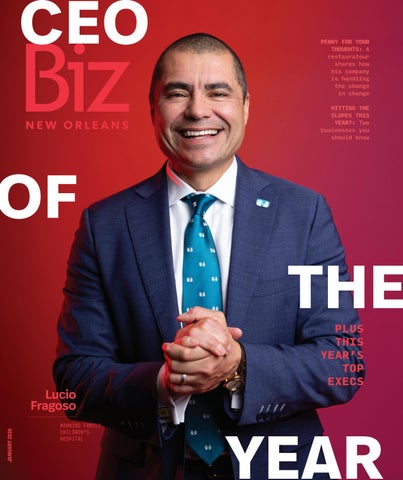
CEO
PENNY FOR YOUR THOUGHTS: A restaurateur shares how his company is handling the change in change HITTING THE SLOPES THIS YEAR?: Two businesses you should know
OF
THE JANUARY 2026
Lucio Fragoso MANNING FAMILY CHILDREN’S HOSPITAL
PLUS THIS YEAR’S TOP EXECS
YEAR
JANUARY EVERY ISSUE
PERSPECTIVES
VOLUME 12 ISSUE 04
FROM THE LENS
58 WHY DIDN’T I THINK OF THAT? Looking to hit the slopes this Carnival season? Now there are two names to know — The Backpacker and Alpinr Mountain Travel
08 EDITOR’S NOTE
10 PUBLISHER’S NOTE
24
HEALTHCARE The City Council’s new Healthy Workplace Program seeks to drive change through recognition and incentives
62 NEIGHBORHOOD GEM Helping Hands Accounting Services
64 NEW ORLEANS 500 Cherie Teamer-Henley, attorney at Teamer Legal Corporation and executive counsel at Pivotal GR Solutions
22 ACCOUNTING A local restaurateur shares how his company is dealing with the change in change
14 SPORTS New LSU head coach Lane Kiffin destined to bring les bons temps, along with drama
16 TOURISM A year after the Jan. 1 attack, New Orleans is balancing grief with forward movement 18 ENTREPRENEUR Please excuse me as I let my imagination run a little wild with some entrepreneurial predictions for 2026
30 BANKING + FINANCE Why businesses should stop waiting to start capital planning and tips for success
38
34 ECONOMIC DEVELOPMENT If we want New Orleans’s market to have a strong path forward, this is what we’ve got to do
36 GUEST Louisiana’s largest worker’s compensation carrier offers advice on creating a culture where service strengthens both people and performance
54
GREAT WORKSPACES
With a legacy of evolution, local architecture firm practis finds a new home on Magazine Street
Executives of the Year
2025 was a year chock full of wins for the region, and our annual Executives of the Year played a big part in the success story
Publisher Todd Matherne EDITORIAL Editor Kimberley Singletary Art Director Sarah E.G. Majeste
Digital Media Editor Kelly Massicot Associate News Editor Kelly Hite Research Alex Jorns
Contributors Veronica Asmond, Brenda Breaux, Walt Leger III, Pike Howard, Jeremy Jones, Ashley McLellan, Misty Milioto, Chris Price, Keith Twitchell ADVERTISING Senior Account Executive Meghan Schmitt 504- 830-7246 Meghan@BizNewOrleans.com Account Executive Abby Palopoli 504- 830-7208 Abby@BizNewOrleans.com
Account Executive Caroline Benoit 504-830-7235 Caroline@BizNewOrleans.com RENAISSANCE PUBLISHING
PRODUCTION Digital Director Rosa Balaguer Arostegui Senior Production Designer Ashley Bravata Production Designer Czarlyn Ria Trinidad MARKETING Marketing Manager Haley Nash Sponsored Content Coordinator Jeremy Marshall Visual Media Producer Mallary Wolfe CIRCULATION Distribution John Holzer
ADMINISTRATION Office Manager Emily Ruiz VP of Sales and Marketing Kate Henry Chief Executive Officer Todd Matherne For subscriptions, call (504) 830-7231
110 VETERANS BLVD., SUITE 123 • METAIRIE, LA 70005 • 504- 828-1380 Biz New Orleans is published monthly by Renaissance Publishing, LLC, 110 Veterans Memorial Blvd., Suite 123, Metairie, LA 70005; 504- 828-1380. Subscription rate: one year $48, no foreign subscriptions. Postage paid at Metairie, LA, and additional mailing entry offices. POSTMASTER: Send address changes to Biz New Orleans, 110 Veterans Memorial Blvd., Suite 123, Metairie, LA 70005. Copyright 2025 Biz New Orleans, all rights reserved. No part of this publication may be reproduced without the consent of the publisher. The trademark Biz New Orleans is registered. Biz New Orleans is not responsible for unsolicited manuscripts, photos, and artwork, even if accompanied by a self-addressed stamped envelope. The opinions expressed in Biz New Orleans are those of the authors and do not necessarily reflect the views of the magazine or owner. Official digital reprint and framed content is only available from Renaissance Publishing, LLC by calling 504- 828-1380.
06
B IZ NE W ORL E AN S
JAN2 6
B I Z N E WORLE AN S.C O M
07
EDITOR’S NOTE
Biz Talks Each week, “Biz Talks” will reach beyond the pages of Biz New Orleans’ magazine to bring you in-depth conversations with members of the business community.
Support Our Standouts
T
I love this issue and this time of year because it’s all about inspiration. In our June issue, we honor our “New and Notables,” people who, for the most part, have taken on a big new role in the past year. Just starting out in their new position, they are always full of plans and goals. In our January issue, we honor — occasionally some of those same people — typically years later for hitting those goals and really making a mark in our community. Lucio Fragoso’s case, however, is unique. Fragoso was promoted from CFO and CAO of what was then Children’s Hospital New Orleans to CEO in February 2023. By the end of that same year, he had already racked up so many big wins — notably heading two big community programs — that we had to include him as one of Biz New Orleans’s Executives of the Year in 2023. Fragoso’s story is the perfect inspiring tale to start off a new year. A child of immigrants and the first in his family to attend and graduate from college, he has an awe-inspiring work ethic — the kind of person who runs 100-mile races, for fun, in his off time. He has a real palpable passion for his work, which is one of the highest callings a person can have — ensuring the health and success of our children. Fragoso likes to push — push his work beyond the boundaries of its walls and into the commu-
nity, push his body to its limits, push those around him to be the best version of themselves. For all these reasons, we are excited to honor him as our 2025 CEO of the Year. Equity, hospitality, biotechnology, technology, healthcare, community betterment. Joining Fragoso this year are our six Executives of the Year. These half-dozen area professionals really impressed us with their work in hospitality, equity, technology, healthcare and economic development over the past year and we are excited to highlight their accomplishments. Please reach out to them and share your support if you can. Here’s to a happy and healthy 2026 for us all! And don’t forget, we look forward to sharing all your news in the new year too! Keep us posted at editorial@bizneworleans.com. Happy New Year and thanks for reading,
KIMBERLEY SINGLETARY Editor Kimberley@BizNewOrleans.com
THE ALLIANCE OF AREA BUSINESS PUBLISHERS AWARDS 2025 Silver Best Overall Design Silver Best Feature Layout 2024 Silver Best Daily Newsletter Silver Best Feature Layout Silver Best Beat Reporting, Real Estate 2023 Gold Best Feature Layout Gold Best Beat Reporting, Real Estate Silver Best Feature Series Silver Best Personality Profile Silver Best Cover Silver Best use of Photography/Illustrations Bronze Best Overall Design 2022 Gold Best Feature Gold Best Recurring Feature Silver Best Feature Layout 2021 Gold Magazine Design Gold Best Explanatory Journalism Gold Feature Design Silver Best Feature Bronze Best Use of Multimedia 2020 Silver Best Recurring Feature 2019 Gold Best Recurring Feature Gold Best Explanatory Journalism 2018 Gold Most Improved Publication Silver Best Recurring Feature 2017 Silver Best Recurring Feature Bronze Best Daily Email 2016 Bronze Best Feature Layout
08
B IZ NE W ORL E AN S
JA N 2 6
Episode 266 The Business Case Against ICE’s Operation Catahoula Crunch
A week into ICE’s “Operation Catahoula Crunch,” New Orleans’ immigrant community, along with businesses that employ immigrants, are feeling the effects. This week, Mayra Pineda, president and CEO of the Hispanic Chamber of Commerce of Louisiana, pushes back against misinformation online and shares what she’s hearing from area businesses and what the chamber is doing to support New Orleans’ only growing community. Episode 264 French Truck’s New Leadership Change Talks Future Plans
Founded by New Orleanian Geoffrey Meeker in 2012, French Truck Coffee has become a local coffee success story with now 13 locations across New Orleans, Baton Rouge and Memphis. Last month, Meeker stepped away as CEO, handing the company over to long-time partner Bobby Winston and his brother Sam. Together, the Winstons share their thoughts on how coffee is changing and what they envision for the future of French Truck.
AVAILABLE ON: Spotify, Apple, Audible, Amazon Music, Anchor, Overcast, Pocket Casts
PUBLISHER’S NOTE
SALES TEAM
Building on the Momentum
L
ast month, two outstanding annual meetings set the tone for the year ahead and offered a clear snapshot of where our region is headed. JEDCO and the New Orleans Chamber once again did an exceptional job bringing the business community together; their annual luncheons were the largest I have seen in many years. The energy in the room was unmistakable — a sense of optimism rooted in the successes of 2025 and a shared excitement for what promises to be a banner year in 2026. That momentum continues this month with several business gatherings and leadership transitions across the region. I encourage you to mark your calendars and attend as these business organizations pass the gavel, recognizes champions from 2025, and set priorities for the year ahead: • JANUARY 8 Jefferson Chamber, Alario Center • JANUARY 13 St. Tammany Chamber, The Greystone • JANUARY 15 Thibodaux Chamber, Nicholls State University Ballroom • JANUARY 21 St. Bernard Chamber, Docville Farm • JANUARY 22 Westbank Business & Industry Association, Stonebridge Country Club
START THE NEW YEAR RIGHT! GET 10% OFF A NEW SUBSCRIPTION. *Must order online, new subscribers only expires January 31, 2026.
10
B IZ NE W ORL E AN S
JA N 2 6
I also want to highlight a milestone celebration for one of the region’s most impactful leadership organizations. The New Orleans Regional Leadership Institute (NORLI) will mark its 25th anniversary with a gala on January 16 at The MISI (600 Decatur Street). As a proud alumnus of the Class of 2002, I can personally attest to the lasting influence NORLI has had on leadership across the region. All these celebrations are wonderful, but perhaps the most significant moment of the month comes on January 12, when new governmental leadership is sworn in for the City of New Orleans. Helena Moreno, her team, and the incoming city council have a lot of work ahead, but I am confident we will begin to see a city renewed — one that is focused, forwardlooking and “all in” for the residents and business community. The year is off to a strong, optimistic start.
KATE HENRY
VP of Sales and Marketing 504- 830-7216 kate@bizneworleans.com
MEGHAN SCHMITT Senior Account Executive 504- 830-7246 meghan@bizneworleans.com
ABBY PALOPOLI Account Executive 504- 830-7208 abby@bizneworleans.com
TODD MATHERNE CEO and Publisher Renaissance Publishing
CAROLINE BENOIT Account Executive 504-830-7235 caroline@bizneworleans.com
B I Z N E WORLE AN S.C O M
11
PHOTO CSM/ALAMY LIVE NEWS
IN THE BIZ
16
18
On the first anniversary of the Jan. 1 attack, New Orleans is balancing grief with forward movement
Please excuse me as I let my imagination run a little wild with a few entrepreneurial predictions for 2026
TOURISM
ENTREPRENEUR
14
SPORTS
New LSU head coach Lane Kiffin destined to bring les bons temps, along with drama
IN THE BIZ SPORTS
CHRIS PRICE is an award-winning journalist and public relations principal. When he’s not writing, he’s avid about music, the outdoors, and Saints, Ole Miss and Chelsea football.
What to Expect When You’re Expecting New LSU head coach Lane Kiffin destined to bring les bons temps, along with drama BY CHRIS PRICE
S
14
B IZ NE W ORL E AN S
JA N 2 6
ment would allow the Tigers to lure a top-level head coach to Baton Rouge. But with weeks left in the 2025 season, whispers soon rose from the bayou — LSU was locked in on hiring Ole Miss head coach Lane Kiffin. The whispers turned into a roar as speculation grew, and a soap opera erupted. In six seasons with the Rebels, Kiffin led the team to 55-19 record — making him the third-winningest head coach in program history — and had the team positioned to make a run in the College Football Playoff. For weeks, Rebel fans agonized over the prospect of losing their coach, who in a mid-season documentary declared that “he needed Oxford more than Oxford needed him,” to their archrival. Then, on the Sunday afternoon after Thanksgiving, Kiffin boarded a jet bound for Baton Rouge, where he would be named LSU’s head football coach. The breakup wasn’t smooth. Although he made up his mind to leave, Kiffin wanted to lead the Rebels through the playoffs. Ole Miss AD Keith Carter, unwilling to take attention away from his team while also giving Kiffin and LSU a weeks-long opportunity to promote the Tiger football program, denied his request. Kiffin became LSU’s 34th head coach when he signed a
I L LU S T R AT I O N BY PADDY MILLS
ix months ago, the LSU Tigers looked poised to be a shoo-in to make a deep run in the College Football Playoff. Led by head coach Brian Kelly and Heisman Trophy candidate quarterback Garrett Nussmeier, the vibes emanating out of Baton Rouge suggested nothing but success. The Tigers rushed out to a 4-0 record, including wins over then-No. 4 Clemson (17-10) and Florida (2010) before losing three of their next four games. The losses were too much for the Tiger faithful, and athletic director Scott Woodward fired Kelly. Within days, Louisiana Gov. Jeff Landry got involved and fired Woodward. Associate head coach and running backs coach Frank Wilson was named interim head coach, Verge Ausberry became AD, and Nussmeier — who looked hurt for much of the season and was later revealed to have an abdominal injury — was replaced by Michael Van Buren Jr. LSU football appeared to be in complete disarray as questions over Kelly’s contractual buy-out emerged and the team limped to what would be a 7-5 record (3-5 in the SEC). National media questioned what was going on at LSU and whether gubernatorial involve-
seven-year, $91 million deal, making him one of the highest-paid coaches in the sport. So, what are the Tigers getting? Two things. LSU is getting a coach that will bring a lot of fun to Tiger Town. He runs a prolific offense that zips up and down the field. Kiffin is also a maestro on social media. He like to win and he likes to talk. He’s seemingly a tailored fit for LSU. LSU is also getting a coach that brings a lot of drama, most of it self-inflicted. Expect him to make head-scratching decisions that will negatively affect games. While very confident, he doesn’t seem to ask himself what if his brilliant gimmick doesn’t work. Kiffin will bring results, but he’ll also bring a wandering eye. He just left an 11-1 playoff bound team because he feels he can win a national championship at LSU. That’s exactly what Kelly said when he left Notre Dame for Baton Rouge. But Kiffin has a track record. He left Tennessee after one season to go to USC, where he was fired. He was also fired as Alabama’s offensive coordinator a week before a national championship game because he eyed the head coach position at Florida Atlantic, which he left after three seasons to go to Oxford. Any time a high-profile job in college or the NFL becomes available, Kiffin’s name will be linked to it. Rival coaches will use that with potential transfers and recruits. Kiffin will also be under a ton of pressure to live up to expectations in Baton Rouge, more than what he’s ever experienced before. Nick Saban, Les Miles and Ed Orgeron all won a national championship at LSU. He’ll have to not just join but eclipse them. This much is certain; Kiffin and LSU football will draw attention in 2026. Road games in Oxford and Knoxville will be must-see-TV. It remains to be seen, however, whether Tiger fans will be watching the reinvigoration of their team or witnessing a train wreck in slow motion. T
B I Z N E WORLE AN S.C O M
15
IN THE BIZ TOURISM
WALT LEGER III is president and CEO of New Orleans & Company, the official destination marketing and sales organization for New Orleans tourism industry. He may be reached via email at walt@neworleans.com.
One Year Later
On the first anniversary of the Jan. 1 attack, New Orleans is balancing grief with forward movement BY WALT LEGER III
A 16
B IZ NE W ORL E AN S
JA N 2 6
our amazing city and keep it a great place to live, work and visit. Local charities raised hundreds of thousands of dollars for the victims and their families, and the restaurant community came together to support Bourbon Street restaurants and workers who were harmed economically. We united and hosted a Sugar Bowl only one day after the attack, as well as an incredibly successful Super Bowl LIX and Mardi Gras with unprecedented security measures. For more than 300 years, New Orleans has been a critical international port city and the creator of some of the world’s best food, music and traditions. This city shines brightly and is a unique light in the hearts, minds and imaginations of people around the world. That light will not be dimmed by a single act of evil. In fact, it has only strengthened our resolve and love for this community. No matter what challenge comes our way, we come together and show the best of humanity, especially during difficult times. In the past year, New Orleans & Company has reinforced this message to the world: For example, this past holiday season, our city, business owners and culture bearers came
I L LU S T R AT I O N BY PADDY MILLS
s we begin a new year, I would like to remember and honor the victims of last year's horrific New Year's Day attack on Bourbon Street. Since that day, we have proved that no attack will EVER destroy the spirit of this city or dim the unique light that our community shines upon the world. One of the things that sustained us in the horrible days following the attack was the outpouring of love we received from people all over the world. We heard from customers, visitors, journalists and even competitor cities. They all shared their love for New Orleans and pledged their support in standing against evil. We continue to send our deepest condolences to the victims, their families and all those whose lives have been forever changed by this act of terrorism. We are profoundly grateful to the first responders and law enforcement agencies for their work to save countless lives, as well as the work they do every day to protect us. Our business and tourism community united with local, state and federal partners to protect
together to honor the victims of the attack with the Second Line in the Sky. This memorial installation intertwines remembrance with holiday celebrations in a way that only we can. The 822 prayer flags welcomed millions who walked Bourbon Street in December, inviting them to look up, reflect, and be part of something uniquely New Orleans. We hope Second Line in the Sky will become an annual New Orleans holiday tradition and a symbol of hope, remembrance and joy. I salute the project’s creator and visionary, Katy Casbarian, proprietor of Arnaud’s Restaurant and a New Orleans & Company board member — great things can only happen with great leadership. I am so proud of this community and especially the team at New Orleans & Company and our partners. While 2025 was a year of tremendous highs, as well as many challenges, we are moving into the new year reinvigorated and ready to build on the positive momentum created. In 2026, we’re working to create opportunities for New Orleans to play a role in the FIFA World Cup, hoping to draw international visitors to our city between matches in nearby cities. We’ll celebrate America 250 and Sail 250 New Orleans-style, kicking off Sail 250 for the whole nation in New Orleans in May and demonstrating why New Orleans and Louisiana are indispensable to our nation. We will also host global events such as Rockin’1000, LIV Golf, Bocuse d’Or and the Pastry World Cup. These events elevate our great city's global brand and enhance our world-class offerings. When I look ahead to 2026, I see a city that is ready to welcome the world, ready to host events of every size and scale, ready to grow in ways that lift every neighborhood, every worker, and every business, and ready to make New Orleans a harmonious place to live, work, learn and visit. The world is watching. In 2026, New Orleans will prove once again that we are not just “Built to Host,” we are built to lead. Thank you for your partnership.T
IN THE BIZ ENTREPRENEUR
KEITH TWITCHELL spent 16 years running his own business before serving as president of the Committee for a Better New Orleans from 2004 through 2020. He has observed, supported and participated in entrepreneurial ventures at the street, neighborhood, nonprofit, micro- and macro-business levels.
Hey, It Could Happen Please excuse me as I let my imagination run a little wild with a few entrepreneurial predictions for 2026 BY KEITH TWITCHELL
C
18
B IZ NE W ORL E AN S
JA N 2 6
including installing tolls on the Mississippi River, requiring residents to obtain “pet licenses” for all cockroaches on their premises, selling naming rights for city buildings — prompting the announcement of the “IV Waste City Hall” — and conducting a citywide bake sale. Addressing coastal erosion remains a top-burner issue, especially after Governor Landry cancels every remaining land restoration project. The governor’s suggestion that “everyone should take swimming lessons” does not play well. Meanwhile, ongoing land-replenishing efforts by groups like Glass Half Full are augmented by innovative new measures such as injecting Botox into the marshes and airdropping Rogaine on the vegetation. Sadly, the primary result is hairy alligators with weirdly smooth skin. In sports, the Saints show signs of improvement in their second year under Coach Kellen Moore, leading fewer locals to sell their game tickets. While this makes the Superdome again feel like a home stadium, the reduced number of visiting team fans negatively impacts Down-
I L LU S T R AT I O N BY PADDY MILLS
onsidering how bizarre last year was in so many ways, predicting the events of 2026 may not be the best idea I’ve ever had. On the other hand, pretty much anything could happen, so let’s have some fun with the crystal ball, shall we? Shortly after taking office and facing the city’s enormous budget deficit, New Orleans Mayor Helena Moreno decides to seek new revenues by placing tariffs on goods imported from Jefferson Parish. Among her targets are Grand Isle oysters, Zatarain’s spices, Haydel’s king cakes, and all Renaissance Publishing magazines. Jefferson Parish President Cynthia Lee Sheng retaliates by slapping tariffs on Urban South beer, Community Coffee, Aunt Sally’s Pralines, and the Orion spacecraft. Consumer complaints force the two officials to back down, but not before another nail goes into the coffin of regional cooperation. Thwarted on this revenue measure, Moreno seeks new city funding via other methods,
town hotel, restaurant, bar and cheap t-shirt revenues. Paper bag sales also plummet. Inspired by the buzz over the entry of Michelin ratings into the New Orleans dining scene, several imitators attempt to generate their own publicity for restaurant evaluations. One initial success is the Louisiana Seafood Association’s 1 to 4 crawfish scale, but when the crawfish turn out to be imported from China, the venture lands in hot water. Even the Department of Public Works — hoping to generate monies for its substantially reduced budget — jumps in, but its “Four Potholes” designation creates little interest. The federal government's decision to stop minting pennies causes a variety of headaches for area businesses. Pike Howard, owner of Felipe’s Taqueria, predicts that the copper coins will completely disappear by the end of the year. “The biggest challenge will be having to explain to guests why they aren’t getting exact change,” he observed. Customers also rue the loss of those “take a penny, leave a penny” containers often found next to cash registers. Related to this, the revised adage is now, “A nickel for your thoughts” — further reminding unhappy consumers that inflation simply won’t go away. Other inflation indicators include renaming the NFL’s most important position the “dollarback”; renaming the heart of old New Orleans the “French Dollar”; and renaming Interstate 10 to “Interstate 39.95.” In politics, November’s mid-term elections create considerable confusion throughout Louisiana. The elimination of the traditional “jungle primary” infuriates voters hoping to cast their ballots for candidates such as Tiger Woods and Mike the Tiger. Equally confounding are the new “Jackson Pollock” Congressional districts, which somehow manage to place residents from Dry Prong, Cut-Off, Plain Dealing, Jigger, and Waterproof all in the same district. These are just my predictions, but if any of this actually comes to pass, remember — you read it here first! T
PERSPECTIVES
22
30
A local restaurateur shares how his company is dealing with the change in change
Why businesses should stop waiting to start capital planning and tips for success
ACCOUNTING
BANKING+FINANCE
34
36
If we want New Orleans’s market to have a strong path forward, this is what we’ve got to do
How to create a culture where service strengthens both people and performance
ECONOMIC DEVELOPMENT
GUEST
24
HEALTHCARE
The City Council’s new Healthy Workplace Program seeks to drive change through recognition and incentives
PERSPECTIVES ACCOUNTING
PIKE HOWARD is a New Orleans-based entrepreneur who’s grown a family-run taqueria, Felipe’s Mexican Taqueria, into a regional restaurant group. He may be reached via email at pike@felipestaqueria.com.
A Penny for Your Thoughts A local restaurateur shares how his company is dealing with the change in change BY PIKE HOWARD
22
B IZ NE W ORL E AN S
JA N 2 6
the last four to five years. For example, in the restaurant industry we have seen a 30% to 50% increase in base hourly wages over the past five years. Of course, the corollary to this has been wage compression, as our industry doesn't have the profitability levels to support salaries (fixed costs) seeing that same magnitude of increases, but make no mistake, they, too, have gone up. The sheer fact that we can now only make a penny for $0.02-$0.03 a copy seems mind-boggling, yet here we are, in the new
I L LU S T R AT I O N BY S.E. GEORGE
F
or restaurants and retailers, removing the penny from existence means a lot of things. It’s symbolic for those of us who remember the dollar menu at McDonald's or the true meaning of a “dollar store” — where everything was intended to be no more than a dollar, at least pre-sales tax. The “death of the penny” is a microcosm for the immense inflationary pressures over
paradigm, and like we have done before, we will find ways to keep the operations going, with or without pennies. What does it truly mean for those in businesses that still must or choose to accept cash? (As an aside, you would be hard pressed nowadays to find any restaurant or retailer, whose sales aren’t in the neighborhood of 70% to 80% cashless, but we also aren’t willing to part ways with the 20% to 30% or so of consumers that are using cash.) You could gyrate for hours on the mathematical implications of this, by pricing every menu item to hit a nickel or dime (0 or 5), but when you throw in taxes (i.e. percentages) on numbers, the math can get a bit mind bending. Furthermore, you can imagine the additional burden placed on employees having to do rounding in their head: “If it ends in this digit, round up; this one, round down. It will all balance out, right?” Not to mention the consumer perception of this process, sounds fun… One can see how this quickly spirals into a worm hole — so what do you do? You use technology. Let the computer do the work. We built some code into our point-of-sale systems to execute “rounding logic” on cash transactions. This means: • If the final digit of total ends in 3, 4, 8 or 9 cents, round up to the nearest nickel. • If the final digit ends in 1, 2, 6 or 7 cents, round down to the nearest nickel. • If the final digit ends in 0 or 5 cents, do not round at all. Regardless, finding a solution is quickly approaching as pennies are already becoming scarcer, to the point where we have team members bringing them from home. While change can be good, and logically, the “death of the penny,” makes sense, it does not alleviate the burden on the small and large businesses alike that are saddled with the responsibility to figure it out. T
B I Z N E WORLE AN S.C O M
23
PERSPECTIVES HEALTHCARE
24
B IZ NE W ORL E AN S
JA N 2 6
KELLY HITE is the associate news editor for Biz New Orleans, responsible for delivering daily business news on BizNewOrleans.com, focusing on developments that impact the greater New Orleans area and southeast Louisiana. She may be reached via email at KellyH@BizNewOrleans.com.
W
hen the New Orleans City Council voted unanimously in late September 2025 to create the Healthy Workplace Program, it set a new standard for employers. The program, housed within the New Orleans Health D epartment, is designed to recognize workplaces that offer living wages, healthcare access, paid leave and the freedom to organize. For Step Up Louisiana, the community group that helped shape the policy, the vote marked a key milestone in a larger campaign known as the Workers’ Bill of Rights. The Healthy Workplace Program is the first major initiative to advance under that framework.
ARE WORKPLACES ABOUT TO GET HEALTHIER?
The City Council’s new Healthy Workplace Program seeks to drive change through recognition and incentives BY KELLY HITE
New Orleans voters approved the Workers’ Bill of Rights charter amendment on November 5, 2024, with about 80% support. The measure added workplace rights to the city’s Home Rule Charter and laid the groundwork for the Healthy Workplace Program. “We all deserve access to good jobs that allow us to take care of ourselves, our family, and our community,” said Paulette Taylor, a member of Step Up Louisiana. “This win is a step forward for working people.” A CREATIVE REMEDY
Because Louisiana bars municipalities from setting their own minimum wage or benefits requirements, local organizers needed a different path. Instead of looking to change laws, they decided to pursue a recognition-based model in hopes of shifting norms by highlighting employers already meeting stronger standards and by creating market incentives through public transparency. “New Orleanians should have more power over how our businesses are run,” said Britain Forsyth, policy and research coordinator for Step Up Louisiana. “When we imagined the Workers’ Bill of Rights, we did not want to stop at just making a public statement. We created the Healthy Workplace Program as a creative way to take back power for working people and to recognize and incentivize employers who give their employees the work environment they deserve.” In practice, the program gives workers and consumers a tool to evaluate employers and support those that prioritize employee wellbeing. “A healthy workplace benefits business leaders, working people, and consumers,” Forsyth said. “Our long-term goal is to raise labor standards in New Orleans and create a system where every employer adheres to the Workers’ Bill of Rights.” MISSING PROTECTIONS
For the workers who informed the program’s design, the issues at stake are not abstract concepts. Many describe feeling vulnerable
B I Z N E WORLE AN S.C O M
25
or even endangered in workplaces with few protections and limited ways to advocate for change. “There are not enough rules, laws and policies in place to protect workers,” said Step Up Louisiana member Denise Augustine. “Without unions and organizations fighting alongside them, workers in isolation are afraid to speak up for themselves, even when advocating over violations such as overtime pay, sexual harassment and lack of workplace safety.” Augustine pointed to emergency room nurses who regularly face unsafe conditions without adequate security or supplies. “Many employers do not offer proper security and safety protocols for their workers, including not even having first-aid kits,” she said. “When we organize and see real progress like the Healthy Workplace Program — workers speak up.”
We created the Healthy Workplace Program as a creative way to take back power for working people and to recognize and incentivize employers who give their employees the work environment they deserve. Britain Forsyth, policy and research
coordinator, Step Up Louisiana
WE CAN’T AFFORD NOT TO MAKE CHANGES
For some workers, the lack of paid leave has led to devastating medical consequences. Terry Mogilles, a University Medical Center New Orleans nurse and member of National Nurses United, recalled caring for hospitality and construction workers who returned to their jobs far too soon because they needed the income. “I had a patient who was a single mom to small children, and she could not afford to take off after an injury, so she continued to work in a boot and crutches,” said Mogilles. “Her inability to take off turned a small injury that would have healed into needing several more surgeries. Eventually, the woman had to lose her whole leg at 28 years old. This is a public health crisis when people do not have time to heal.” While workplace initiatives often sit within economic or workforce offices, Step Up Louisiana insisted on placing the Healthy Workplace Program under the Health Department, arguing that labor standards and public health are inseparable. The stress created by unstable or unsafe jobs, she added, reverberates far beyond the workplace. “Imagine entering crisis mode every time things inevitably pop up and not having the time or money to address them,” she said. “When you have a healthy workplace, you have the ability to enjoy your life, address your health, go to the doctor, and also take a vacation without fear of losing income.”
26
B IZ NE W ORL E AN S
JA N 2 6
WHAT COUNTS AS A HEALTHY WORKPLACE?
Under criteria developed by Step Up and adopted by the Health Department, participating employers must: • offer a living wage; • provide or facilitate access to healthcare; • offer paid leave; and • allow employees to organize without intimidation. “The program is a way for city officials to recognize local employers who support their employees’ well-being,” Forsyth said. “And a way for working people to evaluate employers to ensure they support their employees’ well-being.” Augustine said these standards translate into something tangible. “A healthy workplace looks like a place where employees are happy to come into work, who are grateful to work in such a positive environment,” she said, “and it looks like stability and a place where you want to work until you retire.” ADDRESSING THE LIFESPAN GAP
Organizers argue that workplace conditions shape not only economic outcomes but also health disparities. “In New Orleans, the residents of the wealthiest, majority white neighborhoods are living more
than 20 years longer than residents of the poorest, majority Black neighborhoods,” Forsyth said. A 2023 analysis by The Data Center found that the New Orleans metro area has some of the widest neighborhood-level life-expectancy gaps in the nation, with residents in the highest-income, majority-white neighborhoods living more than 82 years on average, compared with under 71 years in the lowest-income, majority-Black neighborhoods. “The path to addressing the lifespan gap ... starts with a healthy workforce,” Forsyth said. WHAT STRONGER STANDARDS MEAN FOR BUSINESSES
For employers already meeting high workplace standards, the Healthy Workplace designation offers public recognition, recruitment advantages and visibility through decals and a public directory. Participating businesses also join a network that shares resources related to benefits and worker support. Concerns about cost, advocates say, overlook the financial value of stability. “It is more profitable because employers can stop having to train people because their turnover is so high,” Augustine said. “A company's success is actually tied to the employees' investment in the company. If you pay people good money, they will work hard.” Forsyth emphasized that small businesses wiould receive support, including guidance on meeting the criteria and access to shared resources. “These aspirations and resource sharing are provided to employers through the Healthy Workplace Program,” she said. A FRAMEWORK FOR THE FUTURE
With the program adopted, Step Up Louisiana is now working to establish a Workers’ Commission to support ongoing dialogue between employers and employees and expand public understanding of workplace issues. “We want to make sure workers can have public conversations with each other and employers about how they are treated, in addition to how they should be treated,” Forsyth said. For Forsyth, the stakes are clear. “Unregulated workplaces are killing us, and it is time to close that lifespan gap. We hope New Orleans employers, business associations and economic development organizations join us in establishing, promoting and supporting better workplaces for all New Orleanians.”T
PERSPECTIVES BANKING+FINANCE
JEREMY JONES serves as executive vice president and head of specialty lending and capital markets for Hancock Whitney Bank. He may be reached via email at jeremy.jones@hancockwhitney.com.
Capital Planning — It’s Time
Local expert explains why businesses should stop waiting and offers tips for success BY JEREMY JONES
A 30
B IZ NE W ORL E AN S
JA N 2 6
INDUSTRIAL AND INFRASTRUCTURE MOMENTUM IS FUELING DEMAND
Across South Louisiana and the broader Gulf Coast, industrial contractors continue to see significant activity. This momentum is coming from two directions: traditional industrial and refining facilities being built or expanded, and the rapid acceleration of data center development. Large contractors are securing substantial projects, creating a ripple effect for smaller specialty contractors who support them. Telecommunications infrastructure is experiencing similar demand. New data center projects require robust connectivity, and fiber providers across the region are carrying some of the largest backlogs they have seen in years. For business leaders, this activity provides valuable visibility. Multi-year industrial and infrastructure projects tend to smooth economic cycles, which allows companies to plan ahead, staff appropriately and evaluate growth investments with greater confidence. FINANCING TRENDS REFLECT A MARKET PREPARING FOR MOVEMENT
Over the past 12 to 18 months, refinancing has dominated the capital landscape. With M&A volumes lower and lenders eager to put capital to work, borrowers have been able to secure competitive terms and improved pricing. Both traditional lenders and private credit providers are operating with significant dry powder, which has encouraged price compression and borrower-friendly structures. As 2026 begins, interest in M&A is reemerging. Owners who delayed decisions during the height of market volatility are resuming conversations, and we expect some of those transactions to move forward in the near
term. At the same time, demand for construction and infrastructure financing remains strong as major projects progress throughout the region. Bonus depreciation has become an added catalyst for the financing of equipment and certain other depreciable assets. The recent budget reconciliation bill clarified the phasedown schedule, encouraging companies to move forward with these purchases. Many are incorporating depreciation benefits directly into their capital plans for 2026, accelerating investment in equipment and technology. For business leaders, the takeaway is clear. Capital is available, competition among lenders remains strong and companies with well-prepared financials are securing attractive structures. WHAT EFFECTIVE CAPITAL PLANNING LOOKS LIKE TODAY
If there is a single theme that applies to every business preparing for 2026, it is this: start planning early. The strongest companies are not waiting for perfect clarity before speaking with lenders. They are building relationships well before they need capital so potential financing partners can follow their story, understand their strategy and advise them along the way. The best prepared businesses tend to share several traits: They maintain strong financial reporting. Lenders want to see quality financial statements and budgets that show where the business is headed, not just where it has been. They proactively communicate. Early and frequent dialogue allows lenders to provide guidance, suggest structures and prepare credit teams. Surprises rarely help the process. They create certainty in their cost of capital. Savvy businesses model projects around an interest rate or cost of capital that works for their economics, then eliminate rate risk through fixed-rate loans or interest rate swaps. They do not allow fluctuations in market rates to jeopardize project viability. For cyclical or seasonal industries, such as tourism or certain construction segments, additional caution is essential. These companies should focus on maintaining lower
I L LU S T R AT I O N BY S.E. GEORGE
s business leaders enter 2026, the economic landscape may feel noisy. From geopolitical headlines to shifting trade policies, it can be easy to get distracted by the shortterm ups and downs. Yet across South Louisiana, many business owners are taking a different approach. They are focusing on life beyond volatility rather than reacting to every headline. Business leaders who prioritize capital planning now, rather than waiting for market certainty, will be best positioned to take advantage of the Gulf South’s next cycle of growth. That mindset is not only healthy; it is proving productive. In recent months, we have continued to see steady capital planning activity among companies preparing for long-term expansion. These business owners recognize that while uncertainty still exists, the fundamentals of
our regional economy remain positive. For many businesses, the year ahead represents an opportunity to get ahead of evolving conditions, take advantage of strong lending appetite and position for growth. Below are the themes most relevant to decision makers today and actions that can help strengthen their capital position as 2026 unfolds.
leverage and greater liquidity so they can navigate downturns without jeopardizing long-term growth plans. REGIONAL STRENGTHS AND EMERGING RISKS
From an economic perspective, the outlook for South Louisiana is encouraging. The scale of planned and active infrastructure projects continues to support construction employment, industrial services and related industries. These projects often extend over multiple years, which brings stability across cycles. At the same time, several risk factors require close monitoring. Consumer health remains one of the most important. Weakening household spending, rising unemployment or declining credit quality can affect everything from service businesses to hospitality. Banks and non-depository financial institutions are watching portfolio performance closely, and lenders are monitoring commercial and consumer stress indicators to anticipate how broader trends may unfold, given the higher for longer rate environment we have experienced. Trade policy is also creating uncertainty. With major ports across the Gulf South, shifts in global trade flows carry significant implications. Tariffs announcements prompted a wave of advance ordering as companies raced to beat increased customs duties. It will take time for the full impact to work through the system. Ultimately, the cost increases tied to tariffs will reach end customers, and that could influence price stability, economic growth and employment. WHAT BUSINESS LEADERS SHOULD DO NOW
For companies planning capital needs in the next 24 months, several steps can strengthen readiness: • Build early relationships with lenders before a project is finalized; • Strengthen financial reporting and forecasting; • Maintain adequate liquidity, especially for cyclical businesses; • Model investment decisions using a cost of capital that works for your economics and lock it in; and • Communicate often and transparently with capital providers. With consistent planning and a long-term outlook, businesses can position themselves to capitalize on regional growth opportunities while managing emerging risks. Early preparation will be a competitive advantage as 2026 progresses. T
32
B IZ NE W ORL E AN S
JAN2 6
PERSPECTIVE ECONOMIC DEVELOPMENT
BRENDA M. BREAUX is the executive director of the New Orleans Redevelopment Authority, a catalyst for the revitalization of the New Orleans region, partnering in affordable and equitable strategic developments that celebrate the city's neighborhoods and honor its traditions. She may be reached via email at bbreaux@nola.gov.
There is No “I” in Real Estate
If we want New Orleans’s market to have a strong path forward, this is what we’ve got to do BY BRENDA BREAUX
N 34
B IZ NE W ORL E AN S
JA N 2 6
a downturn but instability. This environment creates both risk and opportunity, particularly with recent interest rate cuts that may re-energize buyers who have been watching the market from the sidelines. The rental market, however, is more complex. The average rent in New Orleans sits at approximately $1,383, with studios averaging $1,277 and three-bedroom units around $1,693. Projections suggest modest increases by early 2026, with an estimated citywide average of $1,320. But averages tell only part of the story. Some neighborhoods are seeing sharp rent increases driven by demand, while others — often those long affected by disinvestment — are experiencing declines. These patterns highlight a truth we must confront — as goes the worst of us, so goes all of us. A healthy real estate market cannot thrive if entire neighborhoods remain left behind. The city budget will also exert significant influence on the housing and real estate environment over the next several years. As municipal service costs rise, those costs are ultimately shifted to businesses, property owners and resi-
I L LU S T R AT I O N BY S.E. GEORGE
ew Orleans is entering a defining period for its real estate landscape — one marked by uncertainty, opportunity, and the undeniable need for collective action. The forces shaping our neighborhoods today are not isolated; they intersect with our economy, our city budget, our infrastructure, and our shared hopes for a stronger, more resilient New Orleans. At this moment, we cannot approach real estate — whether residential or commercial — with an individual mindset. It can no longer be about “I.” The challenges and opportunities before us require a “We.” Market conditions highlight why strategic coordination matters now more than ever. We’re in a true seesaw market — highly inconsistent, with demand, pricing, and time-on-market swinging in different directions depending on the neighborhood. Some areas are seeing longer listing times and sporadic price reductions, while others are holding steady or even strengthening. Home values are shifting unevenly, signaling not
dents. This has downstream effects on affordability, development feasibility and investment confidence. Our response, therefore, cannot be reactive. It must be strategic. At the New Orleans Redevelopment Authority (NORA), our focus is on long-term, intentional impact. This means directing resources where they matter most, not scattering them broadly across the map, but concentrating them in areas where intervention can stabilize neighborhoods, spark new investment and create equitable opportunity. Strategic thinking requires collaboration, which means creating partnerships with developers, financial institutions, community organizations, residents and policymakers. We must be aligned in both purpose and practice. And partnership means recognizing that no single entity —not NORA, not private developers, not neighborhood groups — can solve our real estate challenges alone. We must bring our collective expertise, our collective resources and our collective vision to the table. When we coordinate efforts, we can address disinvestment, accelerate redevelopment and strengthen the overall housing ecosystem. Of course, none of this is easy as the property insurance issue remains unresolved. Nonetheless, the path ahead involves tough decisions, disciplined prioritization and honest acknowledgement of the disparities that persist in our city. Yet, within this moment lies tremendous opportunity. The market is shifting in a way that may open doors for first-time buyers. Targeted rental support and new development models can stabilize vulnerable neighborhoods. Strategic public investment can unlock growth in areas that have waited too long for renewed attention. New Orleans has navigated difficult terrain before, and we have emerged stronger every time. If we embrace a “we” mindset rooted in shared responsibility and shared impact, we can guide this market into a future that benefits all of us. The opportunity is ahead. Together, we can seize it. T
PERSPECTIVE GUEST
VERONICA ASMOND is the senior vice president and chief human resources officer at LWCC, the largest workers’ compensation carrier in Louisiana. She may be reached via phone at (225) 924-7788.
Successful Companies Turn Purpose into Action
Louisiana’s largest workers' compensation carrier offers advice on creating a culture where service strengthens both people and performance BY VERONICA ASMOND
36
B IZ NE W ORL E AN S
JA N 2 6
personal connection and a more fulfilling experience. • Eligible organizations: Some companies require the volunteer organization to be recognized as a 501(c)(3) nonprofit with sound fiscal and management practices. Communicating clear guidelines for eligibility helps eliminate confusion for employees when selecting nonprofit volunteer opportunities. • Purpose: Prioritize volunteer work that contributes meaningful, long-term community benefits. To help encourage participation, partnerships can make all the difference. By leveraging partnerships, we’re able to create low-lift, consistent volunteer opportunities that maximize employee buy-in and community impact. When employees are empowered to serve, the results are remarkable. In the past five years, LWCC employees and agent partners have donated over 125,000 meals across 35 parishes, participated in community gardening and clean-up projects, and even hosted youthbiking events. These efforts strengthen communities, foster loyalty and compassion, and create shared pride within our company. Research supports the idea that companies that lean into their purpose in deep and meaningful ways are more successful, with more engaged employees. A Deloitte study found that purpose-driven companies report 40% higher levels of workforce retention, and a study by Cone/Porter Novelli found that employees of purpose-driven companies are twice as likely to be motivated. Purpose is powerful, both personally and professionally. As business leaders, we have a responsibility to model purpose in action. Implementing a VTO policy is one way to do that. It dedicates time for employees to live out shared values, builds a culture of care and engagement, and contributes to a stronger Louisiana. For more information, visit LWCC.com/ resource-center. T
I L LU S T R AT I O N BY S.E. GEORGE
P
urpose inspires action in life and at work. As we enter the new year, it’s natural to pause and consider what matters most. For business leaders, this reflection helps us define the principles that guide decision-making and inspire us to do our best work. Implementing a Volunteer Time Off (VTO) policy is one way to bring these principles to life, while strengthening the communities we serve.
At LWCC, our purpose is to help Louisiana thrive, and volunteerism is one of the ways we empower employees to bring that purpose to life. When employees give their time and talents to support others, they create meaningful change in our state, while deepening their connection to the company. Throughout my 30-year career in human resources, I have seen the impact that purposedriven programs can have. Implementing the opportunity for employees to grow closer with their community through service makes for a more well-rounded network of individuals. Employees who are encouraged to give back develop a stronger sense of pride in their work. Teams become more connected, and companies earn greater trust from the people they serve. A VTO policy is not only an act of goodwill, but also a strategic investment in engagement, culture and business success. Here are three steps to create an effective VTO program: • Determine eligibility: Inclusivity is key. At LWCC, all regular full-time and regular parttime employees are eligible for VTO. This ensures that everyone, regardless of their role, has an opportunity to contribute and give back to the community in a way that resonates with them. • Set a time allotment: A clear time commitment gives employees the structure they need to plan their participation. LWCC offers eight (8) hours of VTO each year for full-time employees, prorated for new hires. Employees may opt to take their VTO in two four-hour shifts or one eight-hour shift. • Establish clear requirements: A strong policy provides consistency and helps ensure alignment with company values. Make scheduling protocols clear up front, and consider the following parameters: • Location: Decide whether your company will focus on local organizations or allow employees to volunteer on a broader scale. Letting your employees choose where they give their time contributes to a more
2026 EDITION
INFLUENTIAL, INVOLVED AND INSPIRING EXECUTIVES
The New Orleans 500, an annual publication from Biz New Orleans magazine, profiles the business leaders who are driving the greater New Orleans economy today and making decisions that will shape the region’s future.
ORDER TODAY B I Z N E WO R L E A N S . C O M
BY MISTY MILLIOTO
PORTRAITS BY THERESA CASSAGNE
EXECUTIVES
OF THE YEAR
2025 was a year chock full of wins for the region, and our annual Executives of the Year were a big part in the success story. ¶ Within the following pages, you’ll read about one man’s efforts to raise up more of our culture bearers by expanding on a unique area attraction of his creation, and you’ll learn how a New Orleans native is leading efforts to close the wealth gap by ensuring all members of our community receive the support they need to find success. You’ll read about two leaders in the field of technology — one is crafting an answer to one of modern medicine’s biggest problems while another is reinventing the way our country’s military is trained. You’ll meet two women focused on economic development — one by leading the largest independent hospital district in Louisiana, and another by leading efforts to reinvigorate one of our most notable commercial corridors. ¶ And finally, you’ll learn see all the reasons that this year’s CEO of the year was such an easy decision. Please join us in congratulating Biz New Orleans Magazine’s 2025 Executives of the Year.
P. 39
Michele K. Sutton PRESIDENT AND CEO NORTH OAKS HEALTH SYSTEM MICHELE K. SUTTON, FACHE, was drawn to healthcare administration for a singular reason — a deep sense of purpose to help people when they are most vulnerable. “I wanted to make a meaningful difference, not just in individual lives but across an entire community,” she said. As the head of North Oaks Health System — the largest independent hospital service district in Louisiana — she has become what she calls the “chief storyteller,” ensuring that the public understands the value of the organization’s work. Under her guidance, North Oaks has doubled its provider network and completed more than half a billion dollars in construction projects. Included in that number was this past September’s ribbon cutting on a $50 million, 96,000-square-foot clinic on the Northshore called North Oaks Clinic Building 3, part of what the company says is a mission to modernize healthcare infrastructure and improve access to clinical services. In efforts to address workforce shortages, North Oaks has created a career advancement program that has helped 26 medical assistants become licensed practical nurses and raised minimum wage from $9 to $17 an hour. It has also held medical insurance premiums constant for six consecutive years and created Louisiana’s first hospital-based food pantry for patients and outpatients. The 65-year-old health system is headquartered between New Orleans and Baton Rouge, with facilities in Tangipahoa and Livingston parishes. Boasting more than 3,000 employees,
P. 40
EXECUTIVES OF THE YEAR
it was just honored by Becker’s Hospital Review as one of the “Top 150 Places to Work in Healthcare” in the nation, one of five organizations in Louisiana to earn the distinction. Sutton’s career path has been built on growth and adaptability. Starting as the health system’s community resources officer in 1988, she advanced through increasingly responsible positions, including chief operating officer, executive vice president and ultimately president and CEO. In 2025, she was also named chair of the American College of Healthcare Executives. “Every decision we make is guided by this principle: to enhance the well-being of our patients, employees and community, while preserving the independence that allows us to be nimble and innovative.” Sutton stressed that North Oaks reaches beyond the role of just healthcare provider, into an economic catalyst by contributing $3.2 billion annually to the region’s economy. Her leadership style emphasizes servant leadership and collaboration. “I believe the best ideas often come from those closest to the work,” she says. “Leadership is about empowering others — creating an environment where people feel valued, supported and inspired to achieve their full potential.”
Sandra Herman FOUNDER CELEBRATE CANAL! COALITION IT ALL STARTED during a Q&A session with Michael Hecht, president and CEO of Greater New Orleans, Inc., during which a concerned citizen asked a simple question: “What are we going to do about Canal Street?” Hecht responded that it would take a citizen-led initiative to get something done. At that moment, Sandra Herman, who was in the audience, felt called to act.
SANDRA HERMAN: “Canal Street is the front door and public face of our city and state. A thriving Canal Street projects confidence, prosperity and pride — signaling to residents, visitors and investors that New Orleans is a vibrant place to live, work and build.”
P. 41
Herman is also working to change people’s general feelings about Canal Street. “The biggest misconception is that Canal Street is unsafe,” she says. “While there was a period of concern, that is no longer the case. Nearly 8 million tourists walk Canal Street every year with very few incidents.” However, Herman acknowledges the fact that drawing local residents back remains a key priority. Looking ahead, Herman envisions shortterm success when ground breaks on the first $100 million project in the River District in the coming months. Long-term, she envisions “a Canal Street lined with wide, pedestrian-friendly sidewalks; beautiful lighting; trees and landscaping; and modern storm-drainage systems — all supporting a lively corridor full of higher retail, family-friendly attractions and people walking, shopping, dining and enjoying the city.”
KYLE MONTI: “I wanted to help grow Louisiana and make it better. I realized early on that there weren’t many avenues for technology that could entice young people and keep them here.”
“I accepted that challenge—and I haven’t looked back,” she said. As founder of the Celebrate Canal Coalition, Herman is spearheading an ambitious effort to transform New Orleans’ most iconic thoroughfare. For Herman, who has always been drawn to challenging issues that affect the public good, the stakes couldn’t be higher. “Canal Street is the front door and public face of our city and state,” said Herman. “A thriving Canal Street projects confidence, prosperity and pride — signaling to residents, visitors and investors that New Orleans is a vibrant place to live, work and build.” The coalition’s most successful initiative to date has been Windows on Canal, an effort launched in February 2025 that commissioned local artists to create storefront installations across seven major businesses. The installations ran through June, and the impact was immediate and measurable. “Over a three-month period, local visitation increased by more than 100,000 people as a direct result of that project,” Herman says. From the beginning, inclusivity has been central to the coalition’s approach. “Our team, our board and all of our events intentionally include partners, vendors and supporters who reflect the diverse community that makes New Orleans so special,” Herman says. She credits the coalition’s success to its dedicated staff and board of directors.
Kyle Monti FOUNDER AND CEO HAPTECH INC. WHEN KYLE MONTI watched his friends leave Louisiana for technology careers on the coasts, he made a different choice. Inspired by his father’s work cleaning up the New Orleans Convention Center after Hurricane Katrina, Monti decided to stay and build something meaningful. “I wanted to help grow Louisiana and make it better,” he says. “I realized early on that there weren’t many avenues for technology that could entice young people and keep them here.” Monti spent three years at a New Orleans technology incubator before launching his own company, Haptech, in 2014. His background in physics from the University of New Orleans, where he researched magnetic materials for computing applications, gave him the idea that
P. 42
EXECUTIVES OF THE YEAR
haptic technology could be used in gaming devices and visual simulators. A big breakthrough came when a fellow entrepreneur suggested that Haptech’s linear motor technology could create realistic recoil for military training weapons. “Remember, Haptech is a technology company, not a gun company, so this was a novel approach, but one that paved the way for the company we are today,” Monti explained. The company’s name combines the words “haptic" and “technology.” Haptics relates to feedback that simulates touch — like the buzz you feel texting on your phone. The company’s training weapons use this principle to replicate the recoil of real firearms without bullets, making training safer while collecting valuable performance data. The path to military contracts wasn’t easy, however. In the early days, Haptech pivoted to survive, developing blasters for VR gaming and entertainment venues. At Universal Studios today, visitors can experience Haptech’s technology at the Minion Blast attraction. Meanwhile, Monti persistently pitched military decision-makers. When he couldn’t afford a booth at a convention he wanted to attend, he set up a demo in a nearby hotel suite, where he managed to secure a meeting with a crucial contact. In 2018, the company secured its first major military contract with the Naval Surface Warfare Division, working on virtual training systems. In 2023, Haptech landed contracts with the U.S. Army and Marine Corps totaling more than $11 million. In recognition of Haptech’s success in reshaping military training on a national scale, in 2025, Louisiana Economic Development named Haptech the state’s Innovative Company of the Year. “Today, our technology is training U.S. troops and powering attractions at Universal Studios as well as interactions in the metaverse,” he said. This past December, Haptech launched its next-generation M4 surrogate and Haptech Hub data platform at the world’s largest modeling and simulation conference. “This is the only M4 surrogate on the market to achieve dynamic, repeatable recoil with battery power that fits into the product’s design
P. 43 JONNY LISS: “[JAMNOLA] exists to uplift artists, musicians and culture bearers — especially those who are often overlooked. It is a cultural experience, and you learn something while you are here. That makes all the difference.”
without limitations,” Monti said. “That's what the Department of Defense wants, and that’s what Haptech is delivering.”
Jonny Liss CO-FOUNDER JAMNOLA THE SPARK that became New Orleans’ first experiential museum, JAMNOLA, ignited in a surprising place: the Museum of Ice Cream in San Francisco in 2017. As Jonny Liss — a 30-year veteran of the marketing sales and events industries who recently served as the king of the 2025 Krampus parade — took in the sights of unicorns, giant gummy bears and a sprinkle pool, a light bulb went off. He wondered what it would be like to create an immersive experience that delivered that same feeling of delight, but grounded in the art, music and cultural soul of New Orleans. The idea expanded further after he watched “Meow Wolf: Origin Story,” a documentary about artists staging large-scale exhibits. That vision became reality when Liss and his partner of 23 years, Chad Smith, opened JAMNOLA — in 2020, in the middle of a pandemic — at 2832 Royal Street. “I'm the one with the big, sometimes wild visions for creating joy, community and experiences, while Chad brings the artistic lens and creative approach that shapes those visions into something tangible,” explained Liss. JAMNOLA is an acronym for Joy, Art, Music, New Orleans, and those four pillars define everything about the experience. But what sets it apart from other immersive art installations is its deep roots in local culture. The project has collaborated with 101 local artists (and one Icelandic puppeteer), all contributing to the theme of “roots and wings” — honoring New Orleans’ history while imagining its future. “[JAMNOLA] exists to uplift artists, musicians and culture bearers — especially those who are often overlooked,” Liss says. “It is a cultural experience, and you learn something while you are here. That makes all the difference.” In December 2024, JAMNOLA closed temporarily for a move to a new home. It reopened in June 2025 in a strategic location, at the intersection of Frenchmen Street and the St. Claude Arts Corridor.
“Our goal is to help build a cultural bridge between [these two communities],” Liss said. The $5.4 million move doubled the attraction’s space, allowing it to grow from 17 to 29 installations showcasing the work of more than 100 contributing artists. JAMNOLA includes meaningful installations like NKOMBO: Spaceship NOLA, which celebrates the Black masking Indian tradition with a story by Gina Montana, the historic first queen of Big Chief Tootie Montana of the Yellow Pocahontas. JAMNOLA also partnered with the Black Mardi Gras Indian Cooperative to give the group a permanent presence in the gift shop. For Liss, a New Orleans transplant who fell for the city during Jazz Fest in 1992, JAMNOLA represents a 33-year love affair with the city. “Every part of JAMNOLA is built from that love and our commitment to uplift, support and celebrate the cultural community of New Orleans.”
Kalen Hall CO-FOUNDER AND CEO INFORMUTA DURING HER PHD at Tulane University, Kalen Hall was researching one of modern medicine’s most urgent problems — how doctors couldn’t predict which infections would suddenly become resistant to antibiotics. The gap was especially dangerous for vulnerable patients like those who are immunocompromised or undergoing cancer treatment. The research became deeply personal when fellow PhD student Leo Williams spent three weeks in the ICU after a severe, unexpected infection following routine surgery. One month after Williams recovered, he joined Hall in founding Informuta in January 2023.
P. 44
EXECUTIVES OF THE YEAR
Since launching, Informuta has grown into a multi-site company with operations at Johnson & Johnson Innovation’s JLABS in San Diego and the New Orleans BioInnovation Center. While the focus has long been on what resistance bacteria currently have, Informuta looks for predictive biomarkers that reveal whether an infection is on the brink of evolving resistance. “Think of it like a weather forecast, but for infections,” Hall says. “We have models that read specific patterns in the genome and then warn clinicians before resistance emerges.” So far, Hall and Williams have secured more than $2.75 million in funding, including an STTR award from the National Science Foundation, and expanded the company to nine team members. Clinical validation studies are underway with partners including Ochsner Health and the University of Pittsburgh Medical Center, with commercial availability anticipated in late 2026. While at Tulane, Hall and Williams trained under Dr. Zac Pursell. Hall also worked with Dr. Lisa Morici studying high-priority bacteria and how they mutate to become multidrug-resistant, while Williams focused on cancer genomics and computational biology. Together, they were the first to apply certain analyses originally used in cancer genomics to bacteria, developing a completely novel class of bacterial predictive biomarkers that enable, for the first time, forecasting future antibiotic resistance. The transition from third-year PhD student to CEO challenged Hall in unexpected ways. “I knew the science inside and out, but had never run a clinical study, raised capital, designed FDA-level validation or managed a team,” she said. “Learning how to take deep academic research and turn it into a product that must be reliable, actionable and ready for real patients pushed me far outside my comfort zone. I’ve unexpectedly grown to love the storytelling, recruiting, fundraising and day-to-day problem-solving that come with leading a company.” Hall said she and Williams have big plans for the future. “Our goal is for Informuta to be the trusted brain behind how health systems understand, anticipate and respond to infectious threats.”
KALEN HALL: “Learning how to take deep academic research and turn it into a product that must be reliable, actionable and ready for real patients pushed me far outside my comfort zone.
Judy Reese Morse PRESIDENT AND CEO URBAN LEAGUE OF LOUISIANA FOR JUDY REESE MORSE, the fight for civil rights and community empowerment is deeply personal. Her father, a member of the New Orleans chapter of the Congress of Racial Equality, had pepper blown into his eyes while integrating the lunch counter at McCrory’s in downtown New Orleans in the 1960s. He also rode a freedom bus to McComb, Mississippi — a ride that nearly cost him his life.
P. 45 JUDY REESE MORSE: “Today's challenges call for leaders to be clear-eyed about their organizations and prepared to pivot on strategy if the circumstances require it."
“My father would often recite his version of the famous quote ‘Until all of us are free, none of us are free,’ planting the seeds of collective freedom and opportunity for all in my mind and heart,” said Morse. Her mother’s work teaching English to adults seeking their GED provided another formative influence. As a child, Morse would accompany her mother to night classes, seeing adults sitting at desks, determined to build better futures. “I felt a connection to them personally and, more importantly, to what they were trying to accomplish,” she said. As president and CEO of the Urban League of Louisiana since 2018, Morse channels that legacy into tangible impact. After serving as deputy mayor for the City of New Orleans from 2010 to 2018, she brought her experience in government, communications and community work to lead one of Louisiana’s largest Black-serving statewide organizations. “The past seven years have been deeply impactful for me,” she said. “There is no other organization like the Urban League, and I have been blessed to serve as its leader.” The numbers tell a powerful story. In 2025 alone, the league’s entrepreneurship and innovation programs provided 2,750 hours of counseling to 293 clients, created 31 new businesses, supported 802 jobs and facilitated $21.4 million in capital infusion transactions. Additionally, the organization’s workforce development initiatives connected 1,009 career seekers with employer partners, with 75% of adult participants securing employment at an average of $25 per hour. Morse has led through unprecedented challenges—the pandemic, Hurricane Ida and shifting political landscapes, including the current attacks and rollbacks of diversity, equity and inclusion efforts by businesses and organizations. Her approach has evolved to embrace collective impact models like the SEE CHANGE Collective, which partners with more than 60 organizations to close the wealth gap in Greater New Orleans. “Today's challenges call for leaders to be cleareyed about their organizations and prepared to pivot on strategy if the circumstances require it,” she explained. Her advice to emerging leaders is simple yet profound. “Trust the community you serve and be worthy of the community’s trust.” R
P. 47 BY MISTY MILLIOTO AND KIM SINGLETARY PORTRAITS BY THERESA CASSAGNE
C E O
OF THE YEAR
Lucio Fragoso MANNING FAMILY CHILDREN’S HOSPITAL
WHEN LUCIO FRAGOSO reflects on his childhood in Chicago’s South Side, he sees the children that Manning Family Children’s Hospital now serves today. The son of Mexican immigrants, he often translated for his parents at doctor’s appointments, usually in the children’s hospital emergency room. “I looked a lot like one of the kids that we serve here in the hospital today,” he said. Not long after joining the hospital in 2019 as its chief financial officer and chief administrative officer, Fragoso recognized that same communi-
P. 48
CEO OF THE YEAR
cation barrier at Manning Family Children’s and pushed for action. “Five years ago, we didn’t have any interpreters on staff. Now we have a team of eight,” he said. “We even started a Spanish-speaking-only clinic. We want to make sure we can serve people in the right way. Having this kind of help not only enhances communication, but quality of care, because the physicians certainly need it to get all the information they need.” On Feb. 3, 2023, the hospital announced Fragoso’s promotion to president and CEO after John R. Nickens IV was promoted to president of hospital services and chief of pediatrics for LCMC Health, the nine-hospital health system that manages Manning Family Children’s. The hospital had just completed a $300 million campus expansion at the end of 2021 that solidified it as the Gulf South’s first and largest children’s hospital. In addition to its main campus in Uptown New Orleans, the hospital operates a network of specialty clinics across the state and into Mississippi. On Feb. 5, 2025, during its 70th anniversary year, Children’s Hospital New Orleans announced it was rebranding to Manning Family Children’s following a partnership with New Orleans’ famous football family, the Mannings. Fragoso is quick to credit his own family and upbringing for his success. His father worked grueling 100-hour weeks at a meat-packing plant in Chicago for 52 years, while his mother started a nonprofit serving underserved families called the Frida Kahlo Community Organization — a mission she continues across Chicago Public Schools 22 years later. “The ThriveKids Student Wellness Project that we started here a few years ago I actually shamefully borrowed the idea from my mom and what she has been doing,” said Fragoso. “The whole idea is, how do you get closer to where kids are and support them and support the family unit? One in five kids suffers from a mental health disorder. Suicide is the second leading cause of death for adolescents. That’s not acceptable. So, the thought is, let's not wait for kids to come to us. Let's go to where they're at and bring them the services they need so they feel seen and heard. Now we have social workers and nurses in 200 schools across New Orleans. We've reduced absenteeism, we've reduced suspension rates. I think we did about 17,000 mental health consults in schools, versus them having to come to a clinic or the hospital.”
P. 49 “You have to be a role model. Who you are at work is driven by who you are outside of work... My own personal goal for myself is to do the hardest thing I’ve ever done that year, and then every year you up the ante.”
ThriveKids isn’t the only community outreach program Fragoso has led since taking over as CEO. In April 2023, the hospital announced that it was partnering with the New Orleans Health Department and a national program called Be SMART to promote responsible gun ownership and reduce firearm deaths. While suicide is the second leading cause of deaths for children, guns are the first in Louisiana. So far, the program has distributed more than 2,200 gun safes to families across Orleans Parish, contributing to record-low violent crime rates. The oldest of three boys, Fragoso was the first person in his family to attend college. He earned an accounting degree from Loyola University Chicago and went to work for the accounting firm KPMG, where he worked as an auditor for hospitals. “You'd go into a hospital, spend about six weeks and you'd tell them the issues that are wrong and then you'd leave, but you never really saw any benefit to what you're doing right and for me, I realized I'd rather be a contributor than a critic.” He went to work for one of his clients and then eventually got into pediatric health care. Fragoso worked at Lurie Children’s in Chicago and then Texas Children’s Hospital in Houston for seven years before being recruited to New Orleans. Just like he’s pushed the hospital he leads to think beyond its walls, Fragoso’s work ethic and desire to set big goals and achieve them extends outside of his work. This past summer, Fragoso finally completed Colorado’s Leadville Trail 100. One of the world’s most difficult ultramarathons, the grueling race takes runners through 15,000 feet of elevation gain. It was his third attempt, but after 29 hours, 12 minutes and 16 seconds, he crossed the finish line with 15-year-old Brian Marelo, born with spina bifida and now a wheelchair athlete, who he invited to join him for the final mile. For Fragoso the personal and the professional are always intertwined. In this case, he used the race to raise more than $250,000 for the hospital, running each mile holding the name of a Manning Family Children’s patient. “Their determination and strength carried me through each step,” Fragoso says. “Our kids are my inspiration every single day."
On His Leadership Style “LEADERSHIP IS A LIFESTYLE, number one, that has four key
traits. Number one, I lead with positivity. As a leader, you set the tone for the organization. Do you see problems, or do you see opportunities? How you show up to the organization matters. Remember you could make or break somebody's day with one word. Number two, you have to make a personal investment in the team…It's why I meet every new employee. It's why I
interview every physician. I interview every leadership position. I think it's important that people should know who their leader is. And if I'm responsible for you, I should know who you are. I think here in New Orleans, especially, that relationship and human connection part are so important. Number three, you have to execute — get stuff done. That's a key thing that I try and tell everybody, is to learn to be that person whogets things done no matter what's asked of you. Figure out how to do it and move it forward. The last one is, to me, is the most important. You have to be a role model. Who you are at work is driven by who you are outside of work. The things I do outside of this place make me who I am, so I need to be focused on being the best version of myself outside of here — the best husband, the best son, challenging myself to do difficult things and pushing myself outside of my own comfort zone. My own personal goal for myself is to do the hardest thing I've ever done that year, and then every year you up the ante.”
On His Typical Day “ON A TYPICAL DAY we're going to have about
200 kids inside the hospital, maybe 200 come through the ER, roughly 1,100 that are coming through various clinics. There's a huge amount of human interaction. And then we have 700 physicians and 2,500 staff that help support all of this. And then we've got 30 satellite clinics around the region and we're out across the community, across 200 schools all that. At the end of the day, we're in the people business. So, I spend my day with people. I may be at a new employee orientation welcoming 70 new employees and laying out our vision and culture, and then have a handful of physician interviews, and then there's rounding that happens pretty much every day across the hospital where I'm going to interact with families, our staff, our patients. My buddy Peyton on the fourth floor right now, he's going through bone marrow transplant and can't leave his room, so I go play basketball with Peyton in his room. And then there's this strategic stuff, and then there's the business side of it. I have either a
P. 50
CEO OF THE YEAR
breakfast or lunch with long-tenured employees a couple times a month, anybody that's been here 10 years or more. it's an opportunity to celebrate them for their longevity, for their commitment to the organization and an opportunity for me to get feedback. What's working, what's not working. How I run the hospital is I like to spend as little time in my office as possible.”
On The Best Professional Advice He’s Ever Received “I’LL ANSWER THIS by sharing a quick story. In
my early 20s, when I was working for KPMG in my first job, and in Chicago, you play a lot of softball. I was playing like six days a week. We had this 16-year-old kid on our team named RJ. And some of the guys liked to give RJ a hard time. He had a particularly bad game one day and they were giving him a hard time. I had kind of taken RJ under my wing because I was that kid, that underdog. And his dad, unbeknownst to me, would come to every game, and he would just stand out in right field and watch the game. The day after that particularly tough game, I got a phone call from RJ’s dad. He said, ‘Hey, this is Rich Melman. I just want to thank you for what you did for my kid. I'd like you to come meet me at my office. I want to offer you a job.’ So, I called my buddy Howie, who was on the team. And asked him who is this guy? He said, ‘You don’t know RJ’s dad? He has hundreds of restaurants around the country. The guy's worth a couple hundred million dollars. You should go talk to him.’ So I went, nervous as all get out. I said, ‘You know, Mr. Melman, I just really appreciate the offer, but I just took a job at KPMG, and I think it'd just be in really poor taste if I quit that job… But, as long as I got you here, can I just pick your brain? He said yes. Then I asked him how he got to be so successful. He said, ‘Well, it's easy. If I take care of you, you'll take care of me. And always, always, take care of your best people. Don't treat everybody the same. If they're the best, they deserve to be treated like the best. They deserve the opportunities, the recognition, the financial success. Take care of your best people.’ I always remember those two things he said. And it all started because I was just there doing the
“We will be the first hospital in the country that has a child enrichment center attached to it: Walker’s Imaginarium will open this year. It’s a huge deal, essentially a children’s museum attached to a children’s hospital.”
P. 51
right thing, taking care of some kid that somebody was picking on. That got me two great life lessons and leadership lessons.
On What Excites Him About The Future “THERE’S A COUPLE OF THINGS. One is that we will be the first
hospital in the country that has a child enrichment center attached to it: Walker’s Imaginarium will open this year. It's a huge deal, essentially a children's museum attached to a children's hospital. We have kids who are here three months, six months, nine months, a year, even a year and a half, going through cancer treatment or burn therapy, so we wanted to figure out how to create a space for kids that essentially disguises therapy as fun, and makes fun a part of the healing process. It will be two stories, 18,000 square feet. It's going to have a Ryan Seacrest studio in it. It's going to have a Jazz Fest studio in it. It's going to have a Mardi Gras float. It's going to have a Drew Brees football zone. It's going to have nine holes of miniature golf. Something like this has never been done in a children's hospital before. We are also building a brand new, state-of-the-art, 60-bed neonatology unit — a new NICU. We're the only Level Four NICU in the state that has all of the medical and surgical
specialties that are needed right to take care of the sickest and tiniest babies. This is important because we're in a state right now where the rate of premature births continues to increase. For instance, for micropreemies — babies born at 28 weeks or earlier — we had 44 in 2025, a 30% increase over the previous year. We’re also going to be expanding our outpatient behavioral health access across the city, across all of our schools. And then, something I don’t think most people know, is that we're the only children's hospital in this entire region, and only one of a handful in the country, that has a cure for sickle cell disease. We take care of the most kids in the country that have sickle cell disease. What I'd like to see us do is continue to expand that because right now that treatment is only available for, I believe, kids 11 years and older. We want to reduce that age through clinical trials to down to age 5. That’s so important because the quality of life with sickle cell is so poor. It's an incredibly painful disease. The pain episodes are horrible. They're described like shards of glass going through your veins, and untreated, it can take 30 years off a person’s life.
On Upping The Ante In 2026 “I ALREADY SIGNED up for another 100-mile race.
This one is in Steamboat, Colorado. This one has more of an increase in elevation — instead of 15,000, it’s 23,000 feet of climbing. My plan is to do two 100-mile races this year. This is all in preparation for what I want to do in 2027, which is run the Moab 240. My wife and family are very supportive in all of this. I actually met my wife, Jill, at the start of a 200-mile relay race. She was on a team of nine and I was on a team of three. I chased her for 200 miles until she’d go out with me. We went on a date the next day. We got married that same year, in 2010. We have five kids between us. She’s awesome. She’s the chief HR manager at LSU. She still races too, and she's way better at it than I am, so I've got a good role model there.” R
FROM THE LENS
54
58
62
64
Looking to hit the slopes this Carnival season? Now there are two names to know — The Backpacker and Alpinr Mountain Travel
Helping Hands Accounting Services
Cherie Teamer-Henley, attorney at Teamer Legal Corporation and executive counsel at Pivotal GR Solutions
WHY DIDN'T I THINK OF THAT
NEIGHBORHOOD GEM
NEW ORLEANS 500
GREAT WORKSPACES
With a legacy of evolution, local architecture firm practis finds a new home on Magazine Street
FROM THE LENS GREAT WORKSPACES
PRACTIS // 3450 Magazine St. // practis.design
A FRESH START With a legacy of evolution, local architecture firm practis finds a new home on Magazine Street BY MISTY MILIOTO
PH OTOS BY SARA ESSEX BRADLEY
W
ith its bold use of color and thoughtful design interventions a converted 1920s house on Magazine Street in U p t o w n Ne w O r l e a n s reflects the evolution of an architectural firm that has reinvented itself roughly every 10 years—from Wayne Troyer Architect to studioWTA and now practis. Partners Tracie Ashe and Julie Babin lead this woman-owned firm, which officially became practis after the passing of their mentor, Wayne Troyer, in 2019, and the subsequent upheaval of the pandemic years. The move to 3450 Magazine St. represented more than just a change of address—it was an opportunity to create a space that embodies their outlook on architecture: approachable, collaborative and rooted in the fabric of the neighborhood. When Troyer founded the firm in the mid-1990s, he was a sole practitioner. Ashe joined in early 2003 and Babin in 2006. “My thesis year [at Tulane University] began just days before Katrina hit, and, by the time
54
B IZ NE W ORL E AN S
JA N 2 6
The new home to woman-owned architectural firm practis embraces the use of color and celebrates the firm’s third reinvention with its move from the Warehouse District.
QUICK LOOK Number of years in operation Almost 32
Style of architecture Contemporary with a reverence for the historic Number of Employees Five (Four women in the local office and one independent contractor working from Valencia, Spain)
Persons in Charge Tracie Ashe and Julie Babin Architecture practis
Interior Décor practis
Initial Brand Development Scout (graphic design) and Luke Jones (writer)
I graduated, I couldn’t imagine leaving,” said Babin. “The city was in the midst of rebuilding, and I wanted to be part of the effort to restore the New Orleans I had grown to love.” Around 2013, Troyer began discussing a partnership with Ashe and Babin, leading to a rebrand as studioWTA and their official partnership in 2016. Before his death, he gave them important advice—that when the time came, they should make the firm their own, including changing the name. That moment arrived when their old lease ended and the two women found themselves seeking a fresh start in a post-pandemic landscape. The decision to move from the Warehouse District to Uptown brought unexpected benefits.
56
B IZ NE W ORL E AN S
JA N 2 6
“There’s a wonderful energy and buzz along Magazine Street that feels contagious,” said Babin. “The street is tree-lined, a refreshing contrast to the more industrial feel of the Warehouse District, and everything we need is within walking distance: coffee shops, restaurants and daily conveniences.” The increased foot traffic along Magazine Street also has proven advantageous in unexpected ways. “A few clients have found us simply by seeing our sidewalk sign and walking in to learn more about our work,” said Babin. The location’s residential character also aligns perfectly with the firm’s identity. “Being in a converted house feels homey and reflects who we are as a company.”
The building, constructed in the 1920s as a single-family residence, was purchased in 1996 and converted to commercial use for a shutter business. For practis, the bones of the historic structure provided an ideal canvas for their small firm of only four employees (another independent contractor works remotely). True to their philosophy of respecting historic elements while embracing contemporary style, the partners approached their office design with a light touch. The primary architectural intervention involved opening a portion of a wall to create a cased opening connecting two office areas. “We ensured the new opening is proportionate to the existing tall doors and transoms in the space, while detailing it with a complemen-
Constructed in the 1920s as a single-family residence, the building now housing practis was converted to commercial use in 1996, when it served as home to a shutter business.
tary, simple natural wood surround,” Babin says. “This perfectly reflects our reverence for the old, while embracing the new.” The spatial layout includes a conference room with large windows overlooking Magazine Street and six desks spread across three connected office areas—two desks per room—each flowing into the next through generous openings. “This creates a semi-private environment that strikes a nice balance between the completely open layout of our old office and a more traditional private office setup,” Babin says. The compact property also includes a small materials library, restroom, kitchen, storage room and back shed. The most dramatic transformation came through the interior design.
“The biggest change we made to our space is the color,” Babin says. “Just about everyone who visits compliments the use of color. People are often hesitant to go all in on color in their own homes, so when they step into our space and see it fully embraced, it makes them happy.” The partners experimented thoughtfully with color application, making intentional decisions about where to start and stop each hue. “For example, we extended the green color above the fireplaces onto the ceiling, which catches people’s attention,” Babin says. This confident use of color serves both as a design statement and as a demonstration to clients of what’s possible when embracing bold choices.
Like any home, the practis office remains a work in progress. Future plans include upgrading the kitchen, adding large doors to close off the conference room from other office spaces, refinishing floors, adding wallpaper, replacing the attic stair and improving insulation. “Our new office will probably never be finished,” Babin says. “It’s like owning a home—there is always something you want to change, fix, update or tweak.” The space also has become a venue for community engagement through Art for Arts’ Sake, an annual event the firm has hosted for three years. Their programming has featured artists from Cuba, art by architects and, most recently, photography by local photographers—each opening a success that reinforces their connection to the New Orleans creative community. As a woman-led firm in a profession where only about 27% of licensed architects are women, Ashe and Babin bring what they describe as a unique attentiveness to their work. “Being a woman-led architecture firm means leading with empathy, collaboration and an openness to multiple perspectives,” Babin says. “We tend to listen deeply and care not only about the projects themselves but about the people who inhabit them.” The new office on Magazine Street embodies this philosophy—a space that’s purposeful yet personal, historic yet contemporary and finished yet evolving. In fact, it’s a physical manifestation of practis itself. “We chose the name for its simplicity and layered meaning, which is a nod to both the discipline of architecture and the continual practice of learning, evolving and refining,” Babin says. T
B I Z N E WORLE AN S.C O M
57
FROM THE LENS WHY DIDN’T I THINK OF THAT?
LOOKING TO HIT THE SLOPES THIS CARNIVAL SEASON? Now there are two names to know — The Backpacker and Alpinr Mountain Travel BY ASHLEY MCLELLAN
PH OTOS BY EDMUND D. FOUNTAIN
58
B IZ NE W ORL E AN S
JA N 2 6
THE BACKPACKER 225-925-2667 // backpackeroutdoors.com @backpackeroutdoors ALPINR MOUNTAIN TRAVEL 225-924-4754 alpinrmountaintravel.com // @alpinrmtntravel
“Our ski travelers travel all winter long,” said Matthews, “but our famous ‘Backpacker Ski Trips’ during Mardi Gras are by far our most popular.”
T
he week of Mardi Gras has long been a popular time for ski vacations for Louisianans, as area students enjoy a winter vacation not shared by the rest of the country. It is this Southern love of the slopes that inspired then-LSU student Dale Matthews to launch a brick-and-mortar outfitting company in 1974. Based in Baton Rouge, The Backpacker provided gear and guides for locals looking to escape the chaos of Carnival. “As the business grew over the decades, Mardi Gras ski travel became increasingly popular with families,” explained Michael Matthews, who
purchased The Backpacker and Backpacker Tours from his father in 2006. “Our ski travelers travel all winter long, but our famous ‘Backpacker Ski Trips’ during Mardi Gras are by far our most popular.” Not long after taking over the company, Michael Matthews and his wife, Margo, opened a second location of The Backpacker in Lafayette’s River Ranch development in 2007. As demand continued to grow for packaged travel, especially for winter getaways, from the family’s other company, Backpacker Tours, Matthews decided that having two companies with such similar names wasn’t ideal. In 2025, he rebranded Backpacker Tours to Alpinr Mountain Travel.
B I Z N E WORLE AN S.C O M
59
“In short, we absolutely love taking our customers on amazing mountain adventures and we wanted our name to reflect that,” said Mathews. “But there is also more to it. Our travel agency has always been known as Backpacker Tours, but we have only ever specialized in winter ski travel. Most customers weren’t even aware that they were separate companies. The name Backpacker Tours was not a repre-
60
B IZ NE W ORL E AN S
JA N 2 6
sentation of what we do. At trade shows people assumed we were hiking tour guides, which is far from what we do.” Mathews said the guided tour company’s rebrand has also made it easier to find new clients and to connect with new travelers searching online. “Today’s market demands of social-media marketing, categorization, search engine opti-
mization and branding are very important for capturing the attention of the consumer,” he said. “And you cannot confuse the digital space by trying to be a retail store and a travel agency with the same name, at the same address. It’s too confusing for both consumers and search engines. Alpinr Mountain Travel represents a bold, modern brand that focuses on exactly what is in the name, with over 50 years of experience to back it up. Now we can give the digital space the focus it needs without sending a confusing message.” While Alpinr Mountain Travel provides winter getaways for an expanding digital market of travelers, The Backpacker’s retail mission remains the same for its locations, which now include a store in Mandeville and a website. “When it comes to gear, you will find everything you need for hiking, camping, paddling and all the accessories and fun items that go along with that,” he said. “We also have a huge footwear department including running shoes, hiking shoes, water shoes, casual sandals and boots.” Meanwhile, Alpinr Mountain Travel continues the relationships formed by Backpacker Tours. “We have served tens of thousands of skiers from South Louisiana over the years, and we even have the great-grandchildren of some of our original clients coming along,” said Matthews. “We have customers from areas including New Orleans, Baton Rouge, Lafayette and more who have been with us for years.” Starting off 2026 with a bang, Matthews himself embarked on an around-the-world trip to some of the world’s most remote locations. His trip launched on Jan. 1 at Mt. Yotei Volcano in Japan. “In addition to our regularly scheduled trips, we are really excited about our 2026 World Tour,” he said. “I will be creating a docuseries about skiing all seven continents in under 10 months. The world has so much to offer in the outdoors, and this world tour will embrace the culture, food, skiing and outdoors you can experience on every continent. The eight-episode docuseries will debut this spring on the company’s YouTube channel, @ backpackeroutdoors. “Not only will we be taking our viewers to some of the most amazing ski resorts around the world in Japan and Austria, but we will also be going to those hard-to-reach places – climbing the High Atlas Mountains of Morocco and skiing with penguins of Antarctica,” said Matthews. “I cannot wait to share even more of the world with our clients.” T
TRAVEL EXPERT MICHAEL MATTHEWS SHARES HIS FAVORITE DESTINATIONS Overall Best Ski Resort in North America “For accessibility, great snow, skiing, families and experience, it is hands down Snowmass, Colorado.” Most Majestic Destination “Zermatt, Switzerland, is absolutely mindblowing and fun. I will never turn down a chance to go there.” Best Place to Challenge Your Ski Skills “When it comes to big mountain terrain and a super-fun, rugged ski town, Revelstoke, British Columbia, is hard to beat.”
B I Z N E WORLE AN S.C O M
61
FROM THE LENS NEIGHBORHOOD GEM
HELPING HANDS ACCOUNTING 4480 General De Gaulle Dr. Suite 115 // New Orleans // 504-565-1015 // hhasla.com @HelpingHandAccountingServices
Helping Hands Accounting Services This Westbank business takes the fear and confusion out of tax time for other local businesses BY KEITH TWITCHELL
M
any small businesses focus on serving their communities, but few focus on serving other community businesses. Helping Hands Accounting Services is one of the latter. “I used to work as an auditor for the New Orleans Department of Revenue,” recalled Justin Williams, owner of the accounting firm, “and I realized that many people just don’t know what they are doing. Their books were a mess. I saw a need in the community.” This led Williams to open his business in early 2020, right before the pandemic. Fortunately, the need for tax and bookkeeping services remained steady, and social distancing requirements were manageable. While he maintains an office at 4480 General DeGaulle — the largest part of his clientele is from the Westbank — his two staff members mostly work offsite, and the remotefriendly nature of the firm’s work allows him to have clients in other states. From the beginning, Williams focused on customized accounting services using accessible terminology. “I provide a unique breakdown for every client,” he explained. “I ask clients what they want to call things and then I label everything
62
B IZ NE W ORL E AN S
JA N 2 6
based on what they need and what is particular to their industry. I want the client to understand what their financial breakdown is.” This focus on making sure all clients are clear on their own financial picture, said Williams, is particularly valuable when business owners are working with bankers, especially when they are seeking loans. He also helps them understand their assets and their value as collateral and has represented clients with the IRS and in tax court. Williams stresses the importance of accounting for and declaring all business income, both to obtain loans and avoid tax issues. “All my life I’ve heard ‘I hate taxes,’ but you have an accountant so you can plan for taxes,” he noted. While clients are often tempted to underreport revenues, he shifts their thinking to being meticulous about recording and reporting all legitimate expenses. Helping Hands Accounting Services also advises clients on which corporate structures are best suited to their type and size of business. Managing credit is also a significant component,
one that Williams feels is often overlooked during financial education. “I got my MA and they never told me why my credit report was important,” he reported. “You can mess up your credit in five minutes and that can mess you up for 10 years.” Given the complexity of business finances and the frequent lack of financial acumen, it’s not surprising that Williams finds that simply keeping his clients in order is his biggest challenge. He focuses on educating and advising them, and steering them away from shortcuts and bad practices. “I created a spreadsheet rating my clients from best to worst,” he said. “This way I could see what the worst clients’ needs are and help them become better.” Indeed, this his is underlying purpose for being in business. “At City Hall I noticed that a lot of business owners are just trying to make the next dollar,” he recounted. “I want to help them grow, and I want to see the community grow.” . T
FROM THE LENS NEW ORLEANS 500
EDUCATION
Tulane University Law School (JD), Louisiana State University (BA)
RECENTLY READ
“Women Who Run With the Wolves” by Clarissa Pinkola Estes
Cherie TeamerHenley
Attorney at Teamer Legal Corporation and Executive Counsel at Pivotal GR Solutions
FAVORITE BURGER SPOT
Port of Call
HOBBIES
Hot yoga, running and reading fantasy novels
INSPIRATION
All the women in my life — they are all leaders in their own right
A
A New Orleans native, Teamer-Henley has experience as a political consultant focused on municipal campaigns, land use and municipal zoning, as well as community organizing. She is also a licensed practicing attorney with Teamer Legal, a boutique practice which gives Teamer-Henley the ideal environment across her multiple platforms to focus mainly on clients and issues. T
PH OTO BY THERESA CASSAGNE
64
B IZ NE W ORL E AN S
JA N 2 6
ADDITIONAL Q+A ONLINE AT BIZNEWORLEANS.COM