Eagles expanding play
Paul and Sam Blake
Pioneer with passion
Fozia Saleem
Forging ahead
Richard Bradley

winter 26
Eagles expanding play
Paul and Sam Blake
Pioneer with passion
Fozia Saleem
Forging ahead
Richard Bradley
winter 26
A new year is a time to sharpen focus and concentrate on what really moves the dial.
For us, at the Forum, this means being specific on who we exist to support. The word ‘entrepreneur’ encompasses a broad spectrum of business owners, from life stylers and sole traders to start-up founders, scale up leaders and those running brilliant, hardworking companies striving to be great employers. It also includes the serial entrepreneurs who’ve built and sold businesses and continue to take risks to shape our region. But if we don’t narrow down on who we serve best, then we risk being good, but not electric.
So, we’ve asked ourselves, who really gets what the Entrepreneurs’ Forum is building? Who engages in our activities and walks away informed
and full of new ideas whilst still cheering the success of others?
We believe it’s you: the North East entrepreneurs who are ambitious (yet grounded) and who want to grow alongside others who truly get it. You are generous with your experience and don’t join the Forum to network, you join to connect. You show up, not to be seen, but because you know that your success will be faster, richer and more enjoyable.
That’s why we vet every prospective member, ensuring they meet our criteria and will add to our community, not just consume from it. That’s the community that I am proud to lead, and I encourage every one of you to lean in, contribute and grow with us in 2026. Help us to be electric!
We are built on a foundation of altruistic peer to peer support, and this theme flows strongly throughout our events programme. Of course, it’s not just at our events that you can access the wisdom of your fellow members. The Forum is full of your people, and the door is always open for support. We don’t pretend that being a founder is always easy – far from it. We know that entrepreneurs appear outwardly confident, brilliant at times, yet inside it’s hard, isolating and stressful.
We get it and will help you through whatever challenges 2026 throws
your way. In 2025, 65% of our members reported that they were growing turnover, with one quarter projecting high growth (>20%). We’ve seen our members consistently outpace UK economic growth rates and we want to help you continue to shine this year.
I hope you enjoy this edition of forum magazine which showcases some of the exceptional talent we need to celebrate in our region. Learn about one of the North East’s most exciting university spinouts, Magnitude Biosciences, led by Fozia Saleem, alongside hearing how Richard Bradley has developed his vision for the future of engineering giant, Dyer Engineering. For something a little different, our interview with Mark Deeks, who led the rock choir breakout session at our recent Autumn conference, will make you re-think your relationship with music and understand its power as a well-being tool. This is just a snippet of what’s included in this edition and there’s so much more to explore. So, delve in, be inspired and get in touch if you have a story to share.

Elaine Stroud Chief Executive
proud to be partnered with
The Entrepreneurs’ Forum is a membership organisation created specifically for entrepreneurs in the North East whose businesses generate an annual turnover of at least £250,000. Membership is personal, focusing on the founder or owner rather than just the company – because we understand that being an entrepreneur is more than a job, it’s a way of life that only other entrepreneurs can truly understand. At the Forum, you'll connect with like-minded peers, potential collaborators, and experienced mentors who can provide valuable advice, encouragement, and inspiration throughout your entrepreneurial journey.
Membership starts from as little as £52 +VAT per month. To find out more about who we are, what we do and how to join visit our website or scan the QR Code.

we're stronger together
Chare, Quayside, Newcastle Upon Tyne, NE1 3DF allies-group.com
Editorial
Stacey Crowther stacey@entrepreneursforum.net
Amy Mason amy@entrepreneursforum.net
Nicole Wood nicole@allies-group.com
Advertising
Stacey Crowther stacey@entrepreneursforum.net
Design studio@allies-group.com
To amend your mailing address, or to add/remove yourself email info@entrepreneursforum.net
From inspiring gatherings to thought-provoking discussions, mark your calendars because we’ve got an exciting programme of events designed to spark fresh ideas, foster meaningful connections and help you rekindle your passion for business.
Our events are only open to Forum members and while we've listed a selection of the 70+ events we'll host this year below, for our complete calendar, and to register, please visit our website – entrepreneursforum.net/events

Lunch
The Ship, Redmarshall
Friday 16th January, 12.30pm - 2.30pm
Our members-only socials are the perfect opportunity to catch up, connect, and network with fellow entrepreneurs, all while enjoying delicious food in a welcoming atmosphere.
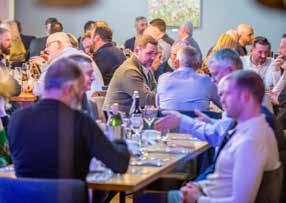
Lunch
The Biscuit Factory, Newcastle Wednesday 28th January, 11.30am - 2.30pm
Picture this: learning from the region’s most seasoned entrepreneurs including Sir Peter Vardy, Brian Palmer OBE, Mark Squires, Steven Bell and Caroline Theobald CBE, over a two-course lunch while swapping ideas, meeting fellow Forum members and walking away with insights that could shape the year ahead.

Workshop: Selling at a Higher Level UMi, Durham
Thursday 5th February, 9.30am - 12.30pm
In this lively and practical workshop, Richard Lane, co-founder of durhamlane and creator of the Selling at a Higher Level methodology, will share how great salespeople think and act differently.
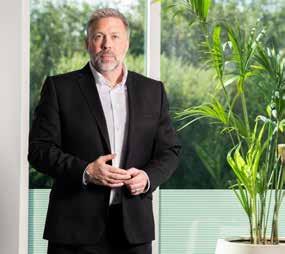
Focus Dinner with Lee Hartley 21, Newcastle
Wednesday 25th February, 6pm - 10pm
From start-up to market leader with £200m in annual revenues, our Entrepreneur of the Year
Lee Hartley has built Fairstone Group into one of the UK’s most dynamic financial services businesses. Join us for a special dinner where Lee will explore the story behind Fairstone including the challenges, the breakthroughs and lessons learned along the way.
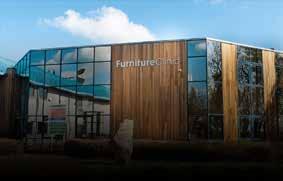
On-site Visit to Furniture Clinic
Furniture Clinic, Consett
Thursday 26th February, 9.30am - 11.30am
From a family garage in County Durham to a global enterprise, Furniture Clinic has transformed the world of restoration and upcycling since its founding in 2004. Following a short introduction from Managing Director Ben Staerck, you’ll enjoy a guided tour of their state-of-the-art facilities, witnessing first-hand how innovation, craftsmanship and sustainability combine to create world-leading restoration products

UMi, Durham
Thursday 19th March, 9.30am - 11.30am
After incredible feedback from her first session, we’re bringing Julie Cuthbertson, Chief Funding Solutions Officer at UMi, back for a deeper dive into one of the biggest questions ambitious entrepreneurs face – how to raise over £500k in external finance.
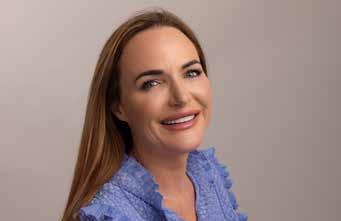
Focus Dinner with Nicola Wood Middleton Lodge, Middleton Tyas
Wednesday 25th March, 6pm - 10pm
Join us for this intimate dinner where Nicola Wood – winner of the Impact Award for her work at the Wonderful Wig Company
– shares her insights, lessons, and reflections. You’ll leave feeling inspired, energised, and ready to reimagine the impact you can have in your own business and life.

Round Table: Making Smarter Decisions with AI
North Sands Business Centre, Sunderland
Thursday 23rd April, 9.30am - 11.30am
Our series of AI round-table discussions brings together the entrepreneurs who aren’t just curious about artificial intelligence – but the ones that are ready to use it, lead with it and get real results from it.
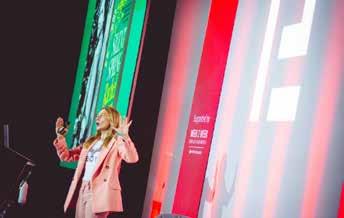
Annual Conference
Ramside Hall Hotel
Thursday 14th May, 8am - 3.30pm
Our annual conference brings together hundreds of business owners to share insight, celebrate success and spark new connections. With inspiring keynote speakers, interactive workshops and practical learning, this flagship event will be fun, inspiring and is one not to be missed.
Our year-round events calendar is designed to inspire, connect and support entrepreneurs navigating the opportunities and challenges of running a business. Below you’ll find a description of the type of events we offer, along with what to expect from each other.
Marking the launch of our annual events calendar, our Founders’ Lunch sees the Forum’s founding, honorary and ambassador members share the one business lesson they’ve learned over a two-course lunch.
£60+VAT (for entrepreneurial members and lead partners)
As the North East’s largest gatherings of entrepreneurs, our annual conference brings top-class speakers to the region from some of the most successful and innovative organisations in the world.
From £120+VAT per person (for all categories of members and partners)
Our annual Entrepreneurial Awards acknowledge the achievements of the region’s most talented and successful entrepreneurs in an evening of celebration and fun.
From £120+VAT per person or £1200+VAT for a table seating ten (open to all in the North East business community)
Our entrepreneur-only focus dinners give you the opportunity to hear stories from trailblazing entrepreneurs that you won’t hear anywhere else. Connect with like-minded entrepreneurs over great food and unfiltered, honest conversations.
£90+VAT (for entrepreneurial members only)
Every quarter, we host a new member online meet and greet session. There is no agenda, just a chance to get to know each other and the Forum team a little better.
FREE (for entrepreneurial members only)
On-site visits are full of helpful ideas to implement in your own business, giving you an exclusive behind-the-scenes tour of some of our region’s most creative and innovative organisations.
FREE (for entrepreneurial members and lead corporate partners only)

Our round tables provide a confidential space for candid discussions, where newer business owners connect with experienced entrepreneurs to share insights, tackle challenges and gain valuable knowledge.
FREE (for entrepreneurial members and lead corporate partners only)
If you’re looking to recharge your batteries, our social events are fun-filled ways to build authentic friendships whether it’s over lunch, at a sporting event or an evening out. Costs may occur (for entrepreneurial members only)
Want to attend one of our events but not yet a member?
Head to our website to find out more or scan the QR code to explore the different options available.
Membership starts from as little as £52+VAT per month. We’d love to welcome and introduce you to the largest community of entrepreneurs in the North East.
Here we shine a spotlight on the entrepreneurs who have joined our membership lately, we’re so excited to have you as part of our community.
Tell us about yourself I am a mechanical engineer by trade, having studied aerospace engineering at the University of Sheffield. Outside of work, I enjoy trail running and playing football whenever possible. Running is my time to relax and think: many of my best business and engineering ideas start and develop while I am out on the trails.


Why did you decide to join the Forum?
I wanted to connect with like-minded people on a similar journey. Some groups and networking events feel transactional, with business developers selling to other business developers, but the Forum fosters a different culture. It is refreshing to get out of my industry bubble, gain diverse perspectives on Subco, and be part of a strong, supportive network.
What do you enjoy most about running your own business?
What I love most is seeing people grow, both professionally and personally; especially those who take a risk and work hard to bring their ideas to life. Creating an environment where people are challenged, supported and can achieve their potential is what really brings me to life.
What was your first job?
As a glass collector at a local working men’s club when I was 14, earning £3 an hour. It was hard work (I must have burned 2,000 calories a shift!), but a great lesson in valuing hard-earned money. Knowing very early on what an hour’s work was worth changed the way I thought about spending and value.
What are you most proud of?
Aside from my kids, I am most proud of creating a business where people genuinely enjoy coming to work. I always believed success would follow if we hired the right people and built the right culture. Realising that vision, and seeing it come to life at Subco, is my greatest achievement so far.
Tell us about yourself I’m the Operations Director and co-founder of Twisted Loop, a data and AI consultancy I started after exiting a previous similar business to Accenture in 2020. Having spent over two decades leading major data transformation programmes with IBM, Accenture and beyond, I’m now focused on helping ambitious mid-market businesses unlock the same power of data and AI. I’ve lived in Sunderland for 17 years with my wife and two boys, and I’m excited to use that enterprise experience to help drive growth across the region.
Why did you decide to join the Forum? I joined the Forum because I’ve found there’s something uniquely valuable about connecting with people who’ve built businesses themselves. The conversations at the events I’ve attended have been open, honest and full of insight. I’m passionate about the North East and want to keep learning from other business owners in the region, while sharing what I can from my own journey in building and growing companies.
What is something most people don’t know about you?
I was once a “phone a friend” for my Dad on ‘Who Wants to Be a Millionaire’. Sadly, he didn’t have the fastest finger to get in the chair so I’m still looking for my millions!
What was your first job?
I started out working at a Little Chef roadside restaurant, doing everything from cooking breakfasts to serving customers and cleaning up at the end of the day. It was hard work but great fun, and it taught me lessons I still draw on today, especially when it comes to people.
If you weren’t running your current business, what do you think you would be doing now? If I wasn’t running Twisted Loop, I’d probably be outdoors somewhere guiding people or teaching the sports I love. I’ve always been passionate about the outdoors, whether it’s kayaking, mountain biking or snowboarding, and I get the same satisfaction from helping others experience it as I do from teaching people about technology.
Tell us about yourself
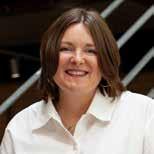
I’ve recently taken on the newly created role of Managing Director at Gardiner Richardson, a strategic brand communications agency in Newcastle. Having taken equity in our business, I am keen to further expand my network in the region.
Outside of work, I am kept busy by my two children, who are four and six, and by our Labrador, who is a bundle of chaos and energy.
What do you enjoy most about running your own business?
The constant challenge and problem-solving. I’m inherently curious, so the thing that’s always appealed to me about brand and marketing is learning about our clients’ industries, their challenges, and how we develop strategies to support them.
What is something most people don’t know about you?
I am an aspiring knitter, but I’ve not progressed much beyond scarves!
What was your first job?
I worked at a riding school while I was at University – I loved being outside with the horses and getting to meet and help lots of different people.
What are you most proud of?
I’m so proud of the partnership we have with the Percy Hedley Foundation, the largest disability charity in the North East. We’ve been working with them for the last year, developing an accessible communications report and providing work experience for adult learners and students from the foundation.
If you weren’t running your current business, what do you think you would be doing now?
It would have to be something varied and involving people – I get my energy and inspiration from being around others.
Tell us about yourself
Hello, I’m Charlotte Prenelle, founder of Pranella – a resortwear and accessories brand.
We create elevated, timeless pieces that are now sold globally in leading resorts, boutiques, and department stores. My role spans across design, product development, operations, and international wholesale, and I’m passionate about building a brand that inspires confidence, adventure, and effortless style.
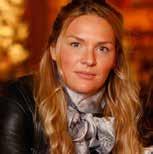
Tell us about yourself

I’m John Forth, cofounder with Is This You?, a CMI recognised coaching company set up to help entrepreneurs to build businesses and lives they love. Collectively with Phil Gray, Steve Beharall and Dave Beharall we’ve built and scaled Is This You? into one of the premier coaching organisations in the North East.
Why did you decide to join the Forum?
Why did you decide to join the Forum?
I joined the Forum to connect with inspirational business owners and engage in meaningful conversations around global business development. I’m particularly interested in the mentorship opportunities available, especially those focused on scaling and growing internationally. There are many members whose experience and insight I feel could offer valuable guidance as I continue to grow my business.
What do you enjoy most about running your own business?
The most exciting part of my business is creating collections that genuinely bring our clients joy. The journey of developing each range – from the initial concept to the moment it reaches our customers – takes me on a global adventure every year, from our factories in Asia to exhibition halls in Miami.
What is something most people don’t know about you?
I actually dropped out of my Fashion Marketing degree to become a DJ – I’ll let you guess how that adventure unfolded.
What was your first job?
My first job was in a clothing boutique called West One in Sunderland. It was owned by friends of my parents, and I started there as the Saturday girl. I saved every penny I earned only to spend it back in the store. This is where I first learned about merchandising, stock control, and the importance of looking after customers.
If you weren’t running your current business, what do you think you would be doing now?
If I wasn’t running Pranella, I would still be doing something creative. I have a real love for food and cooking, so I imagine I’d be working in the catering industry – still creating, still exploring, just in a different medium.
I’m a huge believer in the power of a strong network. I love to be in a room to connect and collaborate with like-minded people on a similar path. There is such an incredible network of amazing, friendly people in the North East business community. We all collaborate and support each other wherever possible.
What do you enjoy most about running your own business?
I’ve been building and running businesses for 30 years and have experienced every stage of the journey. I’ve learned to enjoy all of the ups and downs that affect all entrepreneurs. It’s so important to enjoy the journey as much as possible.
What is something most people don’t know about you?
I’m a huge fan of Bob Mortimer the comedian, and I was honoured to have a night out with him in Manchester, wearing his actual wig from a TV show he was doing. He was the funniest person I’ve ever met, even funnier in real life than on TV. I hope to have a drink with him again, and it’s very possible as one of my best friends is Andy Dawson, who is co-host with Bob of the incredibly popular podcast ‘Athletico Mince’.
What was your first job?
I had several part time bar jobs when I was a young lad, but other than that, my first job was my first business, straight out of university.
If you weren’t running your current business, what do you think you would be doing now?
To be honest, I’ve always run my own businesses since 1995 – I can’t imagine doing anything else. I was asked this on a podcast recently and wasn’t expecting the question, and inexplicably I said stand-up comedian! I don’t really think that, but I do love hosting events, delivering keynotes and speaking on podcasts. So much so that I recently invested in and became a non-exec director of Howell Studios – a podcast studio that is also a virtual TV studio.
More new members shown have joined prior to 1st December 2025:
Gareth Allen Allen Champion and Shaw
Beth Crosier Co4ch
Christian Rowe Executive Compass
Jen Hallam Gardiner Richardson
Louise Woodhall HWI Solutions
John Forth Is This You?
Phil Gray Is This You?
Steve Beharall Is This You?
Aidan Ling Ling Group
Dinesh Kumar Lumanorth
Jonathan Morgan MITS Group
Alasdair Greig Northstar Ventures
Antonia Philp Nursem
Jonny Philp Nursem
Andrew Corsar Owben
Andrew Halpin Owben
Anthony Holmes Owben
Tony Joice Owben
Will Fatherley Pro Fire Safety and Training
Oliver Wickham R9 Group
Martin Reynolds Subco Engineering
Alex Longton Tiba Tempeh
Ross Longton Tiba Tempeh
Malcolm Mathie Twisted Loop
The Entrepreneurs’ Forum is a membership organisation for North East entrepreneurs who run businesses that turnover more than £250,000 per annum. Membership is for the owner, not just the business because we know that entrepreneurship is a life choice that only other founders can truly understand. At the Forum you’ll surround yourself with friends, collaborators and mentors who can offer you guidance, support and inspiration at every stage of your business.
To find out more about what we do and how to join visit our website or scan the QR code.
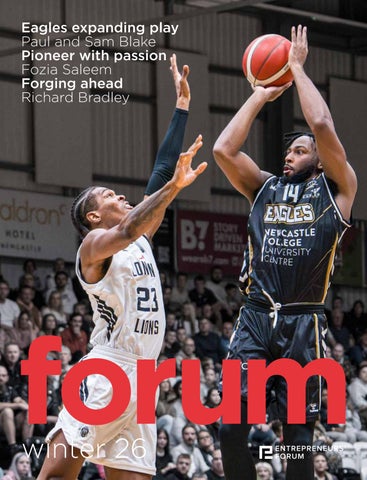
We chat to husband-and-wife team Paul and Sam Blake – the duo behind British basketball’s most successful franchise – about building a club with purpose, powering community change and why, for them, the biggest wins happen off the court…
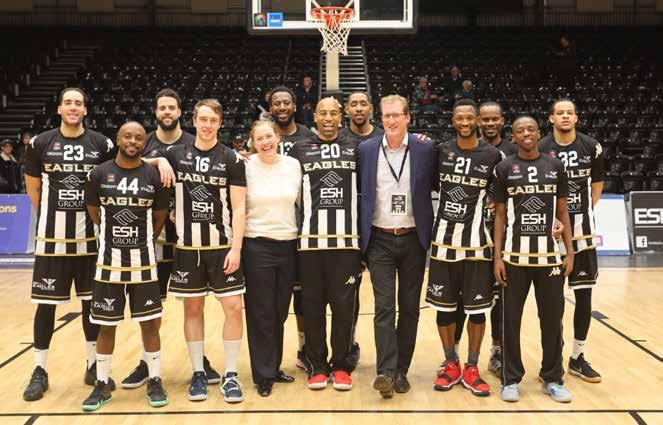
Newcastle Eagles is, at its core, a family business. Run by managing director and owner Paul Blake and his wife Sam, chief executive of the Eagles Community Foundation, the club has evolved from a vulnerable franchise into the most decorated team in British basketball history. Alongside the men’s and women’s professional sides, the organisation now encompasses a purpose-built arena and a charitable foundation that reaches thousands of young people every week across the North East.
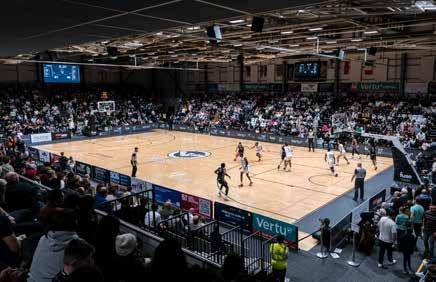
At Vertu Arena, that impact is most visible at weekends, when the building fills with the foundation’s junior league. Close to 180 teams (representing 13 junior clubs from Tyne and Wear and Northumberland) play across two full days, supported by volunteers, coaches and officials who have often come through the system themselves. It is a far cry from the limited regional activity Paul inherited when he first took over the club in 1999.
“It’s the most magical atmosphere,” Sam says. “Youngsters enjoying sport, parents watching from above, people meeting who might never otherwise have crossed paths. And increasingly, it’s the young people themselves who are running the league.” What began as a two-court operation in their old venue has grown into a busy community hub that the Blakes and their team are already struggling to fit under one roof. Paul’s journey with the Eagles started long before the arena doors opened to local families. In the late 1990s he was marketing manager at Newcastle United Sporting Club, the ambitious project led by Sir John Hall that brought rugby, basketball and ice hockey under the same umbrella as the football club. When that business model came to an end in 1999, the basketball team’s future looked uncertain. However Paul and his then boss, chief executive Ken Nottage, were offered the chance to take the club over for £1. Sir John
cleared the losses and handed them a clean slate – and an exciting, yet daunting opportunity.
“I took the club over in August 1999 and here we are 26 years later,” Paul reflects. Back then, the team was playing out of Newcastle Arena, having relocated from Sunderland a few years earlier. Crowds were respectable but far from guaranteed, and the wider basketball landscape in the region was sparse. “There was a job to be done,” he says. “If we were staying in a 7,000-seat arena, we had to build an audience.” For the next decade, he and a small team worked tirelessly to fill those seats, gradually edging average attendances up towards the 3,000 mark and occasionally selling the place out.
That period laid the groundwork for what would become the most decorated team in British Basketball League history. The first trophy under Paul’s ownership did not arrive until 2005 – six years into the journey –but once the breakthrough came,
silverware followed regularly. Yet for all the on-court success, Paul is clear that the real business model was never about quick wins. “From the start our focus was building the sport in the local community, particularly for young people,” he explains.
That philosophy demanded infrastructure, not just enthusiasm. After leaving Newcastle Arena, the club spent nine years at Northumbria University’s Sport Central while Paul quietly explored whether they could build a home of their own. The goal was simple to say and difficult to deliver – a venue the club could control for community use, secondary spend and long-term security. In January 2019 that ambition became reality when the doors opened at what is now Vertu Arena, Scotswood Road, a purpose-built venue that houses both the professional teams and the charitable arm, the Eagles Community Foundation.
Sam leads that foundation as chief executive, overseeing an operation that now supports nearly 180 teams across 13 junior clubs in Tyne and Wear and Northumberland. Week in, week out, those teams feed into the junior league that takes over the arena at weekends. “Our ambition has always been to build an infrastructure that lets young people and their families find the right path for them,” she explains. “Whether that is playing, coaching, officiating or volunteering, we want them to leave in a better position than when they first walked through the doors.” Alongside the leagues and clubs, the foundation runs a performance academy, mentoring programmes for young referees and officials, and courses that allow teenagers to gain governing body qualifications. On any given weekend, it is not unusual to see a teenager who started in the mini league now refereeing games, table officiating or supervising
younger age groups. “It’s the most empowering display of giving back,” Sam smiles. “Young people pay back to their own community by making opportunities possible for others.”
That sense of opportunity matters in a sport that, Sam points out, often sits outside traditional structures.
Basketball is the number two team sport for 5 to 16-year-olds in England, yet the funding picture does not always reflect that popularity. “We talk about a cultural disconnection,” she says. “There are huge numbers of young people playing, but the support systems don’t always see or value that. We want to lobby on their behalf, because what we are really doing is developing rounded individuals with resilience and confidence. Winning games is secondary to that.”
Paul sees that same cultural shift at a global level. For years, British basketball was lazily labelled an American import, something he is keen to challenge. “Basketball is a world sport,” he says. “You wouldn’t tell another country that football is English. The same applies here –every country is playing in the World Cup and the Olympics.” Across Europe, basketball is the secondbiggest sport and in some countries it even eclipses football. With London clubs now competing – and winning – in European competitions and talk of an NBA-style Europe league on the horizon, he believes the game’s profile in the UK is only heading one way.
That momentum does not make running a professional club any easier. Cashflow is a constant concern, particularly in a league where some rivals are prepared to absorb substantial losses in pursuit of rapid growth. “Trying to run a pro sports business at break-even or profit is the exception, not the rule,”
Paul admits. The Eagles aim to operate sustainably, yet they still face the same operational headaches as much larger organisations – arena maintenance as the building ages, unexpected issues like roof damage and the day-to-day challenges that come with managing live events. The solution, as with many growing businesses, has been a small but fiercely committed team willing to juggle multiple roles. “We have some extremely hardworking staff who keep all the plates spinning,” Paul says. Sam agrees. “It’s very selfless being here. People give so much of their time, work beyond their hours and could probably move up the ladder elsewhere, but they choose to stay because they believe in what we’re building.” Many have been with the organisation for 20 years or more, including chief operating officer Susan, whom Sam describes as an “unsung hero” at the centre of everything.
Running the club and foundation as a married couple adds another layer to that dynamic. Sam laughs when asked whether their roles ever overlap. “We’ve worked together for 25, 26 years,” she says. “We absolutely clash – we’re both very strong willed – but we share the same passion to make this the best it can possibly be.” Paul focuses primarily on the professional men’s and women’s teams while Sam leads the foundation, yet their goals are tightly aligned. Both measure success less by trophies and more by the number of people walking through the doors and the impact the sport has on their lives. That shared vision is particularly evident in the women’s game.
The Eagles now run a competitive professional women’s team that plays in Super League Basketball, applying the same long-term strategy that

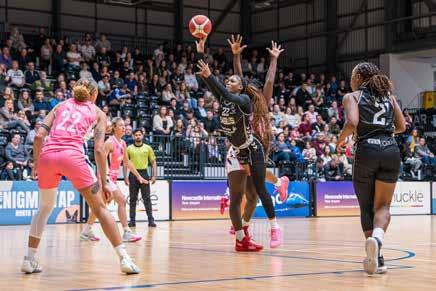
contributed to the men’s success – building participation from the grassroots up and securing the right sponsorship. In a country where netball still dominates in many schools, growing the knowledge base for basketball among girls and young women will take time, but Sam is encouraged by the numbers already coming through the system and by the appetite they see locally.
Both the men’s and women’s teams now compete in our leagues, collectively known as Super League Basketball, further strengthening the club’s unified pathway and identity across the sport.
Looking ahead, neither Sam nor Paul has any intention of slowing down.
“We don’t want to stand still,” Sam says. “The moment we say it’s as good as it’s going to get is probably the time we need to hand it over.”
Their ambitions include extending the Vertu Arena with more courts and seats, deepening the pathway
from junior leagues to the professional teams and continuing to campaign for equitable funding and media coverage for basketball and other under-recognised sports. Above all, they want to reach more young people who could benefit from the sense of belonging the Eagles community provides.
As the conversation draws to a close, Sam offers a message to Forum readers and the wider business community. “If anyone reading this would like to get involved, in whatever way, please get in touch,” she says. “The North East community is all about supporting one another and we wouldn’t be here without that support because we don’t receive the same funding as other sports. We’re only here because our beautiful North East wants us here – and we never take that for granted.”
Together, Paul and Sam have built a franchise that wins titles, yes – but more importantly, they’ve built a club that makes a difference.
By Jimmy Dodgson, Client Services Director at Maitland
Jimmy Dodgson of Maitland shares why a focus on outcomes, not activities, is the only way to GROW in 2026 and beyond.
For decades, business leaders have been sold a version of marketing that is fundamentally broken. You pay for activities, four blogs a month, twenty social posts, a monthly newsletter, then wonder: “What did that actually do for my bottom line?”
This is the ‛Activity Trap’, and in 2026, it’s a death sentence for growth. Traditional marketing delivers vanity metrics: website traffic, social impressions, email open rates that never connect to your bank balance.
High traffic is useless if it doesn’t convert; thousands of followers are a cost if they never buy. Fragmented across multiple agencies, it creates chaos, confusing reports, and zero accountability. You’re paying for activity, not outcomes. The data confirms this crisis. 70% of UK CMOs report being forced to ‛do more with less’, yet only 17% are satisfied with their marketing performance. 56% don’t have enough time to analyse data properly, and
35% struggle with channel coordination. When measurement is fragmented and resources stretched thin, you’re making critical budget decisions on incomplete information. Marketing as a list of siloed deliverables is dead. What’s risen is a singular focus on commercial results. Businesses no longer ask “What did my agency do?” but “What measurable outcome did my investment produce?” So what should ambitious businesses be doing?
Define a single commercial goal
Before you spend a pound, define success in concrete terms. Not ‛brand awareness’, but ‛achieve a 4:1 gross profit return on spend within 12 months’. This North Star aligns every decision. The Data and Marketing Association UK reports £42 return for every £1 spent on properly executed marketing, but this requires clarity and rigorous measurement from the outset.
Demand an accountable partner
A supplier completes tasks. A partner is accountable for outcomes. Find a team whose senior members are actively involved, whose success is contractually aligned with yours, and who focus on business metrics like Return on Spend and Customer Acquisition Cost rather than vanity metrics.
Insist on cohesive planning
Every activity must serve your primary commercial goal. SEO insights inform social content; paid ad data highlights which value propositions resonate. Cohesion turns disparate activities into a single growth engine. Without
it, you’re left with the fragmented chaos that 33% of UK marketers struggle with.
Measure what matters
Focus on business metrics over vanity metrics. UK marketing emails deliver 3,600-3,800% ROI (£36-£38 per £1 spent). Understanding these benchmarks helps you allocate resources to your highest-return opportunities.
The technology exists Modern platforms have evolved dramatically, with businesses using sophisticated technology reporting 32% higher ROI. But many UK marketers cite keeping up with change as a key challenge. What’s missing isn’t the tools, it’s the strategic framework and accountable partnership to deploy them effectively.
At Maitland, we built our GROW partnership model to replace the broken system. Rather than charging for activities, we align our success with yours through outcome-based partnerships. We define a measurable commercial goal together, typically a specific return on spend target over 12 months. Every strategy, campaign, and content piece serves that goal. GROW delivers complete transparency through unified dashboards tracking business metrics, not vanity metrics. We bring together all capabilities under one roof: strategic planning, creative execution, technical implementation, and rigorous measurement. One partner, one plan, one clear measure of success.
The world has changed. It’s time marketing did too!

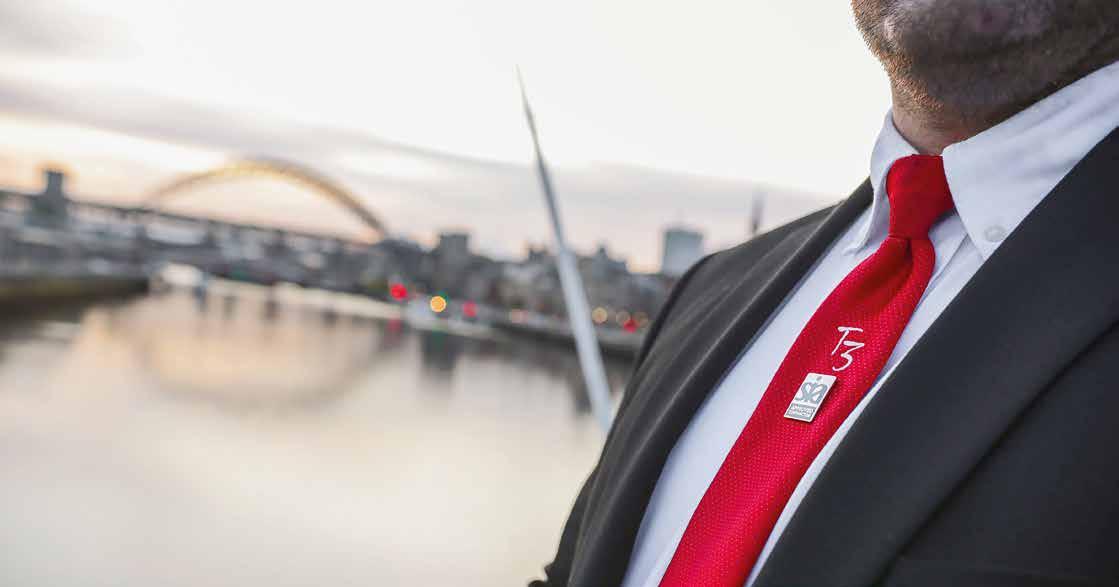
T3 delivers proactive, professional security services tailored to the environment you operate in. Whether managing access to a venue, protecting construction sites, or providing corporate reassurance, our team offers reliable support with a calm, visible presence.
Industries We Protect
Hospitality | Retail | Construction | Corporate Offices | Events
We understand the unique pressures of your industry and provide smart, respectful solutions that blend into your operations without disruption.
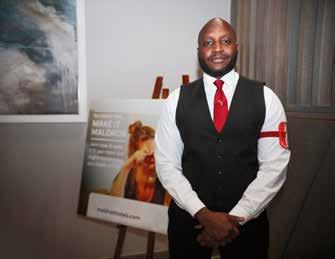

An on-site presence that combines professionalism, deterrence, and a reassuring point of contact. Our guards are trained to adapt to your environment while maintaining a calm, confident presence.
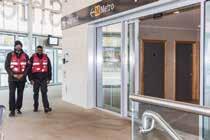
A visible, flexible presence for sites requiring regular checks. Our patrols cover multiple locations with timed inspections and rapid response when needed, smart, cost-effective protection.

Our SIA-licensed door staff create a welcoming yet secure environment, balancing professionalism with a calm, courteous approach. They're there to support your venue and your guests.
Looking for security you can depend on? Based in Newcastle and trusted across the UK, we’re ready to tailor a solution to your needs, get in touch for a personalised quote.
In our One Thing I've Learnt series, Entrepreneurs’ Forum ambassadors and honorary members reveal the one game-changing lesson they’ve learnt in their entrepreneurial journey. Providing a source of inspiration for anyone pursuing a similar path, our guest editors will share some of the critical business challenges they’ve faced and how they overcame them.
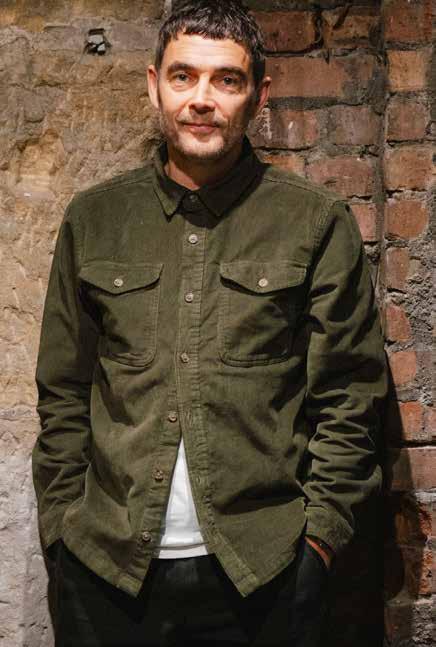
In this edition, Julian Leighton, founder of Orange Bus, talks about why ‘luck isn’t random’, the importance of taking opportunities when they present themselves and how to maximise them when they do.
Years ago I came across some research by Professor Richard Wiseman on why some people feel lucky and others don’t. In one of his most famous experiments, he gave both “lucky” and “unlucky” people a newspaper and asked them to count how many photographs were inside. On average, the unlucky people took about two minutes to finish, while the lucky ones took just seconds. Why? Because on the second page was a large message reading: “Stop counting – there are 43 photographs in this newspaper.” Most of the unlucky people missed it. For fun, Wiseman added another message halfway through: “Stop counting, tell the experimenter you have seen this and win $250.” Again, the unlucky people failed to notice it because they were still too busy counting photographs. Wiseman concluded that so-called lucky people do four things: they stay open to opportunities, they follow their intuition, they turn bad luck into good, and they make the most of
whatever comes along. That really resonated with me, because when I map that onto my own journey, it explains far more than the phrase “right place, right time”.
I’ve had what I’d definitely call unlucky breaks. At 18 I was into graffiti, got arrested, ended up in court and, not surprisingly, my A-levels fell off a cliff. I didn’t get into the London School of Economics like I’d been on track for – I went to Bradford and Ilkley Community College instead, which, with the best will in the world, isn’t quite the same thing. That could have been the moment I decided life had stitched me up. Instead, I found myself in a completely different scene – music, raves, putting nights on – where I learned, very fast, about taking risks, watching cash and even how to negotiate at three in the morning with a nightclub owner I owed £5,000 to. Not the syllabus LSE had in mind, but useful all the same.
A few years later, in corporate life, I hit another fork in the road. I was
working for a meat trading company and the owner was, let’s say, not a leadership role model. One day, while I was on the phone trying to sort out a perfectly reasonable customer complaint, he started shouting and actually threw a phone at me, firing me after I tried to argue my case. I left, took him to court, and won – but the real win was the lesson: if I ever run a business, I will not treat people like that. That apparently “bad” experience became one of the foundations of how we built Orange Bus years later – respectful, collaborative and a genuinely happy place to work. I very quickly landed a much better role – one I’d only gone looking for because I’d been fired. It was with an
IBM Business Partner, a much more professional environment where I started to see how large-scale technology projects came together. I learned about building trust, managing risk, and handling multimillion-pound relationships over six-month sales cycles. It gave me a grounding in process, structure and scale that I’d later draw on constantly at Orange Bus. It also confirmed something important: I could operate comfortably in both worlds – the corporate and the entrepreneurial –and bridge the two.
Probably the biggest “this could have gone very differently” moment, though, was a scooter crash that put me in hospital for months. It was properly life-changing. But it was also
So if there’s one thing I’ve learnt, it’s this: luck isn’t just about what happens to you – it’s about how available you are to it.
the pause that made me ask: do I actually want to stay in corporate life? The answer was no. So I left, did a master’s, bought an old VW campervan and started doing bits of digital consultancy. Driving around in that orange van, I became known as “Julian with the orange bus”, which eventually became “Orange Bus” the company. That wasn’t a 15-year strategy – it was me noticing that people remembered the van, journalists wanted to photograph it, and clients liked the story. So we built on it.
And that, I think, is the real point: luck often shows up looking like hassle. A breakdown. A setback. A conversation you weren’t planning to have.
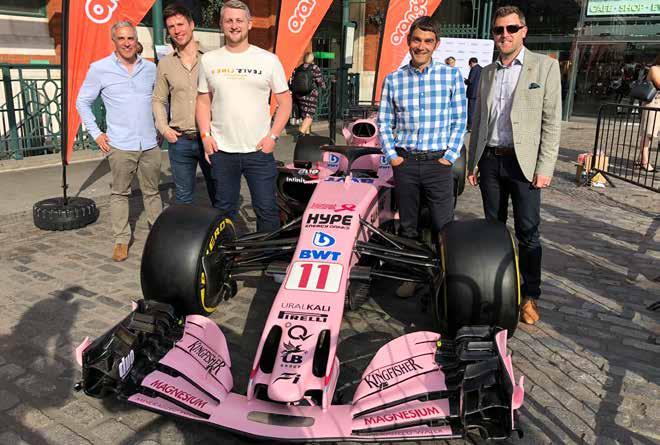
Here’s the best example I’ve got. One day the campervan conked out on the Coast Road. Not a graceful stop either – middle lane, people glaring at me as they passed. Nearly everyone drove on, only one person stopped: a young racing driver called Harry Vaulkhard. We chatted while we waited. I offered to build him a website as a thank you. He put our logo on his car. Then he started winning – first he won the SEAT Cupra Championship, then he moved into the British Touring Car Championship, then into Europe. Because we’d backed him early, we went with him. That got us into motorsport and we were able to move into bigger teams and different championships. From there we ended up working with Aston Martin Racing, Porsche Motorsport and, eventually, Formula One.
If I’d just sat there moaning about old VW vans and said “thanks mate” when Harry pushed me to safety, none of that would have happened. People call that luck. I call it spotting an opening and doing something with it.
Orange Bus went on to become one of the UK’s leading digital agencies, and in 2016 we sold the business to a FTSE 100 PLC. I joined the board of their software business and spent the next few years helping integrate multiple acquisitions. It was a fascinating experience seeing how large corporations plan and operate, and how very not entrepreneurial they can be. Everything was forecast in advance, with little room to deviate either way – no matter how positive or negative the outcome. For someone used to working in
an environment fuelled by experimentation and momentum, it was an education in contrast.
As Yvon Chouinard, founder of Patagonia, writes in ‘Let My People Go Surfing’, entrepreneurs don’t always need the perfect plan –sometimes you take a step towards the opportunity, see how it feels, then take another. If it still feels right, you keep going, if it doesn’t, you step back. That is exactly how so much of my career has gone. We didn’t sit down and forecast our way into working with global motorsport brands or a FTSE 100 boardroom; we saw a door open and we walked through it.
So if there’s one thing I’ve learnt, it’s this: luck isn’t just about what happens to you – it’s about how available you are to it. Most people are heads-down, counting the photographs in the newspaper, to use Wiseman’s experiment, and they miss the line on page two that basically says: “You can stop now. The opportunity’s here.” Entrepreneurs can’t afford to miss that line. We have to keep our heads up. There’s a quote often attributed to Winston Churchill that I’ve had in my head since I was young: “During their lifetimes, every man and woman will stumble across a great opportunity. Sadly, most of them will simply pick themselves up, dust themselves down and carry on as if nothing ever happened.”
notice, and they ask: “What can I do with this?”
That’s not magic. That’s a habit. And it’s the closest thing to luck I know.


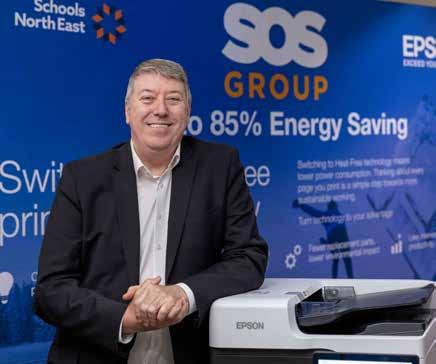
By George Young, Director at SOS Group
Reflecting on a full and varied year, George Young, Director at SOS Group, identifies a common theme to the company's success, whether it’s delivering office technology solutions for startups, for multinationals – or even working alongside a swimming pool.
In the last 12 months, we have supported clients from Land’s End to John O’Groats, working with a wide range of companies, including other Forum members, as well as providing services at 44 major sporting and political party events.
As one of the company’s three Directors, I’m very pleased with the direction we’re heading. We’re entering our 24th year of trading, and every year brings new challenges and opportunities. Our team continues to rise to meet them. The range of client needs is more varied than ever, but we have the experience and expertise required to fulfil them. And we know that, more than anything, quality is the key to our success. Quality in preparedness, delivery, technology and people – it’s the single most important factor for our clients.
Established in 2002, we are a multi-award-winning technology company facilitating all business requirements, including communications and IT, while specialising in providing copy, print and scan solutions to meet any office or event need.
Over the last two decades, we’ve built on our reputation for quality and the high-profile and high-pressure events we’re entrusted with are testament to that.
We’ve worked poolside at international swim competitions, at open water venues, trackside at indoor and outdoor athletics, within horse riding arenas, basketball arenas – you name it. The environments we work within are hugely varied.
What never varies, though, is the requirement for our devices to
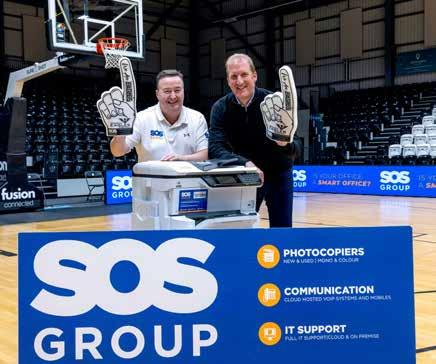
operate seamlessly and the necessity for our clients – who are under pressure to deliver their event – to feel absolutely confident that they can rely on us.
Away from sport, we’ve also provided event services to a leading political party for their annual conference, which presented us with a special set of challenges.
It involved an extremely thorough pre-preparation period and an intense ten days of activity, transporting, setting up, testing and manning 51 devices over a high-
security site of approximately two square miles.
The nature of that particular event made it especially challenging due to the necessary security measures in place. We knew there could be no simple fix or replacement if something failed and, thanks to our detailed planning, everything went smoothly.
It has also been a strong year for SOS Group in growing our client base across a range of sectors, with new contracts signed with household names within leisure, recruitment,


manufacture and education. Alongside new clients coming on board, we’re also very pleased to have renewed contracts with a number of established clients, emphasising the strong working relationships we build.
In addition, we recently transitioned our ISO 27001 accreditation to 27001:2022, updating the highly prized IT security accreditation we’ve held since 2020. That achievement
demonstrates our understanding of quality management and procedural methodology. It also reflects how seriously and securely we treat client data and information, as well as our expertise in supporting clients to do the same.
Looking forward, we already have a very busy events diary for 2026, and we remain focused on supporting all our clients’ objectives. In many cases, clients are aiming to
achieve significant environmental, productivity and financial benefits by replacing their printers and photocopiers with Epson’s heat-free business inkjet devices. This technology consumes dramatically less energy than equivalent laser printers, uses fewer consumables, produces lower CO₂ emissions and requires less intervention from engineers. In short, everything any business would hope for.
During 2026, we’ll also continue our support for charities and organisations that make a positive difference in people’s lives. SOS Group is very proud of our long track record in this area, and more than half of our staff regularly engage in community activity.
As a business, we’ve contributed in excess of £400,000 to support local community projects since our company was launched, and we know that this support has never been more important than it is now.
I like to think that this kind of support is another way we demonstrate our in-depth quality, and the whole SOS Group team is looking forward to another varied year of fulfilling both client and community needs. We have a centralised office on the Team Valley, and our staff – including specialist engineers – service accounts nationally from six regional hubs in London, Scotland, the North West, Midlands, South Yorkshire, South West and here in the North East.
At SOS Group we have the knowledge to iron out the niggles and help make you and your business as productive as it can be.
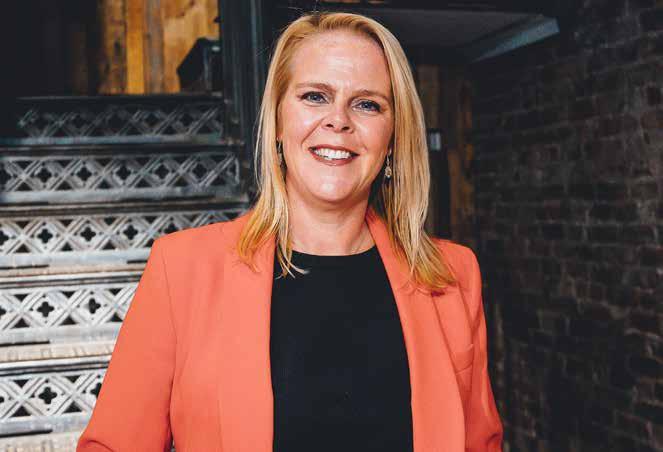
How well do you know your fellow members? In this feature, we shine a light on some of the Forum’s longest standing members, exploring their business journey, their connection to the North East and what makes it such a special place to live, work and grow a successful business.
This time we hear from Louise Kennedy, award winning HR leader and driving force behind Oculus HR, which she founded in 2013. Hailing from Sunderland, Louise shares highlights from her business journey (so far), her love of the great outdoors and how she unwinds after a long week.
Can you tell us what the business does?
Oculus HR is a leading consultancy that supports businesses with everything from day-to-day HR challenges to long-term people strategy. We also design and deliver training and development programmes. At the heart of it, our role is to help businesses bring out the best in their people, whether that’s navigating tricky situations or building a culture where individuals and teams can thrive.
What are the best and worst parts of your job?
The best part is without doubt the people, clients, their teams, and the connections I’ve built along the way.
I love walking into a business and seeing the positive impact of the work we’ve done together, whether that’s improved culture, better engagement, or simply a leader feeling more confident.
The hardest part is patience. Sometimes I can see the solution really clearly, but I know it will take time to bring others on the journey.
HR is never about quick fixes, it’s about people, and people need time to adjust, reflect and grow. It can feel frustrating in the moment, but it’s also what makes the end result so rewarding.
What do you consider to be your greatest achievement?
For me, it’s building Oculus HR into the consultancy it is today. I started with a vision of providing honest, approachable HR support that genuinely makes a difference, and now we’re trusted by so many
businesses across the North East and beyond. That trust – and the relationships that come with it – is something I’m incredibly proud of. I recently found my plans for growth over the first five years. My naivety of those years was good to reflect on and recognise the current achievement.
What is your biggest fear, either personally or professionally?
Standing still. I’m someone who thrives on progress, whether that’s personal development or business growth. The thought of not moving forward, not learning or evolving, feels like the biggest risk of all.
What is one thing that not many people know about you?
You probably do all know this one, however, I have a real passion for travel. I love exploring new places, especially those slightly off the beaten track. There’s something about immersing yourself in different cultures that is both grounding and inspiring – it gives me perspective and reminds me of the bigger picture.
How do you unwind after a long week in the office?
I head outdoors. Being in the fresh air is my reset button – whether it’s walking along the beach or heading up to the Lake District for a hike. It doesn’t matter what the weather’s doing; being outside helps me slow down, switch off and recharge.
What are you currently watching, reading and/or listening to?
I’m a bit of a book collector – I buy them with the best of intentions, but unless I’m on holiday I don’t always find the time to read them! As for TV, a recent favourite was Inflight on Channel4. It was gripping, really well done, and just frightening enough to make you think: could that actually happen to a mother wanting to protect her family?
What makes the North East such a great place to live and work? There’s so much to love, the coastline, the countryside, the warmth of the people, the sense of
I head outdoors. Being in the fresh air is my reset button – whether it’s walking along the beach or heading up to the Lake District for a hike.
community. Professionally, it’s a brilliant place to build connections. Sunderland in particular has been going through such exciting regeneration over the past five years, it’s been incredible to watch the transformation. I honestly can’t imagine living anywhere else; it’s where I feel happiest and most at home.
What is your favourite regional restaurant, coffee shop or bar?
There are so many fantastic choices, but the one we go back to most often is Blacks Corner, the tram shelter in Seaburn. It’s small and local, the food is always fabulous, the team is friendly and engaging, and the views are just stunning.
You have out of region clients visiting, what is the one place that you would recommend they visit?
The beaches. Our coastline is absolutely breathtaking and often takes visitors by surprise. It’s a real showcase of what makes the North East so special.
You have been a member of the Forum for nearly four years. What initially attracted you to join?
For me, the Entrepreneurs’ Forum is the best networking group in the
North East. The variety of events is fantastic – from large conferences and award nights to smaller round tables, focus dinners, and local lunches. But more than that, it’s the people. Members genuinely want to connect, to share, and to support one another. That spirit of collaboration is what drew me in.
What is your favourite thing about the Forum?
I really enjoy the focus dinners. They’re small enough to allow for meaningful conversations and to really hear people’s stories. I keep saying I’ll try one of the golf events too – maybe that’s next on my list!
Finally, what advice would you give to new members or anyone considering joining the Entrepreneurs’ Forum in the future?
Go for it. The Forum is a brilliant place to build connections, not just professionally but personally too.
You’ll meet people who understand the ups and downs of running a business, who are willing to share their experiences and learn from yours. It’s an opportunity to grow your network, find support and make friends along the way. You will get as much out of it as you put into it.
Want the opportunity to connect with like-minded individuals who understand the highs and lows of entrepreneurship?
Head to our website to find out how you can become a member or scan the QR code to explore the different options available. Membership starts from as little as £52 +VAT per month.
From motivational
and
entertaining reads, tv shows and podcasts, forum picks out a selection of
inspiring media...

Hugsy Brightheart and the Missing Star
Written with love by nine-year-old Daisy
Mathieson and her mum Natalie, Executive Assistant to Mike Racz (Forum Member), this touching story was inspired by Daisy’s own experience of losing her dad, Daley, in a tragic racing accident during the Isle of Man TT when she was just three. Wanting to help other children struggling to express their emotions, Daisy with a little help from Natalie created the tale of Hugsy Brightheart – a magical bear whose glowing belly shines with love, courage, and healing. When Hugsy’s best friend, the wise star Lumi, disappears into the sky, he embarks on a gentle journey through grief, memory, and hope, helping young readers understand and navigate big feelings in a comforting, heartfelt way. Perfect for anyone navigating their own grief journey.

Fresh from her breakout role in Hacks, Megan Stalter takes on the role of Jessica Salmon, a thirty-something workaholic commercial producer from New York. Reeling from a devastating breakup with long-term boyfriend Zev (who has quickly moved on to influencer fiancée, Wendy) Jess impulsively takes a job transfer to London in search of a fresh start, where she falls for Indie musician Felix (Will Sharpe). Created by Lena Dunham, this ten-episode romantic comedy is a heartfelt, awkward, and refreshingly honest take on love and reinvention. Paying homage to British genre staples such was Notting Hill, Bridget Jones and Love Actually makes ‘Too Much’ perfect viewing for a wet and wild Winter weekend. Fun fact – The record shop featured in the series is none other than Dash The Henge, which is owned by Forum member Mike O'Brien. Read our Spring edition to hear Mike talk about this in more detail.
Hosted by Ben Gilbert and David Rosenthal, Acquired is a deep-dive business and technology podcast that explores the stories, strategies, and design decisions behind iconic brands such as Google, Nvidia and Coca Cola, uncovering how they grew, pivoted, and sometimes stumbled along the way. From IPOs and acquisitions to the strategies that shaped industries, Acquired combines meticulous research with engaging storytelling. If you’re curious about how companies succeed this podcast delivers insight and analysis that go beyond the headlines.
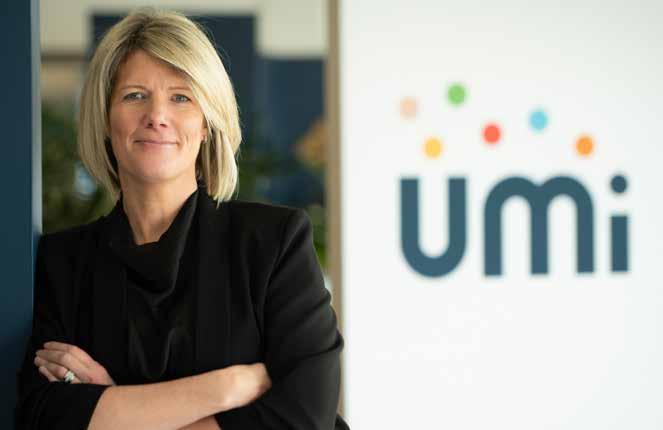
By Nicki Clark OBE, Chief Executive at UMi
UMi believe that when businesses thrive, communities do too. Nicki Clark OBE, Chief Executive, shares why reaching the incredible milestone of over £1billion in investment for UK businesses feels so much more than a statistic. Here, she explains how it's a reflection of the innovation, resilience and ambition that drives entrepreneurs across the country, especially here in the North East.
Since launching in 2007, we’ve been making it easier for businesses to access the right advice and funding solutions. Whether through grants, loans or private investment, we’ve worked alongside ambitious startups, growing SMEs and established companies to help them do more and go further.
In partnership with both public and private sector organisations, UMi has helped more than 680,000 businesses navigate the funding landscape, investing £335m in grants and loans and unlocking £670m in private investment.
But we also know that for too many businesses, accessing finance still feels like climbing a mountain without a map. The British Business Bank reports that 60% of SMEs don’t know where to go to find the right funding, and lending to SMEs has dropped by 50% since 2011. That’s why, even as we celebrate what we’ve achieved, we’re looking ahead to what more we can do to make business finance simpler and more accessible for everyone.
After the successful launch of our Get Funding service, we’ve seen firsthand what ‘accessible’ means in the
world of business finance. Some businesses simply need to know where to look, but others need to understand and prepare for it too. That’s where FUEL comes in.
Launching in early 2026, the FUEL Roadshow is a UK-wide series of events designed to tackle the access to finance challenge head-on. Each full-day will bring together over 250 local business leaders with national funders, investors and advisers to help them understand what type of finance is right for them and how to get funding-ready.
We’re proud that FUEL is backed by national partners including the Minister for Small Business, Office of the Small Business Commissioner, CBI, British Business Bank, and NatWest, and it’s already attracting huge interest.
There’s still time to join us on this journey. We’d love to invite more like-minded partners from across the finance and investment world to work with us to create real, sustainable change for UK businesses.
The first event is confirmed for the North East (17th March 2026), with others planned across Yorkshire, Scotland, the North West, Midlands, South East, and Wales.
This isn’t a trade expo. We’ve designed FUEL to be a practical, no-fluff experience – a day where founders and leaders can meet directly with the people and organisations who can help them move forward. ‘Meet the Money’ sessions have been designed with this in mind, with 250 appointments scheduled at each event. These are tailored meetings between attendees and pre-matched funders that can provide support for their specific business needs.
Too many brilliant businesses are held back by complexity and missed opportunities. Despite having a world-class financial services sector, the UK still faces persistent barriers when it comes to SME finance. With FUEL, we’re determined to help break those down.
Reaching the £1billion milestone is a moment to celebrate, but it’s also a reminder that our work is far from done. We’re more committed than ever to ensuring that every business, regardless of size or sector, can access the funding and support they need to survive and thrive.
If you’re a business leader ready to take your next step, or an organisation doing great work in this space then I’d love for you to join us at one of the FUEL Roadshow events.
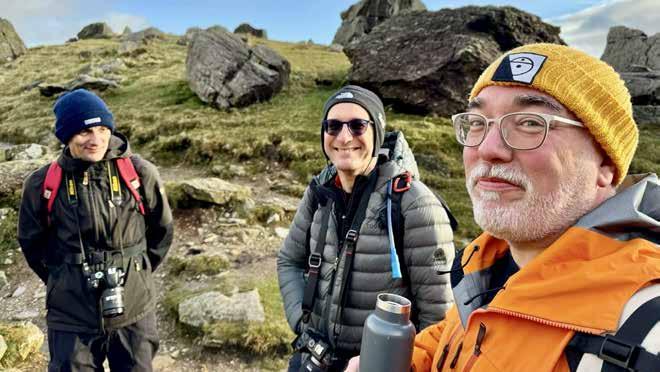
By Simon Briton, Founder of Quantify R&D
Innovation is the growth engine of every successful business. Here, Simon Briton of Quantify R&D explains why they're proud to be part of the North East's innovation landscape. Their role is to make sure that work is recognised, rewarded and defended through the government's R&D tax incentives so it funds growth rather than being an afterthought.
National figures show North East SMEs have been cautious making R&D tax claims. Claims are certainly harder than they were five years ago but the answer isn’t to claim less – it’s to claim better. With light-touch, in-year habits, we help North East founders recognise, protect and celebrate real innovation.
If you run a serious, growing business in the Entrepreneurs’ Forum community, you’ll have no shortage of offers to “sort your R&D claim”, but it’s not about squeezing a claim through; it’s about recognising the work, protecting it properly and using it to power your next stage of growth. That’s where Quantify comes in.
I'm unusual in this space as I'm tax-trained and a former solicitor fuelled by genuine curiosity. That background matters because we prepare claims expecting them to be tested, rather than hoping they won’t be, and the result for our clients is confidence and headspace, not just cash.
Recent work covers construction, digital platforms, edtech, engineering, life sciences, manufacturing, motorsport, space and sport. A good portion of what we do is helping businesses whose advisers have made claims they’re not equipped to defend. We clean up weak positions, defend what stands up and exit
what doesn’t so businesses move forward with a stronger story and a tighter process.
Too many otherwise excellent businesses still treat R&D as an afterthought, folded into accounts preparation. They rely on faded memories, stitch together optimistic narratives and hope for the best. Your business deserves better. That approach misses genuine qualifying work, over-claims in the wrong places and creates avoidable exposure to risk.
It also sends the wrong message to your team: that innovation is incidental rather than central. Serious innovation deserves a serious R&D claims process, not a once-a-year add-on.
There’s a better way. We work with founders, finance directors and accountants to embed R&D into how the business runs all year. We capture the important details at the right moments: project kick-off notes that set out uncertainty and technical challenge, short prompts that record what is actually being tried and clear links between technical work, costs and commercial outcomes. Join that up with Patent Box, grants, SEIS/EIS
and your wider commercial strategy. When claim time arrives, you’re curating an evidence trail you already own.
Precision matters as much as pace. HMRC expectations have moved on, and robust claims are selective, evidence-led and technically grounded. The tax-lawyer lens keeps your position tight, consistent and defensible. Done well, this isn’t about paperwork; it’s about clarity. You explain your innovation once, properly, and get on with business. There’s also a cultural dividend. When you consistently spot, name and celebrate innovation, teams see that progress is noticed and rewarded. Better ideas surface earlier. You become clearer about what truly differentiates you.
The R&D claim shifts from rebate to recognition – proof that ambition is real, not just rhetoric.
Serious innovation needs a specialist rhythm. Most accountants do great work on compliance and accounts. R&D is different, It lives in your projects, your uncertainty, your technical decisions. Treat it with the same intent: by taking the guesswork out of your claim, you’ll have greater confidence in it. That is the work we lead, alongside your accountant, so your innovation is recognised, rewarded and defended.
For Entrepreneurs’ Forum members, we’ve ring-fenced a small number of complimentary Strategic Clarity Sessions. Forum members can book a half-day Strategic Clarity Workshop for their leadership team. We’ll benchmark your current approach, identify risk and missed value, and design a practical, in-year evidence model you can run confidently.
Email hello@quantify.tax and mention the article to request a slot.

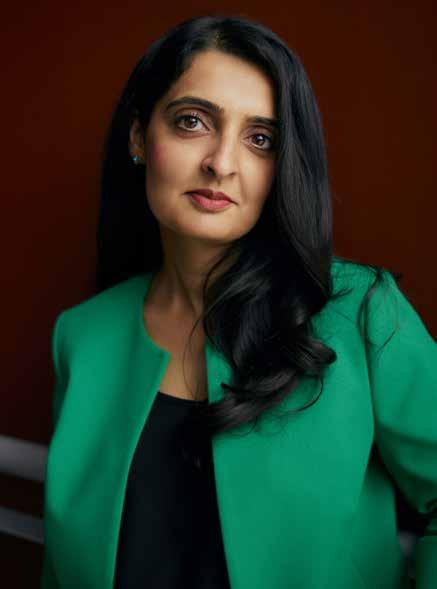
Fozia Saleem chats to Forum about life at the helm of Magnitude Biosciences – a North East early drug discovery business working to revolutionise healthy ageing and neurodegenerative disease research.
When Fozia Saleem moved to the North East in 2018, she didn’t expect it to become the backdrop for the most entrepreneurial chapter of her career so far. “We didn’t know how things were going to go,” she reflects. “But six months in, we were absolutely sold. It’s a lovely place to bring up kids – and the stereotype of Geordie folk being warm and welcoming is very true.”
Having spent over a decade in senior corporate roles, Fozia had reached a turning point. Post-COVID, she was juggling a busy career via Zoom, while raising a young family – and beginning to feel the spark fade. “I was very tired of being a Zoom bot,” she says. “Flexibility was great, especially with young children, but I’d lost my passion. I realised I’m a people person. I like connecting and I missed that.” Keen to re-ignite her purpose, she made a conscious decision to step outside her Londoncentric network and explore the business landscape in the North East. That’s when she began discovering the region’s thriving life sciences community. One introduction led to another, and before long, she met the team behind Magnitude Biosciences – a young but ambitious company based at NETPark in County Durham. “We were seven people on payroll when I joined,” she says. “Now we’re over 20 and growing.” Magnitude is a contract research organisation helping pharmaceutical and nutraceutical companies
accelerate their innovation. By using C. elegans nematode worms – which share around 85% genetic homology with humans – the business is able to generate early-stage data on how drugs, supplements or disease models behave in a whole-organism system. It’s pioneering work that reduces time, cost and risk in clinical trials.
“It’s about helping our clients understand what their product does,” Fozia explains. “We’re not just testing shiny science for the sake of it – we’re guiding it towards an outcome that helps humankind.”
Her drive for purposeful innovation has been the common thread in a career spanning corporate boardrooms and cutting-edge labs.
A neurophysiologist by training, Fozia completed her PhD before landing a role on a competitive management programme in London. She rose quickly through the ranks, managing global launches, securing patents and leading product development across 26 markets. But it wasn’t enough. “I realised I was becoming a small cog in a very big machine,” she says. “I’d lost the fear. I needed something that would push me again.”
Relocating to the North East with her academic husband, Fozia stepped into the startup world and never looked back. The pair met while completing their PhDs, bonding over their shared love of science but soon taking divergent paths. “He
stayed in academia, I moved into industry,” she explains. “I’ve always been an applied research person. For me, science is interesting, but I need to know what the destination is. I’m very outcome-focused, so academic science was never going to be the driver – it was always about what I could do with the science.”
At Magnitude, those questions are front and centre. When she joined, the company was still deeply rooted in its academic origins – founded by two Durham University professors –but ready to scale. Her mandate was clear: drive commercial growth, embed a business mindset, and prepare the company for acquisition. It wasn’t without its challenges. “I remember my first conversation with the chair. She asked how familiar I was with academics and I said, well, I’m married to one!”
That understanding of both worlds has served her well. “Academic research is about curiosity – about what’s interesting,” she explains. “But in a business, you have to monetise innovation. You need a commercial outcome. So I brought in the culture shift. The science is still fascinating, but now we ask: how
can we make it commercially viable?” That shift has paid off. The company’s patented WormGazer™ platform and VivoScanTM technology is delivering huge value in early-stage drug discovery, particularly in the complex field of neurodegenerative diseases.
The impact is real – and global.
Magnitude already operates in 12 countries, and Fozia’s vision is to push that even further. “We want to become the first company in the world to screen a million compounds using C. elegans and identify drugs that are successful in clinic,” she says.
“That’s the ambition.”
When it comes to global opportunities in biosciences right now, Fozia believes they lie in early-stage drug discovery. “The number of blockbusters coming through the global pharmaceutical pipeline is shrinking,” she says.
“It shocked a lot of us when Novo Nordisk – of Ozempic fame –made huge redundancies. They’re one of the richest, most successful pharma companies in the world, so it really shows how tough novel drug development has become.”
The pressure, she says, is forcing companies to re-label existing


drugs or explore new uses for old compounds – but that comes at the cost of innovation. “Drug discovery takes 10 to 15 years and costs billions – and by the time it reaches human trials, you might find you’ve been chasing a false positive. That’s where the opportunity is: reducing the cost and helping people fail fast, fail cheap.”
This year, she led the company’s biggest funding round to date – a near-£1 million raise that brings their total to just under £3 million. The investment will accelerate research into healthy ageing and support further international expansion.
“It’s something I’m really proud of,” she says. “We raised in one of the toughest environments for startups especially outside the ‘Golden Triangle’ of London, Oxford and Cambridge.”
Being based in the North East has its pros and cons, she admits. “There’s a strong sense of community here – if I pick up the phone to another CEO at NETPark, I know I’ll get advice or a helpful steer. But you do have to shout louder to be heard.”
Fozia is quick to acknowledge the geographic gap in access and opportunity. “When people think of biotech startups, they think of Cambridge or London,” she says. “We have to work harder to build those connections. A lot of our peers down south don’t need to travel as far or shout as loud.”
Fundraising remains one of the toughest challenges for Magnitude.
It’s a big ambition. But for someone who’s spent her career making science count – and isn’t afraid of a little fear – it's certainly within reach. If
When asked how she measures success, Fozia doesn’t default to the usual metrics. “Yes, investors want to see a healthy bottom line. But for me, it’s about innovation with impact. If Magnitude can help develop therapeutics that improve the lives of people with neurodegenerative diseases, if we can help make clinical trials safer, faster, cheaper –that’s success.”
She’s just as proud of the culture she’s cultivated as the commercial milestones. “I’ve been able to build a team from scratch. I’ve trained people, brought in new skillsets, and created something special. That’s a real privilege.”
Her leadership is rooted in authenticity, something she’s learned to lean into over the years. “I didn’t have role models that looked like me when I was growing up,” she says. “My dad came to the UK from Pakistan in the 60s. I was born in the North West in the 80s. Coming from a working-class migrant background, I wasn't surrounded by scientists or CEOs or even women that worked outside the family home. I’m proof that you can be what you can’t see, but you must have the perseverance and desire to succeed”
That makes her current role even more meaningful. “If I can do my bit to show young girls – especially young brown girls – that this path is possible, that matters.”

“I know a lot of friends who have businesses in the North East who’ve gone abroad,” Fozia says. “America has actually presented good opportunities. There’s a bit of a British culture of being risk averse, and the global climate isn’t helping. Fundraising is harder than it’s ever been.” With a Series A raise on the horizon, she's under no illusions about the scale of the task ahead.
“We’ll probably have to go broader and wider. Learning from my peers, it’s definitely been easier to raise stateside.”
Despite this, she sees the North East’s supportive culture as a major advantage. “It’s a great ecosystem,” she adds. “And this is home now.
I like to call myself an adopted Geordie,” she smiles.
Her advice to the next generation of entrepreneurs? Ask for help. “One of the best things I’ve learned since becoming CEO is that people are surprisingly willing to support you –you just have to ask. And don't be so afraid. Imposter syndrome can be a sign that you’re growing. If you’re in the room, you’re meant to be there. Take the seat at the table.”
As for what’s next, Fozia is focused on getting ready for the company’s next growth chapter. “Series A is coming. We want to build a commercial team, expand globally, and take the technologies we’ve developed over the last seven years into the next phase.”
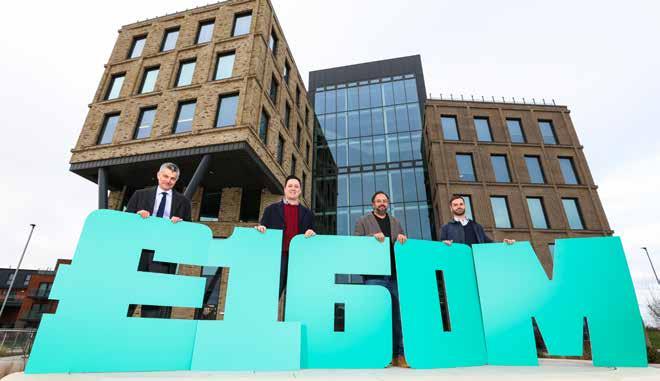
By Sarah Walker, Interim Director of Business Solutions at Tees Valley Combined Authority
Tees Valley is rapidly cementing its position as one of the UK’s most dynamic digital and creative powerhouses. Here, Sarah Walker explains how TVCA are turning ambitions into action by creating jobs, attracting investment and providing the right environment for businesses to innovate, collaborate and grow.
At the heart of our vision for Tees Valley to become one of the UK's most dynamic digital and creative powerhouses is the £160million Tees Valley Investment Zone –a partnership between the Tees Valley Combined Authority and Teesside University focused on our digital and creative sectors. It is designed to supercharge growth, productivity and inward investment, unlocking £175million of private sector funding and creating more than 2,000 skilled jobs. For entrepreneurs and investors, we’re providing an environment where ideas meet opportunity. The Investment Zone is building an ecosystem to connect talent, technology and investment to drive
long-term success. From the Northern Film Studios in Hartlepool to Middlesbrough’s Boho Zone and Albert North, Tees Valley is becoming a place where creative content and advanced technology are made, shared and exported across the world.
Middlesbrough is home to a thriving cluster of gaming and technology businesses which we’re supporting for further innovation and growth. The rise of world-leading gaming giant Double Eleven is a perfect example of a digital business which has thrived – and we want to provide the backing for more of our brilliant firms to go to the next level. Having companies operating with global reach, while remaining rooted in our community,
shows how success here strengthens regional supply chains and generates wider opportunities across Tees Valley. When our creative and digital firms grow, so do specialist suppliers, freelancers and start-ups around them. It’s a ripple effect benefitting everyone involved and we want to make those ripples even stronger. The next generation of digital talent is already being armed with the skills and confidence to lead the economy of the future. Teesside University plays a vital role. More than 1,200 students are currently studying digital-related courses within its School of Computing, Engineering and Digital Technologies – one of the best-equipped in the country. At its heart is the new £40million Digital Life building. A hub for digital skills, immersive media, cloud technology, AI and cybersecurity, Digital Life powers the Tees Valley Investment Zone and supports the UK’s ambition to lead in digital transformation. The University’s research strengths in
artificial intelligence, data analytics, cybersecurity and the Internet of Things are helping our firms innovate faster and operate more efficiently. Supporting collaboration between education and industry is vital. It’s why we want to build on the success of the Industrial Digitalisation Technology Centre by connecting small and medium-sized enterprises with cutting-edge expertise in automation, data and Industry 4.0. This support gives businesses the confidence to explore digitalisation, reduce risks and bring new products and services to market in a sustainable way.
Our backing of Game Republic, the largest professional games network in the North, for the next three years also lays down a marker. We want to give our growing gaming community the support and visibility it needs to thrive by connecting developers and studios with investors and partners. It’s building a region where gaming and digital businesses can progress, and local people see a clear route into highvalue digital careers.
The numbers tell the story. Tees Valley’s digital ecosystem is already home to more than 600 businesses, contributing around £392.5million in GVA and employing more than 4,500 people. New companies are continuing to emerge and scale up. Businesses here are not only adopting technology but shaping it and ensuring supply chains benefit and flourish in equal measure.
Our region is a place where entrepreneurs and firms can plug into one of the fastest-growing digital hubs outside London. Most importantly, it’s a region proving you don’t have to leave to go global by developing our talent, keeping it here and seeing it succeed.

By Michael Vassallo, Partner at Maven Capital Partners
The job of a venture capitalist is to seek out driven entrepreneurs and help them realise their goals. Done correctly, this creates substantial returns for investors while generating material wealth for founders and management teams. Maven’s partnership with the Forum gives the team valuable opportunities to connect with those entrepreneurs, and in recent months they’ve completed several exciting deals with standout North East businesses.
Backing a proven entrepreneur
In August, we completed an investment into Crafter’s Companion, the Durham based crafting supplies business founded and led by Sara Davies MBE. Sara, well-known for her time on Dragons’ Den, recently stepped down from the show to focus more time on Crafter’s – a win for the region as Sara is an outstanding entrepreneur with an exceptional pedigree.
Sara has been joined by Dianne Sharpe, another highly respected North East business leader, and I’m confident we have backed a great team. Whilst the imposition of US tariffs has been a challenge, Sara and
the team have (not unsurprisingly) risen to this with resilience and determination. The company has a bright future!
In October, we backed an exciting young technology business, FITR, with a £1.5million investment. FITR was founded by Durham University graduate Leon Cassidy, who started his career here in the North East with PwC.
Leon then joined UNW’s corporate finance team before moving to London in 2019 to launch FITR –a premium fitness training platform designed to help
coaches and fitness professionals build, manage and scale their businesses globally.
Since launching, Leon and his team have built an international customer base with high levels or recurring income – a key factor in securing our investment. The funding will allow the team to invest in FITR’s technology stack and drive growth.
Durham-made products in space
We also recently provided funding to aXenic, which is based in NETPark, Sedgefield, the region’s leading science park.
Led by Stephen Clements, who brings four decades of expertise in the optical communications industry, aXenic manufactures advanced optical modulators which are used in satellite communications. The company is working with the European Space Agency, amongst others, and its products are currently operating in low Earth orbit.
Our funding will help aXenic expand into larger facilities as part of the next phase of NETPark’s development – an exciting development which will see other space cluster businesses take root in the region.
Funding for entrepreneurs
Locally, Maven manages the Finance Durham Fund, the Northern Powerhouse Investment Fund II Equity Fund and the North East Development Capital Fund. We also invest on behalf of the Maven Venture Capital Trusts and Maven’s Private Equity funds.
We provide flexible funding from £100,000 to £10million to early stage and established businesses and offer both growth capital and funding for MBOs and M&A.
To find out more about our funding options and how Maven can help you grow your business, please email Michael Vassallo at michael.vassallo@mavencp.com

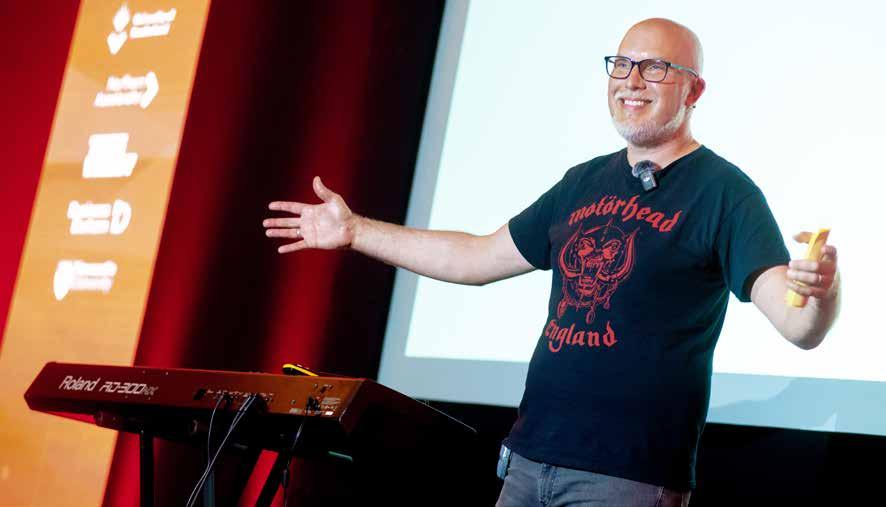
Dr Mark Deeks has built a career defined by music, meaning and motivation. From performing on international stages to helping others find their voice, he’s using his lifelong passion for music to open conversations around creativity, mental health and resilience…
Music has always been more than a career for Dr Mark Deeks – it’s been his anchor, his inspiration and his language for connection. As a professional musician, educator and speaker, Mark has spent more than three decades championing the power of music to improve wellbeing, performance and personal growth. Today, he’s using that same energy to help others harness creativity for positive change.
When we meet, Mark is preparing for a keynote address at the Northern Business Awards – one of many speaking engagements that blend storytelling, lived experience and a deep belief in music’s ability to heal. “I faced a situation that will be familiar
to many young musicians,” he recalls, taking us back to where it all began.
“As I got older my parents started fielding awkward questions from their mates along the lines of ‘are you really going to let him study music?’ and ‘should you not persuade him to do a proper job?’ It was all the kind of stuff that anyone keen to pursue a career in the creative industries comes across at some point. I know my parents had to deal with a lot of that from their ‘concerned’ friends.”
That determination to follow his own rhythm started early. Despite attending an academically focused private school, Mark’s future lay elsewhere. “I knew I needed to leave school at 16 and pursue a music-
focused college course,” he says.
“That didn’t go down well with the headmaster, who called my parents to a meeting at his office and implored them to think again. But it all worked out. My parents backed me from day one and here we are.”
Fast forward 35 years and Mark has carved out a multi-faceted career as a professional musician, teacher and critically acclaimed public speaker. Recently, he hosted the inaugural Breathe getaway – a music and wellbeing retreat on Holy Island that sold out within days. The concept struck a chord with audiences and the next instalment, Breathe II, scheduled for autumn 2026, is already selling fast.
“Through my band Arð I wrote an album about the remains of St Cuthbert and their journey from Holy Island to Durham Cathedral,” he explains.
“So I have this extra connection with Lindisfarne and I’d always wanted to take a small group of people to a reasonably remote location with music and mental health as the focus. I needed somewhere where you can feel a sense of space and find the time to breathe. I wanted to run singing workshops and to introduce a sound bath and some kind of meditation to music. We brought together a small group of people to experience every facet of music and to understand the wellbeing impact it can have on your life. I put on a concert in the church in the evening and we even did a tasting at the Lindisfarne Mead Brewery.”
For many, that would be more than enough. But Mark’s creative output doesn’t stop there. His band Arð –pronounced Arth – has become a cult name in the world of heavy music. Described as Northumbrian monastic doom, the band’s sound has reached audiences across the world. “Who knew there was a market for conceptual metal albums exploring Northumbrian history? It’s remarkable, really.”
Alongside Arð, Mark is also a full-time member of Winterfylleth, a Manchester-based black metal band for which he contributes songwriting, keys and backing vocals. His musical roots trace back to the early 90s.
“My first live show was an Emerson, Lake and Palmer gig at Newcastle City Hall,” he recalls. “At the same time, I loved a band from Scarborough called Little Angels. Prior to that, Def Leppard’s Hysteria had begun my love of hard rock. Soon I graduated to more extreme metal.”
His creativity, however, extends beyond performance. Mark has an entrepreneurial mindset that allows him to balance his many roles – from touring musician to community choir leader, speaker and family man. But behind that productivity lies a deeply personal story that shapes everything he does.
“In 2020, Angela and I were presented with the hardest time of our lives when the 20-week scan for our first daughter, Laurie, went as badly as it can and we were left facing a Termination For Medical Reasons (TFMR),” he says quietly.
“Going through a TFMR comes with a particular form of guilt: you are given the bleakest of bleak prognoses for your child but it is legally your choice as to what to do.
Ten days later the whole of the UK was in a pandemic-induced lockdown, and we were left to deal with the mental fallout of the situation
with little of the same support that might otherwise have been made available to us.”
The experience triggered a period of severe anxiety and panic attacks, which Mark now speaks about openly to encourage others to seek support.
“At the time I was trying to deal with the grief, I was also writing an album for Arð,” he says.
“Meanwhile, my brother-in-law and sister-in-law had arranged for a star to be named after Laurie as a surprise. We didn’t know anything about it until a beautiful, ornate star chart arrived in the post showing us the coordinates of the Laurie Deeks star in the Andromeda Galaxy.”
Those coordinates became a powerful symbol. “The numbers of those coordinates are the numbers on the tattoo on my arm. The ‘heart on my sleeve’, that I can see when I play the piano and guitar, has become hugely important to me. One night at 3am, I suddenly woke up with an idea: what if those numbers weren’t the coordinates of a star? What if they were the numbers of the notes of a musical scale – what does it sound like if you play them as a melody? That melody became the final one at the end of the first Arð album on a track called Only Three Shall Know.”
It’s a deeply personal detail that many listeners will never recognise. “The lyrics are not about the story at all –I didn’t want to write words about what I was going through – and so
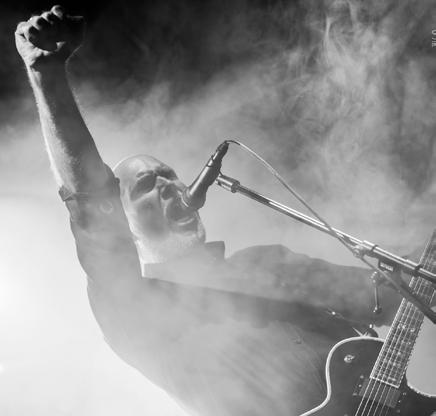
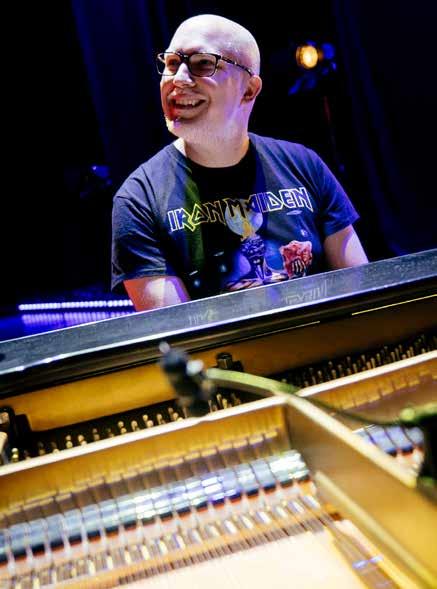
many of the people who have bought that record have no idea that that musical ‘nod’ to Laurie is there. But to me, it means the world. If she had never existed, that melody would never have existed. It’s a huge comfort.”
That melody would later resurface at a poignant moment. When Mark took part in the Great North Run, raising money for baby loss charity 4Louis, exhausted and close to the finish line, Only Three Shall Know randomly began playing from his six-hour playlist. “In the last hundred yards, as I was really struggling for the finish line, Laurie’s melody suddenly came on. I got over the line, sort of crumpled in a heap and I just couldn't explain to anyone around me why I was so emotional.”
It’s a story that encapsulates how music and emotion intertwine.
“But that’s what music does,” Mark reflects. “It stirs the emotions and it triggers memories.” Through his speaking engagements and creative
work, he draws on those experiences to show how music can inspire healing and hope.
That same philosophy underpins his work leading community choirs, where he brings together people of all ages and backgrounds through shared performance. “The older members of my choirs don’t necessarily understand why I’m drawn to heavy metal music and my band mates find it strange that I enjoy working in the community in the way that I do,” he adds. “What both groups have in common, however, is a love of music. That’s universal. I’ve always had that love of music and I understand it. People still ask ‘why music’? I don't know how I would do anything else. It’s just completely natural to me. Always has been, always will be.”
Mark’s story – one of resilience, creativity and compassion –demonstrates that the transformative power of music extends far beyond the stage.
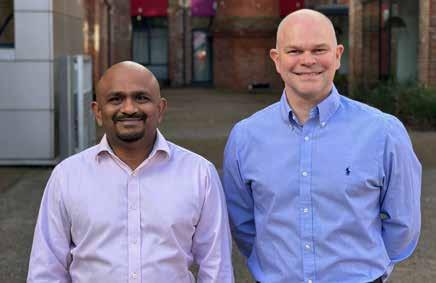
By Richard Coates, Managing Director at Lumanorth
In a world where digital transformation drives progress, few companies have mastered the art of blending cutting-edge technology with human insight as seamlessly as Lumanorth. Founded by long-term business partners Richard Coates and Dinesh Kumar, what began as a shared vision between two passionate innovators has grown into one of the region’s most respected technology studios. Here, Richard explains how Lumanorth stands at the intersection of innovation and impact, where technology meets tomorrow.
A legacy of innovation
Our mission is clear: to create technology that makes a difference. Through intelligent design, advanced engineering and a deep understanding of client needs, we develop solutions that drive meaningful outcomes.
This commitment to excellence has produced a diverse portfolio of innovations, including BentoBot, a multi award-winning bite-sized learning platform that makes professional development engaging and effective. With its intuitive authoring tool, users can easily build custom courses. Powered by AI, BentoBot delivers tailored microlearning experiences that fit
seamlessly into busy schedules, enhancing retention, engagement and performance through accessible, data-driven learning that helps teams grow and succeed continuously.
A partnership built on trust and collaboration
Our ability to deliver lasting value is exemplified by the collaboration with McDonald’s, one of the world’s most recognisable and respected brands. Myself and Dinesh have maintained a strong working relationship with McDonald’s for over ten years, helping the global restaurant giant enhance its learning, development and operational excellence through technology.
In 2025, this partnership achieved a major milestone when we successfully completed the development of a mobile-friendly simulator for McDonald’s Global – a groundbreaking learning tool designed to elevate operational training across the organisation’s vast international network.
The simulator, which has since been launched in over 40 countries and multiple languages, provides McDonald’s restaurant teams with an interactive, practical and highly engaging way to enhance their skills. Its global impact has been nothing short of extraordinary, earning two Golden Brandon Hall Awards in 2025.
Real insights, real-world application
The success of the McDonald’s simulator lies in its authenticity. Lumanorth worked hand-in-hand with the McDonald’s Learning and Development team, incorporating feedback from restaurant managers worldwide to ensure the experience reflected real-life operational scenarios faced daily in McDonald’s restaurants. By combining technology with human experience, we created a platform that empowers McDonald’s employees to learn faster, make smarter decisions and perform at their best. The project not only transformed training but also strengthened the culture of continuous improvement across the global brand.
Expanding horizons
The overwhelming success of the first simulator has inspired new opportunities for growth. Recognising the innovation and impact Lumanorth brought to the
project, McDonald’s Global has commissioned a second simulator, scheduled for release in 2026.
This new venture marks an exciting chapter in our journey, driving both business expansion and creative evolution. The project further solidifies our reputation as a trusted global partner capable of delivering transformative solutions that shape the future of learning and development.
Leading the way forward
As Lumanorth continues to grow, its mission remains unchanged: to empower organisations through intelligent technology. Under our combined leadership, the company continues to push boundaries, redefine possibilities and illuminate the path toward a smarter, more connected world.
With innovation at its heart and excellence as its compass, Lumanorth stands as a shining example of what can be achieved when technology, collaboration and creativity come together.
Congratulations on the launch of Shift Sim. Thank you so much for all your hard work throughout the project. I hope you have taken a moment to pause and celebrate you and all the great work you did. Many thanks for all the passion, dedication, and effort you put into making Shift Sim great! Thank you for helping us be great!!
Lan, Director of Learning Design and Technology, McDonald's Global

BentoBot powers up your workforce performance with bite-sized, multimodal learning.
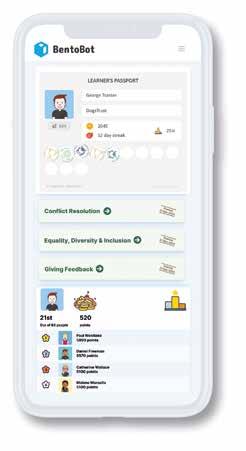
Leveraging Al to specifically target individual knowledge gaps and personalise the learning journey.


Gamification that maximises reward psychology and effortlessly engages your learners.
“BentoBot has been a game changer for us. It fits perfectly with our culture and our agile mentality. We are using it across our full business now and the daily bitesize learning has ensured our teams are compliant and retain the knowledge, resulting in real behavioural changes.”

Kim Harris, L&D Director, RED Construction
Richard Bradley took over Dyer Engineering with a vision for sustainable growth. Now more than ten years on, he talks to Forum about resilience, leadership and how the newly formed SST Group is laying the groundwork for the next generation of engineering success…
In 2013, Richard Bradley swapped spreadsheets for steel, taking a bold leap from the world of finance to engineering when he led a management buyout (MBO) of Dyer Engineering with business partner, Graeme Parkins. Over a decade
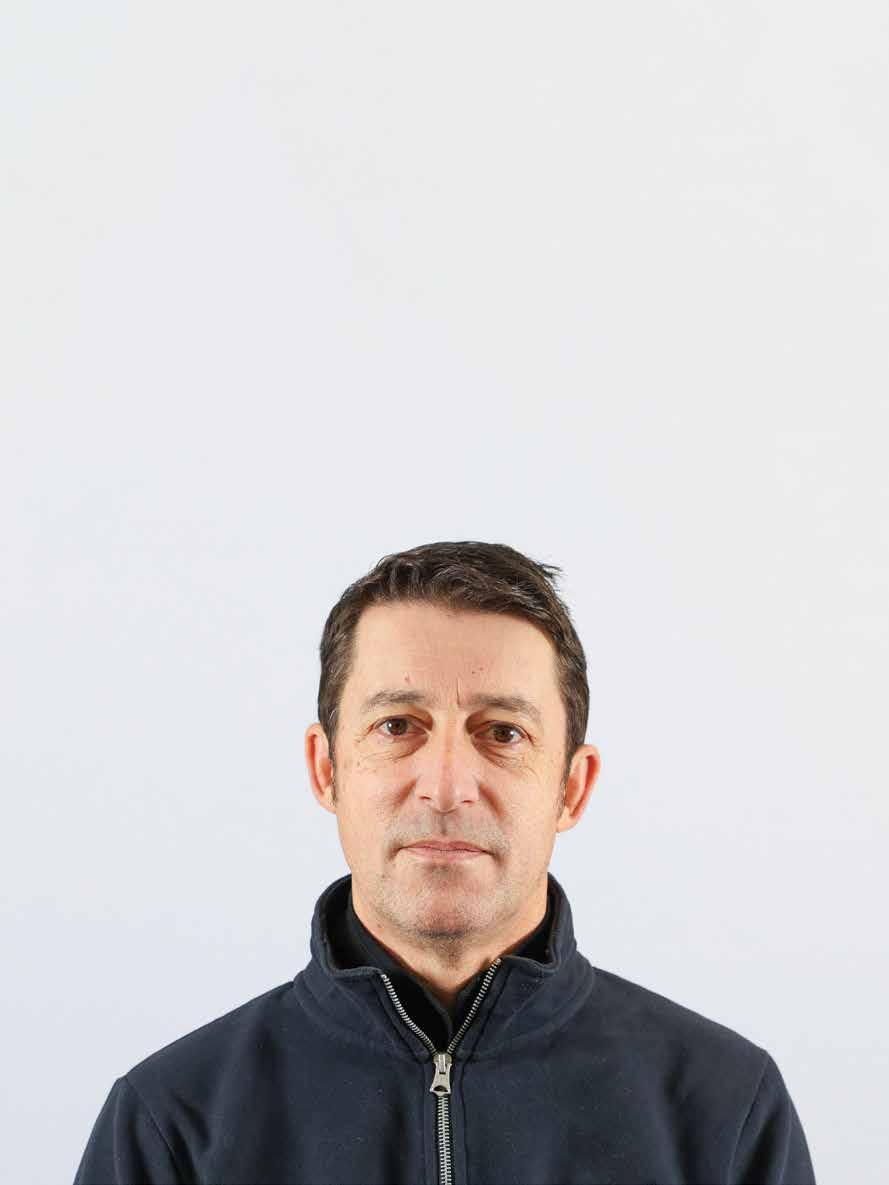
later, the national award-winning firm is almost unrecognisable – not only in terms of scale and ambition, but in the culture, capability and clarity of purpose that now shapes every decision.
That evolution took another step
forward in 2025 when a £1.625 million equity investment enabled the acquisition of Washingtonbased Q-Laser and the formation of SST Group – a new parent company created to drive strategic, long-term growth across the engineering sector. Having initially stepped into the role of chair, Richard returned as Group CEO to lead the County Durham-based business through its next chapter – one defined by smart investment, strong leadership and a collaborative, people-first approach.
“I always knew I wanted to be part of an MBO – I just didn’t know what that looked like until Dyer came onto my radar,” says Richard. “It was manufacturing, it was up for an MBO, and the timing was right.” Engineering, he admits, came about
more by chance than design. What mattered more was the opportunity to take ownership of something with real potential. “I was in my late thirties, early forties, firmly embedded in finance, and I knew I needed to make that leap. So, I reached out to my network and said, ‘This is what I’m looking for.’ and Dyer was the opportunity that came along.”
Making the leap was one thing, building momentum was another. In the early years after the MBO, growth was slower than anticipated – and far harder to achieve. “With hindsight, it was a blur,” he says.
“We knew we wanted to grow, but we were starting from a £7.5 million business with limited customer diversity. Sustainable profitability was always the goal – but we didn’t
grow at all for at least the first four years.”
Instead, the focus was on rebuilding from the inside out – strengthening systems, building networks and laying the foundations for growth that would eventually come. “At the time, it felt like we weren’t getting anywhere,” says Richard. “But in reality, we were, it just took time to see.”
Today, the picture is quite different. Richard continues to champion the industry as chair of the Engineering and Manufacturing Network (North East) and as a sought-after business mentor, leading to his recognition as a Caroline Theobald Award finalist at the 2025 Entrepreneurial Awards. Dyer, meanwhile, has more than doubled in size, with headcount to match and is backed by a leadership team that Richard believes is its greatest asset. “That’s the thing I’m most proud of – the team. They’re running the business and that was always the plan. If you want to build something scalable, it has to be about the people. Smaller businesses can survive with a single leader wearing every hat, but that only gets you so far.”
People have always been central to Richard’s vision – something that became even more apparent around 2016 when the business codified its core values. In a bid to reset the culture and bring the team together, Richard and his colleagues began exploring what made them tick. “We were reading a lot,” he recalls. “Jim Collins’ Good to Great gave us a framework with three simple questions: what can you be the best in the world at, what drives your economic engine, and what are you passionate about?”
For Dyer, those answers became clear. The business could be the best in the world at making metal componentry. Its economic engine was time – time on machines, time spent welding, time assembling. And its passion? “That was the hardest to define,” Richard admits. “But we landed on a simple, powerful statement: impressing everyone we meet. And we meant everyone – not just customers. That starts with the person next to you.”
The values that followed – Smarter, Stronger, Together – became a filter for decision-making and would later become the acronym for Dyer’s parent company, SST Group.
“A simple question emerged: does this make us smarter, stronger, together? If the answer was yes, we would pursue it fully. If not, we’d let it go.
“It gave us real clarity,” he adds. “And while it took time to embed, it still touches my heart when I talk about it now. The team has since adapted the language to suit their own way of working, but the essence is the same and that's what matters.”
That clarity was essential during difficult times. Between 2019 and 2021, Richard faced the toughest years of his career. “Not a lot of people know this, but we came pretty close to losing Dyer Engineering,” he says. “Those years were extremely difficult. The thing I’m most proud of is the fact that we’re still here – and that we’re in a really strong place.” He doesn’t sugar-coat the reality.
“Resilience is everything,” he says. “If I had to give one piece of advice to any business owner, it’s that: keep going. Sometimes, just surviving is the biggest win.”
Ironically, the pandemic – which for many businesses was a major setback – helped Dyer refocus. “We went into the pandemic in a bad place, but the experience forced us to clarify what mattered. It was one of the most stressful periods of my life, but also, weirdly, one of the most helpful. It gave us the momentum we needed.”
Ask Richard what’s shaped him most as a leader and he points to a book he read years ago: The Leader Who Had No Title by Robin Sharma. The message, he explains, is all about taking ownership – of your actions, your behaviour and how you respond to challenges. One of its central ideas is the difference between a leader mindset and a victim mindset. While Richard isn’t keen on the terminology, the concept stays with him.
“The idea is simple: take ownership of everything you do. You might not always be in control of a situation, but you’re always in control of your response.
“It’s about perspective,” he explains.
“You can trip over a paving stone and blame the path, or you can ask yourself, ‘Was I paying attention? What can I learn from this?’ I always try to bring it back to one question: What are we going to do? That forward-thinking mindset is critical.”
It’s something he encourages across the team at SST Group. “We all have
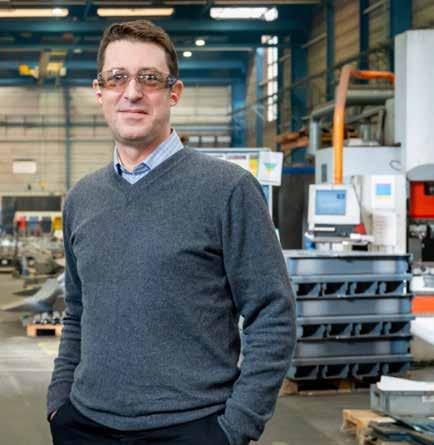
We set out to build a company we’d be proud to work for – a place you’d want your kids to work one day. That’s still the ambition, that’s what drives us.
emotional responses – that’s natural.
But the best, most rational thinking happens once the emotion has passed. In business, logic matters. If you lose a contract, for example, don’t beat yourself up. Ask: What did we learn? What are we doing about it? The faster you can get to that point, the stronger your business will be.”
Today, SST Group is setting its sights on the future. The acquisition of Q-Laser marks the first step on a wider journey to build a group of engineering-led companies that are financially robust, culturally aligned and strategically positioned for growth. “We’ll continue to grow organically, but we’re now actively pursuing acquisitions too,” says Richard. “The goal is to build a group that offers real opportunity – for customers and for the people who work within it. When you grow, you create chances for people to develop, progress and stay. That’s what we’re building.”
He also believes the North East is exceptionally well placed to lead in advanced manufacturing, particularly
as sectors like rail, defence, renewables and marine continue to scale. “All of them rely on complex metal components and assemblies,” he says. “And the North East is perfectly positioned to supply them. We’ve got the talent, the ambition and the capability – now it’s about pulling it all together.”
That same sense of purpose runs through everything Richard does. For him, success isn’t about growth – it's about culture, people and pride. “We set out to build a company we’d be proud to work for, a place you’d want your kids to work one day,” he says. “That’s still the ambition, that’s what drives us.”
Now, as Group CEO, Richard’s focus is on firmly steering that vision. With a strong senior team managing day-to-day operations, his role is about strategy and guidance. “I get asked a lot what I actually do,” he laughs. “The truth is, I spend my days talking to people – thinking, listening, guiding – and I love it, it's much better than finance!”
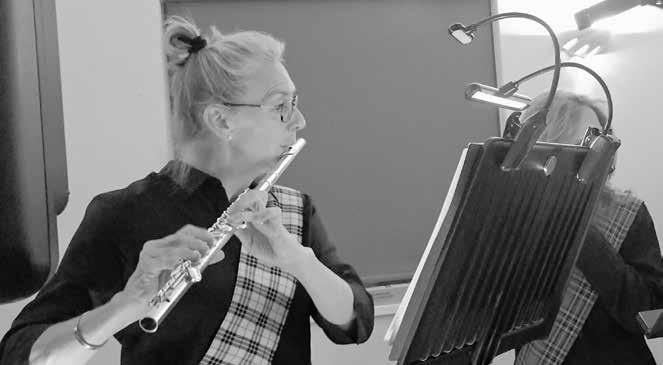
By day, Sally Marshall leads the MRG
Group
–
a growing hospitality business behind much-loved venues including The Ship at Redmarshall. But away from the kitchen and business plans, she finds clarity through music, performing with local bands, busking for good causes and switching off with her flute.
Sally Marshall didn’t grow up dreaming of running a hospitality business. In fact, her first career looked very different and it stemmed from a passion that's always been in her life: music.
“My dad played folk guitar – blues, too – and he was brilliant,” she says. “There was always music in the house. He’d sit beside me while I practised the piano, which must have been painful for him at times, but he never once complained. He just kept saying, ‘Keep going.’”
Sally began learning classical piano aged eight. “I wasn’t a natural – not by a long shot – but I was determined. That’s what got me through.” Her love of music stuck with her into adulthood, shaping a 27-year career as a secondary school teacher,
specialising in music and dance.
It wasn’t until much later that hospitality came into the picture – a business she co-founded with her son, Toby, whose own passion for food started when he was just ten.
“He was obsessed with cooking,” she smiles. “He’d picked it up from my dad, who was also a chef. We started with a street food stall when Toby was 19. It felt that this would be a safe way to try things, fail fast, learn quickly. The business just grew from there.”
That one stall evolved into the MRG Group – employing over 50 people and best known for The Ship at Redmarshall, a community favourite celebrated for its globally inspired Parmo menu.
But while the business has become
a big part of her life, it’s music that still brings her the most clarity.
“If I’m stuck with something at work – a decision I can’t quite make –I shelve it and go and play. A couple of hours with the flute, and it’s like my brain resets.”
Sally plays in multiple ensembles across the North East including a swing band, a Baroque group and a Ceilidh band called The Kelpie Ceilidhs. “We play traditional Celtic folk, songs such as Dirty Old Town and The Irish Rover, with our own modern arrangements. I’m the flautist – although I still play piano and dabble in saxophone too.”
She credits Seaham Music Academy
for keeping her continued passions for learning. “I still have flute lessons every Saturday. There’s always something new to work on. That’s what I love about music – you never really master it. There’s always more.”
The band’s gigs range from local fundraisers and birthday parties to church performances and civic events. “One of my favourite gigs was in this tiny village church. A woman came up to me afterwards – she’d listened to my solo, and she was crying. She said it was the most beautiful thing she’d ever heard. I’ll never forget that.”
When she’s not on stage, Sally can often be found busking outside coffee shops to raise money for music education charities. “We keep it simple – carols at Christmas, duets with violinists. It brings people joy, and it supports a cause that means something to me.”
Music, she says, gives her a sense of focus that nothing else does. “It’s like mindfulness. When I’m reading the dots, I can’t think about anything else. And then, when I stop, I’m calmer. Sometimes I’ve even found solutions to business problems I didn’t know I was working on.”
Looking ahead, Sally is focused on sustaining both sides of her world. “With the business, I want to grow steadily and make sure our team –many of them families – feel secure and supported. And with the bands, I just want to make sure they keep going. They bring so much joy.”
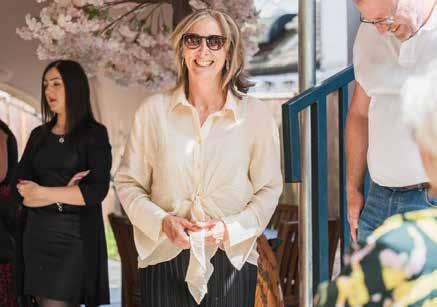
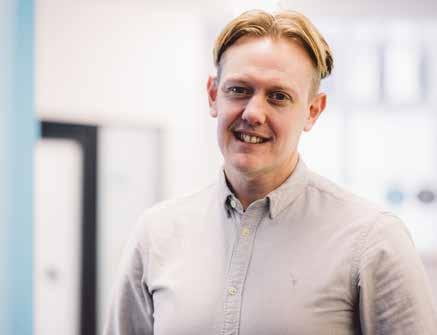
By Jon Dudgeon, Co-founder at Blu Sky
A new year is just beginning, and that means strategy should be moving to the top of your priority list. Year-end can be hectic, especially for founders juggling multiple priorities. But carving out time for planning now is worth every minute. Jon Dudgeon, co-founder at Blu Sky, explains how, with a clear strategy in place, you can enter 2026 with the focus, energy and confidence needed to make it your best year yet.
At Blu Sky, strategy is one of the things we do best. We know that business leaders across the North East aren’t short on ambition – if anything, it’s time that’s holding them back. That’s why we make strategy simple and actionable, so leaders can face the challenges and opportunities ahead with clarity. If you haven’t started thinking about 2026 yet, take this as your sign to start.
Reflect before you reset You can’t plan your next steps without knowing where you’re coming from. Reflection isn’t just about what happened, it’s about how you think. A growth mindset is key: treating
challenges as lessons and progress as a team effort.
Look back on what 2025 taught you. What worked? What didn’t? Where did you face friction? Bring your team into the conversation to get the full picture. Their view might differ from your own, so listen and learn why. Celebrate progress, address pain points and reconnect with your company values before the new year begins.
Set goals that drive the right outcomes
Once you’ve reflected, decide where you’re heading. Too many plans fail because they try to do everything. The best strategies focus on a few goals that
genuinely move things forward. Choose clear, measurable priorities with defined accountability. Use Objectives and Key Results (OKRs) or Key Performance Indicators (KPIs) to track progress and keep everyone aligned. This is also the time to look beyond short-term growth. Consider the environmental, social or governance issues most relevant to your business, such as carbon reduction, employee wellbeing, or supplier ethics. Strong Environmental, Social, and Governance (ESG) goals don’t replace financial ones; they strengthen them by building trust and long-term resilience.
Build your future culture
Every growth plan is also a people plan. The culture you create now shapes how your business grows later.
Ask what kind of workplace you want to lead a year from now. Do your values feel visible every day? Are people empowered to make decisions and learn from mistakes? Recruitment plays a huge part. As you grow, think about the skills and behaviours your business will need in 2026 and beyond. Hire for potential and alignment with your values, not just experience. A strong culture attracts great people and keeps them.
Put your numbers to work
Your numbers are the foundation of everything you do.
Cash flow shows when pressure will arrive. Sales forecasts ground your targets. Budgets set spending limits. Profit and loss tests whether your model delivers value.
A balance sheet check keeps you financially strong.
Use a few leading indicators to track progress and plan ahead, so you already know your next move if conditions change. Automate where possible, but keep people in charge of decisions that matter.
Build your wall of support
Running a business can be isolating, but you don’t have to do it alone.
Surround yourself with specialists who bring expertise when you need it.
A virtual Chief Financial Officer or finance function can offer senior-level insight into forecasting and funding without the cost of a full-time hire. The firms that scale best take finance seriously early and make decisions with confidence.
Make it practical and consistent
A good plan is only as strong as its rhythm. Work in quarters, review monthly and keep short weekly check-ins. Build decision rules that help you stay focused and say no quickly.
Set key 2026 dates in your diary and check in regularly with your adviser to stay ahead of cash and compliance deadlines. These small habits keep the bigger goals on track.
Turning preparation into progress
If you want 2026 to be your best year yet, the work starts now. Strong years don’t happen by luck or momentum in January; they’re built through the thinking, planning and decisions made before the new year begins.
At Blu Sky, we’re taking the same approach: fewer goals, clearer metrics and braver decisions. It’s about being deliberate rather than busy, and putting structure behind ambition.
If 2026 is the year you want to feel in control, confident and ahead of the curve, don't delay. The groundwork you lay now will decide how far you go this year.
From groundbreaking business expansions to impressive investments and exciting new launches, our members are driving growth and shaping the future of the region. Here’s all the latest news you won’t want to miss! For more member news and insights:

Forge restaurant awarded four AA rosettes
Middleton Lodge Estate’s fine dining restaurant, Forge, has celebrated four AA Rosettes at the AA Hospitality Awards 2025/2026. The award recognises outstanding cooking on a national level, with inspectors assessing technical excellence, passion, ambition and exceptional consistency.
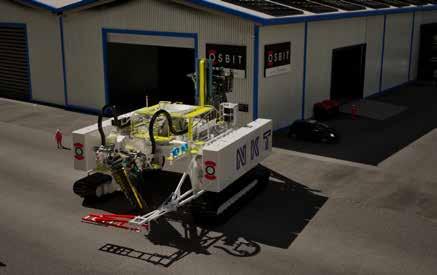
Osbit wins major contract with NKT
North East engineering company Osbit has secured a major contract with Danish power cable firm NKT to design and build one of the world’s most advanced subsea trenchers right here in Blyth.
‘Like Us’, run by Shak Asghar, named amongst UK's 100 most inspiring businesses
Business support agency ‘Like Us,’ which has headquarters in Teesside, has been named as one of the UK’s 100 most inspiring businesses for 2025, by the Small Business Saturday campaign.
Atom Financial strengthens leadership with new head of finance
Award winning Teesside-based financial consultancy firm Atom Financial has strengthened its senior leadership team with the appointment of Sara Eckert as Head of Finance.
AEM lands seven-figure deal for rare-earth-free EV motors
Rapidly growing UK technology business
Advanced Electric Machines (AEM) is demonstrating how the automotive industry can diversify its supply chains and reduce reliance on rare earth materials with the reveal of its Super Speed Reluctance Motor (SSRD) technology demonstrator.
Edwards Commercial Cleaning unveils new website
Edwards Commercial Cleaning is proud to announce the launch of a brand-new website, marking an exciting step forward for the company as it continues to expand its presence across the North East and Yorkshire.
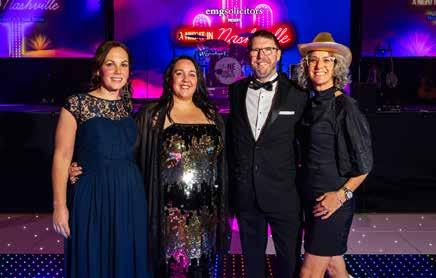
EMG Solicitors’ WonderLAN Ball raises £45k for brain injury charity
Award-winning law firm EMG Solicitors celebrated the ten year anniversary of its charity partnership with Headway – the brain injury association with a rip-roaring hoedown at the Utilita Arena Newcastle on Thursday 13 November, raising £45,000.
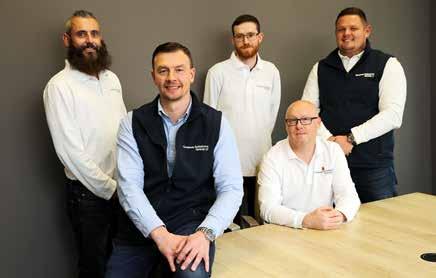
Greener Solutions Group appoints senior leadership team
North Tyneside-based Greener Solutions Group has strengthened its management structure with the formation of a senior leadership team, supporting the company’s continued year-on-year growth.
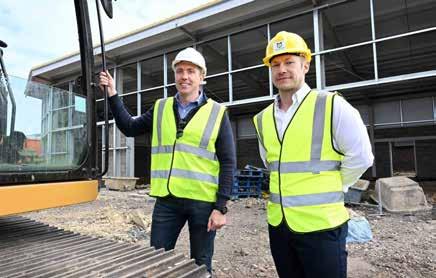
Develop North renews £7m facility with Shawbrook to support growth across the North
Develop North, the North East-based investment company managed by Newcastle-based fund management specialists Tier One Capital, has renewed its £7 million revolving credit facility with Shawbrook Bank for a further 12 months.
Therapy North announces new training centre at House Seven Wellness
Therapy North are delighted to share that they have been awarded ‘Approved Centre’ status by the CPCAB to deliver the BACP Level Four Diploma in Therapeutic Counselling from their brand-new training hub at House Seven Wellness.
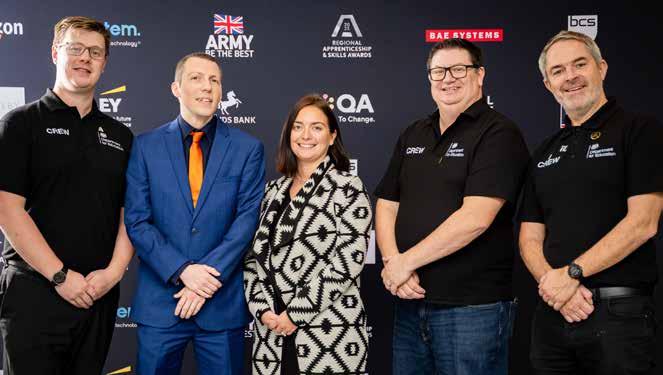
By Mark Renney Managing Director at Wubbleyou
Behind the Department for Education's flagship digital platforms lies a story of partnership. Here, Mark Renney, founder of Wubbleyou, shares how a six-week challenge to rebuild a national service sparked a decade of trust, delivery and real impact.
In 2017, the Department for Education (DfE) faced both an opportunity and a challenge. Apprenticeships were (and remain) a cornerstone of the UK’s skills agenda, but the digital platforms behind its flagship celebrations – the National Apprenticeship & Skills Awards (NAA) and National Apprenticeship Week (NAW) –needed to evolve to match the scale and ambition of the programmes themselves.
The DfE needed something more: a way to make celebrating apprenticeships simpler, more engaging, and more reflective of the people whose hard work shapes the nation’s workforce.
Turning vision into reality takes more than technology – it takes partnership, trust, and vision. Through a competitive process, the DfE found a partner in Wubbleyou, a North East-based tech company that shared
its belief that digital systems should serve people, not process. That first collaboration – forged under tight deadlines and shared determination, set the tone for a relationship built on agility, respect, and results; one that continues to underpin the Department’s apprenticeship initiatives today.
Celebrating skills, connecting the nation
At the centre of this collaboration are two programmes with national impact. The National Apprenticeship & Skills Awards (NASA) showcases the apprentices and employers who are driving the UK’s skills agenda forward. Alongside it, National Apprenticeship Week (NAW) turns those individual successes into a nationwide movement – uniting schools, employers, and learners through events, stories, and
resources that promote the power of apprenticeships.
Together, these initiatives reach hundreds of thousands of people each year. The results speak to more than numbers; they represent real change. Since 2018, applications to the awards have increased over 60%. NAW now attracts a national audience measured in the hundreds of thousands, with resources downloaded tens of thousands of times by employers and educators. Automation introduced through the platforms now saves teams hundreds of hours of admin time annually, allowing them to focus on outreach, storytelling and customer service, rather than admin.
What began as one year partnership has since matured into a decade long contracted partnership secured by several consecutive competitive tender wins, with the tech products evolving alongside the Department’s apprenticeship ambitions. Together, the DfE and Wubbleyou teams now support six interconnected tech

platforms, handling millions of interactions each year.
Behind every milestone sits the same principle that guided the start: trust and long-term partnership. The collaboration has strengthened through steady delivery and a shared commitment to making large-scale digital services feel personal and reliable, and by championing education and skills as an important pillar of the future of our society.
The next phase of the collaboration is already under way. Together, the DfE and Wubbleyou are exploring AI-assisted applications, smarter analytics, and more personalised user experiences –tools designed to empower even more people to access apprenticeship and skills opportunities and celebrate their success.
For employers, our ask is simple –if you have apprentices, shout about them! The National Apprenticeship & Skills Awards (appawards.co.uk) and National Apprenticeship Week (naw.appawards.co.uk) exist to spotlight the individuals and businesses driving real change. And too often, especially here in the North East, we don’t celebrate those successes loudly enough. These initiatives are your opportunity to share your story, showcase your people, and inspire the next generation to take pride in skilled work. When the apprentices stand on stage and accept their awards, it changes their lives – you can see it in their eyes and hear it in their voice; it's genuine disbelief this could happen to them. We have the power as employers to do this, simply by putting forward our people.
Shy bairns get nowt – we must celebrate our achievements in business, the successes of our people, and everything we proudly build here in the North East.

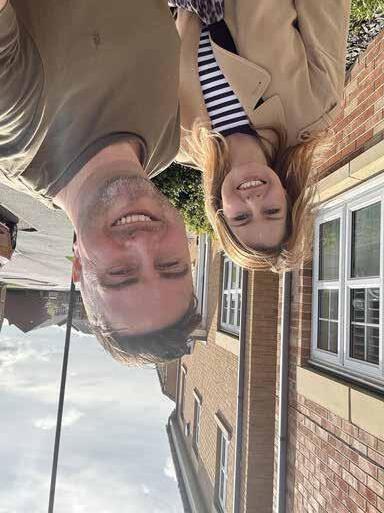

Suadny oTp slliks
em (teh dal woh droppde otu o.. gninioJ teh nErterpenesru oFurm wasn’t a rtshgiat ofwrard... I dah a kconk no teh oodr no
aeFrutde oPts oPts oPts fI senoemo dah tdlo 02-yaer-dlo
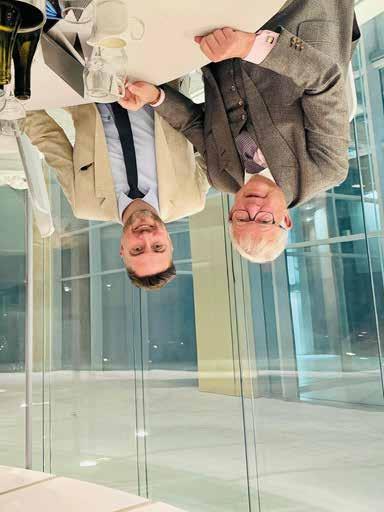
oediV aMrektgni elaSs laicnaniF golonhceTy laicnaniF eSr vecis oediV aMrektgni elaSs laicnaniF golonhceTy laicnaniF eSr vecis
fI you’re rgnidae tihs it ’s acebsue you’ve pdekci pu teh oFurm agamzeni. ahTt naems you nac see taht we’ve f ilppde teh kcab pega spuedi odwn so taht, tllacinhcey, I’m frnot pega ensw
niFtgerate
iRver iBrhc eNwnam
B7
B7 lehp you grba attnetnoi Jtsu ekil tih.s obAtu
C o n n e c t M e s s a g e
5 0 0 + c o n n e c t i o n s
7,206 ollofwesr
w w w . w e a r e b 7 . c o m
C o n t a c t i n f o
eNwactsel Upno Tyen, dnalgnE, inUtde modgniK
B7 | niFtgerate | iRver iBrhc eNwnam
oPtroilof nErterpeneru | oFuednr & iDrcetor at
D a v i d B r o o m