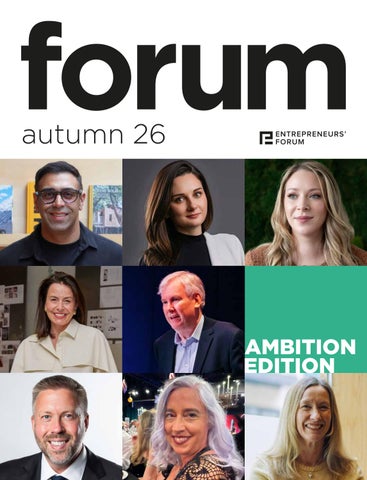
autumn 26
OFFICIAL CONTENT PARTNER OF THE ENTREPRENEURS’ FORUM ANNUAL CONFERENCE 2026 WWW.WEAREB7.COM
HELLO@WEAREB7.COM
Welcome
This edition of forum introduces you to some of the entrepreneurs driving growth across our region, from our 2025 Entrepreneur of the Year, Lee Hartley, to TUTTI’s Kate Rose and Tees Business Leader of the Year Imran Anwar. But what I want to draw your attention to is what lies ahead this autumn, because we are asking you to get involved. Turn the page to read about North East Entrepreneurship Week (NEEW), our new initiative as part of Global Entrepreneurship Week. We are working in partnership with organisations across the region on a campaign to encourage more people to start and grow businesses here. It is a chance to share what you already know, open doors for someone earlier on their journey, and show the next generation what is possible. We need you to take part, not simply sit in the audience.
Other than attending events, there are two ways to help. You can mentor an early-stage business owner, or you can visit a school and spend an hour with a room of young people who may never have met a business owner. Both take less time than you think. If you can do either, email info@entrepreneursforum.net and we’ll match you up. We will also launch the region’s first Ones to Watch Index, showcasing 20 local companies with the potential to scale. Across sectors ranging from leisure and life sciences to engineering, the overall winner will be announced at our annual Entrepreneurial Awards Gala Dinner on Thursday 19th November. In partnership with ScaleUp Britain, our ScaleUp Summits will put our region’s most impressive entrepreneurs in front of founders, investors, decision-makers, and the media. We will make the case for what the North East does well and have an honest conversation about what still holds us back. Beyond NEEW, we have a jampacked autumn programme of entrepreneur-led round tables, focus dinners, and on-site visits. Our Spotlight events are back too. Simon Woodroffe OBE built YO! Sushi into a global brand. Come and hear how he did it and take away a signed
copy of YO! Man, his brutally honest new memoir. Simon Theakston follows with an honest reflection on more than four decades building the family business, sharing the successes, setbacks, and lessons from his time leading Theakston Brewery, warts and all. My own pick of the programme is our three-hour masterclass with hostage negotiator Sue Williams QPM. One of the world’s most experienced hostage and kidnap negotiators, and an Associate Fellow of Oxford Saïd Business School, Sue will be joining us in the North East to share insights from her extraordinary career and translate them into practical guidance you can use in your own conversations and business negotiations. Getting her to Newcastle took some negotiation of its own, which tells you something about how good this session is going to be. The programme is now live on our website, and places are already filling up, so please book early. I hope to see you there.
Built and run independently by entrepreneurs, for entrepreneurs, the Entrepreneurs’ Forum brings together founders across the North East to share real experience. Membership is personal, and everyone involved is building something. That keeps conversations honest, practical, and grounded. Through events and mentoring, members connect with peers who understand the decisions they’re facing and help them move forward. Membership starts from £54 +VAT per month. Visit our website or scan the QR code to find out more. entrepreneursforum.net
Elaine Stroud Chief Executive
Proud to be partnered with
We’re stronger together
Forum is published by Allies Group Ltd
Editorial Stacey Crowther stacey@entrepreneursforum.net Steve Gibson steve@entrepreneursforum.net Nicole Wood nicole@allies-group.com
Allies Group Ltd, The Schoolhouse, 12 Trinity Chare, Quayside, Newcastle upon Tyne, NE1 3DF
Advertising Stacey Crowther stacey@entrepreneursforum.net
allies-group.com
Design studio@allies-group.com
All contents copyright © Allies Group Ltd. All rights reserved. While every effort is made to ensure accuracy, no responsibility can be accepted for inaccuracies, howsoever caused. No liability can be accepted for illustrations, photographs, artwork or advertising materials while in transmission or with the publisher or their agents. All content marked ‛advertorial’ is paid for advertising. All information is correct at time of going to print, August 2026. ISSN 2753-796X
To amend your mailing address, or to add/remove yourself, email info@entrepreneursforum.net
3
Brought together by
Part of
Taking place from the 11th to 20th November 2026, with a curtain raiser on Wednesday 4th November, North East Entrepreneurship Week is a region-wide programme of events and activities that celebrate, connect, and support the people building and growing businesses across the region. And we need you to take part. Here’s how. Secure your tickets today
Ones to Watch Index Launch Wednesday 4th November, 9am - 11am Durham University Business School We’ve scoured the North East to identify the 20 founder-led companies we believe have the highest potential to become scale-ups. Join them and us, and be the first to hear who’s made the Ones to Watch Index. Ones to Watch Index Launch and ScaleUp Summits are FREE to attend.
ScaleUp Summits
Entrepreneurial Awards
Wednesday 11th November, 12pm - 5pm Ward Hadaway, Newcastle
Thursday 19th November, 6pm – late Hilton Newcastle Tyne Bridge
Thursday 12th November, 8.30am - 1.30pm Sheepfolds, Sunderland
Celebrate the entrepreneurs who are making an impact across the North East. Discover the overall winner of the Ones to Watch Index, Entrepreneurial Excellence, North East Entrepreneur of the Year, Caroline Theobald Award, as well as who will be joining the region’s Hall of Entrepreneurial Fame.
Friday 13th November, 8.30am - 1.30pm Double Eleven, Middlesbrough In partnership with the ScaleUp Institute, we’re taking the show on the road, with half-day summits across the region. Hear from entrepreneurs building incredible businesses from the North East, as we analyse the challenges and opportunities of scaling from the region.
Individual ticket - £120+VAT Table seating ten - £1200+VAT
Thank you
North East Entrepreneurship Week is only made possible by the organisations backing its ambition for the region.
Share your experience
Mentoring We are seeking entrepreneurs to mentor early-stage businesses through activities taking place across the region's incubators.
Back to school We are inviting entrepreneurs to take part in our Back to School programme, spending time with Year 8 pupils to tell them about the world of entrepreneurship.
Fringe events Fringe events are taking place throughout the campaign. To see the full agenda and to offer to host an event, see the QR code below.
Get involved Explore the programme, book an event, host a fringe activity, or pledge your support. northeastentrepreneurshipweek.co.uk
5
Dates for your diary Each year, we host more than 70 events, bringing founders together to share what’s working, what isn’t, and what they have learned along the way. From small, focused discussions to our annual conference, these are conversations you won’t find anywhere else. Only open to members, a selection is listed below. For the full calendar, and to book your place, visit entrepreneursforum.net/events
Focus Lunch with Bianca Robinson Fireside Chat with Simon Woodroffe OBE
Ward Hadaway, Newcastle Tuesday 15th September, 9.30am - 11.30am Simon Woodroffe OBE is one of Britain’s most recognisable entrepreneurs. Founder of YO! Sushi, YOTEL, and the YO! Company, he has built some of the most distinctive hospitality brands of the last three decades. Join us as Simon shares stories, lessons, and hard-earned insights from YO! Man, his brutally honest new memoir.
Spotlight Event with Simon Theakston
Blackwell Grange, Darlington Wednesday 23rd September, 3pm - 5pm Join Simon Theakston, Executive Chairman of T&R Theakston Brewery, as he reflects on more than four decades in the family business. As custodian, Simon continues to guide the business through its next chapter, balancing growth with a commitment to quality, heritage, and long-term thinking.
The Impeccable Pig, Sedgefield Tuesday 6th October, 12.30pm - 3pm Business leaders have influence. They create jobs, shape cultures, make decisions that affect communities, and have the ability to bring people together around causes that matter. As an entrepreneur, the question is what you choose to do with that influence. Join Bianca Robinson, CEO Sleepout, for a thoughtful lunch conversation about leadership, responsibility, and the role entrepreneurs can play in creating meaningful change.
AI Workshop: Complexity to Confidence
Focus Dinner with Sam and Paul Blake
21, Newcastle Tuesday 22nd September, 6pm - 10pm Newcastle Eagles is the most successful professional basketball club in British history. But behind the trophies lies a story that is far bigger than sport. Join club owner Paul Blake and the Eagles Community Foundation’s CEO Sam Blake as they share the journey of building, sustaining, and leading an organisation through decades of change.
Negotiation Masterclass with Sue Williams QPM
Gateshead College Thursday 1st October, 12.30pm - 4pm Every business leader negotiates. Whether it’s with customers, suppliers, investors, or employees, some conversations are straightforward, and others carry pressure, emotion, and high stakes. This masterclass with Sue Williams QPM will explore what leaders can learn from the world of hostage and crisis negotiation, and how those principles apply to business conversations where trust, preparation, and judgement matter
UMi, Durham Thursday 5th November, 9.30am - 12.30pm Join Ross Stevenson, Founder of Steal These Thoughts for a practical workshop exploring what he has learned about ROI from working with AI inside some of the world’s biggest organisations. An expert in AI enablement, Ross helps business leaders to build the fluency to use AI in their work and lead adoption across their organisation. Sharing how those lessons can be applied by growing businesses, this interactive workshop will help you cut through the noise and focus on the areas where AI can make a meaningful difference right now.
Events explained Entrepreneurial Awards
Hilton Newcastle Tyne Bridge Thursday 19th November, 6pm - Late For over 22 years, our Entrepreneurial Awards have recognised and celebrated the region’s best business talent, with finalists representing every stage of the business journey - from ‛Ones to Watch’ to the prestigious Lifetime Achievement. Our annual awards are an evening of energy, inspiration, and celebration, creating memories as unforgettable as the North East’s entrepreneurial spirit itself!
Our year-round events calendar is designed to inspire, connect and support entrepreneurs navigating the opportunities and challenges of running a business. Below you’ll find a description of the type of events we offer, along with what to expect. As the North East’s largest gatherings of entrepreneurs, our annual conference brings top-class speakers to the region from some of the most successful and innovative organisations in the world. From £120+VAT per person (for all categories of members and partners)
Our annual Entrepreneurial Awards acknowledge the achievements of the region’s most talented and successful entrepreneurs in an evening of celebration and fun. From £120+VAT per person or £1200+VAT for a table seating ten (open to all in the North East business community)
Our entrepreneur-only focus dinners give you the opportunity to hear stories from trailblazing entrepreneurs that you won’t hear anywhere else. Connect with like-minded entrepreneurs over great food and unfiltered, honest conversations. £90+VAT (for entrepreneurial members only)
Entrepreneurship can often be a lonely place, and the road isn’t always smooth. Our fireside chats and spotlight events are an intimate and candid discussion where entrepreneurs explore the real, often unseen challenges of running a business. FREE (All categories of members and partners)
Expert led workshops combine thought provoking talks and interactive sessions to help you and your senior leadership team learn the skills and insights needed to move your business forward. FREE (All categories of members and partners)
On-site Visit to Nissan
Nissan, Sunderland Thursday 26th November, 9.30am - 12noon A not to be missed opportunity to go behind the scenes at one of the North East’s most iconic manufacturing sites. This tour offers an in-depth and insightful commentary on the cutting-edge tools, processes and technology used as well as the latest advancements in EV technology.
Every quarter, we host a new member online meet and greet session. There is no agenda, just a chance to get to know each other and the Forum team a little better. FREE (for entrepreneurial members only)
On-site visits are full of helpful ideas to implement in your own business, giving you an exclusive behind-the-scenes tour of some of our region’s most creative and innovative organisations. FREE (for entrepreneurial members and lead corporate partners only)
Our round tables provide a confidential space for candid discussions, where newer business owners connect with experienced entrepreneurs to share insights, tackle challenges and gain valuable knowledge. FREE (for entrepreneurial members and lead corporate partners only)
If you’re looking to recharge your batteries, our social events are fun-filled ways to build authentic friendships whether it’s over lunch, at a sporting event or an evening out. Costs may occur (for entrepreneurial members only)
Want to attend one of our events but not yet a member? Head to our website to find out more or scan the QR code to explore the different options available. Christmas Lunches
The Broad Chare, Newcastle Thursday 3rd December, 12.30pm - 2.30pm The Impeccable Pig, Sedgefield Thursday 10th December, 12.30pm - 2.30pm Celebrate the festive season in style at one or both of our Christmas lunches. These entrepreneur-only events are filled with festive cheer, fine dining and fantastic conversation. The perfect way to end the year!
Membership starts from as little as £54+VAT per month. We’d love to welcome and introduce you to the largest community of entrepreneurs in the North East.
entrepreneursforum.net
7
Meet our new members
Here we shine a spotlight on the entrepreneurs who have joined our membership lately. We’re so excited to have you as part of our community. Michelle Sheekey The Montessori People Nursery School Tell us about yourself I’m Michelle, the owner of The Montessori People Nursery School, and founder of Michelle Sheekey Elite Coaching. I left school at 16 with very few qualifications after losing my grandad on the first day of my GCSEs, and for a long time I didn’t think I’d achieve much. Over 40 years later, I’ve built two successful businesses and now coach ambitious people who have achieved their goals but feel ‘stuck’. I hope my story is proof that your starting point doesn’t define where you can end up. Why did you decide to join the Forum? I attended an event as a guest and found it incredibly inspiring. Listening to other business owners talk honestly about their journeys, including the setbacks and challenges they’d faced along the way, really resonated with me. As an entrepreneur, I know how difficult it can be, and it was refreshing to be surrounded by people who understood that. I left feeling motivated, energised and proud of how far I’d come by refusing to give up when things got tough. What do you enjoy most about running your own business? I love the freedom that comes with it. I’m probably unemployable at this point because I enjoy making decisions quickly and without layers of red tape, but what excites me most is having an idea, no matter how ambitious it might seem, and turning it into reality. Seeing your business grow, creating opportunities and building a positive culture is incredibly rewarding. The flexibility of being able to choose when and where I work is a bonus. What is something most people don’t know about you? When I was 20, I moved to Beverly Hills to work as a nanny for a wealthy family. The lady I was working for was dating Prince’s co-manager, which to date is my only claim to fame! The only qualification you seemed to need was a British accent - everyone wanted their own Mary Poppins! It was an exciting adventure and a world away from Teesside.
Natasha McDonough MMC Research
Scott Hopkinson Castrius Capital Partners
Tell us about yourself I’m Natasha. I’ve been running MMC Research for the past ten years and started the business after decades of working in marketing and insights. My career has taken me to far flung places and while working in the USA 20 years ago, I came to London for a wedding, met my husband who was originally from Sunderland. He was the catalyst to me moving back to the UK. I love living by the sea and I'm the mum of two teenagers, a stubborn Rhodesian Ridgeback and obedient Jack Russell!
Tell us about yourself I’m Scott, co-founder of Castrius Capital Partners. I am 52, married to Jen, and have two daughters in their 20s. I’ve lived in the North East all my life and have worked as a CFO for the last 20 years for some of the most high-profile local businesses such as Bannatynes, Eaga, Hays Travel and Fairstone. I have recently founded Castrius with my business partner Lee Hartley, which is a private capital platform set up to bring significant funding into the region. Also, I’m a very average golfer!
What do you enjoy most about running your own business? Genuinely it’s about seeing the difference our research can make to a business or community, and I get a buzz when we have a client that comes back to us for more work, meaning our previous work helped them! I also love taking on new clients and projects. It fills me with pride when our reputation, proposal and position make businesses want to work with us. We’re a small team of five and every person has a key role in our success. I never take that for granted. I couldn’t be running the business I am today without the likes of Vicki, Lisa, Alice and Katherine. They make it work.
Why did you decide to join the Forum? To re-connect with the businesses in the region and speak with like-minded people.
What was your first job? I’ve worked since I was 14. My first business (car washing) failed as I was too short to reach the tops! I moved onto sweeping floors at a local Spar until I reached the dizzy heights of shoe sales throughout school. I left home at 17, started working in an office and fell in love with business from there. I worked for some fantastic – and some wild – entrepreneurs along the way! If you weren’t running your current business, what would you be doing now? I like working with my team too much to want to do anything else. I think I’m exactly where I need to be in life. What are you most proud of? I recently became president of the NE Chamber of Commerce. I feel a huge sense of pride and I’m looking forward to making a difference.
What do you enjoy most about running your own business? Control and autonomy – being able to make a decision immediately, whether it be business critical, or to go for a round of golf – both equally important! What is something most people don’t know about you? I’m one of the best pizza chefs in the North East, if not the UK! What was your first job? Part-time jobs were selling newspapers door to door on a Sunday and working in a pick and mix shop on Shields Road on a Saturday for £10 per day! Full-time, I’ve always been in finance starting at Robson Laidler when I was 18. If you weren’t running your current business, what do you think you would be doing now? Travelling, which I still intend to do a lot of. What are you most proud of? I’m still very good friends with people from every job that I have ever had, I doubt there are many that can say that.
Craig Daly Northern Print Solutions
Rebecca Beeby Altho Dai
Tell us about yourself I’m Craig, MD of Northern Print Solutions. We’re a print and production group that brings together design, print, direct mail, packaging, fulfilment, large format, signage, display, POS and web-to-print solutions. We recently acquired Design Xpress, which has allowed us to keep growing the group, supporting clients across the UK and internationally. I’m a dad of three, which means spending a lot of time following my daughters around to basketball and acting as an unpaid taxi service so life is full, but I wouldn’t really have it any other way.
Tell us about yourself I’m Rebecca, founder of Altho Dai, a modern, refreshing approach to accountancy. I spent years at two North East success stories, Nigel Frank and END, before taking voluntary redundancy while pregnant with my second baby. I’d picked up the entrepreneurial bug, and knew I had a skillset I could sell. If it failed, I could always ring a recruiter and get a normal job again. Having worked in large, collaborative businesses, I knew what a strong finance relationship could do, and founders needed that more than most. Consulting alone wasn’t enough impact, so I built a team instead, now eight strong, mostly working mams, part time around family life. Women become superheroes when they become mams, and that work ethic sits at the core of the business.
Why did you decide to join the Forum? I want to keep learning from people who have been through different stages of growth. Running a business is exciting, but it can also be quite isolating. You’re often making decisions that affect staff, customers, suppliers and your family, and there isn’t always a clear right answer. Being around other entrepreneurs who understand that pressure is really valuable. I also think the North East has a brilliant business community, and I wanted to be better connected with people who are ambitious, open and willing to share their experiences honestly. What do you enjoy most about running your own business? Seeing ideas turn into something real. That might be a new service, a customer campaign, new piece of kit, an acquisition, or watching someone in the team grow into a bigger role. There’s a lot of pressure in running a business, but there are also moments where you step back and think, “we actually built this.” What is something most people don’t know about you? I’m in a band. It’s a very different kind of pressure to running a business. You can’t hide behind a spreadsheet, a strategy meeting or a well-timed email when you’re standing in front of a microphone. I think that’s why I enjoy it, it pushes me out of my comfort zone and gives me a completely different outlet. What are you most proud of? Building something from nothing. The acquisition of Design Xpress was an important milestone. I’m just as proud of the quieter things, the hard decisions, long days, the team sticking together, customers who have trusted us and the fact we’ve kept moving forward even when it hasn’t been easy. I’m proud we’ve built it in the North East, and the business still feels grounded, honest and human.
Why did you decide to join the Forum? I’m hugely passionate about being from the North East and want to learn from powerhouse entrepreneurs who have walked this path. I soak up nuggets of good advice from everyone I meet and think the quality of people I’ll meet is what I need for the next stage of the business. What do you enjoy most about running your own business? The independence and freedom it gives me, it’s terrifying and exhilarating in equal measure! It fits around my home life. I don’t miss swimming lessons or movie nights, even if it means being at the laptop until the early hours. What is something most people don’t know about you? That one of my favourite things to do is to be alone in silence, on a beach with my two dogs! I live at 100mph, I talk a lot and look like I never stop, so when I do stop it’s zero, silent and reflective, soaking up fresh air. We’re lucky to have Jesmond Dene and Armstrong Park on our doorstep. What was your first job? In Greggs, Cramlington on a Saturday when I was in sixth form – learning how to deal with the hungry public and adding up on the spot were brilliant life lessons in resilience!
We’re delighted to welcome the latest members of the Entrepreneurs’ Forum, joining up to and including Friday 28th August. Chris Marshall Blair West Lee Hartley Castrius Capital Partners AJ Swinbank Corporate Trade Supplies Karl Smith Corporate Trade Supplies Ben McKechnie Epicurium Richard Weatherburn Grandpa's Fish Bar Kris Wylam Intelligent Gas and Power Simon Edminson Intelligent Gas and Power John Heward JH Mechanical & Electrical Kelly Whitfield KLIK SaaS® Hugo Clerey Prime Payment Solutions Jennifer Abraham Rosewood Independent School Craig Rose Seaweed & Co. Tom Chandler The Digital Lighthouse Rachael Coates The Serviced Accommodation Company Ash Wright Visualsoft Chris Fletcher Visualsoft We’re delighted to welcome the latest members of the ASCENT cohort. Tamma Carel iCOR Systems Paul Woodhouse PLW Fitness Lewis Mennim Shiverbug Studios Cheryl Spears Spear-heads Paul Lancaster Stellar Venture Labs Pippa Fox Tiny Dragon Productions Matt Runham Tiny Dragon Productions Christian Cerisola Welcome To The People
The Entrepreneurs’ Forum is a membership organisation for North East entrepreneurs who run businesses that turnover more than £250,000 per annum. Membership is for the owner, not just the business because we know that entrepreneurship is a life choice that only other founders can truly understand. At the Forum you’ll surround yourself with friends, collaborators and mentors who can offer you guidance, support and inspiration at every stage of your business. To find out more about what we do and how to join visit our website or scan the QR code
If you weren’t running your current business, what would you be doing now? I think I would probably have gone back to a ‘normal’ job. Apparently, I wanted to be an Accountant when I was little so I can’t even claim I had exciting dreams! entrepreneursforum.net
9
Great up north
Entrepreneurs’ Forum Entrepreneur of the Year for 2025, Lee Hartley, reflects on building Fairstone from a 2008 startup into a billion-pound wealth management business, and why his next chapter is focused on bringing capital, ambition and opportunity to the North East. Lee Hartley never set out to build one of the UK and Ireland’s largest wealth management firms. As a child, he had other plans. “I wanted to be an RAF pilot as a kid, but being short-sighted kind of kyboshed it,” Lee laughs. Instead, he went to Northumbria University, by his own admission, “to kill time” while he worked out what came next. Mechanical engineering gave him a broad base, but business soon caught his attention. He took electives in business studies and management and used his time at university to shape a plan for an e-commerce and technology company. After university, he
launched the business and, through what he calls “a twist of fate more than anything else”, found himself working with financial services firms. What interested him was the gap between the sector’s image and its reality. “Whenever we had to go and implement a new solution or piece of software, I’d drive into a car park in my Renault and see lots of Bentleys and Range Rovers,” he says. “But the businesses we were implementing these systems in were really oldfashioned. No tech, no customisation, no business model, no centralisation.” After almost a decade running the technology business, he spotted an opportunity.
“I thought, this whole financial services sector looks like it could be fun. How hard can it actually be?” he says. “Turns out, it’s a lot harder than I thought.” Lee sold the tech business, spent 2007 planning Fairstone and launched the Sunderlandheadquartered wealth management firm in January 2008 – nine months before the global financial crash. It was, he jokes, proof of his “fantastic timing”. “For a good five years, the happiest day of the month was the day after payroll,” he says. “Just getting through another payroll was the only marker of success.” Lee and Scott Hopkinson, Fairstone’s
CFO through its key growth years and now his business partner at Castrius, managed the company’s finances closely. “We were checking the bank balance twice a day to check receipts in the morning and the afternoon,” he says. “We created the pressure for ourselves because we were trying to grow the business against that backdrop, we weren’t just trying to keep the business running.” Fairstone could have slowed down and waited for the market to recover. Instead, the team kept adding clients and assets, while taking risks only with their own money. “We set out to build something big,” he says. “To take a time out at the start and give ourselves breathing space until the world returned to normal didn’t feel like the right strategy. As hard as it was, I look back now and think it was exactly the right decision.” That determination took Fairstone from organic growth into acquisitions. After raising its first external investment in 2011, the business
began buying firms, but Lee quickly realised the traditional acquisition model did not work for people-based businesses. “There had to be a better way,” he says. “We realised we should focus on businesses that wanted to grow, not businesses that wanted to sell.” The result was Fairstone’s downstream buyout model. Rather than acquire firms outright from day one, Fairstone partnered with businesses, helped them grow and integrated them before a future acquisition. “We gave them access to customers, resource, capital, tech and time because we took a whole load of the regulatory and compliance pressures away,” Lee explains. “They could drive their profits as hard as they wanted and build their business with our tools and resources.” It became one of the defining decisions of his career. “The single smartest thing I ever did was decide to buy businesses that weren’t for sale,” he says. “It sounds like a contradiction, but it’s absolutely true.” By the time Lee stepped away from the chief executive role, Fairstone had completed 110 deals on that basis. The business had grown to more than £20bn in funds under management, more than 1,250 staff and fee income exceeding £175m annually. “I’m very proud of that,” he says. “But the main entrepreneurial phase of the business was behind us.” That clarity helped shape his decision to step back. After almost two decades building Fairstone, Lee knew the next stage would require a different kind of leadership, particularly as the business prepared for another potential private equity cycle. “I had to ask myself whether I wanted to commit to another five-to-sevenyear investment cycle with a new sponsor,” he says. “The opportunity to bring in a new chief executive who can deliver the next part of the vision and strategy was exactly the right thing to do." Leaving was never purely a strategic decision. Fairstone had become part of Lee’s identity and he remains emotionally connected to the business. “My wife and I don’t have kids, but I feel like I’ve got 1,300 of them in the business,” he says. “I care massively about it.”
Even so, he knew the timing was right. Bringing in a new chief executive early meant the business could prove its next leader well before any future transaction. Lee’s next chapter is Castrius Capital Partners, the venture accelerator he has launched with Scott. Its focus is firmly on the North East, but not in a narrow sense. Every business Castrius launches or invests in will have “significant gravity” in the region, but each must also have national or international scope. “It’s not about investing in regional businesses that only want to make an impact within the region,” Lee says. “I’d love the economic impact to be felt mainly here, but I want the scale to be far outside the North East.” For Lee, the issue holding the region back is not talent, lifestyle or location. It is profile and access to capital. “I couldn’t pick a better place to build a business,” he says. “We’ve got a great talent pool in the North East. Lifestyle is so much better and there’s so much more scope to make a mark.”
He rejects the idea that serious growth businesses have to be in London. Capital, he says, needs to be connected to the region more effectively, but the distance is not the barrier people imagine. “It’s only three hours on the train,” he says. “Sometimes we do ourselves a disservice by being a little too insular.” Through Castrius and the wider work that followed his regional white paper with NET magazine, Lee wants to help bridge that gap by creating an integrated capital platform capable of drawing investment into the North East. “There is so much capital out there,” he says. “Raising more money doesn’t improve anything. What we need to do is drag that money to the North East. One thing capital doesn’t do very well is travel. It tends to get a nosebleed once you go past Oxford and Cambridge. If we can create that bridge and connect it all together, we solve the capital problem straight away.” His target is deliberately bold: £10bn
If you're building a business in the North East, the world's your oyster. You've got everything here and you've got an area that's dying to embrace some success. It's great up north.
of investment capacity over 10 years, creating a billion pounds of deployable capital each year for the region. “I’ve got absolutely no doubt that it is there,” he says. “The tough part will be lining up the capital and the investment opportunities correctly.” At Fairstone, Lee says he helped create more than 100 millionaires, but only 20% were based in the North East. With Castrius, he wants the next 100 to be here. “That’s a big target and I don’t say it lightly,” he says. “But if you want to do something big, you’ve got to have a target.” His advice to those starting out is rooted in experience rather than theory. Business, he says, always takes longer and costs more than expected. And when it comes to building a team, character matters more than polish. “Hire on culture, not CV,” he says. “Every superstar I’ve hired was on culture. You can gain new skills and experience, but you can’t change the fabric of a person.” For all the scale of his ambition, Lee’s message is simple. The North East has the talent, universities and appetite for success. Now, it needs the confidence to claim more of it. “If you’re building a business in the North East, the world’s your oyster,” he says. “You’ve got everything here and you’ve got an area that’s dying to embrace some success. It’s great up north.”
11
PARTNER ARTICLE
Less noise, more impact
By Warren Colby, Managing Director at Agilico Digital transformation has changed how we work. It has made teams faster, more flexible and more connected. But Warren Colby, Managing Director at Agilico, argues it has also created a new challenge for businesses: digital fatigue. Every day, customers and colleagues move between inboxes, feeds, portals, dashboards and notifications. Attention is harder to earn. Trust is harder to build. Many messages disappear before they have had the chance to land. That does not mean going backwards. It means being more deliberate about the role each channel plays. Print still has a place, especially when it is used with intent. A printed event guide, customer pack, brochure, direct mail piece or internal campaign can feel more considered than
another email. It can support digital journeys through QR codes, personalised landing pages and follow-up automation. It can also make key messages easier to keep, share and remember. The question is no longer whether print or digital is better. The better question is: what deserves to be printed, what should be automated, and how do we do both responsibly? At Agilico, that thinking shapes two areas of our work: sustainable print and smarter process. Through Agilico Zero, we remanufacture multifunctional
devices to a certified standard, giving organisations a more responsible way to maintain high-performing print environments. Our award-winning Agilico Zero programme has achieved the BSI Kitemark™ for remanufacturing under BS 8887, giving customers independent assurance that sustainability does not have to mean compromise. Print has not disappeared from the workplace. It has become more selective. Across schools, legal firms, healthcare providers, manufacturers, finance teams and growing SMEs, physical documents still support moments where clarity, compliance, accessibility or impact matter. Production print also gives organisations a practical way to create personalised, high-quality collateral in shorter runs, without the waste that comes from over-ordering. For us, the opportunity is to make print more considered, more targeted and easier to justify.
But this is not just about paper. It is about process. Many organisations still rely on paper-heavy workflows behind the scenes. Purchase orders, invoices, approvals, filing and supplier documents can still move slowly through manual routes. That creates cost, delay, risk and frustration. Smarter processes remove the steps that no longer need to be manual. Document capture, approval routing, invoice matching and finance system updates can all happen with less human intervention, giving teams better visibility and more time to focus on the work that needs their judgement. The outcome is not a paperless business at any cost. It is a paperlight, process-smart business that uses the right format for the right purpose. Some communication should be digital because it is fast, measurable and easy to scale. Some should be physical because it can be more memorable, accessible or trusted. Some processes should not involve paper at all, because automation can remove the friction completely. For entrepreneurs, the challenge is not to follow every technology trend. It is to build operations and communications that people can engage with, while reducing waste and improving control. Used well, print can cut through digital noise. Used responsibly, it can support sustainability goals. And when combined with automation, it can form part of a more efficient and more considered way to work. At Agilico, that is the role we see for technology: helping organisations communicate clearly, reduce waste and make work easier. For more information visit: agilico.co.uk/make-work-easy
agilico.co.uk
You build progress. We translate it into proof. Your team knows the work. Quantify turns the technical story into clear, evidence-led R&D tax claims.
Behind every serious innovation are decisions, tests, failures, fixes and technical judgements. Too many R&D tax claims fail to capture that by starting with a blank questionnaire and ending with guesswork. Quantify does it differently. No homework dressed up as advice. We speak to your team, understand your technical progress and write the claim with clear evidence, clean scope and a position we would defend. We work alongside your accountant, bringing the specialist discipline robust R&D tax claims require.
Quantify your innovation with us. Book a R&D claim health-check for a one-page risk and opportunity summary.
Contact: ent.forum@quantify.tax
Evidence over anecdotes. Certainty over guesswork. If innovation is driving your business forward, let’s work together to make sure it is recognised properly.
One thing I’ve learnt In our One Thing I’ve Learnt series, Entrepreneurs’ Forum ambassadors and honorary members reveal one lesson that has shaped how they build their businesses. Providing a source of inspiration for anyone following in their footsteps, our guest editors share some of the business challenges they’ve faced and what they taught them. After nearly five decades as an entrepreneur, investor and ecosystem builder, Paul Callaghan CBE reflects on the single most important lesson he has learned: lasting success comes not just from building great businesses, but from creating the conditions that help others succeed too. When I was invited to contribute to this edition of forum magazine, I was asked to share a game-changing lesson from my entrepreneurial life that might help others facing similar challenges. Looking back over almost five decades, across multiple sectors and through more than a few reinventions, one lesson stands out above all the others: don’t just build the business, build the environment that allows businesses to thrive. It is a lesson I learned gradually,
sometimes painfully, and often unexpectedly. Yet once I understood it, it transformed the way I approached almost every challenge, not only in business but also in leadership, regional development, and collaboration. It feels particularly relevant to the Entrepreneurs’ Forum community because this organisation, which I was proud to help establish alongside Lorna Moran, Sir Peter Vardy and others, has always been about far more than individual
success. From the outset, it has been about creating the conditions in which entrepreneurs across the North East can learn, grow and succeed together. The Forum was built on the belief that when the environment is strong, everyone benefits. Like many business founders, I began by believing that success depended largely on having a great idea, building a strong product and assembling a talented team. Those things matter enormously. But over time, I realised they are
only part of the equation. Every business operates within a wider ecosystem of relationships, institutions, skills, investment, culture and opportunity. When those elements are fragmented or misaligned, even outstanding businesses struggle to fulfil their potential. Many entrepreneurs believe they are competing against the market. More often, they are wrestling with the limitations of the environment around them, and that is a much harder challenge to overcome. Most founders naturally focus on what sits immediately in front of them: the next customer, the next hire, the next contract or the next funding round. That focus is understandable and often essential. But it can also be limiting. The biggest breakthroughs rarely come from working harder on the business itself. They come when you begin asking broader questions: • What would make success easier for everyone in this sector? • Who else needs to succeed for us to succeed? • What connections are missing? • What barriers are holding people back? • How can we foster shared progress rather than isolated wins? Entrepreneurs who ask these questions start to see opportunities that others miss. They stop thinking solely as business builders and start thinking as ecosystem builders. And that shift in perspective can be transformative. Some of the most rewarding work I have ever been involved in was never about growing a single organisation. It was about strengthening the wider environment around it. A good example was the creation of Sunderland Software City. When we began that journey, the North East already had talented people, ambitious founders and pockets of innovation. What it lacked was a connected ecosystem capable of turning those assets into sustained growth. There was no clear pipeline linking education, entrepreneurship, investment and opportunity. The answer was not simply to create more technology companies. The answer was to create the conditions for more technology companies to emerge and prosper. We worked to connect universities with industry, create pathways for young people,
support founders, attract investment and build confidence in the region’s digital future. As those foundations strengthened, businesses began to grow, not because anyone pushed them harder, but because the environment around them became more supportive. That experience taught me that ecosystem building is not a side project. It is a strategic necessity. The same principle informed the creation of Dynamo North East. The region already had exceptional technology leaders, but many were working in isolation, often unaware of one another’s achievements and challenges. Dynamo was never intended to be just another organisation. It was designed to bring people together, align effort and make it easier for ideas, talent and opportunities to flow across the region. Once those connections formed, progress accelerated. Collaboration increased. Skills developed. Investment followed. Ambition grew. That is the power of strengthening the environment around the businesses within it. This lesson feels even more relevant today. Entrepreneurs are operating in
an increasingly uncertain world. Economic conditions shift rapidly. Technologies evolve at an unprecedented speed. Markets change. Assumptions that seemed solid a year ago can disappear overnight. In that environment, building a successful business is only part of the challenge. The real challenge is building resilience. And resilience rarely comes from any single organisation acting alone. It comes from strong networks, trusted relationships, supportive institutions and communities that help people navigate uncertainty together. In other words, it comes from the strength of the ecosystem. When we founded the Entrepreneurs’ Forum, we were not simply creating a networking organisation. We were creating a mechanism through which entrepreneurs could support one another, share experience and build confidence together. We recognised that entrepreneurship can be lonely. Founders often face similar challenges but tackle them in isolation. Sometimes the most valuable advice comes not from an expert or adviser, but from another entrepreneur who has already
Don’t just build the business. Build the environment that allows businesses to thrive. travelled the same road. The Forum created a space where those conversations could happen. That is why it has endured. And that is why its impact extends far beyond the businesses of its individual members. The Forum itself is proof that when you strengthen the ecosystem, better outcomes follow. If I could offer one piece of advice to entrepreneurs in the North East, it would be this: occasionally, lift your eyes from the business and look at the environment around it. Ask yourself: • What would help this entire sector thrive? • What infrastructure is missing? • Who could become an unexpected ally? • What challenge is everyone facing but nobody is solving? • How can we make success easier for those who follow? The entrepreneurs who create lasting
impact are rarely those who build only successful businesses. They are the people who leave behind stronger foundations for others. Entrepreneurship is often portrayed as a solitary pursuit: the lone founder, the visionary leader, the individual who changes everything through determination and hard work. But that has never been my experience. Everything meaningful I have been involved in has been built through collaboration, partnership and shared purpose. Businesses matter. But the ecosystems that support them matter too. And if you want to create something that lasts, something that benefits not only your organisation but also future generations of entrepreneurs, don’t just focus on building the business. Help build the environment around it. That is where resilience is created. That is where opportunity grows, and that is where the future is shaped.
Business | Corporate | Leisure | Contractor North East and Na�onwide | Reloca�on | Extended Stays Corporate Housing | Contractor Accommoda�on | Property Management Experience the ul�mate in home-away-from-home with Week2Week www.week2week.co.uk
+44 (0) 191 281 3129
info@week2week.co.uk
15
ADVERTORIAL
Building the future of interactive learning offer a route where users make choices, solve problems, experiment safely, and see the consequences of their decisions. That shift from passive learning to active participation is at the heart of our partnerships with organisations of every size, from SMEs to large enterprises and public sector bodies.
By Richard Coates, Managing Director of Lumanorth Richard Coates, Managing Director of Lumanorth, explains that by rebranding as a serious games studio, Lumanorth is helping organisations move beyond passive e-learning to create immersive experiences that combine the engagement of gaming with education, training and impact. The problem with traditional training Everyone knows that training is important, but too often, it’s delivered in a way that people endure rather than engage with. Clicking through slides, watching videos, answering a few questions, ticking the box and moving on. That may be enough for compliance, but for genuine learning, behaviour change, or better decision-making, the impact often falls short. That’s the challenge we have set out to solve. From passive learning to active participation With a focus on interactive, simulation, and immersive digital experiences that help people learn by doing, we are moving from general software development into the rapidly growing serious games sector.
On a mission to create meaningful experiences that inform, train, inspire, and help solve complex challenges, the studio is concentrating on creating digital solutions that combine the engagement of games with the practical needs of organisations. What are serious games? Serious games are not games built purely for entertainment. They are interactive tools designed with a specific purpose, such as training, testing decision-making, improving knowledge retention, simulating workplace scenarios, or helping people understand complex subjects. For business leaders, the appeal is easy to understand. Traditional training can struggle when the goal is confidence, judgement, or behavioural change. Serious games
Where Lumanorth will focus For several years, the studio has worked with global enterprises to bridge the gap between engagement and learning through serious games, immersive simulations, and largescale digital training solutions. Those projects have shaped a belief that people engage more when they are not being told what to do, but are placed inside an experience that asks them to think, respond, retain knowledge, and learn through action. Committed to making serious games and immersive experiences, we will focus on projects across: • Education and digital learning • Corporate and professional training • Manufacturing, engineering, and industrial environments • Food, hospitality, and retail • Healthcare and wellbeing Why this matters for growing businesses For us, this new rebrand is a statement of intent. The business has moved away from general software development and is placing our technical, creative, and commercial game development experience behind a more clearly defined specialism. That matters because the quality of the experience is central to whether this kind of training works. A serious game still has to be engaging, feel intuitive, and respect the time and
lumanorth.com
intelligence of the person using it. By bringing together software engineering, game design, and purpose-led learning, we can create training and communication tools that people are more likely to remember and use. With new projects already underway, our next phase will focus on interactive experiences built around participation, experimentation, exploration, and play. In other words, training that people don’t just complete, they experience. Discover how serious games with real performance can help your business at lumanorth.com
Games are one of the most powerful tools for communication and learning. This rebrand reflects our commitment to meaningful interactive experiences that deliver measurable results, without sacrificing the creativity and emotional connection people expect from modern games.
We craft serious games and simulations that transform performance through real-world practice.
We are an award-winning serious games studio creating immersive learning experiences that transform real-world performance. We combine learning design, behavioural thinking and modern game development to create experiences where people learn through practice, experimentation, decision-making and consequence.
With decades of experience across games, technology and workplace learning, we craft immersive training that drives engagement, builds confidence and transforms performance.
Get in touch and discover what’s possible hello@Lumanorth.com
17
Can you tell us what the business does? We are an automation and systems integration company, helping manufacturers improve and automate their production processes by integrating control systems, servo drives, robotics and industrial software. The automotive sector has always been one of our key industries, but we also work within pharmaceutical and other manufacturing environments. Every customer is different, so our role is to understand their challenges and deliver practical solutions that improve productivity, quality, and reliability. Alongside new installations, we also provide support, upgrades and optimisation for existing systems.
My North East How well do you know your fellow members? In this feature, we shine a light on some of the Forum’s long standing members, exploring their business journey, their connection to the North East, and what makes it such a special place to live, work and grow a successful business. In this edition, Aneta Majerska shares her love of the North East coastline, her passion for developing the next generation of engineers, and why the region's greatest asset is its people.
What are the best and worst parts of your job? The best part is seeing both our people and the business grow. When we started AG Controls, we did almost everything ourselves. Today, experienced engineers are mentoring newer team members and helping them develop their skills. While our customers see automation systems and production lines, I often believe that our real product is people. Watching someone grow from a junior engineer into a confident professional who can lead projects and deliver results is one of the most rewarding parts of running the company. The most difficult part is dealing with the unpredictable nature of project work. Some months we are incredibly busy, while at other times projects are delayed or pushed back by customers. As a business owner, you are constantly trying to balance having enough engineers available for upcoming work while also making sure everyone stays productive. It can feel like solving a puzzle that changes every day.
For me, the people are what make the North East special
What is your greatest achievement? In my personal life, it is undoubtedly my family – my husband and our two sons. Professionally, it would be building AG Controls together with my husband. When we arrived in the UK, we started from scratch and had to create every opportunity ourselves. There was no safety net and no easy path forward, so failure was never really an option. Through hard work, determination, and the support of some great people, we built a company that we are incredibly proud of. Another achievement I am particularly proud of is completing my degree while working full-time and raising my son. During my final year, I was pregnant with my second son. It was not always easy and required a great deal of determination, discipline and organisation, but it showed me that with enough commitment, it is possible to balance both personal and professional ambitions. What is your biggest fear, either personally or professionally? I think most people have worries about the future, whether that is for themselves, their families or their businesses. My biggest fear is losing the ambition and determination that helped us build the life and business we have today. Life can change very quickly, and our journey has taught me not to take opportunities for granted. Like many parents, I also worry about the health and wellbeing of my family. Beyond that, I try not to spend too much time worrying about things I can’t control. Professionally, I believe that if we stay adaptable, continue learning and work hard, we can deal with whatever challenges come our way. What is one thing that not many people know about you? People are surprised to learn that when I first arrived in the UK, I spoke
very little English and understood even less. The early days were incredibly difficult. Simple everyday tasks felt overwhelming, and there were times when I came home and cried because I felt frustrated and out of my depth. Looking back, those experiences taught me resilience and gave me confidence to keep pushing myself outside my comfort zone. They also remind me that progress rarely happens overnight. Sometimes the things that seem impossible at the beginning become completely normal a few years later. How do you unwind after a long week in the office? It depends on the time of year. Sometimes we like to get away for a weekend and explore somewhere new, while at other times we enjoy keeping things simple and spending time locally with family and friends. One of our favourite places is Whitley Bay. We love walking along the coastline and enjoying the view. After a busy week, being outdoors and spending quality time with family is usually the best way for me to recharge. What are you currently watching, reading and/or listening to? I recently started reading 1984 by George Orwell. It is one of those books that everyone seems to know about, and I felt it was finally time to read it myself. When it comes to television, I can happily watch Friends and The Big Bang Theory over and over again. They are both comforting, funny and familiar, which is sometimes exactly what you need after a busy day.
both personally and professionally. The opportunities we found here helped us build our life and our business, which is why we will always have a strong connection to the region. From a business perspective, its strong manufacturing base and a vibrant business community. Many of our customers are based here, and there is a real culture of innovation and collaboration. Outside of work, there is always something happening, from cultural events in Newcastle to beautiful countryside and coastline just a short drive away. What is your favourite restaurant, coffee shop or bar? My favourite restaurant is Antico in Birtley. It is a fantastic Italian restaurant. We have been there many times over the years and, being local to us, it is always an easy choice. You have out-of-region clients visiting, what is the one place that you would recommend they visit? If they are visiting for a weekend, I would recommend spending time in Newcastle. It is a fantastic city with a great mix of history, culture, restaurants and nightlife. A walk along the Quayside and the River Tyne is a must. For those looking for something quieter, Durham is beautiful and full of character. I would also highly recommend Alnwick Castle and its stunning gardens, which are among the most impressive attractions in the region. What first attracted you to join the Forum? The opportunity to learn from other business owners. The Forum brings
together people who have already faced many of the challenges that growing businesses encounter. Being able to learn from their experiences, ask questions and share ideas is incredibly valuable. Business ownership can sometimes feel isolating, so having access to a community of people who understand those challenges is a huge benefit. What is your favourite thing about the Forum? The willingness of members to support each other. It is not just a networking organisation where people exchange business cards; it is a community of people who genuinely want to help one another succeed. I have met inspiring business leaders and learned valuable lessons from their experiences. What surprised me most, however, is how open people are. I expected networking, but I didn’t expect experienced business owners to be so willing to share both their successes and their mistakes. What advice would you give to new members or anyone considering joining the Forum? My advice would be simple: get involved. Attend events, speak to people and do not be afraid to ask questions. There is a huge amount of knowledge and experience within the Forum, but you will get the most value from it if you actively participate. Every business owner faces challenges, and often someone in the room has already solved the problem you are dealing with. The more you contribute, the more you will gain from being part of the community.
agcontrols.co.uk If you’re building a business and value honest conversation with people who understand the decisions and risks you’re carrying, the Forum may be for you. Find out more on our website or scan the QR code. Membership starts from £54 +VAT per month.
What makes the North East such a great place to live and work? For me, the people are what make the North East special. When we moved to the UK, we met many welcoming and supportive people who gave us opportunities to grow
19
PARTNER ARTICLE
From Insight to Impact
By Dr Fiona Whitehurst, Newcastle University Business School Associate Dean Engagement and Place. Innovation is often talked about as a priority, but for many businesses, turning ideas into tangible outcomes can be a challenge. Limited time, resource constraints, and access to specialist expertise can all slow progress. Dr Fiona Whitehurst of Newcastle University Business School explains how ‛Arrow’ is helping businesses move faster. Arrow, a collaborative innovation support programme, is designed to help businesses transform ideas into action through structured support and academic collaboration. How the model works Arrow connects businesses with academic expertise and university resources to support innovation at different stages of development, including: • Early-stage idea development and problem definition • Research and development support • Proof of concept and product validation • Access to specialist expertise, including data science • Use of advanced research facilities and equipment
Arrow is a collaboration between Newcastle University, Northumbria University, Durham University and the University of Sunderland, and is funded by the North East Mayoral Strategic Authority through its Integrated Settlement, making it accessible for all business across County Durham, Tyneside, Sunderland, Gateshead, Newcastle and Northumberland. Critically, it is not a one-size-fits-all solution. Support is tailored to each business, ensuring that activity is aligned with commercial priorities and delivers measurable outcomes. Turning ideas into business advantage The strength of the model lies in its practical application. By combining academic insight with real-world
challenges, businesses can test assumptions, refine products and uncover new opportunities. A number of businesses that have benefitted from Arrow support, including OptiMe, Blu Sky, Wonderful Wig Company, and Layers Studio, are Entrepreneurs’ Forum members, demonstrating the close alignment between innovation and entrepreneurial growth in the region. From refining leadership programmes and business models, to developing new technologies and digital platforms, these businesses reflect the breadth of innovation activity supported through Arrow. What unites them is a willingness to step outside day-to-day operations and engage with fresh thinking, research insight and external expertise to unlock new opportunities. The role of research-led insight Arrow’s impact is not limited to product or service innovation, it also extends to strategic thinking and behavioural insight. When Sarah McCalden, Financial Wellness and Personal Growth Expert, wanted to understand why so many capable, intelligent, hardworking women still feel uncertain or anxious when it comes to money, she turned to Arrow. The team matched her with Prof. Darren Duxbury, Professor of Finance at Newcastle University Business School, and an international expert in the areas of experimental and behavioural finance. The resulting project explored what really drives women’s financial behaviour, and what helps create lasting financial wellbeing. The project gives Sarah a solid foundation to innovate further inside the
ncl.ac.uk/arrow
business, developing new ways to help women understand their financial behaviour, make better and more informed decisions, and create lasting change. Sarah said: “There’s so much more to explore, and I can already see how this will shape what’s next in my work.” “It’s been brilliant… the depth and quality of the data are outstanding!” For businesses, engaging with research-led insights like this can inform everything from product development to customer engagement strategies. Why innovation partnerships matter In a competitive and rapidly evolving market, businesses that innovate effectively are those that can access the right knowledge at the right time. Arrow provides a structured yet flexible way to do exactly that – bringing together academic expertise, practical application and regional collaboration. A catalyst for growth For SMEs in particular, Arrow offers a valuable route to capabilities that may otherwise be inaccessible. By lowering barriers to innovation and providing targeted support, it enables businesses to move faster, reduce risk and maximise impact. Whether refining an existing offer, exploring new markets or developing entirely new solutions, the programme acts as a catalyst, helping businesses move from idea to implementation. In a world where standing still is not an option, innovation partnerships like Arrow provide a clear advantage. For more information contact external.engagement@ncl.ac.uk
ADVERTORIAL
Leading for growth business delivers consistent outcomes at scale while the team focuses on the high-value work people are genuinely best at.
By Mark Renney, Managing Director at Wubbleyou Every week seems to bring another announcement that reshapes what technology can do for business. A new AI model arrives, a business launches a platform in weeks that one year ago would have taken a full team months, and conversations among leadership teams carry the same tension: we know we need to move but are not sure where to start. Mark Renney of Wubbleyou shares why, for founders running ambitious, people-driven businesses, the difficulty isn’t knowing you need to act but knowing how to act. The illusion of productivity When it’s possible to build literally anything, everything becomes a distraction. Across dozens of conversations with business leaders this past year, we have watched the same cycle play out. Teams invest in AI training or tech without clear objectives and adopt tools only to abandon them within weeks, while initiatives start strong and trail off because it’s not clear how they have made anything better. The pace of change makes it
remarkably easy to mistake activity for progress, and the strategic clarity that would move the business forward keeps getting deferred. Case in point, the prototypes we have seen this year are phenomenal, but only a fraction end up delivering value. Claude code without purpose, without a plan to extract that value, is no different to pulling the arm on a slot machine and feeling the thrill when the wheels spin. We watched this play out in web design, where a five-figure specialist service
compressed to a few hundred pounds as platforms and freelancers undercut the mid-market. AI is accelerating that compression across B2B service industries, wherever businesses trade time for money. Your expertise was always the advantage The businesses navigating this well actively capitalise on something most are passive about: the knowledge accumulated over years, processes refined through experience, and expertise that allowed them to solve problems their competitors and customers could not. Where generic work is being commoditised, that deep expertise has become more important than ever. The challenge is that it remains locked inside the way they currently deliver, in the founder’s judgement, in manual processes, in how a senior team member handles a complex situation. Productisation structures that knowledge into reusable assets technology can work with, so the
What this looks like in practice We applied this thinking inside our own business recently around responding to tenders, one of the most time-intensive parts of winning new business. We took what we had accumulated over years, our successful past tenders, our proven methodology, our trusted response templates, and structured it into building blocks that AI could assemble into a coherent first draft. Last week, a tender that would normally have taken eight days was completed in around twelve hours, because the knowledge was already there and the time went into where experience genuinely adds value: understanding the client, shaping our approach, and making sure the submission reflected our best thinking. The metric that ties this together is revenue per head. When a team delivers more value to clients without growing headcount, clients receive a faster and more considered service, the team focuses on meaningful work, and the business steadily builds recurring revenue, stronger margins, and genuine exit value. At Wubbleyou, we take proven B2B expertise and build it into scalable, AI-augmented tech products. Since 2009, we have brought over 150 products to market, with partners creating seven-figure revenue streams. Free workshop - September 2026 We run free, curated workshops for B2B leaders looking to create clarity in leadership, technology and AI. Our next session runs in September and the waitlist is now open. To reserve your place, email mark@wubbleyou.co.uk.
wubbleyou.co.uk
21
Built on instinct
After more than 20 years of building TUTTI on her own terms, Kate Rose is taking the North Shields lifestyle brand into its most ambitious chapter yet, with new stores, a growing team and expansion into international markets. When Kate graduated from Northumbria University with a degree in Fashion Marketing, she faced a choice familiar to many young creatives in the North East: move away to find the right opportunity or stay and create one herself. At the time, creative roles in the region were limited, and Kate came close to accepting a job with Mamas & Papas, which would have meant relocating south. “I kept thinking, ‘What am I going to do that for?’” she recalls. “It was miles away, I didn’t know anybody and it would have completely changed my lifestyle.” Running her own business had always been part of Kate’s plan, just not quite so soon. “I’d always said from being really young that I would love to have my own business,” she says. “I probably thought I was a little bit young and that I needed to go and get a job first, but because I was finding it so difficult, I thought, ‘If I don’t do it
now, I’m never going to do it’.” A shopping trip to Milan with her now-husband helped turn that ambition into a clearer idea. Kate found herself drawn to the city’s effortless sense of style. “I loved everything about it,” she says. “The people were so stylish. The ladies were dressed simply but classically, and the stores were gorgeous. They weren’t overcluttered; they were just very stylish. “Being in that environment sparked something in me, I really want to bring a little bit of this back home’.” On the return flight, Kate began sketching ideas and thinking about what the business could become. The Italian word tutti, meaning “everyone” gave the brand its name. The trip took place in April. By November, TUTTI had launched. “I was 23 with no clue, just grit and determination,” Kate says. “I gave myself 18 months to see where it got to. If it didn’t work, I was still young enough to go
and get a job and start a career.” She chose jewellery and accessories deliberately; the products were easier to store and allowed her to keep overheads low. For the first year, her parents’ conservatory in North Shields became TUTTI’s base. The original plan was to open a shop. Instead, an unexpected mention on BBC Radio generated calls from retailers asking to stock her products, pushing the business towards wholesale. That unplanned route helped TUTTI build its name and its relationships with major retailers. Today, products are sold through businesses including John Lewis and Fenwick in the UK, as well as Macy’s and Nordstrom in the
US. Yet the company has remained self-funded throughout. “We’ve never had a loan or outside investment,” Kate says. “I’ve always had this mindset that I never wanted the business to become a noose around my neck. “Having debt, owing people money or having other people with shares who might want to take the business in a different direction was never something I wanted.” That decision meant accepting slower growth and, at times, putting the needs of the business ahead of her own. “If I was taking on someone senior or building a department, they came first and I came second,” she says. “There have been times when I haven’t taken a salary. That was something I had to accept if I was going to grow on my own. “Sometimes I think we could have grown much faster with investment, but it was a deliberate decision. I feel proud that we’ve reached
Gut instinct has never served me wrong. Some of the biggest decisions I’ve made have been based on a feeling that something was right.
this point on the back of what we’ve built ourselves.” The responsibility has also made every decision feel personal. “When it’s the last few thousand pounds in the bank, you have to really think about whether you’re making the right decision because the impact could be massive,” she says. Few decisions carried more weight than those Kate faced in 2020. Before the pandemic, TUTTI relied heavily on wholesale. It had little direct-to-consumer infrastructure and had recently committed to a significant collection for John Lewis which was cancelled overnight. “It was about £200,000, and it was just cancelled,” Kate says. “I remember thinking, ‘Are we actually going to make it?’ There were a lot of sleepless nights, particularly before the furlough scheme was announced.” Rather than wait for the wholesale market to recover, the team focused on what it could control. Within a week, TUTTI had a new website, selling direct to customers. “We had all this stock, we needed to sell it,” Kate says. “It dawned on me that our business was completely reliant on other people. We had to change direction, create something for ourselves and become the driving force behind it.” The experience reinforced Kate’s belief that the most difficult periods provide the clearest lessons. “There have been so many points in
the journey that were really hard at the time but helped me change direction and see things I might not otherwise have seen,” she says. “Covid was horrific, but I don’t think we would be where we are now without it.” That new direction has brought back the original ambition of becoming a retailer. To mark TUTTI’s 20th anniversary, Kate visited Harbour House, North Shields while looking for somewhere to hold a celebration. She left having taken a studio and retail space. “I got to 20 years and thought, ‘I still haven’t done what I originally wanted to do’,” she says. “I knew that, if I wasn’t going to do it then, I never would.” The concept store allows customers to shop for both clothing and jewellery while seeing the designers working in the adjoining studio. “It’s a real-life Instagram,” Kate says. “People can see the designers creating products, watch us having meetings and get to know the background of the brand.” Its location was equally deliberate. TUTTI was founded on the North East coast and remains inspired by Kate’s surroundings in Tynemouth, where daily walks provide ideas for colours, shapes and textures. “I can be walking down the street with my family and see a rusty old door and think the texture would be amazing,” she says. “The business has always been here, being in North Shields feels true to
the brand. We’re proud of where we are and, if people want to find us, they will.” The move has helped TUTTI develop beyond a product brand into a community, with styling, confidence and wellbeing events regularly selling out. “Women tell us they’ve been dying for something like it,” Kate says. “They want to spend a few hours with friends, listen to a talk, have a shop and enjoy a drink. High streets have lost a lot of that personality.” Rather than pursuing conventional high-street units, Kate now plans to place TUTTI within destination venues. The latest is Raby Castle, where a new store launched with an outdoor fashion show attended by around 200 people. “Raby couldn’t be a better match,” she says. “We want every store to be an experience inspired by the place and the people around it. It’s about creating something more than a transactional shop.” Further growth is planned, expanding internationally, developing a collection for the New York Botanical Garden and exploring several new UK stores. Kate has also appointed experienced managing director, Helen Williamson, enabling her to return to creative direction after years of balancing design with operations, HR and logistics. “I had been wearing all of the hats for such a long time,” she says. “Bringing somebody in has allowed me to sit back within the creative team and
think about where we can take the brand next.” Trusting someone else with part of the business was not easy after so long in control, but Kate believes it has been essential for its next stage. Ambition, for Kate, has never been about money. It comes from seeing an idea become real and watching the team share in its success. “When we get those wins and I see what everybody has pulled off, those are the moments for me,” she says. “It’s seeing the next step and something complete at the end that we’ve all worked hard to create.” Her advice to other entrepreneurs is to trust their instinct but remain selective about the opportunities they pursue. “Gut instinct has never served me wrong,” she says. “Some of the biggest decisions I’ve made have been based on a feeling that something was right. “But you don’t have to take every opportunity, just the right opportunity. Sometimes deliberately holding back can be the best decision you make.” For Kate, the next chapter is about growth without losing the independence, creativity and North East identity that shaped TUTTI from the beginning. “No matter how much we grow, this is where we are and this is where we came from,” she says. “This is us.”
tuttiandco.com
23
ADVERTORIAL
Insight drives growth By Kim Davis, Chief Executive, Explain Market Research Explain Market Research and the Entrepreneurs’ Forum created the Quarterly Pulse Survey to give North East entrepreneurs a clearer view of what their peers are experiencing. Providing a consistent picture of business confidence, the survey asks entrepreneurs about their outlook, growth plans, and the pressures they’re facing. Here Chief Executive Kim Davis explains why the survey gives entrepreneurs and the Forum the evidence they need to make better decisions.
8 in 10
plan to increase investment in AI.
81
%
optimistic about their business prospects.
Survey of Entrepreneurs' Forum members: May 2026 For more than 30 years, Explain Market Research has helped organisations make better decisions by replacing assumptions with evidence and turning insight into action. Today, we work with some of the UK’s largest organisations across the private and public sectors, utilities and healthcare, helping them understand the people they serve and make decisions with confidence. While our reach is national, our roots remain firmly in the North East, and we’re proud to be one of the region’s own growth stories. Explain’s expansion Over recent years, we have expanded our team, invested in new technology and moved into larger premises in the heart of Newcastle. That growth reflects something we see across every sector organisations increasingly recognise
the value of listening before they act. As a North East business, we are passionate about supporting the region’s entrepreneurial community and that’s why our partnership with the Entrepreneurs’ Forum is particularly important to us. Every quarter, Explain works with the Forum to take the pulse of North East business. The Entrepreneurs’ Forum Quarterly Pulse Survey gathers the views of founders, entrepreneurs and business leaders from across the region, creating a real-time picture of confidence, growth ambitions, challenges and opportunities. Creating real value Working in partnership, we don’t simply distribute a questionnaire and count the answers. We collaborate with the Forum to develop the questions, analyse the responses and identify the patterns and changes
behind the headline figures and the result is insight that has tangible value. For entrepreneurs, the findings provide a benchmark against which they can compare their own experiences. For the Forum, it creates a clear evidence base that helps shape events, conversations, and engagement with regional decisionmakers. It ensures the support they provide reflects what their members are experiencing now, rather than making assumptions. Collectively, the responses also create an important snapshot of the health of the North East economy. They give a voice to the people building businesses, creating jobs and investing in the future of the region. The power of data Many successful businesses exist because their founders saw an opportunity that others had missed.
Entrepreneurial instinct is incredibly powerful, but it becomes even more valuable when it is supported, challenged, or refined by evidence. Research can help leaders understand what people really think about a product or service, it can test assumptions, identify opportunities, uncover risks, and understand what employees need to remain engaged. The businesses that thrive are rarely those making the most noise; they’re the ones listening most carefully and at Explain, we don’t believe insight should be treated as a luxury or a one-off exercise. The most successful businesses create continuous ways to listen, learn and respond. They combine experience and intuition with a clear view of the people they serve, because when understanding improves, better decisions follow, and better decisions create stronger businesses and a stronger North East.
“Our Quarterly Pulse Survey helps us turn hundreds of individual experiences into a clear picture of what is happening across North East business. Explain’s expertise gives the findings independence and credibility, helping us respond to the issues that matter most to our members and represent the voice of entrepreneurs with confidence.” Elaine Stroud, Chief Executive, Entrepreneurs’ Forum
explainresearch.co.uk
ADVERTORIAL
The risk closer to home other, and has tools that allow them to respond and adapt that they did not have before.
By Karen Weir, Managing Director, Weir Insurance Weir Insurance’s core purpose is to protect what matters most. It has done so since 1972. Last year the firm was named 2025 British Small Broker of the year at the Insurance Age awards, the first firm in the North East to take the title. In this edition, Managing Director Karen Weir explains how the firm has been pricing other people's risk for 50 years, but sometimes the real risk is closer to home. When someone asked what the biggest risk in my own backyard was, I gave the answer I’ve heard a hundred clients give. I said we were fine. Then I thought about it properly. Capacity is a commercial line, not a discretionary one The role of insurance is shifting in this AI-driven, unpredictable era, moving from pricing risk to reducing it before it becomes a claim. Technology is allowing risk to be identified and managed earlier, but it’s people and processes that hold the reins on revenues and profitability. Looking at our business, I realised that the capacity and wellbeing of our people deserved the same attention.
Despite the wellbeing investment we were already making, we weren’t where we wanted to be, and needed three things to happen in unison: • Greater adaptability and capacity. • Better coherence as a team. • Improved commercial performance. I have always believed that investing in our people is smart money. Having clear evidence of that adds crucial weight, and I am passionate about seeing this “soft” investment shown in hard numbers. Why this was different When I first met Anni Hood and heard what she was doing with AstralMandala, I was sold from the first line. The only thing that gave me reason to pause was
whether a structured approach would land. There was resistance, for sure, ranging from enthusiasm to scepticism. What changed minds was the felt experience, the shared transparency, and the measurable evidence that came from the protocol: biomarker improvements identified through blood testing before and after, team feedback, and a notable financial impact following completion. The Mandala42 protocol is unlike anything else I’ve seen. Over 12 weeks, it provides a daily limbic reset, nervous system recalibration, and expansion of emotional agency. It’s rooted in human biology and in the understanding that human capacity is an asset that depletes and expands with lifestyle choices, intentional practice, and wellbeing state. It teaches, incrementally, how to recalibrate our inner operating systems. Everyone in our team is now more aware of themselves and each
The results Every person’s blood pressure improved. Inflammatory markers fell in 70% of people, cholesterol reduced in 4/10, and every team member’s subjective wellbeing score improved by a minimum of 20%. Emotional capacity also grew 39% on the Warwick Edinburgh Mental Wellbeing Scale. I’m not a scientist, but I know what it feels like to witness a professional team coming into coherence and moving as one. It positively affected their personal lives too. Then the business numbers arrived. Revenue up 25% year-on-year (YOY). Earnings before interest, taxes, depreciation and amortisation (EBITDA) up 61%. New business enquiries up 120%. Our strongest quarter in over 50 years of trading, and a 540% return on investment (ROI) in the first half. Most businesses keep human capacity and financial performance in separate budgets, then wonder why the spend never reaches the profit and loss. That gap is what AstralMandala has helped us to close. Not as a benefit, but as infrastructure. My invitation to you I saw a risk that needed attention, on an asset class nobody in my sector was measuring, and it has repaid us many times over. I’d do it again, tomorrow. Start where we started, with AstralMandala (astralmandala.com) and the people carrying the load at the top, then bring in the infrastructure. We priced risk for fifty years before we comprehensively priced our own. Can you afford to wait that long?
weirinsurance.co.uk
25
Backing ambition As founder and CEO of Alt Labs and co-founder of Flok, Imran Anwar has built a career around challenging the status quo. From growing an international digital innovation studio in Middlesbrough to backing the next generation of founders, his work is helping to create the conditions for ambition to thrive in Teesside. Imran Anwar never set out to become an entrepreneur. Growing up in Stockton, watching his parents run a local shop in Thornaby, he was sure business was the life he wanted to avoid. “I wanted to be a fighter pilot,” he says. “I watched my parents have a business and thought, I don’t want to grow up and have that stress. Yet, here we are.” Today, Imran is the founder and CEO of Alt Labs, a Middlesbroughbased digital innovation studio, and co-founder of Flok, the 5,000 sq ft co-working space that has become a home for Teesside’s creative community. His route into business was not planned. After choosing not to go to university, he started his career young, moving through roles with Orange, GlaxoSmithKline and a local tech startup before joining Leeds Bradford Airport, where he oversaw digital and product development. The work showed him what technology could unlock inside an organisation, but it also exposed a pattern that would shape his career: Imran was rarely content with how things had always been done. “I’ve always been the one that will challenge the status quo,” he says. A six-month contract with London Midland Railway became the turning point. Brought in to implement Microsoft and explore better ways to
digitise the organisation, Imran found himself working with an executive team willing to open the playbook. “They challenged me,” he says. “The playbook’s open. You have to come up with out-of-the-box thinking for us.” The result was Labs by London Midland, a dedicated accelerator programme inviting startups to solve real operational challenges. The railway business created a sandbox where founders could test whether their technology worked, with a contract on the table if it did. For Imran, it proved large organisations could innovate differently. The model soon led to work with Go-Ahead Group, Transport for Wales, National Express and LNER. As those programmes grew, people began asking Alt Labs to build the technology too. Alt Labs has since built a full engineering team creating AI products, digital apps and bespoke software. Founded in 2017, the company has secured contracts including LNER and UCL, supported more than 260 startups and helped three go on to become unicorns. It has also grown beyond the UK, with an office in Riyadh and work delivered across the UAE and Europe. Yet, despite that reach, Alt Labs has remained rooted in the North East. “We’ve always been based in the
North East,” says Imran. “We started in Stockton and then moved our head office to Middlesbrough.” For Imran, Alt Labs is proof that a business does not need to be based in London to succeed. He acknowledges that COVID changed the market, as clients realised high-quality digital work could happen anywhere. For businesses like Alt Labs, that helped level the playing field. “You can work with a Northern-based business, one that’s more costeffective and the quality is just as good, if not better,” says Imran. “People need problems to be solved.” His roots shaped his understanding of risk too. His grandfather came to
the UK in the 1950s and later moved to Middlesbrough. His father built a business around hard work, safety and stability. Imran grew up seeing early starts, late finishes, few family holidays and constant pressure. As a child, he may not have appreciated it. As an entrepreneur, he understands it deeply. “That playbook has never changed,” he says. “But I’m a lot more risk-heavy than my parents.” For him, that comes from standing on the foundations laid by previous generations. His grandparents and parents had to play safe. His generation has had more room to build, to scale and to stay. “Staying here was a big risk,” he says.
“You’re dealing with risk nearly every day in business.” That same frustration, belief and appetite for risk led to Flok. Born out of a lack of available space and a concern that Teesside’s digital ecosystem was not yet inclusive or connected enough, it was his answer to a gap he could see clearly. The result is a co-working space designed not just for desks, but for community, where founders, creatives and growing businesses can come together, have coffee, share ideas and access support. “We set up Flok in terms of people coming together, flocking together,” he says. “Can people, through the serendipity of coffee and space, generate business?” Flok has since become a social and commercial hub for the city, hosting Barclays Eagle Labs and the first TEDx Women event outside London. For Imran, its value lies in the guidance and community it gives people at different stages of their journey. The commercial side has not been easy. Further north, he says, there can still be an old-school view that having your own office is the marker of success. But for early-stage
founders, taking on leases, business rates, internet and other overheads too soon can mean “just bleeding costs” at the very moment they need to protect cash flow and stay agile. That honesty runs through the way he talks about entrepreneurship. Imran likes being busy, but the past year forced him to reassess how many plates he could spin. In January, he stepped back from formal board roles to spend more time on the business. “I think it’s important for me to be busy because it’s the way I learn,” he says. That hands-on mindset also sits behind Tees Valley Labs, the startup and scale-up programmes Imran helped establish. Writing the bid was personal. His father passed away during the process, and the loss of the person who had always been in his corner sharpened his sense of purpose. For too long, he says, business support has been led by people too far removed from what it takes to build now. Tees Valley Labs was built on a different principle: for founders, by founders. “You need to have that lived experience because that allows you
We can either keep talking about why investors don’t come, or do what we’re doing now. We’re going to raise our own funds, get the money to startups and scale-ups directly ourselves. to have empathy with the people you’re trying to help,” he says. The programme was practical. Rather than simply offering workshops, it paid founders a living salary for six months so they could leave their nine-to-five and go all in, while bringing in partners from Barclays Eagle Labs to MediaWorks. The results have given Imran confidence. An independent report found that for every £1 invested, the programme delivered £18.90 back. Businesses that have come through Alt Labs programmes include Quantexa, CitySwift, AirPortr, Emu Analytics and Transreport. That is what drives him. Not simply building Alt Labs or expanding Flok, but proving what can happen when ambition is backed in the North. “When I retire in the future, if that’s ever a thing, I want to look back and go, you made a change,” he says. With ambition on the horizon, Alt Labs is restructuring as a group, preparing to launch its own investment arm and
building new AI products. Imran is also exploring Flok-style hubs in other parts of the North. The mission is clear. Stop waiting for investment and opportunity to arrive, and build the conditions that make them impossible to ignore. “We can either keep talking about why investors don’t come, or do what we’re doing now,” he says. “We’re going to raise our own funds, get the money to startups and scale-ups directly ourselves.” His advice to the next generation is grounded in the same belief. Be brave. Make mistakes. Learn quickly. Give it a go. “Failure is only failure if you make the same mistake twice or three times and haven’t learned,” he says. “You’re either growing or you’re learning. That’s what business is.”
altlabs.co.uk flok.life
27
Bright beginnings What began as a search for better childcare for her own son has grown into an ambitious, family-owned early years education business. Debbie Wylie, founder and CEO of Little Angels Nursery, reflects on more than 25 years of learning, leadership and purposeful growth. When Debbie Wylie left teaching in April 1999, opening a nursery was still an idea for the future. By July, she and her husband had sold their home, bought an empty care home and registered with Ofsted. She had not set out to build a multi-site business. As a young mother retraining as a teacher, she wanted childcare that combined care with the early learning experience she believed children deserved. The childcare she found was kind and supportive, but something was missing. “As somebody who is really passionate about education and learning, it didn’t have the same emphasis that I was looking for,” she says. The idea had deeper roots. Growing up in a single-parent family during the 1970s, Debbie saw how limited childcare prevented her mother from working. Little Angels emerged from that combination of personal need, social awareness and professional belief. Debbie recognised that families would value one drop-off point where babies, toddlers and school-age children could access nursery care, school transport and before and after-school support. “We offered something from babies right the way through to 11 year olds,” she says. “At that stage, that was really unheard of.” More than 25 years later, Little Angels operates centres across Northumberland and Newcastle, employs around 100 people and holds multiple Outstanding Ofsted ratings. Three recent acquisitions have taken the business into Teesside for the first time, with growth plans targeting 800 childcare places. In a sector defined by tight margins, funding pressures and intense regulation, numbers matter. But
Debbie is clear that they are never the whole story. “Early years education remains underfunded, undervalued and misunderstood. Private nurseries fund their own premises, cannot reclaim VAT and face additional costs whenever policy changes. Although government funding now covers around 75% of fees at Little Angels, we cannot access some arrangements available to schools,” she explains. “There is an awful lot of discrepancy between the funding framework for early years in the private sector and the funding framework in schools,” she says. “It’s not level at all. We’re treated as a private business, but we’re expected to deliver to government expectations and those expectations are increasing.” Debbie’s experience on both sides of education has given her a clear view of those inequalities. After helping establish a primary school in Cramlington, she became its headteacher and led it for 10 years,
seeing first-hand the different financial and structural support available to schools. Despite the challenges facing private providers, Debbie has remained focused on quality. In 2009, Little Angels won a national Day Nursery of the Year award for its distinctive approach to learning. Across both nursery and school settings, she saw the importance of making parents equal partners in their children’s development. That principle remains central to Little Angels, where parents of children under three receive a daily photograph and families are contacted quickly if an accident or concern arises. “Our parents and grandparents talk about how much of a relief it is to know there is somebody who is such an important part of their child’s life,” Debbie says. Delivering that level of care consistently brings its own pressures. Childcare is highly regulated and labour intensive, while recruitment
has become more difficult since COVID. Little Angels’ standards are intentionally demanding because Debbie wants every setting to operate at an Outstanding level. “We have really high expectations because to be Outstanding under Ofsted criteria is pretty stretching,” she says. “That’s not necessarily the aspiration or the culture that everybody is used to being in.” Before teaching, Debbie completed business management training with McDonald’s, including managing a £2 million-turnover store on Princes Street – experience she still considers invaluable. “I would absolutely encourage anybody to go and work in McDonald's as a manager because the training you get there is second to none," she says. That grounding became especially important in childcare, where educational expertise must be supported by close financial control. “You can have all the passion in the world, but without the right advice and the right information, the margins are so small and the costs are so high that it can go wrong very quickly.” The decision to grow was not automatic. After helping the school recover from COVID, Debbie stepped away following several family bereavements and her stepfather’s terminal diagnosis, spending time with him on the Isle of Wight. When he passed shortly after celebrating his 90th birthday, Debbie faced a choice. She could return to the nurseries and keep them ticking over, grow them properly or let them go. “I wasn’t ready to hang up my hat,” she says. Her daughter, who had been cared for at Little Angels as a baby and later worked in the business while at university, suggested returning to see
You can have all the passion in the world, but without the right advice and the right information, the margins are so small and the costs are so high that it can go wrong very quickly. where they could take it. Within months, they had developed a growth strategy and begun building with greater intention. Until then, expansion had largely been opportunistic. In 2023, Debbie set out to double registered numbers within three years, then double again over the following four years. Three years in, the first target has been met. Sales have increased by 25% year-on-year for the past three years, supported partly by government funding but also by clearer systems, stronger controls and a more focused plan. “We had to get our house in order and make sure that it was really solid,” she says. Working with scale-up coach Ian Kinnery through the Entrepreneurs’ Forum supported that process,
helping Debbie and her team become more deliberate about where the business was going and how it would get there. The timing also reflects a sector in motion. Debbie describes the nursery acquisition market as “incredibly hot”, with large corporate operators seeking to increase their share. For Little Angels, remaining familyowned is an important point of difference. Its latest acquisition, completed in April, involved another family-owned business. “There are some businesses that never see their CEO,” she says. “Some nurseries don’t have that oversight and that passion. The board of directors is there to maximise a return. But children are not just a return.” Quality, she believes, is what creates
the return. As Little Angels grows, protecting it requires strong structures, shared practice and consistent expectations across its sites. Managers meet weekly, bring different strengths and support one another when a nursery faces pressure. The longevity of the team also speaks to its culture. Debbie’s first recruit, who joined as a manager in 1999, remains with the business 27 years later. “For me, it’s about more than that,” Debbie says. “It’s about quality and longevity” The expectation is high because the work is high stakes. “You feed them, you play with them, you get an insight into their little world, you help them learn and you help them develop,” she says. “There’s no job in the world that gives you that feeling.” For Debbie, ambition means more than additional sites. It means protecting the experiences that shape how a child feels about learning, relationships and themselves. It means recognising potential in staff who may not yet have formal qualifications but
demonstrate the right qualities. “Inclusivity is not just about the children,” she says. “It’s about the staff as well.” Looking ahead, Debbie would like to see a 20-year, cross-party education plan shaped by respected specialists rather than short-term political cycles. She wants greater stability, better funding and a stronger national conversation about the impact of technology on young children’s speech, emotional regulation and social development. Little Angels is now entering its most ambitious phase, but its purpose remains recognisable from that first nursery in 1999. Growth is not an end in itself. It is a way to give more children a secure, stimulating beginning and more families the confidence to pursue their own futures. It is ambitious, but not for ambition’s sake. As Debbie puts it, the aim is to keep “planting those seeds of excitement about learning” and give them every chance to grow.
littleangels.info
When Urgency Increases. Options Decrease. Most businesses only look for funding when they need it. By then, time pressure can lead to poor decisions, limited options and expensive mistakes.
With access to over 300 lenders and investors, we help businesses secure the right funding—not just the quickest option. Let's start the conversation before urgency does.
Everyone needs a Trusted Business Partner. www.tbp.co.uk
James Clinghan | 07887827827 | James@tbp.co.uk We don't just arrange finance. We become part of the journey. 300+ Lenders | Chartered Bankers | 120+ Years' Combined Experience | NACFB Registered
littleangels.info
29
Out of office Bethany Ainsley has spent her career championing wellbeing through Nuvo Wellbeing and OptiMe, but her latest project takes that work into new territory: a feature documentary giving voice to survivors of domestic abuse and challenging what society thinks it knows about life after leaving. For more than two decades, Bethany Ainsley’s work has centred on wellbeing, movement and the stories that shape people’s lives. Since founding Nuvo Wellbeing in 2008, followed by the launch of workplace wellbeing platform OptiMe in 2019, she has built a career around helping people feel supported, understood and better equipped to move forward. Known across the North East business community as an IoD Director of the Year and a regular speaker on entrepreneurship and wellbeing, Bethany has often used her platform to raise awareness of issues that affect people beyond the workplace. Away from her day-to-day business life, that same instinct has led her into one of her most challenging projects yet. Invisible Prison is a documentary Bethany has written and recently
produced about domestic abuse. Through the lived experiences of three survivors, it explores narcissistic abuse, coercive control and postseparation abuse, looking at the damage that often continues long after someone has left a relationship. “On the surface, it probably seems like a very different project, but to me it feels like a natural progression of everything I’ve done over the past two decades,” says Bethany. “The more I learned, the more I realised how little many people understand about these hidden forms of abuse. I felt I had an opportunity to help change that, and film seemed like the most powerful way to reach people.” Due for release in 2027, Invisible Prison brings together survivor testimony and expert insight to challenge common assumptions about domestic abuse. It asks people
to look beyond visible signs of violence and understand the patterns of control that can leave people trapped, even when they appear to have escaped. “Invisible Prison is a prison without walls. It describes the reality that someone can appear to have escaped, while still living under the constant threat, fear and control of abuse. For many survivors, the abuse doesn’t end when they leave; it changes form and can often worsen,” she explains. “It’s a prison that no one else can see. The most damaging forms of abuse often leave no visible scars, making them difficult to recognise, harder to believe, and leaving many survivors feeling trapped in plain sight.” Bethany says there was not one defining moment that pushed her towards the film. Instead, it grew from years of listening, learning and
recognising how little coercive control and post-separation abuse are properly understood. Invisible Prison is not an isolated passion project, but the result of a long period of awareness-building. At the heart of the documentary is a message Bethany believes is still widely missed: leaving is not always the end. She explains that one of the biggest misconceptions about domestic abuse is that once someone leaves, they’re safe and able to move on. For many survivors, that’s simply not the reality and separation can mark the beginning of a different, complex chapter, where control continues through family courts, finances, children, false allegations or ongoing intimidation. “I think we’re still asking the wrong questions,” says Bethany. “Too often we ask, ‘Why didn’t they leave?’ instead of asking, ‘What made leaving so difficult?’ The reality is that survivors may fear for their safety, worry about their children, face financial dependence, or know that the abuse could continue or even escalate after separation. Leaving isn’t simply walking away; for many, it’s the start of an even more challenging journey. I wanted people to understand that leaving often takes extraordinary courage, but it’s not always the end of the story. For many survivors, it’s the beginning of a different kind of battle. “We also need to move beyond the stereotype of what domestic abuse looks like. It isn’t confined to one age, gender, profession or postcode. It affects successful professionals, business owners, parents and families from every walk of life.” With no previous filmmaking background, producing the documentary was a step into unfamiliar territory. Yet Bethany found that many of the skills she uses in business still applied. The process required collaboration, trust, clear purpose and the ability to listen properly. “Although filmmaking is new to me, storytelling isn’t. Throughout my career I’ve had to step into other people’s shoes to understand their experiences, whether that’s designing wellbeing programmes, writing funding bids, interviewing guests on my podcast or working with communities through Nuvo Wellbeing. Listening with empathy and helping people tell their stories has always been part of
Too often we ask, Why didn’t they leave? Instead of asking, What made leaving so difficult? what I do,” she explains. “I believe great ideas come from bringing together talented people with a shared purpose. Working alongside the team at 7EVEN Productions has reinforced that producing a documentary isn’t so different from building a business, it’s built on collaboration, trust and a shared vision.” The responsibility of telling survivor stories was never lost on her. The film may be driven by awareness, but its foundation is care. “From the beginning, it was important that every contributor felt heard, respected and in control of how their story was shared. We’ve worked closely with survivors throughout the process and always prioritised their wellbeing. When someone shares something so deeply personal, that’s a privilege and with that comes a responsibility to tell their story with honesty, dignity and care,” she shares. “When abuse leaves no physical injuries, it can be incredibly difficult for survivors to explain what they’re experiencing and for others to understand it. That’s one of the reasons coercive control can continue for so long,” she explains. “I wanted to help people recognise the patterns, understand the tactics used by perpetrators and realise that abuse isn’t always loud or visible. Sometimes it’s subtle, calculated and hidden in plain sight, yet its impact can be just as devastating.” The weight of that responsibility stayed with Bethany throughout production. Rather than trying to speak for survivors, she wanted the film to create space for lived experience to be heard. “There were moments during filming that stayed with me long after the cameras stopped rolling. My background in wellbeing has taught me the importance of processing difficult experiences, reflecting on them and recognising when it’s time to step back and recharge. “But Invisible Prison is ultimately a
story of hope. I hope it helps people feel seen, recognise the signs of abuse and gives those who may be struggling, or who are concerned about a friend or family member, the confidence to seek support or start an important conversation,” she adds. For Bethany, the film is for everyone. It is for survivors, but also for employers, friends, parents, neighbours and colleagues who may not yet understand what domestic abuse can look like when it leaves no visible mark. “It’s for everyone. Whether you’re a business owner, a parent, a teacher, a friend or a neighbour, domestic abuse affects us all. The latest Office for National Statistics figures show that one in three women and one in five men have experienced domestic abuse at least once since the age of 16. These aren’t just statistics – they’re our colleagues, our friends, our family members and the people we care about. “Above all, I hope people leave with greater understanding. I hope survivors feel seen, loved ones feel better equipped to offer support, and more people recognise the signs of abuse before it’s too late. If the documentary inspires even one conversation that helps someone feel less alone or seek support, then it will have achieved exactly what we set out to do.” As Bethany looks ahead, the film’s ambition is simple, but powerful: to help people see what has too often remained hidden. “I hope it makes the invisible visible,” says Bethany. “When people understand what domestic abuse can really look like, it’s harder to dismiss, harder to ignore and easier to recognise. That creates earlier intervention, better support and, ultimately, better outcomes for survivors and their families.” As the film moves towards release, Bethany hopes it will do what so much of her work has always set out to do: help people feel seen, understood and less alone.
myinvisibleprison.com
Forum favourites From motivational and entertaining books, TV shows, and podcasts, here’s a selection of inspiring media that’s capturing our attention right now... Read
Good to Great: Why Some Companies Make the Leap... and Others Don’t This all-time classic is a must-read for all entrepreneurs. Drawing on years of rigorous research and comparative analysis, Jim Collins identifies key factors that distinguish great organisations, including disciplined leadership, a “first who, then what” approach to hiring, and the powerful “hedgehog concept,” where simplicity and focus drive long-term sustainable success. Rather than relying on charismatic leaders or short-term trends, the book emphasises consistent cultural habits and embedded systems that enable sustained excellence. Nearly 25 years after its publication, Good to Great remains a cornerstone of modern business thinking.
Watch
How To Get To Heaven From Belfast (Netflix) In this Irish comedy-thriller, the journey is less about geography and more about chaos, conscience, and the strange poetry of everyday life in Northern Ireland’s capital. Blending dark humour with moments of surprising tenderness, the series follows old school friends Saoirse (Roisin Gallagher), Robyn (Sinéad Keenan) and Dara (Caoilfhionn Dunne) after they learn of a former classmate’s death. Suspecting foul play, they are pulled into a frantic, increasingly unhinged quest to uncover the truth. All while desperately trying to keep their own long-buried secret from surfacing. Written by Lisa McGee, the show feels like a slightly darker spiritual successor to Derry Girls. Fast-paced, sharp, and definitely funny, How To Get To Heaven From Belfast is, quite simply, mighty good craic!
Listen
Mind Your Business Hosted by Entrepreneurs’ Forum member and former Dragon’s Den star Sara Davies, alongside her sister Helen Goddard, this podcast offers a candid look at the realities of running a business. Drawing on more than 30 years of shared sisterhood and self-employment experience, the duo bring an unfiltered, practical perspective to entrepreneurship, blending humour with hard-earned insight. Across each episode, they explore challenges that business owners often face but rarely discuss openly, including building confidence, managing cash flow, handling underperforming staff, and stretching limited budgets to drive sales. At its core, Mind Your Business aims to make entrepreneurs feel less isolated and more understood. It’s both a supportive companion and a straight-talking guide for anyone trying to grow a business.
31
EntrepreNews From expansions and investment to new launches and milestones, North East entrepreneurs continue to build and grow businesses that shape the region. Here’s the latest from across the Forum community. For more member news and insights:
entrepreneursforum.net/news
Lane7 tees up Par 59 takeover
Pacifica strengthens its national repair capabilities
Signalling a new chapter for the growing social gaming business, Darlingtonheadquartered Lane7 Group is expanding its footprint after acquiring mini golf-led hospitality brand Par 59, including its Cardiff and Bristol sites.
Pacifica Group has announced the acquisition of the Repaircare business from Screwfix Spares, significantly expanding its national service capability and reinforcing its position as a trusted partner to manufacturers and retailers.
Full Circle Brew Co lands nationwide Tesco listing
North East offshore engineering company Osbit appoints new Managing Director after more than 15 years of founder leadership
Newcastle-based Full Circle Brew Co has secured a major national retail listing, partnering with The OddBalls Foundation to launch Hippy Jungle Pale Ale in 636 Tesco stores across the UK.
North East engineering and technology company, Osbit, has appointed Nigel Ward as Managing Director following the decision by Robbie Blakeman and Brendon Hayward to step down after more than 15 years leading the business.
Blair West secures seven-figure investment
Leading cocktail bar group celebrates investment and expansion
The Newcastle-headquartered executive search and recruitment firm, Blair West, has secured a seven-figure investment from Frontier Development Capital to support the next phase of its growth strategy as co-founder Simon West transitions to a Non-Exec role.
Mother Mercy Hospitality, one of the region’s leading cocktail bar groups, has received a strategic six-figure investment from NPIF II – NEL Debt Finance, which is managed by NEL Fund Managers as part of the Northern Powerhouse Investment Fund II (NPIF II), and at the same time opened a new venue in Durham city centre.
Is This You? named finalists in the Allica Bank Great British Entrepreneur Awards
Tennick Accountants joins forces with Kinder Accountants as firm doubles in size
Executive and Leadership Coaching Company Is This You?, has been named a finalist in the 2026 Allica Bank Great British Entrepreneur Awards, shortlisted in the Innovation Entrepreneurs of the Year category.
Tennick Accountants has joined forces with Hereford-based Kinder Accountants in a move that doubles the size of the business and strengthens its support for clients across the UK.
Robson Laidler named in The Sunday Times ‘Best Places to Work’ list
Tiba Tempeh is UKs fastest-growing meat alternative brand
The official Sunday Times Best Places to Work list, in partnership with leading employee experience platform WorkL, has listed North East-based Robson Laidler Accountants for the third consecutive year.
New NielsenIQ research reveals that Ponteland-based Tiba Tempeh continues to be the fastest-growing brand in it's category in the UK with 144% year on year growth.
33
ADVERTORIAL
Building with homegrown expertise
By Sarah Reid, Managing Director of Richard Reed Solicitors Richard Reed Solicitors is committed to developing local talent and expanding the firm's expertise. Managing Director Sarah Reid explains how the firm's latest appointment, Sunderlandborn Alex Howarth, has strengthened its Dispute Resolution team and the support it offers to North East businesses. Growing a successful law firm is about more than increasing headcount. At Richard Reed, we believe it is about bringing in the right people, giving them room to develop and making sure we continue to offer the kind of practical, high-quality advice and support our clients need. That is why we are delighted to welcome Alex Howarth to our Dispute Resolution team. Sunderland-born, Alex studied at Newcastle University and Northumbria University and has built his legal career with firms across the region. He also brings broad experience in dispute resolution across the private and commercial sectors, with a particular focus on commercial litigation, insolvencyrelated disputes and property conflicts. For us, Alex's appointment is about more than adding expertise to the team. It reflects our commitment to making sure talented people can build ambitious careers here in the
North East while strengthening the specialist support available to our clients. There is real momentum building in Sunderland and across the wider region. Our new city-centre office reflects that growing confidence and investment, and I believe professional firms have an important role to play in that progress. That means creating opportunities for local people while ensuring businesses and individuals can access the expertise they need close to home. Alex's appointment supports both of those ambitions. His approach to working with clients also reflects the values we want to maintain as the firm continues to grow: clear communication, attention to detail and a focus on practical outcomes. Alex explains: “Clients don’t just want legal answers, they want practical solutions that help them move forward. Disputes can often become emotional or
“Clients don’t just want legal answers, they want practical solutions that help them move forward. Disputes can often become emotional or unnecessarily complicated, so my approach is to simplify the process, explain options clearly and focus on outcomes. Attention to detail and communication are essential, particularly when balancing commercial and private client interests.” - Alex Howarth unnecessarily complicated, so my approach is to simplify the process, explain options clearly and focus on outcomes. Attention to detail and communication are essential, particularly when balancing commercial and private client interests.” Business disputes can arise in many different ways. Alex and the Dispute Resolution team regularly work with clients facing issues including unpaid invoices, contractual disagreements, landlord and tenant disputes, property conflicts and commercial relationships that have broken down. What is important to us as a firm is that clients have access to the right expertise when those situations arise. Alex and the team can help clients understand their legal position, the options available to them and the potential commercial implications of each route. Depending on the circumstances, that may involve negotiation, mediation, carefully
richardreed.co.uk
managed correspondence or, where necessary, formal legal proceedings. That practical, solutions-focused approach is an important part of the service we want Richard Reed to provide. Clients should feel that they are being given clear information and specialist advice that enables them to make informed decisions about what happens next. From my perspective as Managing Director, strengthening our Dispute Resolution team is therefore an important part of the firm's wider growth. Alex brings additional knowledge and experience in-house while adding another locally rooted solicitor to a team that understands the region and the people doing business here. That is what backing local talent should achieve. It should create opportunities for people to develop their careers in the North East while helping us strengthen our service to our clients and the communities around us.
35
WE’RE NOT A RECRUITMENT AGENCY...
...and thatʼs exactly the point.
HELLO@TALENTHEADS.CO.UK @talentheads
|
0191 300 8688 @talentheads
|
WWW.TALENTHEADS.CO.UK @talentheads
36