
revue
Member Platform Login
If you have not set up your login on the new member platform please do so as soon as possible. The new system requires you to set up a new login (step by step instructions were emailed to members on 24 March). Please use the email address we have for you on our records as your username. If you have any issues please contact us.

Copy deadline date for the Spring Revue issue is Friday 4 September, 2026. A one page article is 700 words approx. including an image.
Member renewal
Member renewal invoices were issued on 30 June. If you did not receive it please contact Katherine Yeo on info@vpela.org.au
If you pay for your subscription personally don’t forget it's tax deductible.
Student members who are currently studying are free of charge so you would not have received a renewal. You will become a Young Professional member when you complete your course of study and receive a renewal in that membership year.
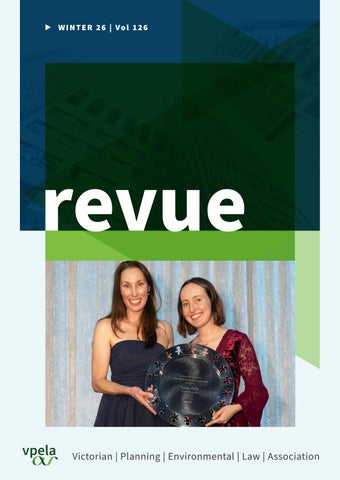
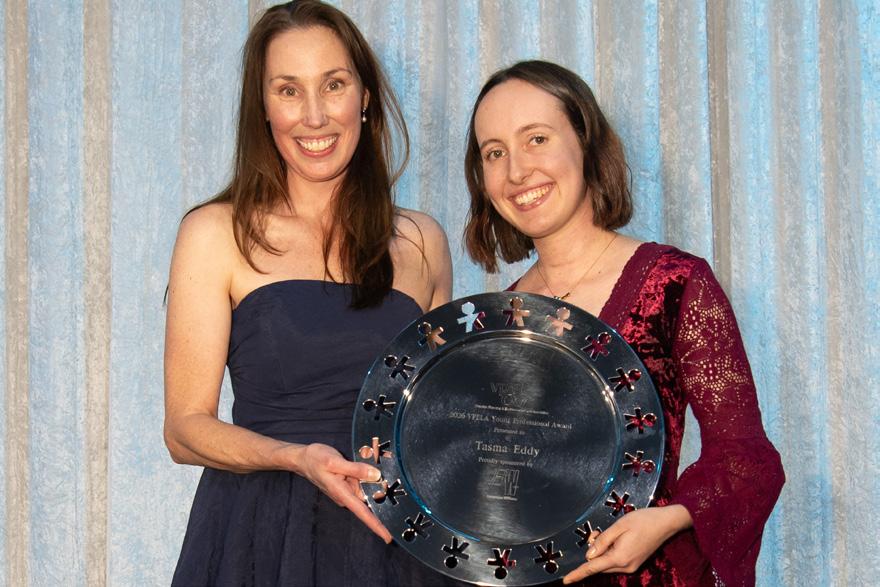
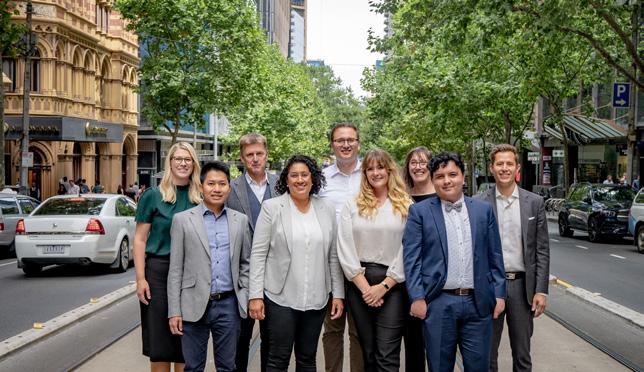
Cover: Fiona Wiffrie, Principal Town Planner, Beveridge Williams presents Tasma Eddy, Graduate Planner, Beveridge Williams with the 2026 Young Professional Award at our Gala Dinner in May.

Newsletter editors: Amanda Ring M: 0419 332 473
E: aring@upco.com.au
T: 8648 3500
Holly McFall
M: 0459 321 020
E: hmcfall@upco.com.au
T: 8648 3500
VPELA PO Box 1291 Camberwell 3124
www.vpela.org.au
E: admin@vpela.org.au
T: 9813 2801
VPELA acknowledges the Traditional Custodians of Country throughout Australia, their Elders and ancestors, recognising their rich heritage and enduring connection to Country and the ongoing sovereignty of all Aboriginal and Torres Strait Islander Nations.
From the Editors Bringing a different perspective

Felicity Karakiklas Contour Consultants

James Aloi onemilegrid
The VPELA Revue is always an incredible source of information and inspiration. Bringing together the many facets of the planning, environment and law industry is no small task, but it is one we have embraced. We hope that this edition offers readers a unique and personal perspective, shining a light on the unique and multi-faceted stories, experiences and ideas that exist within our industry.
The process of editing always begins with the familiar fear that there may not be enough contributions. Fortunately, this year proved to be quite the opposite. We are incredibly proud to have so many interesting and quality contributions featured throughout this edition. If you were ever going to want to read a complete edition, this is the one. Above all, we are proud that the contributions in this Revue are an authentic reflection of the people within our profession.
Following a celebration of VPELA’s 2026 award winners and a look back at some amazing events from the first half of the year, you will be plunged into travels from around Asia, exploring what we can learn from our neighbours in areas such as sustainable transport and urban design – fields in which they often excel.
Interested in hearing more about bikes? This edition of the ‘Fast Lane’ has TWO bike articles written by TWO different James’ (yes, a surprisingly common name among our Traffic Engineers and Transport Planners). Together, they discuss what the future of travel looks like, particularly given the current global climate we face.
We also shine a spotlight on some large and maybe not so large (tiny actually!) environmental issues that may seem small in size but are significant in impact.
Matthew Townsend generously shares an invitation to the Minister to think more courageously about promotional signs as a means to better supporting the conservation and enhancing of Victoria's heritage assets.
It is encouraging to see Tristan Layton, Zachary Pavlou and Kayley Dixon contribute their perspectives to the important debate about whether our cities would benefit from greater planning regulation or a more streamlined regulatory framework. Presenting differing viewpoints, their articles explore both sides of this complex issue and provide valuable insights.
Some pieces will encourage us to go deeper and provide valuable insights into lived experiences that deserve greater recognition and understanding. Gerhana Waty and Simon McPherson have provided some thoughtful pieces on their personal experiences with multiculturalism and neurodivergence in our industry.
Whatever your interests, we believe this Revue has something for everyone. We are immensely proud of this edition and hope you find it as engaging and thought-provoking to read as we found it rewarding to bring together.
As we reflect on our first year as Co-convenors, one thing has become abundantly clear: the VPELA community is filled with incredible, dedicated and hard-working people. We have enjoyed the opportunity to be involved with our industry peers and colleagues and are humbled to have their support in creating what we hope is a unique Revue experience.
The YPG Committee has worked hard to source and prepare a number of interesting reads which are sure to push the boundaries of our perspectives on the industry and the way we work. We are so grateful to have such a thought-provoking group of young professionals who have contributed to this publication and more broadly, continue to deliver a wide range of successful events.
The voluntary task of editing the Revue which is always a fantastic read with so much depth and vigour is, what we can now see, no average feat. Holly McFall and Amanda Ring have been incredibly generous with their time to detail the ins and outs of what makes a successful Revue, and we thank them for their guidance. We can only hope that this edition comes close to the exceptional standard they have consistently achieved over the years.
Lastly, to the behind the scenes, VPELA HQ queens, Grace Hamilton and Anna Aughterson. We regularly rely on their guidance, support and organisational expertise as we navigate through the sometimes-chaotic tangle of event organisation and administration, least of which includes the publication of this Revue. Their contribution to this Revue has been invaluable from coordinating submissions to managing event photography... their fingerprints are all over this Winter edition.
The VPELA cohort is a special one, and we are incredibly grateful to play our part.
Felicity & James
Felicity Karakiklas and James Aloi are Co-Convenors of VPELA’s Young Professionals Group (YPG).

President’s Column Building on strong foundations
Welcome to this edition of the Revue, superbly edited by our Young Professionals Group, who have put together a comprehensive and engaging publication.
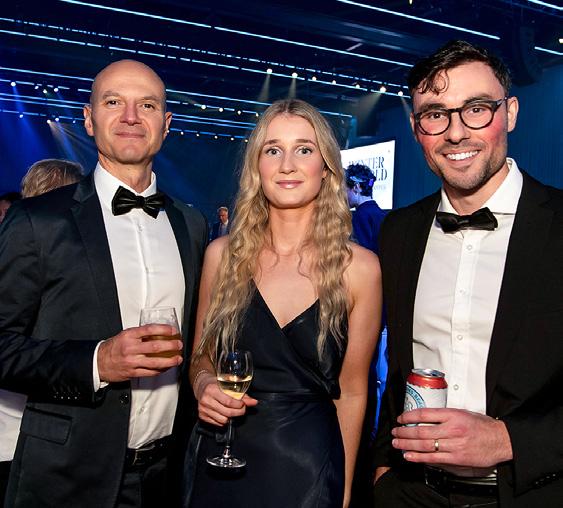
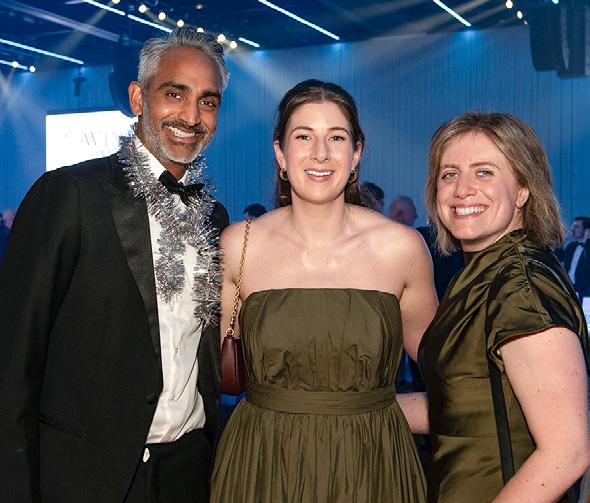
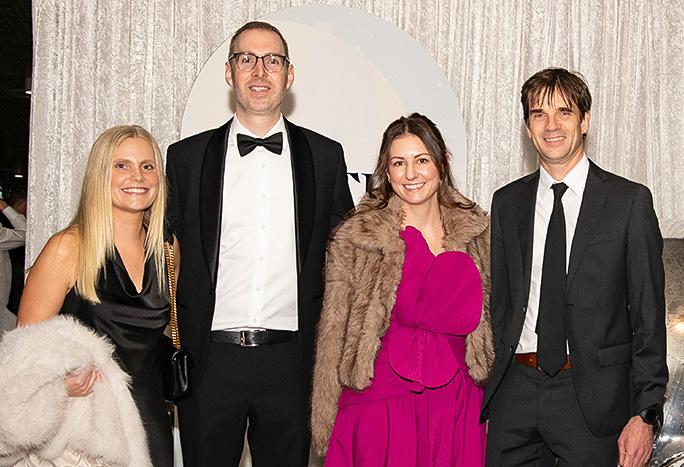
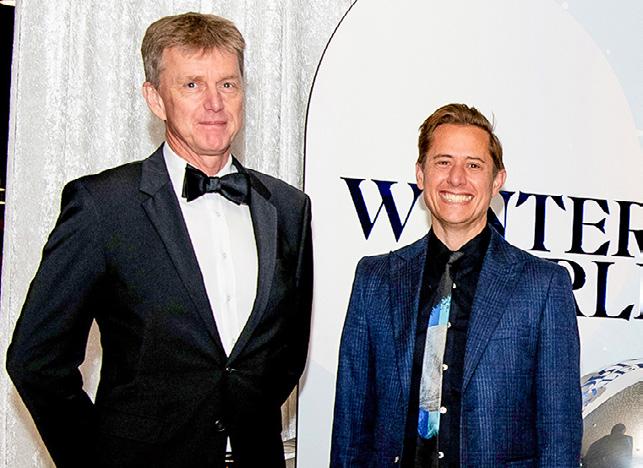
I would like to thank everyone who attended our Annual Gala Dinner ‘Winter World’. It was wonderful to see so many members looking their best, and it is clear that we have some exceptionally creative people within our profession (be sure to check out the photos featured in this edition and also on VPELA’s Facebook page).
The Gala Dinner remains one of the most important events on our calendar, providing an opportunity to recognise and celebrate the outstanding contributions of our peers across the planning sector. I was honoured to be the MC for the evening and extend my sincere congratulations to all award recipients. Full citations are included in this edition; however, I would like to acknowledge the winners here:
• Young Professional Award: Tasma Eddy
• Fellows Award: Carlo Morello
• Richard J Evans Award (Joint Winners): Peter Jewell and Jess Noonan as Planning Xchange
• Richard J Evans Award: Mark Bartley
This year’s awards were particularly noteworthy, with a rare tie in the Richard J Evans Award category, resulting in two highly deserving recipients.
Not surprisingly, many of the conversations throughout the evening focussed on the significant planning reforms currently underway and their implementation. The VPELA Board has been actively involved in engagements with the Planning Regulations Advisory Committee (PRAC) regarding these reforms and will continue to contribute to this important work.

Last month, we hosted a successful Meet the Minister session at Treasury Place. The Minister for Planning was clear in her message that she is keen to hear from the sector about what is working well, what requires refinement, and what aspects may warrant reconsideration. During the session, the Minister encouraged all VPELA members to provide feedback and thanked members who completed our survey.
These reforms represent the most significant changes to Victoria’s planning system in decades. While no reform process is perfect, the opportunity to identify areas for improvement and contribute constructively to the process is one that we should embrace as a profession.
We also heard from Alison McFarlane, Executive Director, State Planning Services and Heritage, who provided an update on the implementation of the reforms to date and outlined several upcoming reforms arising from Plan for Melbourne, including Environmentally Sustainable Design (ESD) Roadmap Stage 2, flooding, bicycle parking provisions, and Better Apartments.
As the reform program continues to progress, the VPELA Board remains committed to ensuring we take every opportunity to inform and influence the work being undertaken by the State Government. VPELA supports the overarching objectives of the reforms, particularly those aimed at improving efficiency and reducing costs. However, as we all know, the success of any reform ultimately lies in the detail.
To ensure we can respond effectively and in a timely manner to consultation opportunities, I encourage members who are interested in contributing to VPELA submissions to contact the Secretariat. We are keen to draw upon the depth of expertise within our membership and bring the level of rigour that reforms of this significance demand.
Looking ahead, the VPELA team has assembled a strong program of events, including seminars, webinars, the YPG Masterclass Series, and the Red Dot Decisions program. Planning for the Annual Conference is also well advanced, and I can confidently say that the program promises to be exceptional. There is certainly no shortage of topics requiring thoughtful discussion, critical analysis, and professional reflection.
While periods of significant change can feel disruptive, they also present opportunities for innovation, improvement, and leadership. As a profession, we have a unique opportunity to help shape the future of planning in Victoria. I encourage all members to remain engaged, contribute their expertise, and continue supporting one another as we navigate this important period of reform.
I hope you enjoy this edition of the Revue.
Jodi Kennedy is President of VPELA and General Manager Community & Culture with Bass Coast Shire.
Jodi Kennedy Bass Coast Shire
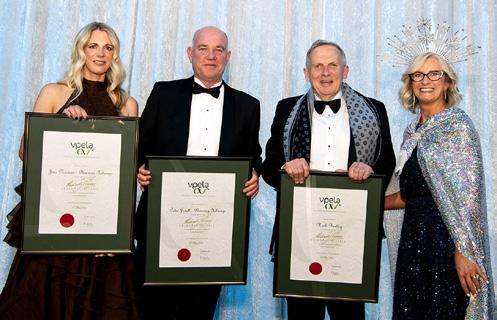
Jess Noonan and Peter Jewell (Planning Xchange) and Mark Bartley, Russell Kennedy, joint Richard J Evans Award Recipients in 2026
VPELA Awards
Richard J Evans Award Recipient
Mark Bartley, Russell Kennedy
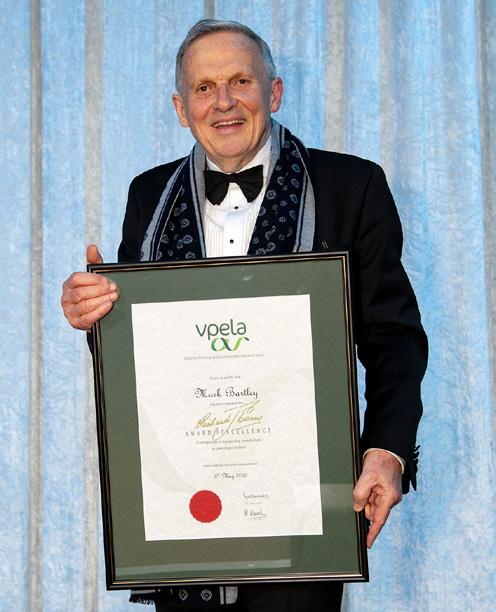
This citation was prepared by the Planning Team at Russell Kennedy
Across five decades, Mark has contributed to every aspect of the planning and environment landscape – as a planner, lawyer, leader, educator, author and mentor. His career is both illustrious in achievement and deeply human in influence. It has been marked by technical excellence and an infectious passion that has inspired generations of planners and lawyers.
Mark is often described, affectionately and accurately, as one of the fathers of planning in Victoria. He was one of the earliest practitioners to pursue law after planning. Few individuals have had such a profound and positive impact on this profession.
For almost 50 years, Mark Bartley has devoted his working life to planning and the environment. He is driven by a genuine belief in responsible development, environmental stewardship and sound, enduring land-use outcomes.
Mark graduated with a Bachelor of Arts in Geography from Monash University in 1976, later completing a Master of Urban Planning.
Mark’s early professional experience included working for regional and state planning authorities and in establishing a private planning and project management consultancy. He also lectured at Victoria University when it offered a very grounded planning course.
From the outset, Mark’s career was grounded in responding to real environmental challenges.
His work with the Western Port Planning Authority aligned him with one of Victoria’s most respected and forward-thinking planning bodies, widely recognised for setting enduring benchmarks in strategic coastal and environmental planning, which has truly stood the test of time. These experiences cemented his understanding of risk, sustainability and the critical role of planning in protecting both people and place.
Mark’s involvement in the planning response to the Coode Island explosion in 1991 placed him at the forefront of environmental regulation and land-use planning in Victoria. Mark has continued to play a very active role in the Victorian planning profession, reflecting an early and enduring commitment to education and knowledge -sharing.
Career evolution: from Planning to Law
Mark transitioned from planning into law while raising a young family, a testament to his extraordinary work ethic and intellectual curiosity. He graduated with Honours from Melbourne University and started his legal career with the firm Sly & Weigall (now Norton Rose Fulbright). Mark was fortunate to work for a number of years with Peter Barber at Deacons before joining Phillips Fox (now DLA Piper).
Mark rose to Partnership, leading the firm’s planning and water practice and serving as the “Partner in Charge” of the Melbourne office. His dual qualifications as both a planner and lawyer became the defining strength of his career, allowing him to approach complex matters with depth and a practical perspective.
In 2012, Mark made a bold and defining move, establishing the Victorian planning and environment practice at HWL Ebsworth Lawyers alongside David Vorchheimer. Under his leadership, the practice grew to four partners – as James Lofting and Alex Gelber rose up the ranks – with Mark playing a pivotal hands -on role in mentoring and developing younger practitioners.
In 2024, Mark joined Russell Kennedy as Special Counsel, where his passion for practice remains undiminished – a man who, by common observation, simply cannot take a day off because he genuinely loves what he does.
Mark Bartley has made an exceptionally deep and broad contribution to planning and environmental law and policy in Victoria.
He is involved in all aspects of property development and has and continues to regularly appear before the Victorian Civil and Administrative Tribunal (and its various predecessors), Planning Panels and Standing Advisory Committees. His experience extends across major transport infrastructure projects; water infrastructure and law reform; and commercial, industrial and residential developments.
Notable matters include:
• Advising on national water reform;
• Acting for VicRoads as the proponent on a number of major projects requiring Environmental Effects Statements;
• Long-term involvement in advising on the rezoning and development of former Commonwealth defence land at Derrimut, transforming land use outcomes through sustained planning advocacy;
• Achieving planning approval for the Arthur’s Seat Gondola; and
• Acting across numerous Precinct Structure Plans throughout Victoria, notably in Armstrong Creek.
His contribution is quietly transformational – behind the scenes, shaping outcomes and systems with care, judgment and integrity.
Sustainability and public interest
For Mark, sustainability is a lived commitment. His career includes substantial pro bono work, including:
• Acting for an Indigenous elder from the Larrakia people;
• Supporting Friends of Mount Cannibal in environmental protection efforts;
• Assisting the Lost Dogs Home with their relocation strategy; and
• Providing planning advice to community housing organisations.
These matters reflect Mark’s longstanding belief that planning and environmental law must serve country, community and future generations, not simply immediate outcomes.
Publishing, though leadership and education
Mark’s contribution extends well beyond practice into publishing, law reform, policy development and professional education. Mark has been actively involved in numerous professional associations for many years and has contributed and presented at many seminars, conferences, lectures as well as publishing articles and insights.
He has also provided ongoing professional training through the Public Land Consultancy, further embedding his contributions and influence across the profession.
Outstanding leadership in professional practice
Mark has demonstrated exceptional leadership across multiple professional bodies, including:
• Director, Urban Development Institute of Australia (1998 – 2008), member of multiple UDIA committees, including State and national design award judging for many years;
Shaping tomorrow’s cities and communities begins with planning.
At Urbis, our urban consultants work with you throughout the entire planning process to deliver outstanding results in the public and private sectors –including due diligence, strategy, strategic planning and development facilitation.
No matter what size your project is we take the time to understand your vision and position it for success. Our planners are the most experienced and awarded in the country guiding projects from vision to approval and beyond.
In addition to our core services, we offer expert advice in key growth areas such as Transport Advisory and Digital Cities.
• Board Member, Victorian Planning and Environmental Law Association (1995 – 2004) and member of various committees;
• State President, Australian Water Association (2013 –2015);
• LIV Accredited Specialist in Planning & Environment Law; and
• Fellow of VPELA, PIA and UDIA.
These roles reflect the trust placed in Mark by the profession and his enduring commitment to leadership and service.
Inspiration to others
With all the formal awards and recognition aside, Mark’s most enduring impact is on the multitude of people he has mentored and inspired.
For countless practitioners, Mark gave them their first real understanding of how planning works – not just in law, but in practice. Famed within the team for his “Planning 101” and “How to Delegate” sessions, Mark graciously imparts his wisdom to emerging planning lawyers. His approach is non-judgmental, expressive and deeply encouraging. He pumps people’s tyres, makes them feel capable and gives them the confidence to grow.
Many esteemed practitioners across Victoria credit Mark with shaping their careers, including James Lofting, Alex Gelber, Peter O’Farrell KC, Briana Eastaugh, Greg Tobin and countless others. Notably, this list includes his son, Will Bartley, a testament to the fact that Mark’s passion for planning and environment law is genuinely contagious.
Mark radiates approachability, always making time for junior practitioners no matter how busy he is or whether he is on holiday!
His passion is undeniable, fuelled by a genuine love for planning, law and people. Whether in discussion, advocacy, mentorship, or even on the VPELA dance floor, Mark’s energy is unmistakable. His lawyering skills, it is often said with affection, are only just rivalled by his dance moves.
Conclusion
In every respect, Mark Bartley undoubtedly exemplifies the spirit of “The Richard J Evans Award for Excellence in Planning and Environmental Law”.
His career reflects lifelong commitment, outstanding leadership, technical excellence, ethical integrity and unparalleled generosity of spirit. He is not only a leader in planning and environmental law, but a source of joy, inspiration and continuity within the profession.
Mark Bartley’s Response
I am very honoured and humbled by this award.
I want to dedicate it to Peter Barber AM who was the inaugural President of VPELA, and who I worked under for 5 years when I started in law. It was Peter who first got me involved in VPELA.
I’ve been very fortunate to have had a wide range of opportunities over a 50-year career as a planner and then later as a lawyer, working with some great people who I acknowledge.
This includes John McCaffrey at City of Berwick and at Western Port Regional Planning Authority under Brian Harper AM, in
the days when ‘regional planning’ was a thing! Then lecturing at Footscray Institute of Technology (later to become VUT) with Rodger Eade and Des Eccles. That’s where I first met Kathy Mitchell AM and later worked with her at Perrott Lyon Matheson under the legendary David Whitney.
Working with the Western Region Commission in the late 1980s led to acting as project manager for the planning of the redevelopment of the Albion Explosives Factory, now Cairn Lea; and later for the potential relocation of the Coode Island tank farm, through the Review lead by John Landy AC and Rob Skinner, after the major 1991 fires. It never got moved, but someone decided it would be a good idea to put lids on what had been open topped tanks storing a range of flammable materials!
My motivation to move into law, in some way a natural progression from statutory planning and VCAT advocacy, was finally prompted by chairing a panel hearing with Ian Murray, then a senior partner/advocate at Mallesons opposed to Tony Hooper QC and several other barristers.
This was a case about the rezoning of the Wilke Printing facilities at Oakleigh (does anyone remember phone books? They printed them all for Australia!) after its purchase by Consolidated Press. This had changed a benign family business using water-based inks into a major magazine publishing centre using VOC solvent-based inks, causing significant impact on the surrounding community.
I had both sides threatening me with a trip to the Supreme Court depending on whether I allowed, or did not allow, what was fairly aggressive cross-examination by Hooper of the company environment manager regarding environmental complaints.
Just what exactly did procedural fairness demand in that situation? Somehow, I confined Hooper’s cross and managed to keep everyone under control.
As a partner in several major law firms over 30 years I have had loyal clients allowing me to build a strong practice.
I have especially enjoyed the opportunity to mentor junior lawyers many of whom have gone on to develop their own careers as partners and senior barristers.
Involvement in VPELA gave me the opportunity to meet a wide range of people working across all the related disciplines that make up the industry.
We are all lucky to work in such an interesting and challenging endeavour helping to contribute to the development of our communities.
I urge all the younger professionals to take opportunities that arise in your careers to get involved in VPELA and the other related professional bodies. We need people contributing to policy development and implementation.
I want to pay tribute to David Vorchheimer (who joined me in developing our practice 14 years ago) and all of the planning and environment team at Russell Kennedy for their support and putting up with me. I promise to stop referring to ‘recent VCAT decisions’ that turn out to be from 10 or 20 years ago!
I thank my wife Merran for all her support and acknowledge my three children who have put up with my career.
Thank you to the VPELA Board for this endorsement. Mark Bartley is Special Counsel at Russell Kennedy.
VPELA Awards
Richard J Evans Award Recipients Planning Xchange: Jess Noonan & Peter Jewell
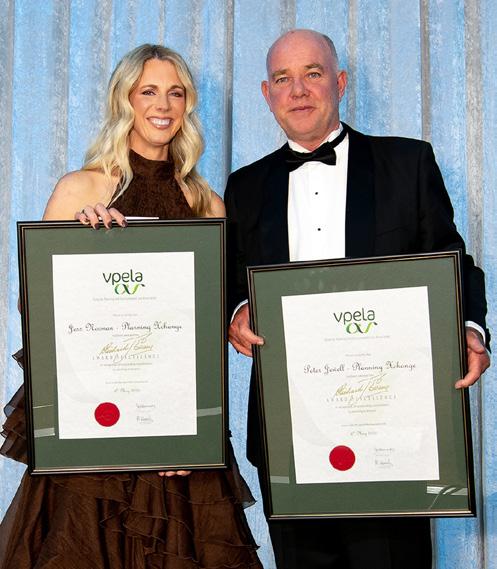
Planning needs voices who challenge conventional wisdom, search for new ideas, listen to those who experiment and to those who have wisdom borne of deep experience.
In the birth and nurturing of Planning Xchange in 2013, Peter Jewell and Jess Noonan gave life to an alternative voice through regular podcasts. A voice that Richard Evans would have applauded in his own quiet respectful manner.
For those who have had a call to be interviewed, the calm invitation from Jess is hard to refuse. Then there is that moment that the questions flow from Peter, the ‘Yang’ to Jess’ ‘Yin’. The thinking is tested by the discourse that follows between them all.
All good partnerships benefit from this chemistry as is demonstrated by the contribution this duo have made through Planning Xchange to the collegiate nature of our industry. They have helped foster the agency of both VPELA and PIA who in return have welcomed and supported their presence in our professional lives.
How did this all start?
As a student of Planning at RMIT in the early 1980’s, Peter Jewell demonstrated an ability to challenge the orthodoxies of
conventional thinking. It was curiosity clearly and courteously expressed. In a student environment of weekly lectures his mentors welcomed a voice from the back of the theatre that could argue an alternative. He stirred the pot.
Moving to employment Peter patiently learnt the art of providing advice from consultants in Planning and Architecture. In his evenings of reflection, he wrote stories that were often an expression of his alter ego in ‘Educating Sarah’ and then ‘Red Jacket.’ They were the first articles many of us would read in Planning News as each month another keen observation would be placed in the public arena. The results being discourse both written and oral in the constituency of the planning world.
Peter was honing his abilities and natural talent to stand outside the box. His next step at the height of a recession was to start Jewell Partnership.
Peter has consistently demonstrated leadership and foresight within the planning profession. He conceived the idea for making podcasts well before they became a widely adopted medium. His objective was clear, to drive innovation within the planning sector and promote higher-quality, evidence-based decision-making.
Peter is a formidable and respected interviewer, unafraid to explore challenging topics or pose difficult questions. He embraces constructive criticism and is willing to place himself under scrutiny if it advances understanding of important industry issues. In a profession where perspectives can easily become insular, Peter brings a rare capacity to interrogate entrenched views, encourage robust debate, and introduce alternative ways of thinking.
He regularly looks outside his immediate environment for inspiration, looking overseas and interstate for different approaches to planning issues. He is an inspiration in respectful debate, in challenging the status quo and in consistently striving for improvement.
Jess Noonan is a quiet achiever. Her journey in the planning profession is grounded in her strong regional roots in Bendigo, Victoria, which have shaped both her perspective and her strong work ethic.
She has worked across statutory, strategic and social planning projects building a diverse career in consulting firstly at Fulcrum, then ERM and now Tract.
She graduated from RMIT in 2009, and has always had a deep passion for urban and social planning, as well as a genuine investment in the people who make up the profession
At University Jess always stood out as an engaged and influential contributor. She was heavily involved in student planning associations and young professional committees, building meaningful connections across the sector.
This citation was prepared by Tim Biles, Tim Biles Project and Tamara Brezzi, Planning & Property Partners
She always made a deliberate effort to maintain ties with regional Victoria by staying connected with both industry professionals and emerging planners through her involvement in the student planning associations and PIA.
This early commitment in industry laid the foundation for her strong and respected reputation.
Jess brings a rare combination of professionalism and personality. Her calm and confident disposition, paired with her approachable and enthusiastic nature, makes her a distinguished planner, who is a genuine pleasure to work with.
A defining feature of Jess’ career has been her commitment to mentoring and developing others. She has always taken emerging planners under her wing generously sharing her knowledge, building their confidence, and equipping them with the practical skills needed to succeed.
Jess is a natural collaborator and leader bringing people together to share ideas, spark creativity, and create engaging content that resonates with podcast listeners,
After obtaining her planning degree from RMIT Jess completed a Master’s in Public Health at Deakin University. Her thesis investigated the factors contributing to social connectedness in older Australians living in aged care facilities. Her experience with a diverse range of urban planning projects makes her a key contributor to the depth of issues that Planning Xchange critically explores.
Interaction with a range of voices and interests in our industry is a hallmark of Jess’s contribution to professional discourse. As an active participant in the planning industry, she has held
a number of roles with the Planning Institute of Australia, including the National Young Planner Representative for Victoria between 2009-2012, Chair of the Social Planning Chapter for the Victorian Division and since 2018 has held the position of Vice-President of the PIA Victoria Division Committee.
In 2011, Jess was awarded Young Planner of the Year by the Planning Institute of Australia and in 2017 was awarded the Female Achiever of the Year Award from the Planning Institute of Australia and the Women’s Planning Network.
Together Peter and Jess have conducted hundreds of interviews with guests from around the world. Planning Xchange has become one of Australia’s longest-running independent planning podcasts and remains unparalleled in its breadth, longevity, and influence. While many have attempted to create similar platforms, none have matched its sustained impact or reach.
In making this nomination we take a moment to reflect on the nature of Richard Evans. He had a curious mind shaped and sharpened by a Science and Arts degree. In his early years he was an inspiring mentor and tutor to students at Caulfield Grammar. After taking up the law, he applied these same qualities to clients – often widening conventional legal perspective with balance and Insight that was never afraid to explore alternative solutions.
Planning Xchange contributes to our industry in a manner that honours the nature of Richard Evans and the legacy we seek to celebrate in this award.

Planning Xchange: Jess Noonan & Peter Jewell Response
How a chance meeting, a shared respect for debate and thirteen years of conversation helped shape a distinctive voice in planning.
Standing before a room of respected peers to accept an industry award is not something either of us imagined when we first began recording conversations about planning over a decade ago. Receiving the Richard J Evans Award from VPELA was therefore both deeply humbling and an opportunity to reflect on a professional journey built on curiosity, humour, robust debate and a shared commitment to the planning profession.
It also reminded us that meaningful leadership often begins in unlikely places.
Our story begins with VPELA itself, a multidisciplinary professional body that has long played an important role in connecting and developing planning and environment professionals across Victoria. We first met at a VPELA conference in Ballarat in 2012 and crossed paths again at a VPELA ball the following year. Somewhere amid the latenight conversations, we decided starting a planning podcast sounded like a good idea.
In hindsight, that spontaneous decision proved unexpectedly consequential.
The partnership itself has always been part of the appeal. We often describe ourselves as an unusual pairing. We challenge each other regularly and do not always agree, but there has always been strong mutual respect and a shared belief in the value of thoughtful public conversation. That dynamic has helped sustain Planning Xchange for more than thirteen years and has shaped the tone of the podcast: curious, probing, informal and occasionally irreverent, but always grounded in respect for the profession and the people within it.
From the beginning, the podcast sought to contribute to what might be called the “planning commons”, creating space not only for established figures in the profession, but also for emerging voices and those working at its edges,
where new ideas often emerge first. Over the years, we have interviewed hundreds of practitioners, academics, designers, public servants, lawyers, economists and commentators from Australia and overseas.
What began as a local Victorian planning conversation has gradually developed an international audience. The podcast now attracts its largest audience from the United States, regularly features guests from overseas and, over a number of years, has consistently appeared in global top ten rankings of urban planning podcasts. For something that started as an entirely amateur late-night idea, the reach has been both surprising and deeply rewarding.
Taken together, those conversations have become an informal archive of industry thinking: discussions about policy, leadership, design, governance and reform that both document and challenge the evolution of planning practice. At a time when planning faces enormous pressures, housing affordability, climate adaptation, infrastructure delivery, social change and growing public scrutiny, the willingness to have open and sometimes difficult conversations matters more than ever.
While this award recognises exemplar leadership, the podcast has always been a collective effort. It depends entirely on the generosity of industry colleagues who have shared their time, expertise and ideas with us over many years. We are also grateful to the organisations that supported the project from the beginning and helped sustain it over time, including Victorian Planning Reports, Maddocks Lawyers, Alderson Property, onemilegrid, Ratio, VPELA and the wider team at Tract.
Perhaps the podcast’s success is not measured in awards or download numbers, but in its capacity to spark debate, unsettle assumptions and create space for new thinking. Some of the most rewarding moments have come from hearing that an episode changed someone’s perspective, introduced them to a new idea or simply made them feel more connected to the profession.
Ultimately, Planning Xchange has been a celebration of what can happen when professional generosity, robust conversation and a little late-night audacity come together.
Jess Noonan and Peter Jewell are Co-Founders of Planning Xchange.
VPELA Awards Fellowship
Carlo Morello, Traffix Group
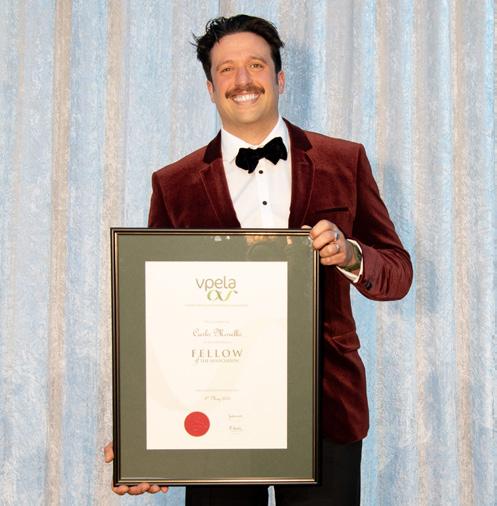
Carlo Morello has been a valued and consistent presence within VPELA since joining the organisation in 2011 as a Traffic Engineer at Cardno. Between 2012 and 2025, he has contributed in a range of leadership roles, demonstrating an unwavering commitment to supporting both his profession and the broader development industry.
Carlo quickly became an active and influential member of the organisation. He joined the Young Professionals Group (YPG) in 2012 and was soon recognised for his leadership potential, serving as YPG Convenor from 2014 to 2016. In this role, Carlo championed the development of emerging professionals, ensuring they were supported, connected, and provided with opportunities to grow their skills and networks.
In 2015 Carlo won the prestigious Young Professional Award – his topic was ‘construction of Melbourne Metro and the impacts the project will have on the transport system and abutting businesses’.
In 2016, Carlo was elected to the VPELA Board – an endorsement of the respect and confidence the membership held in his leadership. Throughout his Board tenure, he brought energy, dedication, and a strong desire to give back to the profession. His progression to the Executive Committee in 2021 as Secretary, and later to Treasurer in 2025, reflects his capability and the trust placed in him. As Treasurer, Carlo played a pivotal role in establishing the Endowment Fund, a significant legacy initiative for the organisation.
Carlo is widely respected for his thoughtful approach and strong convictions. His strengths in lateral thinking and communication enable him to develop well-considered solutions and articulate them effectively to professionals, clients, and the broader community. He is a confident, personable, and highly regarded traffic engineer.
For those who know Carlo beyond his professional achievements, as a Director at Traffix Group-you may also recognise him as the warm and engaging presence who has hosted our Conference as MC, or as the talented musician who has entertained members at various events over the years.
Carlo is a well-rounded professional who brings enthusiasm, generosity, and a genuine commitment to supporting the next generation of practitioners.
Fun facts: Before entering the engineering profession, Carlo was a pre-service teacher, co-founded and managed a successful corporate and wedding band, and is now a Director at Traffix Group.
Carlo Morello is a Director at Traffix Group.
VPELA Awards
Young Professional Award Recipient Tasma Eddy, Beveridge Williams

Investigating Singapore’s approach to affordable, diverse and accessible housing to inform Victorian planning policy
Housing affordability, diversity and accessibility are core objectives of the Victorian planning system, yet there remains a persistent gap between policy intent and praxis. In Melbourne, rapid population growth (4.6 million in 2024 to a projected 8 million by 2051), escalating housing costs and a very low proportion of social and affordable housing (around 3 per cent of total housing stock) have intensified housing stress for low and moderate-income households. With the Planning Amendment (Better Decisions Made Faster)


Bill receiving Royal Assent in February, Victoria is at a pivotal juncture where planning reform can meaningfully align with its housing ambitions.
This research investigates Singapore’s approach to affordable, diverse and accessible housing to identify planning and governance mechanisms that could strengthen Victorian planning policy. Singapore provides a strong comparator to Melbourne: both are dense, urbanised cities facing population growth, land constraints and increasing development intensity, and both operate within robust planning frameworks and are supported by major public investment. However, unlike Melbourne’s predominantly market-led housing delivery model, Singapore adopts a centrally coordinated system that integrates legislation, universal design standards and large-scale public housing provision. This contrast enables a focussed examination of how governance, density and delivery mechanisms can improve housing outcomes.
The project will be undertaken through targeted field research in Singapore in March 2027 approximately two weeks). The methodology includes observation of housing typologies, analysis of public-realm integration and accessibility standards, and engagement with key agencies, accessibility experts and academics. Regulatory frameworks integrating affordability, diversity and accessibility will be examined and assessed for their transferability to the Victorian context.
The research aims to generate practical, evidence-based recommendations to inform Victorian planning reform, supporting planners and policymakers to improve housing affordability, diversity and accessibility in high-growth, higherdensity urban environments.
Tasma Eddy is a Graduate Planner at Beveridge Williams.
The Paul Jerome Award 2026 Nominations are invited
In 2005 the Victorian Planning and Environmental Law Association established The Paul Jerome Award, as a memorial to a much loved and respected colleague. This award was created to encourage, recognise and support outstanding contribution to public administration.
The principal focus of the award is planning within the umbrella of public service to state and local government and the list of past recipients has brought prestige to the award.
A list of previous recipients, criteria for the award and a nomination form can be downloaded from our website.
Nomination forms can be downloaded from our website https://www.vpela.org.au/Web/ AboutUs/Awards/Paul-Jerome-Award.aspx and emailed to admin@vpela.org.au
Nominations close COB Friday 31 July 2026.
The recipient will be presented with an engraved trophy at the VPELA Conference Gala Dinner, to be held at Mantra Lorne on Friday 28 August 2026.
Thanks to Contour Consultants for their sponsorship of this prestigious award.
VPELA STATE PLANNING CONFERENCE
27 & 28 AUG 2026 | MANTRA, LORNE | VPELA.ORG.AU
THE FUTURES WE IMAGINE
The places we inhabit today were once ideas on paper – visions of how cities, towns, infrastructure and landscapes might grow and evolve. Some of those futures became reality. Others did not. As Victoria faces new challenges – housing supply, climate adaptation, regional growth, infrastructure investment and changing community expectations – the role of industry in imagining and shaping the future has never been more important.
KEYNOTE SPEAKERS INCLUDE:


Our conference committee has just finalised a great line-up of keynote speakers to inspire and provoke you:
• Jelena Dokic, Australian broadcaster, tennis analyst, former professional player and public speaker
• Lucy Saunders, Founder of Healthy Streets UK
• Rita Arrigo, AI Strategist
• Dean Landy, Partner, ClarkeHopkinsClarke
• Cameron Hamilton, Director, Hamilton Group
PLUS PANEL SESSIONS:
Getting ready for future justice – what’s new at VCAT and the County Court of Victoria
Judge Suzanne Kirton, County Court of Victoria and Vice President of the Victorian Civil and Administrative Tribunal (VCAT)
Deputy President Carol Daicic, Victorian Civil and Administrative Tribunal (VCAT)
Justice institutions around the world are being challenged to deliver more with less — driving innovation in the way disputes are managed and resolved. Courts and tribunals are rethinking traditional processes, embracing technology, and placing greater emphasis on appropriate dispute resolution and early issue identification. Parties and practitioners are increasingly expected to play an active role in the efficient administration of justice. As these disputes grow in scale and complexity, proceedings are becoming more digital, adaptive and user-centered, reshaping the future delivery of justice.
This session explores recent innovations and initiatives by the Victorian Civil and Administrative Tribunal and the County Court of Victoria and considers what the future may hold.
Imagining and Reimagining: Transforming precincts and the places in between
As we grapple with rapid change and how to make space for growing communities, the city of the future is already being built right now.
We explore examples of how we’re already reimagining spaces and innovating the design processes that created them – from adaptive reuse to urban residential and beyond. In this session you’ll meet some of the people behind the vanguard of ‘21st century’ planning and design and leave with the power to think differently.
PRACTICAL FOCUS SESSIONS WILL INCLUDE:
• Modern Methods of Construction
• We tried this in another country: what travels, what fails and what sticks
• AI, Modelling, Smart networks and the next generation of transport engineering
• Where do I even start? Understanding & navigating the ICP systems in the context of recent change
• Off-site cultural Immersion experience facilitated by Eastern Maar Aboriginal Corporation
• PhD Candidate Presentations RMIT
• Modern methods of research
There will also be a mentoring session if you are new to the conference – no need to walk to our Thursday night dinner at the Lorne Hotel by yourself and as always a fabulous Gala Dinner on Friday night – this year Back to the Future! (open to interpretation).
You can take part in our get active get social program including new to the program “Lorne” bowls! As always our bike rising, yoga, paddling and running are all welcoming groups to take part in.
Sponsorship Opportunities Still Available
BOOKINGS OPEN SOON!
Our conference brochure with full details and pricing will be available shortly on our website: www.vpela.org.au
Events Reflecting on reform: planning for a fairer Victoria
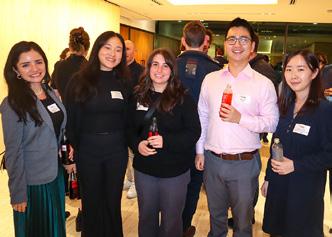
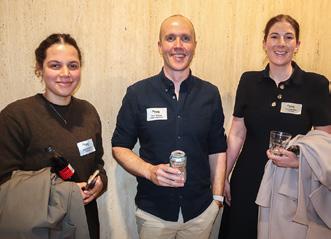
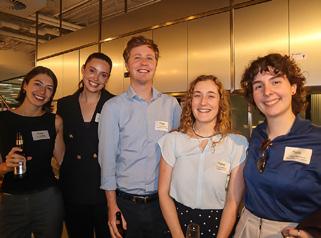
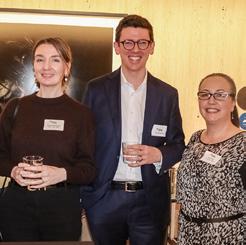
VPELA’s annual “Reflecting on Reform” event, held on 19 May 2026 at Melbourne’s Treasury Theatre, once again provided a valuable forum for practitioners, decision-makers and policy leaders to engage directly on the future of Victoria’s planning system. Bringing together a cross-section of the profession, the evening combined substantive policy discussion with the collegiality that continues to make this a highlight of the VPELA calendar.
Opening the discussion, Minister for Planning Sonya Kilkenny set a clear and purposeful tone, emphasising the broader significance of planning reform. As she observed, “planning is not just about permits. It’s not just about overlays or statutory process. It is about how we shape the future of our state.” This framing resonated strongly, reinforcing the central role of planning in addressing housing affordability, liveability, and long-term urban and regional outcomes.
The reform agenda was presented as a necessary response to structural challenges within the existing system. The Minister acknowledged that Victoria is working within a framework “designed for a very different era,” one that has struggled to respond to contemporary growth pressures and housing demand. Against this backdrop, the Government’s reform program seeks to deliver a system that is faster,

clearer and more proportionate – while maintaining integrity and public confidence.
A key element of the reforms is the introduction of new assessment pathways aligned to development scale and complexity. The Minister’s emphasis, however, was not on speed alone, but on quality decision-making, noting that the objective is “good decisions made faster.” For practitioners, this distinction is critical: efficiency must be balanced with transparency, rigour and defensibility.
The discussion also situated these reforms within the broader strategic framework of Plan for Victoria, described by the Minister as “never a static document… a living document.” With extensive community input underpinning its development, the plan reflects both the demand for increased housing supply and the expectation that growth will deliver well-designed, connected and sustainable communities. The message was clear – reform is ongoing and responsive.
Importantly, the evening extended beyond a metropolitan focus to meaningfully address regional Victoria. The Minister recognised that planning in regional contexts presents distinct challenges, including environmental overlays, flooding and bushfire risk, infrastructure constraints, and local workforce pressures. In this context, she emphasised that “context
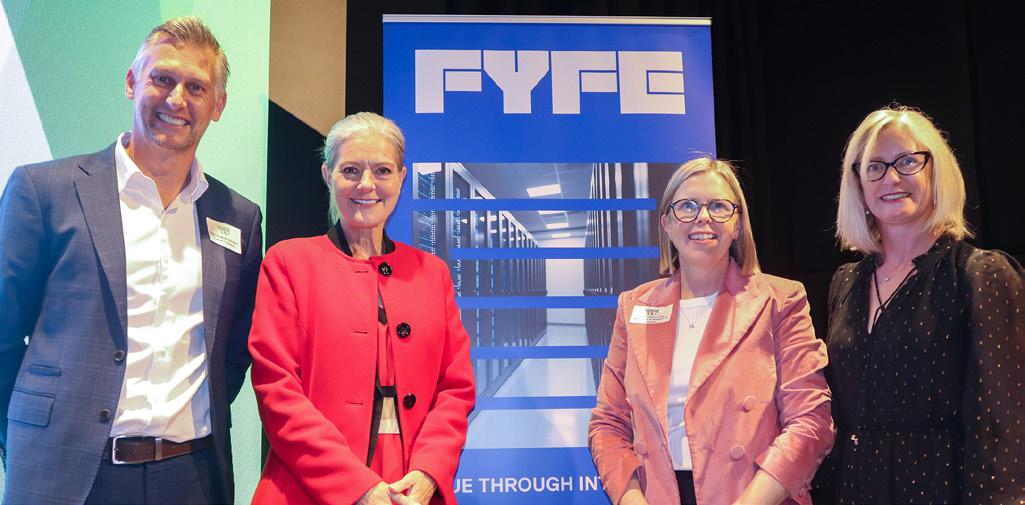
L>R:TimMcBride-Burgess,TheHon.SonyaKilkenny,AlisonMcFarlaneandJodiKennedy
Oona Nicolson Fyfe
matters,” highlighting the need for reforms that balance statewide consistency with local flexibility.
This statewide approach is embedded within Plan for Victoria, which seeks to integrate metropolitan and regional outcomes rather than treat them separately. Regional centres are expected to play an increasingly important role in accommodating growth, supporting local economies and providing housing for key workers. Ensuring that the planning system can respond effectively in these contexts is therefore critical.
Alison McFarlane, Executive Director, State Planning Services and Heritage at the Department of Transport and Planning, provided further insight into how these reforms are being delivered. She highlighted the Regional Hub Program, which supports 48 rural and regional councils in permit processing, strategic planning and scheme amendments. The program includes investment in planning capability through the funding of 37 cadets across 20 councils, reflecting a practical response to resourcing pressures in regional areas.
Environmental reform was also a key focus, particularly the move to a more coordinated, state-led approach to flood mapping and its integration into planning schemes. These changes are expected to be especially significant for regional councils, where the complexity and cost of delivering such amendments have historically been a constraint.
A consistent theme throughout the evening was that legislative reform alone will not deliver outcomes. As the Minister noted, “this is about changing the way we use a system… changing it from the inside out.” This emphasis on cultural change – across government, councils and the profession – was echoed in the
discussion, particularly in relation to implementation and the consistent application of new tools.
McFarlane reinforced the importance of continued engagement with practitioners, encouraging feedback on how reforms are operating in practice, including “what works well” and where there may be “friction, uncertainty, and unintended consequences.” This recognition of the profession as an active participant in reform implementation was a constructive and important message.
For practitioners, the implications are significant. These reforms will shape how advice is provided, how risk is managed, and how projects are delivered across both metropolitan and regional contexts. While the move toward a more codified system is evident, the need for informed professional judgment remains central.
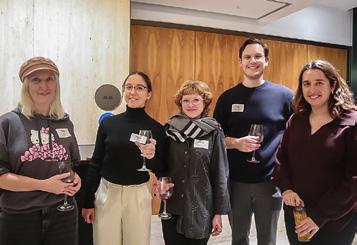
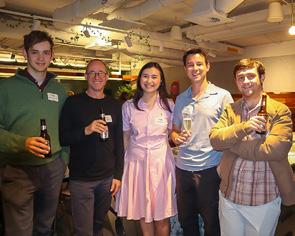
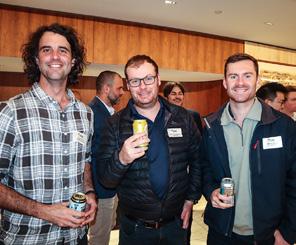
As always, one of the enduring strengths of this VPELA event lies in the opportunity for informal engagement. The conversations extended beyond the formal presentations, with many attendees staying on to connect with colleagues, exchange perspectives and reflect on the practical implications of reform over a drink.
Ultimately, the evening reinforced a shared understanding: planning reform is not an end in itself, but a means to deliver better outcomes. The challenge for the profession is to ensure that the system supports equitable, efficient and welldesigned communities – across metropolitan Melbourne and throughout regional Victoria alike.
Oona Nicolson is National Discipline Lead, Heritage & Senior VIC Practice Lead at Fyfe.

YPG Events


YPG Trivia
Hot off the back of the successful YPG Speed Networking, the annual YPG Trivia Night took place at Urbis in late April.
Taking inspiration from VPELA’s multi-disciplinary planning and environment membership base, this year, the YPG trivia organisers set out to put a twist on the traditional trivia night. With the “Traffic” round featuring Snoop Dogg, “Acoustic” round featuring the AFL, and the “Heritage” round featuring an Aussie chocolate favourite (Haigh’s of course), it was industrythemed trivia, but not as you know it!
With over 100 trivia goers in attendance, the sold-out night was a roaring success and a great opportunity for everyone to socialise and embrace their competitive side. Congratulations to the MinterEllison team, featuring the YPG Committee’s very own Ruby Bell, for taking home first prize.
A big thank you to our Quiz Masters, former YPG Co-Conveners Charlie Wurm and Isobell Vescovi, who ensured that the night ran smoothly and energy kept high with their flair and enthusiasm.
Thanks to the creative minds of the YPG committee members Lauren Goldstein, Lizzy Henry, Eliza Kane, Ruby Bell and Campbell Gullock, as well as to VPELA’s Grace Hamilton, Anna Aughterson and Katherine Yeo for all their help in organising and running the event.
Test out your or your colleagues’ trivia skills (and competitive edge) with a sample of the YPG trivia questions.
Answers are provided on page 35.
1. Planning round:
a. Name the two trams that do not pass through the Melbourne CBD
b. The recently gazetted VC277 introduces how many car parking categories?
2. Heritage round:
a. Which Victoria National Park has the highest concentration of Aboriginal rock art?
b. Name the three mascots from the Sydney 2000 Olympics (bonus point for the species as well!)
3. Traffic round:
a. Which country was the first to introduce the mandatory seatbelt laws for drivers?
b. Under the Victorian Planning Provisions, if a car parking space is 4.9m long, and accessed via a 5.8m aisle, what is the minimum width?
4. Law round:
a. What is the name of Elle Woods’ chihuahua in the film Legally Blonde?
b. Name the three branches of government in Australia.
5. Acoustics round:
a. A location (e.g. residence, school or hospital), where people are particularly susceptible to noise, is known as a “sensitive….”?
b. What AFL team would you be watching if you were singing along pre-match to INXS’ “Never Tear Us Apart”?
6. Design round:
a. Which is longer: A. Earth’s circumference OR B. China’s high-speed rail network?
b. ‘The Life and Death of Greater American Cities’ was written by which influential urban designer?
7. Environment round:
a. In 2021, why did the ship Ever Given become famous online?
b. Under Victoria’s native vegetation regulations, what are the three key biodiversity values assessed when determining permitted clearing?
Masterclasses: A frolic through the fields
This year, the YPG masterclass series has explored Greenfield, Greyfield/Brownfield and ‘Open Field’ developments, titles we all use as shorthand to categorise different types of developments, through the lens of a number of respected industry experts.
Bringing together perspectives from across planning, law and technical disciplines, the sessions explored how ‘greenfield’ and ‘open field’ land is identified, planned and ultimately transformed. The session covered high-level policy and strategy technical considerations, and pathways for funding, delivery, and approvals. Each session tackled treatments under both state and commonwealth-level planning controls.
A sincere thank you to our outstanding ‘greenfield’ panellists Paul Connor KC (Victorian Bar), Jason Black (Insight Planning Consultants), Rob Swan (HARC), and Paula Bradshaw (EMM Consulting) for sharing their time and expertise, including session moderator Ruby Bell for guiding a thoughtful and engaging discussion.
And again, a sincere thank you to the insightful ‘open fields’ team for taking us through their renewable energy projects and sharing their lessons learned as we continue charging towards the energy transition, Josh Dellios (MinterEllison), Lachlan Forsyth (DTP), Rose Campbell (Cogency) and John Haysey (Contour Consultants). And thanks to session moderator, Eliza Kane.
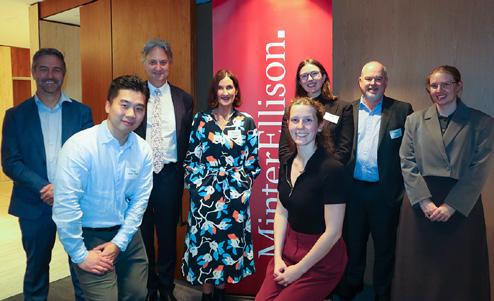
This series is hosted by MinterEllison in their fantastic seminar
Ruby Bell MinterEllison
Eliza Kane Cogency Australia
room, and for all YPG events, thanks and appreciation are extended to sponsors Biosis, Contour, Traffix Group, Ratio, and Urbis for supporting the series and helping bring this important professional development initiative to the YPG community.
This was a fantastic start to the series – we look forward to
seeing you at the final masterclass on Wednesday 15 July 2026, “A frolic through Greyfields”.
Eliza Kane serves as a committee member of VPELA’s YPG and is a Graduate Planner at Cogency Australia.
Ruby Bell serves as a committee member of VPELA’s YPG and is a Lawyer at MinterEllison.
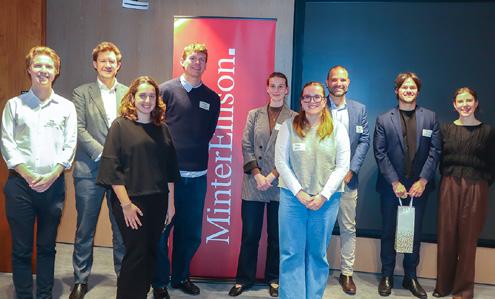





L>R Back Row Rob Swan, Paul Connor KC, Paula Bradshaw, Ruby Bell, Jason Black and Lauren Goldstein. Front Row: Steven Huang and Lizzy Henry.
L>R Tristan Layton, John Haysey, Felicity Karakiklas, Nic Watson, Rose Campbell, Lilly Green, Josh Dellios, Lachlan Forsyth and Eliza Kane.
Places Chinese streets hold design lessons for Australia

Jemima Cummins Eukai:
Transport Advisory
Jemima, a transport planner based in Naarm (Melbourne), presents her observations and experiences from a recent five-week stint in China. In doing so, she hopes to highlight an alternative planning approach that could improve transport choice and affordability in Australian cities and regions. I recently went to the Chinese provinces of Yunnan and Sichuan, where I spent the best part of a month travelling by bicycle with my partner. We rode through villages, towns and cities with populations ranging from a few hundred to millions. Our time in China came at the end of a three-month-long bikepacking trip, where we also visited Thailand, Laos and Vietnam. Of all the countries we visited, China stood out when it came to bicycle infrastructure. It has urban and regional networks comparable to what I have experienced in the Netherlands. The design approach is different, but the same key principles are evident (i.e., safety, connectivity, directness and comfort).
‘Safe’ bicycle network design refers to both physical infrastructures, like protective barriers from motorised traffic, and perceived safety, where people of all ages and abilities feel comfortable using the facilities. Before my trip, I thought that creating a network of protected lanes for the exclusive use of people cycling should be prioritised. It took my trip to China to also understand the potential of shared lanes and traffic calming for building safe and efficient bicycle networks.

Transport can be a social activity when the infrastructure allows for it.
Where I visited, the bicycle network largely comprised single directional lanes (on each side of the road) shared by people on mopeds and micro-mobility modes, including electric scooters, e-bikes and these three-wheeled mini-utes
I had never seen before. In China, vehicles that resemble what we call mopeds in Australia are functionally more similar to e-bikes and e-scooters than motor scooters or motorcycles. There were also shared user paths, but these were complementary rather than being the dominant planning approach. The multi-modal lanes varied in width but were always wide enough for people to overtake safely or ride sideby-side. They could be up to four or five metres wide in CBDs.
These multi-modal lanes were commonly separated from cars and trucks by kerb and fence barriers with landscaping. In addition to improving air quality, this greenery provided a welcome contrast to the concrete and glass towers that dominated city skylines. There were frequent gaps in the barriers, enabling people to merge into adjoining car lanes when there were high volumes of traffic in the multi-modal lanes.
Sharing bicycle lanes with mopeds may raise concerns for some, but my experience demonstrated it can be safe and comfortable if designed well. In China, mopeds (as well as e-bikes) using the multi-modal lanes cannot exceed 25 km/h. The risk of serious injury at this speed is low. Moreover, the chances of collision in the first instance are reduced by the moped’s design. There are no barriers blocking the driver’s line of sight or sound – not only does this allow them to be attuned to the presence and behaviour of other road users, but highly amenable to social interaction. My partner and I chatted to more than one fellow road user during our travels in China.
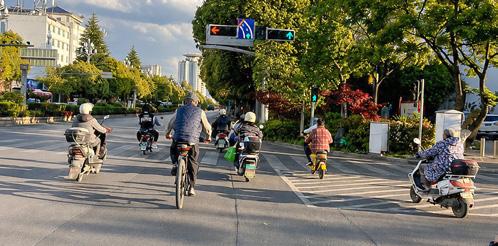
Chinese bicycle infrastructure is designed to be shared.
The majority of people I observed cycling were using the public bicycle-share program. These bicycles were cheaply and widely available across all the cities we travelled through, concentrated around train stations and commercial centres. The bikeshare program has been hugely popular across China, especially for getting to and from metro stations.
In addition to infrastructure design and maintenance, driver behaviour and personal security are key aspects of feeling safe while cycling. CCTV cameras were ubiquitous, reducing
my concerns of bicycle theft, and the vibrant street life that existed late into the evening made me feel as though nothing would go unnoticed.
I found drivers in China to be cautious and courteous. They beeped as a warning to say “I’m here” rather than “get out of my lane!” as is often the case in Australia. Thankfully, I did not experience any road rage from car drivers during my time cycling there. I suspect this is related to China’s longstanding cycling culture, whereby car drivers cycle themselves or know someone who does.
Within all the cities we visited, there was a comprehensive network of bicycle infrastructure that provided convenience as well as a high degree of transport choice. Bicycles were catered for on every street, even through tunnels and over bridges.
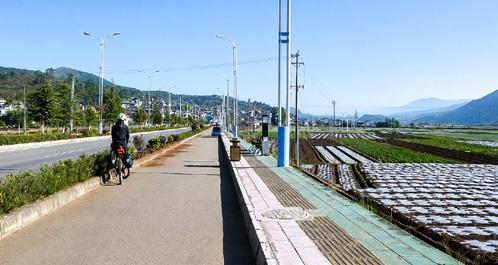
The multi-modal lanes I describe above were always provided on highways, enabling regional travel by bicycle. This regional bicycle infrastructure felt safe and comfortable due to being wide and protected from high-speed motorised traffic. They were always well signposted with directions and distances to major cities. I was also pleased to learn bicycles could be taken on the high-speed trains!
Since returning home, I have been asking myself whether this multi-modal approach is better than building exclusive bicycle lanes. The dominant approach to road design in Australia has been to provide traffic lanes and footpaths only. Where bicycle lanes are provided, they have too often been narrowed painted strips or shared with pedestrians. This forces people on bicycles and micromobility modes to share the road with pedestrians or cars, despite vastly different needs and characteristics. The adoption of electric bikes and e-scooters should be better catered for on the road network to make them a safer and more harmonious transport choice, rather than allowing these sustainable transport alternatives to raise tensions. My time in China showed me that multi-modal lanes make for vibrant streets where people are brought closer together (literally) as they go about their daily errands.
If you are interested in hearing more about Chinese cycling infrastructure and culture, please feel free to reach out. The Dutch Cycling Embassy’s Chris Bruntlett has also shared his recent work in China in the podcast ‘Active Towns’.
Jemima Cummins is a Transport Planner at Eukai: Transport Advisory.

Advice which delivers positive environmental, social and economic outcomes
As a leading environmental and planning consultancy, EMM assists clients to navigate and manage planning and environmental risks within the broader political and regulatory environments in which they operate.
Regional bicycle infrastructure.
Places Small spaces, big success Urban design learnings from Japan

Campbell Gullock Department of Transport & Planning
We’ve all experienced the prevalence of vacant shopfronts throughout Melbourne. Whether it’s the slow decline of our traditional retail strips, or new developments struggling to gain traction with tenancies at street level; the impact retail vacancy has on our streets is tangible. It’s a constant tension between landowners and developers, the planning system, and those striving for better cities.
On a recent trip to Japan, the lack of retail vacancies was something that particularly stood out. Over three weeks of travel, the vibrancy of retail was especially surprising in a country grappling with steady population decline, less than ideal inflation and a challenging wage growth climate. While it’s easy to attribute this to population density and a world class public transport system, there is an interesting urban design approach that likely coincides with the success of bricks and mortar.
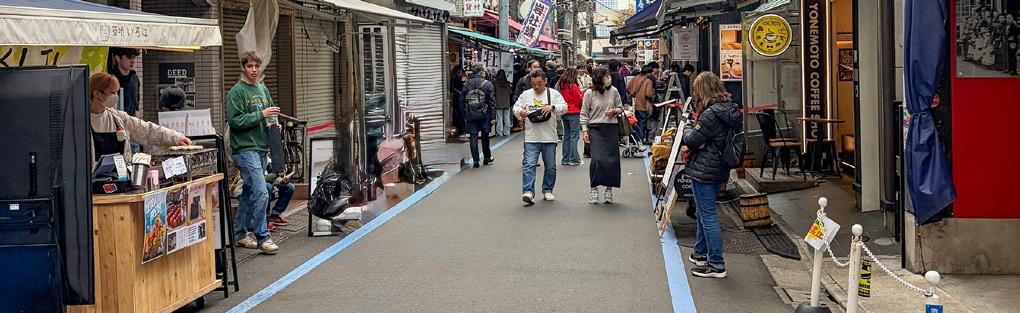
In Japanese urban design, the notion of fine grain is taken to an entirely new level. A larger number of smaller tenancies is beneficial for retail diversity and a mixture of uses; however, it likely benefits the tenancies themselves. For instance, smaller floorplates mean cheaper leases, less barriers to entry and start up risk, and opportunities for shared back of house facilities such as toilets and waste. The ‘Yak Ocho’ alleyways throughout Tokyo illustrate this perfectly, where high concentrations of fine grain (and mostly independent) restaurants and bars are often the liveliest and most resilient parts of the city.
Next, is the innovative siting of retail that goes beyond traditional street level tenancies. The utilisation of basements levels, the upper levels of the famous neon-clad ‘Zukkyo’ buildings, train stations (including the platforms themselves) and beneath railway/freeway overpasses unlocks often overlooked parts of the city. Like the Yakocho alleyways, these tenancies remain small in footprint making them highly
flexible and adaptable. Often occupying undesirable parts of the city, they have lower leasing and start up risk, while having the potential to activate areas most in need of revitalisation.
The final approach pertains to pedestrian infrastructure, or lack thereof. Whilst main arterial roads are equipped with wide footpaths and space for pedestrians and bicycles, the more intimate side streets are generally absent of footpaths and car parking. Instead, these streets function as shared spaces where pedestrians, bicycles and vehicles/trucks exist in reasonable harmony. Aside from slow moving vehicle speeds, frequent intersections and limited through block traffic routes gives further priority to pedestrians. The result are high levels of foot traffic and serendipitous interaction with retail tenancies, which are particularly important for small businesses that cannot rely on brand power to draw customers from a distance. Further, these small businesses build upon the high level of foot traffic by making their shopfronts as active and welcoming as possible.
This isn’t to say that Melbourne needs to mimic other cities or doesn’t have its own success stories, it’s simply exploring one piece of the puzzle when it comes to successful retail and city building. Melbourne has many examples, such as the fine grain arcades and laneways of the CBD, the ‘vertical streets’ of Curtain House and the Nicholas Buildings, or highly pedestrianised spaces such as Greville Street, Prahran. The success of these spaces may be attributed to ideas of smallness, innovative siting, and pedestrianisation, and provide home grown precedents we may be able to use for future development.
Campbell Gullock serves as a committee member of VPELA’s Young Professionals Group (YPG) and is a Senior Urban Designer at the Department of Transport and Planning (State Planning Major Projects).
Places Colour Hunt



Finding colour in the commute – “getting to your desk”
A Colour Hunt is a simple but powerful creative exercise built around a shared idea: choosing a universal theme and exploring both the similarities and differences in how each participant observes it. By focusing on a single colour, participants are encouraged to look more closely at their surroundings and notice how that colour appears in different ways, places and contexts.
For our YPG Colour Hunt, we turned our attention to the everyday commute through the ‘Getting to Your Desk’ theme. Inspired by the familiar rhythm of traffic lights, our photographers selected red, amber and green as our guiding palette. Ruby capturing red, Lily focusing on amber, and Brigette exploring green. Throughout autumn, what might normally feel like a routine journey became an opportunity for discovery.
These colours appeared in a variety of surprising and creative ways: the glow of a neon sign, the branding of businesses, the iconic fabric pattern adorning Melbourne tram seats, and even subtle moments embedded within urban streetscapes. By anchoring the exercise in something universally recognised, each photographer was able to interpret the brief differently, highlighting both shared experiences and unique perspectives. What emerged was a vibrant collection that transformed the daily commute into something far more intentional. It serves as a reminder that even in the rush of getting to your desk, there is colour and creativity to be found when you take a moment to notice it.
Lily Green is a Senior Traffic Engineer at Amber Organisation, Ruby Bell is a Lawyer at MinterEllison and Brigette is a Planner at UPco – Urban Planning Collective. All are members of VPELA's Young Professionals Group (YPG) Committee.

Ruby Bell MinterEllison
Brigette McKay UPco – Urban Planning Collective
Lily Green Amber Organisation
Places Colour Hunt



Stepping away and seeing differently – the creative pause
The second part of our YPG Colour Hunt shifted focus from the morning rush to the quieter, in-between moments of the day. Centred on ‘stepping away from your desk’, this theme encouraged our team to pause, reset and engage more mindfully with their surroundings.
Photographers Lily, Chloe and Lauren each selected a colour – yellow, blue and purple respectively – and captured images over one week in autumn whenever they stepped away from their screens. Whether during lunch breaks, after work, on weekends, or simply in moments of pause between tasks, these snapshots became an exercise in both creativity and awareness.
Across the series, colour revealed itself in everyday settings: the bold presence of caution signs, the layered textures of café environments, and the vibrancy of colourful murals.
These familiar elements, often overlooked, became the focus of attention when viewed through a single-colour lens.
Presented in a collage-style format, the Colour Hunts invites you, the viewer, to play along, to engage in the same “eye spy” experience as the photographers themselves.
This exercise was about more than just photography. It was a reminder that creativity can be woven into everyday life, and that a small shift in perspective can reveal beauty and detail in small, unexpected places.
As professionals operating within the built and natural environment, this is a great way to reconnect with your surrounds in an intentional way. We encourage you to share this idea with your own team or family, choose a colour, step outside your routine, and see what you discover!
Lily Green is a Senior Traffic Engineer at Amber Organisation, Lauren Goldstein is an Associate at Russell Kennedy and Chloe Moorcroft is a Manager at KPMG. All are members of VPELA's Young Professionals Group (YPG) Committee.

Lauren Goldstein Russell Kennedy Chloe Moorcroft KPMG
Lily Green Amber Organisation
Costumes that impressed!
1. Fi Cotter, Fyfe (centre)
2. Amya De Silva, City of Boroondara
3. Louise Hicks, Victorian Bar
4. Sophie Handley
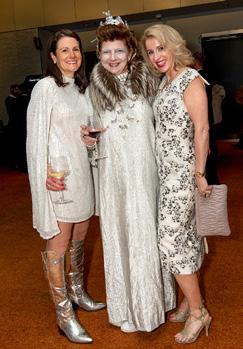



5. Will Cavey, Michael Willson, Tom Dwyer with Sarah Stephenson and Lily Green, Amber Organisation
6. Marshall Day Acoustics
7. Sam Lane and Adrian Peggie, Whiteman Property






Gala Dinner


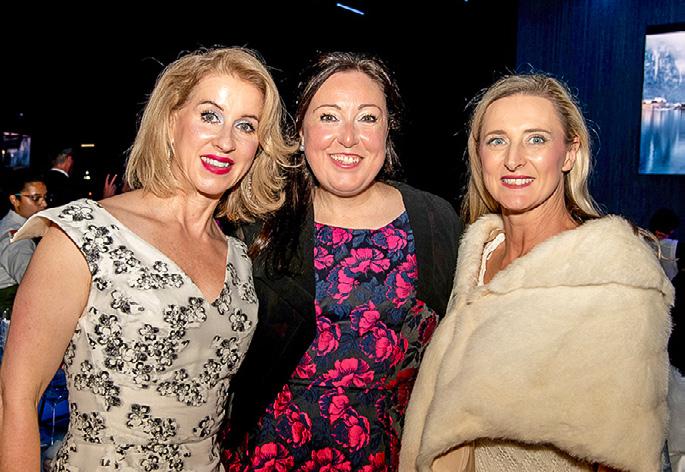



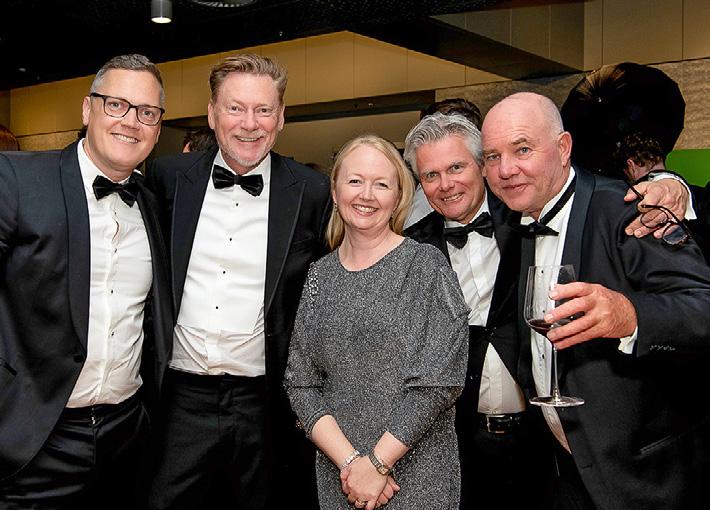




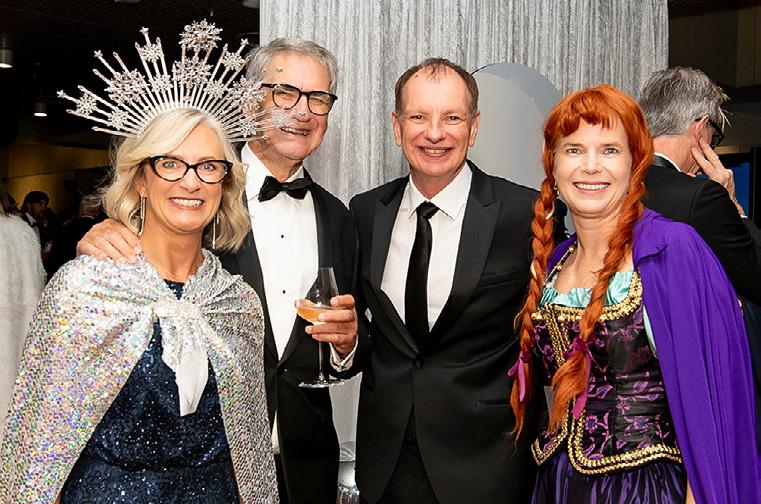
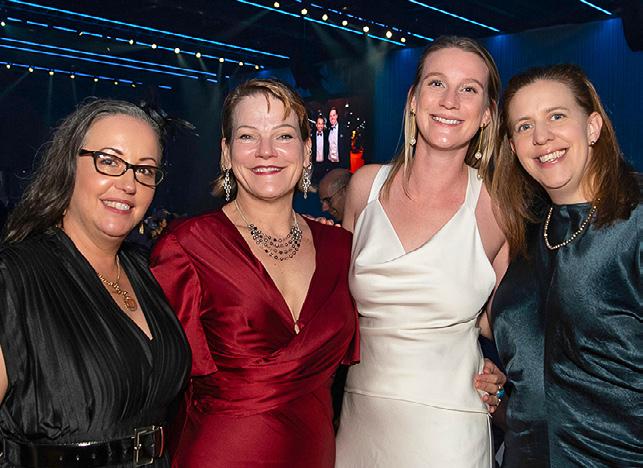










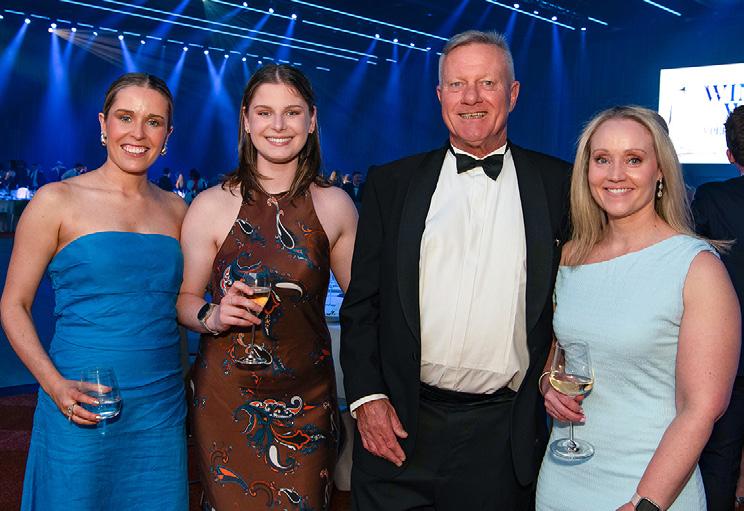

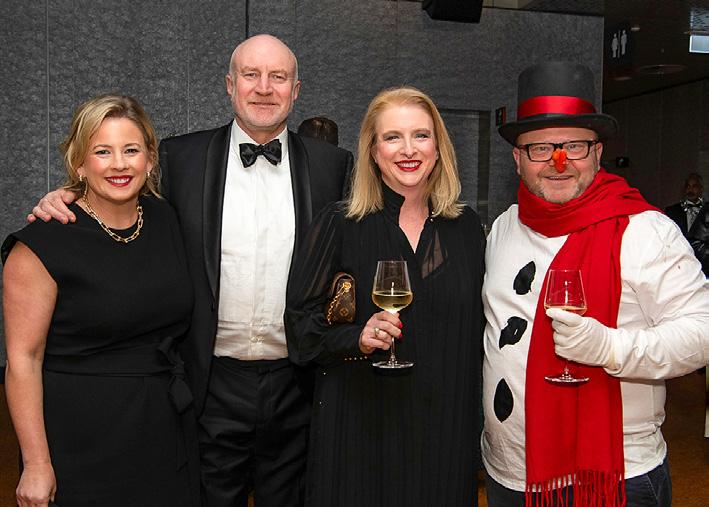

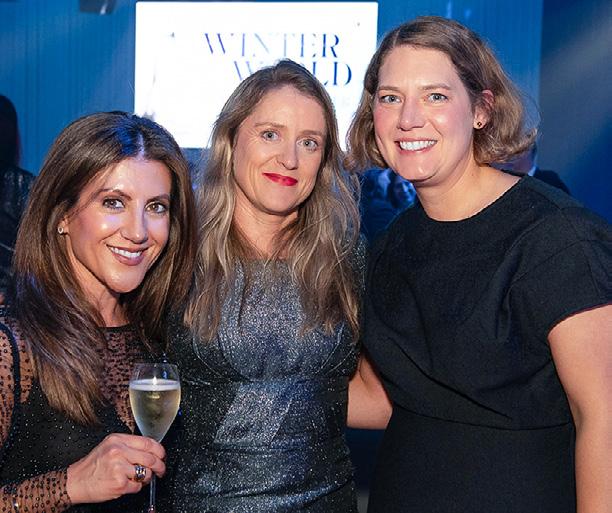

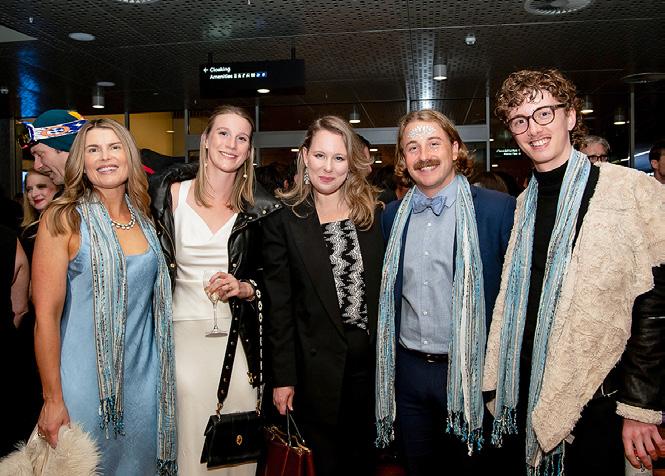






The Business Rory’s Ramble
The federal budget has just driven home the prime focus of delivering housing to the nation but developers actively seeking to get these housing projects off the ground are being hindered from every direction by government process and significantly rising construction prices.
In order to achieve housing targets, all parts of each state need to carry the load. We need inner, middle and outer Melbourne and regions to fire up to be anywhere near our targets.
While the delivery of apartments in activity centres is fully supported, current construction costs exceed selling prices and that is not necessarily what many people need or want. Housing diversity is important to maintain a robust, engaged housing sector.
Hopefully the ‘Deemed to Comply’ changes will assist the middle ring to flourish again with medium density housing, although everyone is still waiting on the implementation regulations by July, not long after this is published!
Federal Budget changes to Capital Gains Tax Concessions will certainly add to the volume of established dwellings being offloaded onto the already heavy market in Victoria. It is the final nail in the coffin for landlords who have already been shedding dwellings and apartments due to the high cost of compliance (e.g. gas/electricity/smoke alarm inspections not to mention land tax!).
Tenants’ safety is important but charging $500 an inspection is a rort by inspectors. The extra availability of apartments will likely drop the prices of apartments and townhouses in the short term, which is a bonus to the F.H.B, but it will create a further shortage of rental accommodation. Those who do not have the ability to buy a home will face exorbitant rent rises.
There are stories of agents increasing rental prices regularly which is bad in every sense.
The unintended consequences of the tax changes will be that owner occupiers will buy all the ex-rental housing in existing suburbs (due to the negative gearing changes) and renters will all be pushed out to the growth areas or activity centres into newly built dwellings.
I know of a few younger people who would like to buy their first home but don’t want to buy an apartment, knowing they are unlikely to gain in value over time. Many still want a house in which they can grow in, with secure open space for their children, dogs and for general privacy.
Victoria has suffered a 15 per cent hike in civil construction costs this financial year mainly due to the Iranian crisis, but there is no doubt some price gouging taking place also.
This is compounded by a very onerous and slow planning system that is preventing the Utopian outcome it desires.

Rory Costelloe Villawood Properties
The effect of cost increases and rising interest rates is savage. Victoria’s overall metropolitan market enjoys a long-term average of 15,000 lot sales a year. It is presently trending at half that, at a miserable 7000 to 8000.
Victoria’s 2024-34 Housing Statement is looking to build 800,000 homes but September 2025 quarter figures showed just 13,748 dwellings completed – the lowest September quarter result since 2014. And as ABS figures show, this is in the face of a Victorian population that grew by 1.2 million, or 21 per cent, over those 11 years.
People still want to live in Victoria but where will they live? Will they be able to afford living here?
Melbourne actually has the cheapest average house price compared to all the capital cities. Melbourne used to rank second to Sydney but now ranks second last in Australia only to Hobart. This reflects a lack of confidence in our State. One of Victoria’s largest road contractors has moved 40 per cent of its construction machinery interstate in the last two years to where the work is.
Projects are stalling, developers are looking interstate and potential homebuyers are going begging. Consultants such as engineers, planners and surveyors, along with other businesses, builders and the general development industry that rely upon a diverse housing sector, are all struggling. The attitude to developers is far more welcoming interstate, especially in South Australia where the processes are less complicated and more streamlined.
But all these adverse influences are only half the problem. There are factors that could be altered to boost housing activity that lie with governments – local, state and federal.
But the political will to act on them is patently lacking.
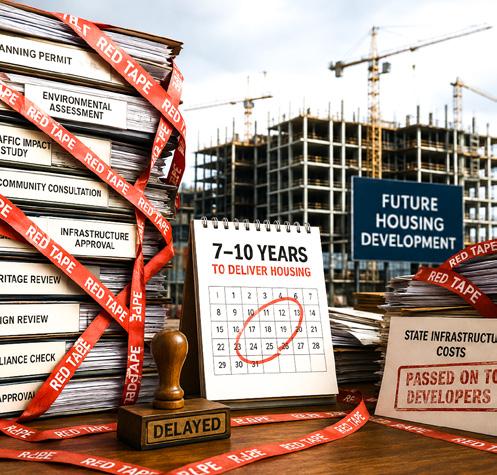
The most obvious problem is the excessive red tape attached to the Precinct Structure Plans required with new projects. These now take seven to 10 years before any housing can be delivered. And we’re now seeing Victoria’s government trying to push State traffic infrastructure costs it is responsible for on to developers.
Development contributions costs are heading toward $1 million a net developable hectare. And we don’t see any benefits for this.
The upshot is the combined taxes in getting land to market now take up to 47 per cent of the price of a block of land – and these now must be passed onto landowners.
While Victoria is fighting a bizarre battle against itself, some other States are bending over backwards to accommodate new housing and developers.
I recall in recent memory, we had a healthy development industry across infill, suburbs and greenfield, where Melbourne’s greenfields were a truly affordable option
– a reliable choice for families and the envy of other markets across Australia.
By contrast, in South Australia, the government is intent on delivering critical infrastructure to enable housing to go ahead. It is fast-tracking rezonings to ensure supply can match demand. It is partnering with developers to provide new housing and affordable housing. It is trying to minimise costs.
And in the face of everything else going on, the South Australian market is strong.
In Queensland, housing supply is desperately wanted. As Brisbane gears up for the 2032 Olympic Games, the government is moving to push things along via Economic Development Queensland, which is aimed at accelerating approvals and ensuring the concurrent delivery of key infrastructure.
It is time for Victoria to take a stand. To stand with developers, with the construction industry and with the trades, and deliver the backlog of homes urgently needed across metropolitan Melbourne and regional Victoria – and the broader positive economic impact this will generate.
Rory Costelloe is Founder and Executive Director at Villawood Properties.





Andrew Hill Victoria State Manager - Environment
Aaron Organ National Technical Director - Ecology
Oona Nicolson National Discipline Lead - Heritage
The Business
VicGrid’s renewable energy zones

Can a declaration without planning weight support a renewable energy transition?
In May 2026, Victoria’s energy planning body VicGrid formally declared five Renewable Energy Zones (REZs) across the state, where new wind, solar and battery storage projects are prioritised over the next 15 years. This follows VicGrid’s Victorian Transmission Plan (VTP) which was released last year.
As someone who works in this space, I have observed the renewable energy industry arguing for clearer signals about where renewables belong, this should be a turning point. The REZs are the product of detailed work on grid capacity, wind and solar resources, community feedback and environmental sensitivity. The State has effectively said “build renewables here.”
Yet, a renewable energy project proposed inside the REZs will be assessed under the same planning pathway as a project proposed anywhere else in Victoria. The Planning and Environment Act 1987 (Vic) and the Environment Effects Act 1978 (Vic) apply in the same way, and there is no statutory recognition of the REZ in any planning scheme. This means that within the planning system there is no streamlined approvals track for projects that have located themselves where the State has asked them to go.
Victoria has legislated renewable electricity targets of 65% by 2030 and 95% by 2035. Meeting those targets, however, will require getting as many renewable energy and grid infrastructure projects approved as possible through the planning system. The REZs are an obvious vehicle for that, but only if they actually hold any weight under the planning and environmental regulations.
Our friends in New South Wales offer a useful comparison. Under the Electricity Infrastructure Investment Act 2020 (NSW), REZs in NSW are formally declared by the Minister for Energy, and EnergyCo sits as the Infrastructure Planner responsible for coordinating their development. Under this arrangement, the Central-West Orana REZ became the first in Australia to receive full planning approval for its network infrastructure in 2024. The NSW model is not perfect, and I am not suggesting Victoria should copy it (in fact, renewables approval timelines in NSW significantly lag behind Victoria). It shows, however, that a statutory REZ designation can be effectively built into the legislative framework, rather than sitting alongside it.
There are some key questions that the current VTP does not provide detail on, such as: How should a project inside a REZ be prioritised in the planning system, given the location has already been studied at a state level? Should assessment timeframes be different inside a REZ vs outside? How do we make sure that streamlined approvals do not come at the expense of rigorous environmental assessment and community engagement? If VicGrid’s REZs are to be successfully integrated into planning policy, the State Government and the renewable energy industry as a whole will need to reconcile these questions.
There is a real opportunity in this moment of widespread planning reform, to leverage the Victorian Transmission Plan and elevate the REZs to more efficiently approve and deliver critical renewable energy and grid infrastructure.
VicGrid completed a long and extensive strategic assessment to narrow down the REZs, and it would be a shame if this work was siloed within the VTP and not more widely recognised or given appropriate weight in the planning system. VicGrid’s REZs have the chance to be more than just lines on a map and instead be meaningfully built into planning policy and regulations. This is critical to provide industry certainty, support investment, and give communities a clearer picture of where development will happen. This is what is required to ultimately give Victoria a shot at achieving its renewable energy targets and transitioning to net zero.
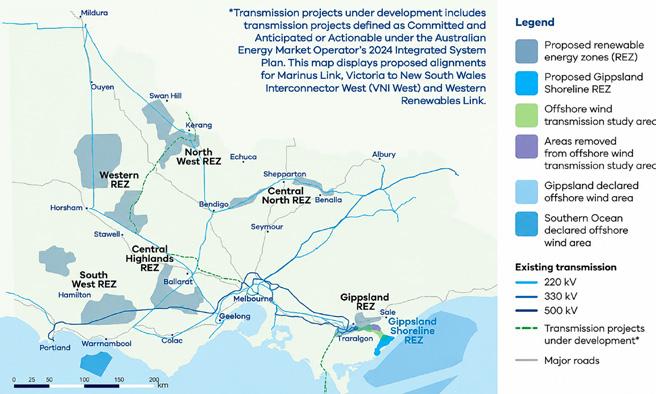
Dinan McMahon is a Senior Planner at Cogency and former member of VPELA’s YPG.
Dinan McMahon Cogency Australia
The Business From research to reality: Reforming planning enforcement in Victoria

In 2024, I was the lucky and grateful recipient of VPELA’s Young Professional Award, which supported my research into Australian and international approaches to vegetation protection (namely the enforcement and prosecution of vegetation removal/destruction offences) with a view of developing a series of recommendations regarding prospective amendments which could be made to the Planning and Environment Act 1987 (Act).
In the ensuing 12 months, I undertook extensive research into the planning and environmental compliance and enforcement frameworks in place within other States and Territories, and also internationally. I subscribed to obscure legal journals, utilised translation software (for very helpful, yet immediately indecipherable Swedish legal commentary) and delved into the weeds to establish whether there were any success stories to be found within other jurisdictions which could, in my view, be employed within our humble system.
In July 2025, I presented my findings to the VPELA Fellows at their Annual Dinner. In short, the headline conclusions of my presentation were as follows:
• The existing compliance and enforcement framework within the Act was sub-optimal, and did not provide authorities with the necessary tools to effectively punish or deter offenders;
• There was considerable widespread judicial and scholarly support for the proposition that financial penalties alone do not sufficiently deter potential environmental criminals. In Victoria, I considered that the benefits of offending would, in many cases, significantly outweigh the available punishments; and
• Within both Victoria and Australia, there has been a marked decrease in the extent of enforcement and prosecution being pursued by planning and environmental authorities.
Having regard to all of this, I recommended that a number of mechanisms found in the legislation of other States, Territories and countries could be introduced into our Act to provide far more effective tools to both deter, and to directly respond to, the commission of offences. These included (but were not limited to):
• The ability for Courts to issue a broader array of orders, including orders which required offenders to pay a proportion, or multiple, of the value of any gain or uplift which directly resulted from the commission of an offence;
• More effective evidentiary provisions and the ability to bring prosecutions more than 12 months following the commission of an offence (thereby limiting the prospect of being statute-barred from bringing an action);
• The prospect of imprisonment for offenders; and
• The ability for authorities to pursue civil penalties in addition to criminal penalties.
Following my presentation, a number of Fellows provided some kind and honest feedback – many supported my recommendations, and some respectfully queried the prospect that our Act would be subject to the substantial changes which I was calling for. Upon reflection in the following days and weeks, I was admittedly not as youthfully optimistic that we might adopt such sweeping changes within our system after all.
You can therefore imagine my pleasure in perusing the provisions which are now to be introduced into the Act’s compliance and enforcement framework by virtue of the Planning Amendment (Better Decisions Made Faster) Act 2026 (Amendment Act), which was passed by Parliament and received Royal Assent on 17 February 2026 What emerged from my review was that the proposed changes which were scarily yet pleasingly consistent with the recommendations arising from my research. These include:
New Offences, Time Limits and Penalties
False or Misleading Information
Increase in time to bring prosecutions
Introduction of new offences to knowingly or recklessly provide false or misleading information or produce a document which someone knows to be misleading (without indicating the respect in which it is misleading).
Increase to the time by which a charge sheet can be filed from 12 months to 24 months after the date on which the offence is alleged to have been committed.
General Penalties
The maximum penalties for natural persons and corporations for breaches of planning laws are proposed to be significantly increased. This includes:
• Adding imprisonment of up to 10 years to the existing penalty of up to 1,200 penalty units for a natural person; and
• Adding a greater penalty of up to 6,000 penalty units for a corporation.
Charlie Wurm Maddocks
New Court Orders
Adverse Publicity Orders
Whereby Courts can order offenders to publicise their offence and its consequences in a specified manner.
Commercial Benefits Orders
Supervisory Intervention Orders
Whereby Courts can require offenders to pay up to three times the estimated commercial benefit the offender or an associate of the offender obtained from the offence or, if the offender was interrupted or thwarted by the responsible authority from committing the offence, the commercial benefit the offender or associate would have obtained if not for the interruption.
Whereby Courts can require systematic or persistent offenders to take specific actions (like staff training, installing compliance systems, or appointing compliance officers) to improve their ability or willingness to comply with the Act or the regulations. The order can require offenders to provide compliance reports to the responsible authority or the Court.
Industry Exclusion Orders
Whereby Courts can prohibit systematic or persistent offenders from providing, or being otherwise involved in, services relating to the commercial development of land as specified in the order.
Introduction of Civil Penalties
Contravention Orders
Section 126(1) of the Act will become a ‘civil penalty provision’, meaning the Act will empower Courts to make a ‘contravention order’ upon the application of the responsible authority. Significantly, a contravention order may be made if the Court is satisfied ‘on the balance of probabilities’ (lower than the criminal standard of ‘beyond reasonable doubt’) that the person has contravened a civil penalty provision.
New Civil Penalties When making a contravention order, Courts can impose a ‘civil penalty’. The maximum civil penalty that may be attached to a contravention order is 2,000 penalty units for natural persons and 10,000 penalty units for corporations. The civil penalty may be recovered by the responsible authority as a civil debt and must be paid into a Consolidated Fund (not directed to and retained by the responsible authority, as is the case with criminal offences).
The Amendment Act will also introduce a host of new provisions relating to the powers of authorised officers, and the preparation and maintenance of monitoring, compliance and enforcement policies.
To be clear, I am by no means suggesting or implying that these changes were the direct result of, or informed by, my research. While I would love to ascribe some cosmic significance to the similarities, the work involved in drafting the new provisions would have commenced long before I was bestowed the Young Professional Award and commenced my research. That said, the level of alignment between the conclusions of my independent research and the amendments being made to the Act suggest that, like me, our legislators considered that substantial change was necessary and justified. In other words, it seems that we were behind the eight-ball, so to speak.
Ultimately, the changes to the enforcement and compliance space are significant. The mechanisms available to respond to offences are far greater and, in theory, should be more effective both in their ability to deter and punish the commission of offences. Further, the ability to pursue a number of different pathways depending on the nature or significance of an offence should make it easier for authorities to take swifter and more effective action. The proof, however, will most certainly be in the pudding.
These particular changes to the compliance and enforcement provisions will commence on 3 August 2026, and I will be keeping a very keen eye on how the new provisions are employed and applied from August.
Charlie Wurm is a Senior Associate at Maddocks and former Co-Convenor and member of VPELA’s YPG.

The Business
Truck noise, expert evidence, and the NSW Road Noise Policy (NSW RNP) Three cases, one rural road
Two VCAT decisions (Beach & Ors v Colac Otway SC [2011] VCAT 2086 and Beach v Colac Otway SC [2025] VCAT 872) together with the Ombersley Quarry Advisory Committee Report (Planning Panels Victoria, 2017) expose a persistent acoustic planning problem in Victoria – there is no single, binding traffic noise standard for urban or rural local roads.
In practice, noise policies and precedents from earlier VCAT and Planning Panel outcomes are commonly adopted and become the preferred noise assessment methodology. These three matters – each relating to the same noise sensitive receiver, the Beach dwelling on Mooleric Road – demonstrate that acoustic experts can align on the technical noise criteria (e.g. NSW Road Noise Policy or RNP), while panels and tribunals sometimes apply outcomes that may be inconsistent with experts’ findings.
Over the course of the three (3) applications, common technical ground across the Ombersley Advisory Committee and both VCAT matters shows that up to five (5) acoustic experts agreed on several points that is:
• Victoria has no mandatory road traffic noise standard for urban or rural local roads.
• It is common practice, to adopt the NSW RNP of 55 dB(A) LAeq(1h) daytime as criteria or guideline.
• A low number of heavy vehicle pass-bys per hour will exceed the adopted NSW RNP hourly Leq noise limit and potentially impact the noise sensitive receiver. As demonstrated by acoustic experts that “more than four (4) truck pass-bys per hour will result in the NSW Policy noise criteria being exceeded.”
However, despite the unanimous technical agreement, tribunals and panels reached different conclusions as outlined below:
• VCAT 2011 (Quarry): Refusal. The Tribunal concluded that key matters remained unresolved – truck volumes, the timing of road upgrades, and whether permit conditions could reliably protect the Beach dwelling’s amenity – so the proposed conditions were inadequate to manage risk. Truck noise was a decisive factor, alongside groundwater and ecological uncertainties.
• Ombersley Advisory Committee 2017 (Quarry): Conditional support. The Committee accepted NSW RNP as the assessment tool and acknowledged truck noise would exceed the guideline without mitigation. It recommended a permit with an enforceable mitigation package – speed controls, low-noise pavement, limits on hours and truck pass-bys, monitoring, and offers of acoustic treatment. The Committee judged those measures sufficient to manage risk.

• VCAT 2025 (Broiler farm): Permit granted without applying a traffic-noise criterion. The Tribunal acknowledged that “this proposal cannot proceed if we apply the criteria in the NSW RNP” (para. 142) but did not treat the guideline as an absolute pass/fail test. Instead, it balanced predicted noise impacts against broader planning objectives and concluded that the broiler farm’s benefits (agriculture, employment), together with monitoring and permit conditions, justified approval –even while accepting increased truck noise at the Beach dwelling particularly during the night-time period. It also suggested: “Given our findings, we question whether a noise measurement (limit) is considered necessary on a Victorian country road.” (para. 207)
Why the divergence? Three drivers explain the split
First, experts did not agree on some of the input parameters: however, concluded that based on the proposed haulage schedule there will be an exceedance to the agreed truck noise criteria. As the 2025 reasons note, “the fundamental variation between the two experts is the measured truck noise level, not the methodology” (para. 130).
Second, tribunals may differ in how much uncertainty they will accept. The 2011 Tribunal rejected approval because uncertainties were not acceptably managed. The Advisory Committee and the 2025 Tribunal suggested conditional, adaptive noise management.
Third, institutional roles and decision functions have demonstrated a difference. An advisory panel produced recommendations to inform the Planning Minister and are structured to craft comprehensive set of conditions. The Tribunals issue determinative legal decisions under the Planning and Environment Act and must resolve contested facts and law for an outcome. These different roles may shape how each body frames risk, the weight they place on noise mitigation, and the language they use in reaching a conclusion.
Victoria commonly borrows noise policies from other states (and overseas) to fill its noise policy void. Examples include guidance for construction noise and vibration, windfarm noise (pre-2010), road traffic noise (NSW RNP), rail noise and low frequency noise assessments. Imported standards are often persuasive rather than binding and their suitability to a specific Victorian rural context is not automatic. That may explain why experts commonly use NSW RNP as a practical benchmark, and why decision bodies may treat the outcome of that benchmark as informative but not necessarily decisive.
Frank Butera
Virid Ardent AU
Implications
for practice
• Noise measurement matters: acoustic experts, must resolve their input parameters, and use conservative assumptions where uncertainty exists.
• Expect policy balancing: tribunals will weigh noise predictions against broader planning objectives. The NSW RNP type thresholds will inform but not dictate outcomes, experts are to consider other alternatives to assist the tribunal.
• Victoria needs a traffic noise standard for rural local roads and/or provide clearer expectations for experts, decision makers and communities to reduce reliance on interstate precedents and promote consistency.

Ian Alcantara Zesty Planning
Jecil Kay Asiedu Student
Roxanne Dow EMM
Cassandra Evans Slater & Gordon
Nathaniel Ahmed Faller
Michael Gori Student
Alex Iljin
Marcus Koorn Traffix Group
Ahnri Lee Student
Josh Lim Student
Chenwei Lin Student
John Mejia RMIT University
Purnima Menon Plan Urban Pty Ltd
Vy Nguyen Urbis
The Mooleric Road matters show that technical consensus on noise impacts does not remove planning discretion. Experts may agree on methods and thresholds, yet panels and tribunals can reach different conclusions depending on mitigation certainty, enforceability and the policy context. Until Victoria adopts a clear, local standard for rural road noise, expect continued reliance on interstate policies and case by case resolutions that test the boundary between acoustic assessment and planning judgment.
Frank Butera is a Principal Acoustic Consultant at Virid Ardent AU.

Nathan Notley White & Case
Lucinda Peterson Pro Bono Planners Australia
Arinah Rizal Resonate Consultants
Brendan Ryan Department of Transport and Planning
Matt Sauvarin Tree Dimensions
Sanika Sawant Student
Maria Setiawan Planning and Property Partners
Benjamin Sette Student
Divya Shree
Patrick Spinazzola VIDA Rail
Cherry Wang White & Case
Qiankuan Yang Student
James Young Traffix Group
YPG Trivia Answers:
1a. No. 78 (North Richmond to Balaclava); No. 82 (Moonee Ponds to Footscray); 1b. 4 categories; 2a. Gariwerd (Grampians National Park); 2b. Syd (Duck-billed platypus); Olly (Kookaburra); Millie (Echidna / Spiny Anteater); 3a. Australia; 3b. 2.8m; 4a. Bruiser Woods; 4b. Executive, Legislature and Judiciary; 5a. Sensitive Receiver or Receptor; 5b. Port Adelaide; 6a. B. China’s high-speed rail network (50,000 km vs. Earth at 40,000 km); 6b. Jane Jacobs; 7a. Getting stuck (sideways) in the Suez Canal; 7b. Extent, location and type of native vegetation.

https://www.instagram.com/vpela_
The Business Planning and design for diverse minds

Simon McPherson McP
Introduction
For years, my children have grappled with the significant impact of neurodivergence and associated mental health challenges, withdrawing from school and regressing to the safety of home. This led me to investigate the role of the urban environment, in supporting, or excluding, anxious neurodivergent individuals, and how the evolving city is contributing to these outcomes.
This article introduces the context of built environment design for neurodivergent experiences, drawing on the extensive resources available, and introducing concepts as a prompt to consider, explore and implement design and planning strategies to better accommodate diverse user groups.
Urban Design is a public discipline focussed on the public realm, and the community as the primary ‘client’ or stakeholder. We design for people - but the ‘typical’ person does not capture the multiplicity of experiences of the urban environment.
Context for neurodivergence
An estimated 15-20% of the global population is neurodivergent, described as when the neurological ways information is processed in our brains is different from the majority population1. This is comparable to the 21.4% of Australians with disability2 (noting potential overlap in these categorisations), but these rates are increasing. The number of Autistic Australians increased by 42% in four years to 20223, while media reported that nearly one in four, or almost a million Australian school students, need extra support because of a disability. Social and emotional disability categories (including autism, ADHD, behavioural disorders) have grown at nearly 10% per year – far outpacing general school enrolment growth4.
Over half of all autistic people meet criteria for an anxiety disorder, and multiple studies have now found links between anxiety and sensory reactivity5, while social anxiety is a much broader phenomenon in the post-Covid world6.
Neurodivergent
experiences of the urban environment
We constantly take highly complex sensory information, which increases in intensity as urban areas grow and develop; more people, traffic, noise, signals. The neurodivergent brain has different reactions and responses to stimuli in the environment such as light, sound, colour or smell7.
While experiences vary greatly, sensory overload can cause overwhelm, while confusing spatial layouts cause anxiety, which is related to sensory differences8.
Unmet sensory needs, potential overwhelm, feeling unsafe and unbearable uncertainty, can lead to social exclusion for some parts of the community from the public realm, events, employment and education.
I have seen this manifest in my family as a fear of leaving the home, a distinct unease in busy settings, and panic at certain, sudden noises.
However, the range of impacts, needs and limitations is also highly diverse and personal, requiring planning and design to respond not to specific individual requirements, but to create places that reflect the extensive community diversity, ensuring that more people can feel comfortable using them9.
Implications for urban design principles
Our cities are necessarily moving towards intensification, of housing, populations and activities, with more people occupying less space. Bustling, vibrant cities and towns are important for economic prosperity and avoiding desolate streets, but these come with increased stimulation – more sounds, lights, signals and messages - bringing a substantial cost of over-stimulation and exclusion for some people.
We design for safety, through intensive development, ‘active’ building frontages, avoiding concealment spaces, and supporting passive surveillance or ‘eyes on the street’. But what we think of as safe, doesn’t feel safe for all of us. For some, a busy street, playground or event space feels very unsafe. Further, being seen or looked at can be something to be avoided, to regress from. An adult friend explained to me that she will visit bathrooms during events or outings, just to be out of sight, to mentally re-regulate in an enclosed, secluded space.
Intensively developed ‘urban’ environments comprise streets and spaces which are more hard-edged, spatially contained, have less greenery, and less open to the sky or wider outlook. These conditions can add to psychological pressure and discomfort, to a sense of unwanted enclosure or containment.
Urban Design and Planning must therefore recognise that not all people will seek vibrant settings, or want to be seen by others, but still need access and inclusion. New strategies are required to design-in a sense of inclusion, safety and comfort for all.
Resources and references
Stadiums typically provide Sensory Rooms and offer information and tools for sensory needs, to help people prepare for and enjoy the experience. Sensory Rooms provide a place of quiet, calm respite in an otherwise intensive, crowded, noisy, bright and eventful setting.
Activity Centres within the city are also typically crowded, loud and visually stimulating. This raises the prospect of a ‘Sensory Room’ infrastructure for urban centres and busy streets. Cities provide access to large parks, river corridors and other quiet places, but it is the smaller scale, ‘fine grain’ network of places for respite which may address this essential need, within the fabric of the city.
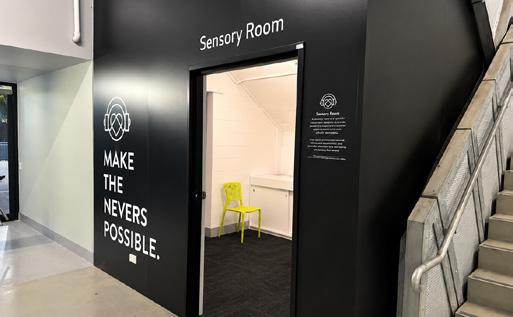
The UK has developed the world’s first PAS 6463:2022 Design for the mind – Neurodiversity and the built environment standard10 to guide site and building layout, facades, wayfinding, external spaces and internal layouts. A similar, but more compact, guidance document for Australia, is currently in development11
Dublin City Council has committed to an ambitious plan to become the first Autism Friendly Capital in the World12, including to:
• Enhance public knowledge and understanding.
• Improve infrastructure to become more inclusive and safer.
• Celebrate the Autistic community and their strengths.
• Promote inclusive workplaces and strengthen pathways to employment.
The New York City installation named ‘Restorative Ground’ was designed as a distinctive, engaging ‘landscape of choice’ accommodating a range of activities/uses informed by research into neurodivergent experiences, and to make the city more enjoyable to more people13.
This small-scale intervention provides an accessible place for movement or play, sitting or contemplation, with ‘separation’ from the contiguous street environment.
Therefore, spatial diversity or variance, and places for respite and seclusion are valuable not just in stadiums, but in busy city environments. This spatial diversity may be seen as a form of urban infrastructure, a ‘layer’ of the city which is evident and accessible at regular intervals.
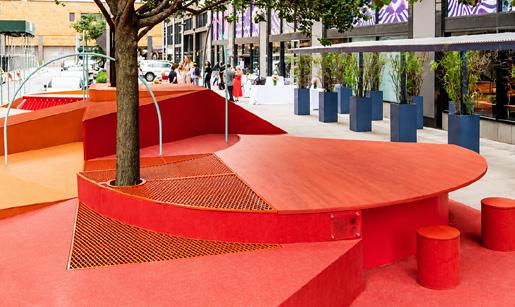
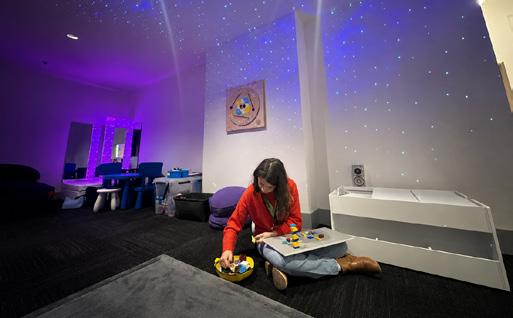
Strategies
Providing detailed and accurate information about the environment and potential barriers aim to empower neurodivergent people to prepare, choose and navigate with confidence.
Quiet, restorative spaces or retreats can reduce the impact of otherwise hostile environments. Providing discreet, dignified places for rest and recovery in a neutral sensory setting supports a safer environment for neurodivergent people14,15. However, opportunities for retreat and seclusion must also be designed for physical safety and security, management and maintenance, and shared, equitable access.
Flexible and varied settings (rooms, streets, public spaces) provide choice to avoid over – or under – stimulating environments, to suit individual needs.
Clear wayfinding through visual signs, landmarks and consistent, clear layouts reduces anxiety and builds confidence. Spatial sequencing (logical ordering of spaces or activities), compartmentalisation (of sensory environments) and transition spaces in between, allow adjustment and recalibration of senses between different levels of stimulus16
Traffic calming and other initiatives to reduce noise and chaos on streets provide benefits for the whole community while reducing the impact for those with sensory challenges.

(Left) ‘Make the nevers possible’: Sensory Room entrance, AAMI Park, Melbourne; (Right) Sensory Room (interior)
Restorative Ground, a playful New York City streetscape installation inviting varied modes of use by the public. Images sourced from Curbed online publication.
These strategies support lower anxiety, more independence, greater wellbeing, and better urban spaces for everyone17, but their implementation in evolving cities and urban centres requires careful design consideration and clear delivery mechanisms within the public realm and on private land.
An outline way forward
Complex, busy, intensive places are likely to present challenges for the experience of many people – as our cities actively plan for widespread intensification.
In Victoria, recent initiatives for increased housing-led development provide a picture of future urban environments in and around Activity Centres.
The Train and Tram Zone Activity Centres program seeks to deliver more than 300,000 new homes across 60 centres, and vibrant places where people shop, work, access public transport, connect with family and friends, as well as live… and enjoy parks and open space18
The program is, therefore, strongly built form focussed, and applies to expansive areas in each centre, facilitating substantial change in the urban character of these places. While this brings many benefits, it will also present impacts for some.
As an example, the new plan for Thornbury facilitates 6-8 storeybuilt form along High Street (with limited sites up to 12 storeys), for a length of around 1.25km – a significant intensification relative to existing conditions.
Open space improvements, shown as ‘indicative’, are limited and removed from the High Street corridor. The corridor itself, and a short connecting length of most side streets, are indicated for ‘opportunities – streetscape improvements’. Associated Strategies include:
• Support improved opportunities for play and recreation and maximise greening, use, access, and enjoyment of public space by everyone.
• Support thriving activity centre cores that encourage social life and activity and are greener and cooler places where people are safe and welcome to shop, socialise and dine.
However, these are described as a flexible system (of) indicative improvement opportunities, which could be rolled out in the short, medium or long-term20
A similar strategic basis underpins planning for the Suburban Rail Loop (East) precincts. It is encouraging that the Urban Design Principles include (in summary): Diverse (welcoming, inclusive), Connected (legible, green networks), and Accessible (universally inclusive)21
These principles are less definitive and tangible, and more complicated to implement, than the built form controls, but will be increasingly important as precincts evolve and intensify, and should inform their design and assessment, as they develop.
Conclusion
The growing awareness and identification of neurodivergence in the community is coupled with expanding knowledge and understanding of how the urban/built environment impacts, or supports, these experiences.
As our cities experience continued growth and intensification, these planning and design considerations become increasingly important to making the urban environment safe and accessible for all.
Simon McPherson is a Director at McP.
Footnotes
1 Australian Disability Network, ‘What is neurodiversity?’, 2024
2 Australian Bureau of Statistics, ‘Disability, Ageing and Carers, Australia: Summary of Findings’, reference period 2022, released 4/07/2024
3 Australian Bureau of Statistics, ‘Autism in Australia, 2022’, released 11/10/2024
4 Agestrong Health Group, ‘The Hidden Crisis for Neurodiverse Australians’, November 2025
5 Autistica Inclusive Spaces Plan, Autistica, autistica.org.uk
6 Autistica Inclusive Spaces Plan, Autistica, autistica.org.uk
7 Craig Sheach, ‘Designing for diversity: Embracing neurodiversity in urban spaces’, Building Design, https://www.bdonline.co.uk, 21 December 2023
8 Neurodiversity in Planning (UK), ‘Designing for neurodiversity –making places for every mind’, 2025
9 Craig Sheach, ‘Designing for diversity: Embracing neurodiversity in urban spaces’, Building Design, 21 December 2023
10 British Standards Institute, PAS 6463:2022 Design for the mind –Neurodiversity and the built environment – Guide
11 Anthony Burke, By Design: Why neurodivergent minds need better design — and how our spaces exclude them, ABC Listen (radio), 28 April 2026
12 Dublin City Council / As I Am, Your Voice, Our Action: A Commitment to make Dublin City the First Autism Friendly Capital in the World 2026-2028
13 Diana Budds, ‘A Napping Corner in Hudson Square (That’s Also a Playscape and Lunch Spot)’, in Curbed, 11 August 2021.
14 Autistica Inclusive Spaces Plan, Autistica, autistica.org.uk
15 ASPECTSS The Autism Design Index, https://www.autism.archi/ aspectss
16 ASPECTSS The Autism Design Index
17 Neurodiversity in Planning (UK), ‘Designing for neurodiversity –making places for every mind’, 2025
18 Department of Transport and Planning, ‘About the program’, https://www.planning.vic.gov.au/guides-and-resources/strategiesand-initiatives/train-and-tram-zone-activity-centres/about-theprogram
19 Department of Transport and Planning, Thornbury Train and Tram Zone Activity Centres Plan, February 2026.
20 Department of Transport and Planning, Thornbury Train and Tram Zone Activity Centres Plan, February 2026.
21 Suburban Rail Loop East, Urban Design Strategy, 2025.

The Business Watts the deal with E-Mobility
Electric mobility devices (EMDs) are electrically powered personal vehicles, primarily e-scooters and e-bikes, designed for short trips.
Depending on your preferred source of news, you’ll be hearing good or bad things about EMDs. Talkback radio is probably leaning heavily on the gangs of youths riding unregistered overpowered electric motorbikes through Docklands. For the most part, however, an EMD (whether rented or privately owned) is simply an easier way to get around, saving time and effort on short trips. They are an easier, quicker way to get to the shops, the station, or work, without worrying about sweating through your new shirt.
Victoria’s experience with EMDs has been shaped by trial and error, both figuratively and literally. The City of Melbourne’s e-scooter trials were well known, and so too was their abrupt end following a reactive response to safety concerns. One silver lining was a change to Victorian legislation, which now permits private e-scooter use on public roads.
The neighbouring Councils of Yarra, Port Phillip and Stonnington continue to host rental schemes, albeit with tighter operating conditions. Darebin City Council has recently commenced an e-scooter and e-bike rental trial within its southern suburbs, though e-scooters are curiously confined to the municipal boundary, an arrangement that may frustrate riders without an encyclopaedic knowledge of local government borders.
While rental schemes are an important entry point, the larger opportunity lies in shifting everyday trips away from private cars and toward active transport.
I’ve been commuting by bike for nearly 15 years and have seen incredible growth in e-bike and e-scooter use in the last two years. Anecdotally, a lot of that growth seems to be families ferrying kids to school or child care on e-bikes, and encouragingly many women who are typically underrepresented in cycling statistics.
These devices are making active transport far more accessible. But to genuinely shift people out of cars, any alternative needs to be cheaper, faster, or both.
In Victoria, legal e-scooters are limited to 20 km/h and 200 watts, while e-bikes can assist up to 25 km/h with a 250-watt motor before cutting out. For context, a middling road cyclist might produce around 200 watts to travel at 30 km/h on flat ground, so these are hardly stunning figures. Anything with a throttle, or maximum speed and power outside of those limits is considered in the eyes of the law as an unregistered motorbike. In my view, less restrictive regulations will make EMDs far more attractive transport options.
Of course, regulation is only part of the story. Infrastructure is a critical issue.

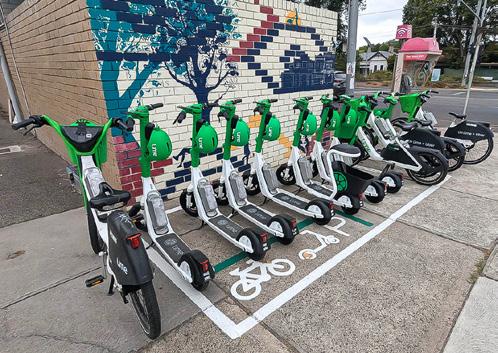
Much of the criticism of EMDs centres on their use in pedestrian spaces. I would argue though that in the denser areas of our city, riders are making a rational choice. Dedicated infrastructure is lacking, it feels unsafe to share the roads, and riding on a footpath becomes the fallback. It’s less a sign of disregard for pedestrian safety and more an indication of gaps in the network.
If EMDs are to play a meaningful role in transport, infrastructure needs to catch up. Despite steady progress, large parts of the inner city remain disconnected from highquality, separated cycling facilities. The principle is well understood but inconsistently applied: provide safe, continuous infrastructure, and people will use it.
Planning policy is beginning to respond. Plan for Victoria includes actions to better align bicycle parking and endoftrip facilities with demand, and flags increased provision rates for bikes and scooters in future Planning Scheme updates. These changes are underway and should translate into more meaningful provision in new developments.
EMDs are now part of the transport landscape, not a temporary disruption.
For designers, ensure you’re considering the needs for these modes in your projects. Along with more provision, provide generous parking dimensions for larger bikes, and make allowances for charging facilities to account for the growing numbers of powered device users.
For the curious, I encourage you to have a think about what trips could be replaced with an e-bike or e-scooter (or a standard bike) and give it a go. You might just be converted!
James Dear is a Director at onemilegrid and former Co-Convenor and member of VPELA’s YPG.
James Dear onemilegrid
The Business From car parks to cargo bikes: The next shift in development transport assessment
The recent reforms to statutory car parking rates have shaken up the development game; but as the dust settles a natural question follows – what is next?
Bicycle parking is rarely the deciding factor in whether a development is approved. That could be changing. Changes to statutory bicycle parking requirements are on the horizon, and active transport is set to play a more influential role in development application assessments.
By 2030, Victoria is aiming for 25 per cent of all trips to be undertaken by “active transport”. Consistent with Victoria’s recently published Active Transport Plan, this includes “human-powered” modes such as walking, bike riding, wheeling and rolling as well as electric personal mobility devices like e-scooters and e-cargo bikes. These emerging transport technologies are becoming increasingly important in broadening transport choice and supporting a wider range of users and trip purposes.
This direction is likely to shape both design outcomes and approval processes for new development. Meeting active transport requirements may no longer be a late-stage “tickthe-box” exercise. Instead, it is beginning to inform site feasibility and building form and massing, and how transport impacts are framed.
So, what might this mean in practice?
1. Higher minimum bicycle parking rates, linked to public transport access
Communications from DTP suggest that an amendment for Clause 52.34 Bicycle Parking is due in 2026. This aligns with Action 5 of Plan for Victoria which calls to match car and bike parking requirements and bike facilities with demand
This will almost certainly involve an increase to the minimum bicycle parking requirements for new developments across Victoria. These new rates will also likely be linked to public transport accessibility, meaning that developments which are subject to car parking maximums under the recent VC277 reforms will be expected to provide more bicycle parking. DTP has already released their public transport accessibility index in the form of “car parking requirement maps”, and may adopt a similar approach for bicycle parking (albeit coupled with a name change).
The obvious question is what the new rates will be. Some schedules within the Capital City Zone require bicycle parking in the order of 1 space per dwelling and 1 space per 50 sqm of non-residential floor area. This rate could be benchmarked for developments with the highest level of public transport accessibility, with rates scaling back to the current Clause 52.34 minimums in less accessible areas.

2. More space allocated for bicycle parking facilities
Higher minimum rates will inevitably mean more space allocated to bicycle parking. However, design standards for bicycle parking and end of trip facilities are also likely to shift.
Bike riding culture is beginning to evolve in Victoria. It is no longer limited to riding your fixie to your local pub or pulling on lycra to shave a minute off the commute. Ebikes and cargo bikes are increasingly being used as genuine car replacements, with many family households choosing them over a second vehicle.
These bikes are typically larger and heavier than traditional bicycles. This will almost certainly be reflected via new bicycle parking design standards under Clause 52.34, with a focus on providing spaces that cater to a wider range of bicycle types.

3. Greater scrutiny of network impacts beyond the site boundaries
Alongside changes to on-site provision, there will likely be greater scrutiny around how well new developments connect to existing walking and cycling networks beyond the site.
The recent Active Transport Plan flags that walkability and rideability assessments will be required for large-scale developments, and that developers will need to contribute financially to address gaps in active transport between their site and the existing network.
Exactly which developments will trigger these assessments, and how developerfunded walking and cycling infrastructure will be delivered, remains unclear. What is clear is the direction of travel. Active transport upgrades will be increasingly treated in the same way as road or intersection works for major developments, and likely across a wider area than traditionally required.
James Ramm Urbis
Source: Bicycle Network
4. A shift from vehicle-focussed to people-focussed assessment
As the Train and Tram Zone Activity Centres Program continues to be rolled out, active transport will play a critical role in supporting uplift. Many of the locations earmarked for densification are in areas where the existing road network is oversaturated, with limited scope to accommodate additional vehicle traffic.
In response, traditional vehiclefocussed assessment methods will be challenged. Recent updates to DTP’s transport modelling guidance reinforce this shift, emphasising network performance for people rather than only vehicles. This will change the way that transport impacts are assessed and communicated, with walking and cycling playing a pivotal role at mitigating new developments.
Taken together, these changes point to a clear conclusion. Active transport is no longer sitting on the periphery of development application assessments. As policy firms up and assessment methods evolve, it will become a core part of how development transport impacts are understood, mitigated and ultimately approved.
James Ramm is a Senior Consultant in the Transport Advisory team at Urbis.

The VPELA Small Business Collective (SBC) meets quarterly and aims to bring small business members together to broaden their networks within the VPELA community and stay connected throughout the year and at VPELA events. Agendas for these sessions will include industry updates, small business issues and initiatives, and informal discussion and support for these matters. If you would like to be part of this group and receive an invitation to the next informal catch please contact Ellen Tarasenko who will add you to the mailing list.

First Tier
Town planning and development, Environment and climate change
— Doyles Guide, 2026
“The firm are distinguished by their accessibility and depth of talent.”
— Chambers Asia-Pacific
The team at Norton Rose Fulbright are responsive and provide practical advice.”
— Chambers Asia-Pacific
“Norton Rose Fulbright boasts a large and dedicated environmental planning practice… renowned for large scale developments.”
— Legal 500 Asia-Pacific
Law Firm of the Year | Best Lawyers Planning and Environmental Law (2026, 2025, 2022, 2021, 2019, 2018)
Tier 1
Environment and Planning
— Legal 500, 2026
Band 2
Environment and Planning
— Chambers Asia Pacific, 2026


Elisa de Wit Partner, Environment and Planning
Jacqueline Plant Partner, Environment and Planning
Nick Sutton Partner, Environment and Planning
Sally Macindoe Consultant, Environment and Planning
The Business
The City wasn’t built for you. Let’s fix that

Melbourne is one of the most culturally diverse cities on earth. One in two Melburnians is a first or second-generation migrant. 32% of every one hundred households speak a language other than English at home. And yet, walk into most planning panels, design review boards, precinct masterplan workshops, or community engagements and ask yourself: does this room look like that city? It rarely does.
That gap, between the city we are designing and the city that actually lives here, is not a values misalignment. It is a structural gap. And it is one that our profession has the tools and the responsibility to fix.
I should say where I am speaking from.
I am an Indonesian of Chinese heritage. I grew up knowing that being culturally different was not an identity question. It was a survival question. When a country turns on a particular cultural group during hard times, you learn very quickly what it means to be visible in the wrong way.
In Singapore, I looked like I blended in but was constantly reminded I was an outsider. In Australia, I arrived as an international student and eventually understood that I had been welcomed primarily for my fees, as a commodity.
It is only recently, after more than two decades building a career in urban design in Melbourne, that I have felt I could be fully myself without wearing what I call the ‘metaphorical beard of assimilation’.
It is through this lens that I read every structure plan, every street design, every public realm and built form brief that crosses my desk. I know what it feels like to move through a
city that was not designed for you. And I know, professionally, exactly where in the process it goes wrong.
Diversity has a geographic location
Melbourne’s cultural communities are not distributed evenly across the metropolitan area. Vietnamese communities anchor the west and inner north. South Asian communities are concentrated in the southeast. East African communities are growing rapidly in the northern growth corridors. Chinese Australian communities have transformed Box Hill into something closer to a genuine Asian third place than anything a planner could have intentionally designed.
When we treat Melbourne as a single homogeneous design client, we produce spaces that work for an imagined resident who looks nothing like the actual population. The Town Centre and High Street with a 6pm closing time. The community centre with a meeting room and no commercial kitchen. The housing typology that has no consideration for multigenerational living. These are not bad designs. They are designs for someone else.
The question I bring to every precinct brief is simple: who is this actually for? Who will walk these streets, gather in these parks, and raise their children in this neighbourhood?
The third-place gap
Urban design borrowed the concept of the third place, the social spaces beyond home and work where community life happens, from European and North American thinking. The pub. The square. The park.

Gerhana Waty Hansen Partnership
But the third place looks profoundly different across cultures. In much of Southeast Asia and East Asia, it is the hawker centre, the kopitiam, the wet market, the kaki lima or five-foot way. It is covered and climate responsive. It is multigenerational by default, not by design. It opens at 6am and again at 10pm. Food is not a pretext for gathering. Food is the act of community itself.
When we design precincts in Melbourne’s growth corridors, where a significant proportion of incoming residents bring this relationship to public space precisely, we are still largely producing the European model. And then we wonder why the park is empty on Sunday mornings while the food court three suburbs over is packed.
I had the privilege of delivering the Darebin Streets for People program. It pointed toward a different approach. By establishing groups of local ‘Street Champions’, people who live and work in the study area, it introduced lived experience as a legitimate design input alongside traffic data and sunlight studies. A resident who walks a street every day holds knowledge that no dataset captures. That knowledge is evidence.
The structural problem
Here is the harder truth. The mismatch between Melbourne’s cultural diversity and its built environment is not primarily a failure of individual design. It is a structural lag.
Decision makers and advisory bodies in planning and design are weighted toward experience. Decades of it. The voices shaping our cities today largely reflect the profession as it was built twenty, thirty, or forty years ago.
Melbourne’s cultural transformation, while not new, has accelerated most visibly over the last fifteen to twenty years.
The communities that now make up half this city arrived, established themselves, educated their children, and entered the professions on a timeline that puts them at mid-career at best. Their leaders are only just arriving at the tables where decisions get made.
At every tier of the Victorian planning system, from state policy to statutory panels to local permit decisions to the consultants commissioned to do the work, the cultural diversity of Melbourne’s communities is underrepresented among the people making decisions.
Not because of malice. Because of the pipeline, because of professional culture, and because lived experience continues to be treated as anecdote rather than evidence.
As the first Asian woman to lead a team at Hansen Partnership, I am aware that I occupy a position that should not still be notable in 2026. But I also know that the path required, is not just about competence but one that requires a particular kind of stamina. The stamina of contributing from rooms that were not built for you, while making the work better in ways that rarely get attributed. That stamina should not be a prerequisite for influence.
What good looks like
Culturally inclusive urban design is not complicated. It requires three commitments, and none of them are beyond us.
First, treat demographic research as design research. The demographic profile of a catchment is a design brief. Who lives there, how they gather, when they activate public space, what food means to their social life – these are not sociological curiosities. They are spatial instructions.
Second, accept lived experience as expertise. Engagement structures should be built around communities rather than asking communities to navigate formats that were never designed for them. A drop-in session on a Wednesday evening at a council office is not neutral. Genuine engagement goes to where people are, in the language they speak, at the times that work for their lives. And what community members say should carry evidential weight in the design process, not be filtered into a dot point under community feedback noted.
Third, support diverse leadership now. People in the room at the point where built form and precinct decisions are actually made must bring genuine cultural knowledge rather than goodwill alone. Representation at the delivery end of a project, while strategy has already been set by a homogeneous leadership group, is not inclusion.
Melbourne is already one of the most culturally diverse cities on earth. Every design decision encodes an assumption about who the city is for. The precincts and neighbourhoods being designed right now will either reflect that reality or they will not. There is no neutral position.
The only remaining question is whether we have the will to design for the city that actually lives here.
Gerhana Waty is a Director at Hansen Partnership.




The Business Small spaces, big shift


What the Victorian Grassland Earless Dragon means for planning practice.
For decades, the Victorian Grassland Earless Dragon was considered lost. Once a small but widespread inhabitant of Victoria’s native temperate grasslands, it had not been recorded since the late 1960s and was widely regarded as extinct. Its rediscovery in 2023, west of Melbourne on Wada Wurrung Country, marked a significant finding for Australian conservation.

The species itself is unassuming. Growing to around 15 centimetres, it relies on open grassland systems and features such as spider burrows for shelter, breeding and protection. However, its significance lies not in its size but in its status. Listed as critically endangered even prior to its rediscovery, the Victorian Grassland Earless Dragon (VGED) sits within one of the most heavily modified and actively urbanising regions in the state.
Its reappearance within the Melbourne Strategic Assessment (MSA) program area has required an immediate and coordinated response. The Victorian Government has introduced a formal ‘Prescription’ under the MSA framework, setting out how impacts to the species are to be avoided and managed. The most notable outcome for practitioners is a shift in sequencing. Habitat assessments and, where required, targeted surveys must now be undertaken before planning approvals can meaningfully progress.
This represents a departure from more familiar approaches where biodiversity issues are resolved progressively through permit conditions or secondary approvals. In the case of the VGED, ecological constraints are brought forward and become central to early decision-making. Projects are now required to establish, at the outset, whether suitable habitat exists and whether further investigation is needed.
The process is guided by a Habitat Distribution Model developed by the Department of Energy, Environment and Climate Action (DEECA). The model maps areas of potential habitat across the MSA area, based on environmental characteristics associated with the species. It is important to note that the model identifies potential rather than confirmed habitat. Where a site intersects with modelled habitat, a habitat assessment must first verify whether suitable conditions are present on the ground. Targeted surveys are then undertaken where suitable habitat is confirmed.
From a practical perspective, this staged approach introduces both clarity and constraint. Survey timing is limited by seasonal windows, which can influence project timelines where access or coordination is delayed. Government agencies are working to prioritise survey delivery, and ecological considerations are now embedded much earlier in the approval pathway. At the same time, the approach provides a more transparent basis for decision-making.
Confirming the presence or absence of VGED habitat early reduces the risk of unforeseen constraints emerging later in the process. For proponents, this can limit the likelihood of redesign or delays once planning approvals are underway. For planners and environmental consultants, the implications are clear. Early-stage due diligence must extend beyond high-level desktop review to include a more considered understanding of ecological constraints. Habitat modelling, survey triggers and engagement with ecological specialists are now core elements of a feasibility assessment. The Prescription also allows proponents to undertake their own surveys using suitably qualified ecologists, providing some ability to manage timing where required.
More broadly, the VGED highlights a planning system that is becoming more responsive to biodiversity. The rediscovery of a species long thought extinct demonstrates that environmental knowledge remains incomplete and subject to change. Planning frameworks must therefore adapt to new information, even where it introduces complexity or uncertainty. The implications extend beyond a single species. The VGED signals a shift towards earlier, more precautionary consideration of biodiversity in planning decisions. Constraints that were once dealt with later are now shaping whether and how projects proceed from the outset.
Wyn Russell is a senior Zoologist and Luciano Solomon is an Environmental Planner at Biosis.
Luciano Solomon Biosis
Wyn Russell Biosis
The Business
What we lose when entry-level work disappears
I recently supervised a university planning student during their planning placement in local government. It reminded me how easy it is to forget how much of our profession is built on knowledge that is hard to see until you have to teach it.
Over a few weeks, we worked through matters from first principles. We discussed different tests, read case law, looked at the facts, and talked through why a planner might reach one view rather than another. The concepts themselves can often be explained quickly. Applying them in the real world is the harder part.
That experience made me think about a question I do not think the profession, or even the broader white-collar workforce, has fully answered yet. As AI becomes better at doing the early tasks of professional work, where will the next generation learn professional judgement?
AI is already useful in planning work. Given the right material and the right direction, it can produce a decent first draft. It can summarise documents, organise issues, and act as a useful devil’s advocate. It can, and does, save time.
It is not hard to see why AI has taken the professional world by storm. Entry-level staff take time to train and supervise. Reviewing their work often means senior people absorbing the cost of teaching rather than billing. In a pressured environment, where everyone is trying to do more with less, AI can look like an obvious way to reduce the burden.
But this is where I think we need to be careful.
A lot of early professional work can look low value from the outside. Reading a file. Preparing a first draft. Checking a policy. Asking a basic question. Revising work after feedback. None of that looks especially sophisticated, but it is often where judgement starts to form.
A junior planner learns by working through real matters, testing their thinking, making mistakes, and being corrected. Over time, they start to see patterns. They learn why one matter can be dealt with quickly, while another needs more attention. They learn how to listen to stakeholders without accepting every point at face value, and how to ask experts the right questions.
That is also where the small but crucial lessons happen. A question about why a particular policy mattered. A draft sentence that needed to be reworked. A discussion about why one issue was routine and another was not. These moments can seem minor at the time, but they are often where the real learning takes place.
The easiest parts of AI use are usually the structured ones: summarising information, organising issues, drafting from clear facts, or stepping through a familiar pathway. The harder part is knowing when not to treat a matter as routine. That is

Steven Huang Clutch Planning
where professional judgement still matters. Good planning work is more than applying rules. It is knowing which facts matter, which questions to ask, and when something needs a more experienced set of eyes.
Looking back, that is how I learnt too. Not through one big lesson, but through repeated exposure to real work and people taking the time to explain where my thinking needed to develop. That kind of learning is easy to undervalue because it is slow, informal and hard to measure. But it is where I build my professional capability.

The long-term risk is not just that AI may produce a bad draft or miss a point. The bigger risk is that we quietly remove some of the early work that once trained future professionals. Then, in a few years, we wonder why there are not enough experienced planners in the market.
Many organisations want ready-made professionals. Fewer want to spend serious time creating them. That is understandable. Budgets are tight, workloads are high, and senior staff are already stretched.
We should embrace tools that make us more efficient. But we should not conflate efficient output with professional development. If AI takes over more of the basic work, then we need to be deliberate about replacing the learning that work used to provide.
Otherwise, we may solve today’s productivity problem while creating tomorrow’s capability problem.
Steven Huang serves as a committee member of VPELA’s YPG and is a freelance planning consultant.
The Business Major promotion signs should be allowed in heritage areas to finance building renovations and restorations
The Minister for Planning should facilitate the granting of short-term planning permits for advertising signs in heritage areas to help fund the renovation and restoration of heritage properties.
This proposal arises out of a practice in Milan, Italy, in which scaffolding shrouding is partially adorned by major promotion signs to help finance the renovation works that keep the city’s buildings clean and structurally sound.

Urban Vision in Milan claims to have been involved in 400 restoration projects financed with the contribution of private funds, amounting to over 200 million euros, partly through advertising revenue: https://care.urbanvision.com/en/progettidi-valorizzazione/
In Milan, a private advertiser (or an intermediary company) finances all or part of the restoration costs in exchange for exclusive use of the external faces of the scaffolding sheeting for a defined period. The revenue from the advertising rights offsets what would otherwise be the owner’s or institution’s out-of-pocket restoration expenditure. Applicants are required to submit draft campaign materials to the permitting authority.
Digital advertising is also allowed, but may be required to include documentary footage of the restoration works in progress and include messages such as “this advertising is financing the restoration works …”
In Victoria, the Victoria Planning Provisions already anticipate short term advertising contracts for buildings under construction. Clause 52.05-10 provides:

Matthew Townsend Victorian Bar
“Despite any provision in a zone, overlay, or other particular provision of this scheme, a permit is not required to construct or put up for display any of the following signs:
…
A sign on a hoarding, building shrouding or fence associated with a development that is, or is proposed to be, under construction on the site. The total display area on each street frontage must not exceed 25 percent of the combined area of the hoarding, building shrouding or fence on that street frontage.
The sign must not be:
• Animated
• Electronic
• Internally illuminated or floodlit
• Displayed for more than two years.
The sign must be removed when the construction work is complete.”
However, there is no comparable exemption under the Heritage Overlay. Rather major promotion signs are discouraged in heritage precincts. I suggest a new provision that provides something along the following lines:
“
Short term signage
A permit may be granted for major promotion signage in the Heritage Overlay, where the responsible authority is satisfied that the revenue from that signage will be substantially used to renovate or restore the heritage place. The total display area on each street frontage must not exceed 30 percent of the surface area of the protective sheeting surrounding those restoration or renovation works.
The sign must not be displayed for more than two years.
The sign must be removed when the renovation or restoration works are complete.
Permit application requirements
A permit application under this provision must be accompanied by a report from a suitably qualified expert detailing the nature and extent of the renovation or restoration works and the suitability of the advertising proposed.”
It may be that this initiative is supported by landowners who see this as an opportunity to clean, paint or restore their heritage buildings on a heavily subsidised basis; advertisers who may otherwise be locked out of heritage areas; and residents and visitors who will gradually see our heritage precincts improved over time.
I am keen to hear from heritage consultants and people in the advertising industry who have an interest in this proposal. Matthew Townsend is a Barrister at the Victorian Bar.
The Business
Planning gets in the way of good housing outcomes
We are all very familiar with the well-worn idiom about there being two sides to every story. At a time when public discourse is more polarised than ever and ‘the two sides’ find it difficult to respect an opposing point of view, it is important to recognise the value in respectful contributions to a contest of ideas.
“The art of advocacy is to lead you to my conclusion on your terms.”
– Adam M Grant
Many young people feel they can’t cut through the louder noise, so it is refreshing that Tristan Layton, and Zachary Pavlou and Kayley Dixon, have come forward as ‘the two sides’ in a debate about whether there should be more planning regulation in our cities, or less. If you haven’t formed your own views on the subject, we are confident that the opinion pieces that follow may just get you thinking. – Eds
Cities are the product of billions of decisions, made by millions of people, sharing a few thousand square kilometres of land. Cities are disorganised, uncoordinated, and chaotic. On the other hand, cities are spontaneous, organic, and natural.
By presuming top-down planning regulation can override this spontaneity, our planning system gets it wrong. The costs of top-down regulation are numerous and felt most acutely by those unable to afford homes in our cities. The evidence is mounting – a shortage of homes across Australian cities is, in significant part, a direct consequence of restrictive planning systems that drive the price of housing sky-high and put home ownership out of reach for my generation.
In my view, the answer is less planning, not more.
We cannot solve housing affordability until we accept that new homes are too often prohibited where they are most viable and profitable to build: in the well-located, highamenity areas close to infrastructure and services where people most want to live.
The history of our planning system is a story of creeping restrictions on building homes, many of which, of themselves, are perfectly defensible. However, each additional restriction or requirement chips away at the developability of land – a little bit at a time. Cumulatively, these restrictions make it nearly impossible to feasibly develop housing in areas of high demand.
An accumulation of these restrictions over decades has created enclaves of wealth and privilege in our cities. Numerous

Tristan Layton Planning & Property Partners
patches of valuable inner-city land are protected as quiet (and arguably exclusive) communities for the benefit of their existing residents. But for these restrictions, this is the land that, based on the proximity to infrastructure and services, would otherwise be hosting bustling, vibrant urban activity according to a compelling body of evidence.
The consequence is an aging inner-city population, with young families priced out and forced to move away from their older relatives who had the fortune to get there first. It is no coincidence that school enrolments at many of our inner-city schools are going backwards. Australian cities risk becoming what the NSW Premier has described as “cit[ies] without grandchildren”.
How do we, as a profession, fix this?
In my view, there are some uncomfortable truths about planning that our industry needs to grapple with if we are serious about addressing the housing shortage evident in our cities.
First, we need to stop pretending that planners know the optimal use for every parcel of land in the state in perpetuity. Instead of pre-empting how land should be used, we should respond to how it is actually used. This means we should listen to and trust price signals more, as they are the clearest expression of consumer preferences.
Top-down central planning fails due to information asymmetry. The truth is, I don’t really know what my neighbour wants. I don’t know if she wants to live in a threebedroom detached house surrounded by greenery, or a cozy walk-up brick flat. These are not my decisions to make, nor should they be my decisions to guide.
What I can measure, though, is what my neighbour will pay for. Price is, and has been for thousands of years, the most efficient way of conveying decentralised information. If a price for a certain kind of home in a certain area is going up, it means there are more people who want it than can be accommodated. Instead of restricting the market from providing housing in numbers that better meet localised demand, we should facilitate more housing in those areas.
Second, we need to acknowledge that every additional planning restriction or requirement we impose on housing inherently requires a trade-off, usually in the form of a higher cost to deliver a given housing unit, or in the cost to society of slower rates of growth in supply.
Whenever we increase restrictions (such as restrictions on height, site coverage, or floor area ratios), we need to be sure that the costs are worth paying. It is my view that more accessible and robust assessments of the economic impact of the restrictions we impose are critical to a fair and balanced assessment of whether we’re getting bang for our buck.
Third, we need to accept that land use regulation is not the cure for all of society’s problems. We need to stop insisting that every new development be rolled gold and unwind the design standards that impact project feasibility – and in many cases, push housing projects into the “no longer stacks up” category. We don’t need more design requirements to mandate the latest fad from Scandinavia in the VPPs. We need to trust that markets can respond to consumer preferences like they would for any other product, and let it deliver.
Where does this leave us?
In the context of strategic planning, this means focussing above all on the quality of the public realm and supporting infrastructure, not micromanaging design. Plan the sewers, design beautiful and efficient streets, and then trust people to use their land in the manner that suits them best. In the context of statutory planning, this means regulating the externalities that actually arise from the use and development
Most planning regulations are necessary
Yes, fewer regulations could allow more, and more affordable housing in our cities. However, this would almost certainly come at the cost of losing what makes our cities and homes liveable, healthy and desirable. In many cases, the very regulations targeted for removal are those that safeguard basic standards people rely on, yet they are often taken for granted.
For example, Clause 58.07-3 requires that habitable rooms have windows. Why remove regulations like this when there is extensive research linking access to sunlight with better physical and mental health outcomes? This is not a theoretical issue. In 2022, The Architect’s Newspaper reported that many new buildings in Austin, Texas, include more than 20% of apartment bedrooms without windows.
Windowless dorm rooms have also become increasingly common. For example, a proposal at the University of California, Santa Barbara – Munger Hall – was designed as a 12-story building accommodating 4,500 students, with no windows directly into dorm rooms. It was, unsurprisingly, the subject of negative reaction from students, architects, and community members. The project was cancelled in 2023.
While a windowless bedroom is better than no shelter, we should question whether this represents an adequate standard for new housing in one of the world’s most prosperous nations. Poor quality housing has broader implications for health systems, productivity and social cohesion. Unregulated, unhealthy dwellings may reduce costs upfront but could likely impose greater long-term costs on society. It risks normalising a lower benchmark for what constitutes acceptable living conditions.
It is often argued we should build more housing where people want to live – places with mature trees, open space, attractive buildings, and fine-grain ‘high’ streets. But these places exist because of regulations that encourage tree canopy, open space, walkable streets, and neighbourhood character reinforced by heritage controls. Are these the regulations that
of land, instead of seeking to ensure that every proposal is visually pleasing or suits public purposes.
In areas of high demand, like our inner and middle suburbs that are proximate to good infrastructure, we need to upzone and allow significantly more ambitious built form outcomes. Evidence from different cities around the globe is compelling – getting planning out of the way in areas of high land value leads to more homes being built.
Thankfully, we’re on the precipice of a significant ‘vibe shift’ across the country in how we understand the interaction between planning and the housing shortage – governments of all stripes are starting to untangle the Gordian knot of planning regulation and are seeing results. Let’s hope, for the sake of our cities, and my generation, it continues.
Tristan Layton is a lawyer at Planning & Property Partners and is the Vice President of YIMBY Melbourne.


should be removed to cut costs? Or should Built Form and Heritage Overlays be eliminated entirely, leaving no historic streets at all?
There are, of course, areas where planning protection could be more flexible. For example, some overlooking rules, certain heritage controls, some standards around heights and setbacks can be considered too restrictive. However, the character of our places matters, and development should reinforce rather than compromise it.
We believe we can find common ground that enables us to deliver healthy, beautiful neighbourhoods without unnecessary regulation. However, we should not lower our societal standards for what dignified housing looks and feels like simply to increase supply. Housing reform should not treat supply as an end in itself, divorced from the quality and liveability of what is actually delivered.
Planning is not responding to consumer preferences
Consumer preferences are more complex than they first appear. Many in our communities still favour detached homes in suburban areas, often close to where they grew up.
A recent money.com.au survey found only 7–8% of Gen Z and Millennials prefer city apartments as a place to live. The figure is about 11% for older generations. Duplexes and townhouses appear slightly more preferred with figures generally between 11% and 15%.
Current planning reform is pushing toward significantly more high-density development than consumer preferences suggest as a means of protecting natural amenity, avoiding urban
Kayley Dixon Mecone
Zachary Pavlou Mecone
sprawl, improving transport connectivity, and better utilising community infrastructure.
There are cases where development does not align with preferences, but these are often architectural or stylistic rather than functional, and sit more within building design and industry trends than planning itself.
In 2015, UK-based group Create Streets asked respondents which buildings they would prefer near where they live. Curiously, the survey found the least popular buildings were often those receiving architectural or planning awards. While many people cannot access their preferred housing, the causes extend beyond planning, especially where planning already permits such outcomes.
Discretionary planning making it slower and harder to build
Planning is often criticised for slowing development, but there is a glut of approved projects that remain unbuilt. Maribyrnong Deputy Mayor, Cr Samantha Meredith has stated:
“… that more than 20 sites in central Footscray already hold approved planning permits. Together, these permits could deliver over 4,000 apartments. Yet many of these sites have remained idle for years, some for more than a decade.”
We hear remarks like these, often. They highlight factors beyond planning contributing to delays, including tax settings, construction costs, labour shortages, financing conditions, and other approvals. Streamlining planning alone will not solve these challenges, particularly in a constrained economic environment.
Enabling our communities to thrive
Our planning and environment team has market-leading expertise across a broad range of industry areas, including property development, transport, construction, energy, waste and recycling and social infrastructure. We act for State government, local Councils, statutory authorities and the private sector. Our full service firm enables you, your projects and your communities to thrive.


Deemed-to-comply pathways can help by streamlining decisions and setting minimum design standards. However, they remove the need to assess proposals against broader local policies such as neighbourhood character.
The removal or contraction of discretion from planning controls risks encouraging “cookie-cutter” outcomes that prioritise quantity over quality. Development should strengthen, not detract from, the character of our places.
While these broader policies can feel tedious, and difficult to quantify, that does not mean they lack value. Discretionary planning is collaborative, it creates opportunities that are informed by policy and community perspectives, to improve liveability, health, amenity, and community outcomes.
It allows for community input and professional judgement. Discretionary planning means a level of consumer preference can be reflected in decision-making, helping ensure outcomes are more widely supported. Rather than removing it, we should recognise its role in enabling better places. Why shouldn’t communities and professionals work together to shape the neighbourhoods they live in?
Ultimately, we should aim to create neighbourhoods that are not only affordable, but also beautiful, liveable and supportive of good health and wellbeing.
Zachary Pavlou is a Senior Planner at Mecone and advocates for more beauty and charm in the built environment.
Kayley Dixon is a Planner at Mecone and is a strong believer in the ability for planning to create fairer, more beautiful cities.






Meg Lee – Partner
M +61 404 070 549 meg.lee@hallandwilcox.com.au
Rory O’Connor – Partner
M +61 400 436 175 rory.oconnor@hallandwilcox.com.au
Natalie Bannister – Partner
M +61 409 418 259 natalie.bannister@hallandwilcox.com.au
Lucy Eastoe – Special Counsel
M +61 401 836 105 lucy.eastoe@hallandwilcox.com.au