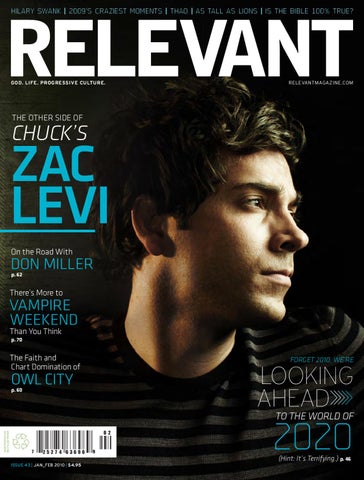
HILARY SWANK | 2009’S CRAZIEST MOMENTS | THAO | AS TALL AS LIONS | IS THE BIBLE 100% TRUE?
god. life. progressive culture.
RELEVANTMAGAZINE.COM
>>>>>>>>>>>>>>>>>>>>>>>>>>>>>>>>>>>>>>>>>>>>>>>>>
the other side of
Chuck’s
Zac Levi On the Road With
Don Miller p. 62
There’s More to
Vampire Weekend Than You Think p. 70
The Faith and Chart Domination of
forget 2010. we’re
LOOKING AHEAD>>>>>
Owl City p. 60
now printed on recycled paper
TO the world of
0 2 7
2527 4 63696
ISSUE 43 | Jan_feb 2010 | $4.95
9
2020 (Hint: It’s Terrifying.) p. 46
I AM It is possible to end extreme poverty one community at a time – but we need your help. There are 1,000 families in Kuria, Kenya who need continued access to our lifesaving programs. For about a dollar a day (less than a cup of coffee) you can empower one of these families out of extreme poverty.
JOIN NURU TODAY AT NURUINTERNATIONAL.ORG/RELEVANT
Sign up today and receive a free copy of Where Are You Wearing? Courtesy of John Wiley & Sons.
VaRnisseghem
GOD. LIFE. PROGRESSIVE CULTURE. RELEVANT magazine January/Febuary 2010, Issue 43 Making this issue went swimmingly. By that, we mean we wore Speedos. And, no, it didn’t go well.
EDITOR, PUBLISHER & CEO Cameron Strang > cameron@relevantmediagroup.com
Editorial Director | Roxanne Wieman > roxanne@relevantmediagroup.com Associate Editor | Ashley Emert > ashley@relevantmediagroup.com Associate Editor | Ryan Hamm > ryan@relevantmediagroup.com EDITORIAL INTERNS: Brendan Case, Alyce Gilligan, Christopher Rule, Ashley Severson Contributing Writers: Chris Blumhofer, Jason Boyett, John Brandon, Steve Dobritch, David Johnson, Carl Kozlowski, Brett McCracken, Jonathan Merritt, Jessica Misener, John Pattison, Kevin Selders, Richard Stearns, Sara Sterley, Tyler Wigg-Stevenson Print Design Manager | Amy Duty > amy@relevantmediagroup.com Senior Marketing Designer | Jesse Penico > jesse@relevantmediagroup.com Junior Designer | Justin Mezzell > justinm@relevantmediagroup.com design INTERNs: Raychel Mendez, Jared Wells Contributing Photographers: Shawn Brackbill, Jeremy Cowart, Justin Douglass, Daniel Garcia, Pamela Littky, Chrissy Piper, Søren Solkær Starbird, Tarina Westlund Digital Manager | Tim Dikun > tim@relevantmediagroup.com Audio/Video Producer | Chad Michael Snavely > chad@relevantmediagroup.com Systems Administrator | Josh Strohm > joshs@relevantmediagroup.com Programmer | Casey Morford > casey@relevantmediagroup.com Chief Operations Officer | Josh Babyar > josh@relevantmediagroup.com Director of Channel Development | Philip Self > philip@relevantmediagroup.com Director of Strategic Innovation | Josh Loveless > joshl@relevantmediagroup.com Account Manager | Michael Romero > michael@relevantmediagroup.com Senior Marketing Manager | Hemarie Vazquez > hemarie@relevantmediagroup.com Field Coordinator | Sarahbeth Wesley > sarahbeth@relevantmediagroup.com Marketing Assistant | Richard Butcher > richard@relevantmediagroup.com Finance & Ad Traffic Manager | Joanne Garcia > joanne@relevantmediagroup.com Executive Assistant & Project Manager | Theresa Dobritch > theresa@relevantmediagroup.com Fulfillment Manager | Rachel Gittens > rachel@relevantmediagroup.com Payroll Manager | Maya Strang > mstrang@relevantmediagroup.com FOR ADVERTISING INQUIRIES, PLEASE CONTACT Michael Romero (407) 660-1411 x 125
want to write for us? Our writers’ guidelines for the magazine and website are at RELEVANTmagazine.com. But please, only if you’re good.
Reprints & permissions
RELEVANT Issue #43 January/February 2009 (ISSN: 1543-317X) is published 6 times a year in January, March, May, July, September, and November for $14.95 per year by RELEVANT Media Group, Inc., 1220 Alden Road, Orlando, FL 32803. Periodicals postage paid at Orlando, FL, and at additional mailing offices.
Love an article so much you want to pretend you wrote it, put your name on it and print up copies? You can’t. For what you can do, visit RELEVANTmagazine.com.
POSTMASTER: Send address changes to RELEVANT magazine, P.O. Box 11687, St. Paul, MN 55111-9913.
jobs
Where having full-time jobs sure cramp our drifter lifestyles. 1220 Alden Road, Orlando, FL 32803 Phone: 407-660-1411 Fax: 407-401-9100 www.RELEVANTmediagroup.com
If you enjoy low pay, horrible work conditions, brainwashing and intense manual labor, RELEVANT is the place for you! Openings are listed at RELEVANTmediagroup.com.
Media Group
TO SUBSCRIBE
Distribution
www.RELEVANTmagazine.com/subscribe Phone: (Toll-free) 877-538-4417 Rates: 1 year (6 issues) U.S. $14.95, Canada $24.95, International $30.95
If you are a retailer and would like to carry RELEVANT magazine, please contact:
bulk discounts Call 877-538-4417 for special bulk subscription discounts for your organization
Subscriber Services www.RELEVANTmagazine.com/subservices Phone: (Toll-free) 877-538-4417 U.S. and Canada, 651-251-9689 International
Ben Woosley Rider Circulation Services > ben@rcsmagazines.com > 323-344-1200 x247
redef ining ining worship worship music music for for the the nex nextt generation... redef
available on iTunes www.anthemworship.com download free chord charts
CONTENTS ISSUE43_JAN FEB 2010 | RELEVANTMAGAZINE.COM
8 10 12 22 24 26
First Word Letters Slices The Pulse: Film’s Deeper Side Reject Apathy: A World Divided Reject Apathy
Frontliner: Justin Dillon
28 The Drop
Thao with The Get Down Stay Down, The Mountain Goats & As Tall As Lions
34 Resolve This 10 ways to get it together in 2010 38 2009 in Review
5 of the strangest pop culture moments of the year that was
46 Bringing 2020 into Focus
Experts in six areas predict how your world is going to change
60 Owl City The unlikely chart-topper is still
wide-eyed and wondering
62 Donald Miller
The best-selling author on humility, inspiration and living your story
70 Vampire Weekend Exploring this New York band’s
many curious paradoxes
74 Fact or Fiction?
What do we do when Scripture contradicts itself?
78 Recommends COVER STORY:
ZAC LEVI THE REAL AND SURREAL LIFE OF
RELEVANTMAGAZINE.COM / 25
FIRST WORD
The Future Is Now > Cameron Strang
I
t was about five months ago, while the editorial team and I were in a meeting planning out this issue, when it hit us. We were discussing the usual mix—equal parts God, life and culture, with a dash of irony for flavor—when we collectively realized this isn’t just another issue. This is January, 2010. Let that sink in. I know it’s a sign of aging when you start talking about how time flies. But come on, last time I looked, it was 2006. Now we’re in double digits. The thing is, this isn’t just another decade. This is the one in which our generation will come into its prime. We’ll go from emerging to established, from young to middle-aged, from next to primary. When you consider how much the world has changed in the last 10 years—the crumbling music industry, skinny jeans, wars, iPhones, global economic meltdowns, twittering—you realize how quickly our lives can evolve. With the increasing speed of technological and scientific advances, cultural shifts, pandemics and war, it can be daunting to think what the future holds. Yet, whatever it is, it’s going to be our reality. I was recently at a meeting where some scientists and leaders were discussing what the world may look like in 2020, and the ethical questions that the Christian community in particular needs to address. I have to admit, things like gene manipulation, nuclear war, global migration, human dignity and pandemic disease aren’t exactly at the forefront of my thoughts every day. But they represent the types of issues with far-reaching moral ramifications, and as a Christian, I more than a non-believer, need to be wrestling with what that means. As quickly as
things are changing, it’s imperative we’re aware of what’s happening and the implications of the path we’re on. That’s why in this issue you’ll find our 14-page 2020 section. As we take the first steps into a new decade, it’s vital we look further down the road we’re on. The world will change more rapidly in the next 10 years than it did in the last 10. Are we ready? Are we going to have a say in what it looks like? In the section, we examine six key areas— politics, the environment, social justice, faith, science and culture—and have experts highlight the critical issues we should be talking about. Some of the statistics and projections are jarring, but I hope they spur thought and discussion that make a difference. (We’ll actually be soliciting conversation about these issues at RELEVANTmagazine.com throughout January and February, so make sure to check that out and join us.) I for one am optimistic about the future. Our generation wants to change the world. We see injustice and want to fight it. We see corruption and want to make it right. We’re creative, passionate and connected. If we can steer those attributes into the areas where God is trying to get our attention, anything’s possible. There are some huge challenges facing us, but what the future looks like is up to us. This is our decade. I believe our generation is ready to make a difference. The future is now.
This is our decade. I believe our generation is ready to make a difference.
8 / RELEVANT_JAN/FEB 10
FEARLESS 2020 *PREDICTIONS AS YOU KNOW, this issue devotes 14 pages to expert predictions on important issues shaping our world over the next decade. Here are some that didn’t make the section, from a group with its finger no less on the cultural hot buttons—the RELEVANT Podcast crew:
* *
In 2012, enough rehearsal footage is finally pieced together to make a Billy Mays movie. I n 2014, medical science will discover a cure for obesity. Turns out we shouldn’t have been eating so much.
* * * *
and Facebook.com/CameronStrang.
In 2016, under the leadership of a revitalized Tim Couch, the Cleveland Browns will win the Super Bowl. The NFL disbands the next day. or three days in the summer of 2017, F frosted tips and barbed-wire tattoos make a comeback. I n 2017, having exhausted all other genres, the makers of hits Guitar Hero and DJ Hero have their first flop with the release of Hand Bell Choir Hero.
* * *
In 2018, Ron Paul will return to his home planet. In 2019, Radio Shack will still be confusing and disappointing. I n 2019, Texas secedes from the Union and develops a Utopian society based on the mutual goals of chastity, forbearance and discovering new and bolder barbecue sauces.
CAMERON STRANG is the founder of RELEVANT. Connect with him at Twitter.com/CameronStrang
I n 2015, we will be visited by a fun-loving time traveler from 1985, who, disappointed by a lack of hoverboards and automatically tying Nikes, will get into his DeLorean and head to the Old West for a better adventure.
*
In 2020, the Chimpocalypse ensues.
reLevanTMAGAZINE.COM / 23
COMMENTS, CONCERNS, SMART REMARKS > Write us at feedback@RELEVANTmagazine.com
LETTERS I don’t blame Jon Foreman for not wanting to be tagged with the Christian band label [“Switchfoot’s Unexpected Journey,” Nov./Dec. 09]. You don’t have to be overly explicit with your message to be a true servant. Switchfoot defies categorization. They have too much integrity, sincerity and honesty for either the secular or Christian music scenes. —AARON CLEMENT / via RELEVANTmagazine.com
There are some remarkable quotes by Jon in this article that show the depth of his reflection while on the journey. Makes me respect him even more. —Harris moss / via RELEVANTmagazine.com It might be a rush to judgment to assume that young adult ministries are “rebellious” [“Church Mutiny,” Nov./Dec. 09]. It might just be that the establishment wasn’t interested in change, input, sharing or even relevancy. —P. Thompson / via RELEVANTmagazine.com I am part of a young adults ministry and don’t think it is “rebellious” towards the church body. Even though we have our own service on Thursday nights, the majority of us are also involved in the church. We come on Sunday mornings for service, and we serve in other parts of the church. We’re not just an entity to ourselves. I don’t see the urgent need to get rid of young adult ministries. I find these ministries (or at least the one I’m a part of) very helpful in this stage of my life. —Sousetoiles / via RELEVANTmagazine.com It was with great anticipation that I read the article titled “The New Face of Homelessness” [Nov./Dec. 09]. As I work in this sector, it was refreshing to read about the positive work and results happening in the areas you focused on. I hope this article will help focus the attention of the readers of RELEVANT on the problem of homelessness and the fact it is happening in the cities, towns and communities we live in. —Stuart Boon / Northern Ireland I’m one of those people who grew up thinking drinking was a sin. I did my best not to look down my nose, but it wasn’t until college
10 / RELEVANT_JAN/FEB 10
that something shifted in how I viewed the consumption of alcohol. One night my roommate said: “I don’t drink because I hate alcohol. Not the taste of alcohol but what it does to people. What it does to families and how its effect kills innocent people.” Jason Boyett attempts to dip his toe into that moral realm, but I’m not taking his “change in culture” angle [“So, Is Drinking OK?” Nov./Dec. 09]. I’m not calling it sin—I just know why I don’t drink, and it has nothing to do with quoting Scripture. —Joel Close / Raleigh, NC What a disappointing article about a Christian acceptability of alcohol consumption. I found it salacious, indulgent and poorly argued. Paul says in referencing an old saying to the Corinthian church, “’Everything is permissible for me’—but not everything is beneficial.” This is the real question, isn’t it? What is the benefit? What type of relational doors will this open? Is my attitude rebellious or relational? —J.P. Groenink / via RELEVANTmagazine.com That’s three questions. When I read the Slice about Jennifer Knapp making music again, I literally squealed with excitement [“Slices,” Nov./Dec. 09]! She has always been one of my favorite artists, even when she virtually disappeared from the music world. Thank you so much for keeping RELEVANT readers informed about such a powerful singer’s return! —Brittany meyer / Fountain Valley, CA Thank you to Cameron Strang for sharing this [“Waiting on God,” Nov./Dec. 09]. I always find it encouraging when people we look up to share their struggles and not act like they have everything together, because the truth is, nobody does. Blessings to you and your family. —Sarah ALTON / via RELEVANTmagazine.com We’re happy to announce that on October 23, 2009, about a week after Cameron wrote that column, he and Maya celebrated the birth of a healthy boy, Cohen. They appreciate all the wellwishes people have sent in.
RELETWEETS If you didn’t know, we tweet every day over at Twitter.com/RELEVANTmag. Here’s some of the (almost completely positive) Twitter scuttlebutt about us, in 140 characters or less:
A book on Guiness and God, Is Drinking OK and a CD review of my friend R. Delmore. You guys made my winter warm. —@ltullis
Devoured my @RELEVANTmag, coverto-cover, in just 2 1/2 days. It was delicious to my mind. —@CourtneyHeald
Dear @RELEVANTmag: A piece on “New Atheism”? Now? ‘Bout a year late, isn’t it? Article seemed heavy on stereotype, light on insight. Too bad. —@KelleyRowe
Great job on the site and the communication. Read the mag for a while, but been going to the site *a lot* lately. —@petejuvinall
Got the new issue. Looks identical to the last—random rock star on the cover. How about mixing it up a bit? —@jessdowning
Check out the article in @RELEVANTmag this month about the changing face of homelessness. It’s great. Is there an online version? —@sargrace
Killer article in the latest @RELEVANTmag on @Switchfoot and frontman @JonathanForeman. Worth the year’s subscription. —@mikevprice
SLICES
f This year’s new event is called “Skicross” which is kind of like skiing crossed with MotoCross. Sorry, kids, still no “ice jousting.” Maybe 2014.
The Olympics’ Dirty Little Secret Believe it or not, the Olympics is a hot-bed for human rights violations The olympics are usually a time when countries compete in friendly bouts of athletic tests and citizens cheer them on. Even when countries might bicker politically (or militarily), the Olympics is a place for peaceful coexistence through sport. The 2010 Winter Games (February 12-28 in Vancouver, British Columbia, Canada) should be no different. But recently, groups have begun to highlight a dark side to the Olympic Games. According to a report from The Future Project, an organization in Canada dedicated to the eradication of human sex trafficking (the practice of coercing people against their will into the sex trade), the possibility of sex trafficking rises exponentially at international sporting events like the Olympics. The report says the number of human trafficking victims almost doubled in Greece the year of the 2004 Athens Games, and still hasn’t returned to pre-2004 levels. The Future Project’s report also notes that international sporting events are particularly insidious in the sex trade industry, as it makes it easier to bring visitors into the country who may be unwilling victims of the sex trade. There’s also an increase in demand for prostitution and “other forms of sexual exploitation” by attendees. Vancouver is notable as a city already attracted to traffickers; a 2007 U. S. State Department report said there were many victims, particularly from South Korea, who are sent through Vancouver before being trafficked into the United States. A group called Resist Exploitation, Embrace Dignity (REED) has started a campaign dubbed “Buying Sex Is Not a Sport.” REED has set up panels and forums around Vancouver in the lead-up to the 2010 Winter Olympics. The group seeks to raise awareness of the increased demand for sex during the Olympics, and ways people can get involved in eradicating the trade. The campaign stresses that in order for human trafficking to cease, the demand for paid sex must cease as well. Check out BuyingSexIsNotASport.com for ways you can get involved.
RAy Mason
12 / RELEVANT_JAN/FEB 10
Social Justice Initiatives at the 2010 Olympics
Is that you, margaret?
REED isn’t the only social justice group at this winter’s Olympics. Here are some others impacting Vancouver:
b More than Gold This umbrella group includes the efforts of multiple organizations and denominations to prepare for the expected 300,000 (or more) visitors who will be in British Columbia for the Olympics. Efforts include creative and performing arts, missions teams, sports (including kids’ sports camps and leagues), social initiatives and radical hospitality. b Home for the Games Part of the “radical hospitality” arm of More than Gold, Home for the Games encourages volunteers in and around Vancouver to open their homes to visitors for the Games in exchange for money that will go toward charities. The charities have been chosen for their commitment to addressing homelessness in Vancouver. b Olympic Sustainability One of the main focuses at this year’s Games is environmental sustainability. The Games have made every effort to be as green as possible, awarding “sustainability stars” to sponsors and Olympic partners who have done something to benefit the environment and surrounding culture. Examples include a “hydrogen highway” that highlights hydrogen fuel-cell vehicles and hydro-electric power to replace diesel generators. b Aboriginal Participation at the Games
Another one of the Vancouver Organizing Committee’s priorities was to encourage participation from local Aboriginal communities—including First Nations, Inuit and Métis—in all aspects of the Games. This includes developing opportunities specifically for indigenous groups by offering sports and business outlets, and highlighting the cultures of the Aboriginal groups.
The Decemberists Animate Their Opus
Misc.
> According to an interview, MC Hammer says multiple designers are working on versions of his famed “Hammer pants,” the flowing pantaloons he helped popularize in the early ‘90s. We’re just excited because it’s one step closer to the return of the slap bracelet ... > A woman in South Korea finally passed the written portion of the driver’s test ... after her 950th try. We’re not familiar with local South Korean law, but we feel like there should be some kind of “you only get four tries per year” rule ...
t The Decemberists drew a mixture of praise and jeers for their 2009 album The Hazards of Love, since it was an overstuffed rock opera with a ridiculous storyline that managed to also rock so hard. The album tells a narrative about a woman named Margaret who falls in love with a shape-shifting forest creature and incurs the jealousy of an evil Forest Queen. If that sounds absurd and awesome, that’s because it is. It also includes the best metal licks this side of Black Sabbath, and the most proggy pop music since the heyday of Rush. So it only makes sense to turn the album into a crazy cartoon movie. The film, Here Come the Waves: The Hazards of Love Visualized, is available on iTunes and features animation from filmmakers Guilherme Marcondes, Julia Pott, Peter Sluszka and Santa Maria. And, of course, some crazy musical stories.
Albums turned into movies
The Wall This movie is based on Pink Floyd’s classic double-album of the same name, and features lots of strange metaphors and psychedelic mysticism. So yeah. It’s weird and what you’d expect.
Yellow Submarine Technically based on a song and not an album, this is what happens when a hugely drug-riddled music scene inspires a movie. The Beatles basically animated a drug trip and released it.
RELEVANTMAGAZINE.COM / 13
mWe’re waiting for a liberal Bible to be announced, one that puts the words of Jesus in blue instead of red, and all references to the poor have Keith Olbermann’s face in the margin with a speech bubble saying, “SEE?!”
FLAVOR OF THE
Misc.
BI-MONTH
> A church in Phoenix has been banned from feeding the homeless on its property due to a zoning restriction. The same judge likely also hates puppies ...
The Gospel According to Limbaugh?
c What’s the best way to actually get
14 / RELEVANT_JAN/FEB 10
FEBRUARY 17
a raise in uncertain economic times? If you’re a marketing genius and your name is Jason Sadler, you come up with a website called IWearYourShirt.com and sell your torso space every day of the year. Sadler started selling the rights to a daily T-shirt in 2009, charging $1 for Jan. 1, $2 for Jan. 2 and all the way up to $365 for December 30th. Each day, he wore the T-shirt of whoever hired him and used social networking tools to publicize his shirt (and the company’s name). He sold out for 2009 and made almost $90,000 (he also sold monthly sponsorships on his website) and he’s already sold the months of January-July for 2010. He’s expanded his operation, hiring an operative on the West Coast and doubling his price. This news will now likely lead to a rash of people selling advertising space on their clothing, so don’t be surprised if you hear someone talking about their new “Burger King pants and sweet Geico Crocs.”
FEBRUARY 7
HOW TO MAKE $90,000 SELLING YOUR BODY. KIND OF.
FEBRUARY 2
If you read the Gospels and think to yourself, “Man, that Jesus was a raging liberal; this is obviously a translation issue,” then the Conservapedia Bible is for you. Conservapedia was founded by conservative activist Andy Schlafly, who started it after finding Wikipedia to be “liberal, anti-Christian and anti-American.” According to their website, the conservative translation will be open-source and will correct “liberal errors” in the Bible, fulfilling 10 guidelines, including “not emasculated,” the use of “powerful conservative terms” like “accountability” and, of course, the preference for “conciseness over liberal wordiness,” which means using the word “Lord” instead of “Jehovah” or “Yahweh.” Because, you know, God never suggested His name is Yahweh or anything. Crazy liberals.
FEBRUARY 2
> A boy in the upper reaches of Canada was forced to shoot and kill a polar bear after it got too close to him while he was stranded on an ice floe for a few days. The boy was saved and was also granted the title of “Most Hardcore Kid in Canada” ...
u new year’s day // Most every place
JANUARY 1
> A team of textile engineers used more than 1 million spiders from Madagascar to make a large cloth made entirely out of golden spider web. The process took four years and required the invention of a “milking” machine to get the silk. Can you imagine the person in charge of that? “Yeah, I just got bit by a spider ‘cause I was trying to milk it for a giant cloth that no one will use” ...
Five Things to Pay Attention to in january & February
in the country will be hosting a party, but if you’d like to celebrate in a less crazy atmosphere, check out First Night parties, which are alcohol-free celebrations of the arts. Participating cities include Austin, Boston, Monterey, Charlotte and others around the country.
u lost final season // Lost kicks off its sixth (and final) season at the beginning of February. (Any significance to the date? Not sure yet.) This final season will supposedly answer our many lingering questions. If it doesn’t, expect a surprising number of broken TVs the day after the series ends. u groundhog day // People take this day (weirdly) seriously. Punxsutawney Phil of Pennsylvania might be the most famous predictor of weather, but General Beauregard Lee, Ph.D. (he has two honorary doctorates) is the only one you can follow on Twitter @GameRanch.
u super bowl // More than just a sporting event (and a bunch of expensive commercials), the Super Bowl is a cultural landmark. It’s in Miami this year, so you can bet it will be the biggest party of the year. If you can make it down there, check out free concerts like Super Bowl Saturday Night and Pepsi Smash.
u ash wednesday // One of the most important days on the Christian calendar marks the start of Lent. And we mean “mark” literally: Most Ash Wednesday services culminate in the marking of the forehead with a cross of ashes, to remind us of our sin before God and our need for repentance and reconciliation to God.
FLING WIDE
Experience a live evening of worship recorded during an IHOP–KC service. This seamless flow of worship led by Misty Edwards and her team is a raw, live album with songs including “Fling Wide,” “Rend,” and “Arms Wide Open.” These songs, birthed in the prayer room, convey abandonment to Jesus, loyalty to His truth, and a desire to impact the world with the love and power of God.
Point of Life Misty Edwards
Point of Life is Misty Edwards’ latest studio project, with Dave Wiens as the producer. The songs on this album were written in personal devotional times; some have a unique sound, with Dave Wiens on the Chapman Stick bringing a rhythmic energy, while others capture the quiet intimacy of devotion. We pray that this CD would lead you into a deeper love for Jesus.
GET A FREE SONG FROM FLING WIDE AT FORERUNNERMUSIC.COM
FORERUNNERMUSIC.COM/MISTYEDWARDS Forerunner Music is a division of the International House of Prayer of Kansas City, Missouri To learn more about IHOP–KC go to IHOP.org
SLICES
> Do you think Hilary Swank tries to forget The Core even exists?
The Inspiration of Hilary Swank by Carl kozlowski
u Every Life
Tells a Story…
Hilary Swank is winning raves for her portrayal of Amelia Earhart in the biopic Amelia. We sat down with the Oscar-winning actress to talk about her acting choices, Hollywood’s expectations and living unapologetically.
Biographic films (or biopics) like Amelia are some of the best films being made today, often winning awards. Here are six of our favorites:
American Splendor
You’ve played a girl who wanted to be a boy, and a boxer. Now you’re playing a tough-minded female icon in Amelia, yet in real life you’re very glamorous. How does that affect your career in Hollywood?
The biopic of underground comic sensation Harvey Pekar, this film manages to be funny, heartbreaking and original all at the same time. Paul Giamatti puts forth some of his best work as Pekar.
I think being an actor we’re constantly objectified based on what we look like [and] how we should look. It’s easy to look at yourself in those terms. There are many ways a person is beautiful. The fact that Amelia talked about herself humbly when she was so beautiful and [had] accomplished so much showed that she stood up for those seeking equality and human rights.
Directed by Martin Scorcese and starring Leonardo DiCaprio, this film is the story of Howard Hughes, the eccentric airline magnate who made and lost a fortune.
Are you trying to give today’s women a message by portraying Amelia Earhart? She’s a source of inspiration. I’ve never had such an outpouring of people coming up to me saying they can’t wait to see this film. Usually you get an iconic image of who she was from textbooks, but she was a woman in a time when following your dream was a man’s job. Take it a step further, she made no
The Aviator
apologies for really living her life the way she wants to live it. In 2009, she’s ahead of her time for thinking that way. It’s challenging to live the way you want, whether a woman or man. More than anything, that’s what people are responding to. It’s exciting especially in difficult economic times to see women 70 years later dealing with a lot of the same issues. What about Amelia surprised you the most? I really think I didn’t recognize truly how unapologetically she lived her life. She was quite remarkable. The more I read about her the more endearing she became. Usually you read more and you find the “Whoooooa!” moments of scandal. But this is someone I really would want to meet, talk with and learn from. How have you had to overcome the limiting preconceptions of casting directors in Hollywood?
v Boys Don’t Cry Swank won her first Oscar for her portrayal of Brandon Teena, a transgendered male teenager who was killed when it was discovered he was transgender.
16 / RELEVANT_JAN/FEB 10
v Million
Dollar Baby
Swank’s second Oscar was awarded for her depiction of boxer Maggie Fitzgerald in this heartbreaking Clint Eastwood film.
Everyone has an opinion about you, and it’s difficult when you’re pursuing your dream. I had someone tell me I was a sitcom actress when I was going in for auditions as a film actress. Some advice helps, but some is silly and you push it to the side and try not to take in. The person who told me all I’d ever be is a sitcom actress now pretends they never said it.
The Diving Bell and the Butterfly This incredible French film tells the story of Jean-Dominique Bauby who was paralyzed and lost all ability to communicate except by blinking one eye.
Elizabeth Cate Blanchett should have won an Oscar for her performance as Queen Elizabeth I. The film traces the early career of the Virgin Queen, from unsure youngster to steely ruler of Britain.
The Hurricane This biopic is about Rubin “Hurricane” Carter, a boxer falsely accused of murder in 1960s New Jersey. The movie features Denzel Washington as Carter in a fierce performance.
Walk the Line Johnny Cash rode a wave of popularity around the turn of the century, and this film turned that wave into Oscar noms. And for good reason: The story told the legend of Cash like never before.
FIND “THE ONE” [SCHOOL THAT IS]
INTRODUCING THE
relevant college guides UNDERGRAD | GRADUATE | SEMINARY THE DEFINITIVE GUIDES TO PREPARING FOR & SELECTING YOUR COLLEGE
AVAILABLE FOR FREE AT RELEVANTMAGAZINE.COM/COLLEGEGUIDE THE NEW SEASON OF THE
RELEVANT PODCAST TUNE IN EVERY FRIDAY FOR IN-STUDIO PERFORMANCES, INTERVIEWS & MORE! LISTEN AT RELEVANTMAGAZINE.COM OR SUBSCRIBE AT ITUNES IF YOU HAVEN’T BEEN LISTENING, YOU’VE MISSED PERFORMANCES BY DEAS VAIL, THE MYRIAD & AS TALL AS LIONS, AND INTERVIEWS WITH ROB BELL, DEREK WEBB, DON MILLER & MUCH MORE!
SLICES
e Rejected Creative Valentine’s Day idea: Silently plot your revenge.
Misc.
Creative (and Cheap) Ways to Celebrate Valentine’s Day
they call me crouching recession, hidden health care
Valentine’s Day is a strange holiday for a lot of reasons—the Hallmark cards, the memories of awkwardly handing Duck Tales valentines to all of your classmates, the reality of “singles awareness day.” But with enough creativity, the day really can be fun for everyone—couples and single people alike.
reversing course with native americans
John Hughes movie marathon
Without a doubt, one of the more shameful chapters of American history has been the nation’s treatment of Native Americans. From the infamous blankets of small pox to the Trail of Tears, the relationship has been an open sore in the history books. President Obama sought to confront the pain head-on in an address to Native American leaders, pledging to consider a series of indigenous concerns including economic development, education, housing and health care. Obama also pledged to formalize a federal commitment to Native Americans for at least the remainder of his presidency. The president signed a memo telling each governmental agency to show specific ways they would address Native American concerns.
> A 19-year-old from Sheboygan, Wis., is unemployed and desperate for cash. So he did what anyone would do: put his name up for auction on eBay. Yes, for the low starting bid of $5,000, he will legally change his name to a name of a company’s choosing. Linux, this is a chance for you to move in swiftly on the whole “I’m a Mac/I’m a PC” thing ... > Great news: The record for the world’s largest meatball has been broken. Mmmm ... 222 pounds of meaty goodness ... > Google has included a handy new dashboard tool telling you how much they know about you. Basically, the more Google tools you use, the more data they collect. If you use Gmail, Google Talk, Picasa and iGoogle, you can GoogleWave goodbye to your privacy ...
No one captured the pain and euphoria of teen romance like the late John Hughes. So what better day to watch a bunch of his movies than a day that represents the pain and euphoria of love? Have a bunch of friends over, pop some popcorn and charge through Pretty in Pink, Sixteen Candles, Ferris Bueller’s Day Off and The Breakfast Club. You may not feel better about Valentine’s Day, but at least you’ll have some pretty powerful comrades in misery.
Candlelit living room picnic This is an all-weather picnic—just put a blanket on your living room floor, light some candles, bring out the food and enjoy a favorite summer activity in the middle of February. Make classic picnic food—sandwiches, salads and soup—add some drinks and music from your happy-to-be-indoors iPod and the only things you’ll be missing are the bugs.
Progressive Valentine’s Day dinner Make plans with some friends and do a dinner that has a course at each person’s house. Dress up in your nicest garb (or go all out with themed food and costumes) and walk around your town or city enjoying wine and cheese in one house, soup at another friend’s apartment, your main dish at the couple’s house down the street and then back to your place for coffee and dessert.
18 / RELEVANT_JAN/FEB 10
What Would Jesus Dew? A man in Tennessee has been amazed to find an image of Jesus in the condensation on the window of his Isuzu pick-up truck every morning. Jesus is apparently a big fan of fine Japanese engineering. The Golden Rule = Tolerance for Inequality Goldman Sachs has been in the news plenty, and not in a good way. But now they’re bringing Jesus into the mix. An international advisor said: “The injunction of Jesus to love others as ourselves is an endorsement of self-interest. We have to tolerate the inequality as a way to achieving greater prosperity and opportunity for all.” Kids, Drugs Lead to Casual Heresy Arrested for drug possession? Why not say the paraphernalia belongs to ... Jesus? When police found drug utensils in a Louisville, Ky., man’s house, he said it “belonged to Jesus” who was setting him up. Just say no to drugs; they lead to terrible theology.
get defensive
There’s every reason to stand up for your faith if you know why it’s true. Once you’ve spent time with the Apologetics Study Bible for Students, you’ll find yourself better equipped to answer critics of Christianity and advocate the truth in an ungodly culture.
Learn more at ApologeticsBible.com. Available at BibleNavigatorX.com, the Bible on the XBOX or PC.
SLICES
f You: “I have the interwebs!” Us: “Get thee over to our URL posthaste.” You: “Huh?” Us: “Visit our site. Now.” You: “Darn skippy.”
RELEVANTmagazine.com Spotlight Every day on RELEVANTmagazine.com, we post original features, reviews, blogs and news. Here’s an excerpt from one recent feature that got people talking:
Is Living Together Really a Big Deal? by Ed Gungor
Most of us know people who are in love, plan to marry and currently live together. It’s sort of the new premarital counseling program. I visited a church out West that had we’re just a “pre-marriage” ceremony for a making sure couple living together. No license. we’re compatible, No wedding dress. Just a prayer of right? blessing to hold them over until the couple walked down the aisle—a kind of marital “appetizer.” I asked the pastor why they did it. He said, “The couple believes they are married in the eyes of the Lord, and we just wanted them to feel affirmation in our community.” What did I think about it? I was bummed about it. I actually believe that marriage needs to be public and people need to vow into it in front of those who matter to them—it’s not just a private matter in front of the Lord. Truth is, those who declare they are married “in God’s eyes” seem to reframe their claim when they break up with their live-in partner. Then they claim they were never “really married.” This makes me very dubious about the “married in the eyes of the Lord” doctrine ... To read the rest, go to RELEVANTmagazine.com and search keyword “Living Together.”
d Your Response (2 of the 68 comments)
I don’t know a thing about the stats, but I do know that living with someone puts you through the test from top to bottom. And there were times when, if my wife and I were not married, I would have walked out.
— jefe
I was a bit disappointed in your article. Yes, most Christians will agree that premarital sex is wrong. However, what about pre-cohabitation in and of itself? That isn’t so clear. I’ve learned a lot from the reader input—glad I’m not the only one thinking about this issue.
— Betha
From Our Blogs v Career & Money // Moving on from college is a huge transition. You have to find new ways to make friends, adjust to a new job and possibly a new city, and in many cases, you now have to be somewhere at 8 in the morning—wide awake, no less. It’s a whole different world, and it takes some getting used to. v Deeper Walk // Rising from the ground, I headed to my pastor’s office. “Tony, I have to go … I have to go to the hospital. There’s been an accident. I have to go. I have to go to the hospital. My mom, my mom, my mom. Accident. They were driving and now I have to drive there.” To check out all of our blogs, hit up RELEVANTmagazine.com/blogs.
20 / RELEVANT_JAN/FEB 10
Misc. > A new report suggests that people who download the most music illegally are also the most likely to buy a lot of music through legal channels. Which means, of course, the music industry is charging after those people the hardest ... > When Miley Cyrus had a Twitter account, she had legions of followers— some of whom were a little “dedicated.” One such fan was so distraught when Cyrus closed her Twitter account, she set up a website that says she’ll kill her cat if Miley doesn’t come back to Twitter. The choice is yours, Miley ... > German cemetery gardeners are looking to improve their image by creating personalized gravesites. They hope to help the public overcome stereotypes about their work and create dialogue about death and grief. The campaign is called “Long Live the Graveyard!” (no, really) ... > Mattel, creators of the profitable and “make-girls-growup-with-impossiblebody-expecations” Barbie doll, has announced a new Ken doll called “Palm Beach Sugar Daddy Ken.” Sometimes these don’t even need a punch line ...
RELEVANT.TV
spotlight MUSIC VIDEOS Check the front page of RELEVANTmagazine.com for our spotlight Video of the Day. Here are some recent viewer favorites:
1
2
3
4
5
6
1. Death Cab for Cutie “Meet Me on the Equinox” 2. Avett Brothers “I and Love and You” 3. Derek Webb “What Matters More” 4. Matisyahu “One Day” 5. Switchfoot “Mess of Me” 6. Dead Weather “Cut Like a Buffalo”
RELEVANTmagazine.com’s The Drop streams new, breaking albums in their entirety. For free. Here are some recent additions:
Sara Groves
Fireflies and Songs (Integrity)
Ives the Band
The Incredible Story of mr. birch (iMusician Digital)
Brian Lee and His Orchestra
Let yourself be happy (vol 2) (Independent)
Lives of Significance and Service
THE PULSE
Film’s Deeper Side > Brett McCracken
I
t’s the middle of another “awards season.” That time from December until the Academy Awards, when studios roll out the prestige pics they hope will become the next Slumdog Millionaire. It’s a good season for film lovers seeking a palette cleanser from the likes of Transformers 2. And it’s a season that gracefully reminds us why we still love watching movies. We all agree movies allow us to escape—and there’s value in that—but it’s more than simple escapism. Movies take us to places we’ve never been and inside the skin of people quite different from ourselves. They offer us a window onto the wider world, broadening our perspective and opening our eyes to new wonders. This “window” idea figures into the very form of cinema itself. One of my favorite film theorists, André Bazin, often compared the cinematic “shot” to a framed window that hints at a vast reality just outside of view. While other theorists saw the framed shot as something that restricts or limits what can be seen (i.e., what is inside the shot), Bazin theorized that the film image—through its suggestion of off-screen space—was about being “part of something prolonged indefinitely into the universe.” Siegfried Kracauer, another of my favorite film theorists, agreed that the film image was by nature indeterminant, ambiguous and open-ended—a fragment of reality suggesting endlessness. The idea brings to mind what C.S. Lewis said about art functioning as a “window” onto worlds unseen. As humans, he writes in An Experiment in Criticism, we “seek an enlargement of our being. We want to be more than ourselves. Each of us by nature sees the whole world from one point of view with a perspective and a selectiveness peculiar to himself. ... We want to see with other eyes, to imagine with other imaginations, to feel with other hearts, as well as with our own. ... We demand windows.” But cinema is more than just a window. It’s also a magnifying glass. It focuses our attention on everyday reality in a way that makes us see everyday reality for what it really is: magnificence and curiosity. Protestant theologian Paul Tillich once said that “in the proximate, the daily, the apparently small, there is hidden in truth the metaphysical; the here-and-now is the place where meaning is disclosed, where our existence must find interpretation, if it can find an interpretation at all.” This idea—that the everyday, when carefully seen and considered, can provide epiphany—finds its greatest ally in the cinematic form. Bazin believed cinema was “objectivity in time,” presenting a reality of things onscreen even more real than our experience of them in “real life.” In one of my favorite films of the year, Munyurangabo, there is a scene of two boys throwing mud at a wall. They’re just throwing mud at a mud hut for what feels like five minutes. Nothing much happens except
22 / RELEVANT_JAN/FEB 10
mud-slinging (literally). And yet in that moment, I felt the object-ness of mud in a way I hadn’t in a long time, if ever. Another one of my favorite films of the year, Bright Star, opens with a closeup of Abbie Cornish’s hands stitching. I can honestly say I’ve never focused so attentively on the soft, lyrical, industrious beauty of a hand that is stitching. It was the most objective stitching I’d ever been confronted with. These moments of “objectivity in time” have little to do with things like story, plot or narrative … and yet in them exists the key to why we find cinema so intoxicating. It’s more than just a story—because for that we could read books, see a play or watch an opera. Movies are different because they can capture, probe, explore the world in ways no other medium can. We feel the texture of a silk dress in a costume drama like Bright Star. We smell the blood spurting off of a smoking bullet in Inglourious Basterds. We languish at the sight of a tormented face in a movie like Precious or The Road—every line and wrinkle of which the camera so painfully exploits. Movies are visceral. And during awards season, the films that offer the most visceral experiences are often the most rewarded. In a movie, the raw materiality and physical geography on which the story plays out (i.e., nature, sets, bodies, props) resonates with us as much or more than the story itself. This is reality, shooting out at us in flickering light. Kracauer believed the primary function of cinema was to open up reality and re-focus the spectator on the mundane and everyday elements of life that are typically taken for granted. It is through this encounter with the “texture of everyday life” that cinema serves to reconnect humanity with its estranged material habitat, urging us to look closer and see the world for the concrete thing that it is. So yes, we love movies because they let us escape. But we are not escaping from reality as much as we are escaping into a clearer, more focused understanding of it. The movies we cherish the most are not those that feel the farthest from our experience. On the contrary, they are the ones that—in the darkness and stillness of a square, box room— reanimate the wonder and mystery of the world we know. a
Movies can capture, probe, explore the world in ways no other medium can.
Brett Mccracken has an MA in cinema and media studies from UCLA. His first book—on hipster Christianity—is due out in August 2010.
AD
PULSEREJECT APATHY
A World Divided > Richard Stearns ©2009 Justin Douglass/World Vision
O
ur world is increasingly divided between rich and poor. When I was born, the richest countries were 35 times as wealthy as the poorest. Half a century later, it stood at 75 to one. The divide more than doubled on the watch of my generation—the one that vowed to end war and save the planet. Today, 2.6 billion people—40 percent of the world’s population—live on less than $2 a day. Americans, who make up less than 5 percent of the world’s population, live on an average $105 a day. That means the typical American has more material wealth than 96 percent of the world’s people. But it’s more than money. Poverty is about lack of essentials, such as food, clean water and basic health care. Poverty is about lack of hope for the future, because your children can’t get an education—if they survive their first five years of life. Poverty is about not being able to find meaningful work. Poverty is about lack of dignity. This is not how God intended the world to be. The apostle Paul spoke to the issue of disparity in 2 Corinthians when he urged the wealthier Corinthians to make a relief offering to the Christians in Jerusalem, who were in dire economic circumstances. “Our desire is not that others might be relieved while you are hard pressed,” he wrote, “but that there might be equality. At the present time your plenty will supply what they need, so that in turn their plenty will supply what you need. The goal is equality, as it is written: ‘The one who gathered much did not have too much, and the one who gathered little did not have too little’” (8:13-15, TNIV). The Bible is clear that God’s people always had a responsibility to see that everyone in their society was cared for at a basic-needs level. Ruth was able to glean wheat from Boaz’s field because God had instructed those who controlled the land to not harvest everything, so that there would be food for the poor. For Christians, this is a justice issue or, stated more bluntly, a moral issue in which those of us who have plenty seem willing to allow others to have nothing. It is not our fault that people are poor, but it is our responsibility to do something about it. But how? Poverty, disease, ethnic hatred and injustice are the oldest plagues on the human race and when we tackle them, we must not underestimate the challenge. The truth is the poor know much more about their own problems than we do. Walking with the poor requires a willingness to learn from them before attempting to help them. Tackling issues of health education or economic deprivation cross culturally is rocket science, and anyone who attempts it without appreciating its complexity will regret it. We do have one thing the poor need: cash. Not just as a hand-out, but for creating businesses, jobs and hope. Nobel Prize-winning economist
24 / RELEVANT_JAN/FEB 10
Milton Friedman explained, “The poor stay poor, not because they are lazy but because they have no access to capital.” Microfinance is a proven method for helping impoverished communities move toward economic self-sufficiency. Traditional loans are out of the question for the poor, who have nothing but their own labor and initiative to guarantee repayment. Poor businesspeople and farmers often depend on private money lenders—loan sharks—to buy seeds and inventory. Exorbitant interest rates make it impossible for them to get ahead. Through microfinance, entrepreneurs in poor communities can borrow on reasonable terms. Our clients (most of them women) use the loans to start a small business, for example, to buy a sewing machine for a oneperson tailoring shop. After the first loan is repaid—and 98.7 percent of our loans are—they often take a larger loan to expand their businesses, creating local jobs. In one Kenyan community, for every $1,000 in loans, nearly 11 jobs were created or sustained, and the lives of more than 28 children were improved. Once the loans are repaid, that money will be recycled over and over again to help other entrepreneurs; these loans are a powerful tool in the long-term transformation of a community. It doesn’t take much to help people in need. The lack of clean water causes millions of needless child deaths each year. Yet the cost to bring clean water to one person costs only $1 per year. When you realize a gift as small as a dollar can save a life, it is hard to argue that you’re not wealthy enough to make a difference. We might instead want to ask just how many lives our own wealth would enable us to save. In truth, the cost to feed the hungry, to educate children, to inoculate children, and even to provide needed surgeries to the poorest of the poor is extremely affordable and within the reach of most of us. I’m hopeful for this generation just starting out in life. They have a much broader view of the world than mine. Technology has brought the world closer together, enabling us to share both problems and solutions. I pray they have the will and persistence to bridge the divide between rich and poor, and bring the world much closer to God’s ideal. a
It is not our fault that people are poor, but it is our responsibility to do something about it.
Richard Stearns is the president of World Vision, U.S., and author of The Hole in Our Gospel, published by Thomas Nelson.
RELEVANTMAGAZINE.COM / 25
FRONTLINER
Justin
Dillon > Ashley Emert
(L-R: natasha bedingfield, justin dillon, Rocco DeLuca)
r While Justin Dillon was touring with his band in Russia in 2004, his interpreter told him about offers she’d had to travel west for a job. Dillon looked into the “opportunities” and discovered they were fake jobs used to lure girls into sex trafficking. It was an incident that left Dillon reeling. He couldn’t let it go. Dillon’s response was to couple his own passion for music with his desire to seek justice in the area of modern-day slavery. Out of that, he created the “rockumentary” film Call+Response, which he wrote, produced and directed. Scenes of injustice, such as 6-year-old girls working in brothels, are juxtaposed next to interviews with social justice experts, including the president of International Justice Mission, Gary Haugen, and human rights activist Ashley Judd. The film also features performances by several musicians, including Matisyahu, Cold War Kids and Natasha Bedingfield. “We like to think, ‘Oh, I would’ve been on this side of women’s suffrage,’” Dillon says. “Or, ‘I would’ve been on this side of the Civil Rights’ or, ‘I would’ve been on this side of the Holocaust,’ but if you can’t get on this side of [modern slavery], then maybe we need to question what side we would’ve been on if we were to be transplanted back to history. Because it’s the same thing, it’s still human rights.” The documentary’s title plays off of the direct link between music and
26 / RELEVANT_JAN/FEB 10
slavery: In the 1800s, slaves gained hope from singing out in the fields as they worked. Before slavery in the U.S., there weren’t verses or choruses in songs. That sense of call and response was born from the music of the oppressed, and it’s still present in music today. Dillon seeks to show that today’s human trafficking is a form of slavery as real as the slavery of the 1800s. Right now, there are 27 million slaves in the world—more than at any point in history. “Being forced to work without pay under threat of violence, being economically exploited and unable to walk away—that is slavery,” he says. “If people could learn what slavery is, and work the term back into their vernacular, if they could take it out of antiquity and actually put it into current events and call it for what it is, that’s actually quite huge.” Dillon also recently launched the online campaign “Chain Store Reaction,” which enables people to easily send consumer letters to chain corporations in an attempt to communicate their concern for slave labor. “Like anything that moves society forward, we need commitment and innovation,” Dillon says. “There’s never been a disease that has been eradicated, or a human rights issue that has been wiped out without both of those things.”
To learn more, visit CallandResponse.com.
Are you called to serve? In a troubled and uncertain world, hope is often left by the wayside. How can you share God’s love and care? At Fuller, you’ll find the preparation and resources you need to fulfill your call to serve the hurting and hopeless. You’ll study with faculty, who are renowned scholars, authors, and practitioners, engaged in leading-edge research in theology, intercultural studies, and psychology. Consider becoming part of our richly diverse learning community—committed to Jesus Christ and passionate to serve.
Pasadena Irvine Menlo Park
Sacramento Seattle Phoenix
Colorado Springs Houston Online
For more information visit fuller.edu or call 800.2FULLER
THE DROP
Website:
www.thaomusic.com
MySpace:
myspace.com/thaomusic
For Fans of:
Laura Veirs, Cat Power, Feist
28 / RELEVANT_JAN/FEB 10
To hear more emerging artists, check out The Drop at RELEVANTmagazine.com
While Thao With The Get Down Stay Down’s last effort, We Brave Bee Stings and All, was critically acclaimed, singer/guitarist Thao Nguyen says her band’s latest release kicks things up a notch. Know Better Learn Faster reveals a more mature band and better captures their energetic live show. “On this record, we’re much more comfortable with our identity as a band,” she says of The Get Down Stay Down, which features Adam Thompson on bass, keys and additional guitar, and Willis Thompson on drums and percussion. “I think this record definitely benefited from almost a year and a half of consistent touring.” According to Nguyen, the new collection of indie pop is also the band’s most emotionally intense. “I didn’t plan it this way,” she says, “but it sort of coincided with the end of a relationship. “I don’t ever consider that people who listen are interested in my personal life,” she continues. “It’s more my hope that they find something they can attach or relate to in the song and focus on that element.” Recorded by producer Tucker Martine (The Decemberists, Sufjan Stevens), Know Better Learn Faster features appearances from Andrew Bird, Laura Veirs, tUnE-yArDs, and members of Blitzen Trapper and Horse Feathers. Having Veirs on the album is extra special to Nguyen, who, when in college, sent the folk singer a demo asking to be a part of her tour. Veirs’ management agreed and Nguyen’s music career was born. “I’ve always been a really big fan of her work,” Nguyen says. “She’s always been a big influence of mine.” For her own music career, Nguyen says her hope is to maintain a proper balance. “My goal is that we might continue making a living playing music for kind people while not completely sacrificing any semblance of normal lives.” —Kevin Selders
Tarina Westlund
THE DROP
Website:
www.mountain-goats.com
MySpace:
myspace.com/themountaingoats
For Fans of:
The Hold Steady, The Dodos, Bruce Springsteen
30 / RELEVANT_JAN/FEB 10
From the outside looking in, Christianity is a little bizarre. Strict precepts not always followed, Bible verses recited to one another, megachurches built next to suburban malls. It doesn’t always make sense—even to Christians. For John Darnielle, the singer and songwriter in North Carolina’s neo-folk trio Mountain Goats, Christianity is an interesting cultural phenomenon. “I’ve always listened to gospel, and to hymns, and to early sacred music; it’s just music I really enjoy,” says Darnielle, explaining how he’s read the Bible “forever” and written songs about Scripture. Now, in the songsmith’s latest album, The Life of the World to Come, Darnielle has based each song on a verse in the Bible. The album offers oblique references (the lilting, piano-accented “Genesis 30:3,” which is about procreation), forlorn modern fables (“Matthew 25:21”), and non sequiturs a-plenty (“Romans 10:9” could work as a song at a Christian camp, except for a line about visiting the pharmacy). As Darnielle wrote on his website, it’s not a scourge—he’s not being sarcastic or pointing fingers. Darnielle seems to be passionate about the Bible, even if he has not fully digested the edicts. “I have to be honest with you: I am not a believer,” says Darnielle, addressing the question most of his fans will pose. “But for me it is a little more complicated than that, because I love God, whether I can actually feel belief or not. It is really hard to explain: I pray and read the Bible (and, I should also say, other Scriptures); I seek comfort in the Word all the time, really all the time. But do I believe in an Almighty God, in an afterlife? No, I don’t. I just don’t.” Interestingly, he agrees with the “resonance” in the verses he’s writing about, and the music is never sardonic. It’s a journey, one we all take at times, though perhaps without quite as much wit and wonder. —John brandon
Chrissy Piper
a generation in desperate pursuit of God
DECADE
DO YOU SEE 2020?
JUNE 24-26, 2010
JULY 15-17, 2010
Colorado Springs, Colorado
Colorado Springs, Colorado
DESPE BAND RATION
ILL JOEL STOCKS T
FROM JE SUS CU LTURE
KIM WALKE R
AARO STERNN
JARED ANDER SON
BRAD BOYD Y
KARI JOBE
MATTH EW BARNE TT
DAVID PERKIN S
PHIL WICKHA M
MARK BATTER S
BREN PARSLTE Y
ON
RegisteR now // get pRomotional mateRial // get moRe info
THE DROP
Website:
www.astallaslions.com
MySpace:
myspace.com/astallaslions
For Fans of:
Broken Social Scene, Dear and the Headlights, TV on the Radio
32 / RELEVANT_JAN/FEB 10
As Long Island-based experimental-anthemic rock band As Tall As Lions recorded their third album, You Can’t Take it With You, they decided to leave the technological trickery behind. “I’d say this record is more on the organic side,” says frontman and guitarist Dan Nigro. “We didn’t use any kind of computer manipulation. There’s only one song that uses any drum samples. A lot of music today is computer-based—we tried to stay away from that.” The result is an album that’s deepened the band’s fan base, attracted praise from critics and earned the opening spot on MuteMath’s fall tour. You Can’t Take it With You blends the band’s signature mix of alt-rock and R&B into multi-layered soundscapes with each song celebrating its own identity. “With this record, we wanted to be more free and spontaneous instead of overanalyzing or over-intellectualizing,” Nigro says. “There’s a lot more freedom with that in the studio. Even if it wasn’t exactly perfect, we went with it.” It’s an ambitious album that tackles love, war, anxiety, money and the politics of God. The album’s pounding “In Case of Rapture” challenges those who only use religion as a measuring stick. “It was mainly for people who were taking religion too seriously to where it blinded them to other things in life,” Nigro says. “Faith is an important thing to people, and it should be an important thing, but the song is geared toward people who are passing judgment on other people based on their own religion.” Each band member also had more creative input and responsibility on this album, with bassist Julio Tavarez and guitarist Saen Fitzgerald providing lead vocals on several tracks. Nigro says this is critical for the band’s success. “A lot of bands that have longevity are bands where each member feels like they contributed,” he says. “[For us], each member is a mainstay because each member has a very important role in the process.” —Kevin Selders
shawn brackbill
While our culture is selling sex and violence, understand that there are 19,000,000 new cases of std’s in America every year, that the porn industry made 2.84 billion dollars last year, and 80% of all first time sexual experiences happened under the influence of alcohol. Live outside the culture, defy the norm, make a difference.. Be a true anti-culture presence and stand with us to promote healthy relationships.
learn more @
ALnow.com
whatstheBIGDE
join education for a lifetime on:
34 / RELEVANT_JAN/FEB 10
The arrival of 2010 isn’t quite as fresh or exciting as starting a new millennium, now that we’re 10 years into 2K. But 2010 doesn’t just mark a new year. It kicks off a new decade. In that spirit, why not blow off the lame single New Year’s resolution approach and do something really big? Something impressive. Something … deca. The following are RELEVANT’s 10 Challenges for the New Year. There are two ways to approach this list. One: Pick a single challenge and do your best to accomplish it. When you do? Mark it off your list and feel good about yourself when 2011 rolls around. Or, two: Take on all 10 challenges. Check off the entire list in 2010 and you’ll really have something to celebrate. Are you up for it? Don’t waste time. Better get crackin’. 1. Take the physical challenge. It’s no secret anymore that exercise is good for you. It puts you in a better mood, helps you lose (or manage) your weight, boosts your energy level and can even extend your lifespan. So why aren’t more of us doing it? One reason is that exercise can be boring. Who wants to plod away on a treadmill or do whatever weird move the elliptical makes you do at the gym? Spice up your exercise this year by setting a wild, intimidating goal: Find a local endurance event, register for it and start training. Shoot for a 5K (3.1 miles) or 10K (6.2 miles). Sign up for a nearby sprint triathlon (usually around a 400yard swim, 15-mile bike and 5K run). Or go big and train for a half-marathon (13.1 miles) or marathon (26.2 miles). Will it be difficult? Of course. You’ll have to be disciplined in getting your body in shape for it. But you’ll likely discover several things. The first is that it’s way easier to exercise when you’re training for a specific goal. The second is that those aforementioned benefits of regular exercise are actually true. And, third, you may find you enjoy it more than you think. Exercise, after all, is addictive.
2. Memorize a chapter of the Bible. You’ve no doubt heard of pastors or missionaries who memorized large chunks of the Bible, from theologically dense books like Isaiah or Romans to lengthy passages like the Sermon on the Mount. Such a feat isn’t just impressive; it seems well-nigh impossible. You may also have heard stories about persecuted or imprisoned Christians. Left without their Bibles, the only Scripture available to them was what they had memorized. Inspiring? Of course. But still pretty daunting. But the Christian faith is built upon the words of the Bible. Plenty of believers
can recite an important verse or two, but when it comes to “hiding” the Word within our hearts—like the psalmist says in Psalm 199:11—a majority of us fall woefully short. It’s time to turn that around. Make it a goal this year not just to memorize a verse or two, but to commit to memory an entire chapter of the Bible. Pick a favorite, like Psalm 23 or 1 Corinthians 13. If the task turns out to be easier than you think? Up the ante: memorize a whole book. Philippians, James or 1 John are good candidates.
3. Reduce your carbon footprint in one major way. How earth-friendly is your lifestyle? If you’re like most of us, the answer is probably not enough. The truth is, there are countless ways each of us can reduce our impact on the planet. Make it a goal this year to implement one of the following ideas and diminish your footprint in a major way. Don’t use your dryer for a year. You’ll consume less energy by drying your clothes the old-fashioned way: using air. Replace all your incandescent bulbs with CFLs. They cost more in the short run but save money over a lifetime. Turn off lights and unplug appliances when they’re not being used. Invest in power strips for your computer set-ups and home entertainment systems. Drive substantially less this year. Take the bus, take the subway, join a carpool, ride a bike, use your feet. The less you drive, the better. Start a garden. Discover what vegetables grow best in your climate and get them planted. It’s like your own private farmer’s market. Start a compost pile. This doesn’t just provide you with beneficial compost for your garden, it reduces the amount of garbage you produce in the first place.
4. Learn to cook one mouth-watering dish. A great goal for 2010—or any year—is to become a more well-rounded person. And while it’s great to get in shape or memorize Scripture or improve the environment, you’ve still got to eat, right? Then why not eat something delicious? Or let me put it another way: few things impress a date, good friend or spouse like a man or woman who can rock the kitchen. Learning to cook is one of the most useful skills a person can possess. It has a surprising number of benefits beyond keeping you from being hungry. Cooking at home helps you save money, boost your confidence, and take control of your nutrition and diet. As a bonus, home-cooked meals generally taste better than carryout. Whether you’re a total kitchen newbie or a Top Chef addict, resolve this year to master at least one great meal. Find a recipe in a cookbook or on the web (AllRecipes.com is a good place to start). Look it over, buy fresh ingredients and get cooking. Whether it’s roast chicken with rosemary or a killer slow-cooked chili, make 2010 the year you discover your signature dish.
5. Learn to pray a whole new way. Ask any follower of Christ what he or she needs to improve on most, and “prayer” will be a popular answer. All of us could stand to pray more. Few believers need to be convinced of its benefits, but actually doing it—consistently and cheerfully—can become a chore. How do you keep your prayer life fresh? Learn how to pray a new way. If you typically pray mentally, try praying out loud. Find a time and place where you can do this without looking like a crazy person—or just hold your phone to your ear and no one will bat an eye. If you tend to rely on spontaneous, offthe-top-of-your-head prayers, try praying according to a prayer book. The Book of Common Prayer is a good place to start. Another option? Pray Scripture. Does prayer feel too intangible? Do you have trouble staying focused? Add a physical aspect to your prayer life by using prayer beads or rosaries. (Google “prayer beads” for abundant tips and products.) Or change your posture by kneeling, standing or lifting your hands. Drop a few raisins into the oatmeal of your prayer life this year. I think you’ll be amazed by the results.
RELEVANTMAGAZINE.COM / 35
6. Do something you’ve been putting off. Everyone procrastinates. It’s one of the ways we cope with anxiety— even though, in most cases, putting something off adds to the stress rather than alleviating it. But life is short. Who has time for coping mechanisms? Procrastination when it comes to writing a paper or finishing out the basement is one thing. But some of the things we put off are things we actually need to do—things that can be detrimental to us if we don’t kick it into gear. We’re intimidated into inaction when faced with something complicated and time-consuming. The I’ll-get-to-it-tomorrow approach is a natural one. But it’s not healthy. Your first step for 2010? Throw that approach out the window. This is the year you’ll stop making excuses and get moving on the important stuff. Start saving for retirement. Purchase a life insurance policy. Draw up a household budget. Create a will. Reunite with your estranged family member. Forgive the person who wronged you. Find a church home and get involved. Don’t waste any more time.
7. Start a new relationship that’s not about you. Have you ever found yourself thinking, “I really want to get to know that guy” or, “Wouldn’t it be great to hang out with her?” And maybe you pursue that relationship because of the supposed benefits for you: a new friend, a kindred spirit, a higher social setting, the possibility of romance. Most of our relationships have that kind of selfish undercurrent running beneath them. But what if you began a relationship that inconvenienced you, one that had nothing to do with personal gain? Get to know someone at the local nursing home, which are full of lonely residents who simply need someone to talk to. Participate in a youth mentoring program like Big Brothers/Big Sisters (bbbsa.org) or Friends for Youth (FriendsforYouth.org). Spend a week as a counselor at Angel Tree camp for the children of prisoners (AngelTree.org).
36 / RELEVANT_JAN/FEB 10
Selfless relationships can be difficult. They require patience, humility and reserves of energy you may not feel you can spare. But they can also be among the most fulfilling relationships you’ll ever have. So the “not about you” part may not even be that accurate. You’ll benefit in ways you’ll never expect. How? There’s only one way to find out …
8. Do something that freaks you out. What’s on your lifetime to-do list? Bucket lists aren’t just for over-the-hill actors in need of a movie plot. They’re a good way to make sure we don’t lose sight of the things we want to accomplish in life. Is there something on your list you could take a stab at in 2010? Something you’ve been wanting to accomplish for years but couldn’t ever find the guts to do? Make this the year you overcome your fears and scratch a big item off your Things I Want to Do Someday list. Go skydiving. Get a tattoo. Take the plunge and work from home. Save up and take that big family vacation. Learn to juggle. Register for those photography classes. Learn tae kwon do. Take a week-long backpacking trip. Raft down the Colorado River. Apply for The Amazing Race. Sing karaoke. Learn to scuba dive. Does just reading that list fill you with anxiety? Good. Discover your own adrenalineproducer and show it who’s boss.
9. Reduce as much debt as possible. If you’re like most Americans, you’re living under the burden of debt. Maybe you’re slogging through the process of paying back college loans. Maybe you let your credit card use slip out of control. Maybe you’re regretting that new car you bought a week into your first real job after school. Debt can be a crazy stress-producer, especially once the creditors start calling. Procrastinating will only make it worse, so this is the year to start paying it down. Step one is to
get your spending under control. Cut out the non-necessities. Over a year, small expenditures like fast food, dry cleaning or Starbucks runs can add up to hundreds of dollars. Set up a budget using Mint.com (or a similar site) and stick to it. Also? Ditch the credit cards. Use a debit card instead. Step two is to start an emergency fund. Save until you can get around $1,000 in the bank to cover unexpected budget-wrecking expenses like a car repair. Then, start paying down the debts. Hit the highest interest rates first. Work hard. Apply bonuses and birthday cash toward it. Go all-out, and don’t stop until you’re clear. You’ll be glad you did.
10. Donate your time to a cause that matters to you. A lot of us want to help people, serve the poor, work for social justice or otherwise do our part to make the world a better place. There are multiple ways to get involved. The easiest way is to write a check. There’s nothing wrong with this, and most nonprofits, justice ministries and compassion organizations wouldn’t exist without financial support or sponsorship. But for some people, giving financially isn’t enough. They want to give of a resource more valuable than cash: time. It can be much more difficult, but also more personally fulfilling. This year, find an organization you love and get involved. Serve soup at the homeless shelter. Deliver Meals on Wheels to the elderly. Hand out backpacks with your church’s back-toschool program for children in poverty. Join the ground teams of grassroots organizations like ONE (ONE.org). Start an International Justice Mission chapter on your campus (IJM.org). Host a house party for Preemptive Love Coalition (PreemptiveLove.org) or Blood:Water Mission (BloodWaterMission.com). You can coast through the year, or you can do something big. Make 2010 the year you decide to go big. a
Jason Boyett is the author of the Pocket Guide series of books. His latest book, O Me of Little Faith (Zondervan), releases in April. Follow Jason at JasonBoyett.com and on Twitter @jasonboyett.
Relational intelligence
a new appRoach to cReating influence and lasting change
in this practical and insightful book, steve saccone – noted pastor, speaker, and professor – offers you an essential guide for learning to increase the ability to form and sustain stronger and healthier relationships.
It’s an important message that will help you foster true and lasting change in our world.
available now!
Imma Let You Finish, but
Was One of the craziest Years of All Time
5 of the Strangest Pop
Culture Moments from the Year That Was BY RYAN HAMM
2009 is over. And what a strange year it was. Justin Timberlake secured his spot as the best current SNL host. The Arizona Cardinals were in the Super Bowl. And, of course, there was Lady Gaga, who’s so strange we couldn’t even figure out how to explain her in one issue (have you seen her Kermit dress?). So without further ado, here are our picks for the 5 weirdest things that happened in 2009—at least in pop culture.
West’s already-shaky reputation—apparently people are willing to overlook Grammy rants and “George Bush doesn’t care about black people” tirades, but insult a cute 19-year-old country singer and, well, that’s just not right.
1. Kanye Goes Nuts at the VMAs
2009 was the year of humans defeating pesky natural emissaries sent to destroy our comfortable lives of unnatural light, air conditioning, ability to do interviews and enjoy a basketball game. The trend truly kicked off this summer when President Obama, who may or may not be a ninja, was being interviewed by CNBC’s John Harwood. Mid-interview, a fly started buzzing around their heads. Obama paused, watched the fly for a moment and then slapped his arm with his hand, killing the pesky insect. He calmly said, “I got the sucker” and continued the interview. Hands of lightning has the president.
It was the Internet meme heard ‘round the world. During the 2009 MTV Video Music Awards in September, Kanye West stormed the stage, grabbed the microphone from Taylor Swift—who was in the middle of accepting the award for Best Female Video—and announced that Beyoncé should have won because she had “one of the best videos of all time” for “Single Ladies.” Swift looked on with confusion and hurt. Beyoncé looked horrified. America thought “What is he doing?” And MTV
38 / RELEVANT_JAN/FEB 10
producers frantically high-fived one another. No one in the audience was quite sure what to do ... so they booed. And then everyone acted outraged. Even President Obama got caught off-record saying he thought West was a “jacka--.” West later blamed the incident on depression, but having been seen with a bottle of Hennessy cognac on the red carpet before the event probably didn’t help matters. West later apologized (several times), but not before spawning a fantastic wealth of mocking YouTube clips, tribute videos and even a website that will embed his famous phrase over your favorite website. The incident put a dent into
2. People Catching Creatures
3) It’s inevitable people will die and fall in love in the midst of crazy circumstances. So, if you find yourself single, load up on some guns and pray for the zombie apocalypse.
4. Celebs Die and Also “Die” on the Internet ... but then Not Really There were a lot of celebrities who actually died in 2009—DJ AM, Patrick Swayze, Ted Kennedy, Les Paul, John Hughes, Walter Cronkite, Billy Mays, Ed McMahon, Farrah Fawcett, John Updike and Michael Jackson. All of those were, of course, sad—and some of them took over the culture for weeks and, in the case of Jackson, broke the Internet. But a more bizarre (and kind of interesting) trend is the way celebrities were reported dead on the Internet ... but then actually weren’t. Jeff Goldblum was the most notorious of the fake celeb deaths, with people reporting he’d died while filming a movie in New Zealand. More recently, Zach Braff was the victim of a death hoax after someone made a fake CNN. com page reporting his death. His response was to awesomely record a video with Scrubs co-star Donald Faison affirming his life-status.
5. Spencer Pratt and Heidi Montag Get Baptized. By Stephen Baldwin. But not just the president. Manu Ginobli, a star player with the San Antonio Spurs, was playing an opening-night game vs. the Sacramento Kings on Oct. 31 (that’s right, Halloween) when an elusive bat began flying around the arena, bothering players and fans. As the bat flew near the court late in the first quarter, Ginobli simply swatted it out of mid-air with cat-like quickness. The bat dropped to the floor, where Ginobli walked over, picked it up and calmly handed the winged rat to an arena worker. Ginobli wiped his hands with cleanser and rejoined the game. (Of course, his good deed was rewarded by weeks of rabies shots.)
3. Vampires and Zombies Capture Our Hearts (and Necks and Brains) 2009 was certainly the year movie monsters reclaimed their spot at the forefront of American pop culture. Vampires ruled the
bookstores as tweendom’s obsession with the Twilight books continued, culminating in the November release of New Moon—to the delight of female audiences and Hot Topic. HBO’s True Blood ruled the premium cable airwaves with its hyper-sexualized (and sneakily clever political/religious) tale of vampires in the Deep South. Of course, there were also the terrible derivative vampire tales, like Cirque du Freak: The Vampire’s Assistant, which inexplicably starred John C. Reilly. All in all, you might say vampires really sunk their fangs into 2009’s soft, supple neck. But it wasn’t just vampires who took our immortal souls; we also faced repeated threats from zombies, especially in this fall’s Zombieland, starring the incomparable Woody Harrelson and a cameo so amazing we won’t spoil it here. George C. Romero, the grandfather of zombie films, also premiered his new film, Survival of the Dead, at the Toronto Film Festival. These movies taught us that: 1) It’s important to carry heavy weaponry; 2) Zombies are usually slow; and
Spencer Pratt and Heidi Montag, stars/villains/the best part of The Hills, are sort of the Ken and Barbie of our generation: they’re plastic, kind of hollow inside and are both rather off-putting examples for young people. On the seminal show that will define our generation, I’m a Celebrity, Get Me Out of Here!, Pratt, after doing some sort of strange stunt involving snakes and eels, decided he needed to leave the jungle with his wife, Montag, because it wasn’t worth it (they were doing the show for charity). But before they left, they wanted to do one last thing: get baptized ... by Stephen Baldwin, who also happened to be on the show. In what was perhaps the most surreal baptism of all time, Baldwin baptized the pair in the “name of the Father, Son and Holy Ghost ... and in the name of Jesus Christ,” presumably just for good measure. “I really do feel, like, next-level powerful,” Pratt said. The couple exchanged hugs and hallelujahs with Baldwin, and walked off the set agreeing they both “love Stephen Baldwin.” We can’t even begin to imagine what God thinks of the whole thing. d
RELEVANTMAGAZINE.COM / 39
The
Real
and Surreal
life OF
Zac
The star of NBC’s hit series Chuck gets real about God, community ... and saving the world in primetime
Levi
Step into the house of Zac Levi on any ordinary day and you’re likely to find more than you expected. Peek into the living room and you’ll see three or four people sitting around tapping away on laptops. In the office, there’s an author writing a script. Walk upstairs and you’ll find an editing facility with a commercial editor hard at work.
“Zac’s home is like a fraternity house,” explains Jeremy Boreing, Levi’s business partner, pastor and close friend. “You can’t walk in without meeting someone you don’t know. Two of the bedrooms are always used by someone who needs a place to stay while they’re struggling financially. Saturdays are open for barbecues and Sundays are for home church.”
words by Carl Kozlowski photos by jeremy cowart
40 / RELEVANT_JAN/FEB 10
RELEVANTMAGAZINE.COM / 41
It’s an unlikely setting for a celebrity—many of whom live lives of seclusion, purchasing homes in obscure corners of the Hollywood Hills or deep inside the walls of gated communities. But for Levi, the star of NBC’s hit actioncomedy Chuck, his house is everyone’s house. It’s a place filled with friends and occasionally strangers, all sharing a combination of creative and Christian community. It’s precisely this community—this link to “ordinary” life—that Levi points to as his anchor. His life is characterized by “celebrity” and all that comes with it (the parties, the press, the wealth) in one moment, at another moment he faces the realities of being a TV star (the weekly scripts, the late nights on set, the weekly challenge of saving the world) and in other moments he experiences the inevitable “letdown” of the off times. Because of this whirlwind, Levi admits to needing friends, faith and a few fun escapes (i.e., video games and ping-pong) even more than the next guy. “A good correlation between Chuck and what I’ve gone through personally is that Chuck goes from being a regular guy working at a big box store to becoming a government spy and having his life turned upside-down,” Levi says. “Having gotten [the title role on] Chuck was almost the same thing in my personal life. My whole life changed. Just as Chuck was struggling through the newfound world of spydom, I was struggling with a newfound world of celebrity.” And, Levi admits, being a “celebrity” certainly does change things. “I’m still not even at pseudo-stardom, but certainly I’ve seen enough to throw you for a loop and in a lot of good ways, too,” he says. “It’s incredible, the meetings I can have now, the people I can meet at a party. I was at a Lakers game and Steven Spielberg told me he loved Chuck. What do you say to that: ‘Thank you, Mr. Spielberg’? I don’t know what I said, because a moment like that blows your mind. I feel like I’ve been walking that parallel life. Chuck finds his footing in this third season, and I feel I’m doing the same.”
42 / RELEVANT_JAN/FEB 10
ABOVE: Zac Levi at his Los Angeles-area home. PREVIOUS PAGE: He had some trouble watering the plants.
Always center stage Celebrity might be new to Levi, but acting certainly is not. He was drawn to the stage from a very early age, recalling his teen years as a blur of “theater, theater, theater, whether high school, regional or community.” Levi’s parents divorced when he was 5 years old (“before I was really cognizant of the situation”), and Levi’s mother, two sisters, his aunt and grandmother all lived together in Ventura, Calif. ... a situation Levi points to as part of his acting success.
“Growing up in a house full of women was certainly interesting,” Levi says. “You learn a lot about women, good and bad, and still not nearly enough. It made me a certain type of man—certainly a certain type of boy. A really sensitive one, which lends itself to acting. I never had a hard time opening up onstage or to anyone, and I could emote or be energetic and wasn’t worried about looking like an idiot.” Levi laughs as he recalls a few memories of growing up the only male in the household. “It’s not incredibly easy when everything in your life is estrogen-driven and family trips
temptations of celebrity. “You realize God is good and He gets you through whatever in life,” Levi says.
God and Hollywood
are outings to JC Penney and Mervyns,” he says. “But you learn to make your fort and run around your side of the store. My first kiss might have been a mannequin. In my defense, though, I had seen the movie Mannequin so it wasn’t altogether ridiculous to hope that by kissing one it would turn into the hot older woman from Sex and the City.” Levi points to his childhood and his family’s faith as a critical foundation in his life. Something that sustained him through all the ups and downs—from his parents’ divorce, to the early rejections of Hollywood, to the
Faith is something that comes up often when you talk with Levi. “I’ve always had a really strong measure of faith,” he says. “Even when I was a little kid. I never was torn other than the normal day-to-day where you wonder and have doubts—but it always comes around.” Levi admits to experiencing his share of the typical teenage rebellion—a time in his life when he was searching for a good time and not much else. “I did my share of growing up, and high school is a turbulent time,” Levi recalls. “I certainly learned about girls, substances, friends and responsibilities. God protected me a lot and also let me fall on my face a lot. One big blessing of it all was purging a lot of that out of my system before I got into Hollywood. Not that I don’t go out with friends and have a good time, but I saw the emptiness and hollowness that it brings in high school, so it wasn’t such a temptation.” It wasn’t until after high school that Levi says he really started to understand what he believed and what it meant to live the faith that came so easily to him. “Embracing Christ fully was a choice I made later in life, when I was 18 and out of high school,” he says. “I had questions and on my own volition started going to church and learning on my own, and then it kind of went from there.” Of course, having faith in Hollywood is an altogether different story—it’s certainly not a place that makes it easy. “I think people find what they’re looking for,” Levi says. “If you’re looking for sex, drugs, rock ‘n’ roll, you’ll find it. I’m looking for ping-pong and video games. “Not that I haven’t had fun, but I’m blessed with solid people here in L.A. who would rather stay home. We’re all getting to an age around 30 or more, and the club life is so fleeting, trite ... and pretty fun, but if that’s your main course you won’t be satisfied.” To fight those doubts and the temptations of stardom, Levi has opted to worship among trusted friends and confidantes in an informal home church setting. The idea is based on his experiences with a similar worship service called The Bridge back in Ventura, where he feels the “very community-based” approach made worship services “very real, more about relationship and less about religion.” Upon moving to L.A. after high school to pursue his acting career, Levi found “lots of groups of Christians” gathering around the
city but never felt he belonged with any of them. After landing a part in the four-season ABC sitcom Less Than Perfect when he was 21, Levi knew finding a home base was an urgent matter. Eventually, he realized the men’s Bible study he was part of was fulfilling all his spiritual needs. “The girlfriends and wives of the guys in the group didn’t have the same thing available,” Levi explains. “[So] we opened it up to everyone in the group, and it became a home church. Straight up Gospel, no frills, no gimmicks, no additives or preservatives. It’s breaking down the Gospel for its own truth and building from there.” Levi met his pastor, Jeremy Boreing, a few years back but didn’t establish a strong connection until they connected at the Bible study a couple years later. “We all engaged in a spirited conversation at a Bible study a couple years later, over a message about Galatians,” Boreing says. “We all enjoyed the dialogue and it was a transition where I became a teacher at that Bible study and we developed into a home church. We became good friends, and wanted to work together both spiritually and creatively.” Boreing and Levi wrote a TV series pilot together and, with their friend Joel Moore, produced a feature called Spiral in 2005 starring Levi and Amber Tamblyn (Joan of Arcadia). They also started a production company called Coattails Entertainment, developing other features and short films. “We spend a lot of time talking about the first-century Church, and that it’s just another way of being intimate and familial, and those are really appealing aspects of it,” Boreing says. “Our whole thing is feeling trust in God. ”That’s why Zac has success walking the line as a believer in a largely secular setting,” Boreing continues. “He’s not creating division between himself and other people; he just rests comfortably in who he is and in his faith, and trusts God with the rest.” So what does it mean for Levi to live out that faith on-set and around his non-Christian co-workers? For Levi, actions speak louder
“It’s pretty easy: are you a jerk or not? Are you doing things to benefit you, or others? Are you available to be part of the solution and not the problem?”
RELEVANTMAGAZINE.COM / 43
story balcony at a hotel for a Chuck episode that won the stunt coordinator an Emmy. Levi admits he’d love to have a career in the path of Bruce Willis, who went from the similarly wacky comedic detective series Moonlighting in the ‘80s to film stardom in action classics like Die Hard. “I love action movies, because I’m a guy and I love running around shooting guns and chasing cars,” Levi says. “That’s what guys like, to do action movies like Bruce Willis and any great leading men who can do both character roles and leading-man roles.” With his network, NBC, facing a desperate season in which even a cable TV series has beaten the ratings of The Jay Leno Show, Levi and Chuck are fast becoming a hot priority for the network. After initially planning to bring back Chuck in March, the ABOVE: Levi in his room, owning at Xbox Live. RIGHT: Levi in his garage, practicing his MJ. It’s how we assume he spends most weekends. network has instead pushed it forward to January and than words. He admits it’s not always black Levi applies the same common moral sense ordered additional episodes. And rather than and white, but the key is to be sensitive to the to his career choices, saying he hasn’t had to Chuck saving the world each week, this coming Holy Spirit in whatever you say and do. turn any scripts down “because everything season has a major twist that might require “If you’re someone who puts their faith in starts with the audition process” and he the world being saved from Chuck and some Jesus, then trust Him in being led,” Levi says. chooses which projects to go up for based on new powers that run amok. “To me, it’s not rocket science. Go about your the material and “whether it’s something I “Chuck downloads a new Intersect 2.0 day putting your faith in God and standing on want anything to do with.” If he finds a script program that grants him powers that take truth. It’s pretty easy: are you a jerk or not? questionable, Levi simply won’t audition. him over,” Levi explains. “It was intended for Are you doing things to benefit you, or others? someone in control of their emotions, and Are you available to be part of the solution Chuck isn’t, so this makes Chuck unpredictable and not the problem? Walk in love and that Getting in on the action and unstable—that’s where the danger comes.” opens some doors of dialogue. How about just But before you think Levi is a man torn by Levi knows Chuck won’t last forever, though, starting to talk and see where it goes? I don’t equal measures of faith and angst, remember and admits the pressures of landing that next think there’s any clock on it—your life is God’s, that joy is what truly drives him and has led job are always there in the back of his mind. so let Him do as He wills with it.” to his getting the goofball leads in Chuck and Hollywood makes it tough that way. the recent “This industry is all about rejection,” Levi Alvin and the says. “There are certainly awesome victories in Chipmunks: The getting some great roles, and I’ve been blessed Squeakquel. in working consistently since I started this And one whole journey in Hollywood—that’s helpful in thing he’s keeping sane. I’ve been rejected far more than unlikely to turn being accepted, though.” down—ever—is Of course, a person’s worth has to come the chance to from more than a job—a lesson Levi admits has do an actionbeen critical for him to learn, and to live by. Chuck vs. the Chuck vs. the Chuck vs. the Suburbs Chuck vs. the Ring packed stunt “Things happen for a reason and jobs that Intersect Imported Hard Salami Chuck and Sarah pose Chuck finally seems scene. He says I wanted in the past and haven’t gotten, just Chuck’s first episode Chuck and Sarah are as a married couple close to attaining introduces us to tasked with stopping who move to a new a normal life by the “craziest weren’t meant to be. And that keeps you the bumbling Chuck a giant bomb from suburban subdivision. confronting a shadowy stunt” he’s from beating yourself up that you weren’t and his government destroying part of Which, of course, group of bad guys handlers. Chuck’s Los Angeles. And, turns out to be a front ... until he sees new ever done was enough, or adequate enough. You have to brain downloads huge of course, killing our for a collection of data that make him dangling off have something to go back to—God—and rest in amounts of data, and heroes ... who may evil agents working even more tied up in he becomes a spy. just be in love. for Fulcrum. the world of spydom. a seventhknowing that there’s a bigger plan.” A
how will chuck get out of this one?
44 / RELEVANT_JAN/FEB 10
“I love action movies, because I’m a guy and I love running around shooting guns and chasing cars.”
RELEVANTMAGAZINE.COM / 45
bringing
2020 into focus
WITH THE RATE TECHNOLOGY, POLITICS, SCIENCE and culture ARE CHANGING, WE STAND AT THE BEGINNING OF WHAT WILL LIKELY BE ONE OF THE MOST SIGNIFICANT DECaDES IN HISTORY. HERE’S A LOOK AT WHAT’S IN STORE —AND WHAT WE CAN DO ABOUT IT.
46 / RELEVANT_JAN/FEB 10
photo illustration: justin mezzell
>>>>>>>>>>
>>>>>>>>>> change—that force we both love and hate—is upon us yet again. It’s the start of the second decade in this new millennium, and (whether we recognized it happening or not), our lives look vastly different than they did only 10 years ago. Facebook, Twitter, 9/11, two wars, an economic recession, the green revolution, several hurricanes and a tsunami have all changed the landscape of culture and the way we live our lives. “The ‘new, new thing’ often gets hyped,” says David Kinnaman, president of the Barna Group. “But the massive changes we have experienced—and will no doubt keep experiencing—can be an unsettling reality. The collapse of Lehman Brothers a year ago was 10 times the size of the Enron fiasco. The stakes seem higher than ever, don’t they?” The coming decade holds fantastic promise and horrifying realities: economic recession and shifts in financial power, poverty and health crises around the globe, changing global demographics, emerging technologies,
advancements in bioethics, significant climate change, religious and cultural wars, global and national politics, and an evolving spiritual landscape. So what does this mean for our lives? For our faith? What will the world of 2020 look like? In the following pages, you’ll find a snapshot of 2020. Experts in six key areas predict what our world will look like in 10 years, taking note of the existing trends and influences that will shape our future. While certainly not exhaustive, these six areas are among the most critical for Christians to consider. This will be the world when our generation comes into its prime. It’s not a simple one, not a perfect one—just like the world now. There are forces at work beyond us shaping and changing the landscape. Yet our impact is not mute. We are part of that future, and we can influence it. “Rather than waiting for others to define the future, Christian[s] need to be at the forefront of
anticipating change and directing those variations toward biblical outcomes,” Kinnaman says. “This means moving from the sidelines and engaging the world. It demands that we find experts and input from outside our comfort zones.” Culture has always and will always redefine itself. Change shapes our future and the world we’ll live in. And, as the following pages reveal, change brings with it both good and bad. There are exciting developments and technologies that will change our lives ... but there are also frightening realities we cannot avoid. We don’t have to fear change, though. We can embrace it as Christians who trust the God of history—and the God of the future. Not only can we embrace change, but we can redeem it, becoming change-agents ourselves and attempting to shape the context we live in as something glorifying to God. —Editorial Director Roxanne Wieman
RELEVANTMAGAZINE.COM / 47
2 0 2 0 in foc u s :
[environment] by Jonathan Merritt
fig 01
>>>>>>
In 2020, “green living” is just living >>>>>>>>>>
48 / RELEVANT_JAN/FEB 10
[SUPPLIMENT 1.A]
The Coming Water Crisis 6.8 BILLION
TODAY
During the first decade of the 21st century, environmentalism was everywhere. In 2020, will the “green movement” have turned out to be nothing more than a passing fad with little impact whatsoever? No. Well, at least not in America. Even if people aren’t thinking about “going green” anymore, in 2020 Americans will be living more green whether they mean to or not. For example, IBM predicts all new cars sold in 2020 will have at least some level of hybridization. Does that mean in 2020 the U.S. will be independent from fossil fuels? Of course not. But the days of making a statement by driving a Prius will be long gone because everyone who drives a new car will be driving one with fewer emissions than a Prius. Other changes will concern how America is powered. Car companies will be partnering with utility companies to make sure electric grids can handle the increased demand from electric vehicles. And battery technology, which was the most cost-prohibitive portion of creating electric vehicles, will continue to increase rapidly. More companies will follow IBM’s lead and develop technology for smart electric grids that are more efficient and that will help people save energy in daily life. That’s the good news in 2020 for people who have fought so long to be “green.” But there’s bad news: The “smart grids” will still rely on fossil fuels (especially coal). And even though more people will be driving hybrid or electric cars in 2020, they still won’t be the highest percentage on the road because of all the existing vehicles still in circulation. Additionally, according to an estimate by the International Energy Association, oil supply will peak in 2020, meaning gas prices could be at their highest yet. But the biggest thing to keep in mind: The United States doesn’t exist in a climate or cultural vacuum. As globalization and our dependence on other countries increase, the U.S. will be affected by other nations like never before. Pollution doesn’t know where borders are, so just because it’s “easier” to be green in 2020 doesn’t mean we can sit back and assume the effort is done. In fact, Ed Miliband, England’s Energy and Climate Change Secretary, warns that 2020 must be the year greenhouse emissions peak for all nations, not just developing nations, since estimates suggest every 10 years of delay means another .5 degrees celsius increase in temperature. Focusing on the U.S. will not be enough. In 2020, Americans’ and Christians’ activism and focus on stewardship must expand to include a broader view of how to care for God’s Earth.
inhabitants
1.1 BILLION
lack access to safe drinking water
2050
[fig 1.1]
9.3 BILLION inhabitants
0
1
2
3
4
5
6
(IN BILLIONS)
7
8
9
2–7 BILLION
lack access to safe drinking water
[fig 1.2]
There Will be Nothing to Eat ... In 2010, 1.02 billion people across the world were hungry. Experts believe that by 2020 this problem will be significantly worse because of environmental and economic pressures worldwide. As Nobel Prize winner Amartaya Sen is famous for noting, famines aren’t usually caused by lack of food, but lack of money. Often there’s enough food, but poor people can’t pay for it. The worsening food crisis will be driven by a perfect storm of problems. Farmers will continue to produce chronically low amounts of food, especially in the poorest countries where it will be increasingly difficult to afford necessary items, such as seeds and fertilizer. Increased climate variability will affect the global production of the most basic foods. In Africa, more land will become arid and the duration of the growing season will decrease, reducing food production by up to half in 2020.
Misguided environmental policy in the United States and Europe may only make the problem worse. Massive government subsidies divert critical food crops to produce biofuels, such as corn-based ethanol. Studies show ethanol production could consume more than half of U.S. corn, wheat and coarse grains by 2012, driving up food prices worldwide and causing shortages. At the same time, increased population and a swelling worldwide middle class will increase the global demand for food and feed grains. Put simply, demand will grow, supply will fall and poor people will be hit the hardest. In 2020, wealthy people (read: Americans) will likely be able to find ways to eat. The global poor won’t. Combating global hunger in 2020 will require better environmental policy in Washington to mitigate and help others adapt to the effects of climate change.
[Fig 1.3]
… Or Drink In 2009, 1.1 billion people had no access to clean drinking water and 3 million died annually from preventable, water-related diseases. That number will only be worse in 2020. Experts predict that half of the global population will be living in areas of “acute water shortage” by 2030. And where there’s no water, there’s no life. Even worse, dirty water produces a whole host of problems, including diarrhea, dysentery, typhoid and various parasites. These maladies are deadly in developing countries. Clean water—and the ability to access it—will truly be one of the most pressing environmental
problems facing humanity in 2020. The challenge then will be to increase the quantity and quality of water worldwide. To increase quantity of water, water wells will need to be built and natural watersheds protected—new wells will not solve anything if the watersheds that produce water for those aquifers are contaminated. Additionally, the quality of water must be enhanced through the construction and distribution of water purification systems. People around the world will literally be dying of thirst in 2020, but the good news is that most solutions to the water shortage will still be within our grasp.
Water, Water Everywhere and Not a Drop to Drink
<<<<<<<<<<<<<<<<<<<<<
An Earth made of more than 70 percent water and yet so little of it will be drinkable in 2020. Experts estimate that by 2020, between 75 and 250 million people in Africa will experience problems related to water. In Asia, fresh water supplies are expected to diminish over the next 20-30 years as glaciers recede, impacting more than a billion people’s access to fresh water by 2050. “God created a world where eco-systems are the natural factories for purifying water year after year,” says Rusty Pritchard, president of the Christian environmental group Flourish. “We are responsible for maintaining those factories.”
97.5 percent of water is saline and ocean-based, unable to be consumed. 1.5 percent is fresh, but is not easily accessible (e.g., trapped in glaciers and snowfields). Much of the rest is polluted, leaving 0.007 percent of Earth’s water available to its 6.8 billion inhabitants.
RELEVANTMAGAZINE.COM / 49
2 0 2 0 in foc u s :
[social justice] by Ashley Emert
fig 02
the two sides of justice Why outreach and social action must go hand-in-hand [fig 2.1]
>>>>>>>>>>
Dr. Ron Sider released Rich Christians in an Age of Hunger in 1977. Half-a-million copies and several reprints later, it remains the seminal work on Christians’ role in social justice. We spoke to Sider about his thoughts on how far we’ve come and how far we still need to go in fighting injustice. What positives have come from social justice becoming a “trend”? I have a lot of optimism about the next couple of decades. Christianity is growing around the world. Christians passionate about evangelism are embracing social engagement and justice for the poor, as well as creation care. Do you see any negative effects? I see evangelicals who embrace social justice in a way that begins to neglect evangelism, and that bothers me. People are not just created for life on earth—they are invited to live forever with the Lord—and if we don’t tell them, they don’t know about that. It’s precisely the combination of evangelism and social action that works best during this life. Where will Christian social engagement be in 2020? We’ve had quite fabulous growth in the number and size of Christian development organizations in the last 50 years. The bad news is giving patterns have dropped consistently. We used to give 3.1 percent in 1969 and it’s now dropped to 2.6 percent. That reflects a growing materialism among American Christians. We need programs in churches to teach people what
50 / RELEVANT_JAN/FEB 10
the Bible says and the need of the world both in evangelism and overcoming poverty. Our leaders need to visit other countries and see firsthand how desperate poverty is and what we can do to change that. What do you see as the most critical areas of need to address in the next decade? Continuing to respect the sanctity of human life. It is crucial we end the scandal of widespread poverty, that our own nation—the richest nation in human history— still [has] the highest percentage of poor in any industrialized nation. And globally, we have people who try to live on a dollar a day. Climate change is crucial. Dealing with the threat of nuclear weapons is crucial. What must we keep in mind as we continue to fight social injustice? To be Jesus’ people and not social activists. It’s because we are committed to Christ that we are peacemakers and care for creation and justice for the poor. So to keep our center on Christ. Both ministering to physical needs and sharing the Gospel, holding that together and not letting it go back to an either/or is absolutely crucial.
[fig 2.2]
The Great Migration Climate change means more than just wearing shorts into October. For millions of people, it means becoming environmental refugees. Already 24 million people have been forced to leave their land because conditions are no longer livable, and one-third of the world’s crop land has been abandoned since 1970. By 2020, 50 million people could be displaced as a result of climate change. Migration has already begun for those living on the Carteret Islands in Papua New Guinea. The islands are being submerged by rising ocean levels, forcing villagers to undergo an organized relocation, 10 families at a time. Scientists believe the islands will be uninhabitable by 2015. A third of the world’s population live in arid regions, and are at risk of being displaced by desertification. When the land stops yielding crops and water sources become scarce, people move on to fertile areas for the basics they need to survive. By 2020, yields from water-fed crops in sub-Saharan Africa could be down by 50 percent, and up to 60 million people could be forced to migrate to North Africa and Europe— dramatically affecting those societies. Climate change also plays a role in war. Scientists believe the changing landscape in Darfur has aggravated the situation there, where people fight over rare fertile land and water sources. Displaced populations often come into conflict when they resettle in new locations and are prime targets for victimizations of all kinds, including rape, human trafficking and burglary. These refugees are losing food and water, but they’re also losing their identities—the homes and land they’ve known for years, and the traditions that have defined them for generations.
[supplement 2.a]
2020: A mixed bag
NORTH AMERICA
In 2020, huge strides will have been made in almost every area of social justice. However, there will still be much to do. Here’s a look at our world in a decade.
About two-thirds of all 18- to 34-year-old black males in the U.S. will be behind bars. The composition of the college freshmen class in the U.S. will be a “majority minority” group (with the majority of students coming from minority groups).
africa The population will be predominantly adolescent—50 percent of Africans will be under 15, including many orphans. The number of AIDS deaths will be reduced by as much as 27 percent and the number of new infections by as much as 55 percent.
SOUTH AMERICA The slum population in Latin America and the Caribbean will be 162,626,000, a 9 percent increase over 2010.
EUROPE
More than 60 percent of the sustainable wood supply in Latin America and the Caribbean will come from planted forests.
The continent’s overall economic growth will continue to decrease— dropping 50 percent in a 20 year span—from 5.5 percent in 2008 to 2.7 percent in 2030.
Asia
If they maintain their current efforts, Britain will have eradicated child poverty.
There will be 30 million more men than women in China—a consequence of the government’s one-child policy and a cultural desire for sons. More than 40 percent of the world GDP will come from Asia, and the continent’s economy will be larger than the U.S.’s and Europe’s combined.
[fig 2.3]
Save the Women, Save the World In a 2008 report by the UN, the risk of dying as a result of pregnancy or childbirth was one in 22 in sub-Saharan Africa, compared to one in 7,300 in developed countries. In 2020, such large differences won’t exist because of an increased effort to empower women in impoverished areas. This critical area of development has become a central focus since then-Secretary-General of the UN Kofi Annan, said in 2005, “There is no tool for development more effective than the empowerment of women.”
It comes down to the basic rights of education, equality and health. When girls go on to secondary education, it contributes to poverty reduction through labor force participation and reproductive health—including HIV prevention. Child survival rates increase by 40 percent when girls are educated for five years. When women are given proper health care and health education, the number of infant and under-5 deaths decreases. The young girls of 2010 survive to become the educated, healthy women of 2020.
In his book The Hole in Our Gospel, Richard Stearns, the president of World Vision U.S., writes, “Educating girls pays dividend after dividend to the whole community.” Improving women’s health in developing countries also improves farming, as women grow a large percentage of staple crops in most developing nations. In Africa, 80 percent of staple crops are grown by women, and in southeast Asia 90 percent of rice growers are women. Between now and 2020, more women will receive proper family
planning education, prenatal health care advice, and basic nutritional training. Because of those advances, communities that are rapidly becoming impoverished today will grow far more settled in the future— decreasing infant mortality rates and stabilizing urban migration. A famous African proverb wisely notes, “If you educate a man you educate an individual, but if you educate a woman you educate a [nation].” When women are educated, they pass that knowledge on to future generations in 2020 and beyond.
RELEVANTMAGAZINE.COM / 51
2020 in focus:
[politics] [supplement 3.a]
by Tyler Wigg-Stevenson
The Game-Changer Many decades have one. A singular event that changes the course of history. While unpredictable, they’re often the straw that breaks the camel’s back, so to speak, sparking events that in many ways had become inevitable. Here are a few from our relatively recent history. Will this coming decade have one? 1910: Colonial Europe
fig 03
tomorrow
defines world stage. June 28, 1914: Assassination of Archduke Francis Ferdinand.
In light of history [fig 3.1]
>>>>>>>>>>
No one in 1910 could have predicted World War I with any precision, because no one could have predicted the assassination of Austrian Archduke Francis Ferdinand in 1914. At the same time, any world observer in 1910 could have noted that the web of alliances entangling Europe was a noose just waiting to tighten around the continent. So, that same savvy observer— while not able to predict the particular shape and time of WWI—could have been able to note the trends that would determine the coming decade. With that in mind, here are three political trends to take note of— trends that could well define the shape of our world in 2020.
1920: WWI, 15 million dead, empires destroyed, start of the Communist experiment in USSR.
1910-1920
1940: Europe at war, American isolationism keeps West at arm’s length from conflict. December 7, 1941: Japanese attack Pearl Harbor.
1940-1950
1950: American engagement in WWII, 60 million dead, start of the Americandominated atomic age and Cold War.
[fig 3.2]
America: No Longer the Superpower In 2020, 36 percent of the world’s 7.6 billion people will live in China (1.43B) or India (1.32B). China currently owns $1 trillion in foreign assets and consumes one-third of the global supply of iron, steel and coal—figures not likely to dwindle as the Chinese economy, which has quadrupled since the 1970s, overtakes the United States around 2020 to emerge as the world’s largest.
52 / RELEVANT_JAN/FEB 10
To many, the supremacy of the United States feels like a fact of nature: Nobody under 70 can remember a time when the U.S. was not a singularly dominant power; those under 25 have only known a world in which the U.S. is the only superpower. The brevity of human experience makes this status feel like a permanent state of affairs, rather than the historical blip that it
is. But by 2020, this unquestioned dominance will be obsolete. As Princeton’s John Ikenberry writes, “U.S. grand strategy ... should be driven by one key question: What kind of international order would the United States like to see in place when it is less powerful?” Violent conflict is a real possibility if the U.S. is unable to share influence with 2 billion-people-strong nations—
let alone other emerging powers like Brazil, Nigeria and Indonesia. It is in U.S. interest to ensure the rise of powers like China and India happens through, rather than against, global institutions that reinforce Western liberalism. Doing so will also set the stage for how the U.S. deals with the emergence of vast, trans-national financial interests that may come to rival the power of nations.
2000: Domestic prosperity, Internet bubble intact, biggest fear is Y2K and computer clocks. September 11, 2001: Terrorist attacks on America.
2000-2010
2010: Ongoing “war on terrorism,” two-front war in Afghanistan and Iraq with total casualties in the hundreds of thousands, widespread domestic discontent culminating in election of first black president.
[fig 3.4]
The Destabilizing Effects of Democratized Media In 2009, the world watched in horror as the events of the Iranian election and the ensuing protests unfolded. What made this particular rebellion astonishing was its fusion between online and real-life activity. Iranians turned to Twitter as a decentralized, hard-to-suppress technology that turned every protester into a reporter with a global audience. As Time magazine wrote, “Tyranny ... is a monologue. But as long as Twitter is up and running, there’s no such thing.” What was overlooked, however, is the democratic impulse built into the very foundation of Twitter and other social networking technologies. The first decade of the 21st century is a sad illustration of the difficulty of exporting Western democracy to countries without the centuries of social traditions that underpin it. But Twitter may offer a quantum leap for democracy. After all, the Twitterverse is premised on the notion that the individual’s voice matters. You can’t
give a population access to Twitter, or Facebook, or even cell phones, and then tell them their votes don’t count. The best ambassador for democracy may well be the technologies that dispose their users toward an enacted belief in the value of self-determination. On the flip side, Twitter may well be the ruin of democracy in America. In an era of near-constant “status updates” and twittered self-disclosure, an entire generation is coming of age with their youthful indiscretions indelibly etched into the ruthless memory of the Internet. Is there any candidate for office who has not, at some point, made a singularly stupid comment capable of derailing a campaign? Faced with an ubiquitous and exhaustive textual record of self-reporting, by 2020 we will no longer be able to sustain any illusion that we are electing heroes. The celebration of mediocrity—for we will have nothing else left—and the resulting social decline can hardly be far behind.
[fig 3.3]
National Security Isn’t Enough The development of a global nuclear system ushered in an age marked by mutual security threats. Consider India and Pakistan, regional rivals who are both nuclear powers. India is the stronger of the two militarily. But a weak Pakistan is a threatened—and therefore dangerous—Pakistan, whose nuclear arsenal could kill more than 100 million Indians.
Nuclear weapons are just the first manifestation of the kind of mutual threat that will be the greatest danger in 2020. Climate change, pandemic disease, mass population migration, resource shortages and other global dangers—many of them interrelated—require a new paradigm of cooperative security that transcends a narrow vision of national interest.
The globalized economy—which emerged, in part, due to the lack of open war between major powers since WWII—has created a financial interdependence that mirrors cooperative security. In this context, the emergence of terrorism as a tactic of “asymmetric warfare” poses a threat to international stability. This is not to say that conventional national security
should or will go away. But in the case of these mutual threats, individual security rises or falls along with the security of others—even that of enemies. The capacity to develop global tactics and mechanisms to cooperate where everyone’s interests are at stake may well determine whether countries stand united, however uneasily, or fall divided.
RELEVANTMAGAZINE.COM / 53
2020 in focus:
[Culture]
by Brett McCracken
fig 04
>>>>>>>>
making meaning
When consumers become producers [fig 4.1] >>>>>>>>>> In 2006, Berkeley journalism professor Rebecca Solnit described “the great struggle in our time” as “the endeavor to become a producer of meanings rather than a consumer of them.” Indeed, this struggle has become explosively evident with the rise of Internet-enabled user participation. Ten years ago, there was no YouTube and blogs were barely in their infancy. “Have it your way” was just a Burger King slogan. But now, “have it your way” is manifest destiny. It’s an inalienable right—a mantra that permeates everyone’s digital media existence—and by 2020, it will conquer more than just music libraries. It will define the fourth estate.
[fig 4.2]
The New Cultural Power Brokers In the 2000s, a massive shift took place in terms of cultural authority (what one might call “gatekeepers”). The culprit was the Internet, which suddenly blew the doors off the limits of things like distribution and production costs. To wit: Musicians and artists can now circumvent traditional distribution systems and do everything they need to do—make culture, promote it, get it to an audience—and they can do all of it without The Man. In this new world, more and more culture is reaching more and more people. But sometimes it becomes too much—a glutted market that is harder to sift through. Thus, the need for a “gatekeeper” of a different sort emerges. This time it isn’t a profit-seeking gatekeeper bent on pushing easy pop onto our MTV-conditioned ears; it’s
54 / RELEVANT_JAN/FEB 10
a taste-keeper who establishes credibility by continually recommending great things to his or her reader-constituents. Whether it’s the 17-year-old film critic blogger who talks up the unknown indie films or a music webzine like Pitchfork that rises to atmospheric importance because of a track record of reliably good taste, these everyday tastemakers will rule the roost of cultural capital in 2020. They will be the arbiters of worth-my-attention commodities for the niche audiences they twitter to. They will pan for gold in the muddy waters of DIY culture-making and elevate only that which deserves it. They will carry the carrots toward which the deep pocket conglomerates race to monetize, and though merely “intermediaries,” they will be the most indispensable link in the chain.
[fig 4.3]
There Will Be No Place Like Home The world has gotten a lot “flatter” in recent decades. But even as digital technology has opened up the wider world, people have curiously begun to slow down their actual physical mobility. They aren’t changing residence as often, they’ve slowed their travel activity and are just not going out of the house as much. Home is making a comeback; “local” is the new “global.” And in 2020, people will wonder why, back in the day, they were ever so antsy to leave. Rising gas prices and struggling airlines will lead to continued escalation in transportation costs and the desire to “get out” will simply be crowded out by the realities of affordability. The “main street” local economy will thrive again, and shipping costs will make homegrown business more viable. But it also has to do with the ways life is lived in the Internet age. Things people used to need to physically go places to do are now doable on their home desktops. Jobs, for example. A lot of people can do their entire jobs on the computer, which means they can theoretically do their entire job from anywhere. They can go to school remotely. Socialize remotely. Even exercise “remotely” with motion-sensor games. But what about leisure? Wouldn’t people still want to get out of the house to have a little fun? Probably, but a lot of favorite diversions can also now be done at home. Home theater systems, for example, will soon be able to all but replicate the multiplex experience. The possibilities of virtual reality are vastly intriguing. Perhaps in 2020 people won’t need to spend thousands of dollars to go to Tokyo because they can go there virtually!
[supplement 4.a]
Oh How the gates have changed The landscape of culture is changing, ushering in a new era for media creation and consumption.
>>>>
The old Regime
>>>> <<<<
• A “hit” model that is dependent on the Britneys and ‘NSYNCs.
What hasn’t changed
>>>> <<<<
• Artists and creators still create.
The new Regime
<<<<
• A “long tail” model where money can be made on Grizzly Bear and Gillian Welch.
• Audiences still desire good content. • Quality is less important than “what will sell.” • Artists talk about “breaking in” to “the industry.” • There are numerous obstacles and filters between artists and their audience.
• Money can still be made from cultural products.
• Quality and “what will sell” are much more intimately linked.
• There is still room for mass market appeal, a la the Twilight series.
• If you have a computer and creative software, you’re in the industry.
• Oprah is still the most valuable endorsement.
• The only obstacle between artist and audience is the fight to get and keep their attention.
• Content is primarily created for profit and is a profession for the artist.
• Content is primarily created as a passion of labor or love (though profit is welcome!).
• Having broad appeal is important. • Having specific, niche appeal is key. • Art is an industry. • Art is a community/folk activity.
[fig 4.4]
One With the News All signs point to a 2020 in which the news is no longer uniform, no longer top-down and no longer the same for any two people. The news will no longer be an externality, but a personal thing—for individuals, by individuals, about individuals. It won’t just be about the ability to personalize the news people consume (through RSS feeds, Digg and personalized homepages), it will become more about people placing themselves in the thick of generating the news and being the news. CNN’s “iReporter” is the current industry standard for this “citizen journalism,” and sites like Newsvine—which attempt to
involve average consumers in the generation of news—are perhaps a good indicator of what is to come. In an interview with the Online Journalism Review, Newsvine co-founder Calvin Tang had this to say: “I think that eventually all traditional media companies will have to rely on some form of citizen reporting, partly motivated by financial reasons but also because of access.” In 2020, these unfiltered accounts will be the new standard: immediate, raw and usergenerated. Of course, this will also result in a huge amount of “news” to sift through. Curators and tech-
enabled, personalized weeding-out mechanisms will be key. But it will also mean a comeback in local, community-based news. With an overwhelming amount of news available to them, people will naturally go first to that which affects them directly: their town, their friends, themselves. This community-oriented news will likely be a blend between social-networking, local newspapers and blog collectives, with emphasis on useful information that’s context-specific (localized news reports, concert listings), immediate (weather, traffic) and interactive (classifieds,
restaurant reviews). An example of things to come is the Chicago Tribune’s recently launched ChicagoNow website, described as “Huffington Post meets Facebook for Chicago,” featuring 80 local bloggers who focus on a variety of niche interests and communities of interest to Chicagoans. This more intimate, interactive, digestible news landscape is the future. “One reporter” investigative journalism will likely give way to a “collective intelligence” Wikipedia model, still buttressed by professionalism but also energized by the push toward participatory meaning-making.
RELEVANTMAGAZINE.COM / 55
2020 in focus:
[FAITH] by Ryan Hamm
fig 05 >>>>> >>>>>>>>>> [supplement 5.A] [fig. 5.1]
Nigeria: The Center of Christianity in 2020 When most Americans hear the phrase “average Christian,” the first image they think of is a good-looking white guy in his mid-20s (think Billy Graham, circa 1960). This is almost the complete opposite of the average Christian in the world of 2020, and it will be an increasingly disappearing image in the decades to follow. An “average Christian” will likely be a woman in a village in Nigeria or in a shantytown in Brazil. While Europe and the United States move into an era known as “post-Christian,” the rest of the world is embracing Christianity at a level not seen since the early Church. By 2020, this will have far-reaching effects. Philip Jenkins, a noted church historian and expert in global church trends, points out the changes have come swiftly and are here to stay. “When you get to 2025,” he says, “Africa and Latin America will be jostling each other for the title of the most Christian continent.” The figures are even more staggering when applied to specific denominations. “By 2025, something like three-fourths of all Catholics will be in Africa, Asia and Latin America,” Jenkins says. “It is possible that the next Archbishop of Canterbury [in the Anglican Church] will be a Ugandan, and a lot of people will be disturbed if the next Pope isn’t a Latin American or African.” Jenkins also points to rapidly changing demographics such as birth rate and immigration as reasons for this shift to the “Global South”—a term Jenkins and others use to refer to Asia, Latin America and Africa, collectively. “If you go back to 1950, there are far more Europeans than Africans,” Jenkins notes. “But by the time you get to 2050, there will be far more Africans than Europeans. “By 2050, America will be a majority minority country—a very large part of the minorities will no longer be minorities. America will be about 25 percent Latin American, 15 percent African and African-American, and 8 percent Asian. So if that’s the ‘Western Church,’ it’s a very different kind of Western Church.”
56 / RELEVANT_JAN/FEB 10
How will these changes affect the Church and theology? Jenkins points to American megachurches as places that are already trying to figure out how best to reach their increasingly diverse population. “Do you try and have one kind of service to reach everybody’s needs? Do you throw in a little bit of tokenism where you have the odd African hymn? Do you try to break it into separate services at the risk of segregation? I think the next 20 or 30 years will see a lot of mix-and-match experiments as people try different solutions.” Jenkins foresees far-reaching changes in how ministry is done as the Church heads increasingly southward. “One of the great mistakes the [Western] Church has made was giving up the idea of therapy, as if it was just a secular thing, whereas the Global South churches tend to be more holistic. They offer healing in mind, body, spirit and society.” Jenkins also thinks recent battles over gender and sexuality will intensify. “I will give you a typical example,” he says. “You have a Presbyterian or Methodist church in this country, it’s an older congregation, they are often liberal and grew up in the civil rights movement. “Now you get this bunch of young Kenyans or Nigerians who are 25 or 30 ... and these younger and growing members of the congregation are likely to be more conservative on issues of women as pastors, on issues of homosexuality—those are going to be very hot-button issues. That comes as an interesting problem for the older white members who might be very happy to have a racially diverse congregation, but not so happy to see all they used to believe about gender attitudes questioned.” The idea of what a Christian “looks like” is changing, and will only change more by 2020. For the Church in the West, it will be critical to embrace the Global South and the lessons and perspectives they bring. And, perhaps most of all, the Western Church must maintain a humility and willingness to learn and grow from the faith of the Global South—and perhaps finally working to reconcile its own history of colonial Christianity and seeking unity and forgiveness.
The “Most” Christian Countries By 2050, the most Christian countries—those countries with the highest populations of Christians—will be decidedly less “Western.” The head of the list will still be the United States, but it will be followed, in no particular order, by Mexico, Brazil, Nigeria, the Congo, Ethiopia, the Philippines, Korea and China.
>>>>> • Between 1900 and 2000, the number of Christians in Africa grew from 10 million to more than 360 million, from 10 percent of the population to 46 percent. • Africa and Asia currently represent some 30 percent of all Christians. • By 2050, there will be around 3 billion Christians in the world, of whom only around one-fifth or fewer will be non-Hispanic whites.
>>>>>>>>>>>>>> [supplement 5.b]
x marks the spot Here’s how the center point of Christianity—the one spot on the globe where there are an equal number of Christians north, south, east and west—has changed over the centuries.
1800 - Northern Italy
1970 - Morocco 2010 - Timbuktu
X
2020 - Nigeria
[fig 5.2]
The Reverse Flow of Missions Jaeson Ma is a church planter working to develop organic communities and house churches in the U.S. and East Asia. He points to four ways the global Church will change by 2020, as Christianity shifts from the West to the Global South.
Doing church—The way the Eastern Church is doing church is very different than the Western Church is doing church—the Western Church is centralized in individualistic leadership, and in the Eastern Church it is pluralistic and elder-driven. In Eastern Christianity, church is not based on buildings, budgets or big shots. It’s focused on obedience to the
you might see a house church network with a million members who see themselves as truly one.
Gospel, not just a knowledge of the Gospel. Eastern Christianity is not specifically postmodern, but it has a lot of those values— authenticity, family-based, relationship-driven, communal.
Perspective on money—Most of the leadership in Asia is lay-driven. Elders/pastors/apostles/prophets are bi-vocational. Money is used to fund missions, plant churches and further the cause of mission. Very little goes into church buildings/ salaries/church programs.
Denominationalism—In East Asia there really are no denominations. Most churches in East Asia are no more than 15-30 people, but
Sacrifice—When you go to Asia, there’s not even a question whether or not people will lay down and die for the Gospel.
There is a radical commitment and perseverance—these are the qualities growing an obedient Church in Asia that believes God has prepared to go into the last remaining areas closed to the Gospel. Most of these places are not open to Westerners. Asian Christians aren’t going in as missionaries, they’re going in to plant businesses—to contribute to economies. They are going in as gentle as doves but as wise as serpents. East Asia is no longer a mission field. It is now a mission force. By 2020, that will only increase.
RELEVANTMAGAZINE.COM-
2020 in focus:
[SCIENCE] by Brendan Case
fig 06
[fig 6.1]
Are We Going to Get Robot Parts?
New developments in genetic sequencing, nanotechnology and synthetic biology point to a future in which it may be possible for people to mold the very fabric of their being. Advances in gene manipulation could lead to the magnification of desired hereditary talents, the elimination of diseases and, ultimately, the prevention of the cellular decay that leads to aging and death. By 2020, new breakthroughs will have prepared the way for the most astonishing technological leaps since the steam engine.
That Sounds Like a Movie >>>>>>>>>>>>>>> Biotechnology has long been the playground of Hollywood. Here are a few films depicting a future that no longer seems so far-fetched. Gattaca conceives of a world where the genetically perfect are given preferential treatment.
AI asks what makes a human. Is it emotions? A soul? And is a robot with feelings, in fact, human?
Blade Runner wrestles with the ramifications of cloning human life—even for pragmatic purposes.
My Sister’s Keeper follows one family who chooses to conceive a child purely to save her older sister’s life.
Minority Report shows a world where criminal tendencies can be predicted and criminals jailed before committing a crime.
Surrogates imagines a time when humans live vicariously through surrogate robots who are virtually indestructible.
Human enhancement is the way of the future. Not human enhancement in the way we think of it—plastic surgery, for instance—but “betterments” like designer children and computer implants. Nanotechnology—the development of materials and devices 100 nanometers or smaller— is the beginning of this trend. By 2020, these nano-devices will be smaller, more sophisticated and applied to every aspect of life. One group at the University of Delaware has created a nano-device that could dismantle inoperable tumors, and which will likely be commercially available in 2020. When nanotechnology meets genetics, the result will be synthetic biology, a field devoted to—as the Project on Emerging Nanotechnologies puts it—“the systematic design of biological systems.” Dr. Charles Rubin, editor of The New Atlantis (a journal of technology and society), expects that we will see “a host of new and customizable medical devices, treatments and enhancements […] more intrusive and effective than anything we do now.” The defining feature of medical technology in 2020 will be its increasingly seamless integration with human users, which could begin to blur the line between human and
machine. As Dr. Nigel Cameron, president and CEO of the Center for Policy on Emerging Technologies, says, “In four years time, we may have contact lenses on which we can have the Internet.” Researchers at the University of Southampton have demonstrated a crude form of direct brain-to-brain communication: The next decade may witness completely portable, nearly invisible computers with the capacity to talk directly to our brains. Cameron suggests future enhancements from these technologies might include “granting humans the eyesight of an eagle, or radar.” So what’s wrong with that? Who wouldn’t want to see further, run faster and live longer? “It isn’t necessarily all bad,” Cameron says. “But it is a big deal. And [Christians] should be having a huge anguished debate about the many, many dimensions of enhancement.” According to Cameron, it’s critical that Christians spend time considering the implications of these advancements: for our own capacity to be human, for our privacy and dignity, and for our stewardship of future generations. “Humans have never before had these capacities,” he says. “And we’re drifting sideways into them without any critique among those who are theologically aware.”
[fig 6.2]
Let Me Introduce You to My Clone Though unpredictable and usually unsuccessful, the process of cloning (especially sheep) is wellestablished. Wesley Smith, author of Consumer’s Guide to a Brave New World, insists a key development by 2020 will be “the successful cloning of human beings.” Many Western nations have banned human cloning, and most states in the U.S.
58 / RELEVANT_JAN/FEB 10
have passed similar bans. For Smith, however, cloning has been a quiet issue politically because cloned embryos have only been able to survive outside a womb for about two weeks, limiting their usefulness for research. But Smith believes by 2020 or before, scientists will create an “artificial womb, which would allow embryos to develop outside a
woman’s body,” and enable cloned embryos to survive for longer than a few weeks. A version of this technology was developed at Cornell in 2002, and as it is refined, may well result in a friendlier environment for cloning. Despite recent advances in biomedicine that do not require tampering with human life, Smith
fears cloning will remain appealing to many scientists “because cloning opens out onto new realms of genetic engineering,” such as harvesting organs for medical reasons. As the technology develops, we may witness the widespread creation of human beings solely destined to be destroyed for the sake of others.
>>>>>>>>>>>>>> [supplement 6.a]
It All stems from here Stem cell research—the great debate of the 21st century’s first decade—will likely have resolved itself by 2020. A team of Japanese researchers led by Shinya Yamanaka have used a process called “induced pluripotency” to produce neurons and heart tissue from human skin cells instead of using embryos. By 2020, induced pluripotency may be used in applications as far-reaching as curing blindness or paralysis. Put simply, here’s how it works:
1
2
3
Four genes actively expressed in stem cells are inserted into a retrovirus. Included along with the stem cell genes is a “marker gene” resistant to a particular antibiotic.
Skin cells swabbed from the face are injected with the retrovirus. The culture is treated with an antibiotic; the only cells to survive are those expressing the resistant marker gene (and, thus, the four “stem cell” genes).
After a few weeks, these surviving cells gradually morph into stem cells, changing in appearance and in the expression of more than 5,000 genes.
4
These stem cells are “co-cultured” with specialized cells, such as cardiac tissue. Within two weeks, the cells differentiate, assuming the characteristics of the cardiac cells.
[fig 6.3]
Still Created Equal? Biotechnology presents many ethical dilemmas, perhaps the gravest of which concern human equality: global equity as well as generational equity. As synthetic biology advances, parents may have the ability to determine a child’s height or hair color, to magnify musical ability or athletic aptitude. To, as bioethicist Nigel Cameron puts it, “design children in very sophisticated ways using technology to change your children and make them how you want them to be.”
Oxford philosopher Nick Bostrom has argued, “The use of genetic medicine or embryonic screening to increase the probability of a healthy, happy, and multiply talented child is a responsible and justifiable application of parental reproductive freedom.” However, Christians must consider whether the exercise of this freedom might not be, as C.S. Lewis observed in The Abolition of Man, simply an instance of “selective breeding,” whereby
“future generations are […] made to be what one generation, for its own reasons, may prefer.” Lewis concludes, “What we call Man’s power over Nature turns out to be a power exercised by some men over other men with Nature as its instrument.” Cameron suggests if biotechnology results in the creation of a “super human subspecies” of genetically altered Westerners, it could result in a genetics-based class struggle. By 2020, a real foreshadowing of
such a conflict could exist in the creation of a market for “extra” organs such as kidneys. By 2020, kidneys may be exported from Africa or Southeast Asia (or Detroit or Camden) to rich and ailing Westerners. Without limits and protections, such advancements could lead to a dramatic exploitation of the weak and vulnerable. In the future, each generation will be challenged to consider its own responsibilities toward global neighbors as well as future generations.
RELEVANTMAGAZINE.COM / 59
The unlikely chart-topper is still wide-eyed and wondering by John Brandon and Christopher Rule
60 / RELEVANT_JAN/FEB 10
“My plans for 2010? I plan on waking up every day at around noon, then I’m gonna lay out by the pool, order some Chinese food, play golf on my cell phone and get super sunburned,” said Adam Young, the one and only member of electro-pop act Owl City. Of course, that was all before his major label debut Ocean Eyes was released and shot to No. 2 on the iTunes charts. Before one of his previously unreleased tracks, “Sunburn,” was featured on the 90210 soundtrack. Before eating authentic Chinese food on the Asian leg of a world tour and before knowing he would have a chance to play real golf a hop and skip away from its birthplace on the UK leg of the same tour. Not bad for a community college drop-out from middle-of-nowhere Minnesota who had never seen the ocean. His hometown of Owatonna isn’t exactly a booming metropolis with a plethora of musical influences. Closer to Iowa than Minneapolis, and with a population of 25,000, it doesn’t initially seem like the ideal environment for creative output. For Young though, the “cozy, quiet place” was the perfect ingredient for Owl City songs; finding the magic in the things of everyday life and the natural world around him is Young’s specialty. “I started making music out of boredom,” Young says. “I wrote and recorded a bunch of electronica songs in my parents’ gross, moldy basement a couple years ago, put them on the Internet and here we are. It’s unbelievable how things have progressed.” The electronic soundscape, dreamed up in his parents’ basement to escape boredom and a warehouse job loading trucks, took the Internet by storm, garnering more than 6 million plays on MySpace. After two independent releases, Universal Republic found him and Ocean Eyes was released in mid-July. The album raced up the charts and his hit single, “Fireflies,” soared to become the fastest-selling electronic/ alternative single in history. Young laughs at the irony of his “success by Internet,” saying the Internet has been both a blessing and a curse for him—a means of success, but also a bit of a crutch for himself and others who tend to be introverted. “The Internet has been a ‘way out’ for a lot of kids, me included,” Young says. “It allows us to avoid awkward situations, life scenarios, etc. Things our parents had to stand up and face. It makes me sad how the Internet has, in some respects, stolen a lot of imagination and creativity from kids growing up today. At the same time, things like Facebook can be wonderful.” Young touches on shyness and self-doubt on the title track “Tidal Wave” (featuring Matt Thiessen of Relient K): I forget the last time I felt brave, I just recall insecurity. The song doesn’t settle for insecurity, but concludes with a challenge to look up: Then I was given grace and love, I was blind but now I can see / ‘Cause I found a new hope from above, and courage swept over me. Though not blatant, the spiritual imagery continues in “Meteor Shower,” where Young states, I am not my own, for I have been made new / Please don’t let me go, I desperately need You. The biblical allusion is not an accident; Young is unashamed of his faith. “I cling dearly to the hope and joy that is found in Jesus Christ,” Young says. “My faith is a big part of who I am and why I make music.”
Though his sound is reminiscent of The Postal Service, his music is infused with a unique brand of whimsy and optimism. In fact, when critics repeatedly compare him to The Postal Service (often dismissively), Young views it as a compliment, saying in past interviews that “it’s an honor to be put in the same sentence as The Postal Service.” Regardless, Young has clearly tapped into something—Ocean Eyes exploded with little radio play. So what’s the secret of his sugary-sweet pop song success?
“I cling dearly to the hope and joy that is found in Jesus Christ,” Young says. “My faith is a big part of who I am and why I make music.” “I drink a can of carbonated cactus oil soda right before adding some extra life to a song,” Young laughs. His late-night moments of inspiration come when sleep eludes; while the music seems to stay dreamlike, the lyrics often explore the highs and lows of life. Perhaps this is why so many fans can relate; they can skip along to “The Bird and the Worm,” imagining they are the ones “picking apples in late September” and swirling around a room under a canopy of glow-in-the-dark stars, yet they can also empathize with the deeper meaning behind songs like “Tidal Wave.” Young’s wide-eyed wonder shines even in his blog posts, where he asks his fans, “What lifts you off the ground and dips you waist-deep in grace and amazement?” Speaking of his own gratefulness for the turn his life has taken, Young’s morning routine involves hitting the floor with his knees and “wholeheartedly thanking God for allowing me to do what I do.” With this solid Website grounding and a healthy www.owlcitymusic.com amount of humility, MySpace: the self-described shy www.myspace.com/owlcity boy has weathered For Fans of: the changes to a life The Postal Service, Relient K that has become a “shimmering, brilliant blur.” But with a tour schedule that covers 14 states and nine countries in little more than four months, it is safe to say that Young needs to adjust his expectations for 2010. a
RELEVANTMAGAZINE.COM / 61
The
Very
Public Private
Life of
Donald
Miller The best-selling author on humility, inspiration and the art of living your story Words by John Pattison photos by Jeremy Cowart
62 / RELEVANT_JAN/FEB 10
D
onald Miller saunters
back and forth across the stage at Windsor Crossing Community Church, talking about his new book, A Million Miles in a Thousand Years. He talks about how after the success of his best-selling memoir Blue Like Jazz, he was adrift, and so he bought a nice couch and watched Oprah and ate a lot of ice cream. [Laughter.] About how two filmmakers decided they wanted to make Blue Like Jazz into a movie. About what it was like to change the Donald Miller from the book into a more interesting, made-up Donald Miller for the screenplay. [Laughter.] About how the real Donald Miller used the principles of storytelling—character, ambition, risk, conflict and climax—to edit his own life, and about how you can, too. “I don’t consider myself a good storyteller,” Miller said before the event. But here he is in front of 250 people in Chesterfield, Mo., just west of St. Louis, and he’s killing it. This is maybe the 18th stop (no one can remember) on quite the ambitious speaking tour: 65 cities in less than 80 days. At this point in his career, Miller isn’t just a writer of Christian memoirs. He is a celebrity whose public face now includes his blog; Twitter; speaking engagements; this tour; the Blue Like Jazz movie; his nonprofit organization, The Mentoring Project; service on the White House Task Force on Fatherhood and Healthy Families; a four-DVD writing workshop called Into the Elements; and Convergence, a video curriculum which features Miller interviewing “thought leaders” like Phyllis Tickle, Lauren Winner and Dan Allender. Last year, he was a high-profile supporter of candidate Barack Obama. He has been criticized for being too vocal, as when he gave the opening prayer at the Democratic National Convention; and he is sometimes expected to be a spokesman on topics about which he would rather stay silent.
This gets to the heart of many people’s curiosity about Miller. Are there conflicts of interest between being a writer whose brand is built on authenticity and accessibility (Erick Gross, the executive producer of Convergence, calls him a “Christian everyman”), and the demands of being a “personality”? “Not much of one,” he replies. “My personality type is always trying to be authentic, which sometimes can be the most mannered person because you’re always trying to figure out who you are and then be that rather than just being. Sometimes I do find myself creating an image of a person not trying to create an image. That in and of itself is creating an image. So then I just have to stop thinking about that stuff.”
“I could create a persona that people would be romanticized by, but I would never be fulfilled doing that. I would feel like a fake.” Miller admits the authenticity costs him. “We can have a lot more people at this tour if I tweeted less, or if I only tweeted interesting quotes, or pictures of me smoking a pipe. I could create a persona that people would be romanticized by, but I would never be fulfilled doing that. I would feel like a fake. Another thing is, it’s almost like decreasing expectations. I haven’t told anybody that I’m going to be this amazingly gifted speaker, and so no one expects that.”
RELEVANTMAGAZINE.COM / 63
STUFF CHRISTIANS LIKE
187
#
Leaving room for the Holy Spirit when you dance
Insert Holy Spirit here. When in doubt, stay at least one Bible length away.
Miller believes there may be a “rude awakening” somewhere down the road. For instance, by Miller’s own estimation, he is asked 10 or 15 times a day if he needs anything, and he has caught himself taking advantage of the special treatment. “It has to affect you over a period of time,” he says, “where you learn that you’re somebody different, or somebody special, and that somebody should serve you. Can you imagine? I can see why celebrities go nuts. Of course, this is F-list celebrity in Christian subculture and small venues, but it’s still a weird experience that I’m really uncomfortable with. Again it goes back to setting low expectations. If I stay here on the bus while other people are unloading, they’re going to expect something great tonight, so I better get out and unload the bus.”
Local kid makes good All of Miller’s books have been written in the context of community. He shares writing credit with John MacMurray for To Own a Dragon, his book about growing up without a father. All the other books include colorful characters from Miller’s life. But Million Miles is an inherently public book. As Miller acknowledged recently on his blog, it is a book about writing a movie about a book he once wrote about his life. And his life is very different now than it was just a few years ago. It’s very different than the life of a solitary writer sitting down at his desk three or four hours a day to put words on paper. But Miller is having a blast. “If this would have happened to me 10 years ago, I would not have enjoyed it,” he says. “I would have felt like it’s wrong, or narcissistic, or I should be more humble. But it’s happened, so why not enjoy it, have a great time with it, or even ham it up and play with it.” Miller says he doesn’t expect the “celebrity” or the focused attention to last forever—after all, a person can only have a movie made about him so many times—and that none of it means he’s somehow “more special or better than anybody else.” He puts it this way: “It’s just this loser kid who had this great thing happen, and that’s a great story, right?” It’s a story Miller wants to enjoy. “Why not live into it and embrace it and give as much as you can of it away?” he asks. “I’ve received all this as such pleasure. Especially the last two years. And times have been lean the last two years: book sales have dropped, I’m two years late with a book and the pressure of coming up with another best-seller is intense. And yet it’s been such a pleasure.”
“I couldn’t figure out how to be sad” Miller says when he finally turned the manuscript for Million Miles into the publisher, he experienced two weeks of “really melancholy thinking.” He recognized he was going through writer’s withdrawal. He’d been focusing on one project for so long, his mind didn’t know what to do now that it was over. But he realized something else. “Before that two weeks, I think it had been a year since I had had a sad thought,” he says. “I couldn’t figure out how to be sad about anything. And I’m not on personality drugs or anything like that. I think a lot of it just came from saying, ‘I am not going to s--- on myself anymore.’” There are two, sometimes competing, sides to Miller’s personality. One side is sensitive and introspective, emotionally honest, funny, vulnerable and ironic—elements which came together so effectively in Blue Like Jazz. On the other side, Million Miles represents someone who is ambitious, goal-oriented and self-assured. Miller recognizes both strands of his personality and has set out to deemphasize the former, which he admits can be narcissistic, self-serving and prone to self-pity. Miller also believes some of his newfound contentment has come as a result of tuning out messages that say: “You are not good enough. You are not good enough until you do this, or you are not holy enough.” He did an experiment where he filtered out messages like that for a whole year, from the media and even the Church. “Not that I am good enough,” he’s quick to say, “I just don’t care about the conversation. I am just going to enjoy the sunrise and not think about [those messages]. And it made me happy. Or if not happy, it made me very, very content and grateful and appreciative. “It’s a contentment that I wish on everybody I know,” Miller continues. “I mean, there’s a lot to be sad about in my life: I’m not married; finances can go up and down; I’m 38, I’ll be 40 in a couple years. There’s a good chance I won’t have a family. That means nothing to me. I mean, I’d love to have that stuff, but I know it won’t deliver what we think it’s going to deliver. So why not watch a sunset? You know what I mean?” Miller writes in Million Miles that the idea that Jesus will make everything better is a lie. It is, he says, “biblical theology translated into the language of infomercials.” Jesus will make everything better, but not necessarily during our earthly existence. “If anything, looking at Scripture, Jesus makes it worse—according to the testimonies of the people who encountered Him,” Miller says. “And yet they wouldn’t trade it for
“
[Million Miles] is sort of a Trojan horse in the selfhelp genre in that it’s more interested in creating beauty than in creating success.
“
RELEVANTMAGAZINE.COM / 65
STUFF CHRISTIANS LIKE
269
#
The Metrosexual Worship Leader Voluminous winter scarf regardless that it’s 100 degrees outside
Copious amounts of “product” creating a faux hawk or “on purpose bed head”
Bedazzled, embellished, fantastical jeans that glimmer like a unicorn’s mane when he moves Canvas shoes that look to cost about $2 but were actually the same price as a monthly payment on his car (Silver Audi or VW)
anything. But the stuff that we’re selling—and I’m not even talking about health and wealth here; I’m talking about the average yuppie church—is the idea that you can have a life without conflict. Very few people would come out and say that, but it’s intuited through what they’re saying, right? You feel like that’s what they’re saying.” Miller says since he started filtering out the “crap” message of “You can be all that God wants you to be,” he’s been in a better place. “I think it’s driving people nuts. It drove me nuts. Since I filtered that, I’m just a happier, more well-adjusted person, I think ... well, no, I know.”
Beginnings Miller knew from a young age he wanted to be a writer. Growing up in Houston, Texas, Miller relied on male mentors to serve as father figures after his real dad left home. One of his mentors, a youth pastor named David Gentiles, noticed Miller’s interest in books and his gift for language, and gave Miller his first writing assignment: a review of a school talent show for the youth group newsletter. The review was a success. It was, Miller says, the first time he’d been affirmed for having any kind of skill. Later in high school, he wrote a letter to a friend in youth group laying out a few of his life goals, which included writing a best-selling book, getting married after the age of 35 and moving to Oregon. What did a kid living in Texas find so fascinating about Oregon? “I thought it bordered Canada,” Miller says seriously. “I am ashamed to say. It was either Oregon or Maine. I didn’t take geography. I took economics, because you could choose.” At first, Miller focused his energy on poetry. Right about age 20 or 21, he said, he hit a wave where he wrote at least one or two poems a day. This went on for a while, and Miller has saved notebooks that contain more than a thousand poems. He was memorizing poetry, too. “I probably had about 40 or 50 poems memorized, everybody from Shelley to Shakespeare to some of the more modern guys. I credit that season with the honing of my skills as a writer. That season taught me an economy of words.” Miller did end up in Oregon, though it was as much by accident as anything else. He was traveling with a friend, and they ran out of gas and money on the road to nowhere in particular. This was the subject of Miller’s first book, Prayer and the Art of Volkswagen Maintenance (later revised and republished as Through Painted Deserts). Coming from Texas, where highways and interstates connected half a dozen cities with more than a million people each, Miller wrote that Oregon felt at first like the outback: “I feel like I’m traveling
into the deepest remote parts of Alaska or the Northern Territory. There is a spot on the map, in eastern Oregon, where I can place my entire hand and not lay it over a town. There are only a few minor roads that head out that way and they all seem to dwindle off like weak creeks and streams.”
Tr ansitions Prayer and the Art of Volkswagen Maintenance marked a shift in Miller’s writing from poetry to prose. “I sat down in Common Ground coffee shop, which just closed down about two weeks ago in Portland, and I wrote the first page of that book,” Miller says. He had tried writing books before and they never got off the ground, but he knew right away he would finish this book. “It was coming out of poems and into that book, and later in Blue [Like Jazz] I had to hold that prose back and not be so literary,” Miller says. “I’ve been honing it back ever since. I would say Million Miles is the least prose-ish, if that’s a word.” If Volkswagen Maintenance signaled a transition from poetry to prose, Million Miles is a kind of conclusion. Miller believes he is done with the memoir genre for now. He is going to write fiction. He even has ambitions for writing a biography of somebody else, possibly John Lee Malvo, the Washington, D.C., sniper who grew up without a father. He will also go back to poetry. “When I’m old and gray, I want to be doing the poetry festival circuit,” he says. Miller met recently with his agent to talk about what it would take to release a book of poems. “I may also come back and write a Christian apologetic based on story, which is an angle I’ve never written.” Miller says he felt like the apologetics didn’t fit within Million Miles. He saw the book as an experiment, asking himself: “How good a craftsman am I? How can I write a book that many people can access and enjoy?” At one point, he tried shoehorning a religious agenda into the text, but he felt like it was compromising the book as a work of art. “This book didn’t go there,” he says. “And I don’t think the next couple books will go there either—probably even less so.” A relative recently told Miller: “You are an author who is a Christian. You are not a Christian author.” Miller says he is much more comfortable in that skin. “That’s exactly where I feel like this book is, as opposed to some of my previous books.” A Million Miles in a Thousand Years is essentially a self-help book cleverly disguised as autobiography. Miller originally tried to write the book without the memoir voice, but he admits it came off preachy and not very good, so he re-wrote it from a more personal
perspective. “Even though I don’t like self-help anything, I love the fact that this book is in the self-help category on Amazon. Because it’s a self-help book, but it doesn’t promise anybody that they’re going to win. Your life may be more painful if you do these things, but it will be more meaningful. And so it’s sort of a Trojan horse in the self-help genre in that it’s more interested in creating beauty than in creating success.” Even on the tour, Miller says he is approaching the subject of story like a journalist. He is comfortable not really landing anywhere, but saying instead, “Let’s look at some different camera angles.” Miller’s favorite form of media is the documentary, and he feels like he is presenting a documentary on an idea that is “inherently Christian, or religious at least.” Miller says one of the things that makes a story meaningful is the “acknowledgment that there exists some kind of good in the world and that that good is aimed at me somehow, or at least knows I’m here. I think that is what we’re looking for in a good movie, some kind of hope. I think that is why the Act III climax is so important—someday this will end.”
The closing of the day When the event in Chesterfield is over, Miller meets in a separate room with 20 or so audience members who pledged
financial support for World Vision and The Mentoring Project, a nonprofit organization Miller founded to respond to the crisis of fatherlessness in America. The Mentoring Project pairs mentors from local faith communities with boys who are growing up without dads. Miller set an ambitious goal of recruiting 10,000 mentors from 1,000 churches in the next five years. The organization is currently mentoring a hundred kids out of nine programs in Portland, and there are 300 additional churches nationwide on a waiting list ready to start mentoring programs of their own. New supporters are given a free copy of Million Miles. It’s almost 10 p.m. Miller has to be running on adrenaline at this point, but he autographs each book and offers to pose for photographs. Then he goes back into the foyer and signs books for everyone else. There are more introductions. It’s well past 11 by the time Miller, Susan Isaacs, Brent Gibbs and Melody Wilson, the representative for World Vision, have loaded the bus. After debating the merits of food and sleep, a decision is made to head to a nearby sports bar. The waitresses’ outfits are semipornographic (Isaacs calls the bar “Hooters for legs men”) and so the three guys at the table spend a lot of time looking at their food. The Cardinals are on their way to being swept by the Dodgers in the playoffs, but that is still
“I think that is what we’re looking for in a good movie, some kind of hope. That is why the act III climax is so important—someday this will end.” a couple days away. The bar is rowdy. When we talk, we have to shout to be heard. Miller is at the other end of the table across from Gibbs. A few young guys come up and introduce themselves to Miller; they were at the show. He asks them a few questions, and then they go on their way. It’s past midnight now. Miller is wearing a cap, and he is slumped down in his seat. The day is catching up with him. No one is talking much now. Then, by an unspoken assent that must come from living life together on the road, the four of them get up as one and exit the bar. They drag themselves across the parking lot to the bus, a scene they’ll have to repeat dozens of more times before the tour is over.
RELEVANTMAGAZINE.COM / 67
STUFF CHRISTIANS LIKE The book that captures it all. 80 new essays. 40 classics from the blog. 100% funnier than The Shack. Small stories
Visit
stuffchristianslike.net to pre-order your copy now.
Donald Miller tells a story in Million Miles about the time he hiked Machu Picchu to woo a girl. Before his group started the arduous hike, Miller looked up toward the peaks of the Andes to where “the farmers cut the steep land for their crops.” He wrote that the farmers, “hiked up every day to their high fields. They hiked up with their tools and their baskets for harvesting, straight up a thousand feet of trail, to tend their family business.” Most of the people Miller writes about in Million Miles are living stories that are big and dramatic. Like his friend Bob Goff, a lawyer who founded Restore International, an organization that rescues children from slavery, prostitution, and poverty in India and Uganda. With his family, Goff, who at the time of this writing is close to being named the first non-Ugandan justice on that country’s Supreme Court, has also hosted sleepovers for foreign leaders and diplomats at his home in San Diego. The Goffs’ story is incredible. But what about the people who are living lives that are comparatively small, but who are living them with great integrity and fidelity? What about those farmers in Peru? Is it possible to live a great story while living simply, while living in obscurity?
“normally you would expect this invitation to live a grand story, and instead I say, ‘It’s not for me.’” “Yes,” Miller says without a beat. “When you’re doing a book, you’re looking for the more dramatic as a tool to compel the reader.” Miller says he re-wrote the ending of the book because he realized that not even he wants to live those dramatic stories. He says he hopes his next story will be “very Americana”: some sort of family, some kids. “Bob Goff wants to ride motorcycles across the Middle East,” Miller says. “I don’t know if I have the energy to do that. I think I want to put on a record, drink some wine and take my dog to the creek. You know what I mean? There is this sense at the end of the book where normally you would expect this invitation to live a grand story, and instead I say, ‘It’s not for me.’ I think there is a beautiful story in living a simple life, and I’m kind of tired.” A
WESLEY SEMINARY
INDIANA WESLEYAN UNIVERSITY
VAMPIRE
WEEKEND
SØren solkÆr starbird
Vampires are so hot right now. But ask Vampire Weekend, who chose their band’s name years before Twilight star Robert Pattinson started tickling teen hearts, and they’ll assure you they’re not resentful. “I actually saw the Twilight movie and loved it,” says keyboardist Rostam Batmanglij. “If we were the bitter types, I don’t think we’d get very far in life.” And far they’ve already gone: with a feverishly acclaimed debut album and gobs of critical praise behind them, the New York indie band
70 / RELEVANT_JAN/FEB 10
is teetering on the brink of a second media frenzy as they release their highly anticipated second record, Contra. After meeting as friends at Columbia University in 2006, the four members of Vampire Weekend—Ezra Koenig, Chris Baio, Chris Tomson and Batmanglij—started out playing gigs on the campus scene before upgrading to the New York bar circuit. Initially, they slaved at day jobs: Koenig taught middle-school in a low-income neighborhood of Brooklyn, Tomson worked as a music archivist and Batmanglij did freelance film scoring. But less than a month after Baio graduated in 2007, the group
exploring this new york band’s many curious par adoxes by Jessica Misener
The A-list acclaims started rolling in: Spin named them the Year’s Best New Band in 2008, and Rolling Stone ranked their debut the 10th Best Album of the Year. They contributed a song, “Ottoman,” to the soundtrack for Nick and Norah’s Infinite Playlist, and soon they will head to the Abbey Road Studios to record a live session. As a more dubious honor, the cheeky website “Stuff White People Like” christened them the “Whitest Band Ever,” a label Batmanglij says the band laughs at. “In a lot of ways, we’re commenting on—maybe even parodying—the same ideas about ourselves in our music,” he says. What remains unclear is just how firmly Vampire Weekend’s tongue is lodged in cheek. Are they boasting about their Ivy League origins? Making fun of them? Are those African drum rhythms borrowed ironically or sincerely? Are they actually wearing penny loafers on stage at SXSW? Elusive as they might be, Vampire Weekend has clung to their button-downs and harpsichords and continues to churn out taut pop melodies that are both globally informed and effortlessly catchy. “There’s more than meets the eye with our band,” Batmanglij says. “I think our music’s very sincere. If you listen closely, our music conforms to any world whatsoever.” Their new album, Contra, is a preppy whirling dervish, blazing through 10 songs in a breathtaking 36 minutes. As the title might suggest, the songs delve into the nuances of tension, doubt and regret with sharp observation. “We’re trying to explore this idea of conflict, which is not necessarily an external thing,” Batmanglij, who also produced the record, says. “Conflict is not just a war between two sides. It can be internal.” Contra is indeed heavier than their debut, incorporating the same plucky pop fused with Afro-percussion, but also experimenting with elements of ska, reggaeton, Beethoven, Bollywood and ‘80s dancehall. “Bringing in new sounds is hopefully something every band does with every new record,” Batmanglij says. “It was a natural progression, but at the same time I think we’re staying true to who we are as musicians.”
“conflict is not just a war between two sides. it can be internal.” —Rostam Batmanglij
(l-r: Rostam batmanglij, Chris Baio, Chris Tomson, ezra Koenig)
started touring and soon signed with XL Recordings. Their self-titled debut, released in 2008, spawned the major indie hits “Cape Cod Kwassa Kwassa” and “A-Punk” and blended elements of Afro-pop, indie playfulness and Paul Simon with the polished ease of a Hamptons bartender mixing up gin and tonics. Bearing a plucky, I-onlysummer-in-Nantucket attitude, the band tackled such highbrow subjects as grammatical rules (“Oxford Comma”) and “spilling kefir on your keffiyeh” (“Campus”) while name-dropping preppy mainstays like Peter Gabriel and Benetton (“Cape Cod Kwassa Kwassa”).
Musically, the dichotomy is clear. There’s a smattering of songs in the familiar style: “White Sky,” a song the band debuted live on Late Night with Jimmy Fallon back in March, is classic VW, tinkling along with a falsetto chorus so catchy it doesn’t even need words. Nursery rhyme piano snakes along on top of a pulsating bass line on “Taxi Cab,” and lead single “Horchata” is buoyed by billowing calypso. The new amalgam of influences is apparent, with one song sampling M.I.A. and another featuring a bit of Auto-Tune—although there’s no tiptoeing into T-Pain territory: Batmanglij maintains the band employs it more as an artistic technique than a Kanye-style pitch corrector. Buzz for Contra has long been crackling, thanks, of course, to the Internet, and marketing for the album slashed an interesting viral path. Instead of the usual promos and press releases, the band sent out a mysterious candid photo of a blond woman in a polo shirt, which started popping up on websites like Pitchfork.com. They remain mum on its origins: “It’s an image I found that was taken in New York in 1983,” is all Batmanglij will say. Online, the photo linked to a website which displayed only a larger version of it, puzzling the blogosphere until the band revealed the photo was to be Contra’s cover art and released a track list. Thus, the public found out about the album before they even knew what it was—Vampire Weekend’s intent all along.
RELEVANTMAGAZINE.COM / 71
Glossary of Terms Feeling a little lost? Here are a few definitions to help you wade through Vampire Weekend speak. You’re welcome. Kwassa Kwassa: A Congolese dance beat employed by Vampire Weekend on their hit song “Cape Cod Kwassa Kwassa,” of which Peter Gabriel is a reported fan. Rejected names for the song: “Cashmere Crewneck Calypso,” “The Hamptons Hoedown” and “I Took a Spin at Martha’s Vineyard.”
Contra: Name of the band’s second album to be released on Jan. 12. Ambiguously a reference to either the Latin word for “against,” a burly form of bassoon, Central American guerilla armies, an old-school Nintendo game or some bizarre erudite combination of all of the above. Kefir: A fermented milk beverage similar to yogurt. In “Campus,” VW’s song about tortured young love (but really, is there any other kind?), the narrator notes whimsically that the object of his affection spilled some on her scarf. To the dry cleaners, Jeeves!
Horchata: Traditional Latin American beverage (noticing a trend?) usually made with almonds, rice, cinnamon, sugar and lime; also the title of VW’s first single off their new album. Oxford Comma: A term for the second comma in a list of three or more items. Example: the comma after “jeans” in the sentence, “Hipsters like to wear plaid shirts, skinny jeans, and Converse sneakers.” In their single called “Oxford Comma,” Vampire Weekend states that they (to rephrase it in language much more polite) don’t care a trifle for such an obscure tenet of grammar.
72 / RELEVANT_JAN/FEB 10
“We wanted to toss a second album out there before people even heard of it. Even before we had a name or an album cover, we knew we wanted to take this path. So many people have written on the band, and this was a way to put it out there in a way that wasn’t connected to us at all initially,” Batmanglij explains. The new album also displays the band’s proclivity for exploring deeper subject matter. “Holiday” sounds whimsical, but it’s belied by darker subject matter: A vegetarian since the invasion / she’d never seen the word “bombs,” sings Koenig about a family member who stopped eating meat after the invasion of Iraq. On “Giving Up the Gun,” quiet pacifist imagery sears into the singsong melody: My ears are blown to bits / from all the rifle hits … [your sword’s] locked up like a trophy / forgetting all the things it’s done. Their political interests go deeper than simple lyrical commentary, though. During the 2008 election, they were vocal supporters of Barack Obama. “When it comes down to politics, you can either do nothing, or you can try to do something to push things in one direction,” Batmanglij says. “We supported Obama because we found him more progressive than what was going on in mainstream politics.” The band has also been involved with ONE to end global poverty and preventable diseases, and in April they ventured to South Carolina to play a free concert at Wofford College, the winners of the ONE Campus Challenge to raise poverty awareness. It’s clear these four guys from New York have more to contribute than just cardigan rock. “We really try to look for ways that we can raise awareness or do things for a good cause, and if someone invites us to contribute, we will,” Batmanglij says. “It’s awful to see bands that are excessive, that take a private jet to all their tour locations. Hopefully we can avoid that, and in the long term we hope we can continue to give back to the community.” a
There’s a Bethel Seminary student who, by God’s grace, helps put marriages back together. Miracle worker? Not really. Just a person prepared to have God do the work through her. Something’s happening. God is at work in unusual ways and places. And if He’s calling you, get ready to go at Bethel Seminary. Go online and see why.
seminary.bethel.edu
St. Paul • San Diego • new York • waShington DC • PhilaDelPhia • new englanD • 800-255-8706
Get ready to go!
FACTor
FICTION What do we do when Scripture contradicts itself?
BY Chris Blumhofer
We’ve all noticed them—the points at which the Bible seems to disagree with itself. And we all have different ways of moving forward. Take this example: Mark 6:8, speaking of Jesus’ sending out of His disciples, says, “These were his instructions: ‘Take nothing for the jurney except a staff …” (TNIV). The same account in Luke 9:3 (and Matt. 10:10) has Jesus saying, “Take nothing for the journey—no staff …” So which is right? Did Jesus tell His disciples to bring staffs (Mark) or not (Matthew and Luke)? Some say these differences indicate that Jesus’ disciples couldn’t even make up a coherent story when they tried. Others will harmonize away the differences—thus, Jesus meant “walking stick” in Mark, but He meant “fighting stick” in Luke and Matthew … never mind that each of the Gospels use the exact same Greek word. Most Christians learn early in life that the stakes are very high on these matters. “All Scripture is God-breathed,” after all. That
74 / RELEVANT_JAN/FEB 10
means the Bible is always right. It is, as a matter of fact, impossible for the Bible to be wrong about anything. That’s a fine position, but it is increasingly criticized. The doctrine of inerrancy—the belief that the Bible contains no mistakes—has fallen on hard times. Those times began quite a while ago. Certainly, they were thick in the air when Thomas Jefferson took scissors to the New Testament and came up with a document without miracles. Even today, any
student of the Bible and most people who have taken a religion class at a secular college can tell you that belief in the Bible’s inerrancy is unfashionable—out-of-date at best or downright dangerous at worst. And, according to a recent Barna survey, our generation is beginning to challenge it in greater and greater numbers. What does it mean to confess that the Bible contains God’s truth when we are well aware there are things in the Bible it is hard for us to make sense of? Let’s consider this question from three angles. First, we should keep in mind that we’re not the first to ask this question. Origen, for example, a third-century Christian and one of the greatest biblical interpreters of the early Church, flat-out denied the book of Joshua recorded actual history. “Why would God command His people to commit genocide?” Origen asked. Finding no satisfactory answer,
Christianity has always had a long tradition of faith seeking understanding. We don’t possess faith at the expense of critical thinking, or vice versa. We have to be confident and humble at the same time. he resolved that the conquest stories in Joshua are allegories of how we battle the temptations we face. Origen was a careful reader of the Bible. He wrestled with Scripture and tried hard to apply it to the world and the reality he knew. His conclusions were not always right. (Certain beliefs of his—unrelated to Joshua—were even deemed heresy after his death.) But his struggle was born of his deep faith and commitment to keep reading the Bible, even as he labored to make sense of it. Christianity has always had a long tradition of faith seeking understanding. We don’t possess faith at the expense of critical thinking, or vice versa. This means we have to be confident and humble at the same time—not using inerrancy as a bludgeon in order to beat others into agreement with us, nor shouting “inerrancy” as if it is home-base in a game and thus gets us out of acknowledging difficulties. Second, we have to accept that the Bible is not what we want it to be. One particular
example of this is explained well by bishop and scholar N.T. Wright. He points out that we have to be careful with the word “literal,” as in, when we claim to be committed to the “literal truth” of the Bible. When this became an important word in our understanding of Scripture, “literal” meant, “what the writer intended.” Wright notes that we sometimes confuse this with another definition, that is, when “literal” is understood to mean, “it happened exactly this way.” There’s an important difference between those two meanings. As an example of the first definition, someone might believe Genesis 1 was written as a divinely inspired meditation on the origins of humanity and the world, one that goes into detail to assert the total order and creative power with which God brought reality into being. Or it could be read a second way, as a scientific account of the first days of the universe. The important question is not, “What do we want the Bible to say?” but rather, “What does the Bible actually intend to communicate?” It may be one meaning or the other, both or neither, but we don’t get to decide based on our preferences. Third, we have to resolve an important challenge: Doesn’t the Bible say some things that are wrong, or at least inaccurate, by the standards of history, science and normal human experience? Here we need to be especially careful. There are many events recorded in the Bible that seem far-fetched to us. The Exodus crossing of the Red Sea is a good example. But even the reigns of King David and King Solomon seem like a bigger deal in the Bible than they ever were in the ancient world of their time. It’s doubtful archaeologists will ever prove the Bible wrong, but they may help us find out what Scripture is actually saying. For example, the Israelite king about whom scholars have some of the most archaeological evidence is Omri (1 Kings 16). He was a significant player in the political and economic world of his day. We would expect
the Bible to make much of this important man. But, surprisingly, the Bible fits the majority of Omri’s life into one chapter and then sums up his reign with the word “evil.” King David, someone for whom we have relatively little archaeological evidence, gets an entire book for his reign, and his legacy of faithfulness marks huge amounts of Scripture. So is Old Testament history accurate? Not in the “objective” sense of the 21stcentury world. Rich, powerful, well-known people comprise the stuff of history. Everyone knows that. But God’s history centers on wandering patriarchs and little-known kings, people who are noteworthy only because they served a particular God named Yahweh. In service to this God, all sorts of things occurred that defy modern science and normal human experience. The question for us is this: Will we allow the Bible to be the kind of history it actually is? When we do that, we can affirm that Scripture is totally true and without error in all that it records. But we will also have to affirm that God and Scripture are not bound by limits that we impose. When it comes to truths or facts that are professed in the Bible but that don’t yet make sense by the standards of our world or our experiences, then we’re invited to accept them in faith and wrestle with what they mean. Here inerrancy is a good position, but we may need another one that gives us ground to stand on while we ask hard questions. Many people have begun to emphasize the authority of Scripture alongside the inerrancy of Scripture. The authority of Scripture gives us a larger frame for our beliefs about what the Bible is. It is the story of God’s action in the world to redeem creation. It is God’s truth because it tells us the story we find ourselves living within. It is a story filled with names, numbers, places and events far removed from us. And this story demands a worldview very different from the atheistic one that often challenges it. But since the Bible is God’s story, we can trust God’s way of telling it is—as a matter of fact and faith—true. A
( The More You Know) > The question of how to think about the truth of Scripture—known as the question of “inerrancy”—is something theologians have wrestled with for centuries. And it’s an issue modern voices continue to wrestle with. Here are three books to check out if you’re interested in learning more about the Bible:
76 / RELEVANT_JAN/FEB 10
1
2
The Last Word: Scripture and the Authority of God
The Blue Parakeet: Rethinking How You Read the Bible
N.T. Wright (HarperOne)
Scot McKnight (Zondervan)
3 The Erosion of Inerrancy in Evangelicalism G.K. Beale (Crossway Books)
Investments that raise the roof.
Discover a
constructive way to grow your investment while helping build churches across the country. The mission of AG Loan Fund is to take funds invested and use them to impact lives by providing loans to build churches and other ministries. And our fixed interest rates are competitive with other similar investment options. Contact us and start today.
1-877-616-5204 RV.agloanfund.com
*Not actual rates. For current rates, visit www.agloanfund.com or call 877- 616 - 5204. This is not an offering to sell securities referred to herein. The offering is made only by the Offering Circular which includes risk factors. The Offering Circular may be obtained by writing or calling AG Loan Fund or online at www.agloanfund. com. An investment in AG Loan Fund involves certain risks that other investment options may not have. Not all risks can be quantified or compared to other investments. You should carefully evaluate all the risks in assessing the potential benefit of the various investments. Investments are not available in Washington, D.C. Not FDIC or SIPC Insured. Not a Bank Deposit. No AG Financial Solutions Guarantee.
is an affiliated entity of AG Financial Solutions, one of the nation's largest church investment and lending institutions.
RECOMMENDS
MUSIC/// Spoon
Transference (MERGE) $ > Accessibility is a matter of opinion. On the new Spoon release,
Transference, the music is easier to comprehend than ever. In fact, the band’s seventh and best release is straight-ahead guitar rock with moments of synth, clever wordplay and exclamatory piano. “Trouble Comes Running” has a two-second intro that says “this could be Animal Collective” and then immediately uncorks a lo-fi pop song crackling with intensity. An effortless shift into Van Morrison territory (“Goodnight Laura”) shows some new soul-craft, but “Out Go the Lights” is so airy, meandering and brilliant that Spoon could be the new Elvis Costello: Each release reveals a few more layers of wonder. While the music doesn’t pull punches, the lyrics are esoteric in a good way. I’ve got nothing to lose but loneliness and patterns, sings Britt Daniel on “Got Nuffin.” Transference is about how we view ourselves and others and how we cope with life. Transference doesn’t offer solutions, but raises tough questions: What can relieve stress? Why does life take so much effort? Yes, walls bind us in and lock us away, but there is a glimmer—just a glimmer!—of light on the other side.
Paul Baloche Glorious (Integrity Music)
Weezer Raditude (Geffen)
> Every Paul Baloche record is a
> Weezer is just playing with you,
songwriting triumph. His ability to
natch! The stage lighting, the goofy
craft memorable lines (I have come to
rock star stance, the syrupy pop
the end of me, he sings on “Just to be
culture references. In truth, Raditude—
With You”) and singable melodies (on
easily the worst album name in their
“Wonderful God”) rivals Chris Tomlin,
canon—is consistently brilliant, thanks
yet digs as deep as Jeremy Riddle or
to a re-energized Rivers Cuomo and
Charlie Hall. On Glorious, after almost a
simplified song structures, a la the
dozen albums since 1992, he slows down
Pixies. They can switch gears like a
a bit and focuses on sustaining truths—
truck driver: “I Don’t Want to Let You
how only God can comfort in times of
Go” starts out like something from
spiritual distress, that Christ offers
Shrek, but the oohs and ahhs channel
in-the-moment joy and that intimacy
late-period The Beach Boys. New
with God requires honest confession.
production from Jacknife Lee (Snow
No pogo-stick anthems here—just ripe
Patrol) emphasizes a pleasing sonic
spiritual insight.
texture, especially on the fantastic “Let It All Hang Out.”
$
$
February 12-13, 2010 Speakers
R. Albert Mohler
Russell D. Moore
Musical Guests
Josh Wilson
on the web: events.sbts.edu
FLAME
southern seminary · louisville, ky
Vampire Weekend Contra FOOD, INC. (XL Recordings) (PARTICIPANT > Vampire WeekendMEDIA) is one of the most
RJD2 The Colossus (500) DAYS OF SUMMER (Electrical (WATERMARK) Connections)
Patty Griffin Downtown Church LORNA’S (ATO) SILENCE > Buddy Miller’s fingerprints are all (LES FILMS DU FLEUVE)
Final Fantasy Heartland STAR TREK (Domino) >Owen Pallett, thePICTURES) only steady member (PARAMOUNT
>curious Ever wonder your food comes bands where around. Percussive
>>InFat (500) Days of Summer, Tom beats, insane loops, turntable
Downtown Church,best a collection >over Lorna’s Silence (named
is also injumpstarts high demand Fantasy, >of In Final Star Trek, J.J. Abrams
from, or whyguitar-driven, it’s so cheap with at grocery yet always African
(Joseph Gordon-Levitt) is obsessed triumphs—RJD2 is a master DJ
of gospel at songs withdepicts a country screenplay Cannes) a grit
byclassic other artists (arranging the franchise by payingstrings homage
stores places?the Food, Inc. beats and fast a skafood sensibility, music
with nding one,” and Summer who,fion his “the fourth release, throws
reminiscent Johnny Cash in his tragic fall fromofgrace: a poor Albanian
playing violin forupdates Arcade it Fire toand its roots, even as he to and
isisasurprisingly documentary thatand explores such fresh inventive.
(Zooey Deschanel) thinks “true computerized concoctions up against
latter days. Patty Griffin’s on Doc immigrant embroils herself intake the sordid
Beirut),toand third full-length album connect newhis generations of potential
questions, fromtoauthors On Contra,with theirinsight follow-up 2008’s
love” is a palette. myth. They both work foris a digital RJ Khron, as he
Watson’s “We Shall All Becrime Reunited” world of Belgian organized to
makes itAbrams easy todelivers see why. Heartland is Trekkies. a trademark
Michael Schlosser (The eclecticPollan debut,and theEric band reaches even
aknown greeting card company, crafting offstage, somehow fuses two
is especially aching, with herself spiraling attain citizenship, but finds
the most symphonic album he’s ever visual effects extravaganza, replete with
Omnivore’s DilemmaEnglish” and Fasthas Food higher. “California one
new ways of expressing love even as styles—instrumental hip-hop and lo-fi
fiddle accents harmony vocal beset and abusedand by aforces beyond
produced,and filled with lush explosions fistfi ghts, butsounds, not at the
Nation, respectively). From revealing brainiac moment after another, with
they argueone overplatter, its existence; they rap—onto this time with a
by control. Emmylou Harris that she appears her The brilliant Dardenne
soaring vocals and pounding And cost of interesting subplots that piano. flesh out
how chickens are mass-produced, a cello solo mid-song and lead singer
go onguest datesvocalists to see The Graduate few including Kenna
to have have borrowed fromanother a heavenly Brothers produced gritty
anchoring affair isfamous Pallett’s the origins ofthe theentire Enterprise’s
to telling the story a mother- into Ezra Koenig sort ofofdescending
(for a bit of meta-angst) and to (from Star Trak) on the lush “Games
ode. Griffin a lot of ground urban drama, covers set amid a bleak, godless
lovely and fulluptenor, which sounds crew (and sets the franchise to go
turned-activist lost her healthy a lo-fi rap. The who crescendoing piano
IKEA, in aWin.” 21st century version You Can Khron revels in of lush
here: a Hank Williams wellBelgium, in which thingscover, like marriage
likeand a less Rufus inkind bothofnew oldshow-tuney directions). In the
two-year-old coli after heand ate a on “Taxi Cab”toisE.spellbinding
playing house.and With superbdiversions— acting— breakdowns jazz-pop
choreographed Creatures and pregnancy arehymns merely(“All economic
Wainwright. The has something paranoid humor of album exiled Scotty (Simon
contaminated fast food“what burger, unworldly. In another in the
Deschanel andwork Gordon-Levitt’s you might glows, know his from TV
of our God and King”), duets a-plenty— transactions. Nonetheless, the grace
to dothe withvast a strange farmer arguing Pegg), potential of unruly James
fiworld?” lm reveals that whileon fast food meals double-take “Cousins,” the
descent from love-addled romantic theme songs (Inside the NBA, Mad Men),
Spanish. “Never Grow ofeven love aissong neverinfar from sight, if only
with his “creator,” butidentity the album Kirk (Chris Pine) or the crisisis more
are cheap, still into a price. It might band divesthere’s head-first a furious
to destroyed ex-lover is winning several commercials (ESPN, Nike) and
Miller’s forlorn inOld”—with the affection of a nurse atfingera state
the sounds—of voice, orchestra, ofabout half-human Spock (Zachary Quinto),
also help you form a new habit: buying rhythmic showdown.
and tragic—a killer and a few movies, like soundtrack, Freedomland.
picking—is highlight.presence hospital, andthe its shadowy
electronics course, the violin. Abrams gives and, theseofsci-fi mainstays a new
local at farmers’ markets rather than
playful cinematography, (500) Days
animates the heroine in her struggle
lease on life by giving them a past.
turning to a grocery store.
of Summer is an archetypal love story
against despair.
$
$
for our generation.
$
Exploration not explanation, thatʼs GodFilms. Each open-ended short film invites individuals, small groups and congregations to search, discuss and discover Biblical application together. Rather than experts explaining issues, GodFilms are often mysterious and thought-provoking, pushing us to g “MYSTERIOUS and TOUCHING! Our small group loved this resource!” — CLAYTON D., KS
unwrap Jesus’ teaching in a new way.
RECOMMENDS
dvds/// DVDS/// It Might THE HURT $ Get Loud LOCKER
(Sony LIGhT Pictures Classic) (FIrsT prOduCTIOn)
Moon UP (Sony Pictures Classic) (dIsneY/pIXar)
Julie & Julia DISTRICT 9 (Columbia Pictures) (keY CreaTIVes)
An Inconvenient documentarian Davis Guggenheim > In The Hurt Locker, Truth, director kathryn bigelow (Point Break) has
Duncan Jones’from directorial debut, > UP, the latest pixar, follows
It’s a rare > District 9 isfilmmaker somethingwho likecan The
captivated audiences withcinematic only Al Gore and a PowerPoint presentation, crafted perhaps the best treatment of the current Iraq War. so you can imagine the limitless possibilities in his newest Fraught with nonstop action, white-knuckled suspense andventure. gripping It Mightdrama, Get Loud together three generations of electric rock human Thebrings Hurt Locker transcends mere polemics to present beginning with Jimmy of Theset Yardbirds Led agreatness, tragic vision of human frailty andPage violence. in 2004and baghdad, Zeppelin, The Edge fromdescent U2, and into JackaWhite The White the film traces the war’s hellishofquagmire ofStripes, roadside The Raconteurs andinsurgents. currently The Deadfollows Weather. Simultaneously bombs and faceless Locker a trio of american poignant and exploding raw rock power,with Loud explores the task lives of army specialists in deltawith Company, charged the harrowing thelocating three virtuosos, fromthese Page’s early,explosives: low-tech recordings in Headley of and defusing hidden the levelheaded sgt. Grange, to U2’s turbulent youththe amid the chaosunnerved of 1980s Ireland, to J.T. sanborn (anthony Mackie), chronically specialist White’s early days as an upholsterer. Of course, all of that fades to the Owen eldridge (brian Geraghty) and staff sgt. William James (Jeremy background when cross Guggenheim puts the menand on Mad an L.A. soundstage renner), a riotous between MacGyver Max. The film for two days, giving them to guitars letting the cameras Loud is flits from sniper standoff bomband crisis and back, with theroll. trio’s an excellent blend of backstage idiosyncrasies, captivatingplummeting anecdotes nerves frayed to breaking, the odds of survival seemingly and aevery once-in-a-generation confluenceevery of musical genius. The film with moment, and overhanging scene—the faint pallor willgruesome make youdeath. want to your old Zeppelin LPs andcannot your dusty of asdig theout tension mounts, the viewer resist and that’s exactly what should from this august aacoustic, certain existential solidarity with theseresult men: as they sweat anddisplay of amplified greatness. tremble overmusic a ticking bomb, he sweats and shakes on his couch, and feels that their race for survival has in some sense become his own.
Moon, is a smalloffilm that asks big the adventure 78-year-old,
integratefrom two compelling plot lines Creature the Black Lagoon meets
questions. It’s also philosophical curmudgeonly Carl aFredricksen (ed
into aRwanda, single film. Yet, incultural Julie & critique Julia, Hotel blending
exploration cleverly disguised as a asner), an indomitable Wilderness
writer-director Nora Ephron (Sleepless with ‘50s-style monster drama. Made
claustrophobic sci-fi mystery. Moon scout named russell, and a host of
in Seattle, You’ve Got Mail) on a shoestring budget by aoffers team just
stars Sam Rockwell as Sam including Bell, a other unlikely companions,
such an effortless display, following of unknown south africans, District the
harvesting an imagined atechnician talking dog and a colorful giant
amusingly lives of chef Julia 9 presents aparallel documentary-style
energy utterflisolation moa. asresource Carl and in rusty y to a south
Child (Meryl Streep), who achieved allegory of racism, apartheid and social
on the dark side of the american paradise in a moon. ricketyAs house
worldwide fame in the ‘50s with her unrest. When a spaceship stalls over
his three-year contract draws to a suspended from thousands of helium
Art of French Cooking, and Julie Johannesburg and unloads aboutPowell a
close, Bellthe finds swept balloons, filmhimself explores the into grief
(Amy Adams), a youngare New million alien refugees, weYork to fear
terrifying visions hisdivorce, wife andthe that follows deathof and
City writer trapped an us? insurance them, or should theyinfear The
family. Far joys awayoffrom the casual surprising friendship and our
salesperson’s body,the whose solaces are government corrals “prawns” (the
distractions of daily hisall isolation ability to begin anewlife, when seems
her loving husband (Chris Messina) human epithet applied to them) into a
is a catalyst personal lost. Fun, butof rarely silly;discovery, sad, but
and her to cook (and slum, andaudacious instigatesproject a controlled human/
leading him to a brutal truth amid not gloomy; and touching without
blog)segregation her way through of Cooking alien for theArt next 20 years.
his empty detachment from the melodrama, UP continues pixar’s
in a movie year. explores what occurs when The
human of race. legacy films that appeal to all ages.
the system becomes a witches’ brew of
$
greed, courage and charity.
$
Shape Your Culture
You believe that redemptive, positive-value stories are worth telling. At Regent University, we will teach you to craft your stories in ways that are both compelling and meaningful. Learn to move your audience and leave a lasting impression.
888.777.7729 | www.regent.edu/communication Bachelor’s, Master’s and Doctoral Degrees Cinema-Television • Communication Studies • Digital Media •Journalism •Theatre Arts
Christian Leadership to Change the World
Regent University is accredited by the Commission on Colleges of the Southern Association of Colleges and Schools to award associates, baccalaureate, masters, and doctorate degrees. Contact the Commission on Colleges at 1866 Southern Lane, Decatur, Georgia 30033-4097 or call 404.679.4500 for questions about the accreditation of Regent University. Regent University admits students without discrimination on the basis of race, color, disability, gender, religion or national or ethnic origin. Regent University is certified by the State Council of Higher Education for Virginia to operate campuses within the Commonwealth of Virginia. COM096388
Public Enemies (Universal Pictures)
The Cove (LionsGate)
Brick City (First Run Features)
> Despite a title that makes it sound
ADAM (Fox Searchlight Pictures)
> If there’s one thing Michael Mann knows how to do, it’s how to film a
like a bad slasher movie, The Cove
> Adam follows the complicated
focuses on Mayor Cory Booker, Director
shootout, and at several points in
is a different type of horror movie
romance of Beth (Rose Byrne) and
of Police Garry McCarthy and the people
Public Enemies, he showcases that
altogether. The film is, in fact, a
Adam (Hugh Dancy), who suffers from
who are trying to make a difference
talent, turning banks into building-
documentary dedicated to uncovering
Asperger’s Syndrome, a condition
in turbulent Newark, New Jersey. And
sized pieces of Swiss cheese. The
the annual slaughter of thousands of
that makes it difficult for him to
although the miniseries/documentary is
film takes place in 1933 during a
bottle-nosed dolphins off the coast
understand emotion. Naturally, this
full of the drama that makes any series
13-month streak of bank robberies
of Japan. The event is legal and the
makes a relationship extraordinarily
worth watching, what strikes the viewer
by John Dillinger (Johnny Depp), a
meat of the dolphins sold to Japanese
difficult, as both characters struggle
most is being able to watch love in action:
ruthless Robin Hood of sorts who
customers as “whale meat.” The film
adequately to care for one another.
true agape love—selfless, unending love.
is relentlessly pursued by the FBI’s
is directed by National Geographic
To its credit, despite its focus
It is everywhere, just as ferocious as the
Melvin Purvis (Christian Bale). With
photographer Louie Psihoyos who
on disability, Adam never feels
violence which seeks to destroy the city.
Mann’s characteristic rough-hewn
balances the naturalistic impulses of
exploitative. Dancy does an amazing
What makes Brick City so powerful is that
camera work and solid supporting
a documentarian with the excitement
job of bringing life to Adam, a man of
it lays out a map for its viewers, showing
cast (Marion Cotillard as Billie
of an action film. The film also centers
admirable intelligence and honesty.
how to be Christ to those who desperately
Frechete, Dillinger’s love interest),
around Richard O’Barry, a trainer
Overall, Adam is poignant and
need Him most. Is it neat and tidy? No. It’s
Public Enemies is a fine addition to the
from the TV show Flipper, as he leads
surprising, full of the complexities and
gritty. It’s real. But that’s what love is; and
annals of mobster drama.
his team to uncover the truth.
puzzles of real life.
that is where Christians are called to be.
$
$
$
> From its powerful start, Brick City
$
You already have a feeling that your tiny place isn’t all that matters. Messiah sends you out into the world so that you know it. After your time at Messiah, you inhabit God’s world as though all of it is your home. Messiah College. See anew.
sharpening intellect deepening christian faith inspiring action
messiah.edu 800.233.4220
admiss@messiah.edu Grantham, pa
Students: 2,800 • Student/Faculty ratio: 13:1 • Percentage of students receiving financial aid: 97 Athletics: 22 NCAA Division III sports • Majors: 55+ • Study abroad: 41 locations
RECOMMENDS
BOOKS/// The Liturgical Year Joan Chittister (Thomas Nelson)
$
The Anthologist Nicholson Baker (Simon & Schuster)
Manhood for Amateurs Michael Chabon (Harper)
> A relatively unknown poet named
> Early in Manhood for Amateurs,
> “We must rediscover our faith as a way of life, not simply a system
Paul Chowder is the narrator of
Michael Chabon laments the changes
of beliefs.” So writes Brian McLaren in Finding Our Way Again: The Return of the Ancient Practices, a book-length introduction to Thomas Nelson’s Ancient Practices Series. With Phyllis Tickle (The Great Emergence) serving as General Editor, each book in the series explores one of seven ancient ways of spiritual formation practiced by Christians from the beginnings of the faith: prayer, fasting, Sabbath, tithing, pilgrimage, the sacred meal and observance of the liturgical year. Though we have found much to divide us as followers of Jesus, these practices remind us what binds us together. In the most recent volume, Sister Joan Chittister explores the role that observing the liturgical year can play in the spiritual life and formation of the Church. Following the liturgical calendar will seem mysterious to some and unnecessary to others, but Chittister writes persuasively about how participating in the life of Jesus through the observation of seasons such as Advent and Lent helps us “remember who we are even as we keep on becoming more than we were.”
Nicholson Baker’s latest novel, The
he’s witnessed in Legoland—from
Anthologist. Chowder’s life is falling
the austere parallelograms of his
apart—he’s running out of money and
childhood, with an emphasis on
his girlfriend has recently left him—
exploration, to the elaborate, solution-
and at root is his inability to focus
provided sets on the shelves today. But
on the one thing he’s supposed to be
he finds hope in his kids’ Lego drawer,
doing: writing the introduction to an
a mash-up pastiche that destroys
anthology of poetry. Instead, Chowder
its sources even as it makes use of
holds forth on the various forms and
them. This book is also a mash-up, a
functions of poetry while occasionally
collection of 39 short essays fusing
and ineffectually wooing his ex. This
elements of memoir and cultural
may not sound like the recipe for
criticism with meditations on Chabon’s
an entertaining novel, but Baker’s
present life as a husband, father and
stream-of-consciousness narrative is
son—all held together by the author’s
consistently funny and insightful.
characteristic warmth and imagination.
$
$
volunteer
with the
Have the
e Adventure of auniLiqufee tim oir Ch ! with the world’s most Seeking:
rones Volunteer Chapeda, or the UK
Tour as:
Bus Driver, Sound Tech, Teacher, Music Supervisor...and others!
Required:
to tour within the USA, Cana
12 month commitment 20 years of age Application & References
Interested? EXPLORE MORE at
africanchildrenschoir.com/help volu ntee r@a frica nchi ldre nsch
oir.c om
Don’t forget to check it out at africanchildrenschoir.com/help
the Financial Lives of the Poets Jess Walter (Harper)
Everyday Justice Julie Clawson (Intervarsity Press)
Brother West Cornel West (Smiley Books)
Eating the Dinosaur Chuck Klosterman (Scribner)
> Julie Clawson’s Everyday Justice
>“I’m a bluesman in the life of the mind
> Since you’re reading this magazine,
> Matt Prior’s life started unraveling
is a sobering call to action for
and a jazzman in the world of ideas.”
you’re probably familiar with Chuck
the day he quit his job as a newspaper
Christians to look more carefully
With those words, Cornel West begins
Klosterman, author of six books and
reporter to start a website that would
at the seemingly mundane choices
his long-awaited, music-saturated
a regular contributor to Esquire, The
provide financial news and advice in
we make each day that affect the
memoir, Brother West: Living and
Believer, ESPN and Spin. After trying
blank verse. By the time The Financial
cause of justice around the world.
Loving Out Loud. Though at times
his hand at fiction (Downtown Owl:
Lives of the Poets begins, Prior is a
Clawson convincingly argues that
rambling and unfocused, the book
A Novel), Klosterman returns to the
week away from losing his house and
the decisions we make about what
unapologetically recounts the life of
form for which he is best known in
probably his wife, and his increasingly
to wear, what type of transportation
the brilliant, controversial Ivy League
Eating the Dinosaur, a collection of
desperate attempts to fix the situation
to use and what to do with our
professor “as a thing of beauty.” It is
previously unpublished essays. The
have only made it worse. But author
trash, to name a few, have Kingdom
a madcap tale of dramatic reversals:
most effective of these illuminate
Jess Walter hasn’t written a tragedy.
implications. Everyday Justice offers
graduating from Princeton and then
the connections between apparently
Rather, The Financial Lives is a darkly
many practical ways to “stop being
sleeping in Central Park, later living
unrelated things (e.g., Weezer, Werner
funny story about the possibility of
complicit in injustice” and serves as
in a luxury hotel for his safety; thrice
Herzog and Ralph Nader) in order to
redemption in spite of our best efforts
a valuable introductory resource for
married, and thrice divorced, and
draw unexpected conclusions. The
to make a mess of things.
those of us trying to weave justice-
through it all profoundly committed to
essay on the journalistic interview
making into our daily lives.
a “relationship with Jesus Christ.”
alone is worth the price of admission.
$
$
$
$
“ YOUR LIFE IS NOT YOUR PROJECT, IT’S GOD’S PROJECT.” -john ortberg
God made you to flourish. When you flourish, you become more you. As you do, you get a glimpse for a moment why God made you. Read The Me I Want To Be by JOHN ORTBERG and learn how to become the best version of yourself. For more info about The Me I Want to Be or the free monvee™ spiritual assessment, visit TheMeIWantToBe.com. Available wherever books are sold.
CONTENTS ISSUE43_JAN FEB 2010 | RELEVANTMAGAZINE.COM
8 10 12 22 24 26
First Word Letters Slices The Pulse: Film’s Deeper Side Reject Apathy: A World Divided Reject Apathy
Frontliner: Justin Dillon
28 The Drop
Thao with The Get Down Stay Down, The Mountain Goats & As Tall As Lions
34 Resolve This 10 ways to get it together in 2010 38 2009 in Review
5 of the strangest pop culture moments of the year that was
46 Bringing 2020 into Focus
Experts in six areas predict how your world is going to change
60 Owl City The unlikely chart-topper is still
wide-eyed and wondering
62 Donald Miller
The best-selling author on humility, inspiration and living your story
70 Vampire Weekend Exploring this New York band’s
many curious paradoxes
74 Fact or Fiction?
What do we do when Scripture contradicts itself?
78 Recommends COVER STORY:
ZAC LEVI THE REAL AND SURREAL LIFE OF