CIP MARKETPLACE (pg.17): CONSTRUCTION COMPANIES/GENERAL CONTRACTORS COMMERCIAL LENDING REAL ESTATE LAW FIRMS
VOL.36 NO.5
THE LEADING NEWS SOURCE FOR INDUSTRIAL REAL ESTATE PROFESSIONALS & USERS
SEPTEMBER/OCTOBER 2026
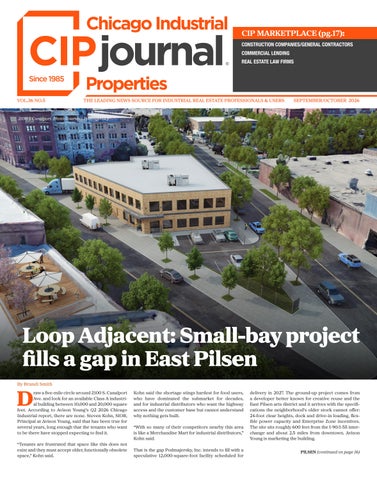
2100 S Canalport. Photo Courtesy Podmajersky
Loop Adjacent: Small-bay project fills a gap in East Pilsen By Brandi Smith
D
raw a five-mile circle around 2100 S. Canalport Ave. and look for an available Class A industrial building between 10,000 and 20,000 square feet. According to Avison Young's Q2 2026 Chicago Industrial report, there are none. Steven Kohn, SIOR, Principal at Avison Young, said that has been true for several years, long enough that the tenants who want to be there have stopped expecting to find it. “Tenants are frustrated that space like this does not exist and they must accept older, functionally obsolete space,” Kohn said.
Kohn said the shortage stings hardest for food users, who have dominated the submarket for decades, and for industrial distributors who want the highway access and the customer base but cannot understand why nothing gets built. “With so many of their competitors nearby this area is like a Merchandise Mart for industrial distributors,” Kohn said. That is the gap Podmajersky, Inc. intends to fill with a speculative 12,000-square-foot facility scheduled for
delivery in 2027. The ground-up project comes from a developer better known for creative reuse and the East Pilsen arts district and it arrives with the specifications the neighborhood's older stock cannot offer: 24-foot clear heights, dock and drive-in loading, flexible power capacity and Enterprise Zone incentives. The site sits roughly 600 feet from the I-90/I-55 interchange and about 2.5 miles from downtown. Avison Young is marketing the building. PILSEN (continued on page 16)
SE P T E MBE R/OCTOBER 2026 CHICAGO I ND U STR I AL P R O P ER TI ES
CONTENTS
PUBLISHER Jay Kodytek jay.Kodytek@rejournals.com MANAGING EDITOR Dan Rafter drafter@rejournals.com VICE PRESIDENT OF SALES & MW CONFERENCE SERIES MANAGER Ernie Abood eabood@rejournals.com VICE PRESIDENT OF SALES Frank E. Biondo Frank.biondo@rejournals.com CLASSIFIED DIRECTOR Susan Mickey smickey@rejournals.com BUSINESS DEVELOPMENT DIRECTOR Matt Loarie matt.loarie@rejournals.com Chicago Industrial Properties® (ISSN 1546-377X) is published bi-monthly for $59 per year by Real Estate Publishing Corporation, 7767 Elm Creek Boulevard, Suite 210, Maple Grove, MN 55369. Contact the subscription department at 312.933.8559 to subscribe. © 2026 by Real Estate Publishing Corporation. All rights reserved. No part of this publication can be reproduced or transmitted in any form or by any means, electronic or mechanical including photocopying, recording or by any information storage or retrieval system.
2026 EDITORIAL BOARD Dan Barrins
Associated Bank
Ron Behm
Colliers International
Susan Bergdoll CRG
Corey Chase Newmark
Dan Fogarty
Stotan Industrial
Barry Missner
The Missner Group
Adam Moore
First Industrial Realty Trust Inc.
Joe Pomerenke
Arco/Murray National Construction Company, Inc
Adam Roth NAI Hiffman
Mike Yungerman Opus Group
3
1
Small-bay project fills a gap in East Pilsen: Draw a five-mile circle around 2100 S. Canalport Ave. and look for an available Class A industrial building between 10,000 and 20,000 square feet. According to Avison Young's Q2 2026 Chicago Industrial report, there are none.
4 6
Nine Options: Shallow bay supply runs dry: The Interstate-55 corridor holds roughly 120 million square feet of industrial space. A tenant who needs 15,000 to 30,000 square feet of it today can choose from just nine options. Why Chicago's data center demand keeps landing in Indiana: Elk Grove Village bills itself as the data center capital of the Midwest and Illinois runs on a grid in which nuclear supplies roughly a third of generation, according to ComEd data cited by CBRE. By JLL's count, the state has also watched at least $200 billion in data center projects originally planned for Illinois get built somewhere else.
8
Growing signs of momentum in Chicago-area’s big box industrial market: The Chicago-area big box industrial market showed fresh signs of momentum during the second quarter, as stronger leasing activity, improving absorption and a new wave of construction helped push vacancies lower.
10
Negative net absorption? Yes. But that doesn’t tell the full cold storage story: The U.S. cold storage market is going through a period of adjustment. And older facilities? They are struggling to keep occupancy levels high, while newer cold storage buildings are seeing steady demand.
12
Green Street: Industrial still one of the leaders in commercial real estate recovery: Despite challenges, the industrial sector remains one of the leaders in the commercial real estate property recovery, with values rising faster than those of most major property sectors even as higher borrowing costs threaten to slow the momentum.
14 17
Fertile ground for industrial tenants? In the Chicago area it’s increasingly in the I-90 Northwest corridor: Tenants looking for industrial space in the Chicago-area market? They are increasingly heading west, according to Oakbrook Terrace, Illinois-based NAI Hiffman. CIP MARKETPLACE: CONSTRUCTION COMPANIES/ GENERAL CONTRACTORS/ COMMERCIAL LENDING/ REAL ESTATE LAW FIRMS
C H I C AG O I ND U STR I AL P RO P E R T I E S S E P T E M B E R / O C TO B E R 2 02 6
4
Nine Options: Shallow bay supply runs dry By Brandi Smith
T
he Interstate-55 corridor holds roughly 120 million square feet of industrial space. A tenant who needs 15,000 to 30,000 square feet of it today can choose from nine options, according to Packy Doyle, Executive Vice President of Industrial Services at NAI Hiffman. Double the requirement to 30,000 to 50,000 square feet and the list only doubles with it. That arithmetic explains the shape of Chicago's second quarter. Of the 153 industrial leases signed across the metro in Q2 2026, 79 landed between 20,000 and 100,000 square feet and totaled 3.7 million square feet, according to George Cutro, Director of Industrial Research at JLL. JLL's Q2 report credits shallow bay occupiers with driving the quarter's leasing activity and the deal count rose from 133 in Q1 even as total volume fell. That volume reached 10.6 million square feet, down from 14.4 million in Q1 but the fourth consecutive quarter above 10 million, per JLL. Vacancy slipped 20 basis points to 4.5%, net absorption of 5.8 million square feet compared with 648,700 square feet a year earlier and average asking rent reached $8.12 per square foot. Big box supplied the volume. JLL points to KeHe Distributors' 1.2-million-square-foot lease of a speculative building at Cherry Hill Business Park in Joliet and Hyundai Translead's 906,500-square-foot manufacturing facility at Clarius Park Joliet, the company's second major Chicago deal of the year. Shallow bay supplied the deals and Cutro said the tenants signing them are not primarily logistics users. Construction and building materials companies accounted for 19 of the 88 shallow bay leases JLL tracked in Q2 with logistics second at 12. Doyle sees the sharpest pricing pressure at the small end. Rents diverge around the 30,000-square-foot mark, he said, with smaller suites pushing rates harder than 40,000- to 50,000-square-foot spaces because so little functional supply exists beneath that line. Velocity on well-located 20,000- to 40,000-squarefoot space looks much as it did two years ago, he said. “This product size range had been the constant while big box had slowed down,” Doyle said. Landlords are giving where they can to hold face rents, according to Doyle: roughly two months of abatement on a five-year term, a bit more on longer deals and tenant improvement allowances of $2 to $5 per square foot depending on the space, the buildout and whether the deal is new or a renewal. Specialized
George Cutro
Packy Doyle
Jeff Lanaghan
"The construction is not necessarily less sophisticated because the building is smaller; in many ways, it requires more precision." buildouts still get done when term, credit, security and restoration language line up, but owners have limits. “While you certainly prefer a tenant that has unique components or buildouts in their space that makes them a sticky tenant, there comes a time when you don't want to play the role of the bank and fund all of those tenant specific builds, nor alter the functionality of that space,” Doyle said. The scarcity shows up most clearly at renewal. Tenants that can leave the market to save on rent will, Doyle said. Most cannot. “They will have sticker shock at the first renewal proposal, they will then go out and learn the market and more often than not, they come back to sign that renewal,” Doyle said. “Moving is difficult, costly and disruptive so if the space works and their rents are in line with where the market has grown to then they will stay put.” Relief from the construction pipeline is thin. Three speculative shallow bay projects broke ground in Q2, adding 232,600 square feet and bringing the metro's spec shallow bay pipeline to
nine buildings totaling 740,700 square feet, according to Cutro, with two of the nine in North Kane County. JLL counts 14.2 million square feet under development across the market. Jeff Lanaghan, SVP of Development and Investments at Becknell Industrial, said the math explains the gap. A 50,000-square-foot multi-tenant building costs more per square foot than a 500,000-square-foot bulk facility because it loses economies of scale: more demising walls, more storefront and office buildout, more drive-in doors, separate metering, more parking and more site work relative to the building. A $20-per-square-foot improvement allowance on a demised small bay suite is largely consumed by the demising itself, he said, while half that allowance on a 250,000-square-foot space covers demising and a comparable office with money to spare. “The construction is not necessarily less sophisticated because the building is smaller; in many ways, it requires more precision,” Lanaghan said. “In small bay, there is very little room for inefficiency because every design decision affects the economics.”
Rents have responded. Lanaghan sees shallow bay commanding roughly a 30% premium over bulk warehouse space and rents have improved across many Chicago submarkets. Even so, he said, they do not always justify new construction once land basis, site constraints and the cost of flexible, tenant-ready space are counted. Sites that work pair realistic pricing with labor, transportation access and room for modern parking, loading and stormwater. The ones that fail are undone by land basis, entitlement risk, environmental conditions or irregular geometry. Where the fundamentals align, Lanaghan said, small bay can be compelling and Becknell's construction background lets it evaluate an older building through both an ownership lens and a builder's lens. Cutro is watching interest rates and prospective tariffs with Canada as the variables most likely to end the run of 10-million-square-foot quarters. Neither would loosen the small end of the market where demand has never been the constraint.
Chicagoland 23rd Annual
INDUSTRIAL SUMMIT
March 10, 2027
8:00 AM - Registration, Networking & Exhibits 8:30 AM - 12:00 PM Program Carlisle Banquets (435 Butterfield Rd, Lombard, IL 60148)
Register Today
Scan for more information and to register www.rejournals.com/upcomingevent/
Speakers to be Announced... Sponsors:
Speaking and Sponsorship opportunities available Jay Kodytek jay.kodytek@rejournals.com 612-940-3713
Ernie Abood eabood@rejournals.com 773-919-8799
Frank Biondo frank.biondo@rejournals.com 248-670-2691
Matthew Loarie matt.loarie@rejournals.com 701-388-4926
6
C H I C AG O I ND U STR I AL P RO P E R T I E S S E P T E M B E R / O C TO B E R 2 02 6
Across the Line: Why Chicago's data center demand keeps landing in Indiana By Brandi Smith
Image by Gerd Altmann from Pixabay
E
lk Grove Village bills itself as the data center capital of the Midwest and Illinois runs on a grid in which nuclear supplies roughly a third of generation, according to ComEd data cited by CBRE. By JLL's count, the state has also watched at least $200 billion in data center projects originally planned for Illinois get built somewhere else. Andy Cvengros, Executive Managing Director and Co-Lead of JLL's U.S. Data Center Markets team, said those projects have landed in southern Wisconsin, northwest and northeast Indiana, Des Moines, Kansas City and Dallas. The physical case for Chicago, in his view, was never the problem.
“From a pure power standpoint, Illinois is actually an excellent market for data centers — we have strong generation capacity, a lot of nuclear and good green energy attributes,” Cvengros said. The misses come against record national demand. JLL's North America Data Center Report for midyear 2026 puts first-half absorption at 25 gigawatts with 66 gigawatts under construction and 95% of that pipeline precommitted. North American vacancy has held below 1% for a third straight year. Indiana and Ohio both appear among JLL's top 10 markets by existing and under-construction capacity. Illinois does not.
The report tracks Chicago at 1,352 megawatts of existing inventory and northern Indiana at 1,206 megawatts, a market Cvengros said did not exist two years ago. Hyperscalers build in availability zones, three geographically distinct sites in a region that back each other up, and that footprint was always meant to include Illinois. “When those Illinois projects got canceled, the hyperscalers didn't go far — they went to Northwest Indiana instead, because it checked the same boxes,” Cvengros said. Land is cheaper, Indiana passed comparable tax exemptions and the sites sit about 25 miles from downtown Chicago.
Cvengros points first to Illinois' Biometric Information Privacy Act, which he said has created enough uncertainty around how AI data is handled that hyperscalers have pulled back or canceled major projects. He also cited ComEd's higher deposit requirements and slow power procurement. Kelly Disser, Executive Vice President with the Industrial Services Group of NAI Hiffman, called ComEd's cluster studies a significant consideration, with developers now underwriting application costs and the price of added generation, though he described BIPA as a consideration rather than a primary driver. CBRE's Chicago H1 2026 report also cites anticipated BIPA revisions as pushing hyperscalers toward friendlier markets.
SE P T E MBE R/OCTOBER 2026 CHICAGO I ND U STR I AL P R O P ER TI ES Then, on July 1, Illinois paused its data center incentive program. CBRE reports the pause runs through the mid-November veto session when Gov. JB Pritzker plans to push a broader regulatory framework and that applications filed before July 1 are unaffected. For industrial owners, the competition is already priced in. Cvengros said the core corridors of Franklin Park, Northlake, Elk Grove and Aurora overlap heavily with where data center developers want to be and data center land comps have run about twice what industrial users pay. In Elk Grove, industrial land traded around $25 per square foot for years while data centers paid closer to $50, which he said has lifted the floor for the whole corridor and led to entire neighborhoods being acquired. “Part of that is just a different business model — we're not pricing projects by the square foot, we're pricing them by megawatts of power,” Cvengros said. Converting existing industrial buildings rarely works. Cvengros cited Skybox Chicago I, a 30-megawatt, 190,000-square-foot facility in Elk Grove Village, as a rare example, noting most conversions fail on sealed dock
7 JLL's report floats a scenario in which demand normalizes around 2030. Cvengros is not convinced, saying supply coming online from 2028 through 2031 is largely pre-leased or soon will be. “A lot of people are talking about a bubble,” Cvengros said. “We're not seeing it. There is a capped ability to accommodate demand because of power availability, zoning timelines and everything that comes along with that.”
Andy Cvengros
Kelly Disser
doors, roof reinforcement and a sixinch slab that needs to be 12.
The activity he does see is moving southwest toward Joliet and Minooka and into rural sites of 500 to 1,000 acres next to heavy power infrastructure, where added generation could take five or six years and natural gas is being explored. CBRE lists a planned 1-gigawatt Aligned campus in Coal City and a 1-gigawatt Tract campus in Morris, and puts Chicago-area vacancy at 2.2% with no contiguous block of 5 megawatts or more available this year.
Disser said qualifying sites are rare, which is exactly why they are valuable. “We have three industrial developments underway now in western suburbs – not one of them is viable for a data center development,” Disser said.
° Geographies: JLL's sub-1% vacancy is labeled North American, CBRE's 2.2% is labeled Chicago-area, and the 1,352/1,206 MW figures are tagged to the JLL report. The $200 billion and the ComEd deposit claims are attributed to Cvengros/JLL throughout. ° Skybox checks out against the page you sent: 30 MW, 190,000 square feet, Elk Grove Village. ° The lead's "one of the most nuclear-heavy grids in the country" is my framing, supported by CBRE's ComEd fuel mix chart showing nuclear at 34% of the market's generation. If you'd rather not editorialize in the lead, swap in "a grid where nuclear supplies roughly a third of generation, according to ComEd data cited by CBRE."
8
C H I C AG O I ND U STR I AL P RO P E R T I E S S E P T E M B E R / O C TO B E R 2 02 6
Growing signs of momentum in Chicagoarea’s big box industrial market By Dan Rafter
Image by THAM YUAN YUAN from Pixabay
T
he Chicago-area big box industrial market showed fresh signs of momentum during the second quarter, as stronger leasing activity, improving absorption and a new wave of construction helped push vacancies lower. That’s one of the highlights from NAI Hiffman’s second quarter 2026 Big Box Market Report, which tracks industrial buildings of at least 200,000 square feet with 28-foot clear heights across the Chicago market, including Northwest Indiana and Southeast Wisconsin. The report found that the vacancy rate in the region’s big box sector fell 10 basis points during the quarter to 8.4%. The market now includes about 390.3
million square feet spread across more than 870 industrial buildings. Leasing activity was particularly encouraging. Tenants signed leases covering 8.7 million square feet during the second quarter, a 32% increase from the same period a year earlier. That brought 2026 year-to-date leasing activity to 17.8 million square feet. Third-party logistics providers continued to be among the most active users of big box space. In all, 37 new lease deals were completed during the quarter, with the I-80/Joliet Corridor accounting for 2.8 million square feet and the I-88 Corridor another 2.1 million square feet. Absorption numbers also pointed to a strengthening market. Chicago’s big box
sector recorded 3.4 million square feet of net absorption in the second quarter, up sharply from 2.1 million square feet in the first quarter and well ahead of the 737,000 square feet recorded in the second quarter of 2025. Several large deals helped drive those numbers. RJW Logistics Group signed a 1.2 million-square-foot build-to-suit lease in Montgomery along the I-88 Corridor. KeHE Distributors, meanwhile, committed to 1.2 million square feet at 21533 Cherry Hill Road in Joliet. KeHE initially plans to occupy 802,440 square feet before expanding into another 393,300 square feet, with that expansion expected to deliver in early 2027.
There were 16.9 million square feet of big box projects under construction at the end of the second quarter, an 80% increase from the same period last year. More than half of that construction—57.2%, or 9.7 million square feet—is build-to-suit space. Speculative construction accounted for the remaining 7.2 million square feet. Developers broke ground on 12 new big box projects during the quarter. The I-80/Joliet Corridor led the way with 4.1 million square feet under construction, followed by Northwest Indiana with 2.3 million square feet and DeKalb County with 2 million square feet. The largest new project was a 1.5 million-square-foot build-to-suit facility in Wilmington for Kimberly-Clark. Elion
SE P T E MBE R/OCTOBER 2026 CHICAGO I ND U STR I AL P R O P ER TI ES Partners is developing the project, which is scheduled for completion in the third quarter of 2027. Despite the improving conditions, tenants still have options. NAI Hiffman reported 119 available big box buildings totaling 49.7 million square feet. Most available space falls between 200,000 and 500,000 square feet, while 12.2 million square feet of availability is in buildings of at least 750,000 square feet. But truly massive blocks of vacant space are becoming harder to find. The report identified only two available buildings offering roughly 1 million square feet or more: a 1.2 million-square-foot multistory distribution facility in Chicago North and a 997,800-square-foot manufacturing facility along the I-55 Corridor. Looking ahead, NAI Hiffman expects vacancy to tighten further as recently completed lease transactions translate into tenant move-ins. Class A rents are forecast to remain in the $7-to-$8-persquare-foot range, with moderate appreciation expected. Demand is also becoming more selective. Third-party logistics companies and e-commerce operators remain major sources of demand, while man-
9
"Despite the improving conditions, tenants still have options. NAI Hiffman reported 119 available big box buildings totaling 49.7 million square feet. Most available space falls between 200,000 and 500,000 square feet." ufacturers are showing increased interest in onshoring and supply-chain resiliency. For landlords and developers, that is creating a clear dividing line in the
market. Modern, well-located big box properties with the scale and functionality required by today's logistics users are outperforming older, functionally obsolete facilities.
And with million-square-foot options particularly limited along the I-80 Corridor, NAI Hiffman expects development activity to accelerate as companies search for modern, large-scale distribution space.
10
C H I C AG O I ND U STR I AL P RO P E R T I E S S E P T E M B E R / O C TO B E R 2 02 6
Negative net absorption? Yes. But that doesn’t tell the full cold storage story By Dan Rafter
iStock photo, credit Unaihuiziphotography.
T
he U.S. cold storage market is going through a period of adjustment. And older facilities? They are struggling to keep occupancy levels high, while newer cold storage buildings are seeing steady demand. That is one of the big takeaways from Newmark’s first-half 2026 U.S. Cold Storage Market Overview, which found that this key sector recorded negative net absorption during the first half of the year, the first time that has happened during a first half since 2007. About 41 million cubic feet of new cold storage space was delivered during the period, while net absorption fell by 56 million cubic feet. Thanks to this imbalance, vacancy climbed to an average of 7.7% in the U.S. cold storage market during the first six months of the year, according to Newmark. But that negative absorption? It doesn’t provide an accurate picture of the strength of the U.S. cold storage industry. Newmark found that tenants are increasingly seeking space in modern cold storage facilities. According to the company’s report, cold storage proper-
ties delivered since 2020 have captured nearly all recent demand, while older facilities continue to lose occupancy. Legacy properties have posted negative absorption since 2022, a trend that points to growing functional-obsolescence risks for aging facilities. For owners of older cold storage properties, the current environment is a challenging one. Just look at the numbers: As of the second quarter, legacy facilities carried an 8.2% vacancy rate, compared with just 3.4% for properties delivered from 2006 through 2019. Newer facilities delivered since 2020 had the highest vacancy rate in the first half of the year, at 10.9%. But much of that reflects the lease-up of recently completed space rather than the same kind of structural decline facing older buildings.
of cold storage space by 2035 based on projected population growth. Houston could need 1.3 million square feet, while Tampa-St. Petersburg-Clearwater could require 1.1 million square feet and Atlanta about 1 million square feet.
conventional dry warehouses. Those costs, combined with higher capital costs and softer near-term demand, mean that new projects are likely to be dominated by build-to-suit, owner-user and pre-leased developments.
The pharmaceutical side of the business is another major source of demand. Newmark noted that products requiring pharmaceutical cold storage have grown from 26% of pharmaceutical sales in 2017 to roughly 35%. Logistics companies including DHL, C.H. Robinson, FedEx and UPS are responding by investing billions of dollars in specialized cold-chain capacity.
That dynamic is already reshaping the development pipeline. The average cold storage lease signed during the past five and a half years has been roughly 125,000 square feet, while properties under construction average nearly 300,000 square feet. The mismatch is contributing to longer lease-up periods.
Legacy facilities accounted for 68% of all vacant cubic feet, compared with 24% for post-2020 properties and 8% for the 2006-2019 cohort, Newmark reported.
Food distribution is changing, too. U.S. e-grocery sales rose 21.5% on a yearover-year basis in July, while in-store sales declined 2.6%. Because delivery and ship-to-home orders are more cold-chain intensive than pickup orders, retailers and logistics providers are expanding temperature-controlled capacity.
Population growth continues to fuel food distribution patterns across the country. Newmark is predicting that the Dallas-Fort Worth market could require another 2.8 million square feet
But building that capacity isn't cheap. Newmark estimates that cold storage construction costs between $130 and $350 a square foot, compared with roughly $85 to $150 a square foot for
For investors and occupiers, then, the message from Newmark’s first-half report is becoming clearer: Cold storage remains a durable real estate sector, but not all cold storage is created equal. Modern facilities with automation, higher clear heights and sophisticated temperature-control systems are attracting demand from tenants. Older properties face a bigger challenge: Can their owners upgrade, reposition or replace them before they become obsolete?
12
C H I C AG O I ND U STR I AL P RO P E R T I E S S E P T E M B E R / O C TO B E R 2 02 6
Green Street: Industrial still one of the leaders in commercial real estate recovery By Dan Rafter
D
espite challenges, the industrial sector continues to be one of leaders in the commercial real estate property recovery, with values rising faster than those of most major property sectors even as higher borrowing costs threaten to slow the momentum. That’s one of the major findings from Green Street its September 2026 Commercial Property Price Index. Industrial property values rose 0.6% in August and 7% over the past 12 months, according to Green Street’s price index. The sector remains one of the strongest performers in commercial real estate, with values now just 8% below their 2022 peak. That compares favorably with the overall market. Green Street’s all-property index increased 0.8% in August and 5% over the past year. Overall commercial property values remain 13% below their 2022 peak, a slightly worse performance than industrial specifically. The latest numbers show that commercial real estate values are continuing to recover from the sharp declines that followed the Federal Reserve’s interest-rate increases. But that recovery could face a new headwind. “It’s been a nice run for property prices, but I expect things will cool off,” said Peter Rothemund, Co-Head of Strategic Research at Green Street, in a written statement. “The rise in Treasury yields over the past several months, and its impact on borrowing costs, is likely to cause buyers to rethink what they’re willing to pay.” That could be particularly important for investors weighing the next phase of the industrial market. The sector has benefited from strong tenant demand and years of rent growth, but higher financing costs could make it more difficult for buyers to justify spending too much on these properties. Green Street reported that the industrial sector isn’t the only one posting gains. Retail has emerged as another bright spot in Green Street’s latest figures. Mall property values increased 2.5% in August and 14% over the past 12 months. In fact, mall values are now 6% above their 2022 peak. Strip retail has performed almost as well. Values climbed 2.1% in August and 8% over the past year. Strip retail values are essentially back to their 2022 peak, sitting just 0.4% below that level.
The retail recovery is notable given the challenges the sector faced earlier in the decade. The Green Street data suggests that investors have become increasingly comfortable with high-quality retail properties and the income streams they can generate. Healthcare real estate is also showing strong momentum. Values rose 3.1% in August and 7% over the past year, although they remain 8% below their 2022 peak. Green Street’s healthcare category includes medical office, senior housing operating properties, senior housing net-leased properties, skilled nursing and life science assets. Data centers, meanwhile, continue to benefit from the growing importance of digital infrastructure. Values increased 1.1% in August and 6% over the past 12 months. The sector remains 6% below its 2022 peak. Office and apartments continue to be the notable laggards. Office values increased 1.5% in August and 5% over the past year. Yet the sector remains 33% below its 2022 peak, by far the largest decline among the major property types tracked by Green Street. The numbers reflect the continuing challenges facing office owners and investors, including elevated vacancy, changing workplace patterns and the cost of repositioning older buildings. Apartments are also struggling to regain their former values. Green Street’s apartment index fell 3.6% in August and declined 4% over the past year. Apartment values remain 22% below their 2022 peak. Green Street’s Commercial Property Price Index highlights the prices at which commercial properties are currently being negotiated and contracted. The index emphasizes high-quality, institutional properties and is based primarily on Green Street’s estimates of price appreciation for property portfolios owned by REITs in its U.S. coverage universe. For now, the broader trend remains positive. But with Treasury yields climbing and borrowing costs moving higher, the next phase of the commercial real estate recovery could be more challenging. As Rothemund’s warning makes clear, the market may be approaching a point where investors become less willing to stretch on price, even for the property types that have performed best. All charts provided by Green Street.
Chicago 25th Annual
COMMERCIAL REAL ESTATE FORECAST SUMMIT January 14, 2027
11:30 AM - Registration, Networking & Exhibits 12:25 PM - 4:30 PM Program 4:30 PM - 5:30 PM Happy Hour Networking The Westin O’Hare (6100 N River Rd, Rosemont, IL 60018)
Register Today
Scan for more information and to register www.rejournals.com/upcomingevent/
STAY TUNED FOR OUR LINEUP OF INDUSTRY EXPERTS... Sponsors:
Speaking and Sponsorship opportunities available Jay Kodytek jay.kodytek@rejournals.com 612-940-3713
Ernie Abood eabood@rejournals.com 773-919-8799
Frank Biondo frank.biondo@rejournals.com 248-670-2691
Matthew Loarie matt.loarie@rejournals.com 701-388-4926
14
C H I C AG O I ND U STR I AL P RO P E R T I E S S E P T E M B E R / O C TO B E R 2 02 6
Fertile ground for industrial tenants? In the Chicago area it’s increasingly in the I-90 Northwest corridor By Dan Rafter
T
enants looking for industrial space in the Chicago-area market? They are increasingly heading west, according to Oakbrook Terrace, Illinois-based NAI Hiffman.
a building will operate more efficiently over the long term. In many cases, companies find they can lower occupancy costs while moving into a newer facility that improves productivity and gives them additional room to grow. That's a compelling value proposition, particularly for businesses planning years ahead rather than simply focusing on today's lease rate.
In researching the Chicago industrial market, NAI Hiffman tracked a significant migration of tenants from O'Hare, Central DuPage and Northwest Cook into the I-90 Northwest corridor, where users can secure newer facilities and lower occupancy costs while maintaining access to the same labor pool and transportation infrastructure.
Can you address the role that demand for new data center space is playing in the growing strength of the I-90 Northwest submarket? Is this submarket a strong one for data center users?
The evidence of this trend? Here are the numbers: • Of the roughly 2 million square feet of new leasing activity in the I-90 Northwest submarket since Jan. 1, 2025, about 1.3 million square feet, or 65% of it, came from companies relocating from other Chicago-area submarkets. • Tenants moving west include Claires (248,400 square feet), JFC International (255,142 square feet), Palfinger (177,270 square feet), Guardsman Global, Fromm Beauty, Sodexo and others. • While the I-90/Northwest submarket posted 178,099 square feet of positive absorption in the first quarter of 2026, the O'Hare, Central DuPage and Northwest Cook submarkets all recorded negative absorption during the same period. We spoke with Steve Bass and Jack Brennan, both executive vice presidents of industrial services with NAI Hiffman, about the industrial activity now taking place in the I-90 Northwest submarket. Here is what they had to say: Can you provide a brief summary of how much of the new leasing activity in the I-90 Northwest submarket since the start of the year came from tenants that moved from another Chicago-area submarket? Jack Brennan: Approximately 65% of the roughly 1.3 million square feet of new leasing activity in the Interstate-90 Northwest submarket since late 2025 has come from companies relocating from O'Hare, Northwest Cook and Central DuPage. That's a high percentage, which demonstrates that the I-90 corridor is successfully competing with some of Chicago's most established industrial markets. Companies are making deliberate relocation decisions because they see long-term operational and financial advantages here.
Claire's Essentials recently leased the entire 248,400-square-foot Building 1 at 1100 Tollgate Road, leaving just 57,708 square feet available at the 437,930-square-foot, two-building Class A industrial campus. NAI Hiffman serves as the exclusive leasing agent for owner High Street Logistics. (Credit: NAI Hiffman)
What are the main reasons for this migration? What is attracting tenants from other Chicago submarkets to the I-90 Northwest submarket? Steve Bass: Companies today are looking beyond lease rates. They’re evaluating the entire operating equation, including occupancy costs, transportation efficiency, workforce accessibility, building functionality and future growth opportunities. The I-90 corridor performs well across all those categories. Many occupiers signed leases a decade ago under very different market conditions. As those leases expire, they discover they can relocate into newer, more efficient facilities while often reducing occupancy costs by as much as 30% to 50% compared to infill markets. At the same time, improved highway infrastructure and access to a broad labor pool have made the corridor an increasingly attractive long-term operating location. I know the "flight to quality" is still a major driver of many moves. Is that in play in the I-90 Northwest submarket? Does this submarket feature many newer properties that are attractive to tenants?
Bass: Absolutely. Companies are using lease expirations as an opportunity to upgrade their facilities, not simply renew existing space. They're seeking modern buildings with higher clear heights, more efficient loading configurations, expanded trailer parking and layouts that better support today's logistics and manufacturing operations. The submarket responded by adding approximately 4 million square feet of speculative industrial space across 2023 and 2024, and all but about 400,000 square feet of that has been leased. Looking ahead, NorthPoint Development is slated to deliver a 428,000-square-foot speculative facility in late 2026, and Phelan Development has plans for two spec buildings with a 2027 delivery. We're also seeing growing interest in build-to-suit facilities as companies look for buildings designed around their specific operational requirements. How does pricing play into this? Are the properties in this submarket more affordable? Brennan: Companies are looking at their total occupancy costs and whether
Bass: The I-90 corridor has certainly attracted interest from the data center industry, including high-profile projects such as Microsoft's campus and Compass' redevelopment of the former Sears headquarters. However, data center development faces significant challenges, including power availability, extensive infrastructure requirements and, in many communities, public opposition. While data centers will remain part of the development conversation, industrial continues to be the dominant driver of activity throughout the corridor. Manufacturing, distribution and logistics users remain highly active, and demand for well-located industrial space continues to outpace available supply. Do you expect this trend of companies relocating from other Chicago submarkets to the I-90 Northwest submarket to continue in the coming years? Why or why not? Brennan: Yes. The conditions driving these relocations aren't temporary. Companies continue to prioritize operating efficiency, modern facilities and long-term flexibility, and the I-90 corridor checks those boxes. At the same time, redevelopment within older infill markets is reducing the supply of industrial properties available to many users, particularly small and mid-size companies. As those businesses evaluate their next move, we expect the I-90 corridor to remain one of the region's strongest alternatives because it offers a combination of modern facilities, competitive occupancy costs and room for future growth.
Chicagoland 21st Annual
PROPERTY MANAGEMENT September 29, 2026
8:00 AM - Registration, Networking & Exhibits 8:30 AM - 11:30 AM Program Carlisle Banquets (435 Butterfield Rd, Lombard, IL 60148)
Register Today
Scan for more information and to register www.rejournals.com/upcomingevent/
Speakers:
Mark Ainley - GC Realty and Development Lloyd Berry - Colliers International Ben Bischmann -Kurv Industrial Veronika Bocanova Diffley - Whitney Architects Alexandria Borrego - Hiffman National Kirsten Bowersox - Xroads Real Estate Advisors Rebecca Cusack, RPA - CBRE | Property Management Roger Daniel - Daniel Management Group Lauren Fernandes - Confirmed Life Safety Meg Hanley - Sterling Bay David Hopwood - JLL Brian Keaty - Stream Realty Partners Jillian Larkin - Willow Bridge Property Company Tom Marsan - Beverly Companies Jonathan Swindle - Waveland Property Group, Inc. Jeff Weinberg - Drexel Properties
Sponsors:
More Speakers to be Announced...
Speaking and Sponsorship opportunities available Jay Kodytek jay.kodytek@rejournals.com 612-940-3713
Ernie Abood eabood@rejournals.com 773-919-8799
Frank Biondo frank.biondo@rejournals.com 248-670-2691
Matthew Loarie matt.loarie@rejournals.com 701-388-4926
C H I C AG O I ND U STR I AL P RO P E R T I E S S E P T E M B E R / O C TO B E R 2 02 6
16
Podmajersky expects the east end of the neighborhood to keep attracting last-mile, service, distribution and business-to-business showroom users along the lines of the tenants already at 900 W. Cermak. He said the company still has space available there and a second phase is in early planning nearby.
PILSEN (continued from page 1)
John Podmajersky III, President of Podmajersky, Inc., has owned the Canalport parcel for years and said his vision for it shifted as industrial users were pushed out of Fulton Market. He came to see it as a natural home for service companies that need to reach the Loop quickly with I-94, I-55 and DuSable Lake Shore Drive all within a few hundred feet. “These interchanges take you right into the service areas of Loop buildings via Lower Wacker Dr.,” Podmajersky said. “It's really just a matter of minutes to service a building or deliver a product to the Loop from this location.” That proximity is the whole argument against heading out to the I-55 corridor where a tenant can find plenty of modern space at the cost of distance. Kohn draws a sharp line between the two. “Every mile their customer has to drive to get what they need to complete their job sucks up time and destroys profitability,” Kohn said. “I-55 is a regional distribution center. This location is for those servicing the central business district.” The Canalport project grew out of what Podmajersky has already seen work directly across the street. The company's building at 900 W. Cermak Road, a Chicago industrial loft with common brick,
John Podmajersky III
Steven Kohn
transom skylights and multiple loading options, houses Gustave Larson and Bento Inc., the sushi provider that took over the former Foxtrot commissary in a lease negotiated by Avison Young. Podmajersky said both companies chose the location for the transportation access and the labor pool nearby, and both prioritized quality space.
so the design gives a new industrial box the appearance of a Chicago loft building with local Chicago common brick and a scale that fits the historic commercial structures around it. With 900 W. Cermak facing the site, he said, delivering something that fits its surroundings was a priority.
“So, yes, I guess you could say that I enjoyed those projects and companies so much that it got me thinking about who might be next,” Podmajersky said. The new building borrows its look from that older neighbor. Podmajersky said the area around Canalport brings together several building types and uses,
The Podmajersky family has been investing in East Pilsen since 1913. The company itself was founded in 1987 and has renovated, managed and leased more than 300,000 square feet in the neighborhood, a portfolio that spans creative industrial, loft office, retail, art and residential space.
Kohn sees Canalport as part of a wider turn toward small-bay infill development with similar projects appearing in Fulton Market and on the North Side. He expects many more in the coming years and describes Pilsen as hot across every property type with office, retail, industrial and residential all picking up. He calls it the Brooklyn of Chicago, a comparison a recent travel guide also made. “Nobody has done more for commercial property in Pilsen than the Podmajerskys so ground up is another feather in their cap,” Kohn said. For Podmajersky, the project is one more step in a family commitment that predates the company by decades. “This project is the next step in our longterm commitment to bringing economic development to Pilsen by providing attractive and affordable space,” Podmajersky said. “It's a fantastic location for business and it won't be overlooked anymore.”
CIP MARKETPLACE
CONSTRUCTION COMPANIES/GENERAL CONTRACTORS MERIDIAN DESIGN BUILD 9550 W. Higgins Road, Suite 400 Rosemont, IL 60018 P: 847.374.9200 info@meridiandb.com meridiandb.com Primary Contacts Paul Chuma, President Howard Green, Executive Vice President Core Services Meridian Design Build provides construction and design/ build construction services on a national basis with a primary focus on industrial, office, medical office, retail and food and beverage work. Company Overview With a team of in-house professional project managers, Meridian has extensive experience coordinating the design and construction of new buildings, tenant improvements, and additions/renovations from 15,000 square feet to 1,000,000+ square feet. Meridian Design Build has been a Member of the U.S. Green Building Council since 2007. Selected Projects University Park Logistics Center, University Park, IL - 970,123 sf speculative multitenant industrial distribution/warehouse facility for Clarius Partners and Hillwood Investment Properties. Silesia Flavors, Huntley, IL - 134,075 sf food production, laboratory, research and development, and office facility for Venture One Real Estate and a global leader in confectionery and beverage flavors. FedEx Ground, Gary, IN - 324,901 sf package sorting and distribution center on a 78-acre redevelopment site for Scannell Properties and Transport Properties. PRINCIPLE CONSTRUCTION CORP. 9450 West Bryn Mawr Ave., Suite 120 Rosemont, IL 60018 P: 847.615.1515 | F: 847.615.1598 pccdb.com Primary Contacts Mark L Augustyn, COO, maugustyn@pccdb.com, James A. Brucato, President, jbrucato@pccdb.com Core Services Since 1999, Principle Construction Corp. has been a leading design-build general contractor serving the industrial markets of Chicago Metro, Southern Wisconsin, and Northwest Indiana. We specialize in designing and constructing exacting solutions for our clients, including: • Built-to-Suit Facilities • Speculative Facilities • Warehouse and Distribution Centers • Logistics and Cross-Dock Facilities • Industrial Outdoor Storage •Industrial and Manufacturing Plant • Tenant Improvements • Expansions and Additions• Food Processing Facilities • Specialty Projects Selected Projects • 8,205 SF animal shelter for Heartland Animal Shelter, at 586 Palwaukee Dr., in Wheeling, IL. • 12,560 SF showroom and outdoor pool park for Doheny Enterprises, at 5307 Green Bay Rd., in Kenosha, WI • Phase 1 renovation project for SMW Autoblok, at 285 Egidi Dr., Wheeling, IL COMMERCIAL LENDING MARQUETTE BANK 10000 W. 151st Street Orland Park, IL 60462 P: 708.364.9131 emarquettebank.com Primary Contact Gene Malfeo, Executive Vice President, Chief Lending Officer gmalfeo@emarquettebank.com Core Services Full line of Commercial, Business and Real Estate loans customized to your individual needs including: commercial and residential construction loans, commercial mortgages, equipment loans and working capital lines of credit. Company Overview Marquette Bank started in Chicagoland in 1945 and is still locally-owned/operated. Expect quick decisions, competitive rates, easy application and personal service. Personal/business banking and lending, home mortgages, land trust services, estate planning, insurance services, wealth management and multifamily lending. REAL ESTATE LAW FIRMS SARNOFF PROPERTY TAX 100 N. LaSalle St., 10th Floor Chicago, IL 60602 P: 312.782.8310
Sarnoffpropertytax.com Primary Contact James Sarnoff jsarnoff@sarnoffpropertytax.com, P: 312.448.5337 Core Services Since 1986, Sarnoff Property Tax has been a leading and recognized law firm concentrating solely in the field of property taxation. We help clients secure favorable taxes in Illinois through property tax appeals, incentives, and consulting. Firm Overview Sarnoff Property Tax’s clients include Owners, Developers, Managers, REITs, Fortune 500 Companies, Private Equity Firms, etc., in connection with commercial property, high-rise and low -rise apartment buildings, condominium associations and single-family home portfolios. WORSEK & VIHON, LLP 180 North LaSalle Street, Suite 3010 Chicago, IL 60601 P: 312.917.2307 P: 312.917.2312 F: 312.596.6412 wvproptax.com Primary Contacts Francis W. O’Malley, Managing Partner, fomalley@wvproptax.com; Jessica L. MacLean, Partner, jmaclean@wvproptax.com Core Services Worsek & Vihon, LLP represents taxpayers in Illinois by limiting their property tax liabilities through ad valorem appeals resulting in lower tax bills. We have over 40 years of experience and can handle basic to the most complex assessment issues while offering the dependable, personalized attention our clients deserve. We have experience representing owners of all property types. In addition to filing thousands of appeals with the Cook County Assessor, we have been involved in numerous proceedings before various Boards of Review, the Illinois Property Tax Appeal Board, and the Circuit Court of Illinois, and have appeared before the Illinois Appellate and Supreme Courts. Firm Overview Worsek & Vihon LLP, is a team of highly experienced attorneys singularly focused on Illinois real estate tax law. The firm is dedicated to minimizing property tax liabilities through strategic tax portfolio management, well researched, creative appeal preparation and aggressive advocacy.
FOR ADVERTISING OPPORTUNITIES IN THIS SECTION, PLEASE CONTACT SUSAN MICKEY AT SMICKEY@REJOURNALS.COM OR 773.575.9030