Conservative development, strong demand provide a boost to Indianapolis’ commercial real estate market
By Dan Rafter, Editor
There’s a benefit to the cautious nature of developers in the Indianapolis market. While developers in other big cities built too many office buildings, industrial facilities or multifamily communities for demand, those working in this key Midwest city did not.
That has protected Indianapolis during today’s uncertain economic times. A conservative approach to development has led to lower vacancy rates, keeping the Indianapolis-area multifamily, office and industrial sectors healthier than in competing markets.
Better times ahead for multifamily?
Investor demand is rising and renter fundamentals remain steady in the Indianapolis multifamily market, thanks largely to a level of supply that has stayed in check compared to many high-growth metros across the country.
That’s the view from Steve LaMotte Jr., managing director of investment sales with Walker & Dunlop in Indianapolis, who says the Midwest, and Indianapolis in particular, has avoided the overbuilding that has softened apartment performance elsewhere.
“Contrasting Indianapolis with most of the rest of the country in the post-COVID months and years, markets outside the Midwest were flooded with supply,” LaMotte said. “That did not happen in the Midwest. Most markets are not oversupplied. They are all appropriately supplied. Thanks in part to this, we have seen fundamentals maintain themselves in Indianapolis, in contrast to Denver, which is a poster child of oversupplied markets.”
Because supply and demand have remained balanced, Indianapolis has avoided the rent stagnation and rising vacancy rates that have hit the multifamily sector in other similarly sized metropolitan areas.
By Dan Rafter, Editor
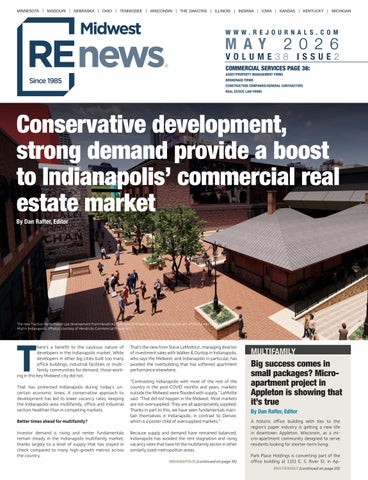
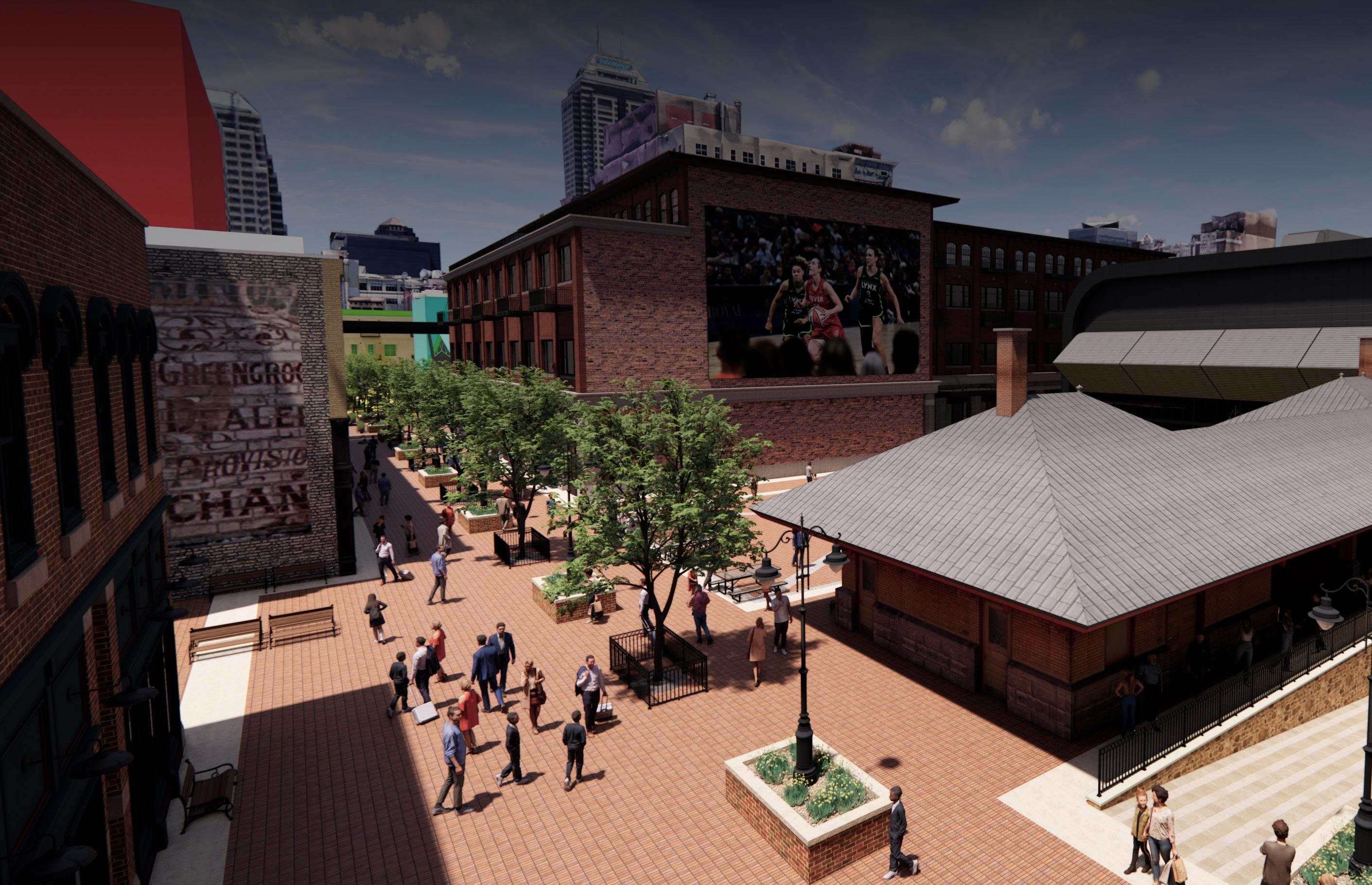
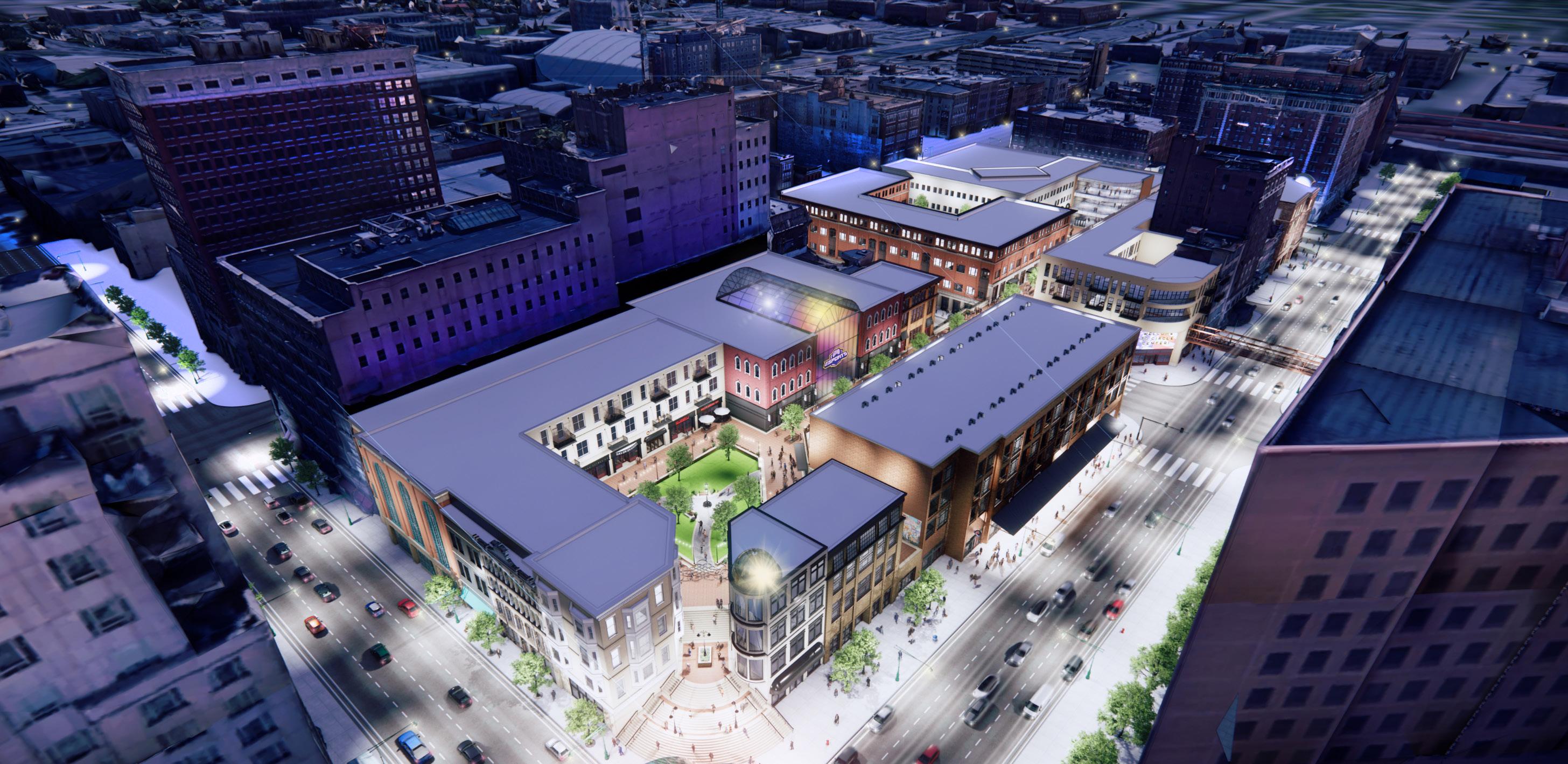
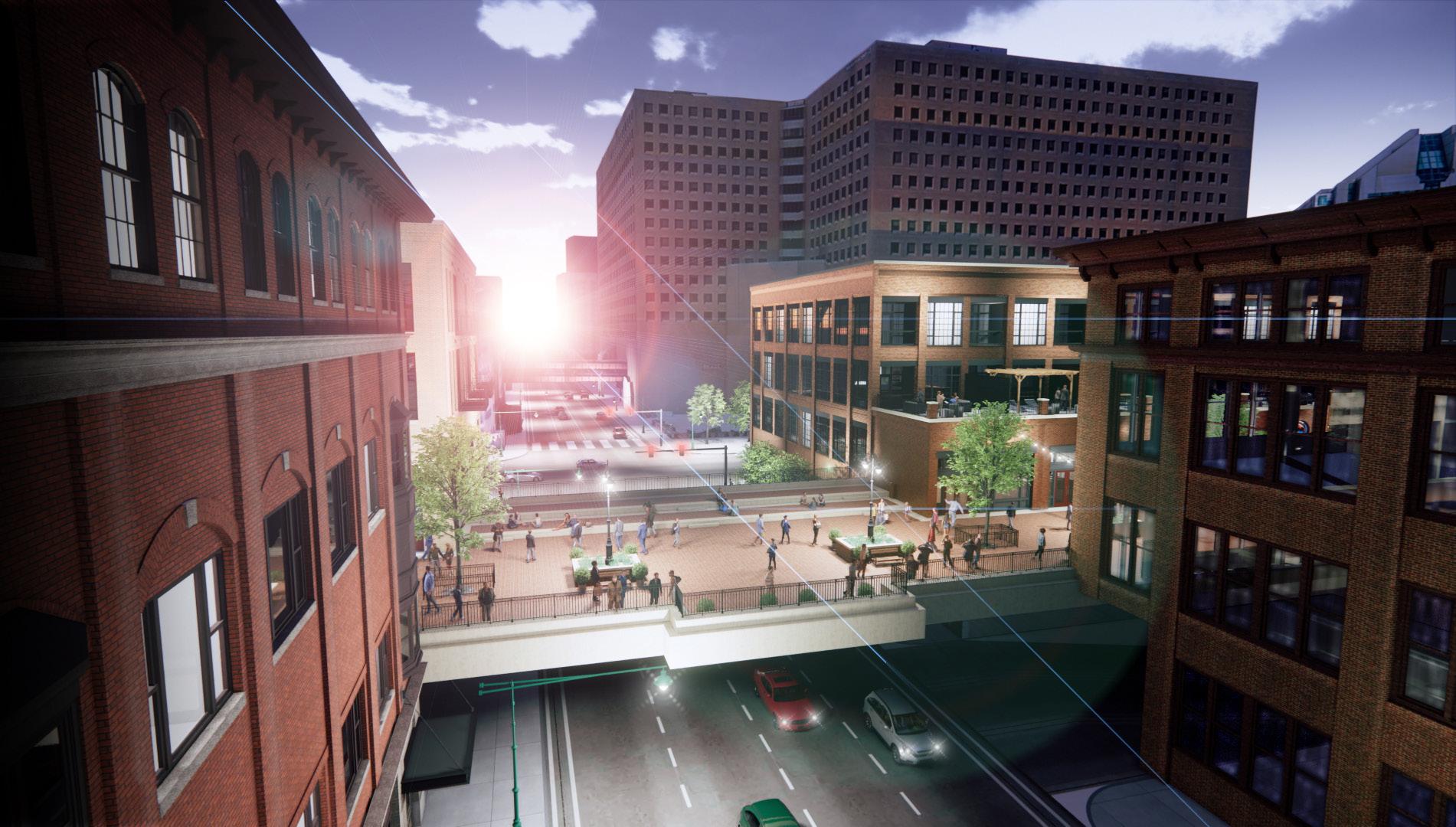
The new Traction Yards mixed-use development from Hendricks Commercial Properties is transforming the site of the former Circle Centre Mall in Indianapolis. (Photos courtesy of Hendricks Commercial Properties.)
Solutions
Conservative development, strong demand provide a boost to Indianapolis’ commercial real estate market: There’s a benefit to the cautious nature of developers in the Indianapolis market. While developers in other big cities built too many office buildings, industrial facilities or multifamily communities for demand, those working in this key Midwest city did not.
Big success comes in small packages? Micro-apartment project in Appleton is showing that it’s true: A historic office building with ties to the region’s paper industry is getting a new life in downtown Appleton, Wisconsin, as a micro-apartment community.
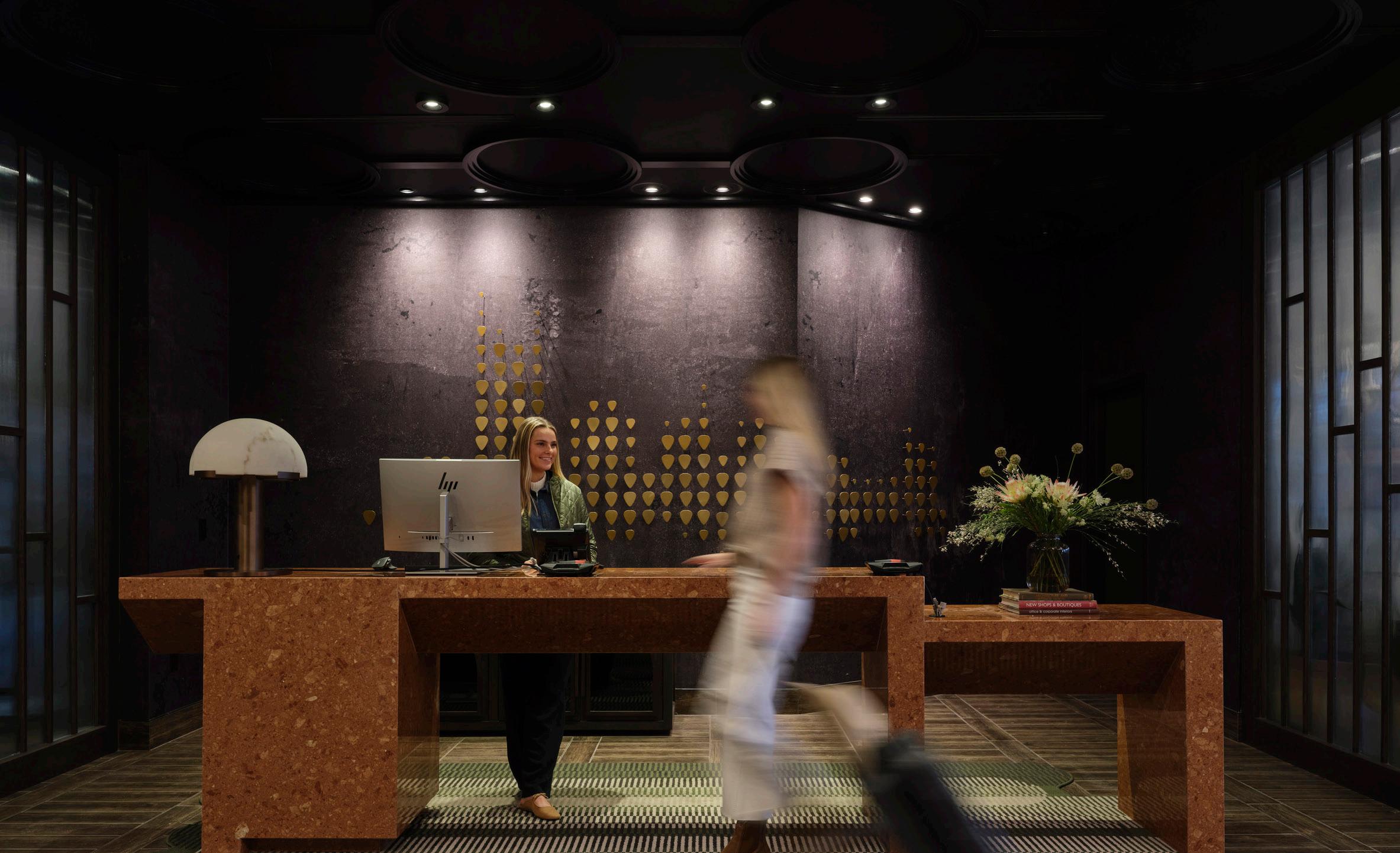
A perfect landing spot? The micro-hotel concept hits Nashville: Challenging sites can bring creativity in the hospitality sector. That’s the case with the newly opened Motto by Hilton Nashville Downtown, a micro hotel located just three blocks south of the Tennessee city’s entertainment district.
More investment sales in Cincinnati’s retail market? The Cincinnati retail market should prepare for a busier year when it comes to investment sales activity, according to the latest forecast from Marcus & Millichap.
Silverstone Development’s Kimpton Hotel project bringing new life to former Odd Fellows building in Indianapolis: The 16-story neo-classical high-rise at 1 North Pennsylvania St. has been a key part of downtown Indianapolis’ skyline since it was first built in 1908.
Strong population growth fueling Indianapolis’ multifamily market in 2026: People are moving to Indianapolis. In fact, Marcus & Millichap reports that the net in-migration levels for the Indianapolis metropolitan area rank among the highest in the Midwest.
Quality amenities even more important today for office building owners: The U.S. office market remains a challenging one. But building owners who offer high-quality office space enhanced by amenities have an advantage.
Growth in bulk industrial occupancies push U.S. industrial market closer to recovery: A rebound in large industrial occupancies helped push the U.S. industrial sector closer to recovery in 2025, a sign that demand for big-box logistics and manufacturing space is strengthening after several years of slower activity.
Number of office-to-apartment conversions continues to soar across the United States: Office-to-apartment conversions continue to break records, with 90,300 such conversions in the pipeline across the United States as of the start of 2026, according to the latest research from RentCafe.
Many renters searching for those cheaper rents in the Midwest: Is the grass greener in another city? That’s what many apartment renters seem to believe, according to the latest research from Apartment List.
COLUMNS/DEPARTMENTS
6 Editor’s Letter
30 Wisconsin’s Data Center Reckoning: Four Bills, No Resolution, and a Policy Vacuum
32 Why your community should welcome data centers, not fear them
34 Capital flows in industrial: Who’s buying, who’s pausing and who’s targeting niche assets
36 Directory Listings
The Midwest’s commercial real estate publication, providing useful, unbiased and accurate coverage of the industry and its professionals since 1985.
WWW.REJOURNALS.COM
Publisher | Mark Menzies menzies@rejournals.com 312.933.8559
Editor | Dan Rafter drafter@rejournals.com
ADVERTISING
Vice President of Sales & MW Conference Series Manager | Ernest Abood eabood@rejournals.com
Vice President of Sales | Frank E. Biondo frank.biondo@rejournals.com
Classified Director | Susan Mickey smickey@rejournals.com
Director, National Events & Marketing | Allison Kim Allison.kim@rejournals.com
Midwest Real Estate News brings real estate leaders together to explore the challenges and opportunities unique to their markets.
ADDRESS
7767 Elm Creek Boulevard, Suite 210, Maple Grove, MN 55369
Midwest Real Estate News® (ISSN 0893-2719) is published bimonthly by Real Estate Publishing Corp., (rejournals.com). Current and back issues and additional resources, including subscription request forms and an editorial calendar, are available on the internet at rejournals.com.
Still searching for stability: Conditions in U.S. office market not getting worse. But are they getting better?
By Dan Rafter, Editor
The U.S. office market is still struggling to find its footing, but there are at least a few signs that conditions might not be getting worse.
That’s one of the key takeaways from a new report released by CommercialCafe, which shows that while vacancy rates remain elevated across the country, they have begun to inch down on a year-over-year basis.
According to the report, the national office vacancy rate stood at 17.6% in February. That figure is still high by historical standards, a reminder that many companies continue to rethink how much space they need in a post-pandemic world. But it also represents an improvement: Vacancy has dropped by 200 basis points compared to the same month a year earlier.
Rents, though, are moving in the opposite direction. The average national listing rate hit $32.79 a square foot in February, down nearly 2% from a year ago. That dip reflects the continued pressure landlords face as they compete for a smaller pool of tenants. In many markets, building owners are offering concessions or trimming asking rents to fill empty space.
New construction isn’t adding much additional pressure. The office pipeline remains modest, with just over 28 million square feet under construction nationwide. That limited supply could help prevent vacancy rates from rising significantly in the near term, especially if leasing activity continues to stabilize.
Office investment activity is still concentrated in a handful of major markets. Manhattan led the country in office sales volume so far this year, with nearly $1.6 billion in deals closed. The San Francisco Bay Area followed with $680 million in transactions, while Miami recorded $666 million.
“With vacancies slowly declining and new construction in check, the latest numbers suggest that the office market may finally be stabilizing.”
Interestingly, both Manhattan and Miami also posted some of the lowest vacancy rates among the nation’s top office markets in February, a sign that demand remains stronger in select, high-profile locations.
Geography continues to play a significant role in pricing, too. Office markets in the West and Northeast generally command higher-than-average rents, while those in the Midwest and South remain more affordable. That dynamic could make central
U.S. markets increasingly attractive to cost-conscious tenants, even as companies continue to evaluate their long-term office strategies.
Construction activity is also unevenly distributed. Boston; Manhattan; Dallas; and Los Angeles were the only major markets with more than 2 million square feet of office space under construction in February. These cities also ranked among the most active development hubs, suggesting that developers are still willing to bet on long-term demand in key gateway and Sun Belt markets.
For now, though, the broader story remains one of a sector in transition. Vacancy is still high, rents are under pressure and many companies are still figuring out how office space fits into their future. But with vacancies slowly declining and new construction in check, the latest numbers suggest that the office market may finally be stabilizing, even if a full recovery is still a long way off.
Image courtesy of Joe, Pixabay
2+ BILLION IN BROKERED SALE & LEASE SF OVER 5 YEARS
$120+ BILLION IN TRANSACTION VOLUME OVER 5 YEARS
1,750 PROFESSIONALS AND GROWING INTERNATIONALLY
LEE & ASSOCIATES IS THE LARGEST BROKER-OWNED COMMERCIAL REAL ESTATE FIRM IN NORTH AMERICA, AND ONE OF THE FASTEST GROWING!
Since 1979, Lee & Associates has reimagined the way that commercial real estate companies should be structured. Each Lee & Associates office is owned and operated by its professionals. As shareholders of the company, this separates us from our competition and creates one common goal; to provide seamless, consistent execution and value-driven market-to-market services to our clients.
CINCINNATI
JOHN RICKERT RICKERT
GEORGE FLYNN DAN MCDONALD TC BARTOSZEK STEWART DEVITT
GEORGE FLYNN DAN MCDONALD TC BARTOSZEK STEWART DEVITT
STAN FALK
CHRIS NACHTRAB PAUL SCHMERGE MATT SNYDER
STAN FALK
CHRIS NACHTRAB PAUL SCHMERGE MATT SNYDER
CHAS COOK
GARY FISHER EVAN JENKINS CHRIS KINNARD CHRIS VITORI
A perfect landing spot? The micro-hotel concept hits Nashville
By Dan Rafter, Editor
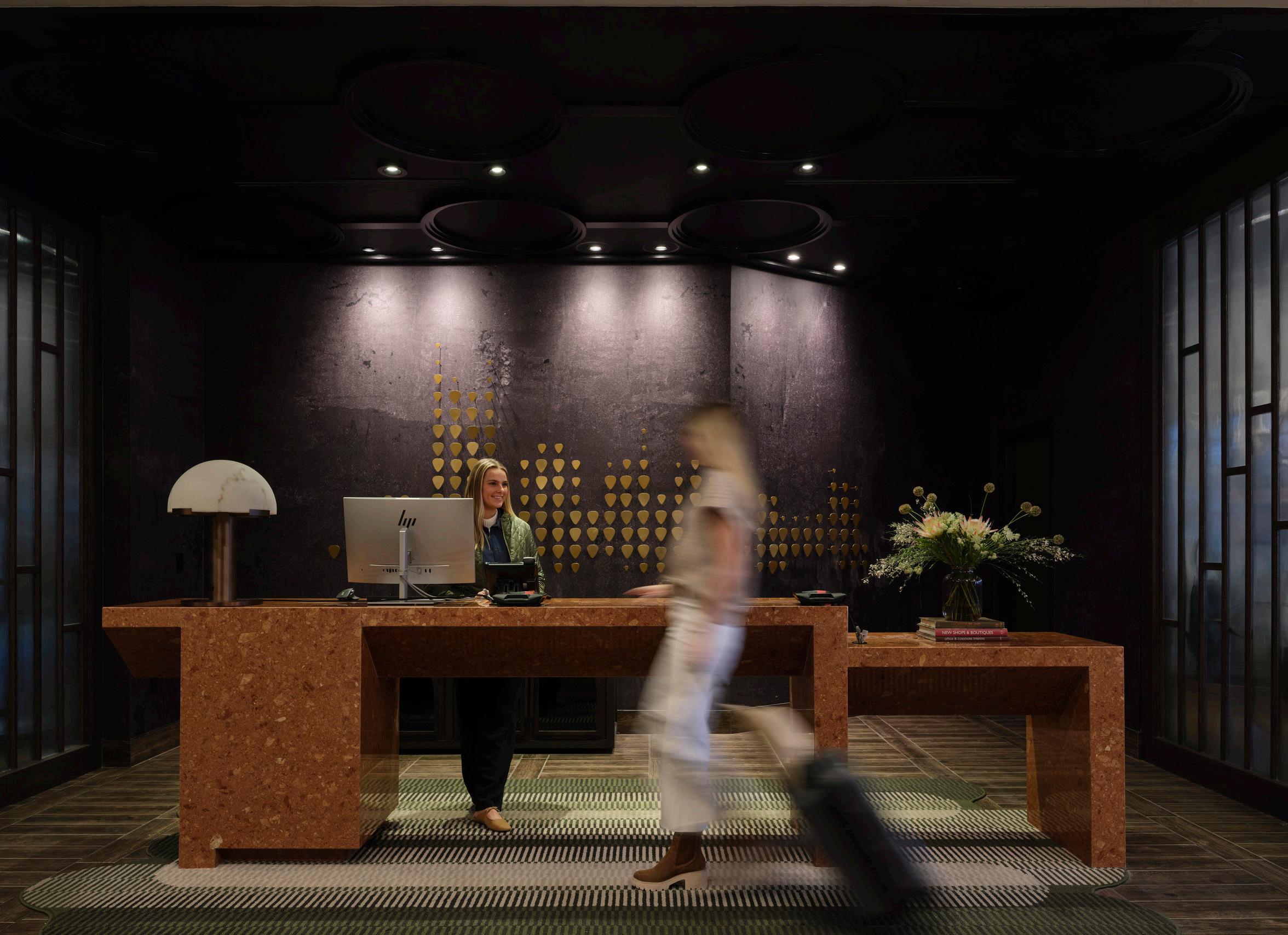
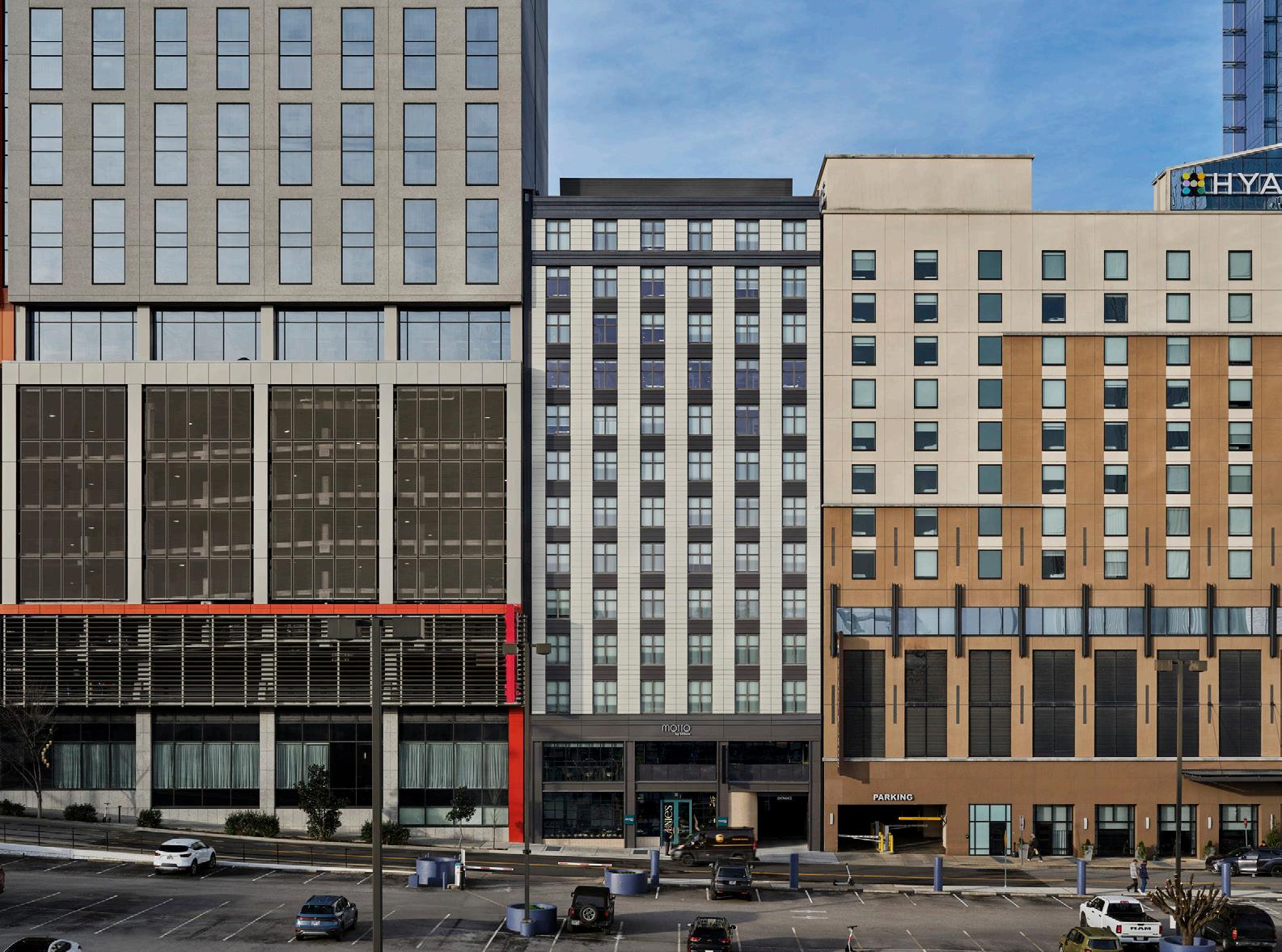
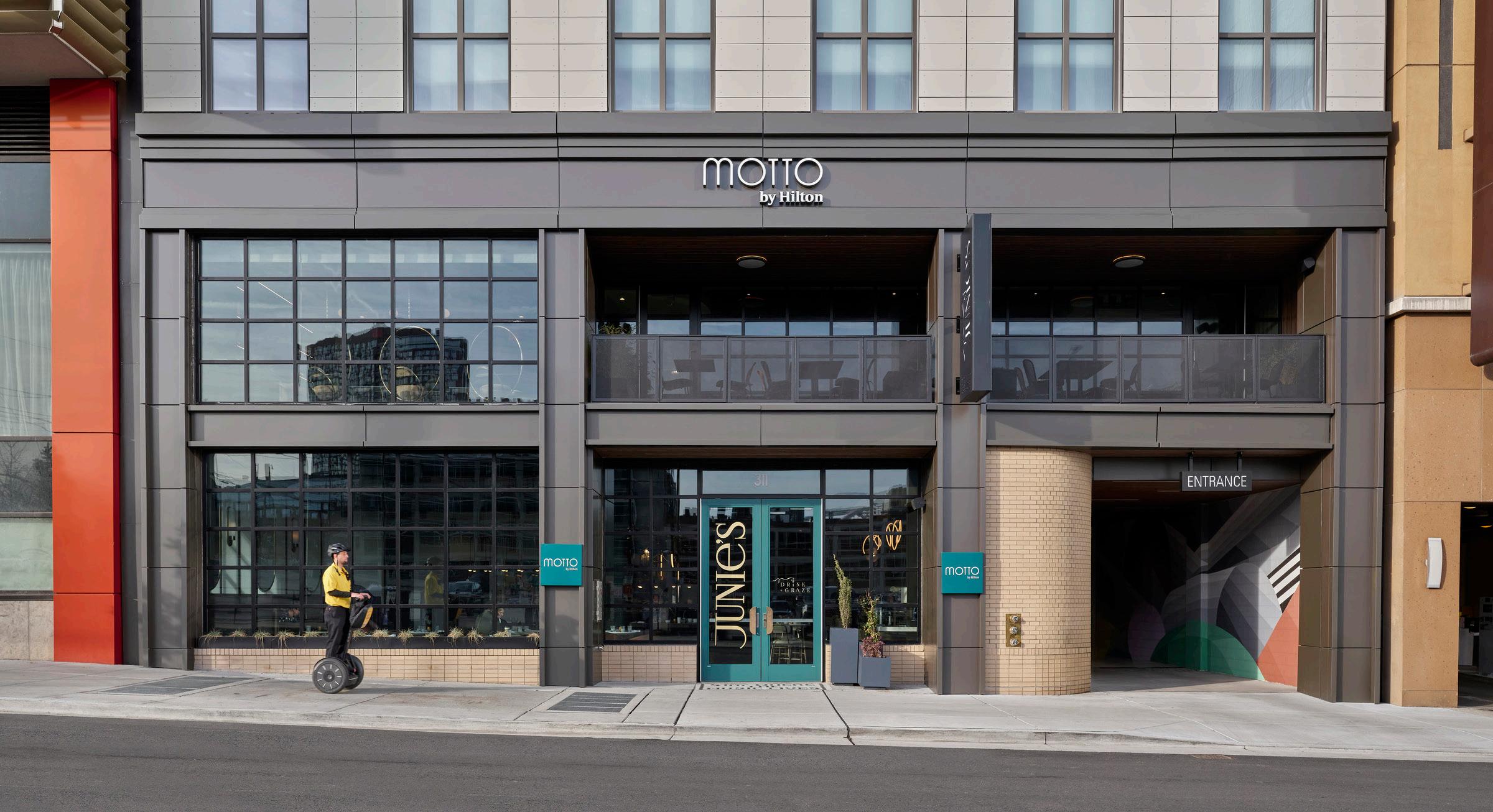
Challenging sites can bring creativity in the hospitality sector. That’s the case with the newly opened Motto by Hilton Nashville Downtown, a micro hotel located just three blocks south of the Tennessee city’s entertainment district.
What is a micro hotel? It’s one that features smaller, but purposefully designed, rooms. While standard hotel rooms might boast 350 square feet
of space, the rooms in the new Motto by Hilton in Nashville are 150 to 180 square feet.
That might sound cramped, but it’s not. When designing the new Motto at 311 3rd Ave. S, Nashville-based design firm ESa focused on flexibility, using available space smartly and designing a building that feels more spacious than it is.
The micro hotel also targets a dif-
ferent type of traveler, one looking for lower-priced accommodations -micro hotels charge lower room rates than standard hospitality properties -- and shorter stays. These travelers would rather spend their dollars on the food, music and attractions that Nashville offers than on a hotel room that they’ll mostly use for sleep.
“This is about reaching a dollar figure that is more attainable for a larger group of travelers while still providing
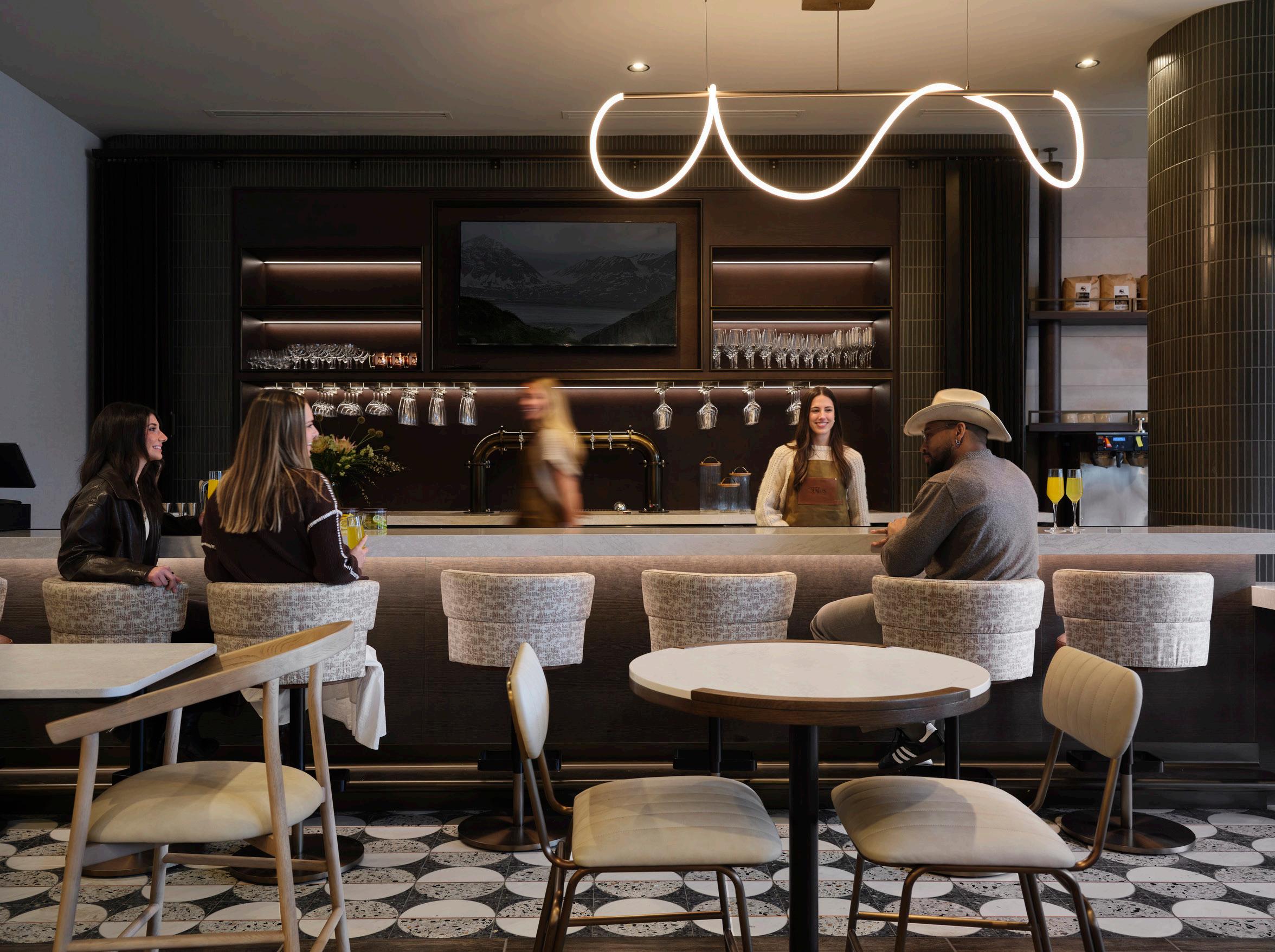
everything that you’d need in a hotel,” said Lee Davis, principal and senior design manager at ESa. “You can still go downstairs to grab food or have a drink in the lobby bar. But the property is designed in a way that asks ‘What is unnecessary? What unnecessary costs are passed onto travelers that we can avoid?’ We are giving travelers another option to explore Nashville.”
As Davis said, a micro hotel such as Motto won’t cost travelers $500 a
All photos credited to McGinn Photography.
night. Instead, travelers can rent a room for a fraction of that price.
“That’s a huge differentiator, especially when you consider the kind of tourist destination that Nashville is,” Davis said. “You might only be here for a night or two. How much time will you spend in a hotel room? You might spend the evening watching a Predators game or visiting a honky tonk. You can be saving $300 on your nightly rate for a room that you aren’t spending much time in anyway.”
The concept of connecting
What sets Motto apart, though, is its aggressive use of connecting rooms.
Most hotels offer connecting rooms that families can use if parents want to sleep in one room while their kids sleep in the one next door. An interior door separating the two rooms can be opened to keep the family members connected but also give everyone extra space.
The Nashville Motto offers this concept but in a bigger way. Davis said that travelers can rent a series of connecting rooms so that everyone has his or her own space while still being connected to each other. This makes the hotel’s smaller rooms seem more spacious than they are.
Davis gives this example: Maybe several families or a group of friends are traveling together. They can rent six
connecting rooms. When the interior doors are open, the space these friends or family members are sharing seems larger. When they are closed, guests get their privacy.
“If you are traveling with five of your best friends, you want that sense of connection,” Davis said. “The idea that everyone needs to be forced out of their hotel rooms and into common-area spaces to hang out together is a little tired. This project answers the question of how you make your living and sleeping space more hospitable in a micro hotel. We do it by being aggressive with the connecting rooms. It’s a differentiator for Motto.”
A challenging space
Nashville’s Motto features 260 rooms in a 13-story 93,754-square-foot building.
The challenge for designers started with the site itself. At just 60 feet wide, the footprint left little room for inefficiency. ESa responded by carefully planning circulation, maximizing usable space and creating a guest flow that begins the moment guests arrive.
“This is a forgotten piece of property,” Davis said. “It’s a great location. It was only available because people couldn’t get their heads around how to design a hotel to fit into such a small space between two existing buildings.”
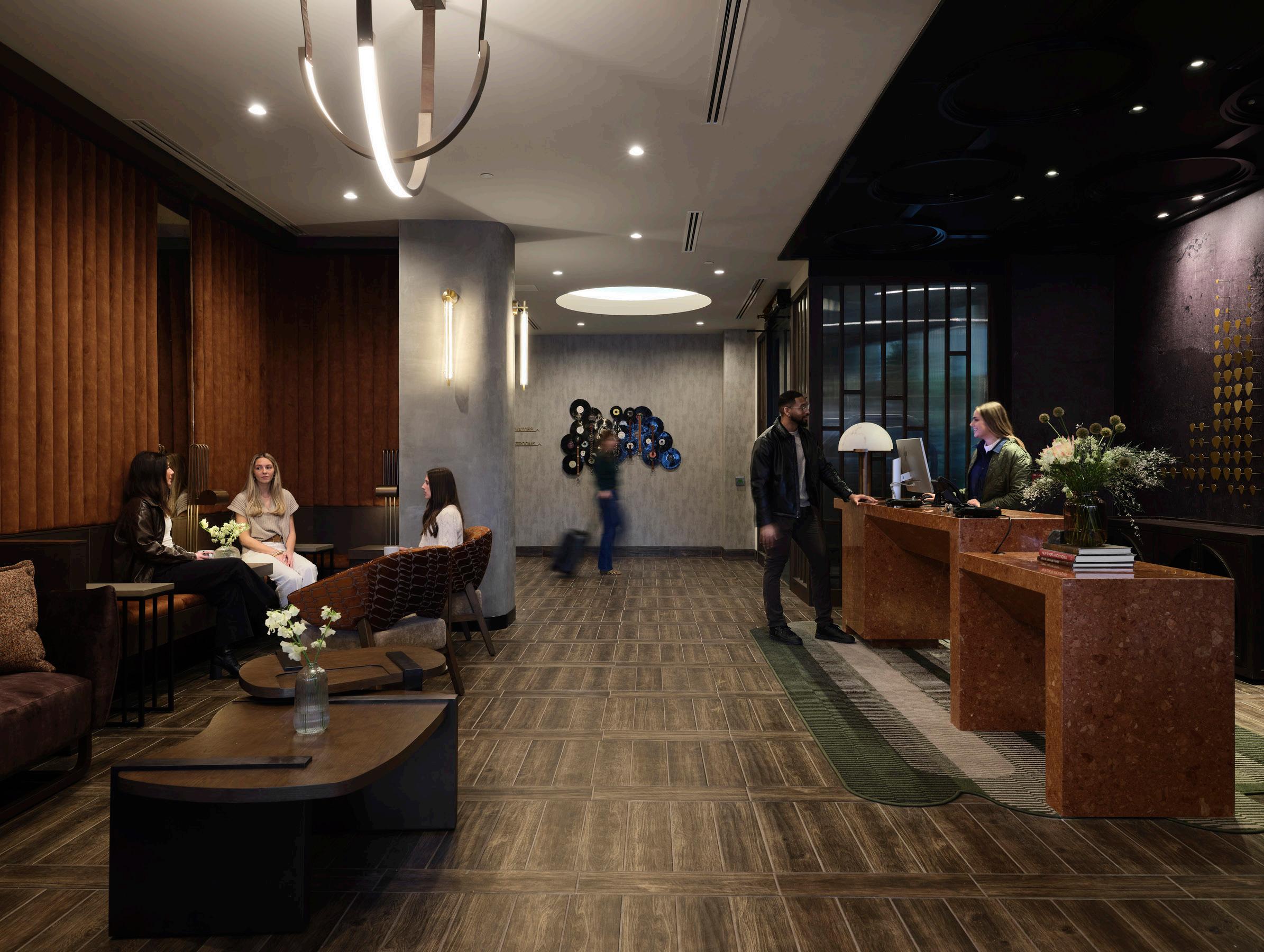
Unlike many urban hotels, the property offers two distinct entries. One draws guests through a lower-level restaurant along 3rd Avenue, while the other leads through a more secluded courtyard drop-off. Inside, a two-story lobby opens the space, anchored by a staircase that connects to a second-floor bar and patio.
And while the rooms are smaller, Motto doesn’t skimp on the common-area amenities. The property includes meeting space, a fitness center, laundry facilities, an outdoor patio and about 3,000 square feet of retail and restaurant space.
About 30% of the hotel’s rooms can connect to adjoining units. In some configurations, as many as six rooms can link together. Some rooms also include bunk beds, a perk for younger travelers and group stays.
Hannah Terry, design manager with ESa, in a written statement said that the goal when designing Motto was to not sacrifice a sense of place while focusing on efficiency. Architectural details, including a curved and recessed entry, draw inspiration from the Victorian and Italianate storefronts that define much of downtown Nashville’s historic character.
The team behind Motto includes Apple Hospitality REIT, which owns the hotel, and Chartwell Hospitality, which serves as its operator. Mortenson Develop-
ment, Inc. led the development, with M.A. Mortenson Co. handling construction. ESa oversaw both architecture and interiors, working alongside Wild Muse Interiors, while KVD and Barge Civil Associates provided landscape architecture and civil engineering.
Davis said that he expects more micro hotels to pop up across the country. It gives operators a chance to capture a new market, travelers more interested in spending their time and money on experiences in the places they visit rather than on unnecessary space in a hotel room they’re rarely in.
“When you think about a hotel, what are you renting out for the night?” Davis asked. “It’s a bed, shower, toilet and sink. A window. That is what you are leasing for the day. A micro hotel is about challenging what part of a room is unnecessary.”
The biggest challenge? It might be convincing travelers that a lower-cost micro hotel can offer them everything they need in a stay.
“Some people still have a distaste for this concept. They think they’re going to be sleeping in a closet,” Davis said. “Once people understand that this gives them everything they need in a hotel, and that it won’t be a bad experience for a guest, I think you’ll see more of these kinds of hotels.”
More investment sales in Cincinnati’s retail market? That’s what Marcus & Millichap predicts
By Dan Rafter, Editor
The Cincinnati retail market should prepare for a busier year when it comes to investment sales activity, according to the latest forecast from Marcus & Millichap.
According to Marcus & Millichap’s 2026 retail Investment Forecast, the strength of downtown Cincinnati and a limited supply of new retail space should boost the performance of the area’s retail sector this year, making
it a more attractive market for investors. The lower sales prices and higher cap rates here don’t hurt, either.
In its report, Marcus & Millichap said that after a year of negative net absorption and dips in average asking rent in 2025, the Cincinnati retail market is poised to post a moderate recovery in 2026.
A particular bright spot? Downtown Cincinnati. Marcus & Millichap said
that downtown’s multi-tenant segment still stands as one of the metropolitan area’s lowest-vacancy and highest-rent areas. The downtown area’s limited construction pipeline -- which accounts for less than 1% of new retail supply in the region -- could lead to more activity in the submarket this year.
Marcus & Millichap is predicting, too, that the renovation of the Duke Energy Convention Center should boost
visitor traffic to Cincinnati’s downtown, which should provide a positive for retailers in the heart of the city. A major mixed-use development near TQL Stadium, which is now under final zoning approval, could also boost the long-term prospects of downtown-area retailers.
It’s not just the downtown retail sector that appears poised for a strong year, either. Marcus & Millichap pointed to the Butler County submarket as
iStock photo, courtesy of Fanliso.
“Marcus & Millichap is predicting, too, that the renovation of the Duke Energy Convention Center should boost visitor traffic to Cincinnati’s downtown, which should provide a positive for retailers in the heart of the city.”
boasting a strong retail sector, too, with one of the lowest single-tenant vacancy rates in the region. The retail sector in the Northern Kentucky submarket is solid, too, with a year-overyear drop in vacancy of nearly 120 basis points.
Marcus & Millichap predicts that the metro area’s asking rent growth will increase modestly in 2026, reaching $14.50 a square foot. Even with
that boost, retail asking rents in the Cincinnati area will continue to rank among the lowest markets nationally.
Also in its forecast, Marcus & Millichap predicts that improving demand will not outpace new supply, pushing the metro area’s vacancy rate to 6.5% by the end of 2026. This would be its highest level since 2020.
Retail deliveries should remain above
the five-year average, according to Marcus & Millichap. The company predicts that the Cincinnati region will see 450,000 square feet of new retail space in 2026.
Marcus & Millichap does predict an increase in retail investment sales in the Cincinnati area this year. Cincinnati continues to rank among the lowest-priced major metros, with high cap rates, particularly given its com-
paratively low asking rents. This was attractive to investors last year, and helped increase trading activity by 33% last year, Marcus & Millichap said.
This increase was largely driven by a higher number of investment sales in the Butler County and Northern Kentucky submarkets. Marcus & Millichap said that signs point to additional capital being raised for single-tenant acquisitions this year.
Silverstone Development’s Kimpton Hotel project bringing new life to former Odd Fellows building in Indianapolis
By Dan Rafter, Editor
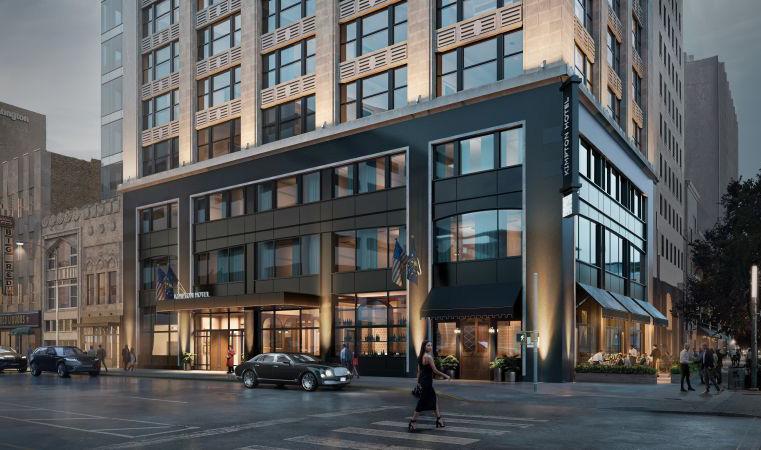
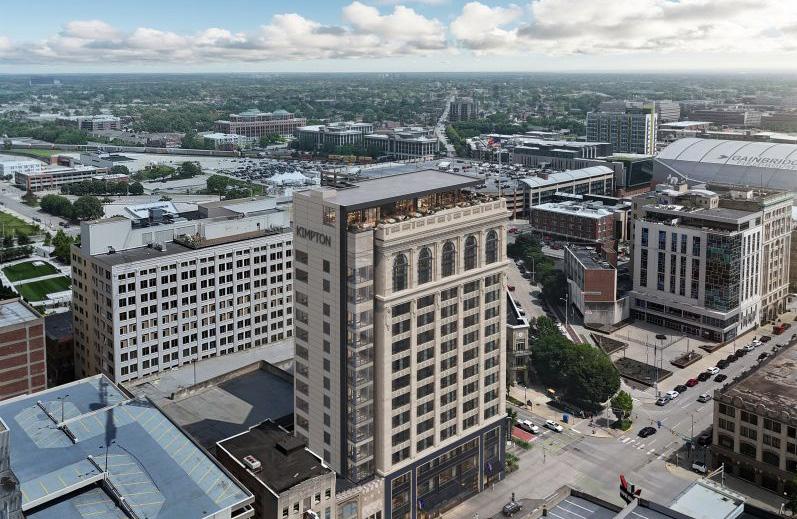
The 16-story neo-classical high-rise at 1 North Pennsylvania St. has been a key part of downtown Indianapolis’ skyline since it was first built in 1908.
The building ranked as the tallest highrise in Indianapolis when it first rose in the city’s downtown. And locals still call it the Odd Fellows building because it served as the Indiana state headquarters of the Independent Order of Odd Fellows, a national fraternal organization.
This fall, the Odd Fellows building will begin its next chapter thanks to Indi-
anapolis-based developer Silverstone Development.
Silverstone is transforming the building into the Kimpton Hotel Indianapolis, helping to meet the city’s need for more hotel rooms in its downtown core. The hotel is slated to open in the fall of this year.
The Kimpton Hotel Indianapolis will offer 167 guest rooms, a ballroom on its 15th floor and a full-service restaurant. The hotel will also feature a rooftop cocktail lounge providing views of downtown Indianapolis.
Midwest Real Estate News spoke
with Dale Johns, founding principal of Silverstone Development, about the challenges of transforming this iconic building and the potential that adaptive-reuse projects have to bring new life to aging properties.
What made the former Odd Fellows Building a good candidate for an adaptive-reuse?
Dale Johns: Part of what made the Odd Fellows Building an excellent candidate for adaptive reuse is the location. The Odd Fellows building sits just a few minutes’ walk from Indianapolis event hubs like Gainbridge Fieldhouse, the Indianapolis Convention Center, Lucas
Oil Stadium, and downtown nightlife options.
Another benefit was the building’s inherent suitability for a modern lifestyle hotel. Its historic façade, generous ceiling heights, and large window openings give us the character and natural light today’s guests expect, while the floor plates are efficient enough to support a thoughtful mix of guestrooms and amenity spaces without forcing awkward compromises.
The existing structure was fundamentally sound, which allowed us to invest more of the budget into guest-facing design and experience rather than
: A rendering of the Kimpton Hotel Indianapolis that will open this fall in downtown Indianapolis. (Renderings courtesy of Silverstone Development.)
rebuilding core systems from scratch. It’s the kind of property where you can preserve a sense of Indianapolis history and still deliver a contemporary, high-performing hotel.
How strong is the demand in Indianapolis for new hotel rooms? Is this demand growing as Indianapolis’ tourism industry continues to strengthen?
Johns: Our friends at Visit Indy shared in January at their State of Tourism event that in 2025 Indianapolis set a record for hotel rooms booked and occupied, breaking the previous record set in 2024 of 932,000 hotel rooms booked. It is safe to say that Indianapolis’ tourism industry is growing at a rapid rate, with 30.5 million visitors in 2025, helping bring a strong demand for new hotel rooms.
However, what we’re seeing on the ground is that this demand is not just about more hotel rooms, it’s about the right kind of hotel rooms. Citywide conventions, major sporting events, and a steady calendar of cultural programming are drawing guests who want a higher touch, more experiential stay than a traditional one.
“A boutique, design driven hotel in a historic building helps Indianapolis compete with peer cities by giving visitors a memorable “only in Indy” experience that keeps them coming back and talking about the city long after check out.”
A boutique, design driven hotel in a historic building helps Indianapolis compete with peer cities by giving visitors a memorable “only in Indy” experience that keeps them coming back and talking about the city long after check out. Kimpton Indianapolis is designed to capture that demand while also serving locals who are looking for a new go to spot for events, dining, and nightlife beginning in the Fall of 2026.
What were some of the bigger challenges in transforming the Odd Fellows Building into a new Kimpton?
Johns: Any adaptive reuse project starts with what you inherit, and Odd Fellows was no exception. Working within a historic envelope meant we had to carefully thread modern building systems, life safety requirements, and acoustic performance
through a structure that wasn’t initially designed to be a hotel. Aligning column grids, window placements, and existing floor elevations with Kimpton’s room standards and brand expectations required a lot of upfront coordination between our design, engineering, and construction partners.
We also had to balance preservation with performance. There’s a responsibility to honor the building’s history, but we can’t let nostalgia override guest comfort or operational efficiency. Everything from integrating new vertical circulation to carving out a 15th floor ballroom demanded creative problem solving so that the finished product feels seamless to the guest. That level of complexity reinforces why early, honest collaboration between owner, brand, designers, and contractors is so critical on projects like this.
What are some of the amenities that you think will set this hotel apart from its competitors?
Johns: In addition to the 167 high-end guest rooms, the mixed-use property will feature a 15th-floor ballroom, perfect for a variety of events, and located in a prime location in downtown Indianapolis. Additionally, a rooftop cocktail lounge will offer an expansive view of the city skyline.
The ballroom and rooftop are being programmed with both travelers and locals in mind, creating a social hub for downtown that can host every -
thing from weddings and nonprofit galas to pre game meetups and post show nightcaps. Layering that energy onto the backdrop of a restored historic building gives Kimpton Indianapolis a personality that’s distinct from larger convention hotels, while still plugging directly into the city’s growing tourism and events ecosystem.
Are you interested in taking on more adaptive-reuse projects in the Indianapolis market? Are there any projects you are working on now in the market that you are especially excited about?
Johns: We absolutely see Indianapolis as a long term market for adaptive reuse and are very interested in taking on more projects here that align with our expertise. The city has a deep inventory of historic and underutilized buildings in walkable, well connected locations, and when you pair that with strong tourism trends, it’s a compelling environment for thoughtful hospitality development.
“Supply product and renter demand have remained in equilibrium and will continue to do so over the next several months,” LaMotte said. “We might even see things slip into undersupply for the next 12 to 24 months.”
That stability is reflected in longterm projections. LaMotte pointed to Walker & Dunlop forecasts calling for steady rent growth and occupancy in the Indianapolis market through the end of the decade: 2.95% rent growth and 94.5% occupancy in 2027; 3.08% rent growth and 94.2% occupancy in 2028; 3.08% rent growth and 94.05% occupancy in 2029; and 3.1% rent growth with 94.9% occupancy in 2030.
“You can’t get any more stable than that,” LaMotte said. “The Indianapolis market is in a great position.”
That consistency is attracting new investor interest, particularly from capital sources that once overlooked the Midwest.
“The capital is taking note,” LaMotte said. “I’m having conversations with capital sources. For 24 years, I tried to get their attention. For 24 years, they said, ‘No thanks, Steve. We will happily fly right over the Midwest.’”
Now those same groups can’t buy in places like Denver, so they are coming to the Midwest, where they can apply a positive rent growth number in year one or year two.
“They would not be as focused on the Midwest and Indianapolis if they could continue buying in the Denvers of the world,” LaMotte said. “They can’t. We are the beneficiary of oversupplied markets across the country.”
On the development side, LaMotte said new construction has already begun to slow after peaking in recent years.
“We are on a downward supply curve currently,” he said. “We peaked at 5,000 units in 2024 and 6,500 units in 2025. We are back to 4,000 units in 2026 and expect between 3,000 and 4,000 units over the next couple of years.”
LaMotte said that this number of new units might not be enough to meet demand.
“I’d argue that this is not enough supply,” LaMotte said. “I expect the development community to step into that need and be closer to the 4,000plus mark as you look out to 2027 and 2028.”
With occupancy hovering around 95%,
LaMotte said the market remains tight.
“When you are 95% occupied, that is a pretty tight market,” he said. “There are not a lot of excess unoccupied apartment units to choose from. It is still an owner’s market.”
Performance, however, varies by location. Walkable, amenity-rich districts are outperforming more auto-dependent areas.
Multifamily markets seeing the most demand from renters include downtown Carmel, downtown Fishers, Noblesville, downtown Westfield and downtown Indianapolis, LaMotte said.
Among those, Carmel stands out.
“Carmel is the land of infinite demand,” LaMotte said. “A renter looking for a place to live, a homeowner looking for a place to buy, an employee looking for a business to work for, it doesn’t matter. There is infinite demand in Carmel, Indiana. It is a remarkable community that keeps printing demand.”
As for what renters want, traditional amenities remain important, but newer features are becoming essential.
“Fitness centers, club rooms and pools are still critical,” LaMotte said. “But now there are also amenities like pickleball and co-working space. Pickleball is not
universal, but co-working space should be universal. If not, you are not speaking to a large segment of your audience.”
He added that electric vehicle infrastructure is often underestimated.
“Most properties have a token two or four EV charging stations,” LaMotte said. “That, in my opinion, is underserving a market increasingly interested in EVs. The right number is more like 10 to 15 charging stations. If you are not having more than two, it is effectively the same as saying you are not interested in renting to people who own EVs.”
Downtown Indianapolis, meanwhile, is poised for a resurgence, fueled by major investment. IU Health is building a $4.3 billion Indianapolis hospital complex now, one that is expected to open in late 2027. That project will provide a major boot to downtown, LaMotte said.
“The pendulum swings,” LaMotte said. “COVID forced that pendulum to swing violently five or six years ago to suburban living. People wanted to rent in the suburbs. Now the pendulum is swinging back to downtown living.”
Some stability in the office sector
The Indianapolis-area office market is no longer in freefall. But it is still a
INDIANAPOLIS (continued from page 1)
“Landlords are partnering with tenants and helping with return-to-work policies . Fitness, food, exercise and walkability are all critical. If everything is closed around you, you need to have it in the building. The workplace needs to be a magnet to draw people in.”
market defined by sharp contrasts, contrasts between top-tier buildings and everything else, between walkable suburban nodes and struggling secondary locations and between preand post-pandemic demand.
That’s the takeaway from John Robinson, managing director in the Indianapolis office of JLL, who says signs of improvement are emerging in the office sector, but only in certain submarkets and in higher-quality buildings.
“There are some very bright spots in the suburban office market,” Robinson said. “We are seeing some of the highest rents and demand we have seen in certain pockets. It still comes down to the flight to quality. The market is bifurcated. The buildings tenants and workers want to be in, like Class-A properties in downtown Carmel, Keystone Crossing and Fishers, are seeing growing rents and increased demand.”
Outside of those pockets, the story is far less encouraging.
Robinson said that in some of the tertiary submarkets in the Indianapolis area, office demand remains static.
“If you have a B-class building, your vacancy is high and your outlook is not good,” Robinson said. “That’s why we are seeing a lot of conversions, buildings being redeveloped into alternative uses like schools, hotels and multifamily. There are bright spots in the market, but it is very divided.”
That divide can be traced back to the earliest days of COVID, Robinson said. And the numbers bear this out. The demand for office space in the Indianapolis market is down 50% from the
days immediately before the start of COVID quarantines.
“That is a massive decrease in demand and the driving force behind the market dynamics in today’s office world,” Robinson said. “The large office deals we saw before COVID have disappeared.”
In better news for landlords and owners, tenants that are leasing office space today are showing a willingness to pay more, just for less space.
A tenant once might have rented 40,000 square feet and paid $25 a square foot, Robinson said. Today, these same tenants only need 20,000 square feet. Because they are renting a smaller amount of space, they don’t mind paying $30 a square foot for a better quality office.
That shift is fueling the continued “flight to quality,” with amenities playing a central role.
“It has been a war of amenities,” Robinson said. “Landlords are partnering with tenants and helping with return-to-work policies. Fitness, food, exercise and walkability are all critical. If everything is closed around you, you need to have it in the building. The workplace needs to be a magnet to draw people in.”
Top-performing buildings, Robinson said, are those that offer an experience beyond the office itself.
“The office areas that are doing well have experiential components,” Robinson said. “Employees can do things during the day, like walk around, exercise, shop, run errands. The height
of office demand in central Indiana is downtown Carmel. It is the gold standard for what tenants are looking for in walkability.”
After several years of uncertainty, Robinson said the broader office market is at least finding its footing.
Robinson said that he sees an office market now that is more stable. The
Indianapolis-area office vacancy rate peaked at the end of 2024. Demand has been down 40% to 50%, but it has stabilized.
Part of that stability comes from greater clarity around workplace strategies.
“We haven’t heard about return-to-office policies in 18 months,” Robinson said. “Everyone has their plans, and
they are in place. The momentum of in-office attendance is starting to increase.”
Most companies, he added, have settled on a hybrid model.
“Most companies are still doing hybrid,” Robinson said. “That is the solution they have settled on. I think that is good for workers. You need to be in the office. You can have a job remotely, but you can’t have a career remotely. I have always said the pandemic killed the necktie and it killed the Friday workday. Everyone gets to work remotely on Fridays.”
The office sector in downtown Indianapolis is also showing signs of resilience, particularly when compared to peer cities, Robinson said.
“In the Indianapolis CBD, if you look across the country at similar-sized cities, we have made a much better recovery than others,” Robinson said. “The fundamentals of our downtown are convention, tourism and sports. Those have returned to pre-COVID levels and are doing well.”
A key factor in that recovery has been
the removal of obsolete office space through conversions.
Robinson said that the Indianapolis-area office market has benefitted from 500,000 to 600,000 square feet of outdated office space coming off the market.
Important examples? Floors in Capital Center are being converted into a Moxy by Marriott hotel. Circle Tower in downtown Indianapolis is being converted into an AC by Marriott hotel. The office building at 220 N. Meridian St. is being converted to multifamily.
Still, Robinson said downtown’s longterm health will depend on rebuilding its street-level energy.
“We have to get the retail back and the foot traffic downtown so that office users have options to eat during the day,” he said. “It is getting better.”
A collaborative environment for development
For more than a decade, Hendricks Commercial Properties has quietly but steadily deepened its presence in Indianapolis, drawn by something the
developer’s chief executive officer Rob Gerbitz says isn’t always easy to find: a market where developers, government and the public are aligned and striving for the same goals.
“We really like the market as a whole,” Gerbitz said. “The city of Indianapolis and the state of Indiana are collaborative. It’s easy to build relationships. The market was positioned for us to grow as a company.”
Gerbitz says the firm’s long-term commitment to Indianapolis stems from more than favorable economics. It’s about relationships, not just with officials, but with the community at large.
“In general, what I’ve been impressed with most is the overall people of Indianapolis and Indiana as a whole,” he said. “Developers are not always the favorite people of the public. That’s the nature of the business. But the people have been great. Their support for what we have done has helped us continue to want to grow our activity in the Indianapolis market.”
That support has encouraged Hendricks to keep investing and, in doing so, reflects a broader trend: Indianapolis
continues to position itself as a developer-friendly market at a time when many cities are struggling to attract large-scale projects.
At the center of that development activity is a growing emphasis on mixeduse projects, which Gerbitz views as both an opportunity and a challenge.
“We are a company that wants to help communities grow,” he said. “Obviously we want good developments that are solid investments. But part of our overall drive is helping communities grow.”
Combining office, residential, retail and entertainment components creates the “live-work-play” environment that so many property owners, tenants and residents want.
“You bring in the housing, it completes the live/work/play environment,” Gerbitz said. “We like the adaptability of it. We like the balance of mixed-use, with retail, restaurants, entertainment, and having the base of office users there to create stability for the rest.”
But the appeal of mixed-use comes with complexity.
“When you do mixed-use, it is so hard,” Gerbitz said. “We want to bring something that is substantial, from the branding and design to the uses. I love it. I’ve been in mixed-use my entire career. But it is hard and complicated. It can be a head-scratcher.”
That complexity requires deep research and, just as importantly, a willingness to pivot.
“An enormous amount of due diligence and research goes into it,” Gerbitz said. “We look at so many different scenarios of how it will work. We get to a point where we feel good, but we always want to have adaptability.”
Another key ingredient in successful mixed-use developments? Entertainment.
“That is so important for us,” Gerbitz said. “After people eat and drink, they either go home or they go to an entertainment option. You need that next level, something for people to do.”
He points to emerging concepts that
“We need to get more
affordable housing options in
downtown Indianapolis.”
are reshaping how developers think about these spaces, from pickleball venues to experiential destinations like PopStroke, backed by Tiger Woods.
All of these trends are coming together in one of Hendricks’ most ambitious Indianapolis projects: the redevelopment of the former Circle Centre Mall site into an ambitious mixed-use development known as Traction Yards.
Hendricks was selected by the city to reimagine the site, and the firm is now in the design phase of a project that will transform the enclosed mall into
an open, connected mixed-use district.
“It will no longer be a mall,” Gerbitz said. “We want to reimagine it as mixed-use. We need office. But what we need most is housing, then the retail and entertainment components.”
That emphasis on housing reflects a broader need in downtown Indianapolis.
“The housing is such a need, from workforce housing to market-rate apartments to condominiums,” Gerbitz said. “We need to get more af-
fordable housing options in downtown Indianapolis.”
Plans call for opening up the site with a new street running through the development, lined with retail, with office and residential space rising above.
As with any project of this scale, community input has played a key role.
“Through all our diligence of trying to understand what the community wanted, there was a consistency,” he said. “People asked, ‘Can we have something there for us first?’ We want everyone from Indiana and Indianapolis to come to this development.”
Like many large-scale mixed-use projects, Traction Yards will take time. Hendricks is working through design and planning, with a target opening for the first phase in late 2028.
“I want it to be tomorrow,” Gerbitz said. “I lose patience after a while. But I also understand how this works and the time it takes.”
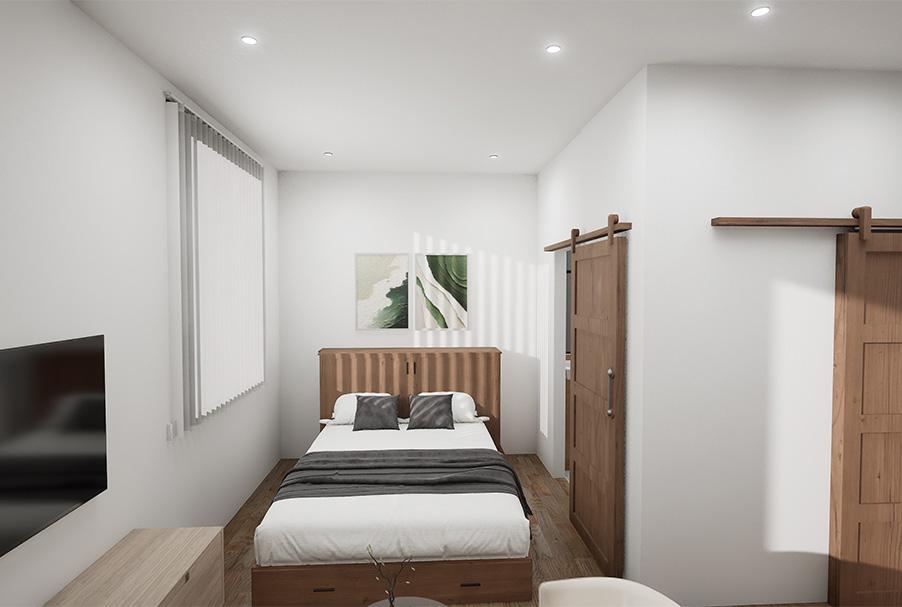
pleton into South River MicroFlats, a 15-unit micro-apartment community scheduled to open this April.
This development is an example of a trend in commercial real estate: transforming underused office space into residential units as hybrid work reduces demand for traditional workplaces.
South River MicroFlats will include studio and one-bedroom apartments ranging from 275 to 438 square feet. Both furnished and unfurnished units will be available, with lease terms ranging from one month to a full year.
The option to rent for as little as a month? That’s key to the success of the project, said Caleb Hayes, chief executive officer and founder of De Pere, Wisconsin-based Park Place Holdings.
“We thought there would be a lot of demand. There is not a lot of product in our area like this,” Hayes said. “The market has responded. We are getting interest from coaches who are only going to be here for a specific season. We are getting interest from students who are here for internships and need
something small for three to six months. We are getting interest from students in the area. Traveling professionals and traveling nurses are interested.”
A long history in the area
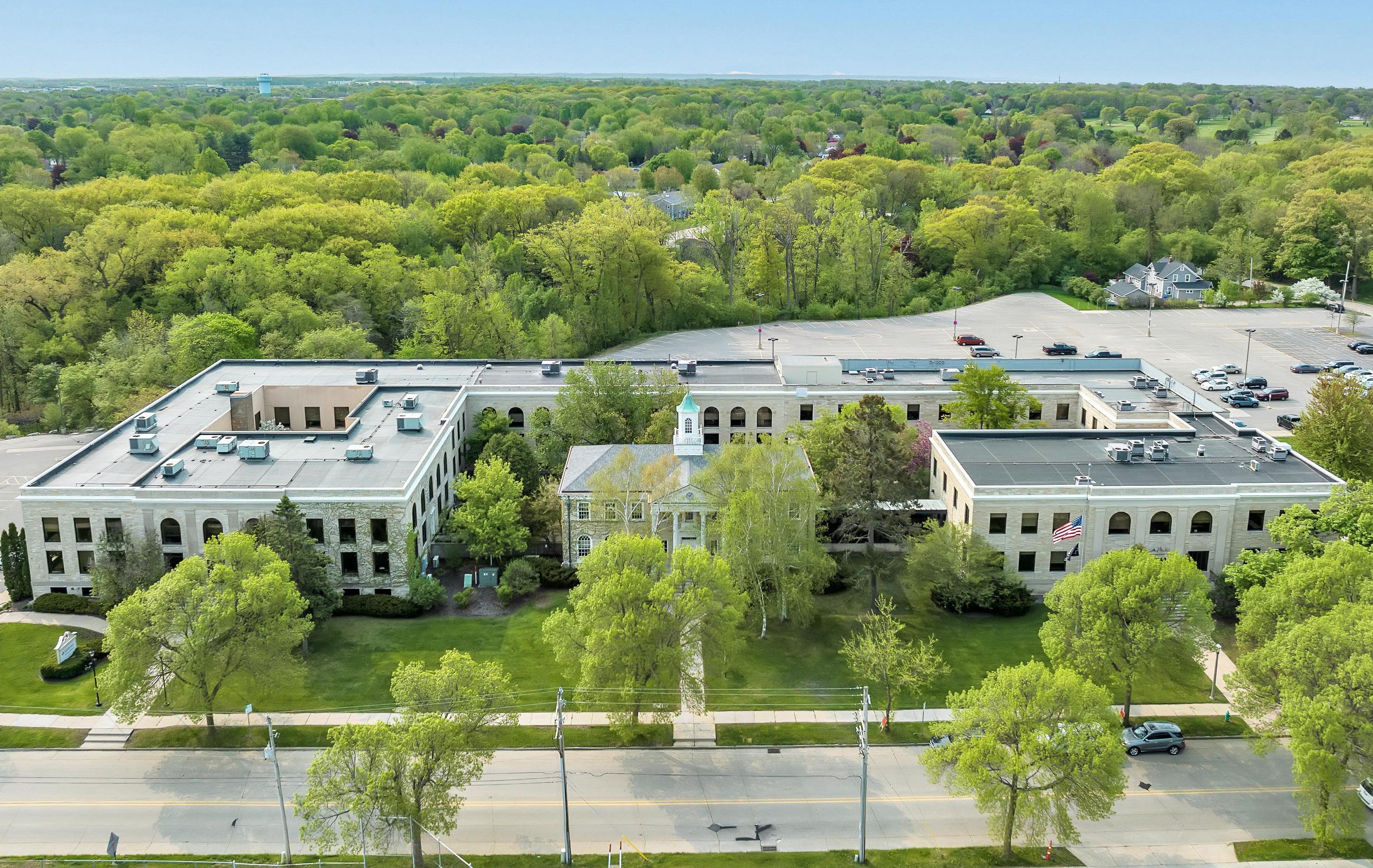
The South River MicroFlats building boasts a long history in Appleton. Built in 1952, it originally served as part of the Institute of Paper Chemistry, a graduate research institution formed through a partnership between Lawrence University and Wisconsin’s paper industry.
When the institute relocated to At-
lanta in 1989, the property sat vacant for nearly a decade before being renovated into professional office space in the early 2000s. In 2004, the building received a Historic Preservation/Restoration Certificate Award from the Appleton Historic Preservation Commission.
Now, developers are once again reinventing the property.
Construction on South River MicroFlats began in summer 2025, with Witt Construction serving as the project’s builder.
Making the pivot
Hayes said that Park Place Holdings had tried to fill the 120,000-squarefoot office space for several years. The demand, though, wasn’t there.
Because of this, Hayes and Park Place decided to pivot, transforming a portion of the building into South River MicroFlats.
“At the time, it felt like wasted space,” Hayes said. “We couldn’t fill it. We had to think of something new. What could go here that the market really needs?”
Hayes said that the gap between the average U.S. homeowners’ monthly mortgage payment and the monthly rents for one-bedroom apartments across the country is shrinking. More renters, then, are looking for quality apartments that they can rent at a lower cost.
“We decided to take a gamble,” he said.
So far? It looks like the gamble might pay off. Hayes said that Park Place Holdings has received from 50 to 60 applications for South River MicroFlats’ 15 existing units. If this demands holds, Park Place Holdings will offer more
MULTIFAMILY (continued from page 1)
Park Place Holdings opened South River MicoFlats in downtown Appleton this spring. (Photos courtesy of Park Place Holdings.)
micro-apartments in the building, potentially up to 90 of them.
“It’s my hope that we will start construction on the new units later this year,” Hayes said.
Plenty of benefits
The micro-apartment community will feature several amenities aimed at professionals and short-term residents. These include outdoor courtyards with gas grills, a fitness center, bike storage, shared workspaces and high-speed Wi-Fi. The building’s original architecture, which includes large windows and high exposed ceilings, will remain a defining feature of the redesigned units.
Location is another selling point. The property sits near the Lawrence University campus and downtown Appleton, with easy access to U.S. Highway 10 and Wisconsin Highway 441. Residents will also have transit options nearby, including a bus stop across the street and the free Downtown/Riverfront Trolley just a short walk away. Appleton International Airport is about a 17-minute drive from the site.
Developers say the project also responds to a growing demand for flexible housing, particularly among traveling health care professionals and other short-term workers. The number of travel nurses nationwide has surged in recent years, and Wisconsin hospitals continue to face nursing shortages, creating demand for furnished housing options near job centers.
For Park Place Holdings, the micro-apartment project may only be the beginning.
The company is exploring a potential expansion that could add as many as 90 additional apartments within the existing property.
“The flexibility that we are offering is what the consumer wants right now,” Hayes said. “If you are a kid coming in for an internship, you usually must sign a one-year lease. With us, you can sign a three- or four-month lease at a third of the cost. I wouldn’t say that we have an apartment shortage in Appleton. But we do have a shortage of spaces for people looking for shorter-term rentals.”
Unique real estate challenges? Meet a team uniquely equipped to take them on.
As one of the nation’s leading providers of commercial and multifamily real estate finance, we focus on building long-term relationships with new ideas and innovative thinking. Our broad financing options, integrated platform, and deep industry expertise across all commercial real estate sectors give our clients what they need to meet their goals.
To learn more, visit key.com/rec.
Strong population growth fueling Indianapolis’ multifamily market in 2026
By Dan Rafter, Editor
People are moving to Indianapolis. In fact, Marcus & Millichap reports that the net in-migration levels for the Indianapolis metropolitan area rank among the highest in the Midwest. That’s good news for the region’s multifamily sector, with Marcus & Millichap predicting that Indianapolis’ apartment market will continue to see growth throughout the rest of 2026, thanks largely to this population boost.
How quickly are people moving to the Indianapolis region? Marcus & Millichap said that since 2020, outlying counties such as Boone, Hamilton and Hancock have seen population increases of more than 10%.
The demand from new renters in the area has helped push monthly multifamily rents up by as much as 50% during the past five years in these counties, outpacing the 19% increase in apartment rents in Indianapolis’ CBD.
Vacancy rates remain stable, too, in the Indianapolis-area multifamily sector. Marcus & Millichap reported that the vacancy rate in downtown Indianapolis’ apartment buildings remains below its long-term average. That’s partly because of limited new supply added to the CBD since the middle of 2024. Corporate relocations, such as Elanco’s move of more than 700 employees to its new global headquarters, have helped boost vacancy rates in downtown Indianapolis, too.
Marcus & Millichap predicts that the apartment vacancy rate in the CBD will fall to the low-5% range this year for the first time since 2022.
There’s big news for smaller submarkets, too, with Marcus & Millichap predicting that communities such as Lawrence and Greenwood-Johnson County will capture a larger share of apartment completions this year. At the same time, deliveries in Carmel will make up more than half of the Indianapolis area’s new apartment projects in 2026.
But how about the numbers?
Marcus & Millichap predicts that the Indianapolis market will see 2,100 new apartment units delivered in 2026.
That’s below he long-term average for this area as inventory growth slows to 1.1%.
Marcus & Millichap is predicting, too, that the Indianapolis-area multifamily vacancy rate will fall for a third straight year to 4.2%. This would be on par with the predicted vacancy rate in the Cleveland and Columbus, Ohio, markets.
The Indianapolis area’s median effective apartment rent should rise to $1,355 a month this year, according to Marcus & Millichap. However, the yearover-year pace of change of 2.1% will be less than half of the prior decade’s average of 5.6%.
Photo by Pexels from Pixabay.
Quality amenities? They’re even more important today for office building owners
By Dan Rafter, Editor
The U.S. office market remains a challenging one. But building owners who offer high-quality office space enhanced by amenities such as flexible meeting rooms, onsite food options, outdoor walking trails, onsite fitness centers and carved-out spaces for people to work in private? The vacancy rates in their buildings remain lower.
We recently spoke with Peter Miscovich, Global Future of Work Leader with JLL, about the continuing flight to quality in the U.S. office sector and what the hybrid work movement means for the future of this asset class.
Here is what he had to say.
Is the flight to quality still a strong trend in the U.S. office sector? And if so, what does “quality” mean to tenants? What features make an office a “quality” destination for tenants?
Peter Miscovich: Yes, the flight to quality remains a dominant trend in the U.S. office sector, fundamentally reshaping tenant demand and creating a bifurcated market where premium assets thrive while older properties struggle. JLL’s latest U.S. Office Market Dynamics, Q4 2025 found leasing continues to be highly concentrated in newer assets, highly-amenitized Class-A buildings, and vibrant Lifestyle Market ecosystems.
JLL’s recent Global Design Perspectives
2026 uncovered that organizations are pursuing high-performance spaces that advance business objectives while maintaining efficiency amid cost pressures, recognizing that thoughtful design has become central to value creation across real estate portfolios. This is also evidenced by the U.S. Office Market Dynamics research that notes that asking rent for buildings under construction increased by 14% yearover-year, and Q4 2025 saw the highest volume of leases executed with starting rents above $100 per square foot on record.
Modern tenants define “quality” through features that directly support their ability to attract employees back to the office under hybrid work mod-
els. Premium locations with excellent transit accessibility and proximity to amenities rank as top priorities. Advanced technology infrastructure has become non-negotiable, with 93% of investors agreeing that technology-enabled properties deliver stronger performance and returns. This includes hybrid-meeting-enabled conference rooms with intelligent cameras, robust digital connectivity, and flexible collaboration platforms.
Enhanced wellness amenities have shifted from nice-to-have to essential: upgraded HVAC systems with superior air quality filtration, abundant natural daylight, outdoor spaces, and fitness facilities. Designs that combine spatial patterns, environmental comfort and
(Photo credit: iStock – JARAMA)
AMENITIES
material finishes to create spaces that inspire and elevate human performance will be differentiators in 2026 and beyond.
A majority of organizations across all portfolio types are now willing to pay a premium for technology-enabled spaces, and this willingness is reflected in market dynamics where Trophy and Class-A asking rents grew by 68 basis points year-over-year, while overall asking rents declined by 35 basis points, demonstrating the clear bifurcation between quality and commodity space.
How important is offering a modern, amenity-rich office space for companies that are still trying to persuade their employees to return to the office in greater numbers?
Miscovich: Offering modern, amenity-rich office space has become critical for companies working to increase office attendance under hybrid schedules. At year’s end 2025, 97% of employees of Fortune 100 companies
are now subject to hybrid or full-time office requirements, with fully flexible companies becoming exceptionally rare among major employers. With this shift, the quality of office space has become paramount.
With JLL research showing that 92% of corporations globally see workforce productivity as a key business objective over the next three years, and 63% of employees report feeling more productive in the office, organizations are examining what high-performance environments truly require.
In an increasingly digital world, genuine place-based connection has never been more valuable. 65% of people want the places they visit to provide ‘unique and distinct experiences’ and 62% want ‘connection to the local area or culture.’
The market is responding. The U.S. Office Market Dynamics research details how JP Morgan and Amazon, the largest office tenants in the finance and technology industries, respective-
ly, added several million square feet to their footprints across major markets during 2025 after increasing attendance requirements. These expansions focused on high-quality, amenity-rich spaces that justify the commute.
However, JLL’s Workforce Preferences Barometer surveyed over 12,000 employees and reveals a significant mismatch between satisfaction and importance for holistic workplace outcomes. Elements like ‘being able to recharge’ or ‘feel inspired and creative’ are most closely correlated with people’s ideal work environments yet rank lower in actual satisfaction scores. Importantly, as people seek relief from 24-hour technology exposure, 61% of consumers globally report wanting digital detox spaces in the places they visit.
Organizations are willing to pay premium rates for spaces that demonstrably attract top talent and enhance collaboration effectiveness. When the office delivers exceptional experiences through superior technology, wellness
offerings, purposefully designed collaboration environments, and spaces that support recharging and creativity, employees more willingly embrace structured hybrid schedules.
What does the flight to quality mean for older office properties? What will happen to older office space that is no longer as attractive today?
Miscovich: The flight to quality creates significant challenges for older office properties. Older commodity office buildings – particularly those with smaller floor plates, outdated mechanical systems, poor natural light, and inflexible layouts – are experiencing elevated vacancy rates and substantial downward pressure on rents. The market data confirms this bifurcation: while Trophy and Class-A rents increased 68 basis points year-overyear, overall market rents declined by 35 basis points.
In 2026, real estate leaders will be focusing on designing for the unknown and futureproofing assets for long-
Image by Ronald Carreño from Pixabay
term flexibility. However, many older buildings lack the capacity for such adaptation. Over the course of 2025, almost 40 million square feet was removed from inventory for conversions or redevelopments, and overall inventory declined by 0.3%, the second consecutive year that U.S. office inventory has fallen.
Business planning agility was rated a key C-suite objective by 88% of organizations globally, underscoring that buildings unable to offer this adaptability face significant competitive disadvantages. Many older buildings simply cannot economically achieve the technology infrastructure, flexible layouts, and amenity packages that modern tenants demand.
Many older buildings are better suited for adaptive reuse, office-to-residential conversions, mixed-use redevelopment, or alternative uses. In 2026 the most successful spaces and buildings will be conceived as adaptive platforms ‘hardwired for flexibility,’ with design aimed at creating and protecting investment value through more unpredictable cycles.
The consolidation of office demand into fewer, higher-quality assets represents a fundamental reset of the sector, with properties unable to compete on quality facing prolonged vacancy or removal from inventory.
Many companies are still working under a hybrid work schedule. How is that impacting the amount of space that these companies need, and how is that changing the U.S. office sector?|
Miscovich: Uncertainty and change have become prevailing characteristics in real estate, as hybrid work models, AI integration and operational requirements can now shift within months rather than years.
The market reflects this transformation. The normalization of attendance policies in conjunction with aggressive rightsizing in the years following the pandemic have left many major occupiers in need of more space. However, companies aren’t simply returning to pre-pandemic space models, they’re fundamentally reimagining how space functions.
Organizations are moving away from the traditional one-desk-per-person approach to activity-based working,
where employees choose spaces based on diverse work tasks. This shift is enabling companies to expand capacity without proportional space increases. Over the course of the pandemic, U.S. office tenants cut roughly 9% of their office footprints through downsizing, but continued to expand headcounts by roughly 5%, leading to a gap between office footprints and employee space needs. This gap is now driving expansion activity as return-to-office policies intensify.
Evolving technology requirements include designing for enhanced collaboration technology, immersive media and LED display walls, and increased computing demands from AI tools. This is particularly important as office attendance continued to incrementally increase to new post-pandemic highs with average weekly requirements rising from 2.8 days in Q4 2023 to 4 days for fully in-office employees and maintaining hybrid arrangements at 2.8+ days.
In workplace portfolios, company HQs will become showcases of innovative flexible and technology solutions, creating learning loops to inform the design of wider portfolios. This transformation is driving increased demand for flexibility in lease structures—shorter terms, expansion and contraction rights, and access to on-demand flex or coworking space. Flexible working patterns continue to evolve, with 85% of organizations identifying flexible work patterns as a key C-suite priority.
A large number of office leases are coming up for renewal soon. What does that mean for the U.S. office sector?
Miscovich: The large volume of office leases approaching renewal represents a pivotal moment for the U.S. office sector. Companies are making more informed decisions about space needs after years of hybrid work experience. Downsizing activity for larger expirations has fallen to negligible amounts, allowing a new expansionary cycle to begin.
Market momentum is strengthening: leasing activity established a new post-pandemic high in Q4 2025, and annual leasing grew 5.2% year-over-year. Large-scale transactions increased by roughly 15% year-over-year as companies are developing more confidence to execute long-term commitments to their workplaces. This signals that
companies approaching renewals are increasingly willing to make strategic, long-term commitments rather than short-term placeholder arrangements.
For landlords of Class-A, amenity-rich properties, this presents opportunity. In 2026, success lies in designing experience journeys focused on personalization opportunities through touchpoints. Organizations increasingly prioritize ‘quality of space’ over ‘quantity of space’ driving companies to seek premium locations with advanced technology infrastructure, accessibility, enhanced wellness amenities and flexible workplace layouts.
The data confirms this flight to quality during renewals: leading markets for leasing included gateway markets like Silicon Valley (+36% year-over-year), Chicago (+33% year-over-year), and San Francisco (+27% year-over-year), suggesting companies are using lease renewals as opportunities to relocate to premium space in stronger markets.
For landlords of older buildings, this renewal cycle poses serious challenges. Organizations are placing greater emphasis on designing “in-between
spaces” and capturing ROI for non-traditional workspaces, features that older buildings often struggle to accommodate. However, severe supply constraints may impact renewal dynamics: just 19 million square feet of office product is currently under development, more than 20% lower than the previous historical low in 2011.
Organizations are now willing to pay a premium for technology-enabled spaces, with 42-54% strongly agreeing they would pay premium rents for such properties across different sectors. This willingness is reflected in market performance where absorption is expected to surge in 2026, with 30-40 million square feet of positive net absorption, driving overall vacancy rates down by roughly 70 basis points.
2026 represents a pivotal moment—a convergence of cutting-edge innovation with sophisticated insights into human behavior and environmental response. How landlords, tenants, and investors navigate this renewal wave amid strengthening demand and constrained supply will substantially shape the U.S. office sector’s trajectory for years to come.
Growth in bulk industrial occupancies push U.S. industrial market closer to recovery
By Dan Rafter, Editor
Arebound in large industrial occupancies helped push the U.S. industrial sector closer to recovery in 2025, a sign that demand for big-box logistics and manufacturing space is strengthening after several years of slower activity.
That’s one of the key takeaways from the March 10 Industrial Tenant Tracker report released by Colliers. The report shows that new leasing, build-to-suit completions and user purchases all contributed to a surge in bulk industrial occupancies — defined as spaces of 100,000 square feet or larger — during 2025.
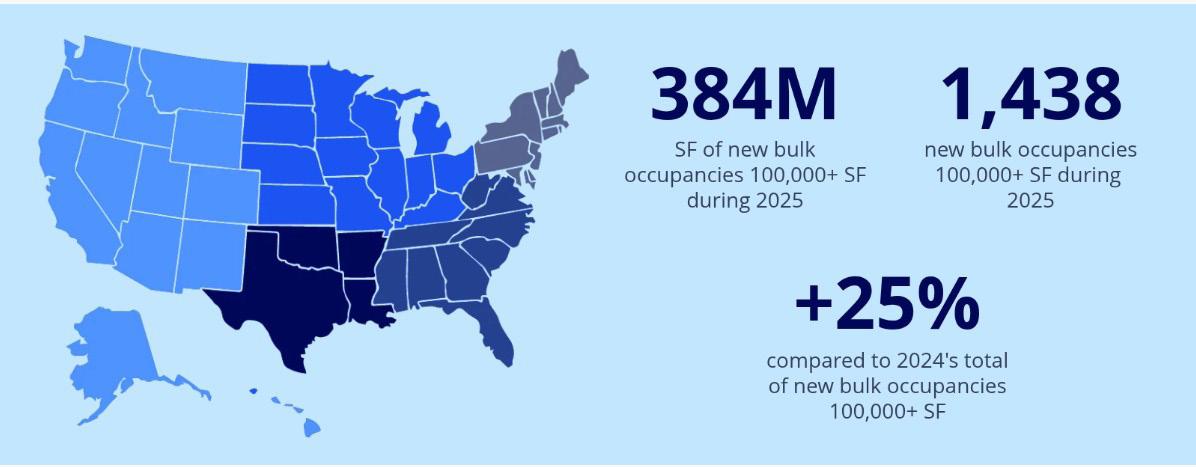
According to Colliers, industrial users moved into 384 million square feet of bulk space across the United States in 2025. That represents a 25 percent increase from the 307 million square feet recorded in 2024.
The rise in move-ins also helped lift demand, particularly in the second half of the year. Net absorption during the final six months of 2025 jumped to 118 million square feet, more than double the 57 million square feet recorded during the first half of the year. Even so, elevated move-outs limited how much those gains could boost overall market performance.
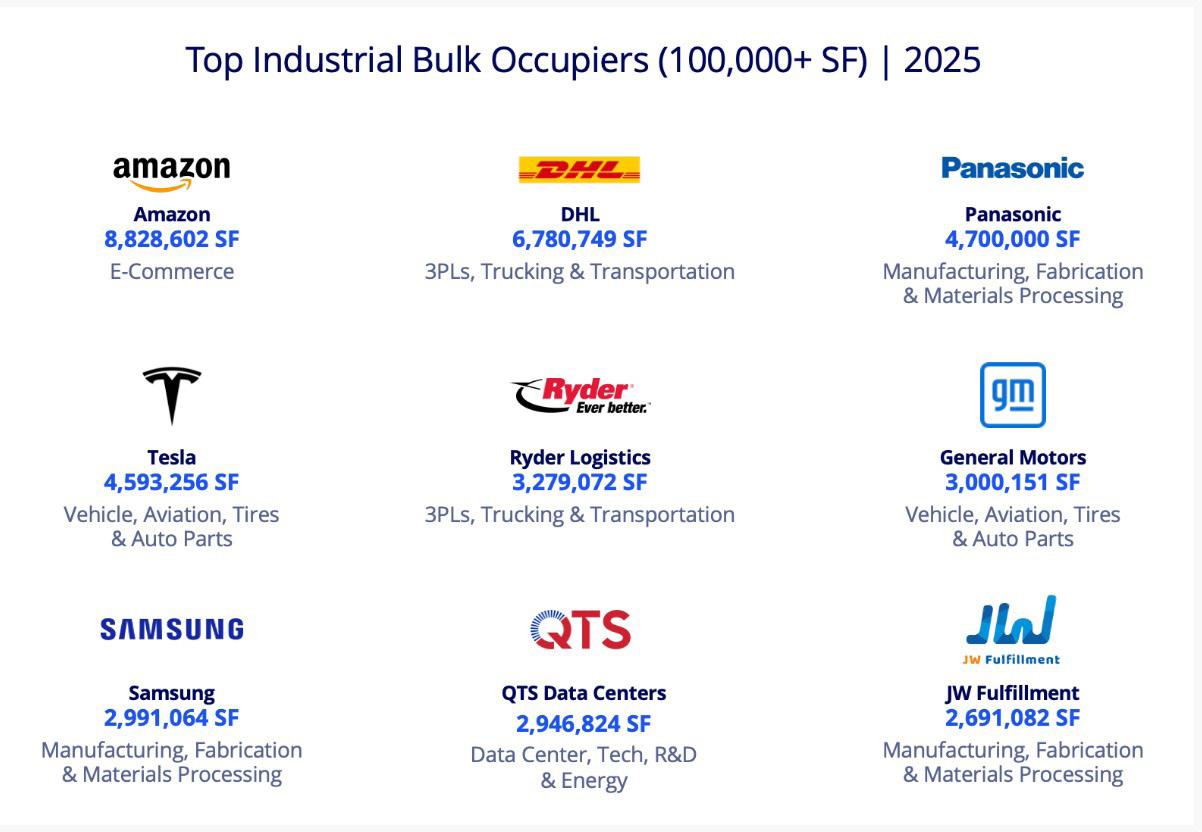
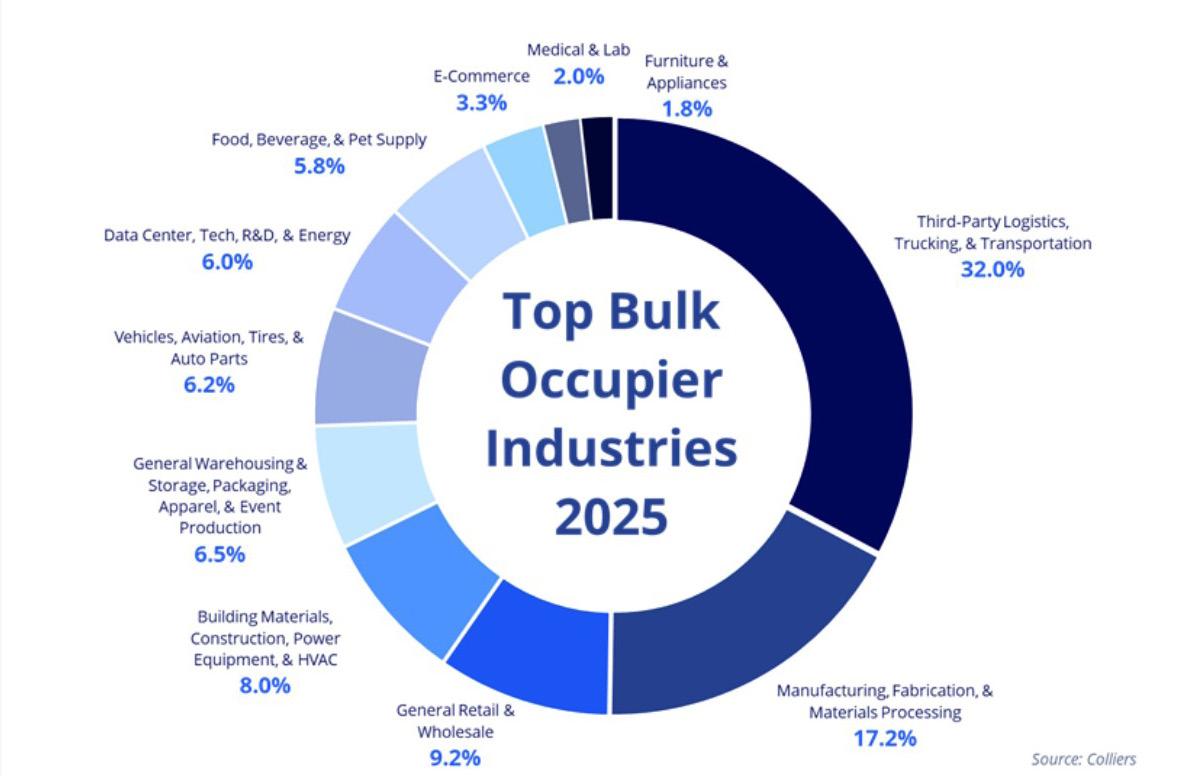
All images courtesy of Colliers.
Large facilities continued to play a key role in the market’s activity. Industrial users moved into 36 buildings of 1 million square feet or larger during 2025. More than one-third of those properties were build-to-suit facilities or buildings purchased directly by their occupants.
Several major advanced-manufacturing projects represented the largest occupancies of the year. These included a 4.7 million-square-foot electric-vehicle battery manufacturing plant developed by Panasonic in Kansas, a 2.8 million-square-foot battery facility developed by General Motors and LG
Energy Solution in Michigan, and a 2.8 million-square-foot semiconductor manufacturing facility operated by Samsung Electronics in Texas.
While average deal sizes grew slightly, they remain below the levels seen earlier in the decade. The typical bulk
industrial transaction measured about 267,000 square feet in 2025. That is up slightly from 2024 but below the 289,000-square-foot average recorded in 2023 and the 309,000-squarefoot average seen in 2022.
Still, the number of individual bulk occupancies continued to climb. Industrial tenants moved into 1,438 large spaces in 2025, up from 1,160 in 2024 and 1,041 in 2023.
Regionally, activity varied across the country. The West recorded the greatest number of move-ins with 404 new occupancies totaling about 100 million square feet, a five percent increase from the previous year.
The Midwest, however, recorded the largest total volume of space absorbed. Industrial users occupied 105 million square feet across 363 move-ins in the region during 2025, a 53 percent increase from 2024 and the highest total of any region in the country.
The Northeast was the only region to record a decline in bulk occupancies, falling 22 percent year over year to 26 million square feet across 87 move-ins.
Activity increased across all building sizes during the year, but the strongest growth occurred in properties ranging from 500,000 to 749,999 square feet, where move-ins climbed 47 percent compared to 2024.
The greatest concentration of deals, though, remained in buildings between 100,000 and 199,999 square feet. Industrial users moved into 792 buildings in that size range during 2025, accounting for 108 million square feet of occupancy and a 23 percent increase from the previous year.
Third-party logistics firms and transportation companies continued to dominate large industrial transactions. These users accounted for roughly one-third of all bulk occupancies in 2025, occupying about 123 million square feet across 430 buildings. That total is up from 100.5 million square feet across 353 occupancies in 2024.
The category was especially prominent in the Northeast, where logistics and transportation firms represented 41 percent of all large industrial occupancies.
International logistics firms also continued expanding their U.S. presence. Asian-based third-party logistics
providers accounted for 21 percent of occupancies within the logistics category since 2024, expanding their footprints to move closer to American consumers, reduce tariff and trade risks and strengthen supply chains near seaports and inland ports.
Manufacturing companies also boosted demand. Firms involved in manufacturing, fabrication and materials processing occupied 66 million square feet of bulk space in 2025, a 49 percent jump from the 44 million square feet recorded in 2024. More than 40 percent of that activity occurred in the Midwest, where manufacturers moved into 27 million square feet during the year.
Among individual companies, Amazon remained the largest new industrial occupier. The e-commerce giant moved into at least 20 large facilities totaling about 9 million square feet in 2025. However, its annual space occupancy has declined each year since 2022.
Global shipping and logistics firm DHL ranked second, occupying 11 facilities totaling about 6.8 million square feet.
Looking ahead, Colliers expects the recovery to continue. Increased leasing activity over the past several quarters should translate into more move-ins during 2026 as tenants take occupancy of recently leased buildings and newly delivered build-to-suit projects.
As the construction pipeline slows and the market stabilizes, new supply and
tenant demand are expected to move closer to balance. That could also slow the pace of tenant move-outs and eventually push the national industrial vacancy rate downward after more than three years of increases.
While the pace of recovery will likely vary by market and region, the diverse mix of industrial users driving occupancy gains in 2025 could help sustain the sector’s momentum through 2026 and beyond.
EVERY PROJECT BEGINS WITH AN IDEA
We bring the ingenuity, experience, and dedication needed to turn ideas into opportunities.
Our developments are built to deliver value, stability, and results.
Our partners would expect nothing less.
Momentum still building: Number of officeto-apartment conversions continues to soar across the United States
By Dan Rafter, Editor
Office-to-apartment conversions continue to break records, with 90,300 such conversions in the pipeline across the United States as of the start of 2026, according to the latest research from RentCafe.
The office-to-apartment conversion trend is continuing to gain momentum, too. RentCafe said that this year’s figure is up 28% from the 70,600 such conversions in the pipeline as of January of 2025.
It looks, then, as if 2026 will be another record year for office-to-apartment projects.
The numbers tell the story: RentCafe said that office conversions now account for almost half -- 47% -- of all future adaptive reuse projects across the country.
The New York City metropolitan area
leads with 16,358 conversions in the backlog, with the Washington D.C. area coming in second place with 8,479 planned office-to-apartment conversions. Chicago pulled up in third place, with 4,360 such conversions in the pipeline at the start of 2026.
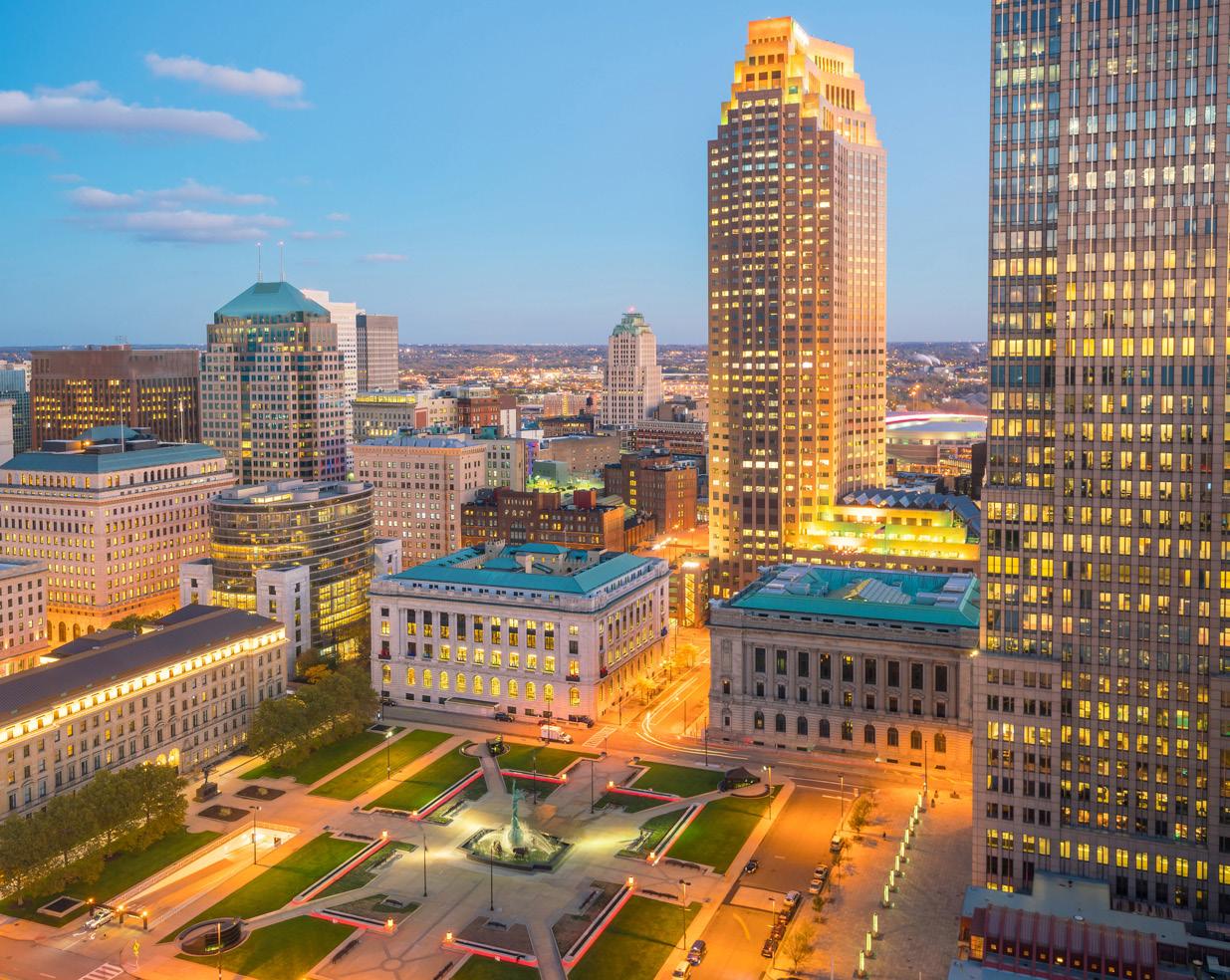
Another Midwest market that is seeing strong office-to-apartment conversion activity? Cleveland. RentCafe said that the city ranks ninth in the country for these conversions, with 1,771 planned as of the start of 2026. Also in Ohio, Cincinnati ranked 10th on RentCafe’s list with 1,770 planned office-to-apartment conversions.
Dallas also landed in the top 10, with 3,966 office-to-apartment conversions in the planning stages as of the start of the year.
These conversions are a positive for the commercial real estate industry. They help remove outdated, difficult-to-lease office space off the
market, replacing it with product that consumers want. The challenge? Conversions can be expensive. And only a limited number of office spaces are a good fit for conversions. They must be in the right location and boast a footprint that doesn’t require too much money to convert.
But for properties that qualify for a conversion? Don’t be surprised to see developers continuing to turn struggling office space into new multifamily buildings. As RentCafe explains, about one-third of U.S. office loans are set to mature by 2027. This means that many office owners face increasing pressure to act on underperforming properties.
“A massive amount of office building loans -- over $213 billion -- are coming due by the end of 2026,” said Doug Ressler, senior analyst and manager of business intelligence with Yardi Matrix, in a written statement. “When loans mature, borrowers need to either pay them off or refinance them. The prob-
lem is that many of these office buildings have lost significant value largely due to remote work trends reducing demand.”
While conversions are a useful too, they are not a cure-all for the office market. As RentCafe says in its report, conversions can be both costly and lengthy. Nearly 66,500 office-to-apartment conversions that were already underway in early 2025 are still under construction this year.
While office-to-apartment conversions are the most common, they are not the only type of conversions that developers and owners are undertaking. RentCafe said that hotels make up about 18% of future adaptive reuse projects, while industrial properties make up about 16%. Other building types, including healthcare facilities, schools, retail and government buildings, account for about 19%.
iStock photo by Bilanol.
Apartment List report: Many renters searching for those cheaper rents in the Midwest
By Dan Rafter, Editor
Is the grass greener in another city? That’s what many apartment renters seem to believe, according to the latest research from Apartment List.
According to Apartment List’s annual Renter Migration Report released in mid-March, 39% of renters on Apartment List were searching for their next home in a new metropolitan area. And 24% of renters were considering a long-distance move to a new state.
And where are renters moving from and to? Apartment List says that many renters are preparing to move out of states in which monthly apartment rents are high, especially in coastal markets, to ones in which they’ll pay less each month. This trend is a positive one for the Midwest, where many markets feature lower monthly rents.
Here’s an interesting example: Apartment List found that 37% of site users renting in Chicago are searching for their next apartment in a different metropolitan area. The most popular outbound destinations are Milwaukee, Indianapolis and Dallas.
In the other direction, 19% of users searching for Chicago apartments are based in a different metropolitan area. The greatest number of inbound searches for Chicago apartments are coming from Dallas, Milwaukee and New York City.
What about other Midwest markets?
Apartment List found that 31,6% of searches for Milwaukee apartments on the site came from out of the Milwaukee metropolitan area. A total of 32.2% of these searches came from Chicago, while 5.2% came from Madison and 3.6% from Minneapolis.
“37% of site users renting in Chicago are searching for their next apartment in a different metropolitan area.”
don’t live in Minneapolis now but want to rent in the city are most often based currently in Chicago (9.6%); St. Cloud, Minnesota (3.7%); or New York
City (3.6%). Renters looking to leave Minneapolis are most often searching Apartment List listings in Des Moines (7.4%); Fargo, North Dakota (5.1%); and St. Cloud, Minnesota (3.9%).
And 24.4% of the Apartment List searches for St. Louis multifamily spaces came from outside that metropolitan area, with 12.4% coming from Chicago, 6% from Kansas City and 3.8% from Columbia, Missouri.
Of renters who live in St. Louis and are searching listings in other markets, Apartment List said that 9.5% were searching for space in Springfield, Missouri; 5.7% in Kansas City, Missouri; and 5.2% in Chicago.
Apartment List found, too, that 22.7% of searches for Minneapolis apart ments on the site came from out of the metropolitan area. Renters who
Renters who live in Milwaukee but are searching Apartment List for a new city in which to rent are most often looking at Madison (10.7% of searches), Chicago (10.4%) or Racine, Wisconsin (4.3%.)
Image by AshirvadPackers from Pixabay.
Wisconsin’s Data Center Reckoning: Four Bills, No Resolution, and a Policy Vacuum
By Rodney Carter, partner, Husch Blackwell, LLP
Wisconsin is in the middle of a data center gold rush — and the State Capitol is struggling to keep up.
Dozens of facilities already dot the state. Billions more in investment are in the pipeline, driven by the insatiable energy demands of artificial intelligence. The state has long offered a generous sales and use tax exemption to attract these projects, and by most measures, the strategy has worked. Wisconsin has quietly become one of the most attractive data center markets in the Midwest.
But a series of bruising controversies over secret deals between data center developers and local governments — and the Legislature’s scrambling response — have put the entire policy framework up for grabs. Four competing legislative proposals were before the Wisconsin Legislature this session, each reflecting a fundamentally different vision of how Wisconsin should manage one of its fastest-growing industries. The session has now ended without resolution on any of them. The outcome will shape where billions of dollars in data center investment flows — and whether Wisconsin keeps its competitive edge.
The NDA Problem That Started It All
It began with secrecy. In communities across Wisconsin — Beaver Dam, Kenosha, Janesville, Menomonie, and the town of Beloit — nondisclosure agreements were quietly signed between data center developers and local government officials, keeping residents in the dark about projects that would dramatically affect their communities’ land, water, and power supply.
When those deals came to light, the backlash was swift. In Menomonie, community opposition was so intense that the city council passed an ordinance blocking a proposed $1.6 billion data center project entirely. The image of elected officials signing secrecy
“Wisconsin has a genuine opportunity to lead. It has the assets, the incentives, and the growing reputation as a serious data center market.”
deals with billion-dollar corporations — and keeping their own constituents in the dark — became politically toxic almost overnight.
The Legislature’s response was bipartisan and fast in committee. Assembly Bill 1036 and its Senate companion, SB-969, would prohibit data centers and local governments alike from entering into nondisclosure agreements intended to conceal the details of data center development from the public. A permit issued to a data center whose developer signed a prohibited NDA would be void. SB-969 advanced out of its Senate committee on a 4-1 vote — a strong bipartisan signal of where legislative sentiment stood on the NDA issue.
But the session ended before either
bill received a full floor vote. Despite the broad consensus on the underlying problem, the NDA legislation died with the close of the session. It will need to be reintroduced.
A trade secret carve-out in the bills preserves the ability of companies to protect genuinely proprietary information. The legislative intent was clear: the era of secret data center deals in Wisconsin should be over. Whether that intent becomes law remains an open question.
The Big Regulatory Fight: Who Pays for the Power?
While the NDA bill moved with relative consensus in committee, the Legislature’s broader regulatory effort became one of the most contentious de-
bates of the session — and ultimately collapsed without a resolution.
AB-840 and its Senate companion SB-843, authored by Rep. Shannon Zimmerman (R-River Falls) and Sen. Romaine Quinn (R-Birchwood), are designed to ensure that the massive energy and water infrastructure demands of data centers are paid for by the facilities themselves — not passed along to Wisconsin homes and small businesses through higher utility bills.
On paper, it sounds straightforward. In practice, it managed to unite an unlikely coalition of critics.
The bill’s most controversial provision would require that renewable energy facilities primarily serving a data center be located on the data center’s own
iStock photo, credit Hugo Kurk.
site. The intent was to prevent developers from benefiting from broader gridwide renewable energy investments made at other customers’ expense. But critics — including Democrats, environmental groups, and the data center industry itself — argued that the provision effectively makes it economically and logistically impossible for large data centers to meet meaningful renewable energy goals, and that it would push facilities toward natural gas instead.
“A non-starter for many of the companies seeking to locate in our state,” said Rep. Angela Stroud (D-Ashland). The River Alliance of Wisconsin argued the provision would “likely have the effect of discouraging renewable energy use entirely.”
The bill passed the Assembly 53-44, and cleared its Senate committee 3-2. But it never received a Senate floor vote. The Wisconsin Senate adjourned without taking up AB-840 — or any data center regulation bill — on the floor. Assembly Speaker Robin Vos publicly expressed his frustration at the Senate’s inaction, but the session ended regardless.
The result is not a veto, a negotiated compromise, or even a clean defeat on the merits. It is a policy vacuum. The core questions AB-840 raised — who pays for data center energy infrastructure, on what terms, and with what environmental conditions attached — remain entirely unresolved. They will return next session, in a political environment shaped by everything that happened this one.
The Democratic Vision: Tie Tax Breaks to Green Energy and Labor
While AB-840 is the Republican vehicle, Democrats have their own proposal. AB-722 and SB-729, authored by Sen. Jodi Habush Sinykin (D-Whitefish Bay) and Rep. Angela Stroud, would create a new “very large customer” utility rate class for data centers and — crucially — condition eligibility for Wisconsin’s existing data center tax exemptions on meeting labor standards and sourcing at least 70% of energy from renewable sources.
With Republicans controlling both chambers, this bill was unlikely to pass in the current session, and it did not. But the collapse of AB-840 — and the broad criticism it attracted from environmentalists, labor, utilities, and the data center industry alike — suggests that any bill that does reach a
Governor’s desk in a future session will likely need to address the clean energy concerns that Democrats have been raising. Developers planning long-term projects in Wisconsin should be paying attention.
The Moratorium: A Warning Shot from the Left
And then there is AB-1099 — the most aggressive proposal of them all. Introduced by a group of Democratic lawmakers including Rep. Madison and Sen. Larson, the moratorium bill would prohibit anyone from operating a data center in Wisconsin until the Legislature enacts a comprehensive statutory framework covering everything from energy and water standards to community referendums and reclamation bonds.
The bill faced long odds in a Republican-controlled Legislature, and it did not pass. But its introduction reflects real anxiety — in communities, in environmental advocacy groups, and increasingly in the press — about whether Wisconsin is moving too fast to adequately assess the costs of largescale data center development.
The River Alliance of Wisconsin has put it plainly: “Our preference in this moment of uncertainty would be to pause all new data center construction until we can develop appropriate legislative mechanisms for managing its downsides.”
That sentiment did not command a majority in the Capitol — but the session’s failure to produce any legislative resolution on data center regulation has given it new resonance. It is shaping the political environment in which every data center bill will need to survive when the Legislature returns.
What It All Means for Wisconsin Business
For the real estate developers, investors, utilities, municipalities, and businesses involved in Wisconsin’s data center economy, the legislative moment is genuinely consequential — and the stakes of getting it wrong are high.
The primary regulatory framework for data centers in Wisconsin was not rejected by a Governor — it was never even voted on by the full Senate. The underlying pressures that drove AB840 remain entirely live: ratepayer protection, renewable energy sourcing, water usage, and reclamation obligations are unresolved issues that will return in renegotiated or successor bills. The NDA legislation, despite broad bipartisan support in committee, also failed to reach the floor — meaning the legal framework governing pre-development secrecy agreements remains unchanged for now. If the Democratic alternative’s vision of tying tax incentives to renewable energy benchmarks gains traction in future sessions, the economic calculus for new projects will shift significantly.
And if the Legislature again fails to act coherently — if the next session ends without a clear regulatory framework — it creates a compounding risk: the uncertainty that comes from operating in a prolonged policy vacuum, where the rules governing billions of dollars in investment remain undefined from one session to the next.
Wisconsin has a genuine opportunity to lead. It has the assets, the incentives, and the growing reputation as a serious data center market. But that position is not guaranteed. The decisions that will unfold in Madison next session will either reinforce Wisconsin’s competitive standing or erode it — and the data center industry, the communities hosting these projects, and the ratepayers powering them all have a stake in the outcome.
Rod Carter is a partner at Husch Blackwell, where he advises clients on data center development, permitting, utility and energy contracting, and regulatory compliance. Husch Blackwell is a founding member of the Wisconsin Data Center Coalition.
Rod Carter (Photo courtesy of Husch Blackwell.)
Why your community should welcome data centers, not fear them
By Shawn Clark, CRG
Ispend most of my time thinking about where to deploy capital in real estate, what markets are growing, what asset classes have tailwinds, and where the next wave of development opportunity is forming. Right now, there is no clearer signal in commercial real estate than data centers. The demand is real. The capital is flowing. And in many parts of the country, the welcome mat is out.
But not everywhere. In a growing number of communities, particularly across the Midwest, local opposition is killing projects before they break ground. Residents show up at zoning meetings armed with worst-case anecdotes from Northern Virginia and emotional arguments about noise, water, and property values.
Politicians, eager to avoid controversy, table the discussion or ban data centers outright. And billions of dollars in investment quietly relocate to states that want them.
I’m writing this because the misinformation problem is getting worse, and the economic stakes are too high to stay silent.
The economic case is overwhelming
Between 2017 and 2023, the U.S. data center industry contributed $715.5 billion in total tax revenue across federal, state, and local governments, according to PwC and the Center of Your Digital World’s 2025 Impact Study. That’s not a projection, it’s what already happened.
Take Nebraska, a relatively small data center market. Just 490 full-time data center workers and 1,500 construction workers generated $1.3 billion in combined tax revenue in a single year. Ohio’s data center ecosystem supported 82,800 jobs in 2023 alone, including roughly 16,100 on-site roles, with the rest spread across support services, supply chains, and the broader local economy.
These aren’t warehouse jobs. A single large-scale data center can create over 4,000 construction jobs over two
to three years, followed by up to 300 permanent, high-skilled operational roles. Specifically, the data centers we are building today with Clayco are on track to have over 4,000 craft workers at peak construction. Plus, there is a multiplier effect that ripples through restaurants, housing, retail, and services. Construction wages on these projects are among the highest in the trades. The operational tech salaries that follow are even better.
And unlike a traditional construction project, where the work ends at ribbon-cutting, data centers require constant equipment refreshes and upgrades. The servers, cooling systems, and power infrastructure inside these facilities are updated on rolling cycles, creating ongoing maintenance work and consistent demand for skilled electricians, mechanical technicians, and controls specialists long after the building is finished. This isn’t a one-time construction boom. It’s a permanent pipeline of skilled trade work. For mid-size communities struggling with declining industrial bases, this is exactly the kind of investment that transforms a local economy.
The opposition isn’t backed by data
Let’s address the most common objections head-on, because they keep coming up, and they keep being wrong.
“They use too much water.”
Modern data center facilities increasingly use closed-loop or air-based cooling systems that recirculate water
or eliminate water use entirely. The industry trend is aggressively moving toward water-efficient and water-free cooling, particularly in water-stressed regions. Many operators are signing municipal agreements to use reclaimed water or pledging net-positive water restoration. This isn’t the 2015 data center playbook anymore.
Rather than reacting to scarcity, Ohio is building a governance model designed to preserve long-term water security while sustaining data center growth. Other states can move to this proactive resource governance to avoid future backlash and continue data center growth.
“They’ll raise our electric bills.”
This one is especially frustrating in Missouri, where the narrative has taken hold even though most proposed data centers aren’t even built or online yet. They literally cannot be causing current rate increases. Missouri Senator Cindy O’Laughlin made the point clearly in February 2026: Current rate increases are driven by green energy mandates, not data centers. Solar operates at roughly 18% of nameplate capacity, but ratepayers pay 100% of the cost. States with the highest power prices are consistently states with the most aggressive renewable mandates. Meanwhile, data centers often fund utility infrastructure upgrades that benefit the entire grid, improvements that wouldn’t happen otherwise.
And Missouri isn’t leaving this to chance. The state legislature passed
a law requiring data centers to pay for all the electricity they consume, meaning no subsidies from ratepayers. The Missouri Public Service Commission is finalizing special tariff schedules for any customer exceeding 100 megawatts of demand. “Data centers are required by law to pay rates that the PSC has determined reasonably cover their fair share of energy costs to serve them. We are not offering them any discounts,” said Rob Dixon, Senior Director of Economic, Community, and Business Development at Ameren. “The infrastructure costs to connect large data centers to the grid are not passed on to other customers.” The law was backed by a broad coalition including the Missouri Chamber of Commerce and the Missouri AFL-CIO; two groups that rarely agree on anything.
“They don’t create enough permanent jobs.”
Ohio has 82,800 ecosystem jobs. That number includes direct, indirect, and induced employment. The idea that a billion-dollar technology campus creates fewer economic benefits than the vacant lot or underperforming industrial site it replaces is simply not supported by any serious analysis.
But the real story is what happens after construction. Unlike a traditional building, where the work ends at ribbon-cutting, data centers require constant equipment refreshes and upgrades. The servers, cooling systems, power infrastructure, and network hardware inside these facilities are updated on rolling 3to 5-year cycles, creating a permanent pipeline of skilled trade work for electricians, mechanical technicians, HVAC specialists, and controls engineers. As the Missouri Times reported, these developments “promise high-paying construction jobs that extend over multiple years due to the continuous need for upgrades and maintenance.”
“They’re ugly and hurt property values.”
Modern data centers are designed with aesthetic buffers, extensive landscaping, and noise mitigation systems. They’re typically built on industri-
iStock photo by tiero
al-zoned land that sees property value increases from the economic activity they generate. The honest comparison isn’t a data center versus a nature preserve. It’s a data center versus an abandoned factory or an empty field generating zero tax revenue.
This is a national security issue
The conversation about data centers too often stays at the local level: water, noise, and property values. But the strategic dimension matters just as much. Secure, resilient data infrastructure plays a meaningful role in national security. Our financial systems, communications networks, healthcare records, and emerging AI and defense technologies all depend on domestic, hardened facilities operating without interruption.
Dependence on foreign data infrastructure is a strategic vulnerability. The United States is in a global competition to build and maintain sovereign computing capacity, and the communities that host these facilities are directly contributing to national resilience. Gigawatt-scale campuses are being built across the country right now. This is infrastructure investment at the scale of the interstate highway system, and it matters for reasons that extend well beyond any single municipality’s zoning debate.
Misinformation is real – and growing
Opposition groups use emotional framing (e.g., noise, aesthetics, vague fears about property values) without engaging the actual data. Social media amplifies worst-case scenarios from Virginia’s early, poorly planned data center corridor in Loudoun County as if they apply to every proposed facility everywhere. National media coverage from NPR, the New York Times, and the Washington Post tends to center opposition narratives, which local activists then cite as authoritative.
The irony is hard to miss: the same people opposing data centers use the services they power every single day. Banking, healthcare records, streaming, online shopping, AI assistants — all of it runs through the exact infrastructure they’re trying to block.
What’s needed is proactive engagement from developers, transparent community benefit agreements, and elected leaders willing to present facts rather than duck the conversation. A 2025 national survey by Atomik Research found that most Americans support data
centers when they understand the jobs, investment, and tax relief they bring.
More than half of respondents didn’t even realize data centers power the everyday services they rely on. The awareness gap is the problem, and it’s solvable.
Smart communities are playing this differently
Not every community is getting this wrong. Texas has welcomed gigawatt-scale campuses with open arms, reaping construction employment, utility investment, and long-term tax base expansion. Nebraska, a small market by any measure, turned a modest data center presence into $1.3 billion in tax revenue. Ohio embraced data center development and now supports nearly 83,000 ecosystem jobs.
Georgia may be the strongest example. A 2025 state analysis by the University of Georgia’s Carl Vinson Institute found that data centers created 28,350 construction jobs and added $3.4 billion to the state economy in a single year, plus 5,471 permanent operations roles generating another $823 million in economic activity. The property tax impact is staggering: four new metro Atlanta data centers averaged $2.3 billion in assessed property value each, generating roughly $28 million in annual property tax revenue per project. Counties are using that money to build new schools and rebuild aging water infrastructure.
With 63 active data centers, 35 under construction, and 249 more announced, Georgia has a nearly $50 billion pipeline of projects. As PSC Commissioner Tricia Pridemore put it: “We have counties planning new school builds with this local revenue.”
The operators themselves are putting real money behind community investment. Meta’s Data Center Community Action Grants program has now allocated more than $94 million in direct funding across 3,700 projects globally, spanning 27 data center regions. In March 2026 alone, the latest round of grants is funding drone and smart board technology for agricultural training in Northeast Louisiana, AI literacy programs reaching more than 4,000 students near Bowling Green, Ohio, bilingual AI-powered health coaching for underserved communities in Temple, Texas, and a GPU-accelerated autonomous technology hub at Isothermal Community College in Forest City, North Carolina.
These aren’t press releases. They’re real investments in STEAM education, healthcare access, and workforce development in the exact communities hosting their facilities. This is what engaged corporate citizenship looks like, and it directly counters the “digital colonization” narrative gaining traction in national media.
Closing thoughts
The data center buildout is a once-in-a-generation infrastructure cycle, and I don’t use that phrase lightly. The closest historical parallel is the railroad. In the 1850s and 1860s, towns that welcomed the railroad became economic hubs for the next century. Towns that fought it, worried about noise, smoke, disruption to the way things were, got bypassed. Many of them never recovered. The railroad didn’t just move goods. It determined which communities thrived and which ones faded from the map.
Data centers are the railroads of the AI era. They are the physical infrastructure that the entire digital economy runs on, and the communities that host them will capture the tax revenue, jobs, work-
DATA CENTERS
force development, and the long-term economic gravity that comes with being on the right side of a technological revolution. Just as the Industrial Revolution rewarded the places that embraced the steam engine and the rail line, the AI revolution will reward the places that embrace the data center.
Communities have legitimate questions about these facilities, and they deserve honest, data-driven answers, not bans born from fear and misinformation. But let’s be clear about what’s at stake. This isn’t a zoning debate. It’s a decision about whether your community will be a hub or a footnote. The billions in investment, thousands of jobs, and decades of tax revenue don’t disappear when a town says no. They relocate to Texas, Indiana, Georgia, and every other state that’s ready and willing.
The towns that said yes to the railroad built the American economy. The towns saying yes to data centers are building the next one.
Shawn Clark is chief executive officer of CRG, which has Midwest offices in Chicago and St. Louis.
Capital flows in industrial: Who’s buying, who’s pausing and who’s targeting niche assets
By Kevin Carlson, Clear Height Properties
Over the past 24 months, industrial real estate has undergone a quiet but meaningful reshuffling of capital. While headline narratives have focused on interest rates, development slowdowns, and bid-ask spreads, the more interesting story has been where capital is still flowing, and why.
Industrial is not a monolith. Capital behavior today varies sharply by unit size, lease profile, and operational complexity. Within the larger industrial spectrum, development has remained difficult to capitalize over the past 24-36 months due to the inventory oversupply which was delivered as a response to COVIDera demand for local warehousing space. The resulting underperformance of large box warehouse & logistics product has turned institutional investor attention to another vertical, light industrial. Light industrial, defined in this context as single and multi-tenant properties with <50,000 square foot units with a mix of grade-level and dock high loading.
Who’s Buying: Institutions Lean Into Mark-to-Market
Despite broader market uncertainty, institutional capital has remained active in industrial, particularly core+ and value-add funds that can underwrite operational upside rather than rely on cap rate compression.
The common thread among today’s buyers is a focus on embedded mark-to-market rent growth, especially in multi-tenant industrial portfolios. Years of below-market leases, often the byproduct of fragmented ownership and lack of institutional oversight, have created a durable runway for NOI growth that is less dependent on aggressive leverage or speculative assumptions.
As institutions push to deploy value-add capital, groups are gravitating toward shorter-term WALT, favoring flexibility and the ability to reprice space in a still-tight infill environment. That said, there remains a subset of disciplined capital, often funds later in their lifecycle or single-asset capital stacks, willing to acquire medium-term WALT assets where liquidity is thinner but basis can be compelling. These buyers are not avoiding duration risk; they are being paid for it.
In many respects, this is a more rational market. Capital is underwriting cash flow growth first and financial engineering second.
Who’s Pausing: Capital Is Not Gone - It’s Repositioning
The most visible pause has come from open-ended REITs, many of which are still managing redemptions and rebalancing portfolios. Their reduced acquisition activity is
less a statement on industrial fundamentals and more a function of capital structure and liquidity management.
Similarly, closed-end funds between vintages, or those navigating a slower fundraising environment, have stepped back, even when acquisition teams remain active. This pause is structural, not philosophical. The capital is still bullish on industrial; it simply has not yet been re-allocated.
Importantly, this pause is occurring alongside a material improvement in the debt environment. Compared to 18–24 months ago, buyers today are seeing:
• More consistent debt availability
• Higher leverage levels
• Lower all-in cost of capital
This has not yet resulted in aggressive asset repricing across the board,
but it has narrowed bid-ask spreads and re-enabled transaction velocity for buyers with conviction. In other words, the pause is thawing, selectively.
Who’s Targeting Niche Assets: The Down-Market Shift
Perhaps the most notable shift in capital flows has been the institutional move down-market into light industrial and small-bay product.
Large, closed-end vehicles that historically focused on bulk distribution and Class A development are increasingly acquiring small-bay light industrial directly and/or partnering with experienced local operators to do so. The reason is straightforward: risk has re-priced development.
Higher vacancy, slower leasing velocity, and capital-intensive buildouts have made speculative bulk development a less attractive deployment channel, particularly late
Photo courtesy of Clear Height Properties.
in the cycle. In contrast, infill smallbay industrial has proven resilient, with diversified tenant bases, steady demand, and strong re-leasing fundamentals even during periods of economic uncertainty.
To remain active, many large groups have also shown a willingness to downsize deal size, prioritizing execution & returns over scale optics. This marks a meaningful departure from prior cycles, where institutional capital often avoided smaller transactions due to inefficiency.
What was once viewed as “sub-institutional” is now being recognized as operationally institutional, but manager-dependent.
Why Local Operators Still Matter
As capital crowds into small-bay and light industrial, a familiar truth has resurfaced: execution matters more than ownership size.
Multi-tenant small-bay portfolios are operationally intensive. Leasing velocity, tenant retention, capital
allocation, and day-to-day asset management drive outcomes far more than financial structuring alone. Vertically integrated local operators, like Clear Height Properties, with deep market knowledge and hands-on management, continue to be the most effective stewards of these assets.
Institutional capital has taken notice. While large groups increasingly dominate fundraising and influence
“At DarwinPW Realty, we look at building long term relationships and we achieve this by putting our clients’ interests above all others.
For over 45 years, DarwinPW Realty/ CORFAC International has been a leader in industrial and commercial real estate. The company specializes in brokerage, property management, investment and development services primarily in the Midwest. DarwinPW Realty’s highly qualified professionals are problem solvers and utilize a breadth of tools and knowledge to serve our clients best.
pricing, many rely on local operating partners to source, execute, and manage these portfolios efficiently. In doing so, pricing for well-located light industrial has shifted from traditional value-add toward core+ valuations, even when business plans still require meaningful execution.
This dynamic has created both opportunity and tension. Returns are being compressed, but risk profiles are improving. The winners will be those who can maintain discipline while operating at institutional standards.
A Market That’s Selective, Not Stalled
Industrial today is not suffering from a lack of capital, with the decline of high basis office investment, there has never been a time when industrial has been more in focus. Despite the need to deploy capital, institutional funds are deploying with greater scrutiny, deeper underwriting, and a renewed emphasis on operational alpha.
INDUSTRIAL
For groups like Clear Height Properties, this environment rewards focus. Small-bay, shallow-bay, infill industrial has demonstrated its durability through the cycle, and disciplined acquisition paired with active management continues to attract both capital and tenants.
Looking ahead, the next phase of the industrial market will not be defined by who can raise the most capital, but by who can deploy it thoughtfully. As institutions increasingly target niche assets, the advantage will remain with operators who understand the real estate at the ground level and can translate that knowledge into durable cash flow.
Industrial has matured. The easy money phase is over. What remains is a market that rewards expertise, patience, and execution.
Kevin Carlson is Executive Director of Capital Markets for Clear Height Properties.
Jerry Sullivan Principal
Kevin Carlson (Photo courtesy of Clear Height Properties.)
COMMERCIAL SERVICES
ASSET/PROPERTY MANAGEMENT FIRMS
MID-AMERICA
One Parkview Plaza, 9th Floor Oakbrook Terrace, Illinois 60181
Primary Contacts
Jean Zoerner-Illinois, JMZoerner@midamericagrp.com; Brad Lefkowitz-Michigan, blefkowitz@midamericagrp.com; Brandon O’ Connell-Minnesota, boconnell@midamericagrp.com; Jim Vaillancourt-Wisconsin, jvaillancourt@midamericagrp.com
Core Services
Mid-America provides strategic consulting services that maximize net operating income, net cash flow, and accelerate property appreciation. We provide property and construction management, leasing, due diligence, and market analysis. Additionally, we offer MA Building Services, a self-performing porter and maintenance company offering our clients cost savings and improved accountability for related services.
About Mid-America
Mid-America Real Estate is #1 in retail real estate services in the Midwest, with full-service offices in Illinois, Michigan, Minnesota, and Wisconsin. Our exclusive focus on retail property, combined with cutting-edge technology and unsurpassed service, distinguishes Mid-America within the industry and provides clients with a competitive edge. The total consideration value of leasing and investment sales transactions facilitated in 2025 was $2.6 billion. Mid-America leases and manages more than 50 million square feet of retail space, provides comprehensive selfperforming facility services, and represents over 270 retailers and other tenants. For more information, visit www.midamericagrp.com.
BROKERAGE FIRMS
AREA REAL ESTATE ADVISORS
4800 Main Street, Suite 400 Kansas City, MO 64112
P: 816.895.4800 openarea.com
Primary Contacts
Tim Schaffer, Founder & President, tschaffer@openarea.com
Matt Vaupell, Managing Partner, mvaupell@openarea.com
Doug Grossenbacher, Partner, Director of Property Management, dgrossenbacher@openarea.com
Core Services
Office, Retail & Industrial Landlord and Tenant Representation; Property Management; Project Management; Investment; Research Analytics and Consulting
Firm Profile
AREA Real Estate Advisors is a full-suite commercial real estate firm in Kansas City. AREA is the hometown team that plays in the big leagues. Our size and scope allow us to be nimble and apply a team-driven approach while providing best-in-class service. At AREA, we deal in real estate, but our business is relationships. We are committed to meaningful partnerships with our clients to ensure that their goals are achieved. Our goal is to exceed our clients’ expectations.
Selected Clients
KU Endowment, Federal Realty, SomeraRoad, Price Brothers Management, Gillon Property Group, Five Below, Bath & Body Works, Arvest Bank, Emler Swim School, 151 Coffee, Equity Bank, American Academy of Family Physicians
OUTLOOK MANAGEMENT GROUP, LLC AMO
S74 W16853 Janesville Road
Muskego, WI 53150
P: 414.369.3511 | F: 414.435.0251 outlookmgmt.com
Primary Contact
Ray Balfanz, President/Partner, ray@outlookmgmt.com
Core Services
Full-service property and asset management services, financial analysis and reporting; budget preparation and expense reconciliations; lease administration; construction management; preventative maintenance and consulting services.
Company Overview
Outlook Management Group, LLC AMO provides comprehensive property and asset management services for all asset classes in multiple states and markets.
Selected Properties Managed
Washington Corners, Naperville, IL; Ironwood Office Park, Glendale, WI; Wood River Condominiums, West Bend, WI; Seven 10 West Luxury Apartments, Chicago, IL; MDJD Aesthetic MOB, Rockford, IL, Ascension Health MOB Milwaukee, WI; Henry Ford Health Systems Pharmacy Services Bldg. in Rochester Hills, MI; Henry Ford Medical Center in West Bloomfield, MI.
Randy Goodman, President, Randy@goodmanrealestate.com; Richard Edelman, Senior Vice President/Principal, Richard@goodmanrealestate.com
Core Services
National investment sales, tenant and buyer site selection, property marketing, leasing, sales, and disposition.
Firm Overview
Goodman Real Estate Services Group LLC is a leading commercial brokerage firm based in Ohio that currently markets 13.6 million square feet of property for sale, lease, or development throughout Ohio, and 14 other states with partner brokers, nationwide for investment sales, and tenant and buyer site selection with over 100 companies represented. We combine experience, technology, a large support team and hard work to provide exceptional service to our clients. Goodman Real Estate have offices in Cleveland and Columbus.
CONSTRUCTION COMPANIES/GENERAL CONTRACTORS
BRINKMANN CONSTRUCTORS
16650 Chesterfield Grove Road, Suite 100
Chesterfield, MO 63005
P: 636.537.9700
BrinkmannConstructors.com
Primary Contacts
Brian Satterthwaite, CEO, bsatterthwaite@brinkmannconstructors.com; Tom Oberle, President, toberle@brinkmannconstructors.com; Rebecca Randolph, Executive Director of Business Development & Marketing, RRandolph@brinkmannconstructors.com
Core Services
General contracting services including design/build, design/assist, and construction management
Company Overview
Brinkmann Constructors is a national general contractor that has completed over $10 billion of construction projects across multiple market sectors, including senior living, multifamily, student housing, warehouse, cold storage, manufacturing, automotive, retail, hospitality, and more. With regional offices in St. Louis, Denver, Kansas City, Phoenix, and Richmond and a project footprint that spans 41 states, our mission is to deliver the best construction experience for the people we serve, with a foundation built on lasting relationships and expertise driven by insight—beyond measure.
•Axial Rockville 64 - Rockville, Virginia - Two speculative warehouses totaling 330,550 SF
•I-10 International - Tucson, Arizona - Two warehouses totaling 374,000 SF •74 Broadway – Kansas City, Missouri - 440,000 SF mixed-use development with 280 units
•Aspendale Littleton - Littleton, Colorado - 231,000 SF active adult community with 190 units
MERIDIAN DESIGN BUILD
9550 W. Higgins Road, Suite 400 Rosemont, IL 60018
P: 847.374.9200
info@meridiandb.com meridiandb.com
Primary Contacts
Paul Chuma, President
Howard Green, Executive Vice President
Core Services
Meridian Design Build provides construction and design/ build construction services on a national basis with a primary focus on industrial, office, medical office, retail and food and beverage work.
Company Overview
With a team of in-house professional project managers, Meridian has extensive experience coordinating the design and construction of new buildings, tenant improvements, and additions/renovations from 15,000 square feet to 1,000,000+ square feet. Meridian Design Build has been a Member of the U.S. Green Building Council since 2007.
Selected Projects
University Park Logistics Center, University Park, IL - 970,123 sf speculative multitenant industrial distribution/warehouse facility for Clarius Partners and Hillwood Investment Properties. Silesia Flavors, Huntley, IL - 134,075 sf food production, laboratory, research and development, and office facility for Venture One Real Estate and a global leader in confectionery and beverage flavors. FedEx Ground, Gary, IN - 324,901 sf package sorting and distribution center on a 78-acre redevelopment site for Scannell Properties and Transport Properties.
PRINCIPLE CONSTRUCTION CORP.
9450 West Bryn Mawr Ave., Suite 120 Rosemont, IL 60018
P: 847.615.1515 | F: 847.615.1598 pccdb.com
Primary Contacts
Mark L Augustyn, COO, maugustyn@pccdb.com, James A. Brucato, President, jbrucato@pccdb.com
Core Services
Since 1999, Principle Construction Corp. has been a leading design-build general contractor serving the industrial markets of Chicago Metro, Southern Wisconsin, and Northwest Indiana. We specialize in designing and constructing exacting solutions for our clients, including:
• Built-to-Suit Facilities
• Speculative Facilities
• Warehouse and Distribution Centers
• Logistics and Cross-Dock Facilities
• Industrial Outdoor Storage
•Industrial and Manufacturing Plant • Tenant Improvements
• Expansions and Additions• Food Processing Facilities
• Specialty Projects
Selected Projects
• 8,205 SF animal shelter for Heartland Animal Shelter, at 586 Palwaukee Dr., in Wheeling, IL.
• 12,560 SF showroom and outdoor pool park for Doheny Enterprises, at 5307 Green Bay Rd., in Kenosha, WI
• Phase 1 renovation project for SMW Autoblok, at 285 Egidi Dr., Wheeling, IL
REAL ESTATE LAW FIRMS
SARNOFF PROPERTY TAX
100 N. LaSalle St., 10th Floor Chicago, IL 60602
P: 312.782.8310 Sarnoffpropertytax.com
Primary Contact
James Sarnoff jsarnoff@sarnoffpropertytax.com, P: 312.448.5337
Core Services
Since 1986, Sarnoff Property Tax has been a leading and recognized law firm concentrating solely in the field of property taxation. We help clients secure favorable taxes in Illinois through property tax appeals, incentives, and consulting.
Firm Overview
Sarnoff Property Tax’s clients include Owners, Developers, Managers, REITs, Fortune 500 Companies, Private Equity Firms, etc., in connection with commercial property, high-rise and low -rise apartment buildings, condominium associations and singlefamily home portfolios.
WORSEK & VIHON, LLP
180 North LaSalle Street, Suite 3010 Chicago, IL 60601
Francis W. O’Malley, Managing Partner, fomalley@wvproptax.com; Jessica L. MacLean, Partner, jmaclean@wvproptax.com
Core Services
Worsek & Vihon, LLP represents taxpayers in Illinois by limiting their property tax liabilities through ad valorem appeals resulting in lower tax bills. We have over 40 years of experience and can handle basic to the most complex assessment issues while offering the dependable, personalized attention our clients deserve. We have experience representing owners of all property types. In addition to filing thousands of appeals with the Cook County Assessor, we have been involved in numerous proceedings before various Boards of Review, the Illinois Property Tax Appeal Board, and the Circuit Court of Illinois, and have appeared before the Illinois Appellate and Supreme Courts.
Firm Overview
Worsek & Vihon LLP, is a team of highly experienced attorneys singularly focused on Illinois real estate tax law. The firm is dedicated to minimizing property tax liabilities through strategic tax portfolio management, well researched, creative appeal preparation and aggressive advocacy.