Commercial
(pg 20):
![]()
Commercial
(pg 20):
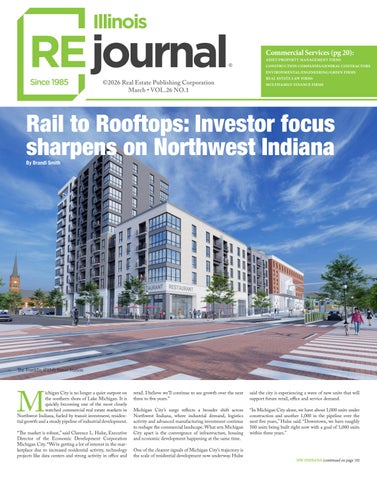
By Brandi Smith

Michigan City is no longer a quiet outpost on the southern shore of Lake Michigan. It is quickly becoming one of the most closely watched commercial real estate markets in Northwest Indiana, fueled by transit investment, residential growth and a steady pipeline of industrial development.
“The market is robust,” said Clarence L. Hulse, Executive Director of the Economic Development Corporation Michigan City. “We’re getting a lot of interest in the marketplace due to increased residential activity, technology projects like data centers and strong activity in office and
retail. I believe we’ll continue to see growth over the next three to five years.”
Michigan City’s surge reflects a broader shift across Northwest Indiana, where industrial demand, logistics activity and advanced manufacturing investment continue to reshape the commercial landscape. What sets Michigan City apart is the convergence of infrastructure, housing and economic development happening at the same time.
One of the clearest signals of Michigan City’s trajectory is the scale of residential development now underway. Hulse
said the city is experiencing a wave of new units that will support future retail, office and service demand.
“In Michigan City alone, we have about 1,000 units under construction and another 1,000 in the pipeline over the next five years,” Hulse said. “Downtown, we have roughly 500 units being built right now with a goal of 1,000 units within three years.” ©2026


PUBLISHER Mark Menzies menzies@rejournals.com
EDITOR
Dan Rafter drafter@rejournals.com
VICE PRESIDENT OF SALES & MW CONFERENCE SERIES MANAGER Ernie Abood eabood@rejournals.com
VICE PRESIDENT OF SALES Frank E. Biondo frank.biondo@rejournals.com
CLASSIFIED DIRECTOR
Susan Mickey smickey@rejournals.com
MARKETING & EVENTS COORDINATOR Allison Kim Allison.kim@rejournals.com 4
www.rejournals.com
RAIL TO ROOFTOPS: INVESTOR FOCUS SHARPENS ON NORTHWEST INDIANA Michigan City is no longer a quiet outpost on the southern shore of Lake Michigan. It is quickly becoming one of the most closely watched commercial real estate markets in Northwest Indiana.
TIGHT VACANCY, THIN PIPELINE: CHICAGO MULTIFAMILY AND ITS ‘MISSING MIDDLE’ Chicago’s multifamily market enters 2026 with strong operating fundamentals and a restrained development pipeline.
KEEPING UP—THE EVOLVING BODY OF REAL ESTATE LAW
The past few years have brought an unprecedented wave of new laws affecting the commercial real estate industry. These developments demand a level of legal sophistication far beyond filling in blanks on a form lease or asking AI to generate a contract, and failing to account for them can lead to costly and unexpected consequences.
TURF TALK: COMMERCIAL LANDSCAPING & SNOW REMOVAL STRATEGIES The overlooked maintenance of late winter, early spring.
THE FUTURE OF HOSPITALITY AND ENTERTAINMENT IS ON THE ASCENT. BUCKLE UP! There are numerous signs the themed entertainment industry is well on its way to recovery and beyond.
POP-UP CONCESSION STANDS AND PORTA-POTTIES? NOT ANYMORE. HIGH SCHOOL ATHLETIC FACILITIES ARE BECOMING GATHERING SPACES AND SHOWCASES A growing number of high schools are turning their athletic facilities into community gateways that focus on safety and accessibility while offering modern amenities.
DELAYED COOK COUNTY PROPERTY TAX INSTALLMENTS: RELIEF FOR TAXPAYERS AND FISCAL IMPLICATIONS FOR LOCAL GOVERNMENT In 2025, Cook County property owners experienced delayed property tax installment due dates.
COMMERCIAL SERVICES
EDITORIAL ADVISORY BOARD
ALISSA ADLER Colliers
GEORGE KOHL Savills
Jeff Krusinski Krusinski Construction Co.
RONALD C. LUNT Hamilton Partners
JOHN M. MOYSEY Avison Young
NANCY A. PACHER CBRE
JONATHAN STEIN Inland Real Estate Group
GREGORY T. WARSEK Associated Bank
CHRIS WOOD Cushman & Wakefield


By Brandi Smith

Chicago’s multifamily market enters 2026 with strong operating fundamentals and a restrained development pipeline. Marcus & Millichap’s 2026 Chicago Multifamily Investment Forecast projects deliveries to fall below 4,000 units this year, the lowest level since 2012, with vacancy expected to end the year at 3.8%. Stabilized occupancy is hovering around 96% and rents are up approximately 3-4% year over year depending on the dataset and time frame.
“Fundamentals are strong, capital markets are plentiful,” said Kyle Stengle, Senior Managing Director with Marcus & Millichap. “Chicago is experiencing high occupancy with a rentgrowth story with limited new supply. Because of the strong fundamentals in the market, buyer demand is very strong.”
Strong demand is not the constraint. Capital confidence is.
“Current owners are realizing the benefits of minimal supply being delivered with increasing rents and high occupancy, but they are not seeing the increased rates and low supply translating into higher valuations,” said Thomas Shanabruch, vice president of residential investments and capital markets at CRG. “Institution-
al investors continue to shy away from Chicago, primarily due to uncertainty around real estate taxes and the financial health of the state, county and city. Investors see the robust fundamentals but cannot justify risk around uncertain expenses in the future.”
Pricing behavior reflects that tension.
“Cap rates in the market should be lower due to investors being able to underwrite strong rent growth, but remain elevated because of real estate tax uncertainty,” Shanabruch said. “These elevated cap rates make exit prices nearly equal to or below replacement cost.”
In most markets, high occupancy and limited supply would compress cap rates and accelerate development. In Chicago, uncertainty around long-term real estate taxes is tempering that response.
“Land costs, hard cost and insurance have all settled since the early days post pandemic. We see a very stable environment (outside of tariff risk),” Shanabruch said. “Financing remains the biggest challenge to new development.”
CRG’s Stead 220 illustrates how projects are advancing under those conditions. The 308-unit
development in Fulton Market includes 62 units affordable to households earning 60% or less of area median income.
“We have over 30 investors in the project because there were no institutional investors willing to take on the risk of real estate tax uncertainty,” Shanabruch said. “Stead 220 is the largest project delivering in Chicago this year and we are very excited about the rents we will be able to achieve knowing we have very limited competition from new development.”
Projects can move forward, but the capital structures required to do so are more fragmented and risk-sensitive than in prior cycles.
“The cost structure makes new development hard to work unless you model Class A rents,” Shanabruch said. “With minimal new supply due to lack of traditional financing options, this leaves middle income renters with limited options and facing rising rents. Without a change in policy, middle income renters will continue to be squeezed and see more and more of their income going towards housing.”
As new development remains constrained, attention has increasingly turned to the city’s existing stock.
“In practical terms, vintage neighborhood multifamily properties fill the missing middle gap by delivering stable, naturally occurring affordable housing without the cost structure of new development,” said Craig Martin, Managing Partner at Interra Realty. “They are typically well-maintained, locally managed buildings that provide attainable rents in exchange for extensive amenity packages.”
He contrasted that profile with ground-up construction.
“In general, interest rates to build ground-up are slightly more expensive than financing to acquire existing mid-market assets,” Martin said. “However, the main financing variable is time. Ground-up projects can take 24 months or more from acquisition to stabilized occupancy, and throughout that period there is no operating income to help cover debt service.”
The result is a market in which preservation is carrying the load that new development historically would have absorbed. Recent transaction activity reflects sustained demand for stabilized assets. Interra brokered the sale of two North Side properties totaling 34 units for $6.7 million. Both were fully occupied at the time of sale and


generated nearly 60 tours and 15 competitive offers in the few weeks they were on the market.
“Local and private owners are still dominating the mid-market,” Stengle said. “Institutions are active, but measured, and usually not the ones chasing true mom-and-pop deal sizes.”
Maxwell Jacobson, Chicago Market Principal at S.R. Jacobson Development, described how existing assets are functioning in the current supply cycle.
“From a market perspective, this existing inventory is absorbing demand because new supply has been limited compared to other major metros,” Jacobson said. “These older assets serve as workforce housing because they are below replacement cost, allowing owners to keep rents affordable while still investing in basic upgrades and operations.”

He said capital allocation differs between stabilized acquisitions and ground-up projects.
“Mid-market acquisitions with in-place or near-term cash flow are easier to raise equity for because investors can underwrite current performance and see a clearer downside case,” Jacobson said. “Ground-up development equity is still being underwritten far more cautiously.”
Even with significant dry powder on the sidelines, he said equity groups are prioritizing lower basis, strong submarkets and projects with clear absorption and exit visibility.
“That said, capital groups that slowed or paused new commitments over the past couple of years are selectively re-engaging, particularly in strong suburban markets with constrained supply and strong renter demand,” Jacobson said. “There is more constructive dialogue today than there was a

year ago. I do feel we’re coming out of the tightest part of the capital markets environment we’ve been in over the last couple of years.”
He added that if capital markets remain stable and transaction activity continues to pick up, the equity environment for suburban ground-up development could become more workable by 2027 or early 2028. Jacobson also pointed to entitlement and zoning dynamics, as material factors influencing feasibility.
“Outdated municipal master plans and codes can really impact your costs, density, and yield,” Jacobson said. “When you mix those with lengthy entitlement processes, downzoning, and unpredictable approvals it can add even more real cost and risk.”
On the renter side, demand remains supported by long-standing lifestyle and financial consider-

ations. Diana Pittro, Executive Vice President of RMK Management Corp., said motivations to rent have remained consistent for decades, ranging from personal finances to career mobility and preference for maintenance-free living.
“I have found that a lot more people, even those with children, are choosing to stay in an apartment today,” Pittro said. “Whereas four decades ago, most young families would almost certainly have bought a house once they began having kids.”
The fundamentals suggest the region could support more development than it is currently delivering. If long-term expense visibility improves, particularly around real estate taxes, developers may once again find conditions supportive of large-scale production. Until long-term expense predictability improves, the gap between operational strength and development activity is likely to persist.


By Marcia Owens
Real estate often appears to be a settled discipline—you sign a contract, conduct due diligence, close at a title company and magically the property becomes yours. While that may be an oversimplification, the past few years have brought an unprecedented wave of new laws affecting the commercial real estate industry. These developments demand a level of legal sophistication far beyond filling in blanks on a form lease or asking AI to generate a contract, and failing to account for them can lead to costly and unexpected consequences.
I have highlighted several of these recent developments below, but it is certainly not an exhaustive list and does not include any of the tax law changes which could be an entirely separate article. Many of these changes may also cause us to do things a little differently, but designing a team that will stay abreast of new developments is key.
The United States Postal Service (“USPS”) has updated its Postmarks and Postal Possession Rule. A letter is now considered “postmarked” on the date it undergoes its first automated processing operation at a USPS facility—not when it is dropped off at a mailbox or post office. For contracts in which notice is effective upon “mailing,” a traditional postmark may no longer provide reliable evidence of the mailing date. A hand stamped postmark is still possible, but it requires physically visiting a USPS office before closing time to get the stamp. You can no longer rely on your mail carrier or a last minute mailbox drop to preserve your rights. You should consider changing your notice provisions to make sure they include a “reputable overnight courier, such as Fed Ex or UPS,” which is effective one business day after “deposit” of the notice and not upon arrival or acceptance, as these services often experience delays.
More laws are being enacted to regulate who is buying property, which can be residential or commercial. Each law is a bit different in terms the parties requiring disclosure and the type of property, parcels located near military installations being of major concern.
• FinCen has issued a nationwide rule requiring certain real estate professionals involved in non financed transfers of residential real estate to report transaction details and beneficial ownership information. The rule aims to increase transparency and combat money laundering in the residential real estate sector.
• A growing number of states have enacted laws limiting land purchases by individuals or entities from certain foreign countries, often designated as “countries of concern.” These restrictions

frequently apply to agricultural land, property near military installations, or land tied to critical infrastructure. Requirements vary by state, making multistate transactions more complex and adding another item to your checklist.
Several jurisdictions have adopted laws granting certain groups a right of first refusal to purchase property. These are enacted to prevent the displacement of residents. These laws are often not written with the precision that you would expect in a contractual right of first refusal provision and may include ambiguous timelines and uncertainty as to when a right has been waived.
• Illinois now grants mobile home park residents a statutory right of first refusal to purchase a park when the park owner sells the community.
• Chicago’s Tenant Opportunity to Purchase – Northwest Side Housing Preservation Ordinance gives tenants in parts of the northwest side of Chicago a right of first refusal when a residential property is offered for sale. The ordinance applies to properties within the 606 Predominance of the Block District, including Avondale, Hermosa, Humboldt Park, Logan Square, and West Town.
Clean energy ordinances are springing up as municipalities promulgate laws restricting, for example, natural gas, setting minimum energy efficiency targets, requiring electric vehicle charging stations and requiring buildings to be solar ready.
• Illinois’ Electric Vehicle Charging Act imposes new requirements on newly constructed and renovated multifamily residential buildings to ensure EV charging readiness and tenant access. These statutes generally include “right to charge” provisions, minimum EV ready infrastructure standards, and limits on association rules that restrict installations. Property owners must now
“More laws are being enacted to regulate who is buying property, which can be residential or commercial.”
consider new capital expenditures, potential retrofits and increased power needs.
• The Village of Oak Park has adopted an Electrification Ordinance prohibiting natural gas hookups in all newly constructed residential and commercial buildings. This shift toward all electric systems affects construction costs, design decisions and long term operating expenses. It also raises questions about grid capacity and whether utilities can support widespread electrification at the pace local governments expect, especially when you also consider the power needs for the wave of industrial and data centers being developed.
New laws can limit what you can do with a property, even if the use may otherwise meet the underlying zoning classification for the property.
• Aurora has enacted a temporary moratorium on new warehouse and data center developments while it reassesses the long term impacts of rapid industrial growth. The pause allows the city to evaluate concerns related to traffic, air quality, land use compatibility, and infrastructure strain. Although existing approved projects may proceed, the moratorium signals a shift toward more deliberate planning.
• Chicago adopted an ordinance restricting new “small box retailers,” primarily dollar stores, from locating within one mile of an existing small box retailer owned or managed by the same controlling person. The ordinance aims to prevent over concentration, improve access to full service groceries, and address the secondary impacts associated with clusters of low cost retailers. It also imposes enhanced maintenance, signage, and code compliance obligations.
It is important not to forget that case law also plays a factor in the ever changing body of real estate law, adding yet another layer of uncer-
tainty. As one example, there is a growing body of case law examining who is responsible for accidents and other incidents at a property. Did you know that it is reported that drivers crash their cars into buildings about 100 times per day? This is much higher than previously thought and, while it may seem unrealistic to think that these accidents are the fault of the building or the owner, owners may have liability for failing to proactively install bollards or other protective barriers in front of commercial spaces vulnerable to vehicle into building crashes. Courts are increasingly evaluating foreseeability and whether property owners have a duty to mitigate such risks, essentially determining how to reduce the possible effects of human error. These cases have implications for insurance coverage, site design and broader risk management practices, even for the most careful owner.
This list is intended only to illustrate the volume and velocity of legal changes in an area of law once considered relatively stable, some of which can dramatically affect how you use your property. As AI and other advancements speed up our ability to enter into and close transactions, it is important to keep in mind that each piece of real estate is unique and consider each new legal development—from postmark rules to electrification mandates. Even what may be permitted in one municipality may not be in another. Failure to plan and to stay abreast of legal changes can easily derail a transaction, adding both cost and time. Therefore, it is important to invest in a strong team, think critically about every deal and do your homework—even when a transaction looks just like the last one.
Marcia Owens is a Partner and Chair of the Retail Group at Honigman LLP. Her practice focuses on representing retailers, developers, lenders and investors and spans all aspects of commercial real estate, from acquisitions and dispositions, to commercial leasing, finance, workouts and restructuring. Marcia has been recognizedforherworkbyCrain’s,LawBulletin Publishing Company, Leading Lawyer,SuperLawyersandBestLawyers.


Additional housing momentum is already taking shape. The Moore townhome community is expected to welcome its first residents in May 2026, adding another layer to the city’s expanding residential base.
If residential growth is providing fuel, transportation infrastructure is providing the spark. Michigan City is home to Indiana’s first and only transit-oriented development rail station and the $1.6 billion Double Track project has materially changed commuting patterns.
“Reducing the commute to downtown Chicago from nearly 90 minutes to about an hour has transformed us into a true commuter community,” Hulse said. “You can live here and work in downtown Chicago.”
That improved connectivity is drawing both residents and employers to the area, reinforcing Northwest Indiana’s position within the broader Chicago metropolitan ecosystem. Regional leaders say Northwest Indiana’s position within the Chicago MSA continues to draw new investor attention.
“We love our proximity to the city of Chicago and believe that together we can continue to be a powerhouse of the Midwest,” said Heather Ennis, president and CEO of the Northwest Indiana Forum.

While residential headlines have captured attention, industrial continues to anchor the Northwest Indiana market. New speculative development is largely concentrated in logistics, advanced manufacturing and distribution facilities.
“For the spec buildings, it’s a lot of industrial: advanced manufacturing, distribution and logistics,” Ennis said. “We’re also seeing significant data center investment happening in Northwest Indiana.”
That pipeline is already taking physical shape in Michigan City. The planned Tailwind Business Park, a roughly $31.5 million development off Cleveland Avenue, is expected to deliver 11 flex and industrial buildings totaling about 132,000


square feet while supporting more than 200 permanent jobs at full buildout.
“The challenge isn’t lack of demand, it’s lack of inventory,” said Lori Tubbs, president and CEO of Lori Tubbs Real Estate & Development Consulting, noting that vacancy across the region’s industrial sector remains under 5 percent.
Tubbs said the shift is most visible in current transaction activity.
“We are actually seeing more owner-users than investors competing for buildings right now because businesses are choosing to buy rather than lease when they can,” Tubbs said.
She noted that the most acute shortage exists in the 10,000- to 50,000-square-foot range, where many local manufacturers and service companies operate.
Two properties currently being marketed by Tubbs illustrate the type of product gaining traction in the region. At 301 Enterprise Drive in La Porte, a newly constructed industrial facility offers between 75,000 and 150,000 square feet on a 23-acre site within a new industrial park. The building features 30-foot clear heights, multiple dock doors and rail accessibility, positioning it for modern logistics users. The property’s proximity to I-94, I-80/90 and IN-20 underscores the transportation advantages that continue to attract tenants to Northwest Indiana. Meanwhile, a 12.5-acre industrial parcel at 551 E. Boyd Blvd. in La Porte is being marketed as a prime development opportunity. Zoned Manufacturing 2, the site can accommodate up to 200,000 square feet of industrial space and sits just 7 miles from the Indiana Toll Road. Together, the two listings highlight the region’s focus on scalable industrial product and shovel-ready sites that can meet user demand quickly.

Despite the strong fundamentals, market professionals such as Belinda Schuster, Owner and Managing Broker of NWI Commercial Real Estate, acknowledge that Northwest Indiana is entering a more complex phase of growth. Industrial growth, housing economics and commercial redevelopment are no longer moving in parallel, creating both opportunity and friction across the marketplace, she said.
“The market is becoming increasingly bifurcated,” Schuster said. “Institutional-grade industrial assets continue to perform well while many legacy retail, small industrial and mixed-use properties face rising renovation costs, changing tenant demands and uncertainty around adaptive reuse.”
Higher interest rates have also reset buyer expectations, expanding cap rates across asset classes and pushing investors to prioritize conservative underwriting and realistic yields.

In Michigan City, officials are responding by focusing on process improvements designed to shorten development timelines.
“Developers are very gung ho,” Hulse said. “We’ve had three developers tell us they don’t want incentives — just get them to market within six months. That’s what they’re looking for.”
The results are already showing up in investment totals.
“Last year, we secured $1.3 billion in capital investment for a city of 30,000 people,” Hulse said. “That’s punching above our weight class.”
Across Northwest Indiana, stakeholders say the narrative around the region is evolving. What was once viewed primarily as an industrial extension of Chicago is increasingly being framed as a diversified, strategically positioned growth market.

“We’ve seen people be pretty bullish about Northwest Indiana,” Ennis said. “More folks are starting to understand that we’re part of the Chicago MSA and that our tax structure and infrastructure assets continue to drive investment to our region.”
For Michigan City in particular, the combination of lakefront lifestyle, commuter access and accelerating development activity is creating a powerful value proposition.
“We’re not just open for business — we’re doing business,” Hulse said. “We’re trying to attract different product types, different restaurants, different entertainment. Anyone looking to expand in the Midwest should call us.”
If current trends hold, Michigan City’s momentum may signal more than growth for a single community. For Chicago-area investors and occupiers increasingly priced out of core markets, Northwest Indiana is beginning to look less like an alternative and more like the next logical move.


By Tom Marsan

Tom Marsan is a certified snow professional who has been in the landscaping and snow removal industry for about two decades. He is an active member of ILCA and SIMA and is currently the general manager at Beverly Companies in Chicagoland.
Every spring, property managers across Chicagoland face the same question: Why does the landscape look worse than expected? Turf thins out, beds wash away, plants fail to return, and drainage issues suddenly appear. In most cases, the damage didn’t happen during the winter. It happened in February - March, a period when landscapes were assumed to be on pause.
For many property managers, this time feels like a quiet gap between snow season and spring
landscaping. In reality, this late-winter window is one of the most influential periods of the year for landscape performance and maintenance costs.
With vegetation dormant and turf thinned, winter damage, drainage problems, and operational weaknesses are easier to identify now than once spring growth begins. Properties that use this time intentionally enter spring with fewer surprises and far more control over outcomes.
Freeze–Thaw Damage Reveals Itself Before Growth Returns
Repeated freeze–thaw cycles commonly push perennial crowns and groundcovers upward, ex-
posing roots and destabilizing plants. This type of damage often goes unnoticed until spring, when plants fail to emerge or decline rapidly.
Addressing heaving early by resetting plants, adding soil where needed, and re-establishing mulch can significantly improve plant survival. Late winter is also when loosened bed edges and grade transitions become visible, preventing erosion issues that typically worsen once spring rains arrive.
Salt Impact Zones Should Be Managed, Not Reacted To
Salt damage does not stop when snow operations end. The effects often become most visible weeks later, particularly on evergreens and turf
near entrances, drive lanes, loading docks, and pedestrian corridors. Browning needles, thinning turf, and dead bed edges tend to follow consistent patterns tied to splash zones and prevailing winds.
Treating these areas as standard landscape beds leads to repeated failure. Identifying salt-impact zones during late winter allows for smarter planning, targeted restoration, and better longterm performance.
A Late-Winter Walkthrough Catches Problems Early
Late winter is the most revealing time of year to walk a property. With snow receding and growth still dormant, site issues are exposed
that will be hidden again by April. A focused walkthrough during this period often uncovers:
• Frost heaving in perennial beds and groundcovers that will struggle once growth resumes
• Turf compaction and rutting near curbs, corners, and snow-storage areas
• Displaced mulch, stone, or edging caused by plowing and snow stacking
• Drainage issues revealed by thawing snow and standing water
• Early signs of salt damage that will worsen without intervention
Identifying these conditions early allows maintenance teams to correct problems while scopes are still flexible, rather than reacting once turf and plants begin failing.
Drainage Problems Are Easier to Spot Before Spring Growth
Late-winter thaws provide a clear picture of how water moves across a property. Pooling water, soft turf, and slow drainage often indicate compaction from snow storage, displaced grades, or blocked flow paths.
These issues are much harder to identify once turf greens up and growth masks surface con-

ditions. Early identification allows for targeted corrections rather than widespread turf replacement later in the season.
When drainage problems or winter damage issues are identified early, corrective action


is often far simpler than property managers expect. Minor re-grading performed before spring growth can restore proper water flow and prevent repeated turf loss in the same low areas year after year.
In locations where flooding has weakened turf but soil structure remains intact, early-season seeding can be effective once temperatures stabilize. In higher-traffic zones or areas prone to continued moisture, sod may be the more reliable option to quickly re-establish surface
1,800+ new residential units added since 2022
3,000+ new residential units for future construction
$120K median household income
Thriving commercial area with new high-end retailers and restaurants


stability. The key is addressing grade and water movement first. Without that correction, even the best turf repairs are temporary.
Late winter is an ideal time for structural pruning, when visibility is high and plants are dormant. Strategic pruning improves sightlines, reduces storm damage risk, and corrects form issues before growth resumes. However, not all plant material should be treated the same.
Blanket pruning without regard to bloom cycles or plant structure often removes an entire season of flowers or creates long-term growth problems. Late winter is best used for intentional, site-specific pruning rather than routine trimming.
Once spring arrives, landscaping often shifts into reaction mode. Schedules tighten, pricing adjusts, and urgent issues take priority. Late winter offers a rare opportunity to assess conditions, prioritize repairs, and align maintenance expectations before the rush begins. Addressing issues early reduces emergency work, stabilizes budgets, and improves overall site performance.

Commercial landscapes perform best when maintenance is approached as a continuous process rather than a seasonal reset. February and March play a quiet but critical role in that
process. Properties that take the time to evaluate winter impacts, address vulnerabilities, and plan thoughtfully before spring growth begins are better positioned for consistent results throughout the year.
In commercial landscaping, spring success is rarely determined in April. It is shaped in the late winter months when problems are most visible, decisions are still flexible, and maintenance can be managed strategically rather than reactively.

Champion specializes in investing and managing transportation related properties and outdoor storage properties in major consumption zones and transportation centers in the United States Champion is now operating under the National Truck Parking Brand (NTP).


Champion seeks to acquire transportation related real estate and outdoor storage properties with the following characteristics:
Property: Will purchase stabilized properties, land for ground up construction and, tear-down opportunities;
Land Size: 5 acres to 100 acres;
Building Size: No building up to 100,000 SF;
Floor Area Ratio (FAR): Maximum building to land FAR of 0.25;


Lease Terms: Prefer properties with short term leases or completely vacant;
Build-to-Suits: We will enter into forward commitments for build-to-suit and acquire-to-suit opportunities;
Acquisition Value: Minimum $5,000,000.
(630) 747 4516
jd @ champion re.com championre.com 800
By Mike Frohnappel, Director of Hospitality and Entertainment Design, Baker Barrios Architects
The recent International Association of Amusement Parks and Attractions (IAAPA) Expo marked the five-year anniversary of the Covid-19 shutdown – which had a significant impact on the themed entertainment industry. However, there are numerous signs the industry is well on its way to recovery and beyond, even surpassing the attendance numbers and revenue of 2019 – the highest year on record.
Entertainment giants like Universal and Disney have announced new attractions as well as expansions of existing parks, while Mattel is set to open its first ever themed adventure park in Glendale, Ariz., as part of the 60-acre VAI Resort complex, for which Baker Barrios is the architect of record. Also, notable is that this year’s IAAPA Expo had the highest number of registrants ever, highlighting the interest in and optimism for the industry.
My colleagues at Baker Barrios and I were among the more than 40,000 registered attendees at the IAAPA conference, and here are four key take-aways for those invested in hospitality real estate:
1.) All in on AI
From shortening guest wait times to streamlining operations, AI and similar technologies are creating both cost savings as well as new revenue opportunities in the themed entertainment industry. Predictive modeling can better anticipate where to increase or reduce staffing, more accurately inform guests of wait times, forecast what attractions will drive attendance and plan ahead for maintenance to reduce downtime.
Similar technology is being used to continually update and enhance various attractions and character interactions, offering a unique guest experience that can be highly personalized to encourage repeat visits.
From a design standpoint, it’s imperative that this tech is integrated from the onset of planning – whether that’s a brand new built or updating an existing park. The data supplied by this technology also highlights the need for flexible space as part of the design, to allow for the ever-evolving guest experience.
2.) Doing more with less
Not every theme park has hundreds of acres to build on or adjacent land for expansion potential, so theme park design is focusing on ways to maintain an engaging guest experience within a smaller footprint. Engineering advancements are allowing for even taller, yet more compact rides that focus on speed and abrupt movements – which maintain the thrill without requiring as much space. AR and VR have also taken hold in themed entertainment, and will be increasingly utilized to offer continually evolving, immersive guest experiences without major space requirements.
Another important piece of designing a theme park within a limited footprint is the master plan of the space. Baker Barrios taps into data points and behavior modeling when creating a master plan, regardless of product type, to ensure efficient use of space and pathways that encourage organic pedestrian traffic flow. That’s especially important in places where there will sometimes be a large volume of people, like at a theme park. The design also needs to make sense from a wayfinding standpoint, to reduce crowding and bottlenecks, and provide a safe environment.
According to the Southeast ADA Center, disabled Americans and their families spend around $50 billion on travel and tourism annually, making them a significant target market for those in entertainment. Creating inclusionary spaces is more than a legal requirement – it’s smart economics.
MULTIFAMILY REAL ESTATE INVESTMENT AND MANAGEMENT FIRM
Results-driven real estate management company with more than 5,000 Units throughout Illinois, Indiana, Wisconsin and Texas
Daniel Management Group (DMG) has made a significant mark within Chicago and beyond for delivering first-rate property management programs focused on exceptional customer service and the seamless integration of technology. As one of the leading regional property management companies, we are dedicated to providing quality, customized living experiences our residents deservethrough unyielding attention to detail and a professional, service-minded management style.
DMG has cultivated a long-standing reputation of providing communities in which residents thrive and owners expectations are exceeded.

Although all theme parks have always been required to comply with ADA regulations, there is certainly a difference between complying with and designing a truly accessible and enjoyable guest experience. Beyond physical accessibility, the trend is moving toward accommodations for a broader range of physical and mental disabilities. These can include sensory spaces and light- and noise-reduction options, expanded dietary offerings and areas within a park especially created for guests and their families to have a safe and restorative place to rest while enjoying their visit.
“AI and similar technologies are creating both cost savings as well as new revenue opportunities in the themed entertainment industry. ”
As designers, that means considering every aspect of a guests visit – not just the rides and attractions, dining, etc. – but also how they spend their downtime, too.
4.) Global inspiration, regional locations
Historically, theme parks have been concentrated in Florida and California, followed by Japan and China. However, there is a trend toward expanding into regional areas with an established hospitality market, such as Glendale, Ariz., noted above as the home of Mattel’s
first theme park, as well as places like metro Nashville, Tenn., where former execs with Pixar and Legoland are planning a literary-focused children’s theme park.
Driving this regional trend is data showing that not only are Americans preferring road trips over air travel, but there is also a significant rise in what is being dubbed “microtravel,” which means a get-away of less than a week. This MSN News article has the stats. So, for companies looking to invest in themed entertainment
facilities, these more inland/centralized locations are attractive.
While conversations around commercial real estate rarely include theme parks, there is no denying the economic impact of this business. Generating billions of dollars in the U.S. annually, this is a growth market with excellent potential to owners and investors alike, and these emerging trends will continue to strengthen this hospitality sector.

By Dan Rafter

Picture a high school football field, softball stadium or track. What do you see? Lonely metal bleachers, a card table covered with candy bars and rows of portable toilets?
That might have been true at one time, but a growing number of high schools are rethinking athletic facilities as more than fields and bleachers. They’re turning them instead into community gateways that focus on safety and accessibility while offering modern amenities.
Just consider much of the work that Minneapolis-based Wold Architects and Engineers has done on high school athletic facilities, including a recent job performed for Richmond-Burton Community High School District #157.
Richmond-Burton Community High School District #157 in Richmond, Illinois, recently unveiled a new entrance for its outdoor athletic stadium. Designed by Wold Architects and Engineers, the project adds clear and secure entry points, larger restrooms, improved concessions and a new press box to the facility.
Illinois Real Estate Journal spoke with Alison Andrews, education practice leader with Wold,
about the new expectations high school officials have when ordering upgrades to their school athletic facilities.
Here is some of what she had to say.
Why are we seeing so many school districts investing in their athletic facilities today?
Alison Andrews: Richmond-Burton is one of those communities that is still so engaged with the whole Friday Night Lights atmosphere of high school sports. The community shows up for basketball or football games. During football season, if there’s a home game, everyone in town is there. This is not a new trend. There are always those communities with that culture. That is one of the drivers leading to school districts transforming their athletic facilities so that they make more of a statement about what the community is all about.
How much work needed to be done to the Richmond-Burton athletic facility to transform it?
Andrews: They had a traditional outdoor athletic facility. It could’ve been built by someone in the community. It had an old restroom that

hardly worked. The pipes would freeze in the winter. They also didn’t have a good space to sell concessions or merchandise. They were carting out a pop-up tent instead.
We changed that. We designed a new entrance to the stadium that acts as a gathering point for the high school. We also added new restrooms and a concession space. We transformed that space and made it more of a central hub for the building.
We also wanted to look at what is unique to Richmond-Burton. What makes this school different? At Richmond-Burton, they have a group of people who without fail show up, bring their own chairs and sit on a berm to watch the game. They don’t sit in the bleachers. The school didn’t want to lose that. That is part of the school culture.
When working through the design, we had to develop around a significant grade. We had to
manage this change of elevation anyway, so we decided to place the stadium amenities on this raised platform area. We created this plaza area. If people bring their own chairs, they can sit there and watch the game from there instead of going into the bleachers. That is something unique to this stadium.
The new entrance to the stadium was designed to serve as a gathering place and plaza before the games. How important is that central-plaza space becoming to high school districts?
Andrews: It is something we are seeing more districts want. We are working with another school district, the Kaneland School District in Kane County, Illinois. They are enhancing their outdoor stadium experience. The work will include a new turf field, the outbuildings, concessions, restrooms and a new press box.
Part of our conversation with Kaneland focused on the sequencing. How are we going to bring the spectators in and out of the stadium? Where does everyone go after the game, including the parents and friends who want to welcome the team as the team members come out after the game? That gathering space has become important. School districts don’t want people hanging out in the parking lots. They want an intentional space designed for people who want to hang out at the stadium.

These spots can also be used during the school day. Districts can, say, bring the entire freshman class together in these spaces if they wanted.
I know no one likes to talk about restrooms, but adding modern bathroom facilities is key, too, right?
Andrews: It does feel like having cleaner, modern bathrooms has become an expectation. When a high school approves a new stadium, turf field or running track, the decisionmakers don’t want a line of porta-potties. They don’t want a line that is an hour long because there aren’t enough bathroom facilities. There has been a shift in what the

expectations are for parents or grandparents who are watching a meet. It’s not just about the high school kids, but about the spectators, too.
Are permanent concession facilities also something that you are seeing?
Andrews: It is. They might sell the same items –nachos, pizza, candies and sodas – but they want a permanent facility that offers protection from the elements. We also see a lot of schools running grilling stations, a place where you can get a hot dog, brat or burger. That is another piece of the puzzle. If everyone is out there on that Friday night, that becomes dinner for a lot of fans. So
you want a facility that makes the people running those stations comfortable.
These games are usually run by volunteers, the people collecting the tickets, the parents running the concession stand and the people manning the grill. A lot of what we design are facilities and spaces designed to protect them. In Richmond-Burton, that was a big catalyst for the project. They were selling tickets on the side of the road. Once people parked, it was a free-for-all for them to get into the stadium. The guy who was grilling might be standing in the rain. Schools now want a built space where you are selling tickets and selling concessions. They want a nice booth for the volunteers running these spaces.
The Richmond-Burton athletic facility is now open. What has the feedback been?
Andrews: The school principal recently gave an update to the board of education. He mentioned all the compliments they’ve gotten about the new stadium, all the excitement in the community about the new space. The students, athletes and band members are all excited about it. The parents appreciate the attention to detail.
We are now in the design phase with the Kaneland School District. We took officials with the district on a field trip to some of the stadiums that we designed. Richmond-Burton was one of the ones we took them to. We like to show them what is possible.
$1.5B REVENUE


By Brian Liston, Liston & Tsantilis

In 2025, Cook County property owners experienced delayed property tax installment due dates. While the adjustment provided temporary financial flexibility for taxpayers, it also created meaningful cash flow challenges for municipalities, school districts, and other local taxing bodies. The shift in timing illustrates how even procedural delays within the property tax system can produce broader fiscal consequences.
Cook County property taxes are issued in two installments. The first installment is generally due in early March and is calculated at fifty-five percent of the prior year total bill. The second installment reflects updated assessments, exemptions, and levies and is issued later in the calendar year after reassessment and appeal processes are completed. Coordination among the Assessor, Board of Review, Clerk, and Treasurer is required before bills can be finalized and distributed.
When reassessments and appeals extend beyond projected timelines, installment bills are
significantly delayed. In recent cycles, higher appeal volumes and administrative timing issues have contributed to later issuance of second installment bills. Although the total tax obligation does not change as a result of the delay, the timing of payment does, and timing in public finance is significant.
For individual taxpayers, the delay can function as a short term liquidity benefit. In a period marked by inflationary pressures, elevated borrowing costs, and increased household expenses, additional time before a large property tax payment is due can ease immediate strain. Homeowners may allocate funds toward mortgage obligations, tuition, medical expenses, or business operating costs while preparing for the eventual tax payment.
However, property owners must note this flexibility should be approached with discipline. The delayed due date is not a reduction or forgiveness of taxes owed. Property owners who fail to plan may face concentrated financial pressure once the installment is issued. A prudent ap-
proach involves setting aside estimated monthly amounts in a dedicated reserve account so that funds are available when the bill arrives. In this respect, the delay offers an opportunity for structured budgeting rather than a reprieve from responsibility.
The impact on municipalities is more complex. Local governments in Cook County rely heavily on property tax revenue to fund essential services, including public safety, education, infrastructure maintenance, and employee compensation. When installment collections are delayed, distributions to taxing bodies are likewise postponed. Operating expenses, however, continue according to fixed schedules.
School districts are particularly sensitive to revenue timing. Payroll, contractual obligations, and instructional expenses remain constant regardless of when property taxes are collected. A delay in distributions may require districts to rely on reserves or short term borrowing to meet obligations. Borrowing introduces interest
expense, which ultimately affects taxpayers and public budgets.
Municipal governments face similar pressures. Cash flow interruptions can complicate capital planning, infrastructure improvements, and vendor payments. Even when reserves are available, uncertainty in revenue timing may prompt conservative spending decisions or project deferrals. Over time, repeated timing disruptions can erode fiscal predictability and complicate long term planning like a lot of our clients TIF payments that are due before the end of the year.
It is important to recognize that the delay does not eliminate revenue. The full amount of levied taxes is ultimately collected. Nevertheless, the compression of revenue into shorter time frames can create structural budgeting challenges. Municipal finance depends not only on the amount of revenue but also on the reliability of its receipt. Predictability supports efficient allocation, responsible debt management, and stable service delivery.

From a policy perspective, improved coordination and administrative modernization may reduce future delays. Investment in technology integration and procedural efficiency across assessment and billing offices could enhance predictability for both taxpayers and taxing bodies. Transparency in communication regarding anticipated timelines also assists property owners and municipal leaders in planning responsibly.
For taxpayers, several practical considerations are warranted. First, review assessment notices carefully and evaluate eligibility for exemptions.
“When timelines are predictable and communication is clear, taxpayers can plan with confidence and municipalities can deliver services effectively.”
Second, maintain awareness of estimated tax liability based on prior year bills and projected changes. Third, consult counsel when significant valuation changes occur. Proactive engagement can mitigate surprise and promote financial stability.
The delayed Cook County property tax installment illustrates the interconnected nature of taxpayer relief and municipal finance. What offers short term breathing room for households may generate short term strain for public institutions. A balanced perspective acknowledges
both realities. Responsible budgeting by property owners and prudent reserve management by municipalities remain essential in navigating timing shifts within the property tax system.
Ultimately, stability within the property tax process benefits the entire community. When timelines are predictable and communication is clear, taxpayers can plan with confidence and municipalities can deliver services effectively. In an environment of economic uncertainty, thoughtful preparation on both sides of the equation is the most reliable path forward.
BrianListonisaPrincipalatListon&Tsantilis andhasbeenranked#1NationallybytheLeadingLawyersNetworkforthepasttwenty-seven consecutive years in the field of real estate tax law.Hehasalsobeenawardedfifty-sixNAIOP Awardsforoutstandingexcellenceinrealestate. His practice focuses on complex property tax matters, incentives and strategic valuation advocacythroughoutCookCountyandtheState of Illinois.He serves on the Board of Wintrust BankandheadsupStPetersFeedMyFamily.

MID-AMERICA
One Parkview Plaza, 9th Floor Oakbrook Terrace, Illinois 60181
Primary Contacts
Jean Zoerner-Illinois, JMZoerner@midamericagrp.com; Brad Lefkowitz-Michigan, blefkowitz@midamericagrp.com; Brandon O’ Connell-Minnesota, boconnell@midamericagrp.com; Jim Vaillancourt-Wisconsin, jvaillancourt@midamericagrp.com
Core Services
Mid-America provides strategic consulting services that maximize net operating income, net cash flow, and accelerate property appreciation. We provide property and construction management, leasing, due diligence, and market analysis. Additionally, we offer MA Building Services, a self-performing porter and maintenance company offering our clients cost savings and improved accountability for related services.
About Mid-America
Mid-America Real Estate is #1 in retail real estate services in the Midwest, with fullservice offices in Illinois, Michigan, Minnesota, and Wisconsin. Our exclusive focus on retail property, combined with cutting-edge technology and unsurpassed service, distinguishes Mid-America within the industry and provides clients with a competitive edge. The total consideration value of leasing and investment sales transactions facilitated in 2025 was $2.6 billion. Mid-America leases and manages more than 50 million square feet of retail space, provides comprehensive self-performing facility services, and represents over 270 retailers and other tenants. For more information, visit www.midamericagrp.com.
MERIDIAN DESIGN BUILD
9550 W. Higgins Road, Suite 400 Rosemont, IL 60018
P: 847.374.9200
info@meridiandb.com
meridiandb.com
Primary Contacts
Paul Chuma, President
Howard Green, Executive Vice President
Core Services

9450 West Bryn Mawr Ave., Suite 120 Rosemont, IL 60018
P: 847.615.1515 | F: 847.615.1598 pccdb.com
Primary Contacts

Mark L Augustyn, COO, maugustyn@pccdb.com, James A. Brucato, President, jbrucato@pccdb.com
Core Services
Since 1999, Principle Construction Corp. has been a leading design-build general contractor serving the industrial markets of Chicago Metro, Southern Wisconsin, and Northwest Indiana. We specialize in designing and constructing exacting solutions for our clients, including:
• Built-to-Suit Facilities • Speculative Facilities
• Warehouse and Distribution Centers
• Logistics and Cross-Dock Facilities
• Industrial Outdoor Storage
•Industrial and Manufacturing Plant • Tenant Improvements
• Expansions and Additions• Food Processing Facilities
• Specialty Projects
Selected Projects
• 8,205 SF animal shelter for Heartland Animal Shelter, at 586 Palwaukee Dr., in Wheeling, IL.
• 12,560 SF showroom and outdoor pool park for Doheny Enterprises, at 5307 Green Bay Rd., in Kenosha, WI
• Phase 1 renovation project for SMW Autoblok, at 285 Egidi Dr., Wheeling, IL
DEIGAN & ASSOCIATES, PLLC
28835 N. Herky Drive Lake Bluff, IL 60044 P: 847.682.7381 www.deiganassociates.com
Primary Contact

Michele Brady, Director Business Development & Real Estate Services mbrady@deiganassociates.com
Core Services
Meridian Design Build provides construction and design/ build construction services on a national basis with a primary focus on industrial, office, medical office, retail and food and beverage work.
Company Overview
With a team of in-house professional project managers, Meridian has extensive experience coordinating the design and construction of new buildings, tenant improvements, and additions/renovations from 15,000 square feet to 1,000,000+ square feet. Meridian Design Build has been a Member of the U.S. Green Building Council since 2007.
Selected Projects
University Park Logistics Center, University Park, IL - 970,123 sf speculative multitenant industrial distribution/warehouse facility for Clarius Partners and Hillwood Investment Properties. Silesia Flavors, Huntley, IL - 134,075 sf food production, laboratory, research and development, and office facility for Venture One Real Estate and a global leader in confectionery and beverage flavors. FedEx Ground, Gary, IN324,901 sf package sorting and distribution center on a 78-acre redevelopment site for Scannell Properties and Transport Properties.
The Deigan Group provides client responsive, results oriented environmental consulting and remediation services, with a focus in land-based work, including Brownfield Redevelopment, Power Plant Decommissioning/Redevelopment, Strategic Environmental Planning, Property Assessments and Site Remediation, Compliance/ Permitting, Employee Exposure Testing/Safety Monitoring Asbestos Surveys/Mold/ Indoor Air Quality, Waste Minimization/ Recycling/ Sustainability Plans, Successful Grant Writing.
Firm Overview
A full-service environmental consulting organization specializing in defining environmental business risk and removing environmental uncertainties for property development sites. Our wide range of experience within the environmental industry helps us provide realistic cost-saving strategies for our clients with the goal of reducing their overall environmental liability and obstacles to redevelopment.
100 N. LaSalle St., 10th Floor
Chicago, IL 60602
P: 312.782.8310
Sarnoffpropertytax.com
Primary Contact

James Sarnoff, jsarnoff@sarnoffpropertytax.com, P: 312.448.5337
Core Services
Since 1986, Sarnoff Property Tax has been a leading and recognized law firm concentrating solely in the field of property taxation. We help clients secure favorable taxes in Illinois through property tax appeals, incentives, and consulting.
Firm Overview
Sarnoff Property Tax’s clients include Owners, Developers, Managers, REITs, Fortune 500 Companies, Private Equity Firms, etc., in connection with commercial property, high-rise and low -rise apartment buildings, condominium associations and singlefamily home portfolios.
1628 W. Irving Park Road, Unit 1D Chicago, IL 60613
P: 708.873.8639
emarquettebank.com
Primary Contacts
Bill Hinsberger, Executive Vice President, bhinsberger@emarquettebank.com; Patrick Tuohy, Senior Vice President, ptuohy@emarquettebank.com
Core Services
Multifamily/apartment building lending for all Chicagoland. Fast, local decision making. Dedicated local servicing staff. Simple, no-hassle paperwork. Quick close. Flexible terms. All clients enjoy ZRent – an automated, hassle-free, no-cost way to collect monthly payments from tenants.
Company Overview
Marquette Bank has 20 branches, 2 loan offices and $2 billion in assets. Independently owned/operated since 1945. Offering clients full-service, banking, financing, insurance, trust and wealth management services.
WORSEK & VIHON, LLP
180 North LaSalle Street, Suite 3010 Chicago, IL 60601
P: 312.917.2307 P: 312.917.2312
F: 312.596.6412 wvproptax.com
Primary Contacts

Francis W. O’Malley, Managing Partner, fomalley@wvproptax.com; Jessica L. MacLean, Partner, jmaclean@wvproptax.com
Core Services
Worsek & Vihon, LLP represents taxpayers in Illinois by limiting their property tax liabilities through ad valorem appeals resulting in lower tax bills. We have over 40 years of experience and can handle basic to the most complex assessment issues while offering the dependable, personalized attention our clients deserve. We have experience representing owners of all property types. In addition to filing thousands of appeals with the Cook County Assessor, we have been involved in numerous proceedings before various Boards of Review, the Illinois Property Tax Appeal Board, and the Circuit Court of Illinois, and have appeared before the Illinois Appellate and Supreme Courts.
Firm Overview
Worsek & Vihon LLP, is a team of highly experienced attorneys singularly focused on Illinois real estate tax law. The firm is dedicated to minimizing property tax liabilities through strategic tax portfolio management, well researched, creative appeal preparation and aggressive advocacy.
