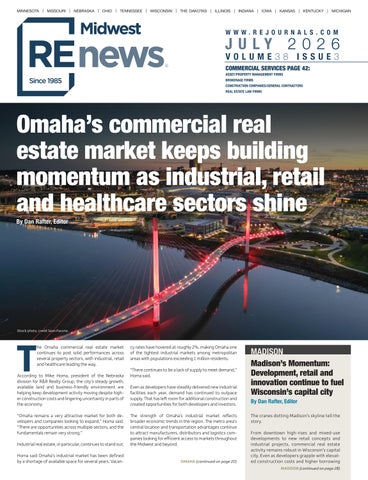
Omaha’s commercial real estate market keeps building momentum as industrial, retail and healthcare sectors shine
By Dan Rafter, Editor
The Omaha commercial real estate market continues to post solid performances across several property sectors, with industrial, retail and healthcare leading the way.
According to Mike Homa, president of the Nebraska division for R&R Realty Group, the city’s steady growth, available land and business-friendly environment are helping keep development activity moving despite higher construction costs and lingering uncertainty in parts of the economy.
“Omaha remains a very attractive market for both developers and companies looking to expand,” Homa said. “There are opportunities across multiple sectors, and the fundamentals remain very strong.”
Industrial real estate, in particular, continues to stand out.
Homa said Omaha’s industrial market has been defined by a shortage of available space for several years. Vacan-
cy rates have hovered at roughly 2%, making Omaha one of the tightest industrial markets among metropolitan areas with populations exceeding 1 million residents.
“There continues to be a lack of supply to meet demand,” Homa said.
Even as developers have steadily delivered new industrial facilities each year, demand has continued to outpace supply. That has left room for additional construction and created opportunities for both developers and investors.
The strength of Omaha’s industrial market reflects broader economic trends in the region. The metro area’s central location and transportation advantages continue to attract manufacturers, distributors and logistics companies looking for efficient access to markets throughout the Midwest and beyond.
By Dan Rafter, Editor
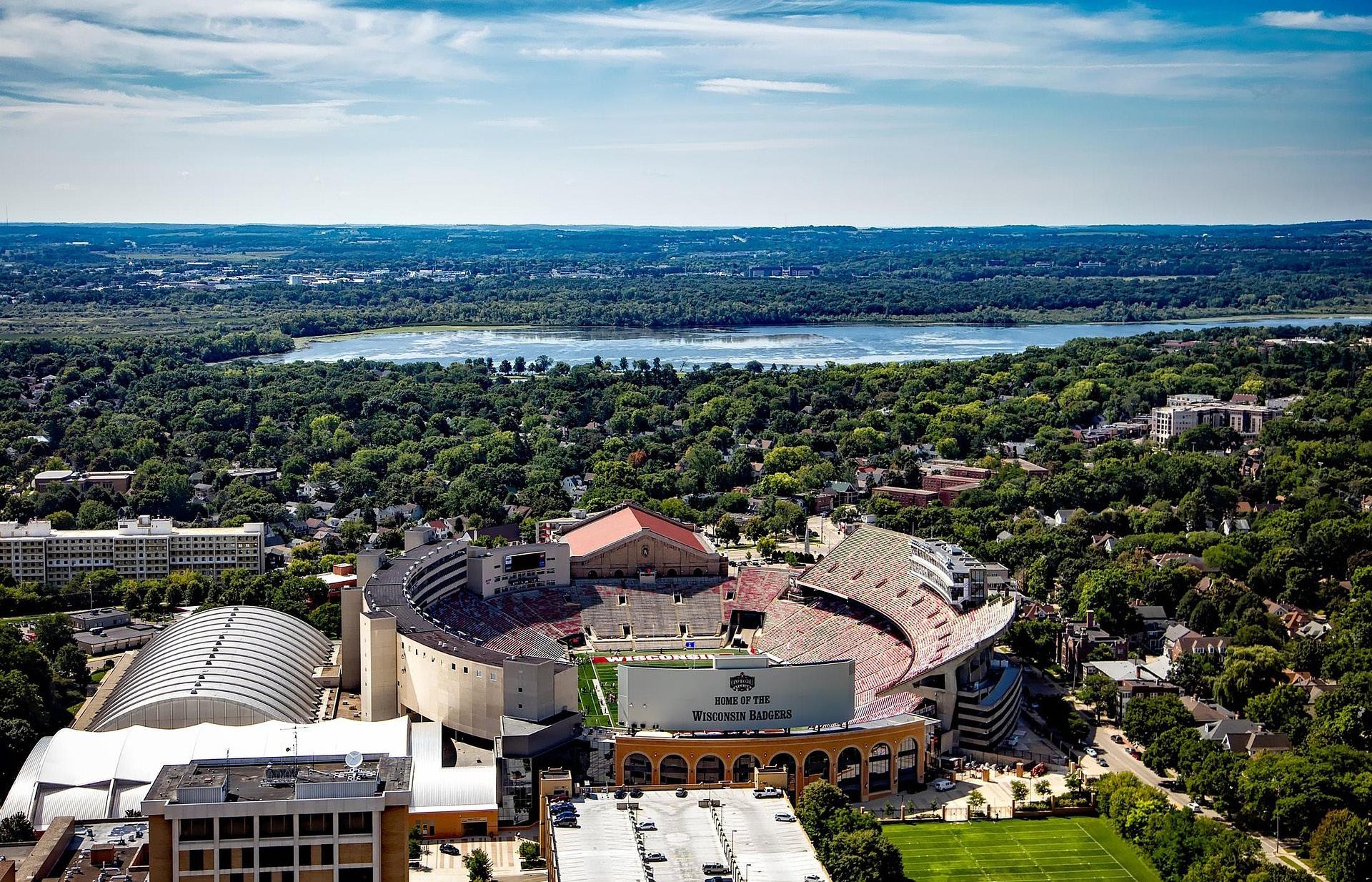
From downtown high-rises and mixed-use developments to new retail concepts and industrial projects, commercial real estate activity remains robust in Wisconsin’s capital city. Even as developers grapple with elevated construction costs and higher borrowing
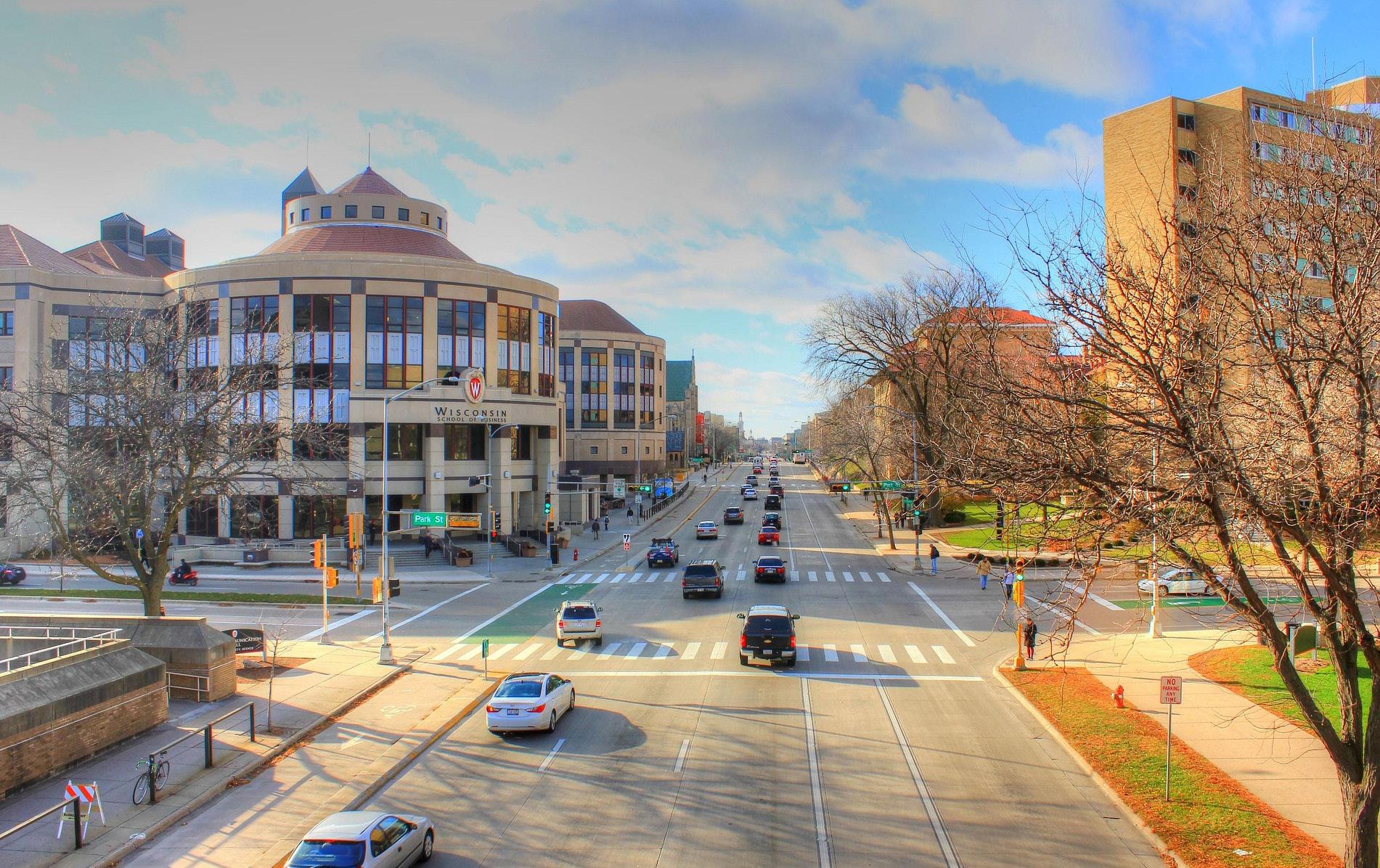
iStock photo, credit Sean Pavone.
The cranes dotting Madison’s skyline tell the story.
MADISON
Solutions
Industrial, retail and healthcare sectors shine in Omaha: The Omaha commercial real estate market continues to post solid performances across several property sectors, with industrial, retail and healthcare leading the way.
Madison’s Momentum: From downtown high-rises and mixed-use developments to new retail concepts and industrial projects, commercial real estate activity remains robust in Wisconsin’s capital city.
An overlooked commercial asset class? How about preschools and early education centers? Developer and investor Fortec is betting that one of the nation’s most overlooked real estate sectors, early childhood education facilities, is also one of its most needed.
The great mall divide: Despite what you might believe from some of the headlines, the U.S. enclosed shopping mall isn’t dead, with many of these retail spots thriving. But not every mall is sharing in the sector’s post-COVID recovery.
Inside the soaring demand for experiential retail and mixed-use projects: As director of relationships at Us Construction, Sophia Reyes understands just how high the demand is today for experiential retail and mixed-use projects.
Evolution never stops at Minneapolis’ 9th Street Center: When Hillcrest Development acquired Minneapolis’ 9th Street Center in the late 1990s, the company saw potential in a sprawling industrial property that boasted plenty of parking and a great location in the city’s Marcy-Holmes neighborhood.
Retail continues to show its resiliency even during challenging economic times: Retail sales continued to show resilience in April, driven by shoppers happy to spend their tax refunds, seasonal purchases and consumers’ ongoing search for value.
Not all industrial markets are created equal: After years of rapid development and shifting market conditions, the U.S. industrial sector appears to be entering a new phase, one marked by improving fundamentals, rising demand and a more balanced supply pipeline.
A life sciences sector that’s finally stabilizing? That’s what JLL is predicting: After several years of big swings in demand, the U.S. life sciences sector is showing signs of stabilization, according to the latest research from JLL.
COLUMNS/DEPARTMENTS
6 Editor’s Letter
36 Don’t paint yourself into a corner: How to take a smarter approach to healthcare facility design
38 Before you buy your first hotel: Key considerations for real estate Investors considering hotel acquisitions
41 What’s new in Wisconsin TIF: Key changes under Acts 173 and 235
42 Directory Listings
The Midwest’s commercial real estate publication, providing useful, unbiased and accurate coverage of the industry and its professionals since 1985.
WWW.REJOURNALS.COM
Publisher | Mark Menzies menzies@rejournals.com 312.933.8559
Editor | Dan Rafter drafter@rejournals.com
ADVERTISING
Vice President of Sales & MW Conference Series Manager | Ernest Abood eabood@rejournals.com
Vice President of Sales | Frank E. Biondo frank.biondo@rejournals.com
Classified Director | Susan Mickey smickey@rejournals.com
Director, National Events & Marketing | Allison Kim Allison.kim@rejournals.com
Midwest Real Estate News brings real estate leaders together to explore the challenges and opportunities unique to their markets.
ADDRESS
7767 Elm Creek Boulevard, Suite 210, Maple Grove, MN 55369
Midwest Real Estate News® (ISSN 0893-2719) is published bimonthly by Real Estate Publishing Corp., (rejournals.com). Current and back issues and additional resources, including subscription request forms and an editorial calendar, are available on the internet at rejournals.com.
High gas prices still putting a hurt on U.S. hotel industry
By Dan Rafter, Editor
The U.S. hospitality sector continues to face a challenging travel environment this summer, but a shortage of new hotel construction and improving investment activity point to a brighter future for the industry, according to Marcus & Millichap’s June Hospitality Outlook report.
The report highlights an industry facing short-term pressure from cautious consumers while benefiting from a development pipeline that remains far below pre-pandemic levels.
According to Marcus & Millichap, rising vacation-related expenses are causing more people to reconsider their travel plans this summer. Higher energy costs, airfare increases and softer employment conditions are causing many U.S. residents to stay put during the traditional summer travel season. Consumer sentiment has also fallen to historically low levels, creating additional pressure on discretionary spending.
The impact is clear across the travel industry. Marcus & Millichap reports that 70% of consumers have altered their vacation plans because of rising gasoline prices. At the same time, only 45% of consumers plan to stay in paid lodging this summer, the lowest share recorded in six years.
Not all travelers are responding in the same way, though. The report said that higher-income households are continuing to travel at relatively stable levels, while lower-income consumers are cutting back more aggressively.
Not surprisingly, then, Marcus & Millichap found that limited-service hotels are experiencing the greatest slowdown in demand because they are more dependent on budget-conscious travelers. Occupancy in this segment has trended downward since 2019, falling from more than 58% before the pandemic to the low-54% range by late 2025 and remaining at similar levels through May of this year.
Select-service hotels, however, have proven more resilient. Total room nights sold in this segment have remained relatively stable since 2023. As of May 2026, occupancy rates for select-service properties were only 1% below their 2019 peak levels, according to the report.
Performance differences also appear across hotel chain scales. Economy and midscale hotels are seeing softer occupancy levels, while upscale and luxury properties continue to demonstrate stronger performance.
One factor helping the hospitality sector weather these challenges is a lack of new supply. Marcus & Millichap reports that hotel additions remain 34% below 2019 levels as developers grapple with elevated construction costs, financing expenses, labor shortages and higher material prices.
The limited development pipeline is helping prevent oversupply and sup-
porting hotel fundamentals despite softer travel demand.
Investment activity is also showing signs of improvement. The report says that hotel transaction volume increased 19% during the 12-month period ending in March compared with the cyclical low reached in 2024. Deal activity has recovered to levels roughly consistent with those recorded in 2016.
Meanwhile, pricing has remained relatively stable since 2023, averaging about $113,000 per room key, while capitalization rates have hovered near 8.7%.
In some positive news? Marcus & Millichap pointed to relatively modest delinquency rates and added that hotels retain an advantage during inflationary periods because operators can adjust room rates quickly in response to changing economic conditions.
Image by Engin Akyurt from Pixabay
12th Annual National
NET LEASE
July 24, 2026
8:30am - 3:15pm 8:00am Breakfast & Networking
University Club of Chicago (76 E Monroe St, Chicago, IL 60603)
speakers:
Anthony Walters - JLL Capital Markets
Chris Capolongo - TPG Angelo Gordon
Christian Tremblay - Northmarq
Edward J. Isola - Isola & Associates, LLC
Elizabeth J. Randall - Randall Commercial Group, LLC
Evan Beeson - Sands Investment Group
sponsors:
Gavin Kam - NNN Retail Advisors
James Hanson - Avison Young
Jeff Peterson - CPEC1031
Justin Amos - JTC Group
Max Jenkins - Essential Properties Realty Trust
Patrick Luther - SRS Real Estate Partners
Randy Blankstein - The Boulder Group
Richard Hurd - Hurd Real Estate
Sean Keane - First Merchants Bank
Thomas Gorman - Marcus & Millichap
Todd Phillips - Legacy Property Trust
Tyler Swann - W. P. Carey
An overlooked commercial asset class?
How about preschools and early education centers?
By Dan Rafter, Editor
Miami-based developer and investor Fortec is betting that one of the nation’s most overlooked real estate sectors, early childhood education facilities, is also one of its most needed.
The company has committed to building between 50 and 60 preschool and early education centers across the country, fueled in part by a $100 million investment fund launched in 2025 and a recent $30 million institutional investment backed by Equiturn Holdings.
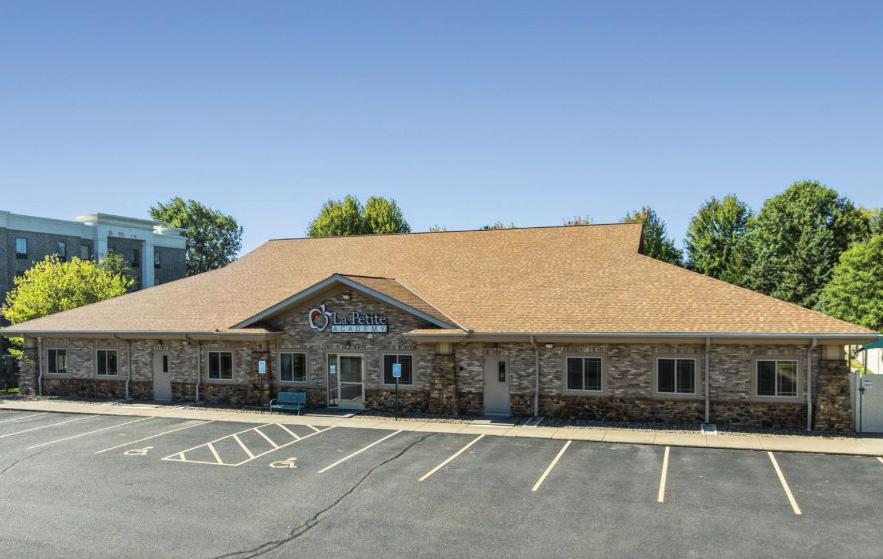
Fortec recently expanded its reach into the Midwest with the acquisition of the 7,700-square-foot La Petite Academy
preschool facility at 470 Imperial Ave. N. in Oakdale, Minnesota. As part of the acquisition, the company signed a new 10-year lease with the property’s operator, Learning Care Group, one of the nation’s largest childcare providers. Fortec also committed additional capital to modernize and upgrade the facility.
For Pablo Barreiro, chairman of Fortec, the company’s focus on early childhood education facilities is about more than investment returns.
“We are trying to help solve a real problem in communities across the country,” Barreiro said. “About 46% of the United States is still considered a childcare desert. When we started in this sector, that number was even
higher. There is still a big need for new schools and modern facilities.”
A childcare desert refers to areas where the supply of licensed childcare falls far short of demand, leaving working families struggling to find affordable and accessible early education options.
Barreiro said the shortage is evident across the country, including in states such as Minnesota.
“The first thing we look at is whether the community needs this product,” he said. “If the need is there, we are open to investing there. We want to help reduce the imbalance between supply and demand.”
Fortec’s strategy is unique in a commer-
cial real estate industry where many developers focus on more traditional asset classes such as multifamily, industrial and retail properties.
“Our main objective is to be the first institution that only invests in educational products,” Barreiro said. “We understand the community needs, so when we do projects, they are specifically designed for that community.”
An evolving sector
Preschool and early education centers continue to evolve. Barreiro said today’s schools boast larger classrooms, more natural light, a greater amount of outdoor learning spaces and modern technology. Safety improvements have also become increasingly important.
La Petite Academy in Oakdale, Minnesota.
“There has been much more investment in playgrounds and outdoor spaces, bigger windows and more natural light,” Barreiro said. “The spaces today are more organic. Kids are not just sitting in classrooms anymore. Learning now includes music, art, outdoor activities and many different experiences.”
That evolution has also changed the design of the buildings themselves.
“The buildings have to support the curriculum,” Barreiro said. “Children use more of the building now, both inside and outside. In places like Minnesota, where winters can limit outdoor activity, schools need larger interior spaces where children can still play and learn.”
Safety features are another priority.
“There have been a lot of improvements in life safety,” Barreiro said. “Fencing, barriers near parking lots, making sure children are safe while still enjoying the building. Those are critical parts of these projects.”
and government officials, something that can prove challenging.
Despite the growing need, Barreiro said that many developers have overlooked the early education sector in part because projects require extensive collaboration with local communities
“These are community-based projects,” Barreiro said. “You are building something where children from that community will spend a large portion
of their day. We work closely with local architects, city staff and council members to make sure the project fits what the community wants and needs.”
Traffic flow and drop-off safety also add layers of complexity that develop-
ALSTON CONSTRUCTION — Celebrating 40 Years
An overlooked asset class
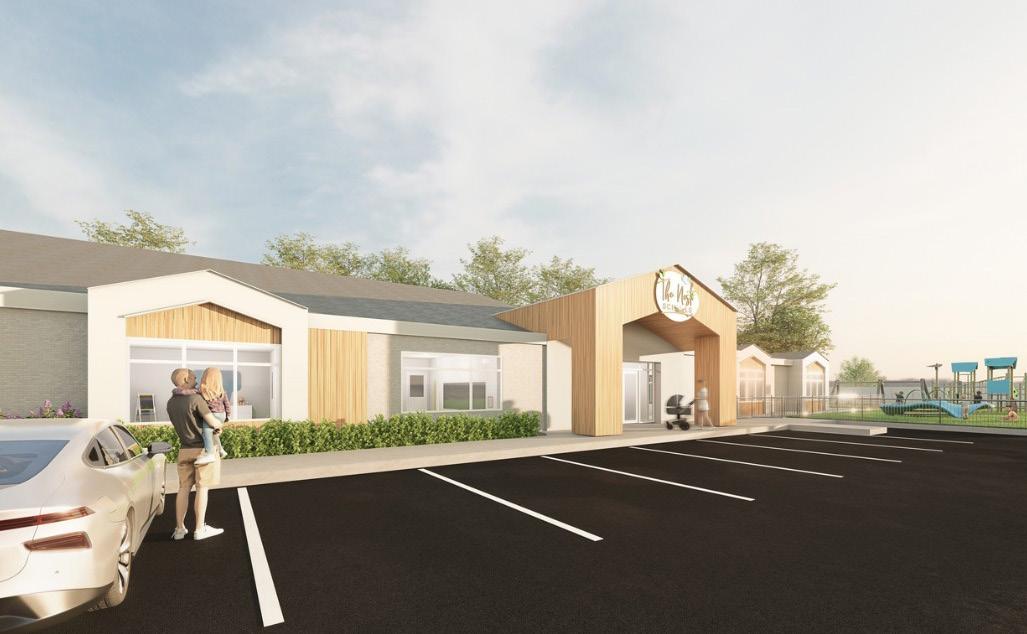
Fortec is working with The Nest Schools to transform a former ambulance warehouse in Vernon Hills, Illinois, to The Nest School-Vernon Hills, an early education center scheduled to open in the spring of 2026 in Vernon Hills, Illinois. (Rendering courtesy of Fortec.)
ers do not always face in more conventional property types.
“It is not as standardized as some other real estate sectors,” Barreiro said. “Every project is specific to that community. Some developers prefer products they can replicate the same way across the country. For us, the focus is on what each community needs.”
Fortec’s growing investment fund is designed specifically to address those needs. Barreiro said the company is currently active in 14 states and expects to expand further by the end of the year.
“All of the money is focused on early education,” he said. “The goal is to bring new schools to communities across the country.”
For Barreiro, the company’s interest in the sector began with a personal connection. About six or seven years ago, Fortec and its partners acquired a preschool property in Hollywood, Florida, a school his daughter attended.
“I knew that property very well,” he said. “At the time, we had never worked with a preschool tenant before. But the tenant was great, and
once we started learning more about the industry, we realized there was a tremendous need.”
That first acquisition quickly led to more projects in Florida and eventually to a nationwide strategy centered entirely on educational facilities.
“We realized this was something where we could put our resources to work and actually help solve a problem,” Barreiro said.
Fortec closed the sale of this Barrington, Illinois, property occupied by The Nest Schools in early 2025. (Photo courtesy of Fortec.)
Pablo Barreiro (Photo courtesy of Fortec.)
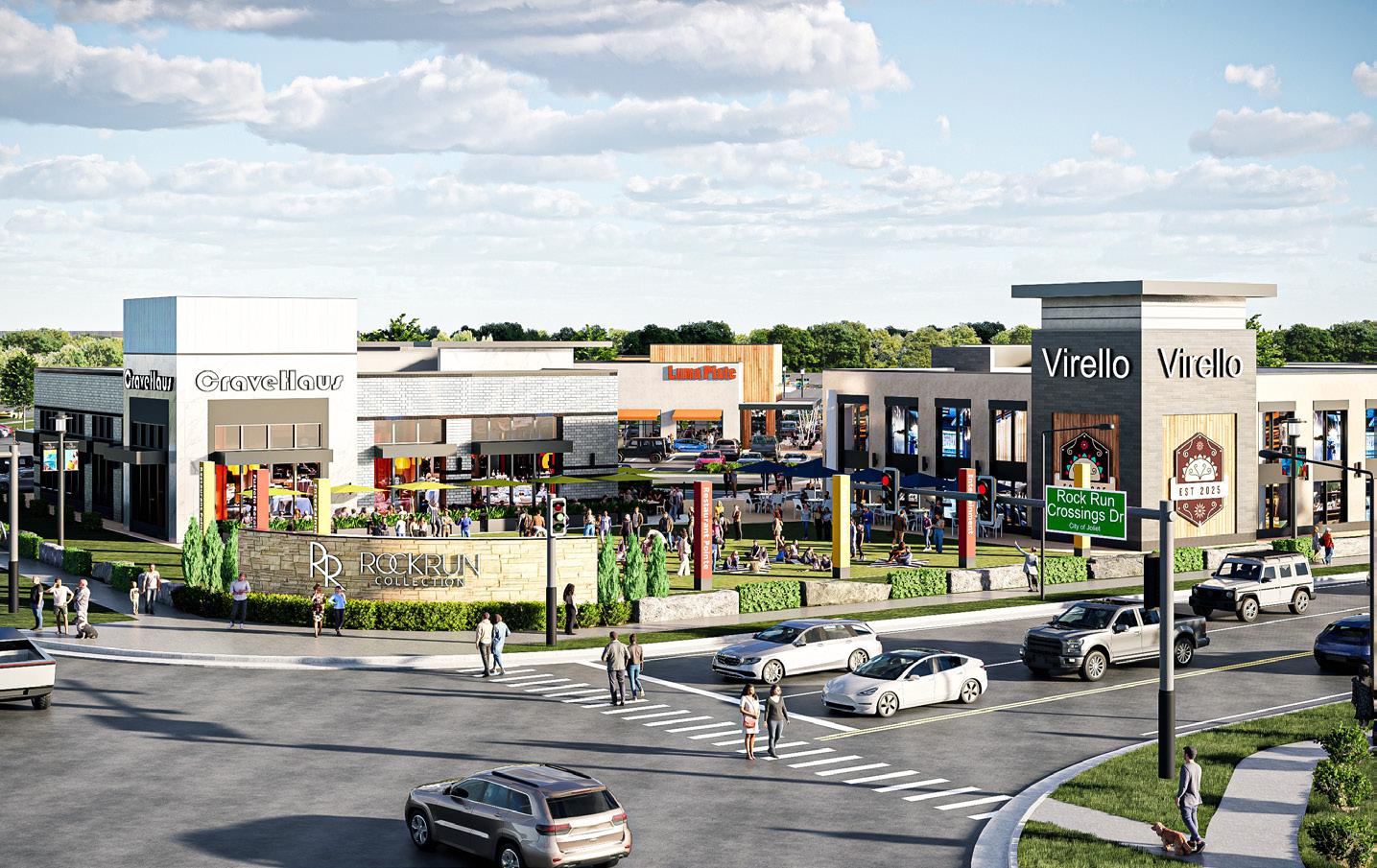
Rock Run Collection Joliet, IL
The great mall divide: Coresight report finds that top-tier malls thrive while lower-tier properties struggle
By Dan Rafter, Editor
Despite what you might believe from some of the headlines, the U.S. enclosed shopping mall isn’t dead, with many of these retail spots thriving. But not every mall is sharing in the sector’s post-COVID recovery.
That’s one of the key points in a new report from Coresight Research, The American Mall Renaissance: A Bifurcated Sector with Top-Tier Assets Leading the Way. According to the study, the nation’s enclosed mall sector has become divided between
high-performing, top-tier properties and struggling lower-tier assets.
“The metrics we look at are heading in opposite directions with these two sets of malls,” said John Mercer, head of global research and managing director of data-driven research with New York City-based Coresight Research. “Whether you look at visits, net operating income, absolute rents or occupancy, the top-tier malls are performing well while the lower-tier malls continue to decline.”
The Coresight report found that by
2025, foot traffic at top-tier U.S. malls had nearly returned to pre-pandemic levels, sitting just 0.1% below 2019 traffic counts.
But the news wasn’t as good for lower-tier malls. Coresight found that foot traffic at these lower-quality malls remained 6.8% below pre-pandemic levels.
Then there are occupancy rates. In its report, Coresight said that top-tier U.S. malls average 95.5% occupancy compared to 89% for lower-tier centers.
The top-tier difference
So, what separates a top-tier mall from the rest?
Mercer said top-tier malls typically feature luxury and high-end retailers while serving affluent trade areas with higher household incomes.
“They are the malls that are thriving and attracting high-end retailers,” Mercer said. “The demographics surrounding the mall matter significantly.”
Those advantages create a cycle of
Photo courtesy of iStock.
success for higher-quality malls. When a tenant leaves a top-tier mall, its owners can often replace that retailer quickly. Lower-tier malls, though, face the opposite challenge: When an important tenant leaves a lower-tier mall, it’s more difficult for its owners to find a replacement.
“If you lose an anchor tenant in a lower-tier mall, you tend to see lower foot traffic in that space,” Mercer said. “Then it becomes harder to fill that anchor space. New tenants don’t join, and it can become a death spiral.”
New concepts
Luxury retailers continue to gravitate toward top-performing malls, but
“We live in an age of instant gratification. Consumers want engagement and experiences. Shopping is no longer purely functional.”
Residential development around malls has become increasingly common, Mercer said, particularly on excess parking lots surrounding existing centers.
“It’s something we’ve been tracking for several years,” he said. “It’s a good use of space and a trend that continues.”
Ultimately, Mercer said the future of retail centers depends on meeting consumer expectations that have been shaped by digital commerce.
Online shopping has become faster, easier and more convenient through quick-commerce delivery services, artificial intelligence tools and streamlined payment options. Physical retail-
Us Construction’s Sophia Reyes: Inside the soaring demand for experiential retail and mixed-use projects
By Dan Rafter, Editor
As director of relationships at Miami-based Us Construction, Sophia Reyes understands just how high the demand is today for experiential retail and mixed-use projects. These are two commercial sectors that are steadily building momentum today, both when it comes to new development and leasing activity.
Reyes was in Chicago this May attending the National Restaurant Association Show at the city’s McCormick Place convention center. We spoke with her about the state of the retail and mixeduse sectors, which type of projects in these classes are still receiving financing and why consumers are flocking to experiential retail.
Here is some of what Reyes had to say.
Qualifying for financing for commercial real estate projects can still be a challenge. What kinds of projects are getting financing today?
Sophia Reyes: We are seeing a lot of demand for mixed-use developments. Many of those projects are being funded by institutions. They have institutional investors backing them. We do see that a lot here in South Florida. The mixed-use projects are having a lot of success attracting institutional financing.
Those struggling to get financing tend to be the smaller, independent restaurants and retailers. As construction
costs have gone up, it is becoming difficult for these independent contractors to get the financing that projects backed by bigger groups can get.
Has this always been the way when it comes to commercial financing? Or is it even more difficult for independent retailers and restaurants to find financing today?
Reyes: It can be more difficult today given how expensive it is to develop a project. Some projects rely on crowdfunding to help cover the gaps. Other owners are going to friends and family for extra help. We are seeing more smaller, independent projects turning to SBA loans. We have three projects right now that have turned to SBA loans
instead of construction loans. Most of the projects relying on SBA loans are being run by independent operators.
Some independent operators are self-funded. They like to handle the financing by themselves.
The rising expenses of opening a retail shop or restaurant have made securing enough financing especially important today, I’d guess.
Reyes: The barriers to entry for, say, opening a restaurant are so much higher today. There is such a significant upfront cost. A lot of people don’t expect to spend quite as much as they end up spending. Sometimes when these independent operators open a restaurant, they only have about
Sixty Vines at Miami Worldcenter (Photo courtesy of Us Construction.)
one month of operating cash left by the time their doors open. That makes it very difficult to keep these businesses going. The ramp-up period for opening a restaurant can take so long.
When you sign a lease, you only get a certain amount of free rent. Landlords are not open to holding off on collecting rent while they wait for you to open. It doesn’t work like that. Paying all that dead rent while they are waiting to open can be a challenge. Operators need to prepare for that.
How strong is the demand for mixeduse projects today? Those projects are often not struggling to gain financing, right?
Reyes: In Miami, we’ve seen an influx of people from cities like New York and Chicago who are used to these live-work-play areas. We are seeing, then, an increased demand for these lifestyle centers with ground-floor retail, office, residential and top amenities.
I have quite a few friends who don’t have cars. They live in one of these mixed-use centers. They work across the street from their apartment. The grocery store is two blocks away. That kind of grouping and consolidating in one area helps grow neighborhoods and grow businesses, too. Businesses opening in mixed-use areas have this built-in clientele. Their customers live and work right there. That is becoming a trend here and across the country.
Are you also seeing strong demand for experiential retail?
Reyes: Yes, that has become more popular, too. Places like Puttshack, SPIN and Pinstripes are all becoming more popular. It’s no secret that alcohol sales have gone down during the last few years. People are not as interested in hanging out at a bar or club. They would rather do something fun like have an experience and maybe have a drink there or dinner there. That is very popular.
People are craving that human connection again. It’s incredible how experiential retail has exploded. We had that e-commerce scare where we thought that every mall was going to become obsolete. But since COVID, people want to get out of the house. They realized that being in front of a screen and shopping online was not as much fun as being in the store where you can try things. It’s not as much fun as trying a new experiential concept. The retail world took an unexpected turn after COVID.
Sophia Reyes (Photo courtesy of Us Construction.)
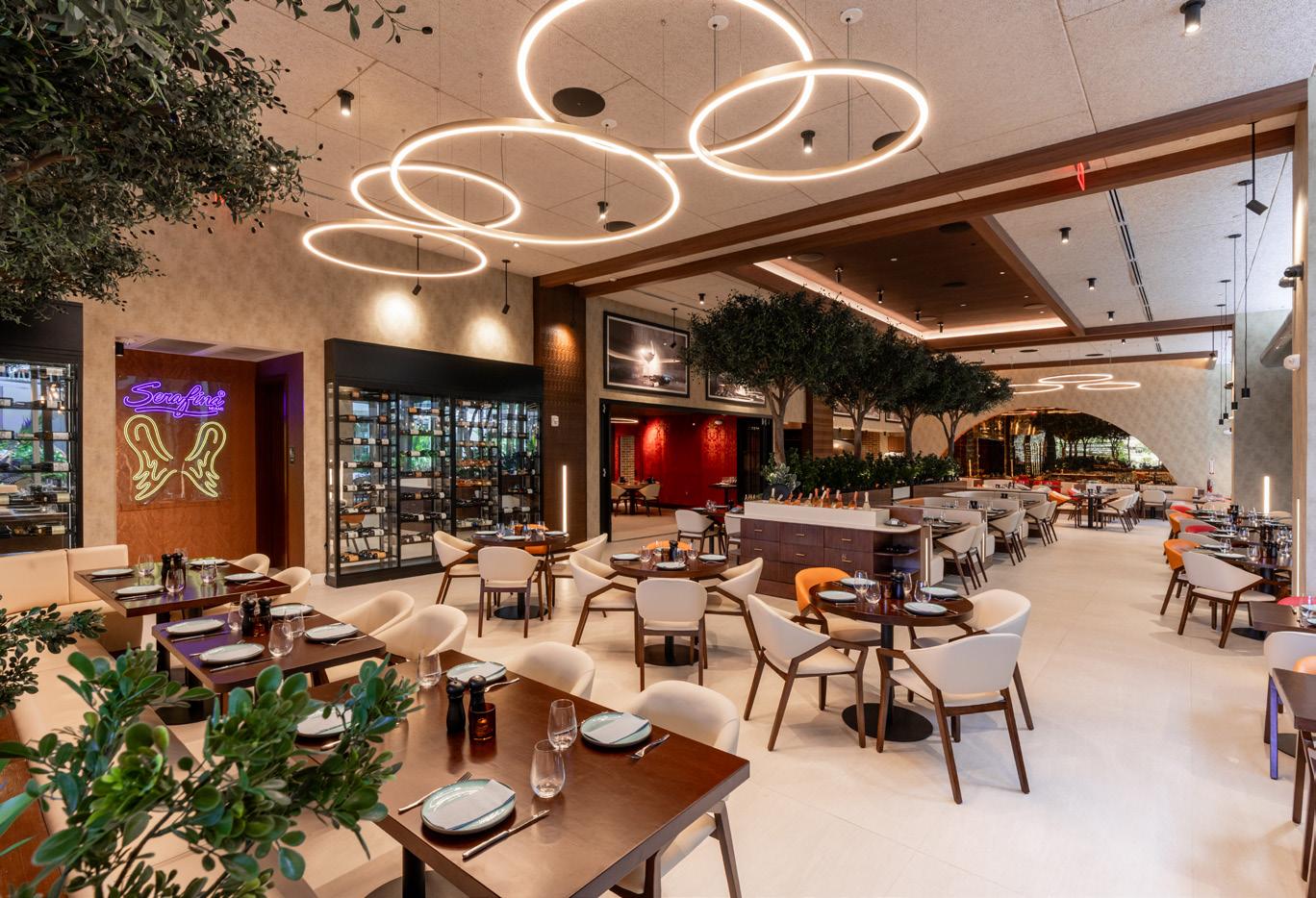
Serafina Miami Worldcenter (Photo courtesy of Us Construction.)
Evolution never stops at Minneapolis’ 9th Street Center
By Dan Rafter, Editor
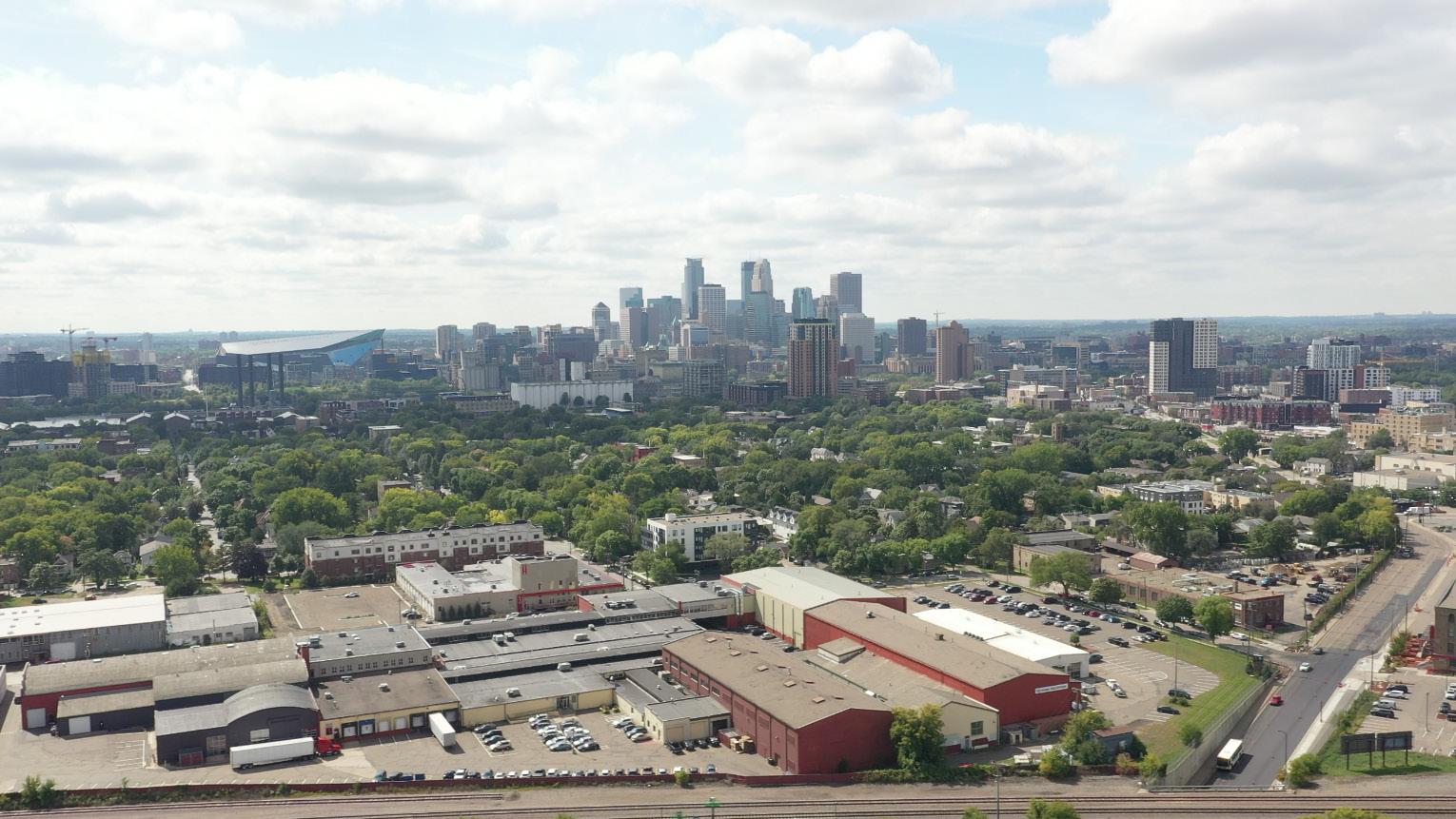
When Hillcrest Development acquired Minneapolis’ 9th Street Center in the late 1990s, the company saw potential in a sprawling industrial property that boasted plenty of parking and a great location in the city’s Marcy-Holmes neighborhood.
What Hillcrest Development didn’t see was a center that would one day be home to tabletop gaming enthusiasts, indoor soccer players, craft beverage fans and a growing collection of experiential businesses.
But that’s exactly what the 224,000-square-foot property has become.
The latest chapter in the evolution of 9th Street Center comes with the addition of two new tenants: Wyldwolf
“We are intentional about tenants. We’re not looking to get market rates for everything.
That’d be great, but having the right tenants that are durable and stay? That’s a good formula.”
Games and Midwest Indoor Soccer. Their arrivals highlight Hillcrest Development’s long-term strategy of creating a mixed-use destination that
blends industrial, retail, recreation and community-focused uses.
Located in Minneapolis’ Marcy-Holmes
neighborhood near the University of Minnesota and downtown Minneapolis, 9th Street Center consists of nine buildings built between 1910 and the
An aerial view of 9th Street Center in Minneapolis. (Photo courtesy of Hillcrest Development.)
1950s. Over the last quarter century, the property has gradually transformed from a traditional industrial site into a diverse campus of businesses that attracts visitors from across the Twin Cities.
“We are intentional about tenants,” said Scott Tankenoff, managing partner with Hillcrest Development. “We’re not looking to get market rates for everything. That’d be great, but having the right tenants that are durable and stay? That’s a good formula.”
That winning philosophy is evident in the property’s newest additions.
Wyldwolf Games will open a 1,945-square-foot location at 9th Street Center in June. The business specializes in tabletop gaming, offering retail products and professionally hosted role-playing experiences such as Dungeons & Dragons and Pathfinder events. The space will feature custom sound-resistant gaming rooms and technology designed to support both in-person and hybrid play.
For Tankenoff, the gaming concept fits naturally into the property’s growing collection of destination-oriented businesses.
The tenant needed more than just square footage. It required a location with ample parking, easy access and a distinctive environment capable of creating an experience for customers.
“They are used to going into retail strip centers,” Tankenoff said. “This is more interesting. There is a certain warmth to a brick-and-timber space. There were certain things about it, the character of the neighborhood and the other retail uses in the building. It made for a more attractive destination for them.”
The second addition, Midwest Indoor Soccer, will occupy approximately 28,000 square feet when it opens in August. Founded by Ashraf Ali, the facility will feature two indoor soccer fields, youth programs, leagues, training sessions and retail offerings. Future additions could include concessions and café space.
The soccer facility addresses a growing need for indoor sports facilities in the Minneapolis-St. Paul market.
“There really aren’t other indoor soccer facilities that we are aware of in the city of Minneapolis,” Tankenoff said. “It’s very hard to find indoor training,
“Back in the late ‘90s, we didn’t foresee this happening,” Tankenoff said. “But 10 to 15 years ago, you could see where the neighborhood was going. You could see where other developments were taking place. It became very evident what was happening.”
That evolution has coincided with a growing demand throughout the Twin Cities region for experiential businesses, the types of tenants that give consumers reasons to leave their homes and gather in person.
“That’s where this is headed,” Tankenoff said. “What makes people want to be here? What makes people want to gather? You need food. You need a place where people can gather that’s not just an office and break room. Exterior spaces are valuable. You need good infrastructure and a sense of place.”
Convenience is also important. Tankenoff said the property’s location near downtown Minneapolis, major highways, residential neighborhoods and retail destinations helps attract both tenants and visitors.
“People want convenience,” he said. “How much time can I save and how much convenience can I give myself today? That’s what matters.”
As 9th Street Center continues to evolve, Hillcrest Development isn’t targeting any single tenant category. Instead, the company plans to continue
evaluating each opportunity based on how well it fits within the property’s existing ecosystem.
“We think a lot about tenant compatibility,” Tankenoff said. “That’s very important. We don’t want someone to move in and not be a good fit. We need to get it right.”
For a property that began life as a traditional industrial complex, that careful approach has helped create something increasingly rare in commercial real estate: a place where industrial, recreational, retail and community uses successfully coexist.
Photo courtesy of Hillcrest Development.
Retail continues to show its resiliency even during challenging economic times
By Dan Rafter, Editor
Retail sales continued to show resilience in April, driven by shoppers happy to spend their tax refunds, seasonal purchases and consumers’ ongoing search for value, according to Colliers’ April U.S. Retail Monthly Foot Traffic & Sales Analysis report released in mid-May.
The report found that overall retail sales rose 4.6% this April when compared to the same month a year ago, while foot traffic increased 2.6%. Colliers said that this is a sign that shoppers are still visiting brick-and-mortar stores despite concerns about inflation and broader economic uncertainty.
“Apparel sales remained strong for a second consecutive month as shoppers updated wardrobes and purchased higher-end accessories.”
At the same time, Colliers noted that the retail landscape is becoming increasingly selective. Consumers are still spending, but they are paying closer attention to what they buy.
One bright spot was discretionary spending. Apparel sales remained strong for a second consecutive month as shoppers updated wardrobes and purchased higher-end accessories. Electronics
retailers also enjoyed a boost, with sales jumping 9.1% year-over-year. According to Colliers, many consumers used tax refund dollars to purchase new technology and electronics products.
Image by hapis from Pixabay
The increased spending translated into more store visits, too. Foot traffic at clothing stores rose nearly 4%, while electronics retailers posted a 2.5% increase in visits.
Value-oriented retailers also continued to benefit from changing consumer habits. As households remain conscious of rising costs, discount stores, dollar stores and off-price retailers attracted a growing number of shoppers.
Colliers reported that visits to discount and dollar stores increased 7.7% in April, while grocery store traffic rose 1.1%.
Several value-focused chains posted strong gains, including Five Below, Ross Dress for Less, Citi Trends and Goodwill.
Colliers reported that while consumers are still willing to spend, they are increasingly focused on finding bargains and stretching their budgets.
Not all retailers, though, are thriving today, according to Colliers’ report.
Housing-related retail segments continued to struggle, partly because of a residential real estate market that re-
last year, while visits to furniture stores declined slightly. Elevated financing costs and a softer housing market continue to slow the demand for big-ticket home purchases.
saw somewhat better results, with foot traffic increasing 2.8%. Colliers noted, though, that consumers appear to be focusing primarily on spending on necessary repairs and smaller projects
Meanwhile, experiential retail categories showed signs of cooling after several months of strong performance. Visits to theaters and music venues dropped 16.8% in April, while attendance at at-
TYSON SCHUTZ
Photo by Mike Petrucci on Unsplash
OMAHA
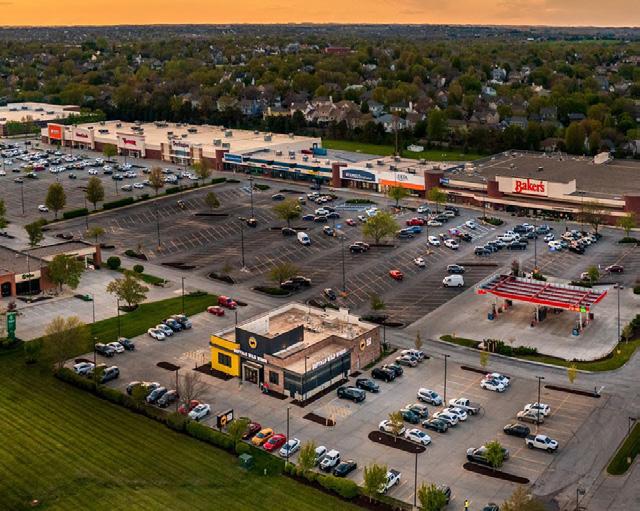
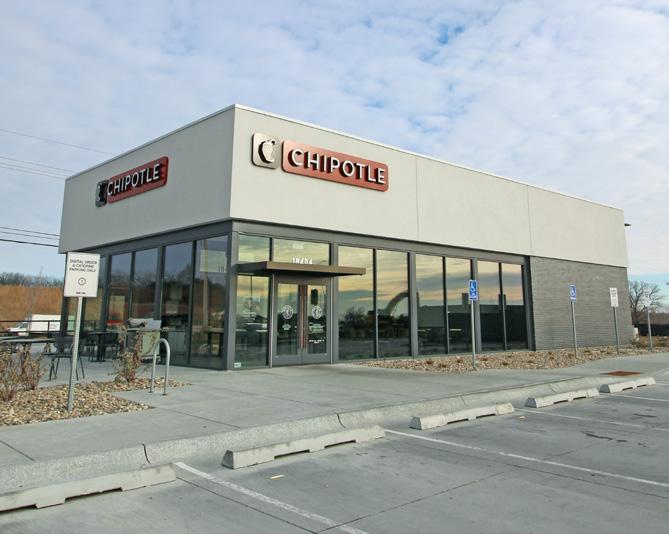
Retail and healthcare properties are also performing well. One of the most notable examples of Omaha’s retail momentum can be found at Avenue One, located at the intersection of 192nd Street and West Dodge Road.
Homa said retail and restaurant development activity at Avenue One has accelerated significantly during the last several months, with several retailers and restaurants either new to the market or relocating to the development.
“This is the most significant new retail development in the past 20 years since Village Pointe opened,” Homa said.
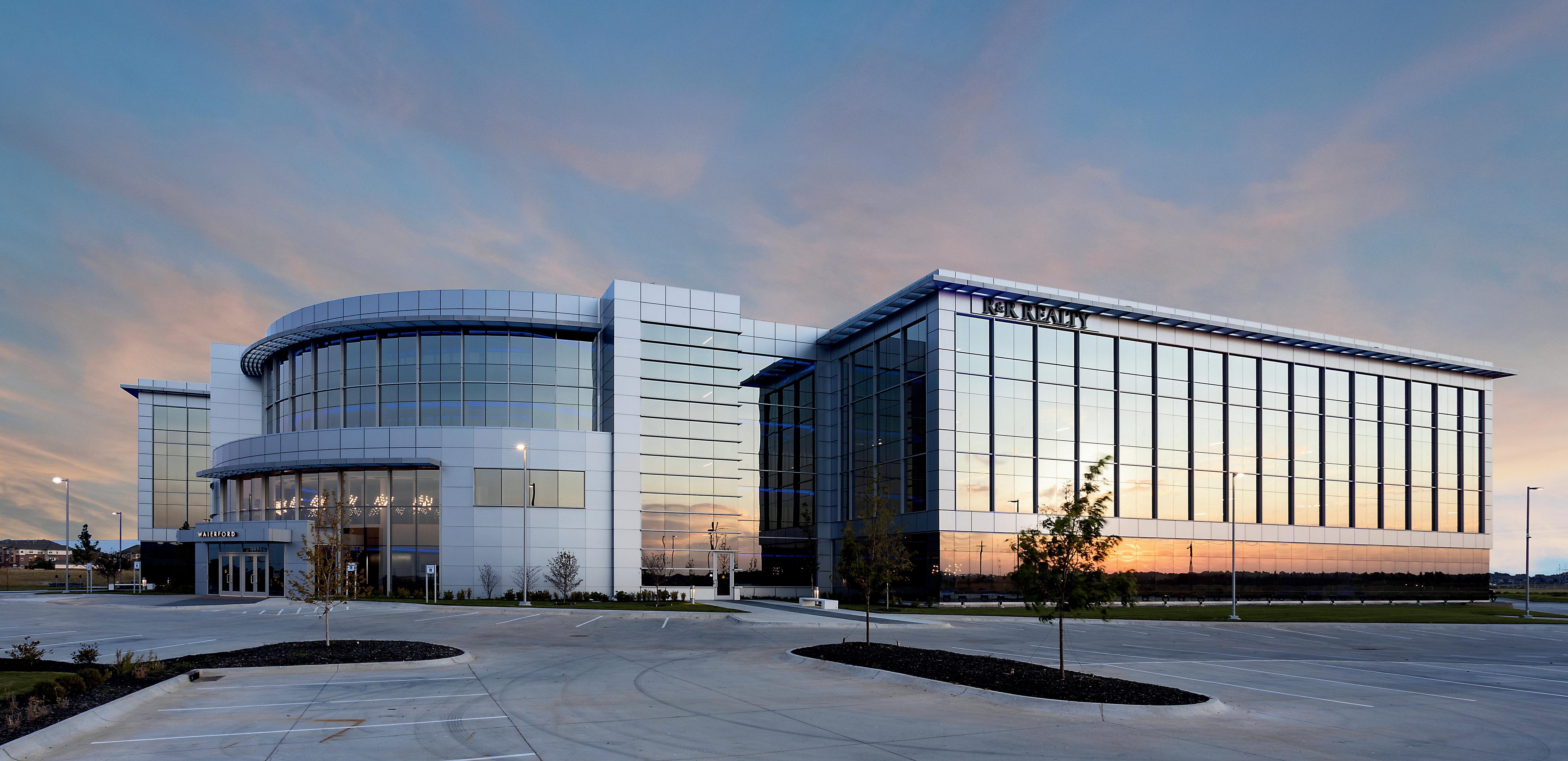
The project also complements the adjacent Fountain Ridge office park, where R&R Realty has completed significant Class-A office and medical office developments.
The activity at Avenue One illustrates a broader trend occurring in Omaha: retailers and restaurants continue to see opportunities in the market, particularly in fast-growing western portions of the metro area where population growth is driving consumer demand.
Construction activity throughout Omaha also remains healthy. Homa said nearly every commercial property sector, with the exception of office, continues to see robust levels of new construction.
While construction costs remain elevated compared to pre-pandemic levels, developers are benefiting from a more stable pricing environment.
“Costs of construction continue to increase,” Homa said, “but the pace of in-
creases has moderated from the years following COVID when double-digit increases in materials, labor and other costs were the norm.”
That moderation has made it easier for developers to underwrite new projects and move developments from the planning stages into construction.
Another factor contributing to Omaha’s development pipeline is the availability of land.
Unlike many larger metropolitan areas, Omaha still offers developers access to reasonably priced sites suitable for commercial projects.
“Land is readily available and reasonably priced,” Homa said.
He also credited local municipalities for maintaining a pro-development approach.
“The local jurisdictions are good to work with and encourage development, which keeps all parties aligned in creating projects that make sense,” Homa said.
Office market still faces challenges
The office market, meanwhile, continues to navigate post-pandemic changes but is showing encouraging signs.
As has been the case in many markets nationwide, Omaha is experiencing an ongoing flight to quality. Companies are seeking higher-quality offices with strong amenity packages and are becoming increasingly selective about the space they occupy.
“Tenants today are choosing quality of space over quantity,” Homa said.
At the same time, businesses appear more willing to make long-term commitments to office space.
Homa said companies are again signing longer leases and investing in office buildouts designed to create environments where employees want to work and collaborate. That willingness to commit capital and sign long-term leases suggests a growing confidence in the role that office space will continue to play, even as workplace strategies evolve.
Taken together, the trends in industrial, retail and office real estate point to a market that continues to build momentum.
Plenty of momentum
From healthcare providers opening new facilities to retailers expanding into the market and mixed-use developments reshaping key corridors, Omaha continues to attract investment across multiple property sectors.
Trey MacKnight, senior associate and retail specialist with Omaha’s Cushman & Wakefield | The Lund Company, said that the city’s diverse economy and favorable business environment are helping fuel activity throughout the metro.
“Overall, Omaha continues to experience healthy growth across most commercial property types,” MacKnight said.
Among the strongest performers today are the healthcare and retail sectors.
Healthcare providers are investing heavily throughout the metro as they seek to meet growing demand from an expanding population. MacKnight pointed to Bryan Health’s entry into the
Omaha market at Privada, OrthoNebraska’s continued growth and the ongoing expansion of the University of Nebraska Medical Center and the EDGE District as examples of healthcare providers’ confidence in the market.
The investments are creating not only new medical facilities but also jobs and additional development opportunities around these healthcare hubs.
Retail is also thriving. Omaha’s combination of strong household incomes, consistent population growth and expanding suburban communities continues to attract both national and regional retailers. New concepts are entering the market while local and regional operators continue to expand their footprints.
“We’re seeing new-to-market concepts such as Flower Child and Culinary Dropout enter the market while established local and regional operators continue to expand throughout the metro,” MacKnight said.
The healthy demand is helping spur new development across the city.
Construction costs remain significantly higher than they were before the COVID-19 pandemic, a challenge that has slowed projects in some markets around the country. Omaha, however, has largely continued to move forward.
“In fact, most residents will see multiple projects under construction during their daily commute, which is a testament to the overall health of the market,” MacKnight said.
Developers and tenants have adapted to the new economics of construction by underwriting projects differently, adjusting rental rates and modifying
OMAHA (continued from page 1)
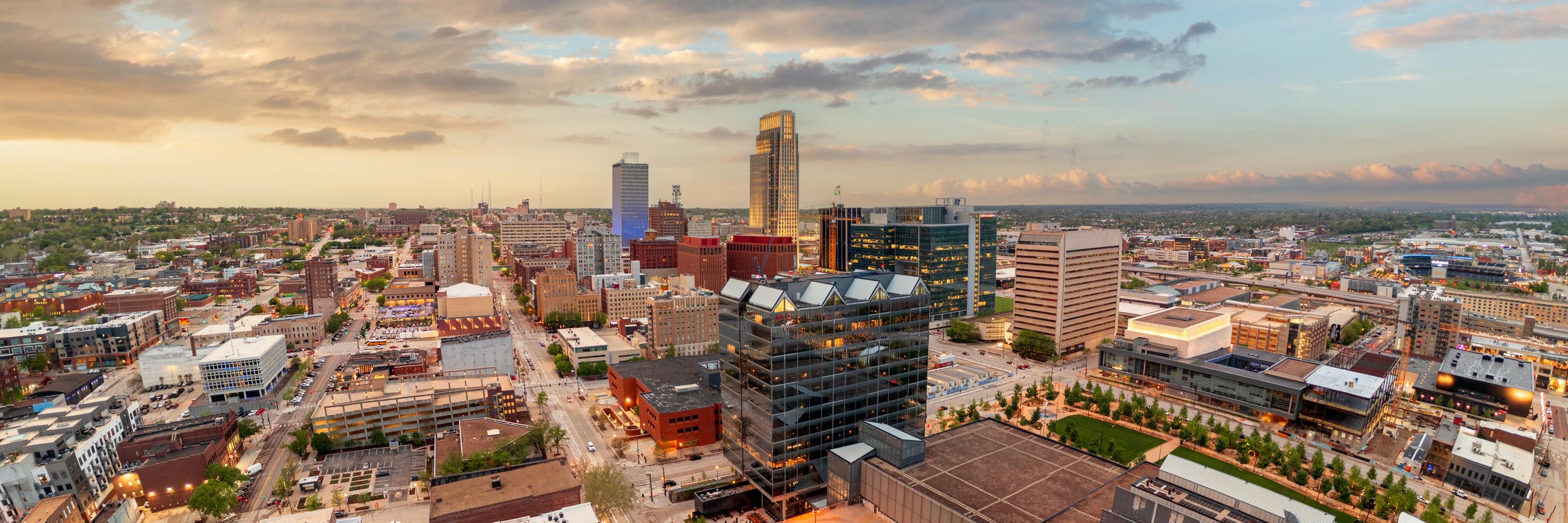
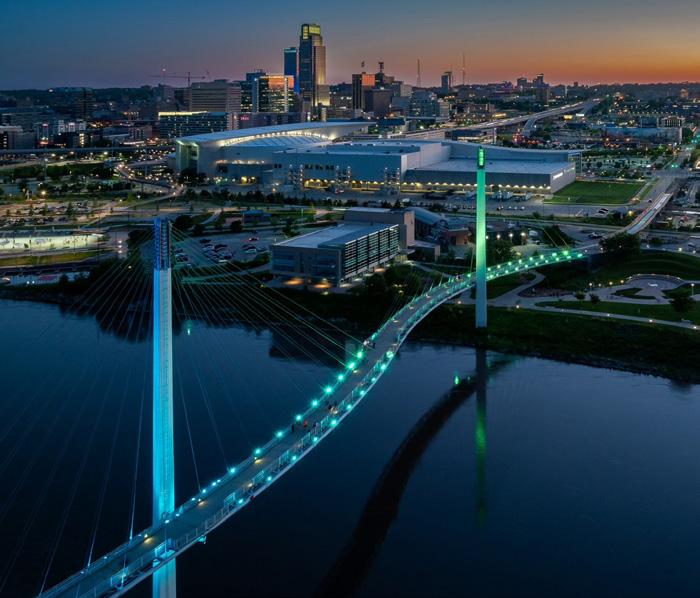
iStock photo, credit Sean Pavone.
tenant improvement packages. The result is that projects in desirable locations continue to break ground.
One development that particularly excites MacKnight is Heartwood Preserve at 144th and West Dodge Road.
The mixed-use project has successfully created a destination where people can live, work, shop, dine and gather. The development has attracted an impressive range of tenants, including new-to-market restaurant concepts such as 30hop, established retailers including Gunderson’s and Mahogany Prime and office users such as Union Bank & Trust and Fidelity Investments.
“As additional tenants open and future phases are completed, I believe Heartwood Preserve will become one of the premier mixed-use destinations in the region,” MacKnight said.
Developments such as Heartwood Preserve highlight one of Omaha’s biggest strengths: its ability to attract both developers and expanding companies.
MacKnight said the metro offers a combination of economic stability, affordability
“We’re still seeing a healthy amount of commercial development across the metro. Projects continue to move forward when there’s strong demand, significant preleasing commitments, or public incentives that help bridge financing gaps.”
and workforce quality that is increasingly attractive in today’s business environment.
The region benefits from steady population growth, a highly educated workforce and a business-friendly climate. Compared to many larger markets, companies can achieve lower occupancy costs while still having access to skilled workers.
“The collaborative business community and the reputation of ‘Nebraska Nice’ create an environment where companies feel welcomed and supported as they grow,” MacKnight said.
Mixed-use developments are another area of growing demand throughout Omaha.
Consumers increasingly want environments that allow them to live, work, dine, shop and access entertainment in a single location. Housing demand is playing a major role in this trend as developers seek to provide a wider range of residential options, including single-family homes, duplexes, apartments and build-to-rent communities. When those housing options are com-
The Midwest’s Preferred Retail Real Estate Company
bined with retail, office and hospitality uses, they create destinations that appeal to both residents and businesses.
Projects such as Heartwood Preserve, the EDGE District and several emerging developments throughout the metro demonstrate that Omaha continues to embrace the mixed-use model, MacKnight said.
A retail surge
Samantha Estivo, associate broker with Omaha-based The Lerner Company, said that the city’s retail sector remains one of the market’s top performers.
As of the second quarter of 2026, Omaha’s retail vacancy rate stood at about 4.4%, a sign that demand for well-positioned space remains robust, especially along the metro area’s strongest retail corridors.
The market’s low vacancy rate is particularly notable because developers are continuing to add new retail projects. However, today’s economic conditions have changed the way these projects move from concept to reality.
“Higher construction and financing costs have made developers more selective,” Estivo said.
Instead of building speculative projects, many developers are moving forward only after securing tenants. Build-tosuit projects and developments with significant pre-leasing commitments are becoming increasingly common.
That measured approach has prevented a flood of new supply from entering the market and has helped maintain strong demand and low vacancies.
Even with higher costs, Omaha’s development pipeline remains healthy.
“We’re still seeing a healthy amount of commercial development across the
Photo courtesy of iStock.
Patrick Bartman (Photo courtesy of McGrath North.)
metro,” Estivo said. “Projects continue to move forward when there’s strong demand, significant pre-leasing commitments, or public incentives that help bridge financing gaps.”
Several large projects underway across the metro demonstrate the confidence developers have in Omaha’s long-term prospects.
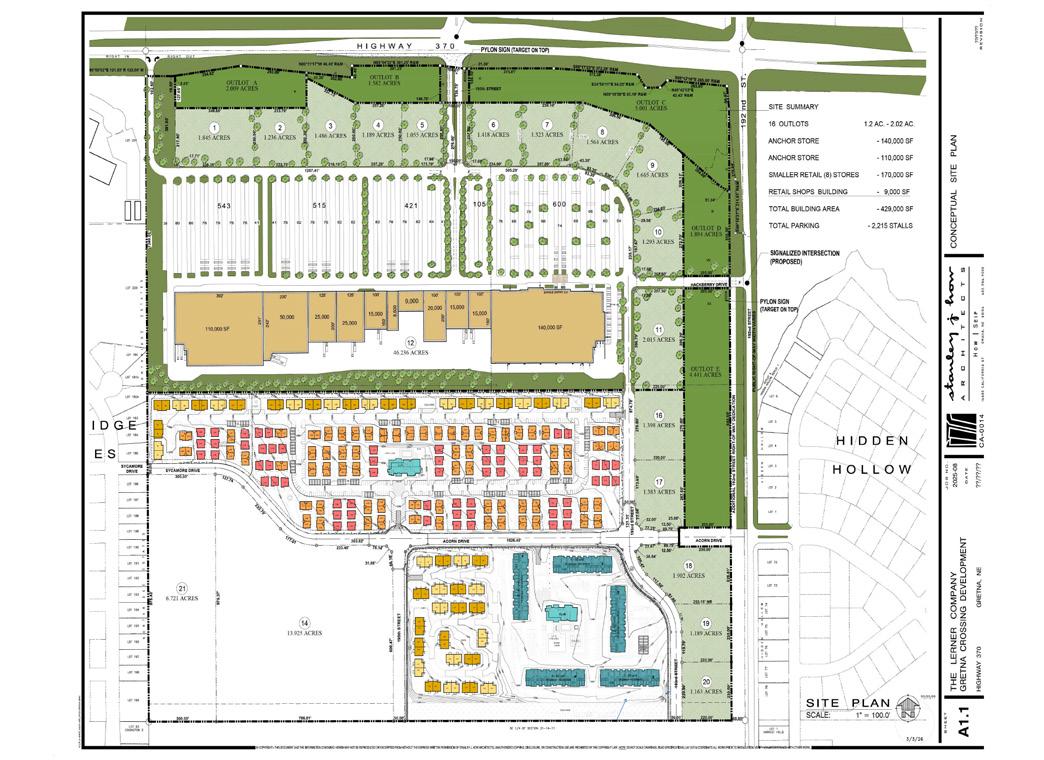
Among the most anticipated is the Crossroads development, a 40-acre mixed-use project rising at 72nd and
Dodge Streets. Another is Avenue One, a 200-acre mixed-use development at 192nd Street and West Dodge Road. Also drawing attention is Gretna Crossing, a 70-acre mixed-use project at the intersection of 192nd Street and Highway 370 that is helping support growth in one of the metro area’s fastest-growing communities.
Estivo said these developments represent only a portion of the projects currently underway across the Omaha market.
The continued flow of development activity stems in large part from Omaha’s economic fundamentals.
“I think Omaha offers a combination of economic stability, affordability and steady growth that’s hard to find in other markets,” Estivo said.
The city benefits from a diverse employment base anchored by several major corporations, including Berkshire Hathaway, Union Pacific, Kiewit and Mutual of Omaha. These employers
provide economic stability and have helped create a business environment that attracts companies looking to expand.
Omaha also benefits from nationally recognized healthcare and educational institutions such as the University of Nebraska Medical Center and Nebraska Medicine. These institutions continue to attract investment, generate jobs and bring new talent to the region.
Another advantage for Omaha is its rela-
Amy Lawrenson (Photo courtesy of Baird Holm.)
Samantha Estivo (Photo courtesy of The Lerner Company.)
Trey MacKnight (Photo courtesy of The Lund Company.)
Mike Homa (Photo courtesy of R&R Realty Group.)
OMAHA
tive stability during economic downturns. The market has historically experienced less severe economic swings than many larger metropolitan areas, according to Estivo. Combined with a lower cost of living than many competing markets, that stability has made Omaha an increasingly attractive destination for businesses, developers and residents alike.
One trend that continues to gain momentum throughout the metro is the rise of mixed-use developments.
“Demand for mixed-use developments remains strong,” Estivo said.
The popularity of these projects reflects changing preferences among both consumers and businesses. Residents increasingly want neighborhoods where they can live, work, shop and dine without traveling long distances. Businesses, meanwhile, appreciate the built-in customer base and increased activity that mixed-use environments create.
The prominence of projects such as Crossroads, Avenue One and Gretna Crossing highlights just how important mixed-use development has become to Omaha’s future growth strategy.
A stable, diverse market
Omaha’s commercial real estate market isn’t defined by one hot sector or one dominant employer. Instead, the Nebraska city benefits from something that many markets envy: stability.
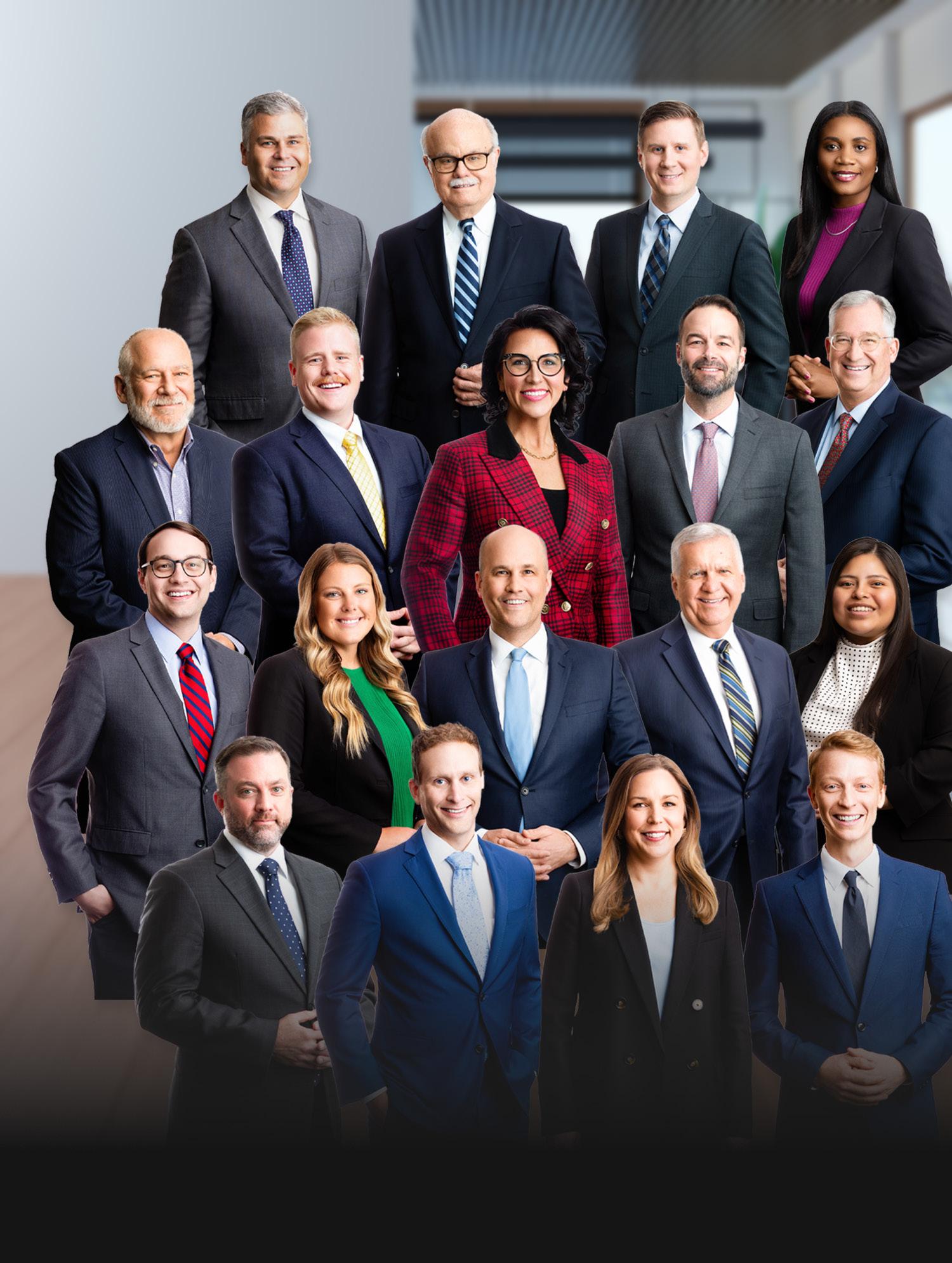
That stability is helping drive robust activity in industrial and multifamily development while also supporting growth in retail, healthcare and mixed-use projects across the metro area, said Patrick Bartman, attorney with Omaha law firm McGrath North.
“Stability is the name of the game,” Bartman said. “Developers see Omaha as a less risky option than many other areas of the country.”
Omaha’s relatively affordable cost of living has made it an attractive destination for families and young professionals. At the same time, ongoing redevelopment projects in midtown and downtown Omaha and significant investments in the city’s urban core are encouraging apartment development throughout the market.
The industrial sector is equally strong.
Omaha’s central location in the United States has turned the city into an attractive destination for logistics and distribution operations.
“New industrial construction is routinely leased or sold before breaking ground,” Bartman said.
Healthcare and retail properties are also performing well. Major healthcare institutions, including the University of Nebraska Medical Center, Nebraska Medicine and CHI Health, continue to drive development activity.
Those investments often spur mixed-use developments that then attract retail tenants. Bartman points to projects such as the Catalyst Building as examples of healthcare-related investments helping create broader commercial growth.
Retail, meanwhile, continues to benefit from population growth, particularly in west Omaha, and historically low vacancy rates.
Construction costs remain elevated nationally, but Bartman said they have done little to slow development activity in Omaha.
Fifteen years ago, Omaha’s entertainment districts were largely limited to the Old Market and Benson. Today, neighborhoods such as Aksarben, Midtown Crossing, Blackstone, Dundee, Little Bohemia, Millwork Commons and Heartwood Preserve have emerged as vibrant mixed-use destinations.
Demand from residents and favorable financing opportunities are combining to fuel additional mixed-use development across the city.
Bartman is especially excited about one project in North Omaha: the development of Omaha North High School’s new football stadium and the construction of a new Butler-Gast YMCA near 34th and Ames Avenue.
The area has historically been underserved and underinvested, making the project especially meaningful.
“It’s refreshing to see such a strong philanthropic commitment to this community,” Bartman said. “I’m optimistic it will be a catalyst for future growth.”
Recognition Earned. Results Delivered.
At McGrath North, we are committed to excellence. Our Real Estate attorneys have earned Band 1 recognition from Chambers USA, a distinction that reflects our commitment. We are proud to support you and your team in achieving success across all your real estate goals.
• Real Estate Development
• Acquisitions and Sales
• Land Use and Zoning
• Construction and Design
• Condominium Creation, Management, and Development
• Environmental Permitting and Compliance
• Commercial Leasing
• Tax Planning
• Entity Structure
• Renewable Energy
Contact: Patrick Bartman
McGrath North Mullin & Kratz, PC LLO First National Tower 1601 Dodge Street, Suite 3700 Omaha, NE 68102
www.mcgrathnorth.com
T: 402-633-6856
pbartman@mcgrathnorth.com
New projects continue to emerge throughout the city, ranging from multifamily developments to large mixed-use projects and new office headquarters that are reshaping Omaha’s skyline.
Among the projects Bartman highlighted are Heartwood Preserve, the Catalyst Building and the Builder’s District.
Part of the reason development has remained active despite higher construction costs is the variety of financing tools available to developers in Omaha.
Public-private partnerships, tax increment financing, Qualified Opportunity Zones, Sanitary and Improvement Districts and institutional investment all help developers assemble the capital necessary to move projects forward.
Mixed-use development has become one of Omaha’s defining trends.
“Omaha is having a bit of a mixed-use moment,” Bartman said.
For decades, Omaha’s growth focused primarily on westward expansion. More recently, however, attention has shifted toward urban neighborhoods as residents increasingly seek walkable communities and shorter commute times.
The office sector continues to face challenges, mirroring trends seen in many markets across the country. Even so, developers continue to pursue opportunities in emerging districts.
Heartwood Preserve, Builder’s District and Regency Landing all feature either speculative or build-to-suit office developments. And the under-construction Mutual of Omaha Tower will become the largest office building in Omaha’s history.
Taken together, the activity across Omaha’s commercial sectors reflects a market that continues to evolve while remaining grounded in its long-standing strengths.
Low unemployment, strong housing demand, a diverse economic base and access to capital have allowed Omaha to weather economic shifts better than many metropolitan areas. Those characteristics continue to attract companies and developers looking for a market that offers both opportunity and resilience.
Industrial momentum not fading
Omaha’s commercial real estate market isn’t immune to the challenges facing the industry nationally. High construction costs continue to make developers cautious, and office tenants are still rethinking how much space they need.
But according to Amy Lawrenson, partner with Omaha law firm Baird Holm, the market’s fundamentals remain strong, with industrial properties leading the way and mixed-use developments reshaping neighborhoods throughout the city.
“The industrial sector is clearly the standout performer in today’s Omaha market,” Lawrenson said.
Industrial vacancy rates remain well below national averages, and available space is increasingly difficult to find. As a result, landlords have gained considerable leverage, with rents continuing to climb year over year.
Several factors are driving this sustained demand. Omaha’s central location at the crossroads of Interstates 80 and 29 makes it a natural distribution hub. The city is also benefiting from steady population growth and major supply-chain investments from companies including FedEx, Amazon, Meta and Google.
“There just isn’t much available to lease,” Lawrenson said.
Construction activity, meanwhile, continues in Omaha, though at a more measured pace than during the development boom of 2022 and 2023.
Lawrenson said new projects are moving forward, but developers are being more selective about where and how they invest.
“For the right project in the right location, capital and construction activity are still flowing,” she said.
High construction costs remain a significant obstacle, particularly for speculative multi-tenant office and multifamily developments. Elevated material prices and longer lead times have pushed many retailers and office users to seek existing space rather than pursue ground-up construction.
Despite those headwinds, Lawrenson sees considerable opportunity in several high-profile projects transforming Omaha’s urban landscape.
She points specifically to North Downtown Omaha, where years of investment have dramatically altered what was once a heavily industrial and blighted section of the city.
Continued development in the Millwork Commons and the Builder’s District
“Omaha consistently ranks among the most affordable large metros in the country for operating costs, including real estate, labor and taxes.”
has helped create a walkable mixed-use neighborhood that connects directly to the campus of Creighton University.
Even more changes are coming. A planned stadium for Union Omaha and an accompanying 20-acre mixed-use district are expected to further transform the area. The partnership between Union Omaha and the city is scheduled to break ground in 2026, with the stadium expected to open in 2028.
Lawrenson said Omaha continues to attract developers and expanding companies because it offers a combination of advantages that are difficult to find elsewhere.
The city provides central geographic positioning, extensive interstate access and relatively low operating costs. Omaha also benefits from a concentration of major corporate headquarters and a diversified economy that has historically weathered economic downturns well.
“Omaha consistently ranks among the most affordable large metros in the country for operating costs, including real estate, labor and taxes,” Lawrenson said. “When a company looks at what they get here versus what they pay, the math works.”
The office sector, often viewed as the industry’s biggest challenge nationally, is showing encouraging signs in Omaha, too.
Omaha is experiencing the same flight-to-quality trend seen throughout much of the country. Companies are frequently reducing their overall footprints while upgrading the quality of the space they occupy.
That trend has allowed Class-A buildings to command higher rents. Owners of Class-B and Class-C properties, meanwhile, increasingly must offer generous tenant-improvement packages to remain competitive.
Another area generating significant excitement is mixed-use development.
Lawrenson said demand for projects that combine residential, retail, entertainment and dining components continues to grow. Developments including the Builder’s District, Heartwood Preserve and Gretna Landing illustrate that momentum.
Much of the demand is being fueled by changing consumer preferences. Residents increasingly want walkable environments that allow them to live, work, dine and socialize in one place.
Omaha’s under-construction streetcar line is also helping stimulate development activity along its planned route.
For Lawrenson, these trends point to a market that remains well positioned for future growth.
Industrial demand remains robust, mixed-use projects continue to gain momentum and even the office sector is showing resilience — all signs that Omaha’s commercial real estate market continues to build on a strong foundation.
Since 1975, Investors Realty has been shaping the commercial real estate landscape across the Omaha metro. With decades of experience, specialized expertise, and a client-focused approach, we provide innovative brokerage, property management, project management, and maintenance solutions that help our clients achieve long-term success. OFFICE
Our Legacy since 1975 Watch Our Story
rates, industry professionals say Madison’s strong economic fundamentals continue to support growth across nearly every property sector.
“Demand for mixed-use development remains exceptionally strong throughout Madison and Dane County,” said Heather Ewing, founder and managing principal of Madison, Wisconsin-based ABSTRACT Commercial Real Estate.
According to Ewing, Downtown Madison Inc.’s development tracker currently lists more than 60 projects in various stages of planning, development, construction and delivery.
“Cranes are visible from nearly every vantage point in the downtown,” Ewing said. “It underscores the scale of ongoing investment.”
She said developers continue to gravitate toward projects that create walkable, higher-density environments emphasizing community gathering spaces, restaurants, public art and opportunities for social interaction.
That trend is evident in major projects such as the Brayton Lot redevelopment, the State Street Campus Garage redevelopment and several projects surrounding State Street and the Business Improvement District. The former Porta Bella redevelopment site and an adjoining parcel, for instance, have been cleared for a new 16-story mixed-use development.
“A sense of community is a common thread,” Ewing said. “Combine this with walkability, and you have a formula for attracting residents, visitors and businesses alike.”
Mixed-use projects are also benefiting from municipal policies encouraging greater density.
Chris Richards, partner and managing director of the Madison office of Colliers, said mixed-use developments have performed especially well in the city’s most densely populated areas.
“The retail component of these mixed-use projects is most successful when developers have the foresight to include the appropriate infrastructure and parking to allow retailers to thrive,” Richards said.
MADISON (continued from page 1)
Image by Yinan Chen from Pixabay.
Retail continues to shine
Among Madison’s commercial property sectors, retail remains one of the strongest performers.
Ewing said preliminary second-quarter data showed Madison’s overall retail vacancy rate at approximately 5.45%, while the market recorded more than 88,000 square feet of positive absorption during the quarter and more than 151,000 square feet year-to-date.
Demand is strongest in grocery-anchored centers, food-and-beverage concepts, experiential retail, wellness tenants and service-oriented businesses.
National brands continue to view Madison as an attractive expansion market. One recent example is North Italia’s first Wisconsin location at Hilldale. Meanwhile, the Madison Public Market has introduced dozens of local food, beverage and specialty retailers.
“The combination of population growth, spending power and quality
of life continues to attract both national and local operators,” Ewing said.
Richards agreed, calling retail one of Madison’s two strongest sectors today.
“The strength in the retail sector is due to strong population growth, strong demographics and limited supply,” he said.
Madison’s zoning policies have also played a role.
“The city has created overlay districts in some of its most popular thoroughfares that require density, which has and will continue to limit retail development,” Richards said.
Industrial demand rebounds
Industrial real estate has also regained momentum after experiencing a temporary slowdown.
Richards said tariff concerns and a wave of new deliveries created un-
certainty in the industrial market. But demand has since caught up with the new supply.
“We anticipate a fair amount of new industrial development in the near future,” he said.
The market’s long-term growth prospects remain favorable, driven by Madison’s expanding economy and population growth.
Development pipeline remains active
Despite rising construction costs and financing challenges, developers continue to push projects forward.
“Construction costs will always be a topic of conversation,” Ewing said.
“The cost of waiting can be greater than the cost of building and may result in lost market opportunities.”
She pointed to projects ranging from the Pumpkin Patch Development in Sun Prairie to high-rise developments around State Street, Hilldale’s Phase 3 and Madison Yards at Hill Farms as evidence of continued developer confidence.
Westward360 provides a complete rental management solution designed to help owners maximize occupancy, protect their assets, and increase long-term profitability. Whether you own a single condo, a multi-family
About Us
Chris Richards (Photo courtesy of Colliers.)
Heather Ewing (Photo courtesy of ABSTRACT Commercial Real Estate.)
“While some projects move more slowly due to capital constraints, the development pipeline remains active compared to many peer Midwest markets,” Ewing said.
Richards said high construction and borrowing costs have delayed or paused some projects. But, in many cases, those delays have prevented the market from becoming oversupplied.
“Retail and industrial developments have felt the pressure of these costs,” Richards said. “But demand in these two areas has been strong enough to allow projects to move forward.”
Major redevelopment opportunities ahead
Both professionals highlighted several projects that could significantly reshape downtown Madison.
Ewing said she is particularly excited about the redevelopment of 425 North Frances Street, where ABSTRACT Commercial Real Estate represented the seller. The site and adjoining parcel have been cleared for a 16-story mixed-use project.
She is also involved with the Brayton Lot
redevelopment team, working alongside JLA Architects, Findorff and other partners.
“The site represents a one-of-a-kind redevelopment opportunity near the Capitol Square,” Ewing said. “It has the potential to further strengthen the connection between downtown Madison and the East Washington corridor.”
Richards pointed to two state-owned downtown sites that are expected to attract significant developer interest: the GEF 2 and GEF 3 properties and the historic 1 W. Wilson building.
GEF 2 and GEF 3 will likely be demolished and redeveloped, significantly increasing density in a prime central business district location, Richards said.
Meanwhile, 1 W. Wilson is expected to be transformed into a mix of hospitality, housing and retail uses, with the possibility of incorporating an Amtrak station.
Office market slowly recovers
The office sector remains challenged but is showing encouraging signs.
According to Ewing, Madison’s overall office vacancy rate stood at approxi-
Photo courtesy of Pixabay.
mately 16.3% in the second quarter of 2026. The market experienced negative absorption during the quarter, though she said much of that activity reflects companies optimizing their space needs rather than abandoning office space entirely.
“Flight-to-quality remains very real,” Ewing said.
Today’s office tenants are prioritizing amenities, collaboration spaces and flexible environments that help attract employees back to the workplace.
“The most successful office buildings are creating destinations rather than simply providing square footage,” she said.
Richards said office demand remains strongest for spaces of 5,000 square feet or less. He also sees tenants continuing to right-size their footprints.
“Companies are eager to find and create spaces that compel their employees to come to the office versus work from home,” Richards said.
As a result, tenants increasingly seek higher-quality space, more walkable locations and enhanced amenities.
A resilient growth story
Ultimately, Madison’s appeal stems from a rare combination of economic diversity, educational resources and quality of life.
The presence of the University of Wisconsin-Madison, state government, Epic, Exact Sciences and a growing healthcare and technology ecosystem has created a resilient economy that continues to attract investment.
Richards said Madison’s growing reputation as a biotech, technology and engineering hub is drawing both companies and young professionals.
“These companies have created a number of high-quality jobs for our local area and continue to poach talent from our larger Midwest counterparts like Chicago, Minneapolis and Milwaukee,” he said.
For Ewing, the city’s momentum extends beyond statistics and development pipelines.
“Strong fundamentals attract investment,” she said. “Culture, creativity and quality of life help sustain it.”
Photo courtesy of Pixabay.
Not all industrial markets are created equal: The country’s top-25 industrial hubs are gaining strength
By Dan Rafter, Editor
After years of rapid development and shifting market conditions, the U.S. industrial sector appears to be entering a new phase, one marked by improving fundamentals, rising demand and a more balanced supply pipeline.
That’s one of the key findings from Colliers’ June 2026 report, The Markets That Move America: An Inside Look at the Top 25 U.S. Industrial & Logistics Markets.
The report examined the nation’s 25 largest industrial markets, which account for 76% of America’s industrial inventory among the 78 markets tracked by Colliers.
According to the report, the industrial market is transitioning away from the post-pandemic construction boom that flooded many regions with new supply. Today, developers are pulling back while occupier demand is gaining momentum.
In its report, Colliers wrote that the surge in new industrial supply is over. According to Colliers’ research, new industrial deliveries fell 24% year-overyear nationwide while construction activity sits roughly 60% below its 2022 peak.
That shift is helping bring balance back to the market.
Across the country, industrial inventory
grew by just 0.5% over the past year, a sharp decline from the rapid expansion seen during the height of the logistics boom. The 25 largest markets grew faster, posting 1.3% annual inventory growth, but even those numbers reflect a significantly slower pace of development.
Several Sun Belt markets continue to dominate industrial activity. Dallas-Fort Worth led all markets with 22.9 million square feet of inventory growth during the past year, followed by Houston with 20.1 million square feet. Greater Los Angeles, Atlanta and Phoenix also remained among the nation’s most active logistics hubs.
Colliers reported that net absorption
across the top 25 industrial markets increased 19% year-over-year to nearly 146 million square feet. Nationwide, industrial demand rose 5.2% to 186 million square feet over the last 12 months.
Dallas-Fort Worth remained the nation’s top performer, recording 24.3 million square feet of net absorption. Phoenix followed with 18.5 million square feet, while Indianapolis emerged as one of the strongest Midwest markets with 15.7 million square feet of absorption. Chicago also posted impressive results, recording 14.2 million square feet of demand growth.
The Midwest continues to demonstrate strong fundamentals. Nine of the nation’s top 25 industrial markets sit in
iStock photo credit by vitpho.
the Midwest, and several are seeing demand outpace supply.
Indianapolis stood out as one of the country’s strongest markets. According to Colliers, the market recorded 15.7 million square feet of net absorption while adding only 3.9 million square feet of new supply during the same period. Columbus, Cincinnati and Memphis also posted strong supply-demand balances.
These conditions are already affecting vacancy rates.
National industrial vacancy reached 7.4% in the first quarter of 2026, up 37 basis points year-over-year. However, conditions were somewhat tighter in the top 25 markets, where vacancy rose only 11 basis points to 7.2%.
Some markets are already seeing vacancy decline. Indianapolis posted one of the largest improvements in the country, with vacancy falling 364 basis points year-over-year to 7.1%. Columbus and Phoenix also recorded significant decreases as demand absorbed previously delivered space.
“The Midwest continues to demonstrate strong fundamentals. Nine of the nation’s top 25 industrial markets sit in the Midwest.”
Phoenix still has the highest vacancy rate among major markets at 10.6%, but even there conditions have improved significantly from a year ago.
Colliers said that the combination of moderating supply and strengthening demand could soon create tighter market conditions in many regions.
Construction activity remains well below its pandemic-era peak, according to Colliers. Industrial space under construction totaled 286 million square feet nationally in the first quarter of
2026, far below the 711 million square feet under construction in 2022.
Dallas-Fort Worth continues to lead the nation with 34.3 million square feet under construction, while Houston ranks second with 24 million square feet underway. The New York metro area saw one of the biggest increases, with its construction pipeline expanding 150% year-over-year.
Still, developers appear increasingly selective. Build-to-suit projects continue to dominate, but Colliers reported that
improving market conditions are laying the groundwork for the eventual return of speculative development.
Rents are also stabilizing. National warehouse and distribution asking rents dipped 0.5% year-over-year to $10.46 per square foot, reflecting a normalization after several years of record increases. Yet rents in the top 25 markets still rose 0.8% to $9.72 per square foot.
Houston led the nation in rent growth, posting a 14.2% increase over the past year.
A life sciences sector that’s finally stabilizing? That’s what JLL is predicting
By Dan Rafter, Editor
After several years of big swings in demand, the U.S. life sciences CRE sector is showing signs of stabilization, according to the latest research from JLL.
In its recently released 2026 U.S. Lab Property Report, JLL reported that tenant demand for laboratory space is beginning to outpace new supply in the nation’s busiest life sciences markets. This is welcome news to landlords and investors who have weathered a prolonged downturn in this sector marked by oversupply and declining rents.
The JLL report found that U.S. lab availability has fallen by roughly 2 million square feet since mid-2025. While this doesn’t mean that the sector’s challenges are over, it does suggest that the life sciences market
“After years of oversupply weighing on the sector, we’re finally seeing clear signs that the worst is behind us.”
might have reached its bottom and is now entering the early stages of recovery.
“After years of oversupply weighing on the sector, we’re finally seeing clear signs that the worst is behind us,” said Travis McCready, head of life sciences, Americas markets, and
chair of JLL’s global life sciences advisory board, in a written statement.
McCready said improving biotech funding conditions, stronger capital flows and increased tenant activity are combining to help fuel momentum in the life sciences sector. That’s a positive. On the downside? The
industry continues to grapple with a significant supply imbalance.
JLL’s report also highlights a shift in the type of life sciences space that tenants want. Companies are increasingly seeking out newer, higher-quality lab buildings while older properties struggle to attract new tenants.
iStock photo credit by gorodenkoff.
JLL said that buildings completed since the start of 2020 have absorbed 2.6 million square feet of available space during the last nine months. During the same period, laboratory properties built before 2000 have seen their available space increase by 700,000 square feet.
The report also highlights the emergence of a new tenant base. Artificial intelligence, robotics and other “tough tech” companies are increasingly leasing laboratory space traditionally occupied by biotechnology firms. In Boston, for example, these alternative users accounted for 30% of lab leases signed in 2025, triple their share from four years earlier, JLL reported.
Despite all this good news, the recovery in this sector is not occurring evenly across the country. JLL found that Boston, the San Francisco Bay Area, San Diego and Raleigh-Durham continue to dominate the sector.
Combined demand in those four markets increased 44% year-overyear to nearly 8 million square feet in the first quarter of 2026.
Secondary markets, though, are not
always thriving. Over the last three years, tenant demand in these locations has fallen by nearly 3 million square feet while available inventory has increased by 4.4 million square feet, according to JLL.
“The winners in this cycle will be the highest-quality assets in the strong locations,” said Mark Bruso, senior
director of Boston and national life sciences research at JLL, in a statement.
Even in the strongest markets, tenants currently hold considerable leverage. Vacancy rates across Boston, San Diego and the Bay Area have reached 32%, prompting landlords to offer shorter lease terms, larger
rent concessions and move-in-ready space packages to attract occupiers.
JLL estimates that the country’s lab market now totals more than 200 million square feet and faces a supply-to-demand ratio approaching 6-to-1. That imbalance is expected to keep downward pressure on rents for years.
Image by Gerd Altmann from Pixabay
Don’t paint yourself into a corner: How to take a smarter approach to healthcare facility design
By Kevin Knue, Bremner Healthcare Real Estate
Patient volumes shift. Care delivery evolves. New technologies emerge. Yet, one mistake continues to create unnecessary cost and operational headaches down the road: failing to plan for flexibility from the start.
Healthcare leaders face a difficult balancing act, designing facilities that meet today’s needs while preparing for an uncertain tomorrow.
Once a site is constrained — by buildings, parking, infrastructure or regulatory limitations — future growth becomes more complex,
more expensive and sometimes impossible without major disruption. The solution isn’t predicting the future perfectly. It’s designing with enough foresight and flexibility to adapt when change inevitably comes.
There are some steps healthcare leaders can take to get it right. The most effective facility strategies begin at the highest level, understanding the full capacity of a site, not just what’s needed on day one.
A health system might plan for a 50,000-square-foot medical office building today. But what happens
The premier construction experience.
when the area’s population doubles? Can the site support expansion? Is there adequate space for additional parking? Will stormwater systems, utilities and access points accommodate future growth?
These aren’t questions to answer later. They should be addressed upfront through comprehensive site master planning, evaluating the maximum building footprint, parking ratios, infrastructure capacity and land constraints before the first shovel ever hits the ground.
Flexibility starts with the site itself. Parking, for example, is often treated as a static requirement, but it shouldn’t be. As facilities expand, so do parking needs, and that has a ripple effect on stormwater management and land use.
Smart planning considers multiple scenarios. Can the site accommodate additional surface parking? If not, is there a path to structured parking in the future? Is stormwater infrastructure sized and located to expand, or will it become a bottleneck?
There’s also a cost strategy at play. Some investments make sense on day one, especially those that are significantly more expensive to retrofit later. Upsizing utility lines, reserving space for future infrastructure or designing expandable systems can prevent costly rework down the line.
Flexibility doesn’t stop at the site. It must extend to the building itself.
spaces to be reconfigured as care delivery models evolve.
Most important is the patient experience. Growth should feel seamless, not disruptive. Thoughtful placement of entrances, corridors, elevators and key departments ensures expansions enhance — not hinder — how patients access care.
For example, critical functions such as emergency departments should be positioned away from anticipated growth zones. Expanding through or around these areas is operationally challenging and costly. Strategic placement upfront avoids those constraints later.
On a project in Kalamazoo, Michigan, Bremner delivered a cancer center that initially supported medical oncology services, such as infusion therapy. However, the building was intentionally designed to accommodate a future expansion into a comprehensive cancer center with radiation oncology.
While that capability wasn’t needed on day one, the team planned for it — allocating space, designing infrastructure and positioning the building to grow without disrupting operations. As patient volumes increase and regulatory approvals are secured, that facility can evolve seamlessly, without requiring a costly redesign or relocation.
“We don’t know what the future holds” is a common pushback from healthcare leaders. That’s true. But uncertainty is not a reason to avoid planning — it’s the reason to plan more thoughtfully.
Healthcare facilities should be designed with expansion in mind, both horizontally and vertically where appropriate. That starts with core elements such as structural grids, mechanical systems and utility infrastructure. Standardized structural layouts and scalable systems allow
The goal isn’t to predict exact future needs. It’s to understand the site’s full potential and make informed decisions about where to invest today. If a relatively small upfront cost can prevent a much larger expense later, it’s worth serious consideration.
Guided by efficiency, anchored in value, driven by results
At the same time, not every future need requires immediate investment. The key is balance, building in the capacity for growth without overcommitting capital to equipment or infrastructure that may not be needed for years.
Ultimately, successful healthcare facility design is about creating a roadmap. That roadmap should outline how a campus can evolve over time — where new buildings can go, how infrastructure will scale and how patient flow will be maintained when the time comes.
This approach aligns both operational and strategic goals. For healthcare executives, it supports market growth and patient access. For facility and real estate teams, it ensures that expansion is feasible, efficient and cost-effective.
The healthcare landscape will continue to change. But with the right approach to site planning and facility design, organizations can adapt without starting over. The best projects aren’t just built for today — they’re designed to grow into tomorrow. Kevin Knue is executive vice president and partner at Bremner Healthcare Real Estate. With more than 17 years of
and construction experience, Kevin has a wealth of knowledge and expertise including experience pursuing new opportunities and managing projects from conception to completion.
National Reach. Strategic Real Estate Execution.
We embed ourselves in your business, so we can solve challenges before they become obstacles. Our Real Estate Group serves as a trusted extension of your leadership team, handling complex transactions nationwide, from acquisitions and joint ventures to development, leasing, and sophisticated financing structures.
to have
Image by Robyn Wright from Pixabay.
Before you buy your first hotel: Key considerations for real estate Investors considering hotel acquisitions
By Aaron Robinow
Investors with significant experience buying and selling triple net real estate often evaluate prospective investments by analyzing predictable rent schedules, tenant (and guarantor) financial statements, and cap rates. This framework, while effective for traditional single-tenant assets, is not readily transferable to the hotel sector.
A hotel is not merely a real estate investment—it is an operating business conducted within a real estate asset.
As a result, the legal, financial, and operational considerations differ in fundamental ways. Here are several key distinctions that net-lease investors should carefully evaluate when considering a hotel acquisition.
Valuation Methodology and Cash Flow Variability
Net-lease investments are typically underwritten based on contractual rent and evaluated relative to prevailing market cap rates. The existence
of a long-term lease with fixed or predictable rent provides a stable basis for valuation and facilitates relatively straightforward comparisons across assets. Net leases also generally make the tenant responsible for all or most property-level expenses, resulting in a more predictable free cash flow to the owner.
By contrast, hotel revenues are not contractually determined and instead fluctuate based on operational performance and demand. Room revenue
is generated on a nightly basis and is subject to variability driven by occupancy levels, average daily rate (ADR), seasonality, and broader economic conditions. In addition, the hotel owner is responsible for all operating expenses, maintenance, and capital expenditures.
As a result, hotel buyers lack a directly comparable standardized metric equivalent to contractual net operating income for purposes of applying a cap rate. Instead, valuation may be de-
Photo by Klaus Nenning, Pexels.
rived from multiple measures, including net operating income, EBITDA, or fee cash flow after management and franchise fees. Underwriting a hotel purchase therefore requires sensitivity analyses and scenario-based projections rather than reliance on a fixed income stream.
Accordingly, investors must adopt a more dynamic valuation approach that accounts for both market-based and operational volatility.
Diligence: Asset Performance, not Tenant Credit
In a NNN lease transaction, diligence is principally focused on the creditworthiness of the tenant and any guarantor, as well as the enforceability and structure of the lease. The investor’s risk profile is therefore closely tied to the tenant’s ability to perform its obligations under the lease.
In a hotel acquisition, there is no tenant. Instead, the investor assumes direct exposure to the operating performance of the asset.
Due diligence is therefore centered on
historical financial statements, operating data, and the physical condition of the asset. However, such data must be evaluated with caution, as historical performance may not be indicative of future results. Investors must also consider a range of additional variables, including changes in room supply within the market, shifts in demand drivers (such as business travel and tourism trends), non-recurring events reflected in historical results, and variations in
management quality and operating strategy.
As a result, legal and financial diligence must be supplemented by a robust assessment of market conditions and forward-looking demand projections.
Capital Expenditures and Ongoing Property Obligations
A defining feature of NNN lease structures is the allocation to the tenant of responsibility for most or all of maintenance, repair, and capital expenditure obligations. This structure limits the landlord’s need to contribute additional capital during the lease term.
Hotel ownership entails a fundamentally different allocation of responsibility. The owner bears primary responsibility for all maintenance, repairs, and capital improvements costs necessary to maintain the property’s physical condition and competitive positioning. In addition, management and franchise agreements commonly require the owner to fund capital reserve accounts, typically in the range of 4% to 5% of gross revenue.
Branded hotels are also subject to periodic property improvement plans (PIPs), which mandate upgrades to furniture, fixtures, and equipment, as well as broader renovations to ensure compliance with brand standards. These capital cycles are recurring and can be significant, often occurring on a 5–7 year cycle for soft goods and a 10–14 year cycle for more substantial improvements. These obligations must be carefully modeled, as they directly affect both cash flow and long-term asset value.
Management Agreements and Operational Control
Net-lease investments are generally characterized by limited landlord involvement in day-to-day operations, with the tenant retaining operational control subject to lease restrictions.
In the hotel context, the owner’s role in operations is central to value creation and preservation.
Investors typically engage a third-party manager pursuant to a hotel management agreement, although some owners elect to operate themselves,
Vincent K.
Aaron Robinow
(Photo courtesy of Dorsey & Whitney LLP.)
HOSPITALITY
sometimes through affiliated management platforms. These management agreements govern the operation of the hotel and address, among other matters, staffing, operational policies and procedures, owner approval rights, management fee structures (including base and incentive fees), performance standards, and termination rights.
The selection of a well-qualified manager and the negotiation of a management agreement with proper alignment of incentives and expectations are critical to the owner’s return on investment.
Franchise Agreements and Brand Considerations
Most hotels operate under a brand affiliation pursuant to a franchise agreement with a major hospitality company, such as Marriott, Hilton, or Hyatt.
These agreements provide substantial benefits, including access to centralized reservation systems, brand recognition, and marketing support. However, they also impose material obligations, including the payment of initial and ongoing franchise fees,
compliance with detailed brand standards, and required capital improvements and renovations.
In connection with an acquisition, investors must typically address the termination of the existing franchise agreement and the negotiation of a new agreement. This process often involves property improvement plans and other conditions required to obtain brand approval. Buyers must also carefully coordinate the timing and
process of franchise application and approval.
In Sum
For private and institutional investors with experience in NNN lease acquisitions, hotel ownership represents a transition from a contractually driven investment model to one that is operationally intensive and performance dependent.
This shift implicates not only different financial metrics, but also a fundamentally different allocation of risk, responsibility, and control. Successful execution in the hotel sector requires a nuanced understanding of hotel management, franchise relationships, capital planning, and market dynamics, in addition to traditional real estate considerations.
Investors contemplating such a transition should engage legal advisors experienced in the hospitality industry to guide them through the due diligence process, identify and mitigate risks specific to hotel acquisitions, and provide strategic insight in negotiating transaction terms and documentation.
About the author:
Aaron Robinow is an attorney at Dorsey & Whitney LLP who advises clients on complex commercial real estate transactions, with a focus on the hospitality sector. Dorsey & Whitney LLP’s Hospitality Industry Group counsels clients on a wide range of hotel and restaurant matters.
Image by Manuela Jaeger from Pixabay
What’s new in Wisconsin TIF: Key changes under Acts 173 and 235
By Richard Donner, Reinhart Boerner Van Deuren
Wisconsin’s 20252026 legislative session has introduced notable updates to tax incremental financing (TIF), including targeted reforms to affordable housing tools and the creation of a new TIF district type to spur residential development.
2025 Wisconsin Act 173
Affordable Housing Extension Expanded. Municipalities can now extend a TIF district’s life by up to two years (a doubling of the previous one-year limit) to fund costs benefiting affordable housing. All other statutory requirements to implement the extension remain unchanged.
Definition of Newly Platted Residential Development. Act 173 introduces a definition for the previously undefined term “newly platted residential development.” Beginning January 1, 2028, this will refer to “residential development on a parcel that has not previously been the site of permanent structures other than structures used solely for agricultural purposes.” Previously, the use of TIF funds for project costs arising from newly platted residential development was permitted only in a Mixed-Use Tax Increment District (TID), with an additional restriction limiting newly platted residential development to no more than 35 percent of the Mixed-Use TID area.
Before this clarification, developers faced uncertainty regarding the meaning of “newly platted.” Did it apply only to residential development on previously undeveloped land, or could a redevelopment project requiring a replat also qualify as newly platted residential development? The new definition provided by Act 173 helps clarify which projects are eligible. Additionally, as described below, beginning October 1, 2026, newly platted residential developments will be allowed to utilize TIF not just in Mixed-Use districts but also within the new Residential TIDs created by 2025 Wisconsin Act 235, making clarity on this issue even more important.
2025 Wisconsin Act 235
Creation of Residential TIDs. Act 235 authorizes a new TID type that allows newly platted residential development without the 35 percent area cap in Mixed-Use districts.
Development in a Residential TID must meet the following requirements:
• Limited to owner-occupied, single-family or two-family residences.
• Lot sizes for single-family residences may not exceed 7,500 square feet, with a maximum lot width of 70 feet and a maximum 10-foot side yard setback.
• Lot sizes for two-family residences may not exceed 12,500 square feet, with a maximum lot width of 80 feet and a maximum 10-foot side yard setback.
• No single-story residence can be larger than 1,500 square feet.
• No two-story residence can be larger than 2,000 square feet.
While there is some overlap with a Mixed-Use TID, Residential TIDs have several unique features:
• Project costs in a Residential TID are limited to costs related to the construction or improvement of infrastructure necessary for residential developments within the district, including financing costs, professional services costs, imput-
“Affordable
Housing Extension Expanded.
Municipalities can now extend a TIF district’s life by up to two years.”
ed administrative costs and organizational costs. Therefore, land acquisition, site prep and housing construction costs are not eligible project costs.
• Project costs can only be financed by the developer or paid out of increment from the Residential TID. No municipal borrowing. In practice, Residential TIDs will require a “pay go” structure with the developer providing the upfront cash to install the necessary public infrastructure and receiving reimbursement from increment generated during the district’s lifespan.
• Like Mixed-Use TIDs, Residential TIDs have a maximum lifespan of 20 years, but municipalities may vote to extend the lifespan by three years.
• Residential TIDs are excluded from the 12 percent rule regarding the maximum equalized value of taxable property that may be contained within TIDs, but are subject to a new three percent valuation test. The base value of the new or amended Residential TID, plus the value increment of all existing Residential TIDs, cannot be more than three percent of the total equalized value of all taxable property in the municipality.
• The project plan cannot be amended to increase project costs within 10 years of the unextended termination date of the Residential TID, unless there is a unanimous vote of the Joint Review Board.
• A Residential TID cannot become a donor or recipient TID.
The legislative changes brought by Wisconsin Acts 173 and 235 represent a step forward in modernizing tax incremental financing for residential development and affordable housing. As these provisions take effect, communities and developers will both benefit from enhanced tools to promote sustainable growth and respond to evolving workforce and housing demands.
Developers, municipalities, and other stakeholders considering the use of TIFs for residential projects should begin evaluating how these statutory changes may affect current and future development plans. In particular, parties should review whether proposed projects may qualify for the new Residential TID structure, assess the limitations on eligible project costs and financing mechanisms and consider how the new valuation thresholds and procedural requirements could impact project feasibility and timing. Early coordination among municipalities, developers, financial advisers and legal counsel will be important to maximize the benefits of these new tools and ensure compliance with the updated statutory framework.
For questions about Wisconsin TIF law, please contact Richard W. Donner or a member of our Real Estate Entitlements Team.
Richard Donner is a shareholder in the Milwaukee office of law firm Reinhart Boerner Van Deuren.
Richard Donner (Photo courtesy of Reinhart.)
COMMERCIAL SERVICES
ASSET/PROPERTY MANAGEMENT FIRMS
MID-AMERICA
One Parkview Plaza, 9th Floor Oakbrook Terrace, Illinois 60181
Primary Contacts
Jean Zoerner-Illinois, JMZoerner@midamericagrp.com; Brad Lefkowitz-Michigan, blefkowitz@midamericagrp.com; Brandon O’ Connell-Minnesota, boconnell@midamericagrp.com; Jim Vaillancourt-Wisconsin, jvaillancourt@midamericagrp.com
Core Services
Mid-America provides strategic consulting services that maximize net operating income, net cash flow, and accelerate property appreciation. We provide property and construction management, leasing, due diligence, and market analysis. Additionally, we offer MA Building Services, a self-performing porter and maintenance company offering our clients cost savings and improved accountability for related services.
About Mid-America
Mid-America Real Estate is #1 in retail real estate services in the Midwest, with full-service offices in Illinois, Michigan, Minnesota, and Wisconsin. Our exclusive focus on retail property, combined with cutting-edge technology and unsurpassed service, distinguishes Mid-America within the industry and provides clients with a competitive edge. The total consideration value of leasing and investment sales transactions facilitated in 2025 was $2.6 billion. Mid-America leases and manages more than 50 million square feet of retail space, provides comprehensive selfperforming facility services, and represents over 270 retailers and other tenants. For more information, visit www.midamericagrp.com.
BROKERAGE FIRMS
AREA REAL ESTATE ADVISORS
4800 Main Street, Suite 400 Kansas City, MO 64112
P: 816.895.4800 openarea.com
Primary Contacts
Tim Schaffer, Founder & President, tschaffer@openarea.com
Matt Vaupell, Managing Partner, mvaupell@openarea.com
Doug Grossenbacher, Partner, Director of Property Management, dgrossenbacher@openarea.com
Core Services
Office, Retail & Industrial Landlord and Tenant Representation; Property Management; Project Management; Investment; Research Analytics and Consulting
Firm Profile
AREA Real Estate Advisors is a full-suite commercial real estate firm in Kansas City. AREA is the hometown team that plays in the big leagues. Our size and scope allow us to be nimble and apply a team-driven approach while providing best-in-class service. At AREA, we deal in real estate, but our business is relationships. We are committed to meaningful partnerships with our clients to ensure that their goals are achieved. Our goal is to exceed our clients’ expectations.
Selected Clients
KU Endowment, Federal Realty, SomeraRoad, Price Brothers Management, Gillon Property Group, Five Below, Bath & Body Works, Arvest Bank, Emler Swim School, 151 Coffee, Equity Bank, American Academy of Family Physicians
OUTLOOK MANAGEMENT GROUP, LLC AMO
S74 W16853 Janesville Road
Muskego, WI 53150
P: 414.369.3511 | F: 414.435.0251 outlookmgmt.com
Primary Contact
Ray Balfanz, President/Partner, ray@outlookmgmt.com
Core Services
Full-service property and asset management services, financial analysis and reporting; budget preparation and expense reconciliations; lease administration; construction management; preventative maintenance and consulting services.
Company Overview
Outlook Management Group, LLC AMO provides comprehensive property and asset management services for all asset classes in multiple states and markets.
Selected Properties Managed
Washington Corners, Naperville, IL; Ironwood Office Park, Glendale, WI; Wood River Condominiums, West Bend, WI; Seven 10 West Luxury Apartments, Chicago, IL; MDJD Aesthetic MOB, Rockford, IL, Ascension Health MOB Milwaukee, WI; Henry Ford Health Systems Pharmacy Services Bldg. in Rochester Hills, MI; Henry Ford Medical Center in West Bloomfield, MI.
Randy Goodman, President, Randy@goodmanrealestate.com; Richard Edelman, Senior Vice President/Principal, Richard@goodmanrealestate.com
Core Services
National investment sales, tenant and buyer site selection, property marketing, leasing, sales, and disposition.
Firm Overview
Goodman Real Estate Services Group LLC is a leading commercial brokerage firm based in Ohio that currently markets 13.6 million square feet of property for sale, lease, or development throughout Ohio, and 14 other states with partner brokers, nationwide for investment sales, and tenant and buyer site selection with over 100 companies represented. We combine experience, technology, a large support team and hard work to provide exceptional service to our clients. Goodman Real Estate have offices in Cleveland and Columbus.
CONSTRUCTION COMPANIES/GENERAL CONTRACTORS
BRINKMANN CONSTRUCTORS
16650 Chesterfield Grove Road, Suite 100
Chesterfield, MO 63005
P: 636.537.9700
BrinkmannConstructors.com
Primary Contacts
Brian Satterthwaite, CEO, bsatterthwaite@brinkmannconstructors.com; Tom Oberle, President, toberle@brinkmannconstructors.com; Rebecca Randolph, Executive Director of Business Development & Marketing, RRandolph@brinkmannconstructors.com
Core Services
General contracting services including design/build, design/assist, and construction management
Company Overview
Brinkmann Constructors is a national general contractor that has completed over $10 billion of construction projects across multiple market sectors, including senior living, multifamily, student housing, warehouse, cold storage, manufacturing, automotive, retail, hospitality, and more. With regional offices in St. Louis, Denver, Kansas City, Phoenix, and Richmond and a project footprint that spans 41 states, our mission is to deliver the best construction experience for the people we serve, with a foundation built on lasting relationships and expertise driven by insight—beyond measure.
•Axial Rockville 64 - Rockville, Virginia - Two speculative warehouses totaling 330,550 SF
•I-10 International - Tucson, Arizona - Two warehouses totaling 374,000 SF •74 Broadway – Kansas City, Missouri - 440,000 SF mixed-use development with 280 units
•Aspendale Littleton - Littleton, Colorado - 231,000 SF active adult community with 190 units
MERIDIAN DESIGN BUILD
9550 W. Higgins Road, Suite 400 Rosemont, IL 60018
P: 847.374.9200
info@meridiandb.com meridiandb.com
Primary Contacts
Paul Chuma, President
Howard Green, Executive Vice President
Core Services
Meridian Design Build provides construction and design/ build construction services on a national basis with a primary focus on industrial, office, medical office, retail and food and beverage work.
Company Overview
With a team of in-house professional project managers, Meridian has extensive experience coordinating the design and construction of new buildings, tenant improvements, and additions/renovations from 15,000 square feet to 1,000,000+ square feet. Meridian Design Build has been a Member of the U.S. Green Building Council since 2007.
Selected Projects
University Park Logistics Center, University Park, IL - 970,123 sf speculative multitenant industrial distribution/warehouse facility for Clarius Partners and Hillwood Investment Properties. Silesia Flavors, Huntley, IL - 134,075 sf food production, laboratory, research and development, and office facility for Venture One Real Estate and a global leader in confectionery and beverage flavors. FedEx Ground, Gary, IN - 324,901 sf package sorting and distribution center on a 78-acre redevelopment site for Scannell Properties and Transport Properties.
PRINCIPLE CONSTRUCTION CORP.
9450 West Bryn Mawr Ave., Suite 120 Rosemont, IL 60018
P: 847.615.1515 | F: 847.615.1598 pccdb.com
Primary Contacts
Mark L Augustyn, COO, maugustyn@pccdb.com, James A. Brucato, President, jbrucato@pccdb.com
Core Services
Since 1999, Principle Construction Corp. has been a leading design-build general contractor serving the industrial markets of Chicago Metro, Southern Wisconsin, and Northwest Indiana. We specialize in designing and constructing exacting solutions for our clients, including:
• Built-to-Suit Facilities
• Speculative Facilities
• Warehouse and Distribution Centers
• Logistics and Cross-Dock Facilities
• Industrial Outdoor Storage
•Industrial and Manufacturing Plant • Tenant Improvements
• Expansions and Additions• Food Processing Facilities
• Specialty Projects
Selected Projects
• 8,205 SF animal shelter for Heartland Animal Shelter, at 586 Palwaukee Dr., in Wheeling, IL.
• 12,560 SF showroom and outdoor pool park for Doheny Enterprises, at 5307 Green Bay Rd., in Kenosha, WI
• Phase 1 renovation project for SMW Autoblok, at 285 Egidi Dr., Wheeling, IL
REAL ESTATE LAW FIRMS
SARNOFF PROPERTY TAX
100 N. LaSalle St., 10th Floor Chicago, IL 60602
P: 312.782.8310 Sarnoffpropertytax.com
Primary Contact
James Sarnoff jsarnoff@sarnoffpropertytax.com, P: 312.448.5337
Core Services
Since 1986, Sarnoff Property Tax has been a leading and recognized law firm concentrating solely in the field of property taxation. We help clients secure favorable taxes in Illinois through property tax appeals, incentives, and consulting.
Firm Overview
Sarnoff Property Tax’s clients include Owners, Developers, Managers, REITs, Fortune 500 Companies, Private Equity Firms, etc., in connection with commercial property, high-rise and low -rise apartment buildings, condominium associations and singlefamily home portfolios.
WORSEK & VIHON, LLP
180 North LaSalle Street, Suite 3010 Chicago, IL 60601
Francis W. O’Malley, Managing Partner, fomalley@wvproptax.com; Jessica L. MacLean, Partner, jmaclean@wvproptax.com
Core Services
Worsek & Vihon, LLP represents taxpayers in Illinois by limiting their property tax liabilities through ad valorem appeals resulting in lower tax bills. We have over 40 years of experience and can handle basic to the most complex assessment issues while offering the dependable, personalized attention our clients deserve. We have experience representing owners of all property types. In addition to filing thousands of appeals with the Cook County Assessor, we have been involved in numerous proceedings before various Boards of Review, the Illinois Property Tax Appeal Board, and the Circuit Court of Illinois, and have appeared before the Illinois Appellate and Supreme Courts.
Firm Overview
Worsek & Vihon LLP, is a team of highly experienced attorneys singularly focused on Illinois real estate tax law. The firm is dedicated to minimizing property tax liabilities through strategic tax portfolio management, well researched, creative appeal preparation and aggressive advocacy.