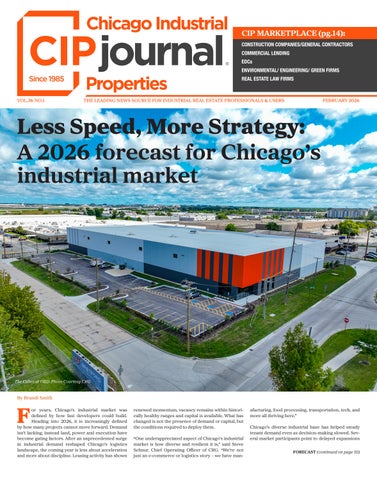
Less Speed, More Strategy: A 2026 forecast for Chicago’s industrial market
By Brandi Smith
For years, Chicago’s industrial market was defined by how fast developers could build. Heading into 2026, it is increasingly defined by how many projects cannot move forward. Demand isn’t lacking; instead land, power and execution have become gating factors. After an unprecedented surge in industrial demand reshaped Chicago’s logistics landscape, the coming year is less about acceleration and more about discipline. Leasing activity has shown
renewed momentum, vacancy remains within historically healthy ranges and capital is available. What has changed is not the presence of demand or capital, but the conditions required to deploy them.
“One underappreciated aspect of Chicago’s industrial market is how diverse and resilient it is,” said Steve Schnur, Chief Operating Officer of CRG. “We’re not just an e-commerce or logistics story – we have man-
ufacturing, food processing, transportation, tech, and more all thriving here.”
Chicago’s diverse industrial base has helped steady tenant demand even as decision-making slowed. Several market participants point to delayed expansions
FORECAST (continued on page 10)
The Cubes at ORD. Photo Courtesy CRG
PUBLISHER
Mark Menzies menzies@rejournals.com 312.933.8559
MANAGING EDITOR Dan Rafter drafter@rejournals.com
VICE PRESIDENT OF SALES & MW CONFERENCE SERIES MANAGER Ernie Abood eabood@rejournals.com
VICE PRESIDENT OF SALES Frank E. Biondo Frank.biondo@rejournals.com
Less Speed, More Strategy: A 2026 forecast for Chicago’s industrial market After an unprecedented surge in industrial demand reshaped Chicago’s logistics landscape, the coming year is less about acceleration and more about discipline. Leasing activity has shown renewed momentum, vacancy remains within historically healthy ranges and capital is available.
4
Capital Back, But Picky: Discipline shapes Chicago’s industrial investment outlook Chicago’s industrial market entered 2026 with a paradox that is reshaping capital markets activity: Leasing demand surged at the end of last year even as new speculative development fell to its lowest level in a decade. That’s creating both confidence and constraint for investors navigating the market.
6
NAI Hiffman report: 2025 not a boom year, but a steady one for Chicago-area industrial market Last year won't go down as a boom year for the Chicago-area industrial market. But the Chicago region still ended the year with a low vacancy rate and more than 18 million square feet of positive industrial absorption.
8
Beyond Compliance: How Skilled Electrical Contractors Meet NFPA 70B and Evolving Safety Standards Nearly every modern facility relies on electrical systems, whether it’s a data center, manufacturing plant, school, hospital, or public infrastructure. In all cases, reliability, safety, and uptime are critical.
14
CIP MARKETPLACE: CONSTRUCTION COMPANIES/GENERAL CONTRACTORS/ COMMERCIAL LENDING/ EDCs/ ENVIRONMENTAL/ ENGINEERING/ GREEN FIRMS /REAL ESTATE LAW FIRMS
Capital Back, But Picky: Discipline shapes Chicago’s industrial investment outlook
By Brandi Smith
Chicago’s industrial market entered 2026 with a paradox that is reshaping capital markets activity: Leasing demand surged at the end of last year even as new speculative development fell to its lowest level in a decade. That’s creating both confidence and constraint for investors navigating the market.
According to JLL’s Fourth Quarter 2025 Chicago industrial report, leasing volume climbed from 8.4 million square feet in the first quarter to 12.7 million square feet in the fourth, pushing total 2025 leasing to 40.9 million square feet. Speculative development delivered just 5.6 million square feet during the year while vacancy held steady at 5.1%, signaling a market that remains fundamentally balanced despite elevated activity.
That combination has helped pull capital off the sidelines across a broader range of deal profiles than many expected after several cautious years.
“I wouldn’t say that any deal profiles are stuck right now, as the momentum in the market continues to pick up with significant capital looking to be placed,” said Sean Devaney, senior managing director of JLL Capital Markets. “Value-add opportunities continue to be highly coveted, but we have seen a resurgence of core-plus and core capital targeting Chicago – evident from the DuPage Infill Portfolio we sold in Q3 2025 and the recent closing of the I-90 East Commerce Center, which is a stabilized new construction deal.”
Devaney said JLL expects that trend to continue as investors respond to Chica-
go’s durable fundamentals, particularly in submarkets with strong logistics infrastructure and limited new supply.
Owner activity is reinforcing that outlook. Jack Brennan, managing principal of Brennan Investment Group’s Midwest region, said improving leasing conditions and more favorable debt terms have supported both acquisition and portfolio performance.
“In 2025, we observed a meaningful increase in leasing activity across our Midwestern portfolio of 12 million square feet,” Brennan said. “Acquisition activity was also robust which was aided by more attractive debt terms. In our view, continued leasing resurgence along with favorable capital markets conditions should propel the industrial market forward in 2026. Brennan re-
mains a very active buyer of industrial in 2026.”
Debt availability has been a critical component of that activity. Devaney said lending conditions have improved materially from the dislocation seen earlier in the cycle.
“The debt markets remain very liquid and offer a variety of flexibility to meet buyer and owner needs, helping to facilitate transactions,” he said.
While capital is flowing, underwriting discipline remains firmly in place. That dynamic is especially visible in industrial outdoor storage (IOS), where investor interest has expanded alongside tighter credit standards.
Photo by Anna Tarazevich for pexels
“From our perspective, debt is generally playing a constructive role in getting IOS deals done rather than acting as an obstacle,” said Cary Goldman, founder and managing partner at Timber Hill. “There is still solid liquidity in the debt markets, and lenders are actively looking for well-underwritten industrial opportunities, particularly in sectors like IOS where fundamentals continue to perform.”
Goldman said loan sizing is increasingly driven by debt service coverage rather than headline leverage, forcing sponsors to be more deliberate in underwriting assumptions tied to rents, absorption and capital structure. At the same time, debt funds have grown more competitive, narrowing pricing gaps with traditional banks and offering greater structural flexibility.
“As a result, they are becoming a more meaningful participant in the IOS space, while banks continue to anchor the market for stabilized and lower-risk deals,” Goldman said.
That evolution has accelerated what Goldman described as the institutionalization of IOS.
“We are seeing larger portfolio-level executions occur with increasing frequency,
which is helping bring additional depth and credibility to the sector,” Goldman said.
Looking ahead, market participants say a sustained increase in transaction velocity will depend less on capital availability and more on occupier health and macroeconomic alignment, particularly in asset classes tied closely to goods movement.
“To see a meaningful acceleration in deal velocity by late 2026, we first need to
see the ‘freight recession’ move into the rearview mirror,” Goldman said. “Once our tenants return to profitability, their ability to expand and commit to longterm leases will catalyze the market.”
Devaney said broader transaction trends are already improving, noting that deal activity accelerated meaningfully in the second half of 2025.
“We are already seeing that momentum carry into 2026 and expect robust trans-
action velocity throughout the year,” Devaney said.
For Chicago’s industrial market, the message heading into 2026 is clear: capital is active again, but it is highly selective. Investors and lenders are rewarding strong fundamentals, disciplined underwriting and assets positioned to benefit from sustained tenant demand, a dynamic that is likely to define dealmaking in the year ahead.
3,000+
$120K
Thriving
Jack Brennan
Sean Devaney
Cary Goldman
NAI Hiffman report: 2025 not a boom year, but a steady one for Chicago-area industrial market
By Dan Rafter
Last year won't go down as a boom year for the Chicago-area industrial market. But the Chicago region still ended the year with a low vacancy rate and more than 18 million square feet of positive industrial absorption.
That's the highlight of NAI Hiffman's recently released fourth quarter 2025 Metropolitan Chicago Industrial Report.
According to NAI Hiffman's research, the Chicago metropolitan area industrial sector ended 2025 with a total vacancy rate of 6% and saw more than 18.7 million square feet of net absorption during the year.
The lowest vacancy rates came in DeKalb County, where the industrial market ended 2025 with a vacancy rate of 2.2%; Central DuPage, 2.5%; the Inter-
state-57/Will County corridor, 2.9%; and McHenry County, 1.1%.
In the fourth quarter of last year, the Chicago industrial market posted 7.9 million square feet of positive net absorption, NAI Hiffman reported. That was a slight increase from the 7.5 million square feet of positive net absorption the sector saw in the third quarter of last year.
The market's year-end positive absorption rate of 18.7 million square feet is an improvement over 2024's 12.2 million square feet of positive absorption.
Leasing activity held steady at 10.3 million square feet in the fourth quarter of 2025, according to NAI Hiffman, up from 9.7 million square feet in the previous quarter. Year-end new industrial leasing volume hit 43 million square feet in
2025 in the metropolitan Chicago area, NAI Hiffman said.
What's interesting is that the average industrial deal size declined compared to the same period in 2024. After reaching an all-time high of 81.1 million square feet of annual new leases in 2021, the overall leasing velocity in the Chicago area has gradually cooled, NAI Hiffman said.
Build-to-suit developments again overtook the amount of speculative development, with 53.5% of industrial space under construction here built with a committed tenant.
The Chicago area saw some significant industrial transactions in the fourth quarter of last year. NAI Hiffman pointed to the 1.3-million-square-foot new lease by Goodyear at Peace Road
and Fairview Road in DeKalb and the 1.209-million-square-foot new lease by RJW Logistics in Plainfield.
NAI Hiffman reported that construction activity picked up across the Chicago area in the fourth quarter of last year, with developers delivering 3.9 million square feet of new space, a jump from the 575,466 square feet that came online in the third quarter of 2025.
Even with that late-year surge, though, overall development slowed on an annual basis, with total completions reaching 11.3 million square feet by year’s end, down from the 15.9 million square feet delivered during the same period in 2024.
Photo credit: Bilanol
Beyond Compliance: How Skilled Electrical Contractors Meet NFPA 70B and Evolving Safety Standards
By Elbert Walters III, Executive Director of Powering Chicago
Nearly every modern facility relies on electrical systems, whether it’s a data center, manufacturing plant, school, hospital, or public infrastructure. In all cases, reliability, safety, and uptime are critical. That’s why NFPA 70B, which moved from a recommended practice to a mandatory standard in 2023, has become a focal point for facility managers across industries. This change raises the stakes. Facilities can no longer treat electrical maintenance as a “check-the-box” exercise. Instead, they must adopt proactive strategies that go beyond the letter of the code, reducing risk, safeguarding people,
protecting assets, and ensuring operations run smoothly.
Standard NFPA 70B Requirements
NFPA 70B outlines how to develop and maintain an Electrical Maintenance Program (EMP) that:
● Minimizes the risk of electrical hazards such as arc flash and equipment failure.
● Keeps electrical equipment in optimal condition.
● Reduces costly downtime.
● Extends the life of critical assets.
The standard covers inspection intervals, testing methods, required documentation, and procedures for safely servicing equipment. While it tells you what needs to be done, skilled electrical contractors understand how to implement these requirements effectively in live facilities, ensuring compliance without disrupting operations and creating long-term reliability.
From Compliance to Strategic Implementation
Qualified electrical contractors have the training and field experience to translate NFPA 70B’s requirements into actionable, site-specific plans. The process typically begins with:
● Comprehensive System Assessment: Reviewing one-line diagrams, verifying equipment data, and identifying critical assets.
● Load Analysis: Determining operational demands to prioritize maintenance efforts.
● Condition-Based Monitoring: Using tools such as infrared thermography
Photo by Fatih Yurtman for pexels
"The real value comes from partnering with qualified electrical contractors who can interpret and apply the standard in ways that enhance safety, improve reliability, and prepare systems for the future."
and ultrasonic testing to detect early signs of wear or failure.
● Risk Prioritization: Ranking assets based on hazard level and operational impact. From there, a tailored EMP is developed that not only satisfies NFPA 70B but also supports operational goals, efficiency targets, and budget priorities.
Keeping Pace with Evolving Standards
NFPA 70B isn’t the only regulation shaping electrical safety. NFPA 70E (electrical safety in the workplace), OSHA requirements, and local building codes are constantly evolving. Qualified contractors stay ahead of these changes through ongoing education, covering everything from PPE requirements and lockout/tagout procedures to the integration of new diagnostic and monitoring technologies. This commitment
to continuous learning ensures maintenance plans remain current, hazards are addressed promptly, and facility teams receive the most up-to-date safety guidance.
The Bottom Line
Compliance with NFPA 70B is the baseline. The real value comes from partnering with qualified electrical
contractors who can interpret and apply the standard in ways that enhance safety, improve reliability, and prepare systems for the future. To connect with an electrical contractor who can help implement NFPA 70B and other essential safety standards, visit Powering Chicago’s Find a Contractor Tool and hire with confidence.
Elbert Walters III
"The market metrics are in place for a strong market, even though we’ve had a lackluster amount of tenant velocity. I think that’s going to change in 2026 and we’ll squeeze vacancy rates down more"
rather than canceled plans, a dynamic that could support improved absorption as projects move from planning to execution in 2026.
Those demand patterns are increasingly shaping development decisions within the city, where infill sites and specialized logistics uses are being prioritized. As tenant demand becomes more targeted, development strategies have followed suit. CRG is advancing multiple projects that align with those constraints, including The Cubes at
Roosevelt & Kostner, a two-building, 364,102-square-foot industrial campus under construction on a 20.8-acre site in Chicago’s North Lawndale neighborhood. Co-developed with Related Midwest and 548 Development, the project includes a 182,051-square-foot Class A facility with 36-foot clear heights
Joshua T. Hearne
designed to serve a range of modern industrial users.
Near O’Hare International Airport, CRG recently completed The Cubes at ORD, a 66,552-square-foot facility leased by World Flight Services for global air cargo logistics and ground handling operations. Together, the projects illus-
The Cubes at Roosevelt & Kostner Building A. Photo Courtesy CRG
trate how location and infrastructure adjacency are increasingly central to underwriting decisions, underscoring continued demand for well-located, logistics-oriented space.
“The market metrics are in place for a strong market, even though we’ve had a lackluster amount of tenant velocity,”
said Joshua T. Hearne, Principal at Cawley. “I think that’s going to change in 2026 and we’ll squeeze vacancy rates down more.”
That expected shift in tenant activity is occurring alongside a more selective development environment. While demand fundamentals remain intact, de-
velopment activity has become the market’s primary filter. Rising construction costs, tighter capital underwriting and infrastructure constraints have slowed speculative starts, a shift many developers view as a necessary recalibration rather than a downturn.
“The idea that the industrial cycle is ending or that the market is entering bubble territory” is overdue for a serious rethink, according to Matthias Trizna, Vice President of Development and Sales for Northern Builders.
“What we are actually seeing is a normalization after an unprecedented
The Cubes at Roosevelt & Kostner community park
Photo Courtesy CRG
Brian Quigley
Steve Schnur
Robin Stolberg
Matthias Trizna
demand surge, not a collapse,” Trizna said. “In the Chicago market specifically, fundamentals remain strong.”
Vacancy has risen modestly from historic lows but remains in the mid-single digits across most submarkets, providing room for tenant movement without undermining pricing power. Rather than signaling weakness, that balance has reinforced a more disciplined approach to new supply. At the same time, speculative development has slowed as interest rates, construction costs and capital selectivity converge to limit new starts.
As development becomes more selective, execution has taken precedence over volume. Land quality, infrastructure readiness and entitlement certainty are now central to underwriting decisions, particularly in a capital-sensitive environment.
“We are intentionally focusing our efforts on our most irreplaceable land positions,” Trizna said. “Asking capital to ‘stretch’ on location, basis, or execution risk has become extremely difficult.”
Northern Builders’ recent activity reflects that approach. The firm recently completed two speculative projects within Cherry Hill Business Park in Joliet and New Lenox that are now available for lease and purchase. The developments include an 802,000-square-foot cross-dock facility with expansion capacity up to 1.2 million square feet, as well as a 183,000-square-foot single-load building with spec office space already constructed. Both projects are located in logistics-driven submarkets along the I-80 corridor and were designed to meet institutional standards while prioritizing long-term demand and execution certainty.
Even with disciplined site selection, another constraint has moved to the forefront. Power availability, in particular, has emerged as a decisive factor in whether projects can advance.
“Power availability has become one of the most critical constraints in the Chicago industrial market,” Trizna said. “Whether it is advanced manufacturing, cold storage, or da -
ta-intensive uses, electrical capacity is increasingly the gating factor in whether a project can move forward.”
That reality is reinforcing the value of existing assets with durable functionality. As new development faces higher barriers, capital is increasingly drawn to buildings that already meet operational requirements.
Cherry Hill Business Park 19.
Photo Courtesy Northern Builders
Cherry Hill Business Park 19 spec office space.
Photo Courtesy Northern Builders
“The building does not need to be Class A new construction to be institutional,” said Robin Stolberg, Executive Director of Acquisitions for Clear Height Properties. “A-located, B-quality multi-tenant buildings with durable functionality drive strong tenant retention & consistent new tenant demand. These assets provide downside protection via faster leaseup, lower turnover costs, as well as more predictable exit assumptions than new construction.”
That emphasis on durability has shaped acquisition strategies heading into 2026. In a market where development risk is harder to justify, replacement cost has become a key reference point.
“The one thing we should talk about more is that right now is a great time to buy an industrial building in the Chicago market,” said Brian Quigley,
What are you looking forward to most about Chicago industrial in 2026?
“Clear Height Properties entered 2026 with a strong acquisition pipeline and a clear buy-box where we are uniquely positioned to move quickly and execute. Our focus is on further scaling our Chicago industrial portfolio beyond what we have accomplished over the past 24 months, through both one-off acquisitions and larger portfolio transactions.” - Robin Stolberg
“Cap rate compression leading to higher valuation for industrial real estate.” - Brian Quigley
“What I’m looking forward to in 2026 is being creative to try and figure out how to create options to meet that increase in tenant demand that I foresee coming.” - Joshua T. Hearne
“I’m excited for 2026 because it feels like Chicago’s industrial sector is primed to go on offense again. After a period where many companies tapped the brakes on big decisions, we’re now seeing that pent-up demand starting to turn into real activity.” - Steve Schnur
Executive Vice President of Conor Commercial Real Estate. “In many cases buyers of industrial buildings can get in at or below current replacement cost allowing investors to forgo development and lease up risk.”
Taken together, these perspectives point to 2026 as a sorting year for Chicago’s industrial market. Demand remains intact and capital is available, but the margin for error has narrowed. Developers, owners and
investors who can execute within infrastructure limits, control risk and prioritize fundamentals are likely to outperform. Those who rely on momentum alone may find fewer paths forward.
Cherry Hill Business Park 21 interior . Photo Courtesy Northern Builders
CIP MARKETPLACE
CONSTRUCTION COMPANIES/GENERAL CONTRACTORS
MERIDIAN DESIGN BUILD
9550 W. Higgins Road, Suite 400 Rosemont, IL 60018
Paul Chuma, President Howard Green, Executive Vice President
Core Services
Meridian Design Build provides construction and design/ build construction services on a national basis with a primary focus on industrial, office, medical office, retail and food and beverage work.
Company Overview
With a team of in-house professional project managers, Meridian has extensive experience coordinating the design and construction of new buildings, tenant improvements, and additions/renovations from 15,000 square feet to 1,000,000+ square feet. Meridian Design Build has been a Member of the U.S. Green Building Council since 2007.
Selected Projects
University Park Logistics Center, University Park, IL - 970,123 sf speculative multi-tenant industrial distribution/warehouse facility for Clarius Partners and Hillwood Investment Properties. Silesia Flavors, Huntley, IL - 134,075 sf food production, laboratory, research and development, and office facility for Venture One Real Estate and a global leader in confectionery and beverage flavors. FedEx Ground, Gary, IN - 324,901 sf package sorting and distribution center on a 78-acre redevelopment site for Scannell Properties and Transport Properties.
COMMERCIAL LENDING
MARQUETTE BANK
10000 W. 151st Street Orland Park, IL 60462 P: 708.364.9131 emarquettebank.com
Full line of Commercial, Business and Real Estate loans customized to your individual needs including: commercial and residential construction loans, commercial mortgages, equipment loans and working capital lines of credit.
Company Overview
Marquette Bank started in Chicagoland in 1945 and is still locally-owned/ operated. Expect quick decisions, competitive rates, easy application and personal service. Personal/business banking and lending, home mortgages, land trust services, estate planning, insurance services, wealth management and multifamily lending.
EDCs
VILLAGE OF HOMER GLEN ECONOMIC DEVELOPMENT 14240 W. 151st Street Homer Glen, IL 60491 P: 708.301.0632 HomerGlenIL.org
Primary Contact
Janie Patch, Economic Development Director, jpatch@homerglenil.org
Services
PRINCIPLE CONSTRUCTION CORP.
9450 West Bryn Mawr Ave., Suite 120 Rosemont, IL 60018
P: 847.615.1515 | F: 847.615.1598 pccdb.com
Primary Contacts
Mark L Augustyn, COO, maugustyn@pccdb.com, James A. Brucato, President, jbrucato@pccdb.com
Core Services
Since 1999, Principle Construction Corp. has been a leading designbuild general contractor serving the industrial markets of Chicago Metro, Southern Wisconsin, and Northwest Indiana. We specialize in designing and constructing exacting solutions for our clients, including:
•Industrial and Manufacturing Plant • Tenant Improvements
• Expansions and Additions• Food Processing Facilities
• Specialty Projects
Selected Projects
• 8,205 SF animal shelter for Heartland Animal Shelter, at 586 Palwaukee Dr., in Wheeling, IL.
• 12,560 SF showroom and outdoor pool park for Doheny Enterprises, at 5307 Green Bay Rd., in Kenosha, WI
• Phase 1 renovation project for SMW Autoblok, at 285 Egidi Dr., Wheeling, IL
Resource center for brokers, developers, site selectors and businesses providing space and property inventory, trade area demographics, site selection assistance, custom tours, coordination through entitlement process, business opening process guidance and retention services.
Demographic Information
Strategic Will County location 25 miles southwest of Chicago with two I-355 interchanges between I-55 and I-80. Average household income of $154,800. Trade area population of 83,000. Prime commercial corridors include Bell Road, 143rd Street and 159th Street (State Route 7). 159th Street is improved with 4 lanes and access to Lake Michigan water and sanitary sewer.
Recent CRE Activity
The Villas of Old Oak (46 ranch duplexes) completing full build out. New food specialty and restaurant openings include South Viet, OneZo Boba Tea, Sultan Sweets and Cervantino’s. Restaurant with drive-thru position available at Homer Glen Bell Plaza with Pet Supplies Plus, Dollar Tree and Taco Bell, SWC 143rd/Bell.
Double Track Northwest Indiana: $1.6 Billion development reducing train travel to Chicago to 60 minutes; The Franklin at 11th St. Station: $100 Million Development with Residential & Retail Space; “You are Beautiful”/ SoLa: $311 Million Mixed-Use Multi-Family Development with 235 boutique hotel rooms & 174 Luxury Condos; Burn ‘Em Brewing: $3 Million Expansion project with 30 new jobs.
ENVIRONMENTAL/ ENGINEERING/ GREEN FIRMS
DEIGAN & ASSOCIATES, PLLC
28835 N. Herky Drive Lake Bluff, IL 60044
P: 847.682.7381
www.deiganassociates.com
Primary Contact
Michele Brady, Director Business Development & Real Estate Services mbrady@deiganassociates.com
Core Services
The Deigan Group provides client responsive, results oriented environmental consulting and remediation services, with a focus in land-based work, including Brownfield Redevelopment, Power Plant Decommissioning/Redevelopment, Strategic Environmental Planning, Property Assessments and Site Remediation, Compliance/Permitting, Employee Exposure Testing/Safety Monitoring Asbestos Surveys/Mold/Indoor Air Quality, Waste Minimization/ Recycling/ Sustainability Plans, Successful Grant Writing.
Firm Overview
A full-service environmental consulting organization specializing in defining environmental business risk and removing environmental uncertainties for property development sites. Our wide range of experience within the environmental industry helps us provide realistic cost-saving strategies for our clients with the goal of reducing their overall environmental liability and obstacles to redevelopment.
REAL ESTATE LAW FIRMS
SARNOFF PROPERTY TAX
100 N. LaSalle St., 10th Floor Chicago, IL 60602
P: 312.782.8310
Sarnoffpropertytax.com
Primary Contact
James Sarnoff
jsarnoff@sarnoffpropertytax.com, P: 312.448.5337
Core Services
Since 1986, Sarnoff Property Tax has been a leading and recognized law firm concentrating solely in the field of property taxation. We help clients secure favorable taxes in Illinois through property tax appeals, incentives, and consulting.
Firm Overview
Sarnoff Property Tax’s clients include Owners, Developers, Managers, REITs, Fortune 500 Companies, Private Equity Firms, etc., in connection with commercial property, high-rise and low -rise apartment buildings, condominium associations and single-family home portfolios.
WORSEK & VIHON, LLP
180 North LaSalle Street, Suite 3010 Chicago, IL 60601
P: 312.917.2307 P: 312.917.2312
F: 312.596.6412
wvproptax.com
Primary Contacts
Francis W. O’Malley, Managing Partner, fomalley@wvproptax.com; Jessica L. MacLean, Partner, jmaclean@wvproptax.com
Core Services
Worsek & Vihon, LLP represents taxpayers in Illinois by limiting their property tax liabilities through ad valorem appeals resulting in lower tax bills. We have over 40 years of experience and can handle basic to the most complex assessment issues while offering the dependable, personalized attention our clients deserve. We have experience representing owners of all property types. In addition to filing thousands of appeals with the Cook County Assessor, we have been involved in numerous proceedings before various Boards of Review, the Illinois Property Tax Appeal Board, and the Circuit Court of Illinois, and have appeared before the Illinois Appellate and Supreme Courts.
Firm Overview
Worsek & Vihon LLP, is a team of highly experienced attorneys singularly focused on Illinois real estate tax law. The firm is dedicated to minimizing property tax liabilities through strategic tax portfolio management, well researched, creative appeal preparation and aggressive advocacy.