MINNESOTA | MISSOURI | NEBRASKA | OHIO | TENNESSEE | WISCONSIN | THE DAKOTAS | ILLINOIS | INDIANA | IOWA | KANSAS | KENTUCKY | MICHIGAN
W W W. R E J O U R N A L S . C O M
DECEMBER
2025
VOLUME37 ISSUE6 COMMERCIAL SERVICES PAGE 38: ASSET/PROPERTY MANAGEMENT FIRMS BROKERAGE FIRMS CONSTRUCTION COMPANIES/GENERAL CONTRACTORS ECONOMIC DEVELOPMENT CORPORATIONS ENVIRONMENTAL/ENGINEERING FIRMS
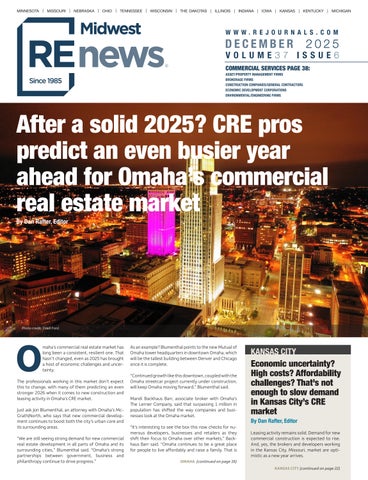
After a solid 2025? CRE pros predict an even busier year ahead for Omaha’s commercial real estate market By Dan Rafter, Editor
A rendering of the build-to-suit project that Zilber Property Group is taking on for Saputo Cheese in the Caledonia Corporate Park in Caledonia, Michigan. (Photo courtesy of Zilber.)
Photo credit: Odell Ford
O
maha’s commercial real estate market has long been a consistent, resilient one. That hasn’t changed, even as 2025 has brought a host of economic challenges and uncertainty.
The professionals working in this market don’t expect this to change, with many of them predicting an even stronger 2026 when it comes to new construction and leasing activity in Omaha’s CRE market. Just ask Jon Blumenthal, an attorney with Omaha’s McGrath|North, who says that new commercial development continues to boost both the city’s urban core and its surrounding areas. “We are still seeing strong demand for new commercial real estate development in all parts of Omaha and its surrounding cities,” Blumenthal said. “Omaha‘s strong partnerships between government, business and philanthropy continue to drive progress.”
As an example? Blumenthal points to the new Mutual of Omaha tower headquarters in downtown Omaha, which will be the tallest building between Denver and Chicago once it is complete. “Continued growth like this downtown, coupled with the Omaha streetcar project currently under construction, will keep Omaha moving forward,” Blumenthal said. Mandi Backhaus Barr, associate broker with Omaha’s The Lerner Company, said that surpassing 1 million in population has shifted the way companies and businesses look at the Omaha market. “It’s interesting to see the box this now checks for numerous developers, businesses and retailers as they shift their focus to Omaha over other markets,” Backhaus Barr said. “Omaha continues to be a great place for people to live affordably and raise a family. That is
KANSAS CITY
Economic uncertainty? High costs? Affordability challenges? That’s not enough to slow demand in Kansas City’s CRE market By Dan Rafter, Editor
Leasing activity remains solid. Demand for new commercial construction is expected to rise. And, yes, the brokers and developers working in the Kansas City, Missouri, market are optimistic as a new year arrives.
OMAHA (continued on page 16) KANSAS CITY (continued on page 22)
Solutions from
all sides. No two problems are alike. Neither are their answers. Each requires a point of view. A new angle. Together, we’ll look for an integrated solution, guided by data and insights. We’ll gain a deep understanding of your business, and consider every part of your commercial real estate strategy, so you can realize anything.
cbre.com
New Construction Facility Renovations Tenant Improvements Additions / Expansions
Thanks to Our Clients for Making 2025 a Success!
Please contact us for any upcoming project needs!
847.374.9200 · www.meridiandb.com
4 | Midwest Real Estate News | December 2025 | www.rejournals.com
FEATURES 10 The Midwest’s commercial real estate publication, providing useful, unbiased and accurate coverage of the industry and its professionals since 1985. WWW.REJOURNALS.COM Publisher | Mark Menzies menzies@rejournals.com 312.933.8559 Editor | Dan Rafter drafter@rejournals.com ADVERTISING Vice President of Sales & MW Conference Series Manager | Ernest Abood eabood@rejournals.com Vice President of Sales | Frank E. Biondo frank.biondo@rejournals.com Classified Director | Susan Mickey smickey@rejournals.com
An AI boom, flexible workspaces
an even busier year ahead for
14 and the continuing return to office:
27 optimism: Cushman & Wakefield
Omaha’s commercial real estate market:
The U.S. office market remains in flux, but
released its U.S. Outlook 2026, revealing
Omaha’s commercial real estate market
there are positive signs for this troubled
that after a year defined by extraordinary
has long been a consistent, resilient one.
sector, according to the latest research from
macroeconomic uncertainty, the U.S.
That hasn’t changed, even as 2025 has
JLL.
commercial real estate sector is entering
1
After a solid 2025? CRE pros predict
brought a host of economic challenges and uncertainty.
1
Renewed momentum and growing
Catalyzing Tomorrow: How One
15 Midwest City Became a Data-
Center Magnet — And How Yours Can,
Affordability challenges? That’s not
Too: Across the Midwest, municipalities are
COLUMNS/DEPARTMENTS 6
Editor’s Letter
enough to slow demand in Kansas City’s
asking the same question: “How do we move
CRE market: Leasing activity remains solid.
from behind the curve to the front of the
29 Redefining the southern gateway to
Demand for new commercial construction
line when global hyperscale data-center
downtown Ann Arbor
is expected to rise. And, yes, the brokers
developers come calling?”
and developers working in the Kansas City
8
30 As $2 trillion in commercial real estate A rural renaissance? That’s what
25 developers are finding in the United
Flaherty & Collins, Twelfth Street
States: The future of commercial real estate
Heritage Development Corporation
debt matures, receiverships are steadying the Midwest market
development in the United States? Much of
31 What the Fall 2025 NAIOP CRE
tackling life-changing project in Kansas
it is targeted for rural areas that have largely
Sentiment Index means for local property
City: A transformative project. That’s what
been ignored until now.
owners
the $500 million redevelopment of Kansas City’s Parade Park will be for the city’s east side.
The fundamentals remain strong.
26 That’s the message from Marcus
32 2025’s Chicago industrial market: Stability Amid Strategic Shifts
& Millichap: The fundamentals are strong. Huntley becoming a draw for new
10 businesses looking for quality of
That’s the takeaway from Marcus &
34 Caution: New risks ahead! Planning
Millichap’s latest commercial real estate
ahead to repurpose your property
life, affordability in the Chicago region:
research briefs.
successfully
Less than an hour’s drive from Chicago, the Village of Huntley is attracting new
35 Capital Markets Teed Up for 2026? A
businesses at a steady pace. Why? Huntley
Promising End to a Turbulent Beginning
offers a high quality of life and is still affordable. It also boasts a local government that is friendly to and encourages new development.
Midwest Real Estate News brings real estate leaders together to explore the challenges and opportunities unique to their markets.
2026 with renewed momentum.
Economic uncertainty? High costs?
market are optimistic as a new year arrives.
Director, National Events & Marketing | Allison Kim Allison.kim@rejournals.com
38 Commercial Services
ADDRESS 7767 Elm Creek Boulevard, Suite 210, Maple Grove, MN 55369 Midwest Real Estate News® (ISSN 0893-2719) is published bimonthly by Real Estate Publishing Corp., Oak Park, Il 60301 (rejournals.com). Current and back issues and additional resources, including subscription request forms and an editorial calendar, are available on the internet at rejournals.com.
Behind every advisor is access to a team of advisors. At Mariner, our team of credentialed engineering and tax professionals make all the difference. Our team seeks to help you uncover and capture tax savings, accelerate cash flow, improve tax efficiency and pursue eligible efficiency incentives. Our Specialty Tax Services team helps move your real estate forward through: • Cost Segregation Studies • §179D Energy-Efficient Commercial Building Deduction • §45L Residential Energy Tax Credits
Access our team at mariner.com | 612-699-8885 Mariner is the marketing name for the financial services businesses of Mariner Wealth Advisors, LLC and its subsidiaries. Investment advisory services are provided through the brands Mariner Wealth, Mariner Independent, Mariner Institutional, Mariner Ultra, and Mariner Workplace, each of which is a business name of the registered investment advisory entities of Mariner. For additional information about each of the registered investment advisory entities of Mariner, including fees and services, please contact Mariner or refer to each entity’s Form ADV Part 2A, which is available on the Investment Adviser Public Disclosure website (www.adviserinfo.sec.gov). Registration of an investment adviser does not imply a certain level of skill or training.
6
FROM THE EDITOR
Midwest Real Estate News | December 2025 | www.rejournals.com
RentRedi survey: Landlords increasingly worried about late rent payments By Dan Rafter, Editor
A
new survey shows that multifamily landlords are increasingly worried about late payments from their tenants, a result that isn’t overly surprising as rising costs on items such as groceries, healthcare and transportation continue to stress consumers, including many renters. RentRedi, which provides property management software for real estate investors, published its Rent Collection Survey Dec. 15. This survey marked the first time that RentRedi expanded its research to include direct insights from not only landlords but renters. The big takeaway from the survey? A growing number of landlords worry that their tenants will miss or skip their monthly rental payments as rising costs continue to shrink the buying power of their paychecks. RentRedi found, too, that landlords who want to reduce late payments should invest in such tools as autopay and credit reporting. “Landlords are telling us they’re more worried about getting rent paid on time,” said RentRedi co-founder and chief executive officer Ryan Barone, in a statement. “What’s encouraging is that our survey shows that renters are clear about what helps them follow through: tools like autopay, automatic reminders and credit reporting.” The RentRedi survey found that for both renters and landlords, automatic rent reminders are a key tool for ontime payments. More than half of landlords surveyed said they rely on automatic reminders to encourage timely payments. Tenants agreed, with 44% saying that reminders help them stay on schedule. Autopay ranked as the next most helpful method for ensuring on-time rent, according to the survey. A total of 41% of landlords said they offer autopay to encourage on-time payments, while nearly a third of tenants
Photo credit: William Potter
said that autopay is the technology most likely to help them pay on-time. This ranked second only to automatic rent reminders. RentRedi’s own data supports this. The company said that units with tenants enrolled in autopay achieve an on-time rent rate of 99%, compared with 87% for units without it. Additionally, more than half of tenants surveyed said that having multiple ways to pay rent would help them make their payments on time each month. In its survey, RentRedi also asked landlords about the incentives they use to encourage their tenants to pay rent on time each month. Of those landlords who incentivize paying rent on time, more than 70% said they use credit reporting to encourage it. Internal RentRedi data shows that credit reporting is also one of the most effective tools for improving renter payment habits, leading to a 13% in-
crease in on-time rent payments. In a more surprising result, only 19% of large landlords who incentivize tenants offer autopay as part of their strategy, RentRedi found. Landlords who operate smaller portfolios, though, are more likely to offer autopay, with 34% of small landlords and 36% of medium-sized landlords telling RentRedi that they include autopay as an incentive. As part of its study, RentRedi partnered with BiggerPockets on three surveys conducted from September through November of 2025. The surveys revealed that: • 41% of rental investors said they are more concerned about tenants not paying rent than last year, while 15% said they feel less concerned. • When asked about actual performance, 36% said they’ve seen more unpaid or late rent in the last 12
months, while 45% reported no increase at all. Landlords on BiggerPockets were also asked how their tenants prefer to pay rent: • Two-thirds said that tenants preferred ACH/bank transfers. • 25% said tenants pay by cash or check in person. • 7% reported credit or debit card payments. • Among tenants using RentRedi, those preferences look markedly different: • 58% prefer ACH/bank transfers. • 38% prefer credit or debit cards. • Only 8% prefer paying in person using cash or checks.
24th Annual Chicago
January 15, 2026 8:30am Registration, Networking, Exhibits & Breakfast 8:00am - 12:30pm Program Hyatt Regency O’Hare Chicago
Register Today
Scan for more information and to register
www.rejournals.com/upcomingevent/
WE HAVE A TABLETOP EXHIBIT for YOU!! EXHIBIT at Chicagoland’s largest CRE event of the year!
• Exhibit & network with 750+ top industry professionals • Keep your company & brand front and center
EXHIBIT TODAY! Speaking and Sponsorship opportunities available Mark Menzies menzies@rejournals.com 312-933-8559
Ernie Abood eabood@rejournals.com 773-919-8799
Frank Biondo frank.biondo@rejournals.com 248-670-2691
8
KANSAS CITY
Midwest Real Estate News | December 2025 | www.rejournals.com
Flaherty & Collins, Twelfth Street Heritage Development Corporation tackling lifechanging project in Kansas City By Dan Rafter, Editor
A rendering of the new Parade Park redevelopment in Kansas City. (Image courtesy of Flaherty & Collins.)
A
transformative project. That’s what the $500 million redevelopment of Kansas City’s Parade Park will be for the city’s east side.
project not only for Kansas City’s east side, but also for the city’s history in general: Parade Park is the oldest black housing cooperative in the United States.
The project, led by Flaherty & Collins and local non-profit Twelfth Street Heritage Development Corporation, will bring almost 1,100 new housing units to the area, including for-sale, workforce, affordable, senior and service-enriched housing, along with commercial and office space.
The goal is to revitalize this historic site, said Alexis Williams, chief operating officer of Twelfth Street Heritage Development Corporation.
The goal is to bring new life to Kansas City’s 18th Street corridor and provide a connection to the city’s 18th & Vine district. The project is also expected to create 1,000 construction jobs and generate more than $400 million in total economic impact for the region. The development will take place in three phases, with the first breaking ground in late 2025. It’s an important
“It was a center for black excellence in Kansas City,” Williams said. The property, though, eventually fell into foreclosure, with the city of Kansas City purchasing it from the U.S. Department of Housing & Urban Development. Twelfth Street and Flaherty & Collins responded to the eventual RFP issued by the city, and the companies’ proposal ended up being the winning bid.
“Not only was this the first black co-op in Kansas City, it was one of the first in the country,” Williams said. “We know how difficult redlining was for black people who wanted to buy a home. This co-op provided some of the first housing that black people in this area could own. A lot of black people here took pride in owning.”
“We want to restore the pride and joy that Parade Park brought,” Williams said. “Our office is right down the street from Parade Park. We saw the decline in the property over the years. We are more than excited about the opportunity to help restore the east side of Kansas City.”
Williams said that in its glory years, Parade Park bustled. It was home to an array of people, including baseball players, lawyers, doctors and jazz musicians.
Julie Collier, vice president of development and principal with Flaherty & Collins, said that the Parade Park redevelopment will offer a mix of housing and retail.
When Flaherty & Collins and 12th Street Heritage purchased the site, only 164 households lived in Parade Park. That’s a low number considering that the development boasts 510 housing units. The new plan will eventually bring more than 1,000 homes to the site. It will also bring back some of the activity and energy that Parade Park once boasted. “Density was important for the city of Kansas City and the neighborhood,” Collier said. “The first phase of this project is almost fully funded. We have large commitments from the city, and we are waiting to hear back on Low-Income Housing Tax Credits from the state. We have a HUD seniors housing grant. We have all the players with all their funding buckets to make sure that this gets done.” Collier said that all the housing built at the development will be high-quality. The residences will also have a unified
KANSAS CITY 9
www.rejournals.com | December 2025 | Midwest Real Estate News look so that the development will function as one community. Amenities will be an important factor, too, with the new development’s multifamily buildings featuring pools, fitness centers and community centers. “We will be bringing all the amenities that Flaherty & Collins typically provides in its projects,” Collier said. Williams said that providing a mix of housing types is important. The property will feature both market-rate and affordable housing, something that will attract a wider range of buyers, she said. This project has posed challenges for Twelfth Street Heritage and Flaherty & Collins. Collier said that the biggest is the site itself. Parade Park was not built on a grid system. That makes it more difficult to maneuver around the site. As Collier said, the neighborhood doesn’t flow through from its east side to its west side or from its north to south. “It’s a hard site to get around in,” Collier said.
“For us at Twelfth Street, it’s important to provide a lot of reassurance that developments take time. This is not going to be an overnight pop-up.” Williams said that it’s been a challenge, too, to foster realistic expectations on the part of community members for how long the redevelopment of Parade Park might take. “I don’t think people always understand how long development takes,” Williams said. “This site in particular is taking time. People expect things to pop up quickly. We are reassuring the community that the redevelopment is coming. It’s understandable; The community has seen projects fall by the
wayside in the past, especially in our community. When things get tough, developers and investors often walk away. For us at Twelfth Street, it’s important to provide a lot of reassurance that developments take time. This is not going to be an overnight pop-up.” And when this work is complete? Dwayne Williams, president and chief executive officer of Twelfth Street Heritage, said that the wait will have been worth it.
“This has been a project that many of us have looked at,” Dwayne Williams said. “When is someone going to grab the bull by the horns? Well, we are doing that. This will be a life-altering project. We are looking at families having Thanksgiving dinners, Christmas celebrations, children being born, children going to high school, people getting married, all while living in this development. This is a godsend project. It will be wonderful for the community.”
10
PROFILE
Midwest Real Estate News | December 2025 | www.rejournals.com
Village profile: Huntley becoming a draw for new businesses looking for quality of life, affordability By Dan Rafter, Editor
Kuriyama chose Huntley for a significant new presence, leasing approximately 329,000 square feet as the anchor tenant in the Huntley Commercial Center. (Photo courtesy of the Village of Huntley.)
L
ess than an hour’s drive from Chicago, the Village of Huntley, Illinois, is attracting new businesses at a steady pace. Why? Huntley offers a high quality of life and is still affordable. It also boasts a local government that is friendly to and encourages new development. We recently spoke with Melissa Stocker, development manager with the
Village of Huntley, about why this community of nearly 30,000 has become such a strong draw for new businesses. Here is some of what she had to say. Why should companies consider Huntley when they are deciding on new headquarters or satellite office locations?
Melissa Stocker: Huntley’s location is one of its strongest assets. With a full-access interchange at Interstate-90 and Illinois Route 47, companies gain immediate access to the Chicago region, O’Hare International Airport, Rockford and major national freight routes. This allows firms to maintain a strong regional presence while avoiding the congestion, higher overhead and higher operating costs
associated with Chicago suburbs. Huntley remains one of the northwest suburbs’ growth communities, with steady population increases and ongoing residential, commercial, and industrial development. The village’s expanding residential base, strong amenities, and family-friendly environment give employers a meaningful advantage when it comes to attracting
PROFILE 11
www.rejournals.com | December 2025 | Midwest Real Estate News and retaining talent. Paired with competitive real estate costs and reliable municipal infrastructure, Huntley offers a compelling option for organizations looking for a headquarters or satellite office with room to grow.
Northwestern Medicine is underway on a noteworthy $95 million expansion of its Huntley Campus. (Photo courtesy of the Village of Huntley.)
What are the main benefits of doing business in Huntley? Stocker: Companies operating in Huntley often point to the village’s straightforward, predictable development process. Huntley has a reputation for streamlined permitting and consistent communication, which helps reduce project uncertainty and shorten timelines. Huntley also has the infrastructure capacity to accommodate a wide range of business needs, whether office, industrial, or mixed-use. There is developable land for companies that want to build new, along with redevelopment opportunities for those seeking to adapt existing space. These advantages—combined with a strong local workforce and a high quality of life for employees—reinforce
Huntley’s position as an attractive place to establish and grow a business.
What steps is the village taking to encourage businesses to move to the area?
Stocker: The Village of Huntley actively positions itself as a partner and has taken a deliberate approach to economic development.
12
PROFILE • The village recently adopted an updated comprehensive plan and continues to follow an economic development strategy centered on business attraction, industry engagement, and long-range planning.
Midwest Real Estate News | December 2025 | www.rejournals.com
The international flavor manufacturer Silesia Group selected Huntley for a major expansion project. (Photo courtesy of the Village of Huntley.)
• Significant infrastructure improvements are underway — including roadway upgrades and enhanced water treatment capacity — to support anticipated commercial and industrial growth. • Staff regularly collaborate with developers and commercial brokers to showcase development-ready sites, particularly along the I-90 corridor. • Huntley continues to support redevelopment and mixed-use projects that strengthen commercial areas and diversify the local economy. Together, these steps demonstrate Huntley’s commitment to fostering a predictable, supportive environment for business relocation and expansion. Is the village seeing an increase in interest from companies? Why is this happening? Stocker: Yes. Huntley has seen rising interest across manufacturing, industrial, logistics, office, and mixed-use sectors. Several factors are driving that activity. Many companies are rethinking their suburban footprints and seeking locations with lower operating costs and improved workforce access. The I-90 corridor, in particular, has become a highly attractive development area thanks to its connectivity and availability of modern sites. Further strengthening Huntley’s appeal is its reputation for efficient permitting and responsive municipal processes— qualities that carry significant weight during competitive site-selection processes. Continued residential growth has also strengthened the labor pool, making the community more appealing to employers focused on staffing stability. Taken together, these dynamics have elevated Huntley’s standing as a destination for business investment. Can you share any recent economic success stories with our readers? Stocker: Yes, several recent developments highlight Huntley’s growing economic momentum.
“Businesses of all sizes value the access, the available space, and the sense of momentum throughout the community.” Huntley has seen several notable economic development successes, many involving companies that already had a presence in the suburbs but selected Huntley for their next phase of growth. Recent examples include: • Silesia Group: The international flavor manufacturer, with operations in our local region, selected Huntley for a major expansion project. The company is investing $40 million in a new production and innovation facility, which will bring more than 40 full-time jobs to the village. • Kuriyama of America: Kuriyama chose Huntley for a significant new presence, leasing approximately 329,000 square feet as the anchor
tenant in the Huntley Commercial Center. This decision underscores the village’s appeal for companies seeking modern facilities with strong interstate access. • Sanfilippo & Son: With longstanding operations in the northwest suburbs, Sanfilippo chose Huntley for a substantial new distribution facility, securing 444,600 square feet to consolidate and expand its logistics functions. The move underscores Huntley’s competitive positioning along the I-90 corridor and its ability to attract major corporate investments. • Rush Truck Centers: A longstanding presence in Huntley, Rush is constructing a large new facility to expand its
operations, reflecting continued confidence in the local market. • Northwestern Medicine: Northwestern Medicine is underway on a noteworthy $95 million expansion of its Huntley Campus. The project will broaden medical services, improve access to care, and strengthen Huntley’s role as a regional healthcare hub. It is one of the most significant capital investments currently occurring in the northwest suburbs. Do you expect the pace of investment activity to remain strong in Huntley? Stocker: These investments reflect a clear trend: companies across the region are choosing Huntley for their next stage of growth. The village’s strategic location, development-ready environment, and forward momentum demonstrate that Huntley is built for business and ready for growth. Huntley has been very deliberate about positioning itself for long-term growth, and companies are responding. Businesses of all sizes value the access, the available space, and the sense of momentum throughout the community, but they also appreciate that Huntley is a place where they can envision their future. That combination—opportunity and community—is what continues to draw businesses here.
14
OFFICE
Midwest Real Estate News | December 2025 | www.rejournals.com
An AI boom, flexible workspaces and the continuing return to office: JLL report highlights the biggest trends in the U.S. workplace By Dan Rafter, Editor
T
he U.S. office market remains in flux, but there are positive signs for this troubled sector, according to the latest research from JLL.
In its Workplace Trends 2025 report, JLL reported that while larger tenants continue to reduce their office footprints, companies looking for a smaller amount of space -- typically 25,000 rentable square feet or under -- are becoming more active in the marketplace. JLL says that this pattern is most frequently seen in the finance, tech and consumer goods industries. And while it’s nice to see smaller users gobbling up space, the lack of activity by companies seeking larger amounts of square footage means that vacancy rates will remain high in the office sector throughout 2026. The strength of the work-from-home movement is lessening, though. JLL reported that more than 70% of firms included in its research have enacted some form of in-office policy, whether that’s requiring employees to return to the office on a full-time basis or on a part-time schedule. That’s a big jump from 2024, when only 51% of companies in JLL’s report had put such policies in place. Another big workplace trend? An increasing number of companies are using AI to fuel their businesses. JLL pointed to the insurance industry, which it says leads all industries in AI adoption. According to JLL’s research, 64% of insurance companies said that they prioritize AI initiatives. More than half of insurance CEOs in JLL’s report said that they expect to see a return on their AI investments in three to five years. These CEOs said that they expect the
EyeEm Mobile GmbH
use of AI for more mundane, time-consuming tasks to free up their employees to tackle high-value work and boost their productivity. In the energy industry, JLL found that employees average three to four days a week in the office. Workspaces in the energy sector increasingly include dedicated focus zones in addition to private offices and workstations, JLL reported. Energy companies are also leasing office space on a longer-term basis than in many other industries. JLL reported that 85% of the office leased volume from energy companies came with lease terms of more than five years. That’s about 1.2 million square feet of long-term office leases in this sector. Finance firms continue to evolve. JLL said that finance companies prefer hoteling systems and flexible seating when it comes to the workplace environment. Employees at these companies are averaging 3.5 to 5 days in the office a week.
The flight to quality is especially strong in this sector, with JLL reporting that finance companies are aggressively pursuing top-tier, Class-A-plus office spaces. The goal? To persuade employees to spend more time in the office and to help retain the best talent. Tech companies continue to embrace the hybrid work model, JLL said. This is clear in the spaces that tech companies are leasing. In tech company spaces, offices function more as collaboration hubs with spaces set aside for team projects and innovation sessions, JLL said. JLL said that tech firms rely on occupancy sensors, booking analytics and employee preference data to continuously redefine space allocation and predict future office needs. Tech companies focus, too, on amenities. JLL said that some companies offer such high-end amenities as baristas, rooftop terraces, outdoor patios, yoga and exercise studios, mother’s suites, prayer rooms and social hubs.
And what does the future hold for the U.S. workspace? First, expect a lot of expiring office leases. JLL says that office leases are beginning to expire that were either extended during the pandemic or standing leases that were signed seven to 10 years ago. JLL predicts that companies, now more certain of their future, will sign leases with longer terms. AI will continue to play an important role in office life. Companies are still trying to determine how to best use AI to increase employee productivity, JLL said. Those organizations that provide training and set clear expectations and boundaries will realize the biggest gains from AI technology, JLL said. JLL also says that flexibility in office design remains key. This includes a focus on quiet zones vs. active zones, spaces for individual work and additional spaces for collaboration. It’s key for companies to understand how their employees work best and design their office spaces to set these workers up for success, JLL said.
DATA CENTERS 15
www.rejournals.com | December 2025 | Midwest Real Estate News
Catalyzing Tomorrow: How One Midwest City Became a Data-Center Magnet — And How Yours Can, Too By Joseph Carrizales | Associate, Investments | Marcus & Millichap
A
cross the Midwest, municipalities are asking the same question: “How do we move from behind the curve to the front of the line when global hyperscale data-center developers come calling?” The story of New Albany, Ohio serves as living proof. When Meta Platforms, Inc. (owner of Facebook, Instagram, WhatsApp & Threads) chose New Albany for its “Prometheus” supercluster — by CEO Mark Zuckerberg described as the world’s first online-gigawatt data-center campus — it revealed far more than infrastructure. It revealed a community ready to pivot and prosper. But what the headlines miss is the system behind success, the invisible framework of readiness and collaboration that allowed a regional Midwestern suburb to become a global tech magnet. A Vision Established Before the Invitation Meta didn’t select New Albany by accident. The municipality had quietly created the conditions: shovel-ready land, streamlined zoning and permitting, public-private alignment. Infrastructure wasn’t added as an afterthought — it was positioned as a competitive asset. With a nearly 900,000 sq ft expansion in its Beech Road campus and a total investment of USD 1.5 billion, Prometheus may be a headline-grabbing figure — but the bigger story lies in how this magnitude became possible. At the municipal level, New Albany treated Meta not just as an investor, but as a partner in community transformation. Local officials aligned utility-capacity upgrades, workforce training and infrastructure planning with the company’s timetable.
Joseph Carrizales facilitating gap analysis readiness for marketing data center development land. (Photo courtesy of Marcus & Millichap.)
The community didn’t compromise its identity — it expanded its possibility. When municipalities in Michigan and Ohio look ahead to the digital infrastructure wave, they can see this blueprint: alignment creates acceleration. The Prometheus project was not just about gigawatts or square footage. It was about readiness, collaboration, and a shared vision for the future. Conclusion
At the county and regional level (in Licking and Delaware Counties), transportation, utilities and workforce initiatives were coordinated so the project wasn’t just land, but was sustainable. A new 200-megawatt natural-gas generation plant by Will Power OH, LLC is a case in point — ensuring the power reliability data centers demand. At the state level, Ohio’s incentives, university partnerships and training programs matched the operational profile of large-scale digital infrastructure. At the federal level, grid modernization and AI-research funding complemented the ecosystem. Lessons for Midwest Municipalities Ready to Compete What can municipalities in Southeast Michigan and Northwest Ohio learn from New Albany’s journey? 1. Prepare Before You Pitch – Having land, zoning clarity, and infrastructure plans demonstrates readiness. Investors look not just at today’s status but tomorrow’s likelihood of smooth execution. 2. Think Regionally, Not in Isolation – Data-center projects don’t land in a silo. When a city, county and region
speak with one voice and align utilities, workforce, and transportation, the offer becomes compelling. 3. Plan for Power, Water & Connectivity – Reliability is non-negotiable. For hyperscale data centers, power capacity, backup infrastructure, and sustainability matter. 4. Build the Talent Pipeline – A community that can demonstrate training, education partnerships, and workforce readiness reduces investor risk. 5. Craft the Story of Innovation – Communities that position themselves as forward-looking — where public–private collaboration is the norm, not the exception — signal they are ready for digital-age investment. Community Impact — Beyond the Data Center Often, data centers are criticized for being high-tech but low-jobcreation. New Albany turns that narrative around. Through strategic engagements, the project strengthened schools, nonprofits and local workforce programs. The result: a global tech infrastructure anchor and a thriving local ecosystem.
The success of Meta’s Prometheus data center was not achieved by size alone — it was engineered through strategy, alignment and community-vision with owners and investors in land, office and industrial assets. For municipalities in the Midwest: those who think ahead, build alliances, and prepare for the digital age will thrive. If you’re ready to position your community as the next data-center destination, I’d welcome the opportunity to work with your team to define and activate that readiness. One way to begin your journey is to evaluate your community’s readiness in context of The Fall 2025 NAIOP CRE Sentiment Index and how that impacts your municipality to see how owners and investors think and feel. To learn more about Joseph: www. marcusmillichap.com/advisors/joseph-carrizales To learn more about the NAIOP CRE Sentiment Index check REJournal’s October 23, 2025 article: rejournals. com/what-the-fall-2025-naiop-cresentiment-index-means-for-localproperty-owners/ Joseph Carrizales is Associate, Investments, for Marcus & Millichap. He is based in Frenchtown, Michigan.
Midwest Real Estate News | December 2025 | www.rejournals.com
16
Photo credit: f1monaco31
CELEBRATING 40 YEARS
As the Midwest’s Preferred Retail Real Estate Company
40 10855 W Dodge St, Ste 270 • Omaha, NE 68154 • (402) 330-5480 • www.LernerCo.com
OMAHA (continued from page 1)
the reason we are seeing strategic investments into suburban growth in Eklhorn, Bennington, Gretna and Papillion. As the population continues to grow and people have more disposable income, commercial will naturally follow and thrive. Demand for new construction not waning
construction in the Omaha market, Weber said. “That shows that high-quality, well-located office projects are still feasible,” Weber said. And in the multifamily sector? Weber said that demand for new apartment construction has softened, with rising vacancy and slower leasing velocity for this product type. Big developments still happening
Jeanette Weber, broker with Omaha’s Investors Realty, says that she still sees demand for new commercial construction in the Omaha market. That demand, though, is not equally strong for all sectors. “Demand is sector-specific,” Weber said. “Industrial and logistics remain exceptionally strong, with historically low vacancy, steady absorption and continued construction activity, much of it pre-leased.” Demand for new office space in the market is more mixed, Weber said. Even though office vacancy rates here, as they are across the country, are elevated, about 1 million to 1.6 million square feet of office remains under
Even though demand for new commercial properties might be slower than in the past, the Omaha market is still home to several big developments that are either in the planning or development stage. One such project is the development of a professional soccer stadium and mixed-use district in north downtown Omaha. Union Omaha Soccer is partnering with the city of Omaha on the development of the stadium. If approved, the project would break ground in 2026 with the stadium’s opening planned for 2028. The new stadium would serve as an anchor for a new transit-oriented neighborhood.
OMAHA 17
www.rejournals.com | December 2025 | Midwest Real Estate News
Mandi Backhaus Barr (Photo courtesy of The Lerner Company.)
Jon Blumenthal (Photo courtesy of McGrath|North.)
Andy Kutilek (Photo courtesy of OMNE Partners.)
Pat Regan (Photo courtesy of OMNE Partners.)
That’s just one big project. Mutual of Omaha’s new headquarters tower continues to energize downtown redevelopment, Weber said. At the same time, the Mercantile Project led by Hines has been a positive for Omaha’s historic Old Market district. This project features Brickline at the Mercantile, a luxury apartment complex with retail space and a parking garage. Future plans for the conversion of the old Conagra campus call for more apartment units, offices and a boutique hotel.
that allow Omaha to continue to grow in positive ways.”
to Elkhorn, there are numerous projects under construction with many more slated to start in the next six to 18 months.”
“I don’t anticipate the development slowing down any time soon because of the growth and need our city provides,” he said.
Secor says that this development activity isn’t likely to slow, either. Omaha and its surrounding areas still suffer from a lack of housing, industrial space and high-quality retail.
Conservative or pragmatic?
Michael Sands, partner with Omaha law firm Baird Holm, said that he has been fortunate to work on several marquee projects in the Omaha market. Those keeping him busy include the Crossroads redevelopment project and the Union Omaha stadium district project. “Each will bring their own unique and exciting contributions to Omaha and the CRE market,” Sands said. “I’m a big believer of growing a city by investing in its urban core, and these are great examples of that.” Development activity has been strong in the center of Omaha, too, something that has brought a steady stream of activity to downtown and its surrounding neighborhoods. Backhaus Barr said that the investment in Omaha’s urban core continues to pay off. “It’s thrilling to see the revitalization of the urban core, with the Gene Leahy Mall and Riverfront completed, Mutual of Omaha’s new headquarters well underway and already reshaping our skyline, new restaurants opening and other projects in the works,” she said. “Omaha is a very philanthropic community, so it’s refreshing to see people giving back to the community in ways
Blumenthal said that he is particularly excited about the new Omaha North high school football stadium. He said that this partnership between The Lozier Foundation, Omaha Public Schools and the Omaha YMCA, with NewStreet Properties taking the lead as the developer, is creating an opportunity in North Omaha, a traditionally underserved segment of the community.
This lack of supply is helping to drive new development, Secor said.
Why has demand for new commercial space remained solid in the Omaha market, even during challenging times? And why has leasing activity remained consistent here while vacancy rates stay relatively low?
“Additionally, I remain excited about the growing industrial sector,” Blumenthal said. “There is still warehouse and industrial need. One outgrowth of data center demand is that those users will need additional warehouse space to store equipment.” Weber said that Omaha continues to push for new developments to enhance the area’s quality of life. “Airport improvements, planning by the Omaha Inland Port Authority and north Omaha business park initiatives are positioning the region for expanded industrial, logistics and advanced manufacturing activity,” Weber said. “Collectively, these projects reflect strong public–private investment and ongoing confidence in the market.” Spencer Secor, senior associate and office specialist with Omaha’s The Lund Company, says that the development activity in Omaha is inspiring, and points to a strong future for the area’s commercial real estate market. “Even being in the real estate business, it amazes me when I drive around town and see the amount of development happening,” Secor said. “From the river
Since 1975, Investors Realty has served as a local expert in buying, selling, leasing, and managing commercial real estate throughout the Omaha Metro. As we close out our 50th year, we’re celebrating the progress we’ve made together and looking ahead with the same client focused commitment to service, insight, and results. Here’s to the next 50. OFFICE | INDUSTRIAL | LAND | RETAIL | INVESTMENT PROPERTY · FACILITIES MANAGEMENT PROJECT MANAGEMENT 12500 I Street · Ste 160 | Omaha, NE 68137 investorsomaha.com
Celebrating 50 Years Watch Our Story
18
OMAHA
Midwest Real Estate News | December 2025 | www.rejournals.com
Photo credit: Matt Bills
Weber said that it’s all about the discipline shown by developers and city officials.
even when the area’s commercial real estate market is strong. Blumenthal agrees.
• • • • • • • • • • •
Real Estate Development Acquisitions and Sales Land Use and Zoning Commercial Leasing Construction and Design Condominium Creation & Management Environmental Permitting and Compliance Tax Planning Entity Structure Renewable Energy Data Center Development
Contact: Jon E. Blumenthal McGrath North Mullin & Kratz, PC LLO First National Tower 1601 Dodge Street, Suite 3700 Omaha, NE 68102 www.mcgrathnorth.com T: 402-633-6855 jblumenthal@mcgrathnorth.com
“A measured, disciplined development approach has helped Omaha avoid the boom-and-bust cycles seen in more volatile markets,” she said. “Developers and lenders typically resist oversupply, which stabilizes vacancy and rent levels during downturns.” Secor says that Omaha has long boasted a steady commercial real estate market. “We are not a boom or bust city like some on the coasts that hurt when challenging economic times present,” Secor said. “We still feel the pain but it is not as severe as some of the larger cities that are more aggressive by nature. This has helped us stay steady and level when the economy isn’t firing on all cylinders.” Another benefit of working in Omaha’s commercial real estate market? Secor pointed to the area’s low unemployment and lower office building vacancies compared to other markets, which he says is another effect of the area’s conservative nature. Omaha hasn’t suffered much overbuilding,
“Omaha has a reputation as a conservative CRE market, which doesn’t give enough credit to the number of active developers we have creating a better city,” Blumenthal said. “I like to think that Omaha’s developers are ‘pragmatic’ rather than conservative. Developers here avoid unnecessary risk and are thoughtful about what they each do best.” Sands said that Omaha’s fiscal conservatism has insulated the commercial real estate industry from the lowest of lows endured in other parts of the country. “I think what makes Omaha a resilient market is the right mix of that mindset with the type of forward thinking and risk tolerance that is necessary,” Sands said. “The credit goes to both developers and the city’s elected officials and administration. It takes a shared vision and willingness on both sides to execute these projects.” Another positive is Omaha’s diverse employer base, one that includes in-
OMAHA 19
www.rejournals.com | December 2025 | Midwest Real Estate News surance, healthcare, logistics, defense, tech and corporate services. Such a diverse employment base provides resilience, reducing the local market’s dependence on any single industry. When one industry might be struggling, others are doing well. That provides Omaha with a cushion to survive economic downturns. This doesn’t mean that all commercial sectors are performing equally well in the Omaha market. Weber said that industrial, logistics and distribution continue to be the strongest-performing sectors, supported by Omaha’s central location, limited availability of modern industrial space, supply-chain shifts and increased public and private investment in infrastructure. Weber said, too, that some office activity, particularly build-to-suit and headquarters projects, remains healthy. Healthcare, medical office and institutional facilities also show steady demand, driven by the region’s major health systems and universities. Weber said that multifamily has shown signs of cooling, with higher vacancy
Michael Sands (Photo courtesy of Baird Holm.)
Spencer Secor (Photo courtesy of The Lund Company.)
Jeanette Weber (Photo courtesy of Investors Realty.
levels and slower leasing activity than in previous years. Certain traditional retail categories, especially non-experiential strip centers in weaker trade areas, are facing challenges as consumer habits evolve, Weber said. And older office products continue to see high vacancy rates.
“Omaha offers a combination of lower operating costs, a business-friendly climate and a central U.S. location that is ideal for distribution, logistics and regional operations,” Weber said. “The market also benefits from a strong, stable talent pipeline supported by local universities and major employers. Omaha’s affordability, safety and overall quality of life make it attractive for both companies and employees, encouraging relocations and expansions.”
Weber said that she expects the market’s industrial market to remain strong in 2026. She even expects to see carefully planned speculative construction in this sector. She added that downtown catalysts such as the proposed soccer stadium, new Mutual of Omaha tower and airport upgrades might spur additional mixed-use, retail and hospitality projects.
Weber, though, said that she expects the commercial real estate market in the Omaha area to remain strong. The city just offers too many positives to see a major slowdown in activity.
The retail sector has been strong, too, Backhaus Barr said. This sector boasts a low vacancy rate, especially in Class-A
Accelerate your opportunity. Navigate market complexity with expert guidance. With more than 38 years of experience in the market, we understand Omaha’s intricacies and stand ready to guide you through commercial real estate decisions with precision. Our eyes are trained to spot strategic advantages and seize opportunities, irrespective of market mood swings. Let’s have a serious conversation about your next move. colliers.com/omaha
Accelerating success.
Midwest Real Estate News | December 2025 | www.rejournals.com
20
Photo by Jesse Duering on Unsplash
product. At the same time, base rents have increased year-over-year on certain retail spaces thanks to high demand from tenants.
Your Partner in Growth.
“Retailers continue to think outside the box and be creative just to plant their brick-and-mortar flag in the Omaha MSA,” Backhaus Barr said.
Industrial and multifamily development backed by a vertically integrated approach and 170 years of expertise.
Backhaus Barr said that institutional groups are focusing on the Omaha market, too. An example? Federal Realty acquired Village Pointe Shopping Center for $153.3 million.
Infinity Industrial Center PAP ILLION
HubbellCompanies.com
Contact Our Team Jeff Fossell
SENIOR VICE PRESIDENT
Sagebrook L A VISTA
Tim Coonan
VICE PRESIDENT
“From the retail side of things, we may see some inevitable bankruptcies and closures from certain retailers, but if their real estate positioning is desirable enough, it will not take long for those spaces to be backfilled due to such a strong demand from other groups eager to plant their flag in the Omaha MSA,” Backhaus Barr said. The office sector, of course, continues to ebb and flow. Backhaus Barr said that both landlords and tenants are getting more creative in how they are using office space, a positive for this sector. Multifamily remains hot in the Omaha market, with developers building more
apartment projects than single-family homes here during the past decade. And across the river in Iowa, demand for multifamily projects in Council Bluffs continues to ramp up, Backhaus Barr said. Bullish on Omaha’s future Pat Regan, president of brokerage, and Andy Kutilek, president of property management, with Omaha’s OMNE Partners, said that they are both bullish on the future of Omaha’s CRE market, partly because the market is growing so quickly. Regan and Kutilek pointed to the population of the Omaha market. In 2004, it surged past 1 million residents. This means that what was once primarily a local investment community has attracted increasing interest from national developers across all asset classes. Kutilek and Regan said that the most significant populaton growth in the Omaha market is occurring in suburban communities such as Gretna, Elkhorn and Papillion. Strong municipal leadership in these areas has fostered robust infrastructure, enabling continued development. Additionally, projections
OMAHA 21
www.rejournals.com | December 2025 | Midwest Real Estate News that Omaha could exhaust its supply of developable land by 2050 have driven notable asset appreciation in these suburban markets, the two said. This growth hasn’t occurred at the expense of downtown Omaha, though. Both Regan and Kutilek said that Omaha’s core continues to thrive, supported by a philanthropic community and strong local leadership. Like others, Kutilek and Regan are excited about Mutual of Omaha’s 44-story tower, under construction now in Omaha’s downtown. This project will redefine the city’s skyline. But Regan and Kutilek say that the Riverfront redevelopment is also paying dividends in bringing more people to the center of Omaha. This development features the Heartland of America Park, nestled between the Gene Leahy Mall and Lewis and Clark Landing along the Missouri River. There’s also the Heartwood Pre-
serve development that continues to attract national interest from retailers and office users. What’s behind Omaha’s long-term stability? Regan and Kutilek point to several factors, including the presence of Offutt Air Force Base in nearby Bellevue, Nebraska, home to U.S. Strategic Command and the 55th Wing. The base employs more than 7,000 personnel, providing an economic foundation on the southern edge of the metro area. Additionally, the presence of Creighton University and the University of Nebraska Medical Center further strengthen the urban core, fostering innovation and talent development. Omaha is fortunate, too, in that most of its commercial sectors continue to show resilience. As Regan and Kutilek say, this is largely because the market has avoided overbuilding. Kutilek and Regan say that they expect the local commercial real estate market to remain steady and
resilient. Omaha’s growing population and strong universities are creating a pipeline of young and skilled talent, they say. Omaha, the state’s largest city, offers graduates a busy metropolitan area with plenty of career opportunities, cultural amenities and a vibrant social scene, they say. Blumenthal also credits the workforce from which companies can pull when they are doing business in Omaha. “Companies are drawn to Omaha because of the strong work ethic of its labor force, affordable cost of living and excellent public-school districts,” Blumenthal said. “Omaha remains a great, affordable place to raise a family and live, work and play.” It helps, too, that Omaha remains a nice place to live. “It’s a bit cliché, but quality of life matters,” Sands said. “Omaha is a nice place to live and work. Nebraska doesn’t have some of the tax advantages and bottom-line incen-
tives that other states and cities use to attract corporations. But what it has in spades is stability and quality of living.” And the future? Blumenthal said that it remains bright. “Omaha will continue to thrive in the years ahead,” he said. “Our business and philanthropic communities are smart, active and work together with a supportive local government to move projects forward. We have so many good developers. They bring out the best in each other.” Omaha isn’t immune to the challenges posed by larger economic issues. But Sands said that the region is poised to see a busy 2026. “If private lending follows the lead of the Fed’s decreasing rate benchmarks, I would expect to see transaction growth in 2026,” he said. “With a number of marquee projects and the street car in the pipeline, I anticipate a continued interest and emphasis on mixed-use development in the urban core.”
22
KANSAS CITY
Midwest Real Estate News | December 2025 | www.rejournals.com
Photo courtesy Pixabay
KANSAS CITY (continued from page 1)
We spoke to John Hassler, executive managing director with Newmark Zimmer; Mike Bell, senior vice president with Hunt Midwest; and Brenner Holland, also a senior vice president with Hunt Midwest, about the state of the Kansas City commercial real estate market, what they expect to see in 2026 and what’s behind the resilience in most commercial sectors here. Here is what they had to say. Are you still seeing a strong demand for new commercial real estate development in the Kansas City market? Why or why not? John Hassler: On the industrial side, the market sits at a very low 4.9% vacancy rate and Kansas City has posted continued rent growth and positive net absorption figures at a time when many other markets around the country have backed up. Demand is consistent from a broad base of users and the primary item that will limit ongoing deal flow is the lack of speculative building construction currently taking place.
Mike Bell: We have a mature market in Kansas City with about 300 million square feet of industrial space serving national and Fortune 500 companies, and we’ve seen those big firms expanding their existing presence here, even as tariffs and financing uncertainty are leading some companies to pause investments in their non-core business operations. But many companies are still making large capital investments in their core businesses, and they’re turning to Kansas City because they know those dollars stretch further here. They can reach more customers across the country faster and cheaper from the center of the country, and we already have an established, highly skilled labor pool to support their operations. Are there any projects currently in development in the Kansas City market that you are most excited about? Bell: We’re continuing to grow at KCI 29 Logistics Park, Missouri’s largest shovel-ready industrial site, and we’re eager to share more in 2026 about an upcoming project with a global technology company that we expect will bring millions of square feet of space online at the park. We’re also
underway on what we call Project Gus, an almost 1.5-million-square foot distribution facility in SubTropolis that we believe will be the largest underground build-to-suit warehouse in the world upon completion next summer. We’re in such a good position now that on the surface at Hunt Midwest Business Center we’re planning our next 505,440-square-foot, spec-to-suit project with another 80 acres available that will support another 1.2 million square feet. We’re also excited about the future at the Country Club Plaza under its new ownership and just in time for us to welcome the world to Kansas City during next summer’s World Cup. The Plaza is a jewel of Kansas City and the Gillon Property Group has done a tremendous job listening to the community and assembling a team of industry-leading professionals to guide the Plaza into its next century. Hassler: Kansas City’s industrial market is dynamic and there have been recent successes in all parts of the metro, although many projects of late have been build-to-suit. Many of the parks that were built over the last 10 years continue to serve a broad base
of users and drive growth. Specifically, the 15-million-square-foot Logistics Park Kansas City remains an anchor to the area’s industrial footprint, providing occupancy to a Hassler list of corporate-level tenants that can utilize a cost-efficient drayage model of being adjacent to one of BNSF’s largest U.S. intermodals. Kansas City has long had a reputation as a being a consistent, conservative CRE market. How has that helped the local CRE market through challenging economic times? Brenner Holland: Industrial and residential are two sides of the same coin, and it’s true in our case that Kansas City is not a boom-and-bust market for housing, either. While costs are going up, we’re still an affordable place to live relative to much of the rest of the country, and companies are accounting for that when making these big investment decisions. We’ve really benefited here from being able to present a consistent overall market to underscore why Kansas City is the best place to put those dollars to work, not just for the company, but for the executives and employees, too.
Make Exact your go-to partner for historic restorations and downtown projects
WE DESIGN, MANAGE AND CREATE FINANCING STRATEGIES Experience Superior Returns with Our Strategic Real Estate Investments!
929 Walnut: 46,000 SF Office to Residential Investment: $11 M total | $8M in Historic Tax Credits Incentives: 10-year LCRA Tax Abatement Timeline: Q4 2024 - Q3 2025
To partner with Exact visit exactarchitects.com
ABC/Anderson: 65,000 SF Warehouse to Residential Investment: $17.5M total | $7M in Historic Tax Credits Incentives: 10-year LCRA Tax Abatement Timeline: Q2 2025 - Q3 2026
27th & Troost: 100,000 SF New Build Investment: $40M total | Incentives: 10-year LCRA Tax Abatement Timeline: 2026 - 2027
Email us info@exactarchitects.com
24
KANSAS CITY
Midwest Real Estate News | December 2025 | www.rejournals.com tion in the U.S., the significant northsouth and east-west rail infrastructure, industrially friendly communities, competitive tax abatements, moderate cost of labor, moderate cost of occupancy and sites that are available to be put into production.
Photo credit Ryan Wewers
I know it’s difficult to predict, but are there any trends you expect to see as far as commercial real estate leasing and building activity in the coming months?
Hassler: The Kansas City industrial market is the 15th largest in the U.S. and home to many of the country’s most active developers but even with that great growth and significant local talent, the regional development pipeline has always been quick to adjust to market conditions and keep inventory in check. That conservatism has allowed Kansas City to post exceptionally strong occupancy rates and rent-growth metrics during broader slowdowns as compared to many of the Tier-1 markets that became overbuilt. Bell: Kansas City is a slow-and-steady market with a proven track record of consistent growth over the long term, as opposed to the wild swings we’ve seen in some of the past few years. But that also means Kansas City is protected from those deep dips in the market, which has spared us the difficulties some other communities faced. That consistency is key because consistency provides certainty, and certainty is what every business needs to succeed. Which commercial sectors are performing especially well today in the Kansas City market? What are the reasons for this strong performance? Hassler: Kansas City’s industrial market has seen continued expansion serving a variety of industries and is supported by a broad base of institutional capital sources, which has both compressed cap rates and provided liquidity to the market. What draws companies to the Kansas City market? Why are so many companies opening headquarters or satellite locations in this market?
“City is a slow-and-steady market with a proven track record of consistent growth over the long term, as opposed to the wild swings we’ve seen in some of the past few years.” Bell: Kansas City offers companies the best location with the most efficient national logistics connections and an excellent labor pool, checking all the right boxes for every kind of industry. We are the almost exact center of the U.S., so chief financial officers have consistently put their dollars to use in Kansas City because every dollar here goes further to reach customers in every corner of the country. If you’re looking to reach the entire North American footprint, this is by far the right location.
Holland: Kansas City is on a historic run — from business to sports to culture — and that has a real effect on how companies, their executives, and their employees view a move or expansion here. Combine that with our relative housing affordability, easy commute times, and great school districts across the metro, and now you have all the ingredients for success inside and outside your business. Hassler: For industrial, users locate here due to the most centralized loca-
Hassler: We expect the huge rush of data center demand to continue, but widespread, ongoing growth may be slowed given the finite amount of power that is available to serve those sites. Logistics and industrial real estate demand will continue its steady pace into 2026, but the limited supply of readily available buildings will spur a new wave of development so Hassler as rental rates keep pace and the cost of borrowing continues to lower. Holland: Certainty on interest rates and government regulations also will be crucial on the residential side of the coin next year. We think there are tremendous opportunities to adapt urban infill sites to higher and better uses, as evidenced by our success at The Hudson multifamily community this year and our plans to begin construction on another in downtown Overland Park next year, but our community has to find a way to cut through some of the overbearing regulation and bureaucracy to unlock even more new growth. The market is right for it and with some of that clarity, I think you’ll see even more firms launch projects to keep this momentum going. Bell: We’re already seeing more activity at the end of 2025 than we typically expect around the holidays, so I believe things may start to pick up over the coming months and several firms will be announcing large spec buildings across the Kansas City metro in 2026. We do need more certainty on regulations for economic development, for our own business and the litany of industries our tenants and partners touch. But if interest rates continue to go down next year and the federal government can offer businesses more clarity on tariffs, we’re likely to see more activity. The market is right for more growth, if only we can provide a little more certainty and stability.
DEVELOPMENT 25
www.rejournals.com | December 2025 | Midwest Real Estate News
A rural renaissance? That’s what developers are finding in the United States By Dan Rafter, Editor
T
he future of commercial real estate development in the United States? Much of it is targeted for rural areas that have largely been ignored until now.
The Tippecanoe County Courthouse in Lafayette, Indiana. (Photo courtesy of Roberto Galan, iStock.)
Why? Industrial developers are increasingly searching for larger swaths of land for their data centers, warehouses and auto-manufacturing plants. More frequently, they find this land in rural areas of the country. This has created thousands of new jobs in these areas. As the jobs arrive so does the need for new multifamily developments, retail centers, healthcare facilities and recreational amenities. This is leading to a influx of development activities in rural counties across the United States. It’s a trend highlighted in a new research report released in late October from Northmarq. In its report, Northmarq looks at nine rural markets, including some in the Midwest, that have become hot beds of commercial development. One of these areas is Lafayette, Indiana. Here, Northmarq says, housing demand has far exceeded the supply of available residential units. Northmarq says that Lafayette’s proximity to Purdue University and its growing manufacturing sector has blessed the city with some of the strongest multifamily fundamentals in the nation. Northmarq reported that in 2025, Lafayette posted a multifamily occupancy rate of 98%, one of the highest in the United States. This is evidence of a tight rental environment. Lafayette is also home to major industrial and manufacturing employers including Subaru of Indiana Automotive, Caterpillar, Wabash and Arconic. As these companies continue to offer well-paying jobs, a steady number of new residents will arrive in Lafayette, only boosting the need for new multifamily development. Northmarq says that the average rental price of multifamily units here continues to rise on a year-over-year basis,
Fayette County will soon be home to a new LG Energy Solution EV battery plant and an Amazon Web Services data center campus. These new additions will sit alongside existing distribution centers for Walmart, Lowe’s and McKesson. It’s not surprising that Fayette County has been targeted for industrial development: It sits along the Interstate-71 corridor between Columbus and Cincinnati, making it a strong logistics hub. Northmarq says that savvy developers will find opportunities to bring new workforce housing, single-family homes, retail, restaurants and medical facilities to the area.
“Lafayette’s proximity to Purdue University and its growing manufacturing sector has blessed the city with some of the strongest multifamily fundamentals in the nation.” an indicator that Lafayette needs more rental housing, an opportunity for developers. Northmarq also lists Fayette County, Ohio, as one of its rural areas to watch. This county in Southwest Ohio is at the center of the state’s industrial boom, Northmarq says, with a big investment in new development expected to bring thousands of jobs to the area. But like
many rural areas, the local infrastructure is not prepared for this surge. Northmarq reported that a 2023 housing study found a need for nearly 1,400 new housing units in Fayette County by 2033 to support the incoming workforce. Most of the county’s current housing stock is older. There are limited rental options for newcomers.
Then there’s Sioux Falls, South Dakota, another rural area listed in Northmarq’s report. Northmarq says that Sioux Falls boasts a strong economy focused on financial services, healthcare and agribusiness. What it needs more of, though, is housing. According to Northmarq, the city’s vacancy rate for apartments has historically remained below the 5% mark. There was a flood of new multifamily construction that delivered in early 2025, spiking the area’s apartment vacancy rate to nearly 10%. But six months later, the market had absorbed enough of these units to drop that rate back to 5.4%. Like other strong rural areas, Sioux Falls boasts major employers, including Sanford Health, Avera Health, Wells Fargo and Smithfield Foods. Northmarq says that the city is also a hub for data centers and bioengineering. Despite all its positives, Sioux Falls has been underserved because it is not on the radar of most national developers, Northmarq says. Because of this, there are plenty of opportunities for developers eager to build multifamily developments here.
26
REPORT
Midwest Real Estate News | December 2025 | www.rejournals.com
The fundamentals remain strong. That’s the message from Marcus & Millichap By Dan Rafter, Editor
T
he fundamentals are strong. That’s the takeaway from Marcus & Millichap’s latest commercial real estate research briefs.
In its third-quarter fundamentals report, Marcus & Millichap said that the CRE market’s fundamentals are holding firm. That’s good news. But that doesn’t mean that commercial real estate professionals won’t face challenges throughout the rest of 2025 and in 2026. In its latest report, Marcus & Millichap analyzed the state of the commercial real estate sector’s main asset types. The findings? These sectors might not be booming, but they are, mostly, holding steady even during national economic challenges. Balance is returning to the multifamily market, according to Marcus & Millichap’s report. Demand growth in this sector is moderating, but so is new supply. That could lead to a more stable multifamily market across the United States, Marcus & Millichap reported. According to Marcus & Millichap, while the national multifamily vacancy rate is still down 100 basis points on a year-over-year basis, this number did increase to 4.6% in the third quarter of this year. Certain markets have also seen so much new apartment development that they are now experiencing higher vacancy rates. Marcus & Millichap pointed to markets such as Austin, Dallas-Fort Worth and Nashville. On the other side of the equation, markets with limited development, including Chicago, Cincinnati, Cleveland, Detroit and Minneapolis-St. Paul, have seen rent growth higher than 5%, Marcus & Millichap reported. In a bit of good news, Marcus & Millichap reported that the U.S. office sector continued to post a positive performance in the third quarter,
Photo credit: Maksim Safaniuk, iStock.
“The U.S. office sector continued to post a positive performance in the third quarter.” which might signal a modest recovery in some metropolitan areas. According to Marcus & Millichap, nearly 38 million square feet of office space was absorbed across the United States in the third quarter. That marks the sixth consecutive quarter of positive net absorption in this sector. This helped drop the national office vacancy rate down 30 basis points to 16.4% in September, Marcus & Millichap reported. The office vacancy rate fell a strong
170 basis points in Milwaukee, making this Wisconsin city one of the stronger performers in this sector during the third quarter. Marcus & Millichap reported, too, that Cleveland and Indianapolis ranked among the least-vacant office metropolitan areas in the third quarter. And in the industrial sector? Marcus & Millichap reported that years of heavy industrial supply continue to influence this sector’s performance. According to Marcus & Millichap, nearly 20 million square feet of indus-
trial space was absorbed from July to September following a second quarter that saw negative net absorption in this sector. Even with the absorption in the third quarter, though, increased construction activity pushed the vacancy rate in the U.S. industrial sector to a 12-year high of 7.8%. Construction activity is the reason behind this higher vacancy rate. Marcus & Millichap reported that about 3.5 billion square feet of industrial space has been completed during the past 10 years in the United States. That space is still being absorbed. The retail sector is holding steady, according to Marcus & Millichap. Net absorption in this sector was positive in the third quarter, but its vacancy rate edged up to a below-average 4.9%. Retail vacancy rates, though, were below 3.5% in Indianapolis and Minneapolis-St. Paul. Marcus & Millichap reported that well-located retail space, especially space in centers with a higher concentration of necessity retailers, remains in demand by investors.
REPORT 27
www.rejournals.com | December 2025 | Midwest Real Estate News
Renewed momentum and growing optimism: CRE pros looking forward to a stronger 2026 By Dan Rafter, Editor
Photo by Pixabay.
C
ushman & Wakefield released its U.S. Outlook 2026, revealing that after a year defined by extraordinary macroeconomic uncertainty, the U.S. commercial real estate sector is entering 2026 with renewed momentum, clearer visibility and growing optimism across both leasing and the capital markets landscape. Despite uncertain tariffs, a volatile policy backdrop, tightening immigration flows and episodes of financial market stress in 2025, the U.S. economy proved far more resilient than expected. Real GDP growth is projected at
1.9% in 2025 and 1.7% in 2026, buoyed heavily by the acceleration of AI-driven investment, which accounted for more than half of all GDP growth in 2025. “As we head into 2026, the tone has shifted meaningfully,” said Kevin Thorpe, Chief Economist at Cushman & Wakefield. “There is still risk on both sides of the outlook, but we’ve moved past the peak levels of uncertainty, and confidence in the CRE sector is building. Capital is flowing again, interest rates are moving lower, and leasing fundamentals are generally stabilizing or improving. If 2025 was a test of resilience, 2026 has real potential to reward it.”
Clear Tailwinds for Capital Markets After two years of constrained liquidity, 2025 marked a turning point. Debt costs eased, lenders re-entered the market, and institutional capital returned, supporting a broad-based revival in deal activity. • Debt availability and pricing improved sharply, with lending volume up 35% year-over-year. • Institutional sales activity increased 17% year-to-date through October. • Pricing has largely reset, presenting
the market with compelling opportunities for yield and income generation. Investors are also seeing more motivated sellers, both from portfolio recalibration and selective distress, creating attractive entry points. “Commercial real estate has already gone through a major price correction, and we are just now emerging from it,” said James Bohnaker, Principal Economist at Cushman & Wakefield. “The sector is not overbuilding heading into next year, and if anything, we are underbuilding in certain areas, which will help support the fundamentals
Midwest Real Estate News | December 2025 | www.rejournals.com
28
Photo by Israel Andrade on Unsplash
under most economic scenarios. CRE is now fairly priced, and that will likely attract even more capital as investors rebalance their portfolios and expand exposure to real estate.” Leasing Markets: Quality Space is Tightening Across major U.S. markets, elevated amounts of vacant space in office and some industrial markets presents tenants with leverage to negotiate favorable lease terms. However, the window to capitalize on market dislocation may be closing. Occupiers are making more decisive commitments and prioritizing high-quality, well-located space, and with limited new supply expected in the next few years, premiums for quality space are expected to rise. The same is true in retail, where the market has been consistently undersupplied amid diverse tenant expansion post-pandemic. Office: Flight to Quality Accelerates • Class A buildings in many markets are nearly fully occupied, driven by tenant preference for modern, amenitized environments. • The U.S. office construction pipeline
is at its lowest level since the 1990s, with just 20 million sq. ft. expected to deliver between 2026–2028.
• Competition for land is intensifying as data center developers and industrial users target similar power-rich sites.
• Key markets, including San Francisco, San Jose, Austin, New York, Atlanta, Dallas, and Nashville, posted strong positive absorption in 2025, supported by AI expansion and diversified job growth.
Market-level performance varies widely. Coastal port markets face cost pressure and softening rents, while inland hubs such as Dallas, Chicago, Phoenix, Atlanta, and Reno continue to record rent growth and robust occupier interest.
“For large office users looking to secure high-quality space, the message is clear: if you find the right space, act decisively,” said Bohnaker. “There is strong demand for new, high-quality space and not enough of it to go around. And given the limited construction pipeline, it’s going to get even tighter.”
Multifamily: Structural Strength Continues Multifamily absorption remains near record highs, propelled by: • High mortgage rates and low for-sale inventory
Industrial: Demand Rebounds as Tariff Uncertainty Moderates
• Demographics favoring household formation
Industrial leasing regained strength in late 2025, with the strongest quarterly absorption in over a year.
• A collapse in new construction starts, down two-thirds from peak
• Demand forecasts for 2026–27 have been revised 70 million sq. ft. higher than midyear estimates. • New supply will fall sharply, expected at roughly half the pace of 2022–25.
renter
• Rent growth is forecasted to strengthen to 5% by 2027, as new supply dries up. Retail: Stable, with Opportunities in Grocery-Anchored and High-Quality Malls
Retail fundamentals remain steady, with occupancy near long-time highs and construction muted. Even with flat-to-negative headline absorption in 2025 due to big-box bankruptcies, leasing velocity, mark-to-market rent gains, and mall-sector performance have all improved. A Market Turning the Page Cushman & Wakefield’s baseline scenario, with a 50% probability, foresees continued economic expansion, gradually easing inflation, and a more supportive policy environment as tariff-related adjustments stabilize and the Fed lowers interest rates toward a neutral 3% by late 2026. “With better visibility, capital confidence returning, and supply waves receding across several key asset types, the backdrop for commercial real estate in 2026 is the strongest it has been in years,” said Thorpe. “The path ahead looks clearer, and the opportunities are broadening for both occupiers and investors.”
PROFILE 29
www.rejournals.com | December 2025 | Midwest Real Estate News
Arbor South: Redefining the southern gateway to downtown Ann Arbor By Oxford Companies
Arbor South (Rendering courtesy of Oxford Companies.)
L
ast year, Oxford Companies drew attention for the early momentum behind Arbor South, a transformational mixed-use development that aims to redefine the southern gateway to downtown Ann Arbor, Michigan.
Since the project’s initial announcement in January 2024, Arbor South has progressed through key entitlement and planning phases. The basic financial structure of the proposed public-private partnership with the city has remained consistent over the past 20 months.
Today, the vision of that project is moving forward with continued community involvement and support, clearer goals and a stronger emphasis on affordable housing and sustainability at every stage.
Plans for Arbor South previously estimated a private investment cost of $469 million, with a significant portion of the public participation allocated to long-overdue infrastructure upgrades to benefit not only Arbor South, but the broader Ann Arbor community and surrounding neighborhoods.
The project is located at the intersection of Eisenhower Parkway and South State Street in Ann Arbor, adjacent to Interstate-94. Currently, in addition to the 500,000 square feet of almost fully occupied Class-A office space located at the site, Arbor South’s plan includes the construction of approximately 800 market-rate apartments, 200 affordable apartments, 30 for-sale condominiums, a 150- to 200-key full-service hotel, 100,000 square feet of ground-floor retail, 15,000 square feet of dining/entertainment space and parking structures to support the development.
Another key highlight is the project’s partnership with the Ann Arbor Housing Commission, which will oversee more than 200 affordable housing units to ensure lasting affordability and support the city’s broader housing strategy. Environmental sustainability has been a core principle since the project’s inception. From the start, it was envisioned as a walkable, transit-connected district that prioritizes green building practices,
renewable energy integration and landscape restoration with direct access to AAATA bus service, bike infrastructure and public gathering spaces. “We are deeply appreciative of the community members, city staff, and elected leaders who have leaned into the conversation with thoughtful questions, ideas, and concerns,” says Jeff Hauptman, CEO of Oxford Companies. “It has truly made the project better.” As the project enters its next chapter, all parties involved remain focused on the shared goal of creating a welcoming, sustainable and inclusive neighborhood that reflects the best of Ann Arbor’s values. Arbor South isn’t a reinvention, but a natural extension of the city’s energy and creativity–a walkable, green and connected place that feels seamlessly part of the community from day one. The project team unites Ann Arbor-based Oxford Companies, an established vertically integrated real
estate investment firm that now manages and leases more than 2.6 million square feet in the greater Ann Arbor area, with Dublin, Ohio-based Crawford Hoying, experts in mixed-use real estate development with more than $3.5 billion in completed and active developments. Lord Aeck Sargent, a Detroit-based, award-winning architectural and design firm, provides an authentic approach to architecture alongside Ann Arbor-based Midwestern Consulting, which is offering expertise in civil engineering for the project. “Arbor South will embody the things that make our community proud, turning parking lots into housing and creating a walkable community,” added Hauptman. “The goal is to address many of the challenges our community has asked developers to solve for years, including better housing options, a pedestrian-friendly, healthy environment and a thoughtfully curated use of space, and we are excited for what the future holds.”
30
FINANCE
Midwest Real Estate News | December 2025 | www.rejournals.com
As $2 trillion in commercial real estate debt matures, receiverships are steadying the Midwest market By Michael Kalil, Farbman Group
R
oughly $2 trillion in commercial real estate debt is set to mature by 2027, with close to $1 trillion coming due in 2025 alone. Borrowing costs are still elevated, values have slipped, and lenders are hesitant to take on new risk. The result is one of the most active receivership environments the Midwest has seen in some time.
stabilization to sale without adding unnecessary complexity or outside intermediaries.
Photo credit: Bin Kontan
The Role of Receivership in a Market Reset
At Farbman Group, receiverships and distressed asset work are now among the most active parts of our business. We are managing properties under court appointment across Michigan, Illinois, Ohio and several other states. That volume is not only a reflection of economic pressure. It also signals a broader shift in how lenders, servicers, and courts resolve underperforming loans and assets. The Maturity Wall The driving force behind this cycle of distress is a surge of loan maturities meeting an unfavorable capital market. Many sponsors are approaching debt deadlines with assets valued well below their previous loan balances. Refinancing these loans has become increasingly difficult, especially for office properties with declining occupancy and shorter leases. Industry data mirrors the dynamic we’re seeing on the ground. The commercial mortgage-backed securities (CMBS) delinquency rate reached 7.23% in September, with office loans exceeding 11%. The U.S. office vacancy rate climbed to a record high of 20.7% in the second quarter of 2025. In this environment, even well-positioned sponsors are facing refinancing gaps that can trigger defaults and, in turn, require receiverships. This pressure is spreading beyond the office asset class. In older multifamily assets, rising expenses often outpace rent growth. Workforce housing and older industrial stock are showing
Michael Kalil (Photo courtesy of Farbman Group.)
strain in several Midwest markets. Senior housing is also exhibiting signs of stress. This sector was hit hard during COVID-19 and has yet to fully recover, leaving operators grappling with higher labor costs, staff shortages, and flat or declining rents. Some distress stems from poor management, but more often it’s tied to the capital stack. Loan structures written during low-rate years no longer pencil out. Higher borrowing costs and lower valuations have pushed otherwise healthy properties into technical default. Receivership provides a path to stabilize those assets and give all sides clarity on their options. Navigating State Lines
Receiverships
Across
Receivership is not a uniform process. Each state’s legal framework dictates how quickly a receiver can assume control, sell, or reposition a property. In Cook County, Illinois, for instance, the process is heavily court-driven. Judges play a hands-on role, and receivers are required to submit quarterly reports and attend regular hearings to review progress. That oversight promotes transparency, but often extends timelines. Michigan’s system, by contrast, is guided by the comprehensive Receivership Act of 2018 that gives the receiver immediate control and, in many cases, the power of sale. The clarity of that statute allows for faster execution and reduces carrying costs for lenders. This level of regional variation underscores why local knowledge and familiarity with the courts are essential. Farbman Group has operated successfully under both systems, completing numerous receivership sales across the region. With 50 years of experience in the business, our firm’s longevity has given us the relationships, name recognition, and procedural insight to navigate court systems effectively. Our full-service platform supports that efficiency. We handle property operations, brokerage, and construction internally. When an asset enters receivership, our team can mobilize quickly, assess its physical and financial condition, and control expenses. That integration helps preserve asset value and keeps receivership fees competitive. It also allows us to move from
Receivership activity across the Midwest is unlikely to slow down. The volume of debt reaching maturity will remain high through 2027 — and likely beyond. Many office buildings continue to face structural demand issues as tenants reassess space needs. Even in stronger submarkets, leasing momentum is uneven. In response, lenders and servicers are becoming more decisive. In the past, many opted for forbearance or loan extensions, hoping market conditions would improve. That patience is wearing thin. More lenders are now appointing receivers earlier in the process, recognizing that waiting rarely restores value. The realities of today’s commercial real estate market are forcing a recalibration of pricing and ownership structures. Some assets will need to trade at a new basis that reflects current income and capital costs. In cases like these, experienced receivers play a critical role in that process by maintaining operations and transparency until a reset can occur. Receivership work has long been a stabilizing force in commercial real estate. The current wave of distress will test that function at scale. Across the Midwest, receivers with the right mix of legal fluency and operational expertise will be vital to moving distressed assets through transition. For those equipped to manage that shift, receivership represents both a responsibility and an opportunity. Michael Kalil is Chief Operating Officer of Farmington Hills, Michigan-based full-service commercial real estate firm, Farbman Group. To reach him directly, email kalil@farbman.com.
NAIOP 31
www.rejournals.com | December 2025 | Midwest Real Estate News
What the Fall 2025 NAIOP CRE Sentiment Index means for local property owners By Joseph Carrizales, Associate Investments – Office & Industrial, Marcus & Millichap
T
he Fall 2025 NAIOP CRE Sentiment Index is one of the most closely watched barometers of the commercial real estate industry. This year’s reading—56, up from the spring’s 50—suggests that industry leaders nationwide expect market conditions to improve over the next 12 months. It’s encouraging news, but what matters most for property owners and investors in Southeast Michigan and Northwest Ohio is how this national optimism connects to local realities— from Detroit’s industrial corridors to Toledo’s growing flex and logistics submarkets. Capital markets are loosening Respondents to NAIOP’s survey indicated improving confidence that debt and equity will be more readily available in the coming year, driven by expectations of declining interest rates and an easing of construction cost pressures. That’s welcome news for local owners facing 2026 loan maturities or evaluating whether to refinance or sell. With fewer new developments breaking ground, the region’s existing industrial and flex inventory stands to benefit from tighter supply and stabilizing vacancies.
Photo courtesy of sinseeho.
“One of the strongest signals in this fall’s report is renewed optimism for
Industrial: A quiet strength building along the I-75 corridor Developers and investors plan to be most active in industrial and multifamily assets over the next 12 months. For our local market, that aligns with sustained tenant demand tied to automotive, advanced manufacturing and logistics sectors. Fewer speculative starts, coupled with consistent user demand, have created an environment in which functional, well-located industrial properties—even Class-B or -C—are enjoying higher occupancy and firmer rents.
Joseph Carrizales (Photo courtesy of Marcus & Millichap.)
shows improving expectations for occupancy and rent growth. Locally, that optimism is most evident in flex and medical office assets—particularly along suburban nodes such as Ann Arbor, Monroe, and Perrysburg.
declining cap rates.” in 2015. For Midwest markets, where capitalization rates remain above coastal averages, that shift could translate directly into stronger valuations in 2026.
flex property owners in Southeast Michigan and Northwest Ohio, this isn’t a call for unchecked optimism. It’s an invitation to plan strategically for the next 12 to 24 months.
The bottom line for local owners
Joseph Carrizales is an Associate of Investments specializing in Office and Industrial properties with Marcus & Millichap, serving Southeast Michigan and Northwest Ohio.
Cap rate outlook: Confidence returns Office and flex: Stabilization before recovery While traditional office remains under pressure nationwide, the NAIOP survey
One of the strongest signals in this fall’s report is renewed optimism for declining cap rates—the most positive reading since the index launched
The NAIOP CRE Sentiment Index confirms what many of us in the field are beginning to feel: after several years of headwinds, momentum is turning constructive. For industrial, office and
32
INDUSTRIAL
Midwest Real Estate News | December 2025 | www.rejournals.com
2025’s Chicago industrial market: Stability Amid Strategic Shifts By Denes Juhasz, director of research, NAI Hiffman
T
he Chicago industrial market entered the third quarter of 2025 on solid footing, continuing its transition from the explosive, pandemic-fueled growth of 2021–2023 toward a more measured, efficiency-driven phase. While the pace of expansion has moderated, fundamentals remain strong, underscoring Chicago’s resilience and strategic importance in the national industrial landscape. 2025 Market Performance: A Return to Equilibrium The third quarter delivered 7.5 million square feet of positive net absorption, a sharp rebound from the 1 million square feet recorded in the second quarter. Year-to-date absorption now totals 10.8 million square feet, surpassing the 8 million square feet achieved during the same period in 2024. Vacancy rates declined 30 basis points quarter-over-quarter to 6.1%, driven by significant tenant move-ins, including RJW Logistics’ occupancy of 1.1 million square feet in Joliet.
All charts courtesy of NAI Hiffman.
Leasing activity totaled 9.7 million square feet last quarter, down from 12.1 million square feet in the prior period, bringing year-to-date leasing volume to 32.7 million square feet. This tapering reflects normalization of the market after several unprecedented years of expansion driven by e-commerce growth, increased inventory storage and domestic supply chain repositioning. The I-80/Joliet Corridor led all submarkets with 1.6 million square feet of new leasing activity, reinforcing its position as a regional logistics hub. The largest lease of the quarter occurred in South Cook, where Peopleworks signed for 757,504 square feet in Matteson. Other notable transactions included Axis Warehouse’s 446,878-square-foot lease in Fox Valley and Estes Forwarding Worldwide’s 420,520-square-foot deal in Joliet. Caution Exercised in Construction, New Supply
Development activity slowed markedly last quarter, reflecting a cautious approach by developers amid rising material costs and financing challeng-
es. Completions totaled just 575,466 square feet, down from 3.5 million square feet in the first quarter and 3.3 million square feet in the second quar-
ter. Year-to-date deliveries stand at 7.4 million square feet, a significant drop from 11.6 million square feet during the same period in 2024.
INDUSTRIAL 33
www.rejournals.com | December 2025 | Midwest Real Estate News However, 12.1 million square feet remains under construction, with 53.5% speculative and 46.5% build-to-suit product. Speculative developments now represent a majority, reversing a build-to-suit trend that began in 2023 and continued until the second quarter of this year. This shift signals developer confidence, particularly for projects with superior transportation access, workforce proximity and power availability. Capital Markets: Price Discovery and Patience Industrial investment sales in the Chicago metropolitan area totaled $571.1 million last quarter, down 33.6% from the prior period due to the absence of major portfolio transactions. Year-todate, however, sales volume reached $1.95 billion across 19.6 million square feet, marking a 19% increase over 2024. The average price per square foot fell 12.7% to $90.12, reflecting cautious investor sentiment amid elevated interest rates and tariff-related uncertainties. Chicago’s Advantage in Industrial Chicago benefits from advantages few logistics markets can replicate, including its centralized location that enables two-day shipping to most of the population, multiple Class 1 railroads, numerous interstate systems and intermodal facilities, abundant skilled labor and moderate climate risk. With third-party logistics providers and e-commerce operators reemerging as key demand drivers in 2025, Chicago is well positioned for the future. Furthermore, global trade tensions and supply chain disruptions are accelerating reshoring activity, boosting expectations for domestic manufacturing growth. Chicago’s reputation as a manufacturing powerhouse makes it a likely candidate for companies seeking to increase domestic production. 2026 Outlook: What Comes Next for Chicago’s Industrial Market At NAI Hiffman, we expect 2026 to see a reallocation of capital and tenant priorities. Specifically, we anticipate the following trends: 1. Deal size shrinks but volume grows. While 2021-2023 rewarded 1 millionsquare-foot blocks, 2026 will reward 200,000- to 600,000-square-foot configurations that meet the demand for smaller, more flexible facilities
“As the most recent data shows, Chicago’s industrial market has proven resilient and adaptable.” that can support last-mile delivery as well as nearshoring of production. The average new lease size totaled 84,000 square feet in 2025, so smaller buildings are ideal for tenants seeking to lease spaces under 100,000 square feet. 2. Selective spec development will rise. The resurgence of speculative projects indicates confidence in long-term demand fundamentals. Developers are betting on sustained interest from logistics providers and manufacturers, particularly as reshoring initiatives gain momentum. New projects will feature higher clear heights to meet ongoing e-commerce tenant needs and increased power availability to meet potential manufacturing demand. In addition, more trailer parking will be essential. Industrial outdoor storage
lease deals have been increasing often due to the need for more trailer parking. 3. Manufacturing demand will accelerate. Reshoring initiatives and geopolitical tension will make Chicago attractive for production due to the region’s extensive infrastructure, labor availability and access to suppliers And, as power becomes a top factor in site selection, Chicago has a distinct advantage. With the rise in AI adoption and automation, Chicago and Illinois will attract manufacturers due in part to the state’s ranking as No. 2 in the nation for power grid reliability, according to U.S. News & World Report. Illinois’ energy capabilities, including its generation of more nuclear energy than all other states, will keep prices down for many manufacturers.
4. Capital markets will thaw. The year-to-date increase in transaction volume underscores investor confidence in industrial assets as a resilient asset class. The dip in average price per square foot reflects recalibrated valuations in response to higher borrowing costs yet demand for stabilized multitenant properties remains robust. Institutional investors and private REITs continue to view Chicago as a safe haven for capital deployment given its liquidity, scale and strong tenant base. Looking ahead, capital inflows are expected to rise as interest rates stabilize and economic conditions improve. As the most recent data shows, Chicago’s industrial market has proven resilient and adaptable. While the frenetic pace of prior years has moderated, the region’s enduring strengths — strategic location, infrastructure depth and economic diversity — ensure its continued prominence in the national industrial landscape. Stakeholders should anticipate a period of steady, sustainable growth characterized by selective development, strategic leasing and cautious optimism in capital markets. Denes Juhasz is director of research with Oakbrook Terrace, Illinois-based NAI Hiffman. He has more than a decade’s worth of experience in commercial real estate research.
34
RENOVATION
Midwest Real Estate News | December 2025 | www.rejournals.com
Caution: New risks ahead! Planning ahead to repurpose your property successfully By Austin Smith
Photo courtesy Freepik
T
he post-pandemic real estate landscape continues to shift as consumer habits change. The market for office property seemed to turn positive in early 2025; but as economic uncertainty continued across the Midwest, the market in many city centers turned the other way. In Chicago, the vacancy rate nearly hit 25%, a record in that area. In Detroit and Milwaukee, the vacancy rates hit similar points, at 21% and 24% respectively. With so much availability, real estate owners and operators are searching for other ways to use their properties.
Depressed and lagging city centers have been shown to benefit greatly from repurposed and reimagined spaces, which bring in new visitors and tenants alike. While the initial wave of repurposing brought quick transformation, real estate owners and operators are now using data to determine the best ways to revitalize a depressed space. Yet these transformations do come with challenges, and those that are prepared are far more likely to succeed. Consider these three major risks before you repurpose your property:
1. Changing Spaces As a building or plaza undergoes renovation and conversion, new risks pop up. For example, vacant spaces can be attractive to troublemakers of all types and come with an increased risk of fire, vandalism and unauthorized entry. When a building is largely unoccupied, it can trigger vacancy clauses that either reduce coverage or increase premiums across the board. Similarly, many real estate owners and operators try to keep the doors open as long as possible, even during a major renovation. While this creates its own
challenge, there are others who follow a strategy of “delay and decay” when faced with uncooperative municipalities. They try to keep properties barely functioning in an effort to convince municipalities to go along with their plans. However, these properties are also at risk of triggering vacancy clauses, leading to increased insurance costs. Solution: Recruit the support of an insurance expert or broker who understands multiple specialties, including real estate, construction, healthcare and entertainment, to be sure you understand the risks that come with
RENOVATION 35
www.rejournals.com | December 2025 | Midwest Real Estate News
Image by Stefano Ferrario from Pixabay
Austin Smith (Photo courtesy of Hub International Michigan.)
this type of project. With expertise in managing risk and plugging coverage gaps, the expert can help determine appropriate insurance coverage from the beginning to avoid the type of issues that can derail an entire project. 2. Changing Tenants Today, underwriters considering insuring a property will often run detailed risk assessments across the entire property, so they require full tenant rosters. This means you will need to determine who is going to be filling all the units, not just the anchor spaces, ahead of time. High insurance costs or an inability to obtain coverage can quickly offset a high-revenue lease. And profitability does not always translate into insurability. For example, cannabis dispensaries, tattoo parlors and casinos are often seen as too risky – even if they are also known to be good tenants in other ways. While one difficult-to-insure tenant may not make a difference, several can make the entire property difficult to insure. Solution: Consider the neighborhood around the property and the type of people who might frequent the new space. If it is a family-friendly location, these risky businesses might be the wrong ones to recruit as tenants. 3. Changing Policies Real estate owners and operators must not assume that their existing policies will apply to the new, repurposed space. Carriers will likely require detailed information about the new space and its tenants before offering coverage. The new space may have different
requirements for major systems such as plumbing, electrical, fire safety and HVAC. For example, an office tower will require different supports than a restaurant, a retail store or a theater. These new spaces will also need to conform to up-to-date ADA standards as well. Solution: Work with your expert advisor or broker to determine the new facility’s needs and work them into the
plan so there are no surprises down the line. Overall, repurposed properties generate higher tax revenues, revitalize neighborhoods and boost local economies. With so many poised to benefit – from the real estate owners and operators to the municipalities to the consumers – it is worth taking the time to do it right.
About the author Austin Smith is a Senior Vice President in Commercial Risk at international insurance brokerage Hub International Michigan. He is focused on delivering creative solutions that drive results and reduce risk, helping clients position themselves in the marketplace and helping to educate them in making better informed business decisions.
36
MARKETS
Midwest Real Estate News | December 2025 | www.rejournals.com
Capital Markets Teed Up for 2026? A Promising End to a Turbulent Beginning. By Joe Monteleone, Principal, Gantry
T
he past year offered up a choppy cycle for commercial real estate finance, nationally and, by extension, throughout the Midwest markets. This translated into a hurry up and wait, hurry up and close pendulum in 2025. The year started with a welcomed sense of optimism and burst of activity that quickly down shifted into hibernation as rate volatility returned across the better part of the second quarter into the third, putting the market at a relative standstill. Then momentum returned as we moved past August into September and the market came back to life in response to the Federal Funds rate cuts and improving treasury benchmarks. Through it all, Midwest markets have stayed relatively healthy in terms of asset performance across the year. Lenders respect the consistency of the Heartland. So do investors. The improving rate climate has lifted the three major asset classes driving activity in the region, mainly multifamily, industrial, and retail, while providing some relief for hospitality and office projects in a more case-by-case basis. For the most part, asset performance, and especially multifamily, in top Midwest MSAs – from Kansas City to St. Louis, Indianapolis to Minneapolis or Milwaukee to Cincinnati – remains solid. If current rate conditions hold, we should expect a strong start for transactional and refinance activity in 2026. If conditions continue to improve, which is a realistic hope, the coming year could represent a phenomenal breakthrough and a return to a more normalized pace for commercial real estate activity. Looking towards 2026, conditions for fixed rate, permanent debt continue to improve with most of us involved in CRE sensing we have gotten past the wait and see hesitation season. Alternative lenders including the life companies and debt funds are more active than ever. Banks are making a return to active originations. Agencies are steadfast. And CMBS is a viable alternative again for many seeking max proceeds and debt service reach.
Photo by wirestock on Freepik.
2025, one of the key benchmarks for permanent commercial real estate debt. There has been similar but less dramatic improvement to the 5-year treasury. Spreads have come in a bit in tandem as lenders compete for loans on quality assets. Debt pricing has improved this year as a result.
Joe Monteleone (Photo courtesy of Gantry.)
Here’s some top of line considerations to look at as you plan your 2026 finance strategies. 10-Year Treasury Yield We have seen a sustained drop in the 10-year treasury yield since Summer
For much of past year, borrowers sat on sidelines looking for the 10-year to drop near or below 4% with expectations that they could secure an all-in fixed rate in the low to mid 5% range when it did. Here we are, with indicators pointing to a sustained hold from 4% to 4.1%. This bodes well for borrowers previously struggling with debt service targets in a ‘higher for longer’ rate climate. For borrowers with amortizing loans, the shift from cash neutral to cash out refinance options should put some more capital to work in the investment markets, and now that valuations are aligning with the current cycle’s cost of capital, expect to
see more assets trade into permanent loans with fixed rates supporting stable performance and enhanced cash flows. Abundant Debt Liquidity Unlike previous challenging cycles, access to debt liquidity has never been more abundant than in the current cycle. Most hesitation or consternation is rate related, excluding but also including office as valuations begin to align with performance reality. This wealth of options makes it more important than ever to do a thorough survey of ready lenders and viable loan programs to tailor outcomes that can optimize returns. For Midwest borrowers most comfortable with traditional bank or agency relationships, the time to survey alternatives has never been more compelling, even if the exercise ultimately leads you back to the relationship where you started.
MARKETS 37
www.rejournals.com | December 2025 | Midwest Real Estate News
Photo courtesy Freepik
Life companies are a strong competitor for banks in this phase of the cycle, starting with their non-recourse terms, relatively streamlined underwriting and often with a rate that can be anywhere from 30-50 bps lower all-in. That being said, life companies can be a bit more conservative than banks on LTV, but not significantly. Most banks have dropped their additional deposit requirements and are moving more aggressively in pursuit of new loans than at any time in recent years but remain tied to recourse requirements. For multifamily borrowers, the GSE’s remain highly competitive on rate and proceeds for qualifying loans, particularly on assets that meet their affordability criteria. Life companies are competing favorably with their streamlined underwriting, advanced rate lock, and servicing experience when leverage is aligned, as are banks with variable rate options. CMBS, with its heavy lift underwriting, potential B piece interruptions, long lead closing timeline, and rigid servicing reputation can still offer a non-recourse option at maximum proceeds
worth exploring, as a consideration or as potentially the only fixed rate, non-recourse option available given underlying metrics or targeted proceeds. Institutional debt funds and REITs have also stepped up their fixed rate lending programs to compete as an alternative source for permanent debt in an effort to secure stronger returns against other vehicles (corporate bonds, etc.) that softened during this current cycle. Options abound. New Development The challenges for new development are not necessarily in the access to ready debt liquidity. More so the rising costs of land, approvals, labor, and materials. However, as demand builds and benchmarks come in, both treasuries and SOFR, we may see a return in 2026 of an active development pipeline as new project starts in the past two years have dropped to cycle lows. The main alternatives to bank construction financing are debt funds and life companies. Life companies will focus on fixed rate construction-to-permanent loans pricing off the five- or 10-year treasuries with an equity requirement at 35%. Debt
funds are coming in at a 25% equity requirement, with most pricing their loans at a floating rate 200-500 bps above SOFR, also an improving benchmark. One of the other significant challenges for many developers will be in the equity piece. Experienced developers with a strong balance sheet and demand driven business plan will find they have access to a myriad of sources for preferred equity and joint venture partners, including family offices, not just institutional sources. In this structure, we expect to see more merchant build plays. Build it, sell it, and target a substantial return. Don’t expect to see many of these opportunistic equity partners going long term with their deployments. Borrower Momentum Confidence is back as more borrowers respond to improving rate conditions by committing to new acquisitions, refinancing extended debt, or locking in for a legacy hold. Many Midwestern sponsors most comfortable in permanent debt structures have durability in their platform with ample cash on
hand and strong banking relationships helping to ease pressure on maturing debt. However, as rates continue to come down, refinancing into new loans and acquiring assets is becoming a compelling action agenda again. When the 10-year dips near 4% or below, my phone starts ringing. With forward rate lock as an option for Gantry’s roster of life company correspondents, I expect to see an active first quarter in 2026, and potentially into the year beyond. As many lenders have already closed their 2025 book to work through their pending loans before year end, the time to look at your 2026 maturities and transactions begins now. The earlier you address known maturities, the better the outcome will be in this improved rate climate. This is also a great time to begin pricing new deals and get them under contract as improving debt costs will ultimately work their way back to valuations and competition. Joe Monteleone is principal with Gantry, leading the firm’s St. Louis operations.
38 | Midwest Real Estate News | December 2025 | www.rejournals.com
COMMERCIAL SERVICES
ASSET/PROPERTY MANAGEMENT FIRMS MID-AMERICA
One Parkview Plaza, 9th Floor Oakbrook Terrace, Illinois 60181 Key Contacts: Jean Zoerner-Illinois, JMZoerner@midamericagrp.com; Brad Lefkowitz-Michigan, blefkowitz@midamericagrp.com; Brandon O’ Connell-Minnesota, boconnell@midamericagrp.com; Jim Vaillancourt-Wisconsin, jvaillancourt@midamericagrp.com Services Provided: Mid-America provides strategic consulting services that maximize net operating income, net cash flow, and accelerate property appreciation. We provide property and construction management, leasing, due diligence, and market analysis. Additionally, we offer MA Building Services, a self-performing porter and maintenance company offering our clients cost savings and improved accountability for related services. Company Profile: Mid-America Real Estate is #1 in retail real estate services in the Midwest, with full-service offices in Illinois, Michigan, Minnesota, and Wisconsin Our exclusive focus on retail property, combined with cutting-edge technology and unsurpassed service, distinguishes Mid-America within the industry and provides clients with a competitive edge. The total consideration value of leasing and investment sales transactions facilitated in 2024 was $2.28 billion. Mid-America leases and manages more than 50 million square feet of retail space and represents over 270 retailers and other tenants. For more information, visit www.midamericagrp.com.
ATTORNEYS
SARNOFF PROPERTY TAX
100 N. LaSalle St., 10th Floor Chicago, IL 60602 P: 312.782.8310 Website: sarnoffpropertytax.com Key Contact: James Sarnoff, jsarnoff@sarnoffpropertytax.com P: 312.448.5337 Services Provided: Since 1986, Sarnoff Property Tax has been a leading and recognized law firm concentrating solely in the field of property taxation. We help client’s secure favorable taxes in Illinois through property tax appeals, incentives and consulting. Company Profile: Sarnoff Property Tax’s clients include Owners, Developers, Managers, REIT’s, Fortune 500 Companies, Private Equity Firms, etc., in connection with commercial property, high-rise and low-rise apartment buildings, condominium associations and singlefamily home portfolios.
BROKERAGE FIRMS
AREA REAL ESTATE ADVISORS
4800 Main Street, Suite 400 Kansas City, MO 64112 P: 816.895.4800 Website: openarea.com Key Contacts: Tim SchafferFounder & President (tschaffer@openarea.com) Matt Vaupell- Managing Partner (mvaupell@openarea.com) Services Provided: Office, Retail & Industrial Landlord and Tenant Representation; Property Management; Project Management; Investment; Research Analytics and Consulting Company Profile: AREA Real Estate Advisors is a full-suite commercial real estate firm in Kansas City. AREA is the hometown team that plays in the big leagues. Our size and scope allow us to be nimble and apply a team-driven approach while providing best-in-class service. At AREA, we deal in real estate, but our business is relationships. We are committed to meaningful partnerships with our clients to ensure that their goals are achieved. Our goal is to exceed our clients’ expectations. Notable Clients: Nordstrom Rack, 151 Coffee, Emler Swim School, Arvest Bank, Five Below, Drybar, KU Endowment, Take 5 Oil Change, SomeraRoad, Price Brothers Management, Equity Bank, Love to Smile, Auto Now, American Academy of Family Physicians, ChowNow.
GOODMAN REAL ESTATE SERVICES GROUP LLC
25333 Cedar Road, Suite 305 Cleveland, OH 44124 P: 216.381.8200 | F: 216.381.8211 Website: goodmanrealestate.com Key Contacts: Randy Goodman, President, Randy@goodmanrealestate.com; Richard Edelman, Senior Vice President/Principal, Richard@goodmanrealestate.com Services Provided: National investment sales, tenant and buyer site selection, property marketing, leasing, sales, and disposition. Company Profile: Goodman Real Estate Services Group LLC is a leading commercial brokerage firm based in Ohio that currently markets 13.6 million square feet of property for sale, lease, or development throughout Ohio, and 14 other states with partner brokers, nationwide for investment sales, and tenant and buyer site selection with over 100 companies represented. We combine experience, technology, a large support team and hard work to provide exceptional service to our clients. Goodman Real Estate have offices in Cleveland and Columbus. ASSET/PROPERTY MANAGEMENT FIRMS
CONSTRUCTION COMPANIES/GENERAL CONTRACTORS WORSEK & VIHON, LLP
180 North LaSalle Street, Suite 3010 Chicago, IL 60601 P: 312.917.2307 P: 312.917.2312 | F: 312.596.6412 Website: wvproptax.com Key Contacts: Francis W. O’Malley, Managing Partner fomalley@wvproptax.com; Jessica L. MacLean, Partner jmaclean@wvproptax.com Services Provided: Worsek & Vihon, LLP represents taxpayers in Illinois by limiting their property tax liabilities through ad valorem appeals. We have over 40 years of experience and can handle basic to the most complex assessment issues while offering the dependable, personalized attention our clients deserve. We have experience representing owners of all property types. In addition to filing thousands of appeals with the Cook County Assessor, we have been involved in numerous proceedings before various Boards of Review, the Illinois Property Tax Appeal Board, and the Circuit Court of Illinois, and have appeared before the Illinois Appellate and Supreme Courts. Company Profile: Worsek & Vihon LLP, is a team of experienced attorneys singularly focused on real estate tax law. The firm is dedicated to minimizing property tax liabilities through strategic tax portfolio management, well-researched, creative appeal preparation and aggressive advocacy.
BRINKMANN CONSTRUCTORS
16650 Chesterfield Grove Road, Suite 100 Chesterfield, MO 63005 P: 636.537.9700 Website: BrinkmannConstructors.com Key Contacts: Brian Satterthwaite, CEO, bsatterthwaite@brinkmannconstructors.com; Tom Oberle, President, toberle@brinkmannconstructors.com; Rebecca Randolph, Executive Director of Business Development & Marketing, RRandolph@brinkmannconstructors.com Services Provided: General contracting services including design/build, design/assist, and construction management Company Profile: Brinkmann Constructors is a national general contractor that has completed over $10 billion of construction projects across multiple market sectors, including senior living, multifamily, student housing, warehouse, cold storage, manufacturing, automotive, retail, hospitality, and more. With regional offices in St. Louis, Denver, Kansas City, Phoenix, and Richmond and a project footprint that spans 41 states, our mission is to deliver the best construction experience for the people we serve, with a foundation built on lasting relationships and expertise driven by insight—beyond measure. Notable/Recent Projects: •Coastal Cold Storage - Foristell, Missouri - 125,000 SF cold storage industrial warehouse •Axial Rockville 64 - Rockville, Virginia - Two speculative warehouses totaling 330,550 SF •I-10 International - Tucson, Arizona - Two warehouses totaling 374,000 SF •74 Broadway – Kansas City, Missouri - 440,000 SF mixed-use development with 280 units •Aspendale Littleton - Littleton, Colorado - 231,000 SF active adult community with 190 units
www.rejournals.com | December 2025 | Midwest Real Estate News | 39 MERIDIAN DESIGN BUILD
9550 W. Higgins Road, Suite 400 Rosemont, IL 60018 P: 847.374.9200 • F: 847.374.9222 Website: meridiandb.com Key Contact: Paul Chuma, President; Howard Green, Executive Vice President Services Provided: Meridian Design Build provides construction and design/build construction services on a national basis with a primary focus on industrial, office, medical office, retail and food and beverage work. Company Description: With a team of in-house professional project managers, Meridian has extensive experience coordinating the design and construction of new buildings, tenant improvements, and additions/renovations from 15,000 square feet to 1,000,000+ square feet. Meridian Design Build has been a Member of the U.S. Green Building Council since 2007. Notable/Recent Projects: Venture Park 47, Huntley, IL - 729,800 sf speculative industrial facility for Venture One Real Estate. Lion Electric, Joliet, IL - 928,500 sf electric bus / medium duty truck assembly plant for Clarius Partners. Greenwood Truck Terminal, Greenwood, IN 125 door truck terminal on 43 acres for Scannell Properties.
PRINCIPLE CONSTRUCTION CORP.
9450 West Bryn Mawr Ave., Suite 120 Rosemont, IL 60018 P: 847.615.1515 | F: 847.615.1598 Website: pccdb.com Key Contacts: Mark L Augustyn, COO, maugustyn@pccdb.com, James A. Brucato, President, jbrucato@pccdb.com Services Provided: Since 1999, Principle Construction Corp. has been a leading design-build general contractor serving the industrial markets of Chicago Metro, Southern Wisconsin, and Northwest Indiana. We specialize in designing and constructing exacting solutions for our clients, including: • Built-to-Suit Facilities • Speculative Facilities • Warehouse and Distribution Centers • Logistics and Cross-Dock Facilities • Industrial Outdoor Storage • Industrial and Manufacturing Plant • Tenant Improvements • Expansions and Additions • Food Processing Facilities • Specialty Projects Recently Completed Projects include: • 8,205 SF animal shelter for Heartland Animal Shelter, at 586 Palwaukee Dr., in Wheeling, IL. • 12,560 SF showroom and outdoor pool park for Doheny Enterprises, at 5307 Green Bay Rd., in Kenosha, WI • Phase 1 renovation project for SMW Autoblok, at 285 Egidi Dr., Wheeling, IL
ECONOMIC DEVELOPMENT CORPORATIONS VILLAGE OF HOMER GLEN ECONOMIC DEVELOPMENT
14240 W. 151st Street Homer Glen, IL 60491 P: 708.301.0632 Website: HomerGlenIL.org Key Contact: Janie Patch, Economic Development Director, jpatch@homerglenil.org Services: Resource center for brokers, developers, site selectors and businesses providing space and property inventory, trade area demographics, site selection assistance, custom tours, coordination through entitlement process, business opening process guidance and retention services. Demographic Info: Strategic Will County location 25 miles southwest of Chicago with two I-355 interchanges between I-55 and I-80. Average household income of $154,800. Trade area population of 83,000. Prime commercial corridors include Bell Road, 143rd Street and 159th Street (State Route 7). 159th Street is improved with 4 lanes and access to Lake Michigan water and sanitary sewer. Recent CRE Activity: The Villas of Old Oak (46 ranch duplexes) completing full build out. New food specialty and restaurant openings include South Viet, OneZo Boba Tea, Sultan Sweets and Cervantino’s. Restaurant with drive-thru position available at Homer Glen Bell Plaza with Pet Supplies Plus, Dollar Tree and Taco Bell, SWC 143rd/Bell.
ECONOMIC DEVELOPMENT CORPORATION OF MICHIGAN CITY
Two Cadence Park Plaza Michigan City, IN 46360 P: 219.873.1211 Website: www.edcmc.com Key Contacts: Clarence Hulse, Executive Director, chulse@edcmc.com Karaline Cartagena Edwards, Economic Development Manager, kcedwards@edcmc.com Services/Demographic Info: Up-to-date inventory of commercial buildings, site selection and orientation tours Incentives: Tax-Increment Financing, Façade Improvement Grants, Property Tax Abatements, Enterprise Zones, Job Training Programs Recent CRE Activity: Double Track Northwest Indiana: $1.6 Billion development reducing train travel to Chicago to 60 minutes; The Franklin at 11th St. Station: $100 Million Development with Residential & Retail Space; “You are Beautiful”/ SoLa: $311 Million MixedUse Multi-Family Development with 235 boutique hotel rooms & 174 Luxury Condos; Burn ‘Em Brewing: $3 Million Expansion project with 30 new jobs.
ENVIRONMENTAL/ENGINEERING FIRMS VICTOR CONSTRUCTION
2000 Center Dr., Suite East C219 Hoffman Estates, IL 60192 P: 847.392.6900 Website: victorconstruction.com Key Contact: Zak Schuttler, President, ZakS@victorconstruction.com Services Provided: Victor Construction Co., Inc. manages projects from ground-up site developments to interior buildouts, specializing in retail, industrial, and commercial markets. Company Profile: Established in 1954, Victor Construction Co., Inc. is a third generation general contractor that specializes in commercial, industrial, and retail construction. Victor Construction is known as one of the most efficient and dependable general contractors in the Chicago metropolitan area and has earned the reputation due to meticulous project management, cost-effectiveness, budget awareness, and prime first-rate workmanship. Commitment to the clients’ goals is what keeps satisfied customers returning to Victor Construction for all of their construction needs— We Build for Your Success! Notable/Recent Projects: Owens + Minor Distribution – 600K SqFt distribution facility that involved a full LED lighting upgrade, new HVLS fans, 200K SqFt section that required new cooling for medical distribution, an office renovation of 20K SqFt, and a new exterior employee pavilion.
FOR ADVERTISING OPPORTUNITIES IN THIS SECTION, PLEASE CONTACT SUSAN MICKEY AT SMICKEY@REJOURNALS.COM OR 773.575.9030
DEIGAN & ASSOCIATES, PLLC
28835 N. Herky Drive Lake Bluff, IL 60044 P: 847.682.7381 Website: www.deiganassociates.com Key Contact: Michele Brady, Director Business Development & Real Estate Services, mbrady@deiganassociates.com Services Provided: The Deigan Group provides client responsive, results oriented environmental consulting and remediation services, with a focus in land-based work, including Brownfield Redevelopment, Power Plant Decommissioning/Redevelopment, Strategic Environmental Planning, Property Assessments and Site Remediation, Compliance/Permitting, Employee Exposure Testing/Safety Monitoring Asbestos Surveys/Mold/Indoor Air Quality, Waste Minimization/ Recycling/ Sustainability Plans, Successful Grant Writing. Company Profile: A full-service environmental consulting organization specializing in defining environmental business risk and removing environmental uncertainties for property development sites. Our wide range of experience within the environmental industry helps us provide realistic cost-saving strategies for our clients with the goal of reducing their overall environmental liability and obstacles to redevelopment.
TRITERRA
1375 S. Washington Ave., Ste. 100 Lansing, MI 48910-1674 P: 517.853.2150 Website: https://www.triterra.us/ Key Contact: Don McNabb, CEO & Visionary, don.mcnabb@triterra.us; Shawn Shadley, Director of Environmental Due Diligence,shawn.shadley@triterra.us Services Provided: Triterra is a full-service environmental consulting firm that serves Michigan and the Midwestern United States. With offices in Lansing, Grand Rapids, Brighton, & Alma, Michigan, Triterra’s services focus on environmental due diligence; brownfield development and incentive acquisition, contaminant investigation and remediation; industrial hygiene; and natural resources management. Notable Clients: Triterra has assisted numerous clients on various types of projects where environmental due diligence services and/or development-related incentives were necessary to keep these projects moving forward in a timely manner.