MINNESOTA | MISSOURI | NEBRASKA | OHIO | TENNESSEE | WISCONSIN | THE DAKOTAS | ILLINOIS | INDIANA | IOWA | KANSAS | KENTUCKY | MICHIGAN
W W W. R E J O U R N A L S . C O M
AUGUST/SEPTEMBER 2026
VOLUME38 ISSUE4 COMMERCIAL SERVICES PAGE 36: ASSET/PROPERTY MANAGEMENT FIRMS BROKERAGE FIRMS CONSTRUCTION COMPANIES/GENERAL CONTRACTORS REAL ESTATE LAW FIRMS
Browning brings its Velocity formula to Columbus By Dan Rafter, Editor
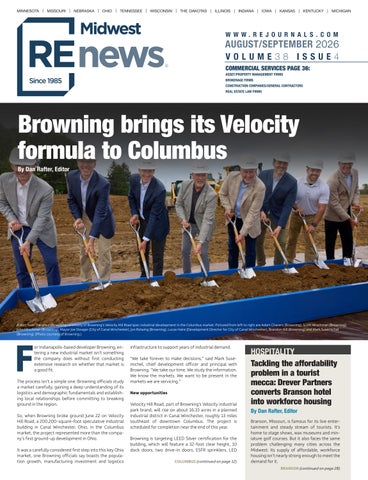
A shot from the groundbreaking ceremony of Browning’s Velocity Hill Road spec industrial development in the Columbus market. Pictured from left to right are Adam Chavers (Browning), Scott Hirschman (Browning), John Hirschman (Browning), Mayor Joe Steager (City of Canal Winchester), Jon Rolwing (Browning), Lucas Haire (Development Director for City of Canal Winchester), Brandon Hill (Browning) and Mark Susemichel (Browning). (Photo courtesy of Browning.)
F
or Indianapolis-based developer Browning, entering a new industrial market isn’t something the company does without first conducting extensive research on whether that market is a good fit.
The process isn’t a simple one: Browning officials study a market carefully, gaining a deep understanding of its logistics and demographic fundamentals and establishing local relationships before committing to breaking ground in the region. So, when Browning broke ground June 22 on Velocity Hill Road, a 200,200-square-foot speculative industrial building in Canal Winchester, Ohio, in the Columbus market, the project represented more than the company’s first ground-up development in Ohio. It was a carefully considered first step into this key Ohio market, one Browning officials say boasts the population growth, manufacturing investment and logistics
infrastructure to support years of industrial demand. “We take forever to make decisions,” said Mark Susemichel, chief development officer and principal with Browning. “We take our time. We study the information. We know the markets. We want to be present in the markets we are servicing.” New opportunities Velocity Hill Road, part of Browning’s Velocity industrial park brand, will rise on about 16.33 acres in a planned industrial district in Canal Winchester, roughly 13 miles southeast of downtown Columbus. The project is scheduled for completion near the end of this year. Browning is targeting LEED Silver certification for the building, which will feature a 32-foot clear height, 10 dock doors, two drive-in doors, ESFR sprinklers, LED COLUMBUS (continued on page 12)
HOSPITALITY Tackling the affordability problem in a tourist mecca: Drever Partners converts Branson hotel into workforce housing By Dan Rafter, Editor
Branson, Missouri, is famous for its live entertainment and steady stream of tourists. It’s home to stage shows, wax museums and miniature golf courses. But it also faces the same problem challenging many cities across the Midwest: Its supply of affordable, workforce housing isn’t nearly strong enough to meet the demand for it. BRANSON (continued on page 28)
Solutions from
all sides. No two problems are alike. Neither are their answers. Each requires a point of view. A new angle. Together, we’ll look for an integrated solution, guided by data and insights. We’ll gain a deep understanding of your business, and consider every part of your commercial real estate strategy, so you can realize anything.
cbre.com
SAVE
THE
DATE
25th Annual Chicago
COMMERCIAL REAL ESTATE Summit January 14, 2027 The Westin O’Hare (6100 N River Rd, Rosemont, IL 60018) 7:30 AM - Registration, Networking & Exhibits 8:00 AM - 12:30 PM Program
Register Today
Scan for more information and to register
www.rejournals.com/upcomingevent/ Speaking and Sponsorship opportunities available Jay Kodytek jay.kodytek@rejournals.com 612-940-3713
Ernie Abood eabood@rejournals.com 773-919-8799
Frank Biondo frank.biondo@rejournals.com 248-670-2691
Matt Loarie matt.loarie@rejournals.com 847-814-9519
4 | Midwest Real Estate News | August/September 2026 | www.rejournals.com
FEATURES 8 The Midwest’s commercial real estate publication, providing useful, unbiased and accurate coverage of the industry and its professionals since 1985. WWW.REJOURNALS.COM Publisher | Jay Kodytek jay.kodytek@rejournals.com Editor | Dan Rafter drafter@rejournals.com ADVERTISING Vice President of Sales & MW Conference Series Manager | Ernest Abood eabood@rejournals.com Vice President of Sales | Frank E. Biondo frank.biondo@rejournals.com Business Development Director | Matt Loarie matt.loarie@rejournals.com Classified Director | Susan Mickey smickey@rejournals.com Director, National Events & Marketing | Allison Kim Allison.kim@rejournals.com
16 The NRP Group earlier this year
COLUMNS/DEPARTMENTS
based developer Browning, entering a
started construction of OSU East, a 336-unit
6
Editor’s Letter
new industrial market isn’t something the
upscale apartment community in northwest
company does without first conducting
Columbus. This is a significant milestone: It’s
22
Incentives play a key role in Liberty,
extensive research on whether that market
NRP Group’s first market-rate multifamily
Missouri’s, industrial growth
is a good fit.
project in the capital of Ohio.
1
Browning brings its Velocity formula to Columbus: For Indianapolis-
Making a difference in Columbus:
24
work of industrial real estate acquisitions
for its live entertainment and steady stream
values remain depressed across much of the
26
of tourists. But it also faces the same
country, but this is creating an opportunity
credibility and capital are rewriting
problem challenging many cities across the
for developers willing to rethink how they
Cleveland’s real estate story
Midwest: Its supply of affordable, workforce
transform outdated office buildings into
housing isn’t nearly strong enough to meet
multifamily projects, industrial space and
30 Lending update for a disrupted
the demand for it.
other uses.
summer season
8
Tackling the affordability problem in a tourist mecca: Branson is famous
A modern office building gets a second act in St. Paul: Developers
The future of office? Creativity
How AI is changing the day-to-day
18 matters more than ever: Office
1
U.S. office market gaining
20 momentum, but not all properties
Game Changers: How collaboration,
32 Making affordable housing more affordable to build
are increasingly transforming struggling
are seeing equal demand: For years, the U.S.
office space into multifamily developments.
office market has been waiting for a sign
34
And usually, developers target offices with
that the worst was over. It might have one in
about thoughtful design and speed to
old bones for this process.
the latest research from Newmark.
market
A real rarity: Sturtevant
10 manufacturing campus a unicorn in today’s industrial market: Manufacturing campuses like the one on the market today in Sturtevant, Wisconsin? They don’t come along often. It’s why this site should see plenty of demand.
Midwest Real Estate News brings real estate leaders together to explore the challenges and opportunities unique to their markets.
Healthcare development today is
36 Directory Listings
ADDRESS 7767 Elm Creek Boulevard, Suite 210, Maple Grove, MN 55369 Midwest Real Estate News® (ISSN 0893-2719) is published bimonthly by Real Estate Publishing Corp., (rejournals.com). Current and back issues and additional resources, including subscription request forms and an editorial calendar, are available on the internet at rejournals.com.
Detroit 7th Annual
APARTMENT & MULTIFAMILY
SUMMIT
November 13, 2026
7:30 AM - Registration, Networking & Hot Breakfast 8:00 AM - 12:00 PM Program The San Marino Club (1685 E Big Beaver Rd, Troy, MI 48083)
Register Today
Scan for more information and to register www.rejournals.com/upcomingevent/
STAY TUNED FOR OUR LINEUP OF INDUSTRY EXPERTS... sponsors:
Speaking and Sponsorship opportunities available Jay Kodytek jay.kodytek@rejournals.com 612-940-3713
Frank Biondo frank.biondo@rejournals.com 248-670-2691
6
FROM THE EDITOR
Midwest Real Estate News | August/September 2026 | www.rejournals.com
On the edge of the next growth cycle for industrial real estate? By Dan Rafter, Editor
F
or much of the last two years, the nation’s industrial real estate market has seen the same story: Developers built warehouses at a blistering pace while tenants struggled to keep up. That is beginning to change. According to Colliers‘ second-quarter 2026 U.S. Industrial Outlook, the national industrial sector is showing its strongest signs yet that the post-construction-boom adjustment is nearing an end. Occupier demand is once again outpacing new supply, vacancy has started to edge lower and the fundamentals are lining up for what Colliers says could be the beginning of the next growth cycle for industrial real estate. Perhaps the biggest milestone came in the second quarter, when net absorption reached nearly 59 million square feet, beating the 53.4 million square feet of new industrial space delivered during the quarter. According to Colliers, it’s the first time since the construction surge began several years ago that tenant demand has exceeded new supply. That shift is significant because it suggests that the industrial sector is working through the wave of speculative development that flooded many markets during 2023 and 2024. In its report, Colliers said that this improving balance also helped lower the national industrial vacancy rate to 7.3%, down seven basis points from the first quarter. While vacancy remains slightly higher than it was one year ago, Colliers said that annual increases in industrial vacancy rates have slowed, and nearly two-thirds of the markets the company tracks either stabilized or posted lower vacancy during the second quarter. The Midwest continues to stand out as one of the healthiest industrial regions in the country.
iStock photo, credit urfinguss.
“Looking ahead, Colliers predicted that industrial demand will remain healthy through the rest of 2026.” Colliers reported that the region maintained the nation’s lowest vacancy rate at 5.4%, benefiting from slower development activity and a stronger balance between supply and demand than many coastal markets. The Midwest recorded more than 13 million square feet of net absorption during the year’s second quarter while adding about 12 million square feet of new industrial space. Nationally, the South saw the most industrial activity in the second quarter, accounting for roughly half of all net absorption recorded across the country. Houston led the nation with 7.5 million square feet of absorption, followed by Dallas-Fort Worth, Atlanta, Los Angeles and Phoenix. Manu-
facturing users, third-party logistics firms, retailers, food and beverage companies and businesses tied to data center development all contributed to healthy leasing activity. This doesn’t mean that the industrial sector is in the middle of a new boom period. New deliveries have slowed considerably from the peak of the building cycle following the start of the COVID-19 pandemic. Colliers reported that new industrial deliveries reached their lowest quarterly total since 2016. At the same time, the construction pipeline has begun expanding again, climbing to more than 314 million square feet. Colliers said that this reflects growing confidence from
developers in the market but not a return to the aggressive speculative construction seen several years ago. Higher construction costs, tighter lending standards and longer development timelines are expected to keep new projects more selective. Rental rates continue to tell a more mixed story. Average warehouse and distribution asking rents slipped 1.6% on a year-over-year basis to $10.36 a square foot nationally as landlords in overbuilt coastal markets continued adjusting pricing. Colliers said that newer industrial buildings with modern features continue to command premium rents, while tighter Midwest markets and select Southern markets have maintained stronger pricing power. Looking ahead, Colliers predicted that industrial demand will remain healthy through the rest of 2026. As more companies move forward with expansion plans that they had delayed because of higher borrowing costs and economic uncertainty, demand should continue matching or exceeding new deliveries. If that trend holds, vacancy should gradually decline while laying the foundation for a more balanced and sustainable industrial market entering the next phase of the real estate cycle.
8
ST. PAUL
Midwest Real Estate News | August/September 2026 | www.rejournals.com
A new chapter for a St. Paul office tower By Dan Rafter, Editor
D
evelopers are increasingly transforming struggling office space into multifamily developments. And usually, developers target offices with old bones for this process.
That configuration helped BKV Group create corner residences with distinctive layouts and views, giving the apartments a selling point beyond its location in a converted office building. The building’s history also proved important to the redevelopment. In 2022, Landmark Tower was added to the National Register of Historic Places. The designation wasn’t based solely on architectural significance. The tower’s connection to American Hoist and Derrick Co., a St. Paul company with more than a century of history, helped establish its historical importance, Krych said.
Think vintage office towers, historic masonry facades and obsolete floor plans from the 1920s and 1930s. Developers view these buildings as natural fits for multifamily conversions because of the history behind the properties and the often stunning architecture that they boast. That doesn’t mean, though, that only vintage office buildings are good targets for multifamily conversion. In fact, the next wave of these conversions might focus on office buildings built in more modern times. Think the more utilitarian but still functional office towers of the ‘80s and ‘90s. Landmark Tower in downtown St. Paul, Minnesota, is a good example. Built in 1983 as the 25-story Amhoist Tower, the modernist office building spent decades as a fixture of the St. Paul skyline. But as office demand changed and the COVID-19 pandemic fueled the rise of work-fromfrom and hybrid in-office schedules, the Amhoist Tower saw its vacancy rate skyrocket. But today? The building at 345 St. Peter St. is enjoying new life as a modern multifamily property. Working with developer Sherman Associates, BKV Group developed a plan to convert most of the tower into 187 apartments. The $97 million rehabilitation was completed more than a year ago, transforming a largely vacant office building into a bustling residential property with amenities that refer back to the property’s past use as an office tower. These amenities include the property’s Business Lounge, which provides coworking space, and its C-Suite, located on the 18th level, which serves as a bar and lounge. For Michael Krych, partner at BKV
The company manufactured cranes and hoists used on major projects around the world, including the Panama Canal and Mount Rushmore. Eventually, the company built the tower that now bears the Landmark name, though financial problems ultimately contributed to its downfall. The historic designation brought something else that mattered enormously: access to federal and state historic tax credits.
Photos of Landmark Tower in downtown St. Paul courtesy of BKV Group.
Group’s Minneapolis office, Landmark Tower demonstrates why developers and architects shouldn’t limit their conversion searches to century-old office buildings. “There are plenty of office buildings of different eras and vintages that can work for this housing shortage we have,” Krych said. That doesn’t mean every modern office tower is a good fit for conversion. Conversions can be expensive. To work, the economics, building systems, floor plates and location of an office property must combine to provide the right fit. Landmark Tower had several advantages from the start, Krych said.
First, there’s its location. The tower sits in the heart of downtown St. Paul, overlooking Rice Park and offering 360-degree views of the city and the Mississippi River. Then there is its architecture, another feature that also helped make the conversion possible. The building’s curtain-wall design rises 25 stories above a footprint formed by three staggered rectangular prisms. Those steps created an unusual floor plate and, ultimately, a collection of apartments with prominent corners and expansive views. “The building footprint was important for it to be successful,” Krych said. “A lot of projects don’t have that amount of stepping.”
“ If that wasn’t in place for Landmark Tower, it would not have gotten done,” Krych said. “Without those credits, the price would have been too steep to make it work.” That point gets to the heart of the office-conversion debate. The question isn’t necessarily whether a building can physically be transformed into apartments. The question is whether the numbers work. BKV Group has spent considerable time studying that issue. During the post-COVID slowdown, the firm evaluated more than 20 vacant or underused buildings in Minneapolis and another 12 to 15 in St. Paul, examining their locations, floor plans and potential residential layouts. “Not every building works,” Krych said. “But there are plenty that do. I do think we will see a lot more of these younger buildings converted into multifamily space.”
ST. PAUL 9
www.rejournals.com | August/September 2026 | Midwest Real Estate News
“Not every building works. But there are plenty that do. I do think we will see a lot more of these younger buildings converted into multifamily space.” What makes an office building a good fit for conversion to apartments? Parking, trash collection and ease-of-access for maintenance vehicles are important factors. Then there are the physical characteristics of the building: column spacing, window sizes, stair locations, structural systems and the location of the core. Mechanical systems can pose another major hurdle. Landmark Tower’s post-tensioned concrete construction, for instance, meant BKV Group couldn’t simply drill through the floors wherever it wanted. “We had to X-ray the floors to understand and know where the tendons were,” Krych said. The building’s curtain wall presented its own challenges, including areas where the exterior enclosure had begun to fail. BKV Group is tackling additional conversions of more modern buildings to apartment developments, Krych said. A good example is in St. Louis. Here, the firm is working on another conversion involving a 1960s International Style complex overlooking the famous Gateway
Arch. The southernmost tower is being converted to affordable housing, while another tower retains its ownership/condominium use and a separate developer is converting the middle building to housing. That project, too, is relying on historic and state tax credits, along with low-income housing tax credits. The takeaway? Downtown residential conversions don’t necessarily require historic office buildings to work. The key instead is for developers to find buildings of any age that they can convert economically and neighborhoods that attract residents. For Landmark Tower, that neighborhood is downtown St. Paul. Krych said that downtown living is still attracting a steady stream of residents who want to live in busy, vibrant neighborhoods. “Urban city dwelling and living is pretty cool,” Krych said. “It’s so different and unique and fun than what you experience beyond the city limits. The key is offering people a place that has a real ‘there’ to it.”
As a national contractor, we know that
EVERY PROJECT IS UNIQUE That’s why we’re committed to investing in local resources and expertise. No matter where we build, our objective remains the same —to deliver residences your tenants are PROUD TO CALL HOME. The Duncan Madison, WI
10
MANUFACTURING
Midwest Real Estate News | August/September 2026 | www.rejournals.com
A real rarity: Sturtevant manufacturing campus a unicorn in today’s industrial market By Dan Rafter, Editor
M
anufacturing campuses like the one on the market today in Sturtevant, Wisconsin? They don’t come along often. It’s why this site should see plenty of demand.
The former Cree Lighting manufacturing campus in Sturtevant.
Hoffman said that he expects strong demand for the campus. “This is not simply a large industrial building,” he said. “It is a highly improved manufacturing campus that can substantially accelerate a company’s path to production while providing long-term access to one of the Upper Midwest’s strongest industrial corridors.”
The site in question? Cushman & Wakefield | Boerke has been selected to market for sale the former Cree Lighting manufacturing campus at 9201 Washington Ave. in Sturtevant, about 30 minutes from Milwaukee and an hour’s drive from Chicago. Encompassing nearly 642,000 square feet across about 30 acres, the Racine County property ranks as one of the largest advanced manufacturing facilities currently available for purchase in the Upper Midwest region of the country. According to research conducted by Cushman & Wakefield | Boerke, a limited number of comparable, modern manufacturing campuses are immediately available for owner-occupancy across the region. Another positive? The campus combines manufacturing infrastructure with corporate office, engineering and research space, creating an opportunity for companies that hope to expand domestic operations without having to suffer through the lengthy timeline and capital required for new construction. Jeff Hoffman, Principal with Cushman & Wakefield | Boerke, said that the greatest advantage that the site offers is the opportunity for its new owners to acquire immediate scale and become operational within months rather than years. The campus also provides plenty of amenities, Hoffman said. It is nearly 90% air-conditioned and includes approximately 93,000 square feet of corporate office space, 8,600 amps
workforce and business environment,” Hoffman said.
of power, an 11,700-square-foot clean room, backup generation, specialized production infrastructure and a distribution component with clear heights reaching 35 feet.
ularly companies involved in energy and electrical equipment, power-generation technologies, life sciences, medical products or other highly engineered manufacturing operations.
“It is an exceptionally difficult combination of features to replicate,” Hoffman said.
Hoffman said that Boerke is also targeting companies evaluating the greater Chicago market that prefer to own their real estate but are finding that most options available in their market are conventional big-box warehouses requiring expensive retrofits.
Hoffman said that the campus is also being offered well below replacement cost. A user pursuing a comparable greenfield facility would face a development process of at least two years, significant construction and infrastructure costs and considerable execution risk, he said. That’s not the case with this site. “This property offers a much faster and more cost-effective path to production,” Hoffman said. Boerke is marketing this property at the right time. The U.S. manufacturing sector is experiencing positive momentum, a momentum driven by a push for reshoring, supply chain diversification, company investments in automation and continued domestic capital expenditures. Hoffman said that the primary targets for the site are large advanced-manufacturing owner-occupants, partic-
The site’s location offers benefits for owners, too. As Boerke says in a press release about the site, Wisconsin continues to benefit from its location in the center of the country, skilled workforce and strong manufacturing heritage. “Southeast Wisconsin has become a major destination for technology and advanced-manufacturing investment,” Hoffman said. A good example? Microsoft recently completed its first Mount Pleasant data center and is continuing construction of its next phases, while Eli Lilly is developing a planned $4 billion investment in its Kenosha County manufacturing operations. “Those projects reflect the region’s increasingly strong infrastructure,
Hoffman said that the industrial market in the region remains a strong one, despite some misleading vacancy statistics. Vacancy statistics for Kenosha County, Racine County and the Milwaukee South industrial submarkets suggest a market working through elevated vacancy rates, Hoffman said. But Hoffman said that five specific buildings, totaling more than 3.5 million square feet and all delivered or vacated between the fourth quarter of 2022 and the third quarter of 2024, account for much of the higher vacancy rate in the region. As Hoffman says, every square foot of space in those five buildings is unleased today, distorting the overall vacancy status of the region. “Once those buildings are removed from the calculation, the picture underneath is one of the tightest industrial markets in the region, tightening further every quarter for two-and-ahalf consecutive years,” Hoffman said. Located along the Interstate-94 corridor between Milwaukee and Chicago, the property provides direct access to one of the Midwest’s premier logistics and manufacturing corridors while offering immediate connectivity to both labor and transportation networks.
www.arcodetroit.com
Detroit’s Design-Build Partner ARCO delivers turnkey design-build solutions across diverse industries, including multifamily, commercial, food and beverage, cold storage, distribution, life sciences, and advanced manufacturing.
Experience A Better Way To Build. E N R #1 W A R E H O U S E & D I S T R I B U T I O N | T O P 10 D E S I G N-B U I L D F I R M S
12
COLUMBUS
Midwest Real Estate News | August/September 2026 | www.rejournals.com
A rendering of Browning’s Velocity Hill Road project. (Rendering courtesy of Browning.)
COLUMMBUS (continued from page 1)
lighting, 2,000-amp electrical service and parking for 200 vehicles. But the building’s biggest selling point might be its size. For years, industrial developers in Columbus, as in many major U.S. markets, have focused on building increasingly large buildings. Browning saw an opening in the market for something smaller. “Everyone was building much larger buildings, 500,000, 600,000, a million square feet,” said Jon Rolwing, senior vice president of development with Browning. “From 2017 to 2023, that was the case. Most of the smaller spaces under 300,000 square feet were absorbed. Nothing was added to the market.” That created what Rolwing considers a compelling niche for a smaller spec industrial project. Velocity Hill Road can be divided into as many as four spaces, though Browning expects the building ultimately to house one or two tenants. The developer also has additional land that could accommodate trailer parking or outdoor storage, amenities that aren’t always available with smaller industrial buildings.
Velocity Hill Road benefits from a strong location, too. The property sits along the U.S. 33 corridor, with Rolwing pointing to its quick access to the highway. From State Route 33, he said, tenants can reach the property with essentially one right turn and one left turn. “We think that really sets us apart, even within our submarket,” Rolwing said. The location offers another advantage that might sound less important on an industrial site plan but can matter to companies trying to attract and retain workers: Amenities are nearby. Fast-food restaurants, a grocery store and other community shopping-center tenants are within walking distance of the property, Rolwing said. Employees can grab lunch, pick up groceries or run an errand before or after work without driving across a sprawling industrial park. “Employees at our property will be able to stop after and before work, run an errand at lunch, in just a couple of minutes,” Rolwing said. “That’s not often the case in big industrial parks that aren’t located near easy commercial amenities.” A market built for logistics Browning’s confidence in Columbus
starts with the same characteristic that helped make Indianapolis and Louisville such important pieces of the company’s industrial strategy: location. Columbus, Rolwing said, shares some of Indianapolis’ most important logistics characteristics. A high percentage of the U.S. population can be reached from the market within a day’s truck drive, making Central Ohio an attractive location for logistics providers, distributors and manufacturers. But Columbus isn’t relying solely on its location. The city is growing, and that growth is occurring across several economic sectors. “It’s an unusual city in this economic cycle,” Rolwing said. “It’s one of the few growing cities.” Manufacturing investment is increasing, too, he said, pointing to Intel’s major investment in the region. Data-center development is another significant part of the area’s growth story. And people continue to move to Columbus, both from other parts of Ohio and from outside the state. Ohio, Rolwing said, offers a combination that is increasingly attractive to businesses and workers: a relatively lower cost of living, a strong quality of life and a compact, accessible metropolitan area.
“It’s the kind of city where you are 15 or 20 minutes anywhere,” he said. Browning said that about 7.1 million square feet of speculative industrial space is under construction across the Columbus market, with the overall industrial vacancy rate in the market standing at 5.6%. In the Southeast U.S. 33 Corridor, where Velocity Hill Road is located, there is no other speculative industrial product under construction and vacancy was 4.3%. The developer isn’t betting against Columbus’ demand for massive distribution facilities. That demand remains strong. Last year, Rolwing said, the market recorded substantial absorption, including several 4-millionsquare-foot buildings being leased. But those enormous buildings don’t serve every industrial user. Browning believes that manufacturers, data centers and other major projects arriving in Central Ohio will create concentric circles of suppliers, vendors and service providers that need smaller warehouse and distribution facilities. “With the manufacturers and data centers coming to town, their suppliers, vendors and concentric circles of providers will need warehouse space,” Rolwing said. “That’s our ultimate tenant.”
COLUMBUS 13
www.rejournals.com | August/September 2026 | Midwest Real Estate News
“Employees at our property will be able to stop after and before work, run an errand at lunch, in just a couple of minutes. That’s not often the case in big industrial parks that aren’t located near easy commercial amenities.” Browning received its first request for proposal for Velocity Hill Road shortly after breaking ground. Tilt-wall construction is underway, with the project expected to be completed in December.
That makes Columbus a natural fit. Browning already operates in Indianapolis and Louisville, and the Columbus market is close enough to those existing operations to make the company’s hands-on approach practical.
The company plans to pursue LEED Silver certification, giving corporate users another way to demonstrate environmental commitments to shareholders and boards.
Louisville’s latest chapter
Susemichel said that environmental focus is part of what Browning considers the company’s “Velocity way” of developing industrial properties. Building a brand Browning’s successful history of delivering quality industrial facilities includes projects for major users such as Walmart.com and UPS, as well as Amazon, Daimler Trucks North America, Reebok, Subaru, Kohl’s and Logisco/ PepsiCo. That experience helped shape Browning’s decision to move into Columbus. This doesn’t mean, though, that the company is trying to blanket the Midwest with Velocity parks. Its strategy is more deliberate. Susemichel said Browning’s next potential markets include Detroit, Cincinnati, Lexington and Dayton, Ohio. What do each of these markets have in common? Geography. Browning builds in markets that its team can reach by car, allowing its development executives to remain personally involved. “If we have to jump on an airplane to reach a site, that’s outside of our radius,” Susemichel said.
While Browning is starting its Ohio push, the company is also moving ahead with another major industrial project in Shepherdsville, Kentucky, south of Louisville.
Demand has been strong. The park has no vacancy, Susemichel said, and other developers have since acquired land nearby and built their own industrial projects. For Browning, the Louisville project and Velocity Hill Road illustrate the same basic philosophy: Find a location with powerful logistics fundamentals, understand the users that need space there and then build a product that
isn’t simply another commodity industrial building. Browning will celebrate its 50th anniversary next year. Susemichel said the company’s industrial strategy has evolved, but its basic approach has not. “When you see a Velocity park, you know that it is a quality development,” he said.
Browning has just started vertical construction on Building 5 at Velocity 65 Trade Center, a 235,830-squarefoot speculative industrial building. The project is the latest chapter in a park that Browning has spent about a decade assembling and developing. Susemichel said the company originally saw the opportunity in Louisville because of the growth of e-commerce and the importance of locating near major air-freight hubs. The biggest draw was the sprawling UPS Worldport in this market. Browning assembled more than 300 acres near the UPS hub, creating a park that ultimately attracted major users including Walmart, UPS and Meta. The site had another advantage: Interstate 65. When Browning acquired the land, the park was served by one interchange. After closing, the company worked to secure a second interchange. Today, Susemichel said, Velocity 65 is the only industrial park in the area served by two interstate interchanges.
Elevate real estate financing Putting clients first. Trusted to be part of their future.
Visit us at bwe.com
14
HOSPITALITY
Midwest Real Estate News | August/September 2026 | www.rejournals.com
Live Oak Apartments (Images courtesy of Drever Partners.)
BRANSON (continued from page 1)
And this is a significant problem: The people who keep the local economy running in Branson need quality, affordable places to live. A new apartment community in the heart of Branson’s Theater District can help. Phoenix, Arizona-based developer Drever Partners has begun pre-leasing at its newly created Live Oak Apartments. Drever Partners converted the former Hall of Fame Motel at 3011 W. 76 County Blvd. into this 142-unit residential community. The property offers studios, larger townhome-style studios and one-bedroom apartments. Importantly, the project is designed to serve Branson’s local workforce, including hospitality workers, healthcare professionals, educators, first responders and retail employees. “Branson’s economy is built by the people who show up every day to serve our visitors, businesses, and community, and they deserve quality
housing options close to where they work,” said Lisa Hicks, regional property manager of Key Management, in a written statement.
Live Oak Apartments (Images courtesy of Drever Partners.)
Key Management is handling professional management of Live Oak Apartments. Studios of about 300 square feet start at approximately $710 a month. Townhome-style studios measuring about 520 square feet start at approximately $890, while 520-square-foot one-bedroom apartments start at about $990. Those rents include electricity, water, trash service and internet. The bundled approach is intended to give residents one predictable monthly payment while eliminating the need to establish and manage multiple utility accounts. “Access to housing plays an important role in the long-term strength of any community,” said Ryan Wall of Drever Partners’ acquisitions and asset management team, in a statement. “Live Oak Apartments represents our commitment to identifying opportunities
where thoughtful investment can revitalize existing properties, expand housing options, and support growing communities like Branson for years to come.”
How big is the need for new multifamily space in the Branson area? And specifically, how big is the need for workforce housing and not just luxury multifamily?
Midwest Real Estate News spoke with Galen Drever, managing director with Drever Partners, about the impact that Live Oak Apartments can have on the Branson market and the ever-growing need for workforce housing.
Galen Drever: Branson’s economy runs on its workforce, from hospitality staff and healthcare workers to educators, first responders and retail employees. For years, the housing supply hasn’t kept pace with that demand. Most of what gets built in resort markets
HOSPITALITY 15
www.rejournals.com | August/September 2026 | Midwest Real Estate News
Live Oak Apartments (Images courtesy of Drever Partners.)
Do you think we’ll see the number of conversions — whether from former hotels or office properties — to multifamily buildings continue to increase over the next several years? Why or why not? And what are the most important factors in determining whether a building is a good fit for conversion? Drever: Yes, I think we’ll see conversions continue to grow. The housing shortage isn’t easing, construction costs and timelines make a lot of ground-up development hard to pencil, and there’s a large stock of underused hotel and office buildings sitting in good locations. Adaptive reuse lets you add housing faster and often more affordably, which is exactly what many markets need.
targets the top of the market, which leaves the people who keep the town running with very few quality, attainable options close to where they work. That’s the gap Live Oak is built for: 142 studio and one-bedroom homes priced for the local workforce, not a luxury tier. The need is real and it’s persistent, because Branson keeps growing as a tourism and entertainment destination while attainable housing stays scarce. What made the former Hall of Fame Motel a good candidate for an adaptive reuse? Drever: Location and bones. The property sits at 3011 W. 76 Country Blvd., right in the heart of Branson’s Theater District, just minutes from the largest employers, plus restaurants, shopping and entertainment along the Strip. A hotel is already configured for residential-style living, with the structure, corridors, and unit footprints largely in place, so we could expand Branson’s housing inventory far faster and with less waste than ground-up construction. When a well-located building can be brought back into productive use for the community, that’s exactly the kind of overlooked real estate we look for. What were some of the more noteworthy challenges in transforming the hotel into functional multifamily units? I know that it can be difficult at times to transform older proper-
ties into modern multifamily buildings. Drever: The core challenge in any hotel conversion is turning rooms designed for a few nights’ stay into homes people live in full-time. That means adding real kitchens, upgrading plumbing and electrical to residential loads, and reworking layouts so a studio or townhome-style unit actually functions day to day.
management, laundry facilities and outdoor community spaces, all professionally managed by Key Management. And it’s the location, walkable to work and everyday services in the Theater District, combined with attainable pricing.
As for fit, the most important factors are location, the building’s existing structure and floor plate, whether the layouts can realistically become livable units, the condition of the core systems and whether the numbers support delivering the housing at a price point the local market needs. When those line up, conversion can be one of the smartest ways to bring a property, and a neighborhood, back to life.
Think of us for your next project in Northwest Indiana...
Ask us how we can help you incorporate sustainability into your next project!
We’re also delivering Live Oak in phases across multiple buildings, which means managing active construction while pre-leasing and welcoming the first residents at the same time. Sequencing that well, so early residents have a good experience while later phases finish, takes real coordination with our construction and property management teams. What are some of the amenities and features that set Live Oak Apartments apart from its competitors? Drever: The biggest differentiator is simplicity and value. Rent includes electricity, water, trash and Internet, so residents make one predictable monthly payment instead of juggling separate utility bills, a real advantage for a working household budgeting month to month. Beyond that, Live Oak offers multiple floor plans (studios, larger townhome-style studios, and one-bedrooms), move-in-ready apartments, online leasing, responsive onsite
UNDER CONSTRUCTION... Package Sortation and Distribution Facility Gary, IN - 309,960 SF ARCHITECT: Cornerstone Architects CIVIL ENGINEER: Spaceco, Inc.
DESIGN BUILD · GENERAL CONTRACTING CONSTRUCTION MANAGEMENT Please contact us for any upcoming project needs! 847.374.9200 · www.meridiandb.com
16
OHIO
Midwest Real Estate News | August/September 2026 | www.rejournals.com
Making a difference in Columbus: The NRP Group breaks ground on first market-rate apartment community in this key Midwest market By Dan Rafter, Editor
T
he NRP Group earlier this year started construction of OSU East, a 336unit upscale apartment community in northwest Columbus. This is a significant milestone: It’s NRP Group’s first market-rate multifamily project in the capital of Ohio.
M/I Homes said its adjacent townhome development will complement the rental community by expanding housing choices in the area.
It also addresses a growing need for more market-rate multifamily developments in this slice of the state. The development will rise on a 27.5acre site along West Dublin Granville Road, an area that continues to see strong residential and employment growth, according to The NRP Group. The apartment community will share the site with 138 for-sale townhomes that will be developed by M/I Homes of Central Ohio LLC, creating a mixed-housing neighborhood designed to serve a range of buyers and renters. The NRP Group said it selected the site because of its access to major transportation corridors, nearby employers and growing retail and recreational amenities. “This project represents an exciting milestone for our team and is the first of many opportunities we hope to pursue in Columbus,” said Mike Zelenkofske, Executive Vice President of Development at The NRP Group, in a press release announcing the development. “We were drawn to OSU East because of its connectivity to major transit corridors, proximity to neighborhood amenities, and the strong population and job growth shaping the region,” Zelenkofske said. “We are grateful for the city’s continued partnership and excited to deliver a high-quality community that serves
Photo courtesy of The NRP Group.
residents today while supporting the long-term growth of Columbus.” A growing need The NRP Group’s project is significant because the Columbus market, like so many across the Midwest, needs more multifamily housing of all types to meet the growing demand from potential tenants. And newly built affordable and market-rate housing continues to be in short supply in the Columbus region. Again, this is hardly a challenge unique to Columbus. Most major cities are working through shortfalls in affordable housing, not surprising given how challenging it can be to make these projects pencil out financially for developers. It’s why so many new apartment developments are luxury or high-end projects: It’s easier for developers to make money on these higher-cost multifamily properties. OSU East will consist of 11 three-story residential buildings featuring 144 one-bedroom apartments, 156 two-bedroom units and 36
three-bedroom residences. Apartment interiors will include kitchen islands or peninsulas, granite countertops, luxury vinyl tile flooring and balconies in most homes. Located near Ohio State University Airport within the Worthington School District, the community will provide easy access to Dublin and other major employment centers throughout Central Ohio. Nearby employers include Ohio State University, Cardinal Health, OhioHealth, JPMorgan, Nationwide Insurance and Nationwide Children’s Hospital. Residents will also benefit from direct access to State Route 315 and Interstate 270. As part of the project, construction crews will build an 11-foot-wide bike path along the property’s frontage in coordination with the City of Columbus, improving connections to nearby restaurants, retail destinations and Bridge Park in Dublin. The community also sits near Linworth Road Community Park.
“We’re pleased to partner with The NRP Group on this transformative development that will allow us to deliver for-sale townhomes alongside The NRP Group’s high-quality rental housing,” said Josh Barkan, Division President at M/I Homes of Central Ohio LLC, in a press release. “This kind of collaboration lets us meet a broader range of housing needs in Northwest Columbus, from young professionals to growing families to active adults and empty nesters, and we’re excited to break ground on our portion of the site this spring.” OSU East will feature a clubhouse with a full kitchen, fitness center, coworking space, resort-style swimming pool, volleyball and bocce courts, outdoor grilling areas and landscaped courtyards. A package delivery room also will be included. The project is backed by equity from Carlyle Group, while PNC Bank is providing financing. The City of Columbus partnered with The NRP Group throughout the entitlement and development process. Since its founding in 1994, The NRP Group has developed more than 68,000 apartment homes nationwide and more than 5,000 rental homes throughout Ohio. Construction on OSU East is underway, while M/I Homes expects to begin work on its townhome community in the spring of 2027.
Detroit 4th Annual
INDUSTRIAL REAL ESTATE August 27, 2026
SUMMIT
7:30 AM - Registration, Networking & Breakfast 8:00 AM - 11:00 AM Program The San Marino Club (1685 E Big Beaver Rd, Troy, MI 48083)
Register Today
Scan for more information and to register www.rejournals.com/upcomingevent/
speakers:
Anne Galbraith-Kohn - CBRE Emily D’Agostini Kunath - D’Agostini Companies Jason Capitani - L. Mason Capitani CORFAC International Robert McCraight - Lee & Associates Nick Savoy - Lee & Associates Robert Pliska - SPERRY - Property Investment Counselors Tyler Rossmaessler - Flint & Genesee Economic Alliance Randall Book - Colliers Conrad Schewe -Burton-Katzman LLC Luke Timmis - Signature Associates Paul O’Connell - Michigan Economic Development Corporation Shannon Selby - Detroit Regional Partnership Marc Werner - NorthPoint Development Kurt Brauer - Warner Norcross + Judd Dave Dismondy - District Capital Thomas Styf - ARCO National Construction Elizabeth Rogers - Taft Mark Bennett - MJBennett Nick Weise - Rightsize Facility
sponsors:
Speaking and Sponsorship opportunities available Jay Kodytek jay.kodytek@rejournals.com 612-940-3713
Frank Biondo frank.biondo@rejournals.com 248-670-2691
18
OFFICE
Midwest Real Estate News | August/September 2026 | www.rejournals.com
The future of office? Creativity matters more than ever By Dan Rafter, Editor
O
ffice values remain depressed across much of the country, but this is creating an opportunity for developers willing to rethink how they can transform outdated office buildings into multifamily projects, industrial space and other uses. That’s one of the key findings from CommercialCafe’s recently released July U.S. national office report. According to CommercialCafe, using research from Yardi Matrix, declining office property values are making office-to-multifamily conversions financially feasible in cases that would have been considered too risky just a few years ago. As more office buildings trade at steep discounts, developers are finding opportunities to offset the often-high costs of converting outdated office space into housing. CommercialCafe reported that nearly half of all office property transactions with two or more recorded sales prices have sold at a discount since 2024. Those lower acquisition costs are helping more adaptive-reuse projects move from the drawing board to construction. The result is a record year for office conversions. CommercialCafe said that 11.8 million square feet of office-to-multifamily projects were either completed or under construction during 2025, more than in any previous year. Peter Kolaczynski, director of Yardi Research, told CommercialCafe that although office conversions remain expensive and technically challenging, discounted building prices are making more projects financially viable. “Recognizing that office conversions can still be an expensive undertaking and difficult to pull off, the fact that a segment of buildings are trading at such a discount creates the opportunity for more conversions to pencil out,” Kolaczynski said in the report. “At the very least, this allows for creative solutions to be introduced on what to do with this oversupply.”
Image by wal_172619 from Pixabay
Chicago stands out as one of the strongest examples of that trend. CommercialCafe reported that nearly 60% of office building sales completed in Chicago since 2024 have been discounted. At the same time, approximately 95 million square feet of office space in the metro is considered suitable for conversion to other uses. That combination of lower purchase prices and a large inventory of potentially convertible buildings has fueled adaptive-reuse activity in the Chicago market. CommercialCafe said those conversions have also helped keep the city’s office vacancy rate at 17.8%, almost identical to the national average of 17.7% recorded in June. Not every market is seeing the same results. CommercialCafe pointed to Seattle as an example of a metro where conversion activity has lagged despite having many of the same ingredients. Seattle posted one of the nation’s highest office vacancy rates at 24.7% in June and has roughly 47.5 million square feet of office space considered suitable for conversion. Even so, the market has experienced relatively little adaptive reuse compared to Chicago. Across the Midwest, office markets continue to offer some of the country’s
most affordable leasing opportunities. According to CommercialCafe, Detroit posted the region’s lowest average office asking rent in June at $21.47 per square foot. The Minneapolis-St. Paul market followed with an average asking rent of $27.63 per square foot. The Twin Cities also maintained a vacancy rate of 17.8% in June, matching Chicago and remaining close to the national average, CommercialCafe reported. Chicago remained the Midwest’s most expensive office leasing market, although only by a modest margin. CommercialCafe reported that average asking rents reached $28.39 per square foot during June while vacancy also stood at 17.8%. Nationally, developers continue to add new office space, although construction remains limited compared to the size of the existing inventory. CommercialCafe reported that 29.6 million square feet of office space was under construction across the markets it tracks as of June, representing roughly 0.4% of existing office inventory. Developers have also delivered 11.1 million square feet of new office space so far this year.
Three markets each had more than 2 million square feet under construction in June: Manhattan, Boston and Dallas, according to CommercialCafe. Dallas continues to draw attention because of its employment growth and expanding financial sector. CommercialCafe reported that the metro had approximately 2.9 million square feet of office space under construction in June, equal to about 1% of its inventory, even though its construction pipeline has declined 11% from a year earlier. The report noted that Dallas recorded 0.6% office employment growth in May, supported by continued expansion in professional and business services as well as financial services. That employment growth, combined with businesses relocating to or expanding in the metro, is expected to support future office development. CommercialCafe highlighted Goldman Sachs’ planned 800,000-square-foot campus at 2323 N. Field St. as one example. The project has already broken ground and is expected to open in 2028, underscoring that while office conversions are reshaping older buildings, demand for new office development remains alive in select high-growth markets.
20
OFFICE
Midwest Real Estate News | August/September 2026 | www.rejournals.com
U.S. office market gaining momentum, but not all properties are seeing equal demand By Dan Rafter, Editor
F
or years, the U.S. office market has been waiting for a sign that the worst was over. It might have one in the latest research from Newmark. The national office market posted another quarter of positive demand in the second quarter, vacancy continued to fall and new construction remained near historic lows. At the same time, tenants are signing leases, especially in the best buildings, according to Newmark’s second-quarter U.S. Office Market Conditions & Trends report. But not everything in the report was positive. The big challenge for this sector? The office recovery is becoming increasingly divided between the properties tenants want and the ones they don’t. That is the big takeaway from Newmark’s recently released trends report. The national U.S. office market recorded nearly 8.8 million square feet of net absorption during the second quarter, marking the fourth consecutive quarter of positive demand. The vacancy numbers are encouraging, too. Newmark reported that the national office vacancy fell to 19.9% in the second quarter, down 60 basis points from a year earlier and below the 20.5% peak reached in the second quarter of 2025. But don’t mistake that improvement for a return to the old office market. The big difference? Today’s tenants are choosier. Class-A buildings continue to dominate the leasing conversation. Fourand five-star properties accounted for 49% of all new leasing activity during the quarter even though they represent just 34% of total office inventory. Newmark says Class-A leasing as a percentage of inventory continues to rise. That flight to quality is one of the
Image by donterase from Pixabay.
defining stories of the current office market. Companies that are bringing employees back to the office want to give them a reason to be there. That makes newer, better-located and amenity-rich buildings considerably easier to lease than older commodity space. The numbers bear that out. Newmark estimates that just over 53 million square feet of office space was newly leased in the second quarter. That’s up 9.1% from the same period a year earlier, but still about 30% below the 2018-2019 average. The bottom line? The U.S. office market is getting healthier. It just isn’t healthy enough yet. In its report, Newmark estimated that about 42% of pre-pandemic office leases have not yet expired. That represents 869 million square feet of space scheduled for renewal before the end of 2027. Average lease sizes have already declined 13.4% from pre-pandemic levels.
Still, there is reason for landlords to feel better about those upcoming expirations. Newmark’s tenants-inthe-market data shows that 78% of companies plan to maintain or expand their footprints when their leases expire. And the recovery isn’t confined to the biggest gateway markets. Secondary and tertiary markets accounted for nearly 80% of second-quarter absorption. Philadelphia led the nation with 1.3 million square feet of absorption, while Nashville posted about 1 million square feet. Technology-heavy and Sun Belt markets including San Francisco, Austin and Dallas also recorded meaningful gains. Chicago remains a more difficult story. The market posted 522,407 square feet of positive absorption in the second quarter, but overall vacancy remained elevated at 26.7%. Average asking rent stood at $35.57 a square foot. One factor could help Chicago and
other challenged markets over time: Developers aren’t adding much new competition. Only 16.3 million square feet of office space was under construction nationally at the end of the second quarter, according to Newmark. That’s a dramatically smaller pipeline than the market saw before the pandemic. Rents are another mixed bag. Asking rents rose 2.1% year-over-year nationally. But landlords are still offering hefty concessions to win tenants, with average tenant-improvement allowances 73.1% above pre-pandemic levels. Real rents remain roughly 9% to 11% below 2021 levels. So, yes, the office market is recovering. But it’s also a market in which quality matters more than ever, tenants have more leverage and older buildings face a tougher road ahead. For office owners, that’s the new reality: The market may finally be moving forward. The question is which buildings will be moving with it.
★
GOLD SPONSOR
★
DETROIT INDUSTRIAL REAL ESTATE SUMMIT M I D W E S T R E A L E S TAT E N E W S
SERVING MICHIGAN & THE MIDWEST
CREATING THE WORKPLACE OF THE FUTURE. For more than 20 years, Rightsi e Facility has helped organi ations across the Midwest plan, furnish, relocate, and decommission workplaces — with the speed and precision Michigan’s growing market demands. Workplace Design • Furniture Procurement • Relocation Services • Eco-Friendly Decommissioning • Facility Services
20+
300+
95%+
YEARS IN BUSINESS
PROJECTS FURNISHED PER MONTH
L A N D F I L L D I V E R S I O N R AT E
PLAN
•
FURNISH
•
SERVICE
Let’s partner on your next workplace project. RightsizeFacility.com
SCAN TO S TA R T
22
INDUSTRIAL
Midwest Real Estate News | August/September 2026 | www.rejournals.com
Incentives play a key role in Liberty, Missouri’s, industrial growth by Mike Stromberg, Opus
F
or industrial and manufacturing companies deciding where to expand, the building is only part of the equation. Transportation access, available labor and quality real estate all matter, but so do the policies, processes and people behind a community.
Liberty Heartland (Image courtesy of Opus.)
In Liberty, Missouri, those factors are working together to create an environment that encourages businesses to invest and grow. The Kansas City suburb has made economic development a priority, actively pursuing private investment and quality jobs while using tax incentives and other programs to compete for targeted industries. Currently, projects totaling approximately $650 million are bringing more than 6 million square feet of industrial space to Liberty and adding more than 4,000 jobs to the area. “Liberty is the most aggressive city in the region when it comes to incentives,” said Liberty Mayor Greg Canuteson. “We want to attract and retain businesses and jobs, and we’re proud of the tools we have to make that happen.” Just as important, Canuteson said, is the certainty those tools provide. Liberty has established programs with defined criteria and thresholds, giving businesses and developers a clearer understanding of what is available rather than negotiating incentives from scratch for every project. For companies evaluating multiple locations, knowing what a community can offer – and knowing that the process will be straightforward – can make a meaningful difference. Incentives and the certainty they provide are particularly valuable in today’s industrial market, where tenants have more leverage and companies can evaluate opportunities across markets and even across states. Developers are competing for fewer deals, while tenants can be more deliberate about location, cost and incentives. For communities trying to attract investment, having tools that can directly affect the economics of a project can help level the playing field.
Mike Stromberg (Photo courtesy of Opus.)
Liberty Heartland Logistics Center, a three-building, nearly 1.7-million-squarefoot development just off Interstate-35, provides a real-world example. Developed and built by Opus, the project is now fully leased. Four of its five tenants were already operating in Liberty or the Kansas City area, while the fifth was establishing its first U.S. operation. The companies had options. Animal Health International was considering locations outside Liberty but wanted to remain in the community. Dakota Bodies was weighing Liberty against an opportunity in Texas. TAB Batteries was evaluating locations nationally. The city’s incentives helped make Liberty competitive in each case. “Incentives played a factor in all of them,” said Canuteson. “For us, it’s about knowing what types of businesses we want to attract and having the tools to compete for them.” Those incentives mattered because Liberty Heartland gave businesses a quality, flexible Class-A option within the community. The development offers both cross-dock and single-load configurations, allowing it to accommodate different operational requirements while giving existing Liberty businesses an opportunity to grow without leaving the market. That combination of product and community also shaped how Liberty Heartland was marketed. Scott Bluhm, executive
managing director of Newmark Zimmer’s Kansas City, Missouri, office, and his team led the leasing efforts for the project. He said the pitch to prospective tenants focused on the quality construction and building attributes as well as transportation access, an educated labor pool, continued population growth, new residential development and a business-friendly environment, along with the incentives available to qualifying companies.
with city and fire officials to accommodate early occupancy for Dakota Bodies, bringing the necessary parties together to find a solution and keep the tenant’s plans moving.
Just as important, Bluhm added, was the city’s willingness to engage in the process.
Liberty Heartland also illustrates a broader point about economic development. Incentives can get a company’s attention, but certainty, responsiveness and collaboration can help turn an opportunity into an investment. By understanding the industries it wants to attract, providing the tools to compete for them and working closely with businesses and developers, Liberty is creating opportunities for both existing companies to grow and new businesses to establish a presence.
“Liberty knows what they need to do, and they can be trusted to do it. That’s one less hand to hold. It makes the whole process more agile and nimble,” Bluhm said. For Opus, that collaborative environment was an important part of developing and leasing Liberty Heartland. The company’s integrated development, design and construction model allowed the team to respond to tenant requirements while working closely with the city and brokerage team. Opus’ experience working in Liberty also gave the team confidence in bringing prospective tenants to the community and discussing the incentives available to them. That relationship is important because economic development does not end when a lease is signed. Developers and tenants still need a community that can work through permitting, construction and operational issues. At Liberty Heartland, Opus’ construction team worked
“The full lease-up of Liberty Heartland Logistics Center demonstrates the strength of Liberty as a place where businesses can invest, expand and create jobs,” Canuteson said.
For developers and tenants, that approach offers something increasingly valuable in a competitive industrial market – confidence that the community is prepared to help make an investment work. For Liberty, the payoff is private investment, new jobs and businesses that have a reason to keep growing in the community. Mike Stromberg is director of real estate development with Opus and was responsible for developing Liberty Heartland Logistics. He can be reached at mike. stromberg@opus-group.com.
Detroit 5th Annual
SUBURBAN STATE OF THE MARKET October 13, 2026
SUMMIT
8:00 AM - Registration and Networking 9:00 AM - 12:00 PM Program The San Marino Club (1685 E Big Beaver Rd, Troy, MI 48083)
Register Today
Scan for more information and to register www.rejournals.com/upcomingevent/
STAY TUNED FOR OUR LINEUP OF INDUSTRY EXPERTS... sponsors:
Speaking and Sponsorship opportunities available Jay Kodytek jay.kodytek@rejournals.com 612-940-3713
Frank Biondo frank.biondo@rejournals.com 248-670-2691
24
AI
Midwest Real Estate News | August/September 2026 | www.rejournals.com
How AI is changing the day-to-day work of industrial real estate acquisitions By Cole Chernow, Senior Analyst, Acquisitions | Clear Height Properties
T
here is a version of commercial real estate acquisitions work that most people outside the industry never see: the hours spent pulling deal details, formatting data, and building presentation materials before any real analysis can happen. On a team tracking 50 to 70 deals a week across Midwest markets including Chicago, Indianapolis, Columbus, Cincinnati, and Minneapolis, that administrative layer adds up fast. Clear Height Properties, the Oak Brook-based industrial real estate firm, adopted Claude as a firm-wide AI tool at the beginning of this year. The decision was straightforward: the acquisitions team was spending too much time on work that did not require judgment, taking time away from work that did. Where the time was going Before AI tools entered the workflow, every deal required manual data entry. Pull the details, format them, get them into the system. At a volume of 50 to 70 deals a week, that process alone consumed an estimated 10 to 20 hours of analyst time every week. Not underwriting. Not market analysis. Just moving data from one place to another. Claude handles that intake now. Feed it the raw deal information, it organizes and formats it, and the team moves straight to analysis. Investment memoranda followed a similar path. A standard memo for a deal in diligence, covering the market, financials, rent roll, tenants, and business plan, typically ran 12 to 15 slides and took an analyst five or six hours to build from scratch. Now the data goes into Claude, and a first draft comes back that is 80 percent complete. The analyst reviews, refines, and finishes it. “The time we used to spend on formatting and assembly is going somewhere better now.”
iStock photo, credit S and V Design
Cole Chernow
(Photo courtesy of Clear Height Properties.)
The 80% rule and why the review still matters
moves faster just because the intake process did.
keep analyst attention focused on higher-order work is a meaningful edge.
The pattern holds across tasks: Claude handles the production, the analyst handles the review. In industrial real estate acquisitions, that distinction matters. A 50-basis-point difference in a cap rate can shift a purchase price by millions of dollars on a single asset. The efficiency gain from AI does not reduce that accountability, it concentrates it. Someone still has to check the numbers, and that person needs to know what they are looking for.
“AI can’t replace being able to find the people who are bringing you deals. It’s a relationship business, that’s not going to change.”
For Clear Height, the first half of this year has made the case clearly enough. The administrative layer is thinner. The analytical work is deeper. And the time that used to go into formatting and assembly is going somewhere better.
What has changed is where analyst time goes. Less of it on data entry and document assembly. More of it on market analysis, underwriting decisions, and the judgment calls that determine whether a deal is worth pursuing in the first place. The part AI cannot touch The shift in production work has also sharpened a more important question: what does not get automated? Brokers bring deals to firms they trust to close. Owners return calls to people they know. Lenders commit to operators they have seen perform. Equity partners back teams whose judgment they respect. Every one of those relationships is built over time, through consistent follow-through and direct human interaction. None of it transfers to a language model, and none of it
In Midwest industrial markets specifically, the relationship layer is the business. Finding off-market deals, sourcing debt, raising equity, and getting to the closing table all run through a network of people who have decided to work with you. That holds in Chicago as much as it does in Indianapolis, Columbus, or Cincinnati. Two tracks at the same time For Clear Height’s acquisitions team, that means running two priorities in parallel. The first is getting very good at AI tools, the efficiency gap between people who use these tools well and those who do not is only going to grow. The second is building and maintaining the broker, lender, and equity relationships that put deals together, because that is the part of the job that compounds over time in ways no software will replicate. AI tools for commercial real estate acquisitions are not a replacement for expertise. They are a multiplier on it. The firms and professionals who are figuring that out now are building a real efficiency advantage. In a business where speed and accuracy both matter, the ability to process more deals and
ABOUT CLEAR HEIGHT PROPERTIES Piloted by an experienced leadership team, Clear Height Properties has built a strong platform for acquiring and operating industrial real estate in the most desirable locations throughout the central United States. From its headquarters in Oak Brook, Illinois, the firm has bought and sold 213 assets totaling nearly $1 billion over the past fifteen years, establishing a record of strong risk-adjusted returns. Driven by its core values and mission of “building wealth and creating legacies,” Clear Height is uniquely positioned to invest in, manage and add value to every asset and relationship. Learn more at clearheight.com. Cole Chernow is a Senior Analyst on the Acquisitions team at Clear Height Properties, an industrial real estate investment firm headquartered in Oak Brook, Illinois. He focuses on deal sourcing, underwriting, and acquisitions across the firm’s Midwest and Sun Belt markets, including Chicago, Indianapolis, Columbus, Cincinnati, Minneapolis, and Dallas/Fort Worth.
THE NEXT FEATURE FIRST WE HELPED READY SITES. NOW WE’RE HELPING READY COMMUNITIES. VIP by DRP removes barriers to industrial development by funding essential due diligence and speeding up project timelines. Then, we take your site to national and global stages. Now available, our Industrial Development Toolkit will give communities and developers practical tools to support modern manufacturing and move projects forward across the Detroit Region’s 11 counties. Because great development needs more than the right site. It needs the right support system.
OVER 100 SITES VETTED AND VERIFIED.
Access the NEW Industrial Development Toolkit here:
26
CLEVELAND
Midwest Real Estate News | August/September 2026 | www.rejournals.com
Game Changers: How Collaboration, Credibility, and Capital Are Rewriting Cleveland’s Real Estate Story By Kevin Malinowski, Executive Managing Director and Market Leader – Northeast Ohio, Colliers
C
leveland’s commercial real estate market is no longer asking whether it can compete; it’s proving that it already does.
At the June 2026 Midwest Real Estate News 12th Annual Cleveland Summit, one theme came through clearly: transformation in Greater Cleveland is no longer driven by isolated projects, but by alignment across an entire regional ecosystem. From catalytic downtown redevelopment to suburban reinvestment, from private capital to quality-of-life assets and advanced technology platforms, the next chapter of Northeast Ohio’s growth will depend on how well these elements work together. That message is reinforced at the highest level. In 2026, Ohio was ranked the No. 1 state for business in the country by CNBC, reflecting a years-long climb supported by strong infrastructure investments and a highly competitive cost structure. From our vantage point at Colliers, this recognition is consistent with many of the trends we are seeing in the market. While overall absorption has remained measured across several asset classes, leasing and investment activity are increasingly tied to long-term fundamentals that favor Ohio and, more specifically, Northeast Ohio. As moderator of the “Transforming Downtown and Suburban Development—Game Changers” panel, the discussion reinforced what many of us are seeing every day: Cleveland’s opportunity is real, but unlocking it requires a coordinated approach that integrates development, infrastructure, talent, and innovation. A System, Not a Set of Projects What makes Cleveland unique today is the emergence of a system-wide approach to development. Major urban projects such as the reposition-
Image by L Griffin from Pixabay
ing of legacy assets and waterfront planning represent visible anchors. At the same time, suburban mixed-use reinvestment continues to evolve into community-centered environments that support local growth. The macro narrative supporting these investments is strong. CNBC’s ranking cited Ohio’s No. 1 position in infrastructure, as well as its ability to provide access to more than 143 million people within a day’s drive; a geographic advantage that continues to be an important consideration for many logistics and supply chain users. At the local level, that advantage can also be seen in real estate fundamentals. Office vacancy remains elevated compared to historical norms, but high-quality, amenity-rich assets
continue to outperform as tenants prioritize workplace experience. In the industrial sector, vacancy has ticked up slightly with new supply, yet demand remains healthy, particularly from advanced manufacturing and technology-driven users. Colliers 2Q2026 Market Data supports this shift. • Overall Office vacancy: ~16.5% reflecting continued national pressure on office occupancy strategies • Overall Industrial vacancy: ~5.7%, remaining within a healthy range despite new deliveries • Net absorption (industrial): ~63,000 SF, a shift from previous negative absorption • Average asking rents (industrial):
$4.64/SF, continuing to hold relatively stable What this tells us is: demand has not disappeared, but it has become more selective. Regional leadership also plays an important role in helping align priorities, resources and long-term economic development objectives, supporting growth that benefits both businesses and the broader community. Equally important is the region’s quality of place. Investments in parks, connectivity, and lakefront access can enhance livability while also contributing to talent attraction and broader economic development goals. When viewed together, these components form a cohesive platform:
28
CLEVELAND
Midwest Real Estate News | August/September 2026 | www.rejournals.com
• Developers delivering catalytic projects
“Ohio’s recognition as the top
• Suburban reinvestment sustaining regional balance
state for business is ... a signal
• Public space enhancing livability
to investors, developers, and
• Waterfront development connecting the system
occupiers that this market
This integrated model represents a fundamental shift in how markets like Cleveland compete nationally.
is positioned for long-term
Continued Proactive Growth While the panel focused on physical transformation, another equally important dimension is emerging: proactive business attraction tied to Northeast Ohio’s technological strengths. The region is home to one of its most underutilized competitive advantages; the NASA Glenn Research Center. When aligned with economic development organizations like Team NEO and other partners such as the Aerozone Alliance, this asset has the potential to transform both the economy and real estate demand. From a market perspective, we are seeing early signals of this shift. A growing share of industrial and flexspace requirements involves companies with R&D, production, or testing components with users that can align directly with NASA Glenn’s capabilities. This is not about marketing a single institution. It is about converting mission-critical research into private sector growth, technology commercialization, and sustained job creation. Competing on Risk, Not Just Cost Historically, Midwest markets have been viewed as lower-cost alternatives to coastal hubs; however, that perspective captures only part of the story. Ohio’s top ranking highlights the growing importance of factors tied to risk mitigation and long-term business resilience. Companies are increasingly prioritizing: Companies are increasingly prioritizing: • Infrastructure reliability
Kevin Malinowski (Photo courtesy of Colliers.)
growth.”
• Speed to deployment
nation across the regional ecosystem.
Ohio is well positioned across many of these dimensions. The state’s investment in site readiness, including significant funding for shovel-ready locations, has made it easier for companies to accelerate timelines and reduce execution risk.
Economic development organizations play a key role in business attraction and in translating regional strengths into compelling business cases. Real estate stakeholders help ensure the availability of flexible, market-ready facilities, while research institutions contribute as important innovation anchors.
From a commercial real estate perspective, this can be a significant differentiator. It helps position Northeast Ohio to compete not only for cost-sensitive users, but also for high-value, time-sensitive projects in sectors such as advanced manufacturing, aerospace and technology. Targeting the Right Industries
This echoes what we discussed at the recent summit: no single entity can drive transformation alone. Success depends on alignment between public and private sectors; urban and suburban markets; economic development; and real estate execution.
The opportunity is not to create new industries, but to selectively attract segments of existing ones. Target sectors align directly with NASA Glenn’s capabilities and include: aerospace manufacturing and propulsion systems; advanced materials and specialty chemicals; power and energy systems; communications and navigation technologies; and research and development in engineering and life sciences. These industries often require proximity to testing, certification, and research infrastructure – assets that contribute to Northeast Ohio’s attractiveness for high-value expansion projects.
Implications for the Commercial Real Estate Market
Ohio has seen continued investment in these sectors, from advanced manufacturing facilities to large-scale data center developments, which continue to cluster in markets with strong infrastructure and energy capacity.
• Growing importance of mixed-use, talent-oriented environments
For owners, developers, and investors, the implications are noteworthy. The state’s No. 1 ranking reinforces many of the underlying fundamentals that continue to shape real estate decision-making across Northeast Ohio: • Increased demand for specialized industrial and R&D space • Continued bifurcation in the office market
atively low real estate costs compared to coastal markets. A Defining Moment for Northeast Ohio Northeast Ohio benefits from a distinctive mix of assets, including leading research institutions, deep industrial expertise, competitive operating costs, energy reliability, and an established real estate foundation. Ohio’s recognition as the top state for business is more than a headline; it’s a signal to investors, developers, and occupiers that this market is positioned for long-term growth. The opportunity now lies in execution. If the region continues to align its development strategy with its innovation ecosystem and market fundamentals, Cleveland can move beyond being a resurgent market to becoming a nationally differentiated hub for advanced industry and connected, livable communities. The pieces are in place. The next chapter will depend on how effectively they come together. Kevin Malinowski is Executive Managing Director and Market Leader for Northeast Ohio with Colliers. Sources
• Market access The Role of Collaboration • Cost predictability Executing this strategy requires coordi-
• Stronger integration of infrastructure and placemaking At the same time, affordability remains a key advantage. Ohio ranks among the most competitive states in cost of doing business, with rel-
1. CNBC, Ohio is America’s Top State for Business in 2026, capping yearslong rise with first No. 1 finish ( July 9, 2026). [cnbc.com] 2. CNBC, Top States for Business 2026: Ohio (2026 Rankings). [cnbc.com]
Omaha 11th Annual
COMMERCIAL REAL ESTATE
CONFERENCE
November 19, 2026
8:00 AM - Registration & Networking 9:00 AM - 12:00 PM Program Embassy Suites by Hilton Omaha La Vista Hotel (12520 Westport Pkwy, La Vista, NE 68128)
Register Today
Scan for more information and to register www.rejournals.com/upcomingevent/
speakers:
Patrick Bartman - McGrath North Ralph DePasquale - Cushman & Wakefield Sam Stahnke - ARCO National Construction
More speakers to be announced... sponsors:
Speaking and Sponsorship opportunities available Ernie Abood eabood@rejournals.com 773-919-8799
30
CLEVELAND
Midwest Real Estate News | August/September 2026 | www.rejournals.com
Lending Update for a Disrupted Summer By Mark Reichter, Principal, Gantry
S
o much for a summer slowdown. The return of rate volatility has put the market on edge again right as vacation season is in full swing. The rapid shift from relatively stabilized conditions and improving benchmarks after the initial cessation of hostilities in the Middle East has shifted back to a highly volatile cycle dynamic directly tied to renewed conflict and the disruption of global energy markets. Since June 1, we have seen a 24bps jump in the 10-year treasury yield and a 28bps increase in the 5-year. Dramatic. This volatility could continue climbing before maxing out, with expectations that the Federal Reserve will also be raising rates before year end as persistent inflation remains a long-term concern. At the same time, we continue to mostly see healthy or improving performance across CRE asset classes and highly liquid debt markets, particularly here in my home market of Kansas City and other nearby key Midwest markets like St. Louis. Still, in a cycle where debt service capacity is key to loan sizing, this rate surge will have impact. Take heart. This maybe a tough shift but is by far not the toughest rate climate for CRE financing I’ve seen during my career. Having survived a few previous challenging cycles, I feel like there is some relevant clarity to offer for focus during this disrupted summer season. Lender Liquidity Unlike other past challenging market cycles, access to a wide range of well-capitalized, active lenders with a variety of programs and targeted allocations seeking out qualified loans sustains a competitive marketplace for borrowers. The sheer volume of lender liquidity still active in the marketplace today is heartening. Competition amongst lenders continues to compress spreads and that is likely to continue for the right assets maintaining stable performance. As valuations have aligned in the current marketplace with the higher rate climate we have been dealing with since 2022, debt pric-
you vulnerable to the pain associated with lagging in the face of the unknown. Approaching lenders that lock rate early in the process is the clearest route to stability.
interest only terms and/or competitive spreads. They reserve their best terms for properties meeting their affordability mandate. Debt Funds and Bridge Loans
Life Company Advantage
Mark Reichter (Photo courtesy of Gantry.)
ing can still meet most requirements when the full market is surveyed, and underwriting can check the boxes for the right loan. Rate Climate Volatile rates make no one happy, but we are still in a functioning marketplace. Rate volatility has the potential to impact anticipated proceeds and sizing for maturities and pending acquisitions, especially for assets underwriting to the last available dollar. CMBS will be particularly vulnerable to dramatic last-minute rate shifts at closing which could have material impacts on final proceeds. At some point later this year, we should also expect to see an increase to the Fed Funds rate. Geopolitical conflict is not systemic failure, but it is a disruption to the system. Expect there may be a need for fresh equity to right size new loans refinancing assets exiting a lower rate or to align acquisitions with debt service capacity. Timing is Everything Timing has become a critical link to financing success in the current market cycle, but not in the way you may think I mean. Start early and research options thoroughly. If your transaction underwrites at current debt service capacity, eliminate the jeopardy and lock in your rate and terms at the earliest opportunity. Waiting for a hopeful rate window to enter the market will only leave
Life companies have remained a consistent and active force in the markets. They have increased their allocations to CRE lending to begin the year and have yet to pullback on those commitments. Their key advantage in a volatile rate climate? Life companies will lock rate at application for loans on quality assets, taking rate pressure off the table. They will compete on spread to improve pricing for the right assets. Where performance supports, partial or full-term interest only terms are also available. Most importantly, once under contract, their certainty of close is a time-tested reliability even in the toughest of markets.
For assets still in transition or sponsors seeking to effectively fund a value-add acquisition, debt funds remain open for business competing with life companies and banks for bridge loans and ready to fund other non-conforming loans. In this highly liquid marketplace, more debt funds continue to enter the marketplace offering competitive advantages and distinct regional or asset specific business models. The key is working with vetted sources. Institutional debt funds, family offices, and private equity all see attractive yield adjusted returns in commercial real estate lending and continue to be an accessible alternative to the primary balance sheet permanent lenders.
Regional Banks Return The Takeaway Regional banks are back and busier than ever chasing new loan production. That can bode well for borrowers in the right circumstances. Their local expertise can make them a valuable source for loans on assets outside the primary markets. While they remain a recourse lender and can often require deposits and performance covenants, their flexibility allows them to structure creative options for the right borrower. This can include prepayment flexibility, interest only terms, and competitive spreads for their preferred clients. Agencies Flush For multifamily borrowers, the agencies (Fannie/Freddie) remain active with highly attractive loan programs for stabilized assets and affordable properties. Both GSEs are operating from expanded caps and are still aggressively competing for loans with the life companies and banks on stabilized multifamily properties. While not known for servicing flexibility or process ease, their non-recourse permanent loans are appealing for maximum proceeds on qualified properties and can include
If I am offering one takeaway from this overview, it would be this: stay cool and focused this summer. Where access and options exist, solutions will follow. Commercial real estate financing is a lift even when times are good when you seek to optimize outcomes. The key in any market is to expect the unexpected and plan accordingly. Move up your discussions. Engage the full market. Do it at the earliest opportunity. Survey viable options and make sure you have documentation ready. Rates are not the only factor leading to a successful financing. Discipline, preparation, and performance still matter in achieving the desired results. Mark Reichter is principal in Gantry’s Kansas City, Missouri, office. He has 25 years of commercial real estate lending experience, having previously worked for a life insurance company, a CMBS lender and a national mortgage banking firm.
St. Louis 9th Annual
COMMERCIAL REAL ESTATE
SUMMIT
September 22, 2026
8:00 AM - Registration & Networking 9:00 AM - 12:00 PM Program Hilton St. Louis Frontenac (1335 S Lindbergh Blvd, St. Louis, MO 63131)
Register Today
Scan for more information and to register www.rejournals.com/upcomingevent/
speakers:
Dan Bamberger - Colliers Patricia Beckerle - Armstrong Teasdale Matt Bukhshtaber - CBRE Stephen Davis - City of St. Louis Alfredo Gutierrez - SparrowHawk Michael Hamburg - Pier Property Group Kyle Howerton - AHM Group Bobby Mills - GREA John Morrissey Jr. - Broadmoor Group Paddy Mullen - Cushman & Wakefield Parker Stewart - Northmarq
sponsors:
More speakers to be announced...
Speaking and Sponsorship opportunities available Ernie Abood eabood@rejournals.com 773-919-8799
32
HOUSING
Midwest Real Estate News | August/September 2026 | www.rejournals.com
Making affordable housing more affordable to build across the Midwest By Kinjal Patel, President, McHugh Construction
C
ommunities across the country are working to address a growing shortage of affordable housing, yet bringing these developments to life continues to present challenges. Rising construction costs, labor shortages, higher interest rates and more complex financing structures make projects more challenging to deliver than in years past. While owners and developers can’t control many of the market forces affecting affordable housing, they can influence how projects are planned and delivered. In our experience, the most successful developments become affordable because project teams make smarter decisions before construction ever begins. Over the past four years, McHugh Construction has served as general contractor on projects delivering nearly 500 affordable and mixed-income residential units across Chicago. These developments include Southbridge 1C, an 80-unit mixed-income community being developed by The Community Builders as part of the redevelopment of the former Harold Ickes Homes; Habitat’s OC Living community in North Lawndale; 508 Pershing in Bronzeville; and Habitat’s 43 Green equitable transit-oriented development, also in Bronzeville. While each project has presented unique opportunities and challenges, they’ve reinforced a common lesson: the greatest opportunities to control cost, reduce risk and maximize value occur during preconstruction.
McHugh Construction and Powers & Sons Construction have begun construction on Southbridge 1C, a 13-story, 80-unit mixed-income building on the southern edge of Chicago’s South Loop. (Credit: Gensler)
design, the team has the opportunity to evaluate constructability, recommend more efficient structural or building systems, improve sequencing and identify logistical challenges while changes remain relatively inexpensive. Those discussions become much more difficult, and often much more costly, once construction documents are complete and permitting is underway. Early collaboration also allows owners, architects and contractors to establish clear project priorities. Whether the objective is preserving resident amenities or maintaining an aggressive funding schedule, aligning those priorities early helps every subsequent design decision support the same outcome.
One of the biggest misconceptions about affordable housing is that cost savings come from bidding and value engineering in the later stages of the design process. In reality, the greatest savings often come from bringing the construction team to the table much earlier.
We saw the benefits of this approach during construction of 508 Pershing, a 53-unit mixed-income development in Chicago’s Bronzeville neighborhood developed by The Community Builders. As supply chain disruptions affected the project, our team worked closely with the owner and design partners to identify cost savings in façade materials, structural framing, finishes and mechanical, electrical and plumbing systems. Those collaborative decisions helped offset rising costs while maintaining the building’s quality and keeping the project on budget.
When a construction manager or general contractor is engaged during
When the goal is to maximize value, project teams who evaluate alterna-
Early Collaboration Pays Dividends Throughout Construction
tives early often improve efficiency without compromising the quality or long-term performance of the building. Strong Partnerships Lead to Better Outcomes Affordable housing developments are among the most collaborative projects in commercial real estate. Success depends on owners, architects, contractors, lenders, public agencies and trade partners working toward the same objective while navigating tight budgets, multiple funding sources and demanding schedules. Long-term relationships make that process more effective. McHugh’s ongoing partnerships with The Community Builders demonstrates how trust and familiarity can benefit a project. After completing 508 Pershing in 2023, we were selected to build Southbridge 1C, the next phase of TCB’s work on Chicago’s Near South Side. Because the teams had worked together previously, we were able to build on established communication, streamline decision-making and focus our attention on solving project-specific challenges rather than developing new working relationships. The same has been true with Habitat, where our collaboration has included completing 179 units at 43 Green in
Bronzeville and 167 units at its OC Living community in North Lawndale. While every project is different, strong partnerships consistently create efficiencies that are difficult to quantify but invaluable over the life of a project. Procurement Requires More Strategy Than Ever The construction industry’s supply chain has improved considerably since the pandemic, but procurement remains one of the most important tools for managing cost and schedule. Lead times for structural steel, electrical equipment and major mechanical systems continue to require careful planning, particularly as data center construction increases demand. Affordable housing projects often operate within strict financing timelines, making schedule certainty just as important as budget certainty. A thoughtful procurement strategy allows project teams to secure production schedules, pre-purchase critical materials when appropriate and provide owners with greater confidence throughout the development process. Procurement strategies can also extend beyond material purchased, such as maintaining healthy relationships with subcontractors. Affordable housing projects frequently undergo
HOUSING 33
www.rejournals.com | August/September 2026 | Midwest Real Estate News multiple pricing exercises as financing packages evolve, but repeatedly requesting bids can discourage participation and ultimately reduce competition. Carefully planned procurement milestones help meet project budgets while respecting subcontractors’ time and encouraging more competitive pricing. Standardization offers another opportunity to improve efficiency. Repeating unit layouts, finish packages and building assemblies can increase labor productivity, reduce material waste and simplify long-term maintenance without sacrificing design quality. The objective is to identify where consistency creates value so resources can be invested where they have the greatest impact. Successful Projects Are Won During Preconstruction Once a project enters construction, the opportunity to make significant changes becomes increasingly limited. That’s why preconstruction planning remains one of the most effective ways to control cost and improve project outcomes.
The Junction at OC Living introduces 75 new mixed-income apartments within a four-story residential building to Chicago’s North Lawndale neighborhood as part of Habitat’s larger Ogden Commons development. (Credit Habitat)
They create opportunities for families, strengthen neighborhoods and support long-term community investment. That makes every construction dollar especially important. No contractor can eliminate inflation, labor shortages or financing challenges. But project teams can choose to collaborate earlier, procure more strategically and invest the time necessary to plan projects thoroughly before construction begins.
Coordinating design milestones, permitting, procurement, estimating and construction sequencing into a single plan allows teams to identify conflicts before they become delays. Digital tools like Building Information Modeling (BIM) and clash detection further improve coordination by resolving issues virtually instead of in the field, reducing rework and improving productivity.
cations, workforce access and delivery logistics all influence efficiency once construction begins. Establishing quality standards, mock-ups and inspection procedures before work starts helps reduce rework while ensuring the finished building meets the expectations of owners and residents alike.
Planning should also extend to field operations. Material staging, crane lo-
Affordable housing developments do more than provide apartments.
Delivering More Housing by Building More Efficiently
Our experience building nearly 50,000 residential units in our company’s history, as well as 500 affordable and mixed-income residential units in just the past four years, has led to practical strategies that help limited housing dollars go further. As demand for affordable housing continues to outpace supply, the industry’s goal shouldn’t be to build cheaper housing. It should be to build housing more intelligently. When owners, designers, contractors and trade partners work together from the outset, more projects become financially viable, more communities benefit and more families gain access to quality housing.
Principle builds the foundations for your future. As a leader in commercial and industrial construction, Principle Construction Corp. specializes in a wide range of projects, from custom build-to-suit facilities to complex food processing plants and efficient cross-dock logistics centers. Our expertise also extends to developing business parks, constructing retail spaces, and executing strategic expansions and tenant improvements.
Building Chicago since 1999
9450 West Bryn Mawr Avenue Suite #120 • Rosemont, IL 60018 (847) 615-1515
PCC2026 CIP 10x7 July Ad (f).indd 1
7/15/26 12:24 PM
34
HEALTHCARE
Midwest Real Estate News | August/September 2026 | www.rejournals.com
Healthcare development today is about thoughtful design and speed to market By Dan Baumeister
iStock photo, credit Deekens.
T
he healthcare organizations that will be most successful over the next decade won’t be the ones building the flashiest buildings. It will be the ones establishing access to care closer to home, designing facilities that can evolve with changing needs, and making disciplined decisions that minimize construction costs and accelerate timelines. In today’s market, flexibility, practicality and speed are competitive advantages, not compromises. For healthcare leaders planning their next facility, the challenge isn’t deciding whether to invest. It’s figuring out how to invest when the economy has fundamentally changed.
The New Cost Reality Construction costs have soared in recent years. Projects that used to cost $300 to $400 per square foot to develop can now easily range from $500 to $800 per square foot, with higher acuity facilities exceeding $1,000 per square foot once all hard and soft development costs are tallied. For organizations relying on third-party developers, those higher costs translate directly into higher lease rates. Existing medical office space may command rents in the mid-$20s to low-$30s per square foot, while new build-to-suit projects often require rents in the high $30s (or even well above $50) to get started.
At the same time, healthcare providers are facing shrinking operating margins, continued reductions in Medicaid and Medicare reimbursements, workforce challenges and growing demand for care closer to home. Those realities don’t eliminate growth opportunities. They simply demand a different development strategy. Unlocking Value in Existing Properties One of the biggest opportunities is adaptive reuse. Many standalone retail buildings already offer features healthcare providers want and need signalized intersections, great visibility, convenient access, ample parking and large open floor plans that can be ren-
ovated more efficiently for outpatient care. The recent supply of former pharmacy locations that hit the market as national players such as RiteAid, CVS and Walgreens abandoned hundreds of locations across the country are prime examples. These opportunistic plays provided a significant head start compared to new builds, but the best sites move quickly. Office properties continue to trade far below replacement costs as demand has not recovered to pre-Covid levels. On paper, these buildings can appear to be an attractive opportunity for healthcare providers, but the reality is more nuanced. For example, medical uses typically require signifi-
r
HEALTHCARE 35
www.rejournals.com | August/September 2026 | Midwest Real Estate News cantly more parking ratios that are not supported by most traditional office developments. Ceiling heights that work for office environments may not accommodate the infrastructure that many medical uses require, such as imaging and ambulatory surgery.
Aesthetics vs Functionality and the Bottom Line Another mindset shift involves aesthetics. For years, many healthcare organizations viewed signature architecture as an important part of their brand and facility strategy. Today, every design decision should answer a more important question: Does this improve quality of care or support the organization’s long-term goals?
Adaptive reuse can absolutely be successful, but only when the right building is matched with the right clinical use. Designing With the Future in Mind Flexible facility design has become increasingly important. Healthcare organizations should create adaptable spaces that can accommodate primary care today, imaging tomorrow or ambulatory surgery several years down the road instead of designing buildings around a single use. Healthcare strategies evolve constantly. Services expand. Patient demand shifts. Technologies change. Organizations shouldn’t have to start over every time those changes occur. A flexible building extends the life of
Dan Baumeister (Photo courtesy of Bremner Healthcare Real Estate.)
an investment while reducing future renovation costs and allowing health systems to respond more quickly to changing community needs. Material selection also deserves far more attention than it often receives. The right solution varies by market, depending on labor availability, transportation costs and supply chains. Organizations that account for those realities early avoid costly redesigns later and move projects to completion faster.
“ Knowledge of Midwest industrial real estate is DarwinPW’s strength. We want to share that strength and knowledge with you.” For over 45 years, DarwinPW Realty/ CORFAC International has been a leader in industrial and commercial real estate. The company specializes in brokerage, property management, investment and development services primarily in the Midwest. DarwinPW Realty’s highly qualified professionals are problem solvers and utilize a breadth of tools and knowledge to serve our clients best.
630.782.9520 | darwinpw.com
That’s not an argument against thoughtful design. Healthcare facilities should absolutely reinforce a health system’s brand, create welcoming environments and inspire confidence. But there’s a difference between smart and expensive design. What is necessary in an on-campus setting is not always necessary for off-campus facilities. The organizations succeeding in today’s environment aren’t eliminating quality. They’re investing where it matters most while avoiding unnecessary complexity that drives construction costs without improving the patient
George Cibula, SIOR Managing Broker
or staff experience. In today’s competitive market, being the first to establish a foothold in a new or growing community is paramount, therefore making sure design adheres to budget is an absolute necessity. There are few things more frustrating than having to redesign at the 11th hour. Healthcare real estate has always been about supporting patient care. Today, that means more than creating attractive buildings. It means creating facilities that open faster, adapt more easily and make financial sense long after construction crews leave the site. In an era defined by cost pressures and rapid change, thoughtful design isn’t about spending more. It’s about making every investment work harder. Dan Baumeister is Vice President at Bremner Healthcare Real Estate. With a career in commercial real estate spanning over two decades he has focused on the medical, office and retail sectors.
36 | Midwest Real Estate News | August/September 2026 | www.rejournals.com
COMMERCIAL SERVICES ASSET/PROPERTY MANAGEMENT FIRMS
BROKERAGE FIRMS
MID-AMERICA One Parkview Plaza, 9th Floor Oakbrook Terrace, Illinois 60181
AREA REAL ESTATE ADVISORS 4800 Main Street, Suite 400 Kansas City, MO 64112 P: 816.895.4800 openarea.com
Primary Contacts Jean Zoerner-Illinois, JMZoerner@midamericagrp.com; Brad Lefkowitz-Michigan, blefkowitz@midamericagrp.com; Brandon O’ Connell-Minnesota, boconnell@midamericagrp.com; Jim Vaillancourt-Wisconsin, jvaillancourt@midamericagrp.com Core Services Mid-America provides strategic consulting services that maximize net operating income, net cash flow, and accelerate property appreciation. We provide property and construction management, leasing, due diligence, and market analysis. Additionally, we offer MA Building Services, a self-performing porter and maintenance company offering our clients cost savings and improved accountability for related services. About Mid-America Mid-America Real Estate is #1 in retail real estate services in the Midwest, with full-service offices in Illinois, Michigan, Minnesota, and Wisconsin. Our exclusive focus on retail property, combined with cutting-edge technology and unsurpassed service, distinguishes Mid-America within the industry and provides clients with a competitive edge. The total consideration value of leasing and investment sales transactions facilitated in 2025 was $2.6 billion. Mid-America leases and manages more than 50 million square feet of retail space, provides comprehensive selfperforming facility services, and represents over 270 retailers and other tenants. For more information, visit www.midamericagrp.com.
OUTLOOK MANAGEMENT GROUP, LLC AMO S74 W16853 Janesville Road Muskego, WI 53150 P: 414.369.3511 | F: 414.435.0251 outlookmgmt.com Primary Contact Ray Balfanz, President/Partner, ray@outlookmgmt.com Core Services Full-service property and asset management services, financial analysis and reporting; budget preparation and expense reconciliations; lease administration; construction management; preventative maintenance and consulting services. Company Overview Outlook Management Group, LLC AMO provides comprehensive property and asset management services for all asset classes in multiple states and markets. Selected Properties Managed Washington Corners, Naperville, IL; Ironwood Office Park, Glendale, WI; Wood River Condominiums, West Bend, WI; Seven 10 West Luxury Apartments, Chicago, IL; MDJD Aesthetic MOB, Rockford, IL, Ascension Health MOB Milwaukee, WI; Henry Ford Health Systems Pharmacy Services Bldg. in Rochester Hills, MI; Henry Ford Medical Center in West Bloomfield, MI.
Primary Contacts Tim Schaffer, Founder & President, tschaffer@openarea.com Matt Vaupell, Managing Partner, mvaupell@openarea.com Doug Grossenbacher, Partner, Director of Property Management, dgrossenbacher@openarea.com Core Services Office, Retail & Industrial Landlord and Tenant Representation; Property Management; Project Management; Investment; Research Analytics and Consulting Firm Profile AREA Real Estate Advisors is a full-suite commercial real estate firm in Kansas City. AREA is the hometown team that plays in the big leagues. Our size and scope allow us to be nimble and apply a team-driven approach while providing best-in-class service. At AREA, we deal in real estate, but our business is relationships. We are committed to meaningful partnerships with our clients to ensure that their goals are achieved. Our goal is to exceed our clients’ expectations. Selected Clients KU Endowment, Federal Realty, SomeraRoad, Price Brothers Management, Gillon Property Group, Five Below, Bath & Body Works, Arvest Bank, Emler Swim School, 151 Coffee, Equity Bank, American Academy of Family Physicians
GOODMAN REAL ESTATE SERVICES GROUP LLC 25333 Cedar Road, Suite 305 Cleveland, OH 44124 P: 216.381.8200 | F: 216.381.8211 goodmanrealestate.com Primary Contacts Randy Goodman, President, Randy@goodmanrealestate.com; Richard Edelman, Senior Vice President/Principal, Richard@goodmanrealestate.com Core Services National investment sales, tenant and buyer site selection, property marketing, leasing, sales, and disposition. Firm Overview Goodman Real Estate Services Group LLC is a leading commercial brokerage firm based in Ohio that currently markets 13.6 million square feet of property for sale, lease, or development throughout Ohio, and 14 other states with partner brokers, nationwide for investment sales, and tenant and buyer site selection with over 100 companies represented. We combine experience, technology, a large support team and hard work to provide exceptional service to our clients. Goodman Real Estate have offices in Cleveland and Columbus.
FOR ADVERTISING OPPORTUNITIES IN THIS SECTION, PLEASE CONTACT SUSAN MICKEY AT SMICKEY@REJOURNALS.COM OR 773.575.9030
www.rejournals.com | August/September 2026 | Midwest Real Estate News | 37
CONSTRUCTION COMPANIES/GENERAL CONTRACTORS BRINKMANN CONSTRUCTORS 16650 Chesterfield Grove Road, Suite 100 Chesterfield, MO 63005 P: 636.537.9700 BrinkmannConstructors.com Primary Contacts Brian Satterthwaite, CEO, bsatterthwaite@brinkmannconstructors.com; Tom Oberle, President, toberle@brinkmannconstructors.com; Rebecca Randolph, Executive Director of Business Development & Marketing, RRandolph@brinkmannconstructors.com Core Services General contracting services including design/build, design/assist, and construction management Company Overview Brinkmann Constructors is a national general contractor that has completed over $10 billion of construction projects across multiple market sectors, including senior living, multifamily, student housing, warehouse, cold storage, manufacturing, automotive, retail, hospitality, and more. With regional offices in St. Louis, Denver, Kansas City, Phoenix, and Richmond and a project footprint that spans 41 states, our mission is to deliver the best construction experience for the people we serve, with a foundation built on lasting relationships and expertise driven by insight—beyond measure. Selected Projects •Coastal Cold Storage - Foristell, Missouri - 125,000 SF cold storage industrial warehouse •Axial Rockville 64 - Rockville, Virginia - Two speculative warehouses totaling 330,550 SF •I-10 International - Tucson, Arizona - Two warehouses totaling 374,000 SF •74 Broadway – Kansas City, Missouri - 440,000 SF mixed-use development with 280 units •Aspendale Littleton - Littleton, Colorado - 231,000 SF active adult community with 190 units
MERIDIAN DESIGN BUILD 9550 W. Higgins Road, Suite 400 Rosemont, IL 60018 P: 847.374.9200 info@meridiandb.com meridiandb.com Primary Contacts Paul Chuma, President Howard Green, Executive Vice President Core Services Meridian Design Build provides construction and design/ build construction services on a national basis with a primary focus on industrial, office, medical office, retail and food and beverage work. Company Overview With a team of in-house professional project managers, Meridian has extensive experience coordinating the design and construction of new buildings, tenant improvements, and additions/renovations from 15,000 square feet to 1,000,000+ square feet. Meridian Design Build has been a Member of the U.S. Green Building Council since 2007. Selected Projects University Park Logistics Center, University Park, IL - 970,123 sf speculative multitenant industrial distribution/warehouse facility for Clarius Partners and Hillwood Investment Properties. Silesia Flavors, Huntley, IL - 134,075 sf food production, laboratory, research and development, and office facility for Venture One Real Estate and a global leader in confectionery and beverage flavors. FedEx Ground, Gary, IN - 324,901 sf package sorting and distribution center on a 78-acre redevelopment site for Scannell Properties and Transport Properties.
PRINCIPLE CONSTRUCTION CORP. 9450 West Bryn Mawr Ave., Suite 120 Rosemont, IL 60018 P: 847.615.1515 | F: 847.615.1598 pccdb.com Primary Contacts Mark L Augustyn, COO, maugustyn@pccdb.com, James A. Brucato, President, jbrucato@pccdb.com Core Services Since 1999, Principle Construction Corp. has been a leading design-build general contractor serving the industrial markets of Chicago Metro, Southern Wisconsin, and Northwest Indiana. We specialize in designing and constructing exacting solutions for our clients, including: • Built-to-Suit Facilities • Speculative Facilities • Warehouse and Distribution Centers • Logistics and Cross-Dock Facilities • Industrial Outdoor Storage •Industrial and Manufacturing Plant • Tenant Improvements • Expansions and Additions• Food Processing Facilities • Specialty Projects Selected Projects • 8,205 SF animal shelter for Heartland Animal Shelter, at 586 Palwaukee Dr., in Wheeling, IL. • 12,560 SF showroom and outdoor pool park for Doheny Enterprises, at 5307 Green Bay Rd., in Kenosha, WI • Phase 1 renovation project for SMW Autoblok, at 285 Egidi Dr., Wheeling, IL
REAL ESTATE LAW FIRMS SARNOFF PROPERTY TAX 100 N. LaSalle St., 10th Floor Chicago, IL 60602 P: 312.782.8310 Sarnoffpropertytax.com Primary Contact James Sarnoff jsarnoff@sarnoffpropertytax.com, P: 312.448.5337 Core Services Since 1986, Sarnoff Property Tax has been a leading and recognized law firm concentrating solely in the field of property taxation. We help clients secure favorable taxes in Illinois through property tax appeals, incentives, and consulting. Firm Overview Sarnoff Property Tax’s clients include Owners, Developers, Managers, REITs, Fortune 500 Companies, Private Equity Firms, etc., in connection with commercial property, high-rise and low -rise apartment buildings, condominium associations and singlefamily home portfolios. WORSEK & VIHON, LLP 180 North LaSalle Street, Suite 3010 Chicago, IL 60601 P: 312.917.2307 P: 312.917.2312 F: 312.596.6412 wvproptax.com Primary Contacts Francis W. O’Malley, Managing Partner, fomalley@wvproptax.com; Jessica L. MacLean, Partner, jmaclean@wvproptax.com Core Services Worsek & Vihon, LLP represents taxpayers in Illinois by limiting their property tax liabilities through ad valorem appeals resulting in lower tax bills. We have over 40 years of experience and can handle basic to the most complex assessment issues while offering the dependable, personalized attention our clients deserve. We have experience representing owners of all property types. In addition to filing thousands of appeals with the Cook County Assessor, we have been involved in numerous proceedings before various Boards of Review, the Illinois Property Tax Appeal Board, and the Circuit Court of Illinois, and have appeared before the Illinois Appellate and Supreme Courts. Firm Overview Worsek & Vihon LLP, is a team of highly experienced attorneys singularly focused on Illinois real estate tax law. The firm is dedicated to minimizing property tax liabilities through strategic tax portfolio management, well researched, creative appeal preparation and aggressive advocacy.
Commercial Real Estate Brokerage & Property Management Serving the Region Since 1965 Our professionals offer a full array of services with market coverage that extends throughout the Detroit Metropolitan area, the State of Michigan and worldwide through our alliance with CORFAC International. ƕ ƕ ƕ ƕ ƕ ƕ
Exclusive Listing, Marketing & Disposition Tenant & Buyer Representation Investment Sales Brokerage of Vacant Land Property & Asset Management Local, Regional and World Market Coverage
1111 W. Long Lake Road, Suite 350
Troy, MI 48098
248-637-9700
LMCap.com