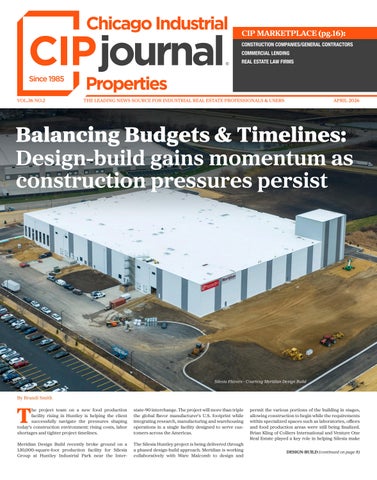
Balancing Budgets & Timelines: Design-build gains momentum as construction pressures persist
By Brandi Smith
The project team on a new food production facility rising in Huntley is helping the client successfully navigate the pressures shaping today’s construction environment: rising costs, labor shortages and tighter project timelines.
Meridian Design Build recently broke ground on a 130,000-square-foot production facility for Silesia Group at Huntley Industrial Park near the Inter-
state-90 interchange. The project will more than triple the global flavor manufacturer’s U.S. footprint while integrating research, manufacturing and warehousing operations in a single facility designed to serve customers across the Americas.
The Silesia Huntley project is being delivered through a phased design-build approach. Meridian is working collaboratively with Ware Malcomb to design and
permit the various portions of the building in stages, allowing construction to begin while the requirements within specialized spaces such as laboratories, offices and food production areas were still being finalized. Brian Kling of Colliers International and Venture One Real Estate played a key role in helping Silesia make
DESIGN-BUILD (continued on page 8)
Silesia Flavors - Courtesy Meridian Design Build
PUBLISHER
Mark Menzies menzies@rejournals.com 312.933.8559
MANAGING EDITOR Dan Rafter drafter@rejournals.com
VICE PRESIDENT OF SALES & MW CONFERENCE SERIES MANAGER Ernie Abood eabood@rejournals.com
VICE PRESIDENT OF SALES Frank E. Biondo Frank.biondo@rejournals.com
Balancing Budgets & Timelines: Design-build gains momentum as construction pressures persist The project team on a new food production facility rising in Huntley is helping the client successfully navigate the pressures shaping today’s construction environment.
4
Industrial Momentum: Modern logistics demand continues to shape Chicago industrial development Chicago’s development landscape has shifted dramatically in recent years.
6
Steady industrial demand and tariff uncertainty shaping Lake County market The North Lake County industrial market experienced steady demand over the past year, supported by positive tenant absorption and low vacancy rates.
10
12
14
Growth in bulk industrial occupancies push U.S. industrial market closer to recovery A rebound in large industrial occupancies helped push the U.S. industrial sector closer to recovery in 2025.
Capital flows in industrial: Who’s buying, who’s pausing and who’s targeting niche assets Over the past 24 months, industrial real estate has undergone a quiet but meaningful reshuffling of capital.
PEOPLE ON THE MOVE The latest promotions, milestones and achievements in the world of commercial real estate
Industrial Momentum: Modern logistics demand continues to shape Chicago industrial development
By Brandi Smith
Chicago’s development landscape has shifted dramatically in recent years. Only about 10 tower cranes are operating across the city today, down from roughly 60 six years ago as higher borrowing costs and elevated construction prices reshape which projects can move forward.
Developers are responding by scrutinizing project feasibility earlier in the planning process and involving construction teams sooner as they evaluate budgets, schedules and material alternatives before committing to new construction.
While some development sectors have slowed, industrial real estate continues to generate significant activity across
"The market absorbed 7.9 million square feet of space in the fourth quarter of 2025."
the Chicago region. The market absorbed 7.9 million square feet of space in the fourth quarter of 2025, bringing total net absorption for the year to 18.7 million square feet while vacancy remained relatively low at about 6 percent, according to NAI Hiffman’s year-end
Chicago industrial report. The activity comes after a surge of new construction across the region during the past several years as developers raced to meet demand from logistics and e-commerce operators.
Leasing activity also remained strong throughout the year, totaling more than 43 million square feet across the Chicago market. Third-party logistics providers, manufacturers and e-commerce distributors continued to account for a large share of that demand as com-
Image by Peter H from Pixabay
panies adjusted supply chains and expanded regional distribution networks.
“The Chicago market is in good balance and deal activity is similar to pre-COVID times,” said Dan Leahy, executive vice president at NAI Hiffman.
Developers remain active, though many have become more cautious about launching speculative projects as they monitor leasing momentum and capital costs. At the end of 2025, roughly 13.6 million square feet of industrial space was under construction across the Chicago region, with more than half of that pipeline tied to build-to-suit projects for committed tenants. The shift reflects a more cautious development environment compared with the speculative building surge seen earlier in the decade.
Many occupiers now require facilities that can support automation, higher electrical capacity and advanced material-handling systems. Distribution operators are also prioritizing buildings with higher clear heights, flexible layouts and infrastructure capable of accommodating robotics and conveyor systems.
“Flight to quality remains a top priority for many logistics and warehouse
users,” Leahy said. “Flexibility and power to support material handling needs are top priorities.”
Recent supply additions have also reshaped the market. More than 65 million square feet of industrial space was delivered in the Chicago region during the past two years, contributing to a modest increase in vacancy from
the historically tight levels seen earlier in the decade. Much of that new supply has been absorbed steadily as companies continue to modernize logistics networks across the Midwest.
Even with more options available, newer buildings with modern infrastructure continue to attract the strongest tenant interest, particularly in logistics corri-
dors tied to the region’s transportation network.
“Power is a top priority for e-commerce and manufacturing clients but location still rules,” Leahy said. “Smart location projects with proximity to highways, ports and transportation infrastructure will remain the first to lease.”
Image by Marcin from Pixabay
Steady industrial demand and tariff uncertainty shaping Lake County market
By Brown Commercial Group
The North Lake County industrial market experienced steady demand over the past year, supported by positive tenant absorption and low vacancy rates. Ongoing uncertainty over tariffs and their impact on costs and business planning are creating challenges for tenants, however.
According to a market review by Brown Commercial Group, an increase in occupier demand has pushed the vacancy rate down nearly 3%, reaching 4.9% in early 2026. The submarket’s absorption rate over the past 12 months climbed to 1.3 million square feet, up from 640,000 square feet in the previous year. The submarket added just 44,000 square feet of new industrial space in the past year but there are no new projects in the pipeline, according to CoStar research.
“Tariffs are a significant issue facing industrial tenants as they make decisions on whether to renew, expand or downsize,” said Brown Commercial Group Broker Collin Tyrrell. “Even manufacturing companies that are based in the
United States have exposure to tariffs through materials or parts they import, adding extra layers to their operational challenges.”
The outlook for the North Lake County submarket remains positive for 2026, with demand expected to slow in the coming quarters. This could lead to a slight increase in vacancy, but the absence of new construction in the pipeline is expected to moderate any increases.
A shortage of smaller spaces is also impacting many industrial users’ growth plans. “We are seeing a lot of interest in Lake County industrial space, but the options are limited for companies looking for less than 50,000 square feet,” said Tyrrell.
Among the other trends driving industrial activity in the Lake County market are:
• Market and economic uncertainty. While some businesses are factoring in
the added costs of tariffs and general uncertainty to their business projections, there are challenged with managing costs across suppliers and production partners.
• Interest rates. Although many companies have adjusted to the “higher for longer” interest rate environment, higher rates continue to impact business financing and property sales. Many investors continue to wait on the sidelines instead of buying property
• Challenges with space planning. Many companies took additional space during the pandemic and are now deciding whether to expand, downsize or take a short-term renewal. “Each approach has its challenges right now and companies are having to think through multiple scenarios before making decisions on their space allocations,” said Tyrrell. “Many companies are looking to expand so they don’t want to be stagnant for too long. Those that can find creative solutions and embrace the uncertainty will fare the best in today’s environment.”
The outlook for the North Lake County submarket remains positive for 2026, with demand expected to slow in the coming quarters. This could lead to a slight increase in vacancy, but the absence of new construction in the slowing pipeline is expected to moderate any increases. There is 1.68 million square feet of proposed construction announced for the next two years, however.
Brown Commercial Group, Inc. is a privately held commercial real estate company specializing in the leasing, sale and acquisition of industrial and office properties throughout the Chicago market. The firm also assists clients with land acquisition and new construction projects. The firm focuses on building relationships with clients and understanding their business model and strategic goals. As such, the firm has a strong track record of leasing and investment success within key suburban submarkets.
Photo credit by Marco Paciello, iStock.
the determination that this approach best suited the needs of its project.
“The phase design/build approach allowed us to get the building up and enclosed while we worked with the client on the design and detailing of the office, laboratory and food production areas,” said Howard Green, executive vice president at Meridian Design Build.
For Meridian, the project reflects a broader shift in how construction teams are approaching complex projects as developers and corporate clients seek greater cost certainty and schedule control.
“We see an increasing number of developers and end users leaning into the design/build delivery method,” Green said. “The appeal of the design/build process is that it allows clients to compress project timelines and lock in guaranteed pricing early on in the process.”
The Huntley project reflects broader adjustments across the construction industry as developers and contractors work to manage cost pressures, labor shortages and shifting project timelines.
Across the Chicago region, construction firms such as PREMIER Design + Build Group say those challenges continue to shape how projects are planned and delivered.
“Developers are building larger contingencies into budgets to account for ongoing material price volatility, labor cost increases and unforeseen delays,”
said James Smiley, senior vice president at PREMIER Design + Build Group. “The ‘just-in-time’ lean budgeting mindset has shifted toward more buffers to avoid cost overruns.”
Contractors across the Chicago market are also being brought into projects earlier in the planning process, Smiley said. Early collaboration between developers, designers and builders helps identify potential cost risks and explore value engineering options before construction begins.
“Contractors invest time upfront to develop detailed, line-item cost estimates based on current market data and local vendor pricing,” Smiley said. “Sharing cost breakdowns openly with clients builds trust and allows for collaborative decision making.”
In addition to cost management, labor availability remains a significant chal-
lenge across the construction sector. Smiley said the Chicago market continues to face shortages of skilled tradespeople in areas such as electrical work, HVAC installation and finish carpentry. Competition for experienced workers has pushed wages higher and can extend project timelines when crews are difficult to secure.
Permitting and regulatory requirements also contribute to longer schedules. According to Smiley, project timelines in some sectors have increased by as much as 10 to 20 percent compared with pre-pandemic norms because of labor constraints and material lead times.
In response, contractors are adopting strategies that prioritize efficiency and coordination. A growing number of developers are turning to design-build delivery. Under this model, a single team manages both design and construction, allowing project phases to overlap and
reducing the risk of miscommunication between separate architects and contractors.
“Design-build allows for overlapping design and construction phases, which can significantly shorten overall project timelines,” Smiley said. “Owners seeking quicker occupancy or faster return on investment find this model attractive.”
Technology and prefabrication are playing a larger role in improving job-site efficiency, according to Smiley. Building Information Modeling, advanced project management software and mobile field technology help teams coordinate schedules, track costs and identify potential issues before they disrupt construction. Prefabrication of certain building components off-site has also become more common, reducing on-site labor requirements and helping projects move forward even when skilled workers are in short supply.
Strong demand in the industrial sector continues to support construction activity across the Chicago region.
“We’ve continued to see increased activity in both build to suit and speculative industrial construction over the last six to eight months,” Green said.
Contractors say collaboration and early planning will remain critical as market conditions continue to shift. As developers seek greater certainty around budgets and timelines, construction teams that provide integrated planning, transparent cost management and efficient delivery will play an increasingly important role in moving projects from concept to completion.
DESIGN-BUILD (continued from page 1)
Howard Green
James Smiley
Growth in bulk industrial occupancies pushes U.S. industrial market closer to recovery
By Dan Rafter
Arebound in large industrial occupancies helped push the U.S. industrial sector closer to recovery in 2025, a sign that demand for big-box logistics and manufacturing space is strengthening after several years of slower activity.
That’s one of the key takeaways from the March 10 Industrial Tenant Tracker report released by Colliers. The report shows that new leasing, build-to-suit completions and user purchases all contributed to a surge in bulk industrial occupancies — defined as spaces of 100,000 square feet or larger — during 2025.
According to Colliers, industrial users moved into 384 million square feet of bulk space across the United States in 2025. That represents a 25 percent increase from the 307 million square feet recorded in 2024.
The rise in move-ins also helped lift demand, particularly in the second half of the year. Net absorption during the final six months of 2025 jumped to 118 million square feet, more than double the 57 million square feet recorded during the first half of the year. Even so, elevated move-outs limited how much those gains could boost overall market performance.
Large facilities continued to play a key role in the market’s activity. Industrial users moved into 36 buildings of 1 million square feet or larger during 2025.
More than one-third of those properties were build-to-suit facilities or buildings purchased directly by their occupants.
Several major advanced-manufacturing projects represented the largest occupancies of the year. These included a 4.7 million-square-foot electric-vehicle battery manufacturing plant developed by Panasonic in Kansas, a 2.8 million-square-foot battery facility developed by General Motors
and LG Energy Solution in Michigan, and a 2.8 million-square-foot semiconductor manufacturing facility operated by Samsung Electronics in Texas.
While average deal sizes grew slightly, they remain below the levels seen earlier in the decade. The typical bulk industrial transaction measured about 267,000 square feet in 2025. That is up slightly from 2024 but below the 289,000-square-foot average record-
ed in 2023 and the 309,000-squarefoot average seen in 2022.
Still, the number of individual bulk occupancies continued to climb. Industrial tenants moved into 1,438 large spaces in 2025, up from 1,160 in 2024 and 1,041 in 2023.
Regionally, activity varied across the country. The West recorded the greatest number of move-ins with 404 new occupancies totaling about 100 million square feet, a 5 percent increase from the previous year.
The Midwest, however, recorded the largest total volume of space absorbed. Industrial users occupied 105 million square feet across 363 move-ins in the region during 2025, a 53 percent increase from 2024 and the highest total of any region in the country.
The Northeast was the only region to record a decline in bulk occupancies, falling 22 percent year over year to 26 million square feet across 87 moveins.
Activity increased across all building sizes during the year, but the strongest growth occurred in properties ranging from 500,000 to 749,999 square feet, where move-ins climbed 47 percent compared to 2024.
The greatest concentration of deals, though, remained in buildings between 100,000 and 199,999 square
All images courtesy of Colliers.
feet. Industrial users moved into 792 buildings in that size range during 2025, accounting for 108 million square feet of occupancy and a 23 percent increase from the previous year.
Third-party logistics firms and transportation companies continued to dominate large industrial transactions. These users accounted for roughly one-third of all bulk occupancies in 2025, occupying about 123 million square feet across 430 buildings. That total is up from 100.5 million square feet across 353 occupancies in 2024.
The category was especially prominent in the Northeast, where logistics and transportation firms represented 41 percent of all large industrial occupancies.
International logistics firms also continued expanding their U.S. presence. Asian-based third-party logistics providers accounted for 21 percent of occupancies within the logistics category since 2024, expanding their footprints to move closer to American consumers, reduce tariff and trade risks and strengthen supply chains near seaports and inland ports.
Manufacturing companies also boosted demand. Firms involved in manu-
facturing, fabrication and materials processing occupied 66 million square feet of bulk space in 2025, a 49 percent jump from the 44 million square feet recorded in 2024. More than 40 percent of that activity occurred in the Midwest, where manufacturers moved into 27 million square feet during the year.
Among individual companies, Amazon remained the largest new industrial occupier. The e-commerce giant moved into at least 20 large facilities totaling about 9 million square feet in
2025. However, its annual space occupancy has declined each year since 2022.
Global shipping and logistics firm DHL ranked second, occupying 11 facilities totaling about 6.8 million square feet.
Looking ahead, Colliers expects the recovery to continue. Increased leasing activity over the past several quarters should translate into more move-ins during 2026 as tenants take occupancy of recently leased buildings and newly delivered build-to-suit projects.
As the construction pipeline slows and the market stabilizes, new supply and tenant demand are expected to move closer to balance. That could also slow the pace of tenant move-outs and eventually push the national industrial vacancy rate downward after more than three years of increases.
While the pace of recovery will likely vary by market and region, the diverse mix of industrial users driving occupancy gains in 2025 could help sustain the sector’s momentum through 2026 and beyond.
Principle is proud to announce that they have been selected by Globe Transportation, Inc. for the construction of their new truck maintenance facility and warehouse. Located on the historic Autoland site on Rand Road, this 44,911-square-foot state-of-the-art facility will feature a dedicated truck wash bay to service Globe’s massive fleet of over 300 vehicles.
Capital flows in industrial: Who’s buying, who’s pausing and who’s targeting niche assets
By Kevin Carlson, Clear Height Properties
Over the past 24 months, industrial real estate has undergone a quiet but meaningful reshuffling of capital. While headline narratives have focused on interest rates, development slowdowns, and bid-ask spreads, the more interesting story has been where capital is still flowing, and why.
Industrial is not a monolith. Capital behavior today varies sharply by unit size, lease profile, and operational complexity. Within the larger industrial spectrum, development has remained difficult to capitalize over the past 24-36 months due to the inventory oversupply which was delivered as a response to COVID-era demand for local warehousing space. The resulting underperformance of large box warehouse & logistics product has turned institutional investor attention to another vertical, light industrial. Light industrial, defined in this context as single and multi-tenant properties with
<50,000 square foot units with a mix of grade-level and dock high loading.
Who’s Buying: Institutions Lean Into Mark-to-Market
Despite broader market uncertainty, institutional capital has remained active in industrial, particularly core+ and value-add funds that can underwrite operational upside rather than rely on cap rate compression.
The common thread among today’s buyers is a focus on embedded markto-market rent growth, especially in multi-tenant industrial portfolios. Years of below-market leases, often the byproduct of fragmented ownership and lack of institutional oversight, have created a durable runway for NOI growth that is less dependent on aggressive leverage or speculative assumptions.
As institutions push to deploy value-add capital, groups are gravitating toward shorter-term WALT, favoring
flexibility and the ability to reprice space in a still-tight infill environment. That said, there remains a subset of disciplined capital, often funds later in their lifecycle or single-asset capital stacks, willing to acquire medium-term WALT assets where liquidity is thinner but basis can be compelling. These buyers are not avoiding duration risk; they are being paid for it.
In many respects, this is a more rational market. Capital is underwriting cash flow growth first and financial engineering second.
Who’s Pausing: Capital Is Not GoneIt’s Repositioning
The most visible pause has come from open-ended REITs, many of which are still managing redemptions and rebalancing portfolios. Their reduced acquisition activity is less a statement on industrial fundamentals and more a function of capital structure and liquidity management.
Similarly, closed-end funds between vintages, or those navigating a slower fundraising environment, have stepped back, even when acquisition teams remain active. This pause is structural, not philosophical. The capital is still bullish on industrial; it simply has not yet been re-allocated.
Importantly, this pause is occurring alongside a material improvement in the debt environment. Compared to 18–24 months ago, buyers today are seeing:
• More consistent debt availability
• Higher leverage levels
• Lower all-in cost of capital
This has not yet resulted in aggressive asset repricing across the board, but it has narrowed bid-ask spreads and re-enabled transaction velocity for buyers with conviction. In other words, the pause is thawing, selectively.
Photo courtesy of Clear Height Properties.
Who’s Targeting Niche Assets: The Down-Market Shift
Perhaps the most notable shift in capital flows has been the institutional move down-market into light industrial and small-bay product.
Large, closed-end vehicles that historically focused on bulk distribution and Class A development are increasingly acquiring small-bay light industrial directly and/or partnering with experienced local operators to do so. The reason is straightforward: risk has re-priced development.
Higher vacancy, slower leasing velocity, and capital-intensive buildouts have made speculative bulk development a less attractive deployment channel, particularly late in the cycle. In contrast, infill small-bay industrial has proven resilient, with diversified tenant bases, steady demand, and strong re-leasing fundamentals even during periods of economic uncertainty.
To remain active, many large groups have also shown a willingness to downsize deal size, prioritizing execution & returns over scale optics. This marks a meaningful departure from prior cycles, where institutional capital often avoided smaller transactions due to inefficiency.
manager-dependent.
Why Local Operators Still Matter
As capital crowds into small-bay and light industrial, a familiar truth has resurfaced: execution matters more than ownership size.
Multi-tenant small-bay portfolios are operationally intensive. Leasing velocity, tenant retention, capital allocation, and day-to-day asset management drive outcomes far more than financial structuring alone. Vertically integrated local operators, like Clear Height Properties, with deep market knowledge and handson management, continue to be the most effective stewards of these assets.
Institutional capital has taken notice. While large groups increasingly dominate fundraising and influence pricing, many rely on local operating partners to source, execute, and manage these portfolios efficiently. In doing so, pricing for well-located light industrial has shifted from traditional value-add toward core+ valuations, even when business plans still require meaningful execution.
This dynamic has created both opportunity and tension. Returns are being compressed, but risk profiles are improving. The winners will be those who can maintain discipline while operating at institutional standards.
A Market That’s Selective, Not Stalled
Industrial today is not suffering from a lack of capital, with the decline of high basis office investment, there has never been a time when industrial has
been more in focus. Despite the need to deploy capital, institutional funds are deploying with greater scrutiny, deeper underwriting, and a renewed emphasis on operational alpha.
For groups like Clear Height Properties, this environment rewards focus. Smallbay, shallow-bay, infill industrial has demonstrated its durability through the cycle, and disciplined acquisition paired with active management continues to attract both capital and tenants.
Looking ahead, the next phase of the industrial market will not be defined by who can raise the most capital, but by who can deploy it thoughtfully. As institutions increasingly target niche assets, the advantage will remain with operators who understand the real estate at the ground level and can translate that knowledge into durable cash flow.
Industrial has matured. The easy money phase is over. What remains is a market that rewards expertise, patience, and execution.
Kevin Carlson is Executive Director of Capital Markets for Clear Height Properties.
What was once viewed as “sub-institutional” is now being recognized as operationally institutional, but
Kevin Carlson (Photo courtesy of Clear Height Properties.)
The latest promotions, milestones and achievements in the world of commercial real estate
PEOPLE ON THE MOVE
Industrial broker with Arlington Heights’ Entre Commercial Realty wins Power Broker deals award
CoStar Group, Inc. announced its Power Broker Quarterly Deals winners for Q4 2025. Entre Commercial Realty’s Denise Chaimovitz came out on top in the list of winners.
Entre Commercial Realty is based in Arlington Heights, Illinois.
The CoStar Power Broker Quarterly Deals winners are determined by the top deals executed every quarter, based on price and square footage.
Chaimovitz has been an industrial real estate broker since 2004, specializing in the Chicagoland market with a focus on Cook and Lake counties, while also completing transactions nationwide.
She has represented more than 400 landlords, tenants, and investors in deals totaling over 7 million square feet and $400 million in value, including the award-winning transaction at 11250 W. 36th Ave., Hialeah, Florida.
Known for her strategic approach and deep market knowledge, Denise works closely with clients to navigate both the business and personal aspects of major real estate decisions. She holds the prestigious SIOR designation and has earned numerous top performance awards, along with recognition for her leadership, mentoring, and industry contributions.
Itasca’s ML Realty Partners adds IT manager
Itasca, Illinois’ ML Realty Partners added Jeremy Norton as its new IT Manager.
Norton most recently worked as a third-party consultant and will oversee the firm’s IT infrastructure, cybersecurity, and information systems.
His expertise and experience, along with his strategic approach, will ensure secure, efficient, and scalable operations for the company while aligning with future business goals.
Hoffman Estates’ Leopardo Construction names VP of business development
Hoffman Estates, Illinois-based Leopardo Construction named Paola Sprenzel as Vice President of Business Development, reinforcing the company’s commitment to relationship-driven growth, strategic partnerships, and long-term market expansion.
Sprenzel brings more than 20 years of experience across commercial real estate, construction, and workplace strategy. At Leopardo, she will focus on deepening client and partner relationships while identifying opportunities aligned with the firm’s expertise in complex construction environments.
Prior to joining Leopardo, Sprenzel led strategic growth initiatives, building high-performing teams and implementing systems that supported scalable growth, expanded market presence, and deepened client engagement. In both global and regional leadership roles, she cultivated strong partnerships across architecture, design, and commercial real estate communities, identifying opportunities that drove meaningful project outcomes.
Beyond her professional work, Sprenzel is deeply committed to expanding opportunity across the industry and within her community. She actively supports organizations including the Hispanic American Construction Industry Association (HACIA), Federation of Women Contractors, and Professional Women in Construction, where she champions mentorship, inclusion, and the advancement of women in construction.
Sprenzel serves on the board of Female Strong, where she supports leadership development initiatives designed to build confidence and create pathways for young women, and played a key role in launching the organization’s first camp. She also serves on the board of the Special Leisure Services Foundation, helping expand access to inclusive recreational programming for individuals of all abilities—an effort that reflects her strong commitment to service and community impact.
ECA of Chicago and Cook County names first female president in organization’s history
The Electrical Contractors’ Association of City of Chicago and Cook County (ECA) has elected Kendra Dinkins as its new president, making her the first female — and first Black — president in the organization’s history.
Dinkins, who serves as president and CEO of Taylor Electric Company, a fourth-generation, family-owned Chicago electrical contractor founded in 1922, as-
sumed the role after three years as ECA vice president.
Dinkins’ election marks a landmark moment for the electrical construction industry in Chicago and Cook County, where the ECA has represented union electrical contractors for over a century. She is the first woman and the first person of color to serve as the organization’s president.
Dinkins’ path to the presidency spans over a decade of dedicated service to the ECA and the broader electrical construction industry. She joined the ECA board ten years ago and has chaired the Research and Education Committee, contributed to the development of the Chicago Electrical Code, and been an active participant in Women in NECA and other national initiatives.
She served three years as vice president before assuming the presidency, working closely with outgoing President Bob Fimbianti of Linear Electric, who now serves as ECA governor.
Taylor Electric Company, which Dinkins leads alongside co-owners representing the company’s third and fourth generations, was founded by her great-grandfather in 1922 and has remained 100% family-owned and operated throughout its history. The company performs commercial,
healthcare and educational electrical construction work across the Chicago metropolitan area and is a longtime member of the ECA and signatory contractor with IBEW Local 134.
As president, Dinkins has identified workforce diversity and small contractor advocacy as top priorities. She has called for expanded recruitment outreach to Historically Black Colleges and Universities (HBCUs), deeper engagement with underrepresented communities and stronger support for small and minority-owned electrical contractors navigating the association’s programs and policies. Her three-year term is expected to run through 2029, after which she will transition to the ECA governor role, representing Chicago and Cook County contractors nationally through the National Electrical Contractors Association (NECA).
Buffalo Grove’s PREMIER Design + Build Group names SVP, preconstruction
Buffalo Grove, Illinois-based PREMIER Design + Build Group promoted Jason Spataro to Senior Vice President, Preconstruction, a newly elevated national leadership role in which he will oversee all preconstruction services across the organization.
The appointment recognizes nearly a decade of exceptional performance, strategic contribution, and
an unwavering dedication to client excellence.
Spataro’s ascent within PREMIER is a testament to what genuine passion for servicing clients and collaboration can build. He joined the company in 2017 as an Assistant Project Manager, a role that his talents quickly outgrew. His natural aptitude for preconstruction processes emerged early, propelling him into a Project Manager position where he demonstrated a rare combination of technical precision and client-focused thinking. Those qualities earned him a promotion to his most recent title, Vice President of Preconstruction Services. As he approaches his ninth anniversary with PREMIER this June, this latest elevation to Senior Vice President marks the next chapter in a career defined by purposeful growth.
In his expanded role, Spataro will be instrumental in shaping preconstruction strategy, standardizing best practices across markets, and ensuring clients receive the quality attention and service that have become hallmarks of the PREMIER experience. His reputation as a creative problem-solver and collaborative leader positions him to build on the firm’s momentum while pushing the boundaries of what preconstruction excellence looks like.
Rosemont’s Brennan Investment Group names VP for net lease
Rosemont, Illinois-based Brennan Investment Group promoted Bobby Martin to Vice President, Net Lease.
Since joining Brennan Investment Group in 2017, Bobby Martin has played an integral role in the growth and success of the firm’s Single-Tenant Net Lease platform. During his time at Brennan, the Single-Tenant Net Lease platform has completed over $1.7 billion of transactions totaling 23 million square feet across 23 states.
Bobby has progressed through multiple roles at Brennan over the years, ranging from Analyst to Asset Manager. Throughout his tenure, Bobby has consistently demonstrated a strong work ethic and a willingness to step forward in matters critical to the success of the Net Lease platform. His ability to manage properties and portfolios through complex transactions has made Bobby a key contributor to the team.
In his new role as Vice President, Net Lease, Bobby will continue to have asset management responsibilities across designated portfolios, encompassing operations, leasing, and dispositions activities. In
“ Knowledge of Midwest industrial real estate is DarwinPW’s strength. We want to share that strength and knowledge with you.”
For over 45 years, DarwinPW Realty/ CORFAC International has been a leader in industrial and commercial real estate. The company specializes in brokerage, property management, investment and development services primarily in the Midwest. DarwinPW Realty’s highly qualified professionals are problem solvers and utilize a breadth of tools and knowledge to serve our clients best.
George Cibula, SIOR Managing Broker
addition to these responsibilities, he will also dedicate a portion of his time to sourcing new acquisition opportunities.
Rosemont’s McShane Construction Company names director of business development
Rosemont, Illinois-based McShane Construction Company added Daniel Sprague as Director –Business Development.
In this role, he will procure build-to-suit opportunities in the manufacturing, distribution, cold storage, and food and beverage sectors across the country.
Sprague comes to McShane with a decade of experience leading high-value pursuits, managing project pipelines, and supporting construction projects across the Midwest and Southeast. He previously served as Senior Business Development Manager at Wieland where he managed an opportunity pipeline of 25 assignments with a volume of $400 million.
Sprague is a graduate of Calvin University where he received a Bachelor of Arts in Business Marketing.
CIP MARKETPLACE
CONSTRUCTION COMPANIES/GENERAL CONTRACTORS
MERIDIAN DESIGN BUILD
9550 W. Higgins Road, Suite 400 Rosemont, IL 60018
Paul Chuma, President Howard Green, Executive Vice President
Core Services
Meridian Design Build provides construction and design/ build construction services on a national basis with a primary focus on industrial, office, medical office, retail and food and beverage work.
Company Overview
With a team of in-house professional project managers, Meridian has extensive experience coordinating the design and construction of new buildings, tenant improvements, and additions/renovations from 15,000 square feet to 1,000,000+ square feet. Meridian Design Build has been a Member of the U.S. Green Building Council since 2007.
Selected Projects
University Park Logistics Center, University Park, IL - 970,123 sf speculative multitenant industrial distribution/warehouse facility for Clarius Partners and Hillwood Investment Properties. Silesia Flavors, Huntley, IL - 134,075 sf food production, laboratory, research and development, and office facility for Venture One Real Estate and a global leader in confectionery and beverage flavors. FedEx Ground, Gary, IN - 324,901 sf package sorting and distribution center on a 78-acre redevelopment site for Scannell Properties and Transport Properties.
COMMERCIAL LENDING
MARQUETTE BANK
10000 W. 151st Street Orland Park, IL 60462 P: 708.364.9131 emarquettebank.com
Full line of Commercial, Business and Real Estate loans customized to your individual needs including: commercial and residential construction loans, commercial mortgages, equipment loans and working capital lines of credit.
Company Overview
Marquette Bank started in Chicagoland in 1945 and is still locally-owned/operated. Expect quick decisions, competitive rates, easy application and personal service. Personal/business banking and lending, home mortgages, land trust services, estate planning, insurance services, wealth management and multifamily lending.
REAL ESTATE LAW FIRMS
SARNOFF PROPERTY TAX
100 N. LaSalle St., 10th Floor Chicago, IL 60602 P: 312.782.8310 Sarnoffpropertytax.com
Primary Contact
James Sarnoff jsarnoff@sarnoffpropertytax.com, P: 312.448.5337
Core Services
PRINCIPLE CONSTRUCTION CORP.
9450 West Bryn Mawr Ave., Suite 120 Rosemont, IL 60018
P: 847.615.1515 | F: 847.615.1598 pccdb.com
Primary Contacts
Mark L Augustyn, COO, maugustyn@pccdb.com, James A. Brucato, President, jbrucato@pccdb.com
Core Services
Since 1999, Principle Construction Corp. has been a leading design-build general contractor serving the industrial markets of Chicago Metro, Southern Wisconsin, and Northwest Indiana. We specialize in designing and constructing exacting solutions for our clients, including:
•Industrial and Manufacturing Plant • Tenant Improvements
• Expansions and Additions• Food Processing Facilities
• Specialty Projects
Selected Projects
• 8,205 SF animal shelter for Heartland Animal Shelter, at 586 Palwaukee Dr., in Wheeling, IL.
• 12,560 SF showroom and outdoor pool park for Doheny Enterprises, at 5307 Green Bay Rd., in Kenosha, WI
• Phase 1 renovation project for SMW Autoblok, at 285 Egidi Dr., Wheeling, IL
Since 1986, Sarnoff Property Tax has been a leading and recognized law firm concentrating solely in the field of property taxation. We help clients secure favorable taxes in Illinois through property tax appeals, incentives, and consulting.
Firm Overview
Sarnoff Property Tax’s clients include Owners, Developers, Managers, REITs, Fortune 500 Companies, Private Equity Firms, etc., in connection with commercial property, high-rise and low -rise apartment buildings, condominium associations and single-family home portfolios.
WORSEK & VIHON, LLP
180 North LaSalle Street, Suite 3010 Chicago, IL 60601 P: 312.917.2307 P: 312.917.2312 F: 312.596.6412 wvproptax.com
Primary Contacts
Francis W. O’Malley, Managing Partner, fomalley@wvproptax.com; Jessica L. MacLean, Partner, jmaclean@wvproptax.com
Core Services
Worsek & Vihon, LLP represents taxpayers in Illinois by limiting their property tax liabilities through ad valorem appeals resulting in lower tax bills. We have over 40 years of experience and can handle basic to the most complex assessment issues while offering the dependable, personalized attention our clients deserve. We have experience representing owners of all property types. In addition to filing thousands of appeals with the Cook County Assessor, we have been involved in numerous proceedings before various Boards of Review, the Illinois Property Tax Appeal Board, and the Circuit Court of Illinois, and have appeared before the Illinois Appellate and Supreme Courts.
Firm Overview
Worsek & Vihon LLP, is a team of highly experienced attorneys singularly focused on Illinois real estate tax law. The firm is dedicated to minimizing property tax liabilities through strategic tax portfolio management, well researched, creative appeal preparation and aggressive advocacy.