MY SOCIETY THROUGH THE EYES OF A SOCIOLOGIST
WEBER + UNIFORM
FIELD STUDY - CLASSICAL SOCIOLOGY
Why Does a Uniform Change the Way We We Treat a Person?
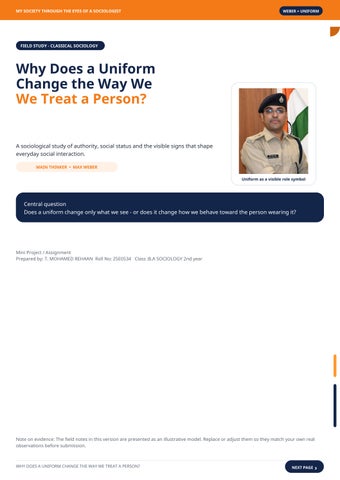
A sociological study of authority, social status and the visible signs that shape everyday social interaction. MAIN THINKER • MAX WEBER Uniform as a visible role symbol
Central question Does a uniform change only what we see - or does it change how we behave toward the person wearing it?
Mini Project / Assignment Prepared by: T. MOHAMED REHAAN Roll No: 25E0534 Class :B.A SOCIOLOGY 2nd year
Note on evidence: The field notes in this version are presented as an illustrative model. Replace or adjust them so they match your own real observations before submission.
WHY DOES A UNIFORM CHANGE THE WAY WE TREAT A PERSON?
›
01 / 10 NEXT PAGE
MY SOCIETY THROUGH THE EYES OF A SOCIOLOGIST
WEBER + UNIFORM
01 • THE QUESTION
An ordinary sight with a deeper question “A uniform can turn an ordinary individual into a socially recognisable role.”
Why this topic?
What a sociologist notices
I chose this topic because uniforms are part of everyday life, but we rarely stop to ask what they do socially. A police uniform, professional robe or institutional dress can make a person recognisable before the person has spoken.
OBSERVE What happens when a uniformed person enters an interaction?
‹
The visible role comes first; the individual comes second. A sociologist asks whether behaviour changes because of the person, because of the institution they represent, or because the uniform signals a legitimate social position.
QUESTION Do people respond differently before the person even speaks?
WHY DOES A UNIFORM CHANGE THE WAY WE TREAT A PERSON? PREVIOUS
ANALYSE What does that response reveal about authority and status?
›
02 / 10 NEXT PAGE
MY SOCIETY THROUGH THE EYES OF A SOCIOLOGIST
WEBER + UNIFORM
02 • SOCIAL SITUATION
The everyday campus as a field of study The selected situation is ordinary interaction in and around a college campus: students meeting people who occupy recognisable institutional roles - security personnel, faculty, administrative staff and other authority-linked workers.
WHO WAS OBSERVED? Students, security staff, faculty/staff and other role-holders encountered during routine campus movement.
WHERE? Common areas such as entrances, corridors, classrooms, offices or places where instructions and requests naturally occur.
Why this works sociologically The same human being can be approached as a private individual in one setting and as a representative of an institution in another. The visual marker helps organise the interaction.
‹
WHY DOES A UNIFORM CHANGE THE WAY WE TREAT A PERSON? PREVIOUS
WHAT WAS COMPARED? The tone of interaction, willingness to comply, physical distance, eye contact, formality and the kind of questions directed toward visibly identifiable role-holders.
A teacher role is recognised visually
›
03 / 10 NEXT PAGE
MY SOCIETY THROUGH THE EYES OF A SOCIOLOGIST
WEBER + UNIFORM
03 • FIELD METHOD
How the observation was carried out The aim was not to count people or create statistics. The aim was to notice small changes in ordinary behaviour and connect them to Weberian ideas.
Observation window
What was recorded
A short 2-3 day observation period, focusing on naturally occurring interactions rather than staged experiments.
Ethical care
What was avoided
No personal names, phone numbers or private information are necessary. The purpose is to study patterns of interaction, not to judge individual people.
DAY
SETTING
Tone of speech, requests for permission, distance, compliance, eye contact, formality, hesitation and whether people addressed the role or the individual.
ROLE SIGNAL
No pretending to be an authority, no provoking people, and no manufactured statistics. Only ordinary situations were considered.
RESPONSE TO OBSERVE
Model entries on the next page are illustrative. They are included to make the field-note section readable and complete, but they should be checked against what was actually observed.
‹
WHY DOES A UNIFORM CHANGE THE WAY WE TREAT A PERSON? PREVIOUS
›
04 / 10 NEXT PAGE
MY SOCIETY THROUGH THE EYES OF A SOCIOLOGIST
WEBER + UNIFORM
04 • ILLUSTRATIVE FIELD NOTES
Three small observations, one recurring pattern
DAY 1 • ENTRANCE AREA
A uniformed security staff member was approached by several students for directions and entry-related questions. The interaction began formally; students commonly waited for the person to finish speaking before responding. The uniform appeared to make the role immediately recognisable.
DAY 2 • CLASSROOM / CORRIDOR
When a teacher was present, students generally shifted into a more formal mode of interaction: fewer interruptions, more direct attention and more use of academic titles. The visible role seemed to organise expectations even before an instruction was given.
DAY 3 • INFORMAL CAMPUS SPACE
People speaking to someone without a visible institutional uniform tended to use more relaxed language. When the same person was treated as representing an office or institution, the interaction became more task-focused and formal.
Interpretive note: The point is not that every person always obeys a uniformed person. Rather, the visible sign can set an expectation about who may give directions, who may be approached for help, and how formal the interaction should become.
‹
WHY DOES A UNIFORM CHANGE THE WAY WE TREAT A PERSON? PREVIOUS
›
05 / 10 NEXT PAGE
MY SOCIETY THROUGH THE EYES OF A SOCIOLOGIST
WEBER + UNIFORM
05 • MAX WEBER
The Weberian lens Only the concepts needed for this observation are used: authority, legitimate authority, status and bureaucracy. The theory helps interpret the interaction without replacing the observation.
Authority
Legal-rational authority
For Weber, authority is connected with accepted rights to command. In an institutional setting, people may obey because they recognise the position as entitled to give instructions.
Modern bureaucratic organisations rely on rules, defined responsibilities and procedures. Authority comes from the office or role, not simply from personal charisma.
Status
Bureaucracy + social action
Status refers to socially recognised differences in honour, prestige or standing. Dress can become one visible cue through which such standing is communicated.
VISIBLE ROLE
Bureaucracy organises work through offices, hierarchy and specialised roles. Social action becomes meaningful when people interpret what another person is doing and respond accordingly.
AUTHORITY SIGNAL
SOCIAL RESPONSE
The uniform itself does not automatically create authority; it can act as a visible signal that helps other people recognise an existing institutional role.
‹
WHY DOES A UNIFORM CHANGE THE WAY WE TREAT A PERSON? PREVIOUS
›
06 / 10 NEXT PAGE
MY SOCIETY THROUGH THE EYES OF A SOCIOLOGIST
WEBER + UNIFORM
06 • SYMBOLS OF ROLE
What clothing communicates before speech The images below are visual examples of recognisable roles. They are not presented as evidence that these specific individuals were observed during fieldwork.
Official uniform role and authority
Professional robe institutional status
Teacher role
academic authority
Casual dress less formal visual signal
Why the contrast matters A uniform can reduce uncertainty about role. Without asking a question, people often know whether they are facing a police officer, lawyer or teacher. That visual shortcut can influence expectations about language, distance, behaviour and the kind of request that is appropriate. Important caution: clothing is a signal, not proof of personal character, competence or legitimacy. Social responses also depend on context, previous experience and whether the institution is trusted.
‹
WHY DOES A UNIFORM CHANGE THE WAY WE TREAT A PERSON? PREVIOUS
›
07 / 10 NEXT PAGE
MY SOCIETY THROUGH THE EYES OF A SOCIOLOGIST
WEBER + UNIFORM
07 • SOCIOLOGICAL ANALYSIS
What changes when we look through Weber's eyes?
1. Authority becomes visible The uniform makes an institutional position easier to recognise. This can shape who is expected to give directions or answer questions.
3. Behaviour is guided by expectation People may change their tone, distance or willingness to comply because they interpret the role before judging the individual.
2. Social status is communicated Clothing becomes part of the social vocabulary of the campus. A professional or official uniform can signal a role that carries recognised standing.
4. Authority is relational The meaning of a uniform depends on context. A person in uniform may be obeyed in one setting, questioned in another, or ignored when their authority is unclear.
THE CORE SOCIOLOGICAL INSIGHT A simple clothing choice can become part of a wider system of roles, expectations, legitimacy and social order.
‹
WHY DOES A UNIFORM CHANGE THE WAY WE TREAT A PERSON? PREVIOUS
›
08 / 10 NEXT PAGE
MY SOCIETY THROUGH THE EYES OF A SOCIOLOGIST
WEBER + UNIFORM
08 • THEORY VS REALITY
Where Weber helps - and where reality is more complicated What Weber helps us see Authority is attached to recognised roles. Modern organisations use rules and offices. Visible role signals can make the institutional order easier to recognise. Status is socially produced, not simply a personal quality.
What reality may add People may ask questions, ignore or resist authority, or treat a role differently depending on context. Personal trust, previous experience, age, familiarity and the behaviour of the authority-holder can alter the interaction.
What has changed? Contemporary life includes digital identities, online access cards, social media profiles and more flexible work cultures. Status can now be communicated through screens and credentials as well as clothing. Yet the basic sociological issue remains: how do visible or recognised symbols help people organise expectations about one another?
Critical point: A uniform should therefore be understood as a social signal within a wider relationship, not as a magical source of power.
‹
WHY DOES A UNIFORM CHANGE THE WAY WE TREAT A PERSON? PREVIOUS
›
09 / 10 NEXT PAGE
MY SOCIETY THROUGH THE EYES OF A SOCIOLOGIST
WEBER + UNIFORM
09 • WHAT I LEARNED
The ordinary became sociological Reflection Before the observation, a uniform looked mainly like work clothing. After looking closely, it became clear that clothing also helps organise expectations. People often react to the role represented by the person before they fully interact with the individual.
What I learned Sociology does not require a dramatic event. An entrance, a request for help, a greeting or a short instruction can reveal patterns of authority and status. The main change was in how I looked: I began asking what social meaning was being carried by something ordinary.
CONCLUSION A uniform does not simply identify a profession. In everyday interaction, it can act as a visible sign of role, status and institutional authority. The response it receives is socially produced and can vary with context.
Before submitting: Replace the illustrative field notes with your genuine observations or adjust the wording so every detail is truthful to what you actually saw. This keeps the project consistent with the assignment requirement not to manufacture data.
References for understanding the theory Max Weber, Economy and Society; George Ritzer & Jeffrey Stepnisky, Sociological Theory; introductory sociology notes on authority and bureaucracy.
‹
WHY DOES A UNIFORM CHANGE THE WAY WE TREAT A PERSON? PREVIOUS
10 / 10