“When it comes to gas work and essential safety checks, cutting corners simply isn’t worth the risk.”
Shaunagh Brown, ex-England Rugby Union player and former gas engineer
Gas Safe Update
The real cost of using illegal gas fitters
Gas Safety Week 2026
Your FAQs
Editor’s comment
From 1 July, the effects of the conflict in the Middle East will start to hit the cost of heating our homes. Ofgem confirmed what many had predicted and said prices will go up by 13% on average as the result of higher wholesale gas prices – although it said this is lower than the 2022 shock caused by the invasion of Ukraine.
The hit to our pockets may take a little while to bite, given that most will be using much less energy in the summer than in winter. But it’s more unwelcome news for cash-strapped homes and is likely to lead to more belt-tightening.
Against this backdrop, Gas Safe Register’s latest research has found that nearly half of all Brits are turning to unregulated goods and illegal or unqualified tradespeople in a bid to save money – risking their own safety in the process. And nearly 1 in 5 households are cutting costs on their boiler servicing and maintenance.
The Register’s new campaign warns people of the dangers of cutting corners with their safety and warns of the risks of using illegal gas fitters, reminding them to make sure that gas engineers are properly qualified and registered. As the campaign’s spokesperson, ex-gas engineer turned England rugby player Shaunagh Brown, says: “Cutting corners simply isn’t worth the risk.”
Sue Harker, Editor
Gas Safe Register, PO Box 631, DARLINGTON, DL1 9GD
Email: enquiries@gassaferegister.co.uk, register@gassaferegister. co.uk or technical@gassaferegister.co.uk
Editor: Sue Harker, suzanne.nee.harker@accenture.com
Features editor: Nicki Shearer, editorial@registeredgasengineer.co.uk
Publisher: publisher@registeredgasengineer.co.uk
Technical consultants: Carl Banister, Rob Denman, Jonathan Palmer
Advertising enquiries only: Mike Allen mike@smartmediasales.co.uk, Tel: 07917 588511
Ian Tournes, ian@smartmediasales.co.uk, Tel: 07814 970732
Registered Gas Engineer is produced on behalf of Gas Safe Register. Gas Safe Register, PO Box 631, DARLINGTON, DL1 9GD
Issue 192 | July/August 2026
04
Gas Safe Register Update
Cost pressures are driving up the use of illegal gas fitters, the Register’s new survey has found. Gas Safe has teamed up with rugby legend – and former gas engineer – Shaunagh Brown to warn Brits of the dangers.
CIRCULATION: Jan-Dec 2025 75,565
The views expressed in this magazine are not necessarily those of Gas Safe Register. The publishers will accept an advertisement or other inserted material only on the condition that the advertiser warrants that such advertisement does not in any way infringe copyright or contravene the provisions of the Trade Descriptions Act. All copy is subject to the approval of the publisher, who reserves the right to refuse, amend, withdraw or otherwise deal with advertisements submitted to it at its absolute discretion and without explanation. All advertisements must comply with the British Code of Advertising Practice. ABC membership approved 19 March, 2009.
06
Gas Safety Week
Get ready for Gas Safety Week – now in its 16th year. How will you get involved?
07 Prosecutions
Fake fitter ordered to pay £20,000 in compensation after his work caused electric shock, water damage and danger to victims
08 In touch
We talk to the brother and sister who have the challenge of continuing their parents’ legacy as they take over the family business
Nearly half of gas engineers and electricians have been asked by customers about tampering with meters to make them run slowly. Do you know how to spot the signs of gas theft and tampering? 20 Electrical safety
How to prevent electrical accidents via strict safe isolation processes, the right tools and careful verification
A reminder about the importance of servicing and maintenance to ensure safe and efficient operation
Get the basics right on pipe sizing to maintain system efficiency and reliability
The role of retrofitting underfloor heating PLUS Quick wins to reduce your customers’ bills
Standard Update 134
IGEM/G/5 Edition 3 with amendments April 2023 and April 2026 - Gas in multioccupancy buildings
What you need to know about IGEM/UP/1B Edition 4, an overview of the tightness test procedure – and your questions answered
How to spot illegal radiators – and the consequences of installing them
A special look back at how Stelrad has evolved over nine decades since its creation in 1936
How to heat homes and hot water does not always need to be a binary choice between gas boilers and heat pumps: hybrids could play an important role.
Product update
The latest launches from around the industry
update
from the Register
Cost pressures are driving rise in use of illegal gas fitters
O28% 12% have cut costs on boiler servicing or appliance maintenance
have cut costs on home maintenance would consider using an illegal gas fitter
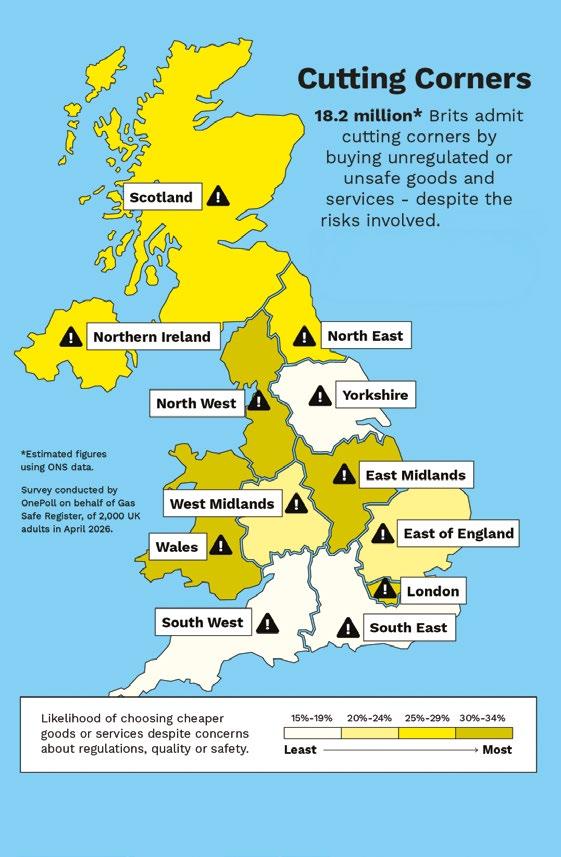
ver half the nation –more than 18.2 million people – are risking their safety by turning to unregulated goods and illegal or unqualified tradespeople in a bid to save money.
19%
As the cost-of-living crisis continues to put household budgets under strain, new research of 2,000 adults, carried out by Gas Safe Register, reveals 53% have changed their spending habits over the past year. Many are now prioritising lower prices over safety, quality and peace of mind.
Spending habits
Rising fuel prices (48%) and reduced disposable income (44%) were the biggest drivers behind changing spending habits, with millions of people admitting they have been forced to cut corners to make ends meet.
The findings reveal a growing willingness to take risks on potentially unsafe or illegal goods and services. Alarmingly, the trend is also extending into household services and repairs, with more than one-quarter (28%) admitting they have cut costs on home maintenance and DIY – even appointing unsafe and unregistered tradespeople to work in their households.
But it comes at a cost: more than half (51%) said attempts to save money by choosing cheaper goods or services had backfired, leaving them needing to replace products or pay to redo work later on.
The research also highlights how financial pressure is changing attitudes to safety, with 36% admitting they are more likely to accept risks now
than just a few years ago.
Worryingly, 16% admitted delaying routine gas safety checks, while 12% said they would consider using an unregistered gas worker to save money, despite the legal and safety risks involved.
A further 15% said they had hired cheaper tradespeople for home repairs even when they had concerns about standards or qualifications.
“Almost 19% admitted cutting costs on boiler servicing or gas appliance maintenance.”
When it comes to gas safety, almost one in five (19%) admitted cutting costs on boiler servicing or gas appliance maintenance.
The research also exposed confusion around safety responsibilities, with 22% of those who failed to check an engineer’s credentials saying they did not realise checks were necessary. And those who knowingly choose unregistered gas workers would expect to save an average of 25% before considering using an unregistered person for a job.
Urgency was found to be a major factor in risky decisionmaking, with 14% saying they would consider using an
Gas Safe Register has partnered with Shaunagh Brown, an ex-England Rugby Union player and former Gas Safe engineer, to warn households about the dangers of using illegal or unqualified gas engineers.
Shaunagh Brown said: “Working as an engineer showed me first hand how important it is to do things properly. I understand why people are looking to save money right now, but when it comes to gas work and essential safety checks, cutting corners simply isn’t worth the risk.
“The short-term savings can quickly turn into much bigger costs or, worse, put your household in danger. It’s about making informed choices and making sure the people working in your home are properly qualified and legally Gas Safe registered.”
unqualified gas worker if work needed to be done quickly.
Recommendations from friends and family were cited by 12%.
Ronan Howard, Customer First Delivery Lead at Gas Safe Register, said: “It shows just how normalised risk-taking has become when household budgets are under pressure. Many people don’t realise that checking an engineer’s credentials is essential, or assume a small saving is worth the risk when work feels urgent.
“No matter how urgent the situation feels, people should always check that any engineer working on gas appliances is legally qualified and Gas Safe registered.” n
update
from the Register
Did you read all about it?
Last year’s Gas Safety Week showed the real impact of the industry’s united front. With the focus firmly on the dangers of DIY, Gas Safe Register teamed up with TV presenter Nick Knowles to amplify messages across press, radio and social media – reaching millions of consumers. And this year is already shaping up to be even bigger and better.
You can find out how companies and gas engineers like you supported the week, and maybe get some inspiration for your own support, in the 2025 report at: www. gassaferegister. co.uk/ gassafetyweek
Get ready for Gas Safety Week
Summer’s here. And you know what that means:
Gas Safety Week will be here before you know it.
On 14-20 September, the pan-industry event will once again unite supporters in the ongoing mission to keep the nation gas safe.
It’s our industry’s biggest annual campaign, now in its 16th year. As always, Gas Safety Week sees the whole industry come together to raise awareness of gas safety and to encourage people to book an annual gas safety check with a Gas Safe engineer. It’s an ideal opportunity to share information and knowledge, even among those who are not directly responsible for gas safety. This year’s focus will include getting ready for the colder months and not taking risks.
Every year sees thousands of organisations rally behind
Get involved
the week, showing their dedication to gas safety by promoting and sharing their expertise, advice and tips to customers, followers and communities. Taking part is a positive way to build your
business’s public image and to help keep your customers safe.
If you’re taking advantage of the quieter summer period to get ready for the winter rush, now’s a good time to get a head start on your planning for Gas Safety Week. You can use the free supporters’ toolkit, which is packed full of useful content to help you take part quickly and easily.
As always, the toolkit includes posters, factsheets and leaflets as well as specially written social media assets and other resources that are easy to share on your own channels with your customers and communities.
You can download the toolkit free at: www.gassaferegister.co.uk/gassafetyweek in July. We hope you will join in with keeping the nation gas safe.
Taking part in Gas Safety Week helps you to stand out from your competitors and shows you care about raising gas safety awareness and protecting your customer’s lives. If you’re looking for ideas and content to share, the toolkit is a great place to start.
But why stop there? Let the Register know what you’re doing to show your support – Gas Safe Register and Gas Safety Week social channels will be sharing as many of your own stories as possible throughout the week.
You can get in touch via email at: marketing@ gassaferegister.co.uk or via the Register’s social channels. You might also spot yourself in the round-up report and this magazine later this year.
The 16th Gas Safety Week will take place on 14-20 September 2026
update from the Register
Fake fitter’s work caused electric shock, water damage and danger
An illegal gas fitter whose work caused an electric shock to one customer and left another’s boiler in a dangerous condition has been given a suspended prison sentence and ordered to pay more than £20,000 in compensation.
Reading Crown Court sentenced Christian Godwin, from Newbury after he had pleaded guilty in January at Reading Magistrates Court to five offences contrary to Regulation 12 of the Consumer Protection from Unfair Trading Regulations 2008, and one offence under section 237(4) of the Digital Markets, Competition and Consumers Act 2024.
Never registered Trading Standards, which investigated and prosecuted, said Mr Godwin had claimed to be Gas Safe registered but never has been and his customers believed he was registered and qualified. He carried out gas and plumbing work, including installing boilers, for which his customers paid amounts ranging from around £2,000 to £4,000.
The court heard evidence from the victims about the impact Mr Godwin's actions had on them. One victim was left without heating over the Christmas period after his newly installed boiler was found to be dangerous and
unusable by a Gas Safe registered engineer.
A second victim explained that he and his wife suffered from nausea, dizziness and headaches immediately following their boiler installation. A gas engineer attended, disconnected the gas supply and advised that the boiler should not be used.
Electric shock
A third victim received an electric shock because of a leak from the hot water tank. Water also came through the ceiling into the living room, causing a large hole and water damage to the walls.
The work Mr Godwin carried out created a real and foreseeable risk of serious injury or death from gas leaks, fire or carbon monoxide poisoning, the court heard.
He operated using a few business names, including
Premier Mechanical Solutions and Premier Heat and Cool Limited.
Christian Godwin was sentenced to 10 months’ imprisonment, suspended for 18 months. He was ordered to complete 200 hours of unpaid work and pay £20,244 in compensation to his victims. He was disqualified from acting as a company director for three years and required to undertake 20 rehabilitation activity requirement days.
West Berkshire Council councillor Tom McCann, chair of the Joint Public Protection Committee, said: “This was a serious and calculated course of deception and the consequences for residents could have been catastrophic. Misrepresenting Gas Safe registration is not a minor matter: it is a deliberate act that puts lives at risk.”
If you find work that you think may have been carried out illegally, you can report it by filling in the “Report Illegal Gas Workers” form in the engineers’ section of the Gas Safe Register website at: www.gassaferegister.co.uk/gassafety/concerns-reporting-illegal-gas-work/ Alternatively, you can call on 0800 408 5577 or report concerns by email at: nonreg@gassaferegister.co.uk
We appreciate your continued support when it comes to reporting illegal gas work. If you have any questions or concerns relating to unregistered work, please do not hesitate to contact Gas Safe Register.
intouch yourview your
say
What's on your mind? Share your views with more than 80,000 readers
editorial@ registeredgas engineer.co.uk
Who is Registered Gas Engineer written for?
Martin Steer
I am a domestic gas engineer and long-time reader of Registered Gas Engineer. My comments are based on practical experience of relying on the magazine to understand changes that affect day-to-day work.
Over recent years, the technical content appears to have shifted towards producing material that is technically correct and well presented but not always written in a way that translates easily into practical, on-site understanding.
Engineers think in terms of tasks, such as carrying out a tightness test, rather than document titles such as IGEM/UP/1B. When guidance is framed around standards rather than practical application, it becomes harder to follow and apply.
More importantly, there appears to be a lack of clear lead-in to significant changes. The update to tightness testing (IGEM/UP/1B Edition 4) was issued in late March 2026 and came into effect in April, yet there was no prior mention or indication in earlier issues of Registered Gas Engineer.
In my own case, I first became aware of the change through a conversation during a quality control inspection,
rather than through official communication.
The May/June issue then presented the update after it had already come into effect, and noted that the earlier publication had caused confusion and misinterpretation. This suggests that even those close to the process were still interpreting the changes, while engineers in the field had not been given any advance notice through the magazine.
Route for feedback
At the same time, the visible route for engineer feedback has become less clear. The previous letters section provided a moderated space where practical concerns could be raised and shared. More recently, communication appears to be moving towards email, surveys and social media, which are either private or unstructured and do not provide a reliable forum for discussion or clarification.
Could you clarify how Registered Gas Engineer now defines its role in communicating upcoming changes, and whether there are plans to provide earlier, task-based guidance along-side a clear and visible channel for engineers’ feedback?
From the editor:
We appreciate you taking the time to write to us and we’re very happy to try to clarify some of the points you raise.
On your point about ‘pre-alerting’ gas engineers to upcoming changes as important as those illustrated in the update to IGEM/ UP/1B, this is not always straightforward in print due to the lead times involved in producing the magazine. Registered Gas Engineer is published in print every two months. The nature of consultation and approval for updates to standards by those organisations in charge of them can be unpredictable in terms of when an update will be finalised and released by the organisation responsible.
The quarterly Legislative, Normative, Informative and Documents list, published by Gas Safe Register and included in this magazine, does provide information about standards and other industry documents that are currently being revised and consulted on, out for review and/or out for comment.
When the revised IGEM/ UP/1B was published in March 2026, Industry Standard Update (133) was published shortly afterwards on both
our website at www. registeredgasengineer. co.uk and Gas Safe Register’s at www. GasSafeRegister.co.uk
However, the Industry Standard Update was revised shortly after online publication and that revised version was published in the next available issue of the magazine as well as updated on our website. Reference in the print edition of Registered Gas Engineer magazine was made to an ISU that had never been included in the magazine, which we acknowledge was slightly confusing.
On your comment about task-based guidance, inside this issue is an in-depth article by Gas Safe Register’s Technical Team that looks in detail at interpreting the changes to IGEM/UP/1B and how to carry out the procedure in line with the update, and some frequently asked questions that have arisen since its publication.
We would welcome hearing from engineers about which topics they would like greater clarity on.
When it comes to feedback and a forum for discussion for gas engineers, we have
not intentionally removed our In Touch page: it’s a valued element of the magazine and definitely something we would very much like to be able include in every issue - but we do rely on readers writing to us. To everyone reading this page (and thank you for reading it), Registered Gas Engineer definitely does want to hear from you and share your views and opinions about the industry in which you work.
Please do get in touch at editorial@ registeredgasengineer. co.uk
Keeping it in the family
What happens when the founders of a family firm decide it’s time to put down the tools? Registered Gas Engineer talks to the brother and sister with the challenge of continuing their parents’ legacy.
There’s a new generation in charge at JC Gas (Parkstone) in Poole. As the company marks more than 40 decades in business, founder couple Jeff and Petra Carrier have handed over the reins to their children Ash and Olivia.
But although the older generation are stepping back to enjoy well-earned retirement, one thing won’t be changing: the standards of workmanship and customer care.
The business has evolved since it was founded in 1981, along with changes in technology and customer expectations, moving from traditional heating systems to modern energy efficient installations and maintenance. But the company says its focus has remained consistent.
Traditional approach
The company’s heart remains very much in traditional gas work. “We’re gas engineers first and foremost. We do about 2,500 boiler services a year,” says Ash. At 40, he has been with the company since he was 17, having been an apprentice there, and remains very much a hands-on gas engineer. “I’ve been through the ranks here and done everything. I even worked in the office for a couple of years.
“We grew up with the company being part of everyday life, so taking it on is a responsibility but also a privilege. Our parents worked incredibly hard to build something trusted in the community and we want to carry that forward for the next generation.”
“Many families have used us for generations and that support means everything to us.”
Petra says: “Customer service has always been a very important part of the company, along with professionalism. My husband’s motto was ‘if it’s not good enough for my house, it’s not good enough for yours’, which Ash has taken forward. It’s lovely that they’re carrying on where we left off and going to do bigger and better things.”
The company has grown from just Jeff and Petra to now employing eight staff but it still looks at how it can do its best for customers. “I’d say the key factor is organisation,” says Jeff. “We follow a methodical, old-school approach.”
Olivia, who left behind a career in modelling and fine art, now runs the back office and
marketing. She adds: “The tools and systems have changed but our approach hasn’t.
Stand by our work “Customers come back to us because they know we care about doing the job right and standing by our work. Protecting that reputation means a lot to us.”
Some customers have been with them since the start. “We have customers that have been with us for over 35 years. I went to a job last week and a customer passed on his regards to my dad and remembered me from when I was a 17 year-old.
“We wouldn’t be here without the loyalty of our local customers. Many families have used us for generations and that support means everything to us.”
With the majority of the company’s work in gas boiler servicing and breakdowns, they have plenty to keep them more than busy for the foreseeable future and aren’t looking to move into renewables installation yet. But Ash is considering becoming qualified in heat pumps and the company already has plans to expand into air conditioning installation and maintenance. ■
The company provides a comprehensive boiler installation and repair service for domestic and commercial customers, including all aspects of plumbing, heating, gas, air conditioning, LPG, bathroom installations and warm air systems.
Caught on camera
What’s the worst gas work you’ve seen lately?
You can share your photos with the Gas Safe engineer community on our Wall of Shame by emailing us at: editorial@registeredgasengineer.co.uk
FROM
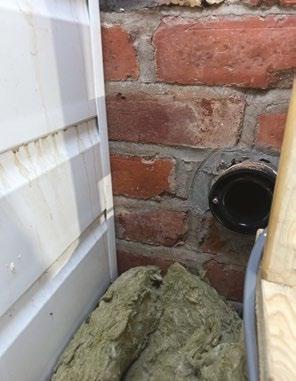
HENRI GUILLEMAIN
The property owner asked Henri to remove a gas fire that had been in the rented property and, presumably, had a gas safety check every year.
FROM RICHARD RUSSELL
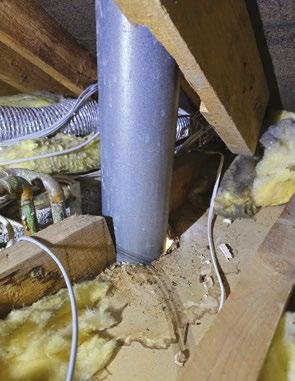
The roof space in this property had suffered from both horizontal beams and roof trusses being cut though for the flue to pass to the roof terminal. The only ‘supporting’ section of wood added wasn’t secure. Richard called a roofing firm to shore up and repair it and he then replaced the boiler.
FROM JAMES EVANS
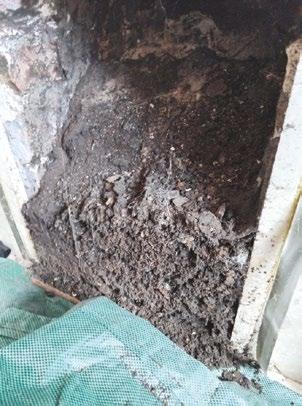
This should have been a boiler service, but James saw that builders had added an extension to the property – but buried the flue in a cavity. He made safe and re-routed the flue.
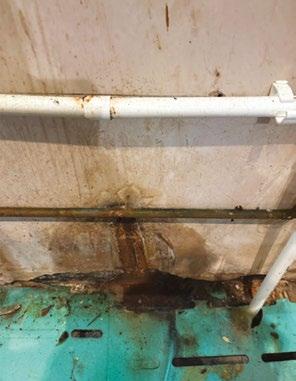
FROM SEAN PLEASANTS
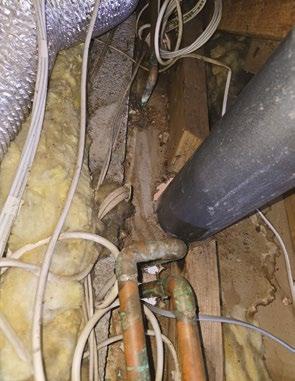
Condensate from the boiler was leaking on to the gas pipework, causing a significant leaking. Sean replaced both sets of pipework.
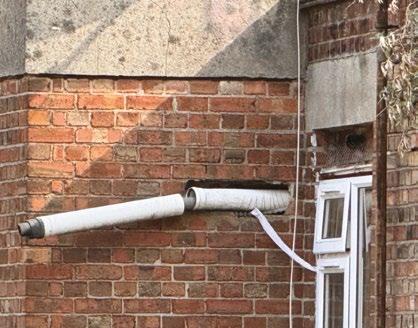
FROM MALCOLM FAULKNER
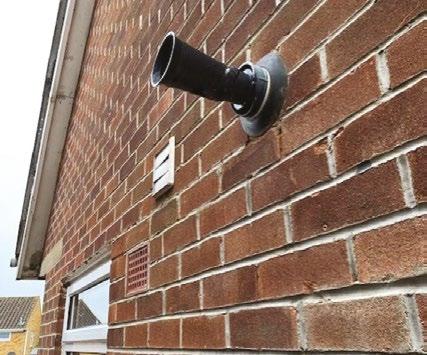
Malcom was asked to service a boiler, which was all fine other than the flue terminal: the homeowner had been experiencing rain-water ingress in high winds so decided to extend the flue with a flower pot.
FROM DARREN HART
During a train journey, this chimney/flue caught Darren’s eye. Can you see why?
Industry Standard Update 134
IGEM/G/5 Edition 3 with amendments
April 2023 and April 2026 Gas in multi-occupancy buildings
Date issued: 13 May 2026
This Industry Standard Update provides an overview of the recently published revised Industry Standard IGEM/G/5 Edition 3 with amendments April 2023 and April 2026 Gas in multi-occupancy buildings, and highlights areas of significant change that the revision has introduced.
Introduction
During April 2026, IGEM published a revision to IGEM/G/5 Edition 3 with amendments April 2023 Gas in multi-occupancy buildings(1). IGEM/G/5 Edition 3 with amendments April 2023 and April 2026(2) (Communication 1911) supersedes Edition 3 (April 2023 – Communication 1874), which is now obsolete.
The following is a brief overview of the amendments made to IGEM/G/5 Edition 3 (April 2026).
General
Notes throughout the document regarding ‘other building services’ have been updated to include, but are not limited to, a building’s lightning protection system, electrical cables, water pipes, sewage pipes, IT and TV communication cables.
A new clause has been added to a number of sections: it states that external metallic pipework that does not act as an extraneous-conductive part shall not be cross-bonded to the building’s lightning protection system. This is now found in clauses 7.1.5, 9.4.2.3.6, and 12.1.4.
The main changes made in the update are additional
information included in Section 14 – Electrical safety. These changes are designed to highlight possible issues relating to the application of Protective Multiple Earthing (PME) within multi-occupancy buildings, whereby an active fault on a PME service may result in a current travelling across parallel paths via the building’s earthing and bonding arrangements, including metallic gas pipework. Accordingly, there is now a requirement that a new or replacement Emergency Control Valve (ECV) shall include an electrical insulation joint. This requirement is not retrospective.
Summary As previously stated, this Industry Standard Update is only a brief overview of the information contained in the amended standard. Registered businesses should be aware that they have a responsibility to ensure that they are fully apprised of all the requirements of the whole published standard and its practical application.
Bibliography (1) IGEM/G/5 Edition 3 – with amendments April 2023 Gas in multi-occupancy buildings (Communication 1874) (2) IGEM/G/5 Edition 3 – with amendments April 2023 and April 2026 Gas in multi-occupancy buildings (Communication 1911)
Consider electrical safety
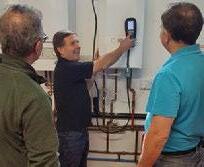
Before starting work, a safeto-touch test should be carried out using a suitable non-contact voltage indicator, performing a sweeping scan of all exposed metal pipework.
Updated tightness testing standard: what you need to know
Gas Safe Register’s Technical Team share an overview of the changes made to IGEM/UP/1B Edition 4 – and answer some of your questions about the updated standard.
In March 2026, IGEM/UP/1B
Edition 4(1) was published to replace the outgoing Edition 3. Unusually, both standards will be live for a period of 6 months to allow Gas Safe registered businesses time to get up to speed with the changes. Edition 3 will be withdrawn on 30 September 2026.
During this period, either tightness testing procedure may be used, although businesses are encouraged to adopt the new version as soon as practicable. From 1 October 2026, all tightness testing must be carried out in accordance with the new Edition 4.
While most of the standard remains unchanged (with the actual practice of how to carry out a tightness test remaining the same), those changes that have been made are significant. This article outlines the new tightness test procedure.
The
procedure
After an initial visual inspection of the installation to be tested, a check for let-by of the emergency control valve (ECV) is done, still carried out at 7-10 mbar for 1 minute. Once you
are satisfied with the let-by test, you raise the pressure on the gauge to the correct tightness test pressure for the fuel gas.
This is where the first change is made to the new standard, which is the inclusion of a new note regarding tightness test pressures. This new note states that where
as detailed in IGEM/G/13(2)
Where test pressures can be achieved, you should then allow 1 minute stabilisation, with a further 2 minutes’ test duration at the relevant test pressure for the fuel gas. If there is no movement of the gauge, the test passes – provided there has been no reported smell of gas. However, where there is any perceptible movement of the gauge, permissible limits for these drops are now decided by the installation volume (IV) of the system (or the part of the system being tested), rather than meter size and so you will need to calculate the IV of the system.
“From 1 October 2026, all tightness testing must be carried out in accordance with the new Edition 4.”
the minimum tightness test pressure for the fuel gas cannot be achieved, the installation will need to be isolated and investigations undertaken into the cause of the low pressure before proceeding with the test.
For natural gas, if 20 mbar cannot be achieved, the tightness test can be done at a minimum pressure of 18 mbar. Where the test is successful, operating pressure checks are to be carried out,
Once the IV has been calculated, the results shall be compared to the relevant table for the fuel gas to ensure the drop is within permissible limits. These permissible limits are given in the tables opposite.
These permissible limits are only acceptable where there are existing appliances connected and no smell of gas has been reported. When testing pipework only or where only new appliances
Table 2 gives the maximum permissible limits for LPG/air installations, which are:
Table 3 gives the permissible limits for movement on a natural gas installation:
Table 5 gives the permissible limits for LPG installations (this remains unchanged from previous versions):
are connected, there can be no perceptible movement of the gauge.
Example
For example, if testing a natural gas installation with existing appliances connected, any drop over 1 mbar will require the IV of the system to be calculated and compared to Table 3 (if below 1 mbar, this will automatically be within permissible limits). Again, there can be no reported smell of gas for permissible limits to apply. If the drop is outside permissible limits, the escape must be traced and repaired, or the installation made safe. If there has been any perceptible movement on the gauge, once it has been
Purging procedure
No perceptible movement
confirmed that any movement is within permissible limits, it must be established that the drop is not attributable to the installation pipework (including when it was not necessary to calculate the IV due to the movement being below the minimum permissible limit). Therefore, all appliances are now to be isolated and the test repeated on pipework only.
There can be no perceptible movement during this test. Where it is not practicable or possible to isolate an appliance, the test shall be done with that appliance connected and the “no perceptible movement criteria” applied. Where perceptible movement is again present, the escape must be traced
and repaired, or the installation made safe.
Once a successful test has been completed, the manometer can be removed, the test nipple replaced, all isolated appliances reintroduced, and the gas supply turned on. All disturbed joints shall then be tested with leak detection fluid (LDF).
Where appliances have been isolated, any installation pipework between an isolation valve and the appliance itself (for instance pipework between an isolation valve and a gas hob) will also need to be tested with LDF. Where this is not practicable, then the appliance shall be left connected when testing pipework only.
There has also been a minor change to the procedure for calculating the purge volume (PV). Where previously for installations with a maximum pipe size of 28mm and a meter not exceeding 6m3/hr you could assume a PV of 0.01m3, you must now work out the IV of all installations and multiply this by 1.5 to get the PV. The purge procedures remain the same: for natural gas, purge to air for up to 0.02m3 and purge to ignition for any PV over 0.02m3. All LPG and LPG/air installations shall be purged to ignition.
Start
Undertake visual inspection
Connect pressure gauge Turn off the appropriate valve (ECV/AECV/MIV)
Adjust pressure to between 7 and 10 mbar and carry out let-by test
Tightness test procedure overview
TTP = Tightness test pressures
NG: 20-21 mbar
LPG/air: Where operating pressure is 14 mbar, TTP is 13-14 mbar.
LPG/air: Where operating pressure is 21 mbar, TTP is 20-21 mbar.
LPG: Where operating pressure is 28 mbar, TTP is 20-21 mbar (with regulator) or 27-28 mbar.
LPG: Where operating pressure is 30 mbar, TTP is 28-29 mbar (with regulator) or 29-30 mbar.
LPG: Where operating pressure is 37 mbar, TTP is 30-31 mbar (with regulator) or 36-37 mbar.
Let-by test passed?
Adjust pressure to TTP and turn off gas supply
Allow 1 minute stabilisation, re-adjust pressure to TTP if necessary
Test for 2 minutes
Is there any perceptible movement on the gauge?
repair
Leak repaired?
Tightness test passed***
Remove pressure gauge, re-fit test nipple, turn on gas and test all disturbed joints and untested pipework with LDF
Calculate the IV of the installation. Is the movement on the gauge in accordance with corresponding table?
Was the movement on the gauge greater than the minimum permissible?
and retest
Is there still perceptible movement on the gauge?
Where it is not possible to isolate an appliance, treat it as isolated
Where no smell of gas reported
If new, or gasways exposed to air, purge installation Record results
IGEM/UP/1B Edition 4: Frequently asked questions
Q I have traced a drop in pressure to an appliance: do I need to disconnect it?
A. Not necessarily. Permissible limits are there for this scenario because a small amount of gas may escape through some gas appliances. As long as there is no smell of gas from the appliance, the permissible limits allow the appliance to remain connected, as long as a suitable site-specific risk assessment deems it satisfactory to do so.
Q. Why do we now need to isolate appliances if there is a drop in pressure?
A. It has always been the case that there can be no perceptible movement when testing pipework only. Where a drop was detected during a tightness test on an installation containing existing gas appliances, it was not previously a requirement to confirm whether this was on pipework. During the review of the standard, it was requested to amend this so that where a drop in pressure is detected, you must now ensure that this is not attributable to installation pipework.
Q I have two appliances in an installation. With both connected, the drop in pressure is over permissible limits. If I disconnect one of the appliances, this brings the drop within permissible limits. Is this acceptable?
A. As long as you have confirmed that the drop is not attributed to installation pipework, and there is no smell of gas recorded, this is acceptable. You must follow the guidance given in IGEM/G/11 (the Gas Industry Unsafe Situations Procedure) for the other appliance.
Q The installation pipework disappears into the wall behind the meter, then appears again by the appliance. How can I effectively work out the installation volume?
A. You will need to use your engineering judgement to estimate the run of the pipework and use the largest pipe size used for any pipework that you cannot see. For instance, if the pipe visible is 28mm, you should assume that all pipework
hidden is of that size and reduces at the point where the pipework becomes visible again. While this may not be entirely accurate, this will ensure that any IV calculation will be an overestimation, and therefore the permissible limit applied will not be larger than is actually allowed.
Q. If I carry out a tightness test to the new procedure that fails, but it would have passed the previous procedure, can I re-test to the old version and pass the installation?
A. No. If you have carried out a tightness test to the new procedure and the installation fails, you must either trace and repair the escape or make safe in accordance with IGEM/G/11. If you have adopted the new procedure, it is not acceptable to retrospectively apply the previous procedure to circumnavigate installation failing a tightness test. Gas Safe Register recommends that you should record which version of the tightness test was applied on any work records. ■
You can view and download Industry Standard Update 133 on IGEM/UP/1B Edition 4 by logging into your Gas Safe Register online account and at: https://registeredgasengineer.co.uk/technical/ industry-standard-update-133/
You can view and download IGEM/UP/1B Edition 4 at: https://www.igem.org.uk/resource/igem-up-1bedition-4-tightness-testing-and-direct-purgingof-small-liquefied-petroleum-gas-air-ng-andlpg-installations.html
Bibliography
(1) IGEM/UP/1B Edition 4
Tightness testing and direct purging of small Liquefied Petroleum Gas/Air, Natural Gas and Liquefied Petroleum Gas installations (2) IGEM/G/13 with amendments August 2023 Domestic supply capacity and operating pressure at the outlet of the meter
Weeding out energy theft
There has been a 75% increase in energy theft since 2012 and around £1.5 billion worth of gas and electricity is stolen every year. But it’s not only domestic meter bypasses and unsafe landlord practices that are the culprits, warns Crimestoppers’ Stay Energy Safe division.
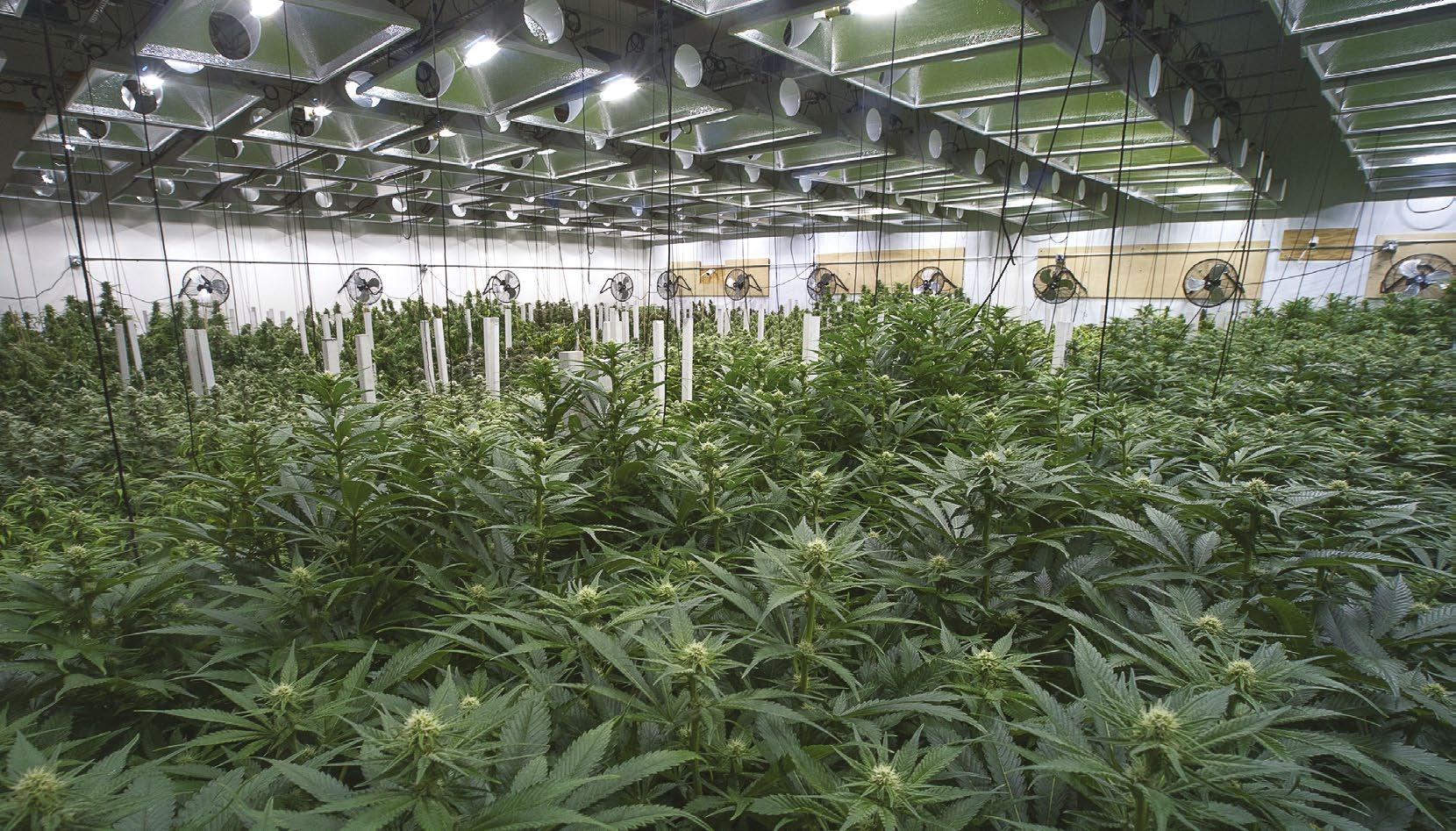
Energy theft is increasingly being linked to organised crime groups. Illegal cannabis farms are often hidden inside ordinary homes, flats, warehouses or empty shops. And, in some cases, criminals even take over the homes of vulnerable people and use them without their consent. These set-ups require huge amounts of power – far more than a normal home –which overloads wiring and creates a serious risk of fires
In one case, nearly £250,000 worth of electricity was stolen to power a £7 million cannabis operation. Organised groups have also been caught tampering with street mains while posing as road workers to divert power.
Not only is lost revenue passed on to other billpayers but the tampering of energy meters risks fires, gas leaks, electrocution and even fatalities. Although not all
energy theft involves organised crime, criminal groups are increasingly using stolen power to support largescale operations.
Crypto-mining
Electricity theft is being used to power illegal crypto-mining rigs. While cryptocurrency mining is legal, the process requires huge amounts of energy: a single transaction can use as much electricity as a household might in a week.
To avoid paying high energy costs, some individuals and organised groups bypass meters or unlawfully connect equipment directly to the mains.
Police have uncovered warehouse units filled with illegally powered crypto rigs, wired dangerously and posing significant fire hazards.
Authorities investigating a power overload at a substation in Leicestershire in 2021
uncovered a secret mining operation in a nightclub and industrial unit. Sanjay Singh’s operation stole £32,000 worth of electricity to mine crypto on 200 computers. He was charged with two counts of abstracting electricity and was sentenced to 13 months and two weeks in prison.
Lives in danger
Energy theft and meter tampering aren’t harmless shortcuts: they create dangerous situations, life-threatening risks and have legal consequences.
Eight-year-old Harvey Tyrell died after being electrocuted in a pub garden where electrical systems had been illegally and dangerously altered. The pub owner was jailed for nine years for manslaughter and stealing electricity, and his brother-inlaw served one year in prison for unsafe electrical work.
Sandu Laureniu-Sava was
Nearly half of gas engineers and electricians have been asked by customers about tampering with meters to make them run slowly, according to Direct Line Business Insurance.
Do you know the signs of gas theft and meter tampering?
Gas meter cheating can take many forms and even smart meters can be unsafe if tampered with. If you spot any of these signs, please report them to Stay Energy Safe:
• A smell of gas near the meter box
• The meter shows that credit has run out but gas is still available
• Dials on the meter aren’t going around, even when gas is being used.
electrocuted while showering in his Bethnal Green flat after the electricity meter had been illegally bypassed. The building owner responsible was jailed for four years, fined £20,000, ordered to pay £20,000 compensation and banned from being a company director for 10 years.
Bigger bills
Stolen energy also creates a financial burden. The cost of recovered losses is redistributed across legitimate billpayers.
A spokesperson for Stay Energy Safe said: “Energy theft happens for many different reasons; from individuals making dangerous decisions to landlords tampering with meters, and increasingly, organised criminal activity. But every instance carries serious risks.
“Whether it’s a bypassed meter, unusual wiring or suspicious activity around a meter box or the mains service cables, we urge anyone with concerns to report it anonymously.” n
You can report anonymously through the Stay Energy Safe service operated by Crimestoppers on 0800 023 2777 or online at: www.stayenergysafe. co.uk/give-info
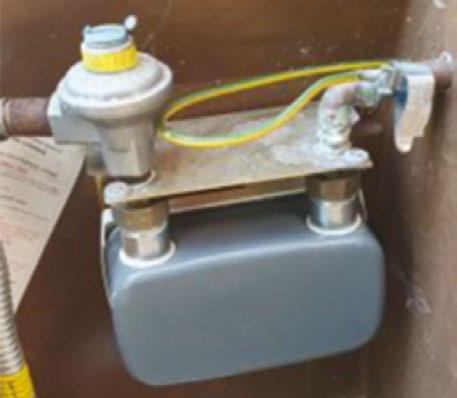
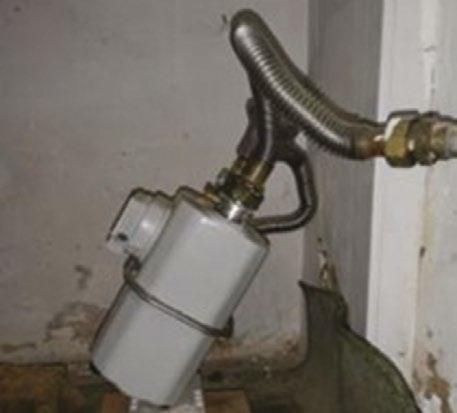
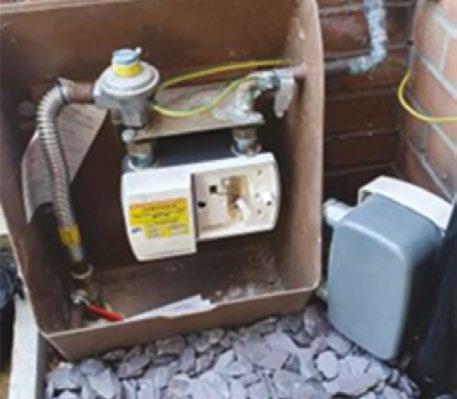
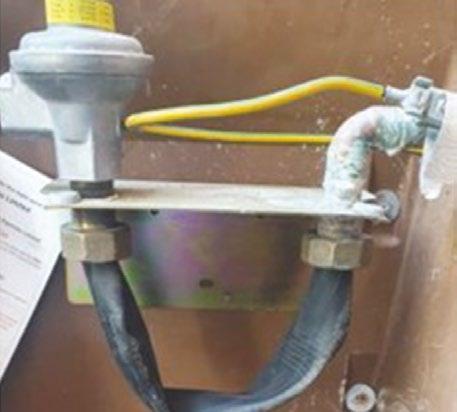
Reversed meter: when the flow of gas passes through the meter in the wrong direction. All gas meters flow from the inlet on the left to the outlet on the right.
Tilted meter: this is only possible in specific circumstances – ie, the meter must have a mechanical index, be fitted with two flexible connections and not fixed to the floor or wall using a meter bracket.
Substitute meter: used to replace the official meter.
Bridged meter: a bridge is anything other than the official meter that is used to connect the regulator or ECV to the outlet pipework.
Images courtesy of Cadent
Stay safe around electricity
Technical Bulletin
118a(1) addresses test procedures to keep gas engineers safe from electrical hazards through verifying the safe isolation of circuits. Proving dead effectively and safely is vital when it comes to safe isolation but there are other dangers to be aware of, such potential injuries caused by coming into contact with unexpectedly live metal parts.
Locking out and proving dead
A comprehensive lockout kit is central to carry out safe isolation correctly and should include a selection of locking devices for miniature circuit breakers and other breaker types, and a padlock with a unique key or combination. The key or code must stay with the person performing the work or an appointed representative and prevents anyone accidentally re-energising the circuit. Clear warning tags should be attached to confirm that the circuit is isolated and work is in progress.
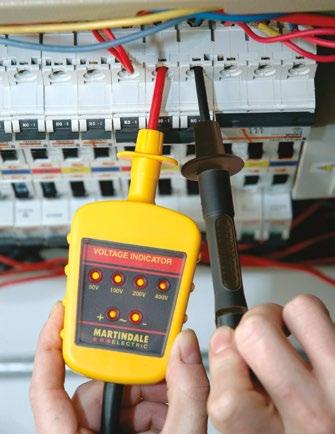
Before any work starts, the circuit must be proven dead using a dedicated voltage indicator. Indicators used for proving dead must function without relying on a battery, eliminating the risk of a depleted battery giving a false reading.
To prove dead, check the
voltage indicator on a known source, preferably a proving unit, then test the circuit. After testing, confirm the voltage indicator again on the known source to ensure it has not failed during use. A matched proving unit is safer, more reliable and always accessible.
ALIVE
ALIVE is a simple acronym reminder of the correct procedure:
A Approved kit: all equipment must meet legal standards; voltage indicators must comply with BS EN61243-3 and GS38.
L Lock out, tag out: identify the isolation point, lock it off and attach warning tags.
I Initial prove: test the voltage indicator against a proving unit before starting checks.
V Voltage test: ensure the circuit you intend to work on is free of dangerous voltage and confirm it is the correct circuit.
E Ensure: test the voltage indicator once more on the proving unit before beginning work.
Other hazards (touch voltage)
Despite the rigorous process of safe isolation, other types of electrical hazard can still be present. Injuries can be caused by encountering unexpectedly
“Before any work starts, the circuit must be proven dead using a voltage indicator.”
Keeping safe around electricity is important for gas engineers carrying out installation and maintenance. Accidents can be prevented via strict safe isolation processes, the right tools and careful verification, writes Steve Dunning, managing director at Martindale Electric.
live metal parts, including metal casings on equipment or appliances, pipework, plumbing and other types of metalwork that should be earthed.
Touch voltage is the electrical potential difference between exposed metalwork and the earth because of a fault condition. The standard safe isolation process does not check for potentially live metalwork, so performing a touch test is an essential addition.
Non-contact and single-pole contact indicators are suitable for performing this test. Unlike a compliant safe isolation voltage indicator, both require batteries and should always be fully checked for functionality prior to use.
Non-contact voltage detectors should always be used with caution as they can be and are often sensitive to other signals such as static electricity. Single-pole contact indicators are a more reliable solution and devices and can be incorporated into touch test safety procedures to help identify potential issues. n
Electrical solutions for gas engineers
Martindale Electric has two dedicated safety kits: the TB118KITA, which includes the LOKKITGAS1 set of four key locking-off devices, and the VI-13800 voltage indicator and PD440S proving unit for safe, straightforward proving dead.
The TB118KITB contains all items from the A kit, plus the EZ664 socket tester, which can be connected to standard 13-amp sockets or used with flying leads for checking fused spurs, terminals and light fittings. It can also measure earth loop impedance without tripping any residual current device rated at 30mA or above. These kits support engineers working where both safe isolation and earth loop verification are essential.
More information and the Martindale Electric knowledge hub at: https://martindaleelectric.co.uk/alive/
(1) Technical Bulletin 118a: Safe to touch and/or safe isolation and proving electrically dead on low-voltage single-phase supplies (below 1000 volts. You can read and download the Technical Bulletin by logging into your Gas Safe Register online account at www. GasSafeRegister.co.uk/sign-in
Reminder on servicing LPG cabinet heaters
Liquid Gas UK is reminding gas engineers and owners of LPG cabinet heaters of the importance of servicing and maintenance to ensure safe and efficient operation.
Many commercial businesses and households rely on LPG cabinet heaters, also known as portable heaters. They remain a popular way to quickly warm homes, workshops, garages and conservatories.
However, without regular maintenance, the appliances can pose safety risks, including carbon monoxide (CO) exposure, gas leaks and fire hazards. Regular servicing and cleaning play a vital role in preventing avoidable safety issues: Prevent CO poisoning: A poorly maintained heater may produce carbon monoxide.
Detect gas leaks:
Professional servicing checks hoses, regulators and connections for leaks. Reduce fire risk: Dust and debris inside the unit can ignite if left to accumulate. Ensure correct burner operation: Yellow or sooty flames indicate incomplete combustion and require immediate attention.
Recommended safety actions
Users should ensure the following checks and cleaning tasks are carried out regularly:
• Clean the exterior casing and vents to remove dust and cobwebs
• Clean or replace filters as needed
• Inspect hoses, regulators and valve assemblies for signs of wear or leaks
• Replace hoses at least every five years, and regulators every ten years
• Ensure the pilot light burns correctly (blue flame); clean the pilot tube if required.
Annual service
Liquid Gas UK strongly recommends that cabinet heaters should be serviced every year by a Gas Safe registered engineer. The service should include:
• Internal deep cleaning of burner and ignition components
• Gas pressure testing
• Safety system checks, including oxygen depletion sensors (ODS) and tip over switches
• Verification of flame quality and overall performance. ■
Get the basics right
Antony Corbett, product applications engineer at Geberit, looks at the role of pipe sizing in maintaining system efficiency and reliability, and some practical considerations when planning domestic systems.
Correct pipework sizing remains one of the most important factors in achieving safe, efficient domestic heating and hot water systems. With boilers operating at lower temperatures and households demanding higher performance from their installations, getting pipework design right has never been more critical.
Pipework is the backbone of any heating or hot water system. Boilers, cylinders, emitters and outlets may be perceived as the more ‘glamorous’ components, but the piping system connecting them is key to determining how effectively heat and hot water are delivered around the home.
Accurate pipe sizing ensures that water flows at the correct rate and pressure throughout the system, which supports stable operation and consistent temperatures.
If pipes are undersized, the system may struggle to provide sufficient flow to radiators, taps and showers, which can result in poor performance, higher energy use and unsatisfied customers. Oversizing, on the other hand, will increase installation costs, require more space and can slow down the speed at which water is delivered. It’s essential to get the right balance.
Lower flow temperatures
One of the reasons correct pipe sizing is important is the shift towards lower-flow
temperature heating systems. As the industry continues to adopt new technologies to unlock energy efficiency and reduce carbon emissions, boilers and heating systems are increasingly designed to operate at lower temperatures. However, lower temperature systems rely more heavily on sufficient flow rates to deliver the required heat output. If pipework is sized incorrectly, it’s unlikely to deliver water at the required temperature, which can cause longer warmup times and uneven heating.
Meeting demand
We’ve also seen a shift in what domestic hot water systems are expected to deliver. New and refurbished homes typically feature multiple bathrooms, powerful showers and multiple appliances that are expected to operate simultaneously, all placing greater demands on the water system.
Incorrectly sized pipes can restrict flow to outlets, resulting in reduced pressure or fluctuating temperatures. It’s one of the reasons some homeowners might notice their water pressure drop when the shower’s running or washing machine is filling. The knock-on effect can be more callbacks and dissatisfied customers, even when the boiler is functioning correctly.
Taking the time to assess the typical demand within the property – including the
“Accurate pipe sizing ensures that water flows at the correct rate and pressure.”
number of outlets in use at the same time – helps to ensure the pipework can support requirements.
Efficiency and noise
Undersized pipes can cause resistance within the system, forcing pumps to work harder to circulate water. Over time, this increased strain can lead to higher energy consumption and potential wear on system components.
In contrast, a well-designed system allows water to circulate smoothly with minimal resistance, which reduces energy use and helps extend the lifespan of components.
Materials selection also plays a role here – the use of flow-optimised multilayer piping
systems can reduce pressure losses and even allow for smaller pipe diameters.
Think about noise too, especially in high-spec projects. High flow velocities caused by undersized pipes may lead to avoidable water noise within the system.
Practical considerations
Calculating heat loss for the property remains a key starting point. This, together with heat demand, helps to determine the required output for the heating system and informs decisions about flow rates and pipe diameters. From there, installers can plan pipe routes and sizes while minimising complexity and bends.
Material choice is another
important consideration.
Different pipe materials have varying internal diameters and the roughness of the internal surface will always have an effect on flow. Look for flowoptimised products, which can help maintain flow rates and reduce pressure drops. Thinking about fittings and ensuring compatibility between system components and pipework also helps maintain consistent performance.
Good planning during the design stage can simplify installation on site. Clear layouts, appropriate pipe sizing and thoughtful routing reduce the risk of redesigns during installation and help ensure the system performs as intended
The fundamentals of system design remain as important as ever. Pipe sizing may not always be the most visible aspect of an installation but it plays a vital role in making sure the system performs well. ■
Dial UFH for efficiency
Sam White, technical sales engineer at RWC, looks at the role of retrofitting underfloor heating for greater efficiency.
When it comes to improving standards and making older properties suitable for modern living, retrofitting modern plumbing and heating systems can have a big impact.
Underfloor heating is one of the leading routes to realising greater levels of efficiency. With a variety of systems designed for fast and fuss-free installation, they can make homes more comfortable and more cost effective to run too. Alongside a desire for greater levels of comfort and cost efficiency by homeowners, legislation and government initiatives are evolving to improve the performance of homes.
The Warm Homes Plan aims to decrease the amount of fuel poverty in the UK. Measures include upgrading insulation,
floor finishes, which can directly impact the performance of UFH.
Operationally, UFH runs at much lower temperatures than traditional heating systems. This is one of the factors that supports its broad compatibility with a variety of heat sources, but it is also critical in supporting households to keep bills down. That’s because lower temperatures place less pressure on heat sources and require less energy to perform optimally.
But surely lower temperatures mean a compromise on comfort? Well, not with UFH, because the set-up elevates heat transfer in each room.
Unlike a radiator system, for instance, where heat is emitted from a single
“UFH allows for heat to be distributed evenly, eliminating cold spots.”
installing more efficient heating systems such as underfloor heating, and providing funding for energy performance upgrades.
UFH efficiency
There are several key factors to take into consideration when taking on underfloor heating projects. This includes the heat source, particularly because UFH is compatible with gas boilers and heat pumps. Alongside this, factors such as the system set-up and the location of the manifold will be key factors, in addition to
source, UFH spans the entire floorspace of the room. This allows for heat to be distributed evenly, eliminating cold spots and, ultimately, requiring lower operational temperatures to achieve optimal levels of comfort.
It is this set-up that also unlocks aesthetic benefits. Because almost all pipework is located beneath the floor, wall space is no longer occupied by radiators, so occupants have greater functionality in their spaces. More broadly, hidden pipework is part of a greater trend towards hidden utilities. ■
Three things to consider
Heat pumps are growing in popularity. Meanwhile, traditional heat sources, including gas boilers, are coming under greater scrutiny, as regulations mandate that new homes built from 2025 onwards must be zero-carbon-ready, effectively discouraging their installation in new properties.
No matter the heat source, UFH can be installed in practically any home. Operating at lower temperatures than traditional heating systems, it works well with heat pumps.
When it comes to retrofitting underfloor heating, planning makes perfect. As for the location of the manifold specifically, a central location is always best because it supports the operational efficiency of the system as a whole and supports the effective distribution of water around the system.
As the heart of the system, the manifold will form the vital connection point for pipework to each room – or zone – being covered by the underfloor heating system. A central location reduces the length of pipe runs to each zone to ensure optimum performance.
The construction and finish of the floor plays a big part in performance and efficiency. Different UFH systems lend themselves to both timber and solid sub-floors, supporting the adoption of UFH in almost every home. When working with timber floors, insulation needs to be considered carefully to minimise heat loss, which could compromise performance overall.
Once the system is laid, attention can turn to the finish. Here, the type of flooring material will have a significant impact on the effect of an underfloor heating system. Tiles, concrete and stone are good conductors of heat and can help homeowners directly feel the benefits of a warm floor. Carpet may compromise efficiency and heat distribution but can still be an option if considered from the outset during system design.
2: Manifold location
3: Flooring
1: Heat source
Quick wins to reduce your customers’ bills
Heating engineers are key to helping households cut costs while energy prices rise, writes HHIC.
Heating engineers have a critical role to play in helping customers reduce their energy use and control costs. Some domestic heating systems are not operating at peak efficiency, often due to settings, controls or system design issues that can be addressed quickly by a qualified heating engineer.
Focus on efficiency first
One of the easiest and most effective steps is to adjust the boiler flow temperature. In many homes, boilers are set higher than necessary, increasing fuel consumption. Reducing the boiler flow temperature, typically to around 60°C, depending on the system, can significantly improve efficiency and deliver immediate cost savings.
System balancing
An unbalanced heating system can lead to some rooms overheating while others remain cold. Balancing radiators ensures even heat distribution, improving overall system performance, helping to avoid the boiler firing up unnecessarily and using more fuel than it needs to.
Fitting smart TRVs that have a system balancing feature can ensure the systems operate efficiently.
Get the controls right
Heating controls are fundamental to efficient operation yet they are frequently missing, incorrectly set up or poorly understood. Ensure that systems include a working room thermostat,
a properly configured timer or programmer and thermostatic radiator valves (TRVs) on most radiators. Correctly set controls mean that households heat only the spaces they need, when they need them, reducing waste and improving comfort. Explaining how to use controls effectively can also make a real difference to energy consumption.
Pipework constraints
Some properties may still be operating with microbore pipework (typically 8mm or 10mm), which can restrict flow and impact system efficiency. Microbore pipework may not always require immediate replacement but installers should be aware of potential limitations, particularly where customers report poor heat distribution or noise.
Where practical, upgrading sections of pipework to larger diameters can improve circulation and system performance.
Check radiator performance
Radiators that are undersized or poorly positioned can struggle to heat rooms effectively, leading to longer run times and higher bills. Assess whether emitters are delivering adequate heat and recommend targeted upgrades where necessary, particularly in colder areas of the home.
Even small improvements, such as bleeding the radiators, checking for sludge in the system and flushing and treating with inhibitor, can help systems run more efficiently and reduce overall demand.
Beyond the boiler
Improving heating efficiency isn’t just about the system itself: heating engineers are well placed to recommend simple measures that reduce heat loss, such as topping up loft insulation and addressing draughts. Reducing heat loss means the system doesn’t have to work as hard, delivering direct savings on energy bills. ■
More information at: https://www. hhic.org.uk/ uploads/62F225 3874AF0.pdf
Illegal radiators: how to spot them
Stewart Clements, director of MARC, highlights how to spot illegal radiators – and has a warning on the consequences of installing them.
What makes a radiator ‘illegal’?
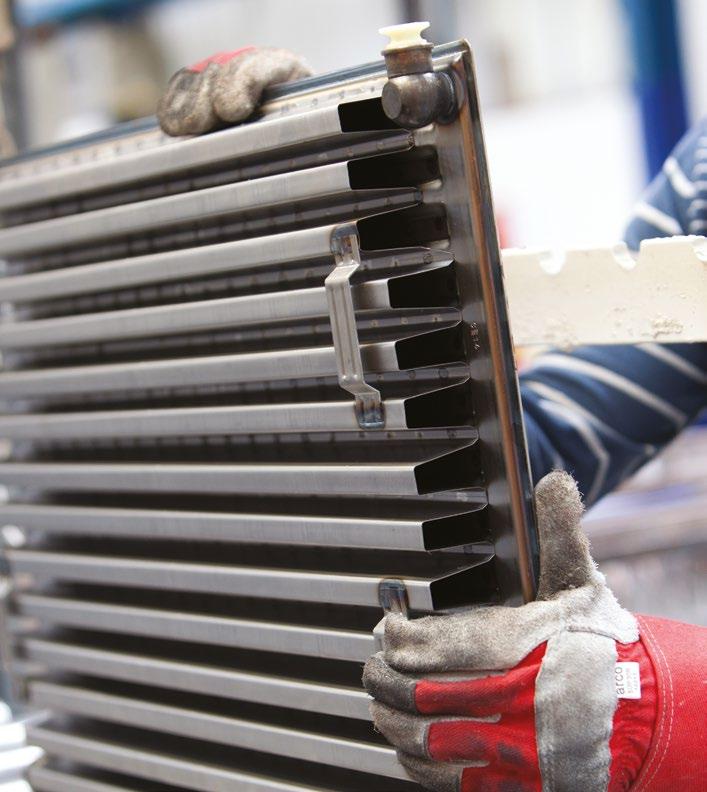
Hydronic radiators (including steel panel radiators, multicolumn radiators, designer radiators and towel rails) must comply with the test standard BS EN 442. This standard requires manufacturers, and importantly, importers, distributors and resellers acting as ‘manufacturers’ to ensure radiators have been tested in an accredited facility, and the heat output accurately measured and declared at ∆T50 and ∆T30.
Under the Construction Products Regulation, every radiator placed on the UK market must be supplied with a Declaration of Performance (DoP), either in paper form or electronically.
A radiator becomes ‘illegal’ if it does not meet these requirements.
is for outputs to be declared at ∆T50 and ∆T30. An output advertised at ∆T60 (or higher) should be a red flag, as this artificially inflates the stated heat output, making the radiator appear more powerful than it actually is under normal UK operating conditions.
• Output not stated in watts: The heat output must be clearly stated in watts (W). Any deviation from this, or vague/unclear performance data, should raise concern.
• Lack of independent testing evidence: If it can’t be demonstrated that the radiator has been tested by an accredited laboratory, the product may not comply.
Why does it matter?
Non-compliant radiators can undermine system performance, increase
“Every radiator must be supplied with a Declaration of Performance.”
The warning signs
• Missing Declaration of Performance (DoP): If a radiator is supplied without a DoP, it does not comply with the law. The DoP should be easily accessible, either included with the product or available for download.
• Incorrect Delta T values: The most common issue is the misuse of Delta T (∆T) values. The legal requirement
customer costs and potentially expose installers to risk. Accurate heat output data is fundamental to the design of the heating system. As highlighted inguidance from the Manufacturers Association of Radiators and Convectors (MARC), correct radiator sizing is critical, particularly as the industry transitions to lower flow temperatures (55°C and below).
If the output data is
wrong, everything built on it is compromised.
There are consequences for your customers too. Installing a non-compliant radiator can lead to underheated rooms because the radiator fails to meet the heat loss requirements. In lowtemperature systems, such as those designed for heat pumps, the margin for error
Radiators must comply with the requirements of the Construction Products Regulation (CPR) 2011 and the designated standard BS EN 442 – Radiators and convectors – Technical specifications and requirements.
is even smaller. A radiator sized using inflated ∆T60 data will almost certainly underperform at lower operating temperatures.
Energy bills may be higher because the system runs hotter and longer to compensate. For heat pumps in particular, where electricity costs are significantly higher than gas, system efficiency is critical to keeping running costs manageable. And carbon emissions can be increased too.
Incorrectly sized radiators, especially when fitted to lowertemperature systems, will lead to customers complaining that rooms are not reaching the correct temperature. They are likely to contact the installer and manufacturer of the heat generator to complain.
The legal responsibility for compliance sits with manufacturers and suppliers, but heating engineers are not immune from the impact of non-compliant products.
• Reputation: if a system fails to heat a property effectively, the installer is the first point of contact.
Even if the root cause is a non-compliant radiator, responsibility may be
perceived to lie with them.
• Costly remedial work: Incorrectly sized radiators may need to be replaced. This could mean return visits, additional labour and maybe even a system redesign, all of which may not be recoverable.
• Compliance and specification: Where engineers are involved in specifying products,
they may be considered part of the supply chain. As highlighted in MARC guidance, those supplying products directly to clients can carry responsibility for ensuring compliance.
• Warranties: Using noncompliant products could jeopardise guarantees or lead to disputes.
To protect both your customers and your business, always use trusted manufacturers and suppliers with transparent data. And request and check the DoP before installation. Check that outputs are quoted at ∆T50 and ∆T30 and avoid products advertised using ∆T60 values.
Carry out accurate heatloss calculations for each installation. Taking these steps will ensure the heating systems you install are designed correctly, perform efficiently and comply with regulations. ■
Celebrating 90 years of warmth
Stelrad Radiators is marking its 90th anniversary this year. Here, we take a look at how the company has evolved across its nine decades.
1936 was a year of notable events: the outbreak of the Spanish Civil War, the abdication of Edward VIII, the birth of Buddy Holly and public TV (in the UK). In the sporting world, Jesse Owens won four gold medals at the Berlin Olympics, Manchester City won its first First Division title and Manchester United were relegated. Arsenal won the FA Cup and Fred Perry won his third successive Wimbledon men’s singles title.
And at the same time, somewhere in west London – in Southall to be exact – the first Stelrad radiators were being made in a small factory not far from the Uxbridge Road. The column radiators
produced were the forerunners of the modern column radiators that are still hugely popular in 2026.
The first practical radiator for central heating was invented by Russian Franz San Galli around 1855 in St Petersburg, using a cast-iron loop for hot water. St Petersburg was a pretty chilly place to be in the winter, so it’s not surprising that the radiator can trace its beginnings to this often snow-bound city.
First modern radiator
Earlier concepts existed, like Matthew Boulton’s 1790s attempt and Stephen Gold’s work in the 1840s, but San Galli’s design is credited as the
birth of the modern radiator, later improved by designs such as the Bundy Loop in 1872.
The radiator in many ways mirrors social history. When Stelrad began manufacturing radiators in 1936, the quantity was small and it would be a while before the volume increased significantly. World War II saw destruction and damage to hundreds of thousands of homes up and down the country, particularly in cities. That led to building large numbers of new homes in the 1940s and 1950s.
Because of the urgency to build replacement homes, many did not incorporate what were then expensive additions, such as heating systems.
Most homes relied heavily on coal in open fires to provide heat, and families often effectively lived in just one room in the colder months because that was the only room that could be heated or that they could afford to heat.
With most homes sporting draughty, metal-framed,
single-glazed windows, waking up to impressive but thick ice patterns on the inside of the windows was not uncommon.
The 1970s saw house buyers first began to notice a new phrase creeping into their consciousness: central heating. It became more common in the UK,
transforming from a luxury feature to a standard requirement as more natural gas became available and new housing was built. Widespread adoption led to changes in home design and public health by the 1980s.
With the growth in demand for central heating came the inevitable growth in demand for radiators and the major growth of Stelrad Radiators. The company has changed hands several times in the past 40 years and its products have grown and broadened to include steel panel radiators, the addition of designer, decorative and low surface temperature radiators, and the arrival of specialist towel rails for the bathroom and en-suites in modern homes.
In 1999, all production, manufacture and national distribution moved Mexborough in South Yorkshire, following the closure of the Dalbeattie factory in Scotland.
The company has come a long way in 90 years and now claims the biggest market share in six European markets, including the UK and Ireland. ■
If not now, when?
The role of hybrids in helping to keep our homes warm – and reduce carbon emissions – is one that is sometimes overlooked. But how to heat homes and hot water does not always need to be a binary choice between gas boilers and heat pumps. Here, we look at the role hybrids could play.
The government is being urged to prioritise hybrid heating systems as part of both its energy and decarbonisation strategies by a raft of organisations. Last year, Worcester Bosch shared the results of its research with the University of Salford, which found that hybrids could effectively heat hard-to-treat older homes, providing 94% of the heat required.
For the 4 million off-grid homes currently heated by LPG and oil, hybrid systems could have a part to play in reducing exposure to volatile prices.
But hybrids don’t receive
any government grants – unlike the Boiler Upgrade Scheme, which has been expanded twice recently: once to include air-to-air heat pumps, and then an increase in grant for conversions from oil boilers, driven partly by the jump in oil costs since the start of the conflict in Iran.
Lower cost
A report published earlier this year by consultant and advocacy firm Stonehaven highlights the role hybrids could play in accelerating the UK’s heat transition. Its key takeaways are that they could reduce installation costs, ease
pressure on electricity networks and provide a practical route to decarbonisation where full electrification is not cost effective or practical.
The report, The heat decarbonisation two-step, highlights that the cost of fitting a hybrid is around £2,700 less than a standalone heat pump.
And there’s the familiarity aspect. For homeowners (and heating engineers), replacing a failing boiler with a new boiler and small heat pump working in tandem is less complex and less disruptive than going full heat pump-only – no new pipework or hot water cylinder required.
Free hybrid heating trial
Cadent is going to put theory into practice through a new initiative that will see 10 households living in vulnerable situations receive a free upgraded hybrid heating system.
The initiative is designed to explore the potential of hybrid heating systems to better support vulnerable households. Combining an air-source heat pump with a gas boiler, the programme will assess the cost, benefits and customer experience of hybrid systems running in real homes.
By the end of the first year, participating households are expected to benefit from lower gas usage, improved energy efficiency, extended heating system lifespan
And a property with hybrid heating is on its way to future-proofing if and when the homeowner decides to move fully to a heat pump, if appropriate.
The report states that the biggest lock-in risk is not the use of hybrid systems themselves, but the continued lack of affordable and practical low-carbon options for households. Without credible routes to cut emissions now,
and a reduced carbon footprint.
Cadent will track system performance, with participants completing quarterly surveys to help assess and improve customer experience.
Technical manager Earl Richards said: “Decarbonising household heating systems is essential for meeting the UK’s net zero/clean power goals.
“However, we know that for many households, the cost and complexity of upgrades can be a barrier. That’s why this project is so important, as it will demonstrate what is possible for all households, including those most vulnerable.”
many homes will remain locked into conventional gas heating for longer.
Not on track
Stuart Gizzi, CEO at Intatec, said: “UK heat pump sales hit a record 125,037 units in 2025, up 27% year on year. Progress, yes: but the growth rate has already slowed from 2024’s 56% surge, and the HPA has been clear that the sector needs around 33%
compound annual growth to reach 450,000 installations a year by 2030.
“We are not on that trajectory. The homes that could tip the numbers are not the easy ones. They are the older properties, the reluctant customers, the jobs where full conversion is technically possible but commercially and practically out of reach for the household in front of the installer.” ■
productupdate
the latest launches from around the industry
Stelrad adds to cast iron range
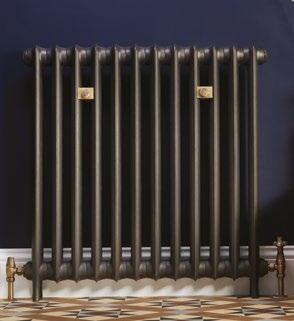
Stelrad is expanding its radiator range with two new cast iron column models, the Artisan and the Foundry. The names link to Stelrad’s 90th anniversary (see page 28).
Alongside the new additions, the warranty across the cast iron range is increasing from five years to 25 years.
This range now includes more than 500 radiators in a wide range of sizes, formats, designs and heat outputs. They come with accessories including shrouds and base plates, wall stays, and manual and TRV valves and in different finishes, such as chrome, natural brass, natural pewter, satin nickel and unlacquered brass.
The radiators are floor-standing with in-built feet for extra stability because they are significantly heavier than their steel counterparts. stelradprofessional.com
Vaillant
evolves its Arotherm Plus heat pump
Vaillant has unveiled its Arotherm Plus, the latest evolution of its flagship R290 air source heat pump. Performance improvements see the new range provide CoP figures of up to 5.39. Its flexible safety function provides greater install flexibility: it can be fitted almost anywhere around the property, breaking free from the fixed-space requirements of the previous generation. This helps make the most of their outdoor space and gives
more options for the heat pump to be fitted in a location that works for the householder.
The new interface has an intuitive semi-touch display, and the anthracite finish integrates with property aesthetics.
The Arotherm Plus comes with up to seven years’ guarantee when fitted with a Vaillant Unistor high-recovery cylinder and registered through Vaillant’s loyalty platform. myvaillantpro.co.uk
Flexible installation options on Vitocal family
Viessmann Climate Solutions has a simplified and highly flexible installation concept for its Vitocal 150-A air source heat pump family. Modular indoor units (IDUs) simplify system configuration and each outdoor unit (ODU) is now compatible with every new IDU.
The separation of outdoor and indoor units helps heating engineers choose the exact indoor unit that meets the individual requirements of the heating system, regardless of the selected output of the outdoor unit – both in new buildings and in retrofits.
With a flow temperature of up to 70°C, the units have been specially designed for modernisation projects. It means that existing radiators can still be used, without the need for underfloor heating.
The heat pumps can be controlled and commissioned via the Viessmann One Base platform and the ViGuide mobile app.
Fernox revamps commercial products
Fernox has a new range of air and dirt separators, vacuum degassers, side stream filters and additives, specifically engineered for commercial applications, to help extend the lifespan and improve the efficiency of heating and cooling systems.
The CC1 Side Stream Filter Air & Dirt 90 provides high-performance magnetic and fine particulate filtration, air removal and a chemical dosing unit. It is suitable for commercial closed-loop systems up to 90,000 litres.
The stainless-steel device uses three different methods to remove contaminants: a powerful magnet captures magnetic debris, and an air vent removes air that would accelerate corrosion. The CF1 magnetic dirt separator captures ferrous debris and hydraulically separates nonmagnetic sludge effectively.
The range of devices also includes the CA1 air separator, a high-efficiency deaerator that continuously removes air and microbubbles from closed loop systems; and the CC1 combi air & dirt separator and CC1 magnetic combi air and dirt separators.
To remove dissolved and free gases from the system water, the CA1 vacuum degasser uses controlled vacuum conditions to effectively release entrained gasses. fernox.com
Stay up to date at: www.registered gasengineer.co.uk
Navien
boosts cashback
You can earn £200 cashback for every LCB700 boiler registered on Navien Choice Plus until 31 July 2026, with no limit on the number of products registered.
Commercial director Greg Banham said: “We’ve dedicated the reward scheme to the LCB700 Blue Flame Boiler as we want to make sure that as many installers have it on their radar as possible.
“It’s easy to install and uses smart technology such as the Navien Smart Plus app.”
The LCB700 includes
features such as flexible pipework and a compact design, says the company, as well as ultra-low NOx emissions.
When heating engineers fit an LCB700 before the July deadline and register the warranty on the Navien app, they will receive their £200 reward via a prepaid e-Mastercard (B4B), which can be used in most retailers.
As part of the scheme, installers will also build up Navien Choice Plus points for every registered installation. T&Cs apply. navien.co.uk/navien-choice/
Take the guesswork out of boiler maintenance with Baxi Care Kits
Baxi’s new Care Kits are designed to make boiler maintenance simpler. By addressing high-wear components at the right time, heating engineers can help reduce unexpected breakdowns and call-outs, minimising disruption for homeowners and maintaining optimal system efficiency.
The kits provide a structured, planned approach to maintenance, focused on high-wear components. They are recommended for use during the annual boiler service as part of routine preventative maintenance.
Baxi says the kits are optional and not a warranty requirement. baxi.co.uk
· All ACS Domestic Gas – core + appliances
·All ACS Commercial Gas including CMDDA1 and BMP1
· Unvented Hot Water & Water Regs
· Highly knowledgeable trainers with years of experience