CAREERS NEXT GEN JOB KIT

SOCIAL WORKER
Connect with communities and change the world


Connect with communities and change the world
Just because I’m Professor Helen now, doesn’t mean my pathway to university was easy. I didn’t pass high school. I grew up in a migrant family, and my parents’ first language wasn’t English. We could have benefited from a social worker – they could have helped us to develop a better sense of belonging in the world.
But social work is much broader than that.
Social workers might do counselling, run therapy groups, develop community programs, or work in policy and research. There are career paths into leadership and humanitarian aid, including opportunities to work overseas with the United Nations. Social work is really diverse and it spans many fields. You could find yourself working in child protection, family support services, with Aboriginal and Torres Strait Islander or migrant communities, in hospitals, or in schools, prisons, disability services,or aged care. Emerging areas like green social work, which focuses on climate change, and animal assisted therapies are also opening even more ways to make a difference.
Throughout all of this, social workers have three core principles: social justice, human dignity, and professional integrity. Because people are experts in their own lives, we do not try to change them. Sometimes we help people

to navigate the world as it is. Other times we try to change the world around them.
At ACU we have small class sizes and work closely with our social work students. Our educators represent the diversity of the communities we work with. We learn side by side with students so they can develop their confidence. We’re not telling you what you have to know; we’re doing it together. And with 1,000 hours of professional placements in the degree, students get a get a good feel for social work. Opportunities to do a placement overseas, such as through our partnership with Christ University in India, are also available.
Wherever social work takes you, you can be confident that the friends you make while studying will stay with you throughout your career. That’s because, whatever has drawn them to the degree, they will have the same philosophy as you: wanting to ensure that the world is a better place for people.
Professor Helen McLaren National Head of Discipline (Social Work), ACU

Keen to solve problems and fight for justice?
Yes, being a superhero is an actual job
Social workers help individuals and communities through some of life’s toughest times, providing assistance across settings such as hospitals, prisons, schools, courts, community organisations, government departments and private practices. In addition to offering support and advocating for fairness, a large part of their work involves connecting people with the resources they need to improve their lives – from counselling and healthcare services to housing and legal aid. Social workers also listen, collaborate, and stand up for their clients’ rights – the perfect high-impact role for compassionate and curious grads who want to make a difference.
Humans have been helping people forever, but social workers are far from stuck in the past. New tech is increasingly making care faster and smarter. Take a look!
Telehealth
Bridges barriers to increase access to support for vulnerable, mobility-impaired or rural patients.
Text & chat services
Connects users with trained professionals without the need to speak to them, making getting help feel less intimidating.
VR empathy training
Allows trainees to immerse themselves in a variety of different perspectives, fostering deeper understanding and compassion for others.
Manages large data sets, predicts risk and streamlines administration processes to free up more direct, face-to-face time.
Case management software
Stores client data, tracks progress, maps services and offers a 360-degree perspective on cases.
Forget snoozy lectures! At ACU students start with practice simulations. In Year 3, they step into social work placements – joining real teams and seeing how their coursework translates.
• Make a difference to people’s lives
• Support children, families and communities
• Turn empathy into a powerful career
• Enjoy a variety of roles and settings
• Be part of a team that values social justice
• Join a growing profession with strong job demand
• Choose work where your values and job align
If you’re wondering who’s hiring, the answer is everyone!
Both ACU’s undergraduate and postgraduate social work degrees could land you a gig in sectors like:
• Child and family services
• Healthcare and hospitals
• Mental health and counselling
• Disability and aged care
• Community development
• Justice, corrections and youth services
• Schools and education
• Government policy and advocacy
As if it wasn’t rewarding enough, in Australia social work pays well. Graduates earn around the $82,000 mark – higher than our national average – with experienced workers earning upwards of $116,000 depending on their role and sector.


As long as people need support, social workers aren’t going anywhere. In Australia there are currently around 48,000, according to Jobs and Skills Australia. They work everywhere from frontline support to policy leadership, with demand expected to grow as communities cry out for more resources.
At ACU, Bachelor of Social Work students can tailor their electives to career goals. Keen on community work? Take units in leadership. See yourself in policy? Explore law. Supercharge your CV with:
Psychology
Diversity & Culture
Communication & Media
Law, Policy & Society
Leadership & Community
Study a Bachelor or Masters of Social Work at ACU. Visit bit.ly/ ACU-SocialWork or scan the code for more info.
Don’t let outdated social work stereotypes put you off!
It’s all sitting around discussing feelings
Nope, talking is just the start. When in session, social workers are also busy problem-solving, advocating, planning, supporting, researching and writing reports.
Most jobs are in child protection
As if! Social workers are needed everywhere, including hospitals, schools, mental health services, youth programs, justice systems, community organisations and even in government.
As long as you’re kind, you’ll get a job
Not exactly! Compassion is important, but social work also demands fluency in a list of specialised areas. These include ethics, law, sociology, psychology, critical thinking, communication and data analysis.
The pay is bad
Er, nope! In Australia social work is a qualified profession with competitive salaries as well as leadership pathways.
There’s no point trying to change the system
Not true. When appropriate, social workers can assist in drafting new policies and programs that can affect whole communities.
She hasn’t finished uni yet, but Jhanvi Joshy already knows what she stands for


It was high school science that first sparked Jhanvi’s interest in the human services sector, with a love of studying people eventually leading to a Bachelor of Social Work. “I’ve always found fulfillment in helping others, and sociology inspired me to learn about society’s impact on people,” she says. “And then there was chemistry, which got me excited about analysing information and breaking down complex concepts.”
Now in her third year at ACU, Jhanvi is complementing her passion for helping people with advanced analytical skills, with subjects like Ethics and Social Work Theory proving useful when separating her head and heart.
“We learnt to apply the Australian Association of Social Workers’ ethical frameworks to specific case scenarios,” she says, stressing that social work is just as much about personal growth as it is professional skills. “Self-reflection transforms the way we see ourselves and those around us.”
Life at ACU has been busy, with Jhanvi putting her hand up for a long list of extracurricular and social opportunities. She balances her coursework with voluntary shifts at open days, playing piano in
social work asks you to listen to people’s stories with humility and presence”
the on-campus chapel and up until recently a vice president position at the uni’s social work society. And now? She’s particularly pumped about an upcoming placement with the Department of Communities and Justice, which she hopes will eventually lead to a full-time job. “Uni has been really enriching,” she says. “Getting involved in extra opportunities has boosted my confidence and networking skills.”
Fast forward a few years and Jhanvi dreams of making a genuine impact on vulnerable children and their families – shaping the policies and legislative reforms that impact their safety and support networks.
Her advice for those on a similar pathway? Be nice! “Social work asks you to listen to people’s stories with humility and genuine presence,” she says. “If you can approach people with warmth and humanity, while building strong advocacy and leadership skills, you’ll grow into a practitioner who can make a meaningful difference”.

When Lily decided she wanted a job that aligned with her values, pursuing a Bachelor of Social Work was an obvious first step. “Hearing a friend talk about his experience helped me realise [the degree] would set me up to do meaningful work in a wide range of settings,” says Lily. “I knew I wanted to work with people.”
Compatible with both her faith and future goals, Lily kickstarted her study and career path at ACU where she enjoyed more than just lecturers, but hands-on and purpose-driven coursework.
The highlight? A practical, community engagement unit that paired students with real-world organisations. “We were able to really experience what it would look like to mobilise support and create meaningful change,” she says. “It was also a great opportunity to work with like-minded people!”
Fast forward four years, two work placements and several hands-on subjects later, and Lily is now a supportive and palliative care social worker at Nepean Hospital. Working with the hospital’s inpatient and community teams, she spends her 9-5 providing end of life care, helping patients and their families navigate one of life’s most vulnerable moments.
Both humanities and STEM skills are key to the job.
On top of drawing on the evidence-based practices she learnt in her psychology units, Lillian increasingly relies on AI systems (Microsoft Co-Pilot) and digital services (Health Direct) to integrate and deliver more informed patient support and care.
“It’s important to remember though, that despite incredible advances in technology, you can’t replace a [human’s] passion for justice and empathy,” she says. “We have the privilege of walking alongside real people and learning from them.”
lily sietsma social worker
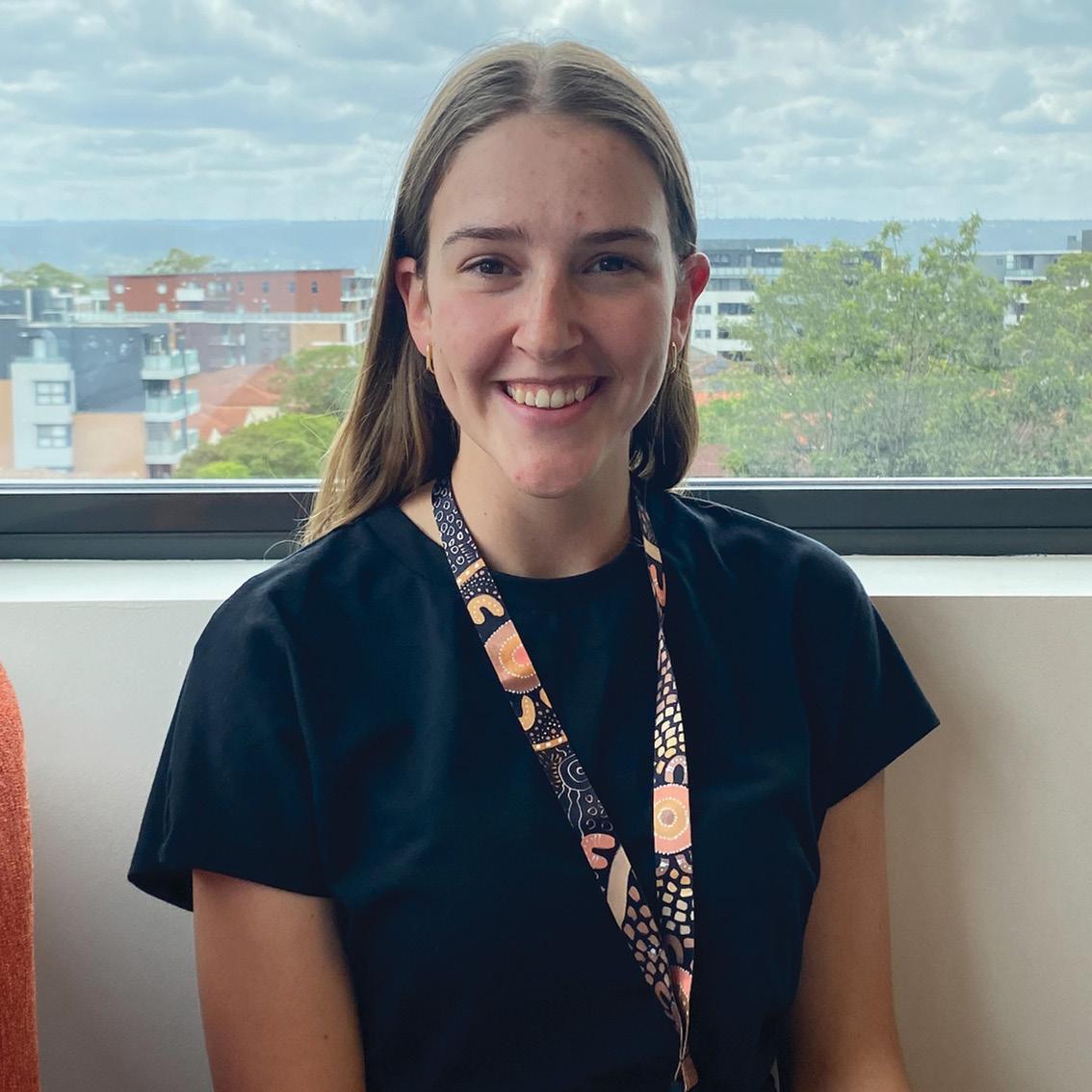

We have the privilege of walking alongside people and learning from them”
8am
Arrive at work, grab a coffee and catch up with colleagues, emails, Teams messages and missed calls. Triage any new referrals. Check in on patient notes and prioritise tasks.
10.30am
Touch base with the team before visiting patients, tackling everything from psychosocial assessments and counselling sessions to advanced care planning and end of life discussions.
12.30pm
On Mondays the medical team presents updates on each patient, allowing us to raise concerns, discuss complex cases and work together to best support them.
1.30pm
Hit my desk after lunch to complete notes from patient interactions – recording stats, time spent and any interventions completed. Occasionally I attend home visits with my seniors to observe and expand my skills.
3pm
District-wide and triage meetings, as well as supervision or non-clinical work such as training, education and research.
4.30pm
Wrap up for the day, schedule any outstanding items for the next work day, grab a chocolate from the office treat jar and head home.

AASW Podcast
Listen For the Bachelor of Social Work at ACU, you need to have studied an English or English as a Second Language course in Year 11-12.
Want to hear from Aussie social workers in the role? The Australian Association of Social Workers has a podcast series.
Social Work Discoveries
Podcast
In this podcast, social worker and researcher Ben Joseph interviews social work researchers about projects they’ve worked on.
• Placements get you crucial work experience – especially long-term ones. But they can take up a lot of time and resources!
• Studying social work, you may be eligible for the government’s Commonwealth Prac Payment .
• This is a weekly payment that helps support social work (and other) students while they’re on placement.
Already been to uni? You can also study social work as a postgraduate course at ACU. You might also be interested in the Master of Family and Systemic Therapy

Social work is becoming increasingly interested in – and affected by – climate change. If you’re highly motivated by climate justice, you might have a role to play as a social worker. Check out the Green Social Work Community Hub or Social Workers for Climate Action for ideas.