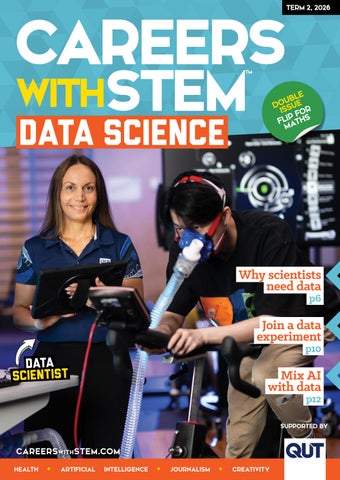
Careers with STEM: Data Science 2026

Page 1


Turn complex data into actionable insights.

Specialise in business analytics, decision analytics, or AI and machine learning, to drive smarter decisions in business, science and technology.

Where curiosity meets opportunity

Data science relies on maths and problem-solving – but you can use it to learn so much more about the world

Part of what drew me to data science was that I wanted to help change the world for the better. Data science has a big role to play in health and the environment.

The other thing that drew me in was that it’s a very collaborative venture. There are many different stakeholders, from the people using the data to the people who generate and own it. It relies on interdisciplinary collaboration, as well as core mathematical problem-solving.

Data science gives you highly transferable skills. You’ll have job opportunities in many different fields: business, finance, consulting, environment, agriculture…

Mathematical skills are an important part of data science, but it’s equally important to be curious.

You’ll have job opportunities in many different fields”

QUT’s Bachelor of Data Science provides you with the core skills needed to be a data scientist. We’ve recently redeveloped the degree to have three new majors: Data and Decision Analytics, Artificial Intelligence and Machine Learning, and Business Data Science. You can study more than one of these majors if you wish.

At every year level of QUT’s degree, students can work with industry partners to gain experience through work-integrated learning. The QUT Centre for Data Science has partnerships in a range of industries, from AI to sport.

Data science is progressing and advancing so quickly. If you’re interested in the field, you don’t have to wait until uni to start exploring. You’ve got the internet at your fingertips: engage with your curiosity now.

Science, QUT

Making human connections

Meet three data scientists at different stages of their learning

Data means flexibility

Data science is a growing field, and that was a big factor in Nathan Li’s decision to study it at uni. It combined employability with subjects he was interested in, like maths.

“I really like the flexibility that data science can give you,” he says.

Nathan picked QUT’s Bachelor of Data Science because it looked like it had the best resources to support him. He also loves studying with “like-minded” students, especially in the Business Analysis and Data Science Club.

“It provides a lot of good networking opportunities,” he says. “But what I really grew to enjoy are the different events and the community that formed around the club.”

Once his degree is finished, Nathan’s hoping to get into a graduate program so he can try out a range of different work.

Nathan’s day at QUT

7am: Wake up.

8am: Head into uni –aim to get some study done on the bus.

9am: Arrive at uni for a two-hour lecture.

11am: Two-hour workshop.

1pm: Lunch (usually packed), plan the afternoon and do extra study.

3pm: Another two-hour workshop.

5pm: Bus home, either get some rest or do some additional study.

6pm: Dinner, shower, complete any extra work, unwind and watch a movie.

Nathan Li Data science student
Bachelor of Data science, QUT

Jiya Thakran Data scientist

Jiya’s tip for students

Keeping up with the industry is very important – don’t be intimidated! There are lots of good articles and videos online.

Be a people person

Jiya Thakran has always enjoyed maths, and that combined with her interest in coding is what drew her to data science at QUT. She also deliberately moved out of her comfort zone at uni, signing up for clubs and other activities alongside her studies.

“I came out of uni not just with a degree, but with a lot of experience in how to work with different people,” Jiya says.

Now, she’s a graduate data scientist at insurance company NTI. She spends a lot of her day coding, but her favourite part of the job is working with other people.

“I am a very social person, so I love the fact that I get to work with such a variety of people and on so many different things.”

Supporting healthy communities

Data science can improve the health of whole communities – but it works better if the people in those communities understand how it’s being used! Becki Cook works on a data literacy project with the Aboriginal and Torres Strait Islander Community Health Service in Brisbane.

“It’s really about empowering community to use data in ways that are beneficial to them and defined by them,” Becki says.

There’s certainly some time spent behind a screen, but Becki, a Nunukul woman, really enjoys the parts of her research where she can head out and chat with people face-to-face.

“Especially in the area of Indigenous research, you really have an opportunity to listen to community.”

Bachelor of Data science, QUT
Consultant, 180 degrees consulting
Event coordinator, women in tech
president, QUT Business Analysis + data science club
graduate data scientist, nti
Griffith University

Welcome to your data era

Looking for a data-driven career? Time to choose your own adventure…

Which of these subjects do you love the most?

Tech

Programming

Digital

Follow your icons to select your path!

What do you want your work day to

You spend the morning brainstorming smart algorithms to help businesses predict trends. Then, you dive into coding and testing models, turning raw data into something that can recognise faces or recommend your next favourite song. You build tools that help companies make lightning-fast decisions.

It’s a mix of creativity, problem-solving and tech wizardry, and every day feels like you’re inventing tomorrow.

Like this option? Imagine yourself in one of these roles (right). Or try another icon.

Your QUT Data Science major: Artificial Intelligence and Machine Learning

Picture this: you’re the ultimate problemsolver, using data and logic to help companies make smart choices. You spend the day designing clever solutions for complex challenges, like figuring out the fastest way to deliver packages or schedule flights.

You use maths and trends to predict what’s coming next. Some describe you as the storyteller of numbers, turning raw data into insights that help businesses understand what’s really happening behind the scenes.

Like this option? Imagine yourself in one of these roles (right). Or try another icon.

Your QUT Data Science major: Data and Decision Analytics

Roles include

• Decision scientist

• Operations research analyst

• Forecasting specialist

• Data analytics specialist

You turn raw data into powerful business moves! You spend the day building dashboards and tools that help companies see the big picture. You’re a detective of customer behaviour, digging into the data to figure out what makes people click, buy and share.

The next day, you’re a tech-savvy advisor working with different businesses to solve tricky problems using data. It’s a powerful combo of creativity, strategy and tech expertise.

Like this option? Imagine yourself in one of these roles (right). Or try another icon.

Your QUT Data Science major: Business Data Science

Roles include

• Business intelligence specialist

• Marketing or growth analyst

• Analytics consultant

• Business intelligence analyst

READY FOR YOUR FIT CHECK?

Healthcare needs people with data and maths skills! Here are some things you could do with a data career in health

Healthcare is a growing sector, and with an ageing population, careers in the field are projected to get ever more important. There will always be a need for people who work in health!

Data is becoming an increasingly valuable part of the health picture. Whether it’s diagnosing individual people or monitoring the health of entire countries, data science has a role to play. Plus, in fields like bioinformatics, diseases can be identified and treatments can be developed.

But a lot of this data is private and needs to be handled responsibly. And since it deals directly with humans, it can be very noisy and complicated!

If you’re interested in the healthcare sector, here are a few spots that data science might be your way in…

Diagnosis data

Sometimes, even diagnosing a disease can be difficult. But data from past patients can make it easier to spot future patients.

One technique making waves in this field is image analysis. Photographs of skin cancers can be used to train software, which can then pick out suspicious moles on new patients. The Skin Health Institute is running a clinical trial of this technology.

Then there’s endometriosis, a condition that forms in people’s uteruses and can be extremely painful. Often, the only way to diagnose endometriosis is with keyhole surgery. But a team of researchers in Adelaide has been working on a non-invasive technique called IMAGENDO that can be used to diagnose endometriosis with MRI and ultrasound scans instead.

People, decoded

How do we know that just under half of Australians have experienced a mental health disorder, or that cancer survival rates have improved by about 20% in the last 30 years? How can we tell if a flu outbreak is concerning, or if a new exercise initiative is working?

Data is crucial for understanding how to make communities healthier, but it comes from hundreds of different sources. Data scientists are needed to make sense of it! The Australian Institute of Health and Welfare plays a big role in this, collecting and maintaining data on the nation’s health. Meanwhile, the new Australian Centre for Disease Control is collating health data to monitor diseases – and spot any new health emergencies in their early stages.

Virus tracker

Want to watch virus data in action?

Nextstrain.org tracks the evolution of diseases of interest as they happen!

Step it up

Ever worn a step tracker or a smart watch that monitors your sleep? Wearable health tech is becoming a powerful way to keep tabs on your own health. For athletes, wearable health monitors can track their performance and recovery, analyse movement patterns, and identify weaknesses. Data scientists make sense of the information these monitors produce, without breaching confidentiality.

$61K–$121K

$69K–$148K

Bioinformatician

$50K–$92K

Biostatistician

$77K–$118K

Everyday data scientists

From the air we breathe in to the gas we fart out, everyday people like you can be citizen scientists capturing health data

What is citizen science?

Citizen scientists help to collect, record or interpret data for real-world research projects. This takes science out of the lab and into homes, schools and communities. For health-related citizen science, you might log symptoms, notice patterns and share observations over time. Each entry might feel small, but together they create massive data sets – the kind data scientists love! Then, data scientists connect the dots between environment, behaviour and health outcomes, turning thousands of everyday observations into evidence.

Here are three great apps to help you on your way to being a citizen data scientist.

Corona Report

Remember the global plot twist called COVID-19? You’re still living in it. Scientists want the real story: yours. This citizen science project invites you to log how the pandemic has reshaped your world. It’s as simple as: download, register your account, start sharing! Then, The University of Edinburgh receives your data – anonymous and aggregated – for research purposes. coronareport.global

Under 18?

Always remember to get a parent or guardian’s permission before creating your citizen science accounts.

Air Rater

The Air Rater app tracks the air pollution around us here in Australia. It lets you report smoke or symptoms affecting your eyes, nose or lungs. You don’t need to log in or get a subscription to contribute. Scientists analyse patterns in this data to understand how air pollution affects our health. During bushfires, this crowdsourced info about smoke can even help firefighters and the government. airrater.org

FluTracking

This project keeps tabs on coughs, fevers and all things respiratory in Australia, Fiji and Hong Kong. It works like this: once a week, a quick email lands in your inbox and you report whether you felt fine or fought off a lurgy. Your two-minute check-in helps an international team of experts spot trends early and fight flu! info.flutracking.net

Making a difference with data

Data analyst Alissa Chaitarvornkit helps IVF patients make more informed decisions about their treatment

Alissa always knew she wanted to work in health but initially she thought that meant becoming a doctor! When she realised that wasn’t the right path for her, she looked for ways to work alongside doctors instead.

Alissa enrolled in a biomedical engineering degree to begin with, but during her studies, a coding subject changed everything.

“I loved being able to write code and see tangible, meaningful outputs from it,” Alissa says.

This led to a summer internship at a research centre, where Alissa was introduced to machine learning and AI.

“I worked on a project aiming to predict factors influencing gestational diabetes using cellular data,” she says. “That inspired me to pivot my career towards health data science.”

Now? Alissa works at the UNSW Centre for Big Data Research in Health. The centre has a range of teams, from researchers developing AI models to predict diseases, to educators and data specialists. Alissa is part of the clinical quality registry team, managing IVF data across

i love writing code and seeing tangible outputs from it”

Australia and New Zealand. Her work also feeds into a government- funded site called YourIVFSuccess.com.au, which includes a prediction tool to help people understand their likelihood of IVF success.

“It’s incredibly rewarding to know that the work I do doesn’t just sit in a report, it contributes to improving people’s lives,”

Alissa says. “The data we manage enables research, informs government and policymakers, educates the public, and even shapes media reporting.”

If you want to follow in her footsteps, Alissa says having a strong foundation in healthcare will help you stand out.

“It’s not just about analysing numbers, it’s about understanding what they mean for patients, clinicians, and health systems and being able to communicate those insights clearly,” she explains.

Alissa Chaitarvornkit data analyst

WHAT WILL MACHINE LEARNING LEARN FROM?

AI needs a steady supply of good data to work – and data experts are a key part of building that supply

One of the fastest-growing industries in the world today is AI. Machine learning spans dozens of different fields – you might be most familiar with large language models, but it’s also a vital tool in everything from weather prediction to medical image analysis.

Whatever the application, AI systems need huge amounts of data to learn. Early versions of ChatGPT were trained on about 300 billion words!

AI and machine learning are also important for processing huge data sets. For example, CSIRO’s ASKAP radio telescope generates so much data that astronomers use machine learning to classify it and pull out interesting info.

If this data is biased or faulty, it produces a biased and faulty AI. So it’s extremely important that data scientists understand and manage the data going into AI training. There’s a lot of important work in training AI models, and checking for bias or problems.

Unlocking local data sets

If we want AI that’s useful to Australians, we need to train it on Australian data. In its National AI Plan, the government highlighted the importance of Australia’s high-quality data sets in the public and private sectors for supporting local AI. It’s also important that people maintain control of their data – particularly for Aboriginal and Torres Strait Islander communities. Data scientists will need to take data sovereignty seriously while developing AI.

DATA SCIENCE + AI + STUDY

Putting on the brakes

What if you have sensitive info that you don’t want an AI to absorb? There’s actually a lot of work in cyber security focused on preventing AI systems from accessing certain data. This includes building image filters that stop AIs from learning on certain images in order to protect people’s privacy and intellectual property. Cyber security experts have been working on filters that do this.

They’re also helping oganisations protect confidential data, such as health records and identifying documents. It’s important to have people who know how to keep this stuff safe!

Big (giga)bytes

An hour of Netflix in high definition: 3GB

All of the text on the languageEnglishWikipedia: 25GB

Data produced by the ASKAP radio telescope in 1 second: 12,500GB (12.5TB)

Bachelor of Data

Science (Artificial Intelligence and Machine Learning), QUT

Bachelor of Computer Science (Artificial Intelligence and Machine Learning), Adelaide Universit y

Master of Data Science and Artificial Intelligence, University of Newcastle

Diploma of Artificial Intelligence, TAFE

Queensland

DATA SCIENCE + AI +JOBS

AI specialist

$52K–$257K

Data scientist

$69K–$148K

Machine learning engineer

$62K–$149K

*Salaries from payscale.com

DATA SCIENCE

Mastering the creative data revolution

Looking for the mathematical secrets behind music, movies and memes? Data is your backstage pass!

Shaping the digital world

How Instagram and TikTok keep you scrolling

What you see on your feeds isn’t random – it’s driven by what you like, who you follow, and even how long you watch a video for. These user interactions help platforms map your vibe and recommend videos and posts you’ll love.

Systems engineers build the ‘brain’ that records this data. User interface or experience designers make platforms like Instagram, easy to use. Then marketers analyze the data to guide their next ad.

Mind-reading platforms

You look up a pair of shoes, then magically, you’re seeing ads for them everywhere. This is predictive analytics.

Your ‘digital footprint’ is a record of what you do online, including the sites you visit, what you post, and what others post about you. Creative strategists look at this data to help brands increase sales.

Games that keep you hooked

In massive games like Fortnite, developers use analytics to decide which stories to tell. If the data shows that 80% of players are ignoring a side quest, they might remove it. In the next expansion, they’ll likely focus on what the players loved about the game and remove what they didn’t.

If you’re worried about AI reducing your chances of getting a job, tapping into your creative side could be the answer you’re looking for. AI is the biggest perceived risk for students entering the job market, but one thing AI can’t do well is… creativity.

Want to go one step further? Combine creativity with data science for a future-proof career.

Without data, many modern creative industries would cease to exist, including design, media, games, marketing, film, music and journalism!

Become a data and digital cadet

The Australian Bureau of Statistics has a program that combines part-time work experience with your training at university. The creative part? They always need people who can turn numbers into compelling visual stories for the public.

The data storyteller

Wes Mountain

Data journalist

Witha background in visual arts and philosophy, Wes went into his Master of Journalism as a cartoonist. Today, he applies these visualisation skills as a data journalist. By using visualisation, Wes uncovers hidden narratives in stats that others might miss.

“I’ll quickly make a chart and think: is there something here? Has anyone else found it yet?”

Wes famously built an interactive microsite mapping the Black Summer bushfires against species’ habitats, showing the devastating impact of the fires.

These days, Wes is a property reporter with The Age, a paper he grew up reading.

“I end up talking to economists… getting them to drill down a little bit and confirm my thoughts or tell me why I’m wrong,” he says. “I get frustrated at other journalists when they say they

don’t do maths... everyone does maths! There’s a reason people can look at a line chart or pie chart and understand it.”

The Australian market for journalists is competitive, but that’s why Wes says being a ‘double threat’ is so vital.

“It’s never going to be a problem that you’re looking at data. It’s always going to be an asset.”

And if you like to travel, good news! Having recently worked in London, Wes says there’s greater demand for data journalists overseas.

Bachelor of Creative

Bachelor of Science (Computer Science) / Fine Arts, UNSW Sydney

Bachelor of Design (UX Interaction Design), Swinburne University

Bachelor of Marketing and Media, Macquarie University

Bachelor of Digital & Social Media, COLLARTS

DATA SCIENCE + CREATIVITY + JOBS

UX

$60K–$121K

Creative

$40K–$102K

Creative

$58K–$161K

Marketing specialist

$65K–$133K

Data journalist

$65K–$105K

*Salaries according to payscale.com and glassdoor.com.au

Dig into data science

Check out these opportunities to turn messy data into meaningful answers

Do

Check your own stats

Have a smartwatch? Your phone probably has health stats for you. If you’re a gamer, check your Steam stats, Xbox achievements or PlayStation trophies. And at the end of the year, check out your Spotify Wrapped or Duolingo Lookback. Keep a tally

Whatever your hobby, keep some stats. Record all the stories you read in a spreadsheet and give each a score out of 10. Log your trading card collection and calculate its value, or track your runs and bike rides on Strava. In a year, the info will be fascinating!

Fantasy football

Powered by current football stats, fantasy football gives you a way to run your own footy team. It’s the perfect window into sabermetrics (studying sport statistics). There are leagues for men’s and women’s AFL, NRL and soccer, and plenty more sports too.

The Pudding

Ever wanted to know the best way to slice onions? This beautiful website investigates all kinds of data from animals in kids’ books to the loneliness epidemic. pudding.cool

Uncharted with Hannah Fry

This podcast explores the most interesting and important graphs ever charted. Predicting earthquakes, unmasking serial killers, and exposing gigantic corporate scandals – it’s packed with data. bit.ly/ HannahFrypodCwS

Turn static files into dynamic content formats.

Create a flipbook
Careers with STEM: Data Science 2026 by Refraction Media - Issuu