Calvin, Edwards, and the Church Fathers on Our Homeland in Heaven
The Early Church’s Unanimous Testimony Against Icons How the Gospel Transforms Parenting (2)
Giant Rebellion, Gracious Rescue
God’s Providence in the Placement of the URCNA Divine Providence (4)
Speaking in Tongues, Prophecy, and Miracles: A Reformed Assessment
You as God Intended: Become the Person You’re Meant to Be Church Membership, Its Biblical Basis (1) Thoughts on Perseverance
You Can be Freed from Rebellion
You Can be Freed from Malice
Contents | May/June | Volume 76 | Issue 3
3 | The King of Glory
Mr. Case VanKempen
Christ’s resurrection and ascension reveal Him as the reigning King who gathers His church through the Spirit and the gospel, calling believers to holiness and hopeful expectation of His return.
4 | Calvin, Edwards, and the Church Fathers on Our Homeland in Heaven
Rev. Dr. Mark J. Larson
Calvin, Edwards, and the church fathers portray earthly life as temporary exile, directing believers to seek their true homeland in heaven and find hope in Christ’s return and eternal glory.
7 | The Early Church’s Unanimous Testimony Against Icons
Rev. Dr. John B. Carpenter
Jewish background, patristic testimony, and early councils indicate the early church rejected icons in worship, maintaining an aniconic tradition that emphasized the Word and Spirit rather than visual representations.
10 | How the Gospel
Transforms Parenting
(2)
Mrs. Elisabeth Bloechl
Is the gospel for our kids? If so, how does that change our parenting?
13 | Giant Rebellion, Gracious Rescue: A Meditation on Genesis 6:1–8
Rev. Peter Holtvluwer
What was it that caused the Lord to send the flood? How bad was it and what lessons does pre-flood life hold for us today?
16 | God’s Providence in the Placement of the URCNA
Dr. Michael R. Kearney
Reflecting on the providential spread of Dutch Reformed immigrants across North America, the URCNA’s geographic distribution presents opportunities for church planting, cooperation, and mutual support among congregations.
19 | Divine Providence (4)
Mr. Daniel Olaska
Joseph, Pharaoh, and God’s providence over human decisions and actions.
22 | Speaking in Tongues, Prophecy, and Miracles: A Reformed Assessment
Rev. Steve Swets
Scripture, theology, and church history all show that miraculous gifts like tongues, prophecy, and apostleship have ceased as God now guides His Church solely by His Spirit and sufficient Word.
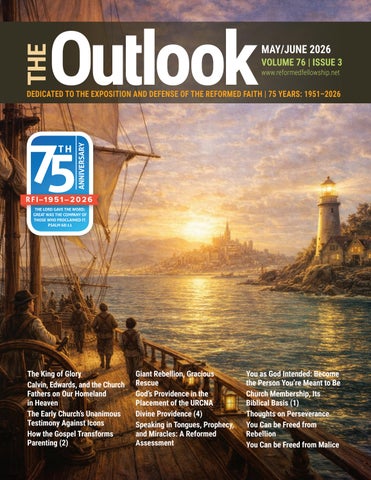
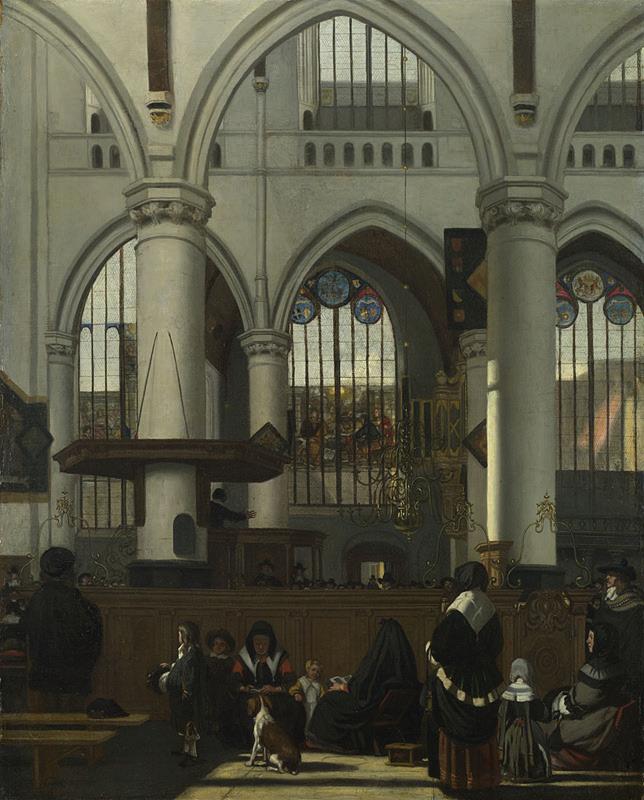
About the cover image: Psalm 107:23-32 gives a fitting image of the Christian pilgrimage. When we face the storms of God’s discipline and also the curse, by crying out to the Lord, we find our deliverance in Him as He brings us to our desired haven (v.30).
25 | You as God Intended: Become the Person You’re Meant to Be
Dr. Bryce Bartruff
A personal story encourages young readers to discover their God-given strengths, accept their weaknesses, and prayerfully develop their gifts so they can serve others and glorify God.
28 | Church Membership, Its Biblical Basis (1)
Rev. Dr. Shane Lems
Does the Bible speak positively about church membership? Is church membership biblical? In this article, we look at Scripture to see how believing in Christ and belonging to His Church go hand in hand.
31 | Thoughts on Perseverance
Augustus M. Toplady (1740–1778)
Assurance of salvation rests on God’s covenant faithfulness, Christ’s finished work, and the Spirit’s preserving grace securing believers forever.
34 | You Can be Freed from Rebellion
Rev. William Boekestein
LD 39 - QA 104
36 | You Can be Freed from Malice
Rev. William Boekestein
LD 40 - QA 105-107
THE KING GLORY OF
“For I know that my redeemer liveth, and that he shall stand at the latter day upon the earth: and though after my skin worms destroy this body, yet in my flesh shall I see God: Whom I shall see for myself, and mine eyes shall behold, and not another; though my reins be consumed within me”
–Job 19:25–27
Tpromise of the birth of the Christ child in the fullness of
loved them. Living in the wilderness of this world, we look for Christ and begin more and more to hate sin because it is an offense to the One we love. We want to be rid of the three-headed enemy—the world, Satan, and self. Self is the insufferable enemy. We desire to be perfectly holy, but sin separates us from God. Hear Paul as he cries but trusts in his O wretched man that I am! who shall deliver me from the body of this death? I thank God through Jesus Christ our Lord. So then with the mind I myself serve the law of God; but with the flesh the law of sin” (Rom. 7:24–25).
But Christ’s work in gathering His kingdom, the church, is ongoing. He sent the Holy Spirit on the day of Pentecost,
to preach His Word to a world filled with sinners. “Go ye therefore, and teach all nations, baptizing them in the name of the Father, and of the Son,
Mr. Cornelius VanKempen
known as Case, has been married to Susan for sixty blessed years. They attend and are members of Heritage Reformed Congregation in Grand Rapids, MI.
and of the Holy Ghost: teaching them to observe all things whatsoever I have commanded you: and, lo, I am with you always, even unto the end of the world. Amen” (Matt. 28:19–20). In this, we see the unity in trinity at work using weak means (men) to fulfill His Word. The glorious gospel, the good news, is brought by men ordained by God. The Spirit opens hearts to receive the word of grace. This will continue until Jesus, the glorious King, comes on the clouds of heaven to judge the world in righteousness.
God is a covenant-keeping God. His love is revealed in the hearts of His people. He uses the preached Word, and families are also added by parents teaching their children about Jesus. “Suffer little children to come unto me, and forbid them not: for of such is the kingdom of God. Verily I say unto you, Whosoever shall not receive the kingdom of God as a little child shall in no wise enter therein” (Luke 18:16–17). This should be the prayer of every parent. “I bring the children Thou hast given me to Thee, and in prayer remember them. In mercy draw them close to Thee. Let Thy Word be fulfilled and Thy kingdom come in their hearts, and let Thy love bring them to truly love Thee.” God has loaned us these children and will answer those prayers. “My sheep hear my voice, and I know them, and they follow me: And I give unto them eternal life; and they shall never perish, neither shall any man pluck them out of my hand. My Father, which gave them me, is greater than all; and no man is able to pluck them out of my
The time that God gives us on earth is very short. The King of Glory is coming; are you waiting and looking for Him?
Let God rejoice in all His works, and let His works proclaim
Forevermore their Maker’s praise and glorify His Name.
Psalter 288:2 (Psalm 104)
Calvin, Edwards, and the Church Fathers on our Homeland in Heaven
This present world is one “in which good and evil are so mixed together as to be a sure sign that this world is not to continue forever.”1 This was how
Jonathan Edwards described the nature of life in a fallen world: a mixture of blessing and misery.
Divine Gifts in the Midst of Suffering
“The earthly life we live is a gift of God’s kindness”; indeed, “before he shows us openly the inheritance of eternal glory, God wills by lesser proofs to show himself to be our Father.” What did John Calvin mean by these statements? He reminded his readers of “the benefits that are daily conferred on us by him.”2 This was the same perspective of the Apostle Paul, when he contemplated the works of God in the generations preceding his own time: “He did good, gave us rain from heaven and fruitful seasons, filling our hearts with food and gladness” (Acts 14:17).
Jesus likewise spoke about the “Father in heaven” who “makes His sun rise on the evil and on the good and sends rain on the just and the unjust” (Matt. 5:45).
Daily gifts come to us from the hand of God: “Every good gift and every perfect gift is from above, and comes down from the Father of lights” (James 1:17). Let us always receive the divine beneficence with grateful hearts. At the same time, we are constantly reminded that we no longer live in Paradise. “This life judged in itself is troubled, turbulent, unhappy in countless ways, and
Rev. Dr. Mark J. Larson
in no respect clearly happy.” We must come to terms, Calvin noted, with these sober realities. “All the things which are judged to be its goods are uncertain, fleeting, vain, and vitiated by many intermingled evils.”3 This was the point made by James about the nature of our lives in a fallen world: “It is even a vapor that appears for a little time and then vanishes away” (James 4:14). What should we expect about our short season on this earth? Paul would answer: “We must through many tribulations enter the kingdom of God” (Acts 14:22).
We have moments of happiness in our present lives, but there is an instability in our experience. Edwards used an apt figure of speech: “this world” is “like a tempestuous sea.” It has been the case since the rebellion of Adam and Eve that “selfishness, and envy, and revenge, and jealousy, and kindred passions keep life in a constant tumult.” Is there a way for us to find peace in the turbulence that surrounds us? Edwards provided wise counsel. The “confusion and uproar” of the present is such that “no quiet rest is to be enjoyed except in renouncing this world and looking to another.”4
Looking to the World Above
Paul calls upon us to meditate upon the heavenly life and to recognize that we are sojourning for just a short time in this world: “Seek those things which are above, where Christ is, sitting at the right hand of God. Set your mind on things above, not on things on the earth” (Col. 3:1–2). Calvin reasoned thus: “If heaven is our homeland, what else is the earth but our place of exile?”5 In fact, he maintained, there is a compelling necessity for us to think properly about this world and the world above. “The entire company of believers” would “have been desperately unhappy unless, with mind intent upon heaven, they had surmounted whatever is in
this world, and passed beyond the present aspect of affairs.”6
Calvin stood in continuity with the church fathers in his perspective on life in this world and our homeland in heaven. Clement, in his letter to the Corinthians, written near the end of the first century, began his epistle with these words: “The church of God which temporarily resides in Rome, to the church of God which temporarily resides in Corinth.”7 Clement reminded the church in Corinth of the Apostle Paul, who “having come to the limits of the west and having given his testimony before the rulers,” was “set free from the world and was taken up to the holy place.”8 We find the same kind of thinking about heaven in Polycarp, a disciple of the apostle John. Bishop Polycarp wrote to the Philippians early in the second century. He assured the congregation that those who had lived “in faith and righteousness” were now “with the Lord.” He likewise expressed his desire that God would give the believers in Philippi the ultimate blessing: “May he give you a share and place with his saints, and to us with you, and to all under heaven who shall believe in our Lord and God Jesus Christ and in his Father.”9
The Place of Supreme Happiness
We need to remember that our ultimate happiness is not to be found in this fallen world. To use the language of Augustine, we must not be like those in unbelief, the earthly city that “longs for earthly joys” and “clings to them, as if they were the only joys.”10 Calvin repeated the same note, pointing out that by nature “the world [tends to] hold us bound by intemperate love of it.” “The whole soul, enmeshed in the allurements of the flesh, seeks its happiness on earth.” Calvin advised, “If we have any concern for eternity, we must strive diligently to strike off
these evil fetters.”11 Many refuse this course of action. This indeed was the problem with Demas who seemed to be a servant of the Lord and who labored with Paul for a period of time (Philem. 24). Sad to say, his affections were wrongly placed resulting in spiritual disaster. Paul reflected on what had happened: “Demas has forsaken me, having loved this present world, and has departed for Thessalonica” (2 Tim. 4:10).
The world above is the place of true happiness. “That blessed world,” proclaimed Edwards, “shall be perfectly bright, without any darkness; perfectly fair, without any spot; perfectly clear, without any cloud.”12 “Every member of that holy and blessed society shall be without any stain of sin, or imperfection, or weakness, or imprudence, or blemish of any kind.”13 “The saints in heaven” are “united together in one society” for “mutual subserviency and happiness.”14 Augustine wrote that the life of the believer “is happy in the expectation of the world to come.”15 We know that true happiness and peace are only to be found in the eternal City of God. Thus, “we sigh for her beauty while on our pilgrimage.”16
Our Entrance into Heaven
Calvin would encourage us to have a biblical perspective on death. He stated, “Through death we are recalled from exile to dwell in the fatherland, in the heavenly fatherland.”17 This indeed was the point made by Paul: “We are confident, yes, well pleased rather to be absent from the body and to be present with the Lord” (2 Cor. 5:8). In fact, “to die is gain,” for “to depart” is to “be with Christ, which is far better” (Phil. 1: 21, 23). This was the promise given by Jesus to the dying thief who appealed to the Lord for mercy: “Assuredly, I say to you, today you will be with Me in Paradise” (Luke 23:43).
Our greatest longing, however, focuses upon the Second Coming. We are “looking for the blessed hope and glorious appearing of our great God and Savior Jesus Christ” (Titus 2:13). We, as Calvin put it, “await the Lord’s coming, not only with longing, but also with groaning and sighs, as the happiest thing of all.” Why is this the case? “He will come to us as Redeemer, and rescuing us, from the boundless abyss of all evils and miseries, he will lead us into that blessed inheritance of his life and glory.”18 We shall hear the Lord’s invitation: “Come, you blessed of My Father, inherit the kingdom prepared for you from the foundation of the world” (Matt. 25:34).
The Glory of God’s Country
Peace and happiness await the people of God. As Calvin described it, “The Lord will receive his faithful people into the peace of his Kingdom.” More than that, He “will deign to make them sharers in his happiness.”19 Augustine contemplated what the eternal kingdom will be like: “How great will be that felicity, where there will be no evil.”20 He concluded his City of God with an expression of wonder: “There we shall be still and see; we shall see and we shall love; we shall love and we shall praise. Behold what will be, in the end, without end!” He then asked, “For what is our end but to reach that kingdom which has no end?”21
This is precisely what Jesus taught. All who trust in Him will dwell with Him forever and will share in His
glory. His comfort is this: “If I go and prepare a place for you, I will come again and receive you to myself, that where I am, there you may be also” (John 14:3). There is not only His promise, but there is also His prayer: “Father, I desire that they also whom you gave me be with me where I am, that they may behold my glory” (John 17:24). Consider His remarkable description of our future possession: “And the glory which you gave me I have given them” (John 17:22).
The Lord’s Invitation
Edwards encourages us, unworthy and wretched sinners that we are: “This glorious world may be obtained by us. It is offered to us. Though it be so excellent and blessed a country, yet God stands ready to give us an inheritance there, if it be the country that we desire, and will choose and diligently seek.”22
The divine invitation goes out to the world until the end of the age. Jesus assures us that all will be well if we place our trust in Him alone: “This is the will of Him who sent Me, that everyone who sees the Son and believes in Him may have everlasting life; and I will raise him up at the last day” (John 6:40). May we be comforted by the safety given to us by the Lord, protection for His sheep who hear His voice and follow Him: “I give them eternal life, and they shall never perish; neither shall anyone snatch them out of my hand” (John 10:28).
1. Jonathan Edwards, Heaven: A World of Love (Edinburgh: Banner of Truth, 2008), 88.
2. John Calvin, Institutes of the Christian Religion, vol. 1, trans. Ford Lewis Battles (Philadelphia: Westminster Press, 1960), 715.
3. Calvin, Institutes, vol. 1:713.
4. Edwards, Heaven, 69.
5. Calvin, Institutes, vol. 1:716.
6. Calvin, Institutes, vol. 1:718.
7. Clement, “The First Letter of Clement to the Corinthians,” in The Apostolic Fathers: A New Translation, trans. Rick Brannan (Bellingham, WA: Lexham Press, 2017), 11. Emphasis added.
8. Clement, “The First Letter of Clement to the Corinthians,” 15.
9. Polycarp, “Polycarp to the Philippians,” in The Apostolic Fathers: A New Translation, trans. Rick Brannan (Bellingham, WA: Lexham Press, 2017), 128–29.
10. Augustine, Concerning the City of God against the Pagans, trans. Henry Bettenson (London: Penguin Books, 1972), 621.
11. Calvin, Institutes, 1:713.
12. Edwards, Heaven, 21.
13. Edwards, Heaven, 23.
14. Edwards, Heaven, 67.
15. Augustine, The City of God, 857.
16. Augustine, The City of God, 205.
17. Calvin, Institutes, 1:717.
18. Calvin, Institutes, 1:718.
19. Calvin, Institutes, 1:718.
20. Augustine, The City of God, 1087.
21. Augustine, The City of God, 1091.
22. Edwards, Heaven, 98.
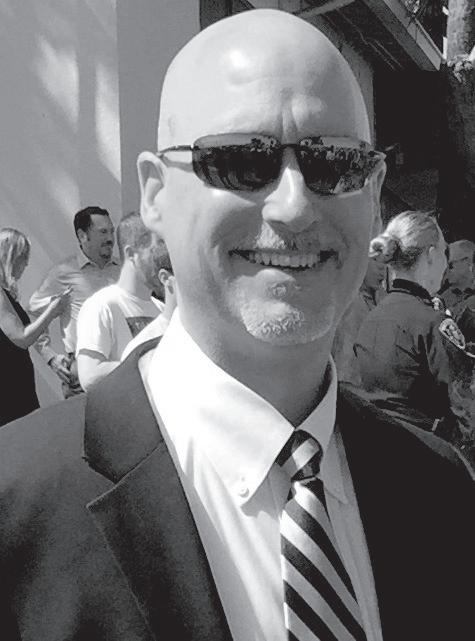
Rev. Dr. Mark J. Larson is pastor emeritus and retired professor of Systematic Theology at Heidelberg Theological Seminary in Sioux Falls, South Dakota.
We have moments of happiness in our present lives, but there is an instability in our experience…. Is there a way for us to find peace in the turbulence that surrounds us? Edwards provided wise counsel. The “confusion and uproar” of the present is such that “no quiet rest is to be enjoyed except in renouncing this world and looking to another.”
The Early Church’s Unanimous Testimony Against Icons
Rev. Dr. John B. Carpenter
In the modern religious landscape, Eastern Orthodoxy presents itself as the pristine alternative for evangelicals weary of the perceived shallowness of contemporary worship. Its appeal lies in a claim of “unbroken continuity”— the idea that the incense-filled, iconladen liturgy of today is the exact same worship practiced by the Apostles and the early martyrs. Yet, when we move past the aesthetic allure and delve into the intellectual and historical record, we find that the “continuity” claim rests on a foundation of sand. The early church was not pre-iconic; it was aniconic.1 To understand the thinking behind this stance is to rediscover a church that viewed the visual representation of the divine not as a
window to heaven, but as a shutter closing out the light of the Word.
What Is an Icon?
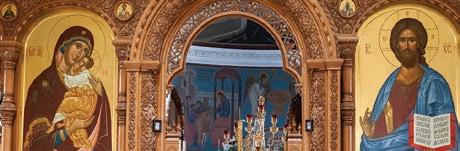
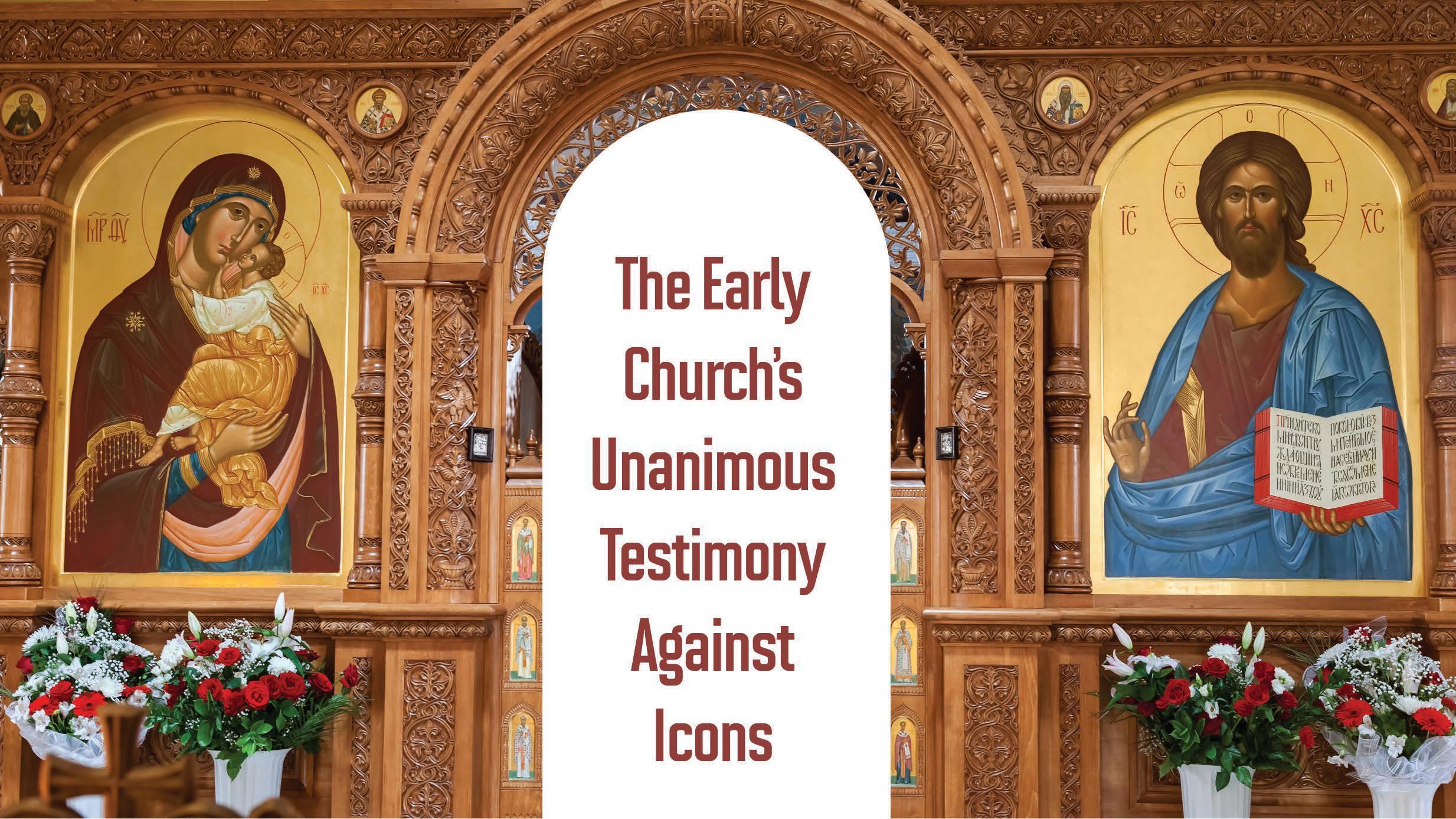
We must first clear the semantic fog. Eastern Orthodox Apologists (EOAs) conflate any instance of Christian art with the practice of iconography. However, an icon in the liturgical sense is not merely a painting; it is a sacred image intended for veneration (proskynesis) and used as a medium for divine encounter.
The early church distinguished between art (decorative or historical) and idols (images used in worship). While archaeologists have found murals in the Dura-Europos house church (ca. 235) or the Roman
catacombs, there is no record of any Christian before AD 500 bowing before, kissing, or offering incense to these images. The early Christians were aniconic—they avoided images in worship—but they were not necessarily artless. They maintained a strict line: the worship of God must be mediated through the Spirit and the Word, not through the “sensible” (physical) representations of the material world.
The Jewish Background and the Second Commandment
The primitive church did not invent its opposition to images in a vacuum; it inherited a fierce, “Second Commandment” hermeneutic from
Second Temple Judaism. For the firstcentury Jew, the prohibition against graven images (and “any likeness of anything” in worship) was a defining boundary of their identity against the image-mad Greco-Roman world.
History records that when Pontius Pilate attempted to bring Roman standards bearing the emperor’s image into Jerusalem, the Jewish populace staged a non-violent protest, baring their necks to Roman swords rather than permit images in the Holy City. This was the environment that birthed the Apostles.
The “Protestant” Polemic of the Church Fathers
When we turn to the writings of the Fathers, their language sounds like that of the later Reformers. They did not see images as “books for the illiterate” (a later sixth-century justification); rather, they saw them as a return to the darkness of paganism.
Clement of Alexandria (ca. 150–215): A philosopher-theologian, Clement argued that the Law was designed to lead us away from the “sensible” to the “intellectual.” He stated flatly, “Works of art cannot then be sacred and divine.”2
Tertullian (ca. 155–240): The fiery North African was so rigorous that he questioned whether a Christian could even be an artist. He argued that the Second Commandment “interdicted” all similitudes.3
Marcus Minucius Felix (d. ca. 250): The distinguished Roman lawyer and early Latin Christian apologist had his pagan interrogator, the fictional Caecilius Natalis, ask of Christians, “Why have they no altars, no temples, no acknowledged images?”4 Arnobius noted that his pagan prosecutor was “in the habit of fastening upon us a very serious charge of impiety because…[we] do not set up statues and images of any god.…”5 Romans frequently considered the lack of religious images among Christians as
prima facie evidence of atheism. These apologists were at pains to explain that it was not so.6
Origen (ca. 184–254): In his sophisticated defense of Christianity against the pagan critic Celsus, Origen rejected the idea that images were symbols of the divine. He argued that Christians “cannot allow in the worship of the Divine Being altars, or temples, or images.”7
Lactantius (ca. 250–325): Often called the “Christian Cicero,” Lactantius provided perhaps the most devastating summary: “It is undoubted that there is no religion wherever there is an image.”8
Arnobius of Sicca (255–330): The fourth-century North African rhetorician turned vigorous Christian apologist wrote, “What greater wrong, disgrace, hardship, can be inflicted than to acknowledge one god, and yet make supplication to something else— to hope for help from a deity, and pray to an image without feeling?…There is nothing divine in images.”9
Eusebius of Caesarea (ca. AD 263–339): “The Father of Church History” and scholarly bishop received a letter from the emperor’s sister, Constantia, asking him for a picture of Christ. He politely rebukes her, saying, “Did the reading escape you where God commanded not to make any likeness of anything in heaven above or on the earth beneath?”10
Epiphanius of Salamis (ca. 310–403): The fourth-century bishop and canonized “saint” in Eastern Orthodoxy and Roman Catholicism tore down a church curtain bearing an image of Christ when he found one travelling in Palestine. He wrote that he was “loath that an image of a man should be hung up in Christ’s church contrary to the teaching of the Scriptures.”11
The Council of Elvira: Canon 36
If there is a historical fact that
destroys the claim of early church iconography, it is Canon 36 of the Council of Elvira (ca. 306). This council of Western bishops met just before the rise of Constantine and issued a prophylactic decree against icons arising in the church. The canon states: “It is decided that there should be no pictures in the church, lest what is worshipped and adored be painted on the walls.” This was not a regional quirk; it was a formalization of the thinking that had dominated the church for three centuries.
The Gnostic Deviation: The First Icons
One of the more revealing details in this debate is that the earliest explicit literary reference to Christians possessing images of Christ comes not from the catholic mainstream, but from a secondcentury Gnostic sect. According to Irenaeus of Lyons in Against Heresies (1.25.6), the Carpocratians claimed to have a portrait of Christ allegedly commissioned by Pontius Pilate. They reportedly displayed this image alongside portraits of philosophers such as Pythagoras and Plato, crowned them, and treated them “after the same manner of the Gentiles.”12 While this does not prove that orthodox Christians rejected all visual representation, it does show that one of the earliest documented cases of Christ-images appears in a heterodox setting rather than within the emerging catholic tradition.
When the early Church Fathers like Irenaeus (ca. 130–202) and Hippolytus (ca. 170–235) wrote about this, they did not say, “The Gnostics are doing it wrong; here is the correct way to use icons.” Rather, they cited the very act of using images of Christ as evidence of the Gnostics’ pagan and heretical nature. The thinking of the early church was clear: icons were a hallmark of the “other,” not the “faithful.”
Deconstructing the Luke Myth
To bypass this wall of historical condemnation, later icon-venerators fabricated the legend that Luke was the first iconographer. This myth, which claims Luke painted the Virgin Mary, did not emerge until the eighth and ninth centuries—appearing during the height of the Iconoclast controversy to provide apostolic cover for a recent innovation.13
The early church knew nothing of this legend. Augustine of Hippo (354–430), one of the most brilliant minds in church history, explicitly stated in De Trinitate that “neither do we know the countenance of the Virgin Mary.”14 If the Apostles had passed down holy icons, the most learned bishop in the West would have been aware of them.
Conclusion: The Triumph of the Word
The Achilles’ heel of the Eastern Orthodox apologetics is, ironically,
the claim it uses to sell itself to evangelicals today: its insistence on unbroken continuity with the early church. If the church today requires the use of icons, but the church of the first 500 years condemned them, then the continuity is historical fiction. The early church’s testimony was unanimously against icons. As Epiphanius insisted, icons are “contrary to our religion.” So, contrary to the claims of Eastern Orthodox apologists trying to woo our church members, returning to the early church is not to embrace the icon, but to embrace the simplicity of the Word.
1. John B. Carpenter, “The Early Church on the Aniconic Spectrum,” The Westminster Theological Journal, 83, No. 1, May, 2021.
2. Clement of Alexandria, Stromata, 2.18, 5.5, 7.5 (ANF 2:530).
13. Bissera V. Pentcheva, Icons and Power: The Mother of God in Byzantium (University Park: Pennsylvania State University, 2006), 124.
14. Augustine, De Trinitate, 8:5 (NPNF, 3).
Beyond Images. Into Christ.
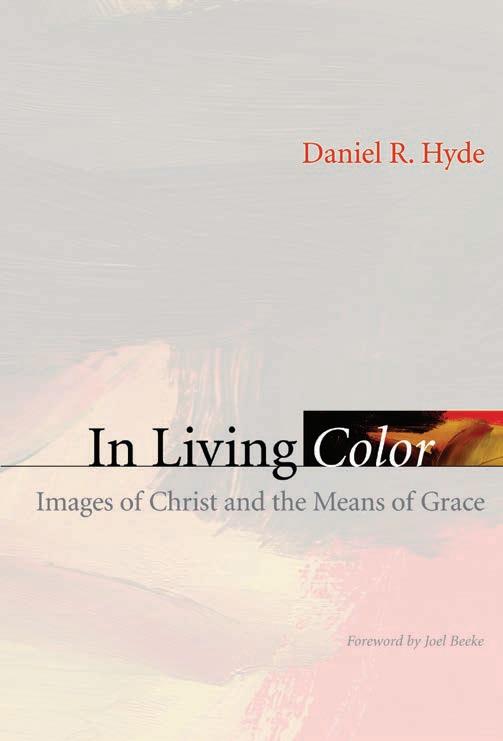
As this article explores, the early church rejected icons not out of hostility to Christ, but out of fidelity to the Second Commandment. Daniel Hyde shows why that matters still.
In Living Color exposes the problem with images of Christ and points us to God’s better provision—the Word and the Sacraments.
Available at reformedfellowship.net
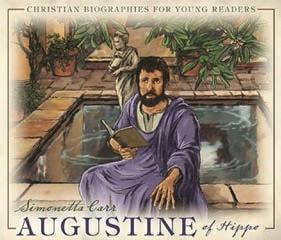
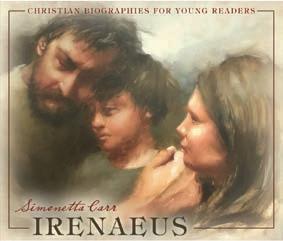
The early church fathers handled the word of truth with care, and their faithfulness provides a foundation which, as we see in this article, still helps us today. Read more in these excellent illustrated biographies, available individually or as part of a set at reformedfellowship.net.
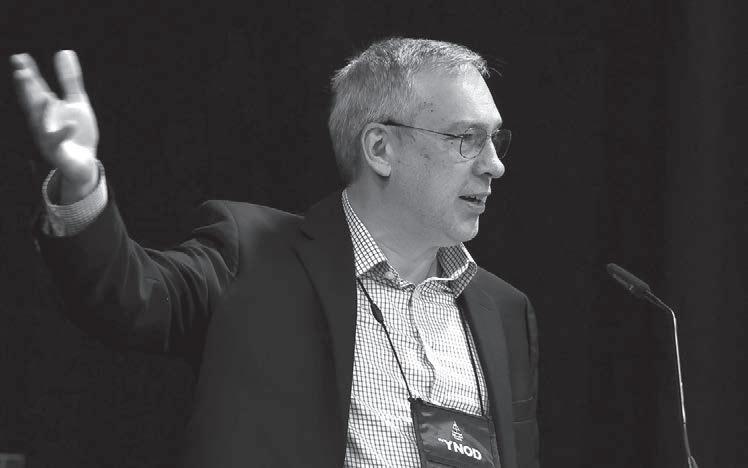
Rev. Dr. John B. Carpenter is pastor of Covenant Reformed Baptist Church, in Danville, VA, and the author of Seven Pillars of a Biblical Church (Wipf and Stock, 2022) and the Covenant Caswell substack.
(ISSN 8750-5754) (USPS 633-980)
“Exhorting you to contend earnestly for the faith which was once for all delivered to the saints.”
—Jude 3
Journal of Reformed Fellowship, Inc.
Send all copy to:
Interim Editor
1988 140th Avenue, Dorr, MI 49323
Email: editor@reformedfellowship.net
Website: www.reformedfellowship.net
Board of Trustees
Al Rumph, President; Rev. Casey Freswick, Vice President; Rev. Doug Barnes, Secretary; Marv Mingerink, Treasurer; Dr. Michael Kearney, Vice-All; Dr. Andrew Compton, Glenn Hop, Tom Kooienga, Dr. Daniel Ragusa, and Dr. Ryan Swale, Directors
Interim Editor: Dr. Andrew Compton
Contributing Editor: Dr. Cornelis P. Venema
Art, Design & Production: Jeff Steenholdt
General Manager & Executive Editor: Hope Staal
Distribution Manager: Emily Postma
Bookkeeper: Mindy Toonstra
Outreach Specialist: Ashley Hoekman
This periodical is owned and published by Reformed Fellowship, Inc., a religious and strictly non-profit organization composed of a group of Christian believers who hold to the biblical Reformed faith. Its purpose is to advocate and propagate this faith, to nurture those who seek to live in obedience to it, to give sharpened expression to it, to stimulate the doctrinal sensitivities of those who profess it, to promote the spiritual welfare and purity of the Reformed churches and to encourage Christian action.
The publishers of this journal express their adherence to the Calvinistic creeds as formulated in the Belgic Confession, the Heidelberg Catechism, the Canons of Dort, and the Westminster Confession and Catechisms.
Reformed Fellowship holds the copyright to all material published in this magazine. All contributions represent the personal views of the writers and do not necessarily reflect the opinions of the members of Reformed Fellowship, Inc.
Subscription Policy
The Outlook (USPS 633-980) is published six times per year (bi-monthly) by Reformed Fellowship, Inc. Annual subscriptions are $35.00 per year in the United States; outside the US, $40 per year (foreign subscribers please remit payment in US Funds; Canada add GST). Digital download subscriptions are $20 annually, and are included FREE with a print subscription. Unless a definite request for discontinuance is received, it is assumed that the subscriber wishes the subscription to continue without the formality of a renewal order and he will be billed for renewal. Anyone desiring a change of address should notify the business office as early as possible in order to avoid the inconvenience of delayed delivery. Zip code should be included. Periodical postage paid at Grandville, MI and at additional mailing offices.
POSTMASTER:
Send address changes to The Outlook, 1988 140th Avenue, Dorr MI 49323
Advertising Policy
1. The Outlook cannot accept announcements or advertising copy inconsistent with the stated purpose of RFI. All advertisements and announcements must be approved by the RFI board prior to publication. We reserve the right to reject, edit, or request resubmission of announcement text or advertising copy. Books, pamphlets, or CDs to be advertised are to be screened as to author and content prior to publication of the advertisement, and such material should not conflict with the stated purpose of RFI. We reserve the right to limit the size of all
announcements and advertisements, and to limit the number of issues in which they appear.
2. All advertisements or announcements are to be submitted via email to office@reformedfellowship.net or to the business office at 1988 140th Avenue, Dorr MI 49323, and must be received at least two months before the publication date.
3. Fees for B&W/grayscale ads: $190 for full-page, $115 for half-page, $65 for quarter-page.
4. Fees for full-color ads: $235 for full-page, $140 for half-page, $80 for quarter-page.
5. Fees for preparing artwork for ads (in addition to advertising costs above) are $140 for full-page, $115 for half-page, $90 for quarter-page. These fees are waived if advertising art is print-ready. Please submit manuscript in an email or as an MS-Word.doc attachment. If you have pictures or images, please include as JPG files.
6. Preferred final file format for print-ready ads: High Quality Print PDF.
7. Ad sizes specifications: 8.75 x 11.25, trim 8.5 x 11"
Full page non-bleed: 7.25 x 9.75"
Half page horizontal bleed: 8.625 x 5.25"
Half page horizontal non-bleed: 7.25 x 4.5"
Quarter page (non-bleed) 3.5 x 4.5"
8. This Advertising Policy supersedes all prior policies, resolutions, or other statements.
Editorial Office
Interim Editor
1988 140th Avenue, Dorr, MI 49323
Email: editor@reformedfellowship.net
Circulation Office
1988 140th Avenue, Dorr MI 49323 (616) 532-8510
Business Mailing Address
1988 140th Avenue, Dorr MI 49323
Email: office@reformedfellowship.net
THE BEAUTY OF REFORMED
@ HILLCREST CRC October 24, 2026
Dr. R. Scott Clark WITH TEACHING AND OTHERS
BONUS PRE-CONFERENCE SESSION
Join us Friday evening for a preaching seminar led by Rev. Stephen Terpstra
PRESENTED BY:
DETAILS & REGISTER
Reformed Fellowship, Inc.
1988 140th Avenue
Dorr, MI 49323
(616) 532-8510
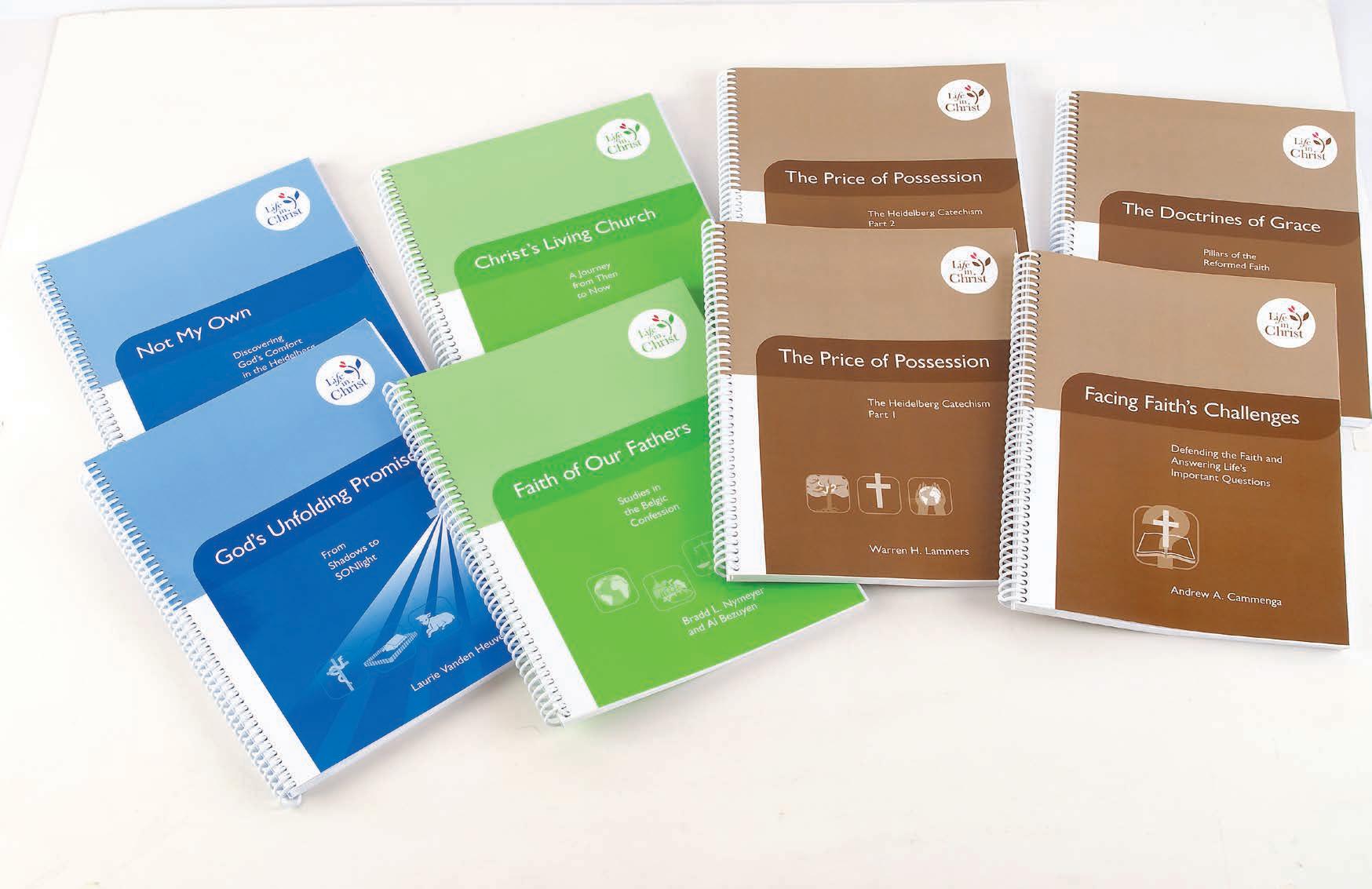
Life in Christ Catechism Curriculum
Covering the Three Forms of Unity (The Heidelberg Catechism, The Belgic Confession, and the Canons of Dort) with reference to the Westminster Confession and Catechisms.
Now available to order for the 2026-27 season!
Fully updated with historically aligned version of the Three Forms of Unity as established by the URCNA Synod. Updated with ESV Bible translation.
Three convenient ways to order:
Online: www.reformedfellowship.net
Email: office@reformedfellowship.net
Call: 616.532.8510
FOR THE FIRST TIME, a full teacher’s key will be available for each book of the second edition.
Price remains unchanged!
Contact our office to order your review copies for 2026-27!