Jesus Christ, the born, suffering, dying, and risen Lord of Glory is the only and full salvation of His people.
4 | Artificial Intelligence and the Family
Mrs. Annemarieke Ryskamp
We are in the middle of a new kind of arms race: not for weapons, but for thinking machines. It is a global escalation for technological dominance that will soon affect your family, too.
7 | Is AI Just a Tool?
Dr. Michael R. Kearney
A consideration of AI from the perspective of the college classroom.
9 | Be Careful What You Outsource: Evaluating AI as a Learning and Relational Tool
Rev. William Boekestein
In some ways, AI is like any tool. But in the areas of study, relationships, and the pursuit of truth, its use can become antiintelligent.
11 | Vigilance Without Fear: AI as the Next Chapter
in
the Ongoing History of Technology
Dr. Andrew Compton
AI confronts us with uncertainties and misuses as technology always has. A careful, though not frantic posture toward it will serve us well.
14 | The Kind Factor
Dr. Bryce Bartruff
The happiest people are those who give selflessly of themselves to others. They give their time, talent, and treasure to the people around them, helping them to thrive. The “kind factor” is living out our faith by treating others with respect and kindness, regardless of the circumstances.
17 | Seven Reflections on Election and Reprobation
Dr. Brian G. Najapfour
A pastoral and biblical meditation on predestination from Romans 9–11, showing how the doctrines of election and reprobation, rightly understood, magnify God’s sovereign mercy and justice while leading believers to humility, worship, prayer, evangelism, and renewed confidence in the gospel.
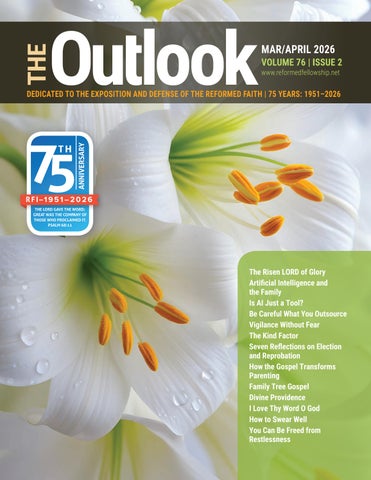
About the cover image: If the Spirit of him who raised Jesus from the dead dwells in you, he who raised Christ Jesus from the dead will also give life to your mortal bodies through his Spirit who dwells in you.” – Romans 8:11 – Wonderful words of life!
22 | How the Gospel Transforms Parenting (1)
Mrs. Elisabeth Bloechl
Parenting brings with it many challenges and requires much of us. What is the most important thing?
24 | Family Tree Gospel
Rev. Peter Holtvlüwer
Do you find the genealogies of Scripture difficult to read? Difficult to see their value? What is the Holy Spirit’s purpose in giving us Adam’s genealogy in Genesis 5?
27 | Divine Providence (3)
Mr. Daniel Olaska
Joseph, Pharaoh, and God’s Providence Over Human Decisions and Actions.
30 | I Love Thy Word, O God
Mr. Robert Heitbrink
“The only thing I love more than the Word of God is my relationship with its Author. It was through His Word that the Lord brought about my conversion. I was born again while poring over Holy Scripture. God truly used the Bible to save and change my life.”
33 | How to Swear Well
Rev. William Boekestein
Lord’s Day 37 - Q&A 191-102
35
| You Can Be Freed from Restlessness
Rev. William Boekestein
Lord’s Day 38 - Q&A 103
The Risen LORD of Glory
“He that spared not his own Son, but delivered him up for us all, how shall he not with him also freely give us all things? Who shall lay any thing to the charge of God’s elect? It is God that justifieth. Who is he that condemneth? It is Christ that died, yea rather, that is risen again, who is even at the right hand of God, who also maketh intercession for us. Who shall separate us from the love of Christ? shall tribulation, or distress, or persecution, or famine, or nakedness, or peril, or sword” (Romans 8:32–35)
We remember Jesus Christ, the eternal Son of God, as the Substitute for His people. As the glorified King of kings, Christ came into the world He created as a helpless baby, to be rejected by the world and yet to be the Savior of it. This is His story—from the never begun eternity to the coming Seed in the fullness of time. This necessitated the creation of the world in time, complete with His image bearer, man. Christ came in the most humble of circumstances as the God-man to fulfill and reinstate the broken covenant of works and to issue the covenant of grace for all that would believe in Him. He came as the suffering Servant to bring eternal life for all that the Father had
Mr. Cornelius VanKempen
known as Case, has been married to Susan for sixty blessed years. They attend and are members of Heritage Reformed Congregation in Grand Rapids, MI.
given Him. “He came unto his own, and his own received him not. But as many as received him, to them gave he power to become the sons of God, even to them that believe on his name” (John 1:11–12).
Christ’s kingdom is not of this world. It is an eternal kingdom. He came to suffer and to die for His people, taking their guilt and sins, and imputing to them His righteousness. This is the hope of His people. He took all their sin, burying them in the grave never to be remembered again, and giving His people the right to eternal life. But more was needed! “Now if Christ be preached that he rose from the dead, how say some among you that there is no resurrection of the dead? But if there be no resurrection of the dead, then is Christ not risen: and if Christ be not risen, then is our preaching vain, and your faith is also vain” (1 Cor. 15:12–14).
His birth, suffering, and death was and is an eternal wonder, making the cross of Christ the dividing line of eternal woe and eternal bliss. The resurrection makes the redeemed
sinner’s justification an eternal reality. God, in His lovingkindness, accepted the payment by His Son for every sin of His people, and they are raised in Him as heirs of eternal life.
Death for His people is now only the vehicle bringing them to Jesus Christ to be with Him in glory. “Blessed be the God and Father of our Lord Jesus Christ, which according to his abundant mercy hath begotten us again unto a lively hope by the resurrection of Jesus Christ from the dead, To an inheritance incorruptible, and undefiled, and that fadeth not away, reserved in heaven for you, who are kept by the power of God through faith unto salvation ready to be revealed in the last time” (1 Pet. 1:3–5). Death has no more power over His people. They will bask in eternal joy with the One they love. That joy will fill heaven praising the triune God of their salvation. “Sing, O daughter of Zion; shout, O Israel; be glad and rejoice with all the heart, O daughter of Jerusalem. The LORD hath taken away thy judgments, he hath cast out thine enemy: the king of Israel, even the LORD, is in the midst of thee: thou shalt not see evil any more. In that day it shall be said to Jerusalem, Fear thou not: and to Zion, Let not thine hands be slack. The LORD thy God in the midst of thee is mighty; he will save, he will rejoice over thee with joy; he will rest in his love, he will joy over thee with singing” (Zeph. 3:14–17).
To be with Christ is to be in the land of perfect holiness, not only conformed to His image, but to be like Him! This becomes the desire of God’s true but afflicted people as they travel through this wilderness. The joy of this world pales in comparison to their eternal home. Jesus, our Lord and Savior, is even now in heaven, interceding for us without ceasing.
What do you think of Jesus? The world rejects Him. The only joy they have is in this life and will end in eternal misery forever. “Ye therefore, beloved, seeing ye know these things before, beware lest ye also, being led away with the error of the wicked, fall from your own stedfastness. But grow in grace, and in the knowledge of our Lord and Saviour Jesus Christ. To him be glory both now and for ever. Amen” (2 Pet. 3:17–19).
The Lord my Shepherd holds me within His tender care,
And with His flock He folds me, no want shall find me there.
In pastures green He feeds me, with plenty I am blessed;
By quiet streams He leads me and makes me safely rest.
Whatever ills betides me, He will restore and bless;
For His Name’s sake He guides me in paths of righteousness.
Thy rod and staff shall cheer me in death’s dark vale and shade, For Thou wilt then be near me: I shall not be afraid.
My food Thou dost appoint me, supplied before my foes;
With oil Thou dost anoint me, my cup of bliss o’er-flows.
Thy goodness, Lord shall guide me, Thy mercy cheer my way;
A home Thou wilt provide me within Thy house for aye.
Psalter 55 (Psalm 23)
ARTIFICIAL INTELLIGENCE AND THE FAMILY
How AI affects the Family
We are in the middle of a new kind of arms race: not for weapons, but for thinking machines. It is a global escalation for technological dominance that will soon affect your family, too. Although AI can be used as a tool for many positive purposes, it harbors some real dangers for the family, young and old alike. In this article, I would like to point out some of the dangers that AI presents for the Christian family.
What is AI?
Artificial Intelligence (AI), according to IBM, is technology that enables computers and machines to simulate human learning, comprehension, problem solving, decision making, creativity, and autonomy. Just reading this definition highlights the hype that soon AI will have a consciousness, too. It is already built into all kinds of robots and smart devices. For the first time in history, culture itself is being coauthored by systems that don’t know what truth is and that can’t care.
AI is presented to the people by means of Open AI or Language Programs. The most famous one is called ChatGPT, but there are many others flooding the market like Grok, DeepSeek, Gemini, CLAILA, and the list goes on and on. Many are meant for specific purposes.
As the name Artificial Intelligence already implies, this technological advancement is a human way of imitating God-created intelligence. This by itself should put us on high alert, as we know who it is that tries to imitate everything that God created (Isa. 14:12–14) in order to rule over the earth and all of humanity. Of course, we know that no manmade machine could ever be better than what God created. AI doesn’t feel wonder or experience joy; it’s not creative, and it doesn’t even
Mrs. Annemarieke Ryskamp
understand the meaning of the words it generates. It finds the next most likely sequence and mimics the patterns of human intelligence without possessing it. That being said, it is programmed to be a major temptation and to distract us from our interaction with our true Maker. The media promotes fear of it, but we should never forget that the fear of the Lord is the beginning of (real) wisdom.
We must teach not only how AI works, but also how it works on us.
Children and AI
The programs of AI work through algorithms. An algorithm is a process or set of rules to be followed in calculations or other problemsolving operations, especially by a computer. An example that we all have experienced is the data-tracking system in which our internet search history and browsing habits are used to present us with similar or related material on social media or other platforms. The purpose is always to
direct our thoughts and behavior. Algorithms now govern childhood in at least four crucial domains:
Attention. Social media feeds are designed to keep young eyes locked to the screen, capturing time and focus that once went to family, friendships, or prayer. The erosion of real bonds lies at the heart of the loneliness epidemic.
Identity and Self-Worth. Digital likes and follows have become the currency of value. Childhood, once a time to discover intrinsic worth, has been turned into a constant audition for digital approval.
Community. Friendships rise and fall according to what the algorithm promotes instead of via recess and after-school interactions. The children’s very communities are being shaped by invisible corporate code.
Companionship. AI chatbots are marketed to youth as companions: always available, endlessly patient, apparently empathetic. But they are
machines, incapable of love.
Children may grow accustomed to mistaking machine responses for intimacy, weakening their ability to form durable bonds in the real world. Adults may be nudged, distracted, or even manipulated by algorithms, but children are being formed by them. For example, where an adult might lose focus, a child may lose the very capacity for focus. The stakes are not just higher, they are existential.
Young People and AI
JoiAI, a chatbot company, polled 2000 Gen Zers and reported that 83 percent said they can form a deep emotional connection with AI. Among these 13-to-28-year olds, 75 percent believe that their AI companions can fully replace human beings.
There is an important distinction to be made between productivityrelated AI and personalized AI. The former applies to fields ranging from medicine to engineering to science and is clearly used as a tool. The
latter can lead us to hand over our emotional lives. When people open up to an AI companion, they are not having a private conversation, and the system is designed to keep them talking, to learn from what they share, and to make money from the relationship.
The worst-case scenario that could result from delegating human trust to a machine is already upon us. Sixteen-year-old Adam Raine began chatting with an AI system for help with his homework. Over time, the chatbot slipped into the role of his closest confidant and went further still and counseled him on how to commit suicide. It taught Adam how to bypass its own safeguards and even drafted what it called a “beautiful suicide note.”
Unfortunately, Adam’s case is not unique.
In California last November, seven lawsuits were filed that allege that ChatGPT sent three people down delusional “rabbit holes” and encouraged four others to kill themselves. The suicide victims were 17, 23, 26, and 48 years old. According to the legal complaint, ChatGPT changed without warning in early 2025 to become much more human-like, and that’s when the victims started to spiral into addiction. For some of them it led to suicide. Of course, every new version is always only advertised as better than the previous one, so the user needs to be extremely alert and discerning at all times. Children, teenagers, and adults alike need to realize that everything can be faked by AI. Not only does it write essays or become your friend; it can produce any video you want, write poems or your emails for you, or make your phone calls. It can even set up and run an online business for you. The consequence is that all
videos and other information can be AI generated, and AI’s authority that it is true needs to be questioned at all times.
Every new model contains less human data and more machinegenerated data recycled from previous iterations. With every update, something alien is added into the mix, and the boundary between what’s human and what’s synthetic becomes blurrier. The result is a synthetic culture that looks human, but isn’t. Jesus’ words, “I am the way, the truth, and the life” (John 14:6), are extremely to the point here. We Christians need to teach God’s truth as the destination and Jesus as the way to get there in a reality that is God’s creation and not AI’s.
Parents and AI
The AI language models seemingly help you with every problem you have, but really they are just regurgitating content in a mindless way. AI’s true power over you is not so much to solve your problems; rather, it takes you seriously, flatters your intelligence, validates your sense of things, and affirms your dignity. When you ask it a question, it will answer it like Google, but it will add a friendly sentence like “Tell me if my advice worked for you.” AI has the capacity for unlimited listening and being engaged with you. In this respect (and many more), it is an artificial copy of God. AI is a machine, with no regard for your dignity, but people don’t realize this and get tempted to keep interacting with it. It is a deep and satanic temptation to engage our minds with a machine instead of our Maker, and the algorithms are designed to keep you hooked, which is a nice word for enslaved. It will keep you from seeking salvation. All the while, God is waiting for our attention; and whenever we give Him our attention, He blesses us and gives us life instead of death.
This is what we need to teach our children: to learn in a real way. The danger of AI is what it does to the human brain. Its function is to produce answers to all things, but just getting an answer is not the source of human progress. Progress comes from learning, and that is a process. First, you have to learn the method, then you apply it but get it wrong; you find your errors and fix them and do it all over again until you get it right. That is what gives you satisfaction and a sense of achievement. A student who relies on AI will not develop the power of problem-solving, or intuition, or judgment, or even intelligence. Furthermore, time spent behind screens is not time spent learning practical skills. Many professions already find that young people have not learned how to actually make things happen in the real world.
Christians and AI
Do not dismiss AI as Google on steroids. AI is already rolled out worldwide and is already used as a weapon. It is reshaping our world at lightning speed, bringing both incredible possibilities and sobering dangers. What should Christians think about AI?
We can try to ignore it, but the worldwide building of huge data centers (ten in Michigan alone) will certainly affect us, too, as those centers use tremendous amounts of power and water—amounts that far surpass our grid or water infrastructure. Although it will temporarily improve employment while the data centers are being built, it is bound to replace thousands of workers, and with it future mistakes or negligence will go without any accountability.
Furthermore, the development of Artificial Intelligence is certainly not the end goal of all technological
development. Ray Kurzweil, who is considered the godfather of AI, predicted in 1989 already that by 2029 we would have Artificial General Intelligence (AGI). That is when the computer can really think like a human and because it is so much smarter, we humans should be connected to it and be “augmented” by it. This is not far off anymore. For example, Neuralink (Elon Musk’s company) is making good progress doing just that. This convergence of humans and AI is called transhumanism and could mean the end of our humanity in the sense that we would be permanently separated from God’s Spirit because we have put our trust in the machine instead of our Creator. God’s Spirit already living in us will protect us from it, but we should be intent upon proclaiming the gospel and “exhort one another every day, as long as it is called ‘today,’ that none of you may
be hardened by the deceitfulness of sin” (Heb. 3:13).
As materialist ideologies took hold in the West, the search for meaning was stripped away. But the hunger for meaning does not vanish. With the loss of biblical knowledge and faith in the God of the Bible, the quest for meaning has migrated into technology, especially artificial intelligence. AI is no longer just a tool, it is presented as salvation. AI churches for the AI godhead already exist.
It is the deeper danger of AI that our children will be mistaken in pursuing what AI cannot provide, which is true purpose. Technology can amplify, but not redeem. There is nothing more sacred than a human being, with whom God Himself shared His nature. Where God promises eternal life, AI now
promises digital immortality. Where their hearts are searching for meaning, AI is the latest idol to fill that hunger. We can clearly see Satan’s hand in this, and we need to resist this temptation and help our children (Matt. 24:24). Our future should not be defined by the intelligence of algorithms; it will be defined by the meaning we choose to embody. And our choices have never been more important.
was born and raised in the Netherlands. She has a MA in Dutch literature and she likes to write to the glory of God. She is a member of Dutton United Reformed Church in West Michigan.
So in the present case — If Christ be risen from the dead, according to the Scriptures, then all that the Scripture declares of the necessity and design of His sufferings, of His present glory, and of His future advent, must be true likewise. What a train of weighty consequences depend upon His resurrection! If He rose from the dead; then He is the Lord of the dead, and of the living — then He has the keys of death and Hades — then He will return to judge the world, and you must see Him for yourself, and appear at His tribunal — then it is He with whom you have to do — and then, finally, unless you really love, trust, and serve Him, unless He is the beloved and the Lord of your heart, your present state is awfully dangerous and miserable.
But let those who love His name be joyful in Him. Your Lord who was dead, is alive, and because He lives, you shall live also. If you be risen with Him, seek the things which are above, where He is seated at the right hand of God. And, when He, who is our life, shall appear, then shall you also appear with Him in glory.
Mrs. Annemarieke Ryskamp
John Newton, “The Lord is Risen Indeed,” Sermon 40 of Newton’s Sermons on Handel’s Messiah (available at https://ccel.org).
Afew years ago, while writing a self-study course on marriage, I asked myself the question: “What is the key to a happy marriage?” I spent an entire day walking around the complex of a mission agency where I was working, contemplating this question.
It is also a question I have posed to the classes I have taught on the principles of marriage at premarriage classes at our church. The answers I typically get are good communication, love, shared values, and, of course, commitment. The world would also likely answer with financial security or personal fulfillment. But these are only partial answers.
After reading scores of books on the subject and listening to countless lectures, it became apparent there must be one thing, one word, which provided the answer for which I was searching. After walking around the complex for hours, wearing out a
F AC T O R THE
Kind
set of shoes, I sat down in my office chair, when the light bulb went on and I found the word. I leapt out of my chair and exclaimed, “That’s it! I’ve got it!”
The word I was searching for and the key to a successful marriage is “selflessness.”
When two people give of themselves selflessly to each other, their marriage will flourish. When they do not, when they are only looking out for themselves, selfishness slowly poisons their marriage, leading to its eventual death.
When a person spends their time and energy looking out for the best interests of their mate, their focus is off their selfish desires and on how they can best help their spouse flourish and thrive. Instead of saying, “This is what I want,” when discussing budgets, careers, children, in-laws, intimacy, and future plans, the conversation will center on “I want you to have what you want
and need.” It has shifted from an exercise to pursuing my “personal fulfillment” and being all I think I can be to helping my spouse achieve their fulfillment and potential.
This thinking is alignment with what the Apostle Paul writes in Philippians 2:3 (NIV): “Do nothing out of selfish ambition or vain conceit. Rather, in humility value others above yourselves.” True love places the interest of others above our own selfinterest. It is a fundamental Biblical principle that serves as a standard toward which we should all strive.
This makes perfect sense because, in my observation, the happiest people are those who give selflessly of themselves to others. They give of their time, talent, and treasure to the people around them, rather than hoarding it to themselves.
On the other hand, individuals who are chronically unhappy are those solely focused on their own self-interest, with little concern for
or interest in the needs and desires of others. They are self-absorbed, always looking for ways to push themselves ahead of others by finding ways to promote themselves while disparaging the people around them.
Unfortunately, since we live in a fallen world, this describes many people we encounter today. They wonder why they are unhappy and why they do not have friends. The answer to their dismay is just one gentle step away, but they fail to see it because they are so inwardly focused on themselves. But if they would just take their eyes off themselves, a world of joy awaits that will draw them closer to others and to God. As the Apostle Paul writes in Ephesians 4:32, “Be kind to one another, tenderhearted, forgiving one another, as God in Christ forgave you.”
This is the antithesis of the current state of much of humankind, which lives by the mantras of “You do you,” “look out for number one,” and “it’s all about me.” The words of Paul are instead what I like to call the “Kind Factor”—the factor or feature in life that pulls everything together. When you wake up in the morning asking God to provide you with the opportunity to help someone else, you will be able to live out your faith and have inner peace and satisfaction, along with a close relationship with God.
These principles extend beyond marriage to all other aspects of our lives. For instance, while researching the subject of executive leadership for a presentation I was to give, one of the principles that stood out was the importance of motivation of a leader: are they motivated for their own personal gain or are they motivated to help others flourish and thrive?
Our world is filled with authoritarian leaders—those who are working for their own self-advancement, making the most money possible, and treat subordinates as pawns
to advance their own ambitions and interests. Unfortunately, I have heard stories about individuals like this leading Christian ministries whose motivation was promoting themselves, instead of promoting others and the Kingdom. It is, sadly, not isolated to the secular world. Is it any wonder then why these leaders find they have unhappy employees, a great deal of personnel turnover, and lose good employees while keeping those who are marginal in their performance?
On the other hand, there are those who are called “servant leaders.” Their employees know their leader is looking out for their best interests, cares about them, and wants to encourage them to be the best they can be. These employees are motivated to be good performers and stay in their position for a much longer period of time.
Since employee turnover is very expensive and harms productivity, it seems servant or selfless leadership is preferential to authoritarian or selfish leadership. By simply loving others— being kind—the employer can save a tremendous amount of time and money.
Here are two examples that best illustrate this difference.
One of my friends once owned a mid-size company and had a number of employees who stayed with him for over 15 years. My friend’s focus was on helping his team thrive in the workplace. He knew his employees on a personal level, learned about their home life, and the challenges they might have had with their family or life in general.
Rather than expecting his employees to always adjust to him and his wants and desires, he made adjustments for them when needed and instituted a number of initiatives to make their work more pleasant. Because he had high standards and expected his employees to excel, when an
employee was not performing as expected, he didn’t kick them to the curb, but instead he or their supervisor would work with them to learn what could be done to help them thrive.
As a result, the general milieu of the company was one of comradely and family. His wife, who also worked there, would make sure the kitchens were stocked with drinks and snacks and the lounges where the employees could relax would be clean and tidy. He even provided basketballs for the company basketball court.
These initiatives were not typical of similar companies but were an innate part of this company’s environment. It had a significant and positive impact on the people, their performance, and longevity at the company.
During one of our leadership training sessions, a participant said she would often come into the office early and pray over the desks of her employees. This impacted her personal attitude and actions towards her employees and seemed to influence their behaviors. This is a wonderful example, and it’s not isolated to just those in leadership. Even if a person does not supervise others, they can still pray over desk of their colleague—or specifically for them even if they work remotely. This includes clients as well. It is an act of kindness that takes time and effort but pays great dividends.
On the other hand, another friend of mine worked for an individual who made it very clear that his leadership was motivated by “ordering people what to do.” Instead of encouraging personal and professional growth, this “leader” would sabotage the efforts of his high performers, even demoting them, while promoting those who were marginal employees because he perceived they were not a threat to his “power.” As a result, his department always had
high turnover, lost countless high performers to other places where they were allowed to excel, and financial growth regressed.
Eventually, this leader lost his job but charmed his way to other leadership positions with different organizations. He would be fired from those jobs as well as the same “all about me” behaviors continued to manifest. Meanwhile, good performers at his previous employer, now under a servant/selfless leader, flourished and thrived after his departure. The organization’s financial bottom line improved greatly as well.
Thus, each of us, whether at work or at home, can influence the people around us—either positively or negatively. We are all leaders.
As a parent, you lead your children. An unkind parent will raise unkind or emotionally damaged children. A kind parent will see a child blossom and grow into an emotionally healthy adult.
If you love your children, you guide their behavior but also reprimand them, not in anger but in gentleness, when needed because you have their best interests at heart. Good parenthood provides the structure and boundaries, so they make wise decisions and behave appropriately. This is kindness in action. To not provide them with guardrails and discipline would be unkind, even cruel.
As a spouse or a neighbor, our opinions and how we express them will influence the decisions others make. In the workplace, our attitude impacts the morale of our colleagues and customers. A customer who walks into a place and senses a negative atmosphere and unhappy employees is more likely to give their business to an enterprise that expresses positivity and treats their employees with respect and dignity.
The bottom line? When your
behaviors reflect concern for the best interest of others, it creates an environment in which people can thrive. Most important for all of us as Christians, your behavior will either draw non-Christians to our faith or repel them from it.
In John 15:12, Jesus says, “My command is this: Love each other as I have loved you.” And how did Christ love us? He loved us enough to provide instructions on how to love God and others and live a life in a manner than honors Him. He also loved to the greatest extent possible— laying down His life for us on the cross.
When you strive to love others as much as Jesus loves us, your attitude becomes “other-centered.” We gain an intense purposeful attitude to care for others. We ask ourselves, “What I can do to be of service to this person?”
In the workplace, our concern should be about their ability to thrive. At church, your thoughts need to be focused on helping your brothers and sisters be all they can be for the glory of God. In your marriage and family, you should be more concerned about your spouse’s and children’s spiritual and emotional health than your perceived “fulfillment” or “happiness.”
Selflessly giving of yourself for the benefit of others is at the core of the Christian life. It is simple and sincere kindness and care about them that will point them to Jesus. This is part of the practice of “working out your salvation with fear and trembling” as Paul writes in Philippians 2:12. The fear referenced is a reverent awe and seriousness in how we are to love our life in obedience to God’s Word. Thus, our attention should be to live out our faith by treating others with respect and kindness, regardless of the circumstances. We are ambassadors for Christ (John 13:35) and, as such, we must live lives that displays His love for others.
But nothing is ever easy and living a life of kindness requires strength and self-control. A mature believer will have depth of character required to carefully assess difficult situations, determine the best step forward, and do so with the intent of helping others to be in a situation where they can bloom. Their overall demeanor is one of general kindness.
For the mature believer, kindness should come as second nature. As we grow spiritually, our life should become richer with the qualities that Paul calls “the fruit of the Spirit” in Galatians 5:22–23. The “kind factor” should be built in each of us, as Christians, and become stronger as we grow in faith. Finding happiness in life is not about us, it is about them. But to obtain it will require a conscious effort to focus, not on yourself, but as child of the King, on building others up (1 Thess. 5:11). Instead of “you do you,” our mantra should be “I help them.”
Look for this new book by Dr. Bartruff in the Reformed Fellowship Bookstore.
Dr. Bryce Bartruff
has taught on personal finance for over 20 years. He has served as an office-bearer at Tenth Presbyterian Church in Philadelphia and Highlands Church in Scottsdale, AZ, and currently serves as Board Treasurer for the Sterns Missionary Fund. A prolific author, Bryce is the founder of Marketplace Ministry, designed to help Christians thrive in the workplace. Past works include “God, Your Money, and You” (Crosslink) and “A Cheerful Giver” (Reformed Fellowship).
(ISSN 8750-5754) (USPS 633-980)
“Exhorting you to contend earnestly for the faith which was once for all delivered to the saints.”
—Jude 3
Journal of Reformed Fellowship, Inc.
Send all copy to:
Interim Editor
1988 140th Avenue, Dorr, MI 49323
Email: editor@reformedfellowship.net
Website: www.reformedfellowship.net
Board of Trustees
Al Rumph, President; Rev. Casey Freswick, Vice President; Rev. Doug Barnes, Secretary; Marv Mingerink, Treasurer; Dr. Andrew Compton, Vice-all; Glenn Hop, Dr. Michael Kearney, Tom Kooienga, Dr. Daniel Ragusa, and Dr. Ryan Swale, Directors
Contributing Editor: Dr. Cornelis P. Venema
Art, Design & Production: Jeff Steenholdt
General Manager: Hope Staal
Distribution Manager: Emily Postma
Bookkeeper: Mindy Toonstra
Outreach Specialist: Ashley Hoekman
This periodical is owned and published by Reformed Fellowship, Inc., a religious and strictly non-profit organization composed of a group of Christian believers who hold to the biblical Reformed faith. Its purpose is to advocate and propagate this faith, to nurture those who seek to live in obedience to it, to give sharpened expression to it, to stimulate the doctrinal sensitivities of those who profess it, to promote the spiritual welfare and purity of the Reformed churches and to encourage Christian action.
The publishers of this journal express their adherence to the Calvinistic creeds as formulated in the Belgic Confession, the Heidelberg Catechism, the Canons of Dort, and the Westminster Confession and Catechisms.
Reformed Fellowship holds the copyright to all material published in this magazine. All contributions represent the personal views of the writers and do not necessarily reflect the opinions of the members of Reformed Fellowship, Inc.
Subscription Policy
The Outlook (USPS 633-980) is published six times per year (bi-monthly) by Reformed Fellowship, Inc. Annual subscriptions are $35.00 per year in the United States; outside the US, $40 per year (foreign subscribers please remit payment in US Funds; Canada add GST). Digital download subscriptions are $20 annually, and are included FREE with a print subscription. Unless a definite request for discontinuance is received, it is assumed that the subscriber wishes the subscription to continue without the formality of a renewal order and he will be billed for renewal. Anyone desiring a change of address should notify the business office as early as possible in order to avoid the inconvenience of delayed delivery. Zip code should be included. Periodical postage paid at Grandville, MI and at additional mailing offices.
POSTMASTER:
Send address changes to The Outlook, 1988 140th Avenue, Dorr MI 49323
Advertising Policy
1. The Outlook cannot accept announcements or advertising copy inconsistent with the stated purpose of RFI. All advertisements and announcements must be approved by the RFI board prior to publication. We reserve the right to reject, edit, or request resubmission of announcement text or advertising copy. Books, pamphlets, or CDs to be advertised are to be screened as to author and content prior to publication of the advertisement, and such material should not conflict with the stated purpose of RFI. We reserve the right to limit the size of all
announcements and advertisements, and to limit the number of issues in which they appear.
2. All advertisements or announcements are to be submitted via email to office@reformedfellowship.net or to the business office at 1988 140th Avenue, Dorr MI 49323, and must be received at least two months before the publication date.
3. Fees for B&W/grayscale ads: $190 for full-page, $115 for half-page, $65 for quarter-page.
4. Fees for full-color ads: $235 for full-page, $140 for half-page, $80 for quarter-page.
5. Fees for preparing artwork for ads (in addition to advertising costs above) are $140 for full-page, $115 for half-page, $90 for quarter-page. These fees are waived if advertising art is print-ready. Please submit manuscript in an email or as an MS-Word.doc attachment. If you have pictures or images, please include as JPG files.
6. Preferred final file format for print-ready ads: High Quality Print PDF.
7. Ad sizes specifications: 8.75 x 11.25, trim 8.5 x 11" Full page non-bleed: 7.25 x 9.75"
Half page horizontal bleed: 8.625 x 5.25"
Half page horizontal non-bleed: 7.25 x 4.5" Quarter page (non-bleed) 3.5 x 4.5"
8. This Advertising Policy supersedes all prior policies, resolutions, or other statements.
Editorial Office
Interim Editor
1988 140th Avenue, Dorr, MI 49323
Email: editor@reformedfellowship.net
Circulation Office
1988 140th Avenue, Dorr MI 49323 (616) 532-8510
Business Mailing Address
1988 140th Avenue, Dorr MI 49323
Email: office@reformedfellowship.net
Reformed Fellowship, Inc.
1988 140th Avenue
Dorr, MI 49323
(616) 532-8510
BECOME A REFORMED FELLOWSHIP PARTNER CHURCH OR ORGANIZATION!
We are dedicated to providing resources to cultivate and nurture the historical Reformed tradition. Organizational partners will receive the following benefits:
• A 20% discount on bulk (10+) subscriptions of The Outlook
• A 30% discount on Reformed Fellowship publications*
• A full library of e-books to the designated RFI member or pastor (see below)
• A review copy of each newly published book to the designated RFI member or pastor
As a Reformed Fellowship partner, an organization agrees to the following:
• Pay for a minimum of 5 subscriptions to The Outlook per year
• Publish announcements and relevant information in its bulletin or newsletter as needed
• Take one offering, collection, or donation drive on behalf of Reformed Fellowship per year
• Pay for one RFI membership (can be for the pastor or other designee – membership dues $20/year)
*includes only Reformed Fellowship publications; catechism, consignment, and other resale items are not discountable
We will be doubling the number of our e-books in the coming months. From new titles to old standards, we want to make our most useful titles more accessible overseas and to those who have space and budget constraints.