April 13, 2026 | The Reflector

Page 1


THE OFFICIAL STUDENT NEWSPAPER OF THE UNIVERSITY OF INDIANAPOLIS

Study abroad concerns

An increased ICE presence at airports nationwide raises questions for traveling

With an increased United States Immigration and Customs Enforcement (ICE) presence at major airports nationwide, according to USA Today, various questions and concerns have been raised regarding upcoming University of Indianapolis spring study abroad trips.

Associate Professor of Sociology and UIndy Faculty Senate President Elizabeth Ziff said her trip to New Mexico City from May 5-15 is “still a green light.” However, Ziff said she finds it interesting from a sociological perspective that places ICE has always been on paper, including Border Patrol, Customs, Department of Homeland Security (DHS) and International Student Affairs on school campuses, are “arguably overriding their authority and jurisdiction.” ICE has been taking a lot of liberties by violating people’s rights, according to Ziff, and they have been racially profiling people without any due process, warrants or any jurisdiction. As a result, Ziff said there is now a new level of safety concerns associated with simply taking people through an airport.

“...This is a potential issue that could still be happening come May, when we travel to bring students, colleagues and anybody through an airport where they might not even make it through security just based on how they look and assumptions that people in these authority positions make about them,” Ziff said.

UIndy emphasizes being part of a global community and having

a large international presence, according to Ziff. She said many conversations are happening in different rooms regarding how UIndy can best protect its students, foster a sense of belonging and make spaces for important conversations that need to be had.

Ziff noted that across the board, most U.S. institutions are seeing a decline in their number of international students. She pointed out that it may be a combination of newer structural barriers, including a decline in interest in studying in the U.S., and getting visas is

“incredibly harder.” If a student gets approved for a visa, it also takes longer than it used to, according to Ziff.

Global Engagement (CDCGE), and the office declined an interview.

The Reflector also reached out to Associate Professor and Department Chair of International Relations, Milind Thakar, to hear about his recent trip to India over spring break from March 7-17. He responded via email that his trip “went quite well,” and they had no problems. Thakar also said, “In fact, due to biometric scans, immigration was a quick stop to take a photograph and then proceed on our way.”

Assistant Professor of

airports.

Anthropology Alex Nelson also gave a list of responses via email about concerns regarding his upcoming trip with UIndy students to South Korea from May 6-21. According to Nelson, the trip to South Korea is unlikely to face major disruptions. However, students may experience slightly higher costs due to rising oil prices affecting transportation and food, even though airfare and the travel route remain unchanged.

Nelson said the group will be partially protected from transportation increases because they will rely mostly on subways,and a weakening Korean “won,”Korea’s form of currency, could also offset some expenses.He added that while ICE and Transportation Security Administration (TSA) issues are not expected to affect the all-U.S. citizen, UIndy student group, he has seen the biggest impact among international scholars, noting that travel hesitations and boycotts, particularly from Canadian academics, are reducing their scholarly exchange and appearances at conferences in protest of the current administration.

When asked what responsibility universities have to communicate clearly in support of international students during periods of uncertainty, Ziff said institutions are “first and foremost there for their students.” However, she said that due to different types of communication, it becomes difficult to decipher which messages should go out to everyone on campus, rather than a targeted group of individuals who are the most vulnerable to new changes.

Students are not alone in this, according to Ziff, and they have many advocates and allies for them on campus. If students are currently feeling uneasy or uncertain about current circumstances regarding immigration policies and an influx of ICE presence, Ziff said it is only natural to feel that way.

Gen Z is pioneering Rock ‘n’ Roll’s comeback by listening more to bands like AC/DC and Foo Fighters. Read about it on Page 6!
Photo by Logan McInnes
Schwitzer Student Center. With UIndy
Photo by Logan McInnes
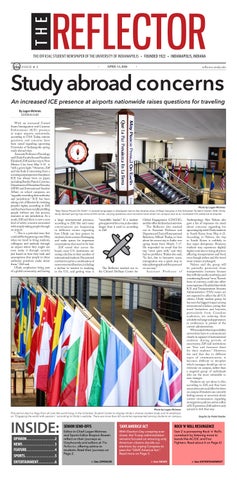
Pictured on April 6, flags from all over the world hang in the Schwitzer Student Center to display UIndy's diverse student body and its emphasis on "Engaging the world with passion," according to UIndy's website. There are more than 60 countries represented among students on campus.
The Reflector reached out to the Christel DeHaan Center for

Reach for the stars

Editor-in-Chief says goodbye to the university that shaped him

If you had told me I would be the Editor-in-Chief at The Reflector someday as a second-semester freshman staff writer in the spring of 2023, I would have told you, “No chance.”

I began my college career as a business major with a minor in religion, with the aspiration to become a pastor, before switching to a communication major after two weeks of an accounting class. After taking all the religion courses I wanted and realizing religious ministry was not my calling, I switched my minor to creative writing, which allowed me to develop as a storyteller and enhanced my communication skills.

In the fall of 2023, I had the opportunity to study abroad for the semester at the University of Stirling in Scotland, where I took courses in media studies and industries, philosophy and Scottish history. When I heard that the UIndy Study Abroad office had a partnership with Stirling, about 40 minutes outside my mom’s family in Glasgow, I jumped at the opportunity without hesitation.

As a first-generation American, I very much take pride in my Scottish heritage because it is a large part of my identity. My mom and grandparents moved to America from Glasgow in 1986, and almost all of my mom’s family still lives across the pond. My time studying abroad allowed me to not only continue my education, but to spend more time with my Scottish family, to live on my own for the first time during the week at Stirling in my flat, to live with my family members on the weekends, and to meet and spend time with family I have never met before. All of my family members were amazing and treated me as one of their own, allowing me to indulge in Scottish culture. They took me all around my

mom’s home country to explore famous Scottish monuments and landmarks, restaurants and pubs, “football” games at Celtic Park and to my mom’s stomping grounds where she grew up, teaching me what it means to be a “true Scot.”

Throughout my time at UIndy, I have made it a mission to gain experience in every area possible to grow as a well-rounded individual. As I learned from Associate Professor of Communication

Darryl Clark, “It is good to know a little bit about a lot of things and to know a lot about one thing.”

I have taken a wide range of courses, including business, communication, religion, creative writing, screenwriting, the foundations of applied radio and television, journalism and TV. Additionally, I assisted with “Good Morning Greyhounds” productions, went on-air for UIndy Radio, operated hero and game cameras for UINDY-TV football, basketball and volleyball games, and directed a UIndy men’s basketball game.

Over the past year, I have served as the Feature Editor, Managing Editor and Editor-in-Chief at The Reflector, having spent one semester in each role, climbing up the ladder. It has been a wonderful learning experience for me, as I have gotten to cover some heartwarming features and important news stories to inform the campus community. I want to especially thank my classmates and co-workers who have challenged me and made me a stronger person, through both the ups and downs of being a college student. Also, if it were not for the previous Editors-in-Chief, Mia Lehmkuhl and Luke Cooper, I would not be where I am today.

During my time working at The Reflector, I have also graduated from news channel WISH-TV 8’s Multicultural Media Producing Program, become a Nu Xi Chapter Member of the Sigma Tau Delta International English Honor Society, and I have been a script

reader and award nominator for national and international short scripts and TV pilots for the film festival co-directors at Days of the Dead, an international horror film festival and convention.

I am extremely grateful for all the opportunities I have been given during my time as a Greyhound, and I would not be where I am if it were not for my family, friends, classmates and wonderful professors who have challenged me academically, always pushing me to strive for excellence. I am beyond ecstatic to walk across the stage in just a few weeks, and I will always hold a special place in my heart for UIndy.

My next adventure is on the horizon, as I have been accepted into Emerson College’s Master of Fine Arts in Writing for Film and Television program beginning this fall. I cannot wait to meet

my new cohort of 34-36 students in the Boston Theater District and in Hollywood on Sunset Boulevard, learn from professional screenwriters and producers in the film and TV industry to grow as a writer alongside my classmates, and push toward my dream of becoming a professional screenwriter. My advice to every Greyhound is never let the words of others diminish your confidence and character, and always believe in yourself. Never let a “no” define you, and work toward the best individual you can be, never settling for less than you deserve. You have whatever it takes to succeed in anything that lies ahead of you, and you just need to take advantage of all the resources available at UIndy to get you there. I believe in you! Now is your time to believe in yourself and reach for the stars.

From baseball to bylines

As I near the end of my time at the University of Indianapolis, I would not trade my four years for anything. The experiences I have endured during my time here have shaped me into the man I am today.

Coming into college, I thought I had it all figured out. I was an all-conference football player and an all-state baseball player. I thought I would easily find my footing in college athletics. I could not have been more wrong.

Over my first two seasons on the UIndy baseball team, I tallied only 34 at-bats and five hit. I was a complete head-case and could not handle failure. My coaches could not play me at times due to my lack of mental strength.

I would spend hours in the batting cages, trying to fix things or figure out why I could not hit the ball well consistently. I would leave the facility two or three hours after practice ended, with my back and legs locking up because I had taken so many swings.

After two years of doing this day in and day out, I realized that I needed to make serious changes in my life. The ironic thing is, almost none of the changes that I made were physical: they were all mental. This is where my faith, family, friends and academics came into play.

One of my best friends from home, also a baseball player, introduced me to mental training exercises such as reading, writing, breathing, visualization and more. We would take walks and talk about our lives, sometimes not even mentioning baseball. Through his help, I developed a routine to take into my junior year that changed my life forever. That routine consisted of

relying on my faith and finding things that I enjoyed doing outside of baseball. I picked up reading books, meditation, journaling and more prayer. My perspective on life completely changed. I finally realized that in the grand scheme of things, baseball is such a minuscule part of life.

During my junior year, I did not start for the first half of the baseball season. Through my routines, I was able to keep my head on straight and be ready for my opportunity. That opportunity came on a random Tuesday game against Purdue Northwest University, where in my first atbat in my first start, I hit a home run, and the weight of the world was off my shoulders.

I started every game from that moment on, becoming a key contributor to a team that played in the conference tournament, NCAA regional and NCAA Super Regional. I also hit a home run in all three of those tournaments.

Ironically, around the same time that I started getting playing time, I was approached by the former Editor-in-Chief at The Reflector, Luke Cooper, about a position on the staff. At first, I told him no, but he and other people kept telling me that I would be great for the position. After some consideration, I applied for the role of Sports Editor at The Reflector.

I interviewed a couple of weeks before the 2025-26 school year and was offered the position. At first, I will admit, I was not very good at journalistic writing. If you could have read the first article draft, you would have thrown the paper in the trash. Thankfully, the other editors took me under their wings and helped me improve to the point where I now feel confident in my ability to write.

I am grateful that I have spent

this year covering sports for The Reflector. Working in this position has allowed me to grow and learn different avenues in the sports media landscape.

As I finish my time at UIndy, I have realized that the lessons that I have learned go far beyond the baseball field or classroom. The struggles I faced early in my career forced me to confront myself in foreign ways, but ultimately helped me grow as an athlete, and more importantly, as a person. Through my faith, discipline and the support of those around me, I learned how to handle failure, trust the process and find balance in life. Baseball gave me incredible memories, but more importantly, it gave me

The great partisan divide

The American people have joked about Congress’s lack of productivity for the better part of a century, according to Britannica, but, as the old proverb goes, “Many a true word is spoken in jest.”

The satirical characterization of our federal representatives as the “Do-Nothings” has sadly become representative of the reality in which we find ourselves.The 119th Congress has passed laws at the lowest rate in over 35 years, according to congressional records, and presided over the two longest government shutdowns in U.S. history, according to NBC.

However, this dysfunction is not something that can be blamed on one candidate, one party or even one congressional body. Rather, it is a reflection of the slow and insidious divide that has been progressively widening between the two sides of the political spectrum.

The degree of polarization that has permeated our politics has shackled our democracy, which is made evident by the fact that our representatives are more interested in assigning winners and losers than pursuing policy solutions to our most pressing issues.The current partial government shutdown demonstrates this perfectly, as both parties desperately try to assign blame to the other side.As a result,their constituents suffer, and their pleas for relief fall upon deaf ears.

This is the predictable result of a political environment that has weaponized disagreement,which itself is not detrimental to our democracy; but, it is predicated upon it. What has changed is the nature of our disagreements. Lawmakers no longer debate the best path forward, rather they argue whether the other side has the right to exist.

This sort of “no-holds-barred” approach to politics threatens the very foundations of our republic that were set in place over 200 years ago. Joe Manchin, a former Independent senator from West Virginia, argues this exact point in his book “Dead Center,” which details over a decade of his experience as a member of Congress.

“I’ve lived the reality of the deepening divide between Democrats and Republicans paralyzing Washington— turning governance into gridlock, eroding trust in our institutions [and] making genuine compromise nearly impossible,” Machin writes. “The consequences of this dysfunction aren’t just infuriating; they are reckless.When politics becomes a zero-sum game, democracy itself is at risk.”

However, we cannot assign the entirety of the blame to our elected officials.Ultimately,they are a reflection of ourselves.If we wish to see change,we must embody it - not only demanding better of our representatives, but also of each other and ourselves.

We are capable of so much more than we realize when we treat our fellow citizens with respect and dignity,endeavoring to understand the differences we may have rather than allowing them to divide us. As Martin Luther King Jr.said,“Darkness cannot drive out darkness; only light can do that. Hate cannot drive out hate; only love can do that.”

Corrections

The Reflector acknowledges its mistakes. When a mistake occurs, we will print corrections here on the Opinion page. If you catch a mistake, please contact us at reflector@uindy.edu.

Now, in my senior season, I am a key contributor to the team. I start just about every game and lead the team in some offensive categories. With just a few weeks left in the season, I am looking forward to hopefully winning many games and making a deep postseason run.

I came into college thinking that I had everything figured out. I leave knowing that growth comes from being uncomfortable, that mental strength trumps physical strength and that who I am off the baseball field matters far more than anything I could ever do on it. With all this being said, I would not trade my experiences for anything.

In our March 2 issue: University of Indianapolis’ Professor of History and Chair of History and Political Science Ted Frantz was not credited with the correct title.

Associate Professor of English and Department Chair Liz Whiteacre was not credited with the correct title. What do you think?

Send your letters to the editor or other correspondence to reflector@uindy.edu

The opinions in this section do not necessarily reflect those of The Reflector staff.

Photo by Willa Allen
Editor-in-Chief Logan McInnes smiles outside Esch Hall on the University of Indianapolis campus. McInnes looks forward to his journey at Emerson College.
Photo Contributed by Dylan Euler
Sports Editor Brayton Bowen swings at Drury University in the 2024-25 season. Bowen will graduate from the University of Indianapolis in May. perspective.

‘SAVE America Act’

President Trump’s top priority amid ongoing debate over voter access and impact

President Trump made it clear that passing the “Safeguard American Voter Eligibility Act,” better known as the “SAVE America Act,” is of the utmost importance, saying it “supersedes everything else,” according to ABC. The “SAVE America Act” was introduced in the House of Representatives on Jan. 30, 2026, but has not yet made it out of committee. However, this lack of progress has done little to dissuade President Trump, who urged Congress to cancel its Easter recess and focus on passing the bill “for Jesus,” according to USA Today. The aim of the “SAVE America Act,” according to a statement posted on Whitehouse.gov, is to decrease instances of voter fraud. The bill seeks to ensure that “only American citizens” can vote in federal elections by requiring proof of citizenship at the time of voter registration and the presentation of a valid ID at the polls. There are various forms of documentation that the proposed legislation lists as acceptable for proving citizenship, which include birth certificates and U.S. passports.

University of Indianapolis Associate Professor of Political Science, Gregory Shufeldt, made the point that it is “already a crime for noncitizens to vote in federal elections.” With the Illegal Immigration Reform and Immigrant Responsibility Act

of 1996 (IIRIRA) specifically addressing the issue, there is already “very little evidence to suggest there is widespread systematic voting” by noncitizens.

However, Shufeldt emphasized that the lack of evidence does not mean that there are not “legitimate concerns” about noncitizens voting.

UIndy Assistant Professor of Philosophy Lacey Davidson agreed with Shufeldt in this regard, but she also highlighted the importance of examining the bill’s effect on citizens who can legally vote.

“The data is not indicating that [noncitizens voting] is happening a ton,” Davidson said. “So you’ve got to ask, ‘What is the cost then?’”

Davidson said that making it harder to vote could drive some to stop participating in the democratic process entirely. She said this could also have a particularly negative impact on students and first-time voters, causing them to question the point of being involved politically to any degree.

Vote.org,a nonprofit nonpartisan organization dedicated to increasing voter participation, raises a variety of concerns about the effects the “SAVE America Act” would have on law-abiding citizens. According to a brief on their website, the bill would “fundamentally change how Americans register to vote,” which, if passed, could restrict the ability of citizens to participate in the democratic process.

UIndy Professor of Political Science, Laura Merrifield Wilson, said she believes the “SAVE America Act” could pose “an issue

in terms of accessibility,” as the bill is “certainly going to make voter registration less accessible, less efficient and harder.” Shufeldt agreed with Wilson, stating that the bill would “add additional hurdles” when registering to vote. He also noted that these additional requirements would increase the amount of time registration takes, potentially making some methods of registration effectively impossible. Wilson stated that this would especially affect “vulnerable pockets of American voters,” including those with “lower education levels, socioeconomic statuses, and first-time and older voters.”

UIndy Professor of Sociology

Amanda Miller agreed with Wilson’s view that those with lower income would be most impacted by the proposed legislation. Miller added that those who live in “more rural areas, who are transient or unhoused, and those who cannot afford the documentation,” would likely be heavily impacted.

Miller also expressed concern about the impact the “SAVE America Act” would have on married women, specifically those who have changed their names. Wilson added that this would cause an “incongruency,” as the name on their birth certificate would differ from their current legal name, requiring them to take additional steps to satisfy the bill’s standard for proof of citizenship.

The documentation requirements proposed by the “SAVE America Act” could

New ‘Hailey’s Law’

A new Indiana state law, known as “Hailey’s Law,” was proposed on March 26 to further educate children on grooming, expand missing persons alert systems and hold digital platforms accountable.

According to WTHR, Hailey Buzbee,a 17-year-old Fishers resident, went missing on Jan. 5, 2026, and was later found dead in Ohio. Because Buzbee did not have a disability or a medical condition, nor was there proof of abduction, neither a Silver Alert nor an Amber Alert was released in Buzbee’s case. This led to her classification as a runaway, according to WTHR.

The Buzbee family is proposing “Hailey’s Law,” which includes the expansion of Indiana’s alert system through a phenomenon referred to as the “Pink Alert,” according to FOX 59. The “Pink Alert” would activate when a substantial risk is indicated in a missing persons case, such as contact with unknown predators, indicators of trafficking or exploitation, or a sudden disappearance without contact or verified whereabouts, according to FOX 59.

“This is the big political argument. If we have too many alerts, people stop paying attention to them,” University of Indianapolis Associate Professor

of Political Science Laura Merrifield Wilson said.“On the other hand,there is a gap in the alert system. Silver alerts are for older people. Amber Alerts are for young minors. In this case, there was nothing they could do. By creating ‘Hailey’s Law,’if it were to pass,it would allow a vulnerable population to have some sort of alert system to try to prevent things like this in the future.”

An additional aspect of “Hailey’s

Law” is concern with the education of children on the topic of grooming. According to WBIW, the law would mandate online grooming education in Indiana schools.

According to University of Indianapolis Associate Professor of Political Science Greg Shufeldt, the youth education aspect is seemingly the most feasible because many schools already implement similar initiatives, and there are no natural opponents. However, Shufeldt acknowledged this aspect’s reliance on young people to recognize and abstain from dangerous situations, as well as its failure to stop predators

from engaging in these threatening behaviors.

“Hailey’s Law” will be considered in the 2027 legislative session, although two bills centered around child exploitation and social media protection for minors already passed during the 2026 session of the Indiana General Assembly,according to FOX 59. The first bill, “House Enrolled Act 1303,” expands the Silver Alert program to missing children and institutes a new crime regarding the distribution of child sex abuse material, according to the Indiana General Assembly. The second bill, “House Enrolled Act 1408,” requires Indiana residents 16 years old or younger to have verified parental permission to open a social media account,according to ACLU Indiana. The legislation was made possible by the Buzbee family’s advocacy, according to FOX 59.

“It takes a lot of time to raise awareness on issues, to cut across bureaucracy and to get members of political parties to agree on something,” Shufeldt said. “…While what the General Assembly did this session might not be the full extent of what the Buzbee family would like ‘Hailey’s Law’ to look like, [the lack of] organized opposition allowed this to move more quickly than we might expect.”

also impose a financial burden, which could prevent some from registering or voting, according to Miller. She said that obtaining new copies of documents that one may need to register or procuring a valid ID is not often free. Miller referred specifically to the cost of renewing or obtaining a U.S. passport, which is currently at least $165 for an adult, according to the U.S. State Department.

President Trump has also stated his desire to use the “SAVE America Act” to restrict absentee voting. In a Truth Social post, Trump said that only those who have an illness, a disability, are traveling or are actively serving in the military should be able to cast a ballot by mail. There are no provisions specifically mentioning vote by mail in the “SAVE America Act” currently, but the bill could be amended to include them.

Wilson said that efforts to restrict absentee voting would benefit the Republican party “not universally, but on the whole,” and emphasized that such efforts would ultimately “hurt both parties,” impacting older voters the most. Shufeldt agreed with Wilson in this regard, noting that mail-in voting has become a highly partisan issue since the 2020 election, with Democrats currently using it more often than Republicans. Despite this, 29% of Americans voted by mail during the 2024 election, according to the U.S. Census Bureau.

Wilson and Shufeldt both expressed concern about how

politicized the policy debate surrounding the “SAVE America Act” has become. Wilson noted that both sides are using the policy as a “talking point,” with Shufeldt adding that both sides may benefit from continuing to disagree on this issue.

“I think that the idea of democracy has been weaponized right now,” Shufeldt said. “This is just another in a long line of policy issues that Democrats and Republicans disagree on… There is very little incentive, including on election law, for the two parties to work together.”

Despite the partisan nature of the debate around the “SAVE America Act” and its potential widespread impact, the majority of Americans support the two main provisions included in the bill, according to a CBS poll. 80% of respondents were in favor of voter I.D. requirements, and 66% supported requiring proof of citizenship at the time of registration.

Both Wilson and Shufeldt said that it is reasonable to question if citizens have a complete understanding of the “SAVE America Act.” Wilson said she believes Americans generally “don’t understand legislation,” and that the bill may have far-reaching impacts they may not realize.

“Americans tend not to know a lot about elections, which is most unfortunate because this is changing the rules of the game, which is invariably going to change the outcome…” Wilson said.

Fee increases

The University of Indianapolis is bringing back four fees this fall 2026 semester that had previously been paused during COVID-19, according to Director of Student Accounts Receivable Kaylee Weir. A $20 returned payment fee is applied if a payment is returned by a student’s bank, and there is a $100 payment plan enrollment fee that can be waived if a student signs up for an Automatic Clearing House (ACH) payment, according to Weir. An ACH payment is “an inexpensive, reliable and secure way to process payments…[that] allows customers to purchase highpriced items without worrying about credit card spending limits,” according to Stripe.

Weir also said there will be a $100 late payment fee that applies if a balance exceeds $200 and is not put on a payment plan by Aug. 7, 2026. A $50 late installment fee will be charged for missed or late payment plan installments, according to Weir.

“Over the past few years, the University [of Indianapolis] has seen a noticeable increase in returned, missed or delayed payments,” Weir said. “Reintroducing these fees is meant to encourage students to stay on track financially and avoid larger balance issues down the road.”

These policies apply to all UIndy students, regardless of financial aid or scholarship status, according to Weir. She explained that students can learn more by visiting the UIndy Student Billing website, checking their eBill account or reviewing recent flyers posted around campus.

“The good news is that every one of these fees is completely avoidable,” Weir said. “Students can easily steer clear of them by following the guidelines outlined in the Financial Responsibility Agreement they accept each semester when accessing their eBill.”

Tuition will also now include required books and will increase by $680 per semester, according to an email sent out to university faculty.

Graphic by Natalie Childers
Hillary McBride highlights the importance of maintaining relationships with our bodies

Counseling psychologist and author Hillary McBride presented her lecture “What The Body Knows: A Clinical and Christian Invitation to Embodied Living” on March 30 at the University of Indianapolis’ “Showers Lecture Series.”

The series was established in 1961 and aims to elicit deep thinking about the Christian faith, according to the University of Indianapolis. It welcomes scholars from around the country to share their work in the realm of theology and transformative faith-based education.

UIndy’s Department of Philosophy and Religion hosted the event, and it was moderated by Assistant Professor of Religion Nathan Johnson. During the event, McBride discussed how faith, faith-based traditions and embodiment can both benefit and harm an individual.

Students and faculty in the audience were presented with information and opinions based on psychological sciences and the Christian faith. McBride provided those present with insights on stress, the value of developing a relationship with oneself, and, above all else, responding to one’s own needs.

The primary takeaway from the lecture was the importance of maintaining a relationship with one’s body. McBride emphasized the importance of being in the body and how to harness that connection to benefit from it.

McBride began the lecture with a story of the first time she felt truly in a relationship with her own body. She recounted an experience at a dance workshop,

The R.B. Annis School of Engineering will hold its DesignSpine Expo on April 14. The event will showcase student-led projects for various campus, corporate and nonprofit clients.

According to the University of Indianapolis, DesignSpine is a team-based experiential learning project for sophomore, junior and senior engineering students, where they create real-world projects for clients. Associate Dean and Director of Engineering Ken Reid said that student teams typically consist of five to six members, and they work together on a

30. McBride’s talk focused on the importance of

where attendees were encouraged to move without restraint. She described the discomfort and judgment that she felt during her first few workshops. During her fifth workshop, she experienced a breakthrough. McBride described the way she watched herself move, and how she looked at her hands and feet, feeling embodied by God for the first time.

McBride used this story to defend her main arguments: the body knows what it needs, and listening to your body can tell you what is coming.

“[We connect] to our bodies [by] listening to their cues, paying attention, considering them

healthy

and noticing things like fatigue, hunger, longing, dissatisfaction, delays and loneliness,” McBride said. “These are all details that matter, where if we stay with them long enough, they tell us about what needs to happen next.”

Listening to the body is pivotal to success and wellness. McBride told a story of her past, about how she was rewarded for denying her body of its needs, and how faith plays a role in many Christians’ relationships with their bodies.

She explained her experience with an acute eating disorder, which people in her circle and those of Christian faith would

applaud her discipline in denying herself of her physical needs. McBride discussed further how the Christian faith often discredits the body, believing it to be an obstacle in the journey to eternal life. It was not the points in her life where she punished herself for having physical needs that she felt in relationship with herself and God. Instead, it was the times when she allowed herself to connect with her body and her physical experiences.

McBride also argued that there is a strategy in being disconnected from the body and refusing the knowledge that our bodies might

be attempting to provide us.

“I have to imagine myself in Plato’s or Descartes’ time when illnesses would run rampant in communities, and people would be left dead without any awareness of what happened or understanding of why or what to do about it…” McBride said. “The next time you see someone…who is in grief or joy, when you feed yourself or when you weep the tears that belong to someone else, my hope is that those actions feel like invitations to see that this human being’s bodily experience [is] something beyond the limitations and the story of the sacred.”

Annual engineering exposition Showers Lecture Series

single project throughout the year, beginning in August.

Reid and Megan Hammond, associate professor of engineering and coordinator of the DesignSpine program, said that some projects are for internal organizations at UIndy, while others are for external organizations. In addition to these projects, Reid said DesignSpine also includes robotics competitions with other universities. Additionally, according to the event page, student poster presentations will be part of the April 14 event.

According to Hammond and Reid, respectively, examples of campus partners include the Department of Music and the Student Counseling

Center. External partners include the Indiana Historical Society and a scooter-based transportation initiative, said Reid and Hammond. Hammond said that what sets DesignSpine apart is how early in their college experience students participate. She said that she has heard from alumni and students returning from internships that their DesignSpine experience has given them a competitive advantage.

“One of the big things that sets DesignSpine apart at this institution is the number of years that our students get to participate in it,” Hammond said.

“The schools of engineering [at other universities] oftentimes have what’s called a capstone experience. Usually, that means

it’s the end of their program, so typically seniors have a large industry-based project.”

Contrasting with this model, Hammond said UIndy engineering students begin having these industry-based experiences as early as their sophomore year. Reid said that the real-world nature of the UIndy DesignSpine program also distinguishes it from other engineering schools.

“[DesignSpine is] an independent study [and] openended project for every team,” Reid said. “Each team has a client and a real-world problem that hasn’t been solved yet. They have all academic year to figure out how to address that problem.” Reid said he has talked to

other engineering programs about integrating this type of experience into their programs. It was easier to do at UIndy, Reid said, because DesignSpine was integrated into the engineering curriculum from the program’s inception.

One project that Hammond said was impactful was the engineering school’s work with the Basic Utility Vehicle (BUV). Hammond said BUV helps rural communities in Africa, where the technology assists with various industries. According to BUV’s website, it is a nonprofit organization based in Indianapolis. A page on BUV’s website lists poverty reduction, education, empowerment of women, health and enterprise among the program’s benefits.

Photo by Willa Allen
Counseling psychologist and author Hillary McBride presents her lecture during the University of Indianapolis’ “Showers Lecture Series” on March
maintaining a
relationship with one’s body.

Diamond dominance

Greyhounds surge toward postseason play behind veteran leadership

The University of Indianapolis’ softball team has been dominant in the 2026 season, posting a 39-3 overall record and a 13-1 conference record.

Junior utility player Cara Cooper leads the team in onbase percentage (.500) and has recorded 53 hits and 29 walks on the season. Cooper was a 2024 National Fastpitch Coaches Association (NFCA) All-American Scholar-Athlete and Academic All-Great Lakes Valley Conference (GLVC) selection, according to UIndy Athletics.

Cooper highlighted the team’s 6-0 run at Space Coast Spring Games in Florida as one of the early defining moments of the season.

“Going into that trip, we knew that none of the games would be easy,” Cooper said. “Truthfully, it showed our true team, because those were important long days. We had a couple of games that we were down in, but we fought back and ended up winning. Those games were huge.”

Cooper also acknowledged the positive impact that their coaches have had on the team, pushing them to reach their full potential.

“The way they push us every day and especially in the offseason really set us up for success this season,” Cooper said. “They made the fall hard, and that has put us in the position to win every game because nothing has been given to us, and nothing has been easy. Each day they want us to be better, and I think we’ve continuously gotten better because our coaching staff has pushed us so much.”

In conference play, the Greyhounds are 13-1 with their only loss coming in the home opener against William Jewell. This loss served as a reminder that the team must stay at the top of its game, according to senior infielder Shelby Cook.

Cook is another key player with a batting average of .377 and a slugging percentage of .585. She also leads the team in putouts with a total of 276. Cook is a 2-time All-GLVC Third Team selection, 3-time NFCA All-America Scholar-Athlete and 3-time Academic All-GLVC selection, according to UIndy Athletics.

“Every team is going to come at us with their best game,” Cook said. “We can’t take a game off or play off, because teams are always going to come at us.”

Last season, the Greyhounds’ postseason run ended in the Super Regional against Saginaw Valley (MI), where they fell in a decisive game three and narrowly missed a trip to the World Series. Both Cook and Cooper said that making it to the World Series would be a big success for this team.

“Seeing the personal goals that I’ve watched my teammates be able to achieve, that in itself is success,” Cook said. “But I think ultimately, and I know my teammates would agree, that getting back to the World Series this year would be the biggest success of all.”

With the regular season winding down and postseason play on the horizon, the Greyhounds remain focused on maintaining their high level of play. The Greyhounds are scheduled to take on the University of MissouriSt. Louis in a doubleheader on Saturday, April 18, at 1 p.m.

Tanking troubles: NBA season in review

As the NBA season nears its conclusion, the buzz around draft prospects is growing, but the real story might be the teams strategically losing their way to the top picks.

As the final games of the regular season approach, the league’s landscape is divided. At the top, contenders and surprise teams are fighting for playoff position. At the bottom, teams are going as far as benching healthy players to intentionally lose games.

According to the NBA standings, the top teams in the Eastern Conference are the Detroit Pistons, Boston Celtics, New York Knicks, Cleveland Cavaliers, Atlanta Hawks and Philadelphia 76ers. In the Western Conference, the reigning champion Oklahoma City Thunder sit atop the standings, followed by the San Antonio

Spurs, Los Angeles Lakers, Denver Nuggets, Houston Rockets and Minnesota Timberwolves.

With the NBA’s play-in tournament format keeping seeds seven through ten in postseason contention, even teams outside the top six in each conference can remain in the playoff picture.

While the play-in tournament has incentivised competition late into the season, it has also caused controversy with teams at the bottom of the standings, where franchises appear more focused on improving their draft position than winning games.

Several teams have drawn attention in recent weeks due to resting players or limiting “star” players’ minutes when those players are healthy. Recently, the NBA launched an investigation into the Milwaukee Bucks organization regarding the health and playing status of former league MVP Giannis Antetokounmpo. Allegedly, Antetokounmpo has

told the Bucks organization that he is healthy and wants to play. The organization is holding him out because they are eliminated from playoff contention and are losing games intentionally, according to ESPN.

The Indiana Pacers and Utah Jazz faltered in similar ways. Both teams violated the league’s conduct regarding reducing minutes or sitting healthy starting players for games. The Pacers were fined $100,000, and the Jazz were fined $500,000, according to Yahoo Sports.

“Overt behavior like this that prioritizes draft position over winning undermines the foundation of NBA competition,” NBA Commissioner Adam Silver said. “We will respond accordingly to any further actions that compromise the integrity of our games. Additionally, we are working with our Competition Committee and Board of Governors to implement further

SPORTS SCHEDULE

measures to root out this type of conduct.”

With the regular season winding down and the playoffs set to begin next month, NBA teams face two very different priorities: preparing for a postseason run or positioning themselves for the future through the draft.

According to ESPN’s NBA draft big board, the top five prospects are the following: (1) Darryn Peterson (Kansas) 6’6, 20.2 PPG; (2) AJ Dybantsa (BYU) 6’9, 25.5 PPG; (3) Cameron Boozer (Duke) 6’9, 22.5 PPG; (4) Caleb Wilson (North Carolina) 6’10, 19.8 PPG; and (5) Kingston Flemings (Houston) 6’4, 16.1 PPG.

With a highly anticipated draft class headlined by the players listed above, the incentive to secure a top pick has only intensified. As the regular season comes to a close, the divide between teams chasing championships and building for the future continues to define the

Cara Cooper batting in the 2026 home opener against William Jewell. The Hounds split the doubleheader, losing game one and winning game two.
NBA.
Photo Contributed by UIndy Athletics
Graphic by Brayton Bowen
Shelby Cook playing first base in the 2026 home opener against William Jewell. Cook has tallied 215 career hits in a Greyhound uniform.
Photo Contributed by UIndy Athletics

Happy “Hannaversary”

Hannah Montana is back for her very own twentieth anniversary special on Disney+

The twentieth anniversary special of “Hannah Montana” was packed with nostalgia, featuring recreated sets,interviews and songs that defined a generation growing up in the 2000s.

The special opened with Miley Cyrus performing “The Best of Both Worlds” for a crowd of devoted fans. The song was transposed to a lower key to fit her more mature voice, a subtle but symbolic change. That small adjustment made the moment emotional and showed how much she has grown and entered a new phase of life.

Cyrus said that when she first considered a twentieth anniversary, or “Hannahversary,” she thought of her godmother, Dolly Parton. She advised her, “If you want something to happen, promote it before it

exists. Then no one can say no,” according to USA Today.Cyrus began publicly mentioning the idea, building excitement among fans before the special was confirmed.

One of the most jawdropping moments came when Cyrus walked into a reconstructed version of the show’s original living room set. The attention to detail, from the lizard decorations to the famous leg table,was impressive. Because the first episode of “Hannah Montana” began in that space, seeing Cyrus return as an adult added emotional weight to the segment.

Another amazing part of the special was the recreation of Hannah Montana’s iconic closet, a dream for many young viewers. Cyrus walked through the closet with her

mother, sharing stories behind memorable outfits while clips from the show played. This segment added a personal touch and felt especially meaningful for longtime fans.

Alex Cooper, host of the “Call Her Daddy” podcast, interviewed Cyrus, offering insight into the behindthe-scenes experiences of filming the series.This portion helped deepen the audience’s understanding of the show’s impact and production.

Cooper and Cyrus discussed what the audition process was like, and Cyrus mentioned that during the audition, she was more worried that she would get replaced on the cheer team than getting the role, which I thought was a funny anecdote.

One surprising element was the appearance of Chappell Roan. She said Cyrus “walked so I could run,” which made the segment feel somewhat unnecessary and out of place within the special. Roan did not add much to the special, and I would rather have had a super fan or a “regular” person be featured.

The special also featured Selena Gomez, who joined Cyrus to reminisce about their time on the show. While this was a nice addition, the absence of the main cast members such as Emily Osment, Jason Earles and Mitchel Musso was noticeable, given their larger roles in the series.

The special closed with Cyrus performing a new song and reflecting on this milestone: “It’s been an honor to celebrate 20 years with Hannah Montana, and I’ve looked back at every memory with a heart full of love,” Cyrus said.“Hannah, she gave me my start, but my fans gave me this life.”

Rock ‘n’ roll resurgence

Conversations about whether or not ‘rock is dead’ are ongoing, and while some may choose to believe it, Generation Z seems to say the opposite. The connection of rock music among youth and culture has had effects that have been long-lasting, according to Pace University. Rock music has recently been showing a similar effect on today’s generation, mainly credited to the largest social media platform, TikTok. TikTok is a significant platform when it comes to helping small artists turn big, influencing the careers of artists such as Olivia Rodrigo, PinkPanthress and Maneskin, according to Time Magazine. This concept allows the main demographic of the app to discover multiple musical artists, genres and backgrounds. The rise of the digital age makes everyone more aware of what is popular and ‘relevant’ in today’s society.For example,in 2023, the specific rock genre of nu-metal was at its highest it’s ever been in the past 20 years, according to Loudwire.

Rock music can be a broad genre. It includes numerous subgenres such as indie rock, hard rock, alternative

rock, soft rock, etc. This allows people to have multiple options to choose from while they are feeling certain emotions, or a certain vibe that can easily make them feel connected to a song, sound or band. These types of genres can allow members of Gen Z to feel a certain sense of authenticity that in today’s world full of AI-generated music, may be rare to find, according to Rock Scene Auctions.

Most notably among Gen Z is a genre known as ‘dad rock,’ which can be a way of insinuating a ‘hipster-insult’ of one’s rock music taste, according to Esquire. This helps this genre become more recognizable among Gen Z with bands such as Foo Fighters, Nickelback and AC/DC. This also causes an immediate connection among generations. The people of Gen Z who listen to rock music most likely have learned of that world from their parents, grandparents or older siblings.The love for rock music is often translated down through generations, which is another reason why the rock scene is reemerging throughout today’s generation, according to Rock Scene Auctions.

The combination of modern day social media use and past generations giving Gen Z rock music hand me downs, double onto the interest, recognition and fascination of rock and roll.

Bridging representation gaps

“Bridgerton” has become one of Netflix’s biggest hits since its release in 2020. The show is known for its inclusivity, yet the addition of a sapphic couple has caused rounds of controversy on the internet.

“Bridgerton,” for the past three seasons, has centered around a different romantic relationship. Speculation of the next lead has caused much debate within the world of period drama online circles. The debate between Eloise and Francesca being our main character was a strong one, but it all came to

an end when Netflix posted their announcement with Masali Baduza (Michaela Stirling) and Hannah Dodd (Francesca Stirling) as love interests. This announcement generated mixed reactions. Some were ecstatic at the notion of finally getting queer representation in something like a period drama. According to a post on X, “Franchaela’s Bridgerton season is everyone’s chance to show up for lesbians the same way they do for gay men. You care about love & queer/POC representation? Great! Here’s a queer romance with a black woman as one of the leads! That won’t be cancelled! Tune in!” Others, however, had a more

negative outlook on the situation. According to a post on Threads,“I’ve been waiting for Bridgerton to cast a black woman as a love interest only for them to disappoint. I’m in no way homophobic, but I do not want to watch an entire season of women kissing each other either. Hard pass.”

This controversy is not particularly new within the Bridgerton fandom. The end of Season 3 also caused controversy, according to Slate, due to a key character being introduced to the audience as Michaela instead of Michael, as the original “Bridgerton” novels had it. The changing of the gender seems little

to some viewers, but to many, this seemingly erases a larger plot point from the original text.

However, if the book’s integrity is the argument that is being used, has the show not veered from the source material before? Many of the stories told on screen have been far from what was originally written, and no one seemed to have an issue with the content then. Daphne was not a diamond and was on the shelf for several seasons. That should make the people who are angered about this for any sort of “book purist” reasons angry from the first episode of the first season. So why this story in particular? The outrage is not really about loyalty to

the books, nor is it about preserving historical accuracy in a show that has never claimed to do so. It is about discomfort—about whose love stories those find worthy of grand ballrooms, sweeping scores and ultimately, that end-all be-all happily ever after.

“Bridgerton” has always reimagined the past through a more inclusive lens, asking the audience to suspend belief in favor of possibility. Season 5 is simply continuing that tradition. The question is no longer whether the show has changed, but whether its audience is willing to grow with it. If love is meant to be the centerpiece of this world, it cannot be conditional.

UIndy’s drag show shows out

A variety of aesthetics, voices and emotions took the stage at the University of Indianapolis on March 27.

UIndy has held an annual drag show since 2005, according to UIndy Pride. This year’s show was dedicated to former UIndy PRIDE Club member Stevie Cox, according to the secretary of the UIndy PRIDE board, Trinity Bell. After attending UIndy, Cox worked as an advisor and professor at the university from 2020 until 2022.According to UIndy Pride,

Cox was a huge part of the UIndy Pride club and an inspiration to the queer community on campus, making a real impact on everyday lives. Due to their passing this summer, the PRIDE club wanted to have something meaningful to remember them. This show felt like a celebration of both their life and impact. The drag show had nine performances from Carmilla Vestonia, Transfemme Vittorino, Nyx Eclipse, Nathan but a Snack, Viper King, Jeanette “Jenny” DeValium, Solstice, Karma and one alumni performer, Vintage Lips. The show’s two anonymous hosts, Jane and Trin, welcomed every drag queen and king

onto the stage with quirky intros and outros that matched each performance. Their commentary helped keep the energy up between acts and made the show feel engaging for the audience. Each performer had their own aesthetic and stage presence, which made the show feel diverse and exciting from beginning to end. My personal favorite was Jeanette DeValium dancing to Breaking Dishes by Rihanna and Circus by Britney Spears. They were a captivating performer with lots of sass and confidence, and it was clear the audience loved every second.I also loved the spunky wigTransfemme Vittorino wore, which was a blonde wig with pigtails that stuck out and

bounced with every movement. Vittorino had a very energetic and playful stage presence that was difficult not to love. Viper King had a strong K-pop aesthetic, with intense and sharp dancing to songs by BTS that really stood out. A crowd favorite that was not on the competitive ballot was Vintage Lips, performing Big Spender and Mommy Issues. As a UIndy alumni who had previously known Stevie Cox, you could tell the performance was emotional, not just for them but for the audience members as well.It added a deeper layer to the show’s purpose. To conclude the show there was a surprise song at the end where all

the drag queens and kings came out to dance improv too. “Proud Mary” by Tina Turner was a favorite song of Cox’s, so the performance of that song was a nice way to highlight their life and lively spirit once again.

The overall standings had Viper King in third, Jeanette in second place and Solstice in first. The competition was fun, but what stood out most was how supportive everyone was of each other. The crowd cheered loudly for every performer, and the sense of community in the room was really strong. Overall, the night felt like more than just a performance, but a celebration of talent, identity and remembrance.

Graphic by Natalie Childers

Turn static files into dynamic content formats.

Create a flipbook