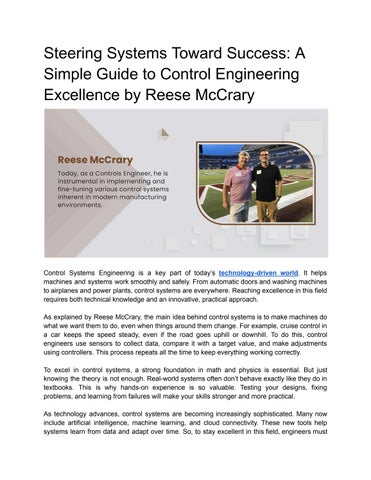
Steering Systems Toward Success: A Simple Guide to Control Engineering
Excellence by Reese McCrary

Control Systems Engineering is a key part of today’s technology-driven world. It helps machines and systems work smoothly and safely From automatic doors and washing machines to airplanes and power plants, control systems are everywhere Reaching excellence in this field requires both technical knowledge and an innovative, practical approach.
As explained by Reese McCrary, the main idea behind control systems is to make machines do what we want them to do, even when things around them change For example, cruise control in a car keeps the speed steady, even if the road goes uphill or downhill To do this, control engineers use sensors to collect data, compare it with a target value, and make adjustments using controllers This process repeats all the time to keep everything working correctly
To excel in control systems, a strong foundation in math and physics is essential. But just knowing the theory is not enough Real-world systems often don’t behave exactly like they do in textbooks This is why hands-on experience is so valuable Testing your designs, fixing problems, and learning from failures will make your skills stronger and more practical.
As technology advances, control systems are becoming increasingly sophisticated. Many now include artificial intelligence, machine learning, and cloud connectivity These new tools help systems learn from data and adapt over time So, to stay excellent in this field, engineers must
keep learning Following tech news, taking online courses, or joining engineering groups can help you stay up to date.
Another key part of success is communication. Control engineers often collaborate with various engineering teams, including software, electrical, and mechanical. Being able to explain your ideas clearly, both on paper and in conversation, can make a big difference Good teamwork can turn a complex problem into an innovative and simple solution.
Becoming excellent in control systems engineering takes more than classroom learning It’s about combining theory with practice, staying current with new tools, and working well with others If you stay curious, keep learning, and enjoy solving problems, you’re already on the right path Control systems may be complex, but the steps to master them are simple when taken one at a time.