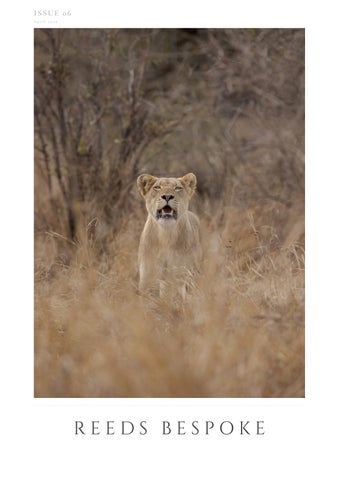
Reeds-Bespoke - Issue 06

Page 1


THE LANGUAGE OF PLACE

Notsimplyspoken,butfeltthroughtexture,,scent,andspace

There are countless elements to a safari that quietly take hold of the senses Those who shape these experiences, whether a guide behind the wheel or the hand that chose the fabric on a daybed, understand that nothing is incidental Every detail carries weight

And yet, it is rarely the obvious that stays with you.

More often, it is something smaller You’re out on a sundowner drive, a soft breeze moving gently through the vehicle, carrying with it a scent, a warm, almost like roasted potatoes Your guide mentions, in passing, that it comes from the potato bush, and then, some time later, you ’ re at home, preparing dinner for the night The same familiar scent rises, and without warning, you ’ re taken straight back to that moment These are the things that settle, almost unnoticed, and return to you later

These are the moments that linger.

To be immersed in this environment is not easily defined; words rarely do justice to the feeling it leaves behind The moments you expect will define the journey, but often fall away with time The photograph, the sighting, the moment you thought you would hold onto What remains is something else entirely

The restraint of a guide who chose silence over explanation The quality of stillness,

Or the feeling of being entirely removed, yet completely present. Luxury, in its truest form, is found here In the ability to step back and fondly remember the thoughtful details that shaped your journey

And perhaps what we carry with us is more than just a photograph, but a language only those who have experienced it can understand

THE REEDS BESPOKE TEAM

TABLE OF CONTENTS

Lebombo Mountains
Monwana
Karien Bendle
Defenders of the Wild
Anne Russell

MONWANA

COMINGHOME

“ Quiet, considered, and undeniably luxurious ”

Set within the Thornybush

Game Reserve, Monwana Game Lodge presents itself with a quiet confidence. There is no need for excess or statement; its presence is assured, its offering considered From the outset, it is clear that this is a property shaped by intention and deeply rooted values

Architecture and design sit at the heart of the experience Monwana does not attempt to compete with its surroundings; rather, it yields to them Clean lines, natural materials, and a muted palette allow the bush to remain the focal point, while still delivering a sense of contemporary ease Stone, timber, and soft textiles are layered with restraint, creating spaces that feel both grounded and refined

The flow of the lodge is seamless. Indoor and outdoor spaces are thoughtfully connected, encouraging a natural rhythm to the day, allowing you to indulge in the idea of being on vacation Morning light filtering through open living areas, afternoons spent in shaded lounges, and evenings drawn outward toward firelight and sky There is a sense that every space has been designed not only to be seen, but to be lived in

One of the more striking details lies just beneath the surface, quite literally A glass viewing panel reveals the lodge’s perfectly stocked and meticulously curated wine cellar It is an understated feature, subtly integrated into the space, yet one that speaks to a deeper level of thought; an understanding that luxury is often found in the details that are quietly discovered rather than overtly presented

The suites and private residences continue this narrative Stone, timber, and layered textiles create a sense of depth without distraction Nothing feels overworked about this property. Instead, each space is resolved with restraint, allowing the eye to move easily between interior and exterior Perfectly positioned day beds, with private plunge pools, allow you to ease into the afternoon, all while having the opportunity to observe a herd of elephants that move quietly to the watering hole

And in many ways, this is where Monwana distinguishes itself. It is not defined by spectacle, but by its ability to create space for moments like these to unfold naturally

Time on safari within Thornybush is both

varied and rewarding. The reserve offers consistent access to a wide range of species, with landscapes that shift subtly between open clearings, denser thickets, and seasonal water sources

What defines the experience here is not only the quality of sightings, but the manner in which they are approached

Guide and tracker work in unison, providing you with guiding that is measured, instinctive, and deeply informed While sightings were, at most times, exceptional, it was their ability to interpret behaviour, anticipate movement, and read the environment that made you eager to head straight back out after returning

Each drive unfolds unhurriedly, with space given not only to the wildlife, but to the landscape itself There is a pace to it, and it is one that allows you to absorb rather than simply observe Sundowners are thoughtfully positioned and quietly refined Soft, golden light catches the edges of polished glassware, with carefully selected flora adding subtle detail to the overall setting It is these considered touches that elevate the experience Less about the moment itself, and more about how it is delivered.

Returning from game drives, there is an immediate sense of ease The team anticipates your arrival without formality as refreshments appear, spaces are prepared, and the shift from exploration to relaxation feels entirely natural It is here that Monwana’s strength becomes particularly apparent There is no need to recalibrate; the

experience simply continues, uninterrupted

Mowana provides you with a style of hospitality that reflects professionalism, where the guest is never aware of the effort behind it For those accustomed to high-end travel, this level of consistency will feel both reassuring and expected The cohesion of the team is unwavering. Nothing ever feels forced or overly attentive, yet every detail and engagement is managed with precision

Dining at Monwana reflects a confident and well-executed approach to cuisine, where technical skill and quality ingredients are clearly prioritised Dishes are prepared with a clear understanding of flavour, and a need for you to thoughtfully taste each element What distinguishes the experience is the consistency across all meals From lighter midday offerings to more substantial evening dining, the standards remain high, and each

meal is a subtle celebration of flavor

There is, ultimately, a clarity to Monwana

A property that understands its place within the andscape and does not attempt to overshadow it

A design philosophy that values restraint over xcess, and a team that delivers with quiet precision Monwana offers an experience that ingers, not because it demands attention, but because it allows you to give yours

n a world where luxury is often equated with more, Monwana offers something altogether different

A place to come home to

THE SHAPE OF THE LAND

An open, deliberate landscape where light, space, and tempo guide the experience

The Lebombo region does not announce itself in the way many landscapes do. It does not rise

dramatically, nor does it overwhelm with density or spectacle Instead, it slowly reveals itself through line, light, and a quiet, almost architectural sense of space

Running along the eastern edge of Kruger National Park, the Lebombo Mountains form a natural boundary between South Africa and Mozambique But to think of them purely as a border would be to miss their significance entirely They are not a barrier, but a transition, a subtle shift in terrain, in ecology, and in atmosphere.

The geology is ancient Basalt ridgelines run in long, deliberate strokes across the horizon, their forms worn and softened over time The land undulates rather than rises, creating a sense of quiet movement that is never static and never imposing. There is a pace to it that reveals itself not through scale, but through repetition and variation

Vegetation follows this same pattern The Lebombo region is more open than the riverine forests to the west, more sparse than the dense bushveld many associate with safari Trees stand with intention rather than abundance Euphorbias, knobthorns, and scattered marula shape the landscape in a way that feels composed rather than wild, as though each element has been placed with restraint rather than left to compete

It is in this openness that the region finds its identity. There is space here, not only in the physical sense, but in the way the land allows the eye to travel and settle Sightlines extend further, and the horizon feels closer and more defined The relationship between sky and land becomes more apparent, more deliberate. Light behaves differently in this environment It lingers across surfaces, revealing texture rather than obscuring it, softening edges rather than sharpening them

Morning arrives without urgency The first light moves across the ridgelines in long, shallow angles, catching the edges of rock and leaf before settling into the valleys below

The transition into the day feels gradual, almost considered, as though the landscape resists sudden change By late afternoon, that same light begins to recede, drawing out muted tones from the basalt and dust, creating a palette that is layered rather than contrasted

Evenings carry a particular stillness. As the sun lowers, the region shifts in temperature, in colour, and in pace Shadows lengthen across the ridges, and the air seems to hold its position for a moment longer than expected It is not a dramatic transformation, but a measured one, where each element adjusts in quiet sequence rather than all at once

Sound follows a similar pattern. In the openness of the Lebombo, it carries further and with greater clarity Bird calls move across distance without interruption, and the movement of animals is often heard before it is seen There is less concealment here, and as a result, less immediacy. Encounters tend to unfold over time, allowing for a different kind of observation, one that is less reactive and more considered

This changes the nature of guiding within the region. It becomes less about proximity and more about interpretation Reading the land, understanding how animals move through space, and recognising patterns that are only visible when distance is allowed to exist There is a calmness to this approach, a sense that the experience is shaped as much by what is understood as by what is seen

Wildlife responds to these conditions in kind Predators move with purpose across open ground, their paths often visible long before they are encountered Herds gather and disperse in ways that feel structured, their movement guided by terrain rather than hidden within it Elephants traverse the ridgelines with a familiarity that suggests continuity

Their routes were shaped over generations Despite this openness, the region does not feel exposed

There is a quiet sense of containment, created by the gentle rise and fall of the land and the way the ridgelines hold the horizon in place. It creates a feeling of being within the landscape rather than separate from it, of moving through a space that is defined without being enclosed

The Lebombo does not rely on spectacle to define itself. Its strength lies in its consistency, in the way each element supports the next without drawing attention away from the whole The experience is not built around singular moments, but around a sustained sense of presence that develops over time

It is a landscape that rewards attention, not with intensity, but with clarity

THE SILENT FRONTLINE

K9 Units of the Sabi Sands

The meeting is arranged over the radio, quietly and without urgency

We are out on drive when Lucy suggests we make a short detour, just a set of coordinates and a time that suits both vehicles. When we arrive, the scene is understated A truck is parked in a small clearing and Dian Louw is already preparing Rex is still on the back of the vehicle, leaning casually over the rail, mouth open and relaxed, taking in the surroundings.

At first glance, there is little to distinguish him from any other well-trained dog accustomed to the bush As Dian speaks, explaining the setup, Rex’s posture shifts intermittently, subtle but precise The mouth closes. The ears lift. The focus sharpens. Then, just as quickly, it softens again It is not restlessness It is readiness, held just below the surface

Dian opens the tailgate, and Rex jumps down lightly Before anything else, he shows us the collar It is a simple object, but it defines the moment When it goes on, Rex is working There is no transition period By this point, a series of scent stations has already been laid out, PVC elbows placed methodically across the ground, each holding a controlled scent To us, they appear identical Dian holds a Kong in his hand

It is not a casual reward; it is the endpoint of the process. The work leads to the reward, and the reward reinforces the work Everything is structured around that exchange The collar is secured

Rex is released

He moves through the line of scent stations with intent. There is no urgency, but there is no distraction either Each cone is approached, checked, and cleared in sequence Then the change A sit, immediately

He stands again, repositions, and sits once more. The sequence repeats, precise and insistent Each sit is a signal; each return to standing is a demand to be acknowledged He nudges forward, closing the space to Dian There is no ambiguity in what he is communicating He has found it Dian confirms, pauses just long enough to remove doubt, and throws the Kong into the bush

Rex is gone in an instant, breaking into the vegetation with a level of speed that makes the preceding stillness feel almost improbable.

What becomes clear, standing there, is that Rex is not operating within a single skill set Dogs deployed in anti-poaching units across the Sabi Sands Game Reserve are among the few trained across multiple disciplines, scent detection, tracking, and apprehension Each of these, on its own, requires a high level of specialization Combining them, particularly in a Big Five environment, is less common Belgian Malinois, such as Rex, are selected for their ability to operate across all three They can detect the presence of ammunition or contraband by scent, follow a track across varied terrain over long distances, and, when required, engage in controlled apprehension

The expectation is not competence in each area, but proficiency, maintained under conditions that are neither controlled nor predictable

This capability sits within a wider system that has developed in response to sustained pressure on wildlife populations across the Greater Kruger National Park Rhino, in particular, remain a primary target for organised poaching networks operating with defined structures and access to resources. The response reflects that level of organisation Aerial surveillance, including drones equipped with thermal imaging, extends coverage into the night Ground teams operate with night vision Intelligence units track patterns and coordinate movements across reserves.

Within this layered approach, K9 units serve a specific function They confirm presence, define direction, and reduce uncertainty at the point where decisions need to be made quickly. Before their integration, tracking outcomes were often inconsistent, with success rates frequently in the single digits once conditions deteriorated

With trained dogs, that equation changes When a viable scent is established, the probability of a successful follow-up increases dramatically often exceeding ninety percent

In conversation, Dian speaks briefly about his experience prior to working within privately managed reserves. The challenges he describes extend beyond the physical demands of the role In some environments, risk was not limited to external threats He refers to death threats and attempts to poison conditions that introduce a different layer of complexity, one that is less visible but no less significant

Within privately operated reserves such as Singita, the structure is more controlled Resources are more consistent, teams are tighter, and oversight is clearer

The work itself, however, retains its intensity It requires precision, trust, and the ability to operate effectively under pressure, often in isolation

By the time we leave, the light has shifted The drive resumes, and with it, the experience returns to its familiarity Wildlife appears again, uninterrupted The reserve presents as it is intended to, composed, accessible, and intact

What sits behind it is less visible The work carried out by units such as Dian and Rex operates in parallel, addressing threats before they intersect with the guest experience It is not staged, and it is rarely seen.

It is measured instead in outcomes, quietly accumulated, and increasingly defined by a level of precision that begins with a dog lowering its nose to the ground and removing uncertainty from the landscape.

THE SAFARI AESTHETIC

A conversation with Anne Russell

Well-travelled and no strangers to the world’s most considered destinations,

Anne Russell and her husband, Dodd Russell, had long spoken of Africa; yet had never quite made the journey That changed this past season,

when they joined Reeds Bespoke for their first safari adventure. It was, by all accounts, a longoverdue introduction And one that clearly left its mark, with a return already planned to celebrate a special birthday

As planning for any safari can be overwhelming, we sat down with Anne to discuss how she prepared for her trip, and overcame the challenge of “limited luggage weight and dimensions”

For your first safari, what was your approach to packing? Did practicality lead, or were you determined not to leave your personal style behind?

My approach to any packing challenge always begins with function, and then I layer in as much style as I can Ahead of the trip, I created a Pinterest board and pulled inspiration from magazine imagery to refine my wardrobe It helped me visualise how everything would come together before I even began packing

Safari wardrobes often lean toward neutrals Did you fully embrace the classic palette, or find ways to make it your own?

I like to begin any trip with a clear colour palette. It makes packing far easier (especially when working within weight limits), as everything can

be mixed and matched. I started with the traditional safari tones such as khakis, olives, and neutrals, but introduced subtle personality through details An animal print, or a pop of colour through accessories like scarves, bandanas, or some fun earrings, made everything feel more personal without straying too far from the setting

Which item in your suitcase proved to be indispensable?

Without question, my scarf. It was something I reached for constantly It kept me warm on early morning drives, and was also a great layer over a dress in the evenings

It’s incredibly versatile. Worn around the neck, pulled over the face, or even used as a belt It became part of my daily uniform

Early mornings on safari can be cooler than expected What became your go-to layer?

A fleece vest It was the perfect mid-layer, light enough to wear comfortably, but warm enough to make a difference On colder drives, I would layer it under a wind or rain jacket, which worked perfectly

Every safari wardrobe has one indulgent piece. Was there something you brought simply because you loved it?

I brought an animal print dress that I couldn’t leave behind Even though evenings are quite relaxed, it felt nice to dress up slightly after an exciting, dusty day in the bush

Accessories can quietly define a safari look What became part of your everyday style?

Once again, a scarf was my absolute must You can pull it up around your face when it’s dusty, wrap it around your neck for warmth, or pull your hair back from your face if the breeze picks up It really is quite a versatile accessory.

Footwear is often overlooked, but critical What worked best for you?

I rotated between two pairs: my Frye Veronica Flex Combat boots and ON Cloudrunner 2 waterproof sneakers The boots gave me extra coverage of my ankles and protection, while the

sneakers were ideal for walking safaris Focusing on the need for only two pairs of shoes

Did you plan your outfits in advance, or rely on versatility once you arrived?

I planned everything ahead of time I built my wardrobe around core safari colours, then laid everything out before packing to ensure it all worked together. A simple rule I followed was three tops for every pair of trousers With laundry services available at most lodges, this made packing far more efficient

Was there anything you packed that you didn’t need?

I would recommend checking with your lodge beforehand I brought a hat, only to find the lodge provided something very similar, and this hat was strictly a safari choice

For someone heading on their first safari, what are three non-negotiables?

A vest, a good pair of boots or shoes, and a reliable pair of sunglasses

As you prepare for your next safari, would you change anything?

I would bring more self-care essentials, particularly for skin exposed to sun, wind, and dust A good exfoliating cleanser, a rich moisturiser or mask, lip balm, facial wipes, and an SPF face buff would all make a difference (I have heard the Reeds Bespoke team is designing some for our next safari!)

I would also bring a pair of clear glasses for protection on cloudy days when sunglasses aren’t necessary, but dust still is

One game drive essential: Sunglasses

Preferred sundowner drink: Bubbly always a reason to celebrate the day when on safari

Sunrise or sunset? Sunrise

As with most things on safari, there is a quiet balance to be found Practicality always comes first, but that doesn’t mean personal style needs to be left behind. Anne’s approach reflects something we often come back to at Reeds Bespoke, where the safari aesthetic is not about dressing for the environment, but dressing within it Thoughtfully, comfortably, and with just enough individuality to make it your own

Because in the end, the safari aesthetic isn’t about getting it perfect It’s about feeling comfortable, considered, and at ease in your surroundings And when that comes together, everything else tends to follow.

KARIEN BENDLE

On Craft, Culture, and the Quiet Details of Luxury

At Ellerman House, the experience is often described in terms of place the views over Bantry Bay the art collection, the sense of quiet discretion But behind it, there is a different architecture at work: one of people, systems, and standards

Karien, the hotel manager, sits at the center of that structure. Her path into the role was neither linear nor particularly well-designed. Instead, it reflects something far more telling about the property itself, a culture that allows people to grow into responsibility, rather than simply step into it.

What follows is a conversation about that progression, and about what luxury hospitality looks like when it is built from the inside out

You’re currently the hotel manager at Ellerman House. How did that journey begin?

I didn’t start in a management role, and I think that’s an important part of the story My journey into hospitality wasn’t something I mapped out from the beginning; it evolved over time

At Ellerman House, I’ve had the opportunity to grow within the business, understand different aspects of the operation, and take on more responsibility as I've progressed That kind of internal development is quite rare, and it gives you a very different perspective on leadership You understand the details because you ’ ve worked within it.

How does that progression influence the way you manage your team today?

It changes everything

When you ’ ve worked across different roles, you understand the pressures, the expectations, and the small details that make a difference in each department You’re not managing from a distance; you ’ re managing with context

It also creates a different kind of culture There’s an understanding that growth is possible, that people can move within the business and build something long-term That’s incredibly powerful in hospitality, where continuity and consistency are so important

Ellerman is known for its highly personalised guest experience. Where does that really begin?

It starts before the guest even arrives

Something as simple as being welcomed at the airport, which we offer as a complimentary service, sets the tone immediately It’s not just about convenience; it’s about removing friction from the journey and creating a sense of ease from the outset

From there, every interaction builds on that first impression The goal is not to overwhelm the guest, but to anticipate what they need before they have to ask for it

What defines great service at this level?

Consistency, more than anything else.

Luxury is often associated with grand gestures, but in reality, it’s the small, repeated details that define the experience It’s how a guest is greeted, how information is remembered, how seamlessly things happen in the background

When those details are executed consistently, the experience feels effortless And that’s ultimately what we ’ re trying to achieve

How do you maintain that level of consistency across a team?

It comes down to culture and communication. You need a team that understands not just what to do, but why it matters. When people understand the intention behind the service, they’re able to deliver it in a way that feels natural rather than scripted.

Training plays a role, of course, but culture is what sustains it When the team takes pride in what they’re doing, that consistency becomes part of the environment, not something that has to be constantly enforced

There’s a strong emphasis on internal growth within Ellerman. How important is that to the operation?

It’s a fundamental part of our culture We’ve seen individuals start in very different roles and grow into positions of real responsibility within the business That kind of progression creates loyalty and depth within the team

People aren’t just performing a role; they understand the property, the guests, and the standards at a much deeper level And that translates directly into the guest experience

Looking at the broader industry, what do you think is often misunderstood about luxury hospitality?

That’s a good question. I think the perception is that luxury is about excess.

In reality, it’s about precision

True luxury is not about adding more, it’s about refining what’s already there It’s about understanding what matters to the guest and delivering that in a way that feels considered and effortless

The best experiences are often the ones that don’t feel forced They feel natural, and they feel personal

How do you personally define a successful guest experience?

For me, it’s when everything feels effortless from the guest’s perspective.

Not in a way where nothing is happening, but where everything is happening without them needing to think about it. They feel comfortable, looked after, and able to fully relax into their time here

If a guest leaves feeling like their stay was seamless and personal, then we ’ ve done our job properly

What does a typical day look like for you in this role?

There isn’t really a typical day, which is part of what I enjoy

You might start the morning by focusing on arrivals and ensuring everything is in place for incoming guests, then quickly shift to an operational task, whether that’s team coordination, problem-solving, or adjusting plans as the day unfolds

A big part of the role is staying present You have to be aware of what’s happening across the property at all times, but also available to the team and to guests

It’s a constant balance, but that’s what keeps it interesting.

What’s something guests might not notice, but makes a big difference behind the scenes?

A lot of it comes down to communication There’s a huge amount of information being shared throughout the day, guest preferences, timings, and small details that need to be remembered and carried through different departments When that communication flows well, everything feels seamless to the guest

They don’t see it, but they feel it And when it’s not there, that’s when things start to feel disjointed

What do you personally enjoy most about working in this kind of environment?

It’s the people, both the guests and the team.

Every guest arrives with a different story, different expectations, and different reasons for being here. Being part of that, even in a small way, is very rewarding.

At the same time, watching the team grow and develop is just as important Seeing someone gain confidence in their role, or take on more responsibility, is something I really value It’s those moments that make the work feel meaningful

What advice would you give to someone looking to build a career in luxury hospitality?

Be patient with the process

It’s not something that happens overnight, and the best experience you can gain is by being involved at different levels The more you understand the details, the stronger you become in your role over time

And I think it’s important to stay open-minded, hospitality can take you in directions you didn’t expect, but that’s often where the most growth happens

“ Training and growth is a fundamental part of our culture”

At Ellerman House, the experience is often described through its setting the views, the art, the stillness of the space But as Karien makes clear, the real foundation lies elsewhere

It’s in the discipline of detail, the continuity of a well-aligned team, and a culture that values progression as much as precision Not imposed, but understood

There is a quiet rhythm to it Systems working in the background, decisions made before they’re needed, a standard that holds whether it’s visible or not. Nothing exaggerated, nothing forced.

What the guest experiences is ease. What sits beneath it is structure.

And like all well-run properties, the difference is not found in a single defining moment, but in the accumulation of many, each one considered, each one consistent, each one reinforcing the next. It is this accumulation, more than anything else, that defines the place

“Luxury

is not defined by what is added, but by what is left out ”

Turn static files into dynamic content formats.

Create a flipbook
Reeds-Bespoke - Issue 06 by Reeds-Bespoke-Travel - Issuu