PRE-PROFESSIONAL DANCERS
PRE-PROFESSIONAL DANCERS
Story & photos by Kate Barker
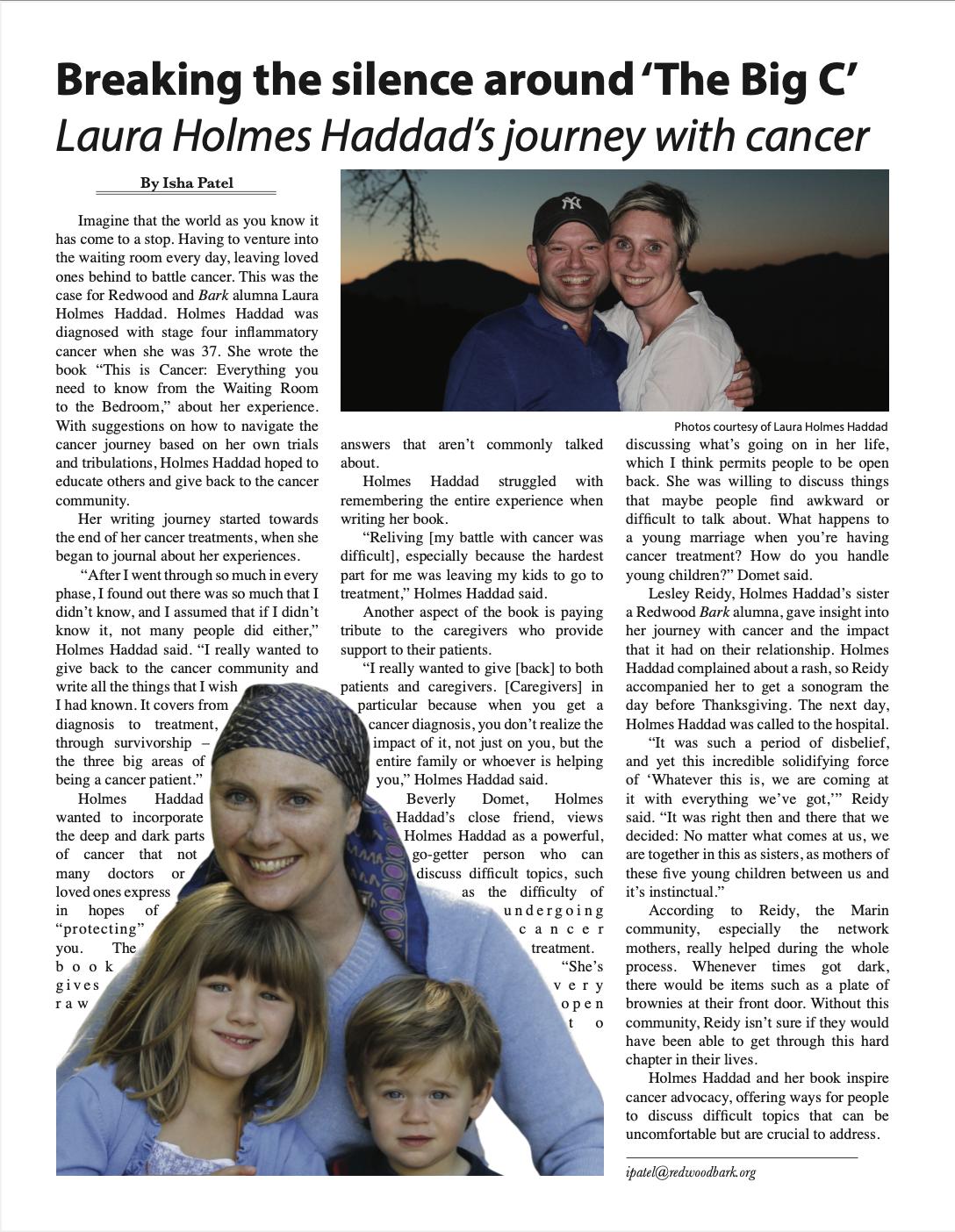
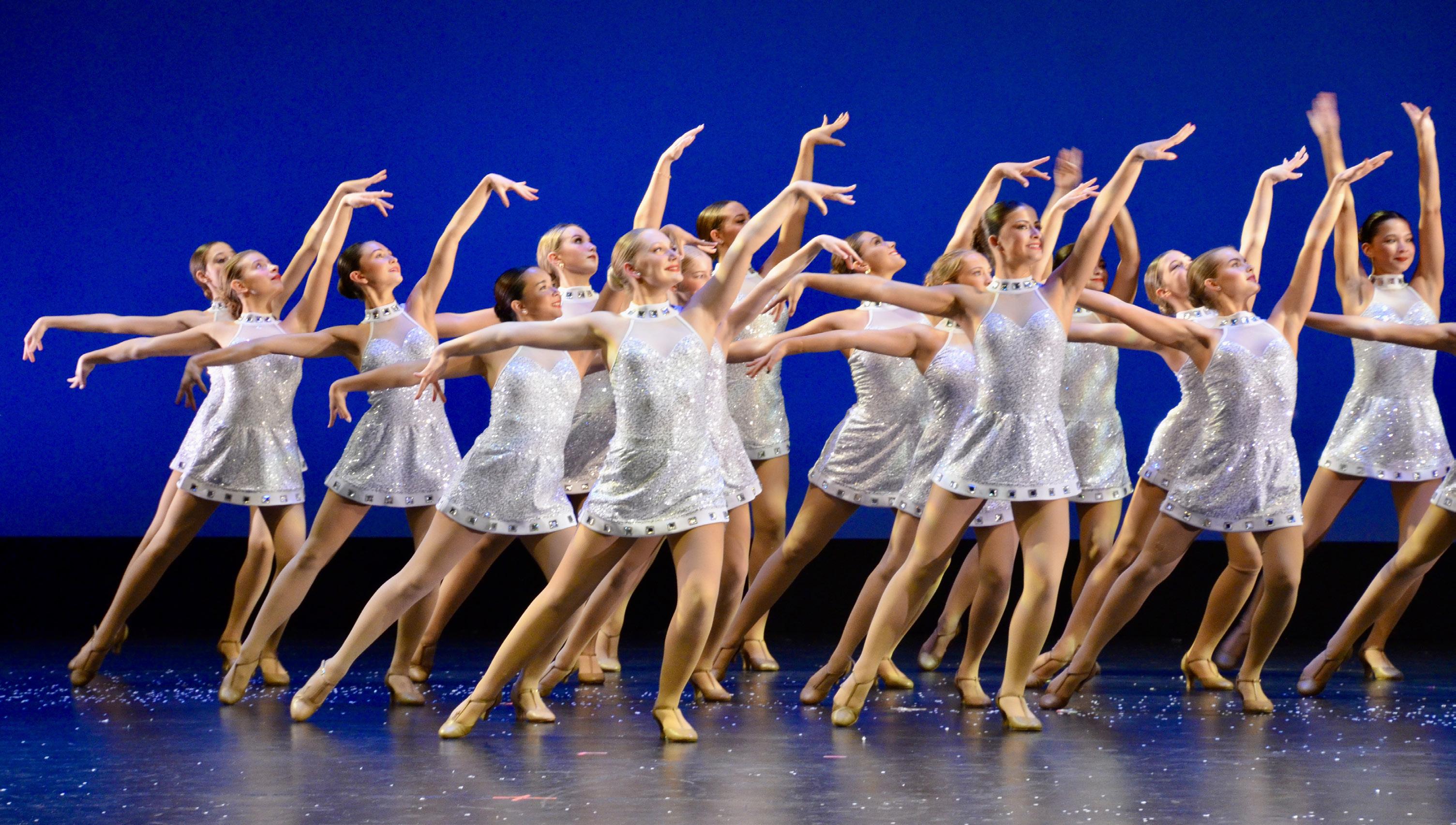
From hip-hop elves to cotton candy fairies and reindeer Rockettes, Performing Arts Academy of Marin’s (PAAM) annual Holiday Spectacular show featured a blend of festive performances to celebrate the holiday season. This year’s performances, on Dec. 6 and Dec. 7 at the Palace of Fine Arts in San Francisco, marked the 13th anniversary of the Holiday Spectacular, a beloved holiday tradition for dancers and the Bay Area community.
The Holiday Spectacular follows the storyline of “A Scarf in Union Square,” an original concept by Annie Leese, the owner of the PAAM studio.
Leese explained that when she was a little girl, her hardworking father took her on their annual fatherdaughter breakfast and finally let her get a sixty-cent tube of Lifesavers after saying no countless times before. Ecstatic, Leese put the special candy prize in her pocket, but when she went to eat it later, it was gone. This devastation of losing something meaningful inspired Leese to create the “A Scarf in Union Square” storyline.
“[The story is about] the idea of getting something that's meaningful, no matter [the price]. It's less about how much it costs [and more about] who gives it to you. That was the idea behind the story: it's a scarf the character [Elliot] wants, then the Mom decides to get it, and [when] the item is lost, it's the journey of the scarf [through
dance],” Leese said.
To make this show a reality, PAAM teaches dancers ages three to 18 their designated choreography and rehearses for four weeks. However, since the show is a coveted PAAM tradition, many dancers come into rehearsals each year already knowing their routines.
Leese attributes the show’s quick turnaround to the dancers’ generational connections.
“The [dancers] who have done roles for several years in a row become the anchors, passing down the tradition to the new [dancers] that are coming into that role,” Leese said.
Although the show encompasses a diverse range of styles, including ballet, hip-hop, acro and jazz, students also gain skills beyond dance from the Holiday Spectacular.
“[Our dancers] learn [principles like] communication, responsibility, friendship, confidence and [how] to put themselves out there when they’re on stage, and anything could happen,” Leese said.
Sophomore Berkeley Smith has danced with PAAM and performed in the Holiday Spectacular for eight years. This year, Smith was cast as one of the lead roles in the story: the Mother, Felicity. With an average of 10 hours of rehearsal per week for the show, Smith has had to learn time management and organization to balance school and dance.
“When I get my work, I do it [right away] so I don't

have it sitting around. I'm [also] a very scheduled person, so I know what day I'm doing each of my homework [assignments], and that helps me not feel overwhelmed,” Smith said.
Still, even the most disciplined dancers face challenges behind the scenes. Day-long rehearsals, technical demands and the pressure of synchronizing choreography present obstacles that most audience members never see. Backstage, dancers must navigate high expectations and the natural stress of performance. Yet, despite exhaustion, the dancers remain committed to one another.
That commitment prompts Smith to return to the Holiday Spectacular year after year. Throughout her many seasons in this annual show, Smith has consistently enjoyed the community and collaboration that make it possible.
“Performing at the Palace of Fine Arts makes me realize that the Holiday Spectacular is bigger than just me. We have all the crew members backstage who work for the Palace of Fine Arts, doing the curtains and the lights. It's cool to reflect on that and [understand], this is so much more than just me and dance; it's a whole performance,” Smith said.
kbarker@redwoodbark.org
[PAAM’s] mission statement is to equip our young artists with the skills and confidence to take on whatever path they choose.
Annie Leese, PAAM studio owner
Story & photos by Nico Ruel
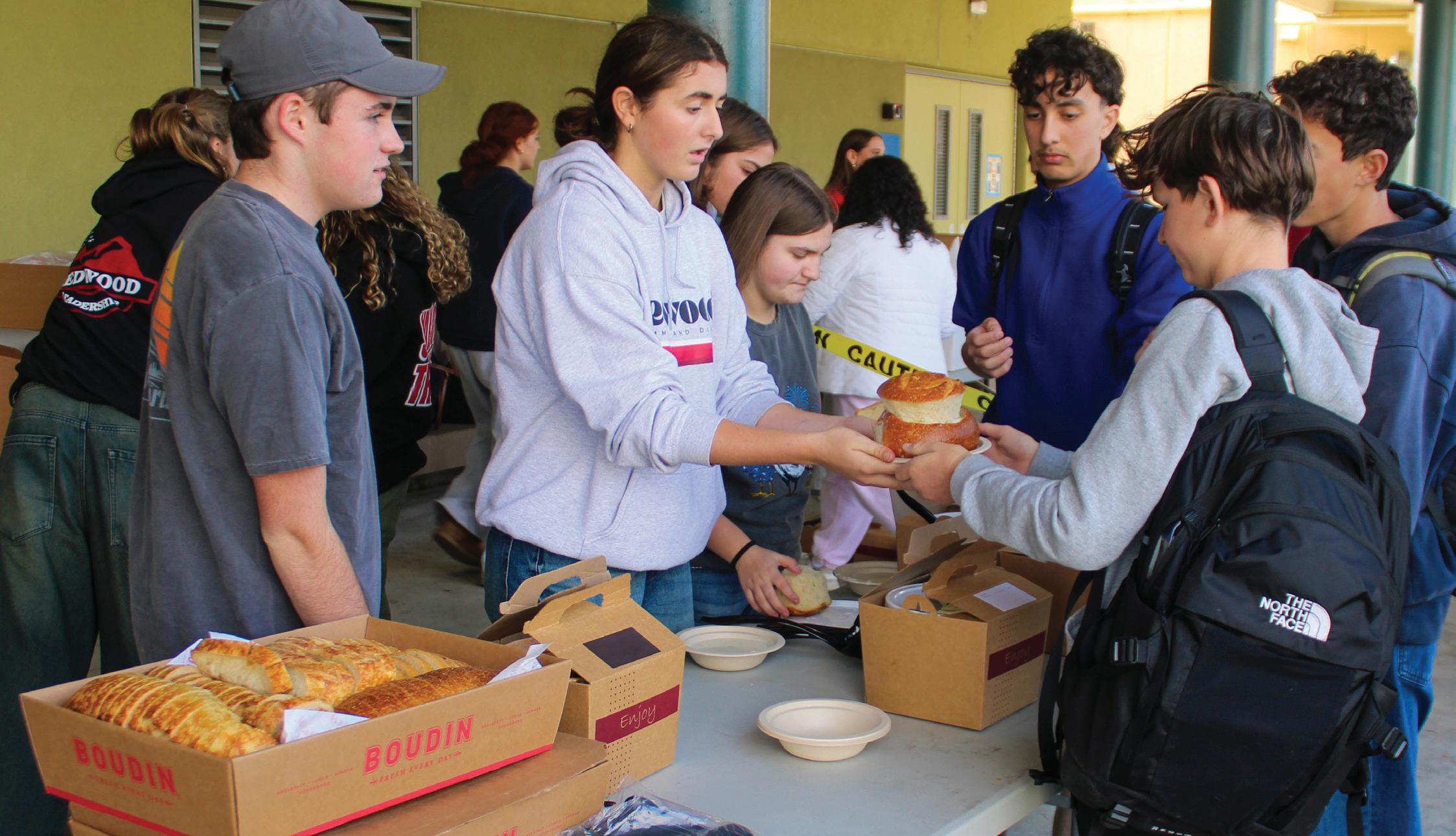
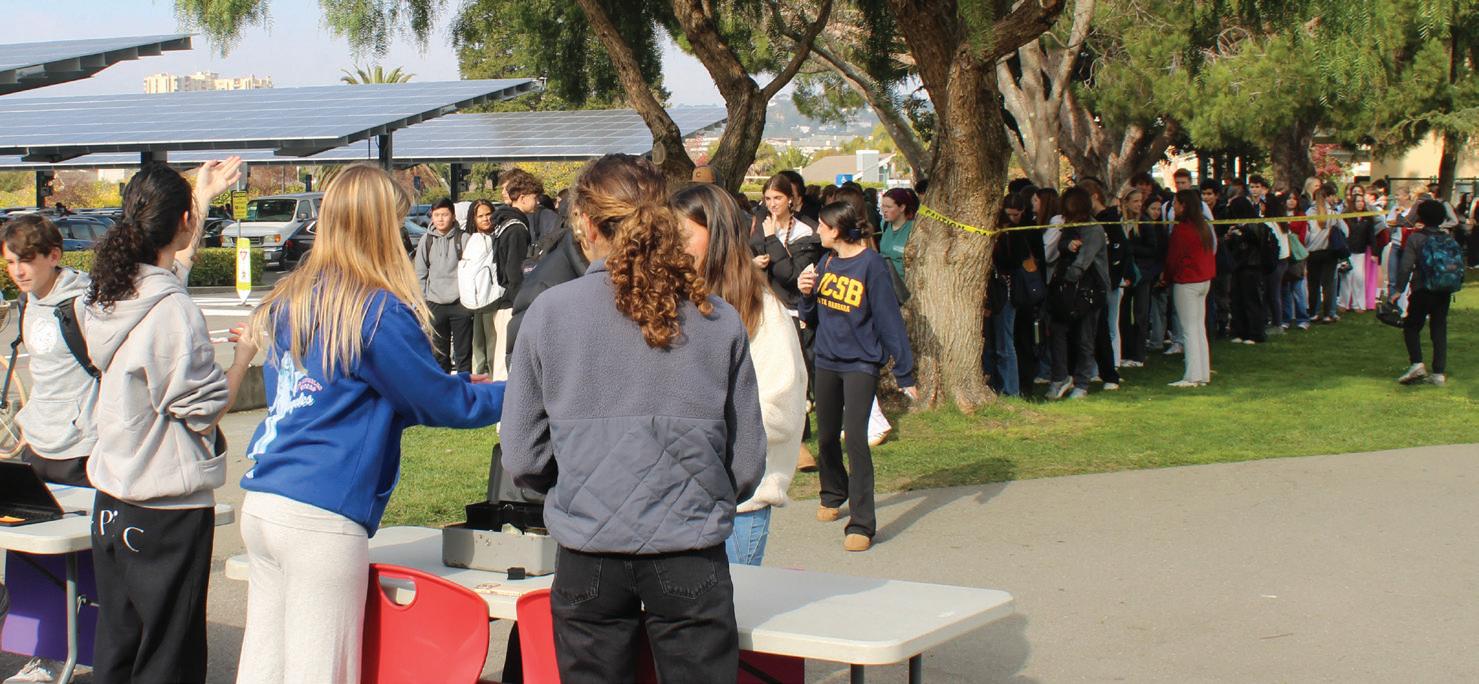
On Friday, Dec. 5, Leadership hosted its annual Boudin Soup Day, a winter tradition bringing warm food and school spirit to campus. Eager students lined up outside the Small Gym and could choose from clam chowder, chili, tomato or butternut squash soup, in either a bread or regular bowl, for a $5 purchase.
This year, the event also introduced a coat drive in partnership with the Ritters Club, which supports the Ritter Center, providing support for Marin County’s lowincome and homeless residents. Junior Leadership student Veronica Horosz gave
insight into the reason behind this addition.
“Leadership has a mission of trying to make a difference, and we have wanted to find more ways to support others outside our community,” Horosz said. “We partnered with the Ritters Club to try and complete a coat drive as a way to make that difference and support others.”
To promote donations, a free cookie was offered to anyone who donated an old coat during the event. Leadership also offered a free cookie to any student who wore an ugly sweater to school on Friday, a Boudin Soup Day tradition.
By Adriella Marcus
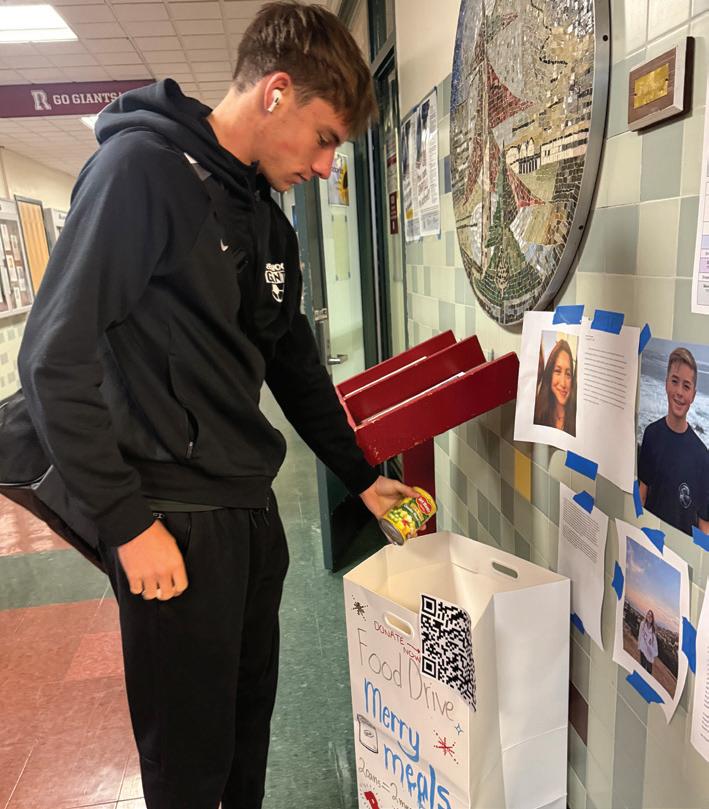
On Nov. 18, the Merry Meals studentrun food drive opened for donations, which can be made online or in bins around campus, and will be accepted until Dec. 19. The drive includes a friendly competition with Tamalpais High School (Tam), with the winning school earning a chance to pie their principal in the face.
Sophomore Nico Less is the co-chair of the Leadership Community Committee. This committee worked alongside sophomore Scarlett Zola-Kahn to create the food drive and establish a collaboration with Tam. Both Less and Zola-Kahn have continued outreach and are eager to expand the food drive to other Marin schools.
“We’ve been trying to figure out what motivates high schoolers [to donate for a good cause]. Competitions are definitely at the forefront,” Less said. “Whoever raises the most in the same time frame wins.”
Both schools have the goal of raising $5,000, which is equivalent to about three
dollars per student at Redwood.
“One dollar is the equivalent to two meals at the San Francisco-Marin Food Bank, so $5,000 is 10,000 meals,” Less said.
Emails have been sent out to families with information about how to donate, in addition to posters hung up throughout the school with QR codes, directing students to the fundraising page.
“[Collecting money] is what really matters. The food bank needs food, but they can also buy canned food with the money that we give them,” Zola-Kahn said.
Zola-Kahn initially had the idea to create the food drive as a result of Supplemental Nutrition Assistance Program (SNAP) benefits being jeopardized during the government shutdown.
“I was struck by the realization that 15,000 Marin residents are not going to get these benefits anymore,” Zola-Kahn said.
“I thought that our school could help out and support them because they’re going through a really rough transition. ”
bread bowl of clam chowder.
Horosz feels that this event is intended to increase community on campus while offering a break from academic stress before finals.
“The main point of Boudin Soup Day is to alleviate the stress of the ongoing school year,” Horosz said. “It’s a really nice opportunity for people to see other classmates, see their friends and to have good food.”
Freshman Logan Martay, who attended the event for the first time, echoed these ideas, describing how he felt the event grew the school’s sense of community.
“Everyone got to enjoy a special meal, and I feel like it brought the school community together because you could see everyone in the line and [students] were super excited to get their food,” Martay said.
Martay also praised the quality of the selection and helpfulness of the Leadership students who were serving the food.
“I got the clam chowder in the bread bowl. I really enjoyed it. The people that were working and serving food were super helpful and really nice,” Martay said.
By Isabella Marsh

celebration.
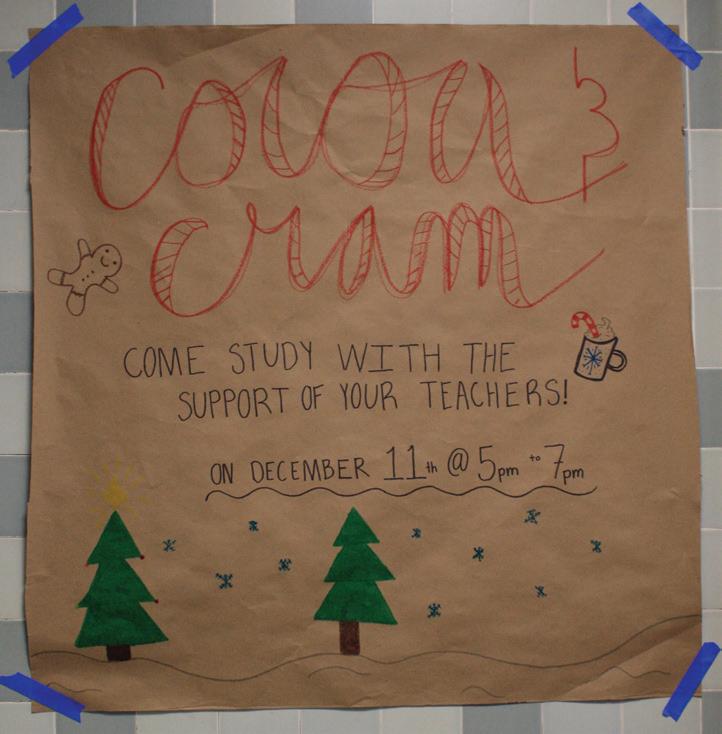
To help equip students for final exams, Link Crew hosted their annual Cocoa & Cram event on Thursday, Dec. 11, after school. At the event, students collaborated with teachers and peers to prepare for their upcoming exams with a cozy cup of hot chocolate. Best of luck on your finals, Giants!
Food drives have also been conducted in prior years, and even though SNAP benefits are returning, food is always needed in the Marin County community.
“[Just because SNAP benefits are] back doesn’t mean that there aren’t still families and communities in Marin that need food, and we’re very excited to help the [SF] Marin Food Bank,” Less said.
nruel@redwoodbark.org amarcus@redwoodbark.org
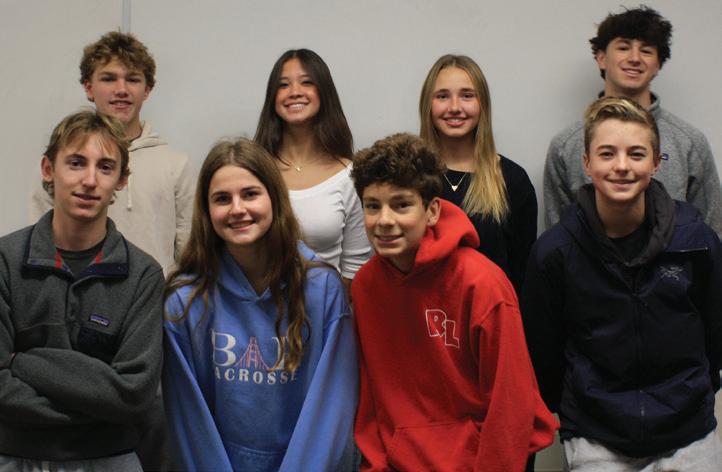
Each semester, the freshman (bottom row) and sophomore (top row) classes hold officer elections. Mason McCabe won the race for freshman class president alongside Gabi Estacio as Vice President, Ian Claire as Secretary and Carter Smith as Treasurer. For sophomores, Adam Scheer was elected as President, Maya Tucker as Vice President, Alexa Martin as Secretary and Ethan Finkelstein as Treasurer.
By Skye Hammond

Seed oils. They’ve been called everything from a “silent killer” to a “hearthealthy staple,” depending on who you ask. Their popularity has spread throughout TikTok and even among national politicians. What started with health influencers and podcasters has transformed into a national debate over this one question. How bad are seed oils, really?
National health secretary Robert F. Kennedy Jr. and his Make America Healthy Again (MAHA) agenda have weaponized the topic and taken a strong stance against the consumption of seed oils. However, science says otherwise.
The Cleveland Clinic of Health refutes claims that seed oils are inherently toxic and emphasizes that, in moderation, seed oils can support a healthy diet. Despite this, the MAHA campaign continues to insist that seed oils are one of the leading causes of obesity (AP News) and that Americans are being "unknowingly poisoned." These accusations aren’t just misleading; they directly contradict decades of nutritional research. The truth is simple: The panic around seed oils isn’t based on science; it’s based on politics. When misinformation becomes a political tool, public health becomes the casualty.
Not only does MAHA fail to produce
credible evidence that seed oils cause health crises, but according to KTVU Fox San Francisco, Kennedy has cited research papers that do not exist in an attempt to legitimize his stance on seed oils. When a national health agency relies on fear-driven messaging, they reveal a political agenda, not a public health mission.
Some critics of seed oils argue that highly processed food, many of which contain these oils, can contribute to health issues and that Americans should be aware of what they're consuming (Stanford nutrition). But this critique targets the overall food system, not seed oils themselves, and it does not justify MAHA’s unsupported claims that seed oils are dangerous.
So why attack seed oils with no substantial evidence of their supposed harm? Controversy generates attention, which in turn generates political power. The anti-seed oil narrative fits into a broader pattern of simplified, fear-based media that aligns closely with the communication style of the Trump administration.
Kennedy launched his crusade against seed oils and obesity during his 2024 presidential campaign, which he later withdrew from in exchange for a place in the Trump administration. Despite lacking medical training and having a history of drug use (PBS), he was appointed National Health Secretary after Trump’s re-election, raising questions about qualifications and political loyalty. In office, Kennedy has made other false claims in addition to the seed oil allegations, including that taking Tylenol during pregnancy causes autism,
lacking scientific backing. This pattern reveals that Kennedy’s health messaging is driven not by evidence but by political ambition. His willingness to promote sensational, unproven theories to gain influence directly supports the argument that the seed oil panic is a political strategy, rather than a public health warning.
When political leaders push simplified explanations for complex health issues, it becomes easier to shift blame onto ingredients like seed oils rather than addressing deeper systemic problems such as food access, education and healthcare inequality. This strategy creates a clear “enemy" for the public to rally against. By turning nutrition into a political battleground, MAHA distracts from real, science-based solutions that could improve public health. MAHA misinformation is creating fear and harm, raising questions about whether we can trust our government with public health.
As students and consumers, it’s essential to recognize when a health trend is being exploited as a political tool rather than a guide supported by credible scientific evidence. The seed oil panic is only one example of many misinformations that can spread quickly when amplified by social influence and government officials. Staying informed, questioning bold claims and examining trusted scientific sources can help cut through the noise and keep us focused on supporting our health instead of what makes headlines.
shammond@redwoodbark.org
By Elaina Leighton
Dynamics between teachers and students have shifted.
Classrooms that used to be grounded in basic respect for one another are now tense, unbalanced and uncomfortable. While many teachers and students still care deeply about each other, there is a growing number of both students and teachers who feel devalued and disrespected in their learning space. Students should show greater respect to their teachers and faculty, as this not only fosters a positive learning environment but also reinforces the mutual respect that should be shown between teachers and students.
The level of disrespect is growing exponentially. In the U.S., a Harris poll found a jarring reality: disrespect to teachers is gaining traction. The poll showed that the number of Americans who believe that teachers are respected in school dropped from 79 percent to 31 percent.
According to the National Center for Education Statistics, in high schools in the U.S., about 45 percent of teachers agreed that disrespectful actions from students, such as tardiness, interfere with their teaching. As opposed to schools with small enrollment numbers, the numbers were significantly higher for teachers
who taught in larger schools with greater than 1,000 students, such as a school like Redwood, with a total enrollment of about 1800 students.
Dr. Fiona Longmuir co-led Monash University’s Education Workforce for the Future Impact Lab, and as a result of the study, Longmuir told Phys, “These results are a wake-up call for us all. They highlight the urgent need for systemic action and personal change. Teachers play a critical role in shaping our shared future; they deserve the utmost respect and appreciation, and that includes having a place at the table when it comes making.”
However, there is a misunderstanding of how treatment between teachers and students is perceived. According to EdWeek, in 2012, a survey conducted by the Pearson Foundation, given to 57,883 U.S. students in grades six through 12, found discrepancies regarding how students and teachers treated each other. They found that just 41 percent of students reported signs of respect from students to teachers, while 61 percent reported that teachers showed students respect. The study continued and found that 54 percent of students believed that they could talk to a teacher when they had a problem, but just 47 percent of the students believed that if they were absent from school, their teachers would care.

More positive and respectful relationships can be extremely beneficial for students. At the University of Missouri, Professor Christi Bergin led a research study that found that students are much more likely to have a higher motivation to learn when they feel as though their teacher cares more about them. “Positive teacher-student relationships change student behavior, and in this study, we found that building those positive relationships actually leads to better teaching, too. It changes teacher
behavior,” Bergin said, according
When teachers feel this disrespect, it harms their efficiency. According to Edweek, about 41 percent of teachers believed that stress induced by disrespect caused them to be less productive, with thoughts that their instruction and management suffered as a result. Additionally, over a fourth of the teachers surveyed said that the stress that they face at work leads to contemplation of quitting their jobs, and 16 percent said that they “dread going to work every day”.
Some may argue that this isn’t an actual concern, pointing out that teachers and students have positive interactions with each other, such as the School Voice Report saying that of the students they surveyed, four out of five said they had positive interactions with their teachers. So, while,
yes, teachers and students indeed have formed healthy classroom environments through meaningful connections, operating smoothly without conflict, a YouthTruth survey conducted from 2013-2016, that surveyed more than 80,000 students in grades five through twelve across 24 states, found that only about a third of students actually have respect for teachers and faculty members. Providing insight in the survey, an anonymous student said, “Although I believe that most staff members do treat staff and students with respect, I have noticed that many students do not show their teachers and fellow students respect. I observe students both disrespecting the authority of teachers and disrespecting the ideas, beliefs and personalities of their peers. This bothers me because disrespect discourages openness and safety. High school equips us for our future, so it is important that students learn the value of respect now" (Education World).
A resolution to this critical issue is needed. When teachers and students treat each other with respect, learning improves, teachers feel valued and students perform better academically. Disrespect harms the motivation and increases the stress on the students and the teachers, and we have the power to change this. By showing kindness, by paying attention and by following directions, students and teachers can foster a healthy and productive environment that is helpful to all.
eleighton@redwoodbark.org
By Morgan Sicklick
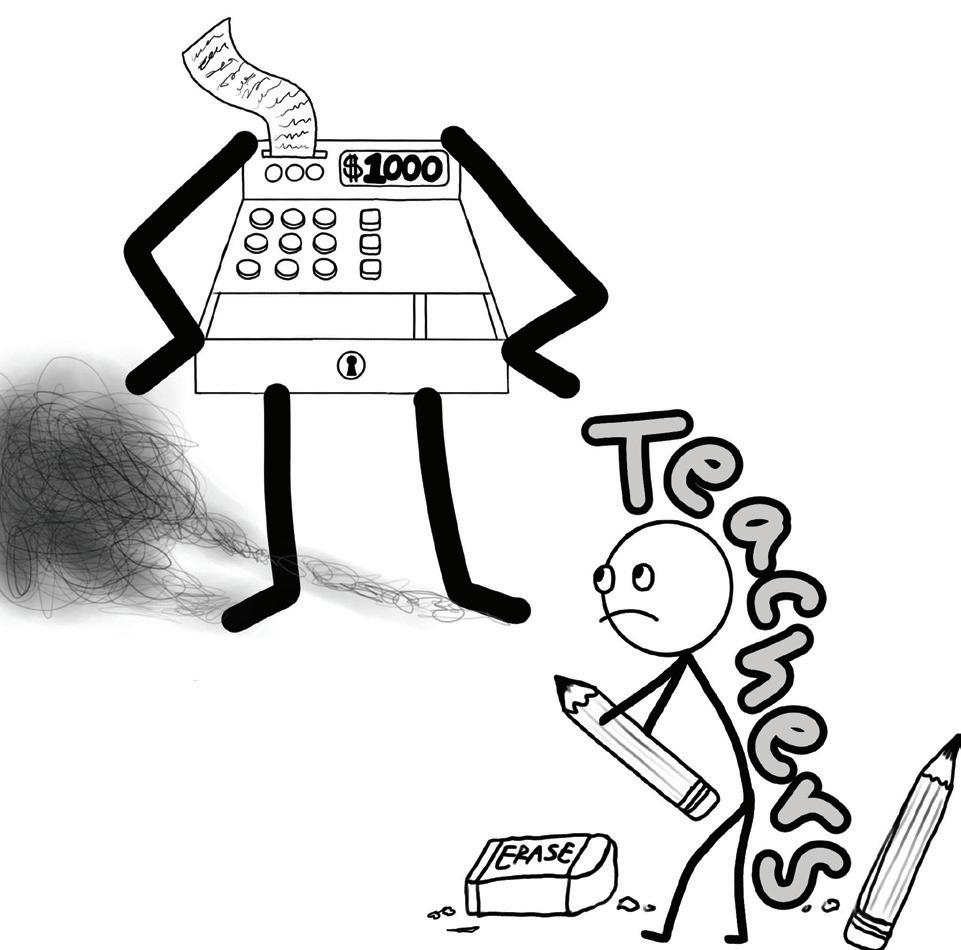
When we walk into a classroom, most of us don’t stop and think about who paid for the motivational posters, the storage bins full of supplies, the decorations that make a windowless room feel alive or even the Band-Aids we use after P.E. Still, our teachers do, because they’re the ones who bought them. Teachers shouldn’t have to subsidize their own classrooms to create the supportive learning environments students need. Districts must responsibly fund decor and supplies because classroom design directly impacts student wellbeing and academic success.
According to Education Week’s national survey of more than 1,100 educators, public school teachers spent an average of $673 of their own money last year on classroom materials, even though roughly 68 percent of them received some funding from the school. Across the U.S. in the 2024-25 school year, teachers spent an average of $895, while the median school budget was $200. 97 percent of teachers said that the budget “wasn’t enough.”
This isn’t about cute decorations or Pinterest boards. It’s about teachers filling a gap that districts continue to ignore, one that directly affects student well-being and academic success. The classroom environment matters. A large study of 3,766 students published by ScienceDirect found that layout, light, color and organization accounted for 16 percent of the variation in student learning progress. Thoughtful design, clear sightlines, natural light and organized walls help students stay engaged, reduce anxiety and build a sense of belonging. According to Edutopia, researchers emphasize that classrooms should make attending school “interesting and pleasurable,” a balance of visual stimulation and comfort. In other words, decor isn’t superficial; it’s necessary.
Yet the people responsible for creating these purposeful environments are often the same individuals who pay out of pocket for them. Teachers in EdWeek’s reporting say they spend between $500 and $715 annually on supplies. More than 3,000 New York City teachers have turned to crowdfunding just to keep their classrooms functioning. Some teachers resort to DonorsChoose, a nonprofit crowdfunding website where individuals can donate to help fund specific classroom projects and materials for public school teachers, and this is just for basic supplies. Manhattan Institute fellow Danyela Souza Egorov described the situation plainly: “No teacher should have to fundraise for basic supplies… It’s another sign of the Department of Education’s incompetence in managing public funds.”
Districts should stop relying on teacher generosity to make classrooms workable.
The contrast becomes even clearer when you look at district and state budgets. The Pew Charitable Trusts found that the median state could operate for nearly 47 days using its rainy-day fund alone. Some states hold billions in reserves. If states can maintain emergency funds capable of running entire systems, then school districts should use some of the emergency funds and reallocate them to essential things like classroom supplies and decorations. Right now, it’s like a family with high income whose kids still have to crowdfund for their own school lunches, not because the money doesn’t exist, but because it isn’t being allocated to the right place.
Teachers’ personal stories add even more urgency. Anecdotes collected by EdWeek show teachers describing how they buy snacks, books, deodorant, cleaning supplies, birthday cards and decorations to meet the basic needs of their students. These are not luxuries; they’re essentials.
This issue doesn’t only exist in national headlines. It’s happening right here in our own district. Our teachers, the ones who stay after school to tutor, who plan lessons late into the night, who make us feel welcome when we’re stressed or overwhelmed, are also the ones buying the decorations and supplies that make our classrooms feel safe and supportive. According to a November Bark survey, 67 percent of students said that their teachers have
decorations in their classrooms. While national news might report average spending, it doesn’t acknowledge our teachers’ individual sacrifices, the ones quietly shaping our experience every time we walk into the class.
Districts should stop relying on teacher generosity to make classrooms workable. Crowdfunding, as teachers in Alabama told reporters from the Alabama Reflector, is only a “temporary stopgap,” not a solution. The real fix lies in budgeting responsibly: setting aside funds for classroom environments, consulting the educators who understand what students need and recognizing that learning isn’t just about curriculum; it’s about the space in which curriculum lives.
Teachers already give us their energy, time, mentorship and care. They shouldn’t also be expected to hand over pieces of their paycheck to create classrooms that are essential for student success. If a classroom’s environment impacts learning, then funding that environment should be the district’s responsibility, not an act of personal sacrifice.
msicklick@redwoodbark.org
By Brooklyn Saputo
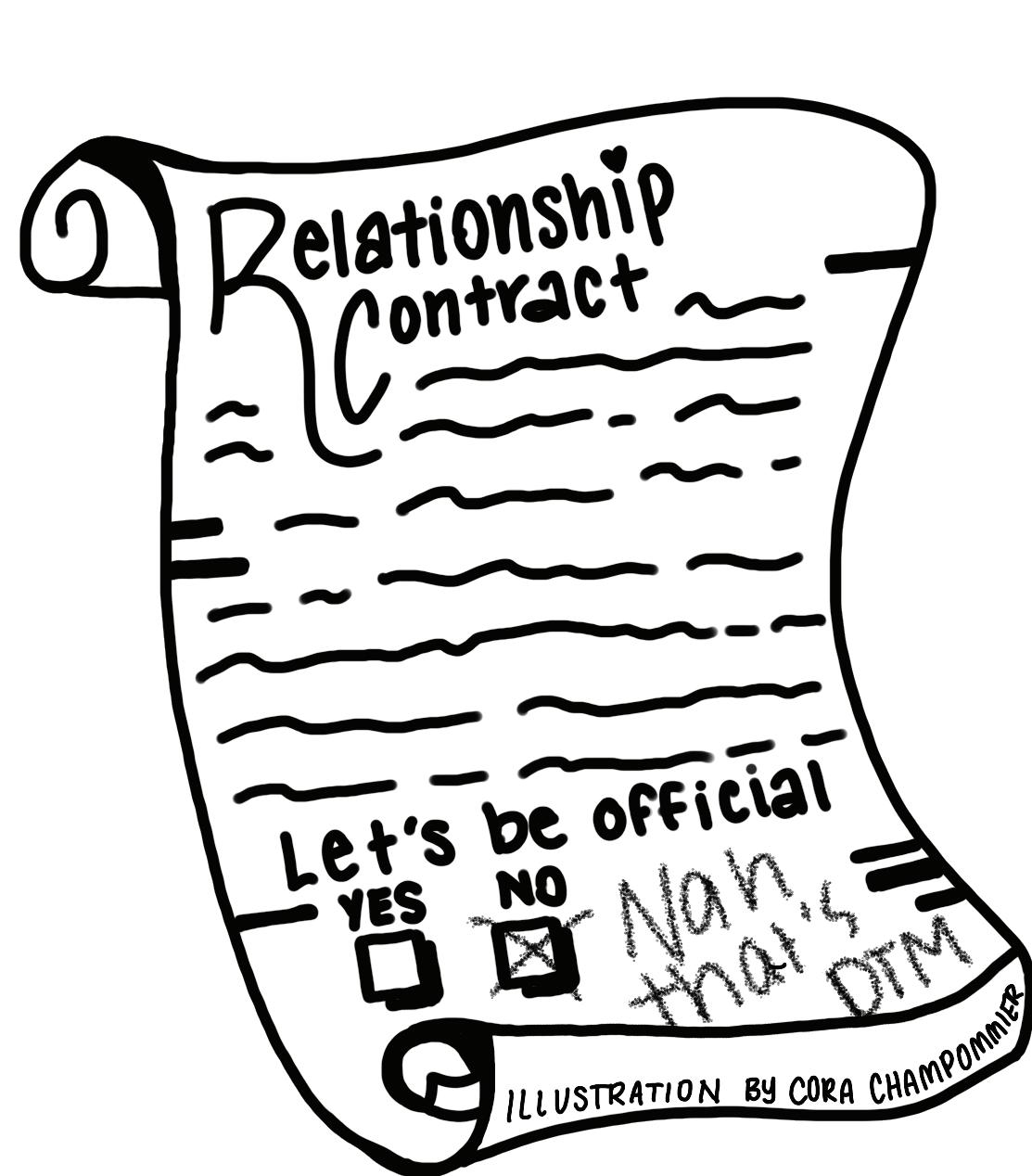
Have you ever genuinely connected with someone, talking every day, going out, getting to know one another, yet you’re “not dating?” Back when my parents were teenagers, this type of situation marked the beginning of a beautiful relationship. Today, it's the “talking stage,” a drawnout limbo that can last months and mimic all the emotional intensity of dating just without the label.
In today’s hookup-oriented culture, the idea of “talking” being less serious than dating is a convenient myth — one that allows people to avoid vulnerability and commitment while engaging in relationships that are just as emotionally intense as labeled ones.
Part of the reason this stage exists is that everyone seems to be too “busy” for a relationship but doesn’t want to be alone. Psychology Today describes it as “an intentional non-label for the relationships, which in its own way, still serves as a label. They’re not dating, but they’re not really single either; there’s no explicit pressure, yet there’s still a slight expectation.” This somehow feels stress-free to many people and makes them feel like they can balance a busy schedule while dating someone by not calling it dating.
Another reason “talking” is so common is that committing, even to a label, is taking a risk. No one wants to make the first vulnerable move of asking for exclusivity because that may lead to rejection. Many people would rather stay unofficial than confront that fear. In fact, according to Enotalone.com, “Commitment can stir anxiety about losing freedom or repeating past heartbreak.” Additionally, in situationships, another word for an avoidant relationship, you can walk away without the social or personal turmoil a breakup might bring. Especially with social media creating forced commitments, such as the pressure to post a soft or hard launch of a
relationship, staying “casual” is a safety cushion from that. That brings me to the idea of being nonchalant in relationships. I walk around school and it is nothing like what I thought high school would be like. There are no public asks of school dancing, no one kissing in the quad, no power couples walking down the hall. There are people I know who have been in a relationship for years and I don’t even see them interact at school. People are so scared to be outward about their romantic feelings toward another person and I don't understand it. Maybe if the whole idea of public display of affection (PDA) wasn’t so shunned on then I would understand the appeal of being in a situationship: you don’t have to be public about your relationship. But, in Marin especially, I can’t even tell the difference between people who are just “talking” and people who are officially dating. This nonchalant form of dating is ruining the whole experience of having a significant other and is dimming the beauty of falling in love. Why wouldn't you want everyone to know you care about someone? I bet it doesn't feel good knowing your boyfriend or girlfriend doesn’t even want their friends to see you guys hug hello.
The numbers also reflect this avoidant behavior. A survey by Deseret News found that “50 percent of men and 44 percent of women in the young adult cohort said they lack confidence in starting romantic relationships; around one-third said they were actively afraid to start one.” Additionally, Business Insider, citing Hinge data reports that “56 percent of Gen Z users say fear of rejection holds them back from pursuing a relationship.” There is a huge issue with the reality of these stats: when fear drives decisions, clarity in a relationship becomes rare.
People seem to believe that talking stages aren’t harmless, but that's an optimistic myth. Enotalone.
com states that situationships “can become emotionally draining and psychologically confusing. It can trigger or worsen existing mental health issues like anxiety, depression, or low self-esteem, especially if one partner desires more than the other.” This resulting stress can affect sleep, appetite and most importantly, a person's ability to form a strong, committed relationship. When taking stages become the norm, people lose confidence in commitment and start to expect a half assed connection. It’s true that some argue situationships aren’t that serious because attention is divided among multiple priorities: other potential partners, work, sports, etc. Some may also claim that situationships aren’t as emotionally intense due to this partial attention. But is that really true? You are talking with someone every day, unpacking personal information and feelings, creating a bond that is equal to one made in a relationship. The only difference is that there is a small part of both partners that refuses to fully commit by adding a label.
A November 2025 Bark survey found that 69 percent of Redwood students have been in a talking stage. That number alone shows how normalized this form of avoidance has become. The other day, I saw a TikTok that said you are either one of two people in a talking stage: the person with no self worth, or the person with commitment issues. And to be honest, that seems right to me.
The point is, if you like someone, fear shouldn’t be what keeps you in a drawn-out relationship. The label of boyfriend or girlfriend shouldn't be this scary and isn’t actually changing the emotional reality or the time commitment.
bsaputo@redwoodbark.org
By Evelyn Harper
Growing up, kids are often told that mistakes help them learn, yet for a large number of kids, this critical part of growing up is restricted by controlling parents, leaving them without the chance to make mistakes and learn from them. Parents often step in first: emailing teachers, resolving conflicts or handling problems before their kids even knew that there was an issue. This approach is called “helicopter parenting.” While it is meant to protect kids, it is harmful in the long run because it prevents them from developing independence, responsibility and the ability to manage consequences on their own. Instead of preparing kids to make their own decisions, it creates unsure, dependent adults who lack the skills to solve the realworld problems that they will ultimately face.
Helicopter parenting limits kids’ independence by preventing them from practicing essential decision-making and problem-solving on their own. A Yale study found that parents intervened an average of 8.6 times while their child completed a simple task, even though the child could do it independently. This constant interference teaches kids to rely on their parents, rather than developing confidence in themselves to solve problems. In addition, mental health experts support this idea. Dr. Gene Beresin from Mass General Brigham says that “helicopter parenting can cause kids to have excessive reliance on others, low self-esteem and self-confidence, poor coping skills, self-image that is grounded on achievement, inadequate life skills, increased anxiety and depression and diminished ability to pursue their own interests.” In many ways, having a helicopter parent is like having a personal trainer who lifts weights for you: You become unable to get stronger or build new muscle on your own.
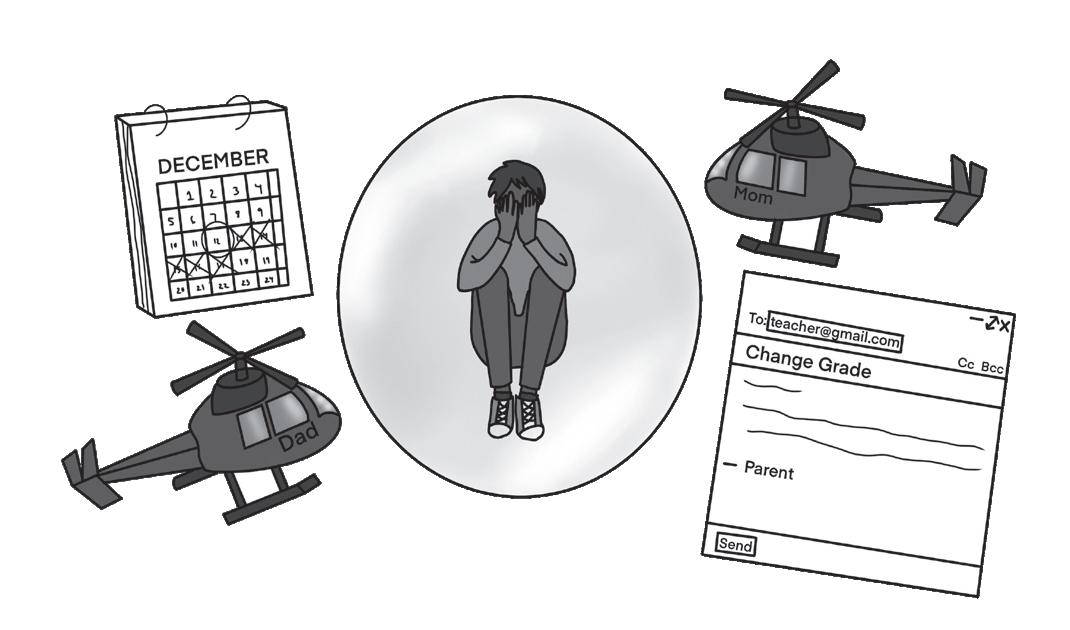
Beyond limiting independence, helicopter parenting also prevents kids from learning to take responsibility for their own actions. When parents email teachers to request a grade change, an extension or to resolve social problems, it shields kids from trying to solve these disputes themselves. Instead of learning to apologize, study harder or communicate with others, kids learn that their parents will solve all of their problems for them. UCLA Health notes that “providing independence and allowing kids to experience failure helps them learn how to adjust their emotional responses and behavior. They tend to develop better academic ability, behavior, mental health, physical health and social relationships.” This is reflected in real life experiences as well. Former helicopter parent Matt Ng says that kids can’t “cope with future failures and setbacks when their parents are no longer in the picture, influencing things at every angle in the background and foreground for the sake of short-term safety.” In the long-term, kids that grew up with helicopter parents will be less prepared for real world situations, compared to kids who were able to learn and make mistakes throughout their childhood.
Although helicopter parents believe they are trying to protect their kids, it has long-term consequences that leave their children less prepared for the real world. Many parents worry “Is it really that bad?” or “What if my kid needs it?” While these are valid concerns, when parents overprotect their kids, such as not allowing them to go to parties or communicating for them, they will not be able to learn the skills they need to develop to deal with these issues once they leave the house. By limiting independence, taking responsibility on behalf of their kids' actions and shielding them from consequences, parents create kids who lack confidence and the ability to stand up for themselves. To help kids have a more successful future, parents should slowly step back from controlling their kids' lives. They should allow kids to communicate directly with their teachers and instead of solving conflicts for them, give them ideas on how they can do it themselves. When parents see failure as an opportunity to learn, children gain the confidence and skills to succeed in life.
eharper@redwoodbark.org
By Bella Garbo
that so many applications could be altered with barely any backlash.
By Paige Catanese
“Get lower!” the commander demanded of the military personnel, followed by a “You are strong. Keep fighting!” The army lined up in their matching uniforms, army-crawling across the battlefield with passion and dedication, fighting to stay alive until the commander uttered the most dreaded word known to mankind: “Pulse.”
But this isn’t a battlefield. It isn’t even a military base. It is a pilates studio during a flow class. Each attendee, fashioning a matching ALO workout set, grip socks and a slick-back ponytail, fights to engage their core and hold their plank, resembling an intense army preparing for battle.
Pilates is an exercise that focuses on controlled, precise movements, incorporating breathwork to improve physical strength, body awareness and flexibility. In recent years, this form of physical conditioning has reached an all-time high of popularity. Google Trends shows that the search “pilates” has increased by over 70 percent in the past year. Even more drastic is the search, “pilates girl,” a social media trend of pilates practitioners who strive for a wellness-oriented, self-care-focused lifestyle. This has risen by 6,300 percent in the past year.
But pilates has existed long before this trend began to flourish. It started during World War I, when Joseph Pilates was interning as a physical trainer at the Isle of Man internment camp in England.
Scan QR code to read more!
pcatanese@redwoodbark.org
Acceptance rates at top 50 colleges and universities have dropped by 31 percent since 2006, according to The College Investor. As a result, in order to get into these top schools students are leaning on other options and strategies to gain enrollment such as including false information on their applications. Many students think making “small embellishments” on their applications will change their outcome of college acceptance and not cause any harm. While this may not seem like a huge deal, and may even be encouraged by parents or college counselors, getting caught would not only be detrimental to that student's chances of getting into college, but it is also incredibly unethical and should not be suggested.
In 2023, Intelligent, a college-based research website, ran a survey on college application embellishments. Out of the 1,600 current four-year college students, 61 percent admitted to including untrue information on their applications. In this 61 percent, 30 percent faked letters of recommendation, 34 percent embellished their college essays and only one third were caught by admissions officers. When the survey became public, many were shocked
The Varsity Blues Scandal occurred in 2019 where many parents — including some celebrities -– altered parts of their kids' applications, hobbies and some even paid colleges to secure their children's acceptance. Celebrities Lori Laughlin and Felicity Huffman were involved in this scandal which led them to face jail time. This scandal as well as the Intelligent survey caused an uproar in the world of college admissions. Following the scandal, many believed colleges would become more strict and difficult within their admissions process. Unfortunately, many colleges have not taken this as seriously as it needs to be.
According to the Menlo-Atherton Chronicle, “Not a single coach or club advisor was asked to verify information on a student’s college application —for example, no college attempted to verify whether a student was really a captain of a sports team.” If colleges aren’t fact checking important extracirculars, then why not embellish a little to make your application stand out? Even the highly prestigious ivy league schools rarely fact check. As mentioned in the Menlo-Atherton Chronicle, Dartmouth College admitted to rarely fact checking applications, but instead they focus on fact checking test scores and recommendation letters.
Meg Heimbrodt, a college counselor at Redwood and in private, has been privately counseling students for about ten years now. While Heimbrodt has never heard
of anyone blatantly lying, she has come across students making small exaggerations on activity lists.
“There's no way that a school’s going to have the time to go and find out if you volunteered 15 hours or 150 hours,” Heimbrodt said.
Not only is factchecking not improving and giving students even more of a reason to take the risk, it seems that parents and peers are encouraging this behavior.

Heimbrodt explained that while counseling students, she's seen two types of parents: those who are more laid back and those who are very active in the process, which can often contribute to the embellishments. Although parents think they know everything about college, the truth is they don’t. College is a completely different level of difficulty nowadays than it was when our parents went to college. While cheating may help you get into college, it won’t help you when you’re there. While getting away with embellishing the truth on applications may have significant benefits and help you get into your dream school, the potential consequences completely outweigh any
Ivy Coach, a counseling and tutoring admissions website, explains that if caught putting untrue information on applications, one could face expulsion, denied admission, offer can be withdrawn, admission is withdrawn and can be asked to leave campus immediately. There is a tremendous amount of pressure when applying to college right now and it is normal for students to lack self-confidence especially considering how challenging getting into college has become. However, there is no excuse for lying on college admissions. It can be damaging to your admission process and it is unethical. College isn’t just about how low the acceptance rate is, it’s about finding the right fit for you and finding a place where you can see yourself living for the next chapter of your life. There are over 5,000 colleges in the United States alone, everyone finds their place and lying to get there sets the wrong precedent before even stepping on campus.
bgarbo@redwoodbark.org
editorial
Stop putting in effort to appear effortless
Searches for “how to be nonchalant” have spiked 241 percent in May of this year on Google, per Movchan Agency. “Nonchalant” is commonly characterized as having a deliberate lack of interest, enthusiasm or concern. Let’s be honest: Pretending not to care has become the worst trend in high school. We are apathetic in how we respond to the people we care about, downplay the friendships we rely on and hide our real reactions out of the fear of looking “too invested.” Being nonchalant might look mysterious from the outside, but inside it leaves us isolated, misunderstood and emotionally drained. At some point, we have to ask ourselves, why are we working so hard to act like we don’t care, when caring is what makes our relationships and lives meaningful in the first place? A National Library of Medicine study found that “emotion suppression may be linked to poor health outcomes through elevated stress-related physiology.” Not wanting to look like we “care too much,” or in other words, being nonchalant, has become an extreme.
A study from the National Institute of Health focused on adolescents suppressing emotions, and found that “suppression is often cited as a maladaptive regulatory strategy due to its associations with poor psychosocial functioning when it is used excessively.” A maladaptive regulatory strategy is a coping mechanism that gives short-term relief but results in counterproductive long-term consequences, such as emotional distress and psychological problems. For example, instead of getting hyped for spirit days, actively participating in class or showing any enthusiasm outside of what is considered the “norm,” students are defaulting to the safety of being nonchalant. According to the October Bark survey, 74 percent of students wished that more people dressed up on spirit days, indicating that there is enthusiasm for more involvement in collective school tradition, yet that isn’t the reality when spirit days actually happen. Redwood sports teams are also performing at the highest level of the schools in the Tamalpais Union High School District, but somehow, we seem to have the least amount of school spirit and support for one another. Why is being supportive of people in our community a fear at our school but encouraged at others?
the pandemic, that percentage of students jumped up to 40 percent. When hours online stack up, so do the habits that come with it, especially the habit of emotional detachment, a practiced nonchalance that starts online and quietly seeps into real life.
Dr. Caroline Fenkel, Chief Clinical Officer at Charlie Health, told SheKnows, a lifestyle blog, that “Nonchalance can act as a protective mechanism, but it can also become a barrier to meaningful connection and emotional honesty.” With the intent of being “nonchalant,” people are disconnecting from their peers. One of the most monumental high school events, Homecoming, is often seen as lame or “uncool” for upperclassmen, especially for those at Redwood. However, a survey from YouGov found that 54 percent of Americans wish they could go back to high school. That nostalgic feeling exists for a reason: These four years are meant to be a time for teenagers to explore their unique interests, risks and build their own sense of identity. But today’s teens are held back by the fear of the labels they will receive and the pressure to appear apathetic and unconcerned.

Some might argue that being nonchalant isn’t harmful at all, that it’s simply a way for teenagers to protect themselves in a social environment where judgment can be harsh. From this perspective, staying calm, detached or “unbothered” can seem like a smart defense mechanism. After all, high school can be unforgiving, and displaying strong emotions might expose you to embarrassment or rejection. Luna, a health and wellness app for teenagers, states, “When teens start to see themselves only through these roles – the cool one, the emotional one, the chill one – it can make it harder to explore anything outside of that.” And sticking to those labels might feel safe, but it also keeps us from being honest about what we actually think and feel.
Editors-in-ChiEf
Cora Champommier
Paige Edelen
Morgan Sicklick
hEad Copy Editors
Madison Bishop
Jamie Glennon
Chloe Jennings
Copy Editors
Gabrielle Baumgarten
Eleanor Bentley
Jack Block
Vivi Endler
Siena Forster
Brooke Hansen
Mila Martinez
Petra Novotny
Nico Ruel
Logan Scully
Elsa Sherman
Estelle Smith
Tessa Soccorsy
Adela Tabak
Georgia Thomas
Evan Wang
opinion Editors
Amrit Aujla
Bella Garbo
Isha Patel
fEaturE Editors
Hilah Brekhus-Lavinsky
Paige Catanese
Ben Mueller
LifEstyLEs Editors
Kate Barker
Mariel Goodhart
Maggie Schwartz
GamEs Editors
Richard Byrne
Lucy Jeffers
sports Editors
Henry Barker
Jake Post
Asha Zlatoper
nEws Editors
Anna Horn
Isabella Marsh
Penelope Trott
rEviEw Editors
Hayden Martay
Angelina Purvey
Sofia Yanni
POLICY: All editorials are unsigned and have been approved by the majority of the Bark staff.

BARKS and BITES are the collective opinions of the BARK staff concerning relevant issues. BARKS represent praise, while BITES represent critiques.
We’ve convinced ourselves that showing emotion makes us weak, dramatic or “too much,” so we swallow it instead—that feeling of excitement when we like someone, the hurt when a friend pulls away, the embarrassment when something actually matters to us. But suppressing all of our emotions doesn’t make us stronger; it works against us. With more reliance on social media and technology to remain connected after the COVID-19 pandemic, Gen Z has only continued to hide behind their screens. In a study published by the National Institute of Medicine, 20 percent of the tested individuals in the pre-pandemic had a screen time of six or more hours a day. During
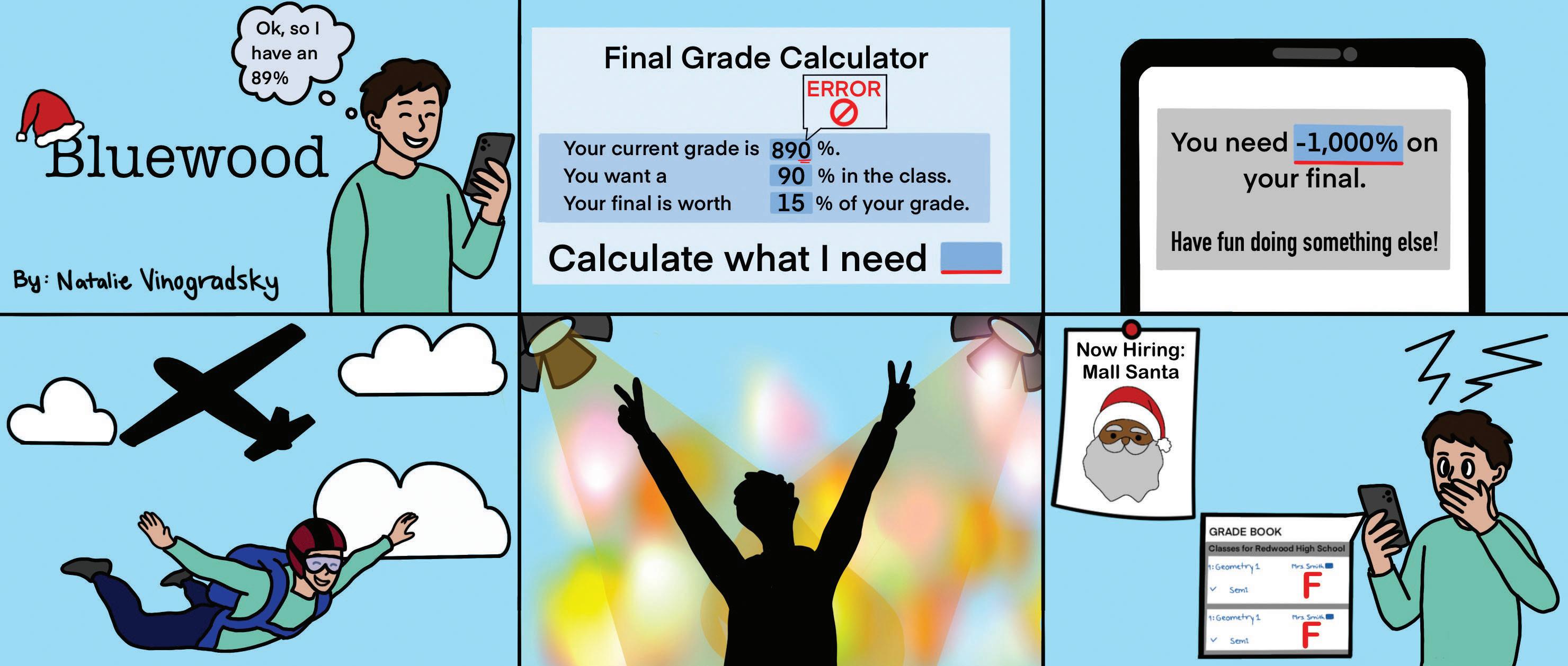
A BARK to the final grade calculator. A 134 percent on the final exam is definitely possible.
A BITE to Black Friday. Thanks for justifying our costly purchases with that five percent discount.
A BARK to Madame Morrible. When we get a 59 percent on a test, let’s flip it around to a 95 percent, wicked witch!
A BITE to people who walk slow in the hallways. You move slower than the school WiFi.
While staying calm under pressure is a valuable skill, pretending not to care about anything is not the same as emotional maturity. Nonchalance may feel like protection in the moment, but in the long run, it walls us from the relationships and opportunities that make life meaningful. The truth is, people aren’t drawn to those who feel nothing; they’re drawn to those who feel deeply and honestly. When we permit ourselves to show excitement, disappointment, affection or fear, we’re not being dramatic—just human. Try out for that sports team. Dress up for spirit days. Join the skit. Raise your hand in class. Stop putting in effort to appear effortless.
Have an opinion regarding anything that appears in the Bark or in general? We encourage our readers to submit letters to the editor. Letters to the Bark should be 500 words or fewer, typed if possible and signed. They must be emailed to bark@redwoodbark.org
Oren Weingarten
A BARK to Spotify Wrapped. Thanks for all of the statistics we didn’t know we needed.
A BITE to Mariah Carey. It’s TIMEEEEE to put the microphone down.
A BARK to a new year coming up. Finally, another chance to make those lifestyle changes we told ourselves we’d do last year.
A BITE to the “six seven” jokes. We are about to have our 67th crash out if we don’t stop hearing them.
rEportErs
Alexander Atherton
Charles Anderson
Lily Bell
Hudson Brod
Claire Carbone
Gabriel Cavanagh
Esperanza Cubillos
Lauren Ellington
Dorothy Florence
Skye Hammond
Liam Healy
Elizabeth Hopkins
Elsa Houtkooper
Olen Johnson
Lily Kilgore
Elaina Leighton
Lucy Levine
Owen Scheeline
Logan Schneidewind
Sienna Watt
advisEr
Erin Schneider
vidEo Editors
Aaron Jensen
Joel Kurtzman
Tate Ralston
Tobin Rivera
Annabelle Walker
spanish Editors
Ofelia Huneeus
Beatrice Nass
Josephine Perlov
podCast
Editors
Mo Colaco
Adriella Marcus
Scarlett Musgrove
outsidE opportunitiEs
Nina Baker
Claire Johnson
Maddy Wagner
BusinEss manaGErs
Cian Kelly
Leighton Olsen
Brooklyn Saputo
soCiaL mEdia manaGErs
Leyton Defesche
Evelyn Harper
Elle Wilson
data anaLysts
Matthew Delay
Kate Morgan
Sophie Sahai
wEB dEsiGnErs
Reed Grossman
Zander Hakimi
Madisen Petersmeyer
staff iLLustrators
Olivia Hamm
Paloma Nacamuli
Rosstin Pouradib
Natalie Vinogradsky
muLtimEdia dEsiGnErs
Zoe Peters
Lily Skinner
Tessa Tuatini
staff photoGraphErs
Wes Fitzpatrick
Noah Gersch


By Hayden Martay and Tessa Soccorsy
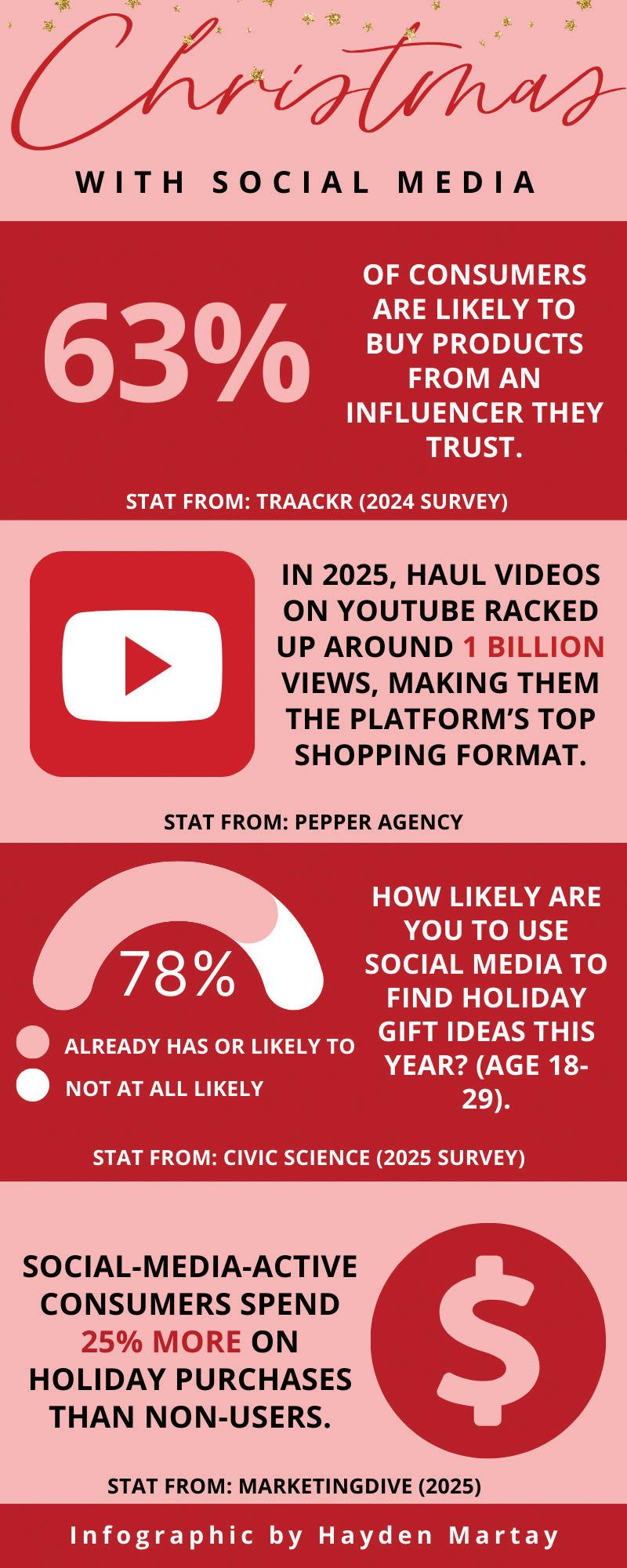
While scrolling on TikTok, the fourth consecutive video beginning with a familiar phrase appears: “I want to start this video off by saying I am grateful for everything I received.”
This disclaimer has become a staple of holiday “haul” content, and often feels more scripted than sincere. These videos display creators’ new clothes, makeup and pricey gifts, transforming what was once a private moment of appreciation into a public point of comparison.
Teenagers are becoming increasingly active on social media than ever before. A 2025 report by the Pew Research Center found that 48 percent of teens say that social media had a mostly negative impact on people their age, up 32 percent from 2022. 45 percent of teens said they spent too much time on social media. Teenage girls in particular were significantly more likely to be affected by platforms that harmed their mental health.
“Christmas haul” culture reflects a broader shift in teens' mentality about receiving material items.
“We’re so used to getting stuff the moment we want it,” Plescia said. “There’s no sense of waiting—you click ‘buy,’ and your brain gets that dopamine hit just knowing it’s coming.”
Additionally, Plescia has observed how social media influences how teens approach gift-giving, a practice meant to promote personal relationships through generosity. Instead, teenagers now share links to the exact items that they want, which can dilute the emotional meaning behind giving.

A 2022 study on adolescent social media use, available through the National Library of Medicine’s PubMed Central database, found that the way teens interpret what they see, rather than the content alone, plays a major role in how social
“With the spirit of giving, what's the point of being the middleman?” Plescia said.
When it comes to comparison, Plescia has noticed a cycle she sees contributing to the notorious feeling of the fear of missing out, which only builds during the holiday season. She believes comparing oneself to others takes away from the real spirit of the holidays.
“I see this with my own daughters, they waste their time looking at someone else’s TikTok, someone they don't even know, [when] they could be spending that time living their own life, doing their own thing,” Plescia said.
Sophomore Isla Geithman, who runs an online presence through a “get ready with me” account, @isla..maee, on TikTok, sees

HOLDING OUT AN array of colorful gift bags, a TikTok influencer,
displays her 2024 Christmas haul inside her decorated home.
Christmas or the holidays are about,” Geithman said. “I think [posting hauls] could also be just for fun. People are also just excited on Christmas and wanna show [what they got].”
Psychologist Dr. Jodie NewDelman, who has spent more than 25 years working with children, teens and families, notices that today's online environment has a stronger impact on adolescent identity than it did in previous generations.
enjoyment and joy from receiving that thing, versus, ‘Oh, guess what I get to show everybody.’”
On Christmas day, many will compare and contrast the gifts they received under their tree, a tradition that now reflects a broader cultural shift through these short videos. Whether teens view them as entertainment, pressure or something in between, “haul” videos have become a new tradition of the holiday season.

bark@redwoodbark.org


If you were in a room full of people and someone happened to sneeze, would you say “bless you?” Why would you make sure this person received a response from this armraising, body-jerking, unusual noise that came out of their body? And if someone did say “bless you” after you sneezed, would you say thank you? What entitled you to thank someone for responding to your loud, sometimes snot-filled sneeze?
This unconscious response goes back centuries. According to NBC New York, “For many years in the Middle Ages, people believed that when you sneezed, your spirit left your body for a second. So, the thought went, to say ‘bless you’ could bring you back to life and also keep evil spirits from entering you in the instant or two that you were believed to have been gone.”
Along with this, the notion that the heart skips a beat when you sneeze is, in fact, false. According to bonsecours.com, “[Sneezing] doesn’t stop the heart from beating. Many think that your heart beats at a fixed rate, but this is also not true. So while it may seem like you feel your heart skip a beat when you sneeze, it would have to stop for at least three seconds before a sneeze would be considered “heartstopping” – something a sneeze is not capable of producing.”
So, the next time someone sneezes in an elevator or during an exam, tell them “bless you,” because you never know if an evil spirit will catch you the next time a tingling sensation arises in your own nose. And especially to avoid a bizarre, awkward moment of silence between the two of you.

Answers to your most
By Adela Tabak
Thoughts. We all have them. Whether expressed verbally or not, it is safe to assume that every human being has had an “I wonder” moment in their life. A moment when we question how things work and who knows the answer eventually becomes a hyperfixation that you can’t seem to find the answer to. As a continuation of former Editor-inChief Colette Boyden’s article, which responds to six “I wonder” questions, here are more answers to save you from the headache of the unknown.
What will happen to the human body in space?
It is common knowledge that in space, an oxygen tank is required to survive. Yet, what would happen if the human body were placed in the middle of space with nothing on it? Physics in the Universe teacher Kristi Perani examines what will happen to the human body when left in space and the immediate effects that will occur.
“The water in your eyes would immediately evaporate and boil. Your blood would start to boil because you don't have pressure on it, and you would probably start to expand because [humans] are used to having pressure on [our skin]. You would also freeze to death right away,” Perani said.
The answer to this question is quite grueling, yet it helps us understand how space affects the human body.
Why do our bones pop?
I don’t know about you, but “cracking” or “popping” your bones is one of the most satisfying feelings and sounds. It feels refreshing to have this form of relief, which makes me wonder why it occurs and if it actually causes arthritis, as some people claim. Whether this myth is true or not is something physiology teacher Jamie Garcia has informed her students.
“There is air dissolved in synovial
The gut — otherwise known as the gastrointestinal (GI) tract — is crucial to the human body’s digestive system. It is also referred to as the “second brain,” as it helps decipher your mood and make decisions. Your gut is a major part of the overall health of the human body, yet it is sometimes mistaken for being the answer to most undecided decisions through the notorious “follow your gut” slogan. Psychology teacher Jonathan Hirsch reflects on this phenomenon: whether your gut actually gives you the correct answer to life’s big decisions.
“[A gut feeling] is one of the biggest misconceptions because it assumes that there’s this kind of magical, unconscious
Why does our stomach gurgle? Is it actually because we are hungry?
A stomach gurgle can either be an embarrassing moment during a silent math test or an indicator that maybe skipping lunch wasn’t the best idea. Overall, this feeling is definitely not a fan favorite. However, why do our stomachs gurgle and does this really mean it’s time for lunch?
According to Harvard Health Publishing’s “Ever wonder why” article, “We usually assume [stomach gurgling] reflects hunger. And the experience of hunger can indeed make itself heard in
fluid [in your joints,] and when you move your bones and joints, some of it creates a pressure change and the air moves from the area of high pressure to low pressure. I show my Physiology students a video that says it is a myth that it causes any arthritis. It’s just something people do,” Garcia said. Now that we know cracking your bones won’t harm your joint health, we can still crack our knuckles as loudly as we want!
part of our mind that is capable of guiding us in unfailingly positive directions. It could be overthinking or underthinking,” Hirsch said. “A lot of times, when people say, ‘I’m going with my gut,’ it’s kind of like saying, ‘I don't want to think about this anymore in the conscious sense.’” Hirsch addresses the hard truth that having a gut feeling is, in fact, a myth, and how we think and feel about daily experiences is much more complicated than that.
“Our feelings and our gut are a combination of all kinds of layered experiences that have been filtered heavily by our emotions and how we feel about experiences. I know no one wants to hear this, but as far as we know, it’s a random neurological mishmash,” Hirsch said.
anticipation of a meal. But your stomach may also growl after a meal, when the stomach and intestines propel liquids and food through the digestive tract. Stress can also trigger stomach rumbling. It may be due to gas moving around in response to muscular contractions of the intestinal walls.”
So, yes, it is helpful to have a snack on hand when the monster in your stomach starts to rumble, but it is also important to note the causes that you may be unaware of and that hunger is not always the answer.
atabak@redwoodbark.org

by



By Beatrice Nass and Tessa Soccorsy
According to a November Bark survey, 58 percent of students were playing video games by age 10. Nationally, Pew Research reports that 85 percent of U.S. children ages 13-17 play video games, however, only 40 percent consider themselves actual “gamers.”
Labels aside, almost every teen who picks up a controller or opens a gaming app experiences the effects it can have. Whether that means lost sleep, shifting attention spans or sudden spikes in dopamine, every gamer is affected. As gaming becomes a bigger part of the teenage lifestyle, the line between harmless fun and harmful distraction is becoming harder to distinguish.
The first video game was created in 1958 and was displayed on an oscilloscope screen, a screen that uses electronic wavelengths for its display. Today, video games can come in all forms, from console setups like PlayStation Fives (PS5s) to simple mobile apps. As gaming has grown throughout the decades, who plays, how they play and what they play on has shifted.
union. These games can spark competition and teamwork, bringing a sense of community to the gaming world.
“I also like how you [can] connect with your friends,” Anon said. “When I'm with my friends, I'll play with them.”
Junior Rhys Terry also enjoys playing with his friends, but finds that it can sometimes impact his normal sleep cycles and everyday life.
47 percent of students reported that playing with friends is their favorite part of video games.
Among the many games fighting for teens’ attention, one has embedded itself deep into teenage culture: Clash Royale. This mobile game fits perfectly into the quick life of a student on a busy school day, one of the reasons it’s become so popular. Its opening melodic sound is now instantly recognizable, practically engraved into our ears.
Junior and avid Clash Royale player Mateo Anon has been playing since 2019, when the COVID-19 pandemic started. Anon regularly gets sucked into the loop of Clash Royale. Whether he plays with his friends or against an unknown opponent, Anon enjoys spending any time he can on the app.
“I'll definitely get distracted, and [sometimes] I'm supposed to be doing other stuff, but instead I'll play [Clash Royale],” Anon said.
As Clash Royale has gained traction, the game has become a way to spend lunch, passing periods and sometimes even class time, if students can manage to sneak their phones under the table.
“During school, I'll play a bit during lunch in the morning when I’m sitting in my car. Whatever free time I have is when I’ll play,” Anon said.
While gaming is used as a fun activity, it is also a way for people to connect online and play together to achieve a likeminded goal.
According to the American Psychology Association, 72 percent of gamers say they play to spend time with friends. On campus, this trend is easy to spot. In a November Bark Survey, 47 percent of students reported that playing with friends is their favorite part of playing video games. Students gather after class to play, talk strategy or simply sit together at a table, each playing on their own phone but all in
“I have had some long nights on video games with my friends that have impacted my sleep, but [the effects are] just in the short term,” Terry said.
While Anon, Terry and other gamers may experience instant satisfaction from opening the Clash Royale app or playing their next favorite game, video games aren’t only made up of victories.
According to an article published by Bright Path, a mental and behavioral health program, video games can disrupt sleep cycles, reduce attention spans and affect academic performances.
For Anon, playing video games is a hobby, and while it does consume lots of free time, it hasn’t yet harmed his sleep or grades in major ways.
“I do postpone my homework, but I think that I don't postpone it to the [extent] where it's negatively affecting my grades. I could definitely be more proactive about it [though],” Anon said.

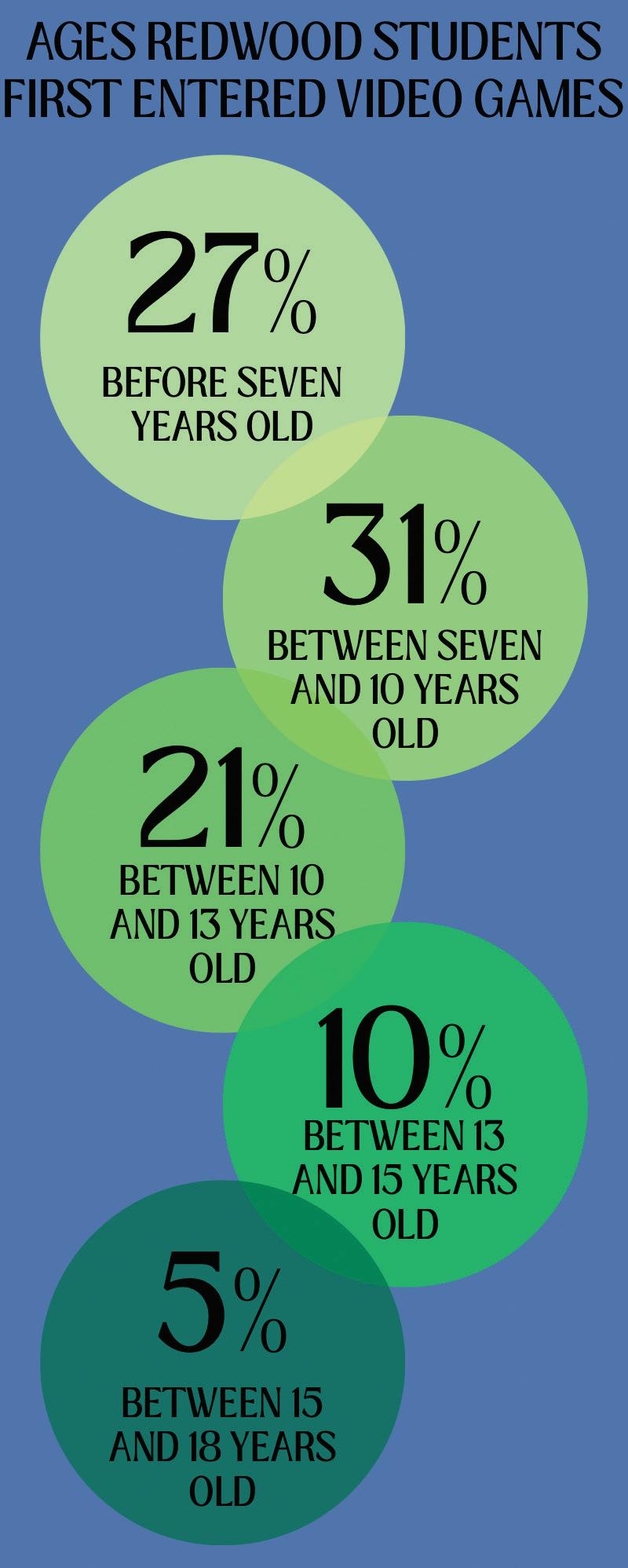
researchers from the University of Electronic Science and Technology of China and Macquarie University in Sydney, gamers have increased grey matter in their brains and better brain connectivity. A larger amount of grey matter can lead to improved cognitive control, better emotional regulation and increased eye coordination. Math and Advanced Placement (AP) Research teacher Ernesto Diaz also sees a lot of positives to playing video games, that is, at appropriate times during school and outside of class time with friends.
“Video games are useful for problem-solving techniques, mental development, special development of abstract thought and a number of different things that are important in the twenty-first century,” Diaz said.
Ultimately, gaming, like most hobbies, comes with both positive and negative attributes. It can bring more time to spend with friends and build cognitive skills, while also distracting students from finishing work and even from paying attention in class. The key with these games is to find a healthy medium: Enjoy sitting down and playing with friends, but have the ability to put the phone or controller away when needed.
53% OF U.S. ADULTS GET THEIR NEWS FROM SOCIAL MEDIA - Pew Research
"The comments [the TikTok] received had nothing to do with the crime. They were all talking about the murderer's looks, an sourceanonymous said.

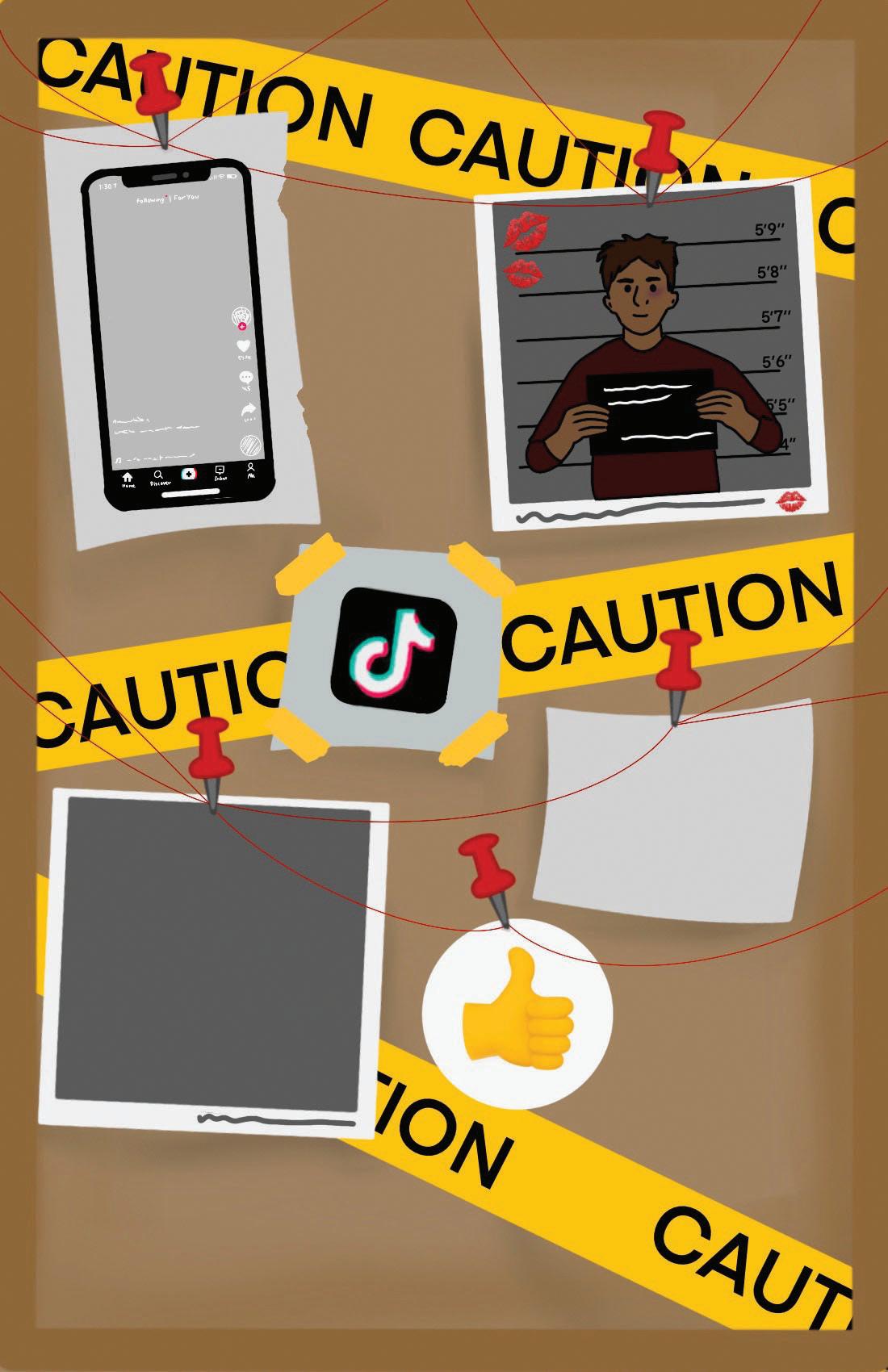


By Chloe Jennings
A crown-jewel heist at the Louvre Museum sounds like the plot of a Netflix thriller. However, on Oct.19, 2025, it actually happened. Thieves stole eight pieces of French crown jewels from the Apollo Gallery at the museum in Paris, France. Within hours, social media users' feeds filled with reaction videos, memes and theories, with #louvre reaching hundreds of thousands of videos on TikTok. Whether it was speculation that there was a Russian passport found at the scene of the crime, or that a mugshot of one of the suspects had been released, misinformation smeared the story and misinterpretation spread quickly online.
This isn’t the first time that amateur investigations of a crime have gone viral, with recent examples including the Lyle and Erik Menendez case (popularized by the Netflix series “Monsters,” starring Nicholas Alexander Chavez and Cooper Koch) and the Luigi Mangione case (the 29-year-old accused of shooting UnitedHealthCare CEO Brian Thompson). Certain crimes are low in sensitivity, allowing leeway for jokes or memes, while others involve victims of life-altering turmoil, like these cases.
starts getting awareness through TikTok, it’s not for the right reasons. After Monsters came out, everyone was raving about the characters in the show and not bringing awareness to the case itself,” Duhagon said.
What effects on an audience through shows like “Monsters” are examples of pretty privilege. When it comes to criminals, the value of physical appearance becomes apparent.
If they are conventionally attractive, people immediately jump to saying things like, 'Oh, they must have had a reason,' or, 'What did [the victim] do to them first?' They try to
A junior who requested to remain anonymous, and will be called Emma, makes TikTok edits of various characters and actors. She noted differences in viewership in videos involving criminals.
“I posted an edit of Mangione, and it is the most liked video on my account. I wasn’t even thinking about the crime he committed when I posted it,” Emma said.
Whether the creator had
the debate a draw. Kennedy was younger and notably more attractive to viewers.
“Our brains automatically put together good looks with being a good person,” Duhagon said. “Pretty privilege goes a long way when it comes to criminals. Physical appearance is so valuable, and people often don't realize that.”
“Pretty privilege” is part of a deeper psychological phenomenon called the “Halo effect," a cognitive bias associating a single positive trait (like attractiveness) with the rest of a person's qualities. This bias causes people to make further assumptions about someone’s characteristics, such as intelligence or trustworthiness.
Humans have historically associated beauty with kindness, exemplified by one particular story from Ancient Greece. The tale notes that Phryne, a woman on trial for impiety, argued that she was favored by the gods and therefore could not have committed the crime she was accused of. She used her beauty to defeat the case against her and was acquitted.
Fifty-three percent of adults in the U.S. say they get their news from social media (Pew Research Center). David Plescia, a social studies teacher, believes that the popularization of the Louvre heist might be beneficial to
Layla Duhagon
senior
Brothers Lyle and Erik Menendez were sentenced to life after being charged with first-degree murder for killing their parents. The brothers were motivated by sexual, physical and psychological abuse primarily from their father. The Netflix series depicting their story, “Monsters” (‘Monsters’ being a metaphor for the brothers’ parents, Kitty and José Menendez), garnered over 69.7 million views, making it the third-most-watched television series on the platform in the second half of 2024. While some took the show seriously, many turned to social media to fawn over the actors’ portrayals of the Menendez Brothers' attractiveness. Soon, the real brothers were being sexualized, along with Chavez and Koch.
Senior Layla Duhagon often watches true crime and is frequently on social media; she has firsthand observed the narrative shift surrounding the perpetrators of crime.

A boy dressed as Erik Menendez looks into his camera, checking out his trending Halloween costume.

Por Siena Forster
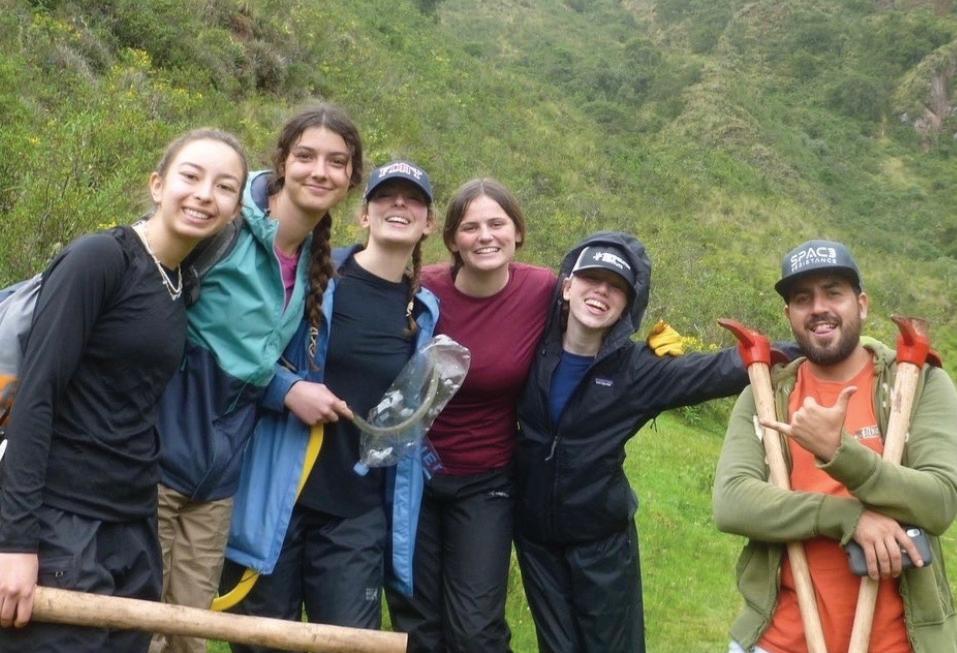
Construir amistades, viajar y conocer nuevas culturas mientras se ayuda a las comunidades de América Latina es posible para los estudiantes de Redwood a través del Regeneration Field Institute (RFI), dirigido por los profesores el Sr. Bingham y el Sr. Van Peursem. En estos viajes, los estudiantes se integran en la cultura latinoamericana, practican su español, ayudan a las comunidades y crean recuerdos y amistades para toda la vida.
“Nos convertimos en una familia, en algo que se convierte en esta unidad que regresa [a Marin], y [los estudiantes que regresan] almuerzan juntos una vez por semana y ven atardeceres y amaneceres, porque crean este vínculo,” dijo el Sr. Bingham.
Erin Macmillan, estudiante de penúltimo año que participó en el viaje a Perú en 2023, explicó que la experiencia la motivó a seguir aprendiendo español.
“Me motivó mucho porque vi aplicaciones prácticas en la vida real, y cuando me encontraba con barreras idiomáticas, me daban ganas de poder tener esas conversaciones,” dijo Macmillan.
Puede ser un desafío ir a un nuevo país y aprender un nuevo idioma, pero el Sr. Bingham nota cómo esta experiencia ayuda a los estudiantes a salir de su zona de confort.
“Veo a nuestros estudiantes prosperar. Veo a nuestros estudiantes superar esas dudas sobre sus barreras lingüísticas, y principalmente se debe a que se les impone,” dijo Sr. Bingham
Los viajes ofrecen experiencias educativas
significativas. Hannah Lacey, estudiante de último año, explicó cómo este viaje la ayudó a fortalecer sus lazos y le enseñó importantes lecciones de vida.
“Aprendí la importancia de la empatía. Comprender a los demás, brindarles apoyo, escucharlos y simplemente estar ahí para ellos, hizo que toda la experiencia fuera mejor,” dijo Lacey.
En Perú, los estudiantes construyeron casas, plantaron árboles, pintaron aulas e interactuaron con las comunidades locales.
“Aprendí a desconectarme. No usamos nuestros teléfonos en todo el tiempo que estuvimos allí, no pensaba para nada en la escuela. No fue estresante. Aprendí que una vida simple puede ser muy gratificante y que ayudar a los demás puede ser maravilloso,” dijo Macmillan.
La experiencia permite a los estudiantes obtener nuevas perspectivas del mundo.
“Cuando visitamos comunidades y trabajamos con familias que tienen una necesidad… Nuestros estudiantes pueden ir allí y ver que, incluso cuando estas personas no tienen las mismas oportunidades que nosotros aquí, se dan cuenta de que hay más de lo que creemos que se necesita aquí en Marin,” dijo el Sr. Bingham.
Durante el viaje el grupo se conecta como una familia.
“Mis relaciones personales con estas personas fueron muy beneficiosas. Fue por lo que estábamos haciendo y el lugar, una combinación perfecta y un grupo genial de personas que estaban allí con un propósito realmente positivo,” dijo Lacey.
Los viajes forman parte de los esfuerzos del programa por exponer a los estudiantes a realidades y comunidades diferentes.
sforster@redwoodbark.org


By Angelina Purvey
Do you ever feel like you have rewatched every single holiday movie in existence? Don’t get me wrong, going with a classic like “Elf” or “Home Alone” is always a safe choice, but having some variety would jazz up this holiday season even more. Just in time, Netflix released multiple new movies to add some spice to the holiday movie section. Each film has a unique storyline that doesn't follow the typical cliché of almost every other holiday movie. Pop some cookies in the oven, grab a fuzzy blanket and turn on those Christmas tree lights because it's time to watch some movies.

Merry Little Ex-Mas
Starring Alicia Silverstone and Oliver Hudson, this movie takes the classic rom-com plot, but adds a twist with the element of divorce. The film captures awkward family tension perfectly, with playful yet comical banter that cuts deep enough to convey the characters' snarky points. The storyline follows Kate (Silverstone) and Everett (Hudson), a couple filing for divorce during the holiday season, set in the picture-perfect winter town. It takes us through the jumbled mess that comes along with a divorce, between dealing with in-laws, their kids and new significant others, but with a comedic and heartfelt tone. An additional side plot that viewers get a glimpse of is that Kate put her career ambitions on hold to focus on her family, which ultimately drove a wedge between their marriage.
“A Merry Little Ex-Mas” has heartfelt moments of reflection and reconnection. The component of divorce boosts points for creativity as a non-traditional holiday movie plot, but the pace felt slow at times, sometimes even repetitive, leaving me wanting a bit more action

throughout the film. Additionally, the plot felt predictable from the beginning, making the ending of the film a little less satisfying.
Jingle Bell Heist
Produced by Matt Kaplan, producer of the “To All the Boys I’ve Loved Before” films, “Jingle Bell Heist” currently holds the spot of number one most viewed on Netflix, and deservedly so. This film has the audience hooked from the very beginning and continues with a fast pace throughout, good for those with short attention spans. Different from what most expect from a holiday movie, the film has more of a melancholy tone sprinkled with scenes of action, heartbreak and ultimately, happiness. The movie follows Sophia, played by Olivia Holt, and Nick, played by Connor Swindells, struggling with different aspects of their lives, leading to both of them needing money and strangely ending up in a robbery together.
The film does an excellent job with captivating filming angles and shots, and notable points for the mostly instrumental soundtrack, as it adds to the depth of the film and captures the tone of a mystery rom-com perfectly. There is also a prominent use of silence, which makes you feel as if you are transported into the conversations between the characters, instead of having the characters being binded to their script.
This holiday movie deals with heavier topics that tug on the heartstrings of the audience, capturing raw moments of life and emotion. It gains bonus points for being cinematic, while having great plot twists, ones that are very unexpected. I was pleasantly surprised with this one, an intriguing storyline with the side of a slow-burning romance that creeps through, making it a must-watch this holiday season.
My Secret Santa Released on Dec. 3, “My Secret Santa” was not exactly a holiday hit. Starring Alexandra Breckenridge and Ryan Eggold, this movie follows Taylor, a mom desperately in search of a job during the holiday season, and Matthew, a wealthy man who has never had to balance any responsibilities in his life. Taylor finds herself becoming a Santa, all to be able to support her daughter’s dream of attending a snowboarding school. Although the plot was creative and original, it felt underdeveloped and lacking substance, as there weren't many exciting points throughout the film.
The movie features moments of rediscovering love again and finding oneself. Taylor encapsulates the feelings of wanting to do everything in her willpower to make the dream life for her daughter, something most mothers can relate to. The mother-daughter bond shines through, making for a stronger message to be shared. Furthermore, an unexpected romance buds through whilst Taylor is living her double life.
Overall, this film radiates the same energy as a Hallmark movie, a little cheesy but sometimes, those types of lighthearted movies with a couple cringe moments make for the best movie nights.
All of these movies are available now, streaming through Netflix. Try something new this holiday season instead of clicking on that same Christmas movie you watch every year. Take some time to watch these new

apurvey@redwoodbark.org
By Beatrice Nass
As the time approaches for Christmas, Hanukkah, Kwanzaa and many other winter festivities, choosing to decorate one’s house to celebrate the season is a great decision. Here are a few tips to make sure houses look as festive as their owners feel.
Tip 1: LIGHT IT UP
Since winter is the season of lights, decorating with them is an easy way to brighten any home. String lights can be hung from mailboxes or over doorways to light up the home’s entrance. Testing out string lights in different colors can also add to the fun. For Christmas, colors like green and red can help spread holiday cheer. To be more inclusive, including a variety of colors can help represent multiple winter holidays. Either way, with string lights up, it’s hard to go wrong.

Tip 2: ADD WINDOW GELS
A fun way to involve younger children in holiday decorating is with window stickers. These are gel-like molds designed to stick to glass windows so both people outside and inside the house can view the message or image. They include letters to spell out phrases of holiday cheer and shapes to create images. They only stick to glass
surfaces, so there's no mess or residue to worry about, making them an easy and creative addition to any window.
Tip 3: ADD INFLATABLE
While it may seem a little over the top, convincing parents to invest in an inflatable character can add the ultimate touch to a festive house. Inflatable decorations range in price from $50 to more than $100. The bonus, however, is that like string lights, they are reusable and durable, allowing houses to dominate the decorating game year after year.
To continue reading this story, visit redwoodbark.org or download the app.
bnass@redwoodbark.org
By Amrit Aujla
Each year, 30 to 40 percent of the food supply in America goes to waste. That is equivalent to 133 billion pounds of food that is thrown away (USDA). This growing issue has led to significant economic and environmental impacts, prompting organizations to develop practical solutions to reduce food waste. Among these efforts, one of the most impactful and prevalent in today’s society is the app, Too Good To Go. Since its founding in 2016, Too Good To Go’s popularity has increased substantially, with now more than 100 million registered users across 19 different countries. Most restaurants, grocery stores and fast food chains throw out their extra or nearly expired food at the end of the day because it no longer meets next-day quality standards. Too Good To Go partners with these businesses to sell surplus food at heavily discounted prices in the form of “surprise bags,” salvaging food that would normally end up in the trash.
With over 175,000 business partners, a variety of surprise bag options are available in different areas. In Marin, some of these options include SusieCakes, Whole Foods and Johnny Doughnuts.
SusieCakes:
The Susie Cakes surprise bag, priced at $6.99, came with four full-size cupcakes and two snickerdoodle cookies. At the regular price in store, this order would total $27.94. This is a great option that not only has a
positive environmental impact but also saves money. For anyone looking to share a treat with family or friends this holiday season, this is the perfect surprise bag.
Whole Foods:
The two Whole Foods locations in Marin offer a variety of surprise bags such as bakery items, dry groceries, seafood, meat, refrigerated groceries and prepared foods. The prepared food bag, in particular, is perfect for a last-minute lunch or dinner. While this bag was the most expensive of the three at a price of $9.99, it was easily justified by the value of the food that came with it. The bag included three on-the-go microwavable meals from the brand Cafe Spice, a chicken salad, a pasta salad and a packet of Swiss cheese. The retail price of these items totaled to $43.60. Compared to the typical high price point of Whole Foods items, this bag felt like a bargain. Beyond the savings, the assortment of ready-toeat items added notable convenience.
Johnny Doughnuts:
This surprise bag included an assortment of four doughnuts, showcasing several of the shop’s signature flavors. Considering that a traditional four-pack at the shop costs $22, grabbing this bag at just $8 felt like a steal. Not to mention, the doughnuts remained fresh despite being sold at the end of the day. For anyone with a sweet tooth, this bag is perfect for adding value to both your wallet and stomach.
By Penelope Trott
There’s no place like home, especially when home returns with a sequel. “Wicked: For Good” clicks its heels and brings audiences back into the magical World of Oz in the highly anticipated sequel to the 2024 blockbuster. Directed by Jon Chu, the Wicked sequel was released on Nov. 21 to a Rotten Tomatoes score of 68 percent. The Wicked franchise, adapted from the novel by L. Frank Baum and the award-winning Broadway musical, reimagines the World of Oz through the eyes of its witches.
“Wicked: For Good” picks up directly after the events of the first film, following The Wicked Witch of the West, also known as Elphaba (Cynthia Erivo), as she faces the consequences of being branded “wicked” by the public. The film also focuses on her counterpart, Glinda the Good Witch (Ariana Grande), who rises to political prominence in Oz. As the tensions in Oz grow and Elphaba begins to spread doubt over the Wizard’s (Jeff Goldblum) authority, both witches must confront the stories and legacies they are leaving behind. Similar to the original 1939 film, “Wicked: For Good” goes beyond the good versus evil motif and shows the complicated relationships.
Visually, the film was even more impressive than I had expected. The bright colors reflect the palette of the first film, but the movie doesn’t shy away from taking a more mature and dark look at Oz, switching the pink-and-green color scheme for more red and black.
Both Cynthia Erivo and Ariana Grande embody their characters and pay homage to the previous Glindas and Elphabas, but they also put their own unique spin on the characters and their dynamic. Grande adds a comedic effect to the film, while Erivo offers a more grounded presence. Their friendship on and off-screen is clear in their chemistry, and it is the heart of the film. During heartfelt moments in the film, it seemed that there wasn’t a dry eye in the room.
However, despite its many strengths, “Wicked: For Good” fell short in a few aspects. The two additional songs, titled “No Place Like Home” and “Girl in the Bubble,” don’t fit the original music, with a more popmusic feel rather than the traditional musical of the original songs composed by Stephen Schwartz. Compared to the originals, the new additions stick out like a sore thumb compared to the rest of the soundtrack. Additionally, The Wicked Witch of the East (Marissa Bode) failed to hit the



notes in her titular song, and Madame Morrible (Michelle Yeoh) delivered a similarly flat performance. Despite the few flaws, “Wicked: For Good” still defies the gravity of my expectations. I was pleasantly surprised by the changes made by the main and supporting cast. The film shows more of the emotional connection between the two witches, in a way more personal than the onstage production. For any longtime fans and newcomers, “Wicked: For Good” is a must-watch and leaves a lasting mark, for good.
ptrott@redwoodbark.org
By Joel Kurtzman
As we approach the end of 2025, here is a look back on the year through music, with a review of four of the best albums produced this year.


Nashville-grown and critically acclaimed country music star Morgan Wallen released his fourth studio album, “I’m the Problem,” in May. This project features a whopping 37 tracks, with the majority being solo performances. The album features music stars such as Tate McRae and Post Malone who have started to collaborate and integrate country and pop music. This album explores many sensitive and vulnerable topics such as love, heartbreak and regret. All of this occurs while also relating back to self reflection through analyzing his flaws and issues he faces, especially in relationships.
With all 21 songs debuting on the Billboard Hot 100 charts, Drake and PARTYNEXTDOOR’s collaborative album “$ome $exy $ongs 4 U,” made a statement and cemented itself early as one of the biggest releases of 2025. This album is filled with melodic R&B hits that feature both artists. Overall, this album is a very fun listen that has a couple tracks that keep me coming back weekly, including “DIE TRYING” and “SMALL TOWN FAME.”
Released on Oct. 3, Taylor Swift put out her twelfth studio album, “The Life of a Showgirl,” which caught the attention of many. Her album reached number one on the Billboard 200 chart after the first week, with all 12 songs on the album taking their place on the Billboard Hot 100. But as Taylor Swift reflects on her fame and career throughout the album, it feels somewhat vague.

On Jan. 31, Canadian singer The Weeknd released his final album ever, “Hurry Up Tomorrow,” which instantly entered the conversation for 2025’s best album. The album featured major artists across various genres such as Lana Del Rey, Travis Scott and Playboi Carti, reaching a wide range of listeners, with over 3.1 billion Spotify streams in the first ten months. The album consists of a variety of songs, including under one-minute transition songs that creatively tie the music together and diversify the tracklist.


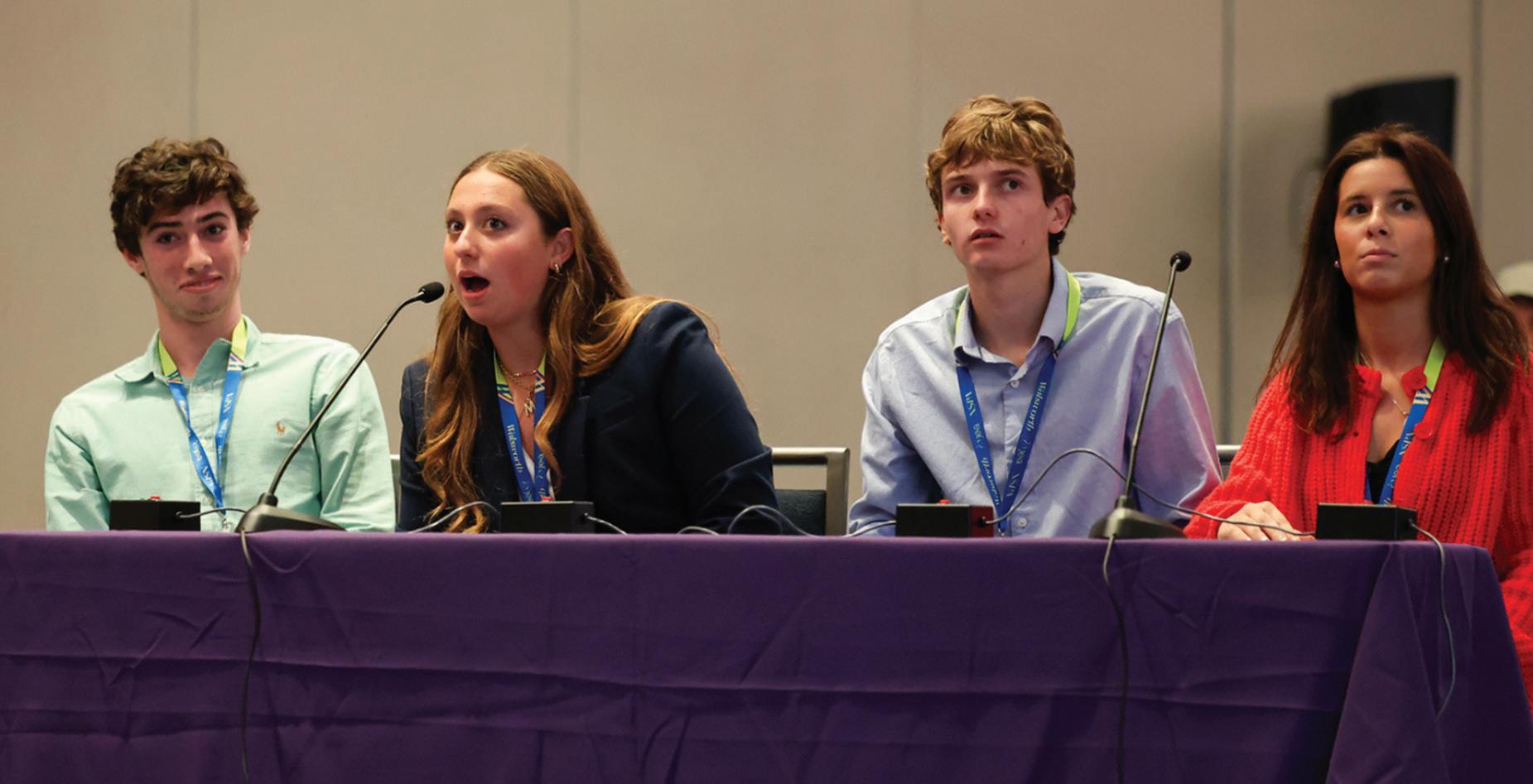
The Redwood Bark spent four days at the National High School Journalism Convention in Nashville, joining over 5,000 student journalists and returned inspired and energized with a fresh perspective.
We are excited to share that our first edition of the year earned eighth place nationally in National Scholastic Press Association’s (NSPA) Best of Show.
On Saturday, surrounded by thousands of journalists and advisers in a packed convention hall, several Bark students (“Barkies”) received national honors for standout work from the ‘24 - ‘25 school year.
NSPA Individual Awards
- First Place: Interactive Graphic: “Board
of Trustees Discusses Yondr Phone Pouch Implementation” by Ben Mueller and Morgan Sicklick
- Second Place: Multimedia Feature: “A Compiled Report of the Current State of Social Media” by ‘24 - ‘25 staff
- Third Place: Comic Strip/Panel: “Student Security” by Lucy Jeffers
- Honorable Mention: Editorial Cartoon: “Schools starved from Lack of USDA Funding” by Penelope Trott
As for this year’s staff, Barkies excelled in the Journalism Education Association (JEA) National Media Contests. These participants competed against over 1,600 students in a timed atmosphere to win national awards for their writing,
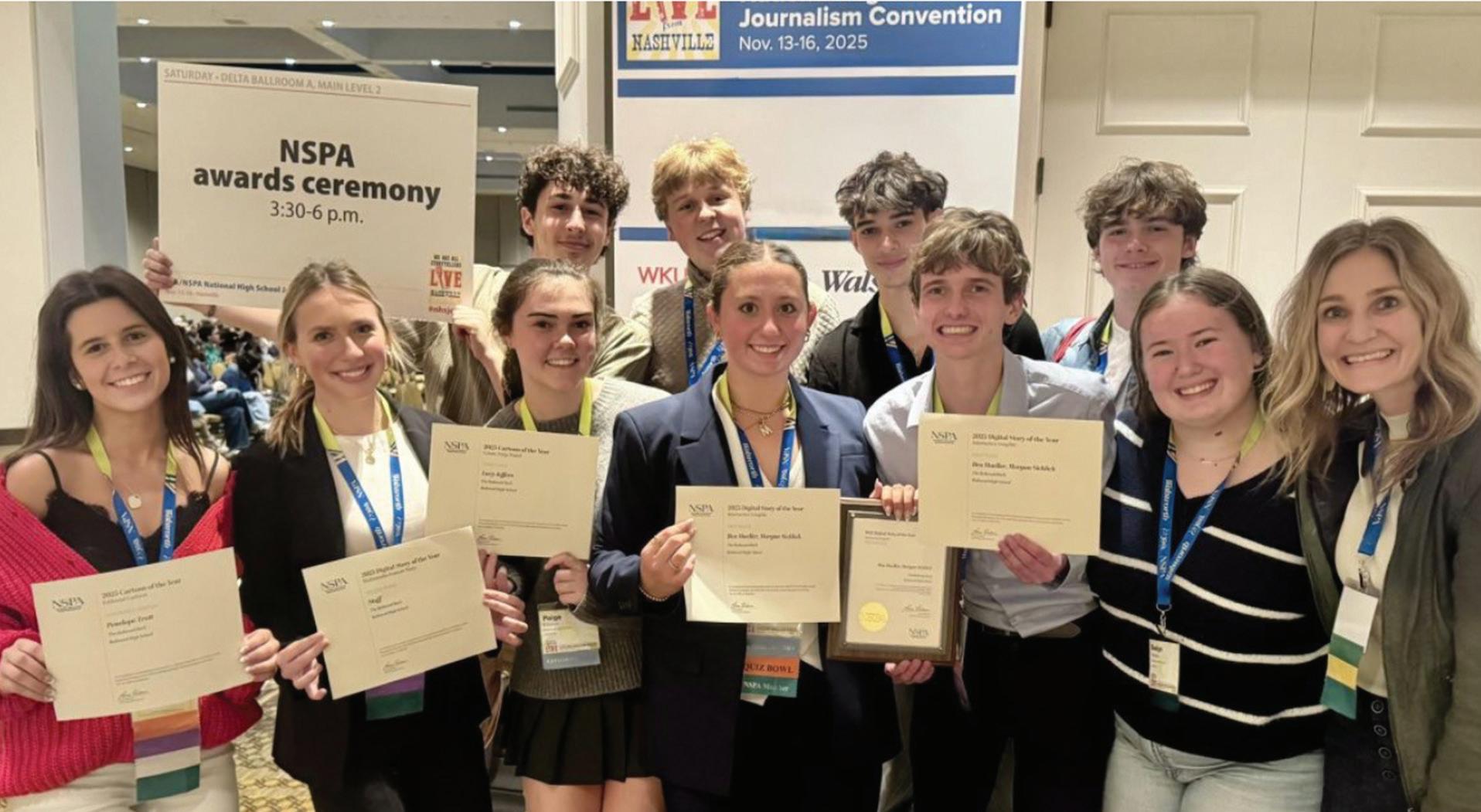
infographics, editing and videography.
Superior Category
- Broadcast Sports Story by Tobin Rivera and Logan Scully. Broadcast Sports Story Feedback: “With the music and tone of the writing, it felt like something out of E60….” JEA judge said.
- Press Law and Ethics write-off by Mila Martinez
Excellent Category
- Graphic Design Infographic by Lily Skinner
- Person on the Street Interview by Siena Forster and Georgia Thomas. Personon-the Street Feedback: “Love, love, love the [Prop 50] subject matter- tackling
the issues of the day is super important for student journalists,” JEA judge said.
- Editorial Writing by Madison Bishop
- Commentary Writing by Ben Mueller
Honorable Mention Category
- Online News Package by editors-in-chief
Morgan Sicklick, Cora Champommier and Paige Edelen
- Newswriting by Isha Patel
- News Editing/Headline/Current Events by Nico Ruel
- Copy/Caption: Sports by Jack Block
- Broadcast News Writing by Kate Barker
To find the links to these award winning pieces, visit the News section at redwoodbark.org

What are you most excited for in the upcoming season?

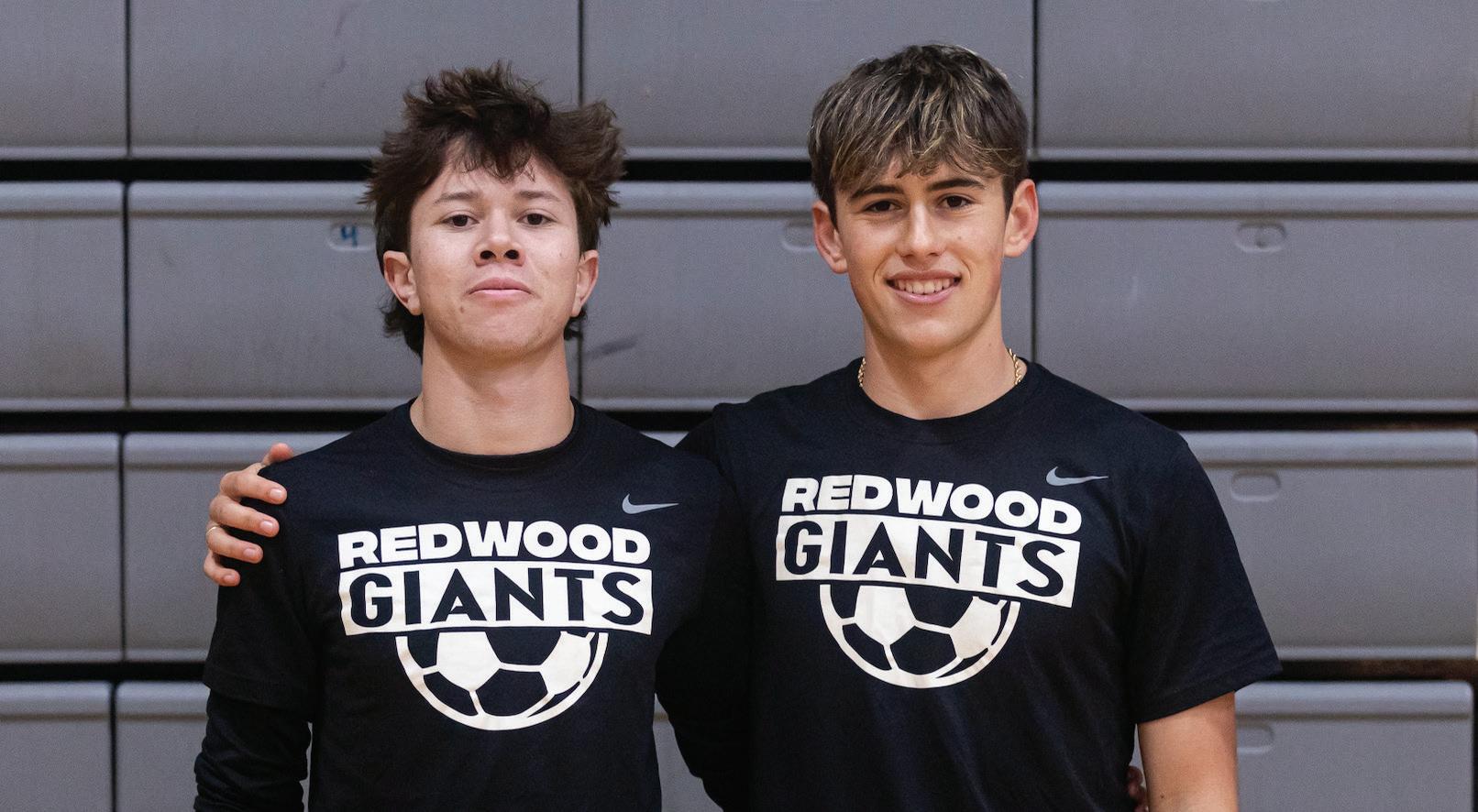
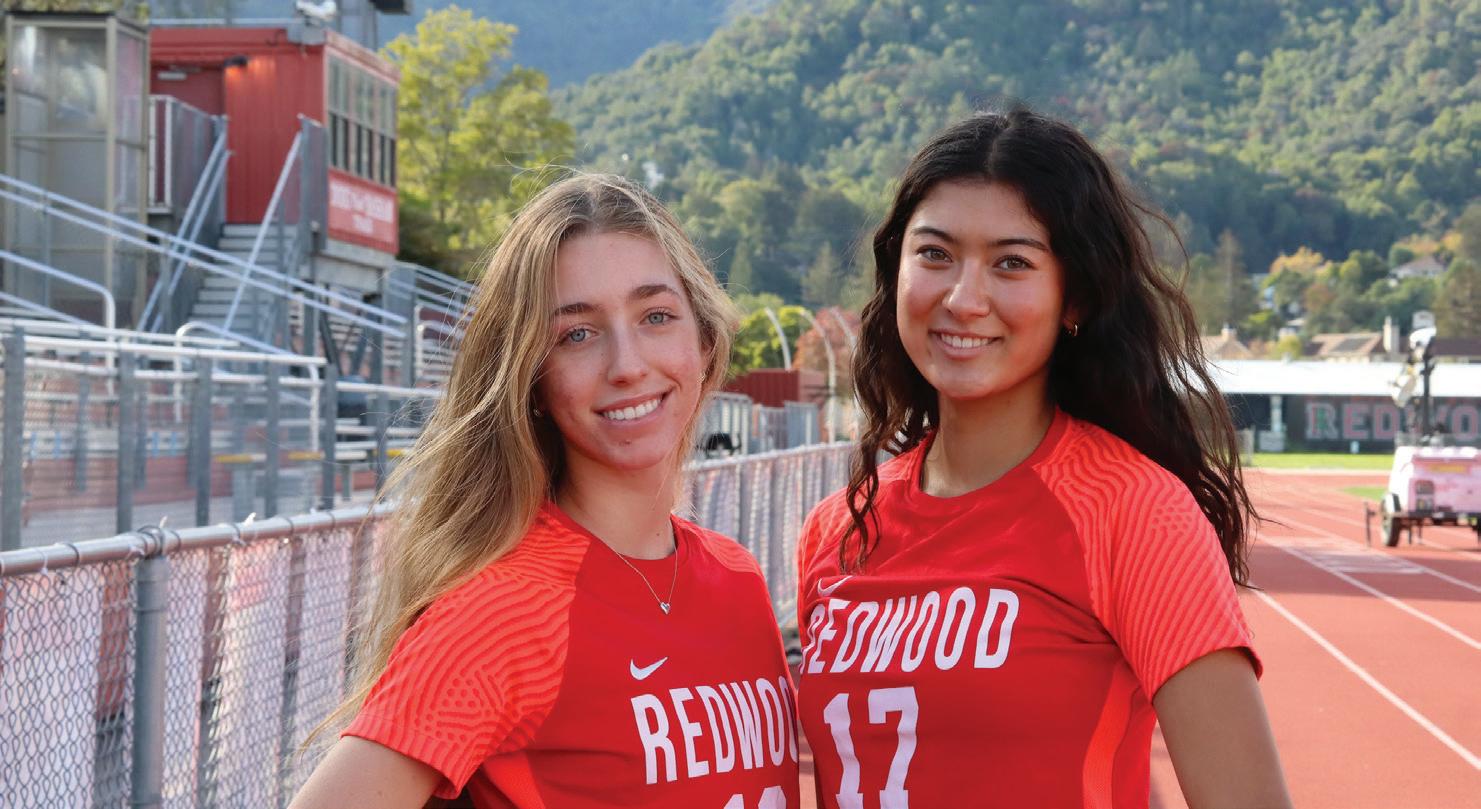

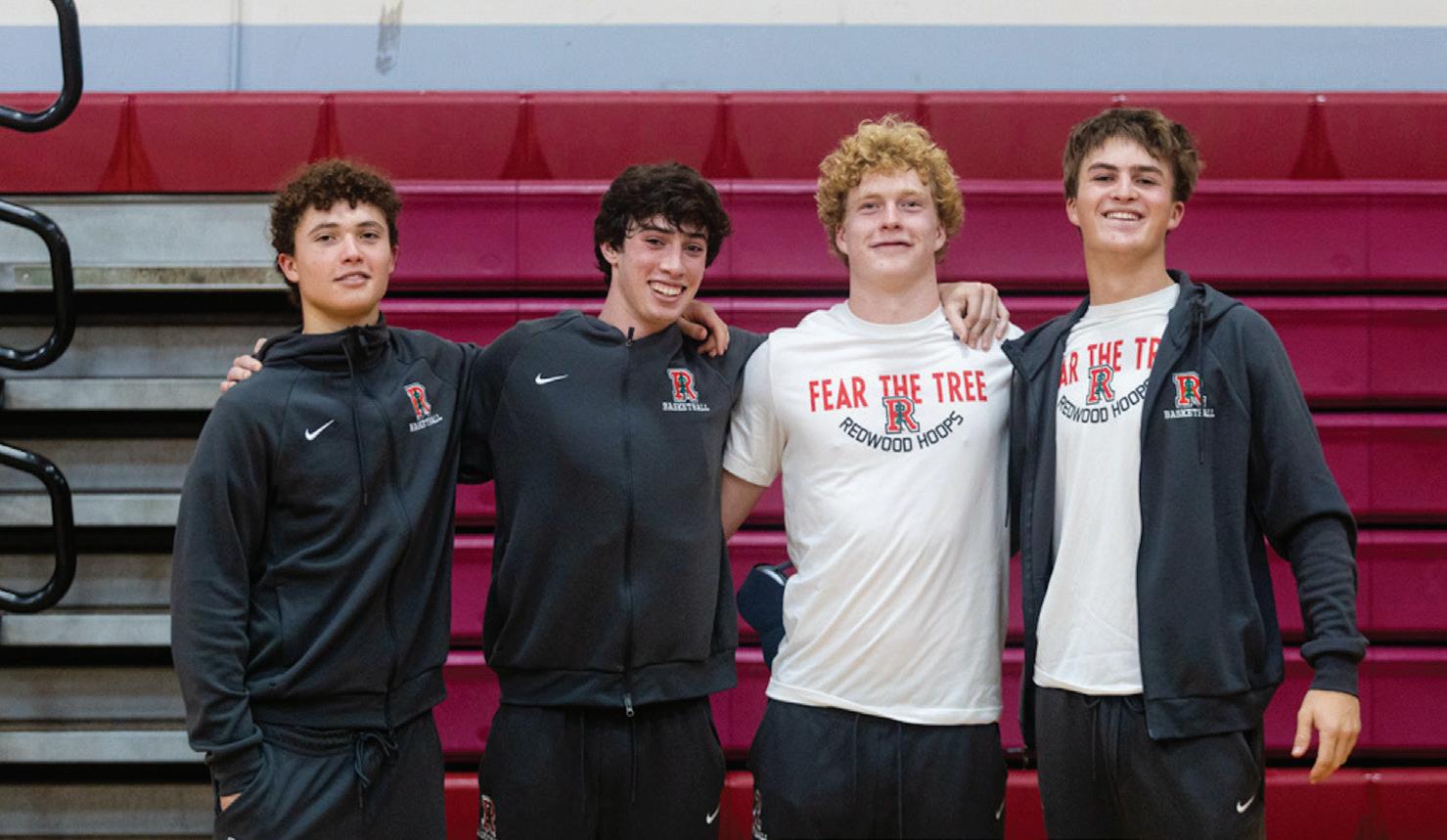
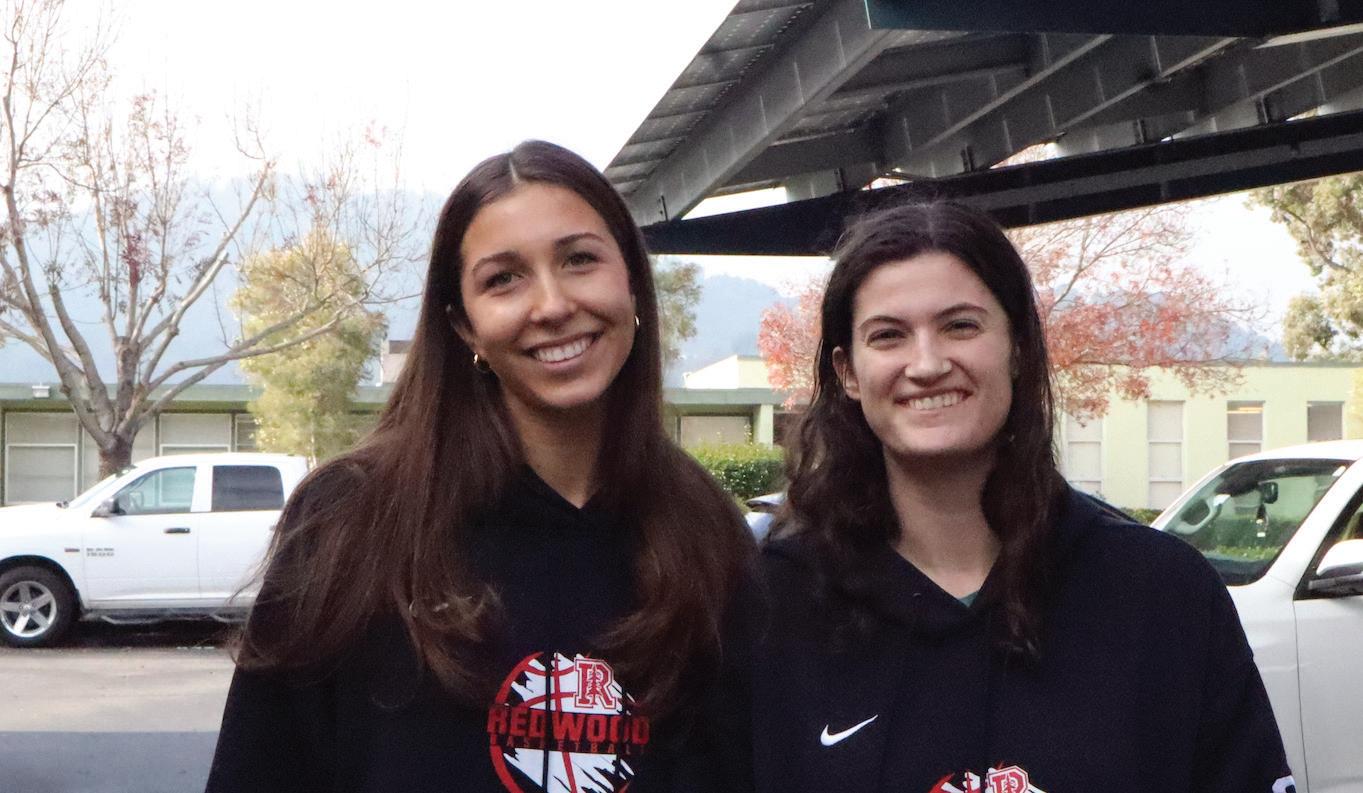

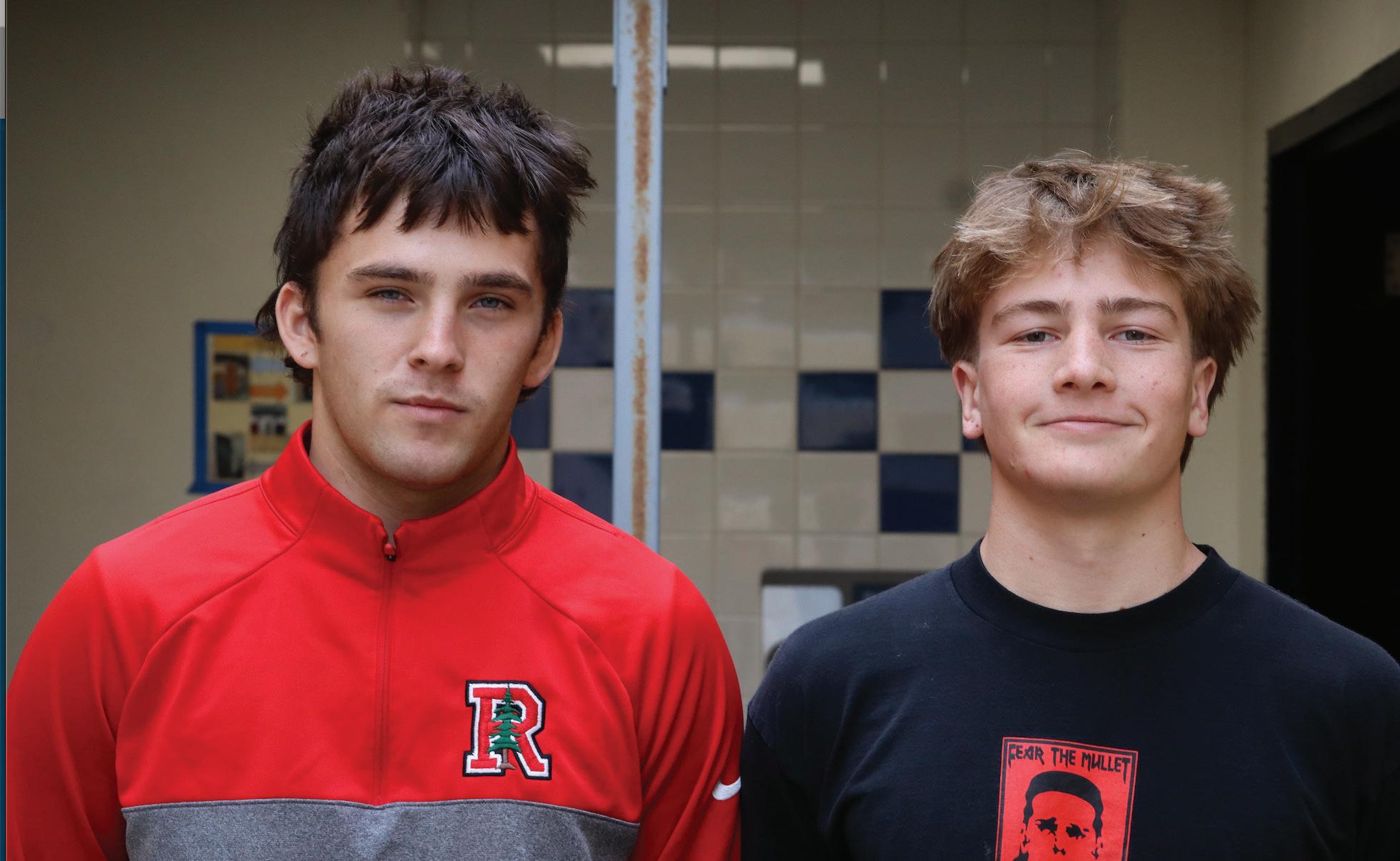

By Henry Barker
Girls’ Flag Football: The inaugural season for Redwood flag football finished with optimism for the future of the program. After starting with four straight losses, the team found a rhythm down the stretch, winning seven of their last eight games to edge over .500 at 1110. The offense was driven by freshman quarterback Annalise Pyle, who will look to lead the team over the next three years after receiving Marin County Athletic League (MCAL) first-team honors in her first year. Another freshman, Pressley Meyers, also earned firstteam awards on the defensive side of the ball, as did junior Emma Stein. The team did not make the North Coast Section (NCS) playoffs.
Football: After losing the first two games of the season without scoring a single offensive point, the Giants appeared unlikely to make a postseason run; but they quickly rebounded. Grounded by a stellar defense and improved offensive play, the Giants strung together wins over Maria Carrillo (35-14), Castro Valley (34-21) and Petaluma (31-21), with senior receiver Dylan McGrath exploding for four touchdowns against Petaluma. The momentum didn’t last though, as a 7-2 loss to rival Tamalpais and another midseason defeat against Casa Grande stalled the offense again. With senior quarterback Tommy Vasquez battling a knee injury, the Giants turned to junior quarterback Cash Ward. Behind their defense and senior running back Riley Ulin — who ran for 150 yards and three touchdowns in the NCS win over Benicia — the Giants pushed their way to the NCS Division 4 semifinals. Redwood ultimately was blown out 20-0 against Miramonte to end the season at 6-6, but the team getting this far was a success in itself. McGrath earned first-team honors as both a wide receiver and cornerback, and seniors Alex Teodoro (offensive lineman) and Ben Vaughn (linebacker), alongside junior Wes Fitzpatrick (defensive lineman) earned first-team recognition as well.
Girls’ Field Hockey: In a heartbreaking 2-1 tripleovertime loss to Tam, the Giants were defeated in the MCAL championship for the first time in seven years. The season finale might be disappointing given the high standard of success Redwood field hockey has set, but their 14-3-1 league record shows the team’s real dominance. They defeated rival University three times (2-0, 4-1, 4-1), including in the league semifinal. Sophomore Moni Hewlette led the Giants with 21 goals, earning herself first-team honors, while senior Lucy Jeffers joined her on the first team
Girls Water Polo: Girls’ water polo had a strong 17-6 record but fell short in MCALs, losing 8-6 to rival Archie Williams in the semifinals.
In NCS, the Giants defeated Castro Valley 7-2, headed by senior Morgan Sicklick with two goals and an assist, and sophomore Samantha Riley, who had a goal and two assists. The season ended with a blowout loss to first-ranked San Ramon Valley, who dominated on offense, putting 23 shots on goal and making 16 of them. Riley showed promise as the future of the Redwood program, leading the team in both goals (56) and assists (24). Riley received first-team all-league honors, while the junior goalkeeper Aurora DeVilbiss earned secondteam awards after an impressive year with 223 saves, and Sicklick received second-team honors as well.
Boys’ Water Polo: Giants took full control of not only Marin—with an 11-0 league record—but all of Northern California, completing a trifecta of the MCAL, NCS and NorCal championships. Their nine-straight wins to finish the season featured a 19-11 win over Archie Williams for MCALs and a 16-8 victory versus Alameda in NCS. This historic season was capped off with a 13-9 victory over Clovis High in the Division 2 NorCal championship, led by junior Isaac Nikfar with four goals and senior Owen Malone with 14 saves. Malone, who finished the season with 255 saves, took home the Redwood Player of the Year, along with first-team MCAL honors. Juniors Jakob Engberg and Maddox McClellan, and leading goal scorer sophomore Storm Jackson, were also awarded first-team all-league honors.
Girls’ Volleyball: The Giants got their six-game win streak broken by Marin Catholic in an Oct. 8 midseason rivalry match. This loss marked the momentous turning point in the season: the team went on to reach victory in eight of their last nine games, including a rematch win over the Wildcats in the MCAL championship. They finished the year with a 2010 overall record and a 10-1 league record, displaying their dominance over league competition. However, in the first round of NCS against MCAL rival Branson, who they defeated earlier in the year, they were swept 3-0, ending their NCS run before it could start.

By Owen Scheeline
Wrestling has officially started its season, and early practices are already filled with energy. With a stronger and more prepared team than last year, wrestling is on track for a dominant season.
This year’s roster features a mix of experienced returners and a large group of newcomers. Second-year head coach Brittley Tringali and captains, junior Dylan Morton and senior Hayden Schepps, believe the new combination of newcomers has created a productive and competitive training environment and team.
Morton thinks the team’s focus is already paying off.
Cross Country: Both the girls’ and boys’ cross country teams were highly competitive in both MCAL and NCS play, with the boys taking first place in MCALs and the girls finishing second. In NCS, the girls were runners-up, led by senior Cal Poly commit Sydney Middleton, who placed second individually. The boys took third place, with Gabriel Cavanagh earning eighth overall. Both teams also qualified for the state meet, where Middleton placed 12th in the 5k with a 17:46 time. Seniors Middleton and Cavanagh earned first-team MCAL honors, along with junior Cole Sandrich and sophomore Oliver Bush for the boys, and sophomore Rose Mueller for the girls.
With the graduation of former two-time MCAL Player of the Year Jordan Marotto, Redwood entered the 2025 season with a major gap in their lineup. But the Giants adjusted quickly, with younger players stepping in to keep the program competitive. One of those players was sophomore Alessia Bailliet, who anchored the singles lineup and earned first-team all-league honors. The doubles lineup was led by senior captains Indah Herzenberg and Sienna Rouas. With a dominant 17-4 regular season record, the Giants entered the MCAL playoffs with confidence. However, a first round defeat to Branson ended their season earlier
“I’m feeling really excited. The season’s only four months long, and the off-season is eight months,” Morton said. “All eight months are just working towards the next season. So I’m really excited for it to have finally started.”
Morton also emphasized that the team has been improving technique, conditioning and mental preparation. He hopes to qualify for state and perform well in the individual matches, while the team aims to have a complete lineup in every weight class to win more overall matches and duals.
Schepps highlighted the team’s new depth as a key strength that they will be utilizing.
“We probably only have two empty weight classes,” Schepps said. “It’ll put us in the mix.”
As captain, Schepps leads warmups and organizes drills. He praises Tringali for adjusting the practice structure to better benefit the wrestlers academically.
“He cut practices from three hours to two hours, giving us more time outside of school to do our own work,” Schepps said.
Both captains also mentioned that preseason training plays a key role in the team’s success. Schepps said that they benefit from practicing on the club team, not affiliated with Redwood and the spring season practices. Morton explained that much of the preseason practice involves rolling through positions, working on certain moves and lots of cardio.
“We’ve been doing a lot of runs preseason, and now we’re doing morning workouts on Tuesdays and Thursdays, trying to improve our cardio. So I’ve noticed a big improvement from that from last year,” Morton said.
Looking ahead, Redwood will compete in duals and tournaments, with its first home dual against Tamalpais High School.
“It’d be great to get a big crowd. Duals are always really fun,” Schepps said.
With high-profile winter sports like soccer and basketball typically garnering more student attention, wrestling can get overshadowed and underrepresented. Schepps and Morton both agreed that fan support can make a difference. So, as they enter the year with large aspirations for the team and for themselves, they will look for “Giant” support pushing them down the stretch.
By Jack Block
Senior Emma Quaroni has danced ballet for over 15 years, making her one of Redwood’s most committed and devoted athletes. Dancing has had a large influence on Quaroni’s life, since starting at the young age of just three years old. Since then, Quaroni has solidified herself as a one-of-a-kind dancer.
Quaroni was unaware of the unique impact that dance would eventually have on her life.
“I don’t even remember how I started [dancing],” Quaroni said. “My mom danced in her teenage years, and I think that’s why she put me into dance classes, and I have stuck with it since then.”
Twirling her way to success, Quaroni has been participating in the Nutcracker ballet since she was just a second grader, where she found her passion for dancing and has since showcased her skills for about 10 years.
“In second grade, I did my first production of the Nutcracker, and that’s when I really started falling in love with performing, getting into costume and getting to work with a big group of dancers,” Quaroni said. “After my first show of the Nutcracker, I kept going year after year until I reached where I am now in my final year.”
very physically and mentally demanding.

Currently, Quaroni is preparing to dance as the Sugar Plum Fairy in her final showcase of the Nutcracker, her hardest role yet. Her instructor, Corrine Jonas of Marin Ballet, stated that Quaroni was the unanimous choice to dance as the Sugar Plum Fairy.
Quaroni’s talents set her apart from her peers as she clearly has earned a deep respect and trust from her teachers to fill such a crucial and physically demanding role.
“Ballet is a subjective sport. Some dancers may find turns really hard, while other dancers might find jumps really hard. But for me, this is the most challenging role, and I’m excited to master it,” Quaroni said.
That being said, Quaroni acknowledges that ballet is
“[Dance is] very self-critical and 90 percent of the time I am being critiqued on my technique. Staring at myself for three hours each day in a leotard, trying to perfect how I perform, can be mentally challenging,” Quaroni said. Quaroni has put countless hours and over 15 years of dedication towards ballet, doing whatever it takes to perform at her best.
“It’s a commitment. I spend five days a week and three hours a day dancing on average. For Nutcracker rehearsals, I’m dancing all day on Saturdays,” Quaroni said. Quaroni’s efforts have not gone unnoticed, as Jonas emphasized that Quaroni is one of the hardest-working students that Marin Ballet has ever seen.
“I have had the pleasure of teaching [Quaroni] for about eight years now. To see her grow and how far she has progressed is thrilling,” Jonas said. “It was clear that [Quaroni] had such a natural ability and talent, but also a love for dance at such a young age.”
Quaroni is the only Redwood student dancing at her level, which makes her stand out more than anyone. While dance may not be as popular as a sport like football or basketball at Redwood, Quaroni separates herself as an athlete by practicing a unique skillset that most athletes do not require.
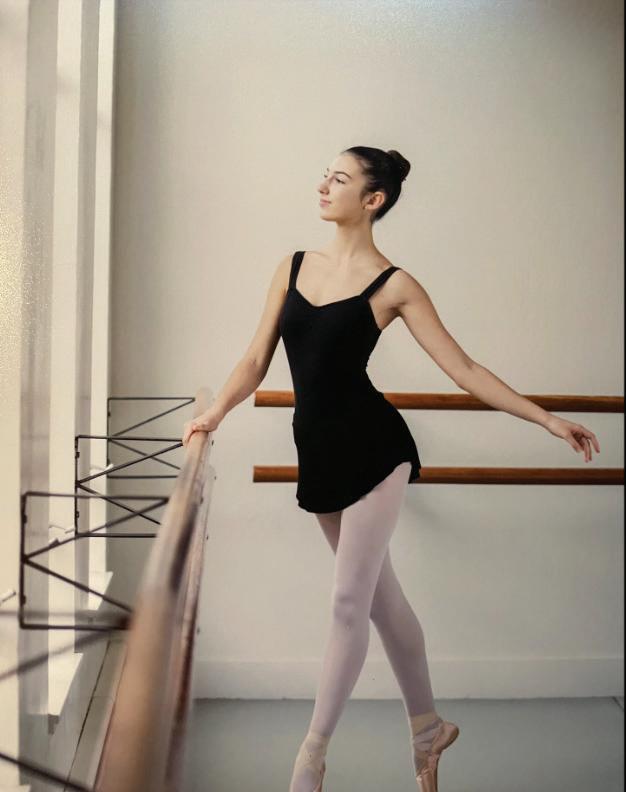
“Ballet is a blend of artistry and athleticism, which is not found in any other sport. That is how I set myself apart from what other athletes do,” Quaroni said.
Quaroni is recognized for her substantial dancing skills, as well as her humanity.
“Her dedication to her art form and her real positive attitude fuels her to be as great as she is and to get to this moment that every little girl dreams of, being selected to dance as the Sugar Plum Fairy,” Jonas said.
Ballet requires many skills that most sports do not
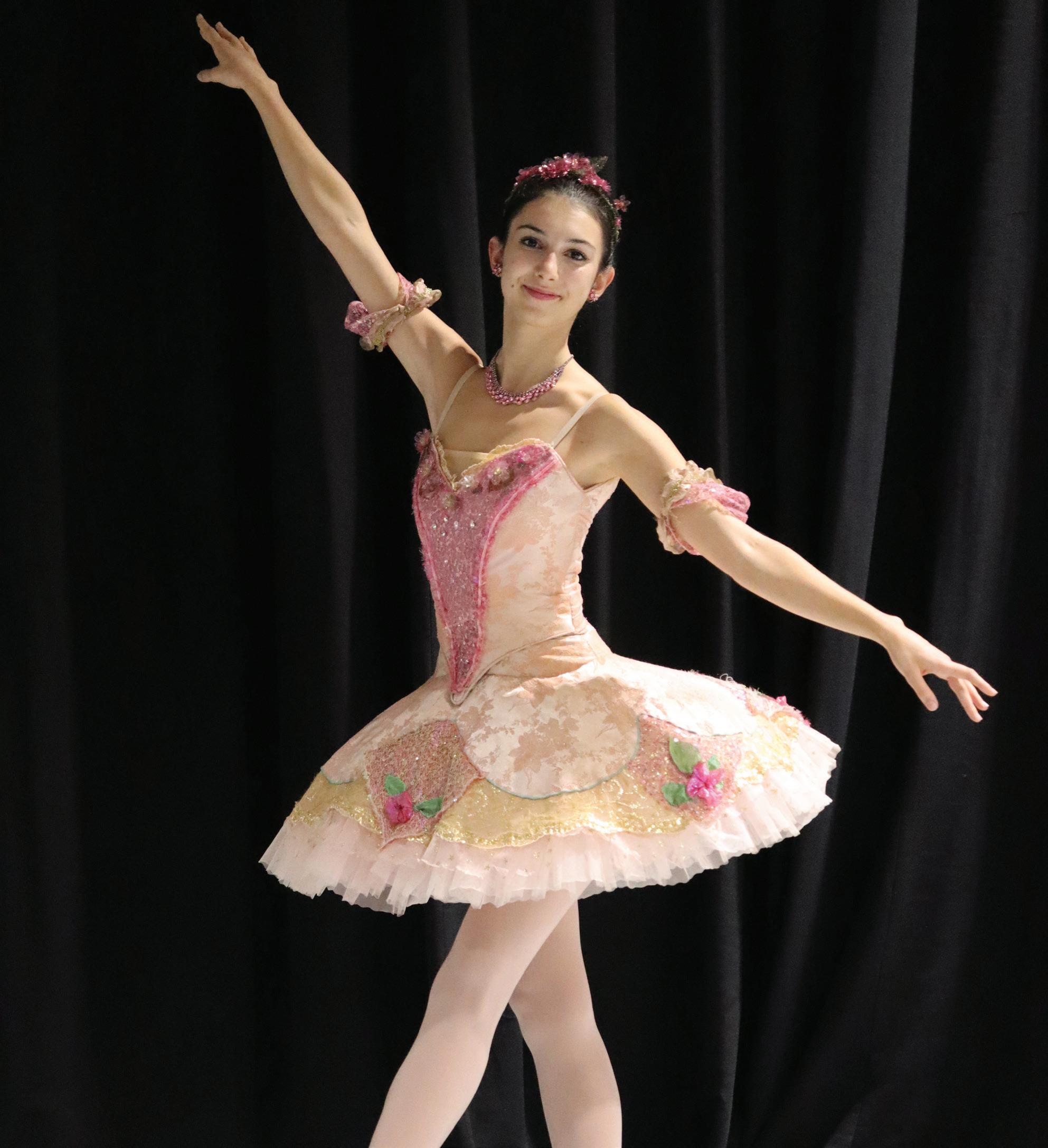
demand, making it very difficult to master it to the extent that Quaroni has achieved.
“Ballet isn’t a sport where results are immediate,” Quaroni said. “I’ve been doing this for 15 years, and it has taken a really long time and a lot of effort to get to where I am and become the Sugar Plum Fairy,” Quaroni said.
Ballet is unique because not everyone has the same skill set as the person next to them. It can be hard and take an especially long time to master different skills that make somebody an elite dancer.
“Quaroni dances with a grace that some pros don’t even have,” Jonas said.
Quaroni attributes her skills to her repetitive and demanding routines that she uses to understand her body and its capabilities.
“Learning how to use your body and dance in the boundaries of the skillset you are naturally given can take a long time to develop, making dance one of the most physically demanding and challenging sports,” Quaroni said.
Quaroni follows a mindset where improvement is always attainable with the right instruction and commitment to her craft.
“It’s visibly noticeable that she loves what she does. To dance with the poise she does and the eagerness to learn and grow, along with her confidence, truly demonstrates that dancing comes from a place of joy and purity,” Jonas said. “Her love for ballet is clear; she gives 100 percent of her effort at the minimum, something she could only do if she truly loves what she does.”

By Cora Champommier and Tate Ralston
The friendly faces sporting black and green vests with an “all-seeing eye” logo, likely with a matching beanie to combat San Francisco’s foggy weather, are the protectors of the city’s streets and vulnerable communities. They are the practitioners of Urban Alchemy. According to the organization, which was founded in 2018, their work grew out of a belief that people who’ve survived trauma can help others move through it. The website says, “The purpose of creating career pathways for returning citizens, primarily those who were serving long-term or life sentences.” Founder and Chief Executive Officer of Urban Alchemy, Dr. Lena Miller finds pride in facilitating second chances. When asked about how Urban Alchemy came to be, Miller spoke honestly about the community she comes from and the gap she saw in support for people returning from prison. Her vision for the organization grew from this disparity.
“I realized there were so few economic opportunities for the [practitioners]. The organization was created to provide economic and employment opportunities for people returning home from prison,” Miller said.
With over 1,300 practitioners in Alabama, California, Oregon and Texas, the organization focuses on three main initiatives: creating, administering and cleaning communities. Practitioners take on a mix of hands-on community work. They clean streets, remove hazards like needles, respond to crises, help run shelters and deescalate tense situations. At the forefront of Urban Alchemy, Miller emphasizes that the practitioners are
the focus.
“They deal with humans who have really complex ways of coping. You have to be constant and understand the environment, and you have to be able to assess what’s going on in the moment,” Miller said. “I think it’s like a muscle that’s been built through exposure.”
Urban Alchemy partners with the DignityMoves interim housing non-profit, at 33 Gough Street in San Francisco. They help manage residents and keep the tiny home village clean and running smoothly.

sure that we all feel safe and welcomed, especially at our pancake breakfasts and all the events we host. They really help create a supportive atmosphere, and I’ve enjoyed collaborating with them a lot,” Gilgallon said.
I’m a success story and no one can take that from me.
Micheal K. Brown, Urban Alchemy Practitioner
Urban Alchemy takes the experiences of people who were once incarcerated and harnesses their skills to give back to those less fortunate. Their work not only provides clarity for their own self-improvement, but also leaves a positive impact on entire communities across the country; one community particularly impacted is the DignityMoves temporary housing village in San Francisco, where many Redwood students volunteer.
Cara Gilgallon, a junior in the DignityMoves club, helps plan community events like cookouts, game nights and Thanksgiving potlucks. With small units created for people transitioning out of homelessness, the club has diligently been doing Sunday pancake breakfasts for almost two years, something residents look forward to every week. Gilgallon regularly works with the Urban Alchemy workers, who assist her and other volunteers with troubleshooting set-up and resident interactions.
“They’re really dedicated to making
By Dorothy Florence
In the summer of 2018, just three months after graduating from the University of Pennsylvania, Redwood alumna Geneva Gondak embarked upon the journey of a lifetime, biking nearly 3000 miles from Virginia to Oregon in support of affordable housing.
Before graduating from Redwood in 2014, Gondak was a dedicated varsity volleyball player who received the Principal’s Award for her significant contributions to the athletic program. At this time, she had not yet developed her passion for biking.
“I didn't bike that much,” Gondak said. “I had a bike. I biked to school. When I went to Redwood, I'd bike a mile to school, but not that far.”
During Gondak’s freshman year of college, she discovered Bike and Build, a non-profit organization that leads service-oriented cross-country biking trips across the United States to raise awareness of the affordable housing crisis. After researching, she found that they were hosting a three-month ride that stretched from coast to coast, stopping in various towns along the way to volunteer and build homes. Based on her athletic history, she found the program enticing and decided to submit her application.
Once Gondak was accepted into Bike and Build, her
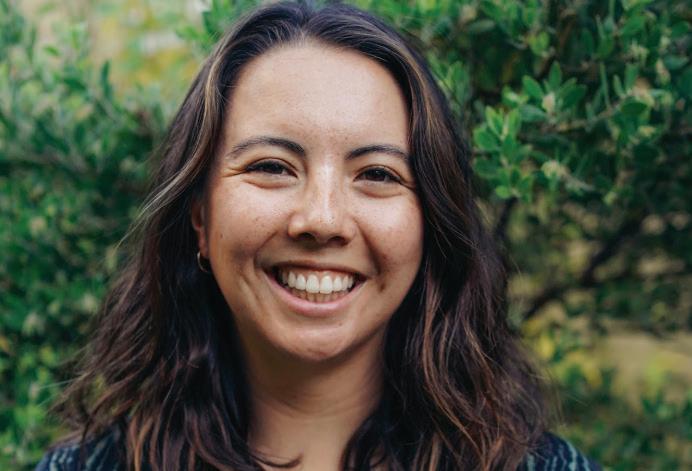
fundraising journey began. Despite not having much prior experience, she underwent months of vigorous training to prepare.
“As part of the preparation, you had to ride at least 500 miles and you had to do certain types of rides,” Gondak said. “You had to ride in the rain at least a few times, do some rides over a certain distance and you had to do some group rides. Then finally, by May, I felt ready to do it.”
Out of the three routes available through the organization, she chose the central Trans-America route, a popular route that cuts through the Midwest along the Rocky Mountains from east to west, beginning in Virginia and ending in Oregon.
The tour was guided by four experienced riders, previously affiliated with Bike and Build, who were in charge of curating paths, organizing accommodations and leading morning route meetings. Each day, the group would average 70 miles of biking from sunrise to sunset. A van would meet the group halfway along that day’s path, where they would stop to refuel, rest and eat. Since a portion of the journey was during the summer heat, the bikers and van drivers communicated beforehand, establishing the 90-90 rule: If they had to bike 90 miles in over 90-degree weather, there would be two lunch stops to suffice for the uncomfortable conditions. The group alternated between camping outdoors and staying in accommodations organized by group leaders, such as churches, businesses and school gymnasiums.
Before becoming the co-head coach of the Mountain Biking team, Steven Scott had used his biking experience in training the 2023 State Champions through independent, long-distance rides similar to Gondak, including a ride spanning across the country as well. Scott participated in a cross-country bike ride stretching nearly 1000 miles from New Mexico to Wyoming along the Great Divide route. Prior to his ride, physical training and supplies were his main consideration when preparing for such distances.
“In my opinion, it's the same as backpacking. You need to get your body used to doing something day after day after day. You don't want to do so much in the beginning that you get injured,” Scott said. “Some days I was riding from the desert up into the mountains. In the beginning, I didn't really need much [gear] because it was going to be warm. Then later, I was going to need more gear as it
In addition, Gilgallon has reflected on the deeper appreciation she’s seen towards the work it takes to rebuild a life.
“Working alongside these people that have been formally incarcerated has really deepened my perspective. It’s made me much more aware of how important second chances are, and it’s given me a lot of respect for people and [shows] how much they can contribute when given a supportive space,” Gilgallon said.
Micheal K. Brown has been with Urban Alchemy for a year, and his journey to become a practitioner was not an easy one. Currently, he is stationed at one of the temporary housing villages created by the non-profit organization, DignityMoves. With units large enough for a bed and desk, these tiny shelters help transition people out of homelessness and are administered by Urban Alchemy workers.
“To read more about practitioners Micheal Brown and Jevon Marshall, scan here...”
bark@redwoodbark.org
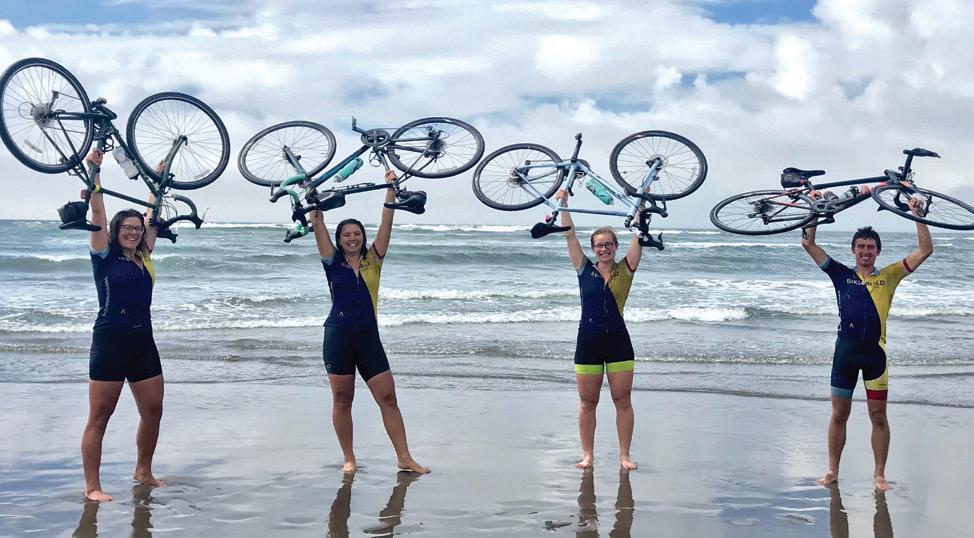
cools, so I sent it to myself ahead of time. If you have a lot of weight, that's the thing that kills you the most.”
As a Bay Area native biking through rural America, Gondak shared how enlightening it was to witness a different kind of America, one she had little familiarity with.
“In Wyoming, there were all these cows one day just in the middle of the road. We were afraid of them and kind of hid, but then actual cowboys came in the road to get them out of the street,” Gondak said.
In addition to riding, the group participated in service days, where they learned fundamental carpentry skills through building, painting and volunteering with housing organizations such as Habitat for Humanity to help address the prevalent housing crisis. They participated in 12 service days across the country, soaking in the various atmospheres and educating themselves on the individuality of each road they traveled.
Currently, Gondak lives in San Francisco, where she works in water efficiency at East Bay Municipal Utility District, where she uses her experience from the trip as an alternate perspective in her work.
“Although it's not housing, everything's related. [East Bay Municipal Utility District] is always thinking about water affordability. I learned a lot about housing, housing policy and how it looks very different in different places across the US,” Gondak said.
dflorence@redwoodbark.org
By Logan Scully
At the beginning of this year, junior Natty Gove launched his own nonprofit, the Tech4Youth Foundation, which works to provide technology access to underfunded schools across the Bay Area. Gove’s first project was an attempt to raise $11,000 in order to buy 30 Chromebooks for students in the Sausalito Marin City School District (SMCSD).
The project began last February, after he and his father volunteered at the Martin Luther King (MLK) Academy School Gardens in Marin City and had a great conversation with faculty members.
“[The SMCSD] said they had 30
classes. Hearing about this lack of resources in local schools motivated him to start the foundation. Following the visit, Gove stayed in touch with SMCSD’s information technology (IT) team and superintendent as he began building his nonprofit foundation from the ground up.
Gove began his fundraising efforts by sending emails to major tech companies like Google, asking for donations, which ultimately proved unsuccessful. Determined to continue, his next step was to go door-to-door around the county, explaining the goal of his nonprofit, which was a key step towards success. Ultimately, Marin newspapers served as the biggest aid to the effort as they were able to spread the news at a much more efficient rate.

“I reached out to The Ark and the Marin Independent Journal (Marin IJ) initially for advertisements, and they said they would write a story about [the foundation],”
After being published by The Ark at the start of May, donations began to flow in as more people in the county talked about the local tech startup. The article helped his original goal of $11,000, instead raising over $15,000 from more than 65 donors.
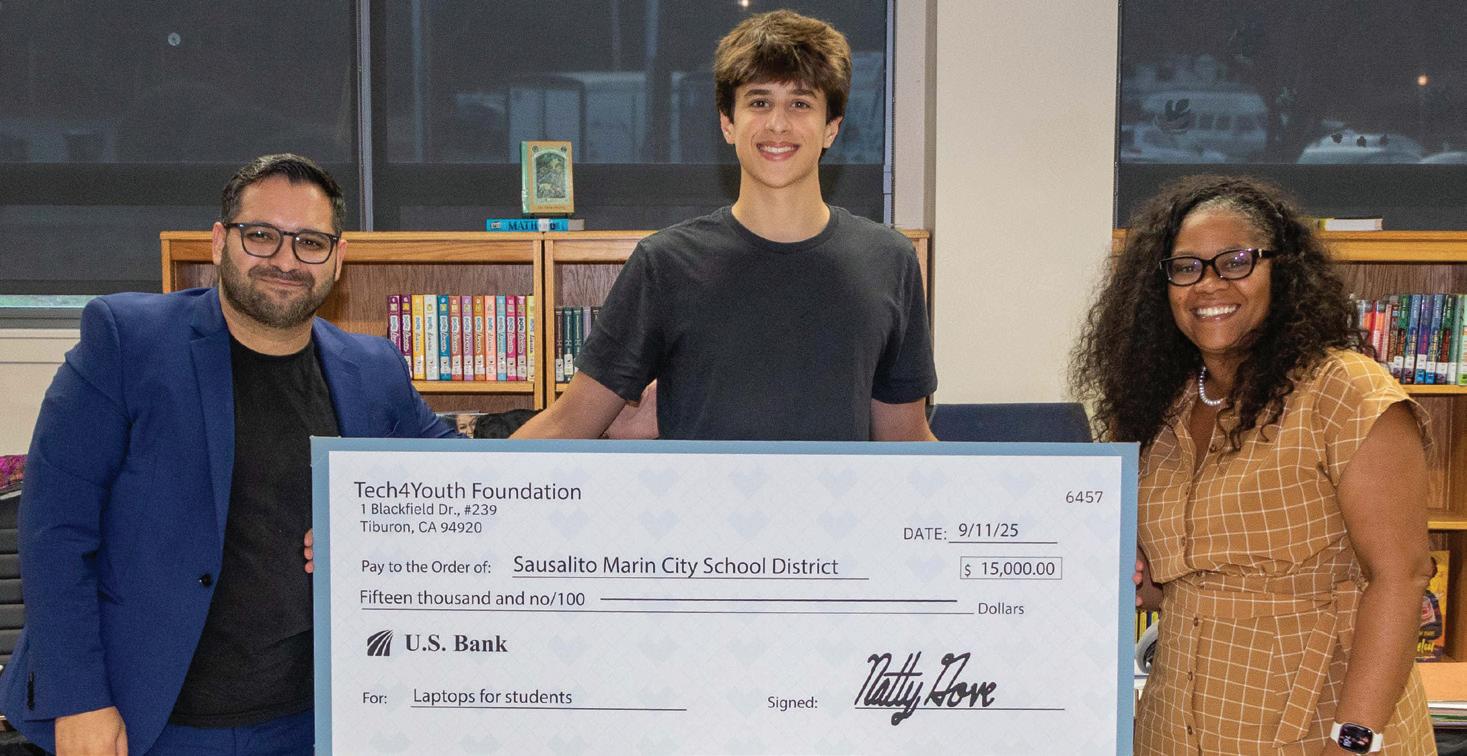
WITH THE HELP of over 65 donors, Natty Gove delivered the final check worth $15,000 to the SMCSD.
Despite the Bay Area being a wealthy region, many school districts in lowincome areas don’t have the same access to technology as others.
“I’m planning to continue [my foundation] as long as I can within the Bay Area, and I want to set up more initiatives with schools that have students without computers at home,” Gove said.
Gove’s mother, Constance Gove, said that she’s seen a philanthropic side to him from a young age.
“He has always had an empathy for other people,” Constance Gove said. “When he was little, [his] teachers would comment on how much he enjoyed helping younger students in other grades.”
Furthermore, Constance Gove stated that she remembered Natty Gove coming home from the MLK Academy School Gardens feeling really energized and
motivated to help the kids in need.
“He came home and almost immediately [asked] the question, ‘how can I help this school district?’” Constance Gove said.
On Sept. 11, 2025, Natty Gove officially presented the $15,000 check to the SMCSD board to fund the purchase of new Chromebooks, a huge milestone for him and the foundation. The board officially accepted the check on Nov. 13, when the district finally put a seal on the rigorous yet rewarding efforts made by Natty Gove and his donors.
“Now, with [this] momentum, it would be great to carry this [work] on to another school and help them [supply their students with technology],” Natty Gove said.
lscully@redwoodbark.org

By Logan Schneidewind
Ben Guyton has made a remarkable impact as the Director of Student Nutrition programs in the Tamalpais Union High School District (TUHSD), bringing together his expertise, passion and leadership to improve student health and wellness.
Guyton manages nutrition programs across TUHSD, gathering data to understand the needs and desires of students who eat school-provided meals. His dedication doesn’t go unnoticed.
Guyton even empowers students by leading Redwood’s Nutrition Committee, where students get to taste test food and give their insight on what food is offered in the cafeteria.
Sophomore Berkeley Smith is a member of the Nutrition Committee.
“[Guyton] is the sweetest, most kind person ever,” Smith said. “He takes all of the student nutrition committees’ opinions, and actually takes action with them.”
Senior Renata Lionetti, an ASB Officer, is constantly coordinating with Guyton on food-related matters for leadership events.
body to the larger picture of [TUHSD] in California nutrition laws,” Lionetti said.
Guyton’s day-to-day work impacts students directly.
“When the vending machines aren’t working, he’s always the one who fixes them,” Smith said. “He also helps improve nutrition by trying out new foods in the cafeteria and making sure the free meals are the best they can be while keeping students’ preferences in mind.”
Because of Guyton’s behind-the-
“I have both a bachelor’s degree in economics and a culinary degree from the California Culinary Academy in San Francisco,” Guyton said. “[I have] worked on the strip in Las Vegas, been a restaurant manager and I’ve been managing school nutrition programs for students for 12 years.”
These experiences outside the cafeteria also shaped who he is today. Growing up near Sacramento, Guyton’s journey to nutrition leadership was shaped by
This growing passion later led Guyton to culinary school and various roles in restaurants, before shifting over to managing school nutrition. As the leader of the nutrition committee, Guyton connects the student body to the broader nutrition landscape. Guyton also improved his leadership style over time to better encourage and collaborate with his team, which has paid off in stronger community support.
The sense of responsibility is the main motivator for Guyton and his work.
“After graduation, I drove buses for [University of California, Davis], which gave me lots of free time to throw parties and develop interest in food,”
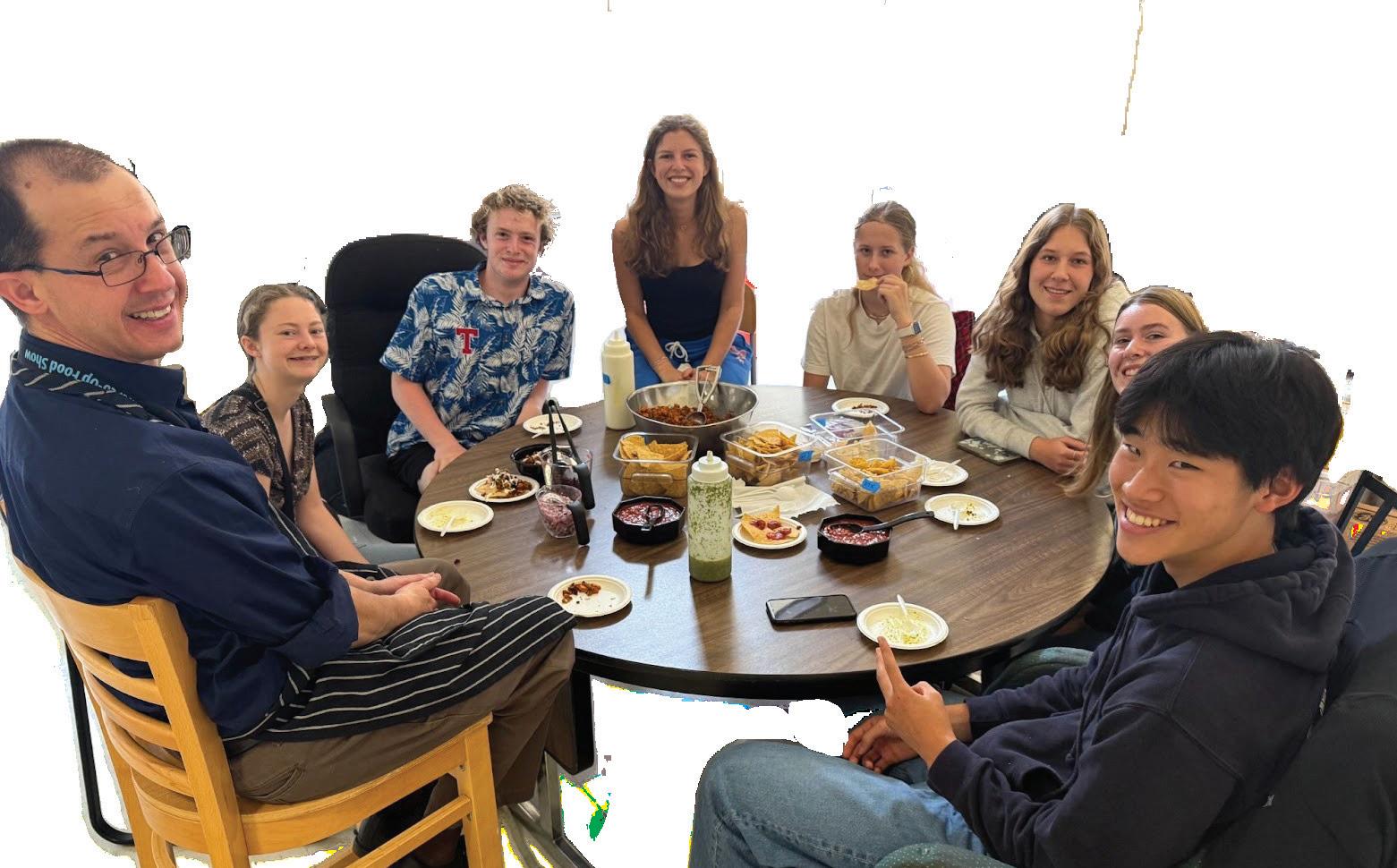
“[Guyton] connects the student
“I come to work and even if I hadn’t accomplished everything, I can look back and say this is something that wouldn’t have happened if I weren’t there,” Guyton said.
Guyton’s passion is clear, in and outside the cafeteria.
“Every time I see [Guyton] in the hallway, he’s always smiling in waves. He preps everything early for meetings and shows so much dedication,” Smith said. Looking ahead, Guyton’s goal for the nutrition committee is clear.
“[The goal is to] pilot a student worker program in the service line so students can help serve meals, keep things moving fast to increase the freshness and appeal of the food.”
Guyton’s story is one of dedication, leadership and heartfelt commitment. His work not only supports students’ health but also fosters a stronger school community.
lschneidewind@redwoodbark.org