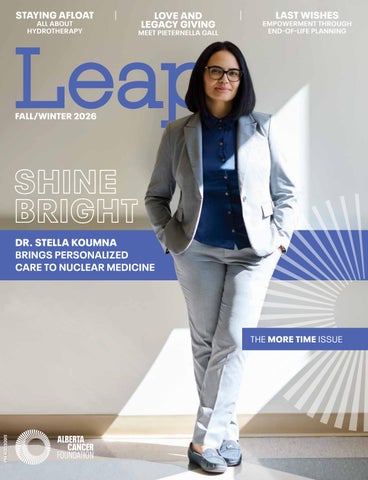
STAYING AFLOAT ALL ABOUT HYDROTHERAPY
LOVE AND LEGACY GIVING
MEET PIETERNELLA GALL
LAST WISHES
EMPOWERMENT THROUGH END-OF-LIFE PLANNING
FALL/WINTER 2026
SHINE BRIGHT DR. STELLA KOUMNA BRINGS PERSONALIZED CARE TO NUCLEAR MEDICINE
PM 40030911
THE MORE TIME ISSUE
14
CONTENTS
Advanced disease cancer patient navigator Thy Chan.
CLOCKWISE FROM TOP RIGHT COURTESY NORMA REID; DAVID SPENCE; LEAH MEIER; LIANNE CAWLEY
30 TENACIOUS AND AUDACIOUS
Dr. Michael Smylie led immunotherapy research to help give advanced melanoma patients more time.
33 BEACON OF HOPE
David Jamieson donated to the Alberta Cancer Foundation long before his own cancer journey.
34 TRUE CALLING
Nora Domingo has spent almost a decade volunteering at the Cross Cancer Institute.
FEATURES
37 ALBERTANS FIRST
16 MORE TIME
Now more than ever, Albertans with cancer are living longer than was previously thought possible. But they’re also living better, thanks to research, supportive programming and medical advances. Because of donor support helping make innovative research, technologies and treatment options available, Albertans living with cancer are able to make the most of these extra moments — even when time is short.
COLUMNS/DEPARTMENTS 6 BRIGHT MIND
Dr. David Langelier helps individuals manage the side effects of cancer and treatment.
8 EVERY STEP OF THE WAY
Breaking down what happens during each phase of a clinical trial and why.
9 5 THINGS TO KNOW
How the Alberta Cancer Foundation is powering cancer progress.
10 WELLNESS
Discover how water’s powerful properties can support recovery for people of all abilities.
ON THE COVER DR. STELLA KOUMNA, NUCLEAR MEDICINE PHYSICIAN AT THE CROSS CANCER INSTITUTE BY RYAN PARKER; TOP RIGHT BY RYAN PARKER; BOTTOM BY MATEUSZ NAPIERALSKI
12 FOOD FOCUS
The benefits of a soft food diet for individuals with cancer.
14 EXPERT ADVICE
Pieternella Gall honours her late daughter by giving back.
38 LIGHT IN THE DARKNESS
A prostate cancer clinical trial in Lethbridge may improve access to treatment in southern Alberta.
41 APPLAUSE, PLEASE
Thy Chan explains why end-of-life planning is important and empowering.
A graduate scholarship allowed Jinsu An to research treatment outcomes for head and neck cancer patients.
28 LIVING WITH CANCER
42 COMMUNITY CHAMPION
Despite a complex cancer journey, Fabienne Morin doesn’t let cancer define her.
Since 2007, Team TaTa’s has raised more than $1 million for the Alberta Cancer Foundation.
FALL/WINTER 2026 LEAP 3
MESSAGE
TRUSTEES Max Chan (Board Chair) Tom Valentine (Vice Chair) Darren Baumgardner Mark Blackwell Scott Budau Kathryn (Kate) Chisholm John Davis Mark Fitzgerald Joan Forge Brenda Hubley Shenaz Jeraj Sandra Lau Lynn Mandel Adriana Mercader Pete Merlo Shelley Powell Dr. Dean Ruether Kiren Singh Gary Smith Danielle Thorkelsson Trustees list current at time of publication.
We want to hear from you! Complete our reader survey here.
More Time Cancer forever changes how we think about and measure time. It’s no longer just about counting the days, months or years, but about making the most of the moments they’re made of: A morning at home. Dinner with the people you love. A special birthday. Plans for next summer. In this issue of Leap, you’ll meet Albertans living longer and living better with cancer, along with the researchers, clinicians, donors and communities working hard to make more time possible for Albertans facing cancer. Sometimes, more time means feeling like yourself again. Dr. David Langelier is helping Albertans manage the lasting physical effects of cancer treatment, so they can regain their independence, walk their kids to school again or hug a loved one with less pain (pg. 6). Cancer survivor Nora Domingo (pg. 34) has found new purpose in the time she’s gained, volunteering at the Cross Cancer Institute to help others through their own cancer experience, even if it’s simply helping someone find the perfect hat. Sometimes, more time means less time spent in treatment. Learn about Lethbridge’s
first radiotherapy trial at the Jack Ady Cancer Centre (pg. 38), which could reduce prostate cancer treatment from weeks of radiation to as little as two days. And sometimes, more time is simply about more moments. You’ll hear from Norma Reid, who treasures sunny days and playing cars on the floor with her children after her breast cancer diagnosis (pg. 24). And meet Leah Meier (pg. 27), who has encountered both difficult days and joyful moments — including meeting her first grandchild — over the past eight years of living with stage 4 colon cancer. Your support gives researchers and care teams right here in Alberta the opportunity to move promising ideas forward sooner, improve life during and after cancer and gives Albertans facing cancer more time for ordinary days and extraordinary milestones. We’re grateful for every moment you help make possible — and for your belief that every Albertan facing cancer deserves more of them. The Alberta Cancer Foundation is taking some time to explore what’s next for Leap and will not be publishing a Spring/ Summer 2027 issue. It’s a privilege to share these stories that highlight worldclass innovation and inspire hope for Albertans facing cancer, and we look forward to reimagining how we amplify these voices and demonstrate the impact of our work.
With gratitude, WENDY BEAUCHESNE CEO ALBERTA CANCER FOUNDATION
DISCOVER MORE INSPIRING STORIES ONLINE AT albertacancer.ca/leap 4 LEAP albertacancer.ca/leap
MAX CHAN BOARD CHAIR ALBERTA CANCER FOUNDATION
Fall/Winter 2026 | VOL. 16 | NO. 2
ALBERTA CANCER FOUNDATION EDITORS
Laurie Callsen, Mariko Macken
VP, OPERATIONS Meredith Bailey
MANAGING EDITOR Karin Olafson
ART DIRECTOR Veronica Cowan
STAFF PHOTOGRAPHER Jared Sych
CONTRIBUTORS
Chelsea Cavanagh, Derek Clouthier, Elizabeth ChorneyBooth, Buffy Goodman, Mason Hastie, Cailynn Klingbell, Nathan Kunz, Alicia L’Archevêque, Fabian Mayer, Mateusz Napieralski, Evelina Pak, Ryan Parker, Olivia Piché, Colleen Seto
PUBLISHED FOR
Alberta Cancer Foundation Calgary Office 300-1620 29 St. NW Calgary, Alberta T2N 4L7 Provincial Office 710-10123 99 St. NW Edmonton, Alberta T5J 3H1 Toll free: 1-866-412-4222 acfonline@albertacancer.ca
PUBLISHED BY
RedPoint Media Group cSPACE Marda Loop 375-1721 29 Ave. SW Calgary, Alberta T2T 6T7 (Letter mail only) Tel: 403-240-9055 Toll free: 1-877-963-9333 Fax: 403-240-9059 info@redpointmedia.ca PM 40030911 Return undeliverable Canadian addresses to the Edmonton address above.
CEO, CO-OWNER Roger Jewett
PRESIDENT, CO-OWNER Käthe Lemon
FALL/WINTER 2026 LEAP 5
Paving the Road to Recovery
Dr. David Langelier works in the relatively new field of physiatry, managing the physical and mental side effects that can accompany cancer and its treatment.
T
by FABIAN MAYER photographs by JARED SYCH
reatment may end, recovery doesn’t. That’s the philosophy behind Dr. David Langelier’s work as medical lead of the Alberta Cancer Physiatry Program at the Arthur J.E. Child Comprehensive Cancer Centre. Physiatry is a relatively new and growing field of medicine that specializes in managing the physical
6 LEAP albertacancer.ca/leap
BRIGHT MIND “Oncologists cure and treat cancer, whereas physiatry focuses on restoring function and giving meaningful life back. That’s what drew me to this field.”
and mental side effects that can accompany cancer and the side effects of treatment. It’s a focus on the whole body and how it works, not just one symptom. Muscles and nerves surrounding cancer tissue can be damaged during treatments, for example, with breast cancer survivors often facing significant shoulder pain and even curtailed range of motion, a side effect of surgery and radiation treatments. Langelier says simple tasks like putting on a shirt, doing one’s hair or holding family members’ hands can be difficult or painful as a result. “We use our medical knowledge to diagnose the multiple things that could be contributing to that shoulder problem. We investigate to help narrow this down and then use advanced treatments,” says Langelier. “Ultimately what we want to get people back to is a good range of motion leading to improvements in their mobility, independence, dignity and quality of life.” Langelier completed his medical training at the University of Calgary in 2013. During his five-year residency in general rehabilitation, he saw physicians focus on quality of life, pain management and creative treatment courses, and considered who else could benefit from that emphasis on quality of life. This inspired Langelier to pursue cancer physiatry.
–DR. DAVID LANGELIER
“Oncologists cure and treat cancer, whereas physiatry focuses on restoring function and giving meaningful life back. That’s what drew me to this field,” says Langelier. After working in Toronto for four years, Langelier returned to Calgary in 2023 to run the Alberta Cancer Physiatry Program. “Calgary is home. I was born and raised here, and always saw myself serving Albertans. I decided to move back with the opening of the Arthur Child. I saw the opportunity to use my leadership and programbuilding skills to transform rehab care in Alberta,” says Langelier. Langelier works with two other physiatry doctors,
providing services across Alberta to anyone 18 years and older with an impairment believed to be caused by their cancer diagnosis or side effects from their treatment. Individuals with cancer are typically referred to this program by their oncology providers, rehabilitation therapists or family physicians. Langelier explains that physiatry is about helping individuals with cancer gain more time doing what matters to them. “Can you walk your family member down the aisle? Can you return to work? Can you hug your loved one with less pain? All of those things that we focus on in physiatry aren’t often the focus when we’re talking survival,” he says. Langelier and his team work collaboratively with Albertans with cancer to prioritize their needs, desires and preferences when it comes to cancer treatment
and medication side effects. He often sees individuals exhausted by needing to take a variety of pills every day just to manage their pain. Instead of simply dealing with symptoms, physiatry seeks to treat what’s causing the symptoms. “There’s other ways that we can address pain in a more focused and tailored way,” Langelier says. “Oftentimes, we can manage pain with injection procedures or creams, which are more favourable to patients in terms of their own needs and get equally good results.” While many Albertans with cancer are willing to travel long distances to access these services, Langelier and his team worked to address the geographic challenges of being the sole provider of this service in such a vast province by seeing individuals with cancer virtually. In the middle of 2025, the Alberta Cancer Physiatry Program began offering virtual care consults and now has a regular, half-aday virtual clinic exclusively serving people outside Calgary. Langelier has helped individuals with cancer in High Level, Upper Peace Region, Lakeland and across southern Alberta, spreading his medical philosophy that cancer recovery can be greater than simply surviving. “Many people come to our clinic and they have this perception that they should be grateful they’re alive, and I challenge that,” says Langelier. “I think we should be very grateful that we’re alive, but we should be challenging our system so that these patients are living the best lives that they can.” FALL/WINTER 2026 LEAP 7
EVERY STEP OF THE WAY
Understanding the Phases of Cancer Clinical Trials Clinical trials are multi-phase research studies that require years of testing and thousands of participants. We break down what happens in each phase.
B
by ALICIA L’ARCHEVÊQUE
efore new methods of diagnosing, screening and treating cancer become the standard of care and available to the public, they must first undergo cancer clinical trials — a form of research involving human participants that take place over many years. These research studies determine if new treatments, such as drugs, therapies or medical devices, are safe and effective for use as standard of care. They also study better ways to detect cancer, new combinations of existing treatments, ways to prevent cancer from coming back and how to improve patient care overall. While participation in clinical trials doesn’t guarantee results for individuals with cancer, those involved are directly powering the progress of cancer care. Alberta is a major hub for clinical trials, hosting more than 200 active cancer clinical research studies. For safety reasons, most cancer clinical trials involve three successful phases before public distribution, which can take up to 10 years. However, individual experiences will vary depending on the type of trial and when a participant enrolls.
HERE’S A BREAKDOWN OF WHAT EACH PHASE ENTAILS AND THE GENERAL TIMELINE. PHASE 1
The first clinical trial phase determines how the treatment should be administered, the dosage and its side effects on patients. This phase requires 15 to 30 participants, and it is typically the shortest phase, lasting less than a year. Still, the timeline of this stage varies based on the trial type.
PHASE 2
The second phase ensures that the new treatment is effective at controlling a particular kind of cancer and examines how it affects those patients. Less than 100 participants are involved in this phase, and the average timeline for this phase sits at around two years.
PHASE 3
In the final phase before approval for public use, the new treatment is compared with current standard treatments to prove its efficacy, and requires significantly more participants. Anywhere between 100 and several thousand participants are involved, and this phase can last up to four or five years. Postapproval, an additional clinical trial phase (or phase 4) monitors long-term impacts.
HOW PHILANTHROPY CAN SET THE PACE
Christie Klaassen (left seated), the associate manager of the Clinical Trials Unit at the Cross Cancer Institute, with a few of her team members.
8 LEAP albertacancer.ca/leap
While clinical trials can be funded by a pharmaceutical company, research centre or university, philanthropy moves the needle in a big way. Donor-funded research and clinical trials have directly contributed to a dramatic shift in Alberta’s cancer outcomes. That’s why, in July 26, the Alberta Cancer Foundation announced a historic $35-million investment over the next five years to power cancer progress in the province through clinical trials. Donations, such as gifts made to the Alberta Cancer Foundation’s More Hope Movement, are what make this possible. By funding every local cancer clinical trial, we’re giving Albertans with cancer more time to experience moments that matter most.
DID YOU KNOW?
5 Ways the Alberta Cancer Foundation is Powering Cancer Progress Alberta has moved from having one of the lowest cancer survival rates in Canada to one of the highest — progress built over decades that wouldn’t happen without the Alberta Cancer Foundation’s community of dedicated donors. Here are five ways that donor support powers cancer progress, right here in our province.
1
WE BREAK DOWN BARRIERS
We support Albertans facing cancer no matter where they live, the type of cancer they are facing or where they are in their journey. The Cancer Patient Navigation Program and the Patient Financial Assistance Program help reduce barriers to care and connect Albertans facing cancer with the resources they need.
2
WE BUILD POWERFUL COMMUNITIES
4
WE ACCELERATE INNOVATION
From grassroots community organizers to our health system partners, we’ve rallied millions of Albertans together under a shared goal: creating more hope, more moments and more time for Albertans facing cancer.
3
WE SPARK BREAKTHROUGHS
5
WE LEVERAGE THE ALBERTA ADVANTAGE
True excellence in cancer care comes through a dedicated, concerted effort to find a better way. Donor support funds every cancer clinical trial in Alberta, turning promising discoveries into meaningful improvements in patient care. Together, we reach beyond what the public system alone can provide.
We don’t wait for the world to bring new treatments or cutting-edge technology to us. By investing in cancer care and research, Albertans have helped build one of the country's most advanced cancer systems. Innovations including immunotherapy, theranostics and the Precision Analytics program are accelerating Alberta to the forefront of cancer care and research.
Unlike national charities, the Alberta Cancer Foundation is the only health foundation fully invested in Alberta's cancer care and research community. Donor generosity powers treatments, cancer clinical trials and discoveries that are built around our population and our needs. And as the fundraising partner for every cancer centre across the province, we help ensure Albertans have access to world-class care close to home.
FALL/WINTER 2026 LEAP 9
Hydrotherapy 101
Warm baths, cold plunges and aquatic therapy: hydrotherapy uses water’s unique properties to support recovery for people of all ages and abilities. by EVELINA PAK | illustrations by MATEUSZ NAPIERALSKI
WHAT IS HYDROTHERAPY?
Hydrotherapy is an umbrella term for therapeutic uses of water. It includes everything from warm baths and thermal circuits to clinical aquatic therapy, where physiotherapists use specialized equipment and treatment plans. Depending on the approach, hydrotherapy can help reduce pain, improve mobility and support recovery from injury, chronic illness and cancer treatment.
“Water’s buoyancy unloads painful joints, its viscosity provides gentle and adjustable resistance and its hydrostatic pressure [the natural force of water] supports tissues in all directions,” explains Grant Fedoruk, physiotherapist and owner at Leading Edge Physiotherapy in Edmonton. Fedoruk works with a range of patients, including those undergoing cancer treatment. “These forces work together to create a therapeutic environment where movement becomes possible again.”
HOT-COLD-REPEAT RETREATS The thermal experience at Everwild Canmore, an outdoor Nordic-inspired spa owned and operated by Basecamp Resorts, follows a simple rhythm: heat, cold, rest, repeat. Guests move between hot pools, cold plunges, saunas and steam lodges. The cycle is designed to improve circulation, reduce stress and promote relaxation. “When I started incorporating hydrotherapy and thermal cycling into my own routine, I noticed a real difference, physically and mentally,” says Sky Mitchell, CEO of Basecamp Resorts. “Everwild is a place to slow down, reconnect with nature and actually feel where you are.”
10 LEAP albertacancer.ca/leap
WELLNESS
ACCESSIBLE WAYS TO
EXPERIENCE HYDROTHERAPY Hydrotherapy doesn’t only take place in a specialized clinic or spa. People can experience aquatic relief and gentle movement in everyday settings. Physiotherapist Grant Fedoruk offers a few tips for easily incorporating hydrotherapy into a wellness routine.
HYDROTHERAPY IN CANCER RECOVERY
For people undergoing or recovering from cancer treatment, hydrotherapy can make movement more accessible. Warm water allows people experiencing treatment-related joint pain, nerve damage and pain or fatigue to walk, stretch and exercise with less discomfort. Water’s natural pressure may also help ease swelling and improve circulation, while the natural resistance of water helps rebuild strength without placing excessive strain on the body. The benefits extend beyond physical recovery. Moving more comfortably in water can reduce anxiety, build confidence and lessen the fear of falling — a very real concern for people coping with neuropathy, balance changes or weakened bone structure from osteoporosis, all side effects of some cancer treatments. “Many patients describe their time in the water as the first moment they’ve felt ‘normal’ again during recovery,” says Fedoruk.
MORE THERMAL EXPERIENCES IN ALBERTA Kananaskis Nordic Spa 1 Centennial Dr., Kananaskis Village, knordicspa.com SKA Thermal Spa 638 11 Ave. S.W.; 3970 Market St. S.E., Calgary, skathermalspa.com Sole Nordic Wellness 4805 50 Ave., Leduc, solewellness.ca
TAKE A BATH
A warm bath can be therapeutic. Gentle movements such as ankle pumps or slow knee bends can help mobilize stiff joints, especially on days when pain or fatigue make land-based exercise difficult. Contrast bathing (alternating warm and cool water) may also help reduce swelling and improve circulation.
GO FOR A DIP
Visit a community pool for public swimming, where there are often lanes available for therapeutic use. Some communities even have therapyspecific pools, like at Cochrane’s Jayman BUILT Aquatic Centre. You can also try walking in chestdeep water to reduce load on joints, making movement easier. Using the water as resistance — you could try sweeping your arms and legs through the water, for example — is a chance to challenge your body gently and safely.
ATTEND A GENTLE FITNESS CLASS
Aquafit and other aquatic exercise classes are a structured way to stay active while benefiting from social connection and encouragement. Fedoruk says: “I’ve seen people who felt isolated or discouraged rediscover confidence simply by moving in water alongside others.” SPRING/SUMMER 2026 LEAP 11
A Mash Made in Heaven Choosing a soft food diet during cancer treatment can make eating a little easier. by ALICIA L’ARCHEVÊQUE
Certain cancer treatments can come with side effects that make it difficult or painful to swallow, such as reduced saliva production or soreness in the throat. To ensure proper nutrition when eating becomes a challenge, dietitians recommend turning to softer foods like soups, mashes, sauces or liquids. These foods are often more comfortable for individuals with cancer to eat — and they’re still packed with flavour.
WHY SWALLOWING CAN BECOME DIFFICULT
Chemotherapy targets cells that grow and divide rapidly, meaning it attacks cancer cells but also some fast-growing, healthy cells in your mouth and gut. When radiation is directed towards the head and neck, saliva production can be temporarily damaged. Without saliva to break down and moisten solid foods, swallowing with a dry mouth can trigger a gag reflex. Radiation can also result in soreness or inflammation in the throat, making swallowing not only difficult, but painful.
FOODS THAT CAN MAKE IT A LITTLE EASIER
When less saliva is being produced, it is important to incorporate liquids into meals to act as an alternative moistening agent. “I really encourage people to not only choose soft food, but to choose moist food,” says Alberta Health Services Cancer Care dietitian Jennifer Black. “Add gravies, sauces or soups to food, or take sips of fluid with each mouthful to act as the saliva.” Soups and stews are great soft food options given that they are easy to chew, moist and very easy to customize. When your diet has less textural variety, Black recommends playing around with flavour profiles. “Adding a little bit of tart and sour flavours to different foods can make things a little bit more exciting,” she says. PHOTOGRAPH BY MIZINA, FROM iSTOCK
12 LEAP albertacancer.ca/leap
FOOD FOCUS INCORPORATING PROPER NUTRITION INTO A SOFT DIET
When trying any new diet, it can be challenging to ensure there’s a variety of nutrients on your plate. “I would guide [patients] to try and include a quality protein food source every time that they’re eating,” says Black. Examples of soft yet proteindense foods include cottage cheese, Greek yogurt, ricotta, eggs and canned fish with added sauces. For extra energy, add healthy fats such as butter, oils or smooth nut butters to help increase the caloric intake of your meal. For soft and fibrous carbohydrates, opt for cooked grains like oatmeal, barley or cream of wheat. When cancer treatment causes food aversions or loss of appetite — or eating becomes more difficult and large portions feel daunting — Black explains that mindfully incorporating essential nutrients into your soft diet is key: “Make every mouthful count.”
RECIPE: CURRIED SWEET POTATO, CARROT AND RED LENTIL SOUP
Recipe recommended by Jennifer Black, Alberta Health Services Cancer Care dietitian; provided by Vincci Tsui (RD) and adapted from Julie van Rosendaal.
TIPS FOR CAREGIVERS WHO COOK HAVE A SIDE OF SAUCE AVAILABLE If individuals with cancer are having trouble eating a prepared meal, registered dietitian Jennifer Black recommends adding moisture-heavy condiments, sides and sauces to change up texture and make the dish easier to swallow. “Help encourage them to dip [their food] in these fluids,” says Black. THE BLENDER IS YOUR FRIEND For some individuals going through cancer treatment, certain foods become too challenging to chew and swallow. “If you try your stew and it’s not soft enough, throw it in a blender,” says Black. PREP A VARIETY OF SOFT FOODS IN ADVANCE During treatment, tolerated textures can change day to day. Having different suitable foods ready to go can be a big help. “Especially when people don’t know what they’re going to manage or desire to eat that day, having a freezer full of different options makes the life of a caregiver a lot easier,” says Black.
Makes about 6 cups (1.5 L) Ingredients: 1 tbsp canola oil 1 medium onion, chopped 2 cloves garlic, crushed 1 tbsp ginger, grated 1/2 cup red lentils, rinsed, drained and picked through for rocks 1 medium sweet potato, peeled and cut into chunks 2 medium carrots, peeled and chopped 1 tsp curry paste or powder 4 cups total low-sodium vegetable broth and/or water 1 cup water 1/4 to 1/2 cup coconut milk, half and half or plain yogurt (optional) Salt and pepper, to taste Instructions: In a medium pot, heat oil over medium-high heat and sauté onion, garlic and ginger until soft, about 3 to 4 minutes. Add the lentils, sweet potato, carrots, curry paste and broth, along with a cup of water. Bring to a boil, then turn the heat down, cover and simmer, until the vegetables are very tender, about 30 minutes. Purée soup using a hand-held immersion blender, or transfer it in batches to a blender and purée until smooth. Stir in coconut milk and season with salt and pepper, to taste. ILLUSTRATIONS BY OLGA KURBATOVA, FROM iSTOCK
FALL/WINTER 2026 LEAP 13
The Power of Planning Ahead An advanced disease cancer patient navigator offers insights into the importance of end-of-life planning, regardless of one’s prognosis. by KARIN OLAFSON | photograph by RYAN PARKER
For many, end-of-life planning is something we avoid. But Thy Chan, a registered nurse and advanced disease cancer patient navigator at the Cross Cancer Institute (Cross), sees it as both important and empowering. Since 2014, Chan has worked in oncology, supporting individuals with cancer from their diagnosis and treatment through to advanced disease, discharge and life at home. Since 2021, she has guided patients after their discharge from the Cross. And since 2024, Chan has specialized in supporting Albertans with advanced gastrointestinal cancers through early palliative care, informed decision-making and quality of life-focused care. Here, Chan shares her experiences supporting individuals through end-of-life discussions. What role does an advanced disease cancer patient navigator play when it comes to end-oflife planning?
“We contribute to end-of-life planning by completing a comprehensive assessment of each patient and their caregiver to understand the physical, psychological, social, emotional, spiritual and practical dimensions of their cancer experience. Our role may include sharing information about a late‑stage diagnosis, initiating conversations about goals of care, exploring treatment and supportive‑care options and coordinating symptom management. At the heart of our work is a commitment to helping patients with advanced cancer and their families feel understood, cared for and supported at every step.”
“We help transform overwhelming moments into ones where patients feel accompanied, informed, advocated for and empowered as they take their first steps into this new chapter.”
–THY CHAN
14 LEAP albertacancer.ca/leap
How do you suggest individuals with advanced cancer and their families approach the administrative side of end-oflife planning?
“Having an advanced cancer diagnosis in the family is profoundly stressful. Financial worries can make stress feel even heavier. We encourage patients and families to begin the process of going through the legalities: create a will, and select a personal directive agent and an enduring power of attorney. We also encourage patients and families to connect with a lawyer they feel comfortable with and trust — the Law Society of Alberta’s online directory is one helpful way to find a lawyer that fits your needs. And where there is financial strain, we recommend connecting with a social worker to discuss possible financial support.”
What else is important for patients to consider when end-oflife planning?
“Begin with what matters most to you. A meaningful piece of this planning is deciding where you want to live with the remaining time you have left. Do you hope to remain at home? If so, who will be there to care for you?
“It’s also important to think about how you want your life to be honoured after you die. You might reflect on whether you prefer a funeral or a memorial service, whether there is a funeral home you feel connected to and what you hope for in your final resting place. “Lastly, consider how you want to spend the last chapter of your life. Where do you picture yourself? What’s around you? Intentionally reflecting and sharing these thoughts with those you love helps ensure that your final wishes are carried out with clarity, dignity and care.”
Why is it important to consider end-of-life planning, regardless of prognosis?
“End‑of‑life planning holds value regardless of an individual’s prognosis. Early exposure to these conversations, gentle encouragement to reflect, and support in beginning the necessary processes all cultivate a sense of preparedness. That readiness brings clarity to patients and families. It restores a measure of control, allowing individuals to shape what they can, while they can.”
Should end-of-life planning feel empowering?
“I encourage us not to see end-oflife planning as morbid or taboo. By preparing early and communicating openly, individuals with advanced cancer offer their loved ones something invaluable: the peace of knowing what matters most and the time to focus on connection. We’re working in service of enhancing each patient’s final moments with more quality time, which is the true reward of the job.”
EXPERT ADVICE
FALL/WINTER 2026 LEAP 15
More time. Now more than ever, Albertans with cancer are living longer than was previously thought possible. But they’re also living better, thanks to research, supportive programming and medical advances.
Here in Alberta, we’re working together to give individuals living with cancer more time. Thanks to donor support, cutting-edge research, innovative treatment options and diagnostic technologies are making more time possible for Albertans with cancer. But they also help ensure that the time is meaningful and that quality of life during and after treatment is improved. Because of donor generosity, Albertans living with cancer are able to make the most of these extra moments, even when time is short, to do what matters most to them: connect with family, give back, advocate and educate.
16 LEAP albertacancer.ca/leap
Meet three physicians helping Albertans live longer, better and celebrate more experiences after a cancer diagnosis. by NATHAN KUNZ
DR. STELLA KOUMNA Nuclear medicine physician, Cross Cancer Institute Dr. Stella Koumna initially moved to Alberta because of family ties, relocating from Cyprus to Fort McMurray in 2013. But it was a nuclear medicine fellowship opportunity at the Cross Cancer Institute (Cross) that pulled her to Edmonton in 2016. The decade since has seen nuclear medicine expand and evolve — though according to Koumna, the most rewarding moments remain the same. “It’s patient feedback that gives the gratification,” says Koumna. “Hearing how this treatment may have changed their life, it’s unparalleled.” Koumna belongs to a highly specialized, multidisciplinary team that uses radioactive substances to image, understand and treat cancers. Edmonton has been a nuclear oncology hotspot since the late 1980s, when Koumna’s mentor, Dr. Sandy McEwan, began administering theranostic treatments — a true-to-name approach that combines “therapy” and “diagnostics.” Theranostic treatments start by intravenously administering radioactive agents into the bloodstream — first for imaging, then for treatment. Viewed using a PET scan, these agents help physicians locate cancer, observe it on a molecular level and determine if treatment will be effective. Imaging also allows physicians to monitor radioactivity distribution, enabling them to maximize radiation to cancer cells while minimizing damage to surrounding tissue. After each session, post-therapy imaging shows how much of the treatment is entering the tumour and how it’s changing as a result. PHOTOGRAPHS (OPPOSITE, CLOCKWISE FROM TOP RIGHT) COURTESY OF LEAH MEIER; LEAH MEIER; NORMA REID; DAVID SPENCE; LIANNE CAWLEY; LIANNE CAWLEY; (THIS PAGE) BY RYAN PARKER
“If, for example, the imaging no longer shows the presence of uptake in the tumour, which means the tumours no longer take up the treatment, we can even stop the treatment early,” Koumna says. In March 2025, two years following a trial supported in part by the Alberta Cancer Foundation, the Cross rolled out a theranostics program for eligible prostate cancer patients as standard of care. Koumna and her team did so with no waitlists attached. “We felt it was our obligation to make every possible effort to minimize delays,” says Koumna. “It’s a drive to give everybody the same chance at a treatment that could improve their life.” Koumna is hopeful as she looks towards the next decade in nuclear medicine. The framework for more personalized care is in place, and Alberta is at the centre of it all. “No pun intended, [but with] theranostics, radioactivity and the photons emitted from our agents,” she says, “but the future is bright.”
WHAT DOES CREATING “MORE TIME” MEAN TO YOU? “‘More time’ resonates deeply with what we do every day. While extending survival is important, it’s equally important to improve what patients can do with the time they have. More moments can mean attending a family celebration, taking a trip or simply enjoying everyday activities with their loved ones. Our goal should not only be to help patients live longer, but to help them live better, so they can achieve what more time means to them.”
FALL/WINTER 2026 LEAP 17
DR. NADIA GHAZALI Medical oncologist, Cross Cancer Institute Meeting an oncologist can be intimidating. It’s a vulnerable situation that often comes with hard conversations. For Dr. Nadia Ghazali, it also comes with a responsibility to be forthright from the start. “Our patients put so much faith in us; in the oncologist, in the nurses, in everyone involved in their care,” Ghazali says. “My goal is to make sure that my patients are well informed and always able to make decisions that align with their own goals and values.” Ghazali specializes in genito-urinary oncology and thoracic oncology (this includes lung and other cancers that affect the chest cavity). Originally from Malaysia, Ghazali attended medical school at the University of Newcastle in Australia. It was there that she learned her father had terminal brain cancer, inspiring her to pursue a career in oncology. “The biggest factor is that there’s still hope for patients,” she says. “Every single thing you do, big or small, contributes to advancement.” Ghazali went on to complete her medical school and training in Australia, followed by a lung cancer fellowship at Toronto’s Princess Margaret Cancer Centre. Then, in fall 2025, she moved across Canada to begin her career at the Cross Cancer Institute (Cross). In Edmonton, Ghazali hopes to increase access to liquid biopsies. Rather than obtaining a tissue sample through an invasive procedure, a liquid biopsy uses blood, urine or cerebrospinal fluid samples carrying shed protein or DNA from the tumour site. Not only are liquid biopsies less invasive, they can also offer quicker turnaround times, leading to quicker treatment decisions.
WHAT SURPRISES PEOPLE ABOUT YOUR WORK? “When I tell people I’m a medical oncologist, they’ll often say: ‘Oh, wow, what a hard job.’ But it’s actually very rewarding. Cancer care has changed dramatically over the last 10 years. And as an oncologist, you’re with patients at every step, helping to make a difference whenever possible.” Liquid biopsies are not yet standard of care in Alberta. However, by helping lead clinical trial research, Ghazali is hopeful more Albertans will soon have access to this innovative diagnostic approach. Over the past year and a half, she has seen Albertans receive world-class care when they need it most. And at the Cross, she says inspiration isn’t hard to find. “You don’t need to seek out the passion here,” says Ghazali. “It just comes to you.” PHOTOGRAPH BY RYAN PARKER
18 LEAP albertacancer.ca/leap
DR. JOE KENDAL Orthopedic oncology surgeon scientist, Foothills Medical Centre and Alberta Children’s Hospital Clinical assistant professor, Cumming School of Medicine, University of Calgary Big questions call for innovative solutions. That’s exactly what attracted Dr. Joe Kendal to oncology. A born-and-raised Calgarian and University of Calgary alumnus, Kendal focuses on sarcomas and metastatic bone disease (MBD) — cancers that impact the bones, muscles, tissues and ligaments that help patients move. On any given day, Kendal can be found in the clinic and performing procedures at the Foothills Medical Centre, in an operating room at the Alberta Children’s Hospital or leading research for the University of Calgary. Kendal’s work recently expanded to another frontier — namely, the Apple App Store. In 2025, Kendal co-created Activation Health with his two University of Calgary colleagues — spine surgeon Dr. Fred Nicholls and exercise physiologist Dr. John Holash. The smartphone application tracks patients pre- and post-surgery, gathering data like their step counts and gait quality, information that can help guide rehabilitation and monitor healing progress. Paired with self-reported surveys, Activation Health shares findings with the user’s medical team, optimizing post-op care based on patient needs. “The entire goal is to decrease patient burden,” says Kendal. “The app is
downloaded to their phones, then they just go live their lives.” Early feedback is promising. Pilot data from 30 users shows that patients are finding the app easy to use and it’s delivering accurate mobility metrics. And this past spring, one of Kendal’s graduate students defended a thesis that used the app. Activation Health represents just one way Kendal is innovating in oncology. His SMarT Bone Program helps surgeons, specialists and kinesiologists in southern Alberta share databases, improve triages and smooth referral pathways for MBD patients. In the operating room, Kendal is implementing novel, minimally invasive surgical techniques and 3D-printed implants, with the goal of helping patients get back to living their best life faster. Paired with programs like Activation Health, Kendal says seeing the difference he’s making in numbers is extremely rewarding. But nothing beats seeing a patient walk back into the clinic, climb a set of stairs and say “thank you” in person. “We can look at the data,” says Kendal, “but when you see somebody doing it, it makes an even bigger difference.”
SARCOMA MOST OFTEN AFFECTS YOUNG PEOPLE. WHAT DOES IT MEAN TO YOU TO SERVE A YOUNG PATIENT POPULATION? “Working with this population is incredibly meaningful. It’s a very scary time in their lives, both for the patients and their families. It’s special to ensure families know that we have a comprehensive sarcoma program in Calgary, and that we’re going to provide the best care that we possibly can. I’m proud to be part of this group.”
PHOTOGRAPH BY JARED SYCH
FALL/WINTER 2026 LEAP 19
MORE INNOVATION,
MORE TIME
Discover three gamechanging advancements that are reshaping how Albertans experience their cancer journeys. by CAILYNN KLINGBEIL
SEEING CANCER DIFFERENTLY
Dr. Kristi Baker is using a new instrument to examine patient samples, aiming to better understand and treat advanced colon and lung cancers. Dr. Kristi Baker is an associate professor in the departments of oncology and medical microbiology and immunology at the University of Alberta. She describes the new instrument her team uses inside a room at the university, known as the Cell Imaging Core, as “a really fancy microscope” — a purple machine paired with a box that circulates fluids through slides of tissue samples. Where a standard microscope might let a researcher examine one or two markers in a tissue sample at a time, this advanced multiplex imaging platform — known as the Akoya Phenocycler Fusion 2.0 — can examine almost 100 markers at once. That instrument’s advanced capability is helping Baker’s team take an unprecedented look at immune cells inside colon and lung tumours. Using one of only a few advanced multiplex imaging platforms in Canada, they want to understand why these cancers spread and why some patients respond to treatment while others don’t — insights that could eventually inform new diagnostic tools and treatments. Supported by the Alberta Cancer Foundation’s Game Changer competition, Baker’s research focuses on
advanced-stage colon and lung cancers, two cancers with a low survival rate. While primary tumours can often be treated, it is the spread of cancer cells, known as metastasis, that is responsible for most cancerrelated deaths. “We really want to be able to compare between the primary tumour and the metastasis and [ask], do we see similar types of immune cells there, and if so, are they doing similar types of things?” says Baker.
INSIDE IMMUNE CELLS
The lungs and intestines are unlike most other organs in the body, Baker explains. They’re constantly exposed to outside substances, from the air we breathe to the food we eat, so the immune cells that live there have to be more tolerant. They can’t react to every foreign particle they encounter, or the body would constantly be fighting itself. But that natural tolerance may also make it easier for cancer to hide from immune system defences. Baker hopes understanding these immune cells will reveal why advanced colon and lung cancers are often so hard to treat, particularly with immunotherapy. The new multiplex imaging platform makes that investigation possible. “We can actually look at different types of immune cells and different types of molecules and receptors that are present in the tumour. And we can see where they are in relation to other cells,” Baker says. The work is a team effort, Baker adds, with graduate and undergraduate students doing much of the day-today lab work. It also depends on patients who donate leftover tissue after surgery, knowing that donation may not benefit them directly but could improve care for future patients. The research project is still in its discovery phase. Since receiving the imaging instrument in January 2025, the team has optimized protocols and prepared samples. Next comes large-scale analysis with computational researchers. Ultimately, Baker hopes her work helps identify which patients will respond to which treatments and find new ways of activating immune cells that currently fail to recognize advanced cancers. PHOTOGRAPH BY BUFFY GOODMAN
20 LEAP albertacancer.ca/leap
A PREVENTATIVE APPROACH
Dr. Claire Temple-Oberle’s work reduces one of cancer surgery’s common side effects. Lymph nodes act like small filtering stations located along the body’s lymphatic system. The lymphatic system is a network of vessels that drain excess fluid from tissues, removing harmful substances before returning clean fluid to the bloodstream. When surgeons remove lymph nodes, often from the armpit or groin, to check for or remove cancer, the limb near the surgical site can swell permanently. This is a common condition known as lymphedema. In breast cancer patients, roughly 30 per cent who have their lymph nodes removed along with radiation develop it. Lymphedema brings swelling, heaviness and pain, and can mean a lifetime of compression bandages, lymphatic massages and physiotherapy, along with a higher risk of infection. Dr. Claire Temple-Oberle, a University of Calgary professor in the departments of oncology and surgery, is focused on stopping lymphedema before it starts. As both a plastic surgeon and a surgical oncologist specializing in melanoma, she brings a dual vantage point to the problem, performing a preventative microsurgical technique when lymph nodes are removed. “The number one way that we try to prevent lymphedema is to [avoid subjecting] patients to lymph node dissection operations,” she says. But some patients still require one, including women with inflammatory breast cancer and patients with bulky nodes from skin cancers like melanoma. For those patients, Temple-Oberle intervenes during the dissection itself, performing a microsurgical procedure called immediate lymphatic reconstruction. As surgical oncologists
Dr. Claire TempleOberle (left) with resident Spencer Yakaback operating on a patient.
remove the nodes, she protects the tiny lymphatic channels left behind, stretching them and preserving nearby veins from being cut too short. Then, under a microscope, she joins the lymphatic channels directly to those veins, a technique called lymphaticovenous anastomosis, which gives the disrupted lymphatic system a new drainage route.
PROMISING RESULTS
“We didn’t invent the procedure, but it wasn’t very common,” Temple-Oberle says, adding her team has performed the procedure since 2020. Now her Calgary team is leading research to prove it works. A randomized controlled trial for melanoma patients enrolled 40 participants, with final results expected next year. The technique has also been offered, through separate trials, to patients at the Arthur J.E. Child Comprehensive Cancer Centre needing lymph node dissections, including patients with breast, skin, rectal and ovarian cancers. “The results have been really quite incredible,” TempleOberle says. The early numbers show a two-thirds reduction in lymphedema across the board. In breast cancer patients, the expected 30 per cent risk drops to roughly 10 per cent, and swelling that does occur tends to be mild rather than severe. Temple-Oberle credits the team behind the work. Together, surgical oncologists, plastic surgeons, and operating room and clinic nurses collaborate on a procedure that adds time and complexity to surgeries. “Everyone really believed in this procedure. They jumped in enthusiastically," she says. As cancer survival rates climb, quality of life after treatment matters. Patients cured of cancer, TempleOberle says, shouldn’t have to live with the lasting symptoms of lymphedema, especially when a solution can be built into the first operation.
PHOTOGRAPH COURTESY OF DR. CLAIRE TEMPLE-OBERLE
FALL/WINTER 2026 LEAP 21
BUILT FROM SCRATCH
A made-in-Alberta cancer drug’s journey to reach patients. While Alberta is a leader in cancer clinical trials, most cancer drugs used here were discovered somewhere else, developed for years in labs far from the patients who eventually receive them. CCI-001 is different. This novel chemotherapy drug exists because Dr. Jack Tuszynski, the Allard Chair in Experimental Oncology at the University of Alberta’s Cross Cancer Institute (Cross) from 2005 to 2020, decided to build a cancer drug from the ground up, starting on a computer. Underlying the drug’s discovery is a basic question: what makes cancer cells divide endlessly when healthy cells don’t? The answer involves microtubules, the rod-like structures that pull chromosomes apart during cell division, and a specific building block of them, beta III tubulin, that’s “This has, in my entire overexpressed in almost all cancer cells, career, been the but largely absent elsewhere in the body. coolest experience, Existing tubulin-targeting drugs, like the widely used chemotherapy paclitaxel, to see something that didn’t distinguish well enough between Dr. Tuszynski did and cancerous and healthy cells. So, in 2010, bring it to Albertans.” Tuszynski’s team turned to an unlikely —DR. JENNIFER SPRATLIN starting point: colchicine, a compound known to ancient Egyptians and still used for gout, but never successful as a cancer drug because of its toxicity. Using computer modelling, his team redesigned the molecule, tuning its structure to bind tightly to the cancerassociated form of the protein, while leaving the healthy version alone. It took roughly three years of computational work — using about 1,000 computers, Tuszynski says — before a physical compound was synthesized. A patent battle followed before CCI-001 was protected in 2016. A Dutch lab tested the drug on different cancer cells, and found it worked best as a form of treatment for metastatic bladder cancer and pancreatic cancer. In mouse models of bladder cancer, CCI-001 outperformed the standard of care astoundingly well. “We’re not shouting from the rooftops yet, but we are very happy that the results are supportive of our hypothesis,” Tuszynski says.
FROM BENCH TO BEDSIDE
The multi-year project required sustained funding, including from the Alberta Cancer Foundation and through the Allard Foundation, sponsors of the Allard Chair. And when it entered human clinical trials in Edmonton in 2021, it marked a milestone: the first 22 LEAP albertacancer.ca/leap
made-in-Alberta drug that kills cancer cells directly to be used in a clinical trial. Medical oncologists Dr. Michael Sawyer and Dr. Jennifer Spratlin enrolled patients for the 2021 trial. Spratlin says watching Tuszynski’s drug move from computer model to hospital treatment room has been a career highlight. “This has, in my entire career, been the coolest experience, to see something that Dr. Tuszynski did and bring it to Albertans,” she says, calling it “a wonderful story of bench to bedside.” The trial is still technically in Phase 1, Sawyer says, though it has shifted from testing CCI-001 on its own to testing it in combination with standard chemotherapies. Results have been strong enough that the team hopes to eventually move the drug into a Phase 2 or Phase 3 trial. Unlike paclitaxel, CCI-001 isn’t causing the nerve damage that often forces patients off standard chemotherapy. Tuszynski’s team has already made 1.4 kilograms of the compound, enough to treat 1,000 patients or more, in anticipation of a larger trial. So far in the human trial, researchers have seen responses primarily in ovarian, head and neck, lung and endometrial cancers. The trial also includes pancreatic and bile duct cancers, which researchers believe could respond to CCI-001. Tuszynski sees the milestone as more than just one drug’s success. It’s proof Alberta can build a cancer drug from scratch and evidence of how powerful computational methods can be in finding new ones. After 15 years dedicated to CCI-001, he says his first emotion is gratitude, to the many people who helped along the way, and to the Allard family in particular for their funding. But he’s not calling it finished. Tuszynski and others are now applying the same computational approach to search for new drugs for metastatic prostate cancer. The model behind CCI-001 isn’t a one-off, but a template for what comes next.
Left to right: Dr. Michael Sawyer, Dr. Jack Tuszynski and Dr. Jennifer Spratlin.
PHOTOGRAPH BY RYAN PARKER
FALL/WINTER 2026 LEAP 23
MORE TIME FOR
BRIGHT MOMENTS Four Albertans share what more moments mean for them following a cancer diagnosis. by OLIVIA PICHÉ
NORMA
REID More memorable moments with family Last October, Calgary television broadcaster Norma Reid was working on a story in support of breast cancer awareness month. Not yet of an age to self-refer for a mammogram, she received a doctor’s requisition to get a screening. While she was wearing a microphone and her camera operator was filming, she was diagnosed with triplenegative breast cancer. (The story hasn’t aired yet.) “I was lucky in the sense that I was doing this story. I think, honestly, that it was God’s way — or a higher power — of putting me in front of that machine in any way, shape or form to get me there that day,” she says. “I immediately felt a lot of gratitude and relief for being there, because I would later find out that the type of cancer I have is very aggressive. So, if I would have waited even a few months longer, who knows?” As a journalist with over two decades of experience, Reid has interviewed many people going through cancer journeys throughout her career. Now, with her personal
experience, she holds a new depth of gratitude for medical advances and innovation. “The Arthur Child is incredible. The care that you receive there and just having it all under one roof in this brand-new facility is amazing. It’s such a beautiful place to go when you’re scared,” she says. Reid found pockets of hope throughout her cancer journey. Today, she appreciates life’s special moments and she’s excited to experience more of them. “I look forward to waking up every day. My parents built a new cabin in Saskatchewan — that’s been a family dream for 30 years — and that is finally completed. I look forward to going there with my kids and spending the best time of our lives there,” she says. “I just look forward to simple things: a sunny day, sitting on the Norma Reid is floor and having little car grateful she has races with my kids. We more time to do what she loves put too much value on most: cook, travel big experiences and you and create special don’t need those things moments with her family. to be happy.” PHOTOGRAPHS COURTESY OF NORMA REID
24 LEAP albertacancer.ca/leap
LIANNE
CAWLEY More appreciation for what really matters
In 2022, Edmonton-based graphic designer Lianne Cawley worked with the Alberta Cancer Foundation on its We Cross Cancer fundraising campaign in Edmonton through The Branded Good, the charitable arm of her graphic design business, Chapter 35. Her apparel raised funds which surpassed its $30 million goal and supports cancer care and research at the Cross Cancer Institute (Cross). Cawley’s designs read, “No one crosses cancer alone” — words that would later take a deeper meaning for her. During this time, Cawley was experiencing severe body aches every day. A rash she had gotten while pregnant remained even after giving birth to her daughter and blood tests showed her white blood cells were dangerously low. In 2023, Cawley was in the thick of caring for two young kids and running her business when she learned she had acute promyelocytic leukemia, a rare type of blood cancer. After six weeks of daily chemotherapy, Cawley was declared in remission. Cawley leaned on her husband and family throughout her journey, and shifted some responsibilities at work, as she continued maintenance treatment that lasted another 10 months. Now, the importance of fundraising for cancer care was personal. When her treatment ended, Cawley reached out to the Alberta Cancer Foundation to see if she could relaunch the apparel campaign to help support others facing cancer. “I had a very good prognosis because of my treatment, which wouldn’t be possible without clinical trials and research,” says Cawley.
Today, as someone in her early 40s who has gone through a cancer journey, Cawley has a deeper appreciation for the things that matter most in her life and has made changes to enjoy more time doing what she loves. “I recognize that I still have so much ambition. If I’m going to still be a business owner and still have love for it, then I have to do it in a way that really fills my cup, with more meaningful work, more aligned clients,” she says. “I don’t think I sweat the small stuff as much. Having very young kids and being a business owner, it’s very easy to get stressed out. When my husband and I think we’re getting stressed out, we just stop and breathe, and remember how thankful we are to be here, to have what we have and to have healthy children.”
Having gone through a cancer experience in her early 40s, Lianne Cawley has a deep appreciation for what matters most in her life — including time spent with her husband and two kids.
PHOTOGRAPHS COURTESY OF LIANNE CAWLEY
FALL/WINTER 2026 LEAP 25
DAVID
SPENCE More advising and volunteering As a public figure, David Spence knew he had a responsibility to share his personal experience with prostate cancer to raise awareness. At the time of his diagnosis in 2012, Spence was CTV’s chief meteorologist in Calgary. He decided to share his story in hopes of helping others. “Some people, such as myself, want to give back. It sounds cliché, but that desire is there. We want to do whatever we can to improve the cancer experiences for others,” says Spence. He decided to volunteer his time and speak at various events to amplify an important message: patient voices matter. Spence personally knows how much feeling heard can make a difference. He recalls a time during his treatment when he felt empowered because of it. He was eligible for both brachytherapy and surgery, and the choice was his. “I was allowed to make that choice for myself, and I chose brachytherapy based primarily on the side effects that come with each treatment. I felt empowered by that decision and I felt grateful that an option was given to me,” he says. In 2018, Spence was approached by someone from Alberta Health Services who asked if he might be interested in becoming a patient advisor. This marked the beginning of his larger-scale advisory work. Today, Spence sits on several committees for Cancer Care Alberta and Primary Care Alberta. He is also involved with research projects at the University of Calgary’s Riddell Centre and Cumming School of Medicine. Some of this work involves a co-mentorship program that pairs cancer patients and caregivers with student researchers.
Since healing from cancer, Spence says he’s grateful he’s able to use his time to work as a patient advisor. “Patient voices matter. Patient engagement in cancer care and cancer research is increasing all the time. It makes both the care experience and the research experience much more valuable, and provides the insight to the professionals dealing with cancer that they would not otherwise have,” he says.
David Spence uses his time to act as an advisor and volunteer, but also enjoys the moments he has with his dogs, Fenton and Zoey, as well as the occasional flight from Springbank. PHOTOGRAPHS COURTESY OF DAVID SPENCE
26 LEAP albertacancer.ca/leap
LE AH
MEIER More Enbridge Tour Alberta for Cancer milestones On Christmas Day in 2024, Leah Meier was too weak to make it from her living room couch to the kitchen table to join her loved ones for games. Without hesitation, her family cleared the table, moved it to the living room and played cards and Rock Band for hours next to Meier. “I wasn’t alone. They were right beside me,” she says. “Even though that was one of the darkest times of my life physically, I look back at that Christmas and remember the hilarious fun we had. That’s making the best of life’s moments.” Meier has been intentional about making those moments count since her cancer journey began eight years ago. In 2018, she was diagnosed with stage 4 colon cancer, which had spread to her liver and later to her lungs. In 2023, it spread beyond her lungs and her treatment took a new course; Meier has been undergoing chemotherapy every two weeks since 2024. The support of her family and the care from her team have given Meier some of the most special experiences of her life, like meeting her first grandchild. Her one-yearold grandson, Charlie, has “brought the most immense amount of joy into my life,” she says. “Throughout everything, you might think, ‘How can there possibly be joy in there?’ But, there is.” Meier’s steadfast participation as a cyclist in the Enbridge Tour Alberta for Cancer — even during the years when it’s been difficult — are also moments she is grateful for. Meier has ridden in the Tour for eight years, and she anticipates that by next year, Team Leah will have raised
over $1 million for the Alberta Cancer Foundation towards cancer care and research. “I’m proud of that. I can’t believe this is my life: to have received a cancer diagnosis eight years ago, and still I look back and see so many great times,” says Meier. “It definitely isn’t always easy. But to me, life is about really embracing the moments that you get. [It’s about] putting things in place to make more of those moments happen and continue to live a full, beautiful life.”
After her cancer diagnosis, Leah Meier has been intentional with her time, participating in the Enbridge Tour Alberta for Cancer and spending moments with friends and family.
PHOTOGRAPHS (TOP & BOTTOM LEFT) COURTESY OF LEAH MEIER; (BOTTOM RIGHT) COURTESY OF ALBERTA CANCER FOUNDATION
FALL/WINTER 2026 LEAP 27
IN THIS LEAP SERIES, WE CAPTURE THE BRAVERY, STRENGTH, HONESTY, HOPE AND RESILIENCE OF ALBERTANS LIVING WITH CANCER.
28 LEAP albertacancer.ca/leap
LIVING WITH CANCER
Meet
FABIENNE MORIN As told to COLLEEN SETO | photograph by JARED SYCH
In 1995, at the age of 15, Fabienne Morin was diagnosed with Hodgkin lymphoma, a cancer that affects the lymphatic system. She underwent mantle radiation, a treatment that targets the lymph nodes in the upper body. While the radiation effectively treated her Hodgkin lymphoma, it also exposed healthy tissues to radiation. In the years since, Morin has experienced secondary cancers and other long-term health effects. In 2014, she was diagnosed with breast cancer and underwent a double mastectomy and reconstruction. Over the following years, new tumours were detected and surgically treated in her kidney, thyroid and gallbladder. Now 47, she is one of the oldest members of the long-term survivor clinic at the Alberta Children’s Hospital. She continues to monitor for cancer recurrence, as well as a range of other health concerns, including declining cardiac health and muscle atrophy. And yet, Morin refuses to let cancer define her. She continues to live a full life with her family while giving back through her work as a board member with Hospice Calgary.
“During that time [of having Hodgkin lymphoma], I wasn't doing the things that normal kids were doing. I was focused on surviving. But I'm super grateful for that experience. That's always been my lens. My story has evolved — I live with advanced illness and have had reoccurring cancers because of the mantle radiation I received early in life. I call it survival with a gentle victory, because it was a victory. But it has become something that me and my family have to live with. “In the last decade, I’ve dealt with a tumour or complication of some sort every two years. My husband and children have lived with this, too — the multiple diagnoses, surgeries, recovery periods and the recurring scans to make sure we catch anything as early as possible. This journey hasn’t just affected me; it’s something our whole family has learned to live with. Still, cancer will never define me. I got my degree, have a successful coaching business, had two kids — which is a miracle in itself! “After the kidney cancer, I thought, ‘This isn't a coincidence.’ I became part of the Patient and Family Advisory Council and the Long Term Survivor Clinic. In times of hardship, I look for how to help others and I coach newly diagnosed patients through their cancer journeys. “The biggest piece of advice I give is to advocate for yourself. If something doesn't feel right, it's okay to ask questions. I am the leader of my life. I have to tell my story and that's my responsibility — I don’t assume they know my file or about the mantle radiation. One of the things I’ve asked for in my survivorship is coordination across [my whole medical team] because my case is complex. “Living with cancer is not just about enduring what happens to you. It's about finding your voice within it, which gives you a sense of control. For me, it's about helping others move through their own cancer. “Don't get me wrong, I do allow myself a couple of days for a pity party. I surround myself with my people, especially when I'm first diagnosed, but I don't sit in it long. At such a young age, I survived cancer. What a confidence booster. I live my life to the fullest because tomorrow is not granted.”
FALL/WINTER 2026 LEAP 29
Dr. Michael Smylie
He dedicated his career to leading innovative immunotherapy research that gave patients with advanced melanoma more time. by ELIZABETH CHORNEY-BOOTH | photographs by RYAN PARKER
30 LEAP albertacancer.ca/leap
W
hen Dr. Michael Smylie was a young oncologist contemplating his future career, a trusted mentor advised him to specialize in a tumour group with relatively poor treatment options. While he’d likely have to give patients bad news more frequently than good, Smylie was intrigued by the opportunity to potentially — and perhaps even dramatically — change the odds for patients with the most unfavourable prognoses. Smylie took his mentor’s advice and dedicated his career to working with patients with advanced melanoma, a skin cancer with a historically low rate of survival. Now, over 30 years later, as he transitions towards retirement, Smylie looks back, gratified that he made the right choice. Thanks to his work in immunotherapy research, melanoma patients throughout Alberta have received early access to a gamechanging therapy, allowing for more quality time with loved ones, and in an astonishing number of cases, longterm survival. “Oncology back then [in the 1980s and 1990s] was, what I like to refer to, ‘in the dark ages.’ It was mostly chemotherapy. We didn't really have a lot of biologic agents or targeted therapies,” Smylie says. “Then we saw these [immunotherapy] drugs come out, and although skeptical at first, I saw patients’ cancers disappear and never come back. Then, we saw survival curves start to change. More importantly was what we had never seen before: they plateaued. As we followed the survival curves from the trials, the curves remained flat after three years — and people started to talk about cures.”
A SEARCH FOR OPTIMISM
After completing his medical oncology training at the University of Ottawa, Smylie arrived at Edmonton’s Cross Cancer Institute (Cross) in 1994. He explored a few other tumour groups, but soon committed to treating melanoma patients. Smylie describes survival rates for advanced melanoma patients at the
TENACIOUS & AUDACIOUS “I’ve met many people who are alive and well only because Dr. Smylie opened the checkpoint inhibitor trials here in Edmonton. ... Without receiving the treatment on trial, those people would not be here today.”
time to be “dismal,” with only two to four per cent of patients surviving past the five-year mark and a median survival rate of just over six months. Moved by the tenacity of his patients, Smylie offered the best care he could, developing a determination to seek out more effective treatments through clinical trials and emerging research. “What really stuck with me were the patients,” Smylie says. “You got quite close to your patients — and melanoma patients are really a special group.” Using individuals’ own immune systems to fight cancer isn’t a new concept, but real breakthroughs in immunotherapy didn’t begin to emerge until the early 2000s, when researchers started clinical trials of checkpoint inhibitors. Cancer cells trick the body’s immune system into turning off “checkpoint” receptors, which are proteins on immune cells, allowing the cancer to grow. Checkpoint inhibitors are a modern immunotherapy treatment that keeps those checkpoint switches on, encouraging the immune system to naturally attack cancer cells. Smylie recognized the potential in these therapies after seeing some miraculous results in the early trials and became an early adopter, offering clinical trials to his melanoma patients at the Cross.
AT THE FOREFRONT OF THE IMMUNOTHERAPY REVOLUTION
Through his clinical trials, Smylie saw firsthand how the drugs being trialled — first ipilimumab and then PD-1 inhibitor — were having a positive effect on his patients. Still, some oncologists were concerned about toxicity and sideeffects. There was also a risk that the trial data could be overlooked or dismissed, with some researchers focusing solely
—DR. MATTHEW ANAKA
on patients’ response rates rather than monitoring the drugs’ effects on those who did respond. But Smylie saw that even in the early trials with a relatively modest response rate of around 10 per cent, those who did respond weren’t just granted a few more precious months or years, as other cancer patients might with other therapies; they went on to achieve long-term survival. For all intents and purposes, they were cured of their cancer. To Smylie, that’s what made immunotherapy a potential gamechanger. “Edmonton was really the pioneering centre in the country in that we got into immunotherapy very early,” Smylie says. “I got very lucky because two of the first patients I treated with ipilimumab were in their 30s and they had complete responses. Their tumours completely disappeared and I became a real believer in immunotherapy.” As the science developed and more immunotherapy options emerged, Smylie and the team at the Cross continued to spearhead clinical trials, improving the outcomes of many of their patients. Smylie says his most significant involvement was in the CheckMate 067 Phase III trial, which combined ipilimumab with PD-1 inhibitors and yielded astonishingly positive results. The Cross’s involvement in that study won the centre considerable recognition, with its results being published in major medical journals including The New England Journal of Medicine. Smylie is still involved in a few immunotherapy studies and he is planning to take on a temporary role as an oncologist in a melanoma clinic next year. But as of 2022, he was mostly retired from his melanoma and clinical trial practice. He was able to leave immensely satisfied, having seen the long-term FALL/WINTER 2026 LEAP 31
TENACIOUS & AUDACIOUS survival rate of advanced melanoma patients grow to 52 per cent after the therapy trialled in the CheckMate 067 study became standard of care.
A LASTING LEGACY
Dr. Matthew Anaka, who now oversees Smylie’s former melanoma practice, recognizes his predecessor as a mentor and source of personal inspiration, as well as a deeply positive force in countless patients’ care. “I’ve met many people who are alive and well only because Dr. Smylie opened the checkpoint inhibitor trials here in Edmonton, getting them early access to what has gone on to become our most effective treatment,” Anaka says. “Without receiving the treatment on trial, those people would not be here today. They all recall his absolute delight in seeing their cancers respond, having prepared himself, and them, for a very different outcome.” As with many passionate medical professionals, Smylie’s retirement has been gradual. While he’s mostly moved on from melanoma, he’s still searching for ways within the system where he can make the most impact. Earlier in his
32 LEAP albertacancer.ca/leap
FOUR QUESTIONS WITH
DR. SMYLIE
What’s the biggest misperception about what you do?
“People used to think oncology was a depressing field. They believed that for terminal cancer patients, we just gave them chemotherapy and they suffered through that chemotherapy, then they died. That has really changed, because now we’re really seeing more improved outcomes.”
If you weren’t an oncologist, what would you be doing?
“I love to travel. Travelling to Europe and seeing the history and the architecture has always been fascinating. I’ve always been a big history buff, and I’m quite into cycling, too. When I do fully retire, I think I’ll still keep reading history, but I plan to do more cycling and just try to stay as active as I can.”
What was the hardest lesson you’ve learned?
“To stay focused on what you’re trying to do. Even with the success rate we have in melanoma, many of our patients still die of the disease, and you take that personally.”
What motivates you?
“The patients. There are some patients that I will never forget. They had such an impact on my life.”
career, he travelled to the Northwest Territories to run cancer clinics for the northern population and resumed the practice a few years before leaving his melanoma work. These days, he runs a monthly clinic in Yellowknife, acting as a general oncologist to provide the best care to a geographical population typically underserved by medical specialists. While his northern clinics are adding meaning to the final act of his career, Smylie knows his contributions to melanoma care and immunotherapy will serve as his legacy. Immunotherapy is now being successfully used for a wide range of other kinds of cancers, and researchers are exploring new immunotherapy drugs to treat the percentage of patients who aren’t responding to current treatments. Knowing he played a part in establishing immunotherapy as the standard of care for so many patients has been deeply fulfilling for Smylie, both personally and professionally.
“I got very lucky because two of the first patients I treated with ipilimumab were in their 30s and they had complete responses. Their tumours completely disappeared and I became a real believer in immunotherapy.”
—DR. MICHAEL SMYLIE
“I teased my colleagues that immunotherapy started in melanoma and kind of metastasized to every other tumour site,” he says. “It was tough to leave melanoma, but I did have a sense of extreme happiness that we made so much progress during my years there. People started to refer to it not just as a breakthrough, but as a revolution.”
BEACON OF HOPE
A Voice of Hope Even before his own cancer diagnosis, David Jamieson was a dedicated Alberta Cancer Foundation donor.
A
by CHELSEA CAVANAGH
s a radio sports broadcaster in Edmonton, David Jamieson’s voice has always been the bread and butter of his career. So, when he was diagnosed with throat and neck cancer in June 2021, one of the first questions he asked was: “Am I going to lose my voice?” At the time, the answer was unknown. Five years after his diagnosis, Jamieson is still working behind the mic. But his return to broadcasting didn’t come without challenges. Jamieson underwent a neck dissection and six weeks of radiation to remove the tumour on his tonsil. He lost nearly 30 pounds, needed a feeding tube and had to re-learn how to swallow. His new appearance was also difficult to come to terms with; the surgery left him with a large scar running from his ear across his throat. By May 2026, Jamieson was in remission — but his desire to give back and improve Albertans’ cancer experiences began well before that. Cancer had touched his friends and family members before he received his own diagnosis; his mother, both brothers and good friend John Sexsmith all passed away before Jamieson entered remission. It was his mother’s passing in 2015 that inspired him to give back to the Alberta Cancer Foundation, and his first donation went to the inaugural World’s Longest Hockey Game. While Jamieson didn’t participate in the tournament, he played hockey up until his diagnosis and knew many people involved in the event. He knew the impact it would have on the community. This kickstarted his longstanding relationship with the Alberta Cancer Foundation as an annual donor. So far, he has made eight gifts totalling $1,100.
David Jamieson as emcee for a ceremony at Edmonton’s Commonwealth Stadium, two years after his throat and neck cancer diagnosis.
“When I see the Alberta Cancer Foundation name and the logo, it makes me pay attention,” says Jamieson. “I believe in the organization, I believe in what they are doing and I know how hard the work is — this is essential stuff we need in our community.” Jamieson has also purchased Alberta Cancer Foundation Lottery tickets for several years. It’s yet another wsay he shows his dedication to “For me, more the Foundation’s cause. time means more “I didn’t want to just things to see in make [my cancer] the world. I want experience solely about me. I had to, on some level, to see where be of help to others,” says my children’s Jamieson. “Donations lives go.” are essential and –DAVID JAMIESON without them, the work doesn’t get done.” No matter the dollar amount, donations help make a difference and give Albertans with cancer more time. For Jamieson, his journey with cancer changed his outlook on life and gave him a new appreciation of the time he gets to spend with his three children: Lindsay, Abby and Danny. “For me, more time means more things to see in the world. I want to see where my children’s lives go,” he says. “Maybe it’s a wedding, maybe it’s the birth of a grandchild — those are moments I want to be around for.”
PHOTOGRAPH COURTESY OF DAVID JAMIESON
FALL/WINTER 2026 LEAP 33
Volunteering With Purpose
Cancer survivor Nora Domingo has spent almost a decade volunteering at the Cross Cancer Institute, giving back to heal herself and help others. by ELIZABETH CHORNEY-BOOTH photographs by RYAN PARKER
34 LEAP albertacancer.ca/leap
O
n a typical Monday, Nora Domingo can most likely be found in the gift shop at Edmonton’s Cross Cancer Institute (Cross), where she’s been volunteering her time for nearly a decade. She dresses the mannequins, organizes merchandise displays and sells books, clothing and various giftware, yet Domingo’s presence in the shop has a deep impact on patients that goes far beyond sales. One of her favourite duties is helping Albertans undergoing chemotherapy pick out headwear. It can be an intensely emotional experience that requires patience and empathy. “I enjoy taking the time to spend an hour with someone to pick one hat, toque, scarf or kerchief, if that’s what they need,” says Domingo. “They have to be comfortable with what they choose.” Domingo understands the importance of these personal interactions and reassurances during cancer treatment because it’s a road she’s walked herself. Volunteering at the Cross gives her the satisfaction of helping others who are living with cancer, but it’s also helped Domingo’s own healing.
DOMINGO’S JOURNEY
Nora Domingo pictured at the Cross Cancer Institute’s gift shop, where she is a volunteer.
Domingo was diagnosed with cervical cancer in 2016. She was fortunate that the disease was caught very early after a routine cervical cancer screening showed unusual results, which led to more testing. Wanting to take control of the situation, she took what she calls “a very radical route” and opted for a hysterectomy to remove any possibility of the cancer spreading. Her lymph nodes were unaffected and the surgery was performed with minimally invasive robotic technology, but the impacts on her body and mind — from the hormonal effects of the hysterectomy and emotional stress of her diagnosis — were still overwhelming. After taking a few months off work, Domingo returned to her job as a case manager in disability management, but found that the emotional toll of her job caused significant mental strain. Having to pore through other people’s medical information to do her job was particularly
TRUE CALLING difficult after having just undergone major surgery herself. Even though she was semi-retired before her cancer experience and working part-time, she considered extending her medical leave. “I didn’t need any chemo or radiation, which was very good, but even without that, the journey was difficult,” Domingo says. “When I went back to work, I had difficulty focusing, reading and processing medical reports to write up the clients’ analyses. This was the brain fog I’d heard about.” Over the course of her career, Domingo often suggested that her clients try volunteering as a way of socializing, getting used to work schedules and redeveloping soft people skills before reintegrating into a formal workplace. As she struggled to return to her pre-cancer routines, she decided to take her own advice — and that of the psychosocial oncology support workers at the Cross — and sign up to volunteer at the cancer centre through the Cross Cancer Institute Volunteer Association (CCIVA).
FROM PATIENT TO VOLUNTEER In 2017, Domingo began volunteering at the Cross as a wayfinder to help patients and their loved ones navigate the halls of the cancer centre, leading them to appointments, doctors’ offices and treatment rooms. She also found a fit at the volunteer-run gift shop. She made friends with fellow volunteers and her time volunteering quickly became an integral part of her life. When the COVID-19 pandemic hit in 2020, most volunteer positions at the Cross were put on hold — save for the wayfinding shifts, which were deemed an essential service. Eager to pitch in even during the pandemic restrictions, Domingo continued the wayfinding shifts so she could still contribute to the Cross community. Once COVID restrictions were lifted, Domingo kept a weekly wayfinding shift on her schedule even after she was reinstated to her gift shop duties. She says she likes wayfinding because it involves significant walking and adds some physical exercise to her week, but she also enjoys the opportunities
FALL/WINTER 2026 LEAP 35
TRUE CALLING
NORA DOMINGO’S VOLUNTEER TIMELINE 2016
Nora Domingo is diagnosed with cervical cancer and successfully undergoes hysterectomy surgery.
2017
Starts her first intermittent volunteer shifts at the Cross Cancer Institute and becomes a regular member of the gift shop team.
2020
Continues volunteering as a wayfinder during pandemic restrictions.
2026
Celebrates 10 years of being cancer-free and continues to volunteer her time both in the gift shop and as a wayfinder.
Nora Domingo began her volunteer duties back in 2017. for deeper social connection and responsibility at the gift shop. Cancer treatment, naturally, is stressful and Domingo appreciates that she can help create moments of respite in the shop, even among individuals facing incredible discomfort and hardship.
PASSION AND PURPOSE
Domingo says her volunteer work started as an outlet to get her back into the swing of things after surgery, but once she started bonding with individuals going through cancer and her fellow volunteers, she recognized the true impact of her work. She says the trick is to choose volunteer opportunities that hold a personal resonance. It’s that passion for engaging with people living 36 LEAP albertacancer.ca/leap
with cancer that keeps her coming back week after week. Now fully retired, she also volunteers at Edmonton’s Yardbird Suite jazz club in honour of her late husband, an active musician who passed away in 2022. Whereas her time at the Cross allows her to give back to the cancer care community, volunteering at Yardbird Suite is a way to stay involved in the community that meant so much to her husband. Domingo says that taking two of the most difficult things that have happened to her and turning them into volunteer opportunities has been especially healing. “I volunteer at places where I have a connection to the cause,” she says. Since signing up to volunteer less
than a year after her surgery, Domingo has contributed over 2,500 volunteer hours at the Cross. She’s helped a lot of Albertans with cancer and helped raise a lot of money, too — gift shop profits go back to the CCIVA to fund other patient programs in the hospital, and in 2024, CCIVA volunteers raised $725,000 to renovate a non-clinical space in the Cross into a clinical area. But volunteering has also offered Domingo a lot of personal healing as she shares her own experiences. As she helps patients in the store, Domingo says she loves acting as an example of how she’s found meaning in the time she’s gained after her cancer surgery. It’s that understanding and connection that makes her volunteer work not just a way to fill her time in her retirement, but a truly soul-nourishing purpose. “I’ve been a cancer survivor for 10 years,” she says. “When you have that history, it helps people at the Cross to feel more optimistic with their own treatment, diagnosis and rehab.”
ALBERTANS FIRST
A Legacy of Love Pieternella Gall honours her late daughter by giving back to the Alberta Cancer Foundation. by FABIAN MAYER
Pieternella Gall still remembers the first time she thought about legacy. It was in 2016 and her 35-year-old daughter was going through treatment for stage 4 bone cancer. She asked Gall to lie down on the bed beside her. Gall was more than a little surprised when her daughter asked: “What is my legacy?” “At that point, I was in my early 70s and I hadn’t even thought about what my legacy would be. That encounter with her made me think, ‘what is something I can do? What is something that I believe in and I think it makes a difference?’” Gall says. Sadly, Gall’s daughter passed away a few months later, 18 months after her diagnosis. The exact origin of the bone cancer was never determined, but her doctors thought it may have started in the bladder and spread. This heartbreaking experience inspired Gall to think about what she could do for future families that would inevitably face similar situations. “I thought about how many hundreds of hours I sat with my daughter getting chemotherapy at what was then the Tom Baker Cancer Centre and I was very impressed. I was impressed with my daughter, I was impressed with the care the nurses and doctors gave and everything that was involved,” she says. So, Gall scheduled a meeting with her financial planner to decide how and where to direct her money. Her late daughter was very interested in cancer research throughout her treatment, so giving to the Alberta Cancer Foundation was a natural choice. As well as being an “It’s not always annual donor, Gall has included easy, but you just a donation to the have to keep up Foundation in her will. the spirit. I think “We need to help retaining a sense people understand that of community cancer just jumps at you. is the most Very few of us expect it, and when it happens, important thing.” it’s important that we –PIETERNELLA GALL have great research and facilities here in Alberta,” Gall says. “The facilities here are top notch and it’s drawing people to come do the research in this province and keep working to make things better for families.” Gall’s support of the Alberta cancer community goes beyond financial donations. She is also supporting multiple friends as
they go through cancer diagnoses of their own. Nearing 80 years old, Gall walks the roughly 35 minutes from her home to the Arthur J.E. Child Comprehensive Cancer Centre (Arthur Child) to visit a friend receiving treatment for lung cancer. “I visit her every second day and we sit and talk. I think it’s very important to keep a sense of their life and just listen,” she says. “It’s not always easy, but you just have to keep up the spirit. I think retaining a sense of community is the most important thing.” As for what she hopes her donations will accomplish, Gall takes further inspiration from her career as an educational consultant with the Calgary Catholic School Board and her late husband’s work in academia. “My husband was a professor and a psychologist, and we were always around universities and academics. Research is very important from my perspective and so this is where my hope lies,” Gall says. “From what I’ve been told and what I've seen at the Arthur Child, people are coming together and working on a problem collaboratively. It’s a gathering spot and I think it's the beginning of a change in the health area that’s really promising.”
PHOTOGRAPHS COURTESY OF PIETERNELLA GALL
FALL/WINTER 2026 LEAP 37
Transforming Prostate Cancer Treatment An upcoming clinical trial in Lethbridge will bring personalized, faster prostate cancer radiotherapy to southern Alberta. by DEREK CLOUTHIER
P
rostate cancer treatment will take a giant leap forward when the province's firstever radiotherapy clinical trial to be run in a community oncology setting begins at the Jack Ady Cancer Centre in Lethbridge. Radiation oncologist Dr. Abhijit Ghose says the Dose Adaptive Personalized Ablative Radiotherapy (DAPAR) trial will have an immediate impact on Albertans with intermediate- and high-risk prostate
cancer by reducing the number of radiation sessions patients must endure and improving access to treatment in southern Alberta. DAPAR is a form of precision oncology: the health care team uses MRI to determine how a patient's tumour responds after an initial high-dose radiation session, then customizes the second dose based on that response. It’s a dose-adaptive approach, rather than a one-size-fits-all model. “What previously used to be a treatment that took 40 days — which is eight weeks of treatment, Monday to Friday — has now been shortened to one week and sometimes down to two days,” he says. Along with Ghose, senior medical physicist Dr. Charles Kirkby is leading the trial, which is supported by the Alberta Cancer Foundation’s Game Changer competition and presented in partnership with the Chinook Regional Hospital Foundation.
“More Albertans will be able to access a clinical trial.”
Dr. Charles Kirkby with the linear accelerator at the Jack Ady Cancer Centre. PHOTOGRAPH COURTESY OF ALBERTA CANCER FOUNDATION
38 LEAP albertacancer.ca/leap
–DR. CHARLES KIRKBY
Funding from donors helps cover dedicated trial nurses, database and statistician costs and student research involvement. This trial is also fostering better collaboration between the Jack Ady Cancer Centre and the University of Lethbridge,
LIGHT IN THE DARKNESS
“Whatever advances we can make by virtue of this study come back and repay us in spades.“ —DR. ABHIJIT GHOSE
with MRIs performed offsite with the university’s support. “What the donors recognize is that, ultimately, you are investing in yourself, you're investing in your own community,” says Ghose. “Whatever advances we can make by virtue of this study come back and repay us in spades. It saves us from having to go to the tertiary centres, from travelling long distances and, at the end of the day, it’s our own friends and family, parents, and sons and daughters who are affected by this.” The trial’s outcome has the potential to improve care, not only for prostate cancer patients, but system wide. Even if the outcome metrics match the standard of care, offering this treatment at a regional site will allow for care closer to home — reducing burdens on patients while reducing wait times and treatment times.
“More Albertans will be able to access a clinical trial,” says Kirkby. “I think there’s also an element of proof of principle in that, if we're able to conduct this trial here in a community setting, what that means is you can conduct more trials in community settings. It opens the door for the next proposal, the next trial. The idea is that it will generally expand — it’s not just this trial, but it may open the doors for other trials in the future.”
(Top) The Jack Ady Cancer Centre in Lethbridge; (bottom) The linear accelerator rotates around the patient to deliver radiation treatment from any angle.
PHOTOGRAPHS COURTESY OF ALBERTA CANCER FOUNDATION
FALL/WINTER 2026 LEAP 39
The Future is Bright For young researchers beginning their careers, research opportunities through studentships at post-secondary institutions can be an integral stepping stone to future work that will improve the lives of individuals living with cancer. Congratulations to all the 2026 award recipients. These awards are made possible through the generosity of our donors, whose philanthropy guides the future of cancer care.
HOST INSTITUTION
AWARD
RECIPIENT Josiah Hoogland
Betty K. Brown Studentship
University of Alberta
Dana Arteaga Jana Sharaby
Cathy Compton McNabb Studentship
University of Alberta
Praveen Perera
David C. Stokes Summer Studentship in Brain Tumour Research
University of Calgary
Caleb Kamenka
Ed and Barbara Prodor Studentship
University of Alberta
Brielle Airey
Lynda Doiron Studentship
University of Alberta
Jaden Lei
Richard R. and Linda A. Singleton Summer Studentship in Cancer Research
University of Calgary
Derek Parker
Sartore Multidisciplinary Summer Studentship
University of Alberta
Elissa Gibb
Victor-Osten Studentship
University of Alberta
Allison Clarke Zachary Cox Jack MacArthur Zahraa (Zaza) Yassine-Hojeij
Antoine Noujaim Cancer Research Graduate Studentship
University of Alberta
Anastasia Roemer
Dr. Cyril Kay Graduate Studentship
University of Alberta
Jason Xie
Richard R. and Linda A. Singleton Summer Graduate Scholarship in Cancer Research
University of Calgary
Ahmed Abdelfattah
William Herbert Young Cancer Research Graduate Studentship
University of Alberta
Lazina Hossain Justin Knechtel Madhumita Subramani Manivannan Elham Zenali
Dr. Herbert Meltzer Memorial Award in Oncology
University of Alberta
CATEGORY
Recipient list current at the time of publication.
SUMMER STUDENTSHIP 40 LEAP albertacancer.ca/leap
GRADUATE STUDENTSHIP
GRADUATE AWARD
APPLAUSE, PLEASE
Researching Head and Neck Cancer Treatments As recipient of the Richard R. and Linda A. Singleton Summer Graduate Scholarship in Cancer Research, Jinsu An analyzes why some individuals with head and neck cancer don’t respond to treatment. by KARIN OLAFSON
Jinsu An had always dreamed of becoming a medical doctor one day. But as he worked through his undergraduate degree at the University of Calgary, he discovered the power of research — and his dreams pivoted. An majored in bioinformatics, a program that combines health science, biology, statistics and computer science. During his fourth year, he completed an honours thesis under the supervision of Dr. Pinaki Bose, an established researcher in bioinformatics and precision oncology and the director of a head and neck cancer research program at the University of Calgary. “I’ve always wanted to help people. During my undergraduate degree thesis, I worked with Dr. Bose and found out that doing bioinformatics can help cancer patients — there are many ways that I can contribute to the medical field by doing research,” says An. An went on to do his master’s degree with a specialization in bioinformatics, continuing to work under the direction of Bose out of the Arnie Charbonneau Cancer Institute. During this time, An received the Richard R. and Linda A. Singleton Summer Graduate Scholarship in Cancer Research, which provided funding for his work between May 2025 and April 2026, allowing him to focus on cutting-edge research in head and neck cancer treatment.
An studied immune checkpoint inhibitors. This is a form of immunotherapy that helps the immune system recognize and attack cancer cells by blocking signals that cancer can use to evade an immune response. When effective, immune checkpoint inhibitors boost the immune system, offering some individuals a more effective treatment option and improved outcomes. However, only 15 to 20 per cent of head and neck cancer patients respond well to this therapy. An’s master’s research aimed to understand why. Using an advanced technology called spatial transcriptomics, An analyzed patterns of gene expression while preserving information about where cells are located within the tumour.
“I’ve always wanted to help people. There are many ways that I can contribute to the medical field by doing research.”
—JINSU AN
“Using this information, we may be able to better predict whether a patient is likely to respond to the immune checkpoint inhibitors therapy or not,” explains An. By looking for spatial patterns in gene expression that suggest how cells may be interacting, An can try to determine which patterns are associated with treatment resistance. This information could eventually help physicians identify patients who are less likely to benefit from the therapy, and consider alternative treatment options. Now in the PhD program, An is using spatial transcriptomics to study another major challenge in head and neck cancer: recurrence. Focusing on oral cancer, An hopes to better understand the biology underlying recurrence and ultimately help improve care for individuals with cancer who are at risk of their disease returning. An says he wouldn’t be doing this research without the support of donors. “I really thank donors for their contribution,” says An. “Because of this scholarship, I was able to just focus on my research and embark on my PhD journey.”
PHOTOGRAPH COURTESY OF JINSU AN
FALL/WINTER 2026 LEAP 41
COMMUNITY CHAMPION
Kathie Geleta (wearing the white T-shirt) with family and friends at the 2025 TataPalooza. Right: Geleta’s handmade TaTa Teddies.
A Survivor’s Purpose Team TaTa’s raises hope along with more than $1 million for the Alberta Cancer Foundation. by COLLEEN SETO
At age 44, Kathie Geleta was diagnosed with a rare and aggressive type of breast cancer. She underwent a double mastectomy and a lymph node dissection in April of 2005. In June, her oncologist gave her the dire prognosis that she only had a 20 per cent chance of survival. “I did everything they told me to do,” says Geleta, who lives in Cochrane and received treatment at Canmore’s Bow Valley Community Cancer Centre. “I went through what was supposed to be six months of chemo that ended up being nine months, and it was gruelling.”
But it worked and Geleta remains in remission today. In late 2006, Geleta had reconstructive surgery. Following her marathon of treatments and recovery, she felt well enough to take part in a marathon of a different kind — the 2007 Alberta Cancer Foundation’s Weekend to End Women’s Cancers. The 60-kilometre fundraising walk was something that her daughters, Nichole and Kaitlyn, had been encouraging her to do. “They said, ‘Come on, Mom, this will be really good for us,’” says Geleta. “We needed to raise $1,500 each in order to be able to walk, so we set off on our fundraising path. That initial year, we raised $21,250. It was an amazing feeling.” But for Geleta, raising money wasn’t the main motivation. During the walks, she interacted with so many people
affected by cancer. “That was the impetus to keep going — it was the hope we could provide because I survived.” The Geleta family, known as Team TaTa’s, raised more than $200,000 in six years for the Alberta Cancer Foundation through the Weekend to End Women’s Cancers. When that event ended in 2013, it meant a new chapter for Team TaTa’s. They began hosting a variety of community fundraising efforts, including selling TaTa Teddies that Geleta makes. To date, thanks to the unwavering support of their community in Cochrane and Calgary, Team TaTa’s has raised $1,013,912.52 for the Foundation — always inserting humour where they can. “We’ve had fundraisers called everything from the TataPalooza, an annual steak-andlobster event, to Boozin’ for Boobies, the Breast Brunch Ever, plus nine big black-tie galas,” says Geleta, about the often sold-out events. TataPalooza 2026 is what pushed Team TaTa’s past the million-dollar mark, and the successful event has already been tentatively booked for 2027. “It has been so well received here in Cochrane and we receive such great support,” she says. “It really has been amazing.” Now, having achieved that incredible fundraising milestone, Geleta is stepping back while her daughters carry on the legacy. “It has been a labour of love,” she says. “I’ve had this big army that marched along with me when I was sick, when I got better and when I started fundraising. It’s this movement that happened and I’m so very grateful. “Maybe that’s the reason I’m still here. We kept going to raise money, but it was more to provide hope. That was the whole purpose of this journey.” PHOTOGRAPHS COURTESY OF KATHIE GELETA
42 LEAP albertacancer.ca/leap
‘One Day’, your legacy will change everything. One Day, a family will celebrate more time together because of you — more moments, more hugs and more love. A gift in your will makes you part of every future breakthrough and life-saving treatment that creates these future moments. It’s a way to honour loved ones and leave a lasting legacy to and for the future. And it’s easy to do. Visit our website to learn more and find resources like 20% off the cost of your online will through Epilogue. albertacancer.ca/legacy
Wayne Meikle Legacy donor in honour of his late wife, Sheena