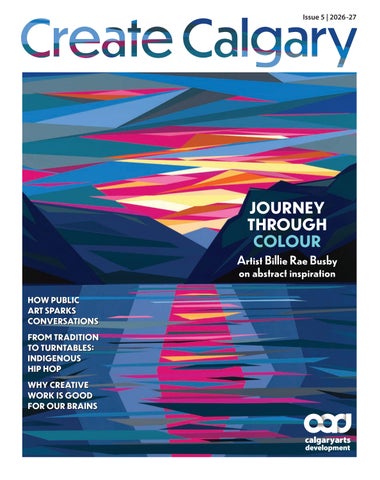
Issue 5 | 2026-27
JOURNEY THROUGH COLOUR
Artist Billie Rae Busby on abstract inspiration HOW PUBLIC ART SPARKS CONVERSATIONS FROM TRADITION TO TURNTABLES: INDIGENOUS HIP HOP WHY CREATIVE WORK IS GOOD FOR OUR BRAINS
2026/2027 SEASON ON SALE NOW SEASON SPONSOR
Explore our season and buy tickets at calgaryphil.com
06 Meet Adora Nwofor, host, writer, producer, comedian and activist, on living a creative life.
10 Pulse The Citizen Reference Panel’s ideas about building an inclusive and innovative cultural community.
12 Next Gen Learn about inclusive and accessible local youth programs.
14 Experience Discover under-the-radar festivals to add to your events calendar.
17 Exhibit Find everything you want to know about public art pieces with the new Calgary Public Art Guide.
20 Discuss Members of the One Yellow Rabbit team on the state of the arts in a growing Calgary.
contents
departments
features
IMAGES: (ON THE COVER) RISE AND SHINE BY BILLIE RAE BUSBY; (THIS PAGE, TOP TO BOTTOM) WINNER BRAVE; PAUL BRAIN; COURTESY OF RAGHAV
This is Your Brain on Art 25 New research combining art, biology and neuroscience shows that creative work is good for our brains.
06
Hip Hop Hooray 30 Hip hop as a cultural movement has taken off among Indigenous artists throughout Treaty 7 and beyond.
The Art of Place 35 How Calgary’s public art anchors community, creates identity, sparks conversation and beautifies utilitarian spaces.
The Grit Behind the Glamour 40 Jubilee Arts helps to develop and diversify future generations of backstage technicians.
25
PHOTOGRAPHS COURTESY XXXX
44 PORTFOLIO
After nearly two decades of painting abstract landscapes, Billie Rae Busby reflects on her artistic journey and how her process has evolved.
48 CREATIVITY BEYOND BORDERS
International pop star Raghav still calls Calgary home.
48
03
Chair, Board of Directors Brian Krywulak President and CEO Patti Pon Calgary Arts Development Authority is a wholly owned subsidiary of The City of Calgary. We invest and allocate municipal funding for the arts to hundreds of arts organizations, individual artists, artist collectives and arts events in Calgary. We believe the arts have the power to create vibrant communities and bring together diverse voices and perspectives. We support artists in the development of their skills and the expression of their creativity. Calgary Arts Development supports and strengthens the arts to benefit all Calgarians. Calgary Arts Development Phone: 403-264-5330 Info@calgaryartsdevelopment.com calgaryartsdevelopment.com calgaryartsdev calgaryartsdevelopment calgary-arts-development
RedPoint Media Group cSPACE Marda Loop 1721 - 29 Avenue SW, Suite 375 Calgary, Alberta T2T 6T7 (Letter mail only)
CEO, Co-Owner Roger Jewett President, Co-Owner Käthe Lemon Vice President, Operations Meredith Bailey Executive Editor, RPM Content Studio Colleen Seto Art Director, RPM Content Studio Veronica Cowan Staff Photographer Jared Sych Editorial Contributors Paul Brain Winner Brave Chelsea Cavanagh Elizabeth Chorney-Booth Marcello Di Cintio John F. Gerrard Helen Hu Stephanie Joe Alicia L'Archevêque Karin Olafson Olivia Piché Kaitlin Roth Dane Thibeault
Phone: 403-240-9055 Toll free: 1-877-963-9333 Fax: 403-240-9059 info@redpointmedia.ca Statements expressed herein do not necessarily represent the views of the publisher. Copyright 2026 by RedPoint Media Group Inc. No part of this publication may be reproduced without the express written consent of the publisher.
Published annually by Calgary Arts Development in partnership with RedPoint Media Group.
At Werklund Centre, we believe in the power of what if to shape what can be. So, what’s your what if ? Because whatever it is, let’s go build it.
@werklundcentre
04 PUBLIC SECTOR SUPPORT
Patti Pon
PHOTOGRAPH: MOTIF PHOTOGRAPHY
WELCOME Calgary has always been my home. I was born and raised here, and apart from a few years spent at university in British Columbia, I’ve had the great privilege of living in this city for most of my life. This is a special place. The confluence of two rivers holds tremendous meaning. Through a variety of methodologies and research, we know this has been a place of gathering for thousands of years and continues to attract visitors and newcomers from around the globe. Calgary has been steeped in creativity for millennia. There’s a World Heritage Site in Alberta called Writing-onStone Provincial Park. In Blackfoot, it’s Áísínai’pi, meaning “those who draw.” When you go there, you enter an incredible valley with the Milk River running through it. On the rocks are petroglyphs and pictographs created
by Blackfoot peoples over thousands of years. These works were created in the eras of da Vinci, Michelangelo and the Greeks. So, although we often refer to Calgary as a relatively young city, people have been drawing, writing, telling stories and singing in this region for thousands upon thousands of years. Creativity is in our DNA. To me, it’s important for us as a city to always root ourselves in a history that goes back millennia, not just a couple of hundred years. Preceded by that history, at this moment we are looking at a once-in-a-lifetime opportunity. Over the next couple of years, billions of dollars in cultural infrastructure investment will be realized right here in Calgary, and all eyes will be on us and the stories we are telling. At Calgary Arts Development, we have the immense privilege of building on the deep roots of art and creativity that have always been part of this place. By investing in artists, arts collectives and arts organizations, we support our present-day sense-makers, storytellers and connectors. Our arts sector plays a vital role in reshaping our city’s identity for all the world to see. Create Calgary is one of the ways we share stories about the amazing artists, arts workers and community builders who make our city richer every day. I hope you enjoy their stories and feel compelled to find out more about them and the thousands of other artists and artistic experiences available to you in this great city. Publishing an arts magazine takes a lot of people, and I extend my heartfelt thanks to our partners at RedPoint Media, the writers, photographers, illustrators, designers, editors, advertisers and, especially, the artists you’ll meet on the following pages. Let’s continue to acknowledge and celebrate the deep-rooted creativity that has always been part of Calgary’s DNA. We’re on the brink of a cultural renaissance. I look forward to meeting you at many events, sharing experiences together and discovering how we all live our most creative lives. Patti Pon, LL.D. h.c. President and CEO, Calgary Arts Development P.S. To find out more about what’s happening in Calgary, visit yycwhatson.ca.
06
MEET: ADORA NWOFOR
By Olivia Piché | Photographs by Winner Brave | Location: Mas Studios, Calgary
Here, we chat with Nwofor about the intersection of art and advocacy and the evolution of Calgary’s art scene. As someone who has been involved in Calgary's arts landscape your entire life, how have you seen it evolve? “The art scene in Calgary has changed in that Calgary's imposter syndrome is beginning to fade. When I was a kid, nobody would think artists come from cowpoke Calgary, but we do, and we always have, and we're incredible at it. The things that have changed are that Calgarians are embracing the arts more, they're seeing the value in it more.”
meet
Adora Nwofor lives a creative life. As the host of Calgary Arts Development's web series, Living a Creative Life, the writer, producer and comedian interviews Calgary creatives, connecting on the power of authentic artistic expression. Equally important to Nwofor is advocacy; she is the president of Black Lives Matter YYC — vital work that aligns with her art. Born and raised in Calgary, Nwofor has practiced nearly every artistic medium, from being a dancer and singing in Mount Royal’s Youth Choir as a child, to her professional work today. Why is it important to tell the stories of Calgary artists through Living a Creative Life? “Calgary is now two million people strong, or very close to that, and it's difficult to keep up with everything with that volume and the internet. It's important to bring people back to a centre that says, ‘You can accomplish what you want, you can have the experiences that you want.’ They may not look exactly how you thought, you may need to expand your network ... but you can find it here, you can find someone to connect to here.”
07
08
meet
What is your favourite part about hosting the show? “I love to see the spark in people's eyes when they're talking about something they're passionate about. I will not allow people to be little. I'm a big person, so on my show, we're going to be big together. I love to be people's cheerleader and show them that they are seen. I want you to be your authentic self, and that's glorious, because the world does not often allow anyone, never mind artists, to be that.” What are you seeing in the current Calgary arts scene? “I’m seeing people who want space to be able to create. They want space to build their communities. I'm seeing those communities that have that space flourishing and healing Calgary and making a positive impact, even when things are uncomfortable, even when they have difficulties. Those groups of people are changing people's lives.”
Why is your work at Black Lives Matter YYC important? “Black communities in Calgary are not supported in the same way as other communities are, and that's 500 years strong. If I'm going to be born in a place where I'm an uninvited guest and I never get my indigeneity, I'm going to fight for people to have the best experience that they can. The best way for me to do that is by being an advocate against oppression, which means Black lives need to be prioritized. When that happens, everybody will benefit.” How do your art and advocacy intertwine? “I don't know them separately. I don't experience them separately. Self-expression is integral to every person. I have to advocate for humanity. We're doing art for humanity. I love humanity, as flawed as it is, as beautiful as it is. It comes from my DNA, and my DNA is connected to other people. That to me says that I have to advocate for not just the people who are creating art, but the people who are presenting art and consuming art, because we go together.”
ABOUT THE PHOTOGRAPHER Winner Brave is a Calgary-based artist and photographer working in editorial and conceptual portraiture. She creates work about liminal identity and the space between who we have been and who we are becoming. winnerbrave.ca
What’s your advice for living a creative life? “Work on loving yourselves, no matter what that looks like, no matter what the world tells you it should look like. If you work on loving yourself, what you express is going to be authentic and genuine. Everybody's not going to love your art, everybody's not going to love your experience, or believe your experience, or what you're expressing. But if you love it, the people who love it will find you.” Watch episodes with Nwofor at youtube.com/@livingacreativelifecalgary
Olivia Piché is a contributing editor and writer for RPM Content Studio.
09
In 2025, Calgary Arts Development (CADA) convened a Citizen Reference Panel on the arts to explore one guiding question: How might we imagine a cultural community that empowers every Calgarian to live a creative life and contribute to a prosperous, innovative city where everyone belongs? At the heart of the panel was the belief that the voices of everyday Calgarians should help shape Calgary’s arts future. This approach, led by Intelligent Futures, emphasized representation and inclusivity to bring lived experience into a shared deliberation. A rigorous multi-stage recruitment process invited 1,000 Calgarians to participate, from which a final group of 32 participants reflecting the city’s diversity was selected to come along for the journey.
How might we build clear, visible pathways that help artists learn, take risks and advance in Calgary? Calgary’s creative economy contributes meaningfully to jobs and GDP, so helping artists move from learning to earning benefits the whole city. Clear pathways align with CreativeCITY’s call to mobilize creative capacity and with CADA’s focus on skill building, mentorship and education.
How might we invite the broader community to play a stronger role in sustaining local artists?
10
Sustaining artists requires more than funding alone; when community members, businesses and institutions share time, skills and relationships, artists gain the practical scaffolding that enables creative focus, stable income and long-term careers.
The panel ultimately proposed seven challenge questions, along with recommendations in response to those questions. The questions call on artists, organizations, funders, civic partners, schools, businesses, community associations and more to consider what they can do, individually and collectively, to turn these challenges into creative and impactful solutions. Together, these ideas aim to make Calgary’s arts ecosystem easier to navigate, more equitable and more resilient. They emphasize clear pathways for artists at every stage, stronger relationships between artists and the broader community, shared infrastructure that lowers costs, invitations that welcome new audiences and trustworthy information that is easy to find. The work of the Citizen Reference Panel directly informed the redevelopment of Calgary Arts Development’s 2027–2030 Strategic Framework. Here, we share the panel’s thoughtful questions. Various ideas will be explored with community members to address each question.
How might we ensure that all artists have access to the building blocks they need to create and share their work? Space, materials and presentation opportunities are the foundations of practice. When these are scarce or expensive, talent stalls, collaboration shrinks, and both audiences and the community miss out. With shared infrastructure, resources can stretch and output can be accelerated.
Calgary produces a high volume of events, yet many residents still say they do not hear about them. A unified, plain-language, multi-language approach reduces friction, strengthens equity and turns interest into attendance.
How might we encourage more Calgarians to explore and express their own creativity? Creativity strengthens well-being, confidence and social connection. Many people want to create but face barriers of time, cost, confidence and access. Lowering entry points can grow participation and improve community health.
CITIZEN REFERENCE PANEL IMPACT METRICS Panel participants shared takeaways from their experience:
STRONGER CONNECTION TO CALGARY: 83.97% said their connection to the
ILLUSTRATIONS BY VERONICA COWAN
city is stronger after the panel.
READY FOR MORE CIVIC LIFE: 94.3% are likely or very likely to volunteer for a similar civic process.
pulse
How might we make arts opportunities easy to find and understand for all Calgarians?
How might we lower the full cost of participation so more people can attend arts events? Cost is the most cited barrier, and it includes more than just tickets — transportation, parking, childcare and accessibility supports often decide whether someone can go. Tackling the full cost opens doors for price-sensitive households and people with disabilities.
TI
E CK
T
How might we build belonging and inclusion so everyone feels the arts are for them? Belonging and participation rise together. People feel welcome when spaces are accessible, culturally relevant and shaped by trust, making inclusive design and relationshipbased outreach essential.
WELCOME
KNOWLEDGE GAINS: 87.1% learned more about the diversity of Calgary’s arts.
74.2% learned practical ways to engage.
11
HELPING KIDS ACCESSgen ARTS next Local youth programs prioritize inclusiveness and accessibility By Alicia L’Archevêque
A Trickster residency performance.
12
TRICKSTER THEATRE Trickster Theatre’s residency program sounds nearly impossible: in just one week, professional artists help students in Alberta’s K-12 schools create and perform an original theatre production from scratch. The entire school partakes in the fun, with each class creating a different show that connects to their chosen theme, such as inclusion or environmentalism. The productions are created by and for the students, meaning that the shows are inherently tailored to the unique needs of each class. The stories are structured around props made from everyday items, such as buckets, tables, plungers and towels, as well as the students’ possible movement patterns. For example, students in wheelchairs at Renfrew Educational Services built onto their mobility aids to create parade floats that were central to their production. Because of Trickster’s movement-centred approach, children with language barriers can fully contribute to the storybuilding. “The first part of the process is almost entirely nonverbal,” says David Chantler, founder and creative director of Trickster Theatre. “It’s an exploration of movement patterns, so it’s quite easy for kids who are new to English to participate.” Over the past 35 years, Trickster Theatre has run week-long residencies with over 400,000 participants in more than threequarters of the province’s communities, including over 130 residencies in Indigenous communities. Rather than starting with a script that needs to be adapted, Trickster residencies create original theatrical performances, where the needs and interests of each unique group of kids are the starting point. “We’ve reversed the whole process, which makes it enormously faster, more inclusive and more suitable for kids with a variety of abilities,” says Chantler. trickstertheatre.com
PHOTOGRAPH: COURTESY OF TRICKSTER THEATRE
Finding youth arts programs can be a tricky pursuit for busy families, particularly when seeking environments that honour and adapt to diverse needs and experiences. To address this challenge, youth-focused initiatives in Calgary are delivering inclusive and accessible programming through schools and public libraries in every quadrant of the city, meeting children where they are. Here are a few programs worth checking out.
STORY PALS Offered through a partnership between the Calgary Public Library (CPL) and the Pet Access League Society (PALS), Story PALS is a literacy program that uses canine companions to create a judgement-free space for children to practice reading aloud. During each 15-minute session, children aged six to 12 read a book of their choosing to a highly socialized dog from PALS and its handler. Running for nearly 20 years, Story PALS is available to all Calgary children with a free library card.
PHOTOGRAPHS: (TOP) COURTESY OF CALGARY PUBLIC LIBRARY; (BOTTOM) BY STEPHEN J’ARCHE
EAST SIDE DANCE FESTIVAL In 2013, a group of public school teachers realized that Calgary’s east end was brimming with dance talent, but lacked access to formal training and performance opportunities. To address that gap, they founded the East Side Dance Festival. Over 13 years later, the festival has expanded into a two-night showcase featuring 20 public school dance programs, while also supporting free, yearround dance opportunities, teacher training, bursaries and mentorship. East Side prioritizes uplifting the original cultures and creators of dance forms by ensuring its dance instruction at teacher conferences and student workshops are grounded in the various contexts from which each dance form emerged. This culturally responsive approach positions dance as a powerful vehicle for social justice education. The conferences are attended by dance educators across Alberta, many being public school teachers who can pass on the socially conscious programming via in-school instruction. “We do our best to teach the history, racial and sociopolitical contexts of these dance forms,” says founding member and teacher Kelsey McMahon-Stoker. “The people who created it and cultures from which it came cannot be separated from the art itself.” This mission is realized through research and collaborations with instructors from the communities where these dance forms originated. By providing funding
“Many kids are shy and self-conscious when they’re asked to read aloud, and Story PALS offers them a unique opportunity,” says Connie Smith, CPL’s assistant manager of volunteers and programs. “It’s not necessarily about learning to read, it’s about increasing their confidence.” By choosing their own books, children can select titles that match their interests and accessibility needs. For participants who would prefer to read in another language, the library’s directory features multi-language youth titles on its “New to Canada” website page. “Over half of Calgarians are active library users, and we understand that we serve a diverse group of people,” says Smith. “It’s important that we have spaces, services and programs to support them.” calgarylibrary.ca/events-and-programs/ programs/story-pals
next gen
Kids with their canine companion at the Calgary Public Library.
for participating schools to work with professionals from around the city, East Side lends kids the opportunity to see themselves represented and develop meaningful connections to Calgary's wider dance community. “What’s really important for us is to provide strong, barrier-free programming in public schools, because that’s where [the kids] are,” says McMahon-Stoker. “They don’t have to leave their communities or their schools to access it.” eastsidedancefestival.ca
A performance from Father Lacombe High School.
Alicia L'Archevêque is the editor of The Scene magazine and a radio host at CiTR 101.9FM.
13
UNDER-THERADAR FESTIVALS
experience THAT SHOULD BE ON YOURS
By Chelsea Cavanagh
East End Cold Spell
Calgary is brimming with festivals all year round. Aside from big players like the Calgary Folk Music Festival, Calgary International Film Festival, Calgary Underground Film Festival and Sled Island, a closer look reveals a plethora of unique festivals that maybe you haven’t heard of…yet. Well, there’s no time like the present. Whether you’re a film fanatic, a music lover or simply looking for community spirit, these festivals are sure to pique your interest.
EAST END COLD SPELL Put your “freezing-in-fashion” skills to the test at this chilly outdoor festival that runs A FascinAsian Q&A event about the movie Akashi.
all February long at The Confluence Historic Site & Parkland. Cold Spell celebrates Calgary’s winter culture and brings the fun out of the frost with a series of events, some calling for their own attire. Dress in your best retro après ski for the Calgary Folk Music Festival’s Block Heater event, bust out a vintage Western look for SkijorDue — a Scandinavianinspired event featuring skiers pulled by horses, along with bratwurst, fondue and yodelling — and bundle up in cozy but chic outerwear for an array of live music performances. theconfluence.ca
FASCINASIAN FILM FESTIVAL
14
Immerse yourself in the wonders and richness of Asian culture and perspectives at this volunteer-run film festival held at Calgary’s Central Library in spring. Established in 2021, FascinAsian Film Festival travels the prairies uplifting the voices of Asian Canadian and Asian American filmmakers, and showcases integral contributions to the film and media landscape. The festival also acts as a hub for local artists to connect and celebrate cultural integrity while exploring stories of the Asian diaspora. fascinasian.ca
OKI CORRAL FILM FESTIVAL Oki Corral is Calgary’s inaugural Indigenous film festival, which started from a group of Indigenous founders, led by local filmmaker Kevin Littlelight, and their vision to create a sustainable, world-class event amplifying the voices and perspectives of Indigenous Peoples. The first year of the festival, held at the Globe Cinema, featured storytellers from all over Canada. The 2027 festival will return to the Globe in February and is set to feature filmmakers from Treaty 7 territory, First Nation territories and communities along the Medicine Line (the Canada-U.S. border). okicorralfilmfestival.org Terminus Festival
Whether you’re a composer, performer or simply an avid appreciator of contemporary classical music, this interactive listening experience held at Contemporary Calgary invites one and all to enjoy worldclass performances by local, national and international artists. Sound Atlas showcases classical music performances with a contemporary spin. The event spans three days in June, each with a different theme, showcasing modern composition, sound design and inspiring performances of chamber music. soundatlasfest.com
experience
PHOTOGRAPHS: (CLOCKWISE FROM TOP RIGHT) CHRIS SANTOS, COURTESY SOUND ATLAS; SHANNON JOHNSTON, @ME_ONLYLOUDER OF TERMINUS FESTIVAL; COURTESY FASCINASIAN FILM FESTIVAL; COURTESY OF THE CONFLUENCE HISTORIC SITE & PARKLAND
SOUND ATLAS NEW MUSIC FESTIVAL
Sound Atlas New Music Festival
TERMINUS FESTIVAL Calling all darkwave, electronic and synth sound lovers! This annual underground, post-punk music festival has been taking over Dickens in downtown Calgary since 2012. The current four-day event in July features more than 30 acts from all over the globe. Dickens’ owner and festival runner Chris Hewitt forged the path for this eclectic group of artists — each with their own unique sound but all with a ferocious intensity to entrance the audience. Don your gothic attire for this dark-music masterpiece. terminus-festival.com
THIRD ACTION FILM FESTIVAL Embrace the beauty of aging and the stories of older adults at this unique film festival. Founded in 2017, Third Action launched at the Glenbow museum, showcasing 30-plus films and an art show addressing seniors’ mental health. Embracing the “third act” of life is what this heartfelt event celebrates, while also fostering intergenerational empathy and challenging stereotypes in how elders are portrayed in the media. Guests are encouraged to take in the inspiring films and engaging discussions, most recently held in June at The Confluence Historic Site & Parkland. Find new appreciation for the journey of growing old. thirdactionfilmfest.ca
Visit yycwhatson.ca for more festivals and events to check out in Calgary, all year round. A recent graduate of the SAIT Journalism program, Chelsea Cavanagh enjoys covering hyper-local stories and connecting with Calgary's communities.
15
It’s like watching The Empire Strikes Back and missing the biggest reveal. Canada’s 27% – people with disabilities – are shaping our arts and culture sector.
Don’t miss what matters.
Ian Judd is an ar tist at the National accessAr ts Centre. Working primarily in painting, h e l o v e s t o e x p l o r e p o p c u l t u r e , f i l m , a n d n a t u r e t h r o u g h b o l d a n d b r i g h t i m a g e r y.
FUTURE HOME OF
accessarts.ca
O P E R AT I O N A L PA R T N E R S :
exhibit
LET ART BE YOUR GUIDE Find something new in the familiar with the new Calgary Public Art Guide By Helen Hu
IMAGES: (RIGHT AND BOTTOM) COURTESY CALGARY ARTS DEVELOPMENT; (LEFT) COURTESY CITY OF CALGARY
Triclopse by Luke Blackstone
Commuting to work, ferrying kids to school, running errands, catching a show — Calgarians move through the public realm daily, taking millions of trips, whether by foot, cycle, vehicle or public transit. A network of more than 17,000 kilometres of roadways and 6,000kms of sidewalks connect Calgary, and within this vast network lives a constellation of public art. While our commutes can become routine and ordinary, public art colours our built environment — it allows us to find something new in the everyday. A city’s public art reflects stories and meaning within that place. It is most successful when it is engaged by an audience, in passing or on purpose. At Calgary Arts Development (CADA), we are committed to bringing these cultural features to the foreground. As we go about our daily lives, the landmarks that guide us seamlessly through our communities are the murals, sculptures, installations and monuments that form our mental map of the city. This year, CADA launched an interactive map — the Calgary Public Art Guide — to make it even easier to engage with public art. It is a comprehensive
17
18
and accessible visual catalogue that captures the multitude of public artworks across the city. Everything is represented in the guide, from community-led initiatives to private commissions, temporary art and permanent installations, large and small. With engagement and accessibility at its heart, the team developed an application that enables citizens and visitors alike to learn more about public art, wherever they may find it. Just go to calgarypublicartguide.com and you’ll find the full collection displayed in an overhead map view. Set your current location to see the public art nearest to you.
You can also search and sort by keyword, creator, title, community, ward and interest. Let the guide help you uncover the details, stories and artist intentions so you can better connect with each piece. For example, Ward 5’s Saddletowne neighbourhood is home to the Triclopse installation. The guide shares that it was completed in 2010 by Luke Blackstone. It is composed of three sculptures that, together, represent the emergency services our city relies on: copper for police, red for the fire department and silver for EMS. The piece is also a nod to traditional hand-cranked sirens. You can actually turn the cranks at the base of the three sculptures to activate siren sounds. Discovering this piece on the map gave me pause to reflect on the long history of essential services and the creative ways artists can breathe new meaning into the things we may take for granted. The guide also shows me that public art lines my route to my office. I walk through an underpass with Jill Anholt’s Below Before Between. I walk over a bridge and spy the Arrival mural by La Güita and Xemelas. I see a construction worker take respite in the bow of Beverly Pepper’s Nuova Twist. If it’s a windy day, I stop to
IMAGES: COURTESY CALGARY ARTS DEVELOPMENT
Below Before Between by Jill Anholt
exhibit
Nuova Twist by Beverly Pepper
admire the dancing tiles of The Flapper Walls. I noticed this piece is not yet in the Public Art Guide, so I took a photo and submitted it as a new entry to the map. You can do this, too! The Public Art Guide helps us navigate our city from an art perspective, engaging with pieces we’ve wondered about before and discovering entirely new pieces we didn’t know existed. And, just as an installation is activated by engaging
PHOTOGRAPHS: (TOP AND RIGHT) BY HELEN HU; (BOTTOM) BY CARVEL CREATIVE AND O2 PLANNING AND DESIGN INC.
The Flapper Walls by Entro
with its audience, the guide is richer with engagement and contributions from its citizens. CADA hopes this innovative guide, which received an Honourable Mention in the 2026 Creative City Impact Award for Cultural IDEA, gives you new insights about the landmarks in your everyday life and that you find something new in your city. calgarypublicartguide.com
Helen Hu is the public art coordinator with Calgary Arts Development.
A construction worker takes respite in the bow of Beverly Pepper’s Nuova Twist.
19
MAKE YOUR OWN SONG
An intergenerational discussion about the state of the arts in our growing city and the entrepreneurial spirit driving the sector forward by Alicia L’Archevêque | Illustrations by Dane Thibeault As Calgary undergoes a population boom and finds itself in the throes of significant cultural infrastructure development, the artistic landscape is shifting alongside the city itself, and a new generation of artists is leaving its mark on Calgary’s creative possibilities. Conventional routes are no longer the only path to success in the arts. Both emerging and established artists are finding new and innovative ways to produce their work. Mentorship is especially important in this evolving art scene. We sat down with Denise Clarke, an original ensemble member of the boundary-pushing One Yellow Rabbit (OYR) Performance Theatre (est. 1982), and two members from OYR’s BeautifulYoungArtists (BYA) mentorship initiative: multidisciplinary artist Maezy Reign and theatre director and choreographer Rita Rebetskaia. BYA was borne out of Clarke’s ongoing dedication to arts education and her desire to work with early career artists to create performance opportunities and build foundational skills.
20 Denise Clarke
Having begun their artistic careers up to four decades apart, the mentor and mentees discuss how the state of the arts has changed and the bootstrapping attitude that drives the scene forward.
discuss Maezy Reign As Calgary grows, how have you seen opportunities in the arts shift? Denise Clarke: “When I was in my 20s, there was Theatre Calgary, Alberta Theatre Projects, Lunchbox and that was it. There was no place for freaks — and we were freaks. We were wild children, we were punk-influenced, we were DIY all the way. One Yellow Rabbit became the place to do our own absolutely authentic and original work.” Maezy Reign: “The Rabbits made it possible for the rest of us to make weird, freaky art. You have to respect those who came before and paved the way. There’s a lot of opportunity for new and younger artists to make weird shit, but the Rabbits really set this city up for success in that way.” DC: “How have opportunities in the arts changed? Utterly, completely. A ‘make your own song’ model is the norm now. It’s harder, but it’s the only way now. It’s an entrepreneurial game, and that’s another reason that Calgary is a good place to do it. Calgary looooves entrepreneurial enterprise.”
Rita Rebetskaia: “I don’t wait to be hired — there are fringe festivals where you can start to do the work without any money, without even any grants. It’s very important to free yourself from these expectations of being hired by someone.” Have more opportunities been created or is the competition fiercer? DC: “Both. It’s not easy to get a grant, so there is more competition, absolutely.” MR: “Today, one thing Calgary really supports is new work. Lunchbox Theatre, Major Matt Mason Collective and Sage Theatre have their new works festival; Verb and Chromatic [theatres] have their new works showcases. In those spaces, it is very easy for younger people to get in, and it is a good way to start building audiences.” RR: “The best opportunities I’ve had were not through [traditional career moves], but by articulating my practice, sharing a vision with other people and asking for them to help.”
21
As the city grows, what kind of art and artists does Calgary need the most? DC: “These guys. I speak to enough people that I feel confident that there’s more coming up, but what we need most is support for artists. We need patronage, people who will step up and put their money on the table. They’re out there, they’re amazing people and you need more of them.” MR: “I agree, especially when it comes to sponsors and funders. We also need more exposure to the performing arts for high school students. The reason I ended up going into theatre is because Blake [Brooker, founding member of OYR] and Denise came into my high school.”
Rita Rebetskaia Why is artistic mentorship important? DC: “If you have a serious practice as a theatre artist, you must pass on the knowledge. I have a very strong belief in sharing all the information, all the technologies — it should be full-on open source.” MR: “Denise is a world-class performer and creator, so being able to study under her has been incredibly powerful. I didn’t go to [post-secondary] school, so working with Denise and the Rabbits has been a huge launch pad for my career.” Have you seen a shift in theatre’s diversity and representation in recent years? MR: “Growing up racialized in the theatre industry, one of my first theatre memories is watching some kids show, realizing that not a single person on stage looked anything like me, and feeling very upset about that. Werklund Centre had a big summit on June 2 [2026] with over 400 kids. So many of the kids who were on stage were racialized or visibly disabled, and I was just bawling my eyes out the entire time. We were in the Martha Cohen Theatre, and I was seeing six-year-olds on stage who had just immigrated here. Thinking about all of these kids really gave me hope. Calgary is getting a bit better at showing diversity on its stages, but we still have a really, really long way to go.”
ABOUT THE ILLUSTRATOR
22
Dane Thibeault is a Calgary-based illustrator who illustrates books, magazines and digital materials, working in both traditional and digital media. Thibeault loves sketching wildlife, dinosaurs, landscapes and people, specializing in portrait art in particular. danethibeaultart.com
RR: “I’d like to see big museum exhibitions where I can bring my kid to be exposed to the top-ranked artists. We’re a little bit isolated, and we need to see more and bring more here.” Are you optimistic about the state of the arts in Calgary? MR: “When I’m talking to other artists, I feel very hopeful. If we come back around to funding, it makes me anxious.” RR: “There’s a part of me that is always optimistic about the future because I have entrepreneurship experience. This is an open field; there’s so much to do.” DC: “I’m optimistic because I’m an art maker, and it feels positive to engage in making art. I have no doubts that if I’m around at 90, I’ll be watching [Reign and Rebetskaia’s] companies, because they don’t sit back and wait. I work with these guys, and it encourages the hell out of me to know that they’re the future.” Learn more at oyr.org
Alicia L’Archevêque is the editor of The Scene magazine and a radio host at CiTR 101.9FM.
Thanks a billion, Calgary. Over the last 70 years, Calgary Foundation has granted $1 billion to the Calgary and area community – helping to care for our city of over a million people. We have thousands to thank for building a more vibrant and healthy community where everyone belongs. It takes strong partnerships between visionary philanthropists and our effective charitable sector to address the current and future needs of people in our community. Fueled by a permanent endowment, we invest donations over the long term, making it possible to care for generations to come. Thank you, Calgary, for helping us to give more, do more, grant more and invest more. calgaryfoundation.org
23
ONE YELLOW RABBIT A bold legacy. An inspired future. For more than 40 years, we’ve championed artists willing to ask difficult questions, take big risks and imagine what creativity can be. Today, we’re carrying that spirit forward by investing in artists, ideas and the possibilities ahead. Explore @ OYR.org Dream Machine, 2026, photo by Benjamin Laird
FOO
IS OU
E IU
SCULPTURAL GRAZING TABLES AND ARTFUL CATERING, CREATED IN CALGARY FOR GATHERINGS WORTH REMEMBERING.
I
N U T
brieandbanquet.com
24
THIS IS YOUR ON ART New research combining art, biology and neuroscience shows that our brains respond positively to aesthetic experiences By Karin Olafson Illustrations by Paul Brain, John F. Gerrard and Kaitlin Roth
ILLUSTRATION: KAITLIN ROTH
W
hen arts educator Dr. Brittany Harker Martin moved to Calgary from Regina, Sask. in 2000, she immediately noticed the arts education curriculum was very different in her new home province. In Alberta, art and music are only mandated for kids in grades one to six and that doesn’t include subjects like dance or drama. Martin was keen to pivot her career to ensure more Calgary kids had access to arts’ benefits.
She found a path as a consultant in schools. Martin was brought in as an artist-in-residence, showing teachers how to educate their students in core subjects like social studies, math, science and reading using art forms like drama, dance and visual art. “When I’d work with teachers, I could see them transform and understand things in new ways,” explains Martin, now a Werklund School of Education associate professor at the University of Calgary and associate member of the Hotchkiss Brain Institute. This got Martin thinking. What’s happening in the brain when people make art? How does engaging in art affect our neurological functioning? It turns out, she wasn’t the only one asking these questions.
25
NEUROAESTHETICS: The biological, brain-based science of aesthetic experiences, including art, music and nature, and their effects.
Martin focused her research in an emerging field called neuroaesthetics. In a nutshell, neuroaesthetics is the biological, brain-based science of aesthetic experiences, including art, music and nature, and their effects. Dr. Semir Zeki, a British neuroscientist, is recognized as coining the term “neuroaesthetics” in the 1990s, first combining brain science with other academic disciplines in order to understand how the brain responds to aesthetic experiences. Martin is a trailblazer in this field in Calgary, and interest and awareness in neuroaesthetics are growing. In fact, U.S.-based NeuroArts Blueprint Initiative — an online space where the growing body of research connecting brain and body is collected — was launched in 2019. Created through a partnership between the International Arts + Mind Lab Center for Applied Neuroaesthetics at Johns Hopkins and the Aspen Institute’s Health, Medicine & Society Program, this initiative brings researchers together to combine science and art, proving on a neurological level that art can advance individuals’ health and well-being. “One of the challenges that I've had, as someone who's sitting at this intersection of the brain and mind, is that the way that a lot of research and understanding within the arts has been conducted so far has come from a philosophy that's not aligned with measuring things and scientific research,” says Martin. “There’s a lot of knowledge in the arts, but it hasn't been measured or quantified in ways that people outside of that research were valuing it.” Neuroaesthetics remedies this by collecting measurable data and neuroimaging that show brain architecture, hormone changes and blood flow, to provide evidence that art affects the brain. Basically, the benefits of the arts aren’t just qualitative. The field of neuroaesthetics supports the premise that art isn’t a nice-tohave luxury. It’s essential and our brains are wired to respond positively to it.
A B O U T T H E I L LU S T R ATO R
26
Kaitlin Roth is an artist and illustrator in Calgary. She studied printmaking at AUArts and has a BA in Psychology from UCalgary. Psychology greatly influences her work, portraying themes of the subconscious and existentialism. @krotchety_
IMAGE (TOP LEFT) BY SIBERIANART, FROM iSTOCK AND VERONICA COWAN; ILLUSTRATIONS BY KAITLIN ROTH
NEUROLOGY MEETS AESTHETICS
FLOATING AND FLOWING Martin’s neuroaesthetics research focuses on how the brain and mind respond to the art-making process, and she has a special interest in its benefits for mental health and well-being. The goal, she says, is to show that art can promote good mental health in schools. In 2021, she recruited 104 school-based mental health professionals to participate in her study. Each participant was asked to paint a simple, visual pattern on a water canvas for a set amount of time. Unlike painting with oil or watercolour paints on paper, the participants’ artwork would disappear. “For many people, it changes the perception of interacting with art when you know it’s going to vanish,” explains Martin. The study collected data measuring changes in perception, and was published in the Canadian Journal of Education in 2022. The results showed that creating visual art — even by those who don’t consider themselves artists — benefits mental health. “Doing this painting engaged the mind and kicked off neurocognitive processes that trigger a shift between mental states: individuals can go into a float state, which typically precedes a flow state,” says Martin. “Float state is a perceivable shift; you can sense your mind is letting go. What we looked at was the relationship between engaging your hands and your eyes in
visual tactile activity, and doing it long enough that your brain just kind of takes over.” She found preliminary evidence suggesting that engaging in visual art fires up the back of the brain, where we process visual and tactile information. And it slows down activity in the front of the brain, where we do all of our executive functioning. Martin says that if you can relax, stick with the art and keep going, your brain can learn to shift your mind away from a stressful, overthinking state and into a more relaxed one. It can even switch from float state into flow — this is a cognitive state of deep focus and deep calm. Martin also has preliminary research that paints a picture, as it were, of what’s going on in the brain while someone is painting.
ILLUSTRATION: BRAINSTROUNAUT IN NIRVANA BY PAUL BRAIN
ABOUT THE I L LU S T R ATO R Paul Brain, an awardwinning contemporary artist, hails from Hong Kong and is now based in Calgary. Following a life-altering, brainreconstructing surgery in 2021, Brain’s art delves into themes of resilience and enlightenment. Brain is not just an artist; he’s a storyteller whose canvas speaks of triumph over adversity. paulbrain.com
27
electroencephalogram or EEG, so the researchers could track their brain activity. Then, those participants painted patterns on a water canvas. Martin saw flow state happening in real time. “The front of the brain, the frontal cortex, is where we do all of our executive functioning — thinking, planning, fretting and dreading. Our imaging showed the participants’ front of the brain really powering down,” she says. “We saw brain waves of high power, low power, high power, low power — think about waves rolling in the ocean. We saw gamma spikes — the highest power the brain will go, the ‘aha’ moments, which show as bright orangeyred. And then the waves would drop down to blue, which is like a daydream state. This happened in milliseconds: very excited, very calm, paired together in rapid succession.” What does this neuroimaging tell us? “It shows that the brain loves art,” states Martin. “It responds in a positive way and and in this state, an engaged brain releases positive neurochemicals related to motivation.”
A B O U T T H E I L LU S T R ATO R
28
John F. Gerrard is an artist, author and peer support advocate whose work explores identity and mental health. His paintings and writing are a celebration of creativity, inquiry and reflection. johnfgerrard.com
ILLUSTRATIONS: JOHN F. GERRARD
During the pandemic, Martin worked with Dr. Jeff Dunn, a professor in UCalgary’s department of radiology, and his team at UCalgary’s Dunn Lab to collect neurological images of people painting. Participants wore skull caps with sensors, which used a neuroimaging technology known as an
PHOTOGRAPH BY MIA + ERIC
ART PHYSICALLY ALTERS THE BRAIN In addition to proving the benefit of art on mental health, neuroaesthetics collects data to show the impact of art on physical brain health. For example, neuroaesthetic research collected in the NeuroArts Blueprint Initiative shows that music improves cognitive functioning in people living with dementia and can aid trauma symptoms. And right here in Calgary, individuals living with Parkinson’s disease (PD) are experiencing firsthand how the arts can positively impact their brains. Dancing Parkinson’s YYC was co-founded in 2013 by Anne Flynn, professor emerita in the Faculty of Kinesiology at UCalgary, and Vicki Adams Willis, founder in residence of Decidedly Jazz Danceworks, Calgary’s acclaimed dance company that’s home to the largest recreational dance school. When Flynn discovered that the Mark Morris Dance Center in New York — which is steps away from where she grew up — had a Parkinson’s dance program, she knew Calgary needed a program like this, too. “I reached out to Dr. Bin Hu, a neuroscientist in the Cumming School of Medicine at UCalgary. At the time, Hu was working with software engineers to develop a device that would help people with Parkinson's work on their gait,” says Flynn. Often, PD affects an individual’s ability to walk in a regular, rhythmic gait and Hu’s device, Ambulosono, uses music cues to help those individuals relearn regular walking rhythms. Flynn worked with Hu to recruit the study participants to join Dancing Parkinson’s YYC for hour-long, instructor-led dance classes. These dance classes are designed specifically for people with PD: participants start with a seated warm-up, and wheelchairs, canes and walkers are welcome. In each class, participants are led through movements, focusing on rhythm and gait, coordination and body awareness, all of which are typically impacted in an individual with PD. The live music accompaniment is another bonus: music is neurologically proven to release dopamine and endorphins, both feel-good hormones produced by the brain. The pilot was a success; 13 years later, the classes are still running. From 2013 to 2018, Flynn also worked alongside Dr. Afra Foroud, a neuroscientist from the University of Lethbridge with a dance background. Collecting data from Dancing Parkinson’s YYC participants, Foroud studied the effects of dance
A NEURODIVERGENT PERSPECTIVE
We’ve learned that human brains respond to art, but what’s happening in the brains of other species? Mia Rushton and Eric Moschopedis are neurodivergent interdisciplinary artists from Calgary, and the first artists-in-residence at UCalgary’s Institute for the Humanities. Their current research project, “Brains, Strains + Other Domains,” looks at neurodivergence outside of the human experience. The two spend long periods of time observing and being inside environments. They then take an artful approach to discussing what they’re seeing. “You start to notice patterns and we couldn't help but ask the question: Is there a divergence happening here? Of course, we'll never know if a snail is autistic or if a bat has ADHD. But what might it mean if we were to take seriously the divergence inside of other species,” says Moschopedis. “As neurodivergent artists, we get to ask questions that challenge bias.” Learn more at miaanderic.ca
on motor learning and social communication in people with PD. And currently, Dr. Sarah Kenny, an associate professor in UCalgary’s Faculty of Kinesiology and Faculty of Arts, is also collecting qualitative research from program participants. “Everyone has reported positive changes,” says Flynn, adding that participants report improvements in PD symptoms such as better balance, improved posture and increased coordination. “Everyone.” Regardless of the form, art is good for your brain. Science is proving just that.
Learn more about Dr. Martin’s work at brainsmoothies.com and Dancing Parkinson’s YYC at decidedlyjazz.com/outreach/dancing-parkinsons-yyc
Karin Olafson is a writer and editor at RedPoint Media, as well as a freelance writer focusing on stories about health and wellness.
29
Hip hop as a cultural movement has taken off among Indigenous artists throughout Treaty 7 and beyond
With artists like Drezus making history as the first Canadian Indigenous artist to win an award at the 2017 MTV Video Music Awards for the collaborative protest anthem, led by Taboo of Black Eyed Peas fame, Stand Up / Stand N Rock, Indigenous hip hop has gained mainstream recognition on a global scale. But well before the awards, hip hop was already having a rippling effect on the self-identity of Indigenous Peoples — particularly youth.
Rooted in the socioeconomic struggles of largely Black communities living in inner-city New York City, prominent hip-hop artists of the ’90s rapped about systemic racism, police brutality and poverty — circumstances that ran parallel to the Indigenous reality of living in Canada. Shining light on the fundamental inequities Indigenous Peoples faced every day, hip hop as a genre validated lived experience and not only made it mainstream, but offered a sense of empowerment where there had previously been shame and despair. Hip hop allows Indigenous artists to explore their identity unapologetically. They use the genre as a tool to process trauma, confront systems of oppression and uplift Indigenous youth. By filling the gaps created by colonialism and intergenerational trauma, Indigenous artists embrace hip hop because it creates space for authenticity and connection. Indigenous artists continue to make the genre their own by blending contemporary sounds with ancestral teachings, lived experience and cultural pride. In Calgary, that movement is gaining momentum. Local artists are creating music that reflects their communities while building inclusive spaces where Indigenous voices are celebrated. Here are some Calgary-area Indigenous hip-hop artists to take a listen to.
Stoodis Music Fest: CALGARY’S NEW INDIGENOUSLED MUSIC EVENT
30
To celebrate Calgary becoming a hub for Indigenous musical talent, an emerging Indigenous-led and -owned music event launched this past September. Known as Stoodis Music Fest, the festival aims to highlight local talent, celebrate culture and create opportunities for Indigenous artists to perform in front of large audiences. The Stoodis Fest Society gained society status in April 2026, and the festival itself has been in development for about two years. It began
IMAGES: (LEFT) COURTESY SARAH GOOD MEDICINE; (RIGHT) COURTESY CREATOR’S PATH
By Stephanie Joe
Drezus As one of the most recognizable figures in Indigenous hip hop, Drezus uses his music to give back to the community. The award-winning Plains Cree artist uses hip hop for personal expression, and he hit a big turning point when audiences told him his songs made them proud to be Indigenous. Drezus travels through North America to mentor youth through his Creator’s Path initiative and uses hip hop to instill confidence, cultural pride and healing. Grounded in ceremony and guided by Elders, Drezus believes music can help people reconnect with identity and discover their own voice. “Once I realized the power in who I was as a person and also in spirit, everything changed,” he said in an interview on Living a Creative Life Calgary. “People were like, ‘You made me feel proud to be Cree, proud to be an Indigenous person.’” @drezus
with community consultations led by the Gord Downie & Chanie Wenjack Fund and Tourism Calgary. Calgary Arts Development was then approached, followed by the establishment of a working group to guide the project. The board consists of Indigenous people with experience in music festivals, event planning, law, marketing, fund development, radio, music performance, Indigenous arts and culture and more. One of the event’s defining features is that it is alcohol- and drugfree (including cannabis) and designed for the whole family, from young children to Elders. It’s intended as a safe space where families can be together to enjoy live music performed by local Indigenous musicians alongside drum groups and cultural programming. "There are very few spaces where your whole family can go and enjoy themselves, from babies all the way up to grandparents,” says Sarah Good Medicine, a Métis artist and secretary for the Stoodis
Fest board. “That's really what sets Stoodis Music Fest apart. You can pack up your whole family and come. We're minimizing the things that could trigger people’s addictions and creating the opportunity for families to have fun together." With the recent soft launch on September 19, 2026, at the University of Calgary’s MacEwan Hall, organizers are gearing up for what they hope will become an annual multi-day event. “Stoodis Fest is about creating something that belongs to our community and gives Indigenous artists the stages and recognition they deserve,” said Blair Cunningham, president of Stoodis Fest Society, in a press release. “We’re just getting started.” Whether on festival stages, in community centres or through youth mentorship programs, hip hop continues to offer space for healing, truth-telling and self-determination.
31
PHOTOGRAPHS: (CLOCKWISE FROM LEFT) COURTESY LUKE LITTLE CHIEF; COURTESY CHINOOK BLAST; COURTESY SARAH GOOD MEDICINE
Luke Little Chief The moment that hip hop became a lifelong passion for Luke Little Chief was when he heard Soundbombing, a hip-hop compilation album by Rawkus Records. Raised in Calgary and from the Siksika Nation, Little Chief found that hip hop could be more than commercial music. He discovered that it could tell honest stories about struggle, resilience and identity. Drawing inspiration from his own community and experiences, Little Chief, who is also a member of Tribe Artist Society, uses his music as a way to process emotions while amplifying Indigenous voices. “Hip hop is a form of expression. It's an outlet that transforms difficult experiences into something meaningful.” @lukelittlechief
Sarah Good Medicine
32
Sarah Good Medicine sees hip hop as a culture that unites people and builds healthier communities. A spoken word poet, MC, DJ and Métis artist, Good Medicine believes “words can be good medicine,” by challenging colonialism and social injustice. To that end, Good Medicine is helping develop Stoodis Music Fest, Calgary’s Indigenous-led festival celebrating Treaty 7 artists. For her, hip hop carries both responsibility and possibility. She understands the importance of youth mentorship and envisions more inclusive hip-hop spaces. “Sometimes putting goodness into the world isn’t rainbows and happiness. Sometimes it’s just being real and being yourself,” she says. “I have a responsibility to help people deal with the pain of living in this world, and I also have a responsibility to try to help the world be better than it is.” @sarahgoodmedicine
Dwight Good Eagle Farahat For Dwight Good Eagle Farahat, hip hop became a way to understand himself and his life circumstances. Farahat discovered rap through artists’ lyrics depicting struggles with poverty, identity and a sense of belonging. The Siksika Nation artist says hip hop gave voice to experiences that often went unspoken, while showcasing the art of storytelling, creativity and community. He mentors emerging artists through the Tribe Artist Society, which originated when Farahat volunteered to teach rap at the Calgary Young Offenders Centre. He feels the genre resonates with Indigenous audiences because it transforms hardships into strength and reminds young people that their voices matter. “Hip hop was telling our story. We didn't need any money. We didn't need anybody else's approval. We just needed our own creativity and our willingness to say yes,” he says. “Hip hop helps you find out who you are deeper. It unlocks things in you.” @dwightgoodeagle @tribeartistsociety
33
Chills For the Calgary-based artist Chills, hip hop is an outlet to process his life experiences, particularly as a young Indigenous person. The Minegoziibe Anishinabe artist began releasing music in 2018, and his style blends storytelling with emotion. He believes hip hop resonates with Indigenous youth because it emerged from struggle and gives people a platform to transform trauma into storytelling and emotional clarity. He believes hip hop is an evolving practice that reshapes experience into sound and sound into connection. “Hip hop comes out of struggle, and Indigenous Peoples in this country know struggle,” he says. “Hip hop is a genre that people are able to use as a voice … to tell their story and actually be heard.” @dylan_is_chillin_yt
Where to Hear Indigenous Hip Hop The Tribe Artist Society hosts alcohol-free Monday Rap Nights from 5p.m. to 7:30p.m. at the Werklund Centre. As well, annual festivals, such as Stoodis Music Fest, the Calgary Folk Music Festival and Sled Island Music & Arts Festival, showcase Indigenous hip-hop talent throughout their events.
34
Indigenous hip hop can also be heard across all streaming platforms like Spotify, where artists share their albums, singles and independent projects. For up-to-date performance details, follow local Indigenous hip-hop artists on Instagram.
Stephanie Joe is an Indigenous writer and journalist from Champagne and Aishihik First Nations in the Yukon.
PHOTOGRAPH: COURTESY CHILLS
Whether you’re discovering the genre for the first time or looking to dive deeper, there’s much to explore with the many voices shaping Indigenous hip hop today.
The Art of
PLACE How Calgary’s public art anchors community, creates identity, sparks conversation and beautifies utilitarian spaces By Marcello Di Cintio “I hate that bridge,” the woman told me. We were riding a light rail car in West Jerusalem in the late 2010s, and the elderly woman was pointing out the window at the Chords Bridge, also called the Bridge of Strings. The soaring structure, designed by Spanish architect Santiago Calatrava, had opened a few years earlier. The woman found the bridge unnecessary, expensive and ugly. The bridge’s design clashed with the city that surrounded it, she said, and should’ve been built by a local architect, not some Spanish guy. This was all too familiar. I’d heard these precise grievances enumerated about another Calatrava bridge — Calgary’s Peace Bridge. I tried to avoid smiling at the woman’s complaints lest I appear unsympathetic, but the fact that Calgary was having the same conversations as the denizens of one of the world’s oldest and most venerable cities made me proud. As a lifelong Calgarian, I consider the debate about our Calatrava bridge, and about public art in general, as the sign of a maturing city.
PHOTOGRAPH BY BRIAN TOLLE
A BROADER DEFINITION OF PUBLIC ART
Outflow by Brian Tolle at Parkdale Plaza
“Public art has evolved to mirror how culture is evolving,” says Kirsten Schrader, director of public art at Calgary Arts Development (CADA). In addition to traditionally static and permanent works like murals and sculpture, public art now includes dynamic and ephemeral forms like theatrical performances, flash mobs or spoken word as well as functional parts of infrastructure like a bridge or even the city’s stormwater system, as shown by Outflow, which stands on the banks of the Bow River at Parkdale Plaza. “It's a democratization of art,” Schrader says.
35
PHOTOGRAPHS: (TOP) COURTESY TRAVEL ALBERTA; (BOTTOM) BY INGES IDEE
36
“You can come across it in your everyday life.” Public art can be found on a bus or in a park. On roadways or in alleyways. Anywhere that is available. “That's really the distinction of public art,” she says. “The surprise element of it being just encountered in life.” For Schrader, public art — whether permanent or temporal — can link a community to both its past and future, address important ideas and allow viewers to consider their surroundings with fresh perspectives. Unlike a painting hanging in a gallery, a successful public artwork engages with the history and cultural context of the place. “Maybe it can spark a debate,” Schrader says. “I think that’s always a wonderful thing.” Just consider what a hot topic Travelling Light, a.k.a. The Big Blue Ring, continues to be in the court of public opinion, 13 years after its completion. Public art also humanizes and beautifies urban spaces that can sometimes feel cold, impersonal and ordinary. “Our cities look the same, and you
(Clockwise from right) Artists Liss Febrero (left) and aloT of Poetry with their Northeast Mini Gallery in the Responsibility to Wonder exhibition; Mariella Villalobos with her gallery for the HOME/LAND exhibition; Travelling Light by Inges Idee; Peace Bridge by Santiago Calatrava. get tired of the blandness,” Schrader says. “But public art can create and embed placemaking and a sense of culture in a community.” Public art builds character in the built environment.
STEP ONE: CONSULTATION
PHOTOGRAPHS: (LEFT) COURTESY CALGARY ARTS DEVELOPMENT; (RIGHT) BY JENNA LI
A public artwork might be attributed, in the end, to a solitary artist, but the project’s eventual success relies upon engagement with a range of community stakeholders. CADA reaches out to residents, Knowledge Keepers, civic leaders, funding agencies, construction teams and architects — among others — to determine which projects to support. Art that feels imposed on a community will always fail. In particular, projects in Calgary wards that are currently underserved by public art are encouraged. CADA also believes public art must benefit the creators as much as the community. Juries evaluate projects based on the opportunities they offer to artists, and one of the program’s chief goals is to provide artists a chance to advance their knowledge, hone new skills, and experiment with media and scale. A gallery artist who typically paints on canvas, for example, might relish the opportunity to paint a pedestrian underpass. Over 90 per cent of public art commissions go to Calgarians, but CADA recognizes the value of bringing in artists from elsewhere. Creating opportunities to interact with international artists — through mentorship programs, for example — affords local talent the chance to expand both their skillsets and their networks. Visiting artists
also bring unique outsider perspectives on our city and culture, which they share with their local collaborators and, through their projects, the city in general. International artists “might not be from here, but they’re showing you something that you might not have recognized before,” Schrader says. “There is an opportunity to learn something about yourself and your place.” Schrader believes Calgary is an art city. “There’s a lot of public art here,” she says, which gilds Calgary with an artistic vibrancy visible to anyone willing to pay attention.
POSING QUESTIONS, GREAT AND SMALL While a grand Spanish-designed bridge, a giant metal-mesh head, and towers of rock and steel beams may command the most citizen attention, the majority of Calgary’s public art pieces are far more modest in scale. Some are proudly miniature. The Northeast Mini Galleries program places 10 tiny public “galleries,” the visual art equivalent of little free libraries, at community associations in Calgary’s northeast quadrant. Every year, the program puts on three- to four-month exhibitions of work by community artists. Cobra Collins, a poet and spoken word artist, curated the HOME/LAND exhibition, which ran from November 2025 to February 2026. The exhibition, which consisted primarily of work by immigrant and displaced artists from the global south, posed questions about the meaning of the term “homeland.” When does a new land become home? Most provocatively, as Collins wrote in the curatorial statement, the exhibition asked, “How do we reconcile calling a place ‘home’ when we know that the land we live on was taken by force?”
37
Such challenging questions, presented in open space, raise issues of consent that are unique to public art. Someone who enters an art gallery implicitly accepts what they might view inside. “But somebody walking down the street with their kid, with their grandmother or just with their own person, is not consenting to see what they're seeing,” Collins says. “So you do have to be considerate of that.” Commissioned works need not be merely decorative, nor should artists have to apologize for challenging their audience, but public art demands an increased level of care. Collins embraces the kind of stories the HOME/ LAND artists sought to tell in their work and the difficult questions they pose. At the same time, she understands the desire of Calgarians, and northeasterners in particular, to want their communities to be, simply, “nicer.” Public art can provide this aesthetic comfort. “In a city that sometimes feels like it doesn't want you to connect or rest,” Collins says, “public art gives you a reason to stop.“
For graphic artist Jillian Fleck, public art gives voice to Calgary’s “unique identity of who we are, what we're about, who we've been and how we've changed from that.” Public art serves as the city’s outward face and collective mirror. “Without public art, what is this place?” Fleck asks. “How is this place different from anywhere else?” Fleck’s answer? Wrestling. In the spring of 2026, the Art Bus initiative gave Fleck and six other artists Calgary Transit buses to use as canvases. Fleck covered their bus with
38
Side view of Wrestle Bus by Jillian Fleck; Below: Rear view of Wrestle Bus (left); Interior art found on Wrestle Bus.
images drawn from Stampede Wrestling — the venerable pro-wrestling promotion of the ’60s, ’70s and ’80s that bestowed upon the world a pantheon of babyfaces (good guys) and heels (villains), including Bret “The Hitman” Hart, his brother Owen and the British Bulldogs. Wrestle Bus also honours Calgary’s ring-a-ding-dongdandiest announcer Ed Whalen, and portrays the Harts competing in a ladder match — which, according to Fleck’s research, is as innovatively Calgarian as mixing vodka with Clamato juice and tabasco sauce. Not only does Fleck’s project defy the traditional definition of public art — unlike a fixed art piece, Wrestle Bus is also a functioning city bus that travels around the city — it questions which histories public art should celebrate. “It just seemed weird to me that the city has a statue of someone like Winston Churchill,” Fleck says. “What does it have to do with Calgary?” Certainly not as much as Stampede Wrestling. No doubt, the lore of the Hart family, both in and out of the ring, is well-known to many Calgarians, and if not, probably should be. But Fleck also wanted to pay tribute to those wrestlers who “didn’t get to be the hero in their story.” For example, Wrestle Bus depicts Gamma Singh, a
IMAGES: (TOP) BY LEIA GAO, ALL COURTESY CALGARY ARTS DEVELOPMENT
NOT JUST TO STOP, BUT TO SEE OURSELVES
“Without public art, what is this place? How is this place different from anywhere else?”
notorious heel despised by most Stampede Wrestling fans but adored by Calgary’s South Asians. Fleck believes that Gamma deserves a place of honour on the bus, and that Calgarians should know his story, Jillian Fleck too. “I viewed this project as an act of service to the community,” they say. Calgary’s blossoming public art scene shows that we’re a city that has stories worth telling and that “enjoys beauty and beautiful things,” says Fleck. Accessible public artwork creates a sense of
belonging by transforming public spaces not only into places where we want to be, but places that tell our stories back to us. “What's really magical about public art,” Fleck says, “is that it can expand our imagination about what Calgary is.” Learn more at calgaryartsdevelopment.com/ public-art
Marcello Di Cintio is the author of six books including, most recently, Precarious: The Lives of Migrant Workers.
39
By Olivia Piché What happens on a theatre stage is enchanting, transporting audiences to new places. But magic lives backstage, too.
40
Behind every production, there’s an entire team of unsung heroes ensuring a show runs smoothly. Backstage careers span all sorts of departments, going well beyond lighting, audio and wardrobe. Technicians are also the ones who build the sets, work that fancy trap door you see mid-show, ensure actors “fly” safely and manage special effects. Without backstage techs, the show could not go on. And so, the industry must continue to recruit and develop skilled techs by building awareness among young people, especially girls and women.
SHAPING THE NEXT GENERATION The Alberta Jubilee Auditoria Society understands the importance of a rich, well-rounded arts landscape and opens doors for Calgary youth to participate in the arts. “I believe the arts are an essential service,” says the society’s former CEO Jonathan Love. “The more arts and culture people have in their lives, the better off their lives are. As we look to the next generation, it's the experiences from when they're in school that define who they are and what they're going to be in the community when they start contributing to what arts and culture looks like here in Calgary.” Jubilee Arts, formerly known as Jube School, offers several programs and workshops, and it places a special importance on showing kids there’s a diversity of arts opportunities, including backstage careers. “It's not just the actors or the singers on the stage. There are hundreds of jobs that you can go into,” says Emma Slunt, the technical coordinator for the Friends of the Alberta Jubilee Auditoria Society. “Being a tech is anything you can imagine, and you can put it into the arts, and make an actual career out of it.”
ILLUSTRATION: SMARQUES774 AND ANILYANIK, FROM iSTOCK
Jubilee Arts helps to develop and diversify future generations of backstage technicians
As a way to introduce high school students to all that behind-the-scenes careers have to offer, Jubilee Arts hosts its Backstage Access program once a year. Here, students participate in four onehour modules. They explore the Jubilee’s secret spaces and fun backstage areas, get the chance to talk with IATSE, a union for behind-the-scenes theatrical workers, and take part in hands-on workshops of their choice. The workshops include developing skills in lighting, audio, set design, stage management, scenic painting, costumes, makeup and more. “We want kids to know that the arts are a wonderful pathway. We want people to see themselves here. Arts are an economic driver for our city. It is a wonderful community to belong to, and we need people to perpetuate that into the next generation [on and off stage],” says Love.
BUILDING INCLUSIVITY
PHOTOGRAPHS: COURTESY OF JUBILEE ARTS
Part of developing a strong technician landscape in Alberta is creating an inclusive one. Some backstage departments are inherently maledominated, especially those that demand intense labour. While there has been an evolution with
more women creating thriving careers as theatre technicians, change has been slow. “Unfortunately, one of the things we still hear today as a woman technician walks into a room is, ‘Oh, don't worry about that, sweetie, it's heavy, I'll lift it,’” says Slunt. “We’re seeing, slowly, women trickling in and getting to the high places and making their mark, and it's amazing, but there is still the stigma. There is still the old boys club. As amazing and talented and skilled as they are, we want to see new faces, we want to see female faces.” This sentiment was the guiding force behind Jubilee Arts’ Tech like a Girl. Designed to be a safe place for girls to ask questions, build confidence, find mentors and get familiar with backstage spaces, Tech like a Girl is a seven-session program over the course of six months. Intended for girls aged 16 to 20, the program helps them learn hands-on skills like rigging (handling the rope and pulley systems that lift stage elements, such as curtains or even people), lighting, audio, stage management, scenic painting and prop building. Jubilee Arts facilitated its first complete Tech
41
like a Girl program last year with 20 participants, and the response was overwhelmingly positive. Organizations from across the country reached out to the Jubilee, sparking nation-wide conversations on the gravity of such a program. “It's important for women to see themselves in these leadership roles so that we are creating a culture that evolves a little faster than it is presently,” says Love. “We have such talented and respected artists who are women. We want to make sure that [the theatre industry] is a safe place. We want to make sure that the community is as open to that as humanly possible, because the more [inclusivity] we have, the better all of our productions are.”
THE FUTURE IS FEMALE
42
Although slow, things are improving for women backstage. Carlee Field, the Jubilee’s house head of stage, says in the five years she’s worked at the Jubilee, she’s noticed a shift. “Now, it's super different,” she says. “There's no question of, ‘Could a woman do this?’ But it felt like, at the beginning, that question was there.” Programs such as Tech like a Girl play a role in welcoming more women to the industry, and it’s critically necessary. Field says that at times, when the crew is based on seniority, she has been the only woman in a crew of 30. But among younger technicians, it’s closer to a 50/50 split. Field, who is an instructor for Tech like a Girl, loves how the program lets girls have the time, space and support to develop skills and confidence. “On the job, when you're working with people who have an older mindset, they can be really judgmental when you ask a question. I love the idea of being able to be a part of giving [girls] that safe space to just figure it out,” she says. “I hope that it can give them the confidence to know that they can make it in this industry.” For 18-year-old Emery Greffen, one of Tech like a Girl’s first participants, that message was well received. “It fostered a really safe space. It made it feel like a reality that was possible for all of us, which was really cool.” Greffen is following her dream to become a stage manager. She explains that, ahead of starting university this year, Tech like a Girl allowed her to feel more comfortable in professional spaces. Beyond the technical skills and an environment where participants can comfortably speak up, Tech like a Girl also builds community and offers mentorship — something that follows the participants into their professional careers.
PHOTOGRAPHS: (BOTTOM) BY EMERY GREFFEN; ALL OTHERS COURTESY OF JUBILEE ARTS
MORE BACKSTAGE TRAINING PROGRAMS Many local theatre companies, post-secondary and continuing education institutions offer technician training programs. Among them is SAIT, which offers programs to become an event technician, with courses in sound engineering, lighting and event production.
“I know that I can do this,” says Greffen. “I know that I have people I can reach out to. I have a net that I can fall back into, which is so important. It makes me feel so much more safe and comfortable, and confident going into the crazy world of university, and of pursuing this career.” Learn more at jubileearts.ca
Olivia Piché is a contributing editor and writer for RPM Content Studio.
For community programming, Theatre Calgary offers TC Learning workshops, designed to enhance artists' knowledge and abilities. Workshops cover backstage skills such as sound design, makeup, set design and more. Triple Threat YYC, a musical theatre program for children, hosts a technical theatre program that covers sound and lighting, set and props, costumes and makeup, and stage management.
43
Surrounding Sky 36” x 72” Acrylic on Canvas 2026
After nearly two decades of painting abstract landscapes, this local artist reflects on her artistic journey and how her process has evolved By Colleen Seto If you’ve been in the BMO Centre since its expansion, you’ve likely noticed the four incredible 1.2m x 3m (4' x 10') abstract landscape paintings by Billie Rae Busby gracing the walls. Titled Through These Places in Time, this vibrant, large-scale commission is part of the Calgary Stampede Art Collection.
44
Busby’s works have been exhibited in various galleries and exhibitions in Canada and are part of numerous collections, including the prestigious art collection in Canada House (the Canadian High Commission) in London, England. In fact, two of her paintings were designed into custom,
hand-tufted carpets in Canada House. She also participated in a public mural project with BUMP, a multi-painting commission for the TC Energy Corporate Art Collection and is represented by Canada House Gallery in Banff. While Busby’s paintings aren’t all grand in scale like the BMO Centre pieces, they all start with something in a landscape catching her attention. Often, when inspiration strikes, she’ll pull over on the side of the road to capture the moment — whether it’s a sunset, the Northern Lights, a grassy field, fluffy clouds or even just the light created by the glare of snow on the road. She then translates that moment, using the photo as a reference, into an abstract landscape. “When I paint the scene,
portfolio “The process part is probably my favourite part — just being able to look at things in a different way.”
PHOTOGRAPHS (CLOCKWISE FROM TOP): BILLIE RAE BUSBY; COLLEEN SETO; ARYN TOOMBS
Billie Rae Busby
it is purposefully abstracted,” she says. “Somebody might look at it and they don’t know that my original inspiration had a road in it. It could be a path, it could be a field, it could be whatever somebody wants to see in it. So I intentionally try to make things as abstract as possible. I want it to be really about the feeling you get of seeing the mountains on the horizon or a sunset or a winter scene.”
COMPOSITION AND TECHNIQUE Busby’s method of painting abstract landscapes using a hard-edge technique derives from taking many road trips between Calgary and Saskatchewan, where she grew up. “When I was going to visit my mom, who was ill at the time, I’d be in the passenger side of the car, half asleep, and that’s sort of the lines I’d see happening with
the fields and the clouds. It’s how things looked as we moved along, and that’s where I combined the hard-edge painting with the landscape, to recreate that.” She also uses colour theory to interpret the landscape. “I use colour to create the mood — that’s probably the biggest thing,” she affirms. “It’s something I continue to learn and enjoy, battling with how colour can really tell the story itself, and then also using the lines and the shapes and the geometric parts of it to create movement and energy. If I’ve got a snow painting, it might be a lot more dramatic. If I’ve got a sunny-day painting, it’s going to be a lot calmer in the colours and shapes I use. When I start off painting, it’s about time of day, season or mood. Those are the three main things that I decide on right away.” The colour makeup of every painting is unique, as she mixes custom colours to create each palette, which may include up to 40 different shades. Busby’s biggest tool, aside from the paint, is a quality painter’s tape, which she uses to create the hard edges of the geometric shapes and lines in her paintings. In her home studio in southeast Calgary, she composes her paintings in multiple steps and layers, requiring countless rolls of tape, applied across the canvas in various lengths, angles and directions to create the hard edges she’s after. She starts with a base colour on the entire canvas, then more colours are mixed and applied to create the horizon and other aspects of the landscape. It’s then left to air dry before the tape is removed. Once dry, the process begins again — applying new bands of tape to create new edges with another layer of colours that may differ from the existing palette. She continues this process until she deems the painting complete. “I know when I’m done when I feel like there’s no problem spots, and there’s nothing that takes my attention specifically,” she says. “If I feel like it looks like a whole piece, then I’m done. I could keep playing with it for a long time, and usually it’s an intuition or instinct to decide it’s finished. It’s just a feeling, like I’ve said everything I need to, or if I think the painting is interesting enough. If I’m not sure, I will put a painting away for a week or two, so I can come back to it with fresh eyes.”
EVOLUTION OF AN ARTIST With nearly 20 years of painting abstract landscapes under her belt, Busby now possesses a maturity in her artwork and expression — and she has something to say. “It might not look like my art has changed, but I have changed quite a bit in my use and confidence
45
in colour and in the complexity. My more recent work has a lot more layers in it. It’s something that would be harder to replicate. My earlier work was a lot more minimal, more basic tube colours, whereas now I generally do a lot more mixing and try to vary the landscape a lot more. “If you see my work in person, you can tell there are layers, colours that have been added, there are edges on some of the pieces, so it does have dimension to it. It’s important that there are imperfections, too. I like it when you can see a little bit of goopiness and layering, because then it shows it’s been done by hand — a human made this.” Busby’s always been into making artsy things since childhood, but she didn’t know that being an artist could be a career. She earned a degree from the University of Saskatchewan, double-majoring in drawing and kinesiology, but without a plan to be an artist. It wasn’t until her 20s and 30s, after she’d moved to Calgary, that she decided that she wanted “to explore this possibility more, and I started to take more classes and learn more about different types of art.” She began taking night classes at ACAD, now AUArts, and that’s where an instructor taught her hard-edge techniques. From there, she began creating, exhibiting and selling her art while working a day job in marketing communications at SAIT.
46
A SHIFT TO FULL-TIME In 2021, she made the decision to do art full time as her sole income. “I decided to give it a shot,” she recalls. “I actually wasn’t sure if this was going to be the right choice. I had burnout from work and had
been on stress leave. So I thought maybe I’d take half a year and see what I could do with my art. I had been exhibiting and selling my work for 12 years, but just on the side. I’d just see if I could explore doing this full time. Now, over five years later, I’m still making it happen. It was a good chance to bet on myself, and it’s been the best choice that I’ve made.” Despite her fruitful transition to a full-time artist, which also best accommodates her role as a caregiver to her father and as the primary parent to two teenagers, Busby doesn’t believe that being a full-time artist necessarily defines artistic success. “You don’t need to have the goal to do art full time,” she says. “You can be a professional or a serious artist with another job or career. I did that for many years, and it did give me that confidence to build up a client base. I love that I am a full-time artist right now, because it gives me the freedom to be with my family and figure out my own
PHOTOGRAPHS (LEFT TO RIGHT) COLLEEN SETO; LANCETTE BURTON; JIAN VON ESMANE
portfolio
schedule. However, I don’t think that if I were still at my day job that I’d be less of a success. “As long as you make a commitment to your practice, if it is at your dining room table for three hours or whatever it is, you can still really get the pleasure of being an artist and also creating new works. My artwork is accessible from a sales standpoint, and I like business and marketing. I don’t have a problem selling my work, whereas for a lot of artists, that might not be their goal. It doesn’t mean that they’re any less talented or successful.” Ultimately, for Busby, creating art preserves her identity and mental wellness. “I find that when I’m creating, it makes me present,” she says. “Any anxiety is completely gone when I’m in the
studio. When I can be present and get into the process of flow and trusting my intuition and being courageous. The process part is probably my favourite part — just being able to look at things in a different way. Because I do landscapes, I try to interpret them in a fresh way, so it’s challenging and new. For my mental health, and for just who I am, I’m always better and happier and more thoughtful when I am creating.”
“I’m always better and happier and more thoughtful when I am creating.”
Billie Rae Busby
Learn more at billieraebusby.com
A born-and-raised Calgarian, Colleen Seto is the editor of Create Calgary and executive editor for RPM Content Studio and Avenue.
47
A STAR AMONG US “Sometimes people who moved here from India who grew up with my music and view me as part of their childhood will come up to me in Calgary,” Raghav says. “’They’ll always say, ‘What the heck are you doing here?’” Now over two decades into his career, Raghav’s story is one of interculturalism, with his music drawing influences from his family’s background, decades of world travel and a youth spent as a second-generation Canadian. With one foot rooted at home and the other dancing through the rest of the world, his sound is a blend of classic pop music, R&B, hip hop, South Asian influences and a reflection of his own life’s journey.
International pop star Raghav still calls Calgary home By Elizabeth Chorney-Booth
48
Calgary is a big city full of artists of all kinds, but many Calgarians may still be surprised to learn we have an international pop star living among us. The city has certainly produced household names like Tegan and Sara, and Jann Arden, but another one of our biggest exports, Raghav Mathur — known publicly as Raghav — has huge hits in countries like India and the U.K., despite considerably less recognition here in his own hometown. The song Angel Eyes earned Raghav nearly two million album sales and stands as a significant touchstone for his listeners. Still, for the most part, he flies under the radar in his day-to-day life in Calgary.
Born in Toronto to parents who had immigrated from India, Raghav moved to Calgary when he was a toddler. After returning to the city after a brief stint in Fort McMurray to accommodate his father’s job as an engineer, the budding musician purposely enrolled in Sir Winston Churchill High School to work with the school’s music teacher and vocal coach Brian Farrell. Young Raghav was also deeply involved with the Youth Singers of Calgary, an experience that helped shape his ability to perform on stage. “I've been singing since I was four years old. But the stuff I sang in Hindi, I just did at home,” he says. “When I was at school or doing Youth Singers, no one ever heard me sing anything in another language. It was like living a double life, musically.” That double life was resolved when Raghav moved to Liverpool, England, to continue his musical studies at the Liverpool Institute of Performing Arts. As he drank in the level of Indian culture integrated into mainstream U.K. culture, he realized the potential of tying the two sides of his musical identity together. In 2004, Raghav released his debut album, Storyteller, which sold over 1.4
PHOTOGRAPHS: COURTESY RAGHAV
PORTRAIT OF THE ARTIST AS A YOUNG CALGARIAN
million copies thanks to the success of multiple U.K. Top 10 singles. The most enduring hits of the bunch were Angel Eyes and Teri Baaton, both produced by Jamaican reggae legends Sly & Robbie. That momentum launched Raghav into the global pop-music stratosphere and before he knew it, he was touring the world, filling stadiums in India, Africa and other parts of the world.
STAYING TRUE TO HIMSELF Even as he played to crowds of 30,000 people, the record industry wasn’t quite sure what to do with this silky-smooth, genre-bending vocalist who oscillated between English and Hindi. Major North
American record labels weren’t convinced his appeal would be long-lasting, while India’s market was primarily focused on Bollywood soundtracks. Raghav was still playing massive shows and earning devoted fans, but the industry support didn’t match that popularity. “They saw me as a novelty,” Raghav says. “I didn’t understand how to get out of this duality, where on Friday night I was a superstar, and on Tuesday I couldn’t get anyone in the industry to give me a deal.”
49
So he just continued to do what he’d been doing all along: working hard and being himself. Some industry contacts tried to convince Raghav to change his name to something more Western, but he didn’t want to give in to inauthenticity. In 2009, he independently released a second album, Identity, featuring hip hop star Redman on the single My Kinda Girl. This was followed by The Phoenix in 2012, anchored by the Juno-nominated song So Much featuring Kardinal Offishall and Fire. He further cemented his popularity in India through collaborations with composer A.R. Rahman on several tracks including Ishq Shava for the blockbuster Bollywood film Jab Tak Hai Jaan. Raghav may not have been doing pop stardom the traditional way, but he never lost sight of the music he believed in. “I really do feel like I failed many tests in my life,” he says. “But the one that I passed was that I didn’t give into the temptation of trying to find a more expeditious route to success when I was challenged.”
TAKING ADVANTAGE OF INDUSTRY SHIFTS
50
For personal reasons, Raghav returned to Calgary in 2011, making the city he grew up in his home base as he continued to perform internationally. As the music industry shifted towards streaming, standalone singles as opposed to full-fledged albums and easily accessible travel to meet with producers and play concerts, a quiet life back home has proven to be a good fit. He’s now able to live comfortably in a familiar setting while having some distance from
industry politics that, at times, caused frustration. “In a market now completely based on meritocracy, I’ve been thriving,” he says. “Now I don’t want a record deal, because now I can go direct-to-market and direct to my fans.” Beyond that, over 20 years after the release of Storyteller, Raghav has drifted into the category of legacy act and is now experiencing a bit of a renaissance, attracting new generations of listeners as well as older fans looking for a dose of nostalgia. Over the last decade, he’s continued to drop new singles including 2023’s Desperado, which was accompanied by a steamy video filmed at Calgary’s Lougheed House. It’s been streamed more than 52 million times and counting on YouTube. Raghav’s real full-circle moment came in 2024 when his early hit Teri Baaton was remade as the Bollywood anthem Teri Baaton Mein Aisa Uljha Jiya for a popular film of the same name, putting it back on the charts and introducing it to new audiences. Two decades later, his signature sound still resonates with fans around the world, including Calgarians of South Asian descent — many of whom do not even realize how closely his experience mirrors their own. His latest single Pablo came out earlier in 2026 and he promises there’s plenty more to come as he continues to bend genres and mix languages. “If you think I’ve confused people the first 22 years, you just wait until you see what I do in the next two years,” he says. “I love the freedom of being able to do what I want without the fear of failure.” Learn more at raghav.com
Elizabeth Chorney-Booth is a freelance culture writer and an enthusiastic lifelong Calgarian.
2026 SEPT 29 — OCT 25
LITTLE SHOP OF HORRORS NOV 26 — DEC 27
A CHRISTMAS CAROL 2027 FEB 02 — 21
TRUE WEST MAR 30 — APR 25
SENSE & SENSIBILITY MAY 25 — JUN 20
PETER PAN GOES WRONG
AD TICKETS: THEATRECALGARY.COM
ON NOW AT THEATRE CALGARY SEPT 29 — OCT 25
LITTLE SHOP OF HORRORS BOOK & LYRICS BY HOWARD ASHMAN, MUSIC BY ALAN MENKEN BASED ON THE FILM BY ROGER CORMAN, SCREENPLAY BY CHARLES GRIFFITH ORIGINALLY PRODUCED BY THE WPA THEATRE (KYLE RENICK, PRODUCING DIRECTOR) ORIGINALLY PRODUCED AT THE ORPHEUM THEATRE, NEW YORK CITY BY THE WPA THEATRE, DAVID GEFFEN, CAMERON MACKINTOSH AND THE SHUBERT ORGANIZATION THIS PRODUCTION IS MADE POSSIBLE BY THE GENEROUS SUPPORT OF THE AL OSTEN & BUDDY VICTOR LEGACY FUND PRESENTED THROUGH SPECIAL ARRANGEMENT WITH MUSIC THEATRE INTERNATIONAL (MTI). ALL AUTHORIZED PERFORMANCE MATERIALS ARE ALSO SUPPLIED BY MTI.
+
+
FROM CLASSROOMS TO CONCERT HALL Grow as a musician, showcase your talent or enjoy a world-class performance.
LEARN MORE
taylorcentre.ca
+
mru.ca/conservatory