1032 Arch Street, 3rd Floor Philadelphia, PA 19107 215.625.9850 GRIDPHILLY.COM
The Material World
In the late 18th century, the French chemist Antoine Lavoisier radically changed how we understand the physical world. He was perplexed by the fact that when metal rusted, despite becoming more brittle, it actually gained weight rather than losing it. Why would metal weigh more when it was decomposing?
It weighed more, Lavoisier came to understand, because the metal was absorbing a then-unknown element: oxygen.
This led to his publishing in the 1789 book “Traité Élémentaire de Chimie” the law of conservation of mass, which states that during a chemical reaction, matter can be neither created nor destroyed. The burning log in your campfire that seems to have disappeared has merely been transformed into ash, water vapor and carbon dioxide.
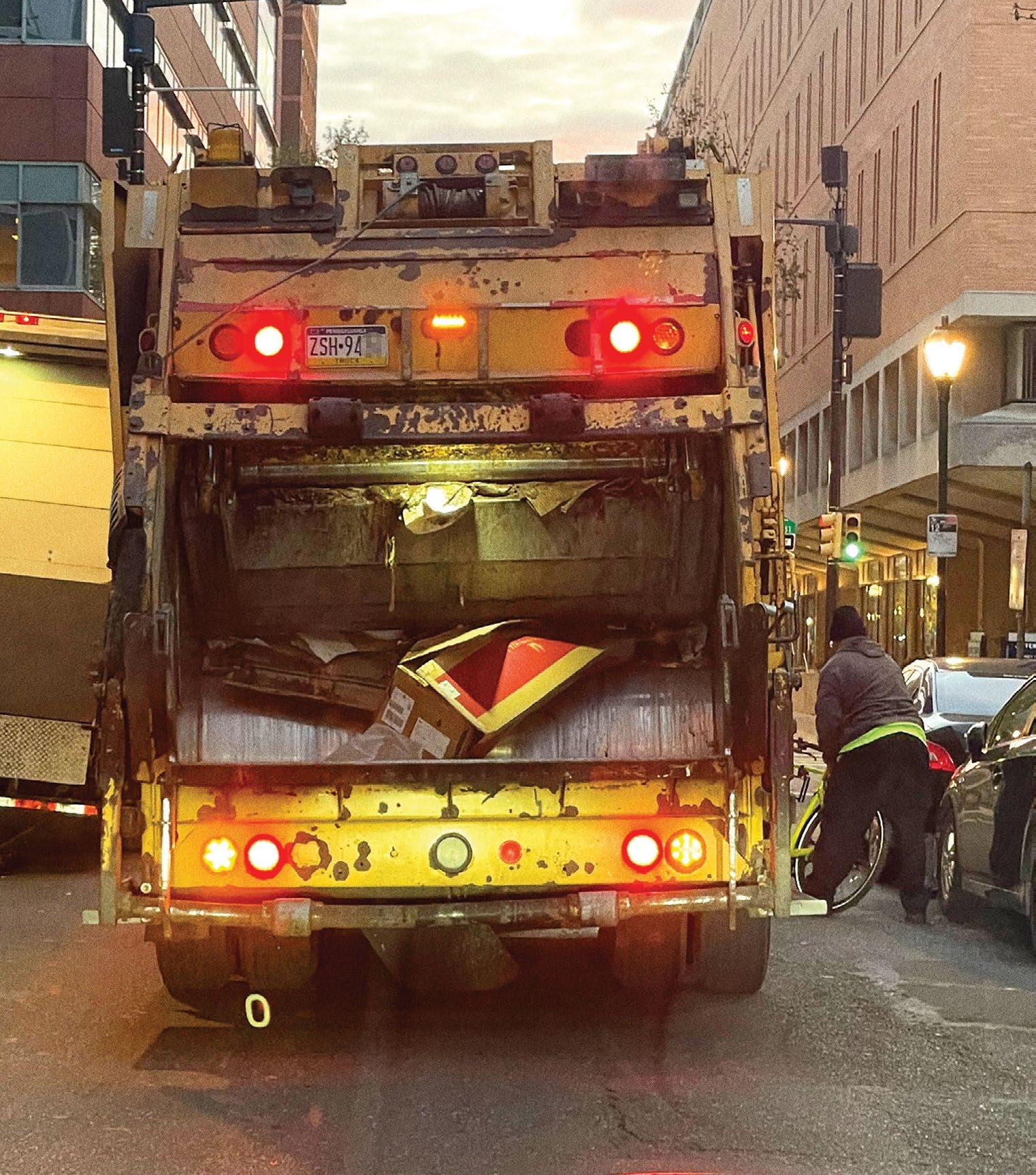
Matter, alas, doesn’t disappear when we throw trash in the garbage, either. We say “throwing it away” but the age-old sustainability question remains: Where is “away?” The reality is that we are just throwing it.
This is illustrated clearly in Melissa Langer’s “In Excess,” her 2025 documentary about Philadelphia trash, particularly in her footage covering the ill-fated trash barge known as the Khian Sea.
In 1986, the ship, registered in Liberia and contracted by a Philadelphia-based company, was loaded up with 14,000 tons of incinerator ash. New Jersey had previously taken this type of waste, but in 1984, they passed a law ending that practice.
They weren’t alone in wishing to avoid being a dumping ground. Over the next 16 months, the Dominican Republic, Honduras, Panama, Bermuda, Guinea-Bissau and the Dutch Antilles all refused the ash. In January 1988, 4,000 tons of the ash were dumped on a Haitian beach. After learning what had happened, the Haitian government tried to get the ship to take it back, but they were unsuccessful.
The Khian Sea returned to Philadelphia, but the pier where it would have been received had a mysterious fire just days after it anchored in the Delaware River.
The ship set sail again, and eventually the remaining 10,000 tons of ash were, according to the captain of the ship, dumped into the Indian and Atlantic Oceans.
In 2002, 2,500 tons of the ash that were initially dumped in Haiti made its way to a landfill in Franklin County — 160 miles from Philadelphia.
We know that our unwanted items, which we dutifully put in plastic trash bags that are carted from our vision, don’t vanish. In the United States, most trash still goes to landfills, where it becomes a major source of methane emissions. Incineration of trash is more common in the Northeast, where land is at a premium; one third of Philadelphia’s garbage is incinerated in Chester, Delaware County. This produces a slew of toxic gases, which makes its way into the atmosphere and our lungs.
But it isn’t the trash that is disposed of conventionally that we find most vexing. It’s that tiny sliver that doesn’t make it to the landfill or the incinerator that we come face to face with every day, on our streets and in our vacant lots that we call “litter.”
I know the feeling of despair litter can bring. For awhile when I was commuting on the El, on the walk home I would have to look at swirls of detritus — piles of bottles, chip bags and candy wrappers — and even imagined the title of an art project documenting them: “The Trash Gardens of Philadelphia.”
A much more productive response, a heroic one, to litter can be found in the work of Andrew Wheeler and Rich Guffanti and all of the volunteers who have joined their cause cleaning Cobbs Creek Park. Eastwick resident Olivia Collier monitoring the air because she wants it to be safe for kids to play in her yard is equally valiant.
They are fighting battles that produce victories, but only temporary ones — at least until we reckon with the law of conservation of matter.
bennett
Count The Ways
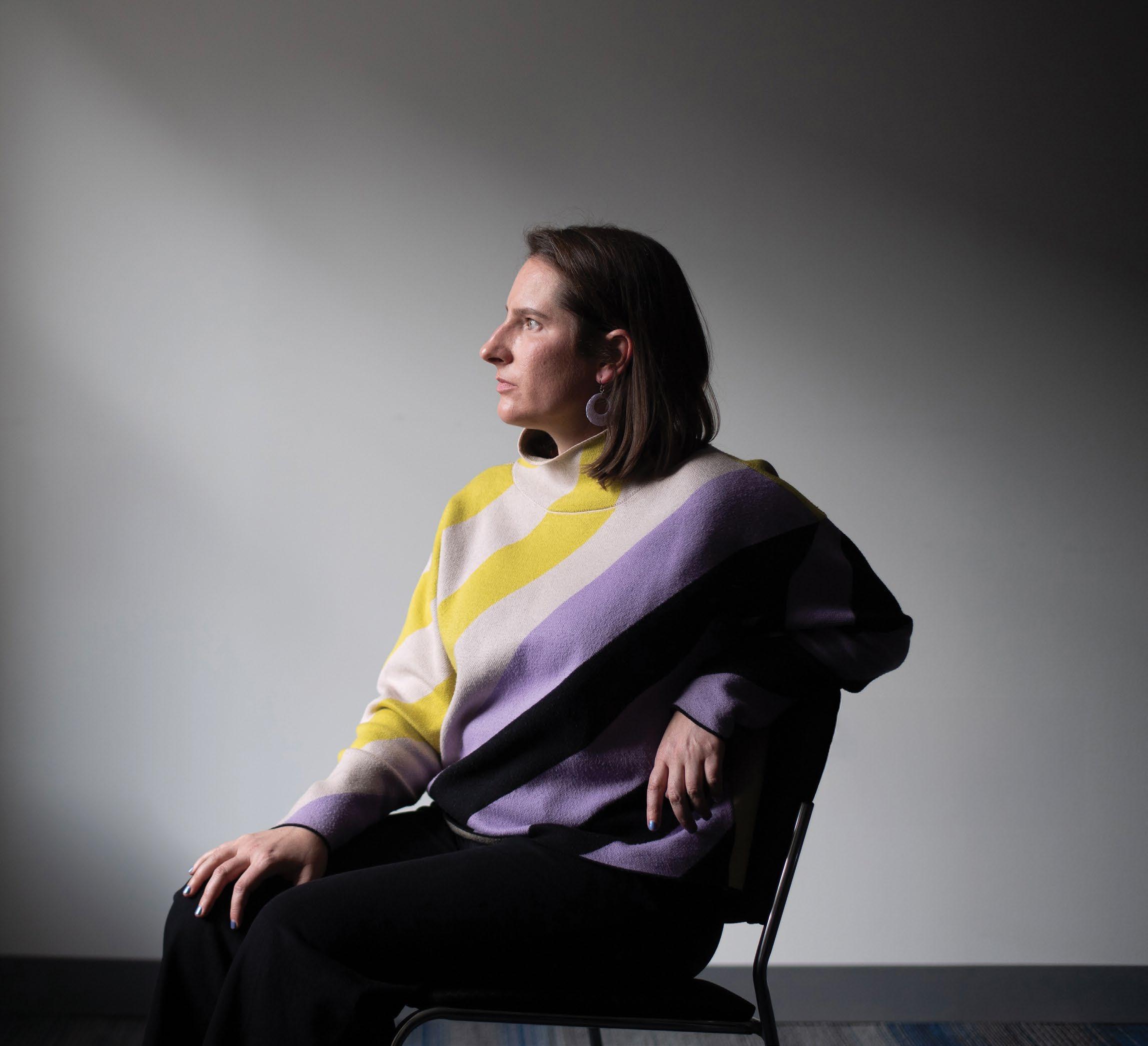
Last year i wrote a series of columns in Grid about several ways the City of Philadelphia could expand composting. While I have had some productive conversations with City officials over the last year, I have seen no indication that they are prepared to begin any large scale residential composting pilot program in the near future. But that doesn’t mean we should throw up our hands and give up. Composting is something an individual can do to reduce their carbon impact. And while a paid composting service, like the one provided by Bennett Compost, works for some, it doesn’t meet everyone’s needs. That is why we want to make sure we are educating people about the benefits of composting. In the coming months, while we wait for the City to incorporate composting into the municipal waste services I will lay out some practical ways people can set up their own composting systems.
So what do you need to compost the right way?
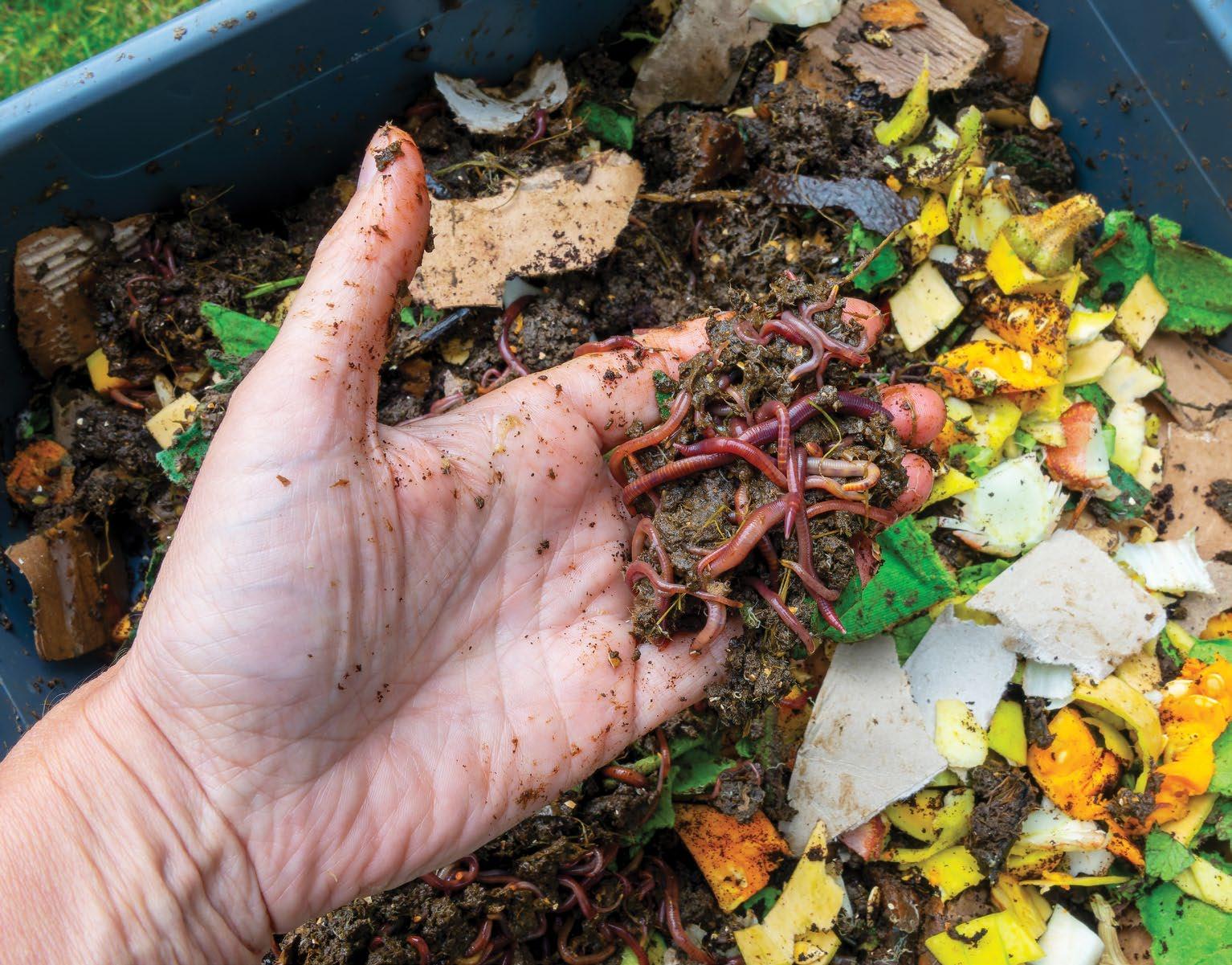
Whether backyard-sized or a large-scale facility, there are four key ingredients necessary in any compost pile: greens, browns, oxygen and water.
Greens are food scraps, organic materials with a low carbon-to-nitrogen ratio. In backyards and community gardens, these should be limited to fruits and vegetable scraps, coffee grounds and limited grains. Think of them as vegan piles. Meat and dairy can only be composted in larger systems where the pile temperatures reach 131 degrees Fahrenheit for 72 consecutive hours.
Browns are organic materials with a high carbon-to-nitrogen ratio, like wood chips, untreated saw dust, fallen leaves and shredded newspaper. The ideal greens to brown ratio is one part greens for every two part browns. That being said, browns are notoriously hard for the urban composter to
obtain. I’ve made quality compost in small scale settings with ratios as low as one part greens to one part browns. Anything less than that ratio and you are asking for a soupy, stinky mess — which can be remedied by adding more browns.
Whether backyardsized or a large-scale facility, there are four key ingredients necessary in any compost pile: greens, browns, oxygen and water.
Once you have combined greens and browns, you need oxygen and water. The good news is that food waste tends to be 60-90% water, and Philadelphia has a fairly humid climate, so watering your pile is not as important as it is in more arid parts of the country. Oxygen gets into smaller piles through natural diffusion, “naturally” moving through the spaces between your vegetable peelings and leaves without any interventions and by turning or mixing your pile at least once per week. The type of method you use for your composting will often dictate the best way to do this.
There are three primary methods to compost at home: tumblers, DIY backyard bins and vermicomposting (worms). Which method you choose will often be driven by your available space and willingness to experiment. We will break down the pros and cons of using each of these methods in future columns.
In addition to backyard composting, there are a number of community composting and drop-off programs that already exist. We will introduce these spots to you and teach you how to start your own dropoff site.
All of this is good and important work we should do as we continue to let our elected and City officials know that composting matters to Philadelphians from all walks of life. Let’s get composting! ◆
PORTRAIT BY JAMES BOYLE
COMPOSTING by tim
Thank You for Your Patience
Cyclists endure weeks of snow-blocked bike lanes
by bernard brown
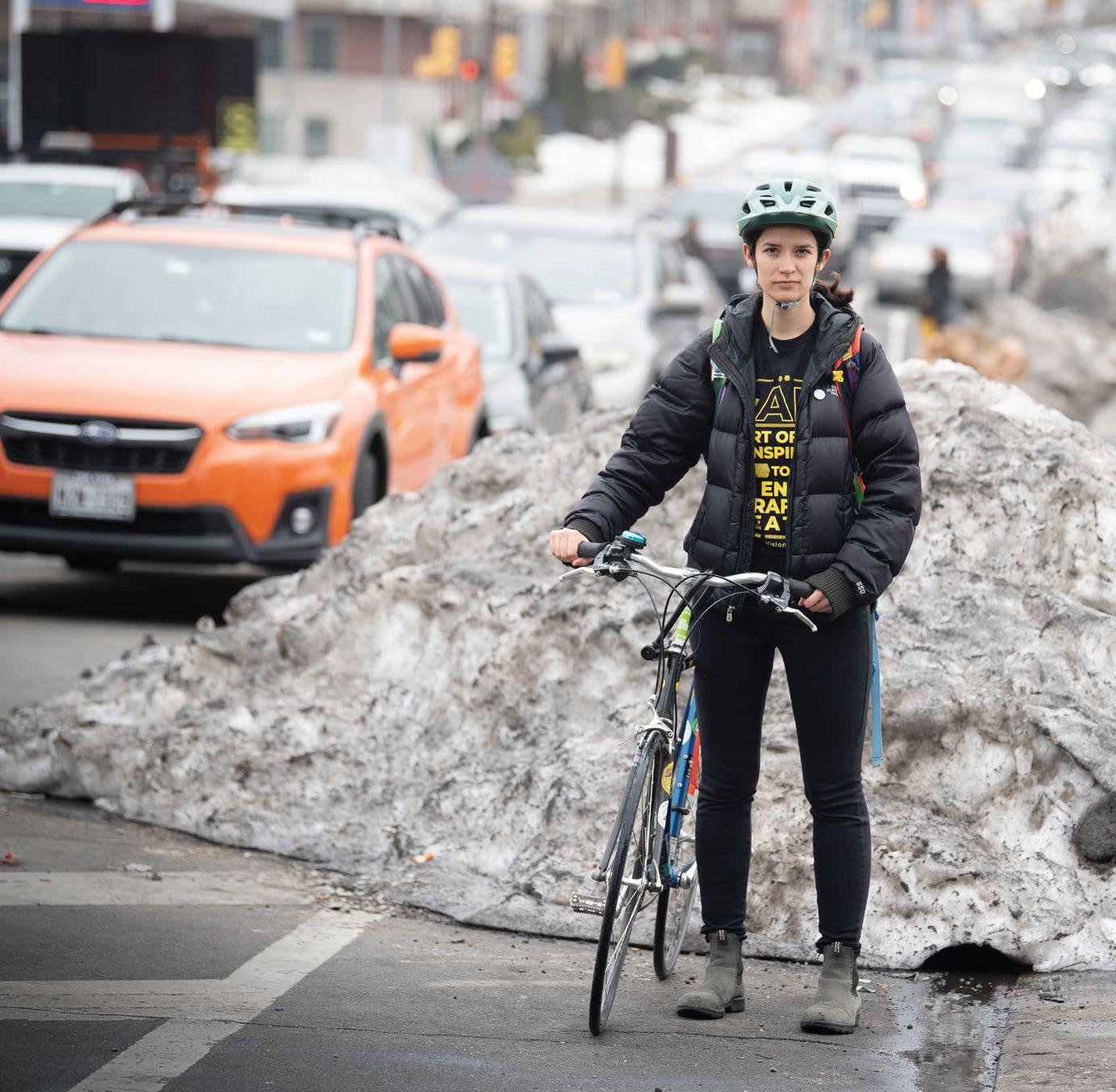
Hanna kahler lives in West Philadelphia and rides her blue commuter bicycle to work in the Graduate Hospital neighborhood, a trip she says takes 18 minutes via the Schuylkill River Trail and parking-protected bike lanes on Walnut and Chestnut streets.
When she spoke to Grid on Feb. 12, more than two weeks after the last snowflakes of the Jan. 25 winter storm fell, she was still unable to ride to work. She could take SEPTA’s 40 bus. “If it works well, it takes 40 minutes, but it hasn’t been working well,” she says. Mostly she’s been walking, which takes 47 minutes. “The City has completely dropped the ball on maintaining the bike lanes,” Kahler says.
The snow that fell directly onto the bike lanes and that the City did not clear wasn’t the only challenge. “Ignoring it is bad enough, but they’ve shoved piles of snow into the bike lanes,” Kahler says, referring to heaps — some as big as an SUV — that City workers clearing the roads had plowed into the bike lanes at intersections.
“Nearly all of the separated bike lanes (parking or flex posts) are untouched or, worse, being used for snow storage,” said John Boyle, research director for the Bicycle Coalition of Greater Philadelphia, in mid-February when Grid reached out to him. “The painted bike lanes throughout the City vary in passability depending on how far the plows pushed the snow. Even those routes have been blocked at corners.”
Uncleared or badly plowed snow is a ma-
The city has completely dropped the ball on maintaining the bike lanes.”
hanna kahler, cyclist
jor inconvenience for the able-bodied, but people with limited mobility fare worse after a snowstorm. An 18-inch berm of icy snow left by a plow might as well be a wall. The snow on sidewalks can narrow the walkway too much to allow wheelchair users to pass.
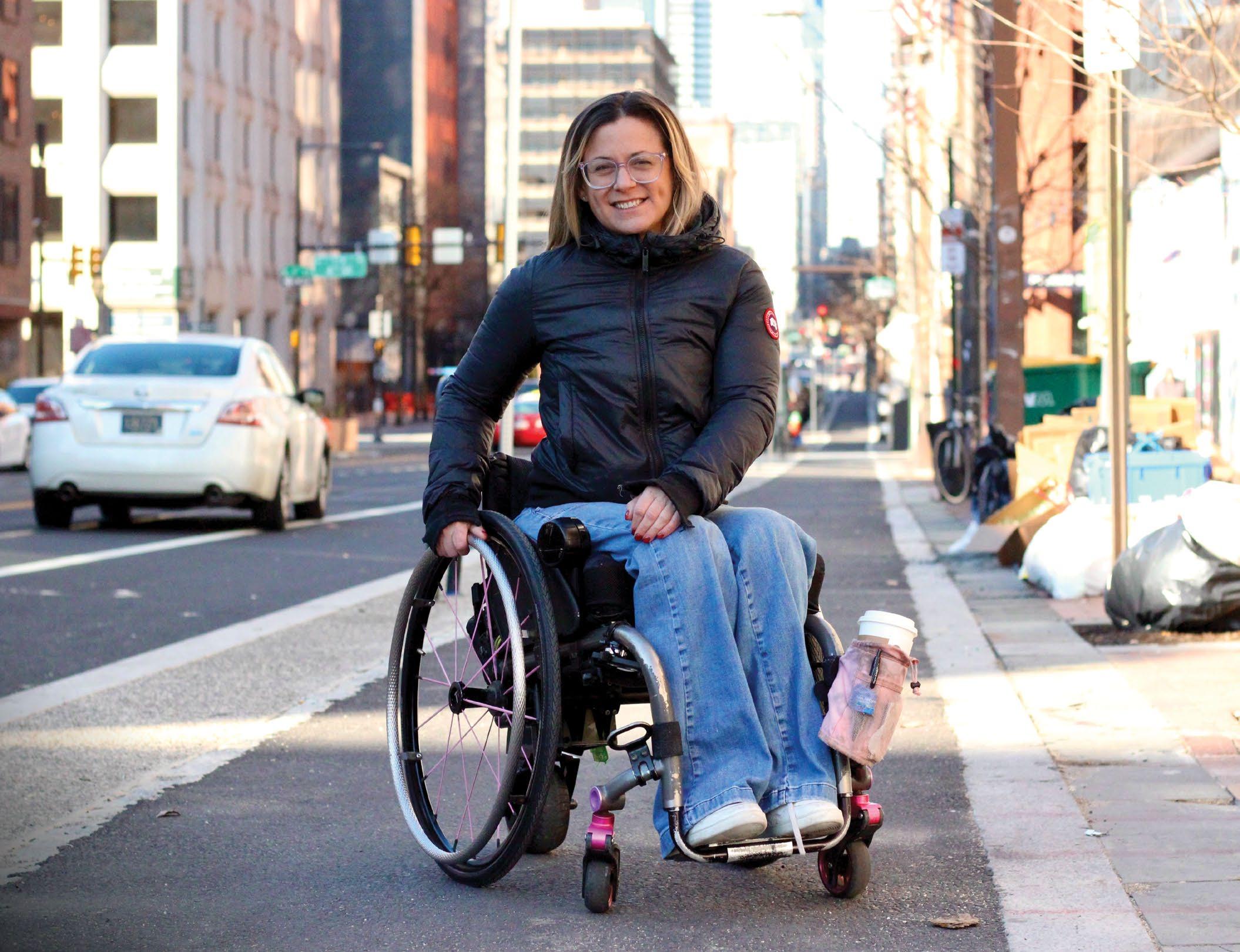
“Snow clearance is not just a mobility inconvenience but an accessibility and equity issue,” says Amanda Parezo, who relies on a wheelchair to get around. In the wake of the January storm, she says, “I was forced to take detours, backtracking or sometimes abandoning a trip entirely. It was detrimental when I had to attend an important medical appointment. An Amazon driver had to stop what he was doing to help push me down a sheet of ice on 4th Street.”
Parezo often uses bike lanes when sidewalks are made impassable by broken pavement or construction, as covered in this issue of Grid. But after the storm, she found that the snow piles in the bike lanes spilled out to block corner crossings. “That
overflow often ends up obstructing accessible pathways.”
The long delay in clearing the bike lanes was not inevitable. Other cities with protected bike lanes manage to plow them.
Boyle pointed to Montreal, which receives about 80 inches of snow a year and keeps its bicycle infrastructure accessible through the winter. “ The City [of Philadelphia] does have Bobcat mini tractors with snow plows and did a fair job with a mid-January snow event,” Boyle says.
Reached by email Feb. 16 for comment, City representative Sharon Gallagher said that the City had prioritized transit routes and curb ramps after the storm. “With this work wrapping up and the weather warming, the City is now going to be tackling priority bike lanes. Some of that work has already started. We thank cyclists for their patience.” Gallagher did not respond to questions about a timeline for the bike lanes or clarification about which lanes were considered “priority.”
Hanna Kahler stands in front of one of the snow mounds obstructing Philadelphia’s bike lanes.
Cleanup Crew
A group of park-loving volunteers keeps Cobbs Creek beautiful by
A1970s-era stereo receiver. Red leather boots. Nine fully intact eggplants.
These are just a few of the unexpected objects the Cobbs Creek Ambassadors have come across while cleaning up Cobbs Creek Park in West Philadelphia.
But most of what they pick up is just typical litter: bottles, cans, food wrappers, old tires. And the volunteers behind this grassroots organization have picked up tons of it — an average of about 9.5 tons of trash each year, in fact — since starting up in 2018.
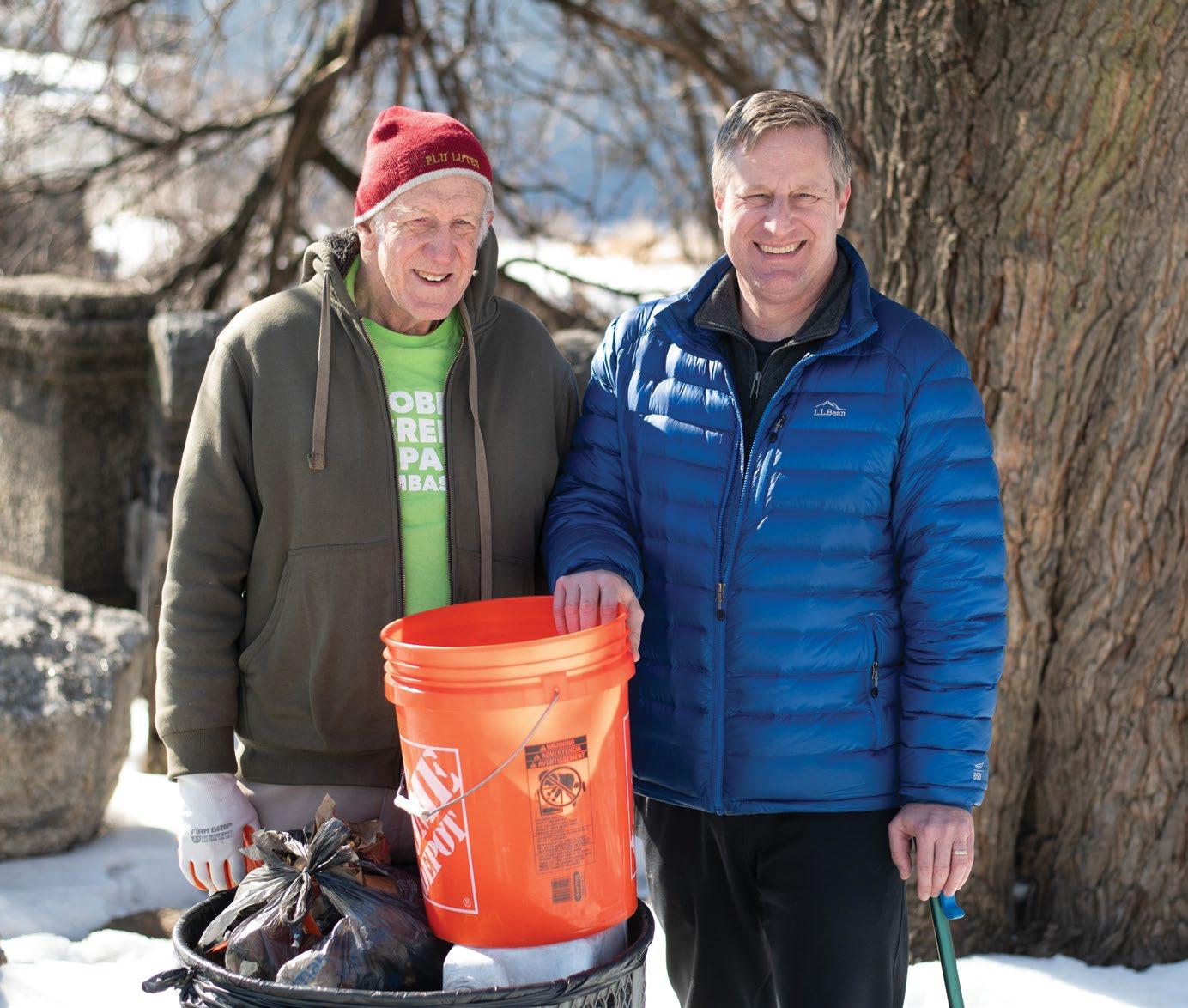
Cobbs Creek Ambassadors was co-founded by Rich Guffanti and Andrew Wheeler, acquaintances who first volunteered together building a wall in the Spruce Hill Bird Sanctuary. They enjoyed each other’s company and volunteered again as a duo to clear gutter leaves along Cobbs Creek Park between Catherine and Christian streets. This effort became a regular meet-up.
“We worked there every Saturday starting in late December 2017, and soon the neighbors recognized us,” Guffanti says. “We got our first volunteer in March of 2018, and then our first ambassador, Temwa, in 2019.”
The cleanup effort began to take on a life of its own, growing from a few people to a more structured community organization. Neighbors recruited other ambassadors, and Guffanti began collecting the volunteers’ names and email addresses. With the help of social media-savvy volunteers, Guffanti and Wheeler started using Google Groups and Facebook to communicate with the group, which now has 12 committed volunteers and a list of 100 occasional helpers.
The City of Philadelphia took notice, as well.
“Philadelphia Parks & Recreation provides us with guidance and has made repairs to the tennis and basketball fences in the park,” notes Guffanti. “They’ve sent lawn mowing crews and tree crews to remove fallen trees, and seasonal workers that help remove the trash. The Fairmount Park Conservancy provided us with publicity by posting our clean-
emily kovach
ups on their event calendar and banners we used for ‘Love Your Park’ cleanups.”
Cobbs Creek is a large park — more than 850 acres threaded with a nearly 4-mile trail. The ambassadors can only cover a small fraction of the acreage, and they focus on the areas close to the curb. They divide up the work between 10 zones, stretching from Market Street in the north to Woodland Avenue in the south. Each zone is cleaned up once a month, with help from volunteer groups, often from universities and high schools. Core members and volunteers also meet monthly via Zoom to share updates,
discuss orders of business and hear from guest speakers from area organizations such as the Darby Creek Valley Association and East Coast Greenway Alliance.
In 2023, Cobbs Creek Ambassadors deepened its neighborhood connections by launching the Summer Festival, a now-annual event at the park featuring free food, live music, bounce houses, bird and mushroom walks, native plant giveaways and more.
Guffanti notes that the personal connections with the neighbors have faded a bit as the ambassadors expanded the cleanup area to include the whole park. And, he admits, it can be discouraging to see new trash reappear in the areas that were recently cleaned. Still, he and Wheeler and the rest of the cleanup crew remain committed to the cause.
“I have a personality flaw,” Guffanti jokes. “I hate a mess and love to see it straightened out.” ◆
We worked there every Saturday starting in late December 2017, and soon the neighbors recognized us.”
rich guffanti, Cobbs Creek Ambassadors co-founder
Rich Guffanti (left) and Andrew Wheeler coordinate volunteers for cleanups at Cobbs Creek Park.
To Love a Dove
Pigeon fans spread knowledge and understanding through tours by bernard brown
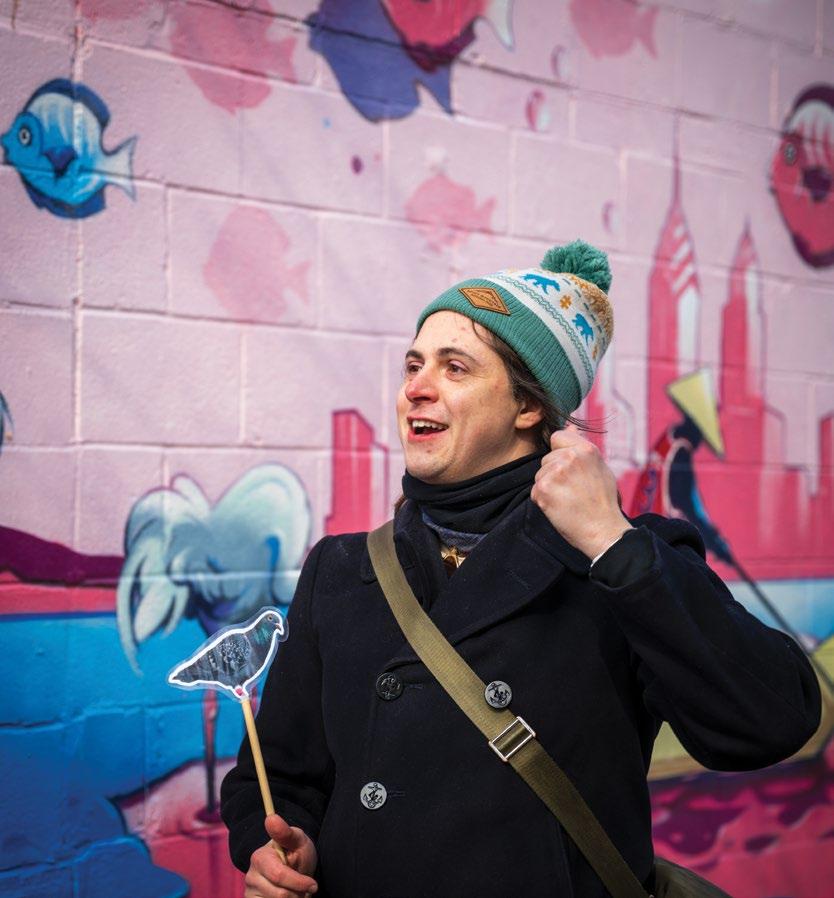
At 11 a.m. on valentine’s day , Aspen Simone stood on the corner of 7th and Christian streets in South Philadelphia holding a long dowel with a laminated, cutout pigeon on the end.
That wasn’t just any pigeon on the end of Simone’s walk leader staff. Primrose the pigeon is how the whole pigeon education enterprise began. Simone’s partner Hannah Michelle Brower took Primrose — at that point a weak, malnourished fledgling found by a neighbor on the sidewalk — to a pigeon rescuer who nursed the young bird back to health. Simone says the rescuer told them
the recuperating pigeon, whom Brower had taken to calling Primrose, would do better as a pet rather than being released into the wild, and so the couple kept her.
“We just started learning more about her as an individual,” Simone says. “And then we started learning more about pigeon biology and behavior generally. One day, we realized we could predict what pigeons were about to do based on subtle cues that we can read now.” In the summer of 2025, the couple launched their pigeon tours, priced at $25, to share what they had learned.
Their flock of humans that morning grew until 10 walkers had assembled, ready to
learn about and gain respect for their poorly regarded avian neighbors. Attendees Ben Fensterheim and Sydney Brodo live in the Graduate Hospital neighborhood. Brodo booked the tour on Valentine’s Day as a gift for Fensterheim, who is a “super casual, aspiring birder.”
Simone started the tour with a simple exercise, asking attendees about their associations with the terms “pigeon” (mostly negative) and “dove” (mostly positive), though they refer to exactly the same birds in the family Columbidae. The pigeon, also known as the rock dove (Columba livia), began its relationship with humans as livestock, kept for meat. The pigeons flying around Philadelphia descend from farmed birds imported by European colonists, mixed with others kept as messengers or pets bred for interesting plumage or flying speed.
The pigeon watchers followed Simone to the intersection of 6th Street and Washing-
Aspen Simone (opposite) leads educational pigeon tours to dispel the negative associations connected to the bird.
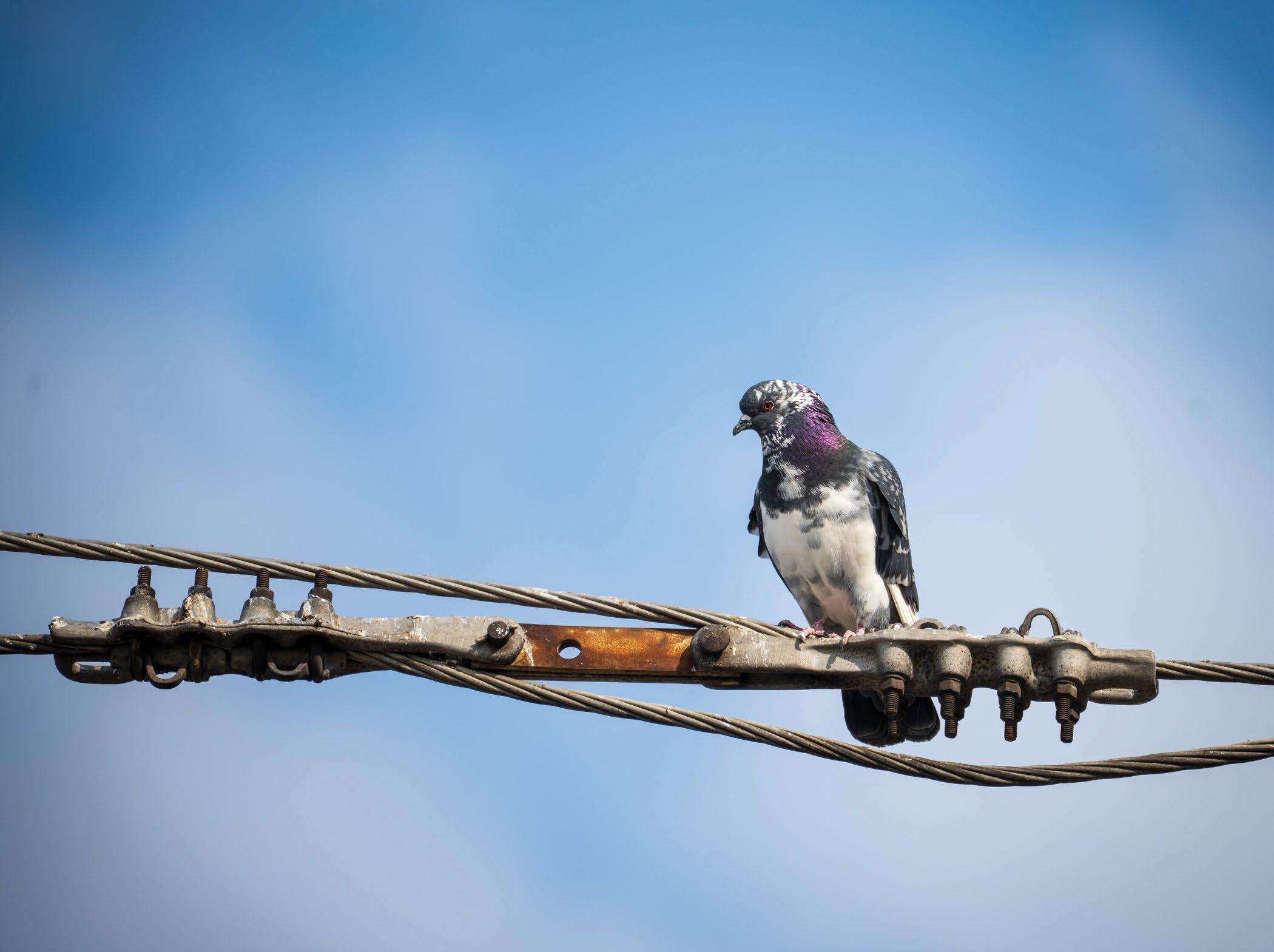
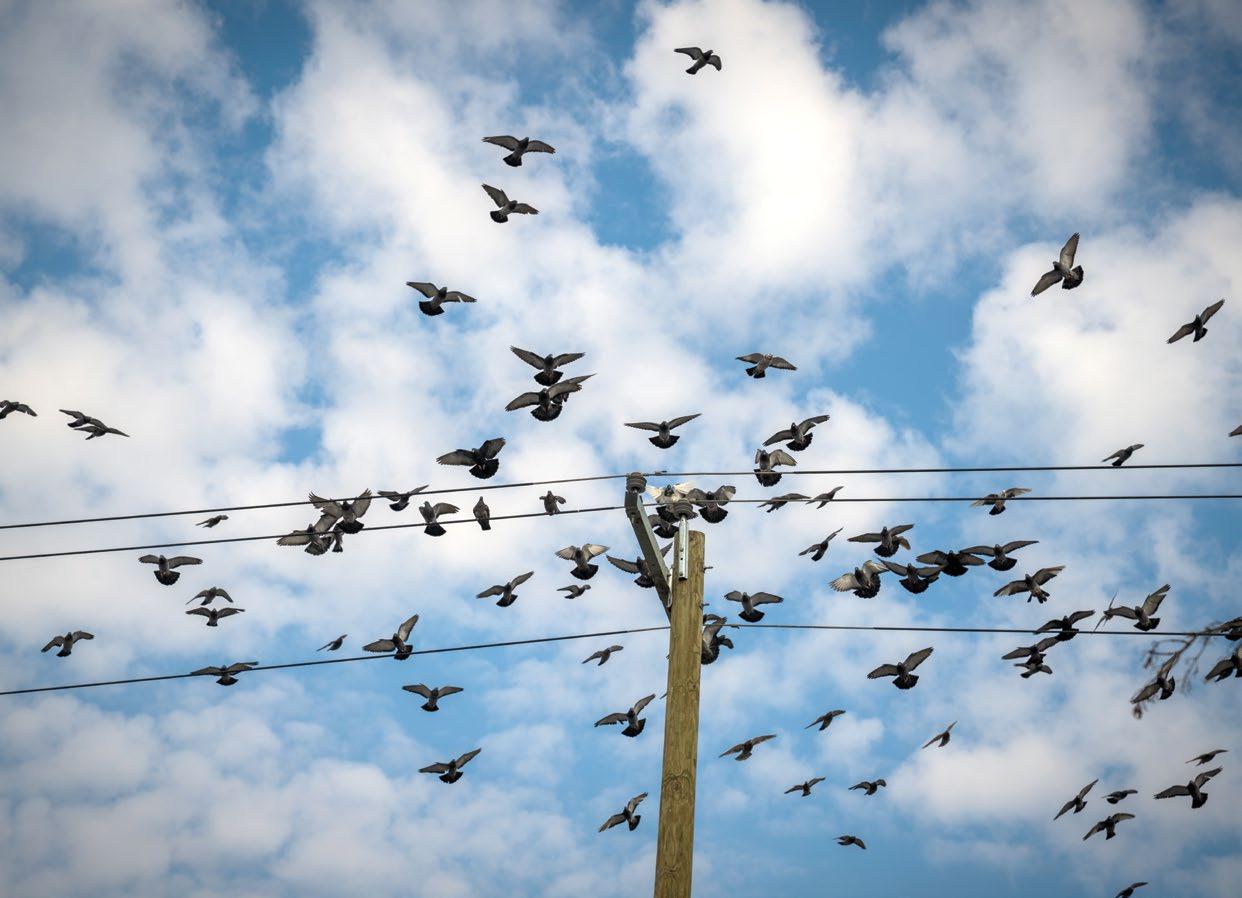
ton Avenue, where about 100 of the birds lined the power lines above. Any urban wildlife walk requires attendees to pay attention to where they’re standing to avoid blocking sidewalks or otherwise getting in the way of people going about their business. But the pigeon watchers had to take additional care to arrange themselves outside of the danger zones beneath the power lines, marked by countless yellow and green splatters on the pavement.
The pigeons did what pigeons do. Mostly, they sat facing the wind. If any pigeon tried to wedge itself in too close to its neighbors, it got pecked until it tried a different spot. Some puffed up and cooed at a neighbor. Then, with a shock of loud warning claps, they would all take off and wheel about over the streets and rooftops before alighting again on the power lines.
A Cooper’s hawk, a raptor that specializes in hunting other birds, reminded the humans below that pigeons have good reason to be skittish. It glided into view and
landed on a rooftop antenna half a block away, where it remained a menacing presence until it flew away.
It was hard to imagine any creature settling down to start a family in Philadelphia in mid-February, still encrusted with dingy snow and ice, but the walk continued to 8th and Washington, where an awning with a plastic grate floor formed an artificial cave for pigeons to nest in, one that has allowed observers in the past to watch the birds courting and raising their young. To get their parents’ attention, baby pigeons make a wheezing noise (what it sounds like when doves cry). Only one adult pair was home that morning, and they were apparently just getting started, with no eggs yet.
The last stop featured yards of plastic mesh and formidable-looking spikes mounted on horizontal surfaces above an Italian Market storefront, all devoted to keeping pigeons out — an effort and an attitude worth reconsidering, according to Simone. “Hating pigeons is a choice,” they say.
Simone says that they and Brower do not feed pigeons, though: “There are a lot of ethics to consider.” Among other considerations, pigeons could become used to a feeder who might then move away, leaving the birds hungry. Feeding pigeons might encourage birds to reproduce more than would be locally sustainable, not to mention that it is against the law in Philadelphia. “What we’ve landed on for now is that we don’t feed pigeons in public places, but we might choose differently if we’re in a different environment,” perhaps in a place where it is legal and if they encountered severely undernourished pigeons.
The tour guide hit their mark with Brodo and Fensterheim. “It was amazing,” Fensterheim says. “I didn’t know that they had homes, that they lived in certain spots and then we could just go visit them at different destinations where they always come back.”
“We spend a lot of time in the Italian Market,” Brodo says. “It’s fun to see our perspective change.” ◆
The Fruits of Serendipity
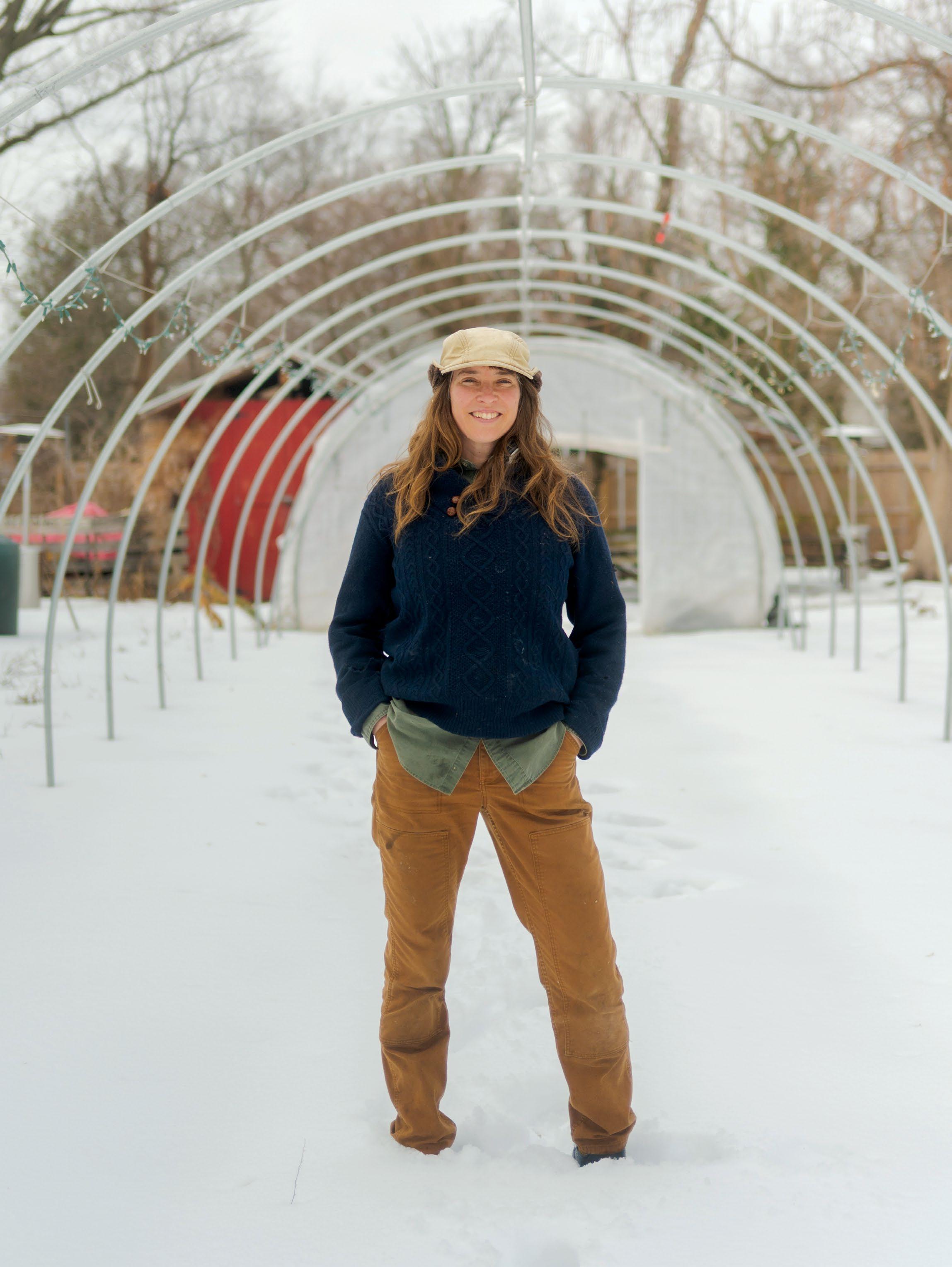
Amanda Staples was a champion for community gardening in Kensington. An unexpected opportunity to buy land in Germantown opened up new possibilities story by marilyn
Germantown kitchen garden’s farmer, Amanda Staples, who hails from Upper Darby, did not grow up on a farm. Although her grandparents operated a Christmas tree farm near Clarks Summit, Lackawanna County, Staples’ initial hands-on contact with farming was growing lima beans in her backyard for an elementary school assignment. After graduating from Temple University with a degree in religion, Staples moved to Kensington, where she first encountered community gardens popping up on vacant lots. A friend invited her to help at a commu-
overgrown it was impenetrable. But it was affordable and available. Staples and her husband bought it in 2008. “It didn’t feel that risky,” she says. “It felt crazy, but not risky.”
Founded on her conviction that farms should exist in cities, Staples began to build Germantown Kitchen Garden as the “hybrid homestead and tiny business” she envisioned. In those early days, she’d sit at a roadside table with salad greens and collards, waiting for customers to find her. After her divorce in 2015, Staples’ vision had to evolve for her to make a living. Unsure if she could keep the farm going, she harvested greens
My attitude became ‘I am running a business,’ and I have to do it all the way, or I can’t do it.”
amanda staples, farmer, Germantown Kitchen Garden
nity garden in Camden, and that experience inspired Staples to mobilize volunteers and build a garden near her Kensington home. She nurtured the garden while earning money from customer service jobs at Philadelphia International Airport, Wawa and the Franklin Institute. Eventually, Staples committed to an internship at Scarecrow Hill Farm in Lancaster County. “Everything you did there was about farming. It was by far the most intensive learning experience,” she recalls. Her aspirations to become a production farmer started taking shape.
Buying a half-acre plot in Kensington proved impossible. Then something unexpected happened. An acquaintance was purchasing a home in Germantown, but the seller made the deal contingent on buying the adjacent parcel. It was a forest of neglect, so
from the family tree farm that winter, fashioned them into wreaths and sold them to raise seed money (for actual seeds). She reopened in 2016 with a new goal. “My attitude became ‘I am running a business,’ and I have to do it all the way, or I can’t do it.” Now 45, Staples gratefully notes that many customers have been with her since the beginning, remaining loyal to her and the farm.
Farming on small acreage requires tough decisions about what to grow. Staples’ process is “a combination of sentimentality, personal tastes and what makes money.”
Tomatoes, in their glorious redness, ripeness and bread-soaking juiciness, tick all the boxes. They require much labor, but she loves the weekly meditative work of pruning and tying them up. Tomatoes also feed her.
Summer leaves little time for cooking, but
TOMATO CHEESE BREAD SITUATION
Makes one massive sandwich that’s hard to get your mouth around if you did it right
One large, ripe tomato Cherokee Purple preferred
Two thick, crusty, excellent slices of bread Ursa Bakery and Dead King Bakery are Staples’ favorites for sourdough
Fresh mozzarella slices or cheddar, provolone, ricotta, goat cheese — the choice is yours Mayonnaise, generously applied store-bought, no need to make your own Salt and pepper
the upside for Staples is that “it makes it a hell of a lot easier to make a quick meal when you have fresh food.” Her meals get simpler as the season warms. “I’m not a person who says ‘I forgot to eat lunch today,’” she admits, so when hunger calls, tomatoes are the answer. Staples shares her instructions for the ultimate seasonal recipe, a “tomato, cheese, bread situation” inspired by the casual summer meal her mom often made.
She adds, “I don’t eat tomatoes any other time of year, so that’s why I don’t get tired of it.”
anthony
PHOTO BY KRISTEN HARRISON
Amanda Staples has dedicated her career to farming fresh food in an urban environment.
Throwaway Culture
Documentary explores what happens to Philly’s trash after it’s tossed
by julia lowe
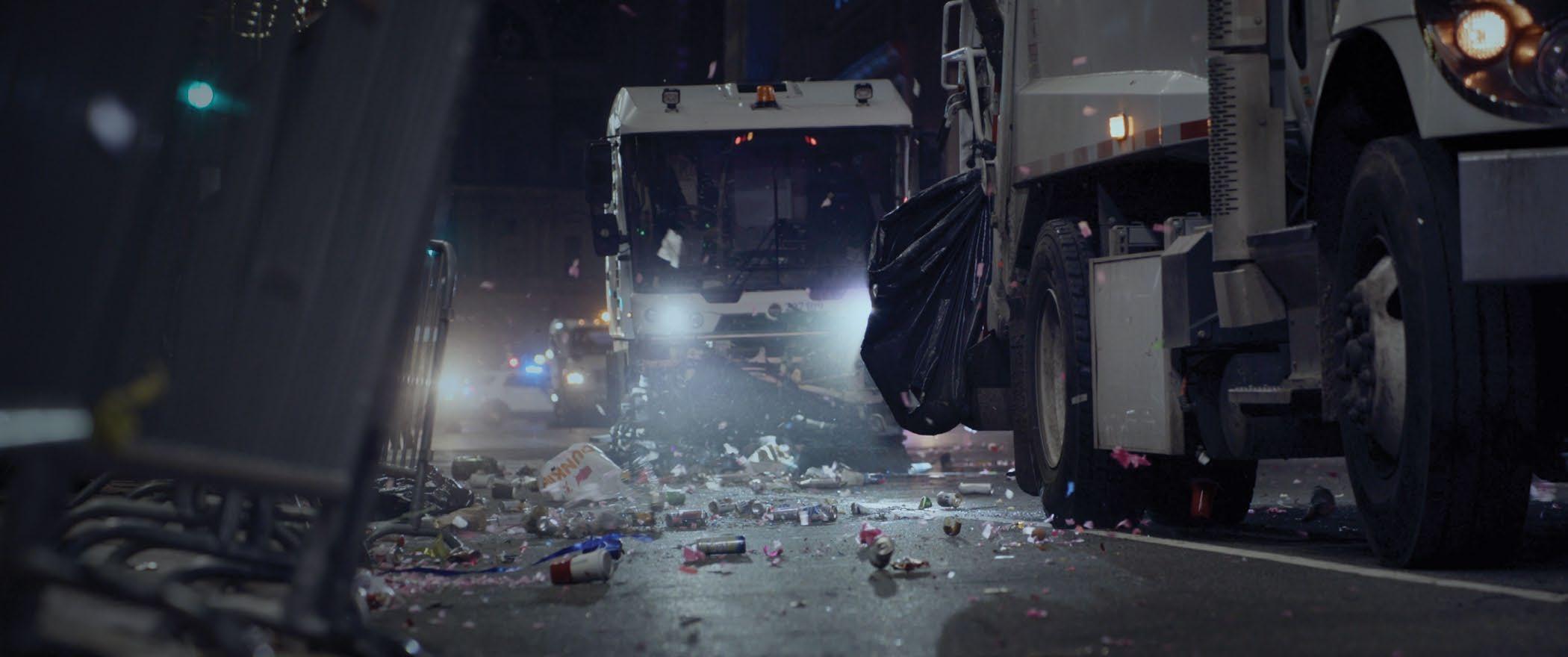
Opening with subterranean footage of the foam cups, plastic bottles and sodden cardboard that decorate the sewer inlets underneath Philadelphia, filmmaker Melissa Langer’s 2025 documentary, “In Excess,” probes into the unseen places where the city’s litter ends up. Spoiler alert: When it comes to the city’s trash, there is no throwing it “away.”
“Every object we discard lives on somewhere else, disturbing someone else’s environment, forever,” says Langer. Langer, who moved to Philadelphia in 2017, immediately noticed disproportionate amounts of litter and illegal dumping in Northeast Philly and began exploring what the City was doing about it.
The product is her 70-minute feature, which weaves haunting stretches of trash footage with candid vignettes of the people tasked with cleaning it up, from Philadelphia Water Department (PWD) sewer inlet crews to a small Streets Department team that monitors hundreds of security cameras for illegal dumping.
The project began as an installation at Vox Populi Gallery, where Langer is an artist member, that featured footage from those
illegal dumping monitoring cameras. The completed film, which has its first public Philadelphia screening on March 8, examines additional layers of the city’s waste-related infrastructure and inquires into Philadelphia’s long, fraught history of waste management.
The film reveals the burden trash, like the floating litter in the opening frames, places on the city’s water infrastructure. Langer sourced that footage from PWD’s sewer maintenance archives. They use robotic cameras to move through the sewers, assessing joints and debris. PWD employees in the film say some of this material can remain lodged in sewers and inlets for decades.
“It’s all interconnected, the above-ground and below-ground systems,” says Langer. “Trash just seeps everywhere and infuses everything, whether you’re talking about particles in the air from incineration, waste on the street level or the trash that travels in these subterranean sewers.”
With help from producer Nora Wilkinson, editor Julian Turner and archival producer Caitlin Riggsbee, Langer mapped the grimy routes trash takes — ending up as incinerator ash polluting communities,
piled on city sidewalks, caught in sewer joints or floating down the Delaware River on its way to join the Great Pacific Garbage Patch. But more glaringly, the film shows that those routes haven’t changed much over the decades. It chronicles the voyages of 1980s ash barges, including the Khian Sea that hauled toxic incinerator ash from Philadelphia in search of overseas dumping sites after regional landfills were exhausted. Bookended by present-day scenes of litter and illegal dumping, this story underscores that “we, like the rest of the world, have not yet solved our fraught relationship to disposability culture,” Langer says.
Reflecting on the filmmaking process, Langer says that she created the film as a window for the public to see the daily realities of Philadelphia’s municipal workers who deal with waste.
“Being a witness to all of that labor and using the film as a way to get to know my city more intimately was really a privilege.” ◆
“In Excess” will be screened at the Lightbox Film Center on March 8 at 5 p.m. The screening will be followed by a conversation with the filmmakers. For more information, go to lightboxfilmcenter org /events/in-excess
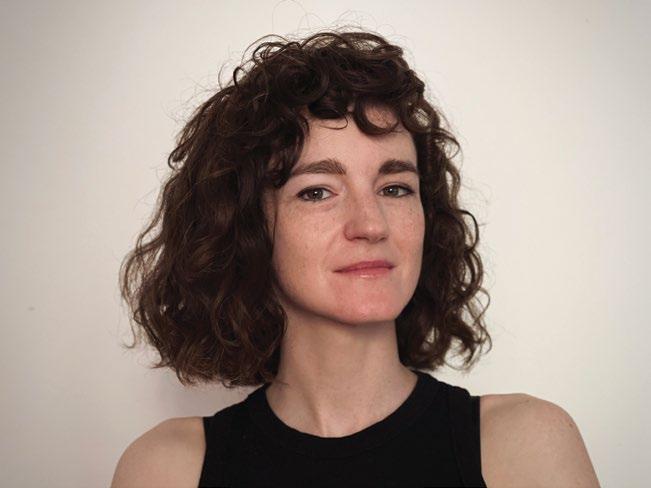
A still from “In Excess,” a documentary by Melissa Langer (pictured below).
What Stinks?
A
community air quality monitoring project keeps track of what industry (and neighbors) emit
by bernard brown
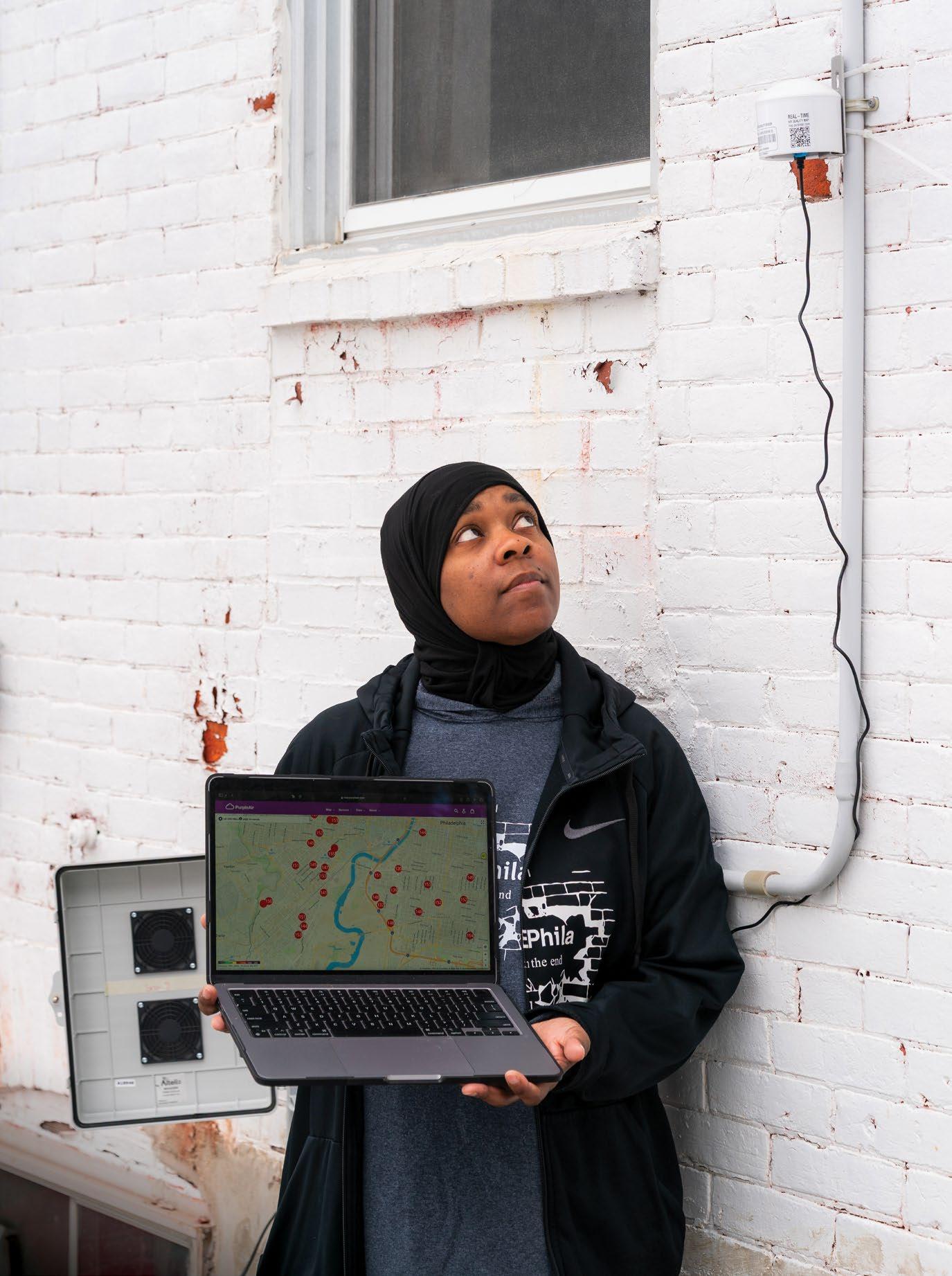
The air in the Delaware Valley’s industrial corridor doesn’t always smell nice. Major odor events assaulted the noses of Delaware County residents in 2019, 2020 and, most recently, last fall. During the 2019 event, Clean Air Council director of programs Eve Miari tried to check air quality readings from the Pennsylvania Department of Environmental Protection monitoring equipment in Marcus Hook. “When we went to access the data, it missed it by two hours,” she says. The monitor worked by capturing air in canisters at intervals, and whatever had caused the odor had leaked out between samplings. In early 2025, Clean Air Council launched an EPA-funded network of air quality monitors to ensure that no leak would go undocumented again.
The network stretches from Southwest Philadelphia through southern Delaware County, along an industrial corridor that dates back centuries. “Pretty much the entire waterfront is industry,” Miari says.
Miari and Clean Air Council’s Russell Zerbo rattle off a list of industrial facilities along the stretch, including the power plant in Eddystone, the Monroe Refinery in Marcus Hook and the Reworld (formerly Covanta) trash-burning power plant and Kimberly Clark paper mill in Chester. Additionally, highways intersect at multiple points (I76, I-95, I-476), bringing tailpipe emissions from millions of cars and trucks into the surrounding communities. “We have more bad air quality days than good. These frontline communities are bearing the brunt of the impact,” Miari says.
Clean Air Council piloted air quality monitoring in this industrial corridor in collaboration with Johns Hopkins University, using two stationary monitors and mobile sensors mounted on a van. “We got some great data,” Miari says, “but it was just one month.”
The grant to fund a larger network was approved by the Biden administration’s EPA, but the Trump administration’s early efforts to cancel funding for environmental justice programs left the follow-up monitoring network in doubt, forcing Clean Air Council to race to set up monitors last winter while they still had the grant money.
Olivia Collier found out about the monitoring program at a block captain event over the summer and was eager to get an air quality monitor on her block. Living in Southwest Philadelphia qualifies her to host a monitor, but she has a pollution source to deal with even closer to home.
Collier has been struggling with neighbors who park and maintain construction vehicles, which is illegal on a property zoned as residential. “I wake up to the smell of fumes and diesel,” Collier says. “I have a youth program. I could do so much in my yard, but can’t do it because I’d put people at risk.”
Her calls to 311, Licenses and Inspections
(L&I), district council member Jamie Gauthier’s office, and other City officials have yet to resolve the problem. Last March, L&I did find that the neighboring property owner was operating without the right use permit, which could result in a fine of $300 per day. Grid reached out by email to L&I for comment. “Code Enforcement Inspectors will return to the property for an updated inspection and issue a Cease Operations Order if the conditions remain the same. Immediately after, we will ask that the case be elevated to court-ordered enforcement,” a City representative said. For now, though, Collier says the fumes still waft across her fence.
Ultimately, the EPA did not cancel the grant (though another EPA-funded Clean Air Council program to monitor a refinery in Delaware was defunded), and the network now stands at 10 volatile organic compound sensors and 60 PurpleAir monitors. Miari and Zerbo say that the program has been extended from two years to three. ◆
PHOTO BY CHRIS BAKER EVENS
Olivia Collier monitors the air quality on her block in Eastwick.
Continuing Education
Could Philadelphia’s environmental science high school be for sale?
It’s not easy to get to the Lankenau Environmental Science Magnet High School. The school sits on 17 acres at the northwest border of Philadelphia, a pocket of land not served by SEPTA, forcing the district to bus students to and from school. In exchange for the long ride, however, students learn in an expansive outdoor classroom — the neighboring Schuylkill Center for Environmental Education has served as an extension of
by bernard brown
the grounds since Lankenau became an environmental magnet school in 2005. If the School District of Philadelphia is to be believed, students will be better served by Lankenau closing and having its programs merged into Walter B. Saul High School. (The original plan to merge the school with Roxborough High School was changed.)
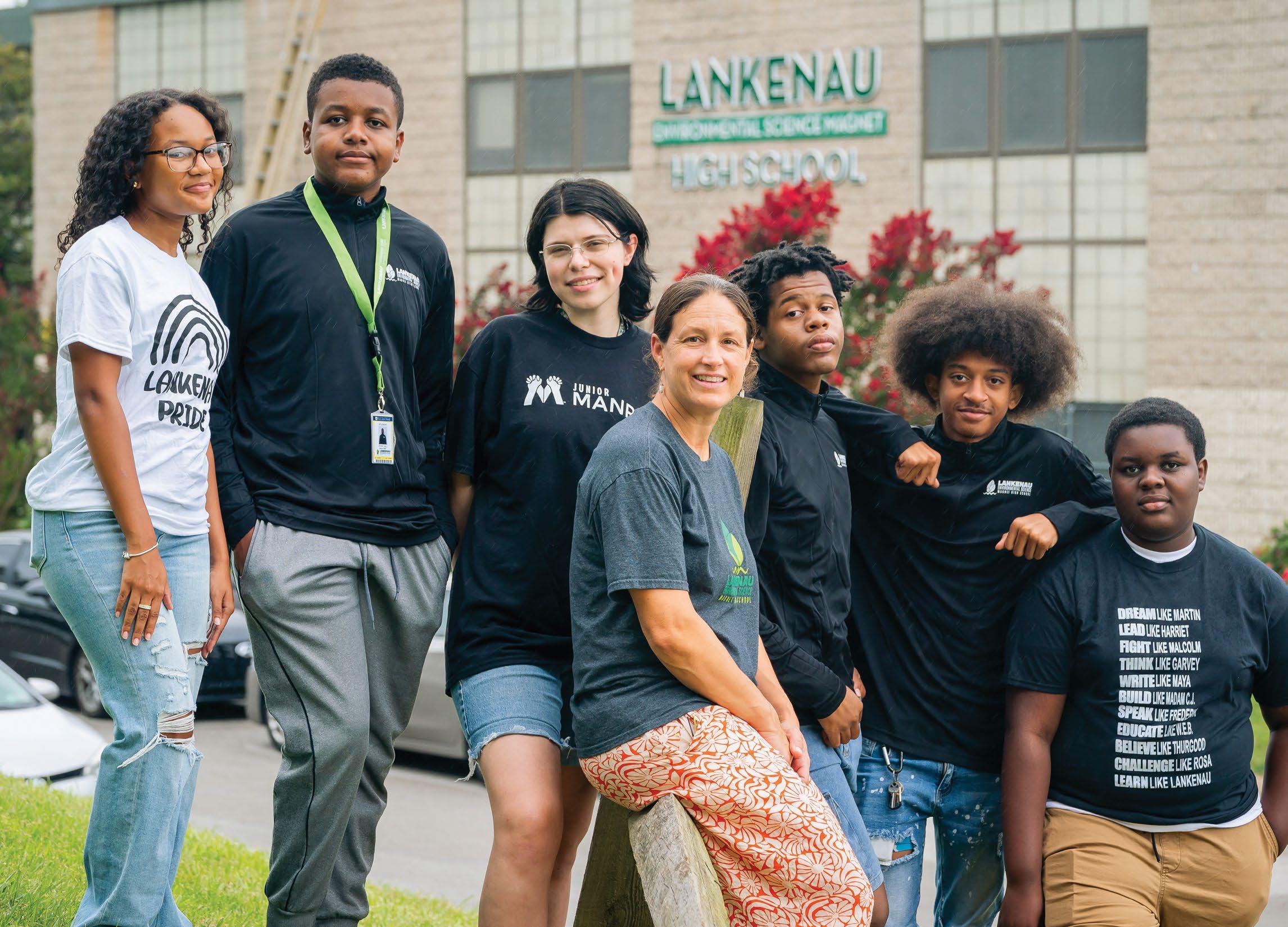
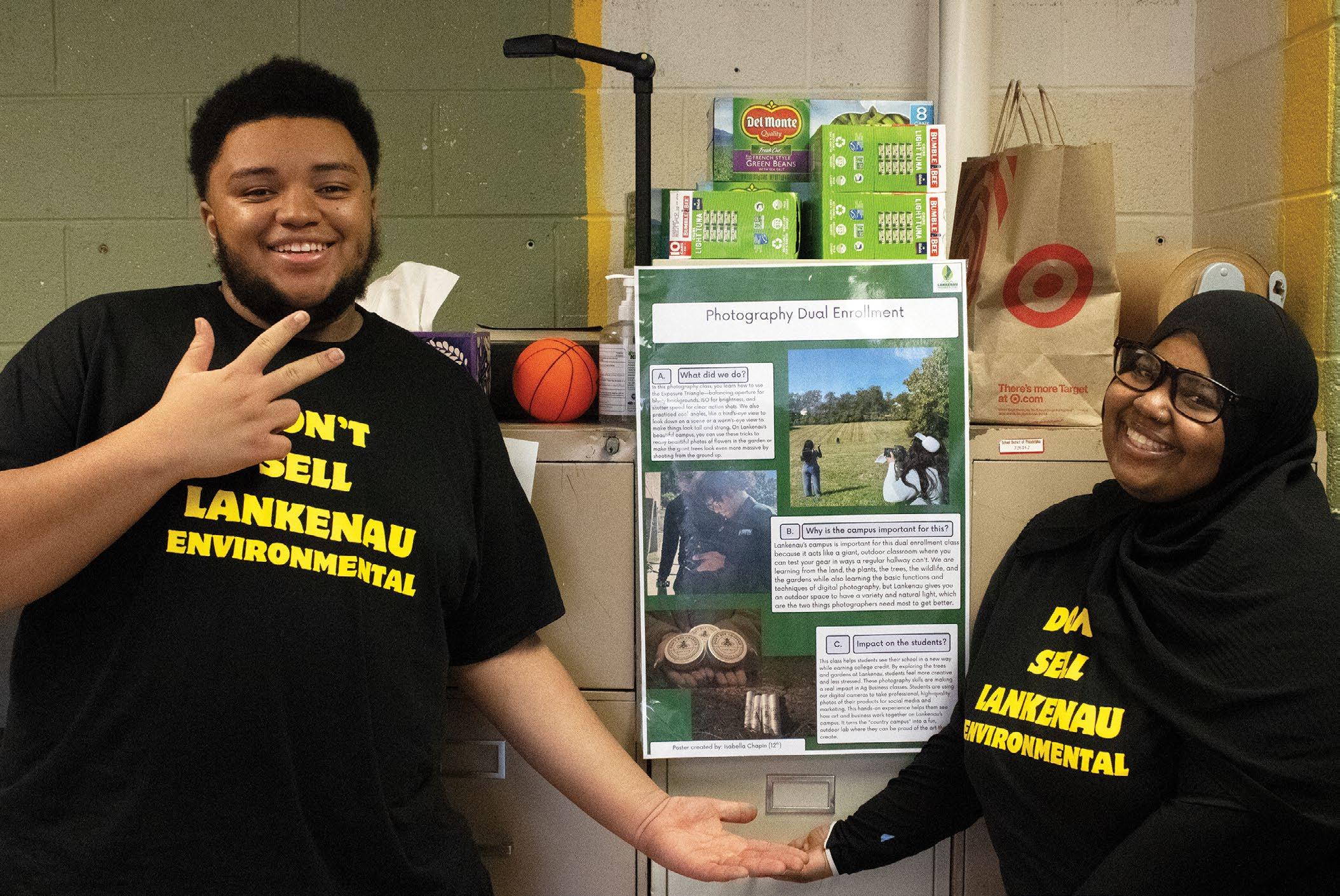
But “Don’t Sell Lankenau Environmental” was spelled out in bright yellow letters on the T-shirts worn by Lankenau students
and teachers at a Feb. 4 open house and community listening session, addressing what they believe is the real reason the district proposes to close the school and send its students to another school.
The official recommendation of the school district on its facilities planning process website is to offer students better preparation for life after graduation near where they live by closing Lankenau and “Lankenau High School will merge into Walter B. Saul High School as a criteria-based CTE honors program with students applying from across the city through school selection. After closing the Lankenau High School building will be conveyed to the City of Philadelphia for affordable workforce housing and/or job creation.”
Twenty other schools find themselves in a similar position as the district rolls out its
PHOTO BY CHRIS BAKER EVENS
One of the reasons Lankenau is so special and why the students are advocating is that the closure would prohibit them from being able to directly access these opportunities.”
jessica m c atamney, principal
plan, based on two years of research and community input.
Schools across the district are falling apart thanks to aging buildings and decades of deferred maintenance. At this point, fixing everything would cost $8 billion. Meanwhile, many schools are partly or even mostly empty. About 25% of school building capacity is underutilized, according to the district’s website. That space is unevenly distributed, however, with 146 buildings moderately or severely underutilized, and 34 buildings moderately or severely overcrowded.
At Lankenau’s listening session, state Sen. Sharif Street said he opposes closing the school but expressed sympathy for the
district, which he says has been chronically underfunded by lawmakers in Harrisburg. “These decisions are not made in a vacuum. They are made in part because we, at the commonwealth, have not met our obligation to fully fund the district,” Street says.
Faced with chronically inadequate funding, the facilities planning process aims to save the district money and give students better learning experiences by, in part, closing some schools and moving students around so that the district’s footprint matches its learning objectives.
Every school in the district was evaluated and scored in four categories: whether the building is safe, accessible and modern;
whether the school’s facilities align with its programs; whether the school is above or below capacity; and how vulnerable the neighborhood is, since closing a school can mean a neighborhood loses a valuable anchor institution. “The value of land was not part of any of the decisions,” a school district spokesperson says.
The district did not provide the rubric for any of the category ratings despite multiple requests, so it is difficult to ascertain exactly how it arrived at the scores for Lankenau, but some are easy to interpret.
Though students hail from all over the city, Lankenau’s neighborhood is far from vulnerable, resulting in a score of 1, with 5 being the most vulnerable. The high school sits in a green corner of the city, a quarter-mile from suburban-style, middle-class neighborhoods of detached houses with lawns and driveways. The facilities planning dashboard page devoted to neighborhood vulnerability bases the score largely on the Center for Disease Control’s Social Vulnerability Score, which rates the school’s zip code, 19128, as “low.”
The building lacks a proper gym or auditorium, which Lankenau staff and
Opposite: Principal Jessica McAtamney (center) with students of Lankenau Environmental Science Magnet High School. Nicholas Motley (left) and Najilah Lackey are proud of their photography project.
students say is part of why the district gave it a 46.6% rating for program alignment. The school building received a score of 59.9%, referring to the building’s “quality, safety, and functionality,” according to the facilities planning dashboard.
Lankenau’s classrooms could fit twice as many students as it now educates, yielding a capacity utilization score of 49.4%. In particular, its 11th grade class has only 24 students, says principal Jessica McAtamney, the result of the district’s difficult transition to a lottery admissions system in 2021, which led to low enrollment at magnet schools across the district.
Grade sizes have since increased to 59 10th graders and 64 ninth graders, though teacher Erica Stefanovich says that more students have wanted to attend. “The district has been suppressing our enrollment for the past three years,” Stefanovich says. “We would have so many students accepted, and then they would say, ‘Okay, but we’re only allowing you educators for 66.’”
But as the “Don’t Sell Lankenau Environmental” shirts made clear, many of the school’s boosters suspect another factor in the district’s decision to close the school, in addition to the four official categories.
“From everything that we’ve heard, it’s about the land,” says a teacher who asked not to be identified out of concerns of professional repercussions. “They would like to take this land away from children and give it to developers.”
The houses closest to Lankenau’s 17-acre campus are valued at more than $500,000, raising suspicions that the cash-strapped district would welcome the millions of dollars it could make by selling the land to a developer.
Students and teachers say there’s no way to put a price on what would be lost.
“We don’t have boundaries here, in the most positive way. We look out for everybody,” says life skills teacher Cynthia Geezy, praising the school’s caring atmosphere. “When somebody is in trouble, everybody steps up to the plate.”
Under principal McAtamney, Lankenau has developed a career and technical education (CTE) focus in agroecology. As Grid covered in 2023, agroecology students have been able to participate in Minorities in Agriculture, Natural Resources, and
Related Sciences (MANRRS). The network of school-based chapters links students to college-level programs in agriculture and natural sciences.
Stefanovich, who has worked at Lankenau for 10 years, teaches social studies and Geographic Information Systems (GIS), which helps to visualize and analyze geographic data. “We are the only school in the district that offers it. We are one of only two schools in the state that I know of that offers it,” Stefanovich says.
Stefanovich saw GIS as complementing the school’s agroecology career development focus. “I saw how well it fit with what we were doing here at Lankenau, as the future of agroecology. It really involves students understanding the technology side of that as well.”
always felt safe going here all four years.”
Even though the building lacks an auditorium and a gymnasium, the school’s defenders say that the green campus and the neighboring Schuylkill Center grounds are essential assets not captured in the district’s assessment of the facility. “It’s a living, breathing, learning space surrounded by nature,” Alexis Musgrove, the school counselor and Lankenau alumna, said at the listening session.
“Within this niche, this space is what enables us to do CTE programming,” McAtamney says.
The school boasts a long list of partners for its professional development programs, including The Food Trust, the EPA, the USDA’s Natural Resources Conservation Service, and the Pennsylvania Horticultural
This is a great place for students to grow.”
najilah lackey, 12th grader
At the open house, students Najilah Lackey and Nicholas Motley stood with cameras hanging from their necks, ready to talk about the photography project they completed in their eco art class. “Photography is a newfound hobby of mine,” Motley, a senior from Germantown, says.
“In eco art, we connect our photography, people and the environment together,” Lackey says. A senior from West Oak Lane, Lackey values the small class sizes and nurturing environment. “This is a great place for students to grow,” she says. “I wanted to go to a school where I could connect to the environment but still feel comfortable.”
Although the school’s neighborhood counted against it in the facilities assessment process, Lackey views the location as an asset. The school’s isolation protects students from violence that can bleed into other Philly high schools from their surrounding neighborhoods. “We’ve never had a bad, scary event here,” Lackey says. “I’ve
Society, among others, according to McAtamney. The school recently received a $70,000 grant from software company Bentley Systems to develop a curriculum studying the properties of bee venom, she says.
The school had been working on a rebranding as the Environmental High School of Philadelphia, “to really stand out as the region’s true space to acquire that kind of hard scientific knowledge,” McAtamney says, but the rebranding was put on pause with the news of the facilities planning process.
District officials at the listening session said that CTE programming would continue from Roxborough High School (now Walter B. Saul High School), but that the details would still need to be worked out.
If Lankenau remains on the final closure list, students will have one more year at the school for what the district is calling a planning year. ◆
Back to the Roots
West Philadelphian offers land care mentorship, nature education — and has big plans for Parrish Street garden by
julia lowe
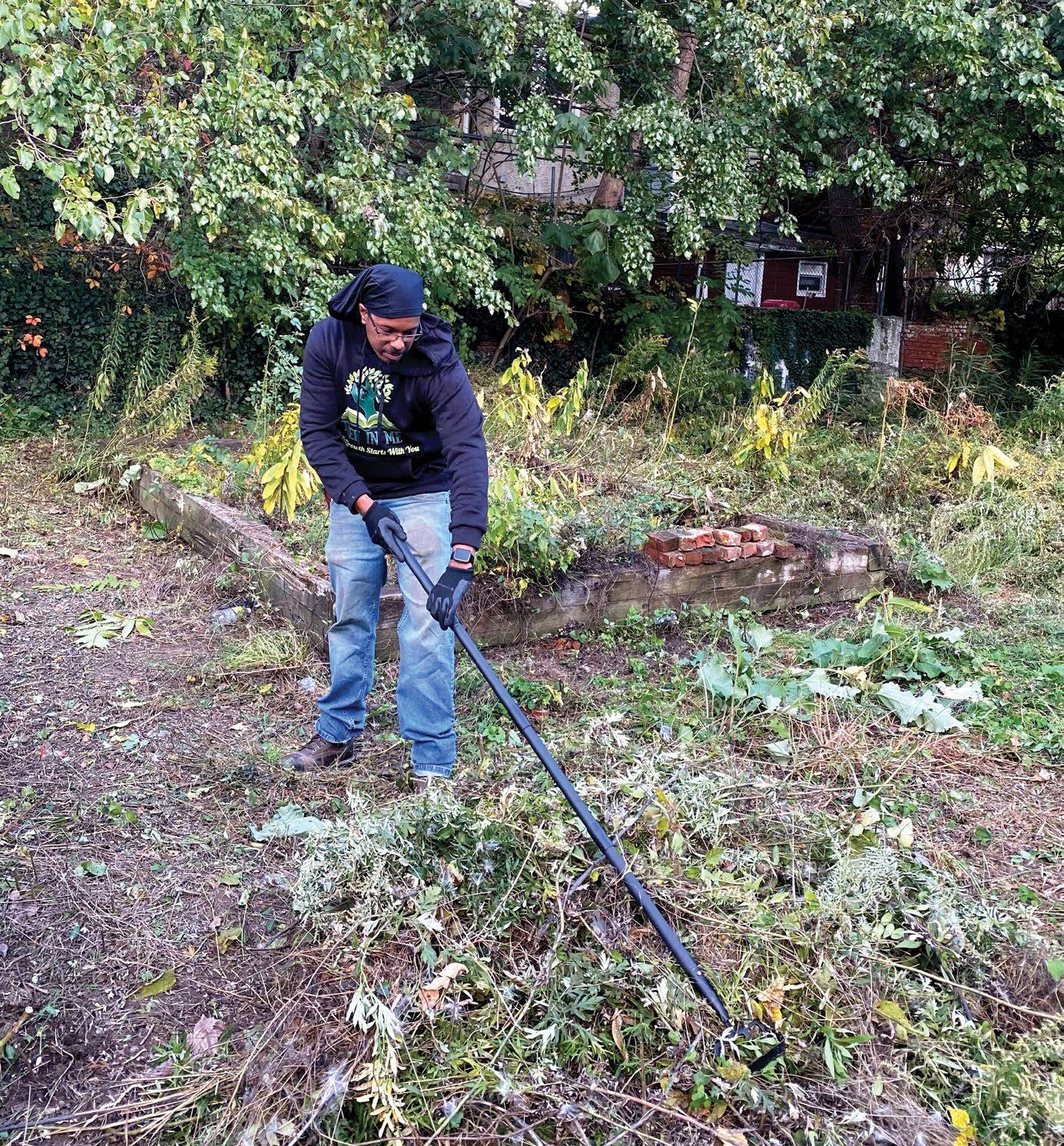
The overgrown lot at 5308 Parrish St. in the Haddington neighborhood of West Philadelphia is getting back to its roots. After sitting abandoned, accumulating trash, construction debris and dumped car parts for over a decade, a new project is in progress to restore the space to a new iteration of its past life as a neat, blooming garden.
Nathan McWilliams, however, who has been pruning back invasive species like mulberry and tree of heaven since September, believes it is already an oasis.
“It has so much potential. And I just want to bring that garden back to its glory,” says McWilliams, owner and lead consultant at Tree In Me, LLC
His presence has already drawn community members to the site — McWilliams
says neighborhood youth have seen him at work and joined in, helping make way for rose bushes and serviceberries. Some return week after week. With support from volunteers like these, who will have ample opportunities to lend a hand at restoration days throughout the year, McWilliams hopes to open the garden to the public by summer and offer plots where neighbors can begin growing their own food.
A 39-year resident of West Philly, McWilliams opened Tree In Me in August 2025 after working for more than two decades in land stewardship for area nonprofit organizations such as Riverfront North Partnership and Tookany/Tacony-Frankford Watershed Partnership. But with his consulting firm, his focus is hyperlocal: on West Philly’s green spaces.
McWilliams hopes Tree In Me can serve as a training hub where he can give his community the tools, the skills and the space to connect with nature, whether that’s as gardeners, hikers, naturalists, conservationists or simply more environmentally aware residents. When he’s not restoring the Parrish St. garden, McWilliams also offers land care management services and educational programming such as gardening demonstrations, native plant workshops and career consultations for Philadelphians interested in the green job sector.
Above all, he stresses that he is not just a landscaper, but rather a conservationist and land steward. Whereas a landscaper may prioritize aesthetics, McWilliams says he guides his clients in creating sustainable, functional green spaces and teaches them about long-term garden maintenance.
“Then they also have a mentor, someone they can work with who will keep continuously teaching them about their own backyard,” McWilliams says.
Education is central to McWilliams’ mission — Tree In Me’s logo features the image of a tree sprouting from an open book. His philosophy: give a man a garden and he eats for a season, but teach a man to garden and he eats for a lifetime.
That goal of empowering his community with knowledge doesn’t end at his clients’ yards. Another way McWilliams helps residents connect with West Philly’s untapped green spaces is on his weekly guided nature tours. Resuming for the 2026 season in mid-March, he will lead participants on the roughly three-mile Haddington Woods Trail, guiding them through plant and animal identification games using the Seek by iNaturalist app and teaching them about the history and ecology of the wooded area adjacent to Cobbs Creek.
With his array of land conservation services and program offerings, McWilliams hopes Tree In Me will not only support the tree canopy, native greenery and biodiversity of West Philadelphia, but also grow a new generation of green leaders.
Like germinating and growing plants from seed, mentorship is not an overnight project, and he is working to partner with more organizations to reach community members who are ready to get their hands dirty.
“Conservation is not always beautiful,” says McWilliams. “It’s all about the long game.”
Nathan McWilliams tends to the overgrown lot on Parrish Street.
Against the Odds
For some undocumented minors living in Philadelphia, making it to the United States is just one step in a long journey to safety and security by
For Ana, 19, of Brazil, and Jonathan, 17, of Guatemala, the southern border of the United States marks the line between life and death. Ana and Jonathan, both clients of the Hebrew Immigrant Aid Society of Pennsylvania (HIAS PA), a local humanitarian nonprofit that provides legal services to low-income immigrants in the state, now live in Philadelphia — but with looming uncertainty.
Ana’s journey began in 2019. Her mother wanted to reunite with Ana’s father, who had left Brazil for Philadelphia a few years earlier for work. Hard-pressed for money, Ana’s mother applied for visas and was denied. Instead of taking the U.S. government’s no for an answer, she hired a “coyote,” or guide, to smuggle her and Ana into America. Despite a difficult relationship with her parents, Ana, then 12, had no choice but to accompany her mother.
For Jonathan, gang violence and death threats forced him to leave his homeland. His mother, already living in Philadelphia, was unable to obtain a visa for him and hired a coyote to take him across the border in 2024.
Thus, Ana and Jonathan arrived without legal documents. They’re hardly alone in that status. Save The Children, a global nonprofit that works to improve the lives of children, reported that in 2022, the “Department of Health and Human Services received a record 128,904 unaccompanied, undocumented minors, up from 122,731 in the prior year.”
Even with coyotes guiding them, Ana and Jonathan had close calls. “Robbers shot at our group in Mexico until they were chased off,” Jonathan says.
constance garcia-barrio
Ana and her mom faced a different danger. Immigration and Customs Enforcement apprehended them on Feb. 6, 2019. Soon after reaching the U.S., they were held in a detention facility in Santa Teresa, New Mexico. “Sixty of us — men, women and kids — lived together in the same big room,” Ana says. “We slept on the floor. They only gave us those aluminum blankets. I got a bad case of chicken pox. My mom went into diabetic crisis because of bad food and too little insulin. She was in the hospital for four days. I had to stay in that big room the whole time.”
About three months after ICE apprehended them, Ana and her mother were released to Ana’s paternal aunt, who is a permanent U.S. resident living in Philly. She signed a contract to sponsor them, agreeing to support them, if necessary, so they wouldn’t need public assistance.
Unaccompanied minors — those who enter the U.S. without a parent or guardian — once detained by Customs and Border Protection, are transferred to the Office of Refugee Resettlement. ORR then sends them to one of its many shelters, depending on where bed space is available, says Stephanie Lubert, a managing attorney at HIAS PA.
“Children can spend anywhere from a couple of weeks to months to years in ORR custody,” Lubert says “Today, we’re seeing children detained for many months. That is due to new policies that restrict undocumented parents [or] caregivers from being able to safely sponsor their children. Coming forward to receive a child from ORR now often results in the detention of the adult.”
Jonathan lucked out. Removal proceedings weren’t begun against him. “Some kids are in
Coming forward to receive a child from [the Office of Refugee Resettlement] now often results in the detention of the adult.”
stephanie lubert, immigration attorney, HIAS PA
active removal proceedings while detained,” Lubert says. Jonathan was only held for two weeks before flying to Philly and being released to his mother July 6, 2024.
crushing poverty, corruption and gang violence drive the exodus of undocumented minors, especially from Central America’s Northern Triangle: El Salvador, Guatemala and Honduras, according to Save The Children
“Most of the kids are fleeing some type of violence, often gang violence or violence in the family,” says Rachel Rutter, founder and executive director of Project Libertad.
Headquartered in Phoenixville and serving Bucks, Chester and Montgomery Counties, Project Libertad is a nonprofit that provides free legal and social support to immigrant youth facing deportation. “We have kids who’ve had a family member raped or murdered by gangs,” says Rutter, who earned recognition as one of 2024’s Top 5 CNN Heroes for her work.
The trek to “El Norte” takes a physical and emotional toll, not to mention cold cash. Some families beggar themselves by hiring a coyote to smuggle children into the U.S., says Lubert. “They see it as their children’s only chance for a decent life.”
The trip often proves deadly as well, Lubert emphasizes. “The exact figures are difficult to track, but every year, hundreds of thousands of people die attempting to reach the southern border of the U.S.,” she says. “Children and families embark on this dangerous journey because they have no other options.”
Some Americans shake their heads over the troubles of undocumented immigrant children, but U.S. Rep. Jim McGovern of Massachusetts urges them to dig deeper. “Our debate on immigration in this country [often] takes place in a vacuum, removed from the violence and poverty … exacerbated by America’s own history of intervention and destabilization in Central America,” McGovern writes in a 2019 Medium article. Many people also wonder why people wishing to immigrate don’t simply follow legal channels, Rutter says. “Under current immigration law, the vast majority of immigrants who are in the U.S. undocumented … simply have no legal path by which to do so — no matter how nice they are, no matter how hard they work, no matter how much they want to do it ‘the right way,’” Rutter says.
lubert represents immigrant youth in the local child welfare system, that is, the Philadelphia Department of Human Ser-
vices (DHS). While some of those young people in the system are unaccompanied minors, others arrive in the U.S. with a parent but require the protection of Philadelphia DHS due to abuse or neglect.
Besides DHS, schools and community organizations refer clients to HIAS PA. “We do a one-on-one assessment to determine a client’s needs,” Lubert says. In addition to kids who arrive alone, HIAS PA and Project Libertad are increasingly helping children left by themselves because their parents have been deported.
HIAS PA assisted 200 young people in the last fiscal year, from October 2024 to September 2025. Until last year, HIAS PA also offered social services, but cuts in government funding forced the organization to close that division, according to Cathryn Miller-Wilson, its executive director.
Rutter also finds herself stretched thin at Project Libertad. She must turn people away because she gets so many requests for help, she told WHYY News in 2024. She would like to see more funding for immigration issues in Philadelphia’s collar counties.
Whatever a child’s situation, legal representation makes the crucial difference.
“About 90% of kids who don’t have a lawyer are deported,” Rutter says. “They are seven times more likely to remain in the U.S. if they have a lawyer.”
Going to court with someone by their side — especially for younger children who may not understand the proceedings — makes a big difference, Lubert finds. “You can see the hope in their faces,” she says.
Clients have other pressing needs. “They don’t have health insurance,” Rutter says, noting that she and two full-time social workers get referrals from ESL teachers, school counselors and other nonprofits. “They don’t speak the language. They face food and housing insecurity.” Yet, Project Libertad has achieved impressive results, according to its 2025 impact statement. Last year, the nonprofit trained 925 youth and families on legal and mental health rights and legally represented 92 for free.
Julie Burnett, one of the nonprofit’s two full-time social workers, handles all kinds of crises, as determined through an intake assessment.“Sometimes they need legal help or academic or emotional support,” she
youth.
My dream is to become an immigration lawyer, to help people like me. I want to fight for my future.” ana, 19
says. “Sometimes they want an interpreter or help navigating complicated systems. In one case, an 18-year-old girl from Guatemala, trying to finish high school, needed urgent medical care for her baby son.”
Project Libertad’s initiatives include a weekly after-school program in partnership with six schools. It serves more than 100 children. “We include ESL, art, STEM projects and a social-emotional learning component,” Rutter says. A mentoring program provides individual help for middle and high school students. Enrollment in the nonprofit’s summer program fell this year due to fear of ICE, Rutter says.
Lubert notes other school-related mat-
ters. Concerned teachers often refer young people to her because they are skipping school. “Many of the young people I serve are terrified to go to school,” she says. “They see ICE raids on television and in their neighborhoods. I’ve heard reports that ICE lingers around schools during drop-off and pick-up. This has a chilling effect.” Children may also work to help their struggling families, Lubert adds. Whether fear or work keeps kids away, their absence may trigger truancy proceedings.
ana, like other children newly arrived in the U.S., prayed for a peaceful life. However, by 2020, old tensions with her father had
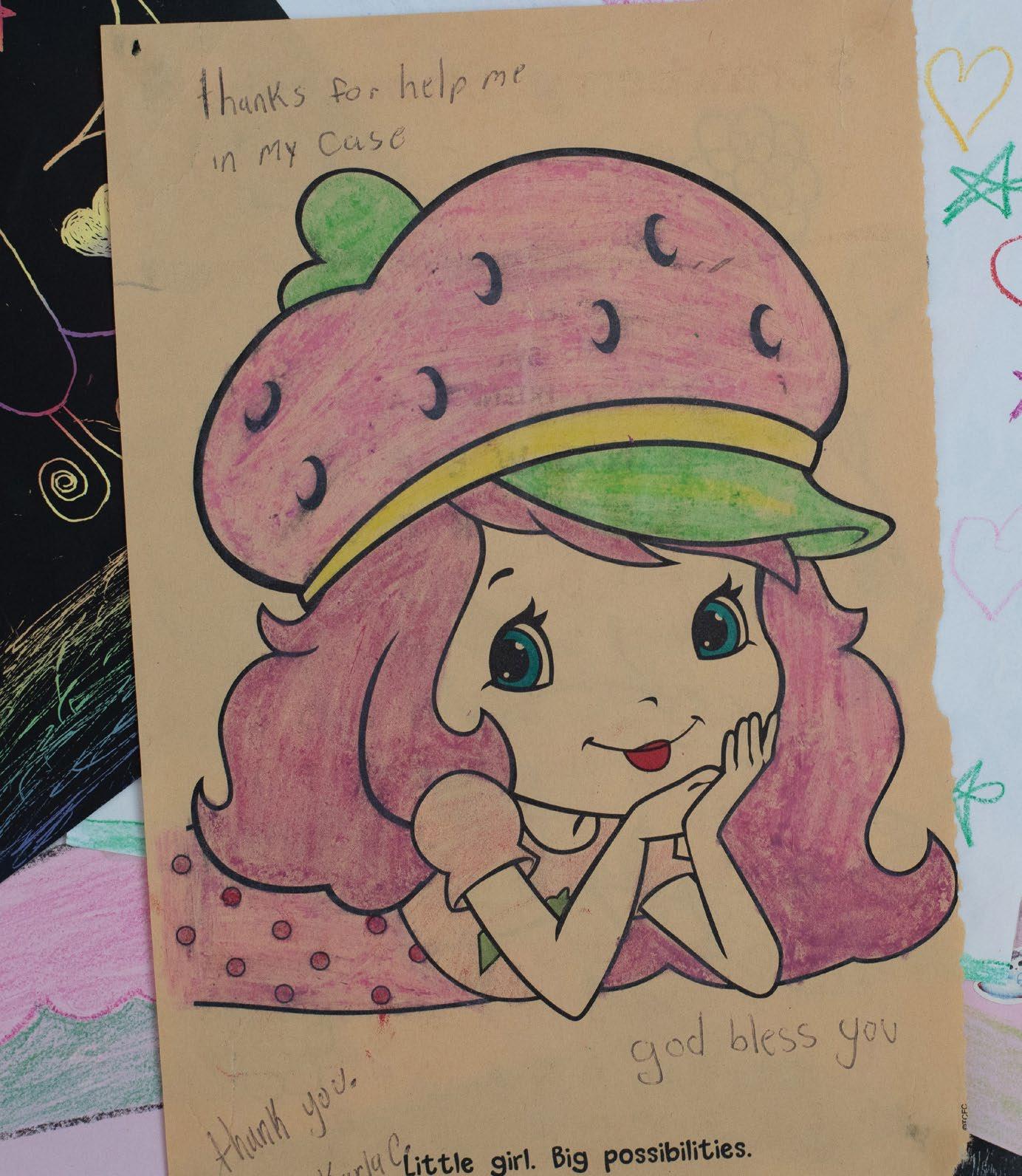
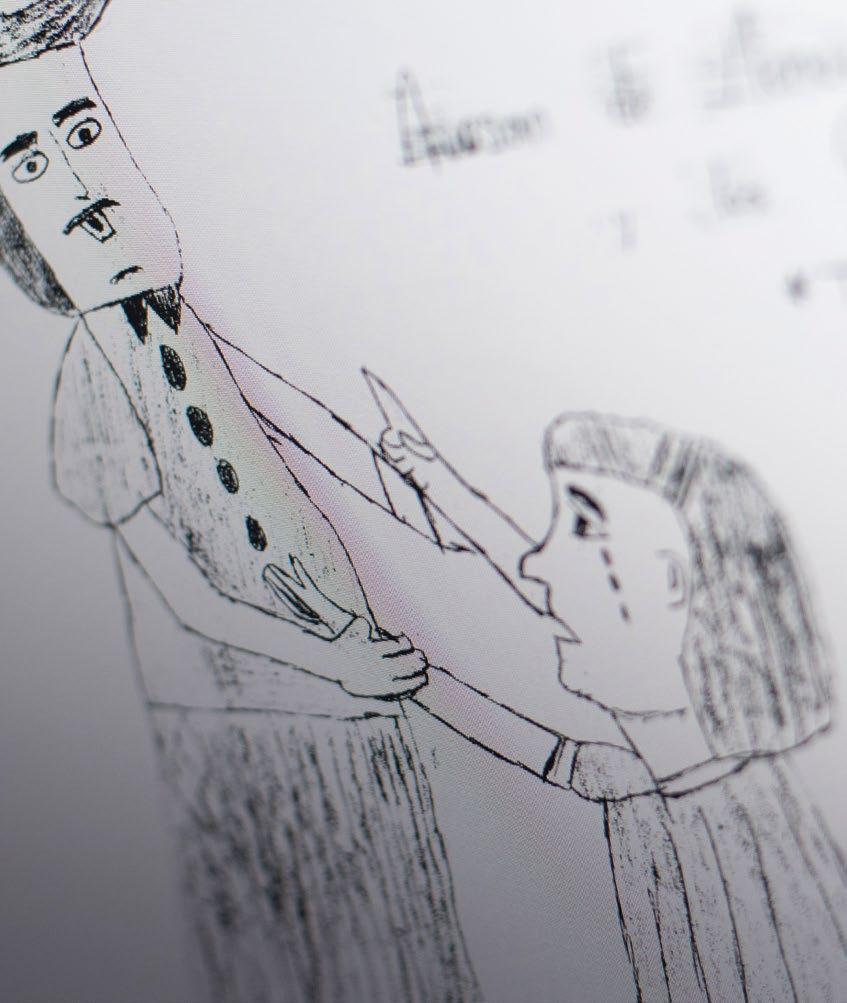
Lubert displays artwork in her office that was made by her clients, all of whom are undocumented
escalated. “He started hitting me, not letting me go to school,” says Ana. “The Department of Human Services put me in foster care [in 2020] after he cut me with a knife.”
Ana’s family situation grew more alarming before it was resolved. “Ana’s parents threatened to kill her,” Lubert says. Family Court eventually revoked their parental rights, and Ana’s mother and father returned to Brazil.
Meanwhile, Ana concentrated on learning English, becoming not only a fluent speaker but also a budding writer. She lived in foster homes and graduated from a Philly high school last June.
Ana’s home life has become more settled. In 2024, she approached Ms. Maria, a fellow church member who fostered children, and asked to live with her. “I’d stopped fostering children,” Ms. Maria says, “but I told Ana that I would love to foster her.” The relationship has blossomed. In August, Ms. Maria began adoption proceedings.
But Ana still doesn’t have legal status in the U.S. and could be deported at any time.
Undocumented immigrant children have fled dire conditions and confront steep challenges here. But Zeke Hernandez, himself an immigrant from Uruguay and a professor at the University of Pennsylvania’s Wharton School, cautions that it’s short-sighted to see these kids solely as victims or villains eager for a handout. “These children are not only resilient, but evidence shows that investing in their early years is a smart bet,” says Hernandez, author of the 2024 book “The Truth About Immigration.” “They’ll start
businesses that will create jobs and make other economic contributions, not to mention what they bring as good neighbors and cultural innovators.”
Jonathan’s and Ana’s strengths and ambitions confirm Hernandez’s findings. Jonathan acknowledges the rough road he traveled, as well as his joys and hopes. “The most difficult thing was getting used to a new language,” he says. Jonathan participates in a college-prep program. “The best thing is playing soccer. I play every day. And I don’t hear gunfire now,” he says. “I want to be an agricultural engineer.”
Ana embraces her dreams despite being in legal limbo. Lubert has applied for Special Immigrant Juvenile Status for Ana, which would allow her to apply for lawful permanent residency. That application is pending. “We’re living day by day, trying not to watch too much TV,” says Ms. Maria.
“My dream is to become an immigration lawyer, to help people like me,” Ana says. “I want to fight for my future.”
To donate or volunteer, visit hiaspa.org, projectlibertad.org and nscphila.org.
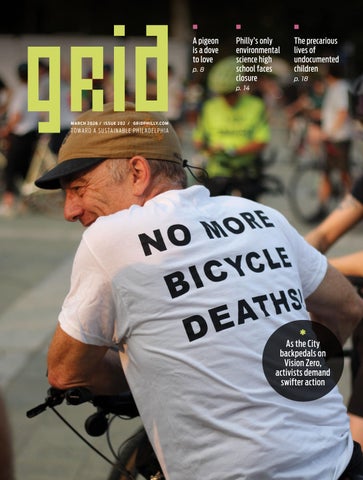
CAN VISION ZERO SPEED UP?
The efforts to eradicate traffic deaths in Philadelphia launched in 2016. Ten years in, the City is still far from its goal
STORY AND PHOTOS BY JORDAN TEICHER
By all accounts, 67-year-old Harry Fenton was a model of safe cycling.
He used hand signals when he was turning and stopped at every stop sign and red light, even when there wasn’t a car anywhere in sight. To be visible, he wore fluorescent jackets, vests and shirts, and he never left the house without his helmet or fully-charged lights. He found routes that felt safe and then stuck to them.
Fenton, in other words, did everything right. But he couldn’t prevent what happened to him on the morning of Sept. 2 while he was riding his bike in Fairmount Park. At the intersection of Belmont Avenue and Avenue of the Republic, a speeding driver struck him and fled. Fenton was taken to a hospital, where he was pronounced dead, making him the fourth cyclist killed in Philadelphia last year, and the eighth person killed in a crash on Belmont Avenue in the past six years.
Belmont Avenue has been part of Philadelphia’s “High Injury Network” — the 12% of roads that are responsible for 80% of the city’s total fatal and serious road injuries — for years. So why have the dangerous conditions there remained unaddressed? The answer is linked to the nearly decade-long history of
Vision Zero, the City’s safe streets initiative. Mayor Jim Kenney launched Vision Zero in November 2016 with a goal of eliminating traffic deaths by 2030. That year, 99 people were killed in crashes. Fatalities fluctuated but remained below 99 for the next three years. But in 2020, after the pandemic started, they surged — not just in Philadelphia, but around the country.
“What happened was just a huge increase in some of the most dangerous types of traffic behavior: speeding, aggressive driving, red light running,” says Vision Zero program manager Marco Gorini. “It just erased a lot of the gains that we had been making. Unfortunately, even though traffic patterns kind of stabilized and lockdowns ended, that change in behavior has proven a lot stickier than we would have hoped.”
As of 2025, the trend is showing signs of declining nationally, and the impact is being felt locally. According to the Bicycle Coalition of Greater Philadelphia, Philadelphia traffic deaths dropped about 16% between 2024 and 2025, from 120 to 100, based on preliminary data — making 2025 the least deadly year since 2019. That coincided with a number of important victories for safe streets advocates this past year. In the spring, City Council voted unanimously
to implement automated speed cameras in school zones citywide. In the fall, the Automated Speed Enforcement camera program — which has resulted in a 95% drop in speeding violations and a nearly 50% drop in pedestrian-involved crashes since it first launched on Roosevelt Boulevard in 2020 — expanded to the entirety of Broad Street and a short section of Old York Road. Last year also saw the fifth neighborhood slow zone completed since the initiative’s launch in 2018 to reduce speeding on residential streets.
Yet Philadelphia still has one of the highest traffic death rates among big cities in the U.S. And traffic fatalities were nearly 3.5 times higher in 2024 than the City had projected in 2018. The City is so far behind on its Vision Zero goals, in fact, that in 2024 Mayor Cherelle Parker moved the target of zero traffic fatalities back 20 years — from 2030 to 2050. “Vision Zero is working,” says Jessie Amadio, an organizer with Philly Bike Action!. “There’s just a lot of dangerous roads in Philadelphia, and we aren’t addressing them fast enough.”
Part of the issue, Amadio says, is funding. After pressure from safe streets advocacy organizations, including Philly Bike Action!, Parker designated a record $5 million in City funds for Vision Zero in fiscal year 2026. But Amadio says the City needs to spend more. “Even at $5 million per year, Philadelphia is just spending about $3.22 per resident. In New York, they spend $32.38,” Amadio says. “Philly and New York aren’t operating with the same tax base, but there’s a clear difference in prioritization and spending.”
The consequences of that relative funding deficit, Amadio says, are apparent in the progress of the Neighborhood Bikeways program. It’s intended to give communities the opportunity to co-design safety measures such as painted bike lanes and sharrows on streets where a high-quality bike lane might not be appropriate. According to a 2017 three-year action plan for Vision Zero, the City had intended to have two neighborhood bikeways completed in roughly two years. But the program didn’t launch until 2023, and while the design
➜
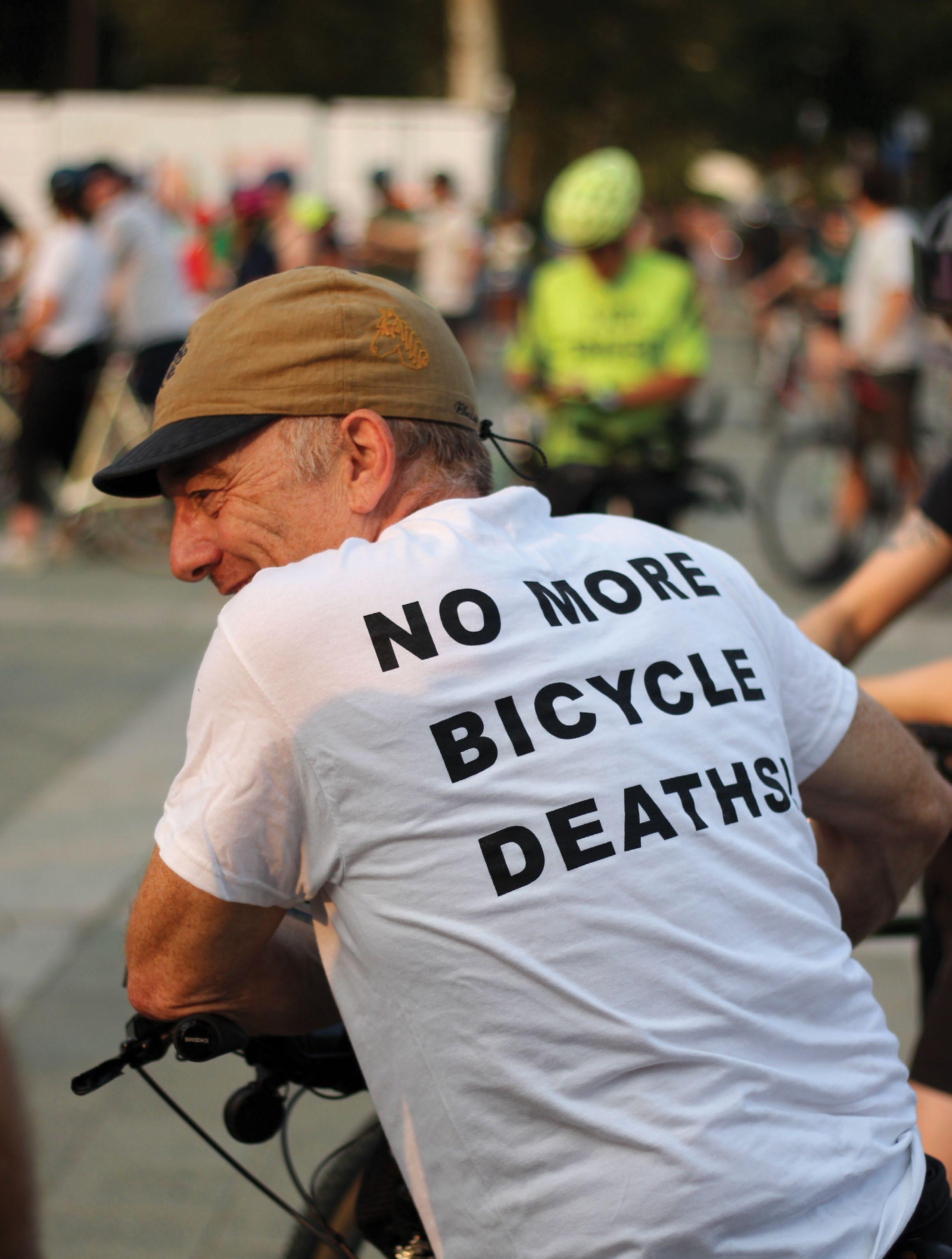
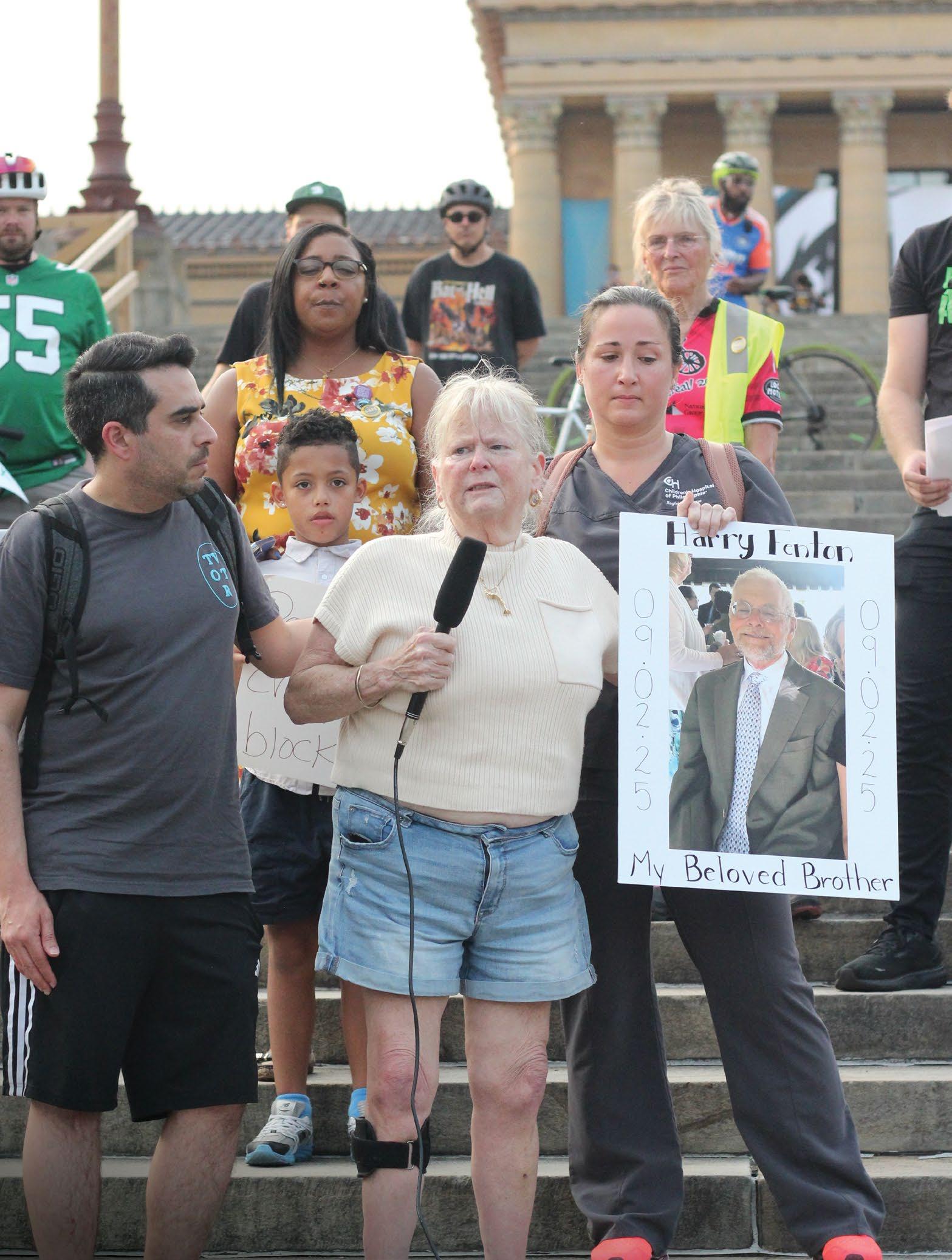
Philadelphians at a rally in September demanded concrete-protected bike lanes immediately following the death of Harry Fenton.
progress for bikeways in Germantown , Strawberry Mansion and Fishtown has begun, no bikeways have started construction.
The City has not identified funding for bikeways in Fishtown or Germantown, according to an email from Sharon Gallagher, the senior director of communications for the Managing Director’s Office. In Strawberry Mansion, she says, “the City is working with the neighborhood to address them rather than identify specific bikeways at this time.”
Additional state or federal grant money is necessary to complete 13 of the City’s action items for the next four years, including: restriping every mile of the High Injury Network at least once, closing at least five gaps in the network of safe bicycle corridors, and constructing one new slow zone each year, according to the latest report. Gorini, the Vision Zero manager, says the City is working on a capital plan to identify exactly how much money is needed to meet the mayor’s goal of programming safety improvements on every mile of the High Injury Network by 2030. “We’re trying to set ourselves up so that as funding opportunities become available, we have projects ready to go,” Gorini says.
According to Gorini, projects that focus on community engagement — like producing behavioral safety ad campaigns — will require “at least $1.5 million” in additional funding, which Gorini believes the City is likely to be able to fund through grants. “A lot of the infrastructure, on the other hand, is more of a reach,” Gorini says.
Amadio, for one, believes that the City should not stake the lives of its residents on the possibility of grant funding and that there’s room for the City to spend more. “If they actually are taking the goal of Vision Zero seriously, they’re going to have to start thinking in bigger numbers than $5 million,” she says.
Funding is not the only impediment to safer streets in Philadelphia. There’s also political inertia, says Laura Fredricks. She would know: She has been advocating for safer streets in the city since her 24-year-old daughter Emily Fredricks was killed in 2017 by a sanitation truck driver while cycling to work in Center City. “Emily was on a road with a bike lane. It was not protected,” she says. “We know that paint’s not protection.”
In 2019, Fredricks and her husband started the advocacy group Families for Safe Streets Greater Philadelphia, and every year since, she’s made an annual trip
to Harrisburg to advocate for legislation to legalize parking-protected bike lanes on state roads, to no avail. “I feel the pace of change is terribly slow. Every year that goes by, there are more people that are seriously injured and killed,” she says. “I don’t know how we make things happen faster.”
In 2020, PennDOT permitted a pilot program to demonstrate parking-protected bike lanes on a set number of state roads in Philadelphia, and the City installed them on Market Street, John F. Kennedy Boulevard, Race Street and the Chestnut Street Bridge. The lanes were a resounding success: according to the City, the project led to a 20% decrease in crashes. But the City reached the pilot’s limit, and while it has asked PennDOT to expand it, Gorini doesn’t
think that there seems to be an “appetite” for doing so. Krys Johnson, a safety press officer at PennDOT, told Grid that legalizing parking-separated bike lanes on state roads “is a legislative priority” for the department. Legislation to legalize the lanes has passed the state House three times since it was first introduced in 2017. It passed the Senate in 2022, too, but then-Governor Tom Wolf vetoed it after Republicans added a provision that would have limited the authority of Philadelphia District Attorney Larry Krasner. The bill, Fredricks knows, has bipartisan support, but it has become a bargaining chip, meaning its fate is tied to the finicky political winds in Harrisburg. Still, she is planning another lobbying trip to the capital this summer. “I don’t know if
Jane Fenton speaks at a protest following the death of her brother, Harry.
I can keep doing it and asking for the same thing,” she says. “I want to go next year and ask for something else.”
Not all of Vision Zero’s barriers emerge from Harrisburg. Many are a symptom of dysfunction right here in Philadelphia, says Will Tung, an organizer with the urbanist political action committee 5th Square.
“We’re kind of beholden to the roadway paving schedule here,” he says. “OTIS very much ties Vision Zero improvements with the paving schedule, mostly for budgetary reasons. They don’t want to implement a roadway change and then have it get ripped out for repaving a year or two later.”
Paving a street should take three to five weeks, according to the City. But it often takes much longer, due to emergency utility work, special events and bad weather. The City aims to pave 131 miles annually to keep the roads in good shape, but since 2002, it has been unable to meet that goal, largely due to staffing shortages.
To Tung, timing street safety upgrades with repaving makes sense to some extent. “But at the same time, if you have a problem today — like, let’s say, on West Market Street, where two people were killed right after another in November — that calls for an immediate solution. Yet we know that the City is not going to do anything robust there until it comes up for paving again, which could be in a decade.”
Gallagher said that the City is currently completing a traffic study, which will “provide recommendations for near-term improvements,” including the potential installation of red light cameras.
There are hyperlocal political obstacles too — namely, the influence of “councilmanic prerogative” — the longstanding political tradition where district councilmembers are assumed to have control over zoning, land use and development projects within their own districts. That means councilmembers can singlehandedly squash a Vision Zero initiative in their district even if all the other stars — funding, paving, engineering — align. That happened in 2022 in the redesign of Washington Avenue. Like Belmont Avenue, where Fenton was killed, Washington Avenue is a part of the city’s High Injury Network. It runs through the districts of both Councilmember Mark Squilla and
Councilmember Kenyatta Johnson. After a decade-long and often heated community engagement process that reached more than 12,000 people, the City arrived at a compromise plan that involved improvements to traffic flow, bicycle safety and pedestrian safety, as reported by The Philadelphia Citizen. Squilla submitted the legislation to enact the proposed changes within his district. But because Johnson didn’t introduce similar legislation, the part of the road in his district went unchanged.
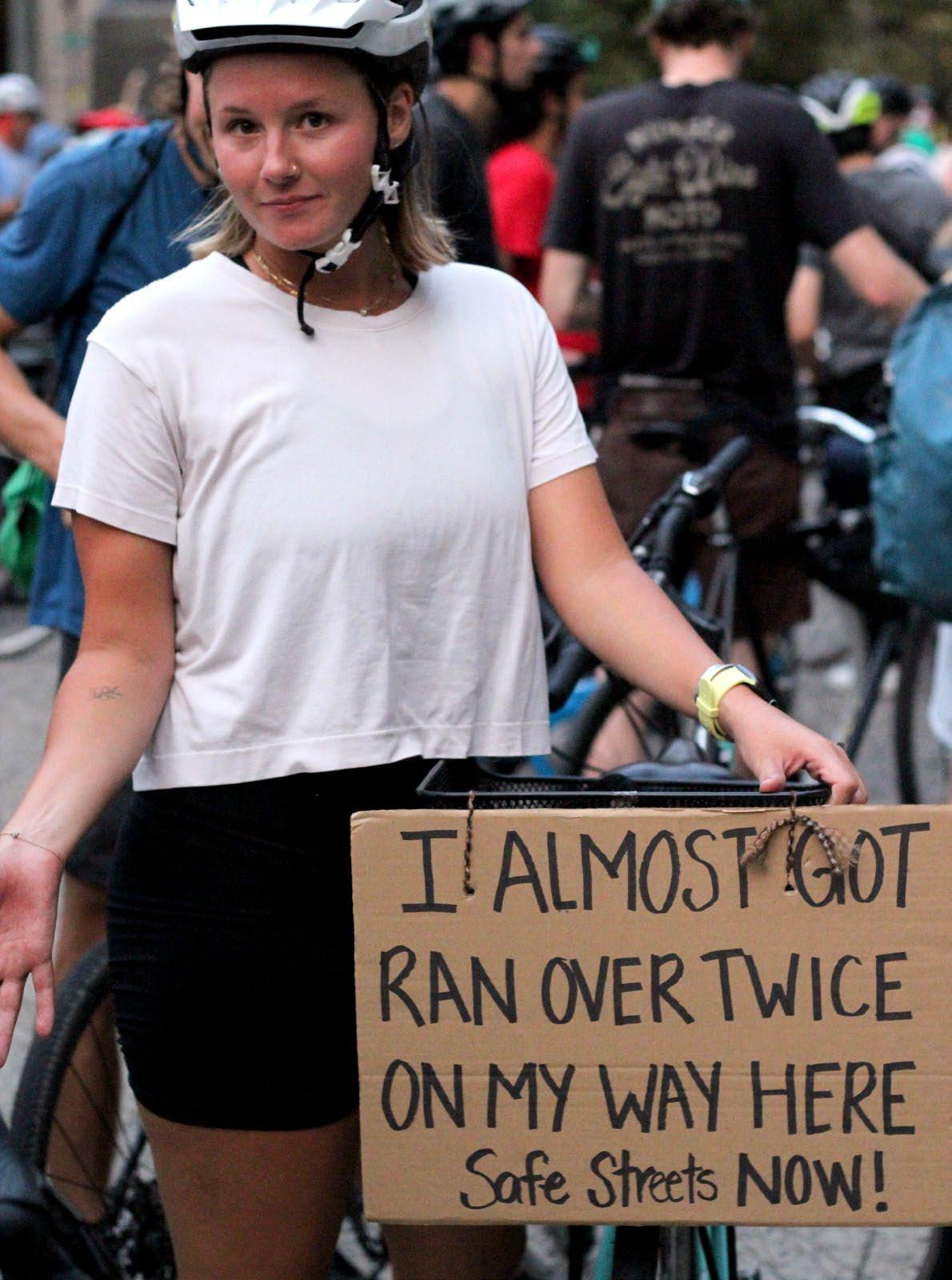
Residents can obstruct Vision Zero projects, too. After Children’s Hospital of Philadelphia physician Barbara Friedes was killed by a car while riding her bike on Spruce Street in 2024, hundreds of Philadelphians demanded bike lanes protected by concrete barriers on the street, a busy commuting route for cyclists. The City agreed to add them and set aside $5 million for the project, but a neighborhood group filed a lawsuit to stop it, resulting in a temporary injunction.
in Fairmount Park, where at least 41 people have been killed in car crashes since 2019. The petition, organized by Philly Bike Action! — of which Harry Fenton was a member — called for several immediate changes, including introducing a road diet on Belmont Avenue, a lower speed limit on all roads in the park, and repairs to the park’s crumbling cycling and pedestrian paths. In January, Ruth Ann delivered the petition signatures to Councilmember Curtis Jones. Jones, who represents the area where Harry Fenton was killed, expressed support for the proposed safety measures. (Jones did not return a request to comment for this story.)
But in the five months since Harry Fenton’s death, the City has not made any changes to Belmont Avenue or any road in Fairmount Park. It plans to restore the sidewalk on the west side of Belmont Avenue and turn it into a shared-use path, expected to begin construction in 2027, according to Gallagher. Adding speed bumps or introducing a road
Some of these fixes are so obvious and could have easily been implemented years ago.”
ruth ann fenton
“We have a very balkanized city,” says Tung. “It’s not a lack of political will across the board.”
In an idealized world, after every crash that results in an injury or death, you’d have a team of folks that descend on the intersection and say, ‘How can we prevent this from happening in the future?’” says Tung. “But the City doesn’t have the staff or the budget or the political will for that.”
Sufficient political pressure is often the best hope of moving the needle on a particular roadway, Tung says. But it’s not a sure thing. That’s something Ruth Ann Fenton, Harry Fenton’s widow, has experienced firsthand.
In the weeks following Harry Fenton’s death, more than 1,800 Philadelphians signed a petition calling for safer road design
diet, meanwhile, requires the collaboration of PennDOT, since the roads are owned by both the City and the state. So far, a road diet has not been put in place. The City does have the power to control speed limits in the park, but hasn’t indicated any plans to change them. Meanwhile, Krys Johnson of PennDOT said the agency is “awaiting guidance from the City regarding the speed limit” and did not have further updates on any other safety improvements for the park.
Fenton knows infrastructure changes don’t happen quickly in Philadelphia. But she’s frustrated nonetheless.
“Some of these fixes are so obvious and could have easily been implemented years ago,” says Fenton. “How many more families are going to have their lives blown apart because a loved one’s life was lost on that lethal intersection?” ◆
LEARNING THE RULES OF THE ROAD
Philly Bike Expo returns with a focus on supporting young riders
BY DAWN KANE
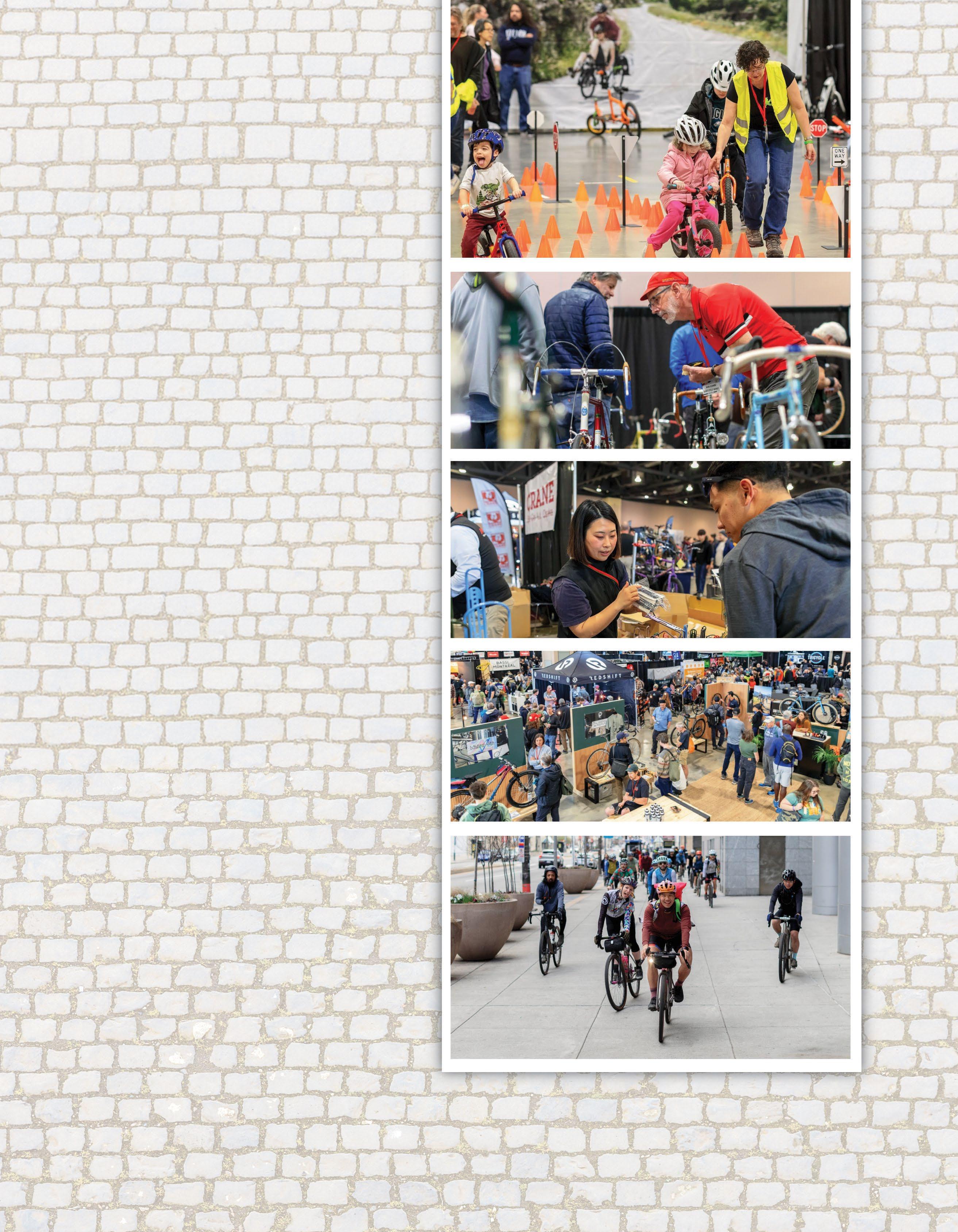
Across the nation, more and more youth are reaching for a bicycle for recreation and as a means of transportation. In fact, the advocacy group PeopleforBikes found in a 2024 survey that ridership for children ages 3 to 17 increased from 46% to 56%, reversing a decline. And on March 14 and 15 at the Pennsylvania Convention Center, the 15th Philadelphia Bike Expo (PBE) is working to instill cycling confidence in young people with its Kids Arena, aiming to build on that upward trend.
The kids riding arena features separated courses with skill and safety stations for a full range of experience levels. The program will be overseen by Sam Pearson, a lifelong cyclist and the Healthy Communities program manager at Pennsylvania Downtown Center. “It’s a skills course,” Pearson says. “We’re trying to get them to show how well
PHOTO COURTESY OF DIANA STEIF
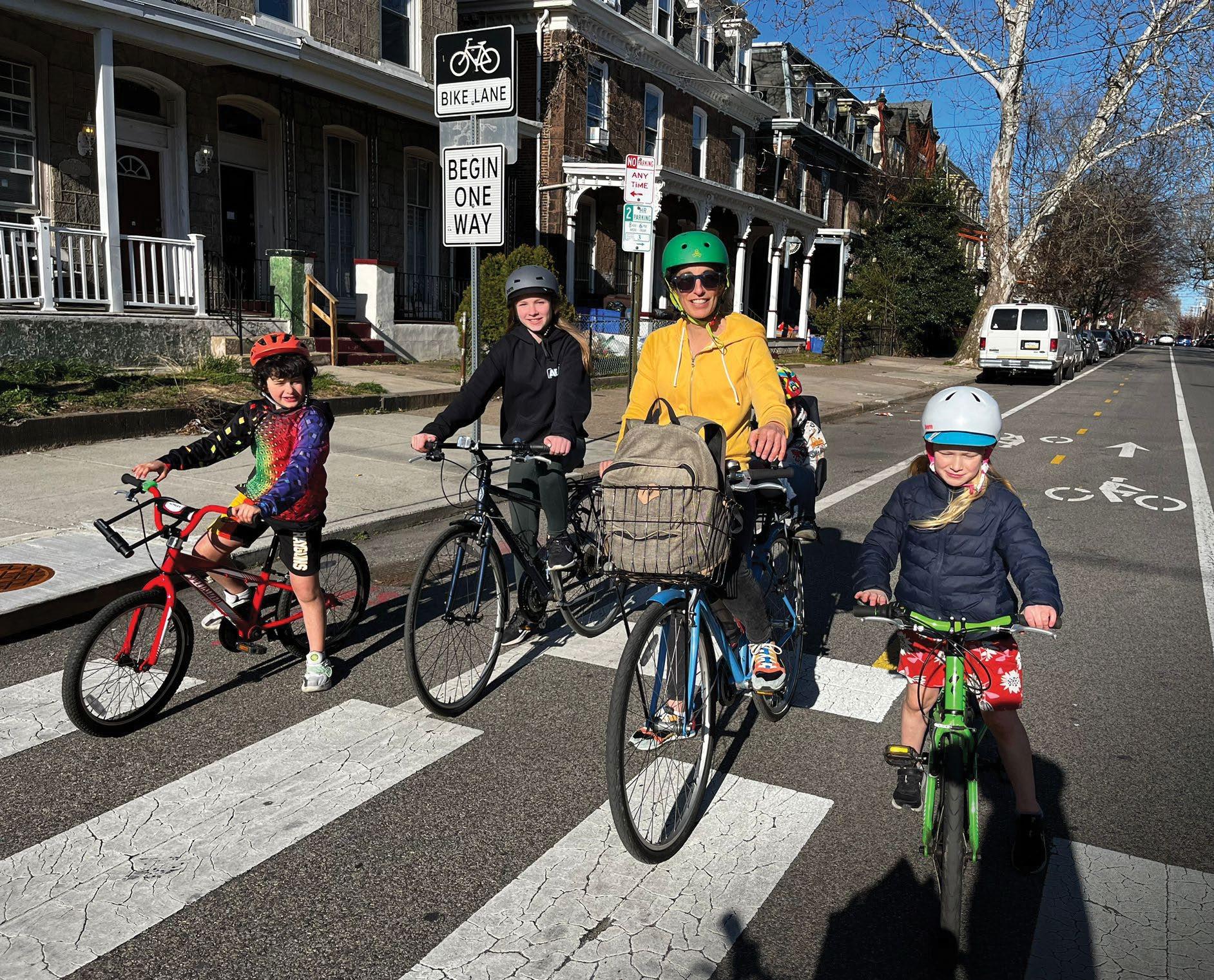
Diana Steif teaches her children safe cycling techniques to support their independence.
It can be challenging to find gear for tweens or kids in the middle space.”
sarah billington, cycling instructor
they follow the signs and interact with each other as they’re circulating.”
The course “road,” as in years past, is halved by a center line, and riders must navigate cones and each other. There is also a roundabout where riders have to obey traffic signs, take turns and decide when to go straight or proceed around the traffic circle, Pearson says. There will be separate stations for riders to focus on a specific skill, and others where they must combine those skills in practice.
Pearson says there are numerous benefits to these kinds of courses, called traffic gardens. Beyond balance work, she says children can work on gliding, braking, staying in their lane and responding to road signs.
“This all happens in the company of other kids riding and course monitors providing support, so there are also social interactions along with the gross and fine motor skills and balance and proprioception they are working on,” Pearson said in an email. “And while it’s typically pretty sedate, it’s a workout; they are getting real exercise.”
There’s a section “for the really tiny kids just getting up to speed on how you walk with the balance bike. But then we mix them all together on the course. Everyone has to use balance bikes, and that cuts down on the racing,” Pearson says.
Some parents may not know about new techniques for teaching young learners. Instructor Sarah Billington, like many adults, learned to ride with training wheels. However, that approach has largely been replaced by balance bikes, which look like regular kids’ bikes but do not have pedals. “Balance is the most important skill for them to learn,” she says.
Billington doesn’t want to take away parents’ opportunities to teach their own children, she says, but “sometimes parents are a little out of their element, and kids can have more respect for an objective instructor” using a structured curriculum. During
her individual lessons, which she offers privately, she likes parents to be close by but not actively watching.
At the expo, Billington will lead a seminar for riders ages 9 to 16, addressing challenges such as fitting the bike properly and supporting young riders’ emotional needs. She says learning differences typically begin to show around age 8, when a new psychological aspect can make learning in front of others difficult. While some early adolescents thrive in group settings, others may give up rather than risk making mistakes in front of their peers.
“Private classes are better when they don’t want to be seen by other kids,” says
MARCH 14 & 15
SATURDAY 10AM-5PM AND SUNDAY 10AM-4PM
Billington, who has been certified by the League of American Bicyclists since 2012.
During the seminar, she will demonstrate different bike types and accessories that appeal to tweens, noting that “it can be challenging to find gear for tweens or kids in the middle space.” Many kids are on social media and want fun accessories, and Billington hopes personalized gear can strengthen the appeal of riding.
At the expo, families will be able to explore gear options offered by many of the exhibitors and vendors showing everything from bike frames to cycling travel options.
Young riders in Philly
For Diana Steif, a West Philadelphia parent and former operations director at the Bicycle Coalition of Greater Philadelphia, cycling independence is a carefully monitored project. Steif co-parents a 16-year-old, two
12-year-olds and a 5-year-old, all of whom ride, and she is emphatic about safety. “I feel like I must demonstrate … I’ll come to a complete stop at stop signs or red lights and overemphasize my turning signals so that my children see it, but also so that car drivers see it.”
Steif and her partner allow their 12-yearolds to ride independently on a few routes they’ve practiced together as a family, but the kids must check in when they arrive. She feels more comfortable when roads have separated barriers but recognizes that intersections are still dangerous pressure points. She trusts that her children know the rules, but she teaches them to stay alert and never assume car drivers see them. “I constantly remind them to make eye contact,” she says.
Pearson says that for young riders, shared vehicular spaces can work at low speeds or where there are fewer cars, but “the gold standard is fully protected, fully separated.”
“Philly is light-years ahead of where it was 20 years ago. It’s a long game,” she says. “Auto ads promise the freedom that bicycles deliver.”
In conjunction with Safe Routes Philly, the Downtown Center collaborates with the state Department of Health on the WalkWorks initiative and has been piloting a bike training program in three public schools in Kensington. Pearson works with PBE to get additional passes for parents who sign up for trainings through their schools, thus enabling the expo to reach a wider audience.
As the weather warms, Pearson says they will do the bike training courses in the Kensington schools for younger kids.
“We don’t just train kids in a vacuum; we also try to provide municipalities with lots of knowledge and tools to work towards safe, protective networks that allow people to walk, bike, use a wheelchair or access transit to get to everyday destinations.”
Pearson and other educators have the opportunity to reach the youngest community members and their parents at PBE, and this year, the summit for the City’s Vision Zero program to eradicate traffic fatalities follows the expo in March. Pearson sees that as an opportunity for parents to “agitate for safer streets.”
“Our goal as parents is to raise independent kids who make good choices,” Steif says. “I want them to think bicycling is a good choice.”
2026 PHILLY BIKE EXPO
AALL-ACCESS
Making bike lanes safer helps more than just cyclists
STORY AND PHOTOS BY JORDAN TEICHER
manda Parezo isn’t your typical bike lane advocate. For one thing, she doesn’t ride a bike. Parezo once loved cycling around Philadelphia. But in 2021, after a game of kickball at Hancock Playground in East Kensington, she was struck in the back by a stray bullet and paralyzed from the waist down. Now, she gets around town using a wheelchair. She rolls from her condo in Old City to her job at Thomas Jefferson University, where she teaches occupational therapy. In a city where sidewalks are often damaged or blocked, Parezo often ends up rolling into a bike lane.
But bike lanes, she says, often aren’t free of barriers either. When a vehicle is stopped or parked in the lane, Parezo has to roll into the street, greatly increasing her risk of injury. “I feel like something’s going to happen as soon as I get into the street,” she says. “If it’s nighttime, that makes it exponentially worse, and then I just won’t go out because I’m scared. I’ll just stay home.”
In fall 2024, Parezo heard that a “Get Out the Bike Lane” bill, which would increase the penalties for parking or temporarily stopping in bike lanes, was up for a vote in City Council. So she showed up to testify in support of it.
“I have personally experienced numerous instances where vehicles blocking bike lanes have put me in dangerous situations,” Parezo told City Council. “The current law, which only prohibits parking on bike lanes, is insufficient to protect vulnerable road users like myself.”
The bill passed, and the City subsequently installed loading zones on Spruce and Pine streets to give residents and visitors a legal place to pull over and unload without blocking the bicycle lane or halting the flow of traffic. Last March, Mayor Cherelle Parker’s administration released a proposed budget that included $5 million for concrete barriers to the Spruce and Pine bike lanes, which would further separate cars and bikes on the streets.
But some residents pushed back. In August, a judge ordered the City to remove the loading zones after the group Friends of Pine and Spruce (FOPS) filed a lawsuit against the City. The group’s argument, in part, is that the loading zones, the no-stopping law that prompted them and the eventual concrete barriers would harm people with disabilities: that is, people like Parezo.
“When vehicles are unable to stop temporarily at curbside locations, passengers with mobility impairments may struggle to enter or exit vehicles safely, particularly in areas without alternative accessible dropoff points. This can be especially problematic for those using wheelchairs, walkers, or other assistive devices, as they may be forced to navigate unsafe distances or uneven surfaces to reach their destination,” the group states on its website. “Furthermore, caregivers, paratransit services, and medical transport providers face logistical difficulties when trying to assist passengers in areas where stopping is restricted.”
The members of Friends of Pine and
Spruce aren’t alone in making the case that bicycle infrastructure can disadvantage people with disabilities who need access to cars to get around. It’s a common refrain at sometimes heated community meetings about changes to the city’s streets. But experts and advocates attest that the reality is more nuanced.
“The disability community is complex,” says Anna Zivarts, a disability advocate and the author of “When Driving Is Not an Option: Steering Away from Car Dependency.” “Sure, there are people who can’t bike for transportation in the disability community. But there’s also many, many folks who can’t drive for transportation in the disability community.”
In fact, according to the Natural Resources Defense Council, 73% of Americans with disabilities don’t drive for the majority of their trips. Many people with disabilities can, however, ride a bike. According to research by Transport for London, 78% of disabled people can cycle, while 15% sometimes use a bike to get around. A survey of disabled cyclists by the U.K. group Wheels for Wellbeing found that 52% own a standard two-wheeled bicycle; another 18% said they own a cycle with electric assist.
There’s no comparable data available for Philadelphia. But cyclists with disabilities are certainly to be found on the city’s streets. Stephanie Wein is one of them. In 2020, she suffered a brain injury that impacted her fine motor skills, short-term memory and balance. For the next three years, she walked with a cane. Afterward, she tried driving a car, but says she found that she no longer had the “cognitive processing speed” to do so safely. She didn’t have the necessary balance to ride a two-wheeled bicycle either. For years, she relied primarily on public transportation to get around.
But on a trip to Montreal in 2023, she tried out an electric tricycle, and it changed her life. “It was the first time in years that I was able to go from point A to point B on my own schedule,” she says. “I started riding down the street, and I just started crying.” A few months later, she bought an e-trike of her own. “It has fully given me back my mobility and my life,” she says.
Wein has ridden it almost every day since, often with her young daughter buckled in up front. And she’s made a point of showing up to advocate for protected bike lanes in her own West Philly neighborhood and beyond, to make her trips as safe as possible. “With the Chestnut Street protected bike lane and
the Walnut Street protected bike lane, I can get across the river and back, basically fully in protected bike lanes,” she says.
While protected bike lanes undoubtedly improve safety and access for disabled cyclists like Wein, they can make life harder for people with disabilities if they aren’t thoughtfully designed, says Vicki Landers, the founder and executive director of Disability Pride PA. Landers is a walker user who, like Parezo, sometimes uses bike lanes when sidewalks are inaccessible and supports the changes on Spruce and Pine. “I support the loading zones because they create clear, reliable places to load and unload without putting me — or cyclists — in danger,” she says. “When access is planned, marked and enforced, it reduces conflict and makes [Americans with Disabilities Act] access intentional instead of an afterthought.”
In a world where people with disabilities are underrepresented on staff at transportation agencies and consulting firms, however, accessibility isn’t always fully considered in the design of protected bike infrastruc-
I just won’t go out because I’m scared. I’ll just stay home.”
amanda parezo, advocate
ture, says Zivarts. But some cities are making efforts to remedy this. In San Francisco, she points out, the nonprofit Walk S.F. partnered with the city’s Office on Disability and Accessibility and other organizations to create a design manual for protected bike lanes that also work for pedestrians and people with disabilities.
Philadelphia has not yet seen that kind of formal partnership, but people with disabilities are participating in the City’s efforts to make streets safer, according to Sharon Gallagher, the senior director of communications for the Managing Director’s Office. As
part of the City’s Vision Zero roundtables, 30 out of 247 registered attendees reported that they identified as having a disability. Of the respondents to the City’s Vision Zero Action Plan 2030 survey, 14% reported that they identified as having a disability.
More collaborations, Zivarts says, could bring cyclists and people with disabilities — communities that often overlap and share an interest in street design — closer together.
“If we are pitted against each other, what we get is just the status quo, which doesn’t serve cycling communities well, and it doesn’t serve disabled communities,” Zivarts says.
Amanda Parezo relies on bike lanes when sidewalks are inaccessible. An obstructed bike lane forces her to use a car lane.
FEEDBACK DETOUR
SEPTA doesn’t receive ride reviews from the Transit app, but that doesn’t mean they don’t seek customer input
STORY BY GABRIEL DONAHUE
For roughly 20% of Americans who ride public transportation, the Transit app is their guide. Displaying nearby routes and mapping step-by-step transit directions, it also asks users to give feedback on their rides.
But for SEPTA riders, their responses to Transit’s in-app questions about station and vehicle conditions during a trip and overall satisfaction at its completion aren’t seen by the transportation authority. That’s because SEPTA does not subscribe to Terminal, Transit’s customer experience platform.
Rather, it relies on its own methods to acquire customer feedback.
The agency conducts a quarterly customer satisfaction survey, which asks riders to rate cleanliness, safety, reliability and other aspects of the system.
“We are super focused on those numbers right now,” says Lex Powers, chief officer of customer experience. “It’s a whole rallying cry in the agency to improve these scores. And over the past year or two, for the most part, they have gone up.”
Other data, such as complaints about onboard conditions like temperature, come through calls and emails, direct interactions with staff and even online mentions of the word “SEPTA.”
“People may not know that if they say something on X or Facebook or something like that about service, there’s a good chance that that comment was cataloged, and I may have gotten it emailed to me,” Powers says. “So that’s a lot of [the] primary information that we receive.”
From there, the agency can consider what went wrong in certain situations and possibly identify overarching patterns, says Katie Monroe, SEPTA’s project manager for service disruption communications.
“All that kind of data certainly is useful to us, and we have ways to use it to improve customer experience,” she says.
Transit’s policy lead, Stephen Miller, says it crowdsources data so agencies can track
their performance generally — what their riders experience daily, rather than the extremes that prompt active feedback through phone calls and emails. It analyzes this data and returns it to the 19 agencies that subscribe to receive Rate-My-Ride feedback through Terminal, he says.
While SEPTA is far from opposed to a closer partnership with Transit, the agency has to weigh the benefits of signing on to Terminal, especially given tight budget constraints. There’s a price to accessing Transit’s data, which Miller said varies by agency size but declined to quantify specific ranges. And although more data could always be useful, Monroe says, feedback from Transit would only be supplementary to SEPTA’s in-house customer satisfaction collection.
As it stands, Powers says Transit is a good channel to distribute its customer experience survey.
SEPTA provides Transit with open data, including schedules and real-time tracking, Monroe says. The same information is shared with other GPS applications, allowing users to plan their trips and see live delays or detours when available. It also works with Transit to ensure the app’s displays match the wayfinding signage and route information passengers encounter during their trip, such as updates reflecting SEPTA’s 2025 Metro rebrand, Monroe says.
The percentage of riders who get information about SEPTA via Transit soared from 2022 to 2025, according to survey response data provided by the agency. While the figures — 8% in 2022 and 49% last year — may not accurately reflect SEPTA’s general ridership due to collection methodology, Transit’s prominence in the list of information sources does indicate its growth as a resource.
And because they are indeed using Transit, Miller emphasizes the importance of continuing to serve SEPTA riders and maintaining open communication with the agency, regardless of whether it subscribes to Terminal.
“In all cases, we are there to work with the transit agency,” Miller says. “It’s not an all-or-nothing approach. There’s never a situation where the lines of communication are closed, because people are still using us to navigate the system, and we’re still relying on the accuracy and quality of the information provided by the transit agency.” ◆
GREEN PAGES
BEAUTY
Hair Vyce Studio
Multicultural hair salon located in University City servicing West Philly & South Jersey since 2013. We specialize in premier hair cuts, color & natural hair for all ages. (215) 921-9770 hairvyce.com
BOOKS
Books & Stuff
The Giving Book Shop! Help me donate books next month by purchasing books I donated this month! books-stuff.com
COMPOSTING
Back to Earth Compost Crew
Residential curbside compost pickup, commercial pick-up, five collection sites & compost education workshops. Montgomery County & parts of Chester County. First month free trial. backtoearthcompost.com
Bennett Compost
The area’s longest running organics collection service (est 2009) serving all of Philadelphia with residential and commercial pickups and locally-made soil products. 215.520.2406 bennettcompost.com
EATS
Fifth of a Farm
Our jams are a tribute to Philly, capturing its rich heritage in every jar. Whether you’re a longtime resident or passing through, take home a taste of the local tradition. Find yours @ fifthofafarm.com
EDUCATION
Kimberton Waldorf School
A holistic education for students in preschool-12th grade. Emphasizes creativity, critical thinking, nature, the arts & experiential learning. Register for an Open House! (610) 933-3635 kimberton.org
ELECTRICIAN
Echo House Electric
Local electrician who works to provide high-quality results on private & public sector projects including old buildings, new construction, residential, commercial & institutional. Minority business. echohouseelectric.com
FARM
Germantown Kitchen Garden
Urban farm with farm stand and plant nursery selling locally grown produce, bread, eggs, veggie and herb seedlings, perennials, trees and shrubs. 215 East Penn St., 19144 germantownkitchengarden.com
FARM
Hope Hill Lavender Farm
Established in 2011, our farm offers shopping for made-on-premise lavender products in a scenic environment. Honey, bath & body, teas, candles, lavender essential oil and more. hopehilllavenderfarm.com
FASHION
Stitch And Destroy
STITCH AND DESTROY creates upcycled alternative fashions & accessories from preloved clothing & textile waste. Shop vintage, books, recycled wares & original fashions. 523 S 4th St. stitchanddestroy.com
GREEN BURIAL
Laurel Hill
With our commitment to sustainability, Laurel Hill Cemeteries & Funeral Home specializes in green burials and funerals, has a variety of eco-friendly products to choose from, and offers pet aquamation. laurelhillphl.com
GREEN CLEANING
Holistic Home LLC
Philly’s original green cleaning service, est 2010. Handmade & hypoallergenic products w/ natural ingredients & essential oils. Safe for kids, pets & our cleaners. 215-421-4050 HolisticHomeLLC@gmail.com
GROCERY
Kimberton Whole Foods
A family-owned and operated natural grocery store with seven locations in Southeastern PA, selling local, organic and sustainably-grown food for over thirty years. kimbertonwholefoods.com
MAKERS
Mount Airy Candle Co.
Makers of uniquely scented candles, handcrafted perfumery and body care products. Follow us on Instagram @ mountairycandleco and find us at retailers throughout the region. mountairycandle.com
RECYCLING
Philadelphia Recycling Company
Full service recycling company for office buildings, manufacturing & industrial. Offering demo & removal + paper, plastics, metals, furniture, electronics, oils, wood & batteries philadelphiarecycling.co
We Love Local
Weavers Way Sources Produce from these Local Farms
Weavers Way Farms
Philadelphia, PA
Farmer Jawn
Philadelphia, PA
Sunny Harvest Farm Cooperative
Lancaster, PA
Everwild Farm
Ambler, PA
Lancaster Farm Fresh Cooperative
Lancaster, PA
Buona Foods Mushrooms
Landenberg, PA
Mother Earth Organic Mushrooms
Landenberg, PA
Bux-Mont Hydroponics
Telford, PA
Mycopolitan Mushrooms
Philadelphia, PA
Ambler
Chestnut Hill
Germantown
Mt. Airy
Beechwood Orchards
Biglervile, PA
Solebury Orchards
New Hope, PA
Three Springs Fruit Farm
Aspers, PA
Subarashii Kudamono
Kempton, PA
Ready to take action for the environment?
Train for success in a field working toward sustainability solutions
Marin Sklan tailored her degree with a concentration in environmental sustainability, which gave her deeper insight into global supply chains and ESG, or environmental, social, and governance—the three pillars of sustainable business practices. “I was so appreciative of the different topics I was introduced to. I was able to see how much opportunity is actually out there in the sustainability space,” she says. “There are so many pragmatic business benefits of operating in a more sustainable way. It’s more efficient. Your costs go down. You are able to reduce your business risk. The coursework invigorated what I was able to bring to the work I was doing professionally as well. There was a beautiful synergy between my school life and the work I was doing.”