in good faith
August 2026
YOUR BIBLE
YOUR
E V E R Y C AT H O L I C ’ S E S S E N T I A L CO M PA N I O N
The journey
With Jeremiah, who saw the power structures crashing all around him during the Babylonian invasion, we learn that God’s covenant, or “love-pact”, is not a national arrangement. God, said Jeremiah, wants to make a love-pact in the heart of every single person. God is a “person-loving” God. Each individual is vitally important to God. With the prophet Isaiah we learn that our God is a holy God. He doesn’t just say this once but three times over: “Holy, holy, holy is the Lord of hosts” (6:3). This is the prayer of the seraphs in Isaiah’s vision of God’s throne in heaven. Isaiah feels this holiness intensely in reaction to his own unworthiness. “Holy” means that God is unique, in a separate class with regard to greatness and goodness. Today we use this triple “holy” from Isaiah’s vision at Mass when we join with the heavenly host in the “Holy, holy, holy”.
GRADUAL REVELATION OF GOD Has your picture of God changed since you were very young? Mine has. And as we journey through the Bible, we can see how the picture of God definitely develops. This is not surprising, since God revealed what God is like to human beings in stages, through people like Abraham, Moses and the prophets, and finally through Jesus. We have just shared a time-map, showing us the historical stages in the Old Testament. We considered the four broad periods:
1. 2. 3. 4.
the story of the patriarchs like Abraham; the story of the Exodus; the story of the kings and the prophets; the story of exile and return.
We make a mistake if we take only one part of this journey and treat it as if it is the finished picture. People often do that. They say, “Look at this! See what God is like!” and they show you some strange story about God slaughtering thousands of foreigners. It’s important to remember that we need to consider the whole Bible if we are to understand what it’s about. Through the course of the Bible we can see how God revealed what God is like gradually, in stages, so that humans could take things in, so that they and their society were able to develop in their appreciation of what God was like. Abraham probably saw God as the God of his family or tribe. He showed great faith in this God as he travelled in obedience across lands where other gods were worshipped. For him, we might say, God was his mighty tribal God. Moses learned that God was not moody, like the gods he had known in Egypt. His God was a reliable God. His God would make a “covenant” with his people. And Moses knew that, despite the fickleness of the Hebrews under his leadership, God would never abandon them. God’s love was constant. When the people entered the Promised Land with their flocks of animals, they found there a people who knew about growing crops and farming. These people needed rain and fertility, and so their gods were what we might call “nature gods”. They had their temples where they “worshipped” using temple prostitutes and this was supposed to help the fertility back home! Hebrew prophets, like Elijah, seriously challenged this: “There is only one God. Your fertility god, Baal, is no god!” When God’s people had settled down they became quite lax. Many of them became richer as those who were poor became poorer. The young prophet Amos challenged such people. They were mouthing their pious prayers but thinking about how much profit they could make from oppressing those who were poor. He gave the women a hard time too, upbraiding them at their worship as they dreamed about their menfolk bringing them their next flagon of wine. “No!” said Amos. God was a God of justice for the poor. Then there is the lovely story of Hosea. He was a man who fell in love with a woman who may have been a temple prostitute. No doubt everyone told him what a fool he was. But he loved Gomer, brought her to his home, and she bore him three children. Then disaster for Hosea: she upped and deserted him, heading for the wild life again! Ignoring the “we told you so” jibes of his friends, Hosea set off into the desert to woo her back gently into his home again. And eventually he succeeded. His story is a revelation about God and the Hebrew people. True, they had abandoned God by prostituting themselves with the ways of foreign gods. But, like Hosea, God gently pursued the sinner, perhaps having to send the people into exile to come to their senses, and forgiving them, restoring them to their homeland once more. Amazingly, we have a God who forgives.
Then, when the people went into exile in Babylon, they were without a king, an army or a temple. Yet God was still with them. God didn’t need all these power structures. They looked around and they saw many good people who were not of Hebrew blood. Surely God is a God for all races, and one day they too will all come streaming to God and be received in love by God. For Christians, God is most fully revealed in Jesus. Through his teaching and healing we learn much more about God as Father. Jesus refused to run away from a horrible death by crucifixion, so we can look at the crucified Jesus and say, with the centurion at the cross: “Now I see! That’s what God is like!” – God is totally poured out in unconditional love. And by seeing him joyfully greeting the disciples in the upper room with “Peace be with you”, we begin to appreciate even more the long journey of God’s revealing love. The story has taken us from Abraham’s family God, through the reliable God of Moses and the prophets, gradually, step by step, right up to the outpouring of God’s Holy Spirit at Pentecost. “Long ago God spoke to our ancestors in many and various ways by the prophets, but in these last days he has spoken to us by a Son” (Hebrews 1:1-2).
Covenant: a solemn sacred relationship, formally entered into, with clear terms (like a treaty) and sealed with some kind of sacrifice.
17
16
N O E L D O N N E L LY
The Gospels
LUKE: GOOD NEWS FOR EVERYONE
Luke is a favourite Gospel for many people. Maybe this is because it contains the word “joy” or “rejoice” more than any other Gospel. (Luke uses “joy” ten times more than Mark and “rejoice” six times more than Matthew. But Mark never uses the word “rejoice”, since, as you may remember, Mark is mainly concerned with Jesus’ struggle through the darkness of misunderstandings and the path of the cross.) Other favourite topics for Luke include prayer, table sharing, the valuing of seemingly “unimportant” people, and the role of the Holy Spirit. This is the only Gospel to contain some of our favourite parables: the good Samaritan (where “outsiders” are seen to be OK, as we find also in the story of the ten lepers); the unforgettable images in the three reconciliation parables of chapter 15 – the lost sheep, the woman’s lost coin, and the prodigal son (which I prefer to call “the lost sons”, since both of them were “lost”; not just the one who left home and returned a wiser person, but also the one who stayed at home, kept all the rules and regulations, and thought that, because of this, his father owed him something in return. Of course, God is a God of grace who owes us nothing but reaches out in love to everyone). Another reason this Gospel attracts many of us is the way that feelings come through: only this Gospel tells us of Jesus’“agony” and sweating during his earnest prayer on the Mount of Olives, with the angel coming and giving him strength, just as an athlete is thoroughly warmed up before the great contest. This is the only passion account in which Jesus prays with feeling for his persecutors: “Father, forgive them; for they do not know what they are doing” (23:34). Only in this Gospel do we find someone intimately addressing Jesus simply as “Jesus”, without any formal title added – “Jesus, remember me when you come into your kingdom” – and we read of Jesus’ unconditional reply: “Today you will be with me in Paradise” (23:42-43). (“Today” is a favourite word in Luke.) And we cannot fail to notice the feelings of the two disciples on the road to Emmaus after the death of Jesus: their “burning hearts” after meeting the risen Lord, their amazement when they recognise him in the breaking of bread, their excitement and growing confidence as they return to Peter and the women in Jerusalem. Many of us enjoy especially the two chapters at the very beginning of Luke’s Gospel, with the two annunciations (one to Zechariah and another to Mary), the visitation to Elizabeth, the journey from Nazareth for the birth of Jesus, the story of the shepherds and the song of the angels… and so on. Only in Luke do we find these particular “portraits” of Jesus, painted as they are with so many Old Testament pigments. 56
Who was Luke? There is a man by the name of Luke who is referred to in three of Paul’s letters:
• “Do your best to come to me soon… Only Luke is with me.” (2 Timothy 4:9-11) • “Luke, the beloved physician, and Demas greet you.” (Colossians 4:14) • “Epaphras, my fellow-prisoner in Christ Jesus, sends greetings to you, and so do Mark, Aristarchus, Demas, and Luke, my fellowworkers.” (Philemon 23-24)
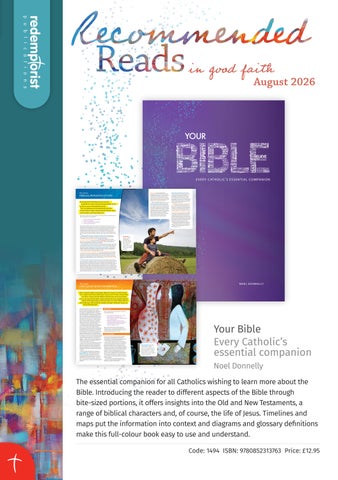
Your Bible Every Catholic’s essential companion
We can sense that Luke was a Gentile, because in Colossians 4:10-11 Paul says that the only Jews who worked with him were Aristarchus, Mark and Justus, so Luke was probably a Gentile, a non-Jew.
An ecumenical Gospel? Luke, of course, was not one of the twelve apostles, but he says in his introduction that he received information from “those who from the beginning were eyewitnesses and servants of the word” (1:2). Some scholars would say that Luke was a Gentile missionary who, in his travels, came across at least four communities or traditions, with their own distinctive pieties and “portraits” of Jesus. Luke seems to have been keen to show that Christ was bigger than any one of these “denominations”; Luke’s Gospel knits together the different sources he came across, with their varying portraits of Jesus. He refused to “smooth over” their differences. Luke was simply faithful to each of his sources. He was a bridge-builder and could therefore be seen as the evangelist of an “ecumenical Gospel”. The central focus for everyone is always on Jesus as the Saviour, reaching out beyond the traditional “religious” limits to everyone. There are stories about Luke hearing first-hand accounts from Mary and dying in Egypt at the age of eighty-four, but these are speculation.
Annunciation: literally “announcing”. Often refers to the angel Gabriel announcing the message to Mary about how God has chosen her to be the mother of Jesus, God’s Son.
57
Noel Donnelly
The essential companion for all Catholics wishing to learn more about the Bible. Introducing the reader to different aspects of the Bible through bite-sized portions, it offers insights into the Old and New Testaments, a range of biblical characters and, of course, the life of Jesus. Timelines and maps put the information into context and diagrams and glossary definitions make this full-colour book easy to use and understand. Code: 1494 ISBN: 9780852313763 Price: £12.95