JANUARY-FEBRUARY 2026 $7.99
New Series: Catholics In America PAGE 28
CATHOLIC. PASTORAL. TRUSTED.
Rely on information from a trustworthy source
The Authentic Word
Print Media
W hat Catholic books are on your reading list?
Top 10 Classic Catholic Books
A Church For And With The Poor A summary of Pope Leo XIV’s Dilexi Te
THE SONG OF THE LAMB Cardinal Robert Sarah with Peter Carter Liturgy is God’s gift to man. It brings to earth a glimmer of the peace, warmth, and liveliness of eternity, engaging all the senses: sight, touch, taste, smell, and sound. Sacred music should immerse us in the atmosphere of heaven. Yet how often does the sound of the liturgy leave us feeling empty, or distracted? In this groundbreaking book, Cardinal Sarah, longtime prefect of the Vatican Congregation for Divine Worship, joins Peter Carter, director of the Catholic Sacred Music Project, to dive into the spiritually rich tradition of Catholic sacred music, from the Church’s earliest days all the way through Vatican Council II and beyond. He minces no words critiquing the liturgical confusion of our times. Yet he returns always to the true center: not aesthetics, but the beautiful person of Christ Himself, God incarnate, who is at the center of sacred liturgy. Sarah’s meditations offer a spiritual and practical roadmap to authentic renewal. Readers will fall more deeply in love with the Holy Mass and the Divine Office, and it will fan the flames of the liturgical renewal that SLSMP . . . Sewn Softcover, $18.95 Christians have so long desired. “True beauty has a remarkable power to pierce hearts and awaken souls. His Eminence shows that artistic excellence and beauty must shine like a beacon, inviting all into the Church to behold.” —Archbishop Salvatore Cordileone San Francisco, CA
“How fitting that the man who taught us the ‘power of silence’ should teach us the meaning of music. This work has the potential to enrich the liturgy, and so enrich the world.” —Scott Hahn Author, Rome Sweet Home
◆ THE MUSIC OF CHRISTENDOM Music professor Susan Treacy takes us on a pilgrimage through the history of Western Music from the Greeks to its most recent masters, with special attention to the role of sacred music in this history. MOCP . . . Sewn Softcover, $16.95
P.O. Box 1339, Ft. Collins, CO 880522
◆ THE SPIRIT OF THE LITURGY A Commemorative Edition of Cardinal Joseph Ratzinger’s famous work on the power and beauty of the liturgy also includes the full text of the classic work of the same title by Romano Guardini. SPLCEP . . . Sewn Softcover cover, $19.95
“It’s extremely rare that a book about music lives up to the sublimity of music itself. This book does because it flows from the rich contemplative lives of its authors. The best book I’ve read about sacred music.” —Mike Aquilina, Songwriter and Author, How the Choir Converted the World
◆ THE SOUND OF BEAUTY
Classical composer and music professor Michael Kurek presents a unique, fascinating perspective into the mechanics of music, while speaking to the deep spiritual and transcendental effects of music. SOBP . . . Sewn Softcover, $17.95
www.ignatius.com (800) 651-1531
Liguorian • Vol. 114, No. 1 A REDEMPTORIST PASTOR AL PUBLICATION
January-February 2026 The Authentic Word: Print Media Rely on information from a trustworthy source
MEDITATION
FR. THOMAS M. SANTA, CSsR
LAURA BAUM-PARR
On Holy Ground at the Bus Terminal Recognize the angels in our midst
. . . . . . . . . . . . . . . . . . . . . . . . . . . . . . . 10
A Top Ten Classic Catholic Book List Apart from the Bible, what Catholic books are on your reading list? FR. BYRON MILLER, CSsR
. . . . . . . . . . . . . . . . . . . . . . . . . . . . . . . . 11
. . . . . . . . . . . . . . . . . . . . . . . . . . . . . . . 36
CATHOLICS IN AMERICA
Literature and the Arts Catholic authors and artists have contributed a unique legacy to our U.S. canon and culture
A Church for and with the Poor A summary of Pope Leo XIV’s Dilexi Te
FR. MATTHEW O’TOOLE
FR. JOHN MUDD
EUCHARISTIC POETRY
. . . . . . . . . . . . . . . . . . . . . . . . . . . . . . . 24
Pieces of Love
PRAYING WITH THE MYSTICS
JEANETTE MARTINO LAND
Saint Thérèse of Lisieux Praying the way you can with the Little Flower
THE CATHOLIC OBSERVER
LIGUORI PUBLICATIONS STAFF
. . . . . . . . . . . . . . . . . . . . . . . . . . . . . . . 38
LIVING THE CATECHISM
Essentials for learning and practicing the Catechism of the Catholic Church LIGUORI PUBLICATIONS STAFF
. . . . . . . . . . . . . . . . . . . . . . . . . . . . . . . . .8
LEBRECHT HISTORY / BRIDGEMAN IMAGES
. . . . . . . . . . . . . . . . . . . . . . . . . . . . . . . 28
. . . . . . . . . . . . . . . . . . . . . . . . . . . . . . . 22
Your independent source of news and views on the Catholic Church
MYSTICS
............................................................ 5
PLAIN TALK Finding Grace in the Pages FR. PETER D. HILL, CSsR
. . . . . . . . . . . . . . . . . . . . . . . . . . . . . . . 32
............................................................ 9
LIGUORIAN INTERNATIONAL
PADRE MIGRANTE Changing the Focus
One Faith, Many Voices, Shared Mission Liguorian opens its pages to the voices and visions of the global Church
FR. MIKE MCANDREW, CSsR
..........................................................27
FACE TO FACE I Still Need More Help SCOTT CZARNOPYS
FICTION
......................................................... 23
Flight to Charlotte The lives of fellow passengers spark curiosity and creativity
KITCHEN TABLE GOSPEL The Lens of Reading
ARTHUR POWERS
......................................................... 35
. . . . . . . . . . . . . . . . . . . . . . . . . . . . . . . 40
PAGE 38
FR. THOMAS M. SANTA, CSsR
GARY GATELY
. . . . . . . . . . . . . . . . . . . . . . . . . . . . . . . 20
WITH
Columns A WORD FROM THE PUBLISHER Catholic Imagination
FR. CHARLES VIJAY KUMAR, CSsR
PRAYING
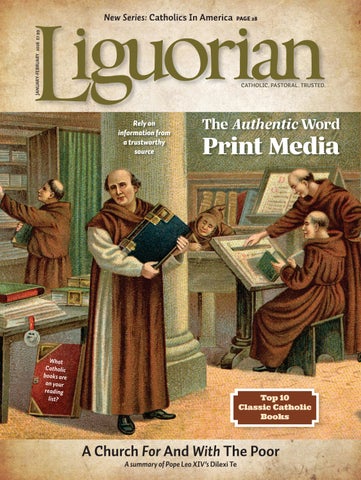
ON THE COVER: MONKS SHOWN COPYING MANUSCRIPTS IN THE MIDDLE AGES, LIEBIG CARD (PRINT)
TIM AND JULIE SMITH
REDEMPTIVE LIVING The Power of Story VINITA HAMPTON WRIGHT
.......................................................... 19
I tell God what I want quite simply, without any splendid turns of phrase, and somehow he always manages to understand me.
SOCIAL MEDIA PERSPECTIVES Hearing the “Other Side”
Saint Thérèse of Lisieux
......................................................... 39
ADAM TRAN-CHUNG
January-February Columnists
Readers Respond
Around the Table
Bible Quiz
Catholic Crossword
The Lighter Side
4
7
34
44
45
46
January–February Columnists Scott Czarnopys (“Face to Face”) is married to his beautiful wife, Arley, and has two children, Haven and Daxton. He is an elementary-school principal serving in his fourteenth year at Saint Patrick School, a thriving semi-rural Catholic school in the Grand Rapids area of Michigan. Fr. Peter D. Hill, CSsR (“Plain Talk”), is a Redemptorist missionary who has served as parish priest of Holy Cross Roman Catholic Church, Santa Cruz, Trinidad and Tobago; director of Holy Redeemer Retreat House, Dominica; and formation codirector at North American Redemptorist Formation House in San Antonio, Texas. Fr. Michael McAndrew, CSsR (“Padre Migrante”), has served for thirty-plus years in Redemptorist Hispanic ministry initiatives, youth ministry, bilingual parish missions, and farmworker ministry. He works with the Catholic Migrant Farmworker Network, directed a Campesino ministry, and recently published a book with Liguori Publications: Walk With My People: A Life in Migration Ministry (828720).
Since 1913
Br. Raymond Pierce, CSsR (“The Lighter Side”), is a native of Saint John, New Brunswick, Canada. His ministry is storytelling via email. Every week, he sends “Morning Smiles” emails of humor and personal stories to nearly 1,000 senior citizens. Fr. Thomas M. Santa, CSsR (“A Word from the Publisher”), was named president and publisher of Liguori Publications in January 2024, his second assignment as the company’s leader. Professed as a Redemptorist in 1973, his ministries have included retreat work and writing reflections for the Scrupulous Anonymous newsletter. Tim and Julie Smith (“Kitchen Table Gospel”) have been professional music ministers in the Phoenix area for more than thirty-five years. They have written and recorded dozens of music collections, including liturgical music, theater music, children’s music, and bilingual music, and their songs have been published in multiple hymnals.
Adam Tran-Chung (“Social Media Perspectives”) is a student of the Redemptorists and is studying philosophy at St. John’s University in New York City. He is an accomplished concert pianist and organist and enjoys composing liturgical music. He is interested in exploring how social media can be used as a tool for evangelization. Vinita Hampton Wright (“Redemptive Living”) worked in religious book publishing for more than three decades. She is retired and continues to write, edit, and present retreats and workshops on creativity, writing, and prayer. She works as a spiritual director in Northwest Arkansas.
It is good to enjoy the fulfillment of reading the printed word—it can be an experience of the sacred. FR. THOMAS M. SANTA, CSsR
Catholic. Pastoral. Trusted.
Publisher
Editorial Offices
Director of Digital and Creative Services
United States 200 Liguori Drive, Liguori, MO 63057
Fr. Thomas M. Santa, CSsR Wendy Barnes
Associate Editors
Fr. Byron Miller, CSsR Paige Byrne Shortal Andrew Tran-Chung, CSsR
Manuscript Editor Amy Deputato
Director of Media
Fr. Charles Kumar, CSsR
Journalist
Gary Michael Gately
Design, Production, and Post-Production John Gantz John Krus Kathy Lane
Director of Sales and Marketing, Liguorian Ad Sales Chuck Healy
Sales and Customer Service Coordinator Donna Hurley
Contracts, Rights, and Permissions Emmy Sandstedt
Editor-In-Chief, India Fr. Sandeep Menezes, CSsR
4 January-February 2026 // Liguorian.org
India Thomas Town Post, Bengaluru, India, 560084 © 2026 Liguori Publications, a ministry of the Redemptorists. All rights reserved. 636-464-2500. Liguori.org. Unless noted, Scripture quotations are from The New American Bible, Revised Edition © 2010, 1991, 1986, 1970 Confraternity of Christian Doctrine, Washington, DC. Used with permission. Subscription Questions? Visit Liguorian.org. Call: 866-848-2492 Email: Liguorian@sfsdayton.com Write: Customer Service, PO Box 292527, Dayton, OH 45429-0527 Print + Digital Subscription One year: $38; Outside US: $53 (US funds only). If you prefer that your name and address not be available to select organizations, please mail your address label to: Mail Preference Service, Liguorian, PO Box 292527, Dayton, OH 45429-0527. Liguorian is available on CD from Xavier Society for the Blind, 154 E. 23rd Street, New York, NY 10010, or call 800-637-9193 for materials for the blind only.
Advertise in Liguorian Call Oremus Advertising at 781-822-0680 or email evelyn@oremusadvertising.com. Publication Mail Agreement #40112731. Canadian Return Mail Request: PO Box 122, Niagara Falls, Ontario L2E 6S8 Canada ISSN 0024-3450 Printed in the US at Kingery Printing. Support Our Ministry Please help us continue Liguorian and other Liguori Publications ministries by making a tax-deductible donation or remembering us in your will. Our legal title is Redemptorist Fathers dba Liguori Publications, Federal ID 43-0653409. Liguorian is named after our founder and patron saint, St. Alphonsus Liguori (1696–1787), Doctor of the Church, bishop, patron of confessors, moral theologian, prolific writer, pastoral theologian par excellence, and founder of the Redemptorist Congregation. It is in his spirit and inspired by the charism he shared with us, “With him there is plentiful redemption for all,” that this magazine and all pastoral educational products of Liguori Publications proudly claim we always strive to be Catholic, Pastoral, Trusted. To learn more about the Redemptorists, visit Redemptorists.com
A Word from the Publisher
Catholic Imagination
FR. THOMAS M. SANTA, CSsR
L
“
ook beyond the bread you eat; see your Savior and your Lord.” These beautiful words, which we often sing in a hymn during the Communion of the Mass, continue to both teach and challenge the faithful people who gather to worship and to give thanks. These simple yet profound words teach the truth of what we celebrate in the Eucharist: the presence of the Body and Blood of the Lord in the bread and the wine. The words of the hymn challenge us because they remind us to continue to perceive the experience of life beyond what is in front of our faces. They are words that invite us to enter fully into the mysterious and the sacred. The ability to perceive life and to experience the kingdom of God presupposes what I like to identify as the “Catholic imagination.” Catholics are called through the grace of their baptism to “look beyond” and to “see something more.” In this sense, imagination is not to be understood as a type of fantasy or making something up, but rather in the fullness of the theological sense of the concept. Catholic imagination is the celebration of the “already” and the “not yet.” We understand that Christ and his kingdom have already come, but we also understand that the kingdom has not yet fully been made manifest. We use this graced skill of Catholic imagination when we celebrate the Eucharist. We also use this graced skill when we look at the crucified Christ that hangs in our churches and in our homes—we do not see the end of something, but rather the beginning of a new creation. Unlike some Christian denominations that exhort their congregations to “take us to the cross, the life-giving blood of the Lamb,” Catholic congregations are led to the foot of the cross but do not remain standing there. A Catholic congregation of worship and faith looks beyond the cross and sees something more. Yes, we celebrate the saving action of the cross, but we also expect to see it present in our world, in the lives and the experiences of the people of God. “Go in peace to love and serve the Lord.” It is not just a sacramental imagination. Catholics routinely look at their daily lives and the world around them and sense something more: the manifestation of the kingdom of God. It is Catholic imagination that permitted Mother Teresa to pick up the abandoned poor at her doorstep and bring them to an experience of dignity—if not in life, then at least in death. It is Catholic imagination that animates a schoolteacher, at work in a forgotten school in an underserved community, who is inspired by the power of education and hope. It is Catholic imagination that gives the rural pastor, assigned to four or five different parishes, the energy to make the long round trip of pastoral visitation Sunday after Sunday. Identifying Catholic imagination at work in the lives of our brothers and sisters in faith does not presuppose or judge the motives of others. Celebrating the powerful manifestation of grace at work in the people of God does not in any way lessen or diminish the inspired efforts of other dedicated men and women. Rather, it is a confident assertion of a quality that is essential to the fabric of what it means to be a Catholic. It is a recognition of the presence of the Spirit of God in our midst that calls us to perceive life as totally and fully blessed. Catholic imagination permits the people of God to face the difficulties and challenges of
Please consider supporting at least one Catholic periodical or newspaper. Enable the authentic representation of Catholic life, practice, and imagination. Witness to your Catholic faith to your family, your friends, and anyone else who might visit your home and enjoy paging through the current issue, which you have placed on an end table for easy reference.
AMOR SANTO / CATHOPIC
January-February 2026 // 866-848-2492 5
life—some which areday, extremely serious and call us to a deeper of faith—and Merry expect that there is a powerful Christmas! happens toof be, to this the favorite Italian Christmas carol. experience It is a wonderful manifestation of grace yet to come. This unique way of perceiving life has given us the ability to weather (English)many difficulties in meditation. You will find stories so rich in meaning that I think you will want the past them and will continue enabling hope inwhat the future. beyondbe the bread you eat; see your Savior and your Lord.” to read several times. And,us of to course, would“Look Christmas without ¡Feliz Navidad! In this issue of Liguorian, we focus on a very important part of our Catholic imagination: the printed word in its many a fruitcake? You’ll find one here! (Spanish) I also to each you, on what behalf of our to authors, editors, saleshave team, forms andextend the authors whoofcelebrate it means be Catholic and who helped us understand our shared life and customer representatives, IT technicians, and who service providers—in Joyeux Noël! (French) values. We service also celebrate each of us—the Catholic readers support this creative energy and effort. We would be at a short, the entire Liguori Publications family—our hopes and prayers for you this loss if we did not have this essential collaboration between author and reader to inspire and sustain Catholic imagination. Frohe Weihnachten! Christmas. May publisher, your family be blessed and safe, not only and during the holiday Every Catholic faithful to the Catholic imagination practice, needs your support. This has always been the (German) season but also in the New Year to come. case, but it is all the more important in a time when readers are turning away from the printed word and embracing the digital There are, unfortunately, so many places in our fragile world where a prayer of Natale! universe. Digital media has many benefits, but it is often missing an essential characteristic ofBuon the printed word: (Italian) in print, you blessing and safety would be welcomed, but where hope seems dim. I think you cannot represent yourself as something other than who you truly are. For example, we say thatFeliz Liguorian is Catholic. Pastoral. Natal! will agree with me when I say that too many people, too many of our brothers Trusted., so we must make this evident on every page of the magazine; otherwise, something important is missing. Unfortu(Portuguese) and sisters in the human family, are deprived of what we take for granted each nately, social media and other digital content are easily manipulated, and what you see is not always what you are looking for. day. I hope this somber reality makes us even more grateful and encourages Please consider supporting at least one Catholic periodical or newspaper. Enable the authentic representation of Catholic us, each in our own way, to help find a way of peace for all of God’s people, no life, practice, imagination. Witness to your Catholic faith to your family, your friends, and anyone else who might visit matter whereand they are. A your home and enjoy paging through the current issue, which you have placed on an end table for easy reference. We, the members of the Association of Catholic Publishers, To sign up for the free digital edition of Liguorianappreciate magazine, your send support. an email A to Liguori@liguori.org.
We can create one-of-a-kind sacred masterpieces for your parish or organization. And it is surprisingly affordable. Delivery in just 120 days.
6 January-February November-December // 866-848-2492 20262025 // Liguorian.org
Readers Respond *
Send Us Your Feedback! Write: Liguorian Editor, 200 Liguori Drive, Liguori, MO 63057 E-mail: Liguorianeditor@Liguori.org The opinions expressed don't necessarily reflect the opinions of the editors. Letters must be signed and include the writer’s full address and daytime phone number. Names will be withheld from publication upon request. The editors reserve the right to edit letters for length, clarity, and style.
Dear Liguorian Editor, I couldn’t agree more with Tim and Julie Smith’s perspectives on what constitutes sacred music (“Kitchen Table Gospel,” November-December 2025). Most certainly, Gregorian chant sits in a place of regal honor and fits the Roman liturgy like a glove... and I love it! But, this is not to say that other forms of appropriate liturgical music are incapable of giving authentic worship and glory to God. I have played guitar and bass in Catholic church choirs since I was in grade school. In fact, before becoming ordained, I played for fifteen years Spirituality of Emptiness within a parish where three of our music directors have had their music published, T recorded, and awarded with the highest musical recognitions (Dove Awards, Grammy nominations) and whose songs are sung at Mass weekly somewhere in the United States. Yet, I would overhear comments from some of my deacon brothers or their wives on how wrong our parish’s liturgy was because it was not chant and/or what they considered to be “sacred music” (likely because instruments such as guitars, bass, and drums were being used). But, note this: in this parish, everyone sings—and sings loudly! So much so that when you’re in the pews at Mass, you can’t even hear yourself singing (which is a good thing for us untalented singers)! What’s not sacred about that? Tim and Julie nailed it: it’s not this or that, but rather both/and. His Peace, Deacon Dennis Lambert (via email) Kitchen Table Gospel
TIM AND JULIE SMITH
he holidays, on the surface, are about “fullness.” Our calendars are full, we fill our plates and bellies with food on Thanksgiving, and we fill our cups with “Christmas cheer.” But there is also a painful side of the holidays: emptiness. The empty seat at the table that was once occupied by a loved one. The sadness and fatigue that come from realizing it’s not the “most wonderful time of the year,” as the song proclaims. Mental health experts tell us that addictive behavior, depression, seasonal affective disorder, and suicide all spike at this time of year. A few years back, we received a Christmas card that included a lovely poem by Barbara Germiat, a gifted Catholic poet from Appleton, Wisconsin, who died in January of this year at the age of eighty-eight. The poem was entitled “On How to Be a Manger,” and it outlined the qualities needed for a manger to be prepared to hold the Baby Jesus, which are the same qualities required of the receptive human heart: Be empty. Be sturdy. Be soft inside. Be still. Be ready. The poem inspired us. “Emptiness” describes deeper aspects of our faith experience, connoting both a negative and a positive condition. There is feeling empty, and there is accepting or acknowledging emptiness. Feeling empty during the holidays, with all its loneliness and pressures to be jolly, is an epidemic in our society. But emptiness—being not full of oneself—is needed to cooperate with grace, as one can see in the lives of all the saints. Mary’s fiat—“May it be done to me according to your word” (Luke 2:38)—and the Suscipe prayer of St. Ignatius Loyola—“Take, Lord, and receive”—are statements of emptiness. Emptying ourselves of society’s expectations is a Be empty. Be sturdy. Be soft inside. Be still. starting point for authentic spirituality. The idea of Be ready. making our hearts a manger, a receptacle for God’s life, sheds new light on the painful reality of the hidden anguish of this season. Inspired by Germiat’s poem, we wrote a liturgical song, “How Can I Be a Manger?” To listen to “How Can I Be a
Manger?”, visit our website, timandjuliesmith.com, and find it under Free Stuff.
How can I be a manger, can my heart be your home? Can hope be born within us upon a stable throne? I long to hold you, Jesus, embrace your loving will. Lord, make my heart a manger: sturdy, strong, and still.
We sang it throughout Advent that year. The verses had the assembly repeat the word empty… empty… empty…. It was a strange way to ritualize Advent, but it seemed to resonate with people. A few months later, we received a letter from a parishioner who had experienced a recent miscarriage. She told us she had been dreading the holidays, but the song had allowed her to embrace the loss within her, to grieve and ponder her emptiness in a new light. May your Christmas celebrations make room for meaningful emptiness and joyful fullness. A
PIXEL-SHOT / SHUTTERSTOCK
November-December 2025 // 866-848-2492 29
Note: Deacon Lambert is the author of For Real? Christ’s Presence in the Eucharist, Liguori Publications (828539). To order, visit Liguori.org or call 800-325-9521.
Dear Liguorian Editor, Years ago, I subscribed to receive Liguorian magazine, somewhere around the 1960s or maybe 1970s. There was an article about the staircase St. Joseph built. It defies gravity! My daughter asked me for that issue. I was thrilled to have her ask, and I gave it to her. I just started receiving Liguorian again after a few years away. I need to read your wonderful, inspiring Liguori publications. Prayers! Leorah M. (via posted letter) To the Editor: The whole issue about polarization (SeptemberOctober 2025) is a keeper. All through the holidays, I thought of the articles about listening to each other and how we shouldn’t write people off with a label. Our family includes people who are very liberal and those who are very conservative, and we all dread the moment when the topic of politics comes up in conversation. I really tried to listen this year. Thanks for the encouragement. Linda S. (via email)
Subscribe to Liguorian — or give a gift subscription! See page 43 for details. Editor’s Note: We regret that the cartoon published in the November-December issue was incorrectly attributed. The cartoon is the work of John Sanko, our featured cartoonist for 2026.
January-February 2026 // 866-848-2492 7
Living the Catechism Essentials for Learning and Practicing the Catechism of the Catholic Church
Within modern society, the communications media play a major role in information, cultural promotion, and formation. This role is increasing as a result of technological progress, the extent and diversity of the news transmitted, and the influence exercised on public opinion. The information provided by the media is at the service of the common good. Society has a right to information based on truth, freedom, justice, and solidarity: The proper exercise of this right demands that the content of the communication be true and— within the limits set by justice and charity— complete. Further, it should be communicated honestly and properly. This means that in the gathering and in the publication of news, the moral law and the legitimate rights and dignity of man should be upheld. CATECHISM OF THE CATHOLIC CHURCH, 2493–2494
Nihil obstat is a formal declaration that a written work contains nothing contrary to Catholic faith or morals. It is often found at the beginning of religious books, pamphlets, and magazines and theological works. To ensure the authenticity of content that is presented as “Catholic,” the Church has long established, with the development of the printing press in the fifteenth century, a review process for the written word. Familiarity with the terminology and meaning of the Latin verbiage is both helpful and expedient, especially in our time, when information is diverse, influential, and, unfortunately, manipulated to make a point. There are far too many people who are misinformed, often through no fault of their own, about the true meaning and practice of their Catholic faith and life. Nihil obstat is a Latin phrase, meaning “nothing hinders” or “nothing stands in the way.” In the Catholic Church, it is a formal declaration that a written work contains nothing contrary to Catholic faith or morals. It is often found at the beginning of religious books, pamphlets, and magazines and theological works. It typically appears together with:
• Imprimatur (“let it be printed”)—the bishop’s official permission to publish.
• Imprimi potest (“it can be printed”)—approval given by the superior of a religious order/congregation.
ANGIE MENES / CATHOPIC
Together, these notations indicate that a text is free from doctrinal or moral error, though they do not necessarily mean that the Church endorses every opinion expressed in the work. a Excerpts from English translation of the Catechism of the Catholic Church for the United States of America © 1994 United States Catholic Conference, Inc.—Libreria Editrice Vaticana; English translation of the Catechism of the Catholic Church: Modifications from the Editio Typica © 1997 United States Catholic Conference, Inc.—Libreria Editrice Vaticana.
8 January-February 2026 // Liguorian.org
Finding Grace in the Pages
Plain Talk FR. PETER D. HILL, CSsR
G
rowing up in the Caribbean, I had a vibrant faith, but it was often confined to Sunday Mass, the yearly novenas and processions, and the Lenten fast. I knew my prayers by heart, and, in my teens, I started thinking deeply about my faith. At university, I enrolled in a philosophy of literature course, where I was introduced to some great Catholic novels that helped shape my thinking. On the list was Evelyn Waugh’s Brideshead Revisited. It is a story of grace working mysteriously through flawed, complicated people. The novel taught me that faith isn’t about being perfect—it’s about being pursued by a relentless, loving God who never gives up on us, and it reminded me of St. Alphonsus Liguori, the founder of the Redemptorists, who taught that God is madly in love with us. We read Graham Greene’s The Power and the Glory, and it shattered every comfortable notion I had about what a holy person should look like. The whisky priest—an alcoholic, the father of an illegitimate child, a man riddled with shame—became one of the most powerful images of grace I’ve ever encountered. In a world where we sometimes reduce holiness to external piety, Greene showed me that sanctity can exist in the most broken vessels. The priest’s final act of courage—returning to certain death to hear a confession—revealed to me the radical nature of the priesthood and the sacraments. A third book in the course was Ron Hansen’s Mariette in Ecstasy, a novel about a young postulant who claims to have received the stigmata. What struck me most was the book’s unflinching exploration of mysticism, suffering, Reading Catholic literature can do for us what sermons alone cannot. and the ambiguity of religious experience. Hansen doesn’t give easy answers. He lets the mystery remain mysterious. This book taught me that doubt and mystery are not enemies of faith but essential companions on the journey. Reading Catholic literature can do for us what sermons alone cannot: give us a vocabulary for spiritual struggles and open a window into the vast, beautiful, and sometimes terrifying landscape of the Catholic imagination. These books have taught me that our faith is not a set of rules to follow, but a story to inhabit, a drama of sin and redemption played out in every human heart. We must read, and we must read widely and deeply. Let the great Catholic writers challenge us, console us, and expand our understanding of what it means to follow Christ. Our faith is not only for Sunday mornings at Mass. It is a way of traveling and seeing the entire world, its beauty, its brokenness, and the many ways God’s grace is operational, particularly in the ordinary. The pages of great Catholic literature allow us to experience these realities. A DANG VU HAI / PEXELS
January-February 2026 // 866-848-2492 9
The Authentic Word:
Print Media FR. THOMAS M. SANTA, CSsR
O
ctober 6, 1536, is the date generally given for William Tyndale’s execution in Vilvoorde (sometimes spelled Vilvorde), near Brussels, in presentday Belgium. Tyndale was strangled at the stake, and his body was then burned in the castle’s courtyard. The execution was public and intended to send a clear message. He was condemned and sent to his death for heresy— chiefly for translating the Bible into English and opposing the authority of both the pope and, on certain points, King Henry VIII. That was the official reason. The real reason was fear of something new—in this instance, fear of the potential power of the printing press and the ramifications that the invention suggested.
Portrait of William Tyndale
WIKIPEDIA COMMONS
Illustration of the Gutenberg printing press SHUTTERSTOCK
10 January-February 2026 // Liguorian.org
We still lack one thing: the ability to trust what is communicated to us. Authenticity is becoming more of an issue than we ever imagined. King Henry, the Pope, and much of the titled class had valid concerns about the printing press. What would happen if ordinary people were able to access information without the help of those who believed themselves to be the official caretakers of information? What would happen if anyone could simply print and read whatever they desired—in this case, the Bible? How would easy access to information impact the power of Church and state officials, who, at least up to this point, controlled how information was shared, interpreted, and stored? Even though most people were illiterate at the time the printing press was invented, there were still enough people who could make use of the printed word, and this number far exceeded that of the “official” keepers of information. The power to read, study, debate, and then discern had traditionally been in the hands of very few people. They were seen as the interpreters of reality, and people turned to them to find out what they should do and how they
au·then·tic adj. 1. Conforming to fact and therefore worthy of trust, reliance, or belief: an authentic account by an eyewitness. 2. Being so in fact; not fraudulent or counterfeit.
should think and act. There was no real reason to doubt them or question them. Not only were they state officials, but it was also believed that they had been placed in their position of power by God. To doubt or question them was to doubt or question God. We read about this understanding of reality from the perspective of our life in this century. We may shake our heads in wonder and disbelief. How
could anyone live with this limited perception of reality? It seems almost nonsensical to us today. We live in an age in which information is available to us in many different formats besides the printed word. People in much of the world can access what they need and what they’re interested in, and access is expanding as technology is continually updated. It seems foolish to suggest that the
A Top Ten Classic Catholic Book List The Bible is the greatest book ever written, bar none. As the word of God, it’s in a distinct class by itself. Apart from the Bible, other books in our Church’s 2,000-year history have endured the test of time to become spiritual classics. Interspersed among the following pages are thumbnail profiles on ten Catholic books for spiritual reading that are considered perennial favorites according to various sources. How many of these are on your reading list? —Fr. Byron Miller, CSsR
1. Confessions by St. Augustine of Hippo (354–430) Likely the first Christian book to attain classic status, this masterpiece speaks eloquently about the human condition, conversion, and our soul’s innate longing for God. The book is written as a prayer to God, and Augustine opens with his famous line, “You have made us for yourself, O Lord, and our heart is restless until it rests in you.” In Confessions, Augustine recounts his existential search and transformative journey from youthful ideas and a licentious lifestyle to an uncompromising embrace of God and the Catholic faith. Augustine wrote this autobiographical account when he was in his early forties, and he lived long afterward, producing another classic work, The City of God. He is one of the four original doctors of the Church, along with Sts. Ambrose, Jerome, and Gregory the Great.
January-February 2026 // 866-848-2492 11
We cannot simply “like” or “follow” and assume we are being informed.
PEXELS
flow of information can be restricted or controlled as effectively as it was once believed possible and even necessary (think of the violence of wars, executions, imprisonment, and the like that followed in the centuries after Tyndale’s execution). We may no longer fight the wars our ancestors routinely engaged in or enthusiastically send people to die in the torture of flames because we disagree with them. Nevertheless, we still are struggling and adapting. We desire to be informed. We demand the ability to pick and choose. But, with all our freedom, we lack one thing: the ability to trust what is communicated to us. Authenticity is becoming more of an issue than we ever imagined. When William Tyndale was condemned to the stake, the people who sent him to his death sincerely believed what they were doing was necessary. With hindsight and the clarity of looking backward through history, we know they were reacting in fear to something unknown. They understood that when the state officials—the keepers of information—were replaced by a new reality, there would be immediate
and unpredictable effects. They sensed this even though they did not truly appreciate the extent of the ramifications the printing press would bring about. Today, the “official interpreters” of past centuries have been replaced by
A Top Ten Classic Catholic Book List
2. The Imitation of Christ by Thomas à Kempis (1380–1471) In this classic book with timeless appeal, Thomas à Kempis relied on his solid faith to navigate the dark and gloomy age in which he lived. Read by more than a billion people, The Imitation of Christ is the most popular Christian book after the Bible. Saint Thomas More recommended it as one of three books that everyone should own; St. Ignatius of Loyola declared it the most precious book on devotion ever written; and St. Thérèse of Lisieux committed passages from it to memory. From this practical guidebook on the spiritual life is an oft-quoted line: “Man proposes, but God disposes.”
12 January-February 2026 // Liguorian.org
“influencers.” There are people who still claim to have the authority or knowledge to direct our human experience, but they are struggling to find and maintain a foothold. Institutions that once were perceived as necessary and essential are now often viewed as relics of the past. Instead, these selfappointed influencers have assumed the role and the authority of interpreting meaning, reality, and community. Understandably, this has caused confusion and, in some cases, even chaos. We are not helpless in this new reality. Chaos generates distractions and a lack of clarity, so we must pay attention to what we have learned from our life experience to successfully navigate today’s challenges and opportunities. The sheer volume of information that is available to us and demands our attention is overwhelming. No one can sift through it all. So, it is a natural development that people will emerge from the chaos and assume the power to interpret what it means—or at least what some of it means. We
What Is a Modern Inuencer?
A
social media influencer, also known as an online influencer or simply an influencer, is a person who builds a grassroots online presence through engaging content such as photos, videos, and updates. This is done by using direct audience interaction to establish authenticity, expertise, and appeal, and by standing apart from traditional celebrities by growing their platform through social media rather than pre-existing fame. The modern referent of the term is commonly a paid role in which a business entity pays for the social media influencer-for-hire to promote its products and services, known as influencer marketing. Types of influencers include fashion influencers, travel influencers, and virtual influencers, and they involve content creation and often live streaming.
then freely choose to “like” and “follow” those influencers who appeal to our personal preferences. We permit the algorithms to sort through the rest and present us with only what we need or believe what we need. Effectively, we have given someone else the power to
determine what we should think, what we should believe, and how we should act. This transfer of responsibility for interpreting the meaning of human life and community is not without cost. Let’s discuss the issue of authenticity. We cannot simply like a post or
follow an account and assume we are being informed. When we turn to influencers as our main source of information, we cannot be surprised when we are then influenced. The influencers are doing exactly what they promised, although they will lose the ability to influence if they wander too far off the path or are no longer perceived as reliable and authentic. The main issue of authenticity that comes into focus with influencers is this: Are they who they claim to be? Is the information they provide trustworthy, or is it being manipulated in some way to support a point of view or a perspective on life of which we may not be fully aware? A crucial weakness in social media is the spread of disinformation and the manipulation of words and images. How can we, the end users, be sure that what we’re viewing and reading is truthful—or even real? How can we be sure that it
The printed word connects us in a particularly important way to the Word made flesh.
AYO PRODUCTION / SHUTTERSTOCK
January-February 2026 // 866-848-2492 13
KINGERY PRINTING
is an authentic representation of what we think we’re seeing? These questions certainly bring up concerns, and there are no simple answers. We are still in the infancy stage of this new media reality. We are not quite sure what will come next. Part of this experience is exciting, but it is also challenging. One important consideration is that, for the most part, social media is not generally understood and accepted as the “place of record.” In other words, it is not perceived as authoritative, comprehensive, and reflective of a rigorous editorial process. That distinction remains with the printed word in newspapers, magazines, bulletins, and the like— you know, those old relics from a time long gone. Take, for example, this issue of the Liguorian that you are reading. It was a laborious process to organize the material for this issue. Once article topics
are identified and authors contracted, it takes a few months (or more!) for the articles to be written. When articles are submitted, they go to the edito-
A Top Ten Classic Catholic Book List
3. The Spiritual Exercises by St. Ignatius of Loyola (1491–1556) A reason for the phenomenal success of this book is that it provides formation for the members of the Jesuit Order founded by Ignatius. It also offers essential guidance for retreat directors and retreatants on contemplative prayer, and, above all, it continues to help Christians of any denomination discern the will of God in their lives. The original, complete form of the Exercises is a silent retreat of about thirty days that focuses on self-abandonment, conversion, and finding God in all things. Few religious figures have so extensively touched the lives of others as Ignatius of Loyola. The Spiritual Exercises—composed between 1522 and 1524 and first published in 1548—has become more than an inspirational book. In the 500 years since it was written, the Ignatian method of prayer has become a way of life for many! Ad majorem Dei gloriam—“For the greater glory of God.”
14 January-February 2026 // Liguorian.org
rial department, where editors read and check for proper format, structure, spelling, and grammar as well as fact-checking items that need to be verified—such as the accepted date in this article for the execution of William Tyndale. Editors then send articles to the creative services department, who format and design the articles for the magazine. Page proofs of edited and designed articles are then circulated among the editorial team to ensure that there are no errors, that the content represents the mission of the Redemptorists, and that they have been approved by the publisher, who is the representative of the Redemptorists and provides the nihil obstat, or “permission to publish,” for this magazine. Then and only then are the final files sent to the printer, and the magazine is then delivered to your mailbox. All this is to ensure the authenticity and quality that you have come to expect from Liguorian. These efforts are repeated with each edition of the magazine, a process that has been in place for more than 110 years.
A Top Ten Classic Catholic Book List
As a reader of this magazine—and, for that matter, of other Catholic periodicals, newspapers, and bulletins—you can be sure that what you are reading is an authentic representation of Catholic thought and practice. If not, the material would not have been approved to publish or to represent this magazine as a Catholic periodical. By contrast, no content on social media is required to meet this high standard of authenticity. For no other reason than the assurance of authenticity, your support of Catholic reading material is well worth it. Your support ensures the accurate recording of Catholic life and practice for the people of today, as well as for the people hundreds of years from now, who will “search archival records,” to understand who we were, what we believed, and why we practiced the way we did. Both authenticity and accuracy in reflecting the Catholic experience are very important, but there is yet another good reason to support the printed word. There is something solemn, perhaps even sacred, about it. That is one of the reasons we acclaim the printed gospel at each liturgy and why our alleluias are so important to us. The printed word connects us in a particularly important way to the Word made flesh. Holding the Word, meditating on the Word, feeling the Word, and praying the Word are all important parts of our Catholic spiritual life and practice. When you subscribe to a Catholic periodical, you are enabling the continued commitment to authenticity. When that Catholic periodical comes to your home, it is an opportunity for everyone in your family to experience Catholic life and practice. Over time, the periodical becomes a welcomed member of your family, a trusted resource, a friend. Social media has its place—it
4. The Interior Castle by St. Teresa of Ávila (1515–1582) Of this remarkable Spanish Carmelite nun’s classic works, The Way of Perfection is the most easily understood, and her autobiography is said to be the most widely read prose classic in Spain after Don Quixote. However, many Teresian scholars single out The Interior Castle as her greatest masterpiece. She received the image of the entire book in a mystical vision on Trinity Sunday, 1577, toward the end of her life. Consequently, it’s regarded as one of her most mature and synthesized works. The book is divided into seven mansions, or dwelling places, and each level in the continuum is a step closer to God. In the seventh mansion, “there are scarcely ever any aridities, or interior disturbances, like…in all the rest; but the soul is almost always in quiet, and she is never afraid that this sublime gift would be counterfeited by the devil; and, therefore, she is confident it comes from God.” Teresa of Ávila was proclaimed a doctor of the Church in 1970.
would be foolish to deny or ignore the world of digital media—but it is still searching for a path to contribute something of substance rather than generate more noise and distraction. Please actively support and encourage Catholic publishing. Please support the printed word. It does not need to replace your digital favorites, but it can be supportive. It can help bring a sense
of authenticity and clarity to the chaos that social media often generates. It is good to enjoy the feel of a book or magazine in your hands, the smell of newly printed pages, and the fulfillment of reading the printed word—it can be an experience of the sacred. It is a medium that was hard earned over the centuries, and there is still a place—a need—for it today.
Holding the Word, meditating on the Word, feeling the Word, and praying the Word are all important parts of our Catholic spiritual life and practice. Fr. Thomas M. Santa, CSsR, is the president and publisher of Liguori Publications, his second assignment as the company’s leader. Professed as a Redemptorist in 1973, his ministries have included retreat work and writing reflections for the Scrupulous Anonymous newsletter.
January-February 2026 // 866-848-2492 15
A Top Ten Classic Catholic Book List
5. Dark Night of the Soul by St. John of the Cross (1542–1591) The common phrase “dark night of the soul,” which describes a crisis of faith or a painful crisis in life, comes from this rapturous poem written by the beloved Carmelite mystic. This classic work follows the soul’s journey from a state of abandonment and purification to a mystical, loving union with God. The journey is called a “dark night” in part because the path and the destination (God) are unknowable. Regarded as one of the most important contributions to the literature of mysticism, Dark Night of the Soul enriches those seeking oneness with God. Saint John of the Cross was proclaimed a doctor of the Church in 1926.
6. Introduction to the Devout Life by St. Francis de Sales (1567–1622) First published in 1609, this book was widely popular in both Catholic and Protestant circles. Francis wrote this influential manual on the interior life after providing expert spiritual direction to numerous people in his lifetime. He emphasizes in the book that holiness is attainable for everyone: “Wherever we may be, we can and should aspire to the perfect life.” Introduction to the Devout Life was intended to help the average layperson embrace the world rather than renounce it. It’s an edifying devotional that motivates readers to achieve greater union with God through prayer and compassionate Christian discipleship. Saint Francis de Sales was declared a doctor of the Church in 1877 due to his wisdom and spiritual writings.
7. True Devotion to Mary by St. Louis-Marie de Montfort (1673–1716) First published in 1843, this classic is considered the greatest single Marian devotional ever written. Pope St. John Paul II credited the reading of this book as “a decisive turning point” in his life when he was young, and he adopted the phrase Totus Tuus (totally yours) from True Devotion to Mary for his apostolic motto. Pope St. John Paul II explained in a letter to the Montfort religious community: “These two words express total belonging to Jesus through Mary: ‘Tuus totus ego sum, et omnia mea tua sunt,’ St. Louis-Marie wrote, and he translates his words: ‘I am all yours, and all that I have is yours, O most loving Jesus, through your most holy Mother.’ This saint’s teaching has had a profound influence on the Marian devotion of many of the faithful and on my own life. It is a lived teaching of outstanding ascetic and mystical depth, expressed in a lively and passionate style that makes frequent use of images and symbols.”
16 January-February 2026 // Liguorian.org
A Top Ten Classic Catholic Book List
8. Uniformity with God’s Will by St. Alphonsus Liguori (1696–1787) Many of the 111 works written by this prolific theologian are considered classics in their own right. Alphonsus helped move the Church away from fear and Jansenism in his landmark Moral Theology; he fostered greater Marian devotion in his popular Glories of Mary; and his Visits to the Blessed Sacrament and The Way of the Cross appeal to people from all walks of life. One of his short booklets that appears on many lists of spiritual classics is Uniformity with God’s Will, written in 1755, likely upon the death of Alphonsus’ confessor and spiritual director. It’s a challenging but encouraging treatise on how to concretely unify one’s will with God’s to experience divine love and authentic peace and happiness—even in hardship. Because of his extensive writings and impact, Alphonsus was named a doctor of the Church in 1871.
9. The Story of a Soul by St. Thérèse of Lisieux (1873–1897) At the request of her superior (who was also Thérèse’s blood sister), this cloistered Carmelite nun known as the “Little Flower” began writing her memoirs before she succumbed to tuberculosis at age twenty-four. Prior to her death, Thérèse herself said of this autobiography, “What I have written will do a lot of good. It will make the kindness of God better known.” She also promised that after her death, she would let fall “a shower of roses.” Her total dependence on God in a relatable childlike manner captivated the hearts of readers around the world, and her “Little Way” of simplicity, love, and trust continues to lead countless readers to God. Describing prayer as a “burst of love” that opens our soul, uniting us with Jesus, she wrote: “I pray like a child, simply telling God what is on my mind…. He guides me and always understands.” For her tremendous influence on spirituality, the Little Flower was declared a doctor of the Church in 1997.
10. The Seven Storey Mountain by Thomas Merton (1915–1968) In this extraordinary spiritual autobiography, Merton is like a modern-day Augustine who recounts his restlessness, conversion to Catholicism, and profession of vows as a Trappist monk in a Kentucky abbey. A New York Times bestseller, with millions sold, The Seven Storey Mountain is credited as the first major Catholic work to achieve widespread acclaim in America, and it’s consistently praised as one of the best books of the twentieth century. First published in 1948, and titled after the mountain of purgatory in Dante’s famous Divine Comedy, the book resonated with readers who sought a sense of purpose in the aftermath of World War II and the dawn of the atomic age. This book is also attributed to attracting vocations to the priesthood and monastic life. Merton’s eloquent prose and profound insights into the human condition continue to enlighten both skeptics and believers far and wide!
January-February 2026 // 866-848-2492 17
Ten Notable Works of Fiction by Catholic Authors The Power and the Glory by Graham Greene A flawed priest tries to bring hope and faith while running from authorities in anti-Catholic Mexico. Wise Blood by Flannery O’Connor Hazel Motes, a war veteran, tries to start a strange church and wrestles with belief and religious doubt. Brideshead Revisited by Evelyn Waugh Charles Ryder becomes close to the wealthy Flyte family and discovers faith, love, loss, and personal change. The Diary of a Country Priest by Georges Bernanos A young French priest records his struggles, doubts, and simple acts of faith in a small village. Silence by Shusako Endo A priest travels to Japan, faces torture and faith challenges, and watches hidden Christians risk everything to believe. In This House of Brede by Rumer Godden Philippa Talbot joins a monastery, learning to live in community, pray deeply, and heal from her past. The Moviegoer by Walker Percy Binx Bolling, a stockbroker in New Orleans who battles domestic issues and postwar trauma, is in need of spiritual redemption. The Father Brown Mysteries by G.K. Chesterton An endearing and eccentric sleuth priest solves mysteries with a compassionate understanding of human nature. The Keys of the Kingdom by A. J. Cronin Considered a failure by his superiors, Fr. Chisholm is sent to China as a missionary, where he encounters the keys to heaven amid danger and hardship. Charming Billy by Alice McDermott When the family and friends of Billy Lynch gather after his funeral to question what drove him to alcohol, his memory becomes a lesson on familial love. Honorable Mention: Although Willa Cather wasn’t Catholic, she wrote a classic piece of Catholic literature in Death Comes for the Archbishop. Two priests build a Catholic community in New Mexico, facing challenges from locals, nature, and their own faith. Fr. Byron Miller, CSsR, is an Associate Editor for Liguori Publications. He previously served as its president and publisher (2015–2023) and is the author of numerous faith-based publications.
18 January-February 2026 // Liguorian.org
The Power of Story
Redemptive Living VINITA HAMPTON WRIGHT
I
love that the sacred book of Christianity is full of stories. Yes, it includes history, wisdom sayings, letters of exhortation, detailed laws, and explanations of doctrine. But the Bible is a marvelous collection of stories, told by historians and prophets, poets and evangelists. And we have stories within stories, such as when Jesus shares parables. As for Jesus, at age twelve, he demonstrated his ability to talk theology with the experts. But when he went into public ministry, he wandered the world, telling stories and offering easy-to-remember wisdom sayings, such as those we find in the beatitudes. Centuries later, scientists tell us that humans process stories differently than we process more left-brained information. When I’m reading or listening to a story, a deep, intuitive part of me becomes engaged. I can place myself in a story. I can also allow my imagination to play with a story and ponder its plot points and characters. Storytelling is simple enough to hold the attention of small children, yet this sort of learning can also be an effective and sophisticated process of spiritual development. World cultures are shaped more by stories than by political ideas or financial strategies. We all look for a story in which to place our lives in a way that makes sense. People remember the grand plots and people of literature, film, and song more than they remember historical facts. Stories are facts arranged meaningfully. Without a plot, actions have little meaning. Without a motive, a character is unconvincing. I “learned” about the kind of person I wanted to The Holy Spirit is still writing stories, even become when, as a child, I heard the stories of Abraham, though the biblical canon is closed. Sarah, and Hagar; Daniel and his friends; the shepherd who became a king; and so on. I watched their lives unfold on flannelgraph boards or in illustrated books. Can I remember a single sermon or lesson from back then? Not really. But I remember the men and women of Bible stories, and I’d like to think they helped me choose a life of faith and generosity. Here’s a thought, and it may sound dangerous, but bear with me: the Holy Spirit is still writing stories, even though the biblical canon is closed. We have thousands of stories from our grand history of saints, and we have unfolding stories today, as people of faith do wonderful work in this world. We also have the written stories of priests, mystics, mothers, and pilgrims—a Teresa of Ávila or a Thomas Merton. A Sister Helen Prejean or the ordinary people who made sure their elderly neighbors were cared for during a pandemic. And the poets, novelists, essayists, and playwrights who are so skilled at bringing truth to life through mere words on a page. Please—allow yourself to enjoy stories. Find new ones and rediscover the old ones. Allow PIXEL-SHOT / SHUTTERSTOCK your spirit to learn wisdom and hope with the delight of a child. A
January-February 2026 // 866-848-2492 19
A VENERABLE MAGAZINE OPENS WIDE ITS PAGES TO THE VOICES AND VISIONS OF THE GLOBAL CHURCH
I N TER N ATION A L One Faith, Many Voices, Shared Mission FR. CHARLES VIJAY KUMAR, CSsR
W
“Go into the whole world and proclaim the gospel to every creature.” —Mark 16:15
e a re liv ing through a transformative moment in history. The world has become smaller. Borders have grown porous not only geographically but also in culture, conversation, and communion. Air travel is accessible, digital technology has woven an interconnected web of communication, and ideas are exchanged across continents at the speed of a click. In such a world, we, as Redemptorists, are called once again to “cross to the other side” (Mark 4:35). This is not merely a physical crossing, but a spiritual and pastoral one. It is a crossing of cultures, languages, mindsets, and, above all, mission. The call to preach the gospel ever anew has never been more urgent or more universal. Today, the Redemptorist mission is no longer bound to the local parish or province. It is a global call to proclaim the message of “plentiful redemption” to the most abandoned, wherever they may be found—in bustling cities or in forgotten corners, in digital spaces or in the solitude of human hearts. It is in this spirit that we launch Liguorian International, a renewed and global expression of a magazine with a storied history.
cal to accompany those who had just experienced Redemptorist missions. These early issues served as pastoral follow-up, offering spiritual insights, moral guidance, and encouragement to families striving to live their Catholic faith. With just $50 of seed funding and a circulation of 500 copies, Liguorian was born, not as a commercial venture, but as a continuation of mission. Over the decades, under the stewardship of committed editors like Fr. Donald Miller and Fr. Louis Miller, the magazine grew in reach and relevance. By the 1990s, it was read by tens—even
hundreds—of thousands across the United States as well as in corners of the globe where Redemptorist missionaries had planted seeds of faith. I remember reading Liguorian while I was in the Redemptorist seminary in Bangalore, India, in the 2000s. It was hailed by the US bishops as “a balanced picture of the teachings of the Church and the needs of Catholics in today’s world.” Yet, Liguorian was never just a magazine. It was, and remains, a pastoral tool, a printed pulpit from which the gospel is preached with clarity, compassion, and courage.
From Seminary to the World The roots of Liguorian magazine trace back to 1913, when five Redemptorist priests in a seminary in Oconomowoc, Wisconsin, began publishing a periodi20 January-February 2026 // Liguorian.org
GEMINI
Why Liguorian International?
alized by local editorial teams in each As Redemptorists, we do not retreat region. These teams will have the freefrom the media landscape; we engage The vision of Liguorian International dom to add voices, images, and insights it with discernment, creativity, and emerges from the very heart of our that speak directly to the cultural and faith. We follow the example of St. Redemptorist identity. Today, more ecclesial realities of their communities. Alphonsus Liguori, who used every than ever, we are a congregation in Thus, Liguorian International bemeans at his disposal, including pammotion, both geographically and pascomes both universal and parphlets, books, missions, and music, to torally. We are restructuring ticular. It speaks a global reach the hearts of people. for the mission, reimaginlanguage of faith while ing how to collaborate Hope Moving Forward being heard in a local acacross provinces and This new frontier excites me, not becent. It is, in the truest continents, and recomcause it is easy, but because it is faithsense, glocal, a ministry mitting ourselves to the ful. It reflects the best of who we are as that is grounded in place Church’s universal call Redemptorists: missionaries of hope, but lifted by the wind of to evangelize. builders of communion, and servants the Spirit across borders. But our mission must Fr. Sandeep of God’s people. Pope Francis reminds us meet people where they are. Menezes, CSsR Liguorian International is a step toin Evangelii Gaudium, “The Church And where are they today? In a ward the kind of Church we are called is called to be the house of the Father, media-saturated world, often overto become and the communities we with doors always wide open” (EG 47). whelmed by misinformation and spiriare called to build. One that is global in In the same way, Liguorian Internatual confusion. In a cultural landscape solidarity, local in service, and always tional will open wide its pages to the marked by disconnection, polarization, walking with those on the margins. voices and visions of the global Church. and despair. In a time when people We pray that this new initiative may hunger not only for information but Media Ministry for the New be led by the Holy Spirit, inspired by the also for authentic wisdom, rooted in Millennium vision of our founder, and strengthened faith. The Liguorian International by the partnership of readLiguorian International steps into ers, writers, and religious initiative is not simply a this context with a clear purpose: to across the world. As we publishing project. Rathbe a Catholic, Trusted, and Pastoral er, it is a missionary launch this new chapter, voice across the globe. Not just for the we do so in faith, echoexpression of the ReUnited States, but now also for India, demptorist charism in ing the words of Christ Ireland, South Africa, the Philippines, himself: “The harvest today’s digital and inand wherever Redemptorists serve. terconnected world. is abundant but the laAs the Apostle Paul writes, “I have At a time when finanborers are few; so ask the become all things to all, to save at least Fr. Charles cial resources are limited master of the harvest to send Kumar, CSsR some” (1 Corinthians 9:22b). So, too, out laborers for his harvest” (Luke and personnel are stretched thin, must we adapt—not the message, but Liguorian International offers a model 10:2). the means—so the Good News may be of collaboration, co-creation, and comMay Liguorian International be one heard, seen, and received with joy. munion. By sharing resources, articles, such laborer. And may it bear fruit that artwork, and editorial guidance, we endures. A A Global Mission with Local Roots make it possible for more people in Fr. Charles Vijay Kumar, CSsR, is a Liguorian International is not an exRedemptorist from Bangalore, India. more places to encounter the gospel port; it is an exchange. It is not about Professed in 2004 and ordained in 2009, he through this time-tested medium. packaging one nation’s experience for later c0mpleted a master’s degree in film and another. Rather, it is about discovering television at Loyola Marymount University, Los Angeles. He is the founder-director of the common soil of faith and allowing the Redemptorist Media Center (RMC) and The magazine will integrate print it to bear fruit uniquely in each land. the founder of Sanctus Redemptor Pvt. Ltd., and digital tools, such as QR codes This model will draw on the core a media company that leads and promotes the Redemptorists’ media ministry. He that link to local Redemptorist media spiritual and theological content from also serves as the publisher-director of content, videos, podcasts, and online the US edition of Liguorian magazine’s Redemptorist Publications India and as the reflections. Social media and YouTube reflections on Catholic living, morality, director of media at Liguori Publications. platforms will extend the conversation spirituality, and pastoral care, and it Fr. Sandeep Menezes, CSsR, serves as beyond the page. will be updated, edited, and contextuLiguorian Editor-in-Chief, India January-February 2026 // 866-848-2492 21
Pieces of Love
Eucharistic Poetry JEANETTE MARTINO LAND
Jeanette Martino Land is a freelance writer and a member of St. Paul of the Cross Catholic Church in Singer Island, Florida. As a Passionist Associate, she presents Days of Prayer, and she and her husband, Jack, have made two missionary trips to Haiti. Jeanette has two sons and one granddaughter. 22 January-February 2026 // Liguorian.org
We are all pieces of Love. Sometimes our pieces become bruised…broken…crushed as we are buffeted by the storms of life. Sometimes our pieces become depressed…angry…unloving. Yet we are still pieces of Love. In our woundedness, we become beggars, approaching the Lord’s table to be nourished by his Body and his Blood, asking to be made whole again in the healing power of the Eucharist, the sacrament of love that unites us with him and with each other. Yes, we are all pieces of God’s Love.
I Still Need More Help
Face to Face SCOTT CZARNOPYS
E
very weekday, my kids put on their school uniforms and head to their Catholic school. I work at the Catholic parish and school they attend, so I get to watch them participate in school Masses and prayer events. From the outside, it might seem like I have this Catholic parenting thing figured out. After all, my kids spend 50–60 hours every week attending classes, playing with friends, and competing in sports—all within our Catholic community. Father Tom Cavera, our priest, knows my children so well that he treats them as family. We have access to the church throughout the day. My uncle is a Redemptorist priest. We are completely immersed in the Catholic faith. Despite all this, I wonder, Will this be enough? I pray that my children will always be people of faith. They have been provided with a foundation that is strengthened day by day, prayer by prayer. My ultimate hope is that they grow to practice their faith throughout their entire lives and stay within a church community as they grow into adults. I want them to turn to the sacraments when life gets tough, which it will, and to share our faith with their children and others in their community. And what I have realized is, even with putting my best foot forward for them every day, I cannot guarantee this outcome. I know I cannot do this alone, and I still need more help. Pope Francis reminded us in an address to families in the Philippines, “It is in the family that we first learn how to pray,” but he also acknowledged during a general audience that this sacred task requires us to be “humble Pope Francis acknowledged that we must be enough to ask for help.” The gravity of this responsibility “humble enough to ask for help.” is more than palpable, and acknowledging our need for assistance can be a sign of wisdom and strength. Lord, help me to be humble during these times! I’ve learned that creating the “perfect” Catholic environment isn’t enough. My kids need more than just the structured environment—they need to witness me, as their father, depending on God. I need to be more transparent with my struggles, how I pray, how I go through periods of doubt, and how I continue to return time and time again to God. They need to know that, despite working in a parish and having a priest in the family, I still pray every morning and tell God, “I need help.” I’m getting closer and closer to accepting that I need to lean into humility and admit that I still need more help. I need help from our faith community, our pastor, our teachers, and other parents walking this same difficult and unpredictable path. Most of all, I still need more help from God, and I will continue to ask him for it. Raising children in the faith isn’t done in a silo, and it was never meant to be. It takes a community. No matter how messy my life is, I need to continue to show up, to pray, to trust, and to ask for help. GROUND PICTURE / SHUTTERSTOCK I’ll pray for you. Please pray for me! A
January-February 2026 // 866-848-2492 23
A CHURCH
FOR AND WITH THE POOR A Summary of
Dilexi Te by Pope Leo XIV FR. JOHN MUDD
24 January-February 2026 // Liguorian.org
F
rom my days in college, when I participated in a seminar on the social encyclicals, I have been deeply interested in the exhortations and encyclicals of our popes. I believe these documents, rooted in sacred Scripture, reflect the clear and consistent teaching of our Catholic tradition on the issues that confront both the world and our faith. Over the years, I have read nearly every encyclical and exhortation, beginning with Rerum Novarum (Of New Things) by Pope Leo XIII and continuing through most of our modern popes—Pope Pius XII, Pope St. John XXIII, Pope St. Paul VI, Pope St. John Paul II, Pope Benedict XVI, and especially Pope Francis—and now Pope Leo’s first major exhortation. These teachings have guided my life as a priest and inspired my preaching. All the texts of these popes can be found on the Vatican website, vatican.va, by clicking on “Supreme Pontiffs” and then selecting the individual pope. Pope Leo XIV’s apostolic exhortation continues this rich tradition, calling us to see Christ in all our brothers and sisters, particularly the poor and marginalized. It reminds us that to love the Lord is to love all of creation and to commit ourselves to bringing about the kingdom of God as proclaimed by our Savior. I share this summary with you in the hope that it will inspire your faith and deepen your spirituality.
Introduction: I Have Loved You Pope Leo XIV opens Dilexi Te with Christ’s words: “I have loved you” (see Revelation 3:9 NIV.), which is also the English translation of the exhortation’s title. These words emphasize that God’s love is revealed most clearly in his closeness to the poor, the suffering, and the forgotten. Building on Pope Francis’ teaching, the Pope stresses that love for the poor is not optional; it is central to the gospel and a measure of the Church’s fidelity to Christ. Recognizing Christ in the poor is a call to holiness, as it embodies the deepest heart of Christ that every Christian is called to imitate.
“I share the desire of my venerable predecessor that all Christians may recognize the profound connection between Christ’s love and his call to be close to the poor” (§3).
Chapter One: A Few Essential Words Chapter One highlights that love for Christ and love for the poor are inseparable. The gospel story of the woman anointing Jesus at Bethany illustrates that even the smallest gestures of mercy have lasting significance. Jesus identifies with the poor, teaching that the Church must live in solidarity with them, not from pity but from communion. Saints like Francis of Assisi exemplify this transformative encounter with the marginalized, showing that contact with the poor renews faith, inspires holiness, and challenges social and cultural indifference. This chapter reminds us that the “poor one cried out and the Lord heard” (Psalm 34:7).
“Love for the Lord is united with love for the poor” (§5). “Thus, in a world where the number of poor people is increasing, we are paradoxically seeing the growth of a few wealthy elites who live in a bubble of very comfortable and luxurious conditions, almost in a different world from ordinary people” (§11). “If we do not want to fall away from the Church’s living stream, which springs from the gospel and makes every moment of history fruitful, we must never forget the poor” (§15).
Chapter Two: God Chooses the Poor Chapter Two reflects on God’s preferential love for the poor as revealed in Scripture and fulfilled in Christ. God’s mercy descends to human weakness, and the Incarnation demonstrates that true love identifies with those in need. Jesus’ life, ministry, and death show a radical solidarity with the marginalized, emphasizing that faith in Christ calls the Church to concrete acts of mercy and justice. The poor are central to the life of the Church, and love for them is inseparable from love for God.
RICCARDO DE LUCA - UPDATE / SHUTTERSTOCK
“For God shows his preference for the poor: first and foremost, the Lord’s word of hope and liberation is addressed to them…. And the Church, if it wants to be the Church of Christ, must be a Church of the beatitudes, a Church that makes room for the little ones, that is poor and walks with the poor, and that is a place where the poor have a privileged place” (cf. James 2:2–4) (§21). January-February 2026 // 866-848-2492 25
Chapter Three: A Church for the Poor Chapter Three emphasizes that the Church must be a Church for and with the poor. The poor are not merely recipients of charity but active participants in God’s plan. Their lives teach the gospel, revealing Christ’s presence and challenging the Church to conversion. Structures, ministries, and pastoral priorities must reflect this commitment, ensuring that the Church remains faithful to her mission of solidarity, mercy, and justice.
“The gospel is only properly proclaimed when it encourages physical contact with the least of them, and warning that harsh doctrines without mercy are mere empty words” (§48). “Even in apostolic times, the Church saw the liberation of the oppressed as a sign of the kingdom of God” (§59).
Chapter Four: A History That Continues Chapter Four traces the Church’s ongoing witness to the poor throughout history. From the earliest Christian communities to modern social teaching, God’s preferential love for the marginalized has been a constant theme. The Pope stresses that the Church’s mission extends beyond private charity to transforming social structures and culture so that the poor can participate fully in society and the life of the Church. Faithful attention to the poor is a continuous call to holiness and justice for every generation.
“The Church’s magisterium of the last 150 years offers a veritable treasure trove of valuable teachings on the poor” (§83). “Pope St. John XXIII...advocated worldwide justice: rich countries could not remain indifferent in the face of countries afflicted by hunger and poverty” (§83). “[The Second Vatican Council] made clear the need for a new, simpler, and more austere form of the Church…. A Church that is more like its Lord than the worldly powers and that seeks to inspire all of humanity to a concrete commitment to solving the great problem of poverty in the world” (§84). “We must make ever greater efforts to eradicate the structural causes of poverty” (§94). “I sincerely thank all those who have chosen to live among the poor…. Such a choice is one of the highest forms of evangelical life” (§101). 26 January-February 2026 // Liguorian.org
The poor are central to the life of the Church, and love for them is inseparable from love for God.
Chapter Five: A Constant Challenge Chapter Five underscores that care for the poor is a permanent challenge. Poverty and marginalization are ongoing realities that require continual vigilance and action. The Church must walk with the poor, defend their rights, and challenge unjust social, political, and economic systems. The poor are not passive recipients but active witnesses, calling the Church to authentic faith expressed through mercy, justice, and compassion. Serving the poor is encountering Christ himself, renewing the Church’s mission in every age.
“Love for the poor...is the evangelical guarantee of a Church faithful to the heart of God. Every ecclesial renewal has, in fact, always included among its priorities this primary concern for the poor” (§103). “Christians must not view the poor merely as a social problem: they are a ‘family matter.’ They are ‘one of our own’” (§104). “The heart of the Church, by her very nature, is in solidarity with those who are poor, excluded, and marginalized, with those who are considered the ‘waste’ of society. The poor belong at the heart of the Church” (§111).
Prayer Father, Pour forth the Spirit of your Son into our hearts, that we may see with his eyes and love with his heart. Teach us to recognize your presence in the poor, the marginalized, and the disinherited of our world. May our hands reach out in mercy; our voices speak truth; and our lives reflect the justice, love, and peace of your kingdom. Transform us, Lord, so that in serving the least, we encounter Christ himself and bear witness to your enduring love. Amen. A Fr. John J. Mudd is a retired priest of the Archdiocese of Washington, DC. He continues to provide pastoral services to the military at Fort Belvoir and Arlington National Cemetery, as well as at the Washington Navy Yard and various parishes. Fr. Mudd authored “The Wisdom of Pope Francis: Calling the Church to Holiness,” Catholic Update (C2411A), in which he summarizes the encyclicals and exhortations of Pope Francis. Available from Liguori Publications. To order, call 800-325-9521 or visit Liguori.org.
Changing the Focus
Padre Migrante FR. MIKE MCANDREW, CSSR
I
n his apostolic exhortation Dilexi Te (I Have Loved You), “On Love for the Poor,” Pope Leo XIV wrote, “I am convinced that the preferential choice for the poor is a source of extraordinary renewal both for the Church and for society, if we can only set ourselves free of our self-centeredness and open our ears to their cry” (DT 7). He calls on people of faith to recognize the poor, the outcast, the migrant, and the abandoned of society as Jesus among us. He wrote, “I often wonder, even though the teaching of sacred Scripture is so clear about the poor, why many people continue to think that they can safely disregard the poor” (DT 23). In his message for the 2025 World Day of Migrants and Refugees, Pope Leo XIV called migrants “missionaries of hope” who have left everything in their countries of origin, placing their trust in God for a better future. His message changes the focus from the problems caused by massive global migration to the person of the migrant. If we only consider the problems, challenges, and tragedies of migration as seen at international borders, then our acts of charity, justice, and compassion will not be enough. We are called to focus on the person of the migrant, to recognize migrants as family, neighbor, coworker, friend, and believer. “Tell me your story” is the question to ask. Then, listen! By focusing on the person, not the problem, we will find answers that are humane, just, and more Christ-like. On his visit to Lampedusa, Italy, in 2013 to pray for refugees and migrants lost at sea, Pope Francis said, By focusing on the person, not the problem, we “Every human being is a child of God! He or she bears will find answers that are humane, just, and the image of Christ! We ourselves need to see, and then more Christ-like. to enable others to see, that migrants and refugees do not only represent a problem to be solved, but are brothers and sisters to be welcomed, respected, and loved. They are an occasion that Providence gives us to help build a more just society, a more perfect democracy, a more united country, a more fraternal world, and a more open and evangelical Christian community” (World Day of Migrants and Refugees, 2013). It is important to remember that the mission of the Church to serve migrants and refugees is not solely about social work, legal assistance, medical care, and emergency services. Pope Francis called attention to the lack of spiritual and sacramental care of the poor. Welcoming the migrant to the care of the Church was of great concern in the message of Pope St. John Paul II for World Migration Day in 1996, when he said, “In the Church, no one is a stranger, and the Church is not foreign to anyone, anywhere.” The world needs migrants, not only for their work but also for their hope. As Pope Leo XIV calls migrants “missionaries of hope,” let people of faith walk with migrants as “missionaries in the struggle.” A FABIAN CAMACHO GARCIA / SHUTTERSTOCK
January-February 2026 // 866-848-2492 27
Catholics in America In this six-part series, we commemorate America’s 250th anniversary by celebrating Catholicism in the United States.
LITERATURE AND THE ARTS FR. MATTHEW O’TOOLE
SHAPED BY THEIR FAITH, CATHOLIC AUTHORS AND ARTISTS HAVE CONTRIBUTED A UNIQUE LEGACY TO OUR U.S. CANON AND CULTURE
★ ★
★ ★ ★ ★
★ ★ ★ ★
L to R: Flannery O’Connor, Thomas Merton, and Andy Warhol WIKIPEDIA 28 January-February 2026 // Liguorian.org
★ ★
★
★ ★ ★ ★ ★ ★ ★ ★ ★ ★ ★ ★ ★ ★ ★ ★ ★
F
or a long time, Roman Catholics in the United States remained a minority—not only in number but also in the influence that their religious expression made on the culture. From the colonial period and well through the nineteenth century, America as a nation was shaped in large part by a reformed and evangelical Christian ethos. Catholics were largely marginalized by the Protestant establishment. In time, however, Catholics came to cherish their sense of separateness as a virtue. They found unique identity in their sacraments and observances, their neighborhood parishes, and their schools. This standing apart from the mainstream came to express itself subtly in the literature and visual arts that contributed to the American landscape. It was not until the twentieth century that Catholic writers came into their own. Particular to the Catholic imagination in storytelling is the portrayal of human actions played out against a backdrop of good and evil, right and wrong. Characters are searching for truth in a world that lacks self-evident truths. Borrowing from threads of their theology, Catholic authors have often depicted their characters in a struggle with their fallen nature but holding out hope for redemption through grace. Wrestling with faith and doubt, these characters are shown more as sinners than as saints. This is especially demonstrated in the literature of Flannery O’Connor (1925–1964), an observant Catho-
lic raised in the evangelical South. O’Connor’s faith comes through with themes of divine grace working in the material world and characters having revelatory moments that arrive through suering and even gruesome violence. In her short story A Good Man Is Hard to Find, O’Connor presents a grandmother who struggles between her superficial displays of rightness
and her internal spiritual goodness. Her antagonist—The Misfit, an escaped convict—is an unexpected instrument of grace whom she comes to call “one of my own children.” This enlightenment comes only when she is brutally murdered by The Misfit in an act that hints at the redemptive passion and death of Jesus Christ. The celebrity of American authors did not ordinarily make room for those
with a spiritual bent to their writing. In such circles, Flannery O’Connor could revel in her “Catholic separateness.” One famous incident happened at a dinner party in New York. During a conversation among literary elites, the Eucharist came up. A writer known for her secular humanism spoke of it as a “symbol.” O’Connor retorted, “Well, if it’s a symbol, to hell with it.” Her Southern frankness silenced the room. She then went on to profess her belief in the Eucharist as the true Body and Blood of Christ and not a mere symbol. O’Connor would never be accused of watering down her faith for intellectual acceptance. At the same time as O’Connor, another unexpected member of the American literati ascended: Thomas Merton (1915–1968), a Trappist monk living in a remote area of Kentucky. In The Seven Storey Mountain, Merton told his story of conversion to Catholicism. It became the improbable best seller of 1948, sparking revived interest in spiritual memoirs and monasticism, especially among young people. Merton’s monastery—Gethsemani— and others like it, experienced a surge in vocations. But it was Merton’s later writings and poetry, his exploration of Eastern spirituality, and his social activism against nuclear armaments and military build-up in Vietnam that made the mainstream public take notice of what he was saying. His publications and public speaking gave a Catholic voice to the emergent movement of social justice in America.
★ ★ ★ ★ ★ ★ ★ ★ ★ ★ ★ ★ ★ ★ ★ ★ ★ ★ January-February 2026 // 866-848-2492 29
Catholics have contributed their own distinct flavor to the “melting pot” by the pen of authors and the craft of artists.
★ ★ ★ ★ ★ ★ ★ ★ ★ ★ ★ ★ ★ ★ ★ ★ ★ ★
A tattooed image of Our Lady of Guadalupe. GOOGLE GEMINI
The sacramental imagination of Catholicism was expressed not only in word but also through art. For generations, most American Catholics were exposed to traditional versions of European piety. Images of Jesus, the Virgin Mary, and saints adorning church interiors, or mass-produced for devotional purposes, were typically sentimental in style. In Hispanic communities throughout the United States, Our Lady of Guadalupe (Mexican in origin) is now a ubiquitous sight. Her image is painted in neighborhood murals, stenciled on cars, and tattooed on the bodies of devout Latinos. Such art is just as much devotional as it is cultural. Overtly religious works of art have typically been the mainstay of the
faithful and not always meant for public consumption. Still, themes of Catholic spirituality could sometimes manifest themselves on the secular canvas. This is true in the unexpected person of Andy Warhol (1928–1987). Warhol was a Pittsburgh-raised Ruthenian Catholic whose religious piety ran silently below his avant-garde art and participation in the cult of American celebrity. He has been called “The Pope of Pop” for his incorporation of images from popular culture and consumer products into his art. This is particularly evident in his 1986 The Last Supper, one of a series of paintings in which Warhol recycled Leonardo da Vinci’s famous work. With the jarring juxtaposition of symbols and corporate labels, commercial
The Last Supper by Andy Warhol (1986) at the Museum of Modern Art, New York City. PHOTO BY NCBPHOTOGRAPHY-NANCYCAROL / SHUTTERSTOCK
30 January-February 2026 // Liguorian.org
★
The interior of the Abbey of St. Louis and St. Mary, designed by Gyo Obata of Hellmuth, Obata, and Kassabaum (1962).
WIKIPEDIA
PHOTO BY ARENTYOUJUSTADORABLE/WIKIMEDIA COMMONS
elements familiar to the v iewer become signifiers of sacred meaning and tools for recovering the lost significance of divine mysteries in the midst of everyday life: a price tag suggests the cheapness of betrayal; the dove of Dove soap becomes the Holy Spirit; and General Electric represents the Light of the World. American Catholic sensibilities also surfaced in the field of architecture. Before World War II, most Catholic churches in the United States were
erected by immigrant populations from Europe who replicated the architecture they had left behind—classical, Romanesque, and gothic. Church buildings had a distinct “sacred” appearance in comparison to their profane secular counterparts. But the evolving liturgical reform movement and post-war era saw an embrace of modern design for Catholic worship spaces. The Second Vatican Council encouraged a “noble simplicity” in the liturgy’s celebration, and this was embraced by many American dioceses as new churches were constructed for the growing Catholic population. The Council’s call for greater attention to the role and participation of the laity at Mass was heard by modern design and seen in examples such as broader naves or seating that encircled the altar, which contributed
to a more egalitarian atmosphere for worshipers and complemented that American value. The diversity of the United States’ ethnicities and religions and their convergence into one American culture have given this nation the description of a “melting pot.” Catholics have contributed their own distinct flavor to this mix by the pen of authors and the craft of artists. The influence, nevertheless, is mutual. Catholic spirituality, expressed in word, color, and stone, similarly absorbs the milieu of the American experience. A
Rev. Matthew O’Toole is a priest of the Archdiocese of Saint Louis, a pastor, and a past instructor of modern European history. January-February 2026 // 866-848-2492 31
The Catholic Observer
YOUR INDEPENDENT SOURCE OF NEWS AND VIEWS ON THE CATHOLIC CHURCH
Pope Leo Calls on Faithful to Support Catholic Church’s Missions Pope Leo XIV appears in a video in which he called on the faithful to support the Catholic Church’s missions. PHOTO: VATICAN MEDIA
Pope Leo XIV urged the faithful throughout the world to support the Catholic Church’s missions, saying, “Let us commit ourselves anew to the sweet and joyful task of bringing Christ Jesus our Hope to the ends of the earth.” In a video message “I saw firsthand how ahead of the 99th World Mission Sunday, Pope Leo the faith, the prayer, said, “I urge every Catholic and the generosity parish in the world to take shown on World part in World Mission Mission Sunday can Sunday. Your prayers [and] your support will transform entire help spread the gospel, communities.” provide for pastoral and catechetical programs, help build new churches, and care for the health and educational needs of our brothers and sisters in mission territories.” Recalling serving as a missionary priest and bishop for two decades in Peru, Pope Leo said, “I saw firsthand how the faith, the prayer, and the generosity shown on World Mission Sunday can transform entire communities.” Pope Pius XI established World Mission Sunday in 1926 as a day of prayer for Catholic foreign missionary efforts, coordinated by Pontifical Mission Societies. The annual global World Mission Sunday collections support more than 1,100 mission territories, Pontifical Mission Societies USA says. Catholics in Western nations provide most of the financial support to the Church’s projects in traditional mission territories, including parts of Africa and Asia where Catholicism is booming and vocations soaring. In a May 22, 2025, audience with Pontifical Mission Societies at the Vatican, Pope Leo said, “Our celebration of this Holy Year challenges all of us to be ‘pilgrims of hope.’… I would conclude by encouraging you to continue to be ‘missionaries of hope among all peoples.’”
32 January-February 2026 // Liguorian.org
Recent headlines from The Catholic Observer * Vatican Defends Monogamy, Rejects Polygamy * Nigeria Faces Record Hunger Amid Insurgent Attacks, Deep Cuts in Foreign Aid * Pope Leo Decries “Extremely Disrespectful” and Sometimes Violent Treatment of Migrants in US * US Bishops’ Special Pastoral Message on Immigration Read the full story at thecatholicobserver.substack.com
Subscribe Free to The Catholic Observer To sign up for The Catholic Observer newsletter at no cost or for a paid individual or group subscription, please type this line into your web browser and follow the instructions.
thecatholicobserver.substack.com
The Catholic Observer
YOUR INDEPENDENT SOURCE OF NEWS AND VIEWS ON THE CATHOLIC CHURCH
Younger Priests in US Are Less Progressive Theologically, More Conservative Politically Than Older Counterparts Political Views of US Priests Based on Ordination Dates Politics by Cohort
More priests report loneliness, with the proportion rising from 27 percent among those ordained before 1975 to 34 percent of those ordained from 1980–1999 and 40 percent of those ordained after 2000. Of the youngest priests, 81 percent said their morale is good, and just 3 percent said they have considered leaving the priesthood. Overall, priests listed youth and young adult ministry, family formation and marriage preparation, and evangelization as the top pastoral priorities for the Catholic Church in the US along with poverty, homelessness, and food insecurity; pro-life issues; immigration and refugee assistance; Hispanic ministry; social justice; Eucharistic devotion; racism; artificial intelligence; synodality; and LGBTQ ministry. Priests’ Views on Pope Leo XIV
More than 85 percent of all priests expressed “a great deal” or “quite a lot” of confidence in Pope Leo XIV, and close to 80 percent said they expect the relationship between the Vatican and the US Church to improve during his pontificate.
Before 1975 1975–1979
1980–1989
1990–1999 2000–2009 2010 or later
■Very liberal ■Somewhat liberal ■Moderate ■Conservative ■Very conservative GRAPHIC: THE CATHOLIC PROJECT/THE CATHOLIC UNIVERSITY OF AMERICA
The proportion of theologically progressive US priests has declined precipitously, while those identifying as politically conservative has risen significantly, a new study has found. The study, by The Catholic Project at The Catholic University of America, follows up on its landmark 2022 study. The proportion of priests who describe themselves as politically liberal has declined steadily over the past half-century, the new study found. Among those ordained before 1975, 61 percent identified as “very” or “somewhat” liberal, and less than 15 percent identified as conservative. By contrast, among those ordained since 2010, more than half identified as “very” or “somewhat” conservative and only about 10 percent as liberal. Even among those priests who identify as “very conservative,” however, about two-thirds said they are at least “somewhat concerned” about the Trump administration’s policies.
The study also found: Priests ordained since 2000 were more likely to report feeling overwhelmed, with 45 percent reporting they are expected to perform too many functions that “go beyond their calling as priests.” That contrasts with only 13 percent who shared that view among priests ordained from 1980–1999.
Confidence in Pope Leo XIV
Under Pope Leo, Relationships Between the Vatican and US Church Will...
■ A great deal ■ Some ■ Quite a lot ■ Very little
■ Improve significantly ■ Worsen somewhat ■ Improve somewhat ■ Remain the same
GRAPHIC: THE CATHOLIC PROJECT/THE CATHOLIC UNIVERSITY OF AMERICA
Gary Gately is the founder and editor of The Catholic Observer, a subscription-based newsletter. Gately, a lifelong Catholic, is an award-winning journalist who has written for The New York Times, The Washington Post, The Guardian, the National Catholic Reporter, America: The Jesuit Review, Newsweek, The Baltimore Sun, The Boston Globe, the Center for Public Integrity, CNBC.com and United Press International. Please email news tips or suggestions to Garymichaelgately@gmail.com.
January-February 2026 // 866-848-2492 33
African Chicken Stew
AROUND THE TABLE
Just as Josephine brought warmth and love to everyone she met, this hearty stew brings the rich and comforting flavors of Africa to your table.
Saint Josephine Bakhita From Slavery to Sainthood 1869–1947 Feast day: February 8 Patron of victims of human trafficking
*
Imagine being taken far away from home and treated very badly, yet still finding the strength to smile and be kind. That’s the incredible story of St. Josephine Bakhita! Bakhita was born in Sudan, Africa, in 1869. As a young girl, she was kidnapped by slave traders and sold into slavery. She went through a lot of hard times. Her owners treated her well, but one day, the owners’ son got very angry and hit Bakhita. She was injured so badly that she couldn’t walk for a whole month. Later, she was sold to other people who treated her with cruelty, which was very painful and scary. But Bakhita never lost hope. Eventually, she went to work for an Italian family, who treated her with kindness. They took her to Italy, where she learned about the Christian faith. Bakhita was so touched by the love and kindness of the Catholic Church that she decided to become a Christian. She was baptized and confirmed in 1890, taking the name Josephine. Feeling a special call from God, Josephine joined the Canossian Sisters, a group of nuns dedicated to serving others. As a nun, she was known for her gentle spirit, joyful smile, and deep faith. She loved helping people, just as she had been helped. Saint Josephine Bakhita’s story teaches us about hope, forgiveness, and love. Even though she went through very hard times, she found peace and happiness in her faith. Her life shows us that no matter how tough things get, we can always find strength in God’s love. To celebrate St. Josephine Bakhita, enjoy this delicious African Chicken Stew. Just like Josephine brought warmth and love to everyone she met, this hearty stew brings the rich and comforting flavors of Africa to your table. Saint Josephine Bakhita, pray for us!
Ingredients (serves 8) 3 to 3½ pounds chicken, cut into pieces Salt and pepper, to taste 1 to 2 teaspoons Creole seasoning ¼ to ½ cup olive oil 1 medium onion, sliced 3 to 4 cloves garlic, minced 2 cups tomato sauce 1½ teaspoon dried thyme 1 tablespoon smoked paprika ¼ teaspoon curry powder 1 bay leaf 2 cups chicken broth 1 to 2 cups sliced carrots 2 green onions, chopped (white and green parts) 3 tablespoons parsley 2 cups cooked rice
Tools Checklist Knives Measuring spoons Measuring cups Large pot Mixing spoons Spatula
Instructions 1. Season the chicken with salt, pepper, and Creole seasoning. Set aside. 2. Heat the oil in a large pot over medium heat until hot, then add the chicken and sauté, stirring frequently and scraping any browned bits off the bottom of the pot, until the chicken is browned. 3. Add onion and garlic to the pot and sauté until tender, about 4 to 5 minutes. 4. Pour the tomato sauce into the pot of chicken, then add the thyme, smoked paprika, curry powder, bay leaf, and chicken broth. Bring to a boil, then reduce the heat and simmer until the chicken is tender, about 20 to 30 minutes. Stir frequently to prevent the stew from sticking to the bottom of the pot. 5. Add the carrots, green onions, and parsley. Cook for 5 more minutes. Adjust the thickness of the stew with water or stock if needed. 6. Season with salt to taste. 7. Remove the bay leaf and serve each portion of stew over ¼ cup of warm rice. From Saintly Bites for Children: Mixing Faith, Fun & Family Time in the Kitchen ©2025, Shelby Siegfried; illustrated by Ted Schluenderfritz (828744, Liguori Publications). To order, visit Liguori.org or call 800-325-9521.
34 January-February 2026 // Liguorian.org
The Lens of Reading
Kitchen Table Gospel TIM AND JULIE SMITH
E
very church has a “lost and found” where the stuff left behind is collected. It’s full of all kinds of things: prayer books, cell phones, small purses, rosaries, little toys, and glasses—sunglasses, reading glasses, even prescription glasses. Glasses are a fascinating symbol. They are corrective lenses that shape the way we see the world around us. They bring the world into focus and enable us to function. Glasses are a crutch, they can be a legal necessity (check my driver’s license!), and they are often a real pain! They may make us look smarter, or they may make a fashion statement. Glasses protect our eyes from the sun, but they also put divots in our noses and have to be cleaned after the priest does the sprinkling rite at Mass. Glasses are both a great metaphor and a practical symbol for the theme of this issue of Liguorian, which centers around the importance of Catholic reading. Just as there are different types of lenses and different ways of looking at the world, there is also a tremendous variety in the world of Catholic reading. First and foremost, we read, study, and venerate the word of God. We may learn the catechism from thick, heavy books and teach our children from little books with cute illustrations. We are inspired by the lives of the saints and Christian historical novels and the documents of Vatican II. We get pulled into the worlds of J.R.R. Tolkien and Flannery O’Connor and many others who form our Catholic Christian imagination. With Ignatius of Loyola, we place ourselves in the gospel story and exWhat is your favorite Catholic reading amine our attachments. material? Tim’s favorite Catholic reading material is about the lives of the saints and Catholic history. For Julie, it’s the work of Catholic poets/mystics and devotional writers who integrate psychology and spirituality. In all of our reading, the goal is transformation. We seek holiness in the pages of our texts and desire to improve ourselves and the world as a result of our engagement with the written word. We read to be inspired and nourished. Reading is a jump-start to prayer and a pathway to contemplation. Maybe for you, there is simple joy in reading. Maybe reading feeds your soul. Maybe when you read, you go somewhere special or exciting. Maybe reading helps prevent the tendency toward slothful nearsightedness by allowing the lens within the book to shape a new way to see a situation. Maybe, like a good pair of sunglasses, reading protects us from the harmful effects of screen time and from “vegging out” as we scroll on our phones or flip through the TV channels. Without Catholic reading, we’d all be a little lost. Hopefully, those glasses in the “lost and found” won’t stay lost forever. A COTTONBRO STUDIO / PEXELS
January-February 2026 // 866-848-2492 35
On Holy Ground at the Bus Terminal LAURA BAUM-PARR
Do not neglect hospitality, for through it some have unknowingly entertained angels. Hebrews 13:2
CALEXICO, CALIFORNIA, GREYHOUND STATION / THE NOMAD PHOTOGRAPHY / SHUTTERSTOCK
36 January-February 2026 // Liguorian.org
Meditation
I
never knew the Holy of Holies resided at the Greyhound Bus terminal, but what I saw with my own eyes convinced me it is so.
In the wee hours of the morning, before the bus arrived, I saw a woman sitting alone, crying quietly, when two strangers moved closer and took a seat on either side of her. They spoke words I could not hear, but I knew they were comforting because she stopped crying and talked with them, offering each a slight smile that appeared to be a mixture of relief and gratitude. And then later, when we were standing in line to board the bus, and the woman’s crying resumed, one of the two listening hearts turned to us, explaining that the woman had some anxiety, but she would be all right. She spoke these words with such compassion and confidence that it seemed they applied to all of us, and I, too, felt reassured. After this, a passenger near the front of the line called out to the anxious woman, asking her name, to which she replied. When the passenger then beckoned, “Donna, come here,” she stepped forward, and the passenger wrapped her in a huge embrace while calling out to Jesus to calm Donna’s anxiety “right now!” As I watched one stranger embrace another in an effort to ease Donna’s suffering, I knew that somehow, we were all being held in her arms. In that moment, I realized I was standing on holy ground, and, if I’d had the courage to do so, I would have taken off my shoes. All the while this love story was unfolding, a woman with the biggest bundle I have ever seen paced back and forth across the terminal—until our eyes met. Then she walked over, telling me she was searching for the perfect place. The bundle contained her tent and all her belongings; she had lived in New York, Florida, Atlanta, and Chicago, but none felt right. Now, with her
unlimited travel bus ticket, she was heading to the West Coast, sure that the perfect place awaited her. As she spoke, I thought about how every one of us may be just like her in our quest for perfection—with one exception. While we tend to seek it from where we are, looking inward, she seeks it outwardly. And this insight also felt sacred to me, so I said a quiet prayer that the West Coast would, indeed, hold the ideal place for her. But, that’s not all. I haven’t even mentioned the barefoot, disheveled boy who looked to be about three years old, with a mother who could pass for seventeen following him around the station as he ran this way and that. Her face looked weary, perhaps from the early morning or from keeping up with this child. I thought about how much work it is to raise a child and wondered if she had to do it alone. And there was the homeless woman asleep in the doorway of the restroom, around whom I had to navigate to go inside. I wondered how hard and cold that concrete floor must feel and where she sleeps other nights. Truth be told, I reluctantly boarded the Greyhound bus when it arrived, not wanting to leave that holy place where grace abounds. Where hearts break open to comfort a troubled stranger, share a profound insight about our searching in life, or remind me of my privileged life, complete with a warm bed to sleep in and loved ones to help me raise my family. I left that bus terminal in awe of the unexpected glimpse of the divine and in gratitude for my life. Truly, the Holy of Holies abides there. a
Laura Baum-Parr is a Boundless Compassion facilitator who has a passion for uncovering the deeper meaning in everyday life. She is the author of the book When Grace Happens: Prayers and Reflections Revealing the Sacred in the Ordinary.
January-February 2026 // 866-848-2492 37
ng i y a Pr
w
My e h t h it
s t ic s
Saint Thérèse of Lisieux
Praying the Way You Can Saint Thérèse of the Child Jesus b. January 2, 1873, Alençon, France; d. September 30, 1897, Lisieux, France; canonized May 17, 1925; feast day October 1
Introduction Saint Thérèse of the Child Jesus, or the Little Flower, was a Carmelite nun whose service to her order, although outwardly unremarkable, was later recognized for its exemplary spiritual accomplishments. Thérèse moved with her family to Lisieux in 1877 and was raised by older sisters and an aunt. In the religious atmosphere of her home, her piety developed early and intensely. At age fifteen, she entered the Carmelite convent in Lisieux. She suffered from depression, scruples, and, at the end, religious doubts, but she kept the rule to perfection and maintained a smiling, pleasant, and unselfish manner. She died from tuberculosis at age twentyfour. Her burial site at Lisieux became a place of pilgrimage, and a basilica bearing her name was built there (1929–1954).
In Her Own Words What an extraordinary thing it is, the efficiency of prayer! Like a queen, it has access at all times to the Royal Presence, and can get whatever it asks for. And it’s a mistake to imagine that your prayer won’t be answered…. If that were true, I’m afraid I should be in a terribly bad position. You see, I recite the Divine Office…but apart from that I can’t face the strain of hunting about in books for these splendid prayers…. There are such a lot of them, each more splendid than the last…. I just do what children have to do before they’ve learnt to read; I tell God what I want quite simply, without any splendid turns of phrase, and somehow he always manages to understand me. For me, prayer means launching out of the heart toward God; it means lifting up one’s eyes, quite simply, to heaven…it’s a vast, supernatural force which opens out my heart and binds me close to Jesus. (Ronald Knox, Autobiography, 1958, p. 289)
Prayer Starters/Focus In showing us how to live as children of God, Thérèse: • challenges us to believe that holiness is for everyone, not just for a chosen few. 38 January-February 2026 // Liguorian.org
• teaches us that holiness does not consist in extraordinary religious experiences but in cooperating with God in the ordinary happenings of everyday life. • gently turns us away from an unhealthy obsession with satisfying God’s demanding justice by inviting us to surrender our lives to God’s merciful love for us. Thérèse’s way of praying grew intuitively from her great desire to love God. She knew what lovers know: the desire to love is love, and the desire to be totally available to God is prayer. Her desire to pray led her instinctively, even if that way was not the way she or others expected. Thérèse once pictured a person in prayer as a little child instinctively seeking the nourishment of his or her mother. To start, let your breathing be the center of your attention for a moment. Now, let your breathing remind you of God’s nourishment and care. Be aware of the air filling your lungs and giving you life. As you breathe, let yourself be aware of God, ever-present and loving. Rest in God. A
Closing Prayer O my God! I offer thee all my actions of this day for the intentions and for the glory of the Sacred Heart of Jesus. I desire to sanctify every beat of my heart, my every thought, my simplest works, by uniting them to [your Sacred Heart’s] infinite merits; and I wish to make reparation for my sins by casting them into the furnace of [your Sacred Heart’s] merciful love. O my God! I ask of thee for myself and for those whom I hold dear, the grace to fulfill perfectly thy holy will, to accept for love of thee the joys and sorrows of this passing life, so that we may one day be united together in heaven for all eternity. Amen.
Hearing the “Other Side”
Social Media Perspectives ADAM TRAN-CHUNG
L
ately, as I scroll through social media and watch the news, I notice a rise in polarizing political discourse and an increase in political violence. In a world of disinformation, we oftentimes fall into the trap of misconception. As Catholics, we are called to be peacemakers, to be instruments of reconciliation who, with the grace of God, resist hostility and division. Yet, in our increasingly digital society, algorithms are evolving to feed us only what we want to hear. These algorithms— regardless of their accuracy or certainty—end up reinforcing our biases and confirming our worldview. Our perspectives are validated, so we begin to believe that our opinions are gospel truth. This builds walls where bridges are needed. The danger of the algorithms is quite subtle. The more we like, share, or comment on posts that reflect our beliefs, the more the platform will show us similar content. Soon enough, our feed becomes an echo chamber, and the perspectives of our neighbors are filtered out. Instead of fostering community, this cycle fuels suspicion toward, mistrust in, and, too often, contempt for the “other side.” However, as Christians, we believe that we are all part of the body of Christ. The body of Christ cannot flourish if one part dislikes another. Peace begins with listening. Christ himself encountered people on the margins and never feared dialogue with them. If we follow Christ in the digital age, we must learn to hear perspectives other than our own. We must accept that we do not have all the answers and that perhaps the other side has worthy insights. Am I willing to accept the perspective of One of my favorite parables is the story of the Good Sasomeone I view as being on the other side? maritan. Unlike the two who passed by without helping, the Samaritan and the victim were sworn enemies. Jesus asks the question, “Who is the neighbor?” Another question we must ask ourselves is, “Am I willing to accept the perspective of someone I view as being on the other side?” Approach others with empathy, patience, and humility. When we truly come together and listen to each other, we sow seeds of peace in a soil hardened by anger. To overcome the algorithms, we can follow accounts that present points of view different from our own. We can pause and think before sharing a post that feels inflammatory. And, most importantly, we can pray for the gift of discernment. These small steps train us to see those on the other side as more than simply opponents—to see them as fellow children of God. Jesus reminds us, “Blessed are the peacemakers, for they will be called children of God” (Matthew 5:9). We can be peacemakers today by engaging in conversation and building bridges. If we allow the Holy Spirit to shape how we scroll, click, and share, our digital VLADA KARPOVICH / PEXELS presence can become a place of witness, dialogue, reconciliation, and, ultimately, peace. A
January-February 2026 // 866-848-2492 39
Flight to Charlotte
Fiction
ARTHUR POWERS
Part One
This is what I do, Richard Thompson thought. Make up stories. He was sitting in an aisle seat on the half-hour flight from Raleigh to Charlotte. Beside him, his wife sat, engrossed in her book. He also had a book, but he had set it down on his lap and was looking around. The airplane was full—that is, full of people returning to their January routines a week after New Year’s. And where there are people, there are stories. Richard Thompson was, among other things, a teller of stories. For instance, three rows ahead, in the aisle seat on the other side of the plane, there was a young woman. That is, Richard thought, young in comparison to me. Perhaps in her mid-thirties, she was slim (Richard could see her well-tailored beige slacks and her tanned left arm in a short-sleeved, cream-colored blouse), with fashionably cut, honey-colored hair that hung attractively halfway to her shoulder. She had a laptop open in front of her and was typing energetically. Richard could see the screen but not closely enough to tell what was on it—some type of spreadsheet, perhaps? 40 January-February 2026 // Liguorian.org
Judging by the little he could see, there was a nervous intensity in the way the woman held herself and moved. Richard remembered when he had been her age—how work had seemed so urgent, so necessary, so important. In his mid-thirties, he had been proving himself—but to whom?
What was her name? Alice? Emily? Marian? Yes, Marian. Was she traveling alone? In the window seat of her row, Richard could see the top half of the head of a darkhaired man. The man seemed to be looking down, as though he were reading something. A book? Something work related? Yes, a legal opinion. The man was absorbed in what he was reading, but there was something calm about him. His name would be what? Hal. He was a little older than Marian. They would be good together, a nice balance, but why would they be sitting separately, the middle seat empty? Unless… Yes. Hal turned his head as though he were speaking to someone in the middle seat. His head was tilted downward—the person was short. A child. That would explain it. Marian and Hal were traveling with their child sitting between them. A boy? No, a girl, sitting next to her father and talking to him because he had time to talk, while her mother, now in the rush of preparing for her meeting, couldn’t be interrupted. How old? Nine. Name? Jamie. “Ladies and gentlemen—” The flight attendant’s voice broke into Richard’s thoughts. “We have begun our descent into Charlotte.” But the story was coming together now. Today is Thursday. Marian has been called down to an important meeting in New Orleans. When? This afternoon. She is dressed for it. But she would have to stay the weekend. Hal and Marian love New Orleans— they honeymooned there. But Jamie has never been there, and they want to show it to her. Hal has reached a point in his career when he can easily take a couple days off, and it won’t hurt Jamie to miss a few days of school—she’s very smart. So, the characters are in place. What else? Are there tensions between
Marian and Hal? Yes, of course. There are always tensions between husband and wife—some of them negative, but many of them positive—tensions that stretch their heartstrings, always growing in love. The wheels of the plane touched the runway, bumping gently. The plane wheeled toward the waiting gate. Hurry up, now—this part takes a little thought. Hal worries that Marian’s job is overwhelming her. He was fully on board when she decided to go back to work a couple of years ago, when Jamie entered first grade, but he senses Marian isn’t happy. She brings her work home with her—emotionally as well as physically—and can’t seem to relax. Marian thinks that Hal considers her work unimportant.
The airplane was full of people returning to their routines after New Year’s—and where there are people, there are stories.
STOCKSMARTSTART / SHUTTERSTOCK
To his employer, of course, and to the memory of his father. But mostly to himself. Yes, that was this young woman. She was dressed professionally, probably heading to a meeting. Where? Not Charlotte, but connecting somewhere. Not Florida or Atlanta—she would have taken a direct flight. Houston, maybe. Or New Orleans? Yes, he liked the idea of New Orleans.
The seat belt lights go off. “Ladies and gentlemen, thank you for flying—” Like many of the other passengers, Richard Thompson had unbuckled his seat belt shortly after the plane landed, and now he stood up, partly to stretch his legs but mostly to get a good look at his characters, three rows ahead on the opposite side of the plane. Richard chuckled to himself. The woman he had named Marian got up quickly, laptop case in hand, and pushed out into the aisle, evidently not at all interested in the others sitting in her row. The man he had called Hal stood up—he was not too different from what Richard had imagined, though he held a novel, not a legal opinion, in his hand. Then, Richard nearly laughed aloud as the person in the middle rose; she was not a nineyear-old girl but a white-haired elderly woman. January-February 2026 // 866-848-2492 41
Part Two
Geof Clark slipped the John Grisham novel he’d been reading into his briefcase, picked up his light winter coat, and waited for the elderly woman in the middle seat to gather her belongings. He guessed she was in her late eighties. They had spoken a little on the flight—she told him she was returning from visiting her granddaughter in Zebulon. Geof came to Raleigh fairly often to deal with legal and regulatory matters. He liked Raleigh. This time, Carol and their daughter, Meagan, had planned to come with him so they could go see the State Capitol and visit the science and history museums. Then, Meagan had gotten sick—a chest cold, nothing serious—and they had postponed their trip together. But he felt oddly close to them throughout the flight, as though his wife and daughter were with him.
Bob was the local manager, and she needed his support. She was hurrying, but then she slowed, as though her mind had suddenly shifted from high to low gear. She’d been working furiously on the presentation during the flight, but there had been something lurking in the back of her mind. Now, as she slowed down, she let it seep into her consciousness. She’d been thinking of Jason. Why? Well, she did think of him every so often—of his quiet, calm manner that sometimes drove her crazy but at other times could be so comforting. Of the afternoon he had asked her to marry him, and she had said no, perfunctorily, almost angrily, and driven away. Sometime during the flight, it crossed her mind that if she had said yes, they might have a child now. A girl, maybe. Seven or eight or even nine years old. But that was nonsense…
✈
✈
Sarah Fox rushed off the ramp into the airport, slipping on her winter coat as she walked quickly toward the Uber pickup point to get her ride to the Charlotte office. She would be there well before the afternoon meeting, which would give her a chance to spend some time talking with Bob Edwards.
Martha Morris sat down on a bench at the pickup point, her coat wrapped around her to fend off the cool Carolina January day. She was happy to have spent a week with Marty—her granddaughter—and her husband and kids in Zebulon, but she was happy to be heading home. Jack would be here in a few
minutes to pick her up. It amazed her that her eldest boy was a retired seventy-year-old. But then, it was amazing that she herself was ninety-three. It had been a nice flight. The young lady to her left had been very intense and busy, but the gentleman near the window had been pleasant. He had reminded her of when she was younger, when people who met casually used to really talk to one another. But she had been tired, so she had closed her eyes and rested. And then, a wonderful thing happened. She remembered more than eighty years ago, when she had been traveling home from Raleigh to Charlotte, sitting on the train between Mama and Papa, feeling safe and cozy and loved. She had felt their presence on the plane, and she smiled, realizing suddenly that she would be seeing them again soon. A
Arthur Powers and his wife, Brenda, lived in Brazil for more than thirty years, including seven years as Franciscan lay missioners in the Amazon. He authored two collections of short stories set in Brazil: A Hero for the People (winner of the Catholic Arts & Letters Award) and Padre Raimundo’s Army. The Powers currently live in Raleigh, North Carolina, where Arthur is a deacon at Saint Raphael Parish. His website is arthurpowers.com.
Bible Quiz answers (puzzle is on page 44)
Catholic Crossword answers (puzzle is on page 45)
1
E (Prv 11:16)
14
I (Dn 4:30)
2
C (2 Sm 14:25)
15
D (Acts 18:1–2)
3
A (Gn 17:26)
16
T (Gn 12:10–15)
4
F (1 Mc 2:52)
17
V (Jgs 16:23–31)
5
X (Acts 16:1)
18
R (Mt 23:23)
6
B (Gn 8:4)
19
Q
7
N (Jas 5:11)
20 J (Gn 12:4–5)
8
M (Jer 1:6)
21
9
U (Jgs 14:20)
22 G (Lk 24:36–42)
10
O (Jn 1:1)
23 S (Gn 8:11)
11
L (Jgs 11:29–40)
24 K (Is 20:2–3)
12
W (Gn 18:1–15)
25 Y (Acts 27:6–38)
13
H (Ex 32:2–20)
W O E S A M E B A B R A C O R S O L A V E D R O M E R S T U W R E N S O T O E S A C R E D O C K S D O E D E E D S N E A K Y W I S W I S E A S H A C T S G E E H O Y A S F I F T H C H A T E B A Y T I M E J O A S H A O K A B B R R E D D E S E R S E A W A K E S C H R I S N A E T R I B E P I O U S B E R N A I D E M O O R A L O N E Y E N S P S S T C E D E D E S S E
P (Lk 10:27–37)
42 January-February 2026 // Liguorian.org
www.wordgamesforcatholics.com
Subscribe to Liguorian Liguorian magazine shines with hope—inspiring stories, thoughtful reflections, and helpful insights into issues of the day. Give the gift of Liguorian magazine and help spread the joy of the gospel while bringing a message of hope to friends and family.
1 Year for $38 Each additional subscription is $33.00 Please add $15 if outside the US. Offer expires 2/28/2026. Detach and mail the completed form below with payment in a sealed envelope. Please do not include cash.
LIGUORIAN TYPE: TERM:
MAIL TO: PO BOX 292527 KETTERING, OH
45429-9709
o NEW SUBSCRIPTION o RENEWAL o GIFT SUBSCRIPTION o 1 YEAR $38.00 (PLEASE ADD $15.00 IF OUTSIDE THE US)
Subscriber or Gift Donor Info (If giving a gift, please provide recipient info below) NAME ADDRESS CITY
STATE
ZIP
Subscribe by Phone
866-848-2492
Subscribe Online
Liguorian.org/ subscribe-today Rate for subscriptions outside
Gift Recipient Info (Discounts available for multiple gifts; please call 866-848-2492 for rates)
the US is $53. Subscriptions outside the US must be prepaid in US funds.
NAME
First-time access to the digital
ADDRESS
edition requires registration
CITY
STATE
ZIP
at Liguorian.org, or send an email to Liguori@liguori.org.
Six issues per year.
o PAYMENT ENCLOSED: $________________ (PLEASE MAIL IN AN ENVELOPE)
4601SS / 4601GS
o CHARGE MY CREDIT CARD: __VISA __DISCOVER __MASTERCARD __AMERICAN EXPRESS Card #
CVV #
Expiration Date______________Signature______________________________________________________ LIGUORIAN IS A REDEMPTORIST PASTORAL PUBLICATION.
Thank You FOR SUPPORTING OUR MINISTRY.
Catholic. Pastoral. Trusted.
Bible Quiz
Rate yourself on your knowledge of Scripture. Match the first column with the second. Answers are on page 42.
1. A gracious woman gains this ________
A. Abraham
2. Absalom was more praised for this than any man ________
B. Ararat
3. Circumcised on the same day as his son ________
C. Beauty
4. Describes Abraham ________
D. Corinth
5. Disciple, son of a Jewish mother and Greek father ________
E. Esteem
6. Ending point for a journey ________
F. Faithful
7. He is associated with perseverance ________
G. Fish
8. He said he was too young to be a prophet ________
H. Gold powder
9. His wife married his best man ________
I. Grass
10. Starts, “In the beginning…” ________
J. Haran
11. Judge who was the father of an ill-fated daughter ________
K. Isaiah
12. Laughed at something the Lord said ________
L. Jephthah
13. Moses mixed this with water for the Israelites to drink ________
M. Jeremiah
14. Nebuchadnezzar ate this ________
N. Job
15. Paul met Aquila here ________
O. John
16. Sarai was taken into his house ________
P. Luke
17. Samson died here ________
Q. Mark
18. Scribes and Pharisees paid part of their tithes in this ________
R. Mint
19. Shortest Gospel ________
S. Olive
20. Starting point for a journey ________
T. Pharaoh
21. The parable of the Good Samaritan is here ________
U. Samson
22. The resurrected Jesus was given this ________
V. Temple of Dagon
23. This leaf indicated that the waters had diminished ________
W. Sarah
24. This prophet wandered naked ________
X. Timothy
25. This was tossed overboard to lighten an ill-fated ship ________
Y. Wheat
Quiz Ratings 11–15 Correct = Novice «
44 January-February 2026 // Liguorian.org
16–20 Correct = Good «««
21–25 Correct = Outstanding «««««
“Catholic Crossword” and “Bible Quiz” are produced by Gabriel Publications. Liguori Publications is not responsible for their content. Please direct questions or comments to Gabriel Publications at info@wordgamesforcatholics.com.
ACROSS 1 Luke has these with his beatitudes 5 One-celled protozoa 10 Bric-a-______ 14 About 15 Washed 16 Where the Vatican is 17 Alphabet string 18 Certain birds 19 Native American 20 Catchall name 21 ______ Coeur 22 Wharves 23 Pete, for one 25 “…that I have sinned exceedingly in thought, word, and ______.” 27 Book attributed to Solomon (abbr.) 28 Describes some men in the Bible 29 ______ Wednesday 32 DC Catholic university team 35 Paul is the major character of this book 36 Command to a horse 37 Cyberauction site 38 Commandment that forbids killing 40 Converse 41 All right (abbr.) 42 “…and a ______ for every matter under heaven” (Eccl 3:1) 43 Father of Gideon 44 ______ Plaines 45 Abbreviation, abbreviated 46 Cardinal color 47 Celtic language 48 Rouses 52 Reuben or Gad, for example 55 Catholic newsman and “Hardball” host Matthews 58 Burns’ “no” 59 Assistant 60 Reverent attitude 61 Capital of Switzerland 62 Heath 63 “It is not good for man to be ______.” (Gn 2:18) 64 Urges 65 “Hey, buddy”
1
2
3
4
Catholic Crossword 5
6
7
8
9
10
11
12
13
28
29
30
31
35
36
50
51
14
15
16
17
18
19
21
20 23
22 25
24 27
32
33
34 38
37 41
42
44
45
39
40 43 46
47 52
53
26
48 55
54
56
49
57
58
59
60
61
62
63
64
65
66
67
66 Yielded 67 Being (Lt.)
DOWN 1 The Seven Last ______ of Jesus 2 Actor Welles 3 First name in cosmetics 4 Former coin of France 5 “Behold, I am with you ______ …” 6 Artist Chagall 7 “…______ this day be at my side…” 8 Saint who wrote a rule 9 Some inserts 10 “You ______ of vipers!” (Lk 3:7) 11 Drilling grp. 12 A way to run 13 Gentleman’s grades
www.wordgamesforcatholics.com 21 Hits the slopes 47 Movie reviewer/film critic who was a former 22 Barely passing grades altar boy 24 “______ in a manger…” 49 Prayer spot? 26 OT historical book 50 “Whoever corrects the 28 Communion host arrogant ______ insults” 29 Muslim title of respect (Prv 9:7) 30 Galilee, and others 51 Pick up 31 Second son of Canaan 52 Compact by pounding 32 Goliath lost his 53 Rivers in Spain 33 Musical instrument 54 Engagement enders? 34 Tibetan oxen 56 Monk’s cowl 38 Lies 57 Anglo-Saxon writing 39 Dolt symbol 40 Conclusion 60 DC lobbying group 42 Noxious weed 61 Tata 43 The Chosen People 46 “Jesus came to Bethany, Answers are on page 42. where Lazarus was, whom Jesus had ______” Catholic Word Games by Mary (Jn 12:1) Bartlett is available from Liguori
Publications (814303). To order, call 800-325-9521 or visit liguori.org.
January-February 2026 // 866-848-2492 45
The Lighter Side
J
Proofreaders Needed… Sign in a Laundromat
Sign Posted on a Repair Shop Door
Notice in the Church Bulletin
Automatic washing machines: Please remove all your clothes when the light goes out.
We can repair anything. (Please knock hard on the door—the bell doesn’t work.)
Applications are now being accepted for two-year-old nursery workers.
Sign Outside a Secondhand Store We exchange anything—bicycles, washing machines, etc. Why not bring your husband along and get a wonderful bargain? Sign Posted at a Conference For anyone who has children and doesn’t know it, there is a day care on the first floor.
One More Bulletin Blooper Please remember in prayer the many who are sick of our church and community.
World Travelers Yesterday, I bought a world map, gave my wife a dart, and said, “Throw this, and wherever it lands, I’ll take you there.”
Br. Raymond Pierce, CSsR, supplies the humor for “The Lighter Side.” To receive his complimentary weekly emails, “Morning Smiles,” email him at raymondcssr@gmail.com. If you have jokes or amusing stories you’d like to share, please email them for consideration to Liguorianeditor@Liguori.org, or mail them to Liguorian Editor, 200 Liguori Drive, Liguori, MO 63057.
We’re spending three weeks behind the couch. Who’s Following Johnny? Fr. Costello was giving a lesson on Psalm 23 to a group of children. He noticed that little Johnny seemed upset by the verse “Surely, goodness and mercy will follow me all the days of my life.” “What’s wrong, Johnny?” Fr. Costello asked. “Well,” replied little Johnny, “I’m not worried about goodness and mercy, but I’m not sure I’d like Shirley following me around all the time.”
TV shows you what’s on. Books show you what’s beyond.
46 January-February 2026 // Liguorian.org
After 35 years in education, John A. Sanko turned to cartooning to entertain and inspire. Married to Joanne for over 50 years, father of two sons and grandfather of five, and member of St. John Bosco Parish, he donates the proceeds from his cartoons to St. Jude’s Hospital for Children and Toronto Children’s Hospital, as well as to local churches. We’re pleased John accepted the invitation to serve as Liguorian’s featured cartoonist for 2026.
AN URGENT CALL TO “SPARK A FiRE FOR LiFE” T
his powerful, timely work is written by Dr. George Delgado, pioneer of the game-changing treatment that allows women who have started the chemical abortion process to reverse the very abortion they initiated. Delgado gives us an inside look at how he started the Abortion Pill Reversal (APR) Network, with stories about the challenges and pitfalls along the way. He tells the inspiring stories of women who reversed their chemical abortions, and gives the personal account of the doctor who performed the very first documented reversal, and also moving testimonies by three APR hotline nurses.
“This is one of the most important works of our time. The APR pioneered by Dr. Delgado has saved thousands of children from abortion. As a former abortion clinic director, I know this powerful book is one of the critical solutions we need to help save lives from this holocaust.” —Abby Johnson, Author, The Walls Are Talking: Former Abortion Clinic Workers Tell Their Stories
The timeliness of this book cannot be overstated. As the percentage of chemical abortions approaches 70%, more women will wonder if they can reverse their chemical abortions. With government health agencies seeking to eliminate dissenting opinions, APR has been strongly persecuted, while the abortion drug mifepristone (RU- 486) was rushed through the FDA approval process with numerous regulations violated. Nevertheless, Dr. Delgado concludes with words of hope, showing that APR is a metaphor for forgiveness, renewal, and second APRP . . . Sewn Softcover, $18.95 chances. “Dr. Delgado shares the lies and scare tactics of the abortion industry as well as the heartwarming stories of heroic women who were pressured into bad decisions and ended up saving their babies through Abortion Pill Reversal.” —Archbishop Salvatore Cordileone, San Francisco, CA “One courageous idea can save countless lives. Medical pioneer Delgado reveals the story of a major breakthrough that has saved thousands of children and their mothers from lifelong regret. This book could not be more urgent. May it spark a fire in all who know that life is sacred and must be protected.” —David Bereit, Founder, 40 Days for Life
◆ ADAM AND EVE AFTER THE PiLL, REViSiTED
◆ TWO PATiENTS
◆ LiFE TO THE FULL
AEAPRH . . . Sewn Hardcover, $19.95
TPP . . . Sewn Softcover, $17.95
LFP. . .Sewn Softcover, $16.95
Mary Eberstadt connects the dots between shrinking, broken families and rising sexual confusion, seen most recently in transgenderism and related phenomena. The result is an indictment of the turn taken by much of the world following the stigmatization of traditional morality.
Dr. John Bruchalski’s powerful story reveals how, after practicing abortion, he came to question the medical status quo and pioneer an approach to reproductive medicine that respects female fertility, honors the dignity of unborn children, and offers care to both patients, regardless of their financial situation.
Abby Johnson & Tyler Rowley present 23 harrowing, inspiring true stories that demonstrate the evil of abortion and, more crucially, the power of life. It shares lived human experiences to breathe new life into the abortion fight and raise a new generation of men and women committed to protecting the unborn.
www.ignatius.com P.O. Box 1339, Ft. Collins, CO 880522
(800) 651-1531
NONPROFIT ORG. U.S. POSTAGE PAID LIGUORI PUBLICATIONS
P.O. BOX 292527 DAYTON, OH 45429-0527 LIGUORIAN.ORG
“The Desert Walk is a beautifully written gem that offers much-needed hydration for the parched, distracted, noise-saturated, and weary soul.” Mary Guilfoyle, ACTS XXIX missionary/leadership team
NEW SACRED PATHWAYS JOURNAL
The Desert Walk A Journey Through Lent With Jesus LESLIE ALBIZZATTI This 40-day Lenten journey will help you progress from an outer life of doing to an inner life of abiding with the Lord. Using the power of contemplative prayer, you will encounter the living Christ and begin to foster a deepening interior life, which can yield beautiful fruit in due season. PAPERBACK | 7.5 X 9.5 828836 | $19.99
Coming soon to the Sacred Pathways journal series: Walking Toward Virtue A Journey With Dante CHRISTOPHER BELLITTO, PHD 828874 | $19.99
|
SPRING 2026
Sense Ability Spiritual Renewal Through Your Five Senses FR. BYRON MILLER, CSSR S PECIAL O FFER EXPIRES 6/30/26
Catholic. Pastoral. Trusted.
828911
|
$19.99
|
FALL 2026
Order today and save 20% on The Desert Walk. Visit Liguori.org or call 800-325-9521. Use Code 26307.