

![]()


What

Catholics in America
Media and Popular Entertainment


Catholicism’s positive contributions to a favorite American pastime


Visiting Redemptorist Confreres in the Philippines


Peter Kree presents a philosophical and spiritual exploration of the mystery of pain and su ering, o ering insights for those seeking meaning in hardship through personal re ection and Christian theology. It is an insightful guide for those who have had seemingly pointless suffering, combining personal experience with wisdom to address the "why" question from a faith-based perspective. Kree ’s real and honest personal quest on the meaning of su ering is engaging and convincing.
MSOSP Sewn So cover, $17.95
“A book of great clarity and comfort, one that really makes a di erence. It gives the real answer to the question why bad things happen to good people.”
William Kilpatrick, Author, Psychological Seduction
“Kree takes up the unanswerable and with lucid and vigorous prose he carries us inexorably to the stunning answer.”
Elisabeth Elliot, Author, Su ering is Never for Nothing
“Kree is all that a guide should be as he tackles the hardest subject in the world. Having made the journey with Kreeft myself, I can say it is a journey well worth making.”
Sheldon Vanauken, Author, A Severe Mercy


Grace and Healing in the Modern Medical Center
Dr. Robert Collins, a leading oncologist, relates powerful true stories about God’s grace and healing in a major medical center. e book ows from the unfolding of faith in the life of an agnostic physician, to his increasing perception of God’s movement in the lives of his patients, and to his understanding medicine as a call to participation in the love of God. He reveals how, in the midst of the seemingly cold, stark medical center, God’s love is present. ese vibrant stories awaken us to the wonder all around us and to the good news that God visits us wherever we are. YVMP Sewn So cover, $17.95
“Whether you are facing serious illness, a caregiver to the sick, a physician, or a general reader, this book restores hope in God’s promises and tender care for each of us.”
John Bruchalski, MD, Founder, Tepeyac OB/GYN; Author, Two Patients

◆ To Die Well: A Catholic Neurosurgeon’s Guide to the End of Life
“In the highly technocratic world of medicine today, it is refreshing to read a book by a professor at a top-tier medical school who sees medicine as a vocation to share in the mission of the Divine Physician.” —Bishop James Conley, Episcopal Advisor, Catholic Medical Association


◆ Doctor and Patient
Adrienne von Speyr, one of the most original spiritual writers of the twentieth century, draws from her experience as a medical doctor to teach Christian medical professionals the art of treating and loving their patients. Physicians and nurses are called by God to be more than mere custodians of health, but bearers of Jesus’ good news, healers who care for the body as well as soul.


Dr. Stephen Doran draws from his vast experience as a neurosurgeon, a bioethicist, and a permanent deacon to present the Catholic perspective on the art of dying well. e rst part focuses on the moral issues that surround death and dying, including end-of-life medical decisions. e second part is devoted to the Catholic spiritual understanding of dying and the rites that accompany the death of a Catholic. TDWP Sewn So cover, $17.95
DPP. . . Sewn So cover, $18.95 . . .


FAITH IN ACTION TEAM (FIAT)
Young people in this rural Appalachian program work selflessly for others
LORENA REYNOSO
EUCHARISTIC POETRY
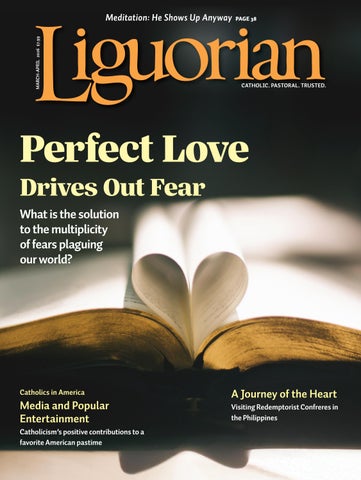
Perfect Love Drives Out Fear
What is the solution to the multiplicity of fears plaguing our world?
FR. RICHARD GRIBBLE, CSC
A Journey of the Heart
A priest chronicles his sacred encounters in the Pearl of the Pacific
FR. CHARLIE WEHRLEY, CSs R 16
CELEBRATING CATHOLIC CULTURAL HERITAGE IN AMERICA
Filipino Catholics in the US
Faith and culture have built a vibrant Filipino American Catholic community
FR. EUGENE TIONGSONBATUNGBACAL
Unity in the Spirit
How can we be sure that something comes from God?
FR. THOMAS M. SANTA, CSs R 24

PRAYING WITH THE MYSTICS

Darkness to Light—Death into Life
JEANETTE MARTINO LAND
CATHOLICS IN AMERICA
Media and Popular Entertainment
Catholicism’s positive contributions to a favorite American pastime FR. MATTHEW O’TOOLE
THE CATHOLIC OBSERVER
Your independent source of news and views on the Catholic Church
GARY GATELY
PRAYING WITH THE MYSTICS
Saint Gerard Majella, CSsR
Loving communion with the Most Holy Redeemer

MEDITATION
He Shows Up Anyway
Avoid mistaking the look of faith for the depth of it
PASCALINE ODOGWU
FICTION
A Prayer for Joy
Planning a funeral triggers a daughter’s pain and a saint’s patronage
MIRA GIBSON
Saint Gerard Majella, CSsR

Scott Czarnopys (“Face to Face”) is married to his beautiful wife, Arley, and has two children, Haven and Daxton. He is an elementary-school principal serving in his fteenth year at Saint Patrick School, a thriving semi-rural Catholic school in the Grand Rapids area of Michigan.

Fr. Peter D. Hill, CSsR (“Plain Talk”), is a Redemptorist missionary who has served as parish priest of Holy Cross Roman Catholic Church, Santa Cruz, Trinidad and Tobago; director of Holy Redeemer Retreat House, Dominica; and formation codirector at North American Redemptorist Formation House in San Antonio, Texas.


Fr. Michael McAndrew, CSsR (“Padre Migrante”), has served for thirty-plus years in Redemptorist Hispanic ministry initiatives, youth ministry, bilingual parish missions, and farmworker ministry. He works with the Catholic Migrant Farmworker Network, has directed a Campesino ministry, and recently published a book with Liguori Publications: Walk With My People: A Life in Migration Ministry (828720).


Br. Raymond Pierce, CSsR (“The Lighter Side”), is a native of Saint John, New Brunswick, Canada. His ministry is storytelling via email. Every week, he sends “Morning Smiles” emails of humor and personal stories to nearly 1,000 senior citizens.


Fr. Thomas M. Santa, CSsR (“A Word from the Publisher”), was named president and publisher of Liguori Publications in January 2024, his second assignment as the company’s leader. Professed as a Redemptorist in 1973, his ministries have included retreat work and writing re ections for the Scrupulous Anonymous newsletter.


Tim and Julie Smith (“Kitchen Table Gospel”) have been professional music ministers in the Phoenix area for more than thirty- ve years. They have written and recorded dozens of music collections, including liturgical music, theater music, children’s music, and bilingual music, and their songs have been published in multiple hymnals.


Adam Tran-Chung (“Social Media Perspectives”) is a student of the Redemptorists and is studying philosophy at St. John’s University in New York City. He is an accomplished concert pianist and organist and enjoys composing liturgical music. He is interested in exploring how social media can be used as a tool for evangelization.

Vinita Hampton Wright (“Redemptive Living”) worked in religious book publishing for more than three decades. She is retired and continues to write, edit, and present retreats and workshops on creativity, writing, and prayer. She works as a spiritual director in Northwest Arkansas.
God’s love is greater, more powerful, and more inclusive than any fear we might have.


Publisher

Wendy Barnes
Associate Editors


Fr. Thomas M. Santa, CSsR
Director of Digital and Creative Services
Fr. Byron Miller, CSsR
Paige Byrne Shortal
Andrew Tran-Chung, CSsR
Manuscript Editor
Amy Deputato
Director of Media
Fr. Charles Kumar, CSsR
Journalist
Gary Michael Gately
Design, Production, and Post-Production
Kate Brown
John Gantz
Kathy Lane
Director of Sales and Marketing, Liguorian Ad Sales
Chuck Healy
Sales and Customer Service Coordinator
Donna Hurley
Contracts, Rights, and Permissions
Emmy Sandstedt
Editor-In-Chief, India
Fr. Sandeep Menezes, CSsR
Editorial O ces
United States
200 Liguori Drive, Liguori MO 63057
India
Thomas Town Post, Bengaluru, India, 560084
© 2026 Liguori Publications, a ministry of the Redemptorists. All rights reserved. 636-464-2500. Liguori.org.
Unless noted, Scripture quotations are from The New American Bible, Revised Edition © 2010, 1991, 1986, 1970 Confraternity of Christian Doctrine, Washington, DC. Used with permission.
Subscription Questions?
Visit Liguorian.org. Call: 866-848-2492
Email: Liguorian@sfsdayton.com
Write: Customer Service, PO Box 292527, Dayton, OH 45429-0527
Print + Digital Subscription
One year: $38; Outside US: $53 (US funds only).
If you prefer that your name and address not be available to select organizations, please mail your address label to: Mail Preference Service, Liguorian, PO Box 292527, Dayton, OH 45429-0527.
Liguorian is available on CD from Xavier Society for the Blind, 154 E. 23rd Street, New York, NY 10010, or call 800-637-9193 for materials for the blind only.
Advertise in Liguorian
Call Oremus Advertising at 781-822-0680 or email evelyn@oremusadvertising.com.
Publication Mail Agreement #40112731.
Canadian Return Mail Request: PO Box 122, Niagara Falls, Ontario L2E 6S8 Canada
ISSN 0024-3450
Printed in the US at Kingery Printing.
Support Our Ministry
Please help us continue Liguorian and other Liguori Publications ministries by making a tax-deductible donation or remembering us in your will. Our legal title is Redemptorist Fathers dba Liguori Publications, Federal ID 43-0653409.

Liguorian is named after our founder and patron saint, St. Alphonsus Liguori (1696–1787), Doctor of the Church, bishop, patron of confessors, moral theologian, proli c writer, pastoral theologian par excellence, and founder of the Redemptorist Congregation. It is in his spirit and inspired by the charism he shared with us, “With him there is plentiful redemption for all,” that this magazine and all pastoral educational products of Liguori Publications proudly claim we always strive to be Catholic, Pastoral, Trusted.
To learn more about the Redemptorists, visit Redemptorists.com
An Arctic cold front, multiple snow squalls that each delivered a healthy accumulation of snow, and seven days of enforced solitude due to the COVID virus all conspired to invite me to consider a new perspective. I really had no idea that I needed a new perspective, but here I am, writing a column about a new perspective, so perhaps it was necessary.
I could have spent my time reading the books I have accumulated or flipping through television channels, but, for some reason, I did not choose that route. It felt quite boring and not at all challenging—when one of the manifestations of isolation is lingering fatigue, something out of the ordinary seems to be the obvious remedy. I rejected the “same old, same old,” as the saying goes, and looked for something different.
I am not a practiced scroller on my iPhone. Checking my Facebook account to see what’s going on with friends and family pretty much sums up my experience. I know little about Instagram, WhatsApp, TikTok, X—or, for that matter, any of the popular social media platforms—but I was determined to follow the suggested “threads” and see where the “reels” might lead. Was I in for a surprise!
I soon learned that synchronized dancing is a passionate expression of youthful exuberance. It was amazing to see how the human body can contort, stretch, and align. I can barely get my shoes on in the morning without risking a fall. I was also astounded by the many commentators—or “influencers”—competing for relevance. I also could not help but be amazed at how comfortable and effective younger people can be at using social media to make their presence felt, and how many older, more traditional content creators can appear “shrill.” The former group is appealing and attracts participation, while the latter group divides people into never-ending streams of “us versus them” comments—or so it seems to me.
A Word from the Publisher
FR. THOMAS M. SANTA, CSsR

Checking Facebook to see what’s going on with friends and family pretty much sums up my experience.
After a couple of days of scrolling, I became determined to stop. It was not an easy decision. There was always the possibility that the next reel would be engaging or even have necessary information, but stop I did. I needed the time to reflect on my experience and try to understand it. Had I just wasted my time, or had I been invited to learn something?
Considering my circumstances, “just wasting my time” would not have been such a bad thing because I had so much time to waste, but it was more appealing to imagine that I might have learned something. Upon reflection, I think I did learn something. It did not necessarily come from scrolling, but in a more traditional manner. A few days earlier, a friend of mine had sent me an article entitled, “Why Young Women Moved Left While Young Men Stayed Sane”—a catchy title that described the content of the article. Most important was not the article, which was argued from a well-defined position, but my friend’s closing comment: “And no one can prove otherwise unless they live in a bubble and ignore objective reality.”
GILLES LAMBERT / UNSPLASH
happens to be, to this day, the favorite Italian Christmas carol. It is a wonderful meditation. You will fi nd stories so rich in meaning that I think you will want to read them several times. And, of course, what would Christmas be without a fruitcake? You’ll fi nd one here!
I also extend to each of you, on behalf of our authors, editors, sales team, customer service representatives, IT technicians, and service providers—in short, the entire Liguori Publications family—our hopes and prayers for you this Christmas. May your family be blessed and safe, not only during the holiday season but also in the New Year to come.
He is correct, and it would be hard to argue otherwise. However, what he does not say is that most people do live in some kind of bubble, and that bubble blurs even objective reality. No one has the perfect all-inclusive, wise bubble. Scrolling through pages and reels of social media content that I never would have experienced without that time to waste is illustrative of this truth. This perspective, and I admit it is a perspective, is in fact an invitation to listen, to experience, to move outside your personal bubble and see what someone else sees. Could it really be as simple, and at the same time as profound, as the expression “Don’t judge a man until you’ve walked two moons in his moccasins” (based on lines from the poem Judge Softly by Mary T. Lathrap and popularized in Sharon Creech’s novel Walk Two Moons) ?
There are, unfortunately, so many places in our fragile world where a prayer of blessing and safety would be welcomed, but where hope seems dim. I think you will agree with me when I say that too many people, too many of our brothers and sisters in the human family, are deprived of what we take for granted each day. I hope this somber reality makes us even more grateful and encourages us, each in our own way, to help fi nd a way of peace for all of God’s people, no matter where they are.
In this issue of Liguorian, we share with you stories of ministry. Stories that describe the experience of spreading the gospel. Stories about men and women who engage with each other to celebrate their shared experience of faith and belief. Nothing necessarily earth-shattering, but important nonetheless. Just, at least from one perspective, ordinary people, doing ordinary things, to celebrate the ordinary presence of the grace of God in their midst. A
Merry Christmas! (English)
¡Feliz Navidad! (Spanish)
Joyeux Noël! (French)
Frohe Weihnachten! (German)
Had I just wasted my time, or had I been invited to learn something?
Buon Natale! (Italian)
Feliz Natal! (Portuguese)
To sign up for the free digital edition of Liguorian magazine, send an email to Liguori@liguori.org.


We can create one-of-a-kind sacred masterpieces for your parish or organization. And it is surprisingly affordable. Delivery in just 120 days.
Send Us Your Feedback!
Write: Liguorian Editor, 200 Liguori Drive, Liguori, MO 63057 E-mail: Liguorianeditor@Liguori.org
The opinions expressed don't necessarily re ect the opinions of the editors. Letters must be signed and include the writer’s full address and daytime phone number. Names will be withheld from publication upon request. The editors reserve the right to edit letters for length, clarity, and style.

Dear Liguorian Editor,


Christmas Gary


Kudos to Gary Gately for sharing a beautiful and touching story about his Dad (“The Ghost of Christmas Past,” NovemberDecember 2025). Every family has had their happy and hurtful moments at times. But Gary brought out the most memorable ones of his father, especially at Christmastime. It is these memories that keep our deceased loved ones here with us in spirit. Thank you, Mr. Gately, for opening up to us readers.
Read “The Ghost of Christmas Past” by Gary Gately. Available on Liguorian.org

Ken Neuser, a beloved longtime author for Liguorian, passed away in September 2025. Ken’s thoughtful meditations and entertaining ction graced the pages of Liguorian for many years. His last piece published in Liguorian was “Forever Fruitcake,” in the November-December 2025 issue. Ken and his writing will be missed by us at Liguori Publications. Rest in peace.

From Ken’s daughter, Teresa: Dad was in good health and good spirits up until the end. I had just spoken to him by phone that evening. He passed away peacefully in his sleep. May we all be so fortunate someday. Thanks to you and your wonderful editorial sta , his legacy lives on in his writing, his passion in retirement. His rst great-grandchild, Alexandra Kendall (named after him) was born on October 22, 2025. Can’t wait to read some of her great-grandpa’s Liguorian stories to her someday!
Dear Liguorian Editor,
I wish sometimes you would explain the covers. I have no idea what the cover means (Liguorian, November-December 2025). All the people do not look happy, but angry. Why all the cats? In the same issue, “The Ghost of Christmas Past” by Gary Gately was a wonderful story. I am saving it and putting it on my computer. Thanks for a great magazine.

Editor’s Response:
Thank you for your honest reaction to the November-December cover. You are not alone in wishing that artwork came with more explanation, especially when the expressions look intense or unsettling. We understand that the artwork can sometimes be puzzling, and we will keep your feedback in mind as we plan future issues.
Inset: Detail from the cover of NovemberDecember 2025 Liguorian magazine: art by Linda Pauline Schäpper. Visit lindaschäpperartlegacy.com for more information.
“Though faith is above reason, there can never be any real discrepancy between faith and reason. Since the same God who reveals mysteries and infuses faith has bestowed the light of reason on the human mind, God cannot deny himself, nor can truth ever contradict truth.”
“Consequently, methodical research in all branches of knowledge, provided it is carried out in a truly scientific manner and does not override moral laws, can never conflict with the faith, because the things of the world and the things of faith derive from the same God. The humble and persevering investigator of the secrets of nature is being led, as it were, by the hand of God in spite of himself, for it is God, the conserver of all things, who made them what they are.”
OF THE CATHOLIC CHURCH, 159
Sometimes, the words of the Catechism, although powerful and important, become even more poignant when an example from human experience illustrates what the Catechism teaches. Paragraph 159 is one such example and, with the story of Galileo Galilei (1564–1642), provides both the illustration and the drama.
Galileo was an astronomer, a teacher, and a strong advocate of heliocentrism—in the 1600s, it was still an idea, not yet an established fact, that the Earth moves around the sun. The Church did not object to studying or discussing heliocentrism as a mathematical model, but objected to asserting it as physical reality without proof. The Church feared that asserting heliocentrism as fact could undermine scriptural authority if Scripture appeared to be wrong. Nonetheless, despite being cautioned, Galileo insisted on teaching heliocentrism, and this brought him into conflict with the Church authorities.
In 1633, after much debate and a formal trial, Galileo was vehemently suspected of heresy, forced to recant, and sentenced to house arrest. Although he remained a Catholic until his death and received the sacraments,


Science did not contradict faith, and faith did not contradict science.


his conflict with the Church became a famous example of faith conflicting with science. It is a useful illustration of the understanding the Church teaches about the relationship of faith and science.
Three hundred and fifty years after the death of Galileo, between 1979 and 1992, Pope St. John Paul II ordered a full re-examination of the conflict and the decision. This Vatican re-examination concluded that Galileo was right scientifically and that the Church authorities failed to distinguish adequately between faith and the scientific method. Science did not contradict faith, and faith did not contradict science.
Importantly, the case is now often cited as a lesson in the limits of ecclesial authority in scientific matters, not as hostility to science itself. An important lesson for the 1600s, but perhaps even more of a lesson for our own time and place.
Excerpts from the English translation of the Catechism of the Catholic Church for the United States of America © 1994 United States Catholic Conference, Inc.—Libreria Editrice Vaticana; English translation of the Catechism of the Catholic Church: Modifications from the Editio Typica © 1997 United States Catholic Conference, Inc.—Libreria Editrice Vaticana
The season of Lent is here again, and as we make our journey through these forty days in the desert, I would like to propose we take St. Joseph, whose feast we celebrate on March 19, as our companion on the journey. Saint Joseph never speaks a single word in all of Scripture, but his presence is deeply felt in profound ways. He shows us that holiness does not require attention or applause. It requires trust, obedience, and the courage to keep showing up when the path is unclear. During Lent, when we are invited and challenged to simplify our lives and listen more deeply to the voice of God, St. Joseph becomes an ideal companion and model.
• Saint Joseph’s first great Lenten lesson is the practice of obedience in silence. When he learns of Mary’s pregnancy, his world is shaken. His plans are shattered, and nothing unfolds the way he expected. Yet, Joseph does not react with anger or self-pity; rather, he listens, he waits, and he tries to figure things out. He acts only when God’s angel speaks in his dream. Life often brings us face to face with disappointments, confusion, challenges, and situations beyond our control. Saint Joseph teaches us how to remain faithful in those moments without needing answers first.
• Saint Joseph also models the discipline of daily faithfulness. He does not perform miracles or preach sermons. He simply works, protects, and provides. His holiness is formed in ordinary responsibilities carried out with love. Lent invites us to examine not only our spiritual practices but also our daily habits: how we treat others, how we carry out our responsibilities, and how we show up dutifully as Christians. Saint Joseph reminds us that holiness grows quietly in our daily living and in the routines we often overlook.
FR. PETER D. HILL, CSsR

Joseph teaches us to trust. His prayer is lived rather than spoken.
• Saint Joseph helps us understand self-denial not as punishment, but as an act of availability. His life required constant surrender to God’s will as he abandoned his reputation, comfort, and certainty to care for Mary and Jesus. Lent asks us to fast; to loosen our grip on what makes us feel secure so that God can lead us more freely into a relationship with him. Saint Joseph shows us that surrender, while costly, creates space for grace.
• Saint Joseph teaches us to trust. His prayer is lived rather than spoken. He listens more than he talks. He responds more than he explains. During Lent, when prayer may feel dry or repetitive, St. Joseph reassures us that faithfulness matters more than feeling. God works powerfully through quiet trust.
• Almsgiving, too, finds a model in St. Joseph. He gives his life to the care of others. His generosity is not measured in money, but in presence, protection, and sacrifice. Lent challenges us to give ourselves more fully, especially when no one notices.
As we live this Lent, may we ask St. Joseph to guide and accompany us into a deeper relationship with Christ. A


WHAT IS THE SOLUTION TO THE MULTIPLICITY OF FEARS PLAGUING OUR WORLD?

FR. RICHARD GRIBBLE, CSC


Unquestionably George Herman (Babe) Ruth, figuratively known as the “Sultan of Swat,” or the “Great Bambino,” was one of the most colorful players to ever grace a baseball diamond. His exploits on the field, including his power hitting, are legendary. His various records stood for many years.
We know that Ruth spent his youth in St. Mary’s Industrial School for Boys in Baltimore, a Catholic school and home for troubled youth and orphans run by the Xaverian Brothers. Over the years, he moved away from his faith, but, as with most people, there came a time of reckoning. A November 2023 article written by Jacqueline Burkepile describes a night in December 1946, when the mighty Babe Ruth was in the hospital. Lying in the hospital bed, he remembered a passage from Scripture that the brothers had taught him: “Repent, for the kingdom of heaven is at hand.”
On this night, that passage had special meaning as he faced a serious medical procedure the next day. A good friend of his, Paul Carey, came to Ruth’s side and advised, “They’re going to operate in the morning, Babe. Don’t you think you ought to put your house in order?”
The former Yankee slugger saw the concern in his friend’s eyes and understood the gravity of the situation. For the first time, he realized it was very possible that death could strike him out. Remembering that passage from Scripture, he asked his friend to contact a priest.
That night, Babe Ruth spent a long time speaking to Jesus with the priest’s assistance. When he finished, Babe had made a full, humble confession, holding nothing back. He later reflected, “As I lay in bed that evening, I thought to myself, what a comforting feeling to be free from fear and worries. I now could simply turn them over to God.”
Babe Ruth’s experience serves as a catalyst for all who follow Jesus to turn our lives over to him and to truly believe that God’s love can conquer all

anxiety and stress. The perfect love of God drives out all fear.
“There is no fear in love, but perfect love drives out fear because fear has to do with punishment, and so one who fears is not yet perfect in love” (1 John 4:18). The beloved disciple’s words are consoling, but they also pose a significant challenge. The consolation, of course, is that God’s love is greater, more powerful, and more inclusive than any fear we might have. God’s love can conquer any manifestation of fear that may plague us. Clearly, those who seek to follow the ways and teachings of Jesus Christ need to believe with conviction that, indeed, the Lord can overcome any obstacles we face—no matter how high we must climb to overcome hurdles or how long we must persevere to outlast the pain we experience. This is indeed a privilege, but it comes with responsibility.
The responsibility—the challenge— that St. John presents us with is finding the confidence in the Lord to believe in his perfect love. In an increasingly complex world, possessing the confidence necessary to place our burdens at the feet of Jesus and allow his perfect love to help us is difficult.
Fortunately, sacred Scripture is filled with examples of people of faith who placed their fears and worries at the feet of the Lord, whose deep love casts out fear. Imagine the fear and consternation that Moses must have felt when he arrived at the Red Sea while leading the Israelites out of captivity in Egypt. Pharaoh and his army were hot on their trail. Pharaoh exclaimed, “What in the world have we done! We have released Israel from our service!” (Exodus 14:5).
Assuredly, Moses was fearful. The community he was leading could easily be slaughtered, and all his efforts would be for naught. But, despite the fear, he went forward because of his total trust in and love for God. He had the conviction that the Lord would not allow his chosen people to die in the desert. Thus, he proclaimed to the people, “Do not fear! Stand your ground and see the victory the LORD will win for you today” (Exodus 14:13a).
Recall the story of the prophet Elijah and his encounter with the prophets of Baal. (See 1 Kings 18:21–40.) Elijah, a solo prophet, was matched against 450 opposing prophets. Despite the obvious disadvantage, Elijah placed his total
trust in Yahweh; he was confident that God would answer. He prayed, “LORD, God of Abraham, Isaac, and Israel, let it be known this day that you are God in Israel and that I am your servant” (1 Kings 18:36). His trust and love were so great that he even taunted the prophets of Baal, both verbally and by his actions. God answered Elijah’s prayer, consumed the sacrifice in fire and proved unquestionably that he was the one and only true God.
The exploits of Judas Maccabeus in 1 and 2 Maccabees provide another example of perfect love casting out fear. The desecration of the Temple by the Greeks and the apostasy of many Jews inspired Judas and his brothers, along with their followers, to place their total trust in Yahweh. Even in defeat, their manifestations of perfect love for God cast out the fear they most assuredly experienced, allowing them to go forward to fight and die bravely in the name of the Lord. (See 1 Maccabees 9:11–22.)
The New Testament provides several more examples of how people of faith were able to cast out fear through their perfect love of God. Saint Mark tells the story of Jesus calming the storm at sea (Mark 4:35–41). The apostles, at this point in their relationship with Jesus, were most likely uncertain about him. Who was this miracle worker who taught with such authority? Their love at that time was imperfect, but after their experience with Jesus on the Sea of Galilee, there was no possibility that they did not understand and believe that Jesus was God. As St. Mark ends the story, “They were filled with great awe and said to one another, ‘Who then is this whom even wind and sea obey?’” (Mark 4:41).
Perfect trust and love for God was clearly demonstrated when four men brought their paralytic friend to Jesus, opened the roof of the house where Jesus was, and lowered the man down in front of him. (See Mark 2:1–12; Luke 5:17–26.) Jesus compliments the men;
March-April 2026 // Liguorian.org
he “saw their faith” (Mark 2:5). Their complete trust and love cast out all fear, erasing what people might think or say about Jesus.
Place y r ars and w ries at the et of the L d, whose deep l casts t ar.
The Roman centurion’s strong faith allowed him to approach Jesus with his passionate appeal: “Lord, my servant is lying at home paralyzed, suffering dreadfully” (Matthew 8:6). When the Lord offered to come and cure him, the centurion’s love and faith was manifest in an even greater way when he replied, “Lord, I am not worthy to have you enter my roof; only say the word and my servant will be healed” (Matthew 8:8). Once again, perfect love drove out fear.
The Contemporary Challenge Contemporary society is, unfortunately, plagued with many manifestations of fear. On a more global scale, especially in the last couple of decades, we fear those who perpetrate terror. Recall the fear we felt on
September 11, 2001, when hijackers commandeered four airplanes, driving three of them into buildings and, because of the courage of passengers, driving the fourth plane into the ground. Over 2,000 innocent people died. And there have been numerous other acts of terrorism—people bent on destroying lives simply out of hatred for a particular ideology or government—including the attack on Bourbon Street in New Orleans on New Year’s morning, 2025.
On a personal level, we are afraid of crime, which continues to plague the world, especially in urban areas. People are rightly fearful about their financial futures; they wonder if they will be able to pay their bills, keep a roof over their heads, and meet the needs of their children. Too often, we hear that people are only one missed paycheck away from being homeless. The future is obviously uncertain, and, therefore, it brings a sense of fear to many. Adrift in a sea of fears, it can feel, at times, like we’re drowning.
What is the solution to the multiplicity of fears that plague our world, seek to derail us from living peaceful daily lives, and inhibit us from pursuing future goals? To place our total trust in God—to seek perfect love for God! On a secular level, back in 1933,


God’s l is greater, m e p rful, and m e inclusi than any ar might ha .


President Franklin D. Roosevelt famously said, “The only thing we have to fear is fear itself.” Of course, President Roosevelt was speaking to a nation mired in the depths of the Great Depression, and he sought to rally people to greater heights and to believe there was an answer to their financial misery. Scripture gives us even better answers. Jesus himself gave us a direct solution: “Do not be afraid; just have faith” (Mark 5:36). The author of the Book of Proverbs presents a similar challenge: “Trust in the LORD with all your heart, on your own intelligence do not rely” (Proverbs 3:5).
The perfect love we must seek should begin within. Too many people have a poor image of themselves. They look in the mirror and say to themselves, in essence, I am inadequate. The Golden Rule says we are to love God with all our being and love our neighbor as ourselves. (See Mark 12:30–31.) Thus, to carry out this basic Christian message, you must love yourself. It might sound a little cliché or simplistic, but the expression “God doesn’t make junk,” is true. As the Lord says, every hair on our heads is counted. (See Matthew 10:30.)
Perfect love requires us to love others and ourselves. Our sincere out-


reach of love to others will necessitate, for many, the spirit of forgiveness. We must let go of past hurts, both those we have caused and those perpetrated against us. If we do not let them go, then our growth is stunted. We’re like prisoners in a chain gang from an earlier era who, when on a work detail, were chained together at the ankles so they could not run away. We must cut the chain of past hurts to achieve perfect love.
Certainly, manifesting love is not easy, but Jesus never promised that the Christian life would be an easy road. In contrast, he told his disciples, “Whoever wishes to come after me must deny himself, take up his cross, and follow me. For whoever wishes to save his life will lose it, but whoever loses his life for my sake will find it” (Matthew 16:24–25). In his book What’s Wrong with the World , the famous British writer and convert to Catholicism G.K. Chesterton put the challenge this way:


“The Christian ideal has not been tried and found wanting. It has been found difficult and left untried.”
It took some soul-searching for a fallen-away Catholic like Babe Ruth to recall his roots and, when he realized he might die, to seek a way to cast out the fear that surrounded him. He found his answer by speaking to the Lord and placing at Christ’s feet the fears, concerns, and tribulations that were holding him hostage. Today’s world, often fearful and dark, can capture us in a similar grip of fear if we’re not careful. This fear can prevent us from moving forward and being the person God has called us to be—what the popular Catholic writer Matthew Kelly calls “the best version of ourselves.”
There is a solution, and his name is Jesus. Let us give him our perfect love, and the Lord’s response will offer us peace today and eternal joy in the life to come.
Fr. Richard Gribble, CSC, was a professor of religious studies and theology at Stonehill College for 27 years. He graduated from the United States Naval Academy, then earned Master of Divinity and Master of Sacred Theology degrees from the Jesuit School of Theology, followed by a PhD from the Catholic University of America. He is the author of numerous historical and spiritual works and is currently in residence at the University of Notre Dame.


Abigail Favale


A successful college professor in her thirties has achieved everything she’s strived for—everything other than happiness.
One winter day, in the face of unexpected news, she returns to her isolated hometown a er a long absence. Torn by conicting desires, she must face both a present choice and a past that won’t stay hidden, culminating in an encounter that will leave her forever changed.
A haunting, evocative exploration of freedom and temptation, of fear and love, of the lies women tell and the lies women have been told. It is a spiritual and psychological thriller that maps the darkest terrain of a woman’s soul—her capacity for reckless abandon and self-deception, but also for heroic love.
OLOSP . . . Sewn So cover, $17.95
“Gritty, nuanced, and beautifully told. An unsparing, philosophical novel in which good and evil wage war within a modern-day agnostic woman. It deserves a wide audience.”
Rhonda Ortiz, Novelist and Editor, Dappled ings
“An intensely psychological story. A deliciously atmospheric, and occasionally spine-tingling, read.”
—Sally Read, Poet and Author, Night’s Bright Darkness
“With relentless, surging candor, Favale’s mystical realism lays open the inner consistency of so many paradigmatically female experiences.” — Katy Carl, Author, As Earth Without Water
◆
Abigail Favale weaves personal experience with expert knowledge, providing an in-depth yet accessible account of the gender paradigm: a framework for understanding reality and identity that has recently risen to prominence. Favale traces the genealogy of gender to its origins in feminism and postmodern thought, describing how gender has come to eclipse sex, and how that shi is reshaping language, law, medicine, sexuality, and our own self-perceptions. GGP Sewn So cover, $18.95


David Pinault
A reclusive librarian seeks quiet by volunteering at an animal sanctuary in South Africa but instead encounters a young Chinese dissident eeing Beijing’s Communist State Security, as well as wildlife poachers and a criminal pangolin-tra cking network that extends from Johannesburg to Hong Kong and Cambodia.
As urgent as tomorrow’s headlines, Earth Dragon Run propels us from San Francisco to the African bush, from Hong Kong to Vietnam, and on to a dramatic confrontation amid the jungle ruins of ancient Angkor.
EDRP Sewn So cover, $18.95
“Intricate and fast-paced. It provides a fascinating window into the alarmingly real world of animal tra cking, totalitarianism, and the deepest con icts of the human heart.”
Eleanor Bourg Nicholson, Author, A Bloody Habit and Brother Wolf
“A vastly entertaining thriller. A ragtag band of heroes nd themselves in a deadly battle of wits against one of the most powerful manifestations of evil in today's world.”
Michael Norton, Author, A Hiker’s Guide to Purgatory
David Pinault presents a compelling novel about Robert Howard who created big characters— Solomon Kane, Conan the Barbarian—who shaped fantasy ction for generations. But Howard would never know it. In 1936, at the age of thirty, he shot himself. is novel imagines the strange underworld journey of Howard a er his suicide, involving occult conspiracy, dark forces, and the writer H.P. Lovecra .
PRBLP Sewn So cover, $19.95

Pope Francis famously said, “I want a Church which is poor and for the poor. They have much to teach us. Not only do they share in the sensus fidei, but in their difficulties they know the suffering Christ. We need to let ourselves be evangelized by them” (Evangelii Gaudium, 198). In his apostolic exhortation Dilexi Te, Pope Leo XIV calls attention to the poverty of Jesus. He was the “Messiah of and for the poor” (DT 19). Jesus was not of the middle class, but born in a stable, presented in the Temple with the offering of the poor, a laborer, and an itinerant preacher. His message was, “Blessed are you who are poor, for the kingdom of God is yours” (Luke 6:20). Pope Leo XIV continues, “I often wonder, even though the teaching of sacred Scripture is so clear about the poor, why many people continue to think they can safely disregard the poor” (DT 23).
In his message for World Day of Migrants and Refugees 2025, titled “Migrants, Missionaries of Hope,” Pope Leo writes, “In a world darkened by war and injustice, even when all seems lost, migrants and refugees stand as messengers of hope.”
I have been privileged to hear many stories from these “messengers of hope”—messages that offer me hope in a world that sometimes seems hopeless. I’ll share just two of those stories here:
• It was after Mass on Easter Sunday, when I asked a fourteen-year-old migrant, “What motivated you to leave your country of origin?” He said, “After they killed my father and my brother, I knew I had to leave.” His mother and grandparents sent him to the border, hoping he would survive. With no money and only the realization that it was not safe to stay in his home, he began his journey. Several weeks later, he arrived at his uncle’s home. He came to Mass to thank God for his safe passage. Gratitude in the midst of such a struggle! How can we who are sheltered, fed, and safe not be grateful?
FR. MIKE Mc ANDREW, CSsR

“In a world darkened by war and injustice, even when all seems lost, migrants and refugees stand as messengers of hope.”
• A woman told me of her journey as a refugee from Guatemala. After three weeks of danger, hunger, confinement, and abuse, she arrived in the United States to be reunited with her husband. She spoke of her arduous journey as simply the cost of migration. Her husband said, “I ask God every day to forgive me for not being able to protect her on the way.” Today, she and her husband assist couples preparing for marriage in their parish. Their story is about being faithful in “good times and in bad.” Such faithfulness is not destroyed by poverty and knows no borders.
Who are the “missionaries of hope”? They are the legions of migrants who carry hope when all seems lost. The challenge of the Church is to stand with them. Padre Lupe, a priest in Michoacán, Mexico, said of people leaving his village, “It is desperation, not hopelessness, that forces people to enter the world of forced migration. It is hope that moves a person to cross deserts, rivers, and oceans to seek life in another country.” A
—Pope Leo XIV


Fr. Charlie Wehrley, CSsR


In 2020, shortly after I became communications director for the North American Conference of Redemptorists, I received friend requests on Facebook from Redemptorists around the world. Many of these requests were from Filipino Redemptorists, and, over time, I was drawn to their personalities, creativity, sense of mission, and sense of humor as well as the goodness I saw in their hearts. Saint Alphonsus said, “The paradise of God is the heart of man.” I experienced that paradise myself in the hospitable hearts of the Filipino Redemptorists and in the hearts of the other Filipino people I met.
Travel Marathon, where Redemptorists serve Catholics in remote areas of the Philippines.
After deciding to meet my Filipino confreres, I messaged Fr. Eric and asked what time of year would be best for me to visit. He recommended the third week of January, when Cebu celebrates Sinulog: the festival of the Santo Niño, or the Child Jesus. So, I planned accordingly.
The next day, I had an unexpected spiritual experience. I had traveled to the Philippines to meet and share time with my confreres there, so I presumed the trip would be social and would give me a chance to learn more about their ministries. But I unexpectedly encountered God in incredible ways.


Over a five-year period, from 2020 to 2025, I became friends with thirtysix Filipino confreres. My first Redemptorist friend from the Philippines, Fr. Eric Soliven Sevencruz, CSsR, is currently the director of RAMM (Redemptorist All-Access Media Ministry). He also has ministerial responsibilities at Our Mother of Perpetual Help Church in Cebu and participates in the Mission
Upon my arrival at the airport in Cebu, I was greeted by a Sinulog welcoming committee, and one of the ladies placed beads around my neck. I was happy to meet Fr. Eric face to face after having communicated with him through Facebook Messenger since 2020.
From the airport, we headed to the Redemptoristine convent to celebrate the birthday of Sr. Alice Agosto, another Facebook friend. There are many very gracious Redemptoristines in their community, most of them young. At the luncheon, I met another cyberspace friend, Fr. Deriz, vocations director for the Redemptorist Province of Cebu. Later, I toured Holy Family Retreat House, located on the same grounds as the convent.
At the provincial house where I stayed, I met several other Redemptorist internet friends. Near the provincial house is Our Mother of Perpetual Help Church and St. Alphonsus Apostolic and Formation Community (which includes the Philosophy House).
My first such encounter happened at one of the eleven daily novena Masses at the Basilica of the Santo Niño. Fr. Edilberto Cepe, provincial of the Cebu Province of Redemptorists, presided at the 4:00 PM novena Mass, and we all concelebrated with him. The basilica itself can’t accommodate the tremendous crowds that show up for the novena Masses, so people gather in a large courtyard with bleachers on both sides of a stage set up with an altar.
As we stood on the platform at the beginning of the Mass, I looked in awe at the thousands of people in attendance at one of the hottest times of day. (The temperatures during the trip were in the 80s with 100 percent humidity


every day.) Gazing at all the faces was overwhelming. I had never seen so many Catholics gathered to celebrate

a Mass. I began to choke up, and tears flowed from my eyes. It’s happening again as I type this. It was one of the most incredible spiritual experiences of my life to see so many devoted, faithful people gathered to honor God. And this was at just one of the eleven novena Masses that day.
The original statue of the Santo Niño still exists. It was brought to the Philippines in 1521 by Ferdinand Magellan as a gift to Cebu’s ruler, Rajah Humabon. It was through the Santo Niño that Magellan was able to begin the Catholic conversion of the Filipino people. Today, it’s estimated that the Philippines is somewhere between 86–92 percent Catholic.
The Basilica of the Santo Niño was founded in 1565. Special liturgical prayers were later approved by Pope Innocent XIII (1721–1724), who designated the third Sunday of January as the annual feast day of the Santo Niño. I was one of the more than four million people who gathered in Cebu for the feast in 2025. In recent years, the feast day had been honored by Pope Francis, who celebrated Mass at the Basilica in Cebu for the Feast of Santo Niño in 2015.
After the novena Mass, the streets were filled with souvenir and food booths, and people celebrated well into the evening. Saturday and Sunday featured processions and parades with dancers from around the country dressed in native costumes. The biggest parade was held on January 19, the actual feast day of the Santo Niño.
On the morning of January 19, I concelebrated the Mass for the feast of Santo Niño with Fr. Eric at Our Mother of Perpetual Help Church, which was another profound spiritual experience—not only because the church was filled with the faithful but also because I know Fr. Eric better than any of my other Filipino confreres.
Fr. Eric is a very gifted person and a remarkable Redemptorist. He’s an artist who paints beautiful images of


Redemptorist saints and others, like St. Francis of Assisi and St. Ignatius Loyola. He has T-shirts imprinted with the saintly images he has created—he calls the shirts “Devo+TEES”—and sells them to support the province. In addition, Fr. Eric creates short meditations on Scripture for social media and is a composer of beautiful hymns. He assembled a vocal group of four Redemptorists, including Father Provincial Cepe, called VIVAT. The group performs many of Fr. Eric’s songs live in concert around the country and also in recorded performances.

worked with the poor. I always looked forward to seeing the photos he posted on social media, and it was good to finally meet him in person.
At the Theologate, I was the welcomed guest at the weekly student gathering. All seventeen theology students introduced themselves, and I


The day after the Feast of Santo Niño, I flew to Davao City. The Theologate for the Province of Cebu is on the grounds of Davao City’s Our Mother of Perpetual Help Church. There, I met Fr. Jesus Sanito, CSsR, a formation director that I had gotten to know through Facebook.


talked with various students while the others were singing along with karaoke. Filipinos generally love to sing, and many have good singing voices.
Brother Michael “KM” Tubog, CSsR, was my guide in Davao City. I’ve known him for about five years. I spent one of those years captivated by his ministry in rural areas of Vietnam, where he
Iloilo
After three days in Davao, I flew to Iloilo: the first place in the Philippines where the Novena to Our Mother of Perpetual Help was prayed. Eighty
years ago, in 1946, the novena was brought to the Philippines by American soldiers following World War II.
I visited St. Clement’s Church and St. Clement’s Retreat House, where Redemptorists and lay partners had assembled for a workshop on Alphonsian spirituality. Later that evening, the Festival of Lights was amazing, with hundreds of multi-colored lanterns hanging across the streets. There was also a parade and fireworks.
On Saturday and Sunday, we visited the Molo area of town, with its lovely square between the Jaro Cathedral and a beautiful church dedicated to Our Lady of Candlemas. On the fourth Sunday of each year, Iloilo celebrates a festival called Dinagyang, which is somewhat like Cebu’s Sinulog (Festival of Santo Niño), perhaps with more emphasis on local history.


People in the Philippines have a unique tradition of beginning their Christmas celebration in September. They celebrate through all the “-ber” months, as they are fond of saying. In Cebu, the Christmas season ends after the Feast of Santo Niño; in Iloilo, the Christmas season ends after the Dinagyang Festival.
We attended parades on three consecutive days. We also celebrated the grand opening of the province’s own travel agency, called Copiosa Travels and Pilgrimages, which offers journeys to sacred destinations.
Manila I then flew to Manila to visit our Shrine to Our Mother of Perpetual Help in Baclaran. The massive shrine seats 2,000. During various feast days and Wednesday novenas to Our Mother of Perpetual Help, the church is often packed with
standing room–only crowds. The impressive modern shrine is open twenty-four hours a day, every day.
For the two days I was in Baclaran, I saw several beautiful churches built in the 1600s. It was incredible experiencing the solemnity of these churches and their histories. The next day, I spent some time with the viceprovincial of Manila, Fr. Raymond Urriza, CSsR.
On Wednesday, January 29, I had a flight back to Cebu and needed to leave for the airport at 6:00 AM. On Wednesdays, the Redemptorists celebrate the Novena to Our Mother of Perpetual Help, with ten services every Wednesday. The first is at 5:30 AM, so I was able to attend. As I walked from the rectory to the shrine, I saw that people were already standing in the very large vestibule and the pews were filled. Again, I had never seen

anything like it in my nearly thirty years of being a Redemptorist. On my way back to the rectory, I again choked up, and tears streamed down my face, like what had happened to me at the Santo Niño Basilica in Cebu. Both times, it was as if the Holy Spirit had wrapped around my heart and touched that place in my soul that is sometimes barren.
On my flight back to the United States, I thought about the deeply spiritual experiences that had caught me off guard and affected me emotionally to the core of my soul. We never know how God is going to work in our lives, but it’s usually in unexpected ways.
I am thankful for the great hospitality, generosity, and friendship of the many Redemptorists who welcomed me so warmly in the Philippines. It was wonderful to meet those confreres I have known online for several years as well as those I had not encountered through social media but was blessed to meet during my visit to the Philippines. Our Filipino Redemptorists are very spiritual, very dedicated to their ministries, very loving of heart, and very fun to spend time with. I hope to return sometime in the not-too-distant future.

po and Viva Pit Señor!
Fr. Charles Wehrley, CSsR, is a Redemptorist priest and retreat director at the Redemptorist Renewal Center in Tucson, Arizona. He directs retreats across the United States, specializing in Twelve-Step recovery retreats.


In this four-part series, we look at various cultural groups and the thriving Catholic communities they’ve established in the United States.


FR. EUGENE TIONGSON-BATUNGBACAL


Afewyears ago, I embarked on a mission adventure with college students to a remote town in New Mexico, where it was an hour-long drive to the nearest gas station. When we arrived at the parish, the pastor greeted us with a big smile and a sincere welcome. He seemed delighted to see me because he was eager to introduce me to my fellow kababayan (countrymen/countrywomen) in his parish. With a shared sense of culture and community, I began to converse with them in Tagalog, my native language. Our conversation flowed effortlessly. It felt as if we were old friends who had been apart for far too long. We exchanged stories that reflected our unique experiences as Catholic Filipinos living in the United States.
Filipinos add a unique thread to the rich tapestry of Catholicism in this country. Many dioceses, clergy, and parishes can testify how this dedicated community plays a vital role in the local church, organizing events and activities that keep the spirit and devotion of the faith community alive and thriving.

The cultural heritage and Catholic identity of Filipinos in the United States are an example of how culture and faith intertwine and build upon each other. Each is perfected by the dynamic experience of humanity and purified by the action of the Holy Spirit.
likeness of God in the people who celebrate a particular cultural heritage. This recognition leads to a communion of persons, a mutual exchange: “If, at first, we saw God beginning from man, we now learn to see the human person beginning from God,” wrote John P. Hittinger in his 2021 article for Communio International Catholic Review, “John Paul II’s Core Teaching on Culture (1979—1980).”
In 1999, in its document “Towards a Pastoral Approach to Culture,” the Pontifical Council for Culture wrote, “The evangelization of cultures and the inculturation of the gospel go hand in hand, in a reciprocal relationship which presupposes constant discernment in the light of the gospel.” Pope St. John Paul II noted in his book Crossing the Threshold of Hope, “The gospel lives in conversation with culture, and if the Church holds back from the culture, the gospel itself falls silent.” In other words, the gospel message of faith,
e thriving li s of lipino Cath ics in the US is truly a testim y of what this c ntry stands f : “In God We Trust!”
hope, and love must mirror what the culture is showcasing in light of the teachings of Christ. Culture must allow itself to be transformed by Christ lest it fall short of the grace of God.
Faith and culture become a sacred union that gives witness to a world where everyone is called to share in the gift of diversity—which is rooted in the truth that God has created each person in his image and likeness. The gift of our common baptism marks us as members of the family of God and, as such, heirs to God’s kingdom. Together, we build a place where the beauty and uniqueness of culture is celebrated, and the Divine Revelation who is Jesus Christ is proclaimed in the sacramental celebration and universality of our Catholic faith.
According to a 2015 study by the United States Conference of Catholic Bishops (USCCB), 63 percent of the Asian and Pacific Islander Catholics in the US are Filipino Americans. This high percentage confirms the deep devotion among Filipino Catholics in this country. Their presence offers opportunities for greater understanding, unity, and welcome.
Sinulog, Flores de Mayo, Simbang Gabi


When we encounter others from different cultural backgrounds, our experience is enriched. Through meaningful interaction and cultural exchanges, strangers become friends. This encounter opens the door to the beliefs, values, and traditions of others, fostering empathy and promoting a sense of community and solidarity, especially toward marginalized groups.
Likewise, faith involves recognizing the image and
One of the most celebrated events of the Philippines in the United States is the Sinulog Festival, held annually in various locations, which features a vibrant dance honoring the Santo Niño, or the Infant Jesus. This lively celebration is marked by participants dressed in colorful costumes and storytelling through a dance ritual that narrates the history of Christianity in the Philippines, creating a captivating spectacle that draws thousands of attendees.


Another significant tradition is the Flores de Mayo, a month-long celebration that occurs each May. This floral festival commemorates the discovery of the Holy Cross by Queen Helena of Con- Helena


stantinople and is celebrated with beautiful processions and the presentation of flowers to the Virgin Mary. The event often includes the participation of children, who dress in traditional attire, adding a youthful charm to the festivities while highlighting the deep reverence for the Blessed Mother in Filipino culture.


Additionally, the Simbang Gabi, which means “Night Mass,” is a cherished nine-day novena that leads up to Christmas. During this time, Filipino Catholics attend early morning Masses, often in the dark before dawn, as a way of preparing spiritually for the celebration of Christ’s birth. This tradition not only fosters a sense of community but also serves as a reminder of the hope and joy that accompanies the Christmas season. Many Catholic churches in the United States—especially parishes with a large Filipino presence—have adopted this famous devotion as an integral part of their Christmas tradition.


A combined celebration of the Sinulog Festival and Flores de Mayo at St. Joseph Parish in Wright, Michigan, organized with the Philippine Cultural Group of Michigan (PCGoM).
In today’s reality of migration, the lives of Filipino Catholics in a country that adopted them as their own can be seen as a parable. It’s a story about human longing to engage with God, who made it possible for Filipinos to be in the United States in the first place. Jesus said, “For I was...a stranger and you welcomed me” (Matthew 25:35). When we receive those we do not know with love, this love moves us to cross boundaries and welcome the stranger.
In God We Trust A thriving motivation for inculturation among Filipino Catholics in the United States is their concept of pakikipagkapwa. This is translated literally as “being neighborly,” but it means much more than simply being part of the neighborhood; rather, it implies building community. It stems from the hearts of all Filipino Catholics who desire to be good and faithful followers of Jesus Christ, sharing their experi-


The thriving lives of Filipino Catholics in the United States is truly a testimony of what this country stands for: “In God We Trust!”

ences with others through cultural exploration and testimonies of faith and worship.
Filipinos regard each person as a gift of God who demands respect, love, and harmony. Pakikipagkapwa is their way of living out the great mandate of Christ when he said, “You shall love your neighbor as yourself” (Matthew 22:39). This concept also strengthens the bonds and the motivation to build bridges between the two countries, where mutual respect and recognition of each other’s dignity is just and necessary.


Like the first Filipinos who came to this country, the first colonial settlers took a chance to migrate to this land and make it their own. They built this country on a powerful foundation and the profound principle stated in the Declaration of Independence that “all men are created equal, that they are endowed by their Creator with certain unalienable Rights, that among these are Life, Liberty, and the pursuit of Happiness.”
Filipino Catholics who have been welcomed in the US stand on the same foundation and principle, acknowledging that all are created in the image and likeness of God, with the right to defend the sanctity of life, celebrate the joy of freedom, and pursue the happiness that can only be achieved when all people proclaim, “In God We Trust.”
Fr. Eugene Batungbacal has been a priest for fteen years and was born in the Philippines. He is currently the canonical administrator for two parishes and an elementary school in the Diocese of Grand Rapids, Michigan. He has led missions throughout the United States and in Honduras, and he has extensive experience in pastoral care for youth and young adults, especially within Hispanic communities.
As we approach Easter, the season of hope and renewal, we remember that Christ’s prayer for his followers is “that they may all be one.” (See John 17:20–26.) Christian unity can be difficult, divided as we are by theology and practice. However, ecumenism is meant to be personal and entrenched in our local community. I am embarrassed to say that I allowed fifteen years to go by without meeting the pastors of the largest Protestant congregations in our area. However, when I joined my pastor, Father Tom, at a meeting with one of those local pastors, it was a reminder that unity starts with a handshake and conversation around shared mission.
In our community, two of the larger congregations are my parish, St. Patrick Parnell, and a local Wesleyan church, Impact Church. This church is well named, as it has had a major impact in the local community. The congregation once worshipped in the local YMCA, and now they gather in an impressive downtown worship space and community center. It’s a beautiful and inviting building, with hospitable people welcoming all who enter, and the congregation provides impressive service to youth and the greater community. Pastor Jason has served as the lead pastor for just over five years, and there is no question why the congregation has grown under his leadership. He has served on the team since the church’s founding and helped build it into what it is today. He understands the overall Christian mission in our community; he’s a partner in it.
Our conversation was not about differences in theology, but about shared social concerns. We discussed our love and hope for the next generation and how they are hungry for faith, tradition, and authenticity. We talked about how important it is to encourage and support other leaders in the community, particularly at our schools, as the social world for kids is so different from our own experiences. And we discussed the importance of leading people to Christ and bringing people together while many are isolated and alone. All these topics were met with a sense of urgency.
SCOTT CZARNOPYS

What is our common goal?
Certainly to keep the conversation going.
What is our common goal? Certainly to keep the conversation going. Maybe we launch initiatives together, invite our youth to engage in service or go to camp together, hold prayer vigils in the community, or support our schools through prayer. Maybe we just shake hands and appreciate that we share the same mission of making the community better for all.
I’m grateful for our conversation and the realization that ecumenism can be made local and practical. It’s not about merging institutions but about unity in service, a commitment to supporting our schools, and a willingness to share Christ with others as we offer hope in the midst of pain and suffering. When Christians respond to Christ’s command to be one, as he and the Father are one, goodness wins over evil. This Easter, let’s seek out opportunities to demonstrate collaboration despite our differences, unified in Christ’s endless love. A


HOW CAN WE BE SURE THAT SOMETHING COMES FROM GOD?
FR. THOMAS M. SANTA, CSsR


Rememberthe story of the Tower of Babel? You can read all about it in the Book of Genesis, chapter 11. If you have not read it, or cannot remember it, now would be a good time to review the story.
According to the story, a long time ago, the people who lived in ancient times were all united, even to the point where they spoke only one language throughout the world. They were also somewhat arrogant. They decided to build a tower that would take them up to the place where God dwells.
When they were building the great tower, the Lord struck them down, scrambled their language, and made it impossible for them to understand each other. The Lord scattered the people and sent them out to the farthest reaches of the earth.
Remembering the story of the Tower of Babel, recall now the story of the first Pentecost. You can read all about Pentecost in the Acts of the Apostles, chapter 2. Take some time now to read the story or reread it to refresh your memory.
The story of Pentecost is similar to the story of the Tower of Babel, but with the opposite results. The story of Pentecost gathers people of many languages and cultures, people from all over the known world, and unites them. Their unity—a unity so profound that they all understand each other—is a unity found only in the person of Jesus, through the power of the Holy Spirit. In other words, the story of Pentecost teaches us that the old days are over, the old ways are over, and the disunity and the alienation that had dominated the people of the earth since ancient times have been wiped away. The way now open before the people of God, because of the gift of the Holy Spirit, is the way of unity, cooperation, and the fullness of the promised kingdom of God.
Pentecost—the coming of the Spirit of God—however that event occurred for the first time in the lives of the apostles and the disciples, is intended to be a gift from God. As a gift, it is freely
and powerfully offered to the Christian community not only on the original day of Pentecost but also again and again. Because the coming of the Spirit of God is a gift, it is only offered to us; it is not forced upon us. As such, there is no guarantee that we will accept the offered gift. There is no guarantee that, if we accept it, we might not abuse the gift. There is no guarantee that we will use the gift to make sense of the babble and the alienation. There is a real possibility that we may misunderstand the gift of the Spirit, and, instead of helping us focus on what the people of God need for unity, it will contribute to the noise and the distraction, scattering us and pulling us in different directions.
Come, Holy Spirit, ll the hearts of your faithful and make the re of your love burn within them. Amen.
The Spirit of God does not intend to divide or to confuse, but it is nevertheless a risk. It is a risk because, with the manifestation of the Spirit, we need yet another gift: the gift of discernment. This is the ability to determine what is from God and what is not. Discernment is very difficult because it often brings us face to face with our own fears, judgments, perceptions, opinions, and all those other human attributes. It takes a very patient, a very prayerful, and a very wise person to discern the movement of the Spirit of the Lord. It also takes a very patient, a very prayerful, and a very wise person to speak to the people of God with confidence and with the assurance that what they are teaching comes from God and reflects the will of God.
Realizing that the Spirit of God comes to us—the people of God—as a gift, and accepting that we need to prayerfully discern the manifestation of the Spirit of God, what signs we can look for? How do we know that what we are being taught and the direction
in which we are being led are from God? This is not an idle question; rather, it is very important. As people of faith, we need some assurance that what is being asked of us comes from God and is a clear reflection of the will of God at work in our lives.
We know that one of the questions asked by Martin Luther and others who we today identify as the Protestant reformers was exactly this question: How can we be sure that something comes from God? Despite the persistence of this question, though, there has not been a clear answer that all Christians have found acceptable.
The tradition that grew out of the Protestant reformers’ question insisted that real discernment could be guaranteed only by sacred Scripture. The tradition that grew out of the Protestant reformers’ question with a Catholic twist was that real discernment could be guaranteed only by sacred Scripture and the teaching of the Magisterium— the pope and his bishops. And that is exactly where we are today, with both perspectives fueling the current controversies about the moral issues of our time.
Some 2,000 years after the first manifestation of the Spirit of God, has the gift of the Spirit united us as one people, clearly focused on the kingdom of God, or are there still scattered and alienated remnants of the people of God around us? If you experience the unity and the fullness of the Spirit, then do so with a grateful heart. If, on the other hand, you believe we are not experiencing the promised oneness and are instead living in disorienting disunity, then what do you do? What is the expected response? What is the prayer of the people of God today, in this place, in our time and circumstance?

Fr. Thomas M. Santa, CSsR, is the president and publisher of Liguori Publications, his second assignment as the company’s leader. Professed as a Redemptorist in 1973, his ministries have included retreat work and writing re ections for the Scrupulous Anonymous newsletter.


YOUNG
LORENA REYNOSO
Saint Michael the Archangel Catholic Church in Erwin, Tennessee, was established by the Glenmary Home Missioners of America, and they continue to staff our small parish in rural Appalachia. In the summer, middle school–aged youth from St. Michael parish spend five days in a program called Faith in Action Team (FIAT). It allows them to be the hands and feet of Jesus in working selflessly for others. The youth do service projects, learn about social justice, strengthen teamwork skills, and participate in daily Mass. It’s also a week of fun and games while doing what Jesus taught us to do.


In FIAT, each day begins with Mass, during which the youth take active roles in the liturgy. After the Eucharist, one group stays on the parish grounds, while another goes out into the community. The groups switch assignments so that everyone has an opportunity to participate in the different projects.


es where needed; for example, by helping elderly or disabled parishioners at their homes. Last year, we helped a retired Navy commander clean his yard. The youth were out in the heat, pulling weeds, cleaning flower beds, and carrying rocks to form weed barriers around trees, and they did this hard work without complaining. The veteran and his wife were thankful for the work and grateful for the company the youth provided, and they showed their appreciation by making ice-cream sodas for the youngsters.
The youth also visit an elderly woman’s home every year, and she waits excitedly to see them each time. She is grateful for the work they do but even more so for the company they provide. Often, our time given as a gift is more valuable than anything else.


The projects at the church are always tangible—something that the youth can later see, reminding them of their role in the betterment of our parish. In the past, they have constructed classroom benches, planted flowers in the Mary Garden, made crosses for the Stations of the Cross walkway, and created peace poles to decorate the grounds.


The young people also play an active role in the community by offering servic-


The young people also assist various organizations. For example, they recently helped at the local animal shelter, feeding the animals, cleaning out the cages, and maintaining the facility. The animal shelter staff was thankful for the muchneeded assistance. In addition, they painted shelves and organized clothes at a community resource center, and they picked up trash along a walking trail to make it a more inviting space. Hard work does not stop these young people!


ing and with a choir of roosters singing. For the young people, this is a new experience plus an opportunity to witness the sacrifice these men make for their families and how they continue to practice their faith even when they’re away from home.
Learning about social justice teachings is also a vital component of the FIAT program. Kathy O’Brien, a Glenmary Lay Missioner, incorporates the lives of the saints into her lessons each day—in particular, saints who are relatable to young people, such as Toribio Romo González and Carlo Acutis. Many of the youth in FIAT have a family member who, at one point, was an immigrant like St. Toribio Romo. Likewise, they can identify with St. Carlo because of their age similarity and how he used his computer skills to promote his Catholic beliefs.


The youth enjoy celebrating morning Mass with migrant farmworkers and then distributing the fresh-baked cookies that they made for them. The farmworkers appreciate this small act of kindness, especially because many of them have been away from their families for months. The youth also benefit from experiencing Mass in a different setting, as this Mass takes place in an old barn without heat or air condition-


Darlene Donzella has been leading FIAT for the last four years. She and other members of St. Michael the Archangel parish spend countless hours planning, implementing, and chaperoning the FIAT program. If the greatest gift someone can give another is their time, then these devoted parishioners are shining examples! Without the efforts of so many in the program, the youth would not have the opportunity to give a small part of their summer vacation to serving others—not only as the hands and feet of Jesus, but with his heart as well.


JEANETTE MARTINO LAND Eucharistic Poetry


Noisy crowds jeering, mocking, their reviling words reverberating in the crowded, cramped, cobblestone streets of Jerusalem.


Merciless soldiers persist in beating the already bruised, battered, bleeding Body of the One who claims to be God’s Son.


The hour of cruci xion is come. Darkness descends, earth trembles.
Jesus cries out, “It is nished.” And God dies into God.


But it was not nished!
The greatest work of God, the saving power of God, is revealed in the dawning of the third day.


The faithful women nd an empty tomb!


Angels tell the terri ed women, “He has been raised just as he said.” Jesus is risen!

The Light has conquered the darkness of sin and death. Love is alive and comes to us:
Love lives in us in Eucharist! Alleluia! Alleluia! Alleluia!


Martino Land is a freelance writer and a member of St. Paul of the Cross Catholic Church in Singer Island, Florida. As a Passionist Associate, she presents Days of Prayer, and she and her husband, Jack, have made two missionary trips to Haiti. Jeanette has two sons and one granddaughter.


In this six-part series, we commemorate America’s 250th anniversary by celebrating Catholicism in the United States.
CATHOLICISM’S POSITIVE CONTRIBUTIONS TO A FAVORITE AMERICAN PASTIME FR. MATTHEW O’TOOLE


Across the centuries, Catholic culture has always made room for entertaining distractions in the lives of the faithful. Religious holidays shared space with secular amusements, such as Carnival before Lent or morality plays staged inside churches. In the United States, however, some religious leaders saw the rise of media entertainment as competition for the attention of their flocks. Movies and television were sometimes at odds with messages being preached from the pulpit. But not everything on the screens led the faithful astray. There were observant American Catholics who made positive contributions to the entertainment of their day.
In 1927, Daniel Lord, a young Jesuit


priest, found himself a consultant on Cecil B. DeMille’s silent film King of Kings. Moving pictures were then unregulated in the content they projected to American theatergoers. Father Lord observed, “Just how far vice may be presented in order to make virtue triumphant is one of the most delicate problems in art.” He drafted the moral standards that were used by the Production Code Administration (PCA), which began in 1930 and was later headed up by Catholic layman Joseph Breen. The added pressure of the Catholic Legion of Decency, founded in the early 1930s, which could call for a boycott of movies they deemed “condemned,” led Hollywood studios to adopt PCA standards for decades.
Between the 1930s and 1960s, America witnessed what has been called the “Catholic Moment.” During this

period, the Church had a very significant, and perhaps even decisive, role in shaping the nation’s public life. This was especially true of several movies with a Catholic flavor, some of which won Academy Awards: The Bells of St. Mary’s, Going My Way, and On the Waterfront. Catholic actors channeled their childhood role models by taking on characters like Bing Crosby’s Father O’Malley or Spencer Tracy as Father Flanagan in his Oscar-winning performance in Boys Town
Likewise, in the theater, writers made an effort to get it right in depicting the sometimes-hidden life of Catholics. When Richard Rodgers and Oscar Hammerstein were refining their musical The Sound of Music, set in part in an abbey convent, they relied on Sister Gregory Duff y, OP, who ran a college drama department in Illinois and was a lover of musicals. In a 2012 article on the Library of Congress’ performing arts blog, In the Muse, author Cait Miller discusses how Sister Duff y


helped Rodgers and Hammerstein depict the life of religious women and how she reacted to some of the characters and music. The theater duo followed her advice and produced a hit for both stage and screen.
Television may have vied for the Church’s attention of families in the home, but Archbishop Fulton Sheen captured up to thirty million viewers a week, according to the Archbishop Fulton J. Sheen Foundation’s website (celebratesheen.com). His first TV program, Life is Worth Living, ran from 1952 to 1957 and used a conversational approach and chalkboard illustrations to discuss moral and religious topics. Sheen’s show became one of the nation’s top-rated programs. His success was so great that he won an Emmy Award in 1953 for Outstanding Television Personality and was featured on the cover of Time magazine, making him America’s best-known Catholic priest at the time.
Ed Sullivan was raised in a poor Irish community in Harlem, New York City. He rose to prominence first as a journalist, then as host of the Sunday night TV fi xture The Ed Sullivan Show. A showcase of song, comedy, and acrobatic performances, the show found talent agents competing to get their clients featured on Sullivan’s stage. But in an era of uneasy feelings about race, Sullivan faced challenges. Major advertisers dropped their sponsorship because he insisted on featuring African American entertainers on national television. Sullivan’s strong Catholic upbringing and childhood experiences of feeling inferior imbued him with a spirit of justice. His faith and decency allowed a parade of Black artists to vault to fame by appearing on his show.
American Catholic showpeople also put their talents at the service of charity. Danny Thomas was a remarkable example of philanthropy. Raised in the Lebanese Maronite Catholic tradition, Thomas made a vow to St. Jude, the patron saint of lost causes, to build a shrine if the saint would help Thomas’
career. Thomas became the star of a long-running television sitcom and made good on his promise to St. Jude: the legacy of his faith is the


nationally known pediatric research center in Memphis which focuses on care of children with cancer and other catastrophic diseases.
Some television programming played on Catholic stereotypes of piety, almost to the point of absurdity, like The Flying Nun. But there were also media-savvy Catholic institutions, like the Paulist Fathers, who took to the airwaves to address contemporary issues. Their program Insight, which ran from 1960 to 1984, addressed the moral dilemmas of the day. Many prominent and rising actors were featured in the show’s storytelling, which used comedy, melodrama, and fantasy to explore issues with viewers.
William Peter Blatty’s fictionalized telling of a documented exorcism in the United States exploded on American pop-culture scene in 1971 when his novel The Exorcist piqued the public’s interest in demonology and exorcism. The sensational depiction of evil in the movie version sparked conversations about faith and the paranormal. For the
post-Vatican II Church, some saw The Exorcist as a challenge to a more modern faith that was less focused on the supernatural; others believed it helped reinforce the real threat of demonic power on the world.
Good and evil, virtue and vice— themes prevalent in Catholic spirituality—have inspired movie directors like Martin Scorsese. He has credited his Catholic faith for the way he presents many of his characters and stories. While Scorsese’s films often lean into the dark places of sin and guilt, other Catholic celebrities offer humorous takes on the faith. Comedians like Stephen Colbert, who comfortably takes up religious topics on his late show, and Jim Gaffigan, whose familyfriendly observations about life, share with their American audiences a lighthearted perspective on being Catholic.
The increasing secularization of US culture and the declining number of churchgoers in recent decades may have contributed to fewer portrayals of Catholicism in mainstream popular entertainment. Still, TV viewership in America escalates when there is coverage of an alluring Church spectacle, like a papal conclave or a pope’s visit to the country. And that can be holy theater worth watching.


Rev. Matthew O’Toole is a priest of the Archdiocese of Saint Louis, a pastor, and a past instructor of modern European history.
Let’s talk about what it’s like—or what it might be like—to live as a follower of Christ, based simply on Jesus’ example and words in the gospels.
• Jesus was about good news, not bad news. He identified his mission on earth as proclaiming the Good News and liberating people from various human afflictions. He did not start with, “Hey, you all are sinners.” He just didn’t. Of course, he dealt with sin, but that was not his starting point.
• Jesus did not judge and condemn. When given the opportunity to carry out Jewish laws of punishment, such as stoning an adulteress (See John 8:1–11.), he did not. He also said, “Stop judging, that you may not be judged” (Matthew 7:1). He told the truth about evil and the natural consequences of evil ways, but he also told Peter that, essentially, there should be no limit to how many times Peter was to forgive someone. (See Matthew 18:21–22.) He also stated that he did not come into the world to condemn it but to save it. (See John 12:47.) Wow.
• Jesus urged us to be fearless. He said, in various ways, “Don’t be afraid. Don’t be anxious. Trust your heavenly Father’s love and providence.” He wanted us to have faith and spiritual confidence and not to panic when faced with new situations or challenges.
Those are just three examples, but I will explore them for myself, and you can listen in.
VINITA HAMPTON WRIGHT
Am I confident every day that God’s love embraces me— no matter what?

Do I lead with good news? Or do I complain and moan about the state of the world? Which of these takes up the most space in my mind and heart? If I choose to lead with good news, what will that look like in my interactions, my reactions, my conversations with people?
Do I refrain from judging and condemning? How many times have I said, “There’s a special place in hell for people who do thus and so”? How many times have I looked for faults in people, including fellow believers, because of their politics or the way they approach and talk about faith? When I meet a person, do I inwardly judge them based on their appearance or way of speaking? Or do I approach them with holy curiosity, wanting to know their story, their gifts, their dreams?
Am I fearless? Am I confident every day that God’s love embraces me—no matter what? Or do I become undone in the presence of people who are different from me or who disagree with me? Do I panic at every change (for example, artificial intelligence) that occurs in this evolving life? Here’s a question: Did God see this AI thing coming?
I confess that a dark outlook, judgmentalism, and fear are still too present in my life. But, having faced the truth, I can ask for God’s help to become more and more like the Jesus who loves me. How about you? A
JACOB LUND / SHUTTERSTOCK

“THE GOOD OF THE BELOVED VENEZUELAN PEOPLE MUST PREVAIL OVER EVERY OTHER CONSIDERATION,” THE PONTIFF TOLD THOUSANDS OF PEOPLE GATHERED IN ST. PETER’S SQUARE.
Pope Leo XIV expressed “deep concern” over the US military’s capture of Venezuelan president Nicolás Maduro and his wife while calling for respect for the nation’s sovereignty and protection of human and civil rights.
“The good of the beloved Venezuelan people must prevail over every other consideration,” Pope Leo told thousands of pilgrims gathered in a rain-soaked St. Peter’s Square. “This must lead to overcoming violence and taking up a journey of justice and peace, guaranteeing the sovereignty of the country, ensuring the rule of law enshrined in the Constitution, respecting the human and civil rights of all, and working to build a peaceful future of cooperation, stability, and harmony.”
The first US-born pope’s comments, at the end of his Angelus address, came a day after predawn US military raid in Venezuela’s capital, Caracas, culminating in the capture of Maduro, and his wife, Cilia Flores, at their home. Maduro and Flores appeared before a US District Court judge in New York to face federal drug trafficking and other charges. During a brief hearing, broadcast on monitors outside the courtroom, the sixty-three-year-
old Maduro and Flores pleaded not guilty, and Maduro, speaking in Spanish, told the judge, “I’m innocent. I’m not guilty. I am a decent man. I am still president of my country.”
The Catholic publication Crux, meanwhile, reported that Pope Leo and Vatican diplomats are closely monitoring the Venezuela situation and international reaction and that if the pope is taking cues from anyone about how to respond, it would be Venezuela’s Catholic bishops.
The bishops, along with the nation’s Catholic priests, have often spoken out against the Maduro regime and demanded the release of political prisoners.
Since the raid, which killed dozens of people, the bishops have condemned all forms of violence and urged prayers for peace, but they have not commented directly on the US military action or the capture of Maduro and his wife.
Read the full story at thecatholicobserver.substack.com
To sign up for The Catholic Observer newsletter at no cost or for a paid individual or group subscription, please type this line into your web browser and follow the instructions. thecatholicobserver.substack.com
YOUR INDEPENDENT SOURCE OF NEWS AND VIEWS ON THE CATHOLIC CHURCH
“We are One”—At a Jesuit
THE 33RD ANNUAL NEW YEAR’S EVE INTERFAITH PRAYER CELEBRATION DREW MORE THAN 300 PEOPLE TO THE HISTORIC ST. IGNATIUS CHURCH.
The shofar—the hollowed-out ram’s horn blown as a spiritual trumpet in Jewish tradition—delivers a raw, primal scream.
“From the sound of a wild animal, it is a cry from the depths of the Earth, from our psyche, the deeper language, a wail, a yearning, a deep prayer,” Rabbi Emily Stern said at the annual New Year’s Eve Interfaith Prayer Celebration at St. Ignatius Church in Baltimore.
“The great shofar…[brings] us together from all directions, a call for connection in the age of alienation, a prayer to awaken from fragmentation and remember that we are united,” said Stern, the spiritual leader of Kol HaLev Synagogue in the Baltimore suburb of Lutherville. “We are actually reflections of each other. We are each other. We are one. The shofar’s cry is harsh because it is a wakeup call for the world.”
On a frigid night, more than 300 people—Catholic, Presbyterian, Lutheran, nondenominational Christian, Jewish, Muslim, and Buddhist clergy, community

leaders, and members of the public—heeded that call, continuing a thirty-three-year-old tradition at St. Ignatius, the 170-year-old Jesuit church in Mount Vernon, just north of downtown Baltimore.
The ninety-minute service began with Imam Earl El-Amin of Baltimore’s Muslim Cultural Center singing a Christian hymn, “O Spirit, All-Embracing,” before reciting in Arabic the Adhan, the Muslim call to prayer, closing with the words “There’s no God but God.”
Rabbi Yerachmiel Shapiro of Moses Montefiore Anshe Emunah Hebrew Congregation, just outside the city, sang the Sim Shalom prayer in Hebrew—a meditation for peace that observant Jews recite three times daily: “Bless us, our Father, all of us as one, with the light of your countenance.”
Marlene Robinson, a teacher at the Kadampa Meditation Center in Baltimore, offered a 2,600-yearold Buddhist prayer: “You, who love all beings without exception, are the source of happiness and goodness. And you guide us to the liberating path.”
The Reverend Lauretta Halstead of the nondenominational Kingdom Worship Center in the Baltimore suburb of Towson sang “Lift Every Voice and Sing,” then prayed: “We ask you, Lord God, that you would remind us all of our common humanity, that we might not stray to the hands of greed, to the hands of pressure, to the hands of division, to the hands of hatred, but that we might walk in and live in hope.”
For his part, the Reverend Yuriy Pylpchak, pastor of St. Michael the Archangel Ukrainian Catholic Church in Baltimore, offered prayers for the people of war-ravaged Ukraine “as they defend their ancestral homeland from aggression” and for peace throughout the world. Read the full story at thecatholicobserver.substack.com
Rabbi Yerachmiel Shapiro, who leads the Moses Montefiore Anshe Emunah Hebrew Congregation in Baltimore, blows a shofar at the 33rd annual New Year’s Eve Interfaith Prayer Celebration at St. Ignatius Church in Baltimore. (PHOTO: GARY GATELY)

Gary Gately is the founder and editor of The Catholic Observer, a subscription-based newsletter. Gately, a lifelong Catholic, is an award-winning journalist who has written for The New York Times, The Washington Post, The Guardian, the National Catholic Reporter, America: The Jesuit Review, Newsweek, The Baltimore Sun, The Boston Globe, the Center for Public Integrity, CNBC.com, and United Press International. Please email news tips or suggestions to Garymichaelgately@gmail.com.
The Brave Shepherd of Ireland 87–461 * Feast day: March 17
Patron of Ireland, migrants, and engineers
One day, while walking along the beach in western Great Britain, sixteen-year-old Patrick was captured by pirates! They took him to Ireland and sold him as a slave. Patrick had to work hard in the elds, tending sheep, and he missed his family terribly. But he never lost hope. He prayed to God every day. One day, he heard God’s voice telling him to escape. Patrick bravely ran to the sea and found a ship ready to take him home.
After returning home to Britain, Patrick could not forget the people of Ireland. He felt God calling him back to teach them about Christ. He spent many years studying, and he became a priest and nally a bishop. When he was ready, he returned to Ireland—not as a slave, but as a missionary.
Patrick traveled all over Ireland, sharing his message. Many people were angry with him because he was teaching a new faith, and they often tried to stop him. But Patrick’s courage and faith were unshakable.
He used the shamrock, a small green clover with three leaves, to explain the Holy Trinity: God as the Father, the Son, and the Holy Spirit. The people of Ireland began to love him for his kindness and his way of making complicated ideas simple.
Saint Patrick’s virtues of faith, hope, charity, justice, and determination made him a hero. He overcame many obstacles to bring his message to the Irish people. He started hundreds of churches and inspired countless hearts with his bravery and dedication.


Ingredients
Nonstick cooking spray
1 pound loose breakfast sausage
2 cups roughly chopped spinach
1 (32-ounce) bag frozen hash brown potatoes
8 large eggs
1 cup heavy cream ½ cup milk
Instructions
1 teaspoon garlic powder
½ teaspoon paprika
Pinch ground sage
1 teaspoon kosher salt
½ teaspoon ground white pepper
1 cup sharp cheddar cheese
1. Preheat the oven to 375°F. Coat the bottom of a 9 x 13inch baking dish with nonstick cooking spray.


To celebrate St. Patrick’s incredible journey and his love for the people of Ireland, enjoy this hearty Irish Green Breakfast Casserole. Packed with potatoes, sausage, and green spinach, this dish will energize you for the adventures ahead, just as Patrick’s faith nourished the people of Ireland. Remember St. Patrick’s story and let him inspire you to be brave and trust God’s will for your own life.
2. In a large skillet, cook the sausage over medium heat until browned, breaking it up with the side of a spoon. When the sausage is fully cooked, stir in the hash browns and cook until the potatoes are tender, stirring occasionally. Add the chopped spinach and continue cooking until the leaves are just wilted.
3. In a large bowl, whisk together the eggs, cream, milk, garlic powder, paprika, sage, salt, and pepper. Then, whisk in the cheddar. Stir in the sausage/potato/spinach mixture.
4. Pour the mixture into the prepared baking dish.


5. Bake until the top is browned and the center is set, about 45 minutes.


Saint Patrick, pray for us!
6. Remove from the oven and serve warm. Store leftovers in a covered container in the refrigerator for up to two days.
Saintly Bites for Children: Mixing Faith, Fun & Family Time in the Kitchen ©2025, Shelby Siegfried; illustrated by Ted Schluenderfritz (828744, Liguori Publications). To order, visit Liguori.org or call 800-325-9521.
Just as prayer, fasting, and almsgiving are the common foci for the season of Lent, there are three “anti-symbols” that may get in the way.
Mirrors: Our comparison culture is always focusing on “image management.” Sometimes, self-reflection is necessary, including glancing at ourselves in a mirror. As cantors, we certainly check our appearance before stepping out in front of the congregation. But the mirror also can invite us to see how inadequate we are. The evil mirror, and the accompanying dangerous self-worship, is rampant in storytelling and fantasy, from Snow White to Lewis Carroll’s Alice stories to the Harry Potter series. Mirrors point out imperfections, echo lies of ugliness, remind us of shameful extra pounds or blemishes. The tempter uses mirrors to distract, devalue, and deceive. Maybe this Lent, instead of looking in a mirror, we should gaze into the eyes of our Creator, who loves us just as we are.
Screens: The addictive nature of screens is well documented. Screens are part of our world today, and we are not going back to the telegraph, or TVs with only three channels, or even video-rental stores (remember those?). But putting phones out of reach at the dinner table, in the bedroom, in church(!), and in the presence of others with whom we might have a meaningful conversation could go a long way as a Lenten spiritual practice. The convenience of listening to inspiring podcasts and spiritual material is undeniable, but scrolling out of boredom is addictive and destructive. Fasting from technology, even for one day a week, may be better than giving up chocolate.

Shopping: Have you ever had a conversation about a certain something, and then your cell phone lights up with a notification from a shopping app or social media platform about that very thing? We may think it’s a coincidence. It’s not. If we want something, one click can bring it to us, along with the burden of too much stuff in our homes and too little in our bank account. Every convenience store, gas station, and supermarket overflow with candy, energy drinks, junk food, and those ever-present lottery tickets that buy us a fleeting moment to dream about the life we might have if we won. As I wait to check out at the grocery store, I count seven types of M&Ms: regular, peanut, almond (Julie’s favorite), peanut butter (Tim’s favorite), pretzel, caramel, and cookies and creme. There is no hunger, thirst, or craving that we don’t try to satisfy with shopping—except the longing for God, for a life of purpose, and for peace and hope and charity.
There are three “anti-symbols” that may get in the way of focusing on what’s important during Lent.
The things that can truly fulfill us cannot be found in a mirror or on a screen or in a bag of M&Ms. Maybe this Lent we can consider a sacrifice that will bring us closer to the source of authentic love, who will certainly meet our deepest needs. A

Saint Gerard Majella, CSsR
b. April 6, 1726, Muro, Italy; d, October 16, 1755; canonized December 11, 1904; feast day October 16
Introduction
Gerard’s only ambition was to be like Jesus Christ in his sufferings and humiliations. After futile attempts to become a Franciscan and then a hermit, he entered the Congregation of the Most Holy Redeemer (Redemptorists) in 1749. Two years later, he made his profession, and he added to the usual vows one that bound him to always do whatever seemed to him more perfect. Although weak in body, he did the work of three, and his great charity earned him the title Father of the Poor. He was so drawn to our Lord in the tabernacle that he had to do violence to himself to keep away. An angel in purity, he was accused of a shameful crime, but he bore the calumny with such patience that St. Alphonsus said, “Brother Gerard is a saint.” He was favored with infused knowledge of the highest order, ecstasies, prophecy, bilocation, discernment of spirits, and penetration of hearts. When he accompanied the priests on missions or was sent out on business, he converted more souls than many missionaries. He predicted the day and hour of his death. A wonderworker during his life, he has continued to be the same since his death.
Consider, I beg you, the brevity of the world and the lastingness of eternity. Think that everything comes to an end. Everything is finished for those who live in the world; it’s as if they had never been there. As a result, what good does it do to lean on what cannot sustain us? So, all these things that do not carry us to God are all vanity, and they can be of no use to us for eternity. How poor is the person who trusts in the world and not in God.
Saint Gerard demonstrated how to live always united to the Most Holy Redeemer. By word and example, he challenges us to:

“How poor is the person who trusts in the world and not in God.”


SAINT GERARD MAJELLA, CSsR

• give witness by our life on the necessity of loving God, “who alone deserves to be loved. How could we live if we were not to love our dear God with our heart?”
• be sensitive to the harshness and difficulties that the poor and those most in need face every day.
• never lose focus on God, in whose contemplation Gerard was so immersed that he spoke like a profound theologian on the highest mysteries of our faith, the Holy Trinity, and the Incarnation.
• conform our will to God’s will, above all things. This was Gerard’s permanent aspiration, even on his deathbed. He told his confessor, “I imagine that I am united to the will of God and that I am confined to this bed as if I had been nailed to the very will of God. Still more, I imagine that God’s will and I are one single thing.” Posted on the door of his room was a sign he had written: “Here the will of God is done, as he wishes and as long as he wishes.”
If I am lost, I lose God. And what is left for me to lose once I have lost God? Lord, make the faith in the Most Blessed Sacrament especially alive in me.
So, I trust and hope in God alone, since in his hands I have placed my whole life so that he may do with it what he wishes. I am, then, alive, but without life, because my life is God.
I trust in God alone, and only from him do I hope for help in fulfilling truthfully what I promise him here. Long live Jesus and Mary. Amen.
ALL QUOTES FROM SAINT GERARD MAJELLA: HIS WRITINGS AND SPIRITUALITY, TRANSLATED BY PETER HEINEGG, LIGUORI PUBLICATIONS (866500), 2002
As we enter Lent, a season that invites us to prayer, fasting, and almsgiving, how do we clear the noise so that we can hear God speaking to us? Specifically, how do we adjust our exposure to social media in order to fully observe, even celebrate, this season?
Every Lent, Catholics around the world ask, “What should I give up for Lent this year?” Often, the answers are things like chocolate, coffee, or soda. We give up these things only to resume them once more—spiritual dieting, if you will. For Lent this year, what if we examined our social media use?
Social media has a particularly powerful influence over our lives. It shapes our thoughts, often before we can examine them, and prompts us to react rather than reflect. Without noticing, we begin to read everything—from newspapers, novels, even the Scriptures—with the same impatience that finds us scrolling from one social media post or page to another. This isn’t just distraction. It’s deformation—prompting our hearts to bend in the direction of what we habitually consume.
Lent is a season of renewal and reformation, a time to allow God to reshape the desires that may have drifted. In a world where the “digital noise” never stops, one of the most countercultural things we can do is to allow ourselves to be quiet. Lent is the Church’s way of inviting us into the desert: a place where the distractions fall away.
Now, before you go deleting your Facebook page and Instagram account, that is not what I’m suggesting. This Lenten fast is about recognizing that not everything deserves our attention. Perhaps, this year, we should scale back on our social media use. Try limiting our scrolling. Try fasting from commenting in anger. Perhaps we can unfollow accounts that lead us down the dark path of comparisons, judgments, or despair. When we do this, we let the Spirit of God work in us as we peruse the internet.

These acts may create a stillness within us and allow us to breathe, pray, or become more aware of our surroundings. This is the true essence of Lent: to make room for God by letting go of distractions. The Lenten digital fast is all about making room for reflection by stepping away from constant reaction. Making room for interior renewal by embracing an exterior simplicity.
Too often, prayer is not our first priority. Many of us check our messages and notifications before we pray or even before we get out of bed. We consume before we listen. Lent calls us back into a certain balance that invites us to turn toward God first. Perhaps, during this Lent, let your fast be this: use social media, but don’t let it use you. Let it serve you rather than shape you. Because, when we do this, we are creating room for God to work in us and reshape us. A


AVOID MISTAKING THE LOOK OF FAITH FOR THE DEPTH OF IT
PASCALINE ODOGWU
There’s a version of faith that photographs well.
It wears flowy linen, drinks matcha, and reads devotionals beside perfectly lit candles.
Its Bible is pink and slim, filled with pastel highlighter marks and handwritten notes in cursive.
Colorful bookmark papers stick out like petals in bloom. Every verse underlined looks like a promise fulfilled.
It’s the kind of quiet time that trends on reels, with soft music playing, sunlight through the curtains, clean journal pages, and steady hands.


And sometimes, when I see it—I feel like I don’t belong.
Because my faith doesn’t always look like that.
Sometimes, it’s barefaced and unfinished.
Sometimes, it forgets to pray before meals.
Sometimes, it cries itself to sleep and doesn’t have the strength to speak in tongues or raise a hallelujah.
And yet…it’s still real.
Sometimes, praying isn’t getting on your knees with your eyes shut tight.
Sometimes, it’s just sitting on the floor, knees pulled to your chest, talking into the air.
To a stranger, it looks like nothing. A monologue. A girl rambling into silence.
But to you, it’s everything. You feel it.
That quiet fire that pushes your words forward. That strange relief that comes after saying things you didn’t even know were inside you.
You just know he’s there.
No lightning. No holy echo. Just conviction without proof.
Faith.
And then, there are the days you’re not in church. You’re not dressed up.
You go to your room, close the door, and sing.
You worship with cracked voice and outstretched hands, not to impress, but to empty.
And somehow, giving him glory gives you something back.
Fullness. Fulfillment. A heart that doesn’t feel so heavy anymore.
This is prayer too.
This is church too.
Even if no one sees it.
Even if it doesn’t sparkle. Sometimes, I wonder when faith started needing filters.
When it stopped being a sacred stretch between me and God and became something that had to look beautiful, like proof.
He’s not limited to Instagrammable altars.
He shows up in messy rooms, rushed mornings, undone prayers, and imperfect people.
He shows up in me.
He shows up when I help people, when I do something kind for someone, just to see him smile.
When I gave that homeless man my food, even though I knew I’d be hungry, but I also knew I had more waiting at home.
He shows up when I compliment a teenager who is struggling with confidence.
When I buy water for tired blue-collar workers sweating under sun and silence.
He shows up in these unpolished, unposted moments, where love speaks louder than performance, and kindness becomes a kind of worship.
And now, everyone is suddenly a judge.
A curator of what Christianity should look like.
Of how it should feel. Sound. Dress. Speak.
God shows up in messy rooms, rushed mornings, undone prayers, and imperfect people.
Like if your devotion didn’t come wrapped in gold pens and well-lit quiet-time corners, it didn’t count.
It’s not that any of those things are wrong.
There’s nothing bad about a pink Bible or well-organized faith journal.
But somewhere along the way, we started mistaking the look of faith for the depth of it.
I’ve had days where I felt ashamed of how my faith looked:
No routine. No fresh sermon. Just me, on the floor, saying, “God, I’m tired.”
And I’ve had weeks where I didn’t open my Bible, but, somehow, I still felt held.
Still caught glimpses of him—in the kindness of a stranger, in the song that found me on the bus, in the silence that didn’t abandon me.
Because the Spirit doesn’t only move in curated places.

And when my peach pink doesn’t look like their bubblegum pink, I am condemned.
Even though it’s still pink.
Even though it still carries softness. Still carries belief. Still carries love.
But because it isn’t bright enough, or loud enough, or public enough, it’s seen as less.
Faith, to them, has become a performance.
And when I don’t clap on cue, they decide I’m not in tune.
But I know this isn’t truth…it’s a mirage.
A shiny, fragile version of holiness that crumbles when life gets real.
Because real faith isn’t always aesthetic.
It’s not always morning light and coffee devotionals and Scriptures perfectly underlined.
Sometimes, faith is a voice cracked from crying.
Sometimes, it’s lying still on your bed and whispering, “God, I’m here.”
Sometimes, it’s holding onto love when you don’t feel it.
Sometimes, it’s just not leaving.
So no! My faith doesn’t always sparkle.
But it breathes.
It weeps.
It reaches.
And God has never once turned away. A
Pascaline Odogwu is a Nigerian writer, poet, and nursing student whose work explores faith, healing, grief, and quiet resilience. She writes lyrical personal essays rooted in emotional truth and spiritual reflection, and she has been featured frequently in Spirituality and Health. She writes as both caregiver and witness.

PLANNING A FUNERAL TRIGGERS A DAUGHTER’S PAIN AND A SAINT’S PATRONAGE
MIRA GIBSON
Joystood beneath the overhang of Quiet Reflections Funeral Home, trying with all her might not to quietly reflect on the mess that had become her life. Instead, she sucked on a cigarette and studied the late-morning fog as rain ticked against her slacks. It was coming down sideways, thanks to the strong coastal winds on this side of Maine.
Her dad was dead.
She pulled hard on her cigarette and ran her finger across the small, ovalshaped scar on her cheek. She swore that she would never come home, but here she was, back from the big city to be a good daughter for her dead dad.
A snort escaped her. It was as close to a laugh as she’d come since returning to her hometown last night to deal with the death. If only she were married, then her husband could have handled the funeral arrangement
“What are you doing out here?”
Joy glanced over her shoulder to find her cousin Charlotte standing in the open entryway and glaring at her. Though annoyed, Charlotte looked pretty.
“You said you were going to the ladies’ room!”
Joy sucked on her cigarette and told her cousin, “I needed some air.”
“You have to pick out a casket,” Charlotte informed her as she joined Joy under the overhang, where the wind met the rain.
Everything about Charlotte was perfect, from her honey-blonde curls to her well-behaved children to her handsome husband. Growing up, they rarely saw each other. Nowadays, they lived far apart. But Charlotte was her cousin through and through.
“There isn’t too much more,” she promised, but Joy wasn’t buying it. “Just the flowers, memorial prayer cards, and one little surprise!”
Charlotte beamed a thousand-watt smile at Joy, who couldn’t take it. She found her mobile phone in the back pocket of her slacks and checked her
work emails to avoid being blinded. “My boss might have emailed,” she explained before sucking her cigarette down to the stump.
Charlotte frowned. “Fine. Come inside when you’re done destroying your health.”
When her cousin slipped into the lobby, Joy let out a rocky breath, flicked her cigarette butt into the wet bushes, and forced herself inside to get this over with.
The funeral home was warm and carpeted. Joy walked into the large office where Charlotte and the funeral director, Mr. Christopher, had been torturing her all morning.
“Shall we go with the mahogany?” asked Mr. Christopher with a smile, holding a giant binder full of glossy casket photos.
“I think so,” Charlotte agreed. “Joy?”
“Is a pine box not available?”
Charlotte elbowed her, then beamed a big smile at Mr. Christopher, who wasted no time pushing his paperwork around and scribbling notes.
“I would like to update you on the mortician’s progress,” Mr. Christopher mentioned. “Your father, Damon, is on schedule. Do you have a photo for the cosmetologist?”
Joy was about to curse under her breath when Charlotte produced a large, glossy print of the silver-haired fox who had turned his nose up at every woman in Maine and made Joy’s life a living hell until she had left to go to college.
“Perfect,” said Mr. Christopher when Charlotte handed him the photo. He smiled at the dearly departed while Joy fought the urge to check her phone for work emails.
Damon had died of a heart attack at age sixty-five. No one, least of all Joy, had seen it coming, especially since she hadn’t spoken to him in ten years.
She hadn’t cried yet. She wasn’t sure if she would.
Mr. Christopher assured both of them that the cosmetologist was a
highly regarded expert, and her makeup techniques would bring life to Damon’s serene repose as he laid in the open casket.
“Not too life-like, I hope,” Joy joked.
Charlotte glared at her.
Mr. Christopher popped up from his chair. “Let me get this photo tucked away, and when I return, we’ll look at an assortment of laminated memorial prayer cards and flowers.”
“The road to hell is paved with binders,” Joy remarked.
“Would you stop?”
“Stop what?”
“Why do you always do that?” Charlotte challenged.
“Do what?”
“Use sarcastic humor to avoid feeling your emotions.”
Joy bristled. “I’m making light of the situation.”
“Why?”
Even though Joy didn’t think her boss would email her, now felt like the right moment to check her phone again for work emails.
Mr. Christopher teetered back into the office, carrying a tall stack of binders, but Charlotte remained focused on her cousin.
“You know what, Joy, I don’t know what your problem is. I really don’t.”
Tension rose between the cousins, causing Mr. Christopher to feel awkward. He slid the teetering stack of binders onto the table, then mumbled something about the other room and excused himself just as Charlotte raised her voice.
“Yes, your mother died when you were young! I’m sorry! But your dad was a good man. He gave you everything. You grew up wealthy, and yet somehow you turned into a sullen, bitter, angry woman.”
“What do you know about it? You weren’t around.”
“You were very hard to play with whenever Mummy, Daddy, and I came to visit,” Charlotte huffed, but she soon cooled off.
“Are you done?” Joy asked.
“Are you ?”
Joy picked at the scar on her cheek while she thought about it.
“You never told me how you got that scar.”
“It’s not a good story,” Joy told her dryly. “Too many plot holes.”
The truth was that a couple of years after her mother died, when Joy had been ten, her high-and-mighty saint of a father had pressed the burning end of his lit cigarette against her face. As she grew up, her sharp cheekbones had emerged, stretching the round dot of the scar into its current oblong shape.
Charlotte didn’t know any of that, and Joy wanted to keep it that way. Her cousin thought Damon was a great man. Now wasn’t the time to burst her bubble. Maybe later…
“I don’t know how you do it, Joy. Live life without Christ. If I weren’t Catholic, I’d fall apart.”
“I’m Catholic.”
“You stopped being Catholic when your mother died.”
Joy doubted that her cousin’s life would fall apart if she weren’t Catholic. Her life was held together by the good fortune of having a dreamboat husband and a mother who hadn’t died. Catholicism had nothing to do with it.
Mr. Christopher cautiously returned, with yet another binder in his hands. “How are we doing?” he asked the cousins.
Charlotte beamed that thousandwatt smile again and said, “We’re ready for flowers.”
“Wonderful!” A nervous chuckle escaped him, and then he got down to business, passing out binders and walking them through the options.
Before Joy could even get her bearings, Charlotte exclaimed, “We’ll take the white lilies! Oh, I can’t hold it in any longer!”
Alarmed at her cousin’s joy, Joy stared at Charlotte, and her stomach knotted with dread.
“The surprise!” Charlotte sang.
Joy dared to ask. “What surprise?”
Charlotte clapped her hands at Mr. Christopher and shrieked, “Get the surprise!”
“Right away!”
He hopped up and walked through the lobby into another room in the funeral home.
“Charlotte, you’re scaring me.”
“What do white lilies remind you of?”
Joy blinked. “Flowers?”
“Who do white lilies remind you of?” she coaxed, but Joy was drawing a blank. “Saint Dymphna!”
Confused, Joy screwed her face up and admitted, “I need a drink.”
“Saint Dymphna is your patron saint, Joy!”
The sound of squeaky wheels caught Joy’s attention, and when she glanced over her shoulder, she saw Mr. Christopher rolling in a life-sized marble statue of—
“Saint Dymphna?” she muttered, guessing accurately.


“Yes!” exclaimed Charlotte as she jumped out of her chair, dragging Joy with her, to marvel at the young martyr and saint. “Isn’t she breathtaking? You can keep her.”
“How am I going to get her into my car?”
As Charlotte became consumed with the beauty of the polished statue, Joy felt uneasy.
Charlotte asked, “You remember your patron—”
“Yes,” Joy snapped.
She knew who her patron saint was. She wasn’t an idiot. Years after her mother’s death, she had been expected to go through with her confirmation Mass, not that she had cared about being Catholic anymore.
Mr. Christopher looked lost, so Charlotte explained, “She’s an Irish saint who was martyred in Belgium.”
Joy grumbled as she tried to keep a lid on her emotions. “Nothing bad ever happened to her.”
“She was beheaded!” Charlotte blurted out with a laugh. “By her own father!”
Joy grew quiet as she realized she had spent her entire life jealous of a saint.
“I don’t like her,” Joy said. “I don’t want her at the wake or the Mass. And I don’t want her coming home with me.”
Mr. Christopher attempted to be the voice of reason. “Are you sure?”
Resentful and seething at the midfourteenth century saint who hadn’t lived to adulthood, Joy knew deep down that every emotion coursing through her veins was irrational. Yet, she couldn’t control herself.
She pointed at the statue’s angelic face and hissed, “Nothing bad ever happened to her. Her mother died, just like my mother died. Her father went crazy, just like my father went crazy. But she escaped, and I didn’t. I don’t want to be reminded of that!”
“What are you talking about?” Charlotte asked, carefully studying her cousin. “Damon didn’t go crazy.”
“Yes, he did.”
Joy felt so disturbed that she couldn’t see straight. Her vision tunneled. She rushed toward the open doorway, spilled into the lobby, then burst outside.
When cold rain stung her face, she regained her senses, found her pack and a lighter in her pocket, and made shaky work of lighting a cigarette. She sensed, more than saw, Charlotte slip out of the funeral home and jog through the fog and rain toward her.
Joy shouted, “I don’t want to talk about it.”
“Dymphna’s father went insane and wanted to marry her. She had to flee Ireland with her priest, or else her father would’ve forced himself on her.”
Joy felt herself sinking into a very dark place.
It was a long moment before she responded to Charlotte. When she did, she turned to face her cousin and said, “I lived the life that St. Dymphna would have lived if she had never fled Ireland.”
All Charlotte could think to say was, “I didn’t know.”
Rain beat at them sideways, and the wind picked up.
“My patron saint. How ironic.”
Tears welled up and stung Joy’s eyes, so she lowered her head and sucked on her cigarette, hoping that if she inhaled deeply enough, she would be able to push the hard emotions down, but they kept coming.
The next thing she knew, Charlotte’s arms were around her.
Joy cried. She cried for the hatred and the shame and the guilt she had felt for so long. She cried for the tragedy and insanity of it all.
She urged Charlotte back and admitted, “I know she was beheaded. But she escaped. She lived free until she was killed.”
“You’re alive, Joy.”
“I’m living a dead life. I’m a glorified secretary. I don’t even travel.”
“That can be fixed.”
“How?”
At first, Charlotte didn’t seem to know. Then she suggested, “Pray.”
Bible Quiz answers (puzzle is on page 44)
1 J (1 Sm 5:7–9)
2 C (1 Kgs 1:5–11)
3 L (Gn 37:2)
4 R (Eph 6:20) 5 K (1 Sm 17:4) 6 G (Jgs 6:25)
7 S (Is 64:7)
8 D
9 T (Gn 41:45)
10 X (Lk 5:27)
11 M (Jude 1:9)
12 P (Dt 34:1)
13 V (Acts 15:22)
“To whom?” asked Joy, snorting a laugh.
“To St. Dymphna.”
Joy surprised Charlotte by not hesitating for a second. She slapped her palms together and yelled at the storm clouds overhead, “St. Dymphna, you never did a darn thing for me! Help me! I don’t even know how—just help me. Now!”
Charlotte looked weirdly pleased.
“What? My prayer’s no good?”
“You were being disrespectful, demanding, and sarcastic.”
“At least I’m consistent.”
Charlotte cracked a smile and pulled her in, and they made their soggy way back to the funeral home.
As they stepped into the lobby, Joy felt her phone vibrating in her pocket and pulled it out.
“It’s my boss,” she told Charlotte, trying to make sense of the message.
“Everything OK?”
“He needs me to fly to Belgium for a presentation. He can’t go, and he wants me to go.”
“When?”
Joy tore her attention away from her phone and gaped at Charlotte.

14 I (2 Tm 1:5) 15 W (Acts 9:23–30) 16 F (1 Sm 5:6–12) 17 Q (Gn 9:12–17) 18 H (Jn 2:1–11) 19 N (Gn 5:28–30)
20 U (1 Sm 9:2) 21 B (3 Jn 1:1) 22 Y (Tb 1:3) 23 A (2 Jn 1:1) 24 O (1 Sm 18:27) 25 E (Tb 1:9)
“Now.”
“Now?”
“I would have to leave tonight and be in Belgium for a week.”
“Go,” Charlotte told her.
“And miss the funeral?”
“I can handle everything here.”
“Charlotte, are you sure?”
“You prayed, and that text message is your answer. This is your chance. Go to Belgium.”
For the first time in decades, Joy felt joy. She was about to take off running through the rain, but she had to ask her cousin, “You think my crappy prayer did this?”
“I think St. Dymphna did it, and I think you need to go and see the life she has waiting for you in Belgium.” A
If you or someone you know is being abused, you are not alone. For confidential help: National Sexual Assault Hotline
1 - 800 - 656 - HOPE (4673), rainn. org; Childhelp National Child Abuse Hotline 1 - 800 -4-A - CHILD (422 -4453), childhelphotline.org.
Mira Gibson is a New York-based author, playwright, and screenwriter. She currently works in an administrative capacity at Catholic Health on Long Island. Her works of fiction have been published by Mystery Royalty. Her feature film, Warfield, is available to stream on Amazon Prime. She recently turned her soapmaking hobby into a vocation at SacredHeartSoap.com.
Catholic Crossword solution (puzzle is on page 45)
Rate yourself on your knowledge of Scripture. Match the first column with the second. Answers are on page 43.
1. After its capture, the ark was taken to this city ___________
2. Attempted to take the kingship from his father ___________
3. Brought bad reports about sons of Bilhah and Zilpah ___________
4. Called himself an “ambassador in chains” ___________
5. Champion of the Philistines ___________
6. Gideon’s father had built an altar to honor this ___________
7. Isaiah compares the Lord to this ____________
8. Joel follower ___________
9. Joseph’s wife, Asenath, was the daughter of one ___________
10 Levi, for one ___________
11 Mentions that Michael argued with the devil ___________
12 Moses went up on this mount to view Promised Land ___________
13 One of the representatives sent to Antioch ___________
14 Paul spoke of her “sincere faith” ___________
15 Paul (Saul) was sent here after people tried to kill him ___________
16 Philistines suffered tumors because they possessed this ___________
17. Sign of the Lord’s covenant with him was a rainbow ___________
18 Site of the first miracle of Jesus ____________
19 Father of Noah ___________
20 He stood head and shoulders above his people ___________
21 . The Presbyter writes to Gaius in this letter ___________
22 This Old Testament book starts out in the first person ___________
23 This letter is written to “the chosen Lady” ___________
24 Wife of David and daughter of Saul ___________
25 . Wife of Tobit ___________
A. 2 John
B. 3 John
C. Adonijah
D. Amos
E. Anna
F. Ark of Covenant
G. Baal
H. Cana
I. Eunice
J. Gath
K. Goliath
L. Joseph
M. Jude
N. Lamech
O. Michal
P. Nebo
Q. Noah
R. Paul
S. Potter
T. Priest
U. Saul
V. Silas
W. Tarsus
X. Tax collector
Y. Tobit
“Catholic Crossword” and “Bible Quiz” are produced by Gabriel Publications. Liguori Publications is not responsible for their content. Please direct questions or comments to Gabriel Publications at info@wordgamesforcatholics.com.
1 Leader of the Church
5 Belief
10 Mary, ___-Virgin
14 Coll. course
15 Our Lady of the Assumption is this country’s patron
16 River in Africa
17 Resting place
18 Scoff
19 “…a person will ___ only what he sows (Gal 6:7)
20 A high priest
22 Oak source
24 Complete
25 Alphabet string
26 Vegas introduction
27 Conspicuously
31 It was in the carcass of the lion that Samson killed
34 Involving subtraction
35 Unbiased hirer, briefly
36 Like good cheese
37 Catholic sports figure Lombardi
38 Lot’s wife was turned into a pillar of this
39 Hotel annex?
40 Spree
41 Religion founded in Iran
42 Large spotted cats
44 Head covering
45 Falls behind
46 Like Little Annie
50 Italian city of St. Clare
53 Plumy
55 Bank contents
56 Approaches
58 Netman Nastase
59 Last word
60 Utterly stupid person
61
The oldest computer was owned by Adam and Eve. It was an Apple with very limited memory. Just one byte, and everything crashed.
If you have jokes or amusing stories you’d like to share, please email them for consideration to Liguorianeditor@Liguori.org, or mail them to Liguorian Editor, 200 Liguori Drive, Liguori, MO 63057.
The children were all gathered on the steps of the altar at Easter Sunday Mass. Fr. Costello asked the children a question: “When did Jesus rise from the dead?” In unison, they all replied, “On Easter Sunday, Father!” He then asked, “What did Jesus say when he rose from the dead?”
All the adults were nudging one another, whispering, “I don’t remember anything in the Bible about Jesus saying something when he rose from the dead.”
The children were silent until one little girl of about six years old raised her hand and said, “I think I know.”
Fr. Costello said, “Well, come on up here to the microphone and tell all these people what Jesus said.”
The little girl walked up to the microphone, faced the congregation, spread out her arms wide, and in a clear, confident voice said, “Ta-dahhh!”
Well-known proverbs completed by third-graders: J Don’t change horses…until they stop running.
J Strike while the…bug is close.
J It’s always darkest before…Daylight Savings Time.
J Never underestimate the power of…termites.
J You can lead a horse to water but…how?
Br. Raymond Pierce, CSsR, supplies the humor for “The Lighter Side.”
To receive his complimentary weekly emails, “Morning Smiles,” email him at raymondcssr@gmail.com.

“OK,
let’s try it again… CAST THE NETS to the right of the boat…not castanets!”

Liguorian magazine shines with hope—inspiring stories, thoughtful reflections, and helpful insights into issues of the day. Give the gift of Liguorian magazine and help spread the joy of the gospel while bringing a message of hope to friends and family.
Each additional subscription is $33.00 Please add $15 if outside the US.
Rate for subscriptions outside the US is $53. Subscriptions outside the US must be prepaid in US funds. First-time access to the digital edition requires registration at Liguorian.org, or send an email to Liguori@liguori.org. Six issues per year.

Sacramentals: Liturgical Symbols That Surround Us
THE QUEEN’S WORK
JOHAN VAN PARYS, PHD

Author Johan van Parys takes us through the symbolism of various elements used in Catholic liturgies, bringing us greater understanding of the sacredness associated with objects when they’re used in a religious manner. He reviews sacred spaces that exist within church buildings and walks through the history of how they developed from ancient times.
192-PAGES / 8 X 10 PAPERBACK / $29.99
FULL-COLOR WITH PHOTOS AND ILLUSTRATIONS
PRODUCT CODE: 828850


Save 20% on Sacramentals: Liturgical Symbols That Surround Us . Use Code 26309. S PECIAL O FFER EXPIRES 5/15/26

