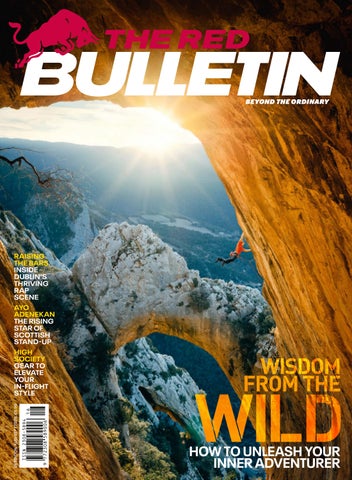
BEYOND THE ORDINARY
RAISING THE BARS INSIDE DUBLIN’S THRIVING RAP SCENE AYO ADENEKAN THE RISING STAR OF SCOTTISH STAND-UP
UK EDITION, AUG/SEPT 2026, £5.99
HIGH SOCIETY GEAR TO ELEVATE YOUR IN-FLIGHT STYLE
WISDOM FROM THE
WILD
HOW TO UNLEASH YOUR INNER ADVENTURER
THE COOLER BRAND
CAITY SIMMERS WSL WORLD CHAMPION 2024 - PHOTO: GRANT ELLIS
WHEN ALL IS SAID AND DONE, WAS IT SAID OR WAS IT DONE?
VISIT BFGOODRICHTIRES.COM
EDITOR’S LETTER & CONTRIBUTORS
Alice Austin ”Ireland is always the best craic,” says the Scotlandbased music journalist, who travelled to Dublin for our feature on the rise of Irish rap. “Everyone I spoke to was so funny, open and generous – we even met an artist’s mum and pet parrot.”
JAN VINCENT KLEINE (ADVENTURE COVER), AMANDA FORDYCE (AYO ADENEKAN COVER)
Luke Gartside After years chronicling surf culture, the Cornwall photographer says Lucy Campbell stands out: “From ripping alternative boards in the south-west to pushing herself over the ledge at freezing slabs in Scotland, I’m always impressed by her tenacity and sense of fun.”
A
07
dventurer Eva zu Beck’s many wild missions around the world have taught her how to love her intrepid life. “We see uncertainty as a bad thing,” she says, “but you have to approach it with joy and curiosity.” And as you’ll discover in this issue of The Red Bulletin, it’s a lesson that can apply to all sorts of adventures. We talk to Zu Beck and two other intrepid travellers – Andy Torbet, a skydiving, cave-dwelling stunt double; and Jan Vincent Kleine, a rock-climbing ace who’s embracing life in the Arctic – to understand how we can all live bolder lives. Then we meet Ayo Adenekan, an up-andcoming star of the UK comedy scene, who – with the help of a little Dutch courage – braved the stand-up stage to discover a whole new world waiting for him. And we catch up with Fisher, the partyloving Australian superstar DJ who’s thrown himself into the most uncertain journey of all: navigating parenthood. Enjoy the issue.
Ralph Jones The Oxford-based journalist also writes and performs comedy, making him an ideal interviewer for rising comic Ayo Adenekan. “He’s thoughtful, talented,” Jones says, “and more mature at 24 than I am at 36.” THE RED BULLETIN
CONTENTS
08
80
Adventure
Wisdom from 32 the Wild Want to experience the world in widescreen? Learn how from these adventurers living their lives to the limit Comedy
Ayo Adenekan
46
From coffee-shop debut to comedy-show dynamite: this Scottish stand-up is a star in the ascendancy Music
Irish Rap
Our guide to Dublin’s best bars – and the new breed of poets dropping them BMX Freestyle
Benoit Gea
Parenthood introduced Fisher to a different kind of all-nighter. The maverick Aussie DJ tells The Red Bulletin how becoming a father has impacted his jet-setting, club-hopping lifestyle
Capturing the essence of BMX through a lens, with the help of its greatest riders Music
Fisher
Bullevard 10 17 19 20 23 24
Gallery Playlist Skating the States Mirror mask art Quartz ID ring Shades of Love
Heroes
TaliaBle 26 Rap gets ruff
Lucy Campbell Back on board
28
Vikkstar 30 Man of many sides THE RED BULLETIN
The Gold Coast-born DJ on Ibizan success, ice baths and life’s simpler pleasures
68
80
Venture 89 Travel 94 Luggage built for adventure 104 How To 106 Tried & Tested 107 Me & My Body 109 Mental Fuel 111 Comedy 112 Calendar 114 The Takeaway
GIANNI GALLANT
Fish out of water
56
10
Florianópolis, Brazil
Full board
For many, a hotel stay in subtropical Brazil would constitute a break from the daily grind. But the punters at Hi Adventure in Florianópolis see things differently. The guesthouse-cumskatepark on the south-eastern coast is a popular drop-in for riders across the globe, as well as for natives including 2021 Olympian Yndiara Asp (pictured), who honed her skills at local spots such as this. Just remember to ask for a room with a bowl view. redbull.com
THE RED BULLETIN
ARTO SAARI/RED BULL CONTENT POOL
DAVYDD CHONG
GALLERY 11
THE RED BULLETIN
12
Maydena, Tasmania
Gold star
Jackson Goldstone has come a long way. Our first introduction was the viral video Jackson Run Bike to Kindergarten, in which a six-year-old Goldstone nailed drops and spins on a balance bike en route to school. This February, 16 years later, the Canadian MTB rider – by now a multiple World Cup winner and 2022 Red Bull Hardline champion (the youngest ever) – was in action again in Tasmania. Uh-oh, looks like he’s forgotten his book bag… redbull.com THE RED BULLETIN
13
BRETT HEMMINGS/RED BULL CONTENT POOL, EVA BERTEN/RED BULL CONTENT POOL
DAVYDD CHONG
GALLERY
Darmstadt, Germany
Roar power
Bragging rights matter, and the fitness world is no exception. But there’s a more convivial way of asserting your gym’s superiority than hurling kettlebells around and tipping over water coolers. Red Bull Gym Clash is a global challenge where teams of four do battle across a variety of workouts. Pictured is Julia Heyckendorf of Fitness First Bad Kreuznach, whose display at the German nationals in June won her crew a place at the world final in Cairo this November. redbull.com
THE RED BULLETIN
14
THE RED BULLETIN
GALLERY
15
New York, USA
Sails pitch
SAILGP/RED BULL CONTENT POOL
DAVYDD CHONG
The USA has welcomed (in a sense) representatives of many nations this year – witness the FIFA Men’s World Cup and the New York stop of the SailGP Championship (pictured). In May, 13 national teams hit the Big Apple, intent on kicking ass rather than balls (perhaps) in hightech foiling catamarans at speeds exceeding 100kph. The tour ends in Abu Dhabi in November, when one crew will sail off into the sunset with $12.8m. Ker-ching! sailgp.com
THE RED BULLETIN
BULLEVARD
17
Rostam
Sharing stories The former Vampire Weekend member and now solo artist picks four tracks that influenced his genre-melding approach Music student Rostam Batmanglij looked set for a career as a classical composer. Instead, when he graduated from New York’s Columbia University in 2006, the multi-instrumentalist stuck with the band he’d recently formed with best friend Ezra Koenig. The four-piece, Vampire Weekend, went on to become indie-rock sensations. In 2016, after three critically acclaimed and commercially successful albums, Batmanglij left to pursue a solo career as Rostam; he’s also become a soughtafter producer, working with the likes of Charli XCX, Haim and Carly Rae Jepsen. The 42-year-old has just released his third solo album, American Stories, which fuses Americana with Persian sounds – he’s the son of Iranian immigrants – and lyrics about road trips and relationships. Here, he revisits four tracks that helped inspire his eclectic compositions… Rostam’s album American Stories is out now; officialrostam.com
MATTHEW WEINBERGER
MARCEL ANDERS
The Mthembu Queens
Wadiliza Umuzi (1989) “In the beginnings of Vampire Weekend, everyone said we were imitating Paul Simon’s Graceland [album]. But I love African pop, [and our music drew from] a larger framework than Graceland. But people’s ignorance led them to make lots of judgments about my band. So I say listen to this song. It continues to inspire me to this day.”
Iman Vaziri
Mahur (2005) “This is Persian music. One thing that saddens me, growing up in the West, is that sometimes our only connection with Middle Eastern music is to experience it as sort of dark or sinister. This is a piece that doesn’t conform [to that perception]. That was something I was interested in expressing on my latest album.”
The Clash
Straight to Hell (1982) “What I like about this is that it lives in a moment when ’80s music was omnivorous in how it connected Jamaican music and rock. It’s the most powerful example of the wide spectrum that those ’80s guitar bands were capable of incorporating – where they don’t sound like guitars and they’re not used the way guitars normally are.”
Claudio Villa
La Strada Del Bosco (1996) “This is on the soundtrack of a movie called Big Night, and the CD was something that played on loop in my parents’ kitchen. I have many memories of growing up listening to it. I just love the track. I love the guitar playing, love the singing, love the melodies. It feels like the beginning of cooking a meal together as a family.” THE RED BULLETIN
V S N ^
V S N ^
V I S I O N /A B O V E
V I S I O N /A B O V E
TA LO N
VSN^ SEE FURTHER AIM HIGHER MOVE BOLDY
BULLEVARD
19
ALEX OROPEL, LLOYD EA
MATT BLAKE
B
y the time Brooke Johnson rolled into eastern Tennessee, she’d already been diverted 120km off course, threatened with jail, blasted by diesel exhaust, splattered with cow poo from passing trucks… and spent days wondering why she ever thought skateboarding across America was a good idea. Then the road opened. The trees turned an impossible green as evening light spilled over an alpine lake. And alone on her longboard, the 29-yearold began singing in the still air. “The day before, a cop had ticketed me for ‘playing in the road’,” she says. “I was beaten down. Then suddenly I was on my own, singing at the top of my lungs. It made me think of my grandma, who always said, ‘Put good into the world and good will come back to you, like an echo in a forest.’” The moment came to define Johnson’s 5,803km journey, which made her the first woman to skate coast-to-coast across the USA. “It was tough,” she says. “There were so many days when I wanted to quit. But I’d remind myself why I started and just keep moving.” The reason had come to her more than a year earlier, in a hospital room. Her stepfather, Roger, had broken his C5 vertebra in an accident and become quadriplegic. Sitting beside his bed, she pledged to take on the challenge to raise money for his recovery. “He said I could do it under one condition: that I pushed him across the finish line.” But just three weeks later Roger died. “As a stepchild, you don’t tend to get much in the will,” Johnson says. “But I realised he left me something bigger than money. He left me a purpose.” She raised sponsorship from Under Armour and mobile network Cricket Wireless to help cover costs and pay a small support crew, then set off from California’s Venice Beach on April 18, 2025. The road itself was rarely romantic. One day in Hereford, Texas, she was crying by the roadside
Skating the States
The big wheel Following a devastating family tragedy, US skateboarder Brooke Johnson set out to become the first woman to ride across the nation when a stranger pulled over. “He said, ‘I’ve been following your journey. I have a spinal cord injury, too. Please keep going.’ There were so many moments like that.” After 119 days on the road, she raised $55,000 for spinal cord charity Wings for Life. But while online platform RecordSetter quickly validated her feat, Johnson is still fighting for recognition from Guinness World Records, despite claiming to have raised the $20,000 application fee required of content creators. Now, she uses her audience of 500,000-plus followers on TikTok and Instagram to talk about women and adventure. “Throughout the journey, people kept asking, ‘Aren’t you worried about your safety?’ No one was asking if I was excited. The jargon around women
High roller: Johnson celebrates at the finish with support team member Tara Hulen; (top) taking her trucks on the road
travellers is always fear first. I had to tune all that out.” Next, she’s planning a 190km trek across New Zealand with her best friend, dressed as hobbits. “It’s a famous pilgrimage where fans cross the North Island from the Hobbiton Movie Set to Mount Ngauruhoe, which was Mordor in the movies,” she says. “It’s not quite the calibre of skateboarding across America, but it makes up for that in ridiculousness.” After surviving 5,803km of American asphalt on four tiny wheels, Johnson knows she has nothing left to prove to anyone but herself. “I’m insanely more confident now than I’ve ever been,” she says. “I’m not just a skater, I’m a woman, and I can do anything I put my mind to.” Instagram: @brookedoeseverything THE RED BULLETIN
Mirror mask art
Time for reflection Witness the natural wonders of the world… in one man’s face The man in the video looks gleefully into the camera. But all that’s visible of his face are his eyes, nose, mouth and flame-red whiskered chin. The rest is obscured by a circular mirror strapped to his head. Reflected in this looking glass, the world unfolds in a montage of vivid fragments: swans afloat, autumn leaves, a purple dusk and tangerine dawn, traffic crawling in dying daylight, all set to the music of electronic duo Bicep. It’s a disarmingly simple spectacle, but one with more than 10 million views on Instagram. The mirror man is Freddie Yauner, a London-based artist and designer whose work dances the line between our physical and digital realities. “It was an idea I’d played THE RED BULLETIN
with for years,” says Yauner, who began shooting the film series, What I’m Looking At, in 2020. “Then, last New Year’s Eve, we re-edited the footage and put it online. By midnight, it had hit a million views. It was incredible. I think it resonated because people are sick of AI slop and fake stuff [on social media]. This mask captures authentic, natural moments: smiling because you found some mushrooms in a tree, or watching the sun set over a city. It’s very human, very pure.” Yauner calls this an “antiselfie”, his attempt to switch the focus away from personal vanity and back towards nature. “[The mask] allows the world to see exactly what I’m looking at, rather than looking at me. It hides your face, but it
Blue-sky thinking: Yauner’s mirror-mask videos are no vanity project, more an “anti-selfie”, he says
also shows that who we are is shaped by our surroundings. That’s why I love using it. When the spring magnolia is out, the mask shows that I’m just as much a part of that blossom as anything else.” The design is also practical: “I’ve taken out a quarter slice of the pizza right where the phone would be in a selfie, so it’s a technical design as much as an interesting shape.” The irony of the project isn’t lost on its creator. “The smartphone is core to the experience,” he says, “yet the overwhelming reaction from people staring at their screens was, ‘How wonderful, this makes me want to get off my phone.’ Ultimately, my dream is that it becomes a global movement using the technology we already have to reconnect us to the real world.” Yauner has a track record for turning ideas into public experiments. Signs of Life, his animated fire-exit sign that comes to life when walked past, is in the collection of New York art museum MoMA. But he’s perhaps best known for his performance art project in which, for three months every year, he grows his beard and adopts the persona and appearance of the Victorian radical artisan William Morris. “An old tutor of mine would talk about ‘dropping pebbles’,” Yauner says. “I think that’s the best thing any of us can do. If I can drop little pebbles that spread ripples to different people, it feels like something worth doing.” Which is exactly what he seeks to achieve with his mirror mask. Yauner has produced 900 and is shipping them out to a mix of artists, musicians and everyday people keen to shoot their own films. “I don’t believe in the highend gatekeeping mentality that art should be exclusive.” he says. “I want the mask to belong to anyone who wants to use it. Flip the camera around, stop looking at yourself, and find some magic in the world.” freddieyauner.co.uk; Instagram: @freddieyauner
MATT BLAKE
BULLEVARD
FREDDIE YAUNER
20
Fo t o : I n n s b r u c k To u r i s m u s / M a r k u s M a i r
Urban beat. Alpine retreat.
ONE PLACE. TWO WORLDS. WWW.INNSBRUCK.INFO #MYINNSBRUCK
BULLEVARD
23
MATT BLAKE
I
magine your daughter calls you on WhatsApp. Panicked and crying, she tells you she’s had a car accident and has subsequently been arrested. She needs £5,000 for bail – immediately. It sounds exactly like her voice… but something isn’t quite right. Then, just as you’re about to hit ‘transfer’, you realise you’re being played by an AI clone. “Deepfake scams like this are now by far the most common and profitable form of online fraud,” says Scott Kooken, research and design director at Amsterdam-based tech think-tank Modem. “And they often work because it’s hard to doubt someone you love, and to say, ‘Hey, you’re not my daughter.’ Scammers bank on that trust.” So he and his team came up with a solution. Quartz, a signet ring designed to act as a digital handshake, allows loved ones to verify who they are from anywhere in the world. “The click moment was the idea that you need to meet offline to create trust online,” Kooken says. “We wanted to create a form of identity verification that exists entirely outside the internet. Something that can’t be hacked, cloned, or spoofed by AI.” Quartz utilises what Kooken calls a three-part “security stack”: biometrics, cryptography and physical trust. To set it up, the two ring-wearers must meet in person and pair their devices by touching them together. The rings exchange an encrypted ‘shared secret’ using NFC technology – the same system used for contactless payments. The code never touches the cloud, and it remains stored entirely on the hardware. The ring itself works using a tiny infrared scanner that maps the unique pattern of veins inside the wearer’s finger. “These veins are as unique as your fingerprint – arguably more so,” says Kooken. “But unlike with a fingerprint, [the technology]
Quartz digital ID
Ring of truth
Jewellery that protects its wearer against AI voice clones and deepfake scams
Keeping it real: Scott Kooken, research and design director at Modem; (above) the Quartz ring
only works with a live finger carrying blood flow.” When a loved one calls, both people tap their ring against their phone, and the device checks whether there’s a match in the encrypted credentials. If there is, both users know they’re speaking to the actual person; if not, they’re probably talking to an AI ghost. This may sound like an extreme precaution, but Kooken believes such systems have become increasingly necessary in the fight against cybercrime. “According to Interpol, by 2027, 85 per cent of internet content could be synthetic,” he says. “If you combine that with deepfakes, it gets scary fast.” Indeed, the same report revealed that the dark web offers fraudsters “synthetic identity kits”, complete with AI-generated video avatars, voice clones
and biometric data that can create convincing digital likenesses using “just 10 seconds” of real-life audio. For now, Quartz exists only as a technical blueprint. The main obstacle is size: the infrared scanners required to read veins are still too bulky to fit inside jewellery. “Based on the trajectory of miniaturisation in consumer tech, it’ll be small enough within five years max,” Kooken reports. Modem has made Quartz open source, hoping a major tech company will eventually adopt and scale the concept. “Unlike at any time in human history, technology is evolving faster than we can adapt,” says Kooken. “We keep throwing technology at problems, only to create new ones.” But, he adds, “We want to maintain the human layer beneath it all.” modemworks.com THE RED BULLETIN
Shades of Love
Raising sights From the Andes to the Himalayas, this charity is fighting a global high-altitude blindness epidemic using discarded sunglasses When Niklas Huppmann pulled up to a remote Bolivian cornfield high in the Andes, the family farming the land were initially suspicious. “Up there, they don’t see many gringos,” says Huppmann, co-founder of the Munich-based charity Shades of Love. “We hadn’t seen another soul for hours.” But when Huppmann, 27, explained their mission – to deliver sunglasses to remote, high-altitude communities – the mood changed. “The old grandmother waved us over, saying, ‘Thank God. This is exactly what we need. We’re working here every day and can feel the radiation in our eyes.’” The grandmother then began to cry. Looking closer at the family, Huppmann realised every adult over 30 already had THE RED BULLETIN
cataracts. “She was terrified her grandchildren would be blind by 30, too. She thought the farm would die because no one would be able to see the crops. We hear heartbreaking stories like this all the time.” For many of us, sunglasses are just a fashion accessory. But on the roof of the world they’re a medical necessity. “If you go to these altitudes, seven out of 10 people have black dots in their eye, or a milky retina,” Huppmann says. “The atmosphere is thin, so UV radiation is incredibly intense and rates of visual impairment run dangerously high.” Shades of Love works with brands including SunGod and Patagonia, collecting ‘dead stock’ (past-season product) as well as individual donations,
Visionary: Shades of Love co-founder Niklas Huppmann; (top) one of the many happy beneficiaries of his charity’s work
packing thousands into checkin bags, and using motorbikes to reach communities inaccessible by car. The charity was founded in 2009 by German restaurateur Jürgen Altmann; Huppmann joined five years later, aged 16, after spotting a poster at school. “It really resonated, because everyone has spare sunglasses they don’t use,” he says. “I knew we could turn it from a small project into a global organisation.” Since then, Shades of Love has distributed hundreds of thousands of pairs across Peru, Ladakh, Pakistan, Kyrgyzstan and beyond. And because prevention can’t restore sight already lost, it also funds eye clinics offering free surgery by local ophthalmologists. During a recent camp in Nepal, the team screened 3,000 people over two days. “There was one lady who had been blind from cataracts for 20 years and had never seen her grandchildren’s faces. After surgery, the patch came off and she could see perfectly. She was crying with happiness and started doing this beautiful little dance. It was so emotional.” The gratitude they receive takes gloriously unpredictable forms. “Sometimes people put them on upside down because they’ve never seen sunglasses before,” Huppmann says. “We’re constantly invited into people’s homes for dinner. In South America, some street workers slaughtered a llama and threw it onto our truck to say thank you.” The charity hopes to expand into “eye education camps” to teach mountain schoolchildren about UV risks: “It’s one thing to bring them sunglasses, but we want to teach them to start wearing them while young. A decade on from joining Shades of Love as a boy, this has become a lifelong mission for Huppmann. “What we’ve done is just a drop in a bucket,” he says. “But it’s a drop that makes a massive splash for the individuals. On a personal note, it’s just the best job in the world. I’ll do this until the day I die.” shadesoflove.org
MATT BLAKE
BULLEVARD
SEBASTIAN BERTHOLD
24
Stream sports you know and love
Available on select Samsung Smart TV’s and Galaxy Devices. Internet connection, Samsung Account log in and, in some cases, subscriptions required. Available apps and content subject to change.
26
HEROES
TaliaBle
The London punk rapper and visual artist who’s creating spaces for people to let loose Words Jessica Holland Photography Elif Gönen
TaliaBle is a blur of seething energy when she performs live. The punk rapper and visual artist – real name Talia Beale – growls, screams and moshes wildly with a customised balaclava over her face, a mop of curls poking out from the top, and an Elizabethan-style ruff around her neck. It looks like chaos, but the creative worlds she builds are carefully curated to create an inclusive space for catharsis and connection, whether she’s at an underground rave or major art museum. As well as headlining a show at Tate Britain while still an art student at Central Saint Martins, and supporting post-punks Snapped Ankles at the ICA last December, the 27-year-old was part of a spectacular, immersive production of Liszt’s Dante Symphony at the Southbank Centre in April this year, performing a narration she wrote about Mother Earth breaking up with humanity. With its meshing of styles and art forms, the show fits seamlessly into TaliaBle’s growing body of work, which includes MIA-influenced dance tracks made with Hot Chip’s Joe Goddard and a frenetic mini-documentary on London nightlife she directed for Fred Perry. It turns out that if you’re totally yourself, you can belong anywhere. A few days before the Southbank Centre concert, at a Tottenham art studio not far from where was raised – by her bus-driving mum, in a flat they still share – TaliaBle makes The Red Bulletin a cup of tea and talks about how she transformed from a bedroom poet to a sought-after collaborator in myriad worlds. the red bulletin: How do you divide your time here at the studio? taliable: Directing is my job, so pitching, directing and editing are my main focus. Then I bounce back to the music. I’m constantly preparing for the next live show or session. You’re more of a live performer than a recording artist? Definitely. In the scene, creating the scene. That’s the vibe. THE RED BULLETIN
What’s the scene that feels like home? The queer club scene, which mixes with punk, DIY and warehouse culture. Those spaces are liberating: everyone’s comfortable in their body and unafraid to express themselves. You can purge so much built-up tension through that hardcore sound. Everyone’s unapologetic. Sometimes I get everyone on stage while I’m performing: the gays, the girls, the non-binary, the trans-dem. There’s strobe lights, everyone’s moshing, and I come off stage so [the crowd] is the performance. It’s mad. A lot of people want an excuse to let loose. Is it a persona that you play onstage? It’s a character. It’s a part of myself that protects me, and my energy can be channelled through the character. It’s my excuse to be outlandish, show off and bring people together. Do you think your video work has a typically Gen-Z style, capturing the overstimulation of growing up online? I’m sure. Social media has made our brains ADHD. We’re all chronically online and everyone’s overwhelmed. As an artist, it’s about channelling all that into something so you can process it. I also love surrealism and art-house film. André Breton is my favourite poet. And I love Salvador Dali and Tim Burton. Everyday magic. I’ve always seen life like that. I’m interested in finding the magic in Tottenham estates. Your rise has looked effortless, but have there been struggles? Insanity, obsessiveness. I don’t go for walks, because I’d rather be creative all the time. You can get in a loop. Your degree at Central Saint Martins focused on fashion promotion. Can promo be an art form? Yeah, creating a spectacle has always been my focus. If you go out on the street to do a publicity stunt, it’s performance art, low-key. At Saint Martins, you’d walk
down a corridor and someone would be rolling in mud on the floor with a puppet next to them, someone [else] standing in the corner with a veil over their face, and then you’d get handed a poster. That probably did influence me. I love the shock factor and being a wild card. What’s the next big goal? Glastonbury is on the bucket list, and [Later… with] Jools Holland. Any big stage performance – crowd surfing again. I’m trying to perform on stages where I have the budget to consider visuals and set design. And I’d love to do a campaign for an artist, creative-directing a whole world for them: live show, video, press shots, considering every aspect. What advice would you give to others who are seeking to discover their creative voice? Go outside, go to events and talk to people. Allow yourself to document how you currently are, and never shrink your voice. Was there a turning point in your life when you learned that lesson? It’s probably attached to discovering my sexuality. [Before that], I was a bit in my shell, not knowing what the fuck was going on. But something’s always guided me. Doubt wasn’t in my head. Maybe it’s the horns of an Aries. I really trust myself. I feel like I’m always where I need to be and, at some point, things will make sense. taliabeale.com
IncrediBle: her pick of inspiring UK artists Caleb Femi “He’s a poet and director. The way he writes about local London is beautiful; it’s like fantasy within concrete. I buy his book Poor for friends’ birthdays.” Grove “[They’re] a good friend from Bristol with a very similar sound to myself, but more dub/bashment as well as punk/rave. Defo watch their Boiler Room set.” BESLAN(d) “He’s this insane VFX artist who does underground events. He’s a world-builder. Everything he puts out is very curated.”
“I love the shock factor and being a wild card” THE RED BULLETIN
28
HEROES
Lucy Campbell
The eight-time national women’s surfing champion on her toughest year and what it taught her about winning on her own terms Words Emine Saner Photography Luke Gartside
When North Devon surfer Lucy Campbell was crowned English national champion last October, her smile was as broad as on the seven previous occasions she’d taken the title. But this win was different. The year before had been the most difficult of Campbell’s life as burnout hit and seriously tested her relationship with her sport. She’d been pushing herself further and harder, balancing intense training with brand work, Qualifying Series events and her Olympic dreams. Then she all but collapsed. “My heart was racing so hard all the time, almost like I was out for a run, but I was only lying in bed,” says the 31-year-old. “I was easily startled, on the verge of tears all the time. My nervous system had just gone crazy.” Surfing was usually her escape. Campbell was 10 when her family moved to Woolacombe, and it was then that she first picked up a board. She didn’t look back. She began competing and winning junior titles, her skills growing as she did. “I was happy to put the time in training; everything it took to try to reach podiums,” Campbell says. This meant training through British winters. “When it’s minus-two degrees and sideways hail, I’d be getting changed in a car park, thinking, ‘Really?’ But I’d love it once I was out there.” After her burnout, it took six weeks for Campbell to find calm. She returned to competition but didn’t realise until later that chronic fatigue had set in. “Surfing brings me so much happiness, but I was really struggling with motivation.” To rediscover her passion for surfing, Campbell has had to reassess her life and career, stepping back from competition and changing her definition of success. Letting go of her competitive dreams, she explains, is exactly what took her back to the top of that podium.
THE RED BULLETIN
the red bulletin: What did you first love about surfing? lucy campbell: Just playing around in the ocean, getting washed around by the sea, the sense of freedom. It was when I was trying to decide between going to university or competing that I won my first open national women’s event. So I thought I’d give surfing my best shot. Have you noticed a change in the women’s surf scene? It’s still 80-per-cent male, but I’m seeing more women in the lineups everywhere I go, which makes me so happy. There was a turning point when they introduced equal prize money and sponsorships also became more equal. I’ve had my fair share [of sexism]. When I was 16, I was told I couldn’t be a professional surfer as I didn’t have the right figure or the blond hair. I wanted to prove them wrong. Looking back, what led to burnout? I’d had one of my best seasons competing and was like, ‘Next year is going to be my year. I’m going to train harder, put more time in the water and the gym.’ But for all the training I was doing, I felt like I was surfing worse. Self-doubt creeps in, then you feel you must work even harder, which puts you in this spiral. Looking back, that was a sign to rest and come back stronger. What helped? I did some work with a dietitian. I tried to focus on meditation, yoga, gentle walks when I could. A friend who’s a yoga instructor would do breathwork with me over the phone. I’d feel a bit calmer, but then a car would drive by and startle me. You returned to competing, but then you decided to step back. Why? I had chronic fatigue for the rest of the year, which impacted my results. I’d have a big day competing, then the next day I was flat out in bed. It wasn’t until I finally
got better that I realised how much it had impacted me. At the end of the season, I realised my career could take a different pathway. It was mixed feelings – I’d hoped that one day I could get to the Olympics, the Challenger Series, the Championship Tour. It was hard to let go of those dreams. Has it made you reassess success? Definitely. I still love surfing’s competitive side, but I’m not chasing events around the world. Health and a calm nervous system define success for me now. I’m still in the gym, still surfing, travelling, but I factor in rest and try to listen to my body. Burnout can affect anyone – we often see being busy as being successful. Now, I don’t see rest as laziness; it’s a productive part of my training. That’s been a big mindset shift. Then you won the English national title again last year… Yes! The day before, I was going to pull out because I was moving house and thought I might be overdoing it again. Then I thought, ‘I’m just going to go down and see everyone, that wonderful community, surf some heats, put the vest on and do my thing.’ Taking the pressure off was exactly what I needed. Instagram: @lucycsurf
Swell time We asked Campbell to list her top five UK surf spots. “There are a few I can’t mention if I ever want to be allowed back!” she replied. “But there are some great ones I can.” Fistral Beach, Newquay, Cornwall “The classic. It’s the home of UK surfing and arguably its most consistent spot.” Saltburn Beach, North Yorkshire “A brilliant surf community, good wave variety, and proof the north-east gets fun waves!” Freshwater West, Pembrokeshire, Wales “Wild, beautiful and one of the most scenic beaches to surf in the UK.” Croyde, North Devon “I grew up surfing here. Not the most consistent, but hard to beat on a good day!” Pease Bay, Berwickshire Coast, Scotland “The dramatic cliffs make every session here special. It’s a reminder of how wild and beautiful Scotland is.”
“I don’t see rest as laziness; it’s a productive part of training”
THE RED BULLETIN
30
HEROES
Vikkstar
The 31-year-old Brit on life as a YouTube superstar with millions of followers, and his side hustle as a globetrotting DJ Words Tom Ward Photography Kiran Bhamra Cox
As a gamer, DJ and entrepreneur, Vikkstar wears many hats. Known to his parents as Vikram Singh Barn, and to his 12m followers across social media as Vikkstar123, the 31-year-old has been entertaining millions since he was a teenager. He started out streaming video games from his childhood bedroom in Sheffield in the early days of YouTube, then became one of the seven founding members of the Sidemen. Branching out from gaming into reaction videos, shorts and gameshow-style vids, the prolific collective have racked up more than 23m followers on YouTube and capitalised on their popularity with everything from an app to a restaurant chain. Not that it all came easy. Vikkstar estimates that between 2010 and 2022 he spent 15 hours a day, seven days a week, creating content. Having dialled down those numbers a bit lately, he’s found a new way to fill his time: a second career as a globetrotting DJ. He recently played on the Gumball 3000 Rally world tour with Afrojack and co-headlined with James Arthur on the final day of this summer’s British Grand Prix weekend. Looming large on the horizon now is Vikkstar’s debut at premier dance music festival Creamfields. Here, he talks about living his dream job, and how even underdogs can win big. the red bulletin: You’ve been entertaining millions for years now. What made you and the Sidemen stand out from the online crowd? vikkstar: We started this at school in 2010. It was a hobby. Having a successful channel and turning gaming into a business on YouTube wasn’t even thought of. There was less competition, and we were motivated to grow and learn. We grew as YouTube grew, and that consistency helped us stand out.
THE RED BULLETIN
You spent a decade working crazy hours. How did you manage it? Yeah, it was a super-unhealthy workload! But you have to make hay while the sun shines. It was fun doing it with my friends, but it was intense. I turned down a place studying natural sciences at University College London and gave this my all. My parents were apprehensive, but when they saw it was working they got on board. You have 10 million followers, hang out with music stars such as JME and Skepta, and make videos with the likes of Bear Grylls. Has fame changed you? I’d love to say I haven’t changed, but the channel has given me so much. I wasn’t the most confident teenager, and by joining the Sidemen and learning from them I’ve grown massively. At the start, what we were doing was seen as very uncool, so proving we could carve out our own lane has given me the confidence to expand into new ventures. I’m super-grateful. Like touring the US with Afrojack, which I’ve just done – teenage me would not believe 99 per cent of the things I get to do now. How did you get into music? I grew up playing the drums, piano and violin, but it wasn’t until I was invited to the Ultra Music Festival in Miami in 2015 that I started getting into EDM. I loved the energy, the people. I spent the next decade going to as many EDM festivals as I could. You’re now friends with DJs such as Steve Aoki and Alan Walker. What advice have they given you? It turns out a lot of DJs are gamers, so we immediately had common ground. Alan actually invited me onstage at [Belgian EDM festival] Tomorrowland in 2022 and said afterwards, “You’ve been coming to these festivals for 10 years. You know the music. If you want to learn to DJ, I’ll help you out.” So that’s what we did. It started as a hobby, then very quickly I was selling out shows. My sound is uplifting and melodic. I just want to make people jump around and dance.
You’ll be DJing at Creamfields this year. Is that special? I can’t wait. It’s the best UK festival for booking dance acts from across the world, so to be booked by them is an honour. This April, you played in the Sidemen’s annual charity football match at a soldout Wembley Stadium. The rest of the collective grew up playing FIFA, but you were more into GTA and Minecraft. Is football a strength of yours? No! I’m awful at football. I was never picked to play at school, understandably. The nature of our content is, “We’ll always give something a go.” So even if I’m the underdog, I’ll try. Simon [Minter, aka Miniminter] keeps giving me tips, and whenever I pull anything off, everyone’s super-excited. I ended up scoring at Wembley in front of 90,000 people! It’s proof you don’t have to be good at something to be entertaining. Sticking to doing what you love has taken you far. What advice would you give to young people looking to do the same? Try new things all the time. Put yourself in new environments with new people. Push yourself out of your comfort zone and eventually you’ll find something you can become really good at or really enjoy – hopefully both. Now I’ve found it, I’m just going to keep doing what I’m doing! YouTube: @Vikkstar123
Going viral: Vikkstar’s biggest hits (so far) To Be Fair, Though (8.1 million YouTube views) “I spaced out after a heavy night and said, ‘To be fair, though,’ on a stream without following it up. Everyone was confused, myself included.” POV Vik at Tomorrowland (910,000 TikTok likes) “A good friend of ours, Jack Joseph, joined us in a Try Not to Laugh video. He did a flamboyant dance and said, ‘POV Vik at Tomorrowland.’ I’d played there the previous year, and for whatever reason that moment went mega-viral.” Penalty Goal at Sidemen Match (421,000 YouTube views) “The first time I scored a penalty was amazing. I was the least likely person to score, but by some complete fluke I managed it.”
“Teenage me would not believe 99 per cent of the things I get to do now”
THE RED BULLETIN
32
Exploring remote submerged cave systems. Travelling with nomadic Iranian mountain tribes. Embracing the Arctic winter with only a dog for company. The world offers endless possibilities for those brave enough to embrace them. Here, three very different adventurers impart hard-earned lessons to help us all live more boldly – without having to ditch the day job Words Mark Bailey
WISDOM FROM THE
WILD THE RED BULLETIN
JAN VINCENT KLEINE
ADVENTURE
Massif achievement: climber and trail runner Michi Wohlleben on the ridge of Alpstein in Switzerland, shot by adventure photographer Jan Vincent Kleine THE RED BULLETIN
34
ADVENTURE
“Seek out different paths”
1
Eva zu Beck Age: 35
Countries visited More than 60 including Iraq, Mongolia, Afghanistan, Oman, Pakistan and Rwanda
Woman of the world
Eva zu Beck Dividing her life between London and Brussels, Eva zu Beck had a husband, an Oxford degree and a highly paid corporate job. But in 2017 she got divorced, quit her job and booked a one-way ticket to Nepal in search of adventure. Fast forward to 2026, and the 35-year-old Polish-British adventurer has 4.7 million followers on YouTube, Facebook and Instagram, her own National Geographic show (Superskilled) and a new memoir titled The Wilder Way. As a solo female traveller, Zu Beck has explored 60 countries including Pakistan – where she lived for a year – Afghanistan and Iraq. She has overlanded across the Americas and the Sahara in a Land Rover she calls ‘Odyssey’. And she has taken on unique challenges such as iceclimbing with the indigenous cholita women of Bolivia. “Back in what I now call my old life, it looked like I had all the symbols of success, and yet I felt hollow and empty,” Zu Beck recalls. “The life I was living wasn’t really mine. I was building someone else’s dream. I THE RED BULLETIN
started asking myself, ‘What is it I really want out of my limited time on Earth?’ I didn’t want the cookiecutter life template; I wanted something adventurous, something different, something that felt truly mine.” Zu Beck admits that making her adventure daydreams a reality was “terrifying”. She had never travelled alone, and she had to learn how to harness YouTube, social media and TV projects to turn her risky life twist into a financially viable existence. “I worried I was making a huge mistake,” she says. “It took battling a lot of fear and anxiety to get here.” But Zu Beck’s radical change carries a vital lesson. “There’s not one way to live life,” she insists. “It’s okay to experiment and seek out different paths.” She now lives alone with her dog – a German Shepherd named Vilk – in a hut in the Carpathian Mountains. “I always thought that a successful person has wealth, a great job and running water,” she says, “so I was surprised to find happiness,
Land Rover expeditions Drives including 48,000km across the Americas – Mexico to Alaska and back – in 2022-2023, and 3,000km across the Sahara, through Morocco and Mauritania, this year Ultramarathons Challenges including the 250km Gobi March (2024) in 34 hours, 50 minutes and three seconds, and the 500km Lapland Arctic Ultra (2025) in nine days, seven hours and 15 minutes Summits Aconcagua (2020), Kilimanjaro (2021) and Mount Vinson (2022)
35
COURTESY OF EVA ZU BECK
Dry spell: Eva zu Beck and her trusty German Shepherd Vilk in the Nevada desert during Expedition Wild, her overland adventure from Mexico to Alaska and back
THE RED BULLETIN
Heart and sole: (above) Zu Beck ‘rewilds’ with a barefoot trail run in Baja California, Mexico; (left) driving overland across Mauritania in ‘Odyssey’, her Land Rover Defender, during this year’s Saharan expedition THE RED BULLETIN
FRITZ OTIKER/FUZZY FILMS PRODUCTIONS, COURTESY OF EVA ZU BECK
36
ADVENTURE
37
“Nature makes humans feel happy”
joy and success in a very different, wild life. And you don’t have to throw your existing life away! But I would encourage anyone to start searching and experimenting with their life.” Zu Beck also encourages us to ‘rewild’ ourselves in nature. “The more positive experiences I had in nature, like running and hiking, the more my mood and my strength improved,” she says. “Nature makes humans feel happy. We’re not meant to be in airconditioned rooms. When I was on Socotra, an island in Yemen, during the COVID lockdown, I started sleeping outside. And there was no context to shave like you do in civilisation. Rewilding is about
reconnecting with that ancestral human being inside all of us – and what a radical thing to do in today’s world. It’s very liberating.” Even small efforts at rewilding can snowball into big adventures. “I started to walk without shoes on Socotra, and I was like, ‘Oh my God, this feels amazing. It’s like a massage for your feet,’” Zu Beck says. “So last year I did a two-day, barefoot 45km hike [in Poland], and I recently did a three-day run-hike in the canyons of Utah in barefoot sandals. Rewilding is an ongoing journey, and you can keep pushing the threshold.” But, to enjoy a more adventurous life, you need to embrace uncertainty. “We see uncertainty as a bad thing, but you have to approach it with joy and curiosity,” she says. “I was driving through Morocco, Mauritania and the Sahara in my Land Rover Defender with my dog this year, and I broke down three times. But although it was always a nerve-racking experience, there’s always a way out. And those moments exist so you can grow a greater tolerance for discomfort and uncertainty. Courage is a muscle that you grow. By the third breakdown, I knew I would find solutions.” Zu Beck says it’s important to remain openminded about the direction your adventures might take. Having climbed Aconcagua (2020), Kilimanjaro (2021) and Mount Vinson (2022) – the highest peaks in the Americas, Africa and Antarctica – she targeted the Seven Summits challenge, which involves climbing the highest peaks on each continent. “But when I started trail running in order to train for these mountain climbs, I enjoyed the trail running more,” she says. “It was a bit of a mindfuck at the time, to be honest. So I switched goals. You don’t have to find your niche right away; it’s OK to experiment.” Inspired by how ultra-athletes empower the mind over the body, and by the reward of long, gritty journeys, Zu Beck has now completed epic ultra challenges including the red-hot 250km Gobi March in Mongolia (2024) and the icy-cold 500km Lapland Arctic Ultra (2025) above the Arctic Circle. “In the Arctic Ultra, you’re cold, exposed to high winds and alone in this dark winter wonderland that becomes like hell. One night, it was minus-20 degrees and I started to fall asleep as I was walking.” After years of experimentation, ultra races are now her primary goal for the years ahead. “The more I embark on extra-long endurance challenges, the more I want to do,” Zu Beck says. “I want to focus on a big journey that takes time, patience and a lot of training. Because the journey is what is really most important, not the outcome.” evazubeck.com THE RED BULLETIN
38
ADVENTURE
“Adventures are part of your life story”
Intrepid photographer
Jan Vincent Kleine
Photographer Jan Vincent Kleine has shot elite climbers in stunning locations worldwide, from Alex Honnold scaling sea cliffs in Norway to Magnus Midtbø free soloing the Verdon Gorge in France. But anyone with a camera, or even just a phone and an Instagram account, can use the medium as a tool for exploration. “With adventure photography, the fascination is where it takes you,” says the 41-year-old German. “The camera opens doors and asks you to go out, see the world and witness things with an open heart and an open eye.” Adventure shoots can be tough. “The hardest for me is anywhere tropical, in 100-per-cent humidity and 35-degree heat where your sweat doesn’t evaporate, so you’re in a sauna,” he says. But braving the elements exposes you to beautiful places and extraordinary people: “I get to glimpse the climbers’ physical abilities and mindsets, which are out of this world.” It was while studying economics at university that Kleine became hooked on hiking and climbing. He began photographing local climbers, then approached bigger THE RED BULLETIN
2 39
Jan Vincent Kleine
Age: 41
Climbers photographed Pros including Alex Honnold, Magnus Midtbø, Alex Huber and Reinhold Messner Destinations visited From the Negev desert and the Brazilian jungle to the north face of the Eiger and remote Kashmir
JAN VINCENT KLEINE
Personal expeditions Patagonia to Canada in a Mercedes-Benz Sprinter van, 2019-2022; crossing Norway by human power alone, 2024-2027
Sheer wonder: Norwegian climber Magnus Midtbø free solos more than 300m above the riverbed at Verdon Gorge in France THE RED BULLETIN
names. Soon, he was profiled in Climbing Magazine. “In most creative fields, if you have half a foot in the door, it’s easier to push the door open,” he says. Adventure photography has inspired Kleine to improve his own outdoor skill set. “I’m not climbing like the pros, but I am on the wall with them, exposed to the same rock fall,” he explains. But, over time, the risk-reward ratio has sparked searching questions: how much is he prepared to risk? In 2018, Kleine was on a climbing shoot in Wadi Rum, Jordan. “It was one of these beautiful big walls where you look down and see the desert with the changing lights on the sand dunes,” he says. He’d been pendulum-swinging on a rope – “not necessarily good practice” – to get a better vantage point for a photo. “I jumared [ascended] the rope, and I saw that where it was going over a rock it was a core shot [meaning the outer sheath of rope is THE RED BULLETIN
MARTIN JAN VINCENT HARTLREY KLEINE
40
VENTURE ADVENTURE
41
“The camera asks you to see the world”
Surging ahead: (above) Kleine and his sled dog Trojka navigate a route that torrential rain has turned into a riverbed; (left) mushing on Finnmarksvidda, Norway’s largest plateau
damaged by abrasion]. So I had to climb without putting any weight on the rope. I thought, ‘There’s a good chance this will just pop… then it’s goodbye.’” Over time, Kleine realised adventure photography is a vehicle that can be driven in different gears, at different speeds. He sought slower, deeper, longer, richer – and safer – adventures. Fusing professional and personal passions, he now wanted to tell isolated people’s stories and write his own adventures. “My photography reflects my changing interests,” he says. “I wanted to get more into the holistic documentary approach, looking at how people live in remote areas or confront challenging situations.” Between 2019 and 2022, he completed an epic 55,000km expedition from Patagonia to Canada in a converted Mercedes-Benz Sprinter van. “It started because me and my girlfriend [Helena, later his wife]
thought, ‘Why are we sitting in Hamburg, Germany, in winter?’ We wanted to live off-grid. I think that trip was the first time in my life I slowed down.” In Patagonia, he photographed Gaucho horsemen, puma hunters and other remote people, before venturing across North America. “The journey showed the beauty and depth you can’t see when you’re just shooting and leaving.” Kleine’s relationship broke down, leaving him depressed. But adventure photography provided the spark to reignite his life. Shooting sled-dog musher Sven Engholm in Norway in 2023 inspired him to adopt a sled dog of his own, Trojka, whom he loved for her loyalty and spirit. In 2024, armed with his Nikon camera and accompanied by Trojka, Kleine began a 6,500km crossing of Norway by human power alone – ski, packraft, foot and bike – which is due to end in 2027. “Sled dogs need to run, to be out, so what fits better than traversing her own country?” he says of the unexpected odyssey. Crossing lakes, mountains and fjords, and camping in the wild, he realised we should all make the most of our time. “In 20 years’ time, I could drive a van to Mongolia, but I might not be able to ride or walk long distances, so I felt like I should prioritise the physical aspect of travel now,” says Kleine, who has shared footage of his trip on YouTube. “If I had one memorable experience each month from age 40 to 65, that would amount to about 300 moments. Suddenly, time doesn’t seem so endless.” But what started as an exciting adventure ended up changing his life. During his expedition, Kleine met June – now his fiancée – who was ski touring in the mountains. “This journey has been a profound experience,” he admits. The couple have travelled together and will soon move to northern Norway, where June will run a sled-dog kennel. When he went to photograph Sven Engholm that day, Kleine had no idea how his life would change. But if you’re open to new experiences, your life trajectory can shift in a moment. Or, as Kleine puts it, “When you embark on adventures, beautiful things happen.” Whether you enjoy a short camping trip or a multiday hiking expedition, Kleine says all adventures, short or long, fast or slow, provide a “clarity filter” on life. He no longer craves the latest iPhone; instead, he pursues life-changing experiences. “Research in psychology and neuroscience suggests that our brains store experiences that are novel, emotionally significant or challenging,” Kleine says. “The routines of everyday life rarely leave a lasting impression. New adventures, difficult challenges, moments of awe, fear, uncertainty or joy – these are the experiences that become part of our life story.” janvincentkleine.com THE RED BULLETIN
42
ADVENTURE
“Do difficult things”
3 Andy Torbet
Man of action
Andy Torbet Deep below Scotland’s West Highlands, cave diver and adventurer Andy Torbet is trapped in a watery underworld. He’d been exploring the Cave of Skulls, which, at depths of 48m, is the country’s deepest pothole system. But now he’s wedged in a submerged passage just 25cm high – narrower than the height of a sheet of A4 paper. Wriggling around, Torbet tries to excavate gravel and silt to make space. But he’s trapped. Alone. In the dark. Most people would panic. But Torbet calms his mind with deep breaths and logical thoughts. Suddenly, a solution appears. He forces air from his lungs to compress his chest, then writhes, like a boa constrictor, through the gap. Liberated at last, he continues into a majestic underwater cave, becoming the first known person to observe this pristine, alien world. “In stressful moments, don’t lose yourself in emotions,” advises Torbet, 50, as he recalls his 2009 escape. “Stay present. You have to go a bit Spock; turn off the ‘caveman’ emotions that scream, ‘I might die,’ and focus on the unemotional ‘robot’ brain that thinks, ‘How can I get out of trouble?’” Cave diving is notoriously dangerous. But whether you dream of scuba diving or cliff diving, skydives or forest hikes, all adventures, big or small, can feel daunting. So why put yourself in such gnarly situations when you could be sitting at home, watching YouTube? Torbet believes we should all chase epic adventures, because the rewards can be life-changing. THE RED BULLETIN
“Do difficult things,” he insists. “Whether they’re difficult technically, physically or mentally, outside in the cold or in a claustrophobic cave, they’ll reset your perspective on life. If you routinely wake at 5am each morning, getting up at 6am feels easy. But if you routinely wake at 9am, getting up at 6am feels difficult. The time isn’t different, but your perspective has shifted. This is what adventures do for us. When I come home, my bed feels softer, my food tastes better, and I appreciate my wife and kids more.” After conquering a tough adventure, you let go of small worries and appreciate what matters most in life. “No epiphany comes from easy moments,” Torbet says. The Scot’s life of eclectic adventures proves you needn’t limit yourself to one type. A former British Army paratrooper, diver and bomb disposal officer, Torbet has completed diverse challenges for TV shows, books and personal thrills. As well as diving in caves and wrecks, he has raced (and beaten) a peregrine falcon, leapt out of a plane at 4,500m with turbine engines strapped to his thighs to hit 414kph, and represented Team GB at speed skydiving, where competitors clock 500kph. He has climbed icebergs and glaciers. And he’s a stunt actor, most notably for Daniel Craig in the James Bond movie No Time to Die. “You don’t have to be the best at any one thing,” he says. “Just make a start and find your way.” But, to conquer truly difficult adventures, you do need to know how to manage risk. “I’ve learned
Age: 50
Military career Ten years of service, including time in Iraq, Bosnia and Kosovo TV presenting More than 20 shows on the BBC, Discovery and History Diving Has explored caves, sunken cities, deep wrecks and unexplored reefs Skydiving More than 1,100 jumps completed; also represented Team GB at the 2022 World Speed Skydiving Championships Climbing Pioneered first ascents in the UK, Canada and Pakistan, on Greenland glaciers and on Arctic icebergs Stunt work Films and shows include No Time to Die, Masters of the Air and The Witcher: Blood Origin
43
MARTIN HARTLEY
Hidden depths: fully loaded in technical deep-water kit, Torbet returns from a cave dive
THE RED BULLETIN
44
“You don’t have to be the best. Just make a start and find your way” THE RED BULLETIN
ADVENTURE
45
MIKE LOVEMORE, JANNE SUHONEN
Underworld boss: Torbet enters Hell’s Gate in Ojamo, a flooded mine system in Finland
Rocket man: Torbet exits a plane at 4,500m to test a pair of prototype electric jet engines strapped to his thighs
to practise accurate threat assessment, and then I mitigate those risks to an acceptable level,” Torbet says. “Paranoia saves lives. People think that I’m an adrenaline junkie. But I’m the most paranoid, cautious person you could meet – and that’s why I’m still alive.” Before any big adventure, work through ‘what if?’ scenarios and have action plans ready. “I run through the whole routine, step by step,” he says. “I’m fairly intelligent, but my IQ drops through my feet in stressed situations. You want strategies that are simple. I’ve had breathing systems fail underwater, but I’ve been carrying one, if not two, back-up systems. So it’s a simple switch.” Try to separate ‘mirage’ risks from real ones. “We’re emotive creatures, but I see the world how it really is,” Torbet explains. “In speed skydiving, the danger is not the dive, because there’s nothing to crash into. But when you pull your canopy and you’re floating at 10mph [16kph], that’s when people make mistakes.” Adventures also force you to confront the unknown, which helps to condition you for the unpredictability of real life, from navigating holidays in strange cities to tackling unexpected work crises.
Later this year, Torbet will face the unknown on Dark Solo, an expedition to a partly unexplored cave system in rural France. He’ll be alone for four nights, swimming underwater and exploring new shafts. “It’s an alien landscape, like the dark side the Moon,” he admits. “But if you’ve planned for outcomes A, B, C, D, E, F and G, if outcome H happens, you’ve probably got something you can piece together. Whereas the person who only plans for Plan A won’t be ready for the unknown.” Plotting epic life adventures might feel like an overwhelming task at times. But don’t succumb to analysis paralysis; just make a start. After leaving the Army, Torbet wanted a career that combined his love of exploration and storytelling, but he had no idea how to go about it. “I was looking at the climber Leo Houlding and explorer Sir Ranulph Fiennes, thinking, ‘How do they make a living?’” he recalls. “I couldn’t figure it out. In the meantime, I just did some cave diving for magazines, then got invited to do some TV work. Two years later, I realised, ‘Oh, I’m here! I did it!’ The people out there doing amazing things don’t wait to be the best. They just go, ‘Fuck it,’ and crack on…” andytorbet.com THE RED BULLETIN
46
THE RED BULLETIN
COMEDY
SHIRT, WAX LONDON
FINDING THE FUNNY
At 24, Scottish comedian AYO ADENEKAN knows exactly who he is. And he has stand-up to thank for it Words Ralph Jones Photography Amanda Fordyce Styling Alicia Ellis THE RED BULLETIN
48
COMEDY
A
s the last episode of Saturday Night Live UK was being broadcast this May, all of the show’s writers came out of the basement and onto the studio floor. Ayo Adenekan – who, at 24, is the youngest in the writing team, as well as in the cast – stood watching the cold open and taking in the enormity of where he was. “Just being in that room and seeing everyone do their jobs,” he says, “it felt like such an insane jump to be like, ‘I’m part of this team. I made this show with people I look up to so much.’ In that moment, I was like, ‘Wow, things are going OK.’” ‘OK’ is a typical Adenekan understatement. It’s only been three years since he performed his first-ever stand-up gig, at a coffee shop in his native Edinburgh, fuelled by rum and nerves. And just a year since he won £5,000-worth of support from THE RED BULLETIN
Brass Tacks Comedy to fund his debut Edinburgh Fringe show, the award-winning Black Mediocrity. Six months later, he was a finalist in the BBC New Comedy Awards; three months after that, he’d left Scotland and moved to London to work six days a week on SNL, helping to supply a constant stream of topical sketches and jokes. It’s only 48 hours after the first-season wrap party at London’s Soho House, and his head is still spinning. “It’s kinda crazy, you know,” Adenekan says, smiling over half a pint. “The last year’s been mad and busy and full of so many things that I never thought would happen. And now we’re here.” ‘Here’ is the back room of a pub in Bethnal Green, east London, where the young comic has just posed for a shoot for this issue of The Red Bulletin – the latest
T-SHIRT, SUNSPEL; TROUSERS, COS; SHOES, ADIDAS
“That first gig, I was like, ‘If this goes badly, I’m moving to Glasgow’”
49
Stump of approval: Ayo Adenekan, photographed for The Red Bulletin in east London in May this year THE RED BULLETIN
50
in a long line of firsts. Now, he’s enjoying the rare opportunity to stop and reflect. Even when he’s sitting down, it’s clear the Scot is strikingly tall – 6ft 3in (1.9m) – with an instinctive grin and a soothing, deep voice. When he talks, his hands dance around as if playing an invisible piano. He’s affable, polite, considerate – not the first attributes that might come to mind when thinking of a stand-up comic. The fact Adenekan is Black, bisexual, dyspraxic and Scottish gives him something of a unique perspective in comedy. He never saw Black Scottish comedians when he was growing up. (As he jokes onstage, there are so few Black people in Edinburgh that they have their own WhatsApp group.) The urge to try comedy himself only came after attending a show at The Stand, arguably Scotland’s best comedy venue, with a mate. The opener, Brennan Reece, started chatting to Adenekan during his set. “My responses were quite quick,” Adenekan remembers. “People were laughing. I was like, ‘Oh, I could do this.’” That night, with a bit of Dutch courage, he signed up to perform a set at an open-mic event happening a fortnight later. “The day before the gig,” he says, “I sat in a Wetherspoon’s and just kinda wrote down everything I thought was funny about myself.” Was he nervous? “Oh definitely, yeah. I remember bouncing my knees up and down, shaking my legs, like, ‘Oh my God, it’s going to happen.’ I didn’t invite friends – I was fully like, ‘If this goes badly, I will move to Glasgow.’ But the minute I got up there and started speaking, the nerves just went away.” During the set, he spoke about his Nigerian parents and his over-achieving older sister. He also talked about the fact he was taking antidepressants. “I thought that would be quite relatable,” he says. “It was quite a tricky time – I’d just dropped out of uni and I was just kind of lost in the world.” Few in Adenekan’s position back then would have turned to a mic, a stage and an audience of strangers for answers. But for him something clicked. The set was only five minutes long, but it’s likely to be one of the most significant five minutes of his life. “I remember coming off the stage just thinking, ‘Oh, I cannot wait to do this again,’” he says. “I truly fell in love with it.” Comedy had never been the plan. For the first chunk of his life – before moving to Leith at the age of 13, following his parents’ divorce – Adenekan lived in Pilton, a working-class area in the north of Edinburgh that he describes as “a bit rough”. The writer Irvine Welsh lived on a housing estate nearby as a boy. “A bit of Trainspotting [Welsh’s acclaimed debut novel] is set there,” Adenekan says. “At the very beginning, when Renton goes to pick up drugs from his bad drug dealer, he goes to Pilton.” Adenekan remembers his family’s car windows
being smashed. “It wasn’t the nicest area to live,” he says. “But it was home, you know?” Although he was shy around other children’s parents, Adenekan was the class clown and found it hard to pay attention in school. Plus, standing out academically was difficult – his sister, six years older, was a tough act to follow. “I remember always feeling that kind of shadow,” he says. His parents, too, were academic: his father works for the publicly funded arts body Creative Scotland, his mum as a children’s librarian. “There was the big kind of pressure to go to university and get a good job, but that kind of didn’t happen,” he laughs. Inspired by his love of football – Hibs, not Hearts – Adenekan wanted to be a sports journalist when he left school. But, noting he was “really good at talking to people”, his guidance teacher advised him to go into advertising. This prompted a surreal few years during which Adenekan dropped out of an advertising degree, completed a media course, but then failed to finish a course in journalism at uni. How did his parents feel about his decisions? “Ups and downs,” he says, laughing. “At that point I was like, ‘I’ve got to try some new things,’ and it was lucky that stand-up was one of the first. I just fell in love with it so quickly. I was like, ‘OK, this is me,’ you know?”
T
hough Adenekan says he’s mostly experienced “really, really nice gigs”, it hasn’t all been plain sailing. He remembers a spot last year in Stirling. “I was on first, and it was almost silent for the whole 15 minutes,” he says. When the MC came back on, he asked a woman in the audience what she thought. “Oh, it’s not for me, actually,” she said. Adenekan doesn’t beat himself up after gigs like this. “You know when a bit works and it’s good,” he says. “And still sometimes people won’t like that bit, and that’s OK.” He invokes the ‘11 O’Clock Rule’, or Millican’s Law – named after stand-up comedian Sarah Millican, who’s credited as its inventor – which allows you to dwell on a bad gig until 11am the next day, at which point you have to move on. A bigger issue than stony silences or hecklers for most comedians trying to establish themselves, is the money – or the lack of it. Having to cover your expenses while travelling the country for small returns can feel like a bad joke. And performing a weeks-long stint at a world-renowned festival such as the Edinburgh Fringe is unachievable for many. “There are definitely barriers to entry in Edinburgh because of how expensive it is,” says Adenekan. “So you’ve got folk taking even more time [to do a full hour-long debut] because they’re like, ‘I can only afford to do one, so I’ve got to do it when I’m properly ready.’”
“I’m now more comfortable in my own skin. Stand-up’s great for that” THE RED BULLETIN
COMEDY
51
T-SHIRT AND TROUSERS, WAX LONDON; SHOES, ADIDAS
Couch session: Adenekan enjoys a chance to relax and reflect on a “mad and busy” year that culminated in a prime-time TV gig as part of the first-ever SNL UK team
With the benefit of already having accommodation in the city, Adenekan covered the costs of appearing at his first Edinburgh Fringe by splitting an hour’s slot with fellow comic Alvin Bang. The run, in 2024, went well, and he came third in the stand-up competition So You Think You’re Funny?. The routine of doing a show every day for a month was an enormous help: “I was riding high after the 2024 Fringe,” he says. Without substantial financial backing, however, his next steps were unclear. Then he saw an ad for the Debut Fund, a prize awarded by Scottish production company Brass Tacks Comedy. To be eligible, Adenekan would have to create his first hour-long set, which felt daunting. “You just really want that first hour to be great and special,” he says. But he applied – with just an hour to go before the deadline – and was selected from more than 50 Scottish or Scotland-based comics for the allimportant cash injection of £5,000.
The fund became a lifeline for Adenekan, which is exactly what Katie Palmer, a producer at Brass Tacks Comedy, had intended it to be. “I had the idea after speaking to a couple of new Scottish comics who weren’t even considering performing at the Fringe because of the huge costs,” she says. “Debut acts can face huge losses if they don’t sell enough tickets to offset their venue costs. In this financial climate, it’s just not a risk a lot of people are able to take.” Adenekan’s resulting debut hour, Black Mediocrity – a play on the phrase ‘Black excellence’ – at the 2025 Fringe last August proved he was more than ready for the step up. The show introduced him and his attempts to navigate the complexities of life. “It was a lot about peer pressure and insecurity,” he says, “and finding where I belonged.” Having predominantly been friends with straight kids in his youth, Adenekan had felt the pressure to conform to “a rigid view of traditional masculinity”. He says THE RED BULLETIN
52
World of opportunity: “There was the big kind of pressure [growing up] to go to university and get a good job,” he admits with a laugh, “but that kind of didn’t happen” THE RED BULLETIN
T-SHIRT, SUNSPEL; JACKET, WAX LONDON. OPPOSITE: TOP, HANRO; JACKET, WAX LONDON; TROUSERS, COS
COMEDY 53
“I fell in love with stand-up so quickly, like, ‘OK, this is me’”
THE RED BULLETIN
54
“It felt like such an insane jump to be part of the SNL team” THE RED BULLETIN
COMEDY
55
“I just hoped I’d get one sketch on SNL, or even a dress rehearsal”
FRINGE BENEFITS Our pick of the best young comics heading to Edinburgh this summer
comedian tackle some of life’s big questions with the characteristic flair that has made her one to watch. Here, she threatens to talk about football as well as “mortality, transformation and genitals”.
Eva Peroni
Rory Marshall
The winner of this year’s Brass Tacks Debut Fund unveils her debut show, Jungled, about moving from Livingston to Costa Rica and back again. Katie Palmer of Brass Tacks Comedy says the 21-year-old West Lothian is “one of the most exciting (and youngest!) comedians on the Scottish scene”.
JACKET, WAX LONDON
Anna Thomas
This enchanting, offbeat Welsh comic won the BBC New Comedy Award in 2021 and was a Sean Lock Comedy Award finalist two years later. The title of her debut Fringe show, How to Juggle a Ferret, gives some indication of the strange paths she might lead us down.
Dee Allum
Allum’s second show, Raumdeuter, sees the trans
In its five-star review of Marshall’s barnstorming debut, Pathetic Little Characters, last year, Metro proclaimed, “We should all be keeping a very close eye on Rory Marshall – he’s about to blow up.” Now, the Devonborn comedian and actor is back, bringing more superbly observed character comedy to the Fringe with Thank You for the Opportunity.
Cabbage the Clown
And now for something completely different. Multimedia drag clown Cabbage brings their bonkers show Cinemadrome back to the Fringe for a 13-day run. Let’s be honest, you haven’t really done the Edinburgh Fringe if you’ve not seen a comedy show in which a drag artist dances around in a gown made from bin bags.
stand-up helped him get a clearer image of who he was. “I guess I didn’t really have that when I started stand-up,” he says. “These days I’m more comfortable in my own skin, and stand-up’s been great for that.” His set connected with people. Adenekan was crowned joint Best Newcomer at the ISH Edinburgh Comedy Awards – an alternative to the main gongs – and won the Bestie Award for Emerging Talent. It wasn’t until the Fringe was over that he realised the casting director for SNL, who’d seen his show, had been messaging him to try to set up an audition. Landing the SNL job and then moving to London to start work happened fast, but the Scot says that he was unfazed. “It’s been a quick trajectory,” he laughs. “It didn’t hit me till I was going to bed on my first night, and I was like, ‘Oh fuck, I’m in England. That’s wild. I live here now, I guess.’ But I felt so relaxed going to SNL. I knew I was the youngest and least experienced in the room, so I was just hopeful to get one [sketch] on the show – or one to dress rehearsal, even.” The pace of Adenekan’s life only looks set to increase. He’s excited to try his hand at acting and possibly presenting, but right now there’s his next stand-up show, Homeland Insecurity, to work on. “I’ll just be gigging, gigging, gigging and writing, writing, writing, up until the Fringe,” he says. “The show’s about working in hospitality, falling in love, falling out of love, and my life outside of being a comedian while I’ve been a comedian.” Wherever the world of comedy has taken him since that shaky first night in a coffee shop, however new it’s all been, it’s also felt like home to the young Scot. The final host of the first season of SNL was actor Ncuti Gatwa, and for Adenekan that was even more of a buzz than working with Tina Fey on episode one. As a fellow Black, queer, Scottish performer, Gatwa is a rare role model – so rare, in fact, that part of Adenekan’s set is devoted to his fake fury at Gatwa for denying him the possibility of being cast as the first-ever queer, Black, Scottish Doctor Who. Adenekan was perfectly placed to write for him, and one of his jokes – about the actor landing his biggest TV role – made it into Gatwa’s opening monologue: “It was the first time my parents were truly proud of my career,” Gatwa said to camera. “When I told them I got the part, they said, ‘Finally! A doctor in the family!’” Adenekan watched from the wings, soaking up the audience’s laughter and applause, a grin on his face. He was no longer lost. See Ayo Adenekan’s Homeland Insecurity at Monkey Barrel Comedy, CabVol2, at the Edinburgh Festival Fringe, August 4-30; edfringe.com THE RED BULLETIN
56 Culchie icon: Lil Skag, photographed on stage at Dublin’s Forbidden Fruit Festival in May this year
A BREATH OF FRESH ÉIRE
From a Gaelic drill pioneer to a country kid who nicks bars from his da’, a new generation of Irish rap talent is ready to make the step from grassroots to global Words Alice Austin Photography Yushy THE RED BULLETIN
MUSIC
THE RED BULLETIN
W
58
hile the sun beams down on the colourful flags and beer queues at Dublin’s Forbidden Fruit Festival, inside the Undergrowth tent it’s raining bars. Local rappers Sugaboo and Lil Skag are thrusting and skanking on the stage, spitting rhymes in thick Irish accents to a sea of delighted faces. Sugaboo, wearing a shell suit from Limerick City-based clothing brand Pellador, looks as comfortable as he would in his own living room. Lil Skag, sporting his signature beanie, intermittently breaks into a silly, limbheavy dance. “This Lil Skag-Sugaboo masterplan/Like Mattress Mick, I’m a gasser man,” they rap in unison, their words a reference to a local viral bed-selling sensation. Groups of girls wearing crop tops, shorts and cowboy boots make heart shapes with their hands whenever the rappers look their way, and shirtless men wearing sunglasses bellow along to the lyrics. Sugaboo and Lil Skag are part of a recent Irish rap and R&B avalanche. Artists such as Aby Coulibaly, Bricknasty, Gemma Dunleavy, Curtisy, EMBY, deathtoricky, Smokey, Selló, Travy, Elzzz and Ahmed, With Love have all
Picture perfect: now in its 14th year, Forbidden Fruit is staged in the grounds of Dublin’s Royal Hospital Kilmainham, home to the Irish Museum of Modern Art THE RED BULLETIN
MUSIC
seemingly come out of nowhere. But the forced pause of COVID, alongside the stratospheric success of Irish artists including Kneecap, Fontaines DC and CMAT, created fertile ground. And the authenticity of this generation of new artists, their lyrics rooted in real Irish life, local ‘IYKYK’ references and genuine friendship, is helping to fuel their sharp rise. “This scene is just a whole bunch of people having fun,” says Ahmed, With Love, a 25-yearold rapper from Dublin. “And the byproduct of people just having fun and being themselves is great pieces of art.” There’s potential now to cross musical borders that once felt impassible. Back in the early 2000s, Irish artists such as Costello, Lethal Dialect, GI and MC Lunitic were adding to an Irish hip-hop history that stretches back to the ’80s. They held rap battles and cyphers in sheds, bedrooms and basements, and toured Europe off the back of a documentary about Costello and his crew of North Dublin street poets. “The film was shown at festivals,” Costello says today. “We went to Switzerland, Moscow, Austria and Paris on the strength of that.” But their music never quite stuck overseas. “Irish rap wasn’t accepted whatsoever. It was almost a novelty.” Times have changed, thanks in large part to a tool Costello’s crew didn’t have access to: social media. Curtisy did a UK-wide tour last year; Lil Skag and Sugaboo have relocated to London; and Aby Coulibaly, a soulful 26-year-old whose blend of R&B, spoken word and confessional rap has more than five million streams on Spotify, recently supported Olivia Rodrigo on tour in Europe. “Ireland is so small, so to be Irish [in the global music industry] is still really special,” Coulibaly says. “But when I was growing up there weren’t any Irish artists that look like me. Now it’s mad, it’s all changing. There are so many more Black Irish artists.” One of the most successful at crushing cultural barriers is Travy. In August last year, the Dubliner released the single Fón Póca’ – mobile phone in Irish – with Manchester DJ Interplanetary Criminal. And this June, Travy dropped Did It Again, a track with Elzzz and London’s Fred Again that generated international buzz and earned millions of streams. But as Irish rap and R&B continues to travel, don’t expect these artists to dilute their identity. Their lyrics, bars and beats are very much rooted in their home nation. And now the rest of the world is beginning to listen.
“This scene is just a whole bunch of people having fun” AHMED, WITH LOVE
59
Party people: this year’s Forbidden Fruit attracted a sell-out crowd of 15,000 Rat star: Travy rides the buzz of his recent collab with partnerin-rhyme Elzzz and Fred Again
Coul school: Aby Coulibaly delivers R&B and confessional rap to the masses THE RED BULLETIN
60
MUSIC
LIL SKAG & SUGABOO On stage in front of a packed crowd at Forbidden Fruit Festival, Sugaboo says three letters into the microphone and the whole crowd erupts into a chant. “KCR! KCR!” It stands for Kimmage Cross Roads. Most people outside of Ireland wouldn’t understand; most people outside Dublin, even. Only in this city would 600 people chant the name of a suburban street that’s home to a petrol station, a pharmacy and a convenience store. But Lil Skag and Sugaboo’s lyrics are packed with hyper-local vernacular – slang, niche references, in-jokes. ‘D12’ is Sugaboo’s postcode, ‘the shack’ his parent’s shed, a favoured spot for after-parties. Lil Skag, from Enniscorthy in County Wexford, is a selfproclaimed ‘culchie’ – meaning someone from the Irish countryside – and steals entire bars from his farmer dad; “I’m flat out like a badger on a bypass” is just one example. “All these old Irish men are straight-born rappers,” Lil Skag says with a grin. “I’m just stealing from them. Whenever I’m around my father, I’ll make sure to have my phone out, because he’s bound to say a straight bar. I don’t even have to change anything.” Stuck at home in their late teens and early twenties
“Old Irish men like my dad are straightborn rappers” LIL SKAG THE RED BULLETIN
during the COVID pandemic with no plan, Lil Skag and Sugaboo wrote rhymes and sent them to one another; resident producers Rory Sweeney and Sloucho provided the beats. Then, instead of relying on venues to reopen after lockdown, the pair went to each other’s sheds. They smoked, partied, played on the Xbox, and wrote music about the experience. “I made a track that was never really meant to go further than the room that we made it in,” Sugaboo says. “But I compressed it into a WhatsApp voice note, sent it to my mates and it got sent around a little bit.” He’s being modest. The track went viral on WhatsApp, and he was soon booked to perform his first Dublin show. That was 2022. Now, Sugaboo’s music has taken him far from the room it was written in, including a slot at the SXSW festival in Austin, Texas, in March this year. He and Lil Skag relocated to London last year – not because of music but despite it, to satisfy an itch to see more of the world. Both fly back to Dublin every other weekend, because their careers are mostly based here. But they’re finding their way in London – Lil Skag, Sugaboo and Ahmed, With Love recently took part in a cypher in Dalston, east London. Skag admits that their slang caused some confusion, though. “We call women of all ages ‘young ones’ here,” he says. “I making this young one’s day/I making this young one tweak/I making this young one’s week.” Without context, bars like these don’t translate well in the UK’s capital. But at Forbidden Fruit Festival, in front of a crowd rapping their lyrics back to them, no translation is needed. Instagram: @lil.skag: @sugaboooooooooo
61
Poets corner: Sugaboo (left) and Lil Skag in Dublin’s city centre
THE RED BULLETIN
62
MUSIC
“The old way of telling stories lives and breathes in me”
Local hero: Gemma Dunleavy on Dublin’s iconic Samuel Beckett Bridge
GEMMA DUNLEAVY
GEMMA DUNLEAVY Gemma Dunleavy’s bluegreen eyes sparkle in the afternoon sun as she finishes posing for photos on Dublin’s iconic Samuel Beckett Bridge. The 31-year-old singer-songwriter is about to head towards her childhood neighbourhood of Sheriff Street, just a few hundred metres away but worlds apart. The gap between the two is what’s inspired Dunleavy’s lyrics. Growing up on Sheriff Street, she had no garden, no playground. The local kids played in burned-out cars, and her mother gave a false address on job applications to avoid prejudice. But Dunleavy describes a happy childhood in a very tight-knit community. “We see people that aren’t THE RED BULLETIN
from our inner-city Dublin community as foreigners,” she says. “Even if you’re from just up the road.” Not because the neighbourhood isn’t welcoming, Dunleavy is quick to point out, but because of its strong communal identity. But at a young age she watched that community crumble around her when the block she grew up in was demolished. “In the ’90s, developers knocked down The Flats [as they were known locally] and dispersed all the families,” she says. “We’ve [had] our community ripped from under us, when really it was all we had.” Dunleavy’s music tells working-class stories. Tales of communities being pushed out and forgotten as Ireland’s economy
booms, with big tech and pharma investment transforming Dublin into a city of glass high-rises and shiny new builds. But she adds important nuance, documenting and paying tribute to the support and strength that characterises these communities. “My nanny and her friends were real Dublin women, and I was obsessed with hearing all the old stories,” she says. “That had more of an impact on me as an artist than any kind of music.” In 2018, Dunleavy released the ethereal spokenword piece I Was Never Young But I’m Not Yet Old, an ode to the resilience of the people she grew up around. Then, in 2020, she had a viral hit with Up De Flats, which tells the story of losing her home. Gliding
between R&B and UK Garage, the track is a powerful love letter to the place that shaped her – earlier this year, The Irish Times described it as “one of the greatest R&B songs to ever come out of this island”. The music video shows boys doing wheelies on bikes, the local football club, kids playing on the street. Dunleavy sings outside a now-closed convenience store, then on a balcony with her mum and her friends. It depicts a thriving, happy community, full of life, the chorus a battle cry: “They said we had nothing but we had it all/Shouting ‘Up De Flats’ from the rooftops.” The track took Dunleavy from little-known R&B artist to underground hero. Up De Flats was shortlisted for Irish Song of the Year at the RTÉ Choice Music Prize, and she won a Decade of Centenaries Markievicz Award – a bursary to fund future projects. She also played just about every festival in Ireland, as well as several overseas. “The old way of storytelling lives and breathes in me,” Dunleavy says. “I’m not making up stories, but carrying them from before. Those two worlds didn’t exist together, and it’s my life’s work to make sure they do.” Instagram: @gemmadunleavy_
63 WORLD CUP Hot dog: Elzzz fires up On song: Trans the crowd. His 2024 release Voices co-founders with Travy, Doghouse, was Ilā Kamalagharan the first Irish rap album to (left) and Coda top the nation’s chart Nicolaeff; (top) the choir o On song: Trans Voices co-founders Ilā Kamalagharan (left) and Coda Nicolaeff; (top) the choir on stage with Kesha at Mighty Hoopla n stage with Kesha at Mighty Hoopla
“Irish rap wasn’t accepted. It was almost a novelty” COSTELLO
THE RED BULLETIN
64
Food for thought: Curtisy grabs a snack after studio practice; (opposite) Ahmed, With Love, rap pharmacist THE RED BULLETIN
MUSIC
65
CURTISY After listening to US artists such as 50 Cent, the first Irish hip-hop Curtisy heard was Costello, followed by Kojaque, arguably the country’s first marketable rapper. “Kojaque was taking a more creative approach,” Curtisy says. “The visuals matched; it was the full package. It was eye-opening.” Today, 26-year-old Curtisy – full name Gavin Curtis – is one of Ireland’s best-loved hiphop artists. Born and raised in Tallaght in south Dublin, he began writing his own rhymes during lockdown. “It was like, I wanna figure me out,” he says. “The message early on was, like, addiction is not great, perseverance is good. We all have feelings. Love is good. It’s OK to be sad, you know?” Curtisy’s latest album, Get a Life!, released in March, blends abstract hip hop, drill, soul and dream pop. Standout track Sonny, an ode to his nephew, showcases his raw, honest lyrics: “Mammy, we’re getting that second house/ The one with the wheels on it/ That you dreamed of.” Standing around 6ft 2in [1.88m] tall, with messy, curly brown hair, Curtisy is not your typical rapper – being silly, awkward and anxious is part of his on- and off-stage persona. This also makes him very charismatic. He signs off voice notes with, “Love you,” and on stage he makes entire crowds feel like old friends, telling them, “We’re a family now.” At Forbidden Fruit, the crowd’s locked into Curtisy like Lego, pushing up against the barrier, despite the fact Nia Archives is on the main stage. When he performs Sonny, the crowd sing along, eyes closed, sound techs included. He attributes his allure as an artist to the least favourite of his traits: “It’s the fact that I cannot shut the fuck up. It’s like, I reject having a secret. People don’t really love that in real life, but they love it when it rhymes at them.” Instagram: @itscurtisy
AHMED, WITH LOVE
“We all have feelings. Love is good. It’s OK to be sad, you know?” CURTISY
Ahmed, With Love represents possibly the one and only point on a Venn diagram where rap, wrestling and pharmacy overlap. Real name Karim Tamu, he grew up in the south of Dublin, relocated to Sierra Leone when he was nine, then moved back to the Irish capital four years later. Tamu grew up listening to Afrobeat and Caribbeaninfluenced music alongside the US’s hip-hop greats. He also played trumpet in bands and joined theatre groups, which might explain his explosive stage presence. In person, he’s energising and extremely friendly – after his photoshoot, everyone is invited back to his flat in south Dublin to play on his Xbox and eat a local Chinese takeaway delicacy known as a Spice Bag. There, Tamu explains how his rap career began in 2018, when he decided to write a diss track for his friend’s birthday. “It ended up turning into a three-track EP of me just talking shit about
my friend Larkin,” he says. “I burned it onto a CD, and on the cover I wrote, ‘From Ahmed, with love.’” He found the process so joyful, he didn’t want to stop: “From 2020, 2021, my output was crazy. I started getting a bit more buzz.” Tamu made a couple of music videos and, post lockdown, was booked for his first show. “I told them I hadn’t performed before and didn’t have enough songs. They said I had a week.” So he pulled together enough material to create an epic first show, joined by Curtisy, who was also making his stage debut. “I was like, oh, I’m performing, but I’m playing me,” Tamu says. “I just have to go up on stage and have fun and be myself? Fucking sold.” The 26-year-old wears several hats – Monday to Friday, you’ll find him working as a pharmacist. Recently, Tamu took part in a wrestling/ poetry slam as part of the Culture Date with Dublin 8 Festival, and he hosts Clash At The Quays!, an occasional wrestling/music event. “My three favourite things are music, performance and professional wrestling,” he says. “So I was like, ‘How do I make money off it?’” The formula of Clash At The Quays! is simple: live music, rap battles and choreographed body slams featuring Ireland’s best alt artists, in and around a wrestling ring. “Lil Skag got choked out by [London rapper] Kibo, and Curtisy got hit with a stone-cold stunner,” Tamu remembers fondly. “I make sure I’m the only artist really wrestling, ’cos I can’t sue myself.” Tamu says many of his most creative moments have blossomed right here, on his sofa, usually after Xbox and a Spice Bag. “Music has given me a handful of like-minded friends. We just want the best for each other. I wouldn’t trade that for the world.” Instagram: @karimtamulol THE RED BULLETIN
66
TOPIC
“We want the best for each other. I wouldn’t trade that for the world” AHMED, WITH LOVE
Slam lord: Ahmed, With Love ponders the logistics of building a wrestling ring in his flat in south Dublin
THE RED BULLETIN
MUSIC
67
SELLÓ Selló, born Michael Afam, is known as the pioneer of Gaelic drill. At the age of just four, he, his mother and his sister were forced to flee persecution in Nigeria and ended up in Clondalkin, a suburb in the west of Dublin. It was “the worst-case scenario”, Afam says now as he takes a sip of peppermint tea in Dublin’s historic Grand Central Café Bar. “It’s in the sticks. There were no businesses, no musicians, and our youth centres weren’t up to par. But we had a lot of creativity.” His was one of the first Black families in the area, and some mornings he woke up to smashed car windows or slashed tires. Socially, he was totally isolated. Nobody spoke to him at school or played with him outside, and he cried all the time. “I call it character building,” he smiles. It was only when Afam heard the likes of Stormzy, Lil Wayne and Wiz Khalifa that he began to gain confidence. “It was like understanding that you don’t need friends, you have these guys,” he says. When he got to secondary school, Afam began to freestyle, and he soon learned it was a good way to make friends. “I’d rap to 200, 300 kids in the playground. It was like a full show.” At first, he was sent to the head’s office, but then one teacher suggested encouraging rather than reprimanding him. “She came up with a project called Teach the Teachers,” Afam says. “I had to teach them about myself through rap so they could understand my story, why I was loud and emotional, and why I struggled in Irish class.” His teacher gave him an Irish-language assignment to tell his story through rap, which became an early track about identity, exclusion and loneliness. She then wrote a letter to his mum, recommending that he study
Dublin take: Selló on the streets of the city he eulogised on his 2021 debut single
“I’d hoped for 10K streams. I woke up to 200K” SELLÓ
music production because he was going to be the next Kanye West. In 2021, as Selló, Afam released his debut single, Dublin, an absolute banger of a track about his authentic Irishness and his lived experience as a Black Irish artist, and a love letter to Clondalkin. It quickly went viral. “I was just hoping for 10K streams,” he recalls. “I woke up to 200K.”
Today, he’s one of the first Black Irish rappers to achieve significant chart success in Ireland, having also performed at major festivals and signed a deal with Atlantic Records. His mission now, he says, is to help other young Irish artists know they’re not alone. “If other refugees come to Ireland and they want to fit in, then listen to Selló,” he says. “Selló will tell you the way.” Instagram: @sello_ire THE RED BULLETIN
68
Rear reflector “This rider, Alex Valentino, is the founder of MArieJADE, an iconic, 100-per-cent French streetwear brand. Here, he’s riding the famous Part-Dieu wall in Lyon, a legendary BMX spot that’s a must-visit and has seen some of the best riders come and go over the years. I shot it for MArieJADE’s last video project, No Future, before Alex moved on to new BMX projects.” THE RED BULLETIN
BMX FREESTYLE
STREET STYLE
BMX is all about movement and flair. Professional rider turned photographer Benoit ‘Ben’ Gea is expert at capturing moments of magic – on and off the bike Words Pauline Krätzig THE RED BULLETIN
70
BMX FREESTYLE
BMX is fast-paced and often improvised, with perfect moments that can last just a fraction of a second. This makes it tricky to capture on camera. But French photographer Benoit ‘Ben’ Gea knows exactly when to press the shutter button. A former BMX pro himself, Gea has ridden with his subjects and can recognise the trick a rider is about to perform before it happens. Plus, crucially, he’s able to keep up. Gea highlights the creative side of BMX freestyle and everything that surrounds it: the tension, the preparation, the crashes. “I want to tell stories, not just take beautiful photos,” he explains. “BMX photos are often focused solely on the rider. I try to add an extra dimension or other elements. The street is perfect for that – there’s always something happening. And anything that brings the photo to life has its place.”
THE RED BULLETIN
The photographer Originally from Pau in south-west France, Ben Gea was a professional BMX (street/park) rider for more than a decade. Today, the 36-year-old is a photographer, a filmmaker, and author of the masterly photo book Emulsion. Instagram: @bengea_
White rider (right) Not all of Gea’s images are improvised; some are the product of good ideas. For this shot, the photographer asked Matthias Dandois, the 10-time BMX flatland world champion, to dress in white, “echoing the markings on the ground”, so that he’d fit perfectly into his surroundings.
71
THE RED BULLETIN
72
PORTFOLIO
BMX FREESTYLE
73
Old school (left) Gea has ditched digital, now working almost exclusively with film. “I studied chemistry,” he says. “That’s one of the reasons why the process of creating a photograph fascinates me so much. Developing negatives is pure chemistry.”
Road trip In 2008, what is now an annual BMX pilgrimage began, bringing together a group of more than 80 riders from across France to ride the iconic wild bowls of the Basque Country together. “The Apache Trip has a festival atmosphere. We ride concrete waves, we chill, we have a good time.” THE RED BULLETIN
74
BMX FREESTYLE
“I studied chemistry. That’s one reason why the process of creating a photo fascinates me. Developing negatives is pure chemistry”
Fly guys Group photos can be a bit cheesy. So Gea likes to shake up these poses with pigeons. “For me, they perfectly embody the spirit of the street. And besides, they’re unpredictable – they always offer surprises when you develop the photo.” THE RED BULLETIN
75
Keeping it real Most people get annoyed when a bystander casually steps into the frame of their photo. Gea welcomes such intruders, like this stranger in the foreground, with a smile. “It’s precisely this mix of street photography and BMX photography that I love.”
THE RED BULLETIN
76
BMX FREESTYLE
Off the wall “I often shoot with [Toulousebased rider] Kilian Limousin – he has a particularly aesthetic riding style that’s great for photos. Some light leaked into this image due to a problem with the camera’s seal. This could be seen as an imperfection, but as it doesn’t interfere with the trick, it ultimately gives the photo that unique analogue vibe. Perfection lies in imperfection.”
THE RED BULLETIN
77
“The light leaking into this image could be seen as an imperfection, but it gives a unique analogue vibe. Perfection lies in imperfection”
THE RED BULLETIN
78
“Garrett Reynolds is the GOAT of BMX. I guided him around Lyon’s spots and, of course, took photos. He didn’t disappoint” THE RED BULLETIN
BMX FREESTYLE
79
Balance bike (left) “American rider Garrett Reynolds is the GOAT of BMX. He came to France for the first time in 2019 for Street Station, the annual street BMX event in Lyon. He took the opportunity to stay on for two weeks, and I joined him to guide him around the city’s spots and, of course, take photos. It was incredible. This guy has been on the circuit for almost 20 years and remains unmatched to this day. He didn’t disappoint.”
“BMX photos are often focused solely on the rider. I try to add an extra dimension”
Lead roll (above right) Gea doesn’t stop shooting when the bikes are put away. “My buddy Jo [Gass, a French pro rider] really has the bad-boy look. This photo with the fighting dogs proves you shouldn’t judge a book by its cover – none of the three bite!” THE RED BULLETIN
80
HOUSE HUSBAND
GIANNI GALLANT
The maverick Australian DJ who once rode a penis-shaped surfboard now has a bedtime routine. Welcome to Fisher’s most outrageous era yet: adulthood
Words Lou Boyd THE RED BULLETIN
MUSIC
Staying grounded: Fisher, photographed at The Dax House in California in April this year THE RED BULLETIN
MUSIC
I
n 2002, on Australia’s Gold Coast, 16-year-old Paul Fisher spent his days surfing, hanging out on the beach, and bouncing between the area’s endless parties. Born and raised in the region, he looked like any other local teenage surfer – living for the next swell and the next event. But, at night, one thing set him apart from the pack: his love of house music. “I was one of the first surfers to start throwing house [music] parties,” Fisher recalls, “because a lot of the surf scene music back then was [Californians] Pennywise, Blink-182, a lot of the punk bands. When I started playing house music at these parties, people were either like, ‘What’s this?’ or, ‘Turn this shit off.’” As his surfing took off, Fisher’s off-kilter sense of humour started getting him noticed as much as his surfing did. He became infamous for his stunts – from riding a penisshaped surfboard to fronting his anarchic interview series Fish Tales. Then, when he retired from competitive surfing in 2012, Fisher unleashed the full force of his riotous energy on clubland, focusing on DJing and music production. The mononymous Fisher was born. His breakout single, Losing It, released in 2018, turned him into a global phenomenon almost overnight. The track landed Fisher a nomination for Best Dance Recording at the 2019 Grammy Awards, along with the number-one spot on the US Dance Club Songs chart and a rocket ride up the DJ Mag ‘Top 100 DJs’ list. His wild streak followed him off the decks, too. At the Grammys in February THE RED BULLETIN
“My manager texted, ‘I don’t know what you’ve done, but you’ve broken the internet’”
GUILLE GASTILEO
82
83
Spec-tacular: Fisher’s Thursday-night takeover at [UNVRS] is already being talked about as one of the all-time great Ibiza residencies THE RED BULLETIN
84
“At Coachella, people were climbing under the tent to hear my song”
Sitting pretty: the Aussie DJ’s 2018 track Losing It made him a global phenomenon almost overnight THE RED BULLETIN
MUSIC
GIANNI GALLANT
2019, he dropped an F-bomb thirty seconds into his red-carpet interview, live on air. His music videos leaned into the same chaos – most notoriously Just Feels Tight (2021), which saw him lead a full thrust-powered aerobics class in nothing but white underwear. Onstage, Fisher built a persona to match, cackling, sprinting across the decks, and hurling himself at the crowd with the same energy he once reserved for a heavy shorebreak. Bucket hat, open patterned shirt, shades on at 3am – it became a uniform for a man who never seemed to stop having fun, on camera or off. Now, after more than a decade in the music business, the 40-year-old DJ hasn’t just endured, he’s become one of dance music’s greatest and most respected headline acts. Currently ranked seventh in the DJ Mag list, and the world’s number-one house DJ, he’s built a career that shows no sign of slowing: sold-out shows on every continent, and tracks racking up more than half a billion streams. This summer sees Fisher return to Ibiza for year two of his Thursday night takeover of the island’s newest hyperclub, [UNVRS], a season already being talked about as one of the all-time great Ibiza residencies. From a Gold Coast kid being told to turn off his music, to the most-booked, most-talked-about DJ on the planet – it turns out he was playing the long game all along. But for all the public spectacle, the biggest shift in Fisher’s story didn’t happen on a stage at all. Somewhere between the parties and sold-out shows, dance music’s naughty little brother became a husband, and a father of two young daughters. The man who once shut down Hollywood Boulevard for a street rave is now the one on nappy duty between tour stops. The question hanging over Fisher’s new chapter is simple: what happens to the party when the wildest man in dance music grows up? the red bulletin: Losing It didn’t only make record numbers in 2018, it crashed onto mainstream radio in a way that’s incredibly rare for a house track. How did that happen? fisher: It was so quick. The song came together in maybe two to four hours. Then I got a call from the guys who run the [electronic music stage] Do LaB at Coachella – it was weekend one of the festival and someone had pulled out of a 3pm slot. I just said, “Yeah, I’ll do it.” Driving out to the desert, I played the track for my wife and my manager. Both
85
Party man: Fisher’s bucket hat, open patterned shirt and shades after dark have become his trademark
went, “Holy shit, this is gnarly.” So we got to the stage at Coachella and I said, “Film it, let’s see the reaction.” I pressed play, flicked my wrist and looked out at the crowd. What happened on that dancefloor in that moment was euphoric. I’ll never forget it. I don’t think I’ve had a reaction like that since. That clip is now legendary online… I woke the next morning and my whole life had changed. My manager sent a message saying, “I don’t know what you’ve done, but you’ve broken the internet.” From that moment on, it was just the craziest thing ever. I got put on the line-up the next week at Coachella, which is unheard of. People almost couldn’t get in – I think it was an 8,000cap tent, and there were 13,000. They almost didn’t let me play. People were climbing under the tent to hear the song. Suddenly it was an international hit, it was on the radio everywhere – a dance
“I’m not thinking about me any more; it’s all family”
record with three words in it. I still don’t know what to say about that. It was magic. More than a decade on, what’s an international DJ lifestyle like with two kids under two years old? They’re in it with us. We’re all going on the road this weekend: Norway, London, then Creamfields. I’ve got my headline show in London on Saturday – an early one, 7pm – and I wanted my family there, just to give [eldest daughter] Bobbi those experiences at this age. She’s the funniest character you’ve ever met, and I think it’s because she’s always around my friends, around adults. She’s pretty much on our schedule – last night she didn’t go to bed till 10pm, and she sleeps all night and gets up full of beans, calling out for my friends. She loves being around people; she’s vibrant. How do you structure family life around your touring schedule? The most important thing for me and my wife was not to change our schedule, but for the kids to also be on it, and to try to get them to enjoy that. It’s working so far. My wife’s very social, too, so we always have people here, and our friends are pretty hands-on, so they help out. When I go away, I get videos of people who’ve come from Australia on holiday, or who live on the island, hanging out with Bobbi THE RED BULLETIN
86
“I just did a trip from Ibiza to Canada to Vegas to Florida, and I didn’t see a bed for two days”
Cool customer: it’s an ice bath rather than a luxury pool that Fisher dips into when life’s pressures build THE RED BULLETIN
MUSIC
87
and [youngest daughter] Andi. It makes us happy, and you can tell the kids are, too. Was your own upbringing similar? Yeah, your mum would drop you at the beach at 6am and you’d be down there till 6pm, surfing all day, and all the older guys would look after you, and you’d get shouted food. That’s what I’ve always wanted for my kids: to be safe with the people around them, to have that energy around them. It moulded my personality, and I want to do that for my kids. I feel like we’re on the right path with them. Do you still have the same love of house music as you did as a scrappy teenage surfer? I do. I just did a show in San Francisco – my biggest headline show – and I was stood on stage looking at these kids at the front, thinking, “Wow, I would love to be there right now with my friends.” All these groups partying, having fun, hugging, smiling, and my music was part of the deal – that’s everything for me. That’s what keeps me going out, getting inspired, or just going and having a mingle and a dance with my wife. Even though it’ll make me tired, it’s worth it. The life of a DJ is more physical than many people think. Do you find yourself having to train your body for big seasons nowadays? Mate, just the travel alone on the body is so intense. I just did a trip from Ibiza to Canada, Canada to Vegas, Vegas to Florida, and didn’t see a bed for two days. I do training and ice bathing. Coming from a surfing background and always being active and in the water, I need that release. The gym for me is where I can switch off, get a little pump in, feel good about myself, then get on with the day. It helps with my thinking and clarity more than anything else.
GIANNI GALLANT, CLAIRE BURKE
How does an ice bath help? It sets my stress levels down, and it’s a challenge every day. It never gets easier, and I like those little challenges. I can’t surf in Ibiza – there’s no waves – and mostly I go to cities and not surf spots,
“Nothing’s better than what I have right now”
so I’ve got to do something to switch off. I know I’m a cliché, but everyone has their thing, and that’s mine.
FLYING FISH Five of his finest full-length shows, all on YouTube Record rave
Moscone Center, San Francisco, US (pictured) Two sold-out nights, one convention centre, and Fisher’s biggest crowd on record: 40,000 people.
Out with the old
Auckland, New Zealand New Year’s Eve energy, southern hemisphere heat, and Fisher in full showman mode – bucket hat, big smiles, bigger drops.
Riding the storm
Tomorrowland main stage, Belgium Three years off, zero rust. Fisher returns to Boom with the stage literally rising through a downpour, turning a weather disaster into one of 2025’s most talked-about main-stage moments.
Big fish energy
EDC Orlando, US Peak-time Fisher doing what he does best: big room bounce, crowd-pleasing IDs, zero filler. If you want the main-stage energy that’s made him a festival headliner staple, start here.
The rest is history
Old Royal Naval College, London, UK Baroque architecture meets tech-house bounce. Fisher swaps festival scale for a UNESCO backdrop, proving the tracks hit just as hard beneath 300-year-old ceilings as they do in a field.
If your kids get to 18 and want to follow you into the music industry, what would you say to them? I think about this. Bobbi might want to create music, same with Andi – they’ve been around music from the start. Honestly, I’d tell them to go out and find their people. If you find the right people who want you to win, and who want to win with you, you’re going to be all right. It’s the people who don’t have the right people around them that suffer. Is that what you’d tell yourself at 18, too, if given the chance to go back to before everything blew up? I got a piece of advice when I was coming up. Someone said to me, “You never get that feeling of breaking out twice, so just enjoy that elevator ride.” When you have a hit like Losing It and all of a sudden your world changes, not many people get to experience that feeling. If I could talk to myself back then, I don’t think I’d try to give any advice. I’d just tell that kid to enjoy the ride. Do you think about that ceiling much now – the idea that you might not get that feeling again? I’m still dreaming and still working. Obviously the goal is to get bigger, and for as many people as possible to enjoy my music, but life has shifted now – I’m not thinking about me any more. It’s all family, 100 per cent. It is different to 10 years ago, where I had the freedom to be wild, go party and do what I wanted and be careless in that kind of way, to be more free. But nothing’s better than what I have right now. How does life look different now to those days? The other week, I was playing on a Thursday night in Ibiza, had to finish at six in the morning, had to be at the airport at nine. I went straight home, but there wasn’t time to sleep. My daughter woke up and we watched the sunrise together outside, then my other daughter came and curled up next to me, and my wife came out and we had a coffee. I’d just played in front of 9,000 people in a club, but my kids didn’t know that – they don’t care, because they don’t know. Sitting there with them, watching that sunrise? That was by far the most euphoric feeling of the night. Instagram: @followthefishtv THE RED BULLETIN
The bag that does it all.
HYBRID BACKPACK 30L
60,000+ REVIEWS, RATED 4.9/5 TEST THE QUALITY FOR YOURSELF STUBBLEANDCO.COM
Porter call
WILL COPESTAKE
Scottish explorer Will Copestake approaches the Porter Glacier in Patagonia’s Beagle Channel by sea kayak
VENTURE
Enhance, equip, and experience your best life
THE RED BULLETIN
90
VENTURE
“One, two, three, pull!” I haul forward a single step with all my might. My fingers throb as they clasp around the plastic toggle of my sea kayak, which is loaded with around 120kg of food and equipment. Behind me is my teammate Seumas, my best friend from Scotland. Although we’re on an expedition between the Strait of Magellan and the Beagle Channel – our third adventure by sea kayak in the fjords of Chilean Patagonia – we find ourselves on foot on the second, arduous day of portage, dragging, lifting and forcing our kayaks across a low mountain pass. Five kilometres long and 300m high, it’ll end up being six times that distance with all our shuttling back and forth, route finding and moving. “There’s a reason they are called sea kayaks and not mountain kayaks,” I think to myself during a break in our struggle. Over the past decade, I’ve been fortunate to work, live and adventure seasonally in Chile as a kayak guide. At the end of each season, Seumas flies south to meet me, and together we’ve embarked on several adventures in the fjords for a month or more at a time. Until now, we’ve covered just shy of 1,500km, first from Puerto Edén to Puerto Natales, then onward the following year to Punta Arenas. Now on our third trip, we’re aiming to go as far south as possible, from the Strait of Magellan to the Beagle Channel and finally toward Cape Horn – an expedition to the ‘Everest of the Seas’ at the southernmost tip of the Tierra del Fuego archipelago, which would take us 40 days including three for a portage between Seno O’Ryan on the Magellan side and Bahia Oceano on the Beagle side of the mountains. Setting off from the end of the fjord with the jagged, snowy peaks of Monte Sarmiento at our back, we make good progress, gaining three days’ advantage THE RED BULLETIN
over our plan in the first week of paddling alone. We bash against the wind to Cabo Froward, the southernmost point of mainland South America, then commit to a long 23km crossing across the Strait of Magellan with some large tidal swell and calmer winds. From the southern shore, we’re truly remote. The mountains are near-vertical down to the shore, with cliffs covered in temperate rainforest; the bush is dense and full of life each time we land to camp on whatever slither we can find.
The narrowing, dead-end fjord of Seno O’Ryan marks the approach of our portage. Bordered by towering, ice-capped peaks and bare, rocky cliffs, the boulders at the shore are blue with mussels. On our first overland day, we line, swim and submerge our kayaks through a narrow riverbed and a thicket of trees, leaving the river behind for marshland and dense calafate bushes that make our hands bleed. Day two is uphill, a long and slow carry of kayaks that pushes us to the edge of
WILL COPESTAKE
Patagonia, Chile “A long and slow carry of kayaks pushes us to the edge of our physical limit. A 12-hour effort to reach the pass means a camp on the summit, exhausted, wet and hurting”
91
Irresistible surge (Clockwise from far left) Seumas nears Pia Glacier; a close pass to the waterfalls in Glacier Alley; unpacking gear on a wet day in the Beagle Channel
our physical limit. A 12-hour effort to reach the pass means a camp on the summit, exhausted, wet and hurting. Day three should be an easy slide downhill to the sea, which at last we can see. Alas, a canyon, not visible on any map or satellite image, stands in our way. Some intricate rope work using our towlines to ‘swing’ the loaded sea kayaks down a small waterfall into a pool unlocks our route back to the water. Any mistake could risk a broken boat, particularly the THE RED BULLETIN
92
Rugged splendour (Clockwise from top) the view from camp; a ‘shark fin’ rock; exposed geology; ‘Fort William’ base camp THE RED BULLETIN
VENTURE
WILL COPESTAKE
WILL COPESTAKE
Paddling in Patagonia Patagonia is a region split between Chile and Argentina. Getting to Chilean Patagonia from the UK involves several flights, typically to Santiago in the north, then a shorter transfer down to Punta Arenas or Puerto Natales. Natales is the gateway to Torres del Paine, a UNESCO national park and the ‘eighth natural wonder of the world’. While most famous for trekking, the region’s kayaking options are also a highly recommended adventure.
93
fibreglass boat I sourced for Seumas. Our nearest escape is back where we started, several hundred kilometres away. Every moment and movement is carefully considered to minimise risk. Despite the hardship, we never doubt our plan, and we’re determined this is the way to make it work. It also buys us time, and with time comes safety to wait for the right weather later in our journey. Although our portage has passed, our plan unravels. After four years spent successfully negotiating permits from the local navy to paddle around Cape Horn unsupported, we’re excited to finally have the opportunity; however, as we drag our way into our final naval region, we soon discover this particular captain has changed his mind. Our triumphant arrival back to the sea comes crashing down with a single message on our satellite device: “Permission Denied. Return to Puerto Williams.” We’re never given a reason why, but we suspect local politics. This suddenly leaves us with an interesting proposition. With Cape Horn now out, there’s a 300km paddle to Puerto Williams, yet we have an extra 10 days of food rations. Our expedition could change from a purposeful goal to a wanton exploration of every nook of the Beagle. Filled as it is with glaciers, this is a fine alternative. For the next two weeks, we sneak our way in and out of each and every
fjord in search of glaciers and ice. This landscape, shaped by the wind and rain that makes it such a challenge to get to and remain in, is a world of rugged mountains and ice. Between the jagged peaks and the sea lies a temperate rainforest alive with birds, from parrots and hummingbirds all the way down to penguins on the foreshore. It’s a world of contrast and character that’s deeply alluring to a hardy paddler. I’ve never embarked on an expedition where I’ve suddenly found myself with almost limitless food for the time given to achieve it, nor any real pace required to complete set goals. The opportunity to press pause in such a remote landscape, and to be comfortable to linger there, is unique and one I will cherish long after this adventure has ended. Arriving back to Puerto Williams, Seumas and I haven’t achieved our intended goal of exploring Cape Horn, but in our unexpected slowing of pace through the Beagle, we’ve found a connection to the fjord perhaps unrivalled by any of our prior expeditions in Chile. The time has given us pause to reflect and enjoy the world we’ve passed through, only deepening our love of this wild landscape. Will Copestake is a Scottish explorer and sea kayak guide, leading and sharing expeditions around the world, from Scotland to Patagonia and Antarctica. Instagram: @willcopestake THE RED BULLETIN
94
TRAVEL Megan wears GRAMICCI Nylon Cap, Pigment Dyed Freedom Tee and Voyager Pants, gramicci.co.uk; SALOMON XT-6 Shoes, salomon.com; NOTHING Headphone (1), nothing.tech. HYDRO FLASK 24oz Wide Mouth Water Bottle With Flex Straw Cap, hydroflask.com; OSPREY Transporter Wheeled Duffel 40, osprey.com (Opposite, clockwise from left) DB JOURNEY Ramverk Carry-On, dbjourney.com; MARSHALL Monitor III ANC Headphones, marshall.com; STUBBLE&CO Wheeled Duffel 40L and Hybrid backpack 30L, stubbleandco.com; ÉMIGRÉ Hardcase Carry-On, emigre.travel; THE NORTH FACE Base Camp Duffel 50L, thenorthface.com
THE RED BULLETIN
VENTURE
95
NOW BOARDING
Leisure travel just got serious. Engineered by specialists in outdoor adventure, this nextlevel luggage and gear will see you through any journey Photography Joe Hart
THE RED BULLETIN
96
OSPREY Transporter Wheeled Duffel 40, osprey.com; SALOMON XT-6 shoes, salomon.com
THE RED BULLETIN
VENTURE
97
Bow wears SUNGOD Miras Sunglasses, sungod.co; O’NEILL Summer Musthave Crewneck Sweatshirt, uk.oneill.com; KAVU All Decked Out Shorts, kavu.co.uk; STANCE Fine Rib Quarter Socks, uk.stance.com; OLUKAI Makiki Shoes, olukai.co.uk; jewellery, model’s own. DAKINE Split Roller Bag 50L, dakine.co.uk
THE RED BULLETIN
98
Ashlee wears SANTA CRUZ Reef Short Sleeve Shirt and Reef Shorts, santacruzskateboards.eu; TEVA Original Universal Sandals, teva-eu.com; JBL Live 780NC Headphones, uk.jbl.com; RADO Captain Cook Automatic Watch, rado.com. YETI Crossroads 73L Luggage, uk.yeti.com
THE RED BULLETIN
VENTURE
99
Luca wears SERVICE WORKS Garden Tee and Patterned Chef Pants, serviceworks.xyz; SUNGOD Zephyrs Sunglasses, sungod. co; jewellery, model’s own. DB JOURNEY Hugger Backpack 25L, dbjourney.com THE RED BULLETIN
100
NOTHING Headphone (1), nothing.tech; DB JOURNEY Ramverk Carry-On, dbjourney.com; FLOWER MOUNTAIN Yamano 3 Shoes, flowermountain.com
THE RED BULLETIN
VENTURE
101
Clodagh wears PEAK PERFORMANCE Ground Cap, Discover HIPE 3L Shell Jacket, Trail Longsleeve Top, Outdoor Cargo Shorts and Wool Socks, peakperformance.com; SAUCONY Progrid Omni 9 Shoes, saucony.com; jewellery, model’s own. PEAK DESIGN Outdoor Sling and Roller Pro Carry-On, peakdesign.com Thanks to Ashlee, Bow, Clodagh, Luca and Megan
THE RED BULLETIN
RUN ALL IN
The Merrell MTL SpeedARC Peak carbon-plated trail-running shoe proves that good things come to those who wait
T
he modern carbon ‘super-shoe’ revolution began in 2017, and, since then, world records have been demolished and personal bests for all abilities of runner smashed. The consensus now is that if you want to run fast, you need to wear a carbon-plated shoe. Merrell’s MTL SpeedARC Peak is a landmark moment for the outdoor footwear specialist as it joins the carbon super-shoe arena. But unlike other brands that might have rushed out a product just to tick that box, Merrell’s first carbon-plated shoe has undergone more than four years of development and thousands of miles of intense testing, with no stone left unturned in the creation of a shoe that will propel its wearer toward their goal.
Part of the brand’s Merrell Test Lab (MTL) line-up, the SpeedARC Peak is aimed at ultra-distance trail races. “The target run is 100 miles-plus – those ultra scenarios where people are looking for true race shoes,” says Jon Sanregret, Merrell’s product line manager. “That’s an elite person in most regards, but there’s a niche level of athletes doing those [runs] who want a shoe capable of performing.” One of these is world trail-running champion Fred Tranchand, who’ll be wearing the MTL SpeedARC Peak as he takes on the OCC at UTMB Chamonix; the Frenchman has been integral to the shoe’s development. “We try to have strong connections and conversations with our pro athletes to see what their opinions are,” says Sanregret. “They’re the primary go-to testing team that puts the shoe through its paces, and we make sure it achieves everything they were looking for.” The result is a shoe that balances propulsion on the flat and climbs, control on the descents, grip to tackle any terrain, and the durability to survive in hostile environments. A lot of this mix is down to the midsole. Sanregret says a springy, lightweight PEBA foam under the foot makes it feel like you’re running on air, while a dynamic Floatpro EVA foam on the midsole’s lower half adds the shock absorption, stability and tear strength required off-piste.
Sandwiched between is Merrell’s first carbon-fibre plate, forked at the front for a dynamic result. “When you’re in flatter environments, the carbon fibre pops, but the fork gives more control and allows you to manipulate and manoeuvre the shoe when needed. If you’re going fast downhill without the fork, that plate wants to do its own thing and you have to work against it.” Beneath the midsole is a Vibram Megagrip Elite outer with 4mm lugs, which balances weight savings and confidence-inspiring capabilities in technical terrain. On top is a stretchy Matryx upper that provides protection at the sides and reacts to what happens inside after you’ve spent hours on your feet. “Feet expand when you’re on the trail eight, nine, 24 or 48 hours later. We’ve provided full adjustability in-run for your foot to breathe and expand, so you don’t need to switch shoes.” All this is finished in an eye-catching fluoro colourway that’ll turn heads for all the right reasons. Merrell’s MTL SpeedARC Peak might not be the first carbon-plate shoe on the trails, but thanks to the brand’s uncompromising approach to performance, it’s up there with the fastest. Find out more at merrell.com
MERRELL
The MTL SpeedARC Peak, Merrell’s first carbon-plated ‘super-shoe’, has been developed in association with professional athletes to ensure optimal performance on all terrains
CHARLIE ALLENBY
Tough act
PROMOTION
104
VENTURE
this year, which would be really exciting.” Whether you’re heading to the Hebrides or your local pond, Wood says success comes down to a handful of basics…
Swing like a golfer
A stable base and strong body position are key, Wood says. “Have your feet firmly planted, with space between them. You don’t want to be crouched, as you need to use your abs.” She likens the throwing motion to a golf swing, building force through the core. “Your hand needs to be coming from somewhere between head and waist height to build momentum, then you release the stone like a slingshot.”
Forget the ‘perfect’ stone
Lucy Wood, six-time stone-skimming champion and Guinness World Record holder, gives her expert spin There was a calm finesse to Lucy Wood’s title-winning skim at last year’s World Stone Skimming Championships (WSSC). Standing on the platform on the tiny Scottish island of Easdale, the wild Atlantic churning beyond the headland, she let the slate fly. More than 2,000 spectators held their breath as it skated across the flooded quarry, skipping, bouncing, flying, before vanishing into the inky water with a plop. Forty-eight metres. The throw secured Wood her sixth WSSC title, cementing her status as the most decorated female stone-skimmer on the planet and extending her Guinness World Record. “There was a bit of pressure because I hadn’t won it for a while,” she admits. “I didn’t actually think it went that far.” Everyone has, at some time in their life, skimmed a stone. But if you want to compete against the best, you make the pilgrimage to Easdale, the smallest inhabited island of the Inner Hebrides – population: 60 – which has hosted the WSSC since 1983. What began as a local curiosity is now a celebrated annual event and a major source of fundraising for the former slate-mining island. Drawing hundreds of competitors each September, the arena is a flooded quarry measuring 63m in length. The ammunition: Easdale’s trademark rounded blue-grey slate. THE RED BULLETIN
The rules of the sport are deceptively simple, which is what makes Easdale so unforgiving. Each competitor is allowed only three attempts. While the women’s category is decided by distance, those in the open category must hit the quarry’s back wall merely to qualify for a ‘skim-off’. “You go a long way for three skims, and it’s done very quickly,” says Wood, who makes the two-day journey from her home in Sheffield each year. “If you look at some of those who have won other competitions, very few have won the [WSSC]. There’s something unique about Easdale.” This is a landmark year for the WSSC. National winners from Wales, Belgium, Germany, the Netherlands, Canada and New Zealand will receive automatic qualification, and a public ballot with a £5 entry fee has been introduced to cope with demand. Wood welcomes the added competition ahead of this year’s event. “I think it’ll feel very different, but the competitiveness will go up. There’s a chance a woman might hit the back wall
“When I’m in London, I’ll skim brick pieces along the Thames” Lucy Wood, world champion stone-skimmer
Impatience is your enemy
Wood has seen even top-tier competitors mess up because they’ve rushed. “Don’t go too quickly,” she says. “Let the ripples settle between skims.” Despite the crowd’s anticipation, you must find a pocket of silence. “Slow it right down and take a few breaths.” Even if you mess up, you’re in good company: “Everybody I know on Easdale has done an embarrassing skim.”
Warm up your fingers
At the edge of the Atlantic, the weather can fluctuate between glorious sunshine and howling gales. “One of the biggest things you can do is keep your fingers warm,” says Wood, who also advises using your index finger to zip the stone as it leaves your hand, because the rotation stabilises flight. “One year I was in full waterproofs, it was blowing a gale, and my hands were so cold I couldn’t skim. That’s Easdale for you: you need to be prepared for all weather.” The World Stone Skimming Championships take place on Easdale on September 5; stoneskimming.com
DAVEY BRETT
SKIM A STONE
GETTY IMAGES
HOW TO
Stone tampering made headlines last year after individuals admitted to sculpting theirs to make them rounder. While the rules on Easdale require naturally formed pieces of slate roughly 8cm in diameter, Wood says a palm-sized stone is a good reference for the average skimmer. “I encourage everyone to skim materials found close to the body of water. Get the angles right and you can skim anything. When I’m in London, I’ll skim pieces of brick along the Thames. If you’re in an urban environment without water, you could even practise on tarmac.” That said, half the skill on Easdale is ‘stonewrangling’ from its bountiful supply. “Easdale slate is the best thing you can skim. It feels beautiful in your hand.”
RES E T
SCO
VER
Y
WO
ND ER
DI
H
L L A
G EN
E
JO
Y
F
E RE
D
IMAGINE IF YOU COULD GIFT THAT FEELING TO SOMEONE ELSE.
THR
ILL
C
OM
AWE
AY L P PRESE
TO G ET H ER N ES
S
NOW YOU CAN, WITH THE PURPOSEFUL ADVENTURE FUND. S S M I LE MI NDF ULNESS
RELE
ASE
EXC
ITEME
NT
NCE
106
VENTURE
finished the wave, it’s not a simple case of sitting on the chair lift and going back to the top of the mountain, either. In sea surfing, you might have a long paddle to get to the position where you want to surf, and that’s more of a marathon, whereas at the wave pool it’s more like a circuit. It’s intense, you’ll be doing a lot, you have a very short break, and then you go at it again.”
Balance board
Why surfing an artificial wave could be a swell substitute for your regular gym workout Surfing may have a laid-back image, but the art of catching a wave is far from chill. Getting into position to scout a set takes a huge physical effort as the surfer must paddle against the current. Once there, a combination of strength, balance and hours of hard-won experience is required to even stand up. In recent years, though, new advances in technology have revolutionised the sport. Now, artificial wave pools offer consistent, guaranteed conditions and make the physical and mental health benefits of surfing more accessible – particularly if you live many kilometres from your nearest surf spot. This technology – pioneered by engineering company Wavegarden at its HQ near San Sebastián, Spain – powers inland surf destination The Wave Bristol. Opened in 2019, its surfing lake uses Wavegarden’s Cove tech to pump out up to 1,000 waves an hour, from beginnerfriendly breaks to 2m-high barrels. THE RED BULLETIN
“From people who’ve never stood on a surfboard before, to Olympians training for gold – we’ve got it all,” says Dan Mullins, head surf coach at The Wave. “We’re not trying to replace the ocean; they can exist together. It’s more that you’re training for your trip to the ocean.” Here, he explains the gains on offer at an artificial wave pool…
Hybrid engine
“It’s a great cardio workout, because at these artificial wave pools you spend a lot of time paddling, which is very intense on the core and shoulders, and it gets your heart rate up,” Mullins says. “It also builds strength across all main muscle groups. Paddling is really good for your shoulders, back, lats and chest. The pop up – when you go from lying to standing – requires arm strength as well as overall flexibility. When you’re on the wave, you use your legs in a crouched lunge to generate force or turns. Once you’ve
“You get the same endorphins and adrenaline rush at an artificial pool that you get from going out in the sea. Just being in the water is such an amazing feeling, and surfing is a great way to access ‘blue health’, a growing body of scientific research that shows the mental and physical benefits of being near water. There’s a nervous system reset – when water touches your face, your heart rate lowers and everything just relaxes. There’s also a thing called pink noise, where just the sound of waves and being next to water, in particular, is a great reset. Groups of pensioners come down to The Wave just to sit on the shoreline and listen.”
Safe and sound
“Surfing is mainly low impact in terms of paddling and standing up, but water can hit hard when you wipeout, and the faster you’re going, the harder it hits. Wave pools are safer than the ocean, though. It’s a controlled area – we’ve got lifeguards all over the place – so there’s an instant response. If you’re considering trying surfing for the first time, or looking to push yourself, a wave pool is a safer environment to do that.” thewave.com
CHARLIE ALLENBY
SUPER SET
System reset
GABBY ZAGNI
TRIED & TESTED
“Consistency is guaranteed on an artificial wave – the conditions are always there, so it takes out all the guesswork. Compared with the ocean, the absolute number of waves you have in an hour is way greater, and there are different wave settings, too. It’s also an amazing tool for beginners to increase their balance and coordination stability: if you’re trying to stand on a surfboard and balance on it while something is moving beneath you, you’re juggling a lot of different variables at the same time. Pro-level athletes, meanwhile, treat the facility as a training centre. They surf the same wave 12-15 times, watch the videos, and get feedback from their coaches. The repetition is really incredible for that.”
VENTURE
ME & MY BODY
HARD YARDS
How trail-running ace Frédéric Tranchand meets the demands of his often-brutal sport
107
BRAIN
“In a race, you can’t switch off for a split second; that’s how you break an ankle. People have called me crazy because I attack on technical downhills – it takes massive confidence to throw yourself down a steep mountain and let gravity do the work. Mentally, it’s so intense that I feel far more emotionally drained than physically empty after a race.”
At 38, reigning short-trail world champion Frédéric Tranchand proves peak performance isn’t limited to the very young. Following an elite career in orienteering, the Frenchman switched to trail running during the COVID pandemic. It was a masterstroke. His gold-medal triumph at the biennial World Mountain and Trail Running Championships last year was followed this June with a win at the European Athletics OffRoad Running Championships. “I attacked on a technical downhill with mud, wet stones and roots,” Tranchand recalls. “That’s where I know I’m strongest. It was a risk, but it paid off.” Now training in Chamonix, he’s gearing up for the legendary Ultra-Trail du Mont-Blanc, which starts on August 28. Yet, despite having conquered some of the world’s most unforgiving landscapes, his worst mountain injury to date was remarkably lowtech. “I once got a tiny piece of gravel embedded in my knee,” Tranchand smiles. “I ran with it for weeks.”
ARMS
“Road runners keep their arms tucked in, but mine do completely different jobs. On steep uphills where I have to walk, I use them to push down hard on my knees to force longer, more efficient steps. On technical downhills, they flare out for balance. You’re looking far ahead, then close, adjusting to rolling stones and mud, and kind of dancing with your arms.”
Instagram: @fredtranchand
ANKLES
DOM DAHER
MATT BLAKE
QUADS
“As a trail runner, you need massive quads – they’re your ultimate braking system. When you fly down a steep, rocky mountain path, your quads are absorbing all that brutal shock and stopping your knees from buckling.”
“Twisting an ankle is the most common injury in this sport, because the terrain is so unstable. So I do a simple exercise twice a day when brushing my teeth: I stand on one foot and close my eyes. The motion forces your foot, ankle, hip and knee to constantly micro-adjust and stabilise. Subconsciously, your joints learn exactly how to react when a rock shifts under you.”
THE RED BULLETIN
PROMOTION
TOPIC
JUST RIGHT
uying a mountain bike is a bit like the fairytale Goldilocks and the Three Bears. While there are plenty of big, bulky all-mountain rigs out there that are made to send it on the downhills, or cross-country whippets designed to gobble up the climbs like an alpine goat, finding the ‘just right’ bike that balances the two is easier said than done. Santa Cruz understands the conundrum faced by riders who want something that does it all. That’s why, when crafting its sixthgeneration Tallboy, it designed a trail-taming bike lightweight and efficient enough to forgo the uplift while still having the durability and confidence-inspiring handling to go all-in on the descents. The iconic Californian-designed and hand-assembled bike manufacturer was able to squeeze more out of the previous-generation Tallboy by putting it on a diet – shaving 300g off the built-up
weight while retaining the superior CC Carbon layup that the brand is renowned for. And any concerns about strength and longevity are allayed with a lifetime warranty, included on all frames as standard. The new Tallboy’s not just about what the scales say, either: Santa Cruz has switched out the rear suspension system for a four-bar design, maximising traction and comfort without sacrificing efficiency. This is teamed with a 130mm rear shock, 140mm travel fork and 29in wheels front and back, giving you a nimble set-up that can handle anything you throw at it.
With six sizes, from XS to XXL, no rider is too big or too small for the Tallboy, while geometry and stiffness are scaled proportionally to deliver the same optimal ride feel whatever your height. Elsewhere, an integrated Flip Chip unlocks even more adaptability and enables riders to adjust the bike’s bottom bracket height and head angle to tailor the geometry to the task at hand. All this is finished with an updated Glovebox that allows you to keep everything you might need for a postwork blast, or all-day epic, inside the downtube, and an accessory mount under the toptube for even more carrying potential (enabling you to reserve the Glovebox for all-important mid-ride snacks). The Tallboy hits the sweet spot and would have Goldilocks grinning from first hit to last. santacruzbicycles.com CHARLIE ALLENBY
B
How Santa Cruz’s new Tallboy is the Goldilocks trail mountain bike
VENTURE
MENTAL FUEL
DANCEHALL DRILLS Gina Obeng, creator of ‘workout-out’ Beats and Bands, talks motivation
Gina Obeng’s fitness journey started after a bad relationship. “I used it as therapy,” says the former probation officer from Essex. Then, in 2023, the spark for Beats and Bands hit her while in the shower. Three years on, Obeng’s idea is a cultural phenomenon. A full-blown fitness party, Beats and Bands mixes resistance-band workouts with live DJ sets for “pure maincharacter momentum from start to finish. You’re counting every rep out loud, to great music. You don’t focus on the pain, just on catching a vibe”. And in June this year, the event was upscaled to its biggest stage yet: Magazine London, with 1,400 fans. Here, the 37-year-old shares the tracks, hacks and icons that drive her. Instagram: @beatsandbands
Fitness inspiration SERENA WILLIAMS Pro athlete Instagram: @serenawilliams “She’s the definition of being so good they can’t ignore you. When I entered the fitness industry, I didn’t see many Black women at the top. Watching Serena overcome barriers and let her talent do the talking is inspiring.”
SUSAN JEFFERS Author of Feel the Fear and Do It Anyway susanjeffers.com “I’ve read this book three times now. On paper, throwing an event for 1,400 people doesn’t make any sense, and it was terrifying, but you have to step out of your comfort zone.”
MATT BLAKE
JOYCE MEYER Host of Enjoying Everyday Life “This podcast covers everything from navigating unreal expectations to leading with your faith in business – that’s helpful to me as a Christian.”
109
Workout wisdom “If you struggle to wake up early to train, sleep in your gym clothes. When I first started trying to get up for a 6am run, I would wear my sports bra and leggings to bed. When the alarm goes off, you just put your socks and trainers on, brush your teeth and go. If you give yourself too much time, you create a window to talk yourself out of it.”
Musical motivation WARM-UP How Far – N011 “This is my go-to for a warm-up – it instantly gets me in a great mood. You know when you’re getting ready to go out and you’re excited? That’s what this track does. It gears my mind up perfectly for the physical work ahead.”
PEAK WORKOUT Shutdown – Skepta “When the workout really kicks in, I need something with massive energy. And this is just a sick song to tap into. A heavy track serves as the perfect distraction to allow you to zone out from the burn and push through.”
ALL-TIME FAVOURITE Thong Song – Sisqo “I’m an old soul, and I honestly think this is the best song in the world. The genius part is that the first, second and third verses are exactly the same, but he sings them differently, so nobody notices! It’s a total classic and an instant lift.”
THE RED BULLETIN
SUBSCRIBE NOW!
Be the first to get your issue of The Red Bulletin An annual subscription costs just £20 for six issues The next issue is out on Tuesday, October 13, and is available to buy from selected high-street and grocery stores It’s also available with City AM and The London Standard, and at airports, universities and selected outlets across the UK getredbulletin.com
VENTURE
111
On tour now
COMEDY
September 1-22 Not Dead Yet! John Cleese and the Holy Grail at 50 Half a century since Monty Python silly-walked roughshod over the sketch comedy rulebook, John Cleese tours the UK with a screening of the film and a live Q&A. Expect behindthe-scenes stories, Cleese-y anecdotes, and an evening of laughing so hard you might just give yourself a flesh wound.
September 4-17 A League of Their Own Hit TV show A League of Their Own hits the stage for the first time, bringing its trademark mix of outrageous challenges, big laughs and surprises to arenas across the UK. Jamie Redknapp, Jill Scott and Tony Bellew lead the action, joined by Tom Davis, Maisie Adam and former footballer Patrice Evra.
September 10-21 Piff & Pop’s Magic Shoppe
KATE BONES, GETTY IMAGES
MATT BLAKE
Magician Penn Jillette is performing without Teller for the first time in 50 years, teaming up instead with grump-in-a-dragonsuit Piff the Magic Dragon for a mix of jaw-dropping illusions and oddball comedy. Plus: Mr Piffles, the World’s First Magic Performing Chihuahua™.
HORSING AROUND
Ginger Johnson on how to discover the show pony within Winner of RuPaul’s Drag Race UK 2023 and the most recent Celebrity MasterChef champion, Ginger Johnson is a selfdescribed professional show-off. The County Durham-born performer tells us about her new live spectacular, Show Pony, and how to unleash the “glittercoughing Clydesdale horse” inside us all. What’s Show Pony about? Well, the main thing to say is that it’s a funny show – I want my audience to have a really good, fun night out. Traditionally, my theatre shows involve my adventures, like time travel or getting shot out of a cannon! This is slightly different. The story is that Ginger finds a 1970s vinyl record in a charity shop, and the cover looks exactly like me, but I have absolutely no recollection of making it. The show is me journeying into my psychedelic past to uncover the truth. It’s a whodunnit in a way – or maybe a how-dunnit! I’ve written the entire music album for it, so expect plenty of 1970s psychedelic rock. You never know, I might even bring out my saxophone.
“Pay attention to your pony, and find others it wants to run with”
Were you always this unashamedly theatrical as a kid? I certainly wasn’t one of those children told to suppress it! Growing up, I was the kid behind the sofa, always doing puppet shows. Or I’d come downstairs in a costume whenever anyone came over. When I ran out of an audience at home, I found one somewhere else – doing magic shows in my local library and entertaining at kids’ birthday parties. I often wonder if my parents encouraged it just because they were sick of my drama and wanted somebody else to watch it! You’ve said everyone has an inner show pony. What advice would you give to people who want to find theirs? Oooh, I do think everyone has one! But you don’t necessarily have to share it with the world. For some, it’s just those moments with friends where they make people laugh, which is the most beautiful, generous thing. But don’t deny the horse. Pay attention to your pony, and find others it wants to run with. If you’re terrified of being judged, remember what my mother RuPaul says: “What anybody else thinks about you is none of your business.” You can only hold the hoof of your own pony, so do it, and be nice to each other. Ginger Johnson’s Show Pony tour kicks off on September 4; gingerjohnson.co.uk THE RED BULLETIN
112
WHAT’S ON
14
to 22 August
August onwards
Red Bull Soapbox Race In a sport-packed summer that saw the nation rally around plucky wild card Arthur Fery at Wimbledon, and our social feeds filled with more Erling Haaland memes than is healthy, it’d be understandable if you’d missed the victory of the Balloonatics at this, the biggest gravity-powered karting competition, held at London's Ally Pally this June. The Billericaybased champs beat rivals such as a kraken in a bath, the Ghostbusters and a giant pasty (pictured). Catch up on the action exclusively on Samsung TV Plus. Open the Samsung TV Plus app on your Samsung TV and search ‘Red Bull Soapbox Race’. samsungtvplus.com
29
August onwards
Reggae Girlz This documentary film about the Jamaican women’s national football team at the 2023 World Cup is set to the soulful sounds of Bob Marley for good reason – but not one you might think. In 2014, Jamaica’s women weren’t even in the FIFA World Rankings, their football programme shuttered due to a lack of funding. Enter Marley’s daughter Cedella, who launched a campaign to find and fund players in the hope of building a women’s team that could compete on the world stage. Directed by two-time Academy Awardwinner Sharmeen Obaid-Chinoy and Trish Dalton, the film is available to rent on Jolt from August 29 and will be on all major streaming services from September. jolt.film THE RED BULLETIN
MARK ROE/RED BULL CONTENT POOL, DANIIL LAVROVSKI, JORDAN MORRIS/RED BULL STUDIOS, EXPLORR, YOUNG VIC
11
Coming from Broadwick Live, the company behind famed superclubs Printworks and Drumsheds, you’d expect this new music-event concept to be interesting. But, as the name suggests, this time they’ve blown the roof off. Magazine Open—Air is a festivalscale venue with a roofless stage, opening up the dancefloor to the London cityscape. Set across two weekends, it features a host of EDM acts, from Our House featuring Meduza and James Hype to Amelie Lens (pictured) b2b with Sara Landry, and Purple Disco Machine. Greenwich Peninsula, London; broadwicklive.com
TOM GUISE
Magazine Open—Air
VENTURE
113
28 to 30 August
explorr
The Scottish town of Banchory was once famous for being Queen Victoria’s train stop on her way to Balmoral. For this three-day outdoor endurance festival, locals are expecting an altogether more rugged clientele. Explorr builds on former local running event Run Banchory, adding cycling and nighthiking to a schedule set on trails in and around the sprawling Cairngorms National Park. Banchory, Scotland; explorr.co.uk
3
Sept to 24 Oct
Thelma & Louise When, in 1988, Callie Khouri wrote a tale about two women liberated from their mundane lives by the ultimate road trip, she was channelling her own boredom as a music video producer. The screenplay won her an Oscar and Golden Globe for the 1991 movie The Atlantic describes as “the last
great film about women”. Now, she has adapted it for the stage, with Olivier nominees Amy Lennox and Rachel Tucker as the driven duo, and music by Grammy nominee Neko Case. Young Vic, London; youngvic.org
Publisher Andreas Kornhofer Editor-in-Chief Andreas Rottenschlager Global Content Tom Guise (Manager) Lou Boyd Creative Directors Erik Turek (Manager) Kasimir Reimann Art Directors Marion Bernert-Thomann Kevin Faustmann-Goll Patrick Schrack Photo Editors Eva Kerschbaum (Manager) Marion Batty (Deputy) Matti Wulfes Production Editor Marion Lukas-Wildmann Managing Editor Ulrich Corazza Publishing Management Sara Car-Varming (Manager) Hope Elizabeth Frater Editorial Design Peter Knehtl (Manager) Lisa Jeschko Tino Liebmann Sophie Weidinger Marketing Creation Julia Schinzel (Manager) Martina Maier Florian Solly Production Veronika Felder (Manager) Martin Brandhofer Walter O. Sádaba Sabine Wessig Repro Clemens Ragotzky (Manager) Claudia Heis Nenad Isailovic Josef Mühlbacher Magazine Retail Klaus Pleninger Subscriptions Peter Schiffer (Manager) Marija Althajm Viktoria Schwärzler Yoldaş Yarar Editorial Office Am Grünen Prater 3 A-1020 Vienna Tel: +43 1 90221-0 redbulletin.com Servus Media Dietmar Otti (Head of Servus Media) Matthias Brügelmann (Head of Content) Marlene Beran (Head of Operations) Stefan Ebner (Head of Commercial & Marketing) Published by Red Bull Media House GmbH, Oberst-Lepperdinger-Straße 11–15, A-5071 Wals bei Salzburg; FN 297115i Landesgericht Salzburg ATU63611700 Executive Directors Dietmar Otti Marcus Weber The Red Bulletin UK. ABC certified distribution 285,858 (Jan-Dec 2025)
THE RED BULLETIN United Kingdom ISSN 2308-5894 Publishing Manager Ollie Stretton Editor-in-Chief, United Kingdom Ruth McLeod Art Director Miles English Photo Editor Susie Forman Chief Sub-Editor Davydd Chong Advertising Sales Mark Bishop mark.bishop@redbull.com Printed by P/mint Sp. z o.o. ul. Pułtuska 120 07-200 Wyszków, Poland UK Office Seven Dials Warehouse 42-56 Earlham Street London WC2H 9LA Tel: +44 (0) 20 3117 2000 Subscriptions getredbulletin.com Enquiries and Orders subs@uk.redbulletin.com Back issues are available to purchase at getredbulletin.com Basic subscription rate is £20 per year. The Red Bulletin is published six times a year. Please allow a maximum of four weeks for delivery of the first issue Customer Service +44 (0)1227 277248 subs@uk.redbulletin.com Distributed by Marketforce UK Limited 121-141 Westbourne Terrace Paddington, London W2 6JR marketforce.co.uk Get in touch via mfcommunications@futurenet.com THE RED BULLETIN Austria ISSN 1995-8838 Editor-in-Chief, Austria Nina Kaltenböck Editors Stephan Hilpold (Senior Editor) Lisa Hechenberger Publishing Management Julian Vater THE RED BULLETIN France ISSN 2225-4722 Editor-in-Chief, France & Publishing Management Pierre-Henri Camy Editors Marie-Maxime Dricot Christine Vitel THE RED BULLETIN Germany ISSN 2079-4258 Editor-in-Chief, Germany David Mayer Senior Editor Stephan Hilpold Publishing Management Natascha Djodat THE RED BULLETIN Switzerland ISSN 2308-5886 Editor-in-Chief, Switzerland Anna Mayumi Kerber Editors Stephan Hilpold (Senior Editor) Christine Vitel Publishing Management Meike Koch
THE RED BULLETIN
VENTURE
Scratching a new way of being onto the Earth’s surface. That’s what I’m learning. Think about all the statistical anomalies that had to happen for us to be here right now, me writing this, you sitting here reading it, being alive. I’m a BAFTA-nominated screenwriter and awardwinning debut novelist – how the hell did that happen? A few top-line events: the universe began; apes stood up; humans arrived, survived, multiplied. And how did they do that? It seems like there’s always been weirdos in every tribe experimenting, figuring things out. Big things (how to farm!) and small things (adding pistachios to chocolate!). That’s what we are in the end: explorers, tinkerers.
Award-winning writer and filmmaker Sufiyaan Salam on the power of telling your story
and had a specific haircut that made him the right level of attractiveness to catch the attention of my mother. They met in a library, so you’d think I’d have grown up feeling at home in the world of letters, but actually, nah, not at all. When I was younger, I felt forced to compress all my
dreams. I grew up in a deprived, north-western town where such flights of fancy were discouraged. Not even worth speaking aloud. I always had a crazy imagination and had been storytelling in some form – as lies, as plays staged with toys, as webcam-filmed short films and animations – my entire childhood. But the expiry date was always looming: turn 18 and you’ll have to give this all up. That’s how it was. Ding! Ding! Ding! Time to get a
real job. The industries themselves – publishing, filmmaking – all felt closed off to me, too. It was hard to see how anything I had to express could possibly fit in. I tried to follow the established path, mimic other writers, other works, writing neat and tidy narratives featuring characters completely removed from the messy colour of my own life. I was treating the whole thing like an exercise in charity: won’t somebody please publish little old me?
The next issue of THE RED BULLETIN is out on October 13 THE RED BULLETIN
as I was still attempting to find my voice. I already had a voice, yo! I use it every day with friends and family, colleagues. I’d be on nights out, telling mad stories, loads of twists and turns. I just didn’t realise that these slang-filled, rapinfluenced digressions could ever make their way into literature; that a film could take the same shape as my mind. But it’s like, dude, this stuff works! I like Shakespeare, Kendrick Lamar, Nusrat Fateh Ali Khan – let’s put it all in a blender, make something fresh and new. I suppose what became apparent was that there’s no one else with the exact same history and interests as me. All the weird and messy parts of a person can power a piece of art, make it recognisable yet unlike anything else. My short film Magid/Zafar and novel Wimmy Road Boyz are real rollercoaster rides, an attempt to be entertaining and heart-wrenching, hyper-specific yet universal. Both works are finding audiences, including those who wouldn’t normally watch a short film or buy hardback fiction. My film won awards. My novel caught Stormzy’s attention and won the #Merky Books New Writers’ Prize. It’s working! So yes, I figured out a way into the industry – it was by being entirely myself.
PETER STRAIN
114
WORK
FF.
SUMMER ON.
RUN TO THE ENDS OF THE EARTH With the ultimate performance GPS smartwatches As worn by TOM EVANS
© 2026 Garmin Ltd. or its subsidiaries. All rights reserved.