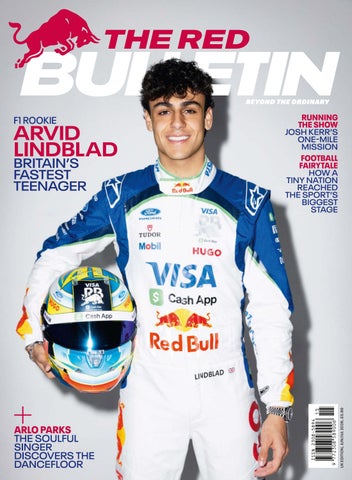
BEYOND THE ORDINARY
ARVID LINDBLAD BRITAIN’S FASTEST TEENAGER
ARLO PARKS THE SOULFUL SINGER DISCOVERS THE DANCEFLOOR
RUNNING THE SHOW JOSH KERR’S ONE-MILE MISSION FOOTBALL FAIRYTALE HOW A TINY NATION REACHED THE SPORT’S BIGGEST STAGE
UK EDITION, JUN/JUL 2026, £5.99
F1 ROOKIE
THE COOLER BRAND
WHEN ALL IS SAID AND DONE, WAS IT SAID OR WAS IT DONE?
VISIT BFGOODRICHTIRES.COM
EDITOR’S LETTER & CONTRIBUTORS
Elliott Morgan “Photographing Arvid Lindblad was, aptly, fastpaced and exciting,” says the Londoner who shot him for our cover. “We wanted to capture the energy of F1 and also the person himself. Arvid has a real focus that translated naturally in front of the camera.”
Jessica Holland The freelance writer spoke to UK rapper Nicole Blakk for this issue. “I loved the story about going viral singing in Punjabi in corner shops,” she says. “It shows that guts, creativity and playfulness can take you far - even when you have few resources to hand.”
ELLIOTT MORGAN (COVER)
Tim Kent
The photographer has shot everything from rock stars to sports cars, but working on our gear guide was no less exciting: “It was great! I got to pitch a tent, play with top-class bikes, and hunt locations in a Bigster.”
A
05
rvid Lindblad wasn’t even born when Lewis Hamilton started driving in Formula 1. Now, aged just 18, the Racing Bulls rookie is racing wheel-to-wheel with him. Britain’s youngest-ever F1 points scorer – and this issue’s cover star – says that if motorsport’s top tier has taught him anything, it’s that even childhood heroes are rivals on the racetrack. From the youngest to the smallest: we travel to the island of Curaçao, the least populated nation ever to qualify for the FIFA Men’s World Cup. So widespread was Curaçao’s joy at the news that even the CONCACAF opposition they trounced on the way to the finals will surely be cheering them on this summer. And we meet British middle-distance runner Josh Kerr. The Scot is happy to ruffle feathers in the name of competition, saying that his running rivalries only spur him on. The multiple world champion will need all that energy this summer as he attempts his toughest test yet… Plus, Arlo Parks finds herself on the dancefloor, poker-faced Wimbledon hopeful Sonay Kartal opens up, and we curate the best gear for your next adventure. Enjoy the issue.
THE RED BULLETIN
CONTENTS
06
68
Fire and ice Until this year, Remco Evenepoel and Florian Lipowicz competed head to head. Now, as Red BullBORA-hansgrohe teammates, these two very different characters are forging a partnership side by side
Features Formula 1
Arvid Lindblad
30
Meet the teen F1 phenom with the world at his feet Music
Arlo Parks
The LA-based singer shares tales from the dancefloor Running
Josh Kerr
Pressure is fuel for the middle-distance athlete Photography
Pelle Cass
Sporting images with a truly immersive quality
44 52 60
Cycling
Venture
08 15 17 18 21 22
95 Travel 100 Equipment 102 Pack like a pro 111 Me & My Body 112 Tried & Tested 115 Mental Fuel 116 How To 119 Comedy 120 What’s on 122 The Takeaway
Gallery Playlist Catching the bus Scent archaeology Book sculpture Pavement power
Heroes
David Keohan
24
Nicole Blakk
26
Jerome Peel
28
No stone unturned Raising the bars
Bike stunts for hire THE RED BULLETIN
From rivals to teammates: a racing power duo is born Football
Curaçao
How the tiny island realised its World Cup dream Football
Game Changers
Inspiring players’ stories from on and off the pitch
78 88
MAXIMILIAN FRIES
Bullevard
Remco 68 Evenepoel & Florian Lipowitz
08
THE RED BULLETIN
GALLERY
09
LUIS BARRA/RED BULL CONTENT POOL
DAVYDD CHONG
Valparaíso, Chile
Ramped up The lad in the red top knows. Witness his expression of incredulity as Chilean enduro rider Pedro Burns comes flying out of the shipping container he’s been locked in for the past fortnight. We joke, obviously, for this is Red Bull Cerro Abajo – the urban downhill MTB competition where the world’s top saddle junkies bomb their bikes around steep, winding courses in three cities: Medellín in Colombia, Guanajuato in Mexico and, here, Valparaíso in Chile. Spoiler alert: Burns landed it perfectly. Makes that hump warning sign seem a bit inadequate, though, eh? redbull.com THE RED BULLETIN
Bisha, Saudi Arabia
Sand effect Welcome to Dakar where, this year, the iconic rally was given a quirky theme: the human body. Here are Ford Racing’s Mattias Ekström and Emil Bergkvist and JJ Sport’s Xu Benyang and Tian Lei on stage 10: ‘The Inner Ear’. After some tricky driving in the small intestine on a later stage, the duos ended up third and 40th overall respectively. All lies, of course. Except the true bits. dakar.com THE RED BULLETIN
FLORENT GOODEN/DPPI/RED BULL CONTENT POOL, KIEN QUAN/RED BULL CONTENT POOL
DAVYDD CHONG
10
GALLERY
11
Palmer, Alaska
Sky light This March, Jeff Provenzano of the Red Bull Air Force scratched two entries off his to-do list in one: the final skydive in his 50-state US tour, and the first-ever recorded descent beneath aurora borealis. As he flew fast and high, photographers Kien Quan and Michael Clark went slow (shutter) and low (light) to capture both spectacles – aerobatic and atmospheric. redbull.com
THE RED BULLETIN
12
Tavarua, Fiji
Top Marks In competitive surfing, Caroline Marks is a titan. From victory in the US under-12s to World Surf League champion, then gold at the 2024 Olympics, she’s carved an assured path to the top. Now, the goofyfooted 24-year-old from Florida – pictured at last September’s Lexus WSL Finals – is tipped for further glory at her home Games in 2028. Don’t bet against it. redbull.com THE RED BULLETIN
WORLD SURF LEAGUE/RED BULL CONTENT POOL
DAVYDD CHONG
GALLERY 13
THE RED BULLETIN
LEVO R
Levo R is Ready to Rally. Are You?
BULLEVARD
15
Wasia Project
Sleepless in South London Four pieces of music that get the pop duo through the night Classically trained siblings Will Gao, 23, and Olivia Harding, 21, have been making emotional, sophisticated pop together ever since Gao asked his younger sister to sing on a track he’d written for his music GCSE. As Wasia Project – the name refers to their mixed Anglo-Asian heritage – they’ve released two EPs, toured internationally with Laufey and Tom Odell, and soundtracked a pivotal moment in teen TV drama series Heartstopper, in which Gao plays a sarkybut-sweet schoolboy. The south London duo are now set to unveil a debut album, Nocturne – featuring their latest single, Bleeding Gold – which Gao describes as “darker, more intense, more reflective” than previous releases. In Harding’s words, “It’s based on the yearning and spiritual feelings that can come to you during the passage of the night.” Here, the pair share the music they turn to for solace and inspiration after dark. Nocturne is out on August 14 on AWAL Recordings; wasiaproject.com
CLARYN CHONG
JESSICA HOLLAND
Béla Bartók
Romanian Folk Dances (1915) Olivia: “I’ve played classical violin since I was very young, using the Suzuki method, trained by ear. My teacher showed me these folk dances by Bartók when I was in my late teens. They were lifechanging, especially the fourth movement. It’s influenced us a lot, the way the instruments are used minimally to create an almost spooky effect.”
Fred Again
I Luv U (2022) Will: “I saw Fred Again recently at Alexandra Palace, and it was incredibly intense and moving. We write songs that are about three to four minutes, but in the world of dance music and techno it’s about building feeling or momentum and maintaining that energy. That helped me think about curation across the length of an album.”
Radiohead
True Love Waits (2016) Olivia: “I only discovered [Radiohead album] A Moon Shaped Pool last year, and I loved its experimental side. This song stood out because it’s hard-hitting and sad, just Thom Yorke’s voice and this muted piano. I love songs that capture the feeling of being introspective and lonely. The lyrics are literally, ‘Don’t leave, don’t leave.’ It’s so vulnerable.”
Samuel Sebastian Wesley
Wash Me Throughly (c.1840) Will: “I sang this choral piece as a young boy. Church music is very intense and cathartic, not unlike the feelings you get on the dancefloor, just on the other side of the spectrum sonically. This one is very confessional: ‘Wash me throughly for my wickedness and forgive me for my sins.’ It’s very moving.” THE RED BULLETIN
Farpoint | Fairview™
Built for Movement. Made for Adventure.
O S P R E Y. C O M
|
@OSPREYEUROPE
BULLEVARD
17
MATT BLAKE
I
n bustling London, people love to complain about the buses. Jordan Izzett, a 25year-old sales professional from Dagenham, is different: he prefers to race them. Known to his 50,000 followers on social media as ‘the Bus Guy’, the amateur runner has become a viral sensation with videos that turn mundane commuting into endurance theatre. “It’s the thrill,” he says. “It’s like a scary movie, like Jason chasing you. You turn around, see this double-decker bending the corner, and you have to move.” The idea came in 2023 after a gruelling London Marathon. “It humbled me,” Izzett admits. “I still found running fun, but going over 5K by myself had become boring. Then a bus drove by, and I thought, ‘What if I can beat it to the next stop?’” He did just that, which led to another idea: “The next day, a Friday, I was in the office alone. I was in my running gear, and I thought, ‘I’m going to race a bus I know really well.’” That bus was the number 5 from Canning Town to Romford. “I grew up in Newham,” Izzett says, “so the number 5 was always there – going to church, to sixth form, out with friends. My first had to be the 5.” It was a sentimental but brutal choice: 18km of running on the hottest day of the year. “It nearly killed me. By the end, I was saying I’d never do it again. But as I edited the footage, I could see the buzz I was getting.” The digital response was immediate. His first video hit 20,000 views; the next, five times that number. Izzett soon realised he’d stumbled into an unexpected London subculture. “I never knew there was this whole world of bus lovers,” he says, noting the ‘bus spotters’ and drivers who film their own day-in-the-life skits. Since then, he’s challenged close to 70 routes, claiming a 60-per-cent win rate. While the traffic in central London favours the pedestrian, the outer boroughs are tougher, Izzett reports. “On the dual
Jordan Izzett
Catching the bus This London runner doesn’t use public transport, he races it carriageways in Essex, they zoom past you,” he laughs. The presence of the Bus Guy on the capital’s roads has become a two-way street. During one race against the number 47, the driver honked and sped past just as Izzett was flagging. “He was basically saying ‘bye-bye’. When I posted the video, the driver actually DM’d me. Now he honks if he sees me. He wants a rematch.” Izzett fondly remembers racing the number 18 to Sudbury, driven by a woman he nicknames ‘Auntie’. After losing her in roadworks, he assumed the race was won, only to find her at the depot, telling another driver about him. “When I said hello, she was stunned,” Izzett says. “Moments
Fare competition: (top) Jordan Izzett races a double-decker – and no, asking a mate to keep ringing the bell isn’t allowed
like that show Londoners aren’t as guarded as people think.” His passion for running was forged on the city’s grassroots scene. Izzett credits his stamina to BRKED-OFF, a weekly social run club. “It’s not just about the running, it’s the people you meet, the vibes you create,” he says. “Running has changed my life, and if I can inspire just one person to get out there, I’ve done my job.” There are currently 675 London bus routes, so what will Izzett do when he’s conquered them all? “I want to explore other cities,” he replies, with a smile. “Like, imagine chasing buses through New York… That would be something.” Follow Jordan Izzett on TikTok and Instagram: @izzettj THE RED BULLETIN
Scent archaeology
Dr Nose By recreating smells from ancient history, this Austrian archaeo-chemist transports us back in time Dr Barbara Huber wants you to know time travel is possible. A vibrating wormhole or fluxcapacitated DeLorean isn’t required: it can be achieved simply by taking a deep breath. Through your nose. An archaeo-chemist and postdoctoral researcher at the University of Tübingen, Germany, Huber is a pioneer in bringing the smells of the past to life. “When we think about history, we usually only consider what we can see: the pottery, bones, buildings,” she says. “We often forget about smell, which is in many ways our most magical sense.” The reason is biological: while vision and hearing are processed in the cerebral cortex – the rational part of THE RED BULLETIN
Scents of the past: (from top) archaeo-chemist Dr Barbara Huber; extracting ‘frozen’ perfume from an ancient Roman glass vessel
the brain – smell is transmitted to the hippocampus and amygdala, areas that govern memory and emotion. “[The novelist] Marcel Proust was right when he wrote that smell is the only sense that can transport us back in time,” Huber adds. “It can trigger a physiological response before we even realise what we’re sniffing.” Reconstructing a lost aroma is laborious. Using an analytical method known as Gas Chromatography-Mass Spectrometry (GC-MS), Huber hunts for ‘biomarkers’ – molecular fingerprints trapped in ancient artefacts for millennia. By identifying these chemical clues, she can rebuild a sensory world, molecule by
molecule, resurrecting everything from the delicate floral notes of a pharaoh’s perfume to the “turpentine and barbecue” stench of a 3,500-year-old mummy. Did those mummies smell good? “I think so,” she says. “Ancient texts say people didn’t want to stink in the afterlife. They used sweet, resinous substances that were antifungal and antibacterial. It was a combination of preservation and scent.” Huber’s latest project involves ‘frozen’ perfumes from ancient Rome. While most liquids from antiquity evaporate into a dry crust, her team recently found a Roman glass vessel so tightly sealed that the scent inside was still a liquid. “We used a syringe to pierce the stopper to extract it. It’s so rare for a container so old to have an actual liquid inside.” They’re currently analysing the substance to recreate the exact perfume once worn by the Roman elite. But history isn’t all flowers and frankincense. Researchers in the Netherlands have tried to recreate the smell-scape of the Battle of Waterloo – gunpowder, blood, wet grass, horsehair, “anxiety sweat” – while in the UK biological data was used to imagine the breath of a T Rex (rotting meat, septic infections). For Austrianborn Huber, these scents are essential educational tools: “Smell connects so many areas of life. Everyone has to breathe in and out to live, so it affects everyone.” By reviving these lost aromas through scented prints and museum exhibits, Huber is restoring what she calls the “invisible layers” of our history. “Most of the time when you visit a museum, you see or read about something. But when you smell it, you have an experience that makes abstract history more tangible. It’s a time machine for your nose: you get transported back in time the moment you breathe it in.” barbara-huber.com
MATT BLAKE
BULLEVARD
CAROLE CALVEZ, JÜRGEN VOGEL/LVR-LANDESMUSEUM BONN
18
FIRST WATER jORDY SMITH – TEAM O’NEILL ATHLETE – PHOTO: NATHAN LAWRENCE
BULLEVARD
MATT BLAKE
B
ooks don’t require electricity or a stable Wi-Fi connection – all that’s needed is ink, paper and a human brain. For sculptor Brian Dettmer, that’s their beauty: a physical integrity that can’t be manipulated. Not, that is, until he slices them up in the name of art. “We’ve reached an age where disinformation is rife, where truth is so readily manipulated,” Dettmer says. “And now all our information is on constant life support. We’ve created this massive infrastructure to share basic facts, which needs electricity to exist. But in a book you have something solid, something trustworthy.” Dettmer, 51, from Chicago, is one of the world’s leading modern artists working with books. For three decades, his intricate sculptures have been showcased in more than 25 solo exhibitions across the world. In that time, he has reconstituted maps, record albums, cassette tapes and other media to create new, transformed works of visual fine art. But he’s always returned to books. “My work is about the way we distribute, read and manipulate information as much as it is about the role of the book itself,” Dettmer says. “There’s celebration in there, but also a lot of criticism.” He begins his process by sealing the edges of a book with varnish to create a solid shell. Then, using a razorsharp crafting knife, Dettmer carves through the layers like an archaeologist digging for treasure. Crucially, he never adds or moves content. “When I find something interesting, I carve around it and continue removing layers,” he explains. “It’s a completely subtractive process. Everything’s exactly where it’s always been.” Dettmer tends not to use novels as they contain too much text. He prefers works that combine text with pictures – encyclopaedias, dictionaries and medical books work best. “I’ll flip through a book to make
Book sculpture
Paper cuts Meet the surgeon-like sculptor who turns the printed page into a work of visual fine art sure it works, but nothing is planned,” he adds. “I like that kind of scientific honesty. The element of surprise is an important part of the process.” For Dettmer, the books he chooses don’t “die” under his knife. He sees his work more as an “autopsy” of an old tome: by destroying the linear narrative, he reveals a hidden, three-dimensional truth within. “It’s a memory or a monument to the book, but it’s also a celebration,” he says. “I want that tension between creation and destruction, death and new life, accessibility versus manipulability.” Dettmer says his work often elicits a “sad nostalgia” from people who view the dissection of a book as a tragedy, but he
New leaf: (clockwise from above left) Spellage (2020); book-loving artist Brian Dettmer; United Stat Story (2023)
welcomes the friction. “I don’t mind upsetting people,” he admits. “I want them to feel a little unsettled with what’s happening to the book, and to our information.” Ultimately, Dettmer wants his work to suggest a retreat to a time when you could trust what was in front of you. As we all face a future where the digital realm could one day fold in on itself, there’s a comfort in his vision. “I’m not advocating going back to the past,” he adds, “but I think books are very valuable as something that’s been properly studied and processed before being distributed. Something that we can rely on as the truth.” briandettmer.com
Pavement power
Positive steps For industrial design engineer Laurence Kemball-Cook, the future of sustainable energy is right beneath our feet
Laurence Kemball-Cook’s road to success began with a spectacular failure. In 2008, fresh out of Loughborough University, the industrial design engineer was offered the job of a lifetime: a brief from energy giant E.ON to devise the ‘future of sustainable streetlighting’. “I looked at solar and wind power,” says the 40-year-old, “but I quickly realised the sun doesn’t shine enough in dense urban areas, and there isn’t much wind either. I completely failed, and they fired me.” But Kemball-Cook couldn’t let it go. “Hanging my head in shame, I kept thinking about clean energy in cities,” he recalls. “Then it hit me: what’s the one source of expendable energy all cities have in abundance? Young people.” The idea evolved quickly. “At first I thought about streetlights you could run up to and kick,” he says. “Then I pictured those fairground machines where you hit a mallet and it goes, ‘Ding, ding, THE RED BULLETIN
Sole-r energy: (from top) Pavegen tiles in action in London; the tech revealed; creator Laurence Kemball-Cook
ding’. That’s when I thought, ‘Why not make a floor tile you can stamp on?’ You walk on it and it generates power.” Kemball-Cook retreated to his bedroom and created a prototype from wood, duct tape and Blu Tack. “It went crunch when stood on, which didn’t sound great, but it powered a light for five seconds.” He knew he had something, but turning it into a business was another challenge. “No one would invest, because I didn’t have revenue, and no one would
buy, because I didn’t have a finished product. I was in a chicken-and-egg stalemate.” So he decided to force a breakthrough. At 2am one Tuesday in 2010, armed with a prototype and a pickaxe, he climbed a fence at a building site on London’s Southbank. “I was mixing cement at 3am, trying not to get caught, buying bottles of water from a corner shop to mix it.” By 6am, he’d installed a working tile and streetlight – and vanished. “I posted a photo online with the caption, ‘The future of energy is here’. By noon, Westfield retail group called and said, ‘We’ve seen your streetlight. We’d like to buy one.’” The next day, £350,000 landed in Kemball-Cook’s bank account. From there, he refined the tech, replacing the ‘crunch’ with a sophisticated internal flywheel that converts rotational energy into electricity which can be fed directly into lights or signage or stored in portable batteries. Today, his company, Pavegen, operates in more than 45 countries, in locations ranging from Yosemite National Park to Hong Kong’s transport hubs. Projects have included a kinetic football pitch in a Rio favela; a dancefloor in Trafalgar Square, powering a DJ set by drum’n’bass act Rudimental, and an installation that converted the footsteps of 37,000 Paris Marathon runners into energy for a local school. Looking ahead, KemballCook’s mission is now to commoditise the technology and make it the same price as standard flooring. He sees a world where our very presence contributes to the planet’s health. “We want every single city, town and village to be able to power their community with footfall,” he says. “Whether it’s powering the biggest nightclubs in Las Vegas, or lights allowing children to read at night, our goal is to make the world a greener place, one step at a time.” pavegen.com
MATT BLAKE
BULLEVARD
PAVEGEN
22
HEROES
David Keohan
The man known on Instagram as ‘Indiana Stones’ is reviving the ancient sport of stone lifting in Ireland, one 100kg-plus boulder at a time Words Tom Ward
The heaviest stone David Keohan has lifted – in Country Derry, in the north of Ireland – weighed 257kg. As Ireland’s premier stone-lifter, the 46-year-old has travelled the length of his home nation – and Scotland and Wales – in pursuit of oft-forgotten stones, each of them integral to their country’s folk history. “My childhood was [spent] wandering the Copper Coast UNESCO heritage site in the south-east of Ireland,” explains the man from County Waterford. “It’s a beautiful landscape of rocky cliffs, coves and beaches, so stone is in my blood.” Keohan, a former kettlebell-lifting champion, started lifting the stones in his garden as something to do during COVID. He quickly realised that “lifting stones feels amazing. It’s really primal”. Six years on, his online videos have helped revive a sport largely forgotten for a century or more. To mark the release of his memoir, The Wind Beneath the Stone, Keohan reveals the beauty of the burden… the red bulletin: What is stone lifting? da,id ke.han: It’s not just picking up stones off the ground. In Ireland, but also in Scotland, in the Basque country and elsewhere, lifting certain stones were rites of passage from child to manhood, or man to warrior. In parts of Iceland, your portion of the fish catch depended on how much you could lift. In Ireland, we used them at fairs, funerals, weddings. There’s a folk culture attached to these things that’s been largely lost, but which we’re trying to bring back to life again. Irish author Liam O’Flaherty wrote a 1937 story, The Stone, which sets out three rules for lifting. What are they? He wrote about a specific 171.2kg stone on the island of Inis Mór. Local lore describes the three stages of manhood.
THE RED BULLETIN
The first was getting the stone two inches off the ground to “let the wind pass beneath it”. Then, if you could get the stone into your lap and sit back with it there, you were a champion, equal to the best man. Stage three: if you could stand, hug the stone to your chest and kiss it three times to show you were in control, you were a phenomenon of strength to be spoken about for generations. Why have humans always been obsessed with tests of strength? There’s an aspect of people wanting to be remembered for how strong they were. I’m looking at this through an Irish lens, but stone lifting took place in Africa, Japan, Papua New Guinea – it’s universal. People wanted to lift something heavy, usually either a tree trunk or a stone. It becomes an important part of tribal culture. But it’s about more than strength; it’s a way of becoming certified as a farmhand or a stonemason, a warrior or a fisherman. Lifting was the test you had to pass. What makes a ‘lifting stone’? It will have been lifted hundreds of years ago and its story recorded, usually orally. Picking up a stone on the beach, it’s just a stone, but a story has to start somewhere. The stone I used to train with, we shipped it to Boston. Now it’s the ‘Boston Lifting Stone’, a physical piece of Ireland, and it’s brought to all the Irish festivals there, so it’s taken on its own story. What are the mechanics of your sport? Stand over the stone with your centre of mass above it – think of it as a super-deficit sumo deadlift without handles. Stones can be any shape, so a grip – and the centre of gravity – can be hard to find. Lift it into your lap in sort of a kettlebell swing motion, then hug it to your chest. Sitting with it in your lap is like a very heavy front squat. It’s a full-body exercise taking maximum effort, especially with the heavier ones.
A lot of the records of Irish stones have been lost. How do you locate them? The Irish government recorded a lot of folktales in 1937, and there’s now a database, the Dóchas initiative. Through it, I found out about the Thomas Lonergan Stone, said to be in the graveyard in Shanrahan in Tipperary. Men would come from all over the parish to try to lift it after Sunday Mass, but only Lonergan could. It’s a starting point, but centuriesold graveyards might not exist any more, so you end up looking at clumps of trees on Google Maps, or hacking through bushes. Luckily, the Lonergan Stone was right there. The locals all knew about it. We weighed it at 177.5kg. Suddenly, the story is back. No one has lifted it since the 1800s, but the stone is alive again. Where’s the most remote place you’ve been to lift stones? I’ve identified 54 lifting stones across Ireland so far, some of them on remote islands off the west [coast]. People send me photos or get in touch online and say, “My dad remembers a story from boyhood about a stone. Come have a look.” What’s the appeal of stone lifting in 2026? I’ve seen meek guys do this, and the roar as they lift a stone is a primal thing. It’s a connection to the land that we’re missing. I’ve seen guys break down, crying. It’s like you’re connecting with something ancient; you’re lifting the bones of the Earth. How many people have been lifting this stone for 1,000 years? It’s a beautiful thing. Keohan’s memoir, The Wind Beneath the Stone, is out now, published by Bloomsbury. Instagram: @_indiana_stones_
Stone love: Keohan’s wish list “The Clach Ic Caoilte is a 149kg stone on the Scottish island of North Uist. It’s linked to the Irish tales of the Fianna warriors. That’s top of my list.” “The Dritvík stones in Iceland were used to test fishermen. There are four, all different weights – the heaviest, the Fullsterkur [full strength], is 154kg.” “There’s a wonderful [lifting-stone] culture in Japan, with more than 50,000 at Shinto temples. I’d love to go.”
JOHNNY SAVAGE/EYEVINE/APA-IMAGES
24
“It’s like you’re lifting the bones of the Earth”
THE RED BULLETIN
26
HEROES
Nicole Blakk
Thanks to original, multilingual lyrics delivered with poise, the Watford-born rapper is taking her seat at the table Words Jessica Holland Photography Zak Watson
“When you’re a woman in rap, you have to be not just good but amazing,” says Nicole Blakk, a rising singer and MC who has successfully proved her undeniable talent. A graduate in digital marketing at the University of Birmingham, Blakk started rapping in 2022 to diss an ex. Just a couple of years later, she was jumping on the mic at an open-air livestream set by DJ AG that attracted the attention of Skepta and other grime OGs. Since then, the now 23-year-old has rapped in English, Punjabi and French at Red Bull Mic Flex; played at Glastonbury and SXSW London, and recorded a lacerating verse for Dave’s most recent, BRIT-nominated album – just one of several collaborations with former childhood heroes who are now peers. Music is in Blakk’s blood – her Congolese grandfather was a respected saxophonist – but she’s worked hard to get here, taking on a series of 33 jobs (by her count) to pay the bills, from night receptionist for Premier Inn to “dragging bricks” at home improvement store Wickes. She sang at talent shows, church services and family gatherings as a kid, going on to write and record music with her supportive older sister before securing a scholarship to the music academy that Ed Sheeran also once attended. The Red Bulletin caught up with Blakk as she gears up for the release of new tracks, followed by her debut EP later this year. the red bulletin: Are you riding high at the moment? nicole bla..: Yeah, I’m not gonna lie, I just moved to east London in February and I’m even more inspired. People are so creative here and there’s always something happening.
THE RED BULLETIN
When did you start rapping? It was in 2022, and I’d just broken up with my ex. We had a good relationship, and the breakup was mutual, but I saw him doing this sad freestyle online about how his heart’s broken and how he can’t trust girls any more. I messaged him, “What are you talking about?” And he was like, “It’s just social media, don’t take it to heart.” So I wrote some bars dissing him. It started a back-and-forth thing for about three weeks on Instagram. I’m crying after I’m posting. His mum told us, “You guys need to stop.” I went back to singing after that, but now I had these lyrics and I started going to cypher [community freestyle] events in London and rapping. Did you feel at home in the spotlight? I remember when I did my first episode of [short-form series] Red Bull Mic Flex I was very new to rap, and I was the only girl on there. But it was great – it made me feel appreciated as a rapper, and I had so many opportunities come from it. You went viral for singing in a corner shop. What’s the story there? Growing up, we’d always listen to Punjabi and Hindi music at my friend’s house, and I just picked it up. One day when I was at uni, my card was declined in a shop, and I asked the owner if I could have the bread and milk for free if I sang to him in Punjabi. He laughed in my face and said, “I need to film this.” I put the video on TikTok as a joke and it went viral. After that, I started a ‘shop series’ of videos. It helped me get free groceries and survive until my next student loan payment. Eventually I created music with an Indian artist, Gurnoor, which surpassed a million streams. I was on billboards in India. Do female rappers feel more pressure? Definitely. You have to constantly believe you’re great, because the men support the men. They’ll pass the mic to the guys, not
the girls. It takes a strong person to keep going. But you have to believe in yourself if you want other people to believe in you. Have you always had this confidence? I’m not the type of girl to get in someone’s face, but when I put on my Nicole Blakk alter ego – it’s not my real name – it brings out the best version of me. Nicole Blakk has white eyebrows and white eyelashes, and she does what she wants. That’s why I feel like music is something I’ve always needed. What did it mean to feature on Dave’s track Fairchild? It’s crazy. I would sing his songs in Year Eight, and there’s a poster of him in my room. The fact that my name is next to his on a track is still really difficult to believe. I’m so glad to have been part of such a powerful message. Before he finished writing the song, I told him about personal experiences I’d gone through. It was very difficult for me to record. You can hear me crying on the recording, trying to hold it in. What advice would you give to aspiring artists? Once you stop caring what other people think, you’ll be flying. Even Beyoncé’s got haters, so don’t let that hate comment keep you up at night. And you miss 100 per cent of the shots you don’t take. Instagram: @nonelikebee
Blakk list: four of her favourite females Lady Leshurr “I love everything she does. My whole family went to see her at a festival, then a year later I was opening for her. It’s madness.” Little Simz “She’s authentically herself, she hasn’t adjusted her image, and she’s made a name for herself globally.” Doechii “Seeing someone who looks like me winning Grammys makes me feel like my dreams are possible. Her creativity is just mad.” Lola Young “I love how she’s so honest, and that she took a break from performing and came back stronger. I respect that so much.”
“Once you stop caring what other people think, you’ll be flying”
THE RED BULLETIN
28
HEROES
Jerome Peel
The New York cyclist, aka Instagram stunt rider Citybikeboys, proves that it’s not the bike that matters, it’s how you use it Words Charlie Allenby Photography Tristan Martinez
Hire bikes are the workhorses of inner-city commuting. Designed to survive years of use and abuse in all seasons, they’re durable, dependable and, at around 20kg, incredibly heavy. But, in the hands of New York-based rider Jerome Peel, they’re also a viable substitute for a BMX or mountain bike when hitting skateparks, cobbledtogether street spots or off-road trails. The 36-year-old is the founder of Citybikeboys, an Instagram account where, through viral posts, he explores the stunt possibilities of New York’s cycle-share service, Citi Bike. Each summer, Peel also organises a Citi Bike race, with thousands riding between Brooklyn and Manhattan. But his antics, which have seen him tick off some of New York’s iconic skate spots and even earn himself an invite to the Swatch Nines MTB event in Austria last year, are more than a gimmick. Peel’s keen to show that, no matter what you ride, access to fun and adventure is simply a matter of imagination. the red bulletin: Where did this idea come from? jer,me peel: Where I grew up riding in Florida, my dad rode with me all the time. He was 60-something, fully padded up, and I ended up getting bullied at the skatepark. I was tormented. When I was 20, I left for New York, thinking I’d never ride again – I had this hatred towards BMX. But a couple of years later I hopped on a Citi Bike. Me and my friend were riding around, and he saw me jump off curbs and said, “Dude, my mind is blown. You can really ride a bike.” He was like, “I’m gonna film everything you do.” Do you remember when you first really tested yourself on a Citi Bike? The double set at LES [Lower East Side] Skatepark was the first video I ever posted.
THE RED BULLETIN
At that point, I’d only jumped down three stairs and curbs. But my friend said, “You should do something crazy, because I’m starting the Instagram page.” It was really insane. When I took off, I thought, “Oh my God, I’m way up in the air right now and I don’t know how I’m gonna land this.” I was so surprised that it worked out. At the beginning it was just funny. It was so accessible – the bikes were everywhere – and I thought, “This is what I’ll ride now.” What’s your favourite achievement? Jumping over the 145th Street subway tracks – that was something I’d wanted to do for three years. If you could jump it straight, it’s 12 feet [3.7m], but you have to jump it at an angle, so it becomes 13.5 feet – a massive leap, whatever way you look at it. I’d always talked myself out of it, because the consequences were so high. The landing side is where the third rail is, which will electrocute you; there’s no surviving getting hit. And even if you don’t hit the third rail, it’s a six-foot drop to a super-uneven pit of metal, so you’re getting hurt. But one night, at 11pm, I was tired of thinking about it – I just wanted to get it done – so I drove around with the filmer, looking for a bike. The one I found had low tyre pressure and the bars were a bit crooked, but it would do. It had absolutely zero modifications. I was pedalling as the train was going. It was just the perfect scenario, and I landed it. That one was the biggest surprise, because it shouldn’t have worked. Is it true that a bit of a scene has developed in the years since? Yeah, there’s been others – including professionals – picking up Citi Bikes [to ride unconventionally] and that’s so cool. I don’t think it’ll ever be its own thing or a sport, but to see other people making their own crew and getting their own content is amazing.
Is your Citi Bike riding still just fun, or is there more of a message to be taken from what you do? I would love to show people who don’t have that much money that the bike isn’t going to hold them back. [British mountain-bike rider] Harry Schofield backflipped the 60-foot [18.3m] gap of the Nines’ freeride run on a Citi Bike. Harry could compete at a very high level on a Citi Bike without his tricks being [much more limited than] they are right now. That frame costs maybe $200 [£150] or less. What are your plans for the future? I want to ride at a pro level on the bike – and I’m not far off. I always have a lot of fun thinking of creative jumps to build in the city, and I have no plans to slow down – it’s only ramping up from here. Also, the Citi Bike event continues to get more and more competitive. At the race last year, I had the course doing zigzags, hopping over curbs and little obstacles. It was hilarious. Everybody has to be on a stock bike, and people go crazy. It’s really a sight to see. It only gets wilder and funnier each year. Instagram: @citybikeboys
Hire calling
A selection of Peel’s best Citybikeboys moments February ’26 Snow ramp to truck A pile of the white stuff and some plywood becomes a ramp, and Peel propels himself up onto the roof of a truck. July ’25 Backflip into the river During an NYC heatwave, Peel cools off by launching himself and his Citi Bike into the East River. A surf leash keeps him connected to the bike, while a motorcycle inner tube shoved into the front rack stops it sinking. July ’24 Curved wall ride Peel and his bike defy gravity, completing a 270° wallride on a curved bench with little room for error. February ’24 Porta potty tabletop Nothing is off-limits for inspiration, even a Portaloo. A ramshackle ramp set-up sees Peel clear the 2.3m obstacle with ease.
“I want to ride at a pro level on the bike – and I’m not far off” THE RED BULLETIN
30
BRAVE NEW WORLD ARVID LINDBLAD: FORMULA 1’s NEXT-GEN STAR Words Justin Hynes Photography Elliott Morgan
THE RED BULLETIN
FORMULA 1
THE RED BULLETIN
32
THE RED BULLETIN
FORMULA 1
33
From wolfing down his grandmother’s chapatis at the back of a car at a riverside kart track to racing wheel-to-wheel with his F1 idol Lewis Hamilton – and winning – Arvid Lindblad has turned boyhood fantasy into recordsetting reality. But now the hard work really starts, and he’s ready for it…
THE RED BULLETIN
FORMULA 1
A
rvid Lindblad is walking up the Albert Park pit lane to make it to the front of the grid for his first F1 race. There are just over 16 minutes to go before the start of the Australian Grand Prix, and the 18-year-old needs to be front and centre for the national anthem. As the packed grandstands hush and pop singer Kita Alexander launches into Advance Australia Fair, Lindblad, about to become Britain’s youngest Formula 1 starter, takes his place in the driver line-up. To his right is Nico Hülkenberg, a veteran of 250 Grand Prix starts; to his left, Lindblad’s childhood inspiration, seven-time champion Lewis Hamilton. As the music swells, Lindblad glances down and the significance of the moment snaps sharply into focus. THE RED BULLETIN
“Your place has a name card on it,” he smiles. “I looked down and I could see ‘Arvid Lindblad’ and just above it the F1 logo and the words ‘Formula 1 World Championship’. I almost got a bit emotional. So many times, you watch the drivers at the national anthem on TV before the start of the race, and I was just thinking, ‘Wow, this is me, I’m here… It’s finally real.’” If the scene seems almost cinematic, an uplifting moment of self-realisation after years of toil in the shadows, then it’s fitting, because Lindblad’s progress to that ‘pinch me’ moment on the Melbourne grid was the endpoint of an origin story as precocious and carefully plotted as it was determined. “For me, the seed was sown when I was four,” says Lindblad, who now
drives for team Visa Cash App Racing Bulls. “My dad was sitting on the sofa watching F1, and I came and sat next to him. I was amazed. This would have been 2011, so it was Seb [Vettel], Jenson [Button], Lewis [Hamilton]. I’m watching this race and I’m just like, ‘Wow, this is so cool.’ I remember asking my dad, ‘Could I ever be there one day? Is it possible?’” For most parents, it’s a familiar question. One week it’s, “How do I become a police officer?” The next, it’s a doctor, a pilot, an astronaut. For Lindblad, there was no other question. The following year, his Swedish father, Stefan, who had dabbled with motocross in his youth, took Arvid to the British Grand Prix at Silverstone and what had been
GETTY IMAGES
34
35
“Jumping from F2 to F1 is just one category, but it feels like a completely different sport” Big time: Lindblad in the Visa Cash App Racing Bulls’ VCARB 03 RB Ford this March THE RED BULLETIN
36
Quick start: Lindblad started driving at an early age, racing go-karts. “It was never [just] a hobby for me,” he says. “I was thinking, ‘How can I be better? How can I learn? How can I improve?’” THE RED BULLETIN
FORMULA 1
37
“Every time I went to the kart track as a kid, I had the goal of getting to Formula 1” speculative became fixed – a North Star that the five-year old would chase all the way to Melbourne.
“T
he first time I went karting, I didn’t want to leave,” Lindblad says. “Every time I went to the kart track, I had the goal of getting to Formula 1.” His father had bought him a go-kart, and weekends became outings to tracks within easy reach of the family’s home in Virginia Water, Surrey: Sandown in Esher; Bayford Meadows in Kent, and, “where Lewis started”, Rye House in Hertfordshire. “It was never a hobby for me,” Lindblad says. “Maybe my dad will say it was, and that I was having fun, but I was also thinking, ‘How can I be better? How can I learn? How can I improve?’” The commitment deepened when the Lindblads moved house and temporarily moved north to Bolton and his Indian maternal grandparents. Forty-five minutes away, near Liverpool, on the banks of the River Mersey, was Hooton Park, a small, unglamorous kart track they would call home for the summer.
“That was the summer that changed everything,” Lindblad says. “Me and my dad would go every other day. I was driving all the time, and I absolutely loved it. My grandparents would come to the track and they’d bring Indian food. I’d be having my nani’s rajma and chapatis at the back of the car. “It’s something I’m very proud of. I come from a multicultural, multi-faith background, and it’s really shaped me into the person I am today. My [paternal] grandparents still live in Sweden, in Knivsta, which is where my dad grew up, so we’d go see them every year. And we spent a lot of time with Mum’s parents in Bolton. It’s been a big part of my upbringing. Those values of hard work, humility, always giving your best, from all three cultures, have really helped me.” Through it all, the seriousness of the competition began to grow. But while the route to success in karting often rests in financial outlay – towards sourcing the best engine possible, in particular – Stefan took another route. Arvid was denied better machinery and instead relentlessly coached to drive around the mechanical deficit. Enter Oliver
On track: Lindblad joined the Red Bull Junior Programme at the age of 13, when he was signed by Helmut Marko
Rowland, now the reigning FIA Formula E world champion, but then a young hopeful on his way to winning the 2015 Formula Renault 3.5 title, and in desperate need of racing finance. Seeking expert help for Arvid, the Lindblads reached out to the Racing Steps Foundation. Rowland signed up. It would become one of the defining relationships of Lindblad’s career. Occasional advice on race craft became regular coaching, and then Rowland suggested a family kart team. “Before we knew it, we had a Sprinter van with a little pop-up tent, and it was me, Ollie and my mechanic Alex [Tee] going around the UK, learning stuff together,” Lindblad says. “Things really took off.” The results that accompanied the surge in performance attracted the attention of another instrumental force: Helmut Marko. The notoriously tough then-boss of Red Bull’s Junior Programme saw what Lindblad was doing and liked it. A place on the programme was offered. New, fully supported pathways opened, but only if he hit targets, won races, took titles. Lindblad was just 13. But, despite his youth and inexperience, he insists he never felt pressured. “It was exciting,” he says. “I knew that Helmut had brought guys like Sebastian and Max Verstappen to F1, so I was just excited that he believed in me. I saw it as an opportunity: they were helping me to make my dream come true. I didn’t feel pressure to perform; I wanted to perform because I wanted to be in F1.” Cross-country van journeys with coaches and mechanics; a mentor whose racing career had peaked four decades earlier; team owners, engineers, sponsors – Lindblad was a child in an intensely grown-up business. The days of tailgate rajma and chapatis were fading – and it did have an effect. “It forces you to mature quickly,” says Lindblad. “From the age of nine, 10, I was going on trains around the UK. As soon as I could, I was flying by myself. It forces you to be independent, which is good, but it’s a bit of an awkward existence. There were parts of the journey that weren’t always fun. Family life and social life in THE RED BULLETIN
38
Model subject: Lindblad is a keen follower of fashion and got actively involved in choosing the HUGO pieces he’d wear in The Red Bulletin’s shoot
THE RED BULLETIN
FORMULA 1
39
“My multi-faith and multicultural background has shaped me into the person I am today” THE RED BULLETIN
40
general were difficult. I missed a bit of school because I was away racing. You get left out of friend groups because you’re not there, and when you are it’s kind of awkward. “There was a long time in my life where I’d come home from the racetrack and just want to hang out with friends, kids my age – 14, 15 – and I’d be like, ‘I don’t actually know who to message.’ I’m really happy now, because it’s the first time that I have really good friends, one or two guys who I can call, who I can talk to about anything. We can have a laugh, and they’re there for me as a person.” It didn’t hamper his progress. Lindblad made the switch to single seaters, finished third in Italian F4, and won the category at the legendary Macau Grand Prix. He jumped up to international-level F3, racing on the same bill as F1, and triumphed on his debut in Bahrain – the first time it had been done – then won both his home races at Silverstone on his way to fourth in the championship. It all came easily. Then he moved to F2. “That was one of the hardest years I’ve had,” he says. “It wasn’t always fun. There were a lot of questions I could never really get answered, and that was confusing.” There were pronounced swings in form. He won in Jeddah, becoming the youngest F2 winner in history at 17 years and 254 days, and did it again in Barcelona. Elsewhere, however, there were collisions, disqualification, penalties. At times, he looked exactly like the driver Red Bull believed he could be; at others, it was wildly unpredictable. He was 17, with a year each of F4 and F3 behind him, trying to keep his head above water in a championship that punishes every missing piece of experience. “I was struggling to gel as well as I wanted with the team,” he says. “Then I started to have my own issues because things weren’t going as I wanted. I was struggling to maximise myself, to arrive in as good a mental place as I wanted to. “When it came together, great things happened,” he continues. “But as a THE RED BULLETIN
result of me coming through so quickly, there were still so many gaps in my knowledge, so many things that I hadn’t experienced, that there were always going to be times where things didn’t go as well.”
T
oo much, too soon? Lindblad and his Red Bull Junior Programme mentors didn’t think so, and with programme graduate and F1 rookie Isack Hadjar stepping up to Red Bull Racing, a seat at Visa Cash App Racing Bulls – a team focused on bringing through young drivers – opened up. F1 beckoned. The only question was whether Lindblad could process the volatility of his rookie F2 season and channel the lessons on the biggest stage. “It’s an old saying, but it’s true: you learn more through the difficult days than you learn through the good,” he says. “I learned a lot from last year, mostly about myself and what I need, how I need to approach the weekends, communication, working with people, all this kind of stuff. I’ve carried it all through to this year.” The step he was about to take was massive, however. In F2, a driver is typically working in a team of 15-20 people trackside, talking with one engineer, dealing with a limited number of set-up parameters and racing a car with a little more than 600 horsepower underfoot. In F1, every number balloons to gargantuan proportions. Each team brings 60 or more operational staff to an event, but dozens more swell the ranks in areas such as marketing, communications and hospitality. In the car, the toybox of set-up tools covers almost every aspect of performance, from multiple engine modes to differential settings, brake configuration to power delivery. Steering alone goes from 8-10 switches and two rotary switches to upwards of 30 separate switches, toggles, buttons, paddles and rotaries. It’s like swapping a pocket calculator for a supercomputer, a crop duster for a rocket ship. “It was massively exciting, nerve-racking, a bit overwhelming,” he says. “This whole new world is so different to what I’m used to. Jumping from F2 to F1 is just one category, but it’s not – it’s completely different. It feels like a different sport.” The reality of how much life was changing became apparent in pre-season testing in Bahrain. “I sat in my first press conference, I hadn’t even gone racing yet, and the room was completely full,” says Lindblad. “There were four drivers and probably 60 journalists – I’m used to four or five. That was like, ‘Wow, OK.’ Then, in Australia, doing things like the
GETTY IMAGES/RED BULL CONTENT POOL
“I’ve almost been learning on the go”
FORMULA 1
41
“I have massive respect for the senior drivers, but will I treat them any differently on the track? No” At the wheel: Lindblad in Sprint Qualifying at the Miami Grand Prix this May THE RED BULLETIN
42
Racing heroes: At the age of 18, Lindblad is lining up against some of the senior drivers he idolised as a child. “Racing side by side with Lewis [Hamilton] is pretty nuts!” he says. “He was a big reason why I fell in love with the sport” THE RED BULLETIN
FORMULA 1
43
“I don’t know what the next few months have in store, but I’m living my dream”
GETTY IMAGES
Melbourne Walk, where fans line the way into the paddock and they’re all shouting and cheering… it’s a whole different world. But luckily with this sort of stuff, I’m able to process it – I just crack on.” Eventually, the white noise off-track stops and the visor goes down. And, in Melbourne, Lindblad did exactly what all the early mornings at Hooton Park, all the coaching, all the outperforming poor equipment had prepared him for. “As soon as the lights went out, I just went for every gap I could find and got stuck in,” he says. “I slotted in between Lando [Norris] and Lewis, and before I knew it I was in P4. Then it was me, Isack and Lewis, racing side by side,” He shakes his head in disbelief. “Racing side by side with Lewis is pretty nuts! Lewis was a big reason why I fell in love with the sport.” The true pace of his rivals eventually played out, but Lindblad took the flag in eighth place to become Britain’s youngest F1 points scorer. The performance was revelatory and attracted good notices across the paddock, where the wheel-towheel battles with world champions Norris and Hamilton saw him branded ‘fearless’. He shrugs off the description.!
“I don’t think, ‘I’m going to be fearless,’ or whatever,” he laughs. “I have massive respect for the senior drivers – Max, Lewis, Fernando – but will I treat them any differently on the track? No. I’m going to race hard but fair with everyone, so if there’s an opportunity, I’ll get stuck in.” The races since have been by turns outstanding and frustrating. Lindblad finished 12th in China, hampered by technical issues from the previous day. In Japan, he bounced back from more gremlins to qualify 10th!and push fourtime champion Max Verstappen out of Q3. And then the pause button was hit.
W
hen events in the Middle East forced the cancellation of this year’s races in Bahrain and Saudi Arabia, the Visa Cash App Racing Bulls rookie says his time was largely taken up with “trying to maximise the break from a learning point of view, being in the sim, staying sharp”. But he also found time to explore other avenues of interest. Lindblad worked on his skateboarding skills, though a ranking of four of ten probably puts him
Turning heads: as this handmade trackside banner illustrates, the teenage driver has a growing following among Formula 1 fans
out of touch with his reference, two-time Olympic champion Yuto Horigome. There’s still been no time for him to get to grips with securing his road licence, though, and while his F1 Superlicence qualifies him to power around tracks at more than 300kph, he’s still mostly being driven around regular roads by his mum, Anita. On the day we meet, Lindblad had a driver to take him to a studio in London’s King’s Cross where he’s playing fashion model for the afternoon, assembling pieces from sponsor HUGO for The Red Bulletin’s cover shoot. He’s as fascinated by the process as much as the clothing, fashion being an interest of his, and he regularly peers at monitors, critiquing his poses. After the rollercoaster ride of his ascension to F1, it’s a useful distraction: “It’s been a very intense start of the year, and the break [before Miami] was the first time I’d been home since the middle of January, so it was nice to sleep in my own bed.” His first months as an F1 driver have formed a steep learning curve, one that will continue at pace.!“It’s almost learning on the go,” he says. “In Japan I qualified P10, and at the end of lap one I was running in P8 or something. I’m almost a bit out of my depth in the sense that I’m higher up than I should be. I’ve got faster cars behind me; I’m trying to hold track position. It’s mentally tiring. I’m just trying to stay focused on myself, on what I can control, what I can do better. I don’t know what the next few months have in store, but it’s all extremely exciting. I’m living my dream and I’m loving it.” Research, review, reset and recharge. If F1 is full of new experiences, then that, at least, is a familiar pattern for a driver whose rise has seen him climb the ladder at impressive speed. “It’s a funny world, sport,” he smiles, then pauses. “You work your whole life to get somewhere, then once you’re there, you kind of start from zero.” For Arvid Lindblad, the journey begins all over again. There are technical hurdles to overcome, standards to reach, points to prove. But if there are any doubts along the way, all he must do is cast his mind back to that card on the Melbourne grid. There, in black and white, it told him he’s a F1 driver. A few laps later, he’d proved it. THE RED BULLETIN
44
PARKS & RECREATION Words Marcel Anders Photography Alastair McVeigh THE RED BULLETIN
MUSIC Stepping out: Arlo Parks, photographed at South Hill Studios in downtown Los Angeles
Until a few years ago, Arlo Parks had never been clubbing. Now the London-born, LA-based artist is touring a new album packed with all the power and emotion she found on the dancefloor THE RED BULLETIN
46
“A lot of making this record was wanting to make peace with the past”
THE RED BULLETIN
MUSIC
47
W
hile her friends in London were partying in their late teens and early twenties, Arlo Parks was travelling the world on a tour bus. The Hammersmith-born singer – real name Anaïs Marinho – was just 14 when she began writing songs, and she had a record deal before she’d finished her A-levels. Now 25, Parks’ tender, intimate tracks have been streamed hundreds of millions of times and won her numerous awards including, in 2021, Best New Artist at the BRITs, and the Mercury Prize for her debut album, Collapsed in Sunbeams. Parks is living her childhood dream. But her rapid rise to fame hasn’t come without challenges. In May 2022, she relocated to Los Angeles, but on social media just four months later Parks announced the cancellation of part of her US tour, citing burnout after 18 months on the road. Since then, alongside the release of a second album – 2023’s My Soft Machine – she’s allowed herself to slow down, put down roots and enjoy a period of exploration, indulging in the nightlife she missed out on when she was younger. The culmination is Parks’ dreamy-yet-danceable third album, Ambiguous Desire, its sound inspired by club culture but with lyrics as personal as anything she’s written. Losing herself on the dancefloor, she says, proved to be the perfect way to find out where her head was at. “There is a sense of my barriers, my walls, being down in those spaces,” Parks says. “And I think I’ve been able to bring that energy into the studio.”
Teenage dream: born in west London and now based in LA, Parks has been writing songs since the age of 14
the red bulletin: How are you enjoying life in LA? arl, -ar.s: I like the sun, I like the pace of life, I like being in nature, and a lot of the people I make music with are here, too, which is important to me. And I literally box every day. Oh my God, I love boxing. I’ve always been a really sporty person – I played field hockey to a really high level [while growing up], and I thought that was what I was going to do with my life – so I’ve always found it grounding to be running, boxing, lifting weights, moving my body. Your latest album is partly inspired by American nightlife. Why the new direction? I feel like it was coming to the end of this block of time where I’d been touring so relentlessly and had spent so much time just, THE RED BULLETIN
MUSIC
like, living my life in these slices. And I was like, “What does spontaneity look like? What does it look like to throw myself into living a life and growing roots and going dancing and being playful and having fun?” And I think that ethos, in terms of how I was living then, translated into the way that I approached production and songwriting. I didn’t necessarily have the intention of swerving in terms of my sound and the palette I was using, but I definitely made a choice to be like, “OK, I want to live a little bit differently and I want to approach making music a bit differently.” And this new mindset was shaped by the club scene, particularly in New York… Yeah, New York, in part, was the place for that. There’s such an amazing culture of nocturnal spaces and community, and such a music history there, that I was drawn to study places like [legendary clubs] Paradise Garage and The Loft and Studio 54, and also to immerse myself in the spaces that still exist out there. What was your first real experience of club culture like? Most people have time at university, or when they’re around that age, to be really free and throw themselves into those spaces and discover themselves. But yeah, for me, ever since I was 17 I was doing this. [Laughs.] So that time [in New York] was the first time that I could really throw myself into that world. I feel like it’s almost necessary for growth. I feel like everyone needs to go and dance for a few months in their lifetime. Did you ever feel as if you’d missed out on something during those early years? Not necessarily. Maybe when I was in the moment in those spaces I did feel like, “Why did I not do this sooner?” But as I was living my life so immersed in music, I was also getting that sense of community by going to shows, playing shows myself, travelling… so I didn’t feel like I was missing out on experiencing music with other people. One of the songs on the new album is titled Heaven. Is that about a particular club or night out? Yes. I was actually in LA, under the Sixth Street Viaduct Bridge, where this night called Midnight Lovers is thrown. My friend Kelly Lee Owens is a DJ who has this amazing, emotional approach to techno. She was there supporting [Canadian dance act] Caribou at this secret set, and I went and was just completely blown away by the energy, the sounds, the lights, and the selections that she made in terms of what she was spinning. I went home and journalled all those little details. And the next day I wrote Heaven.
THE RED BULLETIN
“Seeing me being myself will hopefully encourage others to do the same” Did going clubbing and entering that world ever feel intimidating in any way? There’s something quite un-self-conscious that takes over me in those spaces. I’m in them with my friends and my partner and people who feel like they’re like-minded, and everyone’s lost in their own world. There’s definitely a moment once you make that move to be like, “OK, I’m going to go from staying on the sidelines by the bar to throwing myself into it.” And that’s so transformative. But a big part of dancing is connection, and it doesn’t necessarily have to be at the club. I’ll sometimes have people around at my house and we’ll clear the furniture and put on Janet Jackson records and dance around the living room. I think it’s important for people to understand that dancing and movement is for everyone. You don’t need to feel intimidated by going into a big club; you can make your little space to feel free anywhere. What makes dancing so transformative? It’s everything. It takes you out of your head and into your body in a way that can be difficult to do [in other ways]. It locks you into this headspace which is all gut and feeling. You feel really in touch with yourself. And there’s a confidence that comes from that, being part of something bigger, but then also being really rooted in yourself. My heart feels close to the surface when I’m in those spaces. I’ve been talking about this record as something to find yourself in and lose yourself in. That’s the feeling I have when I’m making records, and when I’m dancing. Was it your conscious decision to make a danceinfluenced record? You can hear in my music what I’ve been around – I’m very much a sponge. So it felt natural that some of the drum choices, some of the minimalism, some of those electronic influences I was surrounded by in these clubs and spaces would find their way into the music. It didn’t feel like a decision – it just started happening. But it’s important for me to not reduce this album to a club record; it’s a lot more kind of intricate and nuanced than that. There are elements that are more ethereal, dream pop-y. I’ve always been inspired by [UK shoegazers] Slowdive and [US dream-pop duo] Beach
GETTY IMAGES
48
49
Centre stage: Parks performs at the All Points East festival in London in August 2024 THE RED BULLETIN
50
Start the dance: Parks’ new album, Ambiguous Desire, was influenced by her experiences on the US club scene THE RED BULLETIN
MUSIC
51
“It’s very much like I’m living a dream that I had as a kid”
House and [’90s Detroit indie band] Majesty Crush – these albums that feel cinematic and mood-based and atmospheric. So it’s a mixture, a soup of influences. Are there any feelings of self-doubt when you change your sound? Oh, always. Always, always. I think it’s almost part of challenging yourself. You feel like, “Oh,” [like] your feet are not quite touching the bottom; you feel slightly out of your depth. But that means you’re exploring and you’re changing. Even though I’ve made three records now, every process has been different. There’s never certainty all the way through. Feeling like you’re not quite sure where you’re going is part of it. Do you think experimenting with your songwriting and your sound is essential as you grow and change as a person yourself? Yes, a lot of this record is about figuring out what to let go of and what to take with you. I think there’s a lot of pain that acts as a lesson, but sometimes pain is also just pain. I think a lot of [making this record] was wanting to make peace with the past in a way that allowed me to move forward and have grace for myself as I was then. As a queer artist, is it important to you to reflect that in your music? For me, it’s less about being a spokesperson and more just me talking about the people I love, and about community and what I embody. I just am [queer], so my songs will have that lens. Hopefully, people seeing me being myself will encourage them to be themselves. I feel really lucky to live in a part of the world where more and more artists feel comfortable in their queerness and make music so unapologetically being themselves. I think it’s beautiful. Some people have always been afraid of otherness. Some people don’t look for community and spread love, they single out the people who seem to be other and ostracise them. I try to put the opposite out into the world, to focus on being really vocal about the artists, the people and the spaces that are queer and that I do love and connect to. You found fame while you were still a teenager. What made you go for a stage name back then? At the time I started making music, like maybe when I was 14 or 15, there was something quite magic about having some kind of separation, stepping into a version of myself that was creative and confident.
Is there a difference between Anaïs and Arlo now? I guess Arlo Parks is a specific part of me, but it’s all contained within me, and I’m always writing about what I’m living. So, no, I don’t think there’s a really distinct separation. Your fanbase includes the likes of Michelle Obama and Billie Eilish. When you first started out, did you ever envisage being where you are now? It’s very much like living a dream that I had as a kid. I have moments of real introversion where I feel the need to be a little hermit. It’s maintaining those little moments of solitude that keeps me grounded while being very perceived, very much out in the world. You’ve just announced a tour of the US and Europe this autumn. Did your break in 2022 change the way you approach being on the road? Yeah, the thing about playing shows is that it’s an exchange of energy. Going from the pandemic, being at home, around family, and then suddenly not having the opportunity to be with them and to do things that nourish the human being rather than the project, that starts to weigh on you. You have to trust your body and your mind when it tells you that you need a little break, a little bit of time away from it all. But this year I’m going to throw myself into it completely. I’ve found a way to do it which feels sustainable. And I’m just really excited about bringing this [album] to the stage. You put a lot of yourself into your music, and there’s a sense that these days you’re more at peace with yourself and who you are. Is that how you feel? Definitely. I mean, it’s a moving target, right? I don’t think we ever arrive at a sense of peace and get to sit there and just be like, “Here I am, this is it.” But I definitely feel more confident, and happier than ever. I think that as soon as I accepted the fact it was a moving target, I became OK with embracing the more fleeting moments of contentment and the fact that joy weaves in and out. I was able to better accept all the feelings and emotions that come with being alive – the difficult ones and all the beautiful ones, too. Instagram: @arlo.parks THE RED BULLETIN
52
BUILT FOR
PRESSURE THE RED BULLETIN
RUNNING Test of time: Josh Kerr trains for Project 222, his mission to beat the world record for running a mile, currently 223 seconds
Record-breaking, Olympic medal-winning, world champion middle-distance runner JOSH KERR is set for his most headline-grabbing year yet. It’ll be tough, but no sweat for a man who says he thrives on discomfort Words Richard Edwards Photography Andy Maguire THE RED BULLETIN
54
RUNNING
J
osh Kerr is so synonymous with his Oakley shades that seeing him without them is initially disconcerting. To be fair to the two-time Olympic medallist and 1,500m world champion, it’s March, it’s cold and he’s indoors, so the need is minimal. The Edinburgh-born and New Mexicobased runner is in fine form, both on the track and in the boardroom of Red Bull HQ in central London. Just four days ago, he won gold in the 3,000m at the World Athletics Indoor Championships in Poland, seeing off the challenge of US rival Cole Hocker to reclaim the title he’d claimed in Glasgow two years earlier. “I could probably have given myself an easier race and gone in the 1,500m [the distance he’s best known for],” Kerr, 28,
THE RED BULLETIN
tells The Red Bulletin. “But that’s not what I’m here for. I want to be uncomfortable; I want to be under pressure.” The win was a demonstration of Kerr’s insatiable desire to claim major titles. He’s a showman who rarely fails to deliver on athletics’ biggest stage; a man who only started running to get better at rugby union – his dad played the sport professionally and his brother is a Scottish international – then loved it so much that he couldn’t imagine doing anything else. That constant need to be pushed is the reason he wakes at 5am every day and submerges himself in an ice-cold plunge pool. It’s why Kerr didn’t think twice about completing the 1,500m in last September’s World Championships in Tokyo despite running the final 600m with a grade-two calf tear that left him on crutches. This
GETTY IMAGES
“I’m here for big moments. I want to put it all on the line”
55
Seat of power: Kerr in his native Edinburgh in March this year; (opposite) en route to gold in Tokyo last September THE RED BULLETIN
56
“Racing and winning races at the highest level is undoubtedly a skill” THE RED BULLETIN
RUNNING
tenacity is also a product of his upbringing in a sports-obsessed family who continue to push each other’s development – Kerr’s mum is a physio and now part of his team. Tackling challenges and rivals head-on is all he’s ever known.! Kerr is one of a group of elite athletes redefining middle-distance running. His rivalry with Hocker and Norway’s Jakob Ingebrigtsen is not unlike the triumvirate of greats who dominated professional boxing’s heavyweight division in the 1970s: Muhammad Ali, George Foreman and Joe Frazier. In between the spats and wars of words – Kerr celebrated his March win over Hocker by mimicking the American’s ‘night night’ celebration, which drew a predictably testy response – the trio have dominated almost every distance between 1,500m and 5,000m, indoors and out. That they don’t seem to like each other much adds to the drama.! For now, though, Kerr has his sights set on one of the greatest and most enduring athletics world records in history: the mile record of 3:43.13, set by Morocco’s Hicham El Guerrouj way back in 1999.!He already holds the British record, with a time of 3:45.34, run in May 2024. “It’s me against 223 seconds,” Kerr says, with a glint in his eye.! His next attempt at the record will come at a Diamond League meeting in London this July, followed less than a week later by the Commonwealth Games in Glasgow. Kerr says he lives for the pressure. In a potentially seismic year for the athlete, that won’t be in short supply.!
GETTY IMAGES
the red bulletin: Is winning a skill you’re born with, or can it be taught? j,-h .err: The level of hunger is different for everyone. The reason you want to win – and how you win – can change and develop over the years. But racing and winning those races at the highest level is undoubtedly a skill. Look, we’re all athletes of a very, very similar fitness level. For me, it’s about figuring out how to make the right decisions – when to split, when to settle. If you don’t have those skills, you’re not going to win. You’ve likened your sport to a game of chess. Are you on autopilot during big races, or are you aware of your decision-making? I have all these plans going into races that become automatic – here’s the stimulus, this is how we react. There’s that flowstate element: everything just washes over you, and you react the best way you can. If think about it for too long, you’re going to lose every time. If I see someone
57
“I still see myself as an athlete more than a runner” go past and I think, “What should I do now?” I’ve already lost time. And probably the race, too.! How long did it take you to learn that?! I went to New Mexico back in 2015… Now, I’m not going to claim I wasn’t a good athlete, but I only had one coach willing to give me an offer. He said, “You know how to win races. We’ll take you.” That summer, I ended up winning the Euro Juniors, and I went on to have a successful career over there. I think it’s something that’s overlooked,!especially with these younger kids. They’re running fantastic time trials, but it’ll only get you so far. [But] someone like Cooper [Lutkenhaus], who just won [the 800m] at the World Indoors at the age of 17… that’s what tells me he’s the real deal.!Not just that he won a world title, but that he went through two rounds of USA [national championships], then three rounds of the World Championships, and he didn’t have a shocker. That’s what tells you this guy really has something.! When you were a kid, did you know you had something special? Me and my brother [Jake] just raced each other and went off hard, as every kid does. Then you move up levels and you’ve got to adapt. I only started running to get fit for rugby. Then I realised: if I work hard, I’ll see the results. I always felt like a rugby
Sparkling form: running the 1,500m at a Diamond League meeting last July
player doing running. I still see myself as an athlete more than a runner. I take inspiration from other sports. People always compare builds, but every body is different. You focus on what yours can do. What position did you play in rugby?! Outside centre, then fullback… then bench, then out of the team! My brother played for Scotland in the Six Nations as a hooker, [and for] Leicester and Bristol Bears. He went one way, I went another. I still love watching rugby. Team sport is incredible. My mum’s a physio, my dad played pro rugby. That knowledge shaped us. We’re a product of our environment. You’re choosy about the races you compete in. Has that helped you? When it comes to regular-season racing, there’s that element of, “OK, I’ve got another race coming. We’re not peaking quite the same.” That’s why I don’t race that much. I don’t think there’s a point in me going out there and giving less than I feel I should. At the end of the day, when people are buying tickets to come watch me, they’re working hard for that. I told them I’d be there to perform. I owe that to them. But championships are what matter most. That’s what means the most to me. And hopefully it affects the younger fanbase, too. I was walking in London today and was given a little thank-you card by a kid. That means a lot. You never forget the impact you can have on people, young or old. If I can leave the sport in a better spot, that’s what gets me up at 5am every morning.! You only competed twice indoors this winter. Do you ever wish that you raced more? Oh yeah. I did intend to race more; it just didn’t work out. I returned to the UK for the first race and had a back problem. After what happened last year [when he tore his calf], I wasn’t risking an injury during a race. But when my body’s ready, I want to race. To get the most out of myself, it’s normally once a month at this point. How draining are championships? Mentally more than anything. A big change we’ve made over the last few years is being aware of my capacity, my mental load. Everything stacks up.! I want things point-perfect, so I offload as much as I can. That’s why I brought in a manager, to take that strain away. I need to be present for interviews, sessions, everything, but still focus on the race without worrying about what’s THE RED BULLETIN
58
RUNNING
Gold and glory Kerr’s proudest moments The athlete likes winning, and he’s had no shortage of success, including gold at the World Athletics Indoor Championships and Olympic silver and bronze at Tokyo 2020 and Paris 2024. But, for Kerr, victory doesn’t necessarily involve a podium...
2015
“Winning gold at the European Junior Championships proved I could win on the big occasion, so it was a huge moment in my career, one that’s probably helped to shape everything since. Athletics is all about racing; it’s about learning your craft under pressure.”
2019
“I’m built for pressure. I need it. It’s a privilege” next. It’s a weird life. Sport’s a weird life. Running’s a weird sport, I guess. From the outside, your event appears full of rivalries. Are they real? Yeah. I respect their careers, but that’s as far as it goes. I’m not texting these guys or walking out of the arena with them. We’re all here for the same thing. I’m going to do my best job and they’ll do theirs. That’s what makes the sport good. So what we see isn’t for show? No. Everything you see is what you get. I don’t mess around to make [the rivalries] more than they are. We all piss each other off sometimes – that’s just how it is. When I announced I was going for the world THE RED BULLETIN
mile record, I knew that would rub some people up the wrong way, but that’s not why I did it. My job is to push the sport forward and have the best career for myself. I’m not thinking about those guys. Do you think you’ll all laugh about it in 20 years’ time? I’m sure we will. But I can’t get myself there right now. If we weren’t going after the same goals, we’d probably get along. At the end of the day, it’s good for the sport. One person has to be remembered as the best. My job is to make people think it’s me, and theirs is to make sure it’s them. I’m built for pressure. I need it. You need it? Yeah. It’s a privilege. People expect things because they respect your work. I don’t see any other way of doing sport. I’m here for big moments. I want to put it all on the line. I quickly realised I loved the intensity [of middle-distance running]. In rugby, you can hide a bit. In running, it’s all on you. Instagram: @joshhkerr
2025
“Sometimes winning doesn’t mean finishing first. When I tore my calf in the final of the 2025 World Championships in Tokyo, there was no way I wasn’t going to finish that race. I wanted the gold medal – it was why I was there – but in sport you win by overcoming adversity. You don’t get a medal for that, but sometimes it counts for more.”
2026
“I need to race the best guys in the world, and the World Indoors [where Kerr won the 3,000m gold medal in March] has always had a special place in my heart. The fact that, from an injury perspective, I wasn’t even sure if I would make it made it even more special. I thanked my mum after the final, because without her and the work she’d done I would never have made it.”
GETTY IMAGES
Job done: a comfortable 5,000m win for Kerr at the UK Athletics Championships in Birmingham last August
“I wasn’t there, but seeing [my brother] Jake run out for Scotland [in a Six Nations opener against Italy] to win a Test cap was one of my proudest moments. We’d grown up together, played every sport together, and dreamt of being international athletes. To see him achieve that made me so happy.”
P R OT E S T. E U
S P R I N G S U M M E R 2026 TEAMRIDER: K E V I N B O U R E Z
60
A bigger splash: the university water-polo teams of Harvard and Syracuse face off in Brighton, Massachusetts, in September 2024 THE RED BULLETIN
PHOTOGRAPHY
MOTION PICTURES By taking thousands of shots from just one spot, US photographer PELLE CASS can tell an entire story in a single frame
Words Matt Blake
THE RED BULLETIN
62
PHOTOGRAPHY
“I’m not trying to make something unreal. I’m just trying to show what it felt like to be there”
“A photograph,” said Dorothea Lange, the revered photojournalist, “takes an instant out of time, altering life by holding it still.” But what if a photograph didn’t hold time still at all? What if it could bend it, stretch it, or allow multiple moments to coexist within the same frame? This question sits at the heart of the work of Pelle Cass. The 71-year-old American’s images reject the long-established bargain that photography made with time: a single moment, frozen for ever. Instead, Cass compresses minutes, sometimes hours, into a single image, layering hundreds or even thousands of exposures. His collection Crowded Fields is discombobulating at first glance. You know that these moments can’t have all happened at once, and yet here they are, coexisting in time and space. But when the initial unease dissipates, a scene of uncanny beauty is revealed: a space where time’s logic melts away. “I was never fated to be the single-image kind of photographer, where you go out and find this quintessential moment that pierces your heart or whatever,” says Cass from his home in Boston. “For me, ‘conventional’ photography was always like taking a picture of the Moon: the image never looked as beautiful as the real thing. I wanted to do something different in the history of photography.” His eureka moment came in 2008 while he sat on his front porch. “Looking at the sidewalk, I THE RED BULLETIN
Photographer Pelle Cass: “My numberone rule is change nothing. Every person is exactly where they were when the picture was taken”
63
Multi-ball mode: (top) pick-up basketball games in Hong Kong in January 2023; (bottom) a university baseball fixture between Harvard and Northeastern in Brookline, Massachusetts, in March 2025 THE RED BULLETIN
64
THE RED BULLETIN
PHOTOGRAPHY
65
Free play: NFL teams Baltimore Ravens and Cincinnati Bengals (plus cheerleaders) fill the field in Cincinnati, Ohio, in October 2024
THE RED BULLETIN
66
PHOTOGRAPHY
Close call: (top) an MIT track meet in April 2025; (bottom) MIT vs Boston at a university swimming event in January 2024
wondered about all the tiny actions that had happened in that spot,” he recalls. “And then it just dawned on me that I could leave my camera there and shoot.” So that’s exactly what Cass did, shooting hundreds of pictures. “Then I took them back to the computer and started combining them,” he says. “I would find the emptiest frame and use that as a base, then add people back in digitally, one at a time, from different moments.” THE RED BULLETIN
His images become a compression of lived experience, a controlled mishmash of moments. To make these pictures, Cass needed the right conditions. “I started asking myself where the most action takes place within a fixed space,” he says. “The answer, inevitably, was sport.” Cass is not a big fan of sports. But that’s not the point. The point is duration: dozens of divers suspended in mid-air; innumerable footballers kicking innumerable balls; an entire tennis match collapsed into a single frame. “I don’t care who wins or loses. I’m interested in the match itself.” Does he ever manipulate his figures for dramatic effect? “No way,” he says. “That’s my number-one rule: change nothing. Every person is exactly where they were when the picture was taken.” Cass pauses. “I’m not trying to make something unreal,” he continues. I’m just trying to show what it felt like to be there. It’s about freezing a whole experience in one shot.” Therein lies the photographer’s motivation to dedicate his life to this project. “All photography captures things that are instantly gone,” Cass says, “but I wanted to hold more than that. The passing of time, the constant changes in life – it’s upsetting. I wish everything would stay the same. If I have a picture containing a thousand exposures, maybe I can hold a second or two more of life than a single photograph ever could.” Instagram: @pellecass
RES E T
SCO
VER
Y
WO
ND ER
DI
H
L L A
G EN
E
JO
Y
F
E RE
D
IMAGINE IF YOU COULD GIFT THAT FEELING TO SOMEONE ELSE.
THR
ILL
C
OM
AWE
AY L P PRESE
TO G ET H ER N ES
S
NOW YOU CAN, WITH THE PURPOSEFUL ADVENTURE FUND. S S M I LE MI NDF ULNESS
RELE
ASE
EXC
ITEME
NT
NCE
68
FIRE & ICE Remco Evenepoel is one of the world’s fiercest cyclists. Florian Lipowitz is one of the calmest. How the unlikely duo ended up on a volcano together, and why that could spell trouble at the world’s biggest bike race Words Christof Gertsch Photography Maximilian Fries
THE RED BULLETIN
CYCLING
Double threat: Florian Lipowitz and Remco Evenepoel train together in Tenerife early this year THE RED BULLETIN
70
CYCLING
One day, Remco Evenepoel and Florian Lipowitz might look back on this Thursday in late January and think this is where it all began. Not in the Pyrenees or on the Champs-Élysées, but on a flat stretch of tarmac in Mallorca shortly after noon, travelling at 60kph. The two pro cyclists are gearing up for one of the most significant dates in the racing calendar: the 2026 Tour de France. This year’s competition won’t start with a normal stage; instead, it’ll begin in Barcelona on July 4 with a team time trial where the best team, rather than the best rider, wins. Eight cyclists, one finishing time. If one rider goes out too hard, he risks breaking the chain behind him. If one is too slow, he limits the pace of the others, too. It’s a great opportunity for the Red Bull-BORA-hansgrohe team, with Evenepoel – the world’s best time-trial rider – backed up by Lipowitz. Which
is exactly why the pair are in Mallorca today, checking if the wind tunnel results and all that lovely theory work in real life. This race, the Trofeo Ses Salines, is something of a trial run for the real deal next month. The first thing you hear is a deep whirring noise, an interlocking machine of muscle, carbon and a precisely calculated tolerance for pain. Out in front is Remco Evenepoel, 26. He’s crouched down low, his head between his shoulders, locked into that perfect aerodynamic position that has earned him the nickname ‘the Aero Bullet’. Evenepoel cycles into the wind for 90 seconds at 500-520W – pedalling that, even by elite standards, is far above the long-term pain threshold. He could give it another 20W, too. But he doesn’t. “I can’t break the others just to prove that I’m the best,” he says. Right in his slipstream is Florian Lipowitz, 25. Evenepoel has had his eye on the German since last year’s Critérium du Dauphiné – now renamed the Tour Auvergne-Rhône-Alpes – and the mountain climb where Lipowitz surprised him. After Evenepoel joined at the start of the year, they’re now Red Bull-BORA-hansgrohe colleagues, on their way to winning the team time
trial four seconds ahead of rivals Movistar Team, and really working together for the first time. These duos are known as wingmen, riders who’ll cycle through fire for each other. One breaks the wind and the other benefits. Then, when necessary, they swap roles. But this pair barely know each other. What will the season hold? And how will it work with two riders on the same team both aiming for the same goal – winning the Tour de France?
High ambitions
Four weeks later, they’re in Tenerife. Approaching Mount Teide – the 3,715m volcano that towers over this Canary Island – from the coast, you witness wildly differing landscapes as foggy forests smelling of resin give way to a barren volcanic landscape. Evenepoel and Lipowitz unpack their suitcases for 20 days in late February at the area’s only hotel, which sits at an altitude of some 2,200m. Mount Teide is the high altar of modern cycling, a place where sacrifices are made. Weeks without seeing your family, days of lonely isolation, hours spent in the saddle on an empty stomach, all in the hope that it’ll pay off in July. Altitude forces the body to adapt. In the thin air, the blood absorbs
Down time: (above) Evenepoel and Lipowitz spend a break from the saddle shooting the breeze – possibly about the dark side of the Moon; (opposite) racing on Mount Teide THE RED BULLETIN
71
The plan is for them to ride for two-and-a-half hours, 80km. But that turns into three. Then three and a half
THE RED BULLETIN
72
“Remco and Florian are polar opposites who don’t threaten but rather liberate each other”
THE RED BULLETIN
CYCLING
73
SZYMON GRUCHALSKI/GETTY IMAGES/RED BULL CONTENT POOL
Tour de force: Evenepoel (opposite) and Lipowitz have their sights set on team glory in this year’s ‘Grand Boucle’
THE RED BULLETIN
74
CYCLING
Rock stars: the two Red Bull-BORA-hansgrohe teammates cycle side by side through a volcanic landscape during training on Tenerife in late February this year
less oxygen, and the body reacts by producing more red blood cells. This natural blood-tuning, which lasts for several months afterwards, is both completely legal and very effective, and explains why several teams regularly rock up on Mount Teide at the same time each spring. The team have deliberately had Evenepoel and Lipowitz overlap so they can get to know each other. For months, the press have been trying to talk up a rivalry: Evenepoel, the superstar and newcomer, four-time world champion, two-time Olympic gold medallist, and winner of the Vuelta a España (Tour of THE RED BULLETIN
Spain); Lipowitz, the great talent who came third on his Tour debut last year. When the team announced Evenepoel’s signing, many thought that Lipowitz would be furious. Partnerships are a delicate matter in cycling. The sport is full of examples of two team captains glowering at each other over dinner, and coaches having to mediate between two enemy camps. John Wakefield, the team’s director of coaching, has experienced that situation. He knows what it’s like when it doesn’t work out. Hence them being together at the summit of Mount Teide, two very different characters with the same dream.
Lipowitz, who was born in 2000, is a family man. Every day he’s up here, he misses his professional mountain-biker girlfriend Antonia Weeger, his parents in the German town of Laichingen, and the normality of daily life. If you walked past Lipowitz on the street, you wouldn’t guess he was one of the world’s top cyclists. With his almost childlike face, big brown eyes and shy demeanour, he neither shows off nor plays it cool. You could call it his German restraint, even though he’s long since lived in Austria. He became a cyclist almost by accident. Lipowitz used to compete in biathlon and was one of Germany’s most
75
“Florian is a different person in private. More open. More direct”
promising juniors. But, at the age of 17, he tore his cruciate ligament while on a family holiday. He used the bike for rehab, spending months on the road increasingly often, riding further and further, and going on cycling marathons with his father – himself a tough endurance athlete – until he realised the road was more his thing than the cross-country track. In 2019, Lipowitz won races out of nowhere in Engadin, Switzerland, and the Tyrol. Then a chance conversation between his father and a BORA coach led to a test, and the data that Lipowitz produced left everyone dumbfounded.
In the middle of the winter, during a huge storm, he rode more than 100km for an interview with team manager Ralph Denk, then rode home again. “Not the way I imagined that day to go,” Lipowitz says. “But maybe that’s why I got the contract.” He was still too young for the BORAhansgrohe team, and – more important – too inexperienced, so Denk arranged for him to work with a more junior team in the Tyrol. Lipowitz’s first professional race was a disaster. He crashed twice. He hated the crush of the peloton and wanted out. “I’m giving up cycling,” he told his parents. But they convinced him to give it another year. A year later, Lipowitz enjoyed the peloton for the first time at the Tour de l’Avenir (Tour of the Future) in France, and thought making it onto a WorldTour team would be a dream. That was five years ago. Now the polite young man from smalltown Germany is transformed when he gets on the bike. Lipowitz attacks on the mountain when least expected. He’s instinctive, merciless. He’s two people rolled in one – you sometimes wonder if one knows the other exists. Belgium’s Remco Evenepoel, also born in 2000, has a different genesis story. He’s a national hero in a country that worships cyclists the same way as Brazil venerates footballers. He was himself once a highly talented junior footballer at Anderlecht before a fractured pelvis brought career to an end and road bikes took over his world. Evenepoel has a reputation as a hothead who races like a madman and then flies into a rage if he loses, but that’s not who he is outside racing. After a long day’s training, the Belgian goes up to every member of staff and thanks them. He knows his mechanics’ names. He writes messages to rookies if they’ve ridden well. When being interviewed, he looks straight at you, speaks in precise, calm sentences and is disarmingly friendly. He has known his wife, Oumaïma Rayane, since their school days. She often travels to races and spends time on the team bus. It was through her that Evenepoel discovered Islam after crashing at the 2020 Giro di Lombardia (Tour of Lombardy) when he fell off a bridge and was lucky to survive. “Why
didn’t the lights just go out?” he wondered during the long dark hours of rehab. He couldn’t find any answers. But prayer gives him something that sport cannot: peace. The feeling that he’s more than just his results. “Protection,” Evenepoel calls it. Not against defeat, but from a feeling of meaninglessness.
Polar opposites
Evenepoel and Lipowitz meet in the hotel basement before setting off. The plan is for them to ride for two-and-a-half hours, 80km, up and downhill, from the sun into the clouds and back again. The colours change every few kilometres, from tropical green to brown and then the rusty black of the national park. About 10 minutes in, the pair start talking about crashes, past races, the route the tour will take in July. Two hours turn into three. Then three and a half. They keep going, much further than planned, time forgotten. It’s fascinating to see how quickly these supposed polar opposites hit it off, and touching to see just how happy that makes the team who are following close behind by car. “Remco and Florian are yin and yang,” Wakefield says later. “Fire and ice. Polar opposites who don’t threaten but rather liberate each other.” They’re still talking when they get back to the hotel. “Florian is a completely different person in private than he is in company,” Evenepoel says. “He’s more open. More direct. Almost no holds barred.” “It was good,” offers Lipowitz when asked, ever the man of few words. But that means it really was good. The pair realise they have plenty in common: the history, the fight, but, above all, a love of cycling. Lipowitz talks about the feeling when your pedalling becomes smoother and you slip into a rhythm you never want to get out of. “It’s like a drug,” he says. And after this outing, he knows that Evenepoel, a perfectionist whose brain works 20 to the dozen according to his trainer, and who’s still testing in the wind tunnel when everyone else longs to get home, loves that same feeling. On Teide, Evenepoel, the engineer, and Lipowitz, who rides on instinct, were just two guys cycling because they love to. What most impresses Lipowitz about Evenepoel are the comebacks, the crashes many people would never make it back THE RED BULLETIN
76
“I don’t care if it’s me or Remco who wins. As long as we race as a team, we can be proud” THE RED BULLETIN
CYCLING
77
FIVE REASONS WHY The team time trial (TTT) is the toughest discipline in cycling 1. Brute force at 60kph
The performances in TTT are beyond extraordinary. Remco Evenepoel pedals 500-520W when he takes the lead in the paceline for 90 seconds, which represents 130 per cent of his functional power, ie. what a cyclist can maintain constantly over an extended period of time. It’s the most brutal job in cycling: full power, no slipstream, 60kph.
2. The magic of aerodynamics
TTT is pure applied physics. While the leader fights air resistance, his teammates ride in his slipstream, where aerodynamic resistance drops by up to 50 per cent. There’s constant rotation, with the leader peeling off after his tour de force and falling back to the end of the chain of cyclists. Any error in the move acts like a shockwave and tears the formation apart. That’s why every good TTT team needs so-called ‘welders’ – cyclists who can close any gap gently without losing speed before the rhythm is lost.
3. Suppressing ego
In TTT, the best cyclist can’t just go as fast as they can: the tactics must take into account the weakest member of the team. Push too hard and you’ll destroy the formation behind you. So powerhouses like
Evenepoel take on longer but controlled leads, while lighter climbers only stay in the wind for a few seconds. It is one of the rare areas of sport where restraint will make you quicker than aggression.
4. The death pull
Normally, a team’s time is taken as soon as the fourth or fifth rider crosses the line, making TTT an exercise in sacrifice. In the final phase, a helper braces himself one last time for the group and empties all his reserves in a so-called ‘death pull’, just to keep the pace up for the leader. When he’s done, he peels off – that’s his race over. However, there’ll be a special version at the start of the Tour in Barcelona, with each individual cyclist timed separately. This means Evenepoel and Lipowitz could go shoulder to shoulder in the final climb and be fighting each other for the first yellow jersey of the Tour.
5. Blind faith at full throttle
TTT is the most stress you can experience in cycling. The riders navigate in crouched aerodynamic positions close to the front man’s rear wheel. They don’t have their hands on the brakes, or even a view, just faith in the rider in front. One mistake and the whole chain breaks. This is not a race of individuals; it’s when eight people become a single machine.
from, and how Evenepoel fulfils his media duties in addition to all the hard training. At the start of the season, he flew to Belgium and back for the Sportsman of the Year gala in the middle of a training block in Mallorca. “I couldn’t do that,” Lipowitz says. “But I think he might even be energised by it. For me, it would be the exact opposite.” Evenepoel looks at Lipowitz with the cool gaze of an analyst. He’d have to be 100-per-cent fit to win a Grand Tour race, but Lipowitz, on the other hand, is like a diesel engine who can keep up with the best when he’s at 90 or 95 per cent, who never exceeds or falls below his level. And now that they know each other, will one take a back seat in France if the other turns out to have the stronger legs? “That was never in question,” Evenepoel says. “Of course I will.” “I don’t care if it’s me or Remco that wins,” Lipowitz says. “As long as we race as a team and one of us is on the podium, we can be really proud of ourselves.” You often hear this sort of thing in elite-level sport. But we won’t have to wait until July to see if they really mean it.
Team goals
It’s late March, and the two riders are at the Volta a Catalunya (Tour of Catalonia), one of the main races in the build-up to the Tour de France. Evenepoel and Lipowitz have come directly from Teide, with huge goals and plenty of red blood cells. Evenepoel doesn’t mention that he’d crashed two days earlier and is in some pain. But on the queen stage it’s clear that Lipowitz is better as he leaves Evenepoel in his wake. An observer could perceive this as a tricky moment, the challenger exposing the ailing superstar’s limits. The following day, there’s a technical descent ahead of the final climb. Evenepoel goes hell for leather, risking his neck on every turn, Lipowitz glued to his rear wheel. In the flat section, the Belgian works tirelessly until they’re one-and-a-half minutes ahead of Austria’s Felix Gall, who’s ahead of Lipowitz in the overall classification. “That was a huge effort,” Evenepoel says at the finish. “But I wanted to help Florian to get on the podium.” “Remco did me a tremendous favour,” says Lipowitz. “I don’t know what to say.” On July 4, the two cyclists, fire and ice, will set off in Barcelona at the start of the Tour alongside their six Red BullBORA-hansgrohe teammates. But this time, when the wheels begin whirring, they’ll know who each other is. Instagram: @remco.ev; @lipo.fl THE RED BULLETIN
78
THE BLUE WAVE
From a island with a population the same size as Cambridge, the Curaçao men’s football team were unlikely qualifiers for the 2026 World Cup. But in doing just that, they have inspired hope, joy and allnight parties in the Caribbean and beyond
THE RED BULLETIN
FOOTBALL
GETTY
Squad goals: the Curaçao players – including Juninho Bacuna (back row, far left) and goalkeeper Eloy Room (back, second from right) – line up before their World Cup qualifier against Barbados in Willemstad in June 2024
Words Richard Edwards THE RED BULLETIN
I 80
GETTY
n the centre of Willemstad, the capital of Curaçao, sits a large car park. During qualification for the 2026 FIFA Men’s World Cup, the site – known as the Waaigat parking lot – began to serve a different purpose. The cars disappeared, replaced by heaving throngs. Waaigat had become the island’s answer to Glastonbury. The only difference: football was the focus, not the likes of Coldplay or Olivia Rodrigo. “People would come from across the island to have some of the biggest parties you’ve ever seen,” says Aldrich Hermelijn, editor-in-chief of local media outlet Curaçao Chronicle. “The matches were on the big screen. Beer tents, dancing, food… it was incredible. When the players came back from Jamaica after the final game, they were honoured in the same place. We basically celebrated the biggest moment in the country’s history in a car park. And it was amazing!” A 0-0 draw in Kingston last November saw Curaçao become the smallest country in terms of population – around 155,000, roughly the same as Cambridge – to qualify for the men’s World Cup in its 96-year history. The record was previously held by Iceland, whose team could – theoretically – have chosen from almost 340,000 wannabe footballers when it qualified for the 2018 tournament. But this isn’t just the unlikely story of a tiny island lying 60km off the coast of Venezuela that upset the odds; it’s an epic tale that takes us from the Caribbean to Rotterdam and back, via Huddersfield and Coventry.
THE RED BULLETIN
TOPIC FOOTBALL
81
Start the party: supporters in the Waaigat fan zone watch that historic qualifier against Jamaica on screens last November
THE RED BULLETIN
82
“We were all sat in a room at the national stadium when [Advocaat] first took the job,” says Mulder. “He came in and wrote ‘2026 World Cup’ on the board at the front of the room. We all looked at each other and thought, ‘That would be nice – but is it realistic?’ Dick believed it was possible. He believed in this dream, 100 per cent.” Curaçao was a football-loving nation waiting for a reason to dream, especially after gaining independent FIFA membership in 2011. But fans still took some time to be convinced of Advocaat’s grand plan. The team opened their campaign on June 5, 2024, with a home fixture against Barbados at the national Ergilio Hato Stadium, named in honour of the country’s most significant footballing success, a talented goalkeeper who played back in the 1940s and ’50s. The match, which Curaçao won 4-1, was watched by just 4,254 spectators. This summer, ‘The Blue Wave’ – as the national men’s side is known – will take on Germany, Ecuador and the Cote D’Ivoire at sold-out, 70,000-plus capacity stadiums in Houston, Kansas City and Philadelphia. This is a team that has come a long way. “I think that, at the start, everyone who was coming to watch the guys was just having fun,” says Mulder. “But the longer it went on, the more people started to buy into it, and the more they started to believe.” This surge in confidence didn’t only show itself in the Caribbean; it could be felt across one of European football’s most established and revered nations, too. The majority of
Coaching the coach: Dick Advocaat steps off the Curaçao team bus as the players arrive for a pre-qualifiers training session THE RED BULLETIN
GETTY
“I
t’s the kind of job you can’t say ‘no’ to,” says Dutchman Raymond Mulder, Curaçao’s assistant coach during qualification for the 2026 World Cup. “Dick [Advocaat] phoned me up and said, ‘I’m taking the Curaçao job, and I need someone to look after the goalkeepers and work on set pieces. Do you fancy it?’ Firstly, you can’t say no to Dick Advocaat, and secondly, why wouldn’t you want a job working with an island in the Caribbean?” Advocaat has been a central figure in Curaçao’s extraordinary rise. Known as the Little General, the 78-year-old has a CV that reads like a Lonely Planet guide to world football. A three-time manager of the Netherlands’ national men’s team, Advocaat is also well-known to football fans in the UK, having also spent three years at Rangers in the late ’90s/early 2000s and a short spell in the Premier League at Sunderland in 2015. He has a deserved reputation as one of the global game’s most steely and adaptable managers. Just approaching the Dutchman for the Curaçao job looked like a long shot in 2024. When he accepted, it must have felt like they’d won the lottery. Curaçao’s previous World Cup campaigns had hardly given rise to optimism. Since the island’s first stab at qualifying for the World Cup – the 1958 tournament, as part of a unified Dutch Antilles team – it had won just 14 out of 49 matches in its attempts to reach football’s biggest stage. Their Dutch coach was unperturbed, however.
FOOTBALL
83
“The longer that things went on, the more that people started to believe”
Putting it to bed: Jeremy Antonisse celebrates his goal in Curaçao’s CONCACAF Gold Cup match against Canada last June
THE RED BULLETIN
84
Aruba
Bonaire
Curaçao Venezuela
Centre of attention: Willemstad, the capital of Curaçao, is home to around 90 per cent of the island’s total population
“This has been the best marketing tool the country has ever had” THE RED BULLETIN
Curaçao in 2019, and it was a big decision for me,” says Juninho. “At that time, I was only 21 and had a lot of years in front of me to see my chances for the Dutch national team. One of the reasons was that I can play in the same team as my brother, and the family [can] see us play together.” Advocaat’s side was rapidly becoming a band of brothers, both on and off the pitch. Gervane Kastaneer, a Rotterdam-born player with Curaçaoan roots, finished as the top scorer in the first World Cup qualifying stage, with five goals. The 29-year-old, currently signed to Terengganu FC in the Malaysian Premier League, is a former Dutch youth international player and will be familiar to supporters of Coventry City, where he spent two seasons between 2019 and 2021. “Playing for the Netherlands [between 2015 and 2017] was a great
experience, but I’ve always wanted to represent Curaçao,” explains Kastaneer. “It means everything to play for my own country, to make my parents and our nation proud. That feeling is special. It’s hard to explain, but every time I experience it, it’s incredible.”
C
uraçao continued to breeze through the first group stage of qualifying, winning all four of their matches and scoring 15 goals in the process. “I think it’s a measure of just how much the players brought into it that once they were picked,” says Mulder. “We hardly had any player dropout. We had players who were fully committed to everything that we were trying to achieve. Everyone had the same target: the World Cup.” The transformation, in football terms, was extraordinary. Prior to Advocaat’s reign, Curaçao were knocked
GETTY
the team has roots in the Netherlands, three-time men’s World Cup finalists and home to a sizeable population of Curaçaoan migrants. Throughout 2024 and 2025, Dutchborn players of Curaçaoan heritage – including ex-Aston Villa and Cardiff City star Leandro Bacuna and his younger brother Juninho, formerly of Huddersfield Town and Birmingham City – were proud to help the island’s team progress. “I started to play for
FOOTBALL
TINY TRIUMPHS The smallest nations* to qualify for the FIFA Men’s World Cup Curaçao
Population: 155,000 World Cup year: 2026
Iceland
Population: 335,000 World Cup year: 2018 Just two years after beating England at Euro 2016, the team managed a draw with Argentina in their opening World Cup match before defeats by Nigeria and Croatia sent them out at the group stage.
Cape Verde
Population: 525,000 World Cup year: 2026 Another success story of the latest qualification round, the island state off the west coast of Africa secured its debut appearance at a World Cup by beating Eswatini 3-0 in October last year. The team includes Ireland-born Shamrock Rovers player Roberto Lopes, who was recruited via LinkedIn.
85
out in the second round of qualification for the 2022 World Cup in Qatar, beaten by Panama over two legs. Four years previously, the Blue Wave had squeezed past Montserrat and Cuba before being dumped out of the tournament by El Salvador. Pre-Advocaat, expectation levels of World Cup qualification were as flat as the Netherlands. In the years leading up to 2024, Curaçao’s on-pitch struggles mirrored the nation’s economic woes off it. The shutdown of the island’s Isla oil refinery in 2019 had effectively removed one of its most lucrative industries, leading to a surge in unemployment. Tourism was ticking over, but then COVID hit, creating another financial crisis for the country. Struggling for answers and cash, qualification for a World Cup ranked fairly low down the government’s list of priorities. And yet it has provided a partial solution to Curacao’s most pressing problems. “In a very short space of time, our tourism
“We always had faith… and we made a dream come true”
industry has grown exponentially,” says Hermelijn, “because everybody wants to say, ‘Hey, we’ve been to the smallest country that has ever qualified for a World Cup.’ I’m telling you, that’s what they’re saying. Before, the Dutch market was our biggest for tourism. Now it’s the US. The hotels are 90-per-cent full all the time, the supermarkets are full of people, the roads are full of cars.” This has been as much an economic triumph as a sporting one. Delta Airlines recently announced and expansion of its routes, with increased frequency, from the US to Curacao. Meanwhile, Hermelijn reports that there are so many jobs that need filling, hotels on the island have launched a recruitment drive in Türkiye. “This has pretty much been the best marketing tool the country has ever had,” he says. But not even the greatest optimist, or the most ardent fan of Dick Advocaat and his managerial credentials, could have foreseen this. Despite Curaçao’s early success, everyone would have expected them to come a cropper against the cream of CONCACAF – the Confederation of North, Central America and Caribbean Association Football – in the second round of qualifiers. They were drawn alongside Jamaica, World Cup qualifiers in 1998; Trinidad and Tobago, who had made it through in 2006 and played England in the
Paraguay
Population: 850,000 World Cup year: 1930 The South American country was invited to play in the inaugural FIFA World Cup, where the team was one of a total of 13 in the competition. After being beaten 3-0 by the USA, they secured a 1-0 win against Belgium before leaving at the group stage.
Trinidad and Tobago
Population: 1.3million World Cup year: 2006 The Caribbean side inspired widespread joy with their first-ever qualification, so much so that the prime minister declared a public holiday in their honour. A tough selection in the group stage saw them finish bottom of the table. *By population at the time of qualification It’s you: Ice-hockey legend Wayne Gretzky at last December’s official World Cup draw THE RED BULLETIN
86
Job done: (top) Juninho Bacuna battles Barbados’ Sheran Hoyte in a qualifier in June 2024 as coach Dick Advocaat watches on; (below) wild scenes in the National Stadium in Kingston and on the streets of Willemstad last November as Curaçao’s World Cup qualification is confirmed
THE RED BULLETIN
FOOTBALL
“In Rotterdam, fans would wake in the middle of the night to watch matches” group stage; and Bermuda, who, like Curaçao, had never reached the finals. Jamaica’s ‘Reggae Boyz’, managed by former England boss Steve McClaren, were heavy favourites to top the group and avoid the play-offs. On this paradise island, though, the sands were shifting. “Once we aligned our individual purpose with a greater purpose, then the magic happens – we started co-creating beauty with the universe,” says Gilbert Martina, president of the Curaçao Football Federation. “Did we think Dick Advocaat would come to Curaçao? Here, we believe that anything is possible.” In this instance, that beauty came in the form of a momentum that proved impossible to stop. “With so many players from the Dutch diaspora with Curaçaoan roots, the team combined European-level training with a strong emotional connection to the island,” says Julian Neijhorst, who writes for Curaçao’s Antilliaans Dagblad newspaper. “I think that mix – the identity plus quality – has made the achievement feel even more meaningful, not just to the locals but to the wider Curaçao community abroad.” After three matches, everyone, everywhere, was starting to dream the impossible. “When we arrived here, when we started, there were 100 people – now it’s 10,000,” said Advocaat after the team’s 2-0 win over Jamaica in Willemstad in October last year. “There is so big a difference between then and now.”
87
At Waaigat, the car park was increasingly serving its alternative use as a pop-up stadium. And the players? They were being given a crash course in Caribbean culture. “You have the European Dutch, and then the Caribbean Dutch,” says Hermelijn. “We say we have more flavour, so we dance the salsa, we dance the meringue. Our food has more flavour, and we’re louder. When you first hear us, you think we’re arguing, or fighting, but we’re not – we’re just having a good time. The players completely bought into that.” By the time Curaçao had drawn with Trinidad and Tobago in Willemstad in October, then hammered Bermuda 7-0 away the following month, everyone was having the time of their lives. Just a single point stood between Advocaat’s men and their dream. Their final game, against Jamaica in Kingston, would be one for the ages, a match that would come to define a nation. “We went to the craziest places in the qualifiers; we played on the worst pitches,” Advocaat says. “And I kept saying that it would all come down to the last match. And that turned out to be true.” A 0-0 draw hardly suggests a classic. But the scoreline only tells half the story. “It was probably the most nerve-racking game of all our lives,” recalls Mulder. The nail-biting match saw Curaçao survive three near misses from a determined Jamaica in the second half. Then an injury-time penalty awarded to the hosts threatened to turn Curaçao’s fairytale into a nightmare, only for VAR
GETTY
B
ack home in the Netherlands, interest in Curaçao’s progress was growing exponentially. “The coverage in the Netherlands was huge,” Mulder says. “We would get messages from family back home saying that people in Rotterdam [home to a huge community of Curaçaoan ex-pats] would be waking up in the middle of the night to watch each match. The parties were getting bigger and bigger.”
On form: Gervane Kastaneer, Curaçao’s five-goal hero in the first round of qualifiers, in action vs Canada last June
to intervene and rule it out. “I had a calmness in myself,” the team’s goalkeeper, Eloy Room, told reporters after the match. “I knew that it was going to be alright.” There was nothing calm about the reaction at the final whistle. As the coaching staff ran onto the pitch, some of the players dropped to their knees, open-mouthed, while others jumped on top of one another in a big celebratory pile. “The fact that the penalty decision was overturned just made that moment feel even more powerful,” says Mulder. “Football is football – there are no certainties – but we always had faith that we would do it, because of the way everyone had played during the campaign. And we did it, we made a dream come true.” The noise made by the mass of supporters gathered at Waaigat could probably have been heard in Caracas. “Everyone came together,” says Hermelijn. “There was such a collective outpouring. It was joy, just pure joy. No one wanted to leave, no one wanted that moment to end.” Advocaat, who wasn’t at the final game for personal reasons that would soon become clear, summed it up. “It’s the craziest thing I’ve ever achieved as a coach,” he said. “This is so wonderful for the island, and for the players who came from far away.” As the party started – one that would run and run – a shadow was about to be cast over one of international football’s greatest modern stories. In February, Advocaat announced that he was stepping aside to look after his sick daughter, leaving a nation in shock. “I’ve always said that family comes before football,” he said. When the team endured a turbulent two months – and two losses – under Advocaat’s replacement, compatriot Fred Rutten, it looked like the fairytale might be over. Then, another twist: in May, amid mounting tensions, Rutten stepped down. And with his daughter’s health improving, Advocaat agreed to come back. His return, at 78, makes him the oldest manager in World Cup history and, crucially, reunites the team with the man who kicked off this unlikely journey two years ago. One phrase has been repeated in Papiamentu, Curaçao’s most widely spoken language, in that time: ‘Nos ta un isla chikí ku un soño grandi’ – ‘We are a small island with a big dream.’ Now Waaigat is quiet, as a nation waits with bated breath. THE RED BULLETIN
88
GAME CHANGERS
From smiling in the face of adversity to playing a street match with old friends, this is where five world-class footballers find the off-pitch inspiration for on-pitch excellence Words Tobias Moorstedt Photography Felix Krüger
#1 NEYMAR JR / The media king Few footballers have been as talked about in recent years as Neymar Jr. A teen sensation at Santos, the Brazilian went on to win the Champions League with Barcelona, then, in 2017, became the world’s most expensive-ever signing when he joined Paris Saint-Germain; he’s also his country’s all-time top goal scorer. Many see him as one of the greatest players of all time; others think he’s a showman who’s wasteful on the pitch, a party boy with no work ethic, a parttimer who’s done with football. But maybe Neymar Jr is best placed to say who he really is. In his YouTube series, the footballer provides a deeper insight into his life and demonstrates to viewers that his career is far from over. “There’s a high price to pay for becoming a professional footballer,” he says to camera during a physio session. And he’s not referring to the 46 injuries he’s picked up, largely caused by the opposition – between 2016 and 2022 alone, he was fouled on 1,040 occasions, more than 200 times that of the secondmost fouled player, Lionel Messi. Neymar THE RED BULLETIN
Jr is referring to the haters, the trash-talk media, and the never-ending pressure from the public. “People immediately pile on after every mistake. They don’t understand that I’m only human.” This isn’t Neymar Jr whining; it’s a sober analysis. After all, the striker uses everything said about him, good or bad, “as fuel” to spur him on. Because, even after 25 titles and countless awards, Neymar really only wants one thing: to play football, both for his beloved Santos and for his national team. “I know what my qualities are,” he says. “And I can help the team.” It was for this reason that he moved back to Brazil – and Santos – last year. He now spends hours every day travelling between the gym, massage bench and football pitch. And even if he doesn’t play, Neymar Jr still steals all the headlines. “Before the preliminary World Cup squad was announced in March, my name came up about a trillion times,” he says with a laugh. Which wasn’t a problem. He’s used to the attention. Watch Neymar Jr’s series on Red Bull TV and his YouTube channel
Major player: Neymar Jr has 128 caps for the Seleção – Brazil’s national team – and is its all-time top goal scorer (79). For his Série A club team, Santos, he’s made 265 appearances and notched up 152 goals
FABIO PIVA/RED BULL CONTENT POOL, JOERG MITTER/RED BULL CONTENT POOL
FOOTBALL
TOP TIER In his latest project with Red Bull, Neymar Jr tests his skills of precision in an extraordinary new way. He and French football freestyler Séan Garnier have to keep the ball moving in the air, passing it back and forth as the platform they’re standing on rises to a dizzying height of almost 15m. To watch their attempts, check out on Red Bull’s YouTube channel.
THE RED BULLETIN
90
FOOTBALL
#2 NICO WILLIAMS / The local hero Spain dominated international football between 2008 and 2012, winning two European Championships and one World Cup thanks to its brilliant academy players and the short passes and dominant possession of its ‘tiki-taka’ style of play. Then followed a decade of disillusion, before a new generation upgraded the old formula and brought fresh success. Individual dribbling and attacks were added to the mix, resulting in more entertaining football, more goals and, ultimately, the Euro 2024 title. This ‘new Spain’ team was shaped by two players in particular: Lamine Yamal, 18, and Nico Williams, 23. “We grew up on the street in our neighbourhoods,” THE RED BULLETIN
says Williams. “We bring street football to the national team.” Williams, the son of Ghanaian immigrants, grew up in the Spanish city of Pamplona and followed in the footsteps of his elder brother, Iñaki, by joining the academy of La Liga team Athletic Bilbao. The winger admits that he’s never mentally left his childhood neighbourhood, Buztintxuri: “Whenever I step out onto the pitch, I think of my
“I was toughened up by constantly getting kicked”
neighbourhood. I’m still that boy who kicked a ball around on the square behind the church.” It was there he was “toughened up by constantly getting kicked” and developed his signature style. In honour of this, Williams has the local postcode tattooed on his upper arm, and he often returns to Buztintxuri where, besides his old friends, the children remind him of his own youth. “I know that a lot of children see me as a role model,” he says. “I’m playing for them, too.” This year, Williams announced his own four-a-side street football tournament. For more info, go to redbull.com/reydelbarrio
GIANFRANCO TRIPODO/RED BULL CONTENT POOL, RUTGER PAUW/RED BULL CONTENT POOL
Hitting home: Williams received his debut call-up to Spain’s senior squad in September 2022 and has been capped 30 times, scoring six goals. For his club side in La Liga, Athletic Bilbao, he’s made 224 first-team appearances and netted 46 times
91
#3 MEMPHIS DEPAY / The pilgrim When a club-less, 30-year-old Memphis Depay moved to Brazil in 2024, many thought he was just another footballer coming to the end of his career. Two years and three titles later, the striker has been born again. And not for the first time. Depay’s footballing career has been a rollercoaster. After his breakthrough at PSV Eindhoven, there was the nightmare of Manchester United, his resurgence at Olympique Lyon, and then one-and-a-half mixed years at Barcelona. Then, following an injury-plagued season with Atlético Madrid, he stormed into the semi-finals of
the 2024 European Championships with the Netherlands team. Buoyed by this international success – playing for the Dutch team is “like a warm bath”, he says – Depay accepted an offer from Série A club Corinthians in São Paulo, Brazil, much to the surprise of fans and pundits alike. “I wanted to get to the roots of real football,” he explained when presented to the press as a newly signed Corinthian. “Even in Europe, children admire Brazilians for the way they play. [This country] is the Mecca of football.”
Depay and Corinthians make a good match. The striker is confident, scoring goals, providing assists and, say local observers, playing “more Brazilian than the Brazilians”. He has embraced the culture off the pitch, too. And Depay hasn’t only visited the favelas – last year, he made a rap track about them, alongside local funk artist MC Hariel. For all the success with his new club – in the Campeonato Paulista, Copa do Brasil and Supercopa – Depay knew something important from the start: “The reason I’m here is bigger than football.”
“I wanted to get to the roots of real football”
Sharp shooter: Depay has an impressive strike rate of 55 goals from 108 games for the Netherlands. For Corinthians, it’s 20 from 77 THE RED BULLETIN
92
#4 ALPHONSO DAVIES / The inspiration From life in an African refugee camp to becoming a beacon of hope, from injury to the Champions League, Alphonso Davies has been through a lot for a 25-year-old. But there’s been one constant: his smile. “His energy was through the roof, and he always had that smile on his face,” says Craig Dalrymple, former academy director for MLS team Vancouver Whitecaps. Fast, physically strong and incredibly mature, at 14 Davies already stood out. Born a Liberian refugee in Ghana, he’d relocated to Canada with his family aged five. “I had to take care of my two younger siblings because my parents were both
working two jobs,” he says. “I’ve always been the one to cheer everyone up.” Davies’ career picked up at a lightning pace – appropriate for someone whose top sprint speed is 36.5kph. He was signed by Vancouver at 15 and worked his way from the youth team into the senior squad. At the age of 17, Davies moved to Bayern Munich, and he won the Champions League just two years later – the first Canadian ever to do so. “Lifting that trophy at 19 was crazy,” he says. “I didn’t sleep for two days from sheer joy.” Having arguably the world’s best leftback in their ranks increased people’s
expectations of Canada’s national team, too. The 2022 World Cup saw them qualify for the first time in 36 years, and score their first goal at the finals – netted by none other than Alphonso Davies. Now Davies faces the challenge of a World Cup on home soil. But, given his track record, it’s one he’ll rise to. After tearing a cruciate ligament in March 2025, he said, “It was like all my energy had seeped away. But then I [thought], ‘I can either sit and feel sorry for myself or smile and keep fighting.’” Just 13 months later, he was back, playing in the Champions League semi-final.
On top: Davies has 58 senior caps for Canada and has scored 15 goals. Since his 2018 move to Bayern Munich, he’s won the Champions League, numerous Bundesliga titles and domestic cups
“Lifting the Champions League trophy at 19 was crazy” THE RED BULLETIN
FOOTBALL
93
CHARLIE LINDSAY / RED BULL CONTENT POOL, ANDRÉ ALVES/RED BULL CONTENT POOL
Going large: Ríos has netted twice in 30 appearances for Colombia. Having joined Premiera Liga club side Benfica last year, he’s scored seven goals in 44 appearances – not a bad return for a central midfielder
#5 RICHARD RÍOS / Mr Adaptable Too small, too fragile, too weak. That’s how coaches evaluated a young Richard Ríos while growing up in the Niquía neighborhood of Bello, Colombia. Today, at 1.85m tall, Ríos is a fine figure of a man and a world-class player. But he wasn’t even strictly a footballer before 2018. After the traditional route to a career in professional football was blocked, Ríos ended up playing futsal, the version of indoor football popular in South America. That hard reality – “We were far from professional,” he admits – taught him to assert himself against bigger players, critical voices and the confines of the sport (a standard futsal pitch is not even a third of the size of
its pro-standard grass equivalent). It made him a player with a huge strength of will. “I’m a fighter – I don’t give up, and I need to win at all costs,” Ríos says. The abilities he’d honed didn’t go unnoticed for long. Ríos was part of the national futsal team for the South American U-20 Championship in Brazil in 2018; a year later, he received a trial offer from top football club Flamengo.
“I’m a fighter – I need to win at all costs”
What stood out to the scouts were the same qualities Ríos capitalises on today, and which he owes to his lessthan-traditional career path. “When there’s almost no space or time to make decisions, the futsal player in me comes out,” Ríos explains. “Short passes, dribble, stay on the ball.” But didn’t all that time away from full-size pitches create weaknesses in his play? “There was a lot I had to learn,” says Ríos, who now plays his club football for Portuguese side Benfica. “Sweeping passes, spatial awareness, offside. But I also bring what I learned in futsal to the pitch, including the will to improve every day.” THE RED BULLETIN
WORK
FF.
SUMMER ON.
CHRISTOPHER LANAWAY
MATT RAY
VENTURE
Enhance, equip, and experience your best life
Gravel bikepacking in Småland, Sweden Adventure travel writer Matt Ray watches the aurora borealis as temperatures drop to zero at his campsite in the forests of Sweden’s lake district THE RED BULLETIN
96
VENTURE
THE RED BULLETIN
this burgeoning form of cycling. When combined with Sweden’s right-to-roam laws, this landscape becomes the ultimate adventure playground. As I set off from the town of Eksjö into the deep forest, a soft, golden light falls on the fast ribbon of compact ‘Champagne gravel’ dirt road. A chill wind blows down my neck, the first breaths of a coming winter curling down into the lowlands like the stirrings of a great white dragon.
As the kilometres tick by, I already feel fully immersed in this adventure, one of the joys of being self-sufficient. Pausing at the fiery sunset waters of a lake, I use a handpump purifier to draw drinking water, then I cast a lure from my lightweight, Japanese-made fishing rod. The mindful rhythm of casting and reeling soothes my soul but does nothing for my grumbling stomach: the fish aren’t biting. Undeterred, my local guide and photographer, Chris Lanaway, and I continue on our gravel loop,
CHRISTOPHER LANAWAY
Fallen leaves crumple beneath my tyres and I sway in the saddle, lightheaded and leaden-legged from hunger. My fully laden gravel bike and the twisting forest singletrack have sapped my mental and physical energy, and after 12 hours with nothing but purified water and oats for sustenance, not even the blazing autumn colours of Sweden’s Småland can lift my spirits. Failed attempts at fishing have robbed me of confidence, and with 115km of undulating terrain and another night beneath the stars still to go, the prospect of more porridge is making this a gruelling challenge in more ways than one. The task at hand is many-sided. I’m undertaking a 48-hour self-imposed survival challenge to ride 200km. During the two days, I’d put recently learned Swedish bushcraft skills to the test, meaning that beyond some supplementary porridge oats, I had to forage for food and water, build fires and wild-camp on the shores of glittering lakes. The endless pine forests and lakes of south-east Sweden’s Småland would be my proving ground. The region, slightly larger than the Midlands in area, is home to 5,000-plus lakes and dense forests criss-crossed with gravel roads used by logging trucks, as well as singletrack trails used by deer, elk and even wolves. It’s easy to see why Småland is always voted the country’s best gravel-riding area: it provides the perfect terrain for
MATT RAY
Småland, Sweden “Going to bed with a grumbling stomach is never a good feeling, but out here it’s actually frightening. What if I don’t have the energy to continue in the morning?”
97
WILD WOODS When you’re cycling through the forests of Småland, they seem vast and shrouded with myth. It’s easy to see how they inspired the works of artist John Bauer and author Astrid Lindgren; (below left) Ray’s ride
which will take us to rocky promontories under the cover of pines, secluded lakes and places heavy with myth. As the last rays of dusk fade, our path through a dense stand of old-growth forest has been completely blocked. “A massive storm came through a few days ago,” says Lanaway. We dismount and carry our cumbersome bikes through a maze of toppled trees, twisted branches and exploded stumps. I reflect that this looks more like the work of a rampaging
troll – Swedish folklore come to life. We’re at the mercy of the elements, so we take care to find a sheltered, lakeside wild campsite for the night, eyeballing the ramrod-straight pines around us to avoid sleeping under any that are at a canted angle, pushed wonky by the storm. Going to bed on an empty stomach is never a good feeling, but out here it’s actually frightening. What if I don’t have the energy to continue in the morning? What’s more, the temperature plummets THE RED BULLETIN
98
PROTECT & SURVIVE
Harvest fatwood “The stumps of cut or felled pine trees sometimes get flooded with resin and rot from the outside in, leaving a super-flammable heart wood that can be harvested and later flaked off with a knife for use as a natural firelighter.” Filter first “Always remove bacteria, viruses and prions from water by filtering, adding tablets or boiling before use. In an emergency, you can even fill a plastic bottle with water, place it directly into a fire and bring it to the boil – it won’t melt, because physics!” allinnature.se THE RED BULLETIN
after dark and the cold seeps into my bones as soon as I leave the firepit. I resort to getting into my sleeping bag with my down jacket still around my shoulders. Sunrise burns early morning fog off the lake as we ride uphill to the forest landmark of Runkesten. This enormous, 10m-long rounded boulder is balanced on a rocky hilltop far from any true mountain. Science says a glacier transported it to this location 10-12,000 years ago, but according to local legend it was thrown here by a giant. After yesterday’s foodlight foray, Runkesten delivers the forest’s only edible rock-fern root, whose delicate aniseed flavour will complement lake fish nicely – assuming I catch one, that is. As the forest closes in around us, I have the sensation of scrolling further back into an ever-present past, along kilometres of gravel roads and singletrack, as the lactic
acid builds in my legs. Småland is blessed with flowing, well-connected gravel roads that have been rolled flat by the thunderous wheels of the heavily laden logging trucks, drawing you in to take on ambitious distances, but now, as I tackle a lumpy, narrow forest singletrack, my wheels keep finding every rut and root, which seem to be intent on bucking me off into the mulch below. What’s more, the elevation isn’t high but the terrain is never flat, which is sapping what little energy I have left. I’m wondering if I’ll even make it back out onto yesterday’s smooth gravel highways. Suddenly, a shaft of sunlight pierces the pines above to fall softly on a colossal moss- and fern-topped boulder with square shoulders like a hunched-over, slumbering troll. “There’s berries here!” shouts Lanaway, gleefully.
CHRISTOPHER LANAWAY
Prioritise warmth “You can survive for three days without water, which means the first thing you need to do in the wilderness is build a fire and find shelter, because hypothermia kills in hours.”
MATT RAY
Local survival and bushcraft experts All In Nature Sweden share their essential outdoors knowledge
VENTURE
99
LIVING OFF THE LAND (Clockwise from top left) Ray rides through a glacierstrewn boulder field; stewing wild loganberries; camping beneath the stars at Åsjön; backcountry firestarting methods require just silver-birch bark and a fire steel; travel light but fully equipped; fishing for perch in a Småland lake with a collapsable rod
TRUE GRIT Sweden’s Småland is a haven for gravel bikepacking, with endless gravel roads, lakeside campsites and deep forests. Fly to Gothenburg and hire a car to drive to Eksjö, the starting point for many gravel-biking tours. The historic Eksjö Stadshotell offers lodging ahead of rolling out into the forests. visitsmaland.se
It’s late in the berry season, and my luck feels like it’s beginning to turn. Rounding into the stone-studded glade, red loganberry bushes carpet the ground. As I snack on tiny blueberries and gather a welcome feast, my lethargy is instantly lifted and I wonder if my leg-burn and hunger was a necessary sacrifice to reveal this bounty. With refreshed legs, the sharp taste of wild berries still on my tongue, we make good progress, stopping at Storebro Lake to cast a line into the waters, finding sheltered areas that are more likely to hold fish. My patience is rewarded when I land a perch, its scales flashing like emeralds in the sun. After building a horseshoe-shaped firepit using a large flat rock and a ring of stones – the flat stone is important because it stops underground fires spreading through tree roots – I cut a square of bark from a silver birch, scrape up shavings from the silver side and add slivers of resin-soaked fatwood before sending sparks into the pile with my fire steel. It flashes into flame, and I gradually stack pieces of wood, parallel to the open side of the firepit to contain
the heat for a longer and hotter burn. Sharpening a stick, I fillet the perch and cook it over the open fire for a surprisingly sweet, satisfying meal. Later, at our hilltop camp, I cook down the harvested lingonberries into Swedish-style lingonsylt jam, pouring it over porridge for a fantastically fulfilling meal that’s miles away from the one I endured 24 hours earlier. Foraging my own food and moving under my own power is simultaneously grounding and inspiring. Suddenly, the sky flickers above and curtains of red and green Northern Lights blow through the night. The wilderness unveils itself to you in all its glory if you come to meet it on its own terms. The following morning, an intricately beautiful hoarfrost has covered every square inch of my bike. As my busy hands break night’s chill hold, I find myself filled with excitement at the thought of the final hours of this unpredictable adventure. Matt Ray is an adventure travel journalist who’s always looking for his next fitnessbuilding mission into the wild – all suggestions are welcome. Instagram: @adventurefella; adventurefella.com THE RED BULLETIN
100
VENTURE
EQUIPMENT
IN FOR THE LONG HAUL
From steep ascents to punishing drops, The North Face’s Base Camp Duffel can withstand it all Chin. “Everything we carry to base camp goes in the Base Camp. It’s simple, indestructible.” Chin has used the duffel for many years, during all his exploits, and each time it’s survived to tell the tale. “I’ve seen it get kicked down the Lhotse face on Everest – 5,000 vertical feet [more than 1,500m].” The bag provides more than a bombproof exterior, though. Fitted with adjustable and removable straps and padded handles, it offers multiple ergonomic carry options, and inner mesh-sleeve pockets allow you to be more strategic with your expedition packing – essential if you need to grab an extra layer or a pair of sunnies in an emergency. Fully recycled and available in six sizes, from XS to XXL, there’s a Base Camp Duffel for your next adventure. thenorthface.com
CARRY-ALL Sizes M-XXL also feature daisy-chain webbing on the bag’s side for storing extra gear such as carabiners, helmets and portable speakers
THE NORTH FACE
CHARLIE ALLENBY
Scaling the world’s highest peaks requires equipment you can trust, durable, reliable and robust enough to withstand the planet’s most extreme environments. This doesn’t only apply to summit suits and climbing gear; it extends to the bag used to carry them, too. This is why, for 40 years, The North Face’s Base Camp Duffel has been the adventure pack of choice for mountaineers and explorers. Originally designed in 1978 and constructed from laminated vinyl, the bag was bolstered and made expedition-worthy in 1986 with the introduction of a water- and tearresistant ballistic nylon – a material that’s stood the test of time. “The Base Camp Duffel is just built for serious abuse,” says The North Face athlete and photographer Jimmy
THE RED BULLETIN
What a view.
Go chase it! www.stantonamarlberg.com
102
HIKE
(Clockwise from top left) OSPREY Fairview Trek 70 Backpack, osprey.com; IGLOO Trailmate 18-can Cooler, igloocoolers.com; VANGO Aotrom Thermo Platinum XL Mat, vango.co.uk; RAB Radeon Synthetic Sleeping Bag, rab.equipment; LEKI Makalu FX TA Compact Trekking Poles, leki.co.uk; MERRELL Speedarc Matis Mid Gore-Tex Hiking Boots, merrell.com; VOITED CloudTouch Blanket, voited.co.uk; VSSL Nest Pour Over Coffee Kit, vsslgear.uk; OS Landranger Maps, shoposmaps.com; QUECHUA Instant Two-person Camping Tent, decathlon.com THE RED BULLETIN
VENTURE
Cart your kit like a pro
Photography Tim Kent
103
A VANGO Aotrom Thermo Platinum XL Mat, vango.co.uk; RAB Microlight Windstopper Down Jacket, rab.equipment; VOITED CloudTouch Blanket, voited.co.uk; RAB Radeon Synthetic Sleeping Bag, rab.equipment; ROARK Layover Pro Traveler Shorts, roarkbrand.co.uk; PEAK PERFORMANCE Treeline HIPE 2.5L Shell Jacket, peakperformance.com; DARN TOUGH Mountaineering Micro Crew Heavyweight Hiking Socks, darntough.uk; KAVU Organic Strapcap, kavu.co.uk; GRAMICCI Brooks Pants, gramicci.co.uk; SALOMON X Ultra 360 Edge Gore-Tex Shoes, salomon.com THE RED BULLETIN
104
VANGO Aotrom Thermo Platinum XL Mat, vango.co.uk; QUECHUA Stainless Steel Non-stick XL Camping Cookset 900, decathlon.co.uk; OLIGHT ArkPro Series Flat Unibody EDC Torch, uk.olight.com; GARMIN Instinct 3 GPS Watch, garmin.com; HYDRO FLASK 32oz Wide Mouth Bottle and 28oz Insulated Food Jar, hydroflask.com
THE RED BULLETIN
VENTURE
105
VÅGA Pacer Cap, teamvaga.co.uk; ACID RUNNING 2-in1 shorts, acidrunning.com; MAURTEN Test Collection Drink Mixes and Gels, maurten.com; SALOMON Adv Skin 12 Hydration Vest, salomon.com; COROS Apex 4 GPS Watch, uk.coros. com; VELOUS FOOTWEAR Hoya Adjustable Slides, velousfootwear. co.uk; ACID RUNNING Albion T-shirt, acidrunning.com; UPPERVOID Knit Apres Mule Recovery Shoe, uppervoid.com; SALOMON 365 Crew Socks, salomon.com
RUN
THE RED BULLETIN
106
STUBBLE&CO Motion Backpack 20L, stubbleandco.com; AMAZFIT Cheetah 2 Pro Running Watch, uk.amazfit.com; OAKLEY Sphaera Strike Sunglasses, oakley.com; YETI Rambler 46oz Bottle, uk.yeti. com; COMPEX Fixx Mini Massage Gun, compex.com; MIZUNO Neo Zen 2 Shoes, mizuno.com
THE RED BULLETIN
VENTURE
107
STUBBLE&CO Wheeled Duffel 80L, stubbleandco. com; SUUNTO Spark Earbuds, suunto. com; SKULLCANDY Push Play Active Earbuds, skullcandy.co.uk; BROOKS Hyperion Elite 5 Shoes, brooksrunning.com; FABLETICS Principal Longline Medium Impact Sports Bra and Eco Full Speed Run Shorts, fabletics. co.uk; SUNGOD Ultras Sunglasses, sungod.co
THE RED BULLETIN
108
DEUTER Attack 18 SL Backpack, deuter. com; SPECIALIZED Ambush 3 Helmet, specialized.com; SMITH Rhythm MTB Goggles, smithoptics.com; DARN TOUGH Light Hiker Boot Lightweight Hiking Socks, darntough. uk; SILCA Pocket Impero II Pump, silca.cc; COROS Nomad GPS Watch, uk.coros.com; GRANITE Rocknroll TQ Torque Ratchet Tool Kit, granitedesign.com; HOVERAIR X1 Pro Drone, uk.hoverair. com; DACIA Bigster, dacia.co.uk
BIKE THE RED BULLETIN
(Opposite) SANTA CRUZ Nomad CC AXS Reserve, santacruzbicycles.com; ABUS AirDrop MIPS Helmet, abus.com; FIVE TEN Freerider Pro Mountain Bike Shoes, adidas.co.uk; MAVIC Deemax DH YLW 29 Wheels, mavic.com; DACIA Bigster, dacia.co.uk
VENTURE
109
THE RED BULLETIN
110
TROY LEE DESIGNS T-Bone Knee Guards, troyleedesigns.co.uk; WTB Water Bottle, wtb.com; POC Motion Air Long Sleeve MTB Jersey and Motion MTB Shorts, poc.com; OAKLEY Sphaera Sunglasses, oakley.com; TROY LEE DESIGNS Ace 2.0 Gloves, troyleedesigns.co.uk; DACIA Bigster, dacia.co.uk THE RED BULLETIN
TOPIC VENTURE
111
ME & MY BODY
BACK
GRAPPLE CORE
How Brazilian jiu-jitsu ace Ffion Davies built the body of a champion As a teenager in Swansea, Ffion Davies would watch Rocky movies and dream of the ring. “But none of local boxing gyms allowed women,” she says, “so I took up judo.” Davies eventually ended up in Brazilian jiu-jitsu (BJJ) – she describes it as “judo plus”. At 31, she’s a multiple world champion in Gi (where the traditional uniform is worn) and No-Gi styles, the first European black belt to conquer the Brazilian nationals, and the numbertwo pound-for-pound female grappler on the planet. Davies is also head coach at ARMA, a BJJ gym in south London where 40 per cent of members are women. “When I began, most gyms didn’t have women’s changing rooms,” she laughs. “They’d send me to the broom cupboard!” Davies’ physique is evidence of her remarkable journey. “I used to hide my upper body. Now I know that looking different is what’s helped me progress.”
ARMS
“These were a huge insecurity while growing up – I was picked on because I was more jacked than the boys. I even tried dieting to make them smaller. It’s ironic, because that strength helped me reach black belt in just five years. I never isolate them with curls; their size is purely a byproduct of decades of grappling and heavy pressure.”
HANDS
TATTOOS
“I have tattoos across my arms, legs and back, mostly inspired by fantasy series like Throne of Glass. I started getting them at 27 to force myself to not hide my body. I figured that if I had beautiful art on my skin, I’d want to show it off. I even tattooed my hands – I realised I’d never have a ‘normal’ nine-to-five, so I might as well make myself totally unemployable!”
“My knuckles have been dislocated more times than I can count. In the Gi, you’re constantly fighting for grips, grabbing collars. Many athletes use tape for protection, but I’ve always believed in just letting [my hands] deform. It’s the price you pay for the grip strength needed to control an opponent.”
GREG COLEMAN
MATT BLAKE
“My back is where the power comes from for takedowns and throws. To keep it strong, I do weighted pull-ups and rope climbs using only my arms, but the real conditioning comes from live wrestling. You need massive pulling strength to lift a person who’s fighting back. It’s like weight training, but with a human who doesn’t want to be lifted.”
armabjj.com THE RED BULLETIN
112
VENTURE
Fast returns
Hough is keen to stress this technique isn’t necessarily a time saver: “People see ‘4x4’ and they think it’s 16 minutes of exercise, but that doesn’t include the warm-up, cooldown and rest periods.” But it can be a more efficient training technique, he says, bringing returns such as improved VO2 Max in as little as four weeks. “You tend to see gains in fitness occur more quickly with this approach than with just continuous [sustainably paced] training. There’s some evidence that you’ll get a quicker return because you’re performing at a higher intensity.”
Making a breakthrough
How a time-efficient training technique studied in Norway could boost your 5K and help you live longer With a population of just 5.6 million, Norway punches above its weight in endurance sports. Runner Jakob Ingebrigtsen holds world records across various distances, while triathlete Kristian Blummenfelt has been world champion in everything from Olympic events to Ironman. The key is not only their Scandinavian roots but a training ideology, the Norwegian Method. Blummenfelt’s regime comprises 30-to-40-hour weeks that mix predominantly low-intensity exercise with two-to-three high-intensity sessions (including a gruelling doublethreshold session day). However, the system is only practical for elite athletes with no need to juggle a career, family and other life commitments around workouts. Fortunately for the average amateur, Norway has popularised another training technique. Known as the Norwegian 4x4, the method isn’t for the faint-hearted, but it can achieve results in a time-efficient 43-minute session. “It involves doing endurance-based exercise in blocks of four minutes with approximately three minutes’ rest in between,” explains Paul Hough, lecturer in sport physiology at the University of Westminster. “Each block is performed at a hard to very hard intensity.” THE RED BULLETIN
Although the technique has been used by coaches for decades, it was Norwegian researchers who began studying its benefits in the early 2000s, hence the name. “They found that it produced good improvements in VO2 Max, a marker of endurance or cardiovascular fitness. It’s often portrayed as a quick way to improve fitness, which it is, but it’s very taxing.”
Going rate
The method works with any endurance exercise: the aim is to push your cardiovascular system into the red zone in a controlled, repeatable way. “You should be able to complete the intervals at the same intensity; if not, you’ve gone out too hard, or your fitness isn’t at the level for this training.” You’re doing it right, Hough says, if your heart rate is “between 85 and 95 per cent of your maximum” or your rate of perceived exertion (RPE) – basically how hard it feels – is “around seven to eight”, with 10 being a maximum effort. It’s important to focus on hitting these peaks towards the end of the interval, too. “The mistake I occasionally see is athletes go off too hard to try to raise their heart rate. It won’t be in that zone until around the third minute.”
Trend with benefits
The gains don’t end at a new Parkrun record: Norwegian 4x4’s explosion as a wider wellness trend stems from its VO2 Max-maximising capabilities. “If you have a higher VO2 Max, you’re less likely to get cardiovascular disease, and also your lifespan is likely to be longer.” Some tout it as a “vital sign”, similar to the way in which blood pressure and cholesterol are measured, says Hough, but in any case, “it’s a relatively good predictor of health”. Sounds like a great return for 16 minutes of hard work.
Norwegian 4x4 1. 10-minute warm-up 2. Four minutes @ 85to-95-per-cent max HR/ seven-to-eight RPE 3. Three minutes of active recovery 4. Three more reps of steps two and three 5. Five-min cooldown exerciseandsportscience.com
CHARLIE ALLENBY
FANTASTIC FOUR
GETTY IMAGES
TRIED & TESTED
Using the example of running, Hough says you’ll see boosts to your 5K and 10K times because “you’re accumulating more volume at that pace”, and you’ll also gain neuromuscular enhancements such as better coordination, balance and stability – “the cadence at which you’re running and producing force [during intervals] is similar to that of running a 5K”. This isn’t restricted to PB chasing in shorter events, either. “If your VO2 Max is the limiting factor, by pushing it higher you effectively increase the size of your engine. When you run at a slower pace, you’re not as close to maximum capacity as you were before, and you raise your ceiling.”
LIV RIDES
Liv Taylor UCI British National Juvenile DH Champion Rides Mavic E-Deemax
The G.O.A.T of Push-Up Bras.
www.fabletics.co.uk/freebra
GET A FREE BRA
on sign-up as a new VIP member, try it now!
VENTURE
115
Workout wisdom “If you think you’re going at the right pace, you’re still going too fast. Eighty per cent of your training should be at a low heart rate, otherwise you’re just knackering yourself out and making tomorrow’s training session harder. It’s better to run for 30 minutes every day than for three hours once a week.”
Fitness inspiration CHRIS FROOME Pro cyclist and author of The Climb @chrisfroome
“His book includes his early days in Kenya, rocking up to races alone. The guy had so much hustle. I found that really inspiring. Plus, I also grew up in Africa, so there was a lot to relate to.”
Musical motivation
RICH ROLL Ultra-endurance athlete richroll.com
“Rich was a lawyer and a recovering addict. He realised he was going to die, [so] he changed his life around to become a vegan ultra-endurance athlete. I love longform podcasts like his. When he had me on, we talked for two-anda-half hours.”
CAROLINE CONWAY
MATT BLAKE
JONAS DEICHMANN Extreme athlete and adventurer @jonas_deichmann “Jonas is a fantastic endurance athlete and also my nemesis. We’ve had a healthy, fun relationship fighting for similar records over the last 10 years. I broke his European record, then he broke my triathlon record. I always like to see what he’s up to.”
WARM-UP Lose Yourself Eminem
MENTAL FUEL
NO LIMITS
How ultra-endurance athlete Sean Conway does the hard yards
Sean Conway is a lifelong student of suffering – and now a teacher, too. From swimming the length of Britain to nailing 105 full-distance triathlons in as many days, the Zimbabweborn, Wales-based athlete “makes a living doing hard things and helping others do the same”. After 15 years of pushing his own limits, Conway, 45, is the sole holder of the “Grand Slam of Endurance”, comprising a world’s first, a world’s longest, a world’s fastest and a ‘most of’ record. This September, he faces a different kind of test: his firstever branded Ironman event in Wales. “It’s one of the world’s hardest, super-hilly,” Conway says. “Can I float around in, like, 14 hours? Absolutely. But I want to go faster, and that’ll hurt.” When it comes to success, his philosophy is simple. “You begin your journey with two cups: luck and experience,” he says. “At the start, your success or failure is entirely down to luck. The idea is that by the time race day comes, you’ll have moved everything from the luck cup into the experience one.”
“I like the rhythm, the way it builds. It gets me into my own zone, saying to myself, ‘OK, time to lose myself.’ The whole album is one of my most listened-to.”
COMPETITION I’m Shipping Up to Boston Dropkick Murphys “This is my go-to track. I’m from an Irish family, and it’s just a great Irish rock song. It’s fun, catchy and fully energetic.”
COOLDOWN The Sick Note The Dubliners “I love a sea shanty, and Irish folk. This is basically a poem, but you can sing it. It’s about a guy trying to get bricks down from the 14th floor of a building, but everything that could go wrong goes wrong. It’s hilarious.”
THE RED BULLETIN
116
VENTURE
Make it official
“You have to state your presence,” says Alexander (pictured left). “It’s about how you choose to interact with the world.” In 2008, Terry I and Jonathan sent a formal declaration of independence to their local MP, Tom Brake, who contacted then UK foreign secretary William Hague to enquire about the official criteria for recognition of new micronations.
Pick a strong name
When choosing your regnal name, do the homework so you don’t accidentally inherit a legacy of failure. “Alexander means ‘defender of others’,” the emperor says. “I chose it for idealistic reasons. It’s a solid name for someone whose job is to keep things thriving.”
Establish your authority
Alexander VI, the recently crowned emperor of Austenasia, on how to lead a micronation It’s not easy being emperor. Just ask Alexander VI of Austenasia. Last June, the micronation founded in a Surrey semi in 2008 was rocked by a constitutional crisis when then prime minister Lord Andrew Musgrave staged a coup to overthrow incumbent emperor Aggelos I. “It was a case of two big personalities clashing,” Alexander says. “When it came to a head, our founder Jonathan backed Aggelos.” Lord Andrew didn’t leave quietly. He took the digital keys to the kingdom – the .com domain – where the splinter group now operates; the official monarchy moved to .org. Aggelos’ eventual abdication handed power to Alexander, or Crown Prince Shiro as he was known. The estimated number of micronations ranges from 100 to 400. Unlike officially recognised microstates such as Monaco, these are self-declared entities created for political, hobbyist or artistic reasons. Austenasia’s history is surprisingly dense for a project run from a living room. Founded in September 2008, when Terry I and his son Jonathan declared their home a sovereign state, the micronation eventually grew to include nearby “vassal kingdoms” and then properties worldwide. Over time, Austenasia shifted THE RED BULLETIN
from a suburban hobby to a revivalist realm claiming a lineage from the Roman Empire. It even has its own newspaper, constitution and enforceable laws. Today, Alexander reigns from Thailand, where he works a day job while managing a diaspora of 126 subjects via Discord. “In five minutes, you can go from talking to a dude from India to a dude from America,” he explains. “It’s very educational.” The emperor has never visited his own capital, however. “I hope to visit Carshalton one day,” he says, “for my official coronation.” Between managing Austenasia’s MicroWiki and passing acts to claim new “territorial” parcels of land, Alexander acknowledges the absurdity. “We have to embrace the theatricality. And if it was all about self-aggrandisement, that shine would fade. It’s all about the people.” For those keen to carve out their own slice of suburban sovereignty, the emperor offers these rules…
“I hope to visit Carshalton for my official coronation” Alexander VI, emperor of Austenasia
Don’t suffer bad actors
Even in a nation of 126 people, you’ll encounter the equivalent of an internet troll. Alexander is clear that while the setting is theatrical, discipline must be real. “You get the odd bad actor who comes in with the sole intention of making others angry,” he warns. “We’ve expelled a prime minister and deposed emperors in the past. It’s never a pleasant process, but sometimes you must give them the boot. You have to maintain a good atmosphere.”
Embrace benevolence
Under Alexander VI, Austenasia focuses on charity, having set up the ‘Order of Saint Constantine’ as the empire’s primary vehicle for charitable work. Its latest initiative is a fundraising drive for the Olympic Refuge Foundation, which supports young refugees through sport. “In terms of charity, Austenasia is one of the quieter organisations,” he says. “Flandrensis and Westarctica [both claiming area in Antarctica] exist solely for conservation, for instance. Ladonia [in Sweden] does the same for artists. For many of us, it’s an opportunity to do a little bit of good in the world.” To learn more about Austenasia, visit the official website: austenasia.org
MATT BLAKE
BECOME A RULER
TOM HUSSEY
HOW TO
A king without a mandate is just a person in a fancy hat. Alexander proved his proactive stance immediately by tackling a stalled constitutional issue: the legalisation of same-sex marriage. “I saw this on my desk and said, ‘We should do something about this,’” he says. “[So] I put down the gavel. We’re improving our systems day by day to ensure every person has a voice.”
Built for the trail. Designed to lead. Lightweight breathable running clothing for high speed, low drag pursuits
SUBSCRIBE NOW!
Be the first to get your issue of The Red Bulletin An annual subscription costs just £20 for six issues The next issue is out on Tuesday, August 11, and is available to buy from selected high-street and grocery stores It’s also available with City AM and The London Standard, and at airports, universities and selected outlets across the UK getredbulletin.com
VENTURE
On tour now Until July 17 Austentatious UK tour Fourteen years on from its riotous first run at the Edinburgh Fringe, the Jane Austen-themed swoon-fest is back on tour. Every show is different, as the cast improvise a hilarious new Austen novel each night. Expect frocks, frolics, and maybe even the odd hunk in a wet shirt.
austentatiousimpro.com
July 1-11 An Evening With David Sedaris David Sedaris is one of the world’s most celebrated satirists and humorous writers. Across 10 UK dates, the American will deliver his trademark blend of dry wit and sharp observation in an intimate live setting, reading new and unpublished stories, fielding audience questions and signing books.
119
COMEDY
GOING DOWN A STORM
In testing times, says stand-up Daliso Chaponda, we need comedy more than ever Daliso Chaponda is a Manchester-based Malawian comedian who shot to fame in 2017 as the ‘golden buzzer’ breakout star of ITV’s Britain’s Got Talent. Now 46, the stand-up tells The Red Bulletin about his new show, Topical Storm, why we need to go ‘analogue’ to stay sane, and why comedy has the power to “pull the teeth out of monsters”. Your new show, Topical Storm, explores the nature of news. What sparked that? I’ve done satire for 10 years on shows like Have I Got News For You, but the world has shifted. People now get news from 10-second TikTok clips. We no longer watch the same things – I can be opposite someone reading about the
davidsedarisbooks.com
July 3-9 Ilana Glazer Live! The American stand-up, writer, and co-creator/star of acclaimed sitcom Broad City lands in the UK for just eight shows in London, Bristol, Glasgow, Manchester and Belfast. Irreverent, sardonic and infectiously energetic, Glazer’s comedy mixes personal confession, social critique and absurdist tangents.
STEVE ULLATHORNE, GETTY IMAGES
MATT BLAKE
ilanaglazer.com
“Humour allows us to discuss the ‘un-talkable’”
same event, but our algorithms feed us totally different versions. Polarisation has always existed, but the ability to create convincing fake stories with AI is a new, dangerous frontier. So my show asks one key question: in a world where everything is subjective and you can’t trust what you see, how do you stay sane? You’ve suggested that the constant news cycle is changing our emotions. What do you mean? A vicar at a show in Chipping Norton [in the Cotswolds] once asked me, “You’re implying we’ve been desensitised because we’ve seen too much. How do we re-sensitise?” I thought, “What a wonderful way to capture what I’m trying to say. How do you feel when you’ve watched 50 images of war to the point that your emotions stop being triggered?” The answer: go ‘analogue’. It’s about connecting, being open and – the big one – disagreeing. So many people today refuse to interact with those whose views they don’t like. I lived with a younger comedian who questioned why I’d even talk to someone with EDL-style views. I told her, “He’s still a person.” It’s better to engage with a complex person you disagree with, rather than just fling things at each other from your little digital silos. In such a polarised world, can comedy still bring us together? Absolutely. I don’t think comedy changes minds instantly, but it disarms people. When researchers looked at how the West became more accepting of gay people, two major factors were Ellen [DeGeneres] and Will & Grace. They were funny, disarming and – crucially – not scary. Shows like The Jeffersons and Good Times did the same to humanise the Black experience for audiences who otherwise felt disconnected. Humour breaks the ice, allowing us to discuss the ‘un-talkable’. If you’ve grown up being bullied or mocked, humour is often your only way to respond – that’s why there are so many famous Black and Jewish comedians. By pulling the teeth out of monsters, comedy can make the world less frightening. See Daliso Chaponda: Topical Storm on tour in the UK until July 29; dalisochaponda.com THE RED BULLETIN
120
A
11-21 June
June In its 1950s heyday, Battersea Power Station consumed as many as 3,000 tonnes of coal a day. But this baby pictured above? Pure renewable energy. Like all the vehicles in Red Bull Soapbox, the Battersea Rollers’ station wagon – seen here in the 2024 London race at Alexandra Palace – was powered by gravity (and bravado) to send it hurtling down the steep 420m course lined with jumps, bumps and plenty of twists. Now the event is back. Stream all the wacky racing action live on Saturday, June 20, exclusively on Samsung TV Plus, or grab a ticket and go to see it firsthand. Alexandra Palace, London; redbull.com
09
June to 17 April 2027 Tim Burton’s 1988 gothic comedy about a demonic exorcist who promises to help ghosts purge their home of its living residents (if his name is uttered three times) brought the director together with actor Michael Keaton and composer Danny Elfman a year before the three of them burned down the box office with Batman. There’s a new Batman film out next year, so it must be time to resurrect the ‘ghost with the most’ – this time in the West End. Starring as the titular terror is David Fynn, who brings solid chaos credentials from his lead performance in the School of Rock stage show, while Hannah Nordberg (Euphoria) plays the Winona Ryder role of Lydia. Prince Edward Theatre, London; beetlejuicemusical.co.uk THE RED BULLETIN
LEO FRANCIS / RED BULL CONTENT POOL, LAURA COULSON, MATT CROCKETT, GETTY IMAHES, PM BARCELO
20
Don’t worry, everyone’s favourite singer-songwriter, actor, marathon runner, fashion-fluid style icon, and guy who randomly appeared in the 2021 MCU movie Eternals only to never reprise the role is fine. This Meltdown is the Southbank Centre’s artist-curated music festival and, as his credentials above demonstrate, Styles is well equipped for his role as the curator of this year’s edition. Opening with LA rockers Warpaint, the 11-day line-up includes Yussef Dayes, Ninajirachi and, on the 16th, Styles himself. But don’t have a meltdown: those latter tickets are long gone. Southbank Centre, London; southbankcentre.co.uk
TOM GUISE
A
VENTURE
121
20 June
Red Bull Midsummer A heliosynchronous orbit around the Earth tracks the position of the sun. Some satellites do it, but a music festival never has... until now. Red Bull Midsummer aims to be the longest-ever oneday festival, spanning Tokyo, India, Austria, Germany, the UK and the US by covering more than 31 hours of daylight in one day. Join the fun in the sun with DJs Jyoty (pictured), Fisher and more. Tickets are available on DICE. Wagtail Bar, London; redbull.com
13 June to 13 Sept
A recent report revealed that 80 per cent of UK music revenue over the past three decades was generated by Black music. This festival celebrates that fact, but also highlights the need for better representation at senior levels of the music industry. Partnered with an exhibition at London’s new V&A East are four live weekends of sound, each showcasing
different aspects, from Black women and queer collectives to London soundsystems and Afrofuturism, curated by artists including Footsie (pictured), Jamz Supernova and Shy One. East Bank, London; queen elizabetholympicpark.co.uk
Publisher Andreas Kornhofer Editor-in-Chief Andreas Rottenschlager Global Content Tom Guise (Manager), Lou Boyd Creative Directors Erik Turek (Manager), Kasimir Reimann Designers Marion Bernert-Thomann, Kevin Faustmann-Goll, Patrick Schrack Photo Editors Eva Kerschbaum (Manager), Marion Batty (Deputy), Matti Wulfes Production Editor Marion Lukas-Wildmann Managing Editor Ulrich Corazza Publishing Management Sara Car-Varming (Manager), Hope Elizabeth Frater Editorial Design Peter Knehtl (Manager), Lisa Jeschko, Tino Liebmann, Matthias Preindl, Sophie Weidinger Marketing Creation Julia Schinzel (Manager), Martina Maier, Florian Solly Production Veronika Felder (Manager), Martin Brandhofer, Walter O. Sádaba, Sabine Wessig Repro Clemens Ragotzky (Manager), Claudia Heis, Nenad Isailovic, Josef Mühlbacher Magazine Retail Klaus Pleninger Subscriptions Peter Schiffer (Manager), Marija Althajm, Viktoria Schwärzler, Yoldaş Yarar Editorial Office Am Grünen Prater 3, A-1020 Vienna Tel: +43 1 90221-0; redbulletin.com Servus Media Dietmar Otti (Head of Servus Media) Matthias Brügelmann (Head of Content) Marlene Beran (Head of Operations) Stefan Ebner (Head of Commercial & Marketing) Published by Red Bull Media House GmbH, Oberst-Lepperdinger-Straße 11–15, A-5071 Wals bei Salzburg, FN 297115i, Landesgericht Salzburg, ATU63611700 Executive Directors Dietmar Otti, Marcus Weber The Red Bulletin UK. ABC certified distribution 285,858 (Jan-Dec 2025)
THE RED BULLETIN United Kingdom ISSN 2308-5894 Publishing Manager Ollie Stretton Editor-in-Chief, United Kingdom Ruth McLeod Art Director Miles English Photo Editor Susie Forman Chief Sub-Editor Davydd Chong Advertising Sales Mark Bishop, mark.bishop@redbull.com Printed by P/mint Sp. z o.o., ul. Pułtuska 120, 07-200 Wyszków, Poland UK Office Seven Dials Warehouse, 42-56 Earlham Street, London WC2H 9LA Tel: +44 (0) 20 3117 2000 Subscriptions getredbulletin.com Enquiries and Orders subs@uk.redbulletin.com Back issues are available to purchase at getredbulletin.com Basic subscription rate is £20 per year. The Red Bulletin is published six times a year. Please allow a maximum of four weeks for delivery of the first issue Customer Service +44 (0)1227 277248; subs@uk.redbulletin.com Distributed by Marketforce UK Limited, 121-141 Westbourne Terrace, Paddington, London W2 6JR; marketforce.co.uk Get in touch via mfcommunications@futurenet.com THE RED BULLETIN Austria ISSN 1995-8838 Editor-in-Chief, Austria Nina Kaltenböck Editors Stephan Hilpold (Senior Editor), Lisa Hechenberger Publishing Management Julian Vater THE RED BULLETIN France ISSN 2225-4722 Editor-in-Chief, France & Publishing Management Pierre-Henri Camy Editors Marie-Maxime Dricot, Christine Vitel THE RED BULLETIN Germany ISSN 2079-4258 Editor-in-Chief, Germany David Mayer Senior Editor Stephan Hilpold Publishing Management Natascha Djodat THE RED BULLETIN Switzerland ISSN 2308-5886 Editor-in-Chief, Switzerland Anna Mayumi Kerber Editors Stephan Hilpold (Senior Editor), Christine Vitel Publishing Management Meike Koch
THE RED BULLETIN
122
growing up, people would tell me I had real talent, but I never really believed it. I spent a lot of time injured and on the sidelines – no one ever saw my true form. It was a struggle. When you don’t see success for so many years, you have moments where you’re like, “Is tennis really for me? Am I wasting a load of money here?” I’ve always looked calm and composed on the court, but that wasn’t the case inside, mentally; I’m just a very good poker player and I can hide things well. It’s only in the past couple of years that I’ve managed to convince myself there’s a reason people see this promise in me.
While growing up, there was a definite tennis stereotype, a certain way to look. And I was the only tennis player at my state school in Brighton. But the sport is evolving, becoming more accessible and more diverse. You’re seeing different shapes and sizes on the tennis court: some people are a little bit bigger and hold more muscle than others. I love seeing it. Like with my tattoos – I thought I’d never get one, and now I have 14. But if I like it
The next issue of THE RED BULLETIN is out on August 11 THE RED BULLETIN
Or you might be playing someone who, on paper, is better than you. Now, I know you’ve just got to have this… almost craziness about you, to go onto court feeling like, “You know what? I can be anyone on any given day.” Tapping into that has played a big part in my biggest wins and achievements in the past few years. I’m more relaxed on the court, and that shows in my tennis. Now, I don’t feel alienated going into the biggest tournaments, and I don’t have to force it – I believe I belong there. I reached number 44 in the world rankings, I’m the British number two, and I’m still nowhere near where I want to be. Now I’m curious: where is my ceiling? This year’s Wimbledon can’t come soon enough. PETER STRAIN
I wanted to test myself to see how much mental toughness I really have. At times it’s been superuncomfortable – there were many moments where I had doubt in myself – but now I feel like I’m coming out the other side. Having self-belief is more important than I knew; it may be the most important thing I’ve learned. When I was
and think it’s cool, I do it. I’m not looking to fit in with anyone. It’s the same with my tennis. I haven’t compared my journey to anyone else’s; I’ve always just wanted to be me. And I’ve come a heck of a long way.
GETTY IMAGES
I remember, as a six-yearold, imagining walking out onto that court. Getting there last year at 23, in my first full year on tour, meant every training session, every drill I’d absolutely hated, had been worth it. The year before, I’d reached the third round, which was a big turning point for me. And last year I wanted to prove it wasn’t a fluke. To be able to do one better [and get to the fourth round] was a huge achievement, for my career but also for my self-belief.
VENTURE
follow yours INSTINCT 3 ®
THE RUGGED GPS SMARTWATCH FEATURING A BRIGHT AMOLED DISPLAY, UP TO 24 DAYS OF BATTERY LIFE AND A BOLD LOOK ALL ITS OWN. © Garmin Ltd. or its subsidiaries. All rights reserved.