RSRC
January 2018 Issue No. 2 www.rsrc.kaust.edu.sa
NEWSLETTER
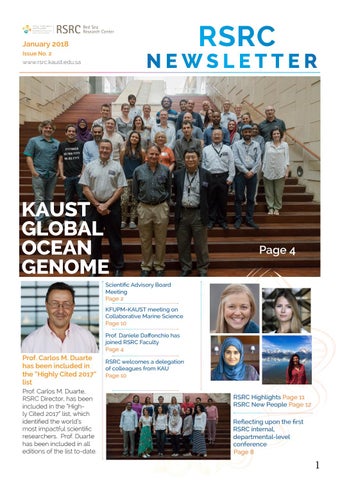
Page 4 Scientific Advisory Board Meeting Page 2 KFUPM-KAUST meeting on Collaborative Marine Science Page 10 Prof. Daniele Daffonchio has joined RSRC Faculty Page 4
Prof. Carlos M. Duarte has been included in the “Highly Cited 2017“ list Prof. Carlos M. Duarte, RSRC Director, has been included in the “Highly Cited 2017” list, which identified the world’s most impactful scientific researchers. Prof. Duarte has been included in all editions of the list to-date.
RSRC welcomes a delegation of colleagues from KAU Page 10
RSRC Highlights Page 11 RSRC New People Page 12 Reflecting upon the first RSRC internal, departmental-level conference Page 8
1
SCIENTIFIC ADVISORY BOARD MEETING The Scientific Advisory Board of the Red Sea Research Center met for two days (October 22-23, 2017), and played an active role as keynote speakers at the 2017 Red Sea Research Center Open Science Conference. The Scientific Advisory Board was impressed by the overall quality and productivity of the Center faculty, as well as the large postdoctoral and post-graduate cohorts, and recommends, along with many useful recommendations to enhance the center’s performance, that the Center continue efforts to expand the number and breadth of collaborative projects across KAUST Faculty to strengthen the research portfolio of the Center. They also urge the Center, and KAUST, to embrace the challenge of longer term thinking, and to make every effort to build a “forward-looking” strategic plan that should keep the Center well positioned for the next decade. This plan will provide the foundation to raise the status and reputation of the Center.
Board Members
Mr. John Gunn (Chair), former CEO of Australian Institute of Marine Science, Australia Prof. Madeleine van Oppen, Senior Principal Research Scientist, Australian Institute of Marine Science & Chair of Marine Biology, University of Melbourne, Australia Prof. Curtis Suttle, Associate Dean of Science, University of British Columbia, Canada Prof. Jack Middelburg, Director of Earth Sciences Institute, Utrecht University, Netherlands Prof. Terry Hughes, Australian Research Council, Centre of Excellence for Coral Reef Studies, James Cook University, Australia
2
Bernard Ghanem Assistant Professor, VCC, KAUST
WELCOME RSRC FACULTY NEW MEMBER PROF. DAFFONCHIO AND HIS TEAM
Daniele Daffonchio Professor, Bioscience, RSRC, KAUST
Research Interests Professor Daffonchio’s research interests are in the microbial ecology of complex ecosystems in conventional and extreme aquatic and terrestrial habitats. His research is spanning from basic aspects of microbial ecology through the application of synthetic ecology approaches to applied aspects for the environmental protection and sustainability of agriculture. Prof. Daffonchio has developed research on the exploration and characterization of extreme marine and terrestrial environments, both pristine and polluted. He is actually dealing with the study and exploitation of extremophile microorganisms along the water stress continuity from the Arabian Desert to the depth of the brine pools in the Red Sea. A particular focus is on the bacteria-host symbiosis with plants and animals in relation to the water and salinity stresses. He leads ESM (Extreme Systems Microbiology) Lab.
ESM Lab The Research interests of the Extreme Systems Microbiology laboratory are in the microbial ecology of complex ecosystems in conventional and extreme aquatic and terrestrial habitats. The research is spanning from basic aspects of microbial ecology through the application of synthetic ecology approaches to applied aspects for the environmental protection and sustainability of agriculture.
Prof. Daniele Daffonchio and his team Extreme Systems Microbiology (ESM) Lab
A focus is made on the exploration and characterization of extreme marine and terrestrial environments, both pristine and polluted, dealing with the study and exploitation of extremophile microorganisms along the water stress continuity from the Arabian Desert to the depth of the brine pools in the Red Sea. A particular focus is on the bacteria-host symbiosis with plants and animals in relation to the water and salinity stresses. The Extreme Systems Microbiology laboratory uses the state of the art techniques of molecular microbial ecology including PCR-fingerprinting for community characterization, Quantitative PCR and genomic and metagenomic techniques. Different cultivation strategies are developed to establish new microbial cultures of previously non-cultivated microorganisms. One major effort is the transformation of wild bacteria from different environments for the generation of mutants as well as for the labeling with marker proteins like fluorescent proteins. A multidisciplinary technical approach is applied to study the symbiosis between microorganisms with plants and animals in particular arthropods.
3
OCT 29 - NOV 1 Article by David Murphy
The recently held KAUST Global Ocean Genome workshop brought together internationally recognized scientists from both KAUST and abroad to discuss and assess the progress of the global ocean genome. The four-day workshop held between October 29 and November 1 focused on updating the current inventory of genes in the microbial communities of the global ocean. Through diverse keynote lectures and presentations, workshop attendees assessed the progress made toward providing an adequate representation of the microbial communities, and their associated gene pools and environments in the global ocean. Attendees also explored the functional capacities of the global ocean microbiome as represented by the global ocean genome and examined the global distribution and sequence variability of key functional genes. The workshop saw attendees attempt to further new analytical approaches to mine the global ocean genome for genes of industrial interest.
4
Enhancing existing collaborations Alongside the University researchers and students present, the workshop featured international researchers from Canada, Denmark, France, Germany, Japan, Spain and Switzerland. In the opening address of the workshop, Pierre Magistretti, Distinguished Professor of Bioscience and Dean of the University’s Biological and Environmental Science Division, welcomed the overseas attendees and highlighted the research ethos of KAUST. “For those of you who have come to KAUST for the first time, I think KAUST will leave you with an impressive impression,” Magistretti said. “I hope this workshop will enhance existing collaborations between KAUST, the University’s Red Sea Research Center (RSRC) and research institutions around the world.” In his opening remarks, Carlos Duarte, Director of the RSRC and the Tarek Ahmed Juffali Research Chair in Red Sea Ecology, outlined how the University is committed to genome and microbiome research. “At KAUST, we use brute force and intelligent, big-data systems to explore the wealth of knowledge in the ocean metagenome data. We are focusing on microbiome research, and we want KAUST to become a repository of global metagenome data,” Duarte emphasized. Chris Bowler from the Institute of Biology, Ecole Normale Supérieure (ENS), and chair for the first session of the workshop, felt that worldwide research in global genomes is only expanding with no sign of plateau in the near future.
Carlos M. Duarte Director Red Sea Research Center, KAUST
Pablo Sánchez Fernández, a postdoctoral fellow in bioinformatics from the Institut de Ciències del Mar (ICM) -The Spanish National Research Council (CSIC), discussed mesopelagic gene and microbial species enrichment across the global tropical and subtropical ocean.
5
Marli Vlok, University of British Columbia
Chris Bowler, Institut de Biologie de l’Ecole Normale Superieure
The unanswered question
Addressing taxonomy difficulties
Marli Vlok, a Ph.D. student in The Suttle Lab based in the Department of Botany, University of British Columbia, spoke about underestimated entities in the marine environment. Vlok described how RNA virus genomes exhibit biogeographical patterns that are affected by many factors. “There are so many RNA viruses that remain unknown—the question is, are we missing half the viruses in the ocean? Marine RNA virus assemblages have unprecedented diversity. In our study, we found viruses and sequences that affect a whole range of animals, bacteria and plants,” Vlok said.
Chris Bowler delivered a keynote on the “Exploration of Tara Oceans metatranscriptomics data.” In his presentation, he focused on how approximately one-third of marine eukaryotic plankton cannot be assigned to any known taxonomic group and the challenge this poses. “The marine eukaryote reference genome catalog is 115 million unique genes and still climbing. A huge amount of discovery remains within this catalog—we’re in the dark in terms of taxonomy and what sequence these genes are in,” Bowler noted. “In our studies, we’ve seen some interesting differences between metagenomics and metatranscriptomics data. Expression profiles of iron-responsive genes at a global scale are congruent with modeled iron concentrations. By integrating global data with a localized response, we provide a framework for understanding the resilience of plankton ecosystems in a changing environment,” he added.
Kasper Urup Kjeldsen, University of Aarhus
In his keynote lecture, Kasper Uper Kjeldsen from Aarhus University, Denmark, covered microbial community assembly and evolution in subsea floor sediment, specifically in Aarhus Bay in his native Denmark. Kjeldsen and his team’s research are focused on trying to understand how microbial communities evolve as they get buried and the substrates supporting their growth, depleted in the seabed. “A lot of genetic diversity can be found in Aarhus Bay, and when you look at sediments, it is highly zonated. In our study, we found that a core group of species exist across all sediment levels—we’ve found very low levels of diversity with subsurface sediment populations,” Kjeldsen said.
6
Takashi Gojobori Associate Director CBRC, KAUST
Curtis Suttle,, University of British Columbia
15 million unique genes
Looking at virus samples
Takashi Gojobori, KAUST Distinguished Professor of Bioscience and Associate Director of the University’s Computational Bioscience Research Center, gave a keynote lecture entitled “Comparative marine metagenomics in the global ocean project.” In his address, Gojobori discussed research findings from field experiments in the Sea of Japan and the Red Sea. “The sea around Japan shows clear examples of seasonal changes, and what we think from our studies is that the Red Sea can be a close model of the global warming effect,” Gojobori said. “In Japan, we have developed automatic seawater sampling instruments, and I feel that widespread, automatic genomic sampling can be achieved in the coming years.” “There has been a growing sequencing effort since 2007, and we are getting a better picture of the global ocean genome. However, the role of increased sequencing depth in building the ocean microbial gene catalog has not yet been examined,” Duarte acknowledged. Duarte noted that a total inventory of genes can never be reached. “As a rule of thumb, about 15 million unique genes are discovered for every tera base pair sequenced in microbial communities. There are millions of microbial ocean genomes to be discovered,” he said.
Day two of the workshop opened with a keynote address from Professor Curtis Suttle, Department of Earth, Ocean and Atmospheric Sciences, University of British Columbia. In his keynote entitled “Vignettes of virus variation in the oceans,” Suttle described his research on viruses and their role in the environment. He spoke on sequencing, RNA viruses and on recent fieldwork. “Our team has been collecting virus communities for the past three years and there is a lot of diversity out there—if we could sequence that diversity that would be great. In our samples, we found 125 distinct evolutionary groups. We’ve found that there is a great diversity of RNA viruses,” Suttle said. “We are looking at virus samples in the Red Sea that could have been there for three million years—from the last time the Red Sea drained and dried out. We’re looking at a really interesting area with viruses that are unknown,” he added. “We really need to get deeper sequencing to try and find out what is out there. We really need to get a reference genome—without reference genomes, we’re in trouble. One of the challenges of metagenomics is trying to figure out what to do when you don’t have a reference genome,” Suttle noted.
7
REFLECTING UPON THE FIRST RSRC INTERNAL, DEPARTMENTAL-LEVEL CONFERENCE Article by Yi Jin Liew and Maha J. Cziesielski
The inaugural student- and postdoc-organized departmental conference (Red Sea Research Center Open Science Conference 2017) was held on October 24th and 25th. The conference aimed to facilitate communication and further collaboration among departmental members, and to provide an opportunity for scientists of other disciplines and the KAUST community to learn about the work being conducted at the RSRC. The general feedback of attendees was very positive: post-conference survey responses reflected the sentiment that the conference was generally well-organized, and a fulfilling experience for departmental members of all levels. Our successes can be broadly split into two categories: having interesting content, and daring to try new mini-events. If a scientific conference can be likened to a burger, the meat would be the talks and posters.
8
We were incredibly lucky to have accomplished scientists and luminaries in marine sciences as our keynote speakers. We took pains to classify student and postdoc talks by theme instead of by lab, so that attendees get a myriad of flavors in every bite-sized session. The poster session, held in the library, had quite a number of community members inquisitively wandering around—we hope they had a good taste of the work done in our center. Drawing inspiration from other conferences, our committee tried our hand at implementing new ideas. We organized a two-hour workshop Terry Hughes that highlighted in-kingdom job opportunities, Director of the Australian Research Council’s Centre of Excellence for Coral Reef Studies, headquartered at featuring eight external panelists across two James Cook University in Townsville sessions. The first session focused on how students could make themselves more desirable for the jobs they sought; while the second was about the opportunities available in-kingdom. We also arranged two sit-down lunches with the keynote speakers that students could sign-up for. These lunches were an opportunity for conference attendees to better know the keynote speakers, and be inspired by their scientific journeys. Lastly, we had a social event at the Island Recreation Club, where attendees (along with their families) could socialize in an informal setting. As with any new experience, there were things that could be improved. Upon introspection, we felt that a formalized hierarchy to streamline planning is essential for events of such a scale. This is especially pertinent when the next departmental seminar expands in scope. Good leadership and accountability is key in staging successful events. The committee should also decide and agree early on over the aims of the conference, and the audience they are targeting. For the former, we initially envisioned a low-stress conference where people shared their successes and failures. We encountered last minute discrepancies in how committee members envisioned the conference, leading to last minute changes that—understandably—led to some criticism Suad Husseini Juffali from attendees. For the latter, we believe that Co-Founder of the Help Center we could have casted the net wider and invited more non-RSRC members to attend our departmental conference, and tailor our publicity efforts accordingly.
Maha J. Cziesielski
Ph.D. student, RSRC, KAUST
Regardless, we are very grateful for this valuable organisational experience. We would like to thank our faculty advisor, Prof. Carlos Duarte, for his guidance in shaping the overall direction of the conference; we also owe Ms. Christine Nelson a debt of gratitude for simplifying the administrative work needed to run a conference. Finally, we’d like to thank the organising committee and attendees for investing their time and sharing their passions.
9
RSRC HIGHLIGHTS
KFUPM-KAUST meeting on collaborative marine science Hosted by Prof. Mohammed Ali B. Qurban, Manager of the Marine Studies Section at King Fahd University of Petroleum & Minerals (KFUPM), the first KFUPM-KAUST Meeting on Collaborative Marine Sciences was held in the KFUPM campus in Dammam between 18 and 19 September, 2017. The conference focused on integrating capacities and know-how to produce a collaborative research program focused on the Arabian Seas to be executed jointly between KFUPM and KAUST. The meeting was hugely successful and laid a number of opportunities for collaborative research between these two institutions.
RSRC Faculty and Business Manager completed a successful retreat to plan the next two years of the Center’s activities Red Sea Research Faculty and Business Manager met for two days on a retreat to plan the future of the Center activities. The focus was to identify the potential, and supporting actions, to deliver broader societal benefits, to the Kingdom of Saudi Arabia and beyond, from the research conducted, as well as to enhance our contribution to translating this knowledge into economic development, job creation opportunities, and improved management of the Red Sea to reconcile development plans with healthy, vibrant marine ecosystems. In addition, we identified the key collaborative programs that the center will undertake over the next three year, as well as the key partners to contribute to these efforts. RSRC welcomes a delegation of colleagues from KAU Red Sea Research Scientists and professors from the Faculty of Marine Sciences at King Abdulaziz University, led by Prof. Adnan Turki, Dean of the Faculty, met to advance towards a research program “Red Sea gradients” aimed at advancing knowledge of the Red Sea as a contribution to the UN’s International Indian Ocean Expedition 2.
10
Sofya Mudrova wins best biology poster award at ICIM4 Our Ph.D. student, Sofya Mudrova, won the best poster award at the 4th International Congress on Invertebrate Morphology (ICIM4) in Moscow, Russia. The congress was held at the Lomonosov Moscow State University (MSU) from August 18 to 23. The event, which was organized by the MSU faculty of biology, brought together members of the global scientific community to discuss and share ideas in the field of invertebrate morphology and to highlight modern achievements in the field of functional morphology and paleontology. Read full story here: https://rsrc.kaust.edu.sa/Pages/ News-2017-PSS.aspx Zahra Al-Saffar wins first prize for best student poster at EMBS 2017 Our Ph.D. student, Zahra Alsaffar, won first prize for her poster presentation at the 52nd European Marine Biology Symposium (EMBS) in Piran, Slovenia, held in late September. Al-Saffar is working towards a Ph.D. in marine science in the University’s Red Sea Research Center (RSRC). Her research examines soft-sediment macrobenthic assemblages and explores patterns of variation in hyper-saline sub-tropical coastal lagoons. Soft-sediments, according to Al-Saffar, are one of the least studied habitats in the Red Sea environs. Read full story here: https://rsrc.kaust.edu.sa/Pages/News-2017-OPH.aspx
Publications Lottery 1. Rapid adaptive Molecular confirmation of hybridization between Dascyllus reticulatus × Dascyllus aruanus from the Great Barrier Reef
Song He, Jacob L. Johansen, Andrew S. Hoey, Melissa K. Pappas, Michael L. Berumen Marine Biodiversity pp 1-10, (2017)
2. Addressing calcium carbonate cycling in blue carbon accounting P.I. Macreadie, O. Serrano, D.T. Maher, C.M. Duarte, J. Beardall Limnology and Oceanography Letters, (2017)
3. Recent expansion of heat-activated retrotransposons in the coral symbiont Symbiodinium microadriaticum
J.E. Chen, G. Cui, X. Wang, Y.J. Liew and M. Aranda The ISME Journal, (2017)
4.
Testing the metabolic theory of ecology with marine bacteria: different temperature sensitivity of major phylogenetic groups during the spring phytoplankton bloom Nestor Arandia-Gorostidi, Tamara Huete-Stauffer, Laura Alonso-Saez, Xosé Anxelu G. Morán Environ Microbiol, (2017) These publications were selected randomly. For the full list please visit our website: https://rsrc.kaust.edu.sa/Pages/Publications.aspx
11
NEW PEOPLE
Ann Marie Hulver Master’s student Reef Ecology Lab
Ann Marie Hulver was born in Chicago, IL, USA but moved to the Eastern Province of Saudi Arabia when she was four years old. Throughout her entire life she has always enjoyed living near the Arabian Gulf and has been fascinated by all of the animals inhabiting the oceans of the world. For her undergraduate degree, Ann Marie studied Marine Biology at Northeastern University in Boston, MA. Throughout her studies she participated in the Three Seas Program - an intensive, year-long program that focuses on three different ecosystems: the rocky intertidal in Boston; coral reefs in Bocas del Toro, Panama; and kelp forests in Friday Harbor, Washington. From this experience she met many professors from Northeastern and universities worldwide. After Three Seas, Ann Marie began an Honors Thesis project with Dr. Mark Patterson at Northeastern University’s Marine Science Center. She built a diver operated profiling device to measure fine scale fluctuations of dissolved oxygen above ecosystems. She once again travelled to Panama in order to continue this research on coral reefs. During this time, Ann Marie was applying to KAUST. Her interests at KAUST are to study the connectivity of the Red Sea with the surrounding coral reef ecosystems.
Lyndsey Tanabe has always had a fascination with the sea. She was born on the island of Oahu, Hawaii, USA and raised in a coastal town in Maine. Ironically, she headed to the landlocked state of Pennsylvania to her obtain her Bachelor’s Degree in both Biology and Environmental Science. On campus she was involved in limnological research focused on assessing the mechanism causing anoxic conditions in local lakes and ponds. To further pursue her passion in conservation, she studied abroad in Turks and Caicos and Tanzania, where she found her love for traveling as well as research. To explore her interests in marine research, she worked as a NOAA Holling’s Scholar to assess abundance and diversity of invertebrates and seaweed on an ancient Hawaiian fishpond wall. After graduating, she worked as an Education Coordinator at the Hawaii Institute of Marine Biology. Her passion for marine conservation and traveling lead her to KAUST, where she has joined the Reef Ecology Lab under Prof. Michael Berumen. She has many research interests including movement ecology, ocean acidification impacts on coral reefs, connectivity, marine protected areas, and conservation biology.
Contact Us
rsrc.info@kaust.edu.sa seda.gasparyan@kaust.edu.sa Red Sea Research Center (RSRC) King Abdullah University of Science and Technology (KAUST) Ibn Al-Haytham (building 2) Thuwal 23955-6900 Kingdom of Saudi Arabia
12
Lyndsey Tanabe Master’s student Reef Ecology Lab