P2
P4
Modeling and
P6
Gliders Revolutionize
performance evaluation of high-speed underwater optical communication systems Story from prof. Mohamed-Slim Alouini
Ocean Research Story from prof. Burt Jones and Nikolaos Zarokanellos
RSRC 2017 Highlights
The whole year with the center
P9 IOP at the International
Ocean Colour Meeting in Lisbon RSRC Publications Lottery
IS001
October
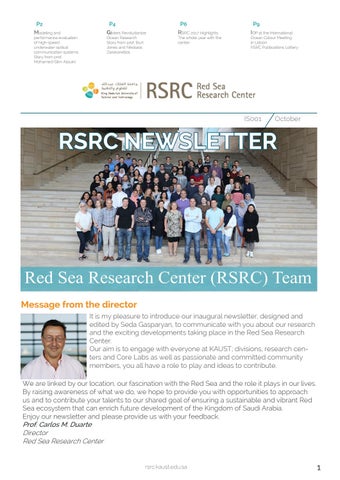
RSRC NEWSLETTER
Message from the director It is my pleasure to introduce our inaugural newsletter, designed and edited by Seda Gasparyan, to communicate with you about our research and the exciting developments taking place in the Red Sea Research Center. Our aim is to engage with everyone at KAUST; divisions, research centers and Core Labs as well as passionate and committed community members, you all have a role to play and ideas to contribute. We are linked by our location, our fascination with the Red Sea and the role it plays in our lives. By raising awareness of what we do, we hope to provide you with opportunities to approach us and to contribute your talents to our shared goal of ensuring a sustainable and vibrant Red Sea ecosystem that can enrich future development of the Kingdom of Saudi Arabia. Enjoy our newsletter and please provide us with your feedback.
Prof. Carlos M. Duarte Director Red Sea Research Center
rsrc.kaust.edu.sa
1
Modeling and Performance Evaluation of High-Speed Underwater Optical Communication Systems Water covers 71% of the Earth's surface and 97% of this is found in seas, oceans and lakes.
This vast marine environment has critical effects on climate, water circulation, oxygen and food production cycles on the Earth. Furthermore, the underwater world is extremely rich in natural resources and offers opportunities for aquaculture, biofuel production, mineral exploitation, and oilfield exploration. The further growth of the marine economy requires a better understanding of the underwater environments which remain mostly unexplored. The current exploration activities are mainly hampered by the lack of efficient means of communication under water. A typical choice for oceanographic data acquisition is to deploy underwater sensors which record data during the monitoring mission and then recover the information from the storage unit of sensor. Such an off-line approach is not able to deliver real-time information which can be particularly critical in surveillance and disaster prevention. There is also an increasing use of robotics in underwater missions in order to increase precision and operability.
Experimental Demonstration
Remotely-operated vehicles (ROVs) and autonomous underwater vehicles (AUVs) are usually used in such applications and an important point is how to communicate with the ROV or AUV. Classically, cabled or fiber-based techniques are used. Although these approaches provide high speed and reliable communication, their use can be challenging in difficult-access locations and in deep-sea as they will limit the range and maneuverability of the ROV. Wireless communication techniques are much more appropriate for such applications. Wireless transmission under water can be achieved through radio, optical, or acoustic waves. Radio frequency (RF) waves suffer from high attenuation in sea- water and can propagate over long distances only at extra low frequencies (30−300Hz). This requires large antennas and high transmission powers which make them unappealing for most practical purposes. Acoustics has been the traditional choice for underwater communication.
rsrc.kaust.edu.sa
2
However, due to the low carrier frequencies, acoustics links are inherently limited to data rates on the order of tens of Kbits/sec. Commercially available acoustic modems typically offer a data rate of 20 Kbits/sec for a horizontal link with a range of 1 Km. At these speeds, large data files take a long time to transfer and real-time video transmission is not feasible. Furthermore, due to the low speed of acoustic wave under water (1500 m/sec), acoustic transmission suffers from large delays. In comparison to acoustic counterpart, optical communication can provide orders of magnitude more bandwidth and is able to realize much higher data transmission (on the order of Mbits/ sec to Gbits/sec) for short and moderate ranges. Furthermore, the propagation speed of an underwater optical wave is five orders of magnitude higher than acoustic waves and does not suffer from latency. As such underwater optical wireless communication (UOWC) is more promising than ever. However, in many respects, this technology is still in its infancy and requires further research efforts to overcome several major technical challenges before its wide-scale deployment. In this context, the Communication Theory Lab (lead by Prof. Mohamed-Slim Alouini) and the Photonics Lab (lead by Prof. Boon Ooi) have made some interesting contributions in this area over the past three years. In particular, they worked on the development of channel models that capture the physical properties of the underwater optical propagation in a realistic yet mathematically tractable manner. They also studied and evaluated the performance of advanced modulation, coding, diversity and multi techniques for the physical (PHY) layer design of UOWC systems. They are now looking at the design, development, and testing of a low power & compact UWOC systems initially for fixed to fixed transmission then eventually for applications requiring mobility of AUVs. Article by Mohamed-Slim Alouini
Mohamed-Slim Alouini 25-26
Professor, Electrical Engineering Associate Dean, Computer, Electrical and Mathematical Science and Engineering slim.alouini@kaust.edu.sa Communications Theory Lab (CTL)
Professor Alouini’s research interests are in the modeling, design, and performance analysis of wireless communication systems with current emphasis on MIMO, diversity, and adaptive modulation systems, cognitive radio systems, cooperative/collaborative communication systems, multi-hop communication systems, physical-layer security, MIMO RADAR systems, optical wireless communications, device-to-device communications, green communications systems and networks, and small cell/heterogeneous networks. He is a Fellow of the Institute of Electrical and Electronics Engineers (IEEE), a member of the Thomson ISI Web of Knowledge list of Highly Cited Researchers, and of the Elsevier/Shanghai Ranking list of Most Cited Researchers,an IEEE Distinguished Lecturer of the IEEE Communications Society, and a co-recipient of best paper awards in ten IEEE conferences (including ICC, GLOBECOM, VTC, PIMRC and DySPAN).
rsrc.kaust.edu.sa
3
Gliders Revolutionize Ocean Research Autonomous underwater vehicles (AUVs) – commonly known as gliders – have transformed
the manner in which oceanographic research takes place. By deploying the vehicles for several months, in parallel with in-situ, ship-based and modeling efforts, we are able to establish a larger-scale, highly detailed picture of the Red Sea from above and below the surface. KAUST Professor of Marine Science, Burton Jones, leads the Red Sea Research Center’s oceanographic program and brought his expertise in AUVs from the USA to KAUST in 2012. As Burt explains, “we want to be able to watch the oceans continuously, but this is difficult because we can’t leave a crew out on a ship for months at a time. We can, however, leave the gliders—small robotic submarines about 2 meters long—in the oceans for long periods of time, giving us a continuous presence there. Watching conditions continuously in both space and time presents a tremendous advantage for us”. Prof. Burton Jones Professor of Marine Science Director of Saudi Aramco-KAUST Marine Environmental Research Center
Each glider’s path is pre-determined by uploading waypoints to the glider prior to deployment. Remote piloting allows for modification of the waypoints as needed. The vehicles are capable of carrying several sensors that provide various measurements such as temperature, salinity, oxygen, and chlorophyll. The gliders surface at regular intervals to obtain a geospatial position and to communicate its position and a subset of the data during while at the surface. The illustration from the University of Washington demonstrates the flight path of a typical glider. Flight path of a typical glider
In 2013, a Slocum glider was deployed in the central Red Sea and provided the first sustained glider observations for several months (Zarokanellos et al., 2017). With the ability to profile the sea from surface to 1000 meters and travelling at a speed of 0.3 m/s (~1 km/hour), we learned much more about the functioning of the sea than ever before.
rsrc.kaust.edu.sa
4
Nikolaos Zarokanellos, PhD student with Prof. Burt Jones, conducted the first study employing ship-based and glider observation to capture key features of the seasonal transition from MarchJune 2013 for the central Red Sea located between KAUST and Yanbu. “The central Red Sea is characterized by high mesoscale eddy activity, and we monitor eddies located in this area that have a diameter from a few kilometers to 200 kilometers,” explained Zarokanellos. “With our gliders, we are able to understand and capture these eddies in 3-D—not only how big they are horizontally, but also at the vertical scale.” Mesoscale eddies and a northward-flowing eastern boundary current (EBC) govern the physical and biogeochemical characteristics of this region of the sea. What Nikos found was that an anticyclonic eddy appears to function as a barrier to the northward flow along the eastern boundary. This interaction of the eastern boundary current and eddies generates patches in the upper layer that are warmer and fresher off the Saudi coastline. This transition, therefore, affects biological properties and processes in the CRS. These interactions between the eddies and the Eastern Boundary Current become important in directing the dispersion of marine organisms, vertical exchange of nutrients, hence affecting primary productivity, and along-basin of various properties that originate in the Gulf of Aden and Arabian Sea. By sustaining AUV deployment in the Red Sea, key data will be gleaned to increase our understanding of seasonal, annual and climate-scale temporal changes in the region. Further analysis of the glider observations is planned to identify the impact of coastal coral reefs, dust decomposition, and intrusion of nutrient-rich water from the Gulf of Aden on phytoplankton abundance, productivity and composition in the CRS. Globally, there is much value in studying the roles and interaction of eddies in the small Red Sea, as remote ocean locations are generally inaccessible to scientists. Burt explains, ‘here in Saudi Arabia, we are able to sustain observations over time in a situation that more resembles coastal oceanography, yet with processes that are important to the open, global ocean’. Ultimately, the gliders form one component of an ocean observatory for the Red Sea which seeks to be smart, scalable, and adaptable (Jones and Kattan, 2017). "We need to understand the interactions between open-sea processes and the coastal reef ecosystems”, explained Burt. “Through our use of the gliders and their instrumentation we hope to gain a better understanding of how these processes interact with the reefs, and contribute to the productivity, connectivity, and fate of production from the reefs. The overall goal is to link all these processes together to understand how they combine to make the Red Sea what it is today." Article by Prof. Burt Jones
rsrc.kaust.edu.sa
5
RSRC 2017 Highlights Award for WEP student video "Meet Aiptasia" "Meet Aiptasia" the student video by Hagen Gegner, Rúben Costa, Sebastian Baumgarten & Matthew Tietbohl has won the Science of Storytelling Award at this year's Winter Enrichment Program in KAUST. You can watch the video on YouTube! https://youtu.be/ByQR5GArXgQ
JBI Cover feature for article by Ziegler et al. The latest cover of Journal of Biogeography featuring an article by Ziegler et al. on the biogeography and molecular diversity of coral symbionts around the Arabian Peninsula. Congrats to Dr. Anna Roik for yet another great cover photo. http://onlinelibrary.wiley.com/doi/10.1111/jbi.12913/full
RNA editing may extend acclimatization capacity in coral symbionts The Reef Genomics lab's publication Liew et al. report condition-specific RNA editing in the coral symbiont S. microadriaticum. This previously unrecognized mechanism may facilitate acclimatization beyond what is encoded by the genome. Read the full story in PLoS Genetics. https://goo.gl/PTjVDb
Amaar Amir has won 3rd place at the Sixth National Olympiad Creative and Science Awards Our 2016 SRSI student, Amaar Amir, has won 3rd place at the Sixth National Olympiad Creative and Science Awards "Innovation 2016". He is now qualified to represent Saudi Arabia at The Intel International Science and Engineering Fair (Intel ISEF) and the I-SWEEEP (International Sustainable World Energy, Engineering, and Environmental Project).
Reef Genomics alumni Aubrie O'Rourkeawarded fellowship with NASA Aubrie O'Rourke completed her Ph.D. with the Reef Genomics Lab in 2015, working on bioactive compounds from Red Sea sponges. Now, two years later, Aubrie has shifted her focus from the hidden realms of the sea to the depth of space. Specifically, Aubrie was presented with the Alfred P. Sloan Foundation Award Fellowship with NASA. The fellowship, which is bestowed by the NASA Space Biology Program, runs for two years and gives her the chance to study the effects of microgravity and radiation on phenotype, genotype and pathogenicity of bacteria onboard the International Space Station.
rsrc.kaust.edu.sa
6
Wave to the Future SAKMEO has installed a surface current mapping system along the central Red Sea. This system, which measures waves and maps surface currents, brings tremendous insight into the surface circulation of the Red Sea. Around the world, these surface current mapping systems are used to track marine contaminants, manage fisheries, design marine protection areas, improve shipping, aid in search and rescue operations, assess the potential of ocean energy and contribute to our fundamental understanding of ocean processes. Once long-term time-series are established, future forecasts are possible including assessing impacts to coastal areas, improving weather forecasts and monitoring climate change.
Cinna Lomnitz Medal for Parsifal Islas Morales Parsifal Islas Morales, Master’s student in the Reef Genomics lab was awarded the Cinna Lomnitz Medal by the Mexican parliament. Parsifal received this award in recognition of his outstanding work on science communication in Mexico. Parsifal acquired his biology education from the National University of Mexico (UNAM), with emphasis on evolution and cell imaging techniques. He is fascinated with fundamental biological questions concerning the origin of life and the origin of eukaryotes. More specifically, he is interested in the evolution of cell complexity and diversity in unicellular microorganisms.
Our lab participated in World Intercalibration for DIC and TA Our lab participated in an 80-strong world intercalibration for Dissolved inorganic carbon (DIC) and TA (total alkalinity) organized by Prof A Dickson of the University of California, San Diego (Scripps Institution of Oceanography, Marine Physical Laboratory). The Dickson lab sent replicates of two seawater samples with different carbonate chemistry, from natural sea water sterilized by a combination of filtration, ultraviolet radiation, and an addition of mercuric chloride.
Hypoxia in the Baltic Sea - Past, present and future. Prof Jacob Carstensen's seminar Prof. Jacob Carstensen is the Danish lead of the Baltic Nest Institute, a collaboration between Aarhus University in Denmark, Finnish Environment Institute in Finland and Stockholm University in Sweden. He studied applied mathematics and statistics at the Technical University of Denmark, where he received his Ph.D. in 1994. This talk discussed what is known about the expansion of low oxygen conditions in the Baltic Sea over the past century. The results will be placed in a historical context using sediment records showing two previous intervals of hypoxia in the Baltic Sea during the past 8000 years.
rsrc.kaust.edu.sa
7
New People Jin Ye graduated with a BSc in Bioscience from Southern University of Science and Technology in Shenzhen, south China. She is interested in macro biomolecules. Jin used to work on structural biology. She has an equal interest in nucleotides. Jin has recently joined RSRC as an MSc student in Dr. Christian Voolstra’s group and her current work is related to coral metagenomics. Jin Ye Master's student
Celina Burkholz graduated with Bachelor degree in Bioscience from University of Rostock, Germany. Her past projects included the assessment of benthic communities, marine planning and seagrass ecology. Celina's previous research at KAUST focused on seagrass ecology and the effects of climate change on the metabolism of seagrass ecosystems, which she hope to continue during her Master's project in Prof. Carlos Duarte's group. Celina Burkholz Master's student Susann Rossbach graduated with Master’s and Bachelor’s degrees from Christian Albrechts University in Kiel, Germany. Her main research interest is in the autecology of marine benthic calcifiers – especially in the face of global change. In the framework of her PhD, Susann is investigating the physiology of Tridacnidae (giant clams) in the Red Sea under several stressors as well as their overall function within reefs. In previous studies during her undergraduate and Master’s studies, she worked on cold-water coral species of the Baltic Sea and Chilean Fjord region, assessing the effect of alternating pH and water temperatures on their physiological performance. Susann Rossbach Ph.D. student New members list also includes Ph.D. students Malak Abdallah Ashwag Asseri
Master's students Gabriela Perna Janna L. Randle Lucia Pombo Ann Marie Hulver Lyndsey Tanabe rsrc.kaust.edu.sa
8
IOP at the International Ocean Colour Science Meeting in Lisbon
The third International Ocean Colour Sci-
ence (IOCS) meeting took place in Lisbon, Portugal on the 15th-18th May 2017. The IOCS2017 theme, “Exploring New Capabilities for Global Ocean Colour Observations” sought to nurture a strong global user community for ocean colour science and applications, and facilitate exchange between the ocean colour research community and international space agencies. Dr. Surya Prakash Tiwari and Dr. Malika Kheireddine, both Post-Doctoral Fellows with the KAUST Integrated Ocean Processes group, participated in the IOCS meeting. Dr. Tiwari presented his poster, an optical algorithm to estimate down welling diffuse attenuation coefficient in the Red Sea.
"Meeting the ocean color community and space agency representatives to ask questions specific to ocean color remote sensing of the Red Sea was a highlight for me", explained Dr. Tiwari. "During this meeting, the presentations I attended and the conversations I had relating to ocean optics and ocean color remote sensing proved useful to my academic and research career, which is focused on issues associated with atmospheric correction, algorithm development and optical radiometry". IOCS-2017 was convened by the International Ocean Colour Coordinating Group (IOCCG) with sponsorship from EUMETSAT, ESA, the European Commission and NASA, and all the IOCCG-sponsoring agencies and organizations. The next major Ocean Optics Conference will be in Dubrovnik in October 2018.
Publications Lottery 1. Rapid adaptive responses to climate change in corals
G. Torda, J.M. Donelson, M. Aranda, D.J. Barshis, L. Bay, M.L. Berumen, D.G. Bourne, N. Cantin, S. Foret, M. Matz, D.J. Miller, A. Moya, H.M. Putnam, T. Ravasi, M.J.H. van Oppen Nature Climate Change, 7, pp. 627-636, (2017)
2. Sugar enrichment provides evidence for a role of nitrogen fixation in coral bleaching C. Pogoreutz, N. Rädecker, A. Cárdenas, A. Gärdes, C.R. Voolstra, C. Wild Global Change Biology, (2017)
3. Fairy circle landscapes under the sea
D. Ruiz-Reynés, D. Gomila, T. Sintes, E. Hernández-García, N. Marbà, C.M. Duarte Science Advances, volume 3, no. 8, e1603262, (2017)
4.
Glider and remote sensing perspective of the upper layer response to an extended shallow coastal diversion of municipal wastewater effluent B. Seegers, E. Teel, R.M. Kudela, D.A. Caron, B.H. Jones Estuarine Coastal and Shelf Science, 186, pp. 198-208, (2017)
5. Unveiling the role and life strategies of viruses from the surface to the dark ocean
E. Lara, D. Vaqué, E. Laia Sà, J.A. Boras, A. Gomes, E. Borrull, C. Díez-Vives, E. Teira, F.C. Garcia, I. Forn, Y.M. Castillo, A. Peiró, G. Salazar, X.A.G. Moran, S. Agusti, C.M. Duarte Sci. Adv., volume 3, no. 9, e1602565, (2017) These publications were selected randomly. For the full list please visit our website: https://rsrc.kaust.edu.sa/Pages/Publications.aspx rsrc.kaust.edu.sa
9
NEXT ISSUE
Stories from Prof. Bernard Ghanem and Prof. Daniele Daffonchio
Wave to the Future: Establishing a surface current mapping system for the central Red Sea
RSRC Cruise With R/V Al Azizi R/V Al Azizi Azizi departed on the 1st of August, 2017. This cruise was an important milestone, being the RSRC’s first cruise on this vessel, owned by King Abdulaziz University (KAU). KAU hosts the only Faculty of Marine Science in the Kingdom of Saudi Arabia and has a long record of research in the Red Sea. There are strong collaborative ties between KAU and KAUST RSRC, reflected in multiple joint authoredship publications. We have complimentary capacities, with KAUST's unique Core Lab concept delivering advanced technical capacities to support marineresearch through CMOR,and KAU operating the largest and most modern research vessel in the Red Sea, R/V Al Azizi.
RSRC Conferences and Workshops. - RSRC Open Science Conference. - RSRC Workshop on the Global Ocean Genome. - RSRC Scientific Advisory Board Meeting
Upcoming Events OCT
22-23 Scientific Advisory Board Meeting
OCT
24-25
OCT 29-1
RSRC Open Science Conference
Global Ocean Genome Workshop
Contact Us rsrc.info@kaust.edu.sa seda.gasparyan@kaust.edu.sa Red Sea Research Center (RSRC) King Abdullah University of Science and Technology (KAUST) Ibn Al-Haytham (building 2) Thuwal 23955-6900 Kingdom of Saudi Arabia
rsrc.kaust.edu.sa
10