Guide (2026)
1. Executive Summary
The rapid evolution of cloud computing has transformed how applications are built, deployed, and secured. Traditional DevOps practices are no longer sufficient organizations now require DevSecOps, where security is integrated into every stage of the development lifecycle.
In a multi-cloud environment (AWS, Azure, GCP), professionals must ensure scalability, automation, and security simultaneously
This document provides a structured overview of essential DevSecOps tools, workflows, and career opportunities in 2026.
�� 2. Understanding DevSecOps
DevSecOps stands for Development, Security, and Operations. It is a modern approach that embeds security practices into the DevOps pipeline.
�� Objectives:
● Integrate security from the early stages of development
● Automate security and compliance checks
● Enable faster and secure deployments
● Reduce vulnerabilities and risks
3. Multi-Cloud Architecture Overview
Multi-cloud refers to using multiple cloud platforms such as:
● Amazon Web Services (AWS)
● Microsoft Azure
● Google Cloud Platform (GCP)
Key Advantages:
● High availability and reliability
● Avoid vendor lock-in
● Better cost optimization
● Flexibility in deployment
4. Core DevSecOps Tools
4.1 Docker – Containerization
Docker enables applications to run in isolated environments called containers.
Key Benefits:
● Consistent environments
● Lightweight and portable
● Faster deployments
4.2 Kubernetes – Container Orchestration
Kubernetes automates deployment, scaling, and management of containers.
Key Benefits:
● Auto-scaling
● Load balancing
● High availability
4.3 Terraform – Infrastructure as Code
Terraform allows infrastructure provisioning using code.
Key Benefits:
● Multi-cloud compatibility
● Automation and repeatability
● Version-controlled infrastructure ��
4.4 CI/CD Tools – Jenkins & GitHub Actions
These tools automate build, test, and deployment workflows
Key Benefits:
● Faster release cycles
● Reduced manual effort
● Improved reliability
��
4.5 SonarQube – Code Quality & Security
Performs static code analysis to detect bugs and vulnerabilities.
Key Benefits:
● Early issue detection
● Improved code quality
��
4.6 Trivy – Vulnerability Scanning
Scans containers and dependencies for known vulnerabilities
Key Benefits:
● Lightweight and fast
● Easy pipeline integration
�� 4.7 HashiCorp Vault – Secrets Management
Securely manages sensitive information such as API keys and credentials
Key Benefits:
● Centralized secrets control
● Enhanced security
�� 4.8 Helm – Kubernetes Package Manager
Helm simplifies application deployment on Kubernetes
Key Benefits:
● Faster deployments
● Reusable configurations
4.9 Cloud Security Tools
Examples include:
● AWS IAM, GuardDuty
● Azure Security Center
● GCP Security Command Center
Key Benefits:
● Access and identity management
● Threat detection and monitoring
4.10 Prometheus & Grafana – Monitoring & Observability
These tools provide real-time monitoring and visualization.
Key Benefits:
● Performance tracking
● Early issue detection
5. DevSecOps Workflow
A typical DevSecOps workflow includes:
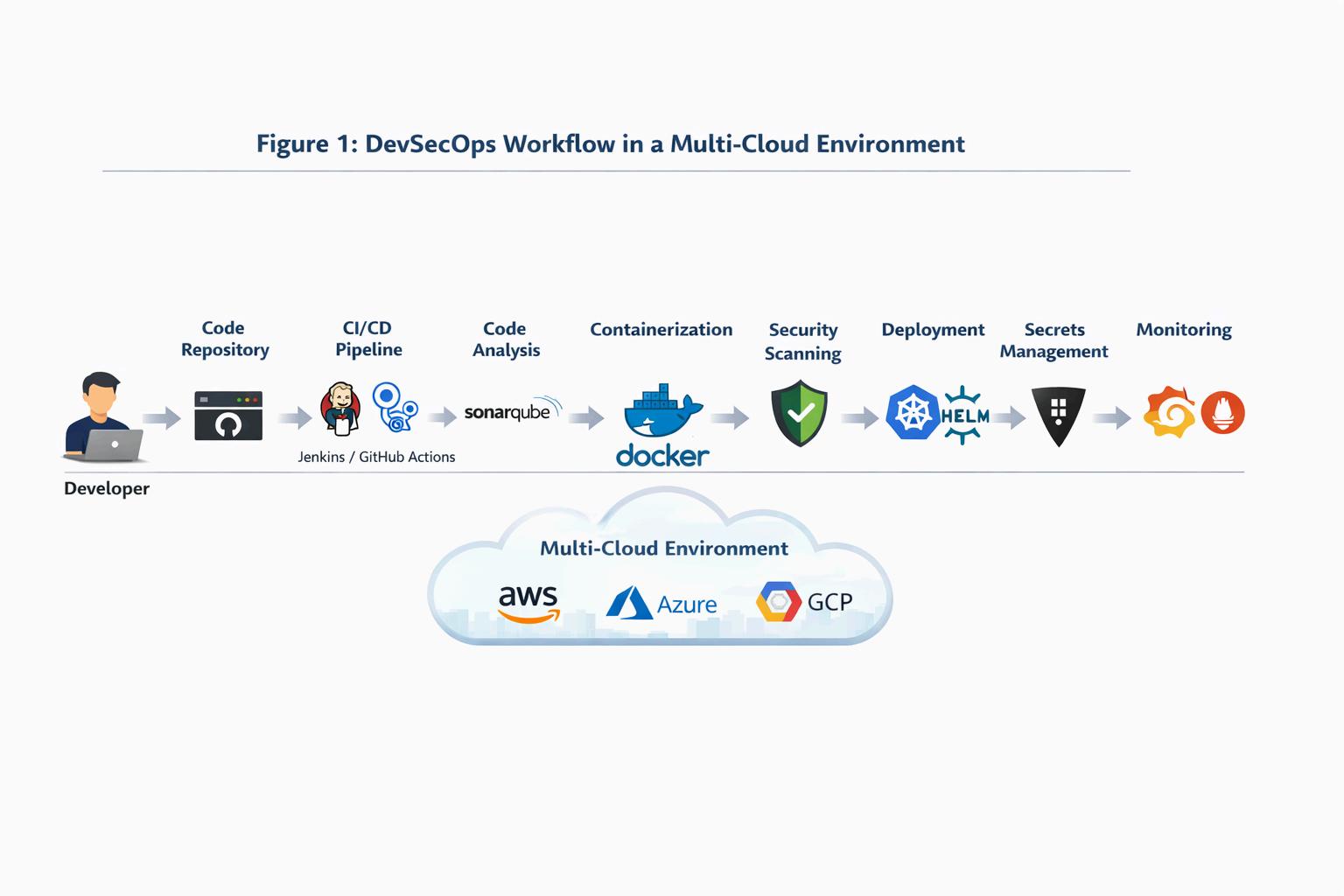
1. Code Development
2 Code Analysis (SonarQube)
3 Build & CI/CD (Jenkins/GitHub Actions)
4. Containerization (Docker)
5. Security Scanning (Trivy)
6 Deployment (Kubernetes + Helm)
7 Secrets Management (Vault)
8. Monitoring (Prometheus & Grafana)
6. Career Opportunities
With DevSecOps skills, professionals can pursue roles such as:
● DevSecOps Engineer
● Cloud Engineer
● Site Reliability Engineer (SRE)
● Security Engineer
�� Market Insight:
DevSecOps is one of the fastest-growing domains in IT, driven by cloud adoption and cybersecurity demands.
7. About RealTech IT Academy
RealTech IT Academy focuses on delivering industry-oriented training in Cloud, DevOps, and DevSecOps.
The programs are designed to provide hands-on experience with real-time tools, practical labs, and project-based learning, helping learners become job-ready for modern IT roles
8. Conclusion
DevSecOps is no longer optional it is a critical requirement in modern software development
Professionals who can integrate development, security, and operations across multi-cloud platforms will have a strong advantage in the job market.
Mastering these tools and practices will help build a future-ready and sustainable career in IT.
9. Learn More
For hands-on training in Multi-Cloud DevSecOps with real-time labs and projects, visit:
https://realtechitacademy com/courses/devsecops-training/