• U nit 22 Home Connection Letter – printed and copied (Supply Room HQ)
• pencil
What You Need to Know
Latin Chunks: tion, sion, and ture
• I n this lesson, students will learn to recognize and read the syllables tion, sion, and ture as whole units, or “chunks.”
• T he modern English language is made up of layers from several languages, including AngloSaxon (Old English), Norman French, Latin, and Greek.
• I n words from the Latin layer of English in which the suffix -ion is preceded by the letter t, the letters t and i together usually spell the sound /sh/ (ac tion, nation, inscription). The letters tion can be read as a chunk that spells the sounds /shin/. The vowel sound in this chunk is the schwa sound. Note that some people may pronounce this as /shun/. For consistency, this Teacher Guide will use /shin/.
• O ne exception is the word equation, in which the Latin chunk tion spells the sounds /zhin/.
• I n words from the Latin layer of English in which the suffix -ion is preceded by the letter s, the letters s and i together usually spell the sound /zh/. The sound /zh/ is the final sound in beige, garage, and massage. The letters sion can be read as a chunk that spells the sounds /zhin/ (vi sion, deci sion, explosion). The vowel sound in this chunk is the schwa sound.
• When sion follows the letters s, l, or n, it is pronounced /shin/, with the letters s and i together spelling the sound /sh/ (ses sion, permis sion, convul sion, emul sion, ten sion, comprehen sion). *Note that some people may pronounce the sion in tension and comprehension as /chin/. As always, use the pronunciation that comes naturally to you, but be aware that the technical pronunciation is /shin/. The vowel sound in this chunk is still the schwa sound, regardless of whether it is pronounced as /zhin/ or /shin/.
letter t spelling the sound /ch/ and ure spelling /er/ (lec ture, vulture, feature). The vowel sound in this chunk is r-controlled.
• Recognizing and reading these letter combinations as chunks helps students decode longer words more efficiently. Students should be able to quickly recognize the chunks, understand that they go on one SyllaBoard ™, and know the sounds they consistently spell. Being able to recognize a Latin Chunk makes it easy to determine the syllable type that comes before it, aiding in decoding the vowel phoneme.
FORTXPILOTUSEONLY
• Students will learn that a part of each of these Latin Chunks is a suffix. They will learn about the suffixes -ion and - ure and their meanings.
• T he letters ture can be read as a chunk that is usually pronounced /cher/, with the consonant
Latin Chunks
Start Teaching
1. State Objectives
OPEN Orbit Online to Unit 22, Lesson 1, Phonics.
CLICK TO DISPLAY Objectives.
SAY:
• “At the end of today’s lesson, you will be able to:
- read words with Latin Chunks.
Images to support the words in the Word Observatory are available in the Comprehension Boost button.
FORTXPILOTUSEONLY
- recognize eight new homograph Heart Words.
• Let’s start off by observing a new group of words.”
Optional
2. Word Observatory
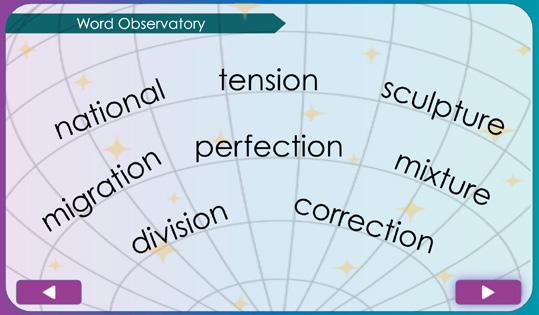
CLICK TO DISPLAY Word Observatory.
SAY “Take a moment to carefully observe these words: national, tension, sculpture, migration, perfection, mixture, division, and correction . Look for things that all or a few of the words have in common.”
ASK “What do all or some of these words have in common?”
• Possible answers include words that have more than one syllable (all words); words that include ion (national, tension, migration, perfection, division, correction); words that end in ture (sculpture, mixture).
SAY:
• ” The common feature of all these words is that they all contain chunks, specifically Latin Chunks. This is the focus of this unit.
• Latin is an old language, and a lot of our modern English words come from it and other old languages.”
3. View Latin Chunks Animation
CLICK TO DISPLAY Latin Chunks animation.
SAY ”Let’s watch this animation to review Latin Chunks.”
CLICK TO PLAY the Latin Chunks animation.
4. Review Latin Chunks
SAY “Let’s review what we just learned.”
CLICK TO DISPLAY Latin Chunks Review.
ASK:
• “ Which two Latin Chunks can spell the sounds /shin/?” (A: tion, sion)
• “ What is the other pronunciation of s -i- o - n?” (A: /zhin/)
• “ What sounds does the Latin Chunk t- u - r- e spell?” (A: /cher/)
• “ Why is it helpful to separate these Latin Chunks on their own SyllaBoards™?” (A: it makes it easy to read the syllable before it)
5. Word Sort
FORTXPILOTUSEONLY
SAY “Now we are going to sort words into three groups based on the vowel phoneme we hear before the Latin Chunk: Long, Short, or R-Controlled. I’ll read the word, and you tell me the type of vowel phoneme you see and hear before the Latin Chunk.”
CLICK TO DISPLAY Word Sort.
CLICK TO REVEAL the word departure
ASK:
• “ The first word is departure. Which Latin Chunk do you see?” (A: ture)
• “ Look at and listen to the vowel spelling you see before ture in departure. Does it spell a short, long, or r-controlled vowel phoneme?” (A: r-controlled, /ar/)
CLICK TO MOVE the word departure under the R-Controlled heading.
CLICK TO REVEAL , read aloud, and then CLICK TO SORT the remaining words.
ASK INDIVIDUAL STUDENTS to determine if the vowel spellings before the Latin Chunks spell long, short, or r-controlled vowel phonemes. (See answers in the table.)
CHECK SORT by reading the words in each column aloud together and stating what all the words in the column have in common. For example, departure, exertion, and inversion all have r-controlled vowels before the Latin Chunks.
fur n i ture fur n i ture fur n i ture ur i ture
fur n i ture fur ni ture
6. Read Real Words with Latin Chunks Using the Multisyllabic Word Reading Procedure
I DO furniture
SAY:
• “ I’ll break down a word with a Latin Chunk as an example, and then we will do some together.
• I ’m going to show you a word, but please do not read it out loud if you know it.”
CLICK TO DISPLAY I Do: furniture.
SAY:
FORTXPILOTUSEONLY
• “ First, I’m going to look for a prefix or a suffix, and I don’t see a suffix I know, but I do see a Latin Chunk that I know will go on its own board.
• I see two other vowel spellings before the chunk: u-r and i.”
CLICK TO UNDERLINE the ur, the i, and the ture all separately from each other.
SAY “I have three vowel spellings, so I’ll need three boards.”
CLICK TO ADD three SyllaBoards™ under the word furniture
SAY “I’ll add the vowel spellings ur and i and the chunk ture to the boards.”
CLICK TO ADD the vowel spellings and the chunk to the SyllaBoards™
SAY:
• “ Next, I’ll add the consonants. I’ll add the f to the first board.
• Adding the n to the end of the first board won’t change the r-controlled vowel, so I’ll add it to the beginning of the second board.”
CLICK TO ADD the consonant spellings to the SyllaBoards™.
TOUCH & SAY the word “/fer/ /nī/ /cher/, furnīture.” (Pronounce incorrectly with a long i phoneme.)
SAY “That isn’t quite right. I know that when i is in an Open Syllable in the middle of a longer word, it can often spell a schwa phoneme. Let’s try it.”
POINT TO and read each SyllaBoard ™, “/fer/ /nuh/ /cher/, furniture.”
CLICK TO REVEAL the contextual image for furniture
SAY “All of our dining room furniture is made of solid wood.”
Phonics
flotation
Note: Because students have not yet learned that -ion is a suffix, for the purpose of decoding and encoding support, chunks are treated differently in this unit and not covered up like other prefixes and suffixes. They will learn about this suffix in Unit 23 during the Morphology lessons.
f l o t a t i o n
f l o t a t i o n
f l o t a t i o n
o a tion
f l o t a t i o n flo ta tion
WE DO flotation, implosion
SAY:
• “ Let’s break down some words with Latin Chunks together.
• Place your SyllaBoards™, dry erase marker, and eraser on your desk.
• Please do not read this word aloud if you know it.”
CLICK TO DISPLAY We Do: flotation
ASK:
• “ Do we see a prefix or suffix?” (A: no)
• “ Do you see a Latin Chunk?” (A: yes, tion)
FORTXPILOTUSEONLY
• “ How many vowel spellings do you see before the chunk? Remember to look for whole vowel spellings, not just individual vowel letters.” (A: two, o, a)
C LICK TO UNDERLINE o, a, and the Latin Chunk tion
ASK “How many vowel spellings are there?” (A: three)
SAY “Right, that means we have three syllables.”
CLICK TO ADD three SyllaBoards™ under the word flotation
SAY “Put down three boards. Let’s add the vowel spellings o and a and the chunk tion to the boards.” (Students write on their boards.)
CLICK TO ADD o, a, and tion to the boards.
ASK “Next, we need to add the consonants. Obviously, the f and l go on the first board, but where should the t go?” (A: answers will vary; come to the conclusion that t should go on the second board)
CLICK TO ADD the consonant letters to the boards. (Students write on their boards.)
TOUCH & SAY each syllable and blend them together with students/flō/ /tā/ /shin/, flotation
CLICK TO REVEAL the contextual image for flotation
SAY “Every boat is required to have flotation devices for safety.”
CLICK TO DISPLAY We Do: implosion .
ASK “Let's try another word. Do we see a prefix or suffix?” (A: yes, prefix im-)
CLICK TO COVER prefix im -.
ASK:
• “ Do we see a Latin Chunk?” (A: yes, sion)
Phonics
sion
sion
Note: Students may choose the /shin/ pronunciation at first, which is one of the pronunciations for the chunk. However, you can remind them that /zhin/ is another possible pronunciation for the Latin chunk sion
• “ How many vowel spellings do we see in the rest of the word?” (A: one, o)
CLICK TO UNDERLINE o and sion
ASK “How many vowel spellings are there now?” (A: two) SAY “Right, that means we have two syllables.”
CLICK TO ADD two SyllaBoards™ under the word implosion .
SAY “Put down two boards. Let’s add the vowel spelling o and the Latin Chunk - sion to the boards.” (Students write on their boards.)
CLICK TO ADD o and sion to the boards.
SAY “Next, we’ll add the consonants p-l to the first board.”
CLICK TO ADD the consonant letters to the boards. (Students write on their boards.)
CLICK TO UNCOVER the prefix and box it in.
SAY:
• “ I know im - is a prefix that is usually on its own, so let’s add one board before the other two. (Click to add a SyllaBoard ™ before the current boards .)
• A nd now let’s add the prefix to the board. (Click to add im-.) (Students write on their boards.)
• T his word has three syllables because there are three vowel spellings that are separate.”
TOUCH & SAY each syllable and blend them together with students/ĭm/ /plō/ /zhin/, implosion
CLICK TO REVEAL the contextual image for implosion
SAY “The implosion of the plastic bottle happened because of the drastic air pressure change; it just collapsed!”
YOU DO convention, punctured, illusion, auction
SAY “Now it’s your turn to follow the routine on your own. Clear your boards.”
For each word:
• s how the word,
• a llow students time to complete the procedure independently,
• c irculate to check student boards and note any misconceptions,
• a nd review after each word to segment and read the words correctly by clicking through the procedure until you reach the confirming image
if students are struggling.
*If students do not need a step-by-step review of a particular word, click through the procedure quickly to reach the confirming image.
HELP students remember that if the word they read does not make sense, they should flex the placement of one of the consonants or vowels or flex one or more of the vowels to schwa
CLICK TO DISPLAY You Do.
convention – Cover prefix con -, underline the vowel spelling e and the Latin Chunk tion, put down two boards, add the vowel spellings to the boards [e] [tion], add the consonants [ven] [tion], uncover the prefix, add a board before vention, and bring down the prefix con - [con] [ven] [tion].
Underline the o that spells schwa
FORTXPILOTUSEONLY
Contextual Sentence: “I had to go to a Stuffy Convention with my little sister.”
punctured – Cover suffix - ed, underline the vowel spellings u and ur, put down two boards, add the vowel spellings to the boards [u] [ur], add the consonants [punc] [tur], uncover the suffix, and bring down the suffix - ed to the second board [punc] [tured]. Suffix - ed does not add a syllable in this word, so it does not require its own SyllaBoard ™
*This word follows the Drop the e Rule. The e was dropped from the Latin chunk before adding the vowel suffix - ed .
Contextual Sentence: “A sharp rock in the road punctured my car tire.”
illusion – Underline the vowel spellings i and u and the Latin Chunk sion, put down three boards, add the vowel spellings to the boards [i] [u] [sion], add the consonants [i l] [lu] [sion]. Underline the i that spells schwa
*If students point out that il - is a prefix, tell them they are correct. It is not mentioned in this example because students have not been taught this prefix in Orbit.
Contextual Sentence: “When you look closely at the optical illusion, your brain gets tricked into thinking the lines are moving, but they are not.”
auction – Underline the vowel spelling au and the Latin Chunk tion, put down two boards, add the vowel spellings to the boards [au] [tion], add the consonant [auc] [tion].
Contextual Sentence: “I won two tickets to the concert at the auction .”
REVIEW student boards after each word and walk through the procedure above if students are struggling to segment and read the word correctly. Provide Positive Error Correction as needed.
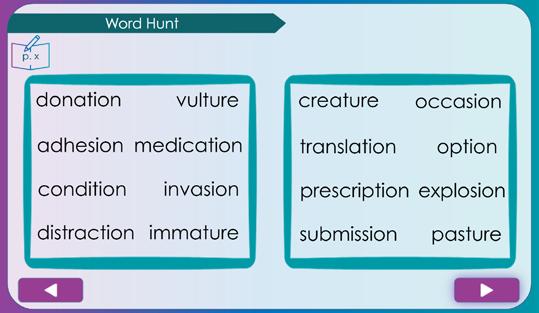
7. Word Hunt
PAIR STUDENTS and have them sit together.
SAY “Now we’ll read words with Latin Chunks. Then, you will hunt for
Phonics
Answer Key
1. Write two words that have only two syllables.
vulture, creature, option, pasture (students choose just two)
2. Write the word that has four syllables. medication
3. Which word is something that might happen to you in class? distraction
3. Which word describes something you give away? donation
Pause briefly at natural stopping points (end of a paragraph or section) and restate one key idea in simple language before continuing.
words with your partner. Open your workbooks to page 76, and then swap books with your partner so they will be marking up your book for you."
CLICK TO DISPLAY Word Hunt.
SAY “Each partner will read one box of words aloud while the other partner checks if the word is being pronounced correctly. Then we will check the words together.”
PROVIDE students time to read the two boxes. Then, have a pair of students read the words to the class, checking for proper pronunciation.
STUDENTS SWAP workbooks back to their owners.
SAY “Read through the Hunt & Answer questions with your partner and answer them together. Write your answers on the lines.”
FORTXPILOTUSEONLY
Brief processing pauses during teacher read-alouds support English Learners by reducing cognitive load and allowing time to construct meaning without interrupting fluency modeling.
REVIEW answers as a whole class and have students adjust answers as necessary.
8. Decodable Passage Teacher Read
SAY:
• “ Turn to page 77.
• O ur passage for this unit is called ‘The Speed of Light.’ It includes our Heart Words and words with Latin Chunks.
• Today, I’m going to read it aloud to you while you follow along in your books.
• Let’s answer a few questions first.”
CLICK TO DISPLAY Activating Prior Knowledge. Read the title and the questions and quickly discuss the answers.
CLICK TO DISPLAY Words to Preview. Read through the words and have students repeat them. Read the definitions and quickly discuss any connections to the words.
CLICK TO DISPLAY Point and Say Words. Read through the words and have students repeat them.
CLICK TO DISPLAY Heart Words. Read through the words and have students repeat them.
SAY “Now pay attention to the way I read with accuracy and how I read smoothly, with fluency, and intonation, how my voice changes to help the listener understand the text.”
READ “The Speed of Light” aloud with appropriate fluency and intonation.
ASK “Were your predictions on what the passage was going to be about correct?”
POINT OUT the compound words in the passage and ask students
Phonics to read them and to break them into their smaller component words: airplane, superhero, yourself, and halfway.
CLICK TO DISPLAY Heart Word Review.
SAY:
• “ Let’s go back through and find those Heart Words before we learn more about spelling them.
• Look at the underlined words in the passage and put your finger on the word wĭnd .” (Continue having students identify the remaining Heart Words.)
If time allows, explain anything new you have learned from the text and allow students to do the same.
9. Heart Word Magic
CLICK TO DISPLAY Heart Word Magic.
Curricular Crossover! Task students with identifying these Heart Words in other texts throughout their week. Keep them posted in the room to help students remember the words they are looking for.
FORTXPILOTUSEONLY
Answer Key
Open sig | na | ture
Closed sus | pen | sion
R-Controlled con | tor | tion
SAY “Let’s watch our Heart Word Magic animation for the Unit 22 Heart Words: līve / lĭve, rēad / rĕad, wīnd /wĭnd, and close/cloze.”
C LICK TO PLAY the Heart Word Magic animation.
10. Climb in InferCabulary and Play in the Reading Arcade
CLICK TO DISPLAY Independent Practice.
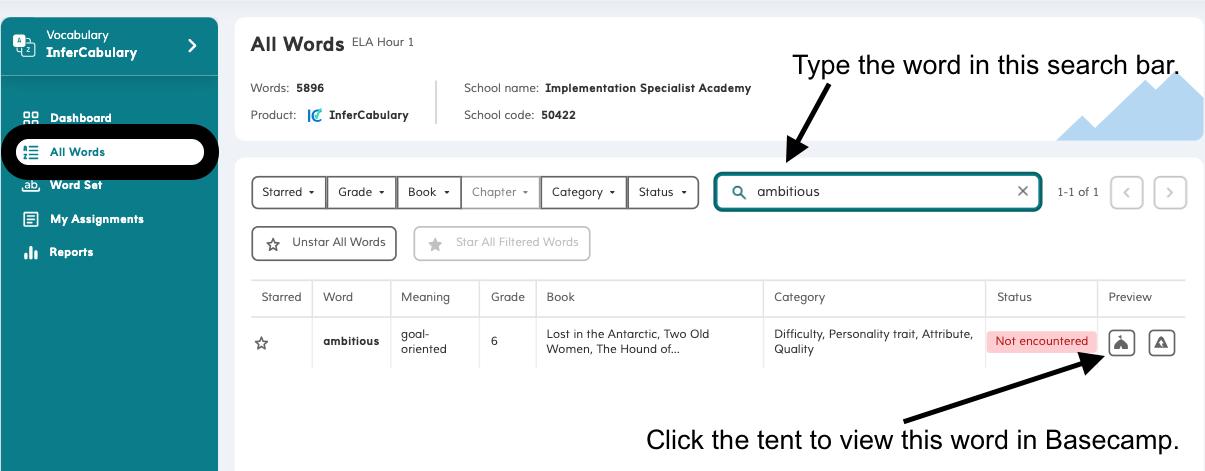
PROVIDE STUDENTS time throughout the week to climb at least 30 minutes in InferCabulary and play at least 15-20 minutes in the Reading Arcade. These minutes should be distributed throughout the week. It is best practice to divide InferCabulary practice into at least three weekly sessions.
For an on-screen timer, choose the Independent Practice Timer below the Handwriting lesson in the lesson dropdown menu of your Teacher Dashboard. There are four timer options: 5 minutes, 10 minutes, 15 minutes, and 20 minutes.
11. Quick Check
CLICK TO DISPLAY Quick Check.
DISTRIBUTE the Unit 22, Lesson 1 Quick Checks.
SAY “For today’s Quick Check, draw lines between the syllables in each of the three words. Then write each of the three words next to the syllable type of the syllable BEFORE the Latin Chunk. Write in your best cursive.”
Unit 22 Lesson 2
Self-Assessment and “Glowing Animals: Hiding or Standing Out?” Reading, Cloze, & Questions Vocabulary
Objectives
• To determine word knowledge of a new set of words through self-assessment.
• To preview a text by activating prior knowledge, making connections to what students already know, and defining unfamiliar words.
• To use semantic links, parts of speech, and word meanings to find missing words in a cloze passage.
• To expand sentences about a compare and contrast article to support and demonstrate comprehension.
Note: Words will fit in more than one category but are placed with the category that is most prominent.
Words used in the cloze passage (versions of the target) adaptation camouflage confused distracted lure marine predator prey species startled surroundings
Words related to light and visibility glowing illuminated indication luminescent vibrant
Words related to animal life and characteristics agile armor concealed disguise evolving fang feature interaction lurking mimicry minute (size) native phenomenon protective rapid regeneration spine stealthy tentacle venomous
Words that include the targeted morphology pattern cept deception exceptional imperceptible
Cloze Passage Answer Key
• To prepare for the second reading of “Glowing Animals: Hiding or Standing Out?” in Unit 23, Lesson 2, you may fill in the missing words in the Vocabulary Passage on page 81 of your blank copy of the Orbit Student Workbook 3 using the answers provided in Orbit Online
FORTXPILOTUSEONLY
Words related to locations atmosphere barrier environment haven region shelter surface vessel
Words that include the targeted morphology pattern rupt disruption eruption ruptured
Answer Key
de | par | ture s com | pa s | sion
Start Teaching
Self-Assessment and “Glowing Animals: Hiding or Standing Out?” Reading, Cloze, & Questions
Phonics Warm-Up
SAY:
• “For our phonics warm-up today, we’ll read a few words with Latin Chunks.
• If you know this word, don’t say it.”
WRITE the word transitional on the board.
SAY:
• “I’m looking for vowel spellings first, and I see four of them, a, i, the io in the Latin Chunk tion, and a (underline each), so I know this word has four syllables.
• I see a prefix I know, trans, so I’ll draw my first syllable line after that (draw a vertical line after trans), and I see the Latin Chunk tion, so I’ll draw syllable lines before and after it because I know it’s always alone in a syllable. The last syllable is the suffix -al, which sounds like /uhl/. This gives me the four syllables to decode.
• /trănz/ /ī/ /shin/ /uhl/ or /trănz/ /ĭ/ /shin/ /uhl/. That sounds better, transitional
• I’m going to write two more words that have a Latin Chunk on the board. If you know the words, don’t say them.”
WRITE the words departures and compassion on the board.
GROUP students in pairs, or by desk/table group.
SAY:
• “With your partner(s), read each word and find the Latin Chunk.
• I will be asking for students to come up to:
– underline the vowel spellings,
– segment the syllables by drawing a vertical line between them,
– point out the Latin Chunk, and – read the word correctly.”
STUDENTS WORK with their partner(s) and then participate in marking
Vocabulary up the words on the board. They should show their work on paper.
1. State Objectives
OPEN Orbit Online to Unit 22, Lesson 2, Vocabulary.
CLICK TO DISPLAY Objectives.
SAY:
• “At the end of today’s lesson, you will be able to:
- identify how much you already know about certain words and use this information to track your own word learning progress.
- prepare to read a compare and contrast article by making connections to what you already know, identifying the meanings of new words, and identifying the part of speech of vocabulary words.
FORTXPILOTUSEONLY
Note: Add in any anecdotal observations from the Module 5 Self-Assessment such as, “I remember how challenging it was for many of you the first time you went through the words at the start of Module 5 compared to how many you knew at the end,” or, “I noticed many of you started with mostly checkmarks in Module 5 but ended with several more plus signs.”
- u se semantic links, word classes, and vocabulary words to find the missing words in a compare and contrast article.
- expand sentences about a compare and contrast article.”
2. Self-Assessment
CLICK TO DISPLAY Module 6 Self-Assessment.
STUDENTS OPEN their workbooks to page 80, Word Knowledge SelfAssessment.
SAY “Here is the final group of words we will encounter the last four weeks. These are the words you will see in InferCabulary, as well as in other activities, throughout this module.”
ASK “What is the goal of talking about these words? Why are we spending so much time working with them in different activities?” (A: deeply learn them, recognize them in other activities, use them when we read and write)
SAY “I will read them aloud while you think about how well you know them.”
ASK:
• “ When should we mark a word with a plus sign?” (A: knowing it well enough to also name 2–3 related words)
• “ When should we use a checkmark?” (A: recognizing it but not deeply enough to be able to talk about with 2-3 semantically related words)
• “ Which words should be marked with a dash?” (A: words we do not recognize)
SAY “Remember, it is completely okay if there are words you don’t
Vocabulary
An image to support the definition for contrast is available in the Comprehension Boost button.
recognize or don’t know deeply yet. That’s what makes this activity valuable. You are in the perfect spot to stretch and learn more. We will come back to these words in a few weeks when you will be able to measure your progress.”
READ each of the words aloud as the students follow along in their workbooks and complete the self-reflection.
3. “Glowing Animals: Hiding or Standing Out?” First Reading
CLICK TO DISPLAY Contrast.
SAY:
• “ Remember when we expanded this kernel using a contrasting idea: ‘Antarctica is inhospitable’? We expanded the sentence to ‘Antarctica is inhospitable, but Shackleton and his men survived.’
• When you expand a sentence with the coordinating conjunction but, you introduce a second idea that contrasts with the first idea in the sentence.”
ASK “What does it mean when two words or ideas contrast?” (A: they are different from each other) (Click to add definition.)
CLICK TO DISPLAY Compare Basecamp.
SAY:
• “ Today, we will read an informational article that compares and contrasts animals.
• B efore we begin, we will use the Think Aloud Process to form a definition of the word compare.
Vocabulary
Note: You may decide whether to read the captions aloud or have the students read to themselves.
• Take a few moments to work with a partner to collect words, draft your definition, and write your answer. We will share with the whole group when everyone is finished.”
When students are finished, CALL ON volunteers to share their definitions with the whole group.
• A nswers will vary. Sample response: to determine how two or more things are similar, or alike.
CLICK TO DISPLAY Compare and Contrast.
SAY:
• “ So far, you have read several nonfiction texts. These provide true facts.
FORTXPILOTUSEONLY
• S ome of them have been informational—they teach, or inform, us about facts. Informational texts can be descriptive—they describe something. (Click to add first bullet.) ‘Snacks Around the World,’ ‘Peanut Butter: A Tasty Tale,’ and ‘Portable Snacks’ are all informational texts that describe.
• We’ve also read true stories. (Click to add second bullet.) These stories, such as ‘Roald Amundsen’ and ‘Ernest Shackleton’s Endurance,’ are called narrative nonfiction.
• T his week, we are reading informational texts that compare and contrast. (Click to add third bullet.) These texts explain how two things are similar and how they are different.”
CLICK TO DISPLAY What Do You Already Know?
SAY “Before we begin reading, we will talk about what we already know.”
ASK the following questions to activate students’ prior knowledge and encourage discussion:
• “ How do animals protect themselves?”
• (Click to replace with new question.) “Why might an animal want to stand out instead of hide?”
• (Click to replace with new question.) “Have you ever seen an animal that glows? What was it?”
CLICK TO DISPLAY Words to Preview.
SAY:
• “ Before I begin reading, let’s preview some words that may be new to you.
• Bioluminescence is when an animal can make its own light.”
ASK “Why do you think an animal might need to make its own light?” (Call on 1-2 student volunteers to share.)
Vocabulary
Answer Key
adaptation – thing
*camouflage – thing
confuse – action
*distracted – description
*lure – thing
marine – description
predators – thing
*prey – thing
species – thing
startle – action
surroundings – thing
CLICK TO ADD communicate
SAY “To communicate means to share information with someone.”
ASK “What are some ways that you communicate?” (Call on 1-2 student volunteers to share.)
CLICK TO ADD notice
SAY “To notice something means to see, hear, or feel it. For example, ‘I noticed there is a new restaurant on my street.’”
ASK “What is something you noticed today?” (Call on 1-2 student volunteers to share.)
CLICK TO DISPLAY Time to Read!
STUDENTS OPEN their workbooks to page 81, Vocabulary Passage –“Glowing Animals: Hiding or Standing Out?”
FORTXPILOTUSEONLY
SAY “I will read the article aloud as you follow along with me. We will not start filling in the blanks until the next activity.”
READ “Glowing Animals: Hiding or Standing Out?” aloud without the missing words. Take this opportunity to model fluent reading with expression.
CLICK TO DISPLAY Sort the Words.
SAY:
• “ Next, we will look closely at the first two paragraphs of this article and use semantic links, parts of speech, and our vocabulary words to fill in the blanks.
• To get ready, let’s sort the vocabulary words that will be in our word bank by their word class. Knowing each word’s job will help us choose the right ones when it is time to fill in the blanks.”
CALL ON a student to read the first word.
ASK:
• “Is adaptation a person, place, or thing; an action; or does it describe?” (A: thing) (Click to move the word adaptation to the person, place, thing column.)
• “ Now here is a trick question: Is camouflage a person, place, or thing; an action; or does it describe?” (A: a thing and an action)
SAY “It can be a thing and an action, but we will use it as a thing for the cloze procedure.” (Click to move the word camouflage to the person, place, thing column.)
REPEAT THIS ROUTINE with the remaining vocabulary words in the list. Use the answer key to support students. The words with asterisks can also be used as actions. The underlined word can also be used as a person. The answer key identifies how the words will be used in the cloze procedure.
4. “Glowing Animals: Hiding or Standing Out?” Cloze and Questions
CLICK TO DISPLAY Read: “Glowing Animals: Hiding or Standing Out?”
STUDENTS OPEN their workbooks to page 81, Vocabulary Passage –“Glowing Animals: Hiding or Standing Out?”
SAY:
• “ You will use the word bank, semantic links, and word classes to fill in the blanks.
• I will reread the first two paragraphs as you follow along.” (Read the paragraphs aloud as students follow along.)
CLICK TO DISPLAY Fill In the Blanks.
Answer Key
“Many marine creatures in the deep ocean glow in the dark.”
“Even though all these animals have this adaptation, they do not all use it the same way.”
“Some glowing animals use light to blend into their surroundings and stay hidden.”
“This camouflage helps them hide from big fish that might try to eat them.”
“The cookiecutter shark glows to confuse fish it wants to eat.”
Common Misconception:
If students choose startle instead of confuse, explain that in this case, the shark is not trying to scare or surprise other fish. It is trying to make other fish mistake it for a smaller fish so they are not afraid to get closer.
STUDENTS WORK independently to find the five missing words. When students have finished, review the correct answers as a whole group.
CALL ON student volunteers to read each sentence and to fill in the blank with the missing word. Once the correct missing word is identified, CLICK TO ADD it.
USE the following prompts to encourage students to explain their thinking:
• “ How did you know the missing word was ?”
• “ What words helped you decide?”
USE the following list of possible connections as a reference as you guide students to explain each word they chose to fill in the blanks.
Missing Word
FORTXPILOTUSEONLY
Related Words
marine ocean, creatures
adaptation glow, bioluminescence, animals
surroundings blend into, hidden, ocean, hide camouflage hide, match the light, glowing bellies, water
confuse make other fish think, smaller fish
Redirection:
If students fill in the blank with the incorrect word, redirect them with the following questions:
• “ What type of word is needed to fill in the blank?”
• “ How do you know it should be a [person, place, or thing; action;
Vocabulary or description]?”
• “ What are the [people, places, or things; actions; descriptions] in our word bank?”
Common Misconception:
Some students may try to expand a sentence with so to introduce a purpose (in order that). They will most likely try to add that after the conjunction. If you see students doing this, explain that to correctly do this, so should not have a comma before it, as it is being used as a subordinating conjunction to introduce an incomplete thought that depends upon the first idea in the sentence to make sense. Remind students that using a comma and the coordinating conjunction so to expand a sentence means they should add an effect of the first idea.
Answer Key
To expand sentences with because, students should add a logical reason for the first idea.
• “ Tell me what you have learned about [incorrect word]. Does the sentence make sense if you use its definition to fill in the blank? If not, what other word would match the meaning of the sentence?”
• “ What words are related to the missing word? How are the words semantically linked?”
Optional
CLICK TO DISPLAY Expand Sentences About Paragraphs 1 and 2.
FORTXPILOTUSEONLY
STUDENTS TURN their workbooks to pages 82-83, Expand Sentences About Paragraphs 1 and 2.
SAY:
• “ You will work with a small group to expand these sentences about the two paragraphs we just read.
• Make sure you pay close attention to the conjunction at the end of each one so you know what kind of information to add.
• T here is only one sentence to expand for number three. It is a Text and Me question in disguise. To expand this sentence, you will need to use text details and what you already know to form a new understanding.
• Take your time and think carefully before expanding each sentence.
• Remember, in our classroom, everyone’s voice matters. People share in different ways—some talk, some use sign language, some use devices, and some need a little extra time to get their words out.
• O ur job is to listen carefully, take turns, stay on topic, and keep the room calm so every voice can be heard and respected.”
STUDENTS WORK in small groups to expand the sentences. Circulate the room and provide support as needed.
• To expand sentences with but, students should add an idea that logically contrasts with the first idea.
*answer key continues on next page
When students have finished, call on student volunteers to share their responses. CLICK TO DISPLAY each sentence, then CLICK TO ADD the sample answers.
5. Climb in InferCabulary and Play in the Reading Arcade
CLICK TO DISPLAY Independent Practice.
Vocabulary
Answer Key
• To expand sentences with so, students should add a logical effect of the first idea.
Text details that help expand sentence #3:
• “ Some glowing animals use light to blend into their surroundings and stay hidden.”
• “…match the light from the water above them.”
Possible prior knowledge that can help expand sentence #3:
• When water is not too deep, sunlight can shine through it.
• A nimals use camouflage to mimic, or copy, the appearance of their habitat.
1. C
Answer Key
2. change, camouflage, lanternfish
PROVIDE STUDENTS time throughout the week to climb at least 30 minutes in InferCabulary and play at least 15-20 minutes in the Reading Arcade. These minutes should be distributed throughout the week. It is best practice to divide InferCabulary practice into at least three weekly sessions.
For an on-screen timer, choose the Independent Practice Timer below the Handwriting lesson in the lesson dropdown menu of your Teacher Dashboard. There are four timer options: 5 minutes, 10 minutes, 15 minutes, and 20 minutes.
6. Quick Check
CLICK TO DISPLAY Quick Check.
DISTRIBUTE the Unit 22, Lesson 2 Quick Checks.
FORTXPILOTUSEONLY
SAY “Select the choice that correctly expands the sentence. Then, circle the words that are related to adaptation .”
Unit 22 Lesson 3
Latin Chunks Practice Phonics
Objectives
• To accurately decode and encode multisyllabic words with Latin Chunks.
• To recognize and accurately decode and encode the homograph Heart Words: live, read, wind, close.
• To practice oral reading fluency with decodable text.
• “At the end of today’s lesson, you will be able to:
- read and spell multisyllabic words with Latin Chunks.
- s pell our Unit 22 Heart Words.
FORTXPILOTUSEONLY
- read words, sentences, and our passage with greater fluency.”
2. Practice Heart Word Spelling
CLICK TO DISPLAY Heart Word Review.
SAY:
• “ Each of our Heart Words in this unit is a homograph, and some of them have tricky parts.
• Let’s look at the words, how they are spelled, and their meanings.”
ASK:
• “Where is the word wind, as in ‘I can feel the wind in my hair’?” (A: top or bottom, third from left) *Explain that with homographs, you need context.
• “ What is the first word?” (A: lĭve or līve)
• “ Which word, lĭve or līve, is spelled the way we would expect?” (A: līve)
SAY “So we can add a heart over the i in lĭve because the vowel in a VCe syllable should be long, but this i spells its short vowel phoneme, /ĭ/.”
CLICK TO CHANGE the i in lĭve from black to red and add a heart above it.
REVIEW each of the remaining word pairs, asking the same questions as above and noting the unexpected sounds in the words in the bottom row.
rēad / rĕad = ea spells /ĕ/ instead of the expected long /ē/ wĭnd / wīnd = both phonemes are phonetically correct; Closed Syllable vs. Closed Syllable Exception close / cloze = s spells /z/ instead of the expected /s/; this is common but not expected
2. 3.
Answer
Key
l i v e c l o s e r ea d w i n d
CLICK TO DISPLAY Heart Word Spelling.
SAY “Turn to page 84 in your workbooks, and we’ll practice spelling the Heart Words we just went over. I’m going to choose one word from each pair.”
DICTATE the words, one at a time, reading the contextual sentence:
1. close (/klōz/) – Please close your book when you’ve finished the chapter.
2. live (/lĭv/) – My best friend and I live next door to each other.
3. wind (/wīnd/) – The football referee said to wind the clock back five seconds.
4. read (/rĕd/) – I’ve read many books about axolotls; they’re my favorite!
For each word, students:
FORTXPILOTUSEONLY
When appropriate, pair students with differing language strengths so partners can support one another through modeling, clarification, and discussion.
• FILL IN a dot for each sound that they hear.
• WRITE a grapheme (spelling) in each box with a dot.
• FI LL IN a heart above the tricky part(s).
• WRITE the whole word on the final line in cursive.
Remind students to use their phonics knowledge to spell the phonetically predictable parts of each word and to write legibly in print.
After students have spelled each single-syllable word, CLICK TO HIGHLIGHT THE ROWS AND REVEAL the answers and review them, one at a time. (Click once for each dot representing a phoneme, then once for each grapheme, a third time to display the hearts over the tricky graphemes, and then once again to display the completed word.)
3. Review
ASK:
• “ How many letters are in each of the Latin Chunks we’ve learned?” (A: four)
• “ How do you read t-i-o-n?” (A: /shin/)
• “ What are the two ways to read s-i-o-n?” (A: /zhin/ or /shin/)
Latin Chunk ture future (2) capture (4) adventure (5) temperature (6) sculpture (7)
Compound Words
campsite (2) earthquake (10)
• Q uietly read the phrases to yourself. If you get stuck on a word, underline the vowel spellings and break up the syllables to help you figure it out. Remember to look for any Latin Chunks. If something doesn’t sound quite right, go back and reread.”
STUDENTS READ QUIETLY TO THEMSELVES as many phrases as they can in the time given.
ASSIGN PAIRS OF STUDENTS to work together to read phrases fluently to each other and check each other’s work. Determine which students will act as the Reader first and which will be the Checker.
STUDENTS TRADE workbooks before the beginning of the paired activity.
5 . Detect & Decode
FORTXPILOTUSEONLY
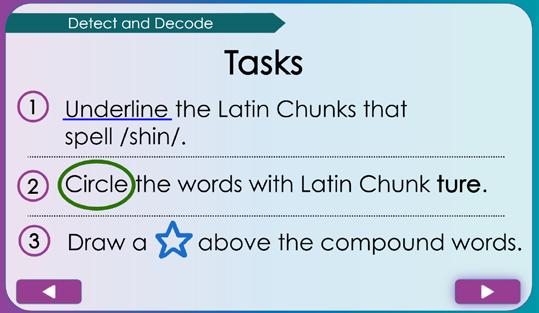
SAY “Now we’ll examine complete sentences to look for particular spellings, or syllable types, and then read them with fluency.”
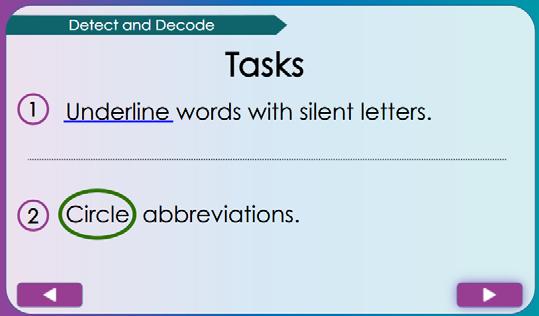
CLICK TO DISPLAY Detect & Decode. Read the tasks aloud.
SAY “Read each sentence and complete your tasks. When you are finished, we will discuss what you found, and then we’ll have a few chances to read sentences aloud.”
After students have had time to complete their Detect tasks, DISCUSS their findings.
SAY:
• “ Let’s read!
• Remember, our goal is to read accurately the first time.
• O ur secondary goal is to read fluently, as if we were talking to a friend.
• Readers, make sure you read loudly enough for everyone to hear.
• Checkers, that is everyone who is not reading, pay careful attention to the reader and the text.
• Q uietly mark any errors in your workbook. Remember to make your marks light.” CALL ON INDIVIDUAL STUDENTS to read sentences, one at a time.
DIRECT CHECKERS to give a thumbs up if the Reader reads all of the words correctly or a thumbs to the side if the Reader misreads a word(s). If the Reader misreads any words, follow Positive Error Correction instructions for Partner Phrase Reading (see page 431 in the Appendix for full directions).
Note: Technically, the e at the beginning of election is pronounced with the schwa phoneme /ih/, but many people pronounce it with a long e phoneme. Pronounce the word the way you usually do.
6. Split It!
CLICK TO DISPLAY Split It!
SAY:
• “ We are going to spell some longer words in our workbooks using Whale Talk to help us hear the number of syllables so we can spell them one at a time.
• Let’s Whale Talk and spell the first word together. Turn to page 86.”
• Election, as in, ‘In an election, people get to vote for the candidate of their choice.’
• N ow, let’s Whale Talk election together.” (Whale Talk election by holding your lips together and shouting e-lec-tion. Students Whale Talk with you.)
ASK “How many syllables do you hear in election?” (A: three)
SAY:
• “Since election has three syllables, e - lec-tion, we will fill in dots in the first three boxes.
• A s you fill in each dot, SAY the syllables in election with me.
• /ih/ (click to fill in 1st dot), /lĕk/ (click for 2nd dot), /shin/ (click for 3rd dot)
• N ow, let’s spell each syllable in election by listening to the sounds in that syllable.
• T he first syllable is just one phoneme - /ih/.
• In this word, /ih/ is spelled by the letter e.”
CLICK TO ADD the syllable e to the first box.
SAY “The second syllable is lec - /l/ /ĕ/ /k/, lec .”
ASK “How would we spell lec when it is in the middle of a word?” (A: l-e-c)
SAY “ T-i-o-n is the most common spelling, and it is the correct one here. If you hear the sound /k/ right before /shin/, the spelling will always be t-i-o-n.” e e lec
SAY “Right, we’d only use ck to spell /k/ at the end of a single-syllable word.”
C LICK TO ADD the syllable lec to the second box.
ASK “Lastly, what are the two ways to spell /shin/?” (A: tion and sion)
e lec tion
C LICK TO ADD the syllable tion to the last box and click again to add word election to the final line.
CONTINUE the above process for the remaining words, one at a time. Review the answers at the end. Letters that spell the schwa phoneme are underlined below. Provide Positive Error Correction if needed (see page 431 in the Appendix for full directions).
REMIND students to write legibly. They should write the complete word in cursive.
2. posture - [pos] [ture]
• “ If you learn how to sit correctly, having good posture is easy.”
3. extension - [ex] [ten] [sion]
FORTXPILOTUSEONLY
• “The extension ladder reached all the way to the roof.”
4. fusion - [fu] [sion]
• “ The new Asian-Indian fusion restaurant mixed my favorite foods, kimchi and naan!”
5. donation - [do] [na] [tion]
• “Your donation of clothing and shoes will help multiple people.”
7. Sentence Dictation Practice
SAY:
• “ Now we’re going to put our Latin Chunks practice into use writing whole sentences.
• I’ll say a sentence, and then I’ll repeat it slowly several times while you write it down.”
For each sentence:
CLICK TO DISPLAY Dictation Sentence Images, one at a time.
READ each sentence once with appropriate fluency and intonation.
STUDENTS REPEAT the sentence and count the number of words in the sentence. They write the number of words at the end. This will help them check that they’ve written each word.
REPEAT the sentence several times slowly as students write.
1. We used pictures to figure out the addition problems. (9)
2. T he PE teacher showed compassion for my arm fracture. (9)
3. I l iked the nonfiction story about the migration of dragonflies. (10)
CLICK TO DISPLAY Dictation Sentences. Review as necessary.
Phonics
Helpful Hint:
Remind students that when they see an underlined word in the passage, it is a Heart Word, and they should use their phonics knowledge to help them decode the word. Using the phonemes they do know can help them decode the whole word even though it has a tricky part.
Students make any necessary corrections. Offer support with schwa spellings.
8. Decodable Passage Practice
SAY “You heard me read the passage ‘The Speed of Light’ earlier this week. Now, it’s your turn to get some practice reading the passage with a partner. Let’s go back to page 77.”
CLICK TO DISPLAY Words to Preview. Review quickly.
CLICK TO DISPLAY Point and Say Words. Review quickly.
CLICK TO DISPLAY Heart Words. Review quickly.
GROUP students in pairs and determine which student will be Reader 1 and which student will be Reader 2.
Procedure:
FORTXPILOTUSEONLY
• Each Reader will read one section as the Checker provides support when prompted.
• Remind students to underline the vowel spellings and segment the syllables of words they struggle with before asking their partner for help.
SAY:
• “ With your partner, find four words with Latin Chunks in the passage. Write those on your workbook page at the end of the passage.
• U se your best, legible cursive handwriting. I should easily be able to read your words as I walk around.”
REVIEW student answers as a class.
TIME PERMITTING, HAVE STUDENTS LOOK FOR other words with the target concept. The list below contains the words in the passage with Latin Chunks.
Latin Chunks adventure expression passion attention future picture capture information station communication invention vision connection mission emotion motion
9. Climb InferCabulary and Play in the Reading Arcade
CLICK TO DISPLAY Independent Practice .
PROVIDE STUDENTS time throughout the week to climb at least 30 minutes in InferCabulary and play at least 15-20 minutes in the Reading Arcade. These minutes should be distributed throughout the week. It is best practice to divide InferCabulary practice into at least three weekly sessions.
For an on-screen timer, choose the Independent Practice Timer below the Handwriting lesson in the lesson dropdown menu of your Teacher Dashboard. There are four timer options: 5 minutes, 10 minutes, 15 minutes, and 20 minutes.
10. Quick Check
CLICK TO DISPLAY Quick Check.
DISTRIBUTE the Unit 22, Lesson 3 Quick Checks.
SAY:
• “ Fill in the correct Latin Chunk to spell each word.
• Remember, when you hear /shin/, there are two spelling choices. Do your best to remember other times you’ve seen these words.”
Unit 22 Lesson 4
Word Work and “Glowing Animals: Hiding or Standing Out?” Cloze & Questions Vocabulary
Objectives
• To use semantic reasoning to identify related words.
• To use related words to construct a definition for an adjective.
• To use semantic links, parts of speech, and word meanings to find missing words in a cloze passage.
• To answer Right There, Think and Search, and Text and Me questions while reading a compare and contrast article to support and demonstrate comprehension.
• SyllaBoards™ Kit OR blank sheet of paper OR 3x5 cards
Start Teaching
Word Work and “Glowing Animals: Hiding or Standing Out?” Cloze & Questions
Phonics Warm-Up
SAY:
• “For our phonics warm-up today, we’ll spell a few words with Latin Chunks.
• The first word is explosion .
FORTXPILOTUSEONLY
• First, I need to figure out how many syllables I need to spell, so I’ll Whale Talk the word. (Whale Talk ex-plo- sion.)
• I felt three pushes of breath, so there are three syllables.”
WRITE three lines on the board in a row.
SAY “The first syllable is /ĕks/, and that is spelled e -x .”
WRITE e -x on the first line.
SAY “The second syllable is /plō/, and I think that should be spelled with an Open Syllable because there is a Latin Chunk after it. If you hear a long o before a Latin Chunk, it will always be spelled with just the vowel letter o.”
WRITE p - l - o on the second line.
SAY “And the last syllable is /zhin/, which is spelled s -i- o - n most of the time.”
WRITE s -i- o - n on the third line.
SAY:
• “Now, I’ll read what I wrote using Touch & Say, ex plo sion, explosion .
• It’s your turn to spell two words that have a Latin Chunk.
• Get out your SyllaBoards™.” (Students may also write on notecards or on a sheet of paper.)
GROUP students in pairs, or by desk/table group.
SAY:
• “With your partner(s), listen to each word, get out the correct number of boards, and spell the word one syllable at a time.
• After, I will be asking for students to come up to:
– write the correct number of lines,
Vocabulary
Answer Key
Curricular Crossover!
The scripted process and templates introduced in Unit 4, Lesson 2 (nouns) and Unit 18, Lesson 4 (adjectives) can be used to define words from curricular content (e.g., ELA, science, or social studies). When students are able to build their own definition that includes part of speech and semantically related words, it contributes to deeper understanding.
– spell each syllable,
– point out the Latin Chunk, and
– read the word correctly.”
DICTATE the following words, one at a time, and repeat as necessary as students follow the above process with their partner: emotion and adventure
STUDENTS WORK with their partner(s) and then participate in spelling the words on the board.
1. State Objectives
OPEN Orbit Online to Unit 22, Lesson 4, Vocabulary.
CLICK TO DISPLAY the Objectives.
FORTXPILOTUSEONLY
SAY:
• “At the end of today’s lesson, you will be able to:
- u se related words to build a definition of the word luminescent
- u se semantic links, word classes, and vocabulary words to find the missing words in a compare and contrast article.
- expand sentences about a compare and contrast article.”
Optional
2. Semantic Reasoning Word Work –Luminescent
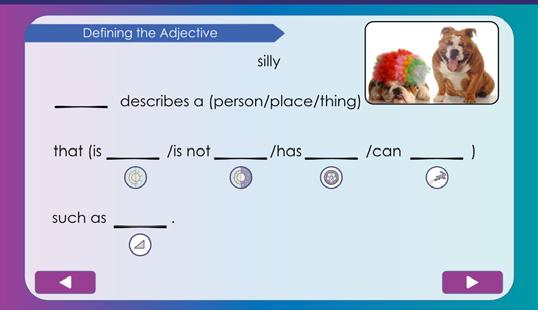
CLICK TO DISPLAY Defining an Adjective.
STUDENTS OPEN their workbooks to pages 87-88, Word Work Worksheet – Luminescent.
SAY:
• “ The word we are studying today is luminescent
• A few weeks ago, we worked with a new template to define adjectives.
• Let’s go over the parts to think about when studying an adjective and finding related words to build the definition. (Click to show arrow.)
• D efining adjectives is a little easier because we always start with the phrase ‘describes a...” and then we just need to circle what types of things it describes. (Click to move arrow.)
• When defining an adjective, it is helpful to use a synonym that
Vocabulary
Note: You may decide whether to read the captions aloud or have the students read to themselves.
Provide one optional oral frame before partner discussion:
“I defined luminescent as something that because .”
“One word I chose was because it shows .”
This helps strengthen academic language without changing the task.
most people will know. Sometimes an antonym is more helpful. Sometimes there are important parts to help define the adjective, and other times it is better to talk about what the adjective does, or the action. Try to include two of these four options. (Click to move arrow.)
• F inally, end with an example.
• You will see the new template and a new checklist created for adjectives in your workbook.”
CLICK TO DISPLAY Basecamp.
SAY “Here are the images and captions for the word luminescent Collect the information you need to complete the checklist and build your definition. I will give you a few minutes to complete the process and then we will share with each other.”
FORTXPILOTUSEONLY
GIVE STUDENTS four minutes to complete their sentences. As you walk around the room, look to see that they have selected helpful related words in their checklists. Redirect as necessary to ensure the definitions will be accurate.
SAY:
• “ Now I want you to turn to your partner and compare definitions.
• Circle the items you chose that were similar and talk about the related words you chose that were different.
• If you or your partner chose a word that was not strongly related, use this time to go back and find one that will make your definition stronger.”
When students are finished, CALL ON volunteers to share their definitions with the whole group. Provide feedback as needed using the answer key.
synonyms glowing, bright, or any other logical, relevant example
If a student selects illuminated, acknowledge that the word is correct as a synonym, but is not likely going to be well known by most people when compared to glowing or bright antonyms dark or any other logical, relevant example n/a parts light
If a student volunteers the idea of electricity, point out that not all luminescent objects require electricity. actions
be seen/visible in the dark, make the darkness bright, or any other logical, relevant example
If a student has already used the synonym glowing and chooses the same word as the action, explain how the second use does not provide any new, helpful information and should be reconsidered.
Vocabulary
examples fireflies, jellyfish, glowsticks, lights, or any other logical, relevant example
If a student identifies items such as the cup or the keyboard, redirect by pointing out that more information would be needed to explain the “sometimes” connection.
3. “Glowing Animals: Hiding or Standing Out?” Cloze and Questions
CLICK TO DISPLAY Read: “Glowing Animals: Hiding or Standing Out?”
STUDENTS OPEN their workbooks to page 81, Vocabulary Passage –“Glowing Animals: Hiding or Standing Out?”
SAY:
Answer Key
“They can startle their enemies.”
“Atolla jellyfish flash their light when they feel threatened by predators.”
“The anglerfish has a glowing lure hanging from its head.”
“Others use their light to communicate with others in their species.”
“Some glow to keep their predators distracted .”
FORTXPILOTUSEONLY
• “ You will use the word bank, semantic links, and word classes to fill in the blanks.
• I will reread the next two paragraphs as you follow along.” (Read the paragraphs aloud as students follow along.)
CLICK TO DISPLAY Fill In the Blanks.
STUDENTS WORK independently to find the six missing words. When students have finished, review the correct answers as a whole group.
CALL ON student volunteers to read each sentence and to fill in the blank with the missing word. Once the correct missing word is identified, CLICK TO ADD it.
USE the following prompts to encourage students to explain their thinking:
• “ How did you know the missing word was ?”
• “ What words helped you decide?”
USE the following list of possible connections as a reference as you guide students to explain each word they chose to fill in the blanks.
Missing Word
“Others glow to lure prey.”
Related Words
startle noticed, flash their light, warning predators threatened, enemies
lure think it is food
species fireflies, others, mate distracted stand out, predators, survival
prey lure, stand out, survival, predators
Vocabulary
Common Misconception:
Some students may try to expand a sentence with so to introduce a purpose (in order that). They will most likely try to add that after the conjunction. If you see students doing this, explain that to correctly do this, so should not have a comma before it, as it is being used as a subordinating conjunction to introduce an incomplete thought that depends upon the first idea in the sentence to make sense. Remind students that using a comma and the coordinating conjunction so to expand a sentence means they should add an effect of the first idea.
Answer Key
To expand sentences with because, students should add a logical reason for the first idea.
To expand sentences with but, students should add an idea that logically contrasts with the first idea.
To expand sentences with so, students should add a logical effect of the first idea.
Text details that help expand sentence #3:
• “…they use their light in very different ways for survival.”
• “ Some use light to hide with camouflage.”
• “ Some glow to keep their predators distracted.”
• “Others glow to lure prey.”
Redirection:
If students fill in the blank with the incorrect word, redirect them with the following questions:
• “ What type of word is needed to fill in the blank?”
• “ How do you know it should be a [person, place, or thing; action; or description]?”
• “ What are the [people, places, or things; actions; descriptions] in our word bank?”
• “ Tell me what you have learned about [incorrect word]. Does the sentence make sense if you use its definition to fill in the blank? If not, what other word would match the meaning of the sentence?”
FORTXPILOTUSEONLY
• “ What words are related to the missing word? How are the words semantically linked?”
CLICK TO DISPLAY Expand Sentences About Paragraphs 3 and 4.
STUDENTS TURN their workbooks to pages 89-90, Expand Sentences About Paragraphs 3 and 4.
SAY:
• “ You will work with a small group to expand these sentences about the two paragraphs we just read.
• Make sure you pay close attention to the conjunction at the end of each one so you know what kind of information to add.
• S entence #3 is a Text and Me question in disguise. To expand this sentence, you will need to use text details and what you already know to form a new understanding.
• Take your time and think carefully before expanding each sentence.”
S TUDENTS WORK in small groups to expand the sentences. Circulate the room and provide support as needed.
When students have finished, call on student volunteers to share their responses. CLICK TO DISPLAY each sentence, then CLICK TO DISPLAY the next question.
4. Climb in InferCabulary and Play in the Reading Arcade
CLICK TO DISPLAY Independent Practice.
PROVIDE STUDENTS time throughout the week to climb at least 30 minutes in InferCabulary and play at least 15-20 minutes in the Reading Arcade. These minutes should be distributed throughout the week. It is best practice to divide InferCabulary practice into at least three weekly sessions.
Vocabulary
Answer Key
*answer key continues
Possible prior knowledge that can help expand sentence #3:
• A n adaptation is the act of changing from one form, state, or belief to another.
• A nimals are part of food chains, on which they fall into different levels. Some animals are predators, some are prey, and some are both!
For an on-screen timer, choose the Independent Practice Timer below the Handwriting lesson in the lesson dropdown menu of your Teacher Dashboard. There are four timer options: 5 minutes, 10 minutes, 15 minutes, and 20 minutes.
5. Complete Expedition Assignment in InferCabulary
CLICK TO DISPLAY Expedition Time.
SAY “Please open your assignment area and complete the assignment titled Orbit Module 6 Expedition Pretest. When you are finished, you may use the rest of the time to climb the mountain.”
FORTXPILOTUSEONLY
6. Quick Check
CLICK TO DISPLAY Quick Check.
DISTRIBUTE the Unit 22, Lesson 4 Quick Checks.
SAY:
• “ Sort the words in the word bank by writing them below the target word they are related to. Look closely! One of them could go into more than one column!
• Next, circle the words that are related to shelter
• T hen, circle the word that correctly completes the analogy. Identify how the words are related.”
FORTXPILOTUSEONLY
Unit 22 Lesson 5
Knowledge Checkpoint: Latin Chunks Phonics
Objectives
• To accurately decode and encode multisyllabic words with Latin Chunks.
• To recognize and accurately decode and encode the homograph Heart Words: live, read, wind, close.
• To practice oral reading fluency with decodable text.
Teacher Materials
• Orbit Online and Teacher Dashboard
• B lank copy of Orbit Student Workbook 3
Student Materials
• S pelling and Dictation page – printed and copied (Supply Room HQ or page 439 in the Appendix)
• “At the end of today’s lesson, you will be able to:
- s how that you can identify, read, and spell words with Latin Chunks by themselves and in phrases and sentences.
FORTXPILOTUSEONLY
- s how that you can spell our Unit 22 Heart Words.”
2. Optional Warm-Up Activity
CLICK TO DISPLAY Warm-Up: Latin Chunks.
SAY:
• “ To warm up, let’s play ‘What’s That Syllable?’
• I ’ll show you a word, and I’ll read it.
• Look at the Latin Chunk and think about the syllable BEFORE it.
– If the syllable before is closed, show me the Closed Syllable hand signal (closed fist)
– If the syllable before is open, show me the Open Syllable hand signal (open hand).
– And lastly, if it is r-controlled, show me the R-Controlled Syllable hand signal (pointer and middle fingers crossed).”
CLICK TO DISPLAY the word completion .
ASK “Syllable type?” (A: students hold up Open Syllable hand signal to show that the syllable before tion is an Open Syllable)
REPEAT rounds of the game with the remaining words: cur vature (open), de par ture (r-controlled), de pres sion (closed), carnation (open), conver sion (r-controlled), sig nature (open), propor tion (r-controlled), question (closed).
3. Spelling and Dictation
CLICK TO DISPLAY Spelling & Dictation.
SAY “We have been practicing spelling Heart Words and words with Latin Chunks. For today’s spelling test, write the words in your best handwriting on your Spelling & Dictation paper.”
DISTRIBUTE a Spelling & Dictation page to each student.
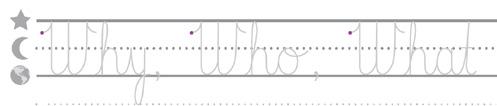
REMIND students to use the handwriting lines for letter formation, using the Moon and Star lines to size letters.
READ aloud the 12 words, four Heart Word pairs, and two dictation sentences to students.
• For spelling words and Heart Words, use the contextual sentences below to ensure students have heard the word correctly.
FORTXPILOTUSEONLY
• For dictation sentences, have students repeat the sentence and count the number of words in the sentence before writing.
1. position – My position in basketball is point guard.
2. mature – When a tadpole is fully mature, it is a frog.
3. confusion – There was confusion about where the finish line was for each race.
4. texture – The soup had a velvety texture; it was so smooth!
5. question – Raise your hand if you have a question
6. explosions – The popping candy is like a lot of tiny explosions in my mouth!
7. mission – My dad was on a mission to find the best cookie recipe.
8. signature – Each page of the document required a signature.
9. version – Which version of the story did you like best, the short or the long one?
10. emotional – Some TV commercials make me emotional.
11. fraction – Only a fraction of the team wanted to get pizza after the game.
12. objections – Does anyone have any objections to walking on the canal?
13. live / live – I live near a venue that holds live concerts.
14. close / close – Since you’re close, can you please close the fridge?
15. read / read – Do you ever read a book after you’ve already read it?
16. wind / wind – Wind up that ribbon so the wind doesn’t knot it up.
Dictation Sentences
1. Write a caption for your partner’s illustration. (7)
2. What impression did you get from your study of that culture? (11)
4. Decodable Passage Fluency and Comprehension
CLICK TO DISPLAY Decodable Passage.
SAY:
• “ We have read ‘The Speed of Light’ twice this week. Now, it’s your turn to read the passage accurately and fluently.
• O pen your workbooks to page 77.
FORTXPILOTUSEONLY
• Your goal is to read with greater accuracy than the first time you read the passage, aiming for 98% accuracy or higher, but remember that you can always reread if you notice you made a mistake or if something you read doesn’t make sense.
• Remember that accuracy is more important than speed. Read carefully.”
GROUP students into the same reading pairs as earlier in the week. The student who was Reader 1 in Lesson 3 will be Reader 1 today for a repeated reading. Reader 2 will begin as Checker.
PROCEDURE
1 CLICK TO DISPLAY AND BRIEFLY REVIEW the “Words to Preview,” “Point and Say,” and “Heart Words” at the top left of the passage with students.
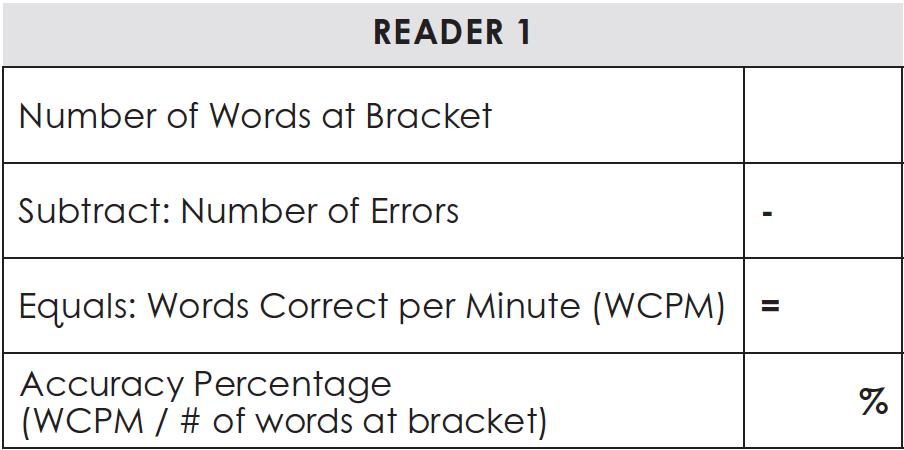
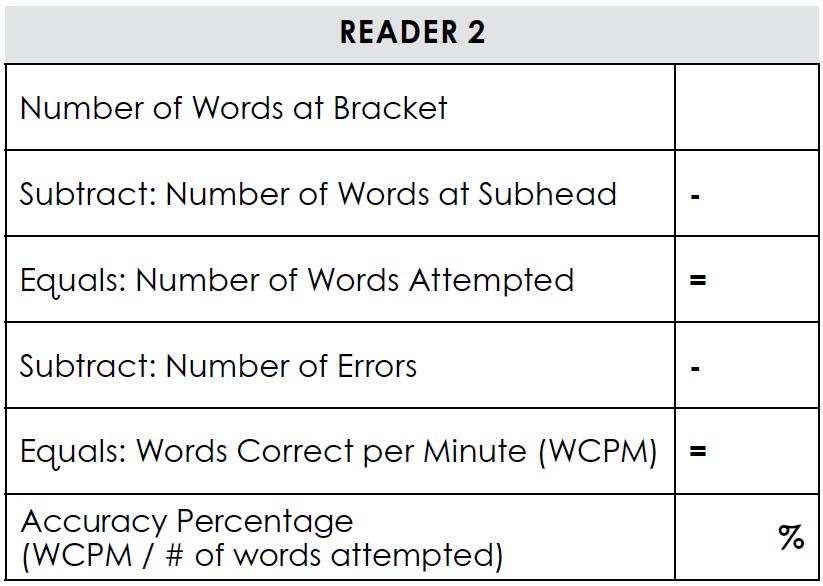
2. READERS SWAP WORKBOOKS and follow the procedure on page 429 in the Appendix as students take turns being the Reader and Checker while tracking miscues, timing a one-minute reading (click to display the timer for each reader), and rereading any misread sentences.
3. E ACH STUDENT CHARTS their own Accuracy Percentage & Words Correct Per Minute using the chart at the end of their workbook.
ASK:
• “ What is something you did well in the oral reading compared to your practice read?”
• “ What is something to improve in your oral reading?”
• “ Would a few students share their growth?”
SAY:
• “ With practice, we can improve our reading accuracy, prosody, and speed. Improving these skills allows us to better understand what we are reading.
• Let’s see what we understood by answering the Investigate the Text questions.”
READ ALOUD OR HAVE STUDENTS READ INDEPENDENTLY the Investigate the Text questions. Students will underline their answers to questions #1-4 directly in the passage. For questions #5 and #6, students will “Think” about their answer, “Pair” up with a classmate to discuss their own experiences and opinions, and then “Write” their responses on handwriting lines. Their answers should be complete sentences written in legible cursive handwriting. The inferential questions foster discussion between all students, helping them find personal and social connections with each passage.
CLICK TO DISPLAY answers and review with students after they have completed all questions in their workbooks, asking for volunteers to read their answers to questions #5-6.
Answer Key
1. How many times could you circle the world in one second if you could run at the speed of light?
If you could run at the speed of light, you could circle the entire world 7.5 times in just one second.
2. About how many miles per hour does light travel? Light travels at about 670 million miles per hour !
3. What was the name of the supersonic aircraft that flew over 7,000 miles per hour in 2004?
4. How can you find out how far away lightning is from you?
Count the number of seconds between the thunder and lightning. Divide that number by five. The answer tells you how many miles away the lightning is from where you live
5. Why do you think the author compared the speed of light to things like airplanes, rockets, and Usain Bolt?
6. The passage mentions seeing someone’s expression on a screen. Why do you think seeing expressions is important when you’re talking with someone?
5. Climb InferCabulary and Play in the Reading Arcade
CLICK TO DISPLAY Independent Practice
PROVIDE STUDENTS time throughout the week to climb at least 30 minutes in InferCabulary and play at least 15-20 minutes in the Reading Arcade. These minutes should be distributed throughout the week. It is best practice to divide InferCabulary practice into at least three weekly sessions.
For an on-screen timer, choose the Independent Practice Timer below the Handwriting lesson in the lesson dropdown menu of your Teacher Dashboard. There are four timer options: 5 minutes, 10 minutes, 15 minutes, and 20 minutes.
6. Quick Check
CLICK TO DISPLAY Quick Check.
Answer Key
1. por tion – sentences will vary
2. creature – sentences will vary
FORTXPILOTUSEONLY
DISTRIBUTE the Unit 22, Lesson 5 Quick Checks.
SAY:
• ” Today, you’ll fill in the Latin Chunk needed to spell two words and then you’ll write a caption for each related image.
• T he captions should be complete sentences, and you must use the word you completed with the Latin Chunk.”
Unit 22 Handwriting
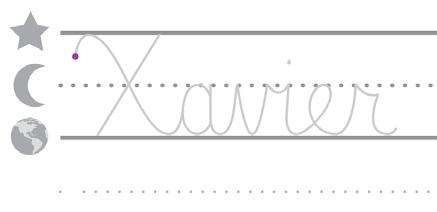
Capital Cursive Letters: U, X, Z
Objectives
• To use proper pencil grip, posture, and paper positioning for legible cursive handwriting.
• To trace and write capital cursive U, X , and Z with proper formation using verbal pathways.
• To write letter connections and decodable words in cursive.
• To alphabetize words to the third letter and write them in cursive.
Teacher Materials
• Orbit Online
Student Materials
• Orbit Student Workbook 3
• pencil
Start Teaching
Capital Cursive Letters: U, X, and Z
1. State Objectives
OPEN Orbit Online to Unit 22, Handwriting.
CLICK TO DISPLAY Objectives.
SAY:
• “Today, we will learn and practice the last three capital cursive letters.
• At the end of today’s lesson, you will be able to:
FORTXPILOTUSEONLY
– trace and write capital cursive U, X , and Z with proper formation using verbal pathways.
– write letter connections and decodable words in cursive.
– alphabetize three words and write them in cursive.”
2. Learn Capital Cursive Letters U, X, and Z
CLICK TO DISPLAY Capital Cursive U animation.
SAY “Open your workbook to page 91. Before we write capital cursive U, let’s watch an animation to see the formation.”
CLICK TO PLAY animation.
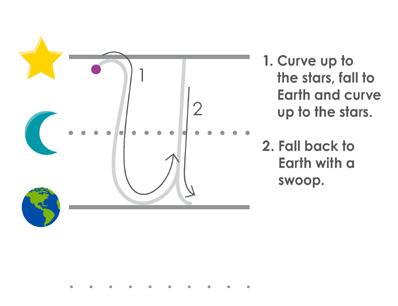
C LICK TO DISPLAY Capital Cursive U Formation image.
SAY “Watch as I trace capital cursive U.”
CLICK TO DISPLAY Tracing Capital Cursive U. (Optional if you would like to show the formation by tracing over the letter or by watching another animated tracing of it.)
TRACE capital cursive U with two fingers as you say the pathway:
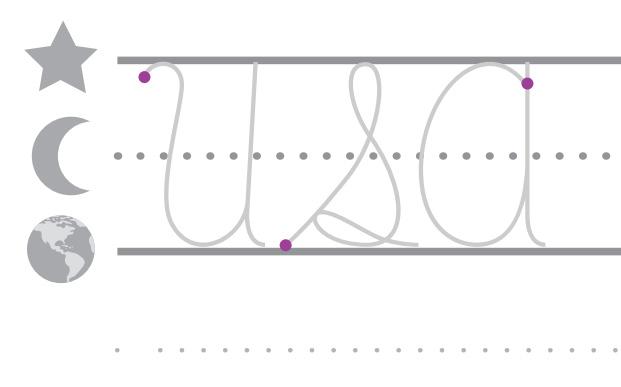
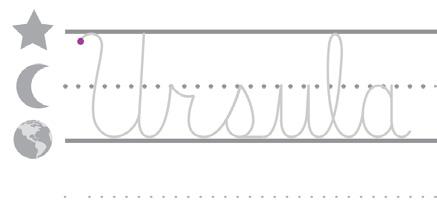
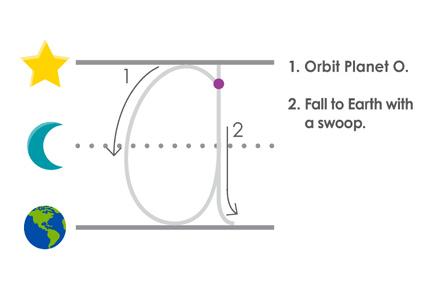
• Just below the Star line. Curve up to the stars, fall to Earth and curve up to the stars. Fall back to Earth with a swoop.
SAY:
• “Put your pencil on the dot in row 1
• Trace the capital U as I say the pathway. (Repeat the pathway above.)
• Great! Move your pencil to the second dot in row 1 and trace capital U one more time.”
ASK “Can you think of any names that begin with U ?” (A: Usher, Urban, Ulysses…)
SAY “Write the capital U three times in row 1 .” (Repeat the pathway as needed.)
CLICK TO DISPLAY Capital Cursive X animation.
SAY “Now, let’s watch an animation to teach us to write capital cursive X .”
CLICK TO PLAY animation.
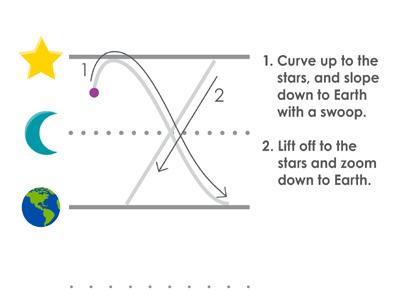
CLICK TO DISPLAY Capital Cursive X Formation image.
SAY “Watch as I trace capital cursive X .”
CLICK TO DISPLAY Tracing Capital Cursive X . (Optional if you would like to show the formation by tracing over the letter or by watching another animated tracing of it.)
FORTXPILOTUSEONLY
TRACE capital cursive X with two fingers as you say the pathway:
• Just below the Star line. Curve up to the stars and slope down to Earth with a swoop. Lift off to the stars and zoom down to Earth.
SAY:
• “Put your pencil on the dot in row 2
• Trace the capital X as I say the pathway. (Repeat the pathway above.)
• Great! Move your pencil to the second dot in row 2 and trace capital X one more time.
• There are just not that many words that begin with an x , and there are even fewer that are proper nouns. Even though we will rarely use a capital X , it is still important to know how to write it for those few instances we do need it.
• Write the capital X three times in row 1 .” (Repeat the pathway as needed.)
CLICK TO DISPLAY Capital Cursive Z animation.
SAY “Our last letter is capital Z . Let’s watch an animation to teach us to write it.”
CLICK TO PLAY animation.
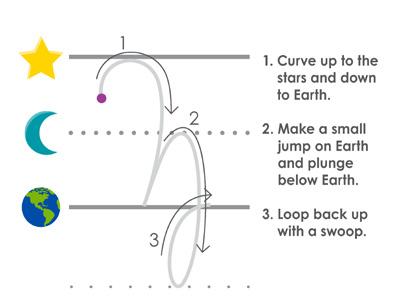
CLICK TO DISPLAY Capital Cursive Z Formation image.
SAY “Watch as I trace capital cursive Z .”
CLICK TO DISPLAY Tracing Capital Cursive Z . (Optional if you would like to show the formation by tracing over the letter or by watching another animated tracing of it.)
TRACE capital cursive Z with two fingers as you say the pathway:
Self-Assessment: Have students look over their individual cursive letters and circle the one they like best and have them fix one that needs work.
Note: Students have practiced cursive connections and should be able to complete a cursive word without the verbal pathway. If needed, use the verbal pathways chart from page 440 of the Appendix.
Click the Comprehension
Boost icon to display an image that corresponds with each cursive word.
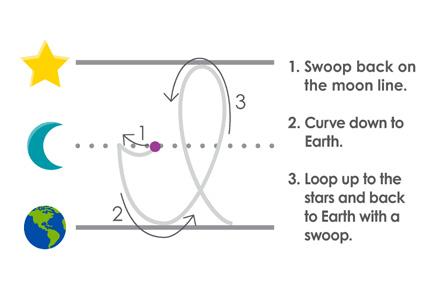
• Just below the Star line. Curve up to the stars and down to Earth. Make a small jump on Earth and plunge below Earth. Loop back up with a swoop.
SAY:
• “Put your pencil on the dot in row 3.
• Trace the capital Z as I say the pathway. (Repeat the pathway above.)
• Great! Move your pencil to the second dot in row 3 and trace capital Z one more time.”
ASK “Can you think of any names that begin with Z ?” (A: Zander, Zoe, Zach, Zaria…)
SAY “Write the capital Z three times in row 3.” (Repeat the pathway as needed.)
3. Writing Cursive Words
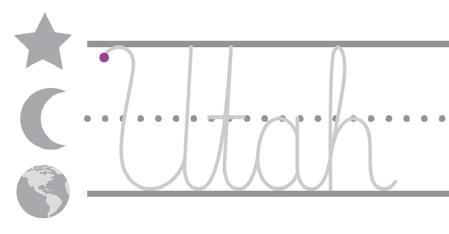
CLICK TO DISPLAY Cursive Word: Utah image.
SAY:
FORTXPILOTUSEONLY
• “Now we will practice writing cursive words with the capital letters U, X , and Z
• Look at the word in row 4, U-t-a-h, Utah .”
ASK “Is Utah a proper noun?” (A: yes)
SAY:
• “Right, as in ‘ Utah is the name of a state in the western half of the United States.’
• Watch me trace the word Utah and pay attention to how the capital U and the lowercase t are connected.
• Also, take note of how I don’t cross my t until I’ve written the whole word.”
TRACE the word Utah
SAY:
• “Now you will trace the word Utah in row 4 .
• Next, write the word Utah in cursive in the same row. Make sure to include a finger space in between the word you traced and the word you write.”
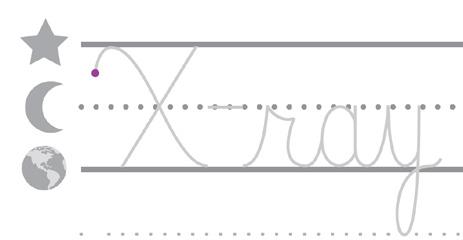
C LICK TO DISPLAY Cursive Word: X-ray image.
ASK “Is X-ray a proper noun?” (A: no, not unless it is a part of a job title)
SAY:
• “ X-ray is not a proper noun unless it is part of a job title, like X-ray technician, as in ‘The X-ray technician had to get images of my foot after my accident.’
• However, X-ray is almost always capitalized.
• It is an abbreviation for electromagnetic radiation .
• Let’s learn to write X-ray
• Look at the word in row 5, X-hyphen-r-a-y, X-ray. This word is always written with a hyphen between the two parts of the abbreviation.
• Watch me trace the word X-ray and pay attention to how I write the capital X , pick up my pencil to write the hyphen, and then begin the lowercase r for ray.”
TRACE the word X-ray
SAY:
• “Now you will trace the word X-ray in row 5
FORTXPILOTUSEONLY
• Next, write the word X-ray in cursive in the same row. Make sure to include a finger space in between the word you traced and the word you write.”
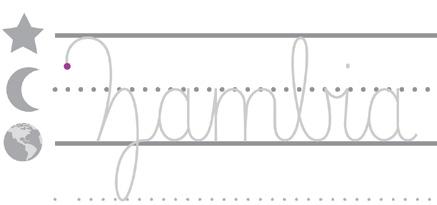
CLICK TO DISPLAY Cursive Word: Zambia image.
SAY:
• “ Zambia is a country in Africa. You could use the word like this, ‘ Zambia is home to Victoria Falls, one of the Seven Wonders of the Natural World.’
• Look at the word in row 6, Z-a-m-b-i-a, Zambia
• Watch me trace the word Zambia and pay attention to the transition between the capital Z and the lowercase a .”
TRACE the word Zambia
SAY:
• “Now you will trace the word Zambia in row 6 without lifting your pencil to dot the i until after the whole word is written.
• Next, write the word Zambia in cursive in the same row. Make sure to include a finger space in between the word you traced and the word you write.”
4. Alphabetizing
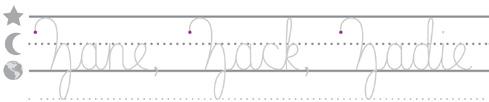
SAY “Let’s alphabetize three names beginning with capital Z . Look at row 7.”
CLICK TO DISPLAY Alphabetizing: Zane, Zack , Zadie image.
ASK:
• “Can you read these three words?” (A: Zane, Zack, Zadie)
• “What do you notice about these three words?” (A: they all start with Za)
SAY “Because they all begin with Za, we’ll need to look at the next letter to figure out which word would be listed first on a class list.”
ASK:
• “Look at the letter after a in each word. What letters do you see?” (A: n, c, d)
• “Which of those letters comes first in the alphabet?” (A: c)
FORTXPILOTUSEONLY
• “So, which name should come first if we are alphabetizing these names?” (A: Zack)
SAY “Let’s write the number 1 above Zack .” (Click to add the number 1.)
ASK:
• “Which name would be second?” (A: Zadie)
• “How do you know?” (A: d comes before n in the alphabet)
SAY:
• “Let’s write the number 2 above Zadie and the number 3 above Zane (Click to add the numbers 2 and 3.)
• Now, trace the three names in row 7
• Lastly, write the three names in alphabetical order in cursive in row 8 with a comma between each name.”
5. Editing Routine
CLICK TO DISPLAY Editing Routine.
SAY:
• “The editing routine you see on the screen is the same checklist that is at the bottom of your workbook page.
• We did not write sentences today, so you will not need to check off punctuation.”
CLICK TO ERASE the punctuation box.
SAY:
• “In this lesson, we learned new cursive letters and wrote cursive proper nouns.
• Use the checklist at the bottom of your workbook page to check for the sizing of your letters, the spacing between connections and words, whether your writing is legible, if you used capitals at the beginning of each word, and if you took your time.
• Look at the words we have completed in this lesson. Fix any mistakes if necessary.
• Once you are finished, put your pencil down.” (Allow students time to check their work using the editing checklist at the bottom of each workbook page they have completed. Guide students through the checklist if necessary.)
Optional Additional Words for Cursive Writing
• Use the following words for more practice or during small groups.
FORTXPILOTUSEONLY
• Follow the same routine as above, clicking through Orbit Online as before.
Cursive Word: Zip
ASK:
• “Can you read this cursive word?” (A: zip)
• “Is zip a proper noun?” (A: no)
• “When might we see the word zip capitalized?” (A: at the beginning of a sentence)
SAY “Watch me trace the word zip, as in ‘ Zip your jacket; it’s cold out!’”
TRACE the word Zip
SAY:
• “Now it is your turn to write Zip. Check your pencil grip, posture, and workbook slant.
• Take your time and write the word carefully. Remember not to dot the i until you’ve written the whole word. Write it a second time after a finger space.” (If students need assistance, remind them of the individual letter pathways.)
Cursive Word: Xavier
ASK:
• “Can you read this cursive word?” (A: Xavier)
• “Is Xavier a proper noun?” (A: yes, a name)
SAY “Watch me trace the word Xavier, as in ‘ Xavier won the spelling bee last year.’”
TRACE the word Xavier
SAY:
• “Your turn to write Xavier
• Take your time and write the word carefully. Remember not to cross your X or dot your i until you’ve written the whole word. Write it a second time after a finger space.” (If students need assistance, remind them of the individual letter pathways.)
Cursive Word: USA
ASK:
• “Can you read this cursive word?” (A: USA)
• “Is USA a proper noun?” (A: yes, a type of abbreviation called an initialism)
FORTXPILOTUSEONLY
• “What words does the initialism USA stand for?” (A: United States of America)
SAY:
• “You might see USA written with periods between the letters sometimes, but they aren’t necessary.
• Watch me trace the initialism USA , as in ‘The USA is comprised, or made up, of 50 states and more than 10 territories.’”
TRACE the initialism USA
SAY:
• “Your turn to write USA
• Take your time and write the initialism carefully. Write it a second time after a finger space.” (If students need assistance, remind them of the individual letter pathways.)
Cursive Word: Ursula
ASK:
• “Can you read this cursive word?” (A: Ursula)
• “Is Ursula a proper noun?” (A: yes, a name)
SAY “Watch me trace the name Ursula, as in ‘ Ursula is my mom’s friend from Switzerland.’”
TRACE the name Ursula
SAY:
• “Your turn to write Ursula .
• Take your time and write the name carefully. Write it a second time after a finger space.” (If students need assistance, remind them of the individual letter pathways.)
Unit 23 Lesson 1
Suffix -ion
Objectives
• To learn and define the suffix -ion, including the variations -tion and - sion .
• To accurately build words with morphemes using Morpheme Addition
• To infer the meanings of words using the morphemes.
• U nit 23 Home Connection Letter – printed and copied (Supply Room HQ)
• pencil
What You Need to Know
Suffix -ion
• T he suffix -ion /uhn/ is a noun-forming suffix that means the act of, state of, or result of. It attaches to verbs to form nouns that describe an action or process; for example, action, invention, and decision . In English, -ion is the parent suffix, but it has common spelling and pronunciation variations: -tion and - sion Words ending in -tion (like action, construction) are pronounced with the final syllable /shin/, sometimes pronounced /shun/. Words ending in - sion (like decision, confusion) are pronounced with the final syllable /zhin/. Generally, bases ending in consonant t or ct use the variation -tion, while bases ending in de, se, or ge use the suffix variation - sion . All three share the same meaning and function. Students will be asked to identify the different variations in words to support correct pronunciation.
Suffix -ous
• T he suffix - ous /is/ is an adjective-forming suffix that means full of or having the quality of. When added to a base word, it describes something characterized by that quality; for example, dangerous (full of danger) and joyous (full of joy). The suffix - ous is also a parent suffix to two spelling and pronunciation variants: -ious (as in curious, mysterious) and - cious (as in gracious, delicious). All three endings share the same meaning but differ in spelling depending on the word’s origin and root. Typically, the suffix variants are pronounced -ious /ē/ /is/ as in envious and - cious /shis/ as in spacious Teaching students to recognize that - ous, -ious, and - cious all signal full of or having the quality of will help them decode and understand many descriptive words.
Suffix -ure
• T he suffix - ure /er/ is a Latin noun-forming suffix that means the act, process, or result of something. It turns verbs into nouns; for example, closure (the act of closing) and mixture (the result of mixing). There are two common spelling variations of the parent suffix - ure: -ture /cher/ and - sure /zher/, which developed because of how the final phonemes in the bases combine with the suffix. For instance, verbs whose base ends with a consonant /t/ phoneme often use the suffix variant -ture (capture, structure), while bases ending in a consonant /s/ or /z/ phoneme often use the suffix variant - sure (measure). All three variations come from the same Latin suffix and share the same meaning of act or result of.
FORTXPILOTUSEONLY
Start Teaching
Suffix -ion
1. State Objectives
OPEN Orbit Online to Unit 23, Lesson 1, Morphology.
CLICK TO DISPLAY Objectives.
SAY:
• “At the end of today’s lesson, you will be able to:
Revisit the Latin Chunks animation from Unit 22, Lesson 1 to support students’ decoding and pronunciation of the suffix -ion
Use the words in this family to count the syllables and morphemes in each word. Ask students if the suffix adds more syllables to each word. Discuss how many words have a different number of syllables and morphemes.
FORTXPILOTUSEONLY
- d efine the suffix -ion, including the variations -tion and - sion
- build and spell words correctly using Morpheme Addition.
- i nterpret the meanings of words using the morphemes.”
2. Morpheme Family
CLICK TO DISPLAY Morpheme Family: Suffix -ion
DIRECT students to turn to page 92 in their workbook.
SAY:
• “ Become a word detective. Look for morpheme similarities in these words.
• U se the notes section of your workbook to write down morphemes that the words have in common.” (Briefly allow students time to take notes.)
ASK “What morphemes do these words have in common? Use the sentence stem to help you answer.” (A: answers will vary; allow students to name any common suffixes and bases they notice)
SAY “Today we will focus on the common suffixes in these words. There will be three variations of the suffix that you may notice.”
CLICK TO REVEAL the suffixes -ion, -tion, and - sion
SAY:
• “ This family has many common morphemes you may have noticed, but the morphemes we will focus on will be the suffixes.
• I notice that each word ends in i- o - n, but there are many morphemes that also end in t-i- o - n and s -i- o - n .
• You may recognize these suffixes from our Phonics lessons. They are Latin suffixes that come from the parent suffix -ion /uhn/.
Morphology
Before students write in their webs, provide a brief oral rehearsal. Have students say a sentence aloud using a suffix.
For example: “This word ends in –tion . I hear /sh i n/, so I think it is –tion .”
This supports students in organizing their thinking before writing.
Remind students that they have studied how to decode Latin endings in Unit 22. Instruct them to discuss the difference in pronunciation between the different suffix variations. -ion -tion -sion state of, act of, result of makes a noun interrupt ↓ interruption decide ↓ decision
• T he variations in spelling are important to recognize because they help us with pronunciation and understanding spelling patterns when combined with certain bases.
• Let’s look closer at each word to start building the patterns. Move to the second box that shows the web on page 92 of your workbook.
• We understand that the parent suffix is -ion . Write that suffix in the middle box of your web.”
CLICK TO REVEAL the suffix -ion in the middle of the web.
SAY “We can break this family into three smaller families. Think for a moment about how you would create three smaller families to fit under the suffix -ion . Whisper to the partner next to you once you have your idea.”
STUDENTS WHISPER their idea to their partner.
FORTXPILOTUSEONLY
CALL ON two or three students to share their thinking.
CLICK TO REVEAL the three morpheme families: -ion, - sion, -tion
ASK “What morpheme families did I make using the suffixes?”
(A: families -ion, -sion, -tion)
SAY “Remember that in the phonics lessons we learned that the suffix t-i- o - n is pronounced /shin/ and the suffix s -i- o - n is pronounced /zhin/.”
CLICK TO SHOW the titles of each family.
SAY “First you will write the titles of each family in the boxes of your workbook. Then, I want you to choose three words from each family to write in the box with the correct title. Choose words that you can decode so that you will be able to use them as a reference.” (Allow students time to complete the web in their workbook.)
3. Learn Suffix -ion
CLICK TO DISPLAY Suffix -ion
SAY “Go to the Suffix -ion chart on page 93 of your workbook.”
CLICK TO REVEAL the meaning of the suffixes -tion and - sion .
SAY:
• “ Remember that the parent suffix is -ion, so we will write the meaning for all three variations of the suffix.
• T he suffix -ion and its variations mean the state of, act of, or result of
• A ll variations of the suffix will make the final word a noun.
• Write the meaning in your workbook. (Allow students time to write the necessary information in their workbook.)
Morphology
• Let’s look at each of the example words for -tion and - sion separately.”
CLICK TO REVEAL the example word interruption
CLICK TO SHOW morpheme puzzles for interruption
ASK “Show me on your fingers, how many morphemes are in the word interruption?” (A: 3)
SAY:
• “ This word has a prefix, a root, and the suffix -tion
• T he root rupt /rŭpt/ means to break apart, and the prefix intermeans between or among
FORTXPILOTUSEONLY
• When I combine the meanings, the word interruption literally means the result of breaking apart between two things.”
CLICK TO REVEAL the sentence and image.
SAY:
• “ Read the example sentence with me, ‘There was a large interruption in the middle of class when our principal walked in.’
• T he principal caused a break between the students and the teacher when he came in the middle of the lesson.
• Write interruption in your workbook.
• T his word is an example of how the suffix -ion and the variation -tion are attached to bases and roots that typically keep their form and that end in the consonant t .
• We know that the root rupt ends in a consonant, t, so categorizing this word under the variation -tion will help us with the final pronunciation.”
CLICK TO REVEAL the example word decision .
CLICK TO SHOW morpheme puzzles for decision
ASK “Show me on your fingers, how many morphemes are in the word decision?” (A: 3)
SAY:
• “ This word has a prefix, a root, and the suffix variation - sion
• T he root cid /sĭd/ means to cut, and the prefix de - means off
• When I combine the meanings, the word decision literally means the act of cutting something off.”
CLICK TO REVEAL the sentence and image.
SAY:
• “ Read the example sentence with me, ‘He made the decision to nap
Morphology instead of cleaning his messy room.’
• I think that by making a decision to sleep instead of clean he’s choosing to ‘cut off’ the idea of putting things away.
• Write decision in your workbook.
• T his word is an example of how the suffix variation - sion is typically attached to bases and roots that end in a silent e vowel. In this word, the d - e at the end of decide is replaced with - sion .
• U nfortunately, there aren’t rules like the Spell It Right Rules to help us, but we will begin to see patterns that will help us spell words correctly using the variations of the suffix -ion .”
4 . Morpheme Addition
Morpheme Addition is the perfect opportunity to have students count morphemes vs. syllables. Instruct students to use SyllaBoards™ after the equation is shown. Ask them what types of syllables the word contains. For example, the word revision includes an Open Syllable, Closed Syllable, and a schwa.
re + vis + ion = re + vis + ion = revision
FORTXPILOTUSEONLY
CLICK TO DISPLAY Morpheme Addition: I Do revision .
I DO revision
SAY:
• “ Now that we have learned the meaning of the suffix -ion, we will continue practicing spelling and building words using the Morpheme Addition routine. Once we build the new word, we will practice making the literal meaning from the morphemes.
• I will show you the first equation and how to make the literal definition.”
CLICK TO SHOW the morphemes re -, vis, and -ion on the equation lines.
SAY “This equation shows there is a prefix, root, and suffix in this equation. We have learned the meaning of all these morphemes.”
ASK for a choral response:
• “ What is the prefix?” (A: re-)
• “ What is the root?” (A: vis)
• “ What is the suffix?” (A: -ion)
(Support students with the pronunciation of each morpheme if they struggle independently.)
SAY “Now I will add each morpheme together to make a real word.”
CLICK TO REVEAL the new word revision .
SAY:
• “ The new word is revision . I notice that the variation that is used in this word is -ion . This is because the word is revise before the suffix is added.
Morphology
re again vis to see ion act of Revision is
pro + fess + ion =
• T he Drop the e spelling rule tells us we should remove the silent e, but we also know that the root vis ends in a consonant s, so the variation that makes the most sense with this word is -ion
• Let’s combine the meaning of each morpheme to make a literal definition.”
CLICK TO SHOW the meaning for each morpheme and the sentence stem.
SAY:
• “ I will use a sentence stem like in the Interpret It routine: ‘ Revision is .’
• I will put all three meanings together to make a literal definition.
• We will not worry about the context in this part of the lesson.”
FORTXPILOTUSEONLY
CLICK TO REVEAL the definition of revision and the image.
SAY:
• “Read the definition with me, ‘ Revision is the act of looking again.’
• Let’s complete an equation and definition together.”
WE DO profession
CLICK TO DISPLAY Morpheme Addition: We Do profession .
SAY “Go to the first addition equation on page 93 of your workbook.”
CLICK TO SHOW the morphemes pro -, fess, -ion
ASK for a choral response:
• “ What is the prefix?” (A: pro-)
• “ What is the root?” (A: fess)
• “ What is the suffix?” (A: -ion) (Support students with the pronunciation of each morpheme if they struggle independently.)
SAY:
• “ Write the morphemes in your equation on the correct lines.
• T he root in this word is fess /fĕs/.
• Put the morphemes together and write the new word in your workbook.
• O nce you have written the word, whisper your answer to your partner.” (Students write their answer and whisper what they wrote to their partner. Walk the room and monitor understanding.)
Morphology
CLICK TO REVEAL the new word profession
SAY “The new word is profession . Notice the suffix -ion is used in this word; typically we will use the variations -ion and -tion when a base or root ends in a double consonant like fess. Let’s figure out the meaning of each morpheme.”
CLICK TO SHOW the meaning for fess
SAY:
• “ I have provided the meaning for the root fess: to speak or declare.
• N ow I want you to work with your partner to add the meanings for the prefix pro - and the suffix -ion
• Remember that you can look at the glossary in the back of your workbook to find the meaning for each morpheme. Write the meanings underneath the equation in the correct boxes .” (Allow students time to work with their partner and find the meanings for pro- and -ion Support students if needed by helping them find the meaning for proin the glossary of their workbook.)
CLICK TO REVEAL the meanings for pro - and -ion .
SAY:
• “ Now that you have completed the meaning for each morpheme, let’s put them together on the line under your equation.
• We will start the sentence with the word we want to define.”
CLICK TO SHOW the sentence stem.
SAY “Work with your partner and use the sentence stem to help you create a definition for profession .” (Allow students time to build a definition using the meanings of the morphemes. Students should write the complete sentence using the sentence stem you have provided.)
CALL ON two or three students to share their definitions.
CLICK TO REVEAL the example definition and image.
SAY:
• “ The example of the literal definition tells us that a profession is the act of declaring something forward. You are coming forward to declare something.
• N otice that I have also included an image of a woman thinking about different jobs she can do.
• T his is because over time the word profession has come to mean more about declaring what type of work you will pursue. After she has made a choice, she will declare the job she wants and work toward that goal.” pro + fess + ion = profession
Morphology
Answer Key
tele + vis + ion = television
far away; to see; state of
Television is the state of seeing from far away.
Note: This word is used to describe the equipment that is used to show sounds and images from a far distance. We more often call this a TV.
di + rect + ion = direction apart; keep straight; act of
Direction is the act of going apart and keeping straight.
Note: More often we use this word to describe the ways in which we go and travel. This may be a straight line like in the literal definition or may take turns.
con + clu + sion = conclusion together; to shut; act of
Conclusion is the act of shutting together.
Note: This word typically describes the end of something, like the end of a book. The word shutting can also imply that something is ending.
CLICK TO ADD to the new definition of profession
SAY “Change or add more information to your definition to help you understand the word profession .”
YOU DO television, direction, conclusion, disruption
SAY:
• “ Now it is your turn to complete the rest of the Morpheme Addition equations in your workbook.
• N otice the morphemes and some of the meanings are given to you.
• O nce you have made the new word, find the unknown meanings and put them all together to define the word on the line below your equation.” (Support struggling students by allowing them to work in a small group or with a partner.)
FORTXPILOTUSEONLY
dis + rupt + ion = disruption apart; to break; act of
Disruption is the act of breaking apart.
Note: Like the word interruption, this word describes something being disturbed or causing confusion. The image shows a disruption in the train tracks because they have broken apart.
CLICK TO DISPLAY Morpheme Addition: You Do television, direction, conclusion, disruption .
CLICK TO REVEAL each equation, meanings of the morphemes, and definition, allowing students to check their work if necessary for error correction. Discuss the differences between their definition and the example definition.
5. Climb in InferCabulary and Play in the Reading Arcade
CLICK TO DISPLAY Independent Practice.
PROVIDE STUDENTS time throughout the week to climb at least 30 minutes in InferCabulary and play at least 15-20 minutes in the Reading Arcade. These minutes should be distributed throughout the week. It is best practice to divide InferCabulary practice into at least three weekly sessions.
For an on-screen timer, choose the Independent Practice Timer below the Handwriting lesson in the lesson dropdown menu of your Teacher Dashboard. There are four timer options: 5 minutes, 10 minutes, 15 minutes, and 20 minutes.
6. Quick Check
CLICK TO DISPLAY Quick Check.
DISTRIBUTE the Unit 23, Lesson 1 Quick Checks.
SAY:
• “ You will complete six cloze sentences.
Morphology
Answer Key
(example context clues are underlined)
1. We had to go back and make a revision to our plans when the weather changed dramatically.
2. I have decided to declare teaching as my profession because it helps shape the future of young people.
3. After dinner, the family gathered around the television to see their favorite show.
4. T he hiker asked the park ranger for clearer directions so he wouldn’t get lost on the trail. The pathways were not very straight without her guidance.
5. After reading the evidence, the jury came to the decision together that the defendant was innocent. The evidence shut down any other possibilities.
6. T he noise from the loud thunderstorm broke through windows and caused a major disruption in the middle of the school assembly
• Read each sentence and underline the context clues to determine the word that best fits in the blank.
• Complete the sentence by writing the chosen word on the blank line.”
Unit 23 Lesson 2
Vocabulary Venture and Content Passage
Objectives
• To conduct a full word-level analysis of the structure and meaning of the word disruption by identifying its syllables, morphological components (prefix, base, and suffix), and semantically related words.
• To use the conjunctions because, but, and so to expand sentences.
• To read aloud with appropriate rate, accuracy, and expression.
• To expand sentences about a compare and contrast article to support and demonstrate comprehension.
• An appositive is a word or phrase that comes right after a noun and renames or explains it. Appositives give students a way to add precision and detail to their writing without creating a whole new sentence.
- Examples:
o My dog, Rex, loves to chase squirrels.
o We visited Austin, the capital of Texas
Why they matter:
• A ppositives help students be more specific by clarifying which person, place, or thing they are writing about.
• T hey also provide a tool for students to add descriptive details that make their sentences more interesting.
Connection to vocabulary instruction:
• When students learn new vocabulary words, appositives give them a natural way to apply and explain word meanings in context.
- Example: The millipede, a glowing insect, uses light as a warning.
• T his supports both sentence variety and deeper word knowledge since students practice using vocabulary with context clues built into their own writing.
• I n this unit, students will identify appositives and practice using them. The focus is not on memorizing the term but on understanding how appositives help make writing more clear and specific and on using them to demonstrate an understanding of vocabulary words.
An image to support the meaning of disruption is available in the Comprehension Boost button.
Note: Students may also mention figurative meaning, hyperbole, or multiple meanings. Celebrate those ideas even though they are not a specific part of a Vocabulary Venture. They are still important when thinking about how words work.
Start Teaching
Vocabulary Venture and Content Passage
1. State Objectives
OPEN Orbit Online to Unit 23, Lesson 2, Vocabulary.
CLICK TO DISPLAY Objectives.
SAY:
• “At the end of today’s lesson, you will be able to:
- break apart a word to understand what it means and how it is built.
FORTXPILOTUSEONLY
- u se the conjunctions because, but, and so to expand the sentences we will write with the word disruption .
- read aloud with the right speed, clear words, and good expression.
- expand sentences about what you read to show you understand it.”
2. Vocabulary Venture – Disruption
CLICK TO DISPLAY Vocabulary Venture – Syllables.
STUDENTS OPEN their workbooks to page 95, Vocabulary Venture.
SAY “It is time for another Vocabulary Venture. Remember that it is important to think about all the ways that words work so that we are better equipped to deal with new words when we find them in our daily reading, writing, listening, and speaking.”
ASK “Who can tell me some of the ways we think about words during a Vocabulary Venture?” (A: syllables, morphology, related words)
SAY “The word we will study today is disruption .”
ASK “Who can tell me the number of syllables?” (A: three)
CLICK TO REVEAL three SyllaBoards™
ASK “Who can identify each syllable and tell me the type?” (A: dis, closed; rup, closed; tion, vowel team syllable and Latin suffix) (Click to show all three syllables.)
SAY “Make sure you have copied this information into your workbooks.”
CLICK TO DISPLAY Morphology.
SAY “Let’s think about the meaningful parts of the word, which is also called morphology.”
Vocabulary
Note: Here is another opportunity to point out the difference between syllables and morphological word parts (affixes). Remind students that syllables help with pronunciation, which is why /rup/ remains a closed syllable. Morphology, on the other hand, helps us understand the meaning and structure of a word. We have learned that rupt is a unit of meaning that has to do with being broken. We gain different, helpful information from each breakdown of the word, which is why they are both important in our study of how words work.
ASK:
• “ What is the base of this word?” (A: rupt) (Click to show rupt and its meaning in the base area.)
• “ The bound base rupt means to break. What are some other words that contain this base?” (A: interrupt, abrupt, erupt) (Click to show words.)
SAY “Copy this information into your workbook.”
ASK:
• “ Does this word have a prefix?” (A: yes)
• “ What is it?” (A: dis) (Click to show the prefix dis-.)
• “ What have we already learned about the meaning of this prefix?” (A: opposite, not) (Click to show the meaning.)
FORTXPILOTUSEONLY
Note: Acknowledge and accept any other words students may share that include the bound base rupt .
Note: Acknowledge and accept any other words students may share that include the prefix dis -. The words in the box above are words students have encountered in the modules.
• “ For some words, such as disruptive, this prefix also means apart or away.”
• “Can we think of other words that contain this prefix?” (A: disgraceful, disrespectful, distracted) (Click to show words.)
SAY “Be sure to copy this information into your workbook.”
ASK:
• “ We learned this suffix in the previous lesson. Who can tell me what it is and what it means?” (A: -ion, the state of, act of, or result of) (Click to show the suffix -ion and the meaning.)
• “Can we think of other words that contain the suffix -ion?” (A: expedition, excursion, provisions) (Click to show words.)
SAY “Be sure to copy this information into your workbook.”
CLICK TO DISPLAY Semantic Study.
Vocabulary
Note: Acknowledge and accept any other words students may share that include the suffix -ion or -ions. If students provide the suffixes -tion and - sion as the answer, remind them that -ion is the parent suffix and will be used with the base rupt because it ends with a consonant t
Note: You may decide whether to read the captions aloud or have the students read to themselves.
Note: Students may identify these words from the captions or infer other ideas from the images.
Answer Key
Related Words Link
loud talking, silliness, back pain, accident, flood, road closed, obstacle example annoying, unexpected description interrupted, blocked, interfere, make me late action
SAY:
• “ If anyone has seen this word while working in InferCabulary, you have already encountered many related words.
• Let’s take a moment to look over these images, read these captions, and write down four related words in your workbook.
• We may use some of these words later when we build our sentence, but for now, focus on finding four strong related words from the captions.
• When you are finished, you will compare the words you chose with a partner.”
CLICK TO DISPLAY Semantically Related Words.
FORTXPILOTUSEONLY
SAY “Take a few minutes to share your words with a partner. Were there any words that were the same? Are there any words that you had not considered?”
CLICK TO DISPLAY Sentence Planning.
S AY:
• “ Today, we are going to take what we have been learning about the conjunctions because, so, and but to create strong sentences with the word disruption .
• To do that, we will use the phrase caused a disruption to answer ‘does what?’
• You can decide who or what will be causing the disruption . We saw many examples during the semantic study. (Click to show arrow.)
• To finish your sentence, you will pick one of these conjunctions (click to show arrow) followed by the necessary information:
– For because, give a logical reason.
– For but, give an idea that contrasts with the first idea.
– For so, give a logical effect.”
CLICK TO DISPLAY Destination Sentence #1.
SAY:
• “ I did not want to use any of the good ideas from the caption, so I came up with a new idea to use as an example.
• ‘ The broken computer caused a disruption because I could not open the lesson.’
• S ee how I added my own ‘who or what’ to ‘caused a disruption’? Then I chose the conjunction because and included a logical reason why it would be a problem.”
ASK “Was I supposed to use a comma here?” (A: no)
Vocabulary
CLICK TO DISPLAY Destination Sentence #2.
SAY:
• “‘The broken computer caused a disruption, so I had to write on the board.’
• M y sentence has a ‘who or what,’ the broken computer, a ‘does what,’ ‘caused a disruption,’ and an effect, ‘so I had to write on the board.’”
ASK “Was I supposed to use a comma here?” (A: yes) (Click to add the comma.)
CLICK TO DISPLAY Destination Sentence #3.
SAY:
• “‘The broken computer caused a disruption, but I kept on teaching my awesome students.’
FORTXPILOTUSEONLY
• M y sentence has a ‘who or what,’ the broken computer, a ‘does what,’ ‘caused a disruption,’ and a contrasting idea, ‘but I kept on teaching my awesome students.’”
ASK “Was I supposed to use a comma here?” (A: yes) (Click to add the comma.)
SAY “Now it is your turn. Pick a ‘who or what,’ use the phrase ‘caused a disruption,’ and add your conjunction. You only need to use one conjunction and write one sentence. Be sure to pay attention to the comma situation!”
GIVE STUDENTS a few minutes to create their sentences. Walk around the room and take note that students have
• c hosen a logical example to answer “who or what?”
• u sed “caused a disruption .”
• i ncluded a conjunction.
• completed the sentence with the appropriate information to match the conjunction.
• u sed a comma before but or so and used no comma with because.
SHARE student sentences, noting correct use of the factors listed above.
3. “Glowing Animals: Hiding or Standing Out?” Second Reading
STUDENTS OPEN their workbooks to page 81, Passage – “Glowing Animals: Hiding or Standing Out?”
CLICK TO DISPLAY Time to Read!
Vocabulary
Provide students with the option to orally rehearse before writing.
Have students quietly say their expanded sentence to themselves or a partner to check that it sounds complete and clear.
This scaffold reduces language load and increases sentence quality.
1. Bioluminescence is important for survival because
SAY “Now that we have found all the missing words, we will reread ‘Glowing Animals: Hiding or Standing Out?’ aloud together. Then, you will expand sentences about the article.”
As a group, READ the article aloud.
STUDENTS TURN their workbooks to pages 96-97, Investigate the Text.
SAY:
• “ Now you will work on your own to expand sentences about the article.
• Make sure you pay close attention to the conjunction at the end of each sentence, so you know what kind of information to add.
• S ome of these sentences are Text and Me questions in disguise. To expand them, you will need to use text details and what you already know to form a new understanding.
FORTXPILOTUSEONLY
• B lank space is provided below each kernel sentence if you need to make a list of text evidence and things you already know.
• U se your best cursive handwriting to expand each kernel sentence.”
STUDENTS WORK independently to expand the sentences. Circulate the room to provide support as needed.
CLICK TO DISPLAY Kernel Sentence #1.
When students have finished, call on student volunteers to share their responses. Use the answer key to discuss the kernel sentences, text evidence, student prior knowledge, and possible answers. CLICK TO ADD the sample answers, then CLICK TO DISPLAY the next kernel sentence.
. Paragraph 2 –“This camouflage helps them hide from big fish that might try to eat them.” “The cookiecutter shark glows to confuse fish it wants to eat.”
Paragraph 3 –“They can startle their enemies.”
“Small fish see the light and think it is food.” “This helps them find a mate.”
• A nimals need food to survive.
• Predators are animals that hunt and eat other animals. Prey are animals that are hunted and eaten by other animals.
• A nimals find mates to have offspring and keep the species alive.
Bioluminescence is important for survival because it can help animals escape predators.
Support students who need help by asking them the following questions:
• What do animals use bioluminescence for?
• What is necessary for survival?
2. Prey use camouflage for protection, but
Paragraph 2 –“The cookiecutter shark glows to confuse fish it wants to eat.”
Paragraph 3“The anglerfish has a glowing lure hanging from its head. Small fish see the light and think it is food.” “Fireflies use their glow to talk to each other.”
3. M illipedes glow to show they are poisonous, so
Paragraph 3 –“They can startle their enemies.”
• Prey are animals that are hunted and eaten by other animals. Predators are animals that hunt and eat other animals.
• Protection means keeping safe from harm
• I deas that contrast with protection are danger and attack / hunting.
This makes me think of a caution sign or a stop sign. When someone sees one of these signs, they know to be careful!
Prey use camouflage for protection, but predators use camouflage to hunt. Support students who need help by reminding them the conjunction but signals a contrast. Prompt students to consider words and ideas in the passage that contrast with prey and protection .
4. Each firefly species has its own blinking pattern, so
Paragraph 3 –“This helps them find a mate.”
FORTXPILOTUSEONLY
5. Animals use their bioluminescence in different ways because . Paragraph 4 –any sentence that identifies how animals use bioluminescence
• S ome animals are prey, and some are predators.
• A nimals live in a variety of habitats.
• Each species is different and eats different foods and survives in different ways.
• Students may describe specific examples.
Millipedes glow to show they are poisonous, so predators see their light and do not eat them.
Support students who need help by reminding them the conjunction so signals an effect. Prompt students to consider what a predator would do if they saw the warning glow of a millipede.
Each firefly species has its own blinking pattern, so fireflies are able to find mates in their own species.
Animals use their bioluminescence in different ways because their habitats require them to adapt in different ways.
Answer Key
1. phenomenon; examplecategory
2. C
3. A
4. Climb in InferCabulary and Play in the Reading Arcade
CLICK TO DISPLAY Independent Practice.
PROVIDE STUDENTS time throughout the week to climb at least 30 minutes in InferCabulary and play at least 15-20 minutes in the Reading Arcade. These minutes should be distributed throughout the week. It is best practice to divide InferCabulary practice into at least three weekly sessions.
For an on-screen timer, choose the Independent Practice Timer below the Handwriting lesson in the lesson dropdown menu of your Teacher Dashboard. There are four timer options: 5 minutes, 10 minutes, 15 minutes, and 20 minutes.
5. Quick Check
CLICK TO DISPLAY Quick Check.
DISTRIBUTE the Unit 23, Lesson 2 Quick Checks.
S AY:
• “Circle the word that correctly completes the analogy. Identify how the words are related.
• T hen, select the choice that correctly expands each sentence.”
FORTXPILOTUSEONLY
Unit 23 Lesson 3
Suffix -ous
Objectives
• To learn and define the suffix - ous, including the variations -ious and - cious.
• To accurately build words with morphemes using Morpheme Addition
• To infer the meanings of words using the morphemes.
Briefly pause to contrast suffix pronunciations (- ous, -ious, - cious). Say two example words aloud and have students listen and identify which suffix they hear (by naming the family). This quick contrast helps English Learners attend to sound–spelling patterns and supports accurate pronunciation before independent practice.
Once the suffixes have been revealed, instruct students to read the different variations and identify which variation adds a new syllable to the base. For example, in the words famous, furious, and spacious, the only variation that adds a syllable is -ious
Suffix -ous
Start Teaching
1. State Objectives
OPEN Orbit Online to Unit 23, Lesson 3, Morphology.
CLICK TO DISPLAY Objectives.
SAY:
• “At the end of today’s lesson, you will be able to:
- d efine and use the suffix - ous.
FORTXPILOTUSEONLY
- build and spell words correctly using Morpheme Addition
- i nterpret the meanings of words using the morphemes.”
2. Morpheme Families
CLICK TO DISPLAY Morpheme Family: Suffix - ous.
DIRECT students to turn to page 98 in their workbook.
SAY:
• “ Become a word detective. Look for morpheme similarities in these words.
• U se the notes section of your workbook to write down morphemes that the words have in common.” (Briefly allow students time to take notes.)
ASK “What morphemes do these words have in common? Use the sentence stem to help you answer.” (A: answers will vary; allow students to name any common suffixes and bases they notice)
SAY “Today we will focus on the common suffixes in these words. There will be three variations of the suffix that you may notice.”
CLICK TO REVEAL the suffixes - ous, -ious, and - cious
SAY:
• “ I notice that each word ends in o - u - s, but there are many morphemes that also end in i- o - u - s and c-i- o - u - s
• Like the suffix -ion from our previous lesson, the variations in spelling are important to recognize because they help us with pronunciation and understanding spelling patterns when combined with certain bases.
• Let’s look closer at each word to start building the patterns. Move to
Morphology
the second box that shows the web on page 98 of your workbook.
• I n this family the parent suffix is - ous /ŭs/. Write that suffix in the middle box of your web.”
CLICK TO REVEAL the suffix - ous in the middle of the web.
SAY “We can break this family into three smaller families. Think for a moment about how you would create three smaller families to fit under the suffix - ous. Whisper to the partner next to you once you have your idea.”
STUDENTS WHISPER their idea to their partner.
CALL ON two or three students to share their thinking.
CLICK TO REVEAL the three morpheme families: - ous, -ious, - cious
SAY “The variations are more difficult to pronounce without seeing them attached to a base. We can spell them out until we learn more about them.”
FORTXPILOTUSEONLY
ASK “What morpheme families did I make using the suffixes?” (A: families -ous, i-o-u-s, and c-i-o-u-s)
CLICK TO SHOW the titles of each family.
SAY “First you will write the title of each family in the boxes of your workbook. Then, I want you to choose three words from each family to write in the box with the correct title. Choose words that you can decode so that you will be able to use them as a reference.” (Allow students time to complete the web in their workbook.)
3. Learn Suffix -ous
CLICK TO DISPLAY Suffix - ous
CLICK TO SHOW a sticky note for envy -ous -ious -cious full of, having the qualities of makes an adjective
SAY “Go to the Suffix - ous chart on page 99 of your workbook.”
CLICK TO REVEAL the meaning of the suffixes -ious and - cious.
SAY:
• “ Remember that the parent suffix is - ous, so we will write the meaning for all three variations of the suffix.
• T he suffix - ous and its variations mean full of or having the qualities of
• A ll variations of the suffix will make the final word an adjective.
• Write the meaning in your workbook. (Allow students time to write the necessary information in their workbook.)
• Let’s look at each of the example words for each of the variations separately.”
Morphology
SAY:
• “ The word envy has two morphemes: the prefix en - and the root vy, which is a variation of the root vis. Together, these morphemes mean to see in
• T his helps us understand that the word envy means to see something you want, typically when someone else has something you want.”
CLICK TO REVEAL the example word envious
SAY:
• “ Read the example word with me: envious.
• When I separate the syllables in the word envious I hear /ĕn/ /vē/ /ihs/.
FORTXPILOTUSEONLY
• T he vowel sounds we hear in the final two syllables, /ē/ /ihs/, is how this variation is pronounced when it is attached to a base.”
CLICK TO REVEAL the sentence and image.
SAY:
• “ Read the example sentence with me, ‘I am envious of my brother’s new shoes.’
• Adding the suffix -ious to the base envy tells us that the sibling is full of want for his brother’s new shoes.
• Write envious in your workbook.
• N otice that when the suffix -ious is added, the Change y to i spelling rule is used to remove the final y in envy.
• Let’s look at the next example word.”
CLICK TO SHOW the sticky note for space
SAY “The base for this example word is space. It describes an empty area or place.”
CLICK TO REVEAL the example word spacious
SAY:
• “ Read the example word with me: spacious
• Say the syllables with me: /spā/ /shis/.
• T he final syllable /shis/ in this word is an example of how the suffix variation - cious is pronounced.”
CLICK TO REVEAL the sentence and image.
SAY:
• “ Read the example sentence with me, ‘My new bedroom is so
Morphology
Revisit the Spell It Right Rules in Unit 7, Lesson 1 and in Unit 10, Lesson 1 if students need support with spelling.
Nervous describes .
spacious ! I can fit all my toys and furniture.’
• W ith the addition of the suffix, the word spacious means being full of or having plenty of empty areas
• Write spacious in your workbook.
• N otice we have used the Drop the e spelling rule for the word spacious.”
4. Morpheme Addition
C LICK TO DISPLAY Morpheme Addition: I Do nervous.
I DO nervous
SAY:
FORTXPILOTUSEONLY
• “ Now that we have learned the meaning of the suffix - ous, we will continue practicing spelling and building words using the Morpheme Addition routine. Once we build the new word, we will practice making the literal meaning from the morphemes.
• I will show you the first equation and how to make the literal definition.”
CLICK TO SHOW the morphemes nerve and - ous on the equation lines.
S AY “This equation shows there is a base and suffix in this equation.”
ASK for a choral response:
• “ What is the base?” (A: nerve)
• “ What is the suffix?” (A: -ous)
(Support students with the pronunciation of each morpheme if they struggle.)
SAY “Now I will add each morpheme together to make a real word.”
CLICK TO REVEAL the new word nervous
SAY:
• “ The new word is nervous. I notice that the suffix that is used in this word is the parent - ous. This is because the base does not end in ce or a vowel y.
• T he Drop the e spelling rule tells us we should remove the silent e when we add a vowel suffix to a base.
• Let’s combine the meaning of each morpheme to make a literal definition.”
CLICK TO SHOW the meaning for each morpheme and the sentence stem.
Morphology
Briefly check for comprehension of the morphemes.
Point back to the morphemes and ask:
“Which part tells us it is full of something?”
“Which part tells us it has to do with fear or anxiety?”
This supports confirming meaning through structure and keeps the focus on morphology, not memorization.
grace + ous = grace + ous = gracious
SAY:
• “ I will use a sentence stem like in the Interpret It routine: ‘ Nervous describes .’
• I will put both meanings together to make a literal definition.
• T he base nerve can have a few different meanings. In this word, the base describes someone being afraid or having anxiety about a difficult situation.”
CLICK TO REVEAL the definition of nervous and the image.
SAY:
• “ Read the definition with me, ‘ Nervous describes being full of anxiety or fear.’
FORTXPILOTUSEONLY
• We may be nervous going on stage to perform in front of an audience or for a tryout, like the dancer in the image.
• Let’s complete an equation and definition together.”
WE DO gracious
CLICK TO DISPLAY Morpheme Addition: We Do gracious.
SAY “Go to the first addition equation on page 99 of your workbook.”
CLICK TO SHOW the morphemes grace + - ous
ASK for a choral response:
• “ What is the base?” (A: grace)
• “ What is the suffix?” (A: -ous)
(Support students with the pronunciation of each morpheme if they struggle independently.)
SAY:
• “ Write the morphemes in your equation on the correct lines.
• T he free base in this word is grace
• Put the morphemes together and write the new word in your workbook.
• O nce you have written the word, whisper your answer to your partner.” (Students write their answer and whisper what they wrote to their partner. Walk the room and monitor understanding.)
CLICK TO REVEAL the new word gracious.
SAY:
• “ The new word is gracious. Notice the suffix variation - cious is used
Morphology in this word, and the spelling rule Drop the e tells us to drop the silent e when the suffix begins with a vowel. (Click to highlight the suffix.)
• T his variation is used because the free base grace ends with the letters c- e. This helps us with the pronunciation of the new word, gracious /grā/ /shis/. (Segment the syllables for students so they can hear the pronunciation of the suffix clearly.)
• Let’s figure out the meaning of each morpheme.”
CLICK TO SHOW the meaning for grace
grace beauty in the form of style or behavior
ous full of, having qualities of
Gracious describes
Gracious describes being full of beauty with style or behavior.
SAY:
• “ I have provided the meaning for the base grace: beauty in the form of style or behavior
FORTXPILOTUSEONLY
• N ow I want you to work with your partner to add the meaning for the suffix - cious
• Write the meanings underneath the equation in the correct boxes.” (Allow students time to write the meanings of the word grace and the suffix - cious with their partner.)
CLICK TO REVEAL the meaning for - cious.
SAY:
• “ Now that you have completed the meaning for each morpheme, let’s put them together on the line under your equation.
• We will start the sentence with the word we want to define.”
CLICK TO SHOW the sentence stem.
SAY “Work with your partner and use the sentence stem to help you create a definition for gracious.” (Allow students time to build a definition using the meanings of the morphemes. Students should write the complete sentence using the sentence stem you have provided.)
CALL ON two or three students to share their definitions.
CLICK TO REVEAL the example definition and image.
SAY:
• “ The example of the literal definition tells us that gracious describes being full of beauty with style or behavior.
• T he word gracious has come to describe someone who is likely to do the polite or right action in any situation.
• T he image shows a gracious party host bringing food to her guests.”
WE DO furious
CLICK TO DISPLAY Morpheme Addition: We Do furious
Morphology
CLICK TO SHOW the morphemes fury + - ous
ASK for a choral response:
• “ What is the base?” (A: fury)
• “ What is the suffix?” (A: -ous) (Support students with the pronunciation of each morpheme if they struggle independently.)
SAY:
• “ Write the morphemes in your equation on the correct lines.
• T he free base in this word is fury
• Put the morphemes together and write the new word in your workbook.
FORTXPILOTUSEONLY
• O nce you have written the word, whisper your answer to your partner.” (Students write their answer and whisper what they wrote to their partner. Walk the room and monitor understanding.)
CLICK TO REVEAL the new word furious.
SAY:
• “ The new word is furious. Notice the suffix variation -ious is used in this word, and the spelling rule Change y to i tells us to take the ending y and change it to the vowel i in -ious (Click to highlight the suffix.)
• T his helps us with the pronunciation of the new word, furious /fyer/ /ē/ /ihs/. (Segment the syllables for students so they can hear the pronunciation of the suffix clearly.)
• Let’s figure out the meaning of each morpheme.”
C LICK TO SHOW the meaning of fury
SAY:
• “ I have provided the meaning for the free base fury : very wild anger
• N ow I want you to work with your partner to add the meaning for the suffix -ious
• Write the meanings underneath the equation in the correct boxes.” (Allow students time to write the meanings of the word fury and the suffix -ious with their partner.)
CLICK TO REVEAL the meaning for -ious.
SAY:
• “ Now that you have completed the meaning for each morpheme, let’s put them together on the line under your equation.
• We will start the sentence with the word we want to define.”
Morphology
Furious describes .
Furious describes being full of wild anger.
Answer Key
victory + ous = victorious
success in a game; full of, qualities of
Victorious describes having qualities of success.
poison + ous = poisonous
substance that can harm; full of, qualities of
Poisonous describes being full of a substance that can harm.
glamor + ous = glamorous
being exciting and charming; full of, qualities of
Glamorous describes being full of charm and excitement.
vary + ous = various
to be different from others; full of, qualities of
Various describes the qualities of many different kinds.
Teacher Note: Explain the image as there being various kinds and colors of flowers at the market.
CLICK TO SHOW the sentence stem.
SAY “Work with your partner and use the sentence stem to help you create a definition for furious.” (Allow students time to build a definition using the meanings of the morphemes. Students should write the complete sentence using the sentence stem you have provided.)
CALL ON two or three students to share their definitions.
CLICK TO REVEAL the example definition and image.
SAY:
• “ The example of the literal definition tells us that furious describes someone being full of wild anger.
• T he image shows two people having a furious argument over work.”
YOU DO victorious, poisonous, glamorous, various
SAY:
• “ Now it is your turn to complete the rest of the Morpheme Addition equations in your workbook.
• N otice the morphemes and some of the meanings are given to you.
• O nce you have made the new word, find the unknown meanings and put them all together to define the word on the line below your equation.” (Support struggling students by allowing them to work in a small group or with a partner.)
CLICK TO DISPLAY Morpheme Addition: You Do victorious, poisonous, glamorous, various
CLICK TO REVEAL each equation, meanings of the morphemes, and definition, allowing students to check their work if necessary for error correction. Discuss the differences between their definition and the example definition.
5. Climb in InferCabulary and Play in the Reading Arcade
CLICK TO DISPLAY Independent Practice.
PROVIDE STUDENTS time throughout the week to climb at least 30 minutes in InferCabulary and play at least 15-20 minutes in the Reading Arcade. These minutes should be distributed throughout the week. It is best practice to divide InferCabulary practice into at least three weekly sessions.
For an on-screen timer, choose the Independent Practice Timer below the Handwriting lesson in the lesson dropdown menu of your Teacher
Morphology
Answer Key
(example context clues are underlined)
1. After scoring the winning point, the away volleyball team was victorious as the crowd cheered.
2. Even though her team lost the game, Ava was gracious and politely congratulated the other team.
3. O n the inside she felt furious but didn’t want to show that anger on the outside.
4. Ava knew that feelings of anger could be poisonous and cause harm, so she took deep breaths and remembered they could win in the second match.
5. Ava felt nervous about the second match. Her hands were shaking, and her stomach was twisting with fear
6. Ava’s team looked anything but glamorous as they dove across the court to save the ball. Winning the match was more important than being charming for the crowd.
Dashboard. There are four timer options: 5 minutes, 10 minutes, 15 minutes, and 20 minutes.
6. Quick Check
CLICK TO DISPLAY Quick Check.
DISTRIBUTE the Unit 23, Lesson 3 Quick Checks.
SAY:
• “ You will complete six cloze sentences.
• Read each sentence and underline the context clues to determine the word that best fits in the blank.
FORTXPILOTUSEONLY
• Complete the sentence by writing the chosen word on the blank line.”
• “For our phonics warm-up today, we’ll read a few words with Latin Chunks.
• If you know this word, don’t say it.”
WRITE the word temperature on the board.
SAY:
• “I’m looking for vowel spellings first, and I see four of them, e, er, a, and the ure in the Latin Chunk ture (underline each), so I know this word has four syllables.
• I see a 2-sound blend, m - p, so I’ll break that up with a syllable line (draw a line between m and p). Then, I see the r-controlled syllable p - e - r, so I’ll add a syllable line after that (draw a line after per). Lastly, I know that Latin Chunks are on their own, so I’ll draw the last syllable line before t- u - r- e (draw a line between a and t)
• I know that when an a is alone in a syllable before t- u - r- e in a word with three syllables or more, it usually spells the schwa phoneme /uh/.
• /tĕm/ /per/ /uh/ /cher/, temperature. Sometimes, when we say it quickly, it sounds like it only has three syllables, but it actually has four.
• I’m going to write two more words that have a Latin Chunk on the board. If you know the words, don’t say them.”
WRITE the words illusion and national on the board.
GROUP students in pairs, or by desk/table group.
SAY:
• “With your partner(s), read each word and find the Latin Chunk.
• I will be asking for students to come up to:
– underline the vowel spellings,
– segment the syllables by drawing a vertical line between them,
– point out the Latin Chunk, and
– read the word correctly.”
STUDENTS WORK with their partner(s) and then participate in marking
Vocabulary up the words on the board. They should show their work on paper.
1. State Objectives
OPEN Orbit Online to Unit 23, Lesson 4, Vocabulary.
CLICK TO DISPLAY Objectives.
SAY:
• “At the end of today’s lesson, you will be able to:
- identify an appositive.
- expand a sentence with an appositive.”
2. Review Vague vs. Specific
Curricular Crossover!
This activity provides a fourth way for students to expand their sentences. Teachers can use these four prompts to strengthen students' writing across curricular areas, including ELA, science, and social studies. When student writing is overly simple or ideas lack depth, remind students of the purpose and impact of each option: an appositive adds detail, because introduces a reason, so suggests a result, and but signals a contrasting idea.
FORTXPILOTUSEONLY
CLICK TO DISPLAY Review Vague vs. Specific.
ASK:
• “ Do you remember when I asked you to point to the person? Did you know who I meant?” (A: no, because all of the pictures are of people)
• “ What about when I asked you to point to the student? Did you know who I meant then?” (A: yes, because that is more specific and we could tell which one was the student)
SAY “That is because the word student is more specific than the word person . A word that makes something very clear is specific. A word that doesn’t give enough information is vague.”
3. Introduce Appositives
CLICK TO DISPLAY Be More Specific with Appositives.
SAY:
• “One way we can be more specific is by using appositives. An appositive renames or tells more about a person, place, or thing, but it is not necessary for the sentence to make sense.
• A n appositive can be one word or a phrase. Appositives that are phrases will often begin with the, a, or an
• Let’s look at some examples.”
CLICK TO DISPLAY A Closer Look.
READ “The Atolla jellyfish, a marine creature, flashes a light to startle its predators.”
Vocabulary
An image is included to support the appositive in the sentence “The Atolla jellyfish, a marine creature, flashes a light to startle its predators.”
The image is used after sentence analysis to help confirm meaning and reinforce the relationship between the noun and the appositive.
Note: This is the only sentence in the lesson that includes an image, allowing the focus to remain on sentence structure and syntax rather than visual support.
SAY:
• “ The appositive is ‘a marine creature.’ (Click to underline the appositive.) It gives more information about the Atolla jellyfish. This appositive begins with the word a
• N otice how we can take the appositive out of the sentence and the sentence still makes sense. (Click to remove the appositive.) ‘The Atolla jellyfish flashes a light to startle its predators.’”
CLICK TO ADD second example.
READ “My cat, Luna, likes to curl up in her fluffy blanket.”
SAY “The appositive is ‘Luna.’” (Click to underline the appositive.) It renames ‘my cat.’”
CLICK TO ADD third example.
FORTXPILOTUSEONLY
If time allows, consider pausing briefly before calling on volunteers to have students turn and talk with a nearby classmate. One student can explain what the appositive is renaming or describing, while the other identifies the appositive in the sentence. This short peer exchange gives students an opportunity to process their thinking and rehearse language before sharing aloud.
READ “I’m going to bring my favorite snack, raisins, on our hike.”
ASK:
• “ What is the appositive in this sentence?” (A: raisins) (Click to underline the appositive.)
• “ What is the appositive renaming or explaining?” (A: ‘my favorite snack’)
• “ Is there anything you’ve noticed about appositives when you see one in a sentence?” (A: there is a comma before and a comma after)
SAY “An appositive is set apart by a comma before and a comma after when it appears within a sentence.”
CLICK TO ADD fourth example.
READ “Juan can’t wait to see his best friend, Sam.”
ASK:
• “ What is the appositive in this sentence?” (A: Sam) (Click to underline the appositive.)
• “ What is the appositive renaming or explaining?” (A: ‘his best friend’)
SAY “An appositive can also go at the end of a sentence, and in that case, there would just be a comma before it.”
CLICK TO DISPLAY Expand Sentences with Appositives.
SAY “Now, I’m going to use appositives to expand sentences. I can use appositives to be more specific and to make my sentences more interesting.”
READ “I want to be an archaeologist when I grow up.”
SAY:
• “ I want to explain the word archaeologist
Vocabulary
Common Misconception:
Students may try to begin an appositive with the words who, what, when, where, that, or which . If a phrase begins with one of these words, it turns into a relative clause. To avoid confusion, explain to students that an appositive should function as a noun in the sentence so that if we were to substitute the noun with the appositive, the sentence would still make sense.
• I remember learning that an archaeologist is someone who studies the past. I’ll add that to my sentence. (Click to add appositive.)
• ‘ I want to be an archaeologist, someone who studies the past, when I grow up.’
• I put a comma before and a comma after the appositive.”
CLICK TO ADD the next sentence.
READ “Rascal Jack is known throughout the forest for his schemes.”
SAY:
• “ I can expand this sentence with an appositive to tell more about Rascal Jack. (Click to add appositive.)
• ‘ Rascal Jack, a mischievous pine marten, is known throughout the forest for his schemes.’
FORTXPILOTUSEONLY
• ‘A mischievous pine marten’ tells more about the character Rascal Jack. There are commas before and after the appositive.”
CLICK TO ADD the next sentence.
READ “Bioluminescence helps some animals talk to each other.”
ASK:
• “ What is a short phrase we can use to explain bioluminescence?” (Answers will vary; sample responses: the ability to make light, an adaptation)
• “ Where do we put the appositive in the sentence?” (A: after bioluminescence) (Click to add the appositive.)
• “ What do we need to put before and after the appositive?” (A: commas) (Point to commas.)
R EAD “Bioluminescence, the ability to make light, helps some animals talk to each other.”
SAY “Now let’s add an appositive for animals.”
ASK:
• “ What kind of information could we add for animals?” (A: examples of animals that use bioluminescence to talk to each other)
• “ What is an example of an animal that uses bioluminescence in this way?” (A: fireflies)
SAY “When we include an example of something, we usually introduce the example with the words such as, for example, or like. (Click to add the appositive.) ‘Bioluminescence, the ability to make light, helps some animals, such as fireflies, talk to each other.’”
CLICK TO ADD the next sentence.
Vocabulary
READ “My dentist says popcorn is not good for my teeth.”
ASK “What is an appositive we can add for popcorn?” (Answers will vary; sample answers: a crunchy snack, a favorite snack at the theater, my favorite snack, etc.)
CLICK TO ADD appositive.
READ “My dentist says popcorn, a crunchy snack, is not good for my teeth.”
4. Writing Time
C LICK TO DISPLAY Time to Write.
Answer Key
Answers will vary. Answers should be a word or phrase that renames or explains a noun. Answers should not begin with the words who, what, when, where, that, or which
Sample Answers:
1. The predator, a stealthy wolf, was searching for prey in the forest.
2. The octopus’s tentacles, long flexible arms, were stretched out to grab a fish.
3. A wolf’s fangs, long, sharp pointed teeth, can grow up to two and a half inches long.
4. The campers were startled by a large creature, a bear, eating their provisions.
5. The shark eyed its prey, a luminescent squid
FORTXPILOTUSEONLY
STUDENTS OPEN their workbooks to pages 101-102, Expand Sentences with Appositives.
SAY:
• “ You and a partner will expand the first four sentences by filling in each blank with an appositive.
• For the last sentence, you and your partner will write a sentence about the picture in your best cursive handwriting. Your sentence should contain an appositive. Use the word bank if you need help.”
STUDENTS WORK in pairs. Circulate the room and provide support as needed. When students have finished, call on student volunteers to read their sentences.
Optional
5. Explaining Figurative Language
CLICK TO DISPLAY Let’s Figure It Out #1.
SAY:
• “ Since we are studying a new set of words for this module, we have some new opportunities to talk about figurative language.
• If someone came into our classroom during a test, they might say, ‘The atmosphere in here is so serious.’ Atmosphere is a word that we often use in science class.”
CLICK TO DISPLAY Pull It Apart.
SAY:
• “ But we know that words can also be used abstractly, or in a figurative way.
• To figure out what is really being said, we can use what we already know about the word atmosphere.
• T his is a great time to rely on semantically related words and their
Vocabulary links. (Click to show icons.)
• I n this case, I know the atmosphere is the air found around the earth. (Click to show words.)
• U sing the same combination of links will help us figure this out. (Click to show word bank.)
• If the literal meaning of atmosphere is the air found around the earth, we already know that the person is referring to our classroom as the location.” (Click to move classroom.)
ASK “What is surrounding the classroom that is so serious?” (A: mood) (Click to move mood.)
CLICK TO DISPLAY Put It All Together.
FORTXPILOTUSEONLY
SAY “If we use what we already know about the word atmosphere and apply it to the classroom situation (click to add explanation), we will see that our visitor was using a figurative way to tell us that the mood surrounding everyone in the classroom was serious. Let’s try another expression.”
CLICK TO DISPLAY Let’s Figure It Out #2.
SAY “This girl said, ‘If anyone teases my little brother, my fangs come out.’”
CLICK TO DISPLAY Pull It Apart #2.
SAY:
• “ Many of us may already know that fangs are the sharp teeth that animals have. Animals will show these fangs to scare away other dangerous animals.
• N ow we need to think about how this relates to big sister and little brother. (Click to show icons.)
• U sing the same combination of links will help us figure this out.” (Click to show the word bank.)
ASK:
• “ If the literal meaning of fangs is teeth that are sharp and used to defend, what will this sister use? We know she is not going to grow fangs or bite someone, so what does she have?” (A: voice) (Click to move voice.)
• “ Since a voice is not literally sharp, but we know that there is an intensity to this expression, how might we describe the voice she might use?” (A: fierce) (Click to move fierce.)
• “ What action is she doing here?” (A: protect) (Click to move protect.)
CLICK TO DISPLAY Put It All Together #2.
Vocabulary
SAY “I know that fangs are the sharp teeth that animals use to defend themselves (click to add explanation), so this older sister is using a figurative way to tell us that she will be fierce about protecting her little brother by speaking out or standing up for him.”
CLICK TO DISPLAY Let’s Figure It Out – We Do.
SAY “The smell of popcorn was a lure pulling us to the theater.”
ASK “For those of you who fish, what is a lure?” (A: a shiny object that looks like food that people use to trick fish and catch them)
CLICK TO DISPLAY Pull It Apart – We Do.
ASK “If the literal meaning of a lure is a type of bait that is shiny so it will attract fish, what does this mean for the moviegoers?” (A: popcorn smell is delicious and will tempt people) (Click to show answers.)
CLICK TO DISPLAY Put It All Together – We Do.
ASK “Knowing that a lure is a shiny or colorful bait used to attract fish will help us figure out that this person is really saying—who can finish this explanation?” (A: the popcorn smell is delicious and tempts people to want to come to the movie)
6. Climb in InferCabulary and Play in the Reading Arcade
CLICK TO DISPLAY Independent Practice.
PROVIDE STUDENTS time throughout the week to climb at least 30 minutes in InferCabulary and play at least 15-20 minutes in the Reading Arcade. These minutes should be distributed throughout the week. It is best practice to divide InferCabulary practice into at least three weekly sessions.
For an on-screen timer, choose the Independent Practice Timer below the Handwriting lesson in the lesson dropdown menu of your Teacher Dashboard. There are four timer options: 5 minutes, 10 minutes, 15 minutes, and 20 minutes.
7. Quick Check
CLICK TO DISPLAY Quick Check.
DISTRIBUTE the Unit 23, Lesson 4 Quick Checks.
S AY:
• “ Select the appositive that correctly completes each sentence.
• T hen, select the correct meaning of illuminating in the sentence.”
Unit 23 Lesson 5
Suffix -ure
Objectives
• To learn and define the suffix - ure, including variations -ture and - sure.
• To accurately build words with morphemes using Morpheme Addition
• To infer the meanings of words using the morphemes.
Revisit the Latin Chunks animation in Unit 22, Lesson 1 to support students’ decoding and pronunciation of suffix - ure
Suffix -ure
Start Teaching
1. State Objectives
OPEN Orbit Online to Unit 23, Lesson 5, Morphology.
CLICK TO DISPLAY Objectives.
SAY:
• “At the end of today’s lesson, you will be able to:
- d efine and use the suffix - ure.
FORTXPILOTUSEONLY
Explicitly contrast the pronunciation of - ure, -ture, and - sure by chorally repeating each suffix while pointing to the spelling. Emphasize that spelling changes do not always change meaning, but may change pronunciation.
- build and spell words correctly using Morpheme Addition
- i nterpret the meanings of words using the morphemes.”
2. Morpheme Family
CLICK TO DISPLAY Morpheme Family: Suffix - ure.
DIRECT students to turn to page 103 in their workbook.
SAY:
• “ Become a word detective. Look for morpheme similarities in these words.
• U se the notes section of your workbook to write down morphemes that the words have in common.” (Briefly allow students time to take notes.)
ASK “What morphemes do these words have in common? Use the sentence stem to help you answer.” (A: answers will vary; allow students to name any common suffixes and bases they notice)
SAY “Today, we will focus on the common suffixes in these words. There will be two variations of the suffix that you may notice.”
CLICK TO REVEAL the suffixes -ture and - sure
SAY:
• “ I notice that each word ends in u - r- e, but there are two variations spelled t- u - r- e and s - u - r- e
• Like the suffixes from our previous lessons, the variations in spelling are important to recognize because they help us with pronunciation.
• Let’s look closer at each word to start building the patterns. Move to the second box that shows the web on page 103 of your workbook.
Morphology
After students have written three words for each family in their web, instruct them to underline the vowel spelling that comes before the suffix. Have them identify the type of vowel spelling based on the syllable type with their partner before you move on to the next section. -ure -ture -sure act of, result of makes a noun mix ↓ mixture close ↓ closure
• I n this family, the parent suffix is - ure /er/. Write that suffix in the middle box of your web.”
CLICK TO REVEAL the suffix - ure in the middle of the web.
SAY “We can break this family into two smaller families. Think for a moment about how you would create smaller families to fit under the suffix - ure. Whisper to the partner next to you once you have your idea.”
STUDENTS WHISPER their idea to their partner.
CALL ON two or three students to share their thinking.
CLICK TO REVEAL the morpheme families: -ture and - sure
SAY “The variations are easier to pronounce once they are attached to the base, so we can spell them out until we learn more about them.”
ASK “What morpheme families did I make using the suffixes?” (A: families t-u-r-e and s-u-r-e)
CLICK TO SHOW the titles of each family.
SAY “First you will write the titles of each family in the boxes of your workbook. Then, I want you to choose three words from each family to write in the box with the correct title. Choose words that you can decode so that you will be able to use them as a reference.” (Allow students time to complete the web in their workbook.)
3. Learn Suffix -ure
CLICK TO DISPLAY Suffix - ure
SAY “Go to the Suffix - ure chart on page 104 of your workbook.”
CLICK TO REVEAL the meaning of the suffix - ure.
SAY:
• “ Remember that the parent suffix is - ure, so we will write the meaning for the suffix and its variations.
• T he suffix - ure and its variations mean act of or result of.
• A ll variations of the suffix will make the final word a noun.
• Write the meaning in your workbook. (Allow students time to write the necessary information in their workbook.)
• Let’s look at each of the example words for each of the variations separately.”
CLICK TO SHOW a sticky note for mix .
SAY “The word mix is a free base that means to put two things together to become one. We blend or combine two things to become one.”
Morphology
CLICK TO REVEAL the example word mixture
SAY:
• “ Read the example word with me: mixture
• When I separate the syllables in the word mixture I hear /mĭks/ /cher/.
• T he sounds we hear in the final syllable are the digraph ch and the r-controlled vowel phoneme /er/.
• T his is the pronunciation for the suffix variation -ture /cher/.”
CLICK TO REVEAL the sentence and image.
SAY:
• “ Read the example sentence with me, ‘He poured the batter into the flour to create a mixture.’
• Adding the suffix -ture to the base mix tells us that the man is performing the act of combining two things or it is the result of adding two things together.
• Write mixture in your workbook.
• Let’s look at the next example word.”
CLICK TO SHOW the sticky note for close
SAY “The free base for this example word is close, which means to shut.”
CLICK TO REVEAL the example word closure
SAY:
• “ Read the example word with me: closure.
• Say the syllables with me: /klō/ /zher/.
• T he final syllable /zher/ in this word is an example of how the suffix variation - sure is pronounced with a base that only includes one final consonant s.”
CLICK TO REVEAL the sentence and image.
SAY:
• “ Read the example sentence with me, ‘She used the zipper closure on her coat to get warmer.’
• W ith the addition of the suffix, the word closure describes the act of shutting something. In this case, the zipper is the type of closure on the coat.
• Write closure in your workbook.
• N otice we have used the Drop the e spelling rule for the word closure.
Morphology
Revisit the Spell It Right Rules in Unit 7, Lesson 1 and Unit 10, Lesson 1 to support students with spelling once the suffix is added.
The variation that begins with the consonant s helps us to pronounce the word.”
4. Morpheme Math
CLICK TO DISPLAY Morpheme Addition: I Do posture
I DO posture
SAY:
• “ Now that we have learned the meaning of the suffix - ure, we will continue practicing spelling and building words using the Morpheme Addition routine. Once we build the new word, we will practice making the literal meaning from the morphemes.
FORTXPILOTUSEONLY
• I will show you the first equation and how to make the literal definition.”
CLICK TO SHOW the morphemes pose and - ure on the equation lines.
SAY “This equation shows there is a base and suffix in this equation. We learned the meaning of this suffix and we will use our background knowledge to make the definition of the base. Let’s complete the equation first.”
ASK for a choral response:
• “ What is the base?” (A: pose)
• “ What is the suffix?” (A: -ure)
(Support students with the pronunciation of each morpheme if they struggle.)
SAY “Now I will add each morpheme together to make a real word.”
CLICK TO REVEAL the new word posture.
SAY:
• “ The new word is posture. I notice the variation that is used in this word is -ture.
• T he Drop the e spelling rule is used to remove the silent e at the end of pose to complete the word.
• I a m also noticing the pronunciation has changed when the suffix is added. The base has one syllable, /pōz/, but the new word has two syllables, /pŏs/ /cher/. The base has a long vowel with the silent e, but in the new word it changes to a short vowel.
• I ’m seeing a pattern with the suffix - ure. The variations of this suffix seem to add a syllable when combined with a free base.
• Let’s combine the meaning of each morpheme to make a
Morphology
pose to take or hold a position -ure act of, result of
is native - ive = native being in the place of birth
literal definition.”
CLICK TO SHOW the meaning for each morpheme and the sentence stem.
SAY:
• “ I will use a sentence stem like in the Interpret It routine: ‘ Posture is .’
• I will put both the meanings together to make a literal definition.”
CLICK TO REVEAL the definition of posture and the image.
SAY:
• “ Read the definition with me, ‘ Posture is the act of holding a position.’
• It is considered good posture to sit up straight in your chair without slumping over, like the woman in the image.
• Let’s complete some equations and definitions together.”
WE DO nature
CLICK TO DISPLAY Morpheme Math: We Do nature.
SAY:
• “Go to the first equation on page 104 of your workbook.
• To help us find the meanings of these words, we are going to use Morpheme Addition a little differently.
• We will use subtraction and addition in this round, making this Morpheme Math
• N otice that the first equation is using subtraction.”
CLICK TO SHOW the word native and the suffix -ive
ASK for a choral response:
• “ What is the word on the first line?” (A: native)
• “ What is the suffix?” (A: i-v-e) (Support students with the pronunciation of each one if they struggle independently.)
CLICK TO SHOW the meaning of the word native
SAY:
• “ Write the answers into the subtraction equation on the correct lines and the meaning for native in the box underneath the first line.
• T he word that we will begin with is native Native means being in the place of birth.
Posture
Morphology
• T his can have to do with a person or other living thing; for example, a plant may be native to one part of the world but not in others.
• T he equation wants us to subtract the suffix -ive /ĭv/.
• Work with your partner to find the answer. Subtract the suffix from the word native to find the base.” (Students work with their partner to write their answer to the equation. Walk the room and monitor understanding.)
C LICK TO REVEAL the base nat
SAY “The answer is the base nat /nāt/. Let’s see how we can use this equation to help us with the next one.”
CLICK TO SHOW the addition equation.
SAY:
FORTXPILOTUSEONLY
• “ Write the morphemes and the answer to the addition equation in your workbook.
• T hen whisper your answer to your partner.” (Students complete the equation in their workbook then whisper the final answer to their partner.)
CLICK TO REVEAL the answer nature and the meaning for - ure.
SAY:
• “ The words native and nature are related. They have the same base. Understanding the meaning of native will help us to find the meaning of nature
• Let’s use the meanings we know to complete the sentence stem.”
CLICK TO SHOW the sentence stem.
SAY “Work with your partner and use the sentence stem to help you create a definition for nature in your workbook.” (Allow students time to build a definition using the meanings of the suffix and the word native Students should write the complete sentence using the sentence stem you have provided.)
CALL ON two or three students to share their definitions.
CLICK TO REVEAL the example definition.
SAY “This literal definition is not what I picture when I think of nature.”
ASK “What do you think of when you read the word nature?” (A: answers will vary)
CLICK TO SHOW the image of nature
SAY “The word nature is related to native because things found in nature are typically born there in their natural state. Let’s go to the next set of equations in your workbook.”
native - ive = nat nat + ure =
Nature is
Nature is the result of the place of birth.
Morphology
WE DO fracture
CLICK TO DISPLAY Morpheme Math: We Do fracture
CLICK TO SHOW the word fraction and the suffix -ion
ASK for a choral response:
• “ What is the word we will begin with?” (A: fraction)
• “ What is the suffix?” (A: -ion)
(Support students with the pronunciation of each if they struggle independently.)
CLICK TO SHOW the meaning of the word fraction
SAY:
FORTXPILOTUSEONLY
• “ Write the morphemes in your equation on the correct lines and the meaning for fraction in the box underneath the first line.
• Fraction is a part of a whole.
• T he equation wants us to subtract the suffix -ion /uhn/.
• Work with your partner to find the answer. Subtract the suffix from the word fraction to find the base.” (Students work with their partner to write their answer to the equation. Walk the room and monitor understanding.)
CLICK TO REVEAL the base fract .
SAY “The answer is the base fract /frăkt/. Move to the addition equation. Let’s add the base to a new morpheme.”
CLICK TO SHOW the addition equation.
SAY:
• “ Write the morphemes and the answer to the addition equation in your workbook.
• T hen whisper your answer to your partner.” (Students complete the equation in their workbook then whisper the final answer to their partner.)
CLICK TO REVEAL the answer fracture and the meaning for - ure
SAY:
• “ The words fraction and fracture are related.
• Let’s use the meanings we know to complete the sentence stem.”
CLICK TO SHOW the sentence stem.
SAY “Work with your partner and use the sentence stem to help you create a definition for fracture in your workbook.” (Allow students time to
Morphology
Fracture is a result of a smaller part.
Answer Key
sculpt + ure = sculpture to make by carving or molding; act of, result of
Sculpture is the act of making something by carving or molding.
ex + pose + ure = exposure out of; to put in place or hold; act of, result of
Exposure is the result of being out of place.
Note: Help students understand this word through the image of the chair being exposed to the elements. It is out of place in the cold, wet air, so now it is falling apart.
press + ure = pressure push or force something; act of, result of
Pressure is the act of pushing or forcing something.
Note: Explain that the flight attendant had to put pressure on the lid in order to close it and keep the baggage contained.
lectern - ern = lect a stand to speak from lect + ure = lecture act of, result of
Lecture is the act of speaking from a stand.
build a definition using the meanings of the suffix and the word fraction Students should write the complete sentence using the sentence stem you have provided.)
CALL ON two or three students to share their definitions.
CLICK TO REVEAL the example definition.
CLICK TO SHOW the image of fracture
SAY “The word fracture is related to the word fraction because they both refer to pieces smaller than the whole. In the case of a fracture, it is a piece that is broken away, like the fracture of a bone.”
YOU DO sculpture, exposure, pressure, lecture
SAY:
FORTXPILOTUSEONLY
Note: Point out that the image shows someone speaking to an audience and that a lecture is usually given by a teacher, professor, or presenter. They may use a lectern to hold notes while they are presenting.
• “ Now it is your turn to complete the rest of the Morpheme Math equations in your workbook.
• N otice the morphemes and some of the meanings are given to you. One of the equations will include both subtraction and addition, while for most you will only need to add morphemes to make a new word.
• Work through the equations and do your best to make definitions of the new words based on what you know.” (Support struggling students by allowing them to work in a small group or with a partner.)
CLICK TO DISPLAY Morpheme Math: You Do sculpture, exposure, pressure, lecture.
CLICK TO REVEAL each equation, meanings of the morphemes, and definition, allowing students to check their work if necessary for error correction. Discuss the differences between their definition and the example definition.
5. Climb in InferCabulary and Play in the Reading Arcade
CLICK TO DISPLAY Independent Practice.
PROVIDE STUDENTS time throughout the week to climb at least 30 minutes in InferCabulary and play at least 15-20 minutes in the Reading Arcade. These minutes should be distributed throughout the week. It is best practice to divide InferCabulary practice into at least three weekly sessions.
For an on-screen timer, choose the Independent Practice Timer below the Handwriting lesson in the lesson dropdown menu of your Teacher Dashboard. There are four timer options: 5 minutes, 10 minutes, 15 minutes, and 20 minutes.
Answer Key
(meanings of bases are examples; students should use language that makes sense to them)
1. fi x/ture to repair/act of, result of Sketches will vary.
2. fam(e)/ous being known by many people/full of, qualities of Sketches will vary.
3. c reat(e)/ion to bring into being, make/ act of, process of Sketches will vary.
6. Quick Check
CLICK TO DISPLAY Quick Check.
DISTRIBUTE the Unit 23, Lesson 5 Quick Checks.
SAY:
• “ First, you will identify the morphemes in the words fixture, famous, and creation
• T hen you will determine the meanings of the morphemes.
• F inally, you will draw a quick sketch to show the definition of the word.”
FORTXPILOTUSEONLY
Unit 23 Handwriting
Capital Cursive Review
Objectives
• To use proper pencil grip, posture, and paper positioning for legible cursive handwriting.
• To write decodable words with capital letters in cursive.
• To alphabetize words to the third letter and write them in cursive.
Teacher Materials
• Orbit Online
FORTXPILOTUSEONLY
Student Materials
• Orbit Student Workbook 3
• pencil
Start Teaching Capital Cursive Letters Review
1. State Objectives
OPEN Orbit Online to Unit 23, Handwriting.
CLICK TO DISPLAY Objectives.
SAY:
• “Today, we will review all the capital cursive letters.
• At the end of today’s lesson, you will be able to:
FORTXPILOTUSEONLY
– trace and write decodable cursive words with proper formation using verbal pathways.
– alphabetize three words and write them in cursive.”
2. Review Capital Cursive Letters
CLICK TO DISPLAY Star Line Capital Cursive Letters.
SAY:
• “We’ve learned how to write every capital letter. Let’s look at all the letters that start on or right below the Star line.
• Notice how the letters in each line have something in common.”
ASK:
• “What do the letters in row 1 have in common?” (A: they are planet O letters)
• “What about the letters in row 2 ?” (A: small swoop up to the stars and then fall or slope to Earth)
• “What about row 3 ?” (A: small curve and swoop along the Star line)
SAY “Capital L in row 4 starts on the Star line, and it has the swoop along the Star line like F and T, but the swoop starts to go down instead of up and then it loops without picking up a pencil tip.”
ASK “What about row 5 ?” (A: start below the Star line, small curve up and then descend)
SAY “This is almost the entire alphabet. There are only five capital cursive letters that don’t start on or just below the Star line.”
CLICK TO DISPLAY Moon and Earth Line Capital Cursive Letters.
Note: Students have practiced cursive connections and should be able to complete a cursive word without the verbal pathway. If needed, use the verbal pathways chart from page 440 of the Appendix.
Click the Comprehension Boost icon to display an image that corresponds with each cursive word.
ASK “What do you notice about capital I versus these other letters?” (A: capital I begins on the Moon line; the others begin on the Earth line)
SAY:
• “Yes, capital cursive I is the only capital cursive letter that starts on the Moon line.
• If you forget where a capital cursive letter begins, there is a good chance it will be on the Star line or just below it.
• Open your workbook to page 107. We’re going to practice writing words that we often write at the beginning of sentences.”
3. Writing Cursive Words
CLICK TO DISPLAY Cursive Word: A image.
ASK:
FORTXPILOTUSEONLY
• “Let’s start with a short word that is very common. How do you pronounce this when it’s a word and not just a letter?” (A: /uh/)
• “Who can give me a sentence beginning with A (pronounce as the word, /uh/)?” (A: answers will vary)
SAY:
• “Another example is ‘A platypus’s fur is brown, but it glows blue-green under a UV light.’
• Notice that A doesn’t refer to a specific platypus, just any platypus in general.”
ASK “What word could we use instead of A if we wanted to talk about a specific platypus?” (A: the, that, this…)
SAY:
• “Go ahead and trace the word A in row 1 .
• Next, write the word A in cursive in the same row twice. Make sure to include a finger space in between the word you traced and the word you write.”
CLICK TO DISPLAY Cursive Word: I image.
ASK:
• “How do you pronounce this when it’s a word and not just a letter?” (A: /ī/, the same as the name of the letter)
• “Who can give me a sentence beginning with I ?” (A: answers will vary)
SAY “Another example is ‘ I prefer chocolate ice cream over vanilla.’”
ASK “What type of word, what part of speech, is the word I ?” (A: pronoun)
SAY:
• “Go ahead and trace the pronoun I in row 2
• Next, write the pronoun I in cursive in the same row twice. Make sure to include a finger space in between the word you traced and the word you write.”
REPEAT the routine above with the cursive words The, You, Now, How, First, and Where in rows 3-8
CLICK TO DISPLAY Cursive Word: The image.
ASK “What is this word?” (A: the)
Contextual Sentence: The koala sat in the tree and ate eucalyptus leaves.
CLICK TO DISPLAY Cursive Word: You image.
ASK “What is this word?” (A: you)
Contextual Sentence: You are my favorite person!
CLICK TO DISPLAY Cursive Word: Now image.
ASK “What is this word?” (A: now)
Contextual Sentence: Now, most people drive cars instead of riding in horse-drawn wagons.
CLICK TO DISPLAY Cursive Word: How image.
ASK “What is this word?” (A: how)
FORTXPILOTUSEONLY
Contextual Sentence: How many bananas grow in a bunch?
CLICK TO DISPLAY Cursive Word: First image.
ASK “What is this word?” (A: First)
Contextual Sentence: First, the family packed their suitcases.
CLICK TO DISPLAY Cursive Word: Where image.
ASK “What is this word?” (A: Where)
Contextual Sentence: Where do sun bears live in the wild? They live in the tropical forests of Southeast Asia.
4. Alphabetizing
SAY “Let’s alphabetize three more words that we often write at the beginning of questions. Look at row 9.”
CLICK TO DISPLAY Alphabetizing: Why, Who, What image.
ASK:
• “Can you read these three words?” (A: Why, Who, What)
• “What do you notice about these three words?” (A: they all start with Wh)
SAY “Because they all begin with Wh, we’ll need to look at the next letter to figure out which word would be listed first in a dictionary.”
ASK:
• “Look at the letter after h in each word. What letters do you see?” (A: y, o, a)
• “Which of those letters comes first in the alphabet?” (A: a)
• “So, which word should come first if we are alphabetizing them?” (A: What)
FORTXPILOTUSEONLY
SAY “Let’s write the number 1 above What .” (Click to add the number 1.)
ASK:
• “Which word would be second?” (A: Who)
• “How do you know?” (A: o comes before y in the alphabet)
SAY:
• “Let’s write the number 2 above Who and the number 3 above Why (Click to add the numbers 2 and 3.)
• Now, trace the three words in row 9
• Lastly, write the three words in alphabetical order in cursive in row 10 with a comma between each one.”
5. Editing Routine
CLICK TO DISPLAY Editing Routine.
SAY:
• “The editing routine you see on the screen is the same checklist that is at the bottom of your workbook page.
• We did not write sentences today, so you will not need to check off punctuation.”
CLICK TO ERASE the punctuation box.
SAY:
• “In this lesson, we reviewed capital cursive letters and wrote cursive words we often write at the beginning of sentences.
• Use the checklist at the bottom of your workbook page to check for the sizing of your letters, the spacing between connections and words, whether your writing is legible, if you used capitals at the beginning of each word, and if you took your time.
• Look at the words we have completed in this lesson. Fix any mistakes if necessary.
• Once you are finished, put your pencil down.” (Allow students time to check their work using the editing checklist at the bottom of each workbook page they have completed. Guide students through the checklist if necessary.)
FORTXPILOTUSEONLY
Unit 24 Lesson 1
Silent Letters Phonics
Objectives
• To accurately decode and encode words with silent letters.
• To build recognition of three individual Heart Words and two sets of homophone Heart Words: school, often, listen, knew/new, and hours/ours
• U nit 24 Home Connection Letter – printed and copied (Supply Room HQ)
• pencil
What You Need to Know
The phonics component in this unit is structured differently from those in other units because it focuses on two distinct concepts. Lesson 1 introduces the decoding and encoding of words containing silent letters. Mastery of this skill requires extended practice and exposure, given the wide range of patterns associated with silent letters.
Spelling words with silent letters can be particularly challenging, as accurate spelling often depends on memorizing these patterns. In contrast, reading such words is somewhat more accessible once students become familiar with the conventions and learn to recognize which letters are not pronounced.
Silent Letters
Identifying Silent Letters in Words
• I n this lesson, students will learn about silent letters in the English language. A silent letter is a letter (or group of letters) that is part of a word’s spelling, yet it is not associated with a phoneme when pronouncing the word. These letters are seen but not heard.
• I n earlier grades, students learned to count the number of phonemes in a spoken word. They also learned that each phoneme was represented by a grapheme, or a sound spelling.
• When confronted with a word containing a silent letter, such as knot, students will discover that the number of letters in the word (4) does not match the number of phonemes (3). If a student attempts to add another color tile to match up with the silent letter (k), they must learn that some letters really don’t represent a speech sound.
consonant sound, such as tch in pitch). They have also learned several vowel teams, such as ai in maid and ea in bean
• T hese letter teams are commonly used spelling patterns that correspond regularly with a given phoneme or syllable type. These letter teams do not have silent letters. Instead, these letter combinations work together to represent a specific phoneme. For example, the h in sheep is not a silent letter. If it were, the word would be pronounced /sēp/. Instead, the s and h work together to spell the sound /sh/.
FORTXPILOTUSEONLY
• S ilent letters are less common in English words, yet many of them follow patterns that can be learned.
Reasons for Silent Letters
• S ilent letters can be confusing for students. If they are “silent,” why not just remove them from words? There are several reasons for silent letters in words. They often serve an important purpose; therefore, leaving them out could change a word’s meaning and/or pronunciation.
• T he silent letter indicates a change to a different sound within the same word (or syllable). For example, a final silent e can inform the reader that the preceding vowel is long (as in note) or that the consonant g has the “soft sound” of /j/ as in page
Differentiating Between Common “Letter Teams” and Silent Letters
• Students have already learned about consonant digraphs (two letters that represent one consonant sound, such as sh in sheep) and trigraphs (three letters that represent one
• T he silent letter maintains word-meaning relationships between words through common spelling. The letter g is silent in the word sign, but it can be heard in the related words signature and signal. In the word vineyard, the letter e is silent, but this silent e does not indicate that the letter i is a long vowel, nor does it change any other sounds in the word. Why have a silent e in this word? It serves to maintain its relationship to the word vine (rather than spelling this word phonetically as “v-i-n-y-ar-d”).
• T he silent letter indicates a previous pronunciation that evolved as languages spread to different regions. For example, in Old English,
What You Need to Know
the phoneme /k/ was once pronounced in the word knife. While the sound was dropped over time, the spelling remained the same.
• T he silent letter indicates the influence of a different language. For example, words that were “borrowed” from French may have a silent letter t at the end (as in ballet), and those borrowed from Greek may have a silent letter p at the beginning (as in psychology).
• T he silent letter differentiates between words that sound the same but have different meanings (homophones). Examples are our vs. hour ; new vs. knew; and ring vs. wring
Abbreviations
Identifying Abbreviations in Text
• I n Lesson 3, students will learn about abbreviations in the English language. Abbreviations are shortened, or abbreviated, forms of words or groups of words.
• B ecause they are shorter, abbreviations can be more efficient than writing longer words and full expressions. Some abbreviations (e.g., titles like Mrs. and Dr.) can be used in any writing style. Others, however, should be reserved for informal communication, technical writing, or social media messaging.
Forming Abbreviations: Short Forms, Initialisms, and Acronyms
Short Forms
• S hort forms are the most common type of abbreviations. They are formed by keeping some letters from a word while dropping others. When these abbreviations are seen in writing, they are generally read as the whole word.
• When reading an address with short forms of words, you would pronounce the short forms the same way you would pronounce the whole words. For example: 614 S. Main St. is read “614 South Main Street.” You would not say “614 /s/ /mān/ / st/.”
FORTXPILOTUSEONLY
• Students have already learned how to form contractions, one type of abbreviation, by following general guidelines such as keeping the first word intact while dropping some letters from the second word.
• T here are several ways to form other abbreviations, but the rules and guidelines are not always clear or consistent.
• Three types of abbreviations will be explored in this lesson: Short Forms, Initialisms, and Acronyms.
• H owever, some short forms of words are clipped words. Clipped words are shortened versions of words that keep one or two pronounceable syllables from a longer word. They are similar to a person’s nickname, such as using Max for Maximilian. Many clipped words are now so common that their longer forms are rarely used in conversation or writing. Here are some examples: auto for automobile; gym for gymnasium; phone for telephone; and flu for influenza
Initialisms
• T his type of abbreviation is formed by writing the initial letter of each word from a common name or phrase. For example, an automated teller machine is known as an ATM . Initialisms can be used for a person’s name, such as JFK for John F. Kennedy, or as an abbreviation for an object or concept, such as UFO for an unidentified flying object . Letters are generally capitalized, even if the component words of the original phrase are not. These abbreviations are pronounced by distinctly saying each letter name in the sequence. The use of periods is usually optional.
Acronyms
• Acronyms are similar to initialisms because they are generally formed with the first letter of each word in a group, and they are often—but not always—spelled with all capital letters. However, we don’t say the names of the letters when we
What You Need to Know
read them. The letters in an acronym create a new pronounceable word. For example, when we refer to a personal identification number, we write PIN and pronounce this as the word /pĭ n/. Occasionally, an acronym includes the second letter from one or more words in a phrase to make it easier to pronounce, such as radar for radio detection and ranging . Some acronyms are so commonly used that most people don’t even know the original group of words they were derived from. For example, we all know that a 5-digit zip code is part of an address, but you may not know that zip is an acronym for zone improvement plan !
FORTXPILOTUSEONLY
Include TPR to reinforce “seen but not heard” vs. “seen and heard.”
Point to the silent letter as you make a closed-mouth gesture (lips pressed together) or shake your head to reiterate “no sound.”
Point to the voiced letters as you quietly whisper their sounds.
Start Teaching
Silent Letters
1. State Objectives
OPEN Orbit Online to Unit 24, Lesson 1, Phonics.
CLICK TO DISPLAY Objectives.
SAY:
• “At the end of today’s lesson, you will be able to:
- read and spell words with silent letters.
FORTXPILOTUSEONLY
- recognize three new Heart Words plus two new pairs of homophone Heart Words.
• Let’s start off by learning a bit about silent letters.”
2. View Silent Letters Animation
CLICK TO DISPLAY Silent Letters animation.
SAY ”Let’s watch this animation to review silent letters.”
CLICK TO PLAY the Silent Letters animation.
3. Review Silent Letters
SAY “Let’s review what we just learned.”
ASK “Why does English have silent letters?” (A: because the words come from different languages, to differentiate between homophones, to aid in pronunciation)
CLICK TO DISPLAY Silent Letters: guide
ASK:
• “ This is the word guide. Which letter is silent in this word?” (A: u)
• “ If we removed the u in guide, how would the pronunciation change (Click to remove the letter u.)?” (A: /jīd/)
• “ We don’t hear the e in guide either. Why is it there?” (A: it is part of the VCe spelling ide)
SAY “This is one case where the silent letter helps us pronounce the word correctly. (Click to replace u.) The u blocks the i from changing the sound of the g to /j/.”
arch
CLICK TO DISPLAY Silent Letters: fasten
ASK “This is the word fasten . Which letter is silent in this word?” (A: t)
SAY:
• “ This word has the same pattern as the words hasten and soften (click to add these words). The bases of these words are fast, haste, and soft, where you hear the t (click to underline the base words).
• J ust like with the words column and columnist you saw in the animation, the silent letter is not always silent in other forms of the word.”
4. Read Real Words with Silent Letters Using the Multisyllabic Word Reading Procedure
FORTXPILOTUSEONLY
I DO monarchy
SAY:
• “ I’ll break down a word with a silent letter as an example, and then we will do some together.
• I ’m going to show you a word, but please do not read it out loud if you know it.”
CLICK TO DISPLAY I Do: monarchy
SAY “First, I’m going to look for a prefix or a suffix. I don’t see a prefix, but I do see the vowel suffix -y, so I’m going to cover that first.”
CLICK TO COVER suffix -y
SAY “I see two other vowel spellings before the suffix: o and a - r.”
CLICK TO UNDERLINE the o and the ar
SAY “I have two vowel spellings in the base, so I’ll need two boards.”
CLICK TO ADD two SyllaBoards™ under the word monarchy
SAY “I’ll add the vowel spellings o and ar to the boards.”
CLICK TO ADD the vowel spellings to the SyllaBoards™.
S AY “Next, I’ll add the consonants. I’ll add the m and the n to the first board to create a Closed Syllable, and I’ll add the c- h to the end of the second board.”
TOUCH & SAY the word “/mŏn/ /arch/, monarch .” (Pronounce incorrectly with a digraph ch phoneme.)
m o n ar chy
mon arch
m o n ar chy
mon arch
m o n ar chy
mon arch y
This word is generally segmented as mon-ar- chy, but both division patterns will produce the same pronunciation.
SAY:
• “ That isn’t quite right. It reminds me of a word I know. I’ve heard of a monarch butterfly before.
• If this is the word monarch, that means that the h is silent. I just hear the c spelling /k/.
• N ow that I think of it, I’ve seen this pattern before in the words school, s - c- h - o - o - l, and echo, e - c- h - o, and chorus, c- h - o - r- u - s
• T hose words also have c with a silent h after them, and it spells the phoneme /k/.
• S o, from now on, if /ch/ doesn’t sound right in a word, I’ll try /k/.”
POINT TO and read each SyllaBoard ™, “/mŏn/ /ark/, monarch .”
S AY “Now I’ll uncover the suffix and bring down another board because the suffix -y is a vowel phoneme, so it needs its own board.”
CLICK TO UNCOVER the suffix and box it in.
SAY “Because -y is a vowel suffix, I’ll add one board after monarch .”
CLICK TO ADD a SyllaBoard ™ after the current boards.
SAY:
• “And now I’ll add the suffix to the board. (Click to add -y.)
• T his word has three syllables because there are three vowel spellings that are not next to each other.”
POINT TO and read each SyllaBoard ™, /mŏn/ /ark/ /ē/, monarchy.
SAY “A monarch can be a butterfly, but a monarch also refers to a single ruler, such as a king or a queen. A monarchy is a noun that describes the rule of a nation by one ruler, usually a king or queen.”
CLICK TO REVEAL the contextual image for monarchy
SAY “A monarchy may be led by a female or a male leader.”
WE DO crescent, knowledge
SAY:
• “ Let’s break down some words with silent letters together.
• Place your SyllaBoards™, dry erase marker, and eraser on your desk.
• Please do not read this word aloud if you know it.”
CLICK TO DISPLAY We Do: crescent
nt
nt e e cresce nt
knowledge
ASK:
• “ Do we see a prefix or suffix?” (A: no)
• “ Do we see a chunk?” (A: no)
• “ How many vowel spellings do you see? Remember to look for whole vowel spellings, not just individual vowel letters.” (A: two, e, e)
CLICK TO UNDERLINE e and e
• “ Do we see a prefix or suffix we know?” (A: no) cresce nt
ASK “How many vowel spellings are there?” (A: two)
SAY “Right, that means we have two syllables.”
C LICK TO ADD two SyllaBoards™ under the word crescent
SAY “Put down two boards. Let’s add the vowel spellings, e and e, to the boards.” (Students write on their boards.)
CLICK TO ADD e and e to the boards.
FORTXPILOTUSEONLY
ASK “Next, we need to add the consonants. Obviously, the c and r go on the first board and the n and t should go on the last board, but where should the s and c go?” (A: answers will vary; try splitting them)
C LICK TO ADD the consonant letters to the boards. (Students write on their boards.)
TOUCH & SAY each syllable and blend them together with students/krĕs/ /sĕnt/), crĕs-sĕnt (Pronounce incorrectly by pronouncing the /s/ phoneme twice and the second e with a short vowel sound as well.)
SAY:
• “ The first board ends with the phoneme /s/, and the second board begins with /s/.
• When we have a double letter in the middle of a word, like in the word classic, we don’t actually pronounce the /s/ twice.
• T his is the same with this word. The c after the s spells /s/ because there is an e after it, but we won’t pronounce /s/ a second time.
• I a lso noticed that the word ends in ent, and I know that this spelling often has a schwa phoneme, so let’s try flexing the second e to schwa.”
TOUCH & SAY each syllable and blend them together with students/krĕs/ /ihnt/), crescent
Note: The word knowledge includes the suffix - ledge, which means the state of, but it is only used in the word knowledge and its derivatives, so it is not taught in Orbit. You can quickly explain the meaning without covering the suffix.
CLICK TO REVEAL the contextual image for crescent
SAY “The crescent moon looks similar to the shape of a banana.”
CLICK TO DISPLAY We Do: knowledge.
ASK:
Phonics
• “ Do we see a chunk?” (A: no)
• “ How many vowel spellings do we see?” (A: three, ow, e, e)
• “Good observation, but let’s look more closely at the end of the word. What do you notice about the last three letters?” (A: they are trigraph dge)
• “ Right, so is that a vowel spelling or a consonant phoneme spelling?” (A: consonant)
SAY “That means we have just two vowel spellings, o -w and e.”
CLICK TO UNDERLINE ow and the first e
SAY “Now it’s your turn to follow the routine on your own. Clear your boards.” knowl
ASK “How many syllables are there?” (A: two)
CLICK TO ADD two SyllaBoards™ under the word knowledge
FORTXPILOTUSEONLY
SAY “Put down two boards. Let’s add the vowel spellings o -w and e to the boards.” (Students write on their boards.)
CLICK TO ADD ow and e to the boards.
SAY “Next, we’ll add the consonants kn to the first board, and we’ll add l and dge to the second board.”
CLICK TO ADD the consonant letters to the boards. (Students write on their boards.)
TOUCH & SAY each syllable and blend them together with students/nō/ /lĕj/, nōlĕj (pronounce incorrectly).
SAY:
• “ It seems we have some work to do. The first syllable looks like the Heart Word know with a silent k , but the o -w actually makes a different sound when we add the rest of the word, which is actually a rare suffix. It spells /ŏ/, so the first syllable spells /nŏ/.
• T he second syllable looks just like the word ledge, but the e actually shifts to schwa in this syllable, so the second syllable spells /lihj/.
• Let’s Touch & Say this whole word together.”
TOUCH & SAY each syllable and blend them together with students/nŏ/ /lihj/, knowledge
CLICK TO REVEAL the contextual image for knowledge
SAY “My little sister’s vast knowledge of dinosaurs is due to her love of the creatures.”
YOU DO gourmet, condemn, wrinkles, island
Note: Because almost any letter can be silent in a word, students may not recognize the silent letter before you pronounce the word— especially if they have never heard or seen it before. Provide extra guidance during this You Do.
Answer
Key gourmet
g ourm et our e gour met condemn cond em o e con demn
wrinkles wri nkl es i kle
wrin kle
w r i n k l e s
wrin kles island i sl a nd i a is land
For each word:
• s how the word,
• a llow students time to complete the procedure independently,
• c irculate to check student boards and note any misconceptions,
• a nd review after each word to segment and read the words correctly by clicking through the procedure until you reach the confirming image if students are struggling.
*If students do not need a step-by-step review of a particular word, click through the procedure quickly to reach the confirming image.
HELP students remember that if the word they read does not make sense, they should flex the placement of one of the consonants or vowels, flex one or more of the vowels to schwa, or they should look for a possible silent letter.
FORTXPILOTUSEONLY
CLICK TO DISPLAY You Do.
gourmet – Underline the vowel spellings our and e, put down two boards, add the vowel spellings to the boards [our] [e], add the consonants [gour] [met].
*Explain that this ending, - et, comes from the French language, and that the e is pronounced like a long a, /ā/, and that the t is silent. This is also true in the words ballet, buffet, and beret
condemn – Underline the vowel spellings o and e, put down two boards, add the vowel spellings to the boards [o] [e], add the consonants [con] [demn].
*Explain that in this pattern, - mn, the n used to be pronounced, but it is not anymore when it is at the end of a word. This word is like the word column we learned about in our animation. When adding certain suffixes, the n is pronounced even now, such as in condemnable
Contextual Sentence: “The principal will condemn lying because being honest is important.”
wrinkles – Cover suffix - s, underline the vowel spelling i and the Consonant-le Syllable, put down two boards, add the vowel spelling and syllable to the boards [i] [kle], add the consonants [wrin] [kle], uncover the suffix, and bring down the suffix - s to the second board [wrin] [kles]. Suffix - s does not add a syllable, so it does not require its own SyllaBoard ™.
*Explain that words beginning with the wr pattern are common, and they are always pronounced without hearing a phoneme for the w. This pattern is seen in the words write, wrist, wring , wrinkle, wrong , and many others. This pattern comes from Old English, and the w used to be pronounced, but it is not anymore.
Phonics
Provide light oral frames the Checker can use (spoken, not written):
“Try that again.”
“That part didn’t sound right.”
“Can you break that word into parts?”
“I heard a silent letter.”
This supports academic talk and feedback without overloading students with writing.
Contextual Sentence: “Even bulldog puppies are covered in wrinkles.”
island – Underline the vowel spellings i and a, put down two boards, add the vowel spellings to the boards [i] [a], add the consonants [is] [land].
*Explain that the s in island was actually added accidentally because it was thought to have come from Latin instead of Old English.
Contextual Sentence: “We had to take a boat to get to the island.”
REVIEW student boards after each word and walk through the procedure above if students are struggling to segment and read the word correctly. Provide Positive Error Correction as needed.
5. Partner Phrase Reading
CLICK TO DISPLAY Partner Phrase Reading.
SAY:
FORTXPILOTUSEONLY
• “ Turn to page 108 for Partner Phrase Reading.
• Q uietly read the phrases to yourself. If you get stuck on a word, underline the vowel spellings and break up the syllables to help you figure it out. Remember to be on the lookout for any silent letters. If something doesn’t sound quite right, go back and reread.”
STUDENTS READ QUIETLY TO THEMSELVES as many phrases as they can in the time given.
ASSIGN PAIRS OF STUDENTS to work together to read phrases fluently to each other and check each other’s work. Determine which students will act as the Reader first and which will be the Checker.
STUDENTS TRADE workbooks before the beginning of the paired activity.
6. Split It!
CLICK TO DISPLAY Split It!
SAY:
• “ We are going to use Split It! lines to spell some longer words in our workbooks using Whale Talk to help us hear the number of syllables so we can spell them one at a time.
• We won’t be able to hear the silent letters, but we will practice looking for patterns we’ve seen with silent letters before.
• Let’s Whale Talk and spell the first word together.”
CLICK TO HIGHLIGHT row #1.
doubt doubt ful
SAY:
• “ Doubtful. Repeat. (Students repeat doubtful.)
• Doubtful, as in, ‘I am doubtful that you will be able to stay up all night.’
• N ow, let’s Whale Talk doubtful together.” (Whale Talk doubtful by holding your lips together and shouting doubt-ful. Students Whale Talk with you.)
A SK “How many syllables do you hear in doubtful ?” (A: two)
SAY:
• “Since doubtful has two syllables, doubt-ful, we will fill in dots in the first two boxes.
FORTXPILOTUSEONLY
Note: Spelling words with silent letters takes time and exposure. Students will not be able to spell novel words with silent letters independently until they practice noticing them while reading. Offer as much support as necessary to help students begin to see common patterns involving silent letters.
• A s you fill in each dot, say the syllables in doubtful with me.
• /dout/ (click to fill in 1st dot), /fuhl/ (click for 2nd dot)
• N ow, let’s spell each syllable in doubtful by listening to the sounds in that syllable.
• T he first syllable is the base doubt - /d/ /ou/ /t/.”
ASK:
• “ How do we spell the phoneme /ou/ in the middle of words most of the time?” (A: ou)
• “ So, how do you think we spell the base doubt?” (A: answers vary; students will most likely spell it as dout unless they are familiar with this word in print)
SAY “It sounds like it should be spelled d - ou -t, but this word has a silent b before the t . We see this pattern in other words like debt and subtle too.”
CLICK TO ADD the syllable doubt to the first box.
SAY “The second syllable is ful - /f/ /uh/ /l/, ful.”
ASK “How do we spell suffix -ful ?” (A: f-u-l)
CLICK TO ADD the syllable ful to the second box.
CLICK TO ADD the word doubtful to the final line.
C ONTINUE the above process for the remaining words, one at a time. Review the answers at the end. Letters that spell the schwa phoneme are underlined below. Provide Positive Error Correction if needed (see page 431 in the Appendix for full directions).
REMIND students to write legibly. They should write the complete word in cursive.
2. descend - [de s] [cend]
Note: The passage in this unit focuses on both silent letters and abbreviations. Many of the abbreviations used in the passage would normally be written out as whole words in a reading passage. It is important to explain to students that when using these words in their own more formal writing, they should spell many of them out.
• “ To get to the classroom on the first floor, descend the stairs.”
*Explain that we saw this pattern in crescent and that they will see this pattern in the words ascend and transcend. The root scend comes from the Latin word scandere. The c was pronounced in the original word.
3. column - [col] [umn]
• “ Write your spelling words in a column down your page.”
*Remind students they saw this word in the animation and that the n is pronounced when the suffix -ist is added, columnist
4. exhausted - [ex] [haust] [ed]
• “ We were all exhausted after that last soccer match went into overtime.”
FORTXPILOTUSEONLY
*The h in exhausted used to be pronounced in the original Latin word that it was derived from.
5. subtle - [sub] [tle]
• “ The cookie was light and fluffy and had a subtle hint of cinnamon.”
* Subtle is also derived from a Latin word where the b was originally pronounced. This pattern is seen in the words debt and doubt
7. Decodable Passage Teacher Read
S AY:
• “ Turn to page 109.
• O ur passage for this unit is called ‘The Land of Always Light.’ It includes our Heart Words and words with Latin Chunks.
• Today, I’m going to read it aloud to you while you follow along in your books.
• Let’s answer a few questions first.”
CLICK TO DISPLAY Activating Prior Knowledge. Read the title and the questions and quickly discuss the answers.
CLICK TO DISPLAY Words to Preview. Read through the words and have students repeat them. Read the definitions and quickly discuss any connections to the words.
CLICK TO DISPLAY Point and Say Words. Read through the words and have students repeat them.
CLICK TO DISPLAY Heart Words. Read through the words and have students repeat them.
Phonics
Curricular Crossover! Task students with identifying these Heart Words in other texts throughout their week. Keep them posted in the room to help students remember the words they are looking for.
SAY “Now pay attention to the way I read with accuracy and how I read smoothly, with fluency, and intonation, how my voice changes to help the listener understand the text.”
READ “The Land of Always Light” aloud with appropriate fluency and intonation.
ASK “Were your predictions on what the passage was going to be about correct?”
POINT OUT the compound words in the passage and ask students to read them and to break them into their smaller component words: flashlights, hedgehogs, nighttime, and someone
CLICK TO DISPLAY Heart Word Review.
SAY:
FORTXPILOTUSEONLY
• “ Let’s go back through and find those Heart Words before we learn more about spelling them.
• Look at the underlined words in the passage and put your finger on the word n - e -w, new.” (Continue having students identify the remaining Heart Words.)
If time allows, explain anything new you have learned from the text and allow students to do the same.
8. Heart Word Magic
CLICK TO DISPLAY Heart Word Magic.
SAY “Let’s watch our Heart Word Magic animation for the Unit 24 Heart Words: hours/ours, knew/new, school, often, and listen .”
C LICK TO PLAY the Heart Word Magic animation.
9. Climb in InferCabulary and Play in the Reading Arcade
CLICK TO DISPLAY Independent Practice.
PROVIDE STUDENTS time throughout the week to climb at least 30 minutes in InferCabulary and play at least 15-20 minutes in the Reading Arcade. These minutes should be distributed throughout the week. It is best practice to divide InferCabulary practice into at least three weekly sessions.
For an on-screen timer, choose the Independent Practice Timer below the Handwriting lesson in the lesson dropdown menu of your Teacher Dashboard. There are four timer options: 5 minutes, 10 minutes, 15 minutes, and 20 minutes.
Answer Key
wrote autum n s c issors crum b
Sentence: answers will vary
10. Quick Check
CLICK TO DISPLAY Quick Check.
DISTRIBUTE the Unit 24, Lesson 1 Quick Checks.
SAY “For today’s Quick Check, read each word and then underline the silent letter in each one. Choose one word to use in a complete sentence. Write in your best cursive.”
FORTXPILOTUSEONLY
FORTXPILOTUSEONLY
Unit 24 Lesson 2
One-Sentence Summaries of Narratives and Using Figurative Language Vocabulary
Objectives
• To identify relevant details to include in a summary of a narrative text.
• To craft complete sentences.
• To write single-sentence summaries of narrative texts.
• To review language flexibility to identify and interpret the intended meanings of individual words and phrases used as figures of speech.
• To think about figurative language in everyday life.
• A one-sentence summary incorporates sentence expansion strategies, student knowledge of complete sentences, and WH words (who, what, when, where, why, how) for the purpose of summarizing a text read or topic studied.
• When given a prompt, students will answer relevant WH question words with phrases providing the information. Then, they will combine this information into a complete sentence.
• B ecause this is a new skill, students should be given the WH question words they should answer for each one-sentence summary. This scaffold can be removed once students can confidently identify the relevant information to include in a summary for a given text.
One-Sentence Summaries and Reading Comprehension
• S ummarizing in one sentence forces students to pick out the most important information rather than retelling every detail. If a student can accurately capture the text in a single sentence, it shows they understood the passage. Additionally, by applying their understanding of WH words and sentence formation, the process for crafting a one-sentence summary becomes formulaic so that students can apply it to a variety of texts and topics.
One-Sentence Summaries and Vocabulary
• When writing one-sentence summaries, students are encouraged to reuse target vocabulary in context, which strengthens long-term memory of word meanings.
es ign d e | s ign
kn uc | kl e
wra p | per
Start Teaching
One-Sentence Summaries of Narratives and Using Figurative Language
Phonics Warm-Up
SAY:
• “For our phonics warm-up today, we’ll read a few words with silent letters.
• If you know this word, don’t say it.”
WRITE the word design on the board.
SAY:
• I will be asking for students to come up to: design
• “I’m looking for vowel spellings first, and I see two of them, e and i (underline each), so I know this word has two syllables.
• I see one consonant between the vowels, so I have to make a decision about where to separate the syllables. If I separate between the e and the s, it will make the first syllable an Open Syllable. If I separate between the s and the i, the first syllable will be a Closed Syllable.
• Normally, I’d try a Closed Syllable first, but when I look at what is left in the word, I actually see a word I know, so I’m going to choose to make the first syllable open. (Draw a vertical line after de.)
• /dē/ /sĭgn/. G and n don’t really blend well together. I wonder if the g is silent like in the word sign . So, it could be /dē/ /sīn/.
• That’s still not quite right. I’m going to try a schwa phoneme in the first syllable, /dih/ /sīn/.
• Oh, that sounds like design, so the s is spelling a /z/ phoneme like in the words is, was, and has
• I really had to use what I already knew about other similar words to help me make decisions that helped me decode the word design .
• I’m going to write two more words that have a silent letter on the board. If you know the words, don’t say them.”
WRITE the words knuckle and wrapper on the board.
GROUP students in pairs, or by desk/table group.
SAY:
• “With your partner(s), read each word and find the silent letter.
Vocabulary
– underline the vowel spellings,
– segment the syllables by drawing a vertical line between them,
– point out the silent letter, and
– read the word correctly.”
STUDENTS WORK with their partner(s) and then participate in marking up the words on the board. They should show their work on paper.
If time allows, ask students to think of other words with the same silent letter patterns.
OPEN Orbit Online to Unit 24, Lesson 2, Vocabulary.
CLICK TO DISPLAY Objectives.
SAY:
• “At the end of today’s lesson, you will be able to:
- write a complete sentence that summarizes a narrative text.
- u se relevant details in a summary of a narrative text.
- us e words figuratively.
- c reate your own sentences that use words figuratively.”
2. Define Summary
CLICK TO DISPLAY What Is a Summary?
ASK:
• “ Has anyone ever asked you about a book you read?”
• “ What is usually the first question they ask?” (A: what is it about?)
• “ When you tell someone about a book you’ve read, do you tell them the whole story and include every detail, or do you tell them the most important parts?” (A: the most important parts)
SAY:
• “ When you tell someone, in your own words, the most important parts
Vocabulary of what you read, it is called a summary. (Click to add definition.)
• Today, you will learn how to write a one-sentence summary of a text using what you have learned about sentences and question words.”
3. Reread “Ernest Shackleton’s Endurance”
CLICK TO DISPLAY Reread “Ernest Shackleton’s Endurance.”
STUDENTS OPEN their workbooks to pages 6-7, Vocabulary Passage –“Ernest Shackleton’s Endurance.”
SAY:
• “ We are going to reread “Ernest Shackleton’s Endurance” to refresh our memories on the details of this narrative nonfiction text.
• Follow along with me as I read.”
READ “Ernest Shackleton’s Endurance” aloud as students follow along.
4. Summarize “Ernest Shackleton’s Endurance”
Before adding each written detail, invite students to briefly rehearse the answer orally using a sentence starter aligned to the WH question. For example: In 1914…, The story is about…, This happened because...
This supports language processing and helps ELs organize ideas before seeing them in written form.
CLICK TO DISPLAY What Is It About?
SAY:
• “ I will answer these questions to gather the important details I need for my summary of ‘Ernest Shackleton’s Endurance.’
• I will record my answers to these questions using short phrases. Right now, I’m planning my summary, so I don’t need to write the details in complete sentences yet.”
POINT TO When?
SAY “The first question is ‘when?’ I can find this detail in the second paragraph. ‘In 1914, Shackleton and his crew started their journey on a ship called the Endurance.’ This story happened in the year 1914.”
CLICK TO ADD the detail – (1914 ).
POINT TO Who or what?
SAY “The next question I’m going to answer is ‘who or what is the story about?’ I can find this information in the first sentence. ‘Ernest Shackleton was an explorer with a bold dream.’ This story is about Ernest Shackleton.”
CLICK TO ADD the detail – (Ernest Shackleton).
POINT TO Did what?
Vocabulary
SAY:
• “ The next question I’m going to answer is ‘did what?’ This question is not as simple to answer because the story tells me about many things Ernest Shackleton did.
• I n a summary, I need to include the most important thing he did. This means I need to describe an action he took that people still talk about today. I can find this information in the last paragraph.
• ‘ Months after they left the Endurance, Shackleton returned with help. Every man on his team lived because of Shackleton’s bravery and strong leadership…. His strength and courage are an inspiration to people today.’
• I n a summary, I need to use my own words to describe what happened. Because this is a one-sentence summary, I need to make it concise, or short and to the point.
FORTXPILOTUSEONLY
• I will put ‘showed great courage and leadership.’”
CLICK TO ADD the detail – (showed great courage and leadership).
POINT TO Why?
SAY “The next question is ‘why?’ It is asking why Ernest Shackleton had to show courage and leadership. I know the answer to this question. In paragraphs two and three, it describes how Shackleton and his crew got stranded on the ice with very little food.”
CLICK TO ADD the detail – (because they were stranded on the ice).
POINT TO Where?
SAY “The last question is ‘where?’ I can find this detail in the second sentence. ‘He wanted to lead an expedition across Antarctica.’ This story happened in Antarctica.”
CLICK TO ADD the detail – (Antarctica).
SAY “Now I have all the important details to put in my summary. I will add the information in the order I have it listed.”
CLICK TO ADD the summary.
READ “In 1914, Ernest Shackleton showed great courage and leadership because his crew was stranded on the ice in Antarctica.”
SAY:
• “ This summary provides important information from the story, but I think if someone read this, they might wonder who Ernest Shackleton was and why he was in Antarctica.
• I will need to expand this sentence with an appositive to add more information about Ernest Shackleton.”
Vocabulary
CLICK TO ADD the appositive – (an explorer).
READ “In 1914, Ernest Shackleton, an explorer, showed great courage and leadership because his crew was stranded on the ice in Antarctica.”
SAY “Now my summary has enough important details.”
Optional Extra Practice
5. Reread “Rascal Jack and the Briar Bluff”
CLICK TO DISPLAY Reread “Rascal Jack and the Briar Bluff.”
STUDENTS OPEN their workbooks to pages 112-113, Write a One-Sentence Summary.
SAY:
FORTXPILOTUSEONLY
• “ Now we are going to practice summarizing a text together. First, we are going to reread “Rascal Jack and the Briar Bluff” to refresh our memories on the details of this folktale.
• Follow along with me as I read.”
READ “Rascal Jack and the Briar Bluff” aloud as students follow along.
6. Summarize “Rascal Jack and the Briar Bluff”
CLICK TO DISPLAY What Is It About?
SAY:
• “ We will answer these questions to gather the important details we need for our summary of ‘Rascal Jack and the Briar Bluff.’
• You will see the list of questions is different from the list of questions about ‘Ernest Shackleton’s Endurance.’ This is because it is a different type of text and the type of details that are important in this story will be different from the type of details we included for ‘Ernest Shackleton’s Endurance.’
• Remember to record the answers to these questions using short phrases in your workbooks.”
POINT TO Where?
ASK “Where does this story happen? Look in the text to find the answer if you do not remember.” (A: “deep in the wilderness”)
CLICK TO ADD the detail – (the wilderness).
POINT TO Who or what?
ASK “Who is this story about?” (A: Rascal Jack)
CLICK TO ADD the detail – (Rascal Jack).
Vocabulary
Briefly model choosing one strong verb instead of many actions.
For example, reiterate, “We could list many things Rascal Jack does, but for a summary, we choose the action that matters most.”
POINT TO Does what?
ASK “What does Rascal Jack do? Remember, we do not need to list everything he does.” (A: tricks Grizzle Gray)
CLICK TO ADD the detail – (tricks Grizzle Gray).
POINT TO How?
ASK “How does Rascal Jack trick Grizzle Gray?” (A: using fake treasure to lure him into a trap)
CLICK TO ADD the detail – (using fake treasure to lure him into a trap).
POINT TO Why?
ASK “Why does Rascal Jack trick Grizzle Gray?” (A: likes to pull pranks on the other forest animals)
FORTXPILOTUSEONLY
CLICK TO ADD the detail – (because he likes to pull pranks on the other forest animals).
SAY “Now we have all the important details to put in our summary. We will write our one-sentence summary by putting the details in the order we have them listed.”
CLICK TO ADD the summary.
READ “In the wilderness, Rascal Jack tricks Grizzle Gray by using fake treasure to lure him into a trap because Rascal Jack likes to pull pranks on the other forest animals.”
SAY “I think our summary needs more information about Rascal Jack and Grizzle Gray.”
ASK:
• “ Where can we add appositives to make our summary easier to understand?” (A: after Rascal Jack and Grizzle Gray)
• “ What information should we add about Rascal Jack and Grizzle Gray?” (Answers will vary; sample responses: “a mischievous pine marten,” “a grumpy badger”)
CLICK TO ADD appositives – (a mischievous pine marten and a grumpy badger).
READ “In the wilderness, Rascal Jack, a mischievous pine marten, tricks Grizzle Gray, a grumpy badger, by using fake treasure to lure him into a trap because Rascal Jack likes to pull pranks on the other forest animals.”
SAY “Now we have a clear and informative summary.”
Curricular Crossover!
Teachers may use this process to help students comprehend new and unfamiliar figurative expressions that they may encounter in their ELA curriculum. Remind students to “pull it apart” by interpreting it literally. Think about the context in which it is being used. Look for a semantic link between the literal meaning and the context. “Put it together” to explain the expression.
Answer Key
1. I will always be here for you like a shelter in a storm.
2. She has a vibrant personality with her big smile and positive attitude.
3. Instead of talking calmly, he spits venomous words to make his point.
4. His heart is a vessel of kindness.
5. Even though her nightmares were scary, she had a spine and told them to go away.
7 . Using Figurative Language
STUDENTS OPEN their workbooks to pages 114-115, How Do You Figure?
CLICK TO DISPLAY Workbook Activity.
SAY:
• “ We have talked about using what we know about the literal meaning of a word to help us determine what it might mean when people use it figuratively.
FORTXPILOTUSEONLY
6. She was glowing with happiness when she found out she was going to have a baby.
Note: It is acceptable for students to exchange glowing and vibrant
• Today, you will use the picture clues and cloze sentences to find the best place for these words: - glowing, - shelter, - spine, - venomous, - vessel, and - vibrant.”
S TUDENTS WORK independently to fill in the blanks.
When students have finished, review the answers by calling on student volunteers to read each sentence and fill in the blank with the missing word.
SAY “Now you will work with a partner to write your own sentence using one of these words figuratively.”
STUDENTS WORK in pairs to create their own example.
When students have finished, call on volunteers to share their sentences with the group.
*Answers will vary. Accept answers that correctly use one of the words from the word bank figuratively. Encourage students to explain their sentences.
8. Climb in InferCabulary and Play in the Reading Arcade
CLICK TO DISPLAY Independent Practice.
PROVIDE STUDENTS time throughout the week to climb at least 30 minutes in InferCabulary and play at least 15-20 minutes in the Reading Arcade. These minutes should be distributed throughout the week. It is
Vocabulary
Answer Key 1. C 2. D
A
B
best practice to divide InferCabulary practice into at least three weekly sessions.
For an on-screen timer, choose the Independent Practice Timer below the Handwriting lesson in the lesson dropdown menu of your Teacher Dashboard. There are four timer options: 5 minutes, 10 minutes, 15 minutes, and 20 minutes.
9. Quick Check
CLICK TO DISPLAY Quick Check.
DISTRIBUTE the Unit 24, Lesson 2 Quick Checks.
SAY:
• “ Match each detail from the Phonics passage ‘The Land of Always Light’ with the question it answers. You can find the passage on page 109 of your workbook.
• N ext, select the correct meaning of the word evolving in the sentence.”
Unit 24 Lesson 3
Abbreviations
Objectives
• To accurately decode and encode abbreviations.
• To recognize and accurately decode and encode the Heart Words: hours/ours, knew/ new, school, often, listen
• To practice oral reading fluency with decodable text.
• “At the end of today’s lesson, you will be able to:
- read and spell abbreviations.
- s pell our Unit 24 Heart Words.
FORTXPILOTUSEONLY
Note: Some people pronounce the /t/ phoneme in often and some do not. Use your normal pronunciation, but point out that the t is not always pronounced, which is why there is a heart over it.
- read words, sentences, and our passage with greater fluency.”
2. Practice Heart Word Spelling
CLICK TO DISPLAY Heart Word Review.
SAY:
• “ In our group of new Heart Words, we have two pairs of homophones and then three more words. We have some silent letters to remember by heart.
• Let’s look at the words, how they are spelled, and their meanings.”
ASK:
• “Where is the word knew, as in ‘I knew that’?” (A: left, third from top) *Have students identify remaining words in random order.
• “ What is the first pair of words?” (A: /ourz/)
• “ Which word is spelled the way we would expect?” (A: o-u-r-s)
• “And what is the silent letter, or tricky part, in the other spelling?” (A: h)
SAY “So we can add a heart over the h in hours because it is silent. Remember, a spelling difference helps us know which meaning to attach to a homophone.”
CLICK TO CHANGE the h in hours from black to red and add a heart above it.
REVIEW each of the remaining word pairs, asking the same questions as above and noting the unexpected sounds in the words in the bottom row.
knew / new = k is silent school = h is silent often = t is silent listen = t is silent
Answer
Key 1. 2. 3. 4. 5. hou r s kn ew of ten s ch oo l lis ten
CLICK TO DISPLAY Heart Word Spelling.
SAY “Turn to page 116 in your workbooks, and we’ll practice spelling the Heart Words we just went over. For the homophones, I’m going to choose one word from each pair.”
DICTATE the words, one at a time, reading the contextual sentence:
1. knew – Willie knew how to solve the math problem in his head.
2. school – My school building has two floors and no elevator!
3. hours – We have just two hours to find everything on the list.
4. listen – Listen carefully and you may hear the train in the distance.
5. often – How often do you brush your teeth?
For each word, students:
FORTXPILOTUSEONLY
Before calling on students, allow 5–10 seconds for silent thinking followed by a quick whisper rehearsal to a partner.
This supports students in organizing language and practicing pronunciation before sharing aloud.
• FILL IN a dot for each sound that they hear.
• WRITE a grapheme (spelling)/syllable in each box with a dot in print.
• FILL IN/DRAW a heart above the tricky part(s).
• WRITE the whole word on the final line in cursive.
Remind students to use their phonics knowledge to spell the phonetically predictable parts of each word and to write legibly in print.
After students have spelled each single-syllable word, CLICK TO HIGHLIGHT THE ROWS AND REVEAL the answers and review them, one at a time. (Click once for each dot representing a phoneme, then once for each grapheme, a third time to display the hearts over the tricky graphemes, and then once again to display the completed word.)
After students have spelled each multisyllabic word, CLICK TO HIGHLIGHT THE ROWS AND REVEAL the answers and review them, one at a time. (Click once for each dot representing a syllable, then once to add each syllable, a third time to display the hearts over the tricky graphemes, and then once again to display the completed word.)
3. View Abbreviations Animation
CLICK TO DISPLAY Abbreviations animation.
SAY ”Let’s watch this animation to review abbreviations.”
CLICK TO PLAY the Abbreviations animation.
4. Review Abbreviations
SAY “Let’s review what we just learned.”
ASK:
• “ When you read the short form abbreviation of a word, do you pronounce the short form or the full word?” (Give an example if needed: If you see the letters a - d, do you say ad or advertisement?) (A: the short form)
• “ When is it OK to use initialisms like L- O - L and B - R- B?” (A: messaging with friends; informal writing; dialogue, etc.)
• “ When you see an initialism, like the letters F-A- Q that stand for Frequently Asked Questions, do you say the letters, read it as a word, or say all three whole words?” (A: the letters)
SAY “There are times when you won’t know if you should say the letters in an abbreviation or read them as a new word if you haven’t heard someone else pronouncing it before. It is OK to ask if you don’t know.”
5. Making Abbreviations
Answer Key
1. M ister → Mr.
2. Street → St.
3. Road → Rd.
4. U nited States of A merica → USA
5. J unior → Jr.
6. General → Gen.
7. N ew J ersey → NJ
8. S eptember → Sept.
9. Thurs day → Thurs.
10. t a ble spoon → tbsp.
11. feet → ft.
12. a lso k nown a s → aka
FORTXPILOTUSEONLY
CLICK TO DISPLAY Making Abbreviations.
SAY “Take a minute to read these words on your own silently. When I point to a word, we’ll all read it aloud together, and then we’ll look at the abbreviation and figure out how it was made. Some examples are initialisms, some are acronyms, and some are short forms.”
POINT TO one word at a time, and read the word aloud with students.
For each word or phrase:
• CLICK TO REVEAL the abbreviation;
• CLICK TO GRAY the removed letters to create the abbreviation.
As you work through each word and abbreviation with students, DISCUSS how you would pronounce the abbreviation.
EXPLAIN that abbreviations like Rd. and St. are generally only used when naming a specific road or street, such as Truman St.
6. Detect & Decode
SAY:
• “ Now we’ll examine complete sentences to look for silent letters and abbreviations and then read the sentences with fluency.
• Turn to page 117.”
CLICK TO DISPLAY Detect & Decode. Read the tasks aloud.
SAY:
• “ Read each sentence and complete your tasks.
Phonics
Answer Key
Words with Silent Letters
sc hool (sentence 1)
c haracter, cas tle (2)
a l mond (3)
k nuckle, chees e (4)
sig n (5)
g u itar (6)
honest, ec ho (7) becaus e, c horus (9) bu ilding, buffet (10)
*Note that there are a few acceptable pronunciations for the word almond, and some may pronounce the l while others do not. Students may or may not choose this word. Both options are acceptable.
Abbreviations
Mrs. (1)
a.m. (2)
AJ (4)
Dr. (5)
St. (6)
Mt. (7)
tsp., c. (8)
Wed. (9)
Jr. (10)
• If you come across an abbreviation you aren’t sure of, raise your hand and we can discuss it as a class.
• When you are finished, we will discuss what you found, and then we’ll have a few chances to read sentences aloud.”
After students have had time to complete their Detect tasks, DISCUSS their findings.
SAY:
• “ Let’s read!
• Remember, our goal is to read accurately the first time.
• O ur secondary goal is to read fluently, as if we were talking to a friend.
• Readers, make sure you read loudly enough for everyone to hear.
FORTXPILOTUSEONLY
• Checkers, that is everyone who is not reading, pay careful attention to the reader and the text.
• Q uietly mark any errors in your workbook. Remember to make your marks light.”
CALL ON INDIVIDUAL STUDENTS to read sentences, one at a time.
DIRECT CHECKERS to give a thumbs up if the Reader reads all of the words correctly or a thumbs to the side if the Reader misreads a word(s). If the Reader misreads any words, follow Positive Error Correction instructions.
7. Sentence Dictation Practice
SAY:
• “ Now we’re going to put our silent letter and abbreviations practice into use writing whole sentences.
• I ’ll say a sentence, and then I’ll repeat it slowly several times while you write it down.”
For each sentence:
CLICK TO DISPLAY Dictation Sentence Images, one at a time.
READ each sentence once with appropriate fluency and intonation.
* SAY “I’ll let you know if there are words you should abbreviate when you write them.” (See the note on the next page below the sentences.)
STUDENTS REPEAT the sentence and count the number of words in the sentence. They write the number of words at the end. This will help them check that they’ve written each word.
REPEAT the sentence several times slowly as students write.
Helpful Hint:
Remind students that when they see an underlined word in the passage, it is a Heart Word, and they should use their phonics knowledge to help them decode the word. Using the phonemes they do know can help them decode the whole word even though it has a tricky part.
1. The answer to the math equation was 20 min . (9)
2. Listen to Mrs. Frank when she tells you not to climb. (11)
3. Hustle to the soccer pitch on Monarch Rd. (8)
*Tell students which words to abbreviate. For min., explain that they should try to create a short form abbreviation for minutes. Explain that Mrs. is the word used for a married woman. For Rd., if necessary, explain that this is another version of a short form where just the vowels are eliminated.
CLICK TO DISPLAY Dictation Sentences. Review as necessary. Students make any necessary corrections. Offer support with schwa spellings.
8. Decodable Passage Practice
FORTXPILOTUSEONLY
SAY “You heard me read the passage ‘The Land of Always Light’ earlier this week. Now, it’s your turn to get some practice reading the passage with a partner. Let’s go back to page 109.”
CLICK TO DISPLAY Words to Preview. Review quickly.
CLICK TO DISPLAY Point and Say Words. Review quickly.
C LICK TO DISPLAY Heart Words. Review quickly.
GROUP students in pairs and determine which student will be Reader 1 and which student will be Reader 2.
Procedure:
• Each Reader will read one section as the Checker provides support when prompted.
• Remind students to underline the vowel spellings and segment the syllables of words they struggle with before asking their partner for help.
SAY:
• “ With your partner, find four words with silent letters and two abbreviations in the passage. Write those on your workbook page at the end of the passage.
• U se your best, legible cursive handwriting. I should easily be able to read your words as I walk around.”
REVIEW student answers as a class.
TIME PERMITTING, HAVE STUDENTS LOOK FOR other words with the target concepts. The list below contains the words in the passage with silent letters and the abbreviations.
Silent Letters
Abbreviations built ASAP chalked Aug. comb Ave. dense DIY gnome Dr. honest ft. hours hrs. knew Jr. know Mr. listen Mrs. often p.m. people P.S. school St. sign Thurs.
snooze talking walked Wren
FORTXPILOTUSEONLY
9. Climb in InferCabulary and Play in the Reading Arcade
CLICK TO DISPLAY Independent Practice .
PROVIDE STUDENTS time throughout the week to climb at least 30 minutes in InferCabulary and play at least 15-20 minutes in the Reading Arcade. These minutes should be distributed throughout the week. It is best practice to divide InferCabulary practice into at least three weekly sessions.
For an on-screen timer, choose the Independent Practice Timer below the Handwriting lesson in the lesson dropdown menu of your Teacher
Dashboard. There are four timer options: 5 minutes, 10 minutes, 15 minutes, and 20 minutes.
10. Quick Check
CLICK TO DISPLAY Quick Check.
DISTRIBUTE the Unit 24, Lesson 3 Quick Checks.
SAY “Match each abbreviation to the corresponding word or phrase. Draw a line to connect them.”
Answer Key
1. tbsp. yard
FORTXPILOTUSEONLY
2. N P peanut butter
3. PA teaspoon
4. f rag. t ablespoon
5. yd. n urse practitioner
6. t sp. f ragment
7. PB Pennsylvania
Unit 24 Lesson 4
One-Sentence Summaries of Opinion and Informational Texts Vocabulary
Objectives
• To identify relevant details to include in a summary of opinion and informational texts.
• To craft complete sentences.
• To write single-sentence summaries of opinion and informational texts.
*This abbreviation comes from Latin as a part of the Roman unit of weight called “libra pondo,” which means “a pound by weight.”
gal - gallon
Start Teaching
One-Sentence Summaries of Opinion and Informational Texts
Phonics Warm-Up
SAY:
• “For our phonics warm-up today, we’ll read a few common abbreviations.
• If you know these abbreviations, don’t say them.”
WRITE the abbreviations c and oz on the board.
SAY:
• “These are both common abbreviations you might see in a recipe.
• I know that a lot of recipes include the measurements cups, so I think the c stands for cup or cups
• O -z is a little trickier to figure out, but the only measurement I can think of that begins with an o is ounce, so I think this abbreviation stands for ounce.
• The context around the abbreviation can really help us figure out what the abbreviation stands for.
• Let’s continue with other abbreviations we might see in a recipe. If you know these, don’t say them.”
WRITE the abbreviations tbsp, tsp, lb, and gal on the board.
GROUP students in pairs, or by desk/table group.
SAY:
• “With your partner(s), discuss what these abbreviations could stand for in the context of a recipe.
• I’ll ask for groups to report back with their responses.”
STUDENTS WORK with their partner(s) and then report out to the class.
1. State Objectives
OPEN Orbit Online to Unit 24, Lesson 4, Vocabulary.
CLICK TO DISPLAY Objectives.
Vocabulary
SAY:
• “At the end of today’s lesson, you will be able to: - write complete sentences that summarize opinion and informational texts.
- u se relevant details in summaries of opinion and informational texts.”
2. Reread “Snacks Around the World”
ASK “What is a summary?” (A: when you tell someone, in your own words, the most important parts of what you read)
SAY:
FORTXPILOTUSEONLY
• “ Today, we will keep practicing how to write a one-sentence summary of a text using what you have learned about sentences and question words.
• I n the last lesson, we practiced writing summaries of narrative texts— texts that tell stories. One of them was nonfiction and one of them was fiction.
• Today, you will learn how to write summaries of opinion and informational texts.”
CLICK TO DISPLAY Reread “Snacks Around the World.”
STUDENTS OPEN their workbooks to page 118, Write One-Sentence Summaries.
SAY:
• “ We are going to reread “Snacks Around the World” to refresh our memories on the details of this informational text.
• Follow along with me as I read.”
READ “Snacks Around the World” aloud as students follow along.
3. Summarize “Snacks Around the World”
CLICK TO DISPLAY What Is It About?
SAY:
• “ I will answer these questions to gather the important details I need for my summary of ‘Snacks Around the World.’
• I will record my answers to these questions using short phrases. Right now, I’m planning my summary, so I don’t need to write the details in complete sentences yet.”
Vocabulary
POINT TO Who or what?
SAY “Who or what is the article about? I can find this information in the title, ‘Snacks Around the World.’ This article is about snacks.”
CLICK TO ADD the detail – (snacks).
POINT TO Where?
SAY “The next question is ‘where?’ The answer is ‘around the world.’”
CLICK TO ADD the detail – (around the world ).
POINT TO Are/Do what?
SAY “Next, is the question ‘are or do what?’ Snacks have a variety of tastes and textures.”
FORTXPILOTUSEONLY
CLICK TO ADD the detail – (have a variety of tastes and textures).
POINT TO Why?
SAY “I know that snacks come in many tastes and textures because people use ingredients from their country, and they are part of special traditions and everyday life.”
CLICK TO ADD the detail – (because people use ingredients from their country and snacks are part of special traditions and everyday life).
SAY “Now I have all the important details to put in my summary.”
CLICK TO ADD the summary.
READ “Snacks all over the world have a variety of tastes and textures because people use ingredients from their country, and they are part of special traditions and everyday life.”
Optional Extra Practice
4.
Reread “Step Outside: Why Nature Is Good for Everyone”
CLICK TO DISPLAY Reread “Step Outside: Why Nature Is Good for Everyone.”
STUDENTS TURN their workbooks to pages 119-120.
SAY:
• “ Now we are going to practice summarizing an opinion text together. First, we are going to reread ‘Step Outside: Why Nature Is Good for Everyone’ to refresh our memories on the details of this opinion essay.
• Follow along with me as I read.”
READ “Step Outside: Why Nature Is Good for Everyone” aloud as students follow along.
Note: If students struggle to find the author’s opinion, remind them that an author will state their opinion in the first paragraph. Prompt them to look for clue words and phrases, such as I think and should
Note: If students struggle to find the author’s reasons, remind them that the author provides three reasons in the essay and that each body paragraph focuses on one reason.
5. Summarize “Step Outside: Why Nature Is Good for Everyone”
CLICK TO DISPLAY What Is It About?
SAY:
• “ We will answer these questions to gather the important details we need for our summary of ‘Step Outside: Why Nature Is Good for Everyone.’
• You will see the list of questions is different from the list of questions about ‘Snacks Around the World.’ This is because it is a different type of text, and the type of details that are important in this essay will be different from the type of details we included for ‘Snacks Around the World.’
FORTXPILOTUSEONLY
• Remember to record the answers to these questions using short phrases in your workbooks.”
P OINT TO What is the author’s opinion?
ASK “What is the author’s opinion?” (A: people should spend more time outside)
CLICK TO ADD the detail – ( people should spend more time outside).
POINT TO Why?
ASK “What reasons does the author give for their opinion?” (A: relaxes people and cheers them up, gives people a place to explore and learn, teaches people why we need to care for the Earth)
CLICK TO ADD the detail – (because it relaxes people and cheers them up, gives people a place to explore and learn, teaches people why we need to care for the Earth).
SAY “When we summarize an opinion, we can begin with ‘The author thinks…’ Use this sentence starter and the details you listed to write your one-sentence summary in your workbook.”
Turn & Talk:
If time allows, invite students to briefly turn and talk with a partner to say their one-sentence summary aloud using the listed details before writing.
This oral rehearsal supports language development and helps students organize ideas before transferring them to writing.
STUDENTS WRITE their own summaries in their workbooks.
CLICK TO ADD the summary.
READ “The author thinks people should spend more time outside because it relaxes them and cheers them up, it gives them a place to explore and learn, and it teaches people why we need to care for the Earth.”
SAY “Now we have a clear and informative summary.”
6. Reread “Glowing Animals: Hiding or Standing Out?”
CLICK TO DISPLAY Reread “Glowing Animals: Hiding or Standing Out?”
STUDENTS TURN their workbooks to page 121.
SAY:
• “ Now you will summarize ‘Glowing Animals: Hiding or Standing Out?’ on your own. First, we are going to reread the article to refresh our memories of the details.
• Follow along with me as I read.”
READ “Glowing Animals: Hiding or Standing Out?” aloud as students follow along.
FORTXPILOTUSEONLY
7. Summarize “Glowing Animals: Hiding or Standing Out?”
CLICK TO DISPLAY What Is It About?
SAY:
• “ You will answer these questions to gather the important details you need for your summary of the article.
• Remember to record the answers to these questions using short phrases in your workbooks.
• D o not write your summary yet. Only record the details for each question.”
STUDENTS ANSWER the questions independently. Circulate the room and provide support as needed.
CLICK TO ADD each detail to the screen as you review the answers with students:
• Who or what: some animals
• D oes/do what: use bioluminescence
• Why: to protect themselves, attract prey, scare predators, or communicate
SAY:
• “ Now you will combine these details into a one-sentence summary. Add the details to your sentence in the order they are listed.
• O nce you are finished, you will have a chance to read it aloud to a partner and decide if your sentence needs to be expanded with an appositive for more information.
Vocabulary
• For right now, you are just drafting your sentence.”
STUDENTS DRAFT their sentences independently. Circulate the room and provide support as needed.
CALL ON three to four student volunteers to share their summaries with the group.
SAY “Now, you will read your summary to a partner and decide if you need to provide more information by adding an appositive.”
ASSIGN PARTNERS and allow students time to read their summaries aloud and add appositives if needed.
CALL ON three to four student volunteers to share their revised summaries with the group.
FORTXPILOTUSEONLY
CLICK TO ADD then read aloud the sample one-sentence summary: “Some animals use bioluminescence, an adaptation, to protect themselves, attract prey, scare predators, or communicate.”
8. Climb in InferCabulary and Play in the Reading Arcade
CLICK TO DISPLAY Independent Practice.
PROVIDE STUDENTS time throughout the week to climb at least 30 minutes in InferCabulary and play at least 15-20 minutes in the Reading Arcade. These minutes should be distributed throughout the week. It is best practice to divide InferCabulary practice into at least three weekly sessions.
For an on-screen timer, choose the Independent Practice Timer below the Handwriting lesson in the lesson dropdown menu of your Teacher Dashboard. There are four timer options: 5 minutes, 10 minutes, 15 minutes, and 20 minutes.
9. Quick Check
CLICK TO DISPLAY Quick Check.
DISTRIBUTE the Unit 24, Lesson 4 Quick Checks.
SAY:
• “ First, select the sentence that clearly and correctly summarizes the Phonics passage ‘The Land of Always Light.’
• T hen, select the appositive that correctly completes this onesentence summary of The Three Little Pigs.”
FORTXPILOTUSEONLY
Unit 24 Lesson 5
Knowledge Checkpoint: Silent Letters and Abbreviations
Objectives
• To accurately decode and encode abbreviations and multisyllabic words with silent letters.
• To recognize and accurately decode and encode the Heart Words: hours/ours, knew/ new, school, often, listen
• To practice oral reading fluency with decodable text.
Teacher Materials
• Orbit Online and Teacher Dashboard
• B lank copy of Orbit Student Workbook 3
Student Materials
• S pelling and Dictation page – printed and copied (Supply Room HQ or page 439 in the Appendix)
Start Teaching Knowledge Checkpoint: Silent Letters and Abbreviations
1. State Objectives
OPEN Orbit Online to Unit 24, Lesson 5, Phonics.
CLICK TO DISPLAY Objectives.
SAY:
• “At the end of today’s lesson, you will be able to:
FORTXPILOTUSEONLY
- s how that you can identify, read, and spell words with silent letters by themselves and in phrases and sentences.
- s how that you can identify, read, and spell abbreviations by themselves and in phrases and sentences.
- s how that you can spell our Unit 24 Heart Words.”
2. Optional Warm-Up Activity
CLICK TO DISPLAY Warm-Up: Can you hear it?
SAY:
• “ To warm up, let’s play ‘Can you hear it?’
• I ’ll show you a word, and I’ll read it.
• S ome words will have a silent letter and others will not. Pay close attention to what you hear and to the spelling you see on the screen.
– If the word has a silent letter, cover your ears to show you can’t hear it.
– If the word does NOT have any silent letters, cup your hands around your ears to show you can hear all the spellings ”
CLICK TO DISPLAY the word czar (/zar/).
ASK:
• “Czar – silent letter or no?” (A: students cover ears)
• “ Which letter is silent?” (A: the c)
REPEAT rounds of the game with the remaining words: mnemonic (silent – m), chimney (no silent – ch is a digraph), sword (silent – w), whisper (no silent – wh is a digraph), crumbly (no silent), character (silent – h), gnarly
(silent – g), porridge (no silent – dge is a trigraph).
3. Spelling and Dictation
CLICK TO DISPLAY Spelling & Dictation.
SAY “We have been practicing spelling Heart Words, words with silent letters, and abbreviations. For today’s spelling test, write the words in your best handwriting on your Spelling & Dictation paper.”
DISTRIBUTE a Spelling & Dictation page to each student.
REMIND students to use the handwriting lines for letter formation, using the Moon and Star lines to size letters.
READ aloud the 11 words, seven Heart Words, and two dictation sentences to students.
FORTXPILOTUSEONLY
• For spelling words and Heart Words, use the contextual sentences below to ensure students have heard the word correctly.
• For dictation sentences, have students repeat the sentence and count the number of words in the sentence before writing.
SAY “We’ll start with the abbreviations, so write the abbreviations of these first four spelling words.”
1. tsp. – My cookie recipe calls for 1 teaspoon of vanilla.
2. Mrs. – We had a birthday party for Mrs. Planter.
3. St. – The community center is on Grant Street
4. Mon. – We have a Monday night book club.
5. receipt – I always get a really long receipt from the pharmacy.
6. written – The written part of the test took the longest.
7. autumn – Autumn is my favorite season because I can wear sweaters!
8. honest – I chose to be honest even though I got into trouble.
9. hustle – My basketball coach was famous for saying “ hustle !” when we slowed down.
10. island – The island was so small you could walk around the shore in one hour.
11. calmly – Can you calmly explain what happened without yelling?
12. *knew / new – Brianna knew about the new student in school.
13. *ours / hours – The living room was ours for a few hours.
14. often – I don’t often read a whole book in one sitting.
15. school – The elementary school let out after the high school.
16. listen – I listen to instrumental music while I do homework.
*For homophone words, students will write the first word in the sentence first, draw a slash, and then spell the second target word in the sentence on the same line.
Dictation Sentences
1. Dr. Drake wrote her answers in the portal. (8) ( *Tell students to abbreviate doctor.)
2. Wrap the two presents for the half birthday party as soon as possible (10) ( *Tell students to abbreviate as soon as possible.)
FORTXPILOTUSEONLY
4. Decodable Passage Fluency and Comprehension
CLICK TO DISPLAY Decodable Passage.
SAY:
• “ We have read ‘The Land of Always Light’ twice this week. Now, it’s your turn to read the passage accurately and fluently.
• O pen your workbooks to page 109.
• Your goal is to read with greater accuracy than the first time you read the passage, aiming for 98% accuracy or higher, but remember that you can always reread if you notice you made a mistake or if something you read doesn’t make sense.
• Remember that accuracy is more important than speed. Read carefully.”
GROUP students into the same reading pairs as earlier in the week. The student who was Reader 1 in Lesson 3 will be Reader 1 today for a repeated reading. Reader 2 will begin as Checker.
PROCEDURE
1. CLICK TO DISPLAY AND BRIEFLY REVIEW the “Words to Preview,” “Point and Say,” and “Heart Words” at the top left of the passage with students.
2. READERS SWAP WORKBOOKS and follow the Decodable Passage Fluency procedure as students take turns being the Reader and Checker while tracking miscues, timing a one-minute reading (click to display the timer for each reader), and rereading any misread sentences.
3. EACH STUDENT CHARTS their own Accuracy Percentage & Words Correct Per Minute using the chart at the end of their workbook.
ASK:
• “ What is something you did well in the oral reading compared to your practice read?”
• “ What is something to improve in your oral reading?”
• “ Would a few students share their growth?”
SAY:
• “ With practice, we can improve our reading accuracy, prosody, and speed. Improving these skills allows us to better understand what we are reading.
• Let’s see what we understood by answering the Investigate the Text questions.”
READ ALOUD OR HAVE STUDENTS READ INDEPENDENTLY the Investigate the Text questions. Students will underline their answers to questions #1-4 directly in the passage. For questions #5 and #6, students will “Think” about their answer, “Pair” up with a classmate to discuss their own experiences and opinions, and then “Write” their responses on handwriting lines. Their answers should be complete sentences written in legible cursive handwriting. The inferential questions foster discussion between all students, helping them find personal and social connections with each passage.
CLICK TO DISPLAY answers and review with students after they have completed all questions in their workbooks, asking for volunteers to read their answers to questions #5-6.
Answer Key
1. What did Dr. Brightside always carry besides a nap mat?
He also had a hair comb for when he woke up.
2. What sound did Cal Jr. think he heard one afternoon?
“ Listen,” said Cal Jr. one afternoon, “do you hear crickets?”
3. What did the children use flashlights for?
They built dark forts so they could use the flashlights to make shadow puppets.
4. What did the children make for the new family to welcome them?
He and his friends decided to make a welcome sign.
5. Why do you think Dr. Brightside carried a comb for when he woke up?
6. The townspeople helped the new family adjust. How could you help someone new feel welcome at school or in your neighborhood?
Answer Key
1. Wed ne sday – Wed.
*depending on personal pronunciation, students may pronounce one or both silent letters
2. c hemistry – chem.
3. bu ilding – bldg.
4. Examples: Peter → Pete; Jasmine → Jazzy; Oliver → Ollie; Calvin → Cal; Elizabeth → Liz
5. Climb in InferCabulary and Play in the Reading Arcade
CLICK TO DISPLAY Independent Practice
PROVIDE STUDENTS time throughout the week to climb at least 30 minutes in InferCabulary and play at least 15-20 minutes in the Reading Arcade. These minutes should be distributed throughout the week. It is best practice to divide InferCabulary practice into at least three weekly sessions.
For an on-screen timer, choose the Independent Practice Timer below the Handwriting lesson in the lesson dropdown menu of your Teacher Dashboard. There are four timer options: 5 minutes, 10 minutes, 15 minutes, and 20 minutes.
FORTXPILOTUSEONLY
6. Quick Check
CLICK TO DISPLAY Quick Check.
DISTRIBUTE the Unit 24, Lesson 5 Quick Checks.
SAY:
• “ Read each word, underline any silent letters, and then abbreviate the word.
• For question #4, abbreviate your own name for fun. Nicknames can be a type of abbreviation.”
Cursive Phrase & Sentence Dictation
Unit 24 Handwriting Handwriting
Objectives
• To use proper pencil grip, posture, and paper positioning for legible cursive handwriting.
• To write decodable phrases and sentences in cursive.
Teacher Materials
• Orbit Online
Student Materials
• Orbit Student Workbook 3
• pencil
Students should be able to spell all the words used in the phrases. However, if students are struggling with the spelling, you may click the Comprehension Boost icon to display the phrases in print so students can focus on cursive handwriting.
Start Teaching
Capital Cursive Letters Review
1. State Objectives
OPEN Orbit Online to Unit 24, Handwriting.
CLICK TO DISPLAY Objectives.
SAY:
• “Today, we will review all capital and lowercase cursive letters.
• At the end of today’s lesson, you will be able to:
FORTXPILOTUSEONLY
– write decodable phrases and sentences in cursive with proper formation using verbal pathways.”
2. Cursive Phrase Dictation
SAY:
• “Now that we have learned all capital and lowercase letters in cursive, we can write anything.
• Today, we are going to write some silly phrases and a few special sentences.
• Open your workbooks to page 122.”
CLICK TO DISPLAY Cursive Phrase #1 image.
SAY:
• “Our first phrase is ‘ski on banana peels.’
• You will write the phrase in row 1
• Use your phonics knowledge to spell each word correctly and use your best cursive handwriting.”
REPEAT the phrase as needed.
CLICK TO REVEAL the phrase in cursive after students have written it down. Have students make any necessary spelling adjustments.
REPEAT the routine above with the following phrases, clicking Next for each new image and cursive phrase:
Row 2: “ turtles dancing on broccoli ”
Row 3: “swimming in the snow ”
Students should be able to spell all the words used in the sentences. However, if students are struggling with the spelling, you may click the Comprehension Boost icon to display the sentences in print so students can focus on cursive handwriting.
Row 4: “gummy sharks sing ”
Page 123, Row 1: “ant lifts weights”
3. Cursive Sentence Dictation
SAY:
• “Now, we’ll write a few sentences. Each one of these sentences is a pangram .
• A pangram is a sentence that includes every single letter of the alphabet. Some letters appear two or more times, but each letter is used at least once.”
CLICK TO DISPLAY Cursive Pangram Sentence #1 Image.
SAY:
FORTXPILOTUSEONLY
• “Our first sentence is ‘ The quick brown fox jumps over the lazy dog.’
• Write the sentence in row 2
• Use your phonics knowledge to spell each word correctly and use your best cursive handwriting.
• Because this is a complete sentence, pay attention to capitalization and punctuation.”
REPEAT the sentence as needed.
CLICK TO REVEAL the sentence in cursive after students have written it down. Have students make any necessary spelling adjustments.
REPEAT the routine above with the following sentence, clicking Next for the image and cursive phrase:
Row 3: “ The very wily jays, pigs, foxes, and my zebra quack! ”
4. Editing Routine
CLICK TO DISPLAY Editing Routine.
SAY:
• “The editing routine you see on the screen is the same checklist that is at the bottom of your workbook page.
• We wrote sentences today, so we will need to check our capitalization and punctuation.
• Use the checklist at the bottom of your workbook page to check for the sizing of your letters, the spacing between connections and words, whether your writing is legible, if you took your time, if you used capitals at the beginning of each sentence, and if you included the
proper punctuation.
• Look at the phrases and sentences we have completed in this lesson. Fix any mistakes if necessary.
• Once you are finished, put your pencil down.” (Allow students time to check their work using the editing checklist at the bottom of each workbook page they have completed. Guide students through the checklist if necessary.)
FORTXPILOTUSEONLY
Unit 25 Lesson 1
Latin Roots rupt and cept Morphology
Objectives
• To identify and define the Latin roots rupt and cept
• To interpret the meanings of words using the morphemes.
• To use knowledge of morphemes and context clues to use newly defined words in connected text.
• U nit 25 Home Connection Letter – printed and copied (Supply Room HQ)
• pencil
What You Need to Know
Latin Roots rupt and cept
• Latin root rupt /rŭpt/ comes from Latin rumpere, meaning to break or to burst. It forms words that convey the idea of breaking apart or interrupting. You can help students connect words with rupt by visualizing the idea of something being broken. For example, erupt (break out), interrupt (break between), disrupt (break apart), and rupture (a break).
• Latin root cept /sĕpt/comes from the Latin verb capere, meaning to take, to seize, or to receive Emphasize that cept often appears with prefixes that change its meaning. For example, accept (take toward), intercept (take between), and concept (something taken together in the mind).
Suffixes -ize and -ate
• S uffix -ize /īz/ from Greek -izein means to make or show. The suffix -ize turns nouns and adjectives into verbs, showing action or process. Point out that -ize creates action words; this way, students can spot verbs like modernize (make modern), organize (make orderly), and energize (give energy) more easily.
• S uffix -ate /āt/ comes from Latin -atus and can function as a verb-forming or adjective-forming suffix. In this unit students will be taught that it will make a verb; this is more common. As a verb, it means to cause to be. For example, activate (to cause to be active) or celebrate (to cause celebration). Encourage students to pay close attention to any pronunciation changes and part of speech.
FORTXPILOTUSEONLY
Start Teaching
Latin Roots rupt and cept
1. State Objectives
OPEN Orbit Online to Unit 25, Lesson 1, Morphology.
CLICK TO DISPLAY Objectives.
SAY:
• “At the end of today’s lesson, you will be able to:
- identify and define the Latin roots rupt and cept .
FORTXPILOTUSEONLY
- i nterpret the meanings of words using the morphemes.
- u se knowledge of morphemes and context clues to use newly defined words in connected text.”
2. Morpheme Families
CLICK TO DISPLAY Morpheme Families: rupt and cept
DIRECT students to turn to page 124 in their workbook.
SAY:
• “ Become a word detective. Look for morpheme similarities in these words.
• U se the notes section of your workbook to write down morphemes that the words have in common.” (Briefly allow students time to take notes.)
ASK “What morphemes do these words have in common? Use the sentence stem to help you explain your findings.” (A: answers will vary; allow students to name any common prefixes, suffixes, and bases they notice)
SAY “Today, we will focus on the common bases that are in this group of words. In this case there are two Latin roots we will look at closer.”
CLICK TO REVEAL the Latin roots rupt and cept .
ASK “What are the roots that these words have in common?” (A: rupt and cept; allow students to spell out the roots)
CLICK TO SHOW the root families.
3. Inferring Morphemes
WE DO rupt
CLICK TO DISPLAY Inferring Morphemes: We Do rupt
SAY:
• “Go to the Inferring Morphemes : rupt section on page 124 of your workbook.
• Read the words at the top of each image with me: erupt, abrupt, bankrupt
• I will read the captions for each word and image. Pay attention to the common words and ideas.”
READ the captions:
FORTXPILOTUSEONLY
• “ The pressure keeps building until the lava suddenly breaks out of the top of the volcano.
• O ne of the violin strings suddenly broke, causing the orchestra’s rhythm to come undone.
• After years of poor spending decisions, his finances came undone, and he was unable to pay his bills.”
ASK “Look at each caption. What are some words or ideas that each one has in common?” (A: answers will vary; breaks/broke, suddenly, came/ come undone.)
CLICK TO REVEAL the common words and ideas.
SAY:
• “ Underline the common words and ideas in each caption. (Give students a moment to underline the words in each caption.)
• Each caption includes common ideas about something breaking or coming undone.
• Each word above the images includes the Latin root r- u - p -t, /rŭpt/.
• T his gives us a clue as to what the root means.”
ASK “What do you think the root rupt means?” (A: to break or come apart suddenly)
CLICK TO REVEAL the thought bubble.
READ “I think rupt means to break or come apart suddenly.”
CLICK TO REVEAL the sketch.
Morphology
Offer an additional sentence frame to allow students at different proficiency levels to access the task.
“I think rupt means .”
“I think rupt means because in the captions .”
Review the words receptacle, captive, and intercept . Instruct students to circle or underline the soft c and the vowel that follows in each word. Discuss why the word captive does not include a soft c phoneme.
SAY:
• “ Here is a simple sketch depicting to break or come apart suddenly.
• Write our inference of the meaning of rupt using the sentence stem, ‘I think rupt means .’
• T hen draw your best sketch in the box next to the meaning.”
YOU DO cept
CLICK TO DISPLAY Inferring Morphemes: You Do cept
SAY:
• “ Move to the next Inferring Morphemes chart in your workbook.
FORTXPILOTUSEONLY
• Work with your partner to complete the same process for the Latin root c- e - p -t, /sĕpt/. You’ll see a variation of cept, which is capt, /kăpt/, in the word captive
• Work together to read the captions and underline ideas and words they have in common.
• Write what you think the root cept means in the left box.
• D raw a simple sketch to depict the meaning you think it is in the bottom right box.” (Provide students with time to collaborate as partners. Circulate to coach and support as needed.)
CLICK TO REVEAL the common ideas and words, the example definition, and the sketch.
READ “I think cept means to hold or keep.”
ASK:
• “Are your definition and sketch like these?” (A: answers will vary)
• “Are they different? If so, why do you think they are different?” (A: answers will vary)
CALL ON one or two students to share their work.
SAY “Now we will learn the definitions for rupt and cept . It will be fun to see how close we came to the definitions.”
4. Learn Latin Roots rupt and cept
SAY “Move to the Latin roots rupt and cept chart on page 125 of your workbook.”
CLICK TO DISPLAY Latin Roots rupt and cept
CLICK TO REVEAL the meaning of the Latin root rupt
Morphology
SAY “The Latin root rupt means to break. Write the meaning in your workbook.” (Allow students time to write the necessary information in their workbook.)
CLICK TO REVEAL the example word interrupt
CLICK TO SHOW a thought bubble.
• We’ve learned that the prefix inter- means between, so intercept rupt to break interrupt cept to take, seize, receive Related to: capt, like in captive intercept
SAY:
• “ Let’s examine this example word, interrupt
• You previously learned that the prefix inter- /ĭn/ /ter/ means between or among, so the word interrupt literally means to break between.”
CLICK TO REVEAL the sentence and image.
SAY:
FORTXPILOTUSEONLY
• “ Read the example sentence with me, ‘The principal had to interrupt the lesson to make an important announcement.’
• We have looked at this image through the lens of the prefix inter-, but now we understand more about the word. He is breaking the focus between the teacher and the students.
• Write interrupt in your workbook, then on the lines below the chart, write your own sentence using the word interrupt .”
CLICK TO REVEAL the meaning of the Latin root cept and the ‘Related to…’ answer.
SAY:
• “ The Latin root cept means to take, seize, or receive.
• I n the row under the meaning, we will write that cept is related to capt, like in the word captive from our Inferring Morphemes activity.
• Write the meaning in the first row of the chart and the variation capt in the next row in your workbook.” (Allow students time to write the necessary information in their workbook.)
CLICK TO REVEAL the example word intercept
SAY “ Intercept is another word that we looked at in the Inferring Morphemes section of our workbook.”
ASK “What do you think it means to intercept?” (A: to receive between)
CLICK TO REVEAL the sentence and image.
SAY:
• “ Read the example sentence with me, ‘The goalie intercepts the ball that the other player kicked toward the goal.’
Morphology
means to receive between. The image and the sentence show us that the goalie is between the ball and the goal.
• Typically, we use the word intercept to describe something being stopped or taken from, so the goalie is stopping the ball from entering the goal.
• Write intercept in your workbook.”
5. Interpret It
WE DO concept
C LICK TO DISPLAY Interpret It: We Do concept .
SAY:
FORTXPILOTUSEONLY
• “Go to the Interpret It section on page 126 in your workbook and find the word concept .
• Remember our first step is to identify the base.”
ASK:
• “ What is the base in the word concept?” (A: cept)
• “ What is the other morpheme in this word?” (A: prefix con-)
CLICK TO SEPARATE the morphemes.
CLICK TO REVEAL the meanings of the morphemes.
SAY:
• “ Write the morphemes and the meanings in the correct spaces in your workbook.
• N ow you will put the meanings of the morphemes into a definition for concept
• Work with your partner and use the sentence stem to make a definition.” (Provide students with time to collaborate as partners. Circulate to coach and support as needed.)
CLICK TO REVEAL the sentence stem.
CALL ON one or two students to share their definition.
CLICK TO REVEAL the example definition.
READ “Concept means to receive together.”
SAY:
• “Add any details to your definition that you feel are necessary.
Morphology
Before students write their inferred meaning of cept, prompt partners to orally rehearse their thinking using a sentence frame such as:
“I think the root cept means because I see in all the captions.”
This supports ELs in verbalizing reasoning before writing and reinforces academic language tied to morphology.
• N otice that we included key words from the meaning of each morpheme in the definition.”
ASK:
• “ What key word did I include for the prefix con -?” (A: together)
• “ What key word did I include for cept?” (A: receive)
CLICK TO HIGHLIGHT the words together and receive.
SAY “Now that we have made a literal definition, let’s look at this word in context.”
CLICK TO SHOW the contextual sentence.
READ “In science class, we learned the concept of gravity is that things fall toward the ground.”
SAY:
FORTXPILOTUSEONLY
• “ The contextual sentence shows us that a concept is something a group of people can learn and understand together.
• Let’s look at the dictionary definition to help us understand this word more.”
CLICK TO REPLACE the literal definition.
READ “A concept is an idea or thought about how something works or what something means.”
ASK “How is the definition different from the original? Talk with your partner about what you notice.” (A: answers will vary) (Walk the room, listening to and supporting students. After a short time, remind students to switch partners.)
CALL ON one or two students to share what they noticed. (Look for possible answers such as the literal definition does not give any reference to an idea or thought.)
CLICK TO REVEAL the additional information.
SAY:
• “ The literal definition tells us that a concept means to receive together. It defines concept as a verb.
• T he dictionary definition and the contextual sentence show us that concept is a noun. It also adds more information, meaning a concept is an idea or thought people have together.
• N ow it is your turn to look at some words with a partner.”
Morphology
Answer Key
1. capt/or :
capt : to take, seize, receive
- or : a person who does Captor is someone who takes.
Their captor locked them in a cell and would not let them out.
Captor is someone who takes hold of someone else by force.
2. re/cept/ion
re -: again or back
cept : to take, seize, receive
-ion: act of, state of, or result of
Reception is the act of taking back.
The class gave a warm reception to the new student, making him feel welcome and comfortable.
Reception is the act of receiving something.
3. ex/cept/ion
ex-: out of, from cept : to take, seize, receive
-ion: act of, state of, or result of
Exception is the act of taking out of.
We go outside every day, with the exception of rainy days.
YOU DO captor, reception, exception, disruption
SAY:
• “ Work with your partner to complete the same process for each word.
• Work together to write a literal definition using the key words from the meanings of the morphemes.
• U se the provided definitions of the morphemes we have not learned yet.
• After you have finished interpreting the meaning of each word, we will discuss the context and dictionary definition together.” (Provide students with time to collaborate as partners. Circulate to coach and support as needed.)
FORTXPILOTUSEONLY
CLICK TO DISPLAY Interpret It: You Do captor, reception, exception, disruption .
DISCUSS each word using the following prompts and the provided answer key. CLICK TO REVEAL each meaning, contextual sentence, and dictionary definition, allowing students to check their work if necessary for error correction.
ASK:
• “ What is the base in the word?”
• “ What does it mean?”
• “ Is there a prefix or suffix attached?”
• “ What does it mean?”
• “ What definition did you build by using the meanings of the morphemes?”
• “ What can we learn from the contextual sentence?”
• “ What is the difference between your literal definition and the dictionary definition?”
6. Climb in InferCabulary and Play in the Reading Arcade
CLICK TO DISPLAY Independent Practice.
PROVIDE STUDENTS time throughout the week to climb at least 30 minutes in InferCabulary and play at least 15-20 minutes in the Reading Arcade. These minutes should be distributed throughout the week. It is best practice to divide InferCabulary practice into at least three weekly sessions.
Exception is something or someone that is not included in a rule or group.
For an on-screen timer, choose the Independent Practice Timer below
Morphology
Answer Key
4. dis/rupt/ion
dis-: opposite of, reversal
rupt : to break
-ion: act of, state of, or result of
Disruption is the act of breaking opposite of.
The loud noise caused a disruption during our reading time.
Disruption is something that stops or disturbs what is happening.
Answer Key
(answers will vary; example word chain below)
port import
importer
porter
specter respect
the Handwriting lesson in the lesson dropdown menu of your Teacher Dashboard. There are four timer options: 5 minutes, 10 minutes, 15 minutes, and 20 minutes.
7. Quick Check
CLICK TO DISPLAY Quick Check.
DISTRIBUTE the Unit 25, Lesson 1 Quick Checks.
S AY:
• “Create a word chain. Begin with the example base. At each step, make one change to create a new word.
• You can add, delete, or change a morpheme.
• You can use the morphemes provided or other morphemes of your choice.”
Unit 25 Lesson 2
Vocabulary Venture, Pick Two, and One-Sentence
Summary: The Postcard Challenge Vocabulary
Objectives
• To conduct a full word-level analysis of the structure and meaning of the word venomous by identifying its syllables, morphological components, and semantically related words.
• To apply flexible thinking and semantic reasoning to independently create and explain word connections using target vocabulary.
• To write a single-sentence narrative summary.
• To craft complete sentences.
• To use because, but, or so to connect ideas in a sentence.
FORTXPILOTUSEONLY
• To use an appositive to provide more information about a noun.
• To use vocabulary in written expression.
Teacher Materials
• Orbit Online and Teacher Dashboard
• B lank copy of Orbit Student Workbook 3
• N otecards with target words from the Pick Two activity written on them
• T he early units of this curriculum introduced students to specific, organized relationships between words, helping them learn the most common ways words connect. At this point, students have learned around 300 new words and have been encouraged to think about them from many angles. As a result, they may now see a wider variety of connections that do not always fit neatly into one defined link.
• I n this version of the Pick Two activity, it is important to use your judgment—and what students already know about weak and strong connections—to recognize and celebrate authentic thinking.
• For example, students might connect concealed and stealthy because both relate to how animals avoid predators. Technically, concealed describes the state of being hidden, while stealthy describes the action that could lead to hiding. But that level of precision is not the goal here. What matters is that students are noticing and explaining meaningful relationships.
• To prepare for this activity, the teacher will write each word from the module on a notecard and distribute the notecards to each student until all notecards have been handed out.
Create InferCabulary Expedition Posttest
FORTXPILOTUSEONLY
• Create the InferCabulary Expedition Posttest for Module 6 by copying the pretest assignment.
• For detailed directions, see “How to Create the Expedition Game Post-Assessment in InferCabulary ” in TG1 on page 279.
An image to support the word venomous is available in the Comprehension Boost button.
Curricular Crossover! Teachers may create a Vocabulary Venture using words from their own curricular content (e.g., ELA, science, or social studies). Select words that students are already encountering in instruction that will have a significant impact on building comprehension and expression. A general script can be found in the activity titled “Vocabulary Venture for magnetic and external” in the Vocabulary Small Group Activities Teacher Guide Book 3 PDF. Engaging in additional practice with curricular words will facilitate the transfer of the routine to academic vocabulary in real time.
Note: Walk around the room to monitor engagement and progress. When students have finished, choose a volunteer to break down the word syllabically.
Start Teaching
Vocabulary Venture, Pick Two, and One-Sentence Summary: The Postcard Challenge
1. State Objectives
OPEN Orbit Online to Unit 25, Lesson 2, Vocabulary.
CLICK TO DISPLAY Objectives.
SAY:
FORTXPILOTUSEONLY
• “At the end of today’s lesson, you will be able to:
- break apart a word to understand what it means and how it is built.
- u se the conjunctions because, but, and so to connect ideas and expand the sentences we will write with the word venomous
- write a one-sentence narrative summary.
- write a complete sentence.
- u se an appositive to give more information about a person, place, or thing.
- u se vocabulary words in your writing.”
2. Vocabulary Venture – Venomous
CLICK TO DISPLAY Vocabulary Venture – Syllables.
STUDENTS OPEN their workbooks to page 129, Vocabulary Venture.
SAY “It is time for our last Vocabulary Venture. You are now experts who can complete this journey on your own for the word venomous. You will remind me of each stop, complete it on your own in your workbook, and then I will ask someone to share their answers.”
ASK “Are you ready? What is the first stop on this excursion?” (A: syllables)
SAY “Take a few moments to break down the word venomous into syllables.”
CLICK TO REVEAL three Sylla Boards™ and syllables.
ASK “What is the next stop on this journey?” (A: morphology)
CLICK TO DISPLAY Morphology.
Answer Key
First syllable - ven – Closed Syllable
Second syllable – om –
Closed Syllable with schwa
Third syllable – ous –
Closed Syllable with schwa, suffix
Note: Walk around the room to monitor engagement and progress. When students have finished, choose a volunteer to break down the word morphologically.
Answer Key
Base – venom meaning – poison
Suffix – - ous
meaning – full of, having the qualities of examples – dangerous, numerous, perilous
Note: Acknowledge and accept any other words students may share that include the suffix - ous, -ious, or - cious. These are words that students have encountered previously.
Note: You may decide whether to read the captions aloud or have the students read to themselves.
Note: Students may identify these words from the captions or infer other ideas from the images.
• “ This word does not have a prefix.
• T he base is free and a specific word that we will not find in many other words.
• I put Xs in the places where you do not need to answer. Please copy these into your workbook.
• N ow fill out the rest of the missing information.
• You will need to write down the base and what it means.
• You will need to write down the suffix and what it means.
• We have studied other words with this suffix, so please write three different examples on the empty lines.”
FORTXPILOTUSEONLY
PROMPT STUDENTS to use previous lessons from this module and the morpheme glossary if they need help finding the meaning for the suffix.
CLICK TO REVEAL answers and example words that end in - ous
ASK “What is the next stop on this journey?” (A: semantic study)
CLICK TO DISPLAY Semantic Study.
SAY “Here are the pictures and captions for this word. Make sure to write down four words that are related to venomous.”
Note: Walk around the room to monitor engagement and progress. When students have finished, choose volunteers to share the words they found.
Note: Point out that you just used an appositive, our destination, to be more specific.
Curricular Crossover! Teachers may include words previously introduced in other curricular content (e.g., ELA, science, and social studies). Write curricular words on notecards, and clearly mark them so students know they are optional challenge words to use alongside the current Module words. Accept any reasonable connection based on a shared semantic link.
synonym deadly, toxic, poisonous
action
harm, stun, sting
ASK “What is the last stop, our destination, on this adventure?” (A: build a sentence)
CLICK TO DISPLAY Sentence Planning.
SAY “Since venomous is an adjective, I put it here for us. You know how to build out the rest. Be sure to choose a conjunction to make your sentence strong. I will call on a few people to share their destination sentences.”
GIVE STUDENTS a few minutes to create their sentences. Walk around the room and take note that students have:
FORTXPILOTUSEONLY
Note: Since this version of the Pick Two activity uses all 50 words from the module, each student will still have a word that they did not use in a connection. These words will all be unique. For extra practice, have each student share their target word and give their own related word to create a connection.
• c hosen a logical example to answer “who or what?”
• used venomous to answer “is what?”
• i ncluded a conjunction.
• completed the sentence with the appropriate information to match the conjunction.
• u sed a comma before but or so, and used no comma with because.
3. Pick Two
CLICK TO DISPLAY Pick Two.
SAY:
• “ This is our last Pick Two activity! I will give each of you two notecards with words we have studied during this module.
• Your job is to use one of your words to make a connection with someone else’s word.
• Remember that both partners will share information. The first person will share the words with this sentence frame, ‘Our words are and .’
• T he second person will explain the connection by finishing the sentence starter, ‘They connect because...’
• You have three minutes. Remember to use the conversation skills we have learned to quietly look for someone who has a word that relates to one of your words, and then we will share our findings.”
DISTRIBUTE two Pick Two notecards to each student.
Note: Students only need to identify the name of the recipient. If they want to come up with a creative, fake address for the recipient, they may.
4. Write a Postcard
CLICK TO DISPLAY What Is a Postcard?
ASK “Has anyone ever seen, sent, or received a postcard? Can you describe what it is?” (A: a card with a picture on one side and a blank space for a written message on the other side)
SAY:
• “ People often buy postcards when they are traveling and mail them to friends or family members.
• O n the right side of the back of the postcard, you’ll see there are lines on which to write an address and a box in which to put a stamp.
• T he note or message on a postcard must be short because there isn’t much space.
FORTXPILOTUSEONLY
• Today, you will write a one-sentence summary as if you are sending a postcard from a pretend trip.”
CLICK TO DISPLAY Write a Postcard.
SAY:
• “ You will use your imagination and vocabulary words to think of fun, creative answers to these questions:
- Where did you go?
- What happened there?
• To help make your summary clear and interesting, you will use an appositive and a conjunction.
• When you are finished with your summary, you will have a chance to draw a picture to go with it.
• Let’s look at an example.”
CLICK TO DISPLAY Look at an Example.
READ “On my hike up Mount Elbert, the tallest summit in the Rocky Mountains, I saw a mountain goat with sharp horns, so I made sure not to get too close!”
SAY:
• “ Notice the sentence is on the left side of the postcard, and the name and address of the person the postcard is being sent to is on the lines on the right.
• I n the example, I included a specific place, Mount Elbert. You may use a specific place you know of or have been to, if you choose.
• You do not need to include an address on your postcard, but you should think of someone you might send a postcard to and write their
Vocabulary
name on the top line on the right side.”
CLICK TO DISPLAY Sentence Frames.
SAY:
• “ Sentence frames are provided to help you draft your summary. You do not have to use one, but they are there if you need them.
• If you use one, you will choose which article to begin your appositive, if it is needed, and you will choose which conjunction to use.”
READ “During my trip to the tundra, a frozen and treeless region, I admired the glaciers because their icy beauty was breathtaking.”
CLICK TO ADD next sentence frame and example.
READ “In Florida, a large peninsula, I went spear fishing, but I didn’t catch anything.”
FORTXPILOTUSEONLY
STUDENTS OPEN their workbooks to pages 130-131, One-Sentence Summary: The Postcard Challenge.
STUDENTS DRAFT their sentences independently. When they are finished, ASSIGN PARTNERS.
CLICK TO DISPLAY Peer Review Checklist.
SAY:
• “ You will exchange workbooks with your partner. Read your partner’s one-sentence summary.
• Put a check mark next to each component that is there. Do not put a check mark next to anything that is missing.
• When you are finished reading and reviewing your partner’s sentence, swap workbooks.
• Look over the checklist your partner used. Take some time to add anything to your sentence that is missing.”
ALLOW STUDENTS time to conduct their peer review and make any necessary revisions.
GIVE STUDENTS additional time to draw their pictures for the front of their postcards.
When students are finished, CALL ON volunteers to share their postcards with the group.
5. Climb in InferCabulary and Play in the Reading Arcade
CLICK TO DISPLAY Independent Practice.
Vocabulary
PROVIDE STUDENTS time throughout the week to climb at least 30 minutes in InferCabulary and play at least 15-20 minutes in the Reading Arcade. These minutes should be distributed throughout the week. It is best practice to divide InferCabulary practice into at least three weekly sessions.
For an on-screen timer, choose the Independent Practice Timer below the Handwriting lesson in the lesson dropdown menu of your Teacher Dashboard. There are four timer options: 5 minutes, 10 minutes, 15 minutes, and 20 minutes.
6. Quick Check
CLICK TO DISPLAY Quick Check.
FORTXPILOTUSEONLY
DISTRIBUTE the Unit 25, Lesson 2 Quick Checks.
SAY “Use the words predator, concealed, and the conjunction but to write a complete sentence.”
Unit 25 Lesson 3
Suffixes -ize and -ate
Objectives
• To learn and define the suffixes -ize and -ate
• To accurately build and break down words by morphemes using Morpheme Math
• To infer the meanings of words using the morphemes.
- ize -ate to make or show to cause to be makes a verb makes a verb formalize pulsate
Start Teaching
Suffixes -ize and -ate
1. State Objectives
OPEN Orbit Online to Unit 25, Lesson 3, Morphology.
CLICK TO DISPLAY Objectives.
SAY:
• “At the end of today’s lesson, you will be able to:
– define and use the suffixes -ize and -ate.
FORTXPILOTUSEONLY
Provide a brief oral contrast using a sentence frame to highlight how the suffix changes meaning:
“When we add -ize, the word changes from a noun to a .”
Students may respond chorally or with a partner.
– build and spell words correctly using Morpheme Math
– interpret the meanings of words using the morphemes.”
2. Learn Suffixes -ize and -ate
CLICK TO DISPLAY Suffixes -ize and -ate.
S AY “Go to the suffix chart on page 132 of your workbook.”
CLICK TO ADD an addition equation in the final row.
SAY:
• “ I am not going to tell you which suffixes we are looking at today. You will help me identify them in the example words in your chart.
• Look at the word formalize. (Point to the word formalize in the suffix chart.)
• Take a moment to identify the morphemes in this word; look for a base and a suffix. Write them on the addition lines in your workbook.” (Allow students the necessary time to write the morphemes in their workbook.)
C LICK TO REVEAL the answer to the equation.
ASK “What is the base?” (A: formal)
SAY “If the word formal is the base, that means the first suffix we will learn is -ize, /īz/.”
CLICK TO REVEAL the title of the first column.
CLICK TO SHOW the meaning of the suffix -ize
SAY:
• “ The suffix -ize means to make or show.
Morphology
Provide a brief oral contrast using a sentence frame to highlight how the suffix changes meaning:
“When we add -ate, the word changes from a noun to a .”
Students may respond chorally or with a partner.
• Write the suffix -ize in the title of your chart and the meaning in the second row.” (Allow students the necessary time to write the information in their workbook.)
CLICK TO SHOW the sentence and image for formalize
SAY:
• “ Read the example sentence with me, ‘He had to formalize the rent agreement through the bank.’
• T he suffix -ize is changing the word to a verb. The man is making the agreement formal or official.
• Let’s look at the next suffix.”
CLICK TO SHOW the second suffix column.
SAY:
• “ Look at the word pulsate (Point to the word pulsate in the suffix chart.)
• Take a moment to identify the morphemes in this word; look for a base and a suffix. While you are looking at this word, keep in mind that the Spell It Right Rules may have affected the base.
• Write the morphemes on the addition lines in your workbook.” (Allow students the necessary time to write the morphemes in their workbook.)
CLICK TO REVEAL the answer to the equation.
ASK:
• “ What is the base?” (A: pulse)
• “ Which Spell It Right Rule is used in the word pulsate?” (A: Drop the e)
SAY “If the word pulse is the base, that means the second suffix we will learn is -ate, /āt/.”
CLICK TO REVEAL the title of the first column.
FORTXPILOTUSEONLY
CLICK TO SHOW the meaning of the suffix -ate
SAY:
• “ The suffix -ate means to cause to be.
• Write the suffix -ate in the title of your chart and the meaning in the second row.” (Allow students the necessary time to write the information in their workbook.)
CLICK TO SHOW the sentence and image.
SAY:
• “ Read the example sentence with me, ‘The DJ set up the strobe lights to pulsate different colors with the beat.’
Morphology
• W ith the addition of the suffix -ate, the word pulsate explains there is a cause for the lights to have a rhythm. It changes the word to a verb, showing that the lights have the action of pulsating
• N ow that we understand what these suffixes mean we will practice identifying them in words.”
3. Identifying Morphemes
CLICK TO DISPLAY Identifying Morphemes Chart.
WE DO fertilization, passionate
SAY:
FORTXPILOTUSEONLY
• “Go to the Identifying Morphemes chart on page 132 of your workbook.
• T his activity is like Morpheme Puzzles. We will identify the morphemes in a word and separate them onto the chart.
• T he trick to identifying the morphemes in these words is to find the ones we are familiar with first. Most likely this will be the prefixes and suffixes.
• Let’s look at the first two words together.”
ASK “What is the first word?” (A: fertilization)
SAY:
• “ Let’s look for the suffixes first.
• I will give you a clue: there are two suffixes in this word.
• Work with your partner to find the suffixes and write each one in the suffix columns.” (Allow students the necessary time to write the morphemes in their workbook.)
CALL ON one or two students to share their answers.
CLICK TO REVEAL the suffixes.
SAY “Correct your suffixes if necessary. The spellings of the suffixes -ize and -tion are modified in this word, making it a little bit more difficult to identify them. Before we discuss this, write what you think the base or root is in this word in the correct column.”
CALL ON one or two students to share what they wrote.
CLICK TO REVEAL the base fertile in the middle column.
SAY:
• “ The base in this word is fertile. In the word it is spelled f- e - r-t-i- l The e has been dropped because of the Drop the e spelling rule.
Morphology
Answer Key
3. Base: memory
Suffix: -ize
Suffix: -tion
4. Prefix: unBase: fortune
Suffix: -ate
5. Prefix: conRoot: sider
Suffix: -ate
6. Base: civil Suffix: -ize
Suffix: - ed
(Point to the spelling of fertile.)
• T he first suffix that was added was -ize. This is spelled i-z, which means the Drop the e rule has also been used here. (Point to the spelling of -ize.)
• T he final suffix, -tion, is spelled a -t-i- o - n . It is common for the suffix -tion to be spelled with an a at the beginning and pronounced /ā/ /shin/. When you see this combination in words you can identify it as -tion (Point to the spelling of -tion.)
• Let’s look at the next word.”
ASK “What is the second word?” (A: passionate)
SAY “Work with your partner to find the morphemes in the word passionate. Your clue is that there are three morphemes.” (Allow students the necessary time to write the morphemes in their workbook.)
FORTXPILOTUSEONLY
CALL ON one or two students to share their answers.
CLICK TO REVEAL the morphemes.
SAY:
• “Correct your morphemes if necessary.
• T he base in passion is a Latin root pas /păs/, and the original suffix is - sion . The suffix -ate is then added after.
• N ow it is your turn to complete the chart independently. Work to identify the morphemes in the next four words, then we will come together and go over the answers.”
YOU DO memorization, unfortunate, considerate, civilized
STUDENTS COMPLETE the Identifying Morphemes chart independently. Support struggling students by allowing them to work in a small group or with a partner.
CLICK TO REVEAL each answer on the chart. Allow students to correct their answers if necessary.
4. Morpheme Math
WE DO criticize
CLICK TO DISPLAY Morpheme Math: We Do criticize.
SAY:
• “Go to the first equation on page 133 of your workbook.
• We are going to use Morpheme Math to find the meanings of words
Morphology with the suffixes -ize and -ate.”
critcal - al =
critical relating to someone who judges
critcal - al = critic
CLICK TO SHOW the word critical and the suffix -al
ASK for a choral response:
• “ What is the word on the first line?” (A: critical)
• “ What is the suffix?” (A: -al)
(Support students with the pronunciation of each one if they struggle independently. They will not need to spell the suffixes and prefixes in this section; they have learned all the morphemes used.)
CLICK TO SHOW the meaning of the word critical
SAY:
FORTXPILOTUSEONLY
• “ Write the answers into the subtraction equation on the correct lines and the meaning for critical in the box underneath the first line.
• Critical means relating to someone who judges
• T his word typically describes someone who judges something or is likely to find fault. A chef may be critical of the food that they prepare for customers because they want it to taste good.
• T he equation wants us to subtract the suffix -al
• Work with your partner to find the answer. Subtract the suffix from the word critical to find the base.” (Students work with their partner to write their answer to the equation. Walk the room and monitor understanding.)
CLICK TO REVEAL the base critic
SAY “The answer is the base critic . Let’s see how we can use this equation to help us with the next one.”
C LICK TO SHOW the addition equation.
SAY:
• “ Write the morphemes and the answer to the addition equation in your workbook.
• T hen whisper your answer to your partner.” (Students complete the equation in their workbook then whisper the final answer to their partner.)
CLICK TO REVEAL the answer criticize and the meaning for -ize
SAY:
• “ The words critical and criticize are related. They have the same base.
• Let’s use the meaning of critical and the suffix -ize to complete the sentence stem.”
Morphology
Criticize means .
Criticize means to make a judgment. Answer Key immunization - ation = immunize
the state of being protected from disease
Immunize means to make something protected from disease.
dramatic - ic = dramat related to being overly emotional
dramat + ize = dramatize to make or show
Dramatize means to make something overly emotional.
misfortune - mis = fortune something unlucky happening
fortune + ate = fortunate to cause to be
Fortunate means to be lucky.
Note: Explain to students that with the subtraction of the prefix mis - they are taking away the negative connotation of the definition.
CLICK TO SHOW the sentence stem.
SAY “Work with your partner and use the sentence stem to help you create a definition for criticize in your workbook.” (Allow students time to build a definition using the meanings of the suffix and word critical Students should write the complete sentence using the sentence stem you have provided.)
CALL ON two or three students to share their definitions.
CLICK TO REVEAL the example definition.
SAY “The word criticize is a verb, so it is talking about the act of judgment. Let’s go to the next set of equations in your workbook.”
YOU DO immunize, dramatize, fortunate
SAY:
FORTXPILOTUSEONLY
• “ Now it is your turn to complete the rest of the Morpheme Math equations in your workbook.
• N otice the morphemes and some of the meanings are given to you. I also want you to notice that some equations are only subtraction.
• T hey will ask you to take away one morpheme to find the word with the suffixes -ize and -ate
• Work through the equations and do your best to make definitions of the new words based on what you know.” (Support struggling students by allowing them to work in a small group or with a partner.)
CLICK TO DISPLAY Morpheme Math: You Do immunize, dramatize, fortunate
CLICK TO REVEAL each equation, meanings of the morphemes, and definition, allowing students to check their work if necessary for error correction. Discuss the differences between their definition and the example definition.
5. Climb in InferCabulary and Play in the Reading Arcade
CLICK TO DISPLAY Independent Practice.
PROVIDE STUDENTS time throughout the week to climb at least 30 minutes in InferCabulary and play at least 15-20 minutes in the Reading Arcade. These minutes should be distributed throughout the week. It is best practice to divide InferCabulary practice into at least three weekly sessions.
For an on-screen timer, choose the Independent Practice Timer below the Handwriting lesson in the lesson dropdown menu of your Teacher
Morphology
Dashboard. There are four timer options: 5 minutes, 10 minutes, 15 minutes, and 20 minutes.
Answer Key
(bases are bolded for the answer key)
con sider ate memor ization
trans mis sion
The transmission of the TV show was interrupted by a power outage.
The student’s quick memorization of the poem impressed the teacher.
It was very considerate of you to help your sister with packing for the vacation.
6. Quick Check
CLICK TO DISPLAY Quick Check.
DISTRIBUTE the Unit 25, Lesson 3 Quick Checks.
SAY:
• “ You will identify and underline the affixes of each word on your Quick Check. Once you have identified the affixes, circle the base.
• T hen you will read each sentence.
FORTXPILOTUSEONLY
• F inally, complete the sentence by writing the correct word on the blank line.”
Unit 25 Lesson 4
Would You Rather? and Self-Assessment Vocabulary
Objectives
• To choose precise and appropriate words to convey intended meaning.
• To use vocabulary words expressively in social interactions.
• To determine growth of word knowledge through selfassessment.
Before you begin teaching, make sure you have done the following:
• c reate and assign the Module 6 Expedition Posttest (directions in TG1 on page 279)
Start Teaching Would You Rather? and Self-Assessment
Phonics Warm-Up
S AY:
• “ For our phonics warm-up today, we’ll read a few words with silent letters.
• If you know this word, don’t say it.”
WRITE the word science on the board.
SAY:
• “ I’m looking for vowel spellings first. I see a possible vowel team, i- e, and then a final e (underline each).
• I ’m not sure if this word has two syllables or three. First, I’ll try to read the word as if i- e is a vowel team. If that is the case, this word might actually only be one syllable because the e at the end might just be helping the c spell its soft sound, /s/.
• /skīns/ (Intentionally mispronounce.)
• T hat is not a word I’ve heard before.
• N ow, I’m noticing that the c should spell /s/ because there is an i after it. So, maybe that is silent because the s is already spelling /s/.
• I ’m also going to try i and e in separate syllables. Maybe they are split vowels. (Draw a vertical line after sci.)
• /sī/ /ihns/, science. That’s it!”
• I ’m going to write two more words that have a silent letter on the board. If you know the words, don’t say them.”
WRITE the words doubtful and honesty on the board.
GROUP students in pairs, or by desk/table group.
SAY:
• “ With your partner(s), read each word and find the silent letter.
• I will be asking for students to come up to:
– underline the vowel spellings,
Vocabulary
Curricular Crossover!
The Would You Rather? activity serves as a precursor to a Claim–Evidence–Reasoning (C-E-R) task by allowing students to rehearse the cognitive and linguistic demands with familiar content in a highly supported format. When sharing their answer, students choose between two options to make a clear claim about their preference. They must support that claim using evidence drawn from prior word learning throughout the module. Their reasoning explicitly connects the selected evidence to the chosen claim. If time allows after students work independently, invite them to briefly turn and talk with a partner to compare one or two labeled abilities. Encourage students to say the word aloud and explain how the image helped them choose it. This low-stakes peer processing supports vocabulary accuracy and oral language rehearsal before whole-group review.
Note: It is not often that we encourage representing vocabulary words with a single image because of their nuanced meanings. This quick review of each single image is designed to reengage what students have already learned, as well as provide important visual reminders of the special abilities they may use when they give their reasoning.
– segment the syllables by drawing a vertical line between them,
– star the silent letter, and
– read the word correctly.”
STUDENTS WORK with their partner(s) and then participate in marking up the words on the board. They should show their work on paper.
IF TIME ALLOWS, ask students to think of other words with the same silent letter patterns.
OPEN Orbit Online to Unit 25, Lesson 4, Vocabulary.
CLICK TO DISPLAY Objectives.
SAY:
• “At the end of today’s lesson, you will be able to:
- u se vocabulary words to share your opinions with your classmates.
- explain your ideas with a reason.
- reflect on your word learning over the past four weeks.”
2. Would You Rather?
STUDENTS OPEN their workbooks to pages 135-136, Would You Rather? – Special Powers Edition.
C LICK TO DISPLAY Would You Rather? Special Powers.
SAY:
• “ Some of the words we have been studying in this module refer to special abilities that animals rely on to hunt or avoid being hunted.
• Today, we will use these words to talk about a special power we would like to have.
• Let’s take a moment to label each of these abilities so that we have them as a reference later.
• You may use the word bank here on this slide. (Point to the word bank.)
Note: Use this time to walk around the classroom to ensure that students are properly identifying each special ability, or power. This is the foundation for the remainder of the activity. Support struggling students by identifying key parts of the image for them.
Answer Key
Answers provided in order from left to right, top to bottom:
illumination armor
imperceptibility
fang
agility
mimicry
regeneration
tentacle
• Let’s take three minutes to fill these in.”
STUDENTS WORK independently to fill in the blanks.
When students have finished, review the correct answers with them using the provided answer key, pointing to each image as you, or student volunteers, identify the correct answer.
CLICK TO DISPLAY Build Your Question.
SAY:
• “ Now I want you to think about two different animal abilities or superpowers that might be interesting to ask about and use them to complete your question. (Point to the sentence template.)
• O nce you are sure of your choices, write the final question in your best cursive handwriting.” (Point to the handwriting lines.)
STUDENTS WORK independently to fill in the blanks for three minutes.
CLICK TO DISPLAY Regeneration or Mimicry?
SAY:
• “ If someone asked me, ‘Would you rather have the power of regeneration or mimicry?’ I would need to think about what I have learned during my InferCabulary word studies about each word.
• I have always wondered what it would be like to have wings like a bird. Since mimicry means copying the behaviors or features of something else, that would be my answer.
• ‘ I would rather have the power of mimicry because I would like to have wings just like birds.’”
STUDENTS WORK in small groups to ask and answer questions. As students are sharing their questions, listen to be sure they are reading and pronouncing the target words correctly. Listen, also, to the answers they are giving. If the reason does not match the meaning of the word they chose, redirect by reminding them of that word’s meaning. Key ideas addressed in InferCabulary are shared in the table below. Target Word
General Information from InferCabulary about the Word’s Meaning
illumination being lit up by bright lights
armor
referring to being able to light up or glow in the dark
a kind of protective covering that keeps something from being harmed or damaged referring to having protective skin
Vocabulary
imperceptibility describes something that is hard to notice
fang a long, sharp pointed tooth
agility describes being able to move or think easily and quickly
mimicry the act of imitating someone or something
regeneration the act of renewing something that was dead, unsuccessful, or failing
tentacle a long extension of an animal’s body used for sensing, feeling, or grasping
venom poison
referring to blending in so as not to be seen
any reference to being able to defend oneself
any reference to being fast or getting out of the way of danger
any reference to adopting the traits of another animal and the abilities that go with it
any reference to coming back to life or regrowing a body part
FORTXPILOTUSEONLY
any reference to being able to grab or control things
any reference to being able to poison predators or prey
If you ever want to view a specific word in InferCabulary, begin on the All Words page, type in the target word, and select the tent /Basecamp icon. This will show you six images and their captions. Sometimes words are programmed with more than six examples that do not appear every time.
3. Self-Assessment Review
STUDENTS OPEN their workbooks to page 80, Word Knowledge SelfAssessment.
SAY:
• “ Remember during Unit 22, we read these words and rated them based on three different levels.
• We put a plus sign if we recognized the word and could name 2-3
Vocabulary
Note: Be sure to give students enough time to really reflect on their learning. This time spent will empower students to engage with their own learning while also providing additional encounters with the target words.
related words.
• We put a check mark if we heard the word before, but couldn’t talk about it, or explain it.
• We put a minus sign if we had never heard or seen the word before.
• N ow you will read the list and think about the words again. Put a plus sign, check mark, or minus sign in the empty columns.” (Click to reference empty columns.)
CLICK TO DISPLAY Reflection Statements.
SAY:
• “ We have one more step in this process.
• At the bottom of this page, there are some statements for you to complete.
FORTXPILOTUSEONLY
• For the first one, circle one description. ‘I notice that my word knowledge (stayed the same/grew a little/grew a lot).’ Circle the option that best matches your learning. Remember to be honest with yourself.
• For the next three, share your thoughts on the words we studied. ‘I like the word . I do not like the word . I am still confused about the word .’
• F inally, describe how you are using some of these new words! ‘I used the word outside of class to talk about .’”
DIRECT students to share their reflections with a classmate sitting nearby.
4. Climb in InferCabulary and Play in the Reading Arcade
CLICK TO DISPLAY Independent Practice.
PROVIDE STUDENTS time throughout the week to climb at least 30 minutes in InferCabulary and play at least 15-20 minutes in the Reading Arcade. These minutes should be distributed throughout the week. It is best practice to divide InferCabulary practice into at least three weekly sessions.
For an on-screen timer, choose the Independent Practice Timer below the Handwriting lesson in the lesson dropdown menu of your Teacher Dashboard. There are four timer options: 5 minutes, 10 minutes, 15 minutes, and 20 minutes.
Answer Key
Must include:
• a ll three words: environment, lurking , and so
• a comma
• l ogical content
Sample Answers:
• T he frog hid in its environment, so it stayed safe while lurking in the pond.
• T he cat was lurking in the dark environment, so the mouse didn’t see it.
• T he shark was lurking in its ocean environment, so it caught many fish.
5. InferCabulary Expedition
CLICK TO DISPLAY Expedition Time.
SAY:
• “ There is a new activity waiting for you on your InferCabulary dashboard today.
• Please open the Assignments button and complete the assignment entitled Module 6 Expedition Posttest.
• If you finish while others are still working, please continue climbing until everyone is finished.”
6. Quick Check
CLICK TO DISPLAY Quick Check.
FORTXPILOTUSEONLY
DISTRIBUTE the Unit 25, Lesson 4 Quick Checks.
SAY “Use the words environment, lurking , and so to write a complete sentence.”
FORTXPILOTUSEONLY
Unit 25 Lesson 5
Morpheme Review Morphology
Objectives
• To accurately build and break down words by morphemes.
• To use context clues and inferred meaning to complete cloze sentences.
• To identify Latin roots and Greek combining forms and explain their meanings.
OPEN Orbit Online to Unit 25, Lesson 5, Morphology.
CLICK TO DISPLAY Objectives.
SAY:
• “At the end of today’s lesson, you will be able to:
– identify morphemes and build words using known affixes.
FORTXPILOTUSEONLY
– complete cloze sentences using context clues and inferred meaning from morphemes.
– identify common Latin roots and Greek combining forms and explain their meanings.”
2. Identifying Morphemes and Building Words
CLICK TO DISPLAY Identifying and Building Morphemes Chart.
WE DO responsibly, athletically
SAY:
• “Go to the Identifying and Building Morphemes chart on page 137 of your workbook.
• T his activity is like Morpheme Puzzles. We will identify the morphemes in a word or build them into a word from the chart.
• Each word will include affixes you are familiar with, so while you are identifying the morphemes, look for the ones you know first to help you break down the word.
• While we are building words, we will need to keep in mind the Spell It Right Rules to help us spell the new words correctly.
• Let’s look at the first two words together.”
ASK “What is the first word?” (A: responsibly)
SAY:
• “ Let’s look for the affixes first.
• I will give you a clue: there are three affixes in this word.
Morphology
Add a quick compare/ contrast prompt tied to spelling rules.
For example: “Turn and tell your partner which morpheme caused the spelling change, and why.” This helps make spelling rules conditional and meaningful.
• Work with your partner to find the prefix and suffixes, then write each one in the correct column.” (Allow students the necessary time to write the morphemes in their workbook.)
CALL ON one or two students to share their answers.
CLICK TO REVEAL the affixes.
SAY “Correct your affixes if necessary. The spelling of the suffix -ible is modified in this word, making it a little bit more difficult to identify. Before we discuss this, write what you think the base or root is in this word in the correct column.”
CALL ON one or two students to share what they wrote.
CLICK TO REVEAL the root sponse in the middle column.
SAY:
FORTXPILOTUSEONLY
• “ The root in this word is sponse. In the word it is spelled s - p - o - n - s. The e has been dropped because of the Drop the e spelling rule. (Point to the spelling of sponse.)
• T his word begins with the prefix re -, meaning again
• T he first suffix that was added was -ible. This is spelled i- b - l, which means the Drop the e rule has also been used here. (Point to the spelling of -ible.)
• T he final suffix is -y. (Point to the suffix -y.)
• Let’s look at the next word.”
SAY:
• “ This time we are going to build a word with the morphemes in the chart. Pay close attention when combining morphemes to be sure the new word follows spelling rules.
• Work with your partner to build the next word.” (Allow students the necessary time to write the morphemes in their workbook.)
CALL ON one or two students to share their answers.
CLICK TO REVEAL the word athletically.
SAY:
• “Correct your spelling if necessary. Did you notice that we used one of the Spell It Right Rules in this word?
• T he base athlete looks like it has lost the final e due to the Drop the e spelling rule. Cross this out on your chart. (Click to cross out the final e in athlete.)
• N ow it is your turn to complete the chart independently.
• Work to identify the morphemes and build new words, then we will
Morphology come together and go over the answers.”
YOU DO impossible, supernatural, encampments, unbelievably, interaction, marvelously, premature, modernized
STUDENTS COMPLETE the Identifying and Building Morphemes chart independently. Support struggling students by allowing them to work in a small group or with a partner.
CLICK TO REVEAL each answer on the chart. Allow students to correct their answers if necessary.
responsibly re sponse ible ly athletically athlete ic al ly impossible im poss ible
supernatural super nat ure al encampments en camp ment s unbelievably un believe able y interaction inter act ion marvelously marvel ous ly premature pre mat ure modernized modern ize ed
3. Completing Sentences
FORTXPILOTUSEONLY
Use the Partner Phrase Reading routine to complete the You Do section of this activity if you feel students are struggling to decode each sentence.
CLICK TO DISPLAY Completing Sentences.
SAY:
• “ The next activity will require you to use the same skills as Cloze Sentences.
• You will have an option of two words to complete the sentence. You will need to choose the correct word based on the context clues and the morphemes.
• Let’s complete a sentence together. Move to the Completing Sentences section on page 138 of your workbook.”
Prefix Base or Root Suffix Suffix Suffix
Morphology
Optional brief oral rehearsal before answer reveal: Have students whisper read the sentence with each option:
“The teacher’s explanation was very helpless...”
“The teacher’s explanation was very helpful...”
This supports students who rely on sound and syntax, not just meaning.
It keeps the focus on meaning and grammar, not guessing.
WE DO helpful
CLICK TO REVEAL the first sentence.
SAY “Read the sentence with me: The teacher’s explanation was very and easy to follow.”
ASK “What are the words we can choose from to complete the sentence?” (A: helpless and helpful)
SAY:
• “ Instead of a word bank we have two choices underneath each sentence.
• Ba sed on our knowledge and understanding of morphemes, we will choose the word that completes this sentence.
FORTXPILOTUSEONLY
• Let’s start by thinking about what the sentence is trying to tell us.”
C LICK TO HIGHLIGHT the context clue.
SAY:
• “ The context clue of this sentence, ‘easy to follow,’ is telling us that the teacher is making the task less challenging with their explanation.
• Looking at the word choices, we see they each use the base help but end with different suffixes.”
ASK “If we know the teacher is making something easier, which suffix is correct for this sentence, - less or -ful ?” (A: -ful)
CLICK TO REVEAL the answer.
SAY:
• “ The missing word in this sentence is helpful . The teacher is full of help when they explain the task.
• Circle the correct word and write the answer, helpful, in cursive in the blank of the first sentence.”
CLICK TO SHOW the next set of sentences.
YOU DO failure, necessary, important, construction, extremely, breakable, discouraged/encouraged, transport, graphic
SAY “Now it is your turn to complete the rest of the sentences in your workbook. Look for context clues to help you choose the correct morphemes.”
For each sentence…
• a llow students time to complete the procedure independently.
• monitor student work and note any misconceptions.
Morphology
Answer Key
1. T he teacher’s explanation was very helpful and easy to follow.
2. T he car’s engine stopped because of a small mechanical failure.
3. It’s necessary to say sorry when you make a mistake.
4. T he scientist made an important discovery that changed everything.
5. The construction of our new school is almost finished.
6. T he test was extremely difficult, and many students struggled.
7. T he glass is breakable; please handle it carefully.
8. H e felt discouraged after failing the test, but his teacher encouraged him to try again.
9. We can transport the statue across the country.
10. Please draw a graphic to show the animal you studied.
• if students are struggling, support them by finding the context clues together when you are showing the answers.
SAY “Let’s check your work.”
CLICK TO SHOW each answer from the first set of sentences.
CLICK TO DISPLAY the rest of the sentences and discuss the answers.
4. Word Match
CLICK TO DISPLAY Word Match.
WE DO biography
SAY:
FORTXPILOTUSEONLY
• “ This final activity will ask us to look back at the Latin roots and Greek combining forms we have learned.
• Go to the Word Match section on page 139 of your workbook.
• You will see short definitions underneath a word bank. We will choose one of the words from the bank to match the definition.
• You will notice there are clues in each definition that will help you choose the correct word.
• We will complete the first one together, but before we begin, whisper read each word in the word bank.” (Allow students to read the words in their workbook for a moment. If support is needed, have students read the words aloud as a group.)
READ the first definition: writing about someone’s life.
SAY “There are key terms in this definition that will help us figure out the correct word.”
CLICK TO HIGHLIGHT the key words writing and life
SAY:
• “ The words writing and life are the meanings of two Greek combining forms we learned.
• T hose forms are graph and bio
• S ilently look through the words in the bank to find the word that includes both of those combining forms.”
ASK “What is the word that matches this definition?” (A: biography)
CLICK TO REVEAL the answer for the first definition.
Answer Key
(key words are bolded)
1. writing about someone’s life: biography
2. tool to see under the water : aquascope
3. tool to measure the rate of motion: speedometer
4. act of breaking open: rupture
5. for the purpose of self- destroying: autodestruct
6. write a copy and adapt from another: transcribe
7. to help or hold in the present : supporting
8. act of looking inside for one’s thoughts: introspection
9. act of taking hold: interception
10. supporting part underneath a building: substructure
Answer Key (example answer)
SAY:
• “ Write the word biography in cursive on the first line in your workbook.
• N ow it is your turn to match the rest of the words to the correct definition.
• U se the glossary in the back of your workbook to help you with the meanings of the Latin roots and Greek combining forms. This will help you notice clues in the definitions.” (Support struggling students by working in small groups or with partners. If needed, click through the answers and follow the We Do routine above.)
YOU DO aquascope, speedometer, rupture, autodestruct, transcribe, supporting, introspection, interception, substructure
FORTXPILOTUSEONLY
Word: modernized Modernized means made current.
They modernized the kitchen with new counters.
CLICK TO REVEAL each answer and discuss the key words. Allow students to fix any mistakes if necessary.
5. Climb in InferCabulary and Play in the Reading Arcade
CLICK TO DISPLAY Independent Practice.
PROVIDE STUDENTS time throughout the week to climb at least 30 minutes in InferCabulary and play at least 15-20 minutes in the Reading Arcade. These minutes should be distributed throughout the week. It is best practice to divide InferCabulary practice into at least three weekly sessions.
For an on-screen timer, choose the Independent Practice Timer below the Handwriting lesson in the lesson dropdown menu of your Teacher Dashboard. There are four timer options: 5 minutes, 10 minutes, 15 minutes, and 20 minutes.
6. Quick Check
CLICK TO DISPLAY Quick Check.
DISTRIBUTE the Unit 25, Lesson 5 Quick Checks.
SAY:
• “Choose a word from the Identifying and Building Morphemes chart in your workbook.
• D efine the word on the first line using a complete sentence. Then use the next two lines to write a sentence with the word in context.”
Wrap-Up Extension Unit
For classrooms operating on a 180-day or 210-day schedule, an additional set of instructional materials is available in the Supply Room HQ. The Wrap-Up Extension Unit provides two to five weeks of additional instruction to support extended program needs.
FORTXPILOTUSEONLY
Cursive Name Writing (Signatures)
Unit 25 Handwriting Handwriting
Objectives
• To use proper pencil grip, posture, and paper positioning for legible cursive handwriting.
• To write their own names in cursive and create their own signature.
Teacher Materials
• Orbit Online
Student Materials
• Orbit Student Workbook 3
• pencil
Start Teaching
Capital Cursive Name Writing (Signatures)
1. State Objectives
OPEN Orbit Online to Unit 25, Handwriting.
CLICK TO DISPLAY Objectives.
SAY:
• “Today, we will review capital and lowercase cursive letters.
• At the end of today’s lesson, you will be able to:
FORTXPILOTUSEONLY
– write your own name and create your signature in cursive with proper formation using verbal pathways.”
2. Cursive Name Writing
SAY:
• “We write our names on every paper we complete in school, and we generally write them in print. However, there are places people generally write their names in cursive, and most of the time, it is when we are identifying ourselves or authorizing something.
– Authorize means that by writing your signature, you are giving permission for something.
• When we sign our name for these purposes, it is called a signature.”
CLICK TO DISPLAY Signature image.
SAY:
• “A signature is a person’s name written in a distinctive way as a form of identification. We use signatures to authorize a check or document, or to conclude a letter. ‘A distinctive way’ means that the signature is easily recognized as yours and no one else’s.
• If your name was Copper Penny, you might sign your name like this, or your signature might look quite different.”
ASK “When might it be necessary to sign your first and last names?” (A: forms, payment, autographs…)
SAY:
• “Before we can create a distinctive signature, we have to know how to correctly form our first and last names in cursive.
• You might write your name in cursive on your school papers or when filling out a form at the doctor’s office.
• Open your workbooks to page 140.”
3. Cursive Signatures
CLICK TO DISPLAY Cursive Alphabet.
SAY:
• “Looking at this chart, write your first and last names in row 1 in your best cursive handwriting.
• Remember to use capital letters and a finger space between your names.
• If the first letter of either of your names can be connected to the second letter, the lowercase letter, then make sure to connect it.”
FORTXPILOTUSEONLY
MONITOR student writing and advise of any adjustments needed.
SAY “Write your first and last names two more times in rows 2 and 3.”
STUDENTS WRITE their names two more times as you monitor.
SAY “Now that we’ve practiced writing our names in cursive, let’s talk about how writing your name is different from signing with your signature.”
ASK:
• “If you were signing your friend’s birthday card, you might use cursive to write your name, but would you write your whole name or just your first name?” (A: just your first name)
• “If you had to fill out a form at the doctor’s office and sign your name at the bottom to say that everything in the form is correct, would you write your whole name or just your first name?” (A: your whole name)
SAY:
• “Most of the time when we use our signature, we write our first and last names, and some people include their middle name or middle initial too.
• We need to use our first and last names in our signature when we are filling out documents, in the closing of a formal letter, or when you’re making a payment.
• You’d also use your first and last names for signing an autograph unless you happen to be extremely famous and have a unique name.”
CLICK TO DISPLAY Signature Examples.
SAY:
• “Let’s pretend your first name is Chocolate and your last name is Bar You might sign your signature in one of these ways.
• The great thing about a signature is that you can add your own style as long as other people can read your name.
• In row 4, write your signature in cursive, but give it your own style.
• If you’re not happy with it yet, you have more rows to practice.”
4. Editing Routine
CLICK TO DISPLAY Editing Routine.
SAY:
• “The editing routine you see on the screen is the same checklist that is at the bottom of your workbook page.
FORTXPILOTUSEONLY
• We did not write sentences today, so you will not need to check off punctuation.”
CLICK TO ERASE the punctuation box.
SAY:
• “Use the checklist at the bottom of your workbook page to check for the sizing of your letters, the spacing between connections and words, whether your writing is legible, if you took your time, and if you used capitals at the beginning of each name.
• Look at the signatures you have written in this lesson. Fix any mistakes if necessary.
• Once you are finished, put your pencil down.” (Allow students time to check their work using the editing checklist at the bottom of each workbook page they have completed. Guide students through the checklist if necessary.)
5. Autographs
CLICK TO DISPLAY Autographs.
SAY:
• “We’re going to pretend you’re all famous. You’re going to collect the autographs of as many of your classmates as you can, and you’re going to autograph the page of anyone who asks.
• When you sign your autograph on a classmate’s page, be careful to stay within the box.
• Try to fit your first and last names in the box. This might mean you need to write your last name below your first name if your names are longer.”
PROVIDE time for students to autograph classmates’ pages.
Phonics
Multisyllabic Word Reading Procedure Using SyllaBoards™
What Is the Multisyllabic Word Reading Procedure?
In Orbit, students use SyllaBoards™ to break multisyllabic words into syllables, read each syllable separately, and finally blend the syllables to read the words. Students can easily and effectively read multisyllabic words by looking for the vowel spellings and by breaking the words into syllables around the vowels.
Procedure for Reading a Multisyllabic Word Using SyllaBoards™
1. Look for prefixes or suffixes and cover them up to help them focus on the base (beginning in Unit 10).
2. Count the number of vowel spellings in the word. (Determine if the vowels are together or apart.)
3. Determine the number of syllables in the word based on the number of vowel spellings.
4. Put out one SyllaBoard™ for each syllable in the base.
5. Break the word into syllables by first writing the vowel spelling on each board and then filling in the consonants.
– If the student has divided the word incorrectly (i.e., closed an Open Syllable, left a Closed Syllable open, split a vowel team onto different boards, etc.), help them adjust their boards and try the word again.
– If the student still does not read the word correctly, identify which syllable(s) the student read correctly.
– Have the student use Touch & Say to reread the incorrect syllable, and then have the student read the whole word.
FORTXPILOTUSEONLY
6. If necessary, add boards for any prefixes or suffixes and fill in the boards.
7. Touch & Say each syllable while touching each SyllaBoard™. (See the Touch & Say section below.)
8. Blend the syllables to read the whole word while sweeping a hand from left to right under the SyllaBoards™
Positive Error Correction for Reading Multisyllabic Words
1. If a student misreads a multisyllabic word, provide Positive Error Correction:
– If necessary, guide the student to ask the vowel questions for multisyllabic words. (How many vowel spellings are in the word? Are they together or apart? How many syllables are there?) Then, have the student read each syllable separately and blend the syllables to read the whole word.
– Have the student independently reread the word correctly.
2. If a student decodes all the sounds in a word correctly but pronounces the word incorrectly (e.g., reads the word motel as mŏt-el, with a short o instead of a long o in the first syllable):
– Identify which syllables the student pronounced correctly.
– Have the student read the incorrectly pronounced syllable again.
– If necessary, guide the student to the correct pronunciation of the syllable by explaining how to flex the vowel sound. (For example, “Flex the vowel sound in the first syllable to long o.”)
3. Always finish with the student reading the whole word independently and correctly.
Collaborative Kit Use with SyllaBoards™
Step
1: Set Up for Collaboration
• Share one set of SyllaBoards™ between two students.
• Ensure SyllaBoards™ stay organized and easily accessible.
• Place SyllaBoards™ between partners to facilitate sharing.
Step 2: Assign Roles
• Assign one student as the Builder and the other as the Checker
• Rotate roles after each word to ensure both students engage in building and checking.
Step 3: Define Roles
1. Builder:
– Deconstructs the word using SyllaBoards™
– Focuses on proper syllable division and spelling.
– Reads each syllable and blends syllables into a complete word.
2. Checker:
• Observes and provides corrective feedback.
• Ensures accuracy and answers questions.
Step 4: Smooth Transitions
• After completing a word, the Builder clears the boards and passes the materials to the next Builder.
• Maintain a steady routine to maximize engagement.
Managing Teaching Materials Efficiently
1. Lost and Found System
– Set up a designated “Lost and Found” area for misplaced SyllaBoards™, markers, and erasers.
2. Timed Distribution
– Use a timer during kit setup to make the process efficient and engaging.
– Challenge students to improve their setup time with each lesson.
FORTXPILOTUSEONLY
Benefits of Collaborative Learning
Active Engagement
Builders develop hands-on skills and retention.
Peer Teaching
Checkers strengthen their understanding by explaining and correcting.
Multisensory Learning
The kinesthetic, auditory, and visual elements boost retention.
3. Permanent Partners
– Assign consistent partners to save time pairing students each session.
4. Designated Partner Roles
– Use partner labels like “A” and “B” or creative tags like “Peanut Butter” and “Jelly.”
– Clearly define roles, e.g., “B builds first” or “Jelly checks first,” to streamline transitions.
5. Homogeneous Pairing for Supportive Learning
– Pair students with similar skill levels to provide balanced support and focused attention.
– Ensure that all students progress without feeling overwhelmed or overburdened.
By following these structured steps and tips, you will maximize student engagement, learning retention, and the efficiency of your lessons while fostering a collaborative and supportive environment.
Touch & Say
What Is Touch & Say?
Touch & Say is a multisensory routine used to read words. Touch & Say is one step within the Multisyllabic Word Reading Procedure. In Touch & Say, students touch SyllaBoards™ while saying the syllables represented by those boards. Students then blend the syllables into a word by running their fingers from left to right under the boards while saying the whole word.
Positive Error Correction for Touch &
Say
1. If a student reads a word incorrectly using Touch & Say, provide Positive Error Correction:
– Tell the student which syllables or sounds were said correctly.
– Have the student touch the board that represents the sound that was incorrect and try to say the syllable again. They can Touch & Say the individual letters on a board if needed.
– Have the student touch each board again while saying each sound, and then have the student blend the syllables into a word.
– If necessary, you or other students use Touch & Say to read the word. Then have the student repeat.
– Have the student independently use Touch & Say to read the word correctly.
2. Always finish with the student independently using Touch & Say to read the word.
Decodable Oral Reading Passage Procedure
Procedural reminders:
• Questions to activate students’ prior knowledge about the topic of the passage help students anticipate the content and words they may encounter as they read.
• Words to Preview introduces students to the pronunciations and definitions of words found in the passage. It is not meant to be a vocabulary lesson. Previewing the words should take less than two minutes. Visual representations of each word support understanding.
Words they will learn in the current unit that are also included in the current passage. Students will practice decoding and encoding these Heart Words throughout the unit. Visual representations of each word support understanding.
• During the final read in Lesson 5, a Reader stuck on a word may ask for the word to be provided, but it will be counted as an error. The Checker should not provide the word unless the Reader asks for it. It is very important that students try to read words independently as much as possible, avoiding the habit of asking for words to be pronounced for them.
FORTXPILOTUSEONLY
• Rotate which pairs, or specific students, you will monitor for each session so you can monitor all students reading aloud on a regular basis.
Lesson 1 – Decodable Passage Teacher Read
• In Lesson 1 of each phonics unit, the teacher reads the unit’s decodable passage aloud to students, modeling accuracy, fluency, and prosody.
Lesson 3 – Decodable Passage Practice
• In Lesson 3 of each phonics unit, students practice reading half of the same decodable passage to a partner.
• It is important to note that the point of this activity is practice and collaborative support, not assessment.
Lesson 3 Procedure:
1. Each student will read their own section of the text without being timed or assessed by a Checker. Reader 1 will read the entire Reader 1 section of the text while Reader 2 follows along and provides support if asked.
2. Reader 2 will then read their section as Reader 1 follows along, providing support if asked.
• Point and Say is an introduction to the pronunciations of another group of words. These words have been identified as being difficult to decode, but students commonly understand their meanings. Visual representations of each word support understanding.
• Heart Words introduces students to the Heart
3. Remind students to underline the vowels and segment the syllables of words they struggle with before asking their partner for help.
4. Remind students to reread if something they read does not make sense.
Teacher Observation/Support:
As students read, observe for accurate reading,
reading with appropriate pacing and intonation. Model this for students if the Checker cannot provide a sufficient model for the Reader.
Post-Reading Work:
Students are instructed to find words with the current phonics concept within the passage and write them in their workbooks. A list of possible answers is given in each Lesson 3 in the Teacher Guide.
Lesson 5 – Decodable Passage Fluency and Comprehension
• In Lesson 5, students will read the same section as in Lesson 3 with the same partner. However, in Lesson 5, students will read just for one minute and the Checker will record miscues so each student can chart their own WCPM (Words Correct Per Minute) and accuracy percentage.
• The goal of Decodable Oral Reading is for students to read decodable text with an accuracy percentage rate of 98% or higher. The secondary goal is for students to improve fluency and prosody.
• In Decodable Oral Reading, two students (Readers 1 and 2) take turns reading aloud to each other for one minute each. Before reading, the students swap workbooks so the Checker can mark errors in the Reader’s workbook. The student who is not the Reader is the Checker, marking the Reader’s miscues.
Marking Errors:
– If a word is read incorrectly or a word is skipped, cross it out.
FORTXPILOTUSEONLY
– If a Reader self-corrects after making an error, write SC above the crossed-out word. This does not count as an error.
– If a word is added that is not in the text, add a caret where the word was added. This counts as an error.
• After each Reader finishes, the Checker reviews the errors the Reader made. The teacher guides all Reader 1s to calculate their WCPM and accuracy in the calculation box at the end of the passage.
• Reader 2 will then read the Reader 2 section for one minute with Reader 1 acting as Checker. The teacher will lead all Reader 2s through calculating their WCPM and accuracy percentage. Students will fill in the calculations.
• All Readers then record their performance on their Tracking Charts, which are found at the back of their workbooks. This will be done in every Lesson 5 so students can see their progress throughout the year.
Oral Reading Scoring
• During the Decodable Oral Reading Procedure, students will calculate their Accuracy Percentage and Words Correct Per Minute (WCPM).
• WCPM is the number of words a Reader reads correctly in one minute. It is calculated as Total Words Attempted minus Number of Errors.
• Accuracy Percentage is the percentage of words the Reader reads correctly in one minute. It is calculated as Total Words Read Correctly (WCPM) divided by Total Words Attempted (words at bracket).
Charting Student Progress
• The next step of the Decodable Oral Reading Procedure is for each Reader to chart their performance [Accuracy Percentage and Words Correct Per Minute (WCPM)].
• Students will chart these two scores in each
Lesson 5 on the chart provided in the back of their student workbooks. This will allow students to see progress over time.
Investigate the Text Questions
• After reading the passage in Lesson 5, students will answer a series of comprehension questions. Students search the text and underline the answers in the passage for the first four questions. The last two questions require students to either synthesize information from the text or to make a personal connection to some aspect of the text.
• Students will write complete sentences in legible handwriting to answer the final two questions.
• The answers to Questions #1-4 are located at the end of the Decodable Oral Reading section of each Lesson 5 in the Teacher Guide. They also appear in Orbit Online in the same area.
• The goal of the Decodable Oral Reading Procedure is for students to practice reading accurately and fluently. Although comprehension is the ultimate goal of all reading, and the Investigate the Text questions provide a way to monitor students’ basic understanding of the passage, the primary goal of the activity is still for students to read with 98% accuracy. When accuracy, fluency, and vocabulary instruction are combined, comprehension will follow.
Word Hunt
What Is Word Hunt?
In Word Hunt, students work with a partner to search for specific words and then answer a few questions about the words. Students must analyze the various phonics features of words and sometimes their parts of speech. By working in pairs, students can become the teacher and provide one another with positive feedback.
3. The Checker follows along, silently marking any errors with an X and any words read correctly with a checkmark.
4. After Reader 1 has finished reading all the words in the first box, the Checker kindly asks the Reader to reread any misread words, offering help if needed.
5. Reader 2 then reads the second box and Reader 1 becomes Checker, following the process above.
6. Both Readers read both boxes, but each Reader has a chance to be the first Reader of one of the boxes.
7. After pairs are done reading to each other, call on students to read each box aloud to the class.
FORTXPILOTUSEONLY
8. Students swap workbooks back and work with their partner to read and complete the Hunt & Answer questions.
9. Review answers with the whole class.
Partner Phrase Reading
What Is Partner Phrase Reading?
In Partner Phrase Reading, students take turns as Reader and Checker while reading all phrases in two columns. The phrases contain Heart Words from the Dolch 220 Pre-Primer through 2nd grade lists and decodable words with phonics patterns students have learned in and up to the current unit. Once Heart Word instruction begins in Unit 2, the words taught in these lessons are also included.
Procedure for Partner Phrase Reading
1. Students are given time to quietly read through all phrases independently. During this time, they may mark up any words they are struggling with to aid them in decoding the word correctly.
Procedure for Word Hunt
1. Pair students and have them swap workbooks.
2. Reader 1 will read one box of words aloud to the Checker.
2. The teacher then assigns partners, and the partners swap workbooks. The teacher can also help designate which student will be the first Reader.
3. Reader 1:
– Reader 1 reads Column 1 as Reader 2 acts as Checker, marking any errors silently. Students
will use the same marking conventions that are used in Decodable Oral Reading.
– Once Reader 1 has read all six phrases in Column 1, the Checker then tells the Reader to reread any phrases that were read incorrectly, providing Positive Error Correction.
– Lastly, Reader 1 correctly rereads phrases that were misread.
4. Reader 2 then reads Column 2 as Reader 1 becomes the Checker. The same procedure is followed.
5. Reader 1 then reads Column 2 and Reader 1 reads Column 1. This gives each student a chance to read a column of phrases first, before hearing it read by the other student.
Positive Error Correction for Partner Phrase Reading
If a student misreads a word in a phrase, provide Positive Error Correction:
1. CHECKER IDENTIFIES the number of misread phrases. Checker points to the misread word(s) in the phrase, without saying the word itself.
2. Reader uses Touch & Say to read the misread word(s), then reads the whole phrase again.
– If Reader reads the phrase correctly, move on.
– If Reader misses any words again:
• Checker assists by using Touch & Say to read the word(s).
each student will read at least two sentences aloud to the group, striving for accurate and fluent reading.
When not a Reader, all other students will act as silent Checkers, providing feedback after the Reader has read the entire sentence. Checkers are instructed to mark up any miscues with light marks as they may read one of the sentences already read aloud.
Split It!
What Is Split It!?
FORTXPILOTUSEONLY
• Reader independently uses Touch & Say to read the word(s) correctly.
• Reader reads the phrase correctly.
Detect & Decode
What Is Detect & Decode?
In Detect & Decode, students work independently in their workbooks to read a set of sentences and to search for, or detect, words containing a target concept. After reviewing findings with the whole class,
Split It! is an activity that can be used to spell multisyllabic words. In Split It!, students listen for the number of syllables in longer words, spell the sounds in each syllable, and then write the whole word. This activity reinforces the importance of hearing the syllables in longer words and spelling each syllable by listening to the individual sounds in that syllable.
Procedure for Split It!
1. Teacher dictates a multisyllabic word.
2. Students Whale Talk the word. (Squeeze lips shut and shout the word. Each push of breath equals one syllable.)
3. Students fill in one dot for each syllable they hear in the word.
4. Students spell each syllable in a section by listening for the sounds in that syllable.
5. Students write the whole word on the line.
Positive Error Correction for Split It!
If a student misspells a word during the Split It! activity, provide Positive Error Correction.
1. Tell the student which syllable(s) were spelled correctly.
2. Repeat the word.
3. Prompt student to Whale Talk the word, repeat the misspelled syllable, and stretch the sounds in that syllable. Then, have the student correct the spelling by changing one or more graphemes.
4. If necessary, you or other students may identify the misspelled sound(s) and spelling(s) for the student.
5. Prompt student to independently use Touch & Say to verify that the word is spelled correctly.
Heart Word Spelling
What Is Heart Word Spelling?
Heart Word Spelling is an activity that supports students in using their phonics knowledge and their memories to spell irregular high-frequency words, Heart Words. Single-syllable Heart Words are broken down by phoneme on the Spell It! template and multisyllabic Heart Words are broken down by syllable on the Split It! template.
Procedure for Single-Syllable Heart Word Spelling
1. Fill in a dot for each sound heard.
2. Write a grapheme in each box with a dot.
3. Fill in the heart above the tricky part(s).
4. Write the whole word on the final line.
Procedure for Multisyllabic Heart Word Spelling
1. Fill in a dot for each syllable heard.
2. Write a syllable on each line with a dot, working through individual graphemes in a syllable when needed.
Procedure for Sentence Dictation
1. The teacher reads the sentence fluently while displaying an associated image.
2. Students repeat the sentence back to the teacher and count the number of words in the sentence. They write this number at the end of the sentence line so they can check that they have written all words.
3. The teacher repeats the sentence slowly several times as students write.
FORTXPILOTUSEONLY
3. Draw a heart above the tricky part(s).
4. Write the whole word on the final line.
Sentence Dictation
What Is Sentence Dictation?
In Sentence Dictation Practice, students listen to and write complete sentences, focusing on spelling, accurate capitalization and punctuation, and legibility.
4. The teacher displays all three sentences on the board to review spelling, capitalization, and punctuation with students.
5. Students make any necessary corrections.
Spelling & Dictation
What Is Spelling & Dictation?
In each unit, students review or learn a new phonics concept and have opportunities to practice reading and spelling words with that concept. In Lesson 5, students are tested on the spelling list included in the Home Connection letter. You may choose to use a term other than “Spelling Test,” but it is important for students to know that they are to try their best in Lesson 5 to show what they know and to do so neatly.
Spelling & Dictation consists of 16 spelling words and 2 sentences. Beginning in Unit 2, this list will include the Heart Words, or high-frequency words, that students are specifically taught in each unit. The remainder of the words on the list will consist of words containing only the phonics concepts taught in and up to the current unit.
The words in the Dictation Sentences follow the same guidelines. You will dictate two sentences to students, reminding them to use proper capitalization, punctuation, and spelling and to write in legible handwriting.
Morphology
Morpheme Math
What Is Morpheme Math?
In Orbit, Morpheme Math is a structured spelling or decoding activity that helps students add or subtract morphemes to make new words. Students will use explicitly taught morphemes to build familiar words and understand the morphological structure.
Procedure for Morpheme Math
1. Identify the task of addition or subtraction of morphemes.
2. Read the morphemes within the equation. Identify the base and affixes that will need to be added or subtracted. (pre + test = ____)
3. Complete the equation by spelling the new word. (pre + test = pretest)
4. If applicable, students will combine the meaning of each morpheme to make a definition for the new word.
Morpheme Puzzles
What Are Morpheme Puzzles?
The Morpheme Puzzles routine’s purpose is to create a visual representation of putting together and taking apart the morphological parts of words to change the meaning. It is important for students to understand the structural elements of morphemes and how they can be added or removed to change a word. Morpheme Puzzles will support students to “piece” together new words by their morphemes.
– Root or Greek Combining Form = blue puzzle piece
3. Identify the affixes or secondary base or root using the correct color code and correctly shaped piece.
– Prefix = green puzzle piece
– Suffix = purple puzzle piece
4. Build or take apart the puzzle. If applicable, combine the meanings of the morphemes to make a new definition.
Cloze Sentences
What Are Cloze Sentences?
This procedure resembles a traditional cloze passage but centers on morpheme knowledge. Students analyze each sentence, use the meanings of familiar morphemes to evaluate the context clues, and select the word that best completes the sentence. By repeatedly seeing how morphemes operate within text, students sharpen their ability to spot key words, apply morphemic cues, and infer the meanings of new or unfamiliar words.
Procedure for Cloze Sentences
1. Read and decode the words in the word bank. Identify the familiar affixes.
2. Read the first sentence.
FORTXPILOTUSEONLY
3. Identify and underline the context clues that relate to the meanings of the affixes and bases from the word bank. (re = again)
4. Choose the word that completes the sentence from the word bank and write it into the blank space.
Procedure for Morpheme Puzzles
1. Identify the task of building new words or taking apart words using the puzzle pieces.
2. Identify the base or root of the word by using the color code and correctly shaped piece.
– Base = black puzzle piece
5. Reread the sentence with the chosen word and listen for grammar cues that affirm the choice.
Interpret It
What Is Interpret It ?
The Interpret It routine helps students understand unfamiliar words by combining the meanings of known morphemes. Do not expect students to memorize the definition of each morpheme; allow them to use the information that is available in their workbooks. This can be from the meaning charts they completed in the same lesson or from the glossary at the end of their workbook. Throughout the lesson, prompt students to include missing idea words such as action or person who, and model how precise morpheme meanings blend into a richer overall definition. This routine will be crucial to build students’ independence and confidence in analyzing and understanding new vocabulary by recognizing known morphemes.
Procedure for Interpret It
1. Identify the morphemes in the given word.
2. Define each one in clear, student-friendly language, using the meaning charts in their workbooks.
3. Use the meaning of each morpheme to build a more detailed definition in their own words.
MorphStory
What Is a MorphStory ?
A MorphStory is a short passage that uses the target morphemes throughout the text. Students will read, identify words with the target morpheme, interpret the meaning of each word, and highlight the context clues that helped them define each word. Students will employ skills that are used in cloze sentences, but they will also need to search for morphemes within text. This routine will mimic the process of reading independently and coming across unknown words. Students will be asked to interpret the meanings of words with a target base or root, but they may not always be familiar with the affixes in the word. This will require them to use context clues and themes within the text to explain new vocabulary.
Procedure for MorphStories
1. Review the morpheme bank before reading to understand which morphemes will need to be identified.
2. The teacher reads the entire MorphStory once as students silently or whisper read along.
3. The whole group whisper reads the first paragraph again. Students circle the word(s) with the morphemes that are outlined in the morpheme bank.
4. The teacher reads the same paragraph aloud. Students underline the context clues that help them understand the circled word(s).
FORTXPILOTUSEONLY
5. Students use the context clues and the meanings of the morphemes to write a definition on the given lines in their workbook.
6. Repeat this process with the remaining paragraphs.
7. Students will then complete the comprehension questions independently or with a partner.
Vocabulary
Cloze Procedure
What Is a Cloze Procedure?
In Orbit, the cloze procedure serves as a focused activity to reinforce vocabulary acquisition and deepen understanding of how words function within sentences based on their word class (noun, verb, adjective) and meaning (semantic links). By strategically omitting words, students are encouraged to engage in close reading, utilize contextual clues, and apply their knowledge of word class and vocabulary to determine the missing words. This process moves beyond simple recognition and requires students to actively process the text.
Cloze Procedure
1. Identify the word class needed to fill in the blank (who or what, action, or description).
2. Look for related words in the text that are semantically related to the missing word.
3. Test potential words by considering their definition and whether they fit the meaning and grammatical structure of the sentence.
Answering Right There Questions
What Is a Right There Question?
Right There questions are questions with answers that can be found in one location within a text. This is a literal question that serves as the first “layer” within the Question-Answer Relationship framework. The Question-Answer Relationship framework, developed by T.E. Raphael, is an approach to comprehension that teaches students how to ask and answer questions about their reading. Students learn to identify the different types of comprehension questions so they can identify where and how the answers can be found.
consider what kind of information the question word is asking for.
2. Find the related detail in the text. (This will be in one spot.)
Answering Think and Search Questions
What Is a Think and Search Question?
FORTXPILOTUSEONLY
The answer to a Think and Search question is in the text, but students need to gather information from more than one place to find it. This type of question still falls under the literal category.
Procedure for Answering a Think and Search Question
1. Think about the question: find the key words and consider what kind of information the question word is asking for.
2. Search for related details throughout the text.
3. Put the related details together to form the answer.
Answering Text and Me Questions
What Is a Text and Me Question?
The answer to a Text and Me question requires students to think about what the author wrote and connect it to their own experiences and/or knowledge. This type of question requires students to infer.
Procedure for Answering a Text and Me Question
1. Think about the question word and key words.
Procedure for Answering a Right There Question
1. Think about the question: find the key words and
2. Search for relevant details in the text.
3. List relevant details from the text and list prior knowledge relevant to the question.
4. Connect the details.
5. Build meaning: Identify your new understanding based on the details.
Self-Assessment
What Is a Self-Assessment?
A self-assessment is a metacognitive activity in which students reflect on and evaluate their own understanding of the 50 words encountered in each module. At the beginning of each module, students rate how well they know a word based on three levels:
• Minus sign (-): The student has never seen or heard the word before.
• Check mark ( ): The student recognizes the word but cannot explain it or use it in a sentence.
• Plus sign (+): The student knows the word deeply and can use it in a sentence with at least two semantically related words.
Rather than a simple yes/no judgment, the selfassessment places word knowledge on a continuum. These guidelines help students develop a clearer understanding of what it means to truly “know” a word, promote autonomy and motivation, and encourage closer attention to target vocabulary as it appears throughout instruction.
At the end of the module, students repeat the process to reflect on their learning throughout the four weeks of the module. Students end by completing reflection statements about their personal word learning, as well as thoughts on specific words.
require less cognitive effort to identify them, freeing up mental resources for higher-level tasks such as comprehension, reasoning, and deeper analysis of the text.
Vocabulary Venture Procedure
1. Think about the syllables.
– How many?
– What types?
2. Think about the morphology.
FORTXPILOTUSEONLY
Vocabulary Venture
What Is a Vocabulary Venture?
The Vocabulary Venture was designed to integrate sounds, syllables, morphology, and semantics to help students develop a well-connected network of word knowledge and support orthographic mapping. As students analyze how words are formed from meaningful parts and connect pronunciation, spelling, and meaning, they more efficiently store words in long-term memory for automatic retrieval. Students
– What is the base? What does it mean? What other words share this same base?
– Is there a prefix? What does it mean? What other words share this same prefix?
– Is there a suffix? What does it mean? What other words share this same suffix?
3. Look for semantically related words.
4. How can I use what I have learned to build a sentence?
Would You Rather?
What Is Would You Rather?
The Would You Rather? activity is designed to be an engaging way for students to use targeted vocabulary while encouraging social interaction and critical thinking. Students use a template to formulate their question with two words of their choice.
The theme of the first module includes a discussion of snacks. Students learn several adjectives that refer to opinions (e.g., delectable, disgusting, sumptuous) or amounts (e.g., meager, abundant, sparse). Students use their own snack ideas and the words they have been learning to build a question using the following template:
Would you rather eat a (adjective) (preferred or disliked snack) or a (adjective) (preferred or disliked snack)?
The activity provides a clear structure for practicing new vocabulary in context, while also making space for
peer conversations and shared preferences through the final Would You Rather? question exchange. This social questioning promotes inclusive dialogue, as students must listen, respond, and compare opinions, all while applying new words meaningfully.
Pick Two
What Is Pick Two?
The Pick Two activity provides students an opportunity to apply their knowledge of semantic links to find and explain how two words might be related. Students will draw upon their experiences with the InferCabulary pictures and captions, as well as their own prior background knowledge, to recall connections and apply them in a new context. Each student is given two notecards with words from the module. They must interact with one another to find at least one classmate with a related word. Students share their connections as a class using the following template:
Student #1 – Our words are and Student #2 – These words connect because (link description).
This encourages peer interaction and promotes discussion with a focus on metacognition, asking students to reflect on their thinking process, explain their reasoning, and consider alternative perspectives.
Semantic Reasoning Think Aloud
What Is a Semantic Reasoning Think Aloud ?
readers do when they comprehend text.
Semantic Reasoning Process
1. Listen and say the word aloud.
– Have you heard this word before?
– What might you already know about it?
2. Look and wonder about the pictures.
– Think about how the pictures are connected. Do you notice anything they have in common?
FORTXPILOTUSEONLY
The Semantic Reasoning Think Aloud is what students will use initially when working in InferCabulary, and eventually throughout their academic day. The thinkaloud is a meaning-making routine, not a definition lesson. Rather than telling students what a word means, students use information from pictures, related sentences, and their own prior knowledge. During the think-aloud, students learn how to notice clues, make a reasonable guess, check that guess against the context, and confirm whether the meaning makes sense. These skills are similar to what strong
– Use what you already know and guess the word’s meaning.
3. Find important words in the captions.
– Do you see words that show up more than once?
– Look for synonyms, opposites, actions, descriptions, and examples of the target word.
4. Build meaning.
– Use the information you have collected from the pictures and captions to put together your own idea of the word’s meaning.
– Find the definition that matches!
5. Review and reflect about it.
– How does this definition compare to your first guess?
– Did you learn new information about the word’s meaning?
– Can you use this word correctly now?
Phonetic Symbols Used In Orbit
Short and Long Vowel Phonemes
/ă/ – short a phoneme; first phoneme in apple
/ā/ – long a phoneme; first phoneme in ape
/ĕ/ – short e phoneme; first phoneme in edge
/ē/ – long e phoneme; first phoneme in eagle
/ĭ/ – short i phoneme; first phoneme in itch
/ī/ – long i phoneme; first phoneme in ice
/ŏ/ – short o phoneme; first phoneme in octopus
/ō/ – long o phoneme; first phoneme in open
/ŭ/ – short u phoneme; first phoneme in up
/y/ – long u phoneme; first phoneme in unicorn
Other Vowel Phonemes
// – first phoneme in ooze
/oi/ – first phoneme in oink
/ou/ – first phoneme in ouch
/þ/ – middle phoneme in book
/aw/ - first phoneme in awesome
R-Controlled Vowel Phonemes
/ar/ – middle phoneme in barn
/or/ – middle phoneme in fork
FORTXPILOTUSEONLY
/er/ – middle phoneme in bird
Additional Phonemes
/ / – schwa (an unaccented, reduced vowel sound; first and last phonemes in Alaska, or second vowel phoneme in salad); written out as /uh/ or /ih/ in Orbit
/ār/ – last two phonemes in chair
Capital Cursive
AB
Verbal (Orbital) Cursive Pathways
Letters
Star line. Orbit Planet O. Fall to Earth with a swoop.
Just below the Star line. Swoop up to the stars. Fall to Earth. Take off to the stars. Curve to the moon. Curve to Earth and loop forward with a swoop.
C Star line. Orbit Planet O. Stop.
D
Just below the Star line. Swoop up to the stars. Fall to Earth. Take off to the stars. Curve to Earth and loop forward with a swoop.
E Star line. Orbit to the moon. Loop and orbit to Earth.
F
G
H
IJ
K
Just below the Star line. Small curve and swoop under the stars. Lift off to under the stars, fall to Earth, and swoop back. Lift off to the Moon line and thrust forward.
Earth line. Slope up to the stars. Loop and swoop under the stars. Curve to Earth and loop forward with a swoop.
Just below the Star line. Swoop up to the stars. Fall to Earth. Lift off to the stars and fall to Earth. Take off back to the moon and loop forward.
Moon line. Swoop back on the Moon line. Curve down to Earth. Loop up to the stars and back to Earth with a swoop.
PONQ
RJust below the Star line. Swoop up to the stars. Fall to Earth. Curve up to the stars and fall to Earth with a swoop.
Star line. Orbit Planet O. Finish with a loop.
Just below the Star line. Swoop up to the stars. Fall to Earth. Take off to the stars. Curve to the moon and loop forward with a swoop.
FORTXPILOTUSEONLY
Earth line. Curve up to the stars. Plunge below Earth and loop back up with a swoop.
Just below the Star line. Swoop up to the stars. Fall to Earth. Lift off to the stars, slope back to the moon, and loop. Slope forward with a swoop.
L Star line. Swoop under the stars and loop back. Fall to Earth and loop forward with a swoop.
M
Just below the Star line. Swoop up to the stars. Fall to Earth. Curve up to the stars and fall to Earth. Curve up to the stars and fall to Earth with a swoop.
Earth line. Curve up to the stars and back to Earth. Loop forward with a swoop.
Just below the Star line. Swoop up to the stars. Fall to Earth. Take off to the stars. Curve to the moon and loop. Slope forward with a swoop.
S Earth line. Loop up to the stars. Curve to Earth and loop forward with a swoop.
TU
V
W
X
Y
Z
Just below the Star line. Small curve and swoop under the stars. Lift off to under the stars, fall to Earth and swoop back.
Just below the Star line. Curve up to the stars, fall to Earth and curve up to the stars. Fall back to Earth with a swoop.
Just below the Star line. Swoop up to the stars. Slope down to Earth. Slope up to the stars with a swoop.
Just below the Star line. Swoop up to the stars. Fall to Earth and curve up to the stars. Fall to Earth and curve up to the stars. Swoop forward.
Just below the Star line. Curve up to the stars and slope down to Earth with a swoop. Lift off to the stars and zoom down to Earth.
Just below the Star line. Swoop up to the stars. Fall to Earth and curve up to the stars. Plunge below Earth and loop back up with a swoop.
Just below the Star line. Curve up to the stars and down to Earth. Make a small jump on Earth and plunge below Earth. Loop back up with a swoop.
Lowercase Cursive Letters
a
Start just below the Moon line. Orbit Planet O. Fall to Earth with a swoop.
b Earth line. Loop up to the stars and back down to Earth. Curve up to the moon. Swoop forward.
c Start just below the Moon line. Orbit Planet O. Stop.
d
Start just below the Moon line. Orbit Planet O. Loop up to the stars and down to Earth with a swoop.
e Earth line. Loop up to the moon and back down to Earth with a swoop.
f
g
h
i
j
Earth line. Loop up to the stars and back down to Earth. Plunge below Earth and loop back up. Finish with a swoop.
Start just below the Moon line. Orbit Planet O. Plunge below Earth. Loop back up with a swoop.
Earth line. Loop up to the stars and back down to Earth. Take off to the moon and curve over. Fall to Earth with a swoop.
Earth line. Slope up to the moon. Fall to Earth with a swoop. Lift off to just above the Moon line. Black hole.
Earth line. Slope up to the moon. Plunge below Earth and loop back up with a swoop. Lift off to just above the Moon line. Black hole.
k Earth line. Loop up to the stars and back down to Earth. Take off to the moon and loop back. Slope back down to Earth with a swoop.
Earth line. Slope up to the moon. Plunge below Earth and loop back up to the moon. Curve back to the loop. Finish with a swoop.
Moon line. Orbit Planet O. Plunge below Earth and loop back up to Earth. Finish with a swoop. r
Earth line. Slope up to the moon. Small swoop forward. Slope down to Earth with a swoop.
Earth line. Slope up to the moon. Curve back to the slope. Finish with a swoop.
FORTXPILOTUSEONLY
l Earth line. Loop up to the stars and back down to Earth with a swoop.
m Earth line. Slope up to the moon. Fall to Earth. Curve up to the moon and fall to Earth. Curve up to the moon and fall to Earth with a swoop.
n
Earth line. Slope up to the moon. Fall to Earth. Curve up to the moon and fall to Earth with a swoop.
o Moon line. Orbit Planet O. Finish with a loop.
Earth line. Slope up the stars. Fall to Earth with a swoop. Lift off to the Moon line and thrust forward.
Earth line. Slope up to the moon. Fall to Earth and curve up to the moon. Fall back down to Earth with a swoop.
Earth line. Slope up to the moon. Slope back down to Earth. Slope up to the moon with a swoop.
Earth line. Slope up to the moon. Fall to Earth and curve up to the moon. Fall back to Earth and curve back up to the moon. Swoop forward.
Earth line. Slope up to the moon. Slope down to Earth with a swoop. Lift off to the moon and zoom down to Earth.
Earth line. Slope up to the moon. Fall to Earth and curve back up to the moon. Plunge below Earth and loop back up with swoop.
Earth line. Slope up to the moon and curve back down to Earth. Make a small jump on Earth and plunge below Earth. Loop back up with swoop.
ELPS Alignment
For 3rd Grade Literacy Skills
Skills: Phonics and Fluency
TEKS
3.2.A.i: Decode multisyllabic words with multiple sound-spelling patterns such as eigh, ough, and en .
3.2.A.ii: Decode multisyllabic words with closed syllables; open syllables; VCe syllables; vowel teams, including digraphs and diphthongs; r-controlled syllables; and final stable syllables.
3.2.A.iii: Decode compound words, contractions, and abbreviations.
3.2.A.iv: Decode words using knowledge of syllable division patterns such as VCCV, VCV, and VCCCV with accent shifts.
3.2.A.v: Decode words using knowledge of prefixes.
3.2.A.vi: Decode words using knowledge of suffixes, including how they can change base words such as dropping e, changing y to i, and doubling final consonants.
3.2.A.vii: Identify and read high-frequency words from a research-based list.
3.3.4: Read grade-level text with fluency and comprehension. The student is expected to use appropriate fluency (rate, accuracy, and prosody) when reading grade-level text.
that involve generating words from word families and spelling high-frequency and irregular words.
ELPS-Aligned Recommendations Based on Proficiency Levels
BEGINNER
Listening: Slow down speech and provide repeated exposure to sounds, word patterns, and irregular spellings.
FORTXPILOTUSEONLY
ELPS-Aligned Recommendations
ELPS Listening: Use audio and visual aids to support understanding of phonemes, word families, and irregular spelling patterns.
ELPS Speaking: Provide sentence stems to scaffold oral responses about phonemes, high-frequency words, and irregular spellings.
ELPS Reading: Use decodable texts and word cards to practice decoding consonant blends, digraphs, and high-frequency words.
ELPS Writing: Provide structured writing activities
Speaking: Provide sentence stems to scaffold oral responses about phonemes, word families, and highfrequency words.
Reading: Use decodable texts with visuals to support decoding consonant blends, digraphs, and highfrequency words.
Writing: Provide word-building templates and sentence frames for writing simple words and sentences.
INTERMEDIATE
Listening: Provide guided listening tasks to identify specific phonemes, blends, and digraphs in spoken words.
Speaking: Support oral fluency through structured read-alouds with teacher and student interaction that require one- to two-sentence responses.
Reading: Provide opportunities for guided reading practice with repeated practice of word families and syllable patterns.
Writing: Encourage students to write sentences using high-frequency and irregular words with teacher guidance.
ADVANCED
Listening: Engage students in tasks requiring the identification and analysis of phonemes, syllable patterns, and irregular spellings in oral texts.
Speaking: Encourage students to explain decoding strategies and participate in discussions about word patterns.
Reading: Assign independent reading tasks with grade-appropriate texts that include irregular spelling patterns and multisyllabic words.
Writing: Encourage students to write short paragraphs, demonstrating fluency and accurate spelling.
ADVANCED HIGH
Listening: Expose students to authentic listening activities (e.g., passages or presentations) with minimal scaffolding.
Speaking: Provide opportunities for students to independently analyze and discuss decoding strategies and fluency techniques.
Reading: Encourage students to analyze and apply advanced decoding strategies independently.
Writing: Provide extended writing assignments where students independently incorporate decoding strategies and fluency skills.
Skill: Comprehension TEKS
3.6.B: Generate questions about text before, during, and after reading to deepen understanding and gain information.
3.6.D: Create mental images to deepen understanding.
3.6.E: Make connections to personal experiences, ideas in other texts, and society.
3.7.C: Use text evidence to support an appropriate response.
ELPS-Aligned Recommendations
ELPS Listening: Use read-alouds or oral presentations where students can practice identifying key information and making connections to their background knowledge.
ELPS Speaking: Encourage students to share personal connections to a text, relating it to their own experiences, other texts, or broader societal themes.
FORTXPILOTUSEONLY
3.6.F: Make inferences and use evidence to support understanding.
3.6.G: Evaluate details read to determine key ideas.
3.6.H: Synthesize information to create new understanding.
3.6.I: Monitor comprehension and make adjustments such as rereading, using background knowledge, asking questions, and annotating when understanding breaks down.
3.7.A: Describe personal connections to a variety of sources, including self-selected texts.
ELPS Reading: Use guided reading activities that focus on generating questions, making predictions, and drawing connections while reading.
ELPS Writing: Assign writing tasks that require students to ask and answer questions about a text, using text evidence to support their ideas.
ELPS-Aligned Recommendations Based on Proficiency Levels
BEGINNER
Listening: Use visuals, gestures, and sentence-level repetition to support understanding of questions about the text.
Speaking: Encourage one- or two-word answers to text-based questions to build confidence.
Reading: Provide highly visual and simplified texts to help students identify basic details.
Writing: Provide fill-in-the-blank writing prompts for answering basic text-based questions.
INTERMEDIATE
Listening: Offer guided listening tasks where students identify key details or text evidence with teacher support.
Speaking: Scaffold discussions with visual prompts and sentence starters to encourage full sentence responses.
Reading : Use guided reading tasks with scaffolding (e.g., highlighted text evidence or graphic organizers) to help students answer questions about the text.
Writing: Scaffold writing tasks with sentence starters and graphic organizers for connecting texts to personal experiences or other readings.
ADVANCED
Listening: Engage students in listening tasks where they answer more complex questions about a text using text evidence.
Speaking: Encourage students to elaborate on their answers, including explaining connections to personal experiences or other texts.
Reading: Assign texts with more complex vocabulary and ideas, asking students to independently identify and use text evidence.
Writing: Assign tasks where students write short paragraphs using text evidence to support answers.
ADVANCED HIGH
Listening: Provide students with the opportunity to independently comprehend oral questions about a text and identify answers with minimal support.
Speaking: Provide students with the opportunity to provide extended, spontaneous responses with text evidence and personal insights.
Reading: Use tasks where students synthesize text evidence and background knowledge to answer nuanced questions.
Writing : Provide students with the opportunity to independently write extended responses or essays, analyzing text evidence and making meaningful connections.
3.3.D: Identify, use, and explain the meanings of antonyms, synonyms, idioms, homophones, and homographs in a text.
3.7.F: Respond using newly acquired vocabulary as appropriate.
3.10.D: Describe how the author’s use of imagery, literal and figurative language such as simile, and sound devices such as onomatopoeia achieves specific purposes.
ELPS-Aligned Recommendations
FORTXPILOTUSEONLY
Skills: Vocabulary & Morphology
TEKS
3.3.A: Use print or digital resources to determine meaning, syllabication, and pronunciation.
3.3.B: Use context within and beyond a sentence to determine the meanings of unfamiliar words and multiple-meaning words.
3.3.C: Identify the meanings of and use words with affixes such as im - (into), non -, dis -, in - (not, non), pre -, - ness, -y, and -ful
ELPS Listening: Use interactive read-alouds and oral explanations to expose students to new vocabulary and descriptive language.
ELPS Speaking: Facilitate discussions where students describe actions, directions, or categories using newly acquired vocabulary.
ELPS Reading: Use guided reading activities where students practice identifying context clues within and beyond a sentence to understand unfamiliar words.
ELPS Writing: Assign tasks where students write sentences or short paragraphs using newly acquired vocabulary, descriptive words, and context clues.
ELPS-Aligned Recommendations Based on Proficiency Levels
BEGINNER
Listening: Use visuals, gestures, and simplified language to help students recognize vocabulary and understand descriptive language.
Speaking: Encourage repetition and short responses to practice new vocabulary, such as naming actions or describing objects.
Reading: Provide highly visual texts with simple vocabulary and descriptive words supported by illustrations.
Writing: Provide fill-in-the-blank and visuals to help students practice new vocabulary and descriptive words.
INTERMEDIATE
Listening: Incorporate listening tasks where students identify basic context clues and descriptive language in short sentences.
Speaking: Provide sentence stems and visuals to scaffold vocabulary use (e.g., “The picture shows .”).
Reading: Use simple texts with clear visuals and descriptive language, supporting students in identifying word meanings.
Writing: Guide students in using dictionaries or digital tools to incorporate new vocabulary.
ADVANCED
Listening: Provide listening tasks that require understanding of more complex vocabulary and context clues in oral discussions.
Speaking: Provide prompts for students to independently use vocabulary in detailed sentences or explanations.
Reading: Assign reading tasks that require students to independently determine word meanings using context clues or illustrations.
Writing: Assign writing tasks that require using newly learned vocabulary and descriptive words in detailed sentences or paragraphs.
ADVANCED HIGH
Listening: Use authentic audio or oral tasks that challenge students to analyze and apply word meanings.
Skills: Print Awareness & Spelling TEKS
3.2.B.i: Spell multisyllabic words with closed syllables; open syllables; VCe syllables; vowel teams, including digraphs and diphthongs; r-controlled syllables; and final stable syllables.
3.2.B.ii: Spell homophones.
3.2.B.iii: Spell compound words, contractions, and abbreviations.
3.2.B.iv: Spell multisyllabic words with multiple sound-spelling patterns.
FORTXPILOTUSEONLY
Speaking: Encourage spontaneous, fluent use of vocabulary during presentations or group interactions.
Reading: Provide opportunities for students to infer meaning from nuanced text structures without additional supports.
Writing: Provide students with the opportunity to write independently using advanced vocabulary and descriptive language in extended writing tasks.
3.2.B.v: Spell words using knowledge of syllable division patterns such as VCCV, VCV, and VCCCV.
3.2.B.vi: Spell words using knowledge of prefixes.
3.2.B.vii: Spell words using knowledge of suffixes, including how they can change base words such as dropping e, changing y to i, and doubling final consonants.
3.3.A: Use print or digital resources to determine meaning, syllabication, and pronunciation.
ELPS-Aligned Recommendations
ELPS Listening: Use read-alouds or audio texts with explicit focus on understanding vocabulary through context and illustrations.
ELPS Speaking: Encourage students to explain word meanings or describe actions, directions, and positions using context clues.
ELPS Reading: Provide guided reading tasks where students analyze context clues and illustrations to determine word meanings.
ELPS Writing: Assign writing tasks where students use newly learned vocabulary and descriptive language to create sentences or short paragraphs.
ELPS-Aligned Recommendations Based on Proficiency Levels
BEGINNER
Listening: Focus on identifying single words or phrases during listening activities.
Speaking: Allow reliance on visuals or gestures to support verbal responses.
Reading: Use bilingual glossaries, picture dictionaries, or word banks to aid vocabulary recognition.
Writing: Use guided activities for writing basic descriptions or actions.
INTERMEDIATE
Listening: Use shorter sentences and slower pacing to help students focus on understanding vocabulary.
Speaking: Provide opportunities for guided speaking tasks where students describe actions, directions, and word meanings in simple sentences.
Reading: Scaffold reading tasks with graphic organizers or word lists to help students identify and infer word meanings.
Writing: Encourage students to write short paragraphs that incorporate context clues and taught vocabulary.
ADVANCED
Listening: Provide students with the opportunity to process and respond to nuanced language and advanced word use.
Speaking: Encourage independent speaking tasks where students use context clues and descriptive language to explain or describe vocabulary.
Speaking: Facilitate tasks requiring students to spontaneously describe or analyze the use of words in context.
Reading: Have students read and analyze grade-level texts, inferring meanings of advanced vocabulary with minimal support.
Writing: Provide students with the opportunity to write fluently using advanced vocabulary and descriptive language in sentences and paragraphs.
Skill: Handwriting TEKS
FORTXPILOTUSEONLY
Reading: Assign tasks requiring students to independently determine word meanings using context, illustrations, or textual clues.
Writing: Encourage peer feedback and self-editing to refine writing for correct vocabulary usage.
ADVANCED HIGH
Listening: Have students identify and understand complex sound patterns in words.
3.2.D: Write complete words, thoughts, and answers legibly in cursive, leaving appropriate spaces between words.
ELPS-Aligned Recommendations
ELPS Listening: Use videos or live demonstrations where students listen to instructions while observing the proper strokes for cursive writing.
ELPS Speaking: Encourage students to verbally describe the steps for forming and connecting cursive letters (e.g., “First, I make a curve, then a loop to connect the letters.”).
ELPS Reading: Provide visual charts or resources that display correctly formed cursive letters and their connections.
ELPS Writing: Assign tasks where students practice writing individual cursive letters and then progress to forming words and sentences.
ELPS-Aligned Recommendations Based on Proficiency Levels
BEGINNER
Listening: Use slow, clear, and repetitive auditory instructions paired with visuals or live demonstrations of cursive strokes.
Speaking: Encourage single-word or short-phrase responses while practicing cursive letter descriptions.
Reading: Provide visual aids with clearly labeled cursive letters and strokes.
Writing: Provide templates and tracing sheets with guided lines to support initial handwriting practice.
INTERMEDIATE
Listening: Pair auditory instructions with guided practice to reinforce comprehension of strokes and letter connections.
Speaking: Provide guided opportunities for students to describe the steps for cursive writing in simple sentences.
Reading: Provide worksheets with written cues for tracing or connecting letters.
Writing: Encourage writing simple, short words using structured practice sheets.
ADVANCED
Listening: Encourage listening tasks where students identify and correct errors in letter formation based on oral guidance.
Speaking: Encourage students to articulate detailed descriptions of letter formation during peer feedback sessions.
Reading: Incorporate resources with minimal visuals, encouraging students to rely on written instructions.
Writing: Assign independent tasks requiring students to write longer sentences and short paragraphs in cursive.
ADVANCED HIGH
Listening: Use authentic auditory activities, such as peer-led instructions or real-world tasks involving cursive writing.
Writing: Provide students with non-guided, independent activities where they are expected to write fluently in cursive, using advanced techniques like proper spacing, alignment, and consistent letter size.
FORTXPILOTUSEONLY
Speaking: Provide opportunities for students to explain handwriting processes fluently, incorporating precise vocabulary and advanced concepts like spacing and alignment.
Reading: Provide students with the opportunity to independently read and follow instructions for cursive writing, including advanced techniques like proper alignment and spacing.
Glossary
1-1-1 Doubling Rule: when a 1-syllable base has one vowel letter followed by one consonant letter, this rule says to double the final consonant before adding a vowel suffix. X does not get doubled.
abbreviations: shortened, or abbreviated, forms of words or groups of words. Students will learn about the following forms in Orbit : Short Forms, Initialisms, and Acronyms.
abstract: words that represent ideas, feelings, or qualities that cannot be seen or touched directly
action-object link: when two words are related based on the action that is done to an object
affixes: morphemes attached to a base and/or root to alter meaning. Affixes are considered bound morphemes that carry their own meaning.
analogous thinking: a solid understanding of how analogies work that can have a deep impact on a student’s ability to recall, understand, and critically analyze text
analogy: two word pairs that have the same semantic link
antonym: a word with the opposite meaning
antonym link: when two words are related because they mean the opposite of one another
appositive: a word or phrase that comes right after a noun and renames or explains it. An appositive gives us a way to add details to our writing without having to build a whole new sentence.
cause: an event that makes something happen
Change the y to i Rule: when adding a vowel suffix to a word ending in y, change the y to i. If making a word plural, add es. This rule does not apply to suffix -ing
chunk: in Orbit lessons, a group of letters in one syllable that consistently spells the same sounds. The letters in chunks can almost always be read reliably as a group. For example, chunk all almost always spells the sounds /aw/ when the letters are in the same syllable, as in ball or call
FORTXPILOTUSEONLY
blend: see consonant blend
bound base: a part of a word that must be attached to another morpheme to form a real word; struct in construct and spect in inspect are common examples. Bound bases still contain their own meaning, but typically, they will need to be combined with affixes or another base to be meaningful in context.
category-example link: when two words are related because one is the category and the other is an example of something that belongs in it
closed syllable: a syllable that has one vowel letter followed by one or more consonant letters. The vowel sound in a closed syllable is usually short. Examples of words containing Closed Syllables are cat, pick , and hab it .
communication: the process of sharing meaning. It includes a sender, a receiver, a message, and an environment. Each part of this process is equally important for success.
compare: to think about how two things are alike complementary antonyms: words that are true opposites (example: on and off)
concrete: words that represent things that can be seen, touched, heard, smelled, or tasted directly
conjunction: a word that joins ideas together in a sentence
connotation: the feeling or idea that a word gives you, in addition to its basic meaning
consonant blend (blend): two or more consonant letters next to each other in which each letter spells a separate sound
consonant-le: a syllable type that contains a consonant letter followed by the letters le Consonant-le syllables are unaccented and occur only at the end of words with two or more syllables. This is always a three-letter syllable. The letters le in a Consonant-le Syllable always spell the sounds / l/. Examples of words containing Consonant-le Syllables are gig gle, puz zle, and ca ble.
consonant letter: a letter that, on its own or when combined with other letters in a grapheme, spells a consonant sound. Letters are consonants only when they spell a consonant sound. For example, the letter y is a consonant in the word yes because it spells the consonant sound /y/. The letter y is a vowel in the word by because it spells the long i vowel sound.
consonant sound: a speech sound in which some obstruction of the flow of air makes the sound. The obstruction is made with the lips, the teeth, the tongue, or a combination of these. Consonant sounds can be made with or without using the vocal cords. Most syllables have consonant sounds.
consonant suffix: a suffix that begins with a consonant letter
context clues: hints provided by other words in the text surrounding a multiple-meaning word
contraction: a shortened form of one or more words, created by leaving out letters and replacing them with an apostrophe. Examples of contractions are I’d for I would, he’ll for he will, and you’ve for you have.
contrast: a difference between two things
coordinating conjunction: a word that joins two independent clauses. Examples of coordinating conjunctions are but, so, and and
correlation: a connection between two semantic links
denotation: the most basic, literal meaning of a word
dependent clause: an idea that does not make sense on its own
description-object link: when two words are related because one gives a description and the other is the thing being described
digraph blend: a digraph and a consonant letter that are next to each other, in which the consonant letter spells one sound and the digraph spells one sound. The letters shr in the word shrimp and nch in the word ranch are digraph blends.
diphthong: a vowel sound that has two parts. The position of the mouth changes as a diphthong is articulated. Diphthongs are also called “glides” or “gliding vowels” because the mouth glides from one part of the vowel sound directly into another. Examples of diphthongs taught in Orbit are /oi/ as in oink and /ou/ as in ouch .
FORTXPILOTUSEONLY
digraph: two letters that work together to spell one sound. The sound spelled by a digraph can be a vowel sound or a consonant sound. In Orbit and in many other reading programs, the term “digraph” is used to refer only to consonant digraphs, or two consonant letters that spell one sound. Some reading programs use the term “vowel digraph” to refer to two vowel letters that work together to spell one vowel (as in ai, oa, oo, and ee). In Orbit, a vowel digraph is called a vowel team.
Drop the e Rule: when adding a vowel suffix to a word ending in a Vowel-Consonant-e Syllable, drop the final e before adding the suffix.
effect: the result or outcome that happens after the cause
etymology: the study of the origin and history of words and how their meanings, forms, and usage have changed for modern usage
example-category link: when two words are related because one is an example of the other
fiction: anything that is not real; imaginary. Examples of fiction include fairy tales, fables, and “Rascal Jack and the Briar Bluff.”
figurative: when words are abstract and mean something beyond their dictionary meaning
figure of speech: the category for any phrase or expression that means something different from its exact, or literal, words. Examples of figures of speech include similes, metaphors, idioms, and hyperbole.
flexible thinking: knowing that words can have more than one meaning, including a figurative meaning, and being able to use the information around the word to understand it best
fluency: reading with sufficient speed, expression, and accuracy to support an accurate understanding of what is being read
fragment: a group of words that is an incomplete sentence; may be missing a subject, a verb, or both
free base: a part of a word that can stand alone as a complete word—think play or use
gradable antonyms: words that name different degrees or levels of a particular trait on a gradual scale
grapheme: a letter or letter combination that spells a phoneme. Graphemes can have one, two, three, or four letters. For example, in the word chef, the phoneme /sh/ is spelled by the grapheme ch
Greek combining form: a family of a few types of morphemes; typically prefixes and roots that originate from the Greek language and are used to form complex English words. We see Greek combining forms mostly in academic, scientific, and technical vocabulary. Greek combining forms are more commonly found in specialized terms like telephone or photograph . These forms entered the English language primarily through scholarly and scientific discourse during the Renaissance and Enlightenment, as Greek was the language of early science and philosophy.
hard sound (as in hard c and hard g): one of the two pronunciations for the letters c and g. Hard c is the sound /k/ as in cold. The letter c spells its hard sound when it is followed by any letter except e, i, y, or h . Hard g is the sound /g/ as in goal. The letter g spells its hard sound when it is followed by any letter except e, i, or y. There are exceptions in which the letter g spells its hard sound when followed by e, i, or y, such as get, give, and gynecology. The other pronunciation for the letters c and g is called the soft sound.
Heart Word: a high-frequency word. Students use their phonics knowledge to read and spell regularly spelled high-frequency words and to read and spell the regular parts of irregularly spelled high-frequency words. Only the tricky parts must be memorized.
determine because the meaning of the whole phrase does not match the meanings of the individual words
independent clause: a complete thought that can stand on its own
irrelevant: not related to the topic or situation you are talking about. Irrelevant information is not helpful.
kernel: a complete sentence with only the necessary components of a complete sentence and no additional details
Latin chunks: chunks of letters that come from the Latin language that can and should be read as a whole because of their consistent pronunciation. The Latin chunks taught in Orbit are tion, sion, and ture
FORTXPILOTUSEONLY
homograph: words that have the same spelling but different pronunciations or meanings
homonym: words that are spelled and pronounced the same way but have different meanings (multiplemeaning words)
homophone: words that sound the same but are spelled differently or have different meanings
hyperbole: saying something in an exaggerated way to show a strong feeling or to make something sound really big or exciting
idiom: an expression whose meaning is difficult to
location-object link: when two words are related because one names a place and the other is something that might be found there
long vowel: a vowel sound that is produced with tension in the vocal cords; also called “tense.” The duration of the pronunciation of a long vowel is often longer than that of a short vowel. The five long vowel sounds in English are long a (/ā/), long e (/ē/), long i (/ī/), long o (/ō/), and long u (/y/).
material-object link: when two words are related because one is used to make the other
metaphor: a figure of speech that compares two different things by saying one thing is another, even though it isn’t literally true
morpheme: the smallest unit of meaning within a word; it cannot be broken down any further
morphology: the study of morphemes, which are the meaningful parts of words such as affixes, roots, combining forms, and bases. Refers to the structure and meaning of words by focusing on the smallest components.
narrative: any type of story
narrative nonfiction: a true story about real people and real events, told in order like a story, with a real setting and time-order words
nonfiction: something that is true or real
object-action link: when two words are related based
on the action that is done by an object
object-description link: when two words are related because one names something and the other describes it
object-location link: when two words are related because one names something and the other is a place where it can be found
object-material link: when two words are related because one is something that’s made of the other
one-sentence summary: collecting information from a variety of different question words (e.g., who, what, where, when, why, how) and organizing it into one strong sentence to explain what you read
opaque idioms: idioms that are more difficult to figure out because the literal words do not give clues to the idiom’s intended meaning
open syllable: a syllable that ends with a single vowel letter. The vowel sound in an Open Syllable is usually long. Examples of words containing Open Syllables are me, hi, ta ble, o pen, and u nit
other vowel: in Orbit, a vowel sound that is not categorized as long, short, or r-controlled. Some reading programs call these vowel sounds “variant” vowels. The other vowel sounds taught in Orbit are // as in food, /oi/ as in oink , /ou/ as in ouch, // as in book , and /aw/ as in awesome.
part-whole link: when two words are related because one is a part of the other
phoneme: the smallest unit of sound in a spoken word. A phoneme is a sound, not a letter.
polysemous: words with multiple meanings possessive: a word that shows ownership or a relationship, usually formed by adding an apostrophe and s (or just an apostrophe) to a noun (for example, the dog’s leash, the teachers’ lounge). Possessive adjectives ( your, my, their) and possessive pronouns (mine, theirs, yours) do not include an apostrophe.
prefix: a word part that can be added to the beginning of a base or root to change the word’s meaning
prior knowledge: what you already know about a topic before you read or learn more about it
FORTXPILOTUSEONLY
phonemic awareness: a person’s ability to identify, segment, blend, hold in memory, and manipulate phonemes in words
phonics: the study of the systematic relationship between sounds and the letters that spell those sounds
phonological awareness: a person’s ability to understand all levels of the speech-sound system. Phonological awareness includes knowledge of word boundaries, syllables, onset-rime units, and phonemes. Phonemic awareness is a subset of phonological awareness.
question: a sentence that requests information
question words: words that tell us what type of information we need to answer correctly
r-controlled vowel: a vowel sound that is modified because it is immediately followed by consonant sound /r/. The pronunciation of an r-controlled vowel is heavily affected by the sound /r/. Examples of r-controlled vowel sounds are /ar/ as in car, /or/ as in fork , and /er/ as in bird, hurt, and her
relevant: related to the topic or situation you are talking or thinking about
Right There question: questions with answers that can be found directly in the text
root: the basic part of a word that holds the core meaning. In the modern English language, roots come from older languages (like Latin and Greek) and cannot be broken down into smaller parts of meaning. Some roots can stand alone as real words. These are free base roots, like port, while other roots appear within larger words. These are bound base roots, like rupt or tract
schwa: an unaccented and unstressed vowel sound. The schwa sound is a weak, quick sound said with less energy than a typical vowel sound, pronounced as / uh/ or /ih/. Any vowel letter can spell the schwa sound in unaccented syllables. The second vowel sound in seldom, the first vowel sound in about, and the second vowel sound in helmet are schwa sounds. The phonetic symbol for the schwa sound is / /.
semantic link: the way that a target word connects with another word. These connections build a network
that helps us learn, store, and remember words more efficiently.
semantic reasoning: using clues from what we already know, pictures, and related words to help us figure out the meaning of an unfamiliar word
semantics: meaning of language
sequence: the order in which things happen. Sequence is important when building an analogy. Synonyms and antonyms are the only semantic links that do not need to share the same sequence or order.
shades of meaning: words that mean the same or nearly the same (synonyms) but also have a positive or negative feeling added to their meaning
short vowel: a vowel sound that is produced with little tension in the vocal cords; also called “lax.” The five short vowel sounds in English are short a (/ă/), short e (/ĕ/), short i (/ĭ/), short o (/ŏ/), and short u (/ŭ/).
silent letters: any letter that is seen in a word and is not heard. Examples of silent letters are b in lamb, c in scenario, and g in sign
simile: a figure of speech that compares things using the word like or as
soft sound (as in soft c and soft g): one of the two pronunciations for the letters c and g. Soft c is the sound /s/ as in city. The letter c spells its soft sound when it is followed by the letters e, i, or y. Soft g is the sound /j/ as in gem . The letter g usually spells its soft sound when it is followed by the letters e, i, or y, although there are exceptions such as get, give, and gynecology. The other pronunciation for the letters c and g is called the hard sound.
the spelling of words when a vowel suffix is added. See 1-1-1 Doubling Rule, Drop the e Rule, and Change the y to i Rule.
split vowels: two vowel letters that are next to each other in a word, but that spell two separate vowel sounds in separate syllables. Examples of words containing split vowels are ne on, ra di o, and gi ant .
statement: expresses a complete thought by including a person, place, or thing and an action
subordinating conjunction: a word that joins an independent clause and a dependent clause suffix: a word part that can be added to the end of a base or root. Suffixes change a word’s verb tense, part of speech, and/or meaning.
FORTXPILOTUSEONLY
sound box: the two slashes surrounding a phoneme’s symbol. In Orbit, phonemes are represented by letters inside sound boxes. Examples of phonemes represented inside sound boxes are /r/, /ŭ/, /ī/, /m/, and /sh/. When a letter is shown inside a sound box, say the sound (phoneme), not the letter name. Often, vowel letters are augmented with special diacritical marks.
specific word: a word that makes something very clear
Spell It Right rules: a set of three rules that inform
syllable: a unit of spoken language that is larger than a phoneme. Every syllable contains a vowel sound, and almost every syllable contains one or more vowel letters.
synonym: a word with the same, or almost the same, meaning
synonym link: when two words are related because they mean the same or almost the same thing
Text and Me question: questions that ask us to connect what we read to our own ideas, experiences, or opinions. The answer is not directly in the text. We have to think about what we already know and how it relates to the text.
textual evidence: the words or details in the text that show or prove your answer is correct
Think and Search question: a type of comprehension question where the answer is found in more than one place
transparent idioms: idioms with meanings that can be guessed from clues found within the literal words of the expression
trigraph: three letters that work together to spell one sound
vague word: a word that can refer to many things, so it does not give enough information
vowel-consonant-e: a spelling pattern (and syllable
type) in which a single vowel letter is followed by one consonant letter and the letter e. In Orbit, the e in vowel-consonant-e is not considered silent because it works with the single vowel letter to spell the vowel sound. In vowel-consonant-e, the vowel sound is usually long. Examples of words containing vowelconsonant-e are make, eve, fine, note, and cute
vowel letter: a letter that, on its own or when combined with other letters in a grapheme, spells a vowel sound
vowel spelling: a letter or a group of letters that spells a vowel sound. The vowel spelling in bat is a The vowel spelling in eight is eigh . The vowel spelling in cake is a e
vowel sound: a speech sound made with the mouth open, produced using vocal cords and with no obstruction of the flow of air to make the sound. Vowel sounds are voiced (produced with vibrations in the vocal cords) and continuants (sounds that can be held for as long as the breath lasts). Every spoken syllable has a vowel sound.
vowel suffix: a suffix that begins with a vowel letter
vowel team: two or more letters that work together to spell one vowel sound. Some examples are ai, oa, oo, igh, and ough .
whole-part link: when two words are related because one is the whole and the other is a part of it
word classes: groups of words that are set up according to what the word does in a sentence. Word classes include nouns, verbs, adjectives, and adverbs.
word origin: English word origins derive from the Anglo-Saxon, Latin, Greek, Old English, and Old French languages. A word origin refers to the language and historical path a word has taken to become part of the modern English language. For example, the Latin root dict means “to say,” and it appears in words like predict, dictate, and verdict .