• To accurately decode words with Consonant-le (Cle) Syllables.
• To build recognition of homophone Heart Words: piece/peace, horse/ hoarse, morning /mourning , and seen /scene
Teacher Materials
• Orbit Online and Teacher Dashboard
• Blank copy of Orbit Student Workbook 3
FORTXPILOTUSEONLY
Student Materials
• SyllaBoards™ Kit
• Orbit Student Workbook 3
• InferCabulary and Reading Arcade
• Quick Check – printed and copied (Supply Room HQ)
• Unit 18 Home Connection Letter – printed and copied (Supply Room HQ)
• pencil
What You Need to Know
Consonant-le Syllables
• Consonant-le Syllables are the 6th and final syllable type: Closed Syllables, Open Syllables, VCe Syllables, R-Controlled Syllables, Vowel Team Syllables, and Consonant-le Syllables.
• A Consonant-le Syllable has a single consonant before the letters le to form a three-letter syllable: - ble, - cle, - dle, -fle, - gle, - kle, - ple, - sle, -tle, and -zle
• T he letters l - e spell the sounds /uhl/.
• Consonant-le Syllables are only found in multisyllabic words: lit tle, baf fle, crum ple
• O ther spellings of /uhl/ are el, al, il, ol, and ul: novel, sand al, tons il, symb ol, joyf ul
Syllables Before Consonant-le Syllables
• S potting and isolating this syllable helps students decode the syllable that precedes it.
• If the syllable before a Consonant-le Syllable ends with a consonant letter, it is a Closed Syllable, and the vowel sound in that syllable is typically short. Two examples are trem ble and daz zle
• If the syllable before a Consonant-le Syllable ends with a single vowel letter, it is an Open Syllable, and the vowel will typically be long. Some examples are sti fle, bu gle, no ble, and ti tle
• A Consonant-le Syllable can also occur after a Vowel Team Syllable or an R-Controlled Syllable. The Vowel Team Syllable or R-Controlled Syllable remains unchanged by the Consonant-le Syllable that follows. Examples include noo dle, pur ple, and bee tle.
• I n a consonant-le word with a doubled consonant just before the - le, the purpose of the doubled consonant is to make the syllable before the consonant- le end with a consonant. This makes the first syllable a Closed Syllable. Some examples are lit tle, siz zle, and baf fle
FORTXPILOTUSEONLY
• If the sound /k/ comes right after a short vowel and right before the sounds /uhl/ spelled with the letters le, the letters ck are used to spell the sound /k/. This allows the letters le to work with the k to form the expected Consonant-le Syllable while the letter c preserves the short vowel sound by making the first syllable a Closed Syllable. Some examples are tac kle, pic kle, frec kle, and buc kle. It would be useful to explain to students that this is one of the only times we will ever break up digraph ck between two syllables.
• S uffixes -able and -ible are included in Unit 18 because of their Consonant-le Syllable. The suffixes, meaning able to, will be taught in greater depth in Morphology in Unit 19.
• Two common exceptions are in the words tri ple and tre ble, in which the final letter in the first syllable is a vowel, but the vowel sound is short.
• I n consonant-le words with three or more syllables (dis ci ple, mul ti ple), the vowel in an Open Syllable right before the consonant-le may be long or schwa. Students should flex the vowel sound if the word does not sound familiar when they decode it.
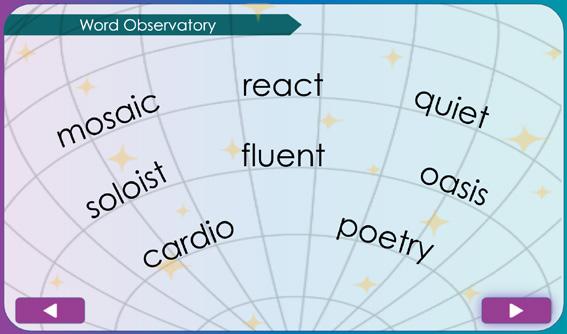
Click to display images that support comprehension of each Word Observatory word.
Start Teaching
Consonant-le Syllables
1. State Objectives
OPEN Orbit Online to Unit 18, Lesson 1, Phonics.
CLICK TO DISPLAY Objectives.
SAY:
• “At the end of today’s lesson, you will be able to:
- read words with Consonant-le Syllables.
- recognize four homophone pairs of new Heart Words.
• Let’s start off by observing a new group of words.”
Optional
2. Word Observatory
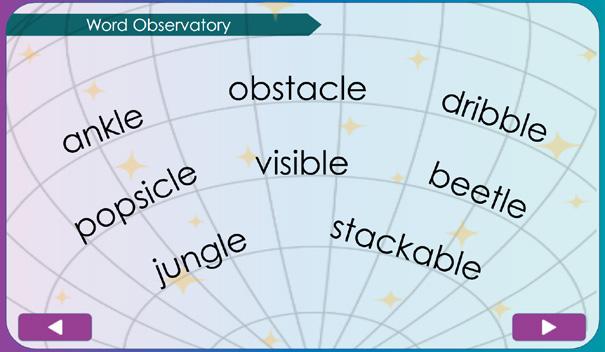
CLICK TO DISPLAY Word Observatory.
SAY “Take a moment to carefully observe these words: ankle, obstacle, dribble, popsicle, visible, beetle, jungle, and stackable. Look for things that all or a few of the words have in common.”
ASK “What do all or some of these words have in common?”
• Possible answers include words that have short vowels (ankle, obstacle, dribble, popsicle, visible, jungle, stackable) and threesyllable words (obstacle, popsicle, visible, stackable).
SAY:
• ” The common feature of all these words that we will focus on in this unit is they all have a Consonant-le Syllable, or C-l-e for short.
• T his is the sixth and final syllable type. We have learned about the five other syllable types: Closed, Open, VCe, R-Controlled, and Vowel Team.”
3. View Consonant-le Syllables Animation
CLICK TO DISPLAY Cle Syllables animation.
SAY ”Let’s watch this animation to review Consonant-le Syllables and how they are spelled.”
CLICK TO PLAY the Consonant-le Syllables animation.
4. Review Consonant-le Syllables
SAY “Let’s review what we just learned.”
ASK:
• “ How many letters are in every Consonant-le Syllable?” (A: three, a consonant and then the letters l and e)
• “ What sounds do the letters le spell in a Consonant-le Syllable?” (A: /uhl/)
• “ If the syllable before a Consonant-le Syllable ends in one consonant letter, what type of vowel sound will we expect to hear?” (A: short)
FORTXPILOTUSEONLY
• “ How do you know?” (A: because it is a Closed Syllable)
• “ If the syllable before a Consonant-le Syllable ends in one vowel letter, what type of vowel sound will we expect to hear?” (A: long)
• “ How do you know?” (A: because it is an Open Syllable)
• “ If the syllable before a Consonant-le Syllable is a Vowel Team or an R-Controlled Syllable, what type of vowel sound will we expect to hear?” (A: long, other, or r-controlled)
• “ What is the hand signal we can use to help us remember Consonant-le Syllables?” (A: form the letter C with one hand)
Optional
5. Word Sort
SAY “Now we are going to sort words into three groups according to the vowel type before the consonant-le. I’ll read the word, and you tell me which vowel type you hear in the word.”
CLICK TO DISPLAY Word Sort.
SAY “The headers are Long, Short, and R-Controlled. The first word is drizzle.”
CLICK TO REVEAL the word drizzle
ASK “Look at the vowel spelling before the consonant-le and say the word to yourself. Which phoneme does the vowel make in this word?” (A: short i)
CLICK TO MOVE the word drizzle under the short heading.
CLICK TO REVEAL and then CLICK TO SORT the remaining words.
ASK INDIVIDUAL STUDENTS to look for vowel spellings and then
Phonics determine which vowel phoneme is before the consonant-le. (Answers are in the table below.)
Answer Key
long short r-controlled
title drizzle marble
beagle humble gurgle
fable paddle sparkle
wobble
CHECK SORT by reading the words in each column aloud together and stating what all the words in the column have in common. For example, title, beagle, and fable all have long vowel phonemes in either Open or Vowel Team Syllables.
6. Read Real Words with Consonant-le Using the Multisyllabic Word Reading Procedure
I DO tentacle
SAY:
FORTXPILOTUSEONLY
• “ I’ll break down a word with a consonant-le spelling as an example, and then we will do some together.
• I ’m going to show you a word, but please do not read it out loud if you know it.”
CLICK TO DISPLAY I Do: tentacle
SAY:
• “ I don’t see a prefix or a suffix in this word, so I can look for the vowels.
• I s ee three vowels, e, a, and e (Click to underline the vowels.)
• A ll three vowels are apart, so I know that the word has three vowel spellings.
• I d on’t see an r-controlled vowel or a vowel-consonant-e, but I do see a consonant, an l, and an e at the end, so that fits our new pattern.
• A ll three letters of the consonant-le pattern aren’t a vowel spelling, but it’s a chunk that is easy to recognize, so I’ll underline all three letters together.”
CLICK TO EXTEND THE UNDERLINE for cle
SAY:
• “ Now, I’m going to look for how many vowel spellings there are before the Consonant-le Syllable, and I see two.
• Consonant- le is always a whole syllable by itself, so that means this word has a total of three syllables and I need three SyllaBoards™.”
CLICK TO ADD three SyllaBoards™ under the word tentacle
SAY “I’ll add the vowel spellings, e, a, and the syllable cle, to the boards. Remember that when we see the consonant-le pattern, those three letters stick together on the same SyllaBoard ™ without any other letters.”
e a cle
t e n t a c l e
ten ta cle
When teaching the schwa, explain simply:
Sometimes vowels sound soft, like /uh/.
Say the word slowly and naturally, then again in syllables: ten–tuh–cle: tentacle
Encourage students to repeat naturally, not overpronouncing.
Why this helps ELs: Many languages do not use schwa; explicit instruction prevents mispronunciation and confusion. d i s m
CLICK TO ADD the e, a, and cle to the boards.
SAY:
• “ Next, I’ll add the consonants. I’ll add the t and the n to the first board to form the Closed Syllable ten
• N ow I’ll decide whether to put the second t on the first board, tent, or on the second board, which would spell tā.
• N o matter which place I add the t, the first syllable will stay closed, so it might not matter where I put it.
• I ’ll try the t on the second board.”
CLICK TO ADD the consonant letters to the boards.
SAY:
FORTXPILOTUSEONLY
• “/tĕn/ /tā/ /kuhl/? That doesn’t sound quite right, though it sounds like a word I know, /t n/ /tuh/ /kuhl/, tentacle, so the a is flexing to the schwa sound, /uh/.
• F iguring out the vowel sound is what is most important. The word is /t n/ /tuh/ /kuhl/, tentacle.”
CLICK TO REVEAL the contextual image for tentacle.
SAY “A tentacle is an arm or hair extended from an invertebrate used for feeling. For example, ‘The tentacles of an octopus are covered with suckers and used for moving, feeding, and sensing the environment.’”
WE DO dismantle, retractable
SAY:
• “ Let’s break down some words with Consonant-le Syllables together.
• Place your SyllaBoards™, dry erase marker, and eraser on your desk.
• Please do not read this word aloud if you know it.”
CLICK TO DISPLAY We Do: dismantle
ASK “Do we see a prefix or suffix?” (A: yes, prefix dis-)
CLICK TO COVER prefix dis -.
ASK “How many vowels do you see in the rest of the word?” (A: two)
CLICK TO UNDERLINE the a and the e.
ASK:
• “Are the vowels together or apart?” (A: apart)
• “ Do you see an r-controlled vowel or vowel-consonant-e?” (A: no)
• “ Do you see a consonant-le?” (A: yes)
Phonics
d
tle
d i s m a n t l e man tle
d i s m a n t l e man tle
d i s m a n t l e man tle
d i s m a n t l e dis man tle
r
CLICK TO EXTEND THE UNDERLINE for tle
ASK:
CLICK TO DISPLAY We Do: retractable. d i
• “ How many vowel spellings do you see before the Consonant-le Syllable?” (A: one)
• “ How many vowel spellings are in this base?” (A: two)
• “ How many syllables are in this base?” (A: two)
CLICK TO ADD two SyllaBoards™ under the word dismantle.
SAY:
• “ I’ll add the a and the tle to the boards.
• T he consonant-le pattern sticks together because it is a Consonant-le Syllable.
• T hose three letters by themselves are in one syllable and on the same SyllaBoard ™.”
CLICK TO ADD the a and tle to the boards.
SAY “Next, I’ll add the consonants. I’ll add the m and n to the first board to make the Closed Syllable man . If I added the n to the second board, it would be /n/ /tuhl/ which is more than one syllable. Remember, a Consonant-le Syllable can only be three letters.”
CLICK TO ADD the consonant letters to the boards.
ASK “How do we pronounce this base?” (A: man-tle, mantle)
SAY “Let’s uncover the prefix.”
CLICK TO UNCOVER the prefix and box it in.
SAY “I know dis - is a prefix that is usually on its own, so I’ll add one board before mantle.”
CLICK TO ADD a SyllaBoard ™ before the current boards.
SAY:
• “And now I’ll add the prefix to the board. (Click to add dis-.)
• T his word has three syllables because there are three vowel spellings that are not next to each other.”
POINT TO and read each SyllaBoard ™, /dĭs/ /măn/ /tuhl/, dismantle
CLICK TO REVEAL the contextual image for dismantle.
SAY “ Dismantle is a verb that means to take apart. For example, ‘The mechanic needed to dismantle the car engine in order to repair it.’”
r e t r a c t a b l e
r e t r a c t a b l e
r e t r a c t a b l e
r e t r a c t a b l e tract
r e t r a c t a b l e tract
r e t r a c t a b l e tract
r e t r a c t a b l e re tract
r e t r a c t a b l e re tract
ASK “Do we see a prefix or suffix?” (A: yes, prefix re-, suffix -able)
SAY “-Able is a suffix that means able to. Even though it includes a Consonant-le Syllable, the purpose of a suffix is to change the meaning of the word, so we are going to cover it up.”
ASK “How many vowels do you see in the rest of the word?” (A: one)
CLICK TO UNDERLINE the a .
ASK:
• “ Is this vowel r-controlled?” (A: no)
• “ Do you see a consonant-le?” (A: no, we covered that up)
• “ How many vowel spellings are in this base?” (A: one)
FORTXPILOTUSEONLY
• “ How many syllables are in this base?” (A: one)
CLICK TO ADD one SyllaBoard ™ under the word retractable
SAY “I’ll add the vowel spelling, a, to the board (Click to add the a.) Then I’ll add the consonants.”
CLICK TO ADD the consonant letters to the boards.
ASK “How do we pronounce this base?” (A: tract)
SAY “ Tract is a root that means to pull. Let’s uncover the prefix.”
CLICK TO UNCOVER the prefix and box it in.
SAY “I know re - is a prefix that is usually on its own, so I’ll add one board before tract .”
CLICK TO ADD one SyllaBoard ™ before the current board.
ASK:
• “ What does prefix re - mean?” (A: back or again)
• “ What is the meaning of the prefix and the root together?” (A: to pull back or to pull again)
SAY:
• “ Now I’ll add the prefix to the board. (Click to add re-.)
• T his word is re -tract, retract . We have one more part to uncover.
• Let’s uncover the suffix.”
CLICK TO UNCOVER the suffix and box it in.
SAY:
• “ The suffix -able means able to or capable of being.
• For example, something washable is able to be washed. This means
Phonics
e
you can safely put the item in the washing machine with detergent and water.
• N otice that it looks like the word āble, but when these letters are a suffix, the a flexes to the schwa sound, /uh/, /uh-bul/.”
ASK “How many syllables do you hear in suffix -able?” (A: two, /uh/ /buhl/)
SAY:
• “ Right, so we need to add two boards after the base. (Click to add two boards.)
• Let’s write a on the first of the boards and ble on the last.” (Click to add suffix.)
FORTXPILOTUSEONLY
ASK “What is this whole word?” (A: re-tract-a-ble, retractable)
POINT TO and read each SyllaBoard ™, /rih/ /trăkt/ /uh/ /buhl/, retractable
ASK “Knowing what the affixes and root mean, how would you define the word retractable?” (A: able to be pulled back)
CLICK TO REVEAL the contextual image for retractable
SAY “A retractable pencil pulls the lead back in with a click.”
YOU DO gobble, unstable, recycling
SAY “Now it’s your turn to follow the routine on your own. Clear your boards.”
For each word:
• s how the word,
• a llow students time to complete the procedure independently,
• c irculate to check student boards and note any misconceptions,
• a nd review after each word to segment and read the words correctly by clicking through the procedure until you reach the confirming image if students are struggling.
*If students do not need a step-by-step review of a particular word, click through the procedure quickly to reach the confirming image.
HELP students remember that if the word they read does not make sense, they should flex the placement of one of the consonants or one of the vowels to schwa r
Answer Key
*Common misconception: Students may point out that able in unstable is a suffix. Explain that the letters able are not always a suffix. You can tell in this word because the a is the only vowel letter in the base; it cannot be a part of a base and a suffix.
CLICK TO DISPLAY You Do.
gobble – Underline the vowel spellings o and ble, put down two boards, add the vowel spellings to the boards [o] and [ble], add the consonants [gob] [ble].
Contextual Sentence: “The children began to gobble the cookies as soon as they came out of the oven.”
unstable – Cover the prefix un -, underline the vowel spellings a and ble, put down two boards, add the vowel spellings to the boards [a] and [ble], add the consonants [sta], uncover the prefix, add a board before stable, and bring down the prefix un - [un] [sta] [ble].
Contextual Sentence: “The unstable chair wobbled every time someone sat in it.”
FORTXPILOTUSEONLY
recycling – Cover the prefix re - and suffix -ing , underline the vowel spelling y, put down one board, add the vowel spelling to the board [y], add the consonants [cycl], uncover the prefix and suffix, add a board before and a board after cycl, and bring the prefix and suffix down [re] [cycl] [ing]. You can adjust to [re] [cy] [cling] for correct pronunciation after walking students through the Drop the e Rule that is needed before adding the vowel suffix -ing .
Contextual Sentence: “Many schools have started recycling the paper used in classrooms.”
REVIEW student boards after each word and walk through the procedure above if students are struggling to segment and read the word correctly. Provide Positive Error Correction as needed.
7. Word Hunt
PAIR STUDENTS and have them sit together.
SAY “Now we’ll read words with Consonant-le Syllables. Then, you will hunt for words with your partner. Open your workbooks to page 1, and then swap books with your partner so they will be marking up your book for you.”
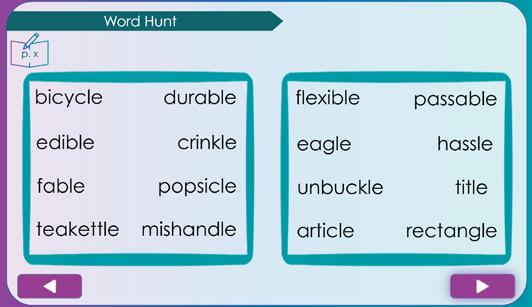
CLICK TO DISPLAY Word Hunt.
SAY “Each partner will read one box of words aloud while the other partner checks if the word is being pronounced correctly. Then we will check the words together.”
PROVIDE students time to read the two boxes. Then, have a pair of students read the words to the class, checking for proper pronunciation.
STUDENTS SWAP workbooks back to their owners.
SAY “Read through the Hunt & Answer questions with your partner and answer them together. Write your answers on the lines.”
REVIEW answers as a whole class and have students adjust answers as necessary.
Answer Key
1. Which two words have an r-controlled vowel?
durable, article
2. Which two words have a Vowel Team?
teakettle, eagle
3. Which three words have a prefix?
*bicycle, mishandle, unbuckle
4. Which two words have an Open Syllable with a long vowel phoneme right before the Cle Syllable?
fable, title
Note: Students may not realize that bi- is a prefix. You can explain that it means two. A bi cycle has two wheels. A person who is bi lingual speaks two languages. A bi plane has two sets of wings.
8. Decodable Passage Teacher Read
SAY:
• “ Turn to page 2.
• O ur passage for this unit is called ‘Roald Amundsen.’ It includes our Heart Words and words with Consonant-le Syllables.
• Today, I’m going to read it aloud to you while you follow along in your books.
• Let’s answer a few questions first.”
FORTXPILOTUSEONLY
CLICK TO DISPLAY Activating Prior Knowledge. Read the title and the questions and quickly discuss the answers.
CLICK TO DISPLAY Words to Preview. Read through the words and have students repeat them. Read the definitions and quickly discuss any connections to the words.
CLICK TO DISPLAY Point and Say Words. Read through the words and have students repeat them.
CLICK TO DISPLAY Heart Words. Read through the words and have students repeat them.
SAY “Now pay attention to the way I read with accuracy and how I read smoothly, with fluency, and intonation, how my voice changes to help the listener understand the text.”
READ ”Roald Amundsen” aloud with appropriate fluency and intonation.
ASK “Were your predictions on what the passage was going to be about correct?”
POINT OUT the compound words in the passage and ask students to read them and to break them into their smaller component words: halfway and something
CLICK TO DISPLAY Heart Word Review.
SAY:
• “ Let’s go back through and find those Heart Words before we learn more about spelling them.
• Look at the underlined words in the passage and put your finger on the word h - o -a - r- s - e, hoarse.” (Continue having students identify the remaining Heart Words.)
Curricular Crossover!
Task students with identifying these Heart Words in other texts throughout their week. Keep them posted in the room to help students remember the words they are looking for.
Answer Key
IF TIME ALLOWS, EXPLAIN anything new you have learned from the text and allow students to do the same.
9. Heart Word Magic
CLICK TO DISPLAY Heart Word Magic.
SAY “Let’s watch our Heart Word Magic animation for the Unit 18 homophone Heart Words: piece, peace, horse, hoarse, morning , mourning , seen, and scene.”
CLICK TO PLAY the Heart Word Magic animation.
10. Climb in InferCabulary and Play in the Reading Arcade
CLICK TO DISPLAY Independent Practice.
PROVIDE STUDENTS time throughout the week to climb at least 30 minutes in InferCabulary and play at least 15-20 minutes in the Reading Arcade. These minutes should be distributed throughout the week. It is best practice to divide InferCabulary practice into at least three weekly sessions.
For an on-screen timer, choose the Independent Practice Timer below the Handwriting lesson in the lesson dropdown menu of your Teacher Dashboard. There are four timer options: 5 minutes, 10 minutes, 15 minutes, and 20 minutes.
11. Quick Check
CLICK TO DISPLAY Quick Check.
DISTRIBUTE the Unit 18, Lesson 1 Quick Checks.
SAY “For today’s Quick Check, draw lines between the syllables in the three words. Then, look at the syllable before the Consonant-le Syllable and determine if the vowel is long, short, or r-controlled. Write the word in the column that matches.”
Unit 18 Lesson 2
Self-Assessment and “Ernest Shackleton’s
Endurance” Reading Vocabulary
Objectives
• To determine word knowledge of a new set of words through self-assessment.
• To preview a text by activating prior knowledge and making connections to what students already know and defining unfamiliar words.
Words that include the targeted morphology pattern meter
barometer perimeter thermometer
Words that include the targeted phonics pattern cle cycle
miracle receptacle vehicle
FORTXPILOTUSEONLY
author entrepreneur explorer interpreter mechanic mentor technician
Words that include the targeted morphology pattern struct
construction destructive obstruction
Previously Learned Words
• B y now, students have already encountered 200 new words since the start of this curriculum. Of these words, there are many that relate to the theme of this unit.
• I nformally including these words as you discuss the passage presents them in yet another new context.
• T his practice promotes generalization and shows students that words will continue to appear in text and conversation long after the curriculum has been finished.
Cloze Passage Answer Key
• To prepare for the second reading of “Ernest Shackleton’s Endurance” in Unit 20, Lesson 4, you may fill in the missing words in the Vocabulary Passage on pages 6-7 of your blank copy of the Orbit Student Workbook 3 using the answers provided in Orbit Online
Start Teaching
Self-Assessment and “Ernest Shackleton’s Endurance” Reading
Phonics Warm-Up
SAY “Let’s start our lesson with a short phonics warm-up. Our first word is a high-frequency word that we can read just using our phonics knowledge. If you know this word, don’t say it.”
WRITE the word circle on the board.
SAY:
• “I see two vowel spellings in this word, ir and the e in the Consonant-le Syllable (underline each), and they are separate vowel spellings, so I know this word has two syllables.
• Because I see a Consonant-le Syllable, I know that the c- l - e is a whole syllable on its own, and I’ll draw my line before it. (Draw a line between r and c.)
• Now I have two syllables to read, /ser/ /kuhl/, circle
• I’m going to write two more words that include a Consonant-le Syllable on the board. If you know the words, don’t say them.”
WRITE the words respectable and measles on the board.
GROUP students in pairs, or by desk/table group.
S AY:
• “With your partner(s), read each word and identify the Consonant-le Syllable in the word.
• I will be asking for students to come up to:
– underline the vowels,
– segment the syllables by drawing a vertical line between them,
– read the word correctly, and
– star the Consonant-le Syllable.
• Remember, if you see a Consonant-le Syllable, put that on its own board first.”
STUDENTS WORK with their partner(s) and then participate in marking up the words on the board. They should show their work on paper.
Explicitly state:
“It’s okay if many words are new. This helps me teach you better.”
Why this helps ELs: Reduces affective filter (emotional variables) and encourages honest responses.
Provide oral processing options:
Allow students to quietly say the word to themselves or whisper-read before marking.
Optional partner check-in for directions only (not word meanings).
Why this helps ELs: Oral rehearsal supports comprehension and confidence.
1. State Objectives
OPEN Orbit Online to Unit 18, Lesson 2, Vocabulary.
CLICK TO DISPLAY Objectives.
SAY:
• “At the end of today’s lesson, you will be able to:
- identify how much you already know about certain words and use this information to track your own word learning progress.
- prepare to read a true story by making connections to what you already know, identifying the meanings of new words, and identifying the part of speech of vocabulary words.”
FORTXPILOTUSEONLY
Note: Add in any anecdotal observations from the Module 4 Self-Assessment such as, “I remember how challenging it was for many of you the first time you went through the words at the start of Module 4 compared to how many you knew at the end,” or, “I noticed many of you started with mostly checkmarks in Module 4 but ended with several more plus signs.”
2. Self-Assessment
CLICK TO DISPLAY Module 5 Self-Assessment.
STUDENTS OPEN their workbooks to page 5, Self-Assessment Module 5.
S AY:
• “ Here are the words we will encounter throughout the next four weeks.
• T hese are the words you will see in InferCabulary, as well as in other activities, throughout this module.
• Remember that we are not just learning these words for this module. The goal is to deeply learn them so that we will recognize them in other activities and use them when we read and write.
• I will read them aloud while you think about how well you know them.
• U se a plus sign next to each word that you recognize and know well enough to also think of 2-3 semantically related words.
• Put a checkmark next to the words that you recognize but do not know deeply enough to be able to talk about with 2-3 semantically related words.
• Finally, put a dash next to words that you are not familiar with or do not remember hearing before.
- Remember that this is all part of your word-learning journey. It is okay that there might be words you are unfamiliar with or words that you do not know deeply. That means we are in the right spot for learning.
• I a lso want you to remember that we will come back to these words in a few weeks when you will be able to measure your progress.”
Vocabulary
READ each of the words aloud as the students follow along in their workbooks and complete the self-reflection.
Click to display the image depicting the contrast between fictional and nonfictional characters.
3. “Ernest Shackleton’s Endurance” First Reading
CLICK TO DISPLAY Narrative Nonfiction.
ASK:
• “Can anyone tell me what a narrative is?” (A: a story) (Click to add definition.)
• “ How about fiction?” (A: something that is made up or imaginary) (Click to add definition.)
SAY “Now I’m going to introduce a prefix that you may not have learned yet: non -, /nŏn/. Non -, like the prefixes un - and dis -, means not or opposite of.” (Click to add definition.)
ASK “If fiction is something that is made up, what do you think nonfiction might be?” (A: something that is true, is the opposite of made up) (Click to add definition.)
SAY “So, that means that narrative nonfiction is a true story!” (Click to add definition.)
CLICK TO DISPLAY Narrative Nonfiction, Continued.
SAY:
• “ Narrative nonfiction will have:
– characters—who are, or were, real people (click to add next bullet);
– a plot with a sequence of true events (click to add next bullet);
– transition words that show the time order of events, such as first, next, then, before, and finally (c lick to add next bullet);
Vocabulary
– and a setting, which is the time and place in which the sequence of events happens.”
CLICK TO DISPLAY What Do You Already Know?
SAY:
• “ Today, we are going to read the true story of an explorer named Ernest Shackleton. He led a group of explorers on a dangerous journey to explore Antarctica.
• B efore we begin reading, we will talk about what we already know about Antarctica and explorers.”
ASK the following questions to activate students’ prior knowledge and encourage discussion:
FORTXPILOTUSEONLY
• “ Have you ever explored a new place? Where was it? What was it like seeing something new?”
• (Click to replace with new question.) “Talk about a time you had to do something hard. What helped you to persist?”
• (Click to replace with new question.) “Who is someone who has inspired you? What makes them inspiring?”
CLICK TO DISPLAY Words to Preview.
SAY:
• “ Before I begin reading, let’s preview some words that may be new to you.
• A ntarctica is one of seven large pieces of land on the Earth. It is located at the South Pole, as far south as you can go. It is very, very cold there—so cold that the coldest place on Earth is found there.”
ASK “Have you ever been somewhere very cold? What did you do to stay warm?” (Call on 1-2 student volunteers to share.)
CLICK TO ADD leadership
SAY “ Leadership is the state of being a leader. For example, Sarah shows leadership as president of the science club at her school.”
ASK “Can you describe a time when you showed leadership?” (Call on 1-2 student volunteers to share.)
CLICK TO DISPLAY Time to Read!
STUDENTS OPEN their workbooks to pages 6-7, Vocabulary Passage –“Ernest Shackleton’s Endurance.”
SAY “I will read the true story aloud as you follow along with me. Remember, we will not start filling in the blanks until the next lesson.”
READ “Ernest Shackleton’s Endurance” aloud without the missing words. Take this opportunity to model fluent reading with expression.
explorer: brave, guide, territory, adventure thermometer: tool, measure, temperature
2. ice, tundra, treacherous, remote
3. i nformational text; category-example
CLICK TO DISPLAY Sort the Words.
SAY:
• “ In the next Vocabulary lesson, we will look closely at the first two paragraphs of this story and use semantic links, parts of speech, and our vocabulary words to fill in the blanks.
• To get ready, let’s sort the vocabulary words that will be in our word bank by their word class. Knowing each word’s job will help us choose the right ones when it is time to fill in the blanks.”
CALL ON a student to read the first word.
ASK “Is adventure a person, place, or thing, or does it describe?” (A: thing) (Click to move the word adventure to the person, place, thing column.)
FORTXPILOTUSEONLY
REPEAT THIS ROUTINE with the remaining vocabulary words in the list. Use the answer key to support students.
4. Climb in InferCabulary and Play in the Reading Arcade
CLICK TO DISPLAY Independent Practice.
PROVIDE STUDENTS time throughout the week to climb at least 30 minutes in InferCabulary and play at least 15-20 minutes in the Reading Arcade. These minutes should be distributed throughout the week. It is best practice to divide InferCabulary practice into at least three weekly sessions.
For an on-screen timer, choose the Independent Practice Timer below the Handwriting lesson in the lesson dropdown menu of your Teacher Dashboard. There are four timer options: 5 minutes, 10 minutes, 15 minutes, and 20 minutes.
5. Quick Check
CLICK TO DISPLAY Quick Check.
DISTRIBUTE the Unit 18, Lesson 2 Quick Checks.
SAY:
• “ Sort the words in the word bank by writing them below the target word they are related to. Look closely! One of them could go into more than one column!
• N ext, circle the words that are related to Antarctica
• T hen, circle the word that correctly completes the analogy. Identify how the words are related.”
Unit 18 Lesson 3
Consonant-le Syllables Practice
Objectives
• To accurately decode and encode multisyllabic words with Consonant-le (Cle) Syllables.
• To recognize and accurately decode and encode the homophone Heart Words: piece/peace, horse/ hoarse, morning /mourning , and seen /scene
• To practice oral reading fluency with decodable text.
• “At the end of today’s lesson, you will be able to:
– read and spell multisyllabic words with Consonant-le Syllables.
– spell our Unit 18 Heart Words.
FORTXPILOTUSEONLY
– read words, sentences, and our passage with greater fluency.”
2. Practice Heart Word Spelling
CLICK TO DISPLAY Heart Word Review.
SAY:
• “ Each of our Heart Words in this unit is a homophone. A homophone is a word that sounds the same as another word with a different spelling and a different meaning.
• Let’s look at the pairs of words, how they are spelled, and their meanings.”
ASK “What is this word (point to piece)?” (A: piece)
SAY:
• “The ie in piece is a less common long e spelling, but it is not unexpected. No heart is needed.
• When c is followed by e, the c makes its soft sound, /s/.
• This piece means a part of something. ‘Ben folded a piece of paper into a paper airplane.’
ASK “What is this word (point to peace)?” (A: peace)
SAY “The ea in p-e-a-c-e, peace, makes an expected long e sound. This peace means a state of quiet or tranquility.”
REVIEW each of the three remaining pairs of homophones, asking the same questions as above and noting any unexpected vowel sounds. horse (strong hooved animal ) = expected /or/ spelling, unexpected e at
Phonics
p ie ce
The words morning and mourning can be segmented between the n and the i OR between the r and the n . The vowel phoneme in the first syllable will not change. p ea ce
end; it is included to note that the word is not plural
hoarse (rough or harsh sounding) = expected, though less common, /or/ spelling, o -a - r, unexpected e at end; it is included to note that the word is not plural
seen (the past tense of see, to look at) = expected long e spelling scene (a part of a play or the setting) = expected VCe long e spelling, unexpected silent c
morning ( part of day from sunrise to noon) = expected /or/ mourning (act of grieving) = expected, though less common, /or/ spelling, o - u - r
CLICK TO DISPLAY Heart Word Spelling.
h or se
h oar se
s ee n
sc e ne
morn ing
mourn ing
FORTXPILOTUSEONLY
SAY “Turn to page 8 in your workbooks, and we’ll practice spelling the Heart Words we just went over. You’ll need to listen to the sentence to know which homophone to write.”
DICTATE the words, one at a time, reading the contextual sentence to help students make informed spelling decisions:
1. piece – She used a second piece of paper for her story.
2. peace – I enjoyed the peace and quiet after a hectic day.
3. horse – The farmer fed the horse in the stable.
4. hoarse – Her voice was hoarse from shouting.
5. seen – Have you seen the new bike trail?
6. scene – My favorite scene in the play takes place at a restaurant.
7. morning – The sun rises in the east every morning .
8. mourning – The family is mourning the loss of their pet.
For each word, students:
• FILL IN a dot for each sound that they hear.
• WRITE a grapheme/syllable in each box with a dot in print.
• FILL IN/DRAW a heart above the tricky part(s).
• WRITE the whole word on the final line in cursive.
Remind students to use their phonics knowledge to spell the phonetically predictable parts of each word and to write legibly in print.
After students have spelled each single-syllable word, CLICK TO HIGHLIGHT THE ROWS AND REVEAL the answers and review them, one at a time. (Click once for each dot representing a phoneme, then once for each grapheme, a third time to display the hearts over the tricky graphemes, and then once again to display the completed word.)
Provide optional frames during ASK prompts:
“The syllable before - le ends in .”
“That makes the syllable .”
“The vowel sound is .”
This allows ELs to participate in phonics talk using correct academic language without guessing sentence structure.
After students have spelled each multisyllabic word, CLICK TO HIGHLIGHT THE ROWS AND REVEAL the answers and review them, one at a time. (Click once for each dot representing a syllable, then once to add each syllable, a third time to display the hearts over the tricky graphemes, and then once again to display the completed word.)
3. Review
CLICK TO DISPLAY Consonant-le Syllables.
SAY:
• “ Next, we’re going to quickly review Consonant-le Syllables.
• T he letters le spell the sounds /uhl/, two phonemes: /uh/ (the schwa sound) and /l/.
FORTXPILOTUSEONLY
• T he single consonant before the letters le works with the le to form a syllable.”
ASK:
• “ How many letters are in a Consonant-le Syllable?” (A: three) (Click to fill in number.)
• “ What are some examples of a Consonant-le Syllable?” (A: ble, cle, dle, fle, gle, kle, ple, sle, tle, zle) (Click to fill in examples.)
• “ Why does looking at the letter before the consonant-le help?” (A: it helps you decode the syllable before Cle, the vowel sound in the syllable before Cle)
• “What is the hand signal we can use to help us remember Consonantle Syllables?” (A: form the letter C with one hand) (Click to show the signal.)
CLICK TO DISPLAY Cle chart.
ASK:
• “ If the syllable before a Consonant-le Syllable ends with a consonant letter, it is what type of syllable?” (A: closed) (Click to add to chart.)
Think-Aloud Modeling
Model decoding explicitly:
“I see the word tremble. I find the consonantle at the end. I look at the letter before it.
The syllable ends in a consonant, so it’s closed, and the vowel is short.”
This scaffold makes invisible decoding decisions explicit and repeatable.
• “ What vowel phoneme would you expect?” (A: short) (Click to add to chart.)
SAY “Two examples are trem ble and daz zle.” (Click to add to chart.)
ASK:
• “ If the syllable before a Consonant-le Syllable ends with a vowel letter, it is what type of syllable?” (A: open) (Click to add to chart.)
• “ What vowel phoneme would you expect?” (A: long) (Click to add to chart.)
Phonics
SAY:
• “ Some examples are bu gle and ti tle (Click to add to chart.)
• T he vowel is also long if the syllable ends in a Vowel Team, like bea gle and noo dle.” (Click to add to chart.)
ASK:
• “ If the syllable before the Cle ends in an r, it is what type of syllable?” (A: r-controlled) (Click to add to chart.)
• “ What vowel phoneme would you expect?” (A: r-controlled) (Click to add to chart.)
SAY:
• “ Some examples are pur ple and gar gle (Click to add to chart.)
• Last, in consonant-le words with three or more syllables, the vowel in an Open Syllable before the consonant-le may flex to schwa like in the words mul ti ple and ob sta cle.” (Click to add to chart.)
Consonant-le Chart
syllable before Cle ends in syllable is vowel phoneme is examples
consonant closed short tremble, dazzle
vowel open long bugle, title
vowel team vowel team long or other vowel team phoneme beagle, noodle
letter r r-controlled r-controlled purple, gargle
three or more syllables, check for schwa multiple, obstacle
4. Partner Phrase Reading
CLICK TO DISPLAY Partner Phrase Reading.
FORTXPILOTUSEONLY
Use symbiotic partner pairings so students can support one another’s language and decoding strengths. Rotate Reader and Checker roles to ensure both partners actively practice reading and listening.
SAY:
• “ Turn to page 9 for Partner Phrase Reading.
• Q uietly read the phrases to yourself. If you get stuck on a word, underline the vowel spellings and break up the syllables to help you figure it out. If something doesn’t sound quite right, go back and reread.”
STUDENTS READ QUIETLY TO THEMSELVES as many phrases as they can in the time given.
ASSIGN PAIRS OF STUDENTS to work together to read phrases fluently to each other and check each other’s work. Determine which
Answer Key Cle
• particles, hassle, cubicle (sentence 1)
• mishandle, bottle, stable (2)
• possible, assemble, obstacles (3)
• nibble, unbundle (4)
• unbuckle (5)
• bundle, drizzle (6)
• capable, apple, crumble (7)
• pineapple, popsicles, enjoyable (8)
• shuffle, multiple, table (9)
• jiggle, kibble, beagle (10)
Cle with Long Vowels Before
• stable (2)
• table (9)
• beagle (10)
Prefixes
• mishandle (2)
• unsafe, unbuckle (5)
• enjoyable (8)
students will act as the Reader first and which will be the Checker.
STUDENTS TRADE workbooks before the beginning of the paired activity.
5. Detect & Decode
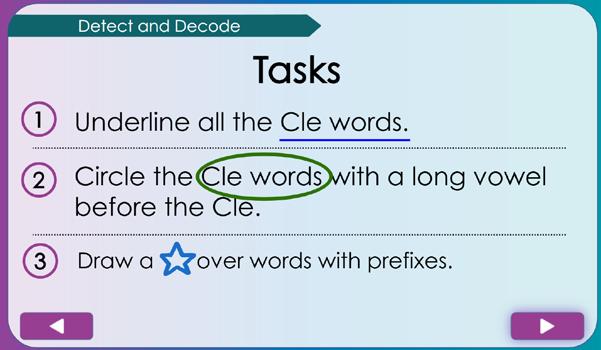
SAY “Now we’ll examine complete sentences to look for particular spellings, or syllable types, and then read them with fluency.”
CLICK TO DISPLAY Detect & Decode. Read the tasks aloud.
SAY “Read each sentence and complete your tasks. When you are finished, we will discuss what you found, and then we’ll have a few chances to read sentences aloud.”
FORTXPILOTUSEONLY
After students have had time to complete their Detect tasks, DISCUSS their findings.
SAY:
• “ Let’s read!
• Remember, our goal is to read accurately the first time.
• O ur secondary goal is to read fluently, as if we were talking to a friend.
• Readers, make sure you read loudly enough for everyone to hear.
• Checkers, that is everyone who is not reading, pay careful attention to the reader and the text.
• Q uietly mark any errors in your workbook. Remember to make your marks light.”
CALL ON INDIVIDUAL STUDENTS to read sentences, one at a time.
DIRECT CHECKERS to give a thumbs up if the Reader reads all of the words correctly or a thumbs to the side if the Reader misreads a word(s). If the Reader misreads any words, follow Positive Error Correction instructions.
6. Split It!
CLICK TO DISPLAY Split It!
SAY:
• “ We are going to spell some longer words in our workbooks using Whale Talk to help us hear the number of syllables so we can spell them one at a time.
• Let’s Whale Talk and spell the first word together. Turn to page 10.”
CLICK TO HIGHLIGHT row #1.
kin
Phonics
kin dle
SAY:
• “ Kindle. Repeat. (Students repeat kindle.)
• Kindle, as in, ‘The campers used dry leaves and sticks to kindle the fire.’
• N ow, let’s Whale Talk kindle together.” (Whale Talk kindle by holding your lips together and shouting kin- dle. Students Whale Talk with you.)
ASK “How many syllables do you hear in kindle?” (A: two)
SAY:
• “Since kindle has two syllables, kin - dle, we will fill in dots in the first two boxes.
• As you fill in each dot, say the syllables in kindle with me.
• /kĭn/ (click to fill in 1st dot), /duhl/ (click for 2nd dot)
• N ow, let’s spell each syllable in kindle by listening to the sounds in that syllable.
• T he first syllable is kin - /k/ /ĭ/ /n/, kin .”
ASK “How do we spell the syllable kin?” (A: k-i-n)
CLICK TO ADD the syllable kin to the first box.
SAY “The second syllable is dle - /d/ /uh/ /l/, dle.”
ASK “How do we spell the syllable /duhl/?” (A: d-l-e)
CLICK TO ADD the syllable dle to the second box.
SAY:
• “ Let’s check our work by using Touch & Say. We’ll touch each section as we read the syllable, and then we’ll blend the whole word together: kin - dle, kindle.
• Write the whole word together on the line on the right.”
CLICK TO ADD the word kindle to the final line.
FORTXPILOTUSEONLY
CONTINUE the above process for the remaining words, one at a time. Review the answers at the end. Letters that spell the schwa phoneme are underlined below. Provide Positive Error Correction if needed.
REMIND students to write legibly. They should write the complete word in cursive.
2. particles - [par] [ti] [cles]
• “ I could see the dust particles floating in the sunlight.”
3. quibble - [quib] [ble]
• “A quibble is a small argument over something unimportant.”
Note: If students struggle to spell dribbled, a Cle word with a suffix, explain that this word follows the Drop the e Rule.
Note: Castle is a tricky word to spell because of the silent t . Students heard about this in the animation in Lesson 1. Remind them of the silent letter in this Cle syllable if needed.
Helpful Hint:
4. detectable - [de] [tec] [t a] [ble]
• “ The noise of the siren is detectable from far away.”
5. improbable - [im] [prob] [a] [ble]
• “It’s improbable that an elephant can ride a skateboard.”
7. Sentence Dictation Practice
SAY:
• “ Now we’re going to put our Consonant-le Syllable practice into use writing whole sentences.
• I ’ll say a sentence, and then I’ll repeat it slowly several times while you write it down.”
For each sentence:
FORTXPILOTUSEONLY
CLICK TO DISPLAY Dictation Sentence Images, one at a time.
READ each sentence once with appropriate fluency and intonation.
STUDENTS REPEAT the sentence and count the number of words in the sentence. They write the number of words at the end. This will help them check that they’ve written each word.
REPEAT the sentence several times slowly as students write.
1. My brother dribbled his popsicle across the table. (8)
2. The subtitle says, “Pelicans gobble multiple fish.” (7)
3. How did you add the sparkle to your castle drawing? (10)
CLICK TO DISPLAY Dictation Sentences. Review as necessary. Students make any necessary corrections.
8. Decodable Passage Practice
SAY “You heard me read the passage ‘Roald Amundsen’ earlier this week. Now, it’s your turn to get some practice reading the passage with a partner. Let’s go back to page 2.”
Remind students that when they see an underlined word in the passage, it is a Heart Word, and they should use their phonics knowledge to help them decode the word. Using the phonemes they do know can help them decode the whole word even though it has a tricky part.
CLICK TO DISPLAY Words to Preview. Review quickly.
CLICK TO DISPLAY Point and Say Words. Review quickly.
CL ICK TO DISPLAY Heart Words. Review quickly.
GROUP students in pairs and determine which student will be Reader 1 and which student will be Reader 2.
Procedure:
• Each Reader will read one section as the Checker provides support when prompted.
• Remind students to underline the vowel spellings and segment the syllables of words they struggle with before asking their partner for help.
SAY:
• “ With your partner, find four words with Consonant-le Syllables in the passage. Write those on your workbook page at the end of the passage.
• U se your best legible cursive handwriting. I should easily be able to read your words as I walk around.”
REVIEW student answers as a class.
FORTXPILOTUSEONLY
TIME PERMITTING, HAVE STUDENTS LOOK FOR other words with the target concept. The list below contains the words from the passage with Consonant-le spellings.
Consonant-le Words able humble simple angle hurdle sparkled assembled impossible stable battled incredible staples brittle little struggled capable multiple stumble gentle obstacle tackle grumble possible
9. Climb in InferCabulary and Play in the Reading Arcade
CLICK TO DISPLAY Independent Practice.
PROVIDE STUDENTS time throughout the week to climb at least 30 minutes in InferCabulary and play at least 15-20 minutes in the Reading Arcade. These minutes should be distributed throughout the week. It is best practice to divide InferCabulary practice into at least three weekly sessions.
Answer Key
mul-ti- ple
tric- kle
flex-i- ble
com-for-ta- ble
For an on-screen timer, choose the Independent Practice Timer below the Handwriting lesson in the lesson dropdown menu of your Teacher Dashboard. There are four timer options: 5 minutes, 10 minutes, 15 minutes, and 20 minutes.
10. Quick Check
CLICK TO DISPLAY Quick Check.
DISTRIBUTE the Unit 18, Lesson 3 Quick Checks.
SAY:
• ”For today’s Quick Check, you will add the final Consonant-le Syllable to four words.
• Read what is given and fill in the blank with an ending that creates a real word.
*If needed, offer support with the following words and contextual sentences.
• T he first word is multiple, as in ‘There are multiple birds on the fence.’
• T he second word is trickle, as in ‘Let the hose trickle water on the plants.’
• T he third word is flexible, as in ‘The lesson schedule is flexible with morning and afternoon choices.’
• T he last word is comfortable, as in ‘Wear your most comfortable sweatshirt.’”
Unit 18 Lesson 4
Semantic Reasoning and “Ernest Shackleton’s Endurance” Cloze & Questions Vocabulary
Objectives
• To use semantic reasoning to identify related words.
• To use related words to construct a definition for adjectives.
• To use semantic links, parts of speech, and word meanings to find missing words in a cloze passage.
• To answer Right There, Think and Search, and Text and Me questions while reading a true story to support and demonstrate comprehension.
• SyllaBoards™ Kit OR blank sheet of paper OR 3x5 cards
• pencil
Start Teaching
Semantic Reasoning and “Ernest
Shackleton’s Endurance” Cloze & Questions
Phonics Warm-Up
SAY:
• “For our phonics warm-up today, we’ll spell a few words with Consonant-le Syllables.
• The first word is example.
FORTXPILOTUSEONLY
• First, I need to figure out how many syllables I need to spell, so I’ll Whale Talk the word. (Whale Talk ex-am-ple.)
• I felt three pushes of breath, so there are three syllables.”
WRITE three lines on the board in a row.
SAY “The first syllable is /ihks/. That is a prefix spelled e -x . Sometimes, that is pronounced /ĕks/, with a short e.”
WRITE e -x on the first line.
SAY “The second syllable is /ăm/, spelled like the word, a - m .”
WRITE a - m on the second line.
SAY “And the last syllable is /puhl/, which is a Consonant-le Syllable spelled p - l - e.”
WRITE p - l - e on the third line.
SAY:
• “Now, I’ll read what I wrote using Touch & Say, ex am ple, example
• It’s your turn to spell two longer words that include Consonant-le Syllables.
• Get out your SyllaBoards™.” (Students may also write on notecards or on a sheet of paper.)
GROUP students in pairs, or by desk/table group.
ASK “Where will we usually find a Consonant-le Syllable—at the beginning, in the middle, or at the end of a word?” (A: at the end)
SAY:
• “With your partner(s), listen to each word, get out the correct number of boards, and spell the word one syllable at a time.
Vocabulary
Answer Key
hur *dle
par ti *cle
Explicit Modeling with Think-Alouds
Verbally model how to use the new adjective template step by step. Say your thinking aloud. For example: “I know inhospitable is an adjective, so it must describe a place or thing…”
This supports ELs by making the invisible reasoning process visible.
• After, I will be asking for students to come up to:
– write the correct number of lines, – spell each syllable,
– star the Consonant-le Syllable, and – read the word correctly.”
DICTATE the following words, one at a time, and repeat as necessary as students follow the above process with their partner: hurdle and particle.
STUDENTS WORK with their partner(s) and then participate in spelling the words on the board.
1. State Objectives
FORTXPILOTUSEONLY
OPEN Orbit Online to Unit 18, Lesson 4, Vocabulary.
CLICK TO DISPLAY Objectives.
SAY:
• “At the end of today’s lesson, you will be able to:
- u se related words to build a definition of the word inhospitable
- u se semantic links, word classes, and vocabulary words to find the missing words in true story.
- a nswer Right There, Think and Search, and Text and Me questions about a true story.”
2. Semantic Reasoning Word Work –Inhospitable
CLICK TO DISPLAY Let’s Review.
SAY “Before we get started, I want you to look at something. These are all the words we have studied together as part of a deep dive using semantic reasoning. The information we collected went into a template that helped us build a definition.”
ASK “What do you notice about these words?” (A: they are all objects) (Click to show object icon.)
CLICK TO DISPLAY Review Continued.
SAY “The definition template we have been using works well for objects. We learned how to take this template (click to show example) and fill it in with semantically related words (click to show example) which becomes a definition .”
CLICK TO DISPLAY New Template for Adjectives.
Vocabulary
Note: You may want to point out this word’s morphological breakdown. See if the students recognize in - as meaning not and -able as meaning can be done. Support the base of hospit by prompting with words such as hospitality and hospital to understand it as caring for a guest.
SAY:
• “ It is a little different when we are talking about adjectives.
• A ll definitions should begin with the target word.
• A n adjective will always describe a person, place, or thing, so we only need to circle one of these. (Point to person, place, thing.) (Click to show next part of the definition.)
• We can often include a more familiar adjective that means something similar, which means it would be a synonym.
• S ometimes it is more helpful to explain the word with a familiar antonym.
• A nd then, just like nouns, we can include parts or an action. (Click to show last part of the definition.)
FORTXPILOTUSEONLY
• Lastly, it can be helpful to include an example of something that can be described by the adjective.”
CLICK TO DISPLAY Defining the Adjective.
SAY “Let’s try it with the word silly. ‘ Silly describes a …’”
ASK:
• “ Should we circle person, place, or thing?” (A: All of them.) (Click to circle answers.)
• “ What is a synonym for silly that most people know?” (A: funny) (Click to show answer.)
• “ Since we have a synonym, we do not need an antonym. I do not think there are important parts to silly, but what does being silly do?” (A: makes people laugh) (Click to show answer.)
• “Looking at the picture, I see a strong example of something that most people think of as silly. What is it?” (A: a clown) (Click to show answer.)
SAY “Here is a strong definition for the adjective silly. Silly describes a person, place, or thing that is funny and can make people laugh, such as a clown.”
STUDENTS OPEN their workbooks to page 11, Word Work Worksheet –Inhospitable.
CLICK TO DISPLAY Inhospitable Basecamp.
SAY:
• “ The word you will be studying is inhospitable. You will see the new template and a new checklist created for adjectives in your workbook. (Click to remove the word.)
• U se the Think Aloud Process to find semantically related words that will help you complete your definition.
Vocabulary
Note: You may decide whether to read the captions aloud or have the students read to themselves.
Before students write independently, have them say one idea aloud using a frame:
“Something inhospitable is because .”
Allow partner rehearsal before workbook writing. Oral language supports written output and increases accuracy.
• Take a few moments to collect words, draft your definition, and write your answer. We will share with a partner when everyone is finished.”
GIVE STUDENTS four minutes to complete their sentences. As you walk around the room, look to see that they have selected helpful related words in their checklists. Redirect as necessary to ensure the definitions will be accurate.
SAY:
• “ Now I want you to turn to your partner and compare definitions.
• Circle the items you chose that were similar and talk about the related words you chose that were different.
• If you or your partner chose a word that was not strongly related, use this time to go back and find one that will make your definition stronger.”
When students are finished, CALL ON volunteers to share their definitions with the whole group. Provide feedback as needed using the answer key.
Answer Key
Link Related Words Redirection
synonyms unwelcoming, harsh, abandoned, uncomfortable, dangerous, or any other logical, relevant example
antonyms safe, enjoyable, welcoming, comfortable, or any other logical, relevant example n/a
parts no food, no water, extreme heat, extreme cold, broken roof, mean people, or any other logical, relevant example n/a
FORTXPILOTUSEONLY
If students choose secluded, explain that it is possible to live in a secluded place, but in this case, there was nothing to eat or drink making it inhospitable.
actions hurt or destroy life or any other logical, relevant example n/a examples arctic, desert, Mars, or any other logical, relevant example n/a
Click to display the image to anchor the text.
3. Cloze and Questions: “Ernest Shackleton’s Endurance”
CLICK TO DISPLAY Read: “Ernest Shackleton’s Endurance.”
STUDENTS OPEN their workbooks to pages 6-7, Vocabulary Passage –“Ernest Shackleton’s Endurance.”
SAY:
• “ You will use the word bank, semantic links, and word classes to fill in the blanks.
Vocabulary
Answer Key
“He wanted to lead an expedition across Antarctica.”
“Even when it was tempting to get discouraged, Shackleton showed strong resolve.”
“In 1914, Shackleton and his crew started their journey on a ship called the Endurance.”
“The pressure from the ice crushed the ship.”
• I will read the first two paragraphs as you follow along.” (Read the paragraphs aloud as students follow along.)
CLICK TO DISPLAY Fill In the Blanks.
STUDENTS WORK independently to find the five missing words. When students have finished, review the correct answers as a whole group.
CALL ON student volunteers to read each sentence and to fill in the blank with the missing word. Once the correct missing word is identified, CLICK TO ADD it.
U SE the following prompts to encourage students to explain their thinking:
• “ How did you know the missing word was ?” (Sample response: “The possessive word his/their came before the blank, so I knew it was a person, place, or thing.” “The sentence was missing the answer to ‘who or what?’, so I knew the missing word had to be a person, place, or thing.”)
FORTXPILOTUSEONLY
• “ What words helped you decide?” (Sample response: “We can lead an expedition .” “ Trip means almost the same as expedition .” “ Pressure can crush .” “A ship can take a journey.” “A journey means almost the same as expedition and trip.” “A crew can be found on a ship.” “ Team means the same as crew.” “Showing resolve is the opposite of getting discouraged .”)
Redirection:
If students fill in the blank with the incorrect word, redirect them with the following questions:
• “ What type of word is needed to fill in the blank?”
• “ How do you know it should be a [person, place, or thing; or description]?”
• “ What are the [people, places, or things; descriptions] in our word bank?”
• “ Tell me what you have learned about [incorrect word]. Does the sentence make sense if you use its definition to fill in the blank? If not, what other word would match the meaning of the sentence?”
• “ What words are related to the missing word? How are the words semantically linked?”
Common Misconceptions:
If students confuse journey and expedition, first remind them that the definition of journey is a long trip from one place to another, and the definition of expedition is a kind of trip organized to explore an area Expedition goes in the first blank, because in this paragraph, they
Vocabulary describe the purpose of the trip as exploring Antarctica and reaching the South Pole. Journey goes in the blank in the second paragraph, because this paragraph is describing the trip across the sea to get to Antarctica. If students confuse resolve and endurance, remind them the definition of resolve is a kind of determination to get something done The definition of endurance is the ability to keep doing something difficult or painful for a long time. The main difference between resolve and endurance is that resolve refers to mental determination and decisiveness and endurance is more often used to refer to physical and emotional stamina over a more extended period of time
CLICK TO DISPLAY Answer Questions – Paragraphs 1-2.
STUDENTS TURN their workbooks to page 13, Answer Questions –Paragraphs 1-2.
SAY:
FORTXPILOTUSEONLY
• “ You will work with a small group to answer questions about the two paragraphs we just read.
• F irst, you will need to determine whether each question is a Right There question, a Think and Search question, or a Text and Me question. Circle the type of question on your worksheet.
• K nowing what type of question it is will help you know how to find the answer.
• For the Text and Me question, use the provided space to write down what you already know and to list text details.
• You will expand the kernel sentence below each question into a complete and informative sentence to form your answer.”
STUDENTS WORK in small groups to answer each question. Circulate the room and provide support as needed. When students have finished answering the questions, discuss the questions and student responses using the routine below.
CLICK TO DISPLAY Question #1.
CALL ON a student volunteer to read the question: “Why do you think the ship was called the Endurance?”
ASK:
• “ What type of question is this?” (A: Text and Me) (Click to add.)
• “ What are some key words in the question?” (A: ship, Endurance) (Click to underline words.)
• “ What kind of information is the question word asking for?” (A: a reason) (Click to add why = reason.)
• “ What text details did you find to help you answer the question?” (Answers will vary. Sample Responses: “one of the coldest and
Vocabulary
most dangerous places on Earth,” “sailed a great distance,” “many miles through icy water to Antarctica,” “Shackleton showed strong resolve”)
• “ What prior knowledge helped you to answer the question?” (Answers will vary. Sample response: Endurance is the ability to keep doing something difficult or painful for a long time.)
• “ What is your answer to the question?” (Answers will vary. Sample response: The ship was called the Endurance because the name describes what the crew would need to survive the difficult journey— endurance.) (Click to show sample answer.)
CLICK TO DISPLAY Question #2.
CALL ON a student volunteer to read the question: “When did Ernest Shackleton and his crew begin their journey?“
ASK:
FORTXPILOTUSEONLY
• “ What type of question is this?” (A: Right There) (Click to add.)
• “ What are some key words in the question?” (A: begin and journey) (Click to underline words.)
• “ What kind of information is the question word asking for?” (A: a time) (Click to add when = time.)
• “ What text details did you find to help you answer the question?” (A: “In 1914, Shackleton and his crew started their journey…”)
• “ What is your answer to the question?” (A: Ernest Shackleton and his crew began their journey in 1914.) (Click to show answer.)
CLICK TO DISPLAY Question #3.
CALL ON a student volunteer to read the question: “How did the crew end up having to survive on the ice?“
ASK:
• “ What type of question is this?” (A: Think and Search) (Click to add.)
• “ What are some key words in the question?” (A: survive and ice) (Click to underline words.)
• “ What kind of information is the question word asking for?” (A: the way or process in which something is done) (Click to add how = way or process.)
• “ What text details did you find to help you answer the question?” (A: “One day the ship got stuck in the frozen sea.” “The pressure from the ice crushed the ship.”)
• “ What is your answer to the question?” (Answers will vary. Sample response: Shackleton’s crew had to leave their ship when it got stuck in the ice and the pressure crushed it.) (Click to show sample answer.)
Answer Key
1. Answers may vary. Sample response: Frozen describes a person, place, or a thing that is very cold and solid, such as an ice cube.
2. work; object-action
3. B
4. A
5. C
4. Climb in InferCabulary and Play in the Reading Arcade
CLICK TO DISPLAY Independent Practice.
PROVIDE STUDENTS time throughout the week to climb at least 30 minutes in InferCabulary and play at least 15-20 minutes in the Reading Arcade. These minutes should be distributed throughout the week. It is best practice to divide InferCabulary practice into at least three weekly sessions.
For an on-screen timer, choose the Independent Practice Timer below the Handwriting lesson in the lesson dropdown menu of your Teacher Dashboard. There are four timer options: 5 minutes, 10 minutes, 15 minutes, and 20 minutes.
FORTXPILOTUSEONLY
5. Complete Expedition Assignment in InferCabulary
CLICK TO DISPLAY Expedition Time.
SAY “Please open your assignment area and complete the assignment titled Orbit Module 5 Expedition Pretest. When you are finished, you may use the rest of the time to climb the mountain.”
6. Quick Check
CLICK TO DISPLAY Quick Check.
DISTRIBUTE the Unit 18, Lesson 4 Quick Checks.
SAY:
• “ First, use the sentence framework to build a definition for the adjective frozen .
• N ext, circle the word that correctly completes the analogy. Identify how the words are related.
• T hen, match each ‘who or what’ with an ‘is what, has what, or does what’ that best completes the sentence.”
• “At the end of today’s lesson, you will be able to:
FORTXPILOTUSEONLY
- s how that you can identify, read, and spell words with Consonantle Syllables by themselves and in phrases and sentences.
- s how that you can spell our Unit 18 Heart Words.”
2. Optional Warm-Up Activity
CLICK TO DISPLAY Warm-Up: Consonant-le.
SAY:
• “ To warm up, let’s play Cle Moves.
• I ’m going to show you a word. Read the word to yourself, paying attention to the final syllable.
• If the word does not have a Consonant-le Syllable, march in place.
• If the word has a Consonant-le Syllable, twist side to side.
• If the word has a Consonant-le Syllable that is also part of a suffix, which will be -ible or -able, hop up and down.”
CLICK TO DISPLAY the word fiddle
SAY “Show me the motion for this word.”
STUDENTS TWIST side to side to show the word has a Consonant-le Syllable.
REPEAT rounds of the game with the remaining words: lawful (march), bundle (twist), usable (hop), metallic (march), rentable (hop), incredible (hop), statement (march), puddle (twist), unscramble (twist), and bagel (march).
3. Spelling and Dictation
CLICK TO DISPLAY Spelling & Dictation.
SAY “We have been practicing spelling Heart Words and words with Consonant-le Syllables. For today’s spelling test, write the words in your best handwriting on your Spelling & Dictation paper.”
DISTRIBUTE a Spelling & Dictation page to each student.
REMIND students to use the handwriting lines for letter formation, using the Moon and Star lines to size letters.
READ aloud the ten words, four homophone pairs, and two dictation sentences to students.
• For spelling words and homophones, use the contextual sentences below to ensure students have heard the word correctly.
FORTXPILOTUSEONLY
• For dictation sentences, have students repeat the sentence and count the number of words in the sentence before writing.
1. mishandle – If you mishandle the puppy, it might get scared and hide.
2. impossible – It seemed impossible to finish the puzzle, but they did it!
3. doodle – Many artists carry a pad to doodle their ideas.
4. flexible – The teacher was flexible and allowed students to work alone or with a partner.
5. noble – A noble act is one that is good, kind, or unselfish.
6. whistle – Coach blows the whistle to signal the start.
7. article – I read an interesting article about the upcoming meteor shower.
8. struggle – The puppy had to struggle to climb up on the couch.
9. dependable – A dependable partner is prepared and cooperative.
10. unscramble – I enjoy the game where I unscramble letters to find a clue.
SAY “For the homophones, you’ll need to think about the meaning of the word to choose the correct spelling. Write the first homophone you hear in the sentence, write a slash, and then write the second homophone in the sentence on the same line.”
1. /pēs/ - She felt a sense of peace after connecting the last piece of the puzzle.
2. /hors/ - My voice was hoarse from cheering at the exciting horse race.
3. /mor-ning/ - On a quiet morning , the town gathered in mourning to remember their loved ones.
4. /sēn/ - I have never seen a more beautiful scene than the sunset at the beach.
Dictation Sentences
1. T he gentle rabbit tried to nibble on the apple. (9)
2. M y uncle planted a rectangle of flowers around the maple tree. (11)
4. Decodable Passage Fluency and Comprehension
CLICK TO DISPLAY Decodable Passage.
SAY:
FORTXPILOTUSEONLY
• “ We have read ‘Roald Amundsen’ twice this week. Now, it’s your turn to read the passage accurately and fluently.
• O pen your workbooks to page 2.
• Your goal is to read with greater accuracy than the first time you read the passage, aiming for 98% accuracy or higher, but remember that you can always reread if you notice you made a mistake or if something you read doesn’t make sense.
• Remember that accuracy is more important than speed. Read carefully.”
GROUP students into the same reading pairs as earlier in the week. The student who was Reader 1 in Lesson 3 will be Reader 1 today for a repeated reading. Reader 2 will begin as Checker.
PROCEDURE
1. CLICK TO DISPLAY AND BRIEFLY REVIEW the “Words to Preview,” “Point and Say,” and “Heart Words” at the top left of the passage with students.
2. READERS SWAP WORKBOOKS and follow the procedure on page 429 in the Appendix as students take turns being the Reader and Checker while tracking miscues, timing a one-minute reading (click to display the timer for each reader), and rereading any misread sentences.
3. EACH STUDENT CHARTS their own Accuracy Percentage & Words Correct Per Minute using the chart at the end of their workbook.
ASK:
• “ What is something you did well in the oral reading compared to your practice read?”
• “ What is something to improve in your oral reading?”
• “ Would a few students share their growth?”
SAY:
• “ With practice, we can improve our reading accuracy, prosody, and speed. Improving these skills allows us to better understand what we are reading.
• Let’s see what we understood by answering the Investigate the Text questions.”
READ ALOUD OR HAVE STUDENTS READ INDEPENDENTLY the Investigate the Text questions. Students will underline their answers to questions #1-4 directly in the passage. For questions #5 and #6, students will “Think” about their answer, “Pair” up with a classmate to discuss their own experiences and opinions, and then “Write” their responses on handwriting lines. Their answers should be complete sentences written in legible cursive handwriting. The inferential questions foster discussion between all students, helping them find personal and social connections with each passage.
CLICK TO DISPLAY answers and review with students after they have completed all questions in their workbooks, asking for volunteers to read their answers to questions #5-6.
Answer Key
1. In what month and year did Amundsen assemble his team?
2. What animals did the team use to pull their sleds?
used skis and multiple dog sleds to move across the ice.
3. What flag did Amundsen raise at the South Pole? Amundsen raised Norway’s flag.
4. Who led the British expedition to the South Pole?
Robert Scott led an expedition to the South Pole weeks after Amundsen.
5. What does the detail about the dogs pulling sleds (and not a horse) tell you about the conditions in Antarctica?
6. The team stayed brave even when they stumbled in the snow. Can you think of a time when you had to keep going even when something was hard?
5. Climb in InferCabulary and Play in the Reading Arcade
Independent Practice.
Answer Key
unstabl e
flavorful
stackab le
edibl e
novel
huddl e
minutes in InferCabulary and play at least 15-20 minutes in the Reading Arcade. These minutes should be distributed throughout the week. It is best practice to divide InferCabulary practice into at least three weekly sessions.
For an on-screen timer, choose the Independent Practice Timer below the Handwriting lesson in the lesson dropdown menu of your Teacher Dashboard. There are four timer options: 5 minutes, 10 minutes, 15 minutes, and 20 minutes.
6. Quick Check
CLICK TO DISPLAY Quick Check.
DISTRIBUTE the Unit 18, Lesson 5 Quick Checks.
FORTXPILOTUSEONLY
SAY ”For today’s Quick Check, you will read the six words in the word bank. If a word has a Consonant-le Syllable, write the word below and circle the Cle Syllable. Underline the words that SOUND like they end in a Consonant-le Syllable but don’t.”
Unit 18 Handwriting
Capital Cursive Letters: G and S
Objectives
• To use proper pencil grip, posture, and paper positioning for legible cursive handwriting.
• To trace and write capital cursive G and S with proper formation using verbal pathways.
• To write decodable words in cursive.
• To alphabetize words to the third letter and write them in cursive.
Teacher Materials
• Orbit Online
Student Materials
• Orbit Student Workbook 3
• pencil
Handwriting
Start Teaching
Capital Cursive Letters: G and S
1. State Objectives
OPEN Orbit Online to Unit 18, Handwriting.
CLICK TO DISPLAY Objectives.
SAY:
• “ Today, we will learn and practice two more capital cursive letters.
• At the end of today’s lesson, you will be able to:
FORTXPILOTUSEONLY
- trace and write capital cursive G and S with proper formation using verbal pathways.
- write letter connections and decodable words in cursive.
- a lphabetize three words and write them in cursive.”
2. Learn Capital Cursive Letters G and S
CLICK TO DISPLAY Capital Cursive G animation.
SAY “Open your workbook to page 15. Before we write capital cursive G, let’s watch an animation to see the formation.”
CLICK TO PLAY animation.
CLICK TO DISPLAY Capital Cursive G Formation image.
SAY “Watch as I trace capital cursive G.”
CLICK TO DISPLAY Tracing Capital Cursive G. (Optional if you would like to show students the formation by tracing over the letter or another animated tracing of it.)
TRACE capital cursive G with two fingers as you say the pathway:
• Earth line. Slope up to the stars. Loop and swoop under the stars. Curve to Earth and loop forward with a swoop.
SAY:
• “ Put your pencil on the dot in row 1
• Trace the capital G as I say the pathway. (Repeat the pathway above.)
• G reat! Move your pencil to the second dot in row 1 and trace capital G one more time.”
Self-Assessment: Have students look over their individual cursive letters and circle the one they like best and have them fix one that needs work.
ASK:
• “ What state begins with a capital G?” (A: Georgia)
• “Can you think of any names that begin with G?” (A: George, Greg, Gina, Gabby…)
SAY “Write the capital G three times in row 1 . Use the dot at the Earth line to help you start the letter.” (Repeat the pathway as needed.)
CLICK TO DISPLAY Capital Cursive S animation.
SAY “Let’s watch an animation to teach us to write capital cursive S.”
CLICK TO PLAY animation.
CLICK TO DISPLAY Capital Cursive S Formation image.
SAY “Watch as I trace capital cursive S.”
FORTXPILOTUSEONLY
Note: Students have practiced cursive connections and should be able to complete a cursive word without the verbal pathway. If needed, use the verbal pathways chart from page 440 of the Appendix.
CLICK TO DISPLAY Tracing Capital Cursive S. (Optional if you would like to show students the formation by tracing over the letter or another animated tracing of it.)
TRACE capital cursive S with two fingers as you say the pathway:
• Earth line. Loop up to the stars. Curve to Earth and loop forward with a swoop.
SAY:
• “ Put your pencil on the dot in row 2 .
• Trace the capital S as I say the pathway. (Repeat the pathway above.)
• G reat! Move your pencil to the second dot in row 2 and trace capital S one more time.”
A SK:
• “ What states begin with a capital S ?” (A: South Carolina, South Dakota)
• “ What days of the week begin with S ?” (A: Saturday, Sunday)
SAY “Write the capital S three times in row 2 . Use the dot at the Earth line to help you start the letter.” (Repeat the pathway as needed.)
3. Writing Cursive Words
CLICK TO DISPLAY Cursive Word: South image.
SAY:
• “ Now we will practice writing cursive words with the capital letters G and S.
Click the Comprehension Boost icon to display an image that corresponds with each cursive word.
• Look at the word in row 3, S-o-u-t-h, South
• South is capitalized when it is a part of a specific location’s name, like South Carolina, South Dakota, or the South Pole, and when it is the first word in a sentence.”
ASK “If you are looking at a map, which way does the arrow for south point on the compass?” (A: down, toward the South Pole)
SAY “Watch me trace the word South and pay attention to the transition between the capital S and the lowercase o.”
TRACE the word South
SAY:
• “ Now you will trace the word South in row 3 without lifting your pencil to cross the t until the whole word is written.
FORTXPILOTUSEONLY
• N ext, write the word South in cursive in the same row. Make sure to include a finger space in between the word you traced and the words you write.”
CLICK TO DISPLAY Cursive Word: Grizzle image.
SAY:
• “ We read a story weeks ago about Rascal Jack and Grizzle Gray. Grizzle also has the consonant- le pattern we’ve been practicing during this unit.
• Let’s learn to write Grizzle.
• Look at the word in row 4, G-r-i-z-z-l-e, Grizzle
• Grizzle is also a noun that describes gray hair, usually on an animal, but it is not capitalized when used this way. Grizzle is capitalized here because it is a part of a character’s name.
• Watch me trace the word Grizzle and pay attention to the transition between the capital G and the lowercase r.”
TRACE the word Grizzle
SAY:
• “ Now you will trace the word Grizzle in row 4 without lifting your pencil to dot the i until the whole word is written.
• N ext, write the word Grizzle in cursive in the same row. Make sure to include a finger space in between the word you traced and the word you write.”
CLICK TO DISPLAY Cursive Words: Saint George image.
SAY:
• “ There are cities or islands named Saint George in Utah, Florida,
Louisiana, and Georgia. Let’s learn to write the words Saint George
• Look at the words in row 5, S-a-i-n-t, Saint, G-e-o-r-g-e, George
• B ecause both words are a part of the city name, they both begin with a capital letter.
• Watch me trace the words Saint George and pay attention to the transition between the capital letters and the lowercase ones.”
TRACE the words Saint George
SAY:
• “ Now you will trace the words Saint George in row 5 without lifting your pencil to dot the i and cross the t in Saint until the whole word Saint is written.
FORTXPILOTUSEONLY
• N ext, write the words Saint George in cursive in the same row. Make sure to include a finger space in between the word you traced and the word you write AND between each of the names.”
4. Alphabetizing
SAY “Let’s alphabetize three names beginning with capital S. Look at row 6.”
CLICK TO DISPLAY Alphabetizing: Sam, Sara, Sadie image.
ASK:
• “Can you read these three words?” (A: Sam, Sara, Sadie)
• “ What do you notice about these three words?” (A: they all start with Sa)
SAY “Because they all begin with Sa, we’ll need to look at the next letter to figure out which word would be listed first on a class list.”
ASK:
• “ Look at the letter after a in each word. What letters do you see?” (A: m, r, d)
• “ Which of those letters is first in the alphabet?” (A: d)
• “ So, which name should be first if we are alphabetizing these names?” (A: Sadie)
SAY “Let’s write the number 1 above Sadie.” (Click to add the number 1.)
ASK:
• “ Which name would be second?” (A: Sam)
• “ How do you know?” (A: m comes before r in the alphabet)
SAY:
• “ Let’s write the number 2 above Sam and the number 3 above Sara (Click to add the numbers 2 and 3.)
• N ow, trace the three names in row 6
• Lastly, write the three names in alphabetical order in cursive in row 7 with a comma between each name.”
5. Editing Routine
CLICK TO DISPLAY Editing Routine.
SAY:
FORTXPILOTUSEONLY
• “ The editing routine you see on the screen is the same checklist that is at the bottom of your workbook page.
• We did not write sentences today, so you will not need to check off punctuation.”
CLICK TO ERASE the punctuation box.
SAY:
• “ In this lesson, we learned new cursive letters and wrote cursive proper nouns.
• U se the checklist at the bottom of your workbook page to check for the sizing of your letters, the spacing between connections and words, whether your writing is legible, if you used capitals at the beginning of each word, and if you took your time.
• Look the words we have completed in this lesson. Fix any mistakes if necessary.
• O nce you are finished, put your pencil down.” (Allow students time to check their work using the editing checklist at the bottom of each workbook page they have completed. Guide students through the checklist if necessary.)
Optional Additional Words for Cursive Writing
• U se the following words for more practice or during small groups.
• Follow the same routine as above, clicking through Orbit Online as before.
Cursive Word: Get
ASK:
• “Can you read this cursive word?” (A: get)
• “Get isn’t a proper noun, so when would we see it written with a capital
letter?” (A: in the first word of a sentence)
SAY “Watch me trace the word Get, as in ‘Get down from the tree branch before you hurt yourself!’”
TRACE the word Get
SAY:
• “ Now it is your turn. Check your pencil grip, posture, and workbook slant.
• Take your time and write the word carefully. Remember not to cross your t until you’ve written the whole word. Write it a second time after a finger space.” (If students need assistance, remind them of the individual letter pathways.)
Cursive Word: Staple
ASK:
• “Can you read this cursive word?” (A: staple)
• “Is Staple a proper noun?” (A: no)
FORTXPILOTUSEONLY
• “ So, when would we see it capitalized?” (A: in the first word of a sentence)
SAY “Watch me trace the word Staple, as in ‘ Staple the packets together, please.’”
TRACE the word Staple
SAY:
• “ Now it is your turn. Check your pencil grip, posture, and workbook slant.
• Take your time and write the word carefully. Remember not to cross your t until you’ve written the whole word. Write it a second time after a finger space.” (If students need assistance, remind them of the individual letter pathways.)
Cursive Word: Grace
ASK:
• “Can you read this cursive word?” (A: Grace)
• “Is Grace a proper noun?” (A: sometimes)
• “ What type of proper noun is Grace?” (A: a name)
• “When grace is not a name, what else can it mean?” (A: fluid movement, as in dance or sports; a polite and pleasant way of being; help or kindness…)
SAY:
• “ The word Grace is capitalized at the beginning of a sentence whether it is a proper noun or not.
• Watch me trace the name Grace, as in ‘Grace, thank you for the gift.’”
TRACE the word Grace
SAY:
• “ Now it is your turn. Check your pencil grip, posture, and workbook slant.
• Take your time and write the word carefully. Write it a second time after a finger space.” (If students need assistance, remind them of the individual letter pathways.)
Cursive Word: Sand
FORTXPILOTUSEONLY
ASK:
• “Can you read this cursive word?” (A: sand)
• “Is Sand a proper noun?” (A: no)
• “ So, when would we see it capitalized?” (A: in the first word of a sentence)
SAY “Watch me trace the word Sand, as in ‘ Sand is fun on the beach, but not in your house.’”
TRACE the word Sand
SAY:
• “ Now it is your turn. Check your pencil grip, posture, and workbook slant.
• Take your time and write the word carefully. Write it a second time after a finger space.” (If students need assistance, remind them of the individual letter pathways.)
Unit 19 Lesson 1
Suffixes -able and -ible
Objectives
• To learn the suffixes -able and -ible
• To identify and sort words based on their morphemes.
• To interpret the meanings of words using knowledge of morphemes.
• U nit 19 Home Connection Letter – printed and copied (Supply Room HQ)
• pencil
Morphology
What You Need to Know
Suffixes -able and -ible
• T he suffixes -able and -ible both come from Latin and mean able to be. They turn verbs into adjectives that describe something’s capability. For example, readable means able to be read, and flexible means able to bend. Over time, -able became the more common spelling in English, while -ible usually appears in words directly borrowed from Latin (like edible). We often see -able combined with Anglo-Saxon and Germanic bases, more commonly free bases like break. We see -ible combined with Latin roots like aud and vis. In the lesson, -able will be described as a “living” suffix, meaning it can still be used in new combinations of English words. Both variations of the suffix give students a way to figure out if a word is describing something that can be done.
Greek Combining Form meter
• T he form meter is a Greek combining form meaning a unit of measure or measuring device There are two variations, metry and metr. In lesson three, students will learn the variations using the words telemetry and metronome. The form meter appears in many words related to measuring length, distance, or speed. For example, a thermometer measures temperature, a speedometer measures speed, and a kilometer is a measurement of one thousand meters. When students see meter in a word, they will be able to connect it to the idea of measuring something or a unit of measure.
Latin Root struct
• T he root struct is a Latin root that means to build or to put together. This root shows up in many English words about building, forming, or organizing. For example, construct means to build, destruction means the act of tearing down or the opposite of building, and infrastructure refers to the underlying framework that is built Helping students spot struct in a word can guide them to the idea of building or arranging.
FORTXPILOTUSEONLY
Before students write definitions or examples in their workbook, include structured partner talk. Have students turn to a partner and say:
“The word portable means .”
“Something is portable if .”
This allows students to practice language orally before committing to print, reducing cognitive load.
Misconception:
Pronunciation of the word able is different than that of the suffix -able:
Explain to students that the pronunciation of the word able will include the long a vowel sound at the beginning rather than the schwa. The suffix -able will become the final syllables when it is added to a base, and the pronunciation will now include the schwa Give students examples like portable, adaptable, and enjoyable. Break each word into syllables and stretch the vowel sounds to help students hear the schwa pronunciation.
Start Teaching
Suffixes -able and -ible
1. State Objectives
OPEN Orbit Online to Unit 19, Lesson 1, Morphology.
CLICK TO DISPLAY Objectives.
SAY:
• “At the end of today’s lesson, you will be able to:
- d efine the suffixes -able and -ible.
FORTXPILOTUSEONLY
- identify and sort words into morpheme family webs based on their morphemes.
- i nterpret the meanings of words using the morphemes.”
2. Learn suffixes -able and -ible
CLICK TO DISPLAY Learn Suffixes: -able and -ible
DIRECT students to the suffix chart on page 16 in their workbook.
SAY:
• “ Displayed on this chart are the suffixes a - b - l - e, /uh/ /buhl/, and i- bl - e, /ih/ /buhl/.
• Let’s learn the meaning and an example of each suffix.”
CLICK TO REVEAL the meaning of -able and -ible
SAY:
• “ Both suffixes mean capable of or can be.
• Write the definition in your workbook.
• T he example roots we see in our chart are port and cred.”
CLICK TO REVEAL the thought bubble for -able
SAY “The root port means to carry or is a gate or door.”
CLICK TO REVEAL the example word, image, and sample sentence.
SAY:
• “ If we add the suffix -able to the root port we get the word portable
• If something is portable, it is something that you can carry with you.
Morphology
• Read the example sentence with me, ‘Trail mix is a portable snack because you can carry it anywhere.’
• Write the word portable in your workbook.”
ASK “Do you remember the word portable from the MorphStory ‘Portable Snacks’? What did it explain to us about the snacks?” (A: It told us about snacks that people can eat while they walk, ride, or play.)
CLICK TO MOVE back to -ible
CLICK TO SHOW the sticky note for -ible.
SAY “The root cred means to believe.”
CLICK TO REVEAL the example word, image, and sample sentence.
SAY:
FORTXPILOTUSEONLY
• “ If we add the suffix -ible to the root cred we get the word credible.
• If something is credible, it is something that can be believed.
• Read the example sentence with me, ‘We listened to the researcher because she is a credible expert and can be believed on the history of the Alamo.’
• Write the word credible in your workbook.”
CLICK TO DISPLAY Etymology Focus: -able and -ible.
SAY:
• “ Let’s take a closer look at the etymology of these two suffixes.
• T hese suffixes originate from the Latin ending - bilis, /bĭl/ /ĭs/. This means able to be.”
CLICK TO REVEAL the two spellings.
SAY:
• “As the Latin language developed, the suffix was written in two ways: -ablis, /uh/ /blĭs/, and -iblis, /ih/ /blĭs/.
• I n the ancient Latin language, these two spellings were used when the base included different vowels.
• We do not follow those spelling rules today; the suffixes have evolved to following different patterns to work with modern English spellings.”
CLICK TO REVEAL the etymology.
SAY:
• “As words traveled, some went through Old French and Germanic languages before entering English, and some went straight to English from Latin.
• I n both paths, the suffixes still mean able to be.”
Morphology
CLICK TO REVEAL the suffix -able
SAY:
• “ Let’s look at how each suffix works today.
• We build new -able words all the time in English. The suffix -able is a ‘living’ suffix, meaning it is still used with bases to make new words.
• We attach -able to some of the verbs we use in English.
• For example, printable, washable, refundable.” (Point to the example words in the flow chart. Put emphasis on the base.)
CLICK TO REVEAL the suffix -ible
SAY:
FORTXPILOTUSEONLY
• “ The words that use the suffix -ible typically come directly from Latin roots.
• T hese words are ‘fixed.’ We do not create new words by adding -ible. Only -able is added to modern words to create new words.
• N otice that the bases used in words with -ible are bound bases and Latin roots.
• For example, visible, audible, credible.” (Point to the example words in the flow chart. Put emphasis on the base.)
CLICK TO DISPLAY Spelling: -able, -ible
SAY “You can use the etymology or history of the suffixes to help you spell words.”
CLICK TO REVEAL the questions and sort.
SAY:
• “ Now we will look at some words that use the suffixes -able and -ible.
• I will read the word, and you will help me sort them by the base.
• T his will help us recognize patterns for how words are spelled using the etymology of these suffixes.”
CLICK TO REVEAL the word washable.
SAY “Take a moment to think about the question, what is the base and can the base stand alone from the suffix to be a real word?”
ASK:
• “Give me a thumbs-up for yes and a thumbs-down for no; can you say the base in washable by itself? Is it a free base?” (A: thumbs-up, yes)
• “ What is the free base?” (A: wash)
CLICK TO REVEAL the answer.
Morphology
SAY “Let’s look at the next word.”
CLICK TO REVEAL the word visible
ASK:
• “Give me a thumbs-up for yes and a thumbs-down for no; can you say the base in visible by itself? Is it a free base?” (A: thumbs-down, no)
• “ What is the base?” (A: vis)
CLICK TO REVEAL the answer.
SAY “The base in the word visible is the Latin root vis, so the suffix -ible is used in this spelling. It is coming straight from the Latin language.”
REPEAT this routine with the words printable, breakable, audible, legible, and terrible
FORTXPILOTUSEONLY
ASK “What pattern do you notice about the words in each column?” (A: the words in the yes column all use the -able suffix; the words in the no column all use the -ible suffix)
SAY:
• “ We know that morphology does not always follow rules, especially when we are looking at the etymology of words.
• Words have evolved and changed over time so much that we should continue to look for patterns but also be aware that there are some exceptions.
• I will display a few more words. I want you to do your best to decide which column these words should go.
• Let’s start with the word predictable.”
CLICK TO SHOW the word predictable
ASK:
• “Give me a thumbs-up for yes and a thumbs-down for no; can you say the base in predictable by itself?” (A: answers will vary; remind students that either answer is not the ‘wrong’ answer)
• “ What is the base of this word?” (A: predict, dict; answers will vary based on student thinking)
SAY:
• “ I notice in the word predictable, there are three morphemes.
• T he prefix pre -, the root dict, and the suffix -able (Click to show the morphemes.)
• T his means the base of this word is not a free base but a bound base. Without the prefix or the suffix it would leave the bound base dict .”
CLICK TO REVEAL the answer.
Morphology
Before starting the activity, instruct students to look at each morpheme in their workbook and underline the vowel. With a partner, students should whisper the type of syllable they found in each morpheme.
SAY:
• “ The spelling of the word predictable will follow the pattern of the ‘yes’ column because we will always add the suffix after the word predict has been made with the prefix pre -.
• We can say the word predict by itself.
• Let’s try another word.”
CLICK TO SHOW the word respectable
ASK:
• “Give me a thumbs-up for yes and a thumbs-down for no; can you say the base in respectable by itself?” (A: answers will vary; remind students that either answer is not the ‘wrong’ answer)
FORTXPILOTUSEONLY
• “ What is the base of this word?” (A: respect, spect; answers will vary based on student thinking)
CLICK TO REVEAL the answer.
SAY:
• “ The spelling of the word respectable will also follow the pattern of the ‘yes’ column because we will always add the suffix after the word respect has been made with the prefix re -.
• We can say the word respect by itself.
• N ow let’s practice making words with the suffixes -able and -ible with Morpheme Puzzles.”
3. Morpheme Puzzles: Word-Building Challenge
CLICK TO DISPLAY Morpheme Puzzles: Word-Building Challenge.
DIRECT students to the Morpheme Puzzles on page 16 in their workbook.
SAY:
• “ Today, you will use Morpheme Puzzles to build real words.
• H ere are puzzle pieces with prefixes and roots you have learned.
• Additionally, you see the suffix -able
• Your job is to use these morphemes to build as many real words as you can with your partner.
• You will notice that the only free base is port . Based on our previous conversation, work to build words with a prefix and a base first and then add the suffix.
• Try to build a variety of short words and longer words with more than two morphemes.
Morphology
• Keep track of the words you build in the organizer for each root in your workbook.
• You have five minutes to build. See how many combinations you can discover. Ready? Go!” (Support students by circulating the room to prompt student thinking and encouraging different word combinations.)
CLICK TO START the timer.
EXAMPLE PROMPTS:
• “Can you make a longer word with another prefix?”
• “ Which prefix can you use with this root?”
• “ Is that a real or nonsense word? Remember the directions told us to make real words; which affix would help it become a real word?”
FORTXPILOTUSEONLY
• “ How can you build on to make it a longer word? Which morpheme can you add?”
CLICK TO STOP the timer and student work.
SAY “Time is up. Great work, word builders. Now let’s see how you did.”
CLICK THROUGH TO REVEAL the list of words with the root port (There will be three clicks to show all the words for port.)
SAY “As I read the list of words with the root port, put a check mark next to any word you made. If you missed a word, that’s okay. You will see more next time.”
READ the list of words slowly, allowing students time to find it on their page.
SAY:
• “ Notice how each word can grow by one morpheme at a time.
• T here are less common words we can understand the meaning of because we recognize all the morphemes!”
CLICK THROUGH TO REVEAL the list of words with the root tract (There will be three clicks to show all the words for tract.)
SAY “As I read the list of words with the root tract, put a check mark next to any word you made. If you missed a word, that’s okay. You will see more next time.”
READ the list of words slowly, allowing students time to find it on their page.
CLICK THROUGH TO REVEAL the list of words with the root fer. (There will be three clicks to show all the words for fer.)
SAY “As I read the list of words with the root fer, put a check mark next to any word you made. If you missed a word, that’s okay. You will see more next time.”
Morphology
READ the list of words slowly, allowing students time to find it on their page.
FACILITATE a conversation about any questions and/or comments students have about the lists. Use the prompting questions:
• “ Which words did you include in your workbook that were displayed?”
• “ Which words did you not include?”
• “ Why do you think the words that were less common included more morphemes?”
• “ Is it harder or easier to understand the meaning of the less common words? Why?”
Answer Key
port
• import – bring in goods or ideas
FORTXPILOTUSEONLY
• report – give an account or tell information
• transport – move something from one place to another
• portable – able to be carried easily
• importable – able to be brought in (often goods or data)
• reportable – required to be reported (often legal/medical)
• transportable – able to be transported
• unreportable – not able to be reported (confidential/legal) tract
• retract – to pull back
• contract – an agreement / to shrink or tighten
• distract – to take attention away
• retractable – able to be pulled back
• contractable – able to be contracted (medical: contractable disease)
• distractable – able to be distracted
• unretractable – not able to be pulled back (technical/engineering)
• intractable – very difficult to manage, control, or solve fer
• confer – to give, grant, or discuss formally
• refer – to direct attention or send someone for help
• transfer – to move from one place to another
• transferable – able to be transferred (rights, tickets, skills)
• referable – able to be referred (medical/legal use)
• conferrable – able to be conferred (legal/governmental rights)
Note: Remind students that we still need to follow the Spell It Right Rules when combining morphemes. The word conferrable follows the 1-1-1 Doubling Rule; the final syllable /fer/ is a 1-1-1 syllable.
• untransferable – not able to be transferred (legal/contractual)
Edible describes
4. Interpret It
I DO edible, inedible
CLICK TO DISPLAY Interpret It: I Do edible.
SAY:
• “ Let’s determine the meanings of words using the Interpret It routine.
• Remember our first step is to identify the base.
• T his is the word edible; the base is the root ed .”
ASK “What is the suffix in this word?” (A: -ible)
CLICK TO SEPARATE the morphemes.
CLICK TO REVEAL the definition of ed
S AY “The root ed means eat.”
CLICK TO REVEAL the image for ed.
CLICK TO REVEAL the definition of the suffix -ible.
SAY:
Edible describes something that is able to be eaten.
CLICK TO HIGHLIGHT the words describes and able to be ed ible edible ed eat -ible able to be
• “ The meaning of the suffix -ible is to be able. It changes a noun into an adjective.
• N ow I will put these meanings together to interpret the word edible
• It is important that I include words from each of the morphemes’ meanings in the definition.”
CLICK TO REVEAL the sentence stem.
SAY “The sentence stem, ‘ Edible describes ,’ will help me state the meaning of the word.”
CLICK TO REVEAL the meaning.
READ “ Edible describes something that is able to be eaten.”
SAY “Notice that I included key words from the meaning of each morpheme in the definition.”
ASK “What key word did I include for the root ed ?” (A: eaten)
CLICK TO HIGHLIGHT the word eaten .
ASK “What key words did I include for the suffix -ible?” (A: able to be)
SAY “Since -ible makes it an adjective meaning able to be, the word describes in the definition tells us it is an adjective.”
Morphology
Inedible describes .
Inedible describes something that cannot be eaten.
Before moving on, include a nonverbal or choice-based check.
For example:
ASK:
“Is a banana edible?” (thumbs up/down)
OR
“Is a rock inedible or edible?” (choral response)
This allows students to show understanding without full sentence production.
CLICK TO DISPLAY Interpret It: I Do inedible
SAY:
• “On the screen, you still see the word edible.
• T he next word we want to interpret is inedible.”
CLICK TO REVEAL the word inedible
ASK:
CLICK TO DISPLAY Interpret It: We Do possible. inedible in ed ible
possible
• “ What did I do to change this word?” (A: added a morpheme)
• “ What morpheme did I add?” (A: the prefix in-)
S AY “I added the prefix in -. In this word the prefix in - means not.”
CLICK TO REVEAL the meaning.
SAY:
• “ The other morphemes stay the same.
• N ow I will put these meanings together to interpret the word inedible.
• It is important that I include words from each of the morphemes’ meanings in the definition.”
CLICK TO REVEAL the sentence stem.
SAY “The sentence stem, ‘ Inedible describes ,’ will help me state the meaning of the word.”
CLICK TO REVEAL the definition.
READ “ Inedible describes something that cannot be eaten.”
SAY “Notice that I included key words from the meaning of each morpheme in the definition.”
ASK “What key word did I include for in -?” (A: cannot)
CLICK TO HIGHLIGHT part of the word cannot
ASK “What key word did I include for ed ?” (A: eaten)
CLICK TO HIGHLIGHT the word eaten .
SAY “Since this word describes not being able, the key words from -ible are cannot be and describes, which tell us the word is still an adjective.”
CLICK TO HIGHLIGHT the words describes and cannot be.
WE DO possible, impossible
Morphology
poss ible
poss to be able -ible able to be
Possible describes
Possible describes something that is able to be.
SAY:
• “ Let’s determine the meanings of two words together.
• Go to the Interpret It section on page 17 in your workbook.
• Remember our first step is to identify the base, but we recognize the suffix so we will name that first.”
ASK “What is the suffix in this word?” (A: -ible)
SAY “If the suffix is -ible, then the base must be poss, /pŏs/.”
CLICK TO SEPARATE the morphemes.
CLICK TO REVEAL the definition of poss
SAY “The meaning of the root poss is to be able.”
CLICK TO REVEAL the image for poss.
FORTXPILOTUSEONLY
CLICK TO REVEAL the definition of the suffix -ible.
SAY:
• “ The meaning of the suffix -ible is able to be. It changes a noun into an adjective.
• N ow we will put these meanings together to interpret the word possible.
• Write the morphemes and the definitions in your workbook.”
CLICK TO REVEAL the sentence stem.
SAY “The sentence stem, ‘ Possible describes ,’ will help me state the definition.”
CLICK TO REVEAL the definition.
READ “ Possible describes something that is able to be.”
SAY:
• “ Write the definition in your workbook using the sentence stem.
• N otice that we included key words from the meaning of each morpheme in the definition.”
ASK “What key words did I include for poss?” (A: able )
CLICK TO HIGHLIGHT the word able
ASK “What key word did I include for the suffix -ible?” (A: able to be)
SAY “Since -ible makes it an adjective meaning able to be, the word describes in the definition tells us it is an adjective.”
CLICK TO HIGHLIGHT the word describes and able to be
Morphology
Impossible describes
SAY “The root and suffix are so similar in meaning that it is harder to determine the key words for each morpheme. When we combine meanings of morphemes to interpret a definition, it is not always necessary to provide a key word for each one. It is more important that the definition be understood.”
CLICK TO DISPLAY Interpret It: We Do impossible.
SAY:
• “On the screen, you still see the word possible.”
• T he next word we want to interpret is impossible.”
CLICK TO REVEAL the word impossible
ASK:
FORTXPILOTUSEONLY
Impossible describes something that is not able to be done.
• “ What did we do to get the new word: changed, added, or deleted a morpheme?” (A: added a morpheme)
• “ What morpheme did we add?” (A: the prefix im-)
CLICK TO REVEAL the definition.
SAY
• “ The meaning of the prefix im - in this word is not.”
• T he suffix stays the same; -ible means able to be. It changes a noun into an adjective.
• T he root also remains the same; poss means to be able
• N ow we will put these meanings together to interpret the word impossible.”
CLICK TO REVEAL the sentence stem.
SAY “The sentence stem, ‘ Impossible describes ,’ will help us state the meaning of the word.”
CLICK TO REVEAL the definition.
READ “ Impossible describes something that is not able to be done.”
S AY “Notice that I included key words from the meaning of each morpheme in the definition.”
ASK “What key word did I include for the prefix im -?” (A: not)
CLICK TO HIGHLIGHT the word not
ASK “What key words did I include for poss?” (A: able)
CLICK TO HIGHLIGHT the word able
ASK “What key words did I include for the suffix -ible?” (A: able to be)
Morphology
Click to display the visual support for terrible.
SAY “Since -ible makes it an adjective meaning able to be, the word describes in the definition tells us it is an adjective.”
CLICK TO HIGHLIGHT the word describes and able to be.
SAY “Now it is your turn to interpret the word meanings with a partner. Move to number three in your workbook. The definitions for some of the roots have already been given to you; work on identifying the morphemes you know.”
YOU DO terrible, flammable, inhospitable, horrible
SAY:
• “ Work with your partner to complete the same process for each word.
FORTXPILOTUSEONLY
• Work together to write a complete definition using the key words from the meanings of the morphemes.
• U se the provided images and definitions of the morphemes we have not learned yet.
• After you have finished interpreting the meaning of each word, we will discuss the context and dictionary definition together.” (Provide students with time to collaborate as partners. Circulate to coach and support as needed.)
CLICK TO DISPLAY Interpret It: You Do terrible, flammable, inhospitable, horrible
CLICK TO REVEAL each meaning, contextual sentence, and dictionary definition, allowing students to check their work if necessary for error correction. Discuss the differences between their definition and the dictionary definition.
Answer Key
1. terr/ible
terr: to cause fear -ible: to be able
Terrible describes something that is able to cause fear. The movie monster looked terrible with slimy skin and crooked teeth. Terrible describes an experience or situation that is very unpleasant.
Note: “The original meaning connects to fear and dread. However, in modern English terrible has shifted to usually be used as ‘very bad.’”
2. flamm/able
flamm: flame, to set on fire -able: to be able
Flammable describes things that are able to catch fire. We should keep flammable things away from fire. Flammable describes chemicals, gases, cloth, or other things that catch fire and burn easily.
Answer Key
(example context clues are underlined)
1. A horrible dust devil ripped across the desert trail.
2. The heat was terrible at noon and melted our resolve
3. Without shade, the canyon turned inhospitable to rest.
4. Reaching the spring by dusk looked impossible as we slowed our pace.
5. With teamwork and rationed water, would it be possible to succeed ?
(Given that terrible and horrible have similar meanings, if students interchange them, it is still correct.)
3. in/hospit/able
in-: not hospit: host -able: to be able
Inhospitable describes people, places, and things that are not able to host.
The sweltering heat rendered the stadium’s upper deck inhospitable by midday.
Inhospitable describes places that are unpleasant to live in and people who do not make other people feel welcome.
4. horr/ible
horr: to shudder, dread -ible: to be able
Horrible describes something that is able to shudder.
The broken water heater flooded the basement, leaving a horrible mess.
Horrible describes something that causes you to feel great shock, fear, and disgust.
5. Climb in InferCabulary and Play in the Reading Arcade
CLICK TO DISPLAY Independent Practice.
PROVIDE STUDENTS time throughout the week to climb at least 30 minutes in InferCabulary and play at least 15-20 minutes in the Reading Arcade. These minutes should be distributed throughout the week. It is best practice to divide InferCabulary practice into at least three weekly sessions.
For an on-screen timer, choose the Independent Practice Timer below the Handwriting lesson in the lesson dropdown menu of your Teacher Dashboard. There are four timer options: 5 minutes, 10 minutes, 15 minutes, and 20 minutes.
6. Quick Check
CLICK TO DISPLAY Quick Check.
DISTRIBUTE the Unit 19, Lesson 1 Quick Checks.
SAY:
• “ You will complete five cloze sentences.
• Read each sentence and underline the context clues to determine the word that best fits in the blank.
• Complete the sentence by writing the chosen word on the blank line.”
FORTXPILOTUSEONLY
Unit 19 Lesson 2
“Ernest Shackleton’s Endurance” Cloze & Questions and Expanding Sentences with Because Vocabulary
Objectives
• To use semantic links, parts of speech, and word meanings to find missing words in a cloze passage.
• To answer Right There, Think and Search, and Text and Me questions while reading a true story to support and demonstrate comprehension.
• To use the conjunction because to expand sentences by connecting ideas.
• Conjunctions connect ideas, or clauses, in a sentence. They can be used to combine two independent clauses (to create a compound sentence) or to combine an independent clause with at least one dependent clause (to create a complex sentence).
• An independent clause is a complete thought and can stand on its own. A dependent clause cannot stand on its own. It must be joined with an independent clause to create a complete sentence. For example, in the complex sentence “I cannot go to the game next Saturday because I have plans.” the independent clause is “I cannot go to the game next Saturday.” This is a complete thought and can stand on its own. “Because I have plans” is a dependent clause. It must be joined with the independent clause to make sense.
• S ubordinating conjunctions are used at the beginning of dependent clauses to combine them with an independent clause. Because is a subordinating conjunction that is used to introduce a reason. In the example “I cannot go to the game next Saturday because I have plans,” because explains the reason they cannot go to the game.
• N otice there is no comma before the subordinating conjunction because. When a dependent clause comes after an independent clause, no comma is needed in front of the conjunction.
• B ecause students have not yet learned the cause-and-effect semantic link, explicit instruction is provided on the cause-and-effect relationship. Students are taught that a cause is an event or fact that makes something else happen. They learn that the effect is what happens as a result.
Vocabulary Venture – What if my student already knows the word destructive?
FORTXPILOTUSEONLY
• It is likely that your students are familiar with the word destructive. They may even be able to use it in a simple sentence.
• T he overarching objective of the Orbit curriculum is to ensure that students not only know the meaning of a word, but how that word works. This includes:
- Considering the phonics components that will help them with decoding, spelling, and pronunciation.
- Recognizing morphological parts of the word so students can apply the knowledge to additional words. This concept is called generative word learning. While we focus on the word destructive, we study de -, struct, and -ive, which can be used to add meaning to many additional words.
• O ne way to combine two independent clauses (complete thoughts) is to add a comma and coordinating conjunction between them.
• T he coordinating conjunctions are for, and, nor, but, or, yet, and so
• In this unit, students will practice using the coordinating conjunction so to expand sentences. So is used to connect a cause and effect.
- S emantic reasoning provides related words that help students place destructive alongside words related to natural disasters, but also alongside semantic networks relating to human impact.
Answer Key
s i | za | *ble (Follows the Drop the e rule and can also be segmented as siz | a | ble)
dwi n | *dle
Start Teaching
“Ernest
Shackleton’s Endurance” Cloze & Questions and Expanding Sentences with Because
Phonics Warm-Up
SAY “Let’s start our lesson with a short phonics warm-up. Our first word is a decodable word that we can read using our phonics knowledge. If you know this word, don’t say it.”
WRITE the word rectangle on the board.
SAY:
FORTXPILOTUSEONLY
• “I see three vowel spellings in this word, e, a, and the e in the Consonant-le Syllable (underline each). All spellings are apart, so I know this word has three syllables.
• Because I see a Consonant-le Syllable, I know that the g - l - e is a whole syllable on its own. I’ll draw one line before it. (Draw a line between n and g.)
• I also see two consonants, c and t, between the other two vowel spellings, so I’ll split between them. (Draw a line between the c and t.)
• Now I have three syllables to read, /rĕ k/ /t ă n/ /guhl/, rectangle
• I’m going to write two more words that include a Consonant-le Syllable on the board. If you know the words, don’t say them.”
WRITE the words sizable and dwindle on the board.
GROUP students in pairs, or by desk/table group.
SAY:
• “With your partner(s), read each word and identify the Consonant-le Syllable in the word.
• I will be asking for students to come up to:
– underline the vowels,
– segment the syllables by drawing a vertical line between them,
– read the word correctly, and
– star the Consonant-le Syllable.
• Remember, if you see a Consonant-le Syllable, put that on its own board first.”
Vocabulary
Click to display the visual support to anchor the text.
Preview the words in the word bank to help ELs focus on meaning and usage of the words.
STUDENTS WORK with their partner(s) and then participate in marking up the words on the board. They should show their work on paper.
1. State Objectives
OPEN Orbit Online to Unit 19, Lesson 2, Vocabulary.
CLICK TO DISPLAY Objectives.
SAY:
• “At the end of today’s lesson, you will be able to:
- u se semantic links, word classes, and vocabulary words to find the missing words in a true story.
FORTXPILOTUSEONLY
Quick Oral Word Bank WalkThrough:
• Read each word aloud
• Have students repeat chorally
• Briefly restate the meaning or give a gesture
- a nswer Right There, Think and Search, and Text and Me questions about a true story.
- u se the conjunction because to expand sentences and explain reasons.”
2. Cloze and Questions: “Ernest Shackleton’s Endurance”
CLICK TO DISPLAY Read: “Ernest Shackleton’s Endurance.”
STUDENTS OPEN their workbooks to pages 6-7, Vocabulary Passage –“Ernest Shackleton’s Endurance.”
S AY:
• “ You will use the word bank, semantic links, and word classes to fill in the blanks.
• I will read the three paragraphs first as you follow along.” (Read the paragraphs aloud as students follow along.)
CLICK TO DISPLAY Fill In the Blanks.
STUDENTS WORK independently to find the five missing words. When students have finished, review the correct answers as a whole group.
CALL ON student volunteers to read each sentence and to fill in the blank with the missing word. Once the correct missing word is identified, CLICK TO ADD it.
USE the following prompts to encourage students to explain their thinking:
• “ How did you know the missing word was ?” (Sample response: “The missing word is describing Shackleton, so I knew it had to be a description.” “The sentence was missing the answer to ‘who or what?,’ so I knew the missing word had to be a person, place, or thing.”)
Vocabulary
Answer Key
“Shackleton stayed steadfast and never gave up.”
“Shackleton decided to take a risk .”
“Their endurance was tested.”
“Even though he didn’t reach the South Pole, his amazing adventure became one of the best survival stories ever.”
“His strength and courage are an inspiration to people today.”
• “ What words helped you decide?” (Sample response: “ Steadfast means to never give up.” “We can take a risk .” “ Riding in a small boat through stormy seas, freezing waves, and strong winds is an example of a risk .” “ Endurance can be tested .” “You need strength and endurance to keep going for 800 miles.” “A survival story is a type of adventure.” “ Strength and courage can inspire people.”)
Redirection
If students fill in the blank with the incorrect word, redirect them with the following questions:
• “ What type of word is needed to fill in the blank?”
• “ How do you know it should be a [person, place, or thing; or description]?”
FORTXPILOTUSEONLY
• “ What are the [people, places, or things; descriptions] in our word bank?”
• “ Tell me what you have learned about [incorrect word]. Does the sentence make sense if you use its definition to fill in the blank? If not, what other word would match the meaning of the sentence?”
• “ What words are related to the missing word? How are the words semantically linked?”
Common Misconceptions
If students choose journey or expedition instead of risk to fill in the second blank, prompt them to reread the two sentences that follow: “He picked five strong men and set off in a small boat to get help. They sailed through stormy seas, fighting freezing waves and strong winds.” Then ask, “Is there a more specific word to use for such a dangerous choice?”
If students confuse resolve and endurance, remind them the definition of resolve is a kind of determination to get something done The definition of endurance is the ability to keep doing something difficult or painful for a long time. The main difference between resolve and endurance is that resolve refers to mental determination and decisiveness and endurance is more often used to refer to physical and emotional stamina over a more extended period of time
CLICK TO DISPLAY Answer Questions – Paragraphs 3-5.
STUDENTS TURN in their workbooks to page 20, Answer Questions –Paragraphs 3-5.
SAY:
• “ You will work with a small group to answer questions about the three paragraphs we just read.
Vocabulary
• F irst, you will need to determine whether each question is a Right There question, a Think and Search question, or a Text and Me question. Circle the type of question on your worksheet.
• K nowing what type of question it is will help you know how to find the answer.
• If the question is a Text and Me question, use the provided space to write down what you already know and to list text details.
• You will expand the kernel sentence below each question into a complete and informative sentence to form your answer.
• Remember, in our classroom, everyone’s voice matters. People share in different ways—some talk, some use sign language, some use devices, and some need a little extra time to get their words out.
FORTXPILOTUSEONLY
• Our job is to listen carefully, take turns, stay on topic, and keep the room calm so every voice can be heard and respected.”
STUDENTS WORK in small groups to answer each question. Circulate the room and provide support as needed. When students have finished answering the questions, discuss the questions and student responses using the routine below.
CLICK TO DISPLAY Question #1.
CALL ON a student volunteer to read the question: “How did Shackleton save his crew?”
ASK:
• “ What type of question is this?” (A: Think and Search) (Click to add.)
• “ What are some key words in the question?” (A: save, crew) (Click to underline words.)
• “ What kind of information is the question word asking for?” (A: a way or process) (Click to add how = way or process.)
• “ What text details did you find to help you answer the question?” (Answers will vary, but may include: “set off in a small boat to get help,” “reached an island with people,” “made a rescue plan and went back to save the others”)
• “ What is your answer to the question?” (Answers will vary. Sample response: Shackleton saved his crew by sailing to an island 800 miles away in a small boat with five men to get help, and then returning to save the others.) (Click to show sample answer.)
CLICK TO DISPLAY Question #2.
CALL ON a student volunteer to read the question: “What did Shackleton and his crew do to survive in such an inhospitable place?”
Curricular Crossover!
Encourage students to use because to help them explain their reasoning when solving problems in math.
ASK:
• “ What type of question is this?” (A: Think and Search) (Click to add.)
• “ What are some key words in the question?” (A: do, survive) (Click to underline words.)
• “ What kind of information is the question word asking for?” (A: actions) (Click to add what + do = action.)
• “ What text details did you find to help you answer the question?” (A: “hunted seals and penguins” “melted ice to make water”)
• “ What is your answer to the question?” (A: Shackleton and his crew survived by hunting seals and penguins to eat and melting snow for water.) (Click to show answer.)
CLICK TO DISPLAY Question #3.
FORTXPILOTUSEONLY
CALL ON a student volunteer to read the question: “Why do you think it was important for every man to have a job to do?“
ASK:
• “ What type of question is this?” (A: Text and Me) (Click to add.)
• “ What are some key words in the question?” (A: important, have a job) (Click to underline words.)
• “ What kind of information is the question word asking for?” (A: reason) (Click to add why = reason.)
• “ What text details did you find to help you answer the question?” (A: “He gave the men jobs each day to help them stay busy and hopeful.” “He knew that doing nothing would make them feel worse.”)
• “ What prior knowledge helped you to answer the question?” (Answers will vary. Sample response: Sometimes when I’m feeling impatient on a long car ride, I play a game or do a puzzle to distract me. At home, my family shares the chores because it’s important to work together as a community. I read a book about a man who survived in Alaska by himself, and he had many tasks to do each day to find food and water and find shelter.)
• “ What is your answer to the question?” (Answers will vary. Sample response: Every man needed a job because it helped him stay distracted from feeling discouraged or afraid and because everyone had to work hard to survive.) (Click to show sample answer.)
3. Expand Sentences with Because
CLICK TO DISPLAY An Expanded Kernel.
SAY “Here is a kernel sentence, which is a complete but short sentence.”
C ALL ON a student volunteer to read the kernel: “Shackleton sailed to Antarctica.”
Vocabulary
Click to display the visual support for inhospitable
ASK “Based on your experience expanding sentences, what would you say is the definition of the adjective expanded ?” (Answers will vary. Sample response: Expanded describes a person, place, or thing that has grown bigger, such as a sentence.)
SAY:
• “ We can use the word because to explain why Shackleton sailed to Antarctica. (Click to cross out the period and add the dependent clause.)
• ‘ Shackleton sailed to Antarctica because he wanted to reach the South Pole.’
• T he word because is a conjunction. (Click to add definition.) A conjunction is a word that connects ideas in a sentence and shows the relationship between them.
FORTXPILOTUSEONLY
• We can use them to expand sentences to include interesting or important information.”
STUDENTS OPEN their workbooks to page 23, Expand Sentences with Because.
CLICK TO DISPLAY Expand Sentence #1.
SAY “Let’s expand this kernel, ‘Antarctica is inhospitable…’”
CALL ON a student to read choice A: “because the sparkling icicles are beautiful to look at.”
ASK:
• “ Does this explain why Antarctica is inhospitable?” (A: no)
• “ How do you know?” (A: inhospitable describes an environment that causes a feeling of discomfort, and looking at beautiful, sparkling icicles does not normally cause discomfort)
CALL ON a student to read choice B: “because the frigid temperatures and icy ground make it very hard to survive there.”
ASK:
• “ Does this explain why Antarctica is inhospitable?” (A: yes)
• “ How do you know?” (A: frigid temperatures and icy ground often cause discomfort)
CALL ON a student to read choice C: “because Shackleton and his men faced many challenges during their expedition.”
ASK:
• “ Does this explain why Antarctica is inhospitable?” (A: no)
• “ How do you know?” (A: Shackleton and his men facing challenges is not the reason why Antarctica is inhospitable)
Vocabulary
ASK “Which choice correctly expands the sentence?” (A: choice B)
CLICK TO ADD choice B to the blank.
STUDENTS CIRCLE the correct answer in their workbooks.
READ the answer: “Antarctica is inhospitable because the frigid temperatures and icy ground make it very hard to survive there.”
SAY “When expanding sentences with because, it’s important to remember how the information you add is related to the information that is already there.”
CLICK TO DISPLAY Because + Reason.
SAY:
• “ Think back to the semantic links we learned.
FORTXPILOTUSEONLY
• Remember, order matters. A rabbit can hop (click to reverse the link), but a hop can’t rabbit. (Click to add the x.)
• (Click to add because + reason.) When you expand a sentence with because, the word because must come before the reason.”
CLICK TO DISPLAY Expand Sentence #2.
SAY “Choice C from sentence number one is now our kernel: ‘Shackleton and his men faced many challenges during their expedition.’”
CALL ON a student to read choice A: “because Shackleton was a weak leader.”
ASK:
• “ Does this explain why Shackleton and his men faced many challenges on their expedition?” (A: no)
• “ How do you know?” (A: Shackleton is described as having strong resolve, courage, leadership, bravery, and loyalty—all traits of a strong leader.)
CALL ON a student to read choice B: “because they were exploring such an idyllic and tranquil wilderness.”
ASK:
• “ Does this explain why Shackleton and his men faced many challenges on their expedition?” (A: no)
• “ How do you know?” (A: idyllic describes a place or time that is very happy, peaceful, or beautiful; and tranquil describes a person, place, or thing that is calm or peaceful, and neither of these descriptions correctly describes Antarctica or gives a reason why the men would face many challenges)
CALL ON a student to read choice C: “because Antarctica is inhospitable.”
Answer Key
Answers will vary.
Sample response:
Shackleton took a risk traveling 800 miles in a small boat because he needed help to rescue the stranded crew.
Text evidence:
Paragraph 3, last two sentences.
Paragraph 4
Answer Key
Answers will vary. Accept answers that correctly use because to connect the first idea with a logical reason.
Sample answers:
4. The explorer survived in the barren tundra because he packed a sufficient amount of provisions.
5. We called the mechanic because our tractor was stuck in an intersection.
6. The children bundled up in coats, hats, and gloves because they were going to trek through the icy woods.
ASK:
• “ Does this explain why Shackleton and his men faced many challenges on their expedition?” (A: yes)
• “ How do you know?” (A: inhospitable describes a place that causes a feeling of discomfort)
CLICK TO FILL in the blank with Choice C.
STUDENTS CIRCLE the correct answer in their workbooks.
SAY “The reason Shackleton and his men faced many challenges is because Antarctica is inhospitable.”
CL ICK TO DISPLAY Expand Sentence #3.
SAY:
FORTXPILOTUSEONLY
• “ You will work with a partner to expand the next sentence: ‘Shackleton took a risk traveling 800 miles in a small boat.’ Expand the sentence by writing the correct reason in the blank using the conjunction because.
• T his time, you will not have multiple choices.
• You may look back at the passage on pages 6-7 to help you find the answer.”
ASSIGN partners and allow students time to expand the sentence. When students have finished, review the answer as a whole group. Prompt students to identify where the answer is located in the passage. CLICK TO ADD the sample answer.
4. Writing Time
CLICK TO DISPLAY Time to Write.
SAY:
• “ Turn to page 24. Now, you and your partner will expand the last three kernels by writing a reason in each blank using the conjunction because
• A word bank has been provided if you need help.
• T hese are not based on the passage. Instead, each sentence will be based on an image.”
STUDENTS WORK in pairs to expand the last three sentences. Circulate the room and provide support as needed. When students have finished, review their answers as a whole group using the following routine.
• C all on student volunteers to read their expanded sentences.
• A sk the whole group:
Vocabulary
– “Does this explain why [fill in the blank with the kernel]?”
– “How do you know?” (Students should use their understanding of the semantic connections between words in the bank and the words in the kernels.)
5. Climb in InferCabulary and Play in the Reading Arcade
CLICK TO DISPLAY Independent Practice.
PROVIDE STUDENTS time throughout the week to climb at least 30 minutes in InferCabulary and play at least 15-20 minutes in the Reading Arcade. These minutes should be distributed throughout the week. It is best practice to divide InferCabulary practice into at least three weekly sessions.
For an on-screen timer, choose the Independent Practice Timer below the Handwriting lesson in the lesson dropdown menu of your Teacher Dashboard. There are four timer options: 5 minutes, 10 minutes, 15 minutes, and 20 minutes.
6. Quick Check
CLICK TO DISPLAY Quick Check.
DISTRIBUTE the Unit 19, Lesson 2 Quick Checks.
SAY “Select the reason that correctly expands each sentence.”
FORTXPILOTUSEONLY
Unit 19 Lesson 3
Greek Combining Form meter and Latin Root struct
Objectives
• To learn the Greek combining form meter and the Latin root struct .
• To identify and sort words based on their morphemes.
• To interpret the meanings of words using knowledge of morphemes.
OPEN Orbit Online to Unit 19, Lesson 3, Morphology.
CLICK TO DISPLAY Objectives.
SAY:
• “At the end of today’s lesson, you will be able to:
- d efine the Greek combining form meter and the Latin root struct
- c ategorize words into groups based on their morphemes.
- i nterpret the meanings of words using the morphemes.”
2. Learn Greek Combining Form meter
CLICK TO DISPLAY Inferring Morphemes meter
DIRECT students to open their workbooks to page 26 and find the Inferring Morphemes meter activity.
READ the captions:
• “ My mom measured my temperature before school when I did not feel well.
• It is important to measure your speed on the dashboard, so that you do not go over the speed limit.
• H er new tool helped her keep track of time and the beat while she practiced guitar.”
SAY “Underline the common ideas and words in the captions under each image for meter.” (Allow students time to look at the captions and find common ideas.)
ASK “What are some ideas and words the captions have in common?” (A: measure, keep track, tool)
CLICK TO REVEAL the common ideas and words.
SAY:
• “ Based on that information, try to interpret the meaning for the Greek combining form meter
Morphology
unit of measurement or device
Related to:
metry > process or science of measuring (barometry, telemetry, metronome)
meter > barometer
• Complete the sentence stem in your workbook: I think meter describes .
• T hen draw a sketch that will show the meaning.” (Allow students time to complete this work.)
CLICK TO REVEAL the thought bubble and the sketch.
READ “I think meter describes a measurement or tool to measure.”
ASK:
• “Are your definition and sketch like these?” (A: answers will vary)
• “Are they different? If so, why do you think they are different?” (A: answers will vary)
CALL ON one or two students to share their work.
FORTXPILOTUSEONLY
SAY “Now we will learn the definitions for this combining form. It will be fun to see how close we came to the definitions.”
CLICK TO DISPLAY Greek Combining Form meter
SAY “Move your pencil to the Greek combining form meter chart on page 26 of your workbook.”
CLICK TO REVEAL the meaning and related morpheme for combining form meter
SAY:
• “ The combining form meter, /mē/ /ter/, describes a unit of measurement or a device. This combining form is often used when talking about math or science measurements and devices.
• It is a free morpheme, meaning that it can be used without another morpheme as a real word.
• T he related morpheme metry, /mĕt/ /rē/, describes the process of measuring. We will see it in words like barometry, telemetry, and metronome
• Write the meaning and related morpheme for meter in the first and meter
• Remember that Greek combining forms and Latin roots have variations that change spelling to fit modern English. Metronome still uses the form metry, but the vowel has been changed to a long o vowel. (Point to the word metronome on the meter chart.)
• We have learned the morpheme tele and that it means far off. When added to the combining form metry it becomes the process of measuring something far off (Click to display the image and sentence to show an example of telemetry.)
• T he example sentence says, ‘The scientist used telemetry measurements to make sure the satellite was working in outer space.’
Morphology
second rows in your workbook.” (Allow students time to write the necessary information in their workbook.)
CLICK TO REVEAL the example word barometer
SAY:
• “ Let’s examine this example word, barometer
• T he other morpheme in this word is a Greek combining form baro, which describes weight or pressure
• T his word is used to describe the measuring device that measures the changes in the air that causes the weather.”
CLICK TO REVEAL the sentence and image.
SAY:
FORTXPILOTUSEONLY
• “ Read the example sentence with me, ‘We used the barometer to tell us whether it would rain during our walk.’
• N otice that the example sentence and image show us what a barometer looks like and how we can use it.
• T he arrow on the barometer shows us the pressure changes in the atmosphere. We would have to learn from a teacher or scientist about what each number means, but the scientists that made the tool have included images of sunny, cloudy, and rainy weather to help us read it more easily.
• Write barometer in the last row of the chart under meter in your workbook.”
3. Morpheme Families and Categories
CLICK TO DISPLAY Morpheme Categories: Measuring Devices.
DIRECT students to move to the Morpheme Categories section on page 27 of their workbook.
SAY:
• “ Many of the roots and Greek combining forms we will learn have similar meanings and connections.
• We will identify connections in this lesson by categorizing the morphemes by type and meaning.
• Recognizing the similarities in word meanings based on their morphemes will help us comprehend words in text.”
CLICK TO REVEAL the words.
Morphology
Add explicit frames for explaining thinking.
“These words belong together because .”
“The combining form means , so these words fit this category.”
This helps scaffold academic reasoning and explanation for ELs.
Use the Partner Phrase
Reading routine and have students read the words they have written in their chart to a partner.
SAY:
• “ Become a word detective. Silently read each word and look for similarities and differences.
• Write your ideas in the notes section of your workbook.
• Talk with your partner about what you notice. Pay attention to your partner’s response, as I may ask you to share their answer.
• You may use this sentence stem to get you started: I notice that some words have .” (Click to show the sentence stem at the bottom of the screen. Briefly allow students time to write down their ideas and discuss with their partner.)
CALL ON two or three students to share what similarities and differences they noticed. (A: answers will vary)
FORTXPILOTUSEONLY
DIRECT students to pay attention to which Greek combining forms they recognize from today’s lesson.
ASK “What bases do you recognize?” (A: answers will vary; students will recognize several Greek combining forms from previous lessons and this lesson) (Click to highlight the bases.)
SAY:
• “ The bases and Greek combining forms shown here range from words we have learned in the Interpret It activity like helio and tele, to some we have studied more in depth like meter.
• Let’s focus on meaning. A lot of the morphemes are Greek combining forms that we have learned previously. (Click to underline the combining forms.)
• Two of the combining forms show up consistently throughout the words displayed here.”
A SK “Which two Greek combining forms show up the most?” (A: scope and meter)
SAY “Find all the words with meter and scope, then put them into categories using the two-column chart on page 28 of your workbook. Leave the titles of the columns blank. We will discuss more about how these words fit together based on their meanings.” (Allow students the necessary time to categorize the words into two columns.)
CLICK TO REVEAL the meter and scope categories.
SAY:
• “ Remember that scope is often used to describe a tool that is used to observe. For example, the word helioscope describes a tool used to observe the sun’s surface.
• We learned that the combining form meter often describes a tool used to measure.”
Morphology
ASK “What titles could we give these categories? Discuss with your partner what titles you would give these categories based on their common meanings.”
CALL ON two or three students to share their ideas.
CLICK TO REVEAL the titles of both columns and the icons for each title.
SAY:
• “ The Greek combining forms scope and meter have a common meaning. They both describe using tools.
• When we see words that include these combining forms they are typically being used in reference to science or math.
FORTXPILOTUSEONLY
• T hey are used to describe a tool that we use to calculate or make scientific observations.
• Write the title of each column in your workbook.
• You are familiar with some of the words in each of the categories. Use the box under your chart to write one word you are familiar with and draw a picture of how that tool is used.” (Allow students time to draw a quick picture of how they would use one of the tools from the list.)
4. Learn Latin Root struct
CLICK TO DISPLAY Inferring Morphemes struct .
DIRECT students to go back to page 27 in their workbook and find the Inferring Morphemes struct images and captions.
READ the captions:
• “ The cranes built a large parking garage for the new apartments.
• T he playhouse is put together with tubes and foam links so kids can climb through.
• M y tutor builds my knowledge of weather patterns with real data from news stations.”
SAY “Underline the common ideas and words in the captions under each image for the Latin root s -t- r- u - c-t, /strŭkt/.” (Allow students time to look at the captions and find common ideas.)
ASK “What are some ideas and words the captions have in common?” (A: built, put together, build)
CLICK TO REVEAL the common ideas and words.
SAY:
• “ Based on that information, try to interpret the meaning for the Latin root struct
Morphology
struct to build, put together
Related to: stru; in stru ment (a tool to build)
struct > construct
Incorporate Total Physical Response (TPR) to add a kinesthetic pathway to meaning.
Examples:
• struct : hands stacking blocks
• con: hands coming together
• Complete the sentence stem in your workbook: I think struct means .
• T hen draw a sketch that will show the meaning.” (Allow students time to complete this work.)
CLICK TO REVEAL the thought bubble and the sketch.
READ “I think struct means to build.”
ASK:
• “Are your definition and sketch like these?” (A: answers will vary)
• “Are they different? If so, why do you think they are different?” (A: answers will vary)
CALL ON one or two students to share their work.
SAY “Now we will learn the definitions for this root. It will be fun to see how close we came to the definitions.”
CLICK TO DISPLAY Latin Root struct
SAY “Move your pencil back to the chart with the combining form meter chart on page 26 of your workbook. We will now complete the second column for struct .”
C LICK TO REVEAL the meaning and related morpheme for struct
SAY:
• “ The Latin root struct means to build or put together
• T his is a bound root. You will not see it stand alone because it will always be bound to another root, base, or affix.
• T he related morpheme stru, /str/, is used in words like instrument, which describes a tool used to build
• Write the meaning and related morpheme for struct in the first and second rows in your workbook.” (Allow students time to write the necessary information in their workbook.)
CLICK TO REVEAL the example word construct .
SAY:
• “ Let’s examine this example word, construct
• T he other morpheme in this word is the prefix con -, which means together
• When these morphemes are put together they explain that something is being built or put together.
• Let’s look at some context to help us understand the definition of construct .”
Morphology
unit of measure, tool to measure
Meter is
Meter is a unit of measure.
CLICK TO REVEAL the sentence and image.
SAY:
• “ Read the example sentence with me, ‘We had to construct baskets by weaving together strips of thick, colorful paper.’
• N otice that the image shows us that a student is putting pieces of paper together to make a basket.
• T he sentence tells us that they are constructing a basket, meaning they are building one for something in class.
• Write construct under struct in the last row of the chart in your workbook.
• N ow we will look at some words that use the root struct and the combining form meter and interpret their meanings.”
FORTXPILOTUSEONLY
5. Interpret It
I DO meter
CLICK TO DISPLAY Interpret It: I Do meter.
SAY:
• “ Let’s determine the meanings of words using the Interpret It routine.
• I n this lesson, we will look at three words that use the combining form meter
• N otice that the first word is only the combining form alone. Remember that meter is a free morpheme; it can stand alone.”
ASK “What is the meaning of the form meter?” (A: unit of measure, tool for measuring)
CLICK TO REVEAL the definition of meter.
SAY “The form meter describes a unit of measure or a tool for measurement.”
CLICK TO REVEAL the image for meter.
CLICK TO REVEAL the sentence stem.
SAY “The sentence stem, ‘ Meter is ,’ will help me state the meaning of the word.”
CLICK TO REVEAL the meaning.
READ “ Meter is a unit of measure.”
SAY “Notice that I included key words from the meaning of each morpheme in the definition. For meter, I included the key words ‘unit of measure.’”
Morphology
CLICK TO HIGHLIGHT the words unit of measure
SAY “Since this definition only tells us what we already know about the form meter, we will need to put it in context to understand how it is a word that can stand alone.”
CLICK TO SHOW the contextual sentences.
READ “Today, we learned how to measure objects using a meter stick. It told us the length of my teacher’s desk was about 1.5 meters.”
SAY “These sentences tell us that the class is learning how to measure the length of different things using a meter. It even tells us they gave a number to the length of the teacher’s desk.”
CLICK TO REPLACE the original definition.
FORTXPILOTUSEONLY
READ “A meter is the international standard unit used to measure length.”
ASK “How is the definition different from the original? Talk with your partner about what you notice.” (A: answers will vary) (Walk the room, listening to and supporting students. After a short time, remind students to switch partners.)
CALL ON one or two students to share what they noticed. (Look for possible answers such as ‘it gives us more detail about how long a centimeter is.’)
CLICK TO REVEAL the additional information.
SAY “ International means that a meter is used all over the world to measure length. One unit is equal to one meter. So, the teacher’s desk is one and a half units of length.”
WE DO centimeter, kilometer
CLICK TO DISPLAY Interpret It: We Do centimeter.
SAY:
• “ Let’s determine the meanings of two words together using what we know about the word meter.
• Go to the Interpret It section on page 29 in your workbook.
• Remember our first step is to identify the base.”
ASK “What is the base in this word?” (A: meter)
CLICK TO SEPARATE the morphemes.
CLICK TO REVEAL the definition of cent and meter
SAY “The meaning of the root cent, /sĕnt/, is hundred.”
CLICK TO REVEAL the image for cent
Morphology
cent hundred meter unit of measure
Centimeter is
Centimeter is a hundred units of measure.
SAY:
• “ We already know that the form meter describes a unit of measure
• T he image shows us what one centimeter looks like on a ruler, giving us a clue as to what the word centimeter might mean.
• N ow I will put these meanings together to interpret the word centimeter
• Write the morphemes and the definitions in your workbook.”
CLICK TO REVEAL the sentence stem.
SAY “The sentence stem, ‘Centimeter is ,’ will help us state the definition.”
CLICK TO REVEAL the definition.
FORTXPILOTUSEONLY
READ “Centimeter is a hundred units of measure.”
SAY:
• “ Write the definition in your workbook using the sentence stem.
• N otice that we included key words from the meaning of each morpheme in the definition.”
ASK “What key word did I include for cent?” (A: hundred)
CLICK TO HIGHLIGHT the word hundred
ASK “What key words did I include for the form meter?” (A: units of measure)
CLICK TO HIGHLIGHT the words units of measure
CLICK TO SHOW the contextual sentence.
READ “Today, we learned that to get to one full meter, we will need one hundred centimeters.”
SAY “This sentence explains that a centimeter is a smaller unit of measure than a meter. That there are one hundred centimeters in one meter.”
CLICK TO REPLACE the original definition.
READ “A centimeter is a unit of length that is equal to one hundredth of a meter.”
ASK “How is the definition different from the original? Talk with your partner about what you notice.” (A: answers will vary) (Walk the room, listening to and supporting students. After a short time, remind students to switch partners.)
CALL ON one or two students to share what they noticed. (Look for possible answers such as ‘it gives us more detail about how long a centimeter is.’)
Morphology
CLICK TO REVEAL the additional information.
SAY “This is a little different than the literal definition because it tells us that a centimeter is smaller than a meter. The phrase ‘one hundredth’ explains there are 100 centimeters within a meter, or it would take 100 centimeters to make a one meter.”
CLICK TO DISPLAY Interpret It: We Do kilometer
SAY “Let’s look at one more word that uses the form meter. Now we have an understanding that meter has to do with measurement, often with length. Let’s see if the pattern continues with the word kilometer.”
ASK:
• “ What is the base in this word?” (A: meter)
• “ What is the second morpheme in this word?” (A: k-i-l-o, kilo; allow students to say the morpheme phonetically)
CLICK TO REVEAL the morphemes.
SAY:
• “ The first morpheme is also a Greek combining form, kilo, /kē/ /lō/.
• N otice that when I say the morpheme kilo independently, we hear the long e vowel in the first syllable.
• When I say the whole word, kilometer, three of the vowel sounds shift from long to a schwa (Say the syllables: /kuh/ /lŏm/ /uh/ /ter/.)
• Let’s find out the meaning of kilo.”
CLICK TO REVEAL the meaning of each morpheme and the image for kilo
ASK “What is the meaning of the form kilo?” (A: thousand)
SAY:
• “Just like the morpheme cent, the morpheme kilo describes a number. It is number one thousand.
• I n the image, we see a road sign that says ‘1,000 km.’ The abbreviation km stands for kilometer
• Write the morphemes and meanings in your workbook for the word kilometer
• Let’s put the morpheme meanings together to make the literal definition.”
CLICK TO REVEAL the sentence stem.
SAY:
• “ The sentence stem, ‘ Kilometer is ,’ will help us state the definition of the word.
Morphology
Kilometer is a thousand units of measure.
• Turn to your partner and use the sentence stem to tell them what you think the literal definition of the word kilometer is.
• T hen write your definition on the line for number two in your workbook.” (Allow students time to talk with their partner, reminding them to switch partners when necessary. Then write their definition in their workbook.)
CALL ON one or two students to share their definition.
CLICK TO REVEAL the example definition.
READ “ Kilometer is a thousand units of measure.”
SAY “Notice that I included key words from the meaning of each morpheme in the example definition. Before I reveal them, go to your definition and underline the key words you used.”
FORTXPILOTUSEONLY
ASK “What key words did I include in the example definition for kilo and meter?” (A: thousand and units of measure)
CLICK TO HIGHLIGHT the words thousand and units of measure.
SAY:
• “ Before we look at the contextual sentence, let’s think about the information we need to really understand the meaning of the word kilometer
• Based on the information we got from the previous words, what details are missing from the definition?
• Talk with your partner about what would help you understand this word better.” (Prompt students to think about what kind of measurement this is, weight or length. Does the definition tell us if a kilometer is bigger or smaller than a meter, like in the definition for centimeter?)
CALL ON one or two students to share their thinking.
CLICK TO SHOW the contextual sentence.
READ “We had to drive two kilometers down the highway to make it to the next town on our road trip.”
SAY:
• “ This sentence gives us some more clues about kilometers.
• Like the image for kilo, we understand that measurements for kilometers are used when driving.
• T his makes me think that kilometers must also have something to do with measurements of length. Let’s look at the dictionary definition.”
CLICK TO REPLACE the original definition.
READ “A kilometer is a unit of length equal to one thousand meters.”
Morphology
Click to display the visual support for each word.
Answer Key
3. de/struct:
de -: down, off
struct : to build, put together
Destruct means to take something off.
If the scientist presses the red button, the rocket will destruct
Destruct means to break apart or destroy.
Teacher Note: Help students notice that the prefix de - makes the root struct the opposite of building or putting together. The prefix is like the prefix dis -, meaning the opposite of
ASK “How is the definition different from the original? Talk with your partner about what details were added that helped you understand.” (A: answers will vary) (Walk the room, listening to and supporting students. After a short time, remind students to switch partners.)
CALL ON one or two students to share what they noticed. (Look for possible answers such as it gives us more detail about how long a kilometer is.)
CLICK TO REVEAL the additional information.
SAY:
• “ Like the dictionary definition of centimeter, this definition does tell us that kilometer measures length, but it is bigger than a meter.
• T he phrase ‘equal to one thousand meters’ tells us that it takes 1,000 meters to get one kilometer. This is why kilometers are used to measure lengths you drive.
FORTXPILOTUSEONLY
• It would take a lot of meters to measure the same length as only two kilometers !
• N ow it is your turn to interpret word meanings with a partner.
• M ove to number three in your workbook. The definitions for some of the affixes have already been given to you, so you will work on combining them with the root struct to make a definition for each word.”
YOU DO destruct, obstruct, substructure
SAY:
• “ Work with your partner to complete the same process for each word.
• Work together to write a complete definition using the key words from the meanings of the morphemes.
• After you have finished interpreting the meaning of each word, we will discuss the context and dictionary definition together.” (Provide students with time to collaborate as partners. Circulate to coach and support as needed.)
CLICK TO DISPLAY Interpret It: You Do destruct, obstruct, substructure
CLICK TO REVEAL each meaning, contextual sentence, and dictionary definition, allowing students to check their work if necessary for error correction. Discuss the differences between their definition and the dictionary definition.
Answer Key
4. ob/struct
ob -: in the way struct : to build, put together
Obstruct means something is in the way of building.
The large rocks obstruct the pathway we want to take for hiking.
Obstruct means to block or clog the way for something else.
5. sub/struct/ure
sub -: underneath struct : to build, put together
- ure: shows actions or results
Substructure is putting something together underneath something.
The builders checked to make sure the substructure of the bridge was stable before adding the road on top.
Substructure is the supporting part underneath a building or other construction.
6. Climb in InferCabulary and Play in the Reading Arcade
CLICK TO DISPLAY Independent Practice.
PROVIDE STUDENTS time throughout the week to climb at least 30 minutes in InferCabulary and play at least 15-20 minutes in the Reading Arcade. These minutes should be distributed throughout the week. It is best practice to divide InferCabulary practice into at least three weekly sessions.
For an on-screen timer, choose the Independent Practice Timer below the Handwriting lesson in the lesson dropdown menu of your Teacher Dashboard. There are four timer options: 5 minutes, 10 minutes, 15 minutes, and 20 minutes.
FORTXPILOTUSEONLY
7. Quick Check
CLICK TO DISPLAY Quick Check.
DISTRIBUTE the Unit 19, Lesson 3 Quick Checks.
SAY:
• “ You will complete six cloze sentences.
• Read each sentence and underline the context clues that help you determine the correct word from the Word Bank.
• Complete the sentence by writing the chosen word on the blank line.”
Answer Key
1. The length of the table was written as two meters
2. The pencil was only ten centimeters long
3. T he distance between the neighbors’ houses was three kilometers
4. T he old robot was built to self- destruct once it stopped working
5. T he fallen tree will obstruct the road, blocking all the cars if we don’t move it out of the way.
6. T he workers built a strong substructure under the house first so the walls would stand firmly.
Unit 19 Lesson 4
Vocabulary Venture and Expanding Sentences with So
Objectives
• To conduct a full word-level analysis of the structure and meaning of the word destructive by identifying its syllables, morphological components (prefix, base, and suffix), and semantically related words.
• To use destructive in a complex sentence with the conjunction because
• To use the conjunction so to expand sentences by connecting ideas.
Click to display the visual support for destructive.
Start Teaching
Vocabulary Venture and Expanding Sentences with So
1. State Objectives
OPEN Orbit Online to Unit 19, Lesson 4, Vocabulary.
CLICK TO DISPLAY Objectives.
SAY:
• “At the end of today’s lesson, you will be able to:
- break apart a word to understand what it means and how it is built.
- u nderstand how to use this word in a strong sentence with the conjunction because
- u se the coordinating conjunction so to expand sentences and connect cause and effect.”
2. Vocabulary Venture – Destructive
CLICK TO DISPLAY Vocabulary Venture – Syllables.
STUDENTS OPEN their workbooks to page 32, Vocabulary Venture.
SAY “Let’s complete another Vocabulary Venture to apply all the things we are learning about how words work.”
A SK:
• “ What is this word?” (A: destructive)
• “ How many syllables do you hear?” (A: three)
CLICK TO REVEAL three SyllaBoards™
ASK:
• “ Let’s identify each syllable and the type. What syllable is first and what type is it?” (A: de, open syllable) (Click to show the first syllable de.)
• “ How about the next one?” (A: struc, closed syllable) (Click to show the second syllable struc.)
• “ What about the last one?” (A: tive, VCe syllable) (Click to show the final syllable tive.)
SAY “Make sure you have copied this information into your workbooks.”
Vocabulary
Provide explicit frames for explaining the word.
Examples:
• “Destructive means because .”
• “The prefix changes the meaning by .”
Note: Acknowledge and accept any other words students may share that include the prefix de -. Students have also already encountered the words devoured (Module 2), determined (Module 5), delectable (Module 2), delta (Module 4), and independent (Module 1). Only devoured and independent include the true prefix de -.
Note: Acknowledge and accept any other words students may share that include the suffix -ive Students have also already encountered the words repulsive (Module 1), narrative (current Module 5), and perspective (Module 3).
CLICK TO DISPLAY Morphology.
SAY “Now that we have thought about the sounds, syllables, and letters in the word destructive, our next phase of this venture is to think about the meaningful parts of the word.”
ASK:
• “ What is the base of this word?” (A: struct) (Click to show struct in the base area.)
• “ Who remembers what struct means?” (A: to build) (Click to show the meaning.)
• “ What are some other words that contain the base struct?” (A: instruct, construction, structure) (Click to show words.)
• “ Does this word have a prefix?” (A: yes)
FORTXPILOTUSEONLY
• “ What is it?” (A: de) (Click to show the prefix de-.)
• “ We have not learned this one directly, but does it sound like something that means upward or something closer to down or away ?” (A: down, away) (Click to show the meaning.)
• “Can we think of other words that contain this prefix?” (A: defend, delay, depart) (Click to show words.)
SAY “Make sure you have copied this information into your workbooks.”
ASK:
• “ Does this word have a suffix?” (A: yes)
• “ What is it?” (A: -ive) (Click to show the suffix -ive.)
• “ This is also a new suffix, but it works a lot like the suffix -ic from the word aquatic When we added -ic to aqua, did it become an object, an action, or a description?” (A: description) (Click to show the meaning and the icon.)
• “ The suffix -ive means having the quality of or describing something. What are some other words that contain this suffix?” (A: active, massive, productive) (Click to show words.)
SAY:
• “Make sure you have copied this information into your workbooks.
• See how the word active refers to something that has the quality of acting or moving.
• Massive has the quality of mass or amount. Productive has the quality of producing or making something.
• The suffix -ive turns the word into a description.”
CLICK TO DISPLAY Semantic Study.
Vocabulary
Note: You may decide whether to read the captions aloud or have the students read to themselves.
Answer Key
Examples from the captions of things that might be described as destructive:
Humans Heavy rains
Machinery Flood
Dogs Fire
Winds Bugs
Tornado Aphids
Note: If students identify rainforests, towns, or plants, redirect them with the explanation that those are objects that are affected by something destructive. They are not being described as destructive.
Examples:
The dog is destructive because he ripped up the toy.
Humans are destructive because they harm the rainforest.
SAY:
• “ If anyone has seen this word while working in InferCabulary, you have already encountered many related words.
• Let’s take a moment to look over these images, read these captions, and write down four related words in your workbook that might help you answer the question ‘who or what?’
• T hat means we will be focusing on examples of things that can be described as destructive.”
CLICK TO DISPLAY Semantically Related Words.
SAY “Take a few minutes to share your words with a partner. Help each other ensure you have chosen examples of things that might be considered destructive.”
CLICK TO DISPLAY Sentence Planning.
FORTXPILOTUSEONLY
SAY “Let’s start planning out our sentence. During our morphology study of this word, we identified the suffix as -ive. We also identified the meaning of this suffix as having the quality of or describing something.”
ASK “Where would destructive be used best in this plan?” (A: next to description) (Click to move destructive.)
SAY “We have been working on including the word because to give a reason. (Click to add why to checklist.) Let’s do the same thing here to make our sentence more complex. You may use a reason from one of the captions or you may use your own reason, but it must make sense.”
CLICK TO DISPLAY Destination Sentence.
SAY “You now have everything you need to complete the planning points and write your sentence. I will give you a few minutes to put it all together and then we will share.”
GIVE STUDENTS a few minutes to create their sentences. As you walk around the room, make sure students have completed their planning points. Use their planning to assess their sentence creation. A strong sentence will include correct syntactical use of the target word, one related word, and the conjunction because followed by a logical reason.
S HARE student sentences, noting correct use of destructive to describe one of the examples shared in the captions followed by a logical reason which may also be taken from the captions.
3. Expand Sentences with So
CLICK TO DISPLAY Review Conjunctions.
SAY “In the last Vocabulary lesson, we learned how to use a conjunction to expand a sentence and connect ideas.”
Vocabulary
Curricular Crossover!
Encourage students to use so to help them explain their process for solving math problems or to explain cause and effect relationships in science.
Share another studentcentered example of using a conjunction.
SAY: “I was tired, so I went to bed early.”
If time allows, encourage students to share with a partner their own example.
Note: If students need to refer to the passage to find the answer, direct them to pages 6-7 in their workbooks.
ASK:
• “ What is a conjunction?” (A: a word that connects ideas) (Click to add definition.)
• “ What conjunction have we used so far to connect ideas?” (A: because) (Click to add because.)
• “ What does the conjunction because introduce?” (A: a reason) (Click to add description.)
CLICK TO DISPLAY Cause and Effect.
ASK:
• “ What will happen if you don’t water this plant?” (Point to the plant image.) (A: it will wilt/die)
FORTXPILOTUSEONLY
• “ What will happen if he lets go of the pencil?” (Point to the pencil image.) (A: it will drop)
• “ What will happen if you study hard for a test?” (Point to the student image.) (A: you will do well on the test, get a good grade)
CLICK TO ADD cause label.
SAY “We call the first event the cause, because it caused something else to happen. (Click to add effect label.) The effect is what happens as a result.”
CLICK TO DISPLAY A Fact Can Be a Cause.
SAY “A cause and effect do not always have to be events or actions. Sometimes a cause can be a fact. For example, ‘I don’t like the color yellow.’”
ASK “What might be an effect of the fact that I don’t like the color yellow?” (A: you won’t wear it, you don’t buy things that are yellow, there are no yellow things in your house, etc.)
CLICK TO REPLACE the sentence with the image.
SAY “I wouldn’t buy a yellow shirt. I would choose a different color instead.”
CLICK TO DISPLAY So Connects Cause and Effect.
SAY “The next conjunction you will learn to use is so So is used to connect a cause with its effect. Let’s look at an example.”
READ the sentence: “Shackleton and his crew did not have much food.”
ASK “What happened as a result?” (A: they hunted seals and penguins) (Click to cross out the period and add a comma, so, and the effect.)
READ the expanded sentence: “Shackleton and his crew did not have much food, so they hunted seals and penguins.”
Vocabulary
ASK:
• “ What was the cause?” (A: the men didn’t have much food)
• “ What was the effect?” (A: they hunted seals and penguins)
SAY “ So is a coordinating conjunction. It connects two complete thoughts into one sentence. We must put a comma after the first thought ( point to the comma), then add so, followed by the second thought.”
STUDENTS OPEN their workbooks to page 33, Expand Sentences with So.
CLICK TO DISPLAY Expand Sentence #1.
SAY “Let’s expand this kernel, ‘Antarctica is inhospitable…’”
CALL ON a student to read choice A: “so an expedition to the South Pole is dangerous.”
ASK:
FORTXPILOTUSEONLY
• “ Does this describe an effect of the fact that Antarctica is inhospitable?” (A: yes)
• “ How do you know?” (A: inhospitable describes an environment that makes survival a challenge, and if surviving is a challenge there, it is dangerous)
SAY “Let’s read the other two choices.”
CALL ON a student to read choice B: “so Shackleton and his men survived.”
ASK:
• “ Does this describe an effect of the fact that Antarctica is inhospitable?” (A: no)
• “ How do you know?” (A: survival is a challenge in inhospitable places, so this provides a contrasting idea, not an effect)
CALL ON a student to read choice C: “so Shackleton’s expedition was tranquil and enjoyable.”
ASK:
• “ Does this describe an effect of the fact that Antarctica is inhospitable?” (A: no)
• “ How do you know?” (A: inhospitable places are not tranquil or enjoyable.)
ASK “Which choice correctly expands the sentence?” (A: choice A)
CLICK TO ADD choice A to the blank.
STUDENTS CIRCLE the correct answer in their workbooks.
Vocabulary
Answer Key
Answers will vary.
Sample response:
Shackleton took a risk traveling 800 miles in a small boat, so he had to take a risk to save their lives.
READ the answer: “Antarctica is inhospitable, so an expedition to the South Pole is dangerous.”
CLICK TO DISPLAY Expand Sentence #2.
SAY “Now, let’s expand this kernel: ‘Shackleton and his men faced many challenges during their expedition.’”
CALL ON a student to read choice A: “so their ship got stuck in the ice.”
ASK:
• “ Does this describe an effect of facing many challenges?” (A: no)
• “ How do you know?” (A: the ship getting stuck in the ice is an example of one of the challenges, not an effect of a challenge)
CALL ON a student to read choice B: “so they had to show strong resolve to survive.”
ASK:
FORTXPILOTUSEONLY
• “ Does this describe an effect of facing many challenges?” (A: yes)
• “ How do you know?” (A: to face challenges and make it through, one must show great resolve)
CALL ON a student to read choice C: “so they sailed a great distance.”
ASK:
• “ Does this describe an effect of facing many challenges?” (A: no)
• “ How do you know?” (A: sailing a great distance is an example of one of their challenges, but not an effect)
• “ Which choice correctly expands the sentence?” (A: choice B)
CLICK TO FILL in the blank with Choice B.
STUDENTS CIRCLE the correct answer in their workbooks.
READ “Shackleton and his men faced many challenges during their expedition, so they had to show strong resolve to survive.”
CLICK TO DISPLAY Expand Sentence #3.
SAY:
• “ You will work with a partner to expand the next sentence: “Shackleton took a risk traveling 800 miles in a small boat.’ Expand the sentence by adding an effect using a comma and the conjunction so
• You will not have multiple choices.
• You may look back at the passage on pages 6-7 if you need to.”
ASSIGN partners and allow students time to expand the sentence. When students have finished, review their answers as a whole group. Prompt students to identify text evidence that supports their answer. CLICK TO ADD the sample answer.
Answer Key
Answers will vary. Accept answers that correctly use so to connect the first idea with a logical effect. Sample answers:
4. It started to rain, so the parade came to an abrupt stop.
5. Robert’s favorite treat is donuts, so we got them for his birthday.
6. There was a traffic jam downtown, so we decided to take a shortcut. Answer Key
4. Writing Time
CLICK TO DISPLAY Time to Write.
SAY:
• “Now, you and your partner will expand the last three kernels by writing an effect in each blank.
• A word bank has been provided if you need help.
• T hese are not based on the passage. Instead, each sentence will be based on an image.”
STUDENTS WORK in pairs to expand the last three sentences. Circulate the room and provide support as needed. When students have finished, review their answers as a whole group using the following routine.
• C all on student volunteers to read their expanded sentences.
• A sk the whole group:
– “Does this idea describe a logical effect of the first idea in the sentence?”
– “How do you know?” (Students should use their understanding of the semantic connections between words in the bank and the words in the kernels.)
5. Climb in InferCabulary and Play in the Reading Arcade
CLICK TO DISPLAY Independent Practice.
PROVIDE STUDENTS time throughout the week to climb at least 30 minutes in InferCabulary and play at least 15-20 minutes in the Reading Arcade. These minutes should be distributed throughout the week. It is best practice to divide InferCabulary practice into at least three weekly sessions.
For an on-screen timer, choose the Independent Practice Timer below the Handwriting lesson in the lesson dropdown menu of your Teacher Dashboard. There are four timer options: 5 minutes, 10 minutes, 15 minutes, and 20 minutes.
6. Quick Check
C LICK TO DISPLAY Quick Check.
DISTRIBUTE the Unit 19, Lesson 4 Quick Checks.
SAY “Use what you know about each prefix and the base struct to find three examples for each word. Then, expand the sentence by selecting the effect that logically follows the cause.”
Unit 19 Lesson 5
MorphStory: meter and struct Morphology
Objectives
• To interpret the meanings of new words using morpheme meanings.
• To interpret the meanings of new words using context clues in a short passage.
• To answer comprehension questions using newly defined words.
Click to display the visual support to help anchor the text.
Start Teaching
MorphStory: meter and struct
1. State Objectives
OPEN Orbit Online to Unit 19, Lesson 5, Morphology.
CLICK TO DISPLAY Objectives.
SAY:
• “At the end of today’s lesson, you will be able to:
- i nterpret the meanings of new words using the morphemes.
FORTXPILOTUSEONLY
- i nterpret the meanings of new words using context clues in a short passage.
- a nswer comprehension questions using the definitions of new words.”
2. MorphStory
CLICK TO DISPLAY MorphStory Paragraph 1.
SAY:
• “ Look at the Morpheme Bank on page 36 in your workbook.
• I n this MorphStory, we will use the combining form meter and the root struct to help us understand new words in the passage.
• Whisper read the morphemes and their meanings in your Morpheme Bank.” (Allow students to read the forms independently.)
READ the passage “Measuring Endurance.” Students read with you silently in their workbook. (Use your copy of the blank Orbit Student Workbook 3 to read the entire passage.)
CLICK TO SHOW the first paragraph.
SAY “Now you will whisper read the first paragraph again. This time, pay attention to the morphemes in each word. Circle any words that include meter or struct from the Morpheme Bank.” (Support struggling readers by allowing them to work with a partner or in a small group.)
ASK “What are the words you circled in paragraph one? Whisper to the partner next to you.” (A: pedometer and construction)
CLICK TO REVEAL the circled words.
ASK:
• “ Which Greek combining form does the word pedometer include?” (A: meter)
• “ Which Latin root does the word construction include?” (A: struct)
CLICK TO REVEAL the combining form meter and the root struct
SAY:
• “ The next step of the MorphStory is to find context clues in the passage that help us understand the meanings of the words we have identified.
• Even if we do not recognize all the morphemes of the words, we can still interpret the meanings based on the information we have. We can also look back in our workbook to find the words we defined in previous lessons.
FORTXPILOTUSEONLY
Before students answer the comprehension questions, briefly preview key words embedded in the questions: pedometer infrastructure destructive resolve
This EL scaffold ensures comprehension questions assess understanding of the text, not confusion about vocabulary.
• Reread the first paragraph to look for context clues that surround the words pedometer and construction that will help you understand their meaning.”
STUDENTS READ the first paragraph again and underline context clues that help them understand the new words.
SAY “Discuss with your partner what you underlined and why.”
CLICK TO SHOW the example context clues.
ASK:
• “ Did you underline any context clues that are different from the examples? If so, please raise your hand. I am eager to hear your thinking.” (A: answers will vary)
• “ How do your context clues and the example clues help you interpret the identified words?” (A: answers will vary)
SAY:
• “ Interpret the meanings of the words pedometer and construction on the first and second lines underneath the MorphStory in your workbook.
• Remember to always start your definition with the word you are defining.”
CLICK TO SHOW the sentence stems. (Allow students to write their definitions in their workbook.)
CALL ON one or two students to share their definition of each word.
CLICK TO SHOW the example definitions.
Morphology
Answer Key
Paragraph 2
• Obstruction
– Context clues: getting in her way
– Obstruction is the act of something getting in the way.
• Kilometer
– Context clues: measured, long
– Kilometer is a long unit of measure, larger than a meter.
• Infrastructure
– Context clues: adding, building block
– Infrastructure is the building blocks that make something successful.
Paragraph 3
• Speedometer
– Context clues: keep track, how fast
– Speedometer is a tool that is used to check someone’s speed.
• Destructive
– Context clues: hurt, keep her from
– Destructive is causing complete ruin.
SAY:
• “Add anything to your personal definition if you feel it is needed. (Allow students time to make changes.)
• Let’s look at paragraph two.”
CLICK TO DISPLAY MorphStory Paragraph 2.
REPEAT the same routine for Paragraphs 2 and 3. REMIND students that they may recognize words that are from previous lessons and that the new context clues from the passage will help them understand the word on a deeper level. Allow students to use the previous activities and glossary of morphemes in their workbook to help them define words.
SAY:
FORTXPILOTUSEONLY
• “ Now let’s answer the comprehension questions.
• After we read the questions together, you will work with a partner to answer the questions using the new words we have defined.”
CLICK TO DISPLAY Comprehension Questions.
READ the first question: “How did the pedometer help Harriet with her training? What did it help her do?”
SAY:
• “ Take a moment to think about your answer or use the text to help you find the correct answer. Then write your answer in your workbook.
• O nce you and your partner have written your answers, turn and talk about what you wrote.
• Pay attention to your partner’s answer so that you can share it with the class when you are finished.” CALL ON one or two students to share their partner’s answer with the class. (A: answers will vary; the pedometer helped her by counting her steps; it pushed her to take more steps)
REPEAT this routine with the next three questions (the answers given for each question are examples, and use key words from the passage):
• T he story says Harriet’s success was built like an infrastructure. How does the meaning of infrastructure connect to her training? (A: it means she built a solid base; she was able to build a foundation to be successful)
• When Harriet ran the marathon, she checked her speedometer. How did this tool help her in the race? (A: it helped her check her speed to make sure she was going fast enough to win; it helped her track how fast she was going)
• “ Why would bad thoughts have a destructive effect on her success?” (A: it could destroy her drive or resolve to finish; it could cause her to stop training)
Answer Key
Morphemes: in/de/struct/ible
Meaning: not/down, off/to build, put together/able to
Definition: Answers will vary.
Definition Example: Indestructible means that something is not able to be destroyed.
3. Climb in InferCabulary and Play in the Reading Arcade
CLICK TO DISPLAY Independent Practice.
PROVIDE STUDENTS time throughout the week to climb at least 30 minutes in InferCabulary and play at least 15-20 minutes in the Reading Arcade. These minutes should be distributed throughout the week. It is best practice to divide InferCabulary practice into at least three weekly sessions.
For an on-screen timer, choose the Independent Practice Timer below the Handwriting lesson in the lesson dropdown menu of your Teacher Dashboard. There are four timer options: 5 minutes, 10 minutes, 15 minutes, and 20 minutes.
4. Quick Check
CLICK TO DISPLAY Quick Check.
DISTRIBUTE Unit 19, Lesson 5 Quick Checks.
SAY:
• “ First, you will identify the morphemes in the word indestructible
• T hen you will determine the meanings of the morphemes.
• F inally, you will write a definition in your own words, combining all the morpheme meanings. With your definition you will include a quick drawing of something that is indestructible.”
FORTXPILOTUSEONLY
Unit 19 Handwriting
Capital Cursive Letters: F, T
Objectives
• To use proper pencil grip, posture, and paper positioning for legible cursive handwriting.
• To trace and write capital cursive F and T with proper formation using verbal pathways.
• To write letter connections and decodable words in cursive.
• To alphabetize words to the third letter and write them in cursive.
Teacher Materials
• Orbit Online
Student Materials
• Orbit Student Workbook 3
• pencil
Handwriting
Start Teaching
1. State Objectives
OPEN Orbit Online to Unit 19, Handwriting.
CLICK TO DISPLAY Objectives.
SAY:
• “ Today, we will learn and practice two more capital cursive letters.
• At the end of today’s lesson, you will be able to:
- trace and write capital cursive F and T with proper formation using verbal pathways.
FORTXPILOTUSEONLY
- write letter connections and decodable words in cursive.
- a lphabetize three words and write them in cursive.”
2. Learn Capital Cursive Letters F and T
CLICK TO DISPLAY Capital Cursive F animation.
SAY “Open your workbook to page 39. Before we write capital cursive F, let’s watch an animation to see the formation.”
CLICK TO PLAY animation.
CLICK TO DISPLAY Capital Cursive F Formation image.
SAY “Watch as I trace capital cursive F.”
CLICK TO DISPLAY Tracing Capital Cursive F. (Optional if you would like to show the formation by tracing over the letter or by watching another animated tracing of it.)
TRACE capital cursive F with two fingers as you say the pathway:
• J ust below the Star line. Small curve and swoop under the stars. Lift off to under the stars, fall to Earth, and swoop back. Lift off to the Moon line and thrust forward.
SAY:
• “ Put your pencil on the dot in row 1
• Trace the capital F as I say the pathway. (Repeat the pathway above.)
• G reat! Move your pencil to the second dot in row 1 and trace capital F one more time.”
Self-Assessment: Have students look over their individual cursive letters and circle the one they like best and have them fix one that needs work.
Note: Students have practiced cursive connections and should be able to complete a cursive word without the verbal pathway. If needed, use the verbal pathways chart from page 440 of the Appendix.
ASK:
• “ What state begins with a capital F ?” (A: Florida)
• “Can you think of any names that begin with F ?” (A: Fred, Frida, Florence, Finn…)
SAY “Write the capital F three times in row 1 .” (Repeat the pathway as needed.)
CLICK TO DISPLAY Capital Cursive T animation.
SAY “Let’s watch an animation to teach us to write capital cursive T.”
CLICK TO PLAY animation.
CLICK TO DISPLAY Capital Cursive T Formation image.
SAY “Watch as I trace capital cursive T.”
FORTXPILOTUSEONLY
CLICK TO DISPLAY Tracing Capital Cursive T. (Optional if you would like to show the formation by tracing over the letter or by watching another animated tracing of it.)
TRACE capital cursive T with two fingers as you say the pathway:
• J ust below the Star line. Small curve and swoop under the stars. Lift off to under the stars, fall to Earth and swoop back.
SAY:
• “ Put your pencil on the dot in row 2 .
• Trace the capital T as I say the pathway. (Repeat the pathway above.)
• G reat! Move your pencil to the second dot in row 2 and trace capital T one more time.”
ASK:
• “ What states begin with a capital T ?” (A: Tennessee and Texas)
• “Can you think of any names that begin with T ?” (A: Tim, Tamir, Tiana…)
SAY “Write the capital T three times in row 2 .” (Repeat the pathway as needed.)
3 . Writing Cursive Words
CLICK TO DISPLAY Cursive Word: Turtle image.
SAY:
• “ Now we will practice writing cursive words with the capital letters F and T.
Click the Comprehension
Boost icon to display an image that corresponds with each cursive word.
• Look at the word in row 3, T-u-r-t-l-e, Turtle
• Turtle is capitalized when it is a part of a specific location’s name, such as Turtle Island, which is a name that some Indigenous people call North and Central America, and when it is the first word in a sentence.
• Turtle also has the consonant- le pattern we practiced in the last unit.”
ASK “What syllable type is before the Consonant-le Syllable in Turtle?”
(A: r-controlled, ur)
SAY “Watch me trace the word Turtle and notice how the capital T and the lowercase u are not connected.”
TRACE the word Turtle.
SAY:
FORTXPILOTUSEONLY
• “ Now you will trace the word Turtle in row 3 without lifting your pencil to cross the lowercase t until the whole word is written.
• N ext, write the word Turtle in cursive in the same row. Make sure to include a finger space in between the word you traced and the word you write.”
CLICK TO DISPLAY Cursive Word: Fiji image.
SAY:
• “ Look at the word in row 4, F-i-j-i, Fiji.
• T his is the word Fiji. In this word, both i s spell the long e phoneme.
• Fiji is a country that is also an island. It is located in the South Pacific Ocean.
• Let’s learn to write Fiji
• Watch me trace the word Fiji and pay attention to the transition between the capital F and the lowercase i.”
TRACE the word Fiji
SAY:
• “ Now you will trace the word Fiji in row 4 without lifting your pencil to dot the i s and the j until the whole word is written.
• N ext, write the word Fiji in cursive in the same row. Make sure to include a finger space in between the word you traced and the word you write.”
CLICK TO DISPLAY Cursive Words: Twin Falls image.
SAY:
• “ Look at the words in row 5, T-w-i-n, Twin, F-a-l-l-s, Falls
• T here is a city named Twin Falls in the state of Idaho. Let’s learn to
write the words Twin Falls
• B ecause both words are a part of the city name, they both begin with a capital letter.
• Watch me trace the words Twin Falls.”
TRACE the words Twin Falls
ASK “Did you notice how the i connected to the w?” (A: up near the Moon line)
SAY:
• “ Now you will trace the words Twin Falls in row 5 without lifting your pencil to dot the i in Twin until the whole word Twin is written.
• N ext, write the words Twin Falls in cursive in the same row. Make sure to include a finger space in between the word you traced and the words you write AND between each of the names.”
4. Alphabetizing
SAY “Let’s alphabetize three names beginning with capital T. Look at row 6.”
CLICK TO DISPLAY Alphabetizing: Talia, Taj , Tate image.
ASK:
• “Can you read these three words?” (A: Talia, Taj, Tate)
• “ What do you notice about these three names?”
(A: they all start with Ta)
SAY “Because they all begin with Ta, we’ll need to look at the next letter to figure out which word would be listed first on a class list.”
ASK:
• “ Look at the letter after a in each word. What letters do you see?”
(A: l, j, t)
• “ Which of those letters is first in the alphabet?” (A: j)
• “ So, which name should be first if we are alphabetizing these names?”
(A: Taj)
SAY “Let’s write the number 1 above Taj.” (Click to add the number 1.)
ASK:
• “ Which name would be second?” (A: Talia)
• “ How do you know?” (A: l comes before t in the alphabet)
SAY:
• “ Let’s write the number 2 above Talia and the number 3 above Tate (Click to add the numbers 2 and 3.)
• N ow, trace the three names in row 6
• Lastly, write the three names in alphabetical order in cursive in row 7 with a comma between each name.”
5. Editing Routine
CLICK TO DISPLAY Editing Routine.
SAY:
• “ The editing routine you see on the screen is the same checklist that is at the bottom of your workbook page.
FORTXPILOTUSEONLY
• We did not write sentences today, so you will not need to check off punctuation. We did practice writing capital cursive letters, so we will check our work with the capitals box.”
CLICK TO ERASE the punctuation box.
SAY:
• “ In this lesson, we learned new cursive letters and wrote cursive proper nouns.
• U se the checklist at the bottom of your workbook page to check for the sizing of your letters, the spacing between connections and words, whether your writing is legible, if you used capitals at the beginning of each word, and if you took your time.
• Look at the words we have completed in this lesson. Fix any mistakes if necessary.
• O nce you are finished, put your pencil down.” (Allow students time to check their work using the editing checklist at the bottom of each workbook page they have completed. Guide students through the checklist if necessary.)
Optional Additional Words for Cursive Writing
• U se the following words for more practice or during small groups.
• Follow the same routine as above, clicking through Orbit Online as before.
Cursive Word: Float
ASK:
• “Can you read this cursive word?” (A: float)
• “ Float isn’t a proper noun, so when would we see it written with a capital letter?” (A: in the first word of a sentence)
SAY “Watch me trace the word Float, as in ‘ Float on your back for one minute to pass the swim test.’”
TRACE the word Float .
SAY:
• “ Now it is your turn. Check your pencil grip, posture, and workbook slant.
• Take your time and write the word carefully. Remember not to cross your t until you’ve written the whole word. Write it a second time after a finger space.” (If students need assistance, remind them of the individual letter pathways.)
Cursive Word: Thank
ASK:
• “Can you read this cursive word?” (A: thank)
• “Is Thank a proper noun?” (A: no)
FORTXPILOTUSEONLY
• “ So, when would we see it capitalized?” (A: in the first word of a sentence or in a salutation of an email or letter)
SAY “Watch me trace the word Thank , as in ‘ Thank you for the gift!’”
TRACE the word Thank
SAY:
• “ Now it is your turn. Check your pencil grip, posture, and workbook slant.
• Take your time and write the word carefully. Write it a second time after a finger space.” (If students need assistance, remind them of the individual letter pathways.)
Cursive Word: Titanic
ASK:
• “Can you read this cursive word?” (A: Titanic)
• “Is Titanic a proper noun?” (A: sometimes)
• “ What type of proper noun is Titanic?” (A: a name of a specific ship)
• “When Titanic is not a ship, what else can it mean?” (A: having a lot of power or force)
SAY:
• “ The word Titanic is capitalized at the beginning of a sentence whether it is a proper noun or not.
• Watch me trace the name Titanic, as in ‘The Titanic sunk in the Atlantic Ocean in 1912.’”
TRACE the word Titanic
SAY:
• “ Now it is your turn. Check your pencil grip, posture, and workbook slant.
• Take your time and write the word carefully. Remember not to cross your lowercase t or dot your i until you’ve written the whole word. Write it a second time after a finger space.” (If students need assistance, remind them of the individual letter pathways.)
Cursive Word: Friday
ASK:
• “Can you read this cursive word?” (A: Friday)
• “Is Friday a proper noun?” (A: yes)
FORTXPILOTUSEONLY
SAY “Watch me trace the word Friday, as in ‘My favorite day of the week is Friday.’”
TRACE the word Friday
SAY:
• “ Now it is your turn. Check your pencil grip, posture, and workbook slant.
• Take your time and write the word carefully. Remember not to dot your i until you’ve written the whole word. Write it a second time after a finger space.” (If students need assistance, remind them of the individual letter pathways.)
Split Vowels
Unit 20 Lesson 1
Phonics
Objectives
• To differentiate between common vowel teams and split vowels.
• To accurately decode words with split vowels.
• To build recognition of Heart Words: usually, scientists, material
• U nit 20 Home Connection Letter – printed and copied (Supply Room HQ)
• pencil
What You Need to Know
Split Vowels
Occasionally, two vowel letters next to each other are not a vowel team but instead spell two separate vowel phonemes.
• In Orbit, two vowels next to each other in a word that spell two separate vowel phonemes are called split vowels. Sometimes these vowels are called “vowel team exceptions” because even though they look like they could be a vowel team, the two letters do not work together to spell one vowel phoneme.
• O ften these vowel letters are arranged in patterns that are the opposite or reversal of common vowel teams:
– ao as in aorta and chaos, eo as in pantheon and cameo, io as in violet and biology, ua as in dual and manual, ui as in ruin and fluid, and ia as in dial and bias.
– In these words, where the vowel letter i is the first vowel of two, it often spells the long e phoneme (rad io, abbrev i ate, bacteri um, glorious, craz ier).
• T here are also words where the split vowel looks like a common vowel team:
ue: vowel team (cue, glue); split vowel (flu en cy and fu el)
– oe: vowel team (toe, oboe); split vowel (po em, co erce)
• Students need to be aware that when some vowel letters are together, each can spell a separate phoneme and be in a different syllable.
• If students see two vowel letters together and they do not seem to be a vowel team that spells one phoneme, it is a good strategy to try to pronounce the vowel letters with two separate sounds.
FORTXPILOTUSEONLY
– oa: vowel team (rowboat, raincoat); split vowel (bo a, o asis)
– ea: vowel team (teammate, easy); split vowel (cere al, ide a)
– ie: vowel team (goalie, chief ); split vowel (qui et, di et)
– oi: vowel team (ointment, uncoil); split vowel (hero ic, co incide)
• B e sure to pronounce the words so that the vowel letters in the split vowels are obviously in two different syllables.
– In some dialects, the pronunciation of each vowel phoneme in a split vowel is not as prominent as in other dialects. For example, in some regions of the country, the word dial clearly has two syllables, /dī/ /uhl/. In other dialects, dial is pronounced similarly to the word doll, but with a slightly different vowel phoneme.
Start Teaching
Split Vowels
1. State Objectives
OPEN Orbit Online to Unit 20, Lesson 1, Phonics.
CLICK TO DISPLAY Objectives.
SAY:
• “At the end of today’s lesson, you will be able to:
- read words with split vowels.
- recognize three new Heart Words.
Click to display a visual support for the words in the Word Observatory.
FORTXPILOTUSEONLY
• Let’s start off by observing a new group of words.”
Optional
2. Word Observatory
CLICK TO DISPLAY Word Observatory.
SAY “Take a moment to carefully observe these words: mosaic, react, quiet, soloist, fluent, oasis, cardio, and poetry. Look for things that all or a few of the words have in common.”
A SK “What do all or some of these words have in common?”
• Possible answers include words that have more than one syllable (all words) and words that have (or look like they have) vowel teams (mosaic, react, quiet, soloist, fluent, oasis, poetry).
SAY:
• “ The common feature of all these words is that they all contain split vowels. This is the focus of this unit.
• T he syllable types in words with split vowels can be any type: Closed, Open, Vowel-Consonant-e, R-Controlled, Vowel Team, or Consonant-le Syllables.”
3. View Split Vowels Animation
CLICK TO DISPLAY Split Vowels animation.
SAY “Let’s watch this animation to review Split Vowels.”
CLICK TO PLAY the Split Vowels animation.
Note: Although the vowel phoneme in an Open Syllable can usually flex to schwa, the vowel phoneme in an Open Syllable that is the first of two split vowels is always a long or other vowel phoneme and never schwa
4. Review Split Vowels
SAY “Let’s review what we just learned.”
ASK:
• “ When you see two vowels next to each other in a word that look like a vowel team, what vowel phoneme should we try first?” (A: the long vowel or other vowel phoneme)
• “ What phoneme can the letter i spell when it’s the first vowel in a split vowel?” (A: long e, /ē/)
• “What kinds of vowel phonemes can the first vowel in a split vowel spell?” (A: long or other)
5. Word Sort
SAY “Now we are going to sort words into two groups: Vowel Team or Split Vowels. I’ll read the word, and you tell me if the vowels are working together or if they are split.”
CLICK TO DISPLAY Word Sort.
CLICK TO REVEAL the word biology
Answer Key Vowel Team Split Vowel
pai nter bi-o logy
poi son ne-on meager ann u-a l
dai ry d i-a ry
f ieldtrip obv i-ou s
ASK “The first word is biology. Are the vowels i and o working as a team, or do they spell their own phonemes in biology ?” (A: split; spell their own sounds)
CLICK TO MOVE the word biology under the Split heading.
CLICK TO REVEAL , read aloud, and then CLICK TO SORT the remaining words.
ASK INDIVIDUAL STUDENTS to determine if the vowels are a team or are split. (See answers in the table.)
CHECK SORT by reading the words in each column aloud together and stating what all the words in the column have in common. For example, biology, neon, annual, diary, and obvious all have split vowels.
6. Read Real Words with Split Vowels Using the Multisyllabic Word Reading Procedure
I DO glorious
SAY:
• “ I’ll break down a word with split vowels as an example, and then we will do some together.
• I’m going to show you a word, but please do not read it out loud if you know it.”
CLICK TO DISPLAY I Do: glorious
SAY:
• “ First, I’m going to look for a prefix or a suffix, and I see a suffix I know. It’s - ous, and it’s pronounced with a schwa, /uhs/.
• S uffix - ous changes a noun into an adjective, and it means having the qualities of.
• Let’s cover it up.”
CLICK TO COVER suffix - ous
FORTXPILOTUSEONLY
SAY “I see two vowel spellings. We have spent a lot of time underlining individual vowels and then looking for other letters that are a part of the vowel spellings. Because we’ve had so much practice, let’s start looking for vowel spellings right away. The two vowel spellings I see are o-r and i.”
CLICK TO UNDERLINE the or and i
SAY “I have two vowel spellings in the base, so I’ll need two boards.”
CLICK TO ADD two SyllaBoards™ under the word glorious
SAY “I’ll add the vowel spellings or and i to the boards. Even though the vowel spellings are next to each other, only one vowel spelling can be on each SyllaBoard ™, so I have to separate them.”
CLICK TO ADD two SyllaBoards™ under the word glorious
SAY:
• “ I’ll write the vowel spellings, one on each board. (CLICK TO ADD the spellings or and i to boards.)
• Next, I’ll add the consonants. I’ll add the g and the l to the first board to form the R-Controlled Syllable glor.” (CLICK TO ADD the consonants.)
TOUCH & SAY the word “/glor/ /ī/ or /glor/ /ē/?”
SAY “Glory is a word I know, so I think that the i is pronounced with a long e phoneme here. Let’s uncover the suffix.”
CLICK TO UNCOVER the suffix and box it in.
SAY:
• “ I know - ous is a suffix that is usually on its own as a whole suffix, so I’ll add one board after /glor/ /ē/. (CLICK TO ADD a SyllaBoard ™ after the current boards .)
• A nd now I’ll add the suffix to the board. (CLICK TO ADD - ous.)
POINT TO and read each SyllaBoard ™, “/glor/ /ē/ /uhs/, glorious.” glori ous g l o r i ous g l o r i ous g
• T his word has three syllables because there are three vowel spellings that are separate even though all of them are next to each other.”
evaluate
Note: The word evaluate includes prefix e - and suffix -ate, but students have not learned these yet, so we will just treat them as a part of the whole word. Suffix -ate is taught in Unit 25. Prefix e - is not taught in Orbit
e v a l u a t e
e v a l u a t e
e a u ate
e v a l u a t e
ev al u ate
e v a l u a t e
e val u ate
ASK:
• “ Is suffix - ous a vowel suffix or a consonant suffix?” (A: vowel suffix)
• “ Which Spell It Right Rule does this word follow: 1-1-1 Doubling, Drop the e, or Change the y to i?” (A: Change the y to i)
SAY “Right, when we see a vowel suffix after the vowel i, the i will spell the phoneme that the base ended in before the change. In this word, the base is glory, ending in the phoneme /ē/, so that phoneme stays the same.”
CLICK TO REVEAL the contextual image for glorious.
SAY “The rising sun opened the glorious lotus flower on the pond.”
WE DO evaluate, fluent
SAY:
• “ Let’s break down some words with split vowels together.
• Place your SyllaBoards™, dry erase marker, and eraser on your desk.
• Please do not read this word aloud if you know it.”
CLICK TO DISPLAY We Do: evaluate.
ASK:
• “ Do we recognize a prefix or suffix in this word?” (A: no)
• “ How many vowel spellings do you see? Remember to look for whole vowel spellings, not just individual vowel letters.” (A: four, e, a, u, a_e)
• “ How can you tell that the u is a separate vowel spelling from the a right next to it?” (A: ua is not a vowel team, and the a is clearly a part of a vowel-consonant-e pattern)
CLICK TO UNDERLINE the e, a, u, and the vowel-consonant-e spelling a-t-e (connected).
ASK “How many syllables are there?” (A: four)
CLICK TO ADD four SyllaBoards™ under the word evaluate.
SAY “I’ll add the vowel spellings, e, a, u, and ate, to the boards.”
CLICK TO ADD the e, a, u, and ate to the boards.
SAY “Next, I’ll add the consonants. I’m not quite sure where to put the v yet, so I’ll start with Closed Syllables and add it to the first board, and I’ll add the l to the second board.”
C LICK TO ADD the consonant letters to the boards.
ASK “How would we pronounce this word?” (A: /ĕv/ /ăl/ /y/ /āt/)
SAY “That doesn’t sound quite right. I’ll try moving the v over to the
Note: When a word begins with an e in an Open Syllable with no consonants before it, the e often spells a schwa phoneme. However, some people pronounce these words with a long vowel phoneme, /ē/. Both are acceptable. Examples: evaluate, equator, and ecology.
f l u e n t
f
f
second board. (Click to move the v.) Try it now.”
TOUCH & SAY each syllable and blend them together with students/ih/ /văl/ /y/ /āt/ OR /ē/ /văl/ /y/ /āt/, evaluate
CLICK TO REVEAL the contextual image for evaluate
SAY “My mom likes to evaluate products she buys online so other people will know if they should also buy them.”
CLICK TO DISPLAY We Do: fluent
ASK:
• “ Do we recognize a prefix or suffix in this word?” (A: no)
• “ How many vowel spellings do we see? Remember to look for whole vowel spellings, not just individual vowel letters.” (A: one, ue OR students might say two, u and e)
FORTXPILOTUSEONLY
SAY “We can see that u and e are next to each other, and we know that they can spell the long u or the // phoneme together, but we also know that they might be split vowels. Let’s try them as a vowel team first.”
CLICK TO UNDERLINE the u and the e together.
ASK “How many syllables are there?” (A: one)
CLICK TO ADD one SyllaBoard ™ under the word fluent
SAY “Put down one board. Let’s add the vowel spelling ue to the board.” (Students write on their board.)
CLICK TO ADD the ue to the board.
SAY “Next, let’s add the consonants.” (Students write on their board.)
CLICK TO ADD the consonant letters to the boards.
ASK “How would we pronounce this word?” (A: /fl nt/)
SAY “That doesn’t sound quite right. Let’s try splitting the vowels up. We’ll need two boards.”
CLICK TO ADD a second board and CLICK AGAIN TO MOVE the letters ent to that board.
SAY “Now we have an Open Syllable with an other vowel phoneme, //, and a Closed Syllable, probably with a schwa phoneme. Touch & Say each syllable with me.”
TOUCH & SAY each syllable and blend them together with students - /fl / /ihnt/, fluent .
CLICK TO REVEAL the contextual image for fluent .
SAY “We talk about being fluent in reading. You can also be fluent in a language other than your native language. Some people are fluent in many languages.”
Answer Key
Note: If students start with ie underlined together and two boards, explain that they are correct about ie being a vowel team sometimes. In this word, the vowels are split.
YOU DO meteor, piano, nutrient, pioneer
SAY “Now it’s your turn to follow the routine on your own. Clear your boards.”
For each word:
• s how the word,
• a llow students time to complete the procedure independently,
• c irculate to check student boards and note any misconceptions,
• a nd review after each word to segment and read the words correctly by clicking through the procedure until you reach the confirming image if students are struggling.
FORTXPILOTUSEONLY
*If students do not need a step-by-step review of a particular word, click through the procedure quickly to reach the confirming image.
HELP students remember that if the word they read does not make sense, they should flex the placement of one of the consonants or vowels or flex one or more of the vowels to schwa
CLICK TO DISPLAY You Do.
meteor – Underline the vowel spellings e, e, and or, put down three boards, add the vowel spellings to the boards [e] [e] [or], add the consonants [me] [te] [or].
Contextual Sentence: “Some people call meteors ‘shooting stars.’”
piano – Underline the vowel spellings i, a, and o, put down three boards, add the vowel spellings to the boards [i] [a] [o], add the consonants [pi] [an] [o].
Contextual Sentence: “I wonder how many keys a full piano has compared to a keyboard.”
nutrient – Underline the vowel spellings u, i, and e, put down three boards, add the vowel spellings to the boards [u] [i] [e], add the consonants [nu] [tri] [ent]. Underline the e that spells schwa
Contextual Sentence: “Each type of nutrient is important to your body: carbohydrates, fats, minerals, protein, vitamins, and water.”
pioneer – Underline the vowel spellings i, o, and ee, put down three boards, add the vowel spellings to the boards [i] [o] [ee], add the consonants [pi] [o] [neer]. Underline the o that spells schwa
Contextual Sentence: “Diya, a pioneer in medical research, is finding new ways to treat diseases.”
REVIEW student boards after each word and walk through the procedure above if students are struggling to segment and read the word correctly. Provide Positive Error Correction as needed.
Answer Key
1. Write two of the words with split vowels that look like vowel teams.
alien, coincide, society, reinvent (students choose just two)
2. Write two words that have prefixes you recognize.
antibiotic, coincide, reuse, dioxide, reinvent (students choose just two)
3. Write two words that end in a vowelconsonant- e pattern.
geode, coincide, reuse, dioxide (students choose just two)
4. Which two words describe things you’d find in nature?
geode, dandelion
7. Word Hunt
PAIR STUDENTS and have them sit together.
SAY “Now we’ll read words with split vowels. Then, you will hunt for words with your partner. Open your workbooks to page 40, and then swap books with your partner so they will be marking up your book for you.”
CLICK TO DISPLAY Word Hunt.
SAY “Each partner will read one box of words aloud while the other partner checks if the word is being pronounced correctly. Then we will check the words together.”
PROVIDE students time to read the two boxes. Then, have a pair of students read the words to the class, checking for proper pronunciation.
FORTXPILOTUSEONLY
STUDENTS SWAP workbooks back to their owners.
S AY “Read through the Hunt & Answer questions with your partner and answer them together. Write your answers on the lines.”
REVIEW answers as a whole class and have students adjust answers as necessary.
8. Decodable Passage Teacher Read
SAY:
• “ Turn to page 41.
• O ur passage for this unit is called ‘The Museum in the Sky.’ It includes our Heart Words and words with split vowels.
• Today, I’m going to read it aloud to you while you follow along in your books.
• Let’s answer a few questions first.”
CLICK TO DISPLAY Activating Prior Knowledge. Read the title and the questions and quickly discuss the answers.
CLICK TO DISPLAY Words to Preview. Read through the words and have students repeat them. Read the definitions and quickly discuss any connections to the words.
CLICK TO DISPLAY Point and Say Words. Read through the words and have students repeat them.
CLICK TO DISPLAY Heart Words. Read through the words and have students repeat them.
SAY “Now pay attention to the way I read with accuracy and how I read smoothly, with fluency, and intonation, how my voice changes to help the listener understand the text.”
READ “The Museum in the Sky” aloud with appropriate fluency and intonation.
Curricular Crossover! Task students with identifying these Heart Words in other texts throughout their week. Keep them posted in the room to help students remember the words they are looking for.
ASK “Were your predictions on what the passage was going to be about correct?”
POINT OUT the compound word in the passage and ask students to read it and to break it into its smaller component words: daylight
CLICK TO DISPLAY Heart Word Review.
SAY:
• “ Let’s go back through and find those Heart Words before we learn more about spelling them.
• Look at the underlined words in the passage and put your finger on the word scientists.” (Continue having students identify the remaining Heart Words.)
FORTXPILOTUSEONLY
Answer Key
ea: cornea repeated
ie: fortieth windsh ield
oa: boa stful proactive
ue: misc ue fl uency
IF TIME ALLOWS, EXPLAIN anything new you have learned from the text and allow students to do the same.
9. Heart Word Magic
CLICK TO DISPLAY Heart Word Magic.
SAY “Let’s watch our Heart Word Magic animation for the Unit 20 Heart Words: usually, scientists, and material .”
CLICK TO PLAY the Heart Word Magic animation.
10. Climb in InferCabulary and Play in the Reading Arcade
CLICK TO DISPLAY Independent Practice.
PROVIDE STUDENTS time throughout the week to climb at least 30 minutes in InferCabulary and play at least 15-20 minutes in the Reading Arcade. These minutes should be distributed throughout the week. It is best practice to divide InferCabulary practice into at least three weekly sessions.
For an on-screen timer, choose the Independent Practice Timer below the Handwriting lesson in the lesson dropdown menu of your Teacher Dashboard. There are four timer options: 5 minutes, 10 minutes, 15 minutes, and 20 minutes.
11. Quick Check
CLICK TO DISPLAY Quick Check.
DISTRIBUTE the Unit 20, Lesson 1 Quick Checks.
SAY “Read the words. Circle the words with underlined vowels that act as a vowel team. Draw a box around words with underlined vowels that are split vowels.”
Unit 20 Lesson 2
Expanding Sentences with But and Explaining
Figurative
Language Vocabulary
Objectives
• To use the coordinating conjunction but to expand sentences by connecting ideas.
• To review language flexibility to identify and interpret the intended meanings of individual words and phrases used as figures of speech.
• To think about figurative language in everyday life.
• I n this unit, students will practice using the coordinating conjunction but to expand sentences. But is used to connect contrasting ideas.
• To combine two independent clauses with the conjunction but, add a comma and the conjunction between them.
Explaining Figurative Language
• T his lesson builds students’ ability to move beyond literal meanings and recognize figurative language in everyday contexts. By modeling how to break apart familiar words and link them to new situations, students learn to apply semantic reasoning to uncover figurative meanings. The goal is to foster flexible word knowledge that supports reading comprehension, writing, and conversation, while encouraging students to generate their own figurative expressions.
FORTXPILOTUSEONLY
Start Teaching
Expanding Sentences with But and Explaining Figurative Language
Phonics Warm-Up
SAY “Let’s start our lesson with a short phonics warm-up. Our first word is a decodable word that we can read using our phonics knowledge. If you know this word, don’t say it.”
WRITE the word cooperate on the board.
SAY:
FORTXPILOTUSEONLY
• “ I think there are three vowel spellings in this word, oo, er, and a -consonant- e
• I ’ll make my first syllable split after c- o - o - p, and then my second one after e - r since that is an r-controlled vowel spelling and I can’t split that up. (Draw a line between p and e and another between r and a.)
• N ow I have three syllables to read, /k p/ /er/ /āt/, c p-er-ate. (Intentionally mispronounce with an // phoneme and only three syllables.)
• T hat’s not quite right; it’s not a word I’ve heard before. Maybe the two o s are actually split vowels. (Add a line between the o and o.)
• T his would make the first syllable open with a possible long vowel and the second syllable closed with a short vowel.
• /kō/ /ŏp/ /er/ /āt/, cooperate. That’s it. Cooperate means to work together.
• I ’m going to write two more words that include a split vowel on the board. If you know the words, don’t say them.”
WRITE the words area and hideous on the board.
GROUP students in pairs, or by desk/table group.
SAY:
• “ With your partner(s), read each word and identify the split vowels in the word.
• I will be asking for students to come up to:
– underline the vowels,
– segment the syllables by drawing a vertical line between them, and
– read the word correctly.”
Vocabulary
Note: You may decide whether to read the captions aloud or have the students read to themselves.
STUDENTS WORK with their partner(s) and then participate in marking up the words on the board. They should show their work on paper.
1. State Objectives
OPEN Orbit Online to Unit 20, Lesson 2, Vocabulary.
CLICK TO DISPLAY Objectives.
SAY:
• “At the end of today’s lesson, you will be able to:
- u se the coordinating conjunction but to expand sentences and contrast ideas.
FORTXPILOTUSEONLY
- explain the meanings of words used figuratively.”
2. Expand Sentences with But
CLICK TO DISPLAY Review Conjunctions.
SAY “In the last Vocabulary lesson, we learned how to use a conjunction to expand a sentence and connect ideas.”
ASK:
• “ What is a conjunction?” (A: a word that connects ideas) (Click to add definition.)
• “ What conjunctions have we used so far to connect ideas?” (A: because and so) (Click to add the conjunctions and their definitions.)
SAY “Remember, so is a coordinating conjunction because it joins two complete thoughts. Unlike because, so must be combined with a comma to join two complete thoughts into one sentence.”
CLICK TO DISPLAY Contrast Basecamp.
SAY:
• “ Before we learn the next conjunction, it’s important for us to understand what a contrast is.
• We will use the Think Aloud Process to form a definition of the word contrast
• Take a few moments to work with a partner to collect words, draft your definition, and write your answer. We will share with the whole group when everyone is finished.”
When students are finished, CALL ON volunteers to share their definitions with the whole group.
Vocabulary
Use Total Physical Response (TPR) to reinforce meaning.
Examples:
To represent the first idea in the sentence, hold up your left hand.
Then, to represent but and the idea of contrasting ideas, cross your arms to make an X.
To represent the second idea in the sentence, hold up your right hand.
This provides ELs with a kinesthetic scaffold for abstract sentence relationships.
• A nswers will vary. Sample response: a difference between two things that are being compared, or something that is very different than something else
CLICK TO DISPLAY But Shows Contrast.
SAY “The next coordinating conjunction you will learn to use is but . (Click to add but to the list of conjunctions.) But is used to connect contrasting ideas. Let’s look at an example.”
CLICK TO DISPLAY Connect Contrasting Ideas.
READ the sentence: “His plan was to cross the frozen land and reach the South Pole.”
ASK “Did Shackleton’s trip go according to his plan?” (A: no)
SAY:
FORTXPILOTUSEONLY
• “ What actually happened on the expedition is a contrast to Shackleton’s plan.
• To connect these contrasting ideas, add a comma after the first idea (click to cross out the period, add a comma, and expand the sentence) then add but . You add a comma before but because it is joining two complete thoughts.
• ‘ His plan was to cross the frozen land and reach the South Pole, but the trip did not go as planned.’”
STUDENTS OPEN their workbooks to page 44, Expand Sentences with But.
CLICK TO DISPLAY Expand Sentence #1.
SAY “Let’s expand this kernel, ‘Antarctica is inhospitable…’”
CALL ON a student to read choice A : “but the land is covered in ice.”
ASK:
• “ Does this idea contrast with the first idea?” (A: no)
• “ How do you know?” (A: inhospitable describes an environment that causes a feeling of discomfort, and a land covered in ice would cause discomfort)
CALL ON a student to read choice B: “but Shackleton and his men survived.”
ASK:
• “ Does this idea contrast with the first idea?” (A: yes)
• “ How do you know?” (A: survival is a common challenge in inhospitable places)
SAY “Let’s read the last choice before we decide on our answer.”
Vocabulary
As you read the answer, use TPR to reinforce the contrasting ideas in the sentence for ELs. Hold up your left hand as you read “Antarctica is inhospitable....,” cross your arms as you read “but...,” then hold up your right hand as you read “Shackleton and his men survived.”
Encourage students to do this with you as you read the expanded sentence for #2. Then, prompt them to do this as they read their expanded sentences for #3.
CALL ON a student to read choice C: “but there were harsh winds and freezing temperatures.”
ASK:
• “ Does this idea contrast with the first idea?” (A: no)
• “ How do you know?” (A: harsh winds and freezing temperatures can create inhospitable places)
CLICK TO FILL in the blank with choice B
STUDENTS CIRCLE the correct answer in their workbooks.
READ the answer: “Antarctica is inhospitable, but Shackleton and his men survived.”
CLICK TO DISPLAY Expand Sentence #2.
FORTXPILOTUSEONLY
SAY “Now, let’s expand this kernel: ‘Shackleton and his men faced many challenges during their expedition.’”
CALL ON a student to read choice A : “but they had to leave their ship when it got stuck in the ice.”
ASK:
• “ Does this contrast with the first idea?” (A: no)
• “ How do you know?” (A: their ship getting stuck in the ice is an example of a challenge)
CALL ON a student to read choice B: “but their endurance was tested.”
ASK:
• “ Does this contrast with the first idea?” (A: no)
• “ How do you know?” (A: one’s endurance is often tested when facing challenges)
CALL ON a student to read choice C: “but they never gave up.”
ASK:
• “ Does this contrast with the first idea?” (A: yes)
• “ How do you know?” (A: Challenges can make someone want to give up, but the men did not.)
CLICK TO FILL in the blank with choice C
STUDENTS CIRCLE the correct answer in their workbooks.
READ “Shackleton and his men faced many challenges during their expedition, but they never gave up.”
CLICK TO DISPLAY Expand Sentence #3.
Vocabulary
Answer Key
Answers will vary.
Sample response:
Shackleton took a risk traveling 800 miles in a small boat, but he reached land and found help.
Answer Key
Answers will vary. Accept answers that correctly use but to connect the first idea with a contrasting idea.
Sample Answers:
4. Alex brought a snack to share, but I am allergic to gluten.
5. We hoped to hike the Mountain Loop Trail, but the summit was closed.
6. The morning started off cloudy and bleak, but the clouds cleared in the afternoon.
SAY:
• “ You will work with a partner to expand the next sentence: ‘Shackleton took a risk traveling 800 miles in a small boat.’ Expand the sentence by writing a contrasting idea in the blank.
• T his time, you will not have multiple choices.
• You may look back at the passage on pages 6-7 if you need to.”
ASSIGN partners and allow students time to expand the sentence. When students have finished, review their answers as a whole group. Prompt students to identify text evidence that supports their answer.
CLICK TO ADD the sample answer.
3. Writing Time
CLICK TO DISPLAY Time to Write.
FORTXPILOTUSEONLY
SAY:
• “ Remember, in our classroom, everyone’s voice matters. People share in different ways—some talk, some use sign language, some use devices, and some need a little extra time to get their words out.
• O ur job is to listen carefully, take turns, stay on topic, and keep the room calm so every voice can be heard and respected.
• N ow, you and your partner will expand the last three kernels by writing a contrasting idea in each blank.
• A word bank has been provided if you need help.
• T hese are not based on the passage. Instead, each sentence will be based on an image.”
STUDENTS WORK in pairs to expand the last three sentences. Circulate the room and provide support as needed. When students have finished, review their answers as a whole group using the following routine.
• C all on student volunteers to read their expanded sentences.
• A sk the whole group:
– “Does this idea contrast with the first idea in the sentence?”
– “How do you know?” (Students should use their understanding of the semantic connections between words in the bank and the words in the kernels.)
4. Explain Figurative Language
CLICK TO DISPLAY Looking Back.
SAY:
• “ In an earlier unit, we learned how one word can have different types of meaning.
• If we looked up the word rock in a dictionary, we would see that it can mean a piece of the Earth that feels solid.
• We can also use this word more abstractly to talk about someone or something that has similar qualities to a rock .
• T his is using the word figuratively.
• ‘ She is my rock’ is a great example.
FORTXPILOTUSEONLY
• Today, we will consider how some of the words we are learning in this module might also have figurative meanings.”
CLICK TO DISPLAY Let’s Figure It Out.
SAY “If we heard a teacher say, ‘Alright, crew, let’s settle down,’ it might be confusing if we only think about the word in a literal way.” (Click to show images.)
CLICK TO DISPLAY Pull It Apart.
SAY:
• “ But we know that words can also be used abstractly or in a figurative way.
• To figure out what my teacher is really saying, or why they are using that word, we need to think about the things we already know about the word crew
• T his is a great time to rely on semantically related words and their links. (Click to show words and icons.)
• I n this case, I know that a crew is a group of people getting work done. The group of people is the object and getting things done is the action . (Click to show next question.)
• N ow we need to think about how this relates to a classroom.
• If we use the same combination of links, we can figure this out. (Click to show words and icons.)
• A c lassroom is a group of people who are students. It also makes sense that they should be getting work done.”
CLICK TO DISPLAY Put It All Together.
SAY “If we use what we already know about the word crew and apply it to the classroom situation (Click to add explanation), we will see that our teacher was using a figurative way to tell us she expects that we will
Vocabulary
get our work done well. Let’s try another expression.”
CLICK TO DISPLAY Let’s Figure It Out #2.
SAY “The other day, I heard someone say, ‘I tried to write the story, but my brain was barren.’”
CLICK TO DISPLAY Pull It Apart #2.
SAY:
• “ For those of you who have already worked with this word in InferCabulary, you know that barren refers to a place that is empty with no life.
• N ow we need to think about how this relates to a brain. (Click to show question.)
FORTXPILOTUSEONLY
• If we use the same combination of links, we can figure this out.
• If the location above is barren because it is empty with no life, then an empty brain would mean no ideas.” (Click to show words and icons.)
CLICK TO DISPLAY Put It All Together #2.
SAY “If we use what we already know about the word barren and apply it to a brain (Click to add explanation), we will see that the person was using a figurative way to tell us that they could not think of any ideas to use in their story writing.”
CLICK TO DISPLAY Let’s Figure It Out – We Do.
SAY “Our principal came in this morning and said, ‘I had to trek through the hallway to get here.’”
CLICK TO DISPLAY Pull It Apart – We Do.
ASK “For those of you who have already worked with this word in InferCabulary, what does trek mean?” (A: trek refers to walking or hiking somewhere that is difficult) (Click to add words and icons.)
SAY:
• “ Now we need to think about how this might relate to a hallway. (Click to show question.)
• If we use the same combination of links, we can figure this out.”
ASK “What would make a hallway difficult or challenging to get through?” (A: it might be crowded, cluttered, or slippery) (Click to show words and icons.)
CLICK TO DISPLAY Put It All Together – We Do.
ASK “If we use what we already know about the word trek and apply it to a hallway (Click to add explanation stem), what did the principal mean?” (A: the hallway was cluttered, crowded, or messy)
5. Climb in InferCabulary and Play in the Reading Arcade
CLICK TO DISPLAY Independent Practice.
PROVIDE STUDENTS time throughout the week to climb at least 30 minutes in InferCabulary and play at least 15-20 minutes in the Reading Arcade. These minutes should be distributed throughout the week. It is best practice to divide InferCabulary practice into at least three weekly sessions.
For an on-screen timer, choose the Independent Practice Timer below the Handwriting lesson in the lesson dropdown menu of your Teacher Dashboard. There are four timer options: 5 minutes, 10 minutes, 15 minutes, and 20 minutes.
6. Quick Check
CLICK TO DISPLAY Quick Check.
DISTRIBUTE the Unit 20, Lesson 2 Quick Checks.
SAY:
• “ First, you will expand the sentence by selecting the idea that contrasts with the first idea.
• T hen, you will select the sentence that is using the word summit figuratively.
• F inally, you will select the sentence that explains the meaning of territory in this sentence.”
Unit 20 Lesson 3
Split Vowels Practice Phonics
Objectives
• To accurately decode and encode multisyllabic words with split vowels.
• To recognize and accurately decode and encode the Heart Words: usually, scientists, and material .
• To practice oral reading fluency with decodable text.
• “At the end of today’s lesson, you will be able to:
- read and spell multisyllabic words with split vowels.
- s pell our Unit 20 Heart Words.
FORTXPILOTUSEONLY
- read words, sentences, and our passage with greater fluency.”
2. Practice Heart Word Spelling
CLICK TO DISPLAY Heart Word Review.
SAY:
• “ Each of our Heart Words in this unit has a split vowel and a tricky part.
• Let’s look at the words, how they are spelled, and their meanings.”
ASK:
• “ What is the first word?” (A: usually)
• “ How many syllables do you hear?” (A: four, /y/ /zh / /uhl/ /ē/)
• “And what letter, or letters, is not making the sound we expect?” (A: s)
CLICK TO CHANGE the s from black to red and add a heart above it.
SAY “We expect s to spell /s/ or sometimes /z/, but what phoneme do you hear in this word?” (A: /zh/)
REVIEW each of the two remaining words, asking the same questions as above and noting the unexpected sounds.
scientists = the spelling of /s/ is sc instead of the expected spelling s; the letter i creates the soft c phoneme
material = er spells /ēr/ instead of the expected /er/
CLICK TO DISPLAY Heart Word Spelling.
SAY “Turn to page 47 in your workbooks, and we’ll practice spelling the Heart Words we just went over.”
DICTATE the words, one at a time, reading the contextual sentence:
1. usually – Marco usually brushes his teeth twice a day.
2. scientists – Some scientists run experiments to invent treatments for illness.
3. material – Fabric, metal, wood, and cotton are all types of material that objects can be made of.
For each word, students:
• FILL IN a dot for each sound that they hear.
• WRITE a syllable in each box with a dot in print.
• DRAW a heart above the tricky part(s).
Answer
Key
3. u su al ly sci en tists ma ter i al
FORTXPILOTUSEONLY
Provide partners with language to use during checking.
Examples:
"Try that word again."
"Check the vowel sound."
"That sounded right / didn't sound right."
This supports academic peer feedback.
• WRITE the whole word on the final line in cursive.
REMIND STUDENTS to use their phonics knowledge to spell the phonetically predictable parts of each word and to write legibly in print.
After students have spelled each word, CLICK TO HIGHLIGHT THE ROWS AND REVEAL the answers and review them, one at a time. (Click once for each dot representing a syllable, then once to add each syllable, a third time to display the hearts over the tricky graphemes, and then once again to display the completed word.)
3. Review
ASK:
• “ When you see two vowel letters next to each other in a word, do they always work together as a team?” (A: no)
• “ What else could they be?” (A: split vowels)
• “ How are split vowels different from vowel teams?” (A: vowel teams spell one phoneme, but split vowels each spell their own phoneme)
• “ What two phonemes can the letter i spell in a split vowel?” (A: /ī/ or /ē/)
4. Partner Phrase Reading
CLICK TO DISPLAY Partner Phrase Reading.
SAY:
• “ Turn to page 48 for Partner Phrase Reading.
• Q uietly read the phrases to yourself. If you get stuck on a word, underline the vowel spellings and break up the syllables to help you figure it out. Remember to look for any possible split vowels. If
something doesn’t sound quite right, go back and reread.”
STUDENTS READ QUIETLY TO THEMSELVES as many phrases as they can in the time given.
ASSIGN PAIRS OF STUDENTS to work together to read phrases fluently to each other and check each other’s work. Determine which students will act as the Reader first and which will be the Checker.
STUDENTS TRADE workbooks before the beginning of the paired activity.
Answer Key
i spells long e ingredients (sentence 1) ravioli, fiasco (4) obvious, previous (7) audiobooks (9)
ea as split vowels deactivated (2) reapply (8) sentence with ia spelling different phonemes
sentence 4 – giant /ī/ /ih/ and fiasco /ē/ /ă/
5 . Detect & Decode
SAY “Now we’ll examine complete sentences to look for particular spellings, or syllable types, and then read them with fluency.”
FORTXPILOTUSEONLY
CLICK TO DISPLAY Detect & Decode. Read the tasks aloud.
SAY “Read each sentence and complete your tasks. When you are finished, we will discuss what you found, and then we’ll have a few chances to read sentences aloud.”
After students have had time to complete their Detect tasks, DISCUSS their findings.
SAY:
• “ Let’s read!
• Remember, our goal is to read accurately the first time.
• O ur secondary goal is to read fluently, as if we were talking to a friend.
• Readers, make sure you read loudly enough for everyone to hear.
• Checkers, that is everyone who is not reading, pay careful attention to the reader and the text.
• Q uietly mark any errors in your workbook. Remember to make your marks light.”
CALL ON INDIVIDUAL STUDENTS to read sentences, one at a time.
DIRECT CHECKERS to give a thumbs up if the Reader reads all of the words correctly or a thumbs to the side if the Reader misreads a word(s). If the Reader misreads any words, follow Positive Error Correction instructions.
6. Split It!
CLICK TO DISPLAY Split It!
Phonics
SAY:
• “ We are going to spell some longer words in our workbooks using Whale Talk to help us hear the number of syllables so we can spell them one at a time.
• Let’s Whale Talk and spell the first word together. Turn to page 49.”
CLICK TO HIGHLIGHT row #1.
SAY:
• “ Media . Repeat. (Students repeat media.)
• Media, as in, ‘Books, online articles, magazines, and TV are all forms of media .’
• N ow, let’s Whale Talk media together.” (Whale Talk media by holding your lips together and shouting me- di- a. Students Whale Talk with you.)
FORTXPILOTUSEONLY
ASK “How many syllables do you hear in media?” (A: three)
SAY:
• “Since media has three syllables, me - di-a, we will fill in dots in the first three boxes.
• A s you fill in each dot, say the syllables in media with me.
• /mē/ (click to fill in 1st dot), /dē/ (click for 2nd dot), /uh/ (click for 3rd dot)
• N ow, let’s spell each syllable in media by listening to the sounds in that syllable.
• T he first syllable is me - /m/ /ē/, me.”
ASK “How do we spell the syllable me?” (A: m-e)
CLICK TO ADD the syllable me to the first box.
SAY “The second syllable is di - /d/ /ē/, di.”
ASK:
• “ What are the two ways to spell the phoneme /ē/ when the next phoneme is another vowel?” (A: e or i)
• “ Which spelling is most common when the next phoneme is the schwa phoneme /uh/?” (A: i)
SAY “Right, when we hear /ē/ /uh/ at the end of a word, it is often spelled i-a, so this syllable, /dē/, is spelled d -i, and the last syllable is spelled a .”
CLICK TO ADD the syllable di to the second box and a to the third.
SAY:
• “ Let’s check our work by using Touch & Say. We’ll touch each section as we read the syllable, and then we’ll blend the whole word together: me - di-a, media
• Write the whole word together on the line on the right.”
CLICK TO ADD the word media to the final line.
CONTINUE the above process for the remaining words, one at a time. Review the answers at the end. Letters that spell the schwa phoneme are underlined below. Provide Positive Error Correction if needed (see page 431 in the Appendix for full directions).
REMIND students to write legibly. They should write the complete word in cursive.
2. fluid - [flu] [id]
• “ I realized the sticky fluid was maple syrup.”
3. manual - [man] [u] [a l]
• “The manual explained how to clean spots on the couch.”
4. diagnose - [di] [ag] [nose]
• “ I’m sure my doctor will diagnose an ear infection.”
5. reuse - [re] [use]
• “ We can reuse old T-shirts as cleaning rags.”
7. Sentence Dictation Practice
SAY:
FORTXPILOTUSEONLY
• “ Now we’re going to put our split vowels practice into use writing whole sentences.
• I ’ll say a sentence, and then I’ll repeat it slowly several times while you write it down.”
For each sentence:
CLICK TO DISPLAY Dictation Sentence Images, one at a time.
READ each sentence once with appropriate fluency and intonation.
STUDENTS REPEAT the sentence and count the number of words in the sentence. They write the number of words at the end. This will help them check that they’ve written each word.
REPEAT the sentence several times slowly as students write.
1. Creating diagonal lines in sand can be relaxing. (8)
Helpful Hint:
Remind students that when they see an underlined word in the passage, it is a Heart Word, and they should use their phonics knowledge to help them decode the word. Using the phonemes they do know can help them decode the whole word even though it has a tricky part.
2. I ’d like to order a medium lemonade when the stand reopens. (11)
3. T he video feed shows the entire stadium . (7)
CLICK TO DISPLAY Dictation Sentences. Review as necessary. Students make any necessary corrections. Offer support with schwa spellings.
8. Decodable Passage Practice
SAY “You heard me read the passage ‘The Museum in the Sky’ earlier this week. Now, it’s your turn to get some practice reading the passage with a partner. Let’s go back to page 41.”
CLICK TO DISPLAY Words to Preview. Review quickly.
CLICK TO DISPLAY Point and Say Words. Review quickly.
FORTXPILOTUSEONLY
CL ICK TO DISPLAY Heart Words. Review quickly.
GROUP students in pairs and determine which student will be Reader 1 and which student will be Reader 2.
PROCEDURE:
• Each Reader will read one section as the Checker provides support when prompted.
• Remind students to underline the vowel spellings and segment the syllables of words they struggle with before asking their partner for help.
SAY:
• “ With your partner, find four words with split vowels in the passage. Write those on your workbook page at the end of the passage.
• U se your best, legible cursive handwriting. I should easily be able to read your words as I walk around.”
REVIEW student answers as a class.
TIME PERMITTING, HAVE STUDENTS LOOK FOR other words with the target concept. The list below contains the words in the passage with split vowels.
9. Climb in InferCabulary and Play in the Reading Arcade
CLICK TO DISPLAY Independent Practice .
PROVIDE STUDENTS time throughout the week to climb at least 30 minutes in InferCabulary and play at least 15-20 minutes in the Reading Arcade. These minutes should be distributed throughout the week. It is best practice to divide InferCabulary practice into at least three weekly sessions.
Answer Key
1. sol oi st
2. portfol io
3. gym nasiu m
4. d ietary
For an on-screen timer, choose the Independent Practice Timer below the Handwriting lesson in the lesson dropdown menu of your Teacher Dashboard. There are four timer options: 5 minutes, 10 minutes, 15 minutes, and 20 minutes.
10. Quick Check
CLICK TO DISPLAY Quick Check.
DISTRIBUTE the Unit 20, Lesson 3 Quick Checks.
SAY:
• ”Choose a set of split vowels from the box to fill in and correctly spell each split vowels word.
FORTXPILOTUSEONLY
• T he words are soloist, portfolio, gymnasium, and dietary (Pause after each word to give students time to find and write the correct spelling.)
• Lastly, circle the word or words where i spells the long e phoneme.”
Unit 20 Lesson 4
Content Passage and Using Figurative Language
Objectives
• To read aloud with appropriate rate, accuracy, and expression.
• To answer questions after reading a true story to support and demonstrate comprehension.
• To review language flexibility to identify and interpret the intended meanings of individual words and phrases used as figures of speech.
• To think about figurative language in everyday life.
• SyllaBoards™ Kit OR blank sheet of paper OR 3x5 cards
• pencil
Start Teaching
Content Passage and Using Figurative Language
Phonics Warm-Up
SAY:
• “ For our phonics warm-up today, we’ll spell a few words with split vowels.
• T he first word is cornea .
• F irst, I need to figure out how many syllables I need to spell, so I’ll Whale Talk the word. (Whale Talk cor-ne-a.)
• I felt three pushes of breath, so there are three syllables.”
WRITE three lines on the board in a row.
SAY “The first syllable is /kor/ and it’s spelled c- o - r.”
WRITE c- o - r on the first line.
SAY “The second syllable is /nē/, and there is more than one way I could spell it. I’m going to start with the simplest way first, an Open Syllable, n - e.”
WRITE n - e on the second line.
SAY “And the last syllable is /uh/, which is a schwa sound, and I feel confident that it is spelled with an a because when you hear /uh/ at the end of a word, it is most often spelled that way.”
WRITE a on the third line.
SAY:
• “ Now, I’ll read what I wrote using Touch & Say, cor ne a, cornea
• Looking at my spelling makes me feel confident because two other ways to spell the long e phoneme are e - e and e -a . Words with e - e -a are extremely rare and words with e -a -a don’t exist.
• It’s your turn to spell two longer words that include split vowels.
• Get out your SyllaBoards™.” (Students may also write on notecards or on a sheet of paper.)
GROUP students in pairs, or by desk/table group.
SAY:
• “ With your partner(s), listen to each word, get out the correct number
Vocabulary of boards, and spell the word one syllable at a time.
• After, I will be asking for students to come up to:
– write the correct number of lines, – spell each syllable, and
– read the word correctly.”
Answer Key
DICTATE the following words, one at a time, and repeat as necessary as students follow the above process with their partner: being and biopsy.
STUDENTS WORK with their partner(s) and then participate in spelling the words on the board.
1. State Objectives
FORTXPILOTUSEONLY
OPEN Orbit Online to Unit 20, Lesson 4, Vocabulary.
CLICK TO DISPLAY Objectives.
SAY:
• “At the end of today’s lesson, you will be able to:
- read aloud with the right speed, clear words, and good expression.
- a nswer Text and Me questions about what you read to show you understand it.
- us e words figuratively.
- c reate your own sentences that use words figuratively.”
2. “Ernest Shackleton’s Endurance” Second Reading
STUDENTS OPEN their workbooks to pages 6-7, Passage – “Ernest Shackleton’s Endurance.”
CLICK TO DISPLAY Time to Read!
SAY “Now that we have found all the missing words, we will reread ‘Ernest Shackleton’s Endurance’ aloud together. Then, you will answer some Text and Me questions about the story.”
As a group, READ the story aloud.
STUDENTS TURN their workbooks to page 50, Investigate the Text.
SAY:
• “Now you will work on your own to answer the questions about the story.
• U se the blank space provided below each question to make a list
Vocabulary of text evidence and things you already know. Then write down any thoughts you have as you reflect on your lists.
• U se your best cursive handwriting for all your answers.”
STUDENTS WORK independently to answer the Investigate the Text questions. Circulate the room to provide support as needed.
Redirection:
• If students struggle to find text evidence, prompt them to look for the sequence of events in the story. Encourage them to consider what choices Shackleton made that led to the ending of the story.
• If students struggle to think of prior knowledge, prompt them with the following questions:
“ What do you know about Antarctica?”
“ Think of a time you felt discouraged or think of a story you have read in which a character gave up. What happened?”
CLICK TO DISPLAY Investigate the Text.
USE the answer key to discuss the questions, text evidence, student prior knowledge, and possible answers.
CLICK TO REPLACE each question on the screen with the next as you discuss them.
Answer Key
1. “ What might have happened to the crew if Shackleton had given up when the ship was crushed?”
Text Evidence:
Paragraph 1 – “It is one of the coldest and most dangerous places on Earth.”
Paragraph 3 – “It was freezing cold and windy.” “They didn’t have much food.” “He knew that doing nothing would make them feel worse.”
Paragraph 5 – “Months after they left the Endurance, Shackleton returned with help.” “Every man on his team lived because of Shackleton’s bravery and strong leadership.”
A: If Shackleton had given up when the ship was crushed, he wouldn’t have gone for help and his crew wouldn’t have been rescued.
If Shackleton had given up when the ship was crushed, his crew would have given up, as well, and they wouldn’t have survived.
Redirection:
In the text, it says Antarctica is one of the coldest and most dangerous places on Earth. In paragraph three, it says the crew didn’t have much food. I know that people need food to survive. The text says Shackleton gave the men jobs to keep their spirits up. I think that if they didn’t have that distraction, they would probably get discouraged pretty quickly—especially if their leader had given up too. I have enough information to answer this question. I think that if Shackleton gave up, his crew would give up too and they wouldn’t survive because they wouldn’t be doing the tasks they need to survive, like hunting and finding shelter.
Vocabulary
Answer Key
Answers will vary. Accept answers that correctly use one of the words from the word bank figuratively. Encourage students to explain their sentence.
Answer Key
1. He heard the loud crash and was frozen with fear.
2. My neighbor gave me an icy stare when I accidentally ran over her rose bush.
3. He went on a quest to find a pencil on his messy desk.
4. My team played so badly that I knew the outcome would be bleak
2. “ Why do you think Shackleton only took five men with him on the rescue trip?”
Text Evidence:
Paragraph 4 – “five strong men” “small boat” “Their endurance was tested, but they kept going.”
Paragraph 5 – “Shackleton returned with help.” “Every man on his team lived…”
A: Shackleton may have taken only five men because there was only enough room for five men.
Shackleton may have taken only five men because they were the strongest and that’s all he needed.
Redirection:
FORTXPILOTUSEONLY
In the text, it says that Shackleton chose five strong men. He needed strong men to make the crossing in the small boat through stormy seas. From what I know about Antarctica, it was a challenge to survive there. Maybe some of the men had been injured or got sick. They wouldn’t be helpful in rowing a small boat in rough waters. I have enough information to answer this question. I think that Shackleton chose five men who were strong enough to make the difficult voyage.
Optional
3. Using Figurative Language
STUDENTS OPEN their workbooks to page 51, How Do You Figure?
CLICK TO DISPLAY How Do You Figure?
SAY:
• “ We have talked about using what we know about the literal meaning of a word to help us determine what it might mean when people use it figuratively.
• Today, you will use the picture clues and cloze sentences to find the best place for these four words: icy, frozen, quest, and bleak .”
STUDENTS WORK independently to fill in the blanks.
When students have finished, review the answers by calling on student volunteers to read each sentence and filling in the blank with the missing word.
SAY “Now you will work with a partner to write your own sentence using one of these words figuratively.”
Before students write their own sentence, allow partner oral practice.
Suggested sentence frame:
“I used the word to mean .”
This scaffold supports oral language development before writing.
Answer Key
STUDENTS WORK in pairs to create their own example.
When students have finished, call on volunteers to share their sentences with the group.
4. Climb in InferCabulary and Play in the Reading Arcade
CLICK TO DISPLAY Independent Practice.
PROVIDE STUDENTS time throughout the week to climb at least 30 minutes in InferCabulary and play at least 15-20 minutes in the Reading Arcade. These minutes should be distributed throughout the week. It is best practice to divide InferCabulary practice into at least three weekly sessions.
For an on-screen timer, choose the Independent Practice Timer below the Handwriting lesson in the lesson dropdown menu of your Teacher Dashboard. There are four timer options: 5 minutes, 10 minutes, 15 minutes, and 20 minutes.
5. Quick Check
CLICK TO DISPLAY Quick Check.
DISTRIBUTE the Unit 20, Lesson 4 Quick Checks.
S AY:
• “ First, select the sentence that uses the word cycle figuratively.
• T hen, select the sentence that uses the word obstruction figuratively.
• F inally, select the sentence that explains the meaning of cliff in the sentence.”
Unit 20 Lesson 5
Knowledge Checkpoint: Split Vowels Phonics
Objectives
• To accurately decode and encode multisyllabic words with split vowels.
• To recognize and accurately decode and encode the Heart Words: usually, scientists, and material .
• To practice oral reading fluency with decodable text.
Teacher Materials
• Orbit Online and Teacher Dashboard
• B lank copy of Orbit Student Workbook 3
Student Materials
• S pelling and Dictation page – printed and copied (Supply Room HQ or page 439 in the Appendix)
• “At the end of today’s lesson, you will be able to:
- s how that you can identify, read, and spell words with split vowels by themselves and in phrases and sentences.
FORTXPILOTUSEONLY
- s how that you can spell our Unit 20 Heart Words.”
2. Optional Warm-Up Activity
CLICK TO DISPLAY Warm-Up: Split Vowels.
SAY:
• “ To warm up, let’s play ‘Together or Apart?’
• I ’ll show you a word, and I’ll read it.
• If the underlined vowels work together as a vowel team, put the palms of your hands together.
• If the underlined vowels should be split apart because they make two separate phonemes, put your hands as far apart as possible.”
CLICK TO DISPLAY the word real .
SAY “Show me the motion for this word.”
STUDENTS PUSH PALMS together to show that the vowels work together as a team.
REPEAT rounds of the game with the remaining words: reacted (apart), Romeo (apart), oboe (together), rescue (together), crue l (apart), coi n (together), coi ncide (apart), poi nter (together), biographer (apart).
3. Spelling and Dictation
CLICK TO DISPLAY Spelling & Dictation.
SAY “We have been practicing spelling Heart Words and words with split vowels. For today’s spelling test, write the words in your best handwriting
Phonics on your Spelling & Dictation paper.”
DISTRIBUTE a Spelling & Dictation page to each student.
REMIND students to use the handwriting lines for letter formation, using the Moon and Star lines to size letters.
READ aloud the 13 words, three Heart Words, and two dictation sentences to students.
• For spelling words and Heart Words, use the contextual sentences below to ensure students have heard the word correctly.
• For dictation sentences, have students repeat the sentence and count the number of words in the sentence before writing.
1. fluency – Reading with fluency means the words sound smooth together.
FORTXPILOTUSEONLY
2. triumph – Winning the spelling bee was a big triumph for Maria.
3. area – The playground has a big area for kids to run around.
4. annual – Our school has an annual field day every spring.
5. reality – In reality, dogs cannot really talk like they do in cartoons.
6. cardio – Running and jumping are good cardio exercises for your heart.
7. copious – She took copious notes, and then her hand cramped.
8. being – A butterfly is a living being that needs food to survive.
9. reuse – We can reuse this water bottle instead of throwing it away.
10. triangle – A pizza slice is shaped like a triangle
11. video – We watched a video about space at school.
12. dial – She turned the dial on the radio to make it louder.
13. geometric – We drew geometric shapes like circles and squares in math.
14. material – The art teacher told us to choose one material to build with: paper, fabric, or wood.
15. scientists – Scientists study animals to learn how they live.
16. usually – We usually eat breakfast before school.
Dictation Sentences
1. We’d like to evaluate the soil around the magnolia tree. (10)
2. Stand behind the podium for the geology talk. (8)
4. Decodable Passage Fluency and Comprehension
CLICK TO DISPLAY Decodable Passage.
SAY:
• “ We have read ‘The Museum in the Sky’ twice this week. Now, it’s your turn to read the passage accurately and fluently.
• O pen your workbooks to page 41.
• Your goal is to read with greater accuracy than the first time you read the passage, aiming for 98% accuracy or higher, but remember that you can always reread if you notice you made a mistake or if something you read doesn’t make sense.
• Remember that accuracy is more important than speed. Read carefully.”
GROUP students into the same reading pairs as earlier in the week. The student who was Reader 1 in Lesson 3 will be Reader 1 today for a repeated reading. Reader 2 will begin as Checker.
PROCEDURE
1. CLICK TO DISPLAY AND BRIEFLY REVIEW the “Words to Preview,” “Point and Say,” and “Heart Words” at the top left of the passage with students.
2. READERS SWAP WORKBOOKS and follow the procedure as students take turns being the Reader and Checker while tracking miscues, timing a one-minute reading (CLICK TO DISPLAY the timer for each reader), and rereading any misread sentences.
3. EACH STUDENT CHARTS their own Accuracy Percentage & Words Correct Per Minute using the chart at the end of their workbook.
ASK:
• “ What is something you did well in the oral reading compared to your practice read?”
• “ What is something to improve in your oral reading?”
• “ Would a few students share their growth?”
SAY:
• “ With practice, we can improve our reading accuracy, prosody, and speed. Improving these skills allows us to better understand what we are reading.
• Let’s see what we understood by answering the Investigate the Text questions.”
1. How did the birds play the sky piano?
READ ALOUD OR HAVE STUDENTS READ INDEPENDENTLY the Investigate the Text questions. Students will underline their answers to questions #1-4 directly in the passage. For questions #5 and #6, students will “Think” about their answer, “Pair” up with a classmate to discuss their own experiences and opinions, and then “Write” their responses on handwriting lines. Their answers should be complete sentences written in legible cursive handwriting. The inferential questions foster discussion between all students, helping them find personal and social connections with each passage.
CLICK TO DISPLAY answers and review with students after they have completed all questions in their workbooks, asking for volunteers to read their answers to questions #5-6.
Answer Key
Birds played music by flying across its keys.
2. Where were Leo and Tiana flying when they found the portal?
One sunny morning in January, they floated over the mountains
3. What shapes were the flowers in the mosaic?
Below them, flowers shaped like stars and moons grew in a geometric pattern that looked like a mosaic.
4. What did Leo use to look for a signal?
Leo took out his radio to look for a signal. “I’m not sure how we even found this place. How will we get home?”
5. Why do you think the alien creature didn’t want Leo and Tiana to tell anyone about their world?
FORTXPILOTUSEONLY
6. The sky world felt magical and peaceful. Where is a place you’ve been that felt special or calming to you? What made it that way?
5. Climb in InferCabulary and Play in the Reading Arcade
CLICK TO DISPLAY Independent Practice
PROVIDE STUDENTS time throughout the week to climb at least 30 minutes in InferCabulary and play at least 15-20 minutes in the Reading Arcade. These minutes should be distributed throughout the week. It is best practice to divide InferCabulary practice into at least three weekly sessions.
For an on-screen timer, choose the Independent Practice Timer below the Handwriting lesson in the lesson dropdown menu of your Teacher Dashboard. There are four timer options: 5 minutes, 10 minutes, 15 minutes, and 20 minutes.
6. Quick Check
CLICK TO DISPLAY Quick Check.
DISTRIBUTE the Unit 20, Lesson 5 Quick Checks.
SAY:
• ” Today, you’ll spell two more split vowel words and then write your own sentences in cursive. Each sentence must include the word you spell on the line. I’ll give you the words.
FORTXPILOTUSEONLY
• For sentence 1, write the word theater in the first blank, and then write a whole sentence using theater on the line next to it. (Answers will vary.)
• For sentence 2, write the word stadium in the first blank, and then write a whole sentence using stadium on the line next to it.” (Answers will vary.)
Capital Cursive Letters: I, L
Unit 20 Handwriting Handwriting
Objectives
• To use proper pencil grip, posture, and paper positioning for legible cursive handwriting.
• To trace and write capital cursive I and L with proper formation using verbal pathways.
• To write letter connections and decodable words in cursive.
• To alphabetize words to the third letter and write them in cursive.
Teacher Materials
• Orbit Online
Student Materials
• Orbit Student Workbook 3
• pencil
Start Teaching
Capital Cursive Letters: I and L
1. State Objectives
OPEN Orbit Online to Unit 20, Handwriting.
CLICK TO DISPLAY Objectives.
SAY:
• “ Today, we will learn and practice two more capital cursive letters.
• At the end of today’s lesson, you will be able to:
FORTXPILOTUSEONLY
- trace and write capital cursive I and L with proper formation using verbal pathways.
- write letter connections and decodable words in cursive.
- a lphabetize three words and write them in cursive.”
2. Learn Capital Cursive Letters I and L
CLICK TO DISPLAY Capital Cursive I animation.
SAY “Open your workbook to page 53. Before we write capital cursive I, let’s watch an animation to see the formation.”
CLICK TO PLAY animation.
CLICK TO DISPLAY Capital Cursive I Formation image.
SAY “Watch as I trace capital cursive I .”
CLICK TO DISPLAY Tracing Capital Cursive I . (Optional if you would like to show the formation by tracing over the letter or by watching another animated tracing of it.)
TRACE capital cursive I with two fingers as you say the pathway:
• M oon line. Swoop back on the Moon line. Curve down to Earth. Loop up to the stars and back to Earth with a swoop.
SAY:
• “ Put your pencil on the dot in row 1
• Trace the capital I as I say the pathway. (Repeat the pathway above.)
• G reat! Move your pencil to the second dot in row 1 and trace capital I one more time.”
Self-Assessment: Have students look over their individual cursive letters and circle the one they like best and have them fix one that needs work.
Note: Students have practiced cursive connections and should be able to complete a cursive word without the verbal pathway. If needed, use the verbal pathways chart from page 440 of the Appendix.
ASK:
• “ What states begin with a capital I ?” (A: Indiana, Iowa, Idaho)
• “Can you think of any names that begin with I ?” (A: Izzy, Indy, Iris, Isaac…)
SAY “Write the capital I three times in row 1 .” (Repeat the pathway as needed.)
CLICK TO DISPLAY Capital Cursive L animation.
SAY “Let’s watch an animation to teach us to write capital cursive L .”
CLICK TO PLAY animation.
CLICK TO DISPLAY Capital Cursive L Formation image.
SAY “Watch as I trace capital cursive L .”
FORTXPILOTUSEONLY
CLICK TO DISPLAY Tracing Capital Cursive L . (Optional if you would like to show the formation by tracing over the letter or by watching another animated tracing of it.)
TRACE capital cursive L with two fingers as you say the pathway:
• Star line. Swoop under the stars and loop back. Fall to Earth and loop forward with a swoop.
SAY:
• “ Put your pencil on the dot in row 2 .
• Trace the capital L as I say the pathway. (Repeat the pathway above.)
• G reat! Move your pencil to the second dot in row 2 and trace capital L one more time.”
ASK:
• “ What state begins with a capital L?” (A: Louisiana)
• “Can you think of any names that begin with L?” (A: Lana, Luka, Leilani, Laura…)
SAY “Write the capital L three times in row 2 .” (Repeat the pathway as needed.)
3. Writing Cursive Words
CLICK TO DISPLAY Cursive Word: I’m image.
SAY:
• “ Now we will practice writing cursive words with the capital letters I and L .
Click the Comprehension Boost icon to display an image that corresponds with each cursive word.
• Look at the word in row 3, I-apostrophe-m, I’m
• I’m is always capitalized no matter where it is located in a sentence.”
ASK:
• “ What type of word is I’m?” (A: a contraction)
• “ What two words make up the contraction I’m?” (A: I am)
SAY “Watch me trace the word I’m and pay attention to how the capital I and the lowercase m are not connected. In this contraction, we write the capital I and then the apostrophe and then the lowercase m without connecting them.”
TRACE the word I’m
SAY:
• “ Now you will trace the word I’m in row 3.
FORTXPILOTUSEONLY
• N ext, write the word I’m in cursive in the same row. Make sure to include a finger space in between the word you traced and the word you write.”
CLICK TO DISPLAY Cursive Word: London image.
SAY:
• “ Look at the word in row 4, L-o-n-d-o-n, London .
• London is the capital city of England. It can also be a person’s name.
• T he first o in this word sounds like a short u, like in the words love and dove and honey, and the second o spells a schwa phoneme.
• Let’s learn to write London
• Watch me trace the word London and pay attention to the transition between the capital L and the lowercase o.”
TRACE the word London
SAY:
• “ Now you will trace the word London in row 4 without lifting your pencil.
• N ext, write the word London in cursive in the same row. Make sure to include a finger space in between the word you traced and the word you write.”
CLICK TO DISPLAY Cursive Words: Long Island image.
SAY:
• “ Look at the words in row 5, L-o-n-g, Long , I-s-l-a-n-d, Island
• T here is an island that is a part of New York State named Long Island
Let’s learn to write the words Long Island
• T he second word, Island, is a bit tricky because it has a silent letter. We don’t hear the s when we say Island
• B ecause both words are a part of the city name, they both begin with a capital letter.
• Watch me trace the words Long Island and pay attention to the transition between the capital letters and the lowercase ones.”
TRACE the words Long Island .
SAY:
• “ Now you will trace the words Long Island in row 5 without lifting your pencil.
FORTXPILOTUSEONLY
• N ext, write the words Long Island in cursive in the same row. Make sure to include a finger space in between the word you traced and the words you write AND between each of the names.”
4. Alphabetizing
SAY “Let’s alphabetize three names beginning with capital L . Look at row 6.”
CLICK TO DISPLAY Alphabetizing: Lorenzo, Logan, Lola image.
ASK:
• “Can you read these three words?” (A: Lorenzo, Logan, Lola)
• “ What do you notice about these three words?” (A: they all start with Lo)
SAY “Because they all begin with Lo, we’ll need to look at the next letter to figure out which word would be listed first on a class list.”
ASK:
• “ Look at the letter after o in each word. What letters do you see?” (A: r, g, l)
• “ Which of those letters is first in the alphabet?” (A: g)
• “ So, which name should be first if we are alphabetizing these names?” (A: Logan)
SAY “Let’s write the number 1 above Logan .” (Click to add the number 1.)
ASK:
• “ Which name would be second?” (A: Lola)
• “ How do you know?” (A: l comes before r in the alphabet)
SAY:
• “ Let’s write the number 2 above Lola and the number 3 above Lorenzo. (Click to add the numbers 2 and 3.)
• N ow, trace the three names in row 6
• Lastly, write the three names in alphabetical order in cursive in row 7 with a comma between each name.”
5. Editing Routine
CLICK TO DISPLAY Editing Routine.
SAY:
FORTXPILOTUSEONLY
• “ The editing routine you see on the screen is the same checklist that is at the bottom of your workbook page.
• We did not write sentences today, so you will not need to check off punctuation.”
CLICK TO ERASE the punctuation box.
SAY:
• “ In this lesson, we learned new cursive letters and wrote cursive proper nouns.
• U se the checklist at the bottom of your workbook page to check for the sizing of your letters, the spacing between connections and words, whether your writing is legible, if you used capitals at the beginning of each word, and if you took your time.
• Look at the words we have completed in this lesson. Fix any mistakes if necessary.
• O nce you are finished, put your pencil down.” (Allow students time to check their work using the editing checklist at the bottom of each workbook page they have completed. Guide students through the checklist if necessary.)
Optional Additional Words for Cursive Writing
• U se the following words for more practice or during small groups.
• Follow the same routine as above, clicking through Orbit Online as before.
Cursive Word: India
ASK:
• “Can you read this cursive word?” (A: India)
• “Is India a proper noun?” (A: yes)
SAY “Watch me trace the word India, as in ‘The country of India has the highest population in the world.’”
TRACE the word India .
SAY:
• “ Now it is your turn. Check your pencil grip, posture, and workbook slant.
• Take your time and write the word carefully. Remember not to dot your lowercase i until you’ve written the whole word. Write it a second time after a finger space.” (If students need assistance, remind them of the individual letter pathways.)
Cursive Word: Lake
ASK:
• “Can you read this cursive word?” (A: lake)
FORTXPILOTUSEONLY
• “Is Lake a proper noun?” (A: sometimes)
• “ When is it a proper noun?” (A: when it is the name of a specific lake)
SAY “Right, when we write Lake Ontario or Lake Erie, we capitalize the word Lake because it is referring to a specific lake. On its own, the word lake is not capitalized. Watch me trace the word Lake, as in ‘We took a boat trip on Lake Erie last summer.’”
TRACE the word Lake
SAY:
• “ Now it is your turn. Check your pencil grip, posture, and workbook slant.
• Take your time and write the word carefully. Write it a second time after a finger space.” (If students need assistance, remind them of the individual letter pathways.)
Cursive Word: Let’s
ASK:
• “Can you read this cursive word?” (A: Let’s)
• “Is Let’s a proper noun?” (A: no)
• “ What type of word is Let’s?” (A: a contraction)
• “ What two words make up the contraction Let’s?” (A: let us)
• “ When might we see the word Let’s capitalized?” (A: at the beginning of a sentence)
SAY “Watch me trace the word Let’s, as in ‘ Let’s go to the zoo today.’”
TRACE the word Let’s
SAY:
• “ Now it is your turn. Check your pencil grip, posture, and workbook slant.
• Take your time and write the word carefully. Remember not to cross your t until you’ve written let . Write it a second time after a finger space.” (If students need assistance, remind them of the individual letter pathways.)
Cursive Word: Imagine
ASK:
• “Can you read this cursive word?” (A: imagine)
• “Is imagine a proper noun?” (A: no)
FORTXPILOTUSEONLY
• “ When might we see the word imagine capitalized?” (A: at the beginning of a sentence)
SAY “Watch me trace the word Imagine, as in ‘ Imagine what the world would be like if everyone was kind.’”
TRACE the word Imagine
SAY:
• “ Now it is your turn. Check your pencil grip, posture, and workbook slant.
• Take your time and write the word carefully. Remember not to dot your lowercase i until you’ve written the whole word. Write it a second time after a finger space.” (If students need assistance, remind them of the individual letter pathways.)
Unit 21 Lesson 1
Latin Roots script & scrib Morphology
Objectives
• To identify and define the Latin roots script and scrib
• To interpret the meanings of words using the morphemes.
• To use knowledge of morphemes and context clues to use newly defined words in connected text.
• U nit 21 Home Connection Letter – printed and copied (Supply Room HQ)
• pencil
What You Need to Know
Latin Roots script & scrib
• T he Latin root script is closely related to scrib and means to write. The root script is a free morpheme; it can stand alone as a real word. It often appears in words that suggest a finished piece of writing or the product of writing. For example, a manuscript is a text originally written by hand, a subscription is an agreement written under (a signed order for ongoing service or copies), and a script is the written text of a play or performance. This root highlights the written form of records rather than just the act of writing.
• T he Latin root scrib comes from Latin scribere, meaning to write, and while the variation script is a free morpheme, scrib is not. In English, it shows up in words connected to writing or recording ideas, referring more to the act of writing rather than the physical form. For instance, scribble means to write quickly or carelessly, inscribe means to write on or carve into a surface, and describe means to write down or record details so that someone else can understand.
Greek Combining Form graph
• T he Greek combining form graph means written or drawn. It often appears in English as part of longer words, especially in scientific or technical vocabulary, where it signals something related to writing, drawing, or recording. For example, autograph means self-writing (a person’s own signature), graphite refers to the material used for writing in pencils, and photograph means writing with light (a picture made by light). This morpheme is especially useful in words that describe tools or processes for recording information.
FORTXPILOTUSEONLY
Instruct students to make a two column chart inside the Morpheme Families box on page 54 of their workbook. Have students categorize the words they write down into two syllable and three syllable words.
Start Teaching
Latin Roots script & scrib
1. State Objectives
OPEN Orbit Online to Unit 21, Lesson 1, Morphology.
CLICK TO DISPLAY Objectives.
SAY:
• “At the end of today’s lesson, you will be able to:
- identify and define the Latin roots script and scrib.
FORTXPILOTUSEONLY
- i nterpret the meanings of words using the morphemes.
- u se knowledge of morphemes and context clues to use newly defined words in connected text.”
2. Morpheme Families
CLICK TO DISPLAY Morpheme Families: script and scrib
DIRECT students to turn to page 54 in their workbook.
SAY:
• “ Become a word detective. Look for morpheme similarities in these words.
• U se the notes section of your workbook to write down morphemes that the words have in common.” (Briefly allow students time to take notes.)
ASK “What morphemes do these words have in common? Use the sentence stem at the bottom of the screen, ‘I notice that some words have .’” (A: answers will vary; allow students to name any common suffixes and bases they notice)
SAY “Today, we will focus on the common bases that are in this group of words. In this case there are two roots we will look at closer.”
CLICK TO REVEAL the roots script and scrib
ASK “What are the roots that these words have in common?” (A: script and scrib; allow students to spell out the roots)
CLICK TO SHOW the root families.
Use TPR to help remember the root word script : Make a writing motion when saying the word.
Further in the lesson when the word root scrib is encountered, use the same motion to reiterate that it also means to write
This is an opportunity to remind the students that these words are synonyms.
3. Inferring Morphemes
WE DO script
CLICK TO DISPLAY Inferring Morphemes : We Do script .
SAY:
• “Go to the Inferring Morphemes : script section on page 54 of your workbook.
• Read the words at the top of each image with me: script, inscription, subscript
• I will read the caption for each word and image; pay attention to the common words and ideas.”
READ the captions:
• “ She looked over the written text she would memorize for her character in the school play.
• T here is a message written on the inside of the ring using a special tool to carve the letters.
• O ur biology teacher wrote the abbreviation for carbon dioxide, including the small number below the letters.”
ASK “Look at each caption. What are some of words or ideas that each one has in common?” (A: answers will vary; written, wrote, message, text, letters)
CLICK TO REVEAL the common words and ideas.
SAY:
• “ Underline the common words and ideas in each caption. (Give students a moment to underline the words in each caption.)
• Each caption includes common ideas about writing or something being written
• Each word above the images includes the Latin root s - c- r-i- p -t, /skrĭpt/.
• T his gives us a clue as to what the root means.”
ASK “What do you think the root script means?” (A: to write, writing or text)
CLICK TO REVEAL the thought bubble.
READ “I think script means to write.”
CLICK TO REVEAL the sketch.
Morphology
script to write, written word
Typically a noun. manuscript scrib to write
Typically a verb. scribble
SAY:
• “ Here is a simple sketch depicting to write
• Write our inference of the meaning of script using the sentence stem, ‘I think script means .’
• T hen draw your best sketch in the box next to the meaning.”
YOU DO scrib
CLICK TO DISPLAY Inferring Morphemes: You Do scrib
SAY:
• “ Move to the next Inferring Morphemes chart in your workbook.
• Work with your partner to complete the same process for the Latin root s - c- r-i- b, /skrĭb/.
• Work together to read the captions and underline ideas and words they have in common.
• Write what you think the root scrib means in the bottom left box.
• D raw a simple sketch to depict the meaning you think it has in the bottom right box.” (Provide students with time to collaborate as partners. Circulate to coach and support as needed.)
CLICK TO REVEAL the common words and ideas, the example definition, and the sketch.
READ “I think scrib means to write.”
ASK
• “Are your definition and sketch like these?” (A: answers will vary)
• “Are they different? If so, why do you think they are different?” (A: answers will vary)
• “ If you noticed that script and scrib have the same meaning, what idea from the captions helped you determine that?” (A: all the captions and images showed something written or someone writing)
CALL ON one or two students to share their work.
SAY “Now we will learn the definitions for script and scrib. It will be fun to see how close we came to the definitions.”
4. Learn Prefixes script and scrib
SAY “Move to the Latin Roots script and scrib chart on page 55 of your workbook.”
Morphology
Allow oral practice when encountering new vocabulary. Students can chorally (or with a partner) repeat the words and the example sentence.
CLICK TO DISPLAY Latin Roots script and scrib
CLICK TO REVEAL the meaning of the Latin root script and the ‘Typically a…’ answer.
SAY:
• “ The Latin root script means to write and written word
• N otice that the captions and images in the Inferring Morphemes section of our workbook show something that is written. The words script, inscription, and subscript are all nouns.
• Typically, when we see the root script it will refer to a written thing instead of the act of writing, so in the row below where we wrote the meaning, we will write the word ‘noun’ to complete the sentence stem. (Point to the second row of the chart where the word noun is written.)
FORTXPILOTUSEONLY
• Write the meaning and the word ‘noun’ in your workbook.” (Allow students time to write the necessary information in their workbook.)
CLICK TO REVEAL the example word manuscript .
CLICK TO SHOW a sticky note.
SAY:
• “ Let’s examine this example word, manuscript
• T he root manu, /măn/ /y/, means hand, so the word manuscript means written by hand.”
CLICK TO REVEAL the sentence and image.
SAY:
• “ Read the example sentence with me, ‘Many classic books were written as manuscripts before they were typed or printed.’
• Write manuscript in your workbook.”
CLICK TO REVEAL the meaning of the Latin root scrib and the ‘Typically a…’ answer.
SAY:
• “ The Latin root scrib means to write.
• N otice the root scrib is used in words that refer to actions. The words scribble, describe, and prescribe all explain the action of writing.
• I n the row under the meaning, we will write that scrib is typically a verb.
• Write the meaning in the first row of the chart and the word ‘verb’ to complete the sentence stem in the next row in your workbook.” (Allow students time to write the necessary information in their workbook.)
Morphology
inscription in script ion in in, into script to write, written ion state of, act of
CLICK TO REVEAL the example word scribble
SAY “ Scribble is a word that we looked at in the Inferring Morphemes section of our workbook.”
ASK “What do you think it means to scribble?” (A: to write quickly or messily)
CLICK TO REVEAL the sentence and image.
SAY:
• “ Read the example sentence with me, ‘My little sister scribbles in her journal because she does not know how to write legibly.’
• Scribble means to write quickly and carelessly. The image and the sentence show us that she is not writing clear words or images.
• Write scribble in your workbook.”
FORTXPILOTUSEONLY
5. Interpret It
I DO inscription
CLICK TO DISPLAY Interpret It: I Do inscription
SAY:
• “ Let’s determine the meanings of words using the Interpret It routine.
• Remember our first step is to identify the base.
• T his is the word inscription; the base is the root script
• T his is a word we saw in the Inferring Morphemes section of our workbook; let’s see if we can use the morphemes to create a definition.”
ASK “What is the prefix in this word?” (A: in-)
SAY “The final morpheme is the suffix -ion, /uhn/.”
CLICK TO SEPARATE the morphemes.
CLICK TO REVEAL the meanings of the morphemes.
SAY:
• “ We just learned the root script means to write or written
• I n this word the prefix in - means in or into. The suffix -ion means the state of or act of.
• N ow I will put these meanings together to interpret the word inscription
Morphology
Inscription is Inscription is the act of writing inside.
prescription
pre script ion pre before script write, written ion state of, act of
• It is important that I include words from each of the morphemes’ meanings in the definition.”
CLICK TO REVEAL the sentence stem.
SAY “The sentence stem, ‘ Inscription is ,’ will help me state the meaning of the word.”
CLICK TO REVEAL the meaning.
READ “ Inscription is the act of writing inside.”
SAY “Notice that I included key words from the meaning of each morpheme in the definition.”
CLICK TO HIGHLIGHT the words act of, writing , and inside
FORTXPILOTUSEONLY
SAY “This makes sense when we think about the image and caption from the Inferring Morphemes section of our lesson.”
CLICK TO SHOW the image and caption.
READ the caption, “There is an inscription on the inside of the ring using a special tool to carve the letters.”
SAY “The word inscription has replaced part of the caption to explain what kind of writing is on the ring. Let’s look at some words with script together.”
WE DO prescription, describe
CLICK TO DISPLAY Interpret It: We Do prescription
SAY:
• “Go to the Interpret It section on page 56 in your workbook and find the word prescription
• Remember our first step is to identify the base.”
ASK:
• “ What is the base in the word prescription?” (A: script)
• “ What are the other morphemes in this word?” (A: prefix pre-, suffix -ion)
CLICK TO SEPARATE the morphemes.
CLICK TO REVEAL the meanings of the morphemes.
SAY:
• “ Write the morphemes and the meanings in the correct spaces in your workbook.
• N ow you will put the meanings of the morphemes into a definition for prescription
Morphology
Prescription is .
Prescription is the act of writing something before.
• Work with your partner and use the sentence stem to make a definition.” (Provide students with time to collaborate as partners. Circulate to coach and support as needed.)
CLICK TO REVEAL the sentence stem.
CALL ON one or two students to share their definition.
C LICK TO REVEAL the example definition.
READ “ Prescription is the act of writing something before.”
SAY:
• “Add any details to your definition that you feel are necessary.
• N otice that I included key words from the meaning of each morpheme in the example definition.”
ASK:
FORTXPILOTUSEONLY
• “ What key word did I include for the prefix pre -?” (A: before)
• “ What key word did I include for script?” (A: writing)
• “ What key words did I include for the suffix -ion?” (A: act of)
CLICK TO HIGHLIGHT the words before, writing , and act of.
SAY “Now that we have made a literal definition, let’s look at this word in context.”
CLICK TO SHOW the contextual sentence.
READ “My doctor gave me a prescription for cough medicine before I left her office.”
SAY:
• “ The contextual sentence is specific about where the prescription is being written, in a doctor’s office.
• Let’s look at the dictionary definition to help us understand this word more.”
CLICK TO REPLACE the literal definition.
READ “A prescription is an order written by a doctor for medicine.”
ASK “How is the definition different from the original? Talk with your partner about what you notice.” (A: answers will vary) (Walk the room, listening to and supporting students. After a short time, remind students to switch partners.)
CALL ON one or two students to share what they noticed. (Look for possible answers such as the literal definition does not give us any details about it being a doctor’s order or it does not say anything about “before.”)
CLICK TO REVEAL the additional information.
Morphology
Describe means
Describe means to write something down.
SAY:
• “ The literal definition tells us that a prescription is specifically a written order from a doctor.
• T he idea that the order is written before we get the medicine is implied based on our knowledge of going to the doctor. We need a prescription before we get the medicine.
• Let’s look at another word together.”
CLICK TO DISPLAY Interpret It: We Do describe.
ASK:
• “ What is the base in the word describe?” (A: scrib)
• “ Is there a prefix or suffix attached to scrib?” (A: yes, prefix d-e)
FORTXPILOTUSEONLY
CLICK TO REVEAL the morphemes and the definitions.
SAY:
• “ The meaning of the prefix de -, /dē/, in this word means down
• T he root scrib means to write
• We will often see the root scrib end with a slient e when it is placed at the end of words.
• N ow we will put these meanings together to interpret the word describe.”
CLICK TO REVEAL the sentence stem.
SAY “Work with your partner to put the meanings of the morphemes together. Use the sentence stem, ‘ Describe means ,’ in your workbook.” (Provide students with time to collaborate as partners. Circulate to coach and support as needed.)
CALL ON one or two students to share their definition.
CLICK TO REVEAL the example definition.
READ “ Describe means to write something down.”
SAY “Notice that I included key words from the meaning of each morpheme in the example definition.”
ASK “What key word did I include for the prefix de -?” (A: down)
CLICK TO HIGHLIGHT the word down
SAY “In this sentence, the word down is being used figuratively. The definition implies that the writer is writing something down on paper. This does not mean that the writer is literally writing in a downward motion, but rather to record something on paper.”
ASK “What key words did I include for scrib?” (A: to write)
Morphology
Answer Key
1. tran(s)/script: trans-: across script: to write, written
Transcript is something that is written across. After college, I got a transcript of my grades from each class.
Transcript is a copy of an official document.
Note: The prefix transexplains that this is happening across. In the dictionary definition, the word “copy” refers to the prefix. The document has been copied across multiple places.
CLICK TO HIGHLIGHT the words to write
CLICK TO SHOW the contextual sentence.
READ “My classmate wrote us a postcard to describe all the places he was visiting on vacation.”
ASK:
• “ What is the classmate describing in his writing?” (A: the places he visits on vacation)
• “ What form of writing did he use to describe it?” (A: a postcard)
SAY:
• “ The contextual sentence gives us some more clues; the classmate is describing a place he went using a short letter or a postcard.
FORTXPILOTUSEONLY
• Let’s look at the dictionary definition to help us understand this word more.”
CLICK TO REPLACE the literal definition.
READ “ Describe means to tell or write about a person, place, or thing.”
ASK “How is the definition different from the original? Talk with your partner about what you notice.” (A: answers will vary) (Walk the room, listening to and supporting students. After a short time, remind students to switch partners.)
CALL ON one or two students to share what they noticed. (Look for possible answers such as the dictionary definition gives us different details about what a person describes, the dictionary definition includes “to tell.”)
CLICK TO REVEAL the additional information.
SAY:
• “ The literal definition does not give us as much detail as to what is being described . The dictionary definition helps us understand that describing something can happen through writing or telling.
• N ow it is your turn to interpret the word meanings with a partner.
• M ove to number three in your workbook. The definitions for some of the morphemes have already been given to you. Work on identifying the morphemes you know.”
YOU DO transcript, subscript, postscript
SAY:
• “ Work with your partner to complete the same process for each word.
• Work together to write a complete definition using the key words from the meanings of the morphemes.
Morphology
Answer Key
2. sub/script
sub-: below
script: to write, written
Subscript is written below.
Our biology teacher wrote the abbreviation for carbon dioxide, including the subscript
Subscript is a symbol, number, or small text written below the main text.
Note: This may be a hard definition for students to visualize. Refer back to the Inferring Morphemes section for script to view the image for subscript if needed.
3. post /script
post-: after
script: to write, written
Postscript is writing that happens after.
I added a postscript to the end of my letter, marked with P.S.
Postscript is a note or message added to the end of a letter after the writer’s signature.
• Use the provided definitions of the morphemes we have not learned yet.
• After you have finished interpreting the meaning of each word, we will discuss the context and dictionary definition together.” (Provide students with time to collaborate as partners. Circulate to coach and support as needed.)
CLICK TO DISPLAY Interpret It: You Do transcript, subscript, postscript
CLICK TO REVEAL each meaning, contextual sentence, and dictionary definition, allowing students to check their work if necessary for error correction. Discuss the differences between their definition and the dictionary definition.
FORTXPILOTUSEONLY
6. Climb in InferCabulary and Play in the Reading Arcade
CLICK TO DISPLAY Independent Practice.
PROVIDE STUDENTS time throughout the week to climb at least 30 minutes in InferCabulary and play at least 15-20 minutes in the Reading Arcade. These minutes should be distributed throughout the week. It is best practice to divide InferCabulary practice into at least three weekly sessions.
For an on-screen timer, choose the Independent Practice Timer below the Handwriting lesson in the lesson dropdown menu of your Teacher Dashboard. There are four timer options: 5 minutes, 10 minutes, 15 minutes, and 20 minutes.
7. Quick Check
CLICK TO DISPLAY Quick Check.
DISTRIBUTE the Unit 21, Lesson 1 Quick Checks.
SAY:
• “ You will complete six cloze sentences.
• Read each sentence and underline the context clues to determine the word that best fits in the blank.
• Complete the sentence by writing the chosen word on the blank line.”
Answer Key
(example context clues are underlined)
1. T he stone monument had an inscription carved into it, with words written deeply in the rock.
2. The doctor gave me a prescription on a small note he wrote to the pharmacist telling them what to give me.
3. C an you describe what you saw at the park? Please write down or explain the details so I can picture it.
4. I n the chemical formula CO₂ , the number 2 is a subscript, written a little lower than the letters to show how many atoms there are.
5. Court reporters must make a transcript of everything people say, writing down spoken words as an exact copy
FORTXPILOTUSEONLY
6. At the end of her letter, she added a short postscript saying, “ P.S. I miss you!”
FORTXPILOTUSEONLY
Unit 21 Lesson 2
Vocabulary Venture, Pick Two, and Expanding Sentences with Because, But, So Vocabulary
Objectives
• To conduct a full word-level analysis of the structure and meaning of the word provisions by identifying its syllables, morphological components (prefix, base, and suffix), and semantically related words.
• To apply flexible thinking and semantic reasoning to independently create and explain word connections using target vocabulary.
• To use the conjunctions because, but, and so to expand sentences by connecting ideas.
Teacher Materials
• Orbit Online and Teacher Dashboard
• B lank copy of Orbit Student Workbook 3
• N otecards with target words from the Pick Two activity written on them
• Words from previous modules have been included to promote generalization and increase the number of possible connections between words.
• A s the complexity and variety of words grow from module to module, the scripted responses may need paraphrasing to match the specific connection. For example, the link between a compass and an explorer may be best expressed as a part-whole relationship. In that case, it is fine for the student to adapt the response to say:
A compass is used by an explorer.
A n explorer uses a compass.
• To prepare for this activity, the teacher will write each of the following words on notecards two to three times depending on the size of your class to ensure everyone has two notecards:
Create InferCabulary Expedition Posttest and Pretest
• Create the InferCabulary Expedition Posttest for Module 5 by copying the pretest assignment.
• For detailed directions, see “How to Create the Expedition Game Post-Assessment in InferCabulary ” in TG1 on page 279.
• Create the InferCabulary Expedition Pretest for Module 6 by building an assignment from the word set entitled Orbit Module 6 Expedition Pretest.
• For detailed directions see “How to Create the Expedition Game Assignment in InferCabulary ” on page 87 in TG1.
InferCabulary Preparation for the Next Module
• Open the word set entitled Orbit Module 5.
• Unstar the words from Module 5.
• Open the word set entitled Orbit Module 6.
• Star the words listed for Module 6.
An image to depict the word provisions is available in the Comprehension Boost button.
Start Teaching
Vocabulary Venture, Pick Two, and Expanding Sentences with Because, But, So
1. State Objectives
OPEN Orbit Online to Unit 21, Lesson 2, Vocabulary.
CLICK TO DISPLAY Objectives.
SAY:
• “At the end of today’s lesson, you will be able to:
FORTXPILOTUSEONLY
- break apart a word to understand what it means and how it is built.
- u nderstand how to use this word in a strong sentence with the conjunction because
- connect words and explain how they go together.
- u se the conjunctions because, but, and so to expand sentences and connect ideas.”
2. Vocabulary Venture – Provisions
CLICK TO DISPLAY Vocabulary Venture – Syllables.
STUDENTS OPEN their workbooks to page 59, Vocabulary Venture.
SAY “Let’s complete another Vocabulary Venture to apply all the things we are learning about how words work. Make sure to follow along and copy the information in your workbook.”
ASK:
• “ What is this word?” (A: provisions)
• “ How many syllables do you hear?” (A: three)
CLICK TO REVEAL three SyllaBoards™ .
ASK:
• “ Let’s identify each syllable and the type. What is the first syllable and what type is it?” (A: pro, open syllable) (Click to show the first syllable pro.)
• “ How about the next one?” (A: vi, open syllable) (Click to show the second syllable vi.)
• “ What about the last one?” (A: sions, vowel team syllable, Latin suffix)
Vocabulary (Click to show the final syllable sions.)
Note: Here is another opportunity to point out the difference between syllables and morphological word parts (affixes). Remind students that syllables help with pronunciation, which is why vi remains an Open Syllable. Morphology, on the other hand, helps us understand the meaning and structure of a word. We have already seen that vis is a unit of meaning that has to do with seeing. We gain different, helpful information from each breakdown of the word, which is why they are both important in our study of how words work.
Note: Acknowledge and accept any other words students may share that include the base vis Students have also already encountered the words visible and visionary (Module 3).
Note: Acknowledge and accept any other words students may share that include the prefix pro -. Students have also already encountered the words prominent (Module 1), productive, proficient, and proportion (Module 2).
Note: Acknowledge and accept any other words students may share that include the suffix -ion or -ions
CLICK TO DISPLAY Morphology.
SAY “Now that we have thought about the sounds, syllables, and letters in the word provisions, our next phase of this venture is to think about the meaningful parts of the word.”
ASK:
• “ What is the base of this word?” (A: vis) (Click to show vis in the base area.)
• “ Who remembers what vis means?” (A: to see) (Click to show the meaning.)
• “ What are some other words that contain the base vis?” (A: invisible, supervision, television) (Click to show words.)
• “ Does this word have a prefix?” (A: yes)
FORTXPILOTUSEONLY
• “ What is it?” (A: pro) (Click to show the prefix pro-.)
• “ Who remembers what this prefix means?” (A: forward, ahead) (Click to show the meaning.)
• “Can we think of other words that contain this prefix?” (A: produce, progress, protruding) (Click to show words.)
• “ Now let’s talk about the suffix. For the first time, we have two of them, which is why there are two pieces here. What are they?” (A: ion, s) (Click to show the suffixes -ion and - s.)
• “ What have we learned about the suffix -ion? What does it mean and how does it affect the way the word can be used?” (A: the act of, the state of being, it makes the word an object, noun) (Click to show the meaning.)
• “ What about the final - s? What does that do to the word?” (A: more than one, plural) (Click to show explanation.)
• “Can we think of other words that contain the suffixes -ion and -s?” (A: confections, portions, intersections) (Click to show words.)
CLICK TO DISPLAY Semantic Study.
SAY:
• “ If anyone has seen this word while working in InferCabulary, you have already encountered many related words.
• Let’s take a moment to look over these images, read these captions, and write down four related words in your workbook.
Note: You may decide whether to read the captions aloud or have the students read to themselves.
• We may use some of these words later when we build our sentence, but for now, focus on finding four strong related words from the captions.
• When you are finished, you will compare the words you chose with a partner.”
Vocabulary
Answer Key
Link Related Word(s)
example school supplies, food, lunches, supplies, water, tools
description important action help, purchase, prepare, pack, survive, stock up
Common misconception: If students identify camping trip, emergency, hurricane, winter, or expedition as locations, acknowledge that they are situational and may be useful when writing their sentence to answer “why”?
Examples: The campers have provisions because they want to stay safe on their trip.
I have provisions because I get hungry during the day.
CLICK TO DISPLAY Semantically Related Words.
SAY “Take a few minutes to share your words with a partner. Were there any words that were the same? Are there any words that you had not considered?”
CLICK TO DISPLAY Sentence Planning.
SAY:
• “ Let’s plan our sentence.
• I n our morphology study, we found the suffix -ion, meaning the act of
• T hat makes the word a noun; something that can answer ‘who or what?’ (Click to show provisions and cross it out.)
• B ut here, I’d like you to use it to answer ‘has or have what?’ (Click to show provisions.)
FORTXPILOTUSEONLY
• N ow, add your own ideas, or use the captions, to finish building the sentence.
• Remember to include a reason or explain why using the word because to make your sentence more complex.
• Your reason can come from an example you read about in the captions or something from your own experience, but it must relate to the word provisions.”
C LICK TO DISPLAY Destination Sentence.
SAY “Here are the planning points we’ve already identified. Use what you know about the word provisions to finish the rest. I’ll give you a few minutes to put it all together, and then we’ll share.”
GIVE STUDENTS a few minutes to create their sentences. As you walk around the room, make sure students have completed their planning points. Use their planning to assess their sentence creation. A strong sentence will include correct syntactical use of the target word, one additional related word, and the conjunction because followed by a logical reason.
SHARE student sentences noting correct use of provisions in a complex sentence including because and a logical reason.
C LICK TO DISPLAY Pick Two.
SAY:
• “ I will give each of you two notecards with words we have studied during this module.
• Remember that your job is to use one of your words to make a connection with someone else’s word.
• Remember that both partners will share information. The first person will share the words with this sentence frame, ‘Our words are and .’
Vocabulary
Note: Give students the time they need to find their classmate connections. When everyone has finished, you can collect the notecards, shuffle them, and redistribute them for an additional turn.
Note: There may be additional connections to be made based on books you are reading or context-specific situations that are special to you and your classroom.
Note: The following scaffolds can be provided for students in need of support:
• Provide students with the link to use for each connection and allow them to select the word pair.
• Provide students with the word pairs and allow them to select the link that connects them.
• T he second person will explain the connection by finishing the sentence starter, ‘They connect because...’
• You have three minutes to quietly look for someone who has a word that relates to one of your words, and then we will share our findings.”
DISTRIBUTE two Pick Two notecards to each student.
Use the following list of possible connections for reference as you guide students to explain the word connections they complete.
A glacier is found in the tundra .
The summit can be found at the top of a glacier.
ObjectLocation
FORTXPILOTUSEONLY
Synonym
An explorer can be found on the frontier, a summit, a glacier, an excursion, a journey, or a voyage
Determined, steadfast, and relentless mean almost the same thing.
Excursion, journey, and voyage mean almost the same thing.
Frigid and icy mean almost the same thing.
Antonym
ExampleCategory
Part-Whole
Determined, steadfast, and relentless mean the opposite of weak
Abundant means the opposite of meager
A compass is an example of equipment and provisions.
An explorer uses a compass, equipment, and provisions
The summit is at the top of a glacier.
A compass can be used as part of an excursion, journey, or voyage
Equipment can be used as part of an excursion, journey, or voyage
Provisions can be used as part of an excursion, journey, or voyage
A compass can be described as portable or essential
ObjectDescription
Equipment can be described as portable or essential . If described as weak , abundant, or meager, additional explanation is needed.
An excursion could be described as essential, frigid, or icy if more information is given.
Vocabulary
ObjectDescription
An excursion could be described as essential, frigid, or icy if more information is given.
An explorer can be described as determined, steadfast, relentless, or weak
A frontier can be described as frigid, icy, or impassable
A glacier can be described as frigid, icy, or impassable.
A journey could be described as essential, frigid, or icy if more information is given.
Provisions can be described as portable, essential, abundant, or meager
FORTXPILOTUSEONLY
A summit could be described as frigid or icy if more information is given.
Tundra could be described as essential, frigid, or icy if more information is given.
A voyage could be described as essential, frigid, or icy if more information is given.
3. Expand with Because, But, and So
CLICK TO DISPLAY Conjunction.
SAY:
• “ You have been using the words because, but, and so to expand sentences. Because, but, and so are conjunctions.
• Let’s look at the morphology of the word conjunction .”
ASK:
• “ What morpheme do you recognize in the word conjunction?” (A: the prefix con-) (Click to show the prefix con-.)
• “ What does con - mean?” (A: together) (Click to show the meaning.)
SAY:
• “ The base in this word is junct . Junct means to join. (Click to add junct and its meaning.)
• T he suffix in this word is -ion . The suffix -ion means the act of or state of being. (Click to add -ion and its meaning.)
• S o, the word conjunction literally means the act of joining together (Click to add definition.) A conjunction is a word that joins ideas together in a sentence.”
Vocabulary
An image to support the sentences for because, but, and so, are available in the Comprehension Boost button.
Curricular Crossover!
Using because, but, and so to connect ideas enables students to craft strong sentences about content in science, social studies, and ELA. Display a historical photograph, a diagram, a timeline, or map, along with a kernel sentence. Prompt your students to expand the kernel three times, using each conjunction, with the image as a reference to support their ideas.
CLICK TO DISPLAY Introduce a Reason.
ASK “Which conjunction introduces a reason?” (A: because)
CLICK TO REPLACE question with sample sentence.
SAY “ Because answers the question ‘why?’ by introducing a reason. ‘I need to clean my room because it is messy.’”
READ “I like the color green, but I dislike the color yellow.”
SAY “Remember, to combine two ideas with the coordinating conjunction but, you need to put a comma before the conjunction. This is because but is joining two complete thoughts.” (Point to the comma.)
FORTXPILOTUSEONLY
CLICK TO DISPLAY Connect Cause and Effect.
ASK “Which conjunction connects cause and effect?” (A: so)
CLICK TO REPLACE question with sample sentence.
READ “We ran out of milk, so Mom went to the store to buy some.”
SAY “Remember, to combine two ideas with the coordinating conjunction so, you need to put a comma before the conjunction. This is because so is joining two complete thoughts.” (Point to the comma.)
4. Writing Time
CLICK TO DISPLAY Time to Write.
STUDENTS OPEN their workbooks to page 60, Expand Sentences with Because, But, and So.
SAY:
• “ In this activity, you will expand each of the three provided sentences with because, but, and so
• Remember to add a comma before the coordinating conjunctions but and so
• Let’s expand the first sentence together.”
CLICK TO DISPLAY Sentence #1.
CALL ON a student volunteer to read the kernel sentence: “This receptacle is overflowing.”
SAY “Let’s start with because.”
Vocabulary
ASK “Why is this receptacle overflowing? What is a logical reason?” (Answers will vary. Sample responses: because someone forgot to empty it; because someone threw too much trash in it)
DIRECT STUDENTS to expand the sentence on the lines provided in their workbooks using the conjunction because and a logical reason. They should use their best cursive handwriting.
SAY “Now let’s expand with but .”
ASK “What contrasting idea could we use to expand this sentence?” (Answers will vary. Sample responses: but there is an empty one over here; but people keep adding more trash; but no one has emptied it yet)
DIRECT STUDENTS to expand the sentence on the lines provided in their workbooks using a comma, the conjunction but, and an idea that contrasts with the first idea. They should use their best cursive handwriting.
SAY “Now let’s expand with so.”
Answer Key
Answers will vary. Accept answers that use each conjunction correctly to connect the first idea with the second idea:
• putting the conjunction between the first idea and the second idea,
• comma before but and so,
• using because to introduce a reason,
• but to introduce a contrasting idea, and
• so to connect a cause and effect.
Sample Answers:
FORTXPILOTUSEONLY
There was an obstruction in the road because a crew was repaving.
There was an obstruction in the road, but I know of another road we can take.
There was an obstruction in the road, so I was late for my appointment.
ASK “What would be an effect of the receptacle overflowing?” (Answers will vary. Sample responses: so there’s no more room in it; so we have to find another one; so I am going to empty it)
DIRECT STUDENTS to expand the sentence on the lines provided in their workbooks using a comma, the conjunction so, and an effect. They should use their best cursive handwriting.
SAY “Now you will work with a partner to expand sentence #2.”
Optional Additional Practice
CLICK TO DISPLAY Sentence #2.
C ALL ON a student volunteer to read the kernel sentence: “There was an obstruction in the road.”
STUDENTS WORK in pairs to expand sentence #2. Circulate the room and provide support as needed. When students have finished, review their answers as a whole group using the following routine.
• C all on student volunteers to read their expanded sentences.
• A sk the whole group:
– For because: “Does this idea give a logical reason?”
– For but : “Does this idea contrast with the first idea in the sentence?”
– For so: “Is this a logical effect of the cause in the first part of the sentence?”
– “How do you know?” (Students should use their understanding of semantic connections to explain why the expanded sentence makes sense.)
Vocabulary
Answer Key
Answers will vary. Accept answers that use each conjunction correctly to connect the first idea with the second idea:
• putting the conjunction between the first idea and the second idea,
• comma before but and so,
• using because to introduce a reason,
• but to introduce a contrasting idea, and
• so to connect a cause and effect.
Sample Answers:
The ship hit the glacier because it was going too fast.
The ship hit the glacier, but there was only a small amount of damage.
The ship hit the glacier, so the passengers and crew had to be rescued.
Answer Key
1. damp; synonym
2. dry ; antonym
3. river ; description
4. drip; action
SAY “Now you will work independently to expand sentence #3.”
CLICK TO DISPLAY Sentence #3.
CALL ON a student volunteer to read the kernel sentence: “The ship hit the glacier.”
STUDENTS WORK independently to expand sentence #3. Circulate the room and provide support as needed. When students have finished, review their answers as a whole group using the following routine.
• C all on student volunteers to read their expanded sentences.
• A sk the whole group:
– For because: “Does this idea give a logical reason?”
– For but : “Does this idea contrast with the first idea in the sentence?”
FORTXPILOTUSEONLY
– For so: “Is this a logical effect of the cause in the first part of the sentence?”
– “How do you know?” (Students should use their understanding of semantic connections to explain why the expanded sentence makes sense.)
5. Climb in InferCabulary and Play in the Reading Arcade
CLICK TO DISPLAY Independent Practice.
PROVIDE STUDENTS time throughout the week to climb at least 30 minutes in InferCabulary and play at least 15-20 minutes in the Reading Arcade. These minutes should be distributed throughout the week. It is best practice to divide InferCabulary practice into at least three weekly sessions.
For an on-screen timer, choose the Independent Practice Timer below the Handwriting lesson in the lesson dropdown menu of your Teacher Dashboard. There are four timer options: 5 minutes, 10 minutes, 15 minutes, and 20 minutes.
6. Quick Check
CLICK TO DISPLAY Quick Check.
DISTRIBUTE the Unit 21, Lesson 2 Quick Checks.
SAY “Circle the word that correctly completes each analogy. Identify how the words are related.”
Unit 21 Lesson 3
Greek Combining Form graph
Objectives
• To learn the Greek combining form graph
• To identify and sort words based on their morphemes.
• To interpret the meanings of words using knowledge of morphemes.
Instruct students to make a two column chart inside the Morpheme Families box on page 65 of their workbook. Have students categorize the words they write down into two syllable and three syllable words.
Start Teaching
Greek Combining Form graph
1. State Objectives
OPEN Orbit Online to Unit 21, Lesson 3, Morphology.
CLICK TO DISPLAY Objectives.
SAY:
• “At the end of today’s lesson, you will be able to:
- d efine the Greek combining form graph .
FORTXPILOTUSEONLY
- infer meaning and form morpheme families using the form graph .
- i nterpret the meanings of words using the morphemes.”
2. Morpheme Families
CLICK TO DISPLAY Morpheme Family graph
DIRECT students to turn to page 65 in their workbook.
SAY:
• “ Become a word detective. Silently read each word and look for similarities and differences. Write the morphemes you identify in the notes section of your workbook.
• Talk with your partner about what you notice. Pay attention to your partner’s response, as I may ask you to share their answer.
• You may use this sentence stem to get you started: I notice that some words have .” (Point to the sentence stem at the bottom of the screen.)
CALL ON two or three students to share what similarities and differences they noticed.
SAY “Let’s examine the morpheme family.”
ASK “Do any of the words in this family include morphemes you are familiar with?” (A: suffixes -er and -y; Greek combining forms auto and tele)
CLICK TO HIGHLIGHT the suffixes - er and -y and the Greek combining forms auto and tele in the applicable words.
ASK “What morpheme do all these words have in common?” (A: the morpheme g-r-a-p-h)
Morphology
CLICK TO HIGHLIGHT the Greek combining form graph
SAY “The Greek combining form g - r-a - p - h, /grăf/, is the common morpheme in this family. It can be used at the beginning, middle, or end of words.”
CLICK TO ADD the common morpheme graph to the middle of the web.
SAY “Now that we have identified the common morpheme in all the words, write that morpheme, the Greek combining form graph, and circle it in the notes section of your workbook.”
3. Inferring Morphemes
CLICK TO DISPLAY Inferring Morphemes: graph .
SAY:
FORTXPILOTUSEONLY
• “ Work with your partner to infer the meaning of the Greek combining form graph .
• Work together to read the captions and underline ideas and words they have in common.
• Write what you think the Greek combining form graph means in the bottom left box.
• D raw a simple sketch to depict the meaning you think it is in the bottom right box.” (Provide students with time to collaborate as partners. Circulate to coach and support as needed.)
CLICK TO REVEAL the the common words and ideas, the example definition, and the sketch.
READ “I think graph means to write or show something using a pen or other tool.”
ASK:
• “Are your definition and sketch like these?” (A: answers will vary)
• “Are they different? If so, why do you think they are different?” (A: answers will vary)
CALL ON one or two students to share their work.
SAY “Now we will learn the definition for this Greek combining form. It will be fun to see how close we came to the definition.”
4. Learn Greek Combining Form graph
SAY “Move to the Greek combining form graph chart on page 66 of your workbook.”
CLICK TO DISPLAY Greek combining form graph
Morphology
graph(y) written or drawn
Related to: gram; telegram, monogram pictograph
CLICK TO REVEAL the meaning and related morpheme of the Greek combining form graph .
SAY:
• “ The Greek combining form graph means written or drawn
• N otice there is a y attached to the end of the title in this chart. The combining form graph often ends in a y when it is attached to the end of words.
• T his means that in the Morpheme Family, the endings of the words autobiography and geography are not made up of graph and the suffix -y, but of the form graphy, /grăf/ /ē/. You will need to remember this during the Interpret It routine!
• T he form graph is related to the variation gram . This word is seen in the words telegram and monogram . It has the same meaning— something is written or drawn
FORTXPILOTUSEONLY
• Write the meaning and the related morpheme in the first row of the chart in your workbook.” (Allow students time to write the necessary information in their workbook.)
CLICK TO REVEAL the example word pictograph .
SAY:
• “ Let’s examine this example word, pictograph
• T he word pictograph has two combining forms, picto and graph
• T he combining form picto means picture, so a pictograph is a picture that shows an idea.”
CLICK TO REVEAL the sentence and image.
SAY “Read the example sentence with me, ‘The teacher drew a pictograph to show everyone’s favorite color.’”
ASK “What is the idea that is being shown in this pictograph?” (A: everyone’s favorite color)
SAY “Write pictograph in your workbook.”
5. Interpret It
I DO calligrapher
CLICK TO DISPLAY Interpret It: I Do calligrapher
SAY:
• “ Let’s determine the meanings of words using the Interpret It routine.
• Remember our first step is to identify the base.
Morphology
Calligrapher is
Calligrapher is a person who writes beautifully. paragraph
• T his is the word calligrapher, and the base is graph .”
CLICK TO SEPARATE the morphemes.
CLICK TO REVEAL the meaning of calli.
SAY:
• “ There are two Greek combining forms in this word. We have previously learned graph, meaning written or drawn.
• T he Greek combining form calli, /kăl/ /lē/, from the Greek kallos, is a combining form that means beauty. It comes from Greek mythology and stories about the goddess Callisto.”
C LICK TO REVEAL the meaning of the form graph
ASK “What is the suffix in this word?” (A: -er)
CLICK TO REVEAL the meaning of the suffix - er.
SAY:
CLICK TO DISPLAY Interpret It: We Do paragraph . calli graph er calli beauty graph written or drawn er someone who does
• “ Now I will put these meanings together to interpret the word calligrapher.
• It is important that I include words from each of the morphemes’ meanings in the definition.”
CLICK TO REVEAL the sentence stem.
SAY “The sentence stem, ‘Calligrapher is ,’ will help me state the meaning of the word.”
CLICK TO REVEAL the meaning.
READ “Calligrapher is a person who writes beautifully.”
SAY “Notice that I included key words from the meaning of each morpheme in the definition.”
ASK “What key word did I include for the root graph?” (A: writes)
CLICK TO HIGHLIGHT the word writes
ASK “What key word did I include for the combining form calli?” (A: beautifully)
CLICK TO HIGHLIGHT the word beautifully
ASK “What key words did I include for the suffix - er?” (A: person who)
CLICK TO HIGHLIGHT the words person who.
WE DO paragraph, monogram
Morphology
para graph
parabeside, near graph written or drawn
Paragraph is .
Paragraph is something written or drawn near something else.
SAY:
• “ Let’s interpret the meanings of two words together.
• Go to the Interpret It section on page 67 in your workbook.
• Remember our first step is to identify the base.”
ASK “What is the base that we recognize in the word paragraph?” (A: graph)
SAY “The prefix in this word is para -, /pār/ /uh/.”
CLICK TO SEPARATE the morphemes.
CLICK TO REVEAL the definition of graph
SAY “The prefix para - means beside or near.”
CLICK TO REVEAL the definition of para -.
SAY:
• “ Write the morphemes and the meanings in the correct spaces in your workbook.
• N ow you will put the meanings of the morphemes into a definition for paragraph
• Work with your partner and use the sentence stem to make a definition.” (Provide students with time to collaborate as partners. Circulate to coach and support as needed.)
CLICK TO SHOW the sentence stem.
CALL ON one or two students to share their definition.
CLICK TO REVEAL the example definition.
READ “ Paragraph is something written or drawn near something else.”
SAY:
• “Add any details to your definition that you feel are necessary.
• N otice that the example definition includes key words from the meaning of each morpheme in the definition.”
ASK:
• “ What key word did I include for the prefix para -?” (A: near)
• “ What key words did I include for graph?” (A: written or drawn)
CLICK TO HIGHLIGHT the words near and written or drawn .
SAY “Let’s look at this word in context to help us understand it a little bit more.”
CLICK TO SHOW the contextual sentence.
Morphology
When pairing students, intentionally match partners so they can support one another using different strengths (for example, one student may be stronger in oral language while the other is stronger in decoding or writing). This helps ensure both students are actively engaged and contributing.
READ “The second paragraph in my report about dolphins has four sentences, and they all tell about what dolphins eat.”
SAY:
• “ This tells us that a paragraph is a group of sentences about one main idea.
• A report, essay, story, article, or other longer piece of text is organized by paragraphs to make it easier for the reader to understand the author’s ideas.”
C LICK TO REPLACE the literal definition.
READ “A paragraph is a group of sentences about one main idea.”
ASK “How is the definition different from the original? Talk with your partner about what you notice.” (A: answers will vary) (Walk the room, listening to and supporting students. After a short time, remind students to switch partners.)
FORTXPILOTUSEONLY
CALL ON one or two students to share what they noticed. (Look for possible answers such as the morphemes do not make it clear that a paragraph is a group of sentences.)
CLICK TO REVEAL the additional information.
SAY:
• “ The literal definition tells us that a paragraph is something written or drawn near something else.
• T he contextual sentence explains the ‘something’ is a sentence, and that in a paragraph, there are multiple sentences written near each other to form a group. They are all about the same topic.”
CLICK TO DISPLAY Interpret It: We Do monogram .
SAY “The next word we want to interpret is monogram . Go to the second word in your workbook.”
ASK:
• “ What is the base of the word?” (A: gram)
• “Are there more morphemes in this word?” (A: yes, another morpheme at the beginning of the word; a prefix)
CLICK TO SEPARATE the morphemes.
SAY
• “ Remember that gram is a variation of the form graph . It has the same meaning.
• T he meaning of the prefix mono -, /mŏn/ /ō/, is one or single
• T his word is a noun.”
Morphology
mono gram mono one, single gram written or drawn
Monogram is
Monogram is a single written word or letter.
CLICK TO REVEAL the meaning of the morphemes.
SAY:
• “ Write the morphemes and the meanings in the correct spaces in your workbook.
• N ow you will put the meanings of the morphemes into a definition for monogram
• Work with your partner and use the sentence stem to make a definition.” (Provide students with time to collaborate as partners. Circulate to coach and support as needed.)
CLICK TO REVEAL the sentence stem.
CALL ON one or two students to share their definition.
CLICK TO REVEAL the example definition.
FORTXPILOTUSEONLY
READ “ Monogram is a single written word or letter.”
SAY:
• “Add any details to your definition that you feel are necessary.
• N otice that I included key words from the meaning of each morpheme in the example definition.”
ASK:
• “ What key words did I include for the combining form gram?” (A: written word or letter)
• “ What key word did I include for the prefix mono -?” (A: single)
CLICK TO HIGHLIGHT the words single and written word or letter
SAY “I think we need more information about this word, let’s look at it in context and the dictionary definition.”
CLICK TO SHOW the contextual sentence.
READ “She had a monogram of her initials put on her suitcase, so it wouldn’t get lost.”
SAY:
• “ This tells us that a monogram is usually placed on someone’s belongings.
• I nitials are the first letters of a person’s first and last name.”
CLICK TO REPLACE the literal definition.
READ “ Monogram is a single design made from two or more initials to decorate someone’s things.”
ASK “How is the definition different from the original? Talk with your
Morphology
Answer Key
1. tele/graph:
tele: far away
graph: written or drawn
Telegraph is writing from far away.
Before telephones were invented, people used a telegraph to send messages quickly over long distances using wires and codes.
A telegraph is a type of machine people used to send messages far away by using wires and special codes.
2. photo/graph
photo: light
graph: written or drawn
Photograph is using light to create, or “write,” pictures.
Lena smiled as her dad used a camera to take a photograph of her holding the puppy.
partner about what you notice.” (A: answers will vary) (Walk the room, listening to and supporting students. After a short time, remind students to switch partners.)
CALL ON one or two students to share what they noticed. (Look for possible answers such as the morphemes do not make it clear that a monogram is often found on someone’s belongings.)
CLICK TO REVEAL the additional information.
SAY:
• “ The literal definition tells us that a monogram is a single letter or word.
• T he contextual sentence tells us it is a single design that brings together multiple letters to decorate something.
FORTXPILOTUSEONLY
A photograph is a picture that is taken with a camera.
Note: Explain that taking pictures is still a form of writing, because it records a memory or event in time. Many times, the goal of writing is to share and describe moments in time.
*answer key continues on next page
• T he use of the form gram is used to explain that it is drawn on an object.”
SAY “Now it is your turn to interpret the word meanings with a partner. Move to number three in your workbook. The definitions for some of the roots have already been given to you; work on identifying the morphemes you know.”
YOU DO telegraph, photograph, geography
SAY:
• “ Work with your partner to complete the same process for each word.
• Work together to write a complete definition using the key words from the meanings of the morphemes.
• U se the provided images and definitions of the morphemes we have not learned yet.
• After you have finished interpreting the meaning of each word, we will discuss the context and dictionary definition together.” (Provide students with time to collaborate as partners. Circulate to coach and support as needed.)
CLICK TO DISPLAY Interpret It: You Do telegraph, photograph, geography
CLICK TO REVEAL each meaning, contextual sentence, and dictionary definition, allowing students to check their work if necessary for error correction. Discuss the differences between their definition and the dictionary definition.
Answer Key
3. geo/graphy
geo: Earth graphy: written or drawn
Geography is the act of writing about the Earth.
In geography class, we looked at maps and learned about the mountains, rivers, and countries around the world.
Geography is the study of Earth’s land and water and places where people, animals, and plants live.
Note: Geography is an example of the form graph that ends with vowel y and is pronounced with a long e vowel sound at the end. We do not separate the y as a suffix. Point this out to students when the morphemes are separated on this slide.
6. Climb in InferCabulary and Play in the Reading Arcade
CLICK TO DISPLAY Independent Practice.
PROVIDE STUDENTS time throughout the week to climb at least 30 minutes in InferCabulary and play at least 15-20 minutes in the Reading Arcade. These minutes should be distributed throughout the week. It is best practice to divide InferCabulary practice into at least three weekly sessions.
For an on-screen timer, choose the Independent Practice Timer below the Handwriting lesson in the lesson dropdown menu of your Teacher Dashboard. There are four timer options: 5 minutes, 10 minutes, 15 minutes, and 20 minutes.
FORTXPILOTUSEONLY
7. Quick Check
CLICK TO DISPLAY Quick Check.
DISTRIBUTE the Unit 21, Lesson 3 Quick Checks.
SAY:
• “ You will complete six cloze sentences.
• Read each sentence and underline the context clues to determine the word that best fits in the blank.
• Complete the sentence by writing the chosen word on the blank line.”
Answer Key
(example context clues are underlined)
1. My report on the water cycle had three paragraphs, one for each phase of the water cycle.
2. Long ago, the national news was sent over the telegraph
3. The fancy towel had a monogram stitched on it, showing the person’s initials written together in one decorative design.
4. The talented calligrapher dipped her brush in ink to form the beautiful letters .
5. By studying geography, we can learn why deserts are dry, why rivers flow, and where people build cities .
6. In the frame was a faded photograph of my grandma as a little girl.
Unit 21 Lesson 4
Would You Rather? and Self-Assessment Vocabulary
Objectives
• To choose precise and appropriate words to convey intended meaning.
• To use vocabulary words expressively in social interactions.
• To determine growth of word knowledge through selfassessment.
Before you begin teaching, make sure you have done the following:
• unstar the words for Module 5 (directions in TG1 on page 280)
• star the words for Module 6 (directions in TG1 on page 280)
• create and assign the Module 5 Expedition Posttest (directions in TG1 on page 279)
• create and assign the Module 6 Expedition Pretest (directions in TG1 on page 87)
Start Teaching
Would You Rather? and Self-Assessment
Phonics Warm-Up
FORTXPILOTUSEONLY
SAY “Let’s start our lesson with a short phonics warm-up. Our first word is a decodable word that we can read using our phonics knowledge. If you know this word, don’t say it.”
WRITE the word antibiotic on the board.
SAY:
• “I see five vowel spellings in this word. At first, I thought maybe the i and o were working as a team, but they are not a common vowel team I know, so they must be separate (underline each). All spellings are apart, so I know this word has five syllables.
• The first thing I notice is the prefix anti-. We haven’t learned that one in Orbit, but I’ve seen it in many words before, and I can hear that it has two syllables in it, /ăn/ /tī/. (Draw a line between n and t and between i and b.)
• I also said that the i and o must be split because they are not a vowel team, so I’ll add a line between them. (Draw a line between i and o.)
• I know I need one more line so that I end up with five syllables. I’ll make the syllable with the o closed because that is usually a good place to start. (Draw a line between t and i.)
• Now I have five very short syllables to read, /ăn/ /tī/ /bī/ /ŏt/ /ĭk/, antibiotic
• An antibiotic is a type of medication.
• I’m going to write two more words that include a split vowel on the board. If you know the words, don’t say them.”
WRITE the words biosphere and obvious on the board.
GROUP students in pairs, or by desk/table group.
Vocabulary
SAY:
• “With your partner(s), read each word and identify the split vowels in the word.
• I will be asking for students to come up to:
– underline the vowels,
– segment the syllables by drawing a vertical line between them, and
– read the word correctly.”
STUDENTS WORK with their partner(s) and then participate in marking up the words on the board. They should show their work on paper.
1. State Objectives
FORTXPILOTUSEONLY
Note: It is not often that we encourage representing vocabulary words with a single image because of their nuanced meanings. This quick review of each single image is designed to reengage what students have already learned, as well as provide important visual reminders of the different features of each occupation they may use when they give their reasoning.
Note: Use this time to walk around the classroom to ensure that students are properly identifying each job. This is the foundation for the remainder of the activity. Support struggling students by identifying key parts of the image for them.
OPEN Orbit Online to Unit 21, Lesson 4, Vocabulary.
CLICK TO DISPLAY Objectives.
SAY:
• “At the end of today’s lesson, you will be able to:
- u se vocabulary words to share your opinions with your classmates.
- explain your ideas with a reason.
- reflect on your word learning over the past four weeks.”
2. Would You Rather?
STUDENTS OPEN their workbooks to page 70, Would You Rather? Jobs Edition.
CLICK TO DISPLAY Would You Rather? Jobs Edition.
SAY:
• “ Some of the words we have been studying in this module are labels for special jobs.
• Today, we will use these words to talk about jobs we might like to have.
• Let’s take a moment to label each of these jobs so that we have them as a reference later.
• You may use the word bank here on this slide. (Point to the word bank.)
• Let’s take three minutes to fill these in.”
STUDENTS WORK independently to fill in the blanks. When students have finished, review the correct answers with them using the provided
Vocabulary
Provide oral rehearsal before writing the final question.
Allow 30 seconds to:
1. s ay their question out loud to a partner
2. revise verbally if needed
Answer Key
Answers provided in order from left to right, top to bottom:
archaeologist
explorer mechanic author entrepreneur interpreter mentor ambassador technician
answer key, pointing to each image as you, or student volunteers, identify the correct answer.
CLICK TO DISPLAY Build Your Question.
SAY:
• “ Now I want you to think about two different jobs that might be interesting to ask about and use them to complete your question. (Point to the sentence template.)
• Once you are sure of your choices, write the final question in your best cursive handwriting.” (Point to the handwriting lines.)
STUDENTS WORK independently to fill in the blanks for three minutes.
CLICK TO DISPLAY Conversation Review.
FORTXPILOTUSEONLY
SAY “Before we begin talking with our classmates, let’s review the important things we have learned about having a conversation.”
ASK “Let’s look at these steps one more time. Who can tell me the important things we learned about having a conversation?” (A: gaining attention with a greeting; using clear, strong speech to ask the questions; listening for their answer; affirming with a follow-up comment)
CLICK TO DISPLAY Author or Explorer?
SAY:
• “ If someone asked me, ‘Would you rather work as an author or an explorer?’ I would need to think about what I have learned during my InferCabulary word studies about each word.
• I l ove creating stories for my family, and an author is someone who writes stories. So, I could say, ‘I would rather become an author because I like to create stories.’
• Maybe I am not sure about either choice, but I do not like traveling to new places. In that case, I could say, ‘I’m not really sure about being an author, but I do not like to travel, so I would not want to be an explorer.’”
STUDENTS WORK in small groups to ask and answer questions. As students are sharing their questions, listen to be sure they are reading and pronouncing the target words correctly. Listen, also, to the answers they are giving. If the reason does not match the meaning of the word they chose, redirect by reminding them of that word’s meaning. Key ideas addressed in InferCabulary are shared in the table below.
Vocabulary
Target Word Definition from InferCabulary
General Information from InferCabulary About the Word’s Meaning
ambassador a person who represents their nation or business representing a group of people, working with other people/from other countries, speaking with new people
archaeologist a person who studies the history of human beings on earth working with bones/artifacts/ cave drawings/pottery/items from the past/skeletons/ dinosaurs, digging, working outside
author a person who has written a book or story liking books, writing, sharing stories
FORTXPILOTUSEONLY
entrepreneur a person who starts a business owning a store/restaurant, helping customers, working hard, running your own business
explorer a person who travels to places unknown to find out what is there new lands, being the first, visiting artic/cave/ocean/jungle/Mars
interpreter someone who helps people understand what is being said in a different language
mechanic someone who repairs machines and engines and keeps them running properly
helping people who are deaf or hard of hearing, learning new languages/sign language
fixing a broken engine/car/bike/ motorcycle/machines/jets, owning a garage
mentor someone who teaches and advises a younger or less experienced person giving advice/teaching/helping/ demonstrating, coaching, guiding
technician a person who has special skills to do their job
expert, fixing, skillful, knowledgeable, does job very well, trained
If you ever want to view a specific word in InferCabulary, begin on the All Words page, type in the target word, and select the tent/Basecamp
Vocabulary
icon. This will show you six images and their captions. Sometimes words are programmed with more than six examples that do not appear every time.
FORTXPILOTUSEONLY
Note: Be sure to give students enough time to really reflect on their learning. This time spent will empower students to engage with their own learning while also providing additional encounters with the target words.
3. Self-Assessment Review
STUDENTS OPEN their workbooks to page 5, Word Knowledge SelfAssessment.
SAY:
• “ Remember during Unit 18, we read these words and rated them based on three different levels.
• We put a plus sign if we recognized the word and could name 2-3 related words.
• We put a check mark if we heard the word before, but couldn’t talk about it, or explain it.
• We put a minus sign if we had never heard or seen the word before.
• N ow you will read through the list and think about the words again. Put a plus sign, check mark, or minus sign in the empty columns.” (Click to reference empty columns.)
CLICK TO DISPLAY Reflection Statements.
SAY:
• “ We have one more step in this process.
• At the bottom of this page, there are some statements for you to complete.
• For the first one, circle one description. ‘I notice that my word knowledge (stayed the same/grew a little/grew a lot).’ Circle the option that best matches your learning. Remember to be honest with yourself.
• For the next three, share your thoughts on the words we studied. ‘I like the word . I do not like the word . I am still confused about the word .’
Vocabulary
• F inally, describe how you are using some of these new words! ‘I used the word outside of class to talk about .’
• If you have not had a chance to use one of these new words, do not worry. You can leave it blank. We will answer these same questions or similar ones at the end of every module.”
DIRECT students to share their reflections with a classmate sitting nearby.
4. Climb in InferCabulary and Play in the Reading Arcade
CLICK TO DISPLAY Independent Practice.
FORTXPILOTUSEONLY
PROVIDE STUDENTS time throughout the week to climb at least 30 minutes in InferCabulary and play at least 15-20 minutes in the Reading Arcade. These minutes should be distributed throughout the week. It is best practice to divide InferCabulary practice into at least three weekly sessions.
For an on-screen timer, choose the Independent Practice Timer below the Handwriting lesson in the lesson dropdown menu of your Teacher Dashboard. There are four timer options: 5 minutes, 10 minutes, 15 minutes, and 20 minutes.
5. Infercabulary Expedition
CLICK TO DISPLAY Expedition Time.
SAY:
• “ There is a new activity waiting for you on your InferCabulary dashboard today.
• Please open the Assignments button and complete the assignment entitled Module 5 Expedition Posttest.
• If you finish while others are still working, please continue climbing until everyone is finished.”
6. Quick Check
CLICK TO DISPLAY Quick Check.
DISTRIBUTE the Unit 21, Lesson 4 Quick Checks.
SAY “Choose the word that correctly completes each analogy.”
FORTXPILOTUSEONLY
Unit 21 Lesson 5
MorphStory script, scrib, and graph
Objectives
• To interpret the meanings of new words using morpheme meanings.
• To interpret the meanings of new words using context clues in a short passage.
• To answer comprehension questions using newly defined words.
Reinforce meaning of morphology-based vocabulary through movement when the roots are introduced.
Examples:
scrib / script (write): write in the air with finger graph / gram (written or drawn): draw a line or frame a picture photo (light): open hands outward like a camera flash tele (far): extend hand outward as if sending something away phono (sound): cup ear
Teacher Tip:
Keep gestures consistent across lessons so students build automatic meaning connections to roots.
Start Teaching
MorphStory script, scrib, and graph
1. State Objectives
OPEN Orbit Online to Unit 21, Lesson 5, Morphology.
CLICK TO DISPLAY Objectives.
SAY:
• “At the end of today’s lesson, you will be able to:
- i nterpret the meanings of new words using the morphemes.
FORTXPILOTUSEONLY
- i nterpret the meanings of new words using context clues in a short passage.
- a nswer comprehension questions using the definitions of new words.”
2. MorphStory
CLICK TO DISPLAY MorphStory Paragraph 1.
SAY:
• “ Look at the Morpheme Bank on page 72 in your workbook.
• I n this MorphStory, we will look for the Latin roots script and scrib, and the Greek combining form graph to help us understand new words in the passage.
• Whisper read the morphemes and their meanings in your Morpheme Bank.” (Allow students to read the forms independently.)
READ the passage “From Stone Walls to Telegram Wires.” Students read with you silently in their workbook. (Use your copy of the blank Orbit Student Workbook 3 to read the entire passage.)
CLICK TO SHOW the first paragraph.
SAY “Now you will whisper read the first paragraph again. This time, pay attention to the morphemes in each word. Circle any words that include script, scrib, or graph from the Morpheme Bank.” (Support struggling readers by allowing them to work with a partner or in a small group.)
ASK “What are the words you circled in paragraph one? Whisper to the partner next to you.” (A: scribe, scribes, inscribe)
CLICK TO REVEAL the circled words.
Morphology
ASK “Which root do the words scribe and inscribe use?” (A: scrib)
CLICK TO REVEAL the root scrib
SAY:
• “ The next step of the MorphStory is to find context clues in the passage that help us understand the meanings of the words we have identified.
• Even if we do not recognize all the morphemes of the words, we can still interpret the meanings based on the information we have. We can also look back in our workbook to find the words we defined in previous lessons.
• N otice that the word inscribe might be a different form of a word we looked at closely in lesson one.
FORTXPILOTUSEONLY
• Reread the first paragraph to look for context clues that surround the words scribe and inscribe that will help you understand their meaning.” (Allow students to look for context clues.)
STUDENTS READ the first paragraph and underline context clues that help them understand the new words.
SAY “Discuss with your partner what you underlined and why.”
CLICK TO SHOW the example context clues.
ASK:
• “ Did you underline any context clues that are different from the examples? If so, please raise your hand. I am eager to hear your thinking.” (A: answers will vary)
• “ How do your context clues and the example clues help you interpret the identified words?” (A: answers will vary)
SAY:
• “ Interpret the meanings of the words scribe and inscribe on the first and second lines underneath the MorphStory in your workbook.
• Remember to always start your definition with the word you are defining.”
CLICK TO SHOW the sentence stems. (Allow students to write their definitions in their workbook.)
CALL ON one or two students to share their definition of each word.
CLICK TO SHOW the example definitions.
SAY:
• “Add anything to your personal definition if you feel it is needed. (Allow students time to make changes.)
Morphology
Answer Key
PARAGRAPH 2
Calligraphy
Context clues: writing became an art form, beautiful, careful style of writing
Calligraphy is the art of beautiful handwriting.
Cinematography
Context clues: writing, recording, with cameras, share stories on film
Cinematography is the art of photographing motion pictures or movies.
PARAGRAPH 3
Phonograph
Context clues: voices and music, “written” onto records
Phonograph is a machine that makes sounds that have been recorded on a disk.
Manuscript
Context clues: writers, handwriting, book
Manuscript is a document or book written by hand before it is printed.
• Let’s look at paragraph two.”
CLICK TO DISPLAY MorphStory Paragraph 2.
REPEAT the same routine for Paragraphs 2 and 3. REMIND students that they may recognize words that are from previous lessons, or they may see different forms of the word, and that the new context clues from the passage will help them understand the word on a deeper level. They may use the activities in their workbook to help them define the familiar words.
SAY:
• “ Now let’s answer the comprehension questions.
• After we read the questions together, you will work with a partner to answer the questions using the new words we have defined.”
FORTXPILOTUSEONLY
Note: This definition was given to students at the beginning of lesson one in the meaning chart for script . Point out to students that the definition has been added to now that we have looked at the word in context.
*answer key continues on next page
CLICK TO DISPLAY Comprehension Questions.
READ the first question: “Based on the passage, why do you think scribes were so important throughout history?”
SAY:
• “ Take a moment to think about your answer and use the text to help you find the correct answer. Then write your answer in your workbook.
• O nce you and your partner have written your answers, turn and talk about what you wrote.
• Pay attention to your partner’s answer so that you can share it with the class when you are finished.”
CALL ON one or two students to share their partner’s answer with the class. (A: answers will vary; scribes kept track of important information in history)
REPEAT this routine with the next three questions (the answers given for each question are examples, and use context clues from the passage):
• “ What kind of cinematography have you seen? What is one detail in the passage that helps us define cinematography ?” (A: answers will vary for the first part of the question; details from the passage include ‘motion with cameras’ or ‘share stories on film’)
• “ Based on what the passage told us about calligraphy, why do you think people admire it and think it is beautiful?” (A: it is like writing with pictures, it is considered an art form)
• “ Using the words we learned from the passage, name an ancient form of writing and a modern form of writing.” (A: calligraphy vs. texting, inscription vs. email, telegram vs. phone call)
Answer Key Telegram
Context Clues: written, by electrical wires
Telegram is a message sent in code over electrical wires.
Note: Point out that this word uses the variation of graph Students have learned the form telegraph in lesson three.
Note: The word inscription is also included in paragraph three. Point out to students that it has the same definitionas the word inscribe from paragraph one. The difference is the inclusion of the suffix -ion and the form script . This means in paragraph three the word refers to the act of inscribing or the act of carving words.
Answer Key
Morphemes: in/de/scrib/ able
Meaning: not/down, off/ to write/able to
Definition: Answers will vary.
Definition example: Indescribable means not being able to explain something or put something down on paper. (If students are struggling, allow them to look at the definition for describe they completed in the Interpret It section of lesson one.)
3. Climb in InferCabulary and Play in the Reading Arcade
CLICK TO DISPLAY Independent Practice.
PROVIDE STUDENTS time throughout the week to climb at least 30 minutes in InferCabulary and play at least 15-20 minutes in the Reading Arcade. These minutes should be distributed throughout the week. It is best practice to divide InferCabulary practice into at least three weekly sessions.
For an on-screen timer, choose the Independent Practice Timer below the Handwriting lesson in the lesson dropdown menu of your Teacher Dashboard. There are four timer options: 5 minutes, 10 minutes, 15 minutes, and 20 minutes.
FORTXPILOTUSEONLY
4. Quick Check
CLICK TO DISPLAY Quick Check.
DISTRIBUTE Unit 21, Lesson 5 Quick Checks.
SAY:
• “ First, you will identify the morphemes in the word indescribable
• T hen you will determine the meanings of the morphemes.
• F inally, you will write a definition in your own words, combining all the morpheme meanings. With your definition you will include a quick drawing of something that is indescribable.”
FORTXPILOTUSEONLY
Unit 21 Handwriting
Capital Cursive Letters: J, Q
Objectives
• To use proper pencil grip, posture, and paper positioning for legible cursive handwriting.
• To trace and write capital cursive J and Q with proper formation using verbal pathways.
• To write letter connections and decodable words in cursive.
• To alphabetize words to the third letter and write them in cursive.
Teacher Materials
• Orbit Online
Student Materials
• Orbit Student Workbook 3
• pencil
Handwriting
Start Teaching
Capital Cursive Letters: J
and Q
1. State Objectives
OPEN Orbit Online to Unit 21, Handwriting.
CLICK TO DISPLAY Objectives.
SAY:
• “ Today, we will learn and practice two more capital cursive letters.
• At the end of today’s lesson, you will be able to:
FORTXPILOTUSEONLY
- trace and write capital cursive J and Q with proper formation using verbal pathways.
- write letter connections and decodable words in cursive.
- a lphabetize three words and write them in cursive.”
2. Learn Capital Cursive Letters J and Q
CLICK TO DISPLAY Capital Cursive J animation.
SAY “Open your workbook to page 75. Before we write capital cursive J, let’s watch an animation to see the formation.”
CLICK TO PLAY animation.
C LICK TO DISPLAY Capital Cursive J Formation image.
SAY “Watch as I trace capital cursive J.”
CLICK TO DISPLAY Tracing Capital Cursive J. (Optional if you would like to show the formation by tracing over the letter or by watching another animated tracing of it.)
TRACE capital cursive J with two fingers as you say the pathway:
• Earth line. Curve up to the stars. Plunge below Earth and loop back up with a swoop.
SAY:
• “ Put your pencil on the dot in row 1
• Trace the capital J as I say the pathway. (Repeat the pathway above.)
• G reat! Move your pencil to the second dot in row 1 and trace capital J one more time.”
Self-Assessment: Have students look over their individual cursive letters and circle the one they like best and have them fix one that needs work.
Note: Students have practiced cursive connections and should be able to complete a cursive word without the verbal pathway. If needed, use the verbal pathways chart from page 440 of the Appendix.
ASK:
• “Can you think of a city name that begins with a capital J ?”
(A: Jacksonville, Jersey City, Johnson City…)
• “Can you think of any names that begin with J ?” (A: John, Jesús, Jessica…)
SAY “Write the capital J three times in row 1 .” (Repeat the pathway as needed.)
CLICK TO DISPLAY Capital Cursive Q animation.
SAY “Let’s watch an animation to teach us to write capital cursive Q.”
CLICK TO PLAY animation.
CLICK TO DISPLAY Capital Cursive Q Formation image.
SAY “Watch as I trace capital cursive Q.”
FORTXPILOTUSEONLY
CLICK TO DISPLAY Tracing Capital Cursive Q. (Optional if you would like to show the formation by tracing over the letter or by watching another animated tracing of it.)
TRACE capital cursive Q with two fingers as you say the pathway:
• Earth line. Curve up to the stars and back to Earth. Loop forward with a swoop. Slope up to the moon. Fall to Earth and curve back up to the moon. Fall back down to Earth with a swoop.
SAY:
• “ Put your pencil on the dot in row 2
• Trace the capital Q as I say the pathway. (Repeat the pathway above.)
• G reat! Move your pencil to the second dot in row 2 and trace capital Q one more time.”
ASK:
• “Can you think of any cities that begin with a capital Q?”
(A: Queensbury, Quakertown, Quail Creek…)
• “Can you think of any names that begin with Q?” (A: Quincy, Quinn, Quentin, Quinlan…)
SAY “Write the capital Q three times in row 2 .” (Repeat the pathway as needed.)
3. Writing Cursive Words
CLICK TO DISPLAY Cursive Word: Justice image.
Click the Comprehension Boost icon to display an image that corresponds with each cursive word.
SAY:
• “ Now we will practice writing cursive words with the capital letters J and Q.
• Look at the word in row 3, J-u-s-t-i-c-e, Justice.”
ASK “Is Justice a proper noun?” (A: sometimes)
SAY:
• “Justice can be a proper noun when it is used before the name of a specific judge, or justice, such as, ‘Justice Roberts will be presiding over the court case today.’
• Watch me trace the word Justice and pay attention to how the capital J and the lowercase u are connected.
FORTXPILOTUSEONLY
• A lso, take note of how I don’t cross my t or dot my i until I’ve written the whole word.”
TRACE the word Justice.
SAY:
• “ Now you will trace the word Justice in row 3
• N ext, write the word Justice in cursive in the same row. Make sure to include a finger space in between the word you traced and the word you write.”
CLICK TO DISPLAY Cursive Word: Queen image.
SAY “Look at the word in row 4, Q-u-e-e-n, Queen .”
ASK “Is Queen a proper noun?” (A: sometimes)
SAY:
• “Queen is a proper noun in the same way that Justice is, when it is before the name of an actual queen, like Queen Elizabeth of England, or when a person’s name is actually Queen . Otherwise, it is written in lowercase letters unless it is at the beginning of a sentence.
• Let’s learn to write Queen .
• Watch me trace the word Queen and pay attention to the transition between the capital Q and the lowercase u.”
TRACE the word Queen .
SAY:
• “ Now you will trace the word Queen in row 4 without lifting your pencil.
• N ext, write the word Queen in cursive in the same row. Make sure to include a finger space in between the word you traced and the word you write.”
CLICK TO DISPLAY Cursive Words: Josie Quinn image.
SAY:
• “ Look at the words in row 5, J-o-s-i-e, Josie, Q-u-i-n-n, Quinn
• Josie Quinn could be a person’s name.
• B ecause both words are a part of a name, they both begin with a capital letter.
• Watch me trace the words Josie Quinn and pay attention to the transition between the capital letters and the lowercase ones.”
TRACE the words Josie Quinn
SAY:
FORTXPILOTUSEONLY
• “ Now you will trace the words Josie Quinn in row 5 without lifting your pencil to dot each i until the whole word is written.
• N ext, write the words Josie Quinn in cursive in the same row. Make sure to include a finger space in between the word you traced and the words you write AND between each of the names.”
4. Alphabetizing
SAY “Let’s alphabetize three names beginning with capital J. Look at row 6.”
CLICK TO DISPLAY Alphabetizing: Jordan, Jovan, John image.
ASK:
• “Can you read these three words?” (A: Jordan, Jovan, John)
• “ What do you notice about these three words?”
(A: they all start with Jo)
SAY “Because they all begin with Jo, we’ll need to look at the next letter to figure out which word would be listed first on a class list.”
ASK:
• “ Look at the letter after o in each word. What letters do you see?”
(A: r, v, h)
• “ Which of those letters is first in the alphabet?” (A: h)
• “ So, which name should be first if we are alphabetizing these names?”
(A: John)
SAY “Let’s write the number 1 above John .” (Click to add the number 1.)
ASK:
• “ Which name would be second?” (A: Jordan)
• “ How do you know?” (A: r comes before v in the alphabet)
SAY:
• “ Let’s write the number 2 above Jordan and the number 3 above Jovan (Click to add the numbers 2 and 3.)
• N ow, trace the three names in row 6
• Lastly, write the three names in alphabetical order in cursive in row 7 with a comma between each name.”
5. Editing Routine
CLICK TO DISPLAY Editing Routine.
SAY:
FORTXPILOTUSEONLY
• “ The editing routine you see on the screen is the same checklist that is at the bottom of your workbook page.
• We did not write sentences today, so you will not need to check off punctuation.”
CLICK TO ERASE the punctuation box.
SAY:
• “ In this lesson, we learned new cursive letters and wrote cursive proper nouns.
• U se the checklist at the bottom of your workbook page to check for the sizing of your letters, the spacing between connections and words, whether your writing is legible, if you used capitals at the beginning of each word, and if you took your time.
• Look at the words we have completed in this lesson. Fix any mistakes if necessary.
• O nce you are finished, put your pencil down.” (Allow students time to check their work using the editing checklist at the bottom of each workbook page they have completed. Guide students through the checklist if necessary.)
Optional Additional Words for Cursive Writing
• U se the following words for more practice or during small groups.
• Follow the same routine as above, clicking through Orbit Online as before.
Cursive Word: Jump
ASK:
• “Can you read this cursive word?” (A: jump)
• “Is jump a proper noun?” (A: no)
• “ When might we see the word jump capitalized?” (A: at the beginning of a sentence)
SAY “Watch me trace the word jump, as in ‘Jump up and down on the trampoline.’”
TRACE the word Jump
SAY:
• “ Now it is your turn. Check your pencil grip, posture, and workbook slant.
• Take your time and write the word carefully. Write it a second time after a finger space.” (If students need assistance, remind them of the individual letter pathways.)
Cursive Word: Quiet
FORTXPILOTUSEONLY
ASK:
• “Can you read this cursive word?” (A: quiet)
• “Is quiet a proper noun?” (A: no)
• “ When might we see the word quiet capitalized?” (A: at the beginning of a sentence)
SAY “Watch me trace the word quiet, as in ‘Quiet is expected in the library at all times.’”
TRACE the word Quiet
SAY:
• “ Now it is your turn. Check your pencil grip, posture, and workbook slant.
• Take your time and write the word carefully. Remember not to dot your i or cross your t until you’ve written the whole word. Write it a second time after a finger space.” (If students need assistance, remind them of the individual letter pathways.)
Cursive Word: Quincy
ASK:
• “Can you read this cursive word?” (A: Quincy)
• “Is Quincy a proper noun?” (A: yes, a name)
SAY “Watch me trace the word Quincy, as in ‘My best friend is Quincy.’”
TRACE the word Quincy
SAY:
• “ Now it is your turn. Check your pencil grip, posture, and workbook slant.
• Take your time and write the word carefully. Remember not to dot your i until you’ve written the whole word. Write it a second time after a finger space.” (If students need assistance, remind them of the individual letter pathways.)
Cursive Word: Jackson
ASK:
• “Can you read this cursive word?” (A: Jackson)
• “Is Jackson a proper noun?” (A: yes, a name or the name of a city)
FORTXPILOTUSEONLY
SAY “Watch me trace the word Jackson, as in ‘Jackson is the capital of Mississippi.’”
TRACE the word Jackson .
SAY:
• “ Now it is your turn. Check your pencil grip, posture, and workbook slant.
• Take your time and write the word carefully. Write it a second time after a finger space.” (If students need assistance, remind them of the individual letter pathways.)