Oremus February 2026

Page 1


Westminster Cathedral Magazine

Join the Companions

... and help us to keep publishing Oremus free of charge

Although we earn income from the advertising which we carry, Oremus relies on donations from readers to cover its production costs.

The Companions of Oremus was established to recognise those who give generously to support us. Open exclusively to individuals, Companions’ names are published in the magazine each month (see page 7). All members are invited to one or more social events during the year and Mass is offered for their intentions from time to time.

If you would like to support us by joining the Companions, please write to Oremus, Cathedral Clergy House, 42 Francis Street, London SW1P 1QW or email oremuscomps@rcdow.org.uk with your contact details, including postcode. Members are asked to give a minimum of £100 annually. Please mention how you would like your name to appear in our membership list and if you are eligible to Gift Aid your donation. Postal subscriptions to Oremus may be purchased by completing and sending to the office the coupon printed in the magazine. Subscriptions to receive Oremus either by email (free) or as hard copy by post (p & p payable) can also be entered by visiting https://westminstercathedral.org.uk/the-cathedral-community/about-oremus/ and completing the form there.

Thank you for your support.

Oremus

Cathedral Clergy House

42 Francis Street

London SW1P 1QW

T 020 7798 9055

E oremus@westminstercathedral.org.uk

W www.westminstercathedral.org.uk

Oremus, the magazine of Westminster Cathedral, reflects the life of the Cathedral and the lives of those who make it a place of faith in central London. If you think that you would like to contribute an article or an item of news, please contact the Editor.

Patron

The Archbishop of Westminster

Chairman

Fr Sławomir Witon´

Editor

Lorcán Keller

Oremus Team

Tony Banks – Distribution

Zoë Goodway – Finance

Anne Marie Micallef – Marketing

Paul Moynihan – Proofreading

Manel Silva – Subscriptions

Design and Art Direction

Julian Game

Registered Charity Number 233699 ISSN 1366-7203

Opinions expressed by contributors do not necessarily represent the views of the Editor or the Oremus Team. Neither are they the official views of Westminster Cathedral. The Editor reserves the right to edit all contributions. Publication of advertisements does not imply any form of recommendation or endorsement. Unless otherwise stated, photographs are published under a creative commons or similar licence. Every effort is made to credit all images. No part of this publication may be reproduced without permission.

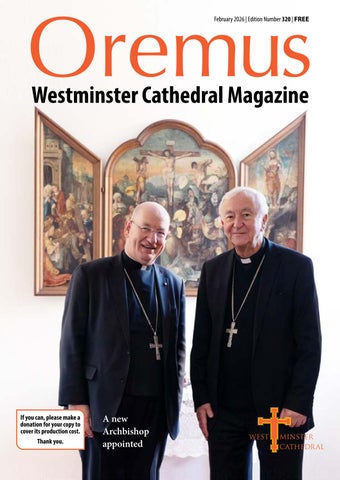
On Friday 19 December, at 11am, it was announced that the Holy Father had appointed the Rt Rev Richard Moth, Bishop of Arundel and Brighton, as the 12th Archbishop of Westminster, succeeding Cardinal Vincent Nichols. That afternoon, we were joined by the Archbishop-elect and the national media in the Throne Room of Archbishop’s House for a live-streamed press conference chaired by Mr Alexander DesForges, His Eminence’s Press Secretary. Following the announcement, Cardinal Nichols ceased to be the Archbishop of Westminster, and his right to wear the woolen pallium in the Diocese. Rather, he became the Apostolic Administrator until the installation of his successor. Pictured here, in Archbishop’s House, the two men make their way to the Throne Room.

© Mazur/CBCEW.org.uk

Inside Oremus

From the Editor 5

12th Archbishop of Westminster appointed 6

Archbishop Richard Moth, a Biography 7

A Three-Month ‘Holiday’ by Fr Patrick Ebenezer Amonoo 12

Cathedral History in Pictures: Future Archbishop of Westminster and former Administrator 19

Thank you, Your Eminence 27

Features

Homily: 80th Anniversary of the Inaugural Meeting of the United Nations by Cardinal Vincent Nichols 8 & 9

A Jubilee of Prisoners by Archbishop Richard Moth 10

Emancipation and Newman by Joanna Bogle 11

Gold, frankincense, and more gold by Julia Lechowicz 13

Nicholas Robinson, OBE 17

Book Review by Fr Nicholas Schofield 18

Henry Clutton: the Forgotten Architect by Philip Fowke 20

St Francis Leprosy Guild 21

Little Nellie of Holy God by Alan Frost 26

Regulars

Monthly Album 14 & 15 The Friends 16

Poem and Crossword 22

In Retrospect: 100 and 70 years ago 23

Diary and Notices 24 & 25

Oremus

Lorcán writes

In November 2020, when Cardinal Vincent Nichols reached his 75th birthday he submitted his resignation as Archbishop of Westminster, as required by Canon Law. Although mandatory, a bishop’s resignation is subject to the will of the Holy Father and, as was his prerogative, Pope Francis asked that Cardinal Nichols remain in his post until his 80th birthday; the age at which Cardinals retire from dicasteries and conclaves. Following his 80th birthday in November 2025, speculation reached a fever pitch, with certain names being declared with absolute authority. However, as Canon Cronin put it; ‘those who know don’t say, and those who say don’t know.’

Having booked Friday 19 December off, to use the last of my annual leave before Christmas, it became apparent earlier in the week that I would need to reschedule, as an announcement would be made that morning. At 11am it was announced that Pope Leo XIV had appointed the Rt Rev Richard Moth, Bishop of Arundel and Brighton, as the 12th Archbishop of Westminster. At 12 noon that afternoon, media organisations gathered in the Throne Room for a press conference with a very cheerful Cardinal Vincent Nichols and Archbishop-elect Moth. Despite the busman’s holiday, I was glad to be present at the conference, and to meet the Archbishop-elect at the door of Archbishop’s House.

Following the appointment, Cardinal Vincent’s role as the Metropolitan Archbishop of Westminster ceased, and he became the Apostolic Administrator of the Diocese, which he will remain until the Installation Mass later this month. As such, he no longer wears the woollen pallium; that symbol of spiritual and regional jurisdiction, representing Christ the Good Shepherd carrying the lamb on his shoulders. Interestingly, as former Archbishop of Birmingham, Cardinal Vincent has received two pallia over the years. One of these will be worn and the other will form a pillow, when (hopefully many years from now) he will meet his Maker. The Pope will confer a new pallium on Archbishop Moth later this year on the feast of Ss Peter and Paul, 29 June.

Looking ahead to the month of February, there will be a Mass of Thanksgiving for Cardinal Vincent at 5.30pm on Thursday 5 February, and all are most welcome to attend. At 2pm on Saturday 7 February, we will also celebrate the Lourdes Mass of the Sick, with the Sacrament of Anointing. On Friday 13 February, at 5.30pm, we will be joined by the Archbishop-elect for Vespers, followed by his Installation Mass on Saturday 14 February at 12 noon. More details about these services will be shared in the Cathedral newsletter in due course. Following the Installation, Archbishop Moth will celebrate the 12 noon Solemn Mass (livestreamed) on Sunday 15 February, and the 8am Mass on Ash Wednesday, 18 February. The following Saturday, 21 February, we will welcome those who are preparing to be received into the Church at Easter at the Rite of Election.

Westminster Cathedral

Cathedral Clergy House

42 Francis Street

London SW1P 1QW

Telephone 020 7798 9055

Email chreception@rcdow.org.uk www.westminstercathedral.org.uk

Cathedral Chaplains

Fr Sławomir Witoń, Dean

Fr Patrick van der Vorst, Precentor

Fr Michael Guthrie

Fr Vincent Mbu’i SVD

Fr Paul Zhao SVD

Fr Hugh MacKenzie

Rev Paul Christian (Cathedral Deacon)

Fr Javier Ruiz-Ortiz (priest in residence)

Also in residence

Franciscan Sisters of Our Lady of Victories: Sr Jesuina, Sr Angelina and Sr Mariana

Music Department

Simon Johnson, Master of Music

Peter Stevens Obl. OSB, Assistant Master of Music

Alexander Robson, Organ Scholar

Cathedral Manager

Peter McNulty

Parish Safeguarding Representative

Trevor Koschalka westcathsg2@safeguardrcdow.org.uk

Cathedral Finance Manager

George Kulasingham

Cathedral Fundraising Manager

Laura Dudhee

Chapel of Ease

Sacred Heart Church

Horseferry Road SW1P 2EF

Oremus

Bishop Richard Moth appointed 12th Archbishop of Westminster

On hearing of his appointment, Archbishop-elect Moth said:

On Friday 19 December, at 11am, it was announced that Pope Leo XIV had appointed the Rt Rev Richard Moth, Bishop of Arundel and Brighton, as the 12th Archbishop of Westminster, succeeding Cardinal Vincent Nichols. That afternoon, we were joined by the Archbishop-elect and media representatives in the Throne Room of Archbishop’s House for a live-streamed press conference chaired by Mr Alexander DesForges, His Eminence’s Press Secretary.

His Holiness Pope Leo XIV has today, 19 December, appointed the Right Reverend Richard Moth as Archbishop of Westminster. Ordained to the priesthood for the Archdiocese of Southwark on 3 July 1982, Archbishop-elect Moth has served as Bishop of Arundel and Brighton since 2015. Prior to that, he was the Catholic Bishop of the Forces from 2009 to 2015.

Archbishop-elect Moth will become the 12th Archbishop of Westminster, succeeding Cardinal Vincent Nichols, who has served in the role since 2009. Cardinal Nichols will now become Apostolic Administrator of the Diocese of Westminster until Archbishop-elect Moth is installed at Westminster Cathedral on Saturday, 14 February 2026.

‘I am moved greatly by the trust that Pope Leo has placed in me, in appointing me to the Diocese of Westminster. As I prepare to move to the Diocese, I am so grateful for the support being given to me by Cardinal Vincent Nichols at this time. He has given dedicated service to the Diocese and will be missed greatly.

Serving the Diocese of Arundel and Brighton has given me the wonderful opportunity of sharing the Church’s mission with lay faithful and clergy, and I give thanks for the many blessings of these last ten years.

My first task will be to get to know the priests and people of Westminster and I look forward, now, to serving them. With them, and building on the firm foundations that have been laid by so many down the years, I look forward to continuing the great adventure that is the life of the Church and witness to the Gospel.’

Cardinal Vincent Nichols said:

‘I am delighted at this news. Archbishop-elect Richard will bring to our Diocese many gifts and considerable episcopal experience from his years of ministry in the Diocese of Arundel and Brighton, and before that as Bishop of the Forces. I look forward very much to his Installation as our new Archbishop on Saturday, 14 February 2026. It is, of course, St Valentine’s Day, as well as the feast of Saints Cyril and Methodius, co-Patrons of Europe.

I remember being present in Westminster Cathedral on 29 September 2009 for the Episcopal Ordination of Bishop Richard as Bishop of the Forces. So today I can say: “Welcome back, dear Bishop Richard. You are most welcome indeed.”’

Archbishop Richard Moth, a Biography

Archbishop Richard Moth was born in Chingola, Zambia, in 1958. He was brought up in Kent and, after leaving The Judd School, Tonbridge, began formation for the Priesthood at St John’s Seminary, Wonersh. He was ordained priest for the Archdiocese of Southwark on 3 June 1982.

He served as assistant priest at St Bede’s, Clapham Park, before pursing studies in Canon Law at St Paul University, Ottawa. In 1987, he was appointed assistant priest at St Saviour’s Lewisham, during which time he also served as a Territorial Army Chaplain with 217 General Hospital RAMC(V).

He served as Private Secretary to Archbishop Michael Bowen from 1992 until 2001, during which time he was also

President of the Interdiocesan Tribunal of Second Instance of Southwark and Vocations Director. In 2001 he was appointed Vicar General and Chancellor of the Diocese.

He was ordained Bishop of the Forces on 29 September 2009 in Westminster Cathedral and served in this capacity, until his appointment as Bishop of Arundel and Brighton on 21 March 2015.

He is Chair of Governors at St Mary’s University, Twickenham, Chair of the Department for Social Justice of the Catholic Bishops’ Conference of England and Wales and Liaison Bishop for Prisons. He serves on the Standing Committee of the Bishops’ Conference. He chairs The Plater Trust, dedicated to the support of projects across England and Wales

that put into practice the principles of Catholic Social Teaching. He is also a member of the Mixed Commission of the Bishops’ Conference – a body that brings together bishops and those living Religious Life.

His Grace has been an Oblate of Pluscarden Abbey for over 40 years and is a member of the Equestrian Order of the Holy Sepulchre of Jerusalem, travelling many times to the Holy Land. In 2020 he was appointed Prior of the Southern Section of the Lieutenancy of England and Wales.

He is a Liveryman and Extra Court Member of the Skinners’ Company and a Freeman of the City of London, serving the Company as Chair of its History Committee.

On Michaelmas 2009, Mgr Richard Moth, Vicar General of the Archdiocese of Southwark, was ordained Bishop of the Forces in Westminster Cathedral.

A Service of Thanksgiving: 80th Anniversary of the Inaugural Meeting of the United Nations

On Saturday 17 January 2026, Cardinal Vincent Nichols attended a Service of Thanksgiving in Methodist Central Hall, the location of the first General Assembly of the United Nations (January 1946).

Your Royal Highness, Your Excellencies, distinguished guests, ladies and gentlemen, dear friends, it is a great privilege to stand before you today in this Hall, where exactly 80 years ago the seeds of a fresh global framework were sown.

On 10 January 1946, as the echoes of the Second World War still reverberated across a shattered continent, representatives from 51 nations gathered here, not as victors and vanquished, but as wayfarers on a shared path towards peace. They came to shape the United Nations, an audacious dream born of necessity: that humanity, scarred by unimaginable loss, could choose cooperation over conflict and dialogue over destruction. Today, we gather in thanksgiving – not merely for that moment, but for the enduring flame it kindled, a light that continues to guide us through our own troubled times.

As we look back on 1946, let us honour those who gathered in this Hall. They were not superheroes cloaked in invincibility, but ordinary souls burdened by the extraordinary grief of families torn asunder, cities reduced to rubble, a world that had lost faith in its own goodness. Yet here, in this Methodist sanctuary – a beacon of the Gospel’s call to justice and mercy – they dared to envision something greater. The United Nations was no abstract treaty; it was a covenant, etched in the memory of the horrors of the Holocaust, the firebombing of Dresden, Coventry and Tokyo, the atomic clouds over Hiroshima and Nagasaki. It declared, with quiet

defiance, that vengeance yields only ashes, while diplomacy ploughs the soil for renewal. They pledged ‘to save succeeding generations from the scourge of war’ (Preamble of the Charter). One delegate later wrote of kneeling here in prayer, whispering for wisdom beyond borders.

80 years on, that vision endures, embodied in your presence here, Your Royal Highness, Your Excellency António Guterres, Secretary-General of the United Nations, and representatives of His Majesty’s Government, diplomats from across the globe, civic leaders, students and members of the public. Your presence

reminds us that peace is not simply the concern or privilege of the powerful, but a cornerstone of the protection and enjoyment of fundamental human rights for every person. Looking again at the candles that have been lit, we thank God for the UN’s many works: for the defenders of peace, for its tireless workers, for aid workers and their agencies, and for the patient work of mediators. Moments from these 80 years come flooding back: blue helmets in Cyprus, mediating the Cuban Missile Crisis (an afternoon which I remember vividly as a student at school), feeding millions in Ethiopia,

Cardinal Vincent Nichols
Oremus
Cardinal Nichols with UN Secretary General Antonio Guterres.

and vaccinating billions in the shadow of COVID. These are not metrics; they are mercy made manifest, threads woven into a tapestry of hope.

Yet, as people of faith, we cannot shy away from honest reckoning. Today, multilateralism faces fierce headwinds. Conflicts rage from Ukraine, across parts of Africa, in the Middle East; climate accords are stalled; and the digital age fractures our shared truths into echo chambers of division. We hear proclamations of peace yet see aggression used as its means. But such proclamations are only for a peace that suits the aggressor. The very idea of nations working with trust, purpose, accountability and patience feels, at times, like a whisper against the clamour of nationalism and protective isolation. This we see also in the plight of refugees turned away at borders and in the erosion of trust that once bound us together. How, then, do we rekindle the spirit that once found expression in this Hall?

Here, the Christian faith offers a timeless compass. The Gospel we have heard reminds us that the work of peace begins in the heart of every person. St Paul puts before us the behaviour that is needed: mutual respect and service, hospitality to

Companions of Oremus

the stranger, patience, empathy, freedom from revenge, the pursuit of the noble and the good.

In this belief, peace is a gift which is both present and ultimately victorious. ‘Peace is the breath of the eternal: while to evil we cry out ‘Enough’ to peace we whisper ‘Forever’ (Message of Pope Leo XIV for World Day of Peace, 1 January 2026). When peace becomes a principle that guides and defines our choices, then that profound sense of the unity of our human family is refreshed. And this unity is not simply a political expedient, but a divine imperative. Our search for peace and our prayer for unity are inextricably bound together.

‘With this in mind,’ as Pope Leo XIV said in his address on 9 January 2026 to the Diplomatic Corps accredited to the Holy See;

‘the United Nations has mediated conflicts, promoted development and helped States protect human rights and fundamental freedoms. In a world facing complex challenges such as geopolitical tensions, inequalities and climate crises, the UN should play a key role in fostering dialogue and humanitarian support, helping to build a more just future.

We are very grateful for the support of the following:

Leticia Dominguez Abada

Lally Ambatali

Leonila V Bennabe

Keith Best

Dr Stuart Blackie

Anne Veronica Bond

Lolita Botanes

Richard Bremer

Hajnalka Burai

Lorenzo Cabrelli

Mrs Erlinda Chin

Francis George Clark

R & L Collyer-Hamlin

Daniel Crowley

Benedicta Jamogha Dako

Angelita Caronan Duran

Cora Emflorgo

Angelita Emperador

Ms Georgina Enang

Fr Joseph Farrell K.H.S.

Ruby & Joseph Farrell in memoriam

Fred Gardiner

William Gardner-Hunter

Juanita Grecalda

Connie Gibbes

Zoe & Nick Goodway

Rosalinda Grimaldo

Agnes Haein Kim

Mrs Valerie Hamblen in memoriam

Amanda Hill

Jithro and Ira Nadine Hangad

Bernadette Hau

Mrs Cliona Howell

Alice M Jones & Jacob F Jones

Poppy K

Rosanne Kay

Mary Thérèse Kelly

John Langan

David Lawton

Raymund Livesey

Alan Lloyd in memoriam

Clare and John Lusby

Tony McGee

Linda McHugh

Christiana Thérèse Macarthy-Woods

Ms Ludivina Mangmang

James Maple

Paul Marsden

Mary Maxwell

Dr Denis Moloney

Dr George Morris

Abundia Toledo Munar

Euphrasie Mundele Kilolo

Chris Stewart Munro

Efforts are therefore needed to ensure that the United Nations not only reflects the situation of today’s world rather than that of the post-war period, but that it is also more focused and efficient in pursuing policies aimed at the unity of the human family instead of ideologies.’

Today, then, we pray for the gift of renewal, remembering the words of St Paul, not known for his timidity, when he tells us, ‘do not claim to be wiser than you are.’ In this renewal, belief in God is not a problem to be solved, but a great resource to be rediscovered. Here, then, we pray for peace, which is always the work of God; for dialogue and cooperation between nations for the common good, the good from which no one is excluded; for the renewal of our international institutions so that national and international power may be used in the cause of a lasting peace based on justice, on respect for the dignity of every person, and on compassion for the poorest in our midst. Then we shall all breathe more easily and readily give praise to God.

May the God of all nations bless these endeavours, unite our wills and guide us so that dialogue may prevail and peace be our common inheritance.

Amen.

Mrs Brigid Murphy

Kate Nealon

Cordelia Onodu

Nigel Parker

Cris Ragonton

Alan Rainer

Clementina Rokosu

Precy Salvador

John Scanlan

Veronica Scrope

Sonja Soper in memoriam

Tessa and Ben Strickland

Yollie Sumayod

Julia Sutherland

Eileen Terry

Robin Michael Tinsley

Lucila Torrefiel

Peter W Wilson in memoriam

Dr Timothy I Young in memoriam

Peter and Teresa Zurenkas and of our anonymous Companions

If you would like to become a Companion of Oremus, see page 2

A Jubilee of Prisoners

In December 2025, Bishop Richard Moth travelled to Rome for the Jubilee of Prisoners (Gaudete Sunday) with the Holy Father, as the Liaison Bishop for Prisons in England and Wales. Below is a reflection he penned for the occasion in Inside Time; the National Newspaper for Prisoners and Detainees. It was while he was on this trip to Rome that he received a call from the Nunciature in Wimbledon, informing him that Pope Leo had appointed him as the 12th Archbishop of Westminster.

Dear brothers and sisters,

During this last year, the Church has been celebrating a Jubilee Year – the Jubilee of Hope. The year was opened by Pope Francis on Christmas Eve last year, with the opening of the Holy Door of St Peter’s in Rome. During the year a vast number of people made a pilgrimage to Rome and there were celebrations on most weekends during the year, focusing on the many different groups of people who form the family of the Church. This weekend is a special moment for all those, across the whole world, who are in prison, for this weekend the focus is the Jubilee for Prisoners.

Perhaps a Year of Hope is not easy for us all. There may still be some time left on a sentence; there may be anxiety about a coming court appearance; there may be worry about family or concern about what will happen after release.

Within the confines of the cell and the regime in prison, it may not be easy

to think about a pilgrimage to Rome. Yet, the fact that Pope Leo and the crowds who will gather with him in Rome this weekend to pray especially for you is a reminder that nobody is ever abandoned by God, who loves each and every one of us. Even when we have gone down the wrong road in life, the love of God is always there for us, just as it is there for our families, our loved ones and those who have been affected by our actions.

The readings at Mass this Sunday are all about the theme of waiting. Perhaps, like the people in Isaiah’s time, we feel that we are in a desert place, that we are weak and anxious. Isaiah reminds us that God will come to save us.

Perhaps, like the people to whom John the Baptist had preached before he himself was sent to prison, we are looking for something, someone. Jesus tells the people that he is the one we seek. Jesus has indeed come – we are going to be celebrating his birth in 11 days’ time – and we know that he is always with us.

St James, in his letter from which we hear today, writes about patience. This can be a real challenge, especially when time seems to drag and one day simply follows the next with little change. Fixing our minds on the person of Jesus, knowing that it is him we seek, brings life in the desert.

Just as the pilgrim to Rome can go through the Holy Door of St Peter’s, so the door of hope is always there for us. The door of the cell may be closed for many hours each day, but Jesus is always with us. Allowing him to give us the gift of hope changes our lives – and there is no place that Jesus cannot reach if we open the door to him.

Pope Leo and the many pilgrims in Rome are praying very specially for you today. I am with them and am remembering you all very particularly at Mass in St Peter’s with the Holy Father. May the Lord Bless you with his gift of Hope now and always.

Bishop Moth at the launch of ‘Remember Me; a Catholic Approach to Criminal Justice’ in the London Oratory, 26 November 2024.
The Most Rev Richard Moth

Emancipation and Newman

In 2029, the Roman Catholic Church in the UK and Ireland will celebrate the 200th anniversary of the Catholic Emancipation Act, with a number of commemorative events. It is fascinating to explore just how different the Britain of 1829 was, and the general atmosphere in which the Act was achieved.

London is a collection of villages. In the early 1800s, when St John Henry Newman was a young boy, his family moved from their home in the City of London—then, as now, the financial heart of the capital—to the newly thriving suburb of Bloomsbury. Today, the house where Newman lived at 17 Southampton Place bears a plaque commemorating him. This area, encompassing the British Museum and London University, boasts many large townhouses, some of which are now university residences, including Newman House, the University Catholic Chaplaincy.

Not far from here (but a world away), High Holborn runs in a straight line west, towards Tyburn. This was the ancient route taken for public executions, hallowed by the Catholic martyrs who died there in the 16th and early 17th centuries. Thankfully, such horrors had ceased by the time Newman was born, with the last execution taking place in 1783; a highwayman named John Austin. A little further stands the old parish church of St Giles-in-the-Fields. The church originally formed part of a leper hospital, established in the 11th century. The hospital was closed under Henry VIII but the adjoining pub, The Angel, continued to offer humanitarian charity by offering a drink to any criminal en route to Tyburn; hence the phrase ‘off/on the wagon’. This long-standing tradition is still recalled at the pub, as discussed when I dropped in to enquire.

Times change. In 1780 a Catholic Relief Act had abrogated the most severe antiCatholic legislation, but full Emancipation would only be achieved in 1829, due to the Napoleonic Wars, increasing Irish unrest, and the rise of industrialisation.

Less than a decade later, the teenage Victoria had ascended to the throne and, during her reign, the Catholic Church in Britain boomed. One of the great lights of that era was, of course, St John Henry Newman. After years of distinguished work in the Church of England, he was received into the Catholic Church in 1845 and ordained a priest in 1847.

One of the most important insights he gave us pertained to the authentic role of the Church in society, and the nation. Prior to Catholic Emancipation, this was a source of real tension between the old Catholic landowning families—those who had held on to the Faith in grim times, and whose loyalty to the Church had cost them their rightful place in public life and service—and the Vicars Apostolic who led the missions, ministering to them and to the scattered Catholic flock more broadly. At the time, many clergy believed that the only authentic model was a Catholic monarch reigning over a Catholic (confessional) state, with the Church maintaining a formal, privileged position. The laity, however, merely sought enough freedom for the Church to flourish. Eventually, this latter view would prevail. It was one that Newman would in turn support, writing that, with respect to the Government and authorities, ‘we simply ask that they leave us alone’. This understanding of the role of a free Church was also well expressed by Pope St John Paul II when he urged that ‘the Church proposes, she does not impose’. It leaves open the various possibilities for the Church to assume her rightful place in the life of the nation; she does not have to propose herself as merely one option among many, nor is it right, or necessary for her to belittle her role in shaping and forming society, including its lawmakers and its laws.

Post-1829, Catholics made good use of their new-found freedom and became active in public life. Over the past two centuries we have seen, and the nation has benefited from, many Catholics serving as Members of Parliament, local councillors,

mayors, Justices of the Peace, and leaders in a range of organisations in civic life. And yet we need more! The call to public life is a call to Christian service. Like most Catholics of his era, Newman had to cope with the common public understanding of the Church as something fearful and oppressive; rooted in the martyrdom of many Protestants in the reign of Queen Mary I, and nourished by publications that routinely warned of ‘Papal aggression’. However, by the end of his life Newman was widely revered. His funeral was a major and public event, and The Times even published an obituary honouring his work and achievements.

In 2025, Newman was officially proclaimed a Doctor of the Church, our King attended Mass here at Westminster Cathedral, flew to Rome for a State Visit with Pope Leo XIV, and enthusiastically visited the Birmingham Oratory to see the room (now a shrine) where Newman lived and worked. All of this has a sense of being, not only right and good, but spiritually nourishing for our country, with a message of goodwill for the future. Meanwhile today, the Church in Britain faces new challenges. While we have recently noted increasing numbers of young people at Mass, there is an uncomfortable awareness that many pupils at our Catholic schools do not practise the Faith. The country faces a crisis in social cohesion and in family life. More than half of all children do not live with married parents. AntiCatholic prejudices have also not gone away, particularly among enthusiasts who promote abortion on demand, or oppose the Christian understanding of marriage as the union of a man and a woman.

History is not tidy, nor does it form one straight path. But it can be illuminated by the lights of the saints; the martyrs along the way to Tyburn and the boy growing up not far from that via sacra. We honour them together in our great Cathedral here at Westminster, just down the street from where Catholic Emancipation was finally enacted.

Oremus

A Three-Month ‘Holiday’

As the Psalmist said, ‘I rejoiced when I heard them say let us go to the house of the Lord’ (122:1). This was my mood when I received a phone call from my bishop, the Most Rev Charles Gabriel Palmer-Buckle, Metropolitan Archbishop of Cape Coast, Ghana, sending me to London for a holiday. I received the news of coming to Westminster Cathedral with both hands, knowing its historical and international significance, and arrived on 7 October last year. Life in Westminster Cathedral is exciting and I am not surprised about the rich and insightful experience I have gathered here, because I expected it.

Cardinal Vincent Nichols practically taught me what it means to be a servant leader. His humility and affability cannot be gainsaid. The first time we shook hands, he smiled and asked, ‘Patrick, how are you keeping?’ I could not hide my excitement. I said to myself, ‘waoooow the Cardinal of Westminster called me by my name.’ Mgr Hayes, the Vicar General, also regularly gave me audience out of his busy schedule to know how I was faring.

In Clergy House, the Dean, Fr Witoń has been so inspiring and supportive. I received my lost bag three days after my arrival but, in the meantime, he had provided basic things in different forms to keep me going. The rest of the Chaplains and the Franciscan Sisters of Our Lady of Victories welcomed and related with me as a brother; coaching me about the culture and practices of the Cathedral. Coming from different countries and cultural backgrounds, the Chaplains offered me the opportunity to learn how to live a community life. It was a community of unity in diversity and diversity in unity. Honestly, I can’t thank all these amazing clergymen and women enough. The Cathedral staff, volunteers and parishioners interacted with me as though I have been here for years. They created the space for me to mix well.

Reflecting on both liturgical and para-liturgical activities in the Cathedral, I think it has been another seminary experience for me. I must confess, the first time I sang the key parts of the Mass in the 18 years of my priestly life happened here in Westminster Cathedral. It was a learning experience that I will carry with me. To this, I thank the music directors: Simon, Peter and Alex. I have not visited Rome before, but my instincts tell me that the liturgy here is no different, as this Cathedral is Roman to the core. The internationally recognised Choir (and School) makes the liturgy very solemn and Catholic.

Additionally, I always thought the Sacrament of Confession to be the least patronised Sacrament. However, this perception has since been changed by the parishioners and visitors to the

Cathedral. I wish other cathedrals and parishes would encourage and rejuvenate this all-important Sacrament. Praying Lauds and Solemn Vespers together also reconnected me to the seminary, and further strengthened my love for the Divine Office. The parishioners’ heavy presence, active participation and support motivated me a lot. This attitude encourages priests to give up their best. As for the Christmas services in the Cathedral, the less said the better; I will not have enough space to talk about them. They sent me to the real nativity scene in the Holy Land. In fact, to serve in Westminster Cathedral as a priest is an honour and a blessing. I thank all and sundry for your unstinting support and for your prayers. I wish you all God’s abundant blessings and a very happy New Year.

Fr Patrick Ebenezer Amonoo

Gold, frankincense, and more gold

I remember November 2019 quite fondly; what began as a school trip to the famous Christmas markets in Germany turned out to be so much more. Standing before the entrance to Cologne Cathedral, a Gothic masterpiece dating back to the 13th century, gave me goosebumps. Upon entering the cathedral, I was transported to what felt like medieval Germany. There was a profound silence that echoed the simplicity of life back then. It was a peaceful contrast to the vast crowds that accumulated later that morning and, with the sun on the rise, each intricate detail on this spectacular building was made apparent. To sum it up, the words of St Augustine come to mind, as I felt I had ‘seen the lines drawn by architects, some of them as fine as a spider’s web.’

Countless numbers of saints and figures linked to Germany’s past are depicted in an array of mosaics, stained glass windows and carved in stone. As the saying goes, ‘True craftsmanship is love made visible in every detail’, and you can certainly see the love and care put into it. It was quite impossible to take it all in—after all, construction began in 1248 and it was only completed in 1880!

The ambulatory and various chapels around the cathedral also house the remains of notable political and religious figures, including the tombs of at least a dozen archbishops. Among them are Richeza of Lotharingia, a member of the Ezzonen Dynasty who later became Queen of Poland, and Clemens August of Bavaria, a member of the Wittelsbach Dynasty.

When I returned to Cologne Cathedral last November, I realised that I had not fully appreciated the significance of the treasures within her walls, particularly those connected with the Epiphany. Was it a mere coincidence that I arrived on the Eve of Advent? Despite being hit by 14 bombs during the Second World War, the soaring 157m tall structure remained miraculously intact amidst the ruins of Cologne. The stainedglass windows, which were destroyed or removed for protective reasons, were replaced in 1948. The oldest surviving glass is located in the Axial Chapel of the Three Kings, which contains a ‘Bible window’ depicting the History of Salvation. Adjacent to it lies a great treasure; one of the largest reliquaries in the world. Found in the apse, the golden sarcophagus is believed to contain the bones of the Magi, who visited the Christ Child and paid

him homage. It is decorated with gold and silver, bearing intricate depictions of the Magi, the Virgin Mary, and key events of Jesus’ life around the exterior casing.

The remains were first carried to Constantinople by the Empress Helena, the saintly mother of Constantine the Great. After being brought to Milan by Bishop Eustorgius I, Frederick Barbarossa, the Holy Roman Emperor, took the relics in 1164 and gave them to Rainald of Dassel, the Archbishop of Cologne. Subsequently, the relics were transferred to Cologne, where the gilded Shrine of the Three Kings was built. Today, Cologne Cathedral is the most visited site in Germany, with approximately four million visitors each year, owing to its rich history and, not to mention, beauty.

Another treasure of Cologne, adjacent to the cathedral, is the 10th century Church of St Andrew where St Albertus Magnus, a Doctor of the Church, is buried in the crypt. A former student of St Thomas Aquinas, his legacy laid the foundation for Scholasticism, and his writings have influenced countless theologians and scientists over the centuries. To mark the 700th anniversary of his death, Pope St John Paul II visited the tomb and, in his words, affirmed the significant contribution St Albertus made, referring to his ability to ‘ward off error’ (and so, I ask for their intercession as I make the attempt to read Summa Theologiæ).

Not one, but two large reliquaries are found in this church, both of which resemble the Shrine of the Three Kings. Although at first glance they appeared to be replicas, it seemed like I had struck gold again! One reliquary, located in the apse, is believed to contain a bone from the arm of St Andrew the Apostle. The other, a gilded sarcophagus, slightly smaller than that of the Magi, is believed to contain the relics of the seven Maccabean brothers and their mother, Salome! Despite being preChristian martyrs, the veneration of the Maccabean relics was notably endorsed by the early Church Fathers, by the likes of St Gregory Nazianzus and St Augustine of Hippo, particularly due to miracles attributed to them.

Running out of time, there was still much more to see. Glancing back at the cathedral over the road, I made a promise. I will return again. One day.

Closing the Jubilee Year

On the feast of the Holy Family, as Rome began the process of sealing the Holy Doors, Cardinal Vincent formally closed the Jubilee Year in the Diocese of Westminster, pictured here with his MC ‘dream team’. In the days prior, Fr Witon received the travelling Jubilee Icon, written by Ethiopian artist Mulugeta Araya. Based on Luke 4:16-21, it was displayed in St Joseph’s Chapel before ending its journey in St Barnabas’ Cathedral, Nottingham.

A Symons Family Donation

Back in November, we were joined by the family of William Christian Symons, the artist responsible for much of the Cathedral’s interior decoration, including the Rood and the Holy Souls Chapel. They kindly donated two small paintings to display in Clergy House, including a framed Christmas card, for which we are most grateful.

Christmas 2025

From Monday 1 December, Christmas preparation was in full swing with school nativities and carols, including the SVP School, Woldingham School, Westminster Cathedral Choir School and Pre-Prep, along with the HCPT carols and the famous Catholic Children’s Society services (complete with donkeys and goat). We held our annual parish carols—as did The Friends—and two nights of ‘A Christmas Celebration’. We hosted carol services for the Institute of Civil Engineers and the Polish Catholic Mission, and a Sankta Lucia service with the Swedish Church, filmed by CNN. By Midnight Mass, a new Archbishop had been appointed, and Cardinal Nichols (now Apostolic Administrator) celebrated the Christmas season without his woollen pallium.

Cathedral Floor

After many months of sanding and varnishing, the restoration of all 1,800m2 of pitch pine parquet flooring is finally complete. Thank you to all who contributed so generously to the restoration; it has certainly had an enormous visual impact and should last for many years to come!

Christmas Fair

Thanks to the dedication of our volunteers and donors, the 2025 Christmas Fair raised a grand total of £6,408! Pictured here, Mercy keeps a watchful eye over the tea and coffee stall.

Oremus

Last year’s achievements and the road ahead

A big thank you to everyone who supported our Big Give campaign to raise funds for the renovation of the Cathedral Hall windows. During the December campaign, £20,455 was donated online between 2 and 9 December, which, with matched funding, generated a total of £40,455. Across both the Easter and Christmas campaigns, almost £100,000 has now been raised for the windows, including Gift Aid and several generous cheque donations made outside the Big Give platform. Just under £65,000 was paid out for work completed in summer 2025, leaving a balance of a little over £35,000 towards the next phase of work planned for this coming summer. It is likely that further funds will be needed, and more details will be shared in the March Oremus.

Funds raised last summer for the new candle store are currently held and ready for construction, which should be able to proceed during the school summer holidays this year. At Easter we are likely to return to the theme of light for fundraising, which feels especially appropriate. Our 2022 and 2023 appeals contributed £300,000 towards the new lighting of the sanctuary and nave. One area not yet refurbished is the set of original chandeliers, which have been in place for over 120 years and are now in need of renovation. Full details will again follow in the March Oremus.

Events

Since our entry in the December Oremus we have run four events. On Thursday 27 November we held a preChristmas Party in Clergy House Library, with a visit to the Lady Chapel for carols by candlelight. We are very grateful to Edward Picton Turbervill for playing the piano and the organ, and to mezzo soprano Lydia Shariff, for her performance and carols.

On 22 November we walked the Jubilee Walk from English Martyrs, Tower Hill, via St Mary Moorfields, Charterhouse Monastery, Ely Place, St Anselm and St Cecilia, Kingsway and Maiden Lane, to Westminster Cathedral. The weather forecast was poor which reduced attendance to 25. In the outturn the weather was not as forecast, although it did rain throughout the walk from Maiden Lane to the Cathedral. Those who walked enjoyed the experience, and all of the churches along the way were very welcoming.

Our regular quizzes also continued on 11 December and 14 January with Fr Hugh McKenzie and Deacon Paul Christian as quizmasters.

Upcoming Events

We have a number of events planned and warmly encourage you to support us by attending. All events take place in Westminster Cathedral Hall and begin at 6.30pm.

Orion Symphony Orchestra –Vivaldi’s Four Seasons

Wednesday 25 February 2026

We are delighted to welcome the Orion Symphony Orchestra, which offers exceptional young musicians the experience and mentorship needed to transition from conservatoire to professional careers. Please join us to support these rising artists while enjoying Vivaldi’s much-loved masterpiece.

Tickets £20, including post-concert refreshments: tinyurl.com/Concert-25022026

Quizzes: February & March 2026

Quiz tickets are £20, including a fishand-chip supper. Drinks are available to purchase.

Thursday 12 February 2026

(replacing the quiz previously advertised for 5 February)

Quizmaster: Fr Mike Guthrie

Tickets: tinyurl.com/Quiz-12022026

Thursday 12 March 2026

Quizmaster: Fr Patrick van der Vorst

Tickets: tinyurl.com/Quiz-12032026

The quizzes are great fun and a wonderful opportunity to meet fellow parishioners. Attendance currently hovers between 40 and 50, with 7 or 8 teams, but Cathedral Hall can accommodate many more. If you could form a team from a group you belong to – or even invite another parish – please do get in touch.

Talk by Fr Patrick van der Vorst

Thursday 19 February 2026

‘Is there such a thing as objective beauty – or is beauty simply in the eye of the beholder?’

Fr Patrick will explore how true beauty is not merely subjective but objective – reflecting God himself. Drawing on Scripture, theology, and art, he will show how beauty originates in God, speaks to the human heart, and ultimately leads us back to him.

Tickets, £10: tinyurl.com/Talk-19022026

Further Information

For more information about any event, or if you are unable to book online, please contact: friends@ rcdow.org.uk

Do also get in touch if you have an idea for a future event or would like to organise one for the Friends.

Andrew Hollingsworth

Nicholas Robinson, OBE

Hearty congratulations to Cathedral parishioner and volunteer, Nick Robinson, who was awarded an OBE in the 2025 King’s Birthday Honours, recognising his exceptional service to disadvantaged young people, charitable fundraising and music.

On 10 December, Nick was awarded his medal by HRH Prince William at an Investiture at Windsor Castle.

Having retired in 2017, after a distinguished career in education, including 19 years as Headmaster of King’s College Choir School, Cambridge, Nick soon realised that retirement didn’t suit him, and decided to continue shaping lives through his work with three charities. Future Talent, which he co-founded with HRH Katharine, Duchess of Kent in 2004, supporting gifted young musicians from low-income backgrounds in all parts of the UK, helping them overcome barriers to musical development and achieve their potential. Future Talent provides tailored support to 150 young musicians annually. Nick first met the Duchess of Kent 21 years ago when he invited her to visit King’s. At the time, she was working as a

voluntary music teacher at a primary school in east Hull, where she was known as ‘Mrs Kent’ by the pupils. Their meeting led to the founding of their charity.

Likewise, Nick is involved with The Listening Place, a charity with four centres in London where he volunteers to offer face-toface support to adults experiencing suicidal thoughts. He is also involved with Sibling Support, a child bereavement charity helping young people who have lost a sibling, as Chair of Trustees. The charity says:

‘Nick brings extraordinary empathy and clarity to our work. His steadfast belief in the potential of children and young people – especially those facing profound challenges – continues to shape our mission, our values, and our everyday approach.’

A passionate advocate for the arts, Nick started his conducting career as a teenager and has founded two community orchestras, offering musical opportunities to young musicians. He continues to champion music education and performance in schools and beyond. He even serves as Deputy Chair of Governors at Westminster Cathedral Choir School!

A much deserved award!

Catholics in London

Catholics in London 1800-1850; Jean Olwen Maynard; Gracewing, Leominster 2025; paperback 680 pp; ISBN 978-0-85244-709-3; £40.

The recent 175th anniversary of the ‘Restoration of the Hierarchy’ and establishment of a system of dioceses, including Westminster, has placed the spotlight firmly on the year 1850. It was, of course, a seismic moment in the history of the English Catholic community – but it did not come out of nothing. Catholic growth and revival had been underway since the 18th century, thanks to changes in attitude and law, the processes of immigration and urbanisation, and the growing confidence of Catholics at every level of society.

In Catholics in London 1800-1850, Jean Olwen Maynard gives a vivid and comprehensive portrait of this muchneglected period. The book begins in the aftermath of the Catholic Relief Acts of the late eighteenth century, which allowed for the opening of Catholic churches and schools, and the influx of French refugees from the revolutionary and Napoleonic regimes. These included clergy, aristocrats and royals; there is even mention of the future King Charles X of France distributing prizes at Somers Town.

Disabilities remained – Catholics could not sit in Parliament until 1829 nor were their marriages recognised in English law until 1836 – but the book shows the vitality of London Catholics. Take the example of Spitalfields. In 1832 two local workers, John Ryan and William Purcell, set up the East London Catholic Book Society so that articles in the Orthodox Journal, one of the leading Catholic journals of the time, could be read and discussed. A Spitalfields Catholic Association followed two years later, which eventually succeeded in opening a free school. The Catholic Revival was just as much the result of the work and vision of the laity (whether they be wealthy benefactors or zealous members of the faithful) as the clergy, all under the leadership of the Vicar Apostolic of the London District.

Through the pages there are descriptions of church openings, charities and associations, fundraising dinners and excursions, literary societies, notable converts and new devotions. Some of this sounds familiar; other aspects plunge us into an unfamiliar world. Maynard describes the melancholic duty of the priests at St Mary Moorfields in attending Catholics condemned to the gallows. Moreover, it was only during the 1840s that most London churches introduced free seating. Up until then pew rents were collected and free accommodation was the standing room near the entrance –perhaps one reason why many Catholics still instinctively sit at the back! During sung Masses with famous professional singers and musicians, prices could be high and many attendees were non-Catholic, giving the ambience of a concert hall to the church.

Much light is shed on the various immigrant communities present in London, providing links with events across the Channel. When the exiled Italian revolutionary Giuseppe Mazzini set up a school in Saffron Hill, the priest at the Sardinian Chapel (now Ss Anselm and Cecilia’s, Kingsway) threatened to refuse

Holy Communion to anyone who sent their children or attended lectures there. A ‘rival’ Italian school, firmly in Catholic hands, was set up shortly afterwards at Hatton Wall. The reverberations of the Risorgimento were thus being fought out among London’s Catholics.

The final chapters bring the reader to more familiar territory – the coming of the Jesuits and Oratorians, sermons by Newman, new churches in Southwark, Fulham and beyond, and the appearance of one Nicholas Wiseman. This is a long book (as reflected in its price) and clearly a labour of love. Due to its chronological rather than thematic structure, readers may decide to dip into it or use the index to follow a particular area or subject. The author has spent years researching the history of Catholic London, alongside her work for CAFOD. She has produced a number of works, including a history of the parish of Commercial Road (now available in paperback) and its community of the Sisters of Mercy (150 Years of Mercy), and is to be commended for her important contribution to our city’s Catholic heritage. Perhaps a volume on ‘Catholics in London 1850-1900’ might be next?

The original St Mary Moorfields Catholic Church, Finsbury Circus, 1827.

CATHEDRAL HISTORY A PICTORIAL RECORD

Future Archbishop of Westminster and former Administrator of Westminster Cathedral – October 2019

This delightful picture of Bishop Richard Moth of Arundel & Brighton, now Archbishop-elect of Westminster, and the late Canon Christopher Tuckwell, Cathedral Administrator (2008-20), was taken just before Solemn Pontifical Vespers on Saturday 22 October 2019. This ecumenical event was held in thanksgiving for the canonisation of St John Henry Newman on the previous Sunday in Rome, attended by HRH The Prince of Wales, now King Charles III.

The liturgy was attended by the Catholic Bishops and Archbishops of England and Wales, the Metropolitan Chapter, a number of Oratorians and secular clergy. There were also many ecumenical guests, including Justin Welby, former Archbishop of Canterbury, and Dame Sarah Mullaly, then Bishop of London.

Henry Clutton: the Forgotten Architect

Visitors to London will know the familiar outlines of the Houses of Parliament and Big Ben. The majestic contours of Westminster Abbey rise up in Gothic splendour as the tourist bus trundles by, only to enter the concrete corridor that is now Victoria Street. Two lone molars, the Prince Albert pub and Artillery Mansions, survive in a grimace of concrete dentures. But then, as the bus continues its way past the building site of the former Army and Navy stores, the panorama on our left unexpectedly opens out into a piazza revealing an eruption of red brick, crouching incongruously amid the Victorian apartment blocks. A profusion of galleries, arcades and domes jostle together culminating in a kind of soaring funnel. One might be forgiven for mistaking Westminster Cathedral to be one of London’s more eccentric power stations.

And yet how different this might have been. Imagine the same tour; passing Westminster Abbey, admiring its elevations and flying buttresses. The bus ambles down the bleak wastes of Victoria Street. Suddenly, two more Gothic spires peek out from above the office blocks, and we see to our left another mighty church almost equal to and in some ways even surpassing its medieval neighbour. The bus slows down, and we can now admire this imposing edifice of the 14th century in a distinctly French style. In size and scale it is not unlike Cologne Cathedral and we might notice how new it looks. In fact, begun in the 1870’s and only recently completed, this would have been the Westminster Cathedral that my great-grandfather designed for his cousin Cardinal Manning.

Henry Clutton (1819-93) was a notable architect who, in 1856 and in partnership with William Burges, won the competition for Lille Cathedral. His many commissions included the restoration of the Salisbury Cathedral Chapter House (1857), the Clock Tower at Cliveden (1867), the Sacred Heart Chapel at Farm Street (1863), and the memorial chapel at St Mary’s Chislehurst (1874) as requested by Eugenie, the last Empress of France, as a memorial to her late husband. He had also produced plans for the proposed Brompton Oratory in 1878, coming second in the open competition won by Herbert Gribble. Significant to our story was the commission to design St Francis of Assisi, Pottery Lane, but more of that later.

Clutton had been approached by Manning as far back as 1867 to prepare drawings for the future cathedral and these were sufficiently advanced by 1868 for the Cardinal to take them to Rome for the approval of Pope Pius IX. The brief had been that the new church be in ‘the earlier period of the English Style […] in favour of grandeur, stateliness, solidity, spaciousness and majestic elevation’ ( The Building News, 22 October 1875). The fact that there was no open competition coupled with Clutton’s familial

relationship with Manning, paved the way for a predictably hostile press; The Tablet being particularly strident. However, in 1875 the plans were published in The Building News, receiving a favourable review. It was felt that Clutton’s Cathedral ‘bore a striking resemblance to that of the Cathedral at Cologne both in the general proportions and length.’

It was estimated that this design would take as long as a century to complete, beginning with the lower portion of the nave built up to the triforium, and roofed over. The cost of this phase alone would have been in the region of £80,000, and it became clear to Cardinal Manning that the enterprise could not be undertaken without substantial funding guarantees.

By appointing a cousin without due consultation, and allowing the plans to reach such an advanced stage, the Cardinal found himself in a particularly awkward situation. Into the breach stepped the great church builder, Sir Tatton Sykes, 5th Baronet. Sykes offered to underwrite the costs of a new cathedral, provided that he could choose his own architect and Manning, rather disgracefully, agreed. Clutton must have felt doubly betrayed by this for, not only had he given six years to the project, but he sought no fee. Manning was unable to resolve the impasse and, having lost interest, the project was shelved. It was not until the succession of Archbishop Vaughan in 1892 that the problem was resolved with the appointment of a new architect. Clutton’s death a year later must also have eased any lingering embarrassments.

As I sit in the Byzantine spaces of the present-day Cathedral, I sometimes think of my great-grandfather and imagine being in his unbuilt masterpiece. It would be fitting that his contribution be acknowledged in some quiet corner. Oh yes, and about that commission to design St Francis of Assisi, Pottery Lane. Clutton’s young assistant, an articled clerk in his practice, was a certain Francis Bentley.

New year, ancient wounds, enduring love St Francis Leprosy Guild

January feels like a threshold. Turning the calendar invites us to imagine renewal, yet the Church reminds us that true renewal is not found in resolutions but in Christ’s healing presence.

Each year, World Leprosy Day is observed on the last Sunday in January. Having marked the day on 25 January, St Francis Leprosy Guild invites you to join us in remembering those who still live with the stigma and suffering of leprosy, year-round; particularly in this Jubilee Year of St Francis.

Although the disease is curable, over 200,000 people are still diagnosed annually, many in communities where stigma endures and access to care is limited. The disease persists not only in flesh but in perception and in the fear that isolates.

In Scripture, leprosy is more than a medical condition: it is a symbol of exclusion, of being cast to the margins. Yet Christ does not turn away. He stretches out his hand, touches the untouchable, and restores dignity as well as health. Christ’s healing is not a momentary cure; it draws the excluded back into communion. This is the kind of healing the Church is called to embody, not just in prayers or liturgy, but in presence. To sit beside those the world avoids and to offer welcome where walls remain.

At SFLG, we work tirelessly to bring this vision to life: restoring dignity, breaking down stigma, and ensuring that those affected by leprosy are not forgotten, but embraced. Yet we can’t do this alone. We need your prayers, your

partnership, and your support to continue walking alongside communities where exclusion still wounds and hope still waits to be born. A kind donation, whether large or small, helps provide treatment, education, and the simple but profound assurance that no one is beyond the reach of love.

As we keep the spirit of World Leprosy Day alive, we invite you to join us in this work: to give, to stand in solidarity, and to help make healing possible. We hope you can help us: stfrancisleprosy. org/donate.

A letter returned home

In a gesture of international remembrance, SFLG will be handing over an original letter from Fr Damien of Molokai to the Damien Museum in Tremelo, Belgium. Fr Damien is remembered for his ministry among those affected by leprosy on Molokai. The letter will join the museum’s collection in a quiet act of restoration and reverence.

Could you be our next Trustee?

At SFLG, the only Catholic leprosy charity in the UK, we are seeking a new trustee to join the board.

We would love to welcome someone who shares our commitment to faith, justice, and practical action. Trustees help shape our strategy, safeguard our values, and ensure that our work continues to bring hope where it is most needed.

If you have a medical background, experience in governance, fundraising, communications, or simply a heart for service, please contact Katharine Jones, Director of SFLG, at: Katharine.Jones@stfrancisleprosy.org.

St Francis Leprosy Guild (SFLG)
Fr Damien De Veuster, now ‘St Damien of Molokai’, by Edward Clifford.

Clues Across

1 St Thomas -------, Doctor of the Church, wrote 22 Down (7)

6 & 20 Across: Term indicating hypocritical nature, can be linked to January (3-5)

8 Open area of grass and shrubbery, famously by Hampstead (5)

9 Meaning of ‘Rabbi’, as in Disciples’ address to Jesus (7)

10 Organised visits and transport (5)

11 Fra Angelico or Giotto, for example (6)

13 Chaos and noise derived from asylums and Christ’s birthplace (6)

15 Family name of the Earl of Shrewbury, great patron of A W Pugin (6)

17 ‘You shall not make for yourself a ------ image’, from the First Commandment (6)

20 See 6 Across

21 Nearby Borough (joint) and Premier League football club (7)

23 Capital of South Korea, with Cathedral dedicated to the Immaculate Conception (5)

24 Short month of the Feast of Our Lady of the Rosary (3)

25 Candle-bearing server at High Mass (7)

Clues Down

1 Summary introducing academic paper (on modern art?) (8)

2 Two little dots above a letter indicating pronunciation (6)

3 Boat-building survivor of great biblical flood (4)

4 The London building that is the tallest in Europe (5)

5 2025 (4,4)

6 Exciting experience (6)

7 ---- Dei (‘The Work of God’), Prelature seeking to promote the Catholic Faith (4)

12 Pretty white flower brightening up this time of year (8)

14 Surname of Romeo, in love with Juliet Capulet in Shakespeare’s play (8)

16 Part of John the Baptist’s diet in the wilderness (6)

18 Room where priest puts on garments for the celebration of Mass (6)

19 La -----, famous Opera House in Milan (5)

20 Portuguese city in the Algarve, with Cathedral dedicated to the Blessed Virgin (4)

22 Tantum ----, Benediction hymn (4)

Reverie in a country churchyard

In a churchyard in Sussex, beneath Duncton Hill, Lie the bones of a lady, sequestered and still, This life she left early, at scarce twenty-five, While the husband, who mourned her, continued to thrive.

In his archbishop’s chapel, this cardinal lies, Who for fifty years longer continued to rise. First as Lavington’s vicar, a decade or more, Then as Rome’s favoured convert, new honours he bore.

He ruled clergy in England, and councils in Rome, But he kept well in memory his old Sussex home. While he governed the faithful, and counselled the great, His success all depended on his wifeless state.

To the wife of his bosom, he rarely referred, But her prayer book went with him, when he was interred; Not a day of his priesthood, but he used her book, For young Caroline Manning he never forsook.

In a corner of Sussex, beneath the down’s crest, Lies a legend of beauty, whose life had been blessed. For the husband she cherished, she left in God’s care, So that he might do great things, in which she might share.

Written in 1983 after a visit to Caroline Manning’s grave.

To submit a poem whether by yourself or another for consideration, please contact the Editor – details on page 3.

St Peter’s Church, East Lavington, West Sussex
Salmon

In retrospect: from the Cathedral Chronicle

Westminster Cathedral Chronicle, February 1956

Chronicle

It was a delightful surprise for us and for the whole congregation when His Eminence stepped into the Cathedral on New Year’s Day and presided at the throne for the first time since his illness. He was able to do the same again on the feast of the Epiphany. There can be few Ordinaries who give so much of their time, either in a public or private capacity, to grace the liturgy in their own cathedrals, and we are always grateful to our Cardinal for the example and encouragement he gives.

It would have been unwise, however, for His Eminence to undertake so long and arduous a ceremony as that of an episcopal consecration so soon after his recovery, and so the new Bishop of Brentwood was consecrated by the Bishop of Southwark, assisted by the Bishops of Derry and Salford, in the presence of the Apostolic Delegate, at the London Oratory. That great church presented a truly Roman spectacle on this occasion. Archbishop Myers and Bishop Craven were present in choir amongst a galaxy of archbishops, bishops, canons, prelates and clergy both religious and secular.

In extending our greetings and welcome to Dr Wall, the new Bishop of Brentwood, we take our farewell of Dr Beck, who has been transferred to the See of Salford and who was solemnly enthroned there on 24 January.

The Chair of Union

The solemn Octave of Prayer ‘that they all may be one’ was kept in the Cathedral again this year as last year with a special preacher on each evening. We were particularly happy to have with us for the whole period Fr Dunstan Donovan, a Franciscan Friar of the Atonement from Sant’ Onofrio in Rome. His Order has been especially entrusted by the Holy Father with this work. The attendance during the Octave was reasonably good and especially so on those occasions when there was an evening Mass.

Sunday Evening Mass

The Sunday evening Mass at 7pm has quickly established itself as part of our Cathedral life. It is a great boon to a large number of people who are working or travelling and cannot get to Mass at other times. For our regular Sunday evening worshippers it brings the supreme act of religion into the centre of their life of prayer in an unmistakeable way.

The Choir School

The boys of the Cathedral Choir School reassembled on Friday 27 January. This ‘Christmas’ holiday, of course, only began after the Epiphany. The head boy of last year, Nicolas Kynaston, has

gone on to Downside where he gained a musical scholarship; he has been succeeded by Paul Greensmith, who before his reception into the Church was a chorister of Lichfield Cathedral. The new term will be short in comparison with the Christmas one, but will have the usual arduous culmination in the services of Holy Week and Easter. The Song School has now been transferred to the old Chapter House and through the munificence of an anonymous donor the former room has been restored to its original role of a gymnasium.

Westminster Cathedral Chronicle, February 1926

The Jubilee Indulgence During 1926 – Excerpt […] The custom has a distinct resemblance to the Sabbatical Year of the Jews, and the common European word ‘jubilee’ is derived from the Hebrew ‘jobel’ —the trumpet which inaugurated ceremoniously the remission of temporal debt, and the manumission of slaves every fiftieth year.

Like many other points of Jewish observance, this ancient custom has been baptised, as it were, by the Christian Church; but the remission granted to the faithful at the time of a Jubilee is not material but spiritual—the remission of punishment due to sin after its guilt has been forgiven. […] The Jubilee Pardon of 1925 was offered to the faithful in order to bring them personally to Rome, that their faith might be strengthened in visiting the tombs of the Apostles and hallowed shrines, and that their love for the Catholic Church might be deepened in visiting the successor of St Peter, who is now gloriously reigning.

During the Holy Year 1925 the Indulgence could normally be obtained, except for a few privileged classes, only by making the Roman Pilgrimage. But now, following the precedent of previous celebrations, the privileges of the Jubilee are extended to the whole world throughout 1926 without the obligation of making the journey to Rome. The present celebration therefore is to be considered not as a separate Jubilee, but as belonging to that which has been kept during the past year at Rome. The extended Indulgence can be gained by all the faithful throughout the world, with the exception of Rome and its surrounding districts, even though they have already gained the privileges during the past year. […]

Those who reside in the parochial district of the Cathedral shall make their visits to the Cathedral; to the Church of Ss Peter and Edward, Palace Street; to the Church of the Holy Apostles, Claverton Street; to the Church of St Anne, Orchard Street. […]

Oremus

2026

The Month of February

The Holy Father’s Prayer Intention

For children with incurable diseases

Let us pray that children suffering from incurable diseases and their families receive the necessary medical care and support, never losing strength and hope.

Sunday 1 February Ps Week 4

4th SUNDAY IN ORDINARY TIME

12 noon Solemn Mass (Full Choir)

Byrd – Mass for four voices

Palestrina – Bonum est confiteri Domino Mawby – Ave verum corpus

Organ: Pièce héroïque – Franck

4pm Solemn Vespers and Benediction

Palestrina – Magnificat primi toni

Holst – Nunc dimittis

Organ: Diptyque (L’Orgue mystique XI) –Tournemire

4.30pm Mass for the Deaf Community (Cathedral Hall)

Monday 2 February

THE PRESENTATION OF THE LORD

5.30pm Solemn Mass (Full Choir)

Victoria – Missa O magnum mysterium Tallis – Videte miraculum

Wood – Nunc dimittis

Organ: Toccata – Dubois

Tuesday 3 February

Ss Laurence, Dunstan and Theodore, Archbishops of Canterbury (Diocesan)

The blessing of throats (St Blaise) will be given after each Mass.

5.30pm Chapter Mass

Wednesday 4 February Feria

1.15pm Lunchtime Concert

2026 Benefactors’ Masses

On the first Sunday of each month, a Mass is celebrated for the benefactors of Westminster Cathedral, living and dead. Sunday 1 February, 7pm, Sunday 1 March, 5.30pm, Sunday 5 April, 12 noon (Easter Day), Sunday 3 May, 10am, Sunday 7 June, 10am, Sunday 5 July, 8am, Sunday 2 August, 7pm, Sunday 6 September, 5.30pm

For more information, contact Laura Dudhee, at 020 7798 9058 or email cathedralgiving@rcdow.org.uk

The Cathedral is open from 7.30am and closes in time for 7pm.

Monday to Friday: Morning Prayer 7.35am, Mass 8am, Mass (Latin, unless there is a Funeral) 10.30am, Confessions 11.30-12.30pm, Mass 12.30pm *, Exposition of the Blessed Sacrament 1.15-4.30pm, Benediction 4.30pm, Confessions 4.30-5.30pm, Sung Vespers 5pm (Latin, Choir, except Tuesday, English, Cantor), Solemn Mass 5.30pm (Choir, Tuesday: Boys’ voices, Wednesday: Men’s voices)

Saturday: Mass 8am, Morning Prayer 10am, Mass 10.30am (Latin, Choir,) Confessions 11.30-12.30pm, Mass 12.30pm *, Confessions 5-6pm, Sung Vespers 5.30pm (English, Cantor), Sung Mass 6pm.

Sunday: Mass 8am, Sung Morning Prayer 9.30am, Sung Mass 10am, Confessions 10.30-12.30pm; Solemn Mass (Choir) 12noon *, Solemn Vespers (Choir) and Benediction 4pm, Confessions 5-6.45pm, Sung Mass 5.30pm, Mass 7pm.

For full opening and closure times of the Cathedral and for confession and service times please consult the Cathedral diary on the website.

* Live streamed via the Cathedral website

Thursday 5 February

St Agatha, Virgin & Martyr

5.30pm Mass in Thanksgiving for the Ministry of Cardinal Nichols in the Diocese of Westminster

Friday 6 February

Friday abstinence

St Paul Miki and Companions, Martyrs

Saturday 7 February

Blessed Virgin Mary on Saturday

2pm Lourdes Mass for the Sick (Bishop McAleenan)

6pm Westminster Cathedral Junior Voices sings at Mass

Sunday 8 February Ps Week 1

5th SUNDAY IN ORDINARY TIME

World Day of Prayer for Victims of Trafficking

12 noon Solemn Mass (Full Choir) de Padilla – Missa Ego flos campi

Croce – In spiritu humilitatis

Tallis – O salutaris hostia

Organ: Toccata – Pott

4pm Solemn Vespers and Benediction Reid – Magnificat secundi toni arr. Stevens – Sweet sacrament divine

Organ: Le Dieu caché (Livre du Saint Sacrement) – Messiaen

Monday 9 February Feria

Tuesday 10 February

St Scholastica, Virgin

Wednesday 11 February

Our Lady of Lourdes

World Day of Prayer for the Sick 1.15pm Lunchtime Concert

Thursday 12 February Feria

Friday 13 February Friday abstinence Feria

5.30pm Solemn Vespers on the Eve of the Installation of the 12th Archbishop of Westminster (Full Choir)

Victoria – Magnificat octavi toni

Victoria – Ave Maria a 8

Organ: Fugue on the Magnificat (BWV 733) – J.S. Bach

Saints Cyril and Methodius – fresco in Troyan Monastery by Zahari Zograf

Saturday 14 February

Ss CYRIL, Monk & METHODIUS, Bishop, Patrons of Europe

St Agatha, Virgin & Martyr by Francisco de Zurbarán

12

noon Installation of the 12th Archbishop of Westminster (Full Choir)

Byrd – Mass for four voices

G. Gabrieli – Iubilate Deo omnis terra

Mawby – Ave verum corpus

Organ: Marche pontificale (Symphonie I)

– Widor

Sunday 15 February Ps Week 2

6th SUNDAY IN ORDINARY TIME

12 noon Solemn Mass (Men’s voices)

Lassus – Missa super Bell’ Amfitrit’ altera

Palestrina – Iubilate Deo a 8

Guerrero – O sacrum convivium

Organ: Final (Symphonie VI) – Widor

4pm Solemn Vespers and Benediction

Bevan – Magnificat primi toni

Byrd – Laudibus in sanctis

Organ: Fugue in G minor (Op. 7, No 3) –Dupré

Monday 16 February Feria

Tuesday 17 February Feria

(The Seven Holy Founders of the Servite Order)

Wednesday 18 February Ps Week 4

ASH WEDNESDAY Fast & abstinence

Ashes will be imposed at all Masses

8am Mass (Archbishop Moth)

5.30pm Solemn Mass (Men’s Voices)

Plainsong – Missa XVIII

White – Miserere mei Deus

White – Cor mundum crea in me Deus

Thursday 19 February

Lent Feria

Friday 20 February Friday abstinence

Lent Feria

Saturday 21 February

Lent Feria

(St Peter Damian, Bishop & Doctor)

2.30pm The Rite of Election

Sunday 22 February Ps Week 1

1st SUNDAY OF LENT

12 noon Solemn Mass (Full Choir)

Plainsong – Missa XVII

Tallis – Suscipe quæso Domine

Tallis – Si enim iniquitates

4pm Solemn Vespers and Benediction de Monte – Magnificat quarti toni

Tallis – In ieiunio et fletu

Monday 23 February

Lent Feria

(St Polycarp, Bishop & Martyr)

Tuesday 24 February

Lent Feria

Wednesday 25 February

Lent Feria

1.15pm Lunchtime Concert

Thursday 26 February

Lent Feria

Friday 27 February Friday abstinence

Family Fast Day

Lent Feria

(St Gregory of Narek, Abbot & Doctor)

Saturday 28 February

Lent Feria

6pm Marriage Preparation couples attend Mass

Sunday 1 March Ps Week 2

2nd SUNDAY OF LENT

12 noon Solemn Mass (Full Choir)

Palestrina – Missa Aspice Domine

Malcolm – Scapulis suis

4pm Solemn Vespers and Benediction

Bevan – Magnificat primi toni

Tallis – O nata lux

4.30pm Mass for the Deaf Community (Cathedral Hall)

Monday 2 March

Lent Feria

Tuesday 3 March

Lent Feria

5.30pm Chapter Mass

Wednesday 4 March

Lent Feria (St Casimir)

Thursday 5 March

Lent Feria

Friday 6 March Friday abstinence

Lent Feria

Saturday 7 March

Lent Feria

(Ss Perpetua and Felicity, Martyrs)

6pm RCIA First Scrutiny

FROM THE REGISTERS 2025

The Data Protection Regulations prevent names being printed without consent; however, the bare numbers do give an indication of the Cathedral’s pastoral activity during the year past. Baptisms up to 1 year old: 28 1 to 7 years old: 18 over 7 years old: 16 Reception into Full Communion 14 First Holy Communion under 18 years old: 21 Confirmations includes Diocesan Youth and Adult Confirmations

(Male: 125, female: 122) 247 Marriages 6 Funerals in the Cathedral 12 The figures do not show funerals performed elsewhere, nor marriages prepared in the Cathedral but celebrated in another church.

Key to the Diary: Saints’ days and holy days written in BOLD CAPITAL LETTERS denote Sundays and Solemnities, CAPITAL LETTERS denote Feasts, and those not in capitals denote Memorials, whether optional or otherwise. Memorials in brackets are not celebrated liturgically.

What Happens and When

Catholic Evidence Guild

Clergy House Room 2, Tuesdays 7pm

Catholic Grandparents’ Association Hinsley Room,

Second Sundays 12-3.30pm

Charismatic Prayer Group

Cathedral Hall, Fridays 6.30-9pm

Divine Mercy Prayer Group

St Patrick’s Chapel, Sundays 1.30-2.30pm

Filipino Club

Cathedral Hall, Second Sunday 1-5pm

Guild of the Blessed Sacrament

Blessed Sacrament Chapel, Mondays 6.15pm

Guild of St Anthony Lady Chapel, Tuesdays 6.15pm

Interfaith Group Hinsley Room, Third Wednesdays 1.30 -3pm

Legion of Mary Hinsley Room, Monday 1.30-3.30pm

Nigerian Catholic Association Hinsley Room, Fourth Sundays 1.30-2.30pm

Oblates of Westminster Cathedral Hinsley Room, Fourth Sundays 2.30-4pm

Padre Pio Prayer Group

Sacred Heart Church, First Thursdays 1.30-3.30pm

Rosary Group Lady Chapel, Saturdays 11.15-12.00noon

Walsingham Prayer Group

St George’s Chapel, First Tuesdays 2.30-4pm

Yoruba Association Hinsley Room, Third Sundays 1.30-3pm

Little Nellie of Holy God

‘I am now the little soldier of Holy God’ said Ellen (‘Nellie’) Organ, a remarkable Irish child, shortly before her untimely death when she was only four years old. And yet, her short life would have a profound effect on Pope St Pius X and Catholic practice worldwide.

Nellie’s father, William Organ from Dungarvan, was in the Royal Artillery and she was born in the family quarters in his barracks in Waterford on 24 August 1903. The youngest of four children, she was baptised in the local church of Holy Trinity Without. As an infant she lived in Waterford and then, aged two, her family moved into a house on Spike Island in the bay facing Cork. Unfortunately, her young mother, Mary Aherne from Portlaw, had contracted tuberculosis and died shortly after their arrival there. In need of proper care, Nellie was taken in by the Good Shepherd Sisters in Cork six weeks later.

The sisters who cared for her came to realise they had a very special little girl in their charge, but she was also a very sickly child. Nellie suffered from a spinal defect and, like her mother, whose body she clung to after she had died, she had contracted tuberculosis. Consequently, Nellie was moved from the dormitory she shared with the other children to the infirmary, with an attendant in her room during the night. She was prone to bouts of illness, spells of weeping and tantrum-like behaviour, but had enough maturity to realise when she was wrong, and would apologise if she thought she had upset anybody.

During this time, Nellie developed an extraordinary sense of religious devotion, including the Rosary, for one so young. She had a particular dedication to the Eucharist and was often seen tightly holding a crucifix. She had a strong desire to receive Holy Communion and would ask the sisters, after they had been to Mass and received the Sacrament, to kiss her, so that she could be close to ‘Holy God’. Nellie also told the nurse looking after her, whom she referred to as ‘Mama’, that a statue of the Infant of Prague moved: ‘Him did dance for me Mama. Him did dance.’ She would also refer to ‘Holy God’ as being in the ‘lock-up’, by which she meant the Blessed Sacrament in the tabernacle.

Nellie’s precocious devotion drew the attention of the Bishop of Cork, Thomas Alphonsus O’Callaghan OP, who came to the Good Shepherd Convent to see for himself. He asked her what Holy Communion was, and she replied:

‘Communion is Holy God. I receive Him on my tongue and He goes down into my heart and makes me and the nuns and the other children holy.’

On the basis of her answer, the bishop allowed Nellie to receive Holy Communion, despite the fact that she had just turned four. He also allowed her to receive the Sacrament of

Confirmation, which he administered himself shortly after. Following this she said to him: ‘I am now the little soldier of Holy God.’ The mission of her short life completed, she died on 2 February 1908, just four years, five months, and eight days old, and was buried in the convent cemetery.

Far from being Irish folklore, the story of her short life was shared with Pope St Pius X, who exclaimed that this was the sign he was seeking to lower the age of First Holy Communion to seven, the ‘age of reason’. He said, ‘May God enrich with every blessing all those who recommend frequent Communion to boys and girls’, proposing Little Nellie as their model. Frequent reception of the Eucharist, from the age of seven, has since become the norm thanks in no small part to the childlike faith of ‘Little Nellie of Holy God’.

Alan Frost
Portrait of Little Nellie of Holy God, circa 1908.

Thank you, Your Eminence!

Oremus
A much younger Cardinal Nichols and Fr Witoń at the Mass of Farewell for the relics of St Thérèse.
Cardinal Nichols after blessing the ‘jumbulance’ (jumbo ambulance), used to bring profoundly sick pilgrims to Lourdes, February 2017.

Turn static files into dynamic content formats.

Create a flipbook
Issuu converts static files into: digital portfolios, online yearbooks, online catalogs, digital photo albums and more. Sign up and create your flipbook.