Annual Review 2025
Dear Brothers and Sisters in Christ,
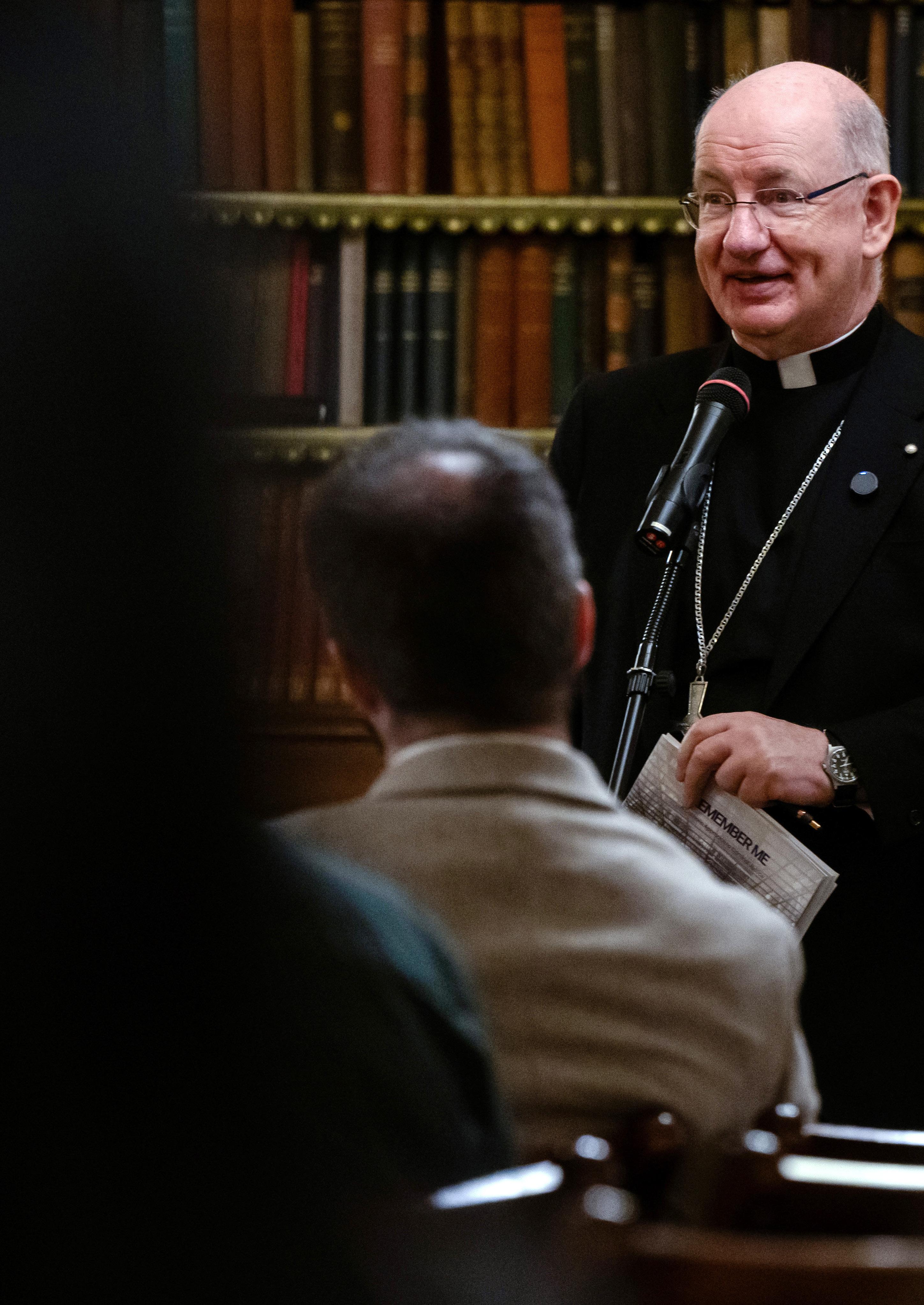
It gives me great pleasure to introduce Caritas Westminster’s Annual Review for 2025. As I begin my journey with you as Archbishop of Westminster, I look forward to continuing the strong legacy of my predecessor, Cardinal Vincent Nichols, in ensuring that we all continue to share the message of the Gospel in expressing Christ’s love through service.
As Chair of the Department for Social Justice of the Bishops’ Conference of England & Wales, I share Caritas Westminster’s commitment to supporting those who are unjustly marginalised in our society. The Church has a vital role to play in the betterment of our communities, and it is my hope that Catholic social action will continue to play a central role in bringing the Good News to our society.
May the contents of this Annual Review inspire us all to live out our shared Christian call to love our neighbour; not ‘in word and talk but in deed and in truth’ (1 John 3:18).
Richard Moth Archbishop of Westminster

Welcome
Pope Leo XIV, in his first encyclical, speaks of charity as ‘the burning heart of the Church’s mission,’ a fundamental expression of faith and ‘a requirement of true worship’ (Dilexi te, §15, 42). The mission of Caritas Westminster is to witness to this burning love in our actions, and to enable and encourage communities to do likewise.
Poverty, our Holy Father goes on to explain, takes many forms: material, moral, social and spiritual; the poverty of fragility, of voicelessness, of those without freedom or space to flourish (Dilexi te, §9). The Church’s presence at the heart of local life makes us uniquely placed to recognise the many faces of poverty. With this comes a great responsibility: to respond in a way that is attentive, personal, and conscious of the real needs of our communities.
At Caritas Westminster, this is precisely the work to which we are committed in whatever we undertake. Whether we are walking alongside survivors of human trafficking and domestic abuse, people with intellectual disabilities, members of the Deaf community or entrepreneurs facing socioeconomic inequality, our work remains rooted in the values of dignity and inclusion that have been handed down to us through the Church.
Dilexi te concludes by urging us ‘to invite everyone to share in the light and life born of recognizing Christ in the faces of the suffering.’ Through our support for social action across the diocese and beyond, Caritas Westminster seeks to improve outcomes for everyone living and working in the Diocese of Westminster, particularly those at greatest risk of exclusion through poverty, disability, isolation and exploitation.
We cannot do this alone. We thank you for the ways you have supported, encouraged, and shared in our mission of bringing hope during the Year of Jubilee.
Please join us in giving thanks for the many achievements of 2025, and we trust that you will also be with us in bringing Christ’s love — caritas — to the most vulnerable; now and in the years to come.
Yours in Christ,
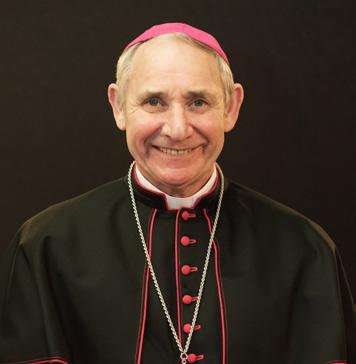

Bishop Paul McAleenan
Auxiliary Bishop of Westminster Chair of Caritas Westminster
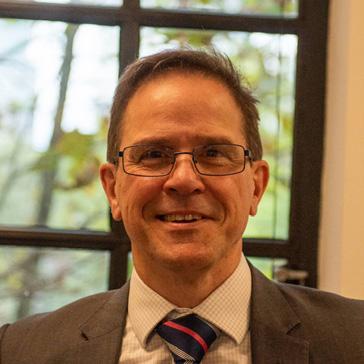

Richard Harries Director of Caritas Westminster
OUR IMPACT


200 Caritas volunteers across our services
10,000+ people have received financial support through one of our schemes in 2025
£194,000 distributed to people through our grants and voucher schemes in 2025
100% SATISFACTION

36 activities available for guests staying at our safe house LEARNING & LEISURE

reported from our domestic abuse awareness training participants

250+ people enrolled in our start-up programmes since 2019
2,620 miles travelled by the Deaf Service to reach their community in 2025
74% surveyed started a social action initiative as a result of using our Rooted in Love resources in 2025 OF SCHOOLS
224 +19 WOMEN BABIES have stayed in our safe house since 2015

A further 22% stay for between five and nine years and 41% of our students stay with us for one to four years £

37% of our students at Caritas St Joseph’s, Hendon, have stayed with us for at least 10 years
Who We Are
Caritas Westminster is the social action agency of the Roman Catholic Diocese of Westminster, operating within diocesan boundaries encompassing London boroughs north of the River Thames, between the River Lea to the east and the borough of Hillingdon to the west, the county of Hertfordshire to the north and the borough of Spelthorne in Surrey.
OUR MISSION
OUR VISION
Our vision is of the Church fully engaged in the ministry of charity, attending to those at greatest risk of exclusion through poverty, disability, isolation and exploitation.
Our mission is to love and serve our neighbours through coordinated social action that upholds their dignity, engages their support, provides practical responses to their needs, and improves their wellbeing.
OUR OUTCOME AREAS
Everything we do at Caritas Westminster contributes to increasing one of our five long-term outcome areas.
1. WELLBEING
Personal wellbeing encompasses the subjective experience of life satisfaction, emotional resilience, mental health, and overall quality of life. We want everyone in the Diocese of Westminster to lead a flourishing life, particularly those at greatest risk of exclusion.
3. CHURCH INCLUSION
In line with our vision, we want to see clergy, religious and laity working hand-in-hand to make Christ’s commandment to love one another a practical reality. We want a diocese where Catholics are known for the depth and extent of their social engagement.
2. PHYSICAL & PSYCHOLOGICAL SAFETY
Safety — both the objective reality of freedom from harm and the subjective experience of security and trust — is a foundational requirement for wellbeing and resilience. No-one should live in fear for their safety.
4. SOCIAL INCLUSION
Social isolation represents a significant barrier to wellbeing, particularly for the elderly and those living with a disability. Greater social inclusion has well-documented links to improved mental and physical health, enhanced resilience, and greater participation in civic life.
5. FINANCIAL INDEPENDENCE & HOUSEHOLD INCOME
The Diocese of Westminster, and London in particular, is an area of extreme income inequality, where too many people experience unjust social and economic barriers. Consistent with Catholic Social Teaching, we see a positive role for social enterprise as a route to a better world.
How We Support the Diocese
Underpinning everything we do and the five long-term outcomes we seek, our Caritas Community Development team works with schools and parishes across the Diocese of Westminster to foster a culture of social action, where Catholics are known for the depth and extent of their work in the community.
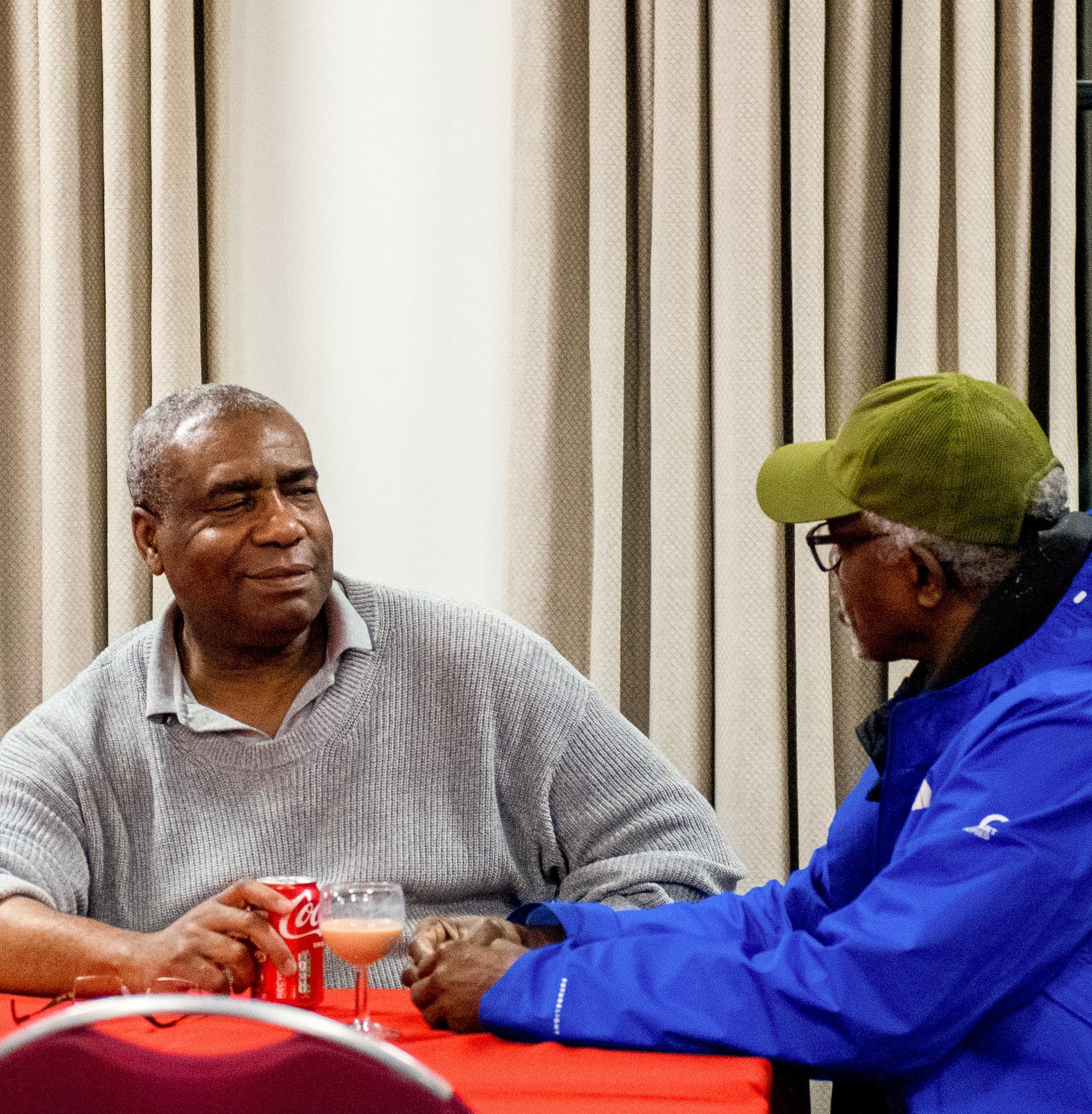
Loving Our Neighbour
St Teresa of Calcutta once said that ‘we can only love one at a time.’ It is in this spirit that we seek to help parishes in our diocese to be instruments of God’s love in their communities; whether that’s an isolated elderly person or a refugee family accessing the parish foodbank.
One of the ways we do this is through Love in Action, a six-week programme weaving Catholic Social Teaching into Sunday Mass and culminating in discernment and action to address local needs. For one parish, this has resulted in the creation of projects like a weekly Community Café, activities for families over the summer holidays, and a sewing group. The fruits of the programme can be seen long after those first six weeks — one priest shares:
We’ve got a Love in Action group that meets periodically and talks about [potential] initiatives... the idea is to keep a running idea on the pulse of how “love in action” as a theme is going on in the parish.
Parishes participating in the programme are accompanied by one of our Development Workers, who are also on-hand to offer expertise, network links and other support to any parish in their assigned geographical area. One parish priest noted the importance of being supported by one of our Development Workers through Love in Action and beyond:
I think it makes a big difference. It makes you feel that in the parish you’re not on your own doing things. There’s a network, there’s support, there’s a bit of interest... knowing that you’ve got the diocese encouraging and supporting you to get involved is really quite useful.
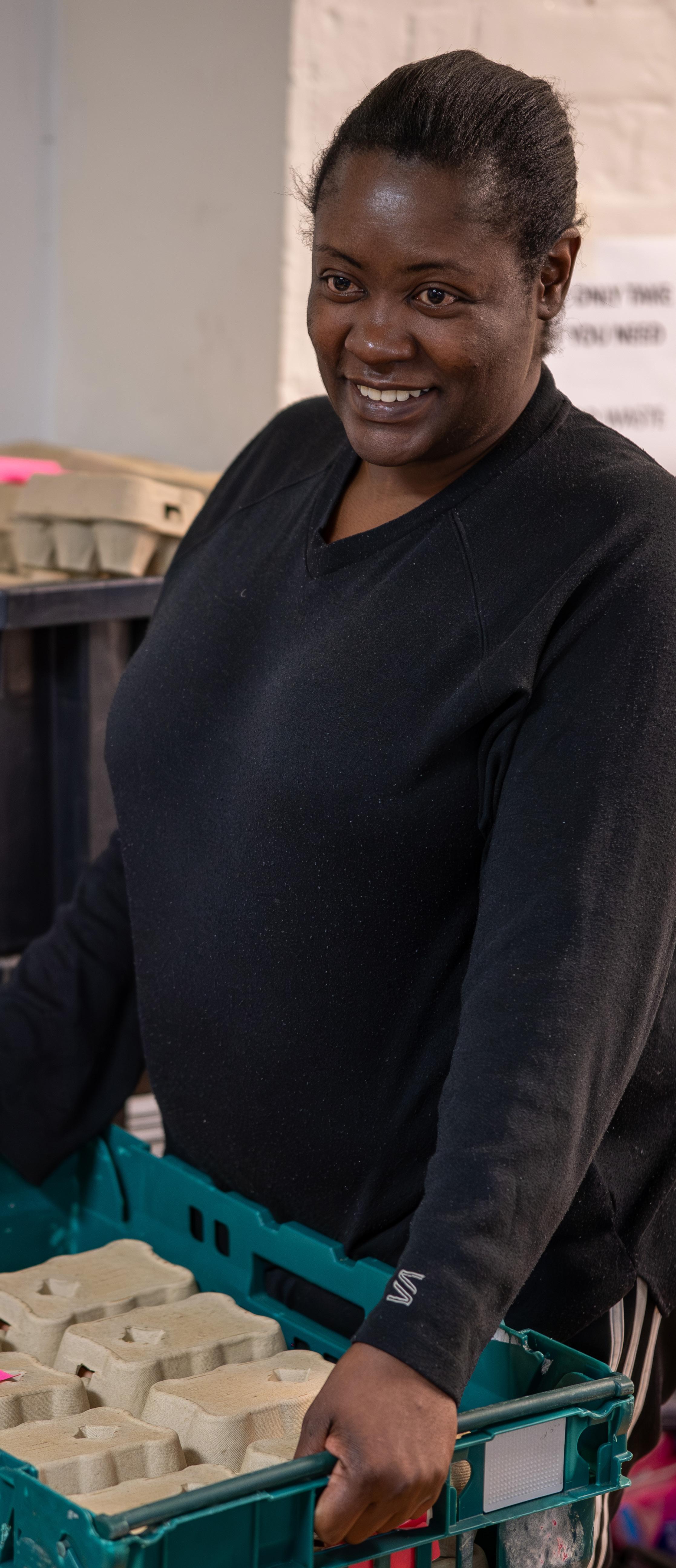

Our Community Development work simply could not happen without our Development Workers, who support parishes and schools across the diocese that are engaged in charitable initiatives. Collaborating with parish priests, teachers and volunteers, they work to facilitate social action that serves the unique needs of each community; from obtaining funding for a project to supporting the training of volunteers.
In September, one of our Development Workers supported the Shrine of Our Lady of Willesden with hosting a community health check day, making free NHS checkups available to Brent-based individuals and families who face difficulties accessing local health services. The event was hosted in partnership with Brent Health Matters, a Brent Council and NHS initiative focused on improving access to healthcare, and was supported by the shrine’s Dean and volunteers from the parish Society of St Vincent de Paul (SVP) group.
On the day, medical professionals were on-hand in the parish hall to carry out a range of tests, including blood pressure checks, blood sugar testing, diabetes risk assessments, clinical consultations and BMI measurements. They were joined by a team focused on supporting young people and a representative offering support for housingrelated concerns.
Over 50 people came to the parish to access the various services available; attendees included parishioners from Our Lady of
Willesden and neighbouring parishes in Kensal Rise and Willesden Green, as well as others from the local area.
One parishioner said:
I went after work with some family members. It was really helpful to speak to organisations like Brent Health Matters who provide accessible health and wellbeing services. The range of free health checks and advice was impressive… [and] having a ‘Children and Young People’ Team onsite was a thoughtful touch that showed a commitment to serving the whole family. It’s a wonderful example of community engagement and support.
Another added:
Lots of people struggle to get GP appointments, so it’s great that they could get some support. It was also nice for everyone to catch up and chat. We should have more events like this, especially for those who need a bit of extra help. God bless Caritas and the SVP!
As a result of the on-site tests, 25 attendees were referred to their GP for further consultation, highlighting the importance of making health checks more accessible to the community.
We were proud to coordinate this event, which highlighted the importance of collaboration between churches, charities and local organisations, as well as the power of parishes to serve the needs of their community.
Walking With Communities 50+
ATTENDEES AT THE PARISH COMMUNITY HEALTH CHECK

Beacons of Hope
We do not have to look far to see the impact of every act of service, big or small: in November, we were privileged to host the 2025 ‘Love in Action’ Volunteering Awards, recognising extraordinary volunteers from across the diocese. For us, the highlight is always sharing the stories of inspiring people who are often behind the scenes, and who demonstrate that loving ‘one at a time’ can have a profound impact on local communities.
One example is 17-year-old Anthony Njoku from Our Lady and St Catherine of Siena in Bow; winner of this year’s Young Volunteer of the Year Award. Following the sudden loss of their Master of Ceremonies, Anthony quietly stepped forward and offered to train younger altar servers at his parish, ensuring that the liturgy continued to be celebrated with due reverence. Anthony has quickly become a leader and mentor for the youth of his parish, going the extra mile by checking up on fellow altar servers when they are unwell and encouraging young people to get involved in parish life. In Anthony, the parish sees the future of the Church: a young person willing to take on responsibility, form others, and offer service with humility.
In Hitchin, Pamela Brannigan was recognised for her decades of devoted service to Our Lady Immaculate and St Andrew, where her presence is felt across every aspect of parish and community life. Through regular Sunday coffee mornings, Pamela has brought people together to raise thousands of pounds for a range of charities, while her coordination of the annual Michaelmas Fair helped to create a beloved parish tradition. Pamela also volunteers with Feed Up Warm Up and the Hitchin Pantry, which operate out of her parish to support people experiencing homelessness and food insecurity. She continues to host a weekly house prayer
group, supports with driving elderly parishioners, and serves as a reader and Eucharistic Minister.
Incredibly, she has balanced all this and more with being a devoted mother, a former career as Headmistress at a local Catholic primary school, and serving as an RE inspector for the diocese. Pamela’s nominator summed it up:
We are extraordinarily lucky to have her in our parish.
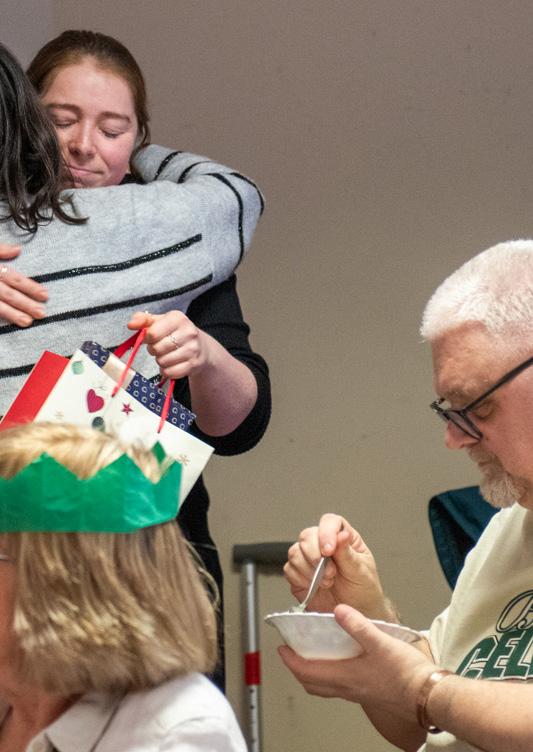
For us, the highlight is always sharing the stories of inspiring people who are often behind the scenes, and who demonstrate that loving ‘one at a time’ can have a profound impact.

MEET MORE WINNERS OF THIS YEAR’S ‘LOVE IN ACTION’ VOLUNTEERING AWARDS
“ Service is not just about giving — it’s about being present
STUDENTS OF ST MARY OF THE ANGELS CATHOLIC JUNIOR SCHOOL, BAYSWATER

Learning to Love
Alongside our support for parishes, we work with diocesan schools to foster future generations of Catholics whose faith informs their service to others. This begins in the classroom with our Rooted in Love resources, designed to integrate seamlessly into the Religious Education curriculum of Catholic primary and secondary schools.
Reaching an estimated 20,000 students and 100 schools in 2025 alone, our resources are trusted by teachers in our diocese, across the country and abroad, with 74% of schools having reported starting a social action project as a result of our resources.
Mrs Neville, RE Subject Lead at St Michael Catholic Primary School & Nursery in Feltham, told us:
This foundation has inspired a wide range of social action across the school, chosen by the children... The resources have given children ownership and a strong sense of their role in the Catholic life of the school.
This year, a further 800 students at 29 diocesan schools participated in our Caritas Ambassadors programme, which complements Catholic education for Key Stages 2 and 3 at the extracurricular level by inviting students to act on the principles of Catholic Social Teaching. In June, we were pleased to host our third Caritas Ambassadors Festival at Westminster Cathedral, bringing
together hundreds of primary school students to share and celebrate their achievements. Students presented an impressive range of social action projects, supporting causes such as Fairtrade, local foodbanks and homeless projects, reducing social isolation for the elderly, and more. Attendees heard from the Caritas Ambassadors at St Mary of the Angels Catholic Junior School in Bayswater, who showed incredible initiative organising a Stay & Play group for parents and toddlers at their school. Inspired by the principles of Human Dignity, Community & Participation and Care for the Common Good, the students explained the twofold aim of their project:
We recognised the vital importance of early social interaction for young children. Socialising in a safe, friendly environment helps toddlers develop confidence, communication skills, and a sense of security outside the home.
We [also] wanted to reduce feelings of isolation and loneliness, especially for any new parents or those without nearby family.
To support the project, the students also launched a donation station at their school, inviting their peers to donate nappies, wipes, toys and clothing to be distributed to families who attend. The Ambassadors spoke enthusiastically about their leadership and involvement in the project:
800 CARITAS AMBASSADORS IN 29 DIOCESAN SCHOOLS
As Caritas Ambassadors, we played a central role in making this vision a reality. We didn’t just set up the play provision and the donation station; we then became joyful companions to the children and toddlers who came through our doors... we were reminded throughout the project that service is not just about giving — it’s about being present, and we really were present throughout this initiative.
Across the diocese, our Caritas Ambassadors are a powerful reminder of the potential for young people to drive social change and be forces for good in our communities. Just ask a parent who attended the Stay & Play group at St Mary of the Angels:
The hall was set up with a wide variety of activities for all ages and was very inviting; my little one ran straight in, extremely excited. It was also a great opportunity for me to interact with other mothers and him with other children his age. They had a fantastic table of free donations that you could help yourself to, which was a lovely bonus as baby essentials are expensive these days.

FIND OUT MORE ABOUT THE CARITAS AMBASSADORS FESTIVAL
A Helping Hand
Our presence on the ground makes us attuned to the needs of our parishes, schools and those they minister to, which can vary significantly in a diocese where affluent neighbourhoods are cheek-by-jowl with some of the UK’s most deprived areas.1 While some parishes and schools request our help with growing their own social action initiatives, others need our help to support individuals and families experiencing financial hardship.
One way we do this is through our grants scheme, which distributes funds to those struggling to meet basic needs or pay for a loved one’s funeral. In 2025, we paid out 64 crisis and funeral grants to applicants from 44 parishes, distributing a total of over £84,000 and supporting more than 50 families in our diocese. For one family, our grant helped to purchase new beds, mattresses and other furniture after they lost their home in a fire. One family member told us:
I cannot thank you enough for the incredible generosity and kindness you have shown to my family. In a moment of great distress, you stepped in and provided help. Your kindness has left a lasting impact on our hearts and my family can never thank you enough.
Elsewhere, a recipient of one of our funeral grants expressed their gratitude:
Not only did the grant help tremendously in easing the burden of the funeral cost... but it allowed me and my mother to further grieve our deceased loved one, honour him and give him the dignified send-off he deserved.
Our most subscribed financial relief programme is our voucher
scheme, which allows parishes and schools to distribute vouchers that can be used to cover food, energy bills, and other essential items. Currently running in 66 parishes and 58 schools, the programme is estimated to have supported around 9,600 people in 2025, with a total of £111,000 distributed.
This year, one of our Development Workers supported a parish in East London where many people were knocking on the door asking for help. After speaking with the parish priest and their Caritas Representative, our Development Worker was able to refer the parish to our voucher scheme, to help them tackle the issue more effectively. Since then, the parish has been an important source of support in the local area, distributing vouchers over the summer and into the winter.
1. English indices of deprivation 2025: Statistical release. London: MHCLG. 17 November 2025.
9,600
PEOPLE HAVE RECEIVED VOUCHERS IN 2025 TO HELP WITH THE COST OF LIVING
64 CRISIS AND FUNERAL GRANTS DISTRIBUTED ACROSS 44 PARISHES
£84,372 WORTH OF CRISIS AND FUNERAL GRANTS DISTRIBUTED
Spreading the Love
One of the reasons we are passionate about celebrating volunteers is because we have the privilege of working with so many ourselves. Caritas Westminster relies on almost 200 volunteers to carry out our work, whether that’s in our direct services or through our network of Caritas Representatives who act as our voice in their parish.
In North London, our Caritas Representative Julia works closely with her Development Worker to enable her parish to support local people in need. She shares:
I started volunteering in about 2021... I felt that after COVID there was a need in a lot of parishes to regenerate some of the things that had been going on before.
Since then, Julia has supported her parish with collecting food donations, which are then given to parishioners in need or passed on to the local school for further distribution. She also helps the parish office to distribute our vouchers for food and essential items to people experiencing financial hardship. Sometimes, she’ll go the extra mile for parishioners she knows personally:
There are people that I know in the parish that do need vouchers and I take them to them, and I take the shopping too. I don’t just go with vouchers; I take a bag of goodies as well.
Julia collaborates with her Development Worker to organise events for the benefit of the whole community, as well as seeking support to help individuals who approach the parish:
Anytime I lift the phone and I ask anybody at Caritas for anything, I get them straight away; whether it’s vouchers or somebody turning up on my parish’s doorstep...
We came across a lady who was an asylum seeker, and she was constantly approaching us for vouchers... I asked for help from my Development Worker, [who] signposted her in the right direction and put a lot of work into getting her help.
Our work in parishes relies on dedicated volunteers and Caritas Representatives, who alert us to the unique needs of their communities and collaborate with us to address them. If you would like to support our work, why not consider becoming a Caritas Representative for your parish?

Alongside our support for parishes, we work
FIND OUT MORE
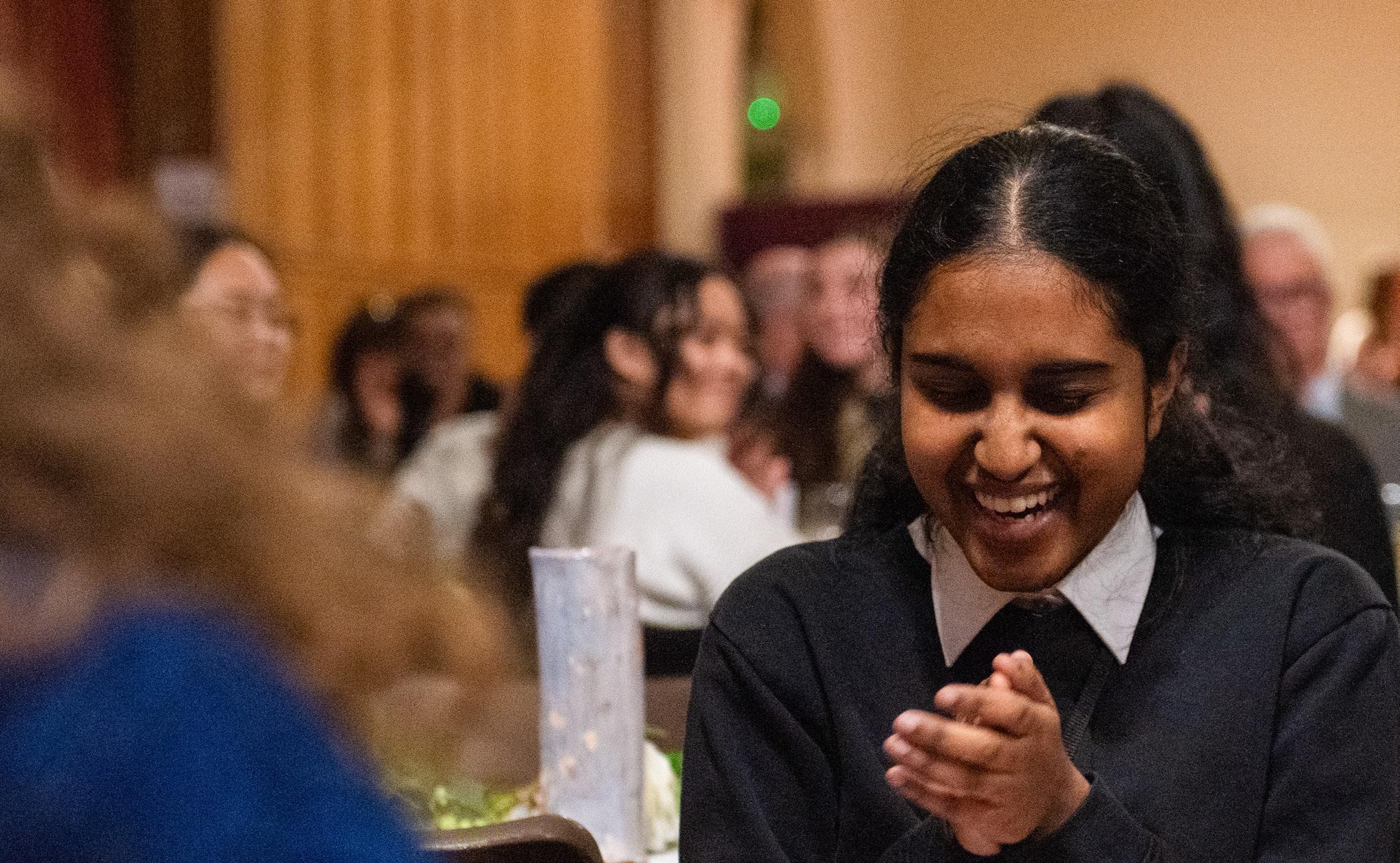
£111,000 WORTH OF VOUCHERS DISTRIBUTED BY 66 PARISHES & 58 SCHOOLS
Wellbeing
In every person we encounter and serve, we recognise the image and likeness of God. Our work is therefore underpinned by a profound commitment to upholding Human Dignity; a core strand of Catholic Social Teaching. In practice, this means supporting people to lead purposeful lives and contribute their unique gifts to their communities.
10 Years of Healing & Hope
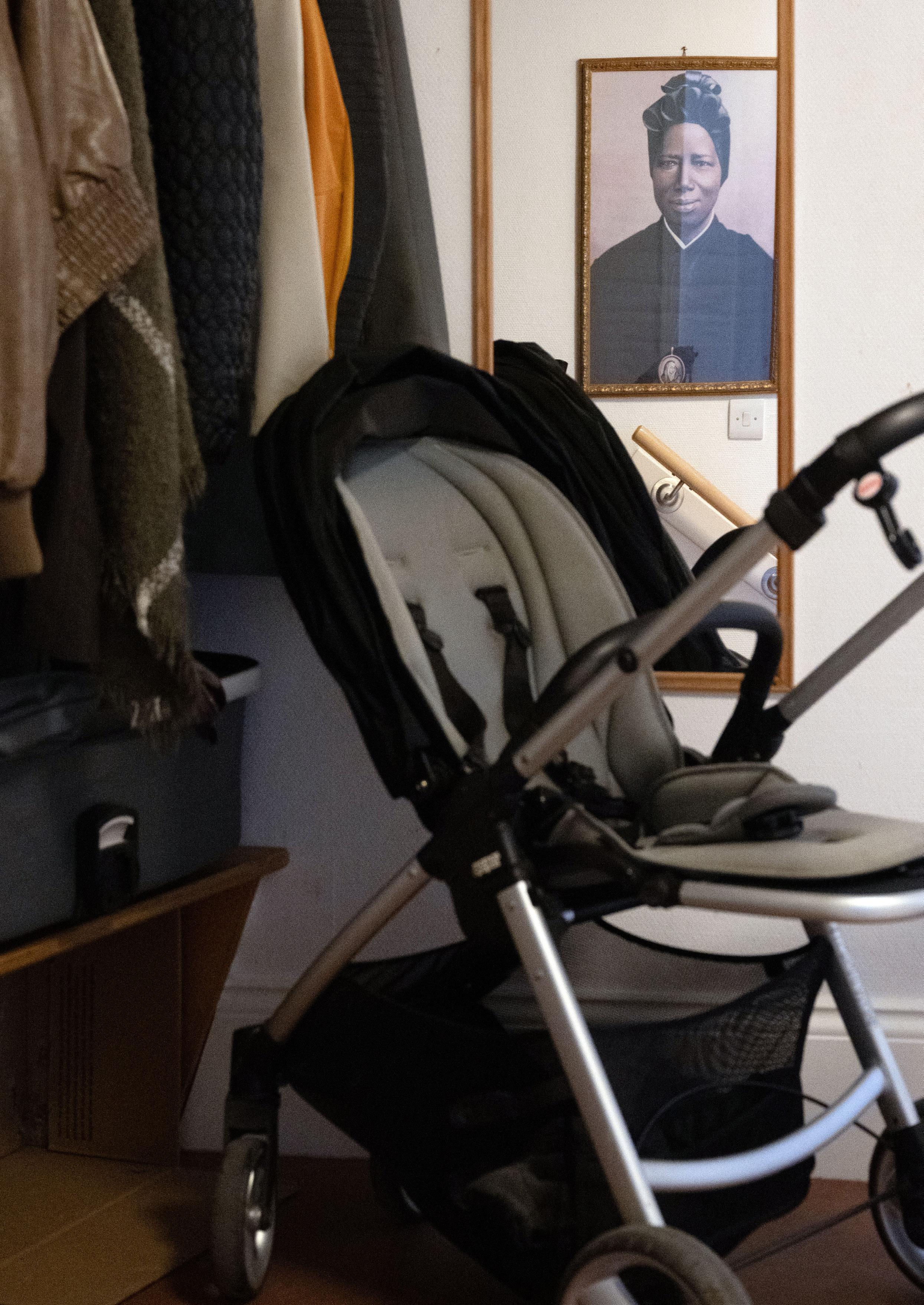
In a world where some 50 million people are still trapped in modern slavery,2 few places embody the spirit of the Jubilee Year as much as Caritas Bakhita House, our safe house for survivors of human trafficking and modern slavery. In 2025, the centre marked its tenth anniversary of offering women shelter and trauma-informed care: since opening, we have supported 224 women and 19 babies — 24 hours a day, 365 days a year.
Our guests are truly ‘Pilgrims of Hope,’ and we are honoured to walk alongside them at every step of the complex journey of recovery. That’s why we offer a lot more than just shelter and access to medical and psychological support: we strive to build a strong sense of community, and to enable women to embrace freedom with courage, creativity and joy.
One of the ways we do this is through weekly in-house art classes led by artist John R Bateson, who has volunteered with us for four years. In November, we were thrilled to showcase paintings, prints and hand-crafted items created during these sessions at the London Jesuit Centre in Mayfair, in a landmark exhibition entitled The Art of Healing.
From emotive paintings drawing on the experience of exploitation to intricate items reflecting the diverse backgrounds and impressive sewing skills of our guests, each
piece offered an insight into daily life at the safe house, where the joys of newfound freedom and fellowship are mingled with the complexities of recovering from severe trauma.
‘For many of the women staying with us, art can be an important step towards processing trauma that cannot yet be verbalised,’ explains Karen Anstiss, Head of Caritas Bakhita House. ‘Like other nonverbal forms of expression, art enables us to explore at a safe distance what might otherwise feel overwhelming and unapproachable.’
Bateson stresses that art is just one of many components that shape the healing journey at the safe house: the women’s work in his class ‘is also a response to whatever is going on at Caritas Bakhita House [and] how they are working out with the rest that is going on here; art therapy, music therapy… it’s a combination of things.’
When asked to look back on their time with us, former guests frequently cite the benefits of the activities available to them, which also include music and drama therapy, gardening and cooking, as well as English language, financial literacy and other practical skills courses to foster independence.
2. Global Slavery Index 2023. Perth: Minderoo Foundation (Walk Free). Available at: https://www.walkfree.org/global-slaveryindex/
For many of the women staying with us, art can be an important step towards processing trauma that cannot yet be verbalised.
28
1,800 WOMEN SUPPORTED
2
BABIES IN RESIDENCE
21
GUESTS PARTICIPATED IN THEREPEUTIC ART LESSONS
HOURS OF SUPPORT PROVIDED BY VOLUNTEERS

KAREN ANSTISS, HEAD OF CARITAS BAKHITA HOUSE
Friends & Family
“
The students have made friendships that will last a lifetime, and I’m not sure they would feel so much a part of a team anywhere else. Here they are treated as equals, whereas elsewhere they might experience challenging prejudices.
A
TUTOR AT CARITAS ST JOSEPH’S IN HENDON
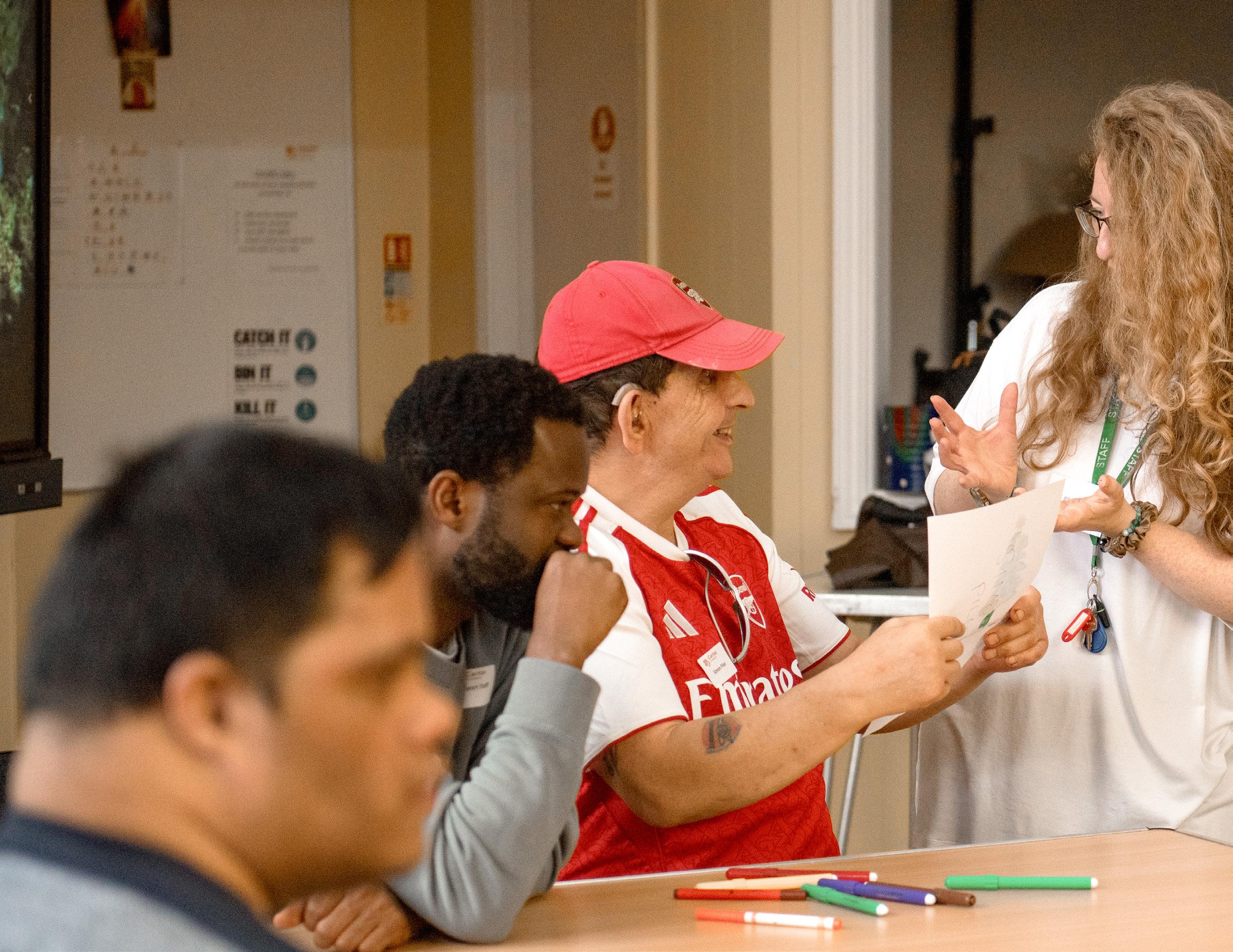
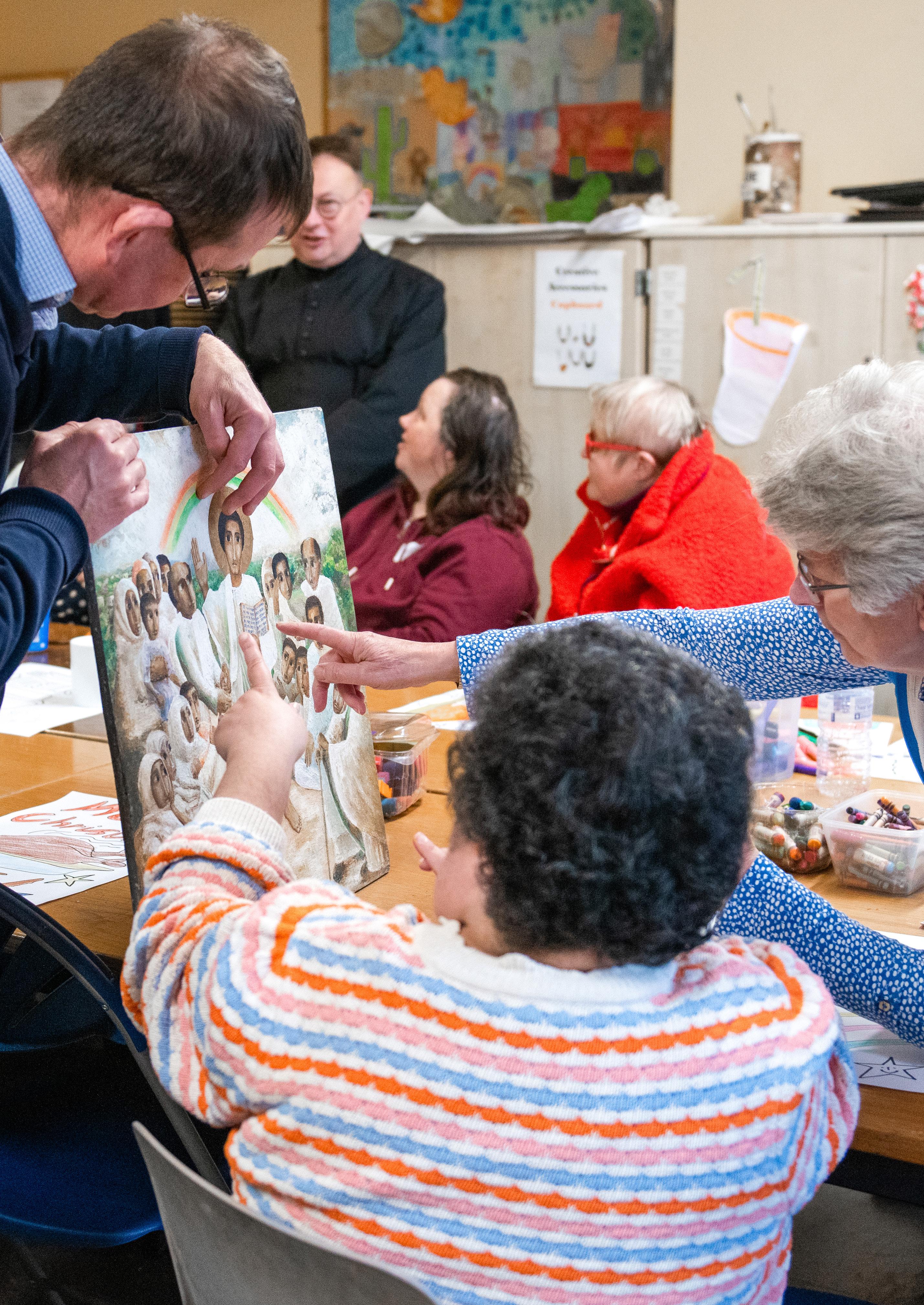
Community and Participation, a core strand of Catholic Social Teaching, is also crucial to the work of Caritas St Joseph’s supporting people with intellectual disabilities. At our lifelong learning centre in Hendon, we know that our selection of over 50 creative, fitness and practical skills courses is just one reason why more than 200 students walk through our doors each week.
Whether it’s art, cookery, gardening or anything in between, our mission is to create a space where adults with intellectual disabilities can engage meaningfully, with their talents and with others.
Just ask a student from our “Lunchbox” cookery class, where participants learn to prepare food that is then served to staff and students at lunchtime:
During the lunchbox class, I chop vegetables and learn about how to set up the trolley for selling food to students and staff. Chopping vegetables and setting up the trolley are my favourite activities, and I always feel relaxed and happy when I work in this class. In future, I want to learn more about making sandwiches, and someday I would like to work in a restaurant.
At first, I was nervous about joining this class; I didn’t know many people and I couldn’t hold a knife properly. But I kept coming because I wanted to make friends, and now I also know how to hold a knife without making any mistakes.
A fellow “Lunchbox” attendee also values the social aspect of the class:
My favourite thing about [this
class] is making new friends and preparing salads. This class brings me a lot of joy, especially being with my friends.
Our students are just the beginning; our community is also shaped by long-serving staff and volunteers, as well as by students’ families. Like Kay, whose daughter Natalie has been a student with us for over 10 years and who is now a much-loved volunteer and friend of the centre:
I first discovered Caritas St Joseph’s about 15 years ago, while looking for a day centre for my daughter Natalie. The centre was highly recommended by one of Natalie’s former teachers, and I can see why: it’s a unique place centred around core principles of love, care, kindness and commitment, all of which are
shown by the wonderful staff who work there. It really feels like a family.
Having seen Natalie blossom as a student at Caritas St Joseph’s, I thought it right to contribute to the centre’s work by sharing my own knowledge and experience, so 14 years ago I began volunteering there once a week.
I have formed many meaningful friendships with students during my years [here]. I became very good friends with Francis; the first student I ever met back when I initially came to view the centre. He became a close family friend, sharing my husband and daughter’s interest in football. Francis passed away last year, and we miss him very much.
One student I have worked with over the past 10 years used to only be able to use one hand; now, he has made incredible progress and can use
“both hands. I also bonded with another student, who is a nonverbal wheelchair user; after many months of coming to my music class, he gave me a big smile and put his hand out to say hello. Moments like these are the reason I volunteer at Caritas St Joseph’s.
Our strong sense of community is also crucial to the wellbeing of our students’ families, who can often feel isolated and overlooked in other contexts. One parent shares the impact of Caritas St Joseph’s after years of struggling to find a place that was the right fit for their son:
The team were amazing in accepting our son and the difficulties he was facing at the time. He has never looked back, and neither have we as a family; it has given him such great structure and support. He comes here as a student four days a week, and on Wednesdays he volunteers helping out at reception. It’s an oasis, Caritas St Joseph’s.
Another parent notes:
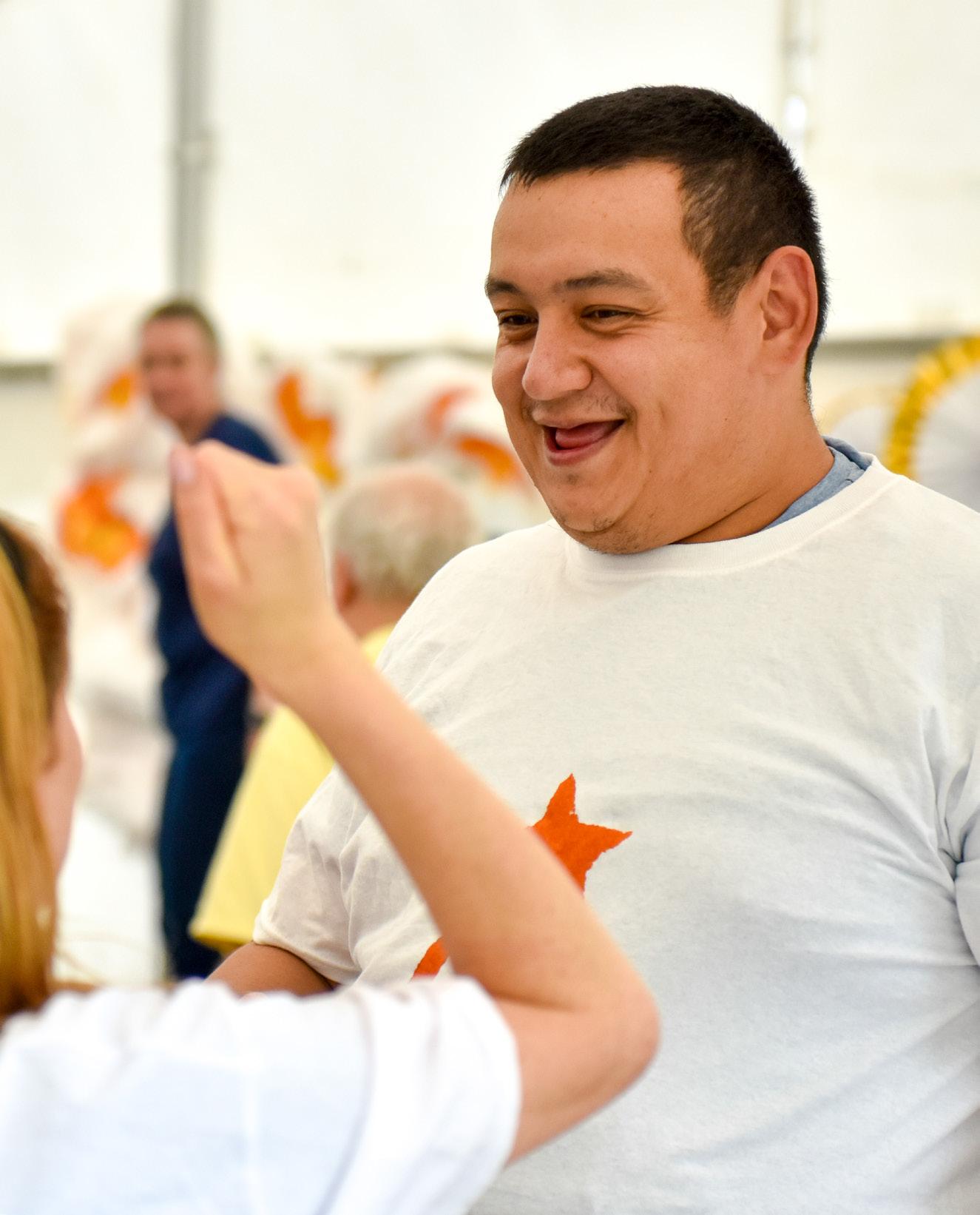
Here at Caritas St Joseph’s, there’s just so much love. Everybody cares, everybody knows you; you come to the desk and they say ‘Oh, you are so-and-so’s mum’ — it’s very special. It’s hard to explain because it’s about a shared understanding of our commitment to the individual and the family; at one point, I remember volunteers ringing up to ask if we had enough support.
200+
STUDENTS WALK THROUGH OUR DOORS EACH WEEK
Over the years that we have been here, the connection with the parents and carers is stronger. We’re older and our children are older. It’s great to feel we are not isolated.
PARENT OF A STUDENT AT CARITAS ST JOSEPH’S IN HENDON
Physical & Psychological Safety
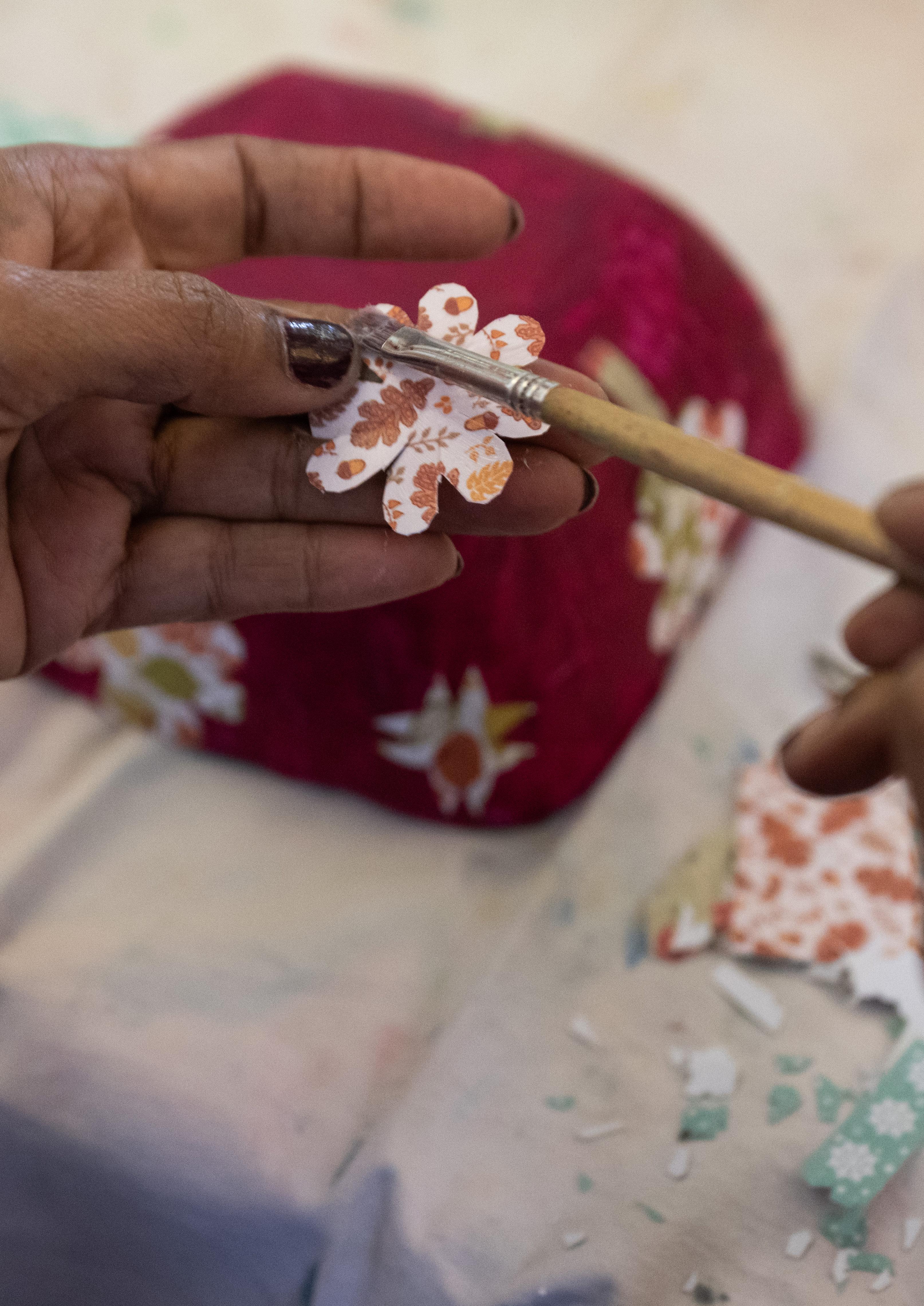
The Scriptures tell us that ‘perfect love casts out fear’ (1 John 4:18). We do not have to look far to see the debilitating effects of fear on individuals and societies, where freedom is curtailed or manipulated in violation of people’s rights and dignity. In our work, we strive to show Christ’s love by fostering a greater sense of safety for survivors of trafficking, exploitation and domestic abuse, supporting people to live out fearlessly their God-given freedom and identity.
Everyday Milestones
For most people, leaving the house to go shopping, visit a friend or walk in the park is part of ordinary life. But for women recovering from the horrors of exploitation, these activities can feel like an insurmountable challenge. At Caritas Bakhita House, our day revolves around helping our guests recover a sense of safety and trust; whether that’s through therapeutic activities, community living, or simply having members of staff, volunteers and fellow guests to walk alongside them.
When women move on from Caritas Bakhita House, the impact on their life they cite most is an improved sense of safety. The centre’s atmosphere of trust and confidentiality, they say, is crucial to their journey of recovery. We know this from experience, too. As one volunteer puts it:
What I like is when I see them [our guests] more relaxed and outgoing instead of being very careful and suspicious.
Take Sakinah,* who arrived in the UK about 25 years
ago. She was taken straight to a house in North London, where she remained for over 20 years, working seven days a week for 12 hours or longer. Her traffickers deliberately isolated her so she would never learn enough English to seek help.
One day a neighbour called the police, who visited the address and found Sakinah; she was sleeping under the kitchen table, and her belongings were stored in a shed. The police referred her to Caritas Bakhita House.
During her first few months with us, Sakinah would not leave the house without someone by her side — but each day she achieves a little more. She still finds it incredible that she can leave the house to go where she wants, when she wants, and she particularly likes walking in the park or with friends she’s made at the safe house.
Little by little, Sakinah’s world is becoming a better place — but moving on after years of isolation and not being taught to read or write also brings its challenges: simple things like withdrawing money from a cash machine or navigating public transport remain difficult. Indeed, on the day Sakinah learned to write her own name, we all celebrated as if she had won an Olympic gold! Because for someone who has been through so much, even moments that others take for granted are nothing short of heroic.
*Not her real name
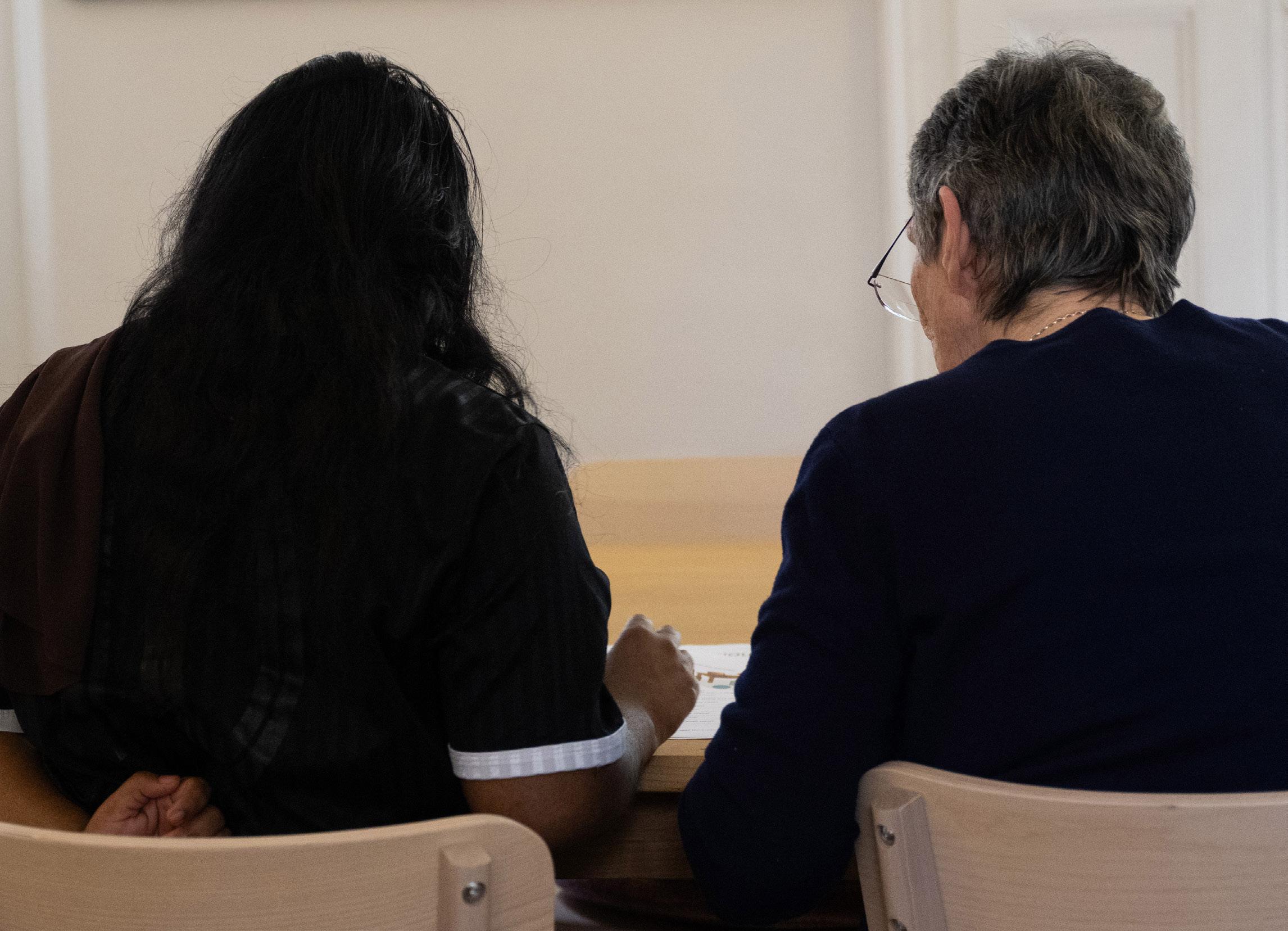
At the beginning... [our guests] come in and they are walking on eggshells. After a very short time, they really feel that everybody tries to listen to them, to be open to them.
A VOLUNTEER AT CARITAS BAKHITA HOUSE
Safety First
“
It’s the most useful course I have done in my life... I think every parish priest should do it.
A PARISH PRIEST
Recent figures show that in England and Wales alone, approximately 3.8 million people over the age of 16 experienced domestic abuse in the last year.3 This pressing local issue affects people in our communities of all faiths and none and demands a local response, which is why our Safe in Faith project works with parishes across our diocese to foster safe spaces for people experiencing domestic abuse. Our free training for clergy and parish staff equips those on the frontline with the tools they need to support people who come asking for help; whether that’s by signposting them to further help or offering informed accompaniment.
One priest explains the challenge of misconceptions and uncertainties when dealing with domestic abuse prior to taking part in training:
As a priest, you do come across a lot of domestic abuse. It was the first serious pastoral problem I encountered... someone came to me and said, ‘my husband threatened me with a hammer; what should I do?’ I wasn’t really equipped [to respond]... if I knew what I know now I could have been a lot more useful to her.
You talk to priests and sometimes the things they say about domestic abuse situations… you wish they
had done the course. It is that classic one — ‘Why is she still in the relationship?’ — as if you can just walk out.
From understanding forms of abuse to tackling common prejudices and misconceptions about Church teaching, our training seeks to make parishes beacons of hope for survivors who may otherwise feel isolated or misunderstood in their faith community.
One participant shared how our training influenced everything from his personal perception of abusive situations to his preaching, pastoral work, and interactions with parishioners:
[Training on] trauma-informed support was incredibly useful. Understanding domestic abuse and its cyclical nature... is quite a handy thing to know pastorally. The idea of spiritual abuse was useful to learn about, as was the idea that the response of a faith leader can be critical for a victim or a survivor. It can keep them stuck in that cycle, or it might just give them a little bit of an opportunity to break free of that cycle.
The other [change] is in preaching and in reconciliation: it’s how you preach, how you give advice about something. Or if I’m talking to parents at the school gates, it’s
just to have a little bit of sensitivity: maybe sometimes asking, ‘is everything okay at home?’... part of the reason you want to be sensitive to domestic abuse is because you care about the children in the parish. From the perspective of safeguarding children, you really do need to know it.
This year saw the launch of our Ask for Mary project; a parish-based counterpart to initiatives like Ask for ANI in pharmacies or Ask for Angela in social venues. Recognising that domestic abuse victims can be cut off from seeking help within the home, we train parish office staff to respond to people seeking help, by giving them access to a telephone, computer, and resources provided by Safe in Faith. One priest notes the importance of ensuring people in abusive situations feel seen within the parish:
You want to create a safe environment in the church, in parish activities and around the parish; because that’s also safeguarding. So we try to have the posters up in the church, or something in the newsletter every week. We’ve got little signs in the gents’ as well.
FaithAware Care
PIN 2025...
134
CLERGY, PARISH STAFF AND SAFEGUARDING LEADS TRAINED
48 COUNSELLING PROFESSIONALS TRAINED
arishes can be a vital source of support for survivors seeking to escape or heal from an abusive situation, but they are just the beginning. When taking the next step, survivors who are religious can often feel alienated in counselling or therapeutic settings that are unable to meet their needs as believers. That’s why Safe in Faith also works with psychotherapists and counselling professionals in secular contexts, to ensure that they can respond appropriately to the unique challenges and perspectives of people of faith. Our work in this field extends beyond the Catholic Church; we also work alongside partners from other faiths and Christian denominations.
In 2025, we continued our partnership with the Caritas Social Action Network (CSAN) and the National Board of Catholic Women for the 16 Days of Activism, an annual campaign against genderbased violence. We were proud to contribute to this year’s calendar of daily actions to raise awareness about Violence Against Women and Girls (VAWG); including prayer, reflection, organisations to support, and resources to share.
Our advocacy spans a range of contexts, and in 2025 Safe in Faith was pleased to be present at 15 events at the diocesan,
national and international level. Close to home, we regularly collaborate with CSAN and the Bishop’s Conference of England and Wales to offer webinars and resources about domestic abuse, and are cuurently engaged in two research projects at St Mary’s University exploring this issue in Catholic contexts such as marriage annulment and the Sacrament of Confession.
This year, we also participated in consultations by the British Association for Counselling and Psychotherapy on developing their updated ethical framework, and have contributed publicly to national policy discussions on topics such as Assisted Suicide and changes in family law. Further afield, Safe in Faith was honoured to present a paper at the International Safeguarding Conference in June, addressing Catholic safeguarding experts, academics, therapists, religious and clergy at the Pontifical Gregorian University in Rome.
We are grateful for every opportunity to discuss how the Church and wider society can better support those experiencing domestic abuse, and our work in parishes and the public sphere shares the one goal of making the Church a safe and inclusive space for survivors.

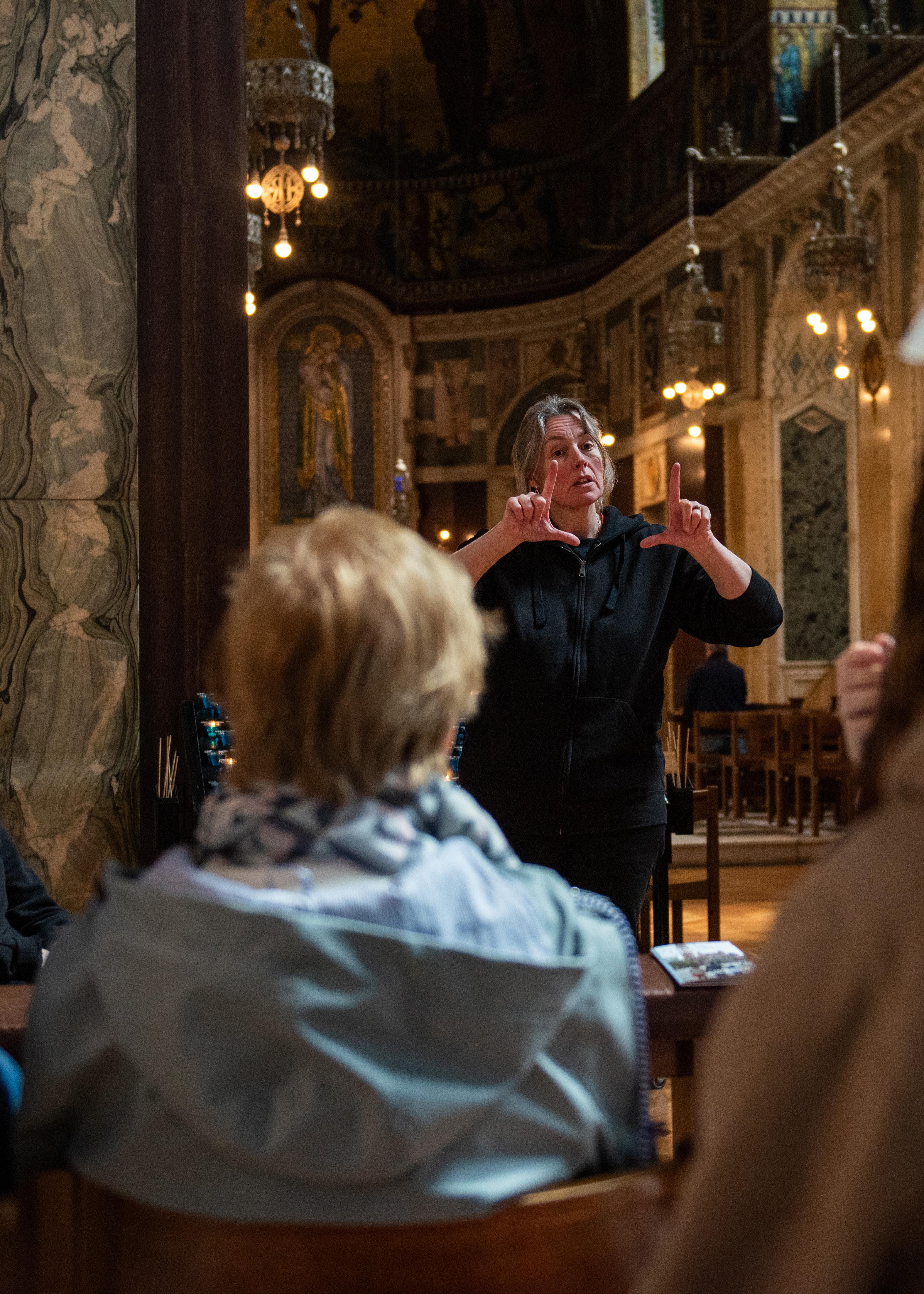
Church Inclusion
We all know the common saying that “charity begins at home,” and at Caritas Westminster, “home” is the Church: our people, our parishes, and our diocese. For us, Pope Francis’ exhortation to ‘go to the margins of our societies’ begins with those who are on the margins of the Church; ensuring that everyone who wishes to has a place in our shared spiritual home. For this reason, a central pillar of our work is fostering inclusion in our parish communities, particularly for members of the Deaf community and people with intellectual disabilities.
In Word & Sign
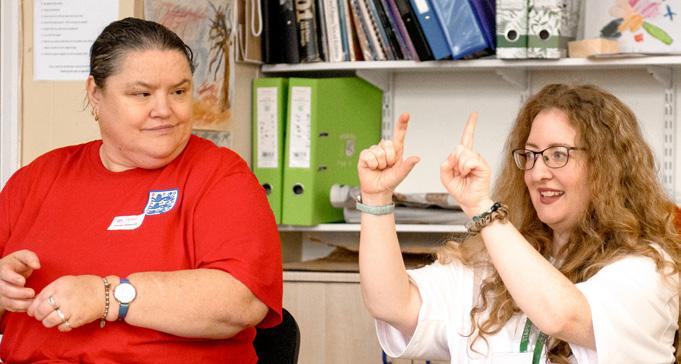
Think of the many things that make up parish life: worship and liturgy, catechesis, scripture study, social groups, pilgrimages and everything in between. Now imagine that you are a Deaf person: how would you access these? That’s where Caritas Deaf Service comes in: our mission is to facilitate participation in the life of the Church for the Deaf community in Westminster and beyond.
In 2025, Caritas Deaf Service continued our core provision of regular Signed and Interpreted Masses across the diocese; we are thrilled to see attendance return to pre-COVID numbers, with an average of 40 attendees per month and several new faces in our congregations. Can’t imagine Sunday Mass without beautiful hymns? No problem: our liturgies are enriched by a Sign Language Choir.
63 FAITH-RELATED EVENTS FACILITATED IN 2025
Alongside liturgies, we host monthly lunch clubs and Bible Study sessions in British Sign Language (BSL), as well as organising pilgrimages for the Deaf community. This year, we were especially proud to support access to Jubilee events across the diocese, including BSL translations of Jubilee resources, signed and interpreted tours of the Charterhouse and Westminster Cathedral, and visits to three other churches along the the ‘Westminster Way’ pilgrimage route.
Now think about faith formation: would a Deaf person be able to participate in most parish catechetical programmes or RCIA? We help with that, too; we are available to accompany both adults preparing for Confirmation and children making their First Holy Communion. This year, we were pleased to support members of the Deaf community entering the Church, including through 21 catechesis sessions tailored to the needs of each recipient.
In the longer term, we continue to strive to make our parishes more accessible to Deaf people, working to foster inclusion from priests to the pews: we collaborate with the eight signing priests in our diocese, and are training the next generation of clergy at Allen Hall Seminary, where five seminarians are currently learning BSL.
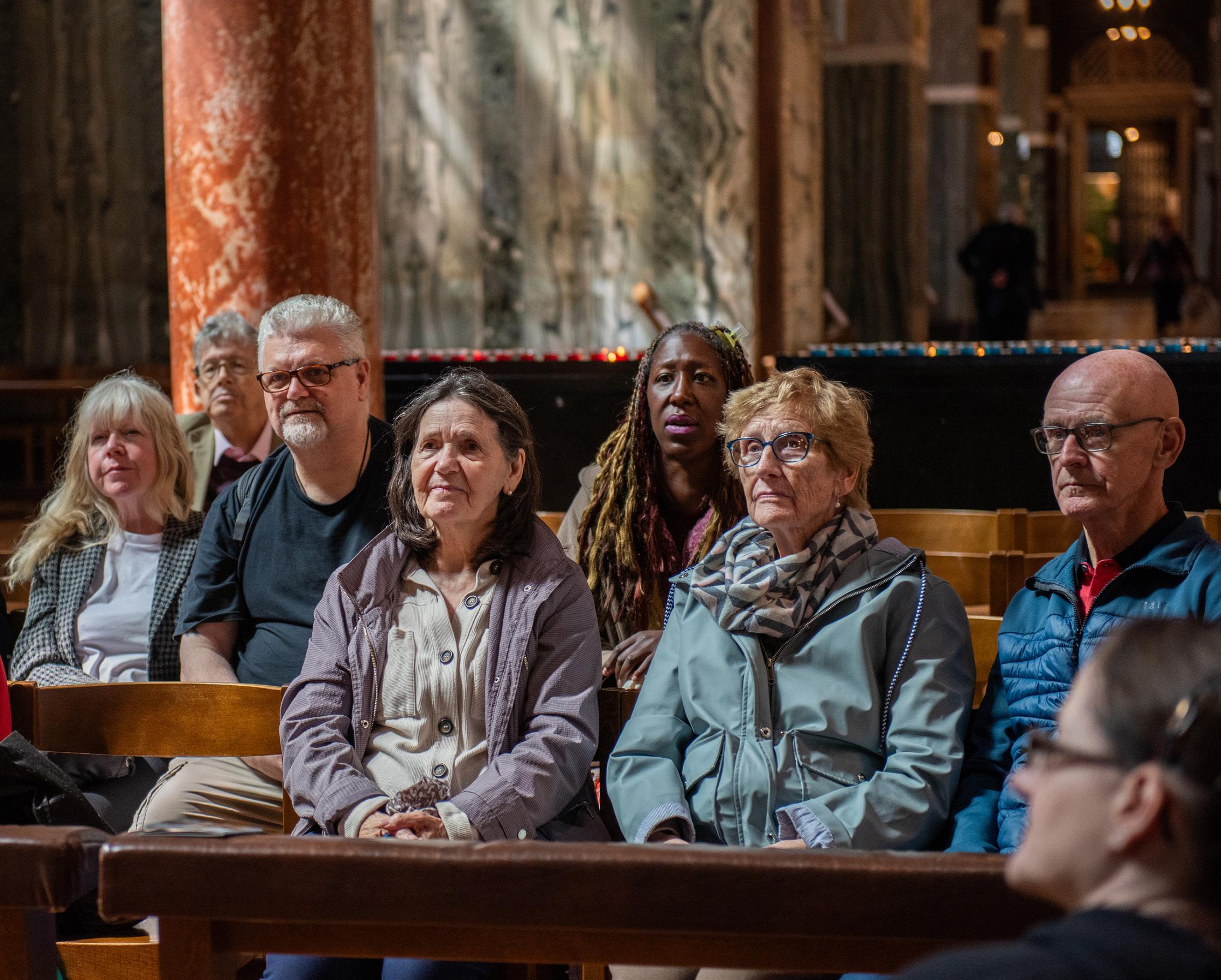
That’s the most beautiful Mass I’ve ever attended, and I’ve been Catholic for 37 years.
A HEARING PERSON ATTENDING HIS FIRST DEAF COMMUNITY MASS “

Networks of Support
Participating in the life of the Church can also be a challenge for people with intellectual disabilities and their families, who may have unique needs when it comes to catechesis, liturgy and parish life. To that end, the Caritas St . Joseph’s Outreach team travels to parishes, schools and homes across the diocese, offering support tailored to the needs of each person. This includes leading inclusive liturgies, Sacramental Preparation and spiritual formation, but can also be as varied as helping parents advocate for Special Educational Needs and Disabilities (SEND) provision at their children’s schools.
We know how important it is for parents to be able to share the faith with their children, and our Outreach team helps to make this possible. In 2025, the Caritas St Joseph’s Outreach team supported with four Baptisms, 15 First Holy Communions, and seven Confirmations. We also facilitated Inclusive and Special Needs Masses and parent support groups, as well as conducting 38 other supportrelated visits.
The Outreach team also runs our parent support groups in Ealing, Watford and Hendon; a lifeline for parents of people with disabilities who can often feel alone or unseen. For the last 10 years, the parent support group in Watford has been a safe space for attendees to express their emotions, discuss shared challenges, and hear from more experienced parents. While many participants attend other support groups too, what brings them together is their faith. Here, they do not feel isolated in their faith and can encourage one another to advocate for their children’s needs in their respective parishes.
One participant said:
I’ve been coming to this group for less than a year; I found out about
it on the newsletter at my church. I find it really comforting hearing stories from other parents: I leave here and think, you know what? I’m ready. I take it day by day with my daughter.
A highlight of our year was going on pilgrimage to Rome for the Jubilee of People with Disabilities with students and families from Caritas St Joseph’s. Supported by young volunteers from the Cardinal Wiseman School in Greenford, we enjoyed a busy and fruitful few days exploring our faith, the liturgy, and what being “Pilgrims of Hope” means to us.
Our stay in Rome brought many unique and uplifting experiences: from carrying the cross to the Holy Door at St Peter’s Basilica to speaking in front of 100 people — something our students had never done before — or serving at the altar with Bishop Paul Hendricks. We also dedicated time to understanding and enriching our faith; through catechesis, exploring parts of the Mass, and an interactive session staging scenes from the Gospel.
Parents and carers often share with us their joy at being able to cultivate their faith alongside loved ones with intellectual disabilities. Following our pilgrimage, one parent commented:
[My daughter] really thrives on the liturgy; she knows all the hymns and she loves being involved. She feels like she is doing something important for everyone.
Reflecting on our time in Rome, Gail Williams, Head of Caritas St Joseph’s, notes:
Our new Pope Leo XIV inspires us with his papal motto: “In the One we are one.” We must not only hold hope in our own hearts, but actively bring it to those on the margins of our communities. Only then can we truly be “one” with God and each other.
Social Inclusion
At Caritas Westminster, we recognise that we walk alongside people of all faiths and none, who are often part of multiple and diverse communities. That is why our mission supporting inclusion within the Church is complemented by broader efforts to cultivate inclusive spaces within the local and social realities of those we serve.
Creative Connections
Spread across Whitton, Feltham, Hounslow and North Harrow, the Caritas St Joseph’s Connect@ Hubs act as satellites of our lifelong learning centre in Hendon, offering a selection of our 50+ courses to adults with intellectual disabilities living in other areas of the diocese.
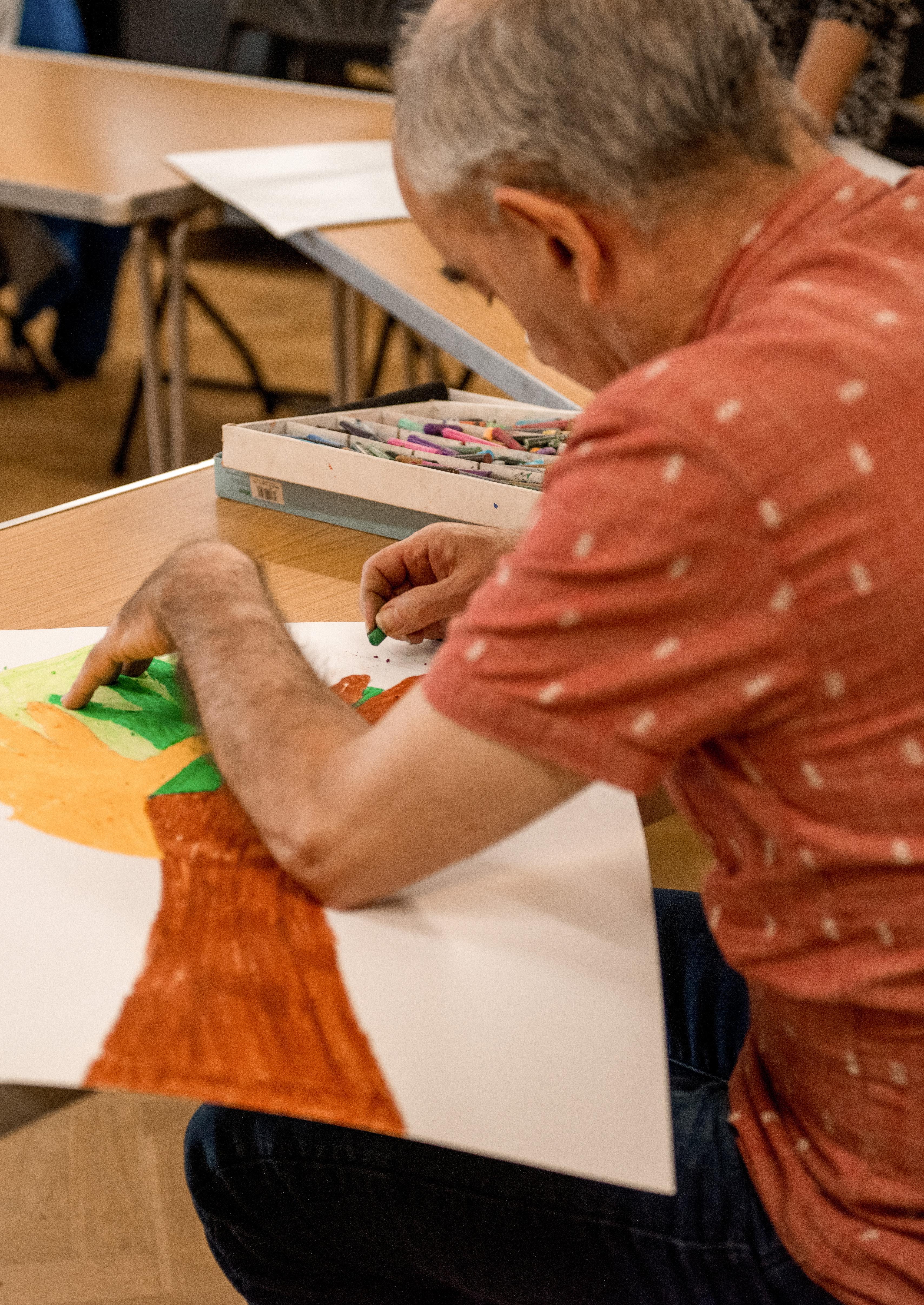
In Hounslow, a group of students and their carers travel to our Connect@ Hub at the parish of St Michael and St Martin, for weekly art classes taught by Jennifer, a former social worker and parish administrator who now works as a tutor running courses at Caritas St Joseph’s. Supported by staff member Karen, volunteers and our Connect@ manager Laura, Jennifer guides students in creating art around different themes using a range of materials: Alex loves crayons, while Faiza favours pencils and Dominic produces a selection of beautiful pieces using different palettes of acrylic paint.
As the lesson progresses, Karen and Jennifer go around the class, talking to students about their artwork as well as about how they feel and how their week is going. Some of the students are nonverbal; for them, art is a particularly powerful means of expression. There is a real sense of warmth
and affection; one student, Rachel, sometimes presents the team with pictures she has drawn at home, as well as one of the many poems she loves to write for people. Rachel says:
I look forward to coming to Connect@ every week; it is the only time I can get away from home... I love to do arts and crafts, and to use my hands to make things. What I enjoy the most about Connect@ is the social side of the class; it’s nice to be with lots of people doing creative things.
Another student, Zoe, has been attending the hub for five years, and often comes with her mum. What initially drew her was the cooking class — she likes to bake cakes and biscuits for her friends — but for the last two years she has also been enjoying exploring different media in Jennifer’s lessons.
As the morning draws to a close, students, carers and volunteers enjoy a break with tea and biscuits, while Laura puts on some music for those who like to dance. Later in the day, a new group will arrive at the hub for a Wheelchair Dance class, which is so popular that it is currently oversubscribed.
“
What I enjoy the most about Connect@ is the social side of the class; it’s nice to be with lots of people doing creative things.

Personal, Practical & Pastoral
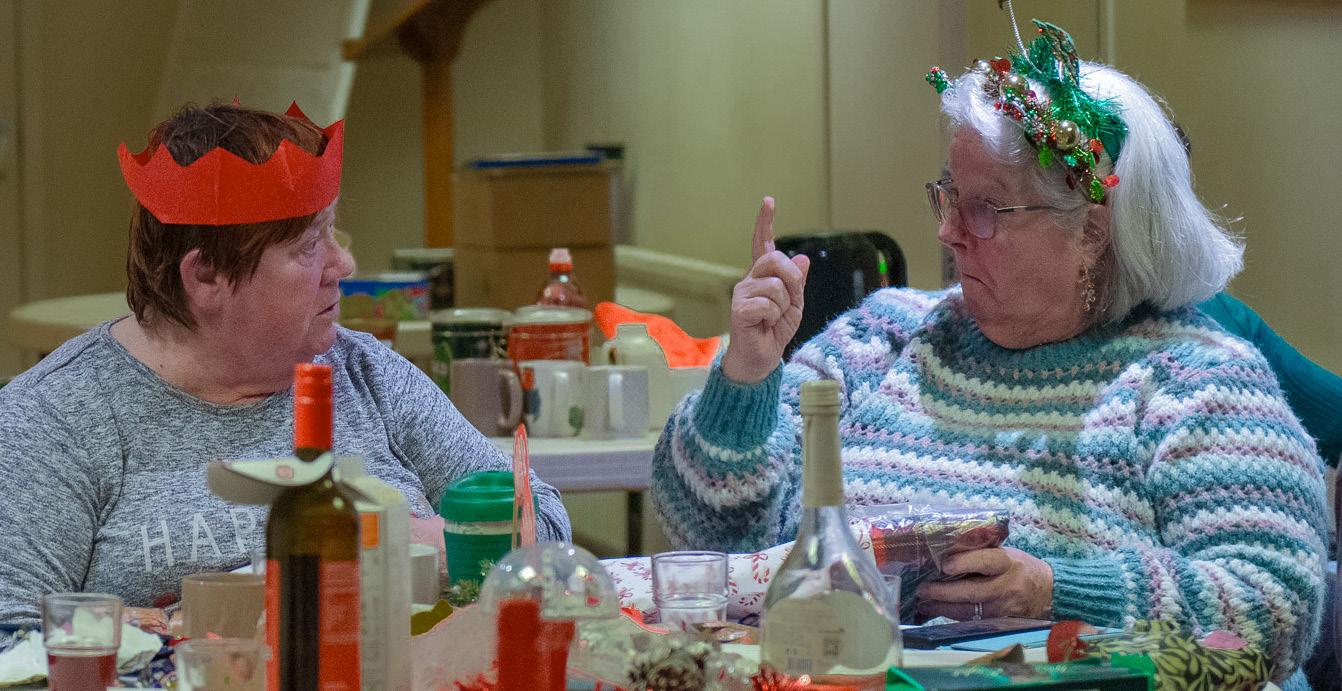
With the number of BSL users in the UK estimated to be between 100,000 and 200,000, the Deaf community is at a particularly high risk of social isolation.4 Deaf people often face exclusion due to a lack of communication and awareness of their needs, and this can be especially acute in medical and care settings. In these situations, Caritas Deaf Service provides personal and practical support that might otherwise be inaccessible.
When one of our clients moved to a care home outside the diocese, a member of our team organised a training day for the centre’s staff, including basic British Sign Language (BSL), to ensure they could cater to her needs. We also reached out to the local parish priest to facilitate an introduction with our client, and prepared online resources tailored to her pastoral situation. Her new parish priest now has access to prayers and readings in BSL that he can use when bringing her Holy Communion.
In other cases, Caritas Deaf Service supports people with aspects of day-to-day life that hearing people take for granted. Our team has been asked to assist with anything from making phone calls and completing forms to translating written information from English to BSL. Some will ask us to translate news articles about national events;
others may need help with applying for a blue badge or corresponding with family members who do not know BSL. Other times, it is simply a case of providing a safe space for Deaf people to chat about issues they are facing in their lives, and giving them the assurance that they will be understood without the need for an interpreter or the challenge of trying to lip-read.
We know that inclusion is a two-way street, which is why our support for the Deaf community goes handin-hand with our work in parishes, charities and local communities to raise awareness about the needs of Deaf people in largely hearing contexts. In 2025, we hosted 40 BSL training sessions and five Deaf Awareness events, to support individuals and groups seeking to create more inclusive spaces for the Deaf community. A participant at one of our BSL Taster Sessions commented:
Learning basic BSL was a real eye-opener for me; I realised that it is really a system and culture of its own, which I never fully appreciated before. It also taught me that a little bit of goodwill and openness to learn go a long way in making people feel seen, and I hope that I can build on this experience in future.
4. Prevalence

Financial Independence
The dignity of workers is a core principle of Catholic Social Teaching, which we seek to uphold by supporting people experiencing socioeconomic inequality into fulfilling, dignified work. We do this through our Seeds Hub, which offers free training programmes to equip entrepreneurs with the skills they need to start or grow a social impact business.
Empowering Entrepreneurs
Seeds Hub’s annual Start-Up Programme offers participants six months of weekly expert-led workshops, as well as regular peer-to-peer sessions, one-toone mentoring and networking opportunities. Around 50% of participants also progress onto the Accelerator Programme, an intensive three-month course designed to help them take their business to the next level. This year, we were thrilled to collaborate with Bootstrap Charity to run a second Accelerator Programme in Hackney, and are excited to continue bringing our ethos and expertise to East London’s dynamic entrepreneurial scene.
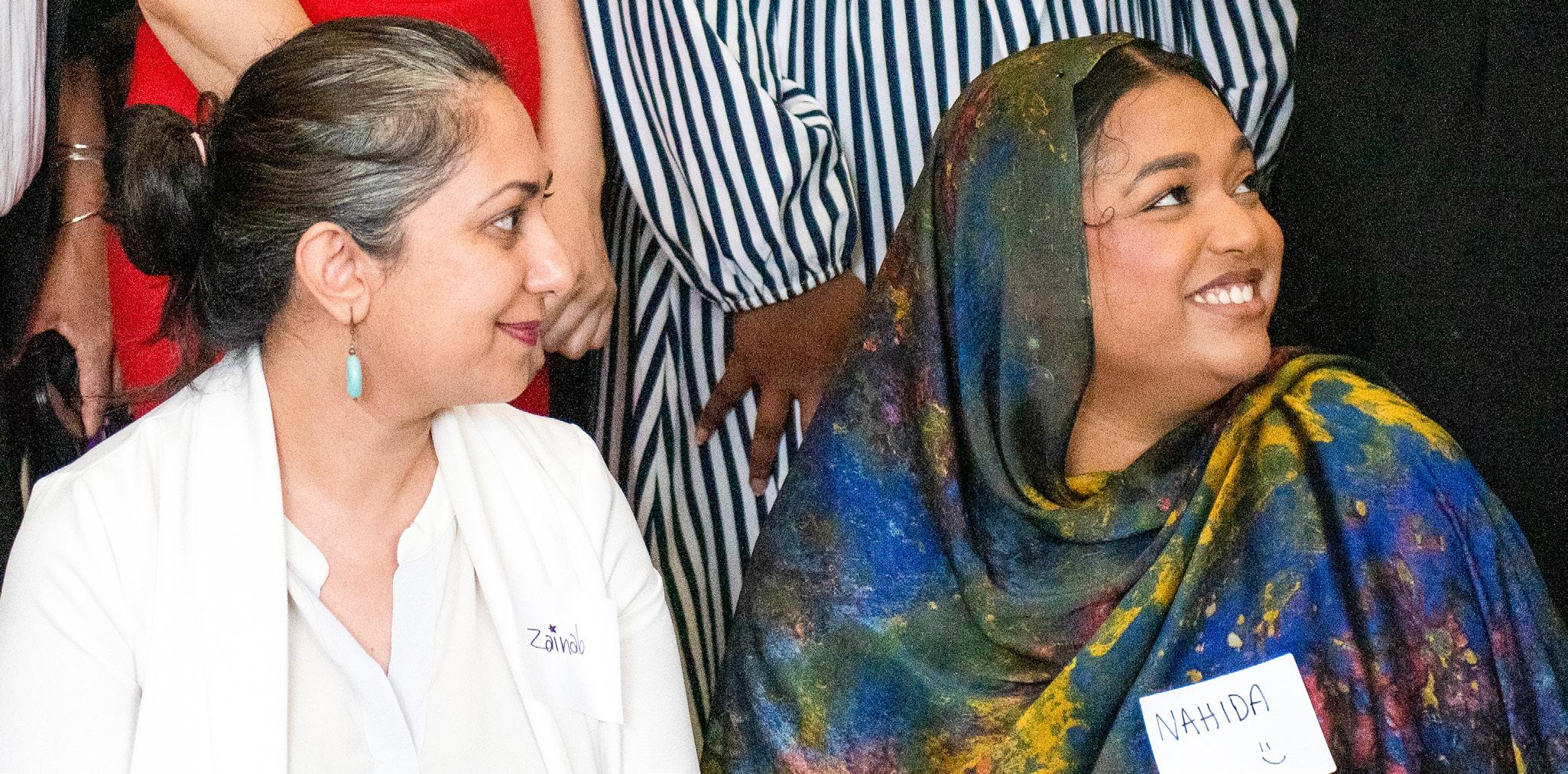
With the support of our Accelerator Programme, Nahida Islam was able to grow Chini Chaat into a fully registered catering company specialising in South Asian food. Operating across London and serving an average of 200 people per month, Chini Chaat is not just another catering business: it’s a family-run endeavour that aims to share the talents of home cooks. Nahida explains:
Chini Chaat is a tribute to the women behind the scenes. It’s about recognising minority women like my mum — women who are incredibly talented in the kitchen, who cook with instinct, creativity, and love, but whose work often
goes unseen. This isn’t just about food, it’s about giving credit where it’s long overdue.
Seeds Hub helped Nahida access the network and resources she needed to turn her family’s popular homemade platters into a sustainable business, for example by encouraging her to explore funding and partnership options and linking her to like-minded entrepreneurs. For Nahida, the real game-changer was gaining the confidence to trust herself:
The idea of having a community around me that I never had before is life-changing. I gained trust in myself; the one important thing that was missing. Being with people who understand how hard things really are in business... made me feel seen and heard. I never had business know-how as I studied Maths, so the Seeds Hub Accelerator helped me grow.
SOCIAL BUSINESSES SUPPORTED IN 2025
I gained trust in myself; the one important thing that was missing. Being with people who understand how hard things really are in business... made me feel seen and heard. “

Always Giving Back
What distinguishes Seeds Hub from other start-up incubators is our commitment to fostering businesses that give back to their communities, to create a cycle of change that expands far beyond our office walls. Just ask Michelle Thompson, founder of Balanced Accounts, who’s been through both our Start-Up and Accelerator programmes and now shares her expertise as a course facilitator.
Raised on a low income in a singleparent household, Michelle would later face the challenge of making ends meet as a young mother to two children. Her experiences learning to manage her own finances inspired her to educate others in accounting and financial literacy, and our programmes helped her apply over 20 years of personal and professional experience to Balanced Accounts — which now supports over 70 private clients, works with students in schools, and has partnered with three local authorities in South London. Michelle says:
[The courses] helped me realise... that I had the pieces to my puzzle, but I just didn’t know how to put them together... they really helped me with the vision of my business; to put all the pieces together to make sure that I had a solid foundation and [was] able to voice what it is that I bring to the table.
Our programmes enabled Michelle to build a long-term plan for her business. She notes:
After graduating from Seeds Hub, in the first year I doubled my turnover, and the following year I added another 50% to that.
She isn’t the only one: by the end of this year’s Start-Up Programme, 27% of participants told us they could rely on their business as their sole source of income, and 100% said they would recommend Seeds Hub to a friend. One entrepreneur shared:
The programme has given me the tools to go back to the drawing board and review our business to create a new approach and better strategies, revising our business model to include improved or better developed revenue streams. It has given us access to prospective partners, ideas for funding and confidence to keep going.
Michelle’s Seeds Hub journey continues as she passes on her accounting expertise to new generations of social entrepreneurs on our programmes. She helps them in other ways, too: our course participants have access to a free co-working desk at our Wembley hub, where established social business founders like Michelle can also rent office space. This means that future cohorts have the benefit of working in a supportive environment where they can learn from other businesses, while rent from desk and office hire contributes to keeping our programmes free to access.
100% OF PARTICIPANTS WOULD RECOMMEND SEEDS HUB TO A FRIEND
27% OF 2025 STARTUP PROGRAMME
PARTICIPANTS TOLD US THEY COULD RELY ON THEIR BUSINESS AS THEIR SOLE SOURCE OF INCOME
Our Resources
How Our Resources Were Used in 2025
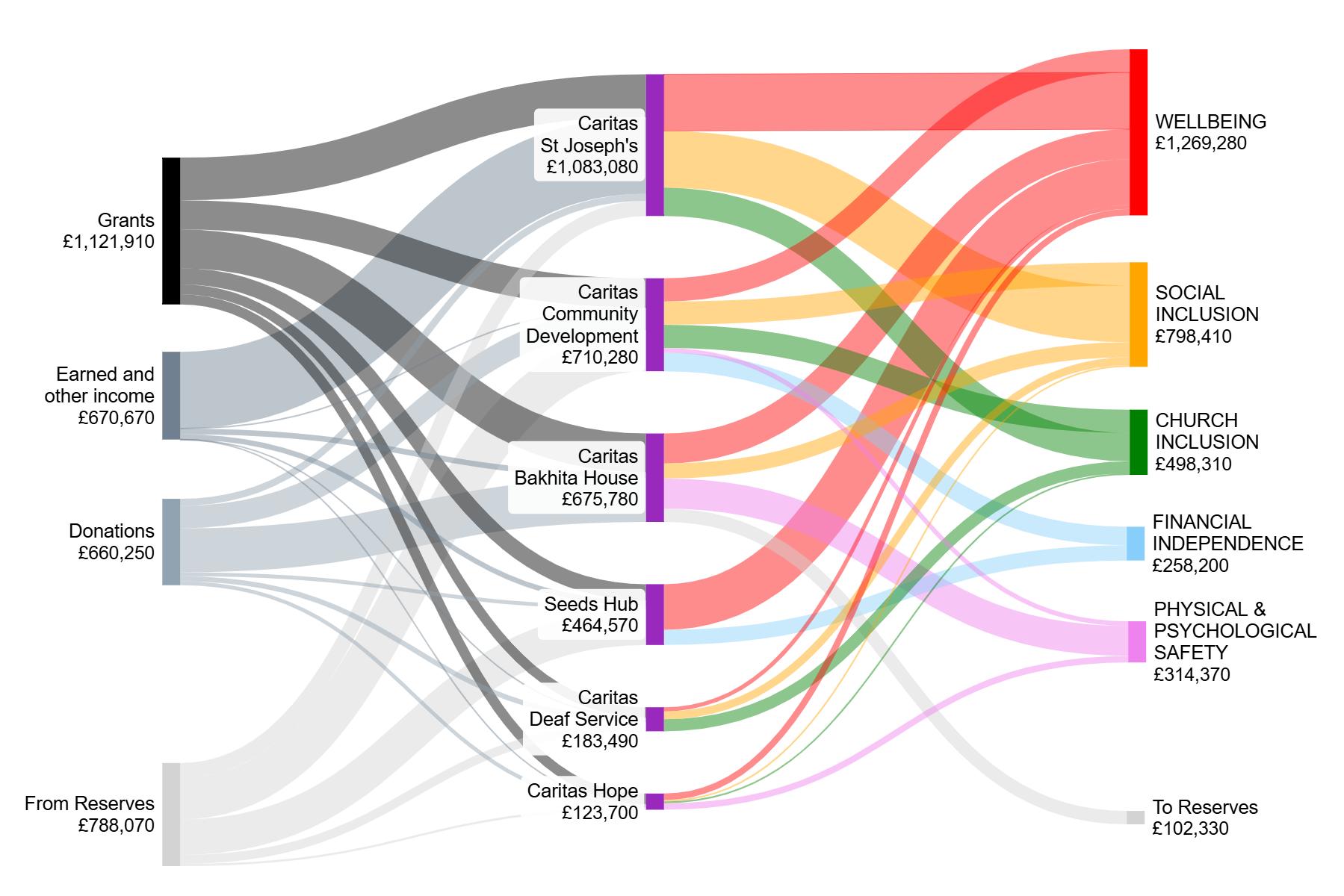
During the year, Caritas Westminster generated a total income of £2.5m, comprising £1.1m (45.7%) in grant funding, £0.7m (27.3%) in earned and other income, and £0.7m (26.9%) in voluntary donations. As illustrated in the diagram opposite, this income flowed directly into the delivery of our charitable activities, alongside a planned contribution from reserves.
Total expenditure for the year amounted to £3.2m, resulting in a £0.7m deficit that was met through the use of reserves. This approach enabled us to maintain continuity of services and respond to need during a year of sustained demand across our programmes. Income received during the year was applied across five core areas of activity, in line with our outcomes: Wellbeing, Social Inclusion, Church Inclusion, Physical & Psychological Safety, and Financial Independence. These areas reflect both the immediate needs of the people we serve and our wider mission to uphold dignity, inclusion and participation.
• Wellbeing represented the largest area of expenditure at £1.3m, reflecting its central role in all Caritas services and our commitment to supporting people to flourish.
• This was followed by Social Inclusion (£0.8m), which supports our work to reduce isolation and foster belonging within local communities.
• The remaining expenditure supported Church Inclusion (£0.5m), Physical & Psychological Safety (£0.3m), and Financial Independence (£0.3m).
A significant proportion of overall expenditure related to Caritas St Joseph’s and its satellite centres, which deliver lifelong learning opportunities for adults with intellectual disabilities. Earned income from courses totalled £0.6m, however the service continues to rely on grant funding, voluntary donations and reserves to sustain its activities.
Income raised for Caritas Community Development amounted to £0.4m, requiring a £0.3m drawdown from reserves to deliver planned services during the year. Similarly, a number of other services — including Caritas Deaf Service, Safe in Faith (which in 2026 will be incorporated into our new service, ‘Caritas Hope’), and Seeds Hub — required reserve support to meet their commitments.
For the first time, and thanks to the generosity of donors, Caritas Bakhita House was able to make a £0.1m contribution back into reserves; strengthening our position for the future.
Please note that all financial figures presented are unaudited and may be subject to revision.
CARITAS WESTMINSTER SERVICE AREAS
CARITAS BAKHITA HOUSE
Our safe house offering round-theclock support to women who have been trafficked, enslaved or exploited.
CARITAS ST JOSEPH’S
Lifelong learning and tailored support for people with physical and intellectual disabilities.
CARITAS DEAF SERVICE
Ensuring Deaf Christians receive vital pastoral and spiritual support to enable them to live full and dignified lives.
CARITAS COMMUNITY DEVELOPMENT
Empowering parishes and diocesan schools to serve their local communities through social action.
SEEDS HUB
An innovative start-up incubator helping entrepreneurs across our diocese to start or grow a social impact business.
SAFE IN FAITH (CARITAS HOPE)
Promoting faith-sensitive support for people experiencing domestic abuse and gender-based violence.
This chart illustrates the total income generated by Caritas Westminster in 2025 - £2.5m - and how those funds were allocated across our service areas, showing how resources flowed to support our key outcomes including wellbeing, social inclusion, church inclusion, financial independence, and physical and psychological safety, with a portion also allocated to reserves.
INCOME
SERVICE AREAS OUTCOME
Thank you
We are deeply grateful to the individuals, trusts and companies whose generosity has sustained our work over the past year. Delivering meaningful social action across parishes depends on supporters who share our commitment to serving those most in need. While a quarter of our costs are met through earned income, the remaining three quarters rely on philanthropic support, particularly from parishioners across the Diocese of Westminster.
We thank all who have supported us through one-off and regular donations. These gifts sustain our diverse programmes and enable us to respond with compassion and flexibility to the needs of our communities.
We are especially thankful to our charitable trust partners, whose flexible and multi-year funding has provided stability for essential services and supported long-term planning and impact. We also thank the companies that have supported us through sponsorship, staff fundraising, and partnerships, extending the reach of our work and strengthening community engagement.
As we look ahead, we invite you to continue supporting our work, and to share our mission with others who may wish to get involved. Your generosity changes lives, and helps ensure that our communities remain places of compassion, care and opportunity.
Below are just some of the partners who supported us in 2025:




Love — caritas — is an extraordinary force which leads people to opt for courageous and generous engagement in the field of justice and peace. It is a force that has its origin in God, Eternal Love and Absolute Truth.
POPE BENEDICT XVI, CARITAS IN VERITATE