Master of Surgery (MCh)

World-class Faculty and Learning
Hybrid Delivery - Online and On Campus
Personal and Professional development focus
1 year full time or 2 years part time
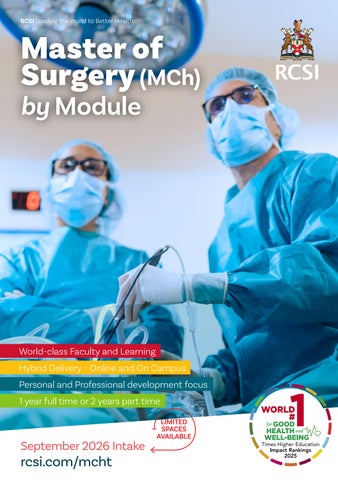
World-class Faculty and Learning
Hybrid Delivery - Online and On Campus
Personal and Professional development focus
1 year full time or 2 years part time

The Royal College of Surgeons in Ireland welcomes you to the Master of Surgery (MCh) by module. This programme aims to equip scholars with a combination of research skills and practical knowledge of the healthcare environment to enhance opportunities for professional development.
Multiple departments at the RCSI have contributed to the development of this programme. Each module will introduce new areas of learning, and many resources will be made available during the delivery of these modules. We have built an exciting programme that offers professional development in areas such as law, ethics, research, teaching, communication skills, global surgery and public health, and management.
The overall success of the programme depends on the drive of the scholars and the class comprises of people from different backgrounds and experience. This ensures a rich mixture of expertise thus providing for healthy discussions and cases studies. The programme aims to give surgeons in training the opportunity to explore areas of professional development that are not specifically addressed in any current higher specialist training programmes. The addition of a taught component equips scholars with skill sets that cannot be adequately developed through research alone. Scholars will continue to develop practical research skills and originality in their research because of exposure to new subject areas in the taught modules, which will encourage scholars to explore surgery within the greater healthcare context.
The College hopes that you enjoy your time doing this programme and will assist you to ensure that you benefit as fully as possible from the experience.
Professor Barry B. McGuire MD, FRCS (Urol)
Consultant Urological Surgeon Professor of Postgraduate Surgical Education and Academic Development RCSI European Robotic (ERUS) Fellowship Director SVUH


As the Academic Lead for the taught Master of Surgery (MCh) programme I extend a warm welcome to you all.
This academic programme has been designed to develop your scholarly competence through the integration of research expertise and applied knowledge of contemporary healthcare topics, thereby supporting your sustained professional and academic development. The curriculum has been refined over the past decade through interdisciplinary collaboration across multiple departments within RCSI, ensuring both breadth and academic coherence.
A distinguishing characteristic of this programme is its structured suite of taught modules spanning a broad range of clinically relevant topics. You will have the opportunity to tailor your academic experience through a diverse selection of elective modules aligned with your individual professional interests and career trajectory. These include, but are not limited to, Leadership, Healthcare Management, Quality Assurance, Innovation in Clinical Practice, Clinical Education, and Professionalism. This flexible, learner-centred design supports your development of targeted competencies that are directly applicable to contemporary surgical and healthcare environments.
This programme employs a diverse range of evidence-informed teaching and learning strategies designed to promote active engagement and professional skill development. These include technology-enhanced learning approaches, collaborative group projects, and structured opportunities to develop advanced oral presentation competencies. You will engage in moderated discussion forums to facilitate critical discourse, alongside peer-assisted learning activities that encourage shared knowledge construction. The curriculum also incorporates peer observation and structured feedback processes, enabling you to cultivate reflective practice and refine your ability to deliver and respond to constructive feedback effectively.
The MCh Team are committed to supporting you throughout your academic journey and we strive to foster an educational environment that enables you to derive maximum intellectual and professional benefit from the MCh programme.
We look forward to supporting you on your MCh journey.
Dr Marie Morris PhD, MSc, PGDipHEd, PGCert Academic Practice, BSc (Hons), DPSN (Teaching & Assessing), RGN. Head of Academic Programmes, Senior Lecturer in Postgraduate Surgical Education. Academic Programme Lead - Masters in Surgery
The programme is aimed at surgeons in training interested in exploring the challenges and opportunities specific to the surgical profession in the wider context of the healthcare and medical community. The aim is to develop skills as researchers and prepare them for the multiple challenges and opportunities available to surgeons interested in a career path that extends beyond the clinical setting.
The modular component specifically focuses on the personal and professional development of the surgeon by encouraging them to seek a deeper understanding of their own skills and provide them with insight into areas that need development.
Learning outcomes at the level 9 qualification of Ireland’s NFQ relate to the demonstration of knowledge, understanding and problem-solving abilities in new and unfamiliar contexts related to a field of study. Scholars are expected to be capable of integrating knowledge, handle complexity and formulate judgements, and link employment at a senior professional or managerial level.


On successful completion of this programme students will:
1. Demonstrate a systematic understanding of the best evidence underpinning professional skills and techniques needed to provide leadership, management, teaching and research in clinical practice.
2. Integrate knowledge from a number of sources to manage complexity and formulate evidence based ethical clinical decisions.
3. Illustrate an ability to self -evaluate and reflect in order to develop continuously by identifying gaps in competence and take responsibility for continuing academic and professional growth.
4. Construct a comprehensive research strategy and produce a thesis inclusive of an original piece of research, a Systematic Review of the Literature or a Meta-analysis relating to an area of current surgical clinical practice.
5. Demonstrate the completion of a Research Ethics Committee application.
6. Distinguish between leadership styles, lead by example by demonstrating exemplary skills in ethical clinical practice, research and teaching.
7. Act professionally and communicate effectively with peers.
A variety of teaching and learning strategies that are scholar-centred and output-oriented are utilised as outlined below:
Lectures: to introduce key concepts, explain course materials, and to provide a forum for scholars where debate and exchange of ideas and experience is encouraged. Lectures will be delivered primarily by RCSI staff who are expert in their field. Guest lecturers will occasionally be provided to supplement teaching and better illustrate selected concepts of the syllabus.
Lecture format:
• Synchronous lectures – live lectures.
• Asynchronous – Scholars watch recordings at a time suitable to them
• Blended approach to teaching which relates to a combination of face to face in person and online classes
Workshops: to encourage active learning and problem solving by working in teams, developing ideas, setting goals, and advancing new knowledge.
Scholar presentations: to develop oral presentation skills and to both give and receive constructive feedback from peers and academic staff.
Case Studies: to advance discussion from the theoretical into practical reallife scenarios.
Supervision: for scholars to learn roles and responsibilities through mentorship developed through seeking guidance and feedback to ensure adherence to research protocol and ethical requirements.
E learning: to develop IT skills and encourage peer support and learning in an alternative forum.
The one-year full-time MCh requires the completion of 90 ECTS credits based on taught modules and a research dissertation. Scholars will complete the taught modules and prepare a research protocol in the first semester and complete the dissertation in Semester 2.
The two-year MCh programme requires the completion of 90 ECTS credits based on taught modules and a research dissertation. It is expected that Scholars will complete most of their taught modules in their first year of the programme. In the second year of the programme scholars will focus more on preparing their research protocol and completing their dissertation.
Scholars can register on the full-time course over one calendar year or on the two-year part-time course. However, once enrolled in the course, if a scholar decides that they would prefer to complete the MCh later, they may defer the completion of the MCh to a later date within a five-year period of the original registration date.
The programme is based on a modular structure using the European Credit Transfer System (ECTS), which has been developed in accordance with the recommendations from the Bologna Agreement (1999) and Ireland’s National Framework of Qualifications (NFQ). These standards provide a mechanism to promote international transparency, international recognition of qualifications, and the international mobility of learners and graduates .
The MCh requires the completion of 90 ECTS credits, divided into 60 credits taught modular work and 30 credits for the research dissertation.
The content of the programme will be delivered through 3 core modules = 60 ECTS and 3 x 10 ECT optional modules.

CORE MODULES – 60 ECTs
All scholars will be enrolled in Core Modules
Course Subjects
Healthcare Ethics and Law
Research Methods: Protocol Design and Development
Research Dissertation
OPTIONAL MODULES – 30 ECTs required
Select 3 x 10 ECT Optional Modules from below
Clinicians as Educators: Effective Teaching Skills
Medical Device, Technology and Innovation
Leading and Managing Your Organisation and Service
Global Surgery
Quality
Prof David Smith
Dr Fiona Boland
Dr Marie Morris, Programme Lead, with Individual Research Supervisors
Dr Marie Morris
Dr David Mathews
Dr Mary E. Collins
Mr Eric O’Flynn
Mr Padraig Kelly
Dr Marie Morris and Guest Lecturer Dr Angela O’Dea
Dr John Murtagh


Clinicians as Educators:
Leading and Managing Your Organization and Service
Technology and Innovation
Primary Care: Orthopaedics
Module 1
• Lectures 30- 35 Hrs
• One-to-one contact 5- 15 Hrs
• Tutorials and workshops 15-35 Hrs
• Course work preparation 50-100 Hrs
• Independent learning time 200-220 Hrs
• Tutor-supported online learning 60-70 Hrs
• Assessment 15-25 Hrs
• Class discussions and PBL 35 Hrs
• On line discussions/learning 35 Hrs
• Continuous assessment 25 Hrs
• Independent learning time 120 Hrs
• Exam preparation/Study 28 Hrs
• Assessment 7 Hrs
• Lectures 30 Hrs
• Course work preparation 47 Hrs
• Independent learning time 138 Hrs
• Tutor-supported online learning 10 Hrs
• Assessment 25 Hrs
• Lectures 40 Hrs
• Course work preparation 10 Hrs
• Independent learning time 120 Hrs
• Assessment 80 Hrs
• Webinars 14 Hrs
• Practical 16 Hrs
• Specified Learning Activities 20 Hrs
• Autonomous Student Learning 150 Hrs
Formative assessment:
• Protocol Presentation
• Ethics Application
Summative assessment:
• Protocol Submission
Formative assessment:
• Draft Teaching Philosophy
Summative assessment:
• Micro-Teaching assessment
• Written Assisgnment
Summative assessment:
• Strategy Assignment
• Finance Assignment
• Written Assignment
Summative assessment:
• Medical DeviceGroup Project & Presentation
• App DevelopmentGroup Project & Presentation
Summative assessment:
• Portfolio
• MCQ
• Pratical Examination
Healthcare Ethics and Law
Healthcare Change and Quality Improvement
Professionalism and Advanced Communications
Global Surgery
Research Dissertation
• Lectures 30 Hrs
• Course work preparation 70 Hrs
• Independent learning time 120 Hrs
• Assessment 30 Hrs
• Lectures 45 Hrs
• Small group teaching 25 Hrs
• On line learning activity 25 Hrs
• Field work 30 Hrs
• Guided Independent learning 25 Hrs
• Independent learning time 40 Hrs
• Continuous Assessment 20 Hrs
• Assessment 40 Hrs
• Face –to-Face interactive & seminars 24 Hrs
• Pre-reading & preparation for Face-to-face days 20 Hrs
• Online weekly readings plus video resources 50 Hrs
• Online discussion Boards 25 Hrs
• Continuous Assessment (Individual reflection) 25 Hrs
• Continuous Assessment (Written Assignment) 50 Hrs
• Independent Learning 55 Hrs
• Course pre-reading 40 Hrs
• Didactic teaching/Case based Learning/PBL 42 Hrs
• Group work – preparation of assessed group presentation 30 Hrs
• Course work – preparation of assessed written report 30 Hrs
• Independent learning time 101 Hrs
• Group presentation assessment 7 Hrs
• Supervisor required - Sourced by Student
• Research Dissertation: Independent Learning Time = 700 Hrs
Research supervision meetings = 20 Hrs Pre-reading = 30 Hrs
Summative assessment:
• Group Presentation
• Group Written Assignment
Formative assessment:
• Weekly Online Quizes
Summative assessment:
• Presentation
• Written assignment
Summative assessment:
• Discussion boards
• Group Presentation
• Project Contribution Statement
• Individual Written Assignment
Summative assessment:
• Group Presentation
• Individual Written Assignment
Summative assessment:
• Dissertation
• Viva Voce Defence
Acceptable Projects:
~ Systematic or Scoping Review Primary Research Meta-analysis#
• Class discussions/PBL 35 Hrs
• On line discussions/learning 35 Hrs
• Continuous assessment 25 Hrs
• Independent learning time 120 Hrs
• Exam preparation/Study 28 Hrs
• Assessment 7 Hrs
• Lectures 30 Hrs
• Course work preparation 47 Hrs
• Independent learning time 138 Hrs
• Tutor-supported online learning 10 Hrs
• Assessment 25 Hrs
• Lectures 40 Hrs
• Course work preparation 10 Hrs
• Independent learning time 120 Hrs
• Assessment 80 Hrs
• Webinars 14 Hrs
• Practical 16 Hrs
• Autonomous Student Learning 150 Hrs 10 200 Optional UCD Primary Care: Orthopaedics Module 1
• Specified Learning Activities 20 Hrs
Formative assessment:
• Draft Teaching Philosophy
Summative assessment:
• Micro-Teaching assessment
• Written Assisgnment
Summative assessment:
• Strategy Assignment
• Finance Assignment
• Written Assignment
Summative assessment:
• Medical DeviceGroup Project & Presentation
• App DevelopmentGroup Project & Presentation
Summative assessment:
• Portfolio
• MCQ
• Pratical Examination

and Quality Improvement
alism and Advanced Communications
• Lectures 45 Hrs
• Small group teaching 25 Hrs
• On line learning activity 25 Hrs
• Field work 30 Hrs
• Guided Independent learning 25 Hrs
• Independent learning time 40 Hrs
• Continuous Assessment 20 Hrs
• Assessment 40 Hrs
• Lectures 30 Hrs
• Course work preparation 70 Hrs
• Independent learning time 120 Hrs
• Assessment 30 Hrs
• Course pre-reading 40 Hrs
• Didactic teaching/Case based Learning/PBL 42 Hrs
• Group work – preparation of assessed group presentation 30 Hrs
• Course work – preparation of assessed written report 30 Hrs
• Independent learning time 101 Hrs
• Group presentation assessment 7 Hrs
• Face –to-Face interactive & seminars 24 Hrs
• Pre-reading & preparation for Face-to-face days 20 Hrs
• Online weekly readings plus video resources 50 Hrs
• Online discussion Boards 25 Hrs
• Continuous Assessment (Individual reflection) 25 Hrs
• Continuous Assessment (Written Assignment) 50 Hrs
• Independent Learning 55 Hrs
Formative assessment:
• Weekly Online Quizes
Summative assessment:
• Presentation
• Written assignment
Summative assessment:
• Group Presentation
• Group Written Assignment
Summative assessment:
• Group Presentation
• Individual Written Assignment
Summative assessment:
• Discussion boards
• Group Presentation
• Project Contribution Statement
• Individual Written Assignment
1 - SEMISTER 2
• Lectures 30- 35 Hrs
• One-to-one contact 5- 15 Hrs
• Tutorials/workshops 15-35 Hrs
• Course work preparation 50-100 Hrs
• Independent learning time 200-220 Hrs
• Tutor-supported online learning 60-70 Hrs
• Assessment 15-25 Hrs
• Protocol Presentation and Feedback
• Final Submission
Completed Year 1, Sem 2
Formative assessment:
• Ethics Application
Completed Year 2, Sem 1
Formative assessment:
• Protocol Presentation
Summative assessment:
• Protocol Submission
YEAR 2 - SEMISTER 2

• Supervisor required - Sourced by Student
• Research Dissertation: Independent Learning Time = 700 Hrs Research supervision meetings = 20 Hrs
~ Pre-reading = 30 Hrs
Summative assessment:
• Dissertation
• Viva Voce Defence Acceptable Projects: Systematic or Scoping Review Primary Research ~ Meta-analysis#
ECTS: 10
Module: Core
Delivery Modes:
• Lectures
• Course work preparation
• Independent learning time
Assessment:
• Group Presentation
• Group Written Assignment
The aim of this module is to increase the capacity of clinicians to address the ethical issues which arise in caring for patients.
The module develops the Principles of Healthcare Ethics, Informed Consent, Capacity and Confidentiality, Ethical issues in End of Life Care, and Ethical Issues and Dilemmas in Surgery.
The module also aims to give scholars an insight in to Patient Safety, Clinical Risk Management and Clinical Negligence, Open Disclosure and Whistle Blowing and Health Care Regulatory Environment for Clinicians.
On successful completion of this module participants will be able to:
• Identify and apply the different approaches to ethical dilemmas taken by the Four Principles method
• Identify and discuss the key ethical components of Informed consent and patient capacity.
• Evaluate the key ethical components of confidentiality.
• Examine the key ethical concepts and distinctions used in end of life care.
• Understand the key ethical issues raised by legislation for physicianassisted dying and suicide and euthanasia.
• Critically appraise the major ethical issues which arise in medicine.
• Examine and critique processes of Clinical Governance, Quality Assurance and Risk management in surgical practice.
• Evaluate the key issues regarding Open Disclosures in Healthcare practice and the Healthcare Regulatory Environment for Clinicians.
• Critically apply the key lessons learnt with an ethical presentation to the class including an ethical case write-up
The Module will include a formal presentation of the key tenets of the Principles of Healthcare Ethics, Informed Consent, Capacity and Confidentiality, Ethical issues in End of Life Care, and Ethical Issues and Dilemmas in Surgery. The module also aims to give scholars an insight in to Patient Safety, Clinical Risk Management and Clinical Negligence, and Open Disclosure and Whistle Blowing and Health Care Regulatory Environment for Clinicians; interactive teaching and learning activities; case-study analysis in pairs and and or small groups, and plenary review.
• Demonstrate the skill of ethical awareness by identifying the ethical elements in a problematic clinical case.
• Demonstrate the application of the Four Principles method to resolve ethically problematic cases in clinical practice.
• Demonstrate an understanding of the administration of Informed Consent
• Demonstrate an understanding of confidentiality
• Demonstrate an understanding of the different issues regarding Patient Safety and Clinical Negligence and Error
The skills of ethical reasoning and argument
• Analysing the core ethical issues in a dilemma
• Identifying underlying ethical perspectives in proposed resolutions
• Evaluating different ethical perspectives
• Drawing inferences from evidence
• Discriminating true and false premises & conclusions in chains of reasoning
• Constructing valid arguments & counterarguments
• Resolving dilemmas using specific methodologies
The skills of critical self-appraisal
• Recognising societal, cultural & religious influences on one’s attitude
• Identifying one’s own bias, prejudices & limitations
• Respecting the different perspectives of others
Pre-Class Component (Blended Learning)
Prior to lectures the scholars are sent core reading which they are expected to review before the commencement of the Module and then prior to each lecture.
In-Class Component (Module Co-Ordinator And Lecturer Facilitated)
• Principles of Healthcare Ethics
• Informed Consent and Confidentiality
• Ethical issues in End of Life Care
• Ethical Issues and Dilemmas in Surgery
• Open Disclosure and Whistle Blowing and Health Care Regulatory Environment for Clinicians
• Patient Safety, Clinical Risk management and Clinical Negligence
Post-Class Component (Blended Learning)
• In-class component review and reflection
• Assignment preparation
• Class project group presentation
Module: Core
Delivery Modes:
• Lectures
• One-to-one contact
• Tutorials/workshops
• Course work preparation
• Independent learning time
• Tutor-supported online learning
Assessment:
• Protocol Presentation
• Ethics Application
• Protocol Submission
The Research methods module aims to provide Masters scholars with the tools and skills necessary to apply appropriate research methodologies to complete the research protocol submission and subsequent dissertation. The written research protocol is the means of assessment for this module. To complete this module, scholars are required to present their proposed research protocol with their peers at a PowerPoint presentation workshop and then to submit a written research protocol for examination. The Research Module co-ordinator will attend the protocol presentation workshop and will provide feedback to Masters scholars in relation to their PowerPoint protocol presentation. It is expected that this feedback is incorporated into the final, written protocol submission. It is mandatory for scholars to attend and present at the protocol presentation workshop, prior to submitting the written research protocol. Written protocol word count 1500 words excluding tables, figures, references, appendices.



On completion of this module, scholars should be able to:
• Critically evaluate the principles, strengths and weaknesses of research study design and how they relate to appraisal and conduct of research
• Analyse health outcomes including mortality, morbidity, pain, health status and quality of life assessment.
• Demonstrate an understanding of statistical concepts, including data management, statistical analysis and sample size calculations.
• Demonstrate an understanding of the ethics of research, governance and data protection.
• Demonstrate an understanding of protocol development for different study designs using appropriate standardized reporting guidelines.
• Indicate the importance of systematic reviews, identify and critically appraise relevant studies and conduct meta-analysis using Stata, including generation of forest plots.
• Demonstrate an understanding of the process of peer review publishing, grant writing and dissemination of research findings.
• Demonstrate how to select a clinical topic that is clinically relevant, feasible, and aligns with current evidence gaps or healthcare priorities.
• Demonstrate the ability to develop a well-structured research protocol that clearly outlines the aims, justifies the research question using an appropriate format (e.g., PICO, PRO, PER), demonstrates understanding of methodological considerations (including risk of bias), presents a statistical analysis plan, and incorporates relevant reporting guidelines (e.g., CONSORT, PRISMA, STROBE).
• Demonstrate the completion of a Research Ethics Committee application.
Pre-Class Component (Blended Learning)
Review module descriptor and module assignments.
In-Class Component (Module Co-Ordinator And Lecturer Facilitated)
• Fundamentals of study design
• Measuring health and health outcomes
• Data management
• Protocol development and standardised reporting
• Basic biostatistics
• Searching biomedical literature and reference management
• Further biostatistics
• Ethics, governance and data protection and research ethics applications
• Systematic reviews and meta-analysis
• Peer review publishing, dissemination of research and multi - choice questions
• Assignment preparation for presentation of research proposal
• Assignment preparation for submission of written research protocol assignment
• Identifying a clinical supervisor who is a subject matter expert on your topic for completion of the subsequent research dissertation.
• Assignment preparation for submission of a completed ethics application.

ECTS: 30
Module: Core
Assessment:
• Dissertation
• Viva Voce Defence
Delivery Modes:
• Supervisor requiredSourced by Student
• Research Dissertation

Module Aims
• To facilitate students understanding of research phenomenology and how research strategy an methods must follow beliefs about the nature of the knowledge.
• To ensure the student can investigate the relevant primary sources of research on a clinically relevant topic.
• To ensure that the student is able to gain a critical understanding of the scope of a research topic at Master’s level.
• To develop students’ proficiency in using an array of qualitative and quantitative research methodologies.
• To educate students to an advanced level so they can critically comment on issues raised by the research topic under investigation.
At the end of this module, scholars should be able to:
• Apply the fundamental principles of research in healthcare towards the identification of an appropriate research question that complies with the FINER criteria.
• Select an appropriate research strategy to answer the research question.
• Demonstrate familiarity with the basic qualitative and quantitative methodologies in research.
• Demonstrate an ability to execute an original research investigation.


• Where appropriate apply research skills in order to submit a research ethics application to the appropriate research ethics committee.
• Implement the appropriate methodology to answer the research question.
• Connect the research hypothesis to wider knowledge in the subject area.
• Demonstrate data management and analysis skills for qualitative and quantitative data.
• Interpret the research findings in the context of existing knowledge in the area.
• Synthesise the knowledge in the chosen area into a literature review.
• Execute, analyse and report research to a publishable standard in a high impact research journal.
Scholars will conduct an independent research dissertation that incorporates subject matter from one of the taught modules in a deeper examination of a surgical issue. Statistical support and assistance will be available to each scholar as required throughout the Research process. Clinical supervisors are required and should be sought and confirmed by the scholar at the start of the Masters programme.
Clinical supervisors provide mentorship to ensure adherence to established standards for the completion of a MCh dissertation, including:
• Ethical research: if the research dissertation includes primary research and the use of information relating to humans or animals, including biological samples or data, full ethical approval must have been obtained by the local Ethics Committee before commencing the research project.
• Originality: the candidate must demonstrate an ability to conduct an original research investigation or systematic literature review or metaanalysis.
• Knowledge of the field: the candidate must be able to connect their research theme to a wider knowledge of the subject and they must demonstrate their familiarity with relevant published work on the topic, including work published since the thesis work was undertaken.
• Publishability: the material in the research dissertation should be suitable for publication in a peer-reviewed, high impact journal relevant to the research dissertation topic. The format of the research dissertation does not have to be presented in publishable format for the purposes of the award of the degree. Previously published research cannot be submitted for thesis examination
• Presentation: the research dissertation must be written clearly, concisely and must follow standard scientific arrangement. Candidates must adhere to the Thesis presentation guidelines provided.
• Examination: The Research Dissertation Module assessment consists of 2 components – an assessment of the written dissertation (60%) and secondly through an oral viva voce dissertation defence examination (40%):
The approved options for the approach to the Research Dissertation are
A Systematic Review of the literature on a clinically relevant topic
~ A Research Protocol for a future clinical study
~ A Primary Research Project
A Meta-analysis of previously published research data
The award of a Master of Surgery (MCh) requires achieving a pass mark of 50% in both the written assessment and viva voce examination. There is no compensation across assessment components permitted in this Module.
ECTS: 10
Module: Optional
Delivery Modes:
• Lectures
• Course work preparation
• Independent learning time
Assessment:
• Medical Device - Group Project & Presentation
• App Development - Group Project & Presentation

The aim of this module is to provide participants with hands-on experience in the industry of medical invention, from identifying unmet needs to developing clinical and market strategies. The module will also seek to build the participants awareness of the various roles of clinical professionals (surgeons) in the design and development of medical devices.
In addition, the module will provide participants with a toolkit of skills to identify unmet clinical needs, conduct background research, generate and develop ideas and understand the basics of clinical investigations, regulatory strategy and routes to market. It will allow student to understand the importance of human factors and usability studies which focuses on the interactions between people, devices and their work environment. These skills will arm participants with the tools to complete an idea disclosure form or a commercialisation grant proposal to secure funding from government bodies or venture capitalist to determine the feasibility of a project.
On successful completion of this module participants will be able to:
• Conduct background research to determine recent developments and trends in medical technologies
• Utilise the toolkit of skills learned to “flesh out” an idea and the research methods involved. Organise and conduct a brainstorming session to generate ideas to solve the identify unmet needs.
• Complete a business analysis of the viability of the project – market potential, classification, patent reviews
• Develop and critically evaluate concepts to select the optimum design
• Identify the areas within the process where clinical input is required.
• Gain an understanding of the complexities of the clinical investigation and regulatory processes.
• Demonstrate an understanding of key terms within the development process – fundraising, intellectual property, medical device directive, clinical and regulatory basics, reimbursement and routes to market
Pre-Class Component (Blended Learning)
• Select an assignment topic
In-Class Component (Module Co-Ordinator And Lecturer Facilitated)
• Assignment Guidelines
• Development Process Guidelines
• Brainstorming
• Human Factors and usability studies
• Regulatory Strategy
• Clinical Investigations
• Health Economics
• Reimbursement & business models
• Fund Raising
• Workshop: Concept Development
• Workshop: Development of a Medical App
• Workshop: Intellectual Property
• Interactive discussions with medical device entrepreneurs
Post-Class Component (Directed Learning)
• In-class component review and reflection
• Assignment preparation
• Article search and review
• Podcast review
• Online inter-professional communication and learning

ECTS: 10
Module: Optional
Delivery Modes:
• Class discussions/PBL
• On line discussions/learning
• Continuous assessment
• Independent learning time
• Exam preparation/Study
Assessment:
• Micro-Teaching assessment
• Teaching Portfolio
This Module aims to support and promote the development of your role as a teacher and assessor in clinical practice. Students will learn to think independently and communicate effectively. They will also learn to act responsibly, by engaging with major issues in identifying and managing their own wellbeing as a teacher and assessor. Exploring research underpins and promotes their development of a professional identity as a medical educator.
On successful completion of this module, scholars will:
• Be able to plan and organise teaching sessions for large and small groups
• Have developed their teaching and presentation skills
• Be able to identify and utilise appropriate teaching resources
• Devise a teaching and lesson plan for an educational event
• Devise an assessment strategy for an educational event
• Devise an evaluation strategy for an educational event
Pre-Class Component
Compulsory:
• Review module descriptor and complete core reading set out for this module.
Optional:
• Deliver a teaching session to a small group in a clinical or classroom setting.
• Deliver a large group lecture.
• Complete a written reflection on these two teaching experiences.
In-Class Component
• Learn the theory underpinning the art and science of teaching.
• Explore effective teaching skills with peers.
• Discuss theories of education.
• Practice lesson planning.
• Practice giving and receiving peer feedback.
• Practice teaching peers through a microteaching session – plan, deliver, assess your peers learning and evaluate your teaching skills.
• Explore Models of reflection.
• Develop your professional identity as a teacher.
Post-Class Component
Complete a 3000 word teaching portfolio including:
• A teaching philosophy statement (500 words)
• A critical clinical teaching incident reflection (500 words)
• A reflection on the micro-teaching session (1000 words)
• A reflection on module learning (1000 words)
• A supporting reference list (10-15 teaching and learning references)
• Maintain a reflective journal of all your future teaching experiences.
Module: Optional
Delivery Modes:
• Face–to-Face interactive & seminars
• Online weekly readings plus video resources
• Online discussion Boards
• Continuous Assessment
• Independent Learning
Assessment:
• Discussion boards
• Group Presentation
• Project Contribution Statement
• Individual Written Assignment

Module Aims
• To introduce scholars to the four main tenets of professionalism: values, knowledge, competency and ethics.
• To facilitate students to explore the core professional values of compassion, empathy and cultural sensitivity; and to explore with students how healthcare culture can impact on these positively and negatively.
• To introduce students to the most important literature on core professionalism topics of shared decision-making, continuity of care, consent, evidence-based medicine, and scholarship.

• To familiarise students with the key ethical principles in healthcare.
• To demonstrate key skills when managing difficult conversations with patients, relative and colleagues
• Explore medicines contract with society and professional regulation.
• Introduce the seminal literature relating to doctorpatient relationships.
• Introduce the seminal literature relating to interprofessional collaborative practice.
• Explore doctors role in patient safety and the development and maintenance of a positive safety culture.
• Examine the literature on advanced professional skills such as continuity of care, handover, shared decision making and open disclosure.
• Examine strategies and techniques to maintain health and fitness to practice.
• Analyse the key legal and ethical principles applicable in healthcare.
• Explain the principles of consent and demonstrate skills in obtaining consent. Demonstrate the ability to communicate risk appropriately to patients.
• Discuss the merits of open disclosure and demonstrate skills in error disclosure strategies.
• Review and assess the principle of continuity of care.
• Review and assess the principles of evidence-based medicine.
• Demonstrate the skills of advanced communication with patients and relatives.
• Critically evaluate different handover tools and methodologies and demonstrate proficiency in structured handover techniques.
• Identify the processes involved in open disclosure of error and demonstrate skills in error disclosure.
• Demonstrate the ability to effectively manage difficult interactions between healthcare professionals.
• Review module descriptor prior to commencement of the module.
• Read any pre-course readings provided.
In-Class Component
• Attend all three Interactive days and engage with class discussion and group work.
• Engage with online resources and literature.
• Contribute to discussion boards by the assigned deadline.
• Engage with your groups to develop a 20 minute presentation on the assignment topic.
• Provide an individual write up of your group project assignment.
• Submit written individual assignment by the deadline.
ECTS: 10
Module: Optonal
Delivery Modes:
• Course pre-reading
• Didactic teaching/Case based Learning/PBL
• Group work – preparation of assessed group presentation
• Course work – preparation of assessed written report
• Independent learning time
• Group presentation assessment
Assessment:
• Group Presentation
• Individual Written Assignment

This module aims to introduce learners to the global context of surgical care. Students will analyse the global context in which surgery is currently practiced, including the challenges in providing adequate surgical healthcare in lowresource settings and in humanitarian crises.
Students will consider innovations and strategies, from both high- and low-resource context settings, that have been successful in improving and expanding surgical care.
On successful completion of this module participants will be able to:
• Describe differences in the delivery of surgical care in different global contexts
• Describe the characteristics of the workforce involved in the delivery of surgical services in different low resource settings
• Identify ethical issues in humanitarian and global surgery
• Explain the process of surgical care policymaking within the global context
• Examine barriers to surgical care in lowresource contexts
• Apply common tools using in planning global surgery interventions
• Analyze global disparities in surgical care and the burden of surgical disease
• Critically analyze and evaluate global surgery interventions, programmes and research
Pre-Class Component
Pre-class preparation material - reading material and videos
In-Class Component
• Introduction to global health and global surgery
• Barriers to accessing safe surgical care
• Ethical and practical challenges in global surgery
• The surgical care workforce
• Global surgery interventions
• Critical analysis of global surgery interventions
• Surgical infrastructure
• Policymaking and advocacy
• Surgery in conflict and humanitarian situations
• A career in global surgery, or global surgery in my career?
Post-Class Component
• Group presentation assignment preparation
• Individual reflective written assignment preparation

ECTS: 10
Module: Optonal
Delivery Modes:
• Lectures
• Small group teaching
• On line learning activity
• Field work
• Guided Independent learning
• Independent learning time
• Continuous Assessment
Assessment:
• Weekly Online Quizes
• Presentation
• Written assignment
Module Aims
• To introduce students to the concept of Lean and Lean Healthcare. Following Day 1 the Team will have an action plan to characterise and investigate the process opportunities.
• To explore Quality Improvement in your department and how Lean Healthcare Methodology can help achieve this.
• To identify potential projects within your hospital and department and as a group identify the most appropriate approach to deploying these

• To connect knowledge-based tools and identify data collection requirements to improve process learning.
• Understand the fundamental principles for successful Healthcare Change Management.
• Be able to develop reflective practice skills that facilitate collaborative working with diverse stakeholders to achieve improvements in practice.
• Be able to develop a robust approach for the application of quality improvement and leadership in an area of your professional practice.
• Be able to critically apply Quality Improvement and lean approaches to achieve change in your department.
• Reflectively and strategically plan their own role as a leader and team member to deliver improvement within an organisation or area of professional practice.
• Be able to apply current research evidence to Justify the application of theories and concepts related to leading and managing change in healthcare to promote quality improvement.
On successful completion of this module, scholars will:
• Demonstrate an understanding of the concepts of Lean Healthcare and the key improvement tools associated with the methodology.
• Demonstrate an understating of the Practical use of the lean tools and templates already in use in the Health Service.
• Development of a charter for an improvement project using the tools and techniques of Lean Six Sigma.
• Confidence to undertaking small improvement projects using the yellow belt tool.
Select a Quality Improvement Project Topic within a defined scope
The Syllabus for this module includes the following core elements:
• National and international perspective on evidence-based practice in healthcare change
• Evidence-based change management theories that have been successful in health and social care settings
• Quality improvement within healthcare, key principles, e.g. seven quality tools, systems, processes and individuals.
• The science of process-based improvement incorporating the Lean Yellow Belt
• Visualisation of data and information for healthcare improvement
• Contemporary improvement methodologies, e.g. Clinical Audit, Model for Improvement, Performance benchmarking, RCA, and clinical quality indicators.
• Human dimensions of quality improvement, e.g. human factors and resistance to change.
• Patient and public involvement is an essential component of quality improvement.
• Formative assessment: Case based discussions and Reflection
• Summative Assessment: Written QI Project Assignment, 3,000 words + Presentation

ECTS: 10
Module: Optonal
Delivery Modes:
• Lectures
• Course work preparation
• Independent learning time
• Tutor-supported online learning
Assessment:
• Strategy Assignment
• Finance Assignment
• Written Assignment
The aims of this module is to provide participants with an understanding of the nature of service and the factors that contribute to excellence in leading service in healthcare through lectures, guest speakers, seminars, readings and assignments. In this module, participants will develop an understanding of the healthcare structures and their competing demands, the development of a culture of service excellence, the various activities involved in the analysis, formulation and implementation of strategic initiatives.
This module will challenge participants to draw on work practices to understand techniques and principles examined to lead and deliver a service of excellence in their organisation.
Each topic has a series of required readings that should assist participants in their preparation and understanding of the central issues for each topic. In addition to the lecture notes, readings and journal articles provide the academic content of the topic. Participants have the opportunity to explore the relevance of concepts and tools in healthcare settings by applying their analytic skills via a course assignment. The objective is to bring the conceptual material to life by illustrating these concepts with real life examples during the lectures.
On successful completion of this module participants will be able to:
• Critically debate strategy in the context of your environment.
• Complete a number of strategic tools for use in your department.
• Critically debate organisational cultures and structures in your working environment.
• Develop competency in financial management for your department.
• Debate performance management as a fundamental part of resource management.
• Critically apply the key lessons you have taken from the selected Case study to your department area.
In order to fully benefit from lectures, it is advised that you familiarise yourself with the material that will be covered during the class in the weeks’ preceding. Please read key reading material in advance of lectures. By reviewing the material, you will become familiar with the key concepts and terminology before the lectures and this will allow you to address any difficulties.
It is expected that participants attend all lectures. As class participation is a vital element in the design of this module, participants are expected to engage in class discussion and debate in order to facilitate the formation of their critical thinking.
• Strategic Leadership: Develop an understanding of strategy and how to effectively manage and lead the strategic process for greater service delivery. Recognise the benefits of strategic management and the basic model of strategic management and its components.
• Strategy: Develop an in-depth understanding of the main concepts, frameworks, theories and approaches within the strategic management literature. Recognise the nature of the healthcare organisation and the importance of strategy in leading healthcare service.
• Organisational Structures and Cultures: Understand the healthcare structures and their competing demands. Recognise the link between strategy, structure and culture and the approach necessary to lead and develop a culture of service excellence.
• Financial Management: Understand financial management practices in healthcare and the impact of service delivery.
• Personal Leadership: Emotional Intelligence, Resilience & Energy Management

• In-class component review and reflection
• Assignment preparation
• Article search and review
• Podcast review
• Online inter-professional communication and learning
ECTS: 10
Module: Optonal
Delivery Modes:
• Webinars
• Practical
• Specified Learning Activities
• Autonomous Student Learning
Assessment:
• Case Studies X2
• MCQ
• Pratical Examination
Co-delivered by the UCD School of Medicine and the UCD Beacon Hospital Academy, this module aims to provide a practical, clinically oriented, learning experience for GP’s and doctors in other disciplines and other health professionals who wish to develop a special interest in the management of patients with musculoskeletal problems. This module aims to enhance a student's capacity to assess and manage musculoskeletal (MSK) conditions that commonly present in primary care and provides an introduction to skills in certain therapeutic procedures, with use of diagnostic imaging where appropriate and available.
Upon completion of the module, a student should be able to:
• Outline the incidence and prevalence of common musculoskeletal injuries and conditions;
• Appreciate the anatomical and functional basis of common musculoskeletal injuries and conditions;
• Competently assess patients with musculoskeletal complaints;
• Appropriately manage patients with musculoskeletal complaints;
• Recognise symptoms and signs of life threatening or impacting disease and appreciate how to respond in practice;
• For any given musculoskeletal presentation/complaint know when/ how to investigate/refer/admit;
• Appreciate the role of diagnostic imaging in the management of musculoskeletal complaints;
• Critically reflect on his/her practice.
Knowledge and understanding, scholars will acquire:
• A thorough knowledge and understanding of best practice in the assessment and treatment of common musculoskeletal complaints in a primary care setting;
• An understanding of the limits of their professional roles, responsibilities, competence, and the need to seek advice and refer when appropriate when treating patients with musculoskeletal problems.
Applying knowledge and understanding:
• Students will learn to apply this knowledge and understanding to improve their competence and confidence in managing MSK conditions in their day-to-day clinical practice.
Making judgements:
• Demonstrate a critical engagement with decision-making frameworks and processes in primary care. Students will improve their clinical assessment capabilities, clinical problem-solving capabilities and clinical decision making.
Communications and team-working skills:
• Students will engage in effective intra and inter professional working with healthcare colleagues.
• Emphasis will also be placed on communication skills reinforcing the primary goal of the School to produce competent, caring practitioners with an ability to convey complex messages to specialist and non-specialist audiences.
Learning skills:
• Throughout the course, students will engage in group and autonomous learning exercises, designed to reinforce an evidence based approach to the management of musculoskeletal problems in a primary care setting.

Graduate attributes and outcomes
• Epidemiology of musculoskeletal problems in practice
• Biomedical sciences (e.g. Anatomy) and their application to the management of patients with musculoskeletal problems
• Diagnosis and assessment of musculoskeletal problems
• Treatment and ongoing management of musculoskeletal problems
• Enhanced critical thinking, analysis and problem solving
• Ability to review his/her own practice and improve patient care through clinical audit and quality improvement initiatives
Module delivery will involve:
• Webinars delivered at 19h00 alternate Wednesday’s over the semester (14 weeks).
• Seminars and practicals, delivered Fridays 10h00 to 16h00, at UCD on 2-3 occasions per semester
Post-Class Component
• Open book mixed modality testing
• Two reflective clinical care portfolios incorporating new ideas using EBM
To be considered eligible for the programme, YOU MUST:
• Hold a MB BAO BCh* holder (or equivalent level 8 undergraduate medical degree)
• Be able to source a research dissertation supervisor: For Primary Research Projects you must working in a clinical post and be able to source a clinically based supervisor. For Systematic Review and Meta-analysis your supervisor does not need to be in a clinical post.
• Be able to attend all face to face in person classes on RCSI campus, Dublin, Ireland
• Candidates must have one of the following: IELTS > 6.5 achieved in all sections (reading, writing and oral) or equivalent must be submitted - OET are not accepted.
~ Accepted language qualifications for RCSI www.rcsi.com/dublin/postgraduate/policies-and-guidelines/englishlanguage-requirements
• Exempt if one has completed undergraduate or postgraduate studies full time in the medium of the English language (three or more years, cumulatively).
Please provide written proof from the university stating that your undergraduate or postgraduate studies were delivered in the medium of English.
*Recognised by the World Health Organisation


Read the testimonials of our graduates, their academic experiences at RCSI and the transformative impact of their studies on the healthcare system in which they work




Dr Gerard Sexton
“The primary feature of the MCh programme from which I continue to benefit in my current practice is the instruction I received in research methodology – from designing a protocol to performing and interpreting my own statistical analysis, I was encouraged from the outset to undertake original research and provided with the tools I needed to make this a reality.
The support of both clinical and methodological supervisors further aids the prospective candidate. The programme also features a heavy emphasis on topics of immense value to the surgeons of tomorrow – ethical practice in surgical care, management and leadership in surgery, and the process of innovating medical devices, to name but a few.”
I can wholeheartedly recommend the MCh programme in RCSI as a stepping stone for anyone considering a career in surgery.”


Dr Regina Morais
“I chose RCSI for its international reputation in surgical education and its strong alignment with my values in clinical excellence, academic development, and patient-centred care. The MCh in Surgery has been a pivotal step in my professional development, providing academic structure alongside full-time clinical practice while strengthening my clinical reasoning, research skills, and understanding of evidence-based practice. I would strongly recommend the programme to anyone considering a Master’s in Surgery, particularly those balancing clinical work with academic training. The blended online and in-person format offers excellent flexibility, and the modules are highly practical and relevant — ranging from medical devices and innovation to health ethics and law, with a strong emphasis on research methodology.
I have greatly valued the support of the programme coordinators and tutors, as well as the opportunity to learn alongside colleagues from diverse backgrounds, and RCSI continues to play a central role in shaping my development as an aspiring surgeon.”
Full-Time Programme
Total fees: €6,595* (EU and non-EU fee)
Payment structure
• First payment: €1,545
(€1,500 Deposit + €45 NUI Fee)
Payment to be made within 2 weeks of accepting offer to secure your place.
• Second payment: €3,095
To be paid by the end of October
• Third payment: €1,955
To be paid by the end of March
* There is a non-refundable online application fee of €50
Total fees: €9,050* (EU and non-EU fee)
Payment structure Year 1: €5,430
• First payment: €1,545
(€1,500 Deposit + €45 NUI Fee)
Payment to be made within 2 weeks of accepting offer to secure your place.
• Second payment: €2,500
To be paid by the end of October
• Third payment: €1,385
To be paid by the end of March
Payment structure Year 2: €3,620
• First payment: €2,000
To be paid by the end of July
• Second payment (January): €1,620
To be paid by the end of March
* There is a non-refundable online application fee of €50
NCHDs working in the HSE full-time may be able to combine Continuous Professional Development Support Scheme (CPD-SS) funding and Training Supports Scheme (TSS) funding to use towards their Master fees. Prospective candidates can check if they are eligible for this funding by emailing cpdss@rcsi.com
For your application to be reviewed, you MUST supply the following Mandatory Documents with the Online Application for both programmes:
1. Full CV – that includes the following:
1.1. Employment information - Job title/Level/Location
1.2. Academic history - Provide details of Institution, Award and Date of completion
1.3. Have you taken a Membership Examination? If yes, please provide name of Institution, Result and Date of completion
1.4. Research - Have you published research yes/no – If so, please provide evidence
2. Copy of Passport
3. Copy of Educational Transcript (Must Detail Results)
4. Proof of Sponsorship for Funding purposes (where applicable)
5. Evidence of English language qualification (where applicable)
• OET are not accepted
6. Written statement : 300 words
• “How do you perceive completing this programme will enhance your career”.
Please note that all responses will be screened for AI generated content


Is this programme online or face to face?
Depending on your choice of modules, this programme is 70-80% online with the remainder delivered on campus.
Each module will have at least 1- or 2-days face to face.
Full-time scholars will be expected to do the following: 35 hours of tuition per week
This will comprise of online/face to face classes, group projects, written assessments and MCQs.
Part-time scholars will be expected to do the following: 20 hours of tuition per week
This will comprise of online/face to face classes, group projects, written assessments and MCQs.
What are the fees for non-EU students?
This programme does not differentiate between EU and non-EU students. The fee is the same regardless of your EU status.
Can I arrange a payment plan for this MCh?
A payment plan can be arranged as an exception to the rule. Please liaise with your programme coordinator once registered.
Is there tax reliefs on fees paid available?
Candidates may qualify for tax relief on fees paid and further information is available at revenue.ie
Who accredits the MCh programme and is it recognised by regulatory bodies in Ireland or elsewhere in the world?
This Master's is accredited by the National University of Ireland and is a Level 9 qualification on the NFQ (Irish
National Framework of Qualification). It is internationally recognised on other regional frameworks such as the European Qualifications Framework (EQF) and the Qualifications Framework for the European Higher Education Area (QF-EHEA).
Is it a requirement to have completed the MRCS exam? No, it is not a requirement.
Is the MCh recognised for the purposes of applying for a student visa for Ireland?
Yes, those who successfully secure a place on the full-time programme can apply for a student visa. RCSI will be able to provide a visa letter to support an application for a student visa; however, students will have to liaise with immigration services to secure their own visa.
Please note it is only the full-time Master of Surgery (MCh) by Module that is recognised for the purposes of applying for a student visa.
What is the process of applying to the Master of Surgery (MCh) by Module as an international/ Non – EU applicant?
• Visa applications to be made a minimum of three months in advance of the course start date.
• Tuition paid in full for one year or a minimum of 6000 euro upon accepting their place
• Student Private Medical Insurance: RCSI does not provide or operate a group scheme, students must therefore purchase this themselves. The cheapest option available is via
a company called Study & Protect. studyandprotect.com/unilanding.aspx
However the cheapest package provided by this company is very basic and provides very limited cover. We therefore recommend that students take out full and comprehensive insurance through the usual providers – VHI, Irish Life etc. More details on the website rcsi.com/dublin/student-life/ undergraduate-essentials/healthinsurance
• College letters. Letters in support of your Visa can be provided by the programme co-ordinator. Please email the course mailbox to request these. mcht@rcsi.com Payment in full must be received before letters can be supplied.
• Review all stipulations on the Dept of Justice website irishimmigration.ie/coming-to-study-inireland/what-are-my-study-visa-options/ how-to-apply-for-long-term-study-visa/
• Tuition Fees – Letter for the Bank. If your bank requires a college letter for the remaining tuition fee payment, please email the programme co-ordinator at the course mailbox to request one. mcht@rcsi.com
What is the value of completing the MCh of Surgery (by Module)?
Good performance as a surgeon involves more than just surgical technical skills. Optimal performance requires awareness and a full understanding of the winder context in which modern surgery is practiced. Issues such as leadership, clinical teaching, innovation, quality improvement should be clearly understood by surgeons in order to optimise the care given to patients. This master programme addresses these professional issues. The modules focus on different and disparate areas which are relevant to good surgical practice, which contribute to better, safer surgical care.
Any queries regarding the Master of Surgery (MCh) by Module should be addressed to the following:
Email: PostgradSA@rcsi.ie
Web: rcsi.com/mcht
SCAN the QR Code to view course website
This programme will commence in September 2026. For Online Applications please go to: rcsi.com/mcht
If you require any further information, please contact: PostgradSA@rcsi.ie

The newly launched Beyond the Theatre podcast explores topics relating to surgery and the healthcare setting, including interviews from professionals, both medical and non-medical. listen here or visit bit.ly/3tbseiw


Any queries regarding the Master of Surgery (MCh) by Module should be addressed to the following: Email: PostgradSA@rcsi.ie Web: rcsi.com/mcht
SCAN the QR Code to view course website

Coláiste Ríoga na Máinleá in Éirinn Royal College of Surgeons in Ireland
123 St Stephen’s Green, Dublin 2, D02 YN77, Ireland.