ROYAL COLUMBIAN HOSPITAL FOUNDATION MAGAZINE
Your Health Matters Your Health Matters MARATHON +A ROYAL COLUMBIAN HOSPITAL FOUNDATION MAGAZINE
FALL 2026 EDITION
IN THIS ISSUE
FALL COMEBACK 2026 EDITION
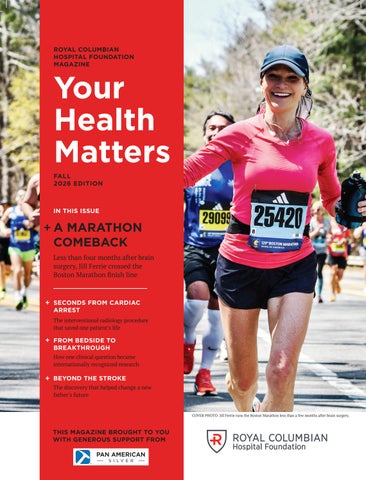
Less than four months after brain surgery, Jill Ferrie crossed the Boston IN THISMarathon ISSUE finish line
+ A MARATHON + SECONDS FROM CARDIAC COMEBACK ARREST The interventional radiologyafter procedure Less than four months brain that saved one patient’s life surgery, Jill Ferrie crossed the Marathon TO finish line FROM BEDSIDE + Boston
BREAKTHROUGH How one clinical question became internationally recognized research
+ SECONDS FROM CARDIAC ARREST
+ BEYOND THE STROKE
The interventional procedure The discovery that radiology helped change a new that saved one patient’s life father’s future
+ FROM BEDSIDE TO BREAKTHROUGH How one clinical question became internationally recognized research
THIS MAGAZINE BROUGHT TO YOU GENEROUS SUPPORT FROM BEYOND THE STROKE + WITH The discovery that helped change a new father’s future
COVER PHOTO: Jill Ferrie runs the Boston Marathon less than a few months after brain surgery.
A NEW CHAPTER BEGINS
O
Hayley Woodin Hastings Chair Royal Columbian Hospital Foundation
Jeff Norris President & CEO Royal Columbian Hospital Foundation
2
YOUR HEALTH MATTERS | ROYAL COLUMBIAN HOSPITAL FOUNDATION
n May 31, Royal Columbian Hospital reached a defining milestone with the opening of the Jim Pattison Acute Care Tower. It marks the beginning of a new chapter in the hospital’s remarkable history. This achievement belongs to an entire community. It reflects the dedication of staff and physicians, the commitment of partners across the health system, and the generosity of donors who have helped equip the hospital with leading-edge technology and innovations in patient care. On page 4 of this edition of Your Health Matters, you’ll find a collection of photographs highlighting the spaces within the new tower. Elsewhere, you’ll meet some of the people whose stories reflect the exceptional care provided at the hospital. You’ll read about a patient who completed the Boston Marathon just months after brain surgery, a family whose son received life-saving care in the Neonatal Intensive Care Unit, and researchers whose work was recently published in the Journal of the American Medical Association (JAMA), advancing critical care knowledge far beyond our hospital. Before you finish this issue, be sure to visit the Q&A at the back of the magazine to meet our new Board Chair. We also take this opportunity to thank Cameron Belsher for his outstanding leadership over the past five years as Board Chair. We are grateful that he will continue to serve on our Board of Directors. As we celebrate the new tower’s opening, we remain focused on what comes next. Together with our community of supporters, we will continue investing in the people, technology, research and innovation that will shape the future of care for generations to come. Thank you for being part of this remarkable journey. •
Your Health Matters
CONTENTS
ROYAL COLUMBIAN HOSPITAL FOUNDATION
EXECUTIVE EDITOR Jeff Norris
VOLUME 12 • ISSUE 2
MANAGING EDITOR Jason Manaois CONTRIBUTING WRITER Jason Howe PHOTOGRAPHY CONTRIBUTORS Joshua Klaassen Jason Manaois Jerald Walliser DESIGN + PRODUCTION Tracy Trydal COVER DESIGN Paula Heal
ROYAL COLUMBIAN HOSPITAL FOUNDATION BOARD OF DIRECTORS
12
Chair Hayley Woodin Hastings Vice Chair Jim McGuigan
02
Greetings Royal Columbian Hospital Foundation Chair Hayley Woodin Hastings and Foundation President and CEO Jeff Norris
04
Inspired Giving Take a look inside the new Jim Pattison Acute Care Tower and go behind the scenes of First Patient Day as Royal Columbian Hospital enters a new era of care
05
83 Days of Hope From fear to hope: compassionate care guides a new mother’s journey
06
Beyond the Stroke The discovery that helped change a new father’s future
08
A Marathon Comeback Less than four months after brain surgery, Jill Ferrie crossed the Boston Marathon finish line
10
Dr. Arun Garg’s Vision for Culturally Connected Care Cultivating innovation through embracing different perspectives
11
From Bedside to Breakthrough How one clinical question became internationally recognized research
12
Seconds from Cardiac Arrest The interventional radiology procedure that saved one patient’s life A Legacy for Generations A mother and daughter help ensure the future of world-class care at Royal Columbian Hospital
Treasurer Han Shu Secretary Puneet Sandhar President and CEO Jeff Norris Directors Cameron Belsher, Hema Bhatt, John M. Clinton, Aleem Jinnah, Diana Miles, Diane Ormiston, Lynn Radbourne, Dr. Carolyn Shiau, Fred Withers, Dr. Brian Yang
We welcome your comments on Your Health Matters magazine. Please email info@rchfoundation.com or write to us c/o Royal Columbian Hospital Foundation, 330 East Columbia St, New Westminster, BC V3L 3W7. Established in 1978, Royal Columbian Hospital Foundation raises millions of dollars annually to purchase medical equipment, fund innovative programs, and support training and research. To donate, please visit www.rchfoundation.com or call 604-520-4438.
14
15
YOUR HEALTH MATTERS | ROYAL COLUMBIAN HOSPITAL FOUNDATION
A New Chapter of Leadership Q&A with the Chair of Royal Columbian Hospital Foundation’s Volunteer Board of Directors Hayley Woodin Hastings
ROYAL COLUMBIAN HOSPITAL FOUNDATION | YOUR HEALTH MATTERS
3
INSPIRED GIVING
O
n May 31, 2026, Royal Columbian Hospital reached a historic milestone with First Patient Day in the new Jim Pattison Acute Care Tower. This transformative facility, made possible through the generosity of donors and the community, welcomed its first patients into a modern environment designed to support specialized care and improve the experience for patients and families. The opening marks the beginning of a new chapter for one of British Columbia’s busiest hospitals and reflects the collective commitment of donors, healthcare teams, partners, and the community who helped bring this vision to life. Together, they are shaping the future of health care for generations to come.
Royal Columbian Hospital and Foundation representatives gather ahead of First Patient Day, which saw more than 200 patients moved into the Jim Pattison Acute Care Tower from other parts of the hospital on May 31, 2026.
Pillars featuring Indigenous artwork welcome patients, families, and visitors into the main lobby of the Jim Pattison Acute Care Tower, reflecting a commitment to culturally safe and inclusive care.
Royal Columbian Hospital Foundation staff gather outside the Foundation’s new office after supporting patient moves and transition activities on First Patient Day in the Jim Pattison Acute Care Tower.
A new CT scanner inside the Jack & Sylvia Gin Emergency & Trauma Imaging Centre (GinETIC) will help care teams diagnose patients faster, improving access to timely emergency and trauma care.
For the latest Royal Columbian Hospital Foundation news, follow us:
4
by subscribing to our monthly e-newsletter at rchfoundation.com
YOUR HEALTH MATTERS | ROYAL COLUMBIAN HOSPITAL FOUNDATION
On Facebook @RoyalColumbian
On Instagram @RoyalColumbian
On Linkedin
83 DAYS OF HOPE ONE FAMILY’S JOURNEY THROUGH THE NICU, WHERE EXPERT CARE AND COMPASSION HELPED A ONE-POUND BABY THRIVE.
W
hen Lauren Niezen unexpectedly went into labour at just 25 weeks pregnant, the excitement of meeting her baby was replaced by fear. “I was told that I was in labour, and I was so shocked,” she recalls. “A moment of joy was taken away because my first thought was that he might not live.” The recreation manager from Chilliwack was airlifted to Royal Columbian Hospital, where her son Daniel was born weighing just over one pound. He was immediately admitted to the Neonatal Intensive Care Unit (NICU), beginning an 83-day stay. “I remember thinking I need to stay calm because I have no control over this situation,” Lauren says. “That was the only thing I could do to give my baby the best chance of surviving.”
creating a sense of inclusion by explaining complex medical information, involving the family in care decisions, and supporting milestones like Daniel’s first bath. After 83 days, Daniel was finally able to go home. Today, he is healthy, meeting his developmental milestones, and thriving. Inspired by her family’s experience,
Lauren created a fundraiser to support Royal Columbian Hospital and other NICU families. “Family-centered care means ensuring families are not only informed but truly involved in their baby’s care,” she says. “It’s about promoting bonding and a sense of normalcy in a highly medicalized environment.” •
Daniel Niezen receiving care in the Royal Columbian Hospital Variety Neonatal Intensive Care Unit (NICU).
Daniel has made a full recovery at home, and continues to meet his developmental milestones.
A JOURNEY THROUGH THE NICU
Seeing her newborn surrounded by medical equipment was overwhelming, but the NICU team supported the family from the very beginning. “From the moment a baby is born, our team partners closely with families, recognizing how overwhelming it can feel,” says Nicole Cusick, a Registered Nurse in the RCH NICU. Early skin-to-skin contact was prioritized, helping foster bonding despite the challenges of intensive care. Living outside the Lower Mainland made frequent hospital visits difficult, but donor-funded accommodations allowed Lauren and her family to remain close to their son throughout his recovery. As the weeks passed, fear gradually gave way to hope. “It went from, ‘We’re scared he’s going to die,’ to, ‘He’s going to be okay—we just need to support him,’” she says.
SUPPORTING FAMILIES EVERY STEP OF THE WAY
Lauren credits the NICU team for
The Niezen Family celebrating Daniel’s first birthday.
YOUR HEALTH MATTERS | ROYAL COLUMBIAN HOSPITAL FOUNDATION
ROYAL COLUMBIAN HOSPITAL FOUNDATION | YOUR HEALTH MATTERS
5
BEYOND THE STROKE A HIDDEN RISK, A LIFE-CHANGING DISCOVERY
A
s a devoted husband and father to a young daughter, 37-yearold Collin Smith was focused on building a life with his family. But when the Maple Ridge resident suddenly suffered a stroke, physicians at Royal Columbian Hospital uncovered a hidden heart condition that had put him at risk all along. Thanks to specialized expertise, a groundbreaking procedure offered at only a handful of centres in Canada, and donor-funded technology helping guide that care, Collin was given the opportunity to help prevent another stroke. “Everything’s pretty normal until that event happened, and then from there it kind of got a little crazy,” Collin recalls. “I had a stroke. The full-face droop, slurred speech, arms can’t lift up, the whole stroke thing.”
FINDING THE CAUSE Collin Smith returns to Royal Columbian Hospital, where a specialized team helped diagnose and treat the hidden heart condition that led to his stroke.
Dr. Razi Khan performs Collin’s minimally invasive patent foramen ovale (PFO) closure procedure at Royal Columbian Hospital. Photo: Joshua Klassen / Fraser Health
6
YOUR HEALTH MATTERS | ROYAL COLUMBIAN HOSPITAL FOUNDATION
For Collin, the stroke was only the beginning of his medical journey. After receiving urgent care at Royal Columbian Hospital, physicians discovered the underlying cause: a patent foramen ovale (PFO), a small opening in the heart that can allow blood clots to travel to the brain and cause a stroke. As a young patient without many traditional stroke risk factors, identifying the source of Collin’s stroke was critical. Closing the PFO would help reduce his risk of another stroke and give him the confidence to return to the life he loves most: being there for his family. “Well, I just had a little kid,” Collin says. “I just want to be here for her.” To reduce his risk of future strokes, Collin underwent a minimally invasive procedure at Royal Columbian Hospital to close the PFO. As part of his treatment, the cardiology team used an advanced robotic-assisted transcranial Doppler (RA-TCD) test to better assess blood flow through the PFO and into the brain. The technology, supported by donors to Royal Columbian Hospital Foundation,
represents an important advancement in stroke care. Royal Columbian Hospital is among the first centres in Canada to use robotic-assisted TCD technology in this way, helping physicians more accurately measure blood flow and identify whether blood is passing through the PFO. “The robotic-assisted portion of the test was a robotic-assisted TCD, which allows us to measure shunting, or flow of blood through the PFO into the brain,” explains cardiologist Dr. Razi Khan. “TCD is a more sensitive test than standard echo. Robotic assistance allows us to find the best area on the temple to accurately measure blood flow to the brain.”
A NEW CHAPTER IN CARE
For Collin, participating in the procedure meant more than receiving advanced care. It also meant helping physicians expand their knowledge and improve care for future patients. “It felt really good that I could be part of it and then other people can watch the Collin undergoes a robotic-assisted transcranial Doppler (RA-TCD) test during his procedure done on me so they can learn procedure, helping physicians assess blood flow through the heart and to the brain. Photo: Joshua Klaassen / Fraser Health and do it to more people and help out with everyone else,” he says. Throughout his hospital stay, Collin was also struck by the human side of his care. Beyond the procedures and technology, it was the compassion and support from the healthcare team that stayed with him most. “The nurses were super nice and super helpful,” he recalls. “Very, very helpful. Talkative.” Even the small moments stood out. “They helped me find my phone and my headphones. I put them down and then just voofed and then we found them a couple hours later.” Today, Collin has returned home to his family with renewed confidence about the future. “It is very gratifying knowing Collin can come home and feel confident he can live a stroke-free life,” says Dr. Khan. “We as cardiologists often treat older patients. Knowing we can have a dramatic impact on a young patient’s Dr. Razi Khan monitors imaging during Collin’s procedure to help guide the minimally invasive closure of his PFO. Photo: Joshua Klaassen / Fraser Health life for the remainder of his life is truly special.” For Collin, the experience is a reminder specialized care when it matters most. “Because if this was three or four years of how quickly life can change, and “I’m just thankful that there was that ago, I don’t know if we’d be talking right how important it is to have access to option when it happened to me,” he says. now.” •
YOUR HEALTH MATTERS | ROYAL COLUMBIAN HOSPITAL FOUNDATION
ROYAL COLUMBIAN HOSPITAL FOUNDATION | YOUR HEALTH MATTERS
7
A MARATHON COMEBACK SOUTH SURREY RUNNER COMPLETED THE BOSTON MARATHON LESS THAN FOUR MONTHS AFTER BRAIN SURGERY
J
ill Ferrie’s time at the 2025 Boston Marathon was not her fastest. But the circumstances surrounding it made the race unlike any she had ever experienced before. Less than four months earlier, the South Surrey resident had undergone brain surgery at Royal Columbian Hospital to remove two brain tumours. On April 21, 2025, she crossed the finish line in Boston feeling something far more meaningful than a slower time. “I was just so grateful that I could actually be there at that point,” Ferrie says. An experienced marathon runner who has completed 11 full marathons over the past 15 years, running has always been deeply connected to Ferrie’s identity, friendships and sense of well-being. The thought of losing that part of her life became one of the most difficult aspects of her diagnosis. “When I got the metastatic diagnosis, that was the one thing I thought,” she says. “It’s such a huge part of who I am and what I like to do.”
A LIFE-CHANGING DIAGNOSIS
Jill Ferrie runs the 2025 Boston Marathon, less than four months after undergoing brain surgery at Royal Columbian Hospital to remove two brain tumours.
8
YOUR HEALTH MATTERS | ROYAL COLUMBIAN HOSPITAL FOUNDATION
Her journey to the Boston Marathon began with an earlier breast cancer diagnosis in 2022. After treatment and surgery, Ferrie believed she was recovering well. Then, she began experiencing severe headaches unlike anything she had experienced before. “I thought I knew what a headache was,” she recalls. “This was like next level. You feel nauseous, you just can’t move. Any movement just triggers intense pain.” The headaches became more frequent and severe over a short two-week period. One day, after a run and coffee
with a friend, she noticed the street felt tilted beneath her feet. Soon after, her husband encouraged her to go to her local hospital. A CT scan quickly revealed two tumours on her brain. Within days, Ferrie was transferred to Royal Columbian Hospital, home to one of British Columbia’s leading neurosciences programs and a specialized centre for complex neurosurgical care. Despite the timing, just after Christmas, everything moved remarkably quickly. Ferrie arrived at the hospital on December 29, 2024. By January 3, 2025, neurosurgeon Dr. Michael Craig was performing surgery to remove the tumours. “When we’re involved with a patient that has metastatic cancer, this may sometimes involve tumours that go to the brain and depending on the location and the degree of symptoms, it can be an emergency,” says Dr. Craig. “There is usually a fairly large team that can be coordinated quickly when needed.”
SPECIALIZED CARE AND A PATH FORWARD
That coordination brought together specialized neurosurgical teams, MRI technologists, anesthesiologists, operating room nurses and advanced surgical imaging technologies to support the procedure. “One of the main things that (Royal Columbian Hospital) Foundation has supported us with recently is navigation software that allows us to combine our anatomic knowledge with a real-time view of the patient’s MRI or CT scan,” Dr. Craig explains. “This can help add an additional safety margin for the patient.” Ferrie remembers feeling reassured from her first conversations with Dr. Craig. “He just put me so much at ease because he seemed so confident and so relaxed,” she says. “I just felt so grateful. It’s hard to explain.” What also stood out to her was the compassion she experienced throughout
Jill Ferrie celebrates completing the Boston Marathon alongside a fellow runner, marking a milestone in her journey following brain surgery and cancer treatment.
her care. “Everyone’s super busy, but they know what they’re doing and they’re doing it with such kindness,” Ferrie says. “I never felt scared. I just felt very much in great hands.” The surgery went smoothly. Ferrie was awake shortly afterward and returned home the following day. Soon after, Ferrie began chemotherapy and immunotherapy treatments closer to home. But even while undergoing treatment, she remained determined to continue training for the Boston Marathon, a race she had originally qualified for before learning about the tumours.
YOUR HEALTH MATTERS | ROYAL COLUMBIAN HOSPITAL FOUNDATION
For Ferrie, the marathon became both motivation and a celebration of what remained possible. “I wholeheartedly believe that physical activity heals your body,” she said. “It just puts your body in the condition that it needs to be in to accept all the other healing.” Dr. Craig was impressed when he later learned Ferrie had completed the race. “That was quite shocking to me,” he says. “While we give our best for every patient, some stories give our team an extra boost to carry forward by highlighting the impact we can have, and that’s certainly been the case with Jill.” •
ROYAL COLUMBIAN HOSPITAL FOUNDATION | YOUR HEALTH MATTERS
9
DR. ARUN GARG’S VISION FOR CULTURALLY CONNECTED CARE BUILDING A MORE INCLUSIVE FUTURE FOR HEALTH CARE
F
or Dr. Arun Garg, improving healthcare begins by connecting people through a shared purpose and a willingness to think differently. This vision inspires others to get involved, like Abdul and Almas Allibhai, a Vancouver couple whose support of the South Asian Health Fund reflects the kind of community-driven momentum Dr. Garg aims to create. Dr. Garg has spent his career as a physician at Royal Columbian Hospital building collaboration across disciplines, cultures and communities. His involvement with the Canada India Network Society has helped create conversations that bridge modern medicine, cultural understanding, and innovation.
BRINGING COMMUNITIES TOGETHER THROUGH INNOVATION
This spirit was reflected at CINI 2026, a gathering focused on integrative thinking and the future of care. The event brought together healthcare leaders, innovators and community voices to explore how diverse perspectives can lead to better outcomes. For Dr. Garg, these ideas are not theoretical. They are embodied in the South Asian Health Fund, an initiative with Royal Columbian Hospital Foundation designed to engage, empower, and educate communities around health and wellness. “Healthcare means different things to different people,” Dr. Garg says. “If we want to improve it, we have to be willing to think differently and work together in new ways.” Created with a long-term vision, the fund supports culturally relevant health initiatives, public education, and
10
Dr. Arun Garg, a retired RCH physician and chair of CINS Board of Directors
improvements to the patient experience. Rather than acting as a traditional granting fund, it serves as a catalyst— encouraging participation, sparking ideas, and strengthening connections between communities and care teams. Its focus may begin with South Asian communities, but its impact is broader. By identifying gaps and addressing barriers,
YOUR HEALTH MATTERS | ROYAL COLUMBIAN HOSPITAL FOUNDATION
the work contributes to knowledge that can benefit patients across the region. As Royal Columbian Hospital Foundation continues to support initiatives that strengthen patient care and community wellbeing, efforts like the South Asian Health Fund—and the connections they foster—are helping shape a more inclusive and collaborative future for healthcare. •
FROM BEDSIDE TO BREAKTHROUGH HOW ONE CLINICAL QUESTION BECAME INTERNATIONALLY RECOGNIZED RESEARCH
Dr. Steve Reynolds, Marlena Ornowska, and Jessica Wittmann are part of the AIM Institute team involved in the CLiCK trial, published in the Journal of the American Medical Association.
F
or Dr. Steven Reynolds, innovation in healthcare starts with practical questions arising at the hospital bedside. For instance, can more be done to reduce complications linked to the central lines used every day in intensive care units? That question became the foundation of the CLiCK trial, a Canadian study led by researchers from Royal Columbian Hospital and Simon Fraser University that was published in the Journal of the American Medical Association (JAMA), one of the world’s leading medical journals. The study examined whether a specialized catheter locking solution could reduce complications linked to central lines in adult ICU patients. Researchers found the locking solution was associated with a significant reduction in a composite measure of these complications. Dr. Reynolds is a Royal Columbian
Hospital critical care physician, associate professor at Simon Fraser University and Executive Lead of Royal Columbian Hospital Foundation’s Advancing Innovation in Medicine Institute, known as AIM. Created as a social enterprise, AIM helps health-tech companies move promising innovations from concept to clinical evidence by connecting them with clinicians, researchers and hospital environments. “We help companies from idea to commercialization by leveraging clinical expertise, research networks and realworld care environments,” Dr. Reynolds says. “Our focus is on improving patient care.”
WORLDWIDE POTENTIAL
The CLiCK trial involved 1,468 patients at six Canadian hospitals and studied whether a four per cent tetrasodium EDTA catheter locking solution could reduce complications associated with
YOUR HEALTH MATTERS | ROYAL COLUMBIAN HOSPITAL FOUNDATION
central lines. “Central lines are essential for many ICU patients, but complications can interrupt care and result in additional treatment,” Dr. Reynolds says. “Because these lines are used in ICUs around the world, evidence on how to reduce complications can matter beyond one hospital or one health system.” The study’s first author was Marlena Ornowska, who recently completed her PhD at Simon Fraser University under Dr. Reynolds. Her doctoral work played a central role in coordinating the trial and preparing the publication. For Dr. Reynolds, the broader goal is to create an environment where clinicians, researchers and innovators can work together to rigorously evaluate ideas before they are adopted more broadly across the healthcare system. “Questions that begin at the bedside can generate evidence with relevance far beyond a single hospital,” he says.•
ROYAL COLUMBIAN HOSPITAL FOUNDATION | YOUR HEALTH MATTERS
11
SECONDS FROM CARDIAC ARREST HOW SPECIALIZED CARE SAVED JYOTI PAWAR’S LIFE
Jyoti Pawar revisits Royal Columbian Hospital, reflecting on the life-saving care that gave him a second chance.
A
s a longtime high school teacher, basketball coach, and father of two, Prabhjyot (Jyoti) Pawar was used to staying busy. So when he began experiencing shortness of breath in early 2025, he assumed it
12
was something minor. What started as a persistent cough evolved into something far more serious. Although he was initially treated for a suspected chest infection and pneumonia, his breathing continued
YOUR HEALTH MATTERS | ROYAL COLUMBIAN HOSPITAL FOUNDATION
to worsen. “The doctors had said the previous two days, ‘If you can’t breathe, go to the emergency immediately,’” recalls Jyoti. “I just wasn’t willing to do that. I was thinking, ‘I’m going to sit there for six
Dr. William Siu is a leading Interventional Radiologist at Royal Columbian Hospital
or seven hours. It’s not going to work.’” One morning, the situation became impossible to ignore. Struggling to breathe and barely able to walk, Jyoti’s family called 911. When first responders arrived, they immediately recognized how critical his condition had become. “They tested my oxygen and said it was 54 per cent,” says Jyoti. “The firefighter said, ‘I thought our monitor was broken because it said 57.’ There’s no reason I should even be conscious.” Jyoti was rushed to Langley Memorial Hospital before being urgently transferred to Royal Columbian Hospital. There, physicians discovered the cause of his symptoms: a massive pulmonary embolism, a life-threatening blockage caused by blood clots in the lungs.
LIFE-SAVING CARE WHEN EVERY MINUTE COUNTS
“When we measured it, it was the highest pulmonary arterial pressure I’ve ever seen in anybody,” explains interventional radiologist Dr. Will Siu. “He was actually imminent of going into cardiac arrest when he came in.” To save his life, Dr. Siu and his team
Jyoti visits the department that he credits for saving his life.
performed a pulmonary thrombectomy, a minimally invasive procedure that removes blood clots from the lungs using specialized catheters. Royal Columbian Hospital is a leader in this advanced treatment and performs more of these procedures than any other hospital in Canada. The procedure was carried out while Jyoti remained awake. Despite the urgency of the situation, what stands out most in his memory is the calmness of the team around him. “At no point did I ever feel like there was any stress on me,” he says. “They kept everything so calm in front of me, at least to make me feel like, ‘Okay, it’s okay.’” The results were immediate. “The impact is phenomenal,” says Dr. Siu. “We see almost instantaneous improvement in a lot of these patients right after we do it.” Within days, Jyoti was discharged from hospital. Within a week, he was walking several kilometres a day. The recovery was a stark contrast to what could have happened had he arrived any later. Following the procedure, he learned just how close he had come to losing his life. “The doctor said, ‘You were very close
YOUR HEALTH MATTERS | ROYAL COLUMBIAN HOSPITAL FOUNDATION
to cardiac arrest,’” recalls Jyoti. “It was really, really close.”
GRATEFUL FOR A SECOND CHANCE
Today, he has returned to the life he loves, spending time with his family, supporting students, and remaining active in the basketball community. He also carries with him a deep appreciation for the team that cared for him during one of the most frightening moments of his life. “People say the medical system doesn’t work, but when you’re in trauma, oh boy, it works,” he says. For Dr. Siu, stories like Jyoti’s demonstrate the importance of having access to advanced, specialized care when every minute counts. For Jyoti, the experience serves as a reminder of how quickly life can change, and how grateful he is that the expertise and technology he needed were available when he needed them most. “I’m just thankful that there was that option when it happened to me,” he says. “Because if this was three or four years ago, I don’t know if we’d be talking right now.” •
ROYAL COLUMBIAN HOSPITAL FOUNDATION | YOUR HEALTH MATTERS
13
A LEGACY FOR GENERATIONS WHEN YOUR MOTHER IS 102 AND STILL SWIMMING LAPS, YOU LEARN TO APPRECIATE EVERY MOMENT.
W
e sat down with two remarkable women, Betty and Rita Brussel, who made the thoughtful decision to include a gift to Royal Columbian Hospital Foundation in their wills. Their choice to leave a lasting legacy grew from deeply positive experiences with Royal Columbian and a shared commitment to support future generations. Elizabeth “Betty” Brussel has become something of a local celebrity in recent years. At 102 years old, she has inspired countless New Westminster residents and British Columbians with her youthful spirit, active lifestyle, and extraordinary swimming career. At 68, she began swimming competitively. With five world records and multiple championships, Betty is still swimming strong. Betty was born in Zaandam, Holland, and was just 16 when the Nazis invaded and occupied the Netherlands. She remembers a time when electricity was scarce, and food was even scarcer. She later moved to British Columbia with her three children, including her seven-yearold daughter Rita. Fast forward to 2020. During the first year of COVID, Betty’s pacemaker became infected, and Rita brought her to Royal Columbian Hospital. That day was the first day of the “essential visits only” policy. Rita was deeply moved by the level of care and compassion shown to her mother during such an uncertain time. She shared that without the swift intervention of RCH physicians, her mother might not be here today. Feeling blessed to still have her mother, Rita
14
Elizabeth “Betty” Brussel celebrates one of her many achievements in competitive swimming. At 102 years old, Betty continues to inspire others through her active lifestyle and determination.
says, “We owe the hospital big time.” technologies and innovative treatments Thanks to the care she received at RCH, for generations to come. • Betty remains mobile, independent, and living life to the fullest. In addition to swimming, she is an avid reader and To learn more about giving a gift enjoys knitting and cross-stitching. With in your will, please contact: no secret formula for her longevity, she remains truly one of a kind. Aidan Halley Together, Betty and Rita are helping Associate Director, Development ensure future patients receive worldP: (236) 332-9471 class care in their most critical E: aidan.halley@fraserhealth.ca moments. Their gifts will support new
YOUR HEALTH MATTERS | ROYAL COLUMBIAN HOSPITAL FOUNDATION
A NEW CHAPTER OF LEADERSHIP
H
ayley Woodin Hastings became Chair of Royal Columbian Hospital Foundation’s volunteer Board of Directors in June 2026, after serving as a board director. She is the Strategic Advisor to the Lieutenant Governor of British Columbia, an award-winning journalist, and former Editor-in-Chief of Business in Vancouver Media Group.
Foundation What inspired you to join Royal Columbian Hospital Foundation’s Board of Directors, and what does this role mean to you as you step into the position of Board Chair? Hayley Woodin Hastings Little else matters when we don’t have our health. Like many people in our region, my family has relied on Royal Columbian during important moments. My grandfather received life-enabling cardiac care here, and that personal connection made the Foundation’s mission feel very real to me. I also believe deeply in giving back to community. As Board Chair, I’m honoured to serve the Foundation, the hospital, and our region in a greater way, and to support the people whose skill, compassion, and dedication make Royal Columbian so extraordinary. Foundation As someone whose career has been built around storytelling, communications, and community engagement, what have you learned about Royal Columbian Hospital that you think more people should know? Hayley Woodin Hastings More people should know the scale and significance of Royal Columbian. This is not only a vital regional hospital: it’s a national leader serving one in three British Columbians and supporting one of the fastest-growing health authorities in the country. More cardiac procedures are performed here than anywhere else in Canada, and Royal Columbian is a major centre for trauma, neurosciences, critical care, mental health, maternity care, and many specialized services. It is B.C.’s oldest hospital, and home to the province’s newest healthcare project. It’s an anchor institution with an essential role in the future of B.C. healthcare. Foundation The opening of the new Jim Pattison Acute Care Tower marks a significant milestone for Royal Columbian Hospital. What excites you most about this moment? Hayley Woodin Hastings This is a transformative milestone for our province. The new Jim Pattison Acute Care Tower brings critically needed capacity, modern patient-centred spaces, new surgical and interventional suites, and advanced technology to support better patient outcomes. What excites me most is that people were at the heart of every decision: the patients and families who will receive care, and the healthcare teams who deliver that care with skill and compassion. Foundation Looking ahead, what opportunities do you see for the Foundation and its supporters? Hayley Woodin Hastings We have an ongoing opportunity to shape what care looks like for decades to come. The new tower creates room to reimagine parts of the existing hospital and expand capacity where it is needed most. It also opens the door to advanced equipment, innovation, research, and specialized programs that can help Royal Columbian deliver care even more effectively.
YOUR HEALTH MATTERS | ROYAL COLUMBIAN HOSPITAL FOUNDATION
ROYAL COLUMBIAN HOSPITAL FOUNDATION | YOUR HEALTH MATTERS
15
Here for BC. Here for life.
Thank you to Pan American Silver for their generous sponsorship of To RCH with Love and The Great Give Back. Your support helps us deliver care to 1 in 3 British Columbians.
rchfoundation.com