
St. John’s Seminary has fully-funded fellowships for Hispanic lay ministers interested in being formed to minister in parishes, Newman centers, Catholic K-12 schools, or campus ministries.
We offer fellowships for our new online M.A. in Pastoral Ministry that allows you to receive your entire education from the comfort of your home.
This program will help lay ministers, increase their knowledge of the Catholic intellectual tradition and improve their ministerial skills for the life of the Church. Students will be prepared to work in different areas of ministry and make professional and personal connections with others of the same mind and spirit.
A studio with professional video, audio, and lighting equipment has been built to allow our students to have an enjoyable technological experience.
We prepare our program to serve our students with the highest quality of education. For more information, please contact us.
Watch a brief video about the program.
7
19, 2026
AROUND OUR DIOCESE
Parishes throughout the Diocese of Orange hosted Sacred Triduum liturgies.
10 EVERY 15 MINUTES
Servite and Rosary High Schools learned about the dangers of impaired and distracted driving.
12 CHRIST AT THE CENTER
Santa Margarita Catholic High School held a eucharistic procession after a schoolwide Mass.
14 “HERE YE, HERE YE”
Would you recognize the word of God spread by word of mouth?
The Orange County Catholic Newspaper seeks to illuminate and animate the journey of faith for Catholics within the Roman Catholic Diocese of Orange – building solidarity among the faithful and inviting a deeper understanding and involvement in the mission of Christ – through the timely sharing of news, commentary and feature content in an engaging, accessible and compelling format.
The Official Newspaper of the Roman Catholic Diocese of Orange Diocese of Orange Pastoral Center, 13280 Chapman Ave., Garden Grove 92840
Publisher: The Most Reverend Kevin W. Vann, Bishop of Orange
Executive Editor: Jarryd Gonzales
Managing Editor: Patricia Mahoney, editor@occatholic.com
News Ideas: editor@occatholic.com
Delivery Problems: occatholicsupport@occatholic.com
ADVERTISING
Director of Custom Content: Caroline Wong, cawong@scng.com
SCNG CUSTOM CONTENT
Managing Editor: Caitlin Adams Art Director: Ryann Beveridge
Delivered weekly to parishes and homes throughout Orange County, Calif., Orange County Catholic is published by SCNG Custom Content, a division of Southern California News Group that offers content development and design expertise to businesses and nonprofit institutions. The Orange County Catholic editorial staff and editorial council are responsible for the content contained herein. Events and products advertised in Orange County Catholic do not carry the implicit endorsement of the Diocese of Orange or SCNG Custom Content.


To report sexual abuse by clergy or church personnel please call: 1 (800) 364-3064
Healing and Hope After Abortion: 1 (800) 722-4356
New Hope Peer-to-Peer Support Line | Mon - Fri 7:30 AM - 9:30 PM | Sat - Sun 8:00 AM - 6:00 PM: 1 (714) NEW-HOPE or 1 (714) 639-4673
đây: 1-800-364-3064, và đồng thời báo cáo cho nhà chức trách địa phương.
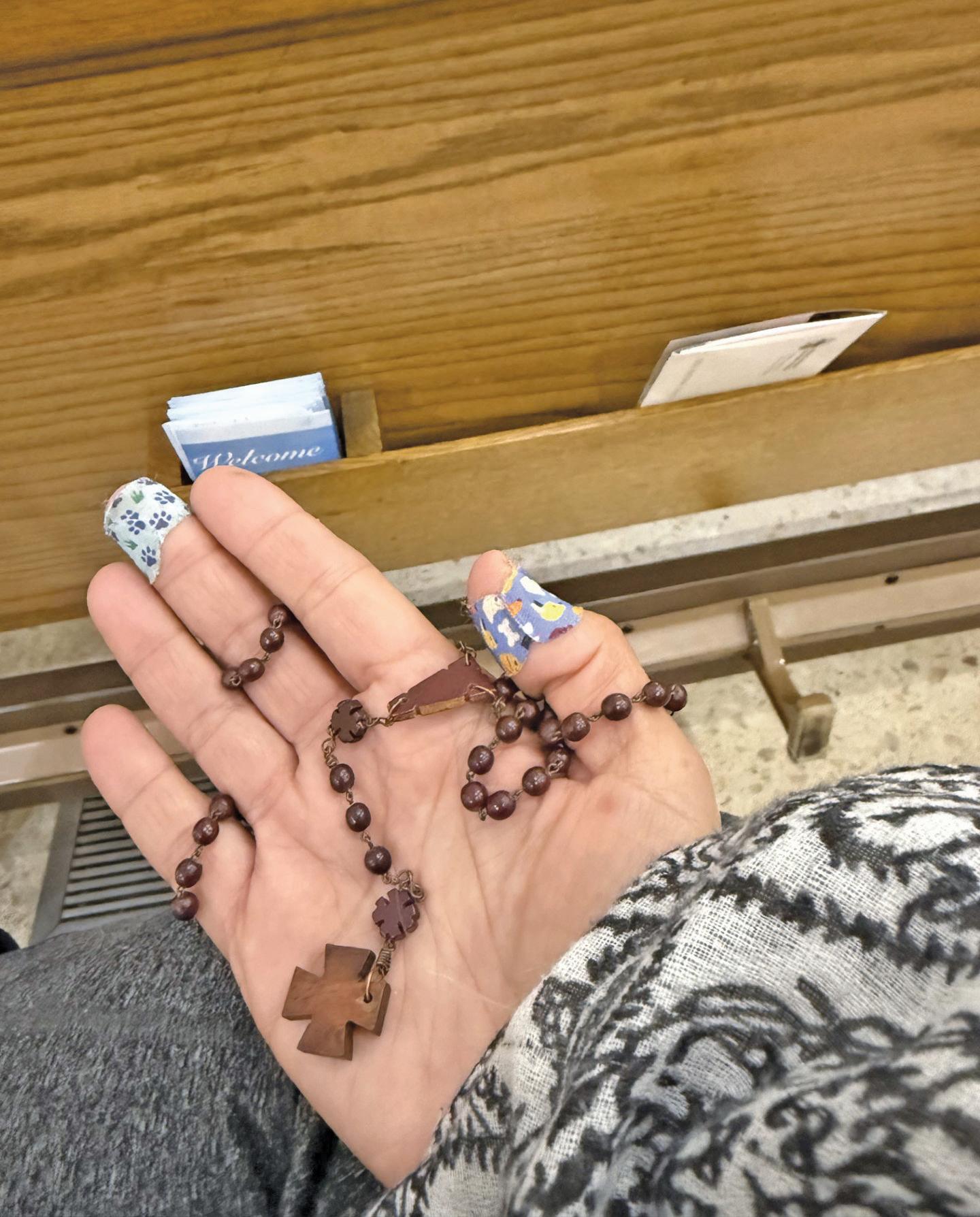
Lisa Escobedo holds her Rosary Beads during Mass at St. Mary’s Catholic Church in Fullerton.
If you would like to share a photo of your Rosary Beads with our readers, please send a photo and brief description (include your name and parish) to: Editor@ occatholic.com
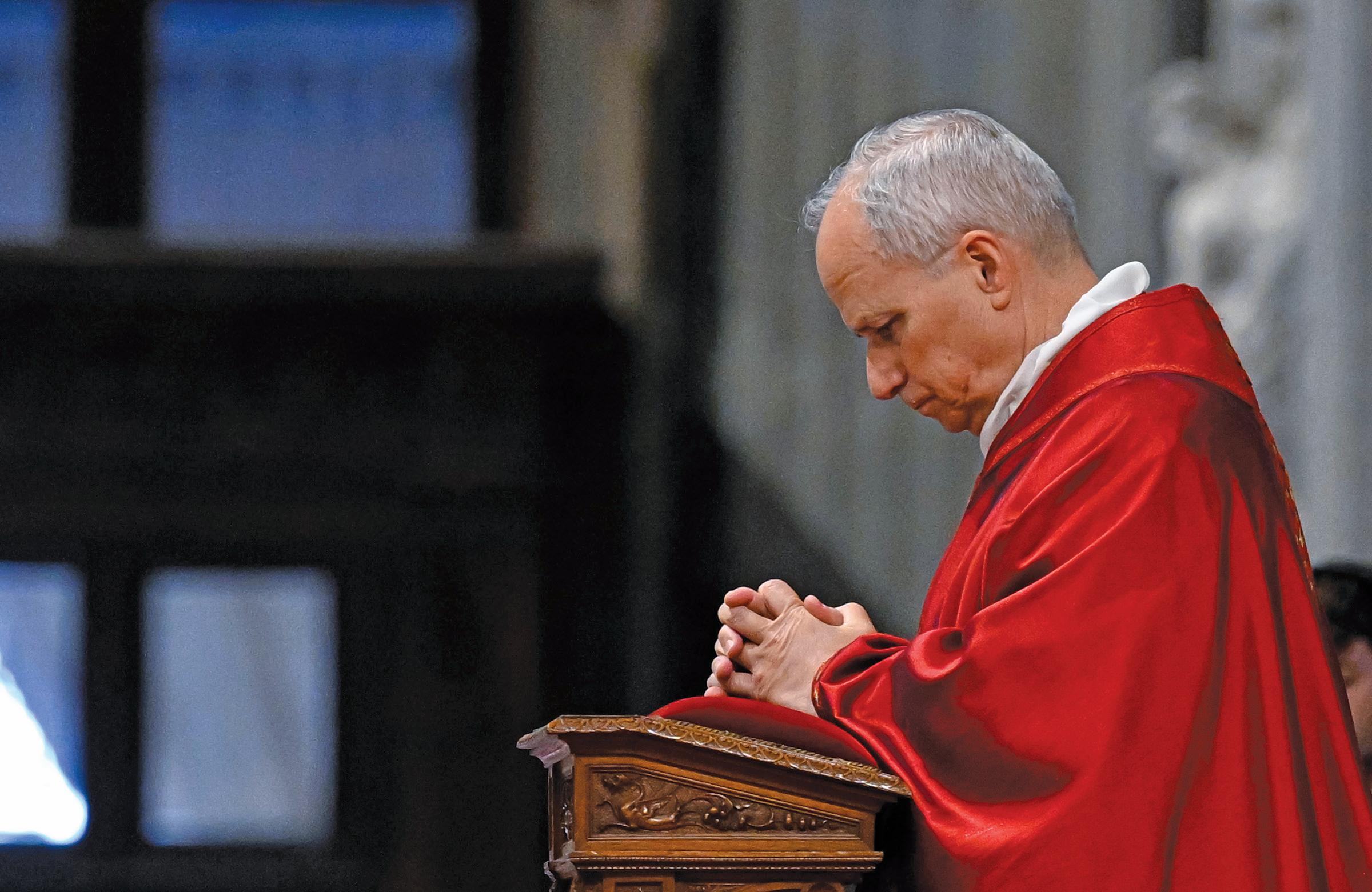
“ Disarm our hearts of hatred, resentment and indifference”
— Pope Leo XIV
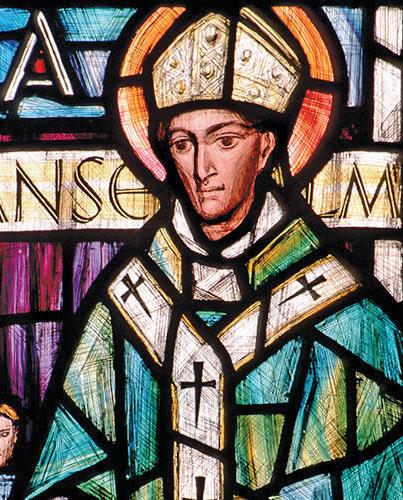
THIS SCHOLARLY ITALIAN YOUTH wanted to become a monk, but his father's disapproval pushed him to a secular life that he later described as dissipated. After his mother died, he moved to France to continue studies with her family. In 1060 he joined the Benedictines at Bec in Normandy, and in 1078 was elected abbot, which increasingly involved him in civil and church affairs in France and England. In 1093 he became archbishop of Canterbury, a post held until his death. During his tenure, Canterbury became England's primatial see, but Anselm was twice exiled over conflicts with English monarchs. He penned a systematic study of Christian beliefs and many letters to his beloved monks. He is a doctor of the church.C
READINGS FOR THE WEEK
MONDAY
ACTS 6:8-15; PSALM 119:23-24, 26-27, 29-30; JOHN 6:22-29
TUESDAY
ACTS 7:51—8:1A; PSALM 31:3CD-4, 6 AND 7B AND 8A, 17 AND 21AB; JOHN 6:30-35
WEDNESDAY
ACTS 8:1B-8; PSALM 66:1-3A, 4-5, 6-7A; JOHN 6:35-40
THURSDAY
ACTS 8:26-40; PSALM 66:8-9, 16-17, 20; JOHN 6:44-51
FRIDAY
ACTS 9:1-20; PSALM 117:1BC, 2; JOHN 6:5259
PHOTOS: CATHOLIC NEWS SERVICE, SHUTTERSTOCK
SATURDAY
1 PETER 5:5B-14; PSALM 89:2-3, 6-7, 16-17; MARK 16:1520
SUNDAY
ACTS 2:14A, 36-41; PSALM 23: 1-3A, 3B4, 5, 6; 1 PETER 2:20B-25; JOHN 10:1-10
BY GREG HARDESTY
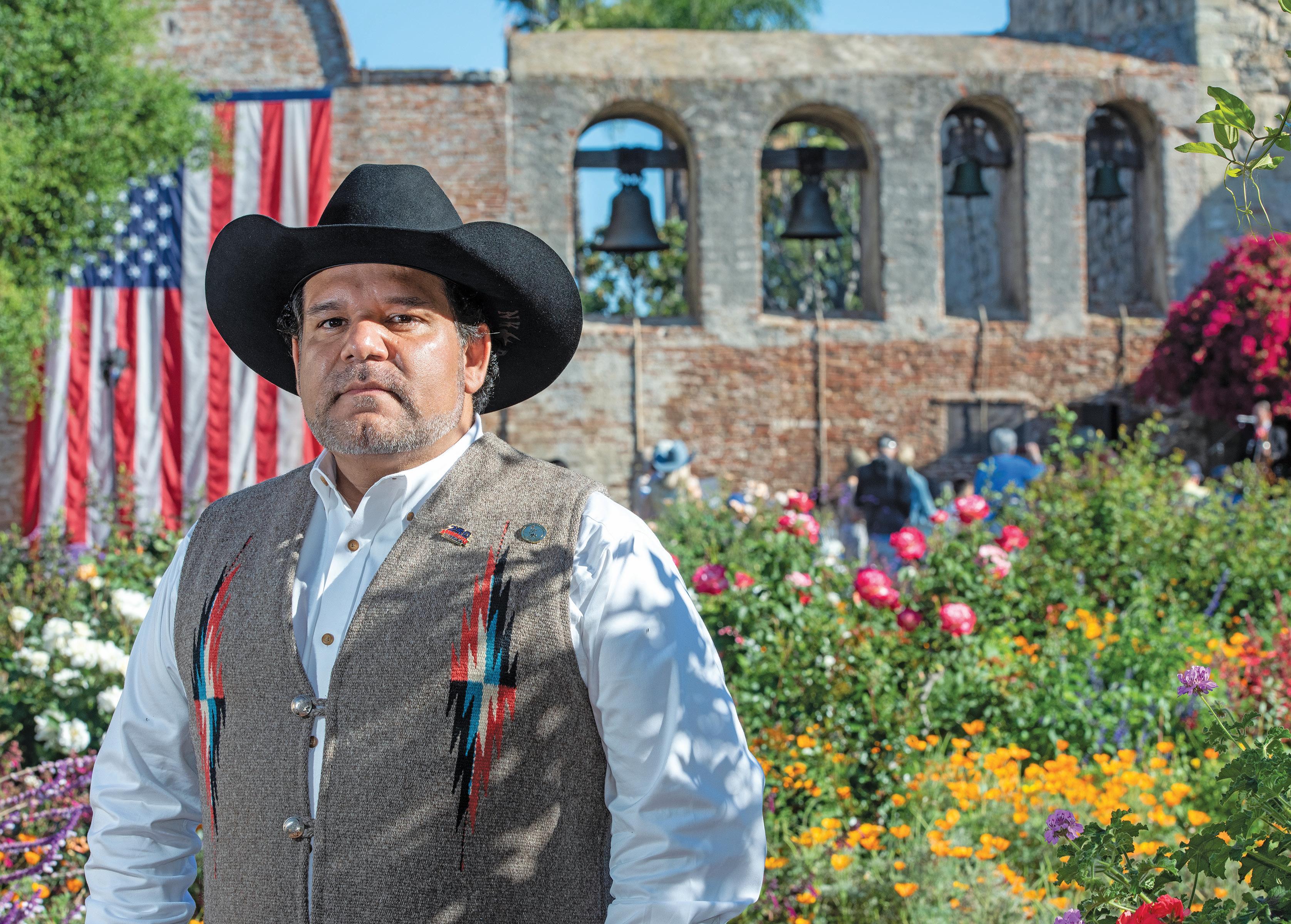
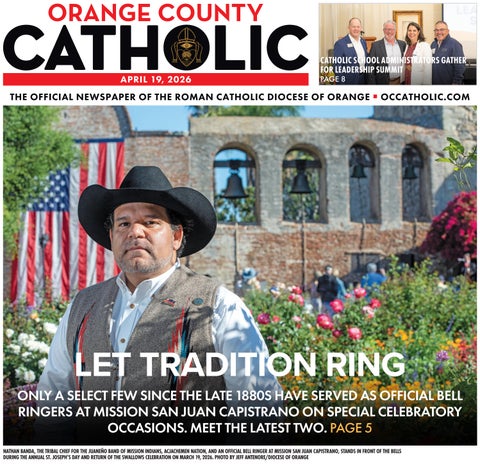
NATHAN BANDA STEPPED up to the bell wall, or campanario, at Mission San Juan Capistrano, taking his place beside Michael “Mission Mike” Gastelum.
The occasion was St. Joseph’s Day and the annual Return of the Swallows celebration on March 19 — one of many key events leading up to the mission’s upcoming 250th anniversary
on Nov. 1.
Gastelum prepared to ring the two larger bells — named San Vicente and San Juan after saints, and replicas of the ones seriously damaged in the earthquake of Dec. 8, 1812. He’s been ringing them for 45 years. His grandfather, the late town patriarch Paul Arviso, rang them for 65 years.
Banda took his place at the two smaller bells, which are original and named San Antonio and San Rafael.
The two grabbed thick ropes and rang
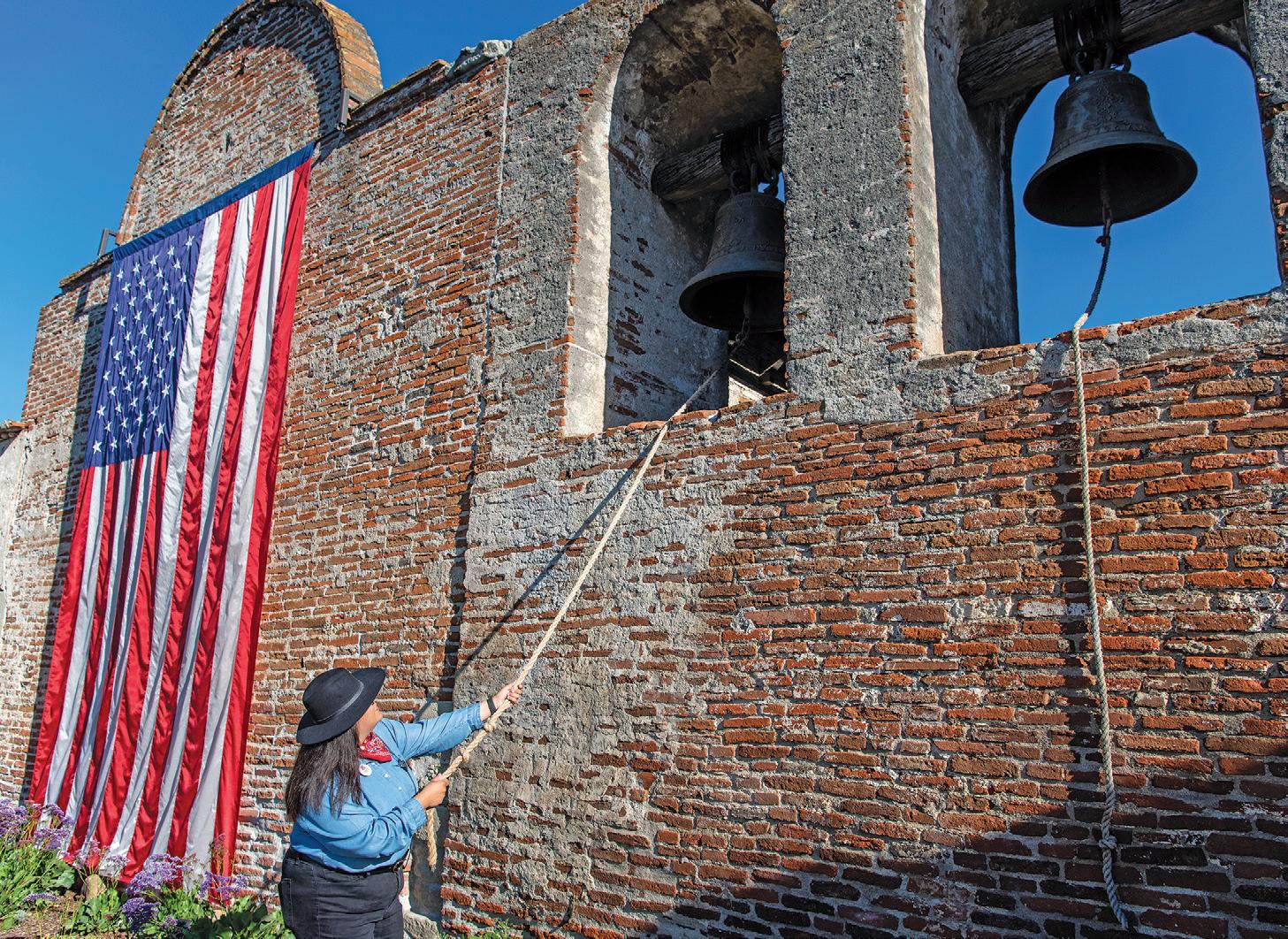
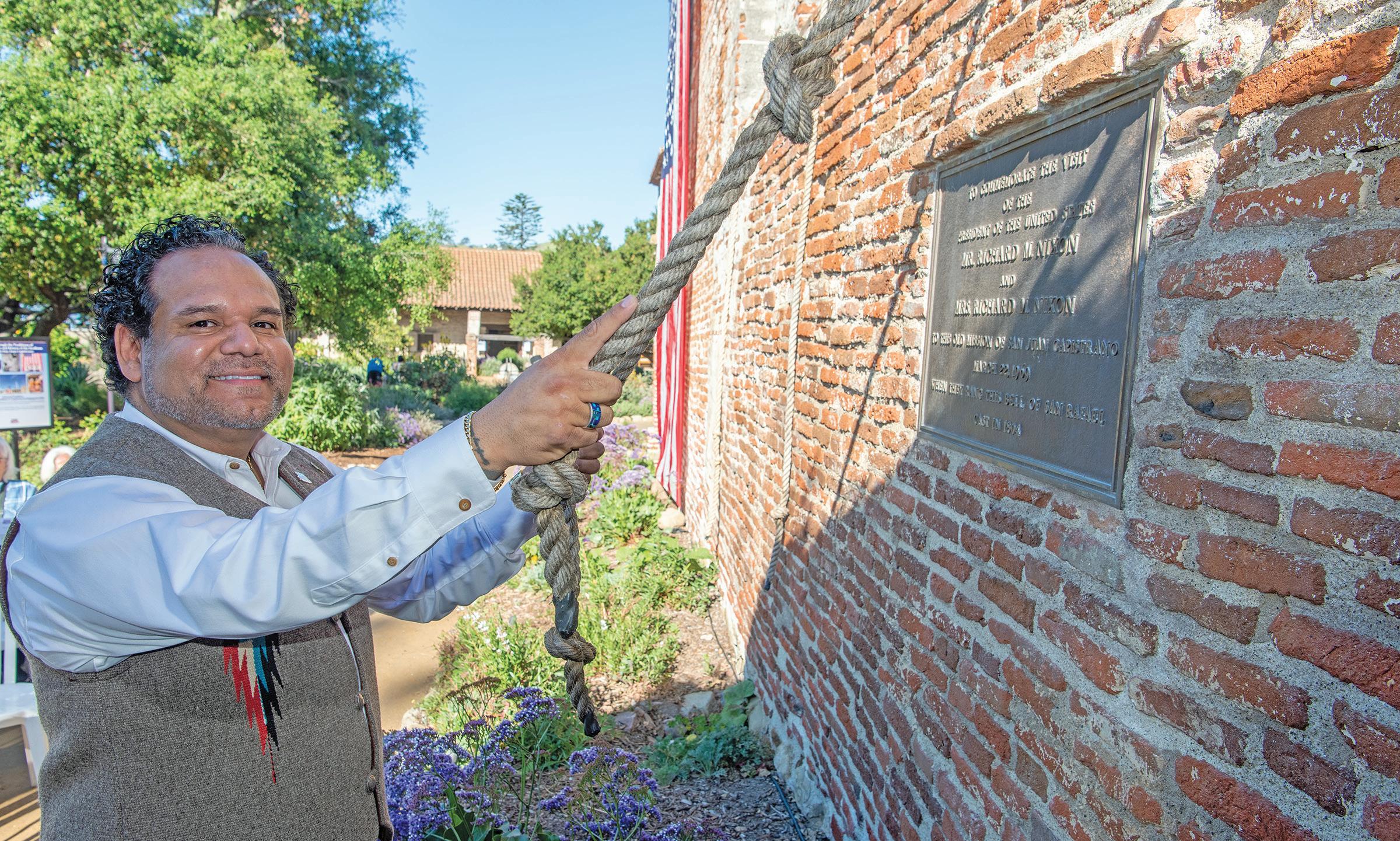
the bells for 90 seconds before a crowd.
Minutes before the celebratory tones rang out, Mechelle Lawrence Adams, executive director of the mission, explained their significance.
“The bells are like a call to a homecoming,” she said. “They are a call to worship, to reflect and during the Lenten season, a time to slow down.”
Both Banda and Gastelum are descendants of the Acjachemen tribe of the Juaneño Band of Mission Indians, who along with Catholic clerics and soldiers formed a working enterprise at the original mission, whose Great Stone Church ruins and Serra Chapel remain.
Although most of the bell ringers dating back more than a century have been members of the Acjachemen tribe, the only requirement is that they be baptized Catholics — since ringing the bells is a Catholic tradition.
Although staff members ring the bells seven times each day when the
mission opens at 9 a.m. to honor the legacy of founder St. Junípero Serra, only Banda and Gastelum can ring the bells on designated feast days, holidays and community celebrations such as the Feast of St. Joseph.
It’s an honor both men don’t take for granted.
“I always think of the special people in my heart when I ring them,” said Banda, who recently began his fouryear term as tribal chair after serving as secretary-treasurer and member-atlarge for the Acjachemen Nation.
Banda is also a former tribal council member whose Acjachemen ancestors go back 11 generations. His three daughters — Marisella, 24, Nevaeh, 15, and Nyiah, 8 — represent the 12th generation in the tribe’s only surviving lineage.
Gastelum can’t count how many times he’s rung the bells over the years and said he’ll ring them “until I’m dead.”
Banda started as a receptionist in the mission’s administrative office in 2004, when he was 20. He had been working in a hardware store and raising his first daughter when Lawrence Adams hired him.
“Nate was so good and had a tremendous spirit even as a young man,” she recalled.
Banda was promoted to events manager before he left the mission to start his own events business. He was working in human resources for an automotive agency until April 2025, when he turned his attention full-time to tribal business.
Among Banda’s priorities as the new chief are getting the tribe recognized by the federal government (instead of just the state) and reclaiming the names of the tribe’s 265 recorded historic villages throughout Southern California.
For example, Banda recently worked with the City of Dana Point to reclaim a
rock formation in the shape of a chief’s profile at the Headlands as “Towóllawut (Guardian).”
“I feel all my life experiences have prepared me for what I’m doing now,” Banda said. “I’m loving it and I’m able to honor my ancestors.”
Banda has been ringing the mission bells for 13 years.
Although he’s hardly a novice, “I still feel like I’m in training,” he said.
“It takes a sense of rhythm,” Gastelum said of the skill required in ringing the bells properly — celebratory tones for special days like March 19, Patriots Day, Constitution Day and, of course, Founder’s Day on Nov. 1.
Mission San Juan Capistrano is one
of two California missions that celebrates 250th anniversaries this year, along with Mission San Francisco de Asís or Mission Dolores in San Francisco.
The Nov. 1, 1776, Mass celebrated by St. Junípero Serra marked the refounding of the mission, which had been abandoned a year earlier after priests and troops were withdrawn in the wake of violence to the south in San Diego.
So, how good of a job does Banda do ringing the bells?
“He’s still learning,” Gastelum said with a smile.
A list of upcoming events connected to the 250th celebration of the 1776 founding of the Mission San Juan Capistrano is available at www.missionsjc.com/250 C
BY STAFF
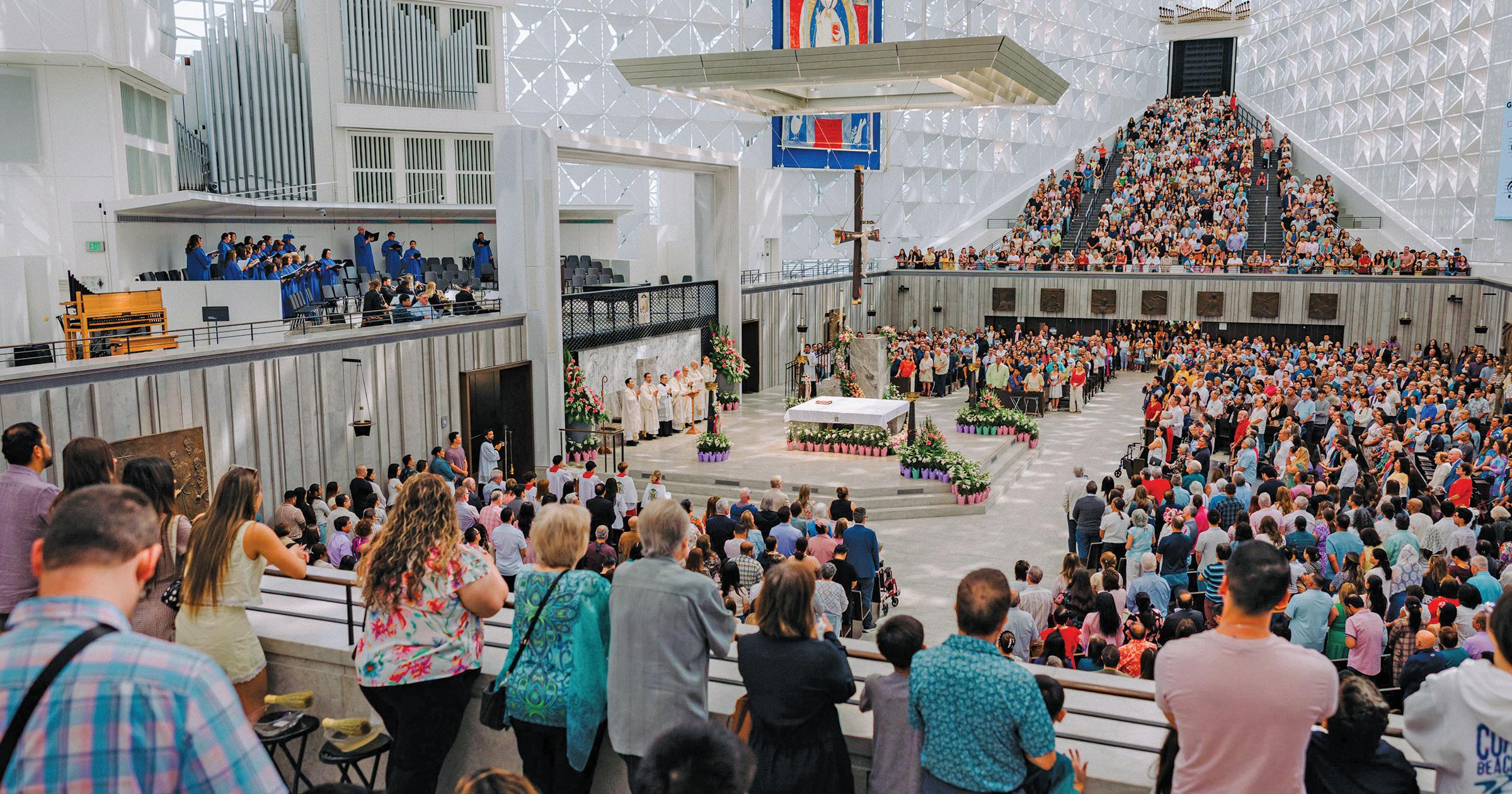
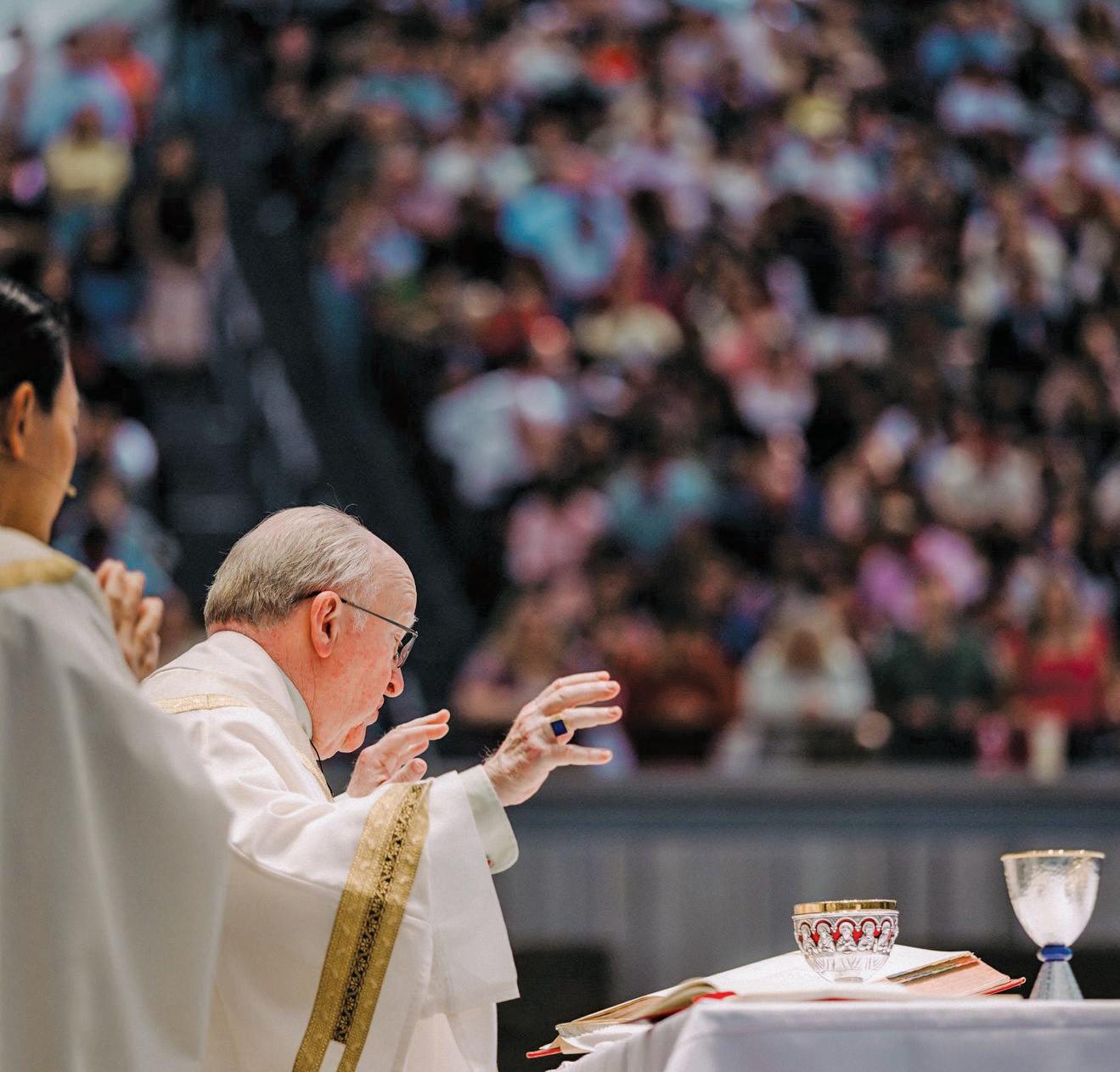
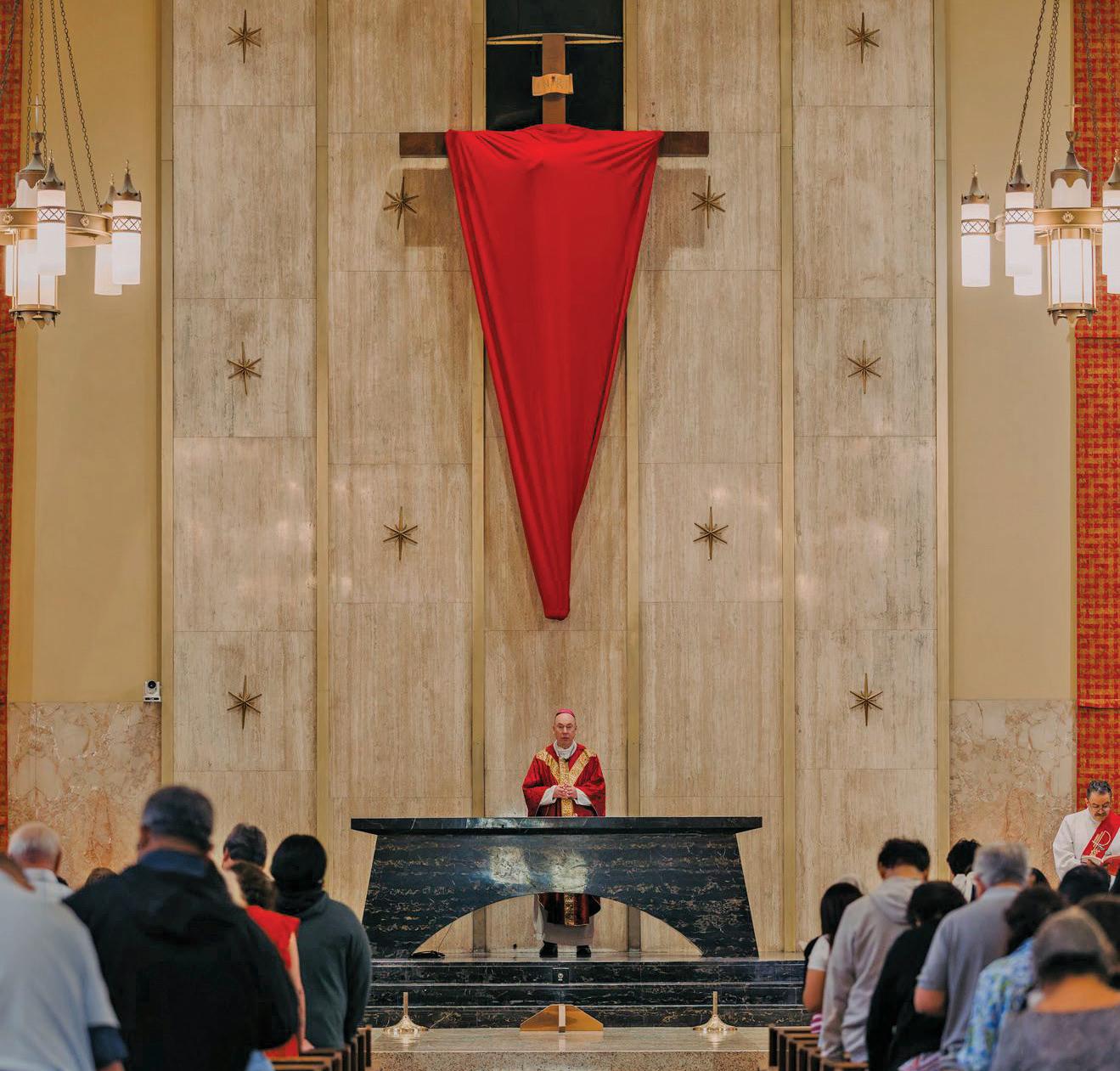
ENJOY THESE MOMENTS from Sacred Triduum liturgies throughout the diocese.
On Holy Thursday with Bishop Kevin Vann presiding, the feet of 12 men were washed at the cathedral, which was full and had many of the faithful seated in overflow in the undercroft of St. Callistus chapel. Then, during the Easter Vigils held throughout our parishes, our diocese welcomed 1,911 individuals into the Church.
Please join us in praying for each of them as they continue their journey of faith! C
BY BRITNEY ZINT
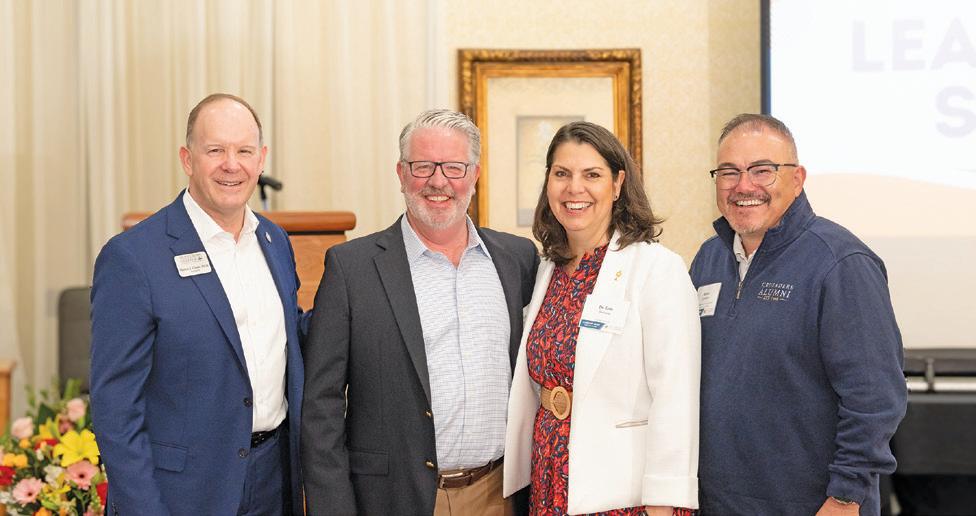
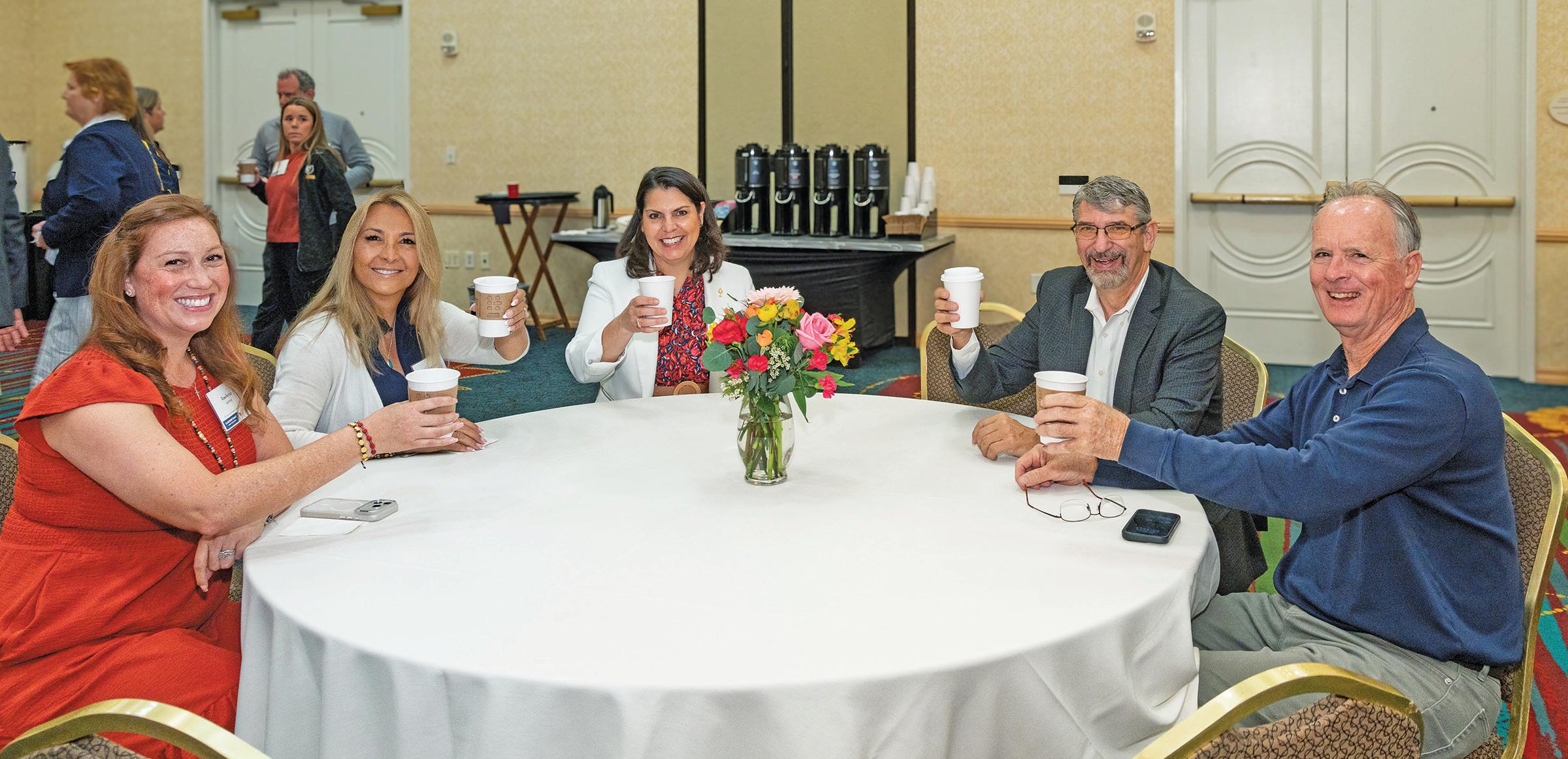
CURRENT AND ASPIRING school administrators recently came together to reflect, reinvigorate the ideals of Catholic education and consider whether leadership is their next career step.
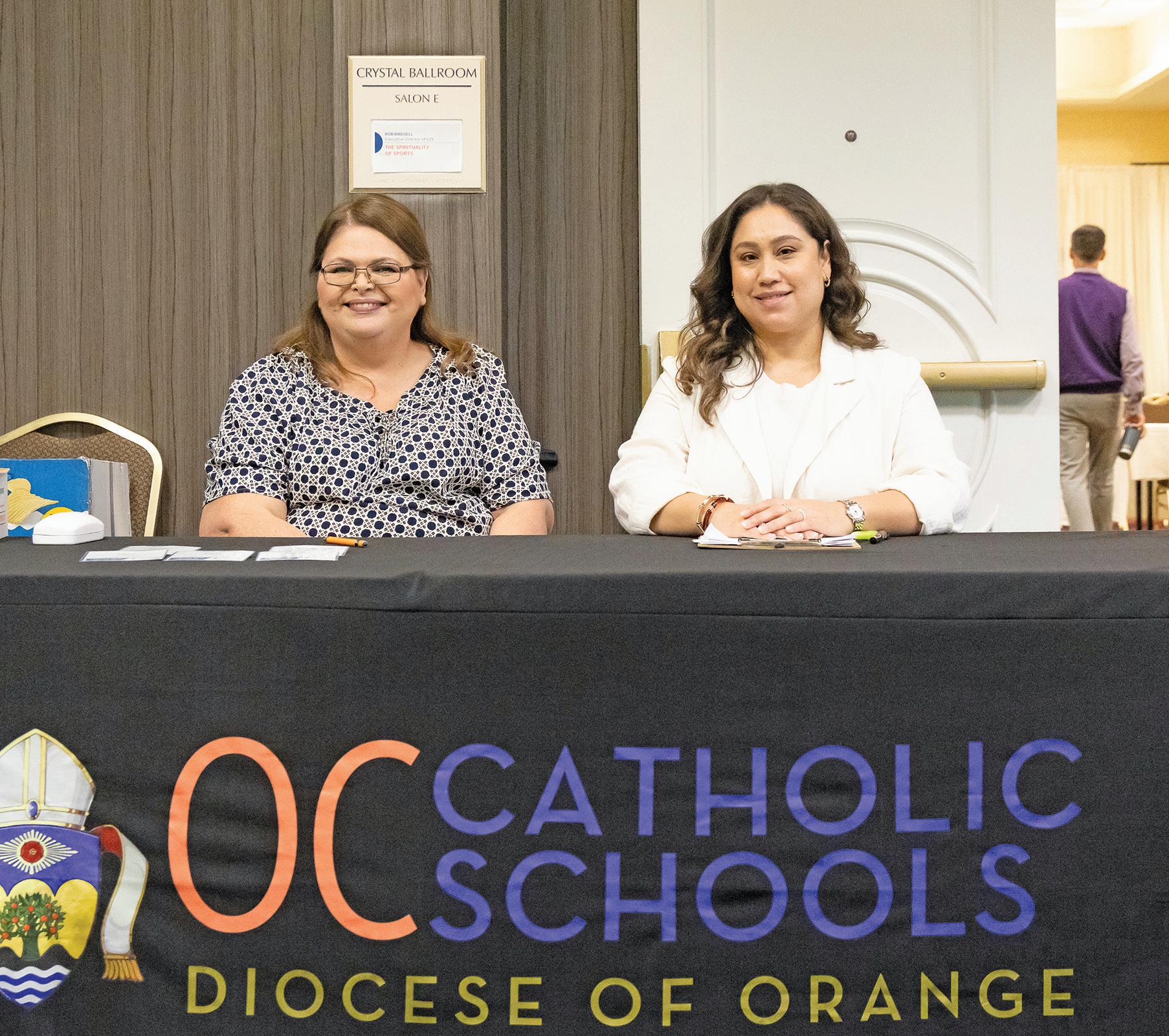
The Diocese of Orange Catholic Schools department hosted its second annual Leadership Summit on March 22 and 23 at Christ Cathedral’s Richard H. Pickup Cultural Center and the Marriott Anaheim Suites in Garden Grove. Attendees also toured the Shroud of Turin museum housed on the cathedral's campus.
The summit was co-hosted by the Institute for Leadership and Entrepreneurship in Education, a national developmental organization for Catholic leaders. It brought together educators from Orange County and some from the Archdiocese of Los Angeles, the Diocese of San Diego and the Diocese of San Bernardino.
“Today is about deepening our commitment to our call to Catholic school leadership,” said Dr. Erin Barisano, superintendent of Catholic schools in the Diocese of Orange. “As school leaders and as aspiring leaders, you’re often the ones providing stability for others, but today we invite you to let Christ be the anchor for you.”
The summit opened with a keynote address from Rob Birdsell, founder and director of the Institute for Leadership and Entrepreneurship in Education. The second day’s keynote speaker was Dr. Marco J. Clark, a nationally recognized expert on Catholic education and leadership formation.
Clark, who serves as president of Holy Cross College in Indiana, shared his career path from being a successful
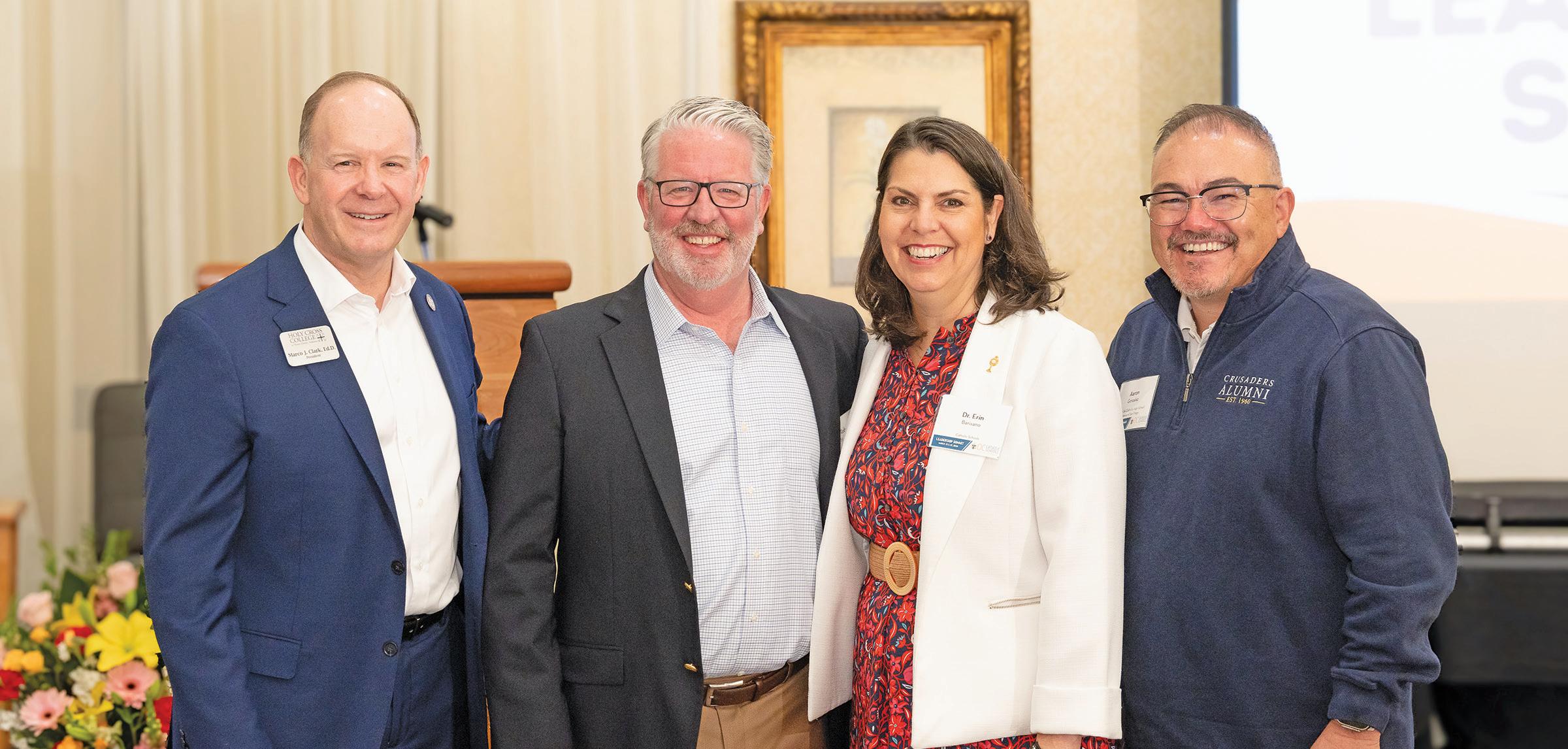
high school football coach to realizing his real passion was building culture, which he went on to do at the K-12 and collegiate level.
“I share these things not to say, ‘Yay me, yay Marco,’ but what we do is truly soul-sized,” Clark said, “and as long as we don’t treat it transactionally, we recognize it was transformational. We invest in relationships, we lead with our hearts, we lead with love and we lead with hope. And if you love the kids, then everything else takes care of itself.”
Clark noted how studies on successful Catholic education leaders show that they are mission-centered, have a spirit of collaboration, possess a zeal and love for the students, and demonstrate a mentoring mindset.
Clark said there is an expected 75 percent turnover in leadership over the next decade at the principal and president levels. He then asked attendees how they will help prepare the next generation.
Blessed Sacrament teacher Phuong Pham is one of the next generation considering making the move toward a full-time leadership position. She currently teaches fourth grade and serves as a part-time assistant principal for her Westminster school. Pham said she likes her current balance of teaching while also supporting her principal and fellow teachers but is seeking clarity if leadership is the right fit.
“I’ve been teaching for a while, so I feel like there is more for me,” Pham said. “This is my second year being the assistant principal, so this is the year that I’m figuring out if I want to take it further and aspire to be a leader and take the next steps so I can officially step into the role more than part-time.”
For JSerra Catholic High School Principal Eric Stroupe, the two days were about recharging, getting fresh ideas and actually spending time contemplating leadership. The contemplation part can be difficult to fit in between day-to-day tasks, he noted.
“I’m really pleased that the diocese is cognizant of leadership as something you have to cultivate,” Stroupe said.
“It doesn’t just happen. You have to actually cultivate leadership. Having conferences like this, where you can really think about it, is important for that process.”
One of the talks of the day, “Collaborative Leadership,” was given by Leticia
Oseguera, superintendent of Catholic schools in the Diocese of San Diego. Oseguera pointed out the differences between management and leadership. Although she said management, such as ensuring health and safety and controlling costs, is vital to a functioning school, leadership focuses on people: celebrating success, mentorship and developing others.
“It’s not about me being the boss and telling you what to do and you seeing my ego to feel powerful, but it’s about recognizing that we are one and that unity is important,” Oseguera said. “I am going to see you as a person and we’re going to work together. That doesn’t mean that I don’t hold people accountable, because I do. But it means that even that conversation happens with dignity and respect.” C
BY LINDSY PYETTE BUTLER
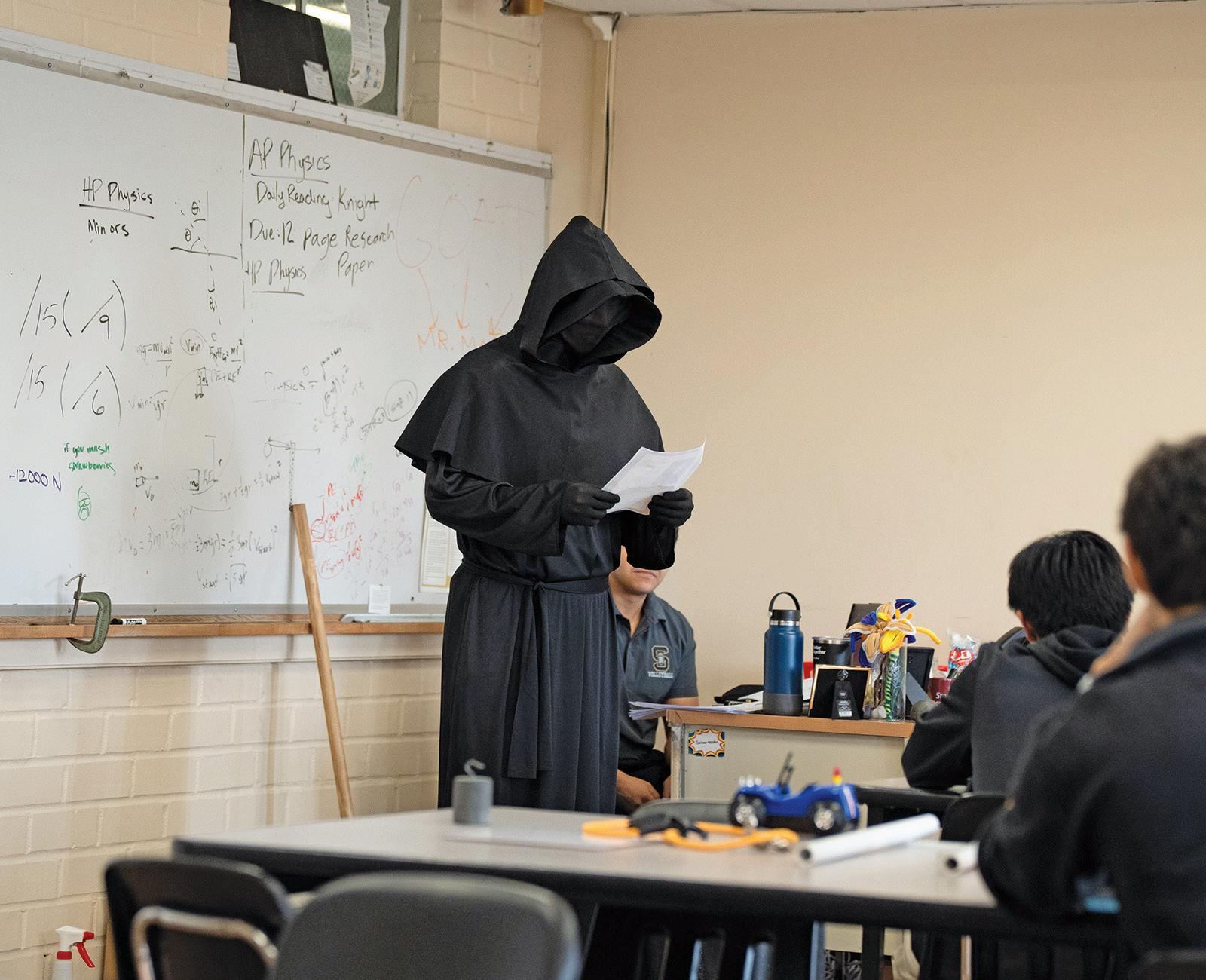
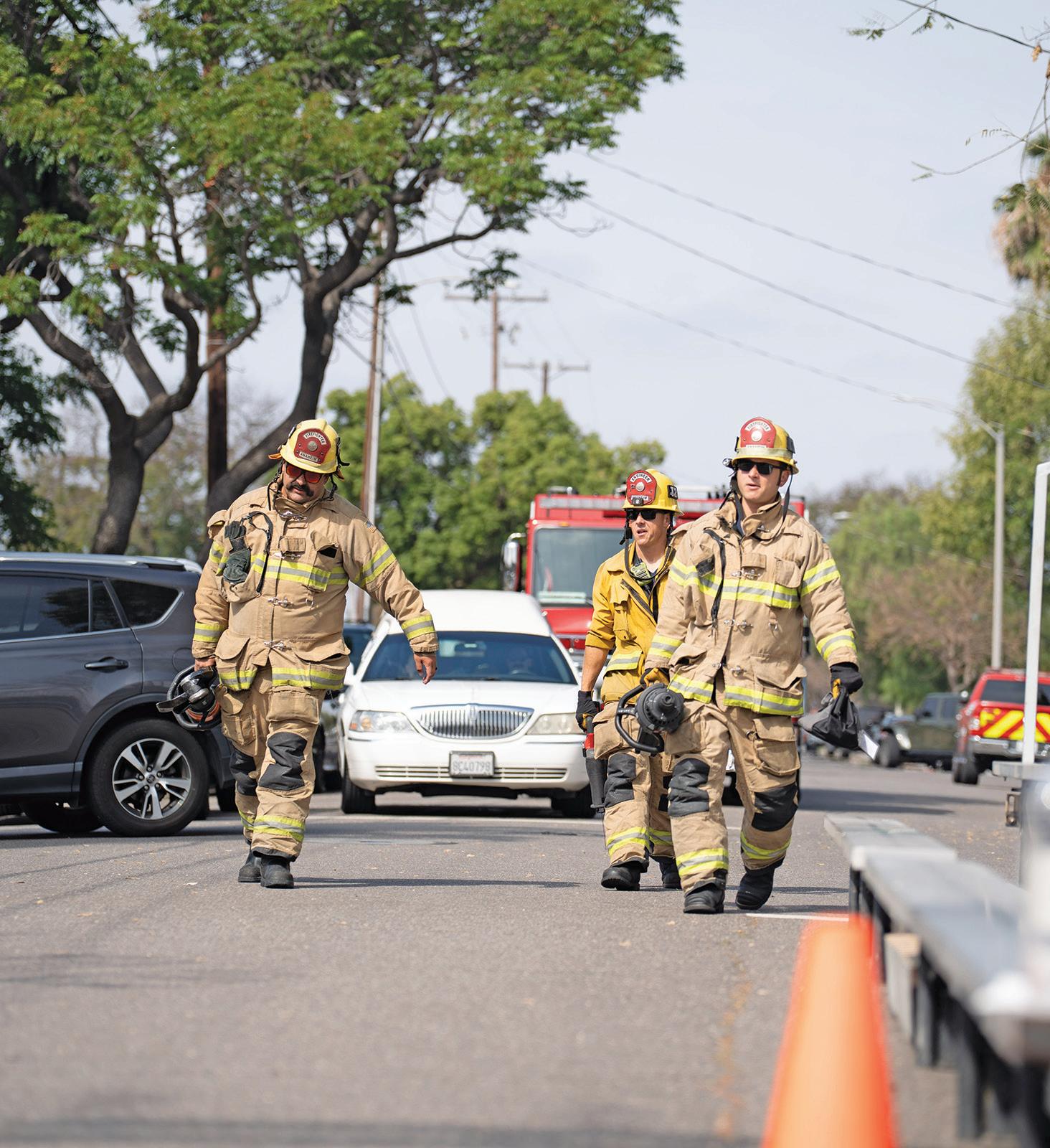
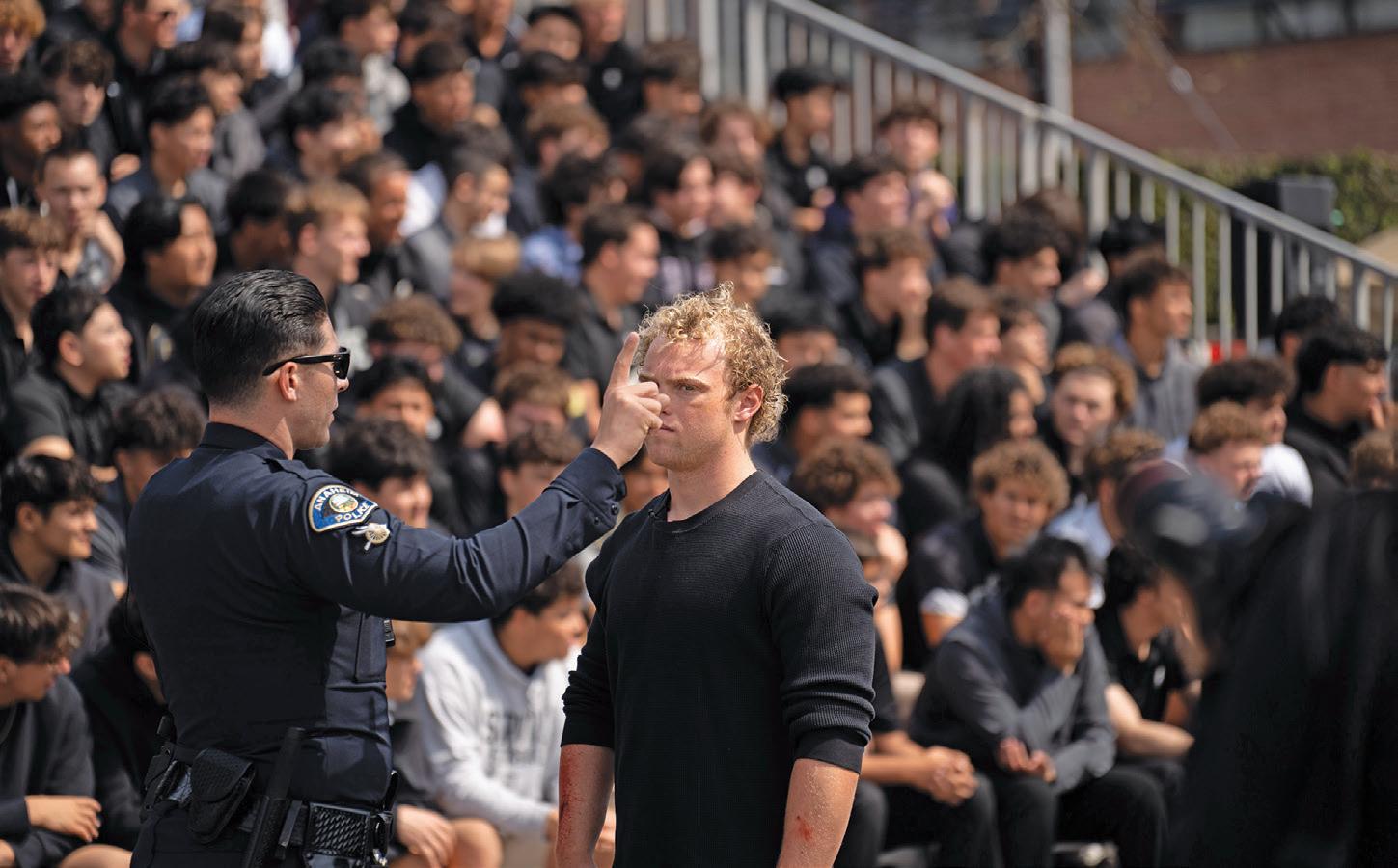
ASTUDENT ACTOR DRESSED as the Grim Reaper visited classrooms at Servite High School and Rosary Academy every 15 minutes, taking students from class as symbols of lives lost to impaired
The March 30 program built up to a staged crash reenactment on campus, bringing first responders, student actors and emergency personnel together in a realistic portrayal of the aftermath of a serious collision. The following day, students gathered for a vigil and watched a video leading into the crash scenes, inviting them to reflect more deeply on the grief, loss and lasting impact such tragedies leave behind.
This year’s presentation followed the stories of Sami, Jackson, Jake and their loved ones, showing how one tragic choice can wound not only those directly involved, but also families, friends and an entire community. By placing students at the center of the reenactment, the program made the dangers of impaired

“Thanks to New Hope Counseling, I have learned that everyone has dignity, no matter what they did or have done.” - Thomas, 5th grade
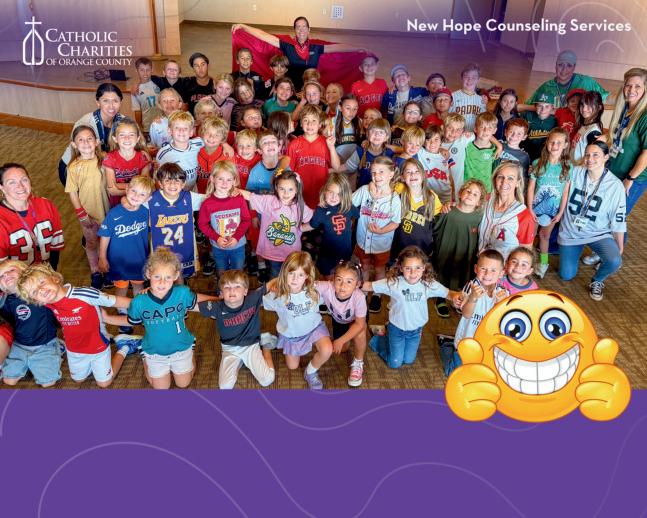
diocese. Our Counseling program implements the Human Dignity Curriculum from the World Youth Alliance to empower the next generation! Your donations help young students understand their worth, respect others, and thrive in a life full of compassion and integrity. Make a difference in
U.S. CONFERENCE OF CATHOLIC BISHOPS STATEMENT RESPONDING TO PRESIDENT TRUMP’S SOCIAL MEDIA POST ON POPE LEO XIV
“ I am disheartened that the President chose to write such disparaging words about the Holy Father. Pope Leo is not his rival; nor is the Pope a politician. He is the Vicar of Christ who speaks from the truth of the Gospel and for the care of souls.”
— Archbishop Paul S. Coakley, President, USCCB
CONTINUED FROM PAGE 10
make the message real in a way students cannot easily dismiss.
“I think it’s important because it teaches people about the dangers of drunk driving and shows the consequences that come from it,” Faulkner said.
He added that staging the crash at Servite made the lesson even more meaningful for students watching their classmates take part.
“I don’t think people would understand it the same way if you showed them a video of people they didn’t know versus someone they do know,” he said.
Faulkner also said the physical absence of students throughout the day leaves a
strong impression.
“It’s important for other students to feel what it’s like when someone isn’t there,” he said. “That physical absence makes the scenario feel real. If you don’t see them, you take it for granted.”
Rosary senior Brigid LeVecke ’26, one of the student actors in the drunk driver’s car, said the reenactment reminds students how suddenly tragedy can happen.
“It shows that this can happen anytime, anywhere,” she said. “It’s scary, but hopefully this will reach a lot of people — and remind all of us of the risks.”
Marisa Mallory, a member of Servite’s parent community council and mother of a senior, led the parent volunteer efforts
to bring the program to campus. She said “Every 15 Minutes” offers students an important lesson at a pivotal moment in their lives.
“As our kids get ready to head out into the world, this program teaches them that their actions can have life-altering consequences,” Mallory said. “I am grateful the Servite and Rosary community came together to present this program.”
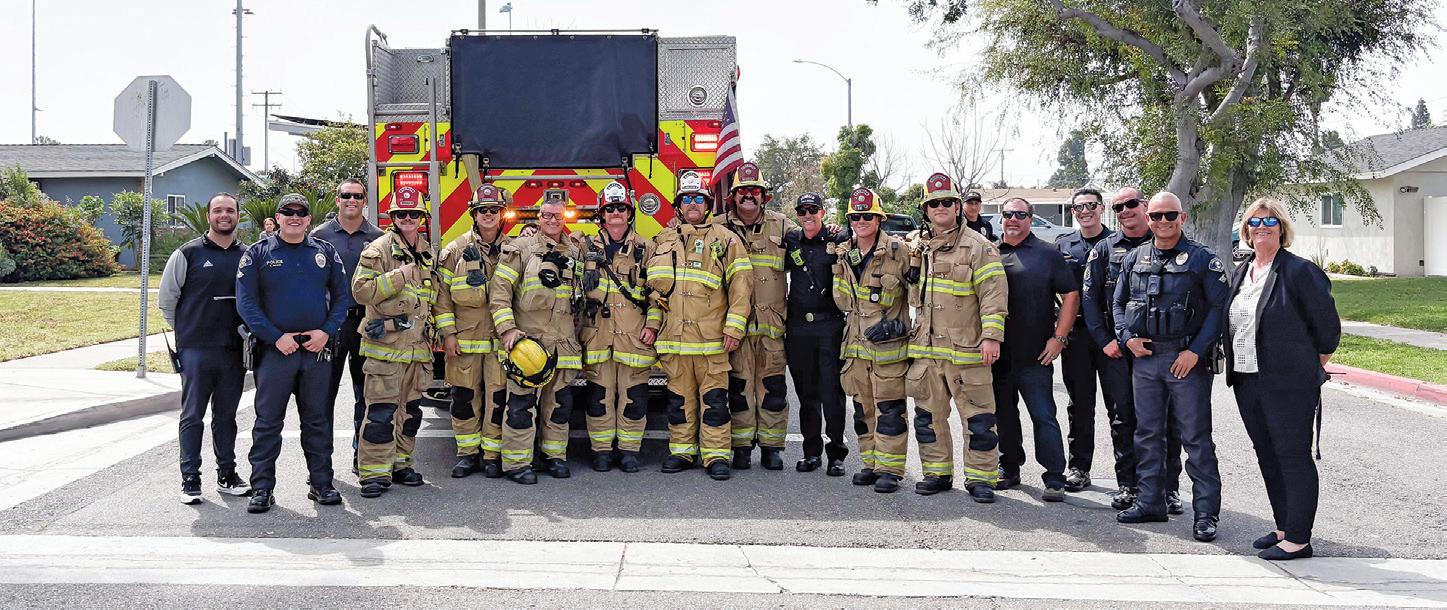
The program was made possible through the support of many community partners whose expertise and presence helped bring realism, care and purpose to the experience. Servite and Rosary expressed special gratitude to Anaheim Fire, Anaheim Police Department,
California Highway Patrol, Hilgenfeld Mortuary, UCI Health and Kathleen Uriostegui for helping make the program possible.
The schools also expressed heartfelt gratitude to the Roth family for allowing Christopher M. Roth ’09’s story to be shared with students. Christopher was walking across the street when he was struck and killed by a drunk driver. He had just graduated from college and was beginning a promising career as a caddie on the PGA Tour. Remembered as a beloved son, big brother and Forever Friar, his life and legacy brought powerful truth and lasting impact to this year’s program. C
BY SMCHS STAFF
SANTA MARGARITA Catholic
High School recently marked a historic and spiritual milestone: the school’s first-ever eucharistic procession.
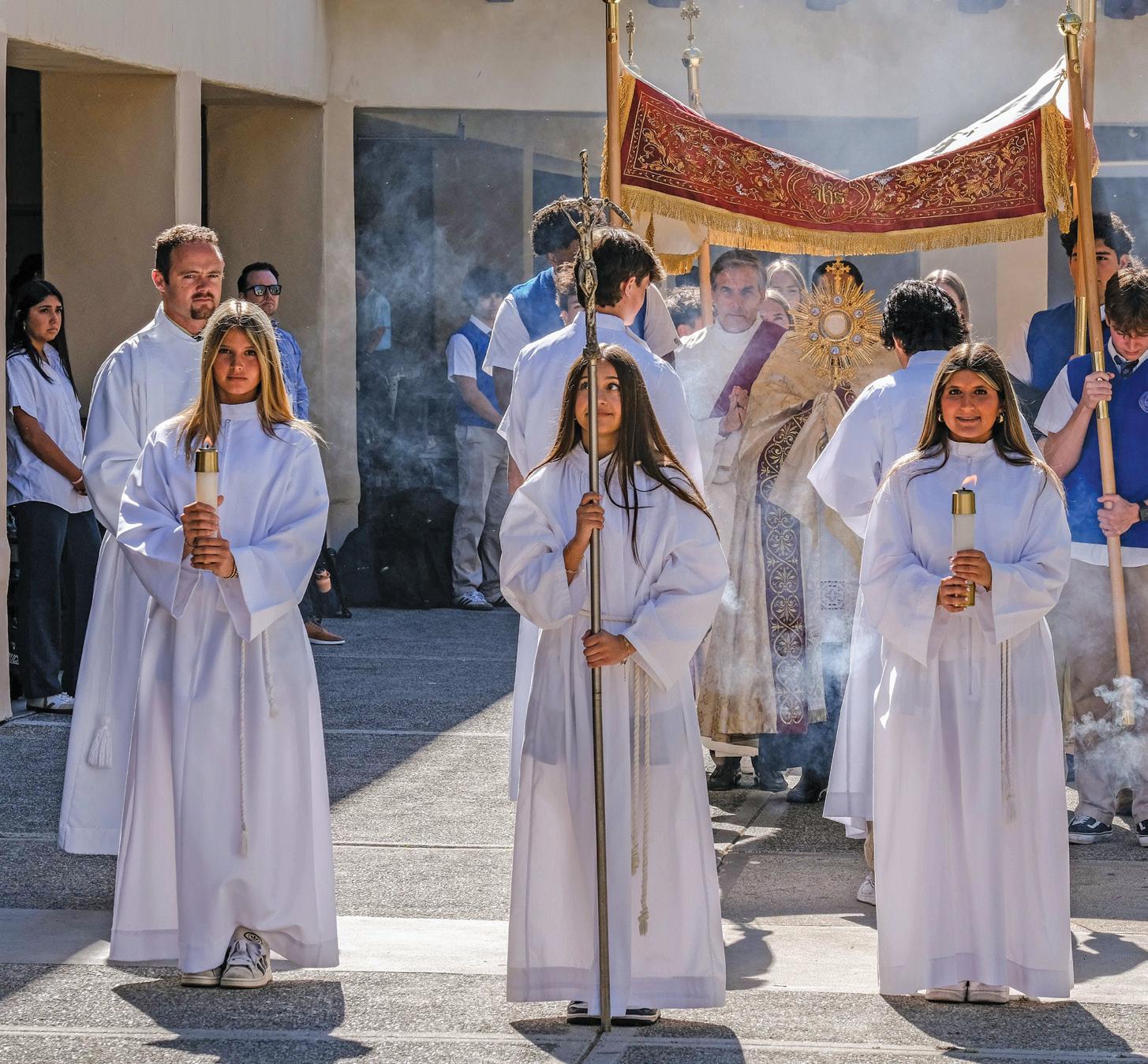
Following the all-school Mass celebrated on March 17, students, faculty and staff united for the memorable event. At the center of the procession was the Eucharist — the true presence of Jesus Christ, body, blood, soul and divinity carried reverently in a monstrance beneath a canopy and accompanied by incense, as the community followed in prayer and quiet devotion.
Rooted in centuries of Catholic tradition, a eucharistic procession is a powerful public witness, an expression of faith that both proclaims Christ’s presence and calls down God’s blessings upon a community. Before the procession began, SMCHS Rector Fr. Matthew Maxwell invited those gathered to reflect on the significance of the moment.
“The eucharistic procession is an opportunity to show love and honor to God in the form in which He showed us the greatest love, by leaving Himself to us in the Eucharist,” he said. “It’s a visible way of centering our lives and our community on Christ.”
He also emphasized the tradition’s enduring place in the life of the Church.
“This is something the Church has done for centuries,” Fr. Matthew said. “It brings an abundance of God’s blessing and grace upon communities. Today, we have the opportunity to rally around Jesus, to follow Him, to show Him our campus, and to ask for His blessing in every part of it.”
Drawing a relatable comparison, he added, “In a parade, we showcase what matters most to us. Today, we show that Christ is at the center of who we are.”
A profound stillness settled over the
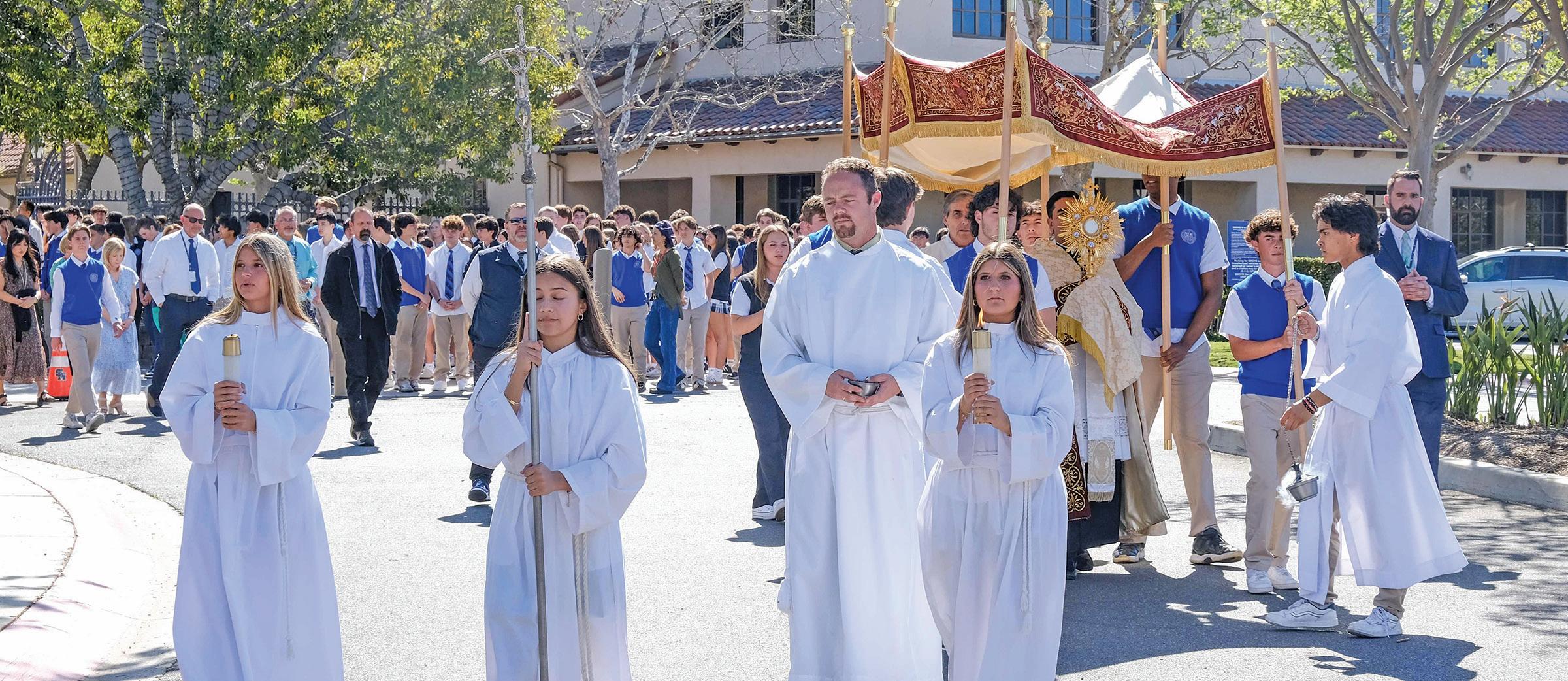
crowd as the procession moved through campus. Along the route, student peer ministers offered prayer intentions over the PA system. As the procession approached the first altar, the entire Santa Margarita community knelt in unison before the eucharist, a striking expression of reverence.
“To me, the procession was a great act of unity and reverence within our school,” said Bella Emanuel ’27, who served as a sacristan helping to prepare for the procession. “It was amazing how we all came together to honor and glorify the Lord’s true presence. What stood out most was being able to bring Jesus to the whole community, and to have Him lead us through campus.”
Reflecting on that moment, Fr. Matthew said, “When everyone knelt, it was a clear demonstration that Christ is at the center, one visible moment where we were all focused together on Him.”
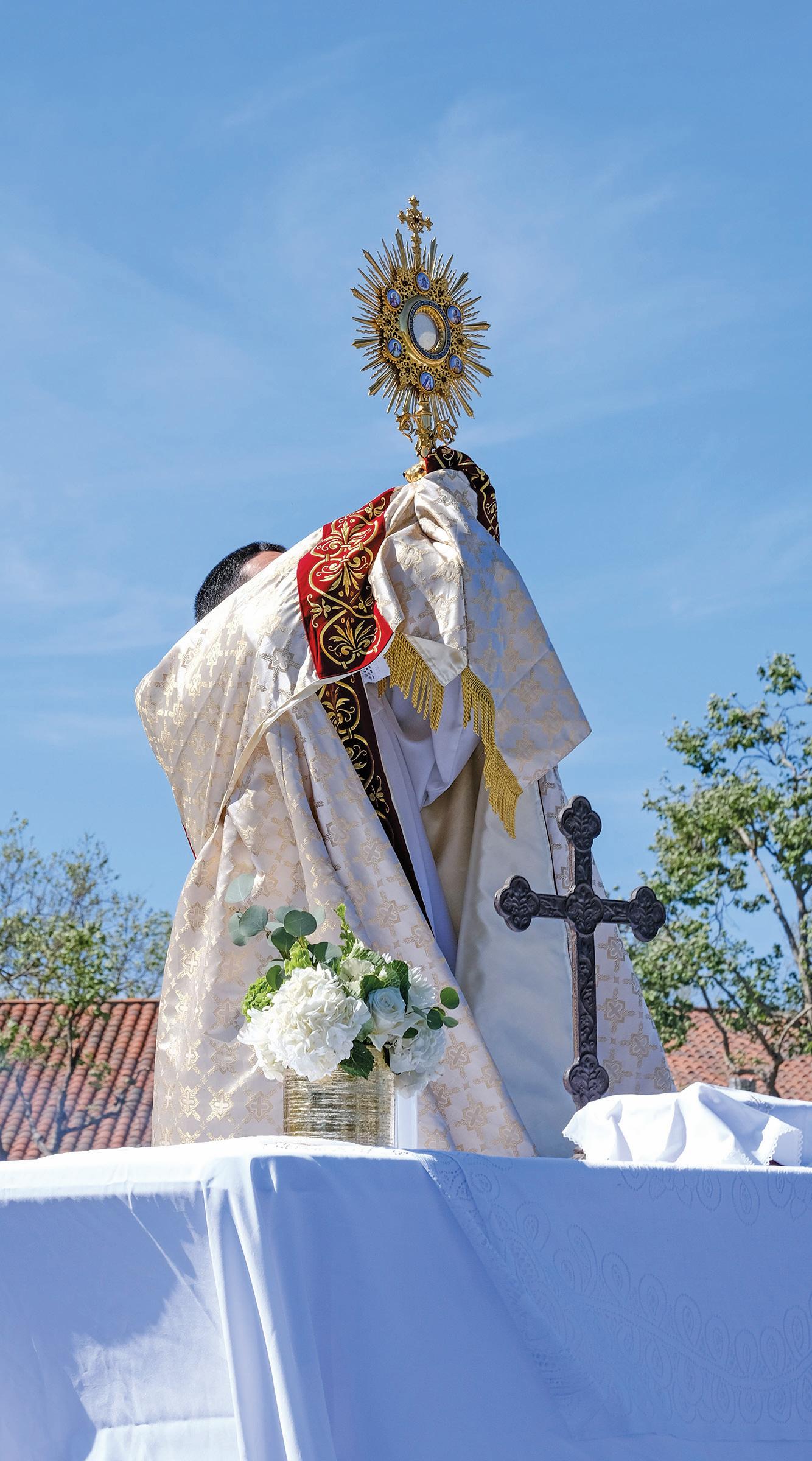
The procession concluded on
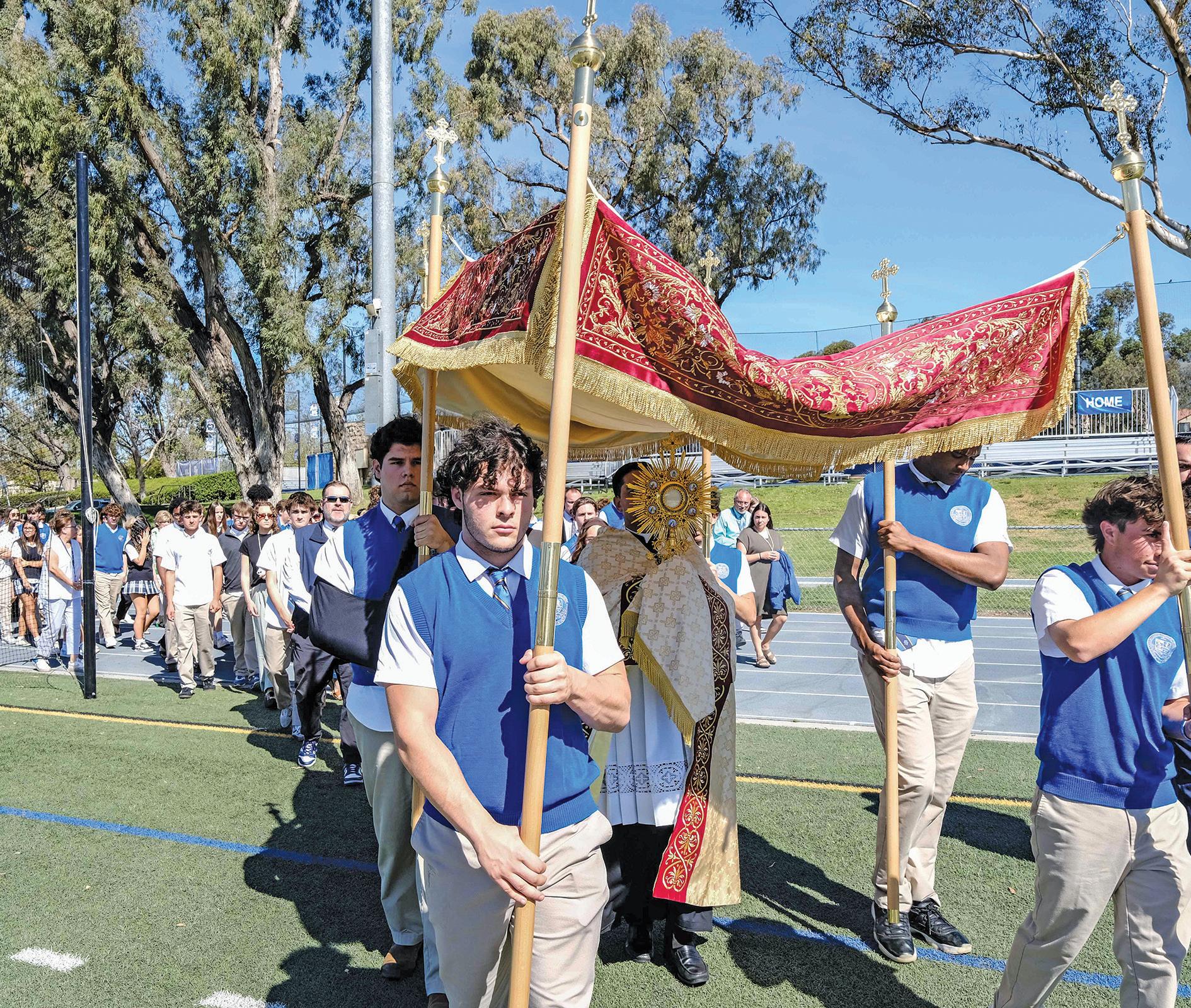
the school’s athletic field, where Fr. Matthew led the community in Benediction, and the kneeling crowd of about 2,000 received Jesus’ blessing in the Eucharist.
“It’s one thing to live out our faith personally,” Fr. Matthew said. “But there is something incredibly powerful about living it out together. What we saw was a community united, focused entirely on Christ.”
Head boys water polo coach Ivan Buich participated in eucharistic processions growing up in Croatia, where they are a common part of the culture. Buich said he is grateful to see this centuries-old Catholic tradition brought to Santa Margarita.
“There’s a deep sense of spirituality when a large group of people of all ages comes together for a greater purpose.
You feel connected to your community and previous generations,” Buich said.
The experience also revealed something deeper: the students’ capacity for intentionality and spiritual depth.
“What we witnessed was truly incredible,” Fr. Matthew said. “Our students turned to the Lord with sincerity and focus.”
As Santa Margarita continues to foster both academic excellence and spiritual growth, this first eucharistic procession stands as a meaningful milestone, one many hope will become a lasting tradition. In a world often marked by noise and distraction, the quiet strength of that morning offered a visible sign of faith, unity and hope.
And at the center of it all was Christ.
“It’s so beautiful and powerful to not just live out our faith personally, but to live it out together,” Fr. Matthew said. C
BY SR. DIANE HEISS, SDSH
EAR YE, HEAR YE”
was the call of the Town Crier throughout the centuries until the rise of literacy, when more people learned how to read. Their official role was to disseminate essential information to their neighbors, such as laws, proclamations, advertisements and other news. This vital role was a necessity in the daily lives of their neighbors, and an asset to help them be aware of any news, bad or good. They were the forerunners of our modern means of communication, news and social media.
Although important to remain abreast of current local and international news, there is another type of news, even more crucial to know and live. This is the Good News of God’s faithful and merciful love for each of us. We did nothing to earn God’s love, and there is nothing we can do to lose it either, for the essence of God’s being is love. The word “Gospel” means good news, and we learn of God’s love through the Gospels. Many scholars agree that the first gospel was written by St. Mark, whose feast day we celebrate on April 25.
We find John (his Hebrew name) Mark (his Latin name) mentioned by Luke in reference to St. Peter’s miraculous escape from prison, after which “he went to the house of Mary, the mother of John who is called Mark, where there were many people gathered in prayer.” (Acts 12:12) Mary of Jerusalem had opened her house as a place for the apostles to meet, so John Mark undoubtedly learned and grew in the Christian faith from them. He was a cousin of St. Barnabas and joined him

and St. Paul on their first missionary journey to Antioch in 44 A.D. Eventually, though, he left and returned home to Jerusalem, causing no little dissension between himself and St. Paul. After some time, they reconciled, and Mark visited St. Paul during his first imprisonment in Rome. (Colossians 4:10)
Christian tradition holds that St. Mark, who had not met Jesus, received information about him from St. Peter who referred to him as “Mark, my son.” (1 Peter 5:13) Additionally, some biblical scholars think that St. Mark was referring to himself in his account of the arrest of Jesus in the Garden of Gethsemane. After saying that all the apostles left Jesus and ran away when he was betrayed by Judas and arrested, he continued with “Now a young man followed him wearing nothing but a linen cloth about his body. They seized him, but he
left the cloth behind and ran off naked.” (Mark 14: 51 – 52)
St. Mark lived for many years in Alexandria, Egypt, probably as its first bishop, where he was eventually martyred around the year 68 A.D. He most likely wrote his gospel between 60 A.D. and his death, basing it on the teachings of St. Peter. His remains were stolen from Alexandria in 828 A.D. and taken to Venice, where they remain to this day in an elaborately constructed and ornate basilica over 1,000 years old.
■ Read the Gospel of Mark, the shortest of the four Gospels. What touched you most deeply? What surprised you?
■ Mark learned about the life of Jesus from Peter and recorded it. What have you done to share your faith? What will you do? C
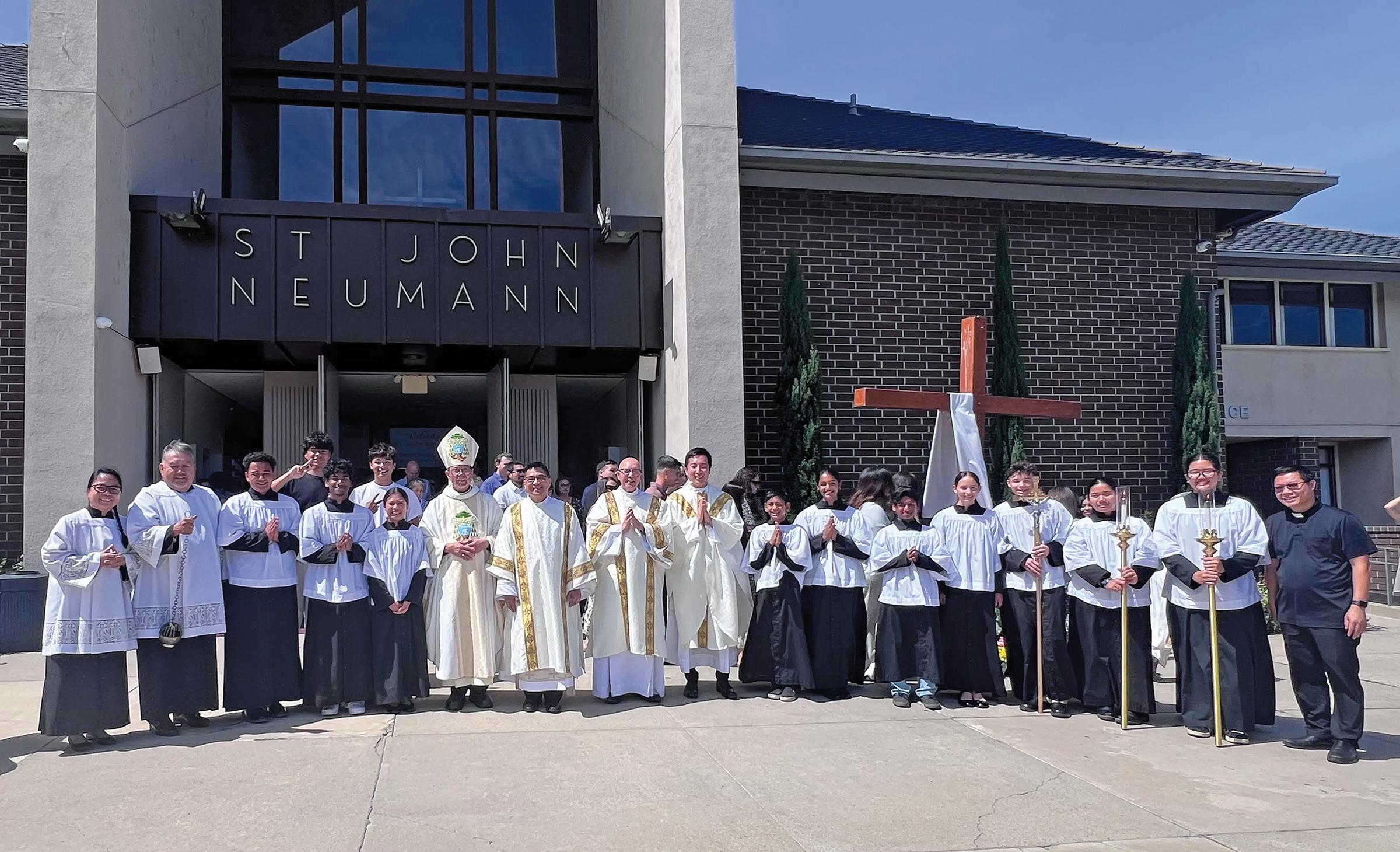
We at St. John Neumann Parish were honored and graced by Bishop Nguyen's presence as he celebrated the 12:30 p.m. Easter Mass. It was a beautiful and joyful celebration for our parish community.
We captured a wonderful photo from this Mass that we would like to share with Bishop Nguyen.This is our small way of expressing our gratitude to Bishop Nguyen for taking the time to be with us and to celebrate such a momentous occasion with our parish community.
We want your photos! Send your pictures of “OC Catholic Afar” — of you, family or friends visiting Catholic churches and other interesting places — to editor@occatholic.com. Please include a brief description of the photo, the name of the person(s) featured in the photo and their home parish.