The competitive gap between customer-centric AI leaders and slower adopters will likely widen significantly
CCM’s Next Act Why “Document First” Stops Working in 2026 IT IS TIME FOR A NEW GENERATION OF CCM. THE COMPOSITION ERA IS ENDING. THE RENEWAL CONVERSATION COMPANIES ARE ALREADY LOSING
TABLE OF CONTENTS
It Is Time for a New Generation of CCM. The Composition Era Is Ending.
A category-shaping perspective from two CCM strategists on what comes after the template By Mia Papanicolaou and Elizabeth Stephen
The Clarity Protocol
How poor customer communication is driving unnecessary service demand — and how to fix it
By Tony Edwards
Capturing an Untapped Market
How accessibility is an imperative and an advantage
By Bryan Matlock
The Renewal Conversation Companies Are Already Losing
The hidden liability sitting on your balance sheet By Jennifer Raml
CCM’s Next Act
Why “Document First” Stops Working in 2026 By Alan Burger
Why CX Leaders Win with AI
How customer-focused organizations are turning AI into stronger engagement, efficiency and loyalty By Richard Huff
The Shift Toward Centralized Communication Management
How financial institutions are rethinking customer communications By Steve Diamond Communications as Trust Infrastructure
LETTER FROM THE ADVISORY BOARD:
The New Rules of Customer Engagement
By Will Morgan
For more than a decade, Aspire CCS has tracked customer communications through its consequential transformation as it’s evolved, first from print to digital, then from static documents to multi-channel delivery, and now from documents to dialogue. Our latest enterprise research makes clear that the transformation from fixed, proscribed messaging to dynamic engagement is no longer a forecast — it is rapidly becoming a new operating reality, and crucially, that the gap between those organizations navigating it effectively and those still finding their footing is widening. Four forces are converging to drive this dynamic.
AI is no longer in the pilot phase. Artificial intelligence has moved decisively beyond the pilot phase, and the most CX-mature organizations have already realized a measurable return on their investment. Agentic communications platforms that can orchestrate intelligent, personalized interactions across the entire customer lifecycle are moving from a mere concept to a concrete competitive advantage.
Dialogue has overtaken documents. Younger consumers already prefer conversational, appbased engagement over traditional document delivery, but once again, AI is taking this concept to a completely new level as tech-savvy consumers leverage artificial intelligence to access communications, automate responses, and manage interactions on their behalf.
Governance is the new battleground. Technology is no longer the limiting factor. The organizations pulling ahead are those that have aligned strategy, governance, and operating models to overcome siloed data repositories and support the speed and complexity of AI-powered customer communications. Those that haven’t will struggle to capture AI’s potential no matter how sophisticated their platforms become.
Hybrid is the new normal. The old binary choice between insourcing and outsourcing is obsolete. More than 50% of the businesses in our research panel have adopted hybrid models, keeping strategy, governance, and data ownership in-house while leveraging external partners for execution and scale. AI is accelerating this shift and raising the compliance stakes.
What our research makes unmistakably clear, however, is that the decisive shifts in AI operationalization, channel sophistication, integration depth, and budget ownership do not accumulate gradually. Instead, they occur at a threshold, at the transition from coordinated CCM to genuinely integrated CXM. Organizations that have crossed that threshold are building communications infrastructure designed around the customer journey while those approaching it are, in many cases, running sophisticated technology on top of outdated architecture.
The gap between the two is not insurmountable, but it is certainly growing.
Going forward, businesses must be intentionally focused on closing it by building the necessary governance infrastructure before moving AI from pilot into production while also evaluating every technology and sourcing decision with the goal of centralizing communications control and improving consumer engagement. Transformational partners can facilitate these efforts by providing organizations already aligned with CXM goals with a credible pathway across the gap, leading with AI-assisted modernization and genuine platform convergence rather than infrastructure cost reduction.
Looking to 2027 and beyond, the organizations that will define the market are those building communications that are intelligent, conversational, appropriately governed, and designed around the customer rather than the document. The market is certainly not short of ambition, but the future demands the discipline to act on it.
president Chad Griepentrog
publisher Ken Waddell
managing editor Erin Eagan [ erin@rbpub.com ]
contributing editor
Amanda Armendariz
contributors
Alan Burger
Steve Diamond
Tony Edwards
Richard Huff
Bryan Matlock
Mia Papanicolaou
Jennifer Raml
Elizabeth Stephen
advertising Ken Waddell [ ken.w@rbpub.com ] 608.235.2212
audience development manager
Rachel Chapman [ rachel@rbpub.com ]
creative director Kelli Cooke
PO BOX 259098
Madison WI 53725-9098 p: 608-241-8777 f: 608-241-8666 email: customerservice@rbpub.com
The articles in this magazine represent the views of the authors and not those of Madmen3 or DOCUMENT Strategy Media. Madmen3 and/or DOCUMENT Strategy Media expressly disclaim any liability for the products or services sold or otherwise endorsed by advertisers or authors included in this magazine.
SUBSCRIPTIONS: DOCUMENT Strategy Media is the essential publication for executives, directors, and managers involved in the core areas of Communications, Enterprise Content Management, and Information Management strategies. Free to qualified recipients; subscribe at documentmedia.com/subscribe.
REPRINTS: For high quality reprints, please contact Chad Griepentrog, 608-241-8777, chad.g@rbpub.com
What’s New
Catch up on all the news, opinions, and current events happening around the industry.
Customer Experience Gaps Are Fueling “Soft Switching”
Customer satisfaction in retail banking remains relatively stable, but new research shows cracks are emerging across digital, branch, phone, and automated service channels. Researchers say these experience gaps are contributing to a growing phenomenon known as “soft switching,” where customers quietly open accounts elsewhere and gradually move funds without formally leaving their primary bank.
AI Investments Begin to Show CX Results
According to the 2026 ACSI Finance Study, banks and wealth management firms are increasingly deploying generative AI for personalization, virtual assistants, and agent support. The study found that organizations making effective digital and AI investments are beginning to see improvements in customer satisfaction and digital service experiences.
TIME FOR A NEW GENERATION
THE COMPOSITION ERA IS ENDING.
By Mia Papanicolaou and Elizabeth Stephen
A category-shaping perspective from two CCM strategists on what comes after the template
GENERATION OF CCM.
We have spent more than two decades in customer communications and we have watched every version of the upgrade cycle in customer communications management (CCM).
Templates got more sophisticated, composition runtimes got faster and channels multiplied from print to email to portal to mobile to chat. Compliance frameworks tightened, while customers got less patient with everything the old stack was producing.
Through every cycle, one assumption stayed exactly where it was: compose the document first, then distribute it. That assumption is the foundation of every CCM platform we have ever worked with and it is the assumption we think is finally giving way.
Our view is that we are at the start of the next generation of CCM, which is not an upgrade but a category move, with the post-template architecture already real, the buyers already ready for it, and the platforms that win the AI era being the ones that get there first.
The architecture was the right answer to a different problem. Template-first architecture was a reasonable response to the constraints of the 1990s and early 2000s, when there was no AI capable of generating regulated content reliably, when compliance approval cycles required a pre-authored document someone could sign off once, when enterprise data was messier than it is today, and when print dominated and email was a second-class citizen. In that world,
encoding structure, copy and rules together inside a template, then constraining the runtime to merge and conditional evaluation, was the only path to compliant output at scale.
What has changed is not one thing but several at once: AI grounding methods are now mature enough to bound generation, regulators expect runtime auditability rather than pre-authored attestation, customers compare the bill from their bank to the experience they get from a rideshare app and the bill comes off worse every time. At the same time, channels have multiplied past the point where per-channel template variants make economic sense.
Template-first cannot accommodate any of those shifts without being rebuilt from the ground up, and adding AI to a template engine does not get you to the
next generation, it gets you a template engine with AI inside it, which is a different thing.
When the foundation is cracked, AI just makes the cracks faster.
We have both seen it play out across regulated industries, where companies eager to deploy AI for efficiency overlook the fact that the process underneath is the part that is broken. If your statement is confusing, AI-generated does not solve the problem, it just generates confusing content faster.
If your fraud alert lands without context, asking AI to soften the language does not give the customer the next step they need, and if the customer has to log in twice to read a secure message, layering an AI assistant on top will not remove the friction, it only moves the friction to a different place in the journey.
We have seen the same pattern with agentic AI, where agents run into the same broken workflows that frustrate
customers and hit the same walls customers do, only faster and at higher volume, which means poorly designed processes will not just frustrate people anymore, they will break the very AI tools meant to support them.
Template-first architecture cannot accommodate what’s coming without being rebuilt from the ground up.
Technology, whether AI or otherwise, is only as good as the experience it serves, and the organizations that win
Template-First vs. Orchestrated Communications
Template-First CCM
Static templates
Predefined channels
Manual rules
Composition-centric
Batch workflows
Orchestrated Communications
Dynamic assembly
Channel-agnostic
AI-assisted decisions
Context-centric
Event-driven
the next chapter of CCM are the ones who step back and ask a different question: what experience are we actually creating, and what would the architecture look like if we built for that?
What replaces composition is governed generation inside a different shape. The template bundled two things together that were always separate ideas: the rules about what a communication must contain and the words that actually fill it. Regulators care about the first and customers experience the second. For 30 years, changing either one meant touching the same file, running the same approval process and hoping nothing adjacent broke.
The future of composition and the move we are envisioning pulls them apart.
The compliance structure, which is what must appear, where, in what order, and what can never be altered, is defined once and locked. And when we say locked, not as a policy, but rather locked as an architecture so that AI cannot edit it and runtime cannot override it. When it needs to change, it routes through governance the same way a structural change to a building routes through an inspector.
Inside that locked structure, the content is generated at the moment of delivery, which can be drawn from live data, shaped by what the enterprise knows about the individual receiving it and assembled once for every channel simultaneously. This means there is no document sitting in a queue and no template being merged. There is a governed artifact being constructed, in real time, within boundaries that make non-compliance structurally impossible rather than policy-level unlikely.
We are calling this agentic composition, where structure becomes immutable, content becomes live, compliance becomes a property of the architecture rather than a gate at the end of the process and the communication that arrives in your customer’s hands is trustworthy not because someone checked it but because it could not have been built any other way.
The question for CCM and CXM leaders is not whether to move but how to tell the real thing from the imitation.
What CCM and CXM leaders should do with this right now.
None of this means pulling the plug on your existing platform tomorrow. It means being deliberate about the architecture you commit to next, because the platform decisions you make in 2026 and 2027 will set your operating envelope for the AI era of regulated communications.
We are starting to see the post-template architecture appear in the field and the category move is real, although what is not yet settled is who builds it and who carries the buyer conversation, with the next 18 months likely to be decisive on both.
The category is up for grabs. Every technology cycle has an inflection where the prior architecture is still good enough to ship today and
clearly insufficient to ship tomorrow and we have spent enough time inside CCM to know the inflection is here. The conversations we are having with operators and with category-shaping analysts converge on the same point: the buyers are ready, the architecture is available and the legacy vendors are starting to recognize that catch-up is not a viable posture.
Channels
have multiplied past the point where
pre-channel templates
make economic sense.
Customers do not compare your bill to your competitor’s bill anymore, they compare your bill to every digital
experience they have anywhere and that is the bar.
Compliant, adaptive, audited, trusted, customer-experience-native is where the next generation of CCM is headed and that is Agentic Composition as a Service (ACaaS).
MIA PAPANICALOU helps companies go paperless for transactional customer communications and works to improve those touchpoints through customized strategy and advisory services. She is a regular speaker and blogger on digital customer communication, digital maturity and improving the customer experience.
ELIZABETH STEPHEN is an expert in CCM and helping clients utilize digital communications to meet their CX goals. As a true specialist in transactional communications, Liz has the ability to help companies make the needed microchanges that will immediately impact the customer experience, while putting the steps in place to make long-term changes.
THE CLARITY PROTOCOL
How poor customer communication is driving unnecessary service demand — and how to fix it
BY TONY EDWARDS
Customers aren’t contacting your support team because they need help. They’re contacting you because your communications are unclear.
This hidden problem — known as failure demand — is driving unnecessary costs, frustrating customers and burning out frontline teams.
The Clarity Protocol
How clearly you communicate with customers directly impacts your operational costs. Despite heavy investments in
digital transformation, organizations still struggle with high volumes of “avoidable contact.” Customers are calling support teams not because they need a new service, but because they cannot understand the information they have already been given.
The Clarity Protocol is a structured framework designed to identify and eliminate this costly friction. By shifting away from subjective debates about “style”, we can use a test-and-verify approach to prove that complex language is an operational risk that inflates costs and damages customer trust.
The Commercial Cost of Confusion Digitization has created a paradox — as our channels of communication increase, the clarity of our messages often degrades. When confronted with jargon-heavy text, customers experience cognitive overload. When the effort to understand becomes too high, they abandon digital self-service and switch channels. They pick up the phone solely to ask what the document means. This is not a customer channel preference; it is a direct symptom of content failure. When reviewing digital transformation efforts, it is highly effective to evaluate this friction through Amy Edmondson’s categorization of failure. Content-induced confusion represents a Basic Failure. It is a completely preventable error occurring in known territory. In regulated sectors like fintech and health, while “Intelligent Failure” must be encouraged to drive innovation, “Basic Failure” in customer communication must be aggressively eliminated through standardization and operational alignment. This preventable contact is defined operationally as Failure Demand. It occurs when a business fails to provide clear, complete information the first time. Alarmingly, research suggests this failure demand can account for 20% to 80% of all service center traffic. The Clarity Protocol specifically isolates the portion of this demand caused by poor written communication.
Where to Start – the 80/20 Rule
A common objection to rewriting corporate content is the sheer scale of the task. We address this pragmatically by applying the 80/20 rule. You do not need to audit every document. Instead, target the top 50 highest-volume outbound communications, such as onboarding emails, terms and conditions or critical error messages. By remediating these key assets, you directly tackle the documents responsible for the majority of preventable contact.
Dispelling the ‘Dumbing Down’ Myth Legal and compliance teams often fear that simplifying language will erode their professional authority. Evidence proves the exact opposite. Research demonstrates that authors who use simpler language are perceived by readers as more intelligent and capable. Furthermore, clarity is visual as well as linguistic. A dense wall of text is impenetrable, regardless of the vocabulary used. Effective communication requires clear access structures, such as distinct headings and logical layouts, allowing the customer to easily find what they need.
A customer receives a confusing onboarding email. Instead of completing the process, they call support for clarification.
The Three-Phase Governance Protocol
To operationalize clear communication, we use a three-step methodology:
1. Phase I – Baseline
We audit the targeted documents to identify the root causes of confusion, such as excessive passive voice or hidden accountability. We then cross-reference these linguistic friction points with actual service center contact data.
2.
Phase II – Test
We run a controlled A/B test. One group receives the existing document, while
another receives a version rewritten to clear, standardized principles. If the simplified version generates significantly fewer support calls, we have evidentiary proof that clarity drives cost savings.
3. Phase III – Verify
Finally, we use qualitative testing to ensure the new content is truly understood. This catches “silent misinterpretation” instances where customers are confused but choose not to contact support.
The Business Case for Clarity
To secure board-level buy-in, these operational improvements must be translated into financial reality. The cost of complexity can be calculated by multiplying the volume of failure demand calls by the cost per contact.
Beyond direct financial savings, there is a critical human element. High failure demand creates a deeply frustrating environment for frontline staff, rapidly leading to burnout. Simplifying communication reduces this pressure, directly protecting employee well-being.
By moving from a “publish and hope” mindset to a “test and verify” standard, plain language ceases to be a stylistic choice. It becomes a measurable, strategic asset for risk mitigation and digital transformation.
TONY EDWARDS is the founder of ServiceCraft and an operational leader specializing in service design and business process improvement. Operating across the fintech and insurtech sectors, he successfully bridges the gap between agile growth and rigorous corporate governance. With extensive experience managing regulated, critical customer communications for major wealth platforms, Tony deploys operational risk frameworks into scaling businesses to surface friction early. He consistently aligns sales targets with operational capacity, using pragmatic, evidence-led strategies to reduce preventable failure demand and build highly resilient services.
CAPTURING AN UNTAPPED MARKET
How accessibility is an imperative and an advantage
There is a conversation happening in boardrooms and compliance offices across financial services, insurance, healthcare and utilities that tends to start with regulation and end with obligation. Organizations ask how they meet accessibility requirements for their customer communications and how they avoid the risk of falling short. That framing is understandable, but it is also limiting.
Accessibility in customer communications should be more than a compliance checkbox. This is a strategic opportunity to reach a segment of the population that has been consistently underserved — and whose expectations for clear, usable and inclusive communications are no different from anyone else’s. The organizations that recognize this early are reducing risk and building a genuine competitive advantage.
The Scale of the Problem
According to the World Health Organization, roughly 1.3 billion people globally live with some form of disability. In the United States, that figure represents more than one in four adults. These are customers who receive bills, policy documents, account statements and benefit notices across both physical mail and digital channels every single day.
By Bryan Matlock
What I see consistently working with enterprise organizations is that the failure to serve these customers is rarely intentional, rather it is structural. Print and digital production often sit in separate teams, with separate governance and accessibility falls through the gap between them. The result is that a customer who cannot read small, low-contrast print on a statement, or whose screen reader cannot parse a tagged PDF, receives a communication that is functionally useless to them. That is unfortunately not a niche problem, rather it is a mainstream failure at scale.
Print Accessibility Is Not a Legacy Issue
Despite the momentum behind digital transformation, print remains a
dominant channel in regulated industries. Statements, explanations of benefits, policy declarations and legal disclosures are still produced and mailed at enormous volume. For many customers, particularly older adults, print is the primary channel. That makes print accessibility an active and pressing concern, not a legacy one.
I have worked with organizations that invested heavily in digital accessibility while their print templates remained unchanged for a decade. High-contrast color schemes, clear visual hierarchy, plain language summaries and appropriately sized fonts are not cosmetic choices in print. They determine whether a customer can actually use the document they receive. For customers who are blind, braille versions and tactile graphics provide access that no digital optimization can replace. QR codes and NFC tags embedded in print documents can bridge both worlds, giving recipients a direct path to audio versions or accessible digital content when that better serves their needs.
Digital Channels Demand Equal Discipline
PDF accessibility is typically where organizations begin the digital conversation and PDF/UA provides a clear framework for ensuring documents are properly tagged, logically structured and navigable by assistive technology. But stopping at the PDF misses the broader picture.
Transactional emails must be built with semantic HTML and properly labeled links. An email rendered entirely as an image with no alt text is invisible to a screen reader. I have seen this repeatedly in organizations that have sophisticated CCM platforms and yet send critical notifications that assistive technology simply cannot read. SMS and push notifications, often the last thing anyone audits, reach customers directly on devices where accessibility features are deeply integrated. Interactive digital forms must be operable by keyboard alone and surface error messages in ways that assistive technologies can convey.
Because print and digital communications increasingly function as part of a single customer journey, a gap in any one of them can break the entire experience for a customer who depends on accessible design to engage.
The Retrofit Problem
The pattern I encounter most often is that accessibility is treated as a retrofit rather than a design principle. Templates are built for the assumed majority and adjusted later, sometimes, to address accessibility gaps. That sequence produces poor outcomes and higher costs in both print and digital.
Beyond merely avoiding legal exposure, being accessibilityfocused from the start means communicating well with the full range of customers an organization serves.
Accessible design built in from the start isn’t more complex. In print, it means templates that default to accessible contrast, logical visual hierarchy and plain language as standard. In digital, it means semantic structure, alt text and keyboard navigability as baseline requirements. What makes consistency difficult at enterprise scale is that these disciplines require governance that spans both channels, and most organizations have not built that yet.
The Regulatory Environment Is Tightening
The Americans with Disabilities Act continues to generate litigation across both physical and digital communications. Courts have consistently extended
the reach of accessibility standards as the definition of a public-facing communication continues to broaden. The European Accessibility Act also creates obligations for organizations operating across EU markets.
Regulated industries face particular scrutiny because the documents they produce carry real legal and financial consequences for recipients. A customer who cannot access a billing statement or understand a coverage denial notice has a legitimate grievance that is increasingly backed by legal standing. The organizations I speak with that have faced accessibility-related complaints almost always trace the failure back to the same root cause: accessibility was nobody’s specific job.
From Risk Reduction to Market Expansion
Beyond merely avoiding legal exposure, being accessibility-focused from the start means communicating well with the full range of customers an organization serves. Older adults, who represent a growing share of customers in financial services, insurance and healthcare, benefit from the same accessible design principles that serve customers with disabilities. Plain language and logical structure benefit non-native speakers, while clarity benefits everyone.
Organizations that invest in accessible communications across print and digital are improving the quality of every communication they produce, building loyalty with customers who notice when an organization genuinely respects their needs and positioning themselves ahead of a regulatory curve that will only continue to rise.
The organizations that treat accessibility as a strategic discipline across the full communications ecosystem, print and digital together, will be the ones that build lasting trust with the broadest possible audience. That’s a growth story for a company, not merely a compliance one.
BRYAN MATLOCK is Senior Director, Software Sales - Critical Communications at Ricoh.
THE RENEWAL CONVERSATION COMPANIES ARE ALREADY LOSING
The hidden liability sitting on your balance sheet
By Jennifer Raml
Every year, somewhere in your organization, a contract comes up for renewal. Your team prepares. They benchmark pricing, sketch out alternatives on paper and walk into the negotiation expecting a reasonable conversation. They walk out having accepted terms closer to the vendor’s opening position than to their own. The cycle repeats. The discounts shrink. The bundles grow. The alternatives stay theoretical.
If this pattern feels familiar, you’re not imagining it, and you’re not alone.
The most visible version of this dynamic played out across thousands of enterprises in 2024. After Broadcom completed its $69 billion acquisition of VMware in late 2023, customers received take-it-or-leave-it
renewal terms. Perpetual licenses were eliminated, products were consolidated into mandatory bundles and pricing increases reportedly ranged from 200% to over 1,000%. The technology running in their data centers was identical to the week before. What had changed was the recognition of a debt that had been accumulating, invisibly, for nearly two decades.
VMware was the dramatic version. The quieter version is happening at renewal tables right now.
Why the Conversation Is Already Over Before It Begins
By the time you arrive at a renewal, the vendor has already priced their offer based on what they believe you’ll pay, not what the service is worth on the open market.
Modern enterprise vendors maintain sophisticated customer success operations whose responsibilities include mapping your dependencies. They know which products you’ve adopted, how integrated you are, what your alternatives realistically look like and roughly how long a migration would take. They know your switching cost almost as well as you do, and often better.
This is not malicious. It’s commercial intelligence working as designed. But it means the negotiation you think you’re having is not the one actually taking place. You believe you’re discussing fair market price. The vendor is calculating maximum extractable value. The gap between those two numbers is what your teams are quietly absorbing every renewal cycle.
The Costs That Weaken Your Position
Several hidden dynamics erode your negotiating leverage long before you reach the table.
Forced feature adoption happens quietly across hundreds of small decisions. Vendors continuously introduce proprietary services: managed databases with custom query languages, AI tools with unique APIs, identity systems that assume their ecosystem. Each adoption delivers genuine shortterm velocity, which is why teams choose them. But each one also raises the cost of leaving, and the cumulative drift away from portable architectures directly determines what alternatives you can credibly threaten in a renewal.
Organizational atrophy is subtler. Teams that have worked exclusively with one vendor for years lose the skills to evaluate alternatives. Migration estimates become inflated, reflecting skill gaps rather than true complexity. When your own teams say, “it would take three years,” the vendor hears the same thing and prices accordingly.
Concentration risk is now visible on actual invoices. Cyber insurers ask about cloud diversification, and premiums rise faster for single-vendor deployments. EU regulations like
the Digital Operational Resilience Act treat vendor concentration as a reportable risk requiring documented mitigation plans. These costs land on your books, not your vendor’s.
The Costs That Compound Once Leverage Is Lost
Other costs activate after the renewal conversation has gone poorly.
Direct migration costs become the reason you accept the new terms. They include data extraction fees, parallel-running infrastructure, re-engineering effort, retraining and the productivity drag of operating two systems simultaneously. For a large enterprise, industry estimates suggest full migration costs typically run 15 to 30 percent of annual cloud spend, and for petabyte-scale data, egress fees alone can reach seven figures. The vendor knows this number. So do you. That’s why you sign.
The innovation tax is what you pay when your vendor’s roadmap diverges from your needs. If they deprioritize a capability you depend on, sunset a product or pivot strategically, you bear the cost. Organizations heavily dependent on specific AI providers between 2023 and 2025 experienced this acutely as capabilities and pricing shifted month to month, prompting many to adopt multi-model strategies.
Compliance and regulatory exposure intensifies as your dependence deepens. When Microsoft restructured Office 365 and Azure bundling in the EU between 2022 and 2024, customers with deep dependencies absorbed the changes because they had no real alternative. Locked-in customers don’t get to opt out of unfavorable contract changes.
A Framework: Lock-In Debt
Treat lock-in like any other liability, with three measurable dimensions.
Principal is the cost to migrate away today, including engineering effort, egress fees, parallel running, retraining and productivity loss. This is your exposure if a triggering event forces your hand.
Interest rate is how fast that principal grows. Every new proprietary service adoption increases the rate. Every investment in abstraction or open standards decreases it. Most organizations have no idea how fast their exposure is compounding.
Servicing cost is the premium your vendor extracts at every renewal because they know your alternatives are limited. It is the renewal conversation you’re already losing, expressed as a number.
Consider a mid-size company with $10 million in annual cloud spend, where 60 percent of workloads use provider-specific services. A reasonable estimate puts their migration principal at $3 to $4 million, new adoptions adding roughly $500,000 per year and servicing costs running around $1.5 million annually. That last number requires executive attention. It’s already being paid, buried inside the cloud bill, but never broken out as what it actually is: the price of having no alternative.
What This Means for Leadership
The goal is not to eliminate lock-in. Some lock-in is strategic and worth the cost. Deep integration with a platform that delivers disproportionate value can be a sound trade. The goal is to make lock-in a deliberate decision rather than an accumulating accident, and to walk into renewals with credible options. That requires four shifts in how leadership engages.
1. Treat lock-in as a portfolio decision. Some areas warrant deep, deliberate dependence. Others, typically core data, document storage and identity, warrant portability investments because optionality has high future value at renewal time.
2. Establish boundary discipline. Explicitly evaluate lock-in implications in architecture review processes, not just technical merit and cost. Without clear guidance on where proprietary dependencies are permitted, every individual decision will favor short-term velocity, and the cumulative drift will show up at your next renewal.
3. Measure continuously. Track lock-in debt quarterly alongside technical debt and security posture. The proportion of critical workloads on portable architectures is a leading indicator of negotiating leverage.
4. Engage your teams. The people closest to these systems already know where the painful dependencies are. Ask them. The conversation alone will reveal more than most executive dashboards.
The Next Renewal Is Already on the Calendar
Somewhere in your organization, the next renewal is already on the calendar. Between now and then, the technology won’t change, the vendor’s leverage won’t shrink on its own, and the dependencies your teams adopt this quarter will quietly raise the price of next year’s conversation. The only variable you control is your own position.
Organizations that treat lock-in as a managed liability, measured quarterly, bounded by deliberate architecture choices and scoped to the dependencies actually worth having, walk into renewals as buyers rather than hostages with checkbooks.
This framework doesn’t eliminate lock-in, and it isn’t meant to. It makes lock-in visible, which is the first requirement for managing it like any other liability on the balance sheet.
The renewal conversation companies are losing is one they can win, but only if it’s treated as a conversation that started long before the contract came up for signature.
JENNIFER RAML, CCM Application Development Manager at Symetra, is a strategic technology leader with over two decades of experience streamlining document workflows and customer communications in banking and insurance industries. She has successfully led enterprise-wide CCM implementations and automation initiatives while building high-performing technical teams. Her expertise spans document strategy, business analysis, and process optimization, with a proven track record in modernizing customer communications. In addition, Jennifer is a member of the DOCUMENT STRATEGY Advisory Board.
CCM’S NEXT ACT
Why “Document First” Stops Working in 2026
By Alan Burger
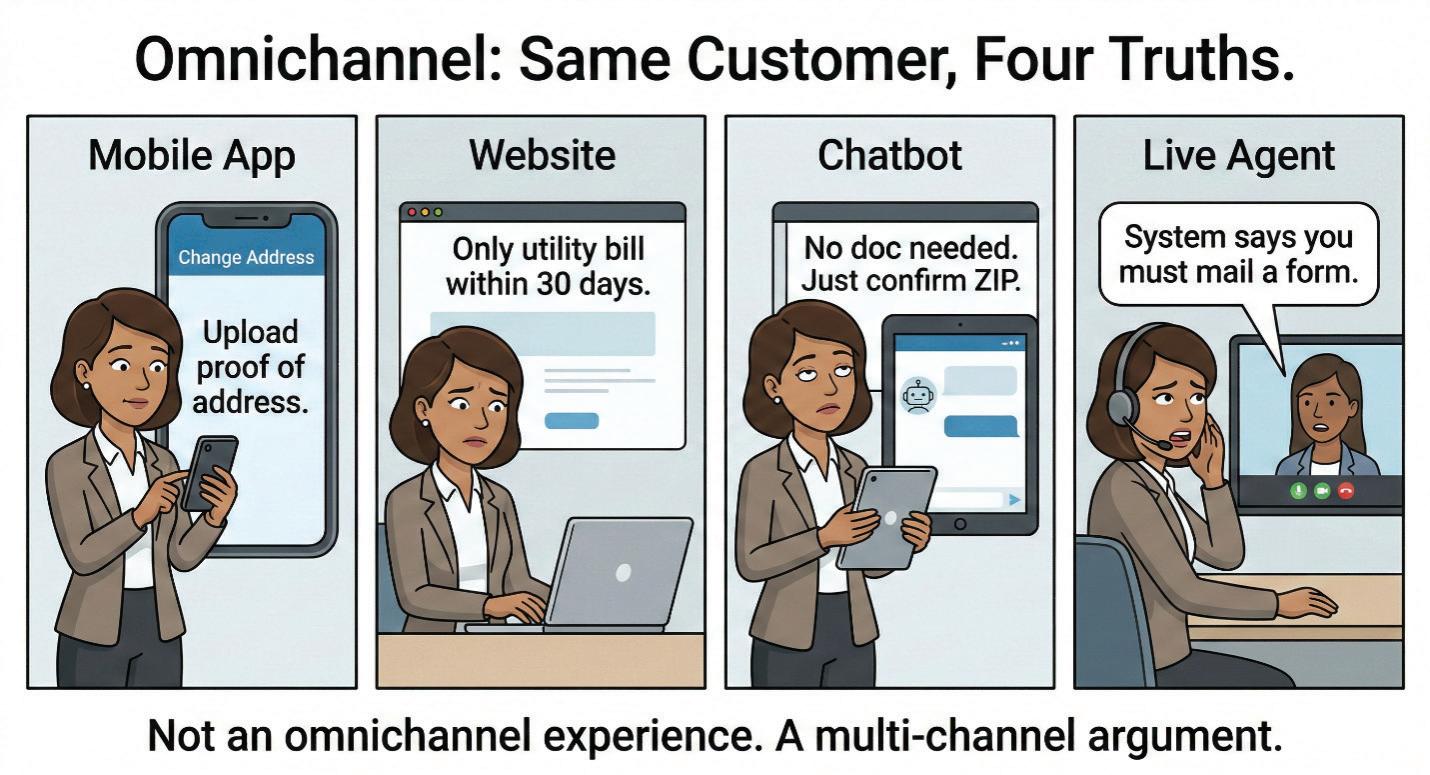
The customer starts an address change on mobile, gets halfway through, switches to the website, and is told they are missing a document they already uploaded. They open chat, where the bot confidently offers a different list of requirements. Finally, they call, and the agent says, “That is odd, the system is not letting me do that.”
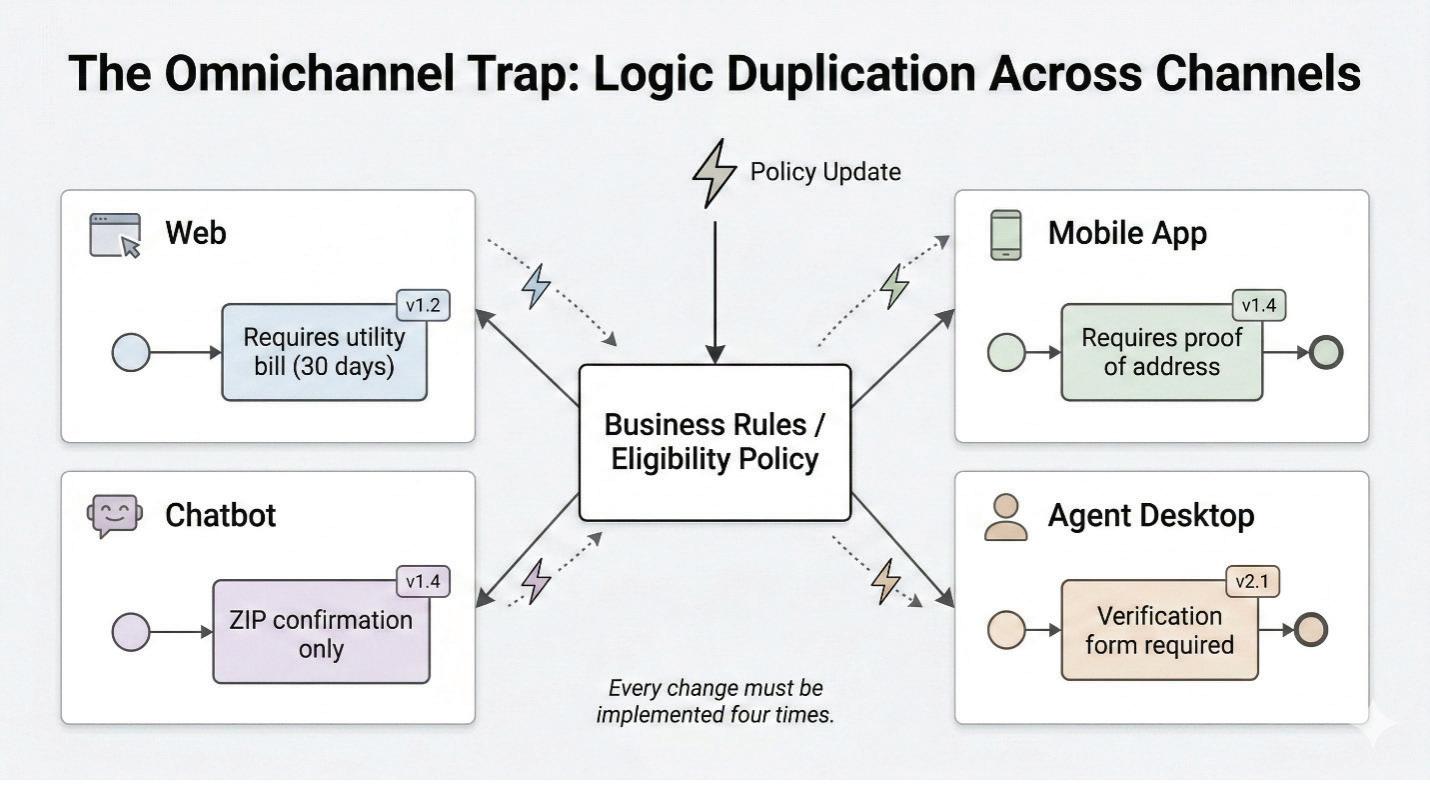
That is not an omnichannel experience. That is a multi-channel argument. (See Figure 1)
It may seem strange coming from me, a CEO, Founder, and Shareholder of a CCM and CXM offering, but we need to say the quiet part out loud. Traditional CCM. Traditional CXM. Even “journey mapping as the operating
system.” None of these ideas are wrong. In fact, they have done a lot of heavy lifting over the last decade. The problem is simpler and more uncomfortable: in 2026, they are no longer
sufficient as the primary model for how customer experiences actually run.
Not because teams got lazy. Because customer behavior and the technology surrounding it stopped cooperating.
We have hit a ceiling: pre-authored experiences
For years, we have managed customer experience by pre-authoring it. We author templates for documents and messages. We build flows for channels. We design “happy path” journeys and add exception handling like an afterthought. We launch omnichannel programs aimed at consistency, then invest heavily to keep that consistency from collapsing under its own weight.
This worked when customers behaved predictably, when channels were fewer, when personalization meant “Hi {FirstName},” and when the cost of building and maintaining those flows was acceptable.
But modern customers do not experience your company as a neat diagram. They experience it as a moment of need. Help me dispute this charge.
Change my address.
Explain why my claim was denied.
Get me back into my account. They do not care which department owns the flow. They care whether the outcome happens fast, correctly, and without friction.
Journey maps did not fail. They got misused.
This is where nuance matters.
Journey mapping remains incredibly valuable as a discovery and alignment tool. It shows where customers get stuck, which moments matter most, where handoffs break, and what the emotional arc looks like. Used well, it creates shared language across teams that otherwise speak in mutually unintelligible dialects.
The problem begins when we treat the journey map like a runtime blueprint, as if customers will follow a designed path across channels in the order we drew. They will not. Customers did not read the diagram. They also did not sign it.
Customers hop, pause, restart, escalate, and switch devices constantly. The “journey” is not a path. It is a pattern of intent colliding with real life. Maps are for discovery. Contracts are for execution. (See Figure 2)
And when we try to support omnichannel the old way, we quietly fall into a trap.
The
omnichannel trap: duplicating logic across surfaces
Most omnichannel programs, if we are honest, become re-implementation programs.
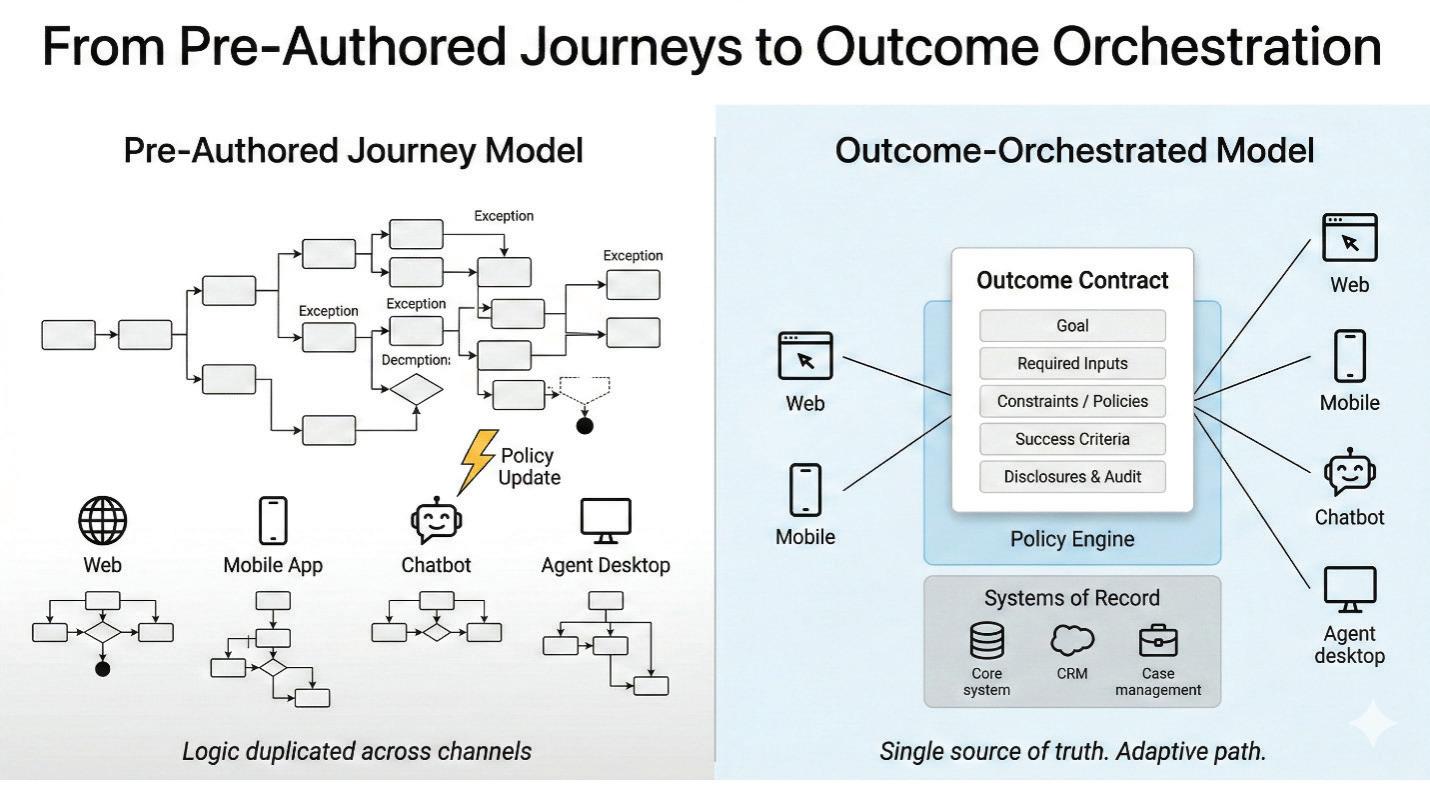
The website ends up with one interpretation of eligibility rules. The app has another. The agent desktop has a third. Email and SMS contain fragments. The chatbot has its own forked understanding of the world, built from good intentions and optimistic assumptions.
So we do not have one customer experience. We have a portfolio of interpretations of the business. Every channel becomes its own little republic with its own constitution. (See Figure 3)
That is why “small changes” take months. That is why consistency becomes a myth we pay consultants to illustrate. We are not orchestrating an experience. We are maintaining a distributed system of overlapping beliefs.
By the time the chatbot, app, and agent desktop agree on a rule, the customer has already opened a competitor’s app.
The shift: from journeys to outcomes
What comes next is not “let AI freestyle the experience.” If anything, it is the opposite.
The next model is simple to say and harder to do: define the outcome precisely, govern it tightly, and let orchestration adapt in real time.
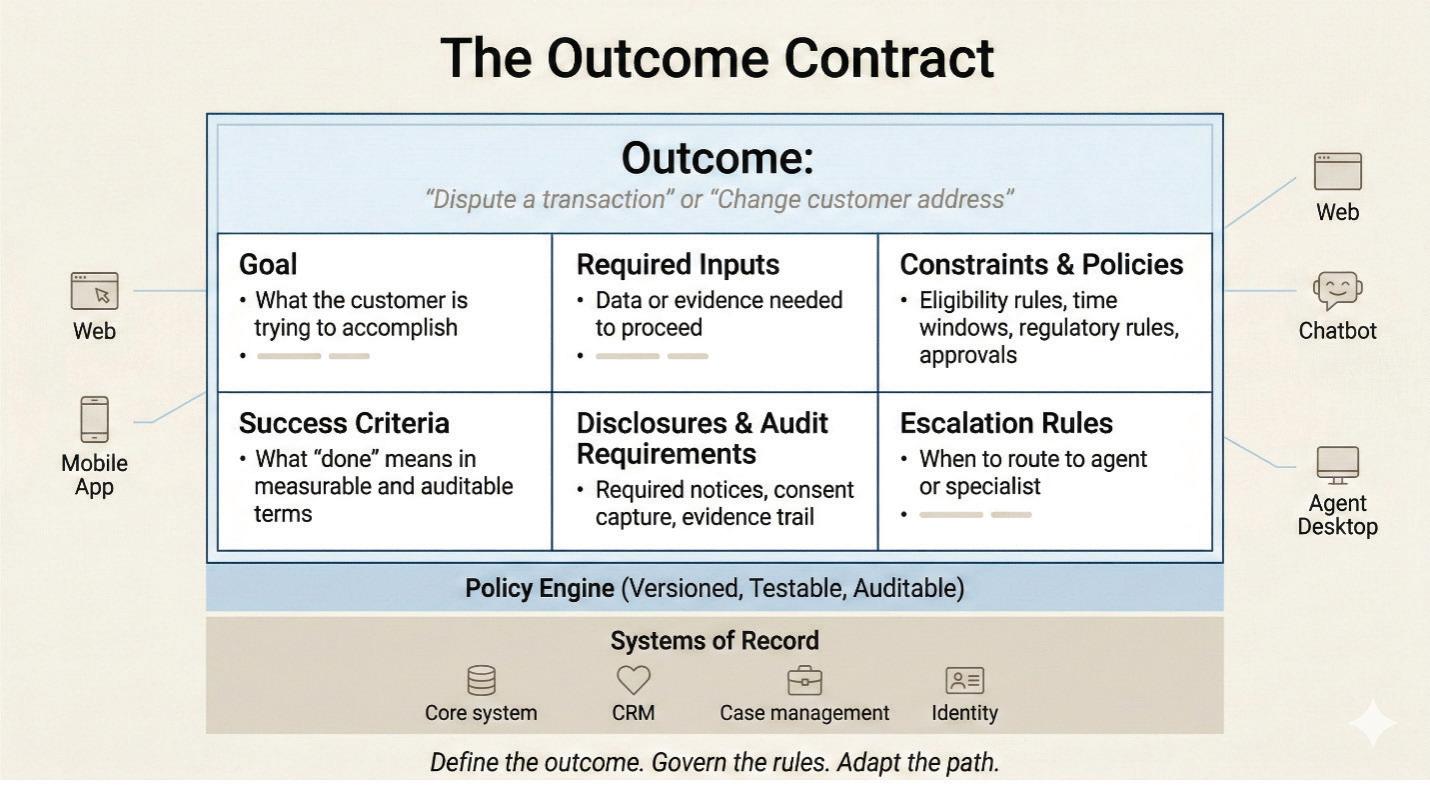
I like the term Outcome Contract because it forces the kind of clarity organizations tend to avoid until something breaks. It turns a vague promise of “customer experience” into something you can test, version, and defend.
Instead of trying to map every step, you define the outcome as a real agreement. (See Figure 4)
What is the customer trying to accomplish. What inputs are required to proceed. What constraints apply,
Figure 3
Figure 2
including eligibility, time windows, regulatory rules, and approvals. What “done” means in measurable, auditable terms.
Now make it real with a common example, the dispute.
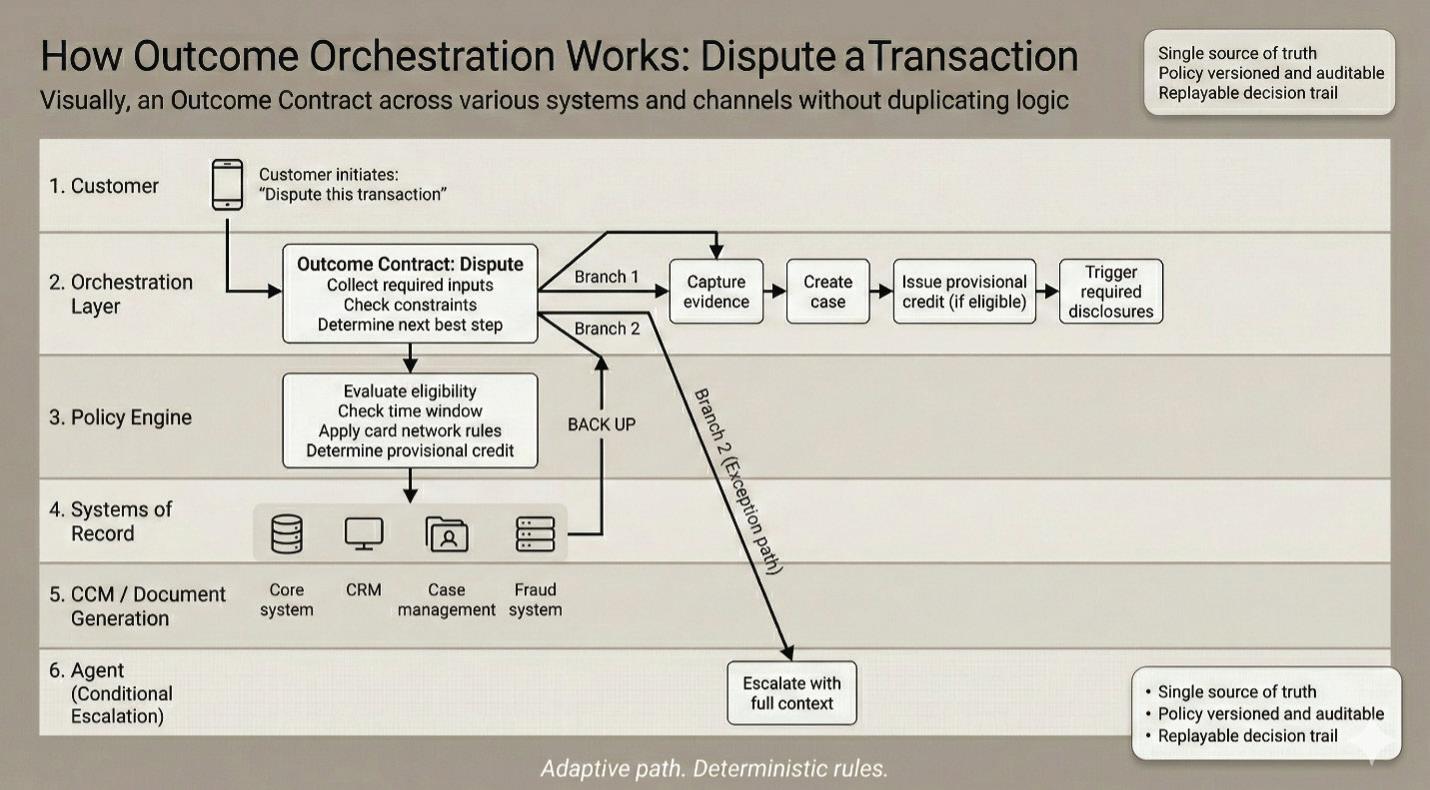
A customer says, “Help me dispute this charge.” The contract defines what the system must collect, such as transaction ID, reason code, and evidence where required. It defines constraints, such as time windows, card network rules, provisional credit thresholds, and fraud checks. It defines success, such as a case created, a status communicated, a provisional credit issued when appropriate, and the correct disclosures delivered.
Then orchestration chooses the path in the moment. If the customer is on mobile and already authenticated, it may start with the transaction list and ask the minimum questions. If the customer is in a branch, it may prioritize ID
verification and agent-assisted capture. If the customer starts on chat and hits an edge case, it escalates with context intact instead of resetting to zero. The contract stays fixed. The route adapts.
(See Figure 5)
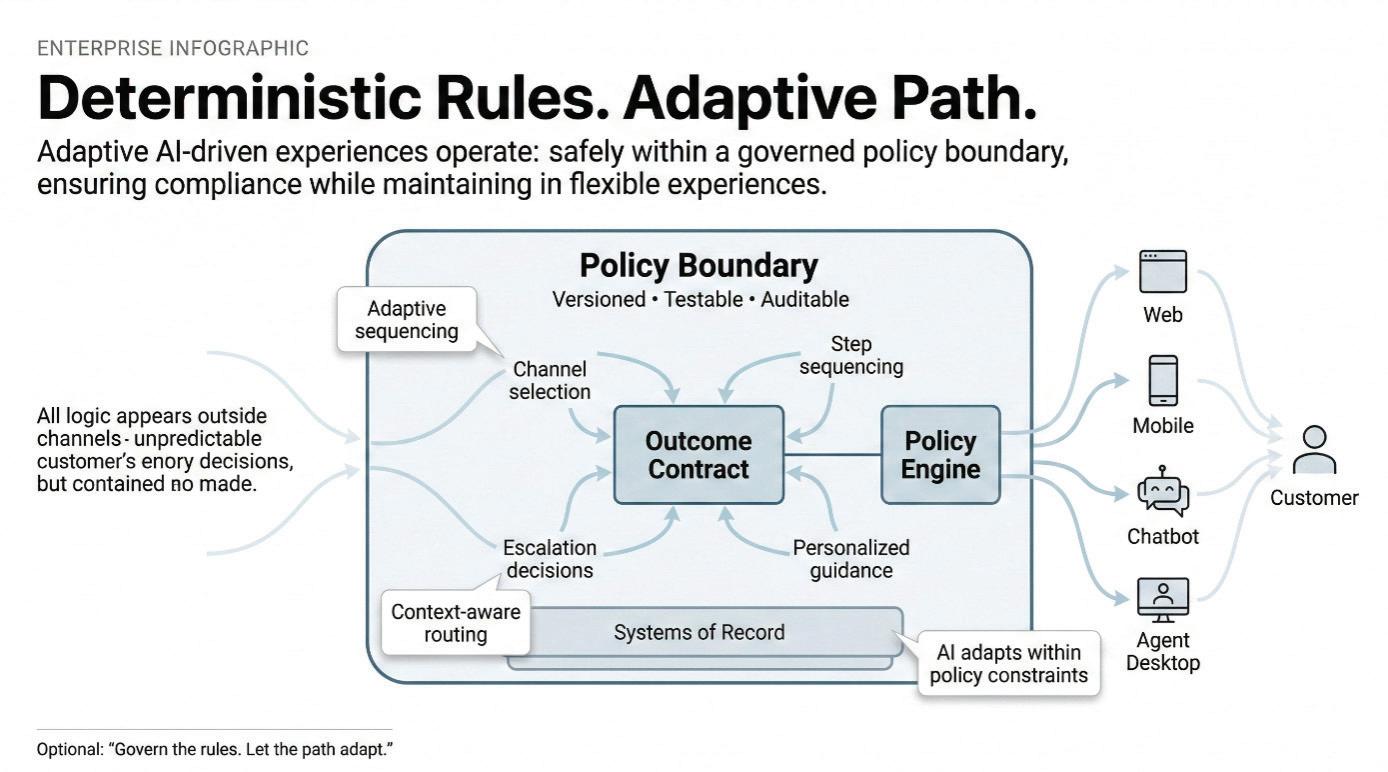
Net result: the path becomes adaptive, while the rules remain deterministic. That distinction matters. Adaptation without governance is chaos. Governance without adaptation is friction.
A common objection here is, “But regulated journeys require predictability.” Exactly. Predictability should live in policy and contracts, not in brittle flow diagrams that snap the moment reality shows up.
CCM is not disappearing. It is changing jobs.
Templates and documents are not going away. But the center of gravity is moving.
Traditional CCM has often been document-first. Build the artifact, deliver it, and hope the customer understands what to do next. Increasingly, the artifact is becoming a byproduct of an outcome. A confirmation of a completed change. A statutory notice tied to a decision. A receipt of consent. An audit-ready record.
This is not a funeral for CCM. It is a promotion.
In an outcome-first model, CCM becomes the compliance-grade recorder of resolution. It produces the evidence that an action was completed, the right disclosures were presented, consent was captured, and decisions were made within policy. The document is not dead. It just got reassigned.
There will always be regulated, highstakes communications where CCM is essential. Statutory notices. Tax and compliance forms. Legally required disclosures. Archival and evidence-grade communications. If anything, those documents become more important as the pace of change increases.
What changes is the role they play. CCM becomes a critical component in a broader system, but the experience is no longer “the document.” The experience is the resolution.
Welcome to the document-byproduct era.
What makes adaptive experiences safe in the real enterprise
If we want adaptive experiences to be production-grade, and not a demo that scares Compliance, we need new primitives, not just new prompts.
First, policies expressed as code, not flowcharts. Deterministic. Testable. Versioned. Auditable. AI can adapt within a policy boundary, but it cannot invent policy. (See Figure 6)
That boundary is the difference between a helpful assistant and an unlicensed policy writer.
Second, governed customer models, not creepy memory. Personalization should come from permissioned signals like preferred channel and cadence, accessibility needs, known friction points, and language and tone preferences. Structured context beats spooky surprises every time.
Figure 4
Figure 5
Third, tool-grounded truth, not best-guess answers. If a system says something to a customer, it should be grounded in systems of record: core platforms, CRM, case management, identity, and consent. If it cannot retrieve the fact, it should not state it as fact. Trust is won and lost right there, in that moment. Fourth, certified building blocks, not hallucinated interfaces. Brand and compliance matter. The answer is not letting an AI design UI. The answer is letting it assemble experiences from approved components, approved copy blocks and disclosures, and approved interaction patterns. Dynamic assembly, controlled ingredients. Compliance does not hate AI. Compliance hates surprises. Mostly the second kind.
Why this matters in business terms
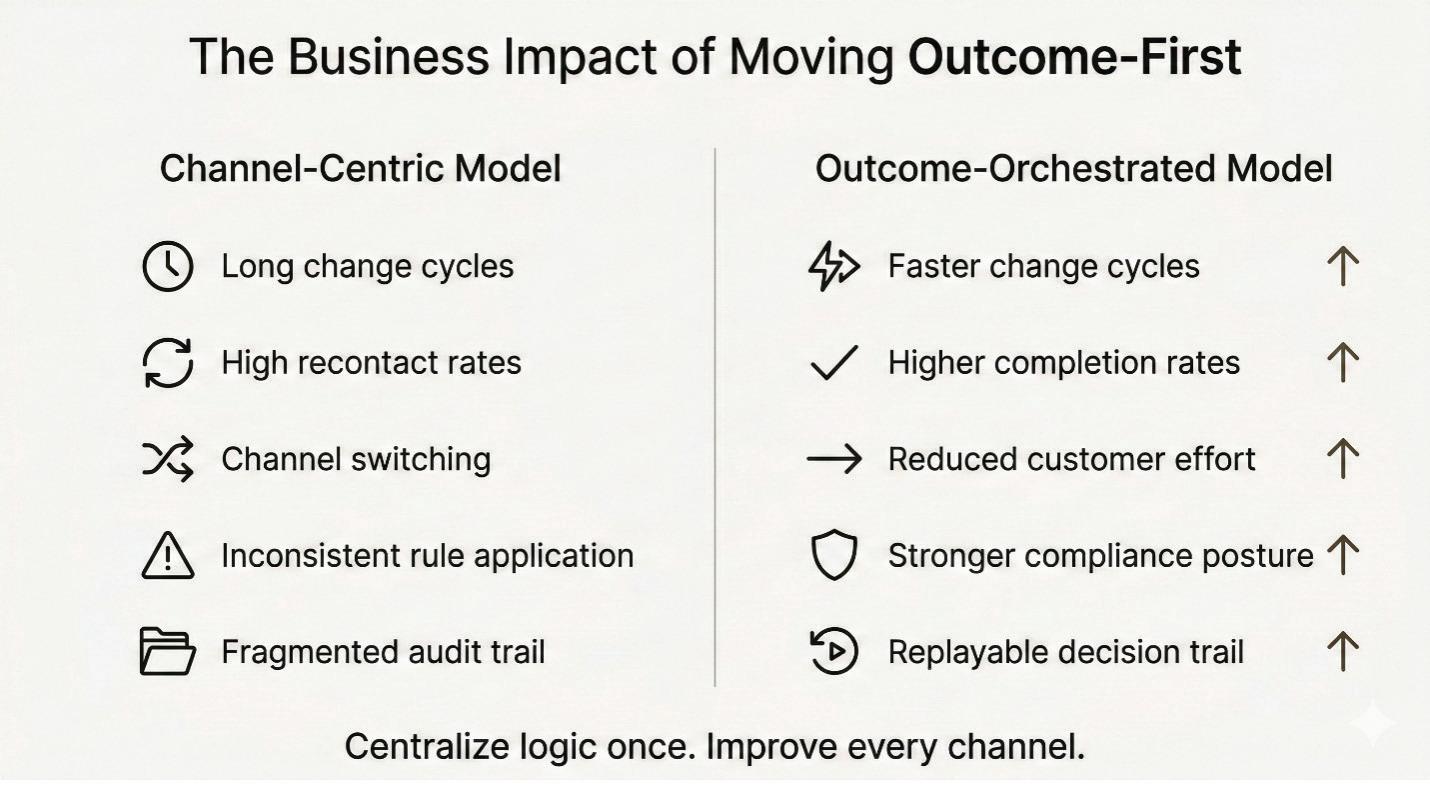
Outcome-first is not just a cleaner architecture story. It has direct operating leverage. (See Figure 7)
First, change cycles accelerate. Instead of updating five channel flows, you update the contract and policies once, and every surface improves together. The work shifts from “rewrite everything” to “change the rule and prove it.”
Second, completion improves and customer effort drops. The system can adapt the order, channel, and help level to the customer in front of it, rather than forcing the customer to adapt to your org chart. When outcomes are clear, customers do less guessing and teams do less apologizing.
Third, compliance posture strengthens. You get a replayable trail: what the customer asked, what data was used, what policies applied, why the decision was made, and what disclosures were presented. That is not “we logged a transcript.” That is “we can prove the decision.”
And there is an unglamorous fourth benefit that operators will appreciate.
When business logic is centralized, recontact drops, exceptions become measurable instead of mysterious, and “why did we tell them that” becomes a solvable question.
A practical way to start without boiling the ocean
The fastest way to make this real is not a grand transformation. It is a wedge.
Pick one or two high-volume outcomes: disputes, address changes, refunds, claim status. Define the Outcome Contract with Risk and Compliance in the room. Centralize the policies, even if the first version is simple. Force tool-grounding for any customer-facing claim. Assemble the experience from certified building blocks. Then measure: completion rate, time-to-resolve, channel switching, recontact, and exceptions.
Think in phases. First define outcomes. Then centralize policies. Then scale adaptive assembly across channels.
You do not need a rip and replace. You need proof, a working example that shifts beliefs.
Final thought
We are moving from “design every step customers should take” to “guarantee the outcome, govern the rules, adapt the path.”
In 2026, the competitive advantage is not omnichannel. It is outcome certainty.
Teams that cling to journey maps and template-heavy CCM as the primary operating model will find personalization and agility increasingly expensive. Teams that move outcome-first, grounded in data and bounded by policy, will deliver experiences that feel more human and are more compliant.
And yes, I am aware how odd this sounds coming from someone with “CCM/CXM” in the family photo.
ALAN BURGER is a strategist and thought leader in Customer Communication Management and Customer Experience Management. With decades of expertise in transforming enterprise communications, Alan helps organizations unlock value at the intersection of compliance, personalization, and customer engagement.
Figure 6
Figure 7
Artificial intelligence has transitioned from being a promising innovation to a fundamental business capability across a wide range of industries. Sectors such as finance, insurance, healthcare, and others are heavily investing in AI technologies to modernize operations and enhance customer engagement. However, the organizations that derive the most value from AI are those that prioritize customer experience (CX) in their business strategies.
Organizations focused on customer experience are at the forefront of AI adoption because they recognize the importance of engagement, communication quality, and personalization. They view AI not just as an isolated technological initiative but as an integral part of their comprehensive customer experience management (CXM) strategy. AI is leveraged to enhance every interaction between the customer and the organization, whether through improved communication, digital engagement, or operational efficiency. Consequently, these customer-centric enterprises use AI to enhance customer loyalty, increase efficiency, and reduce costs by creating a more agile and responsive operating model.
WHY CX LEADERS
WIN WITH AI
How customer-focused organizations are turning AI into stronger engagement, efficiency and loyalty
By Richard Huff
Customer Expectations Are Driving AI Adoption
In recent years, customer expectations have shifted significantly. Consumers now demand highly-personalized experiences, proactive communication, and seamless interactions across both digital and physical channels. They want organizations to acknowledge their preferences, anticipate their needs, and deliver information in a manner that is timely, clear, and relevant. Simplicity is also expected, with less tolerance for fragmented processes, inconsistent messaging, or delays caused by manual workflows and outdated systems.
Meeting these expectations at scale is extremely challenging with traditional operational models alone. AI offers the capability to process vast amounts of customer data, analyze behavior patterns, automate decision-making,
and personalize interactions in ways that are unfeasible manually. This understanding is why CX-focused organizations have aggressively embraced AI. These organizations see AI as a means to enable more personalized and responsive customer experiences, not just as a tool for automation.
Why CX-Focused Organizations Have an AI Advantage
In addition, CX-focused organizations are often equipped with many of the foundational elements necessary for successful AI implementation. AI systems rely heavily on high-quality data, integrated customer workflows, and robust communication infrastructures. Organizations that prioritize customer experience typically invest in customer relationship management (CRM) systems, analytics platforms, customer communication management (CCM) solutions, and omni-channel engagement environments. These platforms provide essential insights into customer preferences, service patterns, and engagement trends.
Because customer-centric enterprises comprehend the strategic importance of detailed data on customer interactions, they are better positioned to implement AI technologies compared to organizations with fragmented data environments or siloed business units. Having a comprehensive view of the customer base provides the data AI needs to generate valuable insights and facilitate decision-making.
Turning Customer Data Into Personalized Engagement
Data centralization is particularly crucial in industries that generate high volumes of transactional customer communications, such as insurance, banking, healthcare, utilities, and telecommunications. AI enables these organizations to transform static customer communications into intelligent, adaptive experiences with high levels of personalization based on customer behavior, demographics, service history, and communication preferences.
For instance, a financial institution might use AI to customize educational
content differently for novice investors compared to experienced clients. An insurance provider could tailor policy explanations based on the customer’s financial literacy or previous service interactions. These capabilities allow organizations to make customer interactions more relevant, understandable, and engaging, incorporating a call to action.
AI is most effective when it augments employees by automating repetitive tasks and providing better contextual information.
AI Is Reshaping the Customer Journey
AI also empowers CX-focused organizations to create adaptive customer journeys that respond to customer behavior. Traditional customer workflows rely on predetermined, deterministic rules that force customers into fixed interaction paths regardless of their needs. AI introduces flexibility and intelligence into these workflows. By analyzing customer interactions, AI systems can determine the most effective next step in a customer journey and suggest alternative engagements or escalate if necessary.
This adaptive capability enhances customer satisfaction by making interactions more contextual and responsive. Customers increasingly expect organizations to anticipate problems before they arise and provide proactive solutions. AI facilitates this by identifying patterns and predicting customer needs based on behavioral data and preferences. Organizations can identify at-risk customers, recognize emerging service issues, or offer
assistance proactively before dissatisfaction escalates.
The rise of digital self-service has further increased the importance of AI within customer experience strategies. Customers now prefer self-service interactions for routine inquiries and transactions, but they also expect these experiences to be intuitive and effective. AI-powered chatbots, virtual assistants, intelligent search capabilities, and guided workflows help organizations deliver faster and more accurate support while reducing the burden on customer service operations.
AI Enhances Human Interaction — It Doesn’t Replace It
Crucially, CX-focused organizations understand that AI should enhance rather than replace human interactions. AI is most effective when it augments employees by automating repetitive tasks and providing better contextual information. Customer service representatives equipped with AI-generated summaries and real-time knowledge retrieval can respond more quickly. Additionally, AI agents can offer recommended actions for training purposes. This boosts employee productivity while allowing representatives to focus on more complex or emotionally sensitive interactions.
Operational Efficiency and Compliance Gains
Operational efficiency is another significant benefit driving AI adoption. Many enterprises recognize the link between operational performance and customer experience. Inefficient processes, fragmented workflows, and inconsistent communications inevitably lead to poor customer experiences. AI helps eliminate many of these operational bottlenecks by automating repetitive tasks and improving workflow coordination. Organizations are increasingly employing AI to automate document classification, data extraction, case routing, quality assurance, and compliance validation. These capabilities reduce manual labor while enhancing processing speed and accuracy. In high-volume communication environments, AI can
significantly expedite production cycles while reducing operational costs. This is particularly important in industries where organizations must process millions of customer interactions and documents annually.
AI-driven analytics provide organizations with faster operational insights. Traditional reporting models often depend on historical analysis and delayed reporting cycles, limiting an organization’s ability to respond quickly to emerging problems. AI enables realtime monitoring and predictive analysis to identify customer dissatisfaction trends, communication failures, or fraud indicators at an early stage. This allows organizations to intervene proactively before issues escalate into larger operational or reputational problems.
Enterprises also benefit from AI’s capacity to strengthen omni-channel communication strategies. Modern customers interact with organizations through multiple channels, including print, email, mobile apps, SMS, portals, and customer service centers. Maintaining consistency across these channels is extremely challenging, especially for large enterprises operating across multiple business units and regulatory environments.
AI analyzes customer interactions comprehensively and coordinates communications across channels while maintaining consistency and adapting to customer preferences and context. AI-driven analytics evaluate which campaigns generate the best responses and can make real-time adjustments based on engagement patterns.
Regulatory and compliance management has become another significant area where AI offers advantages for CX-focused organizations. Highly regulated industries face growing pressure to enhance customer experiences while simultaneously complying with evolving legal and regulatory requirements. AI helps organizations manage this complexity by automating compliance validation, monitoring communications for policy violations, and supporting auditability and governance initiatives.
Organizations increasingly utilize AI to analyze communications for missing
disclosures, inconsistent language, accessibility issues, privacy concerns, and regulatory risks. AI can also assist with language translation, simplified language generation, and accessibility optimization, helping organizations make communications more inclusive while complying with accessibility standards and consumer protection requirements.
The Competitive Divide Between AI Leaders and Laggards
Beyond operational improvements and compliance benefits, AI also creates meaningful competitive differentiation for customer-centric organizations. Customers increasingly reward organizations that deliver seamless experiences, highly personalized interactions, and rapid issue resolution. AI enables enterprises to deliver these capabilities more consistently and at a larger scale than traditional operational models.
Organizations that successfully integrate AI into customer experience strategies often achieve higher customer retention, stronger engagement, and improved brand loyalty. Customers are more likely to remain loyal to organizations that communicate effectively, anticipate needs, and reduce friction in everyday interactions. Over time, these experience advantages create significant competitive separation in crowded markets where acquiring new customers is costly.
Conversely, organizations that lack strong customer experience foundations often struggle to realize meaningful value from AI investments. Many of these organizations approach AI primarily as a cost-reduction initiative rather than a customer experience strategy. As a result, deployments may narrowly focus on automation without improving underlying customer interactions or operational design. In some cases, poorly implemented AI solutions can actually increase customer frustration by creating disconnected or impersonal experiences.
Organizations with fragmented data environments, siloed business processes, or outdated customer communications management platforms frequently encounter difficulties scaling AI initiatives effectively. Without
robust customer intelligence and integrated workflows, AI systems cannot deliver the contextual understanding necessary to create value. This is why customer-centric organizations consistently outperform less mature peers in AI adoption success.
The Future of AI-Driven Customer Experience
Looking to the future, the relationship between AI and customer experience will continue to deepen. Emerging technologies will enable increasingly sophisticated capabilities such as realtime journey orchestration, predictive intent modeling, intelligent preference management, emotion-aware engagement systems, and autonomous communication optimization. AI will progressively advance from basic automation toward intelligent augmentation that enhances decision-making, personalization, and customer trust.
However, the future of AI-driven customer experience will not be defined solely by technological sophistication. The most successful organizations will be those that combine advanced AI capabilities with strong human-centered design principles. Customers do not simply want faster interactions; they desire experiences that feel relevant, trustworthy, transparent, and empathetic. Organizations that balance automation with authenticity will be best positioned for long-term success. As AI technologies continue to mature, the competitive gap between customer-centric AI leaders and slower adopters will likely widen significantly. The organizations that thrive in the coming decade will not necessarily be those with the largest AI budgets or the most advanced algorithms. They will be the ones that use AI most effectively to enhance human experiences and strengthen customer relationships.
RICHARD HUFF is Senior Analyst at Madison Advisors, an independent analyst and market research firm that addresses the needs of the electronic and print customer communications management marketplace. Visit https:// madison-advisors.com/
Communications as Trust Infrastructure
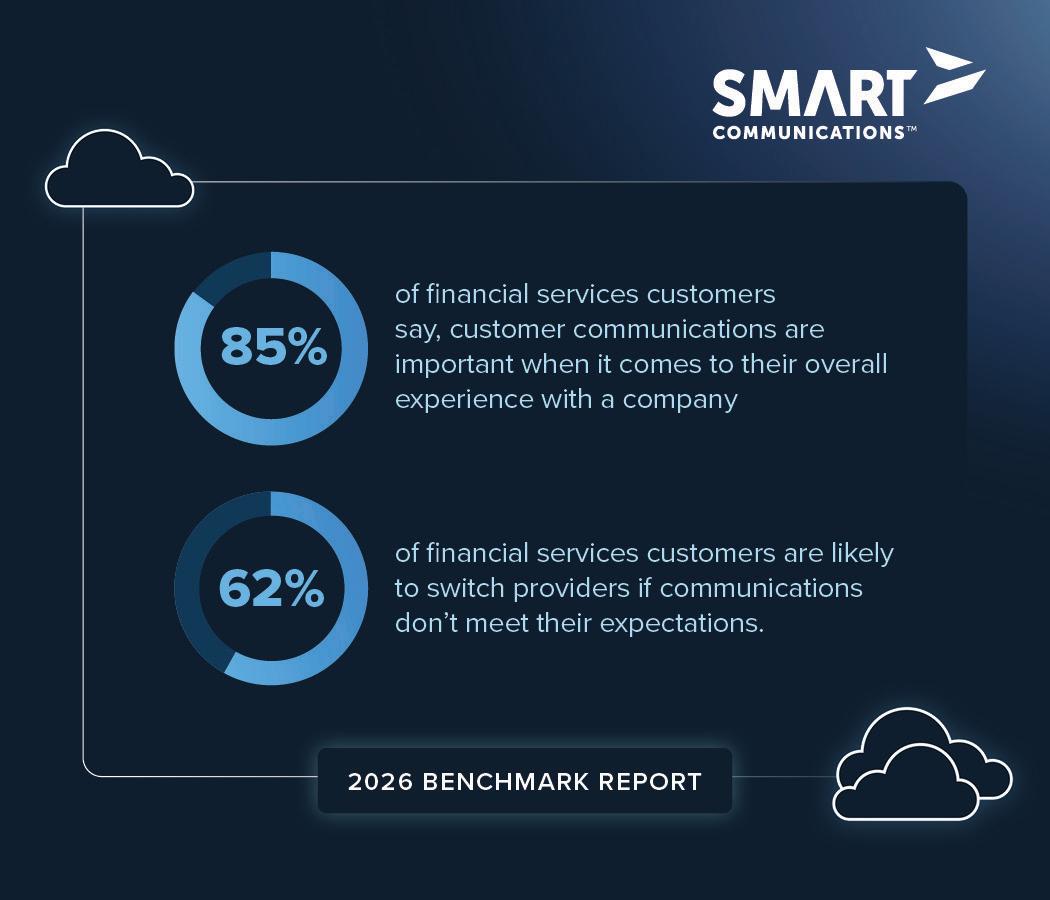
Eighty-five percent of financial services customers say communications are important when it comes to their overall experience with a company. At the same time, 62% of financial services customers are likely to switch providers if communications don’t meet their expectations.
These statistics from the 2026 Smart Communications Financial Services Customer Experience Benchmark Report capture one of the biggest customer experience challenges facing financial services firms today. Customers are not asking for more channels, more apps, or more automation. They are asking for better communication experiences — ones that remember them, respect their time, and make complex interactions feel easier, clearer, and more secure.
For financial institutions, this is not just a service issue. It is a document, data, and communications strategy issue. Here are four findings from the Benchmark Report to help financial institutions better understand the customer experience.
AI Needs a Trust Layer
Financial services customers are open to AI, but that openness comes with conditions. While more than half believe AI will improve their experience, 83% say it is important that companies disclose when AI is part of an interaction.
The implication is clear: AI cannot be a black box. Customers want transparency, human oversight, security, and relevance. For financial institutions, the opportunity is to apply AI within governed, explainable processes that help customers get what they need with less friction and more confidence.
Forms Are Moments of Truth
Data collection remains one of the most overlooked parts of the customer journey. Forms, applications, and service requests are often treated as operational necessities, but customers experience them as moments of truth.
When a customer opens an account, applies for a loan, or updates beneficiary information, the experience sends a signal. A clunky form can make a company feel disconnected. A guided, secure, and personalized process can reinforce trust.
The upside is measurable. When data collection exceeds expectations, 66% of consumers say they would recommend the company and 66% would do more business with it.
Communications Are the Experience
Communications remain central to trust. And communications become even more important as Gen Z and Millennials take the reins — more than 70% would switch companies if communications did not meet expectations.
In financial services, a notice, statement, disclosure, or servicing update is not just a document, but evidence of competence. If communications are unclear, inaccessible, or disconnected from the customer’s journey, service teams bear the burden through calls and repeated follow-up.
Connected Journeys Build Confidence
Eighty-seven percent of financial services customers say that seamless carryover across channels is important. The opportunity here is to connect the customer lifecycle through intelligent data collection, personalized communications, and journey orchestration. That means using customer information appropriately, carrying context across channels, and guiding each interaction to the next step.
Conclusion
Smart Communications helps financial institutions modernize forms, automate personalized communications, and orchestrate customer journeys, so firms can move beyond isolated digital improvements and create experiences that build trust.
To find out how to build trust as infrastructure, view Smart Communications 2026 Customer Experience Benchmark Report at https://www.smartcommunications.com/resources/ benchmark-report/.
THE SHIF T TOWARD CENTRALIZED COMMUNICATION MANAGEMENT
How financial institutions are rethinking customer communications
By Steve Diamond
How might highly regulated organizations maintain a competitive edge while balancing rising customer expectations with strict adherence to regulatory requirements?
It’s an age-old challenge for financial institutions.
Customers want speed, personalization, and experiences that feel new and interesting. But banks are often firing on all cylinders, fielding customer inquiries while ensuring they’re following internal procedures and mitigating risk events. This places them firmly in a reactive state, standing in the way of innovation and strategic development.
The Cost of Staying Reactive
In today’s environment, banks need to be set up for both stability and growth. That’s hard to achieve when teams work within disconnected frameworks that lack visibility, and onerous tasks require manual effort.
These gaps might not seem like a huge issue, but over time they lead to inefficiencies and delays which put your compliance at risk.
Take communication workflows, for example. When processes are manual and difficult to track, teams often spend more time chasing information than moving work through intended stage gates. The lack of transparency makes mistakes more likely,
slowing everything down. Sometimes, the consequences are even bigger. Inconsistent document handling practices may also create operational and compliance risks that require significant remediation efforts.
And there’s the reputational cost. Customer communication issues can also affect trust and long-term customer experience outcomes. For organizations in highly regulated industries, such as banks, the pressure is even greater. They need to stay compliant while also improving operational efficiency. Without the right foundational tools and systems, it becomes much harder to keep up with industry demands.
Many financial institutions are also balancing modernization initiatives alongside legacy infrastructure that may have evolved over decades. In some organizations, communication workflows span multiple departments, vendors, and compliance teams, making standardization difficult without broader operational alignment.
Reducing Complexity in Customer Communications
Handling customer communications in a regulated space is inherently complicated. You’re expected to keep records accurate, follow strict rules, and ensure everything is properly documented.
One of the biggest challenges is how complex things can become. Different tools, manual processes, and disconnected systems slow teams down and increase the likelihood of errors and delays. Many organizations are exploring centralized customer communications management (CCM) platforms to reduce complexity and improve visibility. Centralizing these workflows creates a more organized, predictable way of working.
A CCM platform also makes it easier to step back and see the bigger picture. When your people are working from the same system, it’s easier to spot gaps, align priorities, and make smarter decisions for the good of your organization and customers.
With fewer inefficiencies holding productivity back, banks become better equipped to scale and adjust over time.
It’s also important that print and digital are managed together, not in separate systems. Plenty of customers still rely on print, whether by preference or regulation, and when those channels are disconnected, messaging drifts. More integrated communication environments can help organizations maintain greater consistency across print and digital channels while improving coordination between internal teams and external partners.
Automating Checks and Balances
For banks, meeting compliance isn’t optional.
They must follow regulations with precision and ensure internal procedures track communications, workflows, and documentation carefully. A CCM platform with built-in compliance features automatically applies the right controls as work gets done, reducing the chances that critical details — such as required approvals or error corrections — fall through the cracks. The result is a more reliable process that keeps communications consistent and compliant across every channel, while maintaining productivity and agility within your teams.
Improved Operations at Scale
Growth, while essential, can put pressure on your business. As volumes increase, it becomes harder to keep communications accurate and consistent. To stay on top of evolving priorities, banks need flexible systems that can adapt to change with ease. Communications should be easy to update and quick to deploy, so that new initiatives don’t introduce risk or inconsistency.
A centralized CCM platform helps you create balance. With everything managed in one place, teams can produce communication templates and fulfill requests more efficiently by reducing repetition in your process and ensuring messaging is aligned between channels.
It also makes personalization more attainable because data and automation handle the complexity. With data and automation doing the heavy
lifting, teams can create communications that feel timely and relevant without adding complexity.
Centralization efforts also typically require cross-functional coordination between IT, operations, compliance, customer experience, and communication teams. As a result, many organizations are evaluating not just technology capabilities, but also workflow design and long-term governance models.
Integrating AI Into Communication Workflows
Automation can help reduce manual errors, while AI tools may support personalization and operational efficiency.
Centralization reduces
complexity, keeps messaging consistent, and makes it easier for teams to stay aligned.
AI is most effective when it’s built into the foundation of your communications strategy. With a centralized CCM platform, banks can quickly introduce new capabilities to documents, like statements, while keeping communications aligned and easy to manage.
At the same time, organizations are approaching AI implementation cautiously. Governance, explainability, data privacy, and regulatory oversight remain important considerations, particularly in highly regulated industries such as banking and insurance.
Key Considerations When Evaluating CCM Platforms
As financial institutions evaluate CCM technologies, many are prioritizing flexibility, scalability, governance, and cross-channel consistency.
At a minimum, you want a solution that can handle increasing volumes and unique data requirements, such as custom messaging. It should support both print and digital outputs, so you’re not limited in how you reach your audience. Built-in compliance capabilities are increasingly important for organizations looking to reduce manual oversight and support regulatory alignment.
Organizations are also placing greater emphasis on oversight capabilities, version control, and reporting tools that improve visibility across communication workflows.
Centralization reduces complexity, keeps messaging consistent and makes it much easier for teams to synchronize. For many financial institutions, the broader goal is not simply technology consolidation but creating communication operations that can adapt more effectively to evolving customer expectations, regulatory demands and channel complexity.
Preparing Communication Infrastructure for Change
As customer expectations, compliance requirements, and communication channels continue to evolve, many financial institutions are reassessing how communication infrastructure supports agility, governance, and operational efficiency over the long term.
Centralized communication strategies may help organizations reduce complexity and improve consistency across channels, but successful modernization efforts also require coordination across technology, compliance, operations, and customer experience teams.
While no single approach fits every organization, adaptability and long-term governance are becoming increasingly important considerations for banks navigating ongoing transformation.
STEVE DIAMOND is a senior sales and customer communications leader with more than 25 years of experience serving highly regulated financial services and insurance organizations. For more information, visit www.doxim.com.
WHAT THE ANALYSTS SAY…
2026 Aspire CCS Enterprise Research
Aspire CCS’ new enterprise research for 2026 provides vital insight into a market increasingly defined by divergence. The State of Customer Communications and Experience Management (2026) examines how over 300 enterprise stakeholders in six countries navigate competing priorities across AI-generated or enhanced communications and processes, cloud migration, omni-channel delivery, sourcing strategy, budget ownership, accessibility, data collection, and CCM-CXM integration. Across all of these dimensions, CX maturity consistently emerges as the defining variable, marking a decisive threshold in AI operationalization, in-channel delivery, cloud progression, accessibility commitment, and budget ownership. The results paint a clear picture of what enables CX leaders to thrive and where the most significant commercial and operational gaps currently lie, giving enterprises a roadmap for sharpening their communications strategy and vendors and service providers a detailed map of what their clients and prospects actually need. To learn more, please contact Will Morgan at will.morgan@aspireccs.com.
Aspire’s 2026 Leaderboard Update
The CCM/CXM market isn’t slowing down. Our Q1 2026 Leaderboard update is live - and there’s a lot to unpack. A few themes stood out this quarter:
AI is moving from roadmap to reality
MHC, Elixir Technologies, OpenText, Smart Communications, and Precisely are all shipping practical AI — content generation, tone optimization, accessibility tagging, and compliance validation. Precisely’s new agentic AI capabilities for EngageOne RapidCX introduce Sentiment Analysis, Contextual Rewrite, and Readability agents alongside AI Intelligent Search, targeting the regulated industries where communication risk is highest. Messagepoint’s new Marcie Assure solution automates mandatory CMS content validation for regulated healthcare communications. The era of AI as a talking point is over.
Migration is becoming a product category
Elixir Catalyst, VILT’s Flowtuate (built with OpenText), and MHC’s AI-driven migration tools all tackle the same painful reality: modernization friction is a real barrier — and a real opportunity.
Consolidation continues
Messagepoint acquired Sefas Innovation in March, significantly expanding its European footprint and end-to-end capabilities. Dialog Group is making a strategic investment in Italian specialist M.2S.C. srl, with a full acquisition expected within two years.
Platform evolution across the board
Smart Communications repositioned SmartHUB as a governed, AI-ready data foundation. Quadient is doubling down on its Digital Automation Platform with new leadership alignment and strong e-invoicing momentum. DataOceans continues its evolution from CCM managed services toward a broader customer engagement platform. Crawford Technologies made several product announcements around automation, accessibility, and scalable document processing at its annual event in Orlando.
Aspire CCS Takes a Deep Dive into the Evolution of CCM Sourcing
Aspire CCS’ latest Market Trend Report examines how the communications sourcing dynamic has shifted away from an insourcing/outsourcing binary to embrace a new hybrid reality. No longer solely a question of cost efficiency, sourcing is now driven by considerations of governance, regulatory exposure, and the responsible scaling of artificial intelligence. The right answer can look very different depending on an organization’s CX maturity. The central question is no longer whether to insource or outsource, but how to design a sourcing model flexible enough to evolve alongside changing technology, evolving consumer expectations, and developing regulatory demands. This new report is one in a continuing series breaking down the revolutionary drivers reshaping the customer communications landscape. Upcoming reports will explore the convergence of CCM with CXM, Rich Communications Solutions (RCS) and next-generation integration, and the foundations of agentic AI in communications management. To learn more about Aspire CCS’ library of market trend reports, visit our www. aspireccs.com/market-trendreports/ or contact Will Morgan at will.morgan@aspireccs.com.
Consumer Comfort with AI in Financial Services
As AI becomes more prevalent in financial services, consumer comfort is rising but varies across demography and task complexity. Consumers, especially younger generations, are increasingly open to using AI for financial guidance and show little preference for where that help comes from. Comfort drops sharply as AI moves from explaining options to acting autonomously, and most consumers still trust human advisors more than AI alone. This report helps financial services leaders understand where customers expect AI tools to create value today and the types of AI experiences that consumers will adopt.
2026 Aspire CCS State of the Industry Webinar
For over a decade, Aspire CCS has helped enterprises, technology vendors, service providers, and investors navigate the evolution of customer communications from documents through digitization and into the age of AI. Now, our second annual State of the Industry webinar will draw on that depth of expertise and our new proprietary research to deliver an authoritative and independent view of where the market is headed in 2027. The rules of customer engagement have changed. Eight in ten enterprises are now testing or deploying generative AI, dialogue is quickly overtaking documents as the preferred engagement model, governance has emerged as a defining competitive differentiator, and hybrid sourcing is now the dominant operating model. Aspire CCS’ Founder and CEO Kaspar Roos will examine these transformative forces in a 30-minute keynote and then moderate a panel of innovative industry leaders driving this transformation in the real world, providing an unfiltered view of what’s working, what isn’t, and what 2027 is likely to bring. Sessions are available across three time zones: North America on September 8, Europe/UK on September 16, and APAC on September 24. To register or learn more, please visit our website or contact Will Morgan at will.morgan@aspireccs.com.
Think About It
/ LIZ STEPHEN AND MIA PAPANICALOU / / ALAN BURGER /
FORCED DIGITAL ADOPTION HAS HIT ITS CEILING. CUSTOMERS WANT CHOICES THAT MAKE SENSE IN THE MOMENT RATHER THAN MANDATES TELLING THEM THE DIGITAL CHOICE.
A LEADING CAR FINANCE COMPANY REPLACED STATIC END-OF-LEASE LETTERS WITH PERSONALIZED RENEWAL VIDEOS, CUTTING CALLS BY 28% AND BOOSTING REPEAT LEASES BY 44%.
/ SER GROUP /
Despite years of digital transformation initiatives, 61% of document processes still involve paper somewhere in the workflow.
/ ANDREW STEVENS / For every dollar spent on direct labor for manual document processing, businesses incur an additional $2.30 to $4.70 in hidden costs.
/ BRYAN MATLOCK /
Today, nearly 50% of organizations list cloud migration as their top transformation initiative. The organizations that succeed will be those that view cloud migration not as a technology project, but as a strategic evolution of how they communicate with the customers they serve.