Modernize data capture to protect revenue and trust
By Andrew Stevens
Hybrid Test Data Strategies
Balancing privacy with accurate document testing By
Jennifer Raml
How to Make Channel-Agnostic Content a Reality in 2026
Breaking silos to power true omnichannel communications
By Patrick Kehoe
Migration to Modern Cloud Systems
A practical roadmap for CCM transformation By Bryan
Matlock
Digital Was the Easy Part...
Mastering a great experience is the hard one By Liz
Stephen and Mia Papanicalou
The Next Architectural Leap in Document AI From static prompts to adaptive orchestration By Andrew
Bird
From Hyper-Personalization to Predictive Communications How AI Is enabling companies to anticipate customer needs before they’re expressed By Eric
Riz
Insurance Providers: Ready to Improve the Customer Experience? It’s time to get personal By Steve Diamond
LETTER FROM THE ADVISORY BOARD:
The Experience Economy
By Pat McGrew
This issue is your guide to thriving in the Experience Economy. It’s the next great leap in how we connect with customers. We’re taking the vital foundation of hyper-personalization and evolving it into predictive communications. It’s not about moving away from personalization; it’s about using AI to take it to the next level by anticipating customer needs before they even emerge. And for our colleagues in the insurance sector, we have an in-depth look at why deep, meaningful personalization remains the cornerstone of truly enhancing the customer journey.
We’re also getting practical about the how. We explore AI orchestration — the art of coordinating multiple AI agents. That orchestration can create policy gaps, so we offer guidance on keeping your usage and data management policies in sight as you adopt new tools, sometimes faster than rules can be written. We’re also focusing on digitizing data collection to catch errors in real time, because clean data is the lifeblood of a great document.
For those prioritizing cloud migration in your 2024–2025 initiatives, we’ve provided a comprehensive roadmap for CCM transformation. Pair that with our feature on channel-agnostic
content — defining the “write-once, deploy-everywhere” vision — and hybrid test data strategies that balance privacy with accuracy, and you have a toolkit for complete transformation. As a timely addition to this issue, we take an even deeper dive into what it means to make channel-agnostic content a reality in 2026, breaking free from siloed templates and legacy systems to power true omnichannel communications through modular content, centralized hubs and AI-powered renditions.
The technology is advancing rapidly — but so are we. Dive in, get inspired, and let’s transform these communications together.
Editor’s Note: You’ll notice that this spirit of evolution starts immediately with a refreshed Table of Contents. As the conversations in our industry become more interconnected, we’ve reimagined how we organize them — creating clearer pathways through strategy, technology and real-world application. Think of it as orchestration in action: structured, intentional and designed to help you move quickly from insight to implementation.
And, as always, DOCUMENT STRATEGY is shaped by its community of practitioners, innovators and experts who contribute their insights. As we continue into this next chapter, I invite you to help steer the dialogue — whether by sharing ideas, submitting content or recommending the issues we should tackle next.
president Chad Griepentrog
publisher
Ken Waddell
managing editor Erin Eagan [ erin@rbpub.com ]
contributing editor
Amanda Armendariz
contributors
Andrew Bird
Steve Diamond
Avi Greenfield
Bryan Matlock Mia Papanicalou
Jennifer Raml Eric Riz
Elizabeth Stephen
advertising Ken Waddell [ ken.w@rbpub.com ] 608.235.2212
audience development manager Rachel Chapman [ rachel@rbpub.com ]
creative director Kelli Cooke
PO BOX 259098
Madison WI 53725-9098 p: 608-241-8777 f: 608-241-8666 email: customerservice@rbpub.com
The articles in this magazine represent the views of the authors and not those of Madmen3 or DOCUMENT Strategy Media. Madmen3 and/or DOCUMENT Strategy Media expressly disclaim any liability for the products or services sold or otherwise endorsed by advertisers or authors included in this magazine.
SUBSCRIPTIONS: DOCUMENT Strategy Media is the essential publication for executives, directors, and managers involved in the core areas of Communications, Enterprise Content Management, and Information Management strategies. Free to qualified recipients; subscribe at documentmedia.com/subscribe.
REPRINTS: For high quality reprints, please contact Chad Griepentrog, 608-241-8777, chad.g@rbpub.com
FEATURED CONTRIBUTORS
Andrew Bird
ANDREW BIRD is Head of AI at global IDP provider Affinda, where he is responsible for AI technologies for the automation of high-volume document workflows. He was named a finalist for AI Software Engineer of the Year at the Australian AI Awards 2025 for his work on Affinda’s agentic AI platform.
Steve Diamond
Jennifer Raml
JENNIFER RAML, IT Manager at Acuity a Mutual Insurance Company, is a strategic technology leader with over two decades of experience streamlining document workflows and customer communications in banking and P&C insurance industries. Her expertise spans document strategy, business analysis, and process optimization, with a proven track record in modernizing customer communications.
STEVE DIAMOND is a senior sales and customer communications leader with more than 25 years of experience serving highly regulated financial services and insurance organizations.
FORMS THAT FUEL GROWTH
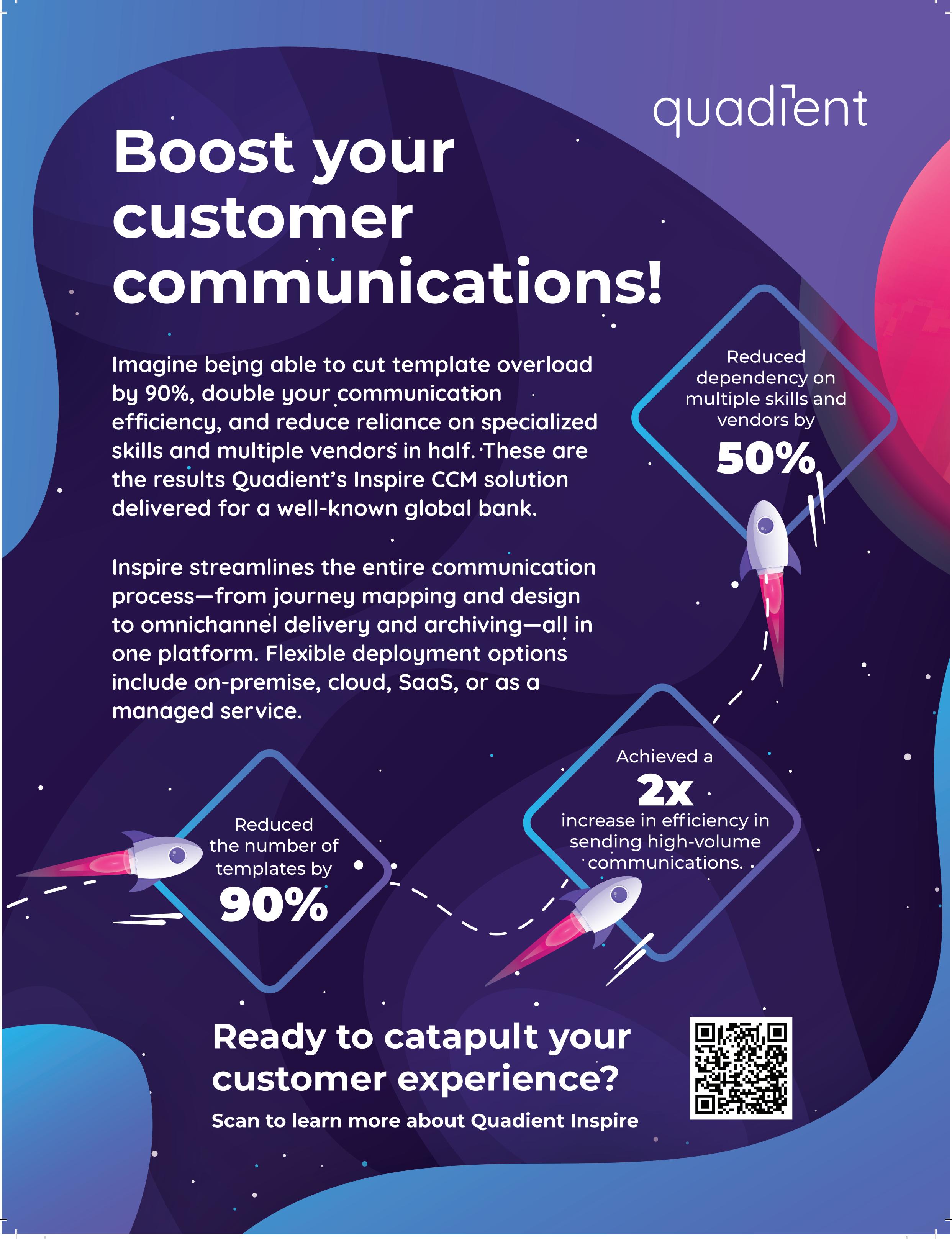
Modernize data capture to protect revenue and trust
By Andrew Stevens
Despite their pivotal role in customer journeys, forms are still viewed by many organizations as operational overhead. In a digital-first era, that outdated view is a hidden drain on revenue and a growing threat to customer trust.
Every form represents a moment of customer intent — to open an account, file a claim, move money or any other activity. Legacy data capture methods like paper and static PDFs introduce friction that derails the experience and drives up costs.
These mobile-unfriendly and errorprone formats not only have high abandonment rates, but they also trigger “not in good order” (NIGO) submissions that require manual intervention. One industry analysis found that for every dollar spent on direct labor for manual document processing, businesses incur an additional $2.30 to $4.70 in hidden costs.
The result is operational drag that leaders feel downstream as missed revenue, delayed processing and rising support costs — but rarely trace back to the form itself.
If your organization still relies on PDFs and paper, you need to modernize your forms now and shift from reactive data processing to proactive customer engagement that drives growth.
Why legacy forms break down
In highly regulated industries like finance, insurance and utilities, organizations often manage thousands of legacy forms, many of which haven’t evolved in decades. Examples include banking account opening forms, insurance policy servicing requests, utility service activations, healthcare patient intake packets and government benefits applications.
PDFs and paper forms persist because they appear easy to manage. Non-technical teams can update them quickly, without IT involvement. However, these outdated formats carry hidden costs.
Customers now expect effortless digital interactions. Yet too often, they’re stuck pinching and zooming through dense PDFs on mobile screens, wading through irrelevant questions, and re-entering the same information again and again.
When errors occur, transactions fall out of straight-through processing and into manual review, pulling staff into exception handling and driving up cost per transaction.
Worse, customers who believe they’ve completed a transaction are often forced to re-engage. It’s an experience that damages trust and increases abandonment risk.
On the employee side, managing PDFs and paper forms may seem
easy, but it’s actually a source of hidden friction. It is estimated that ongoing updates to account for regulatory changes, product updates and localized requirements such as transactions cost organizations as much as $500 per form.
Long story short, PDF and paper forms are likely costing your organization more than you think.
How to turn forms into a growth lever
The answer? Adopting intelligent, digitized forms.
These modern tools do more than just reduce operational costs. They’re interactive experiences that move transactions forward rather than just passively capturing data:
Dynamic logic adjusts questions in real time based on previous responses, eliminating unnecessary steps and reducing abandonment.
A user no longer sees 100 questions when they only need to answer 10.
Real-time validation flags errors before submission, while the customer is still engaged and can correct them quickly, preventing costly downstream exceptions.
The business impact is immediate. Cleaner data increases straight-through processing rates. Fewer exceptions reduce operational costs. Faster
completion accelerates revenue and improves cash flow. And a smoother experience increases the likelihood that customers finish what they start.
Modernizing forms is a critical upstream pillar of the customer communications lifecycle, ensuring that the data captured at the first touchpoint flows seamlessly into the personalized, omnichannel interactions that follow.
To modernize effectively, organizations need to start thinking about forms as front-line customer engagement tools, not just back-office paperwork. Here’s how to make that shift:
Treat forms as revenue-impacting touchpoints, not administrative afterthoughts. Customers don’t separate forms from brands. A slow or confusing form reflects directly on the organization and influences whether a transaction moves forward.
Prioritize moments that carry financial or emotional weight, not just the transactions that happen most often. Don’t stop at digitizing your
organization’s highest volume forms. High-value, emotionally charged transactions often shape long-term loyalty and lifetime value, even if they occur less often. An auto insurance customer will remember if the claim they submitted after a traumatizing car accident went seamlessly or added to their stress.
Design for prevention, not remediation. The most efficient exception is the one that never happens. Capturing accurate data the first time — often with the help of AI tools — reduces cost and accelerates outcomes.
Empower business teams to adapt quickly. Regulatory and operational requirements change constantly. Organizations need tools that allow non-technical users to update and manage forms without waiting on IT. AI tools can play a role here, too, enabling organizations to modernize existing PDFs quickly, rather than rebuilding every form from scratch.
Building trust and your bottom line Forms are no longer neutral infrastructure. They either accelerate revenue and trust, or quietly hold them both back.
Organizations that modernize data capture at the source don’t just improve customer experience. They reduce costs, accelerate growth and build trust at the moments that matter most.
And in a market where speed and experience increasingly define winners, that advantage compounds faster than most leaders expect.
ANDREW STEVENS, Senior Director, Enterprise
Digital Product Marketing at Quadient, is a recognized expert at all levels of enterprise IT, supplier and process management, with 25+ years’ experience leading global teams in cross-boundary governance, architectural analysis, portfolio strategy and solutions development. He specializes in helping enterprises optimize their communication and experience solutions to deliver the highest levels of accuracy while continuing to deliver great customer and business outcomes.
HYBRID TEST DATA STRATEGIES
BY JENNIFER RAML
Balancing privacy with accurate document testing
Test data strategy belongs in boardroom discussions, not buried in technical specifications. But here’s what actually happens: executives assume IT has it handled, middle managers inherit whatever strategy exists (or doesn’t), and developers either work with whatever test data they’re given or create their own workarounds.
This disconnect is costing companies money and putting customer trust at risk. Here’s why everyone, from the C-suite to the development team,
should care about how test data gets created and managed.
The Testing Dilemma Nobody Wants to Talk About
Picture a regional property and casualty (P&C) insurer that needs to test a new policy document system before rolling it out to 500,000 customers. Using real customer data seems obvious. After all, it represents actual scenarios the system will handle. But that’s also a minefield of privacy risks, regulatory violations and potential breaches waiting to happen.
Using completely fabricated data solves the privacy problem. Except it doesn’t solve the testing problem, because fake data rarely catches the errors that matter. It doesn’t reflect the messy reality of how information actually looks in your systems.
This is where hybrid test data strategies come in. Instead of picking between synthetic data (completely fabricated) or real data (actual customer information), you strategically combine both. The goal isn’t checking a compliance box. It’s making sure that when your new billing system, customer portal or automated communications platform goes live, it actually works, while keeping customer data protected throughout testing.
What You’re Actually Choosing Between
Before diving into how to blend them, it’s important to understand what you’re actually choosing between.
Synthetic data is artificially generated information that mimics the patterns of real data without containing any actual customer information. Think of it as creating realistic-looking customer profiles for people who don’t exist. A synthetic health insurance member might be “John Smith, age 47, diagnosed with Type 2 diabetes, residing in Ohio.” Looks authentic. Represents nobody.
Real data is actual customer information, ideally anonymized or masked to protect identities. You might replace “Margaret Johnson” with “Member 847592” while keeping her actual claim history, policy details and transaction patterns intact.
Both approaches have advantages. Both have blind spots that can cost you.
Where Synthetic Data Works, And Where It Fails
Synthetic data has compelling benefits. It scales infinitely. Need to test
how your system handles 10 million records? Generate them. It’s also privacy-safe by design. No real customer data exists in synthetic datasets, so there’s nothing to expose if test environments get breached.
Real data is actual customer information, ideally anonymized or masked to protect identities. You might replace “Margaret Johnson” with “Member 847592” while keeping her actual claim history, policy details and transaction patterns intact.
For a manufacturing company implementing a new invoicing system, synthetic data can create thousands of test scenarios. Customers with varying credit terms, multiple shipping addresses, international transactions, complex pricing agreements. The IT team can test edge cases that rarely occur but would break the system when they do.
But here’s what nobody tells you about synthetic data: it fails to capture the quirks and inconsistencies of realworld data. In banking, customers don’t
enter information consistently. Real data includes misspellings, formatting variations, incomplete addresses and legacy system artifacts that synthetic data generators typically overlook.
A mortgage document system tested only with perfectly formatted synthetic data? It might fail spectacularly when confronted with the messy reality of actual customer records accumulated over decades. And it will fail after you’ve already launched.
Why Real Data Still Matters
Real data, even when properly anonymized, captures authenticity that synthetic alternatives can’t match. At a health insurance company, real claims data reflects actual diagnosis codes, treatment patterns and cost distributions. These nuances matter when you’re testing explanation of benefits documents or claims processing workflows.
Real data also validates that systems handle actual transaction volumes, distribution patterns, and seasonal variations - the kinds of fluctuations that matter in the real world. P&C insurers know claim patterns during hurricane season look vastly different from winter months. Testing with real historical data ensures systems can handle these authentic demand fluctuations.
A financial institution learned this the expensive way. After testing a new statement generation system primarily with synthetic data, they rolled it out. Certain legacy account types, just 2% of customers but involving highnet-worth clients, produced garbled statements. The synthetic data hadn’t included these account types because they weren’t statistically significant. The reputational damage was very real.
The challenge is privacy and compliance. GDPR, HIPAA, CCPA and other regulations impose strict requirements on how real customer data can be used,
even for testing. Data breaches in test environments have led to significant fines and reputational damage.
The Hybrid Approach: Using What Works While Avoiding Problems
Honestly, most companies are winging this. They don’t have a documented strategy. They use whatever test data is convenient or whatever the vendor provides. Smart companies are taking a different approach. They’re adopting hybrid strategies that use what works from both approaches while avoiding the problems inherent in each.
Health Insurance: A health plan uses anonymized real data for common scenarios — standard medical claims, routine preventive care and typical policy configurations. For rare but critical scenarios like catastrophic claim limits or complex coordination of benefits, they supplement with synthetic data.
Banking: Financial institutions often use synthetic data for initial development and basic functionality testing, then switch to carefully masked real data for final validation. They replace customer names and account numbers while preserving the underlying patterns, relationships, and data quality issues.
P&C Insurance: Insurers use real claims data from past years, properly anonymized, to test how new policy document systems handle actual loss patterns and claim complexity. They augment this with synthetic data to test scenarios that haven’t occurred yet — new policy types, coverage expansions and regulatory changes.
Manufacturing: Companies implementing new order management or shipping documentation systems use synthetic data to test international transactions and complex configurations. They use masked real data to ensure integration with legacy systems and existing customer relationships works correctly.
What to Ask About Your Test Data Strategy
Whether you’re approving budgets, managing projects or building systems, here are the questions that matter:
What’s our current test data strategy, and how does it balance privacy protection with testing accuracy? Many organizations don’t have a formal strategy.
Have we documented where we use synthetic versus real data, and why? You can’t optimize what you don’t understand.
Data breaches in test environments have led to significant fines and reputational damage.
What are our biggest testing blind spots? Often, gaps in testing come from incomplete or unrealistic test data, not technical shortcomings.
How do we ensure test environments are as secure as production? Test data breaches are increasingly common and can be just as damaging as production breaches.
What’s our plan for maintaining test data as our business evolves? Test data strategies require ongoing management and refinement.
How do we validate that synthetic data accurately represents our customer base? Synthetic data quality varies dramatically based on how it’s generated and maintained.
If these questions don’t have clear answers at your organization, you have a problem.
What This Actually Means for Your Business
The question isn’t whether to use synthetic or real data. It’s how to strategically combine both to achieve comprehensive testing while maintaining privacy protection. Organizations that get this balance right move faster and innovate more confidently. They avoid the costly errors and breaches that hit companies relying solely on one approach.
Customer communications are increasingly automated and personalized. Regulatory scrutiny continues intensifying. A single testing failure can damage customer relationships built over years. Your test data strategy deserves attention across the organization, not just from IT.
Companies that treat this as a strategic priority rather than a technical detail gain a significant competitive advantage. They can innovate rapidly while keeping customer trust intact.
Your customers will never see your test data. But they’ll certainly experience the consequences of how well, or poorly, you tested the systems that communicate with them. That makes your hybrid test data strategy a business imperative that belongs in boardroom discussions, not buried in technical specifications.
If it’s not getting that attention at your company yet, now’s the time to change that.
JENNIFER RAML, Information Technology Manager at Acuity a Mutual Insurance Company, is a strategic technology leader with over two decades of experience streamlining document workflows and customer communications in banking and P&C insurance industries. She has successfully led enterprise-wide CCM implementations and automation initiatives while building high-performing technical teams. Her expertise spans document strategy, business analysis, and process optimization, with a proven track record in modernizing customer communications.
HOW TO MAKE CHANNEL-AGNOSTIC CONTENT A REALITY IN 2026
Breaking silos to power true omnichannel communications
By Patrick Kehoe
Over the past decade, regulated organizations have spent billions creating digital customer experiences. In many segments, heavy investment has been made in online marketing and onboarding scenarios to capture customers where they shop. When the customer journey shifts to servicing, however, those same organizations force customers to take a step backward and send most communications as printed letters or static, unresponsive PDFs buried inside a portal.
Everyone involved knows this isn’t working. Customers don’t like pinching and zooming through correspondence and disclosures on their phones. Contact centers waste time handling questions that wouldn’t exist if communications were easier to read and navigate. Business teams complain how slow and labor-intensive simple changes are. Despite all these pain points, the status quo persists.
The root issue is the fragmented way communications are managed. In larger organizations, print alone may be distributed across a half a dozen systems and service providers. Email and other digital channels only add to the complexity. The same content gets copied and recreated in each, then maintained separately. Supporting new channels adds even more time and cost on top of an ecosystem that already consumes too many resources to maintain.
Channel-agnostic content management in customer communications management (CCM) offers a solution. The idea is simple: manage content independently from the systems and templates that lock it to specific delivery channels. Done right, content is centrally managed and reused across different communications and channels to speed up change cycles, eliminate redundancy and improve consistency — making better customer experiences achievable without increasing operational risk.
In 2026, many organizations are still trying to meet modern expectations with yesterday’s siloed content
operating model. Until that changes, the gap between what customers expect and what organizations can deliver will continue to widen.
Free Your Content
The foundational issue is that content is still tied to templates and pages that dictate its presentation. When a disclosure or product term is embedded inside a document, webpage or email template, it’s managed as part of that template. Teams are often maintaining hundreds, even thousands, of templates across systems that often contain slightly different versions of the same content.
A modular content approach flips that model. Content is stored as individual reusable, sharable content objects. When a content object is updated, the change automatically flows through every communication where it appears, regardless of channel. This is especially valuable for content that is the same across different communications such as disclosures. This creates a true single point of change, making updates faster and more efficient while improving consistency and accuracy across communications.
Modularity only works at enterprise scale when it’s supported by a centralized content hub. These systems support both composed outputs like print, PDF and email, as well as dynamic digital experiences like mobile apps and portal pages. This requires that the content hub headlessly connects to your production and presentation systems via APIs to automate content distribution.
In a headless model, content is abstracted from the presentation layer enabling the front-end customer facing systems to determine how it is displayed. The content hub should be able to respond to API calls with personalized content on demand with composed HTML components or JSON to enable mobile-friendly experiences. This approach future-proofs your content by giving you have the flexibility to seamlessly adopt new channels as they emerge.
Use AI to Tailor Content to the Channel
Different channels often require different communication styles. A detailed explanation suitable for — a printed communications won’t work in a 160-character SMS. An email may need restructuring for a mobile app. To handle this at scale, content systems need a practical way to create channel-specific renditions, while still being centrally controlled.
AI can also enforce quality standards across these renditions.
Algorithms can analyze readability across all renditions, rewrite technical language to meet plain language standards and flag deviations from brand voice or compliance requirements.
Some platforms now use built-in AI to accelerate the process. Once content is approved, AI can generate versions for different channels by shortening, restructuring or simplifying the content while keeping its meaning and regulatory intent intact. AI can also enforce quality standards across these renditions. Algorithms can analyze readability across all renditions, rewrite technical language to meet plain language standards and flag deviations from brand voice or
compliance requirements. It can also validate accuracy of multi-lingual content, ensuring its semantic meaning and structure remains consistent across all languages. Used this way, AI reduces the operational burden that often prevents organizations from expanding channels responsibly.
Turning Content into Connected Experiences
Ultimately, supporting more channels is about improving customer experience. In 2026, customers expect cohesive journeys, not one-off communications. Once a centralized content hub is in place, the next step is ensuring the right message reaches customers through the right channel at the right time.
An orchestration layer decides what content to send, when to send it, and which channel to use based on customer preferences, consent and journey stage. If an email isn’t opened within a defined window, send an SMS nudge and then fall back to print. If a customer updates their address after a communication was mailed, the system can regenerate and reissue it immediately using the same underlying content. The result is total visibility into what’s being sent, to whom, when and through which channels, with every step recorded for compliance audits.
Channel-agnostic content management is a prerequisite to delivering an omnichannel experience without drowning in operational complexity. Organizations that modernize their communications environments can add new channels confidently, while those that wait will remain constrained by their fragmented, inefficient ecosystems.
PATRICK KEHOE is Executive Vice President of Product Management, driving product strategy in collaboration with the product development team at Messagepoint, a provider of customer communications management software. Kehoe brings to the company more than 25 years of experience delivering business solutions for document processing, customer communications and content management. For more information, visit www.messagepoint.com.
MIGRATION TO MODERN CLOUD SYSTEMS
A practical roadmap for CCM transformation
By Bryan Matlock
Today, nearly 50% of organizations list cloud migration as their top transformation initiative.
Customer communications management (CCM) frequently sits at the center of that priority and the reason is simple; CCM touches data, compliance, operations and customer experience all at once. When it lags, the business feels it everywhere. It’s no wonder that cloud migration has moved well beyond an IT-led efficiency play.
Having spent years working with organizations across financial services, insurance, healthcare, utilities and government, I have seen how cloud conversations around CCM are
rarely straightforward. Leaders recognize the need to modernize, but they are also responsible for highly regulated, high-volume communication environments that rely on many moving parts and often cannot afford disruption. This tension is what makes CCM cloud migration both compelling and complex.
Why CCM Is Driving the Cloud Agenda
Unlike many enterprise systems, CCM is customer-facing by design. Every statement, bill, policy notice or explanation of benefits is both a compliance product and a critical touchpoint for the customer. These communications must be accurate, timely, accessible
and increasingly personalized across print and digital channels.
Legacy CCM environments were not built for this level of agility. They are often tightly coupled, costly to maintain and slow to adapt to new channels or data sources. At the same time, they are deeply embedded in core operations, with organizations relying on them to produce millions of communications per day.
Cloud-based CCM capabilities promise scalability, resilience, faster innovation cycles and better integration with modern digital ecosystems. That promise is what pushes CCM to the top of transformation agendas, but the reality is that very few organizations can simply lift and shift to a new environment.
The Reality of Hybrid CCM Environments
One of the most common misconceptions I encounter is that cloud migration must be an all-or-nothing decision. In practice, hybrid environments are the norm, not the exception. Organizations often keep core composition engines or print operations on-premise while moving orchestration, analytics or digital delivery to the cloud. Others introduce cloud-native CCM platforms for new products or lines of business while maintaining legacy systems for established offerings, while some adopt managed hosting as an interim step, gaining operational stability while planning longer-term modernization.
Hybrid is not a lack of commitment to transformation. It is a recognition of operational reality. The goal is not to eliminate legacy systems immediately, but to reduce dependency on them over time while introducing modern capabilities where they deliver the most value.
A Practical Roadmap for CCM Cloud Transformation
Successful CCM transformation requires a roadmap that balances ambition with pragmatism. In my experience, organizations that follow a phased, outcome-driven approach are far more likely to succeed.
Start with business outcomes
Cloud migration should never be driven solely by infrastructure goals. Organizations need clarity on what they are trying to improve. Cost efficiency, speed to market, customer experience, compliance resilience or operational scalability. These priorities shape every architectural decision that follows.
Understand the current state in detail
Most CCM environments have evolved over decades. Auditing and mapping document types, volumes, data dependencies, compliance rules and downstream processes is essential. This exercise often reveals quick wins alongside areas that require more careful planning.
Design for coexistence, not replacement
During migration, cloud and legacy systems must operate side by side. This requires thoughtful integration, orchestration and governance to ensure communications remain consistent, compliant and uninterrupted across channels.
Modernize incrementally
Rather than attempting an entire platform swap, many organizations modernize specific capabilities first. Common starting points include cloud-based analytics, enhanced digital delivery, template rationalization or journey-level personalization. Each step builds momentum while reducing risk.
For CCM leaders, the challenge is not whether to modernize, but how to do so responsibly.
Plan for organizational change CCM transformation affects more than technology teams. Business users, compliance officers, operations staff and customer service teams all interact with communications. Governance models, training and cross-functional alignment are critical to sustaining progress.
The Systems Integrator Perspective
Working for a systems integrator provides a unique vantage point into these journeys. Rather than being tied to a single technology or deployment model, integrators sit at the intersection of platforms, processes and people. What I see consistently is that organizations rarely struggle with vision. They struggle with execution. How do you modernize without disrupting mission-critical communications? How do you introduce agility while maintaining regulatory confidence? How do you
ensure consistent customer experiences when multiple CCM systems are in play? This is where an ecosystem mindset matters. Cloud migration is not about selecting the right platform in isolation. It is about designing an architecture that allows existing and emerging technologies to work together in service of the business.
Cloud Migration as a CX Enabler
One of the most underappreciated benefits of cloud-based CCM is its impact on customer experience. Modern cloud environments make it easier to leverage real-time data, dynamically personalize content, trigger messages across channels and track engagement across touchpoints and journeys.
This shift allows organizations to move away from treating documents as static outputs and toward treating regulated communications as essential customer experiences. Customers increasingly expect clarity, relevance and choice. Cloud-enabled CCM architectures are far better suited to meet those expectations while still honoring regulatory and operational constraints.
Looking Ahead
The fact that half of organizations now rank cloud migration as their top transformation initiative reflects both urgency and opportunity. For CCM leaders, the challenge is not whether to modernize, but how to do so responsibly.
Cloud migration is not a single event, but rather a series of events that unfold over time. Hybrid environments will remain a reality for many organizations and with a clear roadmap, strong governance and an ecosystem-oriented approach, CCM transformation can deliver meaningful gains in efficiency, agility and customer experience.
The organizations that succeed will be those that view cloud migration not as a technology project, but as a strategic evolution of how they communicate with the customers they serve.
BRYAN MATLOCK, Sr. Director, Software SalesCritical Communications at Ricoh
DIGITAL WAS THE EASY PART...
Mastering a great experience is the hard one
By Elizabeth Stephen & Mia Papanicolaou
Even though regulated customer communications are some of the most frequent interactions a customer has with a brand, these touch-points are treated like background noise. Yes, they’re critical, but they’re not seen as strategic and even though they’re important, they’re rarely designed for ease of use.
That approach is not sustainable. We’re now in the experience economy, where customers measure companies by how easy, clear and effective it is to get something done. Whether organizations like it or not, bills, statements, notices and letters are right in the middle of that comparison set.
We see this every day, not just with clients, but as customers ourselves, and frankly, these communications are
where the biggest customer experience disconnect still shows up.
Digital Maturity Isn’t the Same as Experience Maturity
Most organizations we work with would describe themselves as digitally mature. We’ve seen how they’ve added channels, invested in CCM platforms and have pushed paperless adoption. On paper, they’re doing the right things.
But as customers, we still open bills that don’t explain what changed or how to quickly and easily pay. We get emails that say “Your statement is ready” without any hint as to whether we need to care. We log into portals and too many clicks later, get to the document the company thinks we should read.
What we’ve learned the hard way is that digital availability without
designing for the experience, doesn’t remove friction, rather it just relocates it from paper to screen with more steps to get what you need.
For a great experience, customers aren’t just looking for a digital option, they want clarity and ease. If going digital simply means customers are confused faster, it’s not progress, it means more calls, complaints and churn.
Customers Experience Communications as Journeys, Not Documents
Organizations still design regulated communications as endpoints: send the bill, issue the notice or deliver the confirmation.
Customers experience them very differently. As customers, we aren’t just waiting for that document to arrive to give it our full attention. We’re most likely mid-task, on a call or rushing to get somewhere. So when a bill arrives that isn’t clear, it immediately triggers questions or when a reminder lands after the action was already taken it creates confusion. These moments don’t exist in isolation, they’re part of an ongoing journey, whether the organization planned it that way or not.
We’ve all paid a bill and then received a reminder to pay because systems didn’t talk to each other, or opened a statement that instantly triggered a call because it raised questions the communication never anticipated.
The experience economy forces a mindset shift. Communications are no longer outputs, they’re journey enablers, and if they don’t help a customer move forward, they actively push them sideways into service channels.
Customer Productivity Is Now a Business Metric
One of the biggest changes we’re seeing is a growing awareness that customer effort is not free and when customers struggle, we create failure demand, where costs reappear as calls, disputes, delayed payments and churn.
We see this constantly in various ways, from multi-step portal authentication just to view a balance, over-secured experiences for low-risk
actions or requests for information the organization already has. Customers are working harder than they should to complete simple tasks.
Customer productivity needs to become a real metric in the experience economy. We need to start tracking how quickly someone can understand what’s required and how easily they can complete the intended action.
Templated sameness kills impact. When every message looks and sounds identical, urgency dies, emotion is stripped away and compliance language smothers the underlying meaning.
We’ve both experienced this firsthand, where important messages blend into a sea of generic emails, where payment notices look identical whether a payment is not due or overdue.
The experience economy demands differentiation based on purpose, urgency context and emotional weight. Customers should never have to decode importance on their own because that’s not empowerment, that’s abandonment.
Empathy Has to Scale, Not Be Exceptional
There’s a misconception that empathy doesn’t scale; that it’s something reserved for agents or special cases. In reality, empathy is a design choice.
We see organizations miss trust-building moments all the time. One of us recently received a notice that an insurance premium was going to be lowered on a template with content that apologized for the rate change. These are positive outcomes framed like warnings and they’re not isolated. There are life events communicated with cold, procedural language and stressful moments handled with zero acknowledgment of emotional context.
The companies getting this right are baking empathy into their communication patterns with clear framing, human language, proactive guidance and reassurance where it’s needed. Customers remember how you show up when it matters. In the experience
economy, those moments define loyalty and loyalty protects revenue.
AI Doesn’t Fix Broken Experiences, It Exposes Them
AI is everywhere right now, and yes, it has enormous potential, but what we’re seeing in practice is uneven adoption and even more uneven results.
Chatbots layered onto broken journeys don’t reduce friction, they redirect it. AI summaries of confusing documents don’t eliminate confusion, they just shorten the time it takes to realize you’re still lost. The bottom line is that AI doesn’t fix broken workflows, rather it accelerates them.
When it comes to the experience economy, AI success is measured by whether the experience actually improves.
For a great experience, customers aren’t just looking for a digital option, they want clarity and ease.
Digital First Is Giving Way to Experience First
Forced digital adoption has hit its ceiling. Customers want choices that make sense in the moment rather than mandates telling them the digital choice. Customers want to move between channels without friction or punishment. They want to work and communicate with companies the way they manage in everyday interactions.
We’ve both seen digital-first tactics actively damage the experience. From paperless prompts that interrupt a payment process, app pushes where a simple link would suffice and print treated as failure instead of strategy.
For true elevated experiences, channel choice is a trust signal and control is a differentiator.
Experience Is Now a Cost, Risk and Revenue Conversation
Perhaps the biggest shift of all is this: experience is no longer a brand metric alone.
Confusing communications increases cost-to-serve, unclear disclosures increase regulatory risk and poorly designed journeys delay revenue and erode trust.
This is why compliance, CX and communications teams must start to come together in new ways to lower risk through clarity, reduce exposure through accessibility measures and ensure plain language in every communication.
And this is where regulated customer communications finally earn their seat at the strategic table.
The Bottom Line
The experience economy has raised the bar and customer communications are no longer exempt, particularly regulated ones.
Bills, statements, notices and letters are frontline experiences. They must help customers move forward rather than push them into friction. Technology will continue to evolve, AI will mature and platforms will consolidate. But differentiation will come from how clearly, humanly and effectively organizations design these everyday touchpoints.
MIA PAPANICALOU helps companies go paperless for transactional customer communications and works to improve those touchpoints through customized strategy and advisory services. She is a regular speaker and blogger on digital customer communication, digital maturity and improving the customer experience.
ELIZABETH STEPHEN is an expert in CCM and helping clients utilize digital communications to meet their CX goals. As a true specialist in transactional communications, Liz has the ability to help companies make the needed microchanges that will immediately impact the customer experience, while putting the steps in place to make long-term changes.
THE NEXT ARCHITECTURAL LEAP IN DOCUMENT AI
From static prompts to adaptive orchestration
By Andrew Bird
The current state of AI document processing follows a recognizable pattern. An organization crafts a prompt — often quite sophisticated with detailed instructions and examples — passes it to a large language model along with a document and receives structured data in return. Whether built internally or embedded within a newer IDP solution, the underlying architecture is essentially the same: a static prompt that does not evolve based on what happens during processing. This approach works. It represents a genuine improvement over template-based extraction for handling document variability. But it also
leaves significant value on the table. When extraction fails or validation errors occur, the system learns nothing. When human operators correct mistakes, those corrections inform nothing beyond the immediate transaction. But why should the thousandth document be processed the same way as the first?
There is an architectural pattern emerging, primarily in adjacent domains like software development, where AI coding assistants are evolving rapidly, that suggests a more powerful approach: hierarchical agent systems where a persistent orchestrating agent manages ephemeral worker agents (much like a manager leads a team), where the orchestrator can modify
how those workers operate based on observed outcomes.
What If the Prompt Could Evolve Itself?
The conceptual shift is fairly straightforward. Rather than a human crafting a static prompt that an LLM executes repeatedly, an AI agent sits above that process and takes responsibility for evolving the prompt over time. The human defines the objective and constraints; the orchestrating agent figures out how to instruct the workers that actually touch documents.
This orchestrator maintains context that persists across processing, observing when workers succeed and fail and identifying patterns in those failures. Crucially, it can modify the instructions, examples or approaches provided to subsequent workers based on what it has learned.
Let’s consider an insurance claims workflow where documents arrive from Provider A. Under the current static-prompt model, each document hits the same extraction logic. If extraction errors occur — a misread value, a field the model fails to locate, an unusual document layout — human operators intervene, fix the immediate problem and move on. The system remains unchanged.
Under an orchestrated model, the managing agent spawns a worker to process the first document. That worker encounters a validation failure when attempting to push data downstream. The orchestrator observes this, analyzes the failure, and faces a decision: Is this a one-off error requiring human review? A transient system issue warranting retry? Or a pattern suggesting the current instructions are inadequate for this provider’s documents?
If the orchestrator determines an instructional change would help, it modifies the prompt or examples for the next worker and tests that hypothesis. If the modified approach succeeds, it can apply that learning going forward; if not, it escalates appropriately. The feedback loop that experienced human teams naturally develop — notice a pattern, adjust the procedure, verify the
adjustment actually helped — becomes embedded in the system itself.
Where Variability Breaks Static Systems
AI for document processing is characterized by variability that static approaches struggle to address gracefully. Healthcare providers change how they submit claims, payers update their EOB formats and edge cases accumulate faster than anyone can anticipate. The traditional response is either to accept degraded accuracy or to continuously invest human effort in prompt refinement and exception handling.
An orchestrating agent offers a different path. Rather than requiring human intervention for every adaptation, the system can handle a meaningful subset of adjustments autonomously, testing changes, verifying outcomes and incorporating successful modifications into its ongoing operation.
Humans remain essential for defining objectives, handling genuinely novel situations and providing oversight. But the boundary between “requires human judgment” and “system can handle this” shifts meaningfully.
Here’s where memory architecture matters enormously. A naive implementation might maintain one continuous context, hoping the model retains relevant information as that context compresses over time. More robust approaches give the orchestrator explicit mechanisms to store and retrieve knowledge, recording, for instance, that a particular provider’s claims submissions require specific handling, and surfacing that context when documents from that provider appear in future.
This transforms institutional knowledge from something that lives in human heads and scattered documentation into something the system can actually use, persisting even when staff leave or processing volumes spike.
Why Most IDP Vendors Haven’t Made This Leap
Most AI-based document processing solutions, whether legacy IDP platforms
or newer LLM-based offerings, are still built around a document centric architecture. They tend to optimize for extraction accuracy on individual pages rather than for adaptive processing that improves through ongoing operation.
The ROI implications are significant. Organizations using static approaches pay twice: once for the technology and continuously for the human effort required to keep it working as documents evolve. Every new provider format, every schema change, every edge case requires manual intervention to update prompts or retrain models.
Organizations using static approaches pay twice: once for the technology and continuously for the human effort required to keep it working as documents evolve.
Hierarchical AI orchestration shifts this equation. When the system can adapt autonomously to routine variations, human effort can focus on genuinely novel problems rather than endless maintenance. Designing for adaptability from the start means treating the orchestration layer as a first class concern, not an afterthought.
The Trade-offs Worth Considering
Of course, this architectural pattern introduces its own considerations. When an agent autonomously modifies its own instructions, organizations need
robust logging and decision tracking to maintain explainability. For regulated industries — insurance, financial services and healthcare — governance frameworks need to account for systems that adapt over time.
But this is tractable. The orchestration layer provides a natural place to capture why decisions were made and how instructions evolved. Static approaches, by contrast, offer no such mechanism: each LLM call is essentially a black box, with no architectural support for audit trails. Organizations that need to demonstrate compliance may find that hierarchical orchestration, implemented thoughtfully, actually makes explainability easier rather than harder.
Adaptive orchestration solves the learning problem, but it’s one component of what regulated industries need. Production-ready automation also requires the full document workflow, traceability back to source documents, validation against business rules and human review where it matters. The orchestration layer becomes most powerful when it sits within that broader governed architecture.
The underlying insight is this: moving up one level of abstraction, letting an AI agent manage the evolution of document processing logic rather than freezing that logic in a static prompt, represents a genuine architectural evolution. It aligns AI document processing with how effective human teams actually operate: observing outcomes, adapting approaches and accumulating knowledge that makes future work easier.
For document strategy leaders, the key decision is whether to continue investing in manually refined, static logic or to design workflows that can adapt and improve as they run.
ANDREW BIRD is Head of AI at global IDP provider Affinda, where he is responsible for AI technologies for the automation of high-volume document workflows. He was named a finalist for AI Software Engineer of the Year at the Australian AI Awards 2025 for his work on Affinda’s agentic AI platform.
FROM HYPER-PERSONALIZATION TO PREDICTIVE COMMUNICATIONS
How AI Is enabling companies to anticipate customer needs before they’re expressed
By Eric Riz
For more than a decade, personalization has been the dominant narrative in customer experience. Organizations invested heavily in understanding their customers. They built data lakes. They deployed analytics platforms. They refined segmentation. They optimized journeys.
And for a time, this created real competitive advantage.
But today, personalization is no longer enough. It is becoming table stakes. What once differentiated leaders now simply meets expectations.
A new frontier is emerging.
We are moving from hyper-personalization to predictive communications. This shift will define the next era of business. The organizations that win
will not be those who know their customers best. They will be those who anticipate their customers before those customers even realize what they need.
This is not a marketing evolution. It is a strategic transformation.
The limits of personalization
Traditional personalization was built on history. It analyzed what customers had done. It assumed that the future would resemble the past. It grouped people into segments and optimized messaging accordingly.
Hyper-personalization made this faster and more precise. Real-time signals replaced static segments. Context replaced demographics. Machine learning enabled dynamic experiences across channels.
Yet even this approach remains reactive. It still waits for observable behavior. It still responds to expressed intent.
Customers, however, do not always know what they need. Needs evolve. Context shifts. Intent emerges gradually. The most valuable insight often exists before any action is taken. This is where predictive communications changes the game.
From response to anticipation
Predictive communications is about understanding emerging intent. It is about recognizing patterns before they become obvious. It is about moving from reacting to anticipating.
Instead of asking, “What should we send next?” organizations begin asking, “What is changing in this customer’s world?”
Artificial intelligence enables this shift. Modern AI models process vast volumes of behavioral, transactional, and contextual data. They identify subtle signals that humans would never detect. They continuously learn. They adapt. They refine.
The result is a fundamentally different relationship with customers. Conversations begin earlier. Engagement becomes proactive. Value is delivered before requests are made. This moves organizations from transactional engagement to trusted partnership.
Why this moment is different
Several forces are converging to accelerate this transition. First, the explosion of data. Every interaction creates a signal. Browsing behavior. Search patterns. Location. Time. Digital conversations. Wearables. Transactions. Social context. These signals form a living picture of intent.
Second, the maturation of infrastructure. Cloud platforms and real-time analytics make it possible to process this data instantly. Insight is no longer delayed. It is immediate.
Third, advances in artificial intelligence. Large language models, reinforcement learning and adaptive systems now enable prediction at scale. They do not just analyze
behavior. They understand patterns and simulate outcomes.
Fourth, rising expectations. Customers increasingly assume that organizations will understand them. They expect relevance. They expect speed. They expect proactive value. Prediction is becoming the baseline.
From recommendations to foresight
Early predictive systems focused on recommendations. Streaming services suggested content. Retailers recommended products. Financial institutions targeted offers. This was useful. But it was narrow.
The next wave is about foresight. A financial institution that predicts a loan is helpful. One that anticipates a life transition is indispensable. A retailer that recommends a product is efficient. One that understands a change in lifestyle becomes trusted. A healthcare provider that reacts to symptoms adds value. One that anticipates risk transforms outcomes.
Predictive communications shifts the focus from selling to enabling. It aligns organizations with the customer’s future, not their past.
The role of generative and agentic AI
Generative AI accelerates this transformation by making predictive engagement scalable. Communication becomes adaptive. Messages are created in real time. Tone, format and channel adjust dynamically.
Agentic systems extend this further. These systems do not wait for human direction. They identify goals, initiate workflows and learn from outcomes. They orchestrate journeys continuously. This is intelligence in motion.
Imagine a telecommunications provider that resolves frustration before a complaint. A software platform that detects adoption risk before churn. A workforce intelligence system that identifies skill gaps before productivity declines.
The interaction starts before the problem. This changes not only experience, but economics.
Proactive engagement reduces cost, increases loyalty and creates differentiation that competitors struggle to match.
The organizational shift
The transition to predictive communications requires more than technology. It demands a new operating model.
Customer experience becomes a strategic capability embedded across the enterprise. Marketing, sales, service, product and operations align around shared insight.
Data governance becomes a competitive advantage. Trust is the foundation of prediction. Organizations must ensure transparency, fairness and security. Without trust, predictive engagement feels intrusive. With trust, it creates loyalty.
The most valuable insight is no longer what customers did. It is not even what they are doing. It is what they will do next.
Silos must disappear. Predictive insight requires unified data and collaboration. Fragmented organizations cannot anticipate effectively.
Leadership must evolve. AI literacy becomes essential. Executives must understand how predictive systems work, how they create value and where they introduce risk.
This is not just digital transformation. It is decision transformation.
The ethical frontier
Prediction introduces new responsibility. If organizations can anticipate needs, how far should they go? Where is the boundary between relevance and intrusion? Customers want to feel
understood, not monitored. They want value, not manipulation.
The difference lies in intent and transparency. Organizations must be clear about how data is used. They must provide control and choice. They must design systems that empower rather than exploit.
The companies that win will be those that balance capability with integrity. Trust will become the ultimate differentiator.
The rise of predictive ecosystems
The next phase will move beyond individual organizations toward predictive ecosystems. Financial services, healthcare, retail and workforce platforms will collaborate to create holistic insight. Signals will move across industries. Engagement will become continuous. This opens new opportunities.
Career transitions can be anticipated before they occur. Skills can be developed before gaps emerge. Health interventions can occur before risk escalates. Financial stress can be reduced before it becomes visible.
The organizations that lead this ecosystem approach will shape entire markets.
A new competitive frontier
We are entering a new era. The most valuable insight is no longer what customers did. It is not even what they are doing. It is what they will do next.
Predictive communications moves organizations from response to foresight. From campaigns to conversations. From personalization to anticipation. This is the next competitive frontier.
The question is not whether this transformation will happen. It already is.
The question is whether your organization will anticipate the future — or be disrupted by those who do.
An established leader focused on corporate efficiency, strategy and change, ERIC RIZ founded data analytics firm VERIFIED and Microsoft consulting firm eMark Consulting Ltd. Email eric@ericriz.com or visit www.ericriz.com for more information on how to govern your data journey.
INSURANCE PROVIDERS:
READY TO IMPROVE THE CUSTOMER EXPERIENCE?
It’s time to get personal | By Steve Diamond
Customer experience (CX) has become a defining measure of success across industries, and insurance is no exception. Today, loyalty and brand affinity are shaped not just by price alone, but also by how well insurers communicate, support and connect with their customers over time.
Insurance was built on human-led engagement, which gives the industry a natural advantage when it comes to enriching customer relationships. In a world where nearly everything is digital, human connection is still what policyholders value most.
The challenge, however, is delivering that sense of connection consistently and at scale. And that’s where the industry has had to evolve.
When used thoughtfully, digital tools can help insurers deliver communications that feel more relevant, timely and personal, without losing the empathy customers expect. In fact, the right approach to digital communication can strengthen relationships and improve retention throughout the customer lifecycle.
What Does Connection Mean in a Digital World?
Digitization brings speed, flexibility and
convenience, but it shouldn’t come at the expense of meaningful connection. With the right strategy and technology in place, insurance providers can efficiently deliver better experiences that feel personal and memorable. This is where customer communication management platforms have become essential.
Today, a customer communications management (CCM) solution is recognized as foundational to creating and delivering personalized, omnichannel communications that engage customers through the policyholder journey. Rather than being a differentiator, a CCM solution is now a must-have for delivering personal experiences at scale.
When communications are managed strategically, they become a powerful driver of trust, loyalty and long term customer relationships.
How CCM Solutions Deliver Improved Interactions at Scale
1.
Communications That Are Personalized to the Policyholder
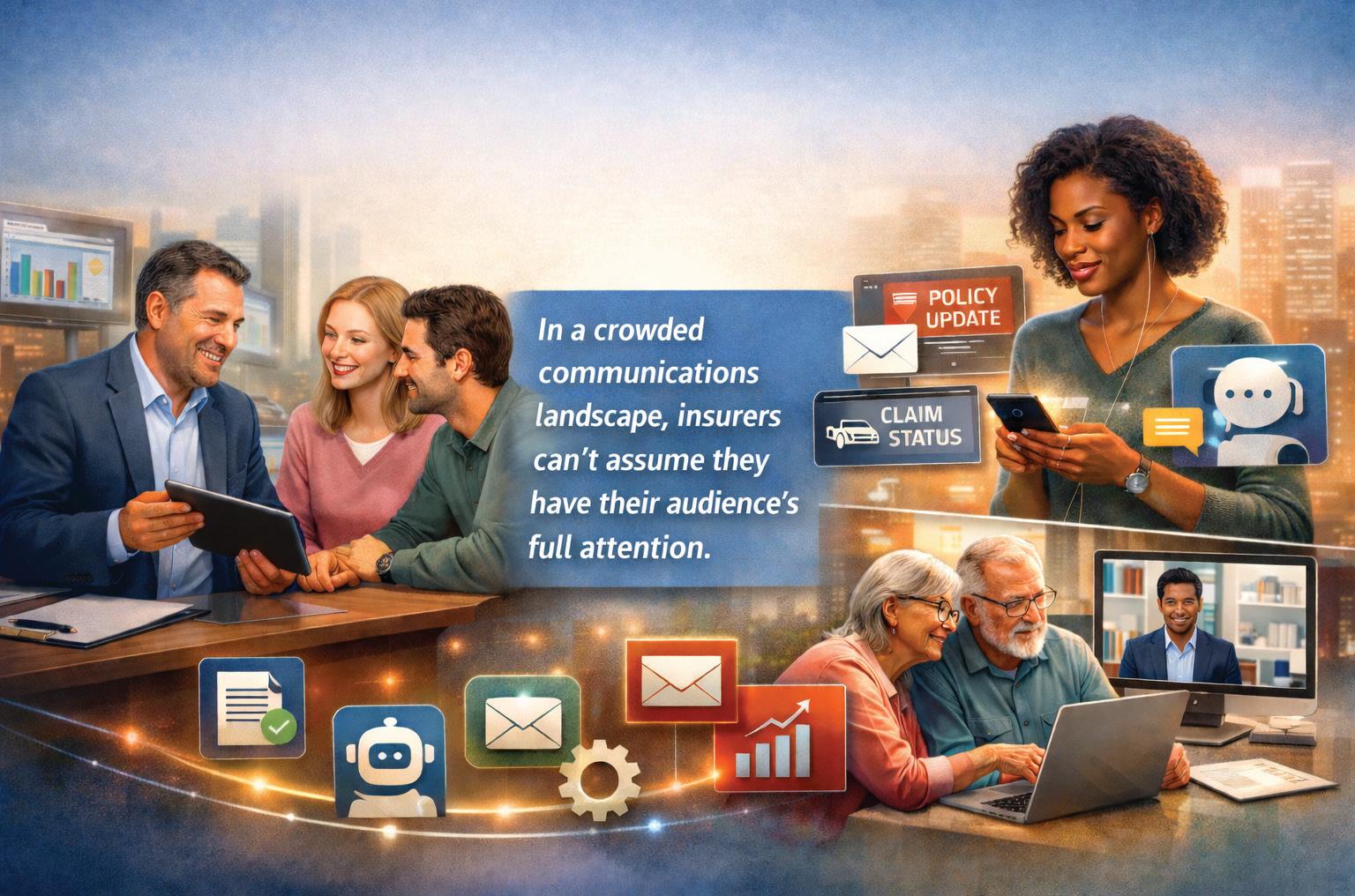
In a crowded communications land scape, insurers can’t assume they have their audience’s full attention. Every interaction needs to feel relevant, meaningful and worth engaging.
Personalization is more than just a policyholder’s name. Where possible, communications and dialogue should be hyper personalized and reference specific policy details, coverage, recent interactions and individual prefer ences. When communications align with a customer’s specific situation, they’re easier to understand and follow.
A CCM platform allows insurers to personalize at scale by using accurate data to design messaging. This helps keep customers informed, reinforces the value of proactive communication and adds more value to the overall policyholder journey.
2. Interactive Experiences That Further Integrate the Policyholder in the Customer Journey
Digital channels enable customer engagement in formats that work for them. The onus is on insurers to build a communication ecosystem that enables channel agnostic, adaptable experi ences in real time.
Features like personalized interactive video give customers a unique way to interact with and receive helpful infor mation. At the same time, AI powered tools like chatbots empower custom ers to self service when less complex issues arise.
The goal is to create experiences that make policyholders feel like they’re part of the conversation, not just on the receiving end.
3. A 360-Degree View of Communication
When it comes to retention and loyalty,
consistency is key. Even small com munication inconsistencies can make a customer question how much you truly value them. When your mes saging is aligned across channels, customers are reassured that the information they’re receiving is accu rate and up to date.
By centralizing communications in a CCM, insurers gain visibility into what customers are receiving and when, and it enables the use of ana lytics to measure the performance of communications based on open and response rates, and overall campaign performance.
Where possible, communications and dialogue should be hyper-personalized and reference specific policy details, coverage, recent interactions and individual preferences.
The information you gain as an insurer can inform how to optimize your communications for the future, and that simply cannot be achieved in an ad hoc environment.
Why Personalized Communications Matter More than Ever
Many organizations now recognize that the customer experience is shaped by more than individual messages. The approach is more holistic, and a successful strategy focuses on inter connected interactions that ladder up to a larger strategic objective.
Modern CCM platforms don’t just manage messages. They help orches trate communications across the entire policy lifecycle. From onboarding and billing to claims, renewals and cross‑sell opportunities, insurers can design coordinated, timely interactions that guide customers through every stage with clarity and confidence.
AI further enhances this orchestra tion by identifying patterns, predicting customer needs and recommending the next best communication. Whether it’s automating content assembly, rout ing messages intelligently or tailoring interactions based on behavior, AI helps insurers deliver more relevant, proactive experiences without adding operational burden.
These capabilities ensure that com munication isn’t just personalized. It’s anticipatory, connected and strategically aligned with customer expectations.
Designing Insurance Communications Around the Customer
Effective personalization in insurance depends on how well communications work together. When messaging is coor dinated and easy to adapt, customers receive information that’s aligned with their needs and values.
Interactive formats help clarify complex details and make it easier for customers to act, whether through dynamic documents or personalized video. Giving customers secure access to their documents, along with simple self service options and consistent com munication across channels, helps make the experience easier and more reliable.
Together, these strategies and tools help insurers deliver communications that feel clear, connected and custom er led, building trust and establishing long term relationships.
STEVE DIAMOND is a senior sales and customer communications leader with more than 25 years of experience serving highly regulated financial services and insurance organizations. For more information, reach out at www.doxim.com.
WHAT THE ANALYSTS SAY…
Upcoming Enterprise Research
Aspire CCS will soon field a new survey of hundreds of enterprises globally to gather fresh insights into the continued evolution of the customer communications market. As experts in this dynamic space, we’ve designed the research to capture the latest data on communications volume and channel distribution trends, budget trajectories, and omni-channel delivery challenges while highlighting the rapid emergence of AI-enabled capabilities, including generative AI use cases, AI agents, and real-world implementation. The study will also reveal strategic priorities around cloud migration and process modernization, how organizations balance in-house and outsourced capabilities, and critical compliance considerations including accessibility and e-invoicing regulations. If you’d like to learn more, please contact our Senior Research Analyst Will Morgan at will.morgan@aspireccs.com.
Aspire Leaderboard Q4 2025 Update
The last quarter of the year is always a busy time — both for us at Aspire CCS and for the Customer Communications Management (CCM) and Customer Experience Management (CXM) vendors on our Leaderboard — and the last quarter of 2025 was no exception. 2025 was a transformative year for customer communications, marked by strategic consolidation, significant product enhancements, and the widespread adoption of AI-driven automation. We’ve also seen an acceleration in the shift from document-centric messaging to dialogue-driven customer engagement as vendors continue to expand their capabilities beyond traditional back-office operations into real-time, personalized interactions spanning the entire customer journey. The emergence of agentic AI represents a significant milestone, with multiple vendors introducing AI-powered tools for content generation, sentiment analysis, and automated workflow orchestration — all while maintaining the governance and compliance controls that regulated industries require. At the same time, accessibility compliance has gained prominence, with providers enhancing their capabilities to meet global standards for document accessibility in high-volume production environments. If you are interested in learning more about new advances in CCM and CXM technology and services, check out our most recent insight post where we review the latest updates from key vendors, including Compart, CSG, ENIT, GhostDraft, OpenText, Precisely and Quadient.
AI-Powered Customer Experience in Insurance: A Strategic Priority
This IDC Perspective explores the evolving role of customer experience in the insurance industry. Drawing on recent IDC survey data and industry research, it highlights the strategic importance of customer experience initiatives, the rapid adoption of AI and digital technologies, and the shift toward real-time personalization and omni-channel engagement. The document provides actionable recommendations for technology buyers, emphasizing the benefits of investing in customer-centric solutions and the risks of failing to keep pace with changing customer expectations and regulatory requirements. “Between generational expectations and the widespread availability of robust technology options, insurance leaders recognize that investing in real-time, personalized customer experiences is no longer optional; it is a strategic priority to remain at the forefront of customers’ minds. IDC surveys show that nearly 60% of insurers are prioritizing dynamic, AI-driven engagement to build loyalty, drive growth, and stay ahead in a rapidly evolving market.”
— Inci Kaya, research manager, Worldwide Insurance Digital Strategies
2025 State of Customer Communications Research
Keypoint Intelligence’s 2025 State of Customer Communications Research examines how enterprises and consumers are navigating an increasingly complex communications landscape. The research highlights a growing expectation for clarity, personalization, and channel choice across transactional, regulatory, and promotional communications. Customers want relevant, easy-to-understand information delivered in their preferred format — whether digital, mobile, or print. The report also underscores operational challenges. Many organizations struggle with fragmented systems, siloed data, and inconsistent branding across channels. As a result, communications are often reactive rather than strategically orchestrated. For document strategy leaders, this research reinforces the need to modernize customer communications management (CCM) platforms, integrate data sources, and prioritize governance and accessibility. It also points to an opportunity: organizations that treat communications as a strategic experience driver — not just an operational requirement — can improve trust, reduce service costs, and strengthen long-term customer relationships.
2026 B2C Marketing, CX & Digital Predictions
Forrester’s 2026 predictions report outlines how AI, trust, and experience orchestration will reshape marketing and customer experience strategies in the coming year. The firm warns that while AI investment is accelerating, many organizations risk eroding customer trust if automation and generative tools are deployed without governance, transparency, and measurable value. The report emphasizes that CX leaders must shift from isolated technology experiments to integrated, cross-functional strategies that align marketing, service, and digital operations. For document and content strategy professionals, the implications are clear: content operations must support personalization at scale, enable consistent cross-channel messaging, and embed governance frameworks that ensure accuracy and compliance. The report also reinforces that experience quality — not just efficiency — will determine brand differentiation. Organizations that align content systems, data, and journey orchestration around customer value will be best positioned to compete in 2026.
Market Trend Reports
Aspire CCS is continuing to expand our library of Market Trend Reports providing independent, actionable research and intelligence to help organizations stay ahead of market trends and emerging opportunities addressing questions like:
What do consumers actually want from communications?
How can organizations implement generative AI with proper governance to transform content creation at scale?
How can healthcare companies modernize communications as the sector shifts from efficiency-driven metrics to engagement-focused outcomes?
How can businesses build trust-first communications through transparency, accessibility, empathy, and consistency?
How can organizations turn content migration from a technical challenge into a strategic advantage?
How can you design a modern Center of Excellence to centralize communications expertise while supporting decentralized practitioners?
Upcoming reports on insourcing vs. outsourcing will examine how governance, trust, and AI enablement are driving hybrid and federated sourcing models while our comprehensive look at Customer Journey Management will explore how businesses can orchestrate seamless, relevant experiences across all touchpoints.
What’s New
Catch up on all the news, opinions, and current events happening around the industry.
MHC Names Chris Hartigan as CEO
To lead the next phase in MHC’s growth, Chris Hartigan brings extensive leadership experience in Customer Communications Management, Accounts Payable Automation, and enterprise software at a global scale. Prior to MHC Chris was with Quadient, a global automation platform powering secure and sustainable business connections through digital and physical channels. Chris led Quadient’s global software business during a period of transformative growth. During his tenure at Quadient, Chris successfully drove growth across markets, scaled product innovation, and expanded international operations in CCM and AP Automation — areas central to MHC’s strategy and customer value.
Crawford Technologies and Madison Advisors Partner to Host 2026 Industry Summit
New in 2026, Crawford Technologies will partner with Madison Advisors to host its seventh annual Industry Summit on April 8-9, 2026 in Orlando, Florida. The Industry Summit will bring together senior-level attendees across financial services, insurance, healthcare, government and print service providers, creating a unique environment for learning, collaboration and strategic dialogue. As the industry’s only dedicated CCM event scheduled for 2026, the Summit offers an exclusive forum for industry professionals to explore emerging trends, exchange real-world strategies and connect with peers and technology innovators.
CX Strategies Stall Without Unified Data and Decision Intelligence
According to new findings from Info-Tech Research Group, CX initiatives often fall short because they are built on incomplete customer insight, fragmented data environments, and static journey models that cannot adapt to changing buyer behavior. As purchasing decisions are increasingly shaped by behavioral signals, emotional drivers, and real-time context, traditional CX approaches are proving insufficient. CX now depends on system interoperability, placing greater responsibility on CIOs to unify enterprise platforms and data environments. To address these challenges, the global research and advisory firm has published its Optimize Your CX Strategy.
Market Trends: Predictions for 2026
Making predictions is a perilous, yet necessary, business endeavor. While it can be an entertaining intellectual exercise, Deep Analysis is acutely aware that for large enterprises, investors, software vendors and system integrators, these forecasts inform critical strategic and financial decisions. What follows are their carefully considered predictions for 2026, grounded in ongoing market analysis and a deep respect for the challenges you face in navigating this complex and rapidly evolving landscape. That said, they are predictions … not confirmed outcomes.
Chris Canaday
With over 30 years of experience in print and electronic media, Chris Canaday is a grizzled veteran of the communications revolution. Over the past decade, he has been focused on helping Northwestern Mutual modernize its client communications ecosystem. Currently, Chris serves as the Assistant Director of Strategic Initiatives within the Print and Digital Document Management (PDDM) function at Northwestern Mutual. In this role, he is helping shape the company’s Client Experience vision, expand digital capabilities and modernize legacy processes. Chris has held a variety of technical and business positions, including Information Architect, Senior Engineer, and Director of Transformation. He has also led numerous tech modernization, outsourcing and eDelivery acceleration initiatives, demonstrating his ability to drive innovation and efficiency for the enterprise. Chris previously served as an Advisory Board member for the Document Strategy Forum.
Aaron Horsfield
Aaron Horsfield, MHA, MPH, is an experienced leader in healthcare and insurance. As the Sr. Director of Plan Operations at UPMC Health Plan, he drives operational efficiency initiatives through transformation, change management, and transparency. His background includes health policy, transactional communications, insurance operations, and healthcare strategy. Aaron is a 2022 Pittsburgh Business Times and Leadership Pittsburgh Inc. 30 under 30 honoree, volunteer board meeting with Iowa Hugh O’Brian Youth Leadership, United of Way of Southwestern PA, National Avairy, GOLD Leadership Group with the University of Iowa Center for Advancement, and advisory board member across the CXM industry. Additionally, he served as an Advisory Board Member for the Document Strategy Forum.
Andy Keller
Andy Keller is the Domain Architect at USAA responsible for Operational Messaging at USAA. Andy began his career at USAA in 1984. For 41 years Andy has been involved in USAA Communication technology, starting as a specialist in Printing, but over time expanding into Omnichannel. Andy provides technical direction for communications resulting from business transactions. This includes EMAIL, SMS, Mobile Messaging, Hosted Documents, and Print\Mail. USAA’s goal is to communicate with their members where and when they want. Additionally, he served as an Advisory Board Member for the Document Strategy Forum. Via this forum as well as other industry groups he has forged a level of expertise that the industry finds value. He specializes in eDelivery, Document Accessibility, and print vendor management while also maintaining a reasonable level of understanding of Document Archive and Records Management domains.
Pat McGrew
Pat McGrew helps companies perform better in the print hardware, software and printing services industries. Her experience spans all customer communication channelsand segments including transaction print, data-driven and static marketing, packaging and label print, textiles, and production commercial print using offset, inkjet, and toner. She is certified as a Master Electronic Document Professional by Xplor International, with lifetime status, and as a Color Management Professional by IDEAlliance.
Jennifer Raml
Jennifer Raml, Information Technology Manager at Acuity a Mutual Insurance Company, is a strategic technology leader with over two decades of experience streamlining document workflows and customer communications in banking and P&C insurance industries. She has successfully led enterprise-wide CCM implementations and automation initiatives while building high-performing technical teams. Her expertise spans document strategy, business analysis, and process optimization, with a proven track record in modernizing customer communications.
Will Morgan
Will Morgan is an experienced industry analyst with expertise in the Customer Communications Services market. As Aspire’s Senior Research Analyst, he works alongside the wider team to provide advice, insight and vital intelligence to the company’s expanding customer base on both sides of the Atlantic. Before joining Aspire, Will worked with Keypoint Intelligence-InfoTrends’ Customer Communications and Business Development Advisory Services.