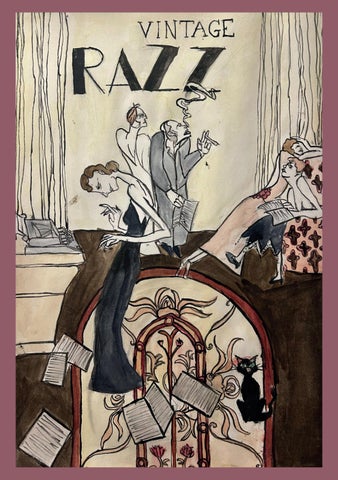
RAZZ
|
VINTAGE
|
ISSUE
47
|
RAZZ
|
VINTAGE
|
ISSUE
47
“
Editor’s Note
RAZZ
MAGAZINE
ISSUE
47
“VINTAGE”
The cold has set in, the days are dark and short, and that infamous Devonshire cocktail of gusts and rain has begun hammering at the door. We took one look at this, and realised what everyone needed was something classically cosy, or, in other words; vintage. It’s not just the weather. The world is rapidly changing; AI is charging down our livelihoods, the news reads like dystopian satire, and everything costs too much - needless to mention, most of us also have coursework. At occasions like this, it is important to centre ourselves again in that which is timeless and valuable. Our vintage edition provides the opportunity for readers to revisit the highpoints of culture, art and fashion, as well as celebrate the brilliant creativity of our shortlisted writers. It is time to read (or watch) those old classics, dig out the wooly sweater, sip cheap wine and think about travelling, without actually having to commit to it. There might be much to do, but there is also plenty of time to do it. Christmas is right around the corner. Whatever you are worrying about, we’ll deal with it in 2026. I would be remiss not to mention the efforts of my wonderful committee who have made this edition possible at every step of the way. Thank you to the editors, designers and secretaries who have once again aided me in rearing a single-word prompt and growing it into an actual publication. A special thank you also to Stewart Ross for his exceptional generosity in funding our writing prize. Lastly, I want to thank whoever is reading this for bothering to pick it up; this is just the first edition of the year for RAZZ - so stick around. It’ll only get better from here.
Nathan - Print Editor in Chief
“
“
“
VINTAGE | ISSUE VINTAGE | ISSUE47
Meina - Creative Director
|
Bring your favourite drink, not a smartphone. Grab this magazine and play your favourite music. We need such a time now. Explore fallen leaves, how are they dancing? Let us see how we are dancing, and living.
RAZZ
Catherine - Deputy Print Editor
|
Autumn and Winter always perpetuate the idea of things falling apart, just to be reborn again. The nervous anticipation of an approaching new year can make the seasons feel tired, slow and cold. But I always associate this time of year with gratitude, rejuvenation and joy. A time to look back on and appreciate the lingering beauty of the past year, whilst mending and upcycling our preceding mistakes and oversights.
47
“
|
“
Kitty - Deputy Print Editor
RAZZ
“
Autumn and Winter are the seasons of Vintage. The days are shorter, and everything becomes intrinsically more nostalgic: with that, we look back on what has passed us by, be it vintage memories, music, art and literature. Discover a dusty album, source some second-hand clothes, and read some old books. As the skies darken earlier each night, rest your worries over the future and relax back into the past.
Contents
Vintage
|
RAZZ
Print Editor in Chief Nathan Steward
Deputy Print Editors
Kitty Carter Catherine Beavis
Copy Editors
Mila Pascolini Maytum Chessie Fernandes
Creative Director Meina Sumida
Assistant Creative Director Meg Ransome Kitty Carter
Cover Competition Winner
Magazine
|
Contents
Vintage
Contributors Nathan Steward Kitty Carter Catherine Beavis Sofía Tapia Ella Burke Jenny Storey Vlad Perciun Hattie Owen Poppy Read Bethany Adams Theo Power Lola Wilton Evie Merrilees Issy Adams Evie Andrew Lucas Taylor-Kent Katie Hackett Emily Thackeray Emma Williamson Frankie Baxter Isadora Nosworthy
Masthead Isadora Nosworthy
Contents
Vintage
|
RAZZ
Magazine
|
Contents
Vintage
Contents
Contents
Contents Vintage
|
RAZZ
Magazine
|
Contents
Editor’s Notes
1-2
Masthead & Contents
3-4
The Return of Vintage
5-6
What Makes A Piece of Clothing Vintage?
7-8
Built to Last
9-10
Vinted vs Charity Shops vs Vintage Stores
11-12
The Stewart Ross Prize
13-22
Vintage Photography
23-24
Vintage Film Article
25-26
Vintage Art
27-28
The Youth-Led Revival of the “Digi-Cam“
29-30
Vintage Book Classics
31-34
Vintage Travel Destinations
35-36
The RAZZ Sommelier
37-38
The Totnes Tour
39-40
Out With The Vintage
41
Autumn Mixtape
42
Vintage and Vinyls
43-44
Lana Del Rey Review
45-46
Inheriting Music
47-49
Life of a Showgirl Review
50
Vintage
|
RAZZ
Magazine
|
Contents
Vintage
Vintage
of
The
Return Vintage
If
you’re reading this article, then you’re probably familiar with the thrill that you get when rummaging through charity shop rails and spotting the distinct retro look of a label on a vintage garment. Vintage fashion has taken young people by storm. Nothing quite rivals the satisfaction you get from delivering a “thanks, it’s vintage” response to an outfit compliment. Trendier than ever, anyone who is remotely interested in fashion is scrambling to fill their wardrobes with the hottest vintage pieces. So, what does this tell us about the young people who are raiding the variegated rails of vintage stores? And what does the future hold for this ever-evolving market? We live in a visual society, and although we don’t like to admit it, we all possess some form of vanity. In this age, more than ever, aesthetics are central to one’s identity. The digitalisation of society has led to an obsession with looks, with social media and influencers significantly fuelling the rise of fast fashion, and shamelessly cultivating the disposable society we find ourselves in today. It is from this unapologetic world of globalised low-cost labour, inexhaustible supply chains and overconsumption, that a new generation of young fashion consumers has been born. Potentially, the vintage fashion market provides relief for the young who crave fresh, individualised silhouettes, together with an opportunity to retaliate against mass market mentality. A perfect solution to overconsumption and its moral, social and environmental pitfalls. Once, the procurement of a vintage piece would likely bring both an element of uniqueness and quality associated with a bygone era.
Photography by Meina Sumida
Who’s that
A treasured leather jacket from the 80s, or some well-worn Mary Janes gifted by a relative perhaps? Whatever the case, you could confidently strut your stuff with the knowledge that you wouldn’t encounter matching contemporaries. Today however, the narrative is changing. Inevitably, the vintage fashion market is becoming saturated. Global sales of pre-owned clothes are rising, consequently inflating prices and excluding a large customer demographic. Once a haven for fashionistas on a budget, now price tags found in second hand and vintage shops often reflect those we so desperately try and avoid on the high street. Furthermore, excessive demand for new styles, though at odds with the underlying principles of ‘vintage’, is creating space for fast fashion retailers to imitate styles and highjack the market. Trends that would ordinarily last years are now retiring after a matter of months. With our daily bombardment of online fashion content, it’s easy to be influenced by profit-hungry fast fashion companies who rip off vintage styles or slow fashion brands.
girl?
In this evolving world of clean-cut minimalism and rapidly advancing technology, there is a counterculture with a thirst for individuality and creativity - and I, for one, hold on to hope that resistance will remain. Through the bold maximalism of the 70s, or the striking simplicity of the 90s, vintage clothing preserves the minds of past creatives and innovators, inspiring a new generation and fostering individuality through retrospection. More than ever, young people are rejecting social media fashion trends for the masses, driven by their desire for individualism, artistic expression and a heightened awareness of the fashion industry’s impact on our planet. Preservation of quality items from authentic vintage traders and refusal of cheaply made copies will continue to propel this industry. All that is required is a little patience, creativity, and an eye for potential.
By Evie Andrew
Page 6
What makes a piece of clothing
T
he trend of acquiring vintage items has become prevalent recently, with people desperately searching sites like Vinted to snatch the best deals on authentic fashion items from the past. This raises the question, what exactly is it that makes a piece of clothing vintage? Is it just measured by the length of time past, or on more abstract qualities, like its historical and timeless appeal? I would suggest it’s the latter, with the clothes ability to stand the test of time being exactly what makes it vintage. The covenanted Alexander McQueen scarf first graced the runway in 2003 and instantly became a cultural phenomenon. In a time where anti-establishment and club culture was at its peak, the scarf’s rebellious and unorthodox pirate print became an essential accessory to any wardrobe. Frequently adorned by noughties icons like supermodel Kate Moss and film star Mary Kate Olsen, the scarf quickly came to represent the cultural desire of the era to emulate the wealthy in their chaotic party culture. The scarf was brought back to the limelight following Charli XCX Glastonbury headline performance, where she wore her own personalised purple scarf whilst singing hits from her Y2K club culture inspired BRAT album.
page 07-08 This clothing statement seemed to resonate with the current reverence held to the 2000’s era with the return of the iconic low-rise jeans and chunky belts suggesting that we are once again going Back 2 McQueen! This journey perfectly encapsulates what makes a piece of clothing vintage, with it representing the cyclical nature of fashion which is often driven by nostalgia and a desire to replicate forgone trends. Thus, vintage can be defined by the longevity of the impact of both the workmanship and the message the item represents, therefore allowing statements from the past to be echoed in the future.
By Evie Merrilees
VINTAGE
Vintage Illustration by Meg Ransome
Lola Wilton is exploring why choosing vintage the planet. The thrill of finding a perfectly worn leather when you know it’ll last longer than the £80, window. It’s no wonder why so many fashion powerhouses and towards vintage second-hand apps - places where quality satisfying about finding a piece that just denim jacket that’s outlived a decade, new. While fast fashion may win you get from vintage pieces is hard clothes barely survive one wash. For many, shopping vintage has a quiet protest against unsusobsessed with newness, there’s of fashion’s environmental appreciation for what already ago was made to last: thicker natural fabrics like wool and blends that dominate modtop today means it feels thin vintage cotton piece offers sturdiness that echo a time standard. Buying second-hand quality for less– it keeps out of landfill. This reduces altogether. As someone who scrolling on Vinted or afterclothes at kilo sales, I can the extra effort to search,
Built
By
9 Illustration by Meg Ransome
Lola
clothing is better for both your wardrobe and jacket from a charity shop resonates more 99% polyester copy hanging in a high-street young people are turning away from fast markets, charity shops, kilo sales, and still matters. There is something deeply feels heavier in your hands - like a or a silk blouse that still looks brand on convenience, the craftsmanship to match in a world where most become more than a trend, but tainable production. In an age not only a growing awareness impact, but also a renewed exists. Clothing made decades cotton, sturdier stitching, and silk instead of the synthetic ern clothing. While buying a and pills after a single wash, a the satisfying weight and when quality was the industry doesn’t just mean better garments in circulation and the need for new production spends far too many evenings noons rifling through piles of confidently say that it’s worth rather than to scrap.
to Last
Winton
10
RAZZ VINTAGE ISSUE 47
VINTED VS CHARITY SHOPS VS VINTAGE
here’s an abundance of incentives to shop second hand: the affordability, the sustainability, or the certain magic and mystery behind that vintage item you just can’t resist. It’s no wonder that when it comes to buying clothes which save money, help save the planet, and allow people to find that hidden gem, the opportunities are continuing to grow. So, with all of the second-hand shopping options, what do each of them have to offer? As a cornerstone of the British high-street, the charity shop has long been the staple option. For over a cen
T
11 something specific, the ‘search and filter’ software
useful benefits. For example, if you’re looking for
technology with thrifting, Vinted offers a wealth of
adaptation of second-hand shopping. By merging
eted in popularity over the past decade as a modern
Another notable option is Vinted, which has skyrock-
VINTED CHARITY SHOPS VINTAGE STORES R A z z
By Isobel Adams
can you look when struggling to find that special
contributing to a spirit of community, generosity and
vintage treasure?
ably convenient and accessible advantages, but where
ingful cause. You can experience these benefits while
support, amplifying the appeal even more.
ing those unique hidden gems. Vinted offers undeni-
This threatens to overshadow the charm of discover-
ingly saturated with low-quality, mass-produced items.
ga-brands, re-selling platforms are becoming increas-
always positive. With the increase of fast-fashion me-
However, the sheer extent of items available isn’t
this just cannot be competed with.
comfort of your own home, sometimes the luxury of
With endless items to see, but now available from the
to-day life. The enjoyment of browsing also remains.
always provide, which is favourable amidst busy day-
an ease and convenience that charity shops cannot
items are delivered straight to your door. Vinted offers
the process simpler. With just the click of a button,
in seconds. The ‘seller-to-customer’ service also makes
means you can find what you want
the charity shop lies its greatest draw: helping a mean-
tury, charity shops have offered customers an exciting in-person shopping experience. At affordable rates, they make fashion accessible and appealing for all. When looking for something stylish and worthwhile, being able to try on the clothes in person is useful… especially on a budget. However, the attraction towards charity shopping goes beyond these practical benefits. For many, it’s also about the experience. Wandering through a charity shop for the pleasure of browsing is a popular phenomenon. It sparks an enjoyment which cannot be found just anywhere. It gives the opportunity to explore a room full of pre-loved treasures, each with its own magic and story; it evokes an exciting sense of nostalgia and charm. This combination of bargains, practicality and flair isn’t all. At the heart of
12
13
The Stewart Ross Prize This is the first ever writing competition hosted by RAZZ Magazine, and we have been amazed at both the variety and quality of the pieces sent to us. A huge congratulations to those shortlisted, whose breadth of vision and exciting turn of phrase impressed us all greatly. It is astounding to witness Exeter’s creativity, and we look forward to further competitions (if more kind benefactors can be found) for categories such as art, photography or design. All of this has been made possible thanks to the generous £200 stipend provided by writer and Exeter alumni; Stewart Ross, who is both an encouraging mentor and inspiring friend. Nathan Steward Print Editor In Chief
A prize-winning author of fiction and nonfiction for readers of all ages, Stewart Ross is one of Britain’s most popular and versatile writers. He was born in Buckinghamshire and educated at Newton Blossomville, Oxford, Berkhamsted, Exeter, Bristol, and Orlando, Florida. He taught at a variety of institutions in Sri Lanka, the Middle East, the US and the UK before becoming a full-time writer in 1989. In addition to fiction and nonfiction, his 330+ published titles include plays, librettos, and the text of a musical work for voice and orchestra. Stewart lectures in France and the UK, gives talks, runs workshops and visits schools. He is an occasional journalist and broadcaster. His brother, Charlie Ross, is the celebrated auctioneer. In his spare time, Stewart enjoys travel, food, sport, theatre, photography, art and music. He lives near Canterbury with his wife Lucy, and – occasionally – his four children and three grandchildren. Every morning, he commutes 10 metres to work in a large hut in the garden. [Biography and Photograph taken from https://www.stewartross.com]
The Hungry Season
Poetry
Katie Gonsalves It’s still spring, after all, and you are young until September, So be red of soul, and loud of mouth, and move towards the night. Ask the names of pretty girls, although you know you won’t remember, Then dissolve them on your tongue and scale the highest of the heights. Spring won’t hold, after all, but son you’re young until the winter, Make your mark and hit it wide, have no regrets if you so please. Go and kiss the girls like glass, unsure which hand now holds the splinter, Watch their rainbow-coloured shards pick up and scatter in the breeze. You’ve rehearsed your tender strategies, reciting every plight, And you don’t believe in damage, not unless you see it weep, So, you sing them all your songs until your bark turns into bite, Their mascara in your bedsheets and your conscience fast asleep. There are swarms out there awaiting you, a newer one instead, Stare into the pulsing lights until your heart begins to blind. Let the cruellest forms of alchemy transform your love to lead, Please ignore your mother’s teachings, out of sight is out of mind. It’s still spring, after all – these days are drunk on fleeting hours, And your hands are made for touching, not for holding nor for prayer, Chase her through an open field, and twine her hair with wildflowers, Pluck each petal from the grasses as if you were never there. Keep your fingers crossed behind you as you lie into the wake, Count your footsteps through the dark and disappear before the sun. We will call it youth or yearning, or just one more small mistake, So don’t let it leave you restless, kid, at least you’ve had your fun. Though your hands will turn to hunger when there’s no more games to play, When the numbers echo empty and there’s no-one left to call, And your mouth will taste of iron once the laughter falls away, And you’ll be left without a toothbrush, in the belly of it all.
14
15
Poetry
Like Sue Carrigan, Daylyn
Half-chewed, fully spit watermelon seeds, like afterthoughts, and new beginnings, like the crack of ice under my heels. Like a melody without end, measured, free. Flowing, like a dancer’s skirt, or poetic verses. Like whispers echoing through a quarry, or floating on a lake. Like artichoke hearts on white wine in the pan, like ships harboring secrets, many, circled around each other. Like nursery rhymes, with bridges, with posies and ashes, falling slowly down. Like us, always near but never quite touching, like concentric rings in the Wisteria tree. Like one twin bed. Like never being sure. Like a spiderweb of similes, like half-truths, yet full-wit. And cutting your hair. Like, love —
You — at the center of it all.
Archive
Poetry
Varya Mishra paper cuts from frantically thumbing the many pages of a heart-broken anguish, spilled out and soaked these pieces of paper freshly pressed in nineteen-forty-two scratched, etched by the sharp teeth of longing a pen! addressing the person it could never reach who lives in between every grain of soil and dirt and earthly creatures that parade between the remnants of outstretched fingers that will never experience the solace of a time long-gone and a person waiting for his eventual return, eyes pouring into the hearth his reflection half smudged, half faded save for the brown eyes that she would run to and hide in, or the lips that had cruelly stolen her nights tearing gashes into her soul and the tips of her fingers bleed drop sear into letters he can never hold bear paper cuts from frantically thumbing
16
17
Prose Midnight painted things on the bedroom wall. They could be gentle, trembling like the sleek, staggering legs of a deer, or a harsh kind of beautiful, spiked into trees and halos. Soren’s eyes followed from where he lay in bed, the duvet to his chin. However misshapen the shadows could be, he could find an identity in them. Even when they morphed with the light of passing cars in the window. It was a kind fixation. Kinder than listening to the noise from the kitchen. The voices continued like music. One amplified with masculine rage, diverting from the harmony. With each sharp and careless word, the noise grew and changed and swelled until it finally hit the crescendo. A series of shatters. Footsteps followed, as they always did. His first, heavy and impatient, thudded along the hallway to their bedroom. Soren stayed flat to the mattress, as if stillness would turn him invisible. He would try to create pictures out of the shadows now too, but there was a difference between the shouting and the crying. The crying was harder to ignore. It went on for a while, and Soren steeped in his guilt. He lay frozen, waiting. Her footsteps came second, quiet as the legs of a deer. They stopped halfway down the hall. The shadows of her feet reached under his bedroom door. As it opened, light swept across the wall, and the things and creatures dispersed. There she was, basked in the harsh yellow light of the hallway. Soren shivered. She stumbled in slowly, blankly looking across the room, before making her way to his bed.
Puppetry Violet Stapleton Sitting at its edge, she stared at the empty wall. “You don’t mind me smoking in here, do you?” Her voice was brittle and steady. “No,” Soren mouthed. As she lit the cigarette, he noticed the two shining lines down her cheeks. She took the cigarette from her mouth and let the smoke seep from her mouth. Her hair was shining softly above her ears. Splinters of glass formed a ring around her head. “Don’t get married, Soren.” “I won’t.” Soren watched her, smoke pluming from her lips, until she looked at him. “You forgive me, don’t you?” she asked, voice failing. He clutched the bedsheets tighter. Yes, he wanted to say. But the word wouldn’t form. She studied his face with a dreadful, desperate kind of hope. Once she realised he was not going to reply, she looked away, bringing the cigarette to her lips one last time before getting up. Closing the door, the light was snuffed out. He stared at the door for a few minutes, suffocating. How terrible of a person he was. How despicable he was to not allow her one word of comfort. He held his breath in punishment, feeling his face grow hot, until he was gasping for air. Soren’s eyes flickered back to the wall, but there was nothing to be made of it. It was simply shadow.
18
Prose It’s called Lover’s Leap. You know it, or you know this one at least, among the hundred places given this name. The four hundred foot drop is not what you imagined, and the dense foliage that masks the river is anything but romantic. Your swooning shape trembles against the truth of gravity, the disentanglement of every cell in your body scattering mid-air like a firework, then you are on the precipice again. You stand here, vertiginous, anticipant as though it is not you who decides. You had a girl with vertigo. She told you a few times during, and actualised it in intermittent collapses. Sorry, I’m sorry, she said. You didn’t mind. You were too fucked up and thinking of other things, you weren’t there, numb to your anatomy’s actions, although if you wanted you could manage a face, a few sparse freckles, old gashes made with a knife in places, hair like oblivion, and a nice enough body, you guess. You remember how it felt to fall, emptiness in your arms that your intoxicated soul slipped into and away: leap. You never saw her again but never forgot how it felt to fall, you’d fallen before but it was different somehow, it has been since. Every time you fall it is a new intimate shock. When you imagine the result of leaping you place it now with a weird luring ending. There are places that make you twitch and your stomach stir. But the overpass was ugly, the view from a balcony un-lovely. You heard about this place when two students leapt, embracing, you imagine, from this height into the gulf down there. It made the news. Everyone was talking about it. A friend was telling you how awful it was. You couldn’t stop thinking about it.
19
Vertigo Michael Tunbridge Below the river dark like long black hair whispers up seductively, the skin of the current ripples insanely and the elaborate surface beckons like four hundred soft arms. You’re back on the precipice, hands on the rickety fence, vertiginous. Creatures scuttle in the undergrowth, birds awaken in the leaves, chirping, perched on tree branches they watch and await the big leap, or retreat. You suppose they’ve seen this before. The tiny things rustle within the great woodland mass, the water murmurs, the loud silence breaks and reasserts itself. The four hundred foot drop from Lover’s Leap seems farther down than it was. The river you can only hear now in the late gloom. At the summit you are alone. You’re embarrassed suddenly. To be here, of all summits, alone. It’s called Lover’s Leap. The name is old to you already, and this is anything but romantic. But you’re flush red, anxious to kiss the river. Close your eyes. Fall the right way and you could be mounting the sky to heaven. You remember how falling felt. You remember the bedroom floor and what happened when you fell. Nothing has pulled you down yet. The water speaks tenderly to you. Go. End
20
Prose They poured into the flats like a cauldron, their boots carving mountains into the dry soil. It was years since any of the town’s inhabitants had seen a patch of grass, they had to travel South for that. The men, clad in khaki and flak did not knock and there were no doors to push down. They were vultures, encircling their prey. The Rebel hid in the corner of his home. He could see it in its entirety; the box built from second-hand steel. One end was a mess of wires that used to end in a television and the other housed the pot he used for breakfast, lunch, dinner and tea. He took it in for the last time. He knew he was headed for the island. No bullets were fired as no resistance was met. The Rebel sat, shattered in the back of the Saracen. Through the metal he could hear the children and mothers strewn across the streets. His mother was likely to have watched while the others waited their turn. Through the bars of the vehicle he saw the flat mountain, painted by the cracks of the rising sun. By evening he would look at the mountain’s heights. The peaks that have stood longer than anything that dared to exist. His eyes always wandered too low and were promptly shut. Light fell on the ivory monument, the roman pillars that upheld the state. The pale masculine form of the unseen that saw all. As he lounged, he did not look to the Southern glades or the bustling metropolitans but the flats. He was more than a statue, he was an idea that failed to die.
21
The Prison James Alexander Chester The Rebel was brought to the stone beach on the West, a man-made monstrosity that spilled out into shopping centres and harbours. He watched as they passed the old fortress. It had no use in the current age, but its purpose remained. Every brick in the castle’s pentagonal walls was a legacy of occupation. The Rebel had never been at sea and the rocking of the boat made his stomach spin. When khaki men disappeared, he was handled with careless violence by brutish guards in blue. Some he had likely grown up with. He stood on the boat, clenching his stomach as the Winter mists rolled in from the sea towards the land. The sun had risen but the fog hid its colours and all it illuminated. He despaired at the loss of his mountain. All that could fill the fog was the glow of the lighthouse. The first one, the oldest. It was a small blinking dot on the peninsula, he struggled to imagine a time when its existence was only an idea. There was nothing beyond that point but the end of the world and ice. But in the fog, no light can ever hope to remain. The world dimmed and the boat stopped rocking. All that was left was prison walls and limestone.
22
Written by Lucas Taylor-Kent
From its origins in the house of Nicéphore Niépce, to its refinement in the workshop of Louis Daguerre, the medium of photography has always been one in motion, with influence from greats such as Man Ray and Dorothea advancing the artform and the way that humanity uses it to record, interpret, and ultimately assert itself in the world.
View from the window at le gras, 1827 Widely considered the earliest sur-
viving photograph, it captures an ethereal perspective of the estate of inventor and photographer, Nicéphore Niépce. Niépce created it through what he termed heliography, using camera obscura to project the image onto a pewter plate coated with bitumen of Judea, and then washed with lavender oil and white petroleum. It is grainy and lacks detail; the buildings are abstract shapes and the pear tree, visible to the left in the background, is just a silhouette. It is one of the greatest human
oto
achievements. As an overture to a long history of the immeasurably impactful art form that is photography, it possesses a beauty in its placid humbleness.
Still life with plaster casts, 1837
a g e
The unpresuming image is the earliest, reliably dated, example of the daguerreotype process. Named after its inventor Louis Daguerre, it was a test-run of the innovation that made photography publicly available, putting the art form into the hands of a much broader cohort
of photographers. Although outwardly prosaic, there is a veiled message in the subject choice that gives the image merit beyond technical achievement. Choosing still life, a genre archetypal of classical painting, Daguerre makes a bold case for the artistic value of the medium he was pioneering.
P
g ra ph y
Le Violon d’Ingres, 1924
First published in the surrealist magazine Littérature, Man Ray’s photograph
[Images Credit From the left to the right: https://en.wikipedia.org/wiki/View_from_the_Window_at_Le_Gras , https://smarthistory.org/daguerre-artists-studio/, manray.net/
in-
of model Kiki de Montparnasse shows her wearing just a turban and drop earrings, with two acoustic f-holes, that of a violin, placed on her back. It was one of the first to diverge from the natural role of photography, capturing what is real, and instead blur the line into art by applying the non sequitur principles of surrealism. The title is an idiomatic expression meaning a person’s hobby or pastime, referencing the painting La Baigneuse Valpinçon by Ingres, and alluding to Kiki as his lover and muse. Both technically and conceptually,
Le Violon d’Ingres is a captivating revolution.
Migrant Mother, 1936
Migrant Mother is an epoch in the history of photography. Taken by Dorothea Lange in California during the Great Depression, it excels in capturing the anxiety of poverty. The direness of the subject’s situation is communicated in a way too clear to be misunderstood, written plainly in the mother’s expression
Vint
and the tenacity of her children. The image is one of the greatest examples of documentary photography, and its wide reproduction in newspapers and magazines inspired support for government aid.
Earthrise, 1968
There are few methods as effective in both uniting and humbling humanity as plainly showing the dire absurdity of the situation we all share, that being inhabiting a very small rock inexplicably floating through the cosmos. Earthrise achieved that. Cap-
tured by astronaut William Anders during the Apollo 8 mission, it shows the surface of the moon with our blue, cloud-splattered home rising in the background. It was the first colour photograph of Earth taken from space and not only did it help establish photography as a medium to prompt interconnectedness, but it also launched the global environmental movement.
PAGE24
gre-s-violin.jsp , https://www.moma.org/collection/works/50989 , bbc.com/future/article/20230511-earthrise-the-photo-that-sparked-an-environmental-movement]
h
25
Black
and
White
Film
|
Black
and
White
Film
Black and White Film
|
RAZZ writer Katie Hackett explores what we can learn from the age of the black-and-white film in the modern age of cinema. The phrase ‘Vintage Film’ conjures up images of the ‘Golden Age’ of Hollywood, drenched in glamour, with black-and-white films sporting household names like Marilyn Monroe and Gregory Peck. Modern day cinema still feels like magic, but with sophisticated camera technology and ever more vibrant images, have we forgotten the art of the blackand-white film? Although colour in film was first used in 1908, the use of colour in mainstream cinema would not become common until much later. With the successful development of technicolour in 1932, films like The Wizard of Oz (1939) shocked audiences accustomed to monochrome cinema with explosions of vivid colours on screen. However, despite its revolutionary quality, producing technicolour films proved too costly for blackand-white to be abandoned completely. However, perhaps there is a lesson here for modern filmmakers? Despite being teased with the promise of colourful movies, black-and-white films continued to be produced alongside films in colour throughout the ‘Golden Age’ of Hollywood. Audiences remained captivated and black-and-white cinema continued to thrive. In fact, one of the most critically acclaimed films of the period, Roman Holiday (1953), which was released entirely in black- and-white, oozed success at the box office; it gained ten Oscar nominations, one of which Audrey Hepburn won for ‘Best Actress’, propelling her to stardom. Other black-andwhite films like Casablanca (1942) and It’s A Wonderful Life (1946) remain timeless classics, watched annually or referenced in pop culture. If in spite of their black-and-white appearance, modern audiences of all ages still find vintage films mesmerising, why shy away from producing black-and-white films in the modern age of cinema? They can be, and still are enjoyable and relevant to the demands of consumers. With black-and-white no longer a cost effective necessity in cinema, a unique opportunity arises for modern Directors to use black-and-white deliberately. An entire film, or just one scene can become instantly more striking, bringing an ironically fresh feel to a film playing with vintage aesthetics. In fact, many Directors within the last 60 years have opted for black
and white to give their films more impact:
Black
and
White
Film
|
Black
and
White
Film
|
|
|
Black
and
White
Film
|
Black
and
White
Film
Schindler’s List (1993)
Exploring the atrocities of the Holocaust, Schindler’s List is shot almost entirely in black-and-white. The lack of colour reflects the sombre tone and emphasises the harrowing emotional struggle throughout the film, giving it a documentary-like quality. One of the only moments where colour is used is the famous scene involving a little girl in a red coat against the black-and-white crowds. The use of colour here is careful and poignant, highlighting the need to see individuals not as a faceless mass. The symbolism of innocence against tragedy is haunting and hugely powerful.
Casino Royale (2006)
Black-and-white can serve to accentuate light, shadow, and intense emotions, building heavy tension. The deliberate stylistic choice to open Daniel Craig’s first film as James Bond in a black-and-white fight sequence is immediately impactful. Craig’s Bond is presented in a darker, more brutal light, giving a gritty new feel for Bond whilst paying homage to the 1954 black-and-white televised version of Casino Royale.
Mank (2020)
Set in the 1930s, Mank tells the story of screenwriter Herman J. Mankiewicz as he rushes to finish the script for Citizen Kane. The use of black-and-white gives a nod to vintage aesthetics, thrusting audiences immediately back to 1930s Hollywood, giving the film an immersive quality unachievable in colour. It is clear that black-and-white film still holds its place in the modern age. With so many new cinematic technologies at our disposal, we shouldn’t discard or forget the success and brilliance of vintage cinema, and how it continues to inform the modern day. In a world where audiences are increasingly unused to seeing it on screen, black-and-white media must be taken into the future proudly, and used to make an impact. [Image from https://www.newyorker.com/culture/the-front-row/mank-reviewed-david-finchers-impassioned-dive-into-hollywood-politics] [Image from https://www.bondsuits.com/bond-wardrobe-review-21-casino-royale-2006/] [Image from https://www.theguardian.com/film/2018/dec/06/schindlers-list-25th-anniversary-steven-spielberg-holocaust]
Black
and
White
Film
|
Black
and
White
Film
26
T
o what extent does your room represent your identity? How do you decorate? What objects clutter the surfaces? What about your identity is kept private, and how much can someone learn about you from the spaces you inhabit? During the 60s and 70s, a collective of feminist artists, including Judy Chicago and Miriam Shapiro, reclaimed women’s identities from male-dominated perspectives through the installation of Womanhouse (1971–1972). The name describes precisely what it was: a woman-house, a home that represented ‘The Woman’, in all its nuance. They transformed an abandoned mansion into a series of rooms, each representing aspects of women’s lives, desires, and struggles. They took the traditional activity of ‘homemaking’ to a whole new level. For example, The Nurturant Kitchen. It contained aprons fashioned with breasts and female body parts, implying that a woman’s body is linked permanently with her domestic, societal role. Like a factory conveyor belt, food plates were lined and lit up, and the ceiling dotted with sculpted eggs. As we view these images, relics of a past definition of ‘Woman’, how have our kitchens evolved? What has been challenged? Bloody sanitary pads pegged up on a tiny washing line, a bin overflowing with used tampons, splattered blood marking the polished floor. In the Menstruation Bathroom, by installing a space that is a true representation of what women experience and endure, these intimate experiences are brought into public view. Menstruation stops being taboo, or subtle. It is the focus of the room, mirroring the part it plays in many women’s lives. And in Lea’s Room by Karen LeCocq and Nancy Youdelman, the character of Lea is based on Léa de Lonval, an aging courtesan from Colette’s novel Chéri. Lea tries desperately to maintain her beauty, endlessly applying and removing layers of makeup, plastering it on her skin in a futile attempt to imitate youth, the performance evidencing the unreachable standards of beauty that women must maintain. Karen LeCoq describes the room as one ‘of lush beauty and suffocating oppression’. One can smell pungent magnolia and feel a sense of suffocation and intimidation as Lea tries to save what kept her alive and afloat: beauty. Her legacy is documented in photos. In a world with edited, filtered and distorted presentations of the human form, do people face mirrors at all, or have they learned to see themselves only through the lens of what society permits? What about other expressions of identities? How would their dressing tables appear?
27
[Image from https://en.wikipedia.org/wiki/Womanhouse]
t r A e g a t n i V By Frankie Baxter
art. These artists opened l health and societal pressures in nta me of ess ren awa g win gro a The 70s saw uty for male approval and the logical weight of maintaining bea dialogues that critiqued the psycho front uncomfortable truths about Each artist invites viewers to con prescribed social roles of women. ntations of what women live female identity. These true represe and ility erab vuln , city esti dom beauty, nhouse’s cultural signifiview. Now a vintage work, Woma lic pub into t ugh bro are day ry anhood in a world through eve erful than ever. As I navigate wom pow re mo ly uab arg is ce van rele cance and current of myself in these rooms. of shifting boundaries, I see parts cultural identity manifest ? How would your personal and like k loo se hou r you ld wou t nooks and crannies So, reader, wha wers? What would be hidden in dra r you fills t wha ls, wal r you on for itself in what hangs ted letters across your front door ds would be splashed in thick pain ut? abo or folded up in boxes? What wor n s are we yet to lear 28 these rooms - whose experience all to see? Who holds the keys to
PHOTO
Photography
From a young age, I’ve always had memories of being on a family holiday, or sitting down a relative would whip out a digital or video camera to capture the moment. My younger brightly at the lens, my teenage self would sulk in embarrassment, and now, as a young myself being the one behind the camera. Not with the newest iPhone or high-definition the same clunky digital camera from the early 2000s. And so are my friends. Nights out now consist not of trying to get the perfect angle or filter for Instagram, but of a friend’s bag, pulling out their old digital camera, scrambling to find the right button, and picture. The revival of these vintage cameras is yet another example of younger generations nostalgia of a time when things were simpler. A time when we didn’t have to compete with nition photos that our phones so easily take. But why else are we drawn to them? Is it just Or something deeper? Beyond the trend factor, or the imagery itself - whether it’s the slightly blurry, flash-heavy ‘digi-cam’, or the grainy, amber tones of film - these older cameras capture moments in a simply can’t replicate. Their slight imperfections make the photos feel raw and genuine. Far any live photo, offering us a rare glimpse into the moment as it was. I remember when a friend and I went on holiday - we had to take turns carrying her digital it had the weight of a brick. It made me wonder, why go through all that effort to carry it our phones were right there? I think it’s because we secretly enjoy the extra effort. In an everything feels instant and convenient, being able to work for your photos feels incredibly
But the effort doesn’t stop there. After a day or night out, my friends and I always to the “I’ve downloaded the photos” or “I’ve got the film developed” text from camera friend. It’s like opening a present on Christmas morning, unveiling the encapsulate the memories from the day before. Especially with film - where you the image until you’ve gotten it developed at a store - the sense of anticipation beats what scrolling through your phone’s camera roll could ever replicate. In a world where everything is so artificial and high-tech, I think there’s an device other than your phone, which often takes you out of the moment, and There’s something beautifully nostalgic about using a device that has one sole tion. While a phone can capture hundreds of photos in seconds, a disposable or be taken with both intention and care. Perhaps that’s why this trend resonates so deeply - it’s not just about looking what it means to be present, to appreciate the imperfect, and to truly see life: not
VINTAGE R A Z Z Page 30 for dinner, when self would smile adult, I find Canon, but with digging through snapping a craving the Why clunky cameras and grainy photos have become Gen Z’s the high-defianother trend? favourite way to capture memories. look of a way that phones more alive than camera since around when era where rewarding.
a
look forward the honorary pictures that can’t even see you get easily
Written by Lola Wilton
Photography: Heejin
TheYouth-Led Revivalof the“Digi-Cam“
incredibly grounding feeling which comes with a vintage camera. It means using a constantly wires you to the outside world. purpose: to capture a memory. With vintage cameras, there’s also a sense of intenfilm camera can only store around thirty. Every photo is incredibly precious, and must back, but about slowing down. In reviving vintage cameras, we’re rediscovering through the sharp clarity of a screen, but through the soft blur of a memory.
BOOK
RECOMMENDATIONS
Resurrection by Leo Tolstoy
Resurrection (1899) is not the book which quickly comes to mind when Leo Tolstoy is mentioned - that honour falls to War and Peace, or perhaps - thank s to the feature film - Anna K arenina. R ightly so - in my opinion, both of those novels are far more enjoyable to read, and yet , despite this, I deeply regret that Resurrection is not more w idely celebrated. The plot follows Prince Dmitri Nekhlyudov when he is forced into jur y duty, and realises the woman on trial (K atyusha) was a girl he seduced and abandoned in his youth - her life now gone to ruin. She does not want his help, and v iolently rejects it at ever y turn - nor does anyone hold him to account - Dmitri however, decides to abandon the trappings of his pampered lifestyle and devote himself to sav ing the woman he wronged so many years before. Steadily, he realises the falsity and immorality which has clung to him his entire life is also embedded in ever y aspect of the society he inhabits.
ping him. And yet , it feels incredibly relevant today - in a world led more and more by groupthink and domineering cultural trends, where rightw ing populism is on the rise, Resurrection is a powerful reminder of the power of the priv ileged indiv idual who is capable of regretting their role in the status quo and making a change. In a world where we are relinquishing more and more of our autonomy, Resurrection reminds us that the decay of morality is a choice of the indiv idual, and it is our duty to be better. Resurrection isn’t a well known v intage classic - but it should be. - Nathan Steward
This book is shor ter than Tolstoy ’s other classics, and much less fashionable - there are no dancing scenes, or epic romances, or cavalr y charges - there is only a man attempting to commit the first truly moral act of his life, and a society unconsciously intent on stop-
31
[Image from https://www.penguin.co.uk/books/471370/ resurrection-by-tolstoy-leo/9781841594330]
classic classic classic classic classic classic classic classic
Metamorphosis by Franz Kafka
Certain books are forever remembered as ‘classics’ - within them lies some immovable part of the human experience, endemic and ubiquitous. They resonate, and are as relatable today as they were a hundred years ago; so, if I must pick but one to embody the term ‘classic’, what better novel is there than Franz Kafka’s, The Metamorphosis. The novel’s protagonist, Gregor Samsa, wakes up from an “anxious dream” to discover that “in bed he had changed into a monstrous verminous bug”. His struggle is physical at first, trying to navigate a world foreign to the one he had been accustomed to, yet soon that struggle becomes existential – conflicts regarding family, purpose and value. For, he had been able to provide “such a life in a beautiful apartment”, so how should it “come to a horrible end?”. The story of ‘man turned bug’ tackles the absurdity of human life, it delves into what it means to be human. What makes us any different to everything around us, and what does it mean to be alive? In his own words - “Was he an an[Image from https://www.amazon.co.uk/Metamorphosis-Franz-Little-Clothbound-Classics/dp/0241573734]
imal that music so seized him?” As Gregor continues reflecting upon his unfortunate circumstance, his family grows distant, eventually fully separating their son Gregor from the monster that now lives on the floor of his living room: “We have tried to take care of it. We must try to get rid of it”. Ultimately, Kafka’s novel grapples with the things humans have always been concerned about: Who am I? What makes me special? Who am I in the eyes of everyone else? The Metamorphosis continues to be discussed a centur y after publication, and it still will for many more, and that is what makes it a classic. - V lad Perciun
- “Als Gregor Samsa eines Morgens aus unruhigen Träumen erwachte, fand er sich in seinem Bett zu einem ungeheueren Ungeziefer verwandelt.”
32
[Image from https://www.waterstones.com/book/the-great-gatsby/fscott-scott-fitzgerald/robert-nippoldt/9781524879761]
The Great Gatsby by F. Scott Fitzgerald
‘Ambition, illusion and the seductive ideal of the “American Dream.” Nearly a century after its first release, F. Scott Fitzgerald’s ‘The Great Gatsby’ has stood the test of time; combining a harsh critique of wealth alongside the excitement of the roaring twenties. Gatsby constantly reinvents himself, believing that success will secure him both legitimacy and love, whilst remaining the novel’s tragic hero. His story is strikingly relevant to the current era of performative politics, in which candidates often cultivate personal brands and aim to rewrite their past, all while promising unachievable changes. The similarities are clear between the lavish parties that Gatsby hosts and the grand media performances and political rallies - in which great spectacles substitute substance for a self-promoted vision. Readers will quickly recognise the novel’s world of privilege and exclusion, which resonates with the deepening inequality which surrounds us. The divide between the East Egg and the West Egg mimics the widening gap between political or celebrity elites and ordinary members of society. The novel endures today, and will remind you that too much ambition creates decay rather than success. If you read it now, it won’t just be the revisiting of a classic; you will discover for yourself how eerily it speaks toward the present day. Overall, it is a thrilling love story and a political parable, carrying forward a timeless warning about mistaking glitter for gold. - Jenny Storey
33
- “So we beat on, boats against the current, borne back ceaselessly into the past.”
[Image from https://www.faber.co.uk/product/9780571337019-pride-and-prejudice/ ?srsltid=AfmBOoq_AD3s0ZM6gvb_rGJxJdxNYjPRxv0m-FXNa-zkpWe7wNUDNY1-]
Pride and Prejudice by Jane Austen
What makes this book the pinnacle of romance? What has made it so popular that there are at least seventeen cinematic adaptations, and more in the works? Why this, and not other romance novels? The book that inspired Bridget Jones, is of course, Jane Austen’s Pride and Prejudice. The epitome of the word ‘classic’, this book has stood tall for over two-hundred years, and we are still as obsessed as ever. This is a great love story, studded with many much-loved tropes that we crave from the genre: enemies to lovers, a strong-willed heroine, and a brooding love interest. We are treated to dramatic romantic scenes; several of which have grown iconic through famous film adaptations of the novel. The book contains descriptions of stately homes, balls, and nineteenth century gowns, a perfect capsule of period charm. Alongside this, the plot is thick with the not-so-charming norms of the time; the pressures to marry, and societal prejudice against a certain ‘type’ of woman. In reading, we are transported into an unknown world. There’s something about a mysterious man, who doesn’t quite behave the way we want him too, and an intelligent woman who knows her worth and has the willpower to turn him away - despite the immense pressures to marry. That is Mr Darcy and Elizabeth Bennett. Both interesting and complicated characters - we have been enamoured with them for centuries. For me, it is the two tied together which has made the novel stick: the vibrant characters set in a world unknown. The audience recognises themselves and their desires, whilst being placed into stunning escapism. That is what makes the story so compelling - the two most striking parts of any work: the discovery of other worlds, and the voicing of our own feelings. It is a masterclass in language and character, and will remain so for many centuries to come. - Ella Burke
- “It is a truth universally acknowledged, that a single man in possession of a good fortune, must be in want of a wife.”
34
VINTAGE
TRAVEL
DESTINATIONS
|
PAGE
35
Vintage Travel Destinations
Rye, Sussex Sofía Tapia
Walking through this south-east town is akin to travelling through time, thanks to its well-preserved buildings. Mermaid Street, once the main road into the town centre, still captures tourists’ attention, with its picturesque houses ranging from the 15th to 17th century. Over the centuries, Mermaid’s Inn, built over a vaulted 13th century cellar, has received a great variety of visitors: from the Hawkgurst Gang to travellers. It’s not surprising that ghosts are rumoured to haunt this historically-rich building! Even older still is the Parish Church, built in 1103. In 1377, during the 100 Years War, the French raided and set alight most of Rye. The church was left badly damaged and its bells were missing. Despite this, the people of Rye managed to recover what was stolen and the church was restored. When you enter, you can see what remains of the original building. Not only this, you can also climb up the church tower for some beautiful views of the whole town. So, if you want to explore centuries worth of history in one place, Rye is certainly the destination for you!
Image from Meg Ransome
Hay-on-Wye, Wales Emily Thackery
This might seem like an unusual pick, particularly when I’ve visited places like Lisbon and Paris, which fulfill the “vintage” motif so well. What’s not appealing about the vintage glory of Paris, or the winding streets of old Lisbon? Hay-on-Wye. If you’ve heard of this Welsh town, it’s probably because of its book trade and festival. Here, you’ll find historical architecture aplenty – but it’s the admittedly unremarkable buildings throughout the town which truly embody “vintage”. They are stuffed full of books, some new,
&
|
RYE
SUSSEX
but mostly second hand or antiquarian. From 1960s penguin paperbacks to Victorian leatherbound volumes, you’ll find every sort of vintage read. When you visit Hay-on-Wye, you’ll be supporting a book trade that dates back to the mid-twentieth century. The first of the bookshops, Richard Booth’s Bookshop, is so enormous you’ll lose an entire day to it – and the same goes for Hay on Wye Booksellers down the street. However, more specialist bookshops, like Murder and Mayhem, are significantly
|
HAY-ON-WYE
WALES
appeal, look no further than Paris. Obvious locations to consider are the Louvre, Pont Alexander III, the Arc De Triomphe. However, I want to share the truly aged and beautiful places that should be top of your list when visiting. Galeries Lafayette has an antique glass dome complimented by waved balconies and noble arches which draws your attention up to the stunning dome. It is a must visit to see a perfect encompassing of a sophisticated, elegant and vintage experience. The next place I would recommend is the Fontaine Des Fleuves. The gold features stand out against the natural green. With the figures adding to the grandness of it, the fountain gives a vintage feel. A definite staple to visit alongside the historical context surrounding it. My final reason why you should visit Paris is for the churches. There are so many styles of church while immersed in the French capital – my favourite is the gothic. The epitome of the French gothic style I found, was Saints-Clotilde. Its historical and classical appeal is accentuated in the golden light before the sun sets.
|
Destin a tions
r a v
e l
V i n tageT-
36
smaller and target certain genres. Most importantly, by visiting, you’ll support indie bookshops, cafes, and B&Bs. Imagine driving up to Hay-onWye, coffee-inhand: I can’t think of a better way to enjoy vintage-vibes this autumn.
Paris
Emma Williamson
If you’re looking for a vintage holiday with a historical
PAGE36
Quirky Bird - Sauvignon Blanc I once downed a Quirky Bird on my way to an Indie night at Cavern. Needless to say, this wine will get you so squiffy that even The Smiths will sound like a hyperpop jam.
Kooliburra - Pinot Grigio
At £4.99 from Aldi, this zesty Pinot Grigio is proven to get you spiritually, geographically and grammatically smashed. You’ll be paying for it the next day as you walk up forum hill, but it’ll be worth it – probably.
Vineyards Fruity Red Wine A second-year staple for me and my friends, Tesco’s appropriately named Fruity Red is one of the sweetest, cheapest reds currently available. Perfect for a beautiful evening jog down Sidwell Street as you attempt (and fail) to beat the queue at Fever.
Echo Falls Pinot Grigio Rose Wine An elegant rose wine, with darker undertones of apple, pencil sharpening, and just a hint of musty bathwater after using a Lush bath bomb, this “Exetah” favourite pairs well with leftover Dominoes, and a light speedwalk to Timepiece.
Casillero Del Diablo - Cabernet Sauvignon 37
Out of all the drinks on this list, this one is genuinely lovely. A friend of mine with classier taste once bought it for us to share - and it was delicious, with hints of coffee, dark chocolate and black cherry. At £8.50 from Tesco (or £7 with a Tesco Clubcard), this Chile wine leans on the pricier scale – but is perfect for a chill, fancy night in with your flatmates.
The RAZZ Sommelier
You are a person of taste, sophistication, academia, perhaps even the occasional salsa night at Timepiece. Such an eclectic student must drink only the best wines that Exeter has to offer… under the price of £10, of course. As an expert on the viticulture and terroir of wines and grapes (I did a wine science course on my study abroad), I feel more than qualified to pass on my winemaking knowledge for the Exeter student body. Here are RAZZ’s top five wines that are guaranteed to get you absolutely trolleyed:
Image from Adobe Stock By Catherine Beavis Background Images credit: Tesco, Aldi, Amazon
Tour J
RAZZ writer Sofía Tapia guides us through Totnes and its surroundings
ust a short train ride from Exeter lies Totnes, one of my favourite English towns. For such a tiny place, there is quite a lot to do, which - in my opinion - is the perfect excuse to visit many, many times. Totnes offers plenty of fun and exciting activities as soon as you leave the station. Just a short walk away is the South Devon Railway, where train aficionados will have the opportunity to admire the steam trains, and even hop on one for a very picturesque ride. If that isn’t up your alley, don’t fret! Nearby is Totnes Rare Breeds Farm, a small family-owned farm that houses all kinds of wonderful animals from all over the world. You can take a picture with the owls, listen to the birds sing, walk alongside goats, stroke a guinea pig, or even hold a (non-venomous) snake... the possibilities are endless! Another Totnes farm that Exeter students might be more acquainted with is Pennywell Farm. Every October, their pumpkin patch receives hundreds of visitors in search of pumpkins and Instagram-worthy autumnal Halloween photos. The farm delivers amazingly on every front! Beyond Halloween though, Pennywell Farm is still a great place to visit, being home to many cute animals like rabbits, guinea pigs, mice and their world-famous Miniature Pig.
[Image from https://shewalksinengland.com/totnes-to-dartington-walk-river-dart/]
After long weeks of completing assignments and watching lectures, what better break than going to the farm to meet and cuddle your favourite animals? As for the actual town, Totnes still has plenty to offer. For the history fans out there, Totnes Museum is free to enter and full of different artefacts, with stories of Totnes stretching back centuries (it’s celebrating its 450th birthday!). Totnes’ Fashion & Textile Museum also gives more insight into the town, showing the change in culture throughout the ages with fascinating displays. Finally, The Elizabethan House Museum gives visitors the chance to experience a Tudor town house in its restored splendour, with twelve galleries, a courtyard and a herb garden. If you desire to experience history outside of a museum, worry not, there are plenty of opportunities. Totnes Castle, built nine-hundred years ago during the Norman Conquest, offers the best views of the town. That is, if you are willing to climb up to the very top of the castle keep! Moreover, at the very centre of the high street, you will get a chance to travel back in time. You must first pass beneath the reconstructed East Gate Arch, which, despite its deceptive appearance, was once the entrance to the medieval town. After that, turn right and enjoy exploring the late 15th-century Parish Church of St Mary, and the 1553 Totnes Guildhall. Through these historic landmarks, you receive a small glimpse of what life in Totnes would have looked like in medieval times. Finally, if you are still not entirely convinced to give Totnes a visit, the great variety of cool independent shops will surely change your mind. Walk from the river all the way through Fore and High Street, and you will see a ton of stores you simply have to explore; from vintage shops, to a delicious gelateria! Near the High Street you will also find the Civic Square, which has many unique and interesting stands during its Friday and Saturday market. If you haven’t already visited Totnes, I hope I’ve convinced you to go at least once. You won’t regret it! [Image from https://visittotnes.co.uk/tag/history-in-devon/]
40
Out
Out
with
the
Vintage
|
Page
“Genes are passed down from parent to offspring” - Sydney Sweeney In late July of this year, American Eagle came out with a new advert for their jeans, featuring actress Sydney Sweeney. The video was ripped apart on social media for its unmistakable appraisal of eugenics and flattering of the male gaze. The script, drawing upon a similarly controversial Calvin Klein commercial from 1980, makes a pun on the inheritance of good genes/ jeans, with no effort to disguise their racial targeting. In the same year, we have seen: the rise of Reform UK; radically fascist actions by President Donald Trump; the continued destruction of Palestinian peoples and their home; and the abuse of ethnic minorities by far-right followers boasting their loyalty to ‘England’. There is no doubt that we are in the midst of a global crisis, and that racism and scapegoating from corrupt leadership is at the heart of it. But why do we continue to grasp onto these values, when they only serve to destabilize an already mistreated people?
with
the
Vintage
|
Page
41
|
Out
with
the
Vintage
History repeats itself; that alone is clear from the current socio-political climate. Fear is the most contagious virus on the planet, and it has spread like wildfire across the globe. I ask you to consider your stance; what are your values? Where do these come from? And who do you listen to? Is it the same people each time? If so, then change your sources. Knowledge, in this climate, is power. Your mind is the only thing you own, so use it. Just because you have always believed it, does not mean you must continue to do so. Acceptance is compliance. So, it is time to reconsider what you are thinking – to be sure your mind is not static. Rest. Review. Rewrite your inheritance, your genes, and expose yourself to the truth. Freedom is not easy, nor is it intrepid; but many of the vintage ways are no longer serving us, and it is time to create something fantastically new.
41
By Hattie Owen
41
|
Out
with
the
Vintage
Music carries memories of times, places, and people. So, here are the songs that I think should follow you through the golden months into Winter.
MIXTAPE VINTAGE
Carter shares her mixtape of songs for the vintage months .
|
RAZZ Deputy Print Editor/ e p a t x i Creative Assistant Kitty AUtumn M
‘Cowboy Like Me’- Taylor Swift
‘With your boots beneath my bed / Forever is the sweetest con’ A wistful country folk song that describes meeting someone whose soul is tied to your own.
MIXTAPE
‘For Emma’- Bon Iver
‘For every life / Forgo the parable / Seek the light / My knees are cold’ A dialogue between two lovers from the ending of their relationship, but surprisingly uplifting nonetheless.
‘For The Cold Country’- Black Country, New Road
VINTAGE
‘Stay’- Leith Ross
‘I couldn’t be fed / and not share this altar / ‘cause I cannot be / human alone’A gentle, tender and achingly vulnerable track on the upcoming album titled ‘I Can See The Future’.
‘Incomprehensible’- Big Thief
‘“I’m afraid of getting older”, that’s what I’ve learned to say’ A song for wanting to be unknown– incomprehensible– guarding Lenker’s fragile vocals.
|
‘I’ll take off my armour / If you promise to stay’ A sprawling expanse of medieval lyricism in a folk song about connection.
MIXTAPE
‘Older’- Lizzy McAlpine
‘I wish I knew what the end is’ Contemplation, nostalgia, and piano - a perfect song for walking through the autumn trees in Exeter whilst reflecting on the movement of time.
Vienna (In Memoriam)- The Army, The Navy
Illustration from Adobe Stock
Page42
VINTAGE
‘And god I’ve lived a lifetime / Because I’m big and tall’ A haunting folk ballad that depicts our relationship with the smaller world.
Theo Power
ViNYL AND VINTAGE | VINTAGE
AND
VINYL
Vintage and Vinyl
VINTAGE
AND
ViNYL
|
Original illustration by Theo Power
RAZZ
writer explores the resurgence of vinyls, where to find them, and he significance of physical media in today’s online world. world. About three years ago, seeing my growing interest in vinyl, my dad gifted me his old sound system.
In an age of streaming, a lot of the character that comes with discovering and listening to albums has been lost. For example, “Digging”, a way for DJs and producers to find hidden gems amidst crates and bins of records anywhere, whether it be a record store or the car-boot sale at the end of their road, was massively popular during the rise of hip-hop in the 80s and 90s. Especially in an age where streaming services like Spotify are turning towards using AI in favour of employing people to curate playlists and user recommendations, it is more important than ever for anyone who cares about music to support their local record stores in any way they can!
VINTAGE AND ViNYL
Fortunately, physical media has had a resurgence over the past few years, evidenced by the growing number of record stores popping up in cities like Exeter, as well as artists making their vinyl releases feel more special. My favourite spot for record shopping in Exeter has to be 12 Bar Music and Social. The space opened in the summer of last year and is run by the loveliest team of staff, combining the atmosphere of a chill café with that of a hip record store. It’s also a great place to study being right in the centre of town, serving up some of the best coffee and music rotation too. The team at 12 Bar also do a fantastic job of hosting events throughout the year: from gigs to quizzes, and even wine tastings. 12 Bar really has it all, and if you haven’t been there yet, you’re missing out on one of the best spots in the city!
| VINYL | VINTAGE AND ViNYL
PAGE 44
AND
In the streaming era, artists and labels have to try much harder to make the physical releases– the records and their packaging– feel special and exclusive compared to downloading albums digitally. This process, known as premiumisation, is what has driven most of vinyl’s recent resurgence. An album released in 2025, The Alchemist’s Life is Beautiful, is pressed on a stunning zoetrope, with a painted variant of the cover and the record itself depicting a boat visually moving through a sea of blue. It is truly gorgeous, but its $100 price tag certainly isn’t. Despite this, the record sold out in only a couple of hours, showing the power of premiumisation. If you are interested in looking at some other examples, I’d highly recommend checking out Blood Records, a small pressing company making some of the most unique vinyl colourways on the market.
VINTAGE
There are a handful of other independent record stores in Exeter that you should also viasit. JM Records, although small, has a really pretty interior tucked away on Gandy Street, housing a variety of modern and vintage pop, indie and r&b records. Rooster Records is located on Fore Street (just down from Chevs), and specialises in second hand stock, making it the perfect spot to crate-dig for rare finds. If you are looking for your next day trip, Totnes is home to one of my favourite shops: Drift Records. Drift embodies my idea of the perfect record store: a carefully curated selection of music, a sleek interior lined with quality merch, and welcoming staff who truly know their stuff. There’s really no excuse not to be visiting your local record store with all these excellent spaces on offer!
Analysing Lana Del Rey's Tropico | Analysing Lana Del Rey's Tropico | Analysing Lana Del Rey's Tropico
Analysing Lana Del Rey’s Tropico RAZZ writer Isadora Nosworthy investigates whether Lana Del Rey criticises or glamorises American nationalism Lana Del Rey ’s musical and performative identity is centred around vintage America. Her music and style are a romantic and nostalgic depiction of America’s paradoxical bones: the moment when Golden Age Hollywood Glamour meets the raw, decaying expanse of America. Her music is ambiguous in its message. She enshrines American nationalism, with her odes to great American figures and the national anthem, yet she also highlights the violence and misogyny that runs with these ideologies. “Tropico” is a short film written by Lana Del Rey. Featuring three of her songs narrated in an electric and dystopian version of Genesis, Lana plays both Eve and Virgin Mar y. The film is cr yptic in whether it criticises or glamourises American nationalism.
The scene begins in a distorted Garden of Eden, with Mar ylin Monroe, Elvis Presley and John Wayne. “Body Electric” begins to play as Eve eats the apple. “I Sing the Body Electric” references a poem in Walt Whitman’s collection: “Leaves of Grass”. Whitman contends that nature allows a connection with the sublime and separates an individual from the material world. “I sing the body electric” ties together the sublimity of nature with the idea of sex as an inherent role in human experience. It counteracts the creationist concept of ‘the fall of Eve”. The poem argues that the body and soul are united, and therefore equally divine: “The body is the soul, so the body cannot corrupt the soul”. Lana brings enlightenment philosophy to her retelling of Genesis, with the denial of temptation being a sin. She refers to a famous quote by Monroe: “Sex is a part of nature. I go along with nature.” This provides a new meaning to Eve eating the apple. When Eve eats the apple in Tropico, it transforms her into a stripper. Lana insinuates that the forbidden fruit empowers Eve through revelation, opposed to condemning her with shame: Eve is awakened to her sexuality. [Image from https://www.youtube.com/watch?v=VwuHOQLSpEg]
However, this message is contradictory. When Eve becomes a stripper, she is an object of male desire, and likewise, Monroe became a sex symbol - her body constantly under public scrutiny. A thread of misogyny and violence repeats throughout the film. Whitman’s soliloquy to the female body is subverted into a crude fetishisation of women: “The womb, the teats, nipples, breast-milk, tears, laughter, weeping”. Whitman’s poetry breaks down nature and bodies into its simple forms through senses and curiosity. Lana turns it into a cyclical obsession with the female form. Furthermore, Lana has a tattoo of a gun on her rib– and in Genesis, Eve was created from Adam’s rib. Lana thus creates the link between men and violence, which she is a product of. Lana is pushing two strong narratives that cannot coexist in harmony, which demonstrates how America has been consciously designed. She does not define a right or wrong; she revels in the concept of America’s hypocrisy being overlooked by patriotism. This is characterised by John Wayne: the narrator recites Genesis 1, but substitutes “God” for “John”: “And John said, “let there be light” and there was light; And John saw that it was good.” John Wayne is a Hollywood golden age actor known for his rugged, individualistic characters in western and war movies, which frequently reflected his conservative values and extreme patriotism. Lana refers to him in a biblical sense, he, and his values, are the creators of America, in the way God was the creator of the world. America runs on individualism with nationalism being its core value. Lana criticizes American politics, while glamourising the grit and violence. She highlights all the flaws of America, then salutes to the flag.
PAGE 46
Analysing Lana Del Rey's Tropico | Analysing Lana Del Rey's Tropico | Analysing Lana Del Rey's Tropico
[Image from https://lanadelrey.fandom.com/wiki/Tropico_(EP)]
Inheriting Music Three RAZZ writers talk us through the music that has been passed down to them. I have always felt like music was something that I knew everything about - I could recognise every song on the radio, and have over two thousand tracks in my liked songs, but, after a while, I realised that I was only familiar with recent pop music, or very basic music from the last twenty years. I had never even considered that there was music from before the year 2000 that I could ever enjoy. After I met my boyfriend, it was obvious that we had very different music tastes. While there were still some things that we both enjoyed listening to - Justin Bieber immediately comes to mind - he had no interest in my particular music taste. The first song I remember being introduced to through him was Common People – ‘Pulp’, which was part of that Brit-pop genre which swept through the country in the 70s-90s. It was never a genre of music which previously interested me, possibly because it was not the sort of music that I grew up listening to with my parents. After giving Common People a few more listens, and realising that it was actually a song which I really liked, he continued to introduce me to more artists within that genre and time period. Bands like ‘The Police’, ‘Blur’ and ‘The Dandy Warhols’. Again, all artists that I had never paid any attention to in the past. Every day, he will mention another song that I have never heard of; ones which he considers “absolute classics” and, by the end of the day, I will have a new favourite song. Through these constant introductions to new music,I have become more inclined to listen to music which I have never encountered before, featuring artists I would have previously ignored. Now, if someone mentions ‘The Clash’, I will listen to anything recommended to me. Bethany Adams
47
Inheriting
Music
|
Inheriting
[Image from https://www.amazon.co.uk/Different-Class-Pulp/dp/B000001E8P]
Music
|
Inheriting
Music
My father. Music fanatic. Long drives from London to Cornwall. It was in the back left seat of his navy Volkswagen Tiguan that I learnt to love listening. To ‘Blondie’, to ‘Paloma Faith’ and ‘Caro Emerald’, to ‘The Cure’, ‘James’, ‘Madness’. It’s really peculiar what sticks with you and what doesn’t. There’s a particular Paloma Faith song that I always loved, 30 Minute Love Affair. As you can imagine, at eight, it’s implausible that I knew what the song was actually about. So now it’s interesting to go back to it, to listen to it with innocence and fresh ears as though I’m eight again in the back of the car and there are fields of pigs and sheep rolling past the window. ... I find myself strumming roughly on the guitar,
I think there’s more, though, about inheriting music than just real songs. My father: endless singer. He wasn’t exactly blessed with the voice of an angel, but he sings and he sings and he sings. Silly songs about those pigs and sheep on the fields by the motorway. Songs about Mum, or about my brother, or even me. Songs about absolutely nothing at all. After every song, “did you like my song? I wrote it for you”. And now, having moved out and becoming older and “wiser”, I find myself strumming roughly on the guitar, shouting nonsense, and asking if my poor audience liked the song that I wrote for them. There’s one song, though, that I would like for you to inherit from me. My forever number one. Somewhere Only We Know by Keane – not by Lily Allen, by Keane. The original version, rough and desperate and wonderful. I am at once in my left back seat again, and in a winterbourne river at the edge of the world, and in my room, alone, grown. - Poppy Read
|
Inheriting
Music
|
Inheriting
[Image from https://en.wikipedia.org/wiki/Somewhere_Only_We_Know] [Image from https://www.amazon.co.uk/Disintegration-VINYL/dp/B0031Y4ALC]
Music
|
Inheriting
Music
48
6 months old. The road is slick from the thunderclouds, and I cry as lightning strikes; my father hums the Mission Impossible theme, and I calm down in an instant. 5 years old. I can’t sleep; my mother sings Somewhere Over the Rainbow as she paints the bathroom walls. I fall asleep to her soft melody and the gentle stroke of bristles on plaster. 9 years old. A four-hour drive to a muddy campsite; my father and I shout the lyrics to Don’t Stop Me Now till our throats scratch and our eardrums rattle. 13 years old. Mr Blue Sky blasts across the field as I race to the finish line of my track debut. I hear my friends scream my name as my legs carry my weakened frame to the finish line. 15 years old. My best friend and I listen to Ribs, drunk off two Strongbow ciders and delirious with the freedom of youth. 18 years old. Tom Wait’s Downtown Train hums quietly in the workshop as I watch my old friend’s wrinkled hands pry open a fresh tin of paint. 20 years old. Tears slide down my mother’s cheeks after I mistakenly queue Slipping Through My Fingers two days before my one-way flight to Australia. 21 years old. Everything matters in the present. I can’t pin it down to just one song. Maybe at 22, I’ll be able to pinpoint it down to one memory, one moment, one song. I’ll look upon each version of myself, and see how I am a mosaic of all those whom I love, how these memories have formed the soundtrack of my life, how beautiful melodies have been passed down, their meaning reconfiguring each time I press play. Hattie Owen [Image from https://www.amazon.co.uk/Pure-Heroine-Lorde/dp/B00EJU8ZIG] [Image from https://www.amazon.co.uk/Out-Blue-Electric-Light-Orchestra/dp/B0000025DV]
Inheriting
49
Music
|
Inheriting
Music
|
Inheriting
Music
’s t f i r Sw o l y Ta
Why So me
of e f i L
a
irl G w Sho
Albums Need
I’ll admit that in past years, I have set alarms to listen to a new Taylor Swift album the minute it has dropped. Swift’s Life of a Showgirl promised the theatrical drama and flamboyance we developed a taste for during the Eras Tour, and I was confident that I shouldn’t expect anything less. This year, I was generally unimpressed, not particularly captivated, and missed that usual thrill of ‘Oh yes, this is my favorite musician’. Unlike a showgirl’s performance, however, Swift has the benefit of time. This album isn’t designed to be listened to only once. Instead, it is one to listen to a few times, here and there, until you unlock that infectious glee she obviously felt writing it. Produced with Max Martin, it also offers a welcome break from the repetition of Jack Antonoff across her recent discography.
Time
There is something charming and comforting about Swift’s recurring themes of high school nostalgia, the drama of falling in love and diss tracks. For anyone who has been a long-time fan across her discography, there is so much value to it. For me, it just took a while. Slowly, it became my go-to album for walks to work, the post-seminar slump, or even singing in the shower. It is undeniable to anyone who isn’t a die-hard hater of Swift that the album is catchy and fun. While it may not be her best, it will undoubtedly feature on my Spotify Wrapped. It’s divisive, but as Swift herself crucially mentioned in an interview with Zane Lowe: ‘the rule of showbusiness is… if it’s the first week of album release, and you are saying either my name or my album title, you’re helping’. Some albums need time, and maybe the next generation of Swifties will pay it the respect it deserves.
[Image from https://en.wikipedia.org/wiki/The_Life_of_a_Showgirl]
50
Issue 47 www.razzmag.co.uk instagram: @razzmagexeter email: razzmag@gmail.com