THE INSIGHT
Perth Industrial Vacancy and Market Overview
RWC WA | February 2026
Perth Industrial Vacancy and Market Overview
RWC WA | February 2026
From a leasing perspective the Perth industrial property sector is navigating a period of slight recalibration as market dynamics shift from the exceptional growth conditions of recent years to somewhat more of a balanced and sustainable environment. Total metropolitan vacancy has stabilised at 715,709sqm, representing minimal movement from August 2025 levels, though the geographic distribution and size range of available properties reveals important in that just over 50% of the vacancy is space in excess of 5,000sqm which still leaves the sub 5,000sqm properties in a tighter and more competitive climate.
The South precinct has experienced the most significant shift, with available space expanding 23.1% to 206,228sqm as assets in traditionally tight locations such as Bibra Lake and Jandakot return to the market. This increase reflects changing occupier behaviour, with businesses increasingly choosing to purchase premises rather than lease, and tenant consolidation strategies reducing overall space requirements. The East precinct, while continuing to account for 56.5% of total vacancy at 404,331sqm, has experienced marginal improvement as mid-sized assets find tenants, though substantial availability remains concentrated in Canning Vale (97,256sqm), Hazelmere (62,658sqm), and Kenwick (58,910sqm). In addition to this some 267,521sqm of the 404,331sqm in the east is space above 5,000sqm.
The rental market has responded with clear stabilisation, with rates holding at $130/sqm in the North, $125/sqm in the East, and $128/sqm in the South. This stabilisation follows years of exceptional growth and reflects the shift in tenants desire to buy versus renting which has equated to a softening of competitive tension between tenants. Incentives such as rent free or fit out contributions have become reacquainted with the market as landlords compete for quality occupiers, effectively placing downward pressure on net effective rents despite stable headline rates.
Investment activity recorded $1.00 billion in transactions during 2025, a 17.6% decline from 2024 levels. This decline is driven from the lack of supply in that for each vacant or leased investment we sell has several serious buyers missing out.Perth continues to attract eastern states capital seeking superior yield spreads, with private investors maintaining their dominance at approximately threequarters of all purchases and willing to accept slightly lower returns for properties with the right type of investment characteristics. The fundamental supply constraints created by limited serviced land and elevated construction costs continues to hinder the full potential of the market however does underpin healthy asset values for the time being.
The Perth industrial market has experienced a modest increase in available space, with total metropolitan vacancy rising to 715,709sqm, representing a 0.5% increase from the 712,320sqm recorded in August 2025. This relatively stable vacancy level suggests the market has reached a period of stabilisation following the substantial expansion witnessed throughout 2024 and early 2025.
The East precinct continues to account for the majority of available space at 404,331sqm, representing 56.5% of total metropolitan vacancy, though this marks a marginal decline from the 61.7% recorded in August. This reduction reflects steady absorption in key East precinct suburbs, particularly in mid-sized assets. Notebaly 66.16% (267,521sqm) is for vacancies above 5,000 which leaves only 136,810sqm of vacancy below 5,000 The South precinct has experienced the most significant shift, expanding from 167,587sqm to 206,228sqm, a 23.1% increase that signals emerging availability in traditionally tight locations such as Bibra Lake and Jandakot. 73,241sqm of the total 206,228sqm is above 5,000sqm. Conversely, the North precinct has remained relatively stable at 105,150sqm. With just 2 properties over 5,000sqm the North is the most tightly held precinct.
Canning Vale continues to dominate individual suburb vacancy with 97,256sqm available, followed by Hazelmere at 62,658sqm and Kenwick at 58,910sqm. The concentration of larger format assets in these East precinct locations reinforces the two-speed market dynamic, where substantial vacancy in buildings exceeding 5,000sqmcontrasts with tighter conditions across much of the metropolitan region, particularly in the smaller sub 1,500sqm area size range.
Additionally, there remains 655,359sqm of vacant industrial land listed for lease across the metropolitan area, predominantly representing opportunities for design and construct pre-lease arrangements and hardstand requirements. This land availability, distributed across the East (131,937sqm), North (252,315sqm), and South (271,107sqm) precincts, highlights the market’s capacity to accommodate larger format users seeking purpose-built solutions or businesses requiring additional yard space for operations, though the high volume also reflects limited appetite for speculative development given current construction cost constraints.
Perth, by region (sqm)
Source: RWC WA
The composition of available industrial listings continues to favour smaller assets, with sub-500sqm properties now representing 51.9% of all available stock, up from 45.1% recorded in August 2025. This increase of 6.8 percentage points to 216 listings represents a notable shift back toward smaller businesses reconsidering their accommodation needs, potentially reflecting cautious expansion strategies amid economic uncertainty and the impact of potential interest rate increases and the evolving state of the world stage on business confidence.
The 501-1,000sqm category has contracted from 14.6% to 13.2% of total listings, suggesting this mid-size segment continues to experience steady absorption and healthier competition. The 1,0011,500sqm range now accounts for 12.3% of listings, while the larger size ranges above 1,500sqm collectively represent 22.6% of all available stock, down from 27.3% in August. This reduction in larger format availability indicates that despite elevated vacancy levels, quality assets in these size categories are finding tenants, albeit with slightly extended negotiation periods.
The North precinct continues to dominate smaller asset availability, housing 93 of the 216 sub500sqm listings, particularly concentrated in Malaga and Wangara where average listing sizes remain under 1,000sqm. The substantial vacancy volumes in Canning Vale, Welshpool, and Jandakot reflect tenant consolidation patterns and businesses increasingly choosing to purchase rather than lease premises. This evolving size distribution supports expectations that tenant incentives will eventually become more prevalent as landlords compete for increasingly cautious occupiers across all size categories.
Vacant industrial property by size range
5,001 + sqm
2,501 - 5,000sqm
1,501 - 2,500sqm
1,001 - 1,500sqm
501 - 1,000sqm
0 - 500sqm
Source: RWC WA
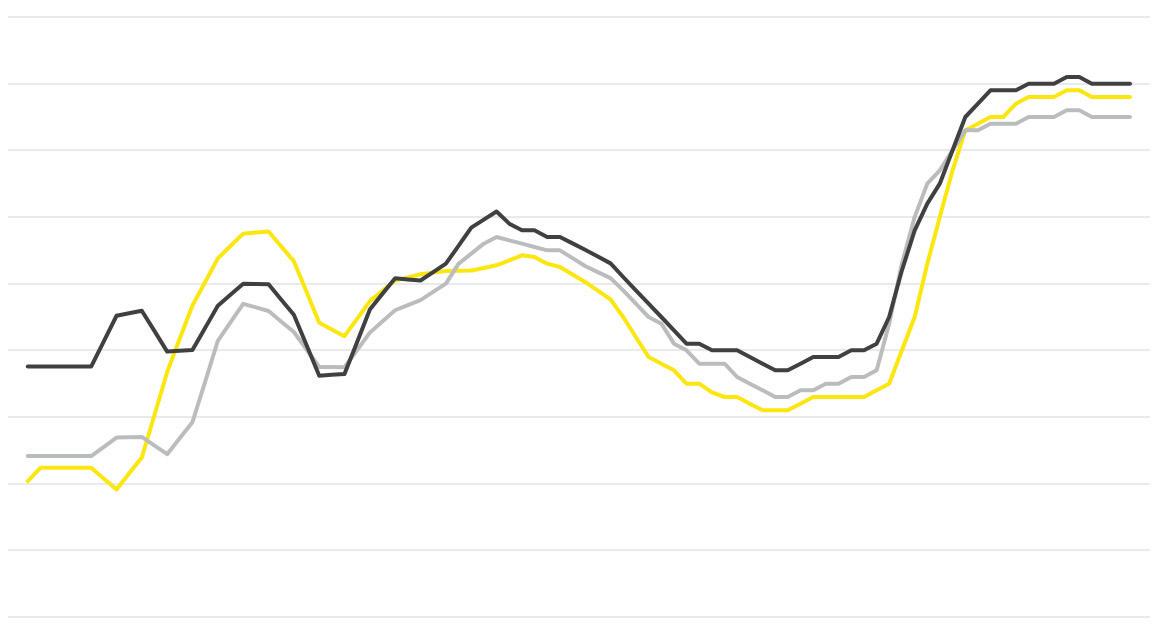
The Perth industrial rental market has reached a clear period of stabilisation following the exceptional growth trajectory witnessed between 2021 and 2024. The North precinct maintains its position at $130/sqm, unchanged since December 2023, while the East precinct holds at $125/ sqm and the South at $128/sqm. This stability represents a significant departure from the aggressive rental appreciation that characterised the market through the post-pandemic period.
The rental stabilisation reflects the combined impact of increased vacancy levels, particularly the 23.1% expansion in South precinct availability, and moderating tenant demand as businesses adopt more cautious accommodation strategies. While headline rental rates have remained stable, the effective rent being achieved has softened through incentive offerings including extended rent-free periods and landlord contributions to fit-out costs.
Construction costs continue to underpin rental floors for new developments, with purpose-built facilities still commanding rates above $160/sqm to be deemed feasible. However, the secondary market comprising properties above 5,000sqm is experiencing more pronounced adjustment, with landlords demonstrating greater flexibility on lease terms to secure tenants. The five-year annual growth remains compelling at 10.5% for South, 8.7% for East, and 8.6% for North, though future rental growth expectations have moderated significantly as the market adjusts to higher vacancy conditions and reduced tenant urgency. By region
Source: Real Capital Analytics, PIMS RWC WA
The Perth industrial investment market recorded approximately $1.00 billion in transactions during 2025, representing a 17.6% decline from the $1.21 billion achieved in 2024. Not to be taken as lack of demand this moderation reflects less assets changing hands due to the limited supply of industrial properties available. For each vacant or leased investment we sell there are several serious buyers missing out who continue the search.
Owner-occupiers, who have been particularly aggressive participants over the past few years, continue to pay premiums for properties with each new sale setting a new benchmark for the area it is within. Investors, particularly via the eastern states, are still plentiful however more logic is applied when making their investment decision.
Despite the decline in dollar volume, the market has maintained relative stability compared to the 2017-2020 period, with private investors continuing to account for approximately three-quarters of all purchases. Yields have held within the 5.8% to 7.5% range depending on asset quality and covenant strength, though the potential for rising interest rates may see greater caution when considering capitalisation rates in 2026. Perth’s relative value proposition compared to east coast markets, where industrial yields have compressed significantly, continues to attract interstate capital, though this interest may moderate if the differential between debt costs and yields narrows. The fundamental supply constraints created by limited serviced land and elevated construction costs continue providing support for maintaining asset values.
The Perth industrial market’s trajectory through 2026 will be fundamentally shaped by the shifting interest rate environment, the global economic stage and its cascading effects on both investment activity and tenant behaviour. The transition from anticipated rate reductions to potential increases is likely to place downward pressure on leased investment sales as investors recalibrate their return expectations and reassess debt serviceability thresholds.
From a leasing perspective landlords of larger properties in Bibra Lake, Jandakot, and Forrestdale will need to adopt increasingly competitive positioning through enhanced incentive packages to attract tenants. The East precinct’s substantial vacancy concentration in Canning Vale, Hazelmere, and Kenwick suggests these suburbs will experience the most pronounced rental negotiation environment, however more particularly for larger format assets where tenant alternatives have increased materially.
Conversely, the North precinct’s stability at 105,150sqm, combined with its dominance in smaller format assets where 93 of 216 sub-500sqm listings are concentrated, suggests this segment may demonstrate less rental stability in those sub 500sqm tenancies.
Investment market dynamics will hinge on the interest rate trajectory with the continuance and strength of the West Australian economy being underpinned by the iron ore price and continued demand for it. A 100 basis point rise in interest rates may see owner-occupiers, who have been particularly aggressive participants over recent years, adopt more measured acquisition strategies and possibly move towards leasing as opposed to purchasing as financing costs face upward pressure.
The fundamental structural constraints around serviced industrial land supply and elevated construction costs will continue limiting speculative development, providing ongoing support for existing asset values. Despite 655,359sqm of vacant industrial land being listed for lease across the metropolitan area, predominantly for design and construct pre-lease arrangements, the limited appetite for speculative construction reflects the challenging development economics where project feasibility remains constrained by construction costs, extended delivery timeframes, and uncertain precommitment levels from tenants.
Western Australia’s economic performance, heavily influenced by iron ore pricing and broader commodity market conditions, will remain critical to occupier confidence and expansion decisions. The combination of stable vacancy conditions, moderating rental growth expectations, and uncertain monetary policy settings suggests 2026 will be characterised by cautious optimism rather than aggressive growth, with market participants carefully weighing accommodation and investment decisions against evolving economic conditions.