How Live-Dealer Streaming Works: Cameras, Latency and Interface Design Why a convincing real-time table experience depends on more than simply pointing a camera at a dealer Publication date: August 14, 2026 • Platform: Issuu • Sports / gaming technology editorial
Editorial note: This article explains live-streaming technology and interface design. It does not provide wagering strategy, betting instructions, deposit guidance or predictions.
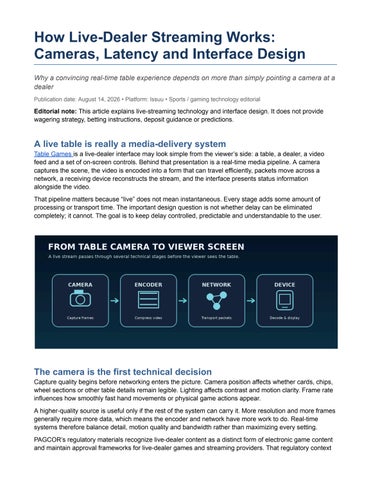
A live table is really a media-delivery system Table Games is a live-dealer interface may look simple from the viewer’s side: a table, a dealer, a video feed and a set of on-screen controls. Behind that presentation is a real-time media pipeline. A camera captures the scene, the video is encoded into a form that can travel efficiently, packets move across a network, a receiving device reconstructs the stream, and the interface presents status information alongside the video. That pipeline matters because “live” does not mean instantaneous. Every stage adds some amount of processing or transport time. The important design question is not whether delay can be eliminated completely; it cannot. The goal is to keep delay controlled, predictable and understandable to the user.
The camera is the first technical decision Capture quality begins before networking enters the picture. Camera position affects whether cards, chips, wheel sections or other table details remain legible. Lighting affects contrast and motion clarity. Frame rate influences how smoothly fast hand movements or physical game actions appear. A higher-quality source is useful only if the rest of the system can carry it. More resolution and more frames generally require more data, which means the encoder and network have more work to do. Real-time systems therefore balance detail, motion quality and bandwidth rather than maximizing every setting. PAGCOR’s regulatory materials recognize live-dealer content as a distinct form of electronic game content and maintain approval frameworks for live-dealer games and streaming providers. That regulatory context