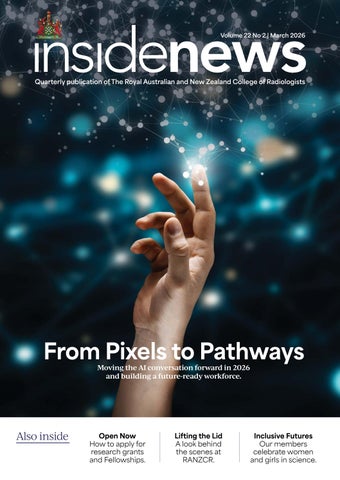
RANZCR Inside News March

Page 1


Volume 22 No 2 | March 2026

Quarterly publication of The Royal Australian and New Zealand College of Radiologists

From Pixels to Pathways

Moving the AI conversation forward in 2026 and building a future-ready workforce.

Also inside Open Now

How to apply for research grants and Fellowships.

Lifting the Lid

A look behind the scenes at RANZCR.

Inclusive Futures

Our members celebrate women and girls in science

Message from the CEO Duane Findley outlines College priorities for 2026.

Details

EDITORIAL

Editor-In-Chief

Dr Allan Wycherley

Editor Arizona Atkinson

NZ Branch Chair Dr Jash Agraval's introduction to 2026.

RANZCR acknowledges the Traditional Owners of Country throughout Australia. We recognise the continuing connection of Aboriginal and Torres Strait Islander people to the sky, lands, waters and culture and we pay our respect to their Elders past and present and emerging. RANZCR acknowledges Māori as tangata whenua and Treaty of Waitangi partners in Aotearoa New Zealand.

All rights reserved. No part of this publication may be reproduced or copied in any form or by any means without the written permission of the publisher. Publication of advertisements and articles submitted by external parties does not constitute any endorsement by The

of the products or views expressed. Inside

Leading Change Together

In his first presidential message, Dr Rajiv Rattan outlines RANZCR’s member-focused projects and advocacy priorities, as well as addressing AI’s expanding role in our professions.

Dear colleagues and friends, Stepping into the Presidency of one of the world’s most respected radiology and radiation oncology colleges is a profound honour I accept with humility and optimism. As we enter the decade that will carry us to the College’s centenary, we inherit the work of thousands of volunteers, leaders and visionaries who have made RANZCR a beacon of clinical and academic excellence across Australia, Aotearoa New Zealand and the global imaging community.

Strengthening Member Experience and Professional Fulfilment

As 2026 gathers momentum, I want to reflect on the forces reshaping our professions and on the practical work underway to ensure the College remains a source of support, clarity and inspiration for every member.

education that meets clinicians at the point of need while minimising unnecessary regulatory and administrative imposts

Strengthening policy influence —evidence-based advocacy so radiologists and radiation oncologists can deliver the highest quality care in an increasingly complex clinical environment

Website—the new-look RANZCR website is designed to enhance member experience. Please send in your feedback with regards to your experience.

The healthcare landscape is changing quickly: regulatory frameworks are shifting, workforce pressures are intensifying, and technology is advancing at unprecedented speed. These dynamics mirror global trends and demand that we remain agile, informed and united.

“These dynamics mirror global trends and demand that we remain agile, informed and united.”

Members tell us they want three things: user-friendly processes, better learning, and stronger advocacy. The College is responding with targeted work-streams that translate those priorities into action. This edition welcomes a new series that will spotlight each College unit and the initiatives driving our strategic priority of enhancing member experience. Key areas of focus include:

Reducing administrative burden —smarter digital systems to automate routine processes and improve responsiveness

Expanding learning resources —modular, competency-based

AI: Far Beyond Diagnosis

AI is already changing how we work and how healthcare is delivered. Its impact extends well beyond image interpretation and touches the entire imaging and treatment lifecycle—from acquisition to outcomes—in ways that improve safety, efficiency and personalisation.

Where AI is reshaping practice: Workflow orchestration and triage—automated prioritisation of urgent studies, smarter scheduling and pre-reporting flags that reduce turnaround times and focus human attention where it matters most

Dr Rajiv Rattan

Image acquisition and reconstruction—AI-driven protocols that shorten scan times, lower dose and improve image quality at the point of capture

Treatment planning and adaptive radiotherapy—machine learning models that accelerate contouring, optimise dose distributions and enable adaptive plans that respond to anatomical change during therapy

Predictive analytics and patient navigation—models that forecast complications, guide supportive care and personalise follow-up pathways to reduce avoidable admissions and treatment interruptions

Federated learning and data stewardship—collaborative approaches that let institutions train robust algorithms without sharing raw patient data, preserving privacy while improving generalisability. These advances promise to reduce clinician cognitive load and free time for the uniquely human tasks of judgement, communication and compassionate care. They also raise urgent questions about validation, explainability, bias and governance that we must address together. Embedding AI into our teaching and training is imperative so future generations are equipped to use these tools safely and ethically.

Advocacy: Protecting Quality, Shaping Policy

Closer to home, the College continues to advocate strongly for members across multiple fronts. Governments in Australia and Aotearoa New Zealand are progressing significant reforms in medical education and training. While we support efforts to address workforce shortages, we are clear

that quantity must not come at the expense of quality. A sustainable, high-performing and high-quality workforce requires rigorous, well-supported training.

We are working with regulators to ensure reforms are systematic, consistent and evidence-based.

This includes:

Ongoing engagement with the Australian Medical Council on new accreditation standards expected in 2027

Collaboration with the Medical Board of Australia and AHPRA on new IMG standards

Continued work to meet outstanding AMC conditions. In our Federal pre-budget submission we have sought funding and policy changes that directly support patient care and workforce sustainability, including:

A national pilot of iRefer Clinical Decision Support in urgent care clinics

Expansion of MBS item 35410 to include non-fibroid gynaecological conditions and a comprehensive review of brachytherapy funding

Medicare support for MRI management in patients with pacemakers

Completion and permanent establishment of the Regional Rural Training Pathway through IRTP as part of broader STP reform.

In Aotearoa New Zealand, with a closely contested election scheduled for 7 November, we are developing clear election priorities in partnership with our New Zealand colleagues, so the voice of our professions is heard.

Sustainability: Human, Environmental, Professional

Sustainability is often discussed in abstract terms, but at its heart it

is deeply human. It concerns the wellbeing of our patients, the vitality of our professions and the resilience of each of us.

A sustainable future requires intentional design. It means:

Embracing diversity and championing equity in our workplaces

Nurturing respectful, collaborative relationships across the healthcare ecosystem

Embedding environmentally responsible practices into clinical service delivery.

Discovery, innovation and adaptation have always defined our professions. These qualities will guide us as we shape the future our patients deserve. Equally, the quiet power of kindness and civility strengthens our communities and elevates our practice.

Values That Endure

Innovation will continue to expand what is possible. Ethical clarity, collegiality and kindness will determine how we use those possibilities. As technology amplifies our reach, these human qualities will decide whether new tools deepen trust or erode it.

I invite every Fellow and trainee to reflect on some concrete action you can take this year—mentoring a trainee, piloting a workflow improvement, exposing medical students to clinical radiology and radiation oncology, joining a College working group, or being an examiner—that advances quality, equity or sustainability. IN

2026: Building Momentum

RANZCR enters 2026 with renewed focus, building on strategic progress, improving member experience, and navigating complex external pressures.

There’s something uniquely energising about the first months of a new year. For me, it is a time of opportunity, potential, and exciting alternatives. The new year is a blank canvas waiting for each of us to inscribe our own journey.

At the end of each year our College staff come together to reflect on the challenges, successes, and lessons learned from the year just past, and to re-focus our sights on the new horizon of the year to come. Our people leave the gathering with a sense of achievement, of working

for an organisation that makes a real difference, and to return in the new year with a refreshed sense of purpose and energy.

Over the past 12 months, RANZCR has embarked on a substantial journey of renewal. We’ve finalised and launched the 2025–2040 Strategic Plan, undertaken deep member experience research, modernised governance and committee structures, employed new technology to reduce or remove member ‘pain points’, enhanced our traineeship programs, delivered successful ASMs in Australia and Aotearoa New Zealand, and strengthened our engagement with governments, regulators and international partners. These achievements reflect not only the work of the organisation, but the commitment of our members—clinicians who continue to step forward despite increasing workload pressures and rising system complexity.

RANZCR in 2026 is shaping to be a particularly interesting year.

A year where we build upon the foundational work delivered in the first year of our 2025-2040 Strategic Plan to deliver real change for our members, while navigating a rapidly changing and potentially damaging political and macroeconomic environment.

2025 AGM Results

Our 2025 ASM in Melbourne saw a record attendance for a RANZCR ASM, with plenty of energised discussion, and a shared sense of connectivity. It was uplifting to see and speak with so many of you at

this event, and to hear your positive experiences at the ASM.

The 2025 AGM presented several important resolutions for change for member consideration and approval. The AGM resolutions before members reflected both the complexity of our environment and the evolving nature of our profession. These resolutions generated a groundswell of debate and presentation of different viewpoints. It was positive to see that there was, for the most part, a constructive tone of debate that sought to educate and understand. Members asked thoughtful questions, challenged assumptions, and held the College and each other to account—exactly as a strong profession should.

There is a justifiably high bar (75% of votes) under the Corporations Act to enact Constitutional change within the College under a special resolution. The College acknowledges both the results of the accepted and failed resolutions and the large number of members who voted in favour of the failed resolutions. The feedback from members will shape the College approach to future resolutions. This includes clearer communication on consultation processes, more consistent policy messaging, and better visibility of how governance decisions connect to member experience.

The Strategic Plan In Motion

The 2025–2040 Strategic Plan is the most ambitious and long-range blueprint in our College’s history. It acknowledges the pace of

change—in technology, workforce, cost pressures, regulation and community expectations—and positions RANZCR to meet that change with purpose rather than reaction.

Horizon 1 of the Strategic Plan runs from 2025 through to 2027 and focuses on strengthening our core, recognising that if the College is not internally at peak operational performance, we cannot deliver against the needs of our members nor can we project our influence beyond the College perimeter.

Last year saw a significant restructure of the College organisational structure, to align RANZCR’s departments and operations to the key priorities of the strategic plan. This restructure has already delivered results and members are commenting positively on the changing culture and improved alignment between the College and member needs. In 2026, this change will continue and accelerate.

In 2025, RANZCR undertook groundbreaking research into the member experience, current and future member needs, and psychographic lifecycle member segmentation, to better understand the different lived experiences of our members and to build a College that addresses their specific needs at each stage of their career. This is an ambitious plan, but something that our members deserve. A summary these research findings was emailed to members earlier this month.

I’d like to thank our members who completed the Customer Science

survey, participated in group workshops, or volunteered for oneto-one interviews, to help us bring this research together.

The research underlined the critical importance of a fit-forpurpose foundational technology platform with a single source of truth for member information. In 2026, we will be designing and implementing this technology platform to drive the changes identified in the Customer Science report.

We heard from members that communication, responsiveness and digital experience needs to evolve. To address this, the College has adopted a unified lifecycle-led communication model, appointed a dedicated Lifecycle Marketing Manager, improved segmentation, and begun work on more coordinated and meaningful communication pathways.

Supporting Members Through Change

The pace of change—especially in technology and workforce —remains one of the defining challenges across our two specialties. AI in particular has shifted from a theoretical conversation to a practical imperative. Last year we released important guidance work on AI safety, governance and integration. This year we deepen that effort by strengthening our policy settings, working with governments, and educating our members through the delivery of RANZCR’s Intelligence26 AI conference on 24 July in Sydney.

Working Nationally and Globally RANZCR continues to strengthen ties with governments, health departments, international colleges, and global partners. Our engagements with counterparts in Canada, Europe, Asia Pacific and the UK help ensure we learn from international best practice and bring those insights home.

Our policy and advocacy work will continue to elevate the professions’ voice on access to care, sustainable training pipelines, imaging and radiation oncology workforce needs, and the rapidly evolving regulatory landscape.

As we move further into 2026, my message to members is simple: we are building for the long term. The College we are shaping—assisted through your engagement, feedback, and professionalism—is one that is modernising, maturing, and positioning itself for the challenges and opportunities ahead.

I look forward to working with you in 2026 as we continue strengthening our core and shaping a future that serves our members, our patients, and our communities. IN

Honouring Excellence

RANZCR congratulates members recognised in the Australia Day 2026 Honours List for their outstanding service to patients, education and the wider community. We celebrate the achievements of Dr Brian Tress AO, Dr Anita Bourke AM, and Prof Lesley Cala OAM.

Prof Lesley Cala OAM

Radiologist | WA

A pioneering neuroradiologist, educator and champion of women’s rights, Prof Lesley Cala has played a leading role in advancing tertiary radiology education.

Her academic career has been marked by dedication to teaching and training the next generation of radiologists, particularly focusing on the integration of imaging techniques into clinical practice.

Beyond her many years of teaching and research at UWA, she has also held positions in the National Council of Women Australia, the International Council of Women and the UWA Centenary Trust for Women.

Her work has strengthened radiology education programs and enhanced clinical training standards across multiple institutions.

Dr Anita Bourke AM

Radiologist | WA

Dr Anita Bourke has made significant contributions to radiology, both as a clinician and through her commitment to community service.

The first dual-trained nuclear physician and senior breast radiologist in WA, Dr Bourke worked as a consultant radiologist at Sir Charles Gairdner Hospital and at BreastScreen WA for more than 30 years, introducing multiple new imaging and interventional breast techniques.

A committed mentor, she also served as a RANZCR Examiner and a long-standing member of the College’s Breast Imaging Group.

She is recognised for combining clinical expertise with advocacy for equitable healthcare delivery.

Dr Brian Tress AO Radiologist | VIC

Dr Brian Tress is a nationally respected neuroradiologist who has been pivotal in advancing diagnostic and interventional radiology in Australia. His work helped introduce cuttingedge imaging technologies that have transformed neurodiagnostic capabilities, especially in stroke and brain tumour imaging. In 2018 he shared his own personal experience with strokes, raising public awareness and encouraging all individuals to pay attention to their health. He has published extensively in neuroradiology and trained multiple generations of radiologists. Dr Tress was awarded for distinguished service to neuroradiology medicine, to interventional and diagnostic radiography, and to the introduction of new imaging technologies in Australia. We also extend our warmest congratulations to our Board Chair, Maryjane Crabtree AM, recognised for significant service to the legal profession, to community health, and to sport.

WOMEN IN RANZCR

4%

Strengthening Science Together

Endorsed by the United Nations in 2015, the International Day of Women and Girls in Science is celebrated annually on 11 February to highlight the contributions of women in science and raise awareness about gender equality in STEM fields. To mark the occasion, we asked a few members to reflect on what inspired them to pursue a career in science and how we can build inclusive futures for the next generation.

Dr

Hannah Ireland

Interventional and Diagnostic Radiologist

“Women in science enrich and advance the field through diversity of thought, creativity and leadership. In interventional radiology, I am committed to enabling women to lead innovation by dismantling barriers and cultivating inclusive systems in which they can truly thrive. We belong here, and it is essential that women and girls see themselves represented, supported and actively shaping the future of science.”

From the Archives

Dr Hannah Scowcroft

Radiology Registrar

“Science is amazing and being a nerd is awesome. I empower women and girls to find passion in their curiosities, embrace their uniqueness and inspire those around them to realise what they are capable of. You cannot aspire to be something you cannot see, so the next generation needs incredible females—show up, be present, and claim your rightful place among emerging STEM leaders because you deserve it.”

Dr Amy Teh Radiation Oncologist

“From Marie Curie’s scientific courage to Florence Nightingale’s data-driven compassion, women have shown us that science advances fastest when knowledge serves humanity. By synergising AI, social science, STEM and finance, we can ensure the next generation of women and girls lead innovations that are both powerful and equitable.”

The College’s first female member was Dr Leila Keatinge, who graduated from the University of Sydney in 1925 and went on to study radiotherapy in London and Cambridge. Her Sydney Morning Herald obituary notes that she was recalled to Sydney by the Cancer Research Committee and took charge of the radiotherapy plant at St Vincent's Hospital, later becoming the hospital’s honorary radiotherapist. It is also noted that she worked in partnership with Dr A Nisbet (RANZCR’s first President) at his Macquarie Street practice as a radiotherapist. Dr Keatinge was one of 14 founding members of the Australia and New Zealand Association of Radiologists in 1935 (and the only female member). Tragically, just as the Association became formally recognised, Dr Keatinge fell gravely ill. Initially misdiagnosed, she was eventually rushed to hospital with appendicitis, but died shortly after surgery. She was 36 years of age.

Pride and Partnership

RANZCR was proud to support Pride in Medicine at the 2026 Sydney Gay and Lesbian Mardi Gras Parade—celebrating diversity, championing inclusion, and advocating for equitable healthcare.

The College was proud to once again support Pride in Medicine (PiM) at the 2026 Sydney Gay and Lesbian Mardi Gras Parade, which took place on 28 February.

PiM is an organisation dedicated to advocating for the rights and wellbeing of LGBTQIA+ medical students, doctors and patients. It promotes a medical profession that embraces diversity and delivers affirming, informed and culturally safe care—an essential foundation for improving healthcare for LGBTQIA+.

Clinical radiologist Dr Glen Lo is a member of the Diversity, Equity and Inclusion Taskforce, and represents RANZCR on the Expert Working Group for the Optimal Care Pathway for LGBTIQA+ People with Cancer. Dr Lo shared his thoughts on the importance of RANZCR’s continued involvement with Pride in Medicine and the Mardi Gras Parade. “People who complain that pride marches are unnecessary and that medical colleges participating in a Mardi Gras float is not “core business” fail to observe the ongoing need for visibility and advocacy in 2026,” he said.

Since 2023, RANZCR has supported the Pride in Medicine float, joining other healthcare professionals, medical colleges and allies, celebrating along the streets of Sydney as part of the iconic Mardi Gras parade.

“RANZCR providing public endorsement of the GLAAD/PiM 2026 Mardi Gras float shows the medical student, the closeted colleague, or the frightened patient that RANZCR members overall are supportive and safe,” said Dr Lo.

Sharing his own personal experiences of pride marches, Dr Lo said, “In 2023 when I marched with North Metropolitan Health Service in WA for Perth Pride, we wore pronoun clapperboards to acknowledge and

show some respect for using preferred pronouns. I wore, “He/They” and saw a young person in the crowd jump up and down, waving at me with euphoria at being seen and acknowledged. “Me too!” He yelled out. We were marching to show our patients, our colleagues and our community that they can be themselves when they come to us for their healthcare. For PiM, the strength is the cross-college collaboration. Where else do almost all the medical colleges come together publicly in agreement?”

Together, our presence sends a clear message: everyone deserves to feel welcomed, respected and supported within the medical profession and the broader healthcare system.

This commitment is reflected not only through RANZCR’s support of PiM, but also through the work of RANZCR’s Diversity, Equity and Inclusion Taskforce (DEIT), which advocates for inclusive policies and helps embed equity, diversity and inclusion across the College’s culture and activities.

For more information, visit www.ranzcr.com/about-us/diversity-at-ranzcr/

United by Unique

The theme of 2026 World Cancer Day, marked on 4 February, was ‘United by Unique’, recognising that every cancer journey is shaped by an individual experience. To support World Cancer Day, Targeting Cancer shared a series of stories reflecting on the importance of people-centred care. Here, we share two of those perspectives, from both a radiation oncologist and a patient.

In his World Cancer Day message, Dr Tuan Ha highlighted the importance of honouring each person’s unique cancer journey and advocated for equitable, compassionate, and personalised cancer care. “Behind every cancer diagnosis is a person with their own fears, strengths, culture, family, and hopes for the future. That’s what United by Unique means to me. We are united by a shared goal—to reduce the impact of cancer—but we must honour the individuality of every person affected by it,” he said. “Radiation therapy is often described in technical terms—fractions, fields, doses—but at its heart, it is deeply personal. Each plan is shaped around a unique individual: their cancer, their body, their life, and what matters most to them.”

He went on to stress the importance of closing the gap in screening, diagnosis and treatment worldwide.

“We are united by a shared goal—to reduce the impact of cancer—but we must honour the individuality of every person affected by it.”

“Equity is a moral and medical imperative. United by Unique reminds us that while cancer affects many of us, each person’s story deserves to be heard and respected. Our strength comes from bringing together science, technology, and human connection—working as a team with patients, families, and colleagues to deliver care that is both precise and compassionate. Together, we can reduce the impact of cancer and move closer to a world where cancer no longer defines a person future.”

Dayveen’s Story: The Patient’s Perspective

When Dayveen lost her father to cancer at just 48, she carried a deep fear of reaching the same age. That fear resurfaced when, at 49, she was diagnosed with cervical cancer. “I was diagnosed with cervical cancer, and it was an extremely difficult time for me,” she shared.

“Receiving a cancer diagnosis is scary and terrifying. Cancer itself doesn't take into consideration the individual. It doesn't care what you have going on in your life or how many children you've got, what you do for a job, or if you're male or female. It's indiscriminate, but the treatment can be the polar opposite.”

After multiple surgeries and radiation therapy, Dayveen is now doing well with an excellent prognosis. “My care team were so wonderful, and thankfully, because of my radiation oncologist, Dr Jennifer Chard, and all the radiation oncology team, I had a positive treatment experience. I was able to ask questions and have my concerns addressed, no matter how obscure,” she said.

For Dayveen, the support of her cancer care team helped her transform fear into hope. “They treated me as a person, not just as a patient. On that treatment journey my fears melted away, and the focus became about my future, and supporting me to get the best outcome. I believe the care I received made a massive difference to my mental health and to my prognosis.”

“My fears melted away, and the focus became about my future.”

Visit www.youtube.com/ranzcr to watch the World Cancer Day video series, which features Dr Tuan Ha, Dr Gina Hesselberg, Dr Jennifer Chard, Dr Leesa Jackson and Dayveen.

A Message from

Lifting the Lid

Lifting the Lid

We often hear the familiar refrain: What does the College actually do? What lies behind the many committees and working groups that shape our profession? How do the staff spend their days? If you’ve ever wondered what unfolds behind the scenes at RANZCR, I’m delighted to introduce the first in a new series that gently lifts the lid on the inner workings of each College unit.

In this issue, you’ll find a brief snapshot of every team—an opening chapter that will be followed throughout the year by deeper explorations into the people, processes, and purpose that drive their work. This builds on the “Know Your Committee” segment in the Dean’s update, expanding our collective understanding of how the College functions as a whole.

As you read, I suspect you’ll uncover things you never knew, and gain a richer appreciation for how each part of the College strives to support us—advocating, guiding, and safeguarding our profession from the first days of training through to senior Fellowship and beyond. My hope is that this insight not only informs but inspires, encouraging even more members to lend their expertise and energy to the work that shapes the shared future of our professions.

I hope you find this both illuminating and encouraging—a reminder of the collective endeavour that strengthens our College and our profession.

Member Fulfilment Unit (MFU)

“My unit is focused on delivering RANZCR’s commitment to transform the way we do things, by progressively building a more connected, member-centred approach across the College, where each member consistently experiences great service and excellent value.

Following the completion of the first of a three-stage Member Experience Research program, we are laying the foundations for a clearly defined member lifecycle, an operating principle that will guide the ways in which the College informs, supports and engages our members throughout their professional journey.”

Our Purpose

Our role is to strengthen how members experience the College at key touchpoints by improving coordination, consistency, and responsiveness across communications, events, services, and data. The MFU:

Owns and delivers a connected, member-centric experience across the full member lifecycle

Ensures members feel valued, informed, supported, and engaged at every interaction with the College.

Key Responsibilities

Events and sponsorship

Communications across all channels

Customer Relationship Management (CRM)

Lifecycle marketing and member experience

Strategic enabler to internal teams on member-focused initiatives

Policy, Advocacy and Standards Unit (PASU)

“Partnering with members in pursuit of our shared

goals is immensely satisfying for my team as we seek to positively influence government (and other stakeholders) to provide our professions with the best funding and the best regulatory settings that will enable members to deliver the best services to their patients.”

Our Purpose

PASU actively supports the College to represent members with one clear, highly credible and authoritative voice to the highest levels of government and other stakeholders, to inform, influence and advance our professions.

In partnership with members, we undertake multiple diverse activities to support members in the clinical space, helping to shape public policy and practice in Australia and Aotearoa New Zealand.

Key Responsibilities

PASU delivers coordinated, evidence-based advocacy and initiatives comprising:

Government and stakeholder engagement

Policy positions

 Clinical and professional standards

External advocacy

Support of Faculty Councils, committees, expert groups

Digital health, emerging technologies

Delivery of government projects (e.g. lung cancer screening)

Tailored policy, workforce, training and government engagement

Subspecialty advocacy, guidance, expert committee work

Training and Lifelong Learning Unit (TLU)

Brendan Grabau GM (TLU)

“Everyone in my team is focused on delivering practical, member-centred support, bringing a constructive, solutionsfocused approach to this work as we continue to improve how we deliver services to meet our members’ needs and expectations.

For us, being responsive means ensuring members can quickly access the right expertise and support when they need it, while minimising unnecessary barriers and delays wherever possible.

Given the complexity of the training and education space and associated regulatory imposts, such as regulator imposed CPD requirements and reporting obligations, the College is working on multiple fronts to optimise members’ learning experiences and minimise the administrative burden.”

Our Purpose

TLU is one of the most operationally complex parts of the College, responsible for designing, delivering, regulating, and assuring the quality of education and training across the entire professional lifecycle of members—from entry into training through to lifelong professional development.

Key Responsibilities

TLU’s work spans five domains:

Specialist Training Programs

Accreditation and regulatory compliance

International Medical Graduates (IMGs)

Continuing Professional Development (CPD)

Education Strategy, Innovation and Digital Enablement

Information Technology Unit (ITU)

Sarah Vella, GM (ITU)

“I lead a team that is constantly thinking about how to improve things for members and staff by finding and implementing the best IT solutions. There is a genuine thirst for change and innovation within the College, and I am motivated by the many opportunities to make a real difference to end users.”

Our Purpose

Our role is that of enabler—using information technology to make it easier and faster for our members to access the services they need, when they need them. We work across all business units to reduce the need for manual input, automate and integrate services, reduce the administrative burden, and ultimately deliver a seamless experience for our members whenever they interact with the College.

Key Responsibilities

Align technology with strategy

Horizon scan for new technologies

Manage cybersecurity and risk

Build talent and capability

Optimise IT governance and financial management

Finance Unit (FU)

Jason Shen GM (FU)

“Our team strives to reduce the financial administrative burdens on members and staff and make it easier for members to engage with the College around financial matters.

As we explore solutions and invest in new systems that streamline internal processing times, we aim to create a more responsive experience for members that offers greater flexibility, reduces follow-up communications and minimises delays.”

Our Purpose

The FU is tasked with managing RANZCR’s financial health and regulatory compliance through a combination of macro-level strategic planning and micro-level, daily operational tasks.

Key Responsibilities

Our team manages all aspects of College finances including:

Finance, tax and statutory compliance

Supporting and optimising accounting and reporting systems

Maintaining College’s Risk Register

Maintaining good internal control and compliance with accounting standards and legislation

Statutory and internal management reporting

Annual budgeting process

Compliance with external governing bodies.

People and Culture Unit (PCU)

“Our work is driven by a fundamental philosophy—a highly skilled, well supported and engaged workforce equates to a positive and service-oriented culture that benefits the whole College and establishes the foundation for a sustainable future. That’s where we come in—working alongside all business units to nurture a positive, ‘can-do’ and inclusive culture that delivers for members.”

Our Purpose

PCU is responsible for ensuring RANZCR has the right people, with the right capability, in the right roles, supported by a culture that enables performance, wellbeing, and longterm sustainability. Developing staff is a key priority and the foundation for a sustainable future.

Executive Unit

Our Purpose

The Executive Unit is the strategic decision-making and operational epicentre of RANZCR, responsible for supporting the CEO, President and Board to implement the strategic plan and manage the operational, financial, compliance and governance functions of the College.

Key Responsibilities

Strategic direction and leadership

Financial stability and risk management

Member-focused culture

Operational oversight and overall business performance

Board liason and governance

Regulatory compliance

Stakeholder management

Making Life Easier for Our Members

Nurturing a member-focused culture is our first strategic priority, where members' expectations, needs and aspirations are fulfilled in every interaction with the College. This is driven and monitored by the executive leadership, informed by mmeber insights, and championed by all business units. All of which underscore the wholeof-organisation investment and commitment to success.

www.ranzcr.com

Occupational Dust Lung Diseases

Details of a new online education series, launching soon.

Occupational Dust Lung Diseases (ODLD) represent a significant and evolving challenge within Australian medical practice, particularly for clinical radiologists who play a pivotal role in diagnosis and ongoing monitoring. Over the past decade, there has been growing recognition of the serious health consequences associated with exposure to respirable dust, especially crystalline silica found in engineered stone.

The National Dust Disease Taskforce Final Report (June 2021) called for urgent reforms to Australia's health and safety laws to protect workers from hazardous dusts such as silica, highlighting failures in regulations concerning engineered stone. Reports of rapid-onset silicosis among workers have prompted a national response, with regulatory changes and recommendations driving improvements in workplace safety, health surveillance and clinical pathways. This ultimately led to a world-first, Australia-wide ban on engineered stone in July 2024.

Clinical radiologists are increasingly interpreting chest imaging for occupational dust exposure. Previously, issues like poor image quality, limited training and inconsistent standards hindered diagnosis. New education initiatives, standardised reporting and clearer clinical pathways are improving outcomes for those at risk of occupational dust lung diseases, many whom rely on early detection for lifesaving interventions.

To meet this critical need, the College, with support from the Department of Health, Disability and Ageing, has developed a comprehensive online education series to address the critical requirements associated with identifying and managing ODLD in Australia. The series covers pathophysiology fundamentals, equipping clinicians with the essential skills needed for accurate chest imaging and improved diagnostic outcomes through advanced CT and X-ray interpretation. The series is delivered through seven comprehensive modules, complemented by a set of practice cases. These interactive modules cover a broad array of topics, beginning with the background and pathophysiology of various occupational lung diseases. They delve into practical imaging principles, focusing on both CT and chest X-ray interpretation, and provide instruction on the application of the ILO (International Labour Organization) and ICOERD (International Classification of Occupational and Environmental Respiratory Diseases) classification systems.

In addition, the modules explore the occupational causes of lung cancer and offer guidance on the differential diagnosis of conditions such as coal workers’

pneumoconiosis, asbestosis, mesothelioma, and other asbestosrelated thoracic diseases. The learning package is designed to consolidate and further develop the skills of clinicians, supporting effective diagnosis, reporting, and management of workers affected by occupational dust lung diseases. Participants will have the opportunity to access practice cases, enabling practical learning and enhanced clinical application. Developed in collaboration with DetectedX, Prof Catherine Jones and the RANZCR Occupational Dust Lung Disease Steering Group (Prof Dinesh Varma, Dr Janu Thananjeyan, Dr Siavash Es’haghi and Dr Stephen Melsom), this educational package directly builds on the recommendations of the National Dust Disease Taskforce and aims to strengthen the profession’s ability to respond to a significant emerging health threat.

RANZCR members are encouraged to stay informed about the development of the program, which is expected to launch in March 2026. The educational package is open to radiologists of all training backgrounds who report thoracic imaging. IN

For information on how to access the online training package, please visit www.ranzcr.com/advocacystandards/occupational-dust-lungdisease/

Advancing IR and INR

The College has strengthened its commitment to advancing Interventional Radiology and Interventional Neuroradiology through dedicated governance, recognition pathways, accreditation, and training initiatives in 2026.

From 1 January 2026, RANZCR implemented a dedicated governance structure for Interventional Radiology (IR) and Interventional Neuroradiology (INR), marking a clear commitment to advancing these rapidly evolving fields. This integrated governance structure is designed to support high-quality local training, advance the visibility and recognition of IR and INR within contemporary radiology practice, and strengthen workforce development across Australia and New Zealand. Moreover, it brings together clinicians practising in IR and INR, experienced practitioners, and trainees, ensuring decisions are informed by those working at the forefront of patient-centred, image-guided interventional care.

As the new Chair of the Interventional Radiology Committee (IRC), I am pleased to lead this work at a time when IR and INR continue to expand their impact across the health system. The dedicated governance includes a newly established IRC with balanced IR and INR representation, trainee representatives, new College leadership roles dedicated to IR and INR training and accreditation, and an IR and INR Training Committee comprised of Network Training Directors and trainee representatives. Together, these elements provide

clarity, accountability, and continued momentum, ensuring both specialties are positioned to respond to growing demand for minimally invasive, high-value care.

A major highlight for the year ahead is the introduction of the IR and INR Grandparenting Pathway. The pathway is a time-limited process that enables experienced IR and INR clinicians to be formally recognised by RANZCR as meeting the required range of practice for these specialties. It acknowledges existing expertise and provides an avenue for appropriately qualified practitioners to be recognised.

Importantly, this process does not change or restrict anyone’s existing range of practice; rather, it recognises the skills and experience that already underpin IR and INR services. Detailed guidance, including evidence requirements and key dates, will be published ahead of the pathway opening in mid-2026.

Provisional accreditation for IR and INR training settings is also scheduled to begin mid-year.

Anchored by the Australian Medical Council’s Model Standards for specialist medical training settings, accreditation offers a constructive way for departments to demonstrate strengths and support high-quality training. The College will provide tailored resources and practical guidance to assist sites/settings with preparation. This supportive, outcomes-focused approach aligns with our commitment to developing a strong and sustainable interventional workforce.

With the IR and INR training program outlines already released, preparing for implementation will

be a central focus for 2026. The College has invested in providing locally delivered advanced training pathways for IR and INR, positioning itself at the forefront of contemporary medical education. Programmatic assessment forms the backbone of these programs, relying on multiple observations collected over time rather than single assessments, and providing rich feedback to generate an accurate picture of trainee progression and competency. The College is also preparing training resources for educators and training settings that support implementation and integrate with clinical workflows. These developments are guiding us towards the College’s plan to welcome the first IR and INR trainees in 2028, with further detail to be released as implementation advances.

IR and INR continue to demonstrate what modern, patient-centred, image-guided interventional care can achieve. With dedicated governance, new recognition pathways, contemporary accreditation, and innovative training moving into delivery, 2026 represents a year of confident advancement. I look forward to working with members, trainees, and partners across the sector to build capacity, expand services, and ensure patients throughout Australia and New Zealand benefit from high-quality interventional care.

Training program overview: www.ranzcr.com/ir-and-inr-latestupdate-training-program-outline/

Dr Kwang Chin, Interventional Radiology Committee (IRC) Chair

The Voice of the Sector

RANZCR’s 2025 Policy and Advocacy Report is now available, offering a comprehensive overview of the College’s policy priorities, advocacy achievements and work underway across Australia and Aotearoa New Zealand.

Earlier this year, RANZCR released its 2025 Policy and Advocacy Report, outlining key initiatives that support safe, equitable and effective healthcare across Australia and Aotearoa New Zealand.

Major developments from the past year are detailed in the report, including the launch of the National Lung Cancer Screening Program, ongoing advocacy to ensure the safe use of artificial intelligence in healthcare, and guidance to help the community understand the current evidence and potential risks of whole-body MRI.

The contribution of RANZCR members feature prominently, demonstrating how their expertise is shaping health policy, improving access to care, and supporting better outcomes for patients.

The publication also introduces RANZCR’s Advocacy Charter, which defines the College’s advocacy role and provides a shared understanding of the aims, scope and principles guiding this work. Looking ahead, readers will find updates on consultations, government submissions and RANZCR’s policy priorities for 2026.

Staff Profile

Within the Voice of the Sector report, RANZCR Policy and Advocacy Senior Manager Sara Hughes offered an insight into the work of the College. Here’s an excerpt from that Q&A.

What does your role entail? My role oversees broader policy and advocacy within Medicare, compliance, environment and sustainability, analytics and both faculties—clinical radiology and radiation oncology. In practice, this means facilitating responses to government, working with stakeholders (government and others), and working closely with members.

What does a typical day look like, if there is such a thing? There is no such thing as a typical day, however I can give you an example of a typical cycle of work and the process involved when a stakeholder approaches us about an issue. First up, we work with members to develop a response. Many issues are very technical and clinical in nature and require clinicians’ input and advice. We then seek members’ feedback and, based on this, we craft a response that represents the breadth of members’ views. This process takes a minimum of at least four weeks, but more likely 12 weeks, and we are often given a very short turnaround, which means that we almost always need to request an extension. We also need to ensure that any response goes through the various layers of College governance, including clinical experts, reference groups, committees which oversee responses, and then final sign off by the Dean.

How many consultations do you respond to on average? In 2025, the team had somewhere in the range of 70 consultations, which often come in a bundle, and this doesn’t include non-government consultations or issues raised by members. The number of consultations we’re responding to has been ramping up in recent years, and that is really good because it means that RANZCR’s perspective is respected and valued.

If there’s one thing you’d like members to understand about the work you do, what would that be? The main thing I want members to know is how much their input and involvement is genuinely valued by our team and that we appreciate the relationships we have developed with them over time. Their efforts, putting in the hours, and perseverance make a profound difference. We couldn’t do this work without them. IN Read the full 2025 Policy and Advocacy Report: www.ranzcr.com/document/ ranzcr-policy-and-advocacy-report-2025/

Advancing Radiology Education

Late last year, RANZCR announced a new partnership with Radiology Across Borders (RAB), a global charity dedicated to saving lives through education. Here, we share further details of the partnership, and how members can get involved.

The recent partnership between RANZCR and Radiology Across Borders (RAB) signals a new chapter in global radiology education, and a shared commitment to improve health outcomes globally.

Speaking of the partnership, RANZCR CEO Duane Findley described it as a powerful opportunity to extend the reach and impact of radiology education. “RAB's mission of 'saving lives through education' in resourceconstrained settings complements our own commitment to advancing excellence for members and communities across Australia, New Zealand, and Oceania,” he said.

"Together, we can provide enriched CPD opportunities, share world-class educational content, and build capacity where it is most needed. For our members, this partnership means greater access to global learning and collaboration; for the sector and community, it represents a shared investment in equity, innovation, and clinical excellence.

“Importantly, this collaboration aligns directly with the RANZCR 2040 strategy, positioning the College as a leading knowledge hub and higher learning institution, while ensuring our work contributes to sustainable transformation

and improved health outcomes worldwide."

A/Prof Suresh de Silva, Co-Founder and Chairman of Radiology Across Borders, added, "Radiology Across Borders are delighted with our partnership with the RANZCR.

"Among other things, they are a leader in setting global standards for training and practice in radiology and radiation oncology, have a strong commitment to quality and patient safety through accreditations and standards, and comprehensive professional development programs.

With their wealth of knowledge and resources, this will add even further to our support of emerging nations globally, through a range of our projects.

empowering clinicians in emerging nations with the skills and knowledge that save lives every day.”

How You Can Support RAB

We invite members to share their knowledge, skills, and experience with RAB to strengthen our collective impact.

Upcoming RAB opportunities include the Teleradiology in Disaster Events and Screening and Second opinions (TIDES) project. This year TIDES will provide second opinion reporting of mammography for emerging nations. With a limited number of scans each week, RAB is seeking breast radiologists to contribute to this important project.

Opportunities for radiologists to

“Importantly, this collaboration aligns directly with the RANZCR 2040 strategy, positioning the College as a leading knowledge hub and higher learning institution.”

"In addition, all those radiologists who support the work of the charity who are Fellows of the College, will get recognition of their CPD hours and efforts, rewarding them for their commitment to their colleagues throughout the globe."

"With RANZCR's support, we can deepen our impact and continue

support educational lectures and participate in site visits are also available.

Members interested in making a meaningful global impact are encouraged to contact RAB at suresh@radiologyacrossborders. org and learn more at www. radiologyacrossborders.org IN

RANZCR CEO Duane Findley and RAB Chairman A/Prof Suresh de Silva sign an MOU at the 2025 Melbourne ASM.

Peak Paediatric Imaging in Queenstown

The Australian and New Zealand Society for Paediatric Radiology (ANZSPR)

2026 ASM and paediatric exam course is now open for registrations.

Registration is now open for ANZSPR 2026, to be held in Queenstown, New Zealand, 24-27 July 2026.

The three-day scientific program will deliver a contemporary exploration of paediatric imaging, with a strong focus on perinatal imaging, alongside updates by experts in neuroradiology, chest and MSK imaging, interventional radiology, and quality and safety. The meeting will feature six international paediatric radiologic and surgical keynote speakers from North America:

Lane Donnelly, MD, FACR Professor of Radiology and Pediatrics University of North Carolina, Chapel Hill

Carolina Guimaraes, MD Chief of Paediatric Radiology, UNC Chapel Hill

R Paul Guillerman, MD Professor

of Radiology, Chief of Chest Imaging, Cincinnati Children’s Hospital and Medical Center

Beth Kline-Fath, MD, FAAP Professor of Radiology, Chief of Fetal and Neonatal Imaging, CCHMC

Alan Daneman, BSc, MBBCh, FRANZCR, FRCPC Professor of Radiology, The Hospital for Sick Children, Toronto

Darrell Cass, MD, FACS, FAAP Director of Fetal Surgery and CoDirector, Fetal Care Center at the Cleveland Clinic, Cleveland, Ohio.

An additional Friday program will be devoted to a dedicated Registrar Exam Review Course in Paediatric Imaging, and we invite all interested New Zealand and Australian trainees to attend. This session will focus on core paediatric imaging knowledge useful in

preparation for sitting the qualifying RANZCR examination, and includes a simulated OSCER platform.

A range of engaging social functions has been planned, providing opportunities to network, discuss cases, and foster collaboration in a relaxed and inspiring environment. Please join us at Eichardt’s Bar on Friday after the Reg Day, and for a stunning view at Nest, voted one of New Zealand’s finest restaurants, on Saturday for the official conference dinner by beautiful Lake Wakatipu.

Accommodation and conference venue are at the Millenium Queenstown. Register early, as social event attendance is limited. anzspr26.eventbrite.com.au IN

Imaging in Paradise

Registration is now open for the ARGANZ Workshop in Fiji, to be held 9-11 September 2026.

Join us for an immersive two-day, in-person workshop featuring in-depth case discussions across six key abdominal and pelvic imaging topics: rectum, liver, pancreas, bowel, prostate, and gynaecological imaging.

This highly interactive workshop is built around case-based presentations, group discussions, and focused mini-lectures, designed to deepen practical understanding and clinical application. Please note that this workshop does not include

individual workstations.

We are thrilled to welcome Prof Kumar Sandrasegaran (Mayo Clinic, Arizona) as our international keynote speaker. Prof Sandrasegaran is an internationally recognised leader in abdominal radiology and has a particular interest in liver and pancreas imaging. He has authored more than 200 peerreviewed papers, delivered over 290 presentations, contributed more than 20 book chapters, and served as editor of three textbooks. He has extensive leadership roles including course director for Body Imaging at the American College of Radiology and he has received multiple RSNA Honoured Educator Awards.

We are honoured to have Prof Sandrasegaran share his expertise and insights and he will be supported by a strong Australian and New

Zealand faculty, including Dr Kirsten Gormly, Dr Teng Han Tan, Dr Arj Somasundaram, Dr Jash Agraval, Dr Kate McLean, Dr Dean Rabinowitz and Dr Jessica Yang.

There will be ample opportunity for Q&A with our expert faculty, along with valuable networking time during the social functions. There will be a welcome function with drinks and light bites on the first evening of the meeting, and a beachfront Fijian buffet dinner on the second evening.

The workshop will be held at the gorgeous Marriott Resort Momi Bay, Fiji, with heavily discounted accommodation rates available exclusively as part of the registration package. Places are filling up quickly, hurry and register now at www.arganzfiji.com. We look forward to seeing you in Fiji! IN

Dr Jessica Yang, ARGANZ Chair

15 APRIL 2026

VIC TRAINING EVENING

The Gertrude, Fitzroy, VIC

www.eventbrite.com.au/e/ vic-branch-trainee-networking-and-educational-evening-tickets-1981387783197?aff=oddtdtcreator

9 MAY 2026 VIC BRANCH SCIENTIFIC MEETING 2026

RACV City Club, Melbourne, VIC

www.eventbrite.com/e/victorian-branch-scientific-meeting-2026-tickets-1980530859114?aff=oddtdtcreator

24-25 JULY 2026

Swissotel Sydney, NSW

na.eventscloud.com/website/90423/ home/

Find details on these events and many more on our website: www.ranzcr.com/whats-on/ events. For regular updates, in addition to the website listing, please “like” and “follow” our RANZCR social media accounts:

2 MAY2026

EVENTS ARE A GREAT WAY TO GAIN CPD HOURS

NSW BRANCH MEETING

Kerry Packer Education Centre, Sydney, NSW

www.eventbrite.com.au/e/ nsw-branch-academic-day-2026-tickets-1982933767277?aff=oddtdtcreator

18 JULY 2026

2026 RANZCR QLD ANNUAL SCIENTIFIC MEETING

Emporium Hotel, South Brisbane, QLD

More information coming soon

More information coming soon

22-24 OCT 2026

RANZCR ASM 2026

Te Pae, Christchurch, New Zealand

www.ranzcrasm.com/

If you have any questions relating to any College events, please contact the Events team at events@ranzcr.edu.au

Representation in Practice

MATEC member Dr Aroha Siilata reflects on her path into clinical radiology and the importance of representation in improving Indigenous health outcomes.

Ko Tararua te pae maunga.

Ko Ōhau, ko Ōtaki ngā awa.

Ko Tainui, ko Te Arawa ngā waka. Ko Ngāti Raukawa, ko Tūhourangi ngā iwi. Ko Kikopiri te marae me te hapū. Ko Aroha Toloa ahau.

My name is Aroha and I am a clinical radiologist based in Auckland with a sub-specialty interest in musculoskeletal radiology. I am currently serving as one of the Māori representatives on MATEC. I am of Māori (Ngāti Raukawa/Tūhourangi) and Fijian descent through my mother, and of Samoan descent through my father.

I attended the University of Auckland’s Medical School and worked in the Auckland region as a house officer. My radiology

experience was limited to a few lectures during medical school and although I enjoyed the lectures, by the end of my training, I had decided the two specialties I could cross off my list of potential future jobs were radiology and psychiatry. Radiology did not appeal as I did not want to work in a dark basement. I had fallen victim to the pervading stereotype about radiology.

One day while at work at Middlemore Hospital, I was having a coffee break with a friend a few years ahead of me, a fellow Māori doctor, and she was excitedly sharing her news of having been accepted onto the radiology training program. I remember thinking “Maori doctors do radiology?! And radiology is a good job?!” I was quite surprised at how happy she was and for the first time I started seriously considering radiology as a career.

After being accepted onto the radiology program and sharing my news with friends and colleagues, I was met with surprise on more than one occasion. I was told I would miss patient interactions and talking to people. Their concerns did not faze me and I realised I came across as more of an extrovert than I felt at times. However, I do remember

feeling some guilt at leaving my job as a junior doctor in my local Māori GP clinic.

I had heard repeatedly during training how Māori and Pasifika had the worst rates of most diseases with increased morbidity and mortality compared to the rest of the population. I was inspired by Māori and Pasifika lecturers and clinicians who were making a difference in their communities, to do the same. Applying for radiology training felt like a step away from this kaupapa/purpose. During radiology training I realised how wrong I was. I had, and continue to have, numerous interactions with Māori and Pasifika patients who have been pleasantly surprised to realise I am their radiologist reviewing their ultrasound or performing their steroid injection.

We need Māori doctors in every specialty, including radiology and radiation oncology. Although I would prefer not to be in the spotlight, I have realised the importance of representation through my own experiences. I am very glad to be involved in MATEC and contribute to the important work they are doing, with the end goal being to make a difference and produce long-term impacts on Indigenous health outcomes. IN

Dr Aroha Siilata

Christchurch Calling

An update on the 2026 RANZCR ASM, including key dates, keynote speakers and things to see and do while you’re in Christchurch.

We are delighted to invite you to the RANZCR 2026 Annual Scientific Meeting, to be held from 22–24 October 2026 at Te Pae Christchurch Convention Centre, New Zealand. Our theme, ‘Better Together. He waka eke noa’, reflects the collective spirit of progress and partnership that drives our professions forward.

In today’s evolving healthcare landscape, collaboration has never been more vital. Clinical radiology and radiation oncology sit at the heart of patient care, supporting and working alongside an ever-broadening range of medical specialties. Together, we navigate increasing complexity, embrace emerging technologies, and translate new research and knowledge into better outcomes for our patients.

He waka eke noa—we are all in this together—embodies the strength and unity of our community.

We are excited to welcome our keynote speakers, Prof Ananya Choudhury, Chair and Honorary Consultant in Clinical Oncology, UK (RO); Prof Wolfgang Schima, MSc, Chief of Radiology of Göttlicher Heiland Krankenhaus, Barmherzige Schwestern Krankenhaus; Sankt Josef Krankenhaus, Vienna (CR); and Dr Jin Woo Choi, A/Prof Division of

Interventional Radiology, Seoul, South Korea. Visit our website to see more confirmed speakers.

Ōtautahi Christchurch, on New Zealand’s South Island, is known for its innovation, resilience, and natural beauty. Nicknamed the Gateway to the South Island, it blends urban vibrancy with quick access to alpine peaks, lakes, coastal trails, and vineyards.

October brings mild weather (10–18°C), blooming gardens, and longer days—ideal for exploring Christchurch and Canterbury.

In the city, enjoy punting on the Avon River, the Botanic Gardens, modern architecture, street art, and dining. Nearby, try Waipara Valley wine tasting, Banks Peninsula wildlife encounters, Southern Alps skiing, or Hanmer Springs’ thermal pools.

Whether staying longer or visiting briefly, Christchurch offers rich culture, great food, and stunning scenery.

Abstract submissions for the meeting close on 23 March. We encourage submissions that are thought-provoking, challenge conventional thinking, and align with our 2026 theme: Better Together. He waka eke noa. Visit the RANZCR 2026 ASM website to read the guidelines and policies, learn about the themes and prizes, and download the abstract templates.

Registration opens end of March 2026. For the first time, a super early-bird discount will be available to RANZCR members only for one month. After that, early bird pricing continues from April through July, with standard rates applying afterward. Register early to secure these discounted rates.

We look forward to welcoming you to beautiful Christchurch!

2026 Organising Committee

Clinical Radiology

Dr Verity Wood, Dr Alana Heath and Dr Anthony Butler

Radiation Oncology

Dr Feng-Yi Soh and Dr Ramesh Pandey

Interventional Radiology and Interventional Neuroradiology

Dr Hyukjoon (Howard) Lee

Radiology Trainee

Representatives

Dr Hannah Scowcroft and Dr Erika Stark

Radiation Oncology Trainee

Representatives

Dr James Kennedy and Dr Visharn Sathiyakumar

www.ranzcrasm.com

Members of the 2026 Organising Committee:
Dr Feng-yi Soh, Dr Alana Heath, Dr Verity Wood and Dr Anthony Butler

AI AND THE FUTURE OF PRACTICE

SWISSOTEL SYDNEY, NSW, 24-25 JULY 2026

AI and the Future of Practice

The upcoming Intelligence26 conference brings global experts together to explore realworld technological advances, challenges, and opportunities, equipping clinicians with practical insights for a confident, future-ready workforce.

Artificial intelligence is already reshaping clinical radiology and radiation oncology, and the pace isn’t slowing. Intelligence26: AI and the Future of Practice is your opportunity to step back, look ahead, and get practical about what comes next.

Over two days, leading voices from Australia, New Zealand, and across the globe will tackle the questions that matter most: how AI is changing clinical practice today, and how we prepare a confident, future-ready workforce.

With a diverse speaker line-up spanning radiology, radiation oncology, informatics, medicolegal practice, public health, medical physics, ethics and research, Intelligence26 offers a broad, balanced view of where AI is heading—and how to engage with it meaningfully. Our international keynotes, Prof Curt Langlotz (Professor of Radiology, Medicine, and Biomedical Data Science, US) and Prof Andre Dekker (Medical Physicist and Professor of Clinical Data Science, Maastricht University and Maastricht UMC +, Netherlands) will share their insights and perspectives on how the professions are evolving, and what needs to be done to get it right.

The program includes dedicated radiology and radiation oncology streams, with speakers sharing real-world experience: what’s working, what isn’t, and what to watch for. Sessions will also explore AI across screening programs, lung, breast and beyond, highlighting both opportunities and lessons learned.

AI isn’t replacing radiologists, but it is changing how we operate. The focus is on embracing new tools and working smarter alongside technology, with practical insights into supporting clinical practice, efficiency, and care. You’ll hear how to move AI from theory into the clinic, with sessions dedicated to everyday workflows and implementation.

Equity and patient-centred care remain front and centre, with discussions on consumer perspectives, consent, and trust—keeping patients at the heart of practice as AI continues to enhance care delivery.

AI is already part of practice. Intelligence26 is where the conversation moves forward.

Date: 24–25 July 2026

Venue: Swissotel, Sydney

To register or learn more, visit: https://bit.ly/Intelligence26

Thanks to our event sponsors and exhibitors

International keynote speakers Prof Andre Dekker (top) and Prof Curt Langlotz (above).

RANZCR Research Grants 2026

RANZCR research grants provide financial support for Fellows, Educational Affiliates and student members in clinical radiology and radiation oncology to conduct research and foster a culture of research at the College. Grants are awarded for sums between AU$5,000 and AU$30,000. APPLICATIONS CLOSE ON 8 JUNE 2026.

Clinical Radiology

RANZCR Research GrantsClinical Radiology

RANZCR Research Grants provide financial support for Fellows, Educational Affiliates and trainees. Applicants who are trainees must be supervised by a Fellow of the College. Grants are awarded for sums between AU$5,000 and AU$30,000.

Clinical Radiology Early Career Researchers Prize

This prize recognises a clinical radiology trainee or junior Fellow (up to two years post-Fellowship) who is the first author of a paper accepted for publication by the Journal of Medical Imaging and Radiation Oncology (JMIRO) or another Medline Indexed peer-reviewed journal. The value of the prize is AU$1,500.

FCR Indigenous Health Research Prize

This AU$2,000 prize is for Fellows, Educational Affiliates and trainees and will be awarded in the case of high-quality Clinical Radiology research in Indigenous Health being published in a peer-reviewed journal.

Radiation Oncology

RANZCR Withers and Peters Radiation Oncology Research Grant

RANZCR Research Grants provide financial support for Fellows, Educational Affiliates and trainees. Applicants who are trainees must be supervised by a Fellow of the College. Grants are awarded for sums between AU$5,000 and AU$25,000.

FRO Indigenous Health Research Prize

This AU$2,000 prize is for Fellows, Educational Affiliates and trainees and will be awarded in the case of highquality Radiation Oncology research in Indigenous Health being published in a peer-reviewed journal.

Bourne and

Langlands Prize

This AU$2,000 prize is awarded to a trainee who has written an exceptional trainee research requirement manuscript.

For more information, and to download application forms and guidelines, visit www.ranzcr.com/college/awards-andprizes/research-awards-and-grants or email gaps@ranzcr.edu.

Awards and Fellowships 2026

Nominations and applications for the College’s range of awards, honours and Fellowships are now open. These are available to recognise outstanding service by members to their professions, and to support members to further their knowledge and expertise by travelling overseas. APPLICATIONS CLOSE 6 APRIL 2026.

College Honours

Gold Medal

The Gold Medal honours a Fellow who has rendered outstanding service or benefactions to the development, teaching or practice of clinical radiology or radiation oncology in Australia, New Zealand or Singapore.

Roentgen Medal

The Roentgen Medal is awarded to Fellows who have made a very valuable contribution to the College over a significant period of time.

Life Membership

Life Membership is awarded to Fellows over the age of 65 who have made an unusually significant contribution to their field or the College.

Honorary Fellowship

An Honorary Fellowship recognises individuals who have contributed to the advancement of clinical radiology or radiation oncology and allied sciences, either through original research or by special services to the College.

Denise Lonergan Educational Service Award

This award recognises members who have demonstrated outstanding long-term commitment, participation and leadership in training and education in radiation oncology.

Clinical Radiology Educational Service Award

This award recognises members who have demonstrated outstanding long-term commitment, participation and leadership in training and education in clinical radiology.

Sally Crossing Award for Consumer Advocacy

The Sally Crossing Award for Consumer Advocacy acknowledges outstanding commitment of consumers involved in health care advocacy. The award honours the memory of the late Sally Crossing AM, in recognition of her exceptional contributions to advocating for cancer patients.

RANZCR Community Services Award

The RANZCR Community Services Award acknowledges individuals whose contributions have had a significant positive impact on their community and/or society more broadly, either within or outside the fields of clinical radiology or radiation oncology.

Educational Fellowships and Scholarships

Thomas

Baker Fellowship

This Fellowship enables a clinical radiology or radiation oncology member up to six years postFellowship to further their knowledge by studying abroad for between three and 12 months. It is supported by a grant of AU$20,000 from The Baker Foundation.

Bill Hare Fellowship

This Fellowship supports a Fellow more than five years postFellowship for a period of intensive or overseas study (three to 12 months) or for attendance at an international short course (two weeks to one month) with a grant of AU$30,000.

Rouse Travelling Fellowship

In 2026, a clinical radiology or radiation oncology Fellow from Australia is sought to travel to New Zealand to attend the RANZCR New Zealand Annual Scientific Meeting. The Fellow is also expected to visit and present in their field of interest in three training centres in Australia, with the support of an AU$8,000 grant.

Indigenous Scholarship

This scholarship is available to support trainees who identify as being of Aboriginal, Torres Strait Islander or Māori heritage during their studies. Six individual annual scholarships of up to AU$5,000 each are available, to be used towards expenses for educational activities.

Windeyer Fellowship

For more information, to nominate someone or to apply, visit http://www. ranzcr.com/college/grants-and-awards or email gaps@ranzcr.edu.au

This is a 12-month position for Fellows up to two years postFellowship or trainees post-Phase 2 exams that provides clinical research opportunities at the Mount Vernon Cancer Centre in the United Kingdom. The position is under the broad supervision of Professor Peter Hoskin.

lungscreen

• Supporting 70 + radiology companies

• First to integrate with the National Cancer Screening Register (NCSR)

• 13 ,000+ screening reports completed, all submitted via HL7 to the NCSR

• Working with radiology providers across

We Can Each Make a Difference

In his first letter as Dean, Dr Barry Soans reflects on the value of collaboration in driving meaningful improvements and creating positive change.

It is with great pleasure and a strong sense of responsibility that I step into my new role as the Faculty of Clinical Radiology Dean. I am very mindful of the debt of gratitude our faculty owes to our previous President, Prof John Slavotinek and our previous Dean, Dr Rajiv Rattan, for their guidance over the past two years.

I am a strong advocate of teamwork and collaboration, and value the numerous opportunities I’ve had within the College and in my clinical practice to work with and learn from the many talented people within our profession.

The College offers members many opportunities to get involved in shaping our shared future, and I’ve had many and varied roles to contribute within the College, mostly in the education and training space, most recently as Chief Censor FCR for the past four years.

I am excited by this new role, not least because in this latter part of my career, I will be extending

myself, learning new things and will have opportunities to work with my learned colleagues as a member of the Board and with the Faculty Councillors, each of whom brings valuable experience to their role.

This new year is also a time of renewal, and for me, a time to make room for others to bring fresh perspectives to the work being undertaken in the education space. We each need to be open to new ideas, new thinking and new approaches, and to embrace the many personal and professional benefits of collaborating with our colleagues, whether cross-faculty or globally.

Priorities and Focus

Clinical radiology remains one of the youngest disciplines in medicine, and yet it is among the most dynamic and rewarding. As we continue to navigate a complex and fast evolving landscape this year, our collective efforts and sustained advocacy as a faculty and College are essential.

I firmly believe that a culture that is built on inclusion, collegiality and accountability is one that will deliver the best outcomes for our profession and patients. As members, our willingness to engage in and contribute our expertise and perspectives on the issues that matter, is crucial in driving meaningful improvements and creating positive change.

It is for these reasons that I am prioritising our efforts to strengthen

member engagement and involvement across the College and to improve our communication so that members can access accurate and timely information about faculty activities and the full breadth of work being undertaken on their behalf.

As a regionally based clinician, I am particularly mindful of the ongoing challenges faced by regional and rural communities in accessing quality healthcare. While our health systems continue to grapple with this issue, the College maintains that geography should not determine the quality or timeliness of care and remains committed to improving equity and access to the essential services we provide.

The College’s inclusion agenda also encompasses efforts to actively promote and embrace cultural diversity and gender equity, and these will be reflected in the work of our faculty throughout the year.

As members are very well aware, we face many pressing issues and challenges that require thoughtful consideration, innovative ideas and multiple perspectives. I warmly welcome members’ thoughts and ideas, whether delivered informally, via email or through more formal feedback mechanisms.

Getting involved in the issues you’re passionate about is a great way to share your thoughts, bring a new perspective to the discussion and help to influence the direction of your profession and the College. There is much to be done. I look forward to working with you. IN

Dr Barry Soans, Dean (FCR)

EARLY BIRD REGISTRATION NOW OPEN IRSAASM 2 26

Register early and save IRSA Members receive exclusive discounted rates.

We look forward to welcoming you to IRSA ASM 2026.

www.irsaasm.com

Join colleagues from across Australia and New Zealand for the IRSA Annual Scientific Meeting 2026 — delivering the latest advances, practical insights and collaborative discussion in interventional radiology.

FLow of Innovation 20-22 July 2026

Brisbane Convention Centre Brisbane, Queensland Connect. Learn. Lead.

Program Highlights

• Three highly acclaimed international speakers

• Latest device and technique updates

• Research sessions (Call for Abstracts now open via the ASM website)

• Debate session pairing international and local speakers to discuss emerging and controversial topics in IR

• Trainee & early career stream

• Industry exhibition & networking events

JOIN ANZSNR

Become part of the Australian and New Zealand Society of Neuroradiology (ANZSNR) — the leading professional body representing neuroradiologists across Australia and New Zealand.

MEMBER BENEFITS

• Access to high-quality Annual Scientific Meetings and educational events

• International affiliations

• Networking with leading clinicians and researchers

• Representation and advocacy at a national level

• Opportunities to contribute to guidelines, research, and policy

• Access to Research grants

• Eligibility to serve on Council and working groups

• Reduced registration fees for ANZSNR events

Whether you are an established specialist or a trainee, ANZSNR membership connects you with a respected community dedicated to advancing neuroradiology

HOW TO APPLY

1. Complete the online membership application form.

2. Applications are reviewed in accordance with the ANZSNR Constitution.

3. Successful applicants will be notified and invoiced for membership fees.

Join your professional community today. Visit: www.anzsnr.org.au

Strength to Strength

Dr Jennifer Chang steps into the Chief Censor role with a focus on collaboration, wellbeing and maintaining the high standards that underpin the FRANZCR qualification.

Stepping into the role of Chief Censor is a genuine privilege, and I’m grateful for the trust placed in me. My journey with the College began many years ago as a Director of Training, and later when I first joined the Education and Training Committee (ETC) as the Queensland Branch Education Officer. That experience gave me invaluable insight into how governance decisions are made — not just the “what”, but the “why”. Understanding the reasoning behind policies, assessments and accreditation processes has shaped how I approach this role: with transparency, fairness and a deep respect for the responsibility we hold.

We have a long tradition of excellence in training, and I’m committed to maintaining the standards set by my predecessors, most recently the inimitable Dr Barry Soans. The FRANZCR qualification is rightly regarded as a high-quality, highly valued credential, both locally and

internationally. Protecting the integrity of that qualification is central to my role—whether through examinations, accreditation or the broader governance of the program. It remains important that anyone who achieves FRANZCR is fully prepared for independent specialist practice, and that the community can have absolute confidence in our graduates.

At the same time, the wellbeing of Directors of Training and trainees sits at the centre of my focus. Training is demanding—emotionally, cognitively and logistically. Directors of Training and Clinical Supervisors carry enormous responsibility, balancing service pressure with teaching and pastoral care. Trainees, too, are navigating increasing clinical workloads and limited resources across many sites. I’m very aware of the external pressures shaping training environments, and I want to ensure our program supports the people within it, not just the processes around it.

This year, I will continue to embed a continuous-improvement mindset across all areas of training and assessment. Supporting trainees and IMGs through the examination pathway remains a key priority, as does working with sites that are experiencing resource constraints. We can’t always remove the pressure, but we can make the pathway clearer, strengthen the supports available, and ensure that expectations are consistent and fair across training settings.

Collaboration will remain a cornerstone of how I work. The

Trainee Committee provides invaluable contemporaneous insight into the lived experience of the program, and I’m committed to maintaining open communication and genuine partnership. Equally, I look forward to working with Fellows, supervisors, site leaders and College staff as we build on the strong foundations already in place. Our training program is at its best when everyone—from trainees to examiners to committee members —feels heard and valued.

Looking ahead, workforce pressure remains a significant concern across both specialties. I’m hopeful that we can work constructively with jurisdictions to increase the number of training opportunities available. Expanding capacity is essential not only for meeting community need, but also for improving the training experience by easing bottlenecks and distributing workload more sustainably.

In the nearer term, we also have important developments with the introduction of the IR and INR training programs. These changes will require thoughtful implementation and close collaboration across sites. My goal is to ensure the transition is smooth, well-supported and aligned with the high standards expected of all College programs. I’m excited for the year ahead. Together, we can continue to strengthen the program, support our people and take FRANZCR training from strength to strength. IN

Expressions of Interest

Expressions of interest are invited from experienced clinical radiologists to join the CT Colonography Accreditation Committee. This is an opportunity to contribute to national standards by assessing applications for recognition of CT Colonography training and supporting the ongoing review of CTC requirements.

Two radiologist positions are available, with a manageable commitment reviewing up to four applications per month. CPD hours may be claimed for this role, including the Professionalism PLR. Applicants must be current RANZCR members with accreditation as a CT Colonography Specialist for at least five years. Committee membership offers a meaningful way to influence professional practice across Australia and New Zealand.

APPLICATIONS CLOSE 31 MARCH 2026.

Join the CT Colonography Accreditation Committee

Expressions of Interest now open

Experienced clinical radiologists are invited to apply for membership of the CT Colonography Accreditation Committee. This is a valuable opportunity to contribute to national standards by assessing applications for recognition of CT Colonography training and supporting the ongoing review of CTC requirements across Australia and New Zealand.

Why Apply?

Contribute to professional practice and training standards

Manageable commitment—up to four applications reviewed per month

Claim CPD hours including the Professionalism PLR

Eligibility

Current RANZCR member

Accredited CT Colonography Specialist for at least five years

Apply by submitting an Expression of Interest form, a short statement of interest, and a four-page executive summary CV to CTC.AccreditationCommittee@ranzcr.edu.au. APPLICATIONS CLOSE: TUESDAY, 31 MARCH 2026

Reset Your CPD

With 2026 well under way, members are urged to complete outstanding CPD, reset with a strong Professional Development Plan, and embrace adaptive, collaborative learning for the year ahead.

Dear friends, Yours truly is here again with some rambling thoughts and mental meanderings.

Welcome to the new CPD year. We are well into 2026, and it is time to think about beginning our CPD journey this year if you have not already done so.

Before we do so, here is a quick reminder about CPD year 2025: Your CPD entries for the 2025 annual year are now overdue. If you haven’t had the chance to finalise your 2025 CPD, please enter these into the CPD ePortfolio as soon as possible to ensure you are compliant with the CPD program requirements. If you need support, the College staff are here to help, please contact +61 2 9268 9777, and select ‘CPD’ from the options available or email  CPD@ranzcr.edu.au.

The first and foremost 2026 CPD task that we need to address right at the beginning of the CPD year is the Professional Development Plan (PDP). Creating a PDP seems

“PDP provides the scaffolding for CPD success and is a very useful first step towards doing truly rewarding CPD activities.”

like a difficult first step but is easy if you use the readily available PDP template on our College website. The PDP provides the scaffolding for CPD success and is a very useful first step towards doing truly rewarding CPD activities.

I am pleased to note that the College staff have recently revised the available resources which will assist in navigating the CPD ePortfolio and understanding the CPD program. These include:

2026 CPD Handbook

‘How to’ instruction guides for key ePortfolio functions

‘How to’ video guides for easy ePortfolio navigation

Program Level Requirement Information guide and quick reference guide

Updates to the ePortfolio for the 2026 CPD year based on member feedback

While these resources are useful tools towards continuous professional development, it is important to point out that each of us is on a personalised journey in the CPD space and best radiologists will be those who continually learn, adjust, and innovate as new information and best practices evolve. In other words, the best ones will be ‘master adaptive learners’.

The concept of master adaptive learner recognises that learning is

no doubt a function of academic aptitude. Additionally, learning is also heavily dependent on four important characteristics of an individual: motivation, curiosity, growth mindset and resilience.

In today’s world of technologyenabled learning, CPD education is available on a wide array of platforms including virtual platforms, webinars and online modules. We need to use these smartly in our personalised learning approaches. You can also actively collaborate with your peers in discussion forums or virtual communities of special interest groups to share knowledge and improve a sense of community and support, making the CPD activity a rewarding experience.

Importantly, these collaborative learning approaches need not be restricted to the discipline of radiology alone. Interprofessional collaboration with other professions (which already happens in multidisciplinary meetings) can be easily extended to other CPD activities. This will enable us to learn from one another, share best practices, and develop a holistic approach to patient care.

If you or your peers are involved in an innovative CPD activity, we would like to know about it and highlight that in an appropriate College forum. Please contact the CPD team if you have any comments or questions. IN

FROM JULY ONWARDS, JMIRO WILL BE A DIGITAL-ONLY PUBLICATION.

Follow the steps below to access the journal online.

MARCH 2026 ISSUE OUT NOW.

Head and neck injury patterns from electric scooter

Role of IR services rural/remote Australia

Joint position statement on autonomous AI Optimising PTV margins Oesophageal cancer

Access your College journal online

If you are a member of The Royal Australian and New Zealand College of Radiologists, access JMIRO free online.

• go to www.ranzcr.edu.au

• Log in using your College username and password

= Free access to all JMIRO current and digitised backfile content from volume 1, 1957!

Maintaining our Momentum

While setting new goals, it is important to acknowledge and build upon our past successes this year.

While a new year is an excellent time to make new resolutions and set fresh objectives, we shouldn’t lose sight of the progress we’ve made so far against our goals of the previous year. With this in mind, I would like to reflect upon and revisit several highlights from 2025 and to recognise that these are the result of the sustained efforts, strong advocacy, collaboration and considerable work by many members. And, as we acknowledge these wins, we also need to maintain our momentum and build upon these successes.

Medical Treatment Overseas Program (MTOP)

MTOP provides financial assistance for eligible Australians with a lifethreatening medical condition that enables them to receive life-saving medical treatment overseas when effective treatment is not available in Australia. Throughout 2025, the College continued to work closely with the Department of Health, Disability and Ageing (DoHDA) to facilitate timely access to particle

therapy for individuals who have applied under the program. We continue to collaborate with the government on how best to streamline and increase efficiencies in the application process, while maintaining robust assessment and decision-making. This close collaboration has resulted in the MTOP Guidelines being updated to reflect new comparative planning requirements. The previous requirement for a comparative proton vs photon plan to be submitted with an MTOP application has been removed for specific patient cohorts, ensuring faster processing and timely access to treatment.

Members continue to play a pivotal role in MTOP, volunteering their time and expertise to assess the increasing number of detailed applications for this important program. And in July last year, after seeking advice from RANZCR on photon/proton planning, the government introduced a new MBS item (15990) for proton beam dosimetry and proton-photon comparative plan reporting to assess applications for PBT under MTOP. In our ongoing discussions with government, we will continue to focus on patient access to particle therapy and improvements to the application process.

Research

Recent advances in radiation oncology are dependent upon ongoing research, and while critically important, securing research funding is both difficult and very competitive. I am therefore delighted to

congratulate Dr Alison Salkeld (right) who was awarded the Inaugural 2025 Radiation Oncology

Large Research Grant by the Faculty of Radiation Oncology for her research project, “Towards Biologically Guided Radiotherapy for Diffuse Midline Glioma.” Endorsed by the FRO Council and approved by the Board, this grant will help advance our understanding of Biologically Guided Radiotherapy (BgRT), a groundbreaking cancer treatment that uses real-time PET/CT imaging to guide radiation beams, allowing the tumour itself to dictate the delivery of treatment.

Future Forward

In 2026, we will continue to advance the exciting field of theranostics through advocacy, further exploring the delivery of this personalised molecular medicine cancer treatment. And, with the recent establishment of a working group, this year we will also be progressing our efforts to recognise and expand the utility of radiation therapy to include the treatment of benign and functional conditions.

What Can You Do?

Our ability to progress this work relies upon members to contribute their time and expertise. Whether it’s becoming an MTOP assessor, getting involved in research or adding your voice to the various working groups and committees, you can make a difference and help shift the dial on the things you care about. Simply email faculty@ranzcr.edu.au IN

Dr Tuan Ha, Dean (FRO)

Routine and Risk

Radiotherapy’s evolution demands equally adaptive safety standards. This article examines the risks of status-quo thinking and how to avoid ‘safety stagnation’.

Radiotherapy is a highly complex and exacting discipline where even rare minor errors can have catastrophic consequences. Yet we stand at the threshold of an exciting era marked by innovative drug–radiotherapy combinations, evolving dose-fractionation schedules, and increasingly sophisticated planning and verification technologies. These advancements enable treatment adaptation, dose escalation, and more personalised care than ever before.

Safety and quality in radiotherapy have long been supported by workflow systems designed to automate processes and minimise human and system errors. However, as new technologies overcome previous limitations, they also introduce novel pitfalls and failure modes that existing safety frameworks were never designed to anticipate. To protect patients and practitioners, our safety standards must evolve alongside modern practice. In truth, risks often lie dormant within routine processes, waiting for the right conditions to emerge, and a history free of major adverse events offers no assurance that future incidents will not occur.

Status quo thinking may silently hinder the impetus for quality improvement in radiation oncology. It appears in defaulting to legacy workflows for familiarity even when newer processes may potentially reduce errors; delaying adoption of updated dose-fractionation schedules or technologies despite strong evidence; and assuming current practices cannot be improved. These habits lead to missed opportunities to deliver

the safest, most effective treatments while workflow inefficiencies persist.

Overcoming status quo thinking faces many obstacles. Implementing new techniques requires significant operational effort: validating new quality assurance (QA) processes, retraining and upskilling of staff, securing administrative support, and managing already stretched departments with high patient loads. In such settings, quality improvement can feel like a luxury rather than an expectation. Cognitive biases—particularly confirmation bias, which privileges data aligning with existing habits— can further cloud decision-making.

Central to challenging the status quo thinking is cultural awareness. Meaningful progress requires fostering a psychologically safe environment that values curiosity, questioning, and continuous professional growth. Embedding critical evaluation of entrenched routines, incentivising innovation, and treating incident reports as learning opportunities rather than sources of blame creates conditions where safety and excellence can thrive. Radiotherapy will only grow more complex, and technological advancement will continue to accelerate. Mistakes—however rare—carry real consequences for our patients. Our safety frameworks cannot remain static; they must evolve with new treatment paradigms, emerging evidence, and changing patient expectations. This evolution is not a threat to established practice but a natural extension of our commitment to delivering the best care. Rather than remaining captive to old systems of our own making, we must recognise that genuine transformation begins with deliberate choice: choosing to adopt new practices as evidence emerges, to honestly reconsider existing workflows, to value reasoning over routine, and to embrace a growth mindset that views incidents not as failures but as opportunities to strengthen systems. While caution is essential, inertia must not be mistaken for caution. The technologies and safety standards we rely on today exist because predecessors believed things could improve. We owe our patients the same conviction. IN

“As new technologies overcome previous limitations, they also introduce novel pitfalls and failure modes that existing safety frameworks were never designed to anticipate.”
Dr Violet Koh, Radiation Oncologist, Quality Improvement Committee (QIC)

On the Shoulders of Giants

In her first letter as Chief Censor, Dr Apsara Windsor shares her commitment to collaboration, transparency and supporting the next generation of radiation oncologists.

As I step into the role of Chief Censor (Radiation Oncology), I do so with a profound sense of gratitude, humility and responsibility. I see this not as a moment of individual arrival, but as one of stewardship —of caring for, strengthening and evolving a training program built through the dedication of many who came before me.

Radiation oncology training within RANZCR is what it is today because of the extraordinary commitment of past Chief Censors, College leaders, examiners, supervisors, educators and volunteers. Their collective effort—often undertaken quietly, generously and alongside demanding clinical roles—have shaped a program that prioritises safety, rigour and professional integrity. I am deeply conscious that any future progress rests firmly on this foundation. I would like to particularly acknowledge the leadership and service of my predecessors, including Dr Lisa Sullivan and A/Prof Alex Tan, whose wisdom, perseverance

and advocacy guided the College through periods of growth, challenge and change. I would also like to thank those who continue in their roles, and whom I anticipate will be positively uplifting partners in the work ahead, including Dr Rajiv Rattan, Dr Tuan Ha, A/Prof David Kok, A/Prof Ben Chua, Dr Carmen Hansen, Dr Matthew Seel, and the many committee members whose ongoing contributions sustain the College. Their work has not only maintained standards, but ensured that radiation oncology continues to evolve alongside advances in cancer care, education and community expectations.

As we look ahead, we find ourselves at an important inflection point. The future of cancer care will require radiation oncologists who are not only technically excellent, but adaptable, collaborative, culturally aware and ready to lead within increasingly complex systems. Training programs must continue to evolve in response— thoughtfully, transparently and with broad engagement across the College and profession.

My vision for the Chief Censor role is therefore grounded in collaboration. No meaningful reform occurs in isolation.

The strength of RANZCR has always been its people—trainees, Fellows, supervisors, College staff, consumers and partner organisations—and I see my role as one of connection: listening, aligning perspectives and working together towards shared goals. At the heart of this work is a shared commitment to transparency and

trust. As we reflect on educational reform, assessment and curriculum development, I hope we can do so with openness, curiosity and a willingness to learn from both evidence and experience. When change is needed, I hope we approach it thoughtfully—with respect for what has come before and clarity about why it matters— ensuring that optimal patient care remain as our guiding principle.

I also hold a strong aspiration to honour and sustain the voluntary culture that underpins so much of the College’s work. The time, expertise and goodwill contributed by Fellows and trainees is both generous and invaluable. As we look to the future, I hope we remain thoughtful about how we engage people, attentive to competing demands, and focused on ensuring that contribution feels meaningful, supported and worthwhile— fostering genuine sustainability for those who give their time and those who are learning within the system.

I approach this role with optimism and genuine excitement. The opportunity to work alongside such a committed community, to learn from diverse expertise, and to help shape the next chapter of radiation oncology training is a privilege.

I am grateful for the trust placed in me, and I look forward to working together—building on what has been achieved, and shaping a future that serves our trainees, our profession and, most importantly, our patients.

Thank you for the work you have done, the work you continue to do, and the work we will do together. IN

Introducing THE SCAN, A RANZCR PODCAST

Hosted by Chris Ashmore, the monthly series explores the latest topics, innovations and issues shaping clinical radiology and radiation oncology, featuring insights from members, leaders and experts across the profession.

Shaping Radiology: Insights from RANZCR Leadership

In Episode 1, Dr Rajiv Rattan and Prof John Slavotinek reflect on formative moments that shaped their careers and leadership. New episodes will be released monthly, offering CPD-eligible, high-quality discussions, available on demand.

Listen via Spotify, Apple Podcasts, YouTube, or wherever you get your podcasts.

Greetings! We welcomed the New Year a couple of months ago and we are now well accustomed to writing ‘2026’ in the date. But looking back, the first of January obviously marked a transition from one chapter to the next. The countdown and celebrations served as a shared recognition of time passing and the beginning of something new. It was a moment to acknowledge the end of the previous year and to consider what might lay ahead. Whether spent with others or alone, the start of the year offered an opportunity to reflect on past experiences and to set intentions for the months to come. This brings me to the subject of the ‘Professional Development Plan’ or PDP.

Goal Setting Through PDP

Now is the time to set your professional development plan—your roadmap for the year ahead.

The PDP is a mandatory requirement for your CPD portfolio. Unfortunately, this item appears to be what our members have most difficulty with as per our CPD statistics at the end of the year.

The CPD handbook describes the PDP as “a structured tool that helps healthcare professionals set and achieve their goals through reflection, planning, and ongoing evaluation”. It goes on to add that it provides a clear framework for identifying strengths, areas for improvement, and specific learning objectives. Clinicians can tailor their learning experiences to align with their career trajectories and areas of interest. The PDP serves as a valuable tool for self-assessment and reflection. Simply stated though, the PDP is a “new year’s resolution” list for your professional education activities for the year.

New Year’s resolutions are personal goals or commitments people set at the start of a new year to improve their lives, habits or mindset. They often focus on health, productivity, relationships, or personal growth. The PDP is similar, but addresses your intended CPD activities for the year related to your assessment of the status of your career, skills and goals. Is there a gap in my knowledge base that I need to fill? Are there developments in the field that I need to review? Is there a particular conference that could address my needs? There could be other aspects of your work-life that you feel may need some work. The PDP could also include activities that address your wellbeing, leadership or even teaching skills.

Once you have worked out what your professional developments goals for the year are, it should be a simple process to put them down in your PDP for the year.

Remember that the PDP is only a roadmap for the year. Just as you may not despair if you do not engage successfully with all your New Year’s resolutions, it is not an issue if are unable to achieve all of your planned professional development goals, as developments during the year could interfere with your plan. What is important is that you had identified professional development objectives for the year. And there is always next year to put down a better plan! IN

Member Rewards

Considered value, for work and life

Membership is more than a professional credential. It’s part of how you live, work, and belong.

The Member Rewards Program offers a curated collection of benefits and services designed to support members both professionally and personally— in ways that are relevant, useful and quietly valuable.

Thoughtfully selected partners. No points, no noise, no complexity. Just meaningful value, made available as part of your membership— for your career, and for life beyond it.

Partners

Retail and Consumer Products

JB Hi-Fi

Petals Network

Financial Planning and Lending

Medical Wealth Advisory

Medical Financial Advisers

Health

Converge International

Bupa Health Insurance

Travel

Hilton Hotels Australiasia

The Accommodation Brokers

IHG Hotels and Resorts

Automotive and Transport

BMW and Mini Corporate

Europcar

Explore Member Rewards

Kia ora tātou,

I hope you all enjoyed a refreshing summer break and are feeling re-energised for 2026 —it’s certainly shaping up to be an eventful year.

A warm welcome to our new trainee cohort—35 clinical radiology trainees and eight new radiation oncology trainees commenced training in February. We’re also pleased to welcome new members of the NZ Branch Committee including Dr Graeme Anderson, our new Branch Education Officer for Clinical Radiology. Graeme brings extensive training experience and a strong passion for supporting education in Aotearoa. We also acknowledge our new President Dr Rajiv Rattan and our new Dean for Clinical Radiology Dr Barry Soans, both of whom make time to attend the NZ branch meetings.

Congratulations to our trainee representatives: Dr Erika Stark for clinical radiology, and Dr

Pushing Forward Into Election Year

A new year brings fresh trainees, renewed leadership, and a clear set of priorities as the NZ Branch prepares for a pivotal 2026 focused on workforce, innovation and national alignment.

James Kennedy and Dr Visharn Sathiyakumar for radiation oncology. We’re delighted to have you all involved and look forward to your contributions.

The NZ Branch Committee held its first meeting of the year recently. Key highlights included confirming our NZ election priorities, along with insightful presentations from Dr Cheng Kai, Clinical Director of Artificial Intelligence at Health New Zealand, on the future of AI in NZ. Dr Alistair Rumball-Smith, clinical radiologist, also presented the National Radiology Network’s Data Dashboard, showcasing real-time demand across sites.

Our NZ Radiation Oncology Executive has also met for the first time this year. They too confirmed election priorities, and heard presentations from Health Workforce NZ on future workforce modelling for radiation oncology.

Dr Myra Ruka and Dr Chris Jackson provided valuable updates from the National Cancer Network, ensuring strong alignment with national priorities.

Looking ahead, key focus areas for the NZ Branch in 2026 include:

AI and digital health

Lung cancer screening and what this could look like for Aotearoa

Scope creep and role extension (including regulation of Physician Associates)

Selection and advocacy for the training pipeline

Pre-vocational conferences/ events

RANZCR ASM in Christchurch

Ongoing membership engagement

Thank you to Dr David Milne, who has served as the lead International Medical Graduate (IMG) assessor for over 12 years. David’s long-standing contribution has been invaluable, supporting the College’s work with the Medical Council of New Zealand and helping IMG colleagues join and strengthen our workforce across Aotearoa.

As we know, we are reliant on IMGs to join our workforce and grateful they choose NZ as their home. The College works with MCNZ to assess our IMGs and make a recommendation to MCNZ whether their training is equivalent to a NZ trained clinical radiologist or radiation oncologist. Without having assessors, we risk delaying their start date in our departments. If you are interested in joining the pool of assessors, or learning more about what this involves please contact nzbranch@ranzcr.org.nz.

I encourage you to stay connected, engage with this mahi, and share your whakaaro as we navigate an important year ahead. As always please get in touch if there is anything you’d like to discuss via nzbranch@ ranzcr.org.nz IN

NEW RANZCR WEBSITE

Members told us they wanted a clearer, more intuitive digital experience. We’re proud to announce that RANZCR has a refreshed website.

Finding what you need is now faster and easier with:

• Improved search functionality

• Updated navigation

• Clean and modern design

Turn static files into dynamic content formats.

Create a flipbook