Volume 22 No 4 | September 2026
Quarterly publication of The Royal Australian and New Zealand College of Radiologists
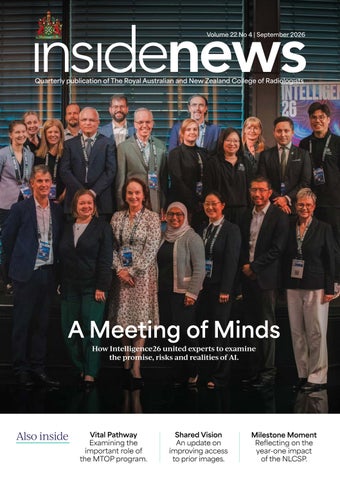
A Meeting of Minds How Intelligence26 united experts to examine the promise, risks and realities of AI.
Also inside
Vital Pathway Examining the important role of the MTOP program.
Shared Vision An update on improving access to prior images.
Milestone Moment Reflecting on the year-one impact of the NLCSP.
Now available in Australia and New Zealand
HOW IT USED TO BE Structure Only
HOW IT IS NOW
Non-Contrast Physiology
Visit us at RANZCR Stand #45
THE ONLY CONTRAST IS BETWEEN NOW AND HOW IT USED TO BE CT:VQ™ is the world’s first and only non-contrast post-processing technology that transforms routine non-contrast chest CTs into ventilation–perfusion maps with quantitative V/Q metrics. No contrast media or inhaled agents, no extra scan time, works with your existing CT fleet. Automated processing and PACS-ready outputs make physiology accessible to every read.
Trial CT:VQ today. Come to our event at RANZCR 2026. ©4DMedical 2026
Contents Volume 22 No 4 — September 2026
4 Message from the President Dr Rajiv Rattan reflects on the value of volunteering. 7 Message from the CEO Duane Findley discusses how member consultations work.
20
Features 8
Centre Stage Behind the scenes of the Intelligence26 conference.
Lifting the Lid An in-depth look at the Training and Lifelong Learning unit. 12 MTOP: A Vital Pathway The role of the program and proton therapy in cancer care.
27
17
Image Access Progress An update, and next steps.
30
Bringing Cancer Care Closer Targeting Cancer’s interview with A/Prof Kumar Gogna.
News
10
18
20
22
Woven by Design A Q&A with artist and ASM merch designer Chloē Reweti. NLCSP An update on the NLCSP, a year after launch.
Clinical Radiology
SIGs
29
GOROC The growing impact of this radiation oncology SIG. FROGG Recent activities and upcoming events. ANZSTR Save the date for in the inaugural ASM in Melbourne.
31
IR and INR Details of the new Grandparenting Pathway.
32
MATEC Connection, collaboration and culturally responsive cancer care.
35 Dean’s Message 37 Chief Censor’s Message 39
CHoPP’s Message
Radiation Oncology 41
Dean’s Message
42
QIC
44
Exams and Training
45
CHoPP’s Message
Branches & Members 46 ACT and VIC Branch Updates 47 NZ Branch Chair 49
From the Archives
51
Radiopaedia Access
Inside News is published quarterly. For enquiries, feedback or to contribute to Inside News, email editor@ranzcr.edu.au EDITORIAL STAFF Editor-In-Chief Dr Allan Wycherley Editor Arizona Atkinson
RANZCR acknowledges the Traditional Owners of Country throughout Australia. We recognise the continuing connection of Aboriginal and Torres Strait Islander people to the sky, lands, waters and culture and we pay our respect to their Elders past and present and emerging. RANZCR acknowledges Māori as tangata whenua and Treaty of Waitangi partners in Aotearoa New Zealand. All rights reserved. No part of this publication may be reproduced or copied in any form or by any means without the written permission of the publisher. Publication of advertisements and articles submitted by external parties does not constitute any endorsement by The Royal Australian and New Zealand College of Radiologists of the products or views expressed. Inside News © 2026 The Royal Australian and New Zealand College of Radiologists® (RANZCR®)
ON THE COVER Staff, speakers and organising committee members at Intelligence26 in Sydney. Photo by Stefan Whitecunas.
Have you moved recently? Log into the MyRANZCR portal and ensure your contact details are up to date at www.myranzcr.com
Volume 22 No 4 | September 2026
3
President’s Message
The Rare Gift of Time and Expertise
A timely reflection on the enduring value of volunteer service and the members whose generosity continues to shape the future of RANZCR.
Dr Rajiv Rattan
E
very one of us can point to someone who helped us along the way in our professional journeys. Perhaps it was the supervisor who stayed back after a long day to review a difficult case. The examiner who challenged us to think differently. The mentor who gave us confidence when ours was wavering. The consultant who offered to give a tutorial on a weekend in preparation for the exams. The colleague who quietly shared their knowledge, experience and wisdom when we needed it most. At the time, we may not have thought of these acts as volunteering. Yet that is exactly what they were: professionals generously giving their time and expertise so that others could grow and succeed. In many ways, that spirit of service is the foundation upon which our College was built. This year, RANZCR celebrates 91 years of serving our professions. For more than nine decades, the College has advanced radiology and radiation
4
Volume 22 No 4 | September 2026
oncology, upheld standards, trained specialists, advocated for patients and represented members. That remarkable legacy was not built by any one individual or even one generation. It was built by thousands of members who chose to contribute something extraordinarily valuable: their time, expertise and commitment to a cause greater than themselves. Today, around 700 Fellows and members continue that tradition through volunteer service. They serve as Directors of Training, Clinical Supervisors, Network Training Directors, Branch Education Officers, examiners, assessors, convenors, mentors, committee members, faculty councillors and Board directors. Most do this quietly, often outside regular working hours and without recognition, because they believe in supporting the profession and the next generation. The impact of their contribution reaches further than many members realise. Some of the College’s most important responsibilities depend almost entirely on volunteer effort. Our high-stakes training and Fellowship examinations could not function without volunteer examiners and educators. The curricula that guide training; the standards that define our specialties; the policies that influence healthcare; and the advocacy that gives our profession a strong and respected voice all rely on members stepping forward to contribute. In truth, much of what we value about RANZCR exists because someone, somewhere, decided to
give a little of themselves for the benefit of others. That gift is not insignificant. In our professions, time is perhaps the scarcest commodity of all. Clinical demands continue to grow. Research, teaching, administration and family commitments compete for our attention. For many of us, finding an extra hour can seem impossible. I understand that reality because I live it too. Yet volunteering has always represented something unique. Unlike money, time cannot be replenished. Once given, it is gone forever. That is what makes it such a powerful gift. When members volunteer, they are not simply completing a task or attending a meeting. They are investing in the future of the profession, in the colleagues who work alongside them and in the patients who ultimately benefit from higher standards of care. And while volunteering is an act of service, it is rarely a one-way exchange. Those who get involved consistently tell us about the unexpected rewards. New friendships. Stronger professional networks. Opportunities to develop leadership skills. Exposure to new ideas and perspectives. A deeper understanding of the challenges and opportunities facing our specialties. Most importantly, a sense of connection to a community of people united by a common purpose. Many volunteers begin by wanting to give back. They often discover they receive just as much in return. This message is particularly for our newer Fellows and younger members. Every generation inherits the College
President’s Message
“Much of what we value about RANZCR exists because someone, somewhere, decided to give a little of themselves for the benefit of others.”
from those who came before. The organisation we know today did not appear fully formed. It was shaped by volunteers who examined trainees, developed curricula, sat on committees, advocated for better healthcare, mentored colleagues and made difficult decisions on behalf of the profession. Now, the responsibility passes to us. If you are early in your career, please do not assume you need decades of experience before you have something meaningful to contribute. Some of the College’s best ideas come from those who see things with fresh eyes. Your perspective matters. Your energy matters. Your experience matters. Volunteering does not have to begin with a major commitment. It can start with joining a working
group, contributing to a project, mentoring a trainee, participating in an educational activity or simply putting your hand up when an opportunity arises. Small contributions often become larger ones. Today’s first-time volunteer may well become tomorrow’s committee chair, faculty leader or College President. When people ask me why I volunteer, my answer is simple. Driven by purpose, I have always found it more rewarding to help solve a problem than to stand on the sidelines and complain about it. Volunteering gives each of us the opportunity to shape the future of our professions, strengthen the communities we serve, and help ensure that radiology and radiation oncology continue to thrive for generations to come. It is one of the
most meaningful ways we can turn our experience and expertise into lasting impact. For 91 years, volunteers have been the lifeblood of this College. Every standard we uphold, every trainee we support, every examination we deliver and every achievement we celebrate is built upon the generosity of members who chose to contribute. The next chapter of RANZCR will be written in exactly the same way: by members who choose to give their time, expertise and passion in service of something bigger than themselves. I sincerely hope you will consider being part of that story. IN
Volume 22 No 4 | September 2026
5
CEO’s Message
RANZCR and Member Consultation A clear look at how member consultation shapes College decision-making and why being heard does not always mean every suggestion is adopted.
Duane Findley, CEO
O
ne recurring theme I’ve heard during my time at RANZCR, and indeed in every member association I’ve worked with, is the refrain that “we were not consulted”. Whether this is in relation to a new IT college system, a new standard or policy, RANZCR’s strategic plan, or our adoption of compulsory regulatory changes imposed on us by the government or regulator, we too often hear from an individual or small group of members that a decision was taken without their considered contribution. Or that their suggestions were ignored. The fact is, rarely if ever is a decision made by the College without extensive consultation and review from sections of our membership and other stakeholders. It is impractical for every College decision to be presented to every member for their thoughts and opinions. Not every suggestion by a member or group of members, even if they are themselves part of a member committee, will be reflected in every final decision. And some
College decisions will be made by College staff with the expertise and authority to make those decisions without reference to the members. For decisions that alter our Articles of Association, RANZCR presents a case to our members, which requires 75 per cent acceptance from members who submit a vote. If that 75 per cent level is not reached, then the proposal is not implemented. RANZCR has an extensive framework of committees, panels, and advisory and working groups, reporting through to our Faculty Councils and the Board, composed
“We all value our member input and especially those members who volunteer their time and expertise to make the College such an amazing organisation.” of elected volunteer members. Depending on their purpose and memberships, these groups participate in or contribute to a range of College initiatives on behalf of their RANZCR colleagues. These member groups employ their own skills and experience, and often source opinions from other members on current RANZCR activities before making a decision, or recommendation for consideration by a higher-level body. To help action the member fulfilment priority of our strategic
plan, in 2025 RANZCR engaged a professional scientific analysis company specialising in member experience to extensively survey, interview, and workshop various member concerns and priorities for change. RANZCR is presently using this intelligence to inform its decisions on the development of our new technology platforms while forming advisory groups to help shape these platforms. Members who feel as though they have not been consulted on an issue are welcome to raise their concern, but they should be aware that they may not have seen the consultation embedded through the entire process, or that they may have been emailed about a consultation and not responded to it at that time. They need to recognise that not having their opinions incorporated into a decision is not the same as not being consulted. Members should also be cognisant that the often-junior staff members they are working with are not the decision-makers on member consultation and should be treated with respect. We all value our member input and especially those members who volunteer their time and expertise to make the College such an amazing organisation. Understanding how our consultation processes are embedded in the organisation will help our members fully participate in strengthening our decision-making processes. IN
Volume 22 No 4 | September 2026
7
Name of feature
Centre Stage
Feature
July’s Intelligence26 conference, hosted by RANZCR, saw AI framed not as a replacement for clinicians, but as a tool that must be clinically led, safely governed and embedded in training to deliver practical gains for radiology and radiation oncology.
8
Volume 22 No 4 | September 2026
Intelligence26
Feature
W
ith the Sydney sunshine streaming through the grand ballroom at the Hyatt Regency, Intelligence26 kicked off with RANZCR President Dr Rajiv Rattan welcoming delegates and reflecting on Geoffrey Hinton’s much-publicised prediction that AI would render radiologists obsolete, a prediction Hinton has since acknowledged was wrong. Dr Rattan emphasised that AI is not a substitute for the healthcare workforce but a tool that can augment clinical expertise. He highlighted the importance of clinicians helping to shape AI policy, education and adoption. “It’s up to us to educate our policymakers to understand that AI is most successful when driven by us,” he told the room. This set the tone for an insightful two days of presentations covering the safe and practical adoption of AI in clinical radiology and radiation oncology. Next on stage, Prof Curtis Langlotz spoke of the potential of AI to reduce medical errors, presenting a clinical case study of an 83-yearold woman with a mass that was not picked up in the first round of imaging. “Human expertise and machine expertise are different,” he said. “The combination of the two is better than either one alone.” Prof Andre Dekker’s first session outlined the various stages at which AI can be utilised in radiation oncology for both efficiency and efficacy. “The short-term focus is efficiency gains. But the long-term strategy is different,” he offered. “The long-term strategy is AI-generated real-time evidence for personalised healthcare.” In the post-morning tea sessions, Prof Robyn Whittaker addressed governance and implementation; A/Prof David Kok explored how education must evolve, and the AI-related risks of de-skilling and never-skilling; Prof Ruth Carlos spoke about human-AI dissonance and the need to balance the capabilities of AI with human expertise and judgement; and Prof David Lowe discussed how AI could inform a broader shift from reactive to preventive healthcare: “My dream is an empty emergency department,” he said. The lunchbreak signalled the commencement of the RadHack workshop, where clinicians, trainees and researchers were invited to work in teams to develop practical AI solutions to real-world healthcare challenges. First place was awarded to Angelica Panopoulos and Ethan Butson. The afternoon sessions covered education, data security and sustainability, with Dr Florence Doo reminding the audience that: “Human health and the health of our planet are inextricably linked.” She suggested clinicians approach daily AI use with the same sustainability mindset as they approach daily recycling, and choose the best AI model and size to maximise efficiency per kilowatt in their practices. This was later followed by an insightful panel discussion on consent and governance issues, and lively networking drinks. Day two opened with sessions on the ‘data-driven revolution’, before separating into radiology and radiation oncology streams. Each specialty examined practical implementation, emerging technologies and realworld experiences relevant to their field, from next-generation cancer screening to treatment planning and future clinical applications of AI. The conference concluded with all delegates reconvening for a round-table discussion featuring keynote speakers, who reflected on the conference’s key themes and future direction. Panellists discussed changing workforce requirements, the potential impact of AI on clinician wellbeing and burnout, and the need for ongoing education and training. A heartfelt thank you to our convenors, Dr Martin Gunn, Prof Helen Frazer, Dr Daniel Stahlhoven, A/Prof Hyun Ko and Dr Farhannah Aly, whose efforts helped make Intelligence26 a success, and to our speakers and attendees for their valuable contributions. Volume 22 No 4 | September 2026
9
Feature
Lifting the Lid
Lifting the Earlier this year, we introduced a new series that lifts the lid on the inner workings of RANZCR. Last issue, we explored the Member Fulfilment and Information Technology units. In this issue, Brendan Grabau, General Manager of the Training and Lifelong Learning Unit (TLU), explains how the College is strengthening member-centred education and training.
Lid
10 Volume 22 No 4 | September 2026
T
Brendan Grabau, General Manager of the Training and Lifelong Learning Unit (TLU)
he approval of our first ever Education and Training Strategy earlier this year represents a fundamental shift for RANZCR, from simply being a conduit for external learning content to becoming a direct education and training provider. Under this strategy, the College will develop learning resources that are specifically tailored for our professions, maximising and leveraging our comprehensive teaching, research and clinical expertise. For members, this means access to high-quality, evidence-based learning that is tailored to their professional context, reflects contemporary practice and supports them to work across Australia and Aotearoa New Zealand. RANZCR’s education and training is already regarded as the gold standard, with no comparable training provided by any other country. That said, the College is continually evolving as a partner in our members’ lifelong learning, and we are currently coordinating multiple efforts to strengthen our support for members and further embed a service excellence mindset throughout the organisation. The College is also working to consolidate learning resources into an easily accessible learning management system: a centralised education and training hub that gives learners a single front door to the resources they need.
Lifting the Lid
The TLU is also improving CPD offerings so members can more easily find accredited activities and record them against the relevant domains. At the same time, the College continues to expand members’ access to high-quality, diverse external learning resources. With the engagement of medical educationalists, the College is also strengthening support for supervisors and Directors of Training (DoTs), providing more upskilling options, and offering additional peer support and networking opportunities. A new dedicated International Medical Graduate (IMG) support officer position has also been created, specifically tasked with assisting IMGs. Together, these initiatives form an integrated education and training ecosystem that prioritises members’ needs, offers greater choice, and provides easier access to quality accredited learning, activities and medical education expertise. Alongside this member-focused education work, TLU is also contributing to broader system challenges that affect access to specialist care across Australia and Aotearoa New Zealand. Within the broader healthcare landscape, where governments and communities continue to grapple with health workforce shortages and maldistribution, the College is exploring the establishment of a dedicated regional and rural training pathway. The pilot Regional and Rural Training Pathway (RRTP), which is still underway, has received unanimous support from training sites, Directors of Training, Network Training Directors and trainees, for the establishment of a permanent regional and rural training pathway. Participants also agreed that the ‘train to retain’ model is an effective way to address workforce maldistribution in regional, rural and remote locations, improve equity of access for these communities
and expand career opportunities for clinicians who wish to practise outside metropolitan areas. With respect to IMGs, in addition to the defined scope pathway that commenced in 2025, the College has launched the IMG limited scope pathway, which also helps address workforce shortages and maldistribution while upholding the standards expressed in RANZCR’s IMG policy. From a regulatory perspective, the TLU plays a significant role as the College’s primary interface with regulators—a vital function that ensures that RANZCR maintains regulatory compliance and ultimately protects the College’s ability to train specialists and award Fellowships for our professions. Members may be surprised to know that the College’s regulatory obligations have increased significantly over the past two to three years. Where RANZCR once worked primarily with the Australian Medical Council (AMC) in Australia and the Medical Council of New Zealand (MCNZ) in Aotearoa New Zealand, the regulatory environment now includes: AMC and MCNZ National Health Practitioner Ombudsman Medical Board of Australia Australian Health Practitioner Regulation Agency (Ahpra) Health Workforce Taskforce Department of Health, Disability and Ageing Multiple jurisdictions (state and territory governments). These mounting regulatory obligations are requiring significantly more staff time to respond to, report on and satisfy multiple, and at times overlapping, requirements and standards. It is against this backdrop that the College continues to strongly advocate on behalf of our members for a sensible regulatory environment that enables, rather than hinders, professional
Feature
excellence and places sustainability and equitable patient access at the centre. While this work is timeconsuming, it is nonetheless vital to protect and advance our professions by ensuring we maintain our independence and reputation as an authoritative and trustworthy organisation whose professions and members meet the highest standards. Together, this work positions the TLU as one of the College’s most operationally complex units: both a risk-containment function and a strategic growth engine for RANZCR. This work ensures the College: remains fit-for-purpose under increasing regulatory scrutiny can scale education delivery efficiently can grow education offerings without a proportional growth in cost. Most importantly, the College seeks to ensure that our members receive world-class education and training, excellent professional and pastoral support, and easy access to quality accredited resources that enable them to practise at the highest possible benchmarks throughout their careers. IN
Education and Training Snapshot Nearly 1000 trainees in training Over 250 accredited training sites An additional 150 accredited IMG (Area of Need) sites 22 different examinations are run by the TLU annually Written examinations are delivered in Aotearoa New Zealand, Australia and Singapore NZ saw the largest intake of clinical radiologists in 2026, who will commence training in 2027 with additional training sites in regional locations such as Invercargill.
Volume 22 No 4 | September 2026
11
Feature
MTOP
MTOP: A vital pathway for proton therapy
Dr Tuan Ha, A/Prof Claire Phillips and Dr Eunji Hwang share their perspectives on the important role of the MTOP program and proton therapy in cancer care.
Dr Tuan Ha, Dean of the Faculty of Radiation Oncology
A/Prof Claire Phillips, Chair of the Particle Therapy Working Group
12 Volume 22 No 4 | September 2026
Dr Eunji Hwang, MTOP Assessor
The Medical Treatment Overseas Program (MTOP) is a federal government initiative that provides financial assistance for eligible Australians with a life-threatening medical condition to access life-saving medical treatment overseas when effective treatment is unavailable in Australia.
The Role of RANZCR
RANZCR has long championed the establishment of domestic proton beam therapy (PBT) facilities for Australians, to enable patients and their families to access this treatment locally. So in 2017, when the government announced funding to establish Australia’s first proton therapy centre in Adelaide (the Bragg Centre), the College initiated a Particle Therapy Working Group to prepare for and support the clinical implementation of this treatment. “Implementing this treatment entails so much more than simply
MTOP
installing a machine. We needed to be proactive to ensure that the multiple aspects for all involved in delivering PBT were properly considered,” says A/Prof Claire Phillips. However, given the ongoing uncertainty around the commencement of a first particle therapy facility in Australia, and the lack of locally based PBT alternatives, Australian patients needing PBT must continue to travel overseas for this treatment. MTOP has therefore become a vital pathway for patients and their families seeking access to this lifesaving therapy.
How MTOP Works
“RANZCR members play a pivotal role as MTOP assessors, volunteering their time and expertise to assess the detailed applications to this program,” says Dr Tuan Ha. Dr Eunji Hwang has been an MTOP assessor for more than two years and has also been involved as an applicant to MTOP on behalf of her patients. “There is a very clear and detailed application process for people applying to
MTOP (which has recently been revised and improved), whose final determination is based on: the rationale for PBT whether they’ve been accepted by an overseas centre a side-by-side comparison between photon/proton therapy for the patient where required. “Each application is de-identified and allocated to two clinicians to provide an independent clinical assessment,” says Dr Hwang. “Where necessary, a third assessor may be involved to achieve twothirds agreement that culminates in a final determination and concise written response. “While many countries offer PBT, Australia tends to refer to a smaller pool, usually to clinicians and centres where we have a professional relationship and are confident in their expertise and broader care for patients, particularly in the case of paediatric patients,” she says.
Impacts of MTOP
“Typically, patients are very grateful to be able to access this treatment option. Nonetheless, there is often
Feature
considerable angst in the lead up to the decision, and travel overseas for cancer treatment can be very stressful,” says Dr Hwang. “All involved in delivering MTOP need to understand the real-life complexities, financial and other costs, and logistical factors involved. Equity of access is a big issue,” adds A/Prof Phillips. While flights are covered by MTOP, families may need to pay for other upfront costs including urgent passports (where needed) and accommodation for carers and the parents of paediatric patients. Living expenses are not funded and families may be further affected by the loss of income for parents and carers unable to maintain their employment while overseas. “Families without the financial resources to meet these costs, and those who have additional caring responsibilities, including single parent households, are particularly impacted,” she says. “Equally important are the multidisciplinary inputs and expertise that are essential to making these decisions—having the right staff involved: radiation oncologists, physicists and radiation therapists. “Educating patients and their families about the efficacy of PBT is also essential—as is distinguishing between photon and proton therapy and helping them understand what’s involved, pre-, during and post-treatment,” says A/Prof Phillips. “While many patients and families have growing awareness of PBT, this is often via less reliable information sources including online forums. It is therefore vital that patients and families, with the support of and oversight by an Australian radiation oncologist, understand all the options that are most appropriate for them. One size (in this case, PBT) does not fit all,” she says. Dr Hwang agrees. “Having been involved in applications to MTOP
Volume 22 No 4 | September 2026 13
Feature
MTOP
on behalf of patients, it is clear that PBT is not a universally appropriate treatment option. Its role requires a careful and highly nuanced discussion, ensuring that patients and families understand both its potential benefits and its limitations. “The principal advantage of PBT lies in its ability to reduce radiation exposure to surrounding normal tissues and thereby lessen the risk of treatment-related toxicity. For some patients, this reduction in acute and long-term side effects may represent a meaningful improvement in quality of life and long-term health outcomes. However, the magnitude of this benefit varies considerably between clinical scenarios and is not always clinically significant.” The greater public and professional awareness is translating into increasing referrals to MTOP. “We expect that the year-on-year growth in MTOP applications is likely to continue for the foreseeable future,” says Dr Ha.
How the College is Responding
“Much of the work we’ve completed and that is still in progress is designed to streamline the MTOP
14 Volume 22 No 4 | September 2026
application process, make this much more accessible for patients and lead to faster turnaround times for assessments,” says Dr Ha. This includes: an accelerated process for specific conditions where comparative planning is no longer required, thereby improving access for conditions commonly treated by PBT achieving Medicare funding for comparative planning where this is required achieving funding for MTOP administration costs currently being absorbed by the College (very welcome given the increased volume of applications) developing a PBT-specific application form creating a succinct and ‘plain English’ position statement that is accessible to patients and families.
The Future of PBT in Australia
“Our current focus is on establishing a national review body for MTOP applications involving radiation oncologists, physicists and radiation therapists,” he says. “This will build the capability of Australian clinicians by increasing their understanding of PBT, especially for those who have not had much exposure to this therapy. “It will also foster trusted professional relationships between clinicians across all jurisdictions, creating a national, cohesive and shared care approach to PBT in Australia, and establishing a national pathway for treatment,” says Dr Ha.
“Such an approach offers valuable opportunities for multidisciplinary input, and aligns with what already happens in a clinical setting,” adds A/Prof Phillips. The College continues to call for a coordinated, nationally funded framework to ensure equitable access to PBT, and travel and accommodation support for regional and remote patients, regardless of state or territory borders. Meanwhile, the growth in MTOP referrals underlines the need for more MTOP assessors. “I would definitely encourage radiation oncologists to become involved as MTOP assessors. You don’t need to be an expert in PBT. This therapy is increasingly being integrated into radiation oncology practice, and the principles around planning are similar as for other treatments,” says Dr Hwang. “It has been very rewarding for me, and I think it’s essential that more radiation oncologists have an understanding and appreciation of PBT. As clinicians and as a College, we need to be part of the ongoing conversation about this treatment and have the opportunity to be at the forefront of new technologies in Australia.” A/Prof Phillips and Dr Ha agree. “Becoming an MTOP assessor offers Australian radiation oncologists (particularly those working with head/neck cancers, brain cancers, sarcoma) great learning opportunities to better understand what proton therapy can offer their patients,” says A/Prof Philips. “We express our sincere gratitude to the clinicians who volunteer their time as assessors, and acknowledge and thank the government for providing the MTOP program,” says Dr Ha. “I also warmly encourage members who are interested in participating as an MTOP assessor to contact us via faculty@ranzcr.edu.au, and consider attending the upcoming Particle Therapy Symposium to be held at Westmead Hospital on 3–4 December 2026.” IN
Seeking Radiologists across our network. Live the future you deserve with Lumus Imaging. opportunities@radiologists.lumusimaging.com
Join Us At Lumus Imaging, we are passionate about caring for our patient’s health and wellbeing. We are seeking Radiologists committed to advancing their career to join our network. Our Radiologists are supported by our advanced technology, collegiality, case mix, commitment to flexibility and our dedication to education. We offer: n Dedicated to offering best in class technology n Varied flexible work arrangements to support your priorities n Education and development opportunities n Sub specialty reporting available n Clinical excellence and collegiality n Market leading remuneration
150 Sites Nationally
2,000 Employees
Positions Available: NSW:
Port Macquarie / Orange / Dubbo / Tamworth / Ryde / St George Private / Foster / Taree / Sutherland / Maroubra / Hornsby
QLD:
Sunshine Coast / Caboolture / Northern Brisbane / Southern Brisbane / Northern New South Wales
VIC:
Warrnambool / Northern Private Hospital / Paediatric / Werribee and Richmond
WA:
Rockingham
TAS:
Launceston
Fellowships / Full Time / Part Time Locum and after hours home Tele-Radiology reporting available in each state.
People / Quality / Customer Experience
lumusimaging.com.au
13 – 15 August 2027 The Cordis Hotel Auckland
www.ranzcr2027.co.nz
JOURNAL OF MEDICAL IMAGING AND RADIATION ONCOLOGY
Volume 68 • Issue 7 • October 2024 • Pages 781–870
NEW ZEALAND ASM 2025
15 -17 AUGUST 9ठ0.3&
<*11.3,943
t W ha
o In We D
Volume 68 • Issue 7 • October 2024 • Pages 781–870
SEPTEMBER WELLINGTON 2026 ISSUE OUT NOW.
Head and neck injury patterns from electric scooter Role of IR services rural/remote Australia Joint position statement on autonomous AI Optimising PTV margins Oesophageal cancer
The Shadows
www.ranzcr2025.co.nz
Access your College journal online ARA_v68_i7_cover.indd 1
If you are a member of The Royal Australian and New Zealand College of Radiologists, access JMIRO free online. • go to www.ranzcr.edu.au • Log in using your College username and password = Free access to all JMIRO current and digitised backfile content from volume 1, 1957!
16 Volume 22 No 4 | September 2026
24-10-2024 13:23:10
Digital Health
Feature
Image Access Progress
An update on the Image Access Strategy Report and the next steps towards improving access to prior imaging across Australia.
Dr Nick Ferris, Digital Health Committee Chair
I
mproving access to prior images has been a College focus for many years. RANZCR has collaborated with a wide range of stakeholders in the diagnostic imaging sector to draw government attention to this issue, and encourage the development of workable solutions. There is now a real chance to advance this work. The Image Access Strategy and Consultation Report, submitted last March, represents an important step forward, integrating perspectives of clinicians, providers, government and industry to identify where we are, and what to improve. The work has been supported by the College’s Joint Informatics Advisory Committee (JIAC), which brings together clinical and informatics expertise to advise on the practical considerations involved in improving image access across healthcare settings. The goal is straightforward: regardless of where the image data are held, appropriately authorised clinicians should have access to all relevant images, whenever and wherever they require it. The barriers are administrative, rather than
technical. Seamless access facilitates safer clinical decisions, reduces the need for repeated imaging, and improves the continuity of care. The report received strong collaboration across the sector. The Australian Diagnostic Imaging Association (ADIA), which worked with the College on the strategy and consultation report, highlighted that improving image access is essential to delivering more efficient and patient-centred care across both public and private settings. Referring clinicians echoed this requirement: the Australian Orthopaedic Association emphasised that prompt access to imaging is critical for clinical management, particularly in acute or complex cases. The need for seamless image access goes well beyond one specialty; it is key to the performance of the healthcare system overall. Drawing on reviews of existing infrastructure and best practices, stakeholder consultations, workshops and surveys, the report identifies key enablers for easier discovery, review and retrieval of prior imaging studies. These include the use of standard patient identifiers, e.g. the Individual Healthcare Identifier; adoption of standard terms for radiology examinations (from the Radiology Request Set); implementation of a single sign-on system for access to the national e-health network (via the Health Connect Australia project);
and development of a ‘locator service’ able to search registries of imaging studies around the country in order to find all of a patient’s relevant previous imaging studies. The immediate goal is for the College, working alongside government, ADIA and sector partners, to use these recommendations to inform detailed design of the processes that will enable better access, integrated into clinical workflows. There is still work to be done, but key building blocks are in place, and there is significant momentum. Following the recent Federal Budget, the Australian Digital Health Agency, in collaboration with the College, ADIA, and other stakeholders, has commenced a program to identify standards and profiles to underpin the management and seamless exchange of digital images in Australia, within the framework of the Health Connect Australia program. Recommendations are due by mid-2027. I would like to thank all our members and stakeholders who have shared their time and expertise so far. Their perspectives have been critical in establishing a clear and practical path forward. With ongoing collaboration, we shall move closer to implementing a system in which seamless access to prior imaging is the rule, rather than the exception. Visit www.ranzcr.com/document/ image-access-strategy-report/
IN
Volume 22 No 4 | September 2026
17
Targeting Cancer
News
Bringing Cancer Care Closer
A conversation with paediatrician turned radiation oncologist A/Prof Kumar Gogna, founding director of Radiation Oncology Queensland (later Icon Group), and lifelong advocate for equitable access to radiation therapy.
F A/Prof Peter Gorayski, Co-Lead, Targeting Cancer
Dr Lucinda Burke, Co-Lead, Targeting Cancer
18 Volume 22 No 4 | September 2026
ew careers embody the mission of Targeting Cancer as completely as A/Prof Kumar Gogna’s. Across nearly five decades—first as a paediatrician serving remote Northern Territory communities, including East Arnhem Land, and then as a radiation oncologist who helped seed treatment services across regional Queensland—he has pursued a single question: how do we bring good cancer care closer to the people who need it? As one of three founding directors of Radiation Oncology Queensland in 2007, Kumar helped build what grew into one of Australia’s largest cancer care providers (Icon Group). He established Queensland’s first prostate seed brachytherapy program, led TROG trials that helped establish bladderpreserving chemoradiation, examined RANZCR Part II Fellowship candidates for more than a decade, and has mentored radiation oncology teams from Singapore to Mongolia. His story is also the story Targeting Cancer exists to tell: that radiation therapy is safe, effective and central to modern cancer care, and that too many patients who stand to benefit still miss out. We are delighted to share an excerpt of his interview with Inside News readers; the full conversation is available on the Targeting Cancer website.
News
“What he taught me is something no trial result can: the goal is never simply to treat the disease, but to protect the whole person and the life they want to keep living.”
IN CONVERSATION WITH A/PROF KUMAR GOGNA
A/Prof Kumar Gogna
In 2010 you co-authored ‘GAP’ in Radiotherapy Services in Australia and New Zealand in 2009. Fifteen years later, has that gap closed, widened, or just shifted? That paper showed that only about 30 per cent of cancer patients in Australia and New Zealand were receiving radiation therapy, when the evidence suggests the figure should have been just over 50 per cent. We also had far too few treatment machines to meet that need, and the shortfall was worst in regional areas. Fifteen years on, the picture has improved but not enough —utilisation now sits around 40 per cent. We still don’t have the machines, the departments or the trained staff that optimal care requires. And with cancer becoming more common as the population grows and ages, demand will keep climbing. Unless both federal and state governments stay alert to this and keep funding in step with need, the gap will simply re-open in a new form. Across nearly 50 years of medicine, is there a patient whose story has stayed with you and what did they teach you that the trial data alone never could? One patient stays with me. In 2024 a man in his forties, with a young family, was found to have an aggressive cancer in a deeply
Targeting MATEC Cancer News
personal part of the body. The standard recommendation was radical surgery, an operation that would have left him profoundly changed, with a heavy toll on the life ahead of him. There was very little in the medical literature to guide us. At our team meeting I argued for an alternative: intensive radiation and chemotherapy, keeping surgery in reserve only if we needed it. He and his urologist chose that path. He came through the treatment well, his pain settled, and scans a few months later showed the cancer had completely disappeared. What he taught me is something no trial result can: the goal is never simply to treat the disease, but to protect the whole person and the life they want to keep living. Sometimes the gentler option is also the right one. You just have to be willing to look for it. If there were one message about radiation therapy you could share with the Australian public that hasn’t yet landed, what would it be? If there is one thing I would want every Australian to know, it is that radiation therapy is safe, effective and a core part of treating many cancers, sometimes on its own, sometimes alongside surgery or chemotherapy. Modern treatment is remarkably precise: we target the cancer while sparing the healthy tissue around it, so side effects are usually mild, localised and manageable with the right support. For many people, it offers a cure. For others, it controls the disease and extends life. And when cancer is advanced, it can ease pain and other symptoms so people live more comfortably. My hope, in whatever time I keep working, is simply that it becomes far better understood than it is today. IN Read the full interview with A/Prof Kumar Gogna at www.targetingcancer.com.au
Volume 22 No 4 | September 2026 19
Feature
Q&A
Woven by Design
Q&A To begin, can you tell us a little about your professional background and what led you to this kind of design work? My graphic design practice specialises in kaupapa Māori (Māori issues and topics), creating culturally grounded visual communication. I work at the intersection of contemporary design and te ao Māori (the Māori worldview) to develop designs underpinned by mātauranga Māori (traditional Māori knowledge systems), robust research and meaningful engagement. I have previously held creative roles as a graphic designer at the Museum of New Zealand Te Papa Tongarewa and Wētā Workshop. This phase of my career allows me to pursue the work I love and can continuously learn and develop from. I also enjoy creating work that uplifts and shares our cultural values and perspectives. How did you interpret the RANZCR ASM theme of “He waka eke noa”
20 Volume 22 No 4 | September 2026
and how did it influence your creative decisions? He waka eke noa is a well-known whakataukī (proverb) in Aotearoa and was the starting point for this concept. I began by exploring Māori visual language connected to the ocean, particularly the pūhoro—a traditional motif used in māori art and tā moko (tattoo)—which established the compositional framework. I went on to explore elements that abstractly spoke to the uniqueness of our environment here, the idea of collaboration and common purpose. One of the references is Te Rā, the only surviving traditional Māori sail used on waka (canoe) prior to European arrival. It is a peak example of Māori engineering and weaving, embodying knowledge of navigation, natural materials and the environment. The sail itself is created through the collective work of many weavers, making it a great metaphor for collaboration and shared purpose. As part of my research, I had a wānanga
Chloē Reweti is an acclaimed graphic designer based in Te Whanganui-a-Tara Wellington. Chloē recently collaborated with RANZCR to create bespoke Māori designs for our 2026 ASM merchandise. Here, we asked Chloē to share a bit more about her creative process and the rich symbolism within the work.
with my cousin Bridget Reweti, a practising Māori artist who is currently learning to weave a waka sail. She shared its distinctive weave patterns and showed me photographs documenting its construction. We discussed how aspects of the sail and ocean could be interpreted metaphorically to support RANZCR’s theme, allowing the design to be grounded in cultural knowledge. The ocean, the sky and the wind are all referenced in the work— tell us more about how you used these symbols. In Māori navigation traditions, wind and birds were essential guides across the vast Pacific Ocean. Navigators observed the movement, direction and qualities of winds to determine pathways, adapt to changing conditions and propel across great distances. In this artwork, references to the sky and wind symbolise challenge and momentum. Birds represent insight, proximity to land and the
Q&A
ability to find pathways forward even within vast and complex environments. Together, they speak to resilience, collective knowledge, and the continual pursuit of understanding. The stylised hand graphic featured in the design is drawn from whakairo (Māori carvings)—can you share more about this reference and how it connects to the broader meaning of the artwork? The stylised hands draw from the abstract visual language of whakairo (Māori carving), where forms are intentionally expressive rather than anatomically realistic. In Māori artforms, hands are often used to represent whakapapa (heritage and genealogy), connection and enduring presence of tīpuna (ancestors) within the narrative. Within this design, the hands
reference Tangaroa, god of the ocean, and speak to the deep ancestral relationship Māori hold with the moana (ocean). For Māori, the natural world is understood as genealogically connected to people, with elements of nature viewed as embodiments and descendants of ancestral beings. The hands acknowledge the ocean as a living ancestor that sustains, connects and carries whakapapa across generations. What was your process for adapting the artwork across different merchandise items, and were there any creative challenges or opportunities in that stage? There are aspects of noa and tapu in cultural design. These are complementary concepts that help guide how people, places and objects are understood
Feature
and respected. Tapu refers to something that is sacred and carries specific cultural importance. Noa is the state of being balanced or unrestricted. In a design context, these concepts encourage thoughtful decision-making about how cultural narratives, symbols and imagery are used. Rather than being decorative, we consider the meaning, purpose and context of a design, ensuring it is applied with respect and integrity. What do you hope attendees notice, feel or reflect on when they view the artwork? I hope they see and feel the beauty of Māori culture and everything it has to offer, but also the depth and richness of our culture and how special it is to be able to share it with them. IN
Tote bags, passport holders and socks featuring Chloē Reweti’s custom artwork will be available to members via the RANZCR booth at the 2026 Christchurch ASM. www.ranzcrasm.com
Volume 22 No 4 | September 2026 21
Feature
NLCSP
Earlier Detection, Better Outcomes Just over a year after launch, the National Lung Cancer Screening Program (NLCSP) is enabling earlier diagnoses, clearer pathways, and better outcomes for people at high risk of lung cancer, with radiology expertise at its core.
A
s Australia’s first new national cancer screening program in two decades, the NLCSP uses low-dose CT to support earlier detection of lung cancer in eligible high-risk people. For patients, these first-year results demonstrate the potential of organised screening to detect cancer sooner, when treatment options are broader and more likely to be effective. RANZCR President Dr Rajiv Rattan says the first-year results reflect strong collaboration and radiology’s essential contribution to patient care. “The first year of the National Lung Cancer Screening Program is something our profession can be proud of,” Dr Rattan says. “Behind every low-dose CT scan is a radiologist bringing specialist expertise, careful judgement, and a deep commitment to patient care. By supporting this program in practices and communities across Australia, radiologists are helping more people access earlier detection, appropriate followup, and timely care. I thank our members for the leadership, time and expertise they have contributed, and for the role they will continue to play as the program grows.” The landmark program has brought together government, clinical and community partners to support a coordinated national rollout. RANZCR and ANZSTR have helped shape implementation, working with Cancer Australia, the Department of Health, Disability and Ageing, and other stakeholders to support safe, consistent and highquality program delivery.
22 Volume 22 No 4 | September 2026
The First Year in Numbers 103,963
Australians enrolled in the National Cancer Screening Register
285
new participants joined each day on average
102,500+
low-dose CT scans completed
900+
participating radiology practices
269
primary lung cancer diagnoses identified*
*Documented diagnoses without large-scale data linkage; the real figure is likely higher
This includes guidelines for image acquisition, structured reporting, nodule management and the management of additional findings found on low-dose CT. A comprehensive education program has been delivered, with webinars, workshops and online modules developed by ANZSTR experts to support consistent reporting, build radiologist capability and strengthen sector readiness. Radiologists sit at the centre of the screening pathway. While low-dose CT is the cornerstone of the program, its impact depends on the expertise behind each scan: identifying subtle nodules, applying structured reporting, recognising significant findings and helping
“The first year of the National Lung Cancer Screening Program is something our profession can be proud of...”
guide the next step, from routine screening to closer monitoring or specialist care. The program also reinforces the importance of equitable access. Designed with culturally safe participation in mind, including for Aboriginal and Torres Strait Islander peoples who are disproportionately affected by lung cancer, it is helping extend screening to those who need it most. In rural and remote communities, mobile services are bringing screening closer to eligible people facing barriers to care. As implementation continues, RANZCR will work with ANZSTR, government and sector partners to advocate for sustainable arrangements that support radiologists and practices while maintaining high standards of quality and safety for patients. The NLCSP is a powerful example of collaboration in action: clinically led, nationally coordinated and focused on improving outcomes for patients and communities. IN
NLCSP
AI in Lung Cancer Screening
AI is an important ally in the NLCSP, but radiologists must remain vigilant to ensure accurate interpretation, reporting and patient care.
Dr Miranda Siemienowicz, ANZSTR Chair
A
s the NLCSP matures, we are seeing the strengths of artificial intelligence (AI) tools to support radiologists with this work. It is timely to consider the risks taken on by the radiologist when working alongside AI. In the context of the NLCSP, these lie in both clinical interpretation and report production. Software approved by the Therapeutic Goods Administration for nodule detection and measurement typically identifies nodules and offers classification as solid, part solid or non-solid. Airway nodules, atypical pulmonary cysts and intrapulmonary lymph nodes are managed using tailored guidance in the NLCSP and are not usually specifically identified by automated tools. Nodules in some locations, such as abutting bronchovascular bundles, are more prone to be missed by computeraided detection. Non-nodule findings, such as atelectasis or scarring, can result in false positives. Many tools generate an automated PanCanadian nodule malignancy risk calculation (PanCan risk) for detected nodules. This calculation is performed indiscriminately by the software,
whether the nodule is a granuloma, normal intrapulmonary lymph node, or a legitimate indeterminate nodule requiring surveillance. The radiologist must determine if the calculation is applicable or whether alternative guidance is required according to the NLCSP Nodule Management Protocol. Furthermore, the risk score may be generated for every nodule on every study; PanCan risk only pertains to nodule management at the baseline timepoint, if no prior imaging is available, and only for some nodule types.
“Be aware of the source data for any AI tools active in your department...” It is critical that reliable sources are used when generating risk calculations in clinical practice. UpToDate hosts a user-friendly interface for the PanCan (Brock University) risk calculator. The widely known calculator hosting website OncoToolkit was recently found to be hosting an erroneous algorithm for the PanCan calculator. Although scores generated since 27 July 2026 are correct, any use prior to this is invalid, with historic reports at risk of mis-categorisation of participants in the NLCSP. Be aware of the source data of any AI tools active in your department, and confirm that calculation outputs correlate with a trusted source. Measurement of nodules in the NLCSP is according to standard
Feature
definitions. Know whether your AI tool is measuring maximal or mean diameter, and which planes are being used to derive these figures. You may still need manual measurements if your software uses alternative definitions. Many AI applications offer some interpretation of non-nodule findings. This may be limited, for example, to emphysema, coronary artery calcified plaque and lymphadenopathy. Significant nonnodule findings extend far beyond this and are routine practice for clinical radiologists. One in four males and one in three females undertaking screening for lung cancer are found to have low measured bone density on CT, requiring bone densitometry. Every lung cancer screening report must document all health-significant findings. The NLCSP Structured Clinical Radiology Report (SCRR) is the only approved written report format for the NLCSP. Many AI vendors offer automated report generation, and some explicitly claim compliance with the NLCSP despite automated report output outside of the SCRR. Core clinical data must be reproduced across all participant documentation, including Assigned Nodule Number, nodule anatomical location and nodule series and image numbers. Measurements that lie outside NLCSP definitions should not be included. The reporting radiologist remains ultimately responsible for the compliance of their report format with the SCRR. Free on-demand webinars and self-paced e-modules remain available for guidance around the Structured Clinical Radiology Report, the use of artificial intelligence in the NLCSP and the Nodule Management Protocol. When we work mindfully alongside artificial intelligence, we leverage Scan or click the QR these supports and further codepowerful to access NLCSP resources learning the goal ofand saving lives through lung modules IN cancer screening.
Volume 22 No 4 | September 2026 23
2026 Nisbet Orator: Nathan Fa’avae
REGISTER NOW ranzcrasm.com 24 Volume 22 No 4 | September 2026
ASM
Connecting in Christchurch With one month to go, RANZCR ASM 2026 is set to bring delegates together in Ōtautahi Christchurch for world-class research, hands-on learning and valuable connection.
W
ith just one month to go, excitement is building for the 2026 ASM, where delegates will gather in Ōtautahi Christchurch under the theme Better Together, He waka eke noa. Held from 22–24 October at Te Pae Christchurch Convention Centre, this year’s Annual Scientific Meeting will bring together clinical radiology, radiation oncology, interventional radiology and interventional neuroradiology for three days of learning, discussion and connection. The theme recognises the collective effort embedded in modern healthcare, and the central role the specialties play in delivering high-quality patient care through innovation and shared expertise. One of the meeting’s key drawcards will be the calibre of international expertise joining the program, including photon-counting CT experts Dr Michael Lev and Dr Fides Schwartz from Harvard, and Siemens Healthineers Head of Research Dr Steffen Kappler. According to Radiology Convenor Dr Anthony Butler, all three have noted the high-quality radiology research underway in Christchurch as one of the reasons they are travelling to Aotearoa New Zealand for the ASM. That research includes plans to conduct photon-counting CT imaging on about 800 volunteers from the Christchurch Health and
Development Study, one of the world’s most prestigious longitudinal studies. It is a powerful example of Christchurch’s growing reputation as a world-leading centre of radiology research, and a reminder that innovation is strongest when clinical practice, research and technology move together. Gain a global perspective on the future of radiation oncology as leading experts from ASTRO, ESTRO and the RCR explore cutting-edge developments, multidisciplinary collaboration, and the opportunities and challenges shaping cancer care worldwide. Hands-on workshops will complement the program, giving delegates the opportunity to apply new knowledge, explore real-world cases and learn directly from experts in a collaborative setting. On Friday morning, the Women in Leadership session will begin with a light breakfast before the formal session opens. Prof Christine Glastonbury will deliver a presentation, followed by a panel discussion facilitated by Dr Emmeline Lee and Dr Dushi Rasanathan, featuring Prof Supriya Chopra and Dr Melissa James. The session promises an energising start to the day, with reflection and discussion on leadership across the specialties. The sold-out exhibition hall will be a lively hub for delegates to
Events
2026 Organising Committee
Clinical Radiology Dr Verity Wood, Dr Alana Heath and Dr Anthony Butler Radiation Oncology Dr Feng-Yi Soh and Dr Ramesh Pandey Interventional Radiology & Interventional Neuroradiology Dr Howard Lee Radiology Trainee Representatives Dr Hannah Scowcroft and Dr Erika Stark Radiation Oncology Trainee Representatives Dr James Kennedy and Dr Visharn Sathiyakumar
meet sponsors, explore the latest products and services, and continue conversations between sessions. Networking events and the Gala Dinner will offer further opportunities to reconnect with colleagues and meet new peers across Australia and New Zealand.
Targeting Cancer Fun Run
What better way to start the final day of the conference than with a run or walk through beautiful Hagley Park? With thanks to Brainlab for its support, the Targeting Cancer Fun Run will raise awareness of radiation therapy while bringing delegates together outdoors. Participants can also join the RANZCR Strava Community and share their runs or walks in the lead-up to the event. From world-class research and emerging technology to workshops, leadership conversations and collegial events, the ASM is shaping up to reflect its theme. Together, delegates will share knowledge, celebrate progress and consider the future of our professions in a changing healthcare landscape. IN View the most up-to-date information on the ASM website www.ranzcrasm.com
Volume 22 No 4 | September 2026 25
ARGANZ MEETING
MARCH 20 - 21, 2027 SOFITEL SYDNEY WENTWORTH
INTERNATIONAL KEYNOTE SPEAKERS
Prof Victoria Chernyak Columbia University United States
Friday 19 March
ARGANZ.ORG
Prof Matthew Davenport Michigan Medicine United States
ARGANZ workshop on Rectal, Renal, and IBD Imaging
LI-RADS/HPB Workshop
arganz_online
Prof Stuart Taylor University College London United Kingdom
Young ARGANZ Trainee Day
arganzradiology
arganz_online
GOROC
SIGs
GOROC’s Growing Impact Calling radiation oncology Fellows and trainees with a special interest in gynaecological cancer.
Dr Robyn Cheuk
T
Dr Tiffany Daly
he Gynaecology Oncology Radiation Oncology Collaboration (GOROC) is a special interest group (SIG) connecting radiation oncologists treating gynaecological malignancies. Gynaecological malignancies continue to cause significant morbidity and mortality. The anticipated reduction in locally advanced cervix cancer with HPV vaccination and changes to screening has not been realised in the clinic. The incidence of uterus cancer has doubled over the past 20 years, and mortality has increased. External beam radiation therapy (EBRT) and brachytherapy (BT) remain essential modalities for these malignancies, in addition to rarer vulva and vaginal cancers, highlighting the importance of a strong unified voice from radiation oncologists. GOROC has advocated for high-quality brachytherapy (BT). It remains an essential component of treatment of locally advanced cervix cancer. Technological advancements such as SBRT do not replace or negate the need for BT, with the evidence showing worse survival when SBRT is substituted
for BT. BT requires considerable expertise, infrastructure and logistical coordination. Technical aspects have evolved, with best practice guidelines dictating image guided adaptive BT (IGABT) using MRI, volume rather than point based planning and greater use of interstitial applicators, all of which improve tumour control and reduce toxicity. Patterns-of-care surveys conducted by GOROC have found considerable variation in access to BT and use of IGABT, with significant impediments acknowledged, including lack of access to MRI for planning, training opportunities and access to operating theatre time.1,2 We appreciate the pivotal work of Dr Viet Do, our inaugural Chair, in the successful revision of MBS item numbers for BT that appropriately reflect the complexity, logistics and expertise. We are also working to expand access to MRI for cervix cancer to assess response to EBRT and inform IGABT, consistent with the evidence-based standard. The MSAC Executive has supported the proposed amendments to cervical cancer MRI MBS items, although these await Government budgetary approval. Members are also collaborating with the National Gynaecology Oncology Registry (NGOR), a clinical quality registry developed to monitor the quality of care for Australian patients. We appreciate Dr Stephen Thompson’s work in establishing a minimum data set for RT for cervical cancers. This can apply to New Zealand patients in anticipation of the development of a similar registry.
Through collaboration with ANZGOG, GOROC has driven research efforts in Australia and New Zealand, giving us a seat at the table in important practice changing international trials. We are indebted to Dr Pearly Khaw for her vision, not only in establishing GOROC, but the prominent role she continues to play in advocating for our participation in research. GOROC has coordinated many educational opportunities, with regular workshops and webinars with international experts. This year we are delighted to host a gynaecology session at the RANZCR ASM in Christchurch, and to host Prof Supriya Chopra of the Tata Memorial Centre, Mumbai, to share her valuable experience in pelvic reirradiation. We look forward to seeing many fellows and trainees in Christchurch, and invite those interested to join us for our twiceyearly meeting, or to join GOROC. Enquires can be sent to goroc@ ranzcr.edu.au. Current members can attest to the satisfaction of being part of a supportive and collegial collaboration, dedicated to improving outcomes by advocating for an essential component of treatment that is often overlooked. IN References:
1. L im K, van Dyk S, Khaw P, Veera J, Mileshkin L, Ohanessian L, Harrison M, Vinod SK. Patterns of practice survey for brachytherapy for cervix cancer in Australia and New Zealand. J Med Imaging Radiat Oncol. 2017;61(5):674–681. doi: 10.1111/1754-9485.12614. 2. Kain M, Govindarajulu G, Johnson C, Xu-Holland A, Lapuz C. Survey to assess present practice and address challenges in gynaecological brachytherapy in Australia and New Zealand. J Med Imaging Radiat Oncol. 2025;69:304–310. doi: 10.1111/1754-9485.12614.
Volume 22 No 4 | September 2026 27
15TH GENERAL
Breast Imaging Group Meeting MARCH 4 – 7 2027 TĀKINA, WELLINGTON, NEW ZEALAND
KEYNOTE SPEAKERS
Prof Wendy DeMartini
A/Prof Fredrik Strand
Dr Karin Dembrower
Stanford University School of Medicine, Canopy Healthcare Imaging USA and New Zealand
Karolinska University Hospital Sweden
Capio St. Göran's Hospital Sweden
www.bigmeeting.com.au REGISTRATION OPEN: 4 August, 2026 | ABSTRACT SUBMISSION CLOSE: 26 October, 2026
28 Volume 22 No 4 | September 2026
FROGG
SIGs
FROGG Updates
News on the next Registrar Training Weekend, prostate SABR guidance and recent contributions across research, education and advocacy.
Dr Renee Finnigan, FROGG Chair
S
ave the date! Planning is underway for the next FROGG Registrar Training Weekend workshop, to be held in Melbourne 12–13 June 2027. Workshops are run triennially and cover management of a wide range of urological malignancies. Trainees of all levels are encouraged to attend, with content particularly well suited for Phase 2 examination preparation. Date and location details will be confirmed and communicated to training networks in due course. ‘From clinical trials to clinical practice—patterns of practice survey on prostate SABR in Australia and New Zealand’ has been accepted for publication in Advances in Radiation Oncology and is now available online via www.sciencedirect. com/science/article/pii/ S245210942600151X. It is anticipated that the FROGG consensus clinical practice guideline on prostate
Dr Therese Kang, ISRS 2026 Young Professional Award winner.
stereotactic ablative radiation therapy will also be published in the near future. In June, Dr Therese Kang presented the guidelines at ISRS 2026 in Sydney, and was awarded the ISRS Young Professional Award for notable contribution to the field of radiosurgery. FROGG congratulates Dr Kang on her outstanding presentation. Other recent FROGG activities include assisting with planning for the genitourinary session at
the upcoming RANZCR ASM, contributing to ANZUP masterclass, and providing feedback to the College regarding the Medical Services Advisory Committee (MSAC) Application 1823–177 Lutetium PSMA-617 for prostate specific membrane antigen (PSMA)-positive, taxane-naïve patients with metastatic castrate resistant prostate cancer (mCRPC). www.ranzcr.com/membershipcommunity/special-interestgroups/frogg IN
Volume 22 No 4 | September 2026 29
SIGs
ANZSTR
Thoracic Imaging in Melbourne
W
e are delighted to invite you to the Inaugural Annual Scientific Meeting (ASM) of the Australian and New Zealand Society of Thoracic Radiology (ANZSTR) to be held from 20–21 February 2027 at Rydges, Melbourne. This meeting marks an important milestone for thoracic radiology, bringing together radiologists from Australia and New Zealand for one-and-a-half days of high-quality education, collaboration and professional networking. The program has been designed to provide a collegial forum for discussing current developments, emerging evidence and best practice across the spectrum of cardiothoracic imaging. The past year has been particularly significant for thoracic radiology following the
introduction of the National Lung Cancer Screening Program in July 2025. The ASM will provide an opportunity to explore the evolving landscape of lung cancer screening, including practical implementation, clinical challenges, quality assurance and the expanding role of artificial intelligence in screening and thoracic imaging. We are honoured to welcome Prof Kim Sandler, Director of the Vanderbilt Lung Screening Center at Vanderbilt University Medical Center, Tennessee, US, as our International Keynote Speaker. Prof Sandler is internationally recognised for her expertise in lung cancer screening and serves as a member of the LungRADS Committee. Her presentations will provide valuable insights into current evidence and future
directions in screening practice. Our keynote sessions will be complemented by an outstanding faculty of Australian and New Zealand experts who will deliver updates across a broad range of cardiothoracic imaging topics, highlighting advances in clinical practice and innovation. Delegates are invited to attend the Welcome Reception on the evening of 20 February, providing an excellent opportunity to reconnect with colleagues and establish new professional relationships. Registration is now open, with early bird registrations closing on 20 November 2026. IN 2027 Organising Committee: Prof Samantha Ellis A/Prof Hannah Rouse Dr Mark McCusker
Australian and New Zealand Society of Thoracic Radiology Annual Scientific Meeting 2027 20 - 21 February 2027 Rydges Hotel, Melbourne
KEYNOTE SPEAKER Professor Kim Sandler Director, Vanderbilt Lung Screening Centre, Professor, Radiology & Radiological Sciences, Vanderbilt University Medical Centre Scan the code for website and registration information
Presented by
News
IR & INR
IR and INR Grandparenting Pathway The new IR and INR Grandparenting Pathway marks a key step in recognising established practitioners and supporting the future of interventional care.
Dr Kwang Chin, Interventional Radiology Committee Chair
T
he opening of the Interventional Radiology (IR) and Interventional Neuroradiology (INR) Grandparenting Pathway marks an important milestone within the College’s IR and INR program of work. On behalf of the Interventional Radiology Committee, I would like to thank the many members who have contributed to the development of this pathway. Their collective expertise and commitment have helped create a fair, transparent, and practical process that recognises the breadth of experience within IR and INR. While future IR and INR trainees will progress through the new RANZCR training programs, the IR and INR Grandparenting Pathway provides a mechanism to recognise the expertise of the practitioners who have built and continue to deliver IR and INR services across Australia and New Zealand today. The pathway provides eligible practitioners with the opportunity to seek formal recognition by RANZCR as either a RANZCR Endorsed Interventional Radiologist or RANZCR Endorsed Interventional Neuroradiologist, recognising
that they have demonstrated the required practice and experience within IR or INR. Applications will be assessed by the dedicated IR and INR Grandparenting Panel, which reports to the Interventional Radiology Committee and has been established to oversee the process in a fair, transparent, and consistent manner. The Panel includes representation from both IR and INR, including nominees from the Interventional Radiology Society of Australasia (IRSA) and the Australian and New Zealand Society for Neuroradiology (ANZSNR), ensuring broad input into the process. Recognising the diverse pathways through which practitioners have developed expertise in IR and INR, the pathway includes two principal routes to support equitable access. One pathway recognises clinicians with longstanding service and substantial experience in IR or INR practice. The second recognises practitioners who have obtained formal qualifications, fellowships, or equivalent advanced training in IR or INR. Together, these pathways acknowledge both the historical development of IR and INR services and the varying opportunities that have existed for training and recognition. Importantly, the pathway does not change the current scope of practice of any clinician and does not alter existing credentialling arrangements. Participation is entirely voluntary. The pathway has been established to provide an avenue for recognition for practitioners who wish to obtain endorsement and who meet the eligibility requirements. Clinicians
who choose not to apply, or who are not eligible to apply, may continue to practise within their existing scope and credentialling arrangements. Moreover, the introduction of the pathway does not change the College’s support for Clinical Radiologists undertaking imageguided procedures, provided they are appropriately trained and credentialled to do so. To further support this position, the College has published a letter to Credentialling Committees and the Procedural Radiology Scope of Practice, both of which confirm that the introduction of IR and INR recognition does not alter the existing scope of practice, credentialling arrangements, or procedural privileges of Clinical Radiologists. Applications are now open, and members are encouraged to review the dedicated IR and INR Grandparenting Pathway webpage for detailed information regarding eligibility requirements, evidence expectations, application and membership fees, and application forms. The College has developed a range of supporting information to assist applicants throughout the process, and will continue to provide information and guidance as applications progress. The opening of the pathway represents an important step in recognising the contribution of the IR and INR workforce and strengthening the future of these areas. I encourage eligible members to consider whether the pathway is appropriate for them, and to explore the information available. Together, these initiatives continue to support high-quality, patient-centred, imageguided interventional care across Australia and New Zealand. IN
Volume 22 No 4 | September 2026 31
News
XXXXXX
Connection, Collaboration and In this issue’s MATEC update, Dr Gerry Adams reflects on the World Indigenous Cancer Conference 2026, and announces speakers for the upcoming RANZCR ASM session.
Dr Gerry Adams, former MATEC Chair
T
he World Indigenous Cancer Conference (WICC) has become one of the most important gatherings for Indigenous cancer clinicians, researchers, advocates and policymakers around the globe. Held every two years, this year’s conference in Tāmaki Makaurau/Auckland brought together hundreds of delegates united by a common purpose: improving cancer outcomes for Indigenous peoples through partnership, innovation and shared learning. Representing radiation oncology were Dr Scott Babington, A/Prof Christopher Milross and myself, attending in my role as Chair of RANZCR’s Māori, Aboriginal and Torres Strait Islander Empowerment Committee (MATEC). One of the defining features of WICC is that it is far more than a scientific meeting. While there was outstanding research on display, the conference placed equal emphasis on relationships, culture and listening. Across three days, delegates were reminded
32 Volume 22 No 4 | September 2026
that improving cancer outcomes starts by understanding people, communities and the environments in which they live. As Scott reflected, “Recognising the disparity in cancer outcomes experienced by Indigenous peoples reminds us of the ongoing unmet need to address these inequities. One recurring comment from presenters who had been personally affected by cancer, despite working in the health system themselves, they still found navigating the health system extremely difficult. This is something that we need to address urgently.” Scott presented several posters highlighting the integration of Māori values within modern radiation oncology services in Aotearoa New Zealand. His reflections captured the spirit of the meeting. “The theme for WICC was Mana tāngata—collective strength through aroha (love), kotahitanga (togetherness) and manaakitanga (care). Personally, I felt proud to reflect how far Aotearoa New Zealand has come in embracing kotahitanga and manaakitanga. Despite recent changes, we continue to work together to improve access to diagnostic and cancer treatment services.” Among the highlights for Scott was seeing emerging Indigenous researchers presenting their work, alongside innovative approaches that embedded mātauranga
Māori into research methodology. He was also particularly proud to see colleagues from the Taonga Ora culturally responsive multidisciplinary team present at an international meeting for the first time. “Their kōrero highlighted the importance of identifying Indigenous patients as soon as they are referred to our service, making contact promptly and building whakawhanaungatanga—trusted relationships. By doing so, we have been able to make a meaningful difference in supporting patients and their whānau to make informed decisions about their care and to complete standard-of-care cancer treatment.” A/Prof Christopher Milross also presented on the Australian Comprehensive Cancer Network delegation’s visit to Northern Territory Aboriginal communities in 2025, sharing lessons from listening directly to communities and exploring how those experiences can help reshape cancer care across Australia. For me, however, the strongest memory of the conference was the extraordinary sense of connection between Indigenous peoples from around the world. Although our histories and healthcare systems differ, many of the conversations centred on familiar themes: the importance of family and whānau, connection
Volunteer MATEC
News
Culturally Responsive Cancer Care
to Country and land, sharing food, finding peace, understanding each other’s stories, and recognising both the disadvantages many Indigenous communities continue to experience and the enormous opportunities to regenerate health through collaboration. Those conversations extended well beyond formal presentations. We met colleagues from across multiple specialties, including members of MiRO (Māori in Radiation Oncology), a network of Māori radiation therapists who have developed impressive mentoring
and support programs for students and early-career professionals. Their work demonstrates how strengthening cultural identity and professional development can go hand in hand. Those new connections are already bearing fruit. We are delighted to welcome MiRO representatives to present during the MATEC session at this year’s RANZCR ASM on Thursday 22 October. Titled ‘Workplace alliances—working today for a better tomorrow’, the session will explore how partnerships, mentorship
and culturally responsive practice can strengthen our workforce and ultimately improve care for Māori, Aboriginal, Torres Strait Islander and Pasifika peoples. If WICC reminded us of anything, it is that lasting change begins with listening—and grows through working together. This session along with several others will attract CPD hours and meet Program Level Requirements for Addressing Health Inequities and/or Culturally Safe Practice. For those interested please check the program closer to the time to maximise your learning (and listening) opportunities. IN
Radiation oncology attendees at poster viewing session at WICC.
Volume 22 No 4 | September 2026 33
Considering selling all or part of your radiology business? Exit happy. Allier Capital is Australia’s leading adviser on radiology practice sales. — Even if you’re not sure or not yet ready to sell, we would be happy to
Dean’s Message
Protecting Optimal Patient Outcomes
Dr Barry Soans, Dean (FCR)
A
s governments in Australia and Aotearoa New Zealand continue to grapple with health workforce shortages, both have proposed and are implementing reforms aimed at improving patient access to care and reducing pressures on overburdened hospitals and primary care settings. They are not alone. Globally, governments are increasingly turning to role extension and scopeof-practice reform as tools intended to remove regulatory, funding and professional barriers that prevent clinicians from working to the full extent of their training. In practice, this means that specific services, procedures and treatments traditionally performed by one profession are expanded to include other professions which are then authorised to deliver them. In this shifting regulatory environment, RANZCR plays a vital leadership role in developing, upholding and protecting quality and standards, and strongly asserts that optimal patient outcomes must be the cornerstone of any changed practice. As a case in point, the College recently provided feedback to the Medical Council of
New Zealand (MCNZ) in response to a consultation paper that sets out Draft Professional Standards for Physician Associates (PAs) working in Aotearoa New Zealand. While we have concerns about the proposed role extension for PAs that would enable them to extend their current scope of practice within a clinical radiology team, the College is somewhat encouraged that the robust draft standards proposed reflect the feedback we provided earlier in the year. The Aotearoa New Zealand government is also considering role extension for sonographers to relieve some of the pressures being experienced in hospital settings. RANZCR will continue to monitor this and constructively engage with regulators about appropriate safeguards and standards. Overseas experience of role extension and scope-of-practice reform reinforces our contention that any reforms should be driven by quality of care rather than a strategy to patch capacity deficits. They also illustrate the risks involved, and underscore the imperative of strong governance. In the UK for example, role extension that shifted tasks such as reporting and image interpretation from radiologists to radiographers has encountered many challenges, including training and supervision bottlenecks and inconsistent scopes of practice. While the College understands and shares government concerns about the health workforce shortage, without the right safeguards, role extension for nonclinical or allied professionals risks fragmenting care, diluting diagnostic precision and having inconsistent standards applied. Nonetheless,
Clinical Radiology
RANZCR acknowledges the need to be adaptable in this increasingly complex regulatory environment and welcomes opportunities to work with government to find the best possible solutions, without compromising patient safety. Alongside these efforts, the College continues to be proactive in addressing the health workforce shortage and the maldistribution of our professions, particularly in regional and rural areas. Our recent initiatives include the introduction of: a Defined Scope Pathway where International Medical Graduates (IMGs) may be assessed against a defined scope within clinical radiology, in the areas interventional radiology (IR), interventional neuroradiology (INR) and paediatric radiology. the Regional and Rural Training Pathway (RRTP) pilot program aimed at attracting, training and retaining clinical radiologists and radiation oncologists in regional and rural areas of workforce need. At a recent leadership workshop, the FCR Council emphasised the intrinsic value of clinical radiologists and it is worth reiterating here. Radiologists: integrate information across modalities provide whole-patient diagnostic synthesis identify incidental but clinically significant findings contribute uniquely to multidisciplinary team discussions. The FCR Council will continue to explore the implications of the growing demand for medical imaging, workforce pressures and government expectations, to ensure the College remains well placed to lead and influence change across our sector, while supporting the long-term strength and sustainability of the profession. We will continue to engage with members as these reforms progress. IN
Volume 22 No 4 | September 2026 35
Join our team
Now Recruiting Consultant Radiologists
APPLY NOW
Scan the QR code or for more information visit qscangroup.com.au
lungscreen Partner with Lungscreen for the National Lung Cancer Screening Program • Supporting 90+ radiology companies • First to integrate with the National Cancer Screening Register (NCSR) • Over 25,000 screening reports completed, all submitted via HL7 to the NCSR • Working with radiology providers across metro, regional & remote communities • Helping bring the National Lung Cancer Screening Program to all Australians and save lives
For more information, please contact: Lungscreen Ph: 07 5376 3333 Email: info@lungscreen.com
Chief Censor
Clinical Radiology
What the Competence Review Panel Taught Me about WBAs WBAs can feel like an administrative burden, but this reflection shows how they build a clearer, fairer picture of trainee progress.
Dr Jennifer Chang, Chief Censor (FCR)
A
fter the recent Series 1 exams, I participated in two meetings of the Competence Review Panel (CRP) —the panel that reviews exam and workplace-based assessment (WBA) data for borderline OSCER and Case Reporting Exam outcomes, and advises the exam advisory committee (CREAC) on whether a result should stand or be amended. It gave me a new appreciation for WBAs, from a vantage point most of us never get. I hear your WBA frustration. As a clinical supervisor at a site with a long history of producing excellent radiologists, I understand why supervisors and site representatives see WBAs as duplicating work that is already happening informally. Their value to the trainee—tracking progress, spotting where to focus— also builds slowly and invisibly, in a way that we as supervisors tend not to see. The College has heard your feedback and understands the workload pressures everyone is
facing. Requirements have been cut significantly. The curriculum and assessment committee (CRCAC) has also recently revised the entrustability guidelines to make them clearer and more clinically relevant. Paired with the introduction of case-complexity, as a clinical supervisor I’ve found this genuinely useful, guiding my scoring and discussions with trainees. The current guidelines, including casecomplexity definitions, are on page 65 of the Clinical Radiology Training Program Handbook. The updated entrustability guidelines will be published soon.
“And as a clinical supervisor, I don’t believe that WBAs should be onerous...” For trainees, WBAs work best in a “safe to fail” environment, as they can create uncertainty in how best to choose supervisors and cases. It’s a bit like a pointillist painting: step back and the dots form a coherent picture of progress; step too close, and every documented struggle looks like a judgement. Trainees aren’t always confident about which view their DoTs and the College are taking. That cognitive dissonance is real. WBAs are meant to be a big-picture learning tool, but they’re also used to help decide whether a borderline candidate can get a “pass on review”. Having sat on the CRP, I can
offer honest reassurance: the panel looks at the big picture, not just a handful of lower scores. The real obstacle the panel faces is lack of evidence. The College must maintain the high standards for which FRANZCRs are known, so an amended result needs solid evidence of competence in the ePortfolio. That has shaped the advice I give my own trainees and I believe is relevant for anyone with access to the ePortfolio: don’t just meet the minimum WBA requirement, fill your ePortfolio generously and log as many cases as is practical. If you never need that evidence for a review, you’ve still gained more data points for your own learning. And as a clinical supervisor, I don’t believe that WBAs should be onerous. In my own clinical work, it takes just a little planning to make the process easy. At the start of a session, the trainee and I agree to use it for a reporting assessment. As we review cases together, I jot down the details and my scores, explaining my reasoning as I go. When the Kaizen email arrives, completing the form takes only one or two minutes. I believe this process is higher yield for trainees, and I have found it works much more seamlessly than when performed retrospectively. One last thing: supervisor comments are really useful for the CRP as an indicator of workplace performance. That step may be the hardest part of the process in a busy clinical day, but I encourage you to include at least a few words about how your trainee is performing to assist decision-making. IN
Volume 22 No 4 | September 2026 37
EVOLVING OUR BRAND. STRENGTHENING OUR FUTURE! Formerly Quantum Medscan, we are now proudly operating as Precision Imaging Partners, bringing our 19 practices together under one unified banner. This evolution reflects our continued growth and a strengthened focus on the future, while upholding an unwavering commitment to our people, clinical excellence, innovation, and patient care.
Offering Locum, Consultant & Partnership
Supporting Radiologists at every career stage
EMPLOYER OF CHOICE
With a diverse & comprehensive case mix
Advanced imaging MRI/MSK, CT, US, IR & NM
Autonomy, influence and support to practise at your best. Competitive remuneration, modern technology & work-life balance.
ADVANCE YOUR RADIOLOGY CAREER WITH CONFIDENCE www.precisionimagingpartners.com.au
EMAIL | HR@PRECISIONIMAGINGPARTNERS.COM.AU
ZON CONFERENCING PRESENTS B L UBEL UHEOHROI R Z IO N CONFERENCING PRESENTS
Medical Leadership Leadership Frontier Medical Frontier MEDICAL CME CONFERENCE IN
KENYA KENYA
EXPAND YOUR KNOWLEDGE IN THE WILD
COURSE DIRECTORS
Mr. Barry Bloch Bloch Prof. Neil Rofsky Neil Rofsky MD MD Prof. Andrew Andrew Stripp Stripp AM A/Prof. RonniePtasznik PtasznikMD MD A/Prof Ronnie
18 Credit points
AUGUST AUGUST
,,
More info More infohere here bit.ly/kenya2027cme bit.ly/kenya2027cme
Chief of Professional Practice
Clinical Radiology
AI and CPD
Radiologists are increasingly expected to understand, assess and use AI tools—making AI literacy an important part of modern professional practice.
T Dr Pramod Phadke, CHoPP (FCR)
hose who attended the recent Intelligence26 conference in Sydney, organised by the College, were rewarded with a broad spectrum of talks given by experts in the field of artificial intelligence (AI). It is clear that the use of AI in radiology is assuming a key role in diagnosis and treatment. We radiologists will be required to see which AI tools are appropriate for our practice settings. We will be responsible for the clinical use of these tools for image interpretation and for non-interpretive tasks. We will have to master the AI beast for its safe and effective use. So, what competencies do we need to acquire to make the best use of AI in our daily practice? A commonly accepted definition of a competency is “a minimal set of knowledge, skills, and attitudes that enable an individual to perform a set of tasks to an appropriate standard”. We will have to learn and prioritise these core AI competencies in our continuing professional development. And what competencies are relevant for the safe and effective use of AI by radiologists? To answer this question, I would suggest readers to go to a multi-society endorsed open-access syllabus which addresses role-based standards for AI literacy in radiology. It is called ‘Teaching AI for Radiology Applications: A MultisocietyRecommended Syllabus from the AAPM, ACR, RSNA and SIIM’ (https://doi.org/10.1148/ryai.250137). This syllabus is aimed at four different groups, and states
the respective beneficial core competencies for each group. These four groups are: users of AI systems; purchasers of AI systems; clinical collaborators (those who provide clinical expertise during the development of AI systems); and developers of AI systems. In the near term, and for us who would belong to the user group, the suggested core competencies are: properties of AI algorithms; using AI algorithms effectively; limitations of AI; and safe uses of AI and importance of user feedback. For those of us involved in purchases of AI systems, the suggested beneficial core competencies are: preengagement product/vendor evaluation; pre-deployment site compatibility/suitability evaluation; pre-deployment performance evaluation; post-deployment monitoring/evaluation; and model value assessment. For those of us who assume the role of clinical collaborators, the suggested beneficial core competencies are: use case definition; dataset curation; model evaluation; and Alpha testing early clinical implementations. For the last group of developers of AI systems, the suggested beneficial core competencies are: problem identification; understanding medical data; model evaluation/utility analysis; algorithm deployment; and AI regulation. There are many other resources available to enable us to become AI savvy. So, what are we waiting for? Let our CPD journey in AI begin forthwith. IN
Volume 22 No 4 | September 2026 39
Events
WRAD
W
hen World Radiotherapy Awareness Day (WRAD) took place on 7 September, it marked the second year of this remarkable campaign dedicated to raising awareness of radiation therapy as a vital cancer treatment. From its beginnings in 2025 as a volunteer-led idea, WRAD has grown into a truly global movement, now bringing together more than 80 radiation oncology organisations worldwide, reaching people in well over 100 countries and all continents. In its launch year, WRAD generated more than 300,000 social media impressions and inspired multiple awareness events across the globe. Prof Sandra Turner, a radiation oncologist and coChair of WRAD, says the campaign is a way to unite the whole radiation oncology community: cancer patients and survivors, their families, healthcare professionals and organisations, as well as industry supporters, all coming together to raise ‘One Voice For Radiotherapy’ and advocate for equitable access to radiotherapy around the world. “World Radiotherapy Awareness Day aims to amplify global efforts that work to address barriers to people with cancer accessing this life-saving treatment,”
says Prof Turner. “Issues like lack of awareness and understanding; fear and misconceptions around radiotherapy; and lack of investment in services and in education of our workforce, leading to limited or no access to radiotherapy services, particularly among rural populations and poorer countries around the world.” Here in Australia, the Targeting Cancer campaign is proud to have again supported this important initiative, sharing WRAD resources and encouraging participation in the movement. Dr Kathy Pope, radiation oncologist and member of the Targeting Cancer Management Committee, says spreading awareness of the role radiotherapy plays in cancer care as part of WRAD helps patients and families feel confident about their treatment options. “Awareness creates understanding. Understanding creates confidence. And confidence improves access.” Learn more about World Radiotherapy Awareness Day at www.worldradiotherapy.org
RANZCR Workshops, Courses and Events 2026 22-24 RANZCR ASM OCT 2026
Te Pae, Christchurch, NZ www.ranzcrasm.com/
40 Volume 22 No 4 | September 2026
21-22 AIRP COURSE NOV 2026
The Grace Hotel, Sydney, NSW https://na.eventscloud.com/website/96479/home/
Dean’s Message
Radiation Oncology
AI: Clinicians at the Core Intelligence26 highlighted the crucial role of clinicians in the ethical development, procurement and deployment of AI.
Dr Tuan Ha, Dean (FRO)
A
s AI development and deployment continues to dominate public and political discourse, RANZCR is maintaining thought leadership in our sector to ensure these technologies meet strict ethical standards, strengthen clinical decision-making and optimise patient care. This commitment is reflected in our Position Statements addressing the use of autonomous and generative AI; our ethical principles; our position on the regulation of AI; and ongoing education initiatives such as the recent Intelligence26 conference which I attended in July. The conference brought together international and local presenters to examine the transformative role of AI. The many excellent presentations offered valuable insights into the challenges, and potential and practical implications of implementing this technology in clinical practice—some of which I share below.
Enhancing, Not Replacing
The rapid momentum in AI evolution is understandably fuelling concerns about AI taking over the clinician role, and was a live topic of discussion over the two
days. Presenters emphasised that protecting the “human in the decision-making loop”, through strict clinical oversight and robust regulation, is vital to ensure final clinical decisions are never left entirely to automated software. This position, advocated by the College, reinforces the crucial role of clinicians’ professional and nuanced clinical judgement where AI technologies act as a supportive tool and digital assistant rather than a replacement. As clinicians, we have ethical responsibilities and professional accountability for patient care decisions, diagnoses and documentation informed by AI outputs. This places the ‘human in the crumple zone’ if something goes wrong with the algorithm. Clinician involvement in AI design, procurement and deployment helps determine whether selected digital tools are suitable for real-world use, and can be integrated into existing technologies and workflows, and support patient safety. Clearly, human-in-the-loop clinical governance is indispensable.
A Fast-slow Dichotomy
With AI, we are dealing with a fastslow dichotomy. While development is moving quickly and pressure to adopt is growing, we must take the time to ensure the highest ethical and governance standards are applied and appropriate guardrails are in place. Moreover, we must take the time to measure AI implementation, tracking across clinical efficacy, workflow integration, and safety pre- and post-deployment. While AI can reduce time spent on routine tasks and help us see more patients, it may also reduce opportunities to
recharge and gain the ‘headspace’ these tasks traditionally provide, increasing the risk of burnout. Such opportunities need to be protected.
Data Validation
Data validation and AI algorithms were the subjects of much discussion, as was the need for transparency across the machine learning pipeline, from training data to model development, deployment and how decisions are made. In Australia, data is fragmented and we don’t have a shared understanding of, nor a universal language about how AI translates into decision-making in clinical practice. There was discussion about the need for federated data collection to facilitate communication between healthcare providers by removing barriers between jurisdictions and individual workplaces. A national datasharing platform could support a consistent treatment model, bridge gaps in understanding, improve interoperability and encourage a national approach to treatments such as particle therapy. These considerations will determine whether we realise the promise of AI tools that enhance our clinical role, act as assistants rather than replacements, and leave ultimate clinical decisionmaking with the clinician. And, while robust regulation is important, so too is building trust and awareness among consumers about the use of AI in a clinical setting through education and supported by our guidance and reassurance. RANZCR will continue to champion careful oversight of AI to ensure that it’s applied safely, ethically, and responsibly. IN
Volume 22 No 4 | September 2026 41
Radiation Oncology
Quality Corner
The Intelligent Clinic
A perspective on how learning health systems, enabled by artificial intelligence, can transform quality improvement and patient safety in radiation oncology.
Dr Reza Masoud Rahbari, MD, FRANZCR
M
ore than two decades ago, To Err is Human changed the way healthcare viewed quality and patient safety. Rather than attributing adverse events to individual failings, it recognised that most errors arise from the systems in which we work.¹ This philosophy transformed healthcare, laying the foundation for structured quality assurance, incident learning and continuous improvement. Radiation oncology has embraced these principles, becoming a leader in patient safety through rigorous quality processes, multidisciplinary collaboration and a strong culture of peer review. Yet our approach to quality remains largely reactive. We investigate incidents after they occur, analyse trends retrospectively and implement improvements once risks have already become apparent. These systems have undoubtedly made care safer, but increasingly complex treatments, expanding datasets and rapidly evolving technologies raise an important question: are we still spending too much of our effort learning from yesterday’s problems rather than preventing tomorrow’s? The next chapter in quality improvement is unlikely to come from collecting more incident reports. Instead, it lies in developing learning health systems, where every patient interaction, quality assurance
42 Volume 22 No 4 | September 2026
check, near miss, treatment plan and clinical outcome contributes to organisational learning.²,³ Rather than viewing quality improvement as a series of isolated projects, learning becomes embedded in everyday practice, continuously transforming clinical experience into knowledge and knowledge into better care. Artificial intelligence has an important role in making this possible but perhaps not in the way it is most often discussed. Current discussions about AI often focus on contouring, image interpretation or treatment planning. These applications are valuable, but they represent only part of AI’s potential. Its greatest contribution may be as an enabler of organisational learning. By integrating information from incident learning systems, quality assurance programs, machine performance and clinical outcomes, AI can detect patterns that would be difficult for humans to recognise consistently. Rather than simply identifying errors, it has the potential to anticipate emerging risks, provide earlier feedback and strengthen the cycle of continuous improvement.⁷,¹⁰ Technology alone, however, will not create safer healthcare. Intelligent systems are only as effective as the culture and data that underpin them. Organisations that encourage reporting, foster psychological safety and embrace a just culture generate the high-quality information needed for meaningful learning.⁴,⁶ Equally important, AI should augment not replace clinical judgement. It should support clinicians in making better decisions, while responsibility for patient care remains firmly with the healthcare team.⁷ Together, these developments
point towards something larger than the adoption of another technology. They suggest a new vision for quality improvement, one that might be described as the intelligent clinic. In this model, leadership fosters a just culture, incident learning captures experience, learning health systems transform experience into knowledge, and AI accelerates the translation of that knowledge into safer, higher-quality care. The goal is not simply smarter technology, but a heathcare organisation that continuously learns, adapts and improves. Ultimately, the success of AI should not be measured by the number of algorithms we deploy or the tasks we automate. It should be judged by whether it helps us prevent harm earlier, learn more effectively and deliver safer, more personalised and compassionate care. That, perhaps, is the real opportunity before us. IN References:
1. K ohn LT, Corrigan JM, Donaldson MS, editors. To err is human: building a safer health system. Washington, DC: National Academies Press; 2000. 2. Institute of Medicine. Crossing the quality chasm: a new health system for the 21st century. Washington, DC: National Academies Press; 2001. 3. McDonald PL, Foley TJ, Verheij R, Braithwaite J, Rubin J, Harwood K, et al. Data to knowledge to improvement: creating the learning health system. BMJ. 2024;384:e076175. doi:10.1136/bmj-2023076175. 4. Murray JS, Lee J, Larson S, Range A, Scott D, Clifford J. Requirements for implementing a ‘just culture’ within healthcare organisations: an integrative review. BMJ Open Qual. 2023;12(2):e002237. doi:10.1136/ bmjoq-2022-002237. 5. Ford EC, Fong de Los Santos L, Pawlicki T, Sutlief S, Dunscombe P. Consensus recommendations for incident learning database structures in radiation oncology. Med Phys. 2012;39(12):7272–7290. doi:10.1118/1.4764914. 6. Crouch K, Adamson L, Beldham-Collins R, Sykes J, Thwaites D. Learning in radiation oncology: 12-month experience with a new incident learning system. J Med Radiat Sci. 2025;72(1):63–73. doi:10.1002/ jmrs.823. 7. Topol EJ. High-performance medicine: the convergence of human and artificial intelligence. Nat Med. 2019;25(1):44–56. doi:10.1038/s41591-018-0300-7. 8. Luk SMH, Ford EC, Phillips MH, Kalet AM. Improving the quality of care in radiation oncology using artificial intelligence. Clin Oncol (R Coll Radiol). 2022;34(12):750–761. 9. Ono T, et al. Applications of artificial intelligence for machine- and patient-specific quality assurance in radiation therapy. J Radiat Res. 2024. 10. Standards of practice for artificial intelligence in radiation oncology. Sydney: RANZCR; 2025
Exams and Training
Radiation Oncology
Evolving Assessment
Radiation oncology training continues to evolve, with recent Phase 2 changes designed to support more meaningful feedback and practical competency checks.
A/Prof Ben Chua, Deputy Chief Censor and Chief of Examinations
R
adiation oncology assessment has undergone significant and positive evolution over recent years with the valued contributions of College staff, educationalists and volunteer Fellows. Apart from examinations, the current program of assessment would be barely recognisable to some radiation oncology Fellows who completed the program prior to 2020. Alongside examinations, the program now uses a series of lowstakes workplace-based activities to help trainees identify performance patterns, set learning goals and take responsibility for improvement. These assessments also capture longitudinal data that informs feedback to trainees, clinical supervisors and Directors of Training. However, high-stakes Phase 1 and Phase 2 examinations remain a key part of the training program. They provide independent, standardised checkpoints for progress and, ultimately, competency for independent practice. They complement workplace-based assessment by helping identify gaps that may have been missed, especially where clinical exposure or supervisor judgement varies. In the Phase 2 exam space, major changes over the past two years have involved the abolition of
standalone pathology examinations and the transition to written exam criteria based on domains of knowledge. The incorporation of pathology into the radiation oncology curriculum is recognised within Australia and internationally as a key strength of our program. In daily practice, Fellows draw on pathology expertise as they navigate an increasingly complex and multidisciplinary landscape. To make the teaching and assessment of pathology more relevant to trainees, pathology is now examined as an integrated part of the broader Phase 2 examination program rather than as a standalone discipline. This means pathology-specific knowledge is assessed in relation to patient scenarios, reflecting its application in clinical practice. Additionally, written examination passing criteria have shifted from a requirement to pass a certain number of questions to assessment
against five key domains. The domains—Applied Pathology, Care of the Oncology Patient, Systemic Therapy, Radiation Therapy and Radiation Oncology—reflect key facets of oncology practice for Fellows. Assessing these domains as discrete entities allows the College to collect more data points and provide trainees with more detailed feedback on their performance. These domains also carry through to the Phase 2 viva, providing a more holistic view of trainee performance across the examination program. Radiation oncology assessment has shifted, with a focus on lowstakes workplace-based activities while retaining Phase 1 and Phase 2 exams as standardised checkpoints for competency. Recent Phase 2 changes are designed to provide more data points and integration across examinations, and to better reflect daily clinical practice for our Fellows. IN
Volume 22 No 4 | September 2026 43
ANZSNR2027 ANNUAL SCIENTIFIC MEETING
SAVE THE DATE
18 - 20 MARCH 2027 PULLMAN EAST MELBOURNE
This flagship event brings together diagnostic, interventional and head and neck neuroradiologists, trainees and allied health professionals to share knowledge, showcase innovation, and foster collaboration.
KEYNOTE SPEAKERS
The 2027 ASM program will feature a dynamic mix of plenary lectures, case-based sessions and opportunities to engage in meaningful discussion with colleagues from across Australia, New Zealand, and beyond.
PROFESSOR ANSAAR RAI Interventional Neuroradiologist, USA
ASSOCIATE PROFESSOR TABBY KENNEDY
Diagnostic/Head and Neck Neuroradiologist, USA
PROFESSOR JOHAN W M VAN GOETHEM
Diagnostic Neuroradiologist, Singapore
PROFESSOR LUCA SABA Diagnostic Neuroradiologist, Italy
Early Bird registrations opening early October. Visit anzsnrasm.com for more information.
WHY JOIN IRSA?
Do you need to renew or start your IRSA membership? Off the back of an outstanding IRSA ASM in Brisbane it’s clear IRSA is going places! IRSA brings together clinicians, RANZCR trainees, nurses, radiographers, and all those who share a commitment to advancing IR and improving minimally invasive patient care in Australia and New Zealand. IRSA is the key society to help support your IR practice, with IRSA Membership opening access to events and an expanding range of resources specific to practicing IR in Australasia. Renewing or starting your IRSA Membership gives you the opportunity to be part of the community shaping the future of IR in Australia and New Zealand. Member Categories Membership is available across a range of categories, including Full, Radiology Trainee, Radiographer/Nurse, Student, Affiliate, Retired and Overseas membership, making IRSA accessible to professionals at different stages of their careers.
JOIN IRSA TODAY irsa.com.au/join-us/member-benefits/ join-irsa-membership/
44 Volume 22 No 4 | September 2026
Connect with your IR Community Build professional connections across Australia and New Zealand through regular Branch Education Events, professional networks, and the most important IR Scientific Meeting in Australasia.
IRSA 2027
annual scientific meeting
NZICC Auckland
AOTEAROA New Zealand
Grow your knowledge and career Members receive discounted access to the IRSA ASM, educational content, and resources, as well as affiliate benefits with leading international IR organisations including CIRSE, SIR and APSCVIR and eligibility to attend the annual Registrars Conference. Get involved and help shape IR in Australasia IRSA members can contribute to initiatives that influence the direction, standards, and future development of IR. From clinical guideline development and research to advocacy and professional initiatives, members can help shape the specialty they work in. For those looking to take their involvement further, there are opportunities to contribute to the Executive. The Executive provides strategic leadership for IRSA and IR in Australia and New Zealand.
SAVE THE DATE
IRSA2027 annual scientific meeting
17-19 MAY 2027 NZICC Auckland AOTEAROA New Zealand Three days of education, innovation and connection. Join colleagues from across Australia and New Zealand for the IRSA 2027 ASM. More information coming soon.
Chief of Professional Practice
Radiation Oncology
Staying Match Fit
Reflections on the importance of physical wellbeing and active CPD engagement, as well as a reminder about the upcoming ASM.
Dr Ziad Thotathil, CHoPP (FRO)
A
s I write this, we are in the middle of the FIFA World Cup. As we watch the top teams from around the world battle it out for the championship, it is hard not to admire the preparation, discipline and resilience demanded of elite athletes. Their performance is not just about talent; it is the product of deliberate training, recovery and mental conditioning. For specialist doctors, the parallels are striking. While our “field” is the clinic, ward, or reporting room rather than the stadium, we too rely on sustained concentration, decision‑making under pressure, and the capacity to perform at our best over many years. Regular physical activity is one of the most effective tools we have to maintain both physical health and mental sharpness, supporting resilience and reducing the risk of burnout in an increasingly demanding healthcare environment. Equally essential to professional resilience is a structured approach
to continuing professional development (CPD). Ongoing learning ensures that our knowledge and skills remain current, and that our practice reflects contemporary evidence and standards. Engaging actively in CPD—and recording those activities accurately and promptly—is critical, not only for our own growth but also to meet the expectations of regulators and the community. RANZCR has implemented some refinements to its CPD program for 2026. Members are encouraged to familiarise themselves with these changes, so they are not caught off guard when reviewing their portfolios at year’s end. In parallel, RANZCR continues to work closely with the Australian Medical Council (AMC) to ensure that our training and CPD frameworks meet evolving accreditation standards. We have recently submitted a detailed response to queries raised by the AMC, reinforcing our commitment
to high‑quality education, accountability and patient‑centred care. Together, attention to physical wellbeing, thoughtful engagement in CPD, and adherence to accreditation standards support sustainable, high‑quality specialist practice. Looking ahead, the upcoming RANZCR ASM in Christchurch in late October promises to be a highlight of the professional calendar. The line-up of invited talks and proffered papers is very exciting, with a program designed in part to help members address several of the Program Level Requirements (PLRs) of the CPD program. The College is also exploring ways to help members easily log their participation, ensuring that the educational benefits of the meeting are seamlessly captured in CPD records. I look forward to catching up with many of you in Christchurch and to sharing in what promises to be a stimulating and energising meeting. IN
Volume 22 No 4 | September 2026 45
Branches
VIC + ACT
Vic Branch Update
T
he Victorian Branch Committee was proud to deliver its annual Branch Meeting in May, with a stellar line up of presenters under the theme Controversies in Radiology. Our opening presentations came from College President Dr Rajiv Rattan and Melissa Doyle, with updates on RANZCR activity and advocacy. Topical and academic presentations were delivered by Drs Alexandra Stanislavsky (women’s imaging), Jenny Ellis (breast), Samantha Ellis (chest), Tom Sutherland (abdominal), Paul Beech (nuclear medicine), Nisha Varma (paediatrics), Shalini Amukotuwa (neuro) and Andrew Owen (interventional). We also had panel discussions on radiologist leadership and
management with Drs Simon Judkins (Australian Medical Association President), Natalie Yang (Austin Health), Pramit Phal (Radiology Victoria), and trainee workshops with Drs Yuan Ling (musculoskeletal) and Nisha Varma (paediatrics). Many thanks to all the presenters for their efforts and time, and the Vic Branch Committee members as session presenters, panellists and chairs including Drs Anu Balasooriya, Rae Gordon, Paul Beech, Yuan Ling, Kevin Shaw, Shu Su, Rose Thomas, Tony Chen and Xavier Yu. Eagleheart Health Spaces and BOQ Specialist provided generous support for this event. Special thanks to Abbey McDonald from RANZCR for putting up with the Committee’s countless emails over preceding
months to make this Victorian Branch “ASM In A Day” arguably the best to date. Other activities this year have included a Trainee Networking and Education Evening in April, which offered a great opportunity to bring our trainees together and offer updates on requirements, as well as our online Trainee Research presentations event in July. In other news, Dr Zoe Ruscoe has been selected to represent Victoria for the Branch Of Origin presentations at the RANZCR 2026 Annual Scientific Meeting with her project “Translating CT Imaging Data to 3D Printed BioModels For Post Traumatic Orbital Reconstruction: a low cost, open access workflow”. We look forward to organising upcoming events. The Victorian Branch Committee also welcomes expressions of interest for members to join the committee (including for the currently vacant Chair position) to branches@ranzcr.edu.au. IN
Barrett, as well as valuable personal insights from our radiology registrars, Dr Michael Young and Dr Angelica Panopoulos. We were also fortunate to have the company of Abbey McDonald from RANZCR and our ACT Education Chair, Dr Martin Dobes. We’ve received wonderful feedback on the session and have provided copies of the slides to
all attendees to help further guide them on their radiology training journeys. Our thanks again to RANZCR, our dedicated organisers and speakers, and our audience for taking time from their evenings to join us. We look forward to next year’s TCH Radiology Training Info Evening 2027. www.ranzcr.com/events/ IN
ACT News
T
he ACT Branch Committee had the pleasure of holding its annual Canberra Hospital Radiology Training Info Evening on 12 May 2026, with almost 70 attendees joining both on-site and online. The audience included a spread of local and interstate medical students and junior medical officers keen to learn more about radiology training and the program at Canberra Hospital. The on-site attendees were also lucky to have an early dinner with delicious catering from local Peruvian institution Mr Papa, kindly sponsored and supported by the RANZCR ACT Education Fund. The event included informative and practical talks from the CoDirectors of Training, Dr Melissa Craft, Dr Jade Lee, and Dr Sean
46 Volume 22 No 4 | September 2026
New Zealand
Branches
Learning Abroad, Leading Locally
Reflections from a sabbatical abroad offer fresh perspectives on New Zealand radiology, research capabilities and the Branch’s priorities for the year ahead.
Dr Jash Agraval, NZ Branch Chair
K
ia ora tātou, As I write this, I am finishing off a sabbatical in Europe and the UK. One of the benefits of working in the public sector is the provision for sabbatical, something I have never previously taken but see the immense benefits of. In New Zealand we can seem isolated, and one of the aims of my sabbatical was learning about different approaches to oncologic imaging within the abdomen and pelvis but also to see how different systems and jurisdictions function in radiology healthcare provision and work distribution. The experience has reaffirmed my prior observation that the radiology care we deliver in NZ is clinically high quality and patient-centred. One of the key differences, however, is the paucity in prospective and high-volume research that is often connected to the centres I visited. Many of these centres have the background ‘machinery’ that enables this work, including partnering with research labs, mentors and statistical departments. I note the recent establishment of a cancer research and clinical centre at the University
of Auckland led by Dr Ben Lawrence —perhaps this will provide the initial spark for growth in this space. The second half of 2026 is already proving to be a busy and productive period for the New Zealand Branch as we continue to progress the College’s election priorities. Developed following consultation with members and stakeholders, these priorities focus on Safe and Effective AI—regulation of AI, maternity ultrasound, digital connectivity and cancer treatment and imaging infrastructure. Our goal is to ensure that decision-makers understand the critical role clinical radiologists and radiation oncologists play within the health system, and the importance of investing in services that support both patients and the future health workforce. As the election approaches, the NZ Branch will continue to actively engage with policymakers and advocate for practical solutions that improve patient outcomes and strengthen healthcare delivery across the motu. A significant milestone this year has been the completion of the 2026 Clinical Radiology and Radiation Oncology Selection Process. Demand for training continues to be strong, with 61 applications received for clinical radiology and 13 for radiation oncology. Following shortlisting, 39 clinical radiology applicants were interviewed for 26 training positions, while all 13 radiation oncology applicants were interviewed for six positions. Prior to the interviews, separate Clinical Radiology and Radiation Oncology Network Meetings were held in June. These meetings brought together Directors of Training, Network Training Directors,
the Training Network Director, Branch Education Officer, Chief Censors and College staff from both New Zealand and Australia. They provided an invaluable opportunity to discuss network priorities, share updates and ensure all preparations were in place for a successful selection process. Thank you to everyone involved—selection doesn’t happen without our mahi from our dedicated members. A particularly positive development this year was the introduction of a new initiative within the clinical radiology interview process based on the principles of whanaungatanga and manaakitanga. Candidates were invited to attend a pre-interview briefing and hospitality space and were encouraged to bring a whānau member or support person if they wished. Five candidates chose to do so. Feedback from participants was overwhelmingly positive, with candidates reporting that the initiative helped them feel calmer, more settled and less anxious on the day. Several specifically identified the opportunity to be supported by whānau as a valuable addition to the process, reinforcing the importance of creating environments where candidates can present their best selves. I look forward to seeing you at the RANZCR ASM next month, in Ōtautahi. I would like to congratulate the convenors on the incredible program—I can’t wait. Thank you to everyone who contributes their time, expertise and whakaaro to this important work. As always, if there is anything you would like to discuss, please contact us at nzbranch@ranzcr.org.nz. IN
Volume 22 No 4 | September 2026 47
Members
Staff Profiles
Meet a Staff Member This issue, we shine a spotlight on Damien Young, RANZCR IT Operations Manager. How would you describe your role? I’m responsible for keeping our technology secure, reliable, and fit for purpose; making sure staff have what they need to help our members. Tell us a bit about your professional background. I’ve worked in IT for 25 years. It was about 10 years ago that I decided it was time to up the ante and I undertook an MBA in Computing, graduating in 2020. Before RANZCR, I was an IT manager in a completely unrelated field working for an organisation spanning most of APAC and prior to that I worked in marine automation where we had a focus on SCADA control and ship-based communications. What are you currently working on? At the moment, I’m focused on a mix of cybersecurity, infrastructure, and improvement projects across the College. Some of the work keeping me busy includes improving member experience by strengthening the security of the MyRANZCR member portal, modernising our identity and cloud services, enhancing our network environment,
G C G G L O B A L H E A LT H C A R E
and planning future technology upgrades which most recently included removing some legacy platforms. What’s something members might be surprised to know? While I wouldn’t call myself a cyclist, I’ve participated in the MS Gong Ride every year since 2009. The event has been running for 45 years and raises funds for people living with multiple sclerosis, a cause that’s particularly close to home as I was diagnosed with MS in 2008. Since becoming a dad, it’s become even more special. In 2021, my son Sam took part in the Virtual MS Gong Ride during the COVID lockdowns and, in 2024, joined me for the first time on the 55km ride from Engadine to Wollongong, NSW. It’s now something we look forward to doing together each year, with the next one coming up in November. Beyond completing the ride itself, we both enjoy knowing that we’re helping raise funds and awareness for a condition that affects so many people, including our own family. To find out more about the MS Gong Ride or sponsor Sam’s ride, visit www.msgongride.org.au/fundraisers/ SamYoung/2026 IN
THE OPPORTUNITY
G C G G L O B A L H E A LT H C A R E . C O M
Why UK consultants are moving to Australia.
Trade grey skies and waiting lists for world-class public hospitals, premium private imaging groups and flexible hybrid reporting — with the lifestyle to match.
01 Lifestyle
02 Technology
03 Earnings
04 Career growth
05 Relocation
06 Flexibility
UK trained radiologists —
Australia is calling. FRCR ·
CCT ·
CESR ·
N H S C O N S U LT A N T S
48 Volume 22 No 4 | September 2026
BONDI
MELBOURNE
Gloreen Goldin gg@gcgglobalhealthcare.com
WINE COUNTRY
Archives
Members
From the Archives A recent donation to the College’s Trainor Owen Archive offers a window into the career of Sydney radiologist Dr Charles de Monchaux.
R
ANZCR’s Trainor Owen Archive preserves the history of radiology and radiation oncology in Australia and New Zealand through small but significant items that bring members’ stories to life. A recent donation from Suzanne, the great-niece of Dr Charles Francis Anthony de Monchaux (1898–1972), adds four annotated hardcover volumes from his personal collection to the Archive. Dr Charles de Monchaux graduated from St John’s College, University of Sydney, in 1922 before travelling to England to study at Cambridge in 1929. In 1931, he was appointed honorary radiotherapist to Dunedin Hospital and lecturer in radiology at the University of Otago, where he led the X-ray and radium department for five years. In 1934, he was awarded the Rockefeller Travelling Fellowship, which took him to leading departments and institutes across North America, Europe and Great Britain. He returned to Sydney in 1936 and held honorary radiotherapy and consultant roles at several hospitals, including St Vincent’s, Mater, Royal Prince Alfred and Prince Henry. His professional memberships and fellowships reflected his standing across both radiology and medicine. He was elected Fellow of the Faculty of Radiologists in 1938, Member of the Royal Australasian College of Physicians in 1939, Fellow of the Royal Australasian College of Physicians in 1946, and Fellow of the College of Radiologists of Australasia in 1949. Together, the volumes offer a tangible link to Dr
de Monchaux’s training, practice and continuing engagement with developments in cancer treatment and radiology. The donated books reflect part of this professional journey. They include: X-rays: Their Employment in Cancer and Other Diseases, a first edition published in London in 1904. The Truth About Cancer, a first edition published in 1930. This book includes a note showing that Dr de Monchaux purchased it in 1931, and features many of his annotations and underlined passages. The Pathology of Tumours, a second edition published in 1925 and purchased by Dr de Monchaux in London in 1930. This book is well loved, as nearly every page has an annotation or underlined sentence. Mass Miniature Radiography, published in 1943 and purchased at Angus & Robertson in Sydney. Donations like these enrich the Archive and help preserve members’ stories through physical items. If you have material you would like to donate to the Trainor Owen Archive, please email archives@ranzcr.edu. au and our team will be happy to assist. To find our more about College history and the archive, visit www. ranzcr.com/about-us/history/ IN
Volume 22 No 4 | September 2026 49
Members
Rewards
Member Rewards Considered value, for work and life
Membership is more than a professional credential. It’s part of how you live, work and belong. The Member Rewards Program offers a curated collection of benefits and services designed to support members, both professionally and personally, in ways that are relevant, useful and valuable. Here are our current partners, thoughtfully selected to add meaningful value to your membership. No points, no noise, no complexity. Partners
Explore Member Rewards
Motoring & Transport
Member savings on vehicles and mobility.
Everyday Living & Lifestyle
BMW and MINI Corporate Europcar
Everyday savings and extras that add up. JB Hi-Fi Business Petals Florist Network
Travel & Accommodation
Finance, Insurance & Advice
Member-only rates when you travel for work or time away. Hilton Hotels Australasia IHG Hotels & Resorts The Accommodation Brokers
Health & Wellbeing
Support for your health and wellbeing, on and off the job. Converge International
Trusted support for financial decisions, tailored to health professionals. BOQ Specialist Bupa Health Insurance Medcentric Medi Financial Medical Wealth Advisory Medical Financial Advisers (MFAS) Westpac
Shape the Future of Radiology & Radiation Oncology: Volunteer Opportunities Now Open Develop your leadership, expand your influence and help drive meaningful change. Every achievement of the College begins with our members. From education and training to accreditation, advocacy and professional standards, RANZCR relies on volunteers who generously share their expertise, experience and insight. To all those who have previously given their time in service of the College, thank you. Your commitment has helped support future generations of specialists and create a lasting impact on patient care. We’re inviting all members to explore the range of opportunities now open for 2027. Volunteering is more than serving on a committee. It’s an opportunity to influence the future direction of the
50 Volume 22 No 4 | September 2026
Explore Opportunities Today
profession, contribute to decisions that matter, and help shape the standards, policies, programs and positions that guide our specialties. It’s also a chance to grow as a leader, broaden your perspective, work alongside respected peers and build connections that extend beyond your day-today practice. Many of today’s College leaders began by stepping forward to contribute. Their legacy demonstrates the lasting difference members can make when they share their knowledge, experience and passion for the profession. If you're ready to help shape the future of radiology and radiation oncology, explore the opportunities now available and discover how you can make a difference.
Radiopaedia
Members
Ad-free Learning
A new partnership gives clinical radiology trainees complimentary ad-free access to Radiopaedia’s peer-reviewed cases, articles and learning tools.
C
linical radiology trainees now have complimentary adfree access to Radiopaedia, providing a more focused way to explore one of the world’s most trusted radiology education resources. Whether preparing for examinations, reviewing cases or exploring subspecialty interests, trainees can access Radiopaedia’s extensive collection of cases, articles, and multiple-choice questions to support their development throughout training and into specialist practice. A globally recognised, peerreviewed education platform, Radiopaedia brings together a wealth of radiology knowledge in one place. Through RANZCR’s supporter account, trainees can access these resources in an enhanced ad-free environment. The partnership reflects RANZCR’s commitment to delivering world-class education and professional development opportunities for trainees across Australia and New Zealand. A/Prof Frank Gaillard, founder of Radiopaedia, welcomed the partnership and its potential to support radiology trainees. “Having gone through the rigours
“Our partnership with Radiopaedia gives clinical radiology trainees ad-free access to an extensive library of peerreviewed content...”
of radiology training, the last thing you need is the distraction of ads. “Radiopaedia without ads is an all-round better experience,” A/Prof Gaillard (pictured right) says. Dr Brendan Grabau, General Manager, Training and Lifelong Learning Unit at RANZCR, said the partnership reflects the College’s commitment to providing trainees with practical resources that enhance learning and professional growth. “Providing access to high-quality educational tools is an important part of our commitment to supporting trainees throughout their professional journey,” Dr Grabau says. “Our partnership with Radiopaedia gives clinical radiology trainees ad-free access to an extensive library of peer-reviewed content that complements RANZCR’s formal training program and supports both examination preparation and day-to-day clinical learning. “Importantly, supporting Radiopaedia helps ensure all clinical radiology trainees can access the same trusted resources regardless of training setting, in Australia and abroad, reinforcing our commitment to educational excellence and equitable access to professional development opportunities.”
How to Access
Your complimentary ad-free Radiopaedia benefit is ready to activate. Complete the online form and provide consent for RANZCR to
share your details with Radiopaedia. If you don’t already have a free account, create one before completing the form Note: This initiative does not include a Radiopaedia All-Access Pass subscription. IN
Scan the QR code for more information
Contributing to Radiopaedia is a great way to study As countless trainees over the past 20 years can attest, uploading cases or improving existing articles is not only a fantastic way to contribute to a resource that forms the backbone of radiology education around the world, but also an effective way to study. If you are not sure where to start, check out these two resources: Articles: www.radiopaedia. org/content-request Cases: www.radiopaedia.org/ uploading-cases
Volume 22 No 4 | September 2026 51