From Boom to Bust: The Collapse of Silicon Valley Bank
Stock Market
From Boom to Bust: The Collapse of Silicon Valley Bank
Is Tesla Overvalued?What's Happening with Meta?
Are we Heading for a Bear Market?
Chevron $75 Billion Share Buyback
What is Short Selling?

Economics and Politics
Tackling Global Warming
Falling Oil Prices
Capitalism Vs Communism
George Santos Campaign Violations
As you may know, Silicon Valley Bank (SVB) was taken over by the Federal Reserve at the end of last week But why did the bank have such a sudden collapse?

Just before when the Federal Reserve took control, SVB was the 18th largest bank in the United States with over $209 billion in deposits. SVB catered to most venture capitalists and hedge funds. These wealthy organizations had their money invested (through SVB) in a lot of high-tech start-ups, and as the tech industry boomed, so did their profits. With this rapid growth, SVB received many more deposits and consequently invested them in treasury bonds and mortgage-backed securities This was a seemingly more conservative approach than they originally had in place Once the Federal Reserve began increasing interest rates to control inflation, the value of those bonds dropped and since these bonds were SVB’s main source of income, they couldn’t make up the difference
Additionally, there was a mismatch in how SVB was doing business: they were
taking deposits from investors and investing them in long-term bonds rather than short-term bonds The bond yield curve looks like the radical function This means that the marginal profit of long-term bonds was smallthe additional amount of profit they would gain from investing in long-term bonds, in comparison, was small. Additionally, they would take on a lot more risk by investing in long-term bonds as they were betting on the idea that interest rates would stop their rapid increase. If you have been keeping up with Jerome Powell and the FED, you understand that this was a risky bet. SVB was on the losing side of this bet as interest rates kept rising The continuation of these rising interest rates made SVB’s assets worth comparatively less On their balance sheet, banks can put the price they paid for a bond or treasury note rather than what it is worth now This means that the banks had a significant amount of unrealized losses- where you lose money on paper, but you haven’t taken the loss yet, as the bond is still in your
Cryptocurrency
FTX Crypto exchange collapse
Growth Struggles in the MetaVerse
The New Crypto
Real Estate
Pullback in Tech Industry
LA Passes New Eviction Laws
Entrepreneurship
Intro to Entrepreneurship

What Made Anita so Successful?
Scrub Daddy Success
Business and Sports

The Business of Owning a Sports Team
Are Super Bowl Adds Really Worth it?
The Impact of the Luxury Tax and Salary Cap in the NBA
C I A L R A M A Z U P P E R S C H O O L B U S I N E S S I N V E S T M E N T J O U R N A L
NEWS CanTeslaMoveHigher? S&P 500 5 56% DJIA 0 87% NIKKEI 3 26% OIL 12 32% GOLD 7 30% BTC 67 7% Contents M a r c h 2 0 2 3 I S S U E I I I THE RAM STREET JOURNAL Page 1
WHAT'S
Seth Abraham, '25
NASDAQ 14 78% YTD:
possession. When the depositors figured this out, they started to withdraw their money This caused a “run on the banks” where all the depositors tried to take their deposits out of the bank The bank did not have enough cash to fulfill all of these requests so they had to liquidate their long-term bonds, which forced them to take large realized losses- when you sell a bond and you lose money
Another risk factor for SVB was that most of its customers had deposits that were much higher than $250,000 which is the amount that is insured by the FDIC (Federal Deposit insurance organization).
If SVB had customers with a larger range of deposits, then more of their customers’ deposits would have been covered, and the potential deposits that were “lost” would be lower. Due to this lack of diversity in the customer base, when major economic events hit, virtually all of their customers were hit hard at the same time

This ultimately led to SVB having to sell bonds at a huge loss This spooked depositors, leading to their requests for withdrawal The fact that SVB could not handle these requests forced the Federal Reserve to step in and take over the bank
As of March 12, 2023, the Federal Reserve and the FDIC have told customers of SVB that they will have
access to all their funds and will not lose anything This bailout does not apply to equity holders or bondholders of SVB The FDIC and Federal Reserve are acting out of caution so that other banks don’t face similar problems It remains to be seen if bailing out SVB was the right thing to do or a mistake As of the time of this article, the Federal Reserve shut down Signature Bank as well What strategy do you think SVB should have employed to prevent this?
Is Tesla Overvalued?
Alex Sultan, '25
Tesla is a well known car company that produces environment friendly, electric cars The company wants to make sustainable cars that will last them into the future Because of this, they have had a surge in popularity over the past few years In addition, Tesla has shown amazing growth in revenue over the past couple years These factors have caused so many people to place their trust in Tesla and in turn, made the stock price and company value sore
In early 2022 Musk announced that he was going to buy out Twitter This was a huge shock to everybody because no one thought he would ever do this. Musk needed a total of about $44 billion to buy Twitter and although his net worth was over $150 Billion, most of that money was tied up in Tesla stock. Musk had to raise money through investors and get loans in order to afford Twitter. Had Musk gotten most of his money from Tesla, he would have had to sell a lot of his shares of Tesla and the stock price of Tesla would have plummeted Despite this, Musk still had to sell some of his shares in order to fully afford Twitter
When Musk bought Twitter for so much money, it worried big investors who had a lot of money invested in Tesla Since Twitter isn’t known as a super profitable company, people were worried that if Musk lost too much money form twitter,

THE RAM STREET JOURNAL Page 2
M a r c h 2 0 2 3 I S S U E I I I
Picturedabove:ElonMuskstandingnexttoTesla'snewcybertruck
Picturedabove:TheBondYieldCurve
he would have to start rapidly selling shares and this would make the stock price of Tesla tank Therefore, a lot of big investors started to rapidly sell their shares in Tesla and this caused the price of Tesla to go down tremendously. In total Tesla went down by about 65% ($205 per share).
Was the big drop in Tesla truly inevitable? Or was it purely because of Musk’s announcement to buy twitter? I think the drop in Tesla was inevitable. Furthermore, before the drop, Tesla was overvalued as a company I think that one of the reasons why Tesla had so many people wanting to invest in it was because Musk knew how to capture the attention of young people His personality convinced people to invest in his company and it was only a matter of time before people would realize that Tesla was overvalued Moreover, even before Musk’s announcement to buy Twitter, Tesla was still on a bit of a downward trend No one knows truly whether or not Tesla was overvalued or not but Musk’s acquisition of Twitter is what ultimately caused the price of Tesla stock to tank by 65% in 2022.
Are we Heading for a Bear Market?
 Victor Moche, '25
A bear market is a financial market condition characterized by a prolonged period of falling prices, typically by 20% or more, over a period of at least two months. In other words, a bear market is a sustained period of negative sentiment in the market, with investors selling their assets and lowering their expectations for future gain There are several reasons why some believe that we may be heading into a bear market Some of these reasons include: Economic Uncertainty, Inflation Concerns, Valuation Concerns, and Interest Rate Hikes
Firstly, Economic uncertainty was primarily caused by the COVID-19 pandemic, political instability, and geopolitical tensions that have led to
concerns about the future health of the global economy which has led to many investors to be cautious Additionally, many investors are concerned about rising inflation levels, which can decrease the value of their investments and decrease purchasing power due to the dollar holding less value. Furthermore, some analysts believe that the current stock market valuations are overvalued, and that there is potential for a correction in prices. This can influence distrust in the entire market and warn buyers and sellers from engaging Lastly, the Federal Reserve has signaled its intention to raise interest rates in response to rising inflation Higher interest rates can lead to slower economic growth, which can have negative consequences for the stock market Overall, a bear market can be a challenging time for investors, as it can be difficult to make gains and/or preserve capital during this period However, depending on the situation, investors can take steps to protect their portfolios by diversifying their holdings, practicing risk management, and seeking the advice of financial professionals.
Chevron $75 Billion Share Buyback

Fisher Angrist, '24
Earlier in this earnings season, Chevron, the world’s third-largest oil company, announced a $75 billion stock buyback. A stock buyback is when a company buys back shares of its stock and permanently retires these shares. Companies do this when they have excess capital from earnings (they made more than they thought they would) and/or they have no better place or opportunity to invest this capital
$75 billion sounds like a lot right? This number is somewhat misleading in that this is spread over a 5-year period, which averages out to around $15 billion every year. Also, this will not be an exact $15 billion every year-- they will buy more when the stock is lower. $15 billion still seems like a lot, even in one year. To figure out how costly this will be for Chevron, you need to look at its financial statement. In the past year, Chevron made $235 billion in revenue, quantity sold x price sold, and they have a 15% net profit margin, revenue minus costs of production which includes the cost of goods sold and salaries to employees If you do the math, Chevron makes approximately $35 billion in profits every year They can easily afford to do this buyback and still have around $20 billion to invest in renewable energy, improve technology and equipment, and lots more
Chevron also used this money to boost its dividend yield The oil industry is known for small dividend yields and Chevrons is no different with a yield of 3.5%. The oil giant thinks that it is more beneficial to shareholders for the company to buy back stock than for the company to distribute dividends, an ideal that a lot of famous investors believe in such as Warren Buffett. With a small dividend yield, their profits/earnings will mostly be used to buy back stock
THE RAM STREET JOURNAL Page 3 March 2023 ISSUE III
What is Short Selling?
 Amiel Low, '24
Short-selling has become a buzzword in the financial world in recent years. Short-selling is an investment strategy that enables people to bet against the value of a stock, anticipating that the

price of the stock will decrease. Shortsellers and investors have opposing market expectations- the investor expects a stock to increase in price, while the short-seller expects the stock to decrease in price Therefore their success is inversely related because when one succeeds, the other one experiences losses Short-selling is a very controversial practice and can be as profitable an investment as a risky one
In practice, short-sellers borrow shares of a company from one person and sell those same shares to another person If the price of the stock decreases, the shortseller makes a profit, but if the price of the stock increases, the short-seller loses money. To explain why, let’s use an example. Suppose Ilan is a short-seller and borrows 10 shares of Tesla from Jeremy at $100 a share (once Ilan borrows 10 shares of Tesla, he owes Jeremy 10 shares of Tesla regardless of the price). After borrowing the shares from Jeremy, Ilan meets with Josh and sells him the 10 shares for $100 a share (receiving $1000) Imagine that the next day, Ilan wakes up and sees that Tesla stock has decreased to $50 a share Ilan can then buy 10 shares at $50 a share ($500 total) and then go back to Jeremy and give him back the 10 shares of Tesla that he owes him By doing so, Ilan makes a profit because he sold $1000 worth of shares to Josh and paid Jeremy only $500 worth of shares
This may seem like an easy way to make money, but the risks that come with short-selling are severe Suppose that the stock that Ilan borrowed from Jeremy increased to $150, then Ilan would owe Jeremy $1500 worth of stocks (Ilan would lose money because he only
received $1000 for the shares and is now paying $1500 to Jeremy) At first, short-selling may seem no riskier than simply buying a stock However, shortselling is riskier because the potential loss is unlimited compared to the finite loss present in buying a stock. This is true because when buying a stock, one could only lose what he invested because the lowest a stock can go is $0. However, when short-selling, the price the stock can reach is unbound, and therefore, the loss could theoretically be infinite.
In addition to being risky, shortselling is a controversial topic for several different reasons Firstly, many debate the ethical side of profiting off of a company’s downfall; when shortselling, one is essentially investing with the hopes that a company will fail. Secondly, some short-sellers are linked to market manipulation by spreading misinformation about a company with the hopes that its stock price will drop. In conclusion, short-selling is a legal yet very controversial practice that can yield great profit with the potential of generating unlimited losses.
THE RAM STREET JOURNAL Page 4
M a r c h 2 0 2 3 I S S U E I I I
Economics and Politics
Tackling Global Warming
Jeremy Feder, '24
As the impacts of global warming have become more evident, the harvesting and use of fossil fuels have been increasingly scrutinized. The U.S. Government has addressed these issues with Biden expressing that “we’ve already waited too long to deal with this climate crisis and we can’t wait any longer” and America must lead “the world in a clean energy future” Biden claims the United States is dedicated to facilitating the creation of renewable energy and reducing the consumption of fossil fuels, what economic incentives has the U S implemented?
The first way that the U S has attempted to impede the use of fossil fuels is through Carbon pricing Carbon pricing creates a financial incentive to lower emissions by placing a tax on GHG emissions and requires economic actors to pay for every ton of carbon pollution emitted This tax encourages companies to switch to more efficient processes or cleaner fuels to lower their carbon tax. While this may seem like a viable solution, Carbon pricing is still relatively ineffective, as the global average for a

ton of emissions is only fifty dollars.
To encourage the growth of renewable energy the government has implemented federal tax incentives, or credits, for qualifying renewable energy projects Approved government spending on clean energy reached USD 480 billion as of October 2021 The USD 45 billion allocated to renewables – including electricity, heat, and fuels (biofuels, advanced biofuels, and biogas) –accounted for about 9% of announced public spending on clean energy The majority of global clean energy stimulus is expected to be spent over 2021-2023. While the United States is encouraging renewable energy, as of October 2021, almost three-quarters of public spending
on clean energy was allocated in Europe, followed by the Asia Pacific region and then North America It is still estimated that approximately USD 42 billion of approved public spending on renewable electricity could mobilize USD 380 billion in additional private investments This strong investment forecast could allow the U S to catch up to the European clean energy economy
Falling Oil Prices
 Fisher Angrist, '24
In the past 12 months, Crude oil has demonstrated wild price fluctuations Crude oil, which is around $67 per barrel today, is a globally sourced commodity and plays a pivotal role in many consumers’ daily lives In February of 2022, a singular barrel of oil was $93 The first drastic change in price occurred when Russia invaded Ukraine and as a result, oil skyrocketed reaching a high of $128 Why did this have such a huge impact on the price of Oil?
The answer to this question is simple Russia’s role in the exportation of oil is vital to the global economy supplying 40% of Europe’s supply. Once Russia invaded, however, they closed the pipe, ceasing all exports of oil. According to the fundamental law of supply and demand, a shortage in the market
THE RAM STREET JOURNAL Page 5 March 2023 ISSUE III THE RAMAZ BUISNESS JOURNAL
Picturedabove:Oilpricessince2008
equilibrium quantity due to restricted supply increases the price of the good
The price elasticity of oil, however, renders the good an inelastic good meaning large price increases have minimal effects on quantity due to the products necessity Inelastic goods have steeper demand curves Consumers do not typically alter their gasoline (a derivative of crude oil) consumption when oil prices fluctuate; they buy oil whenever they need it This is why you saw gasoline prices at ludicrously high prices.
After the world economy adapted to Russia’s absence in the global commodity market, oil and gas prices started to decline. This sell-off can be attributed to the lack of consumption resulting from a stagnating world economy due to rising inflation, unemployment, geopolitical tensions, and the banking turmoil To combat inflation, the Federal Reserve (Fed) is raising interest rates, thereby increasing the cost of capital Additionally, year-over-year inflation has outpaced year-over-year wage inflation, thus eroding the intrinsic value of most Americans’ dollars Due to the stagflation in the US economy, oil producers anticipate a decrease in demand as more inelastic goods, like food, occupy a larger percentage of consumers’ income If this is true, why is oil not continuing to go down? Why is it staying in the $69-76 range and not dropping to $50?
This can be attributed to the United States government’s oil reserve, the Strategic Petroleum Reserve (SPR). During the period of unusually high gasoline prices caused the the RussiaUkraine war, the Biden Administration emptied the SPR in an effort to try to lower gas prices The Biden Administration is now trying to fill the SPR back up again and set a price ceiling in the $60-$65 range Oil virtually has a price floor because it would be economically illogical to sell below this price when the United States is willing to pay more In conclusion, the price of crude oil is expected to remain in the
range it is in, given the combination of inelasticity, reduced demand, and the US government's SPR floor price
Capitalism Vs. Communism
Seth Abraham, '25 CommunismandCapitalismaretwo oppositeeconomicmodelsbutwhatare their origins? Who are their strongest proponentsandwhatarethestrengths and weaknesses of each form of economy?
Communism originated from the writings of Karl Marx, who lived in Prussiaintheearlytomid-1800s His “Communist Manifesto” outlined his principles in regards to labor and privateproperty.Themostbasictenet ofcommunismisthatthe“state”owns the means of production and private property is eliminated The word “state”, in this context, is intended to mean the community of people Marx wanted to set up a completely egalitarian society – one in which personal desire and greed serves as a non-factor,thuscreatingasocietywith equal opportunity and outcome
Communism is characterized by high government intervention in the economy, also known as a command economy Furthermore, in such an economy, prices and production of goods is set by the government The overarching theme we can see is that these ideas serve as a way to put the needsofagroupovertheneedsofan individual While these ideas seem dandyintheory,theyhaveneverbeen practicedsuccessfullyinhistory These attemptshavealwaysledtoaformof dictatorship Only five countries currentlyhavecommunistgovernments: China, North Korea, Cuba, Vietnam and Laos. As you probably inferred, mostofthesecountriesareinshambles economically,withnosignofabounce backanytimesoon
At the opposite end of the spectrum is capitalism, which was defined and explained by Adam Smith in his book, “Wealth of Nations” Adam Smith was a Scottish economist and philosopher who lived in the mid to late 1700’s His vision for society was that it should be one reliant on the “self-interest” of human beings and this pursuit being a vehicle for the betterment of society as a whole His argument was that if every person does what’s best for himself, all will in turn succeed A capitalist society thus promotes private property and private enterprise. This view leads Smith to placing high value on the idea of minimal government intervention, letting each dictate his own decisions. For example, prices and production of goods are controlled by supply and demand and are allowed to fluctuate. To put it simply, a capitalist society revolves around the idea that one’s individual liberties are more valuable than ensuring the success of the group This may seem harsh, but I believe it comes from a root of practicality As we have seen before, ensuring the success of the group usually leads to individual greed corrupting the entire system
Both communism and capitalism have their pros and cons, and I think a mix of both is best While the aspects of communism are beautiful in theory, we must compromise for the practicality of capitalism. How do you think the economy should be regulated?
George Santos Campaign Violations
Zachary Kochin, '25
George Anthony Devolder Santos is a United States politician who is currently serving as the U.S. Representative for New York's 3rd congressional district. He was elected to
THE RAM STREET JOURNAL Page 6 March 2023 ISSUE III
In October 2020, the Federal Election Commission (FEC) began investigating Santos' campaign after reports surfaced of questionable fundraising practices According to the FEC, Santos' campaign had accepted illegal contributions and failed to disclose others The FEC found that Santos' campaign had accepted contributions from corporations, which is illegal under federal law In addition, the campaign failed to disclose all of its contributions, as required by law Furthermore, Santos' campaign was accused of fraudulently using funds for personal expenses. The campaign allegedly used donations to pay for Santos' rent, car payments, and other personal expenses, rather than campaign expenses.The FEC's investigation resulted in Santos' campaign being fined $10,000 for accepting illegal contributions and failing to disclose
others In addition, the campaign was ordered to repay more than $30,000 in misused funds Santos has denied any wrongdoing and has stated that he was not aware of the illegal contributions or the misuse of funds However, the FEC'sfindings have raised questions about the integrity of Santos' campaign and his ability to serve as a representative forNew York's 3rd congressional district.The violation has also raised concerns about the influence of money in politics and the need for greater transparency in campaign finance Campaign finance laws are designed to ensure that politicians are not unduly influenced by special interests or wealthy donors However, violations such as Santos' undermine the public's trust in the political system and the integrity of elected officials.

THE RAM STREET JOURNAL Page 7 March 2023 ISSUE III
NewYorkRep.GeorgeSantosleavesaHouseGOPConferencemeetingonCapitolHillinWashington,DC
Cryptocurrency
FTX Crypto exchange collapse
 Victor Moche, '25
On November 11, 2022, cryptocurrency exchange FTX filed for bankruptcy, sending shockwaves throughout the crypto market. After a surge of customer withdrawals earlier in the month that the company could not fulfill, FTX's thenCEO, Sam Bankman-Fried, admitted that the company did not have sufficient assets in reserve to meet customer demand. The admission was a blow to the reputation of the up-and-coming exchange, which had gained a strong influence within the crypto world The news of FTX's bankruptcy filing astounded many traders and investors who had relied on the exchange for their trading needs The price of several cryptocurrencies, including Bitcoin and Ethereum, fell drastically in response The bankruptcy filing also raised questions about the overall health of the cryptocurrency market Some experts thought that FTX's collapse could be a forewarning of a broader crypto crash, while others saw it as an isolated incident. Due to the bankruptcy, customers of the exchange were left scrambling to recover their funds. The exchange had promised to return all

customer assets, but it remained uncertain how long the process would take The incident also led to an increased examination of cryptocurrency exchanges and oversight Some observers argued that the industry needed more decisive leadership to prevent similar incidents in the future. For Sam Bankman-Fried, the bankruptcy was a humbling experience. The former CEO had built a reputation as a crypto whizkid. Still, the collapse of the exchange was a stark reminder that even the most innovative people are not immune to failure.
Growth Struggles in the MetaVerse
Jesse Rubenstien, '25
Mark Zuckerburg, the multi-billionaire who owns Meta Platforms Inc. (META), announced early this year that his company Facebook would be a “metaverse” company. He hoped to create a virtual and augmented world where billions of people would work, play and socialize. Meta has spent billions of dollars toward this goal. But since Zuckerberg announced Facebook is going Meta, they have had a shaky start
The company's stock has tumbled nearly 60%, but what has happened?
Meta’s metaverse, Horizon Worlds, had seen little engagement, with the metaverse’s potential still unknown Meta plans to release a new VR headset in the near future, along with other metaverse features Even Meta’s employees don’t know what they are working on and don’t even use their product In September, Vishal Shah, the vice president of Meta’s metaverse division, said, “Why don’t we love the product we’ve built so much that we use it all the time? The simple truth is, if we don’t love it, how can we expect our users to love it?” Shah said it very clearly himself, the metaverse isn’t well made and
THE RAM STREET JOURNAL Page 8 M a r c h 2 0 2 3 I S S U E I I I THE RAMAZ BUISNESS JOURNAL
still needs a great amount of development
Another challenge for Meata is creating a sustainable business model While some companies can generate revenue through advertising or virtual item sales, it is unclear how profitable a metaverse can be over the long term Additionally, concerns about privacy and data security in a fully immersive virtual world could further complicate the development and adoption of metaverses Especially with Tiktok bringing in more and more young users from Instagram and Facebook Metas leading money makers. As well as Apple making privacy changes to their mobile operating system.
Finally, if Zuckerberg wants the metaverse to start creating revenue and really get a jump start on the future in technology they need to advance fast. The fab of the metaverse is coming to a close and Meta really needs to figure out how to make the metaverse enjoyable and profitable

The New Crypto
Ilan Puterman, '23
Cryptocurrencies have been gaining popularity in recent years, thanks to their decentralized nature, anonymity, and potential for high returns However, as their usage has increased, governments and regulatory bodies worldwide have become increasingly concerned about their potential for misuse in illicit activities such as money laundering and terrorism financing In the United States, regulatory pressure on cryptocurrencies has been mounting, with several recent events highlighting this trend
One of the most significant recent events was the Securities and Exchange Commission's (SEC) lawsuit against Ripple Labs, the company behind the XRP cryptocurrency. The SEC alleges that Ripple conducted an unregistered securities offering worth $1.3 billion through the sale of XRP. Although the lawsuit is ongoing, the case highlights the SEC's increased scrutiny of cryptocurrency companies and their
offerings.
Apart from the SEC, other U.S. regulatory bodies have also been scrutinizing cryptocurrencies more closely The Financial Crimes Enforcement Network (FinCEN) has proposed a rule that would require cryptocurrency exchanges to collect and report information on transactions involving more than $10,000 in cryptocurrency This proposed rule aims to combat money laundering and other illicit activities and subject cryptocurrency exchanges to the same reporting requirements as traditional financial institutions

The Internal Revenue Service (IRS) has also updated its tax forms to include a question about cryptocurrency holdings, indicating that it is taking a more proactive approach to enforcing tax compliance in this area. The agency also sent letters to more than 10,000 taxpayers who had engaged in cryptocurrency transactions, warning them of the potential tax implications
Finally, the U S Treasury Department has also been ramping up its efforts to
combat illicit activities involving Treasury's Office of Foreign Assets Control (OFAC) added two individuals and two cryptocurrency addresses to its list of Specially Designated Nationals and Blocked Persons (SDN List) for their alleged involvement in laundering ransomware payments This move was seen as a warning to the cryptocurrency industry that regulators are taking a more aggressive stance on illicit activities involving cryptocurrencies In conclusion, regulatory pressure on cryptocurrencies in the United States is increasing, with several recent events highlighting the trend Although some cryptocurrency advocates argue that excessive regulation could stifle innovation in the industry, others see increased regulation as a necessary step to ensure the long-term viability of cryptocurrencies and protect consumers from fraud and other illicit activities. As the cryptocurrency industry continues to evolve, it will be important to strike the right balance between innovation and regulation
THE RAM STREET JOURNAL Page 9 M a r c h 2 0 2 3 I S S U E I I I
Real Estate
Pullback in Tech Industry
Lily Freilich, '25
The modern world revolves around technology and it’s constant strive to improve and innovate While the technology industry is foundational and almost crucial to many other industries, the volatile economic environment is driving even the most successful tech giants to retract their real estate footprint and expenses
During the pandemic, powerful companies including Amazon and Google hired an enormous number of employees and spent billions of dollars on workspaces This was mostly because Covid-19 drove many companies to conduct business in new ways, driving a demand for digital talent and innovation. Additionally, many workers were laid off during the peak of the pandemic. Experts say companies over-hired and overexaggerated the demand, especially in light of the unexpected economic downturn such as the global epidemic.
The recent economic slump has acted as a catalyst for these big companies to cut back costs Along with firing many employees, tech companies have been pulling back on their office leases because they plan to employ less people, and many of those employees continue to work from home or other locations, either part-time, known as ‘hybrid’, or all of the time, known as ‘remote’ The industry’s square-footage and activity of leases signed has decreased from 21% of the US’s office leases, to 17% In the past, technology had the largest share of office real estate, especially during COVID-19. Due to the pullback, the tech industry lost its number 1 rank as the greatest holder of commercial space and it has been taken by Financial companies.

The industry’s shift to remote work has not been seamless. Local business owners

and communities have been affected tremendously Locations that had once been centers for businesses, have been left with vacant retail spaces San Francisco and New York City, who have two of the largest office work dependent economies, have been hit extremely hard, as they are, and always have been, cores for business and technology. San Francisco’s office vacancy rates have gone from the pre-pandemic rate of 3.7% to a record high 27.6%.
While the pullback has had negative impacts, depending on the perspective, there have been positive impacts too Commercial buildings are sitting empty with desperate landlords looking for renters, leading to affordable prime real estate This sudden shift in cost provides opportunities for startups and new entrepreneurs who may not have had the budget to afford those spaces within average circumstances Many of the workers who were laid off from large
tech companies have transformed themselves into these ‘new entrepreneurs ’ In essence, a world that undergoes a pandemic never returns to its normal state, although every cause can have both a positive and negative effect.
LA Passes New Eviction Laws
Alex Ottensoser, '24
On January 31 2023 the covid relief measures that were put in place for Los Angeles rental tenants were set to expire Tenant protections such as, delayed rent, relocation subsidies and eviction delays were very helpful for tenants struggling with rent obligations due to the pandemic. Los Angeles county passed new laws extending many of these protections. This was the biggest expansion of tenant protections in Los Angeles since the Rent Stabilization Ordinance was passed in 1979.
While this was welcomed by the tenants of the 84,000 rental units that this affected, landlords are concerned In particular mom and pop landlords - as opposed to corporate landlords - believe that they will not be able to absorb the additional costs required of landlords from the new laws The only remedy that a landlord has for non compliant tenants
THE RAM STREET JOURNAL Page 10 M a r c h 2 0 2 3 I S S U E I I I THE RAMAZ BUISNESS JOURNAL
is eviction These new laws severely restrict landlords' ability to evict tenants

Finding the right balance between tenant and landlords is critical If rents are too high, then tenants will be forced into homelessness, exacerbating an already existing housing crisis If landlords are unable to remedy delinquent payers or increase rents to fair market levels, they will be forced into financial crisis or sales of their property. Ultimately resulting in fewer residential units.
Many large cities across the United States of America are facing an affordable housing crisis. In New York similar laws are being proposed to enhance the protection of tenant rights Four million people (1 5 million households) would be protected under these new rights These rights are not intended to punish landlords, rather they are a way to protect tenants who pay rent
Entrepreneurship
Intro to Entrepreneurship
Evan Bourkoff’25
Entrepreneurship is the process of creating, developing, and running a business to make a profit It is a dynamic and challenging field that requires individuals to be innovative, risk-taking, and adaptable To be an entrepreneur, one must be a self-starter and willing to take risks Entrepreneurs are individuals who identify a need in the market and develop a product or service that meets that need They are innovative, creative, and persistent in their pursuit of success. They are also highly adaptable and able to pivot quickly in response to changing market conditions. The path to becoming an entrepreneur can be challenging and requires hard work, dedication, and resilience.
There are several different types of entrepreneur careers. The first type is a startup entrepreneur These individuals

are responsible for creating and developing new businesses from scratch They often invent, research, and develop new products and services Startup entrepreneurs must be highly adaptable and able to pivot quickly in response to changing market conditions Another type of career an entrepreneur might engage in is small businesses These individuals are responsible for running and operating existing businesses They may have inherited a family business or purchased an existing business Small business entrepreneurs must be highly organized and have a deep understanding of the industry in which they operate.
Social entrepreneurs are another type of entrepreneur. These individuals are focused on creating and developing businesses that positively impact society. Social entrepreneurs are passionate about social causes and are committed to making a difference in the world. They may focus on issues such as poverty
alleviation, environmental sustainability, or access to education
Finally, there are also corporate entrepreneurs These individuals work within large organizations and are responsible for developing new products or services and implementing new strategies or business models Corporate entrepreneurs must be highly adaptable and able to navigate complex organizational structures
Entrepreneurship is critical to the economy and society as a whole Entrepreneurs create jobs, innovate, and contribute to economic growth. They are often responsible for driving
THE RAM STREET JOURNAL Page 11 M a r c h 2 0 2 3 I S S U E I I I
technological advancements and improving the standard of living for people around the world. Additionally, entrepreneurship can have a positive impact on society by addressing social and environmental issues. To be an entrepreneur requires individuals to be innovative, risk-taking, and adaptable. Entrepreneurship is a critical element in the economy, providing jobs, goods, and services, and can positively impact society by addressing social and environmental issues
What Made Anita so Successful?
Nathan Hiltzik, '25
One of the primary advantages of local businesses is their economic impact When people support local businesses, their money stays within the community, creating a multiplier effect that can benefit everyone Local businesses often purchase goods and services from other local businesses, which keeps money circulating within the community Additionally, local businesses create jobs, which can help to reduce unemployment and strengthen the local economy
Another advantage of local businesses is that they contribute to the character and identity of a community. Local businesses often offer unique products and services that cannot be found elsewhere, which can make a community more attractive to residents and visitors alike. Furthermore, local businesses often sponsor local events and support local charities, which can help to create a sense of community pride and engagement
In addition to the economic and social benefits of local businesses, there are also environmental benefits Local businesses often have a smaller carbon footprint than larger corporations because they do not need to transport goods and services over long distances Furthermore, local businesses often use locally sourced materials, which can help to reduce their impact on the environment
However Anita is different yet similar Anita has two main advantages from its competitors. For one it is in New York City which has its ups and downs. It can be very expensive however there are many tourists and as everyone says there are many opportunities in the Big Apple. Another advantage is how it is an Israeli and is semi kosher. This helps the company since it attracts not only non Jews but can attract Jews which may not seem like a big deal however there is a relatively big Jewish community in the area
Anita is in a way a worldwide company What this means is that there are some in Israel and other countries This allows Anita to access a rather large community than just NYC’s Having an ice cream shop in different places in the world brings diversity and more attractions People feel some sort of comfort when seeing a familiar store in another country Another reason is quality. A huge aspect of shops and businesses is the actual quality of the ice cream which Anita succeeds in. They have loyal customers and can serve all ages.
Scrub Daddy Success
David Mahfar '25
Shark Tank is a famous American T V show that provides a platform for aspiring entrepreneurs to present their innovative business ideas and products to a few wealthy investors. These investors then evaluate the contestant's company, ultimately deciding whether to strike a deal with them or not. Since Shark Tank was aired in 2009 there have been many successful businesses that have come on the show. One of the most notable ones being Scrub Daddy.
Scrub Daddy is a company that produces a unique type of sponge that changes texture based on the temperature of the water it is used in The company appeared on the television show Shark Tank in 2012 and received an investment from multi-millionaire
entrepreneur Lori Grenier Since then, Scrub Daddy has become one of the most successful businesses to ever appear on the show.
One of the keys to Scrub Daddy's success is the unique nature of its product. The company's sponges are made from a polymer foam that becomes firm in cold water and soft in warm water. This allows the sponge to be used for a wide variety of cleaning tasks, from gentle cleaning of delicate surfaces to scrubbing tough stains off of pots and pans
Another factor that has contributed to Scrub Daddy's success is its innovative marketing strategy The company has used social media and other digital platforms to build a strong brand identity and connect with customers It has also leveraged its appearance on Shark Tank to gain exposure and generate interest in its products
In addition to its unique product and innovative marketing strategy, Scrub Daddy has also prioritized quality and customer service. The company uses highquality materials in its products and has a dedicated customer service team that is focused on providing excellent support to its customers.
All of these factors have contributed to Scrub Daddy's rapid growth and success. Since appearing on Shark Tank, the company has expanded its product line to include other cleaning products and has grown into a multi-million dollar business Its products are now sold in major retailers across the United States and around the world Overall, Scrub Daddy's success is a testament to the power of innovation, marketing, and quality in building a successful business By developing a unique product, building a strong brand identity, and prioritizing customer service, Scrub Daddy has become one of the most successful businesses to ever appear on Shark Tank.
THE RAM STREET JOURNAL Page 12 M a r c h 2 0 2 3 I S S U E I I I THE RAMAZ BUISNESS JOURNAL
Business and Sports
The Business of Owning a Sports Team
 Nathan Hiltzik ’25
Owning a sports team can be a lucrative and exciting business venture for many individuals However, like any other investment, this venture has benefits and drawbacks. One of the main benefits of owning a sports team is the potential for high profitability. Sports teams generate significant revenue through ticket sales, merchandise sales, and broadcasting rights. If a team performs well, the franchise's value can increase significantly. In addition, owning a sports team can provide pride and prestige, as the owner is associated with a well-known and beloved organization Besides the potential for long-term appreciation of the investment and the prestige of owning a professional sports team, other benefits include specific tax benefits, a potential vehicle for estate planning, the ability to operate a multi-generational family business, and the opportunity to partake in various philanthropic efforts and causes Owning an interest in a professional sports team can offer a meaningful opportunity to give back to the local community and can provide owners with many exciting memories for years to come.
Another benefit of owning a sports team is the opportunity to network with other successful business owners and entrepreneurs. Sports teams are often owned by wealthy individuals who have achieved significant success in different industries Owning a sports team can provide access to these networks and allow the owner to forge valuable relationships with other influential individuals
Owning a sports team also has drawbacks One disadvantage is the high cost of entry The cost of purchasing a sports team can be substantial, with many
franchises costing hundreds of millions of dollars. In addition to the initial cost, the ongoing expenses associated with running a sports team can be significant Having a diversified investment vehicle such as an ownership interest in a professional sports team can potentially be invaluable during times such as the current pandemic as this particular asset has historically held its value during market downturns better than other investments and can act as a defensive asset against negative market pressures
Another drawback is the unpredictable nature of the industry The success of a sports team is heavily reliant on factors outside the owner's control, such as player injuries and performance. This can make it difficult to predict the team's future profitability and create financial uncertainty for the owner.
Another significant drawback of owning a sports team is the public scrutiny that comes with it. Sports teams are highly visible organizations subject to intense media coverage and public opinion This can make it difficult for the owner to make decisions without facing public criticism
In conclusion, owning a sports team can
be a profitable and exciting business venture. It provides the opportunity to generate significant revenue and network with other successful individuals It also comes with significant costs and uncertainties, including high entry costs, unpredictable industry dynamics, and intense public scrutiny Ultimately, it depends on the individual's goals, risk tolerance, and financial situation
Are Super Bowl Adds Really Worth it?
Eleanor Abitbol, ’26
Is a 30-second commercial in the Superbowl worth it? Every year, the Super Bowl is watched by tens of millions of people. In fact, this year, the Super Bowl had over 110 million viewers, over 50% of whom are tuning in just to watch the commercials
The Super Bowl is clearly different from everyday TV, as most people tend to“run away” when ads come on The number of viewers and how many are focused on actually watching the commercials makes a 30-second commercial in the Superbowl worth it
There is no better place than the
THE RAM STREET JOURNAL Page 13 M a r c h 2 0 2 3 I S S U E I I I THE RAMAZ BUISNESS JOURNAL
Superbowl for a company to reach millions of people to build brand awareness and loyalty. This is why nearly every major brand advertises during the Super Bowl.
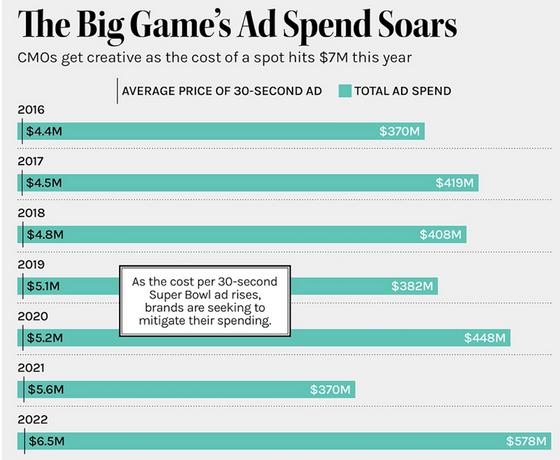
Super Bowl ads are very expensive. The majority of ads being shown range from 15 - 30 seconds. Anything more than a minute will cost the company more than double the average amount. As of Super Bowl LVI, in 2021, a 30-second ad costs around $6 5 million dollars on average Though the same ad in the years 20172021 would have cost an average of $5 35 4 million, which is over a million dollars less Costs can change drastically from year to year In 2021, all “major” companies that advertised during the Super Bowl, including Mountain Dew and T-Mobile, experienced an average ROI(return of investment) of $4 60 per dollar spent on their ad
It is important to note there are expectations and even risks associated with having an ad during the Super Bowl. A company that is advertising must create a memorable ad to resonate with viewers because if it is not memorable, the company will not make a profit which would cause them to lose their investment. Viewers are going to associate themselves with and buy from the brands whose commercials they enjoy and remember the most If produced well, a 30-second Super Bowl commercial is definitely worth it!
The Impact of the Luxury Tax and Salary Cap in the NBA
Joseph Kaufthal, '25
The salary cap is something that the NFL, NHL, and NBA all use Just as these leagues have a minimum amount of money that a team must spend to ensure that all teams are competitive, the salary cap limits the total money a team can spend Some franchises choose to spend more money than others, whether they have a wealthier owner, an owner who is just willing to spend more to win, or just
play in a bigger market with a bigger fanbase
The NHL and NFL have a hard salary cap, meaning the salary cap cannot exceed the limit most of the time, but the NBA has something called a soft cap A soft cap means that NBA teams can spend more than the limit, but not without triggering penalties. One of these penalties is the luxury tax. The luxury tax is a higher number, a separate threshold from the salary cap. This season, the NBA salary cap is 122.7 million dollars, while the luxury tax is 150.3 million dollars. For every dollar a team spends over the luxury tax, they owe an additional 3-4 dollars. For example, the Golden State Warriors, the defending NBA champions, are around 40 million dollars over the luxury tax Because of this, they have to pay a fine of approximately 176 million dollars Additionally, the sum of money paid by teams above the luxury tax threshold is evenly distributed to every team who stays below the threshold The luxury tax system is a way for the NBA to seriously incentive teams to remain below a specific number, greatly increasing the
competitiveness of the league in the process
Both the NBA salary cap and luxury tax are ways of leveling the playing field between wealthier and poorer teams so that teams that can spend more are not able just to buy all of the best players and always win They ensure that all teams have a fair shot at winning any game, which makes the league more entertaining. But the NBA is still a business, so having a soft cap that can be exceeded makes sense. Owners willing to pay for the price of a better chance of winning can, but to ensure that the cap itself is still enforced in some ways, the NBA also has the luxury tax. Overall, the NBA does a good job of ensuring the league is fun and competitive without sacrificing the business aspect of the league In the end, the NBA is a multibillion dollar company
THE RAM STREET JOURNAL Page 14 M a r c h 2 0 2 3 I S S U E I I I THE RAMAZ BUISNESS JOURNAL
THANK YOU
