


How Mrinalini Mukherjee and her peers shaped
How Mrinalini Mukherjee and her peers shaped

Are phones ruining exhibitions?
Also in this issue: Kerry James Marshall, Luc Tuymans, Rose Wylie, Chris Ofili, Cornelia Parker and more…


Marshall
23 Kelly Grovier explores three artists’ responses to the humble spot
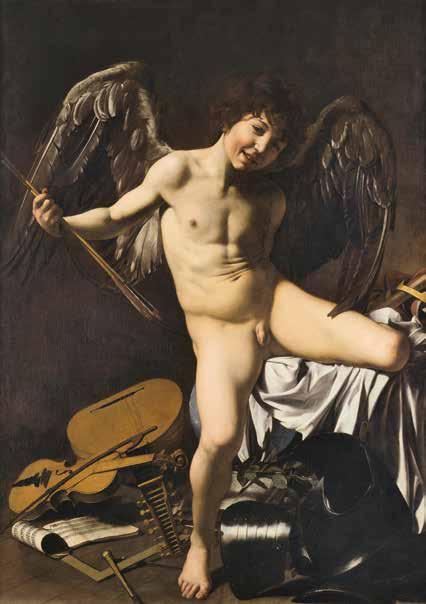
25 Jorella Andrews considers a controversial Caravaggio on show in the UK for the first time
26 A spotlight on the late painter Norman Hyams
29 Juliet Jacques writes a love letter to her favourite football stadium
38
South Asian art at the RA
Pramodha Weerasekera explores how two iconic art schools shaped a new modernist movement for India
48
Kerry James Marshall
Leading cultural figures respond to the RA’s landmark show
56 Rose Wylie RA
Cornelia Parker RA on the bold, original artist coming to the Academy
60
The Pattle Sisters
The charismatic siblings formed the centre of Victorian London’s cultural life, says William Dalrymple
32 A new short story by Damian Barr, inspired by an Ian Fleming painting
35 Artists and curators recommend their favourite reads of the year
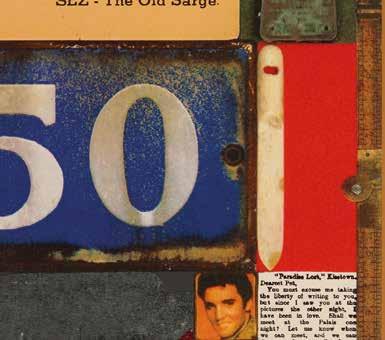
73 Royal Academicians’ news and projects; plus Richard Wilson’s iconic 20:50 on show
76 Tributes to architect Nicholas Grimshaw PRA and sculptor Bryan Kneale RA
81 Gift ideas from the RA Shop
19 Rosanna McLaughlin visits the London studio of RA Schools graduate Kira Freije
30 Do phones ruin exhibitions?
Stephen Smith and Federico Florian weigh in on the debate
66 Imogen Greenhalgh visits the Danish fishing village of Skagen, former hub of an artist colony
71 Ravi Ghosh on the excitement around the Studio Museum’s long-awaited reopening in Harlem
82 Event highlights at the RA, plus news about the Keeper’s House and special festive events for Friends
85 Exhibition listings
90 Allen Jones RA on the art of illustrating Aldous Huxley’s classic novel Brave New World
The issue of RA Magazine you’re currently reading is as packed as the Academy itself this season.
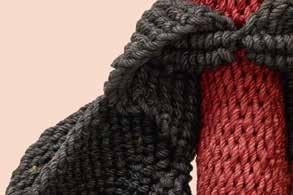
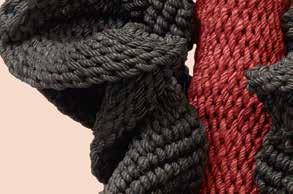
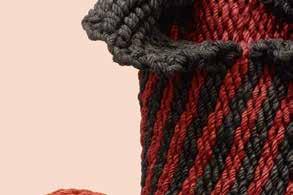
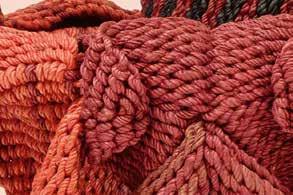
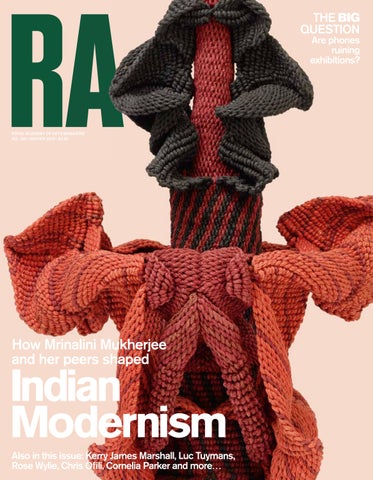
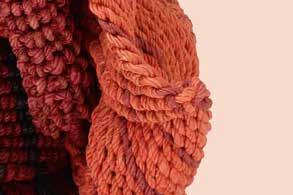
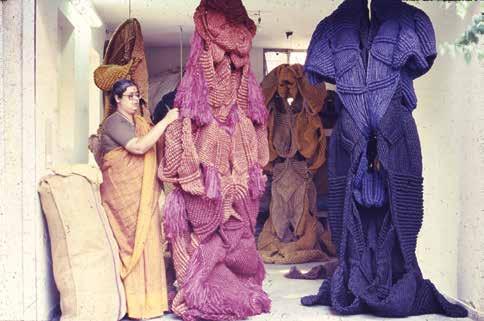
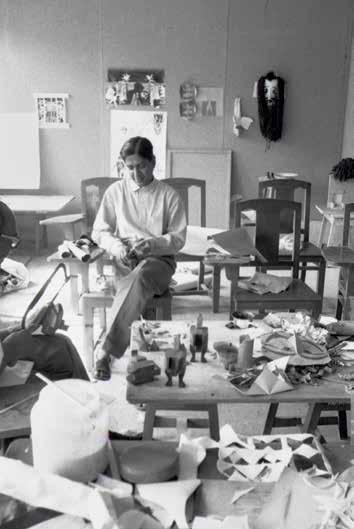
Two landmark shows continue throughout winter: ‘A Story of South Asian Art’ brings together the avant-garde artists who shaped Indian Modernism. At the core of this circle is the radical work of Mrinalini Mukherjee (right). Pramodha Weerasekera traces how two iconic art schools nurtured these artists who ‘went on to make works that reflected the changing world’ around them (page 38). Alongside Mukherjee and her circle, the RA’s acclaimed exhibition of Kerry James Marshall – the foremost painter of Black American life – also continues. We invited five cultural figures to respond to key works in ‘The Histories’ and share the impact these paintings had on them (page 48).
Elsewhere in this lively issue, you’ll find debate, namely do phones ruin exhibitions? There’s a case for both sides of the digital divide (page 30); Damian Barr has written a new short story especially for us (page 32); and
for architecture admirers, Juliet Jacques professes her love for a football stadium (page 29). There’s also must-visit events at the RA – including a Festive Fortnight just for Friends and members – and gallery listings (from page 82).
Some news if you are planning to visit… we are excited to announce plans to expand our Collection Gallery in Burlington Gardens into an ambitious, elegant double-height space. This will significantly enhance
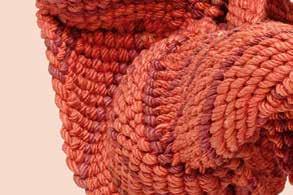
Above: Mrinalini Mukherjee and works in progress in her garage studio, New Delhi, c.1985. On the cover: Adi Pushp II (detail), 1998-99, by Mukherjee. See the artwork in full on page 41
what visitors can see for free by allowing a greater selection of works from the RA’s rich collection to be displayed. As part of this project, the current Collection Gallery and all of 6 Burlington Gardens are now closed to the public and will reopen in early 2027. Burlington House, accessible from Piccadilly, will remain open as usual. You can find more details at royalacademy.org.uk.
And as the festive season edges closer, you’ll find
some wonderful gift ideas for the art lovers in your life (or you could treat yourself) from the Royal Academy Shop (page 81). Friends and members can enjoy a 10% saving on all purchases. And we would like to thank the outgoing Editor & Publisher, Sam Phillips, and the outgoing Advertising Manager, Jane Grylls, who have been an integral part of the success of RA Magazine for the past 12 and 40 years respectively. The editorial team
RA MAGAZINE
RA Magazine is the quarterly publication of London’s Royal Academy of Arts. Established in 1983, it is one of the most widely read art magazines in the UK, with a circulation of around 80,000 copies.
RA Magazine is published in March, May, September and November, and mailed to Friends and members of the Royal Academy of Arts as part of their membership. It is also mailed to patrons and other supporters of the RA, and can be purchased from the RA Shop, newsstands and on subscription.
The opinions in this publication do not necessarily reflect the views of the RA. Paper used in RA Magazine is sourced from responsibly managed forests and other controlled sources.
EDITORIAL
Head of Editorial Content
Terry Barbrook
Deputy Editors Imogen Greenhalgh and Rosanna McLaughlin
Design and Art Direction
Catherine Cartwright
Sub-Editor Gill Crabbe
Editorial Advisers
Eliza Bonham Carter, Michael Landy RA, Goshka Macuga RA, Fiona Mahon, Tarini Malik, Níall McLaughlin RA, John Shevlin
RA Magazine Digital
Georgiana Ashworth, Tom Hutton, Charlie Murray, Cristina Ricci
RA Magazine Digital is supported by Paulo and Caroline Pereira
SUBSCRIBE TO RA MAGAZINE
To subscribe, visit roy.ac/shop or contact the RA Shop (details right)
EDITORIAL ENQUIRIES 020 7300 5820 ramagazine@royalacademy.org.uk
ADVERTISING AND LISTINGS ENQUIRIES 020 7300 5820 advertising@royalacademy.org.uk
Colour reproduction by Dawkins Colour. Printed by Walstead. Published 18 November 2025. © 2025 Royal Academy of Arts. ISSN 0956-9332
EU Authorised Representative: Easy Access System EuropeMustamäe tee 50, 10621 Tallinn, Estonia, gpsr.requests@easproject.com
CONTACT THE ROYAL ACADEMY
Burlington House, Piccadilly, London W1J 0BD 020 7300 8090 friends@royalacademy.org.uk tickets@royalacademy.org.uk
JOIN AND SUPPORT THE RA Membership starts from £70. Find out more at roy.ac/join
RA SHOP 020 7300 8090 (select option 2). Visit roy.ac/shop or email raonlineshop@royalacademy.org.uk
All reasonable attempts have been made to clear copyright before publication. Registered charity number 1125383
The RA’s must-see shows this winter, from Rose Wylie RA’s bold canvases and Indian modernism to Kerry James Marshall’s paintings of Black American life
Opening Hours: The RA is closed on Mondays. The rest of the week, it is open 10am to 6pm, and until 9pm on Fridays
Kerry James Marshall: The Histories
Until 18 January 2026 – Main Galleries Exhibition organised in collaboration with the Kunsthaus Zurich and the Musée d’Art Moderne, Paris Lead Supporter BNP Paribas. Supported by Batia and Idan Ofer, the Huo Family Foundation, Sotheby’s, David Zwirner and The Kerry James Marshall Supporters Circle
A Story of South Asian Art: Mrinalini Mukherjee and Her Circle
Rose Wylie
28 February to 10 April 2026
Main Galleries
Friends Preview Days: 25 Feb, 10am to 6pm; 26 Feb, 10am to 6pm; 27 Feb, 10am to 9pm
Supported by the Rothschild Foundation, Christian Levett and Musée FAMM and Jake and Hélène Marie Shafran and The Magic Trust
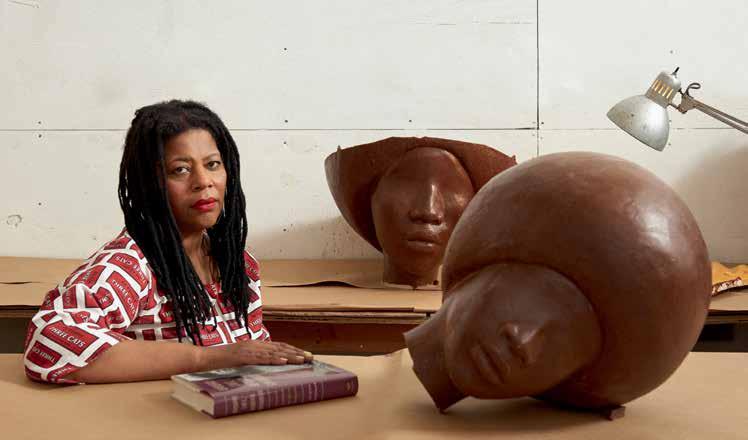
The world-renowned artist will take over the RA’s Main Galleries in 2027 with monumental new work
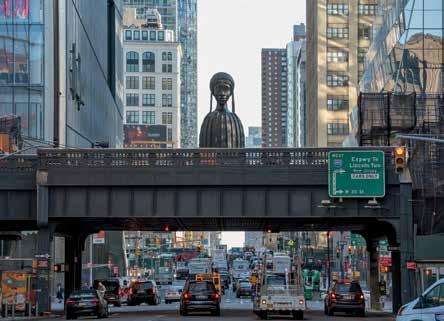
Good news for those who like to plan ahead: the largest exhibition to date of Simone Leigh will take place at the RA from September 2027. One of the most significant living artists, the Chicago-born Leigh is celebrated for her ambitious sculptures that centre the histories and experiences of Black women. Created in metal and ceramic, as well as materials such as rafia and shells, her sculptures draw from African cultures and their diasporas. In 2022, Leigh won the prestigious Golden Lion at the Venice Biennale for her iconic sculpture Brick House – a 16ft-high bronze bust of a woman with a crown of braids (installed on New York’s High Line, 2019; right).
For her groundbreaking exhibition at the Royal Academy she will create new works especially for the historic Main Galleries. Look out for full details in future issues. Supported by the Ford Foundation









Christmas gifting all wrapped up with our complimentary Concierge Service
SEB AGRESTI P30
A Shinto shrine in Japan during Shichi-Go-San – where children in bright kimono are blessed for health and growth, surrounded by family and tradition.
JORELLA ANDREWS P25
Archetypal labyrinth structures hold a special place in my Christian worship practice. Their quiet presence, especially when walked, makes even unloved and disregarded places sacred.
CALEB AZUMAH NELSON P48
The Pentecostal church in Forest Hill, which I grew up in. It always amazed me that a space converted from offices could house such rigorous faith.
THOM ATKINSON P19
St Beuno’s, in Culbone, Somerset, a tiny Saxon church hidden deep in the woods near Porlock Bay, because it’s beautifully understated and a great walk.
DAMIAN BARR P32
I feel closest to my understanding of God when I’m resting among her leafy creations. Otherwise, St Mark’s, Venice, where every stone tells a story.
DALE BERNING SAWA P16
I recently met a fox while playing piano, alone, in St Barnabas Dalston, Hackney’s early modernist concrete secret. It all felt like prayer.
ANN CHRISTOPHER RA P78
The chapel at Notre-Dame du Haut, Ronchamp, by Le Corbusier. Lucky to experience the space alone, I could fully appreciate the chapel’s unique and powerful presence. The sense of serenity and spirituality was profound.
WILLIAM DALRYMPLE P60
Nizamuddin is a Sufi shrine on the edge of Lutyens’ Delhi. A warren of mediaeval shrines, mosques, mausoleums and dervish monasteries all cluster around the tomb of Shaykh Nizam-ud-Din Auliya, the greatest of all Indian Sufis. To this day it attracts almost as many Hindu, Sikh and Christian pilgrims as it does Muslims.
FEDERICO FLORIAN P30
The Old Church in Stoke Newington, the only remaining Elizabethan church in London. It hosts Puddle, one of the best queer rave parties in town!
RAVI GHOSH P71
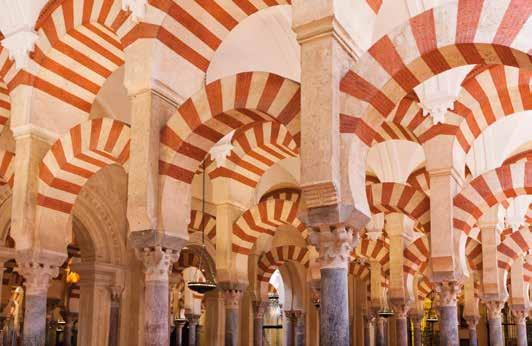
The Mezquita Cathedral in Córdoba (above), an extraordinary embodiment of how religious histories entwine and shape a region – and how they have sought supremacy over one another, reflected to this day in contentious Catholic claims to the building.
KELLY GROVIER P23
The thousand-year-old Benedictine monastery of Santa Cecília de Montserrat, in Catalonia, the ancient interior of which the Academician Sean Scully has transformed with soul-stirring paintings, frescoes and stained glass.
JULIET JACQUES P29
Paul Tournon’s Church of the Sacred Heart in Casablanca – a stunning Art Deco building in a city full of modernist masterpieces. Its function as a church ceased in 1956, but that’s fine – I was never religious.
ALLEN JONES RA P90
Tintern Abbey exudes tranquillity. Verdant lawns once so full of life ascend into the green walls of the enclosing Wye Valley in a timeless meditation.
The Mên-an-Tol in Cornwall features three historic standing stones. The central stone has a circular hole people crawl through for good luck or to cure ailments. They also look like the word ‘lol’.
CHRIS OFILI P48
The Rosaire Chapel, by Matisse, in Vence, is a truly spiritual place and is undeniably beautiful. But a church is really a gathering of people, not a building. Therefore we don’t go to church; the congregation is the church.
DOROTHY PRICE P48
I’m a non-believer now, but if I had to choose it would be St Laurence Parish Church in Northfield, Birmingham, simply on the grounds of nostalgia.
STEPHEN SMITH P30
No vanitas painting is more chastening than the Capuchin Catacombs of Palermo, where Sicily’s long-dead One Per Cent, embalmed in their finery, have become leering bags of bones.
PRAMODHA WEERASEKERA P38 Lodhi Gardens in New Delhi, India. Now known as a garden, it in fact holds a large dome that led to a Mughal-era mosque. It blends Mughal and Hindu architecture, representing a sense of harmony. The space is public and open to anyone, and I have never felt like a foreigner even though I am a Sri Lankan citizen in India.
Opposite page:
Right: Come, let me heal your wounds. Let me mend your broken bones 2024, by Awartani, installed at the Venice Biennale, in 2024
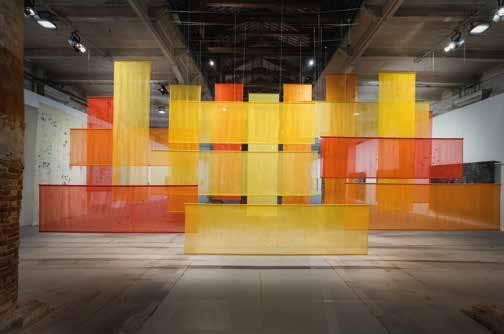
The artist tells Dale Berning Sawa what makes her tick
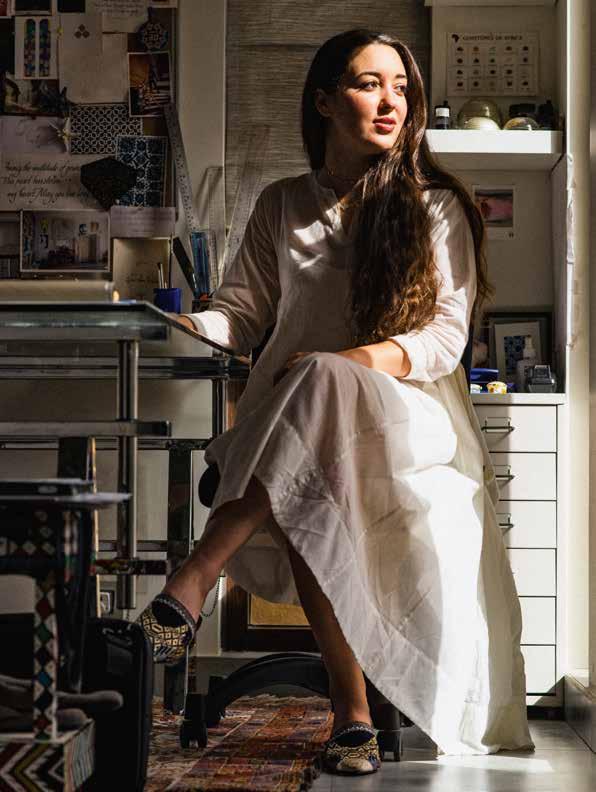
Dana Awartani is besotted with geometry
On the suggestion of her mother’s friend, in 2009, the Jeddah-born artist signed up to a course in sacred geometry at the Prince’s Foundation School of Traditional Arts, in Shoreditch. In her words, she ‘fell in love’. It felt like a breakthrough, after a foundation course at the Byam Shaw School of Art and a BA at Central Saint Martins. ‘I felt that I needed to learn how to make,’ she says. ‘Because at Saint Martins, I was taught really well how to think, but materiality was the least important thing.’
Staying on at the Prince’s School for an MA, she plumbed the symbolism of geometry, wherein ‘every single number, every single pattern, has a meaning… I found a lot of answers to my religious and spiritual beliefs through geometry. If nature is created by the Divine, there’s perfection in nature through geometry. And it brings people together rather than dividing us, which is what’s happening now a lot in the world.’
She sees herself as artist and craftswoman
The day she started at the Prince’s School, she recalls tutors telling her they didn’t care that she was a contemporary artist: ‘You’re a craftswoman for the next two years,’ they said.
The respect this nurtured in her for ancient ways of making, along with the discipline required to master them, has grounded her practice ever since. In her upcoming solo show at the Towner in Eastbourne, there is a tiled
floor piece that recreates the Ottoman design of the Hamam al-Sammara in Gaza, an ancient bathhouse destroyed by an Israeli airstrike in 2023. In making the tiles, formed using wadi clay, a material sourced from riverbeds and traditionally used in the Middle East, she worked with Riyadh-based builders. Specialists she collaborates with respect the fact that she is using crafts she has learned. ‘Most mediums I work with are things that I know how to do myself,’ she says.
This emphasis on making has political import. Whether through rampant capitalism and mechanisation or, as in the Middle East, conflict and displacement, craft and the knowledge it carries are disappearing. Seeking out local masters, as she does, is ‘preserving something under threat and undervalued’.
Her work is a way to mourn Awartani is now based between New York and Jeddah where she was born, but says she comes from many places: ‘My mother is Saudi but I’m also Palestinian, I’m Syrian, I have Jordanian nationality. So my idea of home or identity is broad.’ Making work in response to the Arab Spring, the Syrian civil war or Israel’s actions in Gaza is about raising awareness as much as it is catharsis for the artist, ‘an introverted way of mourning’. In 2019, she started her ongoing textile series, ‘Let Me Mend Your Broken Bones’, in which she trawls the Antiquities Coalition’s list of vulnerable heritage sites and collates images of monuments before and
after their destruction. Working with a master embroiderer in India, she traces ‘the wounds of the buildings’ – whether inflicted by fire, bullet or bomb – onto panels of silk, tearing the fabric then darning the holes closed again. The work was shown at the Venice Biennale in 2024 (installation; above), and will be at Towner too.
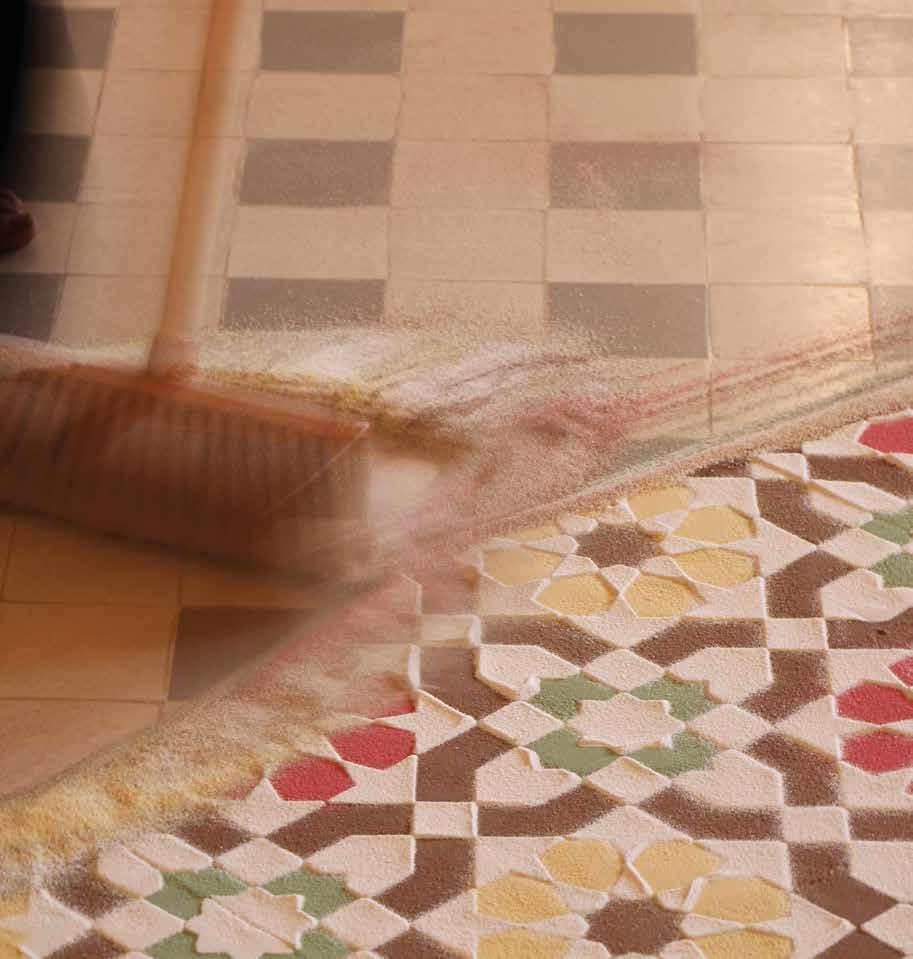
The ground is something sacred Awartani often makes floor installations, arranging hand-dyed sands or handmade tiles in intricate patterns. ‘I’ve always instinctively looked at the floor when I’m walking and felt drawn to it, from early on in my practice,’ she says. Subconsciously, this points to the fact that in Islam you don’t need any specific place to pray, since the earth, the ground itself, is holy. On student visits to Islamic heritage sites in Morocco, India and the Alhambra in Granada, she noted the ornate decoration of the floors, and thought about how, when you prostrate yourself, you touch the floor with your head.
Subtlety is key
Her two-part installation I Went Away And Forgot You. A While Ago I Remembered. I Remembered I’d Forgotten You. I Was Dreaming (2017) features, on the one hand, a beautifully detailed floor-tile design recreated with painstaking precision in coloured sands, and on the other, a video of the artist sweeping it away with a broom. The work was made for a show in Saudia Arabia in 2017, before the Ministry of Culture was created and heritage protections implemented. She wanted to address how Saudi built heritage was being lost, mostly through neglect. Opting for ‘this gentle, conscientious approach of sweeping’, she hoped, would engage her audience more. ‘Sometimes when you whisper,’ she says, ‘it’s more effective than screaming in someone’s face.’
Dale Berning Sawa is a freelance arts writer Standing by the Ruins is at Towner, Eastbourne, 29 Nov to 25 Jan 2026
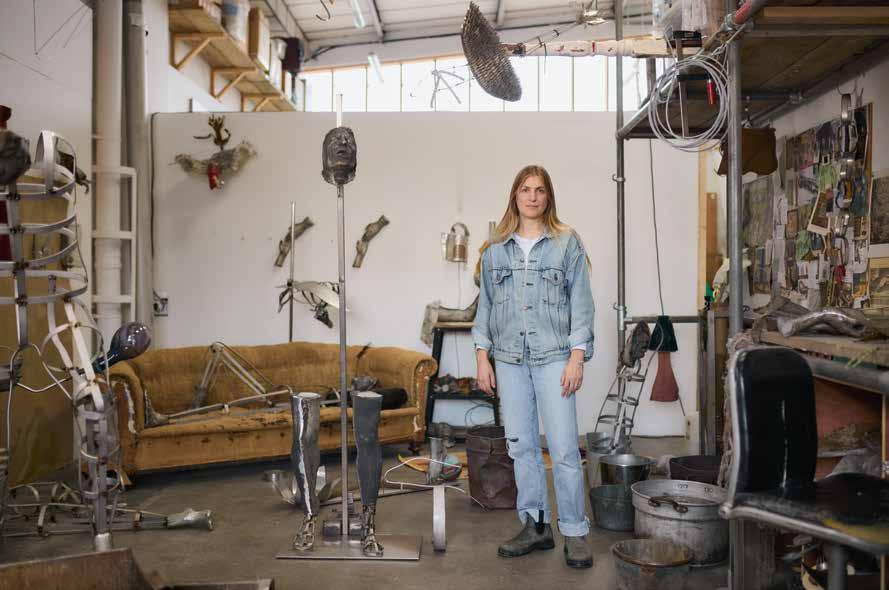
Rosanna McLaughlin visits the RA Schools graduate in her Greenwich studio, ahead of her show at Hepworth Wakefield. Portrait by Thom Atkinson
Daniel Sinsel, who has let her use additional floor space, ‘and whatever else I can get done in the next eight weeks.’ As we talk, her Labrador Laska sniffs suspiciously at a metal bucket on the floor. It appears to be filled with water, yet all is not what it seems. The liquid is in fact a disc of hand-blown glass, black with a silvery film, one of a number made in a Bermondsey workshop the previous weekend. Across the way, I notice an image of Hieronymus Bosch’s Garden of Earthly Delights tacked to a scuffed white wall, above a row of faces waiting to be attached to bodies.
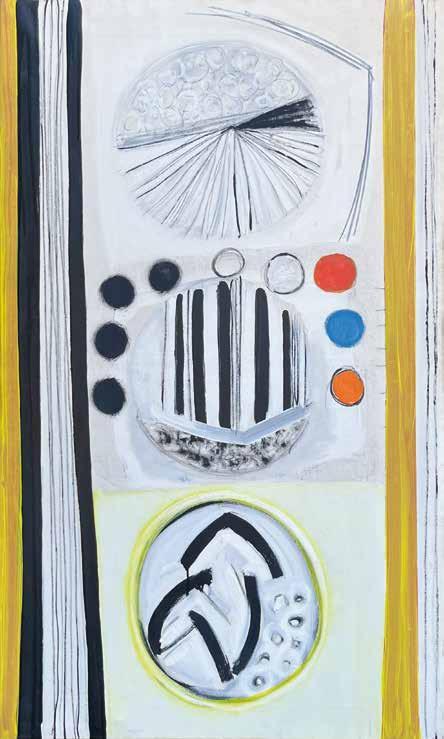
September 1964 by
Sir Terry Frost (RA)
Cockermouth Cumbria CA13 9HA Tel: 01900 822149 thegallery@castlegatehouse.co.uk castlegatehouse.co.uk
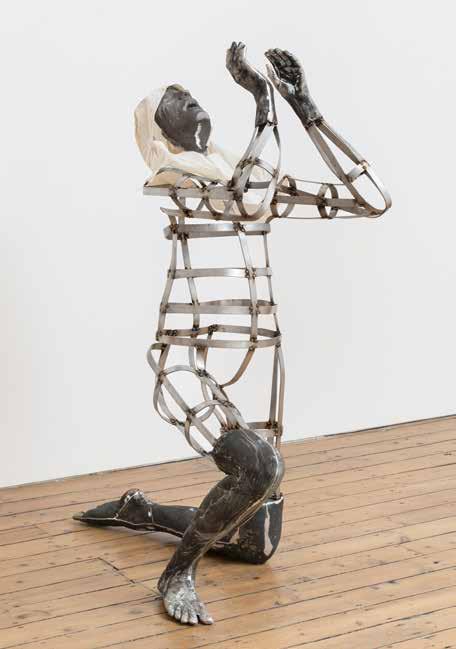
When I arrive at Kira Freije’s studio in the shadow of the O2 arena in Greenwich, it is one of those afternoons when the ghosts of London past seem to have descended upon the present. To get there I walk down cobbled streets, past teenagers vaping among the shards of bone and pottery on the riverbank, and for a moment I feel I am just as likely to bump into a medieval waterman as one of the runners hurtling down the Thames Path. When Freije opens the door of a decidedly contemporary black-brick unit, the sensation of time collapsing only intensifies. Inside, handmade metal sconces
line the walls, and works-in-progress fill the floor: figures with faces cast from aluminium and cage-like bodies made from welded steel, kneeling as if in prayer or reaching towards each other in states of rapture and yearning (permanence of a sacred tongue, 2022; page 20).
On the day of my visit, Freije’s studio is literally overflowing with sculpture. She is busy preparing for a solo show at Hepworth Wakefield – her biggest exhibition in the UK to date. ‘I’m making all new work. I’m showing everything that you see here and next door,’ she says, gesturing towards the studio of painter
Unlike much contemporary art, Freije’s work does not have an obvious theme or message. Instead, she has developed an intuitive, hands-on approach to making, which she uses to create scenes of heightened atmospheric and emotional intensity. ‘I don’t have a plan,’ she says, when I ask how she starts on a new body of work. ‘I just start making and follow each glimpse of an idea that comes, and I deliberately don’t make many sketches. It feels more exciting to try to chase a mood.’ That Freije makes most of her work herself, or in close collaboration with craftspeople, is integral to the success of this ‘mood chasing’. She describes the importance »
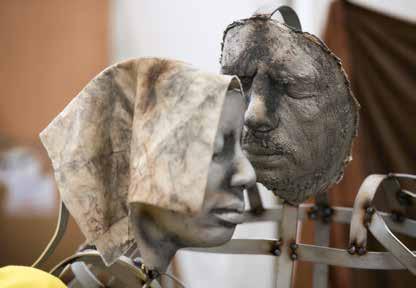
page: Kira
Left: One of the many works-in-progress in Freije’s studio, featuring faces cast from aluminium
Below: permanence of a sacred tongue 2022, by Freije
» of being able to make ‘micro-changes’ to the gestures of her figures as she works, finely calibrating the psychological tensions. She often incorporates the unexpected outcomes of material processes, too, such as dark stains on the surfaces of the cast-aluminium faces that make her figures appear weatherworn or sodden with tears (pictured, left).
Freije first developed her cage-like figures as a student at the RA Schools, from where she graduated in 2016. ‘It was a really important three years for setting up my practice,’ she reflects, leaning against a workbench scattered with tools. ‘I pretty much had the metal workshop to myself, which allowed me to establish a way of working.’ Having initially made a metal armature for a figure she intended to drape with fabric, she was struck by the effect of the hollow body: ‘I liked the suggestion of emptiness, and what you are left to fill in with your mind. I hope I can find ways for there to be less and less.’ An essential component of Freije’s practice is exactly that: what you don’t see. Just as her metal bodies are presented as outlines, the worlds they belong to are only lightly suggested. Freije stresses how important it is that ‘the figures belong to an unspecified time’. The incompleteness of the picture suffuses her work with a longing for what is lost; it also acts as an invitation to the imagination.
When it’s time for me to leave, Laska rises from beside a reclining metal figure with whom she has been taking a nap, and wags me goodbye from Freije’s side. As I walk along the Thames Path the ancient river churns in the fading light, and I briefly catch sight of something glimmering in the water before it’s pulled back under. This, I think, is what it feels like to stand among Freije’s metal figures, to experience their particular poignancy. Like seeing a flash of a memory, or being overcome by an emotion, yet not being able to keep hold of it. Like something reaching upwards from the depths, always on the cusp of emerging, always just beyond reach.
Rosanna McLaughlin is Deputy Editor of RA Magazine
Kira Freije: Unspeak the Chorus The Hepworth Wakefield, 22 Nov to 4 May 2026



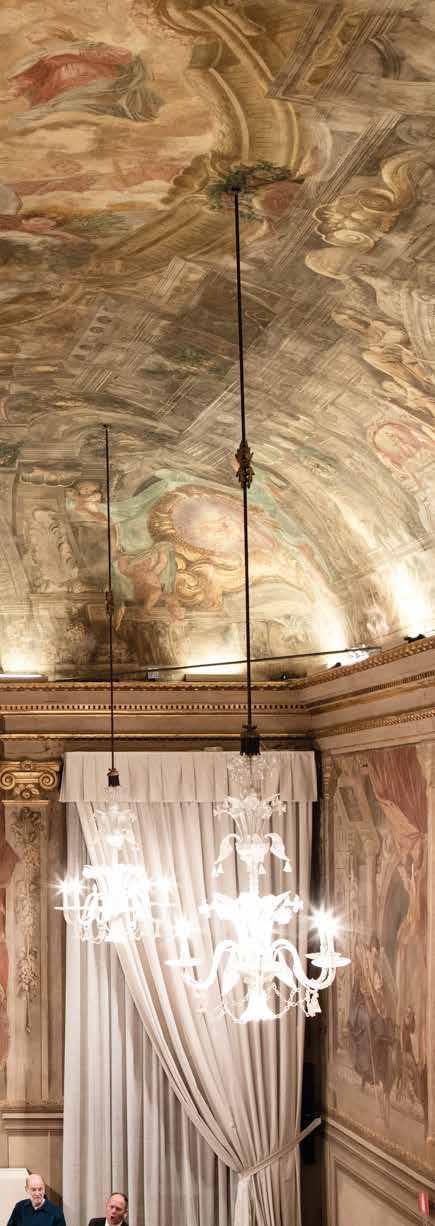
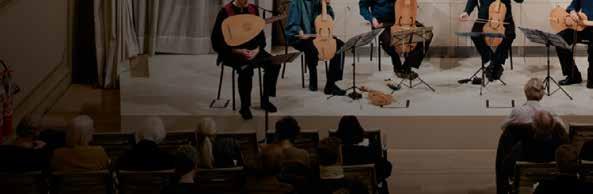
Martin Randall Festivals bring together world-class musicians for a sequence of private concerts in Europe’s most glorious buildings, many of which are not normally accessible. We take care of all logistics, from flights and hotels to pre-concert talks .
Kelly Grovier joins the dots between new shows celebrating artists who have made a point with circular motifs
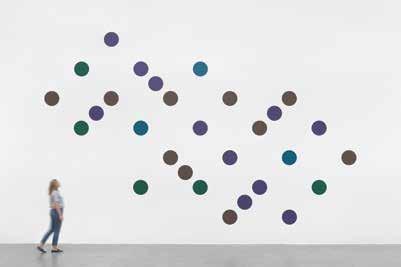
Not small spots but large painted discs of intensely saturated colour appear to vibrate in their stationary voyage across the gallery wall like a slowly drifting constellation.
A groundbreaking optical artist, Riley has, since the 1960s, celebrated, choreographed and confounded the act of seeing, as conveyed by a show at Margate’s Turner Contemporary (22 Nov to 4 May 2026). In Dancing to the Music of Time (2022; 1), the rhythmical quality of retinal cues – those visual signals picked up by the eye – is amplified to an architectural scale. Subtleties of shifting colour and motion are triggered by viewers’ roving perspectives as they navigate the space in which the work is installed. Every step we take brings a synchronicity and dissonance of geometry and hue as spots suddenly tug into darker ovals and parallel vectors begin to tilt, diverge and collide. Here, seeing is spectacle.
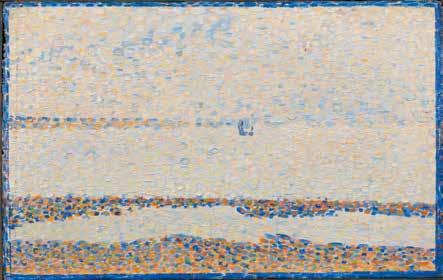
Dots within dots: grains of sand have been discovered suspended in the dabs of paint that Seurat used to catch the glimmering light off the coast of France in The Beach at Gravelines (1890; 2), blurring the line between art and reality. The spots in the pioneering pointillist’s work, on display in a new show at London’s Courtauld Gallery (13 Feb to 17 May 2026), are at once tangible and evanescent, hefty yet hazy, palpable portraits of pulsing light. Four years after launching his experiment in optical mixing, in which individual spots of pure pigment replace colours mixed on a palette, the Neo-Impressionist here refines his technique. Seurat’s investigations were inspired by Michel Eugène Chevreul’s theories of colour contrast and intensity, but the painter turns science into symphony as the world is simultaneously constructed and dissolved, brought into focus and blurred to abstraction.
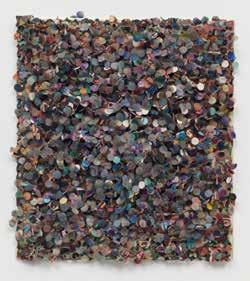
Countless circular dots – popped loose from coloured paper using a hole punch then painstakingly attached to a small canvas with glue and thread – transform the surface of Howardena Pindell’s Untitled #49 (1974; 3) into a sequin blizzard. The disposable detritus of clerical drudgery, these tiny dots are more than upcycled minimalist minutiae rescued from the wastepaper bin. In Pindell’s work, dots are loaded with painful poignancy, recalling a moment from her Jim Crow-era childhood when she realised the underside of a cup she’d been offered had been tagged with a red dot, denoting the crockery to be used by Black customers. But as a new show at White Cube Bermondsey reveals, Pindell recasts the racist code of segregation into a bold language of beauty and defiance (21 Nov to 18 Jan 2026). Kelly Grovier is an art critic and poet
Give a gift that’s not just for Christmas
A whole year of art in one little card
Jorella Andrews examines the troubling masterpiece, on show in Britain for the first time
Young Friends | 16–35 years from £70
Michelangelo Merisi da Caravaggio’s Victorious Cupid (1601-02; above) exists somewhere between mythology and portraiture. Less a depiction of Cupid, it reveals a preadolescent boy playing Cupid, at once luminous and earthy (observe his dirty toenails). As testament to Caravaggio’s realist project, the child’s nakedness is viscerally present, glowing against the dark background into which the dusky eagle wings he is wearing also recede. The painting, which usually hangs
in Berlin’s Gemäldegalerie but travels to London’s Wallace Collection on a rare loan, is a miracle of the chiaroscuro for which the artist was renowned. But it has also been called erotic, subversive and shocking. Certainly, not only the boy’s undeveloped penis but also an indication of his anus is visible in this life-sized portrayal. Worse still, his open pose and grinning countenance are presented as invitational. In other words, the child is pictured as the initiator rather than the victim
of what can only be described as an abusive power dynamic, a dynamic into which the work, using beauty and vivacity as a sanitising shield, inevitably inculcates its viewers. In Victorious Cupid, not only the temptations of sight are rendered in paint but also those of touch, skilfully anticipated by the finger-like eagle feathers that have come to rest on the boy’s left thigh. The Caravaggio scholar Walter Friedlaender has gone so far as to claim that ‘no-one before Caravaggio had been able to depict the devil in the flesh or carnal love so freely and naturally as a matter of triumph and joy’. There might have been a personal dimension to this. Although scholars have compared the boy’s face to youthful works Caravaggio made based on his own appearance, then-contemporary testimony suggests the model was a bardassa, a servant kept for the purpose of sexual exploitation. Surely, Victorious Cupid was created to provoke collisions of admiration and aversion. My own first impulse upon seeing it was (metaphorically) to grab a blanket and throw it over the child’s posed and exposed body. This is ironic. When originally displayed in collector »
» Vincenzo Giustiniani’s great gallery of paintings it was indeed covered with a drape, reputedly not for the sake of decorum, but for fear that the painting’s virtuosity, if left uncovered, would diminish Giustiniani’s other treasures. But Victorious Cupid is powerful not only because it is sexually provocative. Albeit irreverently, it also conveys cultural critique and intellectual erudition. The child’s body appears to be leaping out of a site of cultural wreckage, with instruments, a manuscript, a crown and armour scattered around him. He seems at once to exult in the implied fakery of the enlightened life and to trample on prestige and tradition.
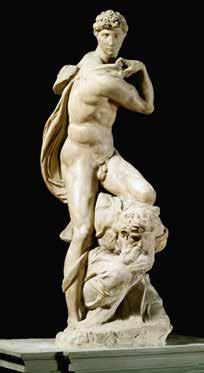
This accords with Caravaggio’s own supposed attitude. He rebelled against inherited stylistic models, and was averse to the artificiality of Mannerism, popular between about 1520 and 1590. Notably, several of Caravaggio’s paintings both cite and seemingly mock works by Michelangelo, who had died some seven years before Caravaggio’s birth but with whom Caravaggio shared a name (he was often referred to as the second Michelangelo). He also shared with him a key site of artistic expression (Rome), and, probably, a sexual predilection (both are famous for their sensual depictions of men). In this painting, we find evidence of his disavowal of Michelangelo especially in how he has posed the boy’s legs. Scholars have described this as a deliberate parody – even a travesty – of Michelangelo’s sculpture The Genius of Victory (1532-34; page 25), now in Florence’s Palazzo Vecchio.
Victorious Cupid is often discussed as partaking in ‘paragone’: a debate that recurred among artists and scholars from the Renaissance onwards about the comparative supremacy of different art forms, including that of painting over sculpture, or vice versa. The Wallace Collection resurrects this debate by positioning Victorious Cupid between two classical Roman sculptures that had also been part of Giustiniani’s collection. One can’t help but suspect Caravaggio’s painting will win out. For all its difficulty in terms of subject matter, the work still testifies to its maker’s success in championing vivid, new, non-idealised directions in image-making.
Jorella Andrews is Professor Emeritus of Visual Cultures at Goldsmiths, University of London Caravaggio’s Cupid is at the Wallace Collection, London, 26 Nov to 12 Apr 2026
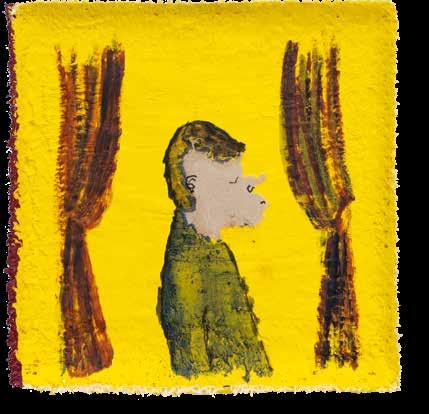
Charlie Mills recalls a painter who moved at his own pace, as a posthumous show of Hyams’s art opens in Peckham
In the 10 or so years that I knew him, Norman Hyams’s subjects proved few and consistent. Figures, landscapes and patterns return and repeat in his paintings, inspired as much by his teenage memories of growing up in London’s East End as they were by the numerous archival photographs and magazine cuttings littered throughout his studio. Among them were pictures of boxing bouts and the cropped corners of tennis courts, winding rows of suburban houses and children’s parties. ‘No rush’, he was known to say. Painting is a process of ‘teaching myself how to see’. Hyams’s self-portraits were also many. He depicted himself as a father, reader, smoker, painter and butcher, peering from the shadowlands, nose and beard only, or flanked by theatre curtains in quiet abandon (Untitled (100), date unknown; above), or solemn in his studio, deep in thought. Minimally executed on the dark linen he favoured, his paintings balanced a strange and elusive melancholy with bullish
optimism, facing himself and his favoured familiar subjects with honesty and patience, often incorporating bold colour. Hyams attended Chelsea College of Arts later in life, graduating in 2006 at the age of 40, going on to cut his brushstrokes at the south London home for painters’ painters, Turps Studio. Visiting his studio, always brimming with canvases and sculptural experiments – piles of hand-painted objects in all materials, shapes and sizes – it was clear that he had an endless curiosity in the people and world around him.
Hyams passed away in the autumn of 2024, aged 58. ‘No Rush’, an upcoming solo show at Hannah Barry Gallery in Peckham (27 Nov to 24 Jan 2026) displays works not yet seen from that same studio, a glimpse into the mind of a painter unhurried by the march of time.
Charlie Mills is senior curator at Bold Tendencies and artist liaison at Hannah Barry Gallery in London
NEAC. RP. RA. (1870–1951)
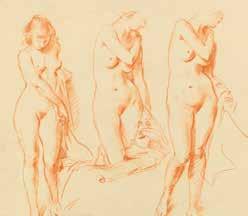
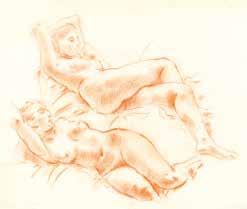
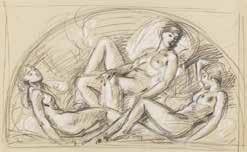
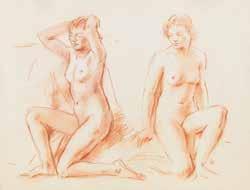
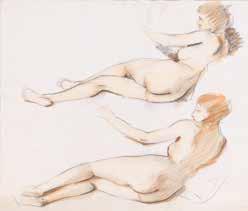
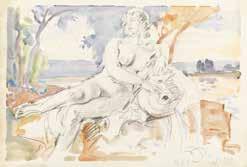
Drawn to the Female Form
An exhibition of sanguine, chalk, pencil drawings and watercolours
During the winter months, when travel stalled and Chelsea called him back home, Wilfrid de Glehn returned to his Cheyne Walk studio: the afternoon sun, pouring through the south-facing windows, as models took their place while he built their figures in chalk and sanguine. These studies were not ends in themselves
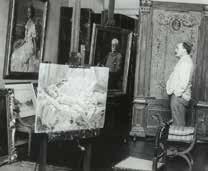
but seeds for classical pictures later completed beside Lake Garda; in Corfu; and along the Vallée du Var. His lines were disciplined, his hatching soft, the models individual rather than decorative cliché. This exhibition takes myth and tradition quietly and methodically, with youthful poise and sensitive effect.
On view in the Gallery or join us online
3 – 24 December 2025



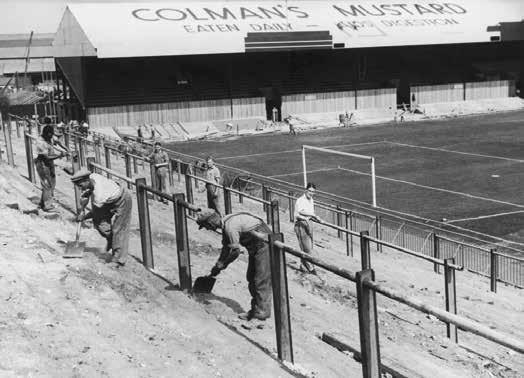
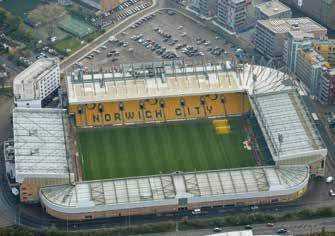
As a new show celebrates the architecture of football stadiums, Juliet Jacques tracks the history of Norwich City’s home turf
at the other end too, where the pitch sloped upwards, with a concrete retaining wall rising 30 feet. Shots would rebound off it, wingers would crash into it. Some standing areas were terraced; others were simply banks of earth, and braver fans would sit in the trees overlooking the pitch.
It’s hard to quantify what makes a football stadium truly great. Like many fans, I focus on that nebulous quality – atmosphere – rather than design, caring little for innovations such as retractable roofs or pitches, colour-changing façades or sensory rooms. My favourite is the one I visit most regularly: Carrow Road. For most of the year I spend every other Saturday afternoon (and plenty of Tuesday evenings) at Carrow Road, watching Norwich City. It has changed since my first visit more than 30 years ago. The South Stand was replaced in 2003, and at the Barclay End, where I’ve always stood, there is now a big screen (to facilitate the monstrosity of VAR), obscured for me by a pillar. Like every stadium built in England before the wave of new grounds that began in the 1990s, it’s a ship of Theseus, the South Stand the last surviving original element of the ground, famously built in just 82 days in 1935 (above). But I still feel a connection to the 29,779 fans who came to its
first match, on 31 August that year – a thrilling 4-3 win over West Ham.
Carrow Road is not as featureless as some of the grounds built shortly after it, but it lacks the architectural strangeness of the late 19th- and early 20th-century stadiums designed by the ubiquitous football architect
Archibald Leitch, who worked on grounds for Arsenal, Chelsea, Liverpool and numerous others. Many of his designs were rebuilt following the tragic 1989 crush at Hillsborough, another of his creations, which ushered in a need for all-seater stadiums.
Norwich City vacated its previous home, The Nest, on the orders of the Football Association, which told the club it was ‘no longer suitable for large crowds’. It’s
astonishing that a catastrophe never happened there: the ground was built in a disused chalk pit, with one goal-line so close to houses that there was barely room for a pavilion and a tiny wedge of terrace. There were houses
I would have loved to watch a match there, just to see if it was as mad as it sounds. Perhaps not the Third Division South against Northampton Town on 17 April 1922, though, when part of the barricade on the concrete wall snapped and sent 60 people falling to the ground. (Fortunately, only one person was injured.) But the incident that hastened Norwich City’s departure to Carrow Road was part of the pitch itself collapsing: the groundsman, Russell Allison, shored it up with soil and railway sleepers and told players to be careful taking corners.
It’s astounding that The Nest was ever allowed to host professional football matches, let alone that it served for 27 years. Carrow Road faces a different problem that would have been barely imagined in 1935: it is one of a quarter of English league grounds vulnerable to climate change-induced flooding. I hope they don’t have to move, as it really feels like home, but if sea levels rise that high, I doubt that will be my primary concern.
Juliet Jacques is a writer, filmmaker and Norwich City season ticket holder Home Ground: The Architecture of Football Tate Liverpool + RIBA North, Liverpool, until 25 Jan 2026
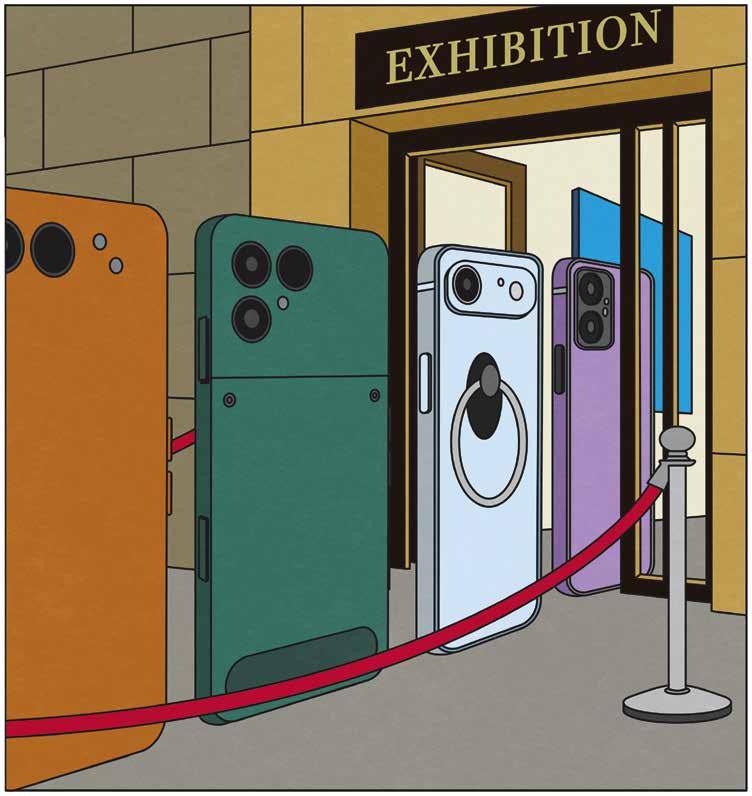
Yes... argues Stephen Smith. Taking selfies in galleries gets in the way of genuine interaction with – and appreciation of – works of art
For a moment, I thought I’d come up with the perfect clever-Dick argument against the use of phones at exhibitions. Suppose that instead of being face to face with a masterpiece – or lens to face, rather – you were miraculously transported to the artist’s studio, to find the painting not yet dry. You wouldn’t dream of elbowing an Old Master aside so that you could take shots for your socials. Of course not. Case closed! But then it occurred to me that you’d never be forgiven by art historians, or anyone else, if your camera hadn’t been rolling throughout your encounter with Rembrandt or Artemisia Gentileschi.
Broadly speaking, art history has taken us from Titian to Munch, from heads of state to heads in a state, until at last we’ve reached the selfie: our heads. And honestly, I’m fine with it. It’s a you-problem not a me-problem. I can live with you taking selfies next to
a painting that I’m trying to look at – but what’s in it for you?
I understand about bucket lists, about saying: ‘Been there, done that, got the tendonitis’ (from all the flexing and posing with your mobile). But you can’t claim to have ‘done’ the Mona Lisa just because you stood with your back to her while taking a picture.
When climbers in Scotland take a snap to show that they’ve bagged a Munro, it means they actually slogged up the mountain and back again. Chances are that you barely glanced at the canvas, which is a mere background to you
Many of us spend as little as seven seconds with an artwork in a gallery and you’ll use that up trying to perfect your composition.
You might imagine that you’re using your phone to curate your memories. In fact, you’re outsourcing the process of remembering to it: you may have little recollection of the
art you saw, only the dubious substitute of photographs. Your phone understands this (it’s not called ‘smart’ for nothing) and it’s already manipulating your portfolio, your memory-proxies. The tech even enables you to crop unwanted details from your collection.
Soon you won’t need to footslog around exhibitions at all. AI will do it for you, filling your library with flawless pictures and inserting your face seamlessly into the foreground. For the more sensitive, enlightened robots, this 21st-century version of the Grand Tour could prove life-changing. And then the last few gallery-goers among us will face a new obstacle. Crowds of paint-splattered droids, hunched over their easels, will be churning out reproductions of the canon which are indistinguishable from – perhaps even better than – the real thing.
Stephen Smith is a writer and broadcaster
No… says Federico Florian. Smartphones can enhance exhibitions, and we should embrace the fact that our lives are intertwined with technology
From a techno-pessimist’s point of view, smartphones are malevolent devices, engineered for distraction. They bombard us with rowdy videos, endless memes and a stream of global calamities, swallowing us into the fragmented chaos of social media. The views they offer are often simplified, as flimsy as the images they generate. How could such a disorderly microcosm not undermine our experience of art?
Yet despite their noise and the impulsivity they might trigger, smartphones often do more than merely divert our attention. In many cases, they can deepen our engagement with art, adding unexpected layers to how we see and understand it. The philosopher Marshall McLuhan famously described all media as ‘extensions’ of the human body and mind. Think of your smartphone: the camera becomes an extra eye; the speaker, an
additional ear; the screen, a portal of tactility. When brought into the gallery or museum, these features allow the device to become an integral part of our aesthetic experience.
As an art writer, for me my phone is not a distraction, it’s a tool. I use it to take pictures of paintings, zooming in on brushstrokes or compositional details to analyse later. I document fragments of durational performances, capturing the subtle interactions between bodies and space. I scan QR codes for additional context, type notes in real time on my iPhone. The kind of interaction smartphones enable is layered and hybrid; it allows me to switch between physical presence and digital mediation.
Purist advocates of ‘the gaze’ (those who believe art must remain untouched by modern distractions) might argue that smartphones act like Trojan horses, infecting
our perceptual abilities – the very operating system of human experience. Messaging a friend during a Bergman screening or checking a dating app in front of a Van Gogh might seem sacrilegious. Yet aren’t these 21st-century versions of life’s inevitable intrusions, which have always existed, even in the most revered art spaces? After all, museums are also social environments where human interaction and aesthetic contemplation coexist. Today, much of that interaction happens to occur on screens. Digital technology is woven into our lives, shaping how we perceive, feel and think. Phones are our sensory prostheses, and the ways we engage with art must evolve to reflect this reality. Rather than resist technology, we might then allow it to accompany us, even within the ‘sacred’ realm of Aesthetics.
Federico Florian is a writer and translator
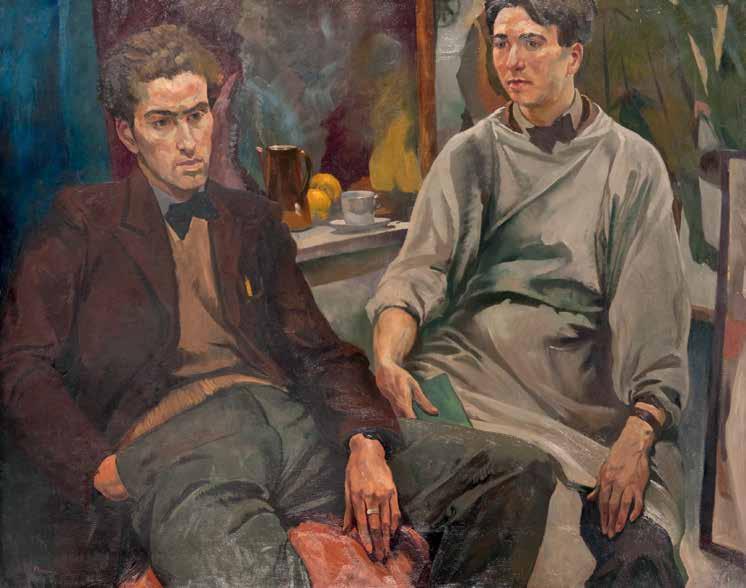
Bobby’s hands threaten to take flight – his fingers fluttering against his knees. He wills them still, closing his eyes briefly.
‘MacBryde…’ sighs Fleming, stepping back from his easel, brush in hand.
The formality of his second name, intoned as a warning by their tutor, quiets Bobby, but only briefly.
‘I cannae help it,’ says Bobby. And he can’t. He liberates his wrists from the sleeves of his smock. Freedom!
Robert shakes his head and leans even further back in his chair, so far back he can almost hear his mother tut. But he’s not at home now – he’s away from Kilmarnock, from that wee flat full of heavy weather made by his father. He’s here at the Glasgow School of Art – with Bobby. They’ve nearly finished and now they’re sitting for a portrait, a portrait done by their tutor, a portrait that will go somewhere, maybe too far. Bobby – the warm dangerous fact of him, sitting knee to knee, closer still when this session is over and they’re finally back in the attic they share at 3 Botanic Crescent. At the top of the maid’s stairs, with the door locked, daring to stand together in the window looking down over the impossibly grand crescent through the treetops to the Botanic Gardens beyond, where plants from every corner of the Empire pay leafy tribute. It’s 1937 already. Soon they will have to leave. And go where? Do what?
The world is turning faster and faster. Robert can feel it. ‘Here,’ he says, reaching behind himself without looking and retrieving a book from Fleming’s mantle.
‘Orlando?’ says Bobby, arching one eyebrow – an ability he fears he caught watching Greta Garbo at the pictures, an ability he spent his boyhood in Maybole trying to hide, along with other things.
‘Mhm,’ nods Fleming, using his brush like a baton, conducting them back towards stillness.
‘Can I borrow it?’ Bobby asks, laying the book flat along his right leg.
‘You may,’ says Fleming, lingering a little too long on ‘may’, the correction settling on his
star students like fine dust. Had they noticed? They missed nothing – each a self-built appreciating machine, designed to make the most of every moment and watchful even here with just him. Fleming is a few years older than the Two Roberts – that’s what everyone calls them, that’s who they are. And what they are?
MacBryde and Colquhoun are from a world away – Ayrshire but not as Turner painted it. Fleming remembers the rough brown paper MacBryde submitted his portfolio on – ‘borrowed’, he’d said, from the boot factory where he’d worked for five years to save his fees. Maybole might as well be the moon. Colquhoun had proper paper but only because his art teacher paid for it – finding a scholarship to keep his prodigy in school after the father tried to take him out at 14. Kilmarnock could never keep such talent. Their mere presence here at the institution where Fleming had studied was as unlikely as a sunny Scottish summer but no less welcome.
Robert had said no when Bobby had told him about Fleming’s idea. We already stand out. But over evenings in their attic Bobby wore him down: They’re all just jealous It’s an honour.
Finally, Robert told himself maybe there was something to be learned from being a sitter if he was to master The Portrait. On paper, he could get close to others. Bobby needed no such tricks – he knew the secrets of people: girls crowded towards him in the corridors, like the goldfish in the pond at the Botanics darting at crumbs. Maybe that’s why Bobby preferred to draw things – like the silver coffee pot on Fleming’s mantel or the lemon sitting beside it. Objects wanted nothing from him.
‘A scrrrrreaming yellow,’ says Bobby, from the side of his mouth, like a ventriloquist.
Fleming sighs. Robert shakes his head.
‘The lemon I mean,’ says Bobby, swallowing saliva born of the tart thought.
‘It’s yours,’ says Fleming. ‘If. You. Just. Sit. Still.’ Fleming paints the air with his brush on each word.
‘Thank you,’ says Bobby, with plans to paint his prize before turning it into a pot of tea and
maybe also a pudding for them if he can get his hands on some cream. He makes a show of pushing his lips together and steals another eyeful of Robert – his picture-house perfect profile like a matinee cowboy. Or a young emperor from a coin at the Glasgow Museum, but not a tyrant, no. Fleming pretends not to notice Bobby looking – adjusts Bobby’s gaze to a kinder safer middle distance.
Robert considers the rug. He’d glimpsed the portrait as they arrived earlier: the sitters are very carefully not touching but seem to want to. The space between them is embarrassingly like a love heart from the cartoons played before the big film. Robert imagines his fellow students viewing it, seeing what he had always looked away from until he laid eyes on Bobby. Seeing what he still turns from some mornings. He sits up ‘Not you too?’ says Fleming, finally surrendering his brush.
‘I can’t,’ says Robert, unknotting his bow tie – identical to the one Bobby is wearing, every stitch knitted by Bobby. Every stitch stifling. Robert sways to his feet, his tie slips to the floor. Bobby reaches for him. Robert leaps away as if electrocuted, staggering towards the easel. Fleming steps wordlessly aside because to say something might be to say everything.
‘Robert!’ says Bobby, getting up and steadying the easel, seeing what Robert has seen and knowing how it will look to him. He smiles at Fleming in the tight way he remembers his mother doing when he was a boy. It’s an honour.
But Robert is already at the studio door, head down, the round brass handle blooming in his hand – a gale rages all around them, but only he can feel it.
‘Wait,’ says Bobby, walking towards the opening door. ‘Wait.’
—
Damian Barr’s novel The Two Roberts (Canongate) is out now
Robert MacBryde and Robert Colquhoun: Artists, Lovers, Outsiders Charleston in Lewes, until 12 April 2026

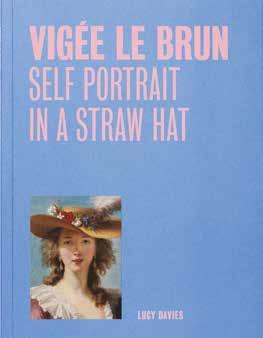
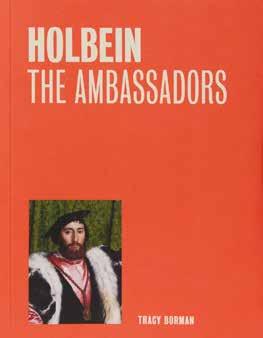
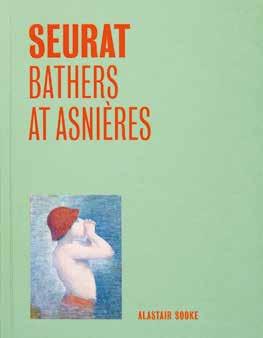
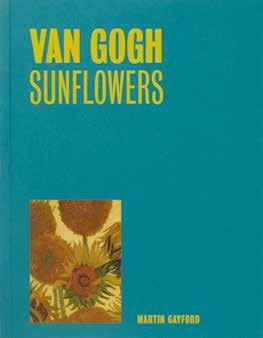
This new collection of beautifully illustrated books explores the stories behind masterpieces from the National Gallery, London. Written by established authors, each publication provides a fresh perspective on these much-loved works and the artists who made them.
Available at the National Gallery and all good bookshops.
Discover the books that shaped the thinking of artists and curators in 2025 – then add them to your reading list for 2026
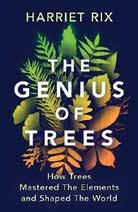
The Genius of Trees
Harriet Rix (The Bodley Head, £25) Chosen by David Nash RA
My love of trees, the primary material in my art for decades, has been magnified by Rix’s book. It tells us how trees have evolved over 390 million years, from algae capable of of withstanding the harsh UV levels upon emerging from the sea, to the development of strategies for sourcing water by seeding rain, and creating earth and fungi, and changing the atmosphere to create oxygen levels that could sustain animal life.
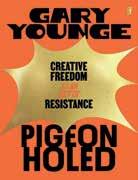
Gary Younge (Faber, £6.99)
Chosen by Tarini Malik, RA Curator
Calling someone your hero can sound sentimental, even a little lazy, but Younge writes with such clarity and courage that it would be a disservice to say anything less. Pigeonholed is precise and moving, exposing how identity is so often confined by the gaze of others. Tracing the uneasy dance between power and responsibility, his essay is an unflinching take on the burden of representation and the quiet toll it takes.
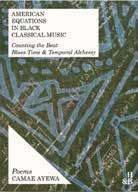
American Equations in Black Classical Music
Camae Ayewa (Hat & Beard, £22.99) Chosen by Rebecca Salter PRA
‘Make a list of all the things you say to yourself while creating.’ ‘Who taught you those words?’ These are lines from ‘University Equations’, one poem in this powerful collection. They offer a clue to unlocking the profound internal musicality of Ayewa’s writing. Her poetry reaches deep into the world of jazz, interwoven with the historical roots of Black America.
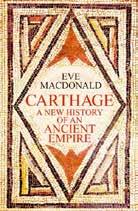
Carthage: A New History of an Ancient Empire
Chosen by Stephen Farthing RA
MacDonald’s view of Carthage has been beautifully constructed from two very different vantage points: first as a historian questioning Roman victors’ accounts of events; then as an archaeologist who has physically dug into the hill to find new and exciting evidence. The author did not bash this story out on a keyboard; instead she gently brushed away the dust that obscured the tale from her readers. books
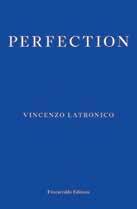
Vincenzo Latronico (Fitzcarraldo Editions, £12.99)
Chosen by Ryan Gander RA
There is a beautiful discomfort in Latronico’s novel Perfection. A kind of inverted empathy exists for the main characters, two Berlin-based creatives. I feel a sympathy and awkwardness and almost embarrassment for them, but realise that the author is in fact describing me. Latronico’s genius is his ability to hold up a mirror to a privileged generation of creatives that dare not look. It makes for a challenging read.
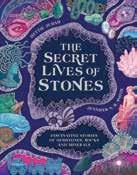
Judah (Laurence King, £16.99)
Chosen by David Remfry RA
Art critic Judah takes readers on a compelling journey through the rich and varied world of gemstones, rocks and minerals. From the golden amber that once flowed as resin through prehistoric forests – preserving ancient life in suspended animation – to the deep blue lapis lazuli, treasured for millennia and ground into pigment by Renaissance masters, this book reveals the extraordinary narratives embedded in Earth’s geological marvels. »
Forest of Noise
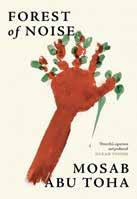
Mosab Abu Toha (4th Estate, £9.99)
Chosen by Mali Morris RA
A book that means a great deal to me, Forest of Noise by Mosab Abu Toha, has thankfully reached many of us, and moved us to tears. The poems, about a life and flight from Gaza, are profound, clear and heartbreaking, and they show the miraculous transformation of grief and suffering into art, when undertaken by a great poet. I read them in counterpoint to Abu Toha’s unmediated reporting online of the genocide as it unfolded. It’s necessary to bear witness, but I am also more grateful than ever for his poetry – the way it structures and gives form, through language, to extreme experience and feeling.
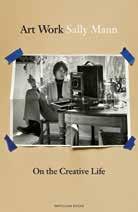
Art Work: On the Creative Life Sally Mann (Particular Books, £25)
I’d recommend this to all artists as a good book about making art. Mann is great on rejection and describes awful moments, such as staggering out of a meeting with photos damaged as she tried to gather them up. I found it heartening to read, with its exhortations of ‘work hard’, ‘time is short’, ‘you will be miserable’, ‘kill your darlings’, as I agonise over new work and struggle. We artists who are so lonely need books like this to act as companions when we are low and forget that that is just how it is. No one becomes an artist for anything other than a life of endless trying.
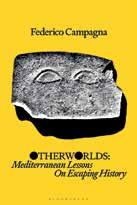
Otherworlds: Mediterranean Lessons On Escaping History
Federico Campagna (Bloomsbury, £18.99)
Chosen by Eliza Bonham Carter
Curator & Director of the RA Schools
A vital book for our time, Otherworlds charts the Mediterranean from prehistory to the present, moving between particular moments in time and vast overviews of geological, religious and political movements. For Italian philosopher Campagna, the Mediterranean imagination is rooted in mysticism, magic, psychedelia and speculative thought. At its heart, this is a love letter to the Mediterranean – and to the enduring power of human imagination that it has nurtured.
books
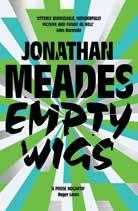
Empty Wigs
Jonathan Meades (Unbound, £25)
Chosen by Mick Rooney RA
Let me warn you. Manoeuvre this book into the room in which you read. It has almost a thousand pages. Over the decades, this extraordinary commentator has peeled society back to the bone. His many themes – anthropological, political, architectural, you name it – are described in the world of this book with the humour of the Dadaist. The British Meades has made his home on the outskirts of Marseille – as with many artists, exile is the preferred destiny. They seem to need distance to recreate the strange land of their birth, which here emanates from the cornucopian pages of this book.
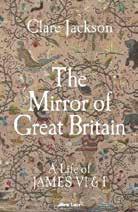
The Mirror of Great Britain: A Life of James VI & I
Clare Jackson (Allen Lane, £35)
Chosen by Jock McFadyen RA
The crowning of James VI & I was the first iteration of the joining of Scotland and England, long before the Act of Union in 1707. Jackson’s biography is a thematic account of James’s life and times. The research is forensic and the extensive use of Scots language transports the reader to James’s world. It’s not by any means an art book but without James there would have been no doomed Charles I, England’s greatest Royal patron, and maybe even no Royal Academy to receive a Royal Charter from George III...
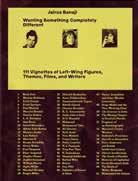
Wanting Something Completely Different
Jairus Banaji (Rab-Rab Press, £18)
Chosen by Nikita Sena Quarshie, curator and researcher
At a time when it feels difficult to imagine an alternative to ongoing crises, Banaji’s collected biographies of left-wing figures is animating. While I don’t necessarily believe in singling out individuals in place of movements they’re a part of, those featured in this book are, as Banaji says, ‘people who can teach us how to think rigorously and creatively about the world’. Some, like Frantz Fanon and Sylvia Plath, were familiar, and it has been interesting to discover new names, like Iranian poet and filmmaker Forugh Farrokhzad.
As the RA’s landmark show of South Asian art continues, Pramodha Weerasekera traces how two iconic art schools – in Santiniketan and Baroda – nurtured India’s avant-garde artists, shaping a new modernist movement that had Mrinalini Mukherjee at its centre
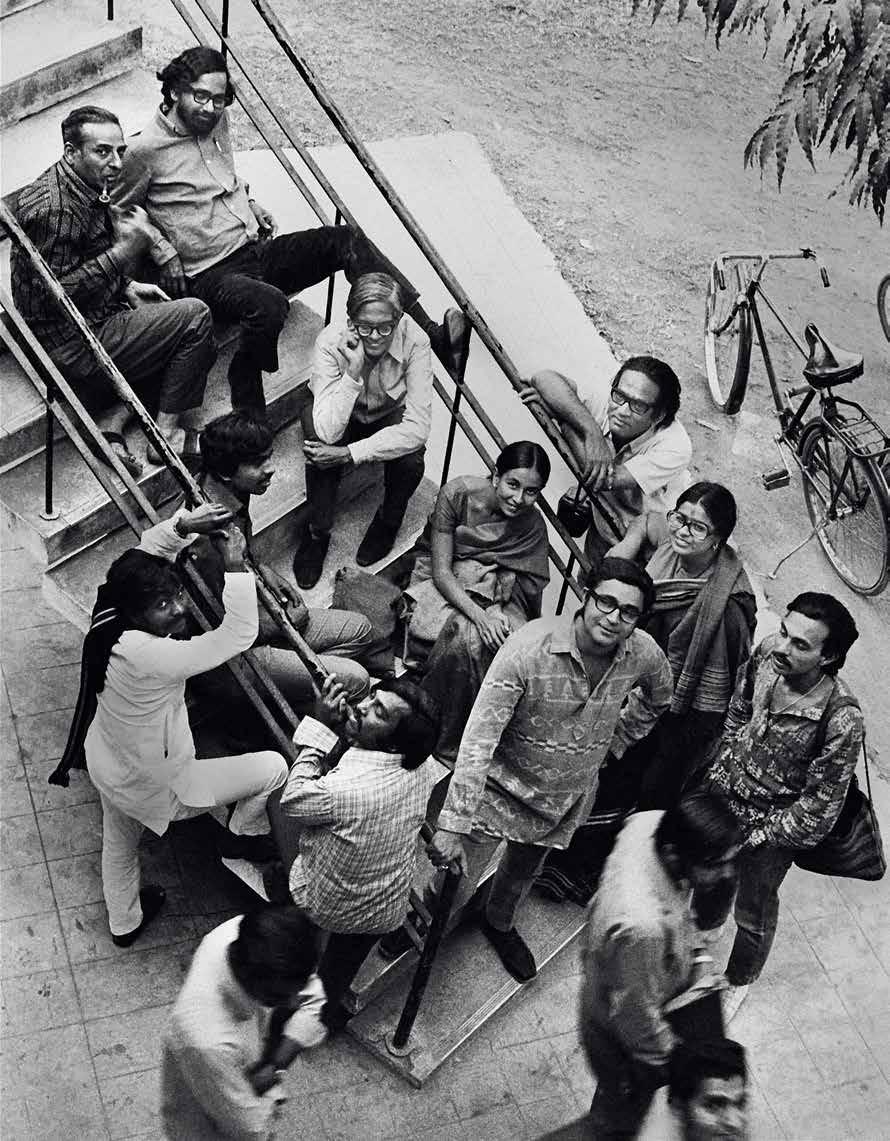
In Mrinalini Mukherjee’s etching Afternoon (1979; right) a larger-than-life squirrel stands in woodland. The creature gazes up at the trees in curiosity and wonder, as if imagining a utopian ecosystem that would let it conquer the surrounding natural world. Mukherjee’s decision to elongate its spine, and to point its nose skywards, suggests that it is not bound by the usual laws of nature and may soon be as high as the branches. When I look at this animal, I see it as an embodiment of Mukherjee herself: an ambitious artist who was as enthralled by the magic of the natural world as she was by the traditions of South Asian art. ‘I like the feeling of awe when you walk up to the small sanctum of a temple and look up and behold an iconic presence,’ she wrote in the decade after making Afternoon ‘My work is a celebration of that sense of wonder.’
As the RA’s exhibition ‘A Story of South Asian Art: Mrinalini Mukherjee and Her Circle’ shows, Mukherjee also thrived as part of a rich cultural ecosystem of artists. These communities formed around two art schools that are crucial to understanding the development of South Asian modern art. The first, Kala Bhavana in Santiniketan, West Bengal, was founded in 1919 by the Nobel laureate Rabindranath Tagore, a towering figure in the Bengal Renaissance, with the aim of connecting students with the natural world. The second is the Fine Art Department at the Maharaja Sayajirao University of Baroda (a city now known as Vadodara), in Gujarat, where the influential Baroda Group formed in the late 1950s, with a focus on combining craft traditions with modern experimentation. Mukherjee spent her life immersed in artist communities. Her parents, Benode Behari and Leela, both studied at Santiniketan and became artist-educators themselves. The young Mukherjee spent a large portion of her childhood in the vicinity of Santiniketan, where her father taught as part of a faculty that would define the direction of Indian art for decades to come. With their love of the local landscape and appreciation of natural materials, Mukherjee’s parents embodied the principles on which Santiniketan was founded. Leela Mukherjee made textural hand-carved wooden sculptures, in
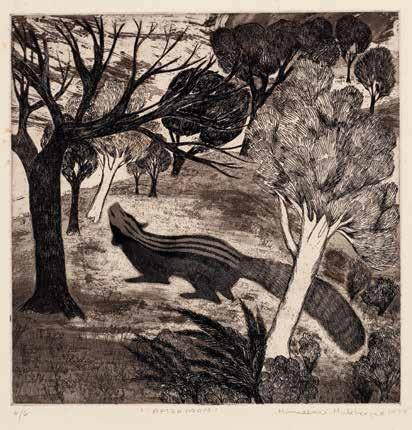
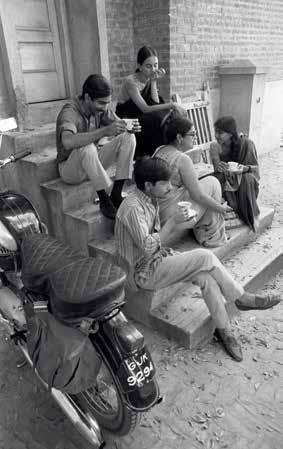
Previous page: Gulammohammed Sheikh, Bhupen Khakhar, Nilima Sheikh, Mrinalini Mukherjee and friends at the Faculty of Fine Arts, Baroda, c. 1970, by Jyoti Bhatt
Above: Afternoon 1979, by Mrinalini Mukherjee
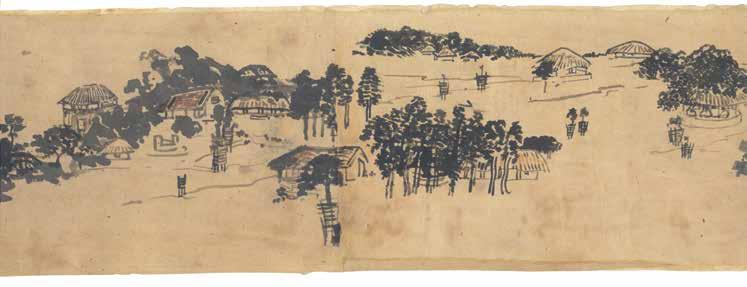
Below and below right: two details of Scenes from Santiniketan 1920s, by Benode Behari Mukherjee
‘Mrinalini Mukherjee spent her life immersed in artist communities. Her parents both studied at Santiniketan, becoming artist-educators themselves’


which abstract shapes combine to reveal human gures. Pairs of lovers are carved out of the same piece of wood, and gures emerge in moments of de ance (Figure with Raised Hand 1950s-80s; above).
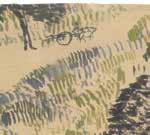
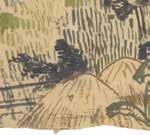
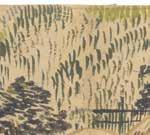
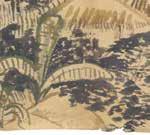
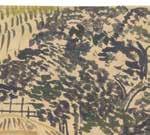
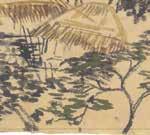
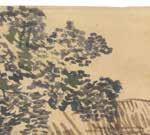
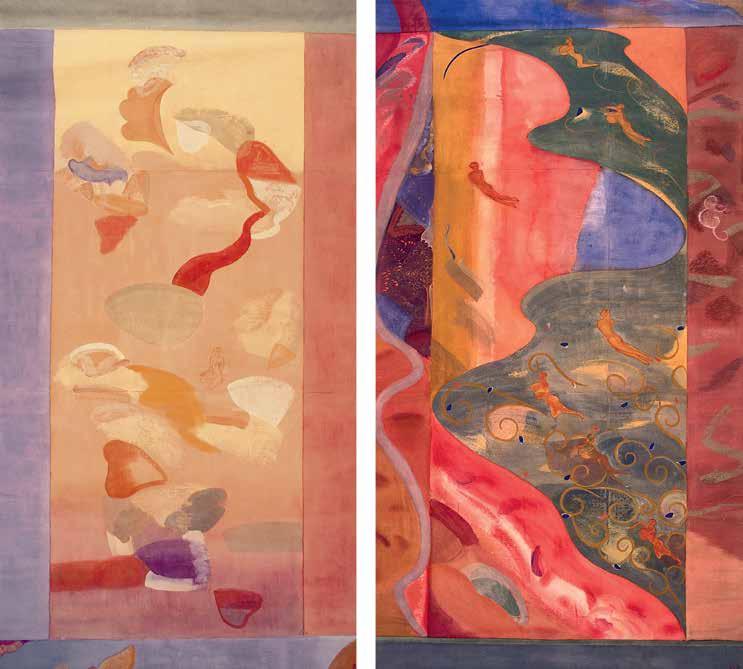
Mukherjee’s father, Benode Behari, studied the landscape around Santiniketan, which he captured in ink and watercolour on paper. Scenes from Santiniketan (1920s; two details, below and below left), a 44-ft-long painted scroll, tells of a young man’s journey around the grounds of the university – a world of dense ora, populations of the bulbul songbirds that roam the orchards, communities in local villages, bullock carts and palm trees. In contrast to European traditions of landscape painting which aim to freeze a moment in time, the handscroll is an East Asian invention, used to document the complexities of a landscape across time. Benode Behari Mukherjee’s scroll provides a romantic insight into his own experience as an »
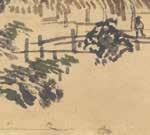
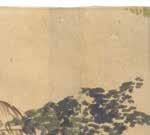
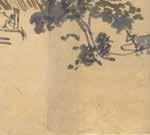
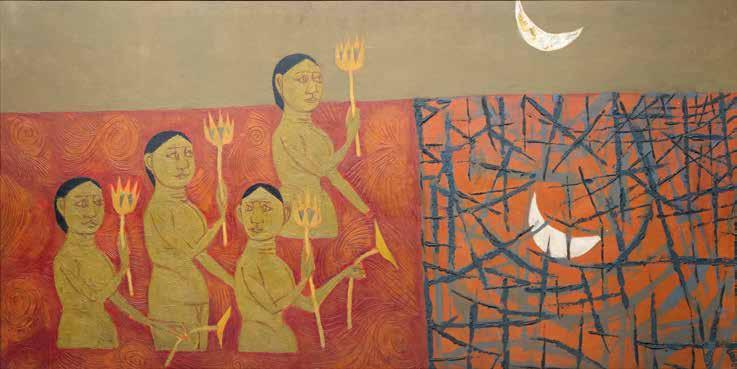
‘In the newly formed nation, artists searched for ways of expressing what it meant to be Indian… turning to the influences of folk and tribal traditions ’
» art student, finding nooks and crannies of natural beauty on the campus grounds, with its waterways, and the trees shading students at al fresco classes. Later in life, during his fifties, he would lose his sight, and turn towards abstraction (Two Triangles, 1957; page 44).
Born in 1949, the Mukherjees’ daughter came of age during a time of great political upheaval and artistic experimentation. Just two years earlier, India gained independence from British colonial rule, and the country was divided into India and Pakistan – a geographical split that displaced millions of people and gave rise to widespread ethnically motivated violence that continues today. In this newly formed nation, artists searched for ways of expressing what it meant to be Indian, reclaiming Indigenous forms of arts and crafts and turning to the influences of folk and tribal traditions.
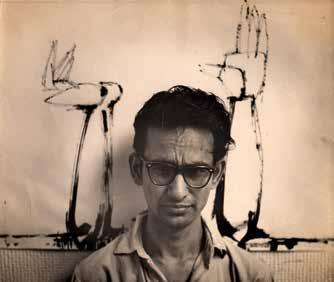
In 1965, at the age of 16, Mrinalini Mukherjee herself enrolled at Baroda, where she first specialised in painting and later studied mural design. Under the influence of her teacher, the artist KG Subramanyan (photographed in 1967; left), she began to explore the use of natural materials, developing the majestic woven sculptures for which she is today best known (Adi Pushp II, 1998-99; page 41).
Subramanyan, who initially studied economics in Madras, had been active in the Indian independence
movement, and was imprisoned for six months in 1943 for his involvement in the cause. His own artistic awakening took place at Santiniketan not long after his release. Having been banned by the British authorities from enrolling at government-run colleges, he decided to study art, learning his craft under the tutelage of Benode Behari Mukherjee.
By the time Subramanyan joined the faculty at Baroda in 1951, he was an artist working in various mediums, as comfortable with a paintbrush as he was with clay, wood and weaving.
During the 1950s Subramanyan became part of the Baroda Group, alongside influential artists such as Bhupen Khakhar and Gulammohammed Sheikh. It was formed in the spirit of Baroda’s curriculum, which taught that an embrace of tradition was necessary in the production of contemporary art. Ever political, he encouraged the young
Opposite page, top: Bathers in Moonlight 1958, by KG Subramanyan
Opposite page, bottom: Subramanyan preparing for a Fine Art Fair at Baroda, 1967, by Jyoti Bhatt
Above: Singer / Crossing 1 from the ‘Songspace’ series, 1995, by Nilima Sheikh
Mrinalini Mukherjee to see no distinction between craft and fine art, rejecting the hierarchy between the artisan and the artist, and inculcated in his students a belief in the importance of working with materials sourced from the local landscape. As art historian Emilia Terracciano wrote of Subramanyan’s teachings, ‘The idea is not to go elsewhere and look for something exotic, but to use something that references one’s living local tradition.’ Whether celebrating Indigenous practices, resisting the dominance of the Western modern canon or making work that highlighted social inequality in a rapidly changing nation, the community of artists that gathered around the Baroda art school was intrinsically political. Under Subramanyan’s guidance, students and staff staged collective Fine Art Fairs on campus. Local craftspeople were invited to the fairs to teach »
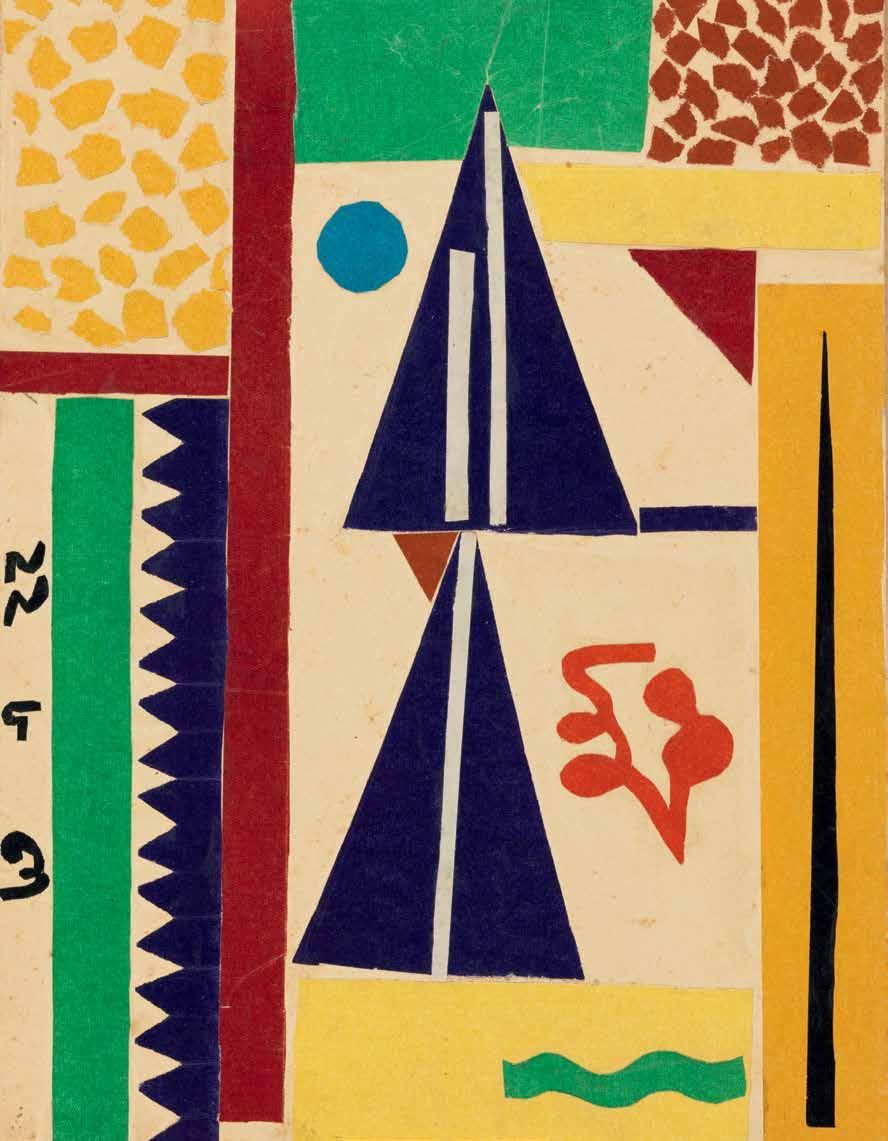
Opposite page: Two Triangles 1957, by Benode Behari Mukherjee
BHATT AND ASIA ART ARCHIVE
JYOTI
OPPOSITE: TATE: PURCHASED WITH FUNDS PROVIDED BY THE SOUTH ASIA ACQUISITIONS COMMITTEE 2015. PHOTO: TATE. THIS PAGE: COURTESY
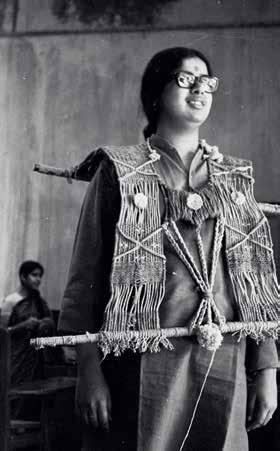
Clockwise, from above: Gulammohammed Sheikh, 1962; students including Nilima Sheikh (top step, right) and Mrinalini Mukherjee (lower step, centre) gather on campus; Mukherjee wearing one of her fibre works during preparation for the Fine Arts Fair, Baroda, 1969. Photos by Jyoti Bhatt
» students traditional methods of making, and it was during these events that Mukherjee developed her own knotting techniques, drawing on local methods of weaving with natural fibres (photograph of Mukherjee; right). Mukherjee’s peer and fellow student at Baroda in the 1960s, Nilima Sheikh, would go on to become one of India’s most celebrated modernists, making artworks that acknowledge and question the status of women in Indian society. Following independence, as India struggled to reimagine itself after colonial rule, violence against women was rife. Honour killings, sexual assaults and sati pujas (in which the wife is ritually sacrificed on the funeral pyre of her husband) were commonplace.
In the following decades, Sheikh depicted stories of courage and resistance among ordinary South Asian women, using motifs and inspiration from Eastern miniature painting, incorporating folk songs and oral histories, while also seeking to forge international solidarities. Singer / Crossing 1 (from the ‘Songspace’ series, 1995; page 43), a double-sided painted scroll, was made for the first Johannesburg Biennale ‘Africus’ in 1995, following the end of the apartheid regime. One of five painted scrolls made for the event, it depicts a Punjabi-Sindhi folk tale in which a young woman, Sohni, swims across a river each night, using a ceramic pot to keep her afloat, to see her secret lover Mahiwal. When her trysts are discovered, her sister-in-law fills the pot with stones to drown her midjourney. Sheikh paints multiple versions of Sohni’s body in the river. The bodily motifs and circular, free-flowing movements of the water show Sheikh’s keen eye for »
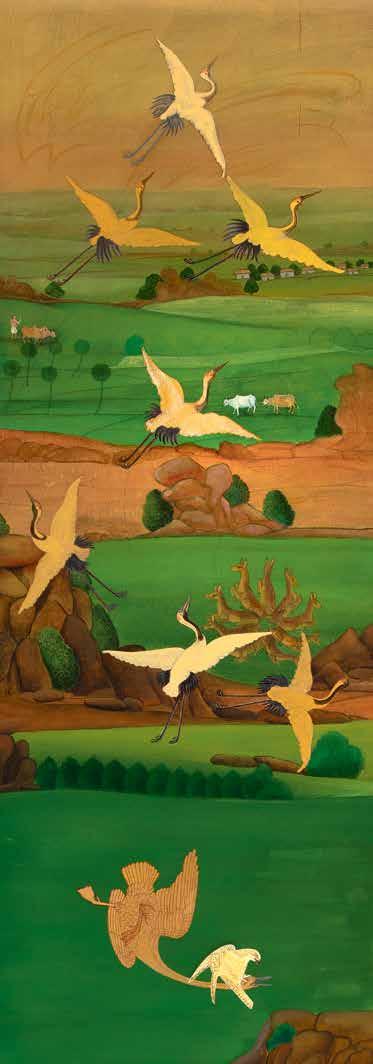
‘ In Hunted, a crane is attacked by a white eagle… the scroll-like format of the painting giving a sense of a landscape unfolding as a story’
Left:
िशकार Hunted (detail), 2018-24, by Gulammohammed Sheikh
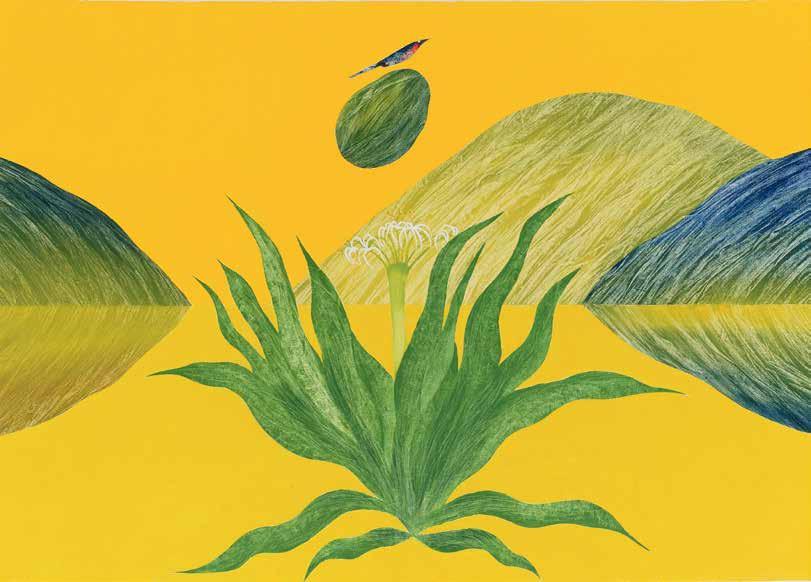
Opposite page: Untitled (Lily by My Window) early 1970s, by Jagdish Swaminathan
» storytelling. Sohni’s blood, painted in red tempera, flows across the canvas as a tribute to her defiance.
It was while studying at Baroda in the 1960s that Nilima Sheikh met her future husband, Gulammohammed Sheikh (photographs, page 45). A former student of the art school, he became part of the Baroda Group and joined the faculty in 1960, and went on to make works that reflected the changing world around him. Sheikh used his practice to respond to moments of communal violence, depicting the riots that took place in Baroda in 1969, and the rapid process of urban development and its impact on communities and landscapes, never losing his love of the natural world. His recent painting, िशकार Hunted (2018-24; detail, left) shows a crane being attacked by a white eagle; the long, scroll-like format of the painting, and a sense of landscape unfolding as a story, echoing Benode Behari Mukherjee’s iconic Scenes from Santiniketan from a century earlier.
In 1962, Gulammohammed Sheikh was an active member of the influential Group 1890, comprising 12 male artists who aimed to form a modernist art movement that embraced change and embodied the new India. However, the group disbanded after their first and only show, held in
New Delhi in 1963, and inaugurated by the then-Prime Minister Jawaharlal Nehru. Among its members was Jagdish Swaminathan, a poet, painter and social activist with an interest in the mystical properties of nature.
Swaminathan’s painting, Untitled (Lily by My Window) (early 1970s; above), imagines a flower blossoming in deep water, swimming in a yellow hue that matches the sky; the lily is still, while a bird on a stone-like form appears to defy the laws of gravity.
Swaminathan was interested in creating equality within the Indian arts ecosystem, a belief that led him to collaborate with artists from the Gond and Bhil Indigenous tribes. In 1982, he would establish the Bharat Bhavan art centre in Bhopal, Madhya Pradesh, in order to house and celebrate the vernacular art forms of the Gond and Bhil tribes. This was not merely a way of representing their artistic traditions; it was a means of actively engaging Indigenous peoples in nation building, in a country that had been ravaged by British colonialism and the Brahmin caste system.
Mukherjee’s artistic circle, which began with her parents and went on to encompass many of her peers, is
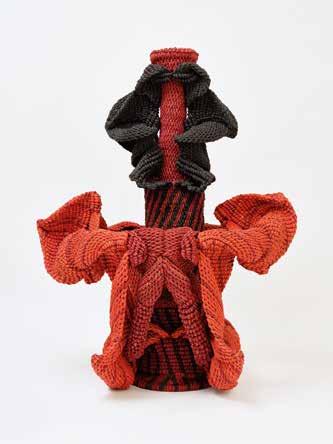
bound by a fiercely intellectual and inventive engagement with India’s natural and political landscape. Its influence reverberates today among contemporary South Asian artists who explore the politics of craft practices and the significance of natural materials. Sagarika Sundaram works with wool and other fibrous materials, often dyed blood red; Marie Gnanaraj makes structures that imitate natural matter, twisting, turning, interrupting and knotting, using a locally designed handloom; Gopa Trivedi decodes the histories of culturally significant floral species, brought to India via ancient trade routes or introduced by colonial powers. The list goes on, and the circle is still expanding.
Pramodha Weerasekera is a writer and curator based in Colombo, Sri Lanka
A Story of South Asian Art: Mrinalini Mukherjee and Her CircleThe Jillian and Arthur M. Sackler Wing of Galleries, 31 Oct to 24 Feb 2026. Exhibition organised by the Royal Academy of Arts, in partnership with The Hepworth Wakefield, which in 2026 presents a major retrospective of Mrinalini Mukherjee. Supported by the Mehra Family, Seher & Taimur Hassan and the Henry Moore Foundation
As the RA’s acclaimed exhibition of the foremost painter of Black American life continues, we invite five leading cultural figures to discuss key works in the show and the impact Marshall’s art had on them
Words: Caleb Azumah Nelson, Luc Tuymans, Angélique Kidjo, Dorothy Price and Chris Ofili
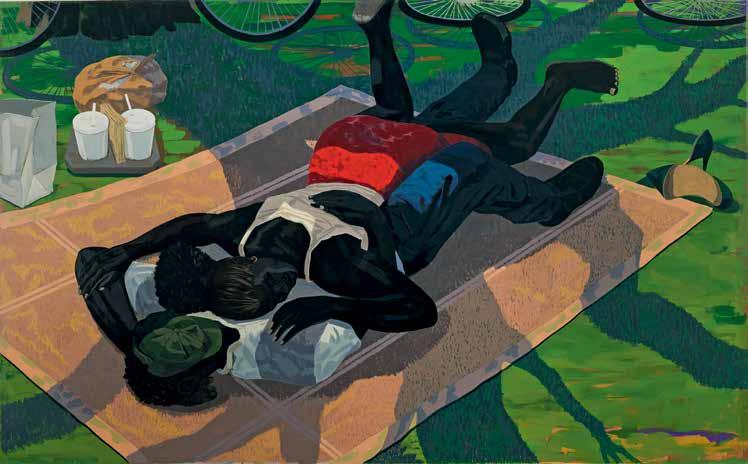
Author Caleb Azumah Nelson burst on to the scene with his best-selling novel Open Water in 2021. Celebrated for his tender and hopeful depictions of Black British life, Nelson shares a personal reflection on Marshall’s intimate painting Untitled (Blanket Couple)
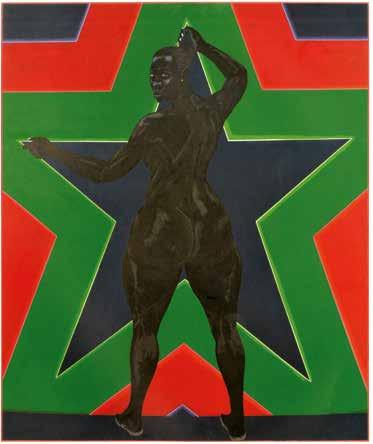
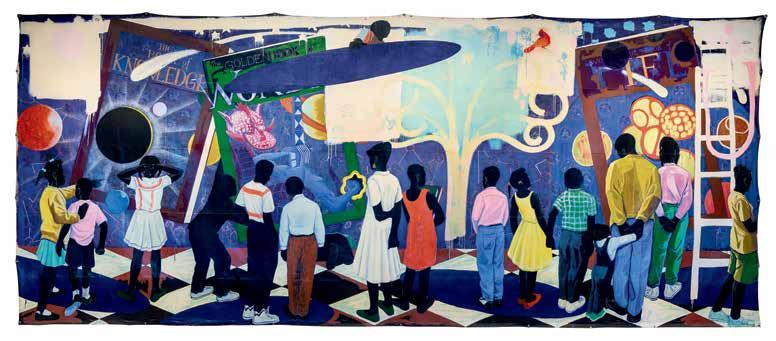
Most of my favourite albums feel like they are designed to be played on loop, endlessly, and this is how I treat Kerry James Marshall’s exhibition ‘The Histories’. When my partner and I face the final painting, Black Star II (2012; page 8), in unspoken agreement, we turn on our heel and make our way back to the start of the show. Every image in the exhibition astounds. As Marshall says, they are ‘pictures that I thought people would want to look at a second time.’ As we walk, we catch glimpses of favourites: Knowledge and Wonder (1995; page 12), for instance – a rapturous scene of young people finding the seemingly infinite possibilities presented by the written word – here at the RA on a rare outing from
Marshall
Marshall’s hometown of Chicago, where it resides in the public library.
But there’s one image that I insisted on returning to more than once: Untitled (Blanket Couple) (2014; page 49), which depicts a young couple embracing as they nap after a picnic in the sunshine. I know when something has arrested my attention because I fold my arms and lean forwards slightly, letting each brushstroke of colour wash over my vision, as I did then. I must have made a sound of satisfaction because my partner smiled at me, knowingly. There was a rush, something akin to euphoria, at seeing a version of ourselves, or what we might feel, rendered on canvas. It returned me to a question I had been asking as we walked through the exhibition, that I first found myself asking when I saw Marshall’s work at the National Portrait Gallery last year in ‘The Time is Always Now: Artists Reframe the Black Figure’: can Black people be seen as alive? As feeling alive?
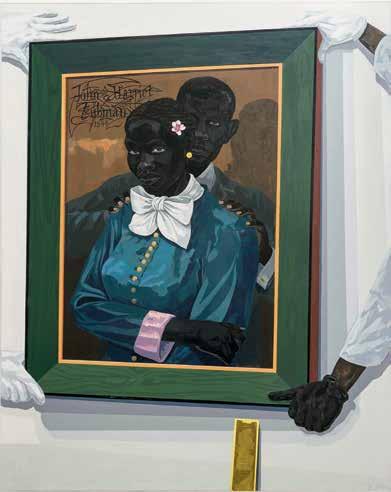
Often, Blackness arrives in the visual in ways that dull the complexity of Black people into Black bodies. But here were images, mostly of everyday life, that find Black people resisting the conditions of precarity we live under. Here was Harriet Tubman, pictured with her husband John (Still-Life with Wedding Portrait, 2015; left), in love, rather than trying to save a nation (but then, who is to say the two actions are not the same?). Here was Scipio Moorhead, not as slave but master of his craft, at an easel. Here we were and are, as humans, the colours rendering us complex and layered.
I gazed at Untitled (Blanket Couple) once more, letting it unfold in front of me. A bike lies sprawled in the grass, while another rests against the tree, suggesting a day cycling through a city’s streets, perhaps one of those endless Saturdays or an illicit afternoon in the middle of the week, when work calls but love calls harder. A blanket spread across the grass for comfort, bodies spread atop it. Her head resting against his chest, listening to the music of his heart. His arm cradling the small of her back, keeping her close. The tangle of their legs. The tangle of their lives.
Letting my eyes rove over the painting, my hand resting against my partner’s, I ask myself the questions once more: can Black people be seen as alive? As feeling alive? That’s when I realise what that earlier rush was, that flash of euphoria on witnessing the painting, witnessing myself: a reminder of aliveness.
Caleb Azumah Nelson is an award-winning British-Ghanaian writer and photographer
Among the most influential living painters, Luc Tuymans creates pale and haunting portraits that raise philosophical questions about cultural memory and what we choose to conceal. The Belgian painter considers Marshall’s Portrait of Nat Turner on Loan from Hell, unpacking his powerful use of collage to depict the leader of an 1831 slave rebellion
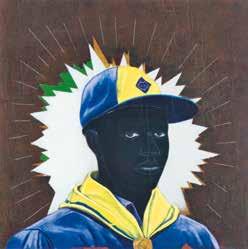
I have picked this portrait as I had not seen it in the flesh before. Also, because it is a clear precursor of his later portraits of lost boys or his ‘Scouts’ series, where individual portraits are extracted out of this world and depicted against a background that implies an imposition (Cub Scout, 1995; below right). The beauty of these portraits lies in the fact that they are unattainable. The portrait of Nat Turner has a nearly ghostlike appearance. The ownership of the
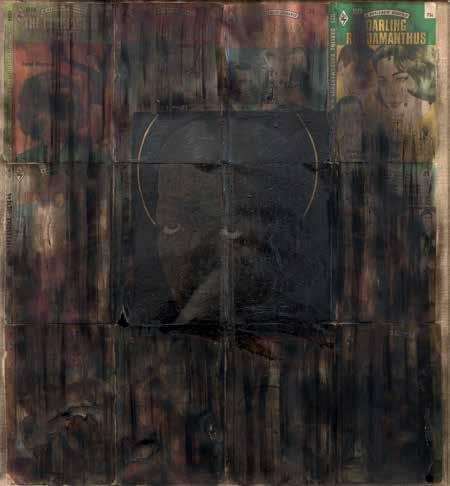
image is appropriated through sampling and collage, attaining a quality that comes close to the idea of a relic, mediating between the world of rituals and reality, retaining a rebellious undercurrent. The collage itself consists of charred pulp-fiction covers, underneath which one can see a glimmer of the glooming white faces that adorned them. On the surface the face of Nat Turner comes up as an apparition; his eyes tilted up as if in an ecstatic state, a golden halo adorning his head, his mouth half open. All this recalling pain and saintly martyrdom. Here memory as a technique is opposed by the collage that, although it is the backdrop, starts to work as a superimposition blocking all access to memory itself, or only allowing it on its own terms. The image becomes traumatic since its commemoration is caught between speech and speechlessness. Although modest in size, this work already configures the idea of monumentality, and the charred book covers with images shimmering through evoke a painterly quality, that later becomes increasingly apparent. Already in this early stage of his career Marshall demonstrates that his work is not defined by a set of rules. He uses rules as a critical tool, resisting audaciously, rather than conforming, and merely capturing and confining the image.
Luc Tuymans is a painter. His exhibition, ‘The Fruit Basket’, is at David Zwirner New York until 19 Dec
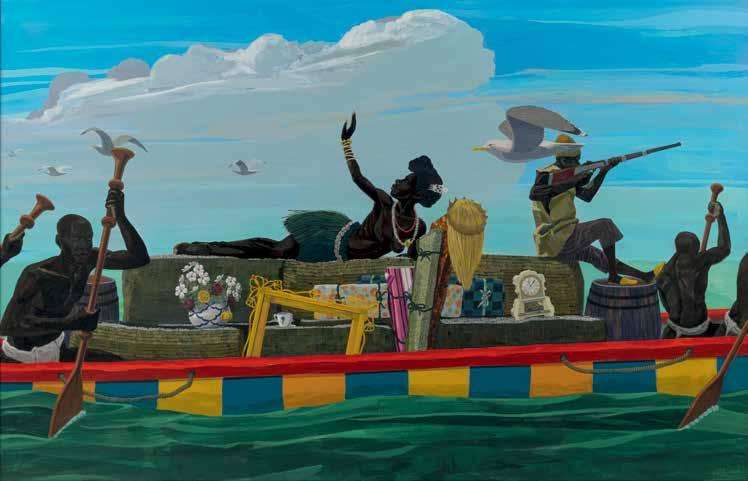
Beninese-French singer Angélique Kidjo is a global superstar. She has performed at the Tokyo Olympics, won five Grammy Awards and released 18 albums. Here, Kidjo reflects on what Kerry James Marshall’s new series ‘Africa Revisited’ means to her

I clearly remember the first time I saw a painting by Kerry James Marshall: I was visiting my daughter in Chicago in 2016, and across the city I saw his paintings on billboards advertising one of his exhibitions. I wondered: was it African art, was it American art? But it didn’t matter, and I fell in love immediately with his work. Thanks to Kerry, it felt to me like the whole city of Chicago was celebrating my people.
Then in 2018, during a snowstorm in the middle of winter, I had the privilege of visiting his studio as we were working together on the cover of my album Remain in Light (above right). The singer, actor and civil rights activist Harry Belafonte once told me the relationship between African American and African cultures is the most complex there is. This is why I was so impressed by the vastness of Kerry’s knowledge of African civilisation and the respect he has for it. The idea he had for my album cover was brilliant: he made me a ‘dealer of light’ in a dark moment of history.
His exhibition at the RA is impressive. Prior to visiting I hadn’t realised the true size of some of his famous works. They fill the historic galleries in a way that feels organic and extraordinary. I was most eager to see his new series of paintings, ‘Africa Revisited’, which looks at the history of my continent. You can’t erase the past, and you have to embrace all of its complexity if you want to prepare for the future. This is why, as painful as it might be, the story of the evil ‘business proposal’ that was the Slave Trade has to be told truthfully and not romanticised. In paintings like Haul (2025; above), Kerry forces us to think about this, and to confront the involvement of Black Africans in the transatlantic trade of enslaved people, sold in exchange for goods. But at the same time, the beauty of Africa, its resilience and strength, has to be celebrated. Kerry never loses sight of that.
Angélique Kidjo performs at Ronnie Scott’s, London, on 23 Nov
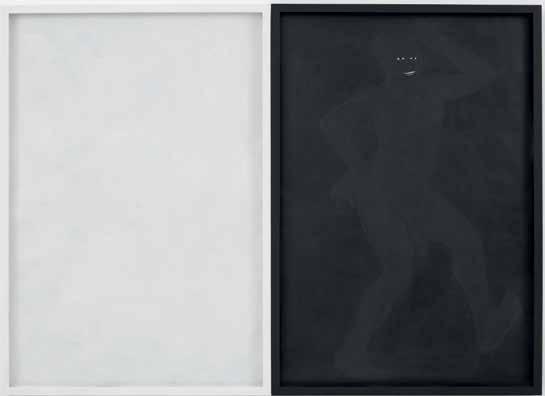
Leading art historian Dorothy Price included work by Marshall in the RA’s exhibition ‘Entangled Pasts’ in 2024, which she co-curated. Here, she explores Two Invisible Men Naked, tracing the racial dimensions of colour back to Russian avant-garde artist Kazimir Malevich’s Black Square
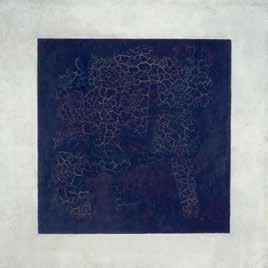
When I first saw Two Invisible Men Naked (1985; above), I was blown away by its audaciousness. While it is enmeshed in the artist’s reworkings of Ralph Ellison’s 1952 novel Invisible Man, to my mind, the diptych also meditates on how painted colour is linked to symbolic meaning.
In Ellison’s novel the narrator recounts how systemic racism in America renders him invisible to the white majority who refuse to see him. After reading the novel in the late 1970s, Marshall began to paint Black figures on dark grounds, rendering them almost invisible but for their eyes and teeth. In this work, the invisible pervasiveness of whiteness is offset by the social invisibility of being Black.
Yet I also think the work operates beyond the immediate reading of racialised social structures. It feels like an interrogation of the racialised premise of modern Western painting. In 2015 conservators at the Tretyakov Gallery in Moscow uncovered the words ‘Negroes battling’ underneath the 1915 version of Kazimir Malevich’s famous Black Square (left). Malevich, it turns out, based his apogee of abstraction on the 1897 April Fool’s Album by French satirist Alphonse Allais, a compendium of painted colours, each assigned a related title. ‘Red’, for example, became Apoplectic cardinals harvesting tomatoes on the shore of the Red Sea, while ‘black’ became Negroes battling in a cave at night Allais, in turn, had been satirising the work of his friend Paul Bilhaud, in particular an 1882 completely black painting titled Negroes Fighting in a Tunnel
Although in 1985 Marshall could not have known about the Tretyakov X-rays, Two Invisible Men Naked remains compelling in its uncanny interrogation of a tradition of white Western painting – both figurative and abstract – premised on the tension between the invisibility and hyper-visibility of Blackness. Mast’ry indeed.
Dorothy Price is Executive Dean and Deputy Director of The Courtauld Institute of Art
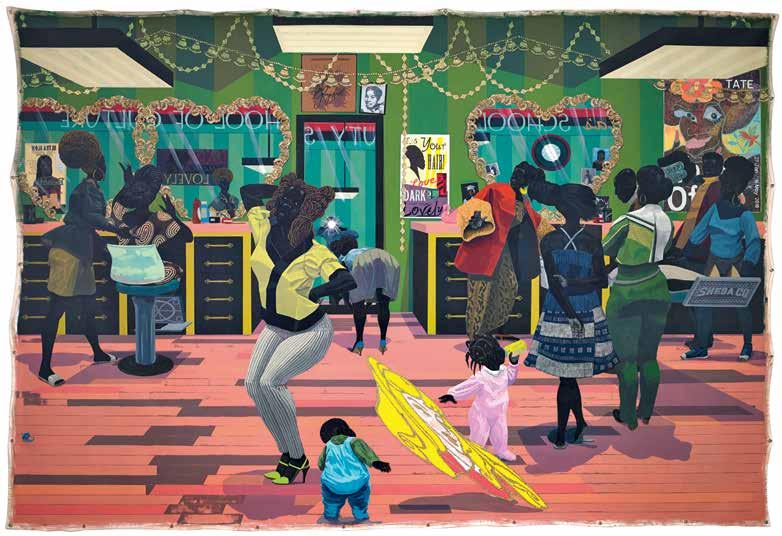
The first Black artist to win the Turner Prize in 1998, Chris Ofili is renowned for richly layered paintings that reflect on Black British identity and culture. A poster for his solo exhibition at Tate Britain in 2010, featuring his painting Blossom, appears on the wall of a salon in Kerry James Marshall’s School of Beauty, School of Culture. Here, Ofili continues the conversation with a creative response to Marshall’s painting
I have had the privilege of wandering solo through the empty halls of the Prado Museum in Madrid, ghosts and all. One of the most magnificent Velázquez paintings, with its multiple perspectives, used to haunt me as a student in art school. In an attempt at exorcism in the early nineties, I made a painting that declared that ‘There are no ghosts in Las Meninas’.
Two decades later, Kerry painted himself hidden behind the (divine) light of a camera flash amidst ladies-in-waiting, watched over by Blossom’s triple eye vision. The spirits have returned. Even the toddlers are not sure if they are seeing things and, since it casts a shadow, maybe it is real and not just a holographic sleeping memento mori beauty advertisement for Skin Darkening Cream by Afrobiotics, specialists in racial harmony; Faux Glo Instant Tan Spray by Fake Bake; I Want the Darkest Tan Possible by B. Tan; 200X Dark Black Bronzer Tanning Lotion by The Sicilian; or Go To Black Dark Maximiser by Supre Tan; Smashingly Dark by ProTan; Black Chocolate 200X Bronzer by Brown Sugar; Xtreme Melano Tan Accelerator by Tan Junkie; Sunkissed Tan Melanin Accelerator Tablets by Genetex Development; Gold Tropical Tanning Oil by Extreme Black; Go Dark Tanning Accelerator by SynergyTan; White 2 Bronze Extreme Advanced Ultra Black Tanning Accelerator Bronzing Lotion by Devoted Creations; Non-Stop Black
Opposite page: School of Beauty, School of Culture 2012 by Marshall, featuring the poster for Chris Ofili’s 2010 Tate show in the top right corner
Right: Blossom 1997, by Ofili
Below right: There are No Ghosts in Las Meninas 1991, by Ofili
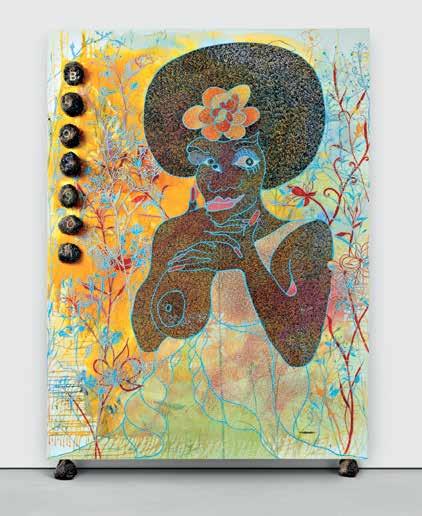
Hybrid UV Sunbed Tanning Accelerator Lotion by Power Tan; ProTan Beaches and Creme Dark Tanning Gelée Sunbed Lotion by Ergoline Plus; Cherry Good Melanoplex Tanning Accelerator Lotion by So Damn Tanned; The Professional Dark Tan by Tan Truth; or ‘Las Melaninas’ by Ana Morphosis. Of course not! But on reflection, skin of course! The paintings on the wall and that poor flayed satyr, Marsyas and his sweet music to which the lady in the pinstripe pants dances the 18-step version of the Electric Slide – then, for a split second, freezes as if she saw a ghost.
Chris Ofili is an artist
Kerry James Marshall: The Histories Main Galleries, Royal Academy of Arts, until 18 Jan 2026. Exhibition organised by the Royal Academy of Arts, in collaboration with the Kunsthaus Zurich and the Musée d’Art Moderne, Paris. Lead Supporter BNP Paribas. Supported by Idan & Batia Ofer, the Huo Family Foundation, Sotheby’s, David Zwirner and The Kerry James Marshall Supporters Circle. Additional support with Art Mentor Foundation Lucerne, Jack Shainman Gallery, The Reuben Foundation, The Bob Rennie Collection, The Magic Trust and Alireza Abrishamchi
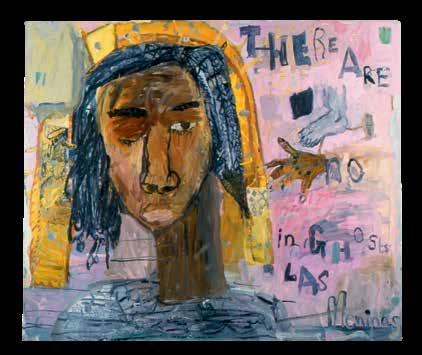
With her striking and irreverent paintings, Rose Wylie RA has become an iconic figure of British art. Her friend and champion, the artist Cornelia Parker RA , remembers an early encounter with the painter ahead of her career-spanning survey show in the RA’s Main Galleries
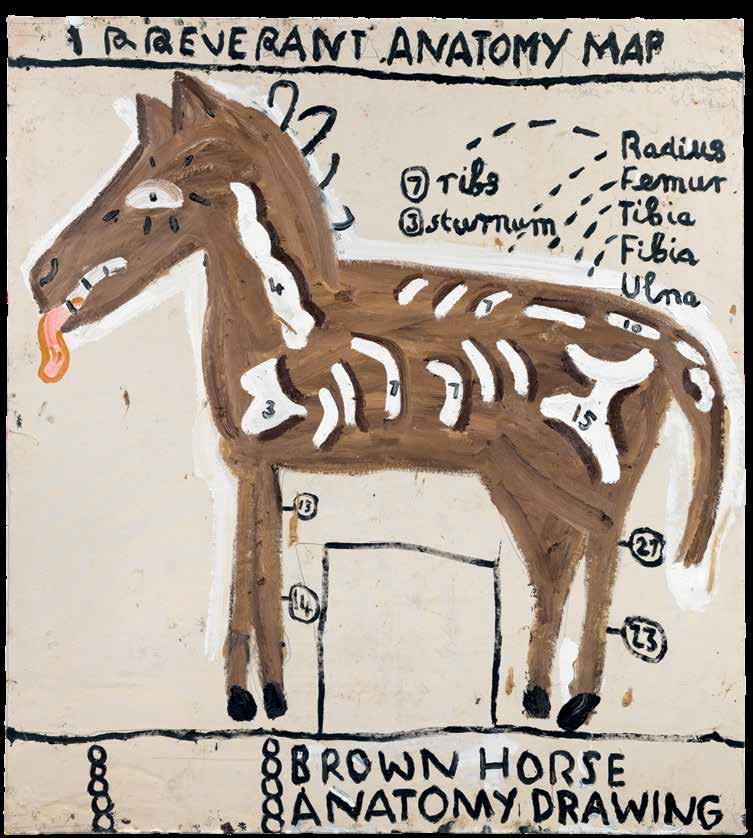
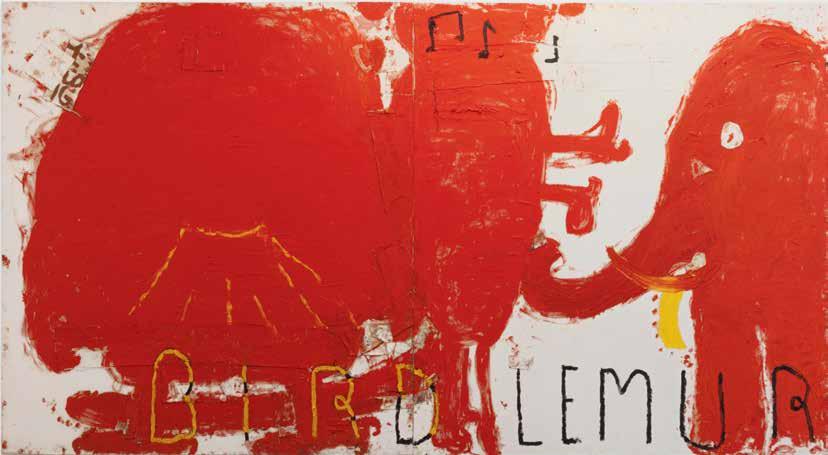
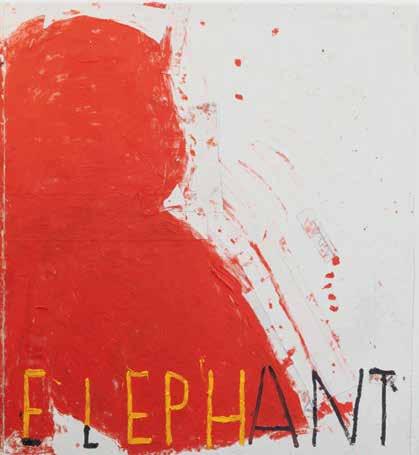
I first came across Rose Wylie’s paintings in 1997 while serving on the Arts Council Collection purchasing committee. The curator Isobel Johnstone, critic Sacha Craddock and I visited Rose’s studio in her home in Sittingbourne, Kent, which she shared with her husband, the painter Roy Oxlade. As admirers we went to view her recent body of work with the possibility of acquiring something for the collection. A slight figure, with a wild yet stylish mop of thick greying hair and flamboyant make-up, met us at the door and ushered us in to her world, where every room seemed to be annexed as a studio. There was evidence of unruly painterly activity on every surface that could serve as a palette: the table, chairs, windows and doors. She painted on large unstretched pieces of canvas laid on top of newspapers on the floor. Her footprints contributed to compositions as she worked in the round, and the paintings became a recording of a kind of ongoing dance, one that wanted to leave the canvas and carry on into the room. She would paint right up to the edges, and later glue the canvas onto a larger one, so there was something to attach to a stretcher. If she didn’t like an element in a work, she simply collaged a patch of canvas on top and carried on. Her imagery and compositions were bold, sometimes chaotic, seemingly naive, yet in reality discerning. She was channelling art history, stylistically quoting Philip Guston, Jean-Michel Basquiat and Julian Schnabel, giving the ‘big beast’ painters a feline twist.
The paintings we saw that day were largely populated with colourful characters, from fairytale figures to footballers, sampled from many sources including magazines, newspapers and films, and sometimes painted directly from the TV. Her freedom, her lack of inhibition and her confidence was enviable, allowing a disparate cast of characters the chance to share the same stage.
We were entranced by her otherworldly persona and her somewhat direct wit. I was amazed to find she was born in 1934, as she had the energy and innocence of someone a lot younger. We were bowled over by her work and enchanted by her charm. For Rose and me, it was the start of a long friendship.
When, in 2013, she exhibited a selection of her paintings at Tate Britain in the Art Now series, Rose and I participated in an ‘in-conversation’ about her work. In preparation, Rose sent me a list of questions I might use to direct the conversation. They were very funny, and I remember a couple of them. ‘Which of these two paintings of a horse is silly?’ caused some entertaining debate. In answer to another – ‘Why don’t you do private commissions?’ – she recounted a hilarious episode when she was asked to make a portrait of a couple, who were keen new collectors. She made several paintings for them but none fitted the brief as they felt their likenesses weren’t flattering enough (hair too big, breasts too pointy etc). The final work ended up being more than six metres long and featured only their
Previous spread: Irreverent Anatomy Drawing 2017, by Rose Wylie
This page, above: Red Painting: Bird, Lemur & Elephant 2016, by Wylie
Opposite page: Girl on Liner 1996, by Wylie
‘A bold, brilliant painter now in her nineties, Rose Wylie is one of the most original British artists living today’
legs, protruding into the painting from either end. The main subject of the painting was a vivid rendition of their living room, the no-man’s-land in between, populated with other people. Due to its epic size (and dubious content), the collectors found their home wasn’t big enough to accommodate it, and they finally admitted defeat and called it a day.
I nominated Rose to be a Royal Academician in 2014 when she was 80, but I was informed by the then President that she was too old for election as the cutoff for consideration was 75. I protested by saying that as a woman, Rose had taken 20 years out to raise three children while supporting her artist husband’s career, and she had just won the prestigious John Moores Painting Prize to boot. All the other Academicians raised their hands in support of her being elected, and they won the day – she
was a very popular choice. It was a pivotal moment, a growing recognition of her rich contribution to painting. Her husband had recently died, so being included into the Academy’s family of artists was a welcome support and validation of her talents, compounded by her win, the following year, of the RA’s Charles Wollaston Award for the most the distinguished artwork in the Summer Exhibition. At a recent meeting of the RA Council, I underlined the continuing need to put right the lack of representation of women artists at the Academy. I find it astonishing that Elisabeth Frink RA and Marina Abramović Hon RA are the only two women to have had major exhibitions in the Main Galleries in their lifetime. I suggested that here was Rose Wylie RA, a bold, brilliant painter, now in her nineties, whose lifetime achievements we could honour with a major UK retrospective. I’m thrilled that she is finally getting the authoritative museum survey that she so richly deserves. Rose Wylie is one of the most original British painters living today. This exhibition makes it her moment at last.
Cornelia Parker RA is an artist. Her show ‘Stolen Thunder (A Storm Gathering)’ is at Kindl – Centre for Contemporary Art, Berlin, until 24 May 2026
Rose Wylie Main Galleries, Royal Academy of Arts, 28 Feb to 19 Apr 2026
Supported by the Rothschild Foundation, Christian Levett and Musée FAMM and Jake and Hélène Marie Shafran and The Magic Trust
Friends Previews 25 Feb and 26 Feb 10am to 6pm, 27 Feb 10am to 9pm
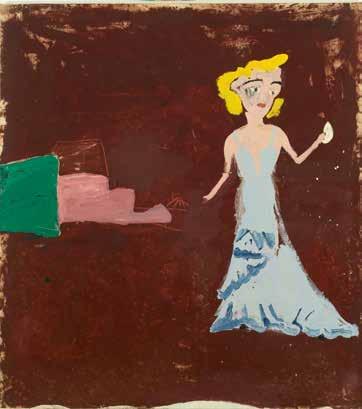
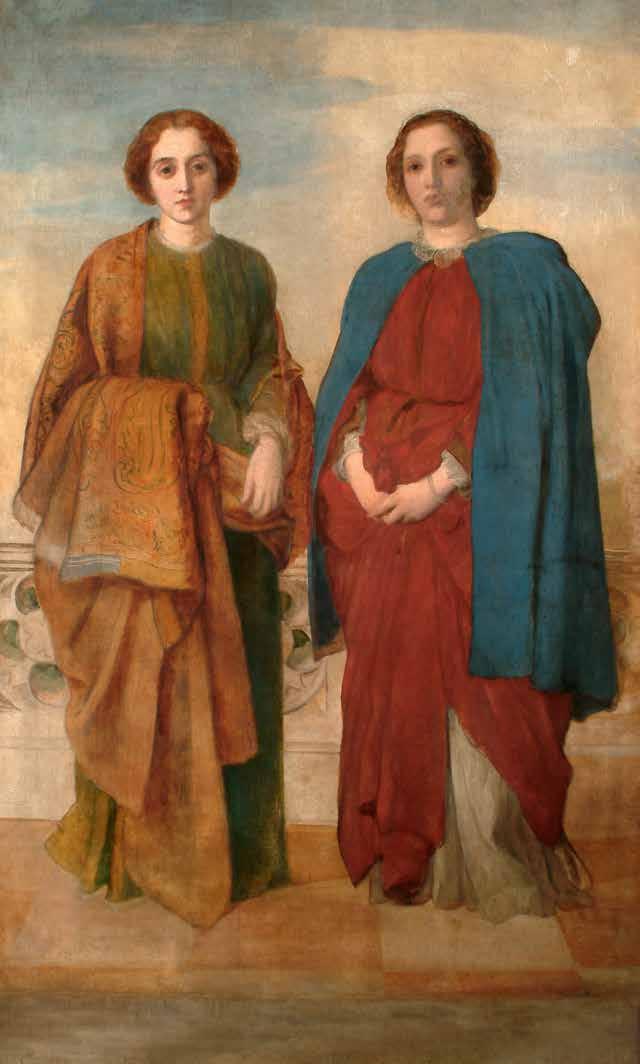
Socialites and muses to the luminaries of Victorian society, the Anglo-Indian Pattle sisters – Adeline, Julia, Sara, Maria, Louisa, Virginia and Sophia – helped shape 19th-century art. William Dalrymple salutes their remarkable influence
Sometime in 1859, the 25-year-old painter Edward Burne-Jones handed over an album of his pen-and-ink pictures and poems to the youngest of the seven Pattle sisters, Sophia Dalrymple. The album is the sole surviving record of an unrequited summer infatuation in bohemian London at the birth of the Pre-Raphaelite movement. In it, Burne-Jones depicts himself standing in medieval costume, like some Dantesque squire, holding a dulcimer, a stringed instrument from the Middle Ages. In case Sophia might miss that the figure represented a personification of Love, Burne-Jones helpfully inscribed above its head, in large medievalised capitals, a single word: ‘AMOR’. The album was a love offering, reflecting the longing the young painter felt for a bewitching woman four years his senior. He signed himself to her, ‘your abjectly devotedly [sic] dog, Ned.’ Sophia had already acted as a model and muse to many of Burne-Jones’s friends and contemporaries including
Opposite page:
The Sisters, also known as Sophia Dalrymple and Sara Prinsep 1856, by George Frederic Watts RA
Dante Gabriel Rossetti and George Frederic Watts RA (and, I confess, I am not neutral about her either: she was my great-great-grandmother). She was not generally regarded as the most beautiful of the seven extraordinary Pattle sisters; that laurel went by widespread acclaim to her dazzling elder sister, Virginia. But Sophie, as she was widely known, was considered the gentlest and most charming, with a sweetness and sensitivity of nature that contrasted with her more forceful elder sisters, who included the eminent photographer Julia Margaret Cameron. As one contemporary wrote, she was ‘a graceful and touching presence… of whom memory always brings back the soft, silken rustlings and the tinklings of silver bangles as she came and went.’ In his most celebrated depiction of her, Watts shows her standing in a white dress, young, lovely and oddly regal (Lady Dalrymple, 1851-53; page 62). Appropriately, given the sisters’ Indian »
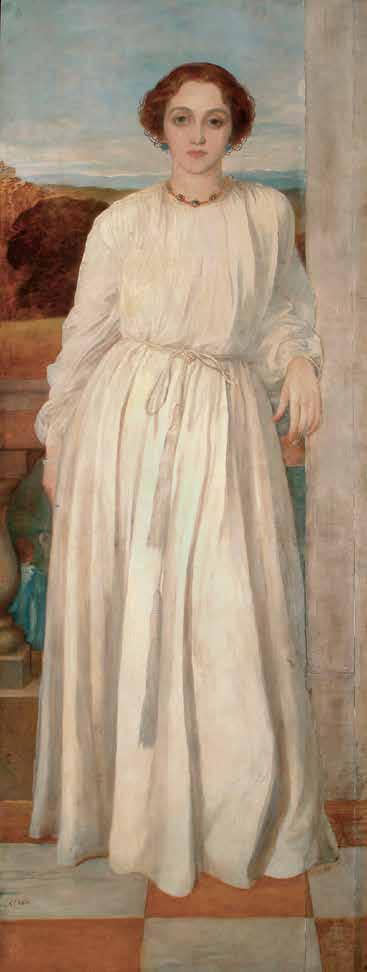
» heritage, a Hindu rakhi a symbol of sibling love, is tied around her wrist.
It was the novelist William Makepeace Thackeray who christened the sisters’ world ‘Pattledom’. Burne-Jones was first initiated to it by his friend and mentor Rossetti. In the summer of 1857, Rossetti had pulled Burne-Jones into a hansom cab ‘and drove and drove until I thought we should arrive at the setting sun’, all the way out of London as far as the village of Kensington. (In the 1850s this was still situated amid open fields.) ‘You must know these people, Ned,’ said Rossetti. ‘They are remarkable.’ Burne-Jones, painfully shy, and – at this stage in his life – socially gauche, was anxious that he would find himself ‘among a lot of swells’. But the Pattles welcomed the young artist into their orbit, which centred on Little Holland House.
The house had been leased by one of the sisters, Sara, and her husband Henry Prinsep. Burne-Jones was to find himself back at the house in 1858, following a project instigated by Rossetti. He, Rossetti and William Morris had been busy finishing the celebrated Pre-Raphaelite frescoes on the walls of the Oxford Union, along with a group including the young Valentine Prinsep RA, Sara and Henry’s son. The effort and drain of the intense creativity as well as the sheer burden of overwork brought the delicate Burne-Jones to the brink of breakdown. Sara, hearing about his predicament, immediately raced to his stuffy rooms in Holborn’s Red Lion Square. Once there, she effectively kidnapped him, or as one contemporary put it, ‘took possession of him bodily’. Then she nursed him back to health at Little Holland House.
The house was the fulcrum of the Pattle sisters’ influence: a rambling dower house backing onto Holland Park. That summer it still looked onto the virgin farmland that would later be ripped up to make the shops and
‘The sisters
were bold, imaginative forces who left a cultural legacy far beyond their time’
squares of West Kensington. Here, Sara and her family hosted something rare at the time: a bohemian salon that was already coming to play an important role in Victorian cultural life. ‘Little Holland House seemed to me a paradise where only beautiful things were allowed to come,’ wrote the leading 19th-century actress Ellen Terry after she had visited. ‘All the women were graceful, all the men were gifted.’ After dining there in 1852, a dazzled Thackeray wrote: ‘It looked like a Fairy Palace’.
Another visitor described how Sara ‘introduced into her new home a cosmopolitan and liberal spirit to which people of that date were little accustomed… At a time genius was tolerated as an eccentricity rather than courted as a divine asset, when an artist and a gentleman were held to be terms antipodean, men met there on a footing which had the attraction of novelty.’ It was, in other words, an oddly classless space in an age when class defined most things in Britain. A person’s background was not a qualification for entry to Pattledom. What mattered was genius, or beauty.
For Burne-Jones, this demi-monde was entirely new, and deeply seductive. He had grown up within a strictly religious family in Birmingham and had originally been intent on entering the Church. Little Holland House was a revelation. As he regained his strength, he began to fall for Sophia, whose laughter and beauty as well as her unattainability (she was married with two children) bewitched the young Pre-Raphaelite. For his album of pictures, he drew two more celebrated images while he was convalescing, including Three Kings Daughters (right), which showed Sophia in a garden surrounded by a court of womenfolk, seemingly modelled on a tribe of miraculously medievalised Pattle sisters. The accompanying inscription reads, ‘Fly away O my heart away’.
The charms of Pattledom have perhaps best been described by Sara and Sophia’s great-niece Virginia Woolf, who was brought up with tales of her mother Julia Duckworth Stephen’s childhood in the Prinseps’ enchanted gardens: ‘I think of it as a summer afternoon world,’ she wrote many years later.
To my thinking, Little Holland House is an old white country house, standing in a large garden. Long windows open to the lawn. Through them comes a stream of ladies in crinolines and little straw hats; they are attended by gentlemen in peg-top trousers and whiskers… They are ‘presided over’ by the lovely sisters, who do not wear crinolines, but are robed in splendid Venetian draperies...
Little Holland House came into its own on Sunday afternoons, when the rest of England descended into a silent Calvinistic gloom; this was the time Pattledom held its weekly Open House. By the late 1850s these
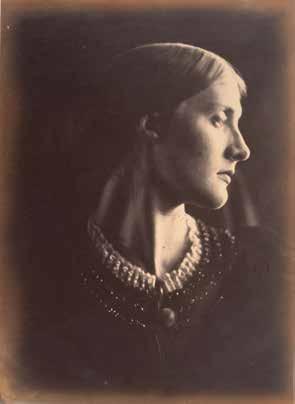
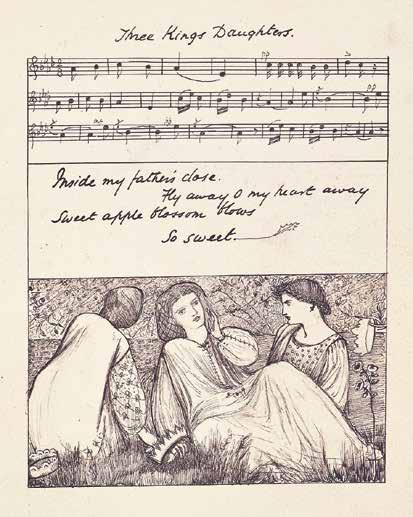
Opposite page: Lady Dalrymple c.1851-53, by Watts
Left: Mrs Herbert Duckworth 1867, by Julia Margaret Cameron. Duckworth grew up visiting the Pattles’ salons. She was Cameron’s niece, and mother of Virginia Woolf
Above:
Three Kings Daughters from ‘The Little Holland House Album’, 1859, given by Edward Burne-Jones to Sophia Dalrymple
unconventional Sunday gatherings attracted all the leading lights of the day. As well as Pre-Raphaelites – John Everett Millais PRA, William Holman Hunt and Frederic, Lord Leighton PRA – there came legions of Victorian men and women of letters: Thackeray, Robert Browning and Alfred Tennyson, John Ruskin and Thomas Carlyle, George Eliot and Elizabeth Barrett Browning, as well as Charles Darwin, his fellow scientist Sir John Herschel, and a tolerated minority of politicians such as William Gladstone and Benjamin Disraeli. Watts was the in-house artist; then regarded by many as England’s greatest painter, even its Michaelangelo, he had introduced Sara and Henry to the house’s owners, and lived there after they leased it, supposedly invited to stay for three days, but going on to live at Little Holland House for 30 years.
Guests were free to roam the wide lawns, to sit talking in the shaded, richly coloured lavender-scented rooms, or relax over a game of croquet. As darkness descended, musicians among the guests such as Joseph Joachim, for whom Brahms wrote his violin concerto, Alfredo Piatti or Charles Hallé would bring out their instruments and begin to play or, as Woolf wrote, Henry Prinsep would recite Persian poetry. More alarming was perhaps the prospect of being waylaid by Julia Margaret Cameron, who was commissioned to take shots to illustrate Tennyson’s Idylls of the King in 1874. Politicians would be draped in rugs and tinsel crowns and made to pose as King Arthur, while their »
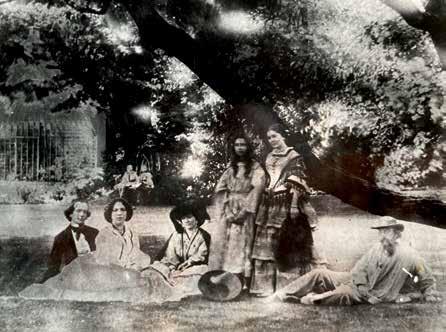
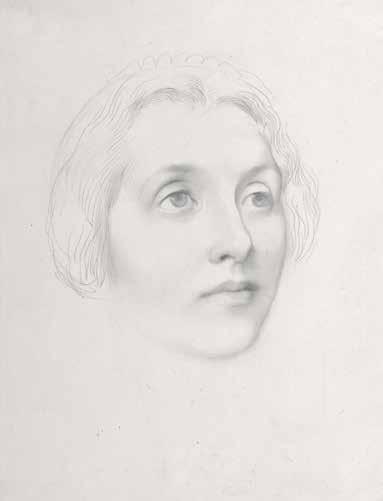
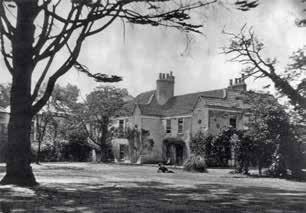
» wives – or indeed servant girls and stray passers-by, willing and unwilling – would be dressed up as Queen Guinevere or the Lady of the Lake.
If this sounds an extremely un-English gathering, that is because the Pattles were fairly un-English. Their mother Adeline Maria de l’Etang was French, and had a Bengali Hindu great-grandmother. Brought up in Calcutta, they spoke Hindustani among themselves and in front of guests. While the rest of London was suffocating in crinolines and whalebone corsets ‘the ladies at Little Holland House,’ one contemporary account recalls, ‘had adopted a graceful and beautiful style of dress made of rare Indian stuffs, and from India came also many of the ornaments they wore: the clustered pearls, the delicate Indian jewells.’
Certainly, the Pattle sisters seem to have been intriguingly, and perhaps unexpectedly, proud to flaunt their Indian background at a time when Victorian Britain tended to regard India as a subject colony and a source of Britain’s wealth, rather than a place of any inherent interest in itself. As well as speaking Hindustani to each other openly, they sat on Indian rugs on the lawns, served Indian food (especially ‘lobster curries’) at their table, and wore Kashmiri shawls during winter.
No doubt there was much pretentiousness and wilful eccentricity in all this, yet Little Holland House represented what the art historian John Christian called ‘a gallant experiment, of a kind made all too rarely in England: the world at large might buckle to the forces of philistinism, but here at least the claims of talent and beauty would receive full recognition.’ The sisters were bold, imaginative and brilliantly interconnected forces who left a cultural legacy far beyond their time. And within the stifling atmosphere of Victorian society, Pattledom was a breath of fresh air.
William Dalrymple is a historian and broadcaster. His latest book The Golden Road: How India Transformed the World (Bloomsbury) is out now
Women of Influence: The Pattle Sisters is at the Watts Gallery, Guildford, 27 Nov to 3 May 2026
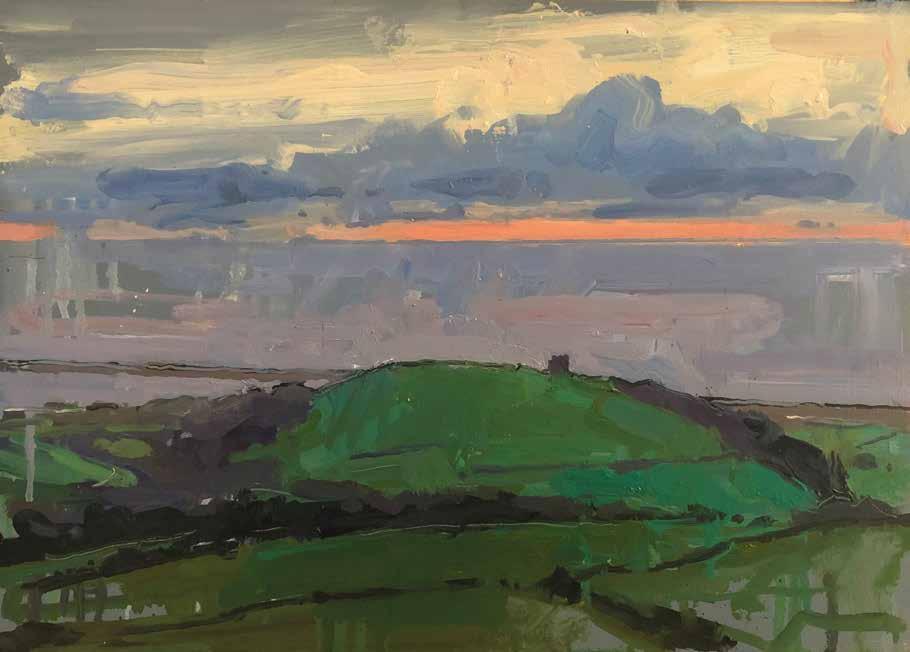
26th November - 19th December 2025
weekdays 10am - 5pm
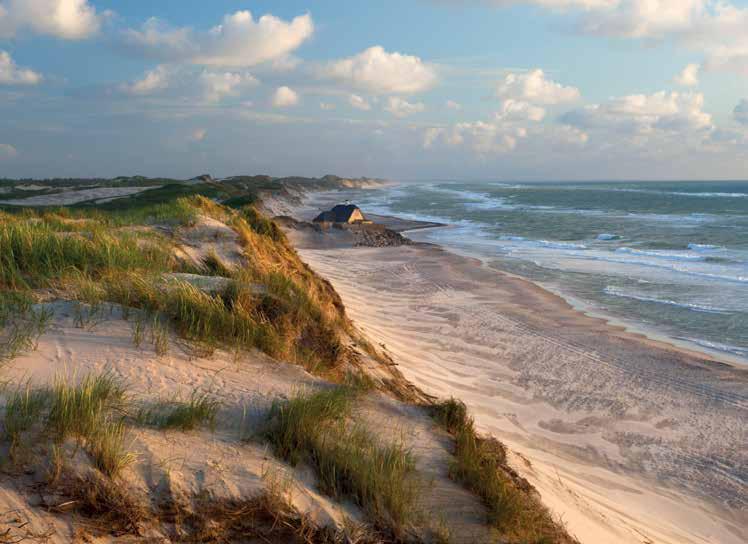
Known for the artist colony that sprung up in the 1870s, this remote Danish fishing village was also the artist’s birthplace. Imogen Greenhalgh pays a visit
Drive north in Denmark – as far north as you can go – and you eventually reach Skagen Odde, a plucky spit of dunes and moorland that pokes out from the coast like a finger. With pewter waves from the North Sea crashing in on one side, and a strait of the Baltic on the other, the peninsula tapers to a point where the waters criss-cross improbably around your ankles. It is a remote, windswept spot, imprinted on the Danish psyche for two reasons: herring (the small town of Skagen is the country’s busiest fishing port) and art, thanks to a colony of painters who gathered here in the 1870s. Only one of them was native to the area, Anna Ancher, born Anna Brøndum.
Today, despite the industrial scale of fish it trades, Skagen remains a place recognisable from its 19th-century depictions. Beyond the port (and its pervasive whiff of fish oil), the streets are lined with small shops and low-slung cottages, and after that are only dunes, heather, vast stretches of beach and the sea. When Ancher was born in 1859, few ventured this far; Skagen was home to a small, devoutly Christian community of fishermen and not much else. Anna’s parents were innkeepers, their hotel, Brøndums, the only place to stay for miles around.
It was here that Hans Christian Andersen checked in one day in 1859, intrigued by stories of Skagen, with its shipwrecks and its shifting dunes that migrated with the wind and had all but buried a 14th-century local church. (Its gabled tower still pokes out from the sand just outside town.) Captivated by the rugged landscape and the harshness of life on Denmark’s far-flung edge, Andersen described it in a
travelogue as ‘the desert between two roaring seas’, imploring his fellow artists and poets to follow his footsteps north. ‘If you are a painter, then follow us up here, here there are subjects for you.’
The famous author’s stay in Skagen would shape Anna’s life in more ways than one. In fact, it influenced her birth, with the apparently belligerent Andersen’s complaints about supper one night hastening Anna’s mother into labour. ‘Our Lord saw my good intentions and rewarded them by giving the child… a talent for art,’ Ane Brøndum later wrote of that fateful meal, so struck was she by the link between her daughter and the author.
Andersen’s A Story from the Sand Dunes published in 1860, successfully drew artists from across the Nordic region, who came in the hope of creating their own Pont-Aven or Collioure, where they could break free from the rigid rules set by Europe’s academies. Among this influx of newcomers clutching easels and brushes were Holger Drachmann, PS Krøyer and Anna’s future husband, the painter Michael Ancher. She grew up amid their early gatherings in the Brøndums’ dining room, where the family ate with guests. In a self-portrait made before she turned 20, we see the marks of a confident young artist, the viewer fixed in her frank gaze (Self-portrait, 1879; above right).
Ancher went to Copenhagen to train with painter Vilhelm Kyhn, returning to marry Michael in Skagen in 1880. In a move highly unusual for the period, she did not stop painting after her marriage as Kyhn advised, but instead debuted her work at that year’s Charlottenburg Salon. The Anchers toured Europe, including to Paris in 1885 (the same year »
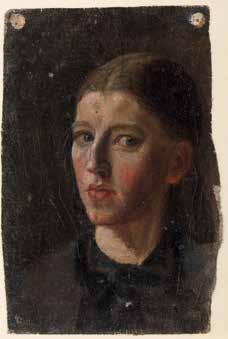
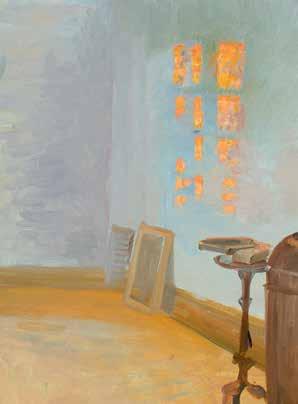
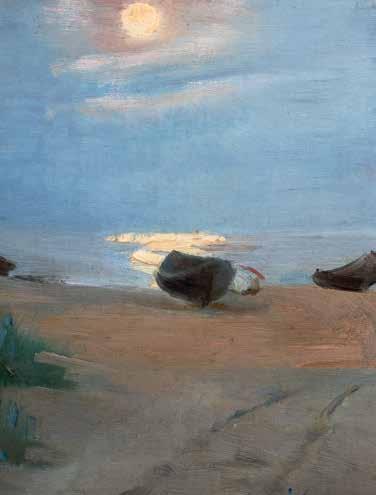
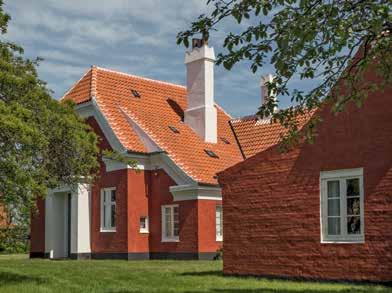
An epic river journey along the Rhine, Main & Danube aboard the 100-passenger MS River Crown with highlight performances by London Festival Opera 8th to 30th May & 1st to 23rd September 2027
Join us aboard the charming, 100-passenger MS River Crown for our ultimate grand tour of Europe as we sail across the continent, visit eight countries, travel more than 2200 miles and yet only have to unpack once. This is the perfect trip for those who enjoy seeing something new every day, as our floating hotel transports you in considerable comfort between great cities, towns and villages, past ever-changing landscapes where the slow speed of the vessel allows us to absorb the views of town and country.
Each port of call has its own unique character waiting to be discovered whilst on one of our guided excursions. From historic locations to iconic buildings, our itinerary is brimming with highlights including the grand cities of Vienna and Budapest; the picturesque towns along the Rhine and Main including Miltenberg and Rudesheim; wine tasting in Wurzburg and music performances. There will of course also be plenty of time to relax on board and enjoy some truly beautiful scenery especially whilst cruising through the dramatic Rhine Gorge and the spectacular Iron Gates.
Left: Boats at Sønderstrand, Moonlight c.1883, by Ancher
Above: The Anchers’ home on Markvej, now open to visitors as a museum
If you have never experienced a river journey it is difficult to explain the sheer pleasure that comes from travelling across Europe observing everyday life on the banks of the Danube, Main and Rhine rivers. You can let the world slip by as you relax on the Sun Deck or in the Lounge and delight in awe-inspiring panoramic views of the passing scenery. Guided excursions with excellent local guides, highlight musical performances by London Festival Opera and interesting talks by our Guest Speaker will create an enjoyable, informative and lively atmosphere on board as we sail along the European waterways.
Special offer prices per person based on double occupancy start from £8695 for a Premium Cabin with French Balcony and include scheduled return air travel from London, 22 nights aboard the MS River Crown on a full board basis, house wine, beer & soft drinks with lunch & dinner, all shore excursions, Noble Caledonia onboard team including Guest Speaker, performances by London Festival Opera, gratuities and transfers.
‘Skagen Museum’s collection is suffused with depictions of the region’s languorous northern light’
» Gauguin returned, having left his Danish wife and five children in Copenhagen). Here, the couple enthusiastically absorbed the lessons of French Realism and Impressionism, as well as studying art from Japan. Skagen was to remain home, however. A new, landmark exhibition of Anna Ancher’s work at the Dulwich Picture Gallery this winter shows just how infused with local life her art was, from the harvesting of fields to villagers absorbed in the business of daily life, knitting, plucking geese, mourning the dead. The heroics of wrecked boats and drowned sailors fascinated her far less than her peers, her gaze lingering instead on the quality of light, how it behaved and metamorphosised over the space of a day or year. As in works like Evening Sun in the Artist’s Studio at Markvej (after 1913; page 67), where a rosy shaft of late sunlight seems almost solid in her use of impasto, it was here she found her surest footing as a painter with a claim to modernity.
| royalacademy.org.uk
Today there is much still to be found of Ancher in her hometown.
The town is also home to the Skagens Museum, which maintains the Anchers’ house and studios, as well as Drachmann’s cottage across town. Founded to house the Skagen colony’s work, the museum’s collection is suffused with depictions of the region’s languorous northern light.
A centrepiece is Krøyer’s Summer Evening on Skagen’s Southern Beach (1893), showing Ancher with Marie Krøyer, walking on the beach as day and night collapse into one another.
Brøndums remains a popular hotel, its traditional rooms and elegant restaurant attracting well-heeled city dwellers up for the weekend. The Anchers’ home, on Markvej, a stone’s throw from the hotel, is open to visitors. Preserved by their daughter Helga until her death in 1964, Anchers Hus is a time capsule for the couple’s tastes, its eclectic interiors betraying their presence in the choice of ornaments and hand-painted decorative flourishes, such as a cluster of local birds painted on an interior door. Many of their own paintings line the walls.
Today artist residencies are run at Anchers Hus from an outhouse and former studio of Michael’s. In the garden, the café serves organic and foraged Danish food. Brilliantly, the museum also preserves the old dining room of Brøndums, that same room where the teenage Anna would have first taken part in conversations about the possibilities of paint. Panelled in wood, the room is lined with scenes of local life – days spent walking the coast and moors, swimming and painting en plein air, before meals around the table. This is capped with a striking row of portraits the artists made of each other, their camaraderie immortalised. At their centre is Anna, still happily holding court.
Imogen Greenhalgh is Deputy Editor of RA Magazine
Anna Ancher: Painting Light is at Dulwich Picture Gallery, London, until 8 Mar 2026
For full details on this holiday call us today on 020 7752 0000 for your copy of our brochure. Alternatively view or request online at www.noble-caledonia.co.uk
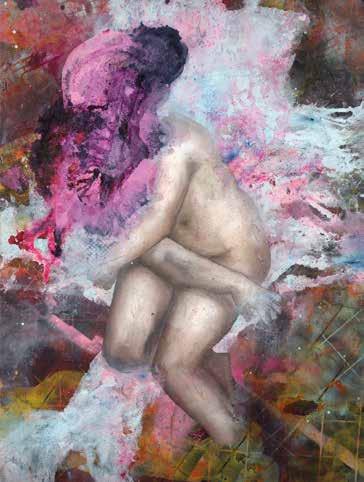
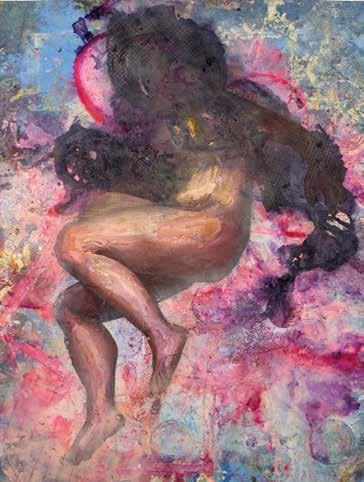
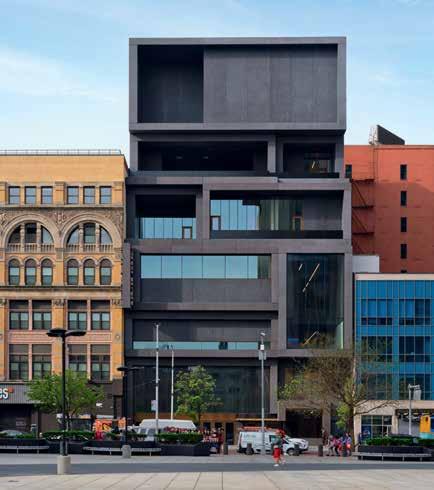
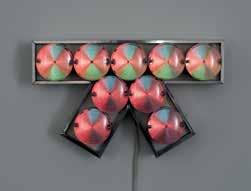
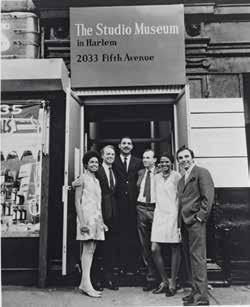
When New York’s Studio Museum reopens after seven years of renovations, no doubt there will be guests at the various parties who remember its inaugural show held in 1968 – Tom Lloyd’s ‘Electronic Refractions II’. It’ll be a full-circle moment. Lloyd’s work returns to mark a new building and the next chapter for the city’s epicentre of African American and African diasporic art.
Once an industrial building on 125th Street, the museum has been transformed by Adjaye Associates, founded by David Adjaye RA, the warehouse façade replaced by concrete blocks and large windows that offer views into the galleries (above).
Lloyd is a natural choice for the reopening: he was the museum’s first studio resident, with the institution
underwriting the costs of materials and hiring local apprentices to build his wall-based light sculptures (top right). Back in the day the works were a collaboration with an engineer from electronics company Radio Corporation of America, echoing experiments with motion-activated bulbs and speakers by Robert Rauschenberg and Hans Haacke.
Then, as now, the Studio Museum works to spotlight Black artists overlooked by establishment institutions. The museum was founded by a group of artists, philanthropists, activists and residents. Within a decade it was running workshops on collecting Black art, and had initiated ‘The Black Masters’ series to canonise artists who had yet to come to public attention. Yet the museum’s inception by no
means signalled harmony within New York’s African American art scene, nor between Harlem organisers and the city’s white philanthropic and political class. The rise of Black Power politics irked integrationists, who envisaged Harlem’s cultural institutions assimilating into the city’s establishment. Battles for the soul of the art world were erupting all around New York. In 1969, The Met’s ‘Harlem on My Mind’ exhibition ignited bitter protests against the absence of original artworks by Harlemites in its supposedly local survey. Meanwhile, the Art Workers’ Coalition was founded in early 1969, in order to petition MoMA and other venues for better treatment of artists, including combating racism. While working
with young Harlemites during the mid-1960s, Studio Museum co-founder Betty Blayton-Taylor had to call in a favour from the poet Frank O’Hara, then working as a MoMA curator, to ensure they were admitted to his museum, as guards kept turning them away. Today the picture is quite different. Led by influential curator Thelma Golden, the Studio Museum sits at the centre of a Black art world stretching far beyond Harlem, acting as a springboard and yardstick for the artists on its walls, such as Lorna Simpson, Carrie Mae Weems, Fred Wilson and David Hammons. In a year of New York reopenings, from The Frick to the New Museum, none has the cross-community impact – or excitement – of the Studio Museum.
Ravi Ghosh is a critic based in New York

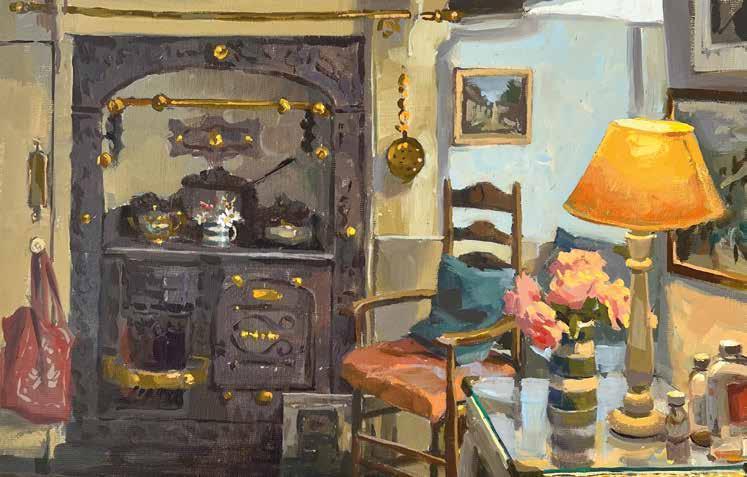

Galleries, The Mall, London, SW1
artsales@mallgalleries.com | 020 7968 0966 | www.mallgalleries.org.uk
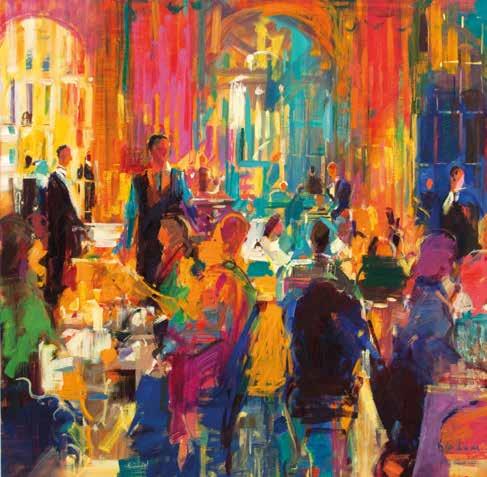
tel: 07575 866772 gallerystandrews.com
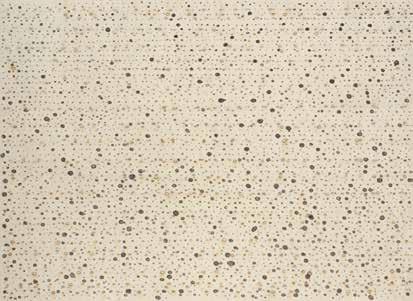
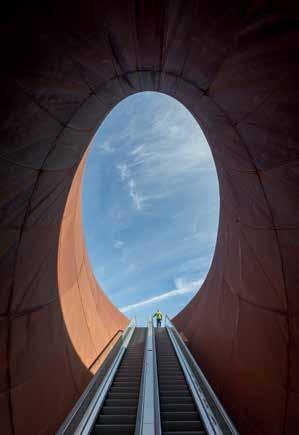
SOLO PURSUITS
Wolfgang Tillmans’s work inaugurates Maureen Paley ’s new gallery on Herald Street, Bethnal Green (until 20 Dec), a homecoming of sorts for the artist as the space is housed in what was once part of his London studio. In addition to photography, the exhibition, which unfolds here and across Paley’s two other east London spaces, also includes film and Tillmans’s first forays into metalwork, made with a German factory in Remscheid, where the artist grew up.
At Camden Arts Projects, Ryan Gander reveals new and recent sculptures in ‘I’ve fallen foul of my desire’ (until 18 Jan 2026). Visitors will recognise the giant black sphere in the gallery’s courtyard from this year’s Summer Exhibition. Featuring the text ‘Why am I so distracted?’, the sculpture is from Gander’s ongoing ‘Questions’ series.
Near Paddington, discover major new sculptures in bronze, marble and steel by Tony Cragg at Lisson Gallery (until 31 Jan 2026). In Mayfair, at Cardi Gallery, Paul Huxley’s geometric abstract works are in the spotlight in ‘An Anthology’ (until 29 Nov), while nearby on Davies Street, Gagosian devotes its space to Honorary Academician Ed Ruscha’s paintings on unprimed linen (until 19 Dec).
Outside London, at Gainsborough’s House in Suffolk, Humphrey Ocean exhibits paintings and drawings spanning three decades, themed around his long-held interest in the built environment (until 22 Mar 2026).
In Spain, at Es Baluard Museu in Palma, Mallorca, Fiona Rae displays paintings dating back to the late 1990s (30 Jan to 23 Aug 2026). In The Hague, in the
Netherlands, Anne Desmet’s prints are celebrated alongside those of MC Escher at Escher in the Palace museum, where their shared mastery of light and dark in woodcut printing will come to the fore (until 15 March 2026). The show coincides with the release of Desmet’s latest book, Wood Engraving: A Personal Approach featuring more than 400 illustrations (The Crowood Press).
In France, Christopher Le Brun has his first major show in Paris, at Almine Rech gallery (until 20 Dec). Like Desmet, Le Brun is the subject of a new monograph, which explores the past decade of the painter’s practice (Rizzoli).
Stateside, Hew Locke’s exhibition ‘Passages’ continues at the Yale Center for British Art (until 11 Jan 2026), accompanied by the first comprehensive book on the artist’s work (Yale University Press). Tacita Dean has a survey show at Columbus Museum of Art
Columbus, Ohio (until 8 Mar 2026), while Antony Gormley takes over the Nasher Sculpture Center in Dallas, Texas with his first major museum survey in the US (until 4 Jan 2026), including newly conceived sculptures installed on rooftops around the city. The sculptor’s work is also in focus in Wonju, South Korea at Museum SAN (Space Art Nature), which earlier this year unveiled Ground (2025), a subterranean site-specific space conceived by Gormley and architect and Honorary Academician Tadao Ando in their first collaboration
GROUP DYNAMIC
In London, the RA’s President Rebecca Salter displays works on paper in dialogue with those by Korean artist Minjung Kim, in a joint show at Patrick Heide Contemporary Art, near Marylebone (until 10 Jan; Untitled 2014-54 2014; above left). »
» Mali Morris participates in two group shows this winter: at Cross Lane Projects in London (until 6 Dec), and in Winchester, as the Winchester Gallery stages ‘Never Say Never Again’, reflecting on the institution’s pioneering early programme (until 10 Jan 2026).
In Cambridge, at the Heong Gallery in Downing College, Stephen Farthing’s work appears in ‘Tudor Contemporary’, a multidisciplinary show focusing on how the Tudor period continues to influence contemporary artists (17 Feb to 19 April 2026). In north Wiltshire, the Chippenham Museum celebrates the multifaceted sculptural possibilities of ceramics with a group show, ‘Subversive Forms: Revolutionary Approaches to Clay’, which includes the work of Peter Randall-Page (until 21 Feb 2026).
In the US, Farshid Moussavi’s new Ismaili Center in Houston, Texas opened on 7 November. The cultural centre was designed, in Moussavi’s words, to offer the city ‘a serene, inclusive environment that will endure for generations’. The new 150,000 sq-ft building will host exhibitions, educational activities, a prayer hall and a café, and aims to be a place for both spiritual reflection and public life.
The Italian city of Naples has inaugurated its new metro stop Monte Sant’Angelo, created by Anish Kapoor (page 73) For the station, the sculptor devised a monumental weathered steel entrance that seems to swell from the ground, recalling Dante’s descent into the underworld.
Closer to home, Michael Landy has created the first global Humanitarian Memorial, located in London’s Gunnersbury Park. The sculpture, which features 15 human-scale figures forming a circle, is a tribute to those who have dedicated and lost their lives to humanitarian work.
The Towner, in Eastbourne, has commissioned a new public artwork by Rana Begum for the town’s seafront. It comprises eight vertical panes of coloured glass, placed in a zigzag formation.
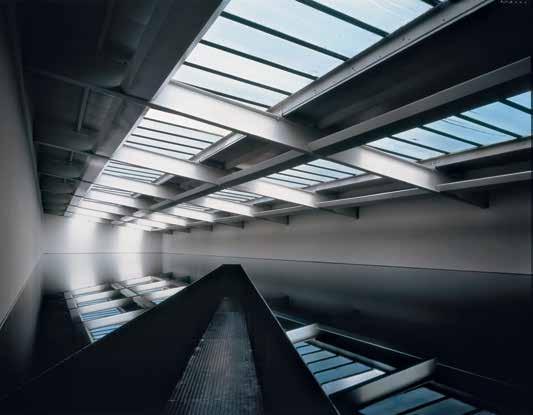
Above:
an installation of 20:50 1987, by Richard Wilson at the Saatchi Gallery’s Boundary Road venue in 1991
This winter, art lovers have the chance to step into Richard Wilson RA’s iconic installation 20:50 (1987; installation view, from 1991, above). The artwork is now on display at the Saatchi Gallery in London’s Chelsea. Wilson used recycled engine oil – known commercially as ‘20W-50’, hence the artwork’s title – to create the work.
Designed to fill an entire room, it transforms an industrial material synonymous with the modern era into an extraordinary visual spectacle.
Visitors enter the oil-filled room via a single walkway. Inside, they find themselves waist-high in the pitch-black viscous substance, which surrounds the walkway on three sides.
From this vantage point, the glossy surface of the oil perfectly reflects the architecture of the space in which it is installed, placing the viewer at the centre of a surreal perspectival illusion, where the room appears to have been turned upside down.
Widely considered a modern masterpiece, 20:50 was a significant
milestone in the development of installation art, paving the way for the blossoming of the genre during the 1990s – not least because it sold. First displayed at east London’s Matt’s Gallery in 1987, the work was subsequently bought by the influential art collector Charles Saatchi, at a time when few collected art of this kind.
While Saatchi toured the work around the world, Wilson set about conjuring further architectural tricks with his art, including balancing a bus precariously on the roof of the De La Warr Pavilion in Eastbourne, and slicing a hole out of the façade of a building in Liverpool.
Now, almost four decades since it was first installed, art enthusiasts have the chance to experience Wilson’s spectacular oil display again, as part of an exhibition celebrating 40 years of the Saatchi Gallery.
The Long Now: Saatchi Gallery at 40 Saatchi Gallery, London, until 1 March 2026
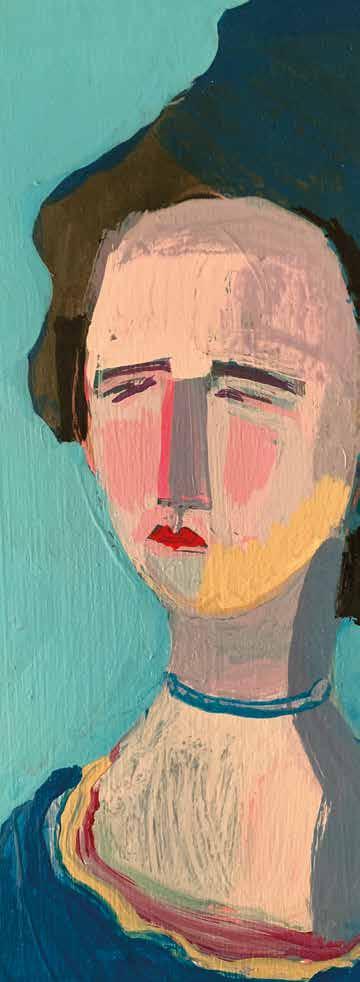

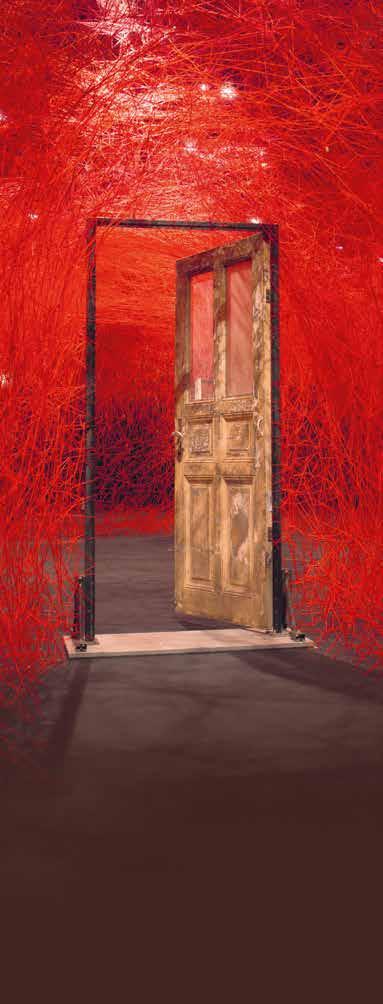
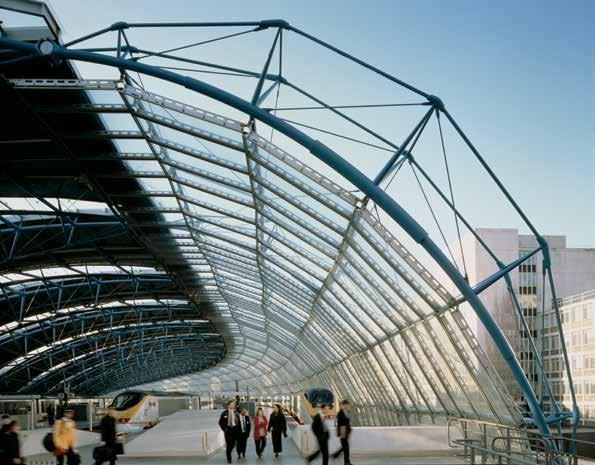
Peter Cook RA pays tribute to a pioneering architect whose remarkable talents were visible from his student days
Nick Grimshaw was the consummate Englishman of the very best kind. Always a good listener, but with a brain ticking over at the same time and probably at a faster rate than the person being listened to. He was one of my first students at the Architectural Association when I became the assistant fifth-year master in 1964. As he told me later, he was suspicious of all this ‘plug-in’ stuff for the first half year (that is, the use of prefabricated elements) – and then he developed it himself. So well, that I still rate the (now demolished) Anglican International Students’ Club Service Tower (1968; opposite), a freestanding tower of prefabricated bathroom pods attached to the rear of student halls, as one of the
bravest manifestations of that architecture commonly known as ‘high tech’ but which is, in fact, vehemently experimental.
Back in 1965 the Best AA Student award was a no-brainer.
The early days of Farrell/Grimshaw (the practice he set up with Terry Farrell, who sadly died two weeks after Nick) saw the creation of not only the bathroom tower, but the more overt metal box, Park Road Apartments (1968), across from the mosque near Lord’s cricket ground. I remember Nick and his wife Lavinia hosting suppers there and seem to remember that Farrell and several of their friends lived up and down the tower. Since it is on my way home from the West End, I pass by it at least three times a week and (seriously) give it a respectful nod as I go, because it remains a symbol of both tectonic
adventure and common sense.
Rhetoric implied but not shouted: just like Nick himself.
In the same light, my wife Yael once admitted to Nick that we sometimes drove over to Camden to use the Sainsbury’s superstore he designed near Grand Union Walk, rather than our local one, because we really admired it. Characteristically, Nick was quietly pleased.
One feels sometimes that his architecture is taken for granted: whether it is the remarkable (and rather naughty) curved villas of Grand Union Canal Walk Housing (1988), or the lovely curved station which made those early trips on Eurostar from Waterloo rather glamorous (above). No disrespect to St Pancras – but this was new and high tech in its rightful place. Then to Melbourne, a city with
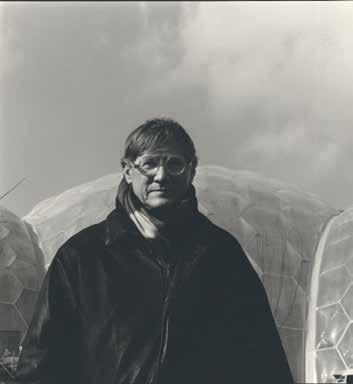
plenty of adventurous architecture and perhaps Nick’s most creative project, Southern Cross Station (2007), his architecture in full flower and confidently exuberant. Another aspect of this admirable character was his humanity: I regularly invited him to The Bartlett to be the External Examiner of the postgraduate Masters course. A very international and complex bunch ranging from the brilliant to the above average. Nick would listen and (again with that brain ticking over at pace) get right into the nub of the work, but (unlike many examiners) he had a good instinct about the student’s personality and fears. This same instinct was instantly recognisable in Royal Academy meetings, too.
Of his office, once it got to be more than a handful of people, I know little, except that it became one of the two or three places to which one could confidently send good students. We last saw Nick and Lavinia a year ago in their Primrose Hill house: the living room like a beautiful boat – let him continue to sail in it. A good man as well as a very, very special architect.
Peter Cook is an architect
Below: the Anglican International Students’ Club Service Tower, in London, completed by Farrell/Grimshaw in 1968
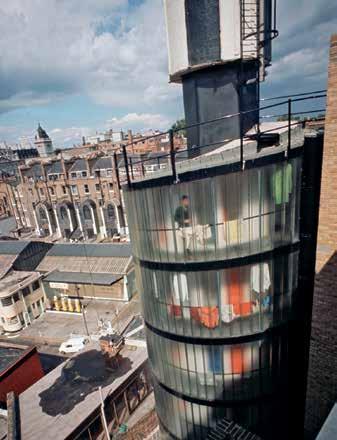
Grimshaw rejuvenated and reformed the RA, recalls his successor Christopher Le Brun PPRA
When Nicholas Grimshaw was elected to the Presidency in December 2004 he had the overwhelming support of the Academicians. This stemmed not just from his achievements as a visionary architect, knighted for his services two years prior, but for a more immediate reason: he was liked and trusted by all who knew him. Painters, sculptors, printmakers and especially his architect peers agreed it was a moment for renewal and optimism.
Nick, as he was known to all his friends and colleagues, had a particular charm, a disarming, perhaps even boyish, manner that conveyed a faith in our combined abilities. He could also be steely. The role of the President is often underestimated and is certainly not for the faint of heart. The ultimate chairman still possesses considerable executive power. Indeed, Nick saw his principal mission to be one of reform. In his own words: ‘I immediately became aware that the institution’s governance was in serious need of an overhaul.’
Given the RA was far larger and more complex in the 21st century than it was upon its foundation, and feeling that its constitution, largely unchanged since 1768, was no longer up to the job, one of his first acts was to form an advisory group (including a former Governor of the Bank of England) to examine the laws. For example, Members delighted with the news they had been elected might have been less delighted to know that they had now acquired unlimited liability for any debts. Nick promptly altered the legal foundation of the Academy by incorporating it as a Company Limited by Guarantee. He also updated the ancient nomenclature which increasingly grated against the spirit of the age.
The historic Summer Exhibition plays a key role not only in the RA but, I think it is fair to say, in the life of the nation. One of several changes to its complicated rules concerned how the chief coordinator was appointed, since merely being the oldest person on the hanging committee seemed less than satisfactory as the sole qualification. It has continued to flourish ever since.
The Academy’s executive Council was strengthened by including external professional voices and revising the role of the Secretary to incorporate the task and title of CEO. As for the infant Burlington Project that aimed to link Burlington House with Burlington Gardens, once David Chipperfield RA was chosen to lead the master plan, the combined authority of these two major architects meant any difficulties and disagreements that had bedevilled the project began to melt away. The success of this acclaimed project some years later depended largely on the foundations Nick laid. If I have touched more on the indoor life rather than the inner life, then for balance I should mention his love of yachting. Turner would have been familiar with the RA dining club’s whitebait dinner, revived with the help of John Maine RA. Memorable nights on the water included chartering a Thames steamer that had seen service at Dunkirk and congregating on the deck of HMS Belfast. Royal Academicians young and old enjoy each other’s company, and these memories will be fondly recalled when thinking of Nick. He was one of the great Presidents of the RA, to whom I personally will always be profoundly grateful.
Christopher Le Brun is an artist
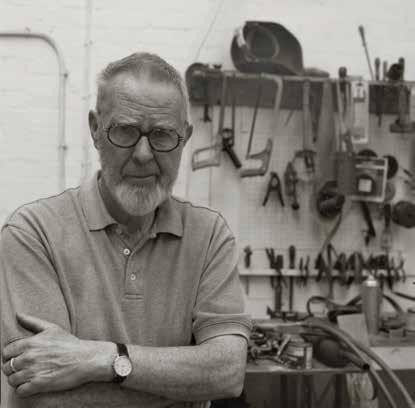
Ann Christopher RA pays tribute to a passionate sculptor and raconteur who made metal his medium
I first encountered the name of Bryan Kneale in March 1966 on the occasion of his solo exhibition at the Whitechapel Gallery. Bryan’s fluid and organic manipulation of his many welded steel sculptures was a complete revelation to me. At that time, I was in my initial year at Harrow School of Art and was applying to further colleges to pursue a career in sculpture. The West of England College of Art, in Bristol, said it had a welding shop, so that was that; after seeing Bryan’s exhibition I was determined to learn to weld.
Bryan started his artistic journey as a painter, but I only knew him as a sculptor. When I was elected an Academician in
Below:
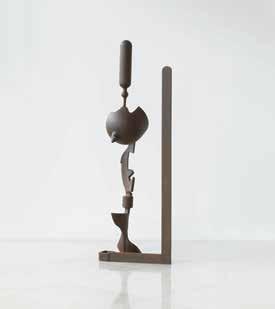
for Portsmouth Cathedral. It transpired that both Bryan and I were submitting proposals, and Bryan won. I was disappointed but losing is not quite so painful when you are competing with someone whose work you respect. Bryan’s beautiful bronze door, pierced with glass shapes and covered with organic metal vine-like forms, certainly enhances the cathedral’s west façade.
1980 he welcomed me as another non-figurative sculptor. There were not very many sculptors, let alone non-figurative ones, at the RA at that time. I was understandably thrilled to be finally meeting the man who I blamed for ‘luring me down the path towards working in metal’. We both laughed.
Hanging the Summer Exhibition in 2002 with Bryan as ‘senior hanger’ was challenging but tremendous fun. Bryan regaled us with tales of his many escapades. How Alison Wilding RA – also on the team – and I managed to get the work done I do not recall but we did, despite being charged with endless searches for Bryan’s walking stick,
which he often left around the galleries. Bryan was no stranger to curating exhibitions. When he was elected to the Academy in 1970, he joined on the condition that he could organise a major show of contemporary sculpture.
‘British Sculptors ’72’ was both progressive and challenging – a real push into the contemporary world for the then very traditional Royal Academy. (As the writer Hilary Spurling later reflected, in comparing the show with the RA’s infamous 1997 ‘Sensation’ exhibition, ‘The recent fuss... was mild by comparison’.)
Our professional paths crossed again in the late 1990s during a competition to design and produce a new west door
Bryan and I shared the drive for physically making sculpture and using the medium of metal. Shortly before he died he checked over a sculpture before it left the fabricators to be installed on the Isle of Man. Bryan was born on the island in 1930 and first studied painting at Douglas School of Art before joining the Royal Academy Schools in 1948. It is fitting that his final sculpture, Eelips (2025), is a tribute to the Manx landscape of his childhood.
Bryan supported and encouraged many young artists. He was a tremendous raconteur with a real zest for life, and he believed passionately in the world of sculpture and looking to the future. He will be much missed.
Ann Christopher RA is an artist



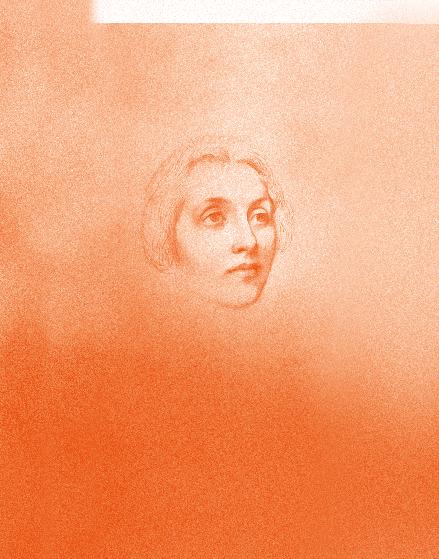
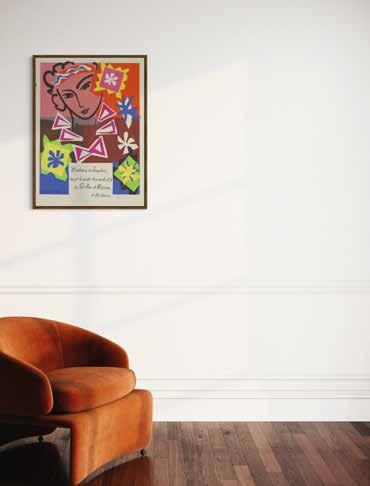


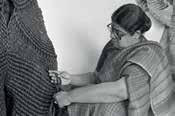
A selection of RA talks, workshops and other events. For full listings, visit roy.ac/events. Book online, in person at the RA box office or by telephone on 020 7300 8090
A FORTNIGHT OF OFFERS AND EVENTS
This year, we’re celebrating the festive season with a fortnight of special events and offers just for our Friends and members. Take part in a seasonal still-life drawing class, join us for an evening of Christmas carols in Burlington House and don’t miss the chance to buy limited edition and unique artworks in our pop-up Art Saleroom, all taking place between 17 and 30 November. For more information, visit roy.ac/festivefortnight.
FRIENDS FESTIVE SHOPPING WEEK
Exclusively for Friends and members, we’re offering a 20% saving at the RA Shop from 17 to 23 November (restrictions apply), the first week of our festive fortnight. Simply show your membership card when you pay in store or use the code found in your regular e-newsletter at the checkout online (see page 81).
A GIFT THAT’S NOT JUST FOR CHRISTMAS
Give a whole year of art in one little card with a Friends gift membership. Your lucky recipient can look forward to a stellar line-up of exhibitions including the five-star ‘Kerry James Marshall: The Histories’, ‘Painting the French Riviera’ and ‘Peggy Guggenheim in London’. Plus, they will be able to access the Keeper’s House and a new dining experience from acclaimed Spanish chef José Pizarro (see opposite). Membership starts at £70 for Young Friends up to age 35. Order your gift online by 14 December (roy.ac/friendsgift) or purchase in person at the RA until 23 December.
THANK YOU FOR YOUR SUPPORT
The generosity of our members is at the heart of everything we do at the RA. We receive no government funding, so your membership is vital to our work.
Thank you.
FESTIVE FORTNIGHT: FRIDAY LATE OPENING
21 Nov
We’re open late for great art, food and shopping – all with a festive twist. Visit the winter exhibitions and hear the English Chamber Choir singing carols and seasonal songs outside the Main Galleries.
Burlington House, 6–9pm; free, drop-in for Friends and members
THE ART SALEROOM AT THE RA 21–23 Nov
At this one-off three-day sale, browse and buy limited edition and unique artworks by renowned artists including Academicians Antony Gormley, Tracey Emin and Ai Weiwei.
The John Madejski Fine Rooms, 10am to 9pm, Fri; 10am to 6pm, Sat & Sun; free, drop-in
CURATOR TALK: A STORY OF SOUTH ASIAN ART
21 Nov
Curator Tarini Malik introduces the RA’s exhibition on South Asian modernism, discussing the work of the pioneering Indian sculptor Mrinalini Mukherjee and her peers and mentors.
Benjamin West Lecture Theatre, 11am to 12pm; £15/£9
SEASONAL STILL-LIFE DRAWING
28 Nov
Find inspiration from the RA’s historic cast collection and an arrangement of seasonal foliage to sketch still-life scenes. In a series of drawing exercises guided by artist Violeta Bravo, create still-life works that capture the holiday spirit.
Dunard Fund Life Drawing Studio, 3–5.30pm and 6.30–9pm; £65
FRIENDS AND MEMBERS
LIFE DRAWING
14 Jan 2026
Enjoy an exclusive morning of life drawing for members and Friends of the RA, led by artist Mick Kirkbride. Whether you’re a novice or an expert, practise your skills in a friendly and supportive environment.
Dunard Fund Life Drawing Studio, 10am to 1pm and 2pm to 5pm; £65
MATERIALITY AND FORM: EXPERIMENTAL WEAVING
7 & 8 Feb 2026
Weave natural materials into bold sculptural forms at this weekend workshop, guided by artist Esna Su. Inspired by Mrinalini Mukherjee, the artist at the centre of ‘A Story of South Asian Art’.
The John Madejski Fine Rooms, Sat & Sun, 10.30am to 5.30pm; £480
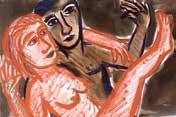
SATURDAY SKETCH CLUB: DRAWING LOVERS
14 Feb 2026
In this practical drawing workshop led by artist Robin Lee-Hall, sketch from a pair of models to learn how to convey connection, chemistry and emotion in art.
Livestreamed online, 10.30–11.45am; £10/£8, or book three Saturday Sketch Clubs for £25
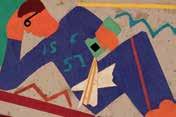
MODERNISM AROUND THE WORLD
20 & 27 Jan, 3, 10, 17 & 24 Feb 2026
Join us for a series of six evening talks exploring the development of modernism in 20th-century art around the world, and discover the many innovations in abstraction and material processes found in its rich and varied expression across different cultures.
Burlington House, 6.30–7.45pm; £340
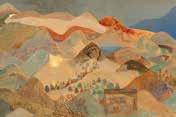
WHEN ARTISTS GATHER: DIALOGUES ON SOUTH ASIAN ART
12 Feb 2026
This special symposium invites leading artists, scholars, curators and critics to discuss the living legacies of South Asian modernism, in response to the RA’s ‘A Story of South Asian Art’.
The John Madejski Fine Rooms, 10am to 4pm; £45/£15 incl exhibition access
MAKING PICTURES: DRAWING AND PAINTING
14 & 15 March 2026
Dive into the vibrant world of Rose Wylie RA to experiment and find playfulness in art. Guided by artist Elinor Stanley, you will use gesture, colour and scale to create works inspired by the world around you.
Main Galleries, Burlington House, 10.30am to 5.30pm; £460
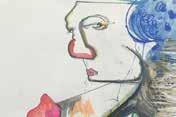
SATURDAY SKETCH CLUB: DRAWING CULTURAL ICONS
7 March 2026
Inspired by Rose Wylie RA’s playful approach to iconic figures, artist Joshua Beaty explores spontaneous mark-making and composition through simple exercises.
Livestreamed online, 10.30–11.45am; £10/£8, or book three Saturday Sketch Clubs for £25
STORYTELLING WITH FIGURES
17 & 24 Feb, 3, 10 & 17 March 2026
Find creative inspiration from stories across history, folklore and mythology in this online course.
Guided by artist Ann Witheridge and working with life models, you’ll experiment with drawing and painting techniques that bring your work to life.
Livestreamed online, 6–8.30pm; £260
As part of a wider review, we’ve made some improvements to your spaces at the RA. The Keeper’s House is now an exclusive space just for Friends, Patrons, Supporters and House Members, plus up to three of your guests.
We were previously required to allow members of the public access to the Keeper’s House after 4pm. Now, the Keeper’s House is yours.
Friends of the RA can also now enjoy all-day access to the Shenkman Bar – downstairs in the Keeper’s House – and the Keeper’s Garden during the summer months. This includes our evening opening hours until 9pm, Wednesdays to Saturdays.
THE KEEPER’S HOUSE BY JOSÉ PIZARRO
Acclaimed chef José Pizarro (above) will soon be bringing his seasonal Spanish dishes to the Keeper’s House, offering a fresh dining experience in all our membership spaces. Our Shenkman Bar will remain a welcoming space for drinks and casual dining, featuring a Mediterranean-inspired menu. Next door, the Dining Room will open as a new restaurant, offering sharing plates and a selection of José’s signature dishes. José will also bring his bestsellers to the members’ café in the Sir Hugh Casson Room.
Do keep an eye on your email newsletter for the latest updates on restaurant bookings, opening times and more. You can update your preferences any time at roy.ac/account.
DURING THE FESTIVE PERIOD
The whole of the RA, including its phone lines, will be closed from 6pm on 23 December until 10am on 27 December. On 1 January 2026, we are open 12-6pm.
CONTACT US
The Membership Team is here to help. We are dealing with a high volume of calls, so please bear with us. The best way to reach us in busy periods is at friends@royalacademy.org.uk.

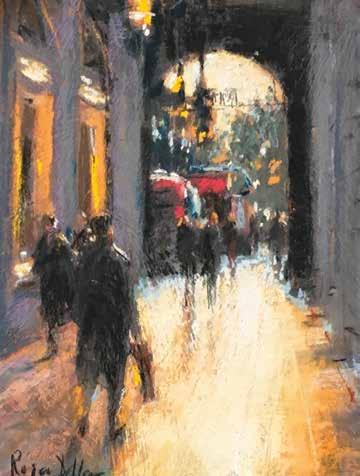

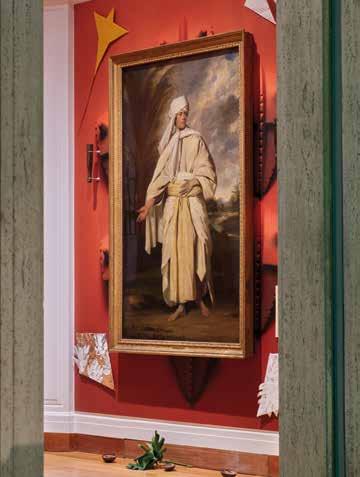
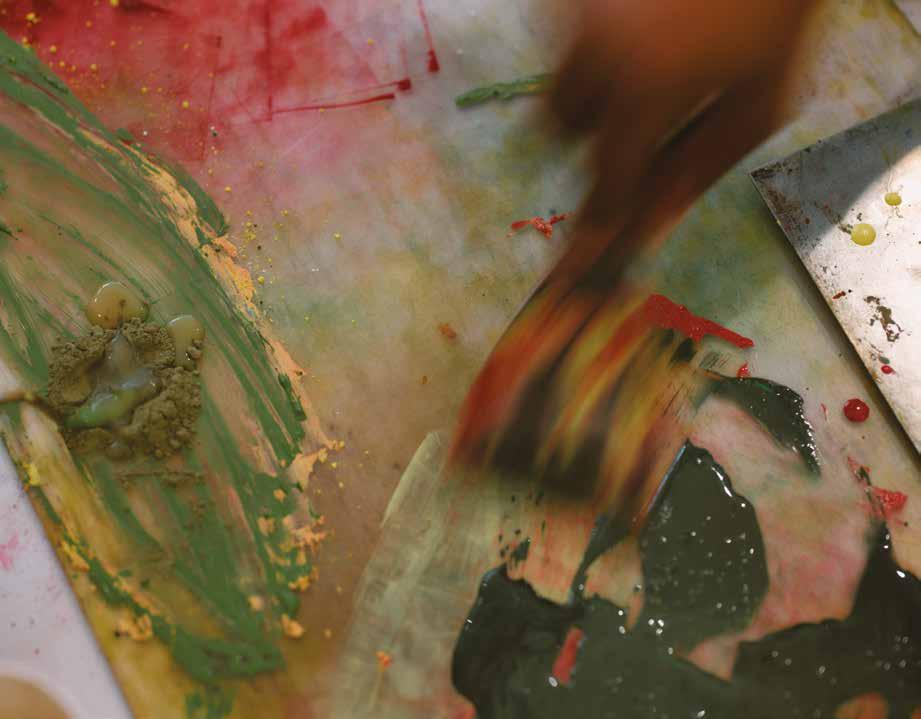
For inclusion in RA Magazine’s paid listings section, email catherine.cartwright@royalacademy.org.uk
London Public
BARBICAN ART GALLERY
Barbican Centre, Silk Street EC2, 020 7870 2500, barbican.org.uk
Encounters: Giacometti until 31 May 2026.
Dirty Looks until 25 Jan 2026.
THE BRITISH MUSEUM
Great Russell Street WC1, 020 7323 8181, britishmuseum.org
Hawaii: A Kingdom Crossing Oceans 15 Jan to 25 May 2026.
THE COURTAULD GALLERY
Somerset House, Strand WC2, courtauld.ac.uk/gallery
Wayne Thiebauld: American Still Life until 18 Jan 2026.
DULWICH PICTURE GALLERY
Gallery Road SE21, 020 8693 5254, dulwichpicturegallery.org.uk
Anna Ancher: Painting Light until 8 March 2026.
ESTORICK COLLECTION OF MODERN ITALIAN ART
39A Canonbury Square N1, 020 7704 9522, estorickcollection.com
Ketty La Rocca: You You until 21 Dec. Alessandro Mendini 16 Jan to 10 May 2026.
FOUNDLING MUSEUM
40 Brunswick Square WC1, 020 7841 3600, foundlingmuseum.org.uk
A Grand Chorus: The Power of Music until 29 March 2026.
HAYWARD GALLERY
Southbank Centre, Belvedere Road SE1, 020 3879 9555, southbankcentre.co.uk/ venues/hayward-gallery
Gilbert & George: 21st Century Pictures until 11 Jan 2026. Val Lee: The Presence of Solitude until 11 Jan 2026. Chiharu Shiota: Threads of Life 17 Feb to 3 May 2026. Yin Xiuzhen: Heart to Heart 17 Feb to 3 May 2026.
IMPERIAL WAR MUSEUM
IWM London, Lambeth Road SE1, 020 7416 5000, iwm.org.uk
Blavatnik Art, Film and Photography Galleries Permanent display.
THE NATIONAL GALLERY
Trafalgar Square WC2, 020 7747 2885, nationalgallery.org.uk
Radical Harmony: Helene KröllerMüller’s Neo-Impressionists until 8 Feb 2026. Wright of Derby: from the Shadows until 10 May 2026.
NATIONAL PORTRAIT GALLERY
St Martin’s Place WC2, 020 7306 0055, npg.org.uk
Cecil Beaton’s Fashionable World until 11 Jan 2026. Taylor Wessing
Photo Portrait Prize 2025 until 8 Feb 2026. Lucian Freud: Drawing into Painting 12 Feb to 3 May 2026.
THE QUEEN’S HOUSE
Royal Museums Greenwich, Park Row SE10, 020 8312 6608, rmg.co.uk/queenshouse Permanent Collection open daily.
TATE BRITAIN
Millbank SW1, 020 7887 8888, tate.org.uk/visit/tate-britain
Lee Miller until 15 Feb 2026. Turner and Constable until 12 April 2026.
TATE MODERN
Bankside SE1, 020 7887 8888, tate.org.uk/visit/tate-modern
Emily Kam Kngwarray until 11 Jan 2026. Theatre Picasso until 12 April 2026. Nigerian Modernism until 10 May 2026.
V&A
Cromwell Road SW7, 020 7942 2000, vam.ac.uk
Design and Disability until 15 Feb 2026. Marie Antoinette Style until 22 March 2026.
THE WALLACE COLLECTION
Hertford House, Manchester Square W1, 020 7563 9500, wallacecollection.org
Caravaggio’s Cupid 26 Nov to 12 April 2026.
155A GALLERY
155A Lordship Lane SE22, 07930 340092, 155agallery.com
Serena Rowe: Soon Comes Night until 23 Nov.
BANKSIDE GALLERY
48 Hopton Street SE1, 020 7928 7521, banksidegallery.com
Mini Picture Show 28 Nov to Jan 2026 (please check website for end date). Society of Wood Engravers 3 to 22 Feb 2026. RWS Open Exhibition 2026 27 Feb to 15 March 2026.
CRISTEA ROBERTS GALLERY
43 Pall Mall SW1, 020 7439 1866, cristearoberts.com
Emma Stibbon: Melting Ice Rising Tides until 22 Nov. Paula Rego: Drawing from Life 28 Nov to 17 Jan 2026. Georg Baselitz: Geschichte 22 Jan to 28 Feb 2026.
DAVID MESSUM FINE ART LTD
12 Bury Street SW1, 020 7287 4448, messums.com
Norman Neasom until 28 Nov.
Wilfrid Gabriel de Glehn: Drawn to the Female Form, Sanguines 3 to 24 Dec. Richard Hoare 7 to 30 Jan 2026. James Dodds 4 to 27 Feb 2026.
HANINA FINE ARTS
21 Woodstock Street W1, 020 7243 8877, haninafinearts.com
Art d’Aujourd’hui 1949-1954 until 19 Dec. Post-War School of Paris 7 Jan to 28 Feb 2026.
HOMMAGE ART
340 Kings Road SW3, 07721 128796, hommage-art.com
Original art exhibition posters and lithographs, all crafted by the giants of the 20th-century modern art world, 20 Nov to 9 Dec.
JOANNA BIRD GALLERY
19 Grove Park Terrace W4, 020 8995 9960, joannabird.com
A Time of Gifts until 16 Dec.
JOHN MITCHELL FINE PAINTINGS
17 Avery Row, Brook Street W1, 020 7493 7567, johnmitchell.net
James Hart Dyke: From the Studio 26 Nov to 19 Dec.
LINDA BLACKSTONE GALLERY
23 Oaklands Road N20, 0780 861 2193, lindablackstone.com
Linda Blackstone Gallery’s 40th Anniversary Celebration (at 340 King’s Road SW3, daily 11am-6pm, except Christmas Day and Boxing Day) 19 to 31 Dec.
LONDON ART FAIR
Business Design Centre, Upper Street N1, londonartfair.co.uk
London Art Fair 21-25 Jan 2026.
LONG & RYLE
4 John Islip Street SW1, 020 7834 1434, longandryle.com
Simon Casson: The Floralia
until 28 Nov. Sophie Knight: Still Life Meditations 2 Dec to 14 Jan 2026.
MALL GALLERIES
The Mall SW1, 020 7930 6844, mallgalleries.org.uk
Royal Institute of Oil Painters Annual Exhibition 2025 27 Nov to 13 Dec. The Pastel Society Annual Exhibition 2026 21 Jan to 7 Feb 2026. Royal Society of British Artists Annual Exhibition 2026 26 Feb to 7 March 2026.
OSBORNE SAMUEL
21 Cork Street W1, 020 7493 7939, osbornesamuel.com
Modern and Contemporary Works on Paper December. London Art Fair 21 to 25 Jan 2026. Brendan Burns: Exhibition and book launch 29 Jan to 13 Feb 2026.
ROYAL DRAWING SCHOOL
19-22 Charlotte Road EC2, royaldrawingschool.org
THE BOWES MUSEUM
Barnard Castle, County Durham, 01833 690606, thebowesmuseum.org.uk
Dressed for Departure: Fashion in the Age of Rail until 1 Feb 2026. Pippa Hale: Pet Project until 1 March 2026. Joséphine: A Woman of Taste and Fashion until 1 March 2026
CAROLINE WISEMAN AT THE ALDEBURGH BEACH LOOKOUT & ARTHOUSE
31 Crag Path, Aldeburgh, Suffolk, 07808 723309, aldeburghbeachlookout.com
The Christmas Show Mixed exhibition of paintings, sculpture and original prints by established and emerging artists. See work by Royal Academicians including Eileen Cooper, Anne Desmet , Ryan Gander
Nigel Hall, Christopher Le Brun
Chris Orr and Alison Wilding 6 Dec until early Jan 2026, by appt.
CCA GALLERIES
Greenhills Estate, Tilford Road, Tilford, Surrey, 01252 797201, ccagalleries.com
Emerging Artist Award 2026
To mark over 50 years of fine art retailing, original limited-edition print publishing, and the successful refurbishment of The Long Gallery, CCA Galleries, Worton Hall Studios and Enter Gallery would like to welcome all aspiring and practising artists to submit up to five artworks to be considered for their first Emerging Artist Award 2026. See website for more details.
CHARLESTON IN FIRLE
West Firle, East Sussex, 01323 811626, charleston.org.uk
Roger Fry until 15 March 2026.
CHARLESTON IN LEWES
Drawing Year 2025 End of Year exhibition with over 400 works by 30 students of the postgraduate-level course. Free admission, all works for sale from £100, 2 to 18 Dec.
THACKERAY GALLERY
18 Thackeray Street W8, 020 7937 5883, thackeraygallery.com
Ethel Walker: Light Reflections 18 Nov to 18 Dec. Matthew Snowden: Solo Show 13 to 30 Jan 2026. Fiona McAlpine: Solo Show 10 to 27 Feb 2026.
VARVARA ROZA GALLERIES
Gallery 8, 8 Duke Street, St James’s SW1, varvararozagalleries.com
Tom de Freston: Poiesis 30 Nov to 21 Dec.
GALLERY PANGOLIN
9 Chalford Ind. Estate, Chalford, Glos, 01453 889765, gallery-pangolin.com / clearwellcaves.com
Christmas Cracker! A collection of sculpture, jewellery, prints, drawings and books, 22 Nov to 19 Dec.
Peter Oloya and Isaac Okwir
An exhibition of sculpture by two Ugandan artists, 17 Jan to 14 March 2026.
GALLERY ST ANDREWS
St Monans Studio, 8 West Shore, St Monans, Kingdom of Fife, Scotland 07990 595643, gallerystandrews.com
Peter Graham: Winter Exhibition opening 29 November.
GOLDMARK GALLERY
14 Orange Street, Uppingham, Rutland, 01572 821424, goldmarkart.com
Ken Matsuzaki: Ceramics 27 Nov to 21 Dec.
GOODWOOD ART FOUNDATION
New Barn Hill, Chichester, 01243 755090, goodwoodartfoundation.org
Erasure: Laís Amaral Dana Awartani and Solange Pessoa 22 Nov to 12 April 2026.
HASTINGS CONTEMPORARY
Rock-a-Nore Road, Hastings, East Sussex, 01424 728377, hastingscontemporary.org
Sophie Barber: Mackerel sky, mackerel sky, never long wet, never long dry until 15 March 2026. Michael Landy: Look until 15 March 2026.
THE HEPWORTH WAKEFIELD
Gallery Walk, Wakefield, West Yorkshire, 01924 247360, hepworthwakefield.org
Kira Freije: Unspeak the Chorus 22 Nov to 4 May 2026.
THE HOLBURNE MUSEUM
Southover Road, Lewes, 01323 811626, charleston.org.uk
Robert MacBryde and Robert Colquhoun: Artists, Lovers, Outsiders until 8 March 2026.
THE FITZWILLIAM MUSEUM
Trumpington Street, Cambridge, 01223 332900, fitzmuseum.cam.ac.uk
Made in Ancient Egypt until 12 April 2026. Tau o Mai Journeys with Mai until 8 Feb 2026.
GALLERY EAST LIMITED
24 Church Street, Woodbridge, Suffolk, 07836 325497, galleryeast.co.uk
Looking into Staverton Thicks An exhibition from the Arborealist group of artists and guest artists from Gallery East, 14 Nov to 20 Dec.
Great Pulteney Street, Bath, 01225 388588, holburne.org
Dreams of the Everyday: The Paintings of Winifred Nicholson and Andrew Cranston until 11 Jan 2026. Illustrating Austen until 11 Jan 2026. Sculpting the Earth: Ceramics by Natalie Bevan, Psiche Hughes and Ann Stokes until 4 Jan 2026. Don McCullin: Broken Beauty 30 Jan to 4 May 2026.
NORTH HOUSE GALLERY
The Walls, Manningtree, Essex, 01206 392717, northhousegallery.co.uk
Capturing Place: Etchers Ian Chamberlain, Ros Ford, Jemma Gunning David Sully until 10 Jan 2026. Blair Hughes-Stanton: Paintings, Prints & Drawings from Five Decades 17 Jan to 28 Feb 2026.






PALLANT HOUSE GALLERY
8-9 North Pallant, Chichester, 01243 774557, pallant.org.uk
William Nicholson 22 Nov to 10 May 2026. Caroline Walker: Mothering 22 Nov to 26 April 2026. Rana Begum: No 1367 Mesh until April 2026.
SLADERS YARD CONTEMPORARY
ART AND CRAFT GALLERY
West Bay Road, West Bay, Bridport, Dorset, 01308 459511, sladersyard.co.uk
Radiance: Louise Balaam, Martyn Brewster, Hugh Dunford Wood Vanessa Gardiner, Howard Phipps
Alfred Stockham, Petter Southall, Lise Herud Braten, Emily Myers, Derek Matthews, Barbara Gittings, Björk Haraldsdóttir Gabriele Koch, Yo Thom and Sue Ure until 10 Jan 2026. Journey: Binny Matthews
Clare Trenchard and Petter Southall 17 Jan to 14 March 2026.
TATE LIVERPOOL + RIBA NORTH
Mann Island, Liverpool, tate.org.uk/ visit/tate-liverpool
Ugo Rondinone: Liverpool Mountain until 6 Sep 2028. Home Ground:
The Architecture of Football until 25 Jan 2026.
TATE ST IVES
Porthmeor Beach, St Ives, Cornwall, 01736 796226, tate.org.uk/visit/tate-st-ives





Emilija Škarnulytė 6 Dec to 12 April 2026.
TOWNER EASTBOURNE
Devonshire Park, College Road, Eastbourne, 01323 434670, townereastbourne.org.uk
Impressions in Watercolour: JMW Turner and his Contemporaries until 12 April 2026. Dana Awartani: Standing by the Ruins 29 Nov to 25 Jan 2026.
VANESSA POOLEY
9 The Crescent, Chapelfield Rd, Norwich, Norfolk, 01603 665775, vanessapooley.com
Open Studio 27 to 30 Nov (11am to 6pm daily).
WATTS GALLERY ARTISTS’ VILLAGE Down Lane, Compton, Surrey, 01483 810235, wattsgallery.org.uk
Women of Influence: The Pattle Sisters 27 Nov to 4 May 2026.
YORKSHIRE SCULPTURE PARK West Bretton, Wakefield, West Bretton, 01924 832631, ysp.org.uk
William Kentridge: The Pull of Gravity until 19 April 2026.
Jordy Kerwick: One to Give. One to Take Away until 22 Feb 2026.
Andrew Waddington: Betwixt and Between – The Poetry of Landscape until 22 Feb 2026.

Lectures, conferences, special events and more at the centre of antiquarian learning, discovery and community, based in the heart of London.
Society of Antiquaries of London, Burlington House, Piccadilly, London, W1J 0BE sal.org.uk
MUSIC • OPERA • BALLET • ART • GARDENS SCIENCE • HISTORY • FOOD & WINE
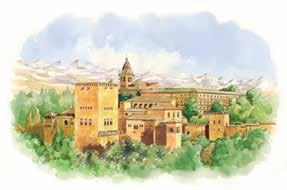
AVAILABLE FOR 2026
ALBANIA • AUSTRIA • BALTIC STATES • BELGIUM CZECH REPUBLIC • EGYPT • FINLAND • FRANCE GERMANY • GREECE • HUNGARY • ITALY • MALTA MOROCCO • NETHERLANDS • NORWAY • OMAN PORTUGAL • SPAIN • SWITZERLAND • TUNISIA TURKEY • UNITED KINGDOM
Speak to an expert: 020 7593 2284 kirkerholidays.com



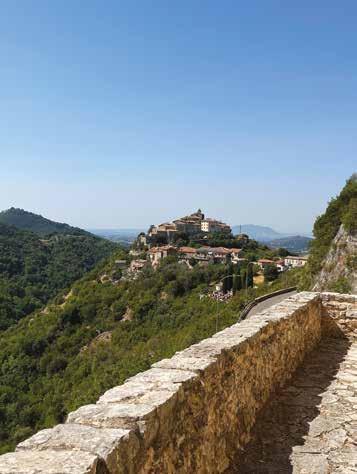
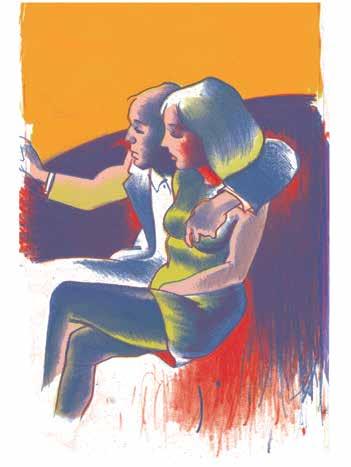
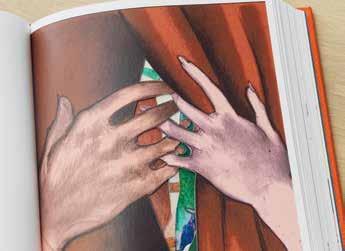
depicts a couple from Huxley’s novel; Jones’s cut-outs create an enticing visual story; the handmade edition boasts a goatskin cover
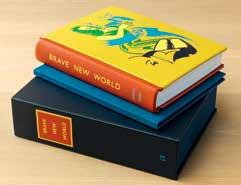
Allen Jones RA on how he created artworks for a new handmade edition of Aldous Huxley’s Brave New World
When I was approached to create new artwork for Aldous Huxley’s Brave New World (1932), the first thing I did was read the book, which I confess I’d never done before. While I knew it was a seminal title, I had thought it was written by George Orwell! I’ve always found that stories about the future seem old fashioned within a few decades because they are trapped in their own time. But Huxley’s dystopia still seems amazingly prescient. Monogamy and the family unit are only practised in remote parts of the world that are visited as tourist attractions. For everyone else, sex is about pleasure rather than procreation, and having babies is done with a test tube. These ideas show how far-sighted Huxley was. I then began looking for connections to imagery I had made in the past, or ideas that have obsessed me over the years. In particular I was drawn to Huxley’s attitude towards sex
and the couple, themes I have been exploring for decades. There is a part of the novel where Bernard and Lenina, two central characters, travel from ‘civilised’ London to a reservation in New Mexico to see the monogamous people (above, left). This section appealed to me because it reminded me of a road trip I had taken during the 1960s having just moved to New York. One day the Pop artist Peter Phillips rang me and said, ‘Hey, I’ve been given a car for free. Why don’t we take a ride?’ I cancelled a teaching job I had lined up and we drove across the US. While travelling through the desert we stopped at a Native American reservation, which had become a tourist attraction. Having seen how this traditional way of life was treated as a spectacle, I felt I had a sense of what Huxley was writing about. Every part of the new edition, from the binding to the goatskin cover and box, is
handmade (above). It took almost two years and the work of many craftsmen to complete, and I produced 29 colour illustrations and 24 black-and-white drawings. To depict the journey to the reservation, I made a series of drawings which later became a 12-page sequence of colour prints that unfold like a story, taking you from the woods into the village, then down the street to the kiva (a chamber used for religious rites) at the end. Each page has a cut-out element to give you a peek at what comes next (above).
My artworks are digitally printed. I am a printmaker and for me, printing has always been a messy, hands-on process, so working digitally was a new experience. I made excursions to the Cotswolds to visit the printer Leslie Gerry, in a house that looked like a Dürer woodcut, complete with a thatched roof – but in the attic he had a state-of-the-art inkjet printer. I produced my drawings on Mylar (transparent polyester film), and by printing overlays we built up layers of colour. It was an intriguing process, and along the way I came to terms with the ‘brave new world’ of modern print technology.
As told to Rosanna McLaughlin Brave New World by Aldous Huxley, illustrated by Allen Jones RA, is available for pre-order from Areté Editions
Protect the future of the Royal Academy with a gift in your will
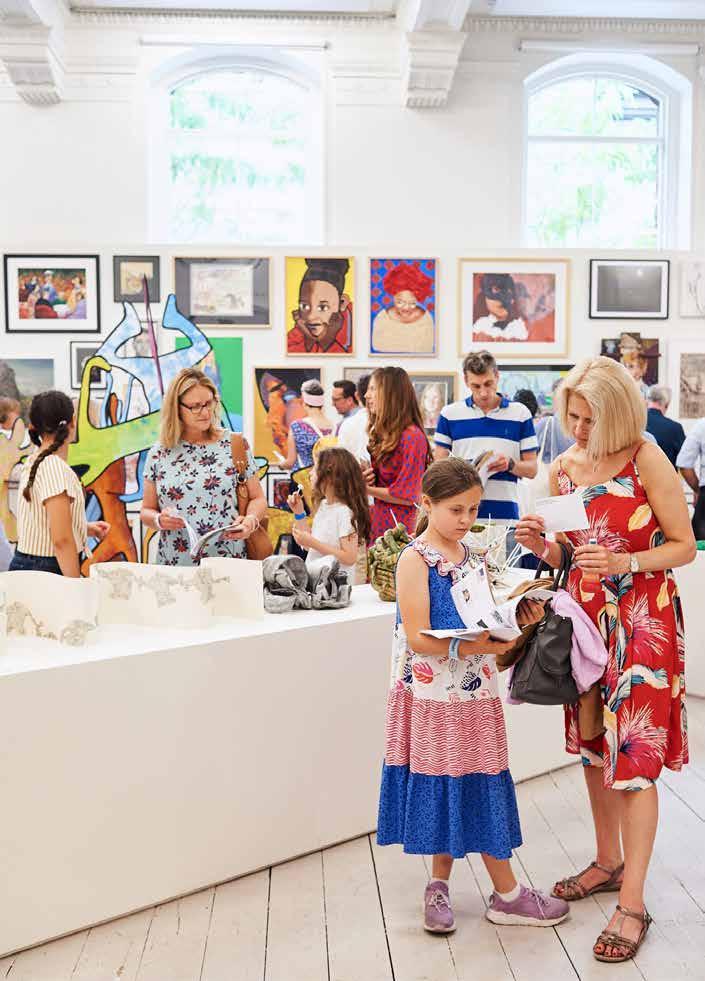
For over 250 years, the Royal Academy of Arts has given art lovers a sense of wonder; artists the chance to create. Together we’ve been absorbed in past masterpieces and inspired by future marvels. With a gift in your will, you could help the Royal Academy to make, debate and exhibit art in the years to come.
To find out more, please email legacies@royalacademy.org.uk
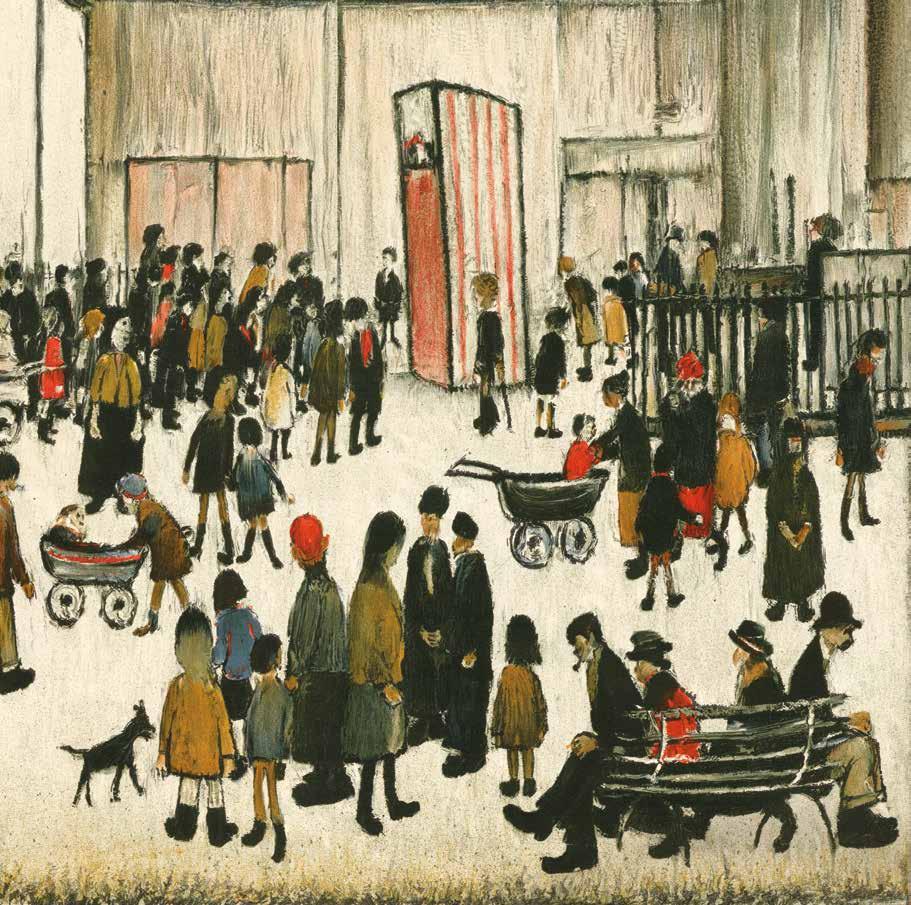
A landmark series by some of the most important artists of the twentieth century. Published in 1946/47, these are not later reproductions. We have thirty different prints in stock, all are in mint condition. Price range: £150 – £2,250
our films, view our full range of school prints & buy online at